





No CrossRef data available.
Article contents
Controlled mean dynamics of red blood cells by two orthogonal ultrasonic standing waves
Published online by Cambridge University Press: 11 January 2024
Abstract
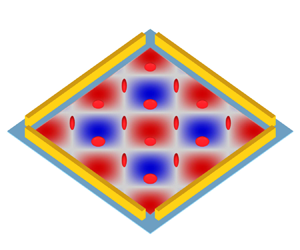
A computational model is developed to study the time-averaged mean dynamics of red blood cells (RBCs) driven by the time-averaged mean stress generated by two phase-shifted orthogonal ultrasonic standing waves in a viscous fluid. The cell is modelled as an ellipsoidal viscoelastic membrane enclosing the viscous fluid cytoplasm, the motion of which is described by the inclination angle of the ellipsoidal cell shape and the phase angle of the potential membrane cycle. Based on the acoustic perturbation method, the acoustic field and acoustic streaming field are solved to obtain the time-averaged mean stress, and then the temporal evolution equations of the inclination and phase angles of the cell are determined considering the torque balance and energy conservation. At a small acoustic pressure amplitude, this model reproduces the experimentally observed features of cell motion in orthogonal standing waves: the transition from steady stationary orientation to unsteady tumbling with the increase of the phase difference between the two standing waves. By turning up the acoustic pressure amplitude above a critical value, it is further predicted that the previously observed motions can be accompanied by the membrane tank-treading rotation. Observations of these motions, combined with the present computational model, can help to evaluate the mechanical properties of RBC membranes in an automated and high-throughput manner by acoustic methods.
Information
- Type
- JFM Papers
- Information
- Copyright
- © The Author(s), 2024. Published by Cambridge University Press
References
Abkarian, M., Faivre, M. & Viallat, A. 2007 Swinging of red blood cells under shear flow. Phys. Rev. Lett. 98 (18), 188302.CrossRefGoogle ScholarPubMed
Baasch, T., Qiu, W. & Laurell, T. 2022 Gap distance between pearl chains in acoustic manipulation. Phys. Rev. Appl. 18 (1), 014021.10.1103/PhysRevApplied.18.014021CrossRefGoogle Scholar
Bach, J.S. & Bruus, H. 2020 Suppression of acoustic streaming in shape-optimized channels. Phys. Rev. Lett. 124 (21), 214501.10.1103/PhysRevLett.124.214501CrossRefGoogle ScholarPubMed
Bagchi, P., Johnson, P.C. & Popel, A.S. 2005 Computational fluid dynamic simulation of aggregation of deformable cells in a shear flow. Trans. ASME J. Biomech. Engng 127 (7), 1070–1080.CrossRefGoogle Scholar
Baudoin, M. & Thomas, J.L. 2020 Acoustic tweezers for particle and fluid micromanipulation. Annu. Rev. Fluid Mech. 52, 205–234.CrossRefGoogle Scholar
Bernard, I., Doinikov, A.A., Marmottant, P., Rabaud, D., Poulain, C. & Thibault, P. 2017 Controlled rotation and translation of spherical particles or living cells by surface acoustic waves. Lab on a Chip 17 (14), 2470–2480.CrossRefGoogle ScholarPubMed
Bruus, H. 2012 Acoustofluidics 2: perturbation theory and ultrasound resonance modes. Lab on a Chip 12 (1), 20–28.10.1039/C1LC20770ACrossRefGoogle ScholarPubMed
Busse, F.H. & Wang, T.G. 1981 Torque generated by orthogonal acoustic waves - theory. J. Acoust. Soc. Am. 69 (6), 1634–1638.CrossRefGoogle Scholar
Chan, F.K., Bhosale, Y., Parthasarathy, T. & Gazzola, M. 2022 Three-dimensional geometry and topology effects in viscous streaming. J. Fluid Mech. 933, A53.CrossRefGoogle Scholar
Collins, D.J., Morahan, B., Garcia-Bustos, J., Doerig, C., Plebanski, M. & Neild, A. 2015 Two-dimensional single-cell patterning with one cell per well driven by surface acoustic waves. Nat. Commun. 6, 9686.CrossRefGoogle ScholarPubMed
Dao, M., Lim, C.T. & Suresh, S. 2003 Mechanics of the human red blood cell deformed by optical tweezers. J. Mech. Phys. Solids 51 (11–12), 2259–2280.CrossRefGoogle Scholar
Daza, R., Gonzalez-Bermudez, B., Cruces, J., de la Fuente, M., Plaza, G.R., Arroyo- Hernandez, M., Elices, M., Perez-Rigueiro, J. & Guinea, G.V. 2019 Comparison of cell mechanical measurements provided by Atomic Force Microscopy (AFM) and Micropipette Aspiration (MPA). J. Mech. Behav. Biomed. Mater. 95, 103–115.CrossRefGoogle ScholarPubMed
Deschamps, J., Kantsler, V., Segre, E. & Steinberg, V. 2009 Dynamics of a vesicle in general flow. Proc. Natl Acad. Sci. USA 106 (28), 11444–11447.CrossRefGoogle ScholarPubMed
Drinkwater, B.W. 2020 A perspective on acoustical tweezers-devices, forces, and biomedical applications. Appl. Phys. Lett. 117 (18), 180501.CrossRefGoogle Scholar
Dupire, J., Abkarian, M. & Viallat, A. 2015 A simple model to understand the effect of membrane shear elasticity and stress-free shape on the motion of red blood cells in shear flow. Soft Matt. 11 (42), 8372–8382.CrossRefGoogle ScholarPubMed
Efremov, Y.M., Wang, W.H., Hardy, S.D., Geahlen, R.L. & Raman, A. 2017 Measuring nanoscale viscoelastic parameters of cells directly from AFM force-displacement curves. Sci. Rep. 7, 1541.CrossRefGoogle ScholarPubMed
Fabre, D., Jalal, J., Leontini, J.S. & Manasseh, R. 2017 Acoustic streaming and the induced forces between two spheres. J. Fluid Mech. 810, 378–391.CrossRefGoogle Scholar
Fornal, M., Korbut, R.A., Lekka, M., Pyka-Fosciak, G., Wizner, B., Styczen, J. & Grodzicki, T. 2008 Rheological properties of erythrocytes in patients with high risk of cardiovascular disease. Clin. Hemorheol. Microcirc. 39 (1–4), 213–219.CrossRefGoogle ScholarPubMed
Gossett, D.R., Tse, H.T.K., Lee, S.A., Ying, Y., Lindgren, A.G., Yang, O.O., Rao, J.Y., Clark, A.T. & di Carlo, D. 2012 Hydrodynamic stretching of single cells for large population mechanical phenotyping. Proc. Natl Acad. Sci. USA 109 (20), 7630–7635.CrossRefGoogle ScholarPubMed
Haase, K. & Pelling, A.E. 2015 Investigating cell mechanics with atomic force microscopy. J. R. Soc. Interface 12 (104), 20140970.CrossRefGoogle ScholarPubMed
Hahn, P., Lamprecht, A. & Dual, J. 2016 Numerical simulation of micro-particle rotation by the acoustic viscous torque. Lab on a Chip 16 (23), 4581–4594.CrossRefGoogle ScholarPubMed
Hamilton, M.F., Ilinskii, Y.A. & Zabolotskaya, E.A. 2003 Acoustic streaming generated by standing waves in two-dimensional channels of arbitrary width. J. Acoust. Soc. Am. 113 (1), 153–160.CrossRefGoogle ScholarPubMed
Hartono, D., Liu, Y., Tan, P.L., Then, X.Y.S., Yung, L.Y.L. & Lim, K.M. 2011 On-chip measurements of cell compressibility via acoustic radiation. Lab on a Chip 11 (23), 4072–4080.CrossRefGoogle ScholarPubMed
Henriksen, J.R. & Ipsen, J.H. 2004 Measurement of membrane elasticity by micro-pipette aspiration. Eur. Phys. J. E 14 (2), 149–167.CrossRefGoogle ScholarPubMed
Keller, S.R. & Skalak, R. 1982 Motion of a tank-treading ellipsoidal particle in a shear flow. J. Fluid Mech. 120, 27–47.CrossRefGoogle Scholar
Lee, C.P. & Wang, T.G. 1989 Near-boundary streaming around a small sphere due to 2 orthogonal standing waves. J. Acoust. Soc. Am. 85 (3), 1081–1088.CrossRefGoogle Scholar
Li, P., et al. 2015 Acoustic separation of circulating tumor cells. Proc. Natl Acad. Sci. USA 112 (16), 4970–4975.CrossRefGoogle ScholarPubMed
Liu, Y.F. & Xin, F.X. 2023 a Deformation dynamics of spherical red blood cells in viscous fluid driven by ultrasound. Phys. Fluids 35 (1), 012011.CrossRefGoogle Scholar
Liu, Y.F. & Xin, F.X. 2023 b Shape dynamics of capsules in two phase-shifted orthogonal ultrasonic standing waves: a numerical investigation. J. Fluid Mech. 964, A18.CrossRefGoogle Scholar
Mendez, S. & Abkarian, M. 2018 In-plane elasticity controls the full dynamics of red blood cells in shear flow. Phys. Rev. Fluids 3 (10), 101101.CrossRefGoogle Scholar
Mignon, T. & Mendez, S. 2021 A theoretical investigation of the frisbee motion of red blood cells in shear flow. Math. Model. Nat. Phenom. 16, 2021014.CrossRefGoogle Scholar
Mills, J.P., Qie, L., Dao, M., Lim, C.T. & Suresh, S. 2004 Nonlinear elastic and viscoelastic deformation of the human red blood cell with optical tweezers. Mech. Chem. Biosys. 1 (3), 169–180.Google ScholarPubMed
Mishra, P., Hill, M. & Glynne-Jones, P. 2014 Deformation of red blood cells using acoustic radiation forces. Biomicrofluidics 8 (3), 034109.CrossRefGoogle ScholarPubMed
Muller, P.B., Barnkob, R., Jensen, M.J.H. & Bruus, H. 2012 A numerical study of microparticle acoustophoresis driven by acoustic radiation forces and streaming-induced drag forces. Lab on a Chip 12 (22), 4617–4627.CrossRefGoogle ScholarPubMed
Nama, N., Barnkob, R., Mao, Z.M., Kahler, C.J., Costanzo, F. & Huang, T.J. 2015 Numerical study of acoustophoretic motion of particles in a PDMS microchannel driven by surface acoustic waves. Lab on a Chip 15 (12), 2700–2709.CrossRefGoogle Scholar
Nama, N., Huang, T.J. & Costanzo, F. 2017 Acoustic streaming: an arbitrary Lagrangian-Eulerian perspective. J. Fluid Mech. 825, 600–630.CrossRefGoogle ScholarPubMed
Noguchi, H. 2010 Dynamic modes of microcapsules in steady shear flow: effects of bending and shear elasticities. Phys. Rev. E 81 (5), 056319.CrossRefGoogle ScholarPubMed
Otto, O., et al. 2015 Real-time deformability cytometry: on-the-fly cell mechanical phenotyping. Nat. Meth. 12 (3), 199–202.CrossRefGoogle ScholarPubMed
Prado, G., Farutin, A., Misbah, C. & Bureau, L. 2015 Viscoelastic transient of confined red blood cells. Biophys. J. 108 (9), 2126–2136.CrossRefGoogle ScholarPubMed
Rednikov, A.Y., Riley, N. & Sadhal, S.S. 2003 The behaviour of a particle in orthogonal acoustic fields. J. Fluid Mech. 486, 1–20.CrossRefGoogle Scholar
Rezghi, A. & Zhang, J.F. 2022 Tank-treading dynamics of red blood cells in shear flow: on the membrane viscosity rheology. Biophys. J. 121 (18), 3393–3410.CrossRefGoogle ScholarPubMed
Schwarz, T., Hahn, P., Petit-Pierre, G. & Dual, J. 2015 Rotation of fibers and other non-spherical particles by the acoustic radiation torque. Microfluid Nanofluid 18 (1), 65–79.CrossRefGoogle Scholar
Settnes, M. & Bruus, H. 2012 Forces acting on a small particle in an acoustical field in a viscous fluid. Phys. Rev. E 85 (1), 016327.CrossRefGoogle Scholar
Silva, G.T., Tian, L.F., Franklin, A., Wang, X.J., Han, X.J., Mann, S. & Drinkwater, B.W. 2019 Acoustic deformation for the extraction of mechanical properties of lipid vesicle populations. Phys. Rev. E 99 (6), 063002.CrossRefGoogle ScholarPubMed
Sinha, K.P. & Thaokar, R.M. 2018 Effect of ac electric field on the dynamics of a vesicle under shear flow in the small deformation regime. Phys. Rev. E 97 (3), 032404.CrossRefGoogle ScholarPubMed
Suresh, S., Spatz, J., Mills, J.P., Micoulet, A., Dao, M., Lim, C.T., Beil, M. & Seufferlein, T. 2005 Connections between single-cell biomechanics and human disease states: gastrointestinal cancer and malaria. Acta Biomater. 1 (1), 15–30.CrossRefGoogle ScholarPubMed
Tsubota, K.I. 2021 Elongation deformation of a red blood cell under shear flow as stretch testing. J. Mech. Phys. Solids 152, 104345.CrossRefGoogle Scholar
Urbanska, M., Rosendahl, P., Krater, M. & Guck, J. 2018 High-throughput single-cell mechanical phenotyping with real-time deformability cytometry. Methods Cell. Biol. 147, 175–198.CrossRefGoogle ScholarPubMed
Vlahovska, P.M., Podgorski, T. & Misbah, C. 2009 Vesicles and red blood cells in flow: from individual dynamics to rheology. C. R. Phys. 10 (8), 775–789.CrossRefGoogle Scholar
Xie, Y.L., Bachman, H. & Huang, T.J. 2019 Acoustofluidic methods in cell analysis. Trac-Trends Anal. Chem. 117, 280–290.CrossRefGoogle ScholarPubMed
Xin, F.X. & Lu, T.J. 2016 Acoustomechanical constitutive theory for soft materials. Acta Mechanica Sin. 32 (5), 828–840.CrossRefGoogle Scholar
Ye, H.L., Huang, H.B., Sui, Y. & Lu, X.Y. 2016 Dynamics of a nonspherical capsule in general flow. Comput. Fluids 134, 31–40.CrossRefGoogle Scholar
Zhang, L.K. & Marston, P.L. 2014 Acoustic radiation torque on small objects in viscous fluids and connection with viscous dissipation. J. Acoust. Soc. Am. 136 (6), 2917–2921.CrossRefGoogle ScholarPubMed