


Impact statement
Intergovernmental and multinational negotiations frequently take place to address global environmental problems. The Intergovernmental Negotiating Committee on Plastic Pollution was tasked with coordinating United Nations Member States to develop a treaty to end plastic pollution. In this article, we critically highlight issues related to equality and justice in the most recent negotiation session in Geneva in August 2025. Equality and justice are central to several key topics of the treaty, as developing States as well as vulnerable and marginalized communities are disproportionately impacted by plastic pollution. Those States and communities have fewer resources and capacities to participate in negotiations. We describe several aspects that contributed to injustice during the negotiation process: Small delegations of developing States, underrepresented vulnerable and marginalized communities, overrepresented lobbyists from petrochemical industries, and the process of negotiation meetings. The insights from these processes of the plastics treaty negotiations could be transferred to other international negotiation sessions.
Introduction
Plastics have severe impacts on ecosystems, human health and economies throughout their whole lifecycle, from fossil fuel extraction to end-of-life management/mismanagement (Macleod et al., Reference MacLeod, Arp, Tekman and Jahnke2021; Cabernard et al., Reference Cabernard, Pfister, Oberschelp and Hellweg2022; Landrigan et al., Reference Landrigan, Dunlop, Treskova, Raps, Symeonides, Muncke, Spring, Stegeman, Carney Almroth, Chiles, Cropper, Deeney, Fuller, Geyer, Karasik, Mafira, Mangwiro, Margaret Matias, Mulders, Park, Velis, Vermeulen, Wagner, Wang, Whitman, Woodruff and Rocklöv2025). Plastic pollution affects developing countries disproportionately (Dauvergne, Reference Dauvergne2023) with, for example, small island developing StatesFootnote 1 (SIDS) bearing disproportional effects of plastic production-associated climate change and coastal/marine pollution (Farrelly et al., Reference Farrelly, Borrelle and Fuller2021). Moreover, vulnerable groups, including indigenous peoples, informal waste workers/pickers and women, are particularly affected by the diverse burdens of plastic pollution, affecting their health and livelihoods (Karasik et al., Reference Karasik, Lauer, Baker, Lisi, Somarelli, Eward, Fürst and Dunphy-Daly2023; Stoett et al., Reference Stoett, Scrich, Elliff, Andrade, Grilli and Turra2024; Landrigan et al., Reference Landrigan, Dunlop, Treskova, Raps, Symeonides, Muncke, Spring, Stegeman, Carney Almroth, Chiles, Cropper, Deeney, Fuller, Geyer, Karasik, Mafira, Mangwiro, Margaret Matias, Mulders, Park, Velis, Vermeulen, Wagner, Wang, Whitman, Woodruff and Rocklöv2025).
Several national and international regulations aimed at curbing plastic pollution (Maes et al., Reference Maes, Wienrich, Weiand and Cowan2023) have culminated in global ambitions to address this ubiquitous and transboundary problem: The adoption of United Nations Environment Assembly Resolution 5/14 (UNEP, 2022) mandates negotiations of a globally binding instrument to end plastic pollution (commonly called the Global Plastics Treaty). An Intergovernmental Negotiating Committee (INC; UNEP, 2025a) is heading the negotiation process, and since 2022 six negotiation sessions have been concluded without reaching an agreement. The INC process was originally intended to be conducted over five negotiation sessions beginning with INC-1 in Punta del Este, Uruguay in December 2022, and culminating at INC-5 in Busan, Republic of Korea (Arora et al., Reference Arora, March, Nieminen, Shejuti and Walker2024). However, INC-5 ended without reaching an agreement for a Global Plastics Treaty due to immense divergence among member States. This resulted in the Chair announcing the need for another “final” negotiation session (INC-5.2) in Geneva, Switzerland in August 2025, which also ended without an agreement (Kantai et al., Reference Kantai, Fernandez, Hovden and Laurens2025a).
During the plastics treaty negotiations, two divergent positions emerged. A total of 97 States, from diverse cultural, socioeconomic and geographic backgrounds, led by the “High Ambition Coalition” (HAC, n.d.), emphasized the need for an ambitious treaty with globally binding measures covering the whole plastics lifecycle (MTEBFMP, 2025) prior to and during INC-5.2. These measures included plastic production caps, regulation of plastic products of concern and associated chemicals of concern, establishing financial mechanisms to support transformation and considering human health aspects of plastic pollution (Arora et al., Reference Arora, March, Nieminen, Shejuti and Walker2024; Kantai et al., Reference Kantai, Fernandez, Hovden and Laurens2025a). This position was largely supported by the aforementioned vulnerable groups. It was opposed by most fossil fuel-producing States, led by Saudi Arabia, Iran, Russia and the United States, which framed the plastic pollution treaty principally as a waste management problem and stalled advances of treaty negotiations, for example, by reverting to discuss rules of procedure and rejecting entire treaty articles (Gonçalves et al., Reference Gonçalves, Webster, Grilli, Elliff, Scrich, Lopes and Turra2024; Tiller et al., Reference Tiller, Cowan, Ahlquist and Tiller2024; Dauvergne et al., Reference Dauvergne, Allan, Beaudoin, Almroth, Clapp, Cowan, de Groot, Farrelly, de Miranda Grili, Mah, Mendenhall, Paik, Ralston, Stoett, Stöfen-O’Brien, Taggat, Tiller, Villarubia-Gómez and Vince2025a; Reference Dauvergne, Ralston, Clapp and Taggart2025b). The petrochemical and plastic-producing industry largely aligned with the position of these latter States and was generally well represented throughout the plastics treaty negotiations (CIEL, 2025; Dauvergne et al., Reference Dauvergne, Ralston, Clapp and Taggart2025b).
The representation of these positions by States with differing economic and political power (within both factions), as well as the differing representation of nonstate interest groups, raises questions about fairness and equality in plastic treaty negotiations. Dauvergne (Reference Dauvergne2023) highlighted the importance of justice in treaty negotiations, emphasizing the impact of pollution on developing States and marginalized communities. In this article, we identify three equity- and equality-related barriers to achieving a legally binding Global Plastics Treaty aimed at ending plastic pollution (UNEP, 2022): (1) insufficient representation of developing States and marginalized groups, (2) the influence of large corporations and (3) procedural injustices arising from the treaty’s processes and organizational negotiation structure.
Underrepresented developing States and marginalized groups
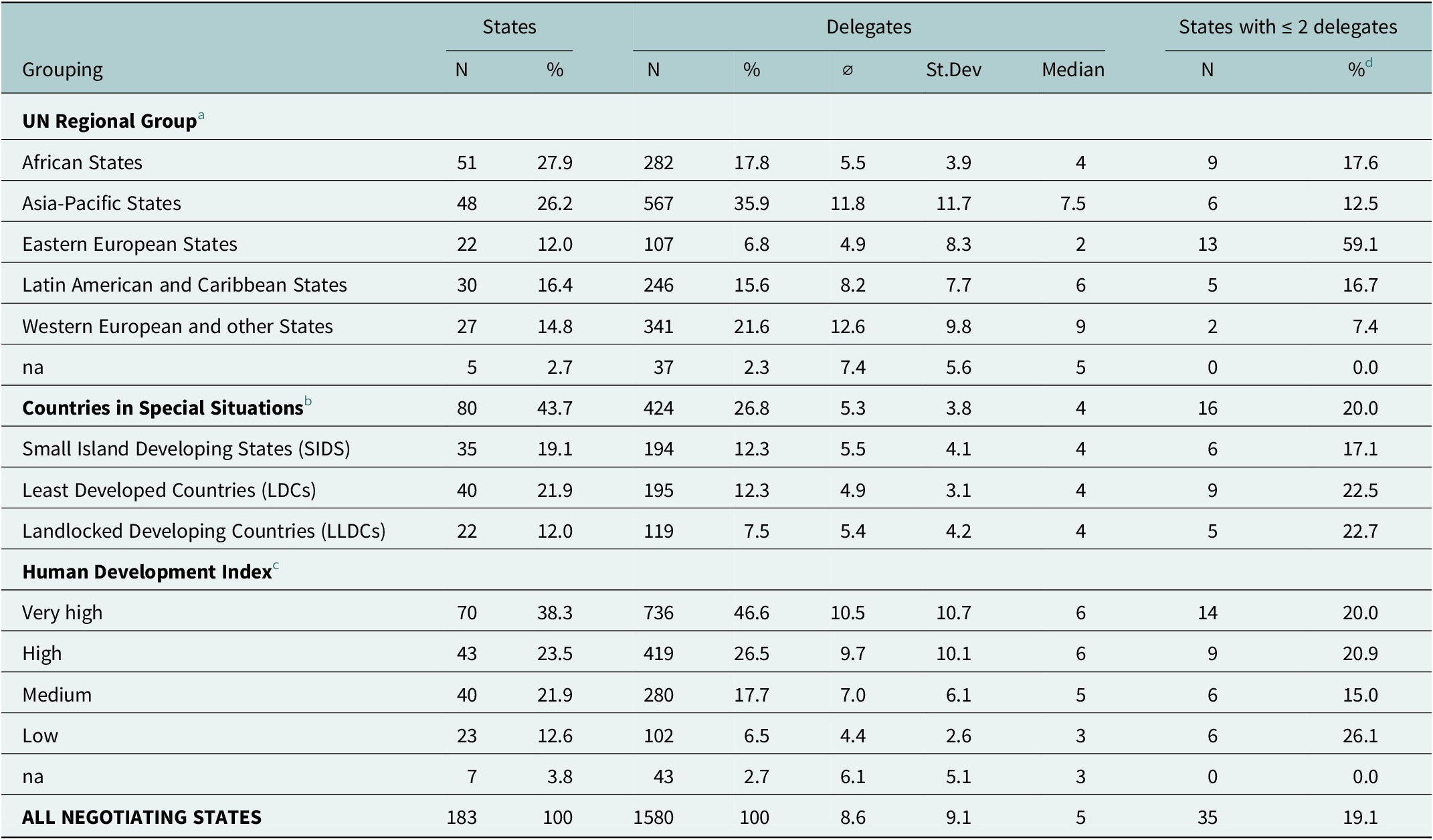
Developing States were underrepresented in the treaty negotiations: a total of 1580 delegates had been registered to participate at INC-5.2 (UNEP, 2025b; see Supplementary material S1). While African States, as the largest UN Regional Group, represented 28% of UN States, they registered only 18% of delegates (Table 1). Countries in Special Situations (comprised of SIDS, least developed countries (LDCs), and landlocked developing countries (LLDCs; UN, 2024a, 2024b), were especially underrepresented, making up 44% of States, but having only registered 27% of delegates. Moreover, the average registered size of these delegations was consistently under six, with 20% of them consisting of two or fewer delegates. This imbalance was also reflected when considering the Human Development Index (HDI): States with a very high index registered more than twice the numbers of delegates per country compared to States with a low index (Table 1).
Number (N), proportion (%) and average (⌀) of delegates of States per category (UN Regional Group, Countries in Special Situations and Human Development Index). Delegates refers to persons registered through States, regardless of their position, function and affiliation and therefore also includes, for example, researchers, industry representatives and representatives from nongovernmental organizations as part of delegations. Details for each state can be seen in the Supplementary Material S1. na values = States not assigned to respective categories or no data available for grouping

This is concerning, as it has been shown that these States are also unable to adequately prepare for INC negotiations, for example, due to a lack of funding, capacity-building and the availability of and access to research (e.g., Ambrose, Reference Ambrose2024). In addition, despite having enabled ambitious legislation (Knoblauch et al., Reference Knoblauch, Mederake and Stein2018; Barrowclough and Eugui, Reference Barrowclough and Vivas Eugui2021), developing and island States suffer especially from excessive plastic pollution through intentional exports of plastic waste by developed States (Wang et al., Reference Wang, Zhao, Lim, Chen and Sutherland2020) and incidental pollution distributed, for example, by rivers and ocean currents (Chenillat et al., Reference Chenillat, Huck, Maes, Grima and Blanke2021; González-Fernández et al., Reference González-Fernández, Cózar, Hanke, Viejo, Morales-Caselles, Bakiu, Barceló, Bessa, Bruge, Cabrera, Castro-Jiménez, Constant, Crosti, Galleti, Kideys, Machitadze, de Brito, Pogojeva, Ratola, Riguiera, Rojo-Nieto, Savenko, Schöneich-Argent, Siedlewicz, Suaria and Tourgeli2021), with both phenomena regarded as “waste colonialism” by Stoett (Reference Stoett and Gündoğdu2024).
Similarly, some populations especially affected by plastic pollution are chronically underrepresented in multilateral negotiations (e.g., Aguilar Delgado and Perez-Aleman, Reference Aguilar Delgado and Perez-Aleman2021), including the past and current INCs, both by being omitted from the treaty text but also in terms of participation in the negotiations. For example, at INC-5.2, indigenous peoples were represented by only 36 members of the “International Indigenous Peoples’ Forum on Plastics” (CIEL, 2025) and have denounced a lack of financial and logistic support for participating in the negotiations as well as the lack of recognition of human and particularly indigenous peoples’ rights in the treaty (Almroth et al., Reference Almroth, de Miranda Grilli and Stoett2025; IIPFP, 2025; Jacobs, Reference Jacobs2025; Liboroin, Reference Liboiron2025). Informal waste pickers, around 40 million people worldwide who collect a substantial amount of plastic waste for recycling (Cook et al., Reference Cook, de Souza Lima Cano and Velis2024; O’Hare and Talbott, Reference O’Hare and Talbott2025), work in precarious economic conditions and face direct exposure to hazardous plastic waste (Karasik et al., Reference Karasik, Lauer, Baker, Lisi, Somarelli, Eward, Fürst and Dunphy-Daly2023). Although they have built alliances to strengthen their negotiating power with governments and businesses and gained significant visibility (O’Hare and Nøklebye, Reference O’Hare and Nøklebye2024), the “International Alliance of Waste Pickers,” representing about 460,000 workers from 34 countries, was represented by only nine members and four staff at INC-5.2 (IAWP, 2025). Their key demand is a just transition with direct funding access to safeguard their livelihoods (IAWP, 2024; O’Hare and Nøklebye, Reference O’Hare and Nøklebye2024). The “Women’s Major Group” and the “Youth Peace Ambassadors Network” (YPAN) also pointed out a lack of representation at INC-5.2 and a lack of acknowledgment in the treaty text for women and future generations (WECF, 2023; WMG, 2025; YPAN, 2025).
Big business influence on treaty negotiations
While several environmental, youth advocacy and indigenous people’s organizations, networks and alliances were present at INC-5.2 (UNEP, 2025b), actors with vested financial interests, namely fossil fuel, petrochemical, plastic manufacturing and food and beverage companies exerted strong influence during INC plastics treaty negotiations (Dauvergne et al., Reference Dauvergne, Ralston, Clapp and Taggart2025b; Ralston and Taggart, Reference Ralston and Taggart2025a). For INC-5.2, CIEL (2025) reported that at least 234 fossil fuel and chemical industry lobbyists were registered to participate, 19 of whom were part of official state delegations. Collectively, lobbyists from the chemical and fossil fuel industries therefore clearly outnumbered delegates of several groups of States, particularly SIDS, LDCs, LLDCs and those with a low HDI (Table 1).
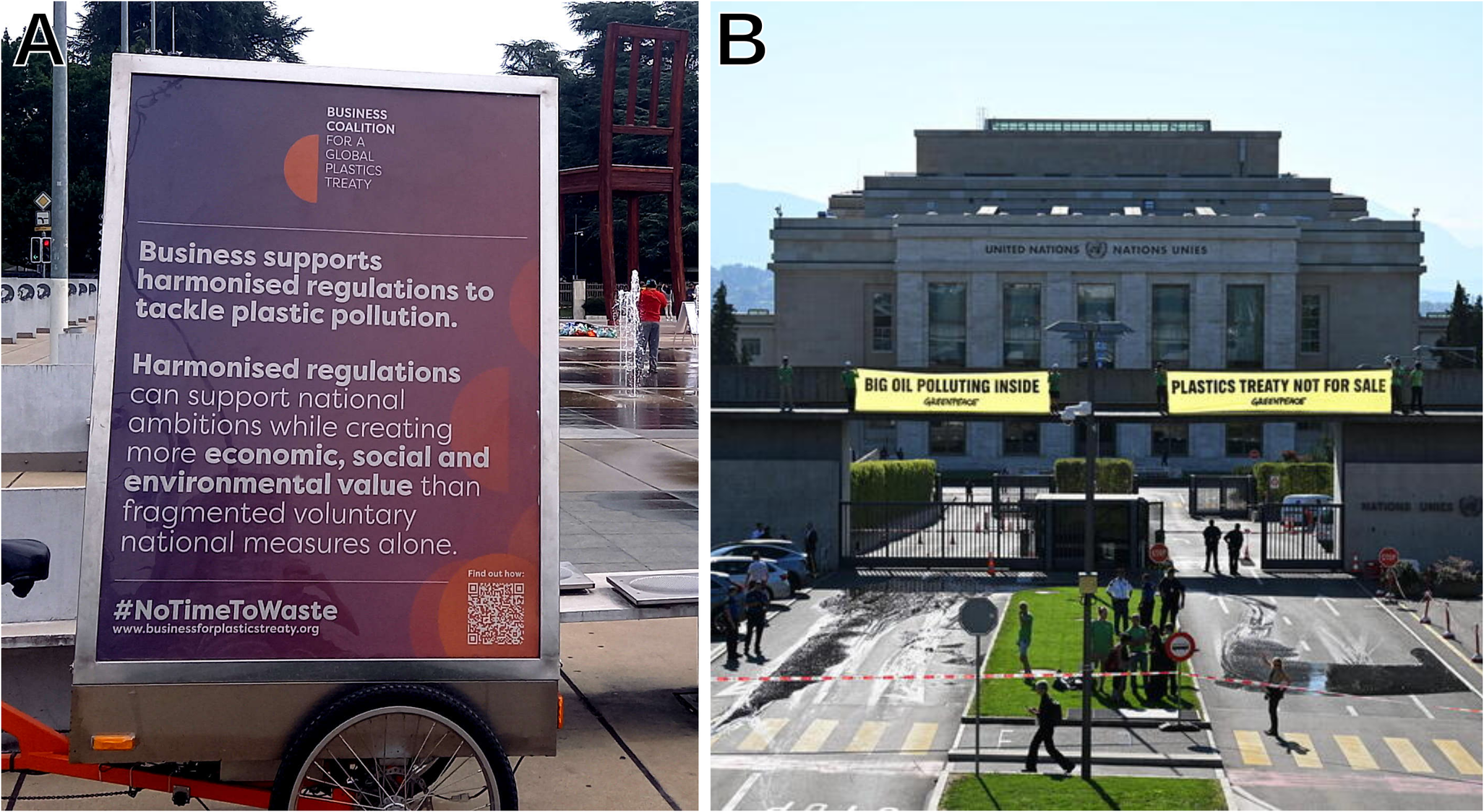
There are multiple ways in which lobbyists, as participants exerted influence during the negotiations, for example, by seeking audiences with delegates “in the corridors” (personal observation), by speaking during plenaries (Kantai et al. Reference Kantai, Fernandez, Hovden and Laurens2025b), by organizing side events accompanying the negotiations (Geneva Environment Network, 2025), by advertisements associating themselves with social responsibility (Figure 1a) and by perpetuating lobbying bodies that intentionally reframe vocabulary (such as the “Fair Circularity Initiative”) and associate themselves with marginalized peoples, such as waste pickers (O’Hare and Nøklebye, Reference O’Hare and Nøklebye2024; Ralston and Taggart, Reference Ralston and Taggart2025a).
(a) Bicycle advertisement by the “Business Coalition for a Global Plastics Treaty,” parked in front of the main entrances to the Palais de Nations in Geneva, where the INC 5.2 negotiations took place. Photo by Tim Kiessling, Creative Commons license CC BY NC 4.0. (b) Banners and black paint in front of the Palais de Nations, coordinated by Greenpeace, to call attention to business influence on the negotiations. © Samuel Schalch/Greenpeace, used with permission.

During recent years, the industry has engaged in “hedging strategies” to minimize impacts on their business model due to regulation (Ralston and Taggart, Reference Ralston and Taggart2025a), rejecting direct responsibility for plastic pollution and emphasizing consumer responsibility (da Costa, Reference da Costa2023; Vandenberg, Reference Vandenberg2024). Companies belonging to the “Business Coalition for a Global Plastics Treaty” and the “Fair Circularity Initiative” are among the main global plastic polluters (Biyani et al., Reference Biyani, Adhikari, Driver, Sheehan and Halden2025). While attention to the influence of business was called out by various organizations during the negotiations (CIEL, 2025; Figure 1b), its potential impact can hardly be overstated, given the number of business representatives, the ample opportunities to engage in treaty-negotiation formats and their alignment with positions postulated by petrochemical States (Dauvergne et al., Reference Dauvergne, Allan, Beaudoin, Almroth, Clapp, Cowan, de Groot, Farrelly, de Miranda Grili, Mah, Mendenhall, Paik, Ralston, Stoett, Stöfen-O’Brien, Taggat, Tiller, Villarubia-Gómez and Vince2025a, Reference Dauvergne, Ralston, Clapp and Taggart2025b; Ralston and Taggart, Reference Ralston and Taggart2025a). Ralston and Taggart (Reference Ralston and Taggart2025b) also caution about UNEP’s decision to support market-driven approaches to the plastic-pollution crisis and its emphasis to attract private investment.
Organizational matters and procedural justice
The organization of the INC sessions and their funding affected equal opportunities for participation: During the opening plenary of INC-5.2, Ghana voiced concerns regarding the simultaneous organization of specific contact groups, because of limited funds and an insufficient number of delegates of African States (Kantai et al., Reference Kantai, Fernandez, Hovden and Laurens2025b; UN Web TV, 2025). Usually, two contact-group meetings were scheduled simultaneously, representing the main format of engagement among delegates with admission of other participants/observers. In addition, informal meetings to facilitate state-to-state negotiations (without observers) frequently overlapped with contact groups and with each other, effectively excluding smaller delegations (UNEP, 2025c). In the final days of the INC-5.2 negotiations there was also mounting confusion among delegates due to scheduling issues for contact-group meetings and other negotiation formats as well as treaty-text drafts (Kantai et al., Reference Kantai, Fernandez, Hovden and Laurens2025c), which disproportionately challenged smaller delegations. Moreover, negotiations often lasted over 12 hours and stretched late into the night (UNEP, 2025c), disadvantaging smaller delegations unable to rotate staff for rest or preparation.
While it is common that States speak on behalf of one another, issue joint statements and are members of formal groups or informal alliances through which they are represented (e.g., the UN Regional Groups, Table 1; Arora et al., Reference Arora, March, Nieminen, Shejuti and Walker2024; Dauvergne et al., Reference Dauvergne, Allan, Beaudoin, Almroth, Clapp, Cowan, de Groot, Farrelly, de Miranda Grili, Mah, Mendenhall, Paik, Ralston, Stoett, Stöfen-O’Brien, Taggat, Tiller, Villarubia-Gómez and Vince2025a), the size of delegations is important in environmental negotiations (e.g., Klöck et al., Reference Klöck, Baatz and Wendler2025 for UN climate negotiations): States of Regional Groups do not always coincide in positions, and opportunities to form and maintain formal or informal alliances also depend on the availability of delegates. In total, 35 States (19%) registered two or fewer delegates for the plastics treaty negotiations. Eastern European States, African States, Latin American and Caribbean States and those with a low HDI more often registered delegations equal to or below the critical size of two. In line with the average number of delegates, Western European and other States as well as Asia-Pacific States had mostly delegations larger than two (Table 1). Although the UN Secretariat covered travel costs for up to two delegates of States with limited resources (UNEP, 2024), this again illustrates the challenge of developing States to nominate delegates for INC negotiations. Remarkable is the large proportion of States with delegations of two or fewer persons from Eastern European States (13 States). Six of those States, however, belong to the European Union, which was well represented with 238 delegates (Supplementary Material S2). As mentioned above, the availability of dedicated personnel is not only relevant for in-person participation at INCs but also to be able to prepare for INCs, for example, by obtaining access to scientific expertise, formulating statements and forming alliances (Dauvergne, Reference Dauvergne2023; Ambrose, Reference Ambrose2024).
It has been suggested that reducing the in-person workload, for example, by organizing virtual meetings prior to UN sessions (Klöck et al., Reference Klöck, Baatz and Wendler2025) or allowing video recording during contact groups to process meeting resolutions and prepare for upcoming sessions could enable States with limited funds to engage more efficiently. However, critical decisions are mostly made during informal meetings arranged by the INC Secretariat, as well as during other bilateral or multilateral exchanges in informal settings apart from the official INC sessions. Therefore, States with low in-person representation would continue to be at a disadvantage.
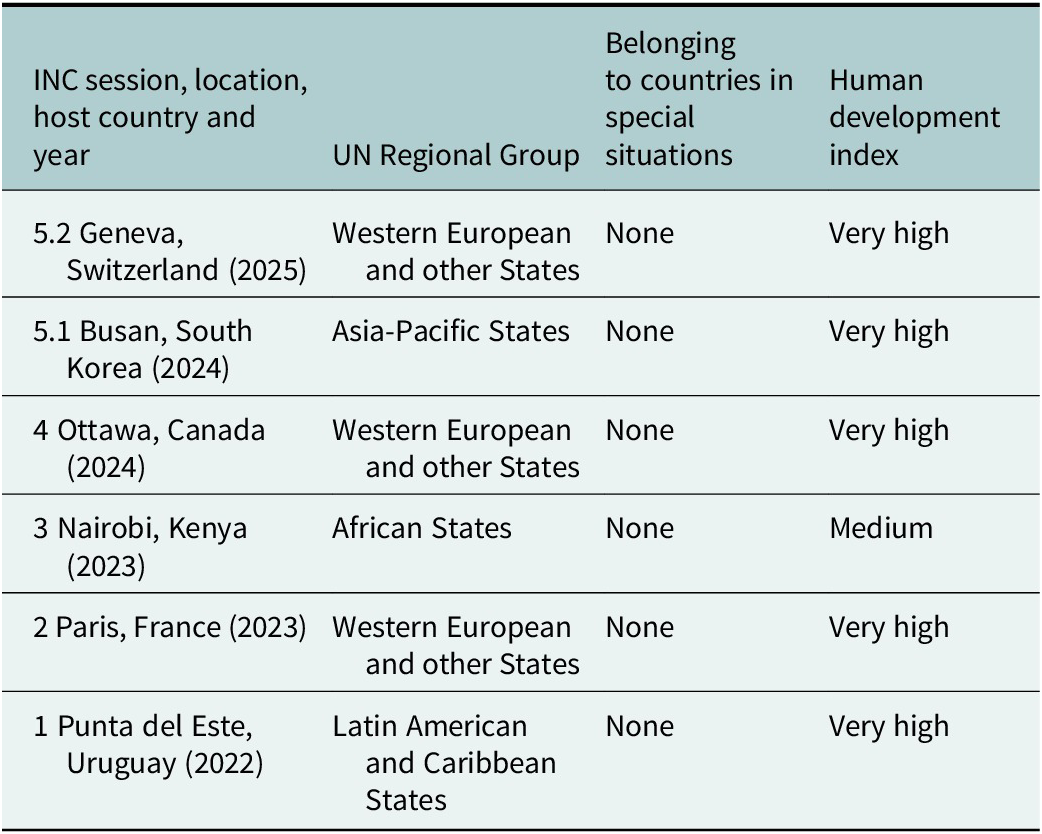
Additionally, the INC sessions have been, with one exception, held in States with a very high HDI and never in States belonging to Countries in Special Situations (Table 2). This further added to the travel costs of delegates and observers from developing and underrepresented States and communities. Hosting, including funding an INC session, “is the responsibility of the host country” (UNEP, 2024), precluding those States with less financial resources to host prestigious UN negotiations.
INC session locations and characterization of States according to different categories

Conclusion
Negotiations of transnational environmental treaties are rarely linear, and to develop an effective global plastics treaty within the set-out timeframe was an ambitious goal (Gonçalves et al., Reference Gonçalves, Webster, Grilli, Elliff, Scrich, Lopes and Turra2024; Vince et al.; Reference Vince, Almroth, de Miranda Grilli, Dwivedi, Stöfen-O’Brien and Beyer2024) – especially as such a text would need to fit into a patchwork of existing national and international legislation (Maes et al., Reference Maes, Wienrich, Weiand and Cowan2023) and consider the impact of plastic pollution on, and the role of, developing States and marginalized people (e.g., Dauvergne, Reference Dauvergne2023; Gonçalves et al., Reference Gonçalves, Webster, Grilli, Elliff, Scrich, Lopes and Turra2024; O’Hare and Nøklebye, Reference O’Hare and Nøklebye2024; Ralston and Taggart, Reference Ralston and Taggart2025b). In this study, we showed that negotiation processes at INC-5.2 were far from being inclusive of positions of these actors due to smaller delegation sizes, the influence of well-represented and well-funded opposing forces and aspects related to procedural justice. A more inclusive treaty process would support developing states with adequate funding and expertise free of vested interests, and raise the visibility of affected populations (e.g., by offering dedicated speaking time in plenaries). Hybrid modes of participation and funding to enable developing States to host INC sessions are further options to be explored. Finally, negotiations related to the plastic pollution crisis could also be moved outside the UN framework and be discussed among ambitious states (Dauvergne and Allan, Reference Dauvergne and Allan2025) in a process that establishes own rules of procedure and procedural justice.
Open peer review
To view the open peer review materials for this article, please visit http://doi.org/10.1017/plc.2025.10037.
Supplementary material
The supplementary material for this article can be found at http://doi.org/10.1017/plc.2025.10037.
Data availability statement
Data in Supplementary Materials and figures presented in this article can be accessed on Zenodo: https://doi.org/10.5281/zenodo.16926222 (link will go live if the manuscript is accepted).
Acknowledgments
Conversations with Diamela de Veer, María de los Angeles Amenabar and two anonymous researchers during the INC-5.2 negotiations have supported the development of this article. We are also grateful to two anonymous reviewers and the editor for helpful suggestions to improve this manuscript!
Author contribution
T.K.: Conceptualization, Data curation, Formal analysis, Writing – original draft, Writing – review & editing. S.R.: Conceptualization, Writing – original draft, Writing – review & editing. K.R.: Data curation, Formal analysis, Writing – review & editing. T.R.W.: Conceptualization, Writing – original draft, Writing – review & editing.
Financial support
T.K., K.R. and T.R.W. volunteered their time and resources to conduct the work presented in this article; no financial support was received. S.R.: The project that gave rise to these results received the support of a fellowship from the “la Caixa” Foundation (ID 100010434)”. The fellowship code is LCF/BQ/PI24/12040006.
Competing interests
All authors declare that they have no known competing interests or personal relationships that could have appeared to influence the work presented in this article.


 Open access


Comments
Dear Editor at Cambridge Prisms: Plastics,
in this submission we detailed and analysed components of injustice that were present during the INC-5.2 negotiations for a global plastics treaty, among them (1) insufficient representation of developing States and marginalized groups; (2) the influence of large corporations; and (3) procedural injustices arising from the treaty’s organizational negotiation structure. We hope that this timely submission, shortly after the INC-5.2 negotiations concluded is of value to the readers of your journal. Please do not hesitate to contact us in case of questions. With kind regards, on behalf of all authors,
Tim Kiessling, Kiel, 1st of September 2025