





Maternal depressive symptoms during infancy and early childhood have been consistently associated with higher levels of child behavioral and emotional difficulties, including internalizing and externalizing problem behaviors (Kingston et al., Reference Kingston, Kehler, Austin, Mughal, Wajid, Vermeyden, Benzies, Brown, Stuart, Giallo and Hashimoto2018; Wagner & Valdez, Reference Wagner and Valdez2020). The negative associations of maternal depression and child behavioral outcomes are especially strong during early childhood, likely due to children’s greater physical and psychological dependence on their caregivers during this time period (for a review, see Goodman et al., Reference Goodman, Rouse, Connell, Broth, Hall and Heyward2011). Interventions that support safe, stable, nurturing relationships between children and caregivers (termed early relational health [ERH]; Garner et al., Reference Garner and Yogman2021), have shown promise in improving children’s behavioral outcomes and may have the potential to buffer children from the effects of maternal depression. Despite this potential, intervention effects on children are sometimes not realized for depressed mothers, perhaps because programs are aimed at parenting behaviors alone, without attending to mothers’ mental health as well (see Shelleby & Shaw, Reference Shelleby and Shaw2014 for a review). Moreover, previous research has focused primarily on the prevention and treatment of child externalizing behaviors, even though child internalizing symptoms are comparably prevalent (Egger & Angold, Reference Egger and Angold2006). This study, therefore, sought to address these gaps by examining relations between maternal depressive symptoms and child externalizing and internalizing problem behavior and how impacts vary by random assignment to Smart Beginnings (SB), a tiered preventive intervention aimed at promotion of ERH.
Maternal depression and children’s internalizing and externalizing symptoms
Links between maternal depressive symptoms and child internalizing and externalizing symptoms may be due to genetic risk and/or to related parenting challenges. Some research suggests that genetics account for up to 30%–40% of risk for internalizing problems and up to 60% of the risk for externalizing problems (Goodman, Reference Goodman2007; Heim & Binder, Reference Heim and Binder2012). Further, newer research focused primarily on the prenatal environment has indicated that exposure to maternal depression in utero may lead to epigenetic alterations – such as changes in DNA methylation and fetal brain development – that increase the child’s risk for psychiatric problems throughout life (DeSocio, Reference DeSocio2018; Suarez et al., Reference Suarez, Lahti, Czamara, Lahti-Pulkkinen, Knight, Girchenko, Hämäläinen, Kajantie, Lipsanen, Laivuori, Villa, Reynolds, Smith, Binder and Räikkönen2018). However, methodologically rigorous studies examining both genetic and environmental effects have found that a significant proportion of children’s early risk for these problem behaviors appears to be environmentally based, rather than primarily the result of passive or evocative genetic risk from parents (Hannigan et al., Reference Hannigan, Walaker, Waszczuk, McAdams and Eley2017). In one such genetically informed study, adoptive mother depressive symptoms were linked to early childhood externalizing and internalizing problem behavior, even after accounting for a history of depression in biological parents (Natsuaki et al., Reference Natsuaki, Shaw, Neiderhiser, Ganiban, Harold, Reiss and Leve2014). Although research exploring the genetic and behavioral factors underlying the association between maternal depressive symptoms and children’s emotional and behavioral development is critical, the present study focuses on parenting intervention as a possible way to protect children at high risk based on low SES and/or exposure to maternal depression from developing early problem behaviors.
Both maternal depressive symptoms and children’s internalizing and externalizing behaviors are closely linked with poverty and low income (Yoshikawa et al., Reference Yoshikawa, Aber and Beardslee2012). Families living in households with fewer resources experience multiple stressors, including food and housing insecurity, marital/parental discord, and limited social support. These stressors may increase the likelihood of depressive symptoms in adults, particularly mothers (Smith & Mazure, Reference Smith and Mazure2021), and lead to elevated rates of problem behaviors in children (Evans & Kim, Reference Evans and Kim2013). In fact, both internalizing and externalizing behaviors are more prevalent among preschoolers from families with low incomes, with studies of teacher and parent reports indicating between 16% and 30% of children attending Head Start met clinical criteria for externalizing problems, while up to 31% met criteria for internalizing problems (Huaqing Qi & Kaiser, Reference Huaqing Qi and Kaiser2003).
Consistent with Conger’s (Reference Conger, Conger, Elder, Lorenz, Simons and Whitbeck1992) family stress model for families living in poverty, decades of research have supported an association between maternal depressive symptoms and multiple dimensions of parenting, including higher levels of harsh parenting and lower levels of sensitive and responsive parenting (Taraban & Shaw, Reference Taraban and Shaw2018). Parenting that is high in harshness and low in sensitivity has, in turn, been routinely linked with higher child internalizing and externalizing symptoms, particularly in early childhood (Belsky & Fearon, Reference Belsky and Fearon2002; Rose et al., Reference Rose, Roman, Mwaba and Ismail2018). In addition, parenting has been found to mediate associations between maternal depressive symptoms in early childhood and child internalizing and externalizing symptoms (Kuckertz et al., Reference Kuckertz, Mitchell and Wiggins2018; Taraban et al., Reference Taraban, Shaw, Leve, Natsuaki, Ganiban, Reiss and Neiderhiser2019). Although the majority of research linking maternal depressive symptoms to parenting and child outcomes has focused on toddlerhood and the preschool period, maternal depressive symptoms occurring in the child’s first year have also been linked to impairments in parenting, and even among newborns, exposure to maternal depression is associated with higher levels of dysregulated behavior (Goodman, Reference Goodman2019). For families living in poverty, a lack of resources and difficulty accessing care may increase maternal depressive symptoms, leading to harsh, less sensitive parenting, and ultimately to the emergence of behavior problems in children. Such behavior problems may in turn make childcare more difficult and negatively impact parents’ social support, leading to further marginalization and isolation for the family, as well as increases in maternal depression (Choe et al., Reference Choe, Shaw, Brennan, Dishion and Wilson2014; Elgar et al., Reference Elgar, McGrath, Waschbusch, Stewart and Curtis2004).
Moreover, genetic risks and other individual-level characteristics may increase children’s susceptibility to both negative and positive environmental influences (Belsky & Pluess, Reference Belsky and Pluess2009), indicating that while increases in harsh parenting associated with maternal depression lead to increases in problem behaviors, sensitive parenting and positive ERH may buffer children from the impacts of maternal depressive symptoms. Thus, preventive interventions that aim to improve child outcomes through promotion of ERH and responsive parenting may be especially critical for families with increased risks, including maternal depression and limited resources. Based on this premise, the current study aims to assess the impact of early preventive interventions in buffering this association between maternal and child mental health.
Importance of internalizing and externalizing symptoms in early childhood
Internalizing and externalizing symptoms often emerge in early childhood (D’Souza et al., Reference D’Souza, Underwood, Peterson, Morton and Waldie2019), and although there is a degree of overlap and co-occurrence, research has supported a distinction between these categories as early as the infancy period (Connell et al., Reference Connell, Bullock, Dishion, Shaw, Wilson and Gardner2008; Gilliom & Shaw, Reference Gilliom and Shaw2004). During early toddlerhood, examples of externalizing symptoms include tantrums that are more frequent, intense, and widely occurring than is developmentally normative, or the regular presence of aggressive and noncompliant behaviors toward others (Carter et al., Reference Carter, Briggs-Gowan and Davis2004). Examples of internalizing symptoms include high levels of sadness and irritability, and high-intensity fearfulness (Tandon et al., Reference Tandon, Cardeli and Luby2009). Internalizing and externalizing symptoms that emerge in early childhood show reasonable rates of stability over time (Korhonen et al., Reference Korhonen, Luoma, Salmelin, Siirtola and Puura2018), with a large, nationally representative sample finding persistence estimates between 30% and 46% for internalizing and 47%–53% for externalizing for child ages 12–48 months (Briggs-Gowan et al., Reference Briggs-Gowan, Carter, Bosson-Heenan, Guyer and Horwitz2006). Further, although most children improve their ability to self-regulate as they approach school age, between 10% and 15% of preschoolers meet diagnostic criteria for an emotional or behavioral disorder (Carter et al., Reference Carter, Briggs-Gowan and Davis2004). Children whose internalizing and externalizing symptoms go unnoticed or unaddressed in early childhood are at significantly increased risk for developing disordered behavior and receiving a mental health diagnosis (e.g., Anxiety Disorder, Major Depressive Disorder, Attention-Deficit/Hyperactivity Disorder [ADHD], Oppositional Defiant Disorder [ODD]; Liu et al., Reference Liu, Chen and Lewis2011; Liu, Reference Liu2004) later in childhood. Thus, for some young children, these early-emerging behaviors are related to more complex mental health symptoms that could impact their development beyond middle childhood and adolescence (Egger & Angold, Reference Egger and Angold2006; Poulton et al., Reference Poulton, Moffitt and Silva2015). This relatively high persistence in early-emerging problem behavior makes appropriate prevention and intervention methods in early childhood – which have not been extensively studied – particularly important, especially models which promote ERH, which, as indicated above, may attenuate the relation between maternal depression and children’s behavior symptoms.
Intervention impacts on child behavior in the context of maternal depression
Research conducted over the past four decades has indicated that interventions can be effective for addressing child behavior problems following their onset with impacts on both children and in some cases, parents (Beauchaine et al., Reference Beauchaine, Webster-Stratton and Reid2005). Parent-focused interventions designed to improve parent–child interaction quality and family management have been shown to be particularly fruitful (Shelleby & Shaw, Reference Shelleby and Shaw2014), as parents are young children’s primary socializing agents (Goodman et al., Reference Goodman, Rouse, Connell, Broth, Hall and Heyward2011; Maccoby, Reference Maccoby1992). Furthermore, empirical evidence suggests that improvements in parenting often mediate intervention effects on both child externalizing (Dishion et al., Reference Dishion, Shaw, Connell, Wilson, Gardner and Weaver2008) and internalizing (Shaw et al., Reference Shaw, Dishion, Connell, Wilson and Gardner2009) behavior outcomes in early childhood. Some of the most well-known evidence-based parenting interventions that have been used in early childhood to address parenting challenges include the Incredible Years (IY; Webster-Stratton & Hammond, Reference Webster-Stratton and Hammond1997), the Triple P-Positive Parenting Program (Sanders, Reference Sanders2012), Parent-Child Interaction Therapy (PCIT; Niec et al., Reference Niec, Barnett, Prewett and Shanley Chatham2016), and the Family Check-Up (FCU; Dishion & Stormshak, Reference Dishion and Stormshak2007).
Meta-analytic reviews focusing on the efficacy of parenting interventions have primarily focused on externalizing behavior outcomes and have largely demonstrated moderate effects in reducing child conduct problems and/or improving parenting (Eyberg et al., Reference Eyberg, Nelson and Boggs2008; Kaminski & Claussen, Reference Kaminski and Claussen2017). For example, Serketich and Dumas (Reference Serketich and Dumas1996) found a mean effect size (ES) of .44 for parental adjustment and an ES of .73–.85 for child outcomes in children aged 6 years. In younger children, a pre-post meta-analysis of studies including children up to age 5 years found moderate effects for conduct problems (ES = .35; Piquero et al., Reference Piquero, Farrington, Welsh, Tremblay and Jennings2009). A review of randomized controlled trials (RCTs) of parenting programs for child behavior found an ES of .67 for parent-reported outcomes and .44 for observational measures of outcomes (Dretzke et al., Reference Dretzke, Davenport, Frew, Barlow, Stewart-Brown, Bayliss, Taylor, Sandercock and Hyde2009).
Meta-analytic reviews of parenting interventions on children’s internalizing problems have been less common and have shown more limited impacts (Barlow et al., Reference Barlow, Smailagic, Ferriter, Bennett and Jones2010). For example, Buchanan-Pascal and colleagues (Reference Buchanan-Pascall, Gray, Gordon and Melvin2018) found small effects (ES = .18) of parenting interventions for children aged 4–12 years, a result also found in a broader age range of children from birth to age 18 (ES = .08 across all ages; Yap et al., Reference Yap, Morgan, Cairns, Jorm, Hetrick and Merry2016). Thus, this remains a key gap in the literature.
Despite the positive small (internalizing) to moderate (externalizing) main efficacy findings of parenting interventions, there remains significant treatment effect heterogeneity, as even the most successful interventions are found to be effective for only about two-thirds of participating children (Webster-Stratton & Hammond, Reference Webster-Stratton and Hammond1997). Particularly in the context of maternal depression, the efficacy of parenting interventions has been mixed. For example, several studies have indicated that interventions may have fewer beneficial impacts when maternal depressive symptoms are high (Dempsey et al., Reference Dempsey, McQuillin, Butler and Axelrad2016; Webster-Stratton, Reference Webster-Stratton1990). One study found that compared with mothers reporting fewer depressive symptoms, mothers reporting higher levels of symptoms reported less change in their children’s behavior following the Brief Behavioral Intervention, a parent training intervention designed to reduce the problem behavior of children ages 2–6 who were referred for parent management training (Dempsey et al., Reference Dempsey, McQuillin, Butler and Axelrad2016). In the IY, 6–11-year-old children of mothers reporting depressive symptoms were more likely to be non-responders to treatment than children of mothers who reported fewer depressive symptoms (Webster-Stratton, Reference Webster-Stratton1990), although another later IY study with mothers of children enrolled in Head Start found no evidence of differences in treatment response based on levels of maternal depression (Baydar et al., Reference Baydar, Reid and Webster-Stratton2003).
In contrast, in a trial of the FCU, the intervention was particularly effective in reducing conduct problems for children ages 17–27 months whose mothers reported high levels of depressive symptoms, indicating that the program may have attenuated the effects of maternal depression on children’s behavior (Shaw et al., Reference Shaw, Dishion, Supplee, Gardner and Arnds2006). In a review of several studies, Beauchaine and colleagues (Reference Beauchaine, Webster-Stratton and Reid2005) found that children ages 3–8.5 with depressed mothers had better outcomes than did children of non-depressed mothers when the interventions included parenting training and/or child training components, providing support for children’s differential susceptibility. A recent study of the Filming Interactions to Nurture Development (FIND) intervention, a brief strengths-based parenting program, provided further evidence for the ability of parenting interventions to buffer the impacts of maternal depression, particularly in the context of heightened sensitivity (Liu et al., Reference Liu, Fisher, Schlueter, Phu, Gunnar and Watamura2021). Findings indicated that the relationship between caregiver depression and children’s behavior was reduced for 4–36-month-old children in the intervention group who had increased cortisol output.
Consistent with these contradictory findings, in a review of the extant literature among children ages 1–11 years, Shelleby and Shaw (Reference Shelleby and Shaw2014) cited mixed effects in regards to intervention outcomes in the context of maternal depression. One study of child outcomes, in addition to that of Shaw and colleagues (Reference Shaw, Dishion, Supplee, Gardner and Arnds2006) described above, found a larger reduction in conduct problems for depressed mothers compared with non-depressed mothers (Gardner et al., Reference Gardner, Hutchings, Bywater and Whitaker2010), while another study of parenting outcomes showed smaller reductions (Baydar et al., Reference Baydar, Reid and Webster-Stratton2003), and three others found no significant impacts by maternal depression (Gardner et al., Reference Gardner, Connell, Trentacosta, Shaw, Dishion and Wilson2009; Lavigne et al., Reference Lavigne, LeBailly, Gouze, Cicchetti, Jessup, Arend, Pochyly and Binns2008; McTaggart & Sanders, Reference McTaggart and Sanders2007).
The importance of tiered models
As part of a paradigm shift in pediatrics and public health, tiered intervention programs, have recently been recognized as an effective approach to promoting ERH and improving child outcomes (Garner et al., Reference Garner and Yogman2021). Such tiered programs deliver different levels of preventive interventions based on family needs, with less intensive services offered to families universally (tier 1) and more intensive services offered to those with greater needs and identified risks (tier 2). By customizing program implementation in this way, tiered programs are able to obtain population-level reach to families with young children and address the significant heterogeneity in risk that exists among families with low incomes.
Critically, by building tailored secondary or tertiary services (such as parent mental health) on a base of primary prevention (such as general parenting strategies), tiered programs have the capacity to address both parenting and psychosocial stressors, such as maternal depression, by offering efficient and effective strategies to tailor program resources to family strengths and needs. As such, tiered models are a potential solution to the previous mixed findings on early childhood parenting programs in the context of maternal depression and can be a valuable strategy for attenuating the relation between maternal depressive symptoms and children’s internalizing and externalizing behaviors.
The current study
The current study examines links between maternal depression and children’s internalizing and externalizing behavior at 18 months, and whether the SB tiered prevention program attenuates that association. It extends previous literature in two ways by: (1) comprehensively examining the effects of maternal depression and a preventive intervention for both child externalizing and internalizing behavior, the latter of which helps address a core gap in the intervention literature; and (2) contributing to research on maternal depression and early-emerging problem behavior and specifically how a tiered parenting intervention may improve early child outcomes in this context. We hypothesized that children whose mothers reported higher depressive symptoms would have increased internalizing and externalizing symptoms, and that SB would attenuate this relation, as the tiered nature of the program provided additional support for families with increased risks. Examining parenting interventions for children’s behavior in the context of tiered prevention strategies is a novel approach in studying intervention efficacy and impacts in the context of maternal depression.
Methods
Participants
Enrollment of low-income or Medicaid-eligible (income ≤138% of federal poverty level) families started at the postpartum units and all families were randomized within the first 6 weeks of age. Inclusion criteria included: singleton, full-term birth, normal birth weight, no significant prenatal or perinatal medical complications, and ineligible for Early Intervention at birth (eligibility is comparable across the two states). In addition, the parent had to: (1) be the primary caregiver and legal guardian; (2) speak English or Spanish as their primary language; (3) have no known significant impairments or medical complications that would interfere with study participation (e.g., intellectual disability, schizophrenia); (4) plan to stay in the birth city for 3 years and receive pediatric care at the institution; (5) have no plans to stay in a shelter; and (6) have no previous participation in the two intervention components of SB – Video Interaction Project (VIP) or FCU. A total of 403 families with 200 in New York City (101 SB; 99 Control), and 203 Pittsburgh (100 SB; 103 Control) participated in the two-site RCT of the SB project (See Roby et al., Reference Roby, Miller, Shaw, Morris, Gill, Bogen, Rosas, Canfield, Hails, Wippick, Honoroff, Cates, Weisleder, Chadwick, Raak and Mendelsohn2021 for more information about the sample). The analytic sample consisted of 314 families (149 in NYC; 165 in Pittsburgh) with complete data at baseline and 18 months.
Intervention design
SB is a tiered intervention that combines universal primary prevention through VIP (Mendelsohn et al., Reference Mendelsohn, Huberman, Berkule, Brockmeyer, Morrow and Dreyer2011) with targeted secondary prevention through the FCU (Shaw et al., Reference Shaw, Dishion, Supplee, Gardner and Arnds2006). Families were randomly assigned to either the SB intervention or routine primary care. Families randomized to SB received VIP at each well-child visit from 1 month to 3 years, with the potential to receive FCU after screening at 6 and 18 months. FCU eligibility included meeting clinical criteria for maternal depression, reports of family violence, child welfare agency involvement, very low maternal literacy, or two more of the following: child behavior difficulties, increased maternal stress or subclinical depressive symptoms, low supportive parenting, or limited family capital (e.g., food insecurity). Therefore, although maternal depression was one FCU screening criteria, not all mothers with increased symptoms were eligible for this targeted program (See Shaw et al., Reference Shaw, Mendelsohn and Morris2021 for additional details). In independent RCTs, both VIP and FCU have demonstrated impacts on maternal mental health, positive parenting behaviors and discipline, and children’s socioemotional outcomes (Shaw et al., Reference Shaw, Dishion, Connell, Wilson and Gardner2009; Weisleder et al., Reference Weisleder, Cates, Dreyer, Berkule Johnson, Huberman, Seery, Canfield and Mendelsohn2016).
Video interaction project
The VIP infant-toddler program employs a bachelor’s level interventionist who meets with families one-on-one at each well-child pediatric visit between birth and 3 years (families are offered up to 14 sessions) with the aim of promoting responsive parent–child interactions and prevent income-based disparities in early child development. At each VIP session, which lasts 25–30 min and takes place within the pediatric clinic, the interventionist discusses the child’s development with the family, provides a developmentally appropriate toy or book to take home, and records a 3-min parent–child interaction. They then review in real time with the parent to identify and reinforce strengths, with a focus on responsive parenting behaviors such as talking and reading, contingent responding, and following the child’s lead in play. Each VIP session follows the same format, but includes age-specific milestones and suggestions for parents to engage with their child. Although VIP does not directly address parent mental health, previous research has indicated that VIP was associated with reduced depressive symptoms through increases in positive parent–child interactions (Berkule et al., Reference Berkule, Cates, Dreyer, Huberman, Arevalo, Burtchen, Weisleder and Mendelsohn2014).
Family check-up
The FCU aims to reduce the development of early disruptive behavior using a home visiting model delivered by a Masters’ level provider (e.g., having an MSW or graduate training in family counseling) to address family management practices or address other challenges to optimal parenting (e.g., maternal depression, low social support, lack of access to community resources). FCU is a brief three-session intervention that begins with an initial interview to build rapport and learn more about perceived family strengths and challenges, followed by a rigorous ecological assessment of the family using standardized parent–child interactions and questionnaires, and a feedback session, during which the interventionist provides formal feedback from the initial interview and assessment, incorporating motivational interviewing to generate goals together with the parents. Following completion of the formal FCU, families then often participate in follow-up treatment sessions (typically 1–10 sessions) to address parenting goals and factors that compromise parenting quality (e.g., parental well-being, social support, housing), using the evidence-based Everyday Parenting Curriculum (EPC; Dishion et al., Reference Dishion, Stormshak and Kavanagh2012). The EPC promotes mindful parenting by focusing on building skills in three areas: positive behavior support, healthy limit setting, and changing interaction patterns to build strong family relationships. Although FCU follow-up sessions focus on building specific parenting skills and improving the parent–child relationship, maternal depressive symptoms may be addressed related to their impact on parenting and the child, and mothers are referred to professional services for additional treatment, as needed. In the SB RCT, approximately 50% of intervention families were eligible for FCU, and approximately 65% of eligible families participated in the feedback session. Of those FCU-eligible families who completed the feedback session, approximatelyFootnote 1 47% engaged in at least one follow-up treatment session.
Procedure
Assessments were conducted for all families at enrollment (baseline within 6 weeks of the child’s birth), with follow-up assessments conducted when the child was 6 and 18 months old. Screening for FCU eligibility was conducted as part of these scheduled assessments and was completed for both treatment and control families. Parents were interviewed at each assessment about themselves, their family and life circumstances, and their child. Six-month assessments were primarily conducted in the lab, and 18-month assessments were conducted in the home when possible.
Measures
Child internalizing and externalizing behavior
Children’s Internalizing and Externalizing symptoms were assessed from maternal reports at 18 months via the Child Behavior Checklist (CBCL; Achenbach & Rescorla, Reference Achenbach and Rescorla2000). The Internalizing Behavior subscale consists of 36 items (α = 0.89) measuring whether a child exhibits symptoms of emotional reactivity, anxiety/depression, somatic complaints, or withdrawn behavior. The Externalizing Behavior subscale consists of 24 items (α = 0.92) that assess attention problems and aggressive behavior. The CBCL uses a three-point scale ranging from Not true (0) to Very true or often true (2).
Maternal depressive symptoms
Maternal depressive symptoms were measured at baseline using the Edinburgh Postnatal Depression Scale (EPDS; Cox et al., Reference Cox, Holden and Sagovsky1987). The EPDS is a ten-question self-assessment tool that identifies symptoms of postnatal depression (α = 0.87). Sample questions include “I have been anxious or worried for no good reason” and responses range from No, not at all (1) to Yes, very often (3). In the current study, high and low depressive symptom groups were created using a cutoff score of 7, which previous studies have indicated is an optimal cutoff for minor depressive disorder among mothers with low incomes (Chaudron et al., Reference Chaudron, Szilagyi, Tang, Anson, Talbot, Wadkins, Tu and Wisner2010). Significant interactions were explored with maternal depression as both a continuous variable and through subgroup analyses with a cutoff score for high and low depressive symptoms.
Treatment group
Treatment group was included as a dichotomous variable (1 = SB; 0 = control) representing randomized groups for intent-to-treat analysis.
Analytic plan
Descriptive statistics and bivariate analyses were conducted to determine baseline equivalence of sociodemographic characteristics and maternal depression on the basis of intent-to-treat. Next, hierarchical regression analyses were used to examine multivariate relationships between treatment group, maternal depression, and children’s internalizing or externalizing symptoms. In the first model, treatment group and maternal depression were included as predictors; then, an interaction term was added in the second model. Interactions were further examined using the Johnson–Neyman procedure to identify regions of significance and simple slopes analysis for high and low depressive symptom subgroups. As randomization was conducted at the site level, site was included as a fixed effect in all models. No other covariates were included, as the randomization procedure resulted in baseline equivalence for the analytic sample on all sociodemographic indicators (see below). However, because differences in child gender and family income-to-need are theoretically important predictors of child behavior problems and maternal depression, respectively, we conducted robustness checks including these covariates. There were no substantial differences in the estimates from these models and the main analyses, and therefore only findings from the primary analyses are reported below. Analyses were conducted using Stata 17 (StataCorp, 2021) and the PROCESS V3.5 macro for SPSS 25 (Hayes, Reference Hayes2017).
Results
Sample characteristics
Table 1 presents descriptive statistics for the SB treatment and control groups in analytic sample. The SB sample was composed of low-income mothers, with about a third primiparous. There were no significant differences on baseline sociodemographic characteristics or psychosocial stressors between treatment and control groups within each site (the unit of randomization) in either individual t or chi-square tests, or through an omnibus F test across baseline variables, F(9, 350) = 1.11, p = .35. There were several notable between-site differences. The majority of mothers in NYC were Latinx (84%), whereas in Pittsburgh they were predominantly Black/African-American (81%, p < .001). Furthermore, NYC mothers also had much higher rates of marriage (32% vs. 4%, p < .001) and cohabitation (49% vs. 37%, p < .05), but were less likely to be high school graduates (56% vs. 83%, p < .001) compared with Pittsburgh mothers.
Demographic characteristics of intervention and control groups in the analytic sample

It was expected that families eligible for FCU would face increased risks, as compared to those who were not eligible, given the design of the SB intervention, and this was the case. For example, FCU families were less likely to have graduated high school (65% vs. 74%), had slightly lower income-to-need ratios (0.69 vs. 0.77), and were more likely to experience residential overcrowding (29% vs. 25%). They were also more likely to have had previous children (68% vs. 62%).
Bivariate analyses
Mothers reported relatively low depressive symptoms overall, M(SD) = 3.35(4.08), with 18.8% meeting the cutoff for mild depressive symptoms (score > 7 on the EPDS). Bivariate analyses indicated no differences in maternal depressive symptoms between the treatment, M(SD) = 3.50(4.27), and control groups, M(SD) = 3.21(3.91), at baseline, t = −0.62, ns, d = .07. There were also no significant differences in mothers’ baseline depressive symptoms between sites (NYC: M(SD) = 3.69(4.23) vs. Pittsburgh: 2.98(3.90), respectively, t = −1.54, ns, d = .23). Children’s t-scores for internalizing behavior, M(SD) = 50.03(9.75) and externalizing behavior, M(SD) = 49.16(9.89), were within the normative range. However, for internalizing behaviors, 13.7% of children met criteria to be considered at-risk, and 7.3% had clinical-level symptoms. For externalizing symptoms, 7.3% of children met at-risk criteria, and 6.4% had reported clinical-level symptoms. There were significant differences between sites at 18 months, with mothers in NYC reporting significantly more internalizing symptoms in their children, M(SD) = 52.58(9.90) vs. 47.72(9.05) in Pittsburgh, t = 4.55, p < .01, d = .49. On the other hand, mothers in Pittsburgh reported significantly more externalizing symptoms in their children at 18 months, M(SD) = 50.36(10.92) vs. 47.83(8.45) in NYC, t = −2.28, p < .05, d = .27.
Associations between maternal depression and child internalizing and externalizing symptoms
Bivariate analyses indicated significant differences in reported internalizing and externalizing symptoms at 18 months between mothers who had higher vs. lower levels of depressive symptoms at baseline. Compared to mothers who scored less than seven on the EPDS, mothers who scored ≥7 reported their children to have significantly more internalizing symptoms, M(SD) = 53.86(9.85) vs. 49.14(9.53), t = −3.41, p < .01, d = .48 and externalizing symptoms, M(SD) = 52.86(10.39) vs. 48.30 (9.59), t = −3.25, p < .01, d = .48.
The linear regression model predicting children’s internalizing behavior at 18 months from maternal depression, controlling for treatment group and including a fixed effect for site (the unit of randomization) was significant, F(2, 311) = 10.52, p < .01, and explained approximately 12% of the variance in children’s internalizing symptoms. For externalizing behavior, the overall regression model was trending, F(2, 311) = 2.62, p = .08, and explained approximately 7% of the variance in children’s externalizing symptoms. Maternal depression was a significant predictor of both internalizing and externalizing behaviors in children (Table 2).
Hierarchical linear regression predicting child internalizing and externalizing behavior from maternal depression
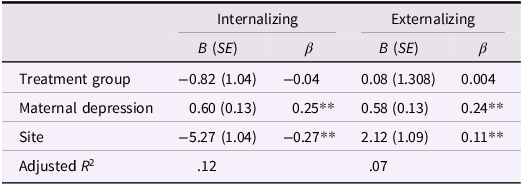
**p < .01.
Attenuating effect of SB on relation between maternal depression and child internalizing and externalizing behavior
To examine whether SB moderated the effect of maternal depression on children’s problem behavior, multiplicative interaction terms between maternal depression and treatment group were added to the initial regression models. The main effect of treatment was not significant. However, the interaction term was significant in the model predicting children’s internalizing symptoms, but not in the model predicting children’s externalizing symptoms (Table 3).
Hierarchical linear regression examining the interaction between maternal depression and treatment group

**p < .01; *p < .05.
To explore the significant interaction between maternal depression and treatment group predicting children’s internalizing behavior, we first examined children’s internalizing at high (i.e., scored 7 or above on the EPDS) and low (i.e., scored below 7 on the EPDS) levels of maternal depressive symptoms in the treatment and control groups separately (Figure 1). In the control group, when maternal depression was high (n = 26), children’s internalizing scores M(SD) = 57.85(9.65) were significantly higher – a full 2/3 SD from the standardized mean (t = 50) – than when maternal depression was low (n = 134), M(SD) = 48.97(9.60), t = −4.31, p < .001, d = .66. However, in the SB group, children’s internalizing behavior scores approximated the standardized average, regardless of whether maternal depression was high (n = 33), M(SD) = 50.73(8.95), or low (n = 121), M(SD) = 49.33(9.48), t = −0.76, p = .45, d = .15. Exploratory subgroup analyses indicated the same pattern of results for children’s externalizing behavior, with increased symptoms in the context of increased maternal depression only for the control group, M(SD) = 54.58(9.73) for control vs. 51.52(10.83) for SB.
Mean internalizing behavior scores for children whose mothers reported low vs. high depressive symptoms, by intervention group.

To examine this conditional effect on children’s internalizing symptoms across values of maternal depression, the Johnson–Neyman procedure was used. Figure 2 shows regions of significance across levels of maternal depressive symptoms. The gray area represents the confidence interval and the vertical hashed line indicates the point at which the confidence interval does not cross zero, indicating a significant effect. As can be seen, there was a significant reduction in internalizing symptoms for children in SB when maternal depression scores were 7.57 or higher. In fact, the difference in internalizing symptoms between children in the SB and control groups when maternal depression scores were below this point was minimal, with an ES of d = .04. But when maternal depression was above this threshold, there was a medium to large effect of group on children’s internalizing symptoms, d = .77.
Region of significance for the conditional effect of SB on internalizing symptoms across levels of maternal depressive symptoms.

Buffering effects of SB on internalizing symptoms across intervention tiers
Finally, to better understand the impacts of SB across both intervention tiers in the context of maternal depression, exploratory bivariate t-test analyses were conducted. Because maternal depressive symptoms did not necessarily result in eligibility for the FCU, we were able to examine differences in children’s internalizing behaviors between SB and control groups both overall and for subgroups based on intervention tier: (1) mothers who reported low levels of depressive symptoms (n = 255); and (2) mothers who reported increased depressive symptoms (n = 57) and were not eligible for FCU (n = 26) or were eligible for FCU (n = 33; Figure 3). As detailed above, there were no significant differences between SB and control groups when maternal depression was low. However, when mothers had increased depressive symptoms, mothers in SB reported fewer internalizing symptoms in their child, t = 2.93, p < .01 compared with control group mothers. This finding was similarly true across intervention tiers within SB: mothers with few other risks who did not meet criteria for FCU in SB reported fewer internalizing behaviors than mothers with fewer risks in the control group, M(SD) = 47.00(8.80) vs. M(SD) = 55.90(10.94), t = 2.23, p < .05, d = .90, and mothers with multiple risk factors who were eligible for the FCU program in SB reported fewer internalizing behaviors than mothers with multiple risks in the control group, M(SD) = 53.88(8.44) vs. M(SD) = 59.06(8.90), t = 1.72, p < .10, d = .60
Mean CBCL internalizing scores across levels of maternal depression and intervention tier.

Discussion
This study examined links between maternal depression and children’s internalizing and externalizing behavior at 18 months, and whether the SB tiered prevention program attenuated that association. We found that increased maternal depressive symptoms were associated with both early child internalizing and early externalizing symptoms, and that, in the context of higher maternal depressive symptoms, mothers in the SB intervention group reported fewer internalizing symptoms among their toddlers than those in the control group. Interactions on externalizing symptoms were not statistically significant.
This study complements and extends previous research by examining both externalizing and internalizing symptoms in very early childhood (the latter of which have been less commonly studied in meta-analytic reviews of parenting interventions and have shown more limited impacts [Barlow et al., Reference Barlow, Smailagic, Ferriter, Bennett and Jones2010; Buchanan-Pascall et al., Reference Buchanan-Pascall, Gray, Gordon and Melvin2018]), and by examining the potential of the SB tiered intervention to attenuate the effects of maternal depressive symptoms. This finding is important, as even low levels of internalizing symptoms in early childhood have been linked to physical health problems in adolescence, and group-based trajectory models have identified increasing symptom trajectories, with implications for adolescent and adult mental health, even for children who start out with only moderate symptoms (Dekker et al., Reference Dekker, Ferdinand, Van Lang, Bongers, Van Der Ende and Verhulst2007; Jamnik & DiLalla, Reference Jamnik and DiLalla2019). Furthermore, although most of the research on maternal depressive symptoms and child outcomes has focused on the toddler and preschool periods, research has documented that even maternal depressive symptoms occurring in the child’s first year can have far-reaching effects (Goodman, Reference Goodman2019), making infancy a particularly malleable time for intervention.
Significantly, the SB intervention focuses on ERH and as a tiered intervention provides primary prevention before issues emerge. Although child behavior difficulties were a criterion for FCU eligibility when children were 18 months, this was not the case when children were 6 months, indicating that children with increased internalizing symptoms were not receiving additional intervention directly related to such difficulties during the period of this analysis. Further, that mean t-scores were below 50 (the standardized mean) for all children when maternal depressive symptoms were low, and when maternal depressive symptoms were high, children in the SB group continued to score close to the average. On the other hand, scores for those in the control group were higher than the standardized mean when maternal depressive symptoms were high. Thus, interventions focused on ERH may be effective in buffering impacts of maternal depressive symptoms and preventing children’s internalizing problem behaviors.
Although we had hypothesized significant interactions between maternal depressive symptoms and the SB treatment on children’s externalizing problem behavior, this hypothesis was not confirmed. Although some studies have found such an association (Briggs-Gowan et al., Reference Briggs-Gowan, Carter, Bosson-Heenan, Guyer and Horwitz2006), the low levels of externalizing symptoms and the lack of significant treatment impacts of SB in the current study, both overall and in the context of increased maternal depressive symptoms, may reflect the challenges of generally assessing externalizing behavior at this very young age. However, the pattern of results, which was similar to the findings for internalizing behaviors, provides an indication that interventions such as SB may also be helpful for buffering the impact of maternal depressive symptoms on children’s externalizing behaviors as well, and future studies should further examine this question.
When examining subgroups of women who reported increased depressive symptoms and who were eligible only for VIP (i.e., were not eligible for FCU), as compared to those who were eligible for both VIP and FCU, we found that mothers in both tiers of SB reported fewer child internalizing symptoms than their counterparts in the control group. Although this difference did not reach statistical significance in the highest risk subgroup, there was a moderate effect of intervention for these families, and exploratory analyses may have been limited by sample size (26 and 33, respectively, in the increased depression groups). That SB was linked to reductions in internalizing symptoms for children whose mothers met the cutoff for depression across SB tiers suggests that the SB tailored intervention provided adequate support to families across levels of risk: VIP for mothers with fewer risks, and VIP + FCU for mothers with increased psychosocial needs. Although the experimental design of this study did not allow for direct evaluation of the added impact of FCU for families facing increased risk factors, the findings support the implementation of tailored services like those provided by SB, as they may provide benefits to all families by adjusting support to match the heterogeneity of families’ assets and vulnerabilities.
This study has a number of limitations. First, as mentioned above, there were low levels of internalizing, externalizing, and maternal depressive symptoms in the current sample, which created relatively small sample sizes that compromised our ability to detect differences. Second, the same informant and method – specifically, maternal self-report – was used to assess both child problem behavior and maternal depression. The use of the same method and informant may mean that our associations reflect maternal perceptions of child behavior (exacerbated by maternal depression) rather than actual behavior per se. However, the parent-report form of the CBCL is a widely used, validated measure of behavior problems in toddlers. Further, there is evidence that, while maternal depression may bias perceptions of children’s internalizing and externalizing behavior, it does not fully explain the relation between parent and child psychosocial symptoms (Brody & Forehand, Reference Brody and Forehand1986). If this is the case, our associations between maternal depressive symptoms and child behavior may be biased upward. At the same time, our estimates of intervention impacts might be biased downward. As mothers were not blind to their intervention status, those in the SB group may have had more motivation to report fewer problem behaviors in their children than those in the control group. Future studies would benefit by incorporating observational measures and reports from teachers and other caregivers that might further elucidate the impacts of interventions focused on promoting ERH and minimize reporter (and method) bias (Fergusson et al., Reference Fergusson, Horwood and Lynskey1995).
This study provides some evidence for the efficacy of a tiered intervention program, SB, to reduce children’s internalizing behavior by addressing heterogeneity of risks and stressors among families in households with low incomes. In the context of increased maternal depression, mothers in SB reported fewer internalizing symptoms in their children than mothers in the control group. These findings suggest that whereas promotion and support for ERH is important for all children’s development, increased supports for parents and families may be especially critical to prevent the intergenerational transmission of risk among families with higher levels of maternal depression. This underscores the importance of considering multidimensional family processes, including parent mental health symptoms and other psychosocial stressors (e.g., household chaos, familial relationships), that may impact both parenting practices and child behavior, in both research and clinical practice in early childhood.
Funding statement
This work was supported by the National Institutes of Health, Eunice Kennedy Shriver National Institute for Child Health and Human Development [R01HD076390 01-05; 06-10 [Competing]; 3R01HD076390-08S1].
Competing interests
None.


 Open access

