


“Move fast and break things” was the motto of nascent platform firms—virtual markets that mediate transactions and other exchanges of goods, services, and data (Cusumano, Gower, and Yoffie Reference Cusumano, Gawer and Yoffie2019)—that disrupted markets and transformed entire industries. These companies defied regulations, ignoring judicial punishment and public condemnation alike. Studies focused on how they took advantage of a permissive political and institutional landscape in the United States (Rahman and Thelen Reference Rahman and Thelen2019) to act like “regulatory entrepreneurs” that imposed their own rules (Pollman and Barry Reference Pollman and Barry2017). Other analyses showed that they prevented or delayed public regulation by exercising business power (Culpepper and Thelen Reference Culpepper and Thelen2020; Valdez Reference Valdez2023) and a variety of “stalling strategies” to slow the state down (Mazur and Serafin Reference Mazur and Serafin2023).
In this article, I shift the focus to a new era in which governments are increasingly regulating platform firms and platform firms are strategically embracing regulations. I focus on the employment classification of platform workers on “lean platforms” (Srnicek Reference Srnicek2016). Lean platforms are designed for customers and workers to meet and exchange payment for services (from food delivery to house cleaning); most often, they outsource workers, formally classifying them as independent contractors to incur lower costs. This potential misclassification gives rise to what is known as the “social protection gap”Footnote 1 (ILO, ISSA, and OECD 2023). Compared to employees, independent contractors generally have less or no access to social protection systems (usually being eligible only for voluntary coverage) and receive reduced benefits packages, which might exclude them from certain contingencies such as unemployment insurance and workers’ compensation (ILO, ISSA, and OECD 2023).Footnote 2 Moreover, whereas for employees, contributions to systems of social protection are shared between the employee and the employer, independent contractors are solely responsible for these contributions. Despite the increased burden on contractors, these contributions are frequently lower than those shared between employer and employee because they may be voluntary, complicated to process, fragmented because of job changes or irregular earnings, or more easily evaded, among other reasons. Therefore, the lack of recognition for contractors’ employment by platform firms restricts or prevents worker access to social protection and labor rights, deprives the state of the revenues that finance the welfare state, and creates an uneven playing field of competition with other firms that employ workers and must cover the corresponding contributions (ILO, ISSA, and OECD 2023). As the platform economy becomes increasingly pervasive, the employment status of platform workers has turned into a key point of contention (Vallas and Schor Reference Vallas and Schor2020).
Building on insights about how welfare institutions shape conflicts around the rideshare company Uber (Thelen Reference Thelen2018), this article argues that regulatory outcomes in platform work result from the interaction between welfare state structures and firm strategies. The characteristics of welfare systems structure the regulatory environment platform that firms navigate (in terms of issues, actors, and conflict arenas), whereas calculations about competition influence firm preferences regarding worker classification.
In contribution-based welfare systems (for example, Bismarckian systems—in which contributions paid by employers and employees finance social protection and determine access to benefits), employment status gives rise to multiple conflicts. If firms misclassify workers as independent contractors, workers demand the missed benefits tied to employee status, social security agencies pursue firms for unpaid contributions, and compliant firms push for enforcement against unfair competitors. In tax-based welfare systems (such as Beveridge systems, in which taxes finance the bulk of social protection and benefits are unrelated to employment status), regulatory pressures center on accurate tax reporting rather than employment classification.
Platform firms respond to these regulatory environments strategically, taking into consideration competitive calculations. Their strategic response—whether to oppose or embrace regulations—depends on two interrelated factors. First, firms assess whether they can disregard legislation without losing competitive ground. As mentioned, the era of no regulation or ignoring regulations without costs altogether might be over. As enforcement tightens or legal avenues close, noncompliance becomes riskier than adaptation.
Second, firms consider whether the embrace of tougher rules offers competitive advantages over rivals. Even when firms could potentially disregard rules, they might embrace stricter standards if they anticipate lower adjustment costs than their competitors. Thus, the competitive implications of compliance, and not just a straightforward preference to avoid costs, drive firm responses to regulatory environments.
I build my argument through an analysis of emerging platform work policies in three jurisdictions: California (United States), Spain, and Denmark. I leverage both cross- and within-case variation. In these three jurisdictions, there has been some type of categorization of platform workers as employees, but they vary in the conflicts that firms confronted, the responses of platform firms within jurisdictions, and, therefore, the outcomes related to employment status across and within jurisdictions—my dependent variable. I reconstruct the process of platform work politics in each of these jurisdictions by conducting a qualitative analysis based on several sources of primary and secondary evidence: databases on social protection, court cases, legislation, public statements and documents from governments and platform firms, and press reports.
In California and Spain, systems with contribution-based social protection, platform firms faced multiple fights related to employment status, and both governments passed legislation on the matter. In California, firms managed to collectively overturn that legislation through an exceptional referendum mechanism and to advance rules closer to their preferences. In Spain, firms reacted in different ways: one was already compliant because of its lower adjustment costs stemming from a structural advantage; another adapted to employee-classification rules but did so strategically to minimize the costs of compliance; and a third resisted until sustained pressure from the government and competitors forced compliance. Therefore, whereas in California no platform workers became employees, platform workers in Spain eventually were classified as such.
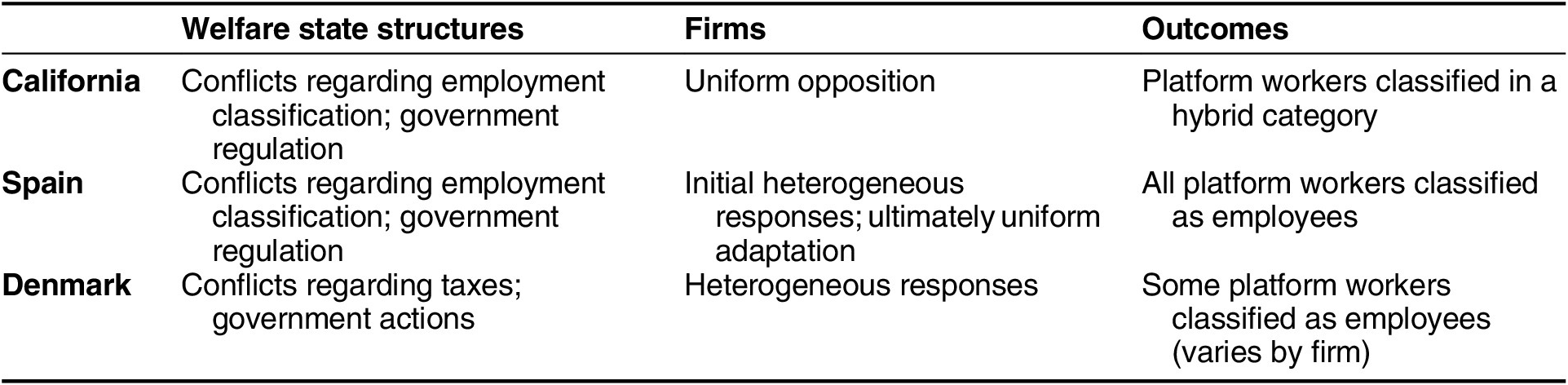
The case of Denmark is different. This country has a tax-based social protection scheme in which employment status is not so conflictual. Government regulatory attention focused on accurate taxation, rather than employment classification. Despite this, some platform firms in Denmark voluntarily categorized workers as employees even in the absence of government mandates on employment status. This action followed from pressures regarding the ease of compliance with taxes and a labor population accustomed to protected employment, making the employee classification a competitive advantage for firms eager to rely on a stable workforce. Thus, the country achieved worker reclassification even without the various conflicts and direct initiatives present in contribution-based systems. Table 1 summarizes these different outcomes across and within cases.
Regulatory Outcomes

Table 1 Long description
From top to bottom, the first row is California. Welfare state structures show conflicts regarding employment classification and government regulation. Firms display uniform opposition. Outcomes indicate platform workers classified in a hybrid category. The second row is Spain. Welfare state structures again show conflicts regarding employment classification and government regulation. Firms initially respond heterogeneously but ultimately adapt uniformly. Outcomes state all platform workers are classified as employees. The third row is Denmark. Welfare state structures highlight conflicts regarding taxes and government actions. Firms respond heterogeneously. Outcomes note some platform workers are classified as employees, varying by firm.
These cases reveal three distinct regulatory configurations that led to different outcomes: government initiatives that firms successfully overrode, resulting in a new hybrid worker category (California); government initiatives that some firms accepted while others resisted until all ultimately classified workers as employees (Spain); and voluntary firm action in the absence of such initiatives, producing within-case variation because some firms chose to classify workers as employees (Denmark). This variation demonstrates that platform work regulation emerges from complex interactions, rather than simple institutional determinism or corporate power.
My work makes two main contributions to our understanding of platform economy regulation. First, it demonstrates that the interaction between welfare state structures and firms’ competitive strategies can produce unexpected outcomes. Similar welfare structures can lead to different outcomes when firms choose different competitive strategies (as seen in California versus Spain). Conversely, different welfare structures can lead to initial similar outcomes when firms pursue comparable competitive strategies (as seen in Spain versus Denmark). My goal is not to predict deterministic outcomes but to understand the range of possible configurations and the conditions under which different patterns emerge.
Second, I identify a crucial but overlooked feature of platform regulation: systematic variation in firm responses within the same jurisdiction. Platform firms are not uniformly opposed to regulation; some strategically embrace rules when doing so provides a cost advantage over rivals. This intra-jurisdictional variation suggests that regulatory outcomes depend as much on firm strategy as on government initiatives.
The rest of the article is structured as follows. In the next section, I explain why existing frameworks cannot account for the observed variation. The third section presents the methodology and case selection. I then outline my framework and argument, and the following section analyzes the cases in detail. The last section summarizes my findings and examines the relevant implications.
Possible Explanations for the Regulation of Platform Work
As the platform economy has become more prevalent, its impact on work has received increased attention (Srnicek Reference Srnicek2016). Initial enthusiasm about the advantages of the “sharing economy” has given way to concern regarding the problems of the “gig economy.” The type of jobs created has been a particular source of worry (Vallas and Schor Reference Vallas and Schor2020). This has generated a wide variety of analyses, mostly in law and public policy. In the former group, what stands out are discussions about the appropriate employment classification for platform workers (Cherry Reference Cherry2016; Dubal Reference Dubal2017; Rogers Reference Rogers2016) and revisions of existing judicial decisions on the matter (Defossez Reference Defossez2022; Moyer-Lee and Contouris Reference Moyer-Lee and Contouris2021). Public policy research includes analyses of these emerging regulatory regimes (De Stefano et al. Reference De Stefano, Durri, Stylogiannis and Wouters2021) and policy recommendations to improve working conditions for platform workers (Lane Reference Lane2020). To the best of my knowledge, no one has attempted to explain via a comparative political perspective the choices that governments and platform firms have made regarding platform work.
The fact that there is variation in regulatory outcomes rules out a prominent theory on the political economy of advanced capitalism—one that foresees the liberalization of labor relations across the board, advanced primarily by states (Baccaro and Howell Reference Baccaro and Howell2017). The implication should be that as governments are confronted with the challenge of platform work, they mostly let firms get away with their deregulatory preferences. Thus, workers would generally be categorized as independent contractors, with minimal rights and benefits. This, however, is not what I find. Whereas initially firms disregarded existing regulations and were allowed to advance their own preferred rules (Pollman and Barry Reference Pollman and Barry2017), more recent developments show a different picture. This is evident in California and Spain, where governments pushed back and categorized (a portion of) platform workers as employees. Moreover, contradicting the idea that business uniformly prefers the individualization of labor relations, my cases show that firms sometimes choose to give workers rights.
Theories that predict the continuity of national models might be more appropriate. The literature on varieties of capitalism (VoC) suggests that different types of market economies persist and that business and labor continue to organize their relationships in a more liberal, market-based way (LMEs) and in a more coordinated, organization-based way (CMEs; Hall and Soskice Reference Hall and Soskice2001). In this setting, we should expect the United States, a pure LME type, to regulate less. However, that has not been overwhelmingly the case: the legislature in California categorized platform workers as employees. In addition, the United States was moving away from its initial noninterventionist approach to the digital economy and toward more regulation, until a change in government in early 2025.Footnote 3 This signals that regulation in this country might hinge on party ideology and not so much on the variety of capitalism. Still, the VoC literature is insightful in centering firm strategies in its analysis, an approach that the study of platform work regulation also requires.
A more recent categorization of national models shifts the focus from the supply to the demand side and organizes countries according to their “growth model” (Baccaro and Pontusson Reference Baccaro and Pontusson2016). National growth can be consumption-led, export-led, a balanced type, or a failed one. Each of these, in turn, should be supported by different labor and social policies (Lynch and Watson Reference Lynch, Watson, Baccaro, Blyth and Pontusson2022). In the case of the United States, with its financialized consumption-led model (Reisenbichler and Wiedemann Reference Reisenbichler, Wiedemann, Baccaro, Blyth and Pontusson2022), we would expect a reduction in social protection to support credit-based consumption. Still, this expectation is not met by the outcomes seen in California. The case of Spain, alternatively categorized as a credit-based consumption-led model or a failed growth model, does not fit well either.
There is one national variable—the welfare state—that has been used to explain government reactions to platform firms. The type of welfare state, contribution- versus taxation- based, arguably influenced whether employment status became a salient point for governments after Uber’s arrival in their countries (Thelen Reference Thelen2018). Similarly, the availability of social benefits—restricted (only for employees) or broader (for employees and the self-employed)—correlated with whether the public response to platform work was more inclusive or more confrontational (Sieker Reference Sieker2022). Although these explanations are informative for understanding the regulatory landscape that firms navigate, they do not fully account for firms’ strategic responses; for example, why some firms choose to categorize workers as employees even in the absence of government mandates or why firms within the same jurisdiction respond differently to the same regulations.
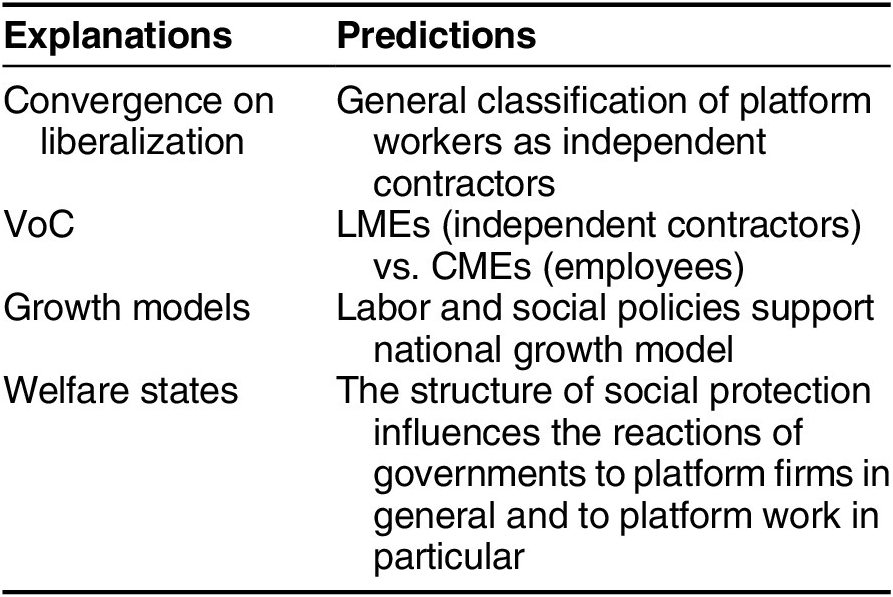
Table 2 summarizes the explanations I have reviewed and their predictions, which are unable to account for the outcomes summarized in table 1.
Existing Explanations and Their Predictions
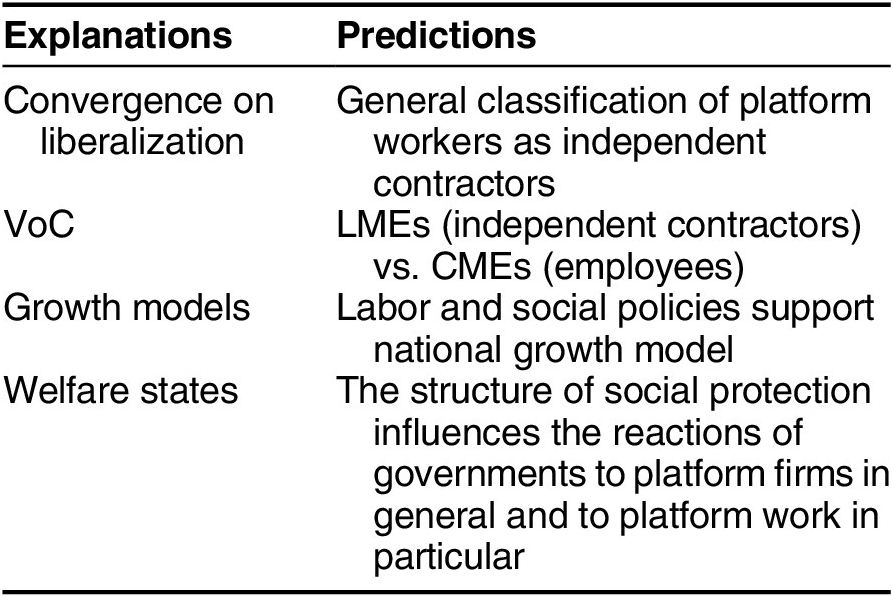
Table 2 Long description
The table has two columns labeled Explanations and Predictions. From top to bottom, the first row pairs Convergence on liberalization with General classification of platform workers as independent contractors. The second row pairs VoC with LMEs as independent contractors versus CMEs as employees. The third row pairs Growth models with Labor and social policies support national growth model. The fourth row pairs Welfare states with The structure of social protection influences the reactions of governments to platform firms in general and to platform work in particular.
Although none of these explanations fully accounts for the variation I observe, they inform my analysis. There is no convergence toward liberalization, but national models, particularly welfare state structures, are influential.
The Politics of Platform Work
To understand the governance of platform work, I focus on two actors: governments and platform firms. This choice is guided by a pluralist framework and the specific regulatory conditions of platform work.
Pluralist theory assumes that power is dispersed among various interest groups, organizations, and associations that compete for influence over public policy, with government acting as a broker among them (Dahl Reference Dahl1956). However, as Dahl (Reference Dahl1959) later recognized, this general framework requires special attention to business power. Businesses have structural advantages in political competition because of their control over investment, employment, and economic growth. Still their role in democratic politics is an empirical question that must be investigated (Culpepper Reference Culpepper2015; Dahl Reference Dahl1959). Thus, I do not assume that firms act as a unified power elite that always prevails. Instead, as I demonstrate, firms within sectors have divergent strategic responses.
Workers and consumers are also groups with important stakes in platform work governance, although their interests are often mediated or represented by other actors (Collier, Dubal, and Carter Reference Collier, Dubal and Carter2018). Workers in the platform economy, especially in ride-hailing, food delivery, and cleaning services, frequently lack strong organizational capacity or union representation. This makes them dependent on governments, civil society organizations, or the firms themselves to advance their interests. Similarly, consumer preferences are often invoked by platforms or policy makers rather than directly articulated through consumer organizations.
Thus, I direct my attention to the strategic interactions between governments and firms. Governments have responsibilities toward the sustainability of welfare systems and obligations to workers. Platform firms create jobs and depend on favorable labor regulations to remain competitive. They can therefore expect to encounter different levels of resistance regarding employment classification across countries and must adjust their business model accordingly. In what follows I explore the characteristics of welfare states and the strategic calculations of firms.
Welfare State Structures
Countries’ welfare state structures shape the environment that platform firms navigate. Because national institutional arrangements vary, firms confront different challenges across sites. Countries have different kinds of social protection schemes (Esping-Andersen Reference Esping–Andersen1992), which vary in the way that social protection policies—old age benefits; healthcare, sickness, and disability benefits; unemployment insurance; and family allowances—are financed and distributed. A basic difference concerns the source of financing of social protection—contributions or taxes (levied on both employers and employees)—which is usually tied to the reach of protection policies from fewer to more recipients.
In an insurance-based model, social contributions paid by employers and employees finance benefits, and benefits tend to be linked to employment status (i.e., a Bismarckian model). Alternatively, in a tax-based system, in which general taxes finance the bulk of benefits, benefits are mostly independent from employment status and tend to reach broader segments of the population (i.e., a Beveridge type).
Each of these types of welfare states create specific regulatory environments that firms must navigate, producing different conflicts and creating different pressures for them. Where welfare is insurance based, a worker’s status as an employee has a significant impact on the ability to access such benefits, the financing of social protection, and firms’ labor costs. Thus, employment status becomes the focus of a variety of conflicts. If firms misclassify workers as independent contractors, they do not receive benefits tied to employee status, social security agencies miss contributions due to misclassification, and compliant firms suffer unfair competition from uncompliant firms. These actors pursue claims against each other across various arenas, including labor inspectorates, courts, and legislative bodies.
By contrast, where welfare is tax-based, the formal classification of a worker is less immediately pressing in terms of the financing of social benefits and the worker’s capacity to receive those benefits. However, firms still face regulatory pressure, which centers on accurate tax reporting and compliance. Public authorities will be interested in guaranteeing the fairness and long-term sustainability of their systems through the proper taxation of firms and workers.
I therefore expect firms to face more conflicts around the employment status of platform workers in countries that have insurance-based welfare systems than in those that have tax-based systems. In insurance-based systems, these conflicts structure the competitive environment as firms navigate pressures from multiple actors and across multiple institutional arenas. I also expect firms in countries with tax-based welfare systems to face regulatory pressure around the accurate taxation of themselves and their workers, which also shapes their competitive strategies, albeit in different ways.
Strategic Calculations of Platform Firms
The business model of lean platform firms rests on a fundamental asymmetry in labor costs. By treating workers as independent contractors rather than employees, these firms shed obligations—contributions to social protection, administrative overhead, workplace safetyFootnote 4—that conventional employers must bear. The result is a structurally lower cost base that allows them to undercut non-platform competitors on price (Davis Reference Davis2015), and one that is central, not incidental, to how these firms operate (Schor et al. Reference Schor, Attwood-Charles, Cansoy, Ladegaard and Wengronowitz2020). This cost advantage, amplified by access to substantial venture capital, made possible a distinctive market strategy: entering industries at a loss, pricing out incumbents, and converting eventual market dominance into profit (Khan Reference Khan2017).
Accordingly, platform firms have significant incentives to keep workers as independent contractors and oppose their reclassification as employees. Still, their capacity to do so hinges on the regulatory environment they confront and on their competitive position relative to other firms in the sector. When governments regulate the employment classification of platform workers in ways that contradict firms’ initial preferences, these firms face a strategic choice: fight or adapt to these regulations. This decision is fundamentally a strategic calculation based on competitive pressures.Footnote 5 Firms assess whether they can disregard legislation without losing competitive ground and whether compliance itself offers advantages over rivals. As Uber explicitly acknowledged in its 2024 Annual Report, the “financial impact” to Uber of having to classify workers as employees “would be moderated by the likelihood of other industry participants being similarly affected” (Uber 2025, 11).
Firms will thus assess whether they can disregard legislation without losing competitive ground. There are two pathways to doing so: when all firms in a sector collectively oppose new rules, no individual firm bears a competitive disadvantage from noncompliance; alternatively, when enforcement is weak or legal challenges are viable, individual firms that successfully avoid compliance costs can undercut rivals who move to comply with regulation.
However, even when resistance is possible, firms may choose to embrace strict employment regulations if they anticipate doing so will yield competitive advantages over rivals. In other words, firms will consider regulations strategically, in pursuit of their own, more narrow economic ends (Oye and Maxwell Reference Oye and Maxwell1994; Smith and Yandle Reference Smith and Yandle2014).
Indeed, standard theories of economic regulation claimed that politically powerful industries sought protection and benefits from governments (Stigler Reference Stigler1971). This was the basis for further analyses of competition among interest groups, in which rival firms or industries would be portrayed actively using state intervention to achieve the redistribution of economic gains in their sector (Peltzman Reference Peltzman1989). This redistribution could happen directly through state protection that would benefit firms (such as subsidies or tax breaks) or indirectly through state directives that hurt competitors, for example, a required technology or product standard that would raise the rival’s costs. In such cases, firms’ embrace of regulation would not be surprising but rather a reflection of economic interest.
This understanding of regulation was most recently applied to policies for mitigating climate change. Although these policies are assumed to evoke staunch opposition from business, some firms have chosen to support or even lobby for environment regulations when they foresee obtaining a competitive advantage (Colgan and Hinthorn Reference Colgan and Hinthorn2023). In particular, firms may calculate that whereas pro-environment industry regulations will impose costs on all firms, their own adjustment costs will be lower than those of their competitors (Kennard Reference Kennard2020). This could be because of their ex-ante capital stock,Footnote 6 prior investments in energy efficiency,Footnote 7 or the locations of their production facilities. If that is the case, these firms will then lobby in favor of stricter rules, expecting to increase their market share as a result.
I apply this argument to the regulation of employment relations in the platform economy and claim that platform firms might embrace regulations because they expect to perform better than their competitors when the new regulations are imposed. Just as with changes to environmental protections, new labor rules might impose different costs across platform firms in an industry, creating opportunities for strategic compliance.
There are several reasons why some firms might have lower adjustment costs. One reason is that there are first-mover advantages in compliance: in times of evolving regulations regarding the protection of platform work, firms operating across multiple jurisdictions may have already adapted to stringent regulations elsewhere and adjusted their business models in ways that are applicable across sites, creating advantages when entering new markets. Second, there are structural asymmetries: firms with smaller workforces relative to competitors face lower absolute costs of reclassification, even if percentage increases are similar. The third reason is strategic compliance: firms may embrace regulations while simultaneously finding ways to minimize costs—for example, through subcontracting arrangements that shift employment obligations to intermediaries. Fourth are labor market factors: in tight labor markets or where workers are reluctant to accept precarious arrangements, firms that struggle with high turnover of independent contractors may find that employee status stabilizes their workforce, enables greater control over service quality, and becomes a recruitment and retention tool.
In these scenarios, firms that anticipate lower adjustment costs from the new rules might be interested in adapting to or pushing for those rules in a bid to gain market share at the expense of competitors who face higher compliance costs. Once some firms in the sector embrace stricter rules of employment, they might push the rest of the sector to comply. This is particularly the case for firms in contribution-based welfare states, where employment classification directly affects cost competitiveness through employer contributions to social protection. Compliant firms will not want to face a permanent competitive disadvantage from rivals that evade obligations, creating pressure for uniform enforcement across the sector. In tax-based systems, by contrast, firms that voluntarily offer employee status may prefer to maintain this as a point of differentiation, rather than pushing for universal compliance. Because employment status does not alter social protection costs as much in these systems, firms can use it as a market positioning strategy without demanding that competitors follow suit. Thus, I expect to see challengers pushing for enforcement in contribution-based systems but not necessarily in tax-based systems.
Given these mechanisms, I expect variation in firms’ responses to the categorization of workers both across and within jurisdictions. Although firms generally prefer to prevent or delay regulation that increases costs, their behavior will be affected by the welfare regime in which they operate and the extent to which embracing regulation might or might not be a strategic and competitive choice when it promises advantages over rivals.
Methodology
I studied three jurisdictions, California, Spain, and Denmark, during a period spanning the regulation of platform work (2017–24). I focused on activities under regulation, which included work on lean platforms such as food delivery, ride-hailing, and housecleaning, representing only a small portion of platform work.
My comparative case study was exploratory with the aim of theory construction: it sought to identify how governments and platform firms interact around platform work. The intensive study of a small number of cases aims to shed light on a larger population (Gerring Reference Gerring2007). With this goal in mind, I selected three localities where there had been some initiative (either by governments or firms) to categorize platform workers as employees. I leveraged both cross- and within-case variation to examine the way governments and platform firms behave.
California and Spain constituted “index” cases (Gerring Reference Gerring2007, 72)—the first of their type. California was the first US state to issue legislation related to platform work, whereas Spain was the first European country to legislate on the employment status of platform delivery workers. As such, these cases could illuminate the origins of platform work regulation, were free of influence from precedents, and could become standard-setting cases for other jurisdictions, which increased their analytical value. In addition, these two cases shared government initiatives to regulate platform work but varied in their platforms’ responses and outcomes, providing variation in worker classification across cases.
I selected Denmark for its “intrinsic importance” (Gerring Reference Gerring2007, 41). Although intrinsic cases can be “idiographic” (Lijphart Reference Lijphart1971) and thus challenging for generalizability, they sometimes contain insights relevant to broader patterns. Denmark offered a window into the dynamics of platforms voluntarily extending more protection and benefits to workers in the absence of government mandates regarding employment classification. Moreover, Spain and Denmark varied in government initiatives but shared similar platform actions.
The state of California might not seem immediately comparable to the two countries. However, given the high level of federalism in the United States, states function as distinct political and institutional units and thus are comparable to countries. In addition, studying California in the context of platform firms has become standard practice (see, for example, Collier, Dubal, and Carter Reference Collier, Dubal and Carter2018) for several reasons: it is both the geographical origin of the platform economy and friendly to tech, yet it is also politically progressive and prone to regulation. Finally, California is not an outlier within the United States regarding the salience of platform work issues. In other states, with or without legislative initiatives, the central issue under discussion has also been worker status (and associated wages, benefits, and rights), and not taxes.Footnote 8
To reconstruct the politics of platform work in the three cases, I relied on several sources of evidence. To describe regulatory outcomes, I used public documents including legislation, court cases, and collective bargaining agreements. I characterized welfare state structures with data from the International Labor Organization (ILO) World Social Protection Database, the European System of Integrated Social Protection Statistics (ESSPROS), and the OECD. To analyze the economic calculations and business strategies of platform firms, I drew on company documents, public statements, annual reports, and press reports. Specifically, I reviewed nine annual reports from the food order and delivery platform Just Eat (2016–24), three annual reports from the food delivery firm Delivery Hero (2022–24, after their acquisition of Glovo), six annual reports from Uber (2019–24), and six annual reports from the rideshare firm Lyft (2019–24).
Empirics: The Politics of Platform Work
The responses of governments and platform firms are still evolving, but as the examples of California, Spain, and Denmark show, regulatory outcomes in different jurisdictions are shaped by the structure of domestic welfare systems and the competitive calculations of platform firms. This section provides an in-depth overview of what happened in these three jurisdictions regarding work on lean platforms.
In California, the contribution-based nature of the welfare system created a regulatory environment characterized by multiple conflicts around employment status. The state government issued legislation that would have categorized workers in lean platform firms as employees, but firms collectively deployed an exceptional mechanism to craft an exemption. As a result, platform workers are not classified as employees. In Spain, the contribution-based nature of the welfare system similarly generated conflicts around employment status, and the government issued legislation categorizing delivery workers as employees. Firms in that sector had different reactions to this legislation because opposition was costly and regulation created varying costs across firms. The result has ultimately been that all workers in the delivery sector are categorized as employees. Finally, in Denmark, with a welfare system financed primarily through taxes, employment classification was not as conflictual, meaning that public authorities did not need to advance specific initiatives regarding employment status. Still, following strategic calculations, some firms gave workers the option to become employees.
California: The Government Takes the Initiative, and All Platforms Counterattack
The contribution-based welfare structure of California created a regulatory environment that embedded employment classification in multiple conflicts. In this state, social protection is financed primarily by contributions, and access to social protection depends closely on employment status: thus, misclassification is relevant to workers’ benefits, the state’s revenues, and fair competition within business. Social protection was therefore a key motive behind a Supreme Court ruling, first, and then a government initiative that shifted the burden of proving that workers were independent contractors to the hiring entity. Faced with this regulatory environment, platform companies in the ride-hailing and food-delivery sectors collectively took advantage of an exceptional mechanism in the state to craft an exemption for themselves. As a result, platform workers in California are not classified as employees but rather are in a hybrid category.
Social Security contributions represent more than 23% of taxation in the United States (and a bit over 6% of GDP).Footnote 9 These contributions finance around 3% of Social Security expenditures (ILO World Social Protection Database). In California, a broad set of rights and social protection benefits depend on employee status.Footnote 10 Workers classified as employees must comply with regulations related to wages, hours, and working conditions. Moreover, they have access to workers’ compensation (not available for independent contractors), unemployment insurance (not available for independent contractors), disability insurance (voluntary and subject to conditions for independent contractors), and old age benefits (available to independent contractors but financed on their own).Footnote 11 Accordingly, employment classification became the central issue that platform firms had to confront in this regulatory environment.
The first conflict emerged through the courts. In 2018, the Supreme Court determined that workers for an offline delivery company were presumptively employees and were therefore eligible for the protection of wage orders in the state—rules regarding minimum wage and a variety of issues such as overtime, expense reimbursements, and uniforms. The ruling shifted the burden of proving that workers were independent contractors to the hiring entity (which had to pass the “ABC test”Footnote 12).
Crucially, the Court’s reasoning reflected the contribution-based welfare structure. It argued that correctly defining employment status was key to firms’ obligations regarding worker access to benefits and social protection, to the state’s collection of revenues, and to fair competition within business. Regarding firms’ obligations toward workers, the ruling stated that “the hiring business bears the responsibility of paying federal Social Security and payroll taxes, unemployment insurance taxes and state employment taxes” so that employees have access to insurance and legislated wage, hours, and working conditions standards (DYNAMEX OPERATIONS WEST INC v. Charles Lee et al., Real Parties in Interest 2018, 1–2). Regarding the state’s finances, the ruling mentioned the “billions of dollars in tax revenue” that federal and state governments were losing because of the misclassification of workers (2). Finally, regarding competition within the sector, the ruling stated that a business may obtain an “unfair competitive advantage” over “competitors that properly classify similar workers as employees and that thereby assume the fiscal and other responsibilities and burdens that an employer owes to its employees” (2). Platform companies of the lean type immediately became concerned.Footnote 13
In 2019, the California legislature approved the California Assembly Act 5 (AB5), which codified the Supreme Court’s ruling. The bill took the ABC test as a general standard for the state and extended its effects beyond wage orders to the provisions in the Labor Code (a general framework for employment relationships), and the Unemployment Insurance Code (which regulates benefits and payments). Again, social protection was a fundamental consideration. AB5 mentioned the need to restore the minimum wage and a series of social benefits to the workers who had been unfairly classified as independent contractors (California State Legislature 2019, 2).
Platform firms in the app-based rideshare and delivery sectors that had already criticized the Supreme Court’s ruling opposed this new legislation.Footnote 14 This opposition was primarily financial in nature: annual reports from Uber show repeated and acute concern with the costs of classifying workers as employees.Footnote 15 Faced with this regulatory environment, firms made a collective strategic calculation. Rather than pursuing individual strategies of adaptation or resistance, firms in the rideshare and food delivery sectors coordinated to overturn AB5 through a ballot initiative—a mechanism of direct democracy available in the state that provided firms with exceptional power to override legislation.Footnote 16 Given this institutional tool, unified opposition offered better competition prospects than individual compliance strategies. Platform firms led by Uber presented the Protect App-Based Drivers and Services Act (later known as Proposition 22), which sought to exempt platform workers in the rideshare and delivery sectors from the employee categorization established in AB5. The initiative created instead a new hybrid category of workers between employee and independent contractor.Footnote 17
The coalition of platform firms invested more than $200 million in advancing Proposition 22, making this the most expensive ballot measure on record at the time. The initiative was passed with the support of California voters in the general election of November 2020 and confirmed by the state’s Supreme Court in July 2024.Footnote 18
Proposition 22 established new baseline protections for workers that functioned as collective standards of competition across the sector. Excerpts from firms’ annual reports reveal the strategic importance of sector-wide compliance. Lyft (2022, 25) acknowledged that it had adapted to “provide for drivers to receive the earning opportunities described in the ballot measure” and that their “competitors may attempt to compete for drivers on the basis of these earning opportunities.” Uber (2022, 6) reported its expectation that “drivers will be able to maintain their status as independent contractors under California law” and that it and its “competitors will be required to comply with the provisions of Proposition 22.” This collective compliance framework meant no individual firm would bear competitive disadvantage from higher labor costs—a calculation central to the firms’ strategic decisions.
Overall, the case of California demonstrates how contribution-based welfare structures create regulatory environments characterized by multiple conflicts around employment status that play out across courts and legislatures. When firms collectively possess institutional tools to override government initiatives and can coordinate effectively, they will deploy unified resistance to employee classification. Therefore, government efforts to reclassify platform workers can be collectively overturned, leaving workers in alternative regulatory categories that fall short of full employment status.
Spain: The Government Takes the Initiative, and All Platforms Eventually Comply
The contribution-based welfare structure in Spain created a regulatory environment similar to California’s, which embedded employment classification in multiple conflicts.Footnote 19 In this country, social protection is financed primarily by contributions, and access to social protection depends closely on employment status, making worker classification relevant to workers’ benefits, government revenues, and fair competition within business. Social protection was the key motive behind conflicts that played out through labor inspectorates and courts, culminating in the government’s Rider Law (Royal Decree-Law 9/2021) that classified delivery workers as employees. Unlike California, Spain lacked institutional mechanisms allowing firms to collectively override legislation. Moreover, firms confronted the reform from different starting points, because one had already classified its workers as employees. These factors led platform firms to respond according to individual competitive calculations. Although one firm was already compliant and another strategically adjusted to the new rules, a third firm initially resisted and only capitulated after receiving exceptional pressure from both government and rival firms. As a result, platform workers in the delivery sector are now classified as employees.
In Spain social security contributions represent more than 35% of taxation in the country (and almost 14% of GDP in 2021).Footnote 20 These contributions finance almost 60% of expenditures on social protection (ESSPROS Database, 2016). Employees and independent contractors have different social security regimes (European Union 2013b): whereas employees are automatically enrolled by employers in their corresponding regime, independent contractors must enroll themselves. Similarly, employees’ contributions are deducted automatically by employers and transferred into the system, but independent contractors must process their own. Assuming equal income, independent contractors can contribute much less than an employee (though the regime only sets a minimum for them, so they can contribute more should they choose to do so). Finally, some mandatory protections and benefits for employees such as insurance against work accidents or sickness are voluntary for independent contractors. Therefore, independent contractors tend to make lower contributions and receive less in benefits. As in California, this contribution-based structure embedded employment classification in multiple conflicts that platform firms had to navigate.
The first conflict emerged through the social security administration. In December 2017, the office of Labor and Social Security Inspection concluded after inspections that delivery riders in the region of Valencia were employees and had been falsely categorized as independent contractors.Footnote 21 The office later expanded its rulings to other parts of Spain, fined platform firms for failing to correctly categorize workers, and demanded missing social security contributions.Footnote 22 The social security administration pursued these cases through the courts to argue for reclassification of platform workers. Spain later stood out among European countries for “the sheer number of cases demanding a reclassification of platform workers” and the fact that a “significant share” of those cases “were brought by the social security administration and concerned large numbers of workers” (Hießl Reference Hießl2022, 12).Footnote 23
The first of many cases reaching the Supreme Court obtained a favorable ruling. The Court determined that a delivery worker for a platform firm was effectively an employee, given that the firm exercised too much control over the work process for workers to be considered independent (resolution number 805/2020).Footnote 24
Following this ruling, the government issued the Rider Law, which modified the Workers’ Statute to establish that platform workers in the delivery industry were employees.Footnote 25 This legislation addressed the conflicts generated by the contribution-based welfare structure; specifically, the social security administration’s interest in securing proper contributions and protecting the financing of the welfare system. Indeed, the Rider Law highlighted the work done by the office of Labor and Social Security Inspection in initiating the path that first led to the Supreme Court ruling and then to this decree (Jefatura del Estado de España 2021, 56734). The new rule emphasized the importance of classifying workers as employees for two main reasons: (1) protecting wages and contributions to social protection and (2) ensuring “equal treatment between ‘traditional’ companies and those that use digital control means based on algorithmic data management, on the basis of transparent and fair competition between them” (56736).
Platform firms responded strategically to this regulatory environment through competitive calculations. There were baseline reasons to oppose the regulation related to increased labor costs.Footnote 26 However, unlike California, Spain lacked institutional mechanisms allowing firms to collectively override legislation. Therefore, collective resistance was not feasible, making opposition less effective and significantly more costly than in California. Moreover, firms’ starting conditions differed, because one had already classified workers as employees. Even though hiring workers and paying corresponding contributions to social security would increase costs by approximately 30%,Footnote 27 employment classification created heterogeneous costs across firms in the delivery sector, leading them to pursue different competitive strategies.
The largest player in the market, the Spanish firm Glovo,Footnote 28 with a 25% share (Smartme analytics 2022), initially made only a few changes. The firm hired only a small minority of workers and modified the work process for the rest in a way that sought to avoid the decree.Footnote 29 The Spanish administration fined and sued the firm, but Glovo did not make any further changes or payments.
However, two other companies, UberEats and Just Eat, adapted to the new rules, anticipating lower adjustment costs than their competitors. UberEats, with a 21% market share (smartme analytics 2022), sought a competitive advantage under the new rules through strategic compliance. Instead of hiring workers directly, the company subcontracted workers by using an intermediary firm. This arrangement allowed UberEats to comply with the letter of the law while minimizing costs by avoiding the full burden of employer contributions to social security.
The third most important player, Just Eat (18% market share; smartme analytics 2022) was already compliant, also because of lower adjustment costs—in this case, stemming from structural differences. This company combines the usual business of logistics, carried out by its own delivery workers, with a marketplace connecting users to restaurants that handle their own deliveries. As a result, in the face of stricter employment regulations, Just Eat faces lower costs than firms whose business consists only of logistics and that have larger fleets to recategorize. In this context, the firm calculated that tougher regulations could help it gain a competitive advantage over its rivals.Footnote 30
The Rider Law effectively established a new collective standard of competition in the sector. Crucially for competitive dynamics in contribution-based welfare systems, both UberEats and Just Eat pushed for full enforcement of the new rules across the entire sector—demonstrating that their regulatory responses were simultaneously competitive strategies. UberEats complained about Glovo’s defiance, denounced the resulting uneven playing field, and sent a public letterFootnote 31 to the Ministry of Employment that highlighted its own observance of the law,Footnote 32 whereas Just Eat repeatedly called for tougher fines against Glovo.Footnote 33 This pressure for sector-wide enforcement reflects the competitive logic in contribution-based systems: firms that bear the costs of employee classification cannot maintain their competitive position if rivals successfully evade those costs.
Finally, in December 2024, Glovo announced that it would hire its riders. The announcement came as it faced extraordinary pressure for its sustained defiance. Three days earlier, Just Eat had sued the company for €295 million in damages, and Glovo’s founder was scheduled to testify the next day in a criminal case for violating labor rights that could result in prison time.Footnote 34 By then, Glovo owed €267 million in contributions to the Spanish social security administration and had accumulated a variety of additional fees and penalties.Footnote 35 In a public statement, the firm calculated that the model change would cost €100 million and adjusted its contingency cost to between €440 million and €770 million for 2024, allocated to cover “social security contributions, fines, VAT claims, and other payment charges.”Footnote 36 Significantly, the firm announced plans to combine its own employees with subcontracted workers, indicating that competitive considerations continued to shape their regulatory responses.Footnote 37
Overall, the Spanish case demonstrates how contribution-based welfare structures create regulatory environments characterized by multiple conflicts around employment status. When firms lack institutional tools to collectively override legislation, individual competitive calculations determine their responses. Although resistance may be attempted, firms with lower adjustment costs will adapt strategically and, crucially, push for enforcement against noncompliant competitors. This competitive dynamic means that initially heterogeneous firm responses may converge toward uniform compliance as enforcement pressures mount and compliant firms demand level playing fields to prevent competitive disadvantage.
Denmark: Voluntary Classification in a Tax-Based Regulatory Environment
The tax-based welfare structure in Denmark created a regulatory environment fundamentally different from that in California or Spain. Because the Danish welfare system is financed through taxes rather than contributions, the employment status of platform workers was a less relevant issue. Instead, platform firms faced pressures around accurate tax reporting. Still, even in the absence of specific government initiatives regarding employment classification, some platform firms categorized their workers as employees. One of these firms responded strategically to the tax-based regulatory environment by using employee classification as a competitive tool that simultaneously facilitated tax compliance and provided market advantages.
Given that the social protection system in Denmark is tax-based, most benefits are universal and therefore not dependent on employee status. Social security contributions represent less than 1% of taxation in this country (and less than 1% of its GDP).Footnote 38 These contributions finance less than 20% of expenditures on social protection (ESSPROS Database 2016). Employees and independent contractors do not have different social security regimes (European Union 2013a). Most branches of social security are compulsory; thus, there are no conditions for inclusion based on employee status. Still, employees might receive additional benefits—for example, a supplementary pension provided by collective agreements that adds to the universal state pension. The one exception to this compulsory regime is unemployment insurance, which is voluntary and available to both employees and the self-employed, with contributions to this fund made by the workers and not employers. In this context, social protection did not generate the multiple conflicts seen in contribution-based systems.Footnote 39
Instead, as mentioned, platform firms confronted regulatory pressure around accurate taxation. The government formed a Sharing Economy Council that brought together the Ministry of Business, the Ministry of Employment, and the Ministry of Taxation with social partners. Its task was to define fair employment conditions in the sector, including, crucially, the automatic and accurate reporting of taxes in the digital economy. In 2017, the government issued a document outlining a strategy for growth through the sharing economy (Ministry of Business 2017). This document was divided into four parts, with parts II and III addressing taxation and the labor market, respectively. In part II, the government promised to “develop a digital reporting solution” that platforms could use to share users’ revenues with tax authorities. In part III, the government focused on how the sharing economy could activate people who had “a loose attachment to labor market” or were unemployed. Notably, there were no mentions of employment classification of platform workers or conflicts over contribution-based benefits. In 2018, the government issued another document, “Better Conditions for Growth and Correct Tax Payment in the Sharing and Platform Economy,” which set out 10 initiatives to regulate the platform economy (Høgedahl Reference Høgedahl2020). Three of these initiatives were devoted to taxes: one to tax deductions and two to better tax guidance and control; none addressed social protection or employee status as issues requiring resolution.
Consistent with this emphasis on taxation, the Ministry of Taxation began to develop an automated income reporting system for platforms. It designed this system in response to demand from “Danish platforms, citizens, politicians, and various government departments, who desired a solution to address the lack of automatic reporting of income earned through platforms” (Ogembo and Lehdonvirta Reference Ogembo and Lehdonvirta2020, 8). Platforms using the state-designed software would input data directly into the ministry’s systems. The plan was to apply it first to renting platforms and later to labor platforms (“lean platforms,” in the classification used in this article).
In this context, and with a highly voluntaristic model of industrial relations in which wages and working conditions are regulated by collective agreements negotiated autonomously by employers’ associations and unions, there was no government mandate for platform firms to categorize workers as employees. Still, platform firms in sectors such as food delivery (Just Eat) and cleaning services (Hilfr) chose to classify workers as employees. The main rationale for Just Eat’s action was already described in the Spanish case: structural cost advantages from its hybrid business model. Additionally, Just Eat possessed first-mover advantages, having already implemented this structure across multiple European markets and viewing it as central to continued expansion.Footnote 40 I therefore focus here on Hilfr, a cleaning platform founded in 2017, which in 2018 signed a collective agreement with union representatives giving workers the possibility of becoming employees.
Hilfr’s decision to offer employee classification reflected a competitive strategy shaped by the tax-based regulatory environment. The firm joined a crowded market for cleaning in private households with generalized low levels of worker protection, competing against a dominant firm, Happy Helper. In this context, growth was vital, yet the firm struggled to attract and retain full-time cleaners because of difficulties with tax payments when using the platform (Ilsøe and Larsen Reference Ilsøe and Larsen2023). Soon after, Hilfr (2018) signed a collective agreement with the United Federation of Danish Workers (3F) that allowed workers to choose their employment categorization—freelancer or employee. If workers chose to be employees, they received at least the minimum salary, contributed to their pension, and benefited from holiday and paid sick leave.Footnote 41 Crucially for the regulatory environment, employee status enabled Hilfr to file workers’ taxes automatically and directly to tax authorities.
This strategic use of employee classification addressed regulatory pressure around tax compliance while simultaneously providing competitive advantages. The firm pursued this path only after failing to find other ways to achieve automatic tax payment (Ilsøe and Larsen Reference Ilsøe and Larsen2023), demonstrating that the decision responded in part to the regulatory environment of tax-based welfare institutions. The automatic reporting of taxes also made the firm more attractive to both customers, who could claim tax deductions, and workers, who avoided tax payment complications (Ilsøe and Larsen Reference Ilsøe and Larsen2023).Footnote 42 Enticing workers was necessary because Denmark is a country with strong labor protections and relatively limited penetration by the platform economyFootnote 43: these factors mean that attracting workers might require offering employee benefits.Footnote 44 Through these changes, the firm calculated that even though providing additional benefits to workers would increase costs, these would be offset by advantages: increased revenue from attracting more cleaners and clients, as well as reduced costs from stabilizing the workforce.
This strategy proved successful for Hilfr. The company became the second-most important player in the market—2,000 customers and 200 active workers according to Ilsøe and Larsen (Reference Ilsøe and Larsen2023)—trailing only Happy Helper. Significantly, unlike compliant firms in Spain that pushed for sector-wide enforcement to prevent competitive disadvantage, Hilfr’s relationship to sector-wide standards was more ambiguous. The firm expressed some concerns about “competitive disadvantage” relative to firms that did not offer employee benefits and, after joining the Confederation of Danish Industries, explored options for developing an industry-level agreement (Alsos, Dølvik, and Jesnes Reference Alsos, Dølvik and Jesnes2020, 57–58).
Still, the outcome in Spain differed from that in Denmark: Spain converged toward uniform compliance through enforcement pressure from the state and compliant firms, whereas Denmark maintained variation in employment classification across firms. This outcome might be tied to the different competitive dynamics in tax-based systems in which employment classification does not fundamentally alter firms’ contribution costs. In contribution-based systems like Spain, noncompliant competitors create permanent cost disadvantages for compliant firms, compelling them to demand sector-wide enforcement to remain viable. In tax-based systems like Denmark, employee classification can remain a competitive differentiator without threatening firms’ viability, allowing variation to persist.
Overall, the case of Denmark demonstrates how tax-based welfare structures create regulatory environments focused on taxation rather than employment classification. Platform firms respond strategically to this regulatory environment, and even without government mandates regarding employment status, firms may voluntarily offer employee classification. As a result, workers’ employment classification in Denmark varies by firm.
Discussion
The expansion of lean platforms challenges conventional work arrangements in advanced economies. Governments have started to intervene, yet we know relatively little about what factors shape government initiatives. Similarly, it is often assumed that all platform firms uniformly oppose regulations, but instead their responses are mixed and strategically calculated. This article addresses this gap through analysis of platform work regulation in three jurisdictions: California, Spain, and Denmark.
I argue that regulatory outcomes emerge from strategic interactions between governments and platform firms, with each actor responding to distinct factors. Welfare state structures shape the regulatory environment that firms must navigate in terms of issues, actors, and conflict arenas. In contribution-based welfare systems, employment classification generates multiple interconnected conflicts involving workers, social security agencies, and compliant firms across courts, labor inspectorates, and legislatures. In tax-based welfare systems, regulatory attention centers on tax compliance without generating the same constellation of conflicts around employment status. Platform firms, in turn, make competitive calculations about how to respond to these regulatory environments, weighing the costs of resistance against the potential advantages of strategic embrace of tougher rules.
This article opens three avenues for further research. The first concerns how governments can extend social protection to platform workers in atypical arrangements. Understanding regulation broadly is essential. The case of Denmark demonstrates that, even without explicit government mandates regarding employment classification, regulatory environments shape firm behavior in multiple ways. Tax compliance requirements created incentives for firms to offer employee status. More fundamentally, Denmark’s protected labor market meant that firms faced tight labor conditions, pushing them to offer better employment terms to attract and retain workers. This highlights that regulation operates not only through explicit mandates but also through broader institutional frameworks that structure competitive dynamics.
More generally, the challenge of ensuring adequate social protection for platform workers is part of a larger struggle to address protection gaps for self-employed and nonstandard workers—a challenge that predates the platform economy. Governments everywhere, particularly in contribution-based welfare states, have long struggled with lower levels of social security for the self-employed than for employees, crucially in healthcare and pensions. The COVID-19 pandemic highlighted these existing inequalities and deepened the consequences of uneven protection (ILO 2021b).
Although the urgency of the pandemic was a catalyst in creating protective measures—for example, the extension of unemployment insurance to the self-employed in the United States that reached five million people in 2021 (Bae Reference Bae2025; Gitis and Sprick Reference Gitis and Sprick2021)—more permanent measures are necessary. Indeed, other countries, like South Korea, have explored income-based unemployment insurance to cover digital platform workers as part of broader efforts to address nonstandard employment (ILO 2024). This is all the more important given that the level of social protection available to the self-employed predicts whether countries adopt more integrative or more confrontational approaches to platform work regulation (Sieker Reference Sieker2022). By extending protection to atypical workers and closing the policy gap, the challenge of platform work becomes smaller. Still, a crucial question to study is whether extending benefits to the self-employed is equivalent to reclassifying them as employees, or whether employment status is about more than just access to social protection; for example, it may also affect labor rights or cost distribution between workers and firms.
A second avenue for research is to explore how firms strategically embrace regulations. Even in the deregulated context of California, where platform firms collectively crafted their preferred regulatory framework through Proposition 22, they still had to concede benefits that were superior to pure independent contractor status. This suggests limits to firm power even under favorable conditions.
My analysis documents several other patterns in strategic regulatory response. First, market leaders like Glovo in Spain, which could arguably afford higher worker expenditures, do not necessarily embrace compliance—or at least not until absolutely compelled. This may relate to the “winner-take-all” condition of platform markets, in which firms compete for markets, rather than in markets, and leaders do not want to jeopardize their dominance. Instead, trailing firms (such as Just Eat in Spain and Hilfr in Denmark) embrace regulations hoping to increase market share. Second, the same firm may pursue different strategies across locations: Uber’s coalition successfully overturned legislation in California, whereas UberEats strategically adapted to Spain’s Rider Law. Third, and crucially, compliance is interdependent—particularly in contribution-based welfare systems where employment classification directly affects cost competitiveness. If some firms comply while others do not, two dynamics may emerge. Noncompliant firms may eventually observe rules due to pressure from compliant competitors that demand level playing fields, as Glovo did following lawsuits and enforcement demands from UberEats and Just Eat. Alternatively, compliant firms may abandon compliance if nonenforcement creates insurmountable competitive disadvantage, as UberEats temporarily did in response to Glovo’s sustained noncompliance. This dynamic reveals that welfare state structures shape not just initial regulatory environments but also the ongoing dynamics of compliance and enforcement. The interdependence of firm responses means that regulatory authorities must attend carefully to enforcement equity within sectors. Uneven enforcement not only creates unfair competition but also may undermine compliance altogether as firms rationally respond to competitors’ evasion.
These findings point to a final avenue for research: distinguishing genuine from merely strategic compliance. In environmental regulation, firms have been found to engage in “strategic support” where they behave as “frenemies” of regulation rather than sincere advocates (Vormedal and Meckling Reference Vormedal and Meckling2024). Similarly, despite widespread claims about green transitions, oil and gas firms showed no actual shift away from fossil fuels between 2004 and 2019 (Green et al. Reference Green, Hadden, Hale and Mahdavi2022). Analogous patterns may exist in platform work regulation. Although some research documents diversity in contract forms across platform companies (Ametowobla and Kirchner Reference Ametowobla and Kirchner2024), other studies reveal that apparent employment relationships may constitute “bogus employment” that leaves workers without genuine rights (Niebler et al. Reference Niebler, Pirina, Secchi and Tomassoni2023). UberEats’ subcontracting strategy in Spain exemplifies this paradox—it was formally compliant yet structured to minimize actual obligations. Understanding the conditions under which firms pursue genuine versus merely formal compliance remains an important task for future research, with significant implications for whether platform work regulation achieves its intended protective goals.
Acknowledgments
I am grateful for the valuable and detailed feedback from Mariel Barnes, Philipp Rehm, Sidney Rothstein, Inés Valdez, and three anonymous reviewers on earlier versions of this article. I also benefited from comments by discussants and participants at the 119th and 120th Annual Meetings of the American Political Science Association. This work was supported by the King’s College London SPE Publication Subvention Fund.

 Open access

