





Non-technical Summary
Fossils can be found in places that had very different climates compared to the places where their descendants or close relatives live today. Consider penguins—the largest living penguin species are the emperor penguin and king penguin, which have cold-water ranges, but new evidence reveals that the group to which they belong, the ‘great penguins,’ once lived in much warmer environments. Our study shows that an extinct great penguin lived in ancient New Zealand during the most recent warm world period approximately three million years ago, when global temperatures were ~3°C warmer than preindustrial times. Because the sea temperatures around ancient New Zealand were 10–20°C warmer than those experienced by living emperor and king penguins today, the reasons that great penguins are not still found in New Zealand might be more complex than climate pressures alone. Land-based predators might provide an answer. The close relatives of emperor and king penguins appeared to have gone extinct in ancient New Zealand at approximately the same time as the arrival of giant Haast’s eagle and Forbes’ harrier.
Introduction
Modelling species ranges is complicated by the fact that most species occur in a more restricted geographic range than they potentially could occupy (Jenkins and Ricklefs, Reference Jenkins and Ricklefs2011). Distributions expand when a founder population encounters a tenable new location and shrink when a localized change in circumstances causes losses to outpace replacement (Chase and Leibold, Reference Chase and Leibold2003; Cazelles et al., Reference Cazelles, Mouquet, Mouillot and Gravel2016). Areas that were previously incapable of supporting a species might become newly habitable in time but will only be relevant if they are accessible to a founding population (Jiménez-Valverde et al., Reference Jiménez-Valverde, Lobo and Hortal2008). Likewise, biotic and/or abiotic constraints on a region’s habitability can be ephemeral (Sousa, Reference Sousa1984). Investigating these dynamics to establish the total potential distribution (i.e., fundamental niche) of vulnerable species has become an important tool in conservation management (Sax et al., Reference Sax, Early and Bellemare2013).
Near-future models of biogeographic change under warming temperatures look to the mid-Piacenzian Warm Period (mPWP) as an analog (Dowsett et al., Reference Dowsett, Jacobs and de Mutsert2022). Global temperatures during the mPWP (3.3–3.0 Ma) were 2–3°C warmer on average than during the preindustrial era (Dowsett et al., Reference Dowsett, Dolan, Rowley, Moucha and Forte2016, Reference Dowsett, Jacobs and de Mutsert2022), similar to temperatures predicted for post-2100 (Burke et al., Reference Burke, Williams, Chandler, Haywood, Lunt and Otto-Bliesner2018), and supported often radically different community structures across mid- and low-latitudes (e.g., Saupe et al., Reference Saupe, Hendricks, Portell, Dowsett, Haywood, Hunter and Lieberman2014). Consistent with this context, mPWP fossils from New Zealand show that modern-day temperate latitudes in the South Pacific were within the habitable range of many tropical species (Rule et al., Reference Rule, Adams, Marx, Evans, Tennyson, Scofield and Fitzgerald2020; Gottfried and Tennyson, Reference Gottfried and Tennyson2024).
Here, we show that during the mPWP, Zealandia was also inhabited by penguins of the genus Aptenodytes Miller, Reference Miller1778, whose fundamental niche therefore included far warmer waters than hitherto thought. Emperor and king penguins—A. forsteri Gray, Reference Gray1844 and A. patagonicus Miller, Reference Miller1778, respectively—are the largest living penguins (Stonehouse, Reference Stonehouse1967) and stand as icons of the southern oceans. Both are seemingly obligate cold-water species, with king penguins being closely associated with the Antarctic Polar Front (Cristofari et al., Reference Cristofari, Liu, Bonadonna, Cherel and Pistorius2018), and emperor penguins molting and breeding on sea ice and typically foraging at latitudes above 50°S (Houstin et al., Reference Houstin, Zitterbart, Heerah, Eisen, Planas-Bielsa, Fabry and Le Bohec2022).
The only previously published record of an extinct great penguin is the holotype of Aptenodytes ridgeni Simpson, Reference Simpson1972 (CM AV22632) from the Canterbury region of New Zealand (Simpson, Reference Simpson1972). The single known specimen consists of postcranial bones that are ~10% larger than those of the extant emperor penguin. The co-occurrence of Carcharodon hubbelli Ehret et al., Reference Ehret, Macfadden, Jones, Devries, Foster and Salas-Gismondi2012 at the same site (Ehret et al., Reference Ehret, Tennyson, Richards and Boessenecker2024) could suggest a late Tortonian to Messinian (7–5 Ma) age for Aptenodytes ridgeni; however, the local geology is complex and overall poorly constrained within the Neogene (discussed by Fordyce, Reference Fordyce, Vickers-Rich, Monaghan, Baird and Rich1991).
Here, we describe a more confidently dated fossil of Aptenodytes from the mid-Piacenzian of New Zealand and show that the fundamental niche of great penguins includes far warmer waters than where they are currently found.
Materials and methods
Anatomical nomenclature
Skull measurement guides and the fossil description are based on the anatomical terminology of Baumel and Witmer (Reference Baumel, Witmer, Baumel, King, Breazile, Evans and Vanden Berge1993) (see Fig. 1).
Aptenodytes sp. indet., NMNZ S.048857: Skull in (1) dorsal, (2) ventral, (3) right lateral, (4) proximal, (5) distal, and (6) left lateral views.

Skull measurements
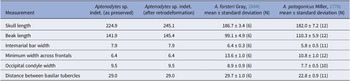
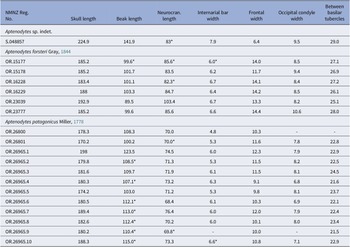
We collected the following measurements from the skulls of Aptenodytes forsteri (N = 6), A. patagonicus (N = 12), and the new fossil skull NMNZ S.048857 (N = 1) (see Table 1; Appendix Table A1), all from the NMNZ collections: (1) beak length, i.e., the maximum distance between the tip of the beak and the border of the nasofrontal joint; (2) neurocranium length, i.e., the maximum distance between the proximal border of the nasofrontal joint and the caudal margin of the supraoccipital; (3) width of internarial bar, i.e., the distance between the lateral edges of premaxillae in dorsal view at approximately half way along the length of the beak; (4) interorbital width, i.e., the minimum distance between the orbits excluding the salt glands; (5) basitemporal width, i.e., the distance between the lateral margins of the basilar tubercles; and (6) occipital condyle width, i.e., the distance between the lateral margins of the occipital condyle. Not all measurements could be collected from all specimens owing to differences in preservation or preparation (see Appendix Table A1).
Measurements (in mm) for skulls of Aptenodytes sp. indet. (NMNZ S.048857, as preserved and after retrodeformation) compared to those of extant Aptenodytes. See Appendix Table A1 for individual measurements

Three-dimensional scanning and retrodeformation
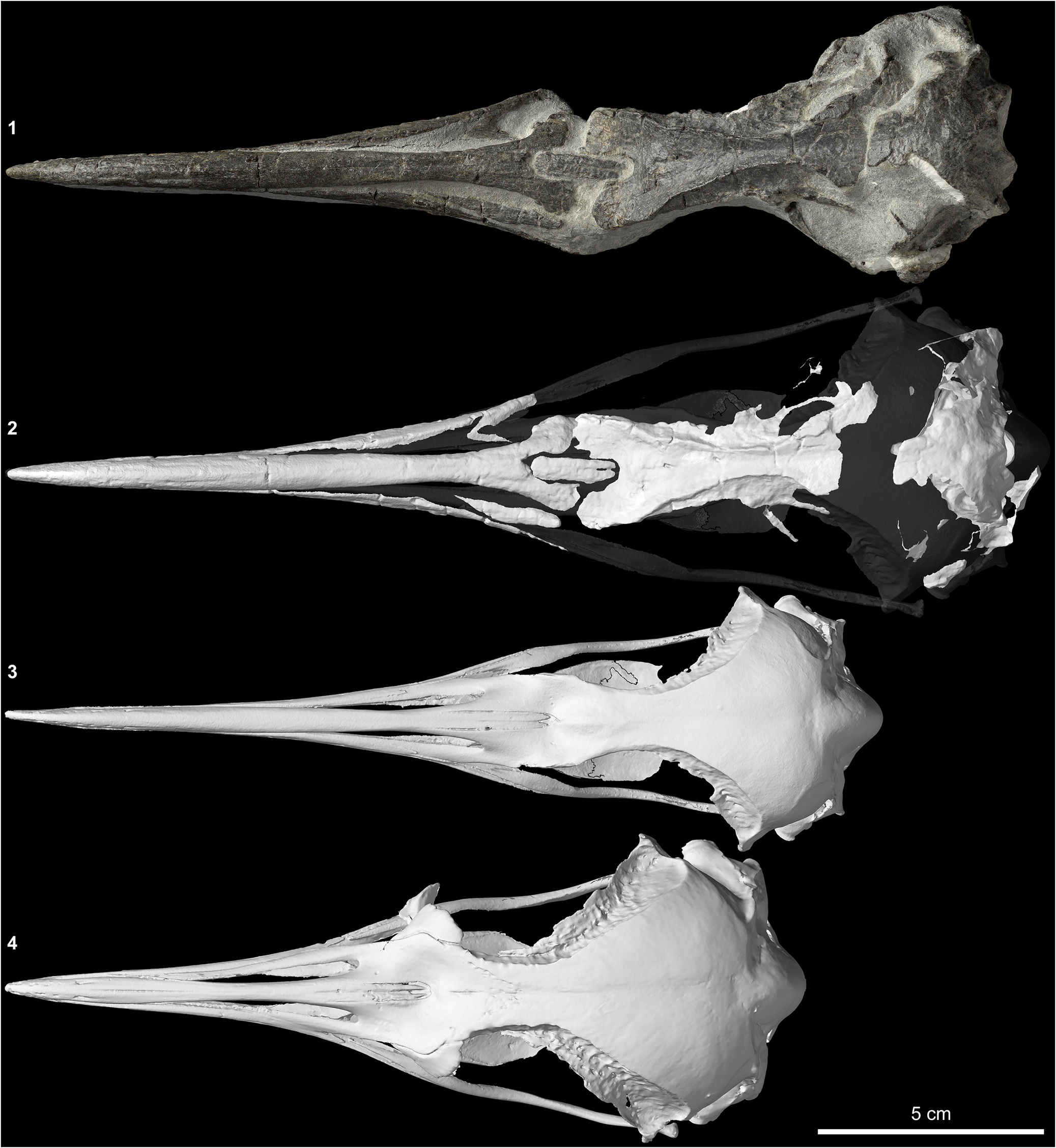
Digital replicas of NMNZ S.048857 and of selected skulls from Aptenodytes forsteri and A. patagonicus were generated using a HandySCAN BLACK handheld laser scanner (Creaform Inc., Quebec, Canada). Three-dimensional (3D) scan data were processed using VXelements 11.1.0 (Creaform Inc., Quebec, Canada). The minimum resolvable surface feature of the digital replicas (i.e., 3D meshes) was ~0.2 mm diameter. Because NMNZ S.048857 was still partially embedded in matrix, the vertices making up the regions of bone in the 3D mesh of the skull were selected and isolated from the matrix using tools within Blender 3.3.1 (Blender Online Community, 2022). The original shape of the skull was then estimated through a retrodeformation process that involved digitally separating, rotating, and translating the bone regions of the fossil. These bone regions were digitally repositioned into the configuration that they were estimated to have held in life through visual comparison with 3D meshes of skulls from A. forsteri and A. patagonicus that had been rescaled (see Fig. 2 for the rescaled A. patagonicus skull template). The visual comparison templates used as repositioning guides for the regions segmented from the fossil were produced by isometrically scaling different regions of the A. forsteri and A. patagonicus skulls to different extents. The retrodeformed fossil skull was used for general size and shape comparisons and to interpret postburial alteration.
Aptenodytes sp. indet., NMNZ S.048857: (1) Skull in dorsal view compared with (2) 3D digital replica showing estimated original shape; 3D digital replica of skull from extant (3) king penguin Aptenodytes patagonicus Miller, Reference Miller1778; and (4) emperor penguin Aptenodytes forsteri Gray, Reference Gray1844 in dorsal view. See Figure 1 for annotated views of NMNZ S.048857.
Sea-surface temperature
Modern-day sea-surface temperature data were taken from the National Oceanic and Atmospheric Administration (NOAA) 1/4° Daily Optimum Interpolation Sea Surface Temperature (OISST) (Huang et al., Reference Huang, Liu, Banzon, Freeman, Graham, Hankins, Smith and Zhang2021). Global daily grids of sea-surface temperature from the period 01 January 2023 to 31 December 2023 were downloaded from the OISST version 2.1 repository (https://www.ncei.noaa.gov/products/optimum-interpolation-sst) in NetCDF file format (i.e., oisst-avhrr-v02r01.20230101.nc to oisst-avhrr-v02r01.20231231.nc, inclusive). These data were read into R 4.4.1 (R Core Team, 2024) and averaged into a global summary of mean annual sea-surface temperature for 2023. Modelled sea-surface temperature data for the mid-Piacenzian (3.264–3.025 Ma) were from the US Geological Survey PRISM4 Paleoenvironmental Reconstruction (Dowsett et al., Reference Dowsett, Dolan, Rowley, Moucha and Forte2016). Monthly grids of sea-surface temperature were downloaded from https://geology.er.usgs.gov/egpsc/prism/4_data.html in NetCDF file format (i.e., PRISM3_SST_v1.0.nc). These data were read into R 4.4.1 and averaged into a global summary of mean annual sea-surface temperature.
Repositories and institutional abbreviations
Canterbury Museum (CM), Christchurch, New Zealand; Museum of New Zealand Te Papa Tongarewa (NMNZ), Wellington, New Zealand.
Systematic paleontology
Class Aves Linnaeus, Reference Linnaeus1758
Order Sphenisciformes Sharpe, Reference Sharpe1891
Family Spheniscidae Bonaparte, Reference Bonaparte1831
Genus Aptenodytes Miller, Reference Miller1778
Referred specimen
NMNZ S.048857, a largely complete skull. The neurocranium is rotated dorsally about, and separated slightly from, the nasofrontal suture. The neurocranium is also fractured between the parietals and the frontals. The parietal and occipital regions are incomplete and the occipital region is slightly crushed.
Diagnosis
NMNZ S.048857 is assigned to Aptenodytes by the combination of its (1) widely separated temporal fossae—meeting at the midline in stem penguins and in Spheniscus Brisson, Reference Brisson1760; (2) elongate upper beak with an unhooked tip (shorter in all other crown penguins); and (3) salt gland fossae lacking a raised lateral border—present in Eudyptes Vieillot, Reference Vieillot1816, Megadyptes Milne-Edwards, Reference Milne-Edwards1880, and Pygoscelis Wagler, Reference Wagler1832. It differs from A. patagonicus and A. forsteri in having (1) a more robust upper beak with a wider internarial bar; and (2) a proportionally narrower interorbital region. Because there is no overlap in preserved skeletal material with the extinct A. ridgeni, which is known only from hindlimb elements, we are unable to either confirm or rule out assignment to that species and conservatively assign the new skull only to Aptenodytes.
Occurrence
NMNZ S.048857 was surface collected from the base of an eroding sea cliff near Ohawe, South Taranaki, New Zealand. This cliff exposes the Tangahoe Formation, which is dated to the late Pliocene (mid-Piacenzian; local Waipipian, constrained to 3.36–3.06 Ma based on oxygen isotope stage and magnetic polarity data) (Naish et al., Reference Naish, Wehland, Wilson, Browne and Cook2005; Raine et al., Reference Raine, Beu, Boyes, Campbell and Cooper2015). The same locality has produced specimens of Eudyptes atatu Thomas et al., Reference Thomas, Tennyson, Scofield, Heath, Pett and Ksepka2020, Eudyptula wilsonae Thomas et al., Reference Thomas, Tennyson, Marx and Ksepka2023, Macronectes tinae Tennyson and Salvador, Reference Tennyson and Salvador2023, and several other recently reported fossil seabirds. See Fossil Record Electronic Database (https://fred.org.nz/) record Q21/f0002 for a nearby location.
Description
The new skull resembles that of modern Aptenodytes penguins in general morphology but, accounting for missing regions of the parietal and supraoccipital, would have exceeded the average skull length of the emperor penguin by 31%. The elongate beak contributes ~60% of the total length of the skull, which falls closer to the proportions of king penguin (the most long-beaked extant penguin). The beak was tapering and slightly hooked as in extant king and emperor penguins, but notably is more stoutly constructed with a wider internarial bar and a deeper profile at the tip (in lateral view). The nares are long and narrow and the suture between the premaxilla and nasals is distinct at the level of the frontal-nasal hinge as in extant king and emperor penguins. Despite the larger size of the skull, the interorbital bridge was absolutely narrower than in king and emperor penguins. This is due in large part to the deeper encroachment of the salt-gland fossa, which gives the interorbital region a distinctly hourglass-like shape. The basitemporal plate is well preserved and closely resembles those of extant king and emperor penguins. The width between the basilar tubercles is within the range of the emperor penguin, consistent with a proportionally narrower neurocranium.
Remarks
The only previously reported fossil record of Aptenodytes is CM AV22632, the holotype of Aptenodytes ridgeni. We cannot directly compare NMNZ S.048857 to this specimen because the latter is known only from postcranial bones. Aptenodytes ridgeni belongs to Aptenodytes based on (1) its extremely wide tarsometatarsus with (2) a strongly distally displaced insertion for m. tibialis cranialis. This species appears to fall outside the clade uniting A. forsteri and A. patagonicus based on the retention of two plesiomorphic features, namely (1) the medial and lateral branches of the linea aspera intersecting near the distal third of the femur (intersecting at the midpoint in extant Aptenodytes), and (2) the path for the ambiens tendon forming a deep sulcus on the patella (extremely shallow in extant Aptenodytes). Both CM AV22632 and NMNZ S.048857 represent individuals of approximately the same size. It is thus possible that they represent the same species, or that the new skull belongs to a descendant of A. ridgeni. Future discovery of Aptenodytes cranial material at Motunau or Aptenodytes postcranial material at Taranaki would help resolve this uncertainty.
Discussion
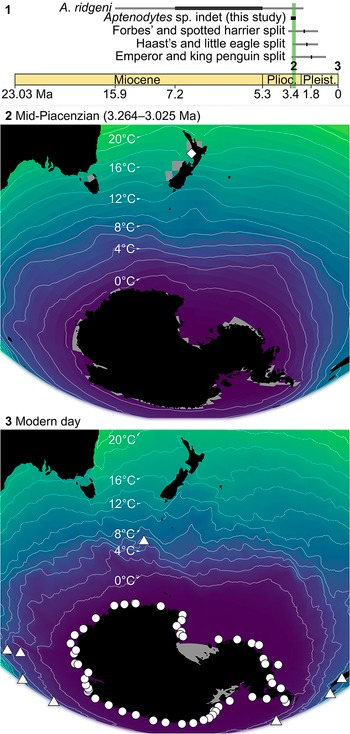
Biogeographic models reconstruct the common ancestor of all extant penguins as originating in the Miocene in either Zealandia (Thomas et al., Reference Thomas, Tennyson, Scofield, Heath, Pett and Ksepka2020) or South America (Cole et al., Reference Cole, Zhou, Fang, Pan and Ksepka2022). Although Aptenodytes has been universally supported as the sister taxon of all other extant penguins by recent studies, the divergence between king and emperor penguins appears to have only occurred within the last 2 Myr (Gavryushkina et al., Reference Gavryushkina, Heath, Ksepka, Stadler, Welch and Drummond2017; Thomas et al., Reference Thomas, Tennyson, Scofield, Heath, Pett and Ksepka2020; Cole et al., Reference Cole, Zhou, Fang, Pan and Ksepka2022). The tightly constrained age of the new Aptenodytes skull is at the upper bound of the estimate for divergence of the crown species (1.82 Ma, 95% highest posterior density [HPD] 3.30–0.78 Ma), consistent with the divergence of a stem species prior to the king-emperor split (Fig. 3).
Geographic and temporal distribution of Aptenodytes: (1) ages (black) with uncertainty (gray) for Aptenodytes ridgeni Simpson, Reference Simpson1972 (CM AV22632) and Aptenodytes sp. indet. (NMNZ S.048857; this study), and the origins of Haast’s eagle, Forbes’ harrier, and king and emperor penguins; (2) collection location of NMNZ S.048857 (white diamond) projected against mid-Piacenzian mean annual sea-surface temperature (Dowsett et al., Reference Dowsett, Dolan, Rowley, Moucha and Forte2016) and paleogeography (Müller et al., Reference Müller, Seton, Zahirovic, Williams and Matthews2016); (3) present-day distribution of emperor (white circles) and king (white triangles) penguin colonies shown with mean annual sea-surface temperature (Budd, Reference Budd1968; Ryan et al., Reference Ryan, Cooper, Dyer, Underhill, Crawford and Bester2003; Otley et al., Reference Otley, Clausen, Christie, Huin and Pütz2007; Le Bohec et al., Reference Le Bohec, Durant, Gauthier-Clerc, Stenseth, Park, Pradel, Grémillet, Gendner and Le Maho2008; van den Hoff et al., Reference van den Hoff, McMahon and Field2009; Ancel et al., Reference Ancel, Cristofari, Trathan, Gilbert, Fretwell and Beaulieu2017; Juáres et al., Reference Juáres, Ferrer, Coria and Santos2017; Foley et al., Reference Foley, Hart and Lynch2018; Barbraud et al., Reference Barbraud, Delord, Bost, Chaigne, Marteau and Weimerskirch2020; Pütz et al., Reference Pütz, Gherardi-Fuentes, García-Borboroglu, Godoy, Flagg, Pedrana, Vianna, Simeone and Lüthi2021). Missing temperature data in gray; contours represent 2°C intervals.

The new skull confirms the late Neogene presence of Aptenodytes in Zealandia and reveals that the genus persisted there into the mPWP. Its geographic range thus once extended to 40.5°S, where sea-surface temperatures averaged ≥ 20°C as recently as the late Pliocene (Dowsett et al., Reference Dowsett, Dolan, Rowley, Moucha and Forte2016; Chiswell et al., Reference Chiswell, Zeldis, Hadfield and Pinkerton2017; Grant et al., Reference Grant, Williams, Naeher, Seki and McClymont2023) (Fig. 3). Today, Aptenodytes is limited to far colder sea-surface temperatures, with individuals at the lowest latitudes in their range (i.e., Crozet Islands, 46.1°S) being exposed to temperatures of 3–10°C while foraging (Guinet et al., Reference Guinet, Koudil, Bost, Charles, Durbec, Georges, Mouchot and Jouventin1997; Huang et al., Reference Huang, Liu, Banzon, Freeman, Graham, Hankins, Smith and Zhang2021; Pütz et al., Reference Pütz, Gherardi-Fuentes, García-Borboroglu, Godoy, Flagg, Pedrana, Vianna, Simeone and Lüthi2021). Our results suggest that the warmer temperatures modelled for 2100 and beyond (Burke et al., Reference Burke, Williams, Chandler, Haywood, Lunt and Otto-Bliesner2018) are not direct constraints on the geographic range of Aptenodytes penguins, especially considering that the upper critical temperatures of the two extant species are up to 20°C higher than the sea-surface temperatures in which they forage (Pinshow et al., Reference Pinshow, Fedak, Battles and Schmidt-Nielsen1976; Barré, Reference Barré1984; Froget et al., Reference Froget, Handrich, Maho, Rouanet, Woakes and Butler2002; Lewden et al., Reference Lewden, Nord, Bonnet, Chauvet, Ancel and McCafferty2020).
The fossil record sheds light on the features that could have aided Aptenodytes in dispersing south. By the mPWP, Aptenodytes had already attained large body size (enabling efficient heat conservation) and—judging from A. ridgeni—unusually wide feet, which could have allowed it to balance eggs (and chicks) on its feet. These traits are key to the breeding success of king and emperor penguins in cold conditions and, thus, could represent exaptations that facilitated the colonization of Antarctic latitudes.
The stark difference in the realized niche between fossil and extant Aptenodytes spp. raises the question why these penguins became limited to colder waters after the mPWP. Climatic shifts cannot easily account for this pattern, because the overall trend of Pleistocene cooling should have had the opposite effect. The cranial silhouette of Aptenodytes sp. indet. furthermore closely resembles that of the extant king penguin, suggesting a similar feeding ecology (Borboroglu and Boersma, Reference Borboroglu and Boersma2013).
An alternative explanation might be predation pressure. New Zealand has a sparse Neogene fossil record of large terrestrial predators. A large accipitrid and crocodilians have been documented in Miocene (19–16 Ma) lake deposits (Worthy et al., Reference Worthy, Tennyson, Jones, McNamara and Douglas2007), but there is no evidence of these lineages persisting into the Pliocene. By the mPWP, Zealandia was seemingly devoid of terrestrial predators capable of taking large prey. This changed with the arrival of Forbes’ harrier Circus teauteensis Forbes, Reference Forbes1892 and Haast’s eagle Hieraaetus moorei (Haast, Reference Haast1872). Both species appear to have diverged from their closest relatives in the Pliocene, presumably soon after dispersing to Zealandia. Forbes’ harrier is estimated to have split from the spotted harrier Circus assimilis Jardine and Selby, Reference Jardine and Selby1828 ~2.4 million years ago (95% HPD 3.54–1.40 Ma) and Haast’s eagle is estimated to have split from the little eagle Hieraaetus morphnoides (Gould, Reference Gould1841) ~2.2 million years ago (95% HPD 3.25–1.41 Ma) (Knapp et al., Reference Knapp, Thomas, Haile, Prost and Ho2019) (Fig. 3). These were large raptors that included avian megafauna in their diets (Worthy and Holdaway, Reference Worthy and Holdaway2002) and, plausibly, could have targeted Aptenodytes colonies along open beaches. Apomorphic features of the hindlimb suggest that penguins from the extinct Zealandian Aptenodytes lineage incubated their eggs on the tops of their feet like extant Aptenodytes, which might have left brooding individuals more vulnerable to aerial attacks. By contrast, more cryptic breeding behavior, e.g., nesting in burrows, natural crevices, and dense vegetation, and avoidance behaviors like transiting across beaches at night, might have enabled smaller Zealandian penguins, e.g., Eudyptula Bonaparte, Reference Bonaparte1856, Eudyptes, and Megadyptes, to better withstand such predation pressure.
Forbes’ harrier and Haast’s eagle became extinct shortly after humans arrived in New Zealand and so might have been a barrier to Aptenodytes re-colonization attempts until the Holocene (Holdaway, Reference Holdaway1989). Intriguingly, the extinction of these raptors could now reopen New Zealand to colonization by Aptenodytes, as long as other constraints like human activity and introduced mammalian predators are controlled (Stevenson and Woehler, Reference Stevenson and Woehler2007). Along similar lines, king penguins recently established a colony at Bahía Inútil (53.5°S) in Tierra del Fuego, Chile (Pütz et al., Reference Pütz, Gherardi-Fuentes, García-Borboroglu, Godoy, Flagg, Pedrana, Vianna, Simeone and Lüthi2021). Individuals from this colony forage within the Magellan Strait, demonstrating that the fundamental niche of king penguins is indeed broader than the Antarctic Polar Front. Nevertheless, predation by mammals at the new site remains a challenge and contributes to low chick survival (Pütz et al., Reference Pütz, Gherardi-Fuentes, García-Borboroglu, Godoy, Flagg, Pedrana, Vianna, Simeone and Lüthi2021), consistent with the hypothesis that onshore predation pressure generally excludes Aptenodytes from warmer latitudes.
Conclusion
Great penguins (Aptenodytes) today live in subpolar and polar latitudes, but also inhabited temperate Zealandia during the mid-Piacenzian. Sea-surface temperature might therefore be less important for determining the geographic range of great penguins than previously thought. Rather, factors that reduce onshore survival, including predation, warrant particular focus when analyzing the biogeography of Aptenodytes through time.
Acknowledgments
We thank M. Langer, J. Calede, and reviewers P. Jadwiszczak and T. Ando for their contributions; K. Sharpe-Young for collecting and preparing the fossil; J. Buchanan-Brown for completing preparation of the fossil; J.-C. Stahl (NMNZ) for photographs of NMNZ specimens; and Ngāti Ruanui and Ngāruahine for supporting the collection and research of fossils from their rohe. DBT used equipment provided by Massey University. This research was supported by funding from the Te Papa Collection Development Fund (AJDT and FGM) and National Science Foundation award DEB-1556615 (DTK).
Competing interests
The authors have no competing interests to declare.
Measurements (in mm) for Aptenodytes sp. indet. (NMNZ S.048857), emperor penguin A. forsteri Gray, Reference Gray1844 (N = 6) and king penguin Aptenodytes patagonicus Miller, Reference Miller1778 (N = 12). Measured with calipers; asterisk (*) denotes approximate measurements. Between basilar tubercles = minimum distance between lateral margins of basilar tubercles; Frontal width = minimum interorbital width excluding salt gland depressions; Neurocran. = Neurocranium; - = not available




 Open access

