


Introduction
Fjord ecosystems are important habitats for elasmobranchs (sharks, rays, and skates) across all of their life stages, functioning as feeding, nursing, and pupping grounds (Andrews et al., Reference Andrews, Williams and Levin2010; Gaitán-Espitia et al., Reference Gaitán-Espitia, Gómez, Hobday, Daley, Lamilla and Cárdenas2017; Licandeo and Cerna, Reference Licandeo and Cerna2007). The Chilean Patagonian fjords comprise a large geographic area of ∼240,000 km2 and more than 84,000 km of coastline, with a complex network of unique ecosystems and high marine species richness (Friedlander et al., Reference Friedlander, Ballesteros, Goodell, Hüne, Muñoz, Salinas-de-león, Velasco-Charpentier and Sala2021; Mutschke, Reference Mutschke, Nelson and Sergio2008). Nonetheless, many of the fjords in northern Chilean Patagonia, especially those in the Chiloense Ecoregion (see Spalding et al., Reference Spalding, Fox, Allen, Davidson, Ferdaña, Finlayson, Halpern, Jorge, Lombana, Lourie, Martin, McManus, Molnar, Recchia and Robertson2007) have been impacted by anthropogenic stressors for decades, including the development of the salmon aquaculture industry and overfishing (Buschmann et al., Reference Buschmann, Niklitschek, Pereda, Castilla, Zamudio, Martínez-Harms and Tecklin2023; Molinet and Niklitschek, Reference Molinet, Niklitschek, Carlos, J, José and David2023). Growing economy and population, as well as stressors related to climate change, are likely to further increase the pressure on the fjords’ ecosystem and its biodiversity (e.g. Soto et al., Reference Soto, León-Muñoz, Dresdner, Luengo, Tapia and Garreaud2019, Reference Soto, Arriagada-González, Molina-Benavides, Cabello, Contreras-Alonso, Ibarra, Guevara, Sepúlveda and Maerker2023).
Elasmobranchs are a diverse group of cartilaginous fishes with important ecological functions (Heithaus et al., Reference Heithaus, Dunn, Farabaugh, Lester, Madin, Meekan, Papastamatiou, Roff, Vaudo and Wirsing2022, Reference Heithaus, Frid, Vaudo, Worm, Wirsing, Jeffery, John and Michael2010) and generally slow, complex life history strategies (Ebert et al., Reference Ebert, Dando and Fowler2021; Last et al., Reference Last, Seret, Stehmann, Naylor, White, Carvalho, White, Carvalho, Stehmann and Naylor2016), which make them highly susceptible to anthropogenic and environmental disturbances (Dulvy et al., Reference Dulvy, Pacoureau, Rigby, Pollom, Jabado, Ebert, Finucci, Pollock, Cheok, Derrick, Herman, Sherman, VanderWright, Lawson, Walls, Carlson, Charvet, Bineesh, Fernando, Ralph, Matsushiba, Hilton-Taylor, Fordham and Simpfendorfer2021; Ferretti et al., Reference Ferretti, Worm, Britten, Heithaus and Lotze2010; Pacoureau et al., Reference Pacoureau, Rigby, Kyne, Sherley, Winker, Carlson, Fordham, Barreto, Fernando, Francis, Jabado, Herman, Liu, Marshall, Pollom, Romanov, Simpfendorfer, Yin, Kindsvater and Dulvy2021). The most recent checklist of elasmobranchs in Chile included 101 species, of which nearly half of them occur within the latitudes of Southern Chile (c. 36° S to c. 54° S), including fjord ecosystems (Bustamante et al., Reference Bustamante, Vargas-Caro and Bennett2014). Largely due to little direct economic importance, most elasmobranchs have only received minor research attention in the Chilean fjords, resulting in a lack of information on their conservation status and functional role within these ecosystems (Molinet and Niklitschek, Reference Molinet, Niklitschek, Carlos, J, José and David2023).
In contrast to most of the fjords in Chilean Patagonia, the Comau Fjord has been subject to extensive scientific research during the past 20 years (e.g. Försterra and Häussermann, Reference Försterra and Häussermann2003; Villalobos et al., Reference Villalobos, Valdivia, Försterra, Ballyram, Espinoza, Wadham, Burgos-Andrade and Häussermann2021). While the research has primarily focused on the sessile benthic fauna of the area, few studies have been dedicated to the ichthyofauna. Unpublished data from 2007 (N. Straube, personal communication, May 2, 2023) and data from 2013 located on the online Global Cestode Database (Caira et al., Reference Caira, Jensen and Barbeau2024) show that at least six species of elasmobranchs are present in the Comau Fjord, namely spiny dogfish Squalus acanthias (Squalidae), narrowmouthed catshark Schroederichthys bivius (Atelomycteridae), bluntnose sixgill shark Hexanchus griseus (Hexanchidae), leafscale gulper shark Centrophorus squamosus (Centrophoridae), birdbeak dogfish Deania calceus (Centrophoridae), and roughskin skate Dipturus trachyderma (Rajidae).
Considering the existing knowledge gap due to a lack of elasmobranch-related research, and the potential threats to the fjord ecosystems in northern Patagonia, elasmobranch species inventories and information about their life history stages, abundance, seasonality, and migration are necessary to provide decision makers with the knowledge needed to counteract potential local extirpations and to conserve biodiversity. The present study combines morphological and molecular data: (i) to provide a species checklist with images of confirmed reports in the Comau Fjord and (ii) to gain insights into the biological aspect of the examined specimens (i.e. sex, length, and maturity) and their relative abundances. These data are further discussed in relation to the fjord acting as an elasmobranch habitat.
Materials and methods
Study area
The field survey took place in the Comau Fjord (42°15′ S, 72°29′ W), which is located in northern Chilean Patagonia (Figure 1). The region is characterised by deep and narrow fjords carved by ice masses during the last glacial period. The Comau Fjord is 2–5 km wide and stretches over 40 km from its head in the south to its mouth in the north. The depth at the centre of the fjord ranges from approximately 300 m at its head to around 500 m close to its mouth (Addamo et al., Reference Addamo, Zaccara, Försterra, Höfer, García-Jiménez, Crosa and Machordom2021). Freshwater and glacial meltwater influx from terrestrial runoff creates a pronounced low salinity surface layer, which varies in its bathymetric extension between < 1 m in summer and up to 10 m in winter, with strong local, seasonal, and weather-dependant changes in extension, temperature (5–20 °C), and salinity (2–20 PSU), followed by a brackish water layer (20–30 PSU, 12–20 °C) at 1–20 m (Sánchez et al., Reference Sánchez, González and Iriarte2011). These low-salinity surface and brackish subsurface layers are especially pronounced close to the head of the fjord where the highest freshwater input occurs (Addamo et al., Reference Addamo, Zaccara, Försterra, Höfer, García-Jiménez, Crosa and Machordom2021). The conditions become fully marine below 20 m, with a year-round stable salinity of >32 PSU and temperatures of 10.2–12.0 °C (Fillinger and Richter, Reference Fillinger and Richter2013; Sánchez et al., Reference Sánchez, González and Iriarte2011). Tidal currents with amplitudes of up to 7.5 m in combination with wind driven currents can, however, on occasions mix water masses down to 100 m depth (Addamo et al., Reference Addamo, Zaccara, Försterra, Höfer, García-Jiménez, Crosa and Machordom2021). As documented from other fjord regions around the world, the Comau Fjord also exhibits features of deepwater emergence, which is a phenomenon referring to the occurrence of deepwater species in shallow depths, far beyond their usual distributional range (Feehan et al., Reference Feehan, Waller and Häussermann2019; Fillinger and Richter, Reference Fillinger and Richter2013). While the drivers beyond this phenomenon are not yet fully understood (Häussermann et al., Reference Häussermann, Ballyram, Försterra, Cornejo, Ibáñez, Sellanes, Thomasberger, Espinoza and Beaujot2021), its occurrence could be an indication for bathyal- or abyssal-like conditions in the study area, thereby providing refugia to deepwater and cold-adapted organisms.
Sampling of specimens
Specimens (n = 305) were sampled from May to October 2018 at 10 locations (Figure 1) with demersal longlines, soaked overnight for 14–16 h at a range of depths 80–450 m. The groundline was held down with weights and fitted with circle hooks set 10 m apart. Buoys were placed between the weights to keep the groundline off the seabed to minimise depredation by epibenthic crustaceans. The hooks were baited with different species of fish, such as Chilean silverside (Odontesthes regia), Patagonian grenadier (Macruronus magellanicus), and other miscellaneous whitefish. In addition, four elasmobranchs that were opportunistically sampled and/or recorded from January 2017 to April 2018 were included in the study (Figure 1, Locations 11–14). These samples comprised two whole specimens donated to the authors (Figure 1, Locations 11 & 14), one in situ personal observation (Figure 1, Location 12) and another one as photographic evidence (Figure 1, Location 13).
Map of the Comau Fjord (42 °S) with the sampling locations (A) within South America (B) and northern Patagonia in Chile (C). The monthly sampling of the elasmobranchs was conducted from May to October 2018 on locations 1–10. The additional locations 11–14 represent the opportunistically sampled and observed specimens from January 2017 to April 2018. The contour lines are expressed as depth in meters (50–450 m depth).

All specimens were identified in the field to species level following the diagnostic characters proposed by Ebert (Reference Ebert and Mostarda2015) and Ebert and Mostarda (Reference Ebert and Mostarda2016). They were further photographed with a NIKON 3300 camera to build up a photo voucher collection and to support taxonomic identification. When possible, both total length (L T) and clasper length (L C in males) of the individuals were measured down to the nearest 1 mm. Sex was determined based on the presence or absence of claspers. The maturity of males was determined by the degree of calcification of the claspers and their length in relation to the pelvic fins based on the reproductive stage protocols by ICES (2010). The degrees of maturity are: (I) immature males: non-calcified claspers shorter than the pelvic fins; (II) developing males: partially calcified claspers extending to the margin of the pelvic fins or slightly beyond, and (III) mature males: fully calcified and long claspers extending well beyond the margin of the pelvic fins. In this study, reproductive stages of females could not be determined since most of the specimens were alive and subsequently released after capture to keep the mortality rate at the minimum. On a few dead female specimens (n = 4), the ovaries were, however, examined for oocytes using reproductive stage protocols and relevant literature (Hamlett WC, 2005; ICES, 2010). Individuals with visible vitelline scars (i.e. fresh or healed) were also noted (see Castro, Reference Castro1993).
Molecular analysis
Tissue samples were collected from specimens (n = 273) and were immediately preserved in 96% ethanol and frozen at −20 °C until further molecular analysis. Genomic DNA (gDNA) was extracted using commercial kits EasySpin® Genomic DNA Tissue Kit (Citomed) following the manufacturer’s recommendations and checked for quality on 0.8% agarose gel electrophoresis run at 300 V with 0.5X TBE buffer. Nucleotide sequences of the mitochondrial ND2 gene were obtained via the polymerase chain reaction (PCR) using the primers ASNM and ILEM by Naylor et al. (Reference Naylor, Caira, Jensen, Rosana, White and Last2012). All samples were amplified in 10 µl reactions, including 5 µl of MyTaq HS Master mix, 3 µl of autoclaved water, 0.4 µl of each primer (10 µM) and 1 µl of gDNA. The PCR temperature profile included an initial denaturation step of 5 min at 95 °C, followed by 30 cycles of denaturation for 1 min at 94 °C, annealing for 30 sec at 55 °C, and extension for 1 min at 72 °C, and by a final extension step of 10 min at 60 °C. Successful PCR amplification was checked on 2% agarose gel electrophoresis and the obtained amplicons were enzymatically cleaned with ExoSAP-IT (Thermo Fisher Scientific) prior to Sanger sequencing on a commercial service provider. No successful amplification of the ND2 gene was obtained for the specimens morphologically identified as Hexanchus griseus, thus, we performed molecular identification using the MiFish-E primers of Miya et al. (Reference Miya, Sato, Fukunaga, Sado, Poulsen, Sato, Minamoto, Yamamoto, Yamanaka, Araki, Kondoh and Iwasaki2015), which amplify a small fragment (∼172 bp) of the mitochondrial 12S ribosomal RNA gene (12S). The same PCR protocol was used as described above, but the temperature profile included an initial denaturation step of 3 min at 95 °C, followed by a touchdown of nine steps of 95 °C for 15 sec, 54 °C for 10 sec (decreasing 0.5 °C per cycle), and 72 °C for 10 sec, followed by 31 cycles of 95 °C for 5 sec, 50 °C for 10 sec, and 72 °C for 10 sec, plus a final extension step at 72 °C for 5 min. The amplicons were cleaned with ExoSAP-IT and processed for Sanger sequencing, as described above.
The obtained nucleotide sequences were checked for quality and manually edited in Geneious Prime (version 2020.1.2). Additional ND2 sequences from a subset of species (i.e. those that were successfully amplified as described above) were obtained from Naylor et al. (Reference Naylor, Caira, Jensen, Rosana, White and Last2012), Straube et al. (Reference Straube, White, Ho, Rochel, Corrigan, Li and Naylor2013), and Concha et al. (Reference Concha, Caira, Ebert and Pompert2019) referring to specimens collected in the corresponding type locality (Table 1). The type localities and taxonomic status of all species were checked following Fricke et al. (Reference Fricke, Eschmeyer and der Laan R2016).
Reference sequences of the ND2 genes used in molecular identification and phylogenetic analyses

* Locality stated in original type description is likely an error as the species is endemic to South America (Compagno, Reference Compagno1984; Springer, Reference Springer1979).
Comparison of the newly generated sequences to those of the putative species’ type locality was performed by aligning all sequences using the ClustalW algorithm (Thompson et al., Reference Thompson, Higgins and Gibson1994) as implemented in Geneious Prime, and by constructing the respective neighbour-joining tree using p-distances and 1000 bootstrap replicates in MEGA version X (Stecher et al., Reference Stecher, Tamura and Kumar2020). For the specific case of putative H. griseus specimens, the obtained sequences were compared against those deposited in GenBank, using the BLASTn algorithm (Camacho et al., Reference Camacho, Coulouris, Avagyan, Ma, Papadopoulos, Bealer and Madden2009).
Results
Relative species composition and abundance
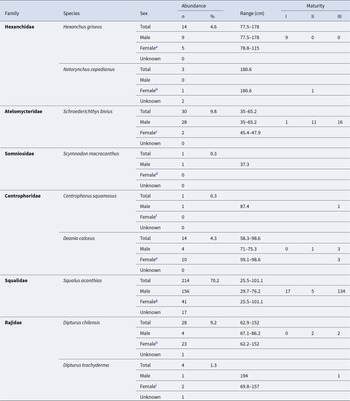
In this study, 309 elasmobranch specimens were morphologically identified in the Comau Fjord, comprising nine species of six families. These comprised three new species records in the fjord, namely broadnose sevengill shark (Notorynchus cepedianus), largespine velvet dogfish (Scymnodon macracanthus), and yellownose skate (Dipturus chilensis). The most abundant species were spiny dogfish (Squalus acanthias), narrowmouthed catshark (Schroederichthys bivius), and yellownose skate (Dipturus chilensis), with the numbers caught, length ranges (by sex), and the proportional occurrence in sampling sites, as summarised in Table 2 and Figure 2.
Stacked bar chart shows the relative species composition at each sampling station (1−10) and the opportunistically sampled and observed specimens (11−14).

Results overview showing by family; species; sex; total number (n) of specimens; relative species composition of the longlined specimens (%); range of total lengths (cm), life stages as immature (I), developing (II) and mature (III), in the Comau Fjord from 2017 to 2018. The estimated length-at-50%-maturity (L m) for females of each species is shown under the table

a L m 421 cm (Ebert, Reference Ebert1986).
b L m 190 cm (Irigoyen et al., Reference Irigoyen, De Wysiecki, Trobbiani, Bovcon, Awruch, Argemi and Jaureguizar2018).
c L m 48.5 cm (Colonello et al., Reference Colonello, Cortés and Belleggia2020).
d L m 170 cm (Ebert et al., Reference Ebert, Dando and Fowler2021).
e L m 85 cm (Lamilla and Bustamante, Reference Lamilla and Bustamante2005).
f L m 119 cm (Parker and Francis, Reference Parker and Francis2012).
g L m 72.8 cm (Gaitán-Espitia et al., Reference Gaitán-Espitia, Gómez, Hobday, Daley, Lamilla and Cárdenas2017).
h L m 103 cm (Licandeo and Cerna, Reference Licandeo and Cerna2007).
i L m 215 cm (Licandeo et al., Reference Licandeo, Cerna and Céspedes2007).
Molecular analysis
Nucleotide sequences of the ND2 gene (1034 bp) were generated for 15 specimens (GenBank Accession no.s PV268444 to PV268458), comprising all the species identified based on morphology, except S. macracanthus, for which no tissue was available. The resulting neighbour-joining tree, including newly generated sequences from a few representative individuals per species and reference sequences from type locality specimens of each species (where available), shows congruence in morphological and molecular species identification (Figure 3). Nucleotide sequences of the 12S gene (172 bp) were generated for seven specimens, morphologically identified as H. griseus (GenBank Accession no. PV275033), which were 100% similar. BLASTn results showed 99% identity (83% query coverage) with other H. griseus sequences available on GenBank of unknown origin and with a specimen from Suruga Bay, Japan (NC_022732.1), supporting congruence between morphological and molecular identification.
Neighbour-joining tree of p-distances among nucleotide sequences of the ND2 gene. Bootstrap support values were generated using 1000 replicates and are shown on the branches if >75%. Reference sequences are shown with GenBank Accession numbers, while newly generated sequences are shown with the sample number after species name. No sequence from Dipturus trachyderma was included in the analysis since the sequence length obtained was much shorter than those from other taxa.

Family Hexanchidae
Hexanchus griseus (Bonnaterre, 1788)
Bluntnose sixgill shark (English), cañabota gris (Spanish)
Hexanchus griseus (Hexanchidae) specimens. (A) Lateral view of an immature female (#46). (B) Ventral view of the head of an immature male (#229). (C) Portion of the upper set of teeth (#114). (D) Portion of the lower set of teeth. (E) Young juvenile with a visible, healed vitelline scar (#228).

Type locality: France, northwestern Mediterranean Sea.
A total of 14 H. griseus specimens were recorded, comprising five females and nine immature males (Table 2 and Figure 2). Twelve specimens were processed for molecular identification with the ND2 genes but none amplified the target fragment. Indeed, we confirmed that the ILEM primer had no complementarity to the H. griseus ND2 gene. We have therefore used a small fragment of the 12S gene (∼172 bp) for the same purpose. Seven sequences were successfully obtained, all of which matched H. griseus sequences with >99% identity against the NCBI nt database (NCBI Resource Coordinators, 2024).
The colouration of the dorsal side of the examined specimens was grey to dark grey or dark brown and occasionally blackish. They only comprised one dorsal fin located near the caudal area. The specimens had a light-coloured lateral line extending from about the middle of the trunk into the caudal fin. The colouration of the ventral surface differed among the specimens, being slightly lighter ventrally on the smaller individuals to darker and more uniform on the larger specimens. The head was broad and blunt, with a wide mouth, as reported by Compagno (Reference Compagno1984). The most useful characteristics for identifying H. griseus from the regional relatives was by counting the pairs of gill openings, since it comprises six pairs of gill openings as opposed to seven pairs in N. cepedianus and Heptranchias perlo. Moreover, the H. griseus specimens did not have small black dots, as noticed on the N. cepedianus specimen (see next section).
Notorynchus cepedianus (Péron, 1807)
Broadnose sevengill shark (English), tiburón vaca de hocico corto (Spanish)
Notorynchus cepedianus (Hexanchidae) specimens. (A) Lateral view of a developing female specimen (#6). (B) Dorsal view of the head and the trunk. (C) Ventral view of the head. (D) A portion of the upper set of teeth. (E) A portion of the lower set of teeth. (F) Screenshot of a video with an N. cepedianus encounter during a SCUBA dive at 10 meters depth in December 2017 (Figure 1, Location 12). (G) An N. cepedianus caught near a salmon farm in March 2017 by a local fisher (Figure 1, Location 13).

Type locality: Adventure Bay, Tasmania, Australia.
Two of the three Notorynchus cepedianus specimens were observed in March and December 2017 (Table 2 and Figure 2). The single sampled specimen (September 2017) was a developing female that contained small, visible oocytes. The observed specimens were likely of a similar size. The single sample included in the analysis showed 99% similarity with a reference sequence from South Australia (Great Bight) and formed a well-supported clade (Figure 3).
The dorsal coloration of the examined specimen was grey to dark grey with many black spots and some sporadic white spots, as reported by Compagno (Reference Compagno1984) and Ebert et al. (Reference Ebert, Dando and Fowler2021). The dorsal side comprised one dorsal fin near the caudal area. The colouration of the ventral side was light to white. The head was broad and rounded with a wide mouth, as reported by Compagno (Reference Compagno1984) and Ebert et al. (Reference Ebert, Dando and Fowler2021). There are a number of useful diagnostic features of N. cepedianus that can be used to distinguish it from the related species H. griseus and H. perlo. However, since two of the specimens were never physically sampled and only exist as photographic evidence, counting the pairs of gill openings and examining the morphology of the teeth and the head was not possible. Instead, the observed specimens were distinguished from the two regional relatives based on the presence of the sporadic white spots on the dorsal side, which are absent in both H. griseus and H. perlo, and are a distinct feature of N. cepedianus only, in the family Hexanchidae (Compagno, Reference Compagno1984; Ebert et al., Reference Ebert, Dando and Fowler2021). Apart from the presence of the spots, the sampled specimen was distinguished from H. griseus by the additional pair of gill openings. As for H. perlo, which is a much smaller species reaching a maximum size of about 140 cm L T (Ebert et al., Reference Ebert, Dando and Fowler2021), the exceedingly narrow head and the morphological features of the teeth were used as characteristics to distinguish it from the N. cepedianus specimen. As of 2024, the number of observations of N. cepedianus is only increasing and is spotted in much shallower depths (B. Hernández, personal communication, 23 March 2024).
Family Atelomycteridae
Schroederichthys bivius (Smith, 1838)
Narrowmouthed catshark (English), pintarroja (Spanish)
Schroederichthys bivius (Atelomycteridae) specimens. (A) Lateral view of a developing male (#156). (B) Dorsal view of the head and the trunk of a developing male (#8). (C) Ventral view of the head of a mature male (#174). (D) Lateral view of the head and the trunk of a mature male (#256).

Type locality: Cape of Good Hope (but likely an error; see Springer (Reference Springer1979) and Compagno (Reference Compagno1984)).
In total, 30 S. bivius specimens were recorded during the study, which comprised two females and 28 males (Table 2 and Figure 2). Four samples were sequenced for the ND2 gene and formed a single, well-supported clade with the reference sequences from the southwestern Atlantic (Figure 3).
The dorsal surfaces of S. bivius specimens were brownish with multiple brown and white dots and large rhombic reddish to dark brown patches along the body. The patches had small white and dark reddish spots. The ventral surface of the specimens was whitish and lacked spots. S. bivius specimens were distinguished from the regional congener S. chilensis, based on distinct diagnostic features (e.g. saddles), following the taxonomic description by Compagno (Reference Compagno1984).
Family Somniosidae
Scymnodon macracanthus (Regan, 1906)
Largespine velvet dogfish (English), tollo, sapata espinuda (Spanish)
Scymnodon macracanthus (Somniosidae) specimen (#239). (A) Dorsal view. (B) Dorsal view of the head. (C) Ventral view of the head and the trunk.

Type locality: Strait of Magellan, Chile.
One immature male S. macracanthus was recorded but not sampled during the study (Table 2 and Figure 2). Thus, this species was only morphologically identified, based on several diagnostic features that distinguishes it from other Somniosidae species in the Southeastern Pacific Ocean.
The colouration of the specimen was dark brown to black, and it had relatively large spiracles. The snout was moderately long and rounded. The dorsal fins, which had a prominent and somewhat large dorsal spine, were greater in length than in height. The second dorsal fin was taller than the first (Ebert et al., Reference Ebert, Dando and Fowler2021).
Family Centrophoridae
Centrophorus squamosus (Bonnaterre, 1788)
Leafscale gulper shark (English), quelvacho negro (Spanish)
Centrophorus squamosus (Centrophoridae) specimen (#69). (A) Lateral view of a mature male. (B) Ventral view of the head. (C) Dorsal view of the head and the trunk.

Type locality: not stated (probably eastern North Atlantic).
A single Centrophorus squamosus specimen was recorded in this study, which was a developing male (Table 2 and Figure 2). Genetically, the examined specimen showed 100% similarity to the reference sequence from the Eastern North Atlantic, off Madeira, Portugal (Figure 3).
The colour of the specimen was plain dark brownish to black. Its snout was moderately flattened, with a preoral snout length shorter than the distance between the mouth and pectoral fins origin. The dorsal fins were about the same height, but the first dorsal fin was more elongated. Both fins had prominent dorsal spines. This species is similar to birdbeak shark (Deania calceus). However, the preoral snout length (i.e. shorter in C. squamosus) and interdorsal space (i.e. longer in C. squamosus) were useful characteristics to ensure a more precise identification.
Deania calceus (Lowe, 1839)
Birdbeak dogfish (English), tollo pajarito (Spanish)
Deania calceus (Centrophoridae) specimens. (A) Lateral view of a female (#217). (B) Ventral view of the head of a female (#218). (C) Dorsal view of the head (#218). (D) Upper and lower set of the teeth of a mature female (#121).

Type locality: Madeira, Portugal, eastern Atlantic.
A total of 14 D. calceus specimens were recorded, comprising 10 females and four males (Table 2 and Figure 2). The four samples sequenced for the ND2 gene formed a single, highly supported clade with a reference sequence from the Southwestern Indian Ocean (Figure 3).
The colouration of the dorsal side of the examined D. calceus specimens was dark grey and brown to black and slightly lighter ventrally. They were distinguished from morphologically similar species in the region, such as C. squamosus, by its relatively (as proportion of L T) longer preoral snout length and relatively (as proportion of L T) shorter interdorsal space (see Ebert, Reference Ebert and Mostarda2015).
Family Squalidae
Squalus acanthias Linnaeus, 1758
Spiny dogfish/spurdog (English), tollo de cacho (Spanish)
Squalus acanthias (Squalidae) specimens. (A) Lateral view of an immature male (#133). (B) Dorsal view of the head of a mature male (#146). (C) Ventral view of the head and the trunk of a mature male (#128). (D) Immature male with a healed translucent vitelline scar (#5).

Type locality: Mediterranean Sea and northeastern Atlantic.
In total, 214 S. acanthias specimens were recorded, comprising 41 females, 156 males, and 17 unsexed and unmeasured specimens (Table 2 and Figure 2). About a quarter (24%) of all the measured specimens comprised juveniles (<50 cm) and among these, at least seven specimens had visible, translucent vitelline scars (22.5–40.5 cm L T). A single sample was sequenced for the ND2 gene and showed 99% similarity to a reference sequence from Rhode Island, USA, forming a well-supported clade (Figure 3).
The dorsal sides of examined specimens of S. acanthias were light to dark grey with some or several conspicuous white spots on their flanks. The colouration laterally faded towards the ventral side. These specimens had a moderately long and pointed snout, and a markedly larger second dorsal fin spine, closely to extending beyond the dorsal fin on some specimens. The ventral surface of the specimens was white with the occasional darker pigmented patterns. The underside of the pectoral fins was darker than the remaining dorsal side.
Family Rajidae
Dipturus chilensis (Guichenot, 1848)
Yellownose skate (English), raya volantín (Spanish)
Dipturus chilensis (Rajidae) specimens. (A) Dorsal view of a female (#223). (B) Ventral view of a developing male (#150). (C) Dorsal view of a female with visible ocelli on the pectoral fins (#238). (D) Dorsal view of the head of a female with lighter spots (#223).

Type locality: Valparaíso Bay, central Chile, southeastern Pacific Ocean.
A total of 28 D. chilensis specimens were recorded, comprising 23 females, four males, and one unsexed and unmeasured specimen (Table 2 and Figure 2). The four specimens of D. chilensis included in the molecular analysis showed >99% of similarity with the sequence data of the neotype from Valparaíso, Chile, (GenBank Accession no. MK613955; Concha et al., Reference Concha, Caira, Ebert and Pompert2019) and clustered in the same, highly supported clade (Figure 3).
The dorsal surface of the examined specimens was dark brownish, with randomly distributed lighter spots, and a large red to purple ocellum near the centre of each pectoral fin. The ventral surface of the body was dark, almost as dark as the dorsal surface and certainly darker than what was reported from central Chile (see Concha et al., Reference Concha, Caira, Ebert and Pompert2019). The colouration patterns on the dorsal surface (i.e. lighter spots and purple to reddish ocelli) were variable, compared to the morphologically similar D. trachyderma specimens. These were mostly plain grey to blackish and lacked coloured ornamentation. In addition, the spinulation pattern of the caudal fin on D. chilensis specimens contained up to three rows of caudal thorns, as opposed to D. trachyderma specimens, which could comprise up to six rows.
Dipturus trachyderma (Krefft & Stehmann, 1975)
Roughskin skate (English), Raya espinosa (Spanish).
Dipturus trachyderma (Rajidae) specimens. (A) Dorsal view of a female (#22). (B) Ventral view of a female (#22). (C) Dorsal view of the head of a large mature male (#240). (D) Ventral view of pointy claspers (#240).

Type locality: Off southern Argentina, southwestern Atlantic
In this study, four specimens of D. trachyderma were collected, comprising two females, one mature male, and one unmeasured and unsexed specimen (Table 2 and Figure 2). One specimen of D. trachyderma included in the molecular analysis showed 100% identity to the reference sequence from off Argentina, near the type locality (OR813835; Table 1). However, given the smaller length of the reference sequence (590 bp) compared to the ND2 sequences obtained here, D. trachyderma was not included in the neighbour-joining tree.
Lacking any colour patterns, both dorsal and ventral side of D. trachyderma specimens were dark brownish, with a slightly lighter ventral side, as originally described by Krefft and Stehmann (Reference Krefft and Stehmann1975) and reported by Leible and Stehmann (Reference Leible and Stehmann1987). The spinulation was restricted to the caudal area, which comprised several rows of caudal thorns, as opposed to D. chilensis specimens (see previous section). The size, colouration, and spinulation were the most useful characters in identifying this species from its sympatric congener, D. chilensis.
Discussion
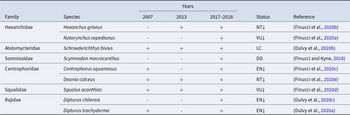
This study presents a species checklist of elasmobranchs inhabiting the Comau Fjord in northern Patagonia (42° S) by combining morphological identification with molecular analysis to validate species identification. It provides valuable new information about the elasmobranch biodiversity in the Comau Fjord and reveals that it is equivalent to nearly 20% of the species richness found in Southern Chile (Bustamante et al., Reference Bustamante, Vargas-Caro and Bennett2014), with at least 55% being threatened with extinction (Table 3). A number of studies from Southern Chile have focused on the life history traits and ecology of a few species but not the entire elasmobranch community, hence, community-focused studies on elasmobranchs are still scarce in the region (see Gaitán-Espitia et al., Reference Gaitán-Espitia, Gómez, Hobday, Daley, Lamilla and Cárdenas2017; Licandeo and Cerna, Reference Licandeo and Cerna2007; Vargas-Caro et al., Reference Vargas-Caro, Bustamante, Bennett and Ovenden2017). Therefore, this is to the best of our knowledge the first species inventory of elasmobranchs in a Chilean fjord system.
Based on a sample size of 309 specimens, the study recorded nine species of elasmobranchs (i.e. seven species of shark and two species of skate), which includes three species not previously documented to inhabit the Comau Fjord (i.e. broadnose sevengill shark Notorynchus cepedianus, largespine velvet dogfish Scymnodon macracanthus, and yellownose skate Dipturus chilensis; Table 3). The most abundant species was spiny dogfish (Squalus acanthias; 70.2%) with the next most abundant species being narrowmouthed catshark (Schroederichthys bivius; 9.8%) and yellownose skate (D. chilensis; 9.2%), which are commonly known to be bycaught or targeted species in many small- to large-scale fisheries in southern Chile (De la Torriente et al., Reference De la Torriente, Quinones, Miranda, Echevarría, Quiñones and Urbina2010; Lamilla et al., Reference Lamilla, Bustamante, Roa, Acuña, Concha, Meléndez, López, Aedo, Flores and Vargas-Caro2010; Quiroz et al., Reference Quiroz, Wiff, Gatica and Leal2008; Valenzuela et al., Reference Valenzuela, Bustamante and Lamilla2008). The examined specimens were consistent in both morphologic and molecular data when compared to other reference specimens or descriptions from other regions of the world. Consistency between morphological and genetic data of the specimens included in this study, when compared to the same species from type localities, became relevant in confirming taxonomic identity of the studied species.
A presence (+)/absence (−) list of elasmobranchs observed in the Comau Fjord in 2007, 2013, and 2017–2018, including their status on the IUCN Red List (i.e. EN = Endangered; VU = Vulnerable; NT = Near Threatened; LC = Least Concern; DD = Data Deficient) and a downwards arrow to indicate a status with a decreasing trend (↓)

Essential habitat: primary nursery ground
In this study, no neonates with fresh or unhealed scars were collected, yet, several young S. acanthias juveniles with visible, translucent vitelline scars were registered at the head of the fjord in late autumn (Figures 2 and 10D). Since neonates consume smaller food items such as shrimps and amphipods (Sulikowski et al., Reference Sulikowski, Prohaska, Carlson, Cicia, Brown and Morgan2013), it is unlikely that they would bite the whole hooked baits deployed for sampling in this study, accounting for their absence in the sample population. S. acanthias neonates are about 18–33 cm L T at birth (Ebert et al., Reference Ebert, Dando and Fowler2021) and may grow 10–15 cm during the first years of their life (Holden and Meadows, Reference Holden and Meadows1964), which suggests that some of the young juveniles collected in the fjord should be young-of-the-year (YOY; Northeast Fisheries Science Center, 2006).
It is generally unknown whether parturition of S. acanthias occurs in enclosed, coastal or offshore waters in the eastern South Pacific, as detailed information about their biology and ecology in this geographic area is still lacking (De la Torriente et al., Reference De la Torriente, Quinones, Miranda, Echevarría, Quiñones and Urbina2010). Yet, other observations from the same biogeographic province found that nursery areas of S. acanthias appeared to be located in open waters of the Southwest Atlantic (Colonello et al., Reference Colonello, Cortés, Belleggia and Massa2016). The migration range of immature S. acanthias, however, is thought to be rather limited (Hickling, Reference Hickling1930), while the onshore–offshore migrations should only occur with sexual maturity, typically as a response to the seasonal changes in the water temperature (Carlson et al., Reference Carlson, Hoffmayer, Tribuzio and Sulikowski2014; Compagno, Reference Compagno1984). A migration of neonates from an offshore area to the study sites in the inner part of the fjord shortly after birth would seem unlikely. Thus, the results obtained in this study could imply that an enclosed environment, such as the Comau Fjord, functions as primary nursery area (see Bass, Reference Bass, Hodgson and Mathewson1978; Heupel et al., Reference Heupel, Carlson and Simpfendorfer2007) for S. acanthias.
The notion of the fjord serving as a primary nursery area could possibly extend to other shark species. All the H. griseus specimens were exclusively juveniles of mixed sex (≤180 cm L T) and considerably far from reaching either adolescence or adulthood (Ebert, Reference Ebert1986; Table 2). H. griseus sharks are approximately 61–93 cm L T at birth (Ebert, Reference Ebert1986, Reference Ebert2002) and may double their length within the first year of life (Ebert, Reference Ebert2003). In this study, some specimens were <90 cm L T with translucent but healed vitelline scars and a lighter ventral side (Figure 4E), indicating that young juveniles frequent the fjord and that some could be YOY. It is not uncommon that neonate and juvenile sixgill sharks exhibit site fidelity and that they may occupy shallower inshore waters like estuaries, bays, and fjords (Andrews et al., Reference Andrews, Levin, Katz, Farrer, Gallucci and Bargmann2007; Ebert, Reference Ebert2002; King and Cornthwaite (Née Surry), Reference King and Cornthwaite (Née Surry)2017; Williams et al., Reference Williams, Andrews, Farrer and Levin2010). For example, in some fjord-like ecosystems such as the Strait of Georgia and the Puget Sound (northeast Pacific), H. griseus juveniles use the areas as nursery grounds before migrating offshore to the deeper continental slope as they mature (Andrews et al., Reference Andrews, Levin, Katz, Farrer, Gallucci and Bargmann2007; King and Cornthwaite (Née Surry), Reference King and Cornthwaite (Née Surry)2017; Williams et al., Reference Williams, Andrews, Farrer and Levin2010).
Segregation by sex and life history stages
Many elasmobranchs live in social units segregated by sex and size, divided into schools of mature males, mature females, and immature individuals of mixed sex (Klimley, Reference Klimley2013). In this study, there was a much lower frequency of mature S. acanthias females (1%) in relation to mature males (68%), and at three stations (i.e. 3, 6, and 10), there was a notable spatial overlap of immature individuals and mature males. This is in contrast to a previous study conducted in the nearby Chiloé Sea, which showed a high frequency of females in all life history stages during summer and winter, with generally a low proportion of males (Gaitán-Espitia et al., Reference Gaitán-Espitia, Gómez, Hobday, Daley, Lamilla and Cárdenas2017). Unlike this study, Gaitán-Espitia et al. (Reference Gaitán-Espitia, Gómez, Hobday, Daley, Lamilla and Cárdenas2017) also noticed a spatial overlap between mature females and immature individuals. It is well known that S. acanthias usually occurs in large schools with immature fish segregating by size and mature fish segregating by size and sex (Nammack et al., Reference Nammack, Musick and Colvocoresses1985; Stenberg, Reference Stenberg2005; Templeman, Reference Templeman1944). This has even led to female-biased fish mortality in the northwest Atlantic (Haugen et al., Reference Haugen, Curtis, Fernandes, Sosebee and Rago2017). Here, we can add that there also seems to be spatial segregation in southern Chilean waters, in addition to school segregation by size and sex. There are other studies suggesting similar spatial segregation in this species tied to environmental/abiotic factors (Dell’Apa et al., Reference Dell’Apa, Pennino and Bonzek2016; Sagarese et al., Reference Sagarese, Frisk, Cerrato, Sosebee, Musick and Rago2013), although male-avoidance behaviour in terms of avoiding courtship could also play an important role (Sims, Reference Sims2006).
Segregation by size and sex has also been reported for H. griseus (Barnett et al., Reference Barnett, Braccini, Awruch and Ebert2012; Ebert, Reference Ebert1989, Reference Ebert2002) and S. bivius (Colonello et al., Reference Colonello, Cortés and Belleggia2020). The results from the current study imply an absence of mature H. griseus individuals in the Comau Fjord. While it must be acknowledged that such indications of size segregations could be due to sampling bias, it could also indicate a strategy to maximise survival, as previously hypothesised by King and Cornthwaite (Née Surry) (Reference King and Cornthwaite (Née Surry)2017). Segregation by life history stages was similarly found in Southern Africa, where juvenile H. griseus sharks occupy shallower areas than adults, which likely minimises resource overlap, intraspecific competition, and the potential of cannibalism by adults (Barnett et al., Reference Barnett, Braccini, Awruch and Ebert2012).
Although based on a limited sample size, there was a bias in the sex ratio of S. bivius, showing a higher frequency of males (93.3%) than females (6.7%), of which 64% of the males were mature. This could indicate spatial segregation by sex for this species in the Chilean Patagonia, as noted in the populations in Argentine Patagonia (see Colonello et al., Reference Colonello, Cortés and Belleggia2020). As a sexually dimorphic species, with males maturing and attaining a larger size than the females (Cedrola et al., Reference Cedrola, González, Chiaramonte and Pettovello2012), sexual segregation could occur due to the different physiological needs and energy requirements between the sexes (Colonello et al., Reference Colonello, Cortés and Belleggia2020; Sims, Reference Sims2006).
Limitations and future studies
The main limitation of this study is the scale of sampling. Due to resource constraints, sampling was only possible in two seasons of the year. Furthermore, there were more opportunities for sampling in the southern area of the fjord, leading to a spatial sampling bias. As a result, seasonality in terms of spatial segregations among the species could not be evaluated. Moreover, some species may not have been represented due to eventual seasonality in their migration habits. In order to address such limitations, future systematic long-term spatial and temporal sampling covering the entire fjord, potentially in a combination with conventional tagging or acoustic telemetry could be initiated (e.g. Andrews et al., Reference Andrews, Williams and Levin2010; Carlson et al., Reference Carlson, Hoffmayer, Tribuzio and Sulikowski2014). This could elucidate how the elasmobranchs use the fjord as a habitat through time and space, any presence of other species, and how anthropogenic stressors might affect the distribution and abundance of this group of fishes. In addition, future studies should also consider including more non-invasive and cost-effective methods such as eDNA (environmental DNA) sampling and underwater camera traps to record the elasmobranch diversity and abundance in the fjord, as it is combined likely to have a higher species detection rate compared to other conventional sampling methods (Bakker et al., Reference Bakker, Wangensteen, Chapman, Boussarie, Buddo, Guttridge, Hertler, Mouillot, Vigliola and Mariani2017; Boussarie et al., Reference Boussarie, Bakker, Wangensteen, Mariani, Bonnin, Juhel, Kiszka, Kulbicki, Manel, Robbins, Vigliola and Mouillot2018; Liu et al., Reference Liu, Collins, Baillie, Rainbird, Brittain, Griffiths, Sims, Mariani and Genner2022). Furthermore, Local Ecological Knowledge (LEK) and sight reporting on social media could likely provide additional data on the presence/absence of the elasmobranchs and their estimated abundance and distribution, as another inexpensive and non-invasive method (see Batista et al., Reference Batista, Abril, Veríssimo, Vasconcelos, Pais and Henriques2024).
While the current study has provided insights into the elasmobranch community of the Comau Fjord, effective conservation management of elasmobranchs relies on consistent and systematic monitoring of their biology and ecology. Elasmobranchs play important ecological roles in many ecosystems, both directly and indirectly. Thus, further research directed towards understanding their role in the fjord ecosystem and their resilience to anthropogenic stressors is warranted to ensure the long-term existence of the elasmobranch community in the Comau Fjord.
Data availability statement
The authors followed the style sheet found in https://www.cambridge.org/core/journals/journal-of-the-marine-biological-association-of-the-united-kingdom/information/author-instructions/preparing-your-materials
Acknowledgements
The authors are grateful for the help and assistance by Boris “Cormorán” and for sharing all his local knowledge and fishing expertise. A special thanks to Juan Pablo Espinoza, research assistant at Fundación San Ignacio del Huinay (FSIH), and all the volunteers at FSIH Stephanny, Curaz Leiva, Anna Covey, and Nicola Mohr, who assisted with the field sampling. Special thanks are extended to the Fundación San Ignacio del Huinay for their funding and support, which made this research possible.
Author contributions
Conceptualisation by M.K.S. and F.J.C.; fieldwork by M.K.S., A.T., and S.A.B.; methodology by M.K.S., A.T., and A.V.; analysis and interpretation of results by M.K.S., A.V., and F.J.C.; writing—original draft preparation by M.K.S., A.T., A.V., and F.J.C.; writing—review and editing by M.K.S., L.M., A.V., A.T., S.A.B., G.F., and F.J.C.; supervision by F.J.C. and L.M.; project administration by M.K.S.; sample logistics by L.M., F.J.C., and S.A.B; funding acquisition by G.F. All authors have read and agreed to the published version of the manuscript.
Funding
M.K.S., A.T., and S.A.B. were financed by the Enel Generation Chile and the Pontificia Universidad Católica de Valparaíso, as the founding partners of Fundación San Ignacio del Huinay (FSIH), during the fieldwork. F.J.C. received support from Fulbright Chile, Faculty Development Program award, and from the Comisión Nacional de Investigación Científica y Tecnológica, CONICYT Becas Chile award. This work was supported in part by Dr. Janine N. Caira with funds from the National Science Foundation Awards, Nos. 1457762 and 1457776. A.V. was funded by Fundação para a Ciência e Tecnologia (10.54499/DL57/2016/CP1440/CP1646/CT0001 and 10.54499/2022.02937.CEECIND/CP1730/CT0011).
Competing interests
The author(s) declare none.
Ethical standards
All elasmobranchs were carefully handled and sampled following the standard international and national protocol for handling marine life, in accordance with the sampling permit approved by the Subsecretaría de Pesca y Acuicultura, SUBPESCA (Resolución Exenta N° 1760).





 Open access

