


Since October 2001, 2·5 million American military members have served in the US wars in Iraq and Afghanistan( 1 ). These veterans often face challenges upon their return to civilian life such as unemployment, difficulties in reintegrating with their family and into the community, mental health struggles and tobacco dependence( 2 ). While economic issues among returning veterans have been documented, less is known about how financial hardship is affecting veteran households.
Food security, or the consistent ability to access sufficient food for a healthful lifestyle, has been associated with many aspects of health including weight gain, diabetes and mental health issues( Reference Parker, Widome and Nettleton 3 – Reference Laraia 9 ). In the USA food insecurity remains a problem; 14·5 % of households were classified as food insecure in 2012( Reference Coleman-Jensen, Nord and Singh 10 ).
In the present paper, the prevalence of food insecurity is reported and the demographic and health-related characteristics that may be associated with food insecurity are described among Iraq and Afghanistan war veterans.
Methods
Using the Department of Veteran Affairs’ (VA) OEF/OIF/OND (Operation Enduring Freedom/Operation Iraqi Freedom/Operation New Dawn) Roster( 11 ), which identifies all veterans who have served in the US wars in Iraq and Afghanistan since October 2001, 800 female and 1200 male veterans who had at least one out-patient health-care visit in the Minneapolis VA Healthcare System and had a telephone number listed in the record were randomly sampled. At the time of the survey (summer 2012), 70·8 % of the current addresses on file were within the state of Minnesota and the rest were outside the state. Women were oversampled in order to have sufficient numbers to examine gender differences. Initially, potential participants were mailed a package that included an invitation to participate, informed consent material, a survey, a stamped return envelope and a $US 20 incentive. We developed the Northstar survey to examine health behaviours related to chronic disease (such as tobacco use, physical activity, eating and sun exposure). A reminder postcard followed a week after the initial mailing; two weeks after the initial mailing non-respondents received a second survey packet that did not include an incentive( Reference Dillman, Smyth and Christian 12 ). The survey response rate was 52·3 %, which exceeds the response rate of nearly all other population-based survey research in Iraq and Afghanistan war veterans( Reference Elbogen, Sullivan and Wolfe 13 – Reference Eber, Barth and Kang 17 ). Of the 922 respondents, there were fifty-seven individuals for whom food security status could not be calculated due to item non-response, service era misclassification or other reasons. Northstar survey data were supplemented with additional information on the veterans drawn from the VA’s electronic medical record.
Food security was ascertained using the US Household Food Security Module: Six Item Short Form( 18 ), which measures food security over the prior 12 months and has been demonstrated to be a valid identifier of households that have low and very low food security( Reference Blumberg, Bialostosky and Hamilton 19 ). This measure includes items such as: ‘The food that (I/we) bought just didn’t last, and (I/we) didn’t have money to get more’ and ‘(I/we) couldn’t afford to eat balanced meals’ (participants are instructed to indicate how often these statements were true)( 18 ). ‘High/marginal food security’ means that either there are no reported food access problems or that the household has some anxiety over food sufficiency but that there is minimal or no impact on diet. Households with ‘low food security’ report reduced diet quality but have little or no report of reducing intake. ‘Very low food security’ households report multiple past-year impacts on their eating which affected food intake( 20 ).
On the Northstar survey, participants were asked to indicate income (‘How much did you earn, before taxes and other deductions, during the past 12 months?’) from a choice of nine brackets. We assigned the participant the median value of his/her selected bracket with the exception of the ‘$US 100 000 or greater’ bracket which we assigned a value of $US 105 000. Employment was measured with the question, ‘During the past 6 months, what were you doing on most days?’ Past 30d tobacco use was assessed with, ‘In the past 30d, did you use tobacco every day, some days or not at all?’ Binge drinking was assessed with the item, ‘Considering all types of alcoholic beverages, how many times during the past 30d did you have five or more drinks on one occasion (four or more if you are female)?’ Sleep was assessed with the question, ‘How much sleep do you usually get at night on weekdays or workdays?’ Physical activity was assessed using the International Physical Activity Questionnaire (IPAQ) Short Form( Reference Craig, Marshall and Sjöström 21 ), which is a four-item measure of past 7d physical activity.
For selected demographic and behavioural attributes, either the proportion of veterans in each of the three levels of food security (high/marginal, low and very low) or mean values for each level were computed. The χ 2 test or linear regression was used to test whether the demographic and behavioural factors had a bivariable association with level of food security. All variables that had a significant bivariable association with food security (P<0·05) were entered into a multinomial logistic model. Variables in this initial mutually adjusted model that did not have a significant association (P<0·05) with food security were removed to arrive at the final model presented. Analyses were conducted in 2013 using the SAS statistical software package version 9·2. All procedures were reviewed and approved by the Minneapolis VA institutional review board.
Results
Over one in four veterans (~27 %) of the wars in Iraq and Afghanistan reported problems with food security. About 15 % of veterans reported low food security and an additional 12 % reported very low food security (Table 1). Veterans were more likely to be food insecure if they were younger, not married/partnered and not employed or on active duty. Food-insecure veterans had lower current income, reported lower final military pay grade and lived in households with more children. Those who were food insecure were more likely to use tobacco, report more frequent binge drinking and slept fewer hours at night. There was a gradient evident for self-reported general health status, with better health reported by those who were food secure.
Demographics and selected health behaviours by level of food security among veterans of the US wars in Iraq and Afghanistan, Northstar–2012

* Some demographic and behavioural category totals do not add up to 865 due to missing values.
† These data were obtained from the electronic medical record.
‡ E1–E9 are enlisted ranks; W and O are officer ranks.
§ ‘Service-connected disability’ refers to veterans who are receiving compensation at any level for an injury, physical illness or mental illness that was incurred or exacerbated during active duty service.
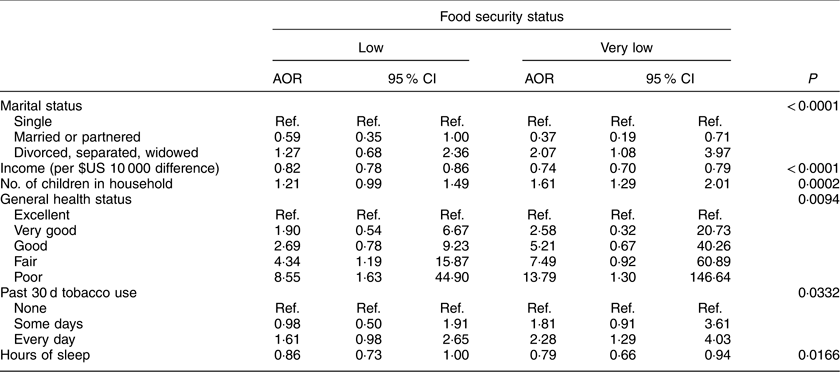
When the characteristics that had significant bivariable associations with food security were combined into a multivariable model, marital status, general health status, tobacco use, income, children in the household and mean hours of sleep continued to have associations with food security at the P<0·05 level (see Table 2). For instance, those who were married or partnered had 63 % reduced odds of being at very low food security, compared with high/marginal level (adjusted OR=0·37; 95 % CI 0·19, 0·71). For each $US 10 000 increase in reported income, the adjusted odds ratio of being at very low food security (compared with high/marginal food security) was 0·74 (95 % CI 0·70, 0·79).
Adjusted odds ratios (AOR) depicting the associations between characteristics and food security among veterans of the US wars in Iraq and Afghanistan, Northstar – 2012. (All predictor variables in the table are mutually adjusted in the multinomial logistic model)
Ref., reference category.
For these analyses, n 771 due to missing values on items.
To estimate whether the survey responders differed systematically from non-responders, comparisons were made on several variables from the electronic medical record. Compared with non-responders, responders were more likely to be older (34·9 years v. 31·0 years, P<0·0001), married or partnered (43·9 % v. 32·5 %, P<0·0001), and less likely to have service-connected disability status (35·7 % v. 43·2 %, P=0·0006) or to be male (55·1 % v. 64·2 %, P<0·0001).
Discussion
At nearly 27 %, the prevalence of food insecurity in our sample of veterans who served in Iraq or Afghanistan was dramatically higher than the US prevalence of food insecurity (14·5 % in 2012( Reference Coleman-Jensen, Nord and Singh 10 )). Further, veterans reported very low food security at double the US rate (12·1 % v. 5·7 %).
To give context to this issue, we described food security by demographic and health characteristics. Factors generally associated with lower socio-economic status such as not being married/partnered and having a lower income were associated with food insecurity. However, neither the number of deployments nor having a service-connected disability was associated with reporting difficulty in accessing food, which would suggest that greater exposure to combat is not what links certain veterans to increased risk of being food insecure. In the bivariable models in Table 1, those who were food insecure were more likely to use tobacco, binge drink more frequently, sleep less and have poorer self-reported general health. The co-occurrence of food insecurity with these health behaviours suggests that food-insecure veterans face multiple serious threats to their well-being. Digging deeper, in the multivariable model, six variables retained their independent association with food security while mutually adjusted for each other, which may indicate that these factors play a role in setting veterans’ food security trajectory. However, the study does not provide information on when various factors may have developed during each participant’s timeline, and thus both whether there is causality between the various factors and food security and what direction it might go in are unclear. There are plausible pathways by which some of these behavioural factors may be more than simply correlated with food insecurity. For instance, sleep issues may interfere with a veteran’s ability to work and earn income, which in turn means there will be fewer resources for food. Alternatively the stress of worrying about obtaining food could be a reason why food-insecure veterans report less sleep. Spending on tobacco may deplete money that could be used to purchase food, thereby leading to food insecurity. To gain clarity on these issues, longitudinal research is needed. But what is known is that these issues cluster and can highlight who is at risk of hunger.
Several limitations of the current report deserve attention. First, while our response rate of 52 % was far higher than in the major survey studies of the new generation of veterans (for instance, the response rates of the baseline waves of the National Health Study for a New Generation of US Veterans and the Millennium Cohort Study were 34·3 %( Reference Eber, Barth and Kang 17 ) and 31 %( Reference LeardMann, Powell and Smith 16 ), respectively), there still may be important difference between survey responders and non-responders related to variables of interest. Indeed, we found differences in electronic medical record variables between responders and non-responders. However, these differences were in areas that were either not associated with food security (service connection status and gender) or these differences suggested that we might have underestimated the prevalence of food insecurity in the general Iraq and Afghanistan war veteran population as responders tended to be older and married/partnered, which are all factors associated with a lesser likelihood of food insecurity. Additional reasons why we might actually be under-reporting food insecurity are that Minnesota is a relatively economically prosperous( 22 ) state and food insecurity may be more common in non-white veterans whom our study under-represents. (In the general population of 7·9 million veterans in the VA health system, 80·8 % are white( 23 ), while 90·1 % of the current sample was white.) Additionally, in 2011 the prevalence of food insecurity in Minnesota was reported to be 11·4 % by one source( 24 ) which was below the national average. Finally, while the US Household Food Security Module: Six Item Short Form has been demonstrated to be a valid tool for identifying households that have low or very low food security( Reference Blumberg, Bialostosky and Hamilton 19 ), it has the disadvantage that unlike the eighteen-item US Household Food Security Survey Module, the six-item measure lumps households with ‘marginal food security’ into the food secure category. There is evidence that marginal food security may also be a risk factor for chronic disease( Reference Seligman, Bindman and Vittinghoff 6 , Reference Coleman-Jensen, Nord and Singh 10 , Reference Cook, Black and Chilton 25 ) and if so, it would have been advantageous for our report to be able to identify individuals in this category as well. An additional limitation is that food security is measured at the household level and many of our predictor variables, such as education, were asked just of the respondent and not of all household members. A strength of the study was use of the OEF/OIF/OND Roster, which completely enumerates those who served in Iraq and Afghanistan, as our sampling frame; this enhances the generalizability of our findings.
Future work should focus on connecting veterans with employment that can provide a liveable wage and food assistance for veterans in need. The USA is one of the wealthiest nations in the world( 26 ) and was engaged in fighting two expensive wars for over a decade (with total costs estimated to be between $US 4 and 6 trillion( Reference Bilmes 27 )). In light of this, it is unacceptable that such a sizeable percentage of those who fought those wars struggle to afford food once they return home.
Acknowledgements
Acknowledgements: The authors would like to thank the many staff members at CCDOR who assisted with the implementation of the survey. Financial support: This material is the result of work supported with resources and the use of facilities at the Minneapolis VA Health Care System. Salary support for R.W. was provided by a VA Health Services Research and Development Career Development Award (CDA 09-012-2). The funder had no role in the design, analysis of writing of this article. The views expressed in this article are those of the authors and do not necessarily reflect the position or policy of the Department of Veterans Affairs or the US government. Authorship: R.W. took the lead in writing and conceptualized the study. A.J. worked on developing measures, editing drafts of the manuscript and recruitment. A.B. contributed to the study design and editing of the manuscript. S.S.F. assisted with study design and manuscript writing. Ethics of human subject participation: All procedures were reviewed and approved by the Minneapolis VA institutional review board.



