


1. Introduction
Contemporary design increasingly embraces a deeper understanding of human behavior, aiming not only to create appealing products and services, but also to subtly influence behaviors and foster new habits. This shift is particularly critical considering pressing global challenges, such as sustainability, which necessitate significant changes in consumer choices and routines (Reference Byerly, Balmford, Ferraro, Hammond Wagner, Palchak, Polasky, Ricketts, Schwartz and B.Byerly et al., 2018). This evolving role of design, often referred to as behavioral design (Reference Cash, Hartley and DurazoCash et al., 2017), builds upon a rich theoretical foundation, including the influential nudge theory (Reference Thaler and SunsteinThaler & Sunstein, 2008) and approaches to integrating behavior change into design processes (e.g. Reference Michie, van Stralen and WestMichie et al., 2011; Reference Cash, Hartley and DurazoCash et al., 2017).
Despite a growing awareness and often genuine intentions towards more responsible consumption, a persistent “intention-action gap” frequently hinders consumers from translating their aspirations into concrete behaviors (Reference Kollmuss and AgyemanKollmuss & Agyeman, 2002; Reference Sheeran and WebbSheeran & Webb, 2016). This gap is often exacerbated by cognitive biases – systematic yet predictable deviations from rational thinking – that subtly shape daily decisions (Reference Tversky and KahnemanTversky & Kahneman, 1974; Reference KahnemanKahneman, 2011). Understanding these inherent human irrationalities is paramount for designing solutions that effectively promote desired behaviors without imposing constraints. While frameworks for integrating behavior change into design processes exist (e.g. Reference Cash, Hartley and DurazoCash et al., 2017), a critical need remains for detailed, actionable methodologies providing specific tools and validated applications in novel contexts.
To address this critical challenge, our paper introduces the Change Factory, an innovative methodology developed to bridge this intention-action gap. The Change Factory leverages the principles of behavioral sciences, including nudge theory (Reference Thaler and SunsteinThaler & Sunstein, 2008), to create design solutions that make desired behaviors intuitive, effortless, and ultimately, more likely to be adopted. Drawing upon and operationalizing key steps from the four-step framework for pro-environmental behavior (Reference Steg and VlekSteg & Vlek, 2009), it offers a systematic approach to identify behavioral barriers and craft targeted, gentle interventions that guide users towards beneficial actions.
We first delve into the theoretical underpinnings of behavioral design and key concepts. Subsequently, we detail the four-step framework of the Change Factory: Behavior, Obstacles, Design, Experimentation. We then illustrate its practical application through a comprehensive case study focusing on fragrance refill, a domain where shifting consumer habits is key. Finally, we discuss the implications of the Change Factory for future design practices, proposing an ethical and impactful pathway for fostering positive behavioral change in various user product experiences.
2. Theoretical framework: understanding human behavior for design
Innovation in design, especially concerning user behavior, benefits immensely from the theoretical foundations of behavioral sciences. This interdisciplinary field, encompassing psychology, economics, and sociology, investigates human decision-making, often revealing patterns that deviate from purely rational choice (Reference ArielyAriely, 2008). Understanding these deviations allows designers to craft effective strategies – often termed behavioral interventions (Reference Verplanken and WoodVerplanken & Wood, 2006) – to guide user behavior.
2.1. Behavioral sciences and design
Behavioral sciences investigate the mechanisms of human thought and actions (Reference SchwartzSchwartz, 2004; Reference Thaler and SunsteinThaler & Sunstein, 2008). In design, this means moving beyond traditional user research that primarily focuses on observations and stated preferences, to uncover deeper cognitive processes and habits that drive actual behavior. Integrating these insights enables designers to predict user interaction with products and services, fostering more intuitive usage and new behaviors adoption. The emerging field of behavioral design explicitly integrates insights from behavioral sciences, providing structured approaches to influencing behavior (e.g., Reference Cash, Hartley and DurazoCash et al., 2017).
2.2. Nudge: gentle incentives for behavior change
A core concept within behavioral sciences, the nudge, coined by Reference Thaler and SunsteinThaler and Sunstein (2008), is defined as any aspect of the choice architecture that predictably influences behavior without removing options or changing economic incentives. These gentle interventions preserve freedom while leveraging human biases and heuristics to make desired actions easier or more appealing. For example, making sustainable options the default or providing timely information can gently steer users toward responsible behaviors.
2.3. Behavioral crivers: levers for change
Effective nudges rely on understanding and strategically employing various behavioral drivers. These are underlying psychological and cognitive mechanisms influencing human decision-making and action. Key examples leveraged in behavioral design include:
-
- Salience: Making the desired behavior or its consequences noticeable and prominent.
-
- Easiness: Reducing the effort required for change or increasing the effort for undesired actions.
-
- Social Norms: Highlighting what most people do or what is socially approved.
-
- Affect: Tapping into emotions to create positive associations with the desired behavior.
-
- Default: Setting the desired option as automatic, requiring active opt-out to choose otherwise.
These drivers are complemented by influential frameworks like MINDSPACE (Reference Dolan, Hallsworth, Halpern, King and VlaevDolan et al., 2010), which provides a comprehensive taxonomy of behavioral drivers, and EAST (BIT, 2024), which distils them into four actionable principles (Easy, Attractive, Social, Timely), valued for its simplicity. By carefully considering these drivers, designers can tailor interventions to specific contexts and target audiences, maximizing their potential to elicit desired behavioral changes.
2.4. The Hooked Model: a typology of interventions for sustained change
To further systematize the process of encouraging sustained behavior, the “Hooked Model” (Reference EyalEyal, 2014) outlines a four-phase cycle designed to build habit-forming products and services:
-
- Trigger: The prompt that initiates the action (e.g., an external notification).
-
- Action: The simplest action to put behavior into practice.
-
- Variable Reward: The unpredictable positive outcome that keeps users engaged and returning.
-
- Investment: The effort users put into the product or service, which commits them to future use.
Integrating interventions across these four phases allows designers to foster new habits.
2.5. Research gap: the need for actionable behavioral design methodologies
While behavioral sciences offer powerful tools for understanding and influencing human decision-making, their systematic translation into comprehensive, actionable design methodologies for integrating behavioral insights remains an underexplored area (Reference LilleyLilley, 2009; Reference Bahmra, Lilley and TangBhamra, Lilley, & Tang, 2011; Reference WendelWendel, 2020). Existing widely adopted design frameworks, such as Design Thinking (Reference BrownBrown, 2009) or Lean UX (Reference Gothelf and SeidenGothelf & Seiden, 2021), are highly user-centred and excel at identifying user needs, improving usability, and iterating on solutions based on feedback. However, these traditional methods often face limitations when the goal is to specifically address the intention-action gap and proactively shape user behaviors towards desired outcomes, particularly in areas like sustainability where intentions often outpace actual behavior (Reference Sheeran and WebbSheeran & Webb, 2016).
2.5.1. Focus on stated needs vs. behavioral diagnosis
Traditional design approaches primarily focus on satisfying user’s stated needs or solving functional problems identified through user research. While invaluable, they frequently lack a structured methodology for deep behavioral diagnosis – that is, systematically uncovering the underlying cognitive biases, heuristics, and contextual factors that lead to deviations between intentions and actions (Reference KahnemanKahneman, 2011). Designers might identify symptoms of undesirable behaviors (e.g., low adoption of eco-friendly options) but often lack the explicit tools to pinpoint the root psychological causes (e.g., “small gesture paradox” (Reference GiffordGifford, 2011), lack of salience, or perceived effort (Reference FoggFogg, 2009)) and translate these insights into targeted gentle interventions.
2.5.2. Reactive vs. proactive behavioral shaping
Many design processes tend to be reactive, optimizing existing user flows or features based on observed usage (Reference NormanNorman, 2013). While A/B testing can be employed to compare different designs (e.g., Reference Kohavi, Tang and XuKohavi et al., 2012), the initial conceptualization of these designs may not systematically integrate behavioral sciences principles from the outset (Reference Lockton, Harrison and StantonLockton et al., 2010; Reference Michie, van Stralen and WestMichie et al., 2011). Consequently, despite optimizing products based on expressed needs, these approaches fail to proactively shape user behavior through structured frameworks for gentle interventions (Reference FoggFogg, 2009; Reference Michie, van Stralen and WestMichie et al., 2011). This leaves the behavioral aspect of design to implicit assumptions or ad-hoc adjustments, rather than rigorous scientific application.
2.5.3. A lack of integrated and actionable frameworks for behavioral design
Despite growing recognition of behavioral sciences in product development (Reference FoggFogg, 2009; Reference Van Essen, Hermsen, Renes, Lloyd and BohemiaVan Essen et al. 2016; Reference Cash, Hartley and DurazoCash et al. 2017; Reference WendelWendel, 2020), there is a scarcity of comprehensive, step-by-step frameworks that explicitly equip the design process with behavioral insights, from diagnosis to intervention design and experimentation (Reference Cash, Hartley and DurazoCash et al. 2017; Reference Khadilkar and CashKhadilkar & Cash, 2020).
While existing behavior change models (e.g., Reference Steg and VlekSteg & Vlek, 2009; Reference FoggFogg, 2009; Reference Michie, van Stralen and WestMichie et al., 2011) offer valuable theoretical underpinnings or taxonomies for interventions, they often lack actionable, well-equipped methodologies for practical integration into product and service development. For instance, Reference Cash, Hartley and DurazoCash et al. (2017) provides limited detail on tools and methods for new case applications. Similarly, Reference Steg and VlekSteg and Vlek (2009), while offering a robust four-step roadmap for encouraging pro-environmental behavior, lacks actionable guidance for translating its stages into a design methodology.
These limitations underscore a significant gap in behavioral design. Our proposed Change Factory methodology directly addresses this by offering a pragmatic, integrated framework to bridge this theoretical-practical divide and systematically embed behavioral insights into design practice, moving beyond traditional user-centered approaches to a more behavior-driven design paradigm.
3. Methodology: the Change Factory approach
This section details the Change Factory methodology, an innovative, behavior-driven design approach. Unlike traditional human-centered frameworks, its primary objective is to bridge the intention-action gap by designing gentle interventions that make desired behaviors intuitive, effortless, and more likely to be embraced by users. We first outline its systematic four-step framework (CODE) and then describe its application within a real-world case study at L’Oréal.
3.1. The four steps of the Change Factory
The Change Factory is a systematic behavioral design approach that specifically aims at bridging the intention-action gap by leveraging insights from cognitive sciences and behavioral economics. The framework is structured around a collaborative, iterative process, with each step equipped with dedicated tools and facilitation techniques to maximize effectiveness.
Central to this methodology is its structured four-step framework, named CODE: Change, Obstacles, Design, and Experimentation. These steps will be elaborated upon in the subsequent sections. Each of them can correspond to a dedicated collaborative workshop. However, depending on the specific project requirements and available time, multiple steps can also be addressed within the same workshop, offering valuable flexibility in the methodology’s application.
3.1.1. Step 1: change
This initial phase defines granular, observable target behaviors, moving beyond broad objectives. Tools like behavioral mapping and user journey analysis ensure a clear, shared understanding of these behaviors. To ensure necessary specificity, a practical technique we employ is the ‘Silent Movie Trick’: participants are invited to envision the desired behavior as purely visual actions (e.g., ‘turning off water while applying shampoo’ instead of ‘reducing water consumption’). This technique validates the actionability of identified behaviors, focusing on actual user conduct rather than abstract goals or intent, thereby addressing the intention-action gap.
3.1.2. Step 2: obstacles
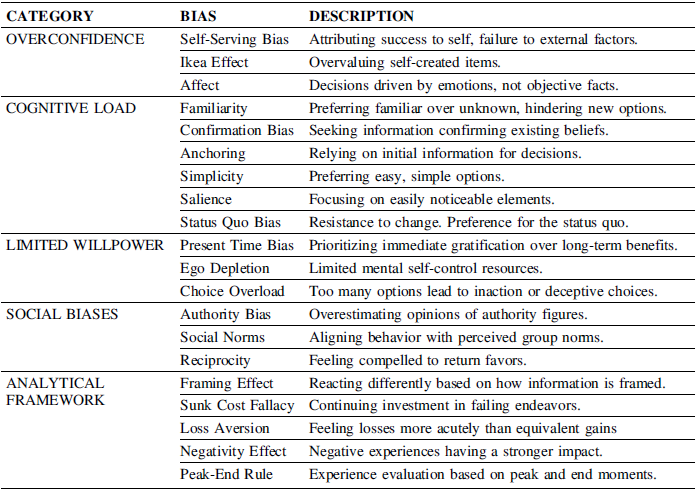
Following the definition of target behaviors, this step delves into uncovering the barriers that impede desired actions (cognitive biases, psychological frictions, environmental constraints, and social norms). To systematically identify these obstacles, we rely on deep qualitative interviews and behavioral audits, which provide insights for the subsequent ideation phase. Central to this process is understanding cognitive biases. These biases, categorized into five principal families (Reference BrunBrun, 2022), offer a structured framework for diagnosing these underlying frictions (cf. Table 1). By systematically mapping these cognitive barriers, designers can pinpoint the precise psychological friction points, enabling the development of truly targeted and effective gentle interventions.
Five families of cognitive biases used in Change Factory

3.1.3. Step 3: design
With a comprehensive understanding of target behaviors and their obstacles, this step focuses on creatively designing nudges – gentle interventions leveraging behavioral drivers (Section 2.3) as innovation levers. Collaborative brainstorming sessions, facilitated by experts in behavioral sciences, are used to generate a wide array of potential nudges, aiming to make desired behaviors simpler, more attractive, and/or more social.
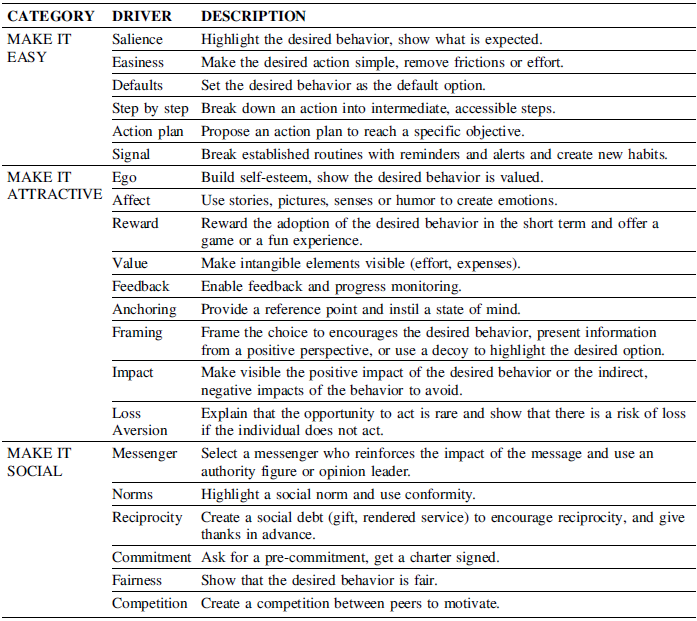
The Design phase systematically uses ‘driver cards’ to guide participants in leveraging specific behavioral drivers. Participants are invited to consider how specific drivers can be leveraged to either encourage the target behaviors or to overcome previously identified obstacles. These drivers are grouped into three practical categories inspired by the EAST model: Make it Easy, Make it Attractive, and Make it Social (Reference Sheeran and WebbBIT, 2024; Reference BrunBrun, 2022). This categorization, detailed in Table 2, aids in structuring the ideation process and ensuring a comprehensive exploration of intervention possibilities.
Categorization of behavioral drivers

Linking specific behaviors to relevant drivers fosters a diverse array of gentle intervention ideas. For instance, recognizing low salience for fragrance refills prompts using the Salience driver with conspicuous in-store signage (“Refillable” or “Discover my refill”) to highlight the desired behavior.
From the generated ideas, participants are invited to select the more promising ones. While they do so, they also engage in a crucial ethical screening process. This includes applying the ‘Newspaper Headline Test’ (Reference BrunBrun, 2022), which prompts reflection on the nudge’s public perception. Concepts causing discomfort are revised or discarded.
Finally, favored concepts are detailed in a ‘Nudge ID Card’, articulating the nudge’s core concept, target audience, behavior, barriers, point of contact, and underlying behavioral drivers. These ID Cards serve as actionable blueprints for subsequent experimentation.
3.1.4. Step 4: expérimentation
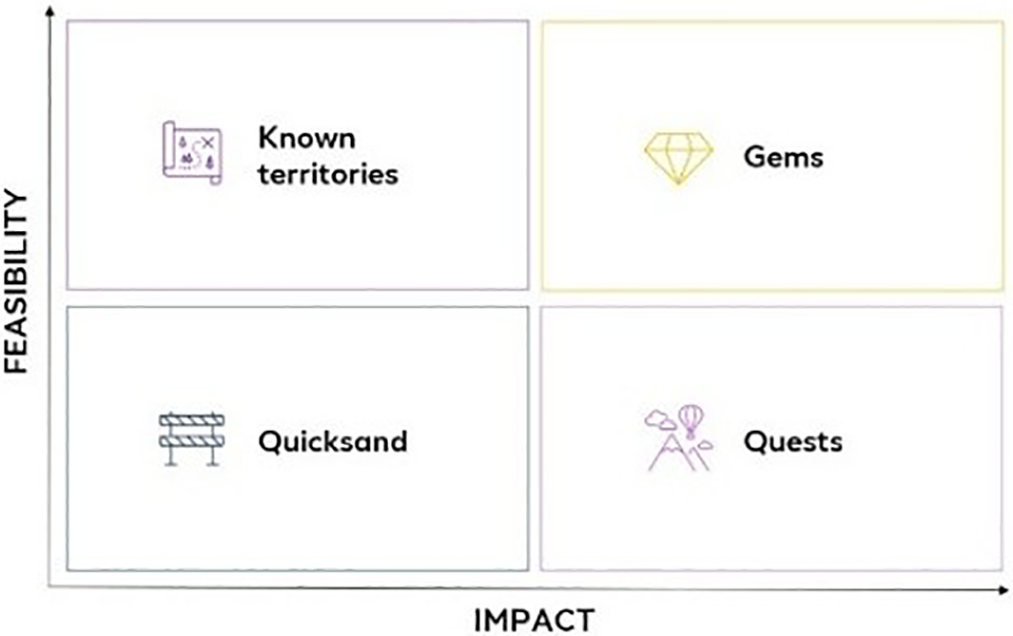
The final step involves prioritizing and testing designed nudges using the Nudge Map (Reference BrunBrun, 2022). This two-dimensional matrix evaluates each nudge based on its potential Impact (effectiveness in driving change) and Feasibility (ease of implementation, scalability, acceptability) (Reference SinglerSingler, 2015).
This matrix classifies nudges into four territories (Figure 1), guiding development:
-
- “Gems” (High Impact, High Feasibility): These interventions have significant potential to drive behavior change and are relatively easy to implement. They are prioritized for immediate development due to their optimal balance of efficacy and practicality.
-
- “Known Territories” (Low Impact, High Feasibility): Nudges in this territory are straightforward to implement. While not game-changers, they can be combined with “gems”.
-
- “Quests” (High Impact, Low Feasibility): Promising for profound change but requiring long-term planning. They are typically earmarked for future development.
-
- “Quicksand” (Low Impact, Low Feasibility): These interventions are deemed unviable, due to limited impact and high resource demands. They are typically discarded.
The nudge map: distinguishing four territories with an impact-feasibility matrix

This systematic prioritization helps identify high-potential nudges for pilot testing. Subsequent experimentation, often through randomized controlled tests (e.g. A/B testing) or rigorous observation, allows for data-driven validation and refinement, ensuring their real-world efficacy.
3.2. Application context: the fragrance refill challenge
To validate the Change Factory methodology, it was applied to a significant challenge within L’Oréal: encouraging the adoption of fragrance refill. This context was chosen for its alignment with L’Oréal’s sustainability commitment and its relevance in bridging the intention-action gap. While sustainability is a growing consumer aspiration, translating this intention into concrete refill practices presents considerable friction. Refilling is a novel routine demanding new gestural learning, overcoming psychological barriers (e.g., convenience, prestige), and navigating diverse retail environments (Reference Lofthouse, Trimingham and BhamraLofthouse et al., 2017; Reference Kazançoğlu, Köse and ArslanKazançoğlu et al., 2024). Guiding consumers through this shift is paramount for sustainable beauty (Reference Verplanken and WoodVerplanken & Wood, 2006).
The methodology was implemented via four half-day workshops, (Sept 2023 – March 2024), each focusing on a CODE step and engaging 40 interdisciplinary L’Oréal participants (Marketing, Operations, R&I). This collaborative setup was instrumental in gathering diverse perspectives on the challenges and potential solutions for the fragrance refill initiative. The identified behaviors, uncovered obstacles, and generated nudges will be presented in the ‘Results’ section.
4. Results
The Change Factory methodology, applied to fragrance refill, delivered tangible outcomes. It fostered a comprehensive understanding of consumer and Beauty Advisor behaviors, precisely identified critical obstacles, and catalyzed a rich portfolio of targeted interventions to bridge the intention-action gap. These findings are a direct output of the collaborative workshops described in Section 3.2.
4.1. Target behaviors
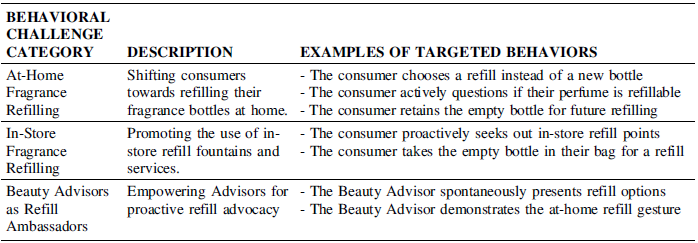
Following the “Behavior” step, the workshops pinpointed three core categories of behavioral challenges crucial for accelerating fragrance refill adoption (Table 3). Importantly, these challenges concerned both end consumers and Beauty Advisors – in-store consultants who guide customers on product choices – whose behaviors significantly influence consumer adoption of refill practices. Within each of these families, multiple granular behaviors were identified, each defined as one or more observable actions (as discussed in Section 3.1.1). For illustrative purposes, and respecting the confidential nature of the detailed findings, examples of these granular behaviors are presented below. These precise behavioral definitions were paramount in guiding all subsequent efforts within the Change Factory framework.
Categorization of target behaviors by family, with illustrative examples

4.2. Target behaviors
During the “Obstacles” phase, diverse barriers hindering the desired behaviors were systematically uncovered. These obstacles, rooted in cognitive biases, practical friction, and perceptions, include:
-
- For At-Home Refill: lack of awareness regarding bottle rechargeability, perceived inconvenience or messiness, insufficient perceived financial or environmental benefit, limited emotional appeal compared to new products, and the notion that refilled products are not suitable as gifts.
-
- For In-Store Refill: difficulty in locating refill services, perceived lack of luxury or appeal in the in-store refill experience compared to new product shopping, and apprehension about navigating an unfamiliar process with staff.
-
- For Beauty Advisors: limited knowledge and confidence in discussing refill options, perception that refill sales are less prestigious or financially rewarding than new product sales, and general lack of spontaneity to propose refill solutions proactively.
4.3. Design
The “Design” phase proved highly productive, yielding 33 gentle intervention ideas that aimed at overcoming identified obstacles through various behavioral drivers. For clarity and strategic planning, these ideas were formalized into ID Cards and subsequently grouped into five overarching categories: Make Refill Visible, Streamline Access to Refill, Empower Beauty Advisors as Ambassadors, Make Refill the Default, and Make Refill a Memorable Experience.
To illustrate the output of the phase Design, we present the Nudge ID Card for “Refill Me” (Figure 2), chosen for its direct product integration. This card encapsulates the comprehensive information developed for each nudge concept, ranging from its core idea to its targeted behavioral drivers. In the following section on Experimentation, we will further detail three other nudges that were selected for development and pilot testing, showcasing how they translate from concept to prototype.
Example of Nudge ID Card for the ‘Refill me’ gentle intervention

4.4. Experimentation
The final stage encompassed rigorous prioritization and development of nudges. A pivotal instrument in this process was the Nudge Map, which assesses each intervention based on its potential Impact and Feasibility. This prioritization provided a level of strategic validation and yielded 9 high-impact, high-feasibility nudges – termed “gems” – thereby ensuring strategic resource allocation. These prioritized nudges were strategically combined to form cohesive behavioral strategies, leveraging the Hooked Model – Trigger, Action, Variable Reward, and Investment (Reference EyalEyal, 2014). This refinement ensured that the chosen interventions would also contribute synergistically to sustained behavioral change.
Based on the prioritization, 6 selected interventions (five “gems” and one “known territory”) were developed within 12 months following the workshops. This selection encompassed varied interventions, designed both to foster understanding and shape intentions, and to directly facilitate the transition from intention to action. Non-confidential examples successfully launched include:
-
- “Why I Won’t Buy This Bottle Again”: An influencer-led communication strategy based on a provocative hook leveraging Messenger and Affect drivers to raise refill awareness.
-
- “Refill Day”: A social media campaign coinciding with World Refill Day that invites consumers to ‘Join the Refill Movement’ relying on Salience and Social Norms.
-
- “Walk the Talk”: An internal competitive event designed to encourage L’Oréal employees to adopt and champion refill practices, leveraging Salience, Easiness, and Messenger drivers.
Beyond direct nudge implementation, this initiative catalyzed complementary research, including studies on the visibility and impact of “refillable” mentions on fine fragrance packaging, thus enriching our understanding of consumer behaviors in the beauty industry.
5. Discussion and implications
The application of the Change Factory methodology to fragrance refill yielded both actionable interventions and significant insights into behavior-driven design efficacy. This study demonstrates a pragmatic pathway for bridging the intention-action gap, particularly for sustainability initiatives.
5.1. Addressing the research gap: a pragmatic behavioral design framework
While traditional design methods solve for user needs, the Change Factory acts as a ‘behavioral engine’ enabling unrealized intended actions. Addressing the lack of structured protocols for translating behavioral science into design, it equips each CODE step (Change, Obstacle, Design, Experimentation) with actionable tools. Its efficacy – generating 33 nudge ideas, prioritizing 9 high-impact nudges, and implementing 6 within 12 months – underscores its potential to translate behavioral insights into tangible solutions and embed behavioral considerations early in the design process.
5.2. Key learnings and insights from application
The case study provided several key learnings regarding the implementation of the Change Factory:
-
- The power of granular behavior definition: Clearly defining target behaviors (at-home refill, in-store refill, Beauty Advisor ambassadorship) was crucial. It ensured ideation was focused and relevant.
-
- The systematic obstacle identification: Moving beyond intuitive assumptions to map behavioral barriers, including biases, revealed several frictions and allowed for the design of targeted interventions. Practitioners noted it pinpointed behavioral frictions overlooked by previous traditional research.
-
- Behavioral drivers as effective levers: The process validated that leveraging behavioral drivers such as Salience or Signal can inspire ideas for effective behavioral interventions.
-
- The value of prioritization: The Nudge map enabled strategic decision-making, focusing resources on high-potential interventions validated by expert feedback for organizational implementation.
-
- An essential cross-functional collaboration: Diverse participant functions enriched ideation, ensuring a holistic perspective on consumer behavior and operational realities, and fostered idea implementation.
-
- Two types of interventions: Education and design. While educational nudges shape user intentions, design-driven interventions facilitate action. This synergy helps fostering long-term habit formation.
Beyond the fragrance refill case study, the Change Factory has been adapted across 15 innovation projects at L’Oréal, generating more than 250 intervention ideas to date.
5.3. Broader implications for behavioral design
The Change Factory presents significant implications for the future of behavioral design, both within L’Oréal and across other industries:
-
- Shift towards behavior-driven design: It advocates a paradigm shift from solely user-centered to behavior-driven design (focused on actions), offering a concrete framework for organizations to proactively shape consumer behavior towards desired outcomes (e.g., sustainability, health).
-
- Versatility and scalability: While demonstrated with fragrance refill, its principles and four-step process are highly versatile, applicable across diverse behavioral challenges in various product categories, services, and internal organizational processes, fostering behavioral change at scale.
-
- Ethical considerations in practice: The methodology explicitly integrates ethical considerations, ensuring chosen interventions align with user well-being and societal benefit.
5.4. Limitations and future work
This study represents a foundational application of the Change Factory, with promising ideation and prioritization phases (6 interventions developed in 12 months). The immediate next step involves rigorous experimentation and long-term impact measurement of selected nudges in real-world settings. A key challenge in practical application is the trade-off between rapid development cycles and comprehensive behavioral measurement, particularly within dynamic industrial contexts like L’Oréal’s. While rigorous experimental designs (e.g., RCTs, A/B testing for refill sales) offer invaluable empirical validation, operational realities (time, budget) often constrain such extensive evaluations, even during pilot phases. Future research and organizational integration efforts must therefore focus on developing more streamlined, cost-effective approaches to robustly quantify behavioral changes.
6. Conclusion
This paper presented the Change Factory, a systematic behavioral design methodology developed to address the critical intention-action gap in consumer behavior. Integrating principles from behavioral sciences and nudge theory, its structured four-step CODE framework enables designers to proactively change user behavior for good and propose sustainable product experiences. Through its application to fragrance refill at L’Oréal, we demonstrated the practical utility and efficacy of this approach. This process successfully yielded 33 intervention ideas, with 9 high-impact nudges prioritized and 6 implemented within 12 months. This case study underscores the Change Factory’s capacity to translate theoretical behavioral insights into actionable design solutions that encourage new, positive routines.
The Change Factory marks a significant step towards a more behavior-driven approach to design, acting as a behavioral engine for guiding users towards desired actions. Highly versatile and scalable, this methodology holds considerable promise for fostering behavioral change across myriad contexts within and beyond the beauty industry. As design evolves, methods like the Change Factory will be indispensable tools for creating products and services that not only meet functional needs but also subtly empower users to adopt new, intuitive, and ultimately, more sustainable habits.


 Open access

