


Introduction: Hybrid threats and trust in digital payments
Does money still exist if we have lost trust in its existence?
This provocative question arises because money is both a physical and abstract concept. As digital payment infrastructures become increasingly embedded in everyday life, their symbolic and functional centrality also makes them a prime vector for trust-based disruption in hybrid conflict strategies. While many use consumer financial infrastructures such as Mastercard, Visa, Swish,Footnote 1 Vipps,Footnote 2 Twint,Footnote 3 Bizum,Footnote 4 Apple Pay,Footnote 5 Google Pay,Footnote 6 and similar services, most may not know of the legal and technical infrastructures that power them.
Recent incidents show that such infrastructures are not only poorly understood but also vulnerable. In a bank heist in Bangladesh in 2016, hackers exploited the SWIFT network to steal $81 million, shaking trust in global interbank systems.Footnote 7 Similarly, the DarkSide group’s ransomware attack on Colonial Pipeline in 2021 disrupted fuel logistics and payment systems, triggering panic buying and revealing how ransomware can destabilise sectors closely tied to financial flows.Footnote 8 The 2007 cyber-attacks on Estonia included disruption of digital banking and ATM systems, offering an early example of how cyber-based assaults can erode financial institutions and hence trust in society.Footnote 9
In more psychologically driven cases, such as for example the 2023 collapse of Silicon Valley Bank (SVB), the events were accelerated by viral social media panic, where trust evaporated in hours based on circulating narratives rather than hard data.Footnote 10 The 2007 run on the UK bank Northern Rock was, while happening before the age of social media, similarly driven by public perceptions amplified by media imagery, even though the bank was not technically insolvent.Footnote 11 In 2021, the GameStop market speculations showed how mere sentiment on social platforms like Reddit can destabilise financial markets and disrupt institutional positions through collective emotion rather than fundamentals.Footnote 12
These mentioned events and others demonstrate that trust in money is fragile and susceptible to both technical disruption and psychological contagion. However, this study is not about public reactions to financial sector incidents that have happened. Rather, it investigates public fear of what could happen, using hypothetical scenarios rooted in real-world precedent, to explore trust under threat. Society simply trusts that the ‘money’ the digital payment services handle will exist and function when needed. While this notion is more pertinent in the modern digital economy, traditional physical cash money also relies on a belief that paper notes and metal coins will always be available and exchangeable with consistent value over time.Footnote 13
So, trust remains the foundation of the financial system, whether digital or physical. As noted by Raza et al., financial trust structures and governance are fundamental to the stability and perception of money in both traditional and digital environments.Footnote 14 Financial systems are thus built on two interconnected forms of trust: public trust in societal institutions, and inter-organisational trust among financial actors such as banks, businesses, and state agencies. Financial infrastructures, including payment systems, central banks, and clearinghouses, function as key pillars of societal stability and economic development. The rise of central bank digital currencies (CBDCs) further reconfigures how trust is mediated in monetary systems. As Kosanović argues, CBDCs represent a shift in financial stability mechanisms, with implications for banking structures, monetary policy, and systemic resilience.Footnote 15 While CBDCs may promise efficiency and inclusion, their long-term success ultimately depends on sustained wide public trust in the central bank as issuer. In short, CBDCs, like all monetary instruments, are viable only insofar as society maintains confidence in their consistent value and continued existence. While Kosanović has a macro perspective,Footnote 16 this study takes a grassroots perspective, where we believe the public trust is anchored.
In the OECD world, nearly all money now exists in intangible digital form. It cannot be seen, touched, or physically stored, yet users trust that it exists and is accessible. According to the ECB’s ‘Payment Attitudes 2022’ study across nineteen Eurozone countries, contactless card transactions reached 62 per cent in 2022, and that is only the contactless cards.Footnote 17 This reflects a decisive shift away from physical cash and reinforcing the criticality of trust in digital payment systems.
Within the mentioned context of trust in money, it is important to recognise that contemporary societies operate in an environment shaped by hybrid threats. Mazur provides a literature review on the subject in the context of economic development, while Giannopoulos et al. present a theoretical model.Footnote 18 This study’s concept of hybrid threats refers to a spectrum of covert and overt tactics combining military, cyber, disinformation, economic, and societal interventions designed to destabilise target societies and erode their resilience.Footnote 19 At the core of many hybrid operations lies the objective of weakening public trust in state institutions and social cohesion. In that regard, everyday infrastructures such as digital payment systems become plausible and strategic targets in a hybrid threat campaign.
This study takes the position that digital payment systems are not merely technical infrastructures but also constitute arenas in which trust is negotiated and potentially contested. As Wisniewski et al. demonstrate, consumer payment behaviours respond dynamically to crises, revealing both institutional resilience and vulnerability in public trust.Footnote 20 In a hybrid threat environment where cognitive, psychological, and infrastructural vectors are often targeted simultaneously, trust in digital payments becomes not only an economic issue but also a strategic concern with direct implications for national security. To guide this inquiry, this article examines how different hybrid threat configurations affect key value dimensions of consumer trust in digital payment systems.
By explicitly linking the consumer’s experience of trust erosion to the employment of hybrid threat operations at both the macro level (e.g., state destabilisation, strategic disinformation) and the micro level (e.g., consumer anxieties, behavioural changes in digital transactions), this study contributes to a growing field that seeks to operationalise trust as a target of contemporary security strategy.
To move beyond abstract theorising, we model hybrid threats through concrete scenarios designed to simulate conditions under which trust in digital payments may degrade. The subsequent analysis employs an empirical survey and scenario-based evaluation across three national contexts: Sweden, Finland, and Germany. In doing so, this work aims to advance scholarly understanding of how trust in digital financial tools may be undermined in an era of hybrid threats. This study contributes to security studies by conceptualising financial trust as a domain of hybrid threats and by operationalising trust erosion as a measurable vulnerability within socio-technical systems.
Trust, hybrid threats, and the fragility of financial systems
This study primarily engages with misinformation, that is, false or misleading content shared without an actor’s antagonistic intent to deceive; misinformation has the capacity to erode trust even when not strategically deployed. However, disinformation – that is, false content disseminated deliberately with hostile aims – remains relevant in hybrid threat contexts and is not excluded. As Wardle and Derakhshan originally outlined,Footnote 21 and recent studies have reaffirmed, both forms can function in parallel within the same information ecosystem, contributing to instability via different pathways. Distinguishing intent (misinformation or disinformation) is important theoretically and analytically, but in practice, the effects often converge. As Merzah et al., for example, note, hybrid campaigns may weaponise both types either through planned narratives or by amplifying organically spread falsehoods.Footnote 22
The fragility of trust in financial systems
Trust, in this article, is defined as a cognitive and affective expectation that social and institutional actors will behave in ways that are reliable, non-arbitrary, and norm-compliant under conditions of uncertainty.Footnote 23 In the context of financial infrastructures, trust includes both interpersonal trust (e.g., in public information or financial advisors) and institutional trust (e.g., in banks, networks, or state actors). Following Fonseca et al., we see trust as not just a sentiment but also a socio-technical condition that underpins public compliance and financial system resilience.Footnote 24
While traditionally framed within macroeconomic models, trust in financial systems must now be reconsidered as a potential attack surface in the context of deliberately ambiguous, hybrid strategies. It is well established in research that trust is a necessary element in a functioning society. Starting with the basic building blocks, Fonseca et al. offer a recent, multi-level framework that situates trust as part of broader social cohesion and resilience,Footnote 25 an important backdrop against which this study`s work on trust in digital payments is positioned. Classic economic theories highlight trust as central to financial stability; for example, the Diamond-Dybvig model explains bank runs as a result of depositor panic rather than real economic fundamentals.Footnote 26 Meanwhile, asymmetric information theory demonstrates how what would today be called misinformation – whether from journalistic financial media in Akerlof’s time, or from current social networks – can induce financial instability,Footnote 27 as seen for example in the cases of SVB, GameStop, and Northern Rock. It is also known that disinformation is generally detrimental to societal cohesion.Footnote 28
Historical evidence demonstrates that fluctuations in public trust in financial and payment systems can have devastating consequences, leading to bank runs, that is, sudden mass withdrawals of deposits, causing bank insolvency, as seen in the cases of, for example, Northern Rock and SVB. If several banks are subject to simultaneous runs (a bank panic), or if systemically important banks suffer mass withdrawals, this might lead to a financial crisis, causing long-term economic damage. For example, van der Cruijsen et al.Footnote 29 show that Dutch consumers who experienced a bank panic remained at lower trust levels in financial institutions and society at large over time. The psychological fragility of consumer trust, particularly under conditions of uncertainty, constitutes a fertile ground for hybrid actors to induce disproportionate systemic effects through targeted disinformation or infrastructure sabotage.Footnote 30
Against that background, the World Economic Forum in early 2025 rated misinformation as the number one general threat to society over a two-year horizon.Footnote 31 That insight relates directly to this study’s concern with misinformation as a threat to public trust in financial and payment systems. Research in financial psychology indicates that bank runs are often driven by fear rather than economic fundamentals. For instance, Dijk finds that emotional states, particularly anxiety, significantly increase the likelihood of individuals withdrawing deposits.Footnote 32 Studies by the Hybrid CoE provide concrete illustrations of how financial behaviour can be manipulated in hybrid threat scenarios. For example, Aho et al. use scenario-based qualitative modelling to show how disinformation and cyber disruption may trigger trust erosion and behavioural shifts.Footnote 33
Trust in financial technologies can erode quickly when perceived transparency, control, or ethical use break down.Footnote 34 Sudden trust collapses, such as bank runs or social media–driven market shocks, such as for example the SVB case, often stem from not technological failure but rather misalignment between public expectations and institutional behaviour. Research in behavioural security further shows that trust is more vulnerable to emotional or fear-based manipulation than technical insecurity.Footnote 35 Conversely, trust is strengthened when systems offer cognitive affordances: clear accountability, verifiability, and simplicity. These dynamics are essential for understanding how publics engage with increasingly digital and complex financial systems.Footnote 36 In parallel, De Coning developed a conceptual framework linking societal resilience to trust in financial governance, positioning institutional coherence as a key defence against hybrid destabilisation.Footnote 37
Taken together, the literature suggests that trust collapses not primarily when systems fail technically, but when uncertainty, ambiguity, and emotional amplification disrupt the stability to interpret the world. Trust is therefore asymmetrically fragile: easier to erode through perceived opacity than through verified malfunction. In short, we are more scared of the monsters we can only imagine than the monsters we know. This asymmetry makes financial trust particularly susceptible to hybrid manipulation.
How media shapes financial perception and panic
The 2023 collapse of Silicon Valley Bank (SVB) was catalysed by panic on social media platforms like Twitter/X. While the bank had a unique exposure profile, the speed of its downfall was unprecedented: viral narratives about SVB’s instability led to mass digital withdrawals, collapsing the institution in under forty-eight hours,Footnote 38 and a Federal Reserve review confirmed social media played a significant role.Footnote 39 SVB’s share price showed an inverse correlation with social media volume.Footnote 40 Though no antagonistic hybrid strategy has ever been discussed in the context of SVB, the incident illustrates how digital narratives, especially those shaped by fear or misinformation, can rapidly erode institutional trust.
Northern Rock’s 2007 bank run predates the social media era but shows similar dynamics in the relationship between media and trust. Though the bank remained solvent at first, media coverage and unclear government communication triggered widespread public fear. Long queues outside branches, shown in news cycles, and rapid withdrawals caused a liquidity crisis, resulting in state intervention.Footnote 41 The crisis wasn’t about economic fundamentals but rather public perception shaped by conventional media. As with SVB, the Northern Rock case demonstrates how institutional trust can unravel quickly, even absent malicious intent, when public narratives take a fearful turn. Again, once a damaging storyline takes root, real-world financial instability can follow.
In 2021, the GameStop saga showcased how online communities can directly influence market dynamics. Coordinated actions by Reddit users on r/WallStreetBets led to massive speculation, creating volatility that disrupted hedge funds and trading platforms. A halt on trades sparked public outrage and allegations of manipulation, undermining trust in the fairness of financial systems.Footnote 42 The episode, though not involving banks, illustrated how mass online sentiment can upend financial norms and trust. Conspiratorial or emotionally charged narratives, regardless of accuracy, mobilised users into actions with measurable economic impact. These three cases show how false or oversimplified narratives embedded in media cycles can create tangible instability.
Integrating hybrid threat theory and public trust
The term hybrid warfare, later expanded into hybrid threats, emerged in strategic discourse in the early 2000s, most notably in Frank G. Hoffman’s Conflict in the 21st Century: The Rise of Hybrid Wars.Footnote 43 Though elements of hybrid warfare were present in earlier conflicts, Hoffman formally conceptualised the integrated use of conventional military force, irregular tactics, cyber activities, terrorism, and criminal networks by both state and non-state actors. His work built upon prior analyses such as the 2002 US Marine Corps study of the Chechen wars, which used the term ‘hybrid’ to describe Russia’s layered military and political strategies.Footnote 44
The concept gained renewed strategic relevance following Russia’s 2014 annexation of Crimea; Čižik, for example, is one of several sources identifying Crimea as a hybrid conflict milestone.Footnote 45 This prompted NATO to update its collective defence posture to recognise hybrid tactics as potential triggers under Article 5 of the North Atlantic Treaty.Footnote 46
In parallel, the European Union introduced a broader conceptualisation of hybrid threats through its Joint Framework on Countering Hybrid Threats, defining them as a mixture of coercive and subversive activities, employing conventional and unconventional methods (i.e., diplomatic, military, economic, technological).Footnote 47 This expanded definition reflects an evolving awareness that modern conflict often targets societal cohesion and institutional legitimacy rather than relying solely on kinetic means.
This study builds upon that perspective. Trust, particularly trust in institutions, is increasingly recognised as a domain of hybrid confrontation. Disinformation campaigns, for example, have been deployed to influence public perceptions in elections and crises. In the 2017 French presidential election, Russian actors attempted to sway public sentiment via the release of hacked materials from Emmanuel Macron’s campaign.Footnote 48 More recently, the 2024 CrowdStrike outage and subsequent media misattributions demonstrate that even if the technological truth was swiftly communicated, fast-moving disinformation could still induce uncertainty and distrust at scale, as noted in industry observationsFootnote 49 or EU vs Disinfo.Footnote 50
Financial destabilisation through trust erosion is also gaining attention in hybrid strategy literature. Reinike outlines how false narratives targeting banks and payment systems can act as instruments of economic coercion.Footnote 51 Bachmann et al. argue that disinformation is not merely a side effect of hybrid strategy but also a deliberate vector of attack.Footnote 52 The 2023 collapse of SVB, though not attributed to any actors’ antagonistic interference, exemplifies the ways social media activity can catalyse trust collapse and trigger real financial harm. The follow-on effects of SVB, such as panic-driven withdrawal surges at institutions like First Republic Bank, which lost very large amounts in deposits within days, demonstrate the amplification potential of digitally mediated fear.Footnote 53
Empirical analyses further reinforce this point. Cookson et al.Footnote 54 and Dosumu et al.Footnote 55 provide quantitative evidence that social media amplification exacerbates depositor behaviour, linking digitally driven trust erosion to systemic financial risk. In both SVB and First Republic’s cases, the contagion dynamics of digital media mirrored how hybrid actors might operate by deploying fear across symbolic and functional domains to weaken institutions from within.
While most hybrid threat theory remains focused on macro-level state destabilisation, there is growing recognition of the micro level, where trust is experienced by individual citizens. Financial infrastructures such as Visa, Mastercard, and national mobile payment systems depend on not only institutional reliability but also daily confidence in their functionality. As digital payment tools become ubiquitous, the trust they require becomes simultaneously more critical and more fragile.Footnote 56
Thus, this study starts off by building on the macro-level understanding of hybrid threats, as presented in for example Giannopoulos et al.,Footnote 57 but then shifts focus away from the tools and methods of hybrid threats to instead show how ordinary citizens can be targeted through financial fear to serve strategic ends. By examining the interface between large-scale hybrid strategies and the everyday behaviours of individual users of digital payments, this research addresses a critical but underexplored dimension of hybrid security.
While the data collection of this study focused on Sweden, Finland, and Germany, hybrid threats unfold across a broader geographic spectrum. A key example worth mentioning is China’s ‘Three Warfares’ doctrine: media, psychological, and legal warfare that, as part of the PLA’s playbook since 2003, aims to undermine trust and system stability below the threshold of open conflict.Footnote 58 This aligns with China’s wider ‘unrestricted warfare’ strategy, which blends cognitive and legal tools with economic pressure. Latif et al. show how such tactics, especially disinformation, reshape public opinion and erode institutional credibility.Footnote 59 Including this perspective highlights that hybrid threats are not only technical but also psychological, making it critical to examine how fear of disruption alone can damage financial trust, even before any attack occurs.
Emerging developments in AI are further complicating the hybrid threat landscape. One striking example occurred in 2025, when criminals used deepfake video technology to impersonate a company’s CFO during a video call, convincing a finance employee to transfer $25 million across fifteen transactions to fraudulent accounts.Footnote 60 This incident highlights how AI-generated voice and video can be weaponised to exploit organisational trust, bypass traditional verification, and destabilise financial operations from within. Such deepfake-enhanced fraud exemplifies the next frontier of hybrid and cognitive threats, where the manipulation of perceived authenticity becomes as dangerous as direct technical compromise or mass psychology.
While there is currently no large body of systematic evidence demonstrating sustained hybrid campaigns explicitly targeting public trust in financial systems in the way elections have been targeted, documented cases reveal both technical vulnerabilities and rapid trust erosion under conditions of uncertainty. Given contemporary societies’ deep and increasing dependence on digital monetary infrastructures, the potential strategic value of targeting financial trust warrants anticipatory analysis rather than reactive studies.
Methodology and research design
As hybrid threats increasingly exploit psychological vulnerabilities and digital information ecosystems,Footnote 61 public trust has become a strategic domain of attack, and the focus of this study is to assess how hybrid threats can be a tool for reducing trust in digital payment systems. Thus, the chosen methodology aims to capture how such threats are perceived and prioritised by those they ultimately aim to influence: everyday users of digital money. We frame trust as a value dimension linked to societal stability, asking what forms of hybrid disruption reduce this value and how scenarios vary in perceived severity. This positions the empirical analysis within a broader tradition of normative inquiry, concerned with not merely observed behaviour but also the conditions for desirable societal outcomes.
The methodological aim here is to make measurable the degradation of trust in digital payment systems, as a strategic objective of hybrid threat actors. The study therefore uses a value-oriented prioritisation approachFootnote 62 to do a multi-criteria threat evaluation, that is, to elicit respondents’ (negative) preferences of how different hybrid threat scenarios affect trust in digital payment systems.
To ensure methodological rigour, the hybrid threat scenarios were constructed to be internally consistent, plausible, and comparable. Because hybrid threats are often ambiguous and low-probability, scenario-based methods provide a structured way to examine how trust may erode under conditions that cannot be directly observed. Each scenario was therefore carefully balanced in tone and structure to ensure that respondents’ evaluations reflected their underlying value priorities rather than differences in narrative intensity.Footnote 63
A value-oriented approach is well suited to capture qualitative dimensions of stakeholder perceptions, such as feelings of anxiety, urgency, or subjective value loss, and represent such feelings in a format enabling the comparison of levels of perceived threat that different scenarios pose on the fundamental value dimensions of money. This methodology thus provides insight into how trust in digital financial infrastructure can be undermined, not abstractly at the institutional level but concretely in the lived experiences of individual citizens.
Multi-criteria threat evaluation
The assessment of how different hybrid threat scenarios impact key value dimensions of consumer trust in digital payment systems is carried out through a multi-criteria evaluation approach, adapted to the literature on hybrid threats.Footnote 64 Reducing trust is here conceptualised as a perceived loss across identified value dimensions of money, referred to as the evaluation criteria reflecting the value-centric character of trust in financial systems. Trust is thus considered reduced when a payment system fails to deliver on these defined value dimensions.Footnote 65
In general, multi-criteria threat evaluation provides a structured approach to eliciting perceived levels of loss and assessing trade-offs in environments characterised by uncertainty and subjective values. It is particularly suitable for evaluating emerging threats, where insufficient data renders traditional risk assessment infeasible, and in contexts where quantitative measures of impact are lacking.Footnote 66
In hybrid environments, resilience depends on not only technical robustness but also public perceptions of vulnerability. Multi-criteria threat evaluation allows systematic mapping of which dimensions of trust are perceived as most fragile, thereby identifying interpretive pressure points that adversaries may exploit. In this sense, the method functions as not merely measurement but also a diagnostic instrument for societal resilience planning.
The approach builds upon previous work valuing mitigation features against disinformation campaigns,Footnote 67 here adapted to the financial sector and the behavioural micro-foundations of trust. Rather than focusing on the design of tools to improve trust in online information sources, this study targets the consumer experience of digital financial systems and how trust in such systems may erode in hybrid threat environments.
Two key elements guide the threat evaluation process: criteria (three dimensions of evaluation) and scenarios (seven specified hybrid threat scenarios). Each hybrid threat scenario in this study was assessed, by a respondent, against a shared set of three criteria using a rank ordering judgement technique. The respondents provide rank order statements of the perceived threat each scenario poses relative to the other scenarios, as well as rank order statements of criteria weights representing the relative contribution of each criterion to the threat level, viz. which key value dimension of trust that fails more or less in the scenario. The use of rank ordered statements is a proposed approach to reduce the cognitive burden put on the respondents when they are to appraise scenarios that have not yet been experienced, such as in the case of policy analysis.Footnote 68
Method of aggregation
For threat evaluation, we conform to the standard additive multi-attribute function where the total threat value is obtained through aggregating criterion-specific threat values multiplied with the weight of the criterion to be done by sets of respondents. The data from the rank ordering exercise was aggregated through transformation of rank order input into surrogate values and criteria weights using a simplified rank sum approach, shown below. For each scenario, the respondents were to provide a weak order of the damage done with respect to trust in the payment system on each of the three different criteria using a four-point scale ranging from ‘no damage on trust’ (1 point on the scale) to ‘great damage on trust’ (4 points on the scale). For a given scenario Sk, the threat weight of criterion j by respondent i is obtained from the points pijk awarded to criterion j, which is subject to be normalised into weights through
 \begin{equation*}{y_{ijk}} = \frac{{{p_{ijk\,}} - {p_{{\text{min}}}}}}{{{p_{{\text{max}}}}}}\end{equation*}
and
 \begin{equation*}{w_{ijk}} = \,\frac{{\mathop \sum \nolimits_j^N {y_{ijk}}}}{N}\end{equation*}
Where wijk is the scenario-specific weight of criterion j and N is the number of criteria (in this case N = 3).
In order to discriminate between the scenarios, each respondent was thereafter asked to assign a total ranking of the level of threat each scenario posed on society, ranging from lowest threat (1) to greatest threat (7). A linear and normalising threat function is then defined as
 \begin{equation*}T\left( {{q_{ijk}}} \right) = \,\frac{{{q_{ijk}} - {q_{{\text{min}}}}}}{{{q_{{\text{max}}}} - {q_{{\text{min}}}}}}\end{equation*}
Where qi is the threat level provided by the respondent in a rank ordering of all scenarios, so in this case we have that q min = 1 and q max = 7. This entails that threat levels are normalised so that the highest ranked threat receives a threat value of 1, the lowest ranked threat a value of 0, and a threat value larger than 0.5 means that the threat is relatively more threatening than the majority of threats. Finally, the part-worth contribution of criterion j to threat level T(S) according to respondent i is provided by
 \begin{equation*}{T_{ij}}\left( {{S_k}} \right) = {w_{ijk}}T\left( {{q_{ijk}}} \right)\end{equation*}
Evaluation criteria
The evaluation criteria (listed in Table 1) reflect the basic functions of money as a concept in society and the following expectations of digital payment users. Grounded in the theory of moneyFootnote 69 and the function of payment systems, we identified three criteria capturing both the instrumental and psychological functions of money in the digital payment system, including its role as a medium of exchange, a store of value, and a carrier of information. To further illustrate money’s role as a carrier of information in the digital payment system, in an influential paper Kocherlakota Footnote 70 argues that money essentially serves as an imperfect form of memory. Money is a record-keeping tool. Instead of remembering every favour or trade individuals have done in the past, we use money to keep track. The digital payment system has made this record-keeping more efficient. However, instead of the transacting parties maintaining the records themselves, a third party is now responsible for storing and mediating this information. As a result, digital payments introduce an additional layer of trust, relying on intermediaries to ensure the accuracy and security of transaction records. Therefore, the digital payment system adds an extra layer of trust, ensuring that this information is both secure and accurate.
The criteria representing basic functions of money.

Table 1 Long description
The table evaluates essential criteria for the basic functions of digital money, focusing on information integrity, exchangeability, and value consistency. Information integrity emphasizes the confidentiality and security of transaction data, while exchangeability highlights the seamless usability of digital payment systems in everyday transactions. Value consistency addresses the stability of digital monetary value over time, considering inflation risk and governance trust. Additionally, the likelihood of occurrence provides a contextual estimate of scenario plausibility based on historical and technical precedent. These criteria collectively assess the reliability and effectiveness of digital money systems.
The criteria thus reflect a synthesis of the classic theory of money, monetary theory, and contemporary research on psychological resilience, thereby encompassing both technical integrity and perceived legitimacy as pillars of digital financial trust. While trust is often taxonomised as interpersonal, institutional, or procedural,Footnote 71 this study adopts a functional dimension-based approach more suited to modelling user perceptions in payment systems. Rather than disaggregating trust by social domain, this framework focuses on core operational expectations consumers hold in digital financial environments, expectations that hybrid threats may seek to disrupt.
Threat scenarios for evaluation
The scenarios (detailed in Appendix A) represent plausible hybrid threat configurations targeting consumer-facing digital payment situations and experiences. Some of them are grounded in documented case studies such as the 2023 SVB collapse and extrapolated based on behavioural theory and observed patterns of digital disruption. Each of the seven scenarios reflects a potential vector for trust erosion, through either psychological manipulation or technical disruption. For analytical clarity, the scenarios were grouped into two overarching categories based on their dominant mode of threat.
Disinformation-dominant scenarios
These focus on narrative manipulation and the spread of rumours, conspiracy, or panic-inducing content, typically via social media, to undermine public confidence and create psychological instability in the digital financial ecosystem. Examples include viral information scare tactics regarding banking solvency or surveillance fears linked to state-issued digital currencies.
Cyber-disruption–dominant scenarios
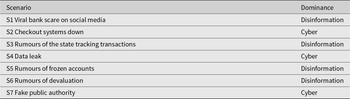
These involve direct technical interference with payment infrastructures, such as denial-of-service attacks, data breaches, or digital impersonation. These disruptions affect the operational capacity of payment systems, undermining functional trust in the availability and reliability of digital money. Here, Scenario 2 (S2) and S4 describe data breaches and S7 describes a case of social engineering, see Table 2 for a list of scenarios.
Structure of the scenarios.

Table 2 Long description
The table categorizes seven scenarios based on their dominant issue, either disinformation or cyber. Disinformation is the dominant issue in four scenarios: viral bank scare on social media, rumors of state tracking transactions, rumors of frozen accounts, and rumors of devaluation. Cyber issues dominate in three scenarios: checkout systems down, data leak, and fake public authority. This distribution highlights a slightly higher prevalence of disinformation-related scenarios compared to cyber-related ones. The scenarios reflect potential threats in financial and information security contexts.
A classification of the scenarios is presented in Table 2.
Following Giannopoulos et al.,Footnote 72 hybrid threats can be categorised into thirteen strategic domains, which often interact transversally. For this study, we concentrate on four domains deemed most consequential for public trust in digital payment systems:
• Cyber: This domain covers operational impacts via digital and communication technologies, including DDoS attacks, data leaks, digital ID compromise, and transactional manipulation. All represent threats to the technical reliability of digital payments. This is reflected in S2, S4, and S7.
• Economy: Hybrid actors may leverage economic disruption to destabilise currencies, markets, or institutional trust. Tactics may include rumour-driven bank runs or speculative attacks on digital currency valuation. This is reflected in all scenarios, as the end result.
• Societal: This domain targets social cohesion and public morale, often by exploiting institutional weaknesses, crisis mismanagement, or polarising narratives. In our context, the focus lies on financial trust as a proxy for societal resilience. This is reflected in all scenarios, as the end result.
• Information: Central to hybrid operations, this domain includes disinformation, strategic communication, and perception management. Viral narratives and manipulated media content are deployed to cast doubt on the integrity of institutions and digital infrastructure. This is reflected in S1, S3, S5, and S6.
The scenarios were designed as evaluative tools for assessing both direct effects on individual confidence in digital payment systems and indirect societal consequences through the spread of panic or systemic doubt.
This study’s domain model thus operates as an analytical lens for understanding how hybrid threats exploit psychological and symbolic vulnerabilities, not merely technical infrastructure. The target is trust itself, particularly consumer trust, which becomes the operational theatre in which hybrid strategies unfold.
Several scenarios such as Scenario S5 (rumours of account freezes) and Scenario S6 (e-krona/e-Euro devaluation rumours) are hypothetical and rather unrealistic constructs, though emotionally plausible. These are not based on single real-world events but are grounded in hybrid threat logic and in the study serve to stress-test individuals’ trust in societal institutions under low-probability, high-impact conditions.
As outlined in section ‘Integrating hybrid threat theory and public trust’, this reflects the dual nature of hybrid warfare and how it affects both perception and infrastructure. The design aligns with the conceptual functions of money as both a medium of exchange and a symbolic anchor of social stability.Footnote 73
Moreover, the scenarios simulate engineered ambiguity where the line between systemic failure and deliberate sabotage is blurred, reinforcing the asymmetric, low-attribution nature of hybrid strategies.Footnote 74 In doing so, the study operationalises a critical dimension of financial resilience: how trust degrades under uncertainty, and how this degradation may be manipulated for strategic gain.
Data collection
The empirical data, which consisted of the rank orderings of criteria weights, threat levels, and likelihoods, was collected through an online surveyFootnote 75 specifically designed to operationalise the multi-criteria approach. The survey instrument was constructed to elicit comparative preferences in relation to hybrid threat scenarios targeting trust in digital payment systems. The survey was conducted between May and July 2025 using a professionally recruited online panel, yielding responses from 310 participants – 131 from Sweden, 84 from Finland, and 95 from Germany. These three countries were deliberately selected for their distinct yet complementary positions in the digital monetary ecosystem. Sweden is among the most cashless societies globally,Footnote 76 with widespread adoption of mobile payment systems such as Swish,Footnote 77 making Sweden a suitable site for examining vulnerabilities to disruptions in trust in digital payment systems. Finland mirrors this high degree of digitalisationFootnote 78 but also has a proximity to Russia and a history of Russian hybrid operations.Footnote 79 Germany, by contrast, as Europe’s largest economy and a country with relatively high reliance on cash,Footnote 80 was chosen as it was believed to offer a more conservative baseline, hence potentially enhancing the variance in the study’s cross-national design
While this study does not claim statistical representativity in a probabilistic sense, it does satisfy the conditions for theoretical saturationFootnote 81 within a purposive sample of information-rich cases.Footnote 82 Philosophically, the use of online panels aligns with a constructivist epistemology, where perceptions, not objective events, constitute the core unit of analysis. As hybrid threats are performative and often ambiguous, gauging subjective experience through controlled panels provides a legitimate form of epistemic access to how trust is socially constructed and degraded.
Results
We present the results from the three surveys, one per country, in the form of bar charts showing the average threat level of each scenario and in the form of pie charts showing the distribution of part-worth values indicating if a scenario is deemed to threaten a certain criterion or not. If the average threat level is above 0.5, then there is a tendency for the respondents to rank the scenario as one of the three most threatening scenarios, and vice versa if the average threat level is below 0.5. As for the distribution of the threat levels over the three criteria, the more the distribution of threat levels deviates from a uniform one, that is, 1/3 on all three, the more the respondents were in agreement on emphasising a particular criterion to be lesser or more threatened.
Sweden
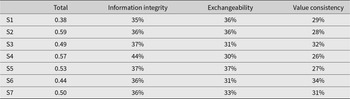
The average threat level of T(Sik) is shown as stacked bar charts built of the average part-worth values of each criterion over all respondents in the Swedish survey in Figure 1. For figures, the total threat level and how it is distributed over the three criteria is provided in Table 3. Notably, S2 (checkout systems down), S4 (data leaks), and S5 (rumours of frozen accounts) have a greater average perceived threat value than 0.5. S1 (bank scare) and S6 (devaluation rumours) who perceived to impose a smaller overall threat level.
Respondents’ average threat levels in the Swedish survey.

Figure 1 Long description
A stacked bar chart titled 'SWE Scenario Threat Levels' displays data for scenarios S1 to S7. The y-axis represents threat levels ranging from 0 to 0.7. Each bar is divided into three segments: information integrity, exchangeability and value consistency. S2, S4 and S5 have higher total threat levels compared to others, with S4 being the highest. The chart visually compares the distribution of threat components across different scenarios.
Threat levels and the distribution of part-worth values over the criteria for the Swedish survey.

Table 3 Long description
The table presents threat levels and part-worth values for various criteria in a Swedish survey. S2 exhibits the highest total threat level at 0.59, indicating a significant concern. Information integrity is highest in S4 at 44%, suggesting a strong emphasis on this criterion. Exchangeability remains consistent at 36% for S1, S2, and S5, while value consistency peaks at 34% in S6. Overall, the data suggests a balanced distribution of part-worth values across the criteria, with slight variations in emphasis depending on the scenario.
It can be noted that information integrity tends to be the criterion perceived to be under greater pressure compared to the other two, and value consistency is the criterion under the least pressure for the top three threatening scenarios of S2, S4, and S5. With respect to S4 having the highest perceived threat level, we see that information integrity is the criteria by far the most threatened. In all, the value consistency criterion is perceived to be less threatened, especially when considering the top three scenarios in terms of threat levels.
Finland
Notable in the Finnish results shown in Figure 2 and Table 4 is the larger difference between the four scenarios with a greater average threat than 0.5 (S2, S4, S5) and the two with a lower perceived threat level (S1 and S7).
Respondents’ average threat levels in the Finnish survey.

Figure 2 Long description
A bar graph titled 'FIN Scenario Threat Levels' displays threat levels for scenarios S1 to S7. Each bar is divided into three categories: information integrity, extrajudiciality and value consistency. The y-axis ranges from 0 to 0.7, indicating threat levels. Scenario S4 has the highest threat level, while S1 and S7 have the lowest. The graph visually compares the contribution of each category to the overall threat level for each scenario.
Threat levels and the distribution of part-worth values over the criteria for the Finnish survey.

Table 4 Long description
The table measures threat levels and the distribution of part-worth values across criteria in a Finnish survey. S4 exhibits the highest total threat level at 0.66, with notable information integrity at 47%. In contrast, S7 has the lowest total threat level at 0.37, maintaining consistent exchangeability and value consistency at 35% and 31%. S1 and S6 share the same total threat level of 0.42, but differ in their distribution across criteria. S5 shows balanced exchangeability and information integrity at 40% and 40%, respectively, but has the lowest value consistency at 20%. The data suggests variability in threat levels and criteria distribution across different survey points, with S4 standing out in terms of information integrity.
It can be noted that the value consistency criterion in general receives the lowest amount of perceived threat level across all scenarios, which is consistent with the Swedish survey. There is a strong emphasis on the information integrity criterion for the threat perceived to be the greatest (S4), and the top three scenarios in terms of average threat are all less considered to threaten the value consistency criterion. Notably, the total threat level of S4 is high by comparison across all scenarios and countries – this in combination with the high proportion of that value stemming from the information integrity criterion suggests that there is a strong anxiety towards data leakage by the respondents.
Germany
Notable in the German results shown in Figure 3 and Table 5 is that the S6 and S7 scenarios are perceived as the most threatening scenarios, the latter striking a difference between Germany and the other two countries subject to the survey.
Respondents’ average threat levels in the German survey.

Figure 3 Long description
A bar graph titled 'GER Scenario Threat Levels' displays data for scenarios S1 to S7. The y-axis represents threat levels from 0 to 0.6. Each bar is divided into three categories: information integrity, extractability and value consistency. S1 has the lowest total threat level, while S7 has the highest. The bars show increasing threat levels from S1 to S7, with varying contributions from each category.
Threat levels and the distribution of part-worth values over the criteria for the German survey.

Table 5 Long description
The table measures threat levels and the distribution of part-worth values across criteria for a German survey. S7 has the highest total threat level at 0.58, while S1 has the lowest at 0.34. Information integrity is highest for S4 at 40%, and lowest for S1 at 31%. Exchangeability is highest for S5 and S6 at 38%, with S4 having the lowest at 29%. Value consistency is highest for S1 and S7 at 33%, and lowest for S5 and S6 at 26%. The data suggests a varied distribution of part-worth values across different criteria, with no single scenario dominating all categories.
The German respondents differ substantially in their perception of threat level regarding the S7 scenario (fake public authority recommendation of alternative payment means); this is discussed in the next section. Further, the top two scenarios in term of total threat level do not have as large a proportion of the threat level value stemming from the information integrity criterion compared to the respondents from the other two countries. Consistent with the other two countries is that S1 is considered to be a relatively less threatening scenario.
Results summary
The empirical results presented in the previous section support the core proposition advanced in this study: that trust in digital means of payment constitutes a strategic vulnerability in hybrid threat environments. While the scenarios were only text in a common online survey environment and can be assumed not to have been so stimulating, their reception across Sweden, Finland, and Germany still demonstrates that public trust is neither uniform nor purely technical in nature but rather shaped by national socio-technical imaginaries, historical legacies, and institutional expectations.
In Sweden, a highly digitalised society with very little physical cash in circulation, respondents displayed acute sensitivity to scenarios that directly affect the operational continuity of digital payments. Scenarios S2 (checkout systems down), S4 (data leaks), and S5 (rumours of frozen accounts) were rated above the average threat threshold (>0.5), reflecting an emphasis on exchangeability and information integrity as pillars of financial trust. These findings suggest that in a system where digital transactions are ubiquitous, any interruption to functionality is valued as a breach of usability and reliability. The relative weakness of response to S3 (state surveillance) and S6 (currency devaluation) indicates less concern for symbolic threats and greater focus on technical performance. It is plausible that respondents viewed exchangeability and value consistency as interlinked without access to one’s digital money, thus meaning the notion of consistent value becomes moot.Footnote 83
Finland, while similarly advanced in digital payments, exhibited a broader risk perception, with higher average threat ratings for S2, S4, S5, and S6. The elevated sensitivity to S6 (devaluation rumours) and S5 (frozen accounts) may reflect Finland’s geopolitical context, especially its proximity to and experience with Russia. Unlike Swedish respondents, Finns assigned greater weight to symbolic and institutional vulnerabilities, suggesting a more cautious stance towards disinformation campaigns. Interestingly, S1 (bank collapse) received low threat perception, potentially indicating either greater institutional trust or more critical interpretation of social media panic. Such distinctions highlight the importance of national memory and external threat landscapes in shaping the perceived plausibility and severity of hybrid disruptions.Footnote 84
In Germany, the results diverged notably. Respondents were most alarmed by S6 (e-Euro devaluation rumours) and S7 (fake public authority) – both scenarios involving symbolic destabilisation rather than technical failure. This suggests a particularly strong sensitivity to disruptions of institutional legitimacy and public narratives, a pattern consistent with Germany’s historically cautious monetary culture and enduring attachment to privacy and state formalism. While S2 and S5 still registered high concern, especially on exchangeability, it was S3 (state surveillance) and S4 (data leaks) that also elicited heightened responses, particularly in relation to information integrity. By contrast, S1 (bank panic) had low impact, possibly because of Germany’s relatively higher cash use, functioning as both a practical and psychological backstop.
Together, these country-specific profiles offer support for the broader theoretical claim developed in the theretical section of this paper: that hybrid threats exploit asymmetric trust structures embedded in each society’s socio-technical systems. As Giannopoulos Footnote 85 and BachmannFootnote 86 have argued, hybrid actors are not constrained by traditional domains of conflict; they target vulnerabilities that are performative, psychological, and deeply contextual.
Analysis and discussion
Returning to the conceptual architecture laid out in the opening three sections of this paper, it becomes clear that trust in digital payments is not a monolith but rather a set of interlocking expectations across functionality (exchangeability), privacy (information integrity), and monetary confidence (value consistency). The findings support the notion that hybrid threats operate through cascading dynamics, wherein even symbolic or narrative interventions can trigger destabilising behavioural responses, especially when they blur the lines between technical failure and discursive manipulation.
Scenario S5 (rumours of frozen accounts) is emblematic of this dynamic. Though entirely based on information ambiguity, it elicited strong responses across all countries, demonstrating how perceptions of personal disempowerment, even in the absence of any systemic outage, can severely degrade functional trust. Likewise, S6 (currency devaluation), which is technically impossible in Sweden due to its floating currency, still provoked alarm in other contexts, particularly in Germany. This underlines that it is the perceived plausibility, not the actual technical realism, that drives emotional and behavioural responses in hybrid threat scenarios.
Most striking is the cross-national variation in how symbolic threats are perceived. S7 (fake public authority), a scenario involving suspicious communication from something that in an unclear way may look like a public authority, was rated as especially threatening in Germany, where formal institutional communication perhaps may hold a cultural weight. In Sweden and Finland, responses to S7 were more muted, perhaps reflecting a more critical or a media-savvy public. Yet the scenario nonetheless illustrates a core vulnerability: when trust in who speaks on behalf of the state is shaken, even briefly, it can result in real-world shifts in behaviour, such as refusing digital transactions.
These insights reaffirm a broader point: trust erosion can be strategically engineered. Unlike kinetic attacks, hybrid operations aim to reconfigure the public’s interpretive frameworks to make the familiar appear unstable, and the dependable seem doubtful. In this context, money itself becomes a narrative object, as much as an economic instrument. The symbolic role of central banks, digital infrastructures, and state communication mechanisms are thus brought to the fore, as argued by SimmelFootnote 87 and Kosanović.Footnote 88
Importantly, the findings suggest that national resilience strategies must move beyond cyber hygiene and technical redundancy. They must also include symbolic resilience: ensuring that institutional authority is legible, that messaging is coordinated and trusted, and that publics understand the underlying logic of their monetary systems. As the study shows, resilience is not merely infrastructural; it is also interpretive.
Implications for European national security policy
From a policy perspective, these findings bear direct relevance for European national security strategy. They indicate that digital payments are not merely financial utilities but also strategic infrastructures whose disruption can be leveraged to destabilise public confidence.
First, scenario-based stress testing of trust should become a regular feature in financial resilience planning. As shown, threats like S5 or S6, though not technically sophisticated, can produce outsize effects due to their symbolic resonance. Security assessments must therefore include narrative plausibility modelling alongside conventional risk metrics.
Second, cross-sectoral coordination between financial regulators, cyber authorities, and strategic communication units is essential. For example, scenarios such as S7 highlight the importance of clarity and verification protocols in crisis messaging. The existence of ‘fake authority’ narratives demands rapid institutional response capacity that can reaffirm legitimacy in real-time.
Third, public literacy in how digital payments function, who controls them, and how they are safeguarded must be increased. Sweden’s limited concern with symbolic manipulation may reflect a lack of conceptual exposure to monetary destabilisation mechanisms, while Germany’s heightened response suggests a public more attuned to the symbolic layers of monetary trust. Either way, public education is a vector of national resilience.
Finally, the study suggests that hybrid threat preparedness must include psychosocial dimensions, not only technical diagnostics. Financial trust is simultaneously procedural and emotional, and hybrid actors are increasingly adept at targeting both.
In conclusion, the evidence affirms the need for a re-conceptualisation of digital financial infrastructure as a domain of national security. The trust that sustains it is asymmetrical, fragile, and exploitable. And as such, safeguarding it requires not only encryption and uptime but also epistemic clarity, communicative integrity, and cultural competence.
If money exists only insofar as it is trusted, then digital financial systems represent not merely economic infrastructure but also shared interpretive frameworks. Hybrid threats exploit precisely this interpretive layer. The findings of this study demonstrate that even the perception of instability can unsettle the social ontology of money itself. In this sense, safeguarding digital payments is about protecting not only systems but also the conditions under which money continues to exist as a trusted social fact.
Acknowledgements
The authors would like to thank Johanna Synstad at Netigate for assistance in survey design and data collection, and for highly valuable comments from the editor and reviewers at the European Journal of International Security.
Mattias Svahn, PhD, is a researcher at the Department for the Information Environment and Influence at the Swedish Defence Research Agency (FOI). He has studied strategic communication and media psychology since 2005, including at the Stockholm Schools of Economics in Stockholm and in Riga. He currently leads the research area Cyber and Society Studies.
Aron Larsson is a professor and researcher at the Risk and Crisis Research Centre of Mid Sweden University. He is also affiliated with the Risk and Decision Analysis group of the Department of Computer and Systems Sciences at Stockholm University. His main research interests lie in computational risk and decision analysis, as well as systems analysis approaches for the study of societal resilience.
Gustav Häggbom is a junior analyst/defence economist at the Department of Economic Security at the Swedish Defence Research Agency (FOI). In addition to analysing issues related to economic security, his primary focus is on defence spending, production capacity, and the conflicts of interest that can arise between political objectives and industrial priorities within the defence sector.
Anders Melander is an analyst at the Department of Strategy and Policy at the Swedish Defence Research Agency (FOI). He has studied hybrid threats since 2020 and was seconded between 2022 and 2024 to the European Centre of Excellence for Countering Hybrid Threats. He currently leads the project Defence Policy Studies.
Appendix 1
This appendix presents the scenarios in the survey. To ensure methodological robustness, the scenarios were written following established quality principles for scenario-based studiesFootnote 89. Each scenario was required to plausibly engage key evaluation criteria (information integrity, exchangeability, value consistency), operationalise a place in a hybrid modelFootnote 90. remain neutrally worded to avoid framing bias, and balance plausibility with cognitive accessibility. Everyday realism was included without dramatisation, ensuring comparability across scenarios. This design follows recommendations that scenario consistency is essential for unbiased preference elicitation, enabling respondents’ values, not narrative intensity, to drive evaluationsFootnote 91. The scenarios were in Swedish, Finnish, and German with necessary local adaptions for each country. For reader convenience, they are here presented in English, though respondents received these in Swedish, German, or Finnish.
Scenario 1
In the stream of news and social media, it is reported that one of the major banks is in crisis, that customers are trying to empty their accounts, and that the crisis risks spreading to other banks. News outlets, colleagues, friends, and influencers are all talking about it. Anyone who logs into their banking app is met with an error message: ‘The system is overloaded.’
Scenario 2
It’s Friday afternoon during the holiday shopping rush. There are queues everywhere. Suddenly, all card payments are declined. Mobile payments don’t work either. Cashiers shrug and say: ‘The entire checkout system is down.’
News outlets speculate about a cyber-attack. The government remains silent. The Financial Supervisory Authority downplays the crisis, while the central bank speaks of ‘heightened alert’.
Across the country, people queue at ATMs, but they’re soon empty.
Scenario 3
It’s 2026. Sweden/Finland/Germany has just introduced the ‘e-krona’/‘e-euro’, a digital version of the national currency issued by the state. In the news feed, the headline reads: ‘Can the state track every purchase made with the e-krona/e-euro?’ A viral article speculates that all government agencies could gain access to your purchase data.
Some experts agree; others say it’s an exaggeration.
Scenario 4
A hacker group claims to have obtained millions of Swedish personal data records from bank cards, Swish, Apple Pay, Google Pay, Samsung Pay – in short, from all forms of digital payments. A website named www.whatyourneighborbuys.com makes the data searchable.
Anyone who visits the site is greeted with a search box. Typing in your name reveals a neat list of everything you’ve purchased with digital payments over the past month. Banks report a wave of customers cancelling their cards.
Scenario 5
It’s the end of the month. News outlets and social media report that some banks are not functioning and that people can’t log in.
It’s said that the banks are shutting down customers’ accounts because their AI systems flagged them as ‘high-risk clients’. Salaries, rent, child benefits – everything is frozen.
No one knows who has been flagged, and there is no known appeals process.
Scenario 6
It’s 2026. Sweden/Finland/Germany has implemented the e-krona/e-euro as a digital complement to regular money. A popular account on X spreads a ‘leaked document’ allegedly showing that the central bank plans to devalue the e-krona/e-euro by 20 per cent. Several news outlets and social media channels report on how the rumour is spreading. Economists deny it, saying such a move is impossible, but the public is still worried. The central bank’s denial is dismissed as propaganda by some media outlets. Concerned individuals start converting their e-kronas/e-euros into euros or gold.
Scenario 7
On social media and several news channels, a press release circulates from what appears to be the ‘Public Authority for Digital Security’. It claims that bank cards and mobile payments should be avoided due to security vulnerabilities, and that the public should switch to cash or use alternatives like PayPal/Revolut, which the agency ‘recommends’. The responsible public authority denies this, calling it a hoax, while other agencies remain silent.
Businesses shut down mobile and card payments ‘for safety reasons’.




 Open access

