


Introduction
Most long-term studies of jaguar Panthera onca ecology have been in lowland protected areas (Emmons, Reference Emmons1987; Nuñez et al., Reference Nuñez, Miller and Lindzey2000; Ceballos et al., Reference Ceballos, Chávez, Rivera, Manterota, Wall, Medellín, Equihua, Chetkiewicz, Crawshaw and Rabinowitz2002) and on private lands where cattle ranching is the dominant economic activity (Schaller & Crawshaw, Reference Schaller and Crawshaw1980; Quigley & Crawshaw, 1992; Hoogesteijn et al., Reference Hoogesteijn, Hoogesteijn and Mondolfi1993; Rosas-Rosas, Reference Rosas-Rosas2006). Few studies have looked at the range of human interactions with jaguars beyond predation on livestock. The objective of this study was to evaluate the potential for jaguar conservation in a community-dominated landscape in montane tropical forests in the southern Mexican state of Oaxaca. With reference to human relations with jaguars, Conforti & de Azevedo (Reference Conforti and de Azevedo2003), Brechin et al. (Reference Brechin, Buff and Blanco2005) and Altrichter et al. (Reference Altrichter, Boaglio and Perovic2006) used interviews to assess human perceptions of jaguars, investigate human–jaguar conflict, and document jaguar presence on private lands in lowland tropical forests in South and Central America. Nuñez et al. (Reference Nuñez, Miller and Lindzey2000), Ceballos et al. (Reference Ceballos, Chávez, Rivera, Manterota, Wall, Medellín, Equihua, Chetkiewicz, Crawshaw and Rabinowitz2002) and Rosas-Rosas (Reference Rosas-Rosas2006) conducted long-term ecological studies on jaguar populations in Mexico but the study reported here is the first study to combine both ecological and social research methods in the country.
For survival, jaguars will need protection in landscapes beyond strict protected areas, and substantial numbers of jaguars exist outside protected areas in Mexico (Chávez & Ceballos, Reference Chávez and Ceballos2006) and elsewhere in Latin America (Rabinowitz, Reference Rabinowitz, Woodroffe, Thirgood and Rabinowitz2005). The emergence of a significant new movement to establish indigenous/community conserved areas in Mexico and the high degree of community land ownership makes the country a laboratory for studying jaguar conservation beyond protected areas (Bray et al., Reference Bray, Durán, Anta, Martin and Mondragon2008). Indigenous/community conserved areas are important institutions for enhancing the value of community-dominated lands for the conservation of biodiversity (Borrini-Feyarabend et al., Reference Borrini-Feyarabend, Kothari and Oviedo2004; Kothari, Reference Kothari2007).
No other country within the jaguar’s range has a greater percentage of its forests in community ownership than Mexico (Bray et al., Reference Bray, Merino Perez and Barry2005), and studies in southern Mexico and Guatemala have found healthy populations of jaguars in community forests managed for timber (Ceballos et al., Reference Ceballos, Chávez, Zarza and Manterola2005; Moreira et al., Reference Moreira, McNab, García, Méndez, Barnes and Ponce2008). An estimated 56–62% of Mexico’s forests are governed by common property regimes and 11.6% of its terrestrial territory is already designated as federal protected areas (CONANP, 2008). Protected areas with strict protection comprise only 0.2% of the total area of Oaxaca (Illoldi-Rangel et al., Reference Illoldi-Rangel, Fuller, Linaje, Pappas, Sanchez-Cordero and Sarkar2008). Mexico has few opportunities for declaring new protected areas that do not conflict with community lands.
A prioritization exercise led by Mexican biologists identified northern Oaxaca as one of nine priority II regions for jaguars in Mexico. Priority II regions are defined as areas that contain considerable habitat but where jaguar status has not been systematically evaluated, and priority I regions as areas that could maintain populations of at least 100 jaguars (Chávez & Ceballos, Reference Chávez and Ceballos2006). A jaguar corridor for Oaxaca has been proposed, using a a least-cost corridor analysis, by the wild cat conservation group, Panthera. Input layers were human population density, distance from settlements and roads, percentage vegetation cover, and elevation (K. Zeller, pers. comm.).
Despite being one of only four Mexican states with both a priority I and priority II jaguar conservation unit (Chávez & Ceballos, Reference Chávez and Ceballos2006; Briones-Salas et al., Reference Briones-Salas, Lavariega-Nolasco and Lira2008), there are few published data on jaguars in Oaxaca (but see Goodwin, Reference Goodwin1969; Lira-Torres & Ramos-Fernández, Reference Lira-Torres, Ramos-Fernández, Ceballos, Chávez, List and Zarza2007).
Study area
The Chinantla, populated for centuries by the Chinantec indigenous peoples (Bevan, Reference Bevan1938), is a remote and rugged region of c. 3,660 km2. It is a subregion of the Sierra Norte, which is in turn part of the Sierra Madre Oriental, and the habitat has been broadly classified as Oaxacan montane forest (WWF, 2001). Elevations in the study area are 200–3,200 m and is abrupt, with slopes of 10–50° (Velázquez-Rosas & Meave, Reference Velázquez-Rosas and Meave2002). The Chinantla is estimated to be the third largest area of contiguous tropical forest in Mexico (Aguilar, Reference Aguilar2007) and ‘the rainiest region of Mexico’ (Velázquez-Rosas & Meave, Reference Velázquez-Rosas and Meave2002), with a mean total annual precipitation of 5,800 mm at 1,450 m.
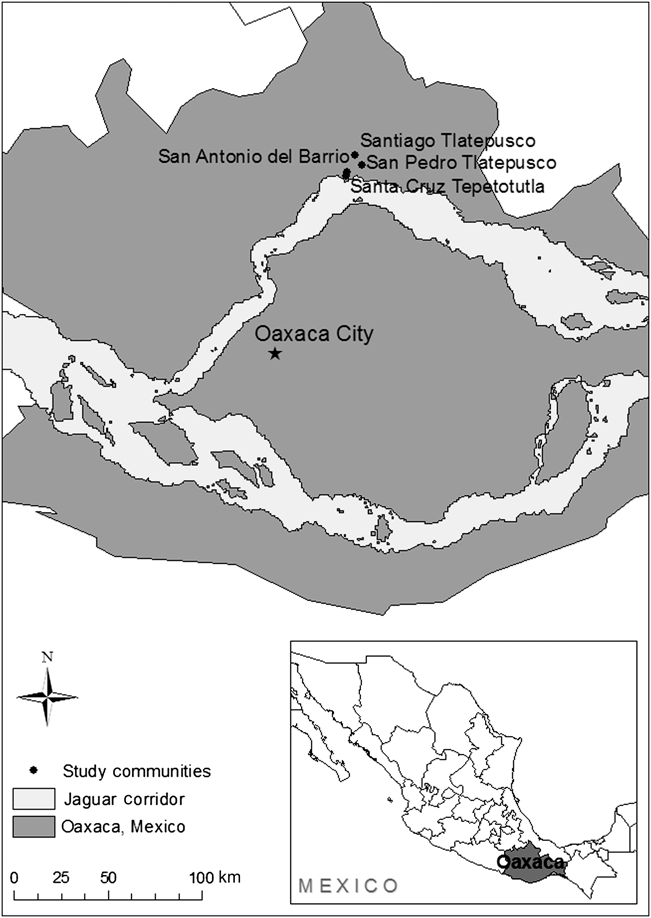
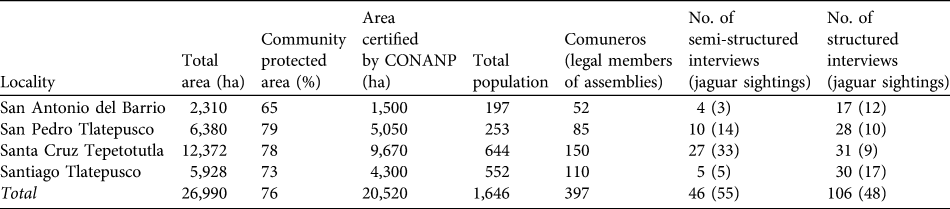
This study took place in the territory of four communities, all located in the San Felipe Usila municipality of the Chinantla: Santa Cruz Tepetotutla, San Antonio del Barrio, San Pedro Tlatepusco and Santiago Tlatepusco (hereafter Santa Cruz, San Antonio, San Pedro and Santiago, respectively; Fig. 1, Table 1). The governance structure is constituted by an Assembly of all legal community members that administer the entire territory as a common property under the agrarian laws of Mexico. For those under 60 this membership is an obligation to participate in community decisions about natural resource management, land use and conservation, and other community governance issues. The total territory of these four communities is 27,351 ha, with 75% declared as indigenous/community conserved areas by the communities and certified by Mexico’s National Commission of Natural Protected Areas (CONANP). In 2005 these four communities joined with two others to form an inter-community organization, the Natural Resource Committee of the Upper Chinantla (CORENCHI) and placed 79% of their territory under community protection. A percentage of these lands receive payments for hydrological services from Mexico’s National Forest Commission.
The four communities, in the territories of which this study took place, in relation to the jaguar Panthera onca corridor in Oaxaca state proposed by the conservation group Panthera. The inset shows the location of the main figure in Mexico.
The four communities in the Chinantla, with their total land area, percentage of land protected, area certified by CONANP, total population, number of legal members of assemblies, and the number of jaguar Panthera onca sightings reported in semi-structured and structured interviews.
The areas not zoned as indigenous/community conserved areas are dedicated to agriculture and the small nucleated human settlement areas. Significant parts of the agricultural areas are characterized by varying stages of secondary succession because of agricultural abandonment following outmigration. Secondary forests, agricultural areas of corn and shade coffee, pasture and patches of intact mature forest are found on slopes at altitudes from 200 to c. 1,600 m. Certain jaguar prey species such as coati Nasua narica and collared peccary Tayassu tajacu may favour this disturbed habitat (Leopold, Reference Leopold1959; Davies et al., Reference Davies, Heydon, Leader-Williams, MacKinnon, Newing, Fimbel, Grajal and Robinson2001).
Methods
Camera trapping
We surveyed for jaguars three times between June 2007 and June 2008 (Table 2) using 18 passive infrared camera traps (Deercam model DC-200, Park Falls, USA) with data packs that record time and date. Cameras were usually placed beside forest trails and roads, with locations chosen based on recommendations from village guides or because they had jaguar sign. Most of the camera-trap sites were in the zoned agricultural areas rather than the indigenous/community conserved areas because fewer jaguar sightings were reported in the latter. Locations of camera-trap sites were recorded using a global positioning system and logged onto topographic base-maps using MapSource v. 3.02 (Garmin, Olathe, USA). Cameras were active 24 hours per day and in position for 20–30 days. The number of trap days for each film was defined as the period beginning with camera activation until film retrieval, if the film had exposures remaining, or until the time and date stamped on the final exposure. After both flanks of one jaguar were photographed simultaneously at a camera station in April 2008, cameras were deployed individually. Pairing of cameras is probably more important in areas with higher jaguar densities because of the greater likelihood that jaguars will pass the cameras and because individuals must be identified from both flanks for population analyses (Karanth & Nichols, Reference Karanth and Nichols2002). Given the limited number of cameras available we judged it more important to cover a larger area then to reduce coverage by pairing cameras. Sampling too small an area runs the risk of overestimating densities.
Camera-trap success for jaguars during the three surveys between June 2007 and June 2008 at the four survey sites (Fig. 1).

* Other than three locations during the monitoring period, all camera stations had only one camera-trap
In areas with a poor prey base, such as montane rainforest, cameras can be deployed 5–10 km apart (Karanth & Nichols, Reference Karanth and Nichols2002). We deployed the cameras at 53 locations with a mean elevation of 1,195 ± SE 224 m and at distances apart of no greater than 5 km. This reduced the likelihood of gaps occurring in the sampled area where the probability of capturing jaguars would be zero (Karanth & Nichols, Reference Karanth and Nichols2002).
Social methods
Human–jaguar interactions in the study area were documented through informal, semi-structured and structured interviews in each of the four communities. Informal interviews were carried out with six community leaders to establish the history of conservation and cattle ranching in the communities. Both the semi-structured and structured interviews were pretested in community households. When the interviewee was monolingual, interviews were conducted in Chinantec using local translators; otherwise we used Spanish. The semi-structured interviews were conducted with 46 people who were identified through snowball sampling as having seen or had some other interaction with a jaguar. These interviews included questions on the type of interaction (sighting, animal lost to depredation, vocalization heard), date, place, time and number of jaguars, and was collected in a narrative form (Figel, Reference Figel2008). The structured interviews were administered to 106 legal community members (a c. 25% random sample). The interview included questions on knowledge about jaguars and abundance of jaguar prey, hunting, traditional cultural beliefs about jaguars, livestock depredation, conservation, and the same questions as in the semi-structured interview, to pick up interactions not uncovered in the snowball sample. For the wildlife knowledge questions, laminated sheets with photos of prey animals and wild felids were used. As a test of reliability, sheets had both native and non-native species (the latter including Canadian lynx Lynx canadensis, common and white Bengal tigers Panthera tigris, and a male African lion Panthera leo).
Data analyses
To calculate jaguar density Karanth & Nichols (Reference Karanth and Nichols2002) recommend defining the study area from the outermost camera locations, plus an added buffer zone with equal width to the mean maximum distance moved of recaptured study animals. Since there are no estimates of jaguar home range size in montane forest and only one of the two jaguars was photo-captured more than once, jaguar abundance could not be estimated. Semi-structured and structured interview data were coded, and tendencies were graphed. Non-parametric tests were used to examine any differences among communities and age groups related to interactions with, and perceptions of, jaguars.
Results
Camera traps
A total of 1,164 trap nights were accumulated from June 2007 to June 2008, with nine independent jaguar photographic events recorded; i.e. 7.8 jaguar captures per 1,000 trap nights. Two individual jaguars were photo-captured over a 13-month sampling period in 82 km2 (as calculated by constructing a polygon connecting the outermost camera sites, without buffer). Jaguars were identified by their unique spot patterns on the right flank as the left flank of one jaguar was never photographed. The jaguar photographed more than once had a maximum distance moved of 12.6 km. Jaguar photographs were taken at a mean elevation of 1,195 m ± SE 224. In September 2008 a third jaguar, undocumented during our surveys, was photographed in the same study area by another group of researchers.
Social data
All interviewees were farmers, aged 17–93 years (mean =47 ± SE 18 years), and all were legal community members. One hundred and three jaguar sighting events were documented by 67 individuals, with 83 sighting events (80%) since 1990 and 60 since 1999. The most common places for sightings were along footpaths connecting towns and agricultural areas (52.4%), in milpas (traditional plots of swidden agriculture) and coffee plots (20.4%), and in the vicinity of towns (9.7%). Usually one individual was sighted (86.4%), but occasionally pairs (9.7%) or a mother and cubs (4.9%).
Of the 10 wild felid photographs shown during the structured interviews, 85% of the respondents recognized and named jaguars as present in their communities. Fourteen wild prey animals were identified as jaguar prey and present in the communities’ territory; 67% of farmers recognized at least three or more species of jaguar prey. The most commonly mentioned were coati, armadillo Dasypus novemcinctus, red brocket deer Mazama americana and collared peccary. All prey species, and especially coati, were considered highly abundant in both forests and agricultural areas. These species, as well as squirrels Sciurus sp. and paca Agouti paca, also cause significant agriculture damage and are considered pest animals by the local people; 79% of the interviewees believe jaguars serve as a biological control of these pest animals.
There is a deep traditional cultural connection with jaguars among the Chinantecs and other indigenous peoples of Mexico, particularly manifested in a belief in nahuales, humans with the power to transform into jaguars (INI, 1981). Nearly 50% of the respondents said they had heard stories about jaguars from parents or grandparents, and 63% indicated they believe in nahuales. The belief in nahuales had no relationship with age. This belief carries with it a cultural inhibition against killing jaguars, as one runs the risk of killing a human being temporarily in a jaguar state whose relatives may seek retaliation against you (INI, 1981).
As elsewhere, the principal source of conflict between humans and jaguars is livestock depredation. The four study communities have only a recent history of small-scale cattle ranching. Small herds were established in the 1980s, financed by earnings from coffee and government development programmes. The interview data suggested that total herd size may have peaked at c. 175 in the 1990s. At the time of the survey herd size was estimated to be 80–90, with jaguar predation commonly mentioned as a reason for the decline. Respondents reported suffering livestock loss to predators, with a total of 40 attacks and 108 livestock lost among 29 herders. In some cases there were issues both with numbers lost and identification of the predator as jaguar or puma Puma concolor, and one case with extreme discrepancies was eliminated. When asked how they knew that a jaguar was the cause of predation, only eight farmers reported actually seeing a jaguar, whereas others reported seeing large tracks, claimed they knew the difference between a jaguar or puma attack, or they had no answer. Thus, it is possible that some of the livestock losses were also to puma, which our camera traps also recorded in the area. During the study period at least six pigs were lost to jaguars (Figel, Reference Figel2008).
Respondents reported killing seven jaguars and one puma during 1990–2002, with five of the jaguars and the one puma death being in retaliation for livestock depredation. Photographs exist to document two of the jaguar killings and one of a puma. Despite the history of depredation, when farmers were asked whether they considered the jaguar to be a positive or negative presence in their communities, 68% said it was positive, 20% said jaguar presence was both positive and negative and 12% thought jaguars were a negative presence. All of the respondents with negative attitudes had either owned cattle previously or lost cattle to predation.
In addition to these findings, informal interviews revealed the emergence of a more conservation-oriented culture in the communities. Since the early 1990s community political struggles over land use placed the few cattle ranchers, who pushed for privatization of the common property and herd expansion, against a faction that wanted to limit cattle and attempt to generate income from conservation. The conservationist group in the community now predominates, consolidating its leadership with the declaration of the indigenous/community conserved areas in 2005, at the same time as dependence on cattle has fallen because of remittance incomes from extensive outmigration. Our survey found that 93% of the community supports the conservation initiatives. In addition, the communities have also established new statutes, approved by the General Assemblies between 2005–2008, which regulate land use and include a ban on all hunting in the indigenous/community conserved area, on hunting red brocket deer, and only permit hunting of some pest species in agricultural areas. The statutes also ban the killing of jaguars but do not specifically disallow retaliation killings, and attempts at retaliation killing still appear to take place (Figel, Reference Figel2008). The majority of the respondents were aware of the community statutes (93%). Most also felt they received benefits from them, specifically from the payments for hydrological services by the Mexican government (Muñoz-Piña et al., Reference Muñoz-Piña, Guevara, Torres and Braña2008).
Discussion
It was recently suggested that only 54% of Mexican protected areas are effective, with the other 46% being weakly effective or non-effective (Figueroa & Sánchez-Cordero, Reference Figueroa and Sánchez-Cordero2008). Thus, for landscape species such as the jaguar to survive, habitat and protection must exist in anthropogenic landscapes (Ceballos et al., Reference Ceballos, Chávez, Zarza and Manterola2005; Valdez et al., Reference Valdez, Guzmán-Aranda, Abarca, Tarango-Arámbula and Sánchez2007). As far as we are aware this is the first study to evaluate the potential for jaguar conservation in a community-dominated landscape and in the context of indigenous/community conserved areas in Mexico whilst also evaluating attitudes towards jaguars and a larger range of human–jaguar interactions than just those associated with livestock depredation. This study also presents the first results of camera-trapping for jaguar in a montane forest habitat in Mexico and, of more local significance, the first camera-trapped jaguar photographs from the state of Oaxaca (Figel et al., Reference Figel, Durán, Bray and Prisciliano-Vazquez2009).
The status of the jaguar in other parts of the Sierra Norte is unclear, although their presence has been reported in adjacent areas of the Chinantla (Ramos-Fernandez et al., Reference Ramos-Fernández, González, Guadarrama-Overa, Eichenberger, Bermudez, Ceballos, Chavet, List and Zarza2007). Our small sample size of only two individual jaguars and three recapture events precludes estimation of population size; this is a common problem in studies of large felids (Lynam et al., Reference Lynam, Rabinowitz, Myint, Maung, Latt and Po2009). However, there do not appear to be many jaguars in this region and the steep terrain is not habitat favourable for the species. Nonetheless, the rich history of interactions from the narratives collected suggests there has been a persistent jaguar population in the Chinantla. Lethal control of jaguars has been infrequent in recent years, a significant part of the prey base has been protected, and there are significant areas under community protection. The payment for hydrological services programme of the Mexican government, which has supported these communities since 2003, has served to reinforce these conservationist tendencies (Muñoz-Piña, et. al., Reference Muñoz-Piña, Guevara, Torres and Braña2008). This suggests that the prospects for jaguar conservation in community-dominated landscapes beyond protected areas can be favourable, as some authors have speculated (Ceballos et al., Reference Ceballos, Chávez, Zarza and Manterola2005).
However, the risk of human–wildlife conflict will always remain in forests occupied by both people and jaguars. The depredation rates reported here may not seem significant when compared to livestock losses in jaguar range countries such as Venezuela or Brazil (Hoogesteijn et al., Reference Hoogesteijn, Hoogesteijn and Mondolfi1993; Zimmerman et al., Reference Zimmerman, Walpole and Leader-Williams2005) but the numbers of livestock lost in the Chinantla represent a much larger percentage of livestock holdings than those in South America. Community perceptions of problem jaguars must be kept distinct from perceptions of jaguars as a problem species as not all jaguars kill livestock (Rabinowitz, Reference Rabinowitz, Woodroffe, Thirgood and Rabinowitz2005).
The Sierra Norte contains a mosaic of conservation land uses that include sustainable community logging based on community forest enterprises (Antinori & Bray, Reference Antinori and Bray2005), ecotourism, shade tree and organic coffee, payment for hydrological services, and the emergence of sizeable areas in indigenous/community conserved areas (Robson, 2007). Our study region is notable, however, because the communities are basing their strategies almost entirely on conservation rather than on sustainable extraction. A recent study of land-use change in Sierra Norte (not including the Chinantla) suggests there is considerable remaining jaguar habitat (Gómez-Mendoza et al., Reference Gómez-Mendoza, Vega-Pena, Ramírz, Palacio-Prietto and Galicia2006), although the connectivity of the forest areas needs to be more closely examined. Future research will need to examine the connectivity of this region with other adjacent lands and possible source–sink dynamics, especially with the 6,000 km2 Chimalapa region, a jaguar priority I region c. 200 km south-east of Chinantla. The jaguar corridor proposed by the conservation group Panthera (Fig. 1) will have to be shifted northward to encompass the study area communities where we documented jaguar presence.
The region studied has been inhabited for centuries by the Chinantecs (Bevan, Reference Bevan1938), who left a jaguar representation in a hieroglyph in the region. Today, the jaguar has been adopted as an icon of the new institutions and cultural practices related to conservation, with jaguar imagery being used in signs and symbols communicating community conservation attitudes. As an effort to encourage the growth of attitudes favourable to conservation and with a commitment to the dissemination of results to the four communities, we have produced three popular publications (Durán et al., Reference Durán, Prisciliano, Bray and Figel2008) and two short videos on the research and distributed them to the communities in workshops that included children. The example of the Chinantec communities suggests that granting local people control over conservation management decisions can result in better conservation practices, improved livelihoods for local people (Bray & Velázquez, Reference Bray and Velázquez2009), and enhanced opportunities for jaguar conservation, adding community-based jaguar conservation to a new emerging paradigm of people-centred conservation.
Acknowledgements
This study was part of a collaborative effort between Florida International University (FIU), CIIDIR–Oaxaca, IPN and Geoconservación A.C. Research was supported by the US Fish and Wildlife Service, Mexico Office, FIU, the Wildlife Conservation Society, and the National Polytechnic Institute of Mexico. We thank the Chinantec people for opening their lands to this jaguar project, CORENCHI for their interest and support, José Rogelio Prisciliano-Vázquez for fieldwork assistance, and veterinarian Diego Woolrich and biologist Gabriel Ramos-Fernández. Courtney Knickerbocker from the UCF SPICE Lab kindly provided GIS expertise to help produce the study area map.
Biographical sketches
Joe J. Figel is continuing his research on, and conservation efforts for, jaguars. Elvira Durán is studying the ecology, conservation and management of community forests in Oaxaca. David Barton Bray’s research is on community forest management in Mexico and Central America.



