

Introduction
The sustainability of competitive advantage represents a fundamental issue in strategy research, not only as a static property of firm resources (e.g., Dierickx & Cool, Reference Dierickx and Cool1989; McGahan & Porter, Reference McGahan and Porter1997), but also as a temporal phenomenon reflecting firms’ ability to maintain superior performance over time (Chacar & Vissa, Reference Chacar and Vissa2005; Chacar, Newburry, & Vissa, Reference Chacar, Newburry and Vissa2010). Performance persistence, the extent to which firms are able to maintain past performance, captures the dynamic trajectory of competitive advantage over time. Consistent with temporal theorizing, which views organizational outcomes as trajectories unfolding through time rather than as static states (Ancona, Goodman, Lawrence, & Tushman, Reference Ancona, Goodman, Lawrence and Tushman2001; Blagoev, Hernes, Kunisch, & Schultz, Reference Blagoev, Hernes, Kunisch and Schultz2024), viewing competitive advantage through a temporal lens highlights how it unfolds to endure or decay over time. This perspective raises an important question for strategy research: under what conditions do these temporal trajectories of competitive advantage differ?
Received wisdom attributes firms’ persistent superior performance to factors related to competitive barriers, including industrial structure and intangible resources (Dierickx & Cool, Reference Dierickx and Cool1989; McGahan & Porter, Reference McGahan and Porter1997). Contemporary empirical studies have investigated a wide array of determinants of performance persistence such as business group affiliation, stakeholder relations, and national institutions (Chacar et al., Reference Chacar, Newburry and Vissa2010; Choi & Wang, Reference Choi and Wang2009; Hu, Cui, & Aulakh, Reference Hu, Cui and Aulakh2019; Zhao, Parente, Song, & Wenger, Reference Zhao, Parente, Song and Wenger2020), demonstrating how these factors influence the decay or reinforcement of performance advantages over time. However, the rise of digital platforms invites a rethinking of how competitive advantage unfolds over time and across various contingencies, since their core mechanism – network effects – embodies a distinctly temporal dynamic. Network effects generate self-reinforcing growth through user accumulation, yet their sustaining power may erode as platforms evolve (Cennamo & Santalo, Reference Cennamo and Santalo2013; Cennamo & Tavalaei, Reference Cennamo and Tavalaei2020; McIntyre & Srinivasan, Reference McIntyre and Srinivasan2017; Zhu & Iansiti, Reference Zhu and Iansiti2012).
To explain why the sustaining power of network effects changes over time, it is necessary to consider the mechanisms of value creation within user networks. Platforms shift the locus of value creation beyond firm boundaries and rely on the growth dynamics of user networks (Parker, Van Alstyne, & Jiang, Reference Parker, Van Alstyne and Jiang2017). This is particularly true for social platforms, which serve to enable users to engage in mutually beneficial interactions online and fulfill users’ economic and social needs through these exchange relationships (Piskorski, Reference Piskorski2014). As users derive greater value from a platform with a larger installed base, the positive externalities tend to form a self-reinforcing loop, which purportedly allows leading platforms to continually cement their market positions (Katz & Shapiro, Reference Katz and Shapiro1985). Yet in practice, market leadership among social platforms is fluid, as seen with Facebook, Instagram, and Snapchat in the US, and Myspace, Qzone, and WeChat in China, where new entrants dethrone incumbents despite their large networks. These practices reveal transient episodes of dominance rather than permanent ‘winner-take-all’ equilibria.
Furthermore, given the born-global nature of many platforms, multinational platforms (MNPs) are accessible in various countries with different environments (Stallkamp & Schotter, Reference Stallkamp and Schotter2021). However, as noted by previous research, network effects cannot easily transcend geographic boundaries, resulting in fragmented regional user bases and uneven platform success (Chen, Shaheer, Yi, & Li, Reference Chen, Shaheer, Yi and Li2019; Cullen & Farronato, Reference Cullen and Farronato2021). For example, while Facebook continued to dominate in the US, it encountered a three-million user base contraction in Europe in 2018. In contrast, China’s digital landscape has witnessed both the global rise of ByteDance’s TikTok and rapid domestic turnover among social platforms such as Weibo, WeChat, and Douyin. These divergent trajectories illustrate how market and institutional contexts shape the persistence and diffusion of platform advantages across countries, to which the literature has paid little attention. These phenomena underscore the question that remains underexplored in the strategy literature (Cennamo & Tavalaei, Reference Cennamo and Tavalaei2020; Cullen & Farronato, Reference Cullen and Farronato2021 ): whether and the extent to which network effects can confer sustainable performance benefits across international markets and over time.
To address this question, we highlight the intrinsically dynamic accumulation process of network effect, and delve into the reasons for increasing returns to scale through the perspective of content and information dissemination. Our core premise is that the value of a sizable installed base for social platforms lies in the enhanced opportunities for information exchange. The fact that users contribute as well as consume information (Kane & Ransbotham, Reference Kane and Ransbotham2016) implies that exchange opportunities will be conditioned by factors affecting the effectiveness of information dissemination and information consumption, which in turn can either hinder or facilitate the conversion of initial user base advantage into sustained valued benefits. To investigate how this mechanism plays out across national contexts and evolves over time, we adopt a geotemporal perspective, which allows us to examine how cross-country variation influences the persistence of platform performance. We argue that the strength of network effects on performance persistence depends on two key conditions: the platform’s ability to facilitate free information dissemination and the extent to which users benefit from the information environment. First, we examine the effect of intellectual property rights (IPR) protection in the host country; since IPR protection may impede the freedom of information dissemination on a platform, the positive feedback loop ignited by user base advantage will be impeded, thereby the positive effect of installed base on performance persistence will be attenuated in countries where IPR protection is stronger. Second, we propose that the strength of network effects in maintaining superior performance will be amplified in countries where user demand heterogeneity is greater. This is because demand heterogeneity in the market context enhances the benefits users derive from a large membership by encouraging the creation of diverse content that caters to a wide range of preferences, and preferences for diverse information are more likely to be met by a wider range of contributors. These together raise the value of having a sizable user network. To test our hypotheses, we follow previous research (e.g., Chacar et al., Reference Chacar, Newburry and Vissa2010; Choi & Wang, Reference Choi and Wang2009; Suk, Lee, & Kross, Reference Suk, Lee and Kross2020) to use first-order autoregressive models to examine how a platform’s prior performance can be retained into the next period. Our analysis, based on a unique dataset of 282,327 observations of the world’s top social networking apps in 56 countries, provides supportive evidence for our hypotheses.
This article makes three key contributions to the literature. First, we develop a user network-based explanation for performance persistence at the platform level, shifting attention from firm-specific resources to ongoing user participation and informational exchange. This reconceptualization highlights how platforms sustain competitive advantage through value cocreation rather than resource appropriation (Chacar & Vissa, Reference Chacar and Vissa2005; Dierickx & Cool, Reference Dierickx and Cool1989; McGahan & Porter, Reference McGahan and Porter1997; McIntyre, Srinivasan, & Chintakananda, Reference McIntyre, Srinivasan and Chintakananda2021). By focusing on how platforms mobilize user participation and sustain informational interactions, we offer an alternative explanation for sustained advantage in digitally mediated environments. Second, we offer a more time-sensitive and nuanced understanding of network effects by revealing their important but overlooked geographic boundary conditions. Moving beyond assumptions that network advantages arise from cumulative scale or connectivity (Afuah, Reference Afuah2013; Karhu, Heiskala, Ritala, & Thomas, Reference Karhu, Heiskala, Ritala and Thomas2024; Lee, Lee, & Lee, Reference Lee, Lee and Lee2006; Lee, Song, & Yang, Reference Lee, Song and Yang2016), we show how content creation, circulation, and consumption drive temporal dynamics of network effect dynamics. Additionally, by incorporating demand-side heterogeneity into persistence literature, which has long attributed declining rates of performance convergence to supply-side economies of scale and firms’ proprietary resources, we offer a more complete account of how competitive advantages persist in digital platforms. Third, we introduce a geotemporal perspective to explain why and how a platform’s competitive advantage varies across countries and evolves over time. This perspective highlights how intellectual property protection and demand heterogeneity jointly shape the persistence of network effects. Although our analysis is based on cross-country comparisons, it also yields temporal implications. Differences in institutional maturity across countries can be interpreted as distinct stages of regulatory evolution, revealing how institutional change influences the duration and trajectory of performance persistence. By integrating spatial variation with temporal insight, this study offers a more context-sensitive and time-embedded understanding of sustained advantage in global platform competition, and resonates with recent research that conceptualizes institutions as dynamic, evolving processes (Reinecke & Lawrence, Reference Reinecke and Lawrence2023). The framework also responds to recent calls to incorporate temporal theorizing into strategy research (Blagoev et al., Reference Blagoev, Hernes, Kunisch and Schultz2024; Zhang, Priem, Wang, & Li, Reference Zhang, Priem, Wang and Li2023) and extends studies of geographic fragmentation by showing how contextual differences shape the unfolding of network-based advantages over time (Cullen & Farronato, Reference Cullen and Farronato2021; Stallkamp & Schotter, Reference Stallkamp and Schotter2021).
Theoretical Background and Hypotheses Development
Performance Persistence
Economic theory, based on the general equilibrium framework, views firms’ superior performance as a temporary disequilibrium phenomenon. According to the convergence hypothesis, abnormal returns will regress toward the mean and dissipate over time due to imitation and competition (Arrow & Debreu, Reference Arrow and Debreu1954). Profitability should direct resource allocation to areas earning above-average returns and away from those with below-average returns, such that any systematic performance differences would be eroded completely by competitive forces.
However, empirical evidence has pointed to lasting abnormal returns at both industry and firm levels (Bou & Satorra, Reference Bou and Satorra2007). That suggests that adjustments of performance to competitive levels may be significantly delayed for some firms more than others (Jacobsen, Reference Jacobsen1988). The very mission of strategy research is to challenge the convergence hypothesis and explain when and why performance divergence persists across time, firms, and markets (Lippman & Rumelt, Reference Lippman and Rumelt1982). Conventional wisdom maintains that industry structural attributes and firms’ internal resources and dynamic capabilities can insulate a firm from competitive forces driving performance back to its competitive level (Choi & Wang, Reference Choi and Wang2009; McGahan & Porter, Reference McGahan and Porter1999; Wibbens, Reference Wibbens2019). Strategies that increase market share and industry concentration within an industry can help firms sustain superior performance because of economies of scale and market power advantage (Jacobsen, Reference Jacobsen1988). These findings suggest that sustaining advantage is not only a matter of strategic positioning or resource endowment, but also of how competitive performance unfolds over time. However, strategy research has paid limited attention to the temporal unfolding of competitive advantage, specifically to the durational patterns through which firms consolidate or lose their lead.
We build on this insight by reconceptualizing performance persistence as a time-embedded process that reflects the evolving trajectory of competitive advantage. We intend to explore when and under what conditions advantage persists or erodes, and how institutional environments shape this unfolding. While past studies suggest that persistence patterns vary significantly across countries (Chacar & Vissa, Reference Chacar and Vissa2005; Hu et al., Reference Hu, Cui and Aulakh2019), the mechanisms behind such geographic divergence remain underexplored. This gap becomes particularly salient in the context of digital platforms. This burgeoning new organizational form, digital platforms, relies less on proprietary resources, but on networked user participation (Parker et al., Reference Parker, Van Alstyne and Jiang2017), raising distinct questions about how platform momentum is maintained or disrupted across institutional and market environments. We address this by adopting a geotemporal lens of performance persistence, integrating time-based dynamics with cross-national variation to explain platform sustainability in the global digital economy.
Social Platforms, Network Effects, and Performance Persistence
The burgeoning research on digital platforms has shed new light on industrial competition, given the unique structural characteristics of network industries (McIntyre & Srinivasan, Reference McIntyre and Srinivasan2017). Platform firms provide an intermediary, often based on information and communication technologies, to enable interactive, multilateral exchange among platform users (Cennamo & Santalo, Reference Cennamo and Santalo2013; Gawer & Cusumano, Reference Gawer and Cusumano2008). Platforms create value by reducing friction and barriers that would otherwise inhibit users from exchanging with one another (Zhu & Iansiti, Reference Zhu and Iansiti2012). For example, social platforms have emerged to address social failures that prevent users from forming relationships due to the substantial costs of interaction between individuals (Piskorski, Reference Piskorski2014). Such interaction costs arise from the barriers to information search and display and communications, and they can be attributed to both economic and social causes. What distinguishes platforms from traditional organizations is that platforms extend their functionality by incorporating user contributions. In a social platform context, users exchange informational content (Butler, Reference Butler2001; Leonardi & Vaast, Reference Leonardi and Vaast2017); those who consume content created by the social network are also potential contributors (Kane & Ransbotham, Reference Kane and Ransbotham2016).
Unlike traditional firms that derive competitive advantage from internal resources and capabilities, platforms enjoy increasing returns to scale, also known as network effects, on their external user base (Eisenmann, Parker, & Van Alstyne, Reference Eisenmann, Parker and Van Alstyne2011; Katz & Shapiro, Reference Katz and Shapiro1986). Network effects manifest as potential adopters attach a greater value to a platform when the mass of users increases (David, Reference David1985; Katz & Shapiro, Reference Katz and Shapiro1985). Much scholarly discussion to date has been on how network effects enable platforms and network technologies to acquire new users (Brynjolfsson & Kemerer, Reference Brynjolfsson and Kemerer1996), and how new adopters together with existing users drive platform momentum and sustain performance over time (Cennamo & Tavalaei, Reference Cennamo and Tavalaei2020). Researchers agree that a platform’s user network constitutes a strategic asset (Shankar & Bayus, Reference Shankar and Bayus2003; Sun & Tse, Reference Sun and Tse2009), and the success of a platform lies in its ability to build a large user network and sustain momentum (Boudreau, Reference Boudreau2012; Engert, Evers, Hein, & Krcmar Reference Engert, Evers, Hein and Krcmar2023; Zhu & Furr, Reference Zhu and Furr2016). Because asset mass efficiencies lead to a self-reinforcing process, one tends to suggest ‘winner-take-all’ outcomes for platforms as a result of network effects (Arthur, Reference Arthur1989).
Nevertheless, platforms’ incumbency advantage remains debatable; to what extent platforms with a larger installed base are insulated from competitive pressures from new entrants offering better technical terms has been unclear (Biglaiser, Calvano, & Crémer, Reference Biglaiser, Calvano and Crémer2019; Cennamo & Tavalaei, Reference Cennamo and Tavalaei2020; Shankar & Bayus, Reference Shankar and Bayus2003; Zhu & Iansiti, Reference Zhu and Iansiti2012). Regarding the winner-take-all prediction, one could question why and how a larger user base can retain the momentum of that self-reinforcing process, and also why some platforms are able to sustain momentum over time while others lose it. As with any social structure, the sustainability of a social platform depends on continued benefit provision, which relies on access to a pool of assets and a social process that converts those assets into valued benefits (Butler, Reference Butler2001). We argue that the main benefit lies in users’ abilities to access and disseminate information (Constant, Sproull, & Kiesler, Reference Constant, Sproull and Kiesler1996; Leonardi & Vaast, Reference Leonardi and Vaast2017). Amassing a sizable user base can sustain the incumbency advantage for two main reasons. First, informational content is contributed by existing users, the amount of which determines resource availability (Butler, Reference Butler2001; Kane, Alavi, Labianca, & Borgatti, Reference Kane, Alavi, Labianca and Borgatti2014). The larger the user network, the more likely there are members who possess the valued information. That leads to a greater pool and variety of information generated, enhancing the benefits and social influence a platform can provide (Boudreau, Reference Boudreau2012; Huang, Aral, Hu, & Brynjolfsson, Reference Huang, Aral, Hu and Brynjolfsson2020). This increased diversity in information not only enriches user experience but also fosters a sense of community and engagement among users to attract more new participants, further amplifying the platform’s value proposition. Second, installed base size signifies the level of ‘audience resources’, that is, the market for consuming the information created by users. The larger the pool of exchange partners, the more likely potential adopters can identify opportunities to exchange the informational content (Schilling, Reference Schilling2002). That also increases the expected level of nonpecuniary payoffs (e.g., public profiles of influencers), as well as monetization opportunities (e.g., platform marketing), which will reinforce user engagement and incentivize users to produce an increasing amount of valuable informational content. Ultimately, this cycle of user engagement and content generation sustains the network effect momentum and contributes significantly to performance persistence. Overall, as a larger installed base will convert to greater benefit provision for users, leading platforms are more likely to experience declining rates of performance convergence. Hence, we propose our baseline hypothesis:
Hypothesis 0 (H0): Installed base has a positive effect on performance persistence for social platforms.
Network Content and Network Effects
The value of an asset must be understood in the specific market context within which a firm operates, and those that are valuable in certain markets or industries might not be equally valuable in others (Miller & Shamsie, Reference Miller and Shamsie1996). That may explain the persistent performance variations across country markets (Makino, Isobe, & Chan, Reference Makino, Isobe and Chan2004). Following this logic, we consider the conditions under which the impact of the installed base may change. Scholars have proposed that the strength of network effects could vary between platforms with a given installed base size (Lee et al., Reference Lee, Song and Yang2016). The value of a platform rises more sharply with the number of users in some contexts than in others (Shankar & Bayus, Reference Shankar and Bayus2003). Extant research primarily attributes the strength of network effects to network structures (Afuah, Reference Afuah2013; Lee et al., Reference Lee, Lee and Lee2006; Suarez, Reference Suarez2005), emphasis has been on how firms can buttress network effects by recruiting users of greater social influence and by reducing social distance between consumer segments (Lee et al., Reference Lee, Song and Yang2016; Zhang & Sarvary, Reference Zhang and Sarvary2015).
In complementing this literature, we have unpacked network effects as driven by the dissemination and consumption of informational content from which users derive benefits (Shriver, Nair, & Hofstetter, Reference Shriver, Nair and Hofstetter2013). That distinguishes us from extant research characterizing network membership per se as the source of performance heterogeneity (Sun & Tse, Reference Sun and Tse2009). Our key premise, following research on online networks, has been that information exchange forms the basis for a social platform’s value, and it relies on users contributing as well as consuming information (Butler, Reference Butler2001; Van Alstyne & Brynjolfsson, Reference Van Alstyne and Brynjolfsson2005). By implication, factors affecting information dissemination and consumption could impede or facilitate the conversion of network membership into valued benefits. Therefore, we argue that IPR protection and demand heterogeneity shape the flow and reach of information on social platforms, serving as critical boundary conditions of network effect dynamics. Below, we elaborate on how IPR protection may constrain the dissemination of informational content, holding constant the size of the network, as well as how demand heterogeneity in the market context may increase user benefits derived from sizable membership.
Intellectual Property Rights
Studies of cross-country performance persistence have focused on how the restricted supply of productive factors shapes performance persistence (Chacar & Vissa, Reference Chacar and Vissa2005). Chacar et al., (Reference Chacar, Newburry and Vissa2010) show that product, capital, and labor market institutions can facilitate certain exchanges and influence the availability of factors of production, rendering it more or less difficult for existing firms to expand and for new entry to occur. Inspired by this literature, we examine the factors restricting the sources of information supply on social platforms.
Instead of assuming a universal and unconditional ‘winner-takes-all’ outcome, we argue that the strength of network effects is conditioned by environmental factors that constrain users’ contributions and the effectiveness of content dissemination. Strategy research suggests that a key environmental dimension influencing competitive forces is IPRs protection (Teece, Pisano, & Shuen, Reference Teece, Pisano and Shuen1997). Erecting legal barriers to imitation, it determines the extent to which intellectual property owners (e.g., firms and individuals) can exploit intangible assets and appropriate value from their innovations (Teece, Reference Teece1986). Recent platform research suggests that IPR protection creates conditions for users to appropriate value from user-generated products, shaping their incentives to continually contribute to the platform (Chen, Li, Wei, & Yang, Reference Chen, Li, Wei and Yang2022; Miric, Boudreau, & Jeppesen, Reference Miric, Boudreau and Jeppesen2019; Rong, Huang, Hao, Xie, & Li, Reference Rong, Huang, Hao, Xie and Li2025). However, the value of social platforms does not accrue solely from original user-generated content (UGC), but from information exchange opportunities. Those are enabled by users’ dissemination of information, with or without content contributors’ authorization. Social platforms are rife with collaborative content and secondary creation that is created by adapting, modifying, or building upon existing works, which can be seen in the form of memes, remixes, fan edits, and other derivative works that thrive on user creativity. These forms of expression not only enrich the platform’s content and encourage user engagement, but often rely on the freedom to build on others’ contributions. Prior work has shown that stronger copyright protection can constrain such practices and suppress downstream creativity (Biasi & Moser, Reference Biasi and Moser2021). These constraints reduce the potential for viral diffusion, limit content variety, and ultimately hinder the positive feedback mechanisms that underpin strong network effects (Uotila, Keil, & Maula, Reference Uotila, Keil and Maula2017).
Therefore, we propose that IPR protection may impair social platforms’ ability to retain the market position bolstered by network effects. IPR rules are designed to impede viral diffusion of the informational content created by copyright owners. In countries with stronger IPR protection, social platform users face regulatory and normative constraints about what content they can disseminate and to what extent they can reprocess original content. The potential exchange of unauthorized copies of copyrighted content poses a constant risk of copyright infringement, containing users’ word-of-mouth interactions (Susarla, Oh, & Tan, Reference Susarla, Oh and Tan2016). As a result, the viral dynamics that drive network effects can be stifled. Holding the network size constant, that will also impair nonpecuniary payoffs that user contributors can accrue from forwarding valuable and diverse content (Jyc & Dempsey, Reference Jyc and Dempsey2010). The inability to engage freely with content dampens the dissemination of informational content, undermines the platform’s overall vibrancy and momentum, and raises the risk of social failure. Ultimately, this reduces the benefits it can provide to users and fails to maintain its incumbency advantage, despite a sizable network (Piskorski, Reference Piskorski2014). That suggests a negative moderation on the relationship between installed base and performance persistence.
Hypothesis 1 (H1): The positive effect of installed base on performance persistence is weaker in countries where IPR protection is stronger.
Demand Heterogeneity
Another factor that might affect social platforms’ performance persistence concerns the perceived benefits of consuming the informational content on a platform. Previous research on performance persistence has focused on supply-side factors, particularly revolving around industry structure and firms’ internal resources, while the demand environment remains largely overlooked. Strategy scholars maintain that firms create value by increasing consumers’ perceived benefits of consumption (Priem, Reference Priem2007), much consistent with our premise. It is consumer utility from functional improvements that determines the success of a new product or business model and the sustainability of competitive advantage (Adner & Zemsky, Reference Adner and Zemsky2006). Different users value different functional attributes of a product and display heterogeneous relative functional preferences (Adner, Reference Adner2002; Priem, Butler, & Li, Reference Priem, Butler and Li2013). By lowering search costs, information technology further enables users to focus their attention on the information that aligns with their preferences (Van Alstyne & Brynjolfsson, Reference Van Alstyne and Brynjolfsson2005).
Network effect predicts that a platform’s installed base is positively related to new adopters, resting on the assumption that users are homogeneous. However, previous studies have found that platform users are in fact heterogeneous, and that user heterogeneity affects platform value in important ways (Afuah, Reference Afuah2013; Rietveld & Eggers, Reference Rietveld and Eggers2018). Therefore, we propose that demand heterogeneity in the market context may improve users’ evaluation of social platforms with a sizable mass of user base. Researchers suggest that the varying requirements and preferences of consumer segments affect firms’ resource allocation in innovation (Adner, Reference Adner2002; Adner & Levinthal, Reference Adner and Levinthal2001). This is largely because demand heterogeneity proves hard to accommodate by any single firm and by firms’ proprietary assets (Kim & Jensen, Reference Kim and Jensen2014). Similarly, it is rare that one type of informational content can provide benefits that are valued by all network members. An important advantage of platform organization is that platforms extend their functionality by incorporating user contributions, as the assets needed to meet consumers’ functional preferences reside beyond the boundary of the platform firm (Gawer & Cusumano, Reference Gawer and Cusumano2014). In general, platform organization would result in enhanced specialization and better servicing of consumers’ heterogeneous needs, thereby improving the overall benefits that consumers perceive (Parker et al., Reference Parker, Van Alstyne and Jiang2017). This advantage will become more pronounced when consumers exhibit a greater range of preferences, as diverse demands can be more efficiently served by a variety of external providers, that is, contributing users in the context of social networks. Specifically, high demand heterogeneity in the market context may enhance user benefits derived from sizable membership by fostering the creation of diverse content that appeals to a wide range of preferences. This influx of diverse content enhances users’ sustained engagement and activates platform momentum, creating a self-reinforcing cycle that drives performance persistence. Demand heterogeneity further amplifies the audience resources effect provided by a large installed base, leading to greater incentives for those who produce and disseminate informational content and driving the overall content flow and diffusing more effectively. Consequently, the platform can better adapt to evolving demands, attract more users, and maintain a competitive edge over time. Therefore, we hypothesize:
Hypothesis 2 (H2): The positive effect of installed base on performance persistence is stronger in countries where demand heterogeneity is greater.
Methods
Empirical Context
We test our hypotheses in the context of mobile apps across 56 major markets worldwide. Recent research from International Business, Information System, Strategy, and Marketing has adopted mobile app samples to investigate platform’s international penetration behavior (e.g., Chen et al., Reference Chen, Shaheer, Yi and Li2019), to evaluate demand in two-sided markets (e.g., Ghose & Han, Reference Ghose and Han2014), user engagement and consumer behavior in mobile apps (e.g., Ghose, Guo, Li, & Dang, Reference Ghose, Guo, Li and Dang2022; Zhang, Li, Luo, & Wang, Reference Zhang, Li, Luo and Wang2019), and copycat detection (Wang, Li, & Singh, Reference Wang, Li and Singh2018). Specifically, we focus on mobile apps in the social networking category from the iOS App Store. This category offers a particularly relevant and theoretically rich setting for our research. First, social networking has begun to proliferate across countries and generations alongside the stellar growth of the global app economy. Having experienced rapid expansion in user base, social networking apps serve to connect a significant proportion of the world’s population. Second, social platforms are uniquely shared by network effects, where the value of the platform increases not just with user scale but with user participation and informational interaction. Prior work suggests that social features amplify both engagement and network externalities, while also increasing sensitivity to content dynamics and platform governance (Ploog & Rietveld, Reference Ploog and Rietveld2025; Rietveld & Ploog, Reference Rietveld and Ploog2022). Third, researchers and practitioners have noted that the app economy shows a significantly skewed distribution where top apps earn the vast majority of revenues, leaving the remainder to be fought over by a long tail of less successful apps (Boudreau & Jeppesen, Reference Boudreau and Jeppesen2015). Benefiting from network effects, some social networking apps like Facebook, Snapchat, Twitter, and WeChat tend to remain longer in users’ smartphones (OECD, 2013), while others, such as Peach, Bullet Message, and Path, faded away after a brief success. This heterogeneity in performance trajectories allows us to investigate how network effects interact with environmental conditions to sustain or diminish incumbency advantages. In this study, we draw data from the iOS app store, which allows us to trace apps’ historical performance and provides adequate grounds for generalizing our findings. Meanwhile, our sampling minimizes the potential biases caused by systematic differences across app categories and distribution channels (Ghose & Han, Reference Ghose and Han2014).
Sample and Data
We use Apptopia as the primary data source to construct a longitudinal, cross-country dataset capturing the performance trend of iOS apps in the social networking category (Apptopia, Inc., 2017). Apptopia is one of the leading analyst firms in the mobile intelligence sector. It has been tracking and archiving information related to all the apps for iOS platforms for over 50 countries. The data are extensively used by app developers, venture capital firms, and financial analysts.
Following prior research using mobile app datasets (Ghose & Han, Reference Ghose and Han2014; Kapoor & Agarwal, Reference Kapoor and Agarwal2017; Rietveld, Ploog, & Nieborg, Reference Rietveld, Ploog and Nieborg2020), we employ a ‘top segmentation’ sampling approach to generate our dataset. We first select iOS social networking apps that appeared in the top 500 grossing ranking in at least 3 months during the period from January 2015 to December 2017. For each app, we aggregate its estimated worldwide daily active users (DAUs) by month during this period. We then re-rank the aggregated DAUs, and following Kapoor and Agarwal (Reference Kapoor and Agarwal2017), we select the top 500 apps as our final sample. That leads to a sample of the world’s top-performing social platforms over the study period.
We supplement our data with information from publicly available sources. We match the data with firm-level characteristics and various country-level variables. For firm-level information, we acquire supplementary data from app publishers’ websites, LinkedIn, Crunchbase, and Bloomberg, including information about the publisher’s headquarters locations. We obtain the IPR protection index from the Global Competitiveness Report, and Gross Domestic Product (GDP) data from the International Monetary Fund (IMF).
Following previous research (e.g., Kapoor & Agarwal, Reference Kapoor and Agarwal2017; Wang et al., Reference Wang, Li and Singh2018), we aggregate all the daily data to the monthly level to alleviate concerns about short-term fluctuations and noise. Setting data on the app-country-month level, we obtain 306,630 observations for 500 apps across 56 countries/regions. Due to missing data for publisher information and country-level IPR protection index, our final sample reduces to 282,327 observations for 462 apps across 56 countries/regions.
Measurement
Models and dependent variable
Performance persistence is defined as ‘the percentage of a firm’s performance from previous periods that still remains in the current period’ (Chacar & Vissa, Reference Chacar and Vissa2005: 936-937). The basic model used in performance persistence literature is a first-order autoregressive model (Chacar et al., Reference Chacar, Newburry and Vissa2010; Chacar & Vissa, Reference Chacar and Vissa2005; Choi & Wang, Reference Choi and Wang2009; Lawrence, Sloan, & Sun, Reference Lawrence, Sloan and Sun2018; Suk et al., Reference Suk, Lee and Kross2020). Following these studies, we use a variation of a typical first-autoregressive model to estimate the performance persistence of our sampled social platforms. Since the data consists of both cross-sectional and time-series data for the observation period, we modify the first-order autoregressive model and use firm fixed effects dynamic panel regressions (Hsiao, Reference Hsiao2003; Hu et al., Reference Hu, Cui and Aulakh2019). By including a lagged variable as a predictor for performance, the first-order autoregressive model directly captures this temporal dependence and enables us to quantify how much of the current performance can be explained by past performance, thus isolating the effect of other factors on performance. To tackle the reverse causality issue, all right-hand variables except for app age, population, IPR protection, mobile penetration, and time dummies are lagged by 1 month, as performance is less likely to have reverse causality effects on the lag explanatory variables (Zhao et al., Reference Zhao, Parente, Song and Wenger2020). Further, since we hypothesize a multiplicative interaction which will increase the variance inflation factors, we mean-center the variables before creating interaction terms (Aiken, West, & Reno, Reference Aiken, West and Reno1991). The model estimated in this study is given by Equation 1:
 \begin{align}{\text{Performanc}}{{\text{e}}_{ijt}} & = {\alpha _i} + {\beta _1}{\text{Perormance}}{f_{ijt - 1}} + {\beta _2}{\text{Installedbas}}{{\text{e}}_{ijt - 1}} \nonumber \\ &\quad\,+ {\beta _3}{\text{Controls}} + {\gamma _1}({\text{Performanc}}{{\text{e}}_{ijt - 1}} \times {\text{Installedbas}}{{\text{e}}_{ijt - 1}}) + {\varepsilon _{ijt}}\end{align}
 where  ${\text{Performanc}}{{\text{e}}_{ijt}}$ is the performance of app i in country j at time t, ${\alpha _i}$ is the app-specific intercept that controls for app-level heterogeneity, and ${\varepsilon _{ijt}}$ is the error term. The coefficient of the lagged performance variable, ${\beta _1}$, presents the relation between current performance and past performance (Lawrence et al., Reference Lawrence, Sloan and Sun2018; Suk et al., Reference Suk, Lee and Kross2020), thereby denoting the degree of persistence. In other words, it measures the percentage of an initial level of performance that remains after 1 month, the higher ${\beta _1}$ is, the more persistent the abnormal performance outcomes are. Our study is concerned with the impact of installed base on performance persistence (or ${\beta _1}$), which is captured by the coefficient ${\gamma _1}.$ The direct effect of the independent variable on performance is given by ${\beta _2}$. H0 predicts positive and significant estimates for ${\gamma _1}$; a positive ${\gamma _1}$ indicates that the superior performance of apps with a large installed base has a greater persistence rate.
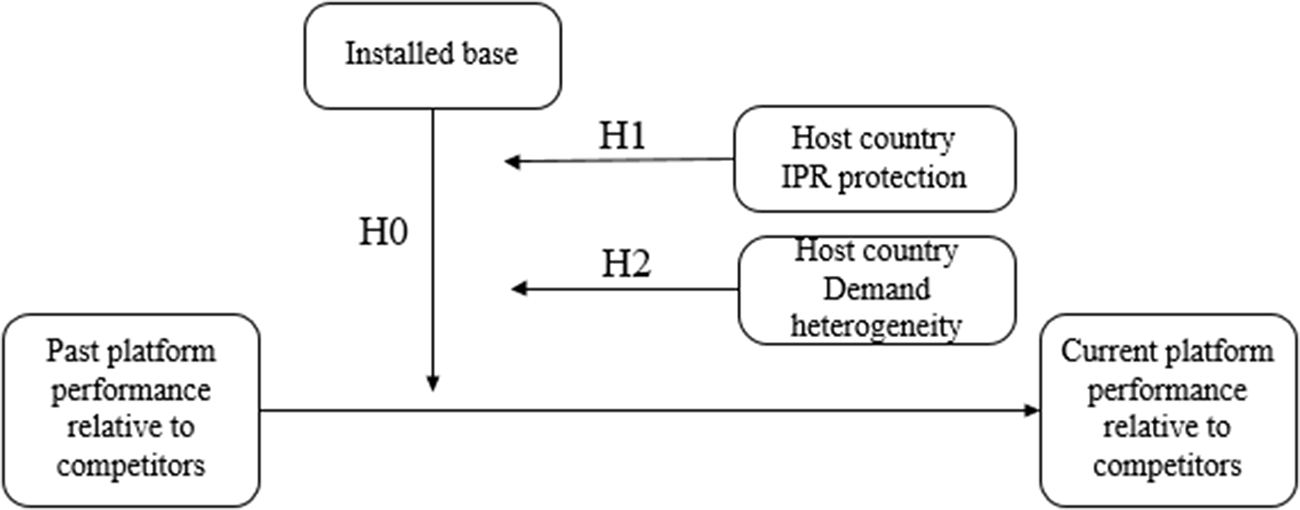
H1 suggests the positive effect of installed base on performance persistence to be weaker in countries where IPR protection is higher. H2 suggests the positive effect of installed base on performance persistence to be stronger in countries where user preferences are more heterogeneous. To test for differences in the impact of installed base on performance persistence, we follow previous research (Chari & David, Reference Chari and David2012; Hu et al., Reference Hu, Cui and Aulakh2019; Zhao et al., Reference Zhao, Parente, Song and Wenger2020) to create three-way interaction terms between lagged performance, installed base and the degree of IPR protection of a country market, and between lagged performance, installed base and the degree of demand heterogeneity of a country market, respectively (see Equation 2). A negative and significant coefficient  ${\gamma _4}$, a positive and significant coefficient ${\gamma _7}$, coupled with a significant and positive ${\gamma _1}$ will lend support for H1 and H2. To provide a more intuitive understanding of these two equations, we present a conceptual model in Figure 1. We also conduct split-sample analyses to facilitate our results interpretation.
 \begin{align}
\text{Performanc}{e_{ijt}} &= \,{\alpha _i}\, + \,{\beta _1}\,{\textrm{Performance}}_{ijt - 1}\, + {\beta _2}\text{Installedbas}{e_{ijt - 1}}\, + \,{\beta _3}\,\text{controls}\, + \,{\beta _4}IP{R_{j\,}} \cr
& \quad+ \,{\beta _5}\text{Demandheterogenit}{y_j} + \,{\gamma _1}\,({\textrm{Performance}}_{ijt - 1} \times \,{\textrm{Installedbase}_{ijt - 1}}) \cr
& \quad+ \,{\gamma _2}({\textrm{Performance}_{ijt - 1}} \times IP{R_j})\, + \,\,{\gamma _3}({\textrm{Installedbase}_{ijt - 1}} \times IP{R_j}) \cr
& \quad+ {\gamma _4}({\textrm{Performance}_{ijt - 1}} \times {\textrm{Installedbase}_{ijt - 1}} \times IP{R_j})\, + \,\,{\gamma _5}({\textrm{Performance}_{ijt - 1}} \cr
&\qquad \times \,{\textrm{Demandheterogenity}_j})\, + \,{\gamma _6}({\textrm{Installedbase}_{ijt - 1}} \times {\textrm{Demandheterogenity}_j}) \cr
& \quad+ \,{\gamma _7}\,({\textrm{Performance}_{ijt - 1}} \times \,{\textrm{Installedbase}_{ijt - 1}} \times {\textrm{Demandheterogenity}_j}) \cr
\end{align}
\begin{align}
\text{Performanc}{e_{ijt}} &= \,{\alpha _i}\, + \,{\beta _1}\,{\textrm{Performance}}_{ijt - 1}\, + {\beta _2}\text{Installedbas}{e_{ijt - 1}}\, + \,{\beta _3}\,\text{controls}\, + \,{\beta _4}IP{R_{j\,}} \cr
& \quad+ \,{\beta _5}\text{Demandheterogenit}{y_j} + \,{\gamma _1}\,({\textrm{Performance}}_{ijt - 1} \times \,{\textrm{Installedbase}_{ijt - 1}}) \cr
& \quad+ \,{\gamma _2}({\textrm{Performance}_{ijt - 1}} \times IP{R_j})\, + \,\,{\gamma _3}({\textrm{Installedbase}_{ijt - 1}} \times IP{R_j}) \cr
& \quad+ {\gamma _4}({\textrm{Performance}_{ijt - 1}} \times {\textrm{Installedbase}_{ijt - 1}} \times IP{R_j})\, + \,\,{\gamma _5}({\textrm{Performance}_{ijt - 1}} \cr
&\qquad \times \,{\textrm{Demandheterogenity}_j})\, + \,{\gamma _6}({\textrm{Installedbase}_{ijt - 1}} \times {\textrm{Demandheterogenity}_j}) \cr
& \quad+ \,{\gamma _7}\,({\textrm{Performance}_{ijt - 1}} \times \,{\textrm{Installedbase}_{ijt - 1}} \times {\textrm{Demandheterogenity}_j}) \cr
\end{align}
Figure 1. Conceptual model
In line with the performance persistence literature, we define performance as the relative advantage or superior performance achieved by an app in period t (Chacar & Vissa, Reference Chacar and Vissa2005; Hu et al., Reference Hu, Cui and Aulakh2019). In this study, we capture platform performance by an app’s active users. The number of active users is a common measure of mobile app usage and a well-received way in which researchers and practitioners gauge the success of an app (Claussen, Kretschmer, & Mayrhofer, Reference Claussen, Kretschmer and Mayrhofer2013). Usage is a particularly important metric for social platforms, as they commonly rely on ad-sponsorship as the revenue model, which ties closely with usage (Qin, Kim, Hsu, & Tan, Reference Qin, Kim, Hsu and Tan2011).
Specifically, we follow Waring (Reference Waring1996) to calculate app-country-specific performance by subtracting the unweighted category-average performance from the app’s performance in a focal country. In so doing, we eliminate (1) country-level unobserved heterogeneity in economic conditions and the development level of social platforms in general, (2) category-level unobserved heterogeneity, and (3) time effects. Considering the confounding influences of daily usage fluctuation, we aggregate the total number of DAUs of an app by calendar month for each country in which it was ranked (measured in 10 million).
Explanatory variables
In measuring the independent variable, installed base, we follow previous research to use an app’s cumulative number of downloads (measured in 10 million) in a focal country up to month t−1 (Chen et al., Reference Chen, Shaheer, Yi and Li2019; Schilling, Reference Schilling2002). User adoption of an app proxies for the network effects that the social platform enjoys. Note that the installed base differs from market share since users can multihome, that is, join different social platforms, at a relatively negligible cost. Moreover, installed base captures user benefits associated with network membership, whilst market share is generally reflective of a firm’s market power in the competitive environment and the competitive intensity it would encounter.
We measure the country-level moderator IPR protection using the data from the Global Competitiveness Report published by the World Economic Forum (WEF) (Chacar & Vissa, Reference Chacar and Vissa2005). Our indicator is derived from the Executive Opinion Survey (the Survey), where more than 13,000 business executives worldwide are asked, ‘In your country, to what extent is intellectual property protected’? The index scales from 1 to 7, with 1 being very weak and 7 very strong. In addition to using three-way interaction in our models, we also test the moderating effect by split-sample analyses. We classify a country into strong (weak) IPR protection if the country’s IPR protection score is above (below) our sample median. We also use the Index of Economic Freedom (IEF), another common institutional indicator, to proxy for IPR protection (Autio & Acs, Reference Autio and Acs2010; Zhao, Reference Zhao2006). Results remain qualitatively consistent.
Demand heterogeneity captures the diversity and heterogeneity of user preferences in a focal country. We measure demand heterogeneity based on the distribution of consumer expenditure data across countries. Specifically, we focus on consumer expenditure distributions within the Leisure and Recreation domain, as reported by Euromonitor International, a proprietary dataset that has been adopted in prior international business research and is recognized for its systematic coverage, methodological consistency, and cross-country comparability (Kotabe, Reference Kotabe2002; Ozturk, Cavusgil, & Ozturk, Reference Ozturk, Cavusgil and Ozturk2021,; Strizhakova & Coulter, Reference Strizhakova and Coulter2015). This category includes subcategories such as audio-visual equipment, books and magazines, recreational services, and package holidays.
We construct an entropy index (Hitt, Hoskisson, & Kim, Reference Hitt, Hoskisson and Kim1997; Verbeke, Coeurderoy, & Matt, Reference Verbeke, Coeurderoy and Matt2018) based on the distribution of consumer expenditure across the above subcategories:  $Demand\,Heterogeneity = - \mathop \sum \limits_{i = 1}^k {p_{ij}}*{\text{ln}}\left( {{p_{ij}}} \right)$, where ${p_{ij}}$ is the percentage of expenditure in subcategory i in country j, and k is the number of subcategories. It is calculated yearly. A higher value of this variable indicates a more diversified distribution of consumer expenditure across different types of leisure and recreational products and services, reflecting higher heterogeneity in user preferences within that country. In robustness checks, we change the measure using a Herfindahl index (Song, Xue, Rai, & Zhang, Reference Song, Xue, Rai and Zhang2018), and the results remain consistent.
Control variables
We control for a set of variables at the app level, app-country level, and country level, which may influence the performance of social networking apps. We control for app age, measured by the number of months since an app was first launched in Apple’s App Store. Older apps are expected to be used less intensively (Claussen et al., Reference Claussen, Kretschmer and Mayrhofer2013). We also include the squared term of age to control for a nonlinear effect (Agesquare). App ratings are reflective of online consumer reviews and an indicator of apps’ quality, which have been found to strongly influence app performance (Zhu & Zhang, Reference Zhu and Zhang2010). Highly rated apps are more likely to be installed and used more intensively (Claussen et al., Reference Claussen, Kretschmer and Mayrhofer2013). We thus control for the average rating an app received from its launch up to month t-1 within a focal country.
We control for industry concentration at the focal country level following prior performance persistence research (Chacar et al., Reference Chacar, Newburry and Vissa2010). Lower industry concentration indicates higher competition, which may move market share toward better-performing firms and improve their performance further. We measure industry concentration by the monthly market share accrued to the leading social networking apps. We calculate the variable following Eisenhardt and Schoonhoven (Reference Eisenhardt and Schoonhoven1990). We first select the top 10 apps that received the highest downloads in a focal country in a given month. We then divide the downloads of these apps by the total downloads earned by all apps in a focal country for the same month. High industry concentration implies that the category contains a handful of dominant players holding a significant share of the total market (Basdeo, Smith, Grimm, Rindova, & Derfus, Reference Basdeo, Smith, Grimm, Rindova and Derfus2006). Furthermore, we controlled for the app’s international diversity. It reflects an app’s extent of global market penetration and scope of international experience. Following previous literature (e.g., Hsu, Lien, & Chen, Reference Hsu, Lien and Chen2015), we used the Blau Reference Blau1977 index of diversity. For each app in month t-1, we created a composite index =  $1 - {\Sigma}_{{\text{i}} = 1}^{\text{k}}\left( {{\text{P}}_{\text{i}}^2} \right)$ where P is the total downloads of an app in country i over its total downloads globally, and k is the total number of countries our full sample includes.
We also control for country-level effects. We use the log of population of each focal country in year t-1 (in millions) to account for country size (Pangarkar, Reference Pangarkar2008). We use mobile cellular subscriptions per 100 people to account for host country’s digital environment and app accessibility. We also control for the social platform firm’s home country IPR protection as a developer firm’s behavior might be conditioned by its home country’s institutional environment. Finally, we control for cyclical fluctuations by including month dummies.
Results
The correlations and summary statistics are reported in Table 1. Table 2 presents the regression results using fixed-effects dynamic panel models with robust standard errors. The unit of analysis for testing our hypotheses is the app-country-month level, where the dependent variable is  ${\text{Performanc}}{{\text{e}}_{ijt}}$. Model 1 serves as the baseline model, including all control variables and lagged performance. Models 2–4 test our baseline hypothesis (H0) and the two moderating effects, respectively. From Model 1 to Model 4, a major finding is that the coefficient of lagged performance is positive and significant across all models, indicating persistence of performance in general. We find positive and significant coefficients for the lagged performance variable (β = 1.02, p = 0.000), suggesting an increasingly divergent performance outcome over time in the observation period and thereby sustainable superior performance for our sampled apps. The baseline hypothesis, H0, states that a larger installed base increases a social platform’s ability to sustain superior performance. In Model 2, we add the installed base and the interaction term of installed base and lagged performance. The coefficient is positive and significant (β = 0.01, p = 0.000), indicating that a social platform’s performance persistence is strengthened by a larger installed base. Thus, H0 is supported, consistent with prior network effect research. We also use the Arellano–Bond method in estimating the baseline hypothesis model to avoid dynamic panel bias (Arellano & Bond, Reference Arellano and Bond1991; Nickell, Reference Nickell1981). The interaction term remains positive and significant (β = 0.004, p = 0.001), which also provides evidence to support H0. To facilitate interpretations, we plot the results in Figure 2 using the parameter estimates from Model 2. Figure 2 compares the path of MAU convergence of two hypothetical social platforms with superior performance, one with a larger installed base (one standard deviation above the mean), and the other with a smaller installed base (one standard deviation below the mean). Despite that a relative MAU advantage in month 0 will eventually converge toward the industry mean, the superior performance of platforms with a larger installed base (red line) will dissipate slowly than those with a smaller installed base (blue line).

Figure 2. Installed base and performance persistence of social platforms
Table 1. Correlations and summary statistics

Note: N = 282,327
Table 2. Fixed-effects dynamic panel models with robust SEs

Notes: Robust standard errors in brackets, p-value in parentheses.
† p < 0.1, *p < 0.05, **p < 0.01, ***p < 0.001
H1 expects IPR protection to negatively moderate the positive relationship between installed base and performance persistence. Therefore, we introduce the interaction terms involving IPR protection, installed base, and lagged performance, along with their respective lower-order terms (see Model 3). The coefficient of the three-way interaction term is negative and significant (β = −0.001; p = 0.000), suggesting that the installed base effect on performance persistence is significantly lower in countries with stronger IPR protection regimes. We further follow Dawson and Richter Reference Dawson and Richter2006 to perform slope difference tests for the three-way interaction effects. As the slopes (the relationship between past and current performance) represent the levels of performance persistence of various groups of platforms, we calculate the difference in effect sizes related to our hypotheses. We find that in countries with weak IPR protection regimes, social platforms with a large installed base have a steeper performance persistence slope than those with a small installed base (1.04 vs. 1.03, t = 6.136, p = 0.000). However, in countries with strong IPR regimes, the performance persistence slopes of platforms with a small installed base and those with a large installed base are not significantly different (t = 0.126, p = 0.900). Accordingly, the effect of installed base is stronger in countries with weaker IPR protection. All these results support H1.
To facilitate interpretation, we also plot the results in Figure 3. As in Figure 3, social platforms with a large installed base are illustrated with red lines, while those with a small installed base are illustrated with the blue lines. The dashed lines indicate the platforms’ performance persistence in countries with weak IPR protection, and the solid lines indicate the platforms’ performance persistence in countries with strong IPR protection. Our figure also shows that platforms with a large installed base are able to sustain superior performance for a longer period than those with a small installed base. Furthermore, the figure shows that in weak IPR environments, platforms with a high installed base exhibit a much slower performance decay compared to those with a low installed base. However, in countries with strong IPR protection, this advantage diminishes significantly: the performance trajectories of high and low installed base platforms converge more rapidly. In other words, the gap in persistence between high and low installed base platforms is visibly narrower under strong IPR regimes, suggesting that restrictive IPR protection might disrupt the reinforcing loop of UGC and information sharing. This supports our theoretical argument that IPR protection attenuates the performance-sustaining effects of network size by limiting content dissemination. Overall, H1 is supported.

Figure 3. Installed base and performance persistence of social platforms in countries with weak/strong IPR protection
H2 expects demand heterogeneity to strengthen the positive relationship between installed base and performance persistence. Therefore, we introduce the interaction terms involving demand heterogeneity, installed base, and lagged performance, along with their respective lower-order terms (see Model 4). The coefficient of the three-way interaction term is positive and significant (β = 0.04; p = 0.000), suggesting that the installed base effect on performance persistence is significantly stronger in countries with greater demand heterogeneity. Thus, H2 is supported. Following the same approach as above, we calculate the simple slopes for the three-way interaction term. We find that in countries with low demand heterogeneity, the slope difference between large platforms and small platforms is 0.02 (t = 20.549, p = 0.000). While in countries with high demand heterogeneity, the slope difference is slightly wider, which is 0.03 (t = 20.091, p = 0.000). We plot the results in Figure 4. As it shows, platforms with a large installed base maintain superior performance for a longer period than those with a small installed base, particularly in markets with high demand heterogeneity. In such environments, the performance of platforms with a high install base decays more slowly, suggesting that diverse user preferences help sustain information exchange and reinforce network effects over time. Notably, the gap between large and small platforms is wider in countries with high demand heterogeneity. This suggests that demand heterogeneity enhances the value of a broad user base by facilitating richer content variety and better informational matching. By contrast, in low heterogeneity markets, performance decays more uniformly across platforms, indicating that limited preference diversity constrains the benefits of scale. Hence, H2 is supported.

Figure 4. Installed base and performance persistence of social platforms in countries with low/high demand heterogeneity
Robustness Checks
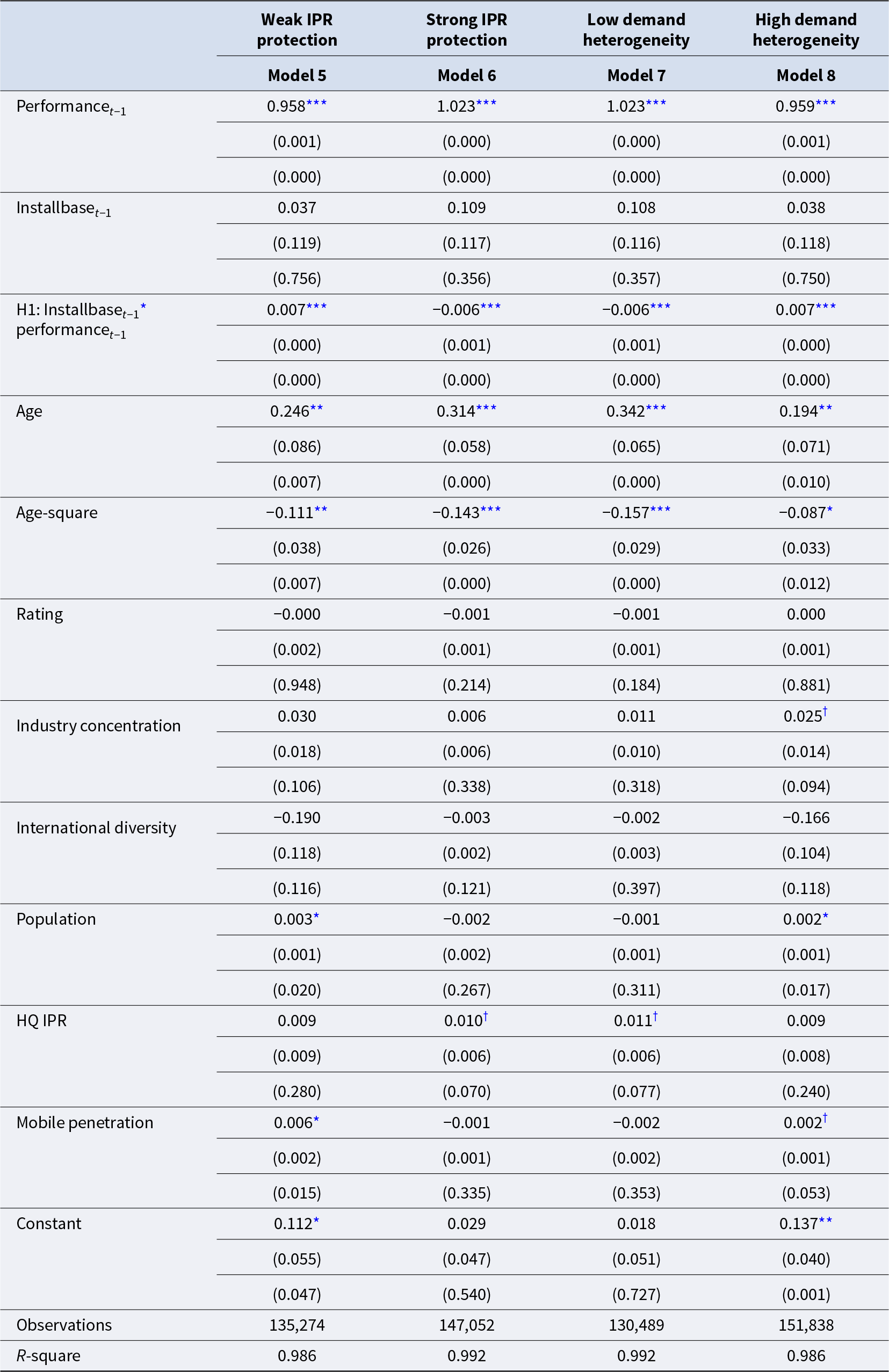
We conduct multiple additional tests to ensure the robustness of our main findings. First, we conduct spilt-sample analyses (see Table 3). Specifically, we spilt the sample into strong and weak IPR protection countries according to the cross-country sample median of the IPR protection index, as well as into low and high demand heterogeneity based on the sample median of demand heterogeneity. We then run the autoregressive models in those subsamples respectively and compare the effects of installed base on persistence. The interaction term of installed base and lagged performance is positive and significant (β = 0.01, p = 0.000) in countries with weak IPR protection (see Model 5), while it is negative but insignificant (β = −0.01, p = 0.001) in countries with strong IPR protection (see Model 6). Similarly, we find evidence in support of H2 (see Model 7 and 8). The interaction terms of installed base and lagged performance are negative and significant in countries where user preferences are homogeneous (β = −0.01, p = 0.000) and significantly positive in countries where the user preferences are heterogeneous (β = 0.01, p = 0.000).
Table 3. Robustness checks (spilt-sample analyses)

Notes: Robust standard errors in brackets, p-value in parentheses
† p < 0.1, *p < 0.05, **p < 0.01, ***p < 0.001 Dropped 1 singleton observations.
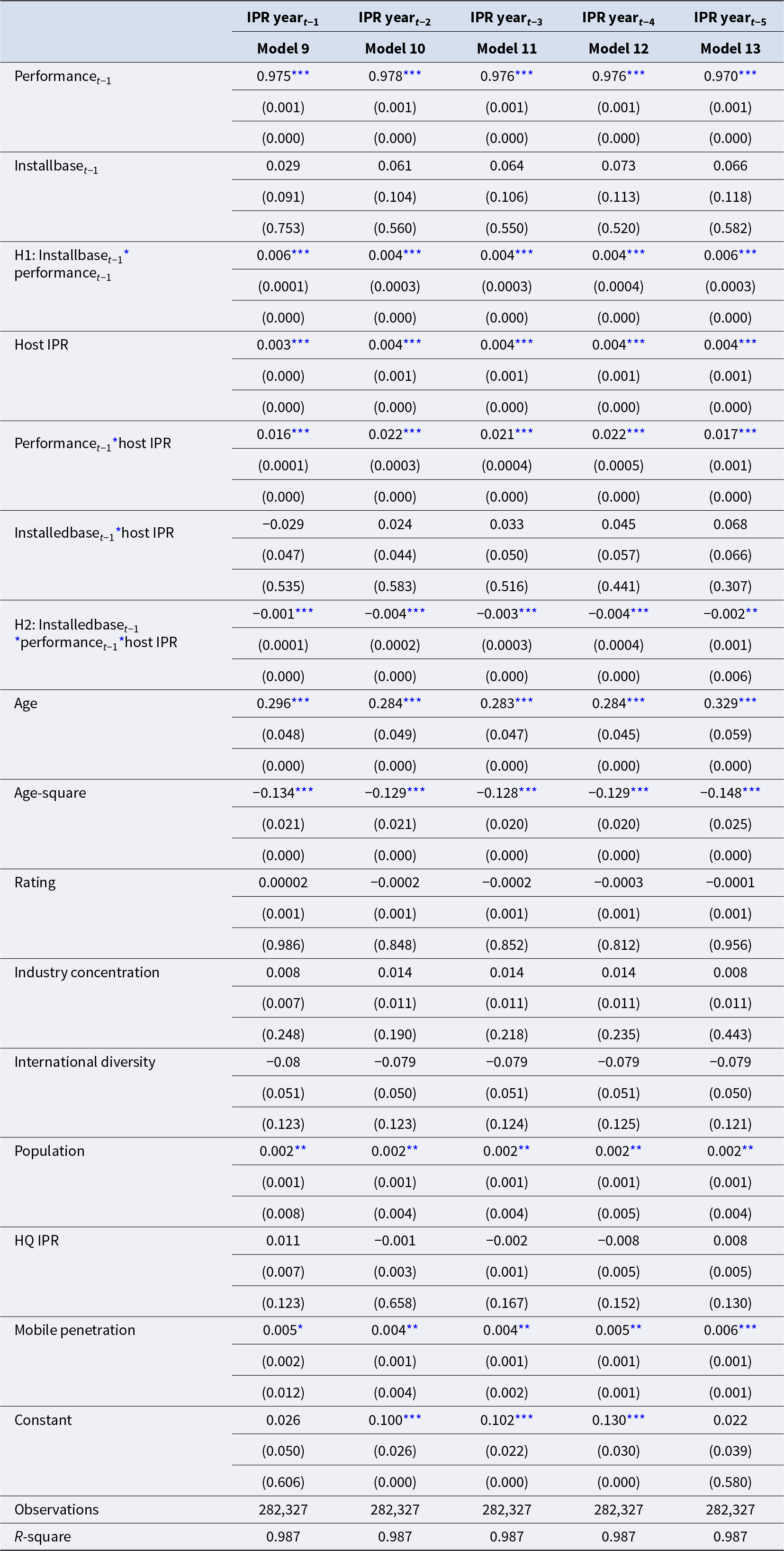
Second, we test the sensitivity of our results to alternative measures of major variables. We run our models with an alternative measure for IPR protection, using the IEF. This index ranges from 0 to 100, with higher scores denoting a stronger perception of IPR strength and enforcement. Results remain qualitatively unchanged from the original specification. In order to explore the temporal effect of IPR protection on network effect based on informational content dissemination and consumption, we lag IPR protection measure for 1–5 years, the results are still robust (see Table 4). Additionally, we created another proxy for demand heterogeneity by weighting apps according to their respective user bases, building on our initial measurement. The results are qualitatively similar to our main results.
Table 4. Robustness checks (temporal effect of IPR protection)

Notes: Robust standard errors in brackets, p-value in parentheses
† p < 0.1, *p < 0.05, **p < 0.01, ***p < 0.001
Third, in our main specification, we consider an app high-performing if it appears in the top 500 list by DAU. One might raise concerns as to whether the top 500 ranking apps can truly count as high-performing. Therefore, we use top 10, top 20, top 50, top 100, and top 200 rankings by DAUs as cut-off points to redefine our sample. The results show that the coefficients of key variables are qualitatively similar to our main results.
Last, platform heterogeneity may also matter. Given that apps vary in the intensity of UGC and thus in their sensitivity to IPR constraints, we conducted subsample analyses to test the robustness of our mechanism across content-heavy and content-light categories.Footnote 1 Specifically, we identify apps with functions of gaming, photo and video, and dating apps in our sample based on subcategories and app descriptions. We then examine the autoregressive models in these three subsamples, respectively, and compare the effects of installed base on persistence. The results of the subsample of game apps and photo and video apps are consistent with our main results. However, the moderating effect of IPR protection is not significant in the dating app sample. Although dating apps share structural similarities with other social apps based on content sharing and information dissemination, their performance persistence relies more on matching efficiency than on UGC circulation, making them less sensitive to IPR-related constraints. To alleviate the alternative mechanism in dating apps, we also re-run our primary analysis after excluding those dating apps from the full sample, and the conclusions remained consistent with our main findings. These findings further support our theoretical claim that IPR impacts performance persistence primarily through its influence on content dissemination dynamics. All the results are available upon request.
Discussion
In this study, we examine whether and when network effects improve social platforms’ abilities to sustain superior performance. Using a unique sample of leading social networking apps in international markets, this study reveals that network effects can help leading social platforms sustain their incumbency advantage, yet such a relationship varies with the geographic boundaries. IPRs regime of a country will contain the creation and dissemination of user contributions upon which the platform’s value is based. This is in contrast with received wisdom that IPR protection buttresses the firm’s ability to appropriate value from its proprietary assets (Teece, Reference Teece1986). Conversely, demand heterogeneity of a country market amplifies the value of sizable network membership for information consumption and maintains platform momentum for sustaining incumbency advantage. The finding complements the literature on platform competition in which the demand environment has so far been underexplored (Rietveld & Eggers, Reference Rietveld and Eggers2018, for an exception). These suggest a persistent heterogeneity in the rates of performance convergence for platforms and have implications for understanding the intensity of platform competition in international markets.
Theoretical Contributions
Our study yields new insights for several literature streams. First, we corroborate a user network-based mechanism for performance persistence. Strategy research has long examined the conditions for sustained competitive advantage, which are mainly attributable to industry structure and firms’ internal resources. However, the burgeoning of digital platforms has transformed the competitive landscape in numerous industries (McIntyre & Srinivasan, Reference McIntyre and Srinivasan2017). The locus of value creation moves from inside the platform firm to outside, raising the importance of external assets beyond the firm’s direct control (Parker et al., Reference Parker, Van Alstyne and Jiang2017). Accordingly, we characterize social platforms as a vehicle for users’ continuous information exchange, where performance persistence hinges on user participation and informational interaction. That sets us apart from extant platform research, which has mainly examined the platform’s ability to attract new users (Cennamo & Santalo, Reference Cennamo and Santalo2013; Ploog & Rietveld, Reference Ploog and Rietveld2025; Zhu & Iansiti, Reference Zhu and Iansiti2012). Our empirical analysis shows that a large installed base can insulate a platform from competitive forces. Further, by integrating demand-side heterogeneity into performance persistence research, which has long attributed declining rates of performance convergence to supply-side economies of scales and firms’ proprietary resources, we offer a more complete account of how competitive advantages persist in digital platforms.
Demand-side researchers suggest that firms create value by increasing consumers’ perceived benefits, which determine the continual success of a new product (Adner & Zemsky, Reference Adner and Zemsky2006). Yet consumer demands vary in that different consumer segments focus their attention on certain functional dimensions of a product. While our arguments build on these fundamental premises, we depart from extant research examining the way firms allocate innovation resources in response to consumers’ heterogeneous preferences (Adner, Reference Adner2002; Adner & Levinthal, Reference Adner and Levinthal2001). Our study is predicated on the fact that heterogeneous demands can be better served by platforms, which take advantage of user contributions and exploit the economy of specialization (Boudreau, Reference Boudreau2012). That allows us to explore how demand heterogeneity in a market can reinforce the impact of the installed base. We show that the heterogeneous demand for informational content warrants a larger user base in achieving the desired benefits necessary to retain network members, since larger networks are likely to produce a wider range of user contributions. Our findings call for future research to delve into the inextricable role of demand conditions in shaping performance persistence.
Second, we reveal important but overlooked boundary conditions of network effects and articulate content dissemination mechanisms driving network effect dynamics. While network effects are often treated as inherently path-dependent or self-reinforcing (McIntyre & Srinivasan, Reference McIntyre and Srinivasan2017), scholars have increasingly questioned the universality of ‘winner-take-all’ outcomes, prompting debates over the contextual factors that qualify their emergence. Previous research primarily explains the strength of network effects by network structures (Kane, Alavi, Labianca, & Borgatti, Reference Kane, Alavi, Labianca and Borgatti2014; Lee et al., Reference Lee, Song and Yang2016; McIntyre, Reference McIntyre2011; Suarez, Reference Suarez2005), scopes of network effects (Cullen & Farronato, Reference Cullen and Farronato2021; Hu et al., Reference Hu, Cui and Aulakh2019) and distinct types of network externalities (Karhu et al., Reference Karhu, Heiskala, Ritala and Thomas2024). Given the born-global nature of many platforms, MNPs are accessible in various countries with different environments (Stallkamp & Schotter, Reference Stallkamp and Schotter2021) and commonly compete beyond the border of their home country (Li, Chen, Yi, Mao, & Liao, Reference Li, Chen, Yi, Mao and Liao2019). However, network effects cannot easily transcend geographic boundaries; the strength of network effects may vary across regions (Cullen & Farronato, Reference Cullen and Farronato2021). Whether and the extent to which network effects can help consolidate advantageous performance in international markets remains underexplored. Addressing this question also offers managerial implications, in that in countries where the incumbency advantage of network effects is relatively weak, new entrants would face fewer liabilities of outsidership and enjoy a better chance of success. Our study is among the first to uncover and explicate the geographic variation of network effects in international markets. Since we characterize social platforms as a facility for information exchange, we draw attention to both supply- and demand-related conditions which may affect the strength of network effects and thereby performance persistence of the platforms. In addition, by examining the process of how the platform sustains its momentum and incumbency advantage in international markets, we have investigated the dynamics of network effects from a temporal perspective, and echoing the emerging call for more temporal research in management (Blagoev et al., Reference Blagoev, Hernes, Kunisch and Schultz2024; Zhang et al., Reference Zhang, Priem, Wang and Li2023).
Prior studies have shown that the rates at which superior-performing firms can sustain their advantage tend to vary across the national border (Geroski & Jacquemin, Reference Geroski and Jacquemin1988). Focus has been on the institutional environment which may restrict the availability of production factors and hence limit the competitive threat of new entrants (Chacar & Vissa, Reference Chacar and Vissa2005). However, our understanding of the inextricable links between institutions and competition remains inadequate. While a higher level of institutional development increases the firm’s ability to recombine its proprietary assets with local resource endowment, the associated reduction in transaction costs could also facilitate market entry and raise competitive pressures for incumbents (Peng, Reference Peng2003). Our study delves into the interaction between competitive position and institutions, and we find that IPR protection may constrain the scale of informational content, which underpins the advantage of a sizable network. This is notably different from the long-standing view that IPR protection is in favor of firms with a stronger resource base and market position, and it sheds light on the overlooked role of IPR in constraining value creation for platforms. Our analysis also adds to recent platform research yielding early insights into how the national institutional environment can constrain the market power of leading digital platforms (Uzunca, Rigtering, & Ozcan, Reference Uzunca, Rigtering and Ozcan2018).
Third, we develop a geotemporal framing to explain cross-country divergence in platform competitive advantage. Building on previous research on temporal theorizing (Blagoev et al., Reference Blagoev, Hernes, Kunisch and Schultz2024; George & Jones, Reference George and Jones2000), we conceptualize performance persistence as a dynamic temporal trajectory – a process capturing how competitive advantage unfolds and endures over time. While prior work has examined geographic fragmentation in platform performance (Stallkamp & Schotter, Reference Stallkamp and Schotter2021), few studies have connected geography with temporality (Cullen & Farronato, Reference Cullen and Farronato2021). Our geotemporal lens reveals not only where but also how fast or slow a platform’s competitive advantages unfold under different institutional and market conditions. Specifically, in countries with stronger IPR protection, stringent legal and normative constraints limit the breadth and speed of content dissemination, truncating viral loops and leading to a faster decay of network-based advantages. Conversely, in markets with greater demand heterogeneity, diverse user preferences promote the creation and recirculation of informational content, thereby extending diffusion cycles and sustaining user engagement over longer periods. Consistent with research conceptualizing institutions as dynamic and evolving processes (Micelotta, Lounsbury, & Greenwood, Reference Micelotta, Lounsbury and Greenwood2017; Reinecke & Lawrence, Reference Reinecke and Lawrence2023), our cross-national findings also offer a temporal inference for institutional strategy research. Observing performance differences across countries with varying IPR strength allows us to interpret these contexts as distinct stages along a continuum of institutional maturity. This interpretation moves beyond viewing institutional variation as purely spatial and instead sees it as reflecting different stages of institutional evolution. Accordingly, the geotemporal patterns we identify suggest how performance persistence may dynamically unfold as institutional environments evolve.
The Chinese platforms help to illustrate these geotemporal dynamics clearly. In the early phase of China’s digital economy, weak enforcement of IPRs and a permissive regulatory environment allowed UGC to spread and recombine freely. This openness fostered the rapid growth of platforms such as Toutiao. As regulation later tightened through initiatives such as the Sword Net campaigns, content creation and circulation became increasingly restricted,early leaders like Weibo lost momentum. During the initial stage of stronger copyright enforcement, Toutiao and Douyin were also significantly affected, since the campaigns targeted unauthorized editing and reposting. They quickly adapted by purchasing content rights, strengthening internal governance, improving recommendation algorithms, and forming licensing partnerships with long-video platforms. These strategies helped them sustain user participation and creative renewal under tighter conditions. These various trajectories further illustrate how changing institutional and regulatory conditions reshape the temporal trajectory of performance persistence.
Practical Implications
Our findings suggest several implications for managers and policymakers. For managers, sustaining performance over time requires adapting content mechanisms that once relied on external permissiveness. As regulatory and intellectual property protection strengthen, platforms should develop internal coordination systems to sustain user participation and content renewal, such as reinforcing creator incentives, improving algorithmic curation, and fostering high-quality derivative creation within regulatory boundaries. These actions help maintain the vitality of content ecosystems even when viral diffusion becomes constrained. For policymakers, fostering a sustainable digital ecosystem calls for balanced institutional design. Overly stringent regulation may constrain content generation and diffusion, while excessive permissiveness may allow low-quality content to proliferate. Regulators should adopt an inclusive and prudent approach that coordinates intellectual property protection and antitrust policy, while encouraging platform internal regulation through transparent standards and incentive-compatible compliance. Such alignment between public regulation and private governance can protect content creation while maintaining the dynamics that sustain user engagement and innovation, thereby supporting the sustainability of platforms’ competitive advantage.
Limitations and Future Research Directions
Our study has a number of limitations that also open avenues for future research. First, our analysis is limited to a single empirical context (i.e., Social Networking category) based on data from 2015 to 2017. While this setting offers a clear and relevant context for studying the interaction between network effects and IPR regimes, we acknowledge that the digital economy has continued to evolve rapidly. Due to data access constraints, we were unable to update our sample to include more recent years or extend it to other content-rich categories such as video sharing, gaming, or online education platforms. These other categories could be even more susceptible to content dissemination constraints and varying intellectual property regimes. However, we contend that the core mechanisms identified in our study are likely to hold, and perhaps even be more pronounced, in the current digital landscape. The principles governing content dissemination, intellectual property, and diverse user demands remain fundamental to platform success. Nevertheless, we strongly encourage future research to investigate these mechanisms in contemporary settings and across diverse digital platform categories. This is especially pertinent given the transformative emergence of generative AI tools, which have fundamentally altered content creation and reuse on digital platforms. Such investigations would provide valuable validation and extension of our findings in an ever-evolving digital ecosystem.
Second, the measure for the installed base captures installed base only on the mobile phone platform, but many of these apps in the social networking category might multi-home on web-based platforms. The installed base in the web-based platform can still impact the network-level benefits for these apps. Unfortunately, we lack data about the installed base on web-based platforms to fully capture the total network effect. We expect that future research will utilize more extensive data on installed base (for both mobile-based and web-based platforms) to better capture the whole network effect of a particular digital platform.
Third, although we adopt a demand-side measure of demand heterogeneity using country-level consumer expenditure data, this proxy may not fully capture the demand characteristics most relevant to social networking platforms. Future research could incorporate more fine-grained, platform-specific demand-side indicators based on user-level or behavioral data to better identify how variation in user preferences shapes network effects.
Fourth, we may also suffer from unobserved variables, as we do not have information on app-specific IPR protection regulations across different countries. Future studies may further investigate whether platforms’ private regulations are intertwined with country-level IPR protection regulations to influence their ability to sustain the competitive advantages.
Data availability statement
The data supporting the findings of this study were obtained from the Apptopia database under a commercial license. Access to these data is subject to the permission of Apptopia, Inc.
Acknowledgements
This research was supported by the National Natural Science Foundation of China (Grant No. 72372146, 71902173, 72091312), National Social Science Foundation of China Major Project (No. 24&ZD073).
Yang Yang (yangyang611@zju.edu.cn) is an associate research fellow in the School of Public Affairs, Zhejiang University. She holds a PhD from Zhejiang University. Her current research focuses on emerging economies, internationalization strategy, innovation, and organization in the digital economy. Her research has been published in the Journal of International Business Studies, Journal of Management, Asia Pacific Journal of Management, among others.
Liang Chen (liangchen@smu.edu.sg) is an associate professor of strategy and entrepreneurship at the Lee Kong Chian School of Business, Singapore Management University. He holds a PhD from the University of Leeds. He studies strategy, organization, and innovation in the contexts of platforms, ecosystems, multinational enterprises, and other meta-organizations. His recent work has been published in the Academy of Management Review, Strategic Management Journal, Journal of International Business Studies, Journal of Management, among others.
Jiang Wei (weijiang@zju.edu.cn) is a professor at the School of Management, Zhejiang University of Finance & Economics. He also serves as the Chairman and President of Zhejiang University of Finance & Economics. His research interests focus on strategic management, innovation management, and service innovation. His recent research has been published in the Journal of International Business Studies, Management and Organization Review, Asia Pacific Journal of Management, and Technovation, among others.
Yang Liu (yangliu@zju.edu.cn) is currently a professor at the School of Management, Zhejiang University. He also serves as the Associate Dean of the school and the Executive Director of the Digital Intelligence Innovation and Management Laboratory at Zhejiang University. His research focuses on innovation management, strategy, and digital transformation in emerging markets, particularly in China. His works have appeared in journals such as Journal of Business Ethics, Journal of Business Research, and Technovation, among others.