




1 Introduction
The present study is concerned with a description of the vowel system of the West Central Bavarian (WCB) dialect and the changes that may be occurring in this dialect as assessed by a combined longitudinal and apparent-time acoustic analysis of WCB children and adults. We consider first some general observations about dialects and the standard variety in German in Section 1.1. This is followed by a summary of the main systemic differences and equivalences between WCB and Standard German (SG) monophthongs and diphthongs in Section 1.2, also taking into account some relevant phonetic realisational differences between these varieties. This comparison between the varieties in Section 1.2 forms the basis for predictions about changes in progress to WCB in Section 1.3, under the assumption that WCB is being increasingly influenced by the standard variety.
The study had four aims. The first was to document the phonological and phonetic correspondences between the vowels of Standard German and those of West Central Bavarian (Sections 1.1 and 1.2). This purpose of doing so was to clarify the nature of the synchronic systemic differences between these varieties – i.e. those in which vowel phonemes contrast different sets of lexical items – and to separate these systemic differences at the phonological level as far as possible from phonetic realisational differences between the varieties. This aim is then one of language (or in this case) dialect documentation. The second aim was concerned with dialect contact: that is, to make use of these documented systemic and phonetic differences in order to predict the possible changes that should occur in WCB, under the assumption that this variety is being influenced by the standard (Section 1.3). The third aim (Sections 2 and 3) was concerned with sound change and specifically with analysing whether WCB like many other German varieties is changing in the direction of the standard. The analysis was of production data using acoustic techniques in both an apparent-time study in which adults were compared with primary school children and a longitudinal study in which changes were analysed in the same children longitudinally over three years. The fourth aim was to determine whether the rate of sound change was affected by social and phonological properties of the speech sounds that were investigated, in particular whether sounds that are salient markers of a dialect are less prone to change (Trudgill Reference Trudgill1986, Auer, Barden & Grosskopf Reference Auer, Barden and Grosskopf1998, Siegel Reference Siegel2010) and to assess whether sound changes that result in mergers as opposed to new contrasts progress at different rates (Chambers Reference Chambers1992, Kerswill Reference Kerswill1996, Evans & Iverson Reference Evans and Iverson2007).
1.1 West Central Bavarian and its relationship to Standard German
Contemporary Standard German has evolved over several centuries in a process of gradual linguistic accommodation between diverse regional dialects. These dialects exist until today and are typically defined as being spoken within a certain geographical area, irrespective of their social status (Zehetner Reference Zehetner1985). They range on a linguistic continuum between basic dialects and the spoken standard with various stages of mixture in between, which are neither dialect-free standard nor pure dialect (Veith Reference Veith2005, Rowley Reference Rowley, Fishman and Ofelia2011).
Basic dialects at the one end of this continuum diverge most from the standard. Their communicative range is restricted as they tend to have a distinct grammar and phonology (Chambers & Trudgill Reference Chambers and Trudgill1998) and are therefore often mutually unintelligible (Leopold Reference Leopold1959, Rues et al. Reference Rues, Redecker, Koch, Wallraff and Simpson2007). The standard language on the other end of the continuum has a geographically broader communicative range and, partly because it is the language used in schools and the media, it often has an increasingly larger influence on dialects (Besch Reference Besch, Besch, Knoop, Putschke and Wiegand1983, Zehetner Reference Zehetner1985). Between these two endpoints of a basic dialect and the standard language, a third level, referred to as regional variety, is usually distinguished which is neither dialect nor standard (Rowley Reference Rowley, Fishman and Ofelia2011). German regional varieties have characteristics of a dialect but are in their local and communicative narrowness above the basic dialects and can vary until they are close to the standard (Zehetner Reference Zehetner1989). Regional varieties are mostly occurrences of language contact between Standard German with the spoken dialects. That is, whereas regional varieties are highly influenced by the standard, basic dialects show the greatest geographical differences and the least similarity with the standard (König Reference König1994).
The degree to which a basic dialect or regional variety is spoken also differs from region to region. While in Northern Germany basic dialects are rarely spoken, they are still common in the South (Kleber Reference Kleber2011). Moreover, Standard German pronunciation is almost always influenced to some extent by the regional background of a speaker (Wiese Reference Wiese1996).
The increasing spread of, and contact with, SG even in rural areas has often resulted in a shift of certain dialectal features in the direction of SG (Reiffenstein Reference Reiffenstein1976, Scheuringer Reference Scheuringer1990). Most of the experimental evidence for the influence of SG on German dialects is based on quite recent apparent-time studies comparing old vs. young speakers of a given population. For example, word pairs in East Franconian that differ in post-vocalic obstruent voicing in SG (e.g. leiten/leiden /laɪtn, laɪdn/ ‘to lead/suffer’) are homophonous with a voiced stop (both /laɪdn/). Müller et al. (Reference Müller, Harrington, Kleber and Reubold2011) showed that such pairs were, however, only homophonous in older speakers of the dialect. Younger dialect speakers in contrast were beginning to distinguish between them, although not to the same extent as in the standard. Augsburg Swabian has /ʃ/ in post-vocalic clusters that maps to two phonemes in SG (e.g. SG: /vɛst, vɛʃt/ west, wäscht ‘west, washes’; both are /vɛʃt/ in Augsburg Swabian). Once again, this contrast was shown to be more marked for younger than older Augsburg participants in both production and perception but not as marked as for standard speakers (Bukmaier, Harrington & Kleber Reference Bukmaier, Harrington and Kleber2014).
As discussed in further details in Section 1.2.1 below, WCB but not SG has an inverse quantity relationship in which a short vowel is followed by a long consonant and vice versa. Kleber (Reference Kleber2017) found that this characteristic was more evident in older than in younger WCB speakers.
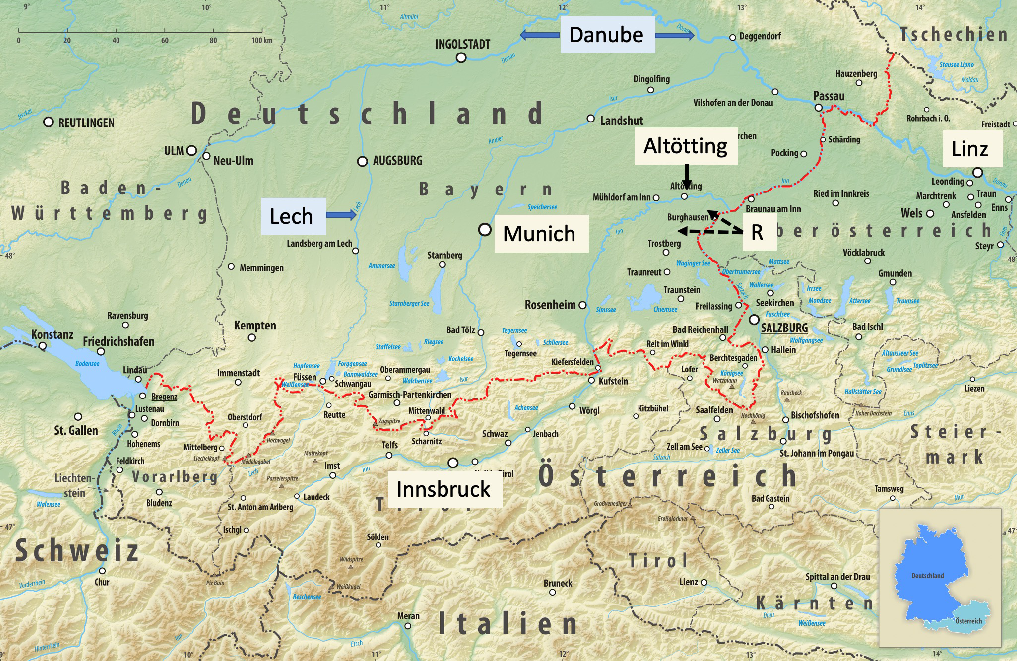
WCB is spoken in the south of Germany around Munich and rural areas of Bavaria (Figure 1).Footnote 1 WCB extends to the west to around the river Lech and to the north just beyond the Danube. To the south, WCB extends beyond the Austrian border, but not as far as Innsbruck which belongs to the South Bavarian variety. To the east, WCB also extends beyond the Austrian border where it merges with East Central Bavarian, the latter also including Linz and Vienna (Schikowski Reference Schikowski2009, Kleber Reference Kleber2017).
A map showing some defining markers of the region in which West Central Bavarian is spoken. The heads of the dashed arrows linked to R mark the location of recording sites near Altötting. The dashed red line marks the border between Bavaria and Austria.
WCB forms part of the Upper German dialects which in contrast to Central and Low German dialects were substantially affected by the Second German sound shift that took place between the years 600 ad and 800 ad (Kufner Reference Kufner1960, Kleber Reference Kleber2011). Moreover, WCB has preserved many sounds from Middle High German which were lost in the standard (Pascoe Reference Pascoe1981, Zehetner Reference Zehetner1985). In contrast to WCB, SG has been extensively conditioned by Central German dialects (Zehetner Reference Zehetner1989, Schmidt Reference Schmidt2000, Kleber Reference Kleber2011). For example, Luther’s translation of the Bible was into a Central German variety (Kufner Reference Kufner1957, Zehetner Reference Zehetner1985). These somewhat different historical developments are one of the reasons why there are not just phonetic, realisational but also many systemic (Wells Reference Wells1982) differences between Standard German and WCB vowel systems.
WCB is a variety with its own lexicon, grammar and vowel system (Bannert Reference Bannert1973, Zehetner Reference Zehetner1989). Dialect speakers can typically shift speech production along the standard-dialect continuum depending upon their social status and relationship to the hearer. Hence, depending on the communicative situation, WCB speakers produce either a basic dialect (e.g. when talking to family or friends) or a regional variety of the standard (e.g. with outsiders or in more formal speaking situations; Zehetner Reference Zehetner1989). That is, while Bavarian dialect speakers can use the standard in order to be more widely understood, their pronunciation is still coloured in a way that provides strong cues to their dialect background (e.g. by the apical pronunciation of [r] typically of Bavarians speaking the standard as opposed to [ʁ] produced by many northern variety speakers of the standard). Speakers from northern parts of Germany (in which speaking in dialect is less common) sometimes even confuse the Bavarian-coloured standard with the Bavarian dialect (Rowley Reference Rowley, Fishman and Ofelia2011).
As mentioned above, dialect usage in the southern parts of Germany is generally very common and in rural areas more prevalent than in the cities. Even if SG is referred to as the language of the townspeople and the school (König Reference König1994), speaking the local dialect in Bavaria is not stigmatised. Indeed, studies have found that Bavarian speakers produce local varieties with the greatest degree of proficiency than anywhere else in Germany (e.g. Institut für Demoskopie Allensbach 1998, 2008). The same studies often report that Bavarian is one of the best-liked dialects in Germany and even the most ‘sexy sounding’ (Rowley Reference Rowley, Fishman and Ofelia2011).
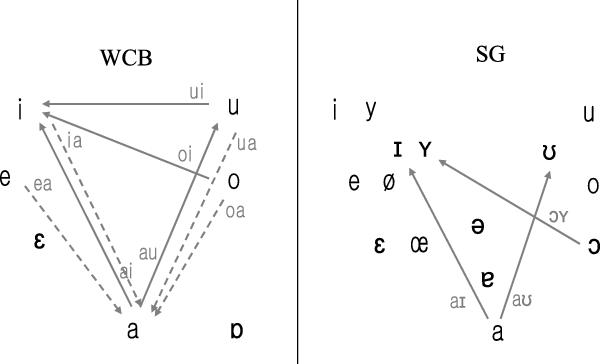
West Central Bavarian (WCB) and Standard Bavarian (SB) monophthong phonemes with superimposed closing/level (solid) and opening (dashed) diphthong phonemes.
In the following, we begin by outlining the main differences between the vowels of the two varieties (Section 1.2); based on these differences, we predict some likely monophthong/diphthong changes in WCB (Section 1.3), under the assumption that they are caused and/or propagated by an influence of the standard variety.
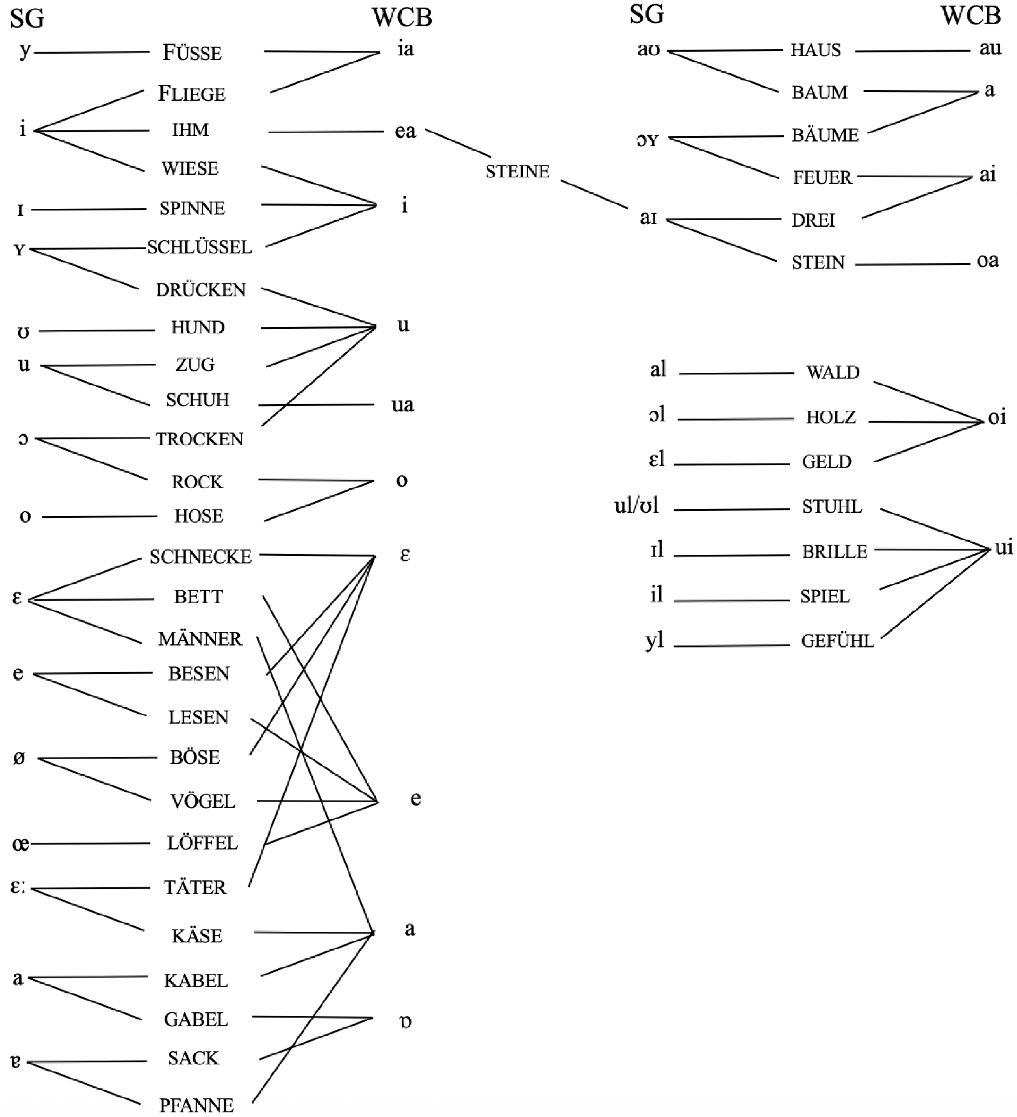
Association between SG and WCB vowel phonemes exemplified by lexical sets (see Appendix A). Left: SG monophthongs. Right: SG diphthongs and vowels before /l/. The lines show correspondences between broad (i.e. phonemic) transcriptions. For example, the vowel phoneme in the first syllable of drücken, hund, zug, trocken is /u/ in all four cases in WCB but /ʏ ʊ u ɔ/, respectively, in SG.
1.2 The relationship between WCB and SG monophthongs/diphthongs
The overview of the mappings in Figure 2 between SG and WCB for the monophthongs and diphthongs shows that SG has a more crowded monophthongal vowel space but five fewer diphthongs than WCB. The former comes about principally because SG but not WCB contrasts (i) front rounded and unrounded vowels /i y/, /ɪ ʏ/, /e Ø/, /ɛ Œ/ and (ii) tense/lax pairs /i ɪ/, /e ɛ/, /a ɐ/, /y ʏ/, /Ø Œ/, /u ʊ/ that differ in both length and, with the exception of /a ɐ/, in quality (see also Hoole Reference Hoole1987, Harrington et al. Reference Harrington, Hoole, Kleber and Reubold2011 for an articulatory analysis).
The greater number of diphthongs in WCB is because of an additional set of opening diphthongsFootnote 2 – i.e. diphthongs with a mid-high or high first component – and also because WCB vocalises domain-final /l/.
Figure 3 shows the association between SG and WCB vowel/diphthong phonemes in terms of lexical sets which stand for word classes of the same type. A lexical set and a SG–WCB association was only included in Figure 3 if there are at least five words that match the corresponding pattern (see Appendix A for further examples). It is very clear from Figure 3, that there is no systemic equivalence (Wells Reference Wells1982) between any pair of SG and WCB monophthongs or diphthongs. Some further details on the salient differences in vowels between these varieties are summarised in the following seven points below.
1.2.1 TensityFootnote 3 and length
As stated earlier, SG has a phonemic opposition between tense and lax vowel pairs that differ in quantity and quality. WCB on the other hand has a difference between short and long vowels that are inversely related to the length of the following consonant (Kufner Reference Kufner1957, Reference Kufner1960; Bannert Reference Bannert1973; Capell Reference Capell1979; Seiler Reference Seiler2009; Kleber Reference Kleber2011). That is, long vowels are predictably followed by short consonants and short vowels by long consonants.Footnote 4 There is, for example, a distinction between VːC [leːsn̩] ‘to read’ and VCː [mesːa] ‘knife’ (Kufner Reference Kufner1957, Bannert Reference Bannert1976, Pascoe Reference Pascoe1981, Scheuringer Reference Scheuringer1990). C can not only be any obstruent but also a nasal consonant (Kleber Reference Kleber2017). Relatively recent research by Kleber (Reference Kleber2017) supports the conclusions in Bannert (Reference Bannert1976) that neither vowel length nor consonant length on its own is phonemic: the phonemic opposition is instead between short vowels followed by long consonants (VCː) as opposed to long vowels followed by short consonants (VːC). The complexity here is that WCB vowel length by itself is allophonic (because it is predictable from consonant length) and so is WCB consonant length (because it is predictable from vowel length). However, the type of complementary length is unpredictable which means that words must be marked in the lexicon for whether they are of the form VCː or VːC.
There is no systemic equivalence between tense/lax pairs in SG and long/short vowels in WCB. For example, the first vowels in Spinne ‘spider’ and Tisch ‘table’ are both /ɪ/ in SG; but in WCB the former contains a short [i] (followed by a long [n]) and the latter a long [iː] (followed by a short [ʃ]).
1.2.2 SG front rounded vowels
Whereas SG has a phonemic opposition in the front vowel set between unrounded /i ɪ e ɛ/ and rounded /y ʏ Ø Œ/, there is no such rounding contrast in WCB (Wiesinger Reference Wiesinger and Russ1990, Schikowski Reference Schikowski2009). At around the end of the 13th century, WCB rounded front vowels were unrounded and coalesced with unrounded front vowels of the same height (Kufner Reference Kufner1957, Merkle Reference Merkle1976, Zehetner Reference Zehetner1985). As a consequence, whereas SG distinguishes between unrounded and rounded front vowels of same phonetic height (/i/ vs. /y/, /ɪ/ vs. /ʏ/, /e/ vs. Ø/, /ɛ/ vs. /Œ/) WCB does not. As Figure 3 shows, it is not the case that the contrasts in SG ±round are simply neutralised in WCB. For example, WCB /i y/ in the lexical sets wiese and füsse correspond to /i ia/ in WCB. But as discussed in Section 1.2.3, there is no systemic equivalence. Thus, while the SG /ɪ ʏ/ contrast can correspond to WCB /i u/ in spinne and drücken, respectively, WCB /u/ also maps to SG /u/ in zug.
1.2.3 SG high vowels and WCB opening diphthongs
SG high tense vowels /i y/ exemplified by fliege and füsse both map to WCB /ia/; SG /u/ exemplified by schuh is /ua/ in WCBFootnote 5 (Kufner Reference Kufner1957, Wiesinger Reference Wiesinger and Russ1990). Such differences between these varieties derive historically from changes of the MHG diphthongs ie, üe, uo that became long monophthongs in SG but were preserved as diphthongs in WCB (Mansell Reference Mansell1973; Zehetner Reference Zehetner1985, Reference Zehetner1989). Figure 3 shows that there is no systemic mapping between SG high tense vowels and WCB opening diphthongs. Thus, whereas there is an /i ∼ ia/ mapping for SG ∼ WCB in fliege, they both have monophthongal /i/ in wiese. There may also be phonetic (realisational) differences between the varieties in words of the wiese type in which both SG and WCB have monophthongs: according to Schikowski (Reference Schikowski2009), WCB /i/ is more centralised than SG /i/.
Some words exemplified by ihm, with an SG tense vowel /i/, map to a mid-high opening /ea/ diphthong in WCB. In all ihm words, SG /i/ and the corresponding WCB /ea/ are closed by a nasal consonant (Appendix A). The historical evolution of the vowel exemplified by ihm into WCB /ea/ rather than /ia/ could be explained with reference to studies showing that a nasal often causes a preceding high vowel to be lowered both synchronically and diachronically (Beddor Reference Beddor1982, Hajek Reference Hajek1997, Sampson Reference Sampson1999, Carignan Reference Carignan2018). WCB /ia/ can nevertheless occur before a nasal consonant, but only in words where SG and WCB differ in whether or not there is an intervening oral stop. Thus, SG /fliːɡŊ/ ‘to fly’ but WCB /fliaŊ/.
We know of no more than three words in which SG tense /y, u/ also map to WCB /ea/.Footnote 6 These are Blume ‘flower’, grün ‘green’, tun ‘to do’ that are /blumə, ɡryn, tun/ in SG but /bleam, ɡrean, dean/ in WCB. It is not clear to us why Blume, grün, tun which derive historically from Old and Middle High German ua or uo should have evolved into /ea/ rather than (following the tendency for high vowels to lower before nasals) lowering to /oa/.
1.2.4 /e ɛ ɛː/
Both SG and WCB have phonemic oppositions between /e ɛ/ that are phonetically close to CV (cardinal vowel) 2 and CV3, respectively, and in which /e/ is longer than /ɛ/. The mapping between the two varieties is not systemic, given that besen ‘broom’ has SG /e/ but WCB /ɛ/ and that messer ‘knife’ has SG /ɛ/ but WCB /e/ (Zehetner Reference Zehetner, Ammon, Knoop and Radtke1978, Scheuringer Reference Scheuringer1990, Stör Reference Stör1999, Schikowski Reference Schikowski2009). Earlier it was noted that WCB /i/ is slightly centralised. If so, it is possible that WCB /e/ is the most peripheral vowel in the WCB front vowel set (Schikowski Reference Schikowski2009). Whether WCB /e/ is more peripheral/fronted than SG /e/ is not known.
For historical reasons to do with the divergent way that MHG ä, æ developed in the two varieties (Zehetner Reference Zehetner1985, Reference Zehetner1989; Scheuringer Reference Scheuringer1990), some SG unrounded mid vowels are WCB /a/. This applies predominantly to words with SG /ɛː/,Footnote 7 exemplified by käse, but SG /ɛ/ can map to WCB /a/ as well as exemplified by männer.
1.2.5 WCB open vowels
WCB has a phonemic opposition between two open vowels /a ɒ/. Phonetically, WCB /a/ is often an open mid vowel; WCB /ɒ/ can vary along a back trajectory of [ɑ ɒ ɔ]. SG also contrasts two open vowels but they are of a phonetically similar central quality and differ principally in length. Thus, SG short /ɐ/ (Lamm ‘lamb’) vs. SG long /a/ (lahm ‘lame’). Many words in SG with short /ɐ/ (sack) and with long /a/ (gabel) map to WCB /ɒ/. By contrast, words with either SG short /ɐ/ (pfanne) or SG long /aː/ (kabel) that typically entered the vocabulary after around the 16th century map to WCB /a/.
1.2.6 SG closing diphthongs
WCB has preserved a distinction from Middle High German between two types of front closing diphthongs whereas SG did not (Zehetner Reference Zehetner1985). As a consequence, while stein and drei both map to SG /aɪ/, they are distinct in WCB as /ai/ and /oa/, respectively (Zehetner Reference Zehetner1989, Scheuringer Reference Scheuringer1990).
SG /aɪ/ can also map to WCB /ea/ in steine words that are always morphologically related to corresponding words of the stein set. Thus, both SG Stein, Steine ‘stone, stones’ contain the diphthong /aɪ/ in SG but are distinguished in WCB as /ʃtoa/ (with no final /n/ and according to Kleber Reference Kleber2017, quite possibly a nasalised [oã]) and /ʃteana/, respectively. Similarly, klein, kleiner, kleinsten ‘small, smaller, smallest’ all have /aɪ/ in SG but /ɡloa, ɡleana, ɡleanstn/ in WCB. The final nasal can no longer be the conditioning environment for this morphological alternation (see remarks on the ihm set in Section 1.2.3 above), because this type of WCB alternation can occur in other contexts, e.g. heiß, heißer ‘hot, hotter’ that are both produced with /aɪ/ in SG but as /hoas, heasa/ in WCB. There is further evidence that this alternation is morphologically conditioned. For example, when klein inflects to kleiner due to gender agreement (rather than as above in comparative form) as in ein kleiner Mann ‘a small man’, WCB has /ɡloana/ and not /ɡleana/.
SG /ɔʏ/ exemplified by feuer maps with regularity to WCB /ai/. Consequently, minimal pairs such as Feier, Feuer ‘celebration, fire’ that are distinguished by /aɪ, ɔʏ/ in SG are homophonous and both map to /ai/ in WCB.
Most SG words with an /aʊ/ nucleus exemplified by haus map to /au/ in WCB. On the other hand, there is a context-dependent mapping of SG /aʊ/ to WCB /a/ before labials /p f m/. Thus, SG /aʊ/ in baum is WCB /a/ (Kufner Reference Kufner1957, Kleber Reference Kleber2011). Whether this WCB haus/baum split has been phonologised and lexicalised or whether it is synchronically conditioned is not entirely clear.
1.2.7 WCB vocalisation of laterals
The vocalisation of post-vocalic laterals (Kufner Reference Kufner1957, Zehetner Reference Zehetner1985, Wiesinger Reference Wiesinger and Russ1990) is a salient characteristic of WCB (Rein Reference Rein1974, Scheuringer Reference Scheuringer1990, Vollmann et al. Reference Vollmann, Seifter, Hobel and Pokorny2015). Typically, the non-high vowel + /l/ sequence in SG (Figure 3: holz, geld, wald) is /oi/ in WCB and the SG high vowel + /l/ sequence (Figure 3: brille, gefühl, spiel, stuhl) maps to WCB /ui/. The main exceptions according to Schikowski, (Reference Schikowski2009) are in certain loan words (e.g. normal ‘normally’) and in words often used in religious contexts (e.g. Altar ‘altar’, Moral ‘morality’) that are with domain-final /l/ in both varieties.
1.3 Predicting WCB change
Because this was a study with children in which the amount of recording time that can be accomplished is restricted (due to e.g. maintaining the child’s attention), the empirical part of the study addressed only a small sub-set of the possible systemic and realisational differences between the varieties outlined above. The possibilities for analysing the potential influence of SG on WCB were also constrained by the extent to which it was possible to represent a suitable number of high frequency words that are likely to be known to children pictorially.Footnote 8
Our focus was on six different analyses which were chosen according to three criteria. Firstly, some of the WCB shifts towards SG should be changes within a phonological category that are not perceptually overt and not commented upon, i.e. ‘below the level of consciousness’ in the sense often intended in social studies of speech (Labov Reference Labov1994, Reference Labov2007; Wardhaugh & Fuller Reference Wardhaugh and Fuller2015): this applies in particular to the predictions in Sections 1.3.2–1.3.5 below. Secondly, others should be perceptually more salient, i.e. overt markers of WCB: this is so for prediction in Section 1.3.1 and especially in Section 1.3.6.Footnote 9 Thirdly, some WCB shifts towards SG should be along a trajectory of phonological reorganisation: this is so for all analyses except that in Section 1.3.5. The six analyses and associated predictions based on the idea that WCB is shifting due to the influence of SG were as follows.
1.3.1 Open vowels
WCB /ɒ/ (gabel) which is a perceptible marker of WCB should begin to shift towards WCB /a/ (kabel) since in SG the gabel/kabel sets are not contrastive and both map to /a/.
1.3.2 Long/short vowels
There should be evidence of a collapse of the WCB contrast between VːC and VCː (see Section 1.2.1 above) given that there is no such contrast in SG (see also Kleber Reference Kleber2017 for some evidence that younger WCB adults are beginning to neutralise this distinction for short/long vowels preceding long/short oral stops).
1.3.3 Tensity
If WCB is being influenced by SG, then there should be evidence of the emergence of a tense/lax contrast such that non–low, tense/lax vowel pairs are distinguished by quality, given that such an opposition exists in SG but not in WCB.
1.3.4 Rounding
WCB should begin to show evidence of the development of a rounding contrast in front vowels, given that a ±round opposition exists in non-low front vowels in SG but not in WCB.
1.3.5 Relative peripherality of /i e/
In Section 1.2.4 above, it was suggested that WCB /i/ is more centralised than its SG counterpart and may be less peripheral than WCB /e/. If there is an influence of SG on WCB, then WCB /i/ should front (and/or raise) relative to WCB /e/, given that in SG /i/ is typically fronted and raised relative to SG /e/.
1.3.6 Diphthongs
WCB opening diphthongs /ia ua/ exemplified by fliege, füsse might shift in the direction of the corresponding SG monophthongs. In addition, WCB /oa ai/ exemplified by stein, drei might show evidence of a merger, given that they both map to SG /aɪ/. There might also be a split of WCB drei, feuer given that these are both /ai/ in WCB but /aɪ ɔʏ/ in SG.
2 Method
2.1 Participants
The study for assessing the influence of SG on WCB vowels was based on a combined apparent-time (Weinreich, Labov & Herzog Reference Weinreich, Labov, Herzog, Lehmann and Malkiel1968, Bailey et al. Reference Bailey, Wikle, Tillery and Sand1991) and longitudinal study in children (Kerswill & Williams Reference Kerswill and Williams2000, Trudgill Reference Trudgill2008, Nardy, Chevrot & Barbu Reference Nardy, Chevrot and Barbu2014, Mooney Reference Mooney2020). For our apparent-time study, comparisons were made between older adults and primary school children. For our longitudinal study, the children were re-recorded 12 and again 24 months after the first recordings had been made when they had just started primary school. Recordings of both adults and children were conducted within the district of Altötting, which is a rural area approximately 90 km east of the state capital, Munich. The children were from two schools, located 14 km apart, in the villages of Wald an der Alz and Burgkirchen an der Alz (Figure 1). These schools were selected because, due to their non-urban location, they were likely to include children who were proficient dialect speakers. Generally, inhabitants of WCB rural villages, just like the two where the recordings were made, tend to stay in/return to the area they were born and raised in. Dialect usage is thus predominant and well-respected while SG pronunciation is a marker of an outsider. However, even though most of the teachers spoke WCB dialect, they used SG in class teaching since pupils are supposed to be taught in the standard. Within the recorded classes most of the children were dialect speakers. Nevertheless, the classes were not completely homogeneous and the WCB-speaking children were together with a much smaller number of peers from other regions of Germany (and also from other countries). That is, even if the dialect is certainly present in school life, children are exposed to a greater amount of SG (and regional varieties of SG) as soon as they enter school.
The contact to the children was established via the principals of the schools who granted permission to attend parents’ evenings prior to the start of the children’s first school year in order to present the study and the experimental set-up.
The adults included 22 WCB speakers (13 female, nine male) who lived in the same villages as the children. One of the adult participants was excluded since she produced the materials in the South-German-coloured standard variety rather than WCB throughout the experiment. The age range of the remaining 21 speakers was 51 to 83 years (mean age of 60.6 years). All speakers were born and raised in the WCB region and had learned dialect from birth. They had no known speech or hearing impairments and wore no hearing aids. Nevertheless, some age-related hearing decline cannot be ruled out (especially among the oldest of the participants aged 73, 77, and 83 years).
The children included 21 (12 female, nine male) WCB speakers and were recorded in their first year of attendance at primary school (average age 6.5 years). Parental questionnaires were used to ensure that both parents were WCB speakers and that the children had learned and spoke dialect from birth. The same children were re-recorded one and two year(s) later (i.e. at age 7–8 and 8–9 years). Two of the children moved away in the first school year and another two in the second school year. Hence 19 WCB-speaking children (12 female, seven male) remained for the second-year recording and 17 (11 female, six male) for the third-year recording. The data from one of the children with speech and hearing difficulties who had participated in the recordings from all three time points were not included in the analysis. The final count of analysed children was therefore 20 (year 1), 18 (year 2) and 16 (year 3).
2.2 Experimental set-up
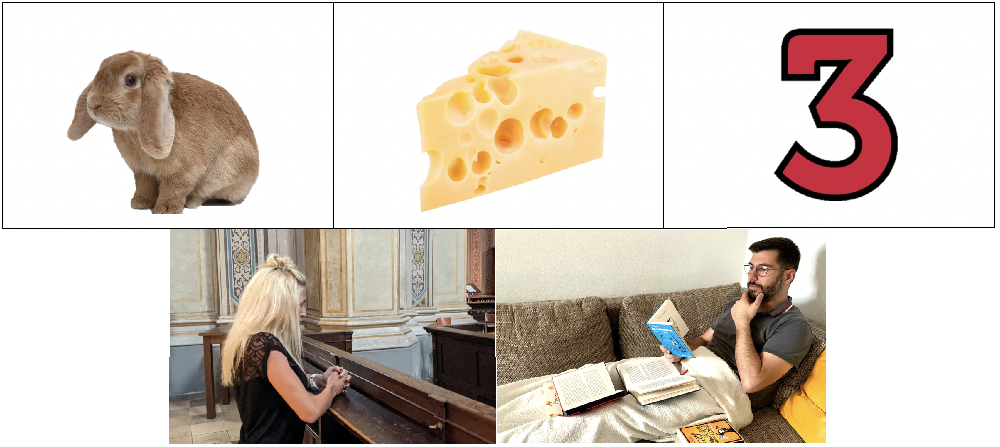
The design of the study involved productions of the same words for all participants of both age groups using a picture naming task. The picture naming task was used without any orthography. This method was chosen to obtain dialectal, semi-spontaneous data while constraining the degree of spontaneity. Picture-naming and word repetition tasks have been found to be useful methods for eliciting single words and for controlling the context (Edwards & Beckman Reference Edwards and Beckman2008). There was no priming with the respective target words and vowels, neither orthographically nor verbally. Only in the cases where the target words were verbs (e.g. lesen ‘to read’ and beten ‘to pray’) did the experimenter ask: ‘What does the woman/the man do?’ before the production to elicit a verb instead of a noun.
All words were presented as real pictures, predominantly on plain white background, as exemplified in Figure 4. Exceptions to this pattern were e.g. lesen ‘to read’ and beten ‘to pray’ (see also Figure 4).
Sample pictures used in the study. The items are: Hase /hɒs/ ‘rabbit’ (top left), Käse /kas/ ‘cheese’ (top mid), drei /drai/ ‘three’ (top right), beten /bɛtn/ ‘to pray’ (bottom left), and lesen /lesn/ ‘to read’ (bottom right).
Adult participants were tested in a quiet room in their homes and produced each word from a picture that was presented on a monitor. The children were tested individually in a quiet room in their respective schools. For the children, the production experiment was constructed as a game in which a human comic figure travelled through space (first year of recordings) or over a treasure map (second and third year of recordings). The game began with a picture of a figure at some starting point on the background of space or a treasure map that moved across several landmarks (planets in the space setting or small circles in the treasure map setting). After approximately every 15th item, a picture with the figure on the respective background appeared again having advanced by one step (accompanied with some gaming sound effects), until the ‘goal’ at the end of the experiment had been reached. This was done in order to ensure that the children maintained interest and motivation throughout the whole experiment.
The recordings were made with an audio interface (M-Audio Fast Track) and a condenser headset microphone (Beyerdynamic TG H54) and digitised at 44.1 kHz, using the SpeechRecorder software version 3.12.0. (Draxler & Jänsch Reference Draxler and Jaänsch2004). The pictures were displayed one at a time on a computer monitor. The participants were seated in front of the screen of a MacBook Pro (2016, 13 inch). The adults were instructed to produce the pictures in their dialect. In order to encourage the children to speak WCB naturally, the children interacted with the experimenter (the first author, who is a WCB speaker from the same area) for some time before and during the picture naming task. There was no time pressure in producing the words which were advanced manually by the experimenter when the participant was ready. The total time to participate in the experiment was approximately 20 and 30 minutes for adults and for children, respectively.
2.3 Materials
The 58 pictures were based on frequently occurring words (predominantly nouns) that are easy to visualise. They were also designed both in order to represent acoustically the WCB monophthong and diphthong spaces (Figure 2) and for analysing the types of questions presented in Section 1.3 above. The picturable words which are listed in Appendix B were either monosyllabic (26/58 words) or disyllabic (32/58 words) with trochaic stress (i.e. the first syllable had primary lexical stress followed by a lexically unstressed syllable). The wordlist included as far as possible words whose (target) vowels differ considerably between WCB and SG, so that the distinction between dialect or standard productions was clear and easily identifiable by native speakers.
The target vowels were in all cases in the initial syllable with primary lexical stress and included one of seven WCB monophthongs /ɒ a i u o e ɛ/ or five diphthongs /oi ai oa ia ua/ in a wide range of segmental contexts. Since the words were produced in isolation or at least most prominent when embedded in a phrase, the initial syllable was also nuclear accented. The words were presented in randomised order and repeated four times (resulting in 232 tokens per participant). The randomisation was generated automatically and therefore varied each time the experiment was run which led to a different order between speakers and also within the same speaker in the repeated recordings.
A number of productions were completely excluded from further consideration in the present study. There were four reasons for doing so:
-
1. Some word types were completely excluded from further analysis because the children had so often produced a completely different word than the intended target item. This was so for Heu ‘hay’ (produced as Stroh ‘straw’) and Licht ‘light’ (produced as Lampe ‘lamp’).
-
2. Kirche ‘church’, Schnur ‘string’, and Uhr ‘clock’ were also completely excluded since these are opening diphthongs that are derived diachronically or synchronically from a post-vocalic /r/ and are not the subject of the present investigation (see Section 1.2 and footnote 2 above).
-
3. Some words were completely excluded because they were produced in SG much more often than WCB. These were Besen ‘broom’, beten ‘to pray’, Ei ‘egg’, Futter ‘fodder’, Hütte ‘cabin’, Müll ‘waste’, Reh ‘deer’, Säge ‘saw’, Schnee ‘snow’, Schlüssel ‘key’, Schüler ‘pupil’.
-
4. All other words and word types were retained but occasionally some tokens were removed because they were produced in SG and not in WCB.
The exclusion of words in (3, 4) was based on auditory criteria. In almost all cases, SG instead of WCB productions were very clearly perceptible either in the target vowel (e.g. the production of SG /aɪ/ instead of WCB /oa/ for Ei ‘egg’) or in other consonants and vowels of the target word (e.g. SG /kabl/ vs. WCB /kabe/ for Kabel ‘wire’). The proportion of adult productions removed as a consequence of (3, 4) together was 14.1 $\%$
; for children, the proportion of words removed due to (3, 4) together was 39.9
$\%$
; for children, the proportion of words removed due to (3, 4) together was 39.9 $\%$
, 38.5
$\%$
, 38.5 $\%$
, 38.0
$\%$
, 38.0 $\%$
for years 1–3, respectively.
$\%$
for years 1–3, respectively.
The final count of word repetitions retained for analysis is shown in Appendix B.
2.4 Data preparation and analysis
The recordings were manually segmented in order to identify the target words, given that the children tended to produce considerably more speech than just the targeted item. Target words were then automatically segmented and annotated with the Munich Automatic Segmentation System (Kisler, Reichel & Schiel Reference Kisler, Reichel and Schiel2017). All subsequent analyses were carried out using the EmuDB system and emuR package in R (Winkelmann, Harrington & Jänsch Reference Winkelmann, Harrington and Jänsch2017). Formants were calculated using the LPC algorithm in Praat (Boersma & Weenink Reference Boersma and Weenink1992–2016) with the Burg algorithm. The analysis window had a length of 0.025 s and the ceiling of the formant search range was set to 7000 Hz for children, 5500 Hz for adult females, and 5000 Hz for adult males. Pre-emphasis was applied with a slope of +6 dB/octave for frequencies above 50 Hz.
Vowel segment boundaries and formant errors were manually corrected. The correction of formants was especially necessary for the child speech data in which e.g. a formant had been mis-tracked as a higher or lower formant number. The acoustic vowel onset and offset were typically defined as the onset/offset of periodicity and/or for the interval over which a formant structure was clearly visible. F1 and F2 of each vowel were linearly time-normalised between the acoustic on- and offset to eleven data points and then smoothed to remove micro-perturbations using a five-point median filter.
All data were speaker-normalised by converting formant frequencies into z-scores (Lobanov Reference Lobanov1971) in order to reduce the influences of anatomical differences in size and shape of the different speakers’ vocal tracts. This was done with (1):
-
(1) ${F^*}_{i,j,k(t)} = \left[ {{F_{i,j,k(t)}}-{\rm{mean}}\,{F_{i,j}}} \right]/{\rm{sd}}\,{F_{i,j}}$

in which F * i,j,k(t) and F i,j,k(t) are, respectively, the normalised and raw formant frequency values of formant number j (j = 1, 2, 3) produced by speaker i in utterance k at timepoint t and where mean F i,j and sd F i,j are the mean and standard deviation of all formant values between the acoustic onset and offset for formant number j with respect to that speaker’s /a/, /o/, and /e/ vowels. These were chosen, because they mark the WCB corner vowels i.e. those with the most extreme F1 and F2 values. Durations for target vowels and their subsequent consonants were measured and normalised relative to the duration of the word in which they occurred.
The formant trajectories between the vowel’s acoustic onset and offset of the first and the second formant were each decomposed into a set of ½ cycle cosine waves using discrete cosine transformation (DCT; see Harrington & Schiel Reference Harrington and Schiel2017 for formulas and details). For the present study, the first three DCT coefficients, k 0 , k 1 , k 2 , were calculated; they are proportional to the mean, linear slope, and curvature of the trajectory, respectively.
The DCT models the shape of a trajectory but does not represent duration.
The (logarithmic) distance d of a vowel ${\vec x_i}$
in a three or six-dimensional space of DCT coefficients to another vowel category
${\vec x_i}$
in a three or six-dimensional space of DCT coefficients to another vowel category $\vec c$
was also calculated separately by speaker and is given (2):
$\vec c$
was also calculated separately by speaker and is given (2):
-
(2)
$d\left( {{{\vec x}_i}} \right) = {\rm{log}}(\sqrt {{{\left| {\left| {{{\vec x}_i} - \vec c} \right|} \right|}^2})}$

(In (2), || denotes vector magnitude and $\vec c$
is the centroid of the vowel category to which the inter-Euclidean distances were calculated.) The formula in (2) was used in Section 3.4, for example, to calculate the distance of a speaker’s F2 trajectory in the vowel of Messer ‘knife’ to the mean F2 trajectory to the same speaker’s lesen ‘to read’ and vice versa. The formula in (3), which is the one-dimensional form of (2), was used in Section 3.6:
$\vec c$
is the centroid of the vowel category to which the inter-Euclidean distances were calculated.) The formula in (2) was used in Section 3.4, for example, to calculate the distance of a speaker’s F2 trajectory in the vowel of Messer ‘knife’ to the mean F2 trajectory to the same speaker’s lesen ‘to read’ and vice versa. The formula in (3), which is the one-dimensional form of (2), was used in Section 3.6:
-
(3)
${\rm{d}}\left( {{{\rm{x}}_{\rm{i}}}} \right) = {{\rm{x}}_{\rm{i}}} - {\rm{c}}$

In Section 3.6, x i was the DCT coefficient k 0 calculated for the F2 trajectory of any /e/ vowel and c was the mean of all the k 0 values calculated across the same speaker’s /i/. Since k 0 is proportional to the trajectory mean, (3) was used to measure the distance between the F2 trajectory mean for any given /e/ vowel and the trajectory mean averaged across /i/ vowels produced by the same speaker.
Statistical tests were carried out with a linear mixed effect regression model using the LMER function from the lmerTest package in R (Kuznetsova, Brockhoff & Christensen Reference Kuznetsova, Brockhoff and Christensen2017). For the analyses in Sections 3.2, 3.3 and 3.5, the model was of the form (R notation) in (4):
-
(4)
$dependent \sim group + year + \left( {{\rm{1}}|speaker} \right) + ( {group|word}))$

In (4), dependent was the dependent variable, group a two-level fixed factor child vs. adult, year a four-level fixed factor for adults and children recorded in the first, second, and third years, speaker a random factor for the participant, and word a random factor for the word. The analysis in Section 3.4 extended (4) to include the vowel, V, as a fixed factor, as in (5):
-
(5)
$dependent \sim group + year + V + group:V + {\rm{year}}:V + \left( {V|speaker} \right) + ( {group|word} ))$

When year was significant in (4) or (5) (which means that adults and children recorded in their first three years potentially all differed from each other), the results of post-hoc t-tests were computed using the R package emmeans (Lenth Reference Lenth2019).
3 Results
We begin with some general comments about the WCB vowel and diphthong space (Section 3.1). We then assess whether WCB is being influenced by SG with respect to the six issues outlined in Section 1.3 and discussed in Sections 3.2–3.7 below. The main indicator of change will be evidence of whether the children’s vowels were shifted towards SG compared with those of adults. Another indicator is whether such adult–child differences were more marked for children in their second year and even more in their third year of recording (henceforth year 2 and year 3) compared with the same children in their first year of recording (year 1). In general, speech tempo is unlikely to be a confounding influence, since word and vowel durations (for the data points shown in Figure 5 below) are quite comparable. These were 488/499/502/490 ms (word duration) and 157/158/160/160 ms (vowel duration) for adults/year 1 children/year 2 children/year 3 children, respectively.
3.1 Overview
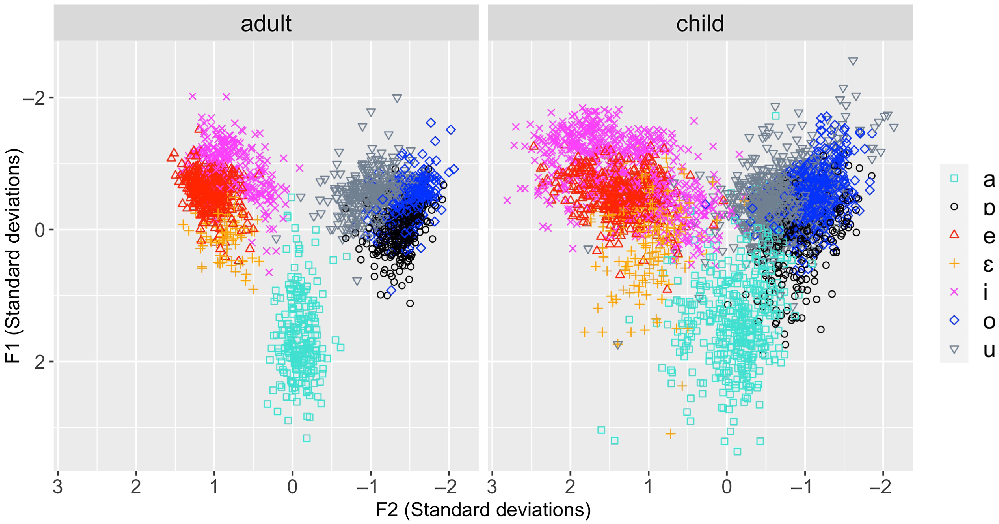
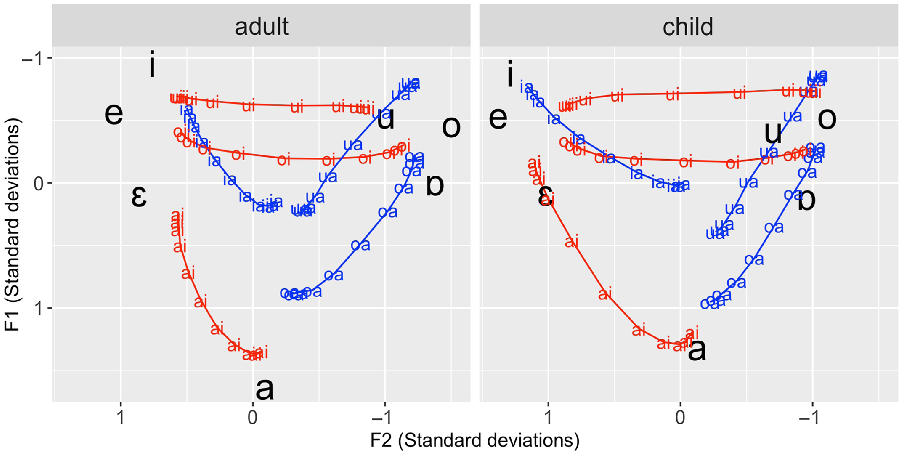
The plot of monophthongs extracted at the temporal midpoint in the F1 × F2 space in Figure 5 (and their aggregates in Figure 6) shows clear evidence of three front vowels /i e ɛ/, three back vowels /u o ɒ/ and an open vowel /a/. Consistently with some observations, /e/ is indeed more peripheral than /i/ at least based on F2. Based on the acoustic evidence and auditory impressions, /ɒ/ is slightly more open than [ɔ]. /o/ is the most peripheral back vowel. /u/ is more central than CV8 and possibly closer to [ʊ]. There are unequivocally three level/closing diphthongs and three opening diphthongs (N.B.: /ea au/ were not analysed and hence not included in Figure 6). The main divergence in quality for the diphthongs from the symbols used for the broad phonemic transcription are as follows: the second component of /ai/ is mid-front, thus [aɛ]; the second component of /ui oi/ is central of CV1 (and the first component of /ui/ is central of CV8), thus [ʊɪ oɪ], respectively, the second components of the falling diphthongs of /ia ua/ are phonetically mid-central (and their first components central of CV1, CV8, respectively), thus [ɪə ʊə].
There are generally quite close correspondences in Figures 5 and 6 between the adults and the children, but also some visible differences. Two of these differences are analysed further in Sections 3.2 and 3.6: these are (i) that /ɒ/ is further from /o/ for children and (ii) that the difference along the F2 axis between /e/ and /i/ is greater for adults. In addition, Figures 5 and 6 suggest – for adults compared with children – (i) a smaller separation between /e ɛ/, (ii) a smaller distance of /u, ɒ/ as well as the first components of /ui oa/ from /o/, and (iii) a more open /a/ (/a/ is further from the first component of /ai/ and from the second component of /oa/ in adults).
The first two formants extracted at the temporal midpoint in monophthongs for adults and children.
Aggregated level/closing (red) and opening (blue) diphthong trajectories in the F1 × F2 plane superimposed on the mean positions (black) of the monophthongs in adults and children.
3.2 Open vowels
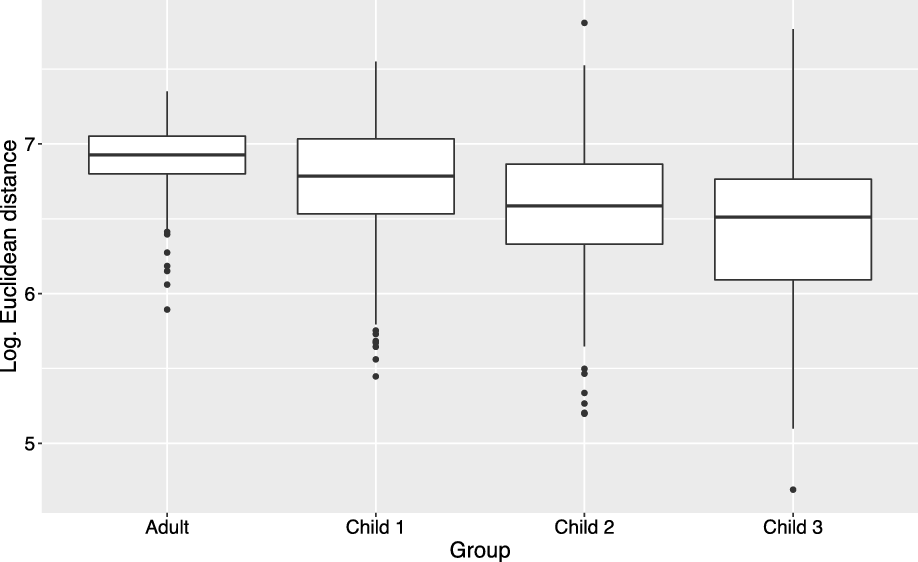
The difference between the positions of /ɒ/ and /a/ in the respective groups was assessed by calculating the inter-Euclidean distances in a six-dimensional F1 × F2-DCT space between all /a/-vowels to the combined centroid of /ɒ/-vowels and vice versa separately by speaker following equation (2) (Section 2.4). The calculation was based on all /a, ɒ/ words shown in black in Appendix B. These included three /a/ words (Kabel ‘wire’, Käse ‘cheese’, Klasse ‘class’) and four /ɒ/ words (Gabel ‘fork’, Glas ‘glass’, Hase ‘rabbit’, Sack ‘sack’). The results (Figure 7) show greater inter-Euclidean distances for adults than for year 1, year 2 and year 3 children. This finding is consistent with the evidence in Figure 5 which shows that /ɒ/ is closer to /a/ in children than in adults. The results of the mixed model in (4) with the Euclidean distances as the dependent variable showed a significantly higher inter-Euclidean distance (i.e. /ɒ/ positioned further from /a/) for adults compared with year 2 (t 40.1 = 3.2, p < .05) and year 3 (t 40.9 = 4.0, p < .01) children, as well as significant differences between year 1and year 2 children (t 1097.2 = 4.7, p < .001), year 2 and year 3 children (t 1091.5 = 3.1, p < .05) and year 1 and year 3 children (t 1103.5 = 7.3, p < .001) in the same direction. Even if the difference between adults and children from year 1 was not significant, the results combined with the evidence in Figure 7 suggest a trend of a decreasing difference between /ɒ/ and /a/ from adults to year 1 to year 2 to year 3 children. Nevertheless, this result (as with all of those in this study) may well not be representative of the population of WCB children, given the small number of children that produced these words in year 2 (between eight and nine) and in year 3 (between five and seven).
Logarithmic inter-Euclidean distance calculated in a six-dimensional F1 × F2 DCT-space between /ɒ/ and /a/ for adults and three groups of children recorded in their first (Child 1), second (Child 2) and third (Child 3) year of school attendance.
3.3 Long/short vowels
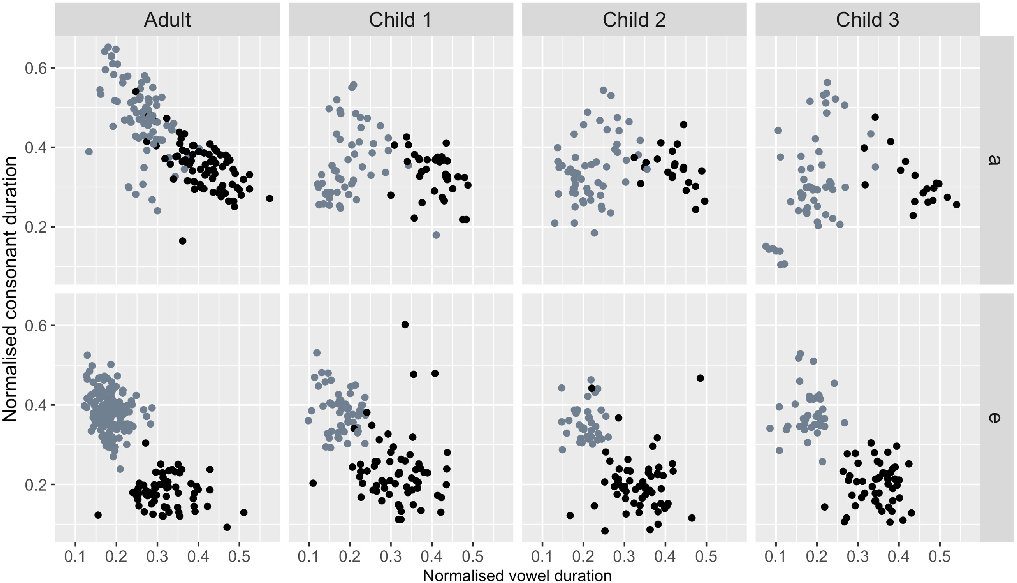
The purpose was to determine whether there was any evidence for a long vs. short vowel distinction that is phonetically conditioned by a following short vs. long consonant, and to assess whether any such relationship is differently manifested in adults than in children. We began by examining vowels for which there were short vs. long pairs of the same quality before /s/. There were four such words in the database. These included Käse and lesen that have a long vowel followed by a short voiceless consonant, thus [khaː܃], [leː܃n̩] and Klasse and Messer for which the vowel is short and the consonant long and voiceless thus [kla܃ː], [me܃ːɐ]. As shown in Figure 8, older speakers showed a clear separation between VːC and VCː based on quantity. In VːC, the vowel was long and /s/ short and vice versa for VCː. Figure 8 shows that vowel duration separated VːC and VCː in children. Figure 8 also shows that the overlap between VːC and VCː on consonant duration was, by contrast, greater for children than for adults. Based on the results from Figure 8, we tested whether there was a reduction in post-vocalic consonant duration in children when the preceding vowel is short. There were 11 available words in our database with phonetically short vowels. These were beten ‘to pray’, Butter ‘butter’, Hütte ‘cabin’, Klasse ‘class’, Löffel ‘spoon’, Messer ‘knife’, Rutsche ‘slide’, Schlüssel ‘key’, Schnecke ‘snail’, Spinne ‘spider’, Suppe ‘soup’. However, we excluded from further consideration beten ‘to pray’, Hütte ‘cabin’, and Schlüssel ‘key’ because they were produced too infrequently (as explained in Section 2.3 and shown in Appendix B).
Durations of the vowels /e/ and /a/ and the fricative /s/ as a proportion of word duration in phonetically short (grey) and long (black) vowels in two /a/ words (top) and two /e/ words (below) for adults, year 1, year 2 and year 3 children.
Durations of the coda consonant normalised for word duration in several words that all have a preceding phonetically short vowel for adults and the children recorded in the first, second and third years.
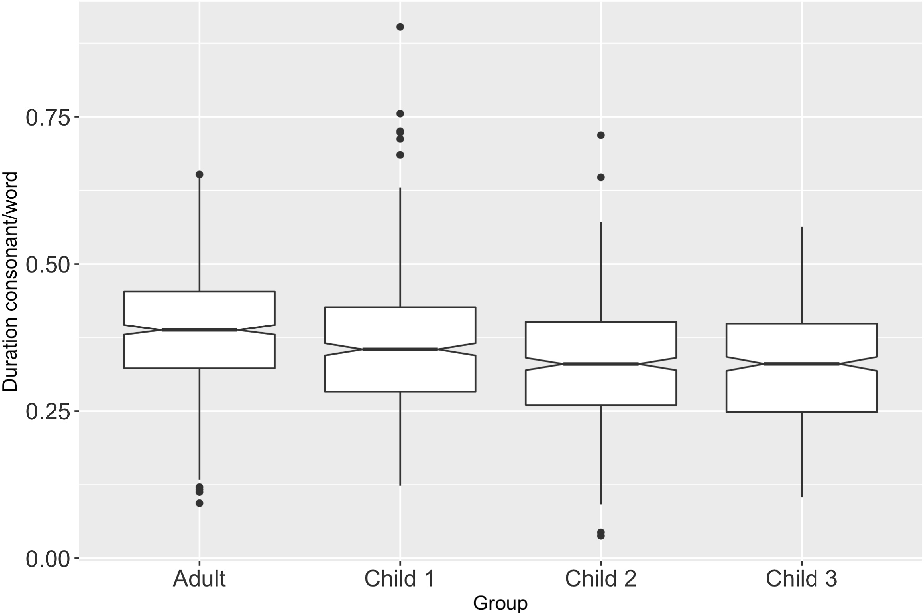
For the remainder, we measured the post-vocalic consonant duration from the acoustic onset to the acoustic offset of aperiodicity following the vowel in plosives and fricatives and between the acoustic onset and offset of /n/ in Spinne ‘spider’. Figure 9 suggests a trend in which the post-vocalic consonant duration decreased from adults to children recorded in the first and then in their second year. In their third year, the duration seems to be at about the same level as for year 2. The results of applying a linear mixed model as in equation (4) (Section 2.4) with the ratio of the consonant to word duration as the dependent variable showed no significant differences between adults and children in their first year, a significant difference between adults and children recorded in their second (t 12.3 = 3.1, p < .05) and in their third year (t 12.4 = 3.4, p < .05), and a significant difference between children recorded in their first and second year (t 1941.2 = 6.2, p < .001) as well as between children recorded in their first and third year (t 1945.0 = 7.0, p < .001). Consistently with Figure 9, the difference between the children in their second and third year was not significant. However, these results, together with the evidence in Figure 9, suggest a trend in WCB in which there was a decrease in the duration of the post-vocalic consonant after short vowels at least from adults to year 1 to year 2 children, while year 3 children range at a similar (low) level as for year 2.
3.4 Tensity
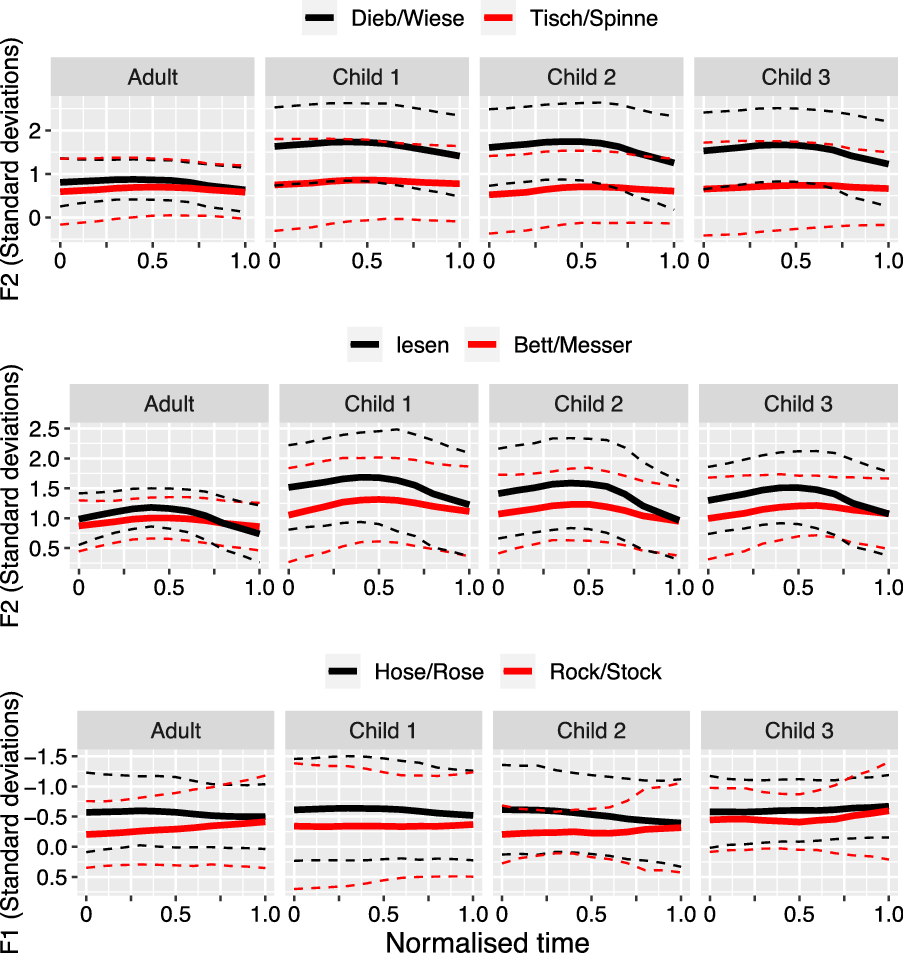
The focus in this section is on whether children are beginning to show evidence of an SG tense/lax contrast that does not exist in WCB. For this purpose, we compared words that have the same quality in WCB but which are tense and lax in SG. These included Dieb ‘thief’, Wiese ‘lawn’, Spinne ‘spider’, Tisch ‘table’, which are all /i/ in WCB but which are tense /i/ (Dieb, Wiese) vs. lax /ɪ/ (Spinne, Tisch) in SG. They also included lesen ‘to read’, Messer ‘knife’ and Bett ‘bed’, which are all /e/ in WCB but tense /e/ (lesen) and lax /ɛ/ (Messer, Bett) in SG. Finally, Rose ‘rose’, Hose ‘trousers’, Rock ‘skirt’, Stock ‘stick’ were also included; they are all /o/ in WCB but tense /o/ (Rose, Hose) and lax (Rock, Stock) /ɔ/ in SG. No other sets of words in the database with sufficient numbers of speakers/repetitions that fulfilled these criteria (of the same quality in WCB but tense/lax in SG) were available.
In Standard German, F2 is typically higher in tense /i/ (Dieb, Wiese) than in lax /ɪ/ (Spinne, Tisch) and higher in tense /e/ (lesen) vs. lax /ɛ/ (Messer, Bett) while F1 is typically higher in tense /o/ (Rose, Hose) than in lax /ɔ/ (Rock, Stock). Such formant differences should be observable in WCB children, if children are being influenced by SG. There is some evidence from Figure 10 that the F2 separation between such tense/lax pairs is greater for children than for adults in the front vowels /i e/ but not for F1 in Rose/Hose vs. Rock/Stock. There seems to be no evidence of any longitudinal trend, i.e. the degree of separation between SG tense/lax pairs was about the same for data from the 1st, 2nd and 3rd year of child recordings.
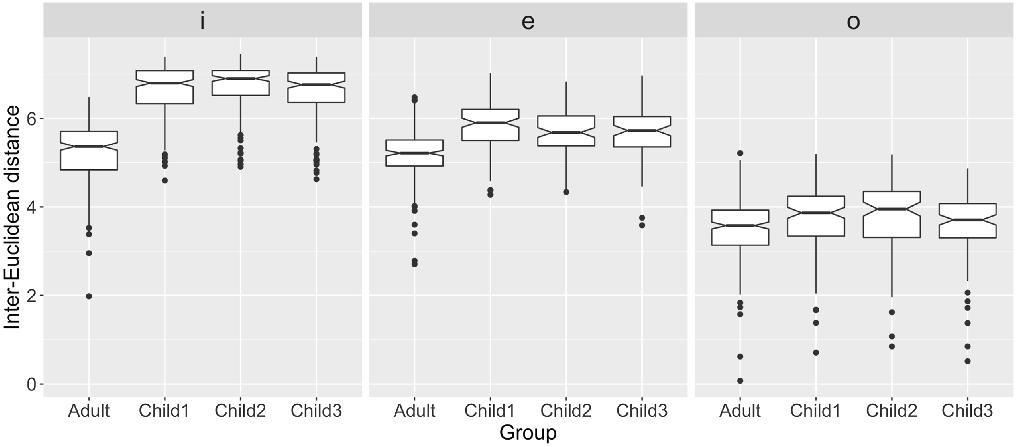
In order to quantify these observations further, the inter-Euclidean distances between vowels corresponding to SG tense/lax pairs were calculated separately for /i e o/ and separately by speaker from equation (2) (Section 2.4). For /i/, (2) was applied twice: firstly, the Euclidean distances in a three-dimensional F2-DCT were calculated of all Spinne/Tisch vowels to the (combined) vowel centroid of Dieb/Wiese and, secondly, in the other direction of all Dieb/Wiese vowels to the centroid of Spinne/Tisch. Exactly the same procedure was applied to /e/ (lesen vs. Messer/Bett) and to /o/ (Rose/Hose vs. Rock/Stock) with the exception that the calculation was made in an F1-DCT space for /o/. Figure 11 shows that these inter-Euclidean distances were greater for children than for adults, although only marginally so for /o/. The results of applying a mixed model as in equation (5) showed significantly greater inter-Euclidean distances between adults and children in /i/ (t 17.7 = 9.1, p < .001) and in /e/ (t 21.3 = 3.6, p < .01) but not in /o/. Furthermore, there were no increases in the inter-Euclidean distance between children in their first, second and third year. There is therefore no evidence of a trend for vowels corresponding to tense/lax differences in SG to become more distant from each other longitudinally.
F2 trajectories for /i/ (top) and /e/ (middle) and F1 trajectories for /o/ (bottom) aggregated by word and speaker group (adults; year 1, year 2 and year 3 children). Black/red correspond to tense/lax in Standard German. Solid/dashed lines: trajectories of the mean and at 1.96 standard deviations from the mean, respectively.
Logarithmic inter-Euclidean distance between vowels that are tense and lax in Standard German for adult speakers and three groups of children recorded in their first (Child 1), second (Child 2) and third (Child 3) years shown separately for /i e o/.
3.5 Rounding
The test for the development of rounding was applied to /e/ in Bett ‘bed’, lesen ‘to read’, Messer ‘knife’, where it is unrounded /ɛ e ɛ/, respectively, in the standard (the −R group) as well as to /e/ in Löffel ‘spoon’, Vögel ‘birds’, where it is rounded /Œ Ø/, respectively, in the standard (the +R group). There were insufficient numbers of words like Hütte ‘cabin’ and Schlüssel ‘key’ (WCB /i/; standard: /ʏ/) for a comparable analysis to be carried out for high vowels.
Lip-rounding lengthens the vocal tract and causes a lowering of formant frequencies and especially F2 in the case of (mid) front vowels (Lindblom & Sundberg Reference Lindblom and Sundberg1971 see also Figure 2 in Vaissiére Reference Vaissiére2009). Figure 12 shows that there were only minor F2 differences between the ±R groups for adults. But in children, F2 of −R vowels was higher than for +R vowels.
Time-normalised F2 trajectories of WCB /e/ aggregated by whether they are unrounded (−R) or rounded (+R) in the standard and separately for adults, year 1, year 2 and year 3 children. Solid/dashed lines: trajectories of the mean and at 1.96 standard deviations from the mean, respectively.
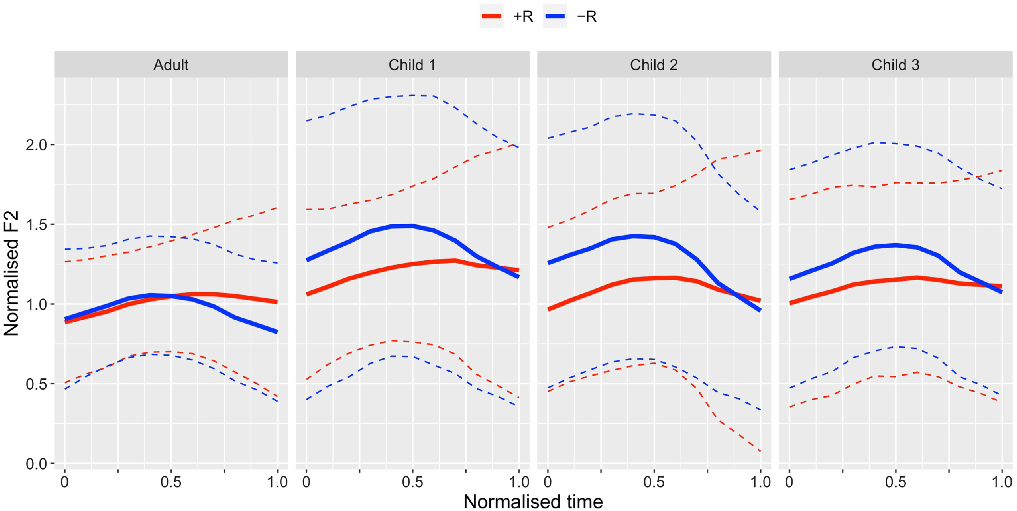
We further quantified these differences by calculating the inter-Euclidean distances from −R vowels to the +R centroid and from +R vowels to the −R centroid in an F2-DCT space using (2) and as always separately by speaker. The results of these calculations in Figure 13 show a greater inter-Euclidean distance between ±R groups for children compared to adults.
Logarithmic inter-Euclidean distance between WCB /e/ vowels that are rounded and unrounded in Standard German for adult speakers and three groups of children recorded in their first (Child 1), second (Child 2) and third (Child 3) years.
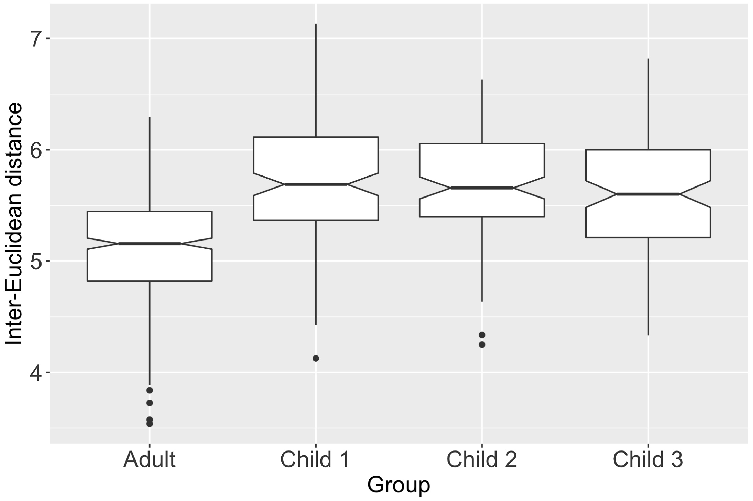
The results of applying a mixed model as in equation (4) (Section 2.4) showed significantly greater inter-Euclidean distances between adults and children (t 24.8 = 6.4, p < .001) and, compatibly with Figures 12 and 13, no differences between children in their first, their second and their third year of recordings.
3.6 Relative positions of /i e/
The test was whether /e/ is fronted relative to /i/ in adults and whether this relationship is being reversed in children. The words available for this investigation were those in the /e i/ sets in Appendix B. However, in order to avoid possible confounds, we removed from further consideration those words that we had found to be influenced due to tensity (Section 3.3) and rounding (Section 3.4) differences in the standard. The only remaining words were /e/ in lesen ‘to read’ and /i/ in Dieb ‘thief’, Wiese ‘lawn’.
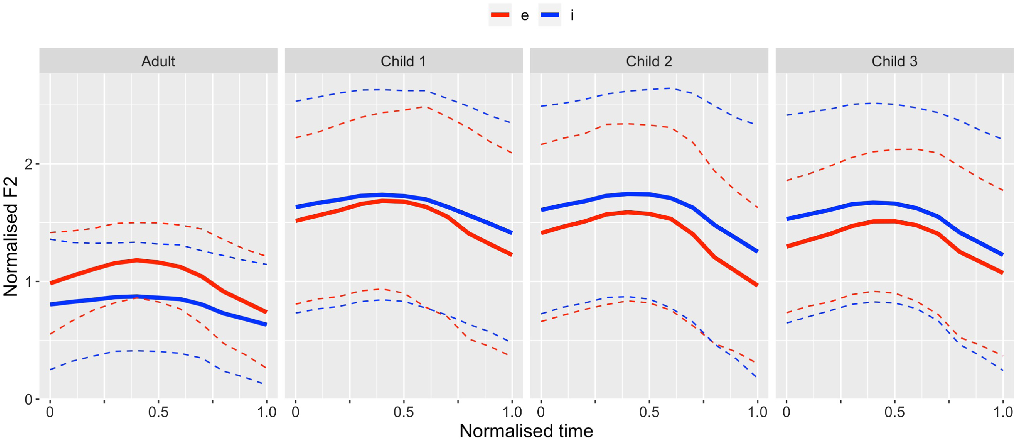
The F2 trajectories in Figure 14 show that F2 of /e/ is lower in adults than in children. They also suggest a trend in which there is a progressive increase in F2 of /i/ relative to F2 of /e/ from adults to children in their first and then in their second and third year. The trend is, however, less apparent in the F2 difference between /i/ and /e/ in Figure 15 calculated with equation (3). Quite the contrary, there even seems to be a trend of decreasing F2 differences from year 1 to year 2 to year 3 within the children.
Time-normalised F2 trajectories of /e i/ vowels aggregated separately for adults, year 1, year 2 and year 3 children. Solid/dashed lines: trajectories of the mean and at 1.96 standard deviations from the mean, respectively.
The F2 difference between /i/ in Dieb, Wiese ‘lawn’ and /e/ in lesen ‘to read’ calculated with (3) for adults and children in year 1, year 2 and year 3.
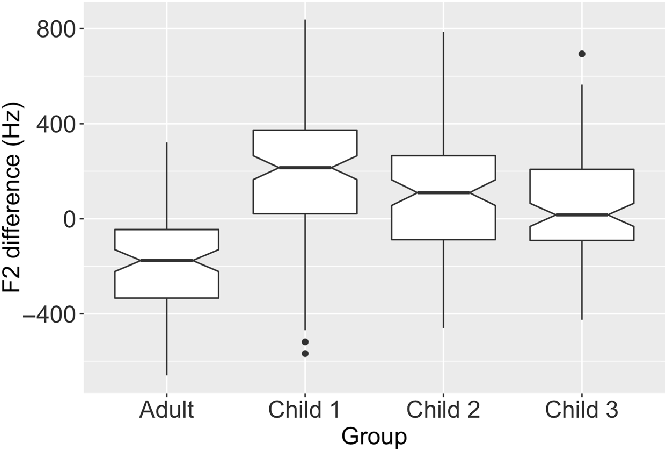
A statistical test using the equation in (4) with the dependent variable shown in Figure 15 showed significant differences between adults and children for all of the recording timepoints (t 47.1 = 7.8, p < .001 for adults and year 1 children; t 50.0 = 5.5, p < .001 for adults and year 2 children; t 52.6 = 4.5, p < .001 for adults and year 3 children).
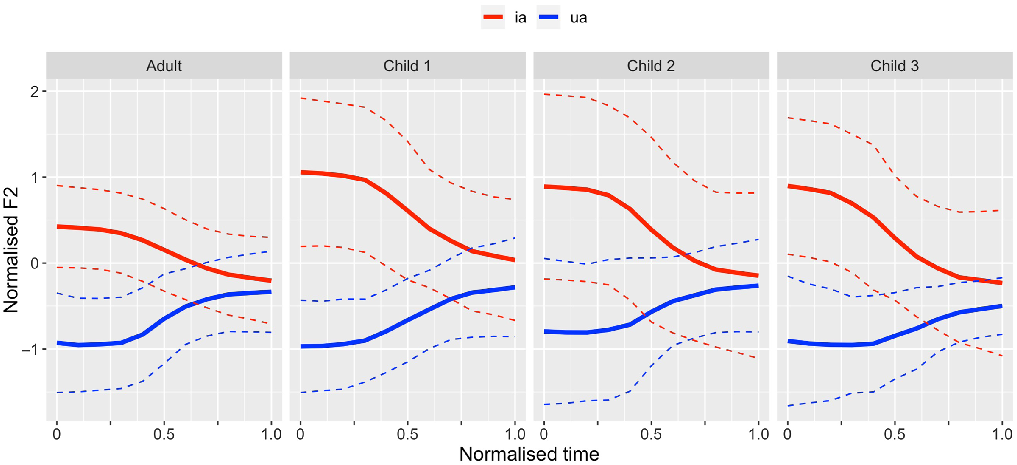
Time-normalised F2 trajectories of /ia ua/ diphthongs aggregated separately for adults, year 1, year 2 and year 3 children. Solid/dashed lines: trajectories of the mean and at 1.96 standard deviations from the mean, respectively.
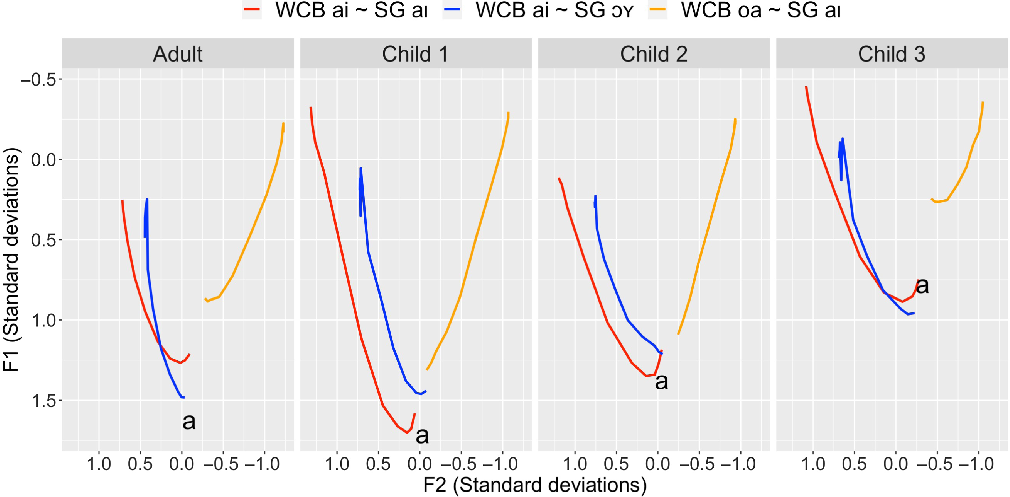
Aggregated F1 and F2 trajectories for three types of diphthongs in adults, year 1, year 2 and year 3 children as well as aggregates of /a/-vowels as reference.
3.7 Diphthongs
The first hypothesis to be tested was that children might monophthongise the opening diphthongs /ia ua/ because they are monophthongal /i u/ in SG. The available words for this purpose were Fliege ‘fly’, Füße ‘feet’ for /ia/ and Schuh ‘shoe’ for /ua/. As Figure 16 shows there is no evidence to support this hypothesis. The second hypothesis was that the closing diphthongs would shift towards those in the standard. For this purpose, we tested whether feuer and drei which have the same /ai/ in WCB are beginning to split under the influence of SG in which they are, respectively, /ɔʏ aɪ/ and whether WCB drei, stein which are /ai oa/ are beginning to merge since these are both /aɪ/ in SG (Figure 3). The test was carried out for (i) drei ‘three’, Wein ‘wine’ (WCB /ai/ ∼ SG /aɪ/) (ii) Feuer ‘fire’, Häuser ‘houses’ (WCB /ai/ ∼ SG /ɔʏ/), and (iii) eins ‘one’, Leiter ‘ladder’, Stein‘stonde’, zwei ‘two’ (WCB /oa/ ∼ SG /aɪ/). There was no support for this type of influence of SG on WCB. That is, there is no evidence from Figure 17 for a greater merger of (i) and (iii) (Figure 17: red, orange) nor for a greater split between (i) and (ii) (Figure 17: red, blue) in children than in adults.
4 Discussion
The study has been concerned with establishing whether the vowels of West Central Bavarian are being influenced by those of Standard German. The question was addressed by documenting the known differences between the varieties in the vowels both phonologically and phonetically. Some of these differences were then used to predict the direction in which the vowels of WCB children and WCB adults might diverge, under the assumption that those of WCB children are influenced to a greater extent by the standard.
The analysis of WCB adults’ speech showed many of the hallmarks of WCB that make it distinct from SG. These distinguishing WCB characteristics include in particular:
(6)
-
a. A contrast in kabel and gabel between (a) an open central and (b) an open, or half-open rounded vowel (Figure 5).
-
b. The use of post-vocalic consonant length to distinguish VːC from VCː (Figure 8).
-
c. Few or minimal quality differences between vowels that contrast in tensity in SG (Figure 10, left panels).
-
d. Few or minimal quality differences between front vowels that contrast in rounding in SG (Figure 12, left panel).
-
e. A phonetic fronting relationship between /i e/ that is different from that typically found in SG.
-
f. Opening diphthongs in fliege and schuh that map to high SG monophthongs (Figure 16), (b) no observable quality differences between diphthongs in drei and feuer that are distinct in SG, and (c) a distinction between the diphthongs exemplified by drei and stein that are non-distinct in SG (Figure 17, left panel).
-
g. High and mid-high diphthongs along a trajectory from back to front that map, respectively, to high and mid/low vowels before laterals in SG (Figure 6).
The children’s vowels were undoubtedly WCB as they were characterised by all of the attributes sketched in the list in (6) above that had been found for adults. Thus, one of the main findings in this study is that the defining characteristics of WCB are being transmitted to the youngest generations, at least in a rural area like the one analysed here. But in line with other studies showing that German dialects are being influenced by the standard (Scheuringer Reference Scheuringer1990, Müller et al. Reference Müller, Harrington, Kleber and Reubold2011, Bukmaier et al. Reference Bukmaier, Harrington and Kleber2014, Kleber Reference Kleber2017), many aspects of the children’s speech data showed a shift towards SG. The strongest shift was for (6a, b) above, i.e. the approximation of /ɒ a/ and the shortening of the post-vocalic long /s/. For both (6a) and (6b), there were adult/child differences as well as a longitudinal trend in which these differences were more marked for children recorded in their third than in their second than in their first year. The next strongest shift was for (6c) and (6d) that pointed to the development of SG tensity and SG rounding contrasts. Here there were adult/child differences but no longitudinal trend. The results for (6e), concerning whether the fronting relationship in /i e/ had changed, showed overall adult/child differences but no evidence for a longitudinal trend for this relationship to be increasingly reversed in children. There was no evidence that the children had shifted towards SG to a greater extent than adults in any of the diphthongs (refer to the characteristics in (6f) above). Finally, there were no innovations introduced by the children that were not in the direction of Standard German.
Studies in the last 20–30 years have documented a variety of factors that are likely to cause the sounds of a dialect (D1) to shift when it comes into contact with another dialect (D2). Although the literature on dialect contact is by no means equivalent to the bidialectalFootnote 10 situation (Hazen Reference Hazen2001, Oschwald et al. Reference Oschwald, Schättin, Von Bastian and Souza2018) analysed in the present study, it is interesting to consider whether the findings of the changes (in 6a–e above) and lack of change (in 6f) are consistent with the predictions and results from these studies on second dialect acquisition. A summary of the main findings by which the sounds of D1 may or may not be modified by D2 are as follows.
(7)
-
a. Exceptionless features are acquired more easily. There is a large body of research showing that children are more likely to acquire the sounds of a new dialect if the change relating D1 and D2 apply to words with limited exceptions, i.e. if sounds from D2 are not conditioned by lexical, morphological, or phonological constraints (Payne Reference Payne and Labov1980; Chambers Reference Chambers1992; Kerswill Reference Kerswill1996; Nycz Reference Nycz2015, Reference Nycz2019) with respect to D1. For example, a British English speaker learning General American may readily adopt the American English production of an intervocalic /t/ as a flap because the context in which flaps occur is largely predictable. By contrast, Northern English speakers who have the same /ʊ/ vowel exemplified by the lexical sets foot and strut might be less likely to acquire the /ʊ ∼ ʌ/ distinction that occurs in other varieties of English because of the complex (largely phonological) factors that condition the split (Wells Reference Wells1982).
-
b. Mergers are more likely to be acquired than new contrasts. Some studies show that D2 contrasts that do not exist in D1 are either not acquired or acquired incompletely (Chambers Reference Chambers1992, Kerswill Reference Kerswill1996, Evans & Iverson Reference Evans and Iverson2007). According to Labov (Reference Labov1994), mergers are often changes from below (the level of consciousness) and so may be more readily acquired than splits if D2 does not make a contrast that exists in D1.
-
c. Saliency/awareness influences D2 acquisition. It has been repeatedly suggested (Trudgill Reference Trudgill1986, Auer et al. Reference Auer, Barden and Grosskopf1998, Siegel Reference Siegel2010) that the shift towards D2 is influenced by whether sounds are salient and well-known markers of a dialect. Nycz (Reference Nycz2013a, b) showed that Canadians who had moved to the northern United States shifted only minimally the raised nucleus of the diphthong in words like about precisely because this is known to be a typical marker of Canadian English (that is also commented upon in the media and by the public) that does not occur in most varieties of American English. In a longitudinal study of the ‘7-up’ series,Footnote 11 Sankoff (Reference Sankoff and Fought2004) suggests that the Northern England speakers were less inclined to adopt the vowel close to CV5 (/ɑ/) in ‘bath’ that is a notable, salient marker of Southern English. Salience and its relationship to whether or not D1 shifts towards D2 may also be conditioned by the speaker’s attitude towards the dialect that is being acquired (Niedzielski Reference Niedzielski1999 for related perception studies, Walker Reference Walker2014; see also Hay & Drager Reference Hay and Drager2010, Jannedy & Weirich Reference Jannedy and Weirich2014).
-
d. A sound in D2 is more likely to be acquired if it already exists in D1. Payne (Reference Payne1976, Reference Payne and Labov1980) was among the first to suggest that a sound of D2 is more readily acquired if it exaggerates a phonetic tendency that already exists in D1. Bigham (Reference Bigham2010) showed that female Southern Illinois high school students’ [o u] that varied considerably along a front–back dimension became more retracted after contact with Northern students who had a retracted [o u]. This idea is central to the cognitive-computational model of sound change developed in Harrington et al. (Reference Harrington, Kleber, Reubold, Schiel and Stevens2018). In their model, a sound from dialect D1 is attracted towards D2 if the variation of the sound in D1 is in the direction of D2. For example, Harrington & Schiel (Reference Harrington and Schiel2017) showed that D1 individuals (represented as computational agents) with a mostly retracted /u/ that was also sometimes fronted though due to coarticulation, shifted towards a more fronted variant as a consequence of contact with D2 individuals who only had a fronted /ʉ/.
Could any of these four points (7a–d) explain why WCB children showed a greater tendency to shift towards SG on (6a–e) but not on (6f)? Complexity in the sense of (7a) is unlikely to explain the differences between (6a–e) and (6f). The structural relationships in Figure 3 do not suggest, for example, that the mapping of WCB /oa ai/ to SG /aɪ/ (in which there was no evidence of a shift towards SG) is any more or less complex than e.g. the mapping between WCB /i/ and SG /i ɪ/ (where children did show a shift towards SG). Neither can (7b) provide any coherent explanation for the pattern of shifts towards SG. This is because while (7b) does predict the observed failure for WCB /ai/ to split into SG /aɪ ɔʏ/ as well as the tendency of a merger of /ɒ a/ to SG /a/ (6a), it is not compatible with the observed tendency for WCB children’s /i/ to begin to split into an SG-like /i ɪ/ (the characteristic in (6c) above) nor for WCB children’s /e/ to show signs of splitting into an SG /e Ø/ contrast (the characteristic in (6d) above).
With regard to (7c), we have already noted that /oa/ and the opening diphthongs /ia ua/ are markers of WCB that are commented upon by the media and public. Perhaps there was no shift towards SG because these diphthongs are such clear identifiers of WCB. However, this interpretation is inconsistent with the finding that the children showed a shift towards SG in both /ɒ/ (6a) and in the rounding of front vowels (6e). Moreover, both WCB /ɒ/ and the WCB production of unrounded vowels exemplified by vögel (Figure 3) are also known (and commented upon) markers of WCB.Footnote 12
Finally, (7d) predicts sound change if SG characteristics already exist in WCB. The potential relevance of (7d) to the observed shifts towards SG is as follows:
(8)
-
a. As Figure 5 shows, the orientation and spread of /ɒ/ towards /a/ is greater than in the other direction. In terms of the model of Harrington et al. (Reference Harrington, Kleber, Reubold, Schiel and Stevens2018), /a/ (and by implication SG /a/) is an attractor for WCB /ɒ/ (because the distribution of WCB /ɒ/ already contains some variants that are quite /a/-like).
-
b. In a hypoarticulated/casual speaking style, long consonants are more likely to shorten than short consonants to lengthen (e.g. van Son & Pols Reference Van Son and Pols1999). Thus, the shorter C in SG is an attractor for the long Cː in WCB (which may tend to drift towards C in faster/hypoarticulated speaking styles).
-
c. In a hypoarticulated/casual speaking style, vowels are often centralised, i.e. are less peripheral (Lindblom Reference Lindblom, Hardcastle and Marchal1990, van Bergem Reference Van Bergem1993, van Son et al. Reference Van Son, Bolotova, Lennes and Pols2004). Thus, it can be expected that hypoarticulated WCB /i e/ shift in the direction of more centralised qualities. For this reason, SG /ɪ/ which is a centralised mid-high vowel is an attractor for WCB /i/ in spinne and SG /ɛ/ for WCB /e/ in bett.
-
d. A similar explanation to that in (8c) can be made with regard to lip-rounding. It has been shown for SG (e.g. Hoole Reference Hoole1999, Figure 5 in Harrington et al. Reference Harrington, Hoole, Kleber and Reubold2011) that /y Ø/ have centralised and lowered tongue position relative to /i e/. Thus, SG front rounded vowels are also attractors for WCB /i e/ in words exemplified by füsse and böse, respectively.
The findings in (7d) may also be relevant to account for the lack of shift towards SG in the opening and closing diphthongs noted in (6f) above:
(9)
-
a. In a more hypoarticulated speaking style, high opening diphthongs may well monophthongise (e.g. Standard British English /pʊə, pɔ/ ‘poor’; Lindsey Reference Lindsey2019) but not as far as we know towards vowels with CV1 and CV8 qualities that characterise SG wiese and schuh. Thus, SG /i u/ are unlikely to be attractors for WCB /ia ua/.
-
b. There is no phonetic reason that we can think of why the phonetic orientation towards SG /ɔʏ/ should be greater for WCB /ai/ in feuer than in WCB /ai/ in drei. There is therefore no SG attractor to encourage WCB /ai/ in feuer and in drei to split into SG /ɔʏ/ and SG /aɪ/, respectively.
-
c. For a similar reason as in (9b), SG /aɪ/ cannot be an attractor for WCB /oa/ because there is no reason why a falling diphthong /oa/ (exemplified by stein) should be phonetically oriented towards a rising /aɪ/ diphthong.
The analysis points to the general conclusion that a shift was most likely for WCB sounds when variation is phonetically directed towards or encompasses those of SG. This is also the outcome that is predicted by the cognitive-computational model of sound change developed in Harrington et al. (Reference Harrington, Kleber, Reubold, Schiel and Stevens2018). According to this model, a sound from a dialect D1 is an attractor for a sound from dialect D2, if the sound in dialect D2 is skewed towards that of D1. This model can be applied to the present data on the assumption that the phonetically quite tense vowel in WCB spinne can also be undershot and centralised in a more casual speaking style or faster speaking rate. Since the vowel in SG spinne is lax and more central than its WCB counterpart, then (because of undershoot/centralisation) WCB spinne encompasses variants that are already in the direction of its SG counterpart. Therefore, SG spinne acts as an attractor because WCB spinne is skewed towards it according to the model in Harrington et al. (Reference Harrington, Kleber, Reubold, Schiel and Stevens2018). From another perspective, the reason why WCB children begin to make a split of WCB /i/ in the direction of SG /i ɪ/ is because, when they hear SG speakers produce spinne with a lax /ɪ/, WCB children consider it to be a possible (albeit outlier) form of WCB spinne. Following the exemplar model in which words and phonological knowledge are statistical generalisations over remembered speech signals (Johnson Reference Johnson, Johnson and Mullennix1997, Pierrehumbert Reference Pierrehumbert2003), WCB children might then readily absorb perceived SG productions into their own cognitive representations of spinne. This does not happen for WCB /i/ in wiese, because, even though WCB wiese can no doubt also be reduced and centralised in hypoarticulated speech, these reduced and centralised forms are not skewed towards SG wiese which is tense /i/. For a related reason, WCB /ai/ in both feuer and feier did not split into SG /ɔʏ aɪ/ because the phonetic variation in WCB feuer is unlikely to overlap very much with the phonetic range within which SG /ɔʏ/ is produced.
This type of change that has been observed in this study is sometimes called ‘automatic’ which Siegel (Reference Siegel2010) contrasts with changes that are ‘socially motivated, arising from an unconscious desire for social approval from one’s interlocutors’. This first type of non-socially motivated, automatic change has also recently been found in the accents of (English-speaking) winterers isolated together in Antarctica for a prolonged period of time (Harrington et al. Reference Harrington, Gubian, Stevens and Schiel2019) and in studies showing Canadians’ tendency to unmerge cot/caught as a consequence of contact with speakers of New York City English which Nycz (Reference Nycz and Babel2016) considers to be driven by ‘automatic accommodative processes’. The basis for these types of automatic changes is likely to be spontaneous imitation (Delvaux & Soquet Reference Delvaux and Soquet2007) which can take place in the absence of any social motivation to do so (Nielsen Reference Nielsen2011, Reference Nielsen2014; Pardo et al. Reference Pardo, Gibbons, Suppes and Krauss2012). Imitation is the mechanism in episodic models and associated computational implementations (Wedel Reference Wedel2006, Harrington et al. Reference Harrington, Kleber, Reubold, Schiel and Stevens2018, Todd, Pierrehumbert & Hay Reference Todd, Janet B. and Jennifer2019) that causes memorised exemplars of words to be updated depending on the type of phonetic variation to which an interlocutor happens to be exposed. Trudgill (Reference Trudgill2008) reasons that New Zealand English in its earliest stages was shaped in particular by children’s ‘innate tendency to behavioural coordination’ (see also Sebanz, Bekkering & Knoblich Reference Sebanz, Bekkering and Knoblich2006, Fowler et al. Reference Fowler, Richardson, Marsh, Shockley, Fuchs and Jirsa2008), i.e. by an automatic, non-socially driven imitation of the range of spoken accents that they heard. We suggest that a similar kind of non-social, but probabilistic (rather than as in Trudgill Reference Trudgill2008, deterministic) mechanism is likely to be the cause of the shift in children’s WCB as a consequence of their greater contact to SG speakers compared with that of the older generation analysed here.
We emphasise that there are many caveats to these conclusions. In particular, the study is based on such a small number of words per condition. This applies in particular to the conclusions about open vowels (Section 3.4) that were based on only seven words, rounding (Section 3.5) based on only five words, and the relative positions of /e i/ (Section 3.6) based on only three words. The very limited scope of this study in this regard was a necessary consequence of combining an analysis of breadth across the WCB vowel/diphthong space with the practicalities of the limited recording time that could be allocated per child. Thus, the possibility must also be considered that we may be observing word by word diffusion (Phillips Reference Phillips1984, Trudgill Reference Trudgill1986, Bybee Reference Bybee2002) rather than shifts to entire phonological categories.
Acknowledgements
The research was funded by the project InterAccent https://www.phonetik.uni-muenchen.de/Forschung/interaccent/interAccent.html, which has received funding from the European Research Council (ERC) under the European Union’s Horizon 2020 research and innovation programme (grant agreement No. 742289). We thank the children who participated, their parents who gave their consent and the schools, the Nikodem-Caro-Volksschule Hart/Wald and the Grundschule Burgkirchen, which let us use their facilities for testing for making this research possible. We further thank the JIPA editor Jody Kreiman, the associate editor Alexei Kochetov, and three anonymous reviewers for their very helpful and constructive comments.
Appendix A. Additional example words for correspondences between Standard German (SG) and West Central Bavarian (WCB) phoneme categories
Words exemplifying the lexical sets for the SG–WCB correspondences shown in Figure 3.
SGWCB
y ia füsse, Gemüse, Kühe, müde, süß
i ia fliege, Brief, lieb, Lied, schießen
i ea ihm, ihnen, Riemen, verdienen, Wien
i i wiese, Dieb, Kies, Vieh, Zwiebel
ɪ i spinne, Liste, sitzen, Tisch, Winter
ʏ i schlüssel, gesünder, Hütte, München, Stückchen
ʏ u drücken, Brücke, hüpfen, nützen, zurück
ʊ u hund, Butter, lustig, Rutsche, Suppe
u u zug, Bluse, Hupe, Nudel, super
u ua schuh, Bruder, Fuß, Kuchen, Kuh
ɔ utrocken, Sommer, Sonne, Sonntag, umsonst
ɔ o rock, Frosch, Loch, Post, Stock
o o hose, groß, Ofen, Rose, tot
ɛ ɛ schnecke, Fett, schwächer, Stecken, wetten
ɛ e bett, Hände, länger, Messer, Wetter
ɛ a männer, Ente, kämmen Lämmchen, Rettich
e ɛ besen, beten, Reh, Schnee, weh
e e lesen, Kleber, Regen, Steg, Weg
Ø ɛ böse, blöd, Größe, Höhe, stößen
Ø e vögel, Möbel, mögen, möglich, schön
Œ e löffel, Frösche, Köche, können, Röcke
ɛː ɛ täter, Bräter, Fräse, gelähmt, später
ɛː a käse, Gläser, mähen, schämen, zäh
a a kabel, Examen, Gas, Rahm, Spaß
a ɒ gabel, Glas, Hase, Laden, Nadel
ɐ a pfanne, Kamm, Klasse, Tasse, Katze
ɐ ɒ sack, Gasse, lassen, Platz, Spatz
aʊ au haus, Kraut, Laus, laut, Maus
aʊ a baum, Daumen, glauben, kaufen, laufen
ɔʏ a bäume, räumen, streuen, träumen, versäumen
ɔʏ ai feuer, Freude, Heu, Häuser, Teufel
aɪ ai drei, Leim, weiß (the colour), Wein, Zeit
aɪ oa stein, Ei, klein, Leiter, zwei
aɪ ea steine, Breite, breiter, heißer, kleiner
al oi wald, alt, halt, kalt, Salz
ɔl oi holz, soll, Stolz, voll, Wolke
ɛl oi geld, helfen, schnell, Welt, Zelt
ul/ʊl ui stuhl, Dult, Pulver, Schuld, Schule
ɪl ui brille, Bild, gilt, Milch, will
il ui spiel, Petersilie, Stiel, viel, Ziel
yl ui gefühl, Kanüle, Mühle, spülen, Stühle
Appendix B. Complete list of words recorded in the experiment
Recorded words, their target vowels, and the total number of repetitions correctly produced by adults and by children in years 1, 2 and 3. Shading marks recorded words that were not part of the analysis in this study.
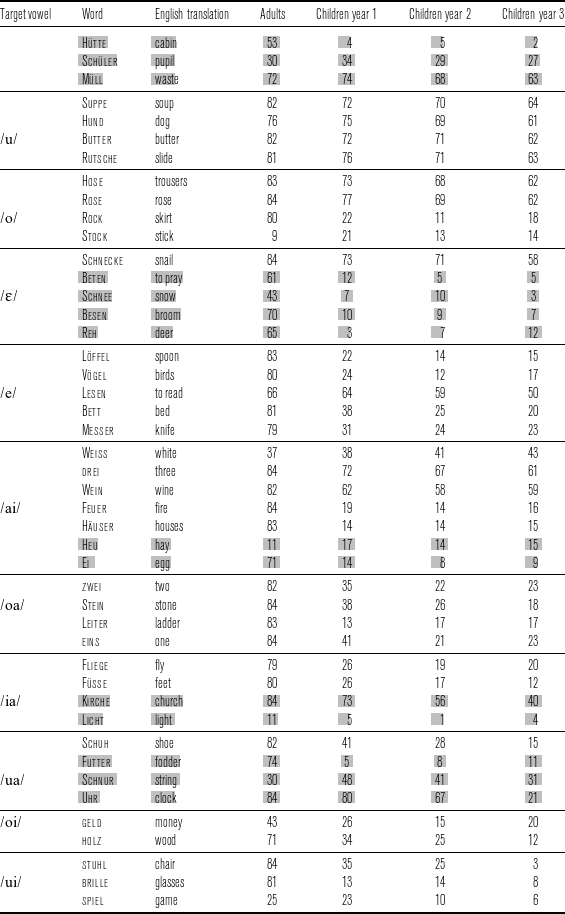
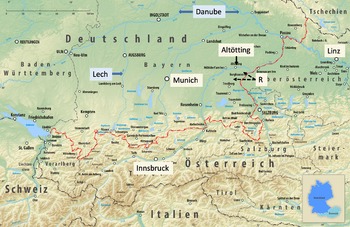

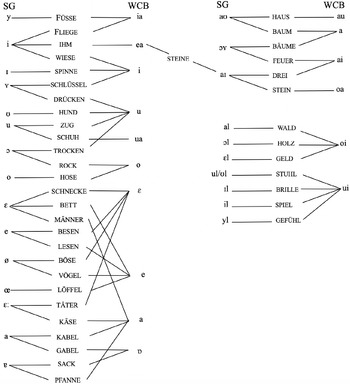
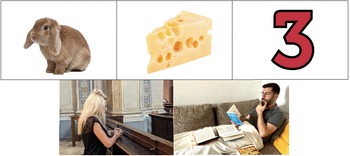
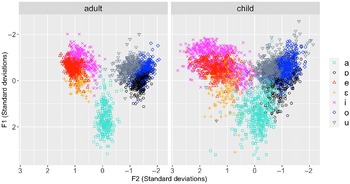


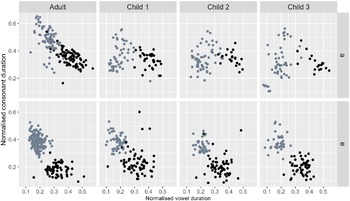


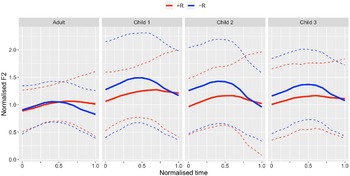


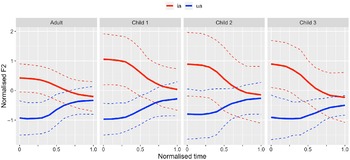


 Open access

