

Introduction
The extraordinary growth of the Chinese economy presented governments worldwide with the prospect of advancing their most important goals through cooperating with China’s rise, or having those goals frustrated or threatened by its expanding power. Even Brazil, the most powerful country in the Southern Hemisphere, and about as geographically distant from China as possible, has viewed China’s rise as a historic opportunity to profoundly reshape the future to its advantage.
The Sino-Brazilian relationship has indeed expanded remarkably over the past two decades. In 2017–2021, China received 26.82 per cent of Brazil’s exports, up from 6.2 per cent in 2002–2006. And China now provides 23.2 per cent of its imports, up from 4.4 per cent over the same period.Footnote 1 In terms of diplomacy, the two countries cooperate on the advancement of ‘multipolarisation’, raising the influence of the BRICS grouping and attempting to jointly constrain US financial and diplomatic power while removing constraints on their own.
However, the relationship has not in fact made Brazil more powerful in relative terms. The trade embrace of China has coincided with Brazil’s de-industrialisation, and its economic and technological level has fallen relative to both China and the United States. In terms of influence, while China has undoubtedly risen in global status, it is not at all clear that Brazil now has more diplomatic power relative to the US than it did before.
This article examines this puzzle. Brazil in large part embraced China in order to advance industrial and technological upgrading, increase autonomy, and raise national prestige and influence. And while progress towards those goals has been limited or even negative, the common perception remains both inside and outside the country that Brazil has risen along with China through their partnership, progressing towards becoming a pole in a multipolar world.
An appreciation of narratives provides some answers. Building on Rodrigues Vieira’s ‘embedded nationalism’ conceptualisation of Brazilian foreign policy,Footnote 2 and taking the embedded autonomy of Evans’ developmental states as a metaphor,Footnote 3 we argue in Brazil’s case there is a deep-rooted embedded-autonomy approach to international relations, through which Brazil seeks to change the international regime more than it is changed by it. Within this strategic narrative, the United States is conceptualised as the main obstacle to Brazil achieving its goals (not China or Brazil’s own shortcomings) and China as part of the solution. Accordingly, Brazil reached out in solidarity to China, expecting outsized gains in material and ontological security. This outsourcing of anti-dependency played a key role in Brazil’s accommodation of China’s preferences, locking in path dependency towards greater reliance on China.
The article begins by laying out this evolving embedded-autonomy narrative that Brazil brings to its foreign relationships. It then looks at the outcomes of Brazil’s economic and diplomatic interaction with China, noting that rather than receiving the techno-industrial sustained autonomy it sought, Brazil has experienced the opposite – a ‘neoliberal’ or even ‘neocolonial’ dependency. Further, the article examines how narrative-mediated goals and outcomes interacted within the Brazil–China relationship. It concludes with a discussion of Brazil’s outsourcing of anti-dependency, and its implications for Brazil’s future and for other developing countries attempting to increase their autonomy through reliance on China.
Theorising embedded autonomy towards the international level
In 1993, China and Brazil entered into a ‘strategic bilateral partnership’ that would evolve into a more global partnership, bound by ‘a critique of the international system as stacked against the developing world’, with both countries seeking rapid economic and technological development as an important means to international autonomy and ‘a seat at the table of the world’s major powers’.Footnote 4 Some 30 years later, however, only one is a major power transformed through rapid economic and technological development.
Making sense of this relational trajectory requires building on – and moving beyond – the current descriptive literature on Brazilian foreign policy. We need a way to frame and synthesise the dichotomies Saraiva identifies – change versus continuity, ideology versus pragmatism, institutionalist versus autonomist.Footnote 5 Moreover, Burges argues: ‘National development has generally remained the key foreign policy priority with a quest for autonomy and meaningful international insertion continuing to be the essential guiding principles underpinning diplomatic practice. Of course, what this means for each president is different.’Footnote 6 We need a way to structure the meaning for each president into an overarching meaning that underpins overall diplomatic practice. And crucially we need to bring China – a country powerful enough to turn Brazil’s ‘quest for autonomy’ into Brazil’s arrival at something more akin to the opposite – into the equation.
Recent work on the utilisation of strategic narratives to shape domestic and international responses can help us in this regard. Storytelling is how actors at different levels construct their identities and a shared understanding of international politics to shape the behaviour of others. It is through these narratives resonating with the target’s own narratives that political persuasion more readily occurs.
Noort and Colley provide a framework with which to explain the role of such narratives in policy change.Footnote 7 They posit, ‘A state is more likely to accept another state’s policy initiative if the former can project a strategic narrative aligning two elements: material interests and ontological security concerns.’Footnote 8 Target states will affiliate more fully with strategic narratives if they anticipate future economic benefits without undermining their identity. Within this framework, narratives are considered prior to both material and ontological interests.
Ontological security is the desire to maintain a consistent sense of self over time. It is narratively constituted and reconstituted through repetition. Hence states will resist either the projection or reception of strategic narratives incongruent with their ‘security of being’. To an important degree, then, the resonance of strategic narratives depends on their congruence with ‘deeply embedded storylines that shape what is seen as common sense in a particular culture’.Footnote 9
As such, it is not only the material benefits a state can offer in order to persuade that is bounded, but also the ontological security it can provide another. Strategic narratives necessarily target both domestic and international audiences simultaneously, implying a two-level persuasion game. Moreover, as ontological security is maintained continually through established norms and routine behaviours, actors will resist projecting strategic narratives that undermine their own sense of self even if more persuasive for the target. And as states are not only targets but purveyors, ontological security narratives are contested continually across and within states, with multiple interpretations of the past, present, and future of each nation and their relationship. Essentially, strategic narratives are thus a ‘win-win’ proposition, with an actor calling for the target to change policy in line with their identities and shared interests.
The target state’s decision makers must decide if the initiating state’s strategic narrative promises future economic and/or ontological security benefit. The domestic audience must then decide if the policymaker’s derived strategic narrative is convincing, and so on. With other relevant factors considered, a policy choice is made, justified by a strategic narrative about the future.
This capacity to narrate thus fluctuates along with expectations of the future. Noort and Colley see Italy shifting from perceiving a low ability to maintain ontological security through engaging with China’s BRI to a high ability in 2019. With Italy pulling out of the BRI in 2024, it has presumably now reverted to its earlier condition. Narratives of the future can be wrong for two main reasons: deception on the part of those projecting a strategic narrative, or cognitive and perceptual failures to understand the present and anticipate the future.
This is where an appreciation of international regimes – the social institutions around which actor expectations convergeFootnote 10 – is useful. Allen develops a framework where actors, in his case pre-World War II European fascists, reach out through solidarism to coordinate as an international society.Footnote 11 In ways both similar to and different from liberal international society, illiberal international society has tensions between the particular and the universal, and between pluralism and solidarity, resulting in a contested ‘diversity regime’ that may not maintain the solidarity necessary for sustainability.
Between Brazil and China there was and continues to be mutual expression of solidarism and an attempt to form an institutionalised coordination to achieve international effects beyond their dyad. To use Allen’s framing, Brazilian and Chinese proponents of an alternative internationalism profess a pan-China–Brazil ‘imaginary’, yet the particularities of each create tension.
Expressed differently, the confluence of expected material and ontological security gains catalyses their strategic dialogue, but that may not translate into a sustained ‘regime’ of results satisfying to one or both actors. This is particularly likely if one actor has more solidarism and idealism than the other, and if there is an asymmetry of knowledge about the other and what economic policy actions in the present will translate into gains in the future.
One wide-focus view of the transnational diversity regime and ontological security international society that embeds Brazil–China relations is Third-Worldism:
Third Worldism, situated between the empires of capitalism and communism, embodied the contradictions of the age: the universal institutionalisation of national sovereignty as the representation of independence of decolonized peoples, political confrontation with European racism, and a movement of quasi-nationalist elites whose legitimacy depended on negotiating their economic and political dependence.… [Today] the G20 is a group dependent on the support of large Third World governments (Brazil, India, China).Footnote 12
This diversity regime is indeed diverse, both vertically and horizontally. For example, Mohan described early 2010s India as wanting ‘to benefit from China’s economic growth but … deeply concerned about the country’s growing military might’, and with contradictory domestic narratives towards China and the United States.Footnote 13 China similarly has complex identities, some in contradiction (like ‘incipient great power’, ‘nativism’), some in confluence (like ‘developing state’, ‘anti-hegemonism’) with countries such as Brazil and India.Footnote 14
Our focus is Brazil, which according to Rodrigues Vieira approaches the world through an ‘embedded nationalism’ that ‘involves promoting development at home while reaffirming sovereignty abroad’Footnote 15 – a fair definition of Third-Worldism.
Rodrigues Vieira’s term borrows from Ruggie’s ‘embedded liberalism’ but is used in a very different way. Rodrigues Vieira suggests Lula is ‘reining in’ nationalism so that Brazil can embed in the international regime. In contrast, Ruggie’s term points to the embedding of liberalism (with its unfettering of the market) within social purposes, ‘reining in’ liberalism to create a durable domestic basis for a durable and beneficial international regime. As Ruggie saw it, the international liberal regime had become more embedded in the social purposes of domestic government at the core than at the periphery, to the detriment of developing countries’ welfare.Footnote 16 Hence, in Ruggian terms, Lula’s approach is embedded liberalism.
In order to orient our analysis in relation to current understanding of strategic narratives and regimes – and to distinguish it from Rodrigues Vieira’s embedded nationalism, which in his usage refers specifically to the current Lula administration with an unclear connection to earlier ones – we conceptualise Brazil’s approach as embedded autonomy. This purposively takes as a metaphor the embedded autonomy of Evans’ developmental states,Footnote 17 which transform the national economy through maintaining autonomy while embedding within it, much as Brazilian political authority seeks to change the international regime more than it is changed by it. And broadly analogous to how China has been a more effective developmental state than Brazil, China has been a more effective exponent of embedded autonomy at the international level, expanding its autonomy at Brazil’s expense.
It is also valuable to regain some of Ruggie’s specificity. Rodrigues Vieira focuses on ‘approaches’ towards domestic governance, economic development, and international diplomacy. Within his framework, the approaches of key individuals, Lula and Bolsonaro in particular, matter. So do the approaches of domestic groups and sectors, such as agribusiness, states such as China, or regions such as Europe. Ruggie’s framework identifies ‘ideology and doctrine’, and ‘ideology and institutional past’, connected to a social base as the causa causans, with ‘actors’ at different levels, both within and across states.Footnote 18 In this context, ideology is the ‘conceptual frame of reference which provides criteria for choice and decision by virtue of which the major activities of an organized community are governed’.Footnote 19 It is where narrative translates into collective action.
Brazil’s approach in this sense has deep roots, with former ambassador and influential scholar Gelson Fonseca Jr. highlighting the significant role of enduring ideas in shaping Brazil’s foreign policy.Footnote 20 Certain patterns of conduct have persisted across different governments, creating a high degree of continuity. According to Cervo, the predictability of Brazilian foreign policy can be attributed to conduct, concepts, values, and principles perpetuated across administrations.Footnote 21 The Ministry of Foreign Affairs, or Itamaraty, has played a pivotal role in this respect.
Brazil’s foreign policy is thus grounded in enduring patterns of conduct, or narratives, that serve as both a guide for decisions and a strategy for diplomacy. The sources of operational ideas for Brazil’s foreign policy extend beyond Itamaraty. They are rooted in the elite ideological currents of Brazil over more than a century. Brazil was part of ‘the urge to industrialize, rooted in the depression and war experiences of the thirties and forties, [which] seized all but the smallest and poorest Latin American countries during the fifties and sixties’.Footnote 22 As Brazil embraced openness and explored various policy options ranging from interdependence to autonomy, its nationalist commitment to development and industrialisation – coupled with a quest for international status – motivated groups such as intellectuals and military officers.Footnote 23
Adler describes this emergent ideology as a pragmatic egalitarian nationalist anti-dependency. It mixed a nationalist rejection of internationalism – in both its liberal and Marxist forms – with Marxist beliefs about equality. This narrative-contained ideology perceives a nation’s imperfections and inequalities as largely due to international factors: ‘Interdependence thus not only constitutes a roadblock to progress for the nation as a whole but also is the cause of inequalities both among and within nations’.Footnote 24 Within this conceptualisation, development is an adaptable process that increases power and economic growth in the face of such international factors – that is, an embedded autonomy.
Adler emphasises that ‘self-reliance does not necessarily mean stopping growth. On the contrary, it means growth – once pride has been regained and some inequalities are redressed’.Footnote 25 It is a self-reliant development that leads to an autonomous techno-scientific base. This autonomy is intrinsically valued for reasons of pride, but also because without it, there could be no development within an exploitative international context.
Intellectuals perceive dependence as coercive because it offends their national pride as well as their humanistic, idealistic, and egalitarian values. Yet foreign involvement provides resources essential for development. Pragmatism offers the flexibility to form strategic partnerships with the foreign to achieve autonomy and, consequently, development. Therefore, embedded-autonomy egalitarians are pragmatic; they do not aim to eliminate foreign investors and foreign technology but are emphatic about securing favourable terms and look forward to the day when their country no longer needs foreign assistance.Footnote 26
Due to the debt and inflation problems of the 1980s and 1990s, Brazil tilted somewhat towards its own evolving conception of laissez-faire or neoliberalism.Footnote 27 Brazil joined programs of ‘neoliberal reform’ that oriented towards dismantling state-directed development, integrating domestic economies into global markets, and giving the market primacy in determining the allocation of resources.Footnote 28 However, this ‘neoliberal’ tilt should not be overstated.Footnote 29
Despite the stabilisation programs and structural reforms in the late 1980s and early 1990s, Latin American countries did not see rapid convergence in productivity and growth rates with developed countries. As a result, they largely exported only what they were able to produce, often a limited range of commodities.
International politics was also changing. Towards the end of the Cardoso government, contradictions emerged in the US regarding multilateralism versus unilateralism, and security versus development and trade as it launched the War on Terror.
This frustrated environment set the stage for China to salientise as a solution to develop while at the same time increasing autonomy from the United States. Under Cardoso, Brazil sought ‘other partners more in tune with the country’s agenda [among] developing countries such as China, Russia, India, and South Africa’, where ‘growth rates were taking off’. Under the first Lula administration from 2003, Brazil would continue the effort to engage with international institutions to ‘counterpose’ the US without ‘rupture’ while ‘diversifying’ its bilateral relationships to prioritise China.Footnote 30
These shifts were narrative-mediated – what Vigevani and Cepaluni called ‘embedded in the Brazilian diplomatic tradition’.Footnote 31 Naseemullah is therefore mistaken to think, ‘In the world after SDD [state-directed development] … “national development” loses much of its meaning, given that development has lost much of its nationalist impulses’.Footnote 32 Rather, autonomy is seen as a means of developing Brazil. Economic growth brings more room to manoeuvre at the international level. Therefore, the goals of embedded autonomy continued as a constant in Brazilian foreign policy.Footnote 33
The assumption was that solidarity with countries like China would increase autonomy rather than decrease it, whereas closer ties with the United States might have the opposite effect:
The relaunch of the strategic relationship in 2004 demonstrated not only an economic rapprochement, but also a strong political harmony between the two countries. Under Lula’s presidency, Brazil projected itself as an emerging power, demanding a more active role in international society … to become a global player. In this vein, China was strategic for Brazilian foreign policy, not only due to the increase in trade and investment flows, but also for being an ally in the request for revision of global international organizations and in terms of the demand for greater shares of power.Footnote 34
There was also an expectation that China shared Brazil’s intention to increase Brazilian participation and leadership in international organisations.Footnote 35 Any loss of autonomy to China, already expected to be small, would presumably be offset by the overall gains. As the following section shows, this expectation of ontological security was not borne out.
China’s impact on Brazil
The China–Brazil international regime transformed Brazil in important ways, some more positive than others. Notably, China’s economic growth increased Brazil’s gross domestic product (GDP), chiefly through demand for Brazilian primary industry exports (see Figure 1). For the 2004–13 period, Vianna estimates that a 1 per cent increase in exports to China for Argentina, Brazil, Chile, Colombia, Mexico, Peru, and Venezuela increased GDP by nearly 0.02 per cent, with the cumulative impact estimated at 5.4 per cent. The number for Brazil was presumably somewhat higher given its large share of the region’s China exports. Murakami and Hernandez compare a counterfactual scenario where the export volumes from Brazil to all trading partners, including China, had grown at the same volumes as the previous 10 years, estimating that China contributed 0.57 per cent of the 1.9 per cent of additional annual growth from 2001 to 2008.Footnote 36
Brazil’s merchandise exports to China by product category (1995–2023). Data from the UNCTAD Merchandise Trade Matrix, in thousands of US dollars at current prices. Last updated 21 October 2024. Source: https://unctadstat.Unctad.Org/datacentre/dataviewer/US.TradeMatrix.

Brazil’s GDP also benefited from Chinese financing and investment. Between 2005 and 2019, Brazil received US$28.9 billion in loans from the China Development Bank (CDB) and EXIM Bank, 21.08 per cent of the regional total.Footnote 37 Most loans have gone to the oil industry.Footnote 38 Chinese financed infrastructure projects were more limited than Brazil had hoped,Footnote 39 with Brazil and other Latin American governments finding it challenging to generate ‘project proposals that match China’s interests’.Footnote 40 Between 2007 and 2018, Brazil received almost half of Chinese investment in the region, with a cumulative stock of about US$61 billion as of 2020.Footnote 41 According to Jenkins, ‘China’s share of FDI in Brazil is still very low.… Chinese FDI has tended to reinforce Brazil’s dependence on primary commodities and has done little to counter the trend of deindustrialization’.Footnote 42
The trade and industrial structure this economic relationship entailed – concentration in primary products and de-concentration in manufacturing and technology – likely increased Brazil’s GDP. China expanded aggregate demand in primary products such as oil, copper, iron, soy, and meat, where Brazil had revealed comparative advantage relative to China and its industrial policy, bringing economies of scale and productivity gains as it intensified ‘the primary exporting character of South American countries’.Footnote 43 However, it is important to note that Brazil’s share of Chinese ore imports actually shrunk during the commodity boom,Footnote 44 meaning it captured less of those available benefits than some other mineral exporters.
Within the preference hierarchy of embedded autonomy, more absolute GDP growth is presumably better than less. However, far more important is relative growth on account of its relevance to status and power. Here Brazil lost ground to the US and especially China (see Figure 2).
GDP per capita (PPP) for Brazil, China, United States (constant 2021 international dollars). Source: World Bank, https://data.worldbank.org/indicator/NY.GDP.PCAP.PP.KD?locations = BR-CN-US.

The implications for Brazil’s long-term GDP per capita of the techno-economic-power structure between Brazil and China will depend on the weight given to structural dependency theories.Footnote 45 For example, Murakami and Hernández note dependency on primary commodity exports can harm economic growth through a long-term worsening of the terms of trade.Footnote 46 Franke and colleagues worry that a concentration on ‘primary products tends to reinforce specialization in the export commodities in Latin America, and they do not have the dynamic effects triggered by industrial development’.Footnote 47 Others such as Lo argue for a China-dependency exception due its anti-neoliberalism.Footnote 48 However, what is currently clear is that within the embedded-autonomy framework, Brazil has moved in the wrong direction relative to not only China but also the United States.
Brazil has undergone de-industrialisation, likely in part due to China’s transformation of Brazil’s economy into one more focused on primary industry, as well as competition with Brazil’s manufactures in third markets.Footnote 49 Soybeans, petroleum, and iron ore now comprise more than four-fifths of Brazil’s total exports, with China by far the most important market for these products. Total soybean production crushed domestically fell from 95 per cent in 1995 to less than 50 per cent.Footnote 50 Industry fell from 25.6 per cent of Brazilian GDP in 2000 to 20.8 per cent in 2022, and its trade surplus in manufactured goods turned to a deficit.Footnote 51 Moreover, the neighbouring ‘countries that were supposed to be Brazil’s natural partners ended up being China’s’, as China consolidated itself as the region’s main trading partner.Footnote 52 The correlated de-industrialisation trends are greater than those in the US relative to China (see Figure 3).
Manufacturing value added in share of total GDP, Brazil, China, and the United States. Source: UNIDO, https://stat.unido.org/data.

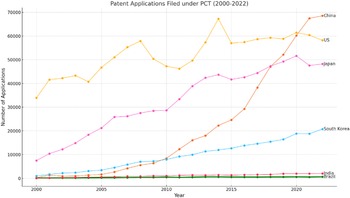
The situation with technology is similar, albeit with less potential role for China as a cause. Brazil’s stock of technology has no doubt increased, including in areas of cooperation such as satellites. However, it has lost ground relative to the United States, and even more dramatically, to China. While they likely overstate considerably China’s technological capacity relative to the US, Patent Cooperation Treaty applications remain a ‘leading indicator of emerging technological prowess [to] indicate a global shift from the West to the East’.Footnote 53 As shown in Figure 4, Brazil’s applications have barely changed. On the other hand, while the US has continued to increase, China has risen from a rate comparable to Brazil’s to be the largest in the world. In the Economic Complexity Rankings, Brazil fell from 26th in 2000 to 53rd in 2019, while China went from China’s 39th to 16th.Footnote 54
Patent Cooperation Treaty applications, by region, country, or economy, 2000–2022. Source: https://ncses.nsf.gov/pubs/nsb20241/data/table/SINV-11.

Why Brazil fell behind is beyond the scope of this article, but the relationship with China was clearly not structured to raise Brazil’s relative technology level. Transfers through investment in the energy and mining sectors were limited. In the industrial sector, China’s investment has ‘tended to be market-seeking and mainly in assembly activities means that it has not involved advanced technology or extensive R&D’. Looking towards the future, ‘given the low level of integration of Latin American producers into Chinese value chains, it is unlikely that this would have been a significant source of technological upgrading for the region’.Footnote 55
The positive egalitarian benefits to Brazil beyond the increase in GDP and tax receipts were likely small, as were the benefits due to Lula being president rather than someone from the right. Flechtner and Middelanis found a left-wing government was neither a necessary nor sufficient factor for a positive relationship between commodity terms of trade and social spending among South American countries that experienced a commodity price boom. For Brazil specifically, they found a small and short increase in spending per capita in education and health spending during the commodity price boom, which then returned to previous levels. There was no impact in terms of social spending as a percentage of overall GDP. There was no statistically significant response in terms of social protection.Footnote 56
In addition, benefits through taxation were reduced by industry action. The agricultural lobby blocked proposals to tax exports. Mining royalty rates are low, with no taxes on exports of iron ore.Footnote 57
Much harder to quantify than China’s impact on the economy is its impact on Brazil’s diplomacy. A common perception is that Brazil has risen in influence along with China. For example, according to Chivvis and Geaghan-Breinerstate, ‘Brazil is moving up the ranks of the global system, with the objective of taking on a greater role in geopolitical agenda-setting. It sees China’s rise as helpful for this objective’.Footnote 58 Brazilians and others perceived that being a strategic partner of China allowed an increase in bargaining power in multilateral forums and an expansion of the spaces occupied by Brazil in international affairs.Footnote 59 The best evidence for this is that Brazil is in diplomatic positions it would not have been in without China, BRICS, and G20 in particular. However, China is clearly the more influential actor within those shared groupings. Moreover, China is in influential forums and groupings that Brazil is not more than the reverse, most notably the UNSC. In an article titled ‘The rise and decline of Brazil as a regional power (2003–2016)’, Bernal-Meza argues:
Internationally, the intra-BRICS reproduction of a core-periphery relationship and the disappointment of not having attained a peer relationship with China, along with the fact that Beijing did not incorporate it into its global policy, weakened Brazil’s presence in BRICS and its North-South relationship with China. This affected its capabilities as an emerging power and its potential role as leader of the Second World in the new world order.Footnote 60
Regionally, while Brazil remains the most powerful state in the region, it has lost regional influence relative to China and the ability to shape the direction of regionalism.
From an embedded-autonomy perspective, that China has risen relatively higher than Brazil matters less than Brazil rising relative to the United States. Here, arguably, BRICS and G20 close some of the influence gap. However, even as Brazil has added new forums and new influence, so too has Washington. For example, the Quad and the addition of new members to NATO have all raised US influence. Thanks to China, Brazil has gained a more prominent voice on peace in Ukraine. However, at the same time, the US voice on Ukraine has never been more influential. Regionally, there is no reason to believe that Brazil increased its influence relative to the US even as China has gained ground at both of their expenses. At best then, Brazil’s influence relative to the US appears rather flat, even as China’s power relative to the US has increased considerably.
The situation inside Brazil is comparable. China has become much more influential over Brazilian affairs, and Brazil’s autonomy relative to China has decreased. For example, according to Becard, Lessa, and Silveira, ‘Chinese investments in the Brazilian electric power market are a key component in the process of China’s growing influence over the economy and politics of its main partner in Latin America’.Footnote 61 US influence in Brazil arguably has fallen, and Brazil’s autonomy relative to the US has increased. However, there are no grounds to believe that Brazil’s autonomy has risen on net.
The information in this section raises the puzzle that if embedded autonomy is so important, why has Brazil not merely failed to achieve its goals but regressed relative to them? Perhaps they were never Brazil’s goals in the first place? However, examining how these goals failed, as we do next, suggests this was not the case.
The (strategic) narrative arc of Brazil’s China story
Lula’s hegemonic narrative frame
While the narrative content has deep and wide roots, Brazil’s response to the rise of China crystallised into a specific programmatic approach under the presidency of Lula. He made developing relations with China a key part of Brazil’s policy in an unprecedented way.Footnote 62 In line with his leftward oriented ontological security, and with a narrative-mediated perception of the US and its past support for Brazil’s military dictatorship, Lula would push to continue the tilt away from what Brazilians conceptualised as neoliberalism and the American imposed ‘Washington Consensus’ towards a new recapitulation of embedded autonomy. On account of his exceptional political abilities and personal charisma, and the deus ex machina of a rising China and the George W. Bush administration taking the United States in a foreign policy direction many in Brazil and elsewhere did not want to follow, Lula’s approach would set the stage for subsequent decades.
The attraction of China for the Brazilian left was of course not new. China now appeared again as an ally to Brazilians such as Lula due to its rapid rise. Unlike Brazil, China’s version of embedded autonomy had been remarkably successful. Its success in government-led innovation, technology, and export competitiveness in manufactures gave renewed impetus for Brazil to push back on ‘neoliberalism’ and (with China’s help) renew its push towards development and autonomy.
The rise of China thus reduced the neoliberal pressure on Brazil to moderate its traditional ideology, creating space for ‘new varieties of capitalism’.Footnote 63 Rather than re-forming Brazilian institutions more in the direction of the Washington Consensus, Brazil could focus on re-forming the US-dominated global structure, which seen through the prism of embedded autonomy was believed to be holding Brazil back and down in both economic and ontological security terms.
Brazil and China continued to identify each other as sharing a common cause of international regime change, even after their fundamentally different trajectories within the global power dynamic became apparent. In 2002, Chinese leader Jiang Zemin indicated that the ‘old international political and economic order … is unfair and has to be changed fundamentally’.Footnote 64 A 2004 speech made by Lula in Shanghai shows his solidarity with China:
We are both great countries that are in a process of development, seeking to integrate ourselves into international trade and investment currents without giving up our autonomy and power of decision. This is why our strategic alliance is so important – not only to intensify our reciprocal relationship, but also to change unfair rules that currently hold sway over international trade.Footnote 65
When Chinese leader Hu Jintao reciprocated the visit later that year, Lula stated:
The strategic Sino-Brazilian alliance is based on the belief that we have interests in common in our search for a multi-polar and pluralistic world.… We want to build a world structure that favors understanding, social justice and respect between societies. China and Brazil maintain a model of horizontal cooperation within an international system marked by inequality. This relation gives us the legitimacy to jointly promote an international agenda that favors the equitable distribution of power and of resources in the international scene. Only thus will the social and economic development of our people be ensured.Footnote 66
This conception of Brazil and China and the future international regime they sought to jointly build stood in contrast to the US, which by implication embodied the opposite. Encapsulating this Brazilian conceptualisation of China, Cervo described Brazil and China as convergent nations seeking national development and an autonomous international integration.Footnote 67
According to Becard, Lula maintained consistent objectives across his two terms,Footnote 68 predicated on China being a partner in achieving his goals:
1. Increase Brazilian exports through the opening of new markets to China.
2. Attract direct and indirect investments from China.
3. Expand Brazilian business in China, including through direct investments.
4. Exchange information in the fields of science and technology.
5. Use the partnership as a way to reduce the dependency on traditional partners.
6. Increase Brazil’s bargaining power in multilateral forums.
Lula continued Brazil’s traditional conceptualisation of the US as Brazil’s biggest foreign problem, integrating China into this worldview as the biggest solution. Importantly, China presented an opportunity to increase anti-dependency and national prestige vis-à-vis the US without a damaging and unpragmatic confrontation with Washington in the manner of regimes like Venezuela or Cuba, and without sacrificing GDP growth. According to Bernal-Meza, ‘Brazil was the only country in the region that shared China’s aspiration to reformulate the global order and sought to participate with it in global alliances, but it was not the only nation with a counterhegemonic strategy as part of a larger international goal; Venezuela and Cuba were others.’Footnote 69
Brazilian experts widely perceived Brazil joining in the BRICS collaboration as the country finding a distinctive place in the international system, enhancing its regional leadership aspirations and taking its place on the world stage, with Beijing ‘seen as its most important global partner’ in achieving this.Footnote 70 This search for autonomy and leadership through strategic solidarity with others aspiring to the same goal resonated with long-standing Brazilian narratives pervasive through Itamaraty and elsewhere.
As detailed in the previous section, China would not follow that narrative script. Less than two years into Lula’s approach, The Economist magazine reported, ‘Euphoria has already given way to a rising fear of Chinese imports, disappointment at the pace of investment and Brazilian anger that their government has weakened the country’s trade defences without getting much in return.’Footnote 71
In addition, Itamaraty quickly grew frustrated that ‘China kept Brazil as a partner in South-South cooperation but did not associate it with the major issues of world politics and did not support Brazil’s demand to join the Security Council’ and ‘frustration with regard to China and the questioning of BRICS’ grew.Footnote 72 Lula was criticised internally for having a ‘diplomatic illusion’ regarding China.Footnote 73
Nevertheless, Lula’s laying down the infrastructure of the relationship in the expectation of partnership – routinised inter-governmental interactions including high-level visits, numerous agreements and collaborations, and so on – created a sense of expected future narrative continuity and material gain, irrespective of the underlying reality. After all, ‘even when the strategies are actually implemented, they require some time to have a direct impact on the country’s foreign policy’.Footnote 74
Moreover, the benefits Brazil received from China’s booming economy in the form of increased GDP and tax receipts due to surging demand for Brazilian commodities and Chinese investment and loans, as well as initiatives such as BRICS and the continuation of the China–Brazil Earth Resources Satellite collaboration,Footnote 75 created a sense that this budding partnership was progressing Brazil in the direction of embedded autonomy. Interest groups coalesced around each contact point with China and the partnership in general. Hence, ‘Paradoxically, during the period when Brazil was most interested in BRICS and China (under Lula’s governments) the core-to-periphery relationship deepened’.Footnote 76
There are two main ironies to Lula’s embrace of China. The first is that despite China and Brazil’s narrative positioning of the US as antagonistic, US–China cooperation was the central driver of the dynamic Brazil had embedded into. China could only use Brazilian raw material inputs to (industrially) produce more than it consumed because the US was willing to consume more than it produced. And diplomatic spaces such as G20 could only open up because it was a social institution around which the expectations of the de facto ‘G2’ (i.e. the U.S. and China) converged.
The second is that the Chinese side asserted autonomous anti-dependency nationalism while Brazil, with varying degrees of reluctance, conformed to China’s goals. As Jenkins noted, ‘it is not the case that negative (“resource curse”) outcomes have been inevitable. Whether or not they occur depends on the policies both of Latin American governments and of China’. Beijing’s policy, for example, was to use various mechanisms to ‘ensure that downstream processing of resources takes place in China’,Footnote 77 and Brazil’s policy was to acquiesce. Despite China not being a market economy, it secured Brazil’s endorsement of its ‘market economy status’ even as it effectively blocked Brazil’s bid for permanent representation on the UNSC.Footnote 78 Despite Chinese goods being viewed as a threat by some industrial sectors and the Brazilian government starting to develop defensive trade policies from as early as 2004,Footnote 79 the Lula administration encouraged Brazil to adjust to this dynamic, essentially allowing external forces – in what could be described as a neoliberal way – to reshape Brazil’s economy in a way that reduced its autonomy. It responded to concerns through appealing to Beijing’s solidarity, seeking cooperative solutions in discussions and agreements.Footnote 80 However, the structure that took shape was ‘perpetuating the classical centre-periphery scenario’,Footnote 81 with the main economic beneficiaries a relatively small group of global and Brazilian agribusiness and mining companies.Footnote 82
In sum, Lula and China’s leaders had manifested an impressive joint story, but whether that would translate into a sustained regime of results satisfying to Brazil and key institutional actors like Itamaraty was already in doubt. Rather than knowledge of Chinese realities, Lula’s enthusiasm had more to do with his solidarism and idealism, and projection of future material and narrative continuity gains. Lula’s Minister of Foreign Affairs Celso Amorin lamented in 2010, ‘We have not developed a full concept of what our relationship with China will be like. This is self-criticism. There wasn’t time. We need to think more deeply about this’.Footnote 83
From personalisation to institutionalisation, from resistance to resignation
With the transition from Lula to Rousseff, there was growing and wider recognition that China was receiving a greater share than Brazil of the ontological security benefits that the bilateral regime produced.Footnote 84 However, Brazil was plausibly making progress towards autonomy vis-à-vis the US due to the elevation of Brazil’s stature through its partnership with China. Moreover, the general GDP growth benefit of the ‘core-periphery’ economic relationship, inertia, and vested interests meant there was no impetus for a fundamental re-conceptualisation of the relationship. In addition, Rousseff was aligned with Lula politically and did not seek to reorientate Brazilian policy away from the direction he had set.Footnote 85 Accordingly, there was not a major change in foreign policy, and overall, the Rousseff administration and the broader bureaucracy including Itamaraty consolidated the initiatives taken under Lula.
Amorim and Ferreira-Pereira refer to this doubling down as ‘institutionalisation’.Footnote 86 The Rousseff administration’s approach took the form of a strategic narrative urging China to adjust the relationship in Brazil’s preferred direction out of solidarity. In April 2011 during her first visit to China, Rousseff conveyed the message that the partnership should deliver more embedded-autonomy benefits to Brazil in line with ‘a very fraternal’ solidarity.Footnote 87 According to Sousa, the speech signalled Brazil would become stricter during bilateral negotiations.Footnote 88 During the visit Rousseff also made it clear to the Chinese government the need for commercial relations to go beyond complementarity and become more reciprocal.Footnote 89
The firm aspect of the Rousseff administration’s reactive approach culminated in the first ever anti-dumping case. Brazil considered the World Trade Organization (WTO), like the United Nations (UN), as an important means to enhance Brazil’s power through embeddation.Footnote 90 Brazil became the second most active in the WTO at opening anti-dumping investigations, most frequently targeting China.Footnote 91 There was also an assumption that as a like-minded country, China would respect Brazil’s recourse to the WTO as adjudicator. In other words, Brazil had the tools to manage the relationship with China in its preferred direction while maintaining friendly ties.
The reality was that Beijing had no intention of letting Brazil use the WTO as a constraint on its autonomy. As it has done in many other cases, Beijing brought countervailing pressure against a politically salient sector not of strategic importance: meat exports. On the pretext of disease it banned imports.Footnote 92
As the prospect of straightforward economic benefits and narrative continuity evaporated, the Rousseff administration was left with its ongoing efforts to increase cooperation to manage de-industrialisation pressure.Footnote 93 Such ‘institutionalisation’ was also seen as the way to encourage China to more help raise Brazil’s international stature and power. Accordingly, in the words of Chinese state media, in 2012 ‘Brazil became the first major Latin American country to elevate bilateral relations with China to a comprehensive strategic partnership’.Footnote 94 The joint statement ‘reiterated their commitment to promoting a qualitative leap in Sino-Brazilian relations’.Footnote 95
A key example of such ‘intensification’ was the establishment of the New Development Bank, of which Rousseff is currently the head. In essence, the bank draws on China’s heft to raise the profile of the other members, including Brazil. Also, in theory, it increases Brazil’s say over the allocation of the capital resources of others, China’s in particular. If Brazil could convince China to funnel more of its resources through, it would raise Brazil’s power relative to Washington Consensus organisations and reduce the growing gap between Brazil and China. In the end, China contributed limited resources to it, and it remained a minor channel for its loans.
Another effort to draw on China’s resources through cooperation to increase anti-dependency was the Contingent Reserve Arrangement (CRA). Here again there was negligible progress, not least of all because China’s industrial policy prevents it from adopting the open capital account necessary to replace the dollar.
As noted in the previous section, de-industrialisation continued through Rousseff’s administration. China’s ambassador to Brazil rejected any implication of Chinese responsibility for the situation, instead blaming Brazil’s deficiencies: ‘If not for these [primary] products, what others could Brazil offer to China to keep the same level of commerce between the countries?’ (author translation).Footnote 96 Some Brazilians shared this view that the fault lay more on the Brazilian side. At the same time, Chinese support propped up inefficient yet politically influential operators in the natural resources sector, such as extending large loans to Petrobras following a major scandal.Footnote 97
Brazil and China had become connected through a partnership with multiple dimensions. These links and the carrots that came with them could also become the means to control and shape Brazil’s actions.Footnote 98
Tellingly, Rousseff’s 2016 replacement with her vice-president, Michael Temer, following her impeachment had little appreciable impact on the trajectory of the relationship despite Temer’s being considerably more to the (neoliberal as opposed to populist) right. This indicates the endurance of the China–Brazil regime that had developed under Lula and the institutionalisation through key bureaucratic actors such as Itamaraty, as well as its essentially neoliberalesque accommodation of the market forces created by China’s decidedly non-neoliberal industrial policy.
In the context of China, Temer’s rightward lean – and ‘centre-right neoliberal coalition’ base – translated into ‘pragmatically’ encouraging China to partner in the privatisation of state-owned assets.Footnote 99 However, overall, meetings with the Chinese side in the context of G20 and BRICS continued much as they had. Temer continued to seek Chinese investment, loans, and strategic cooperation between Petrobras and the CDB.
Temer’s more neoliberal view meant he did not focus on China’s industrial policy as a problem for Brazil even in the restrained way that Rousseff had. Unsurprisingly, dependency on China continued to rise along with Brazilian concerns about it.Footnote 100
Reaffirming sovereignty amid ‘great changes unseen in a century’
Rodrigues Vieira’s embedded nationalism, it will be recalled, ‘involves promoting development at home while reaffirming sovereignty abroad’.Footnote 101 Temer’s successor, Jair Bolsonaro, represented the most serious challenge to the prevailing consensus on Brazil–China solidarity through casting China as the foreign sovereignty threat within that narrative. This can be understood as what Noort and Colley describe as the multiple interpretations of past, present, and future, even as dominant narratives emerge, with foreign policies being easier to justify with reference to ontological security when they resonate with long-established routines.Footnote 102
Bolsonaro’s ideology was on the right in a way comparable to Temer in favouring privatisation and market competition, and in not prioritising egalitarianism. But he was also a populist nationalist with similarities to US president Trump,Footnote 103 representing both a continuation and evolution of Brazil’s nationalist-populist tradition. However, unlike Lula and Rousseff, his impulse was to raise Brazil’s status and autonomy relative to China, not the United States. And where Lula and Rousseff idealised China as a partner, Bolsonaro mirrored that in idealising a partnership with the United States.
In practice, Bolsonaro’s approach was more erratic and incoherent than directionally anti-China. He signalled pulling out of BRICS and into the OECD, neither of which happened. He criticised China as ‘attempting to buy Brazil’, and his anti-China rhetoric, as well as that of his son, created serious friction with Beijing. However, he sought to attract more investments and enhance trade deals, as his predecessors had done.
To a considerable extent, this can be attributed to the institutionalisation that had occurred, and the vested interests and interest groups that had consolidated around continuing the status quo. Itamaraty, for example, played a crucial role in preventing an estrangement with China, ‘working to mitigate the impacts and attenuate the effects’.Footnote 104
However, even more decisive was the powerful pro-China lobby that had been created among agribusiness and local governments.Footnote 105 For example, the president of the Confederation of Agriculture and Livestock of Brazil criticised Bolsonaro’s policy: ‘Brazilian foreign policy has always been aligned with our economic interests. By changing this tradition, the current policy puts hard-won positions by the private sector at risk, in exchange for nothing.’Footnote 106
So while Jenkins is correct that ‘China and Brazil do share certain common interests … both advocate a move towards a multipolar world’Footnote 107 (with economic ties a consequence of political closeness, not a cause), it is also important to note that those resultant economic ties – and their associated socio-material base – then clearly reinforced that political closeness.
Bolsonaro thus moderated his opposition to China, pursing cooperation not very different in practice to his predecessors. On his first visit to China in October 2019, he stated that ‘a considerable part of Brazil needs China, and China also needs Brazil’ and that he would want to ‘share with China the opportunities Brazil can offer’. During the visit, Bolsonaro even described himself as being in a ‘capitalist country’, rhetorically reducing the ideological distance between the Brazilian right and Beijing.Footnote 108
Bolsonaro lacked deep roots in Brazil’s establishment or party system, and his presidency did little to change the trajectory of Brazil–China relations. As Trinkunasput it, ‘Brazil trades twice as much with China as with the United States, a trend accentuated by recent US–China trade disputes. The rise of China as a counterweight for US hegemony will remain appealing in the long-term for Brazilian officials and foreign policy analysts who seek to maximize their country’s strategic autonomy internationally.’Footnote 109 Sure enough, following his re-election, Lula would continue to push for that strategic partnership with China against US hegemony as the solution to Brazil’s problems.
Lula’s re-election win was seen as part of a ‘new pink tide’ in the region, pulling China even closer. Rhetorically, Lula emphasised the framing of relations with China as an assertion of autonomy vis-à-vis the United States. In February 2023, he stated that Brazil wanted ‘splendid’ relations with both Beijing and Washington, rejecting a binary choice. He would later also say: ‘We want our economy to be stronger than ever, so we need to find partners. Do not think that I want to pick a fight with the U.S. On the contrary, I want the U.S. on our side as much as I want China.’Footnote 110 However, he oriented toward reducing Washington’s relative influence, committing to work in solidarity with China to ‘balance world geopolitics’. He would state, ‘Our intentions with China are not just commercial.… We have political interest, and we have a common interest in building a new geopolitics to change the global governance, giving more representativity to the United Nations’.Footnote 111
Lula also lined up with China against the US over the dollar, Ukraine, and other issues. He made a point of continuing to expand technological cooperation with China in areas considered a security risk by the US, such as with Huawei in the country’s 5 G network. Touring a Huawei research facility, he stated that Brazil has ‘no prejudice with the Chinese’. And when asked about US concern over such Brazilian cooperation, his foreign policy adviser proclaimed Brazil is ‘not afraid of the big bad wolf’.Footnote 112
At the same time, Brazilian concerns about China that had emerged to the forefront with Bolsonaro were still there, perhaps even stronger.Footnote 113 And it was now readily apparent that the resonance of the institutionalised story and its promise of economic gains and ontological security through cooperative regime-building with China varied considerably according to sector and substate actor. In October 2024, the Executive Committee of the Foreign Trade Chamber, composed of ministerial advisers appointed by the presidency, imposed additional tariffs on Chinese products, including a 35 and 25 per cent increase on fibre optics and steel, respectively. In this way, Brazil seeks to reconcile a response to domestic pressure to protect vulnerable sectors and reverse de-industrialisation with its international agenda and focus on maintaining good relations with Beijing. According to Maurício Santoro,
the national debate is very agitated; it is not possible to be more moderate and try to establish a conversation between the left and right-wing. The relationship with China becomes a dispute of identity, some believe that Brazil’s place is in the Global South against the North, while others believe that it’s up to Brazil to establish a connection with the West.… Previously, when Lula made a decision, it would happen, but nowadays that’s no longer the case.Footnote 114
In line with narrative continuity, Lula’s approach has been to lean further into solidarist cooperation to resolve the shortcomings in cooperation, seeing China as a partner in a new industrialisation.Footnote 115 He has sought industrialisation and technological upgrading through China’s assistance in financing, as well as Chinese expertise and investment in green technologies, electric vehicles, and other high-tech sectors. One of many sticking points will be that local companies dominate Brazil’s construction industry, with Chinese involvement relatively limited.Footnote 116 Although it is still early, there is little reason to think Lula will resolve the now long-standing economic contradictions between Brazil and China.
The situation in terms of Brazil’s status and influence is similarly pessimistic. China continues to press ahead in diluting BRICS with additional members, and in giving the grouping a greater anti-US orientation, both of which diminish the benefit BRICS brings to Brazil’s influence. Lula was also not able to leverage the NDB for his foreign policy. As Argentina’s economic crisis worsened in the spring of 2023, Lula suggested that the bank provide loans, while saying that the International Monetary Fund (IMF) should ‘remove its knife from Argentina’s neck’.Footnote 117 In the end, the loans were not forthcoming, and Argentina would go on to elect an ideological opponent of Lula.
China’s role in Lula’s narrative has changed somewhat, even as the overall narrative has stayed much the same. In a February 2025 interview, Lula said:
What did the Chinese do? They copied. Yes, they copied. Unlike us in Brazil, who respect patent laws, they copied everything. They copied, improved, and sent many people abroad to study. What happened? China now has more technological capability than other countries. In other words, capitalism tried to exploit an almost slave-like workforce, and the Chinese turned the tables. They learned more than the others and now teach the world many things.Footnote 118
Here, Lula excuses Brazil’s (and his) failure to develop as rapidly as China by way of its virtues, while also celebrating Beijing’s triumph over the West.
As such, Lula’s approach remains one of embedded autonomy. In terms of the agreement between Mercosur and the European Union, he evidently relished the ontological security afforded by the prospect of subverting developed major power France’s autonomy in the interest of Brazil’s: ‘If the French don’t want the agreement, they don’t get to blow the final whistle – the European Commission will blow that whistle. Ursula von der Leyen has the power to make the agreement happen.’Footnote 119
US president Trump’s extraordinary conflict with Lula has resonated powerfully with Brazil’s embedded-autonomy framework, in which the US is conceptualised as the main obstacle to Brazil’s success and China a main solution. Trump surprised observers by applying harsh coercive measures to push Brazil to drop what he described as the ‘witch hunt’ against Bolsonaro. Estado de São Paulo columnist Eliane Cantanhêde ‘saw three motives behind Trump’s “indecent proposal”. He hoped to boost far-right fellow travellers in South America; retaliate against Chinese involvement in the region after the recent Brics summit in Rio; and do a personal favour to Bolsonaro’s son.’Footnote 120
In response, Lula immediately sought ‘indestructible’ relations with China.Footnote 121 Expressing the general sentiment, Tulio Cariello, director of content and research at the Brazil–China Business Council (CEBC), declared, ‘The reality is that, today, the relation between Brazil and China is much more positive and promising than the one with the United States’.Footnote 122 There is now greater pressure to resign to the status quo with China. For example, one Brazilian researcher stated, ‘Brazil isn’t going to export manufactured products to China. That doesn’t make much sense’.Footnote 123 While Brazil’s refound satisfaction with China is mediated through its dissatisfaction with Trump, China is intrinsically satisfied with the current arrangement.Footnote 124 Xi Jinping told Brazilian vice-president Alckmin, ‘The relationship between the two countries goes far beyond the bilateral context and is of exemplary significance to the promotion of solidarity and cooperation among developing countries, as well as to the promotion of peace and stability in the world.’Footnote 125
After declaring a six-point consensus on ‘global hotspots’, including Ukraine, China’s most senior foreign affairs official Wang Yi stated, ‘It is heartening to see that the Global South countries represented by China and Brazil have achieved a collective rise and promoted a more balanced and reasonable structure of world power’.Footnote 126 The Chinese ambassador to Brazil stated that ‘although China and Latin America are separated by vast oceans, both share a commitment to self-reliance, development, and improving people’s livelihoods. Over the years, both sides have adhered to the principles of equality and mutual benefit, aiming for common development’ (author translation).Footnote 127 Using the same phrasing Beijing routinely uses in dialogue with Russia, the ambassador stated:
The world today is undergoing a major change unseen in a century. An important sign is the revitalization of major developing countries represented by China and Brazil. Brazil is the strongest country in Latin America and an important member of multilateral mechanisms such as BRICS and G20. Its international influence is constantly expanding, and China attaches great importance to this. Against the backdrop of accelerated adjustments in the international landscape, China–Brazil relations have gone beyond the bilateral scope and have important global influence. (author’s translation)
For Beijing, reservations on Brazil’s part are a matter for Brazil to address, not China. For example, Song and Gao describe the belief that China is the reason for Brazil’s premature de-industrialisation as an ‘obvious cognitive bias’.Footnote 128
Concluding discussion
There is a paradox at the core of Brazil’s partnership with China: despite aiming to advance industry, technology, autonomy, and national prestige, the relationship has likely contributed to Brazil’s de-industrialisation and dependency. Nevertheless, the perception persists that increased Chinese trade and investment is beneficial, despite its reproduction of the colonial centre-periphery relationship, and that the country is rising alongside China to major power status through BRICS.
We attribute this disconnect to Brazil’s deeply rooted narrative of embedded autonomy. Brazil reached out in solidarity to build an international regime with China. This ‘outsourcing’ of anti-dependency, with its expectations that China would provide Brazil with outsized economic and ontological security gains, played a central role in Brazil’s accommodation of China’s preferences. To borrow Lula’s words, ‘the Chinese turned the tables’.
The overall resonance of this narrative structure helped sustain the Sino-Brazilian regime despite an increasingly clear mismatch between goals and outcomes. Also crucial was substate actors’ adoption of China’s strategic narratives that promised sectional material gain without undermining sectional ontological security, and the resultant institutionalisation and socio-material base that accreted around that.
In one sense, Brazil was not wrong about China but rather too right. Lula and others identified a fellow revisionist state seeking to increase autonomy relative to the United States through embedding within the prevailing American liberal internationalist hegemony. But China grew more powerful more quickly relative to the United States than Brazil could have conceived. And rather than solidarity, Beijing prioritised the maximisation of its own autonomy at the expense of Brazil’s, making use of the channels afforded by their mutual embedding. Put differently, due to the influence of core narratives developed during a period when the US was a powerful and rising threat to its autonomy, Brazil has been prioritising its US problem at a time when than problem is in decline, increasing the scale of its China problem.
Even now, prevailing narratives make it challenging for Brazil to critically assess the outcomes of its solidarity with China. Reforming the approach to China has become connected with Brazil’s very identity and deeply polarising, tied to competing conceptualisations of the good life. Changing direction to increase autonomy is costly in terms of Brazil’s domestic politics and its narrative continuity, and there are strong incentives to avoid friction with domestic actors and Beijing. The return of Trump has made it even harder.
Brazil’s case has implications for other actors, whose approach to China is primarily determined by their approach to the US rather than the reverse. It readily translates to other emerging powers that have also not undergone the conceptual reframing necessary to more accurately perceive the new reality of China’s great and still rising power relative to the US, the concordant high and still growing influence over their decision-making, and the decline in the relevance of the US in terms of the same. In particular, it relates to states sharing aspects of its Third-Worldism-related embedded autonomy. Regime building among autonomy maximisers – especially nationalist ones – is inherently fraught. And when one side in that relationship is much more powerful and much less liberal, as is China, it is unsurprising that the result of solidarist outreach is less national autonomy and prestige, not more.
Funding statement
This work was supported by the Hankuk University of Foreign Studies Research Fund.
Competing interests
The authors declare no competing interests.
Video Abstract
To view the online video abstract, please visit: https://doi.org/10.1017/S0260210525101381.



 Open access

