


Introduction
Threat perception can provoke a wide range of behaviour in individuals.Footnote 1 Theories of international relations (IR) have credited threat perception with causing aggressive, defensive, cooperative, and non-cooperative actions by leaders and their states.Footnote 2 Given these many possibilities, scholars have noted how difficult it is to correctly interpret others’ actions in light of fundamental uncertaintyFootnote 3 and imperfect information,Footnote 4 even when relationships are not inherently adversarial and there is no intention to deceive. Interpreting others’ behaviour and responding optimally are thought to be aided by ‘stepping into their shoes’ and understanding the threats they have perceived.Footnote 5
The terminology used to describe this mental exercise is highly varied in the IR literature and includes ‘empathy’Footnote 6 and ‘perspective-taking’,Footnote 7 as well as variants, e.g. ‘strategic empathy’,Footnote 8 and metaphors, e.g. ‘stepping into someone else’s shoes’. To avoid picking through these competing conceptualisations, I follow recent social cognitive science literature in referring to the bundle of mental exercises that constitute thinking about the internal life of others as ‘mentalising.’Footnote 9 Mentalising subsumes specific targets of inference (e.g. beliefs, traits, intentions) and techniques (e.g. physical perspective-taking, simulation).Footnote 10 As Schurz et al. demonstrate, thinking about another person’s beliefs, their intentions, their traits, or their emotional states are each distinct mental exercises recruiting different combinations of the brain regions associated with social cognition and other functions (e.g. sensorimotor regions).Footnote 11 Since the inferential goal with regard to threat perception is quite specific, I refer to the task of trying to understand threats perceived by others as ‘threat estimation’.
Regardless of the terminology used, however, the question investigated in much of the IR literature is one of effort: what is the effect of trying to estimate the threats that others see? This question arises because there is a strong suspicion that mentalising effort is not always applied: ‘Awareness of how and why an adversary feels threatened … is an important component of empathy but political leaders often display no sensitivity to their adversary’s sense of vulnerability while they dwell heavily on their own perception of threat.’Footnote 12 A significant body of scholarship in this domain has concluded that the application of mentalising effort, deliberately or spontaneously, can improve decision-making by helping leaders better interpret one another’s behaviours.Footnote 13
Arguments in favor of mentalising effort imply that its value resides in providing a more accurate understanding of others’ beliefs, perceptions, intentions, or emotions than would be possible without such effort.Footnote 14 Conversely, when suboptimal decisions are observed, there is a presumption that genuine effort was lacking, perhaps because stereotypes or heuristics were relied upon,Footnote 15 or confounding factors, such as deception, disrupted a mental exercise that would otherwise have yielded accurate results.Footnote 16 But IR scholars can rarely measure mentalising accuracy itself because, as Stein notes: ‘Even with the advantage of hindsight, assessment of accuracy is often not obvious.’Footnote 17 Yet this lacuna means there little empirical evidence to support the presumed relationship between mentalising effort and mentalising accuracy.
Recent experimental studies that have directly manipulated mentalising effort have cast doubt on its straightforward effect on decision-making. Kertzer, Brutger, and Quek show that the consequences of mentalising effort are conditional on prior beliefs and can lead to both escalatory and de-escalatory responses after observing the same action.Footnote 18 Casler and Groves also find conditional effects of mentalising effort, but for cooperative choices.Footnote 19 In sum, knowing that someone has made the effort to ‘step into someone else’s shoes’ is insufficient for predicting their next move.
One way to understand the varied effects of mentalising effort on decision-making is to more closely interrogate the relationship between effort and accuracy. If mentalising accuracy is not simply a function of effort, then effort alone does not produce a better understanding of others and, hence, more optimal decision-making.
In this article, I investigate mentalising accuracy in the domain of threat perception. Specifically, I ask: how accurate are people in estimating why other people feel threatened in a non-adversarial setting, and what are the drivers of accuracy? I also investigate a common assertion in the IR literature: is the capacity to understand others’ emotions an asset when trying to estimate the threats that they perceive?
Evidence from cognitive science casts doubt on the idea that making the effort to understand the world from someone else’s perspective generates an accurate rendering of that perspective. Humans have a mixed track record in accurately inferring others’ thoughts, beliefs, and emotional states, even in controlled, non-adversarial conditions.Footnote 20 To study accuracy, cognitive scientists use relatively simple exercises with known ‘ground truths’, which differ in many ways from the high-stakes, adversarial, fast-moving events of interest to IR scholars. Nevertheless, how individuals perform in simplified conditions provides a useful baseline for theorising about more complex scenarios. Baselines for cognitive faculties during simplified tasks (e.g. reasoning in the domain of gains versus losses), has already been extended to IR contexts, such as McDermott’s work on the role of Prospect Theory in foreign policy decision-making.Footnote 21
To explore mentalising accuracy in the domain of threat perception, I borrow a research design from cognitive science. Within this literature, researchers study mentalising accuracy by deliberately establishing a ‘ground truth’ set of perceptions in one group of participants against which to compare estimates made by another group of participants.Footnote 22 I adapted these methods to create a survey experiment (main study N = 839; pilot N = 297). In the experiment, half of the sample was randomly assigned to provide their own reasons for perceiving either climate change (Issue 1) or illegal immigration (Issue 2) as dangerous and to describe the emotional responses they associated with the issue (the Self-Raters). Threat perception was measured along nine dimensions of potential harm (e.g. physical harm to themselves, financial losses). Emotional responses were measured with respect to ten emotions. All question wording is provided in the Supplementary Material (Table A2).
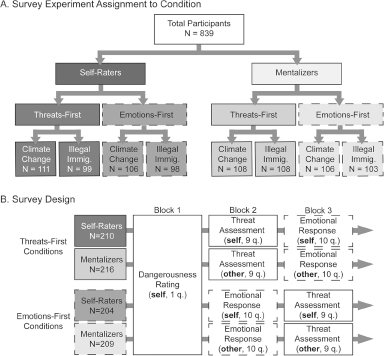
The other half of the sample engaged in two mentalising exercises. Mentalisers were instructed to think about ‘people who are concerned about [climate change/illegal immigration]’ while answering the same threat perception and emotional response question batteries. The ordering of the threat-estimating and emotion-understanding exercises was counterbalanced, producing two sub-conditions: Threats-First Mentalisers and Emotions-First Mentalisers. Figure 1 illustrates the assignment to conditions (Panel A) and the study design (Panel B).
Survey experiment structure. (A) Survey experiment assignment to condition, (B) Survey design.

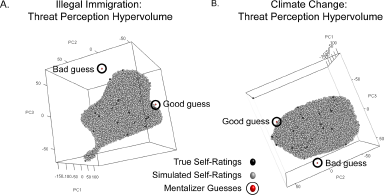
In order to preserve the complexity of threat perception (nine dimensions of potential harm) and emotional responses (ten candidate emotions), as well as the heterogeneity of opinions offered by the Self-Raters, I adapted an analytic tool used to represent populations within high-dimensional ecological niches.Footnote 23 In this case, I represent the population of Self-Raters who are at least moderately concerned about their Issue, and the niche they occupy is defined by their collective responses to the threat perception (or emotional response) batteries for their Issue. The niche is constructed as a hypervolume, which is an enclosed n-dimensional space that includes all the Self-Ratings (barring extreme outliers) and many plausible nearby ratings (see Figure 2 for two examples). I treat any Mentaliser’s guess about the perceptions of the Self-Raters that falls within a hypervolume as accurate because it is within the realm of plausible Self-Rater responses even if it does not correspond to a specific Self-Rater’s response. Any guess outside the hypervolume is inaccurate, though some guesses are better (i.e. closer) than others. I benchmark the quality of both binary accuracy and the distance of inaccurate guesses by comparing Mentalisers’ responses to the distribution of results generated by 500 samples of random responses to the survey questions. Benchmarking against random responses allows me to characterise the effects of effort by estimating how well one can perform on the task when applying no effort whatsoever.
Ground truth threat perceptions. (A) Illegal Immigration: threat perception hypervolume, (B) Climate Change: Threat perception hypervolume.

I used this method of characterising ground truth perceptions and chance accuracy to derive empirical answers to my questions of interest. I found that Mentalisers, on average, were more accurate than chance when estimating the nature of the threats perceived by the Self-Raters, regardless of Issue. However, the effect is driven entirely by Mentalisers who share the Self-Raters’ belief in their Issue’s dangerousness. That is, Mentalisers who believe climate change or illegal immigration is just as dangerous as the Self-Raters do are able to accurately estimate why the Self-Raters feel threatened. Mentalisers who did not associate their Issue with at least a moderate level of dangerousness had lower levels of binary accuracy in threat estimation than would be expected by completing the task with random guesses, but their inaccurate guesses were also better (i.e. closer to the ground truth) than would be expected if they had not exerted any effort. This pattern suggests these Mentalisers were trying to complete the task but did so with an incorrect mental model of those who felt threatened.
Using a series of regressions, I show that the similarity/dissimilarity distinction is not a proxy for either shared political partisanship or shared ideology. Similar beliefs about dangerousness are a stronger correlate of threat estimation accuracy than either variable, regardless of Issue. While cognitive science has identified social distance as a factor in mentalising accuracy,Footnote 24 prior focus has been on social groups (e.g. cultural ingroup versus cultural outgroup) and personal relationships (e.g. marital partners). This finding highlights the importance of mentalising proximity in a new dimension with relevance in IR: beliefs about danger.
I also test an idea derived from the IR literature that emotion understanding could enhance threat estimation accuracy, either by encouraging a process of simulating others’ internal states that then acts as a ‘gateway’ for other inferences,Footnote 25 or by providing important contextual information for others’ perceptions of threat.Footnote 26 I do not find support for a gateway effect on threat estimation accuracy. Mentalisers in the Emotions-First conditions were no more accurate in their threat perception estimates than those in the Threats-First conditions. I also find no evidence of an incremental context effect. The correlation between emotion understanding accuracy and threat estimation accuracy was only greater than chance for those Mentalisers who already held similar beliefs about their Issue’s dangerousness to the Self-Raters.
These findings have several implications. First, an automatic link between mentalising effort and accuracy should not be assumed, at least in the domain of threat perception. Instead effects appear to be conditional on prior beliefs, broadly consistent with Kertzer, Brutger, and Quek and Casler and Groves.Footnote 27 Second, mentalising effort on its own is unlikely to aid in the correct interpretation of others’ behaviours if differences of opinion about what does and does not constitute a danger are a point of contention (e.g. in the security dilemma). Third, despite the inherent entanglement between emotions and threat perception for perceivers, considering (and even accurately understanding) emotional responses does not produce more accurate estimates of threat perception for mentalisers. These two mental exercises are at least somewhat distinct. Finally, these findings suggest that a notion of baseline mentalising task difficulty should be integrated into the literature on the sources of misperception, which to date has emphasised the ability of confounders, such as imperfect information and deception, to undermine mentalising’s beneficial effect on decision-making. This study suggests that suboptimal responses to others’ behaviours may not be the result of failing to make an effort, but rather of failing to succeed at the task.
In addition to these substantive implications, this paper also makes a methodological contribution by demonstrating how mentalising accuracy can be explored empirically. I show that a combination of experimental design and analytic tools from other fields can capture complex subjective ‘ground truths’ and create the conditions for estimating accuracy, which could be extended to a variety of other topics. I also show how simulations, in combination with a mathematical representation of complex perceptions, can characterise accuracy relative to chance, which provides a way to validate the application of effort to mentalising tasks while not conflating effort and accuracy. The representation of threat perceptions in a multidimensional space simplifies the open-ended mentalising task one would find in the real world, but it still preserves the potential for a high degree of variability in subjective perception. Preserving a complicated ‘ground truth’ makes it easier to see the tremendous capacity for, and fundamental challenge of, grasping why others perceive danger.
The paper proceeds in several sections. First, I review the literature related to threat perception and mentalising in IR and cognitive science. Second, I introduce the survey experiment, including a discussion of its design and data collection procedures. Third, I discuss the main analytic methods. Fourth, I present the main study’s results. The final section concludes. The Supplementary Material includes detail on the pilot study, the main study’s participants and survey instrument, as well as technical aspects of the analyses. All data and code required to replicate the results within the paper are available on the Harvard Dataverse (doi:10.7910/DVN/VLDEQU).
Threat perception and mentalising in International Relations
How people interpret and respond to perceived danger in the world around them is a central question in International Relations.Footnote 28 But the actions that leaders and their groups or states take in response to perceived threats are theoretically quite variable and include: preemptive or preventive aggression,Footnote 29 alliance offers,Footnote 30 and both policy coordination and subversion, in the case of nuclear weapons for example.Footnote 31
The task of interpreting the actions others take is rarely straightforward, even outside of adversarial or time-sensitive contexts, because humans are not mind-readers. There is always uncertainty about why other people do what they do (i.e. ‘the problem of other minds’),Footnote 32 as well as the fundamental uncertainty and incomplete information that accompany most real-world interactions in the IR domain.Footnote 33
Interpreting others’ actions
The significance of understanding how people resolve ‘the problem of other minds’ is well understood in the IR literature. Some theoretical approaches propose that the problem is solved by assumption (e.g. assuming a particular form of rationality guides others’ actions).Footnote 34 But a significant body of work has demonstrated that there is a great deal of variation in how people, including leaders, approach the task of interpreting others’ threat-related behaviour. In cooperative contexts, such as the maintenance of security cooperation agreements, failure to understand threats as they are perceived by one’s partners can undermine potential gains to cooperation.Footnote 35 In adversarial contexts, such as the dispute over a piece of territoryFootnote 36 or an arms race,Footnote 37 scholars have associated escalation with the same failure.
One straightforward explanation for the failure to understand the threats perceived by others, and thus suboptimal responding, is a lack of genuine effort. That is, people do not bother to ‘step into someone else’s shoes’ and see the world from their perspective before interpreting their actionsFootnote 38 and so fail to engage meaningfully in mentalising.
In case studies, IR scholars have noted an apparent lack of genuine consideration of the world as seen by others, even in high-stakes situations. Many of the documented cases are adversarial and concern the failure to understand that one’s own actions could be perceived as threats,Footnote 39 or that one’s own actions are less significant than other potential threats.Footnote 40 But similar failings have also been documented within established cooperative relationships that face new, unevenly perceived threats (e.g. climate change,Footnote 41 refugee flowsFootnote 42). In both cases, failures to respond optimally to others’ actions have been attributed to an unwillingness to see the world from a different point of view.
Recent work has highlighted the role of effort in mentalising.Footnote 43 In some settings, such as face-to-face diplomacy, scholars have argued that it happens relatively easily and spontaneously.Footnote 44 In this view, mentalising is aided by simulating others’ internal states (e.g. ‘feeling what they are feeling’) in order to make inferences about their actions and intentions.Footnote 45 That is, simulation offers a ‘gateway’ into making inferences about how another person is thinking.Footnote 46 Holmes argues that this type of mentalising can operate even to understand culturally or physically different others.Footnote 47
But the effortful version of mentalising is also seen as beneficial for decision-making.Footnote 48 Some argue that the success of this type of mentalising hinges only on sufficient information.Footnote 49 But another viewpoint argues that understanding emotions and the context that gives rise to them is critical for mentalising success, particularly if one is trying to infer the ‘why’ of a particular action,Footnote 50 and that this type of understanding is a skill that should be cultivated.Footnote 51
Yet, in research that experimentally manipulates mentalising effort, IR scholars have shown that effort does not have consistent effects on the interpretation of others’ behaviour and on response decisions. Instead, interpretation and response decisions are conditional on prior beliefs, even when mentalising is attempted. Kertzer, Brutger, and Quek show that mentalising effort can provoke both escalatory and de-escalatory behaviors in US and Chinese participants, depending on prior beliefs about the adversary.Footnote 52 Casler and Groves show that mentalising effort can spur cooperative behaviour, but that this effect is limited to those with specific partisan leanings in the US context.Footnote 53 This research has also shown that the dispositional tendency to mentaliseFootnote 54 generally mimics the experimentally induced effects of effort. Thus, mentalising effort, applied after encouragement or due to a dispositional tendency, interacts with prior beliefs in a way that can produce decisions which do not always appear optimal. The relationship between mentalising effort and decision-making is therefore not straightforward.
Effort and accuracy
These mixed findings on the effects of mentalising effort on response decisions suggest that the logic behind arguments in favour of ‘stepping into someone else’s shoes’ to improve decision-making outcomes is incomplete. One missing piece is an understanding of the relationship between mentalising effort (i.e. trying) and mentalising accuracy (i.e. succeeding). The link between effort and accuracy is rarely tested in IR because, as Stein notes: ‘Even with the advantage of hindsight, assessment of accuracy is often not obvious … the dangers inherent in a situation are rarely unambiguous.’Footnote 55 Despite the challenge in assessing accuracy, its link to effort is not trivial. If this link does not hold, then one explanation for the varied results of mentalising effort documented above is that some people try but do not conjure up an accurate representation of the other person. Their response decisions might be optimal for the person they imagined, but their imagination failed. Vitally, this suboptimal behaviour does not arise from misperceptions induced by extenuating circumstances or deception, but rather from misperceptions attributable to the difficulty of the task itself.
Evidence from cognitive science provides reasons to be sceptical that mentalising effort will yield accurate models of other minds.Footnote 56 People perceive mentalising as difficult and effortful, rather than easy.Footnote 57 Our success as a species suggests we cannot be completely incapable of making inferences about others; on the other hand, systematic errors have been demonstrated in tests of mentalising accuracy,Footnote 58 which suggests that we may be wrong quite often, but in ways that are not necessarily detrimental.Footnote 59 One type of systematic error arises because people simply struggle to imagine those who are quite different from themselves, e.g. demonstrating greater accuracy for one’s own cultural ingroup than an outgroup.Footnote 60
The mentalising exercises explored by cognitive scientists are relatively simple (e.g. inferring someone’s emotions from their facial expressions) when set against the real-world cases explored by IR scholars. Nevertheless, simple baseline exercises of general cognitive faculties have provided insight into a range of scenarios in IR and foreign policy decision-making.Footnote 61 There is thus some value in establishing a baseline for how well people can perform the task of estimating the threats that others perceive under simplified conditions. A better understanding of this baseline can then inform theoretical expectations for more complex situations (e.g. adding an adversarial dimension, adding stress and time sensitivity to model crises). In the next section, I lay out a method for defining this baseline and for testing whether it can be improved upon with a technnique proposed in the IR literature: emotion understanding.
Survey experiment
In order to study mentalising accuracy, it is essential to establish ‘ground truth’ mental states. In the case of threat perception, one of the primary issues raised in the literature is the difficulty in understanding why one person would see a particular scenario, state, or phenomenon as dangerous when another person might not (i.e. what kind of harm is the source of concern?).Footnote 62 This mentalising challenge arises due to the fundamentally subjective nature of threat perception.Footnote 63
To better understand baseline accuracy in estimating the why other people feel threatened, I borrow a paradigm used in cognitive science that measures the ability to ‘accurately infer the specific content of another person’s covert thoughts and feelings’.Footnote 64 In a common version of the paradigm, participants perform an exercise while being recorded and then watch their own recording to describe their thoughts and feelings at particular time-points.Footnote 65 A second set of participants then watch the same video and are asked to describe the thoughts and feelings of the person in the video at those same time-points. The exercises in question are naturalistic and unrehearsed, but otherwise highly variable (e.g. therapy sessions, the discussion of autobiographical events). Because the data provided in the traditional version of this task are unstructured comments and thus arbitrarily complex, trained raters are needed to consistently assess the similarity between the ground truth self-descriptions and the assessments provided by mentalising participants. These hand-coded estimates of agreement then serve as the accuracy measure. However, in cases where experimenters radically simplify the task down to a single dimension (i.e. asking for a positive or negative affect score), the correlation between self-ratings and the mentalisers’ guesses can be used directly as an accuracy measure.Footnote 66
To balance between the open-ended design of the original accuracy task as described in IckesFootnote 67 and the one-dimensional valence task described by Zaki et al.,Footnote 68 I use question batteries, which are close-ended but multidimensional. This method has the advantage of capturing some of the complexity inherent in subjective perceptions. It also allows for substantial individual-level variation in those subjective perceptions. I detail the analytic approach required to take advantage of the richness of these subjective assessments in the Analysis section.
Design
The conventional accuracy task uses pre-recorded, annotated videos as representations of the ground truth, often relying on the same stimuli across multiple studies.Footnote 69 But a temporal separation between collection of ground truth perceptions of threat and mentalising efforts is problematic. Events can drastically alter the estimation of particular threats, as shown by rapid shifts in the extent to which Russia is viewed as a threat by Europeans and Americans.Footnote 70 To avoid any risk that external events interfere with the ability to accurately mentalise, I designed a survey experiment to simultaneously collect ground truth perceptions and mentalising estimates.
I adapted the traditional accuracy task to the study of threat perception in two ways. First, while conventional accuracy tasks use self-reported reflections about personal events (e.g. a therapy session), I use self-reported reflections about two familiar international political phenomena: illegal immigration and climate change. In the American context, individuals vary in the extent to which they believe these phenomena are dangerous and in their reasons why.Footnote 71 These two issues have traditionally generated mirror-image patterns of concern across the partisan divide in the United States. Republicans are more likely to be concerned about illegal immigration,Footnote 72 and Democrats are more likely to be concerned about climate change.Footnote 73 Including both issues makes it possible to separate partisan identification (e.g. identifying as a Democrat) from other factors that might affect mentalising accuracy. By using issues which evoke different levels of concern across the population, I also avoid conflating the propensity for threat perception with conservatism.Footnote 74
The survey experiment used a fully factorial between-subjects design with eight conditions (two issues × two perspectives × two question orders) to which participants were randomly assigned. Figure 1A shows the assignment to conditions. In all conditions, participants answered three question blocks, visualised in Figure 1B. Participants in all conditions received the same initial question in Block 1, which asked them to rate the dangerousness of their Issue (Climate Change or Illegal Immigration) from their own perspective on a 0–100 scale (where 0 = ‘Not at all dangerous’ and 100 = ‘Extremely dangerous’). This provided a common scale for the belief in dangerousness across issues and allowed me to identify the subset of participants who felt threatened by their Issue across conditions.
Participants in the four Self-Rater conditions were directed to answer all subsequent questions (Blocks 2 and 3) with reference to themselves (i.e. ‘Please use the scales to indicate how relevant these specific concerns are for you when you think about [climate change/illegal immigration]’). Participants in the four Mentalising conditions were directed to answer all subsequent questions thinking about the views of others worried about their Issue (‘Please use the scales to indicate how relevant you believe these specific concerns are for other people who are worried about [climate change/illegal immigration]’).
For those in the Threats-First conditions, Block 2 consisted of a question battery about the relevance of nine ‘specific concerns’ associated with their Issue.Footnote 75 All nine concerns are listed in the Supplementary Material (Table A2). The list of concerns drew on prior research and captured physical threats (e.g. bodily harm), non-material threats (e.g. compromised spiritual purity), personal harms (e.g. loss of an economic asset), and collective harms (e.g. loss of group status). The rating scale for the relevance of each concern ranged from 0 (‘Not at all relevant’) to 100 (‘Extremely relevant’). Block 3 consisted of a question battery asking how intensely ten emotions were evoked by each Issue. All ten emotions are listed in the Supplementary Material (Table A2). The list of emotions also drew on prior research and included both basic emotions (e.g. fear) and complex emotions (e.g. contempt). The rating scale for the each emotion ranged from 0 (‘Do not feel at all’) to 100 (‘Feel strongly’). In the Emotions-First conditions, Block 2 consisted of the emotion battery, and Block 3 consisted of the concern/threat battery. All other question wording was the same across conditions.
Participant characteristics
839 research subjects participated in this experiment (53 per cent female; mean age 41 years old).Footnote 76 All subjects were recruited through Survey Sampling International (SSI, now Dynata), and the study was administered on the Qualtrics platform. The study was approved by the Committee on the Use of Humans as Experimental Subjects (COUHES) at the Massachusetts Institute of Technology. Many aspects of this study, including the question design, parameters of the accuracy analysis, and sample size requirements were established based on a pilot study conducted on Amazon’s Mechanical Turk platform (N = 297). Details of the pilot study are included in the Supplementary Material.
While the sample was not weighted to be nationally representative, it closely tracks a contemporaneous American National Election Survey (ANES) report of the electorate’s composition at the national level on metrics of gender composition, political party identification, and race/ethnicity self-identification.Footnote 77 The share of women in the sample was slightly higher than in the electorate (53.5% versus 52%). The sample self-identified as slightly less White than the electorate (66% versus 69%).Footnote 78 There were also more political partisans in the sample than in the electorate (Democrats: 39% versus 35%; Republicans: 30% versus 28%).Footnote 79 See Table A1 in the Supplementary Material for additional demographic details of the full sample and the balance across experimental conditions.
Analysis
Measuring ground truths
To establish the ground truth of both the threat perceptions and the emotional responses for each Issue, I use only the Self-Ratings provided by subjects who found their Issue at least moderately dangerous (i.e. provided a Dangerousness rating in Block 1 of 50 or greater).Footnote 80 This restricts ground truth perceptions to ‘those who are worried’ about their Issue, which corresponds to the people Mentalisers were instructed to consider.
As noted above, both climate change and illegal immigration are issues where people hold a variety of beliefs about why they feel threatened. Any measure of ground truth perceptions of threat needs to account for these subjective differences. These differences also have implications for any judgement about mentalising accuracy. An accurate guess is one which could reasonably fall within this heterogeneous collection of perceptions, without necessarily corresponding to a specific response provided by one of the Self-Raters. Therefore, I treat the ‘ground truth’ not as a single point generated by a Self-Rater or as a single summary statistic of the Self-Rater group as a whole, but rather as the high-dimensional space occupied by the sample of Self-Rater responses.
To carry this out analytically, I borrow the concept of hypervolumes as used in the population ecology literature.Footnote 81 In that context, hypervolumes are a method for representing the ecological niche occupied by a population in a multidimensional space (e.g., terrain type, food sources). In this case, the populations of interest are the Self-Raters and the dimensions of interest are either (1) the nine ‘concerns’ for which each Self-Rater provided a relevance rating (i.e. threat perception ground truths) or (2) the ten emotions for which they provided an intensity rating (i.e. emotional response ground truths). The advantage of using hypervolumes instead of summary statistics as a way of characterising the ground truth views of a heterogeneous group is that the approach allows researchers to preserve the multidimensional nature of the underlying construct (i.e. threat perception) while making relatively few assumptions about the data’s distributions. Pilot Study data showed that Self-Ratings were not univariate normal, multivariate normal, or uniformly related in any two dimensions and could potentially have discontinuities (e.g. clusters, holes).Footnote 82 Therefore, a hypervolume approach was appropriate.
The size and shape of hypervolumes are determined by several parameters. I used the Pilot Study data to set those parameters and then applied them unchanged to the main study. Based on the Pilot Study data, I constructed the hypervolumes with a one-class support vector machine (SVM) instead of the Gaussian kernel method, which created volumes that substantially exceeded the scale boundaries even with small bandwidths and was sensitive to outliers. The SVM method is recommended by Blonder et al. for generating a volume that fits smoothly around the data without being overly sensitive to outliers. All SVM tuning parameters were kept at defaults.
Pilot data also revealed correlations within the nine-dimensional threat perception ratings and the ten-dimensional emotional response ratings. In such cases, Blonder et al. recommend using Principal Component Analysis (PCA) to define independent axes for the hypervolume. For each example in the Pilot Study data, the first three Principal Components (PCs) accounted for at least 75 per cent of the variance, so I chose three PCs as the compromise between complexity and analytic tractability. Data was centred before computing the PCs, but not scaled as all scales were identical to begin with.Footnote 83
Based on the methods established with Pilot Study data, I constructed four hypervolumes from the Main Study data, one for each set of ground truth ratings provided by the Self-Raters across four conditions: Illegal Immigration Threat Perception (Threats-First Condition); Climate Change Threat Perception (Threats-First Condition); Illegal Immigration Emotional Response (Emotions-First Condition); and Climate Change Emotional Response (Emotions-First Condition). As with the Pilot Study data, the three PCs used to construct the hypervolumes always accounted for at least 75 per cent of the total variance. Tables A3 and A4 in the Supplementary Material provide the loadings for all items on the first three PCs. To summarise, while the first PC appears to capture mean differences, the second and third capture clusters of threats (or emotions) that hang together for participants. In the case of climate change, PC2 captured concerns about both individual and group status and moral purity, while PC3 captured environmental concerns as well. For illegal immigration, PC2 captured concerns about physical harm (to oneself and loved ones) as well as the loss of personal rights, while PC3 primarily captured economic loss concerns. Negative basic emotions (fear, anger, sadness) dominated PC2 for climate change, while negative complex emotions (resentment, contempt) dominated PC3. Negative basic emotions (anger, disgust) also dominated PC2 for illegal immigration, while sadness dominated PC3.
The ground truth threat perception hypervolumes for the Threats-First Illegal Immigration and Climate Change conditions are shown in Figure 2. Each axis in the figure captures one of the three PCs scaled in arbitrary units. Black points within the volume correspond to the true Self-Rater responses. Grey points represent ‘nearby’ simulated responses.Footnote 84 Conceptually, the collection of black and grey points is the set of responses that could have been given by the Self-Rater group and thus constitutes the ground truth. Any threat perception estimate provided by a Mentaliser that falls within this space is accurate in that it could have been given by a Self-Rater. And, as the circled points in Figure 2 indicate, estimates falling outside this volume can be either near (good guesses) or far (bad guesses) from the edge of the ground truth hypervolume.
Mentalising accuracy
In order to determine whether each Mentaliser’s guess fell inside or outside their respective hypervolume, I first transformed each guess into the relevant rating space.Footnote 85 This transformation provided binary accuracy: a point inside the hypervolume was an accurate guess, and a point outside was inaccurate. I also measured the Euclidean distance of each inaccurate guess to the nearest edge of the hypervolume. This provided a measure of miss distance, which captures the quality of the Mentaliser’s guess, even if it is inaccurate. Section A5 in the Supplementary Material contains additional detail on these procedures.
Chance accuracy as a reference point
I contextualise the binary accuracy and the miss distances generated in the experiment’s Mentalising conditions by comparing them to values achieved by chance. To do this, I ask: how accurate would participants in the Mentalising conditions have been if they had completed the nine-dimensional threat estimation measure and the ten-dimensional emotion understanding measure by randomly selecting values for each item? Conceptually, this process captures the results of completing the task without applying any effort.
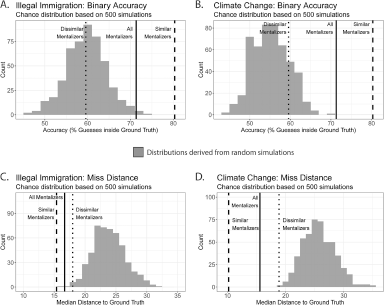
I first simulated 500 datasets of randomly completed responses with the same number of ‘observations’ as the true data. For each randomly constructed dataset, I transformed the each observation into the respective Self-Rating space using the true PCA eigenvectors. I then measured the binary accuracy of each observation and, if applicable, its miss distance. I then generated the distributions for chance binary accuracy (see Panels A and B of Figure 3 for examples) and for the median miss distance (see Panels C and D of Figure 3 for examples). These distributions formed the basis for judging how good subjects were at each Mentalising exercise and what a total lack of effort looked like.
Threat estimation accuracy. (A) Illegal Immigration: binary accuracy. (B) Climate Change: binary accuracy. (C) Illegal Immigration: Miss distance. (D) Climate Change: Miss distance.

Results
I focus first on threat estimation accuracy among those who completed the threat estimation task first (Threats-First conditions). As shown in Panels A and B in Figure 3, the guesses given by all Mentalisers (solid lines) were more accurate than random guessing would generally have achieved for both Issues.Footnote 86 The difference in overall accuracy between Issues was not statistically significant, suggesting the tasks had similar levels of difficulty.Footnote 87
However, estimation accuracy was substantially better for a particular subgroup: those Mentalisers who shared the Self-Raters’ belief that their Issue represented a danger (i.e. Similar Mentalisers). The Similar Mentalisers were participants who had also rated their Issue as at least moderately dangerous on the survey’s first question. For Similar Mentalisers (dashed lines), threat estimation binary accuracyFootnote 88 was significantly better than the Dissimilar Mentalisers,Footnote 89 i.e. those who had provided a Dangerousness score of less than 50 (dotted lines).Footnote 90 Since the Similar Mentalisers would have been the Self-Raters but for random assignment, their high level of estimation accuracy is unsurprising. It is notable, however, that the Dissimilar Mentalisers were not only less accurate than Similar Mentalisers, but also were also less accurate than could have been achieved by random guesses in many cases.Footnote 91
However, as Panels C and D in Figure 3 show, there is no sign that participants were actually providing responses at random. On the contrary, while Dissimilar Mentalisers’ guesses did not land inside the realm of plausible responses at a rate better than chance, their incorrect guesses were significantly closer (i.e. better) than would be achieved by truly random answers, within the conventional standard false positive allowance of 5 per cent.Footnote 92 This provides evidence that Dissimilar Mentalisers applied some effort to the mentalising task but did not succeed at it. That is, their mental models of those concerned by the Issue were wrong.
Does the significance of the Similar/Dissimilar distinction simply reflect the effect of shared partisanship or shared ideological orientation? Democrats (and liberals) might be more likely to self-report thinking of Climate Change as dangerous; Republicans (and conservatives) might be more likely to report thinking of Illegal Immigration as dangerous. Thus, a shared belief in dangerousness may be picking up on broader political alignment.
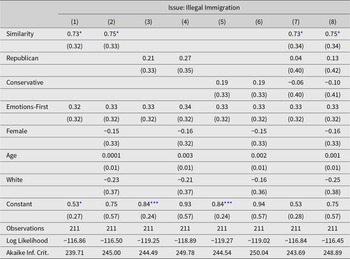
In a series of logistic regressions using binary accuracy as the dependent variable, I show that Similarity is not a proxy for either shared partisanship or shared ideological orientation. Tables 1 and 2 show that Similarity maintains its explanatory significance (Models 7 and 8) even after accounting for the partisan or ideological alignment that would lead to shared views on each Issue (Republican/conservative for Illegal Immigration; Democrat/liberal for Climate Change). Substantively, holding a similar belief about dangerousness increases the odds of threat estimation accuracy by two to three times, depending on the model.Footnote 93
Model 1 in each table demonstrates the main effect of Similarity, accounting only for the experimental condition differences between Mentalisers (Threats-First versus Emotions-First). Model 2 adds three demographic covariates as controls (self-identifying as female, age, and self-identifying as White). These controls have no substantive effect on the importance of belief similarity. Models 3 and 4 perform the same comparison (main effect and the effect after controls) for the partisan identity that is most likely to be shared with the Self-Raters (Republican for Illegal Immigration; Democrat for Climate Change). Models 5 and 6 repeat this process for shared ideology (conservative for Illegal Immigration; liberal for Climate Change). These measures of political and ideological affinity do not appear to account for accuracy. As Models 7 and 8 demonstrate, adding these affinity measures does not reduce the substantive or statistical significance of Similarity, which indicates that there is a meaningful distinction between belief Similarity and these other constructs.
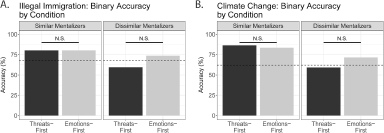
I next test the idea that the capacity to understand others’ emotions is an asset when trying to understand why they feel threatened. One possibility is that the encouragement to understand emotions before attempting the threat estimation task makes that task easier. In this view, simulating (or at least focusing on) others’ emotions provides a relatively intuitive and reliable way to access other aspects of their mind. However, as shown in Figure 4 and Tables 1 and 2, there was no statistically significant effect of considering others’ emotional responses to either Issue before estimating threat perception in this study.Footnote 94 Nor did those in the Emotions-First condition become better guessers; there was no difference between the Threats-First and Emotions-First conditions on miss distances.Footnote 95 While the treatment effect on Dissimilar Mentalisers appears to improve accuracy to better rates than chance for both Issues (dashed horizontal line), the size of the treatment effect itself is not statistically significant.
Effects of mentalising task order on threat estimation accuracy. (A) Illegal Immigration: Binary accuracy by condition, (B) Climate Change: Binary accuracy by condition.

Correlates of binary threat estimation accuracy

Note: *p < 0.05; **p < 0.01;
*** p < 0.001
Correlates of binary threat estimation accuracy

Note: *p < 0.05; **p < 0.01;
*** p < 0.001
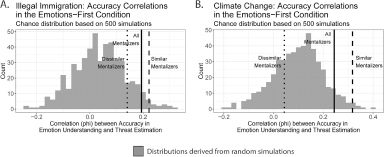
A second possibility is that understanding others’ emotions provides useful context for understanding the reasons why they feel threatened. This effect would only hold for those whose emotion understanding was accurate, however. In this case, there should be a positive relationship between emotion understanding accuracy and threat estimation accuracy in the Emotions-First conditions. As Figure 5 shows, this positive relationship (measured as a Pearson correlation) is only greater than chance among Similar Mentalisers.Footnote 96 There is also no significant difference between the correlations for Similar Mentalisers in the Emotions-First and Threats-First conditions, suggesting the information added by considering emotions first is not substantial for that group.Footnote 97 As such, it does not seem as though access to others’ emotions provides a consistent benefit in the threat estimation task, above and beyond the influence of shared beliefs about dangerousness.
Correlation between emotion understanding and threat estimation accuracies. (A) Illegal Immigration: Accuracy correlations in the Emotions-First Condition. (B) Climate Change: Accuracy correlations in the Emotions-First Condition.

Conclusion
The objective of this study was to provide a better understanding of the link between mentalising effort and mentalising accuracy in the domain of threat perception. The study’s design was a deliberate compromise between the need to cleanly identify a challenging phenomenon like mentalising accuracy and tackling a question with relevance to IR. As such, the study’s findings are best interpreted as a baseline against which to compare more complex mentalising tasks that take place in foreign policy decision-making. The threat perceptions Mentalisers were asked to estimate were multidimensional, but structured, which is not always a feature of real-world decisions. The ‘others’ whom they imagined were also not explicitly defined as adversaries, and recent work suggests that mentalising in adversarial settings may present unique challenges to inferential accuracy.Footnote 98 Future research is thus needed to identify ways in which these baseline findings are affected by such factors.
The baseline findings provided three insights into the relationship between mentalising effort and accuracy. First, mentalising effort was not sufficient to generate mentalising accuracy above rates that could be achieved by chance for subjects who did not already view their Issue as dangerous. Yet the failures of accuracy were not random. The pattern of missed guesses indicated that the Dissimilar Mentalisers applied effort but simply had the wrong mental model of their target. Second, this critical difference in beliefs about dangerousness was not simply politics in disguise. Neither self-reported party identification or ideological orientation provided as much explanatory power for binary accuracy as sharing beliefs about dangerousness. Thus, while finding that the effects of mentalising effort are conditional is consistent with prior work, the differentiator in this case is neither explicitly political (as in Casler and Groves)Footnote 99 nor adversarial (as in Kertzer, Brutger, and Quek).Footnote 100 Instead, the simplified structure of the study makes it possible to identify the basic significance of shared beliefs about dangerousness for threat estimation task performance.
The third insight provided by the study is the disambiguation between threat estimation and other forms of mentalising that are theoretically posited to assist that mental exercise. Specifically, I found that understanding another person’s emotional responses to the Issue that concerned them (Climate Change or Illegal Immigration) provided no incremental benefit for threat estimation accuracy. While threat perception itself cannot occur without an emotional response, accurately understanding the latter did not correlate with accurately estimating the former. This finding is consistent with a literature on the multifaceted nature of social cognitive skills and their situation-specific utility.Footnote 101 But it suggests that – to the extent threat estimation is considered important for interpreting others’ actions – focus should be on fostering a better understanding of their beliefs about danger.
While I have argued for this experiment’s utility, these findings should be treated as provisional, as with any single study. While this study tested threat estimation of two prominent issues in international politics, new tasks and issues are necessary to determine whether the findings in this study hold elsewhere. Another limitation in applying this study’s findings is its focus on recovering group-wide, rather than individual-level, threat perceptions. This set-up rendered the mentalising task easier because there were many possible ‘right answers’. Indeed, one reason for the high absolute (and chance) binary accuracy levels in the study was the size of the ground-truth hypervolumes, since the Self-Raters disagreed amongst themselves about why either Climate Change or Illegal Immigration presented a danger. But in the case of a single individual, or a group with more internally consistent perceptions (e.g. advisors), the space of plausible answers shrinks significantly. The mentalising precision required might be offset by specific information about the targets of inference (e.g. knowing a person’s history), but the difficulties faced by Dissimilar Mentalisers suggest that recovering a precise point, particularly from an adversary, is inherently challenging.
This study has several implications. First, future research into the effects of mentalising effort on inferences about and responses to others’ behaviour should explicitly incorporate a theoretical position on accuracy. It is quite possible that inaccurate mentalising is the driver of optimal behaviour in certain contexts.Footnote 102 But if this is the case, it is not clear that greater information from intelligence sourcesFootnote 103 or personal exchangesFootnote 104 is what will foster better decisions. Instead, much of the work arguing for mentalising’s beneficial effects does so on the presumption of accuracy. But this presumption should be clearly stated and explicitly theorised, given that there are alternative possibilities (e.g. useful inaccuracy).
The second implication is that the drivers of misperception deserve renewed scrutiny. Misperception is often attributed to a lack of mentalising effort, consistent with Stein’s observation, or to confounders like deception.Footnote 105 The difficulty of mentalising, even in relatively optimal circumstances, suggests that trying and failing can have observably the same effects as a lack of effort. But there are consequences in theory and in practice for treating misperception as mostly correctible or treating perceptual accuracy as a rare event. The study of event forecasting, which takes the latter approach, offers some inspiration for IR scholars interested in better understanding the interaction between raw capabilities, individual differences, and systemic conditions.Footnote 106 Further, by studying threat perception accuracy as a rare event, scholars and practitioners might identify new interventions that go beyond encouraging the effort to understand others’ perceptions and actually improve our accuracy when doing so.
Beyond these substantive implications, this paper contributes a multidisciplinary solution to the problem of studying mentalising and threat perception. Experiments are nothing new in IR research. But new tools and methods can expand the boundaries of the phenomena open to study. Using analytical approaches from other disciplines, I was able to separate mentalising effort from mentalising accuracy. The study of mentalising in IR has focused on situations where this type of disambiguation is extremely difficult, if not impossible. Yet this study suggests we should find new ways to investigate this distinction because the inherent difficulty of mentalising may be a much more fundamental challenge to optimal decision-making than previously assumed.
Supplementary material
The supplementary material for this article can be found at https://doi.org/10.1017/eis.2024.42.
Funding-Statement
Funding for this research was provided by MIT’s Political Experiments Research Lab (MIT PERL).
Competing interests
The author declares none.
Marika Landau-Wells is an Assistant Professor in the Charles and Louise Travers Department of Political Science at the University of California, Berkeley. Her work focuses on international security, foreign policy decision-making, political behaviour, and the application of cognitive science to the study of politics.


























 Open access

