

I. Introduction
In 1808, Timothy Dwight preached the inaugural sermon at the founding of Andover Theological Seminary. Dwight, the President of Yale University, was a leading theological voice among New Divinity clergymen who championed the theological innovations of Jonathan Edwards and others that shaped the revivalism of the eighteenth century. Dwight praised the new institution for its commitment to “the doctrines of the Reformation” and the evangelical orthodoxy of the period. He hoped that everything around the school would “become as Eden” – pious and morally pure. Dwight is often recognized as an important figure within the history of Andover and theological education more broadly. Emphases on Dwight and the theological particularities of Andover, however, have overshadowed the organizing efforts Jedidiah Morse, another influential founder, put into establishing the new seminary. Morse, too, spoke that day in 1808, offering the Right Hand of Fellowship to the institution. Describing the day as “singular in the history of our country,” he declared that a “new era in our Churches now commences.” Andover was to be a “nursery for our American Churches.” With that phrase – “American Churches” – Morse signaled that Andover was not simply a theological project aimed at perpetuating what it considered to be orthodox theology; it was a national project.Footnote 1
This article argues that the emergence and development of theological seminaries in the early republic was not simply a theological project, but also a political and spatial one. Much of the historiography has positioned the development of Andover, its novel theological curriculum, and the establishment of subsequent institutions of theological higher learning as a theological and intellectual development within the broader history of US religion.Footnote 2 Such arguments either eclipse the political dimensions of these theological schools or merely leave the political dimensions as implied or unintended byproducts of the development of the first standardized forms of graduate education in the United States. At the same time, growing scholarship on religious nationalism and imperialism within the early republic has not explicitly addressed the ways in which theological education was designed as part of an emerging evangelical infrastructure designed to support and undergird these political projects.Footnote 3 By centering on the life and work of Jedidiah Morse, Andover’s commitment to projects of nationalism and imperialism becomes clearer. These were not coincidental byproducts of an otherwise public-facing, theologically focused institution. Instead, Andover’s earliest conceptions reveal that the political project was part and parcel of the school’s design. This article contributes to the existing scholastic literature by making Andover’s political project explicit.
Questions of politics and power are also spatial questions, and therefore, Andover was also a spatial project.Footnote 4 In establishing these seminaries, founders and supporters sought to produce enough ministers who might “settle” congregations across the landscape to influence and steer the young country’s citizenry toward a more evangelical, reformed future.Footnote 5 Seminaries also trained ministers who became missionaries, seeking not only to spread the Gospel to foreign and indigenous peoples, but also civility and principles of proper governance. Religious nationalism and imperialism are inherently spatial projects, influenced and shaped by both physical, geographic space, as well as imagined space.Footnote 6 Andover and, in turn, theological education more broadly remained concerned with geography and the relationship between moral and spatial order.Footnote 7 It produced clergy who considered the boundaries of the nation and how Christianity ought to shape and maintain both those boundaries and what or who lay beyond those boundaries.
In the early republic, the boundaries of the nation remained changing and uncertain. As a result, projects of religious nationalism and imperialism also remained in flux depending on when and where schools were located. Andover sought to produce ministerial bodies who would inhabit and settle the nation amidst this uncertainty. As the boundaries of the United States grew through the seizure and appropriation of indigenous lands, theological seminaries like Andover supported these political projects through the production of clergy. As the country expanded, more seminaries drew upon Andover’s model in attempts to produce additional clergymen.Footnote 8
This paper examines the history of Andover Theological Seminary and the nationalist and imperialist ambitions that gave birth to graduate theological education in the United States. Beginning with a historical examination of the political climate that birthed Andover, I then provide both qualitative and quantitative examples of Andover’s politics at work. Qualitatively, groups like the Iowa Band show how the school cultivated a commitment to the building of a Christian state, and missionaries like Hiram Bingham and Samuel Worcester show how the school cultivated an imperial commitment to evangelizing and civilizing non-white, indigenous people groups. Quantitatively, I show the geographic and spatial influence of graduate theological education by mapping the dissemination of graduates from Andover. By mapping the dissemination of students (both graduate and non-graduate), I show a type of spatial imagination that Andover facilitated among its students. This visualization of student and alumni movement serves as a spatial representation of how the infrastructure of theological education worked at scale. It also serves as a representation of where students felt spiritually called or, in some cases, compelled to exert their influence as ministers. As the country barreled deeper into the sectional crisis, mapping Andover’s graduates demonstrates the networked political power cultivated at Andover and shaped by its New England context. As students dispersed from the seminary, carrying with them their commitment to the formation of a Christian state, they saw the strength and future of this Christian state north of the Mason-Dixon line. Andover and its graduates reveal how theological education supported the complementary and co-constructed projects of religious nationalism and imperialism that emerged as the sectional crisis became more pronounced by the middle of the nineteenth century.Footnote 9
II. Jedediah Morse, the Politics of the Early Republic, and the Founding of Andover
Traditional narratives of the founding of Andover Theological Seminary begin in 1803 with the death of David Tappan, who held the Hollis Chair of Divinity at Harvard College. Tappan was an orthodox, evangelical faculty member. After his death, members of the Board of Overseers began a concerted campaign to influence the appointment of the next Hollis Chair of Divinity. Jedidiah Morse, a member of the Board of Overseers and pastor in Charlestown, Massachusetts, led the campaign to elect a similarly minded faculty member. Others on the board were committed to appointing a Unitarian. Ultimately, they appointed Henry Ware, a Unitarian. For evangelicals on the board, this was unacceptable and created the theological need for Andover to be established. Traditional narratives, however, miss that it was far more than a theological need. In writing to a friend, Morse described Ware’s appointment as part of a “violent struggle.”Footnote 10 He thought Ware would “seriously affect the usefulness of the University, and the peace of the State.”Footnote 11 According to Morse, this “ancient foundation [Harvard College] will be poisoned, and its streams henceforth be the bane of evangelical religion.”Footnote 12 The appointment of a Unitarian to the Hollis Chair clearly had far larger implications for him than simply the orthodoxy of this educational institution. Harvard-trained religious leaders who helped guide and shape the moral direction of not only Massachusetts but the broader nation as well. For a Unitarian to hold such a position of power was unacceptable. Morse characterized “Unitarianism as the democracy of Christianity. It dissolves all the bonds of Christian union and deprives religion of all its efficacy and influence upon society.”Footnote 13 Beneath Morse’s fretting over, the theological orientation of Harvard’s faculty was a deeply rooted concern over the democratic orientation of the United States.
Morse recognized that the establishment of Andover took place in 1807 as the political dynamics of the country were both fraught and changing. The unlikely success of the American Revolution precipitated tremendous anxieties about the state of the new nation, and clergy continued to actively participate in the country’s political discourse.Footnote 14 The ratification of the Constitution may have unified the country around a political document, but it also revealed significant philosophical differences in democratic governance. In the decade before Andover’s founding, Federalists and Jeffersonian Republicans held sharp disagreements over the strength and centralization of the federal government and foreign policy, among other things. In the years leading up to the election of 1800, Morse, a staunch Federalist, adopted and propagated conspiracies that members of the Bavarian Illuminati had stoked the flames of irreligion and anarchy in France and were now poised to do the same in the United States. He warned of “internal and external enemies” and called upon a “heaven-born patriotism” that “delights in the maintenance of law, in the support of order, and [in] respect of the magistracy.”Footnote 15 He believed that the fates of Christianity and the United States were “so closely allied that they cannot, with propriety, be separated.”Footnote 16 Morse believed the primary strategy of these nefarious actors was the “destruction of the clergy.”Footnote 17 Jefferson’s commitment to France as a foreign ally, his support for a more decentralized government, and his religious beliefs, or lack thereof, concerned Federalists like Morse.Footnote 18
The election of Jefferson in 1800, however, marked the beginning of the end of the Federalist Party. Jefferson’s success and popularity exacerbated fears among New England Federalists. Without access to the political levers of power in the first decade of the nineteenth century, New England Federalists looked for other ways to support the nation through institution-building. If one of Morse’s principal concerns was that the Illuminati was attacking clergy and that Jeffersonian Republicans were not willing to wield the power of the federal government to do anything about it, he committed to supporting and developing strategies to educate and produce Christian ministers. When Morse witnessed the takeover of Harvard by Unitarians, he began the process of conceptualizing Andover as a means of supporting the nation.Footnote 19
Andover, however, was not a reactive or backward-looking institution. It drastically changed the landscapes of Protestantism and higher education in the United States. The new institution implemented a three-year curriculum designed to train Protestant clergy for ministerial vocations at a time when the standard course of study for a medical doctor consisted of a series of lectures lasting not more than a typical semester. Andover set the standard for future institutions of theological higher learning – seminaries and divinity schools – tasked with educating Protestant clergy. The school understood that previous methods for training clergy through pastoral mentorships were too inefficient and taxing on local clergy to support the physical and numerical growth of the United States. Andover was, therefore, founded at the beginning of an era of drastic innovation. Historian Daniel Walker Howe describes the innovation of the early nineteenth century as a “communications revolution,” citing Morse’s son, Samuel, who developed Morse Code in the 1840s. Much of this communications revolution was based on faster and more efficient ways to communicate across greater distances. Andover seemingly anticipated this communications revolution as it was committed to producing clergy who would settle congregations and spread (or communicate) the Gospel across not only the nation but the world. Morse understood that the challenge Andover needed to address was a challenge of space and distance.Footnote 20
Morse anticipated this growing communications revolution, in part because, in addition to being a minister and an institution builder, he was the nation’s first well-known geographer. He published his first book of geography, Geography Made Easy, while he was still studying theology at Yale. He later published The American Geography in 1789. Morse continued revising and updating these geographical works long after their initial publication. At times, his geographical work got in the way of his work as a minister. In January 1804, he wrote to his congregation’s leadership regarding his “geographical works” and informing them that his writings would “require no more of my attention than is consistent with my pastoral duties.” Morse confessed, “it was not my intention to multiply the number of my Geographical publications nor to publish any more…[M]y intention was in the future to revise and prepare for the press the several editions as may be called for.”Footnote 21 Morse balanced his commitment to the pulpit and mapping throughout his career. As historian Amy DeRogatis has argued, “Morse fused geography and religion in his forty-two-year career as America’s first geographer.”Footnote 22 Andover was a beneficiary of this fusion.
For Morse, this geographical work informed how he understood the United States and religion’s role in ensuring the young democracy’s viability. Processes of “democratization” in the United States were not swift or easy, and many evangelicals like Morse held serious doubts that a democracy served as the best form of governance for the new nation.Footnote 23 Within an evangelical, reformed tradition that highlighted human depravity, entrusting civil governance to the people remained a tenuous proposition at best. Without any moral or religious checks on its citizenry, a democracy could easily devolve into anarchy and moral decay. Morse believed that Protestant clergy functioned as a potential mechanism through which this young democratic experiment could avert such a scenario. Through his study of US Geography and particularly the religious landscape of the early republic, he developed an understanding of the unique role that clergy could play in ensuring successful governance. Individual states provided fruitful case studies that contributed to his thought process.Footnote 24
According to Morse, Connecticut provided an exemplary model of governance that best answered God’s call to carry out God’s political agenda for North America in the late eighteenth century. He praised Connecticut for its political and religious composition, claiming that the state’s religion was “the best in the world…for a republican government.” Morse justified such a statement by explaining how clergy within the state had “preserved a kind of aristocratical balance in the very democratical government of the state, which was happily operated as a check upon the overbearing spirit of republicanism.”Footnote 25 For Morse, the new spirit of republicanism that had taken hold within the young country succeeded most when the presence of an ever-watchful clerical body sought to temper the more radical elements of this governmental experiment. He did not trust humanity’s capacity to fulfill their republican responsibilities on their own. Instead, clergy helped provide guardrails that kept the political life of the state in check. Morse exemplifies the notion DeRogatis observes among frontier missionaries that moral and spatial order were related.Footnote 26
Connecticut’s successes, outlined within The American Geography, might best be paralleled with Morse’s critique of Virginia. Through his analysis, he contended that the Anglican settlers who founded the colony of Virginia became “possessed…of the powers of making, administering, and executing the laws.” This dominant group persecuted and oppressed the smaller factions of dissenting religious traditions, which began to grow throughout the eighteenth century. He argued that the Anglican Church exerted too much power over the populace and fueled the rise of dissenting traditions, which, according to Morse, “are of the poorer sort of people, and many of them are very ignorant…but are generally a moral, well-meaning set of people.” Due to this division, Morse claimed that Virginia was “nominally republican” and more closely resembled an “oligarchal or aristocratical” government. The people within these dissenting traditions emerged out of an environment unconducive to cultivating proper Christian republican citizens. Instead, they had been vilified and pushed toward the margins of government. The reformed Protestant theology espoused in a state like Connecticut, according to Morse, taught the proper understanding of human depravity, which balanced out the implicit assumptions about humanity’s moral capacity within a republican democracy. Such an understanding conditioned republican citizens to recognize their own limitations and rely upon God to effectively carry out their responsibilities for the success of the new nation.Footnote 27
While he acknowledged Virginia’s instrumental role within the Revolutionary War, Morse quickly qualified the state’s success by identifying his perceived problems with its governmental system. He asserted that Virginia too closely resembled the government of England. The clerical body had been too oppressive and had therefore lost its moral authority over the general populace. Virginians were too taken with playing billiards, backgammon, cards, and other “diversions” that “kill time.”Footnote 28 Such were not the characteristics of the citizenry within a thriving republican government, according to Morse. A republican society without a strong and influential ministerial profession would be too lazy and anarchical. At the same time, a republican society with too strong or forceful a ministerial profession would not foster the correct type of civic engagement and give way to fractious, dissenting traditions. The clerical authority Morse witnessed within New England generally, but Connecticut specifically, provided the proper balance needed for the United States to succeed. Put another way, the religious nationalism of England was formulated for a monarchy where a strong and forceful church might work. The United States, however, needed a religious nationalism formulated for a democratic republic, according to Morse.Footnote 29
Such an understanding of the role of clergy in shaping the geopolitical landscape reveals why the appointment of a Unitarian to the Hollis Chair of Divinity at Harvard was so significant. This threat was even more perilous for Morse because of his imperial ambitions for the United States. He was not only concerned with the nation as it existed, but with the power the nation would exert over North America and the world. “We cannot but anticipate the period, as not far distant,” he wrote, “when AMERICAN EMPIRE will comprehend millions of souls.” Invoking the divine, he claimed, “The Mississippi was never designed as the western boundary of the American empire. The God of nature never intended that some of the best parts of his earth should be inhabited by the subjects of a monarch” in England.Footnote 30 Morse’s imperial aspirations for the United States were not unique to the early republic.Footnote 31 Religious imperialism in this time period was not at odds with the ideological framework of religious nationalism. Morse understood the realities of the geography and space of the United States, but he imagined the country’s boundaries as far greater and, more importantly, divinely inspired. The Louisiana Purchase of 1803, which greatly expanded the potential borders for the United States, fueled this imagination. For Morse, Andover was an important educational institution because it would educate clergy who would help ensure his imagined national and imperial vision became a reality. The school would educate Christian ministers within an assumed framework of nationalism that presumed an empire was part of God’s divine plan for the continent of North America.Footnote 32
Despite historian Glenn Miller’s claim that “Geography does not explain the founding of new seminaries,” geography and politics were part and parcel of the system of theological education in the United States from the beginning.Footnote 33 Because of Morse’s involvement, geography and politics were always an implicit part of Andover’s development and construction. It was Morse’s paper, The Panopolist, that worked to broker a theological compromise and partnership between New Divinity clergy and Old Calvinist clergy that resulted in Andover’s unique creedal statement. While this has been interpreted as part of the school’s theological novelty, it also points to the school’s politics. Morse facilitated a theological compromise for the sake of a shared political agenda.Footnote 34 As a result, Andover became the model system for producing clergy who could settle the young nation’s landscape. Thanks in part to its success, Protestants established additional seminaries around the country that replicated this infrastructure. Many of Andover’s earliest students recognized that the seminary had more than theological interests in shaping its students. Testimonials from individuals like Rev. Joel Hawes, a member of the class of 1817, described the institution in political terms. “This institution is, I think, peculiarly fitted to patriotic Christians,” he wrote. “Active statesmen are much more needed to the Kingdom of Christ than mere theorists…and here they are trained.”Footnote 35
III. Christian Nationalism of the Iowa Band
Andover’s training of what Hawes described as “patriotic Christians” was part of the school’s commitment to a project of religious nationalism – a project focused on the internal unification of a white, Protestant nation.Footnote 36 The residential nature of the school, along with its three-year curriculum, provided the infrastructure for developing a robust network of ministers. Andover’s campus life also facilitated a robust extracurricular program that supplemented the institution’s aims and objectives. Students regularly established extracurricular activities like the Society of Missionary Inquiry, where they studied other parts of the world to better understand missionary needs. In doing so, they were able to shape one another’s vocational aspirations.Footnote 37 Certainly, this happened informally through conversations that have no historical record, but historians can see the repercussions of these conversations in the formation of “bands.” Throughout the early nineteenth century, numerous groups of students organized themselves into bands that would go and settle various parts of the country, particularly the western frontier. Yale Divinity School students in 1829 and 1830 created an Illinois Band in which seven students settled in Illinois upon graduation. Asa Turner, a member of this Yale Illinois Band, later migrated to the territory of Iowa and wrote to students at Andover, convincing them to create a band to join him.Footnote 38
Ephraim Adams, a member of what would be known as the Andover Iowa Band, remembered in 1842 how he and his friends at Andover began thinking about Iowa as a possible settlement location. Adams and his classmates had developed a tight bond with one another. While many students may have dispersed from Andover individually, Adams and his friends wondered how much more they might accomplish if they could “go out together and take possession of some field where we could have the ground to work together.”Footnote 39 He remembered Andover faculty member Ralph Emerson telling students it was the “duty of more than two-thirds of the [them] to seek fields of labor outside of New England.”Footnote 40 Faculty like Emerson encouraged students to think about and imagine the geographic opportunities for students alongside their vocational ambitions in the growing United States. As the students considered their professor’s call, Adams remembered Missouri was pitched as a potential location for their band to migrate. Missouri, however, was a slave state, and many of the students were not interested in venturing into slave territory. While they acknowledged that the Gospel was needed in Missouri, they settled instead on the free territory of Iowa.Footnote 41
The eleven members of the Iowa Band were not migrating to Iowa simply as Christian ministers; they understood that they would be migrating as public servants and state builders. From helping to establish local and state governments, to educational institutions, to regional denominational bodies, the Iowa Band helped build the state of Iowa. As Adams explained, they sought “to do their part in building a Christian state.” In the preface to his book chronicling the work of the Iowa Band, published in 1868, he wrote of their success. “A Christian state has been founded. Let the skeptics study the work, who think we no longer have a need for the Christian religion. The Church of Christ has lengthened her and strengthened her stakes.”Footnote 42 These Andover alumni typified everything Jedidiah Morse thought the United States needed when he helped establish Andover Theological Seminary. The school facilitated the formation of students’ relationships and religious nationalist ideologies to support the work of Christian state building.
Members of the Iowa Band would also go on to perpetuate myths about the United States and its founding. William Salter, a member of the group, wrote a book in 1907 reminiscing on his career as a minister. In this work, he included several sermons, many of which celebrated what the country had become because of Christianity. The United States, Salter explained, was not founded upon the democratic or republican models of Greece and Rome, but upon the principles of the Christian religion. He compared the brand of Christianity in the United States to that of “primitive Christianity.” He considered the relationship between Christianity and the United States to be considerably interwoven. In a sermon on the two-hundredth anniversary of Benjamin Franklin’s birth in 1906, Salter even postured a divinely inspired birth of the country, claiming, “As Christianity rests upon the three apostles Peter, Paul, and John, so the American republic rests upon Franklin, Washington, and Jefferson, the three strong pillars of the state.”Footnote 43 Salter’s education at Andover and his career helping to build a Christian state in Iowa with his classmates shaped a religious nationalist framework for understanding the United States and its history.
Adams and Salter’s experience at Andover shaped them and the work of their fellow colleagues as members of the Iowa band. They adopted the religious nationalism of Andover that animated their religious and political project. Just as Jedidiah Morse had intended, these ministers took their educational backgrounds from New England and helped influence and guide the moral and governmental fabric of the United States. The choice of Iowa as the location for settling rather than Missouri reveals an important dimension of the nationalist project of early theological education. It was a spatial project. Students recognized that they would have the capacity to utilize Christianity to shape the country in meaningful ways, and so they sought to be strategic in where they would shape the country. The dissemination of students from seminaries like Andover shows how theological education sought to exert Christianity’s influence on the nation.
IV. Imperialism and Settler Missions
Morse’s and Andover’s concerns were not confined to the internal religious identity of the nation; they also extended beyond the borders of the United States. Theological higher education was born out of Morse and others’ imperial aspirations for the new nation. Rather than focus exclusively on the internal unity of a white, Protestant nation, Andover and its graduates also sought to exert power and control over groups and territories that fell outside the formal boundaries of the United States. This hierarchy that established a central metropole over territorial and human peripheries shaped Andover’s imperial aspirations.Footnote 44 Roughly 115 Andover students from 1808 to 1860 became missionaries around the globe, and many others became “home missionaries” who worked to spread the Gospel among indigenous populations both within and outside the territorial boundaries of the United States. The same mechanisms that produced ministers to oversee the theological, moral, and political well-being of the nation also produced missionaries who would export this project to other peoples and places.
Because of Morse’s geographical works, he had long been considered an authority on indigenous populations in North America. Many of his books contain detailed information about regional indigenous groups, and while he may have been skeptical of views that Native Americans were the lost tribes of Israel, he was well-versed in these views. A little over a decade after the founding of Andover, Morse compiled a commissioned report to the US Department of War on the state of Indian Affairs. In the conclusion of his report, he explained that the task before the country was “the noblest in which man can engage—the salvation of his fellow-men.” For Morse, these indigenous populations were under the “special care” of the United States. The work, however, “of educating and changing the manners and habits of nearly half a million Indians” remained significant. In addition to the economic challenges of this work, Morse identified the obstacle of “labor.”Footnote 45 This was an obstacle that Morse had been thinking about for quite some time, and it was an obstacle that Andover was designed to help mitigate.
The principal way in which Andover contributed to a religious imperial project was through the production of missionaries. Just as the Society of Inquiry helped the Iowa Band discern where it would settle, this organization also helped students discern whether they would become a missionary abroad or settle among indigenous populations. Two of the more well-known examples of this missionary settlement were Hiram Bingham and Asa Thurston, who graduated from Andover in 1819 and established the Sandwich Island mission in present-day Hawaii. At the ordination service of these two men, Rev. Heman Humphery posed the question as to how the Gospel was first spread. He responded, through “spiritual conquest.”Footnote 46 He explained that Bingham and Thurston were embarking on a project of subduing a “vast empire” in the name of Christ.Footnote 47 Their mission settlement was not a short-term project, but rather one that saw projects of civilizing and evangelizing as one and the same. Bingham remained in Hawaii for over twenty years and Thurston for over forty years until his death. This long-term settler mission became the model for many other Andover graduates who found themselves civilizing and evangelizing other people groups around the globe.Footnote 48
While far more infrequent, Andover also educated indigenous persons to support greater efforts of conversion. Many of these indigenous students were initially enrolled at the Foreign Mission School in Cornwall, Connecticut, designed to educate non-Christian students. Morse described this institution to the Secretary of War as a “consecrated Seminary,” implicitly connecting the school to the work of Andover.Footnote 49 Exceptional students from the Cornwall school were later admitted to Andover, like David Brown. Brown, a member of the Cherokee Nation, attended Andover as a residential student from 1822 to 1823, after which he returned to serve as an interpreter and secretary for the Cherokee Nation. Using what he learned at Andover, he additionally translated the New Testament from the Greek into Cherokee. Samuel Worchester, an Andover graduate, along with the help of Cherokee Elias Boudinot, a graduate of the Cornwall School, later produced an authorized translation for the American Board of Commissioners on Foreign Missions.Footnote 50 Andover and its graduates utilized indigenous persons and indigenous language in processes of Christianization as it exerted its power beyond the boundaries of the United States and its people.
Because the borders and boundaries of the United States remained in flux, differentiating between Andover’s religious nationalist impulses and imperialist impulses remains difficult. This difficulty shows that projects of nationalism that focused upon the internal unification of a white, Protestant nation and imperialism that focused upon the evangelization and conquest of non-white and non-Protestant persons and territories were not mutually exclusive. Through Andover’s commitment to train and produce ministers, the school provided an infrastructure for supporting both nationalist and imperialist projects. As Andover’s founders and students witnessed the territorial expansion of the United States throughout the early nineteenth century through the seizure of indigenous lands, they prepared themselves for their ultimate project of settlement. While individuals like Samuel Worcester and other seminary-trained missionaries may have opposed Andrew Jackson’s policies of Indian Removal, their civilizing and evangelizing work was not wholly different. As historians have shown, these missionaries merely supported a different approach to civilizing and appropriating indigenous lands, and Jackson’s policies were not a break but a continuation of this missionary work.Footnote 51 Whether they settled white, Protestant congregations within the boundaries of the United States or settled missions among indigenous peoples in North America or abroad, Andover students contributed to the wider project of theological education – ensuring and expanding American Christianity’s power and influence.
V. Mapping the Influence of Andover Theological Seminary
Jedidiah Morse’s vision, the Iowa Band, the Mission to the Sandwich Islands, and Daniel Brown provide qualitative evidence of Andover’s political project, but the design of this novel seminary infrastructure prioritized quantitative results. Many of the earliest institutions of theological higher learning tracked and compiled general biographical catalogues of their graduates. These awkward and dense volumes are packed with data about the men who attended these institutions, often including their educational history, vocational history, and even marital history. The men who attended these institutions in the early nineteenth century were the most formally educated individuals in the United States. For much of this period, less than 2 percent of the adult male population attended college, and even fewer would progress in one’s study to receive graduate theological training. These men went on to become state representatives, college and seminary professors, presidents, and local governmental leaders. Given the immense amount of data within these catalogues, they remain challenging historical documents to utilize. Historians Mark Noll and Peter Wallace drew upon Princeton Theological Seminary’s catalogue to show the school’s national and even international influence through its student body.Footnote 52 While much of their data is numerically driven, advances in the spatial humanities and qualitative Geographic Information Systems (GIS) allow scholars to better utilize these volumes to understand how institutions of theological higher learning physically influenced the American religious landscape through the production of clergy. Attending to the spatiality of early Protestant seminaries in the United States through the dissemination of their students throughout the country shows how these schools shaped conceptions of the “nation” among their students.Footnote 53 If these institutions sought to embrace and teach a type of religious nationalism predicated upon settler colonialism, understanding the imagined spatial boundaries of the “nation” is important.
Mapping helps accompany numeric analysis, like Noll’s and Wallace’s, of these biographical catalogues, providing a visualization of the institution’s footprint. Mapping, therefore, allows scholars to understand and visualize the full breadth and sweep of a school’s influence. As graduates disseminated out from Andover and settled in local congregations throughout the United States, they created a network of alumni who shared a similar experience of graduate theological training. Understanding the geographic and spatial influence of institutions of theological higher learning in the United States requires an analysis of these graduates who disseminated beyond the walls of the school because graduates carried their experiences and knowledge with them. Regardless of whether students completed a full course of study or even disseminated into vocational ministry, the educational training they received distinguished them from most of the population. Because so few men went to college, even a year of professional theological study set these students apart from the general population. Whether students typified and embraced Andover’s theological perspective or rejected it, they were nonetheless influenced by it. Not every graduate would exert the same level of political or moral influence on the American landscape. Andover, however, was not interested in educating singularly influential clergy. Andover was interested in producing clergy at scale. By mapping where students lived following their dissemination, scholars can better understand and visualize the institution’s spatial footprint. In turn, this shows how the school facilitated conceptualizations of the landscape of the United States in light of its nationalist and imperialist agendas.
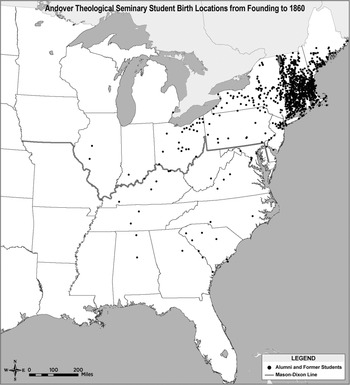
Over the course of the antebellum period, more than two thousand young men – graduates and non-graduates – received an education from Andover Theological Seminary. Figure 1 maps the birth locations of every student who attended Andover before the start of the Civil War. As the map shows, three-quarters of these students were born in Massachusetts, Connecticut, Vermont, New Hampshire, and Maine. Massachusetts alone contributed to over one-third of the student body from 1808 to 1860. Of the students who attended Andover during this era, only one and a half percent were born south of the nation’s capital in Washington DC, and a majority of those students never completed their full course of study. Natives of New York contributed nearly 8 percent of the student population, while natives of Rhode Island, Pennsylvania, New Jersey, and Ohio failed to reach 2 percent, respectively, of the students who attended Andover during this period. Students’ place of birth serves as an important marker for understanding from where the institution drew not only students but also support. Recognizing that Andover was not a national institution in terms of its student population reveals its decidedly New England character and identity. This is markedly different from the only school to rival Andover’s success prior to the Civil War, Princeton Theological Seminary. As scholars have shown, Princeton maintained a more national outlook for the whole of the Presbyterian denomination, drawing students from New England, the Mid-Atlantic, and even the South.Footnote 54
The birth locations of every student who attended Andover between 1808 and 1860.

Whereas some theological schools had more lenient admissions standards, 95 percent of the students recorded in Andover’s catalogue between 1808 and 1860 received a collegiate education. Half of the students received their undergraduate college degree from Yale, Dartmouth, or Amherst. Other schools with sizable numbers of students who attended Andover included Middlebury, Williams, and Bowdoin. Roughly thirteen hundred completed the full three-year course of study from the institution, while the remaining students completed only a portion of the curriculum. This did not mean that non-graduates did not enter the ministerial profession. On the contrary, many left the school early to settle congregations. Others went on to become doctors and lawyers. Over fifty students would serve as representatives in some branch of local or state government.Footnote 55
Where students were born and where they carried out their vocational calling illustrates how Andover moved and extended Christianity’s reach across the country’s landscape. Through this movement, the school cultivated a national imagination among its students. Because less than 2 percent of the student body who attended the school before 1860 were born in the South, Andover was not a national institution in the sense that it served students from every corner of what constituted the then United States. That does not mean, however, that Andover was not a national project. Andover’s advocates desired to establish a more rigorous ministerial education to “settle and maintain faithful ministers.”Footnote 56 This explicit use of the language of “settling” helps to characterize theological education’s nationalist and imperialist aspirations.
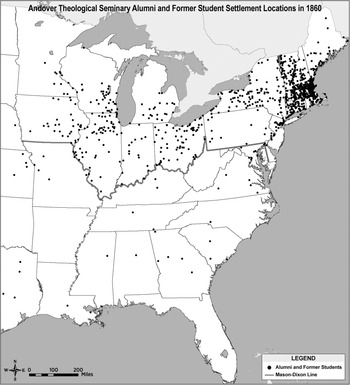
Mapping the settlement locations of Andover’s graduates in 1860 reveals the imagined national boundaries the school cultivated among its graduates. Figure 2 depicts a snapshot of Andover’s influence in 1860. This image shows where every individual who attended Andover was carrying out their vocational callings in the United States circa 1860. While most of these graduates were born in New England, by 1860, sizable numbers of Andover’s students were carrying out callings in western New York, Ohio, Michigan, Indiana, Illinois, Iowa, Wisconsin, and even Minnesota. These maps also show how Andover facilitated the movement of its students across the geographic landscape.
The settlement locations of every Andover student circa 1860.

In many ways, this mapping shows what scholars might expect from Andover. Many of its students were born in New England and continued to carry out their vocational calling in New England. Those who did not follow migration patterns westward were facilitated by transportation networks and railroads that prioritized western rather than southern migration. Mapping these migration patterns, however, shows how theological education was utilized and became part of a US religious infrastructure that supported Western migration. Glenn Miller notes that as the nineteenth century progressed, many theological schools were established at major rail hubs.Footnote 57 As ministers disseminated out from their institutions, they not only settled congregations but helped to shape and form communities through a reformed, evangelical moral outlook. They presumed that their best opportunity for exerting influence upon the geographic landscape was westward. When members of the Iowa Band rejected the possibility of settling in Missouri, they employed a logic that was quite familiar to other Andover students. The imagined future of the nation was the West and not the South. The religious nationalism cultivated at Andover directed students to employ their vocational labors for the benefit of the United States through settling the midwestern territories.
VI. Conclusion
Andover Theological Seminary was not merely invested in shaping the theological orientation of clergy. Jedidiah Morse ensured that the school’s ambitions also intersected with the evolving geopolitical landscape of the expanding United States. Andover educated students with the intention of producing political actors who would advance the school’s national and imperial ambitions. Morse and Andover’s founders believed the success and stability of the United States were uniquely intertwined with an educated Christian ministry. If the young democratic republic were to succeed, it would need well-educated ministers to provide Christian moral guidance to a wider populace.
Andover is an important institution for understanding the history of theological education in the United States. While this remains a case study of one institution, it addresses the broader impetus for establishing theological seminaries in the United States in the early nineteenth century. Andover’s influence remains well-documented among other institutions of theological higher learning as well. It was the prototypical institution. Many of Andover’s students would go on to become influential founders and professors at other institutions by the middle of the nineteenth century. Under the tutelage of Andover Professor Moses Stuart, nearly seventy Andover men would enter into academic life.Footnote 58 Schools including Bangor Theological Seminary, Newton Theological Seminary, Princeton Theological Seminary, Union Theological Seminary in New York, Auburn Theological Seminary, Lane Theological Seminary, and Columbia Theological Seminary could all count Andover graduates among their faculty at some point in this time.Footnote 59 Whereas Morse’s nationalist and imperialist ambitions helped to shape Andover and its graduates, theological education’s origins in the United States writ large were shaped by these political sentiments and the need for a religious infrastructure capable of producing clergy at scale.
While the school may have set the stage for graduate education in the United States and cultivated innovative theological perspectives, it was also part of a religious political project rooted in nationalism, imperialism, and white supremacy.Footnote 60 Andover was established out of a rejection of the belief that democracy was a viable form of governance without proper guardrails. Morse and Andover’s supporters believed that if the United States was going to have a chance at succeeding, it would need Christianity. Specifically, it would need a well-educated ministerial profession to support the country’s moral well-being. By the start of the Civil War, Andover and its students had defined the school as ideologically at odds with the American South and, by proxy, the institution of slavery.
Such a narrative suggests that various scholastic frameworks of religious nationalism and imperialism are rooted in a spatial understanding of the boundaries of the “nation.” One might assume, given Andover’s purported education of “patriotic Christians,” that the school would educate students who carried out vocations in every part of the country. Andover’s students, however, imagined the American religious landscape differently. The rise of the early-modern nation-state facilitated such imaginings because, as historian Eric Storm notes, “their boundaries were not fixed, and in many instances, their territory was expanded without regard for cultural and linguistic differences.”Footnote 61 The Louisiana Purchase in 1803, a French territory, exemplifies this point. Not all Americans, however, imagined the country the same way. As historian Walter Johnson shows, American southerners envisioned closer political and geographic ties with the Caribbean and South America.Footnote 62 Andover helped to create another vision of the United States among New England Protestants. This is not to suggest that Andover and its students did not recognize the physical and political boundaries of the country, rather it suggests that the tenuousness of the country’s boundaries allowed them to envision alternative geopolitical formulations rooted in their commitments to a Christian state. Put another way, religious nationalism is inherently concerned with questions of fluctuating and changing borders and the bodies who establish, maintain, immigrate, and traverse those borders. Andover was not merely concerned with questions of Protestant theological orthodoxy. Through his nationalistic and imperialistic ambitions, Jedidiah Morse ensured that theological education in the United States would work to train Christian ministers who would also attend to these questions.
Acknowledgments
The author would like to extend special thanks to two anonymous reviewers, and also Edward Blum, John Corrigan, David Grafton, Kyle Roberts, and Scott Thumma for feedback on various forms of this article.

 Open access

