

State-promoted population movements, whether sponsored or physically coerced by the state, are a prominent historical feature of state-building processes and important to understanding contemporary settlement patterns. States promote movement in and out of different territories in pursuit of greater territorial control, often in contested border areas. A common means of increasing control for states is manipulation of the targeted region’s ethnic composition, with the goal of increasing ties to the central government. Thus, how individual citizens react, both immediately and in the long run, to being displaced (or surrounded by displaced populations) is key to this state-building strategy.Footnote 1 However, the most prominent arguments focus on the shorter-term consequences of resettling a state’s dominant ethnic group in new regions, leaving our understanding of long-term consequences underdeveloped. We argue that under conditions common to many historical cases, settlers do not develop the ethnocentric, pro-central-state, or national identities that were the desired state-building outcomes, but political identities tied to their locality and region.
State-sponsored resettlement of the central government’s ethnic kin to remote regions often cuts against the state’s policy goals in the long term. States usually promote or coerce resettlement in peripheral border regions, where they have limited administrative capacity. In order for state-led resettlement of coethnics to augment territorial control in peripheral regions, it is essential to establish and maintain close ties between migrants and the central government that prevent or obviate the trauma of resettlement.Footnote 2 However, the combination of a weak central state and a large effective distance to the resettlement area often renders long-term ties between the central government and settlers difficult, undercutting the development of pro-central-government loyalties across generations of migrants. In cases where ties between settlers and their coethnics in the government are weak or severed after resettlement, displaced communities tend to develop relatively local and regional identities. In the long term, resettled communities engage much more with local institutions and their non-coethnic neighbors than they do the central state or their coethnics who did not also resettle. This serves to elevate identification with their region and with local political institutions.
We examine an under-studied historical instance of demographic engineering: Emir Abd al-Rahman’s resettlement of a significant number of Pashtuns from the southern and eastern regions of Afghanistan to the north in the 1880s and 1890s. The emir’s main objective was to consolidate control over a border region contested with the Russian Empire. Resettlement took place over several phases and brought the largest and politically dominant ethnic group in Afghanistan, the Pashtuns, into an area that was populated by groups such as Uzbeks and Tajiks. Despite a lack of systematic empirical evidence regarding the long-term effects of resettlement, most historical treatments assert that Pashtuns in the north became staunch supporters of the central state run by their ethnic kin,Footnote 3 with Barfield writing that “because they were surrounded by other hostile ethnic groups, the former Pashtun rebels of the south became strong supporters of the government in the north.”Footnote 4 We argue that this consensus in the historical literature paints an unrealistic picture of the quality and stability of long-term relations between the displaced communities in the north and the central government, while underemphasizing the trauma of resettlement and its aftermath. In contrast, we argue that the resettled Pashtuns developed relatively local and regional identities, viewing government authorities in Kabul warily, and preferring autonomy along with engagement with regional institutions.
We assess our arguments with detailed survey data on variation in individual attitudes across Afghans in the northern provinces and the rest of the country. First, we use two large Foghorn surveys to analyze citizens’ views of key political institutions and actors. The Foghorn data collected in late 2017 and early 2018 are unusually geographically precise because they are geolocated at the settlement level. The Foghorn surveys were far larger than other, similar efforts and are subnationally representative, with around 40,000 respondents in each platform. The unparalleled scale and geographic detail of data collected in this period ensure that we have enough respondents who identify as ethnic Pashtuns, in addition to other ethnicities across the northern provinces and other regions of Afghanistan, which is a major problem with other data sources. We also use the Measuring Impact of Stabilization Initiatives (MISTI) survey data, which includes over 190,000 respondents across more than 5,000 villages in five waves from 2012 to 2015. The MISTI survey asked detailed questions about respondents’ primary identity and allows us to study attitudes at the district level. We supplement these data sources with disaggregated military records collected by coalition forces during the period leading up to and including the MISTI survey. These significant activity reports allow us to address concerns about the role of conflict dynamics in shaping civilian attitudes and to also explore an important behavioral outcome relevant to our survey-based approach: the volume and value of civilian collaboration with the government during war.
Across numerous empirical tests, we show that the political views and behavior of Pashtuns who descend from those resettled in the late nineteenth century differ sharply from their ethnic kin elsewhere in Afghanistan. These displaced Pashtun communities have considerably less favorable views of the legitimacy and effectiveness of the central government. In contrast to their kin in the south and east, Pashtuns in displaced communities are significantly more favorable to local and regional government, like their non-Pashtun neighbors in the north. Stark intra-ethnic differences are also evident in displaced Pashtuns’ views of the Taliban, which are significantly more negative than their kin elsewhere in the country. Consistent with these survey findings, we find in military records that displaced communities provide less information to the government than other groups do when they collaborate following insurgent attacks. These results contradict the prevailing view that these resettled communities are strongholds of loyalty to the state, which highlights the value of clarifying the long-term intergenerational effects of state-led resettlement.
Our arguments have important implications for scholarship on state building and border politics, as well as research on insurgency and civil conflict. A growing literature highlights how states use “demographic engineering” as a state-building strategy in border regions.Footnote 5 We clarify the conditions under which attempts to bolster state territorial control in the long term are effective, highlighting common difficulties associated with weaker states’ efforts. The limitations we identify are significant, as research has shown that a weaker state has greater incentives to try to consolidate control over threatened border territories.Footnote 6 Attention to the long-term effects in these cases is essential, as the influence of forced resettlement on individuals’ political attitudes, local patterns of conflict, and the degree of cooperation with the state are shaped over generations, rather than months or a few years. We identify a set of cases where forced displacement does not engender greater loyalty to the central state or to the dominant ethnic group, or produce more encompassing political identities, but instead fosters strong local and regional identities and loyalties.
Forced Displacement and State Building
State-led population movements, both voluntary and coerced, have long been a prominent tool of state building. There is much research on such movements, although the political context of resettlement varies considerably across cases. Internal displacements are often a result of traumatic events like civil wars,Footnote 7 territorial conflicts,Footnote 8 increasing security competition with a neighboring state,Footnote 9 or international agreements that conclude large multiparty wars.Footnote 10 Regardless of the specific context, most state-promoted resettlements aim to increase territorial control.
Governments often try to remove a minority population from a region via displacement. A common aim is to produce more ethnic homogeneity in the targeted region(s) by sorting people of different ethnicities, religions, or other relevant social characteristics into different geographic areas. For example, following the Turkish War of Independence, Greece and Turkey agreed to exchange populations between their newly delineated territories, where the goal was to eliminate sizable Christian populations in the new Turkish state and sizable Muslim populations in the Greek state. The transfer of people within Poland and Germany to accommodate the new (and significantly repositioned) post-World War II boundaries was also aimed at cultural homogeneity. State-led resettlements that are meant to homogenize different jurisdictions tend to be forced and aim to facilitate shared national identity and the central state’s territorial control.
While such attempts at greater homogeneity are consistent with common post-eighteenth-century state-building strategies, resettlement results in more heterogeneity when governments resettle their coethnics in regions populated by other groups. Such resettlement policies have the goal of increasing territorial control by placing putatively loyal coethnics among a local population seen as lacking strong ties to the state. They tend to target peripheral or border regions, and also commonly involve at least some voluntary migration.
The outbreak of civil conflict between the newcomers and the local population is documented in many such cases, as highlighted by the “sons of the soil” idea.Footnote 11 Fearon and Laitin show that around a third of post-World War II ethnic civil wars are “sons of the soil” conflicts, where migrants ethnically tied to the state become embroiled in escalating conflicts with their new neighbors.Footnote 12 They note that in many cases, the displaced people become staunchly loyal to the government because they depend on the state for their current land and also often enjoy resource transfers from the center. With a focus on Rwanda, McNamee makes this case for the resettlement of Hutus to border areas traditionally dominated by Tutsis, highlighting the importance of acquired land as an immobile asset.Footnote 13 In short, if the state with the displaced population’s ethnic kin at the helm loses power, the risk that the migrants lose their land significantly increases. This line of reasoning is consistent with that of the Iron Emir, who sent Pashtun kin to the strategically important north as a bulwark against a non-Pashtun population deemed “disloyal.”
Such population movements do not always result in severe intergroup conflict or civil war. While the “sons of the soil” cases involve placing loyal coethnics among putatively disloyal groups, states often promote the settlement of areas because they are seen as unpopulated or economically underdeveloped. An example is Indonesia’s transmigration program, which promoted the voluntary movement of around 2 million people between 1979 and 1988. Agricultural development and nation building were key objectives, with the latter being seen as urgent in a very diverse country where Indonesian, the official language of the central state, was spoken by a small minority of the population.Footnote 14 Bazzi and co-authors show that people relocated to diverse localities developed less exclusively local identities and more national identification, while those displaced to more homogeneous areas populated by their kin retain more exclusive identities and identify more with their ethnic group than with the national state.Footnote 15 This is consistent with research that has shown that people living in more diverse settings have more meaningful cross-ethnic tiesFootnote 16 and more tolerance of other groups.Footnote 17
The literature on border politics and border disputes also analyzes demographic engineering in border regions. The pathbreaking work of Huth highlights that the presence of cross-border ethnic minorities in contested border regions is associated with interstate territorial disputes.Footnote 18 Armed conflict is especially likely when these transnational ethnic groups are excluded from power.Footnote 19 Carter found that states with ethnic minorities with ties to the ethnic majority in a cross-border rival are associated with attempts at demographic engineering to consolidate territorial control,Footnote 20 a dynamic that McNamee and Zhang show is at work in the China–USSR case.Footnote 21 However, the long-term implications of these demographic engineering efforts are not as clear, as most studies either examine the logic behind the strategyFootnote 22 or have a short-term or cross-national focus that provides mixed evidence on these policies’ efficacy.Footnote 23 In one of the few exceptions, Zhang shows that China’s resettlement of ethnic Han to the west had the intended effect of quelling insurgency only at first, when the central government invested very heavily in these efforts; insurgency re-emerged after those investments waned.Footnote 24 In sum, more research is needed to understand the effects of forced resettlement efforts in a contested border region, as the effects of these policies on local actors’ identities and behavior are often shaped over decades rather than months or years.Footnote 25 We contend that the long-term difficulties for weak states to maintain the loyalties of settlers in the periphery over the long term are underemphasized in the literature.
State-Led Resettlement of Pashtuns in Nineteenth-Century Afghanistan
The resettlement of Pashtuns to the north from their historical base in the south and east began in the early 1880s under the transformative and brutal rule of Emir Abd al-Rahman Khan (1880–1901). Historians provide several motivations for the Iron Emir’s interest in the movement of Pashtuns to the northern provinces, and also detail how the policy was implemented in fits and starts from the early 1880s to 1896. This is a case of state-sponsored resettlement that involved a mix of forced and voluntary resettlement. One motivation was the need to consolidate territorial control in a contested border region, amid concerns about Russian encroachment.Footnote 26 Abd al-Rahman viewed the settlement of his Pashtun kin along the frontier of Afghan Turkestan as essential.Footnote 27
Another motivation was that the people in the north were viewed as having weak loyalty to the regime in Kabul. Thus, the emir planned to populate this strategically and economically important area with Pashtuns, who he presumed would be loyal to him and their fellow Pashtuns, particularly when surrounded by non-Pashtun populations.Footnote 28 However, the emir did not rely solely on one strategy here; he also forcibly resettled Ghilzai tribes that he had conflictual relations with, and he obtained the voluntary resettlement of Durrani Pashtun tribes whose loyalty he was more confident in. In practice, these resettlements were quite haphazard and inconsistent in implementation, as detailed by Lee,Footnote 29 although the emir did try to resettle Pashtuns such that tribal alliances in the south that did not favor him were disrupted. In this regard, he had the explicit intent of disrupting the social and political ties and identities of the migrants.
As that last point suggests, the primary political and social identities of Pashtun communities in the 1880s and 1890s in Afghanistan were with the kinship network and qawm. Footnote 30 Thus, one goal was to use resettlement to shift these communities’ primary allegiances away from their qawms and kin and toward the central state.Footnote 31 In this regard the emir may have been successful, as close ties between these displaced Pashtuns and ethnic kin to the south were necessarily disrupted given the lack of infrastructure, with the western ranges of the Hindu Kush standing in the way.
While the resettlement of Pashtuns from the south and west to the north also likely had immediate effects on the Pashtuns who did not migrate, we expect these effects to be fleeting. The resettled Pashtuns had to endure the move to the north and adjust to living in a new place surrounded by non-coethnics, unlike those who did not migrate. Moreover, the Pashtuns who stayed in their traditional areas of settlement in the south and east were the dominant group at the time of displacement and remained so afterward. Thus, we argue that any effects on communities in the south and east would be muted and short lived. Accordingly, our theoretical focus is on how resettlement affects the identities of migrants, highlighting how the process and immediate consequences of resettlement interact with state policies to influence the networks and allegiances of resettled communities.
The Long-Term Effects of Resettlement
Of central interest are the conditions under which settlers will develop long-term attitudes consistent with the state-building goals of the central government. The state’s overarching objective is to develop a group of loyalists among the local population in the target region. A key obstacle to fostering pro-state loyalty are the traumas associated with the process and aftermath of resettlement. While this issue is starkest in cases of forced resettlement, it is also common in cases of voluntary state-sponsored resettlement, which is an under-appreciated point. The state can overcome the effects of trauma and foster a bastion of loyal subjects if it quickly and consistently establishes itself as a provider for and protector of resettled communities. But this is often hard because such resettlement schemes tend to target remote and difficult-to-reach border regions, where limits in capacity and large effective distances from the capital undercut sustained engagement and support. We outline our arguments with the details of the resettlement of Pashtuns to northern Afghanistan in the last two decades of the nineteenth century.Footnote 32
The Trauma of Resettlement
Much research highlights the long-term effects of trauma and state repression on the political views and behaviors of the victims’ descendants. The intergenerational transmission of traumatic events is argued to lead victims’ descendants, decades later, to oppose political groups affiliated with the perpetratorsFootnote 33 and to exhibit weaker identification with the state when it is culpable.Footnote 34 While the idea that negative views of the state are a function of the trauma of resettlement is better recognized for forced resettlements, we argue that it is also fairly common in cases of voluntary resettlement, where the state incentivizes settlers to move.
Trauma for migrants and their families can derive from both the process of resettlement itself and hardships that migrants meet after resettlement. There is ample evidence that the resettlement of Pashtuns in the 1880s was traumatic and often included violence, hardship, and death among the settlers.Footnote 35 Many of them, especially the Ghilzai, were prisoners “exiled” to the north, while as late as 1888 at least 14,000 Pashtuns were forcibly deported to areas in contemporary Herat, which was known then as Afghan Turkestan. In neighboring Badghis, both Lee and Tapper highlight the disastrous consequences of the voluntary arrival of thousands of Ishaqzai from the Durrani tribe in Badghis.Footnote 36 This swift resettlement of thousands of Pashtuns from Pusht Rud in the south “wrought havoc on the local economy, and merely increased the misery and suffering that the indigenous population was already obliged to endure”; it also “proved to be a disaster for the maldars themselves.”Footnote 37 These examples highlight the trauma faced by migrants after resettlement in the north. In sum, historical treatments of northern Afghanistan in the late nineteenth century lay bare the appalling brutality of the Iron Emir’s regime and the repression and hardship of resettlement in the 1880s and 1890s.
A growing literature clarifies how the trauma from state-led resettlement is transmitted across generations. Traumatic and disruptive shocks such as forced displacement can lead norms of cooperation to break down as people adopt shorter time horizons and steeper discount rates.Footnote 38 Forced resettlement can also deplete wealth and assets, disrupt social networks, and undermine access to food stores and public goods,Footnote 39 consequences that transmit intergenerationally via persistent social, economic, and political isolation.Footnote 40 These events have strong influence on contemporary beliefs through mechanisms of memory-making, including oral histories passed down through generations, detailing harm and hardship. Lee effectively describes this mechanism in the Afghan case, highlighting how the trauma of forced resettlement and state repression has been transmitted across generations by descendants of the victims: “Whilst the Amir’s ‘achievements’ are constantly reworked and expanded by successive generations of academics and journalists, for the peoples of Afghanistan, it is the atrocities which dominate the folk memories which have survived from this era.”Footnote 41
A rich theoretical literature shows how the effects of disruptive historical events can be amplified and solidified over time, even in the face of contemporary incentives that reflect changes in context. Tabellini and Guiso, Sapienza, and Zingales show that the intergenerational transmission of political values from parents to children can easily lead to the long-term persistence of pessimistic ideas, as parents tend to pass down their own cultural values and want to protect their children from risk and harm.Footnote 42 Bin Oslan demonstrates that the long-term persistence of communities’ political differences need not rely on parental transmission but can also be sustained when intra-group interpersonal interactions are more common than inter-group interactions.Footnote 43 The upshot here is that once a legacy of skepticism toward the state becomes entrenched in and passed down through communities, these narratives become increasingly difficult to alter. Accordingly, if the state hopes to produce a bastion of support in displaced communities, immediately counteracting the negative experiences of the resettlement process and its aftermath is essential.
The Ties That Bind: Resettlement and Political Identity
A possible counterbalance to these traumatic effects is a stream of support and resources from the state. Along these lines, the shorter-term loyalty of settlers in “sons of the soil” cases often hinges on state support of their communities. However, as noted, the state needs to provide support to counteract the trauma and hardship of resettlement because negative narratives are difficult to alter once they become entrenched in a community and passed down across generations.
For example, when in the 1960s Sinhalese people migrated to the Eastern Province of Sri Lanka, a region traditionally dominated by Tamils, the government swiftly set up large military installations such as the Air Force Farm to house the Sinhalese-dominated security forces. This show of force and the fact that the security forces sided with Sinhalese migrants in disputes both emboldened migrants and fostered stronger identification with the state,Footnote 44 helping obviate the trauma of relocation to a new region. Without these investments in state security presence, the Sinhalese migrants would have likely experienced greater hardship and isolation in their new settlements. In short, this case highlights how support from the state after arrival can reduce the hostile views of the central government that often result when the aftermath of resettlement is difficult.
In our case, the resettled Pashtuns were not shielded from considerable hardship during or after moving to the north. The process of relocation, both in forced displacement and in more voluntary cases, is widely described as traumatic and poorly implemented. Moreover, the evidence suggests that resettled communities did not forge strong connections to the central government, let alone become dependent on Kabul for support. The central state’s weak administrative presence during and after Emir Abd al-Rahman’s rule was of course a significant impediment. Consequently, the displaced Pashtuns were not consistently provided with state resources that would “buy” their continued loyalty, as even the initial subsidies that some of the voluntary migrants received were small and short-lived.Footnote 45 At the time of resettlement, subsidies were very selectively applied to specific groups, while prisoners or more coercively resettled groups usually went without. In general, the historical record suggests that after their haphazard migration process, the displaced Pashtuns did not receive significant or sustained support from the Afghan government.
The lack of central-government resources in the north did not indicate a lack of policy ideas on the part of the Iron Emir. Rather, he calculated that a sense of “Pashtunism” and ethnocentric loyalty would be fostered among the displaced, and that this would translate into greater loyalty to the central government. His reasoning hinged on two notions: that the resettled communities’ relations with their new neighbors would be conflictual; and that the migrants would view the central state as the protector of their resources and status in the targeted region.
Evidence is mixed as to whether relations between the resettled Pashtuns and their new neighbors were consistently hostile.Footnote 46 However, that is beside the point in this case. The central government did not have a strong or consistent presence in the region; the migrants had no reason to see the Pashtun-controlled government in Kabul as a protector of their status and territorial possessions in the north. And given that the central government was not a reliable and essential protector, the displaced Pashtuns would likely only lower their opinion of and identification with the central state in the presence of significant inter-ethnic conflict.
Region and Identity in the Borderland
In cases where resettlement is traumatic and the government does not establish itself as an essential supporter of migrant communities, the local context shapes the development of settlers’ political attitudes. Regions of displacement are commonly border regions that the central government has struggled to consolidate control over. People living in border regions often exhibit political behaviors distinct from those more proximate to state power, especially where there are significant cross-border threats and limited state capacity.Footnote 47 As Braun and Kienitz note, proximity to a border need not strengthen the “visibility of and identification with the state.”Footnote 48 When resources from the state are scarce, communities near a border develop practices and engage with local institutions for subsistence and survival.Footnote 49
We argue that resettled communities that are not dependent on support from the central government and that lack strong ties to their kin in traditional areas of settlement are likely to develop regional political identities centered on local institutions. Resettled people forge ties with their new neighbors and learn to work within and shape the local and regional political system. It is not necessary for relations with non-ethnic kin to be mostly harmonious or for interactions with local political actors to be uniformly positive. Rather, it is important that migrant communities forge meaningful ties with local populations and institutions, and that these ties are more important than ties to the national state.
Thrust into a new region bordering a foreign power, with ties to ethnic kin elsewhere in the country strained or severed, most resettled communities will find it beneficial to engage with local communities. It is uncommon for small communities to be fully self-sufficient economically, especially when they are new to a region and lack full knowledge of important issues, such as growing conditions or seasonal disruptions of activities such as grazing or hunting. Accordingly, resettled communities have strong incentives to engage in economic exchange with neighboring groups. Social ties between migrants and non-coethnics also become more common and meaningful, as resettled communities increasingly find it in their interest to engage with their new neighbors, and economic exchange leads to stronger social ties.Footnote 50 This is consistent with prominent empirical research showing that exposure to ethnic heterogeneity is associated with more inter-ethnic social ties and denser social networks.Footnote 51
These economic and social ties to other ethnic groups, coupled with sparse ties to the central government and their kin in their traditional areas of settlement, significantly affect the migrants’ political behavior and identities over time. There is much evidence that individuals’ social ties affect their political attitudes and behavior.Footnote 52 Consistent with this, a growing literature in the social sciences finds that exposure to ethnic diversity leads to relatively positive views of out-groups.Footnote 53 In cases of resettlement, exposure to different groups can also undercut narrower ethnic identities and promote broader ones.Footnote 54
Marriage is one of the most significant social and political ties, and there is evidence in marriage patterns that resettled Pashtuns’ developed meaningful ties with non-Pashtuns.Footnote 55 In most areas of resettlement in the north there were not enough kin to support traditional patterns of exclusive intra-ethnic marriage, which led to some Pashtun men marrying Uzbek or Tajik women. The practice initially preferred by the resettled Pashtuns was to find wives from their families in the south to marry, but this broke down due to the distance and difficulty of the move to the north. As Dupree notes in his influential treatment, “The Ghilzai who remained in the south did not want to see their daughters move away from the localized, extended family unit ... so the northern-based Ghilzai males had to look elsewhere for brides, and began to take daughters from the neighboring Uzbek and Tajik, and relations between the involved villages intensified.”Footnote 56 In sum, this is one of numerous pieces of evidence in the historical record that the displaced Pashtuns forged meaningful connections with their non-Pashtun neighbors, which also led the strong ties to family and ethnic kin in the south, which had traditionally been bound by marriages, to dissipate over time.
The historical record also suggests that migrant communities’ interactions with regional and local governments were more substantial and positive than those with the central government. It is widely noted that Abd al-Rahman’s government struggled to exert influence over frontier areas during his reign.Footnote 57 This is unsurprising given that Afghanistan’s northern borders were newly drawn in the late 1880s and were quite arbitrary relative to existing economic, social, and political networks. During this period one of the most significant episodes of local resistance to the emir’s repressive policies across Afghanistan came from the governor of Afghan Turkestan, Ishaq Khan. Khan had ignored some of the emir’s more draconian directives and in June of 1888 coordinated a rebellion against Kabul. Khan’s rebellion was brutally defeated but remained popular in local narratives, especially in light of the atrocities perpetrated by the central state following its suppression. The rebellion of Ishaq Khan underlines the Iron Emir’s lack of administrative capacity in the north, as the uprising was planned for almost two months without Abd al Rahman having news of it.Footnote 58 This is notable for a regime known for its unprecedented network of informers, which inculcated a culture of fear in much of the country.Footnote 59
In sum, resettled communities forged meaningful connections in their local environment, with little support from the central government to counteract the trauma of relocation. While relations with their new neighbors were not without conflict, they were not consistently protected by the central state, and to the degree the state did intervene, the historical record suggests it did so with a heavy hand and even brutality.Footnote 60 We argue that this led to the development of a political and social identity centered on locality and region. This identity is more encompassing than a more exclusive identification with being Pashtun (a goal of the emir), or with the more traditional identification with one’s immediate kinship network, or qawm, such as Ishaqzai.
Data and Identification Strategy
To accurately analyze differences between the Pashtuns in Afghanistan’s northern displaced regions and those elsewhere, we need two key data sets. First, we need a detailed measurement strategy to pinpoint Pashtun village locations and to identify descendants of resettled populations. Since no data of which we are aware provide this, we develop our own strategy, which leverages a high-quality 1921 British ethnic map and an algorithm that uses detailed data on important geographic features to identify the expansion of these initial resettled Pashtun communities after the early twentieth century.
Second, we need extensive, geographically precise survey data, surpassing those used in earlier studies. Given the relatively small geographic pockets of territory with a Pashtun population in northern Afghanistan, any comparison of the political attitudes of displaced Pashtuns to those in the rest of the country requires a comprehensive survey of enough Pashtun respondents in the displaced region. Moreover, with Pashtun populations concentrated in specific northern villages, surveys retaining each village’s geolocation are crucial. In what follows, we describe data that meet these two requirements.
Expansion of Displaced Pashtuns in Northern Afghanistan
Understanding which Pashtuns in Afghanistan’s northern provinces descended from displaced groups (versus later emigrants) requires a relatively precise map. We use a detailed 1921 map produced by the British government (Figure 1) because at this point Pashtuns in the north were primarily those displaced by the regime or their descendants.
Initial displacement sites recorded in the 1921 British map
Note: Afghanistan Ethnic Groups, US Library of Congress, G7631.E1 2005 .U5, available at <https://www.loc.gov/resource/g7631e.ct002134/>.

To match contemporary villages to the displaced Pashtuns, we need to account for two processes of resettlement. First, the historical literature notes that the communities of displaced Pashtuns expanded their settlement areas over time, generally moving along valleys and mountain-runoff rivers that could sustain agriculture. Thus, to ensure that we correctly capture the descendants of displaced Pashtuns we need to account for this movement, which took place on foot and with animals. Second, it is documented that Pashtuns emigrated to the North after the 1930s, settling in new areas that previously did not have Pashtun settlements.
We devise a spatial method to distinguish between descendants of displaced Pashtuns and later emigrants by tracing the former’s locations and movements over a century. Specifically, we assess the suitability of land in northern Afghanistan for Pashtun expansion, assuming that Pashtuns will migrate to regions suitable for living. We divide northern AfghanistanFootnote
61
into 236,928 1 km $ \times $
1 km grid-squares, and use a LASSO (least absolute shrinkage and selection operator) model to predict the settlement suitability of each square. The outcome variable
$ \times $
1 km grid-squares, and use a LASSO (least absolute shrinkage and selection operator) model to predict the settlement suitability of each square. The outcome variable $Y$
is distance to the nearest village (regardless of ethnicity), and the predictors
$Y$
is distance to the nearest village (regardless of ethnicity), and the predictors $X$
are a set of variables that may affect people’s decisions to reside: elevation, relative elevation, slope degree, valley, longitude, latitude, distance to river, riverside, crop, rainfed agriculture, and seven key dimensions of soil quality (nutrient availability, nutrient retention rapacity, rooting conditions, oxygen availability to roots, excess salts, toxicity, and workability).Footnote
62
The advantage of LASSO over ordinary least squares is that LASSO penalizes overfitting and thus prioritizes the variables with higher predictive power.
$X$
are a set of variables that may affect people’s decisions to reside: elevation, relative elevation, slope degree, valley, longitude, latitude, distance to river, riverside, crop, rainfed agriculture, and seven key dimensions of soil quality (nutrient availability, nutrient retention rapacity, rooting conditions, oxygen availability to roots, excess salts, toxicity, and workability).Footnote
62
The advantage of LASSO over ordinary least squares is that LASSO penalizes overfitting and thus prioritizes the variables with higher predictive power.
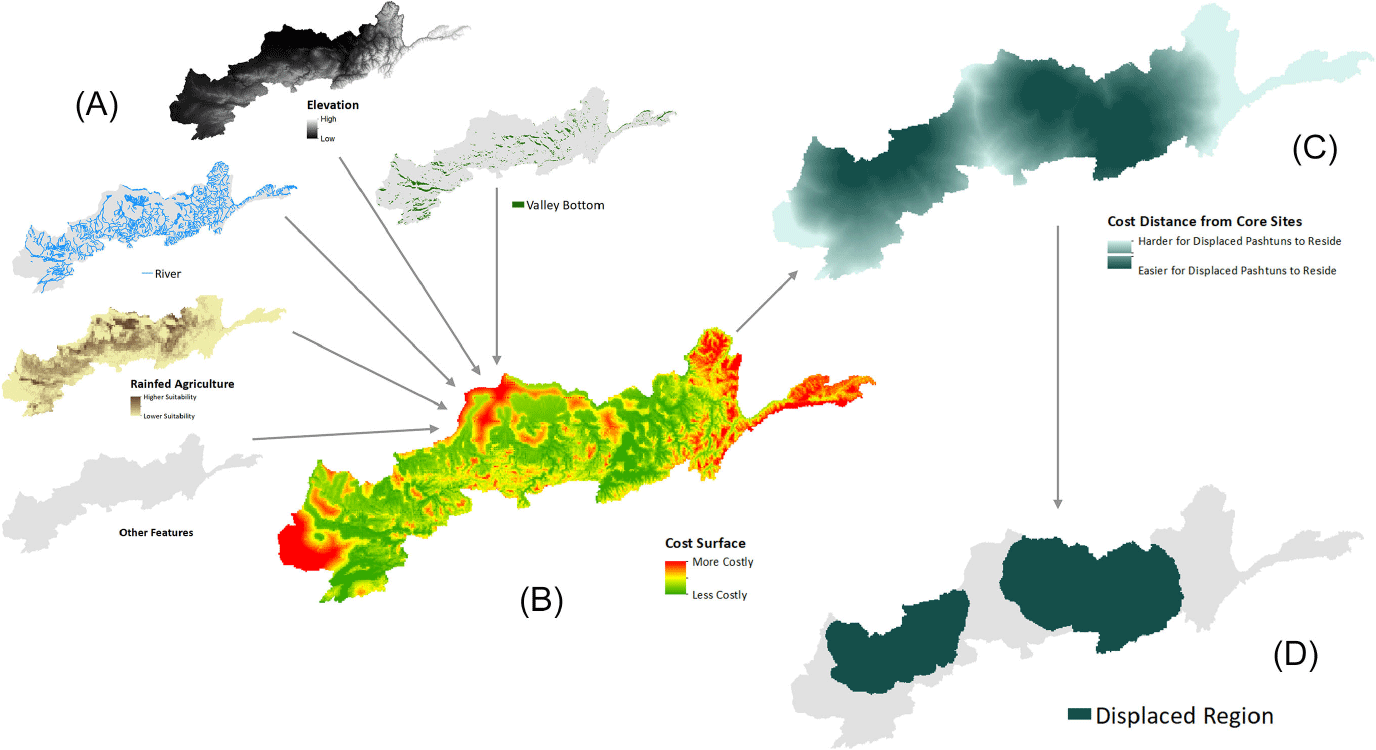
Next, we calculate each grid-square’s likelihood of housing descendants of displaced Pashtuns. We use the pre-1921 map (Figure 1) to identify initial Pashtun settlements. The LASSO model takes into account several local features (Figure 2, panel A) and calculates a cost surface (panel B). Combining these two pieces of information, we get the cost distance for displaced Pashtuns to migrate from their core sites to any place in northern Afghanistan (panel C). Darker areas in panel C indicate a higher likelihood of hosting displaced Pashtuns, further categorized using the Jenks natural breaks optimization method, with probable areas shown in panel D.Footnote 63
Methods used to trace the movement of displaced Pashtuns over time
Note: Each feature is calculated on a 1 km $ \times $
1 km base. Southern Afghanistan is omitted.
$ \times $
1 km base. Southern Afghanistan is omitted.

We carefully validated the identified locations using extensive historical evidence from archival sources and the academic literature, drawing from what we believe are all the available resources. As detailed in the appendix, we carefully reviewed 1,374 references—narrowed down to a dozen pivotal works—that explicitly document the presence of displaced Pashtuns in specific locales. Notably, several sources describe migration patterns along major sites such as the Harirud and Kunduz Rivers, which are precisely captured by our algorithm. The historical accounts closely align with the spatial clusters we identified, providing strong support for the accuracy of our settlement measure and confirming that it reflects recorded movements and is not just model-driven.
Survey Data
We use two large-scale, nationally representative surveys of Afghan citizens’ attitudes and experiences. The first is Foghorn, a project contracted by the US Central Command and implemented by D3 through its Afghan subsidiary, Afghan Center for Socio-economic and Opinion Research (ACSOR). ACSOR used local enumerators to ensure participant comfort and confidentiality. Respondents did not know the identity of the agency that commissioned the survey and interacted only with enumerators during their village visits. Foghorn consists of two survey collection protocols, each of which used a different sample of approximately 40,000 people and different survey questions. Both protocols were fielded three times: in November and December 2017, February 2018, and May 2018. We study these waves because they include precisely georeferenced village locations. Districts serve as primary sampling units,Footnote 64 sampled proportionally by size, with secondary village units randomly selected.Footnote 65 Unlike almost any survey of which we are aware, this sampling approach provides representativeness at the district level. On completing village selection, ACSOR secures local elder approval for enumerator entry. In each village, households are selected using a random-walk method, with a Kish grid used to randomize respondent selection within each household.Footnote 66
To supplement Foghorn, we use data from USAID’s MISTI survey. As the most extensive evaluation of stabilization interventions by the US government, MISTI reached over 190,000 respondents across more than 5,000 villages, in five phases from March 2012 to September 2015. During the sample period, MISTI survey data were also primarily collected by ACSOR. Districts were sampled based on prior USAID activity, and villages were subsequently chosen based, in part, on proximity to these projects. Household and respondent sampling then followed the same randomized approach used in Foghorn. These survey responses, then, capture a representative assessment of public attitudes and preferences in areas with a history of development assistance. Although offering less geographic precision—limited to the administrative-district level—these data provide a wealth of supplemental information. Our focus is on survey questions concerning identity affiliations, which map to our theoretical argument.
We also take care to account for how local security conditions across time might affect individual attitudes about key political institutions and actors. For this we rely on declassified microdata collected by members of the NATO International Security Assistance Force and their local national security partners, secured by Shaver and Wright.Footnote 67 During the conflict, these security forces documented the approximate time and precise location of all attacks directed at them or reported to them. This data set includes more than 400,000 individual observations between 2002 and 2015, each identified by attack type: direct fire, improvised explosive device, or indirect fire.
Measurement Strategy
Having delineated the region of displacement, we can pinpoint displaced Pashtuns at an individual level via their self-identified ethnicity. According to the Foghorn survey, “Pashtun” is the predominant ethnicity, comprising just over 40 percent of all respondents, from a total of forty-four ethnicities. Out of the roughly 33,000 Pashtun respondents, about 1,800 are identified as descendants of the displaced, while a similar number of Pashtuns are not identified as descendants but reside in the same northern provinces. While most of these other potential ethnicities have limited representation, most reflect the population distribution in Afghanistan, identifying as Pashtun, Tajik, Uzbek, Turkmen, Hazara, Baloch, Nuristani, Aimak, or Arab. Figure 3 maps the geographic dispersion of Pashtuns and other ethnicities across sampled villages. Pashtuns are observed to populate the southern provinces continuously from the Iranian border in the west to the Pakistani border in the east, whereas the northern provinces bordering Turkmenistan, Uzbekistan, and Tajikistan have a mix of Pashtun settlements interspersed among non-Pashtun villages. For the MISTI survey, we adopt the same method to identify displaced Pashtuns, but only at the district level. A respondent is considered a displaced Pashtun if they self-identify as Pashtun and their district intersects with the displaced region.
Pashtun and non-Pashtun villages in Afghanistan

We estimate the individual-level effect of being a displaced Pashtun from the north, versus a Pashtun residing elsewhere, by regressing the outcome of interest on a series of mutually exclusive binary indicators that are the product of ethnicity and region: displaced pashtuns, non-pashtuns in displaced regions, and non-pashtuns in non-displaced regions. This makes non-displaced pashtuns the excluded category against which the estimated coefficients of these three included variables are compared. In the models that include respondents across all of Afghanistan, we include Pashtuns from northern provinces that we do not identify as descendants of the emir’s resettlement policy in this excluded category of non-displaced pashtuns. We also exclusively compare this set of non-displaced Pashtuns from the north to displaced pashtuns in analyses that include only northern provinces. We also include province fixed effects in all specifications, which condition out any fixed features of being from a specific province, northern or otherwise, in addition to including survey-wave fixed effects in all models.Footnote 68
We also control for variables that might confound the effect of our theoretically central variables. In the Foghorn models, we first control for individual-level variables that are known to affect political attitudes: age, years of education, college-education status, employment status, community-elder status, marital status, and household income, all of which are self-reported in the survey. Second, we include an indicator of whether the individual lives in an urban area, like Kandahar or Kabul. The urban experience in Afghanistan is known to be very different from rural and village life, making this a vital control. Lastly, we adjust all our models using survey weights to correct for any sample unrepresentativeness.Footnote 69 In the MISTI models, similarly, we control for gender, age, employment status, head-of-household status, marital status, and household income.
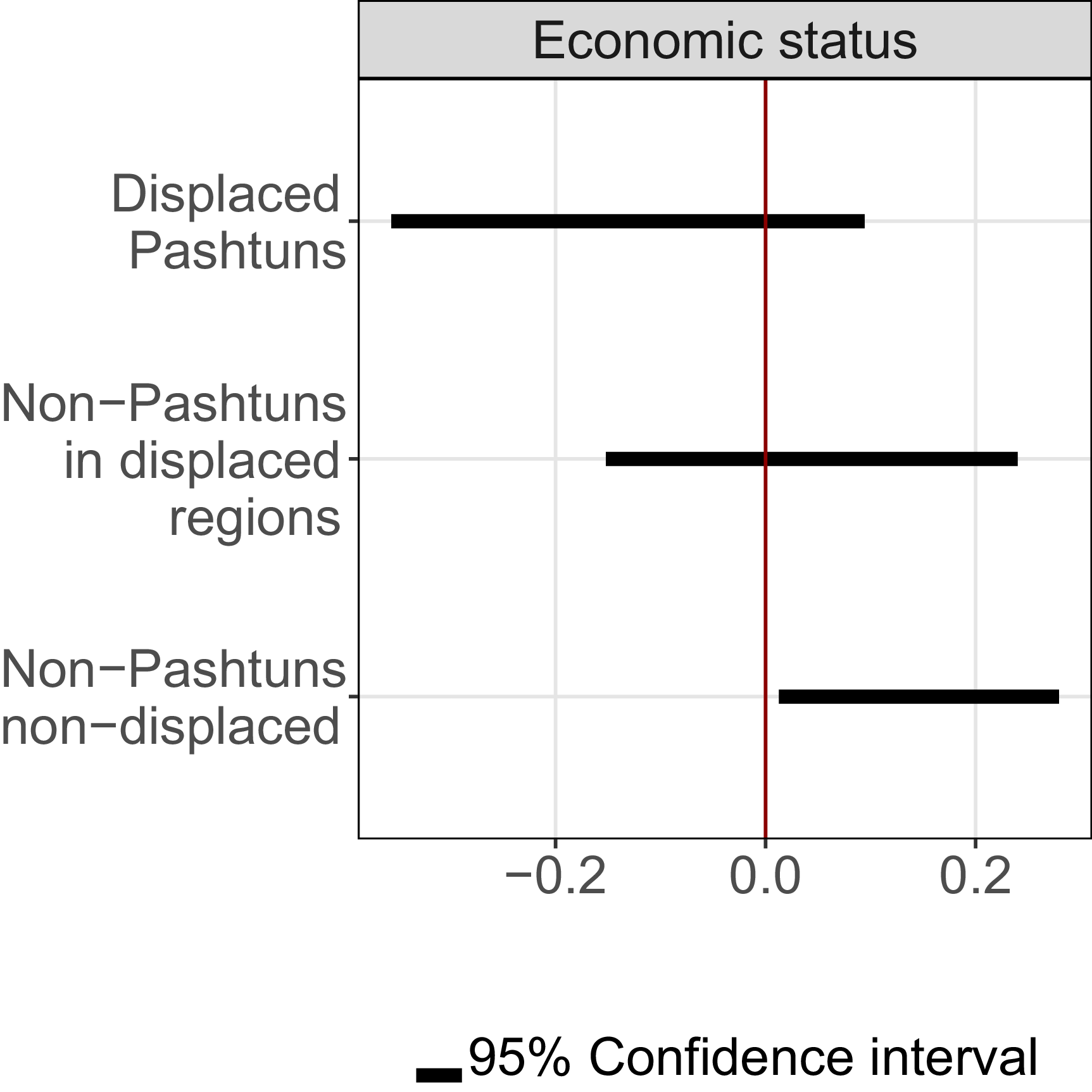
Armed with both the Foghorn data and our measure of displaced Pashtun communities, we can provide a systematic assessment of the common claim that displaced pashtuns are relatively well-off. This claim is often tied to the idea that displaced pashtuns are more supportive of the central government because they have economically benefited from their resettlement to the north over the long term. We infer each individual’s economic status with a measure that uses principal component analysis to combine responses on per capita household income, food security, and economically significant assets such as running water, electricity, and television. We find no significant differences between displaced pashtuns and their non-displaced coethnics (the excluded category) or their non-Pashtun neighbors (Figure 4). These results hardly support the idea that the Pashtuns who live in the areas of those displaced and resettled in the late nineteenth century are significantly better off than their non-Pashtun neighbors.
Pashtun and non-Pashtun economic status across Afghanistan
Notes: The panel head is the dependent variable derived from survey questions. We display only the estimated coefficients for the three population groups, compared to the baseline group, non-displaced pashtuns. The full tables encompassing all the control variables can be found in the Appendix. Robust standard errors are clustered by district and survey waves to be as conservative as possible. Survey weights are included to ensure representativeness of the survey sample to the underlying population.

Results
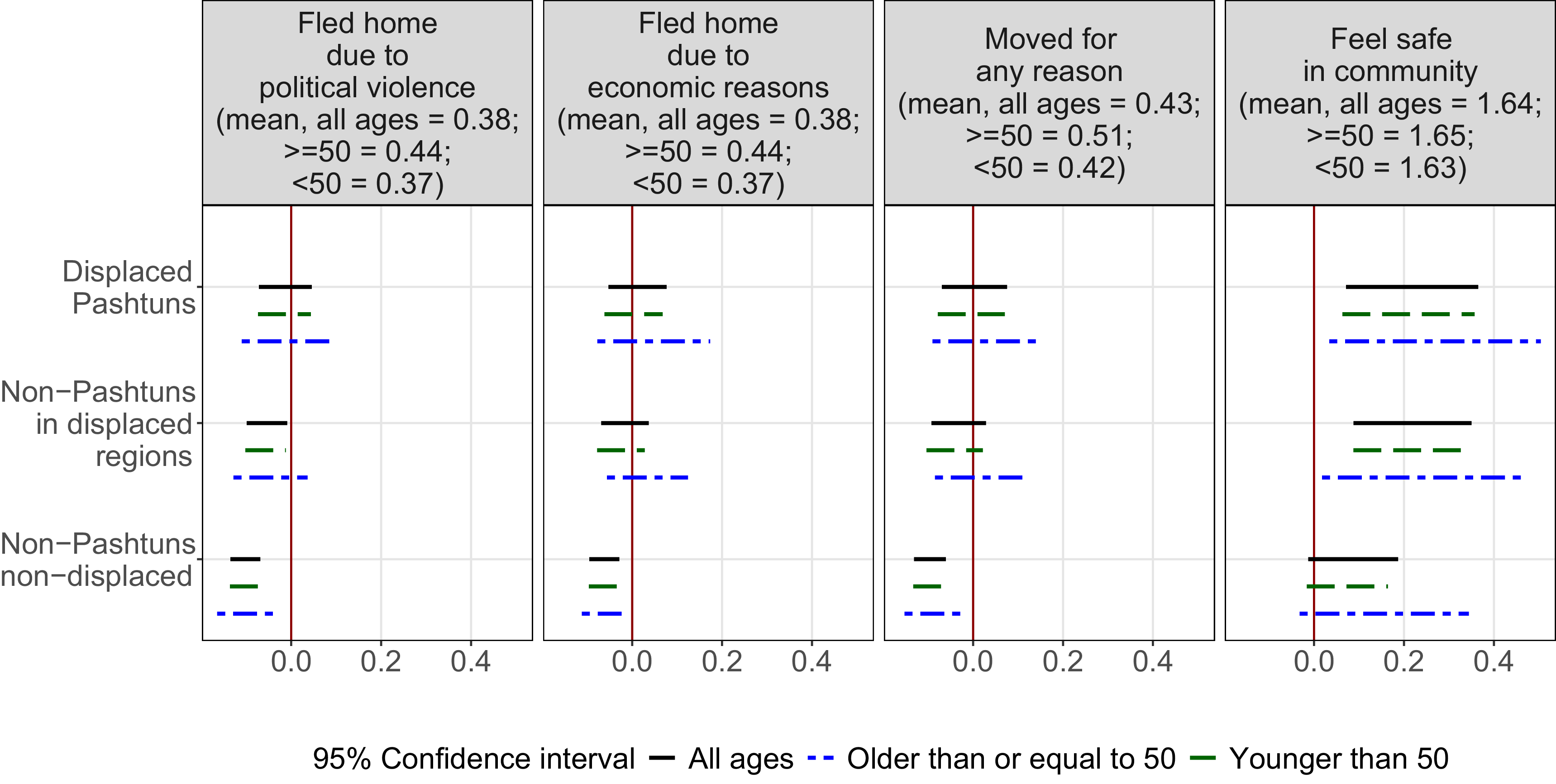
Before delving into our primary analysis, we evaluate the movement patterns of respondents based on the Foghorn survey to test the idea that resettled Pashtun communities have remained fairly stationary, apart from expanding within the same region from their initial sites, since their resettlement over a century ago. We want to test this because armed conflict during the Soviet invasion (1979–1989) and in the period following the US invasion (2001–2021) caused population displacements. While the historical literature suggests that these communities have been quite stable, with little inclination to relocate, we of course want to verify this with data to the degree possible. Figure 5 reports the results, comparing different groups using non-displaced pashtuns as the benchmark. As with all results reported in this section, all models include both province and survey-wave fixed effects, and standard errors are clustered by district and survey wave. The full tables on which these figures are based are given in the Appendix.
Perceived stability and safety in displaced communities
Notes: Panel heads are the dependent variables derived from survey questions. We display only the estimated coefficients for the three population groups, compared to the baseline group, non-displaced Pashtuns. The full tables encompassing all the control variables can be found in the Appendix. Robust standard errors are clustered by district and survey wave to be as conservative as possible. Survey weights are included to ensure representativeness of the survey sample to the underlying population.

Our focus is on the first row, where the estimates for displaced pashtuns are reported, with 95 percent confidence intervals. All estimates in this section are interpreted relative to non-displaced pashtuns, which is the excluded category. We also split the sample into respondents aged fifty and over and those younger than fifty. This cutoff distinguishes individuals who likely personally experienced violence during the Soviet invasion from those who did not. The results remain robust across both age groups. As expected, displaced pashtuns do not show a greater propensity to move due to political violence or economic situations. In fact, they report feeling safer in their communities than non-displaced Pashtuns. These patterns mirror those of their non-Pashtun neighbors, the non-pashtuns in displaced regions.
We supplement this evidence with several analyses of the stability and safety of displaced Pashtun communities (Figure 5). First, we use available data on conflict in the Soviet era (1979–1989), data on intercommunal violence (after 1989), and data on insurgent violence after the US intervention (after 2001) to assess whether this violence is concentrated in the regions populated by displaced Pashtuns. The idea here is to supplement the survey responses with data on violence, as residents who experience more severe violence are more likely to flee. Our analysis of data on violent events and activities is at the district level across all analyses. We find no meaningful association between districts with a larger percentage of displaced Pashtuns and any of the outcomes we analyze.Footnote 70
Are the Central Government and Its Allies Viewed as Effective?
We now turn to analysis of individual respondents’ views of and engagement with key political actors and institutions. Our primary interest is to estimate the effects of being a Pashtun descendant of those resettled by the emir. Models presented here contrast Pashtuns in the displaced region, as well as non-Pashtuns, with Pashtuns who are not identified as descendants of those displaced—that is, mostly Pashtuns in the south and east. This approach enables us to assess whether displaced Pashtuns have significantly different attitudes relative to their Pashtun kin or non-Pashtuns in the same region. These surveys were fielded in 2017 and 2018, which means that all of these responses were recorded when the Ghani government was still in power and the Taliban’s territorial control in urban centers was limited.
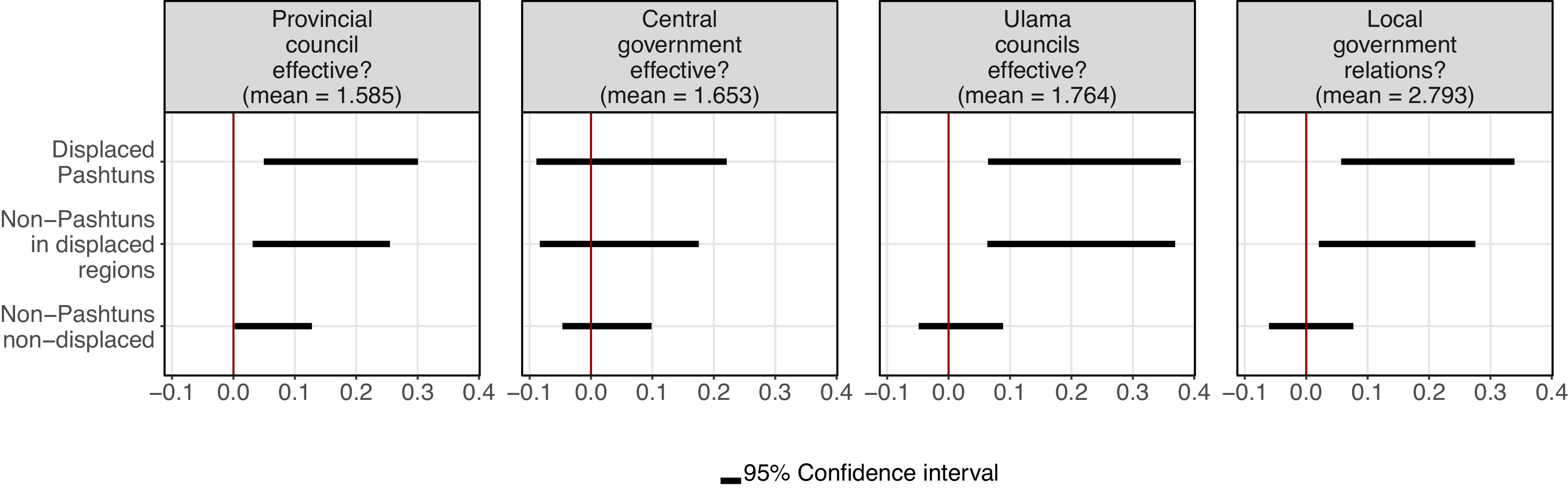
Our first set of models focus on respondents’ views of the effectiveness of three key governing actors: the provincial council, the central government, and the Ulama councils—as well as their views of their communities’ relations with the local government. A higher value indicates higher perceived effectiveness or superior relations.Footnote 71 Figure 6 visualizes our results.
Perceived effectiveness of government and institutions
Notes: Panel heads are the dependent variables derived from survey questions. We display only the estimated coefficients for the three population groups, compared to the baseline group, non-displaced Pashtuns. The full tables encompassing all the control variables can be found in the Appendix. Robust standard errors are clustered by district and survey waves to be as conservative as possible. Survey weights are included to ensure representativeness of the survey sample to the underlying population.

Our findings suggest that whether Pashtun respondents are descendants of those resettled by the emir significantly shapes their perceptions of key governing bodies’ effectiveness. The association between displaced pashtuns and perceptions of central government effectiveness is insignificant, meaning that the Pashtuns we identify as descendants of the nineteenth-century migrants are not staunch supporters of the central government, in contrast to a key long-term state-building objective of resettlement policies like this one. On the other hand, we see a positive and statistically significant coefficient for displaced pashtuns with all three other dependent variables. Notably, compared to their ethnic kin who we do not identify as descendants of those displaced by the emir’s traumatic large-scale resettlement campaign, displaced pashtuns expressed a significantly more favorable view of community relations with local government. This is also reflected in displaced pashtuns’ perception of local governmental actors’ and institutions’ effectiveness. These estimated effects reflect meaningful shifts in attitudes; for instance, the mean of the excluded category is 1.585 for the provincial council outcome, which means the estimated effect of 0.175 corresponds to an 11 percent increase relative to the mean.
Furthermore, when comparing the perspectives of displaced pashtuns with other ethnic groups in the same localities, it becomes evident that there is similarity among these groups. The direction and significance of the estimates across all outcome variables are strikingly similar for both displaced pashtuns and non-pashtuns from the displaced region. This suggests that displaced Pashtuns are more similar, in their political attitudes, to their non-Pashtun neighbors in the north than to their coethnics in the rest of the country. This is notable, as these are groups that have been living in the same regions of the north for over a century.
We follow up on this point by replicating the analysis of Figure 6 focusing only on respondents living in northern provinces,Footnote 72 with the non-displaced Pashtuns (the relative newcomers) as the excluded category. While we include province fixed effects in all of our models of survey data to address geographic differences across Afghanistan, this approach is even more restrictive. Although the sample size decreases by over 70 percent, we recover very similar results (see the Appendix for details).Footnote 73
Are the Central Government and Other Governing Actors Viewed as Legitimate?
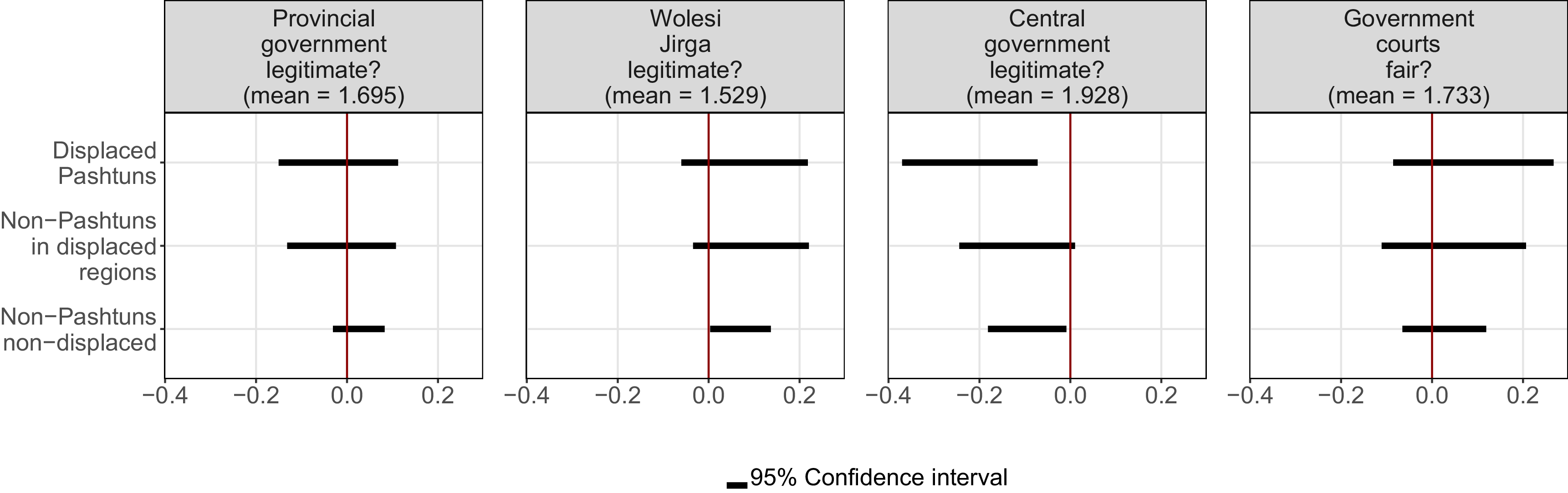
Figure 7 presents the results on the perceived legitimacy of the central and provincial governments, the Wolesi Jirga (House of the People), and government courts. Although the displaced pashtuns’ views of the provincial government are not significantly different from those of Pashtuns who were not resettled by the Iron Emir, their views of the legitimacy of the central government are significantly more negative. The estimated effect of –0.221 corresponds to an 11 percent decrease relative to the mean. This observation aligns with previous findings regarding the perceived effectiveness of the central government, suggesting that displaced pashtuns view the central government as both ineffective and illegitimate. This flies in the face of the state-building objectives that drove the large-scale resettlement of Pashtuns to the frontier.
Perceived legitimacy of government and institutions
Notes: Panel heads are the dependent variables derived from survey questions. We display only the estimated coefficients for the three population groups, compared to the baseline group, non-displaced Pashtuns. The full tables encompassing all the control variables can be found in the Appendix. Robust standard errors are clustered by district and survey waves to be as conservative as possible. Survey weights are included to ensure representativeness of the survey sample to the underlying population.

We also note that displaced pashtuns’ negative views of the central government’s legitimacy are similar to those of non-Pashtuns. While the magnitude of the coefficient for displaced pashtuns is larger and not close to or overlapping with zero, the 95 percent confidence intervals for these groups indicate no statistical differences among them for all four outcomes. We further assess the differences between displaced pashtuns and other Pashtuns by again looking exclusively at Afghans in the northern provinces. Consistent with the plots in Figure 7, the only significant difference we find between displaced pashtuns and Afghans who do not live in the displaced region but do live in the north is in their views on the legitimacy of the central government (see the Appendix for these results). While the coefficient is significant at only the .10 level in this much smaller sample, the coefficient remains a meaningfully large –0.123, with p = 0.056. That is, displaced pashtuns have a consistently negative view of the central government and its legitimacy. The descendants of the Iron Emir’s resettlement policies have not become “strong supporters of the government in the north,”Footnote 74 and they differ in their views from their ethnic kin elsewhere in Afghanistan.
Views on the Taliban
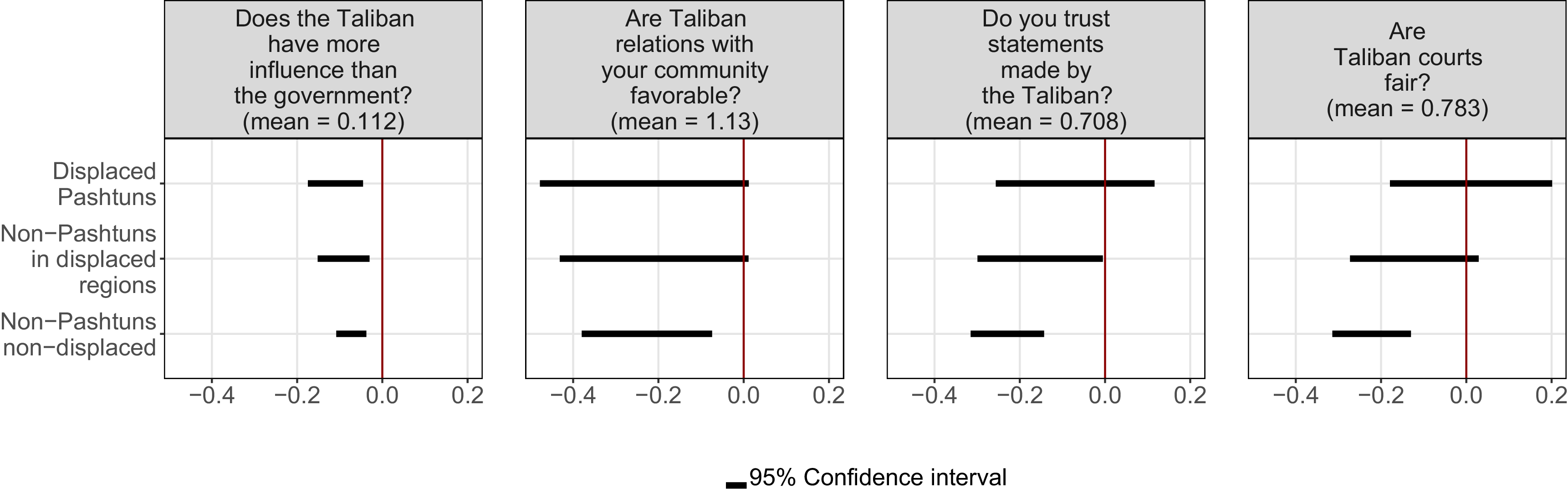
We now turn to respondents’ views of the Taliban. These responses were collected before the Taliban’s 2021 takeover of Afghanistan, and they offer insights into the subsequent support of the Afghan populace for their new regime. Initially, we find that displaced pashtuns are significantly less likely to agree that the Taliban has more influence than the government, compared to their ethnic counterparts in the south and east. In the first model, all coefficients for Pashtuns and non-Pashtuns are negative, which implies a stronger sense of governmental influence across these groups compared to Pashtuns in the south and east. This estimate indicates that displaced pashtuns have dim views of the central government even though it has more influence in their localities than the Taliban, its main competitor. If anything, this result further undermines the idea that the long-term effects of the Iron Emir’s resettlement policies were to create a group of Pashtuns loyal to and dependent on the central state.
In the second model, for the relation of local communities with the Taliban, all groups’ views are generally more negative than the baseline group, Pashtuns in the south and east. However, the estimates for neither Pashtuns nor non-Pashtuns in displaced regions reach statistical significance. In the third and fourth models, the coefficients for displaced pashtuns are both insignificant. Meanwhile, non-Pashtuns have generally less favorable views of the Taliban’s statements and judicial system. Across all categories, the coefficients for all three groups are either negative or insignificant when compared to non-displaced Pashtuns. This trend aligns with the widely held belief that Pashtuns, particularly those in the eastern provinces of Afghanistan, were more supportive of the Taliban. Finally, we note that the estimates are very similar when we look only at the northern provinces (see the Appendix). This suggests that the differences we uncover between displaced pashtuns and their kin elsewhere in Afghanistan are robust to comparing these communities to more recent Pashtun migrants in the north.
Identity in Resettled Communities
The results in Figures 6 to 8 demonstrate that the long-term effects of the large-scale resettlement of Pashtuns to the north cut against the central state-building objective of building a cadre of coethnics loyal to and supportive of the central government. These results support our main argument, that the long-term effects of this traumatic, large-scale, and poorly implemented resettlement over a century ago are communities that have stronger ties with and more positive views of their local and regional government and institutions. We also demonstrate across numerous outcomes that the views of displaced pashtuns are much more similar to non-Pashtuns who live in the same northern region of Afghanistan than to Pashtun kin elsewhere in the country. However, the analysis has not yet directly assessed our claim that displaced Pashtuns have developed political identities centered on their locality and region, rather than their ethnicity or Afghan identity.
Views of the Taliban and its institutions
Notes: Panel heads are the dependent variables derived from survey questions. We display only the estimated coefficients for the three population groups, compared to the baseline group, non-displaced Pashtuns. The full tables encompassing all the control variables can be found in the appendix. Robust standard errors are clustered by district and survey waves to be as conservative as possible. Survey weights are included to ensure representativeness of the survey sample to the underlying population.

Theoretically, people can have identities that combine different aspects of their life and experience, for example, their religion and their nationality. However, our focus here is on the one aspect of “who they are” that they identify as the most salient identity category when prompted to pick just one. We use a MISTI survey item that elicits this directly.Footnote 75
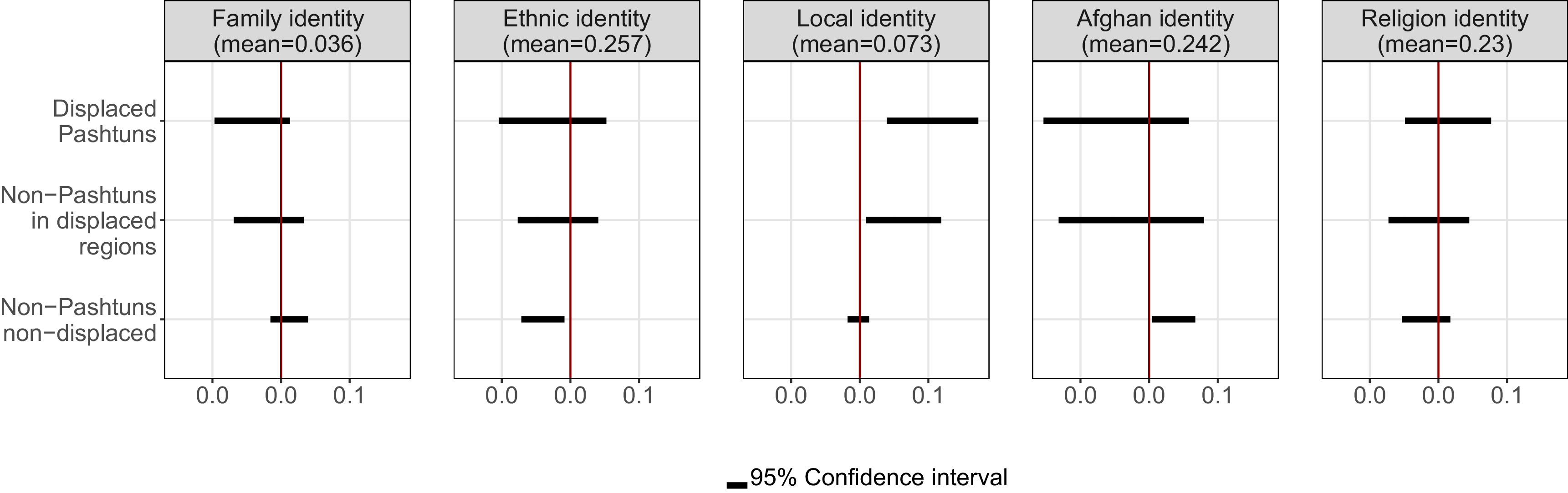
Figure 9 reports the results of five regression models focused on this primary political identity. These models incorporate all survey waves that asked respondents about their primary political identity, covering 2012 to 2014. As with the Foghorn data, we included fixed effects for each survey wave and province to adjust for disparities across time and Afghanistan’s diverse regions. We also considered individual indicators for gender, age, employment status, household leadership, marital status, and household income.
Primary identity attachment: transnational, national, and ethnic identities
Notes: Panel heads are the dependent variables derived from survey questions. We display only the estimated coefficients for the three population groups, compared to the baseline group, non-displaced Pashtuns. The full tables encompassing all the control variables can be found in the appendix. Robust standard errors are clustered by district and survey waves to be as conservative as possible.

The results are striking and support our central claim that the long-term consequences of resettlement are Pashtun communities that identify with their locality and region rather than their ethnicity or nationality. On this front, we find pronounced differences among Pashtuns in different regions of Afghanistan, as displaced pashtuns express a stronger localized political identity—73 percent more than non-displaced pashtuns, the excluded category. Importantly, non-pashtuns from displaced provinces are also significantly more likely to prioritize their local identity than Pashtuns in the south and east. We did not observe a similar effect for family, ethnic, Afghan, or religious identity. The finding that displaced pashtuns are less likely to consider their Pashtun ethnicity or their Afghan nationality as their primary political identities, compared to their counterparts in the south and east, is a key piece of evidence for our central claim: resettled communities developed relatively local identities rather than the ethnocentric or national identities envisioned in the Iron Emir’s state-building project. Instead, displaced Pashtuns are significantly more inclined to prioritize the multi-ethnic local identity that they share with neighboring Tajiks and Uzbeks.
The results are very similar when we examine only respondents in northern provinces (see the Appendix). Thus, the local identity among displaced pashtuns is not simply an artifact of living in the north, as we recover the same effect when we look only at northern Afghans and the excluded category is Pashtuns that we do not identify as descendants of those resettled in the 1880s and 1890s (again, see the Appendix for these results).
It is worth noting that identifying one’s local identity as primary is very uncommon in the survey data: fewer than 8 percent of all respondents across survey waves choose this option, making it the second-least-common response. Ethnic and Afghan are the most common answers, at about 25 percent each. In sum, the results shown in Figure 9 provide strong support for our core arguments. In combination with the findings from Foghorn (as in Figure 6), they suggest that descendants of resettled Pashtuns have political views that are more similar to those of their non-Pashtun neighbors than their kin elsewhere in Afghanistan.
Displaced Pashtuns, Insurgency, and Battlefield Cooperation
The findings summarized thus far provide a wealth of evidence that displaced Pashtuns are neither relatively pro-central-government nor similar in political attitudes to their Pashtun kin. We supplement this detailed survey evidence with a salient and potentially costly behavior: the provision of tips to the central government in response to insurgent attacks. Do displaced Pashtuns’ distinct political attitudes translate into differences in behavior during the ongoing civil war? To answer this question, we use the military reports on civilian casualties and collaboration collected by coalition forces from 2006 to 2014.
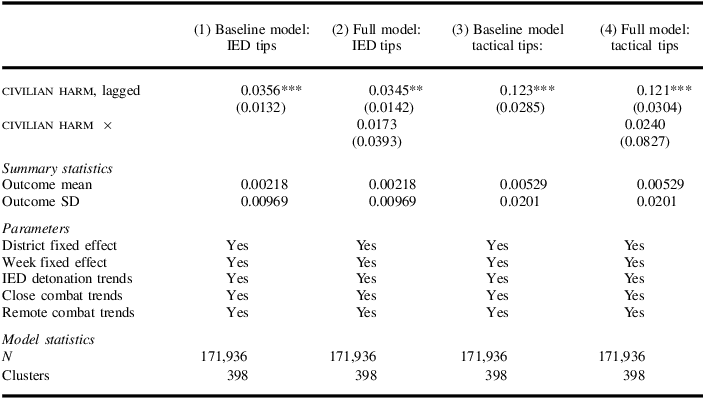
We start by replicating and then building on an established result: that civilians respond to harm from insurgents by shifting the flow of sensitive information toward the counterinsurgency. We do this by studying tips on improvised explosive devices (IEDs) and other tactical threats at the district-week level. Our model specification follows Wright and co-authorsFootnote 76 and includes district and week-of-year fixed effects, as well as trends in combat activity (direct fire, indirect fire, and IED explosions). These results are introduced in Table 1. In columns 1 and 3, we see a robust positive association between civilian harm by insurgents in the prior week and the flow of information in the current week. In columns 2 and 4, we introduce marginal effects, leveraging our district-specific measures of displaced Pashtuns. Note that while the interactions are positive, they are imprecise, suggesting that areas with a larger displaced Pashtun population are not more (or less) responsive to civilian harm than districts with no displaced Pashtuns (the baseline effect).
Civilian harm shapes the flow of information

Notes: Outcomes of interest are noted in each column heading. Model parameters are described in the table footer. The outcome and measurement of harm are expressed in per capita terms (per 1,000), and population weights are included in each regression. Standard errors, clustered at the district level, in parentheses. ** $p \lt .05$
; ***
$p \lt .05$
; *** $p \lt .01$
.
$p \lt .01$
.
However, it is possible that the information flow itself differs between areas, with the descendants of resettled Pashtuns less willing to share precise, actionable intelligence with the central government. Such a gap could have several mechanisms, each consistent with our theoretical argument and the survey-based findings presented thus far. The descendants of resettled Pashtun populations might be less willing to share tips with the government if they do not see it as particularly effective or legitimate. That is, sharing sensitive information with a central government that is unlikely to use it effectively is plausibly viewed as not worth the risk of being identified by insurgents as a collaborator. Of course, the counterinsurgents (that is, the central government) might also view information shared by these communities skeptically.
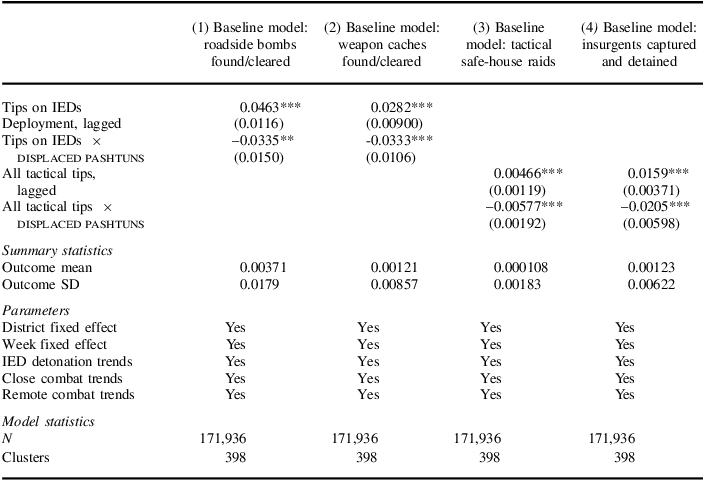
To check whether this flow of information shapes battlefield outcomes, we reproduce results from Sonin and Wright,Footnote 77 allowing the influence of tips to vary using our measure of Pashtun displacement and focusing on an important set of counterinsurgent outcomes: IEDs found and cleared; weapons caches found and cleared; safe-house raids; and insurgent detentions (Table 2). Notice that the marginal effects of displacement are all negative, and the interaction coefficients in columns 2 and 4 are significant at the 95 percent level. These results suggest that while the flow of information overall does not change with displacement status, the impact of this information is substantively and, in the cases of weapons and detentions, significantly diminished. In sum, this is systematic evidence that Pashtuns who live in villages settled by those displaced over a century ago are generally less willing to provide actionable information to the central government in response to insurgent activity.
Displacement associated with reduced battlefield effectivenes

Notes: Outcomes of interest are noted in each column heading. Model parameters are described in the table footer. The outcome and measurement of information flow are expressed in per capita terms (per 1,000), and population weights are included in each regression. Standard errors, clustered at the district level, in parentheses. ** $p \lt .05$
; ***
$p \lt .05$
; *** $p \lt .01$
.
$p \lt .01$
.
Conclusion
Large-scale population resettlements, both forced and voluntary, feature in many historical and contemporary state-building efforts, with a common goal being to consolidate political authority in contested border regions. While some studies uncover the logic behind state-led resettlement, there is comparatively little systematic and detailed evidence of the long-term consequences of these coercive state-building efforts. Consequently, most work that does analyze important cases in detail examines the shorter-term consequences of state-led resettlement, with a focus on periods where the central government remains an active supporter of its coethnic settlers.Footnote 78 However, as Zhang demonstrates, short- and long-term outcomes in these cases can sharply differ when the central government’s active support for settler communities wanes over time.Footnote 79 This gap in the literature has led to overemphasis of the idea that the state-sponsored resettlement of the ethnic kin of the central government to border regions is an effective strategy for consolidating territorial control.Footnote 80
We argue that such resettlement often cuts against the state’s objectives over the long term. States tend to resettle ethnic kin to border regions where they lack capacity, which the resettlement is meant to augment.Footnote 81 However, the combination of weak state presence and large effective distance from the capital makes long-term ties between the central government and settlers difficult to establish and maintain. Consequently, pro-central-government loyalties are often not established or maintained across generations of settlers. The resettled communities engage much more with local actors than with the central state, which strengthens their identification with local and regional political institutions. Where ties between settlers and their coethnics in the government are weak, resettled communities are likely to develop local and regional identities across generations.
We test our arguments by analyzing an under-studied case of state-led resettlement from late-nineteenth-century Afghanistan. Afghanistan is typical of many countries in the Global South, where ethnicity is widely viewed by scholars and policymakers as a key driver of political views and behavior. The view that ethnicity is the most important political trait in Afghanistan is reflected in historical treatments of this case, almost all of which suggest that relocation accomplished the stated goal of the central government by establishing a corps of loyal Pashtuns in the north. Contrary to this conventional view, we argue and demonstrate that the descendants of resettled Pashtuns are more critical of the pre-2021 Afghan central government and of the Taliban. And rather than pointing to their ethnicity, tribe, or religion as their primary source of identity (when asked about it), Pashtuns who we identify as descendants of state-sponsored resettlement are significantly more likely to emphasize their local identity. Our findings cast considerable doubt on the efficacy of forced displacement as a state-building strategy, especially in the Global South, where state capacity is often both weak and variable over time.
Our empirical approach and findings make several contributions to the literatures on population displacement and state building. First, we show that the consequences of the trauma associated with large-scale resettlements are not limited to cases where the state forcibly displaces populations. Trauma with long-term consequences also occurs in instances where many of the migrants are encouraged by the state to resettle voluntarily. When the state does not provide immediate support to counteract the trauma of resettlement, migrants’ cooperation and identification with the central state suffers. To our knowledge, this article is the first to demonstrate these dynamics at the individual level using surveys that precisely geolocate respondents and are large enough in scale to provide coverage across ethnic groups and localities.
Second, we overcome the difficulties of identifying the descendants of state-led resettlement by a weak state generations in the past. We deal with the fact that no census data are available to identify descendants in cases like ours by developing a precise spatial measure of the historical and contemporary locations of Pashtun communities that were resettled in the 1880s and 1890s. We identify their initial settlements using a detailed map drawn by the British over a century ago; we then predict which contemporary settlements are populated by the descendants of nineteenth-century migrants and which are populated by Pashtuns who migrated later using detailed spatial data on land features. We validate our approach with an exhaustive search of historical sources that we use to detail settlers’ movements. This approach, coupled with our geolocated survey data, allows us to systematically analyze differences in political attitudes and identities among coethnics who are descendants of this state-led resettlement and those who are not.
Finally, these findings contribute to the growing literature on how borderland communities often develop and sustain local institutions and identities, and remain resistant to coercive state-building efforts by the central government.Footnote 82 This study provides a blueprint for how the study of borderland communities can be better integrated with research on state building and forced resettlement. Our research also contributes to a burgeoning literature on how citizens in border regions react to major state-building initiatives from the central government. For example, Pengl and coauthors demonstrate that state entrance into formerly peripheral regions of Europe via railroad construction fomented separatism rather than identification with the state,Footnote 83 a finding that (like ours) contradicts a conventional view that railroads generally facilitated state building in Europe during the long nineteenth century. We urge scholars to do more research on the consequences of state-building efforts in border regions that combines detailed local geographic data with a detailed and critical reading of the historical record.
Supplementary material
Supplementary material for this article is available at <https://doi.org/10.1017/S0020818325101008>
Acknowledgments
We thank the IO editors, three anonymous reviewers, Bernd Beber, Taylor Damann, Rex Deng, Ron Hassner, Lachlan McNamee, Will Nomikos, Alex Scacco, Ipek Ece Sener, Güneş Murat Tezcür, Julian Wucherpfennig, Tony Yang, and Anna Zhang for helpful comments. We thank Saniya Sran, Cadence Choe, Elizabeth Vuong, and Emma Howell for research assistance. All mistakes remain our own responsibility.
Data availability statement
Replication files for this article may be found at <https://doi.org/10.7910/DVN/VULC7M>





 Open access

