





1. Introduction
Over the past half-century, many concepts have been explored to design a plasma confinement system that can produce thermonuclear fusion reactions and sustain plasma self-heating. One goal of fusion research has been to achieve fusion ignition with the aim of using fusion as a source of renewable energy. Specifically, inertial confinement fusion (ICF) has attracted attention due to recent successes. Inertial confinement fusion approaches include direct and indirect laser-driven approaches, as well as magnetically driven approaches. Laser indirect drive ICF has gained particularly increased consideration as it has surpassed the Lawson criterion and achieved ignition (Le Pape et al. Reference Le Pape2018; Kline et al. Reference Kline2019; Indirect Drive ICF Collaboration 2022).
One concept of particular interest is the pulsed-power magnetised liner inertial fusion (MagLIF) concept. Magnetised liner inertial fusion has attracted attention for its high experimentally inferred Lawson triple products (Knapp et al. Reference Knapp2022) and prospects to scale to ignition and high gain (Ruiz et al. Reference Ruiz2023a
,
Reference Ruiz, Schmit, Yager-Elorriaga, Jennings and Beckwithb
; Alexander et al. Reference Alexander2025). In this work, we investigate the effect of viscosity on hydrodynamic instabilities in conditions relevant to MagLIF implosions. In MagLIF, an electrical pulser drives an axial surface current $\boldsymbol{j}$
onto a cylindrical liner shell, generating an azimuthal magnetic field
$\boldsymbol{j}$
onto a cylindrical liner shell, generating an azimuthal magnetic field $\boldsymbol{B}$
. The resulting
$\boldsymbol{B}$
. The resulting $\boldsymbol{j}\times \boldsymbol{B}$
Lorentz force then compresses and implodes the liner containing deuterium–tritium fuel (McBride et al. Reference McBride2018). Additionally, MagLIF systems apply fuel preheating with a laser and an externally applied axial magnetic field to suppress thermal conduction. Compared with laser-driven ICF, MagLIF systems offer reduced costs, economies of scale, efficiency and increased operational lifetime (Ellison et al. Reference Ellison2025b
). Recent efforts have investigated MagLIF as the mechanism for operating a fusion power plant because of these traits (Alexander et al. Reference Alexander2025).
$\boldsymbol{j}\times \boldsymbol{B}$
Lorentz force then compresses and implodes the liner containing deuterium–tritium fuel (McBride et al. Reference McBride2018). Additionally, MagLIF systems apply fuel preheating with a laser and an externally applied axial magnetic field to suppress thermal conduction. Compared with laser-driven ICF, MagLIF systems offer reduced costs, economies of scale, efficiency and increased operational lifetime (Ellison et al. Reference Ellison2025b
). Recent efforts have investigated MagLIF as the mechanism for operating a fusion power plant because of these traits (Alexander et al. Reference Alexander2025).
Schematic diagram of forces acting on a cylindrical liner in MagLIF implosions. The closeup shows the unstable orientation of forces such that MRTI occurs.

In order to maximise implosion performance and neutron yield, target designs must be robust enough to withstand degradation from hydrodynamic instabilities. This issue plagues not only MagLIF concepts but other fusion confinement systems and engineering applications, such as the ablative Rayleigh–Taylor instability (RTI) in ICF (Sanz Reference Sanz1994; Goncharov et al. Reference Goncharov, Betti, McCrory, Sorotokin and Verdon1996; García-Rubio et al. Reference García-Rubio, Betti, Sanz and Aluie2021). Of particular interest for MagLIF liners are the sausage and the magneto-Rayleigh–Taylor instabilities (MRTI) (Hussey, Roderick & Kloc Reference Hussey, Roderick and Kloc1980; Slutz et al. Reference Slutz, Herrmann, Vesey, Sefkow, Sinars, Rovang, Peterson and Cuneo2010; Sinars et al. Reference Sinars2010, Reference Sinars2011; McBride et al. Reference McBride2013; Weis et al. Reference Weis, Zhang, Lau, Schmit, Peterson, Hess and Gilgenbach2015; Ruiz et al. Reference Ruiz2022; Dai et al. Reference Dai, Sun, Wang, Zeng and Zou2023; Tranchant et al. Reference Tranchant, Hansen, Michta, Garcia-Rubio, Rahman, Ney, Ruskov and Tzeferacos2025; Huang et al. Reference Huang, Xiao, Wang, Lu and Chen2025). These instabilities occur when perturbations in the liner grow during compression as an effective gravitational acceleration pushes the dense liner onto the driving magnetic field – a naturally unstable configuration. This orientation in MagLIF liners is shown in figure 1. The sausage mode exists due to the variation of the magnetic field over a cylindrically perturbed surface displacement. Since the magnetic field magnitude is inversely proportional to the radius, the magnetic field variation tends towards zero in the limit of large radius and does not exist in the planar case. On the other hand, the MRTI mode exists due to the acceleration of the entire plasma as a whole against a density gradient (like the classical RTI) and does exist in the planar limit.
Recent work has been done to understand the role of viscosity in MRTI specifically (Sun, Zeng & Tao Reference Sun, Zeng and Tao2021; Keenan & Sauppe Reference Keenan and Sauppe2023; Dai et al. Reference Dai, Sun, Wang, Zeng and Zou2023), since viscosity is a well-known suppression mechanism for the classical RTI and MRTI (Chandrasekhar Reference Chandrasekhar1961; Sun et al. Reference Sun, Zeng and Tao2021). This work investigates the effectiveness of viscosity at mitigating the coupled sausage and MRTI in realistic conditions relevant for MagLIF liners. We currently only investigate instability formation during the onset and acceleration phase of MagLIF implosions. During the deceleration phase, the radius of the liner is much smaller and the effective gravity direction is reversed, making the inner liner radius susceptible to RTI and MRTI. The results of this work will require slight but straightforward adjustments for analysis in the deceleration phase, which we leave for future work.
This work is formatted as follows. First, we expand upon the linear growth rate analysis for viscous MagLIF liner implosions derived by Dai et al. (Reference Dai, Sun, Wang, Zeng and Zou2023). We validate this analysis against simulations conducted in the radiative magnetohydrodynamics code FLASH (Fryxell et al. Reference Fryxell, Olson, Ricker, Timmes, Zingale, Lamb, MacNeice, Rosner, Truran and Tufo2000) and show that the linear growth matches well. We then analyse the dispersion relation to find that the plasma viscosity required to noticeably reduce MRTI growth, under standard drive current strengths for MagLIF implosions, must be of the order of or larger than $100$
g cm−1 s−1 for surface roughness perturbations and
$100$
g cm−1 s−1 for surface roughness perturbations and $0.01$
g cm−1 s−1 for perturbations seeded by the electrothermal instability. This analysis is done for both non-accelerating liners, such as during stagnation (sausage-dominated growth) and for accelerating thin imploding liners (MRT-dominated growth). Finally, we conclude that the unmagnetised viscosity coefficient for high-energy density plasmas is unlikely to reach this viscosity magnitude, especially in the thin liner case, implying that viscosity is not an influential parameter in the initial liner instability growth except for the shortest wavelength perturbations.
$0.01$
g cm−1 s−1 for perturbations seeded by the electrothermal instability. This analysis is done for both non-accelerating liners, such as during stagnation (sausage-dominated growth) and for accelerating thin imploding liners (MRT-dominated growth). Finally, we conclude that the unmagnetised viscosity coefficient for high-energy density plasmas is unlikely to reach this viscosity magnitude, especially in the thin liner case, implying that viscosity is not an influential parameter in the initial liner instability growth except for the shortest wavelength perturbations.
2. Sausage and MRTI growth rates
Consider a long, cylindrical liner with constant density $\rho$
and dynamic viscosity
$\rho$
and dynamic viscosity $\eta$
. Let there be a geometrical perturbation at the outer liner–vacuum interface of the form
$\eta$
. Let there be a geometrical perturbation at the outer liner–vacuum interface of the form $\xi = \xi (z)$
. The outer radius of the liner as a function of the axial distance is
$\xi = \xi (z)$
. The outer radius of the liner as a function of the axial distance is $R = R_{\mathrm{out}} + \xi (z)$
, where
$R = R_{\mathrm{out}} + \xi (z)$
, where $R_{\mathrm{out}}$
is the mean outer radius. Similarly, let
$R_{\mathrm{out}}$
is the mean outer radius. Similarly, let $R_{\mathrm{in}}$
be the unperturbed inner radius of the liner. Consider the liner to be thick enough such that feedthrough effects are neglected and that the thermal vacuum pressures for
$R_{\mathrm{in}}$
be the unperturbed inner radius of the liner. Consider the liner to be thick enough such that feedthrough effects are neglected and that the thermal vacuum pressures for $r\lt R_{\mathrm{in}}$
and
$r\lt R_{\mathrm{in}}$
and $r\gt R_{\mathrm{out}}$
are equal. The instability growth rate for this set-up was previously derived by Dai et al. (Reference Dai, Sun, Wang, Zeng and Zou2023). We refer the reader to Dai et al. (Reference Dai, Sun, Wang, Zeng and Zou2023) for a detailed mathematical derivation of the growth rate. The growth rate for a liner with perturbation wavenumber
$r\gt R_{\mathrm{out}}$
are equal. The instability growth rate for this set-up was previously derived by Dai et al. (Reference Dai, Sun, Wang, Zeng and Zou2023). We refer the reader to Dai et al. (Reference Dai, Sun, Wang, Zeng and Zou2023) for a detailed mathematical derivation of the growth rate. The growth rate for a liner with perturbation wavenumber $k$
and outer radius
$k$
and outer radius $R_{\mathrm{out}}$
is given by simplifying (23) in Dai et al. (Reference Dai, Sun, Wang, Zeng and Zou2023) as follows:
$R_{\mathrm{out}}$
is given by simplifying (23) in Dai et al. (Reference Dai, Sun, Wang, Zeng and Zou2023) as follows:
 \begin{align} \gamma ^2 + 2\nu k^2\left (2 - \frac {{{I}_{1}}(kR_{\mathrm{out}})}{kR_{\mathrm{out}} {{I}_{0}}(kR_{\mathrm{out}})}\right )\gamma - \left (\frac {2P_M}{\rho R_{\mathrm{out}}} + g\right )\frac {{{I}_{1}}(kR_{\mathrm{out}})}{{{I}_{0}}(kR_{\mathrm{out}})}k = 0, \end{align}
where $\gamma$
is the growth rate,
$\gamma$
is the growth rate, $\nu = \eta / \rho$
is the kinematic viscosity,
$\nu = \eta / \rho$
is the kinematic viscosity, $P_M = {\unicode{x03BC}} _0 I^2 / 8 \pi ^2 R_{\mathrm{out}}^2$
is the magnetic pressure,
$P_M = {\unicode{x03BC}} _0 I^2 / 8 \pi ^2 R_{\mathrm{out}}^2$
is the magnetic pressure, ${\unicode{x03BC}} _0$
is the permeability of free space,
${\unicode{x03BC}} _0$
is the permeability of free space, $I$
is axial drive current magnitude,
$I$
is axial drive current magnitude, $g$
is the external acceleration of the liner,
$g$
is the external acceleration of the liner, $h$
is the liner thickness and
$h$
is the liner thickness and ${I}_{n}$
is the
${I}_{n}$
is the $n$
th-order modified Bessel function of the first kind.
$n$
th-order modified Bessel function of the first kind.
For a liner with $kR_{\mathrm{out}} \gg 1$
(i.e. the short wavelength limit),
$kR_{\mathrm{out}} \gg 1$
(i.e. the short wavelength limit), ${{I}_{1}}(kR_{\mathrm{out}})/$ ${{I}_{0}}(kR_{\mathrm{out}}) \rightarrow 1$
, which simplifies the dispersion relation as
${{I}_{0}}(kR_{\mathrm{out}}) \rightarrow 1$
, which simplifies the dispersion relation as
 \begin{align} \gamma ^2 + 4\nu k^2 \gamma - \left (\frac {2P_M}{\rho R_{\mathrm{out}}} + g\right )k = 0. \end{align}
Here, $2P_M/(\rho R_{\mathrm{out}})$
is the component of the growth rate due to the classical sausage instability and
$2P_M/(\rho R_{\mathrm{out}})$
is the component of the growth rate due to the classical sausage instability and $g$
is the component due to MRTI. Explicitly solving for the growth rate via the quadratic formula, the growth rate becomes
$g$
is the component due to MRTI. Explicitly solving for the growth rate via the quadratic formula, the growth rate becomes
 \begin{align} \gamma = 2\nu k^2\left (\sqrt {\frac {1}{4\nu ^2k^3}\left (\frac {2P_M}{\rho R_{\mathrm{out}}} + g\right ) + 1}-1\right )\!. \end{align}
In their original asymptotic derivation for the small wavelength regime, Dai et al. assumed the first term under the square root
 \begin{align} \frac {1}{4\nu ^2k^3}\left (\frac {2P_M}{\rho R_{\mathrm{out}}} + g\right ) \ll 1 , \end{align}
which is an unstated part of their derivation. Applying a Taylor series to the square root term ( $\sqrt {x + 1} \approx x/2 + 1$
for
$\sqrt {x + 1} \approx x/2 + 1$
for $x \ll 1$
), one derives (36) of Dai et al. (Reference Dai, Sun, Wang, Zeng and Zou2023) as follows:
$x \ll 1$
), one derives (36) of Dai et al. (Reference Dai, Sun, Wang, Zeng and Zou2023) as follows:
 \begin{align} \gamma \approx \left (\frac {P_M}{2}\frac {1}{R_{\mathrm{out}}} + \frac {\rho g}{4}\right )\frac {1}{\eta k}. \end{align}
This asymptotic form is useful since it highlights an inverse relation to $k$
and
$k$
and $\eta$
, suggesting that decreasing perturbation wavelength will always decrease the growth rate for small wavelengths. However, we will show that for this asymptotic form is not valid for all small wavelength regimes. Rather, for small
$\eta$
, suggesting that decreasing perturbation wavelength will always decrease the growth rate for small wavelengths. However, we will show that for this asymptotic form is not valid for all small wavelength regimes. Rather, for small $\eta$
, increases in
$\eta$
, increases in $k$
will lead to an increase in growth, even in the
$k$
will lead to an increase in growth, even in the $kR_{\mathrm{out}} \gg 1$
regime. This is a particularly important result in investigating the effect of surface roughness on MagLIF liners.
$kR_{\mathrm{out}} \gg 1$
regime. This is a particularly important result in investigating the effect of surface roughness on MagLIF liners.
Consider (2.3) once again. For $P_M/\nu ^2 \gg 1$
or
$P_M/\nu ^2 \gg 1$
or $g/\nu ^2\gg 1$
, the assumption (2.4) is not necessarily true, as is the case for large
$g/\nu ^2\gg 1$
, the assumption (2.4) is not necessarily true, as is the case for large $P_M$
(strong compression) or small but non-zero
$P_M$
(strong compression) or small but non-zero $\nu$
. This suggests the left-hand side of (2.4) is a non-dimensional parameter that requires additional consideration.
$\nu$
. This suggests the left-hand side of (2.4) is a non-dimensional parameter that requires additional consideration.
We define
 \begin{align} g_{\mathrm{eff}} \equiv \frac {2P_M}{\rho R_{\mathrm{out}}} + g, \end{align}
i.e. an effective gravitational acceleration consisting of the acceleration on the surface perturbation associated with the pure sausage instability $2P_M / \rho R_{\mathrm{out}}$
and acceleration associated with the acceleration of the whole liner
$2P_M / \rho R_{\mathrm{out}}$
and acceleration associated with the acceleration of the whole liner $g$
(i.e. the pure MRTI mode). Substituting this definition into (2.3) results in
$g$
(i.e. the pure MRTI mode). Substituting this definition into (2.3) results in
 \begin{align} \gamma = 2\nu k^2\left (\sqrt {\frac {g_{\mathrm{eff}}k}{4\nu ^2k^4} + 1} - 1\right )\!. \end{align}
An alternative rearrangement is
 \begin{align} \gamma = \sqrt {g_{\mathrm{eff}}k + 4\nu ^2 k^4} - 2\nu k^2. \end{align}
Consider the inviscid limit, $\nu \rightarrow 0$
,
$\nu \rightarrow 0$
, $\gamma \rightarrow \sqrt {g_{\mathrm{eff}}k}$
. For stages of the implosion when the pressure in the liner is constant (i.e. for
$\gamma \rightarrow \sqrt {g_{\mathrm{eff}}k}$
. For stages of the implosion when the pressure in the liner is constant (i.e. for $R_{\mathrm{in}} \lt r \lt R_{\mathrm{out}}$
),
$R_{\mathrm{in}} \lt r \lt R_{\mathrm{out}}$
), $g\approx 0$
and
$g\approx 0$
and $g_{\mathrm{eff}}\approx 2P_M/(\rho R_{\mathrm{out}})$
, which simplifies the growth rate into the classical sausage instability (Thorne & Blandford Reference Thorne and Blandford2017). This occurs in situations such as during stagnation. For thin liners with liner thickness
$g_{\mathrm{eff}}\approx 2P_M/(\rho R_{\mathrm{out}})$
, which simplifies the growth rate into the classical sausage instability (Thorne & Blandford Reference Thorne and Blandford2017). This occurs in situations such as during stagnation. For thin liners with liner thickness $h \ll R_{\mathrm{out}}$
, the pressure profile in the liner for
$h \ll R_{\mathrm{out}}$
, the pressure profile in the liner for $R_{\mathrm{in}} \lt r \lt R_{\mathrm{out}}$
is approximately linear. Thus,
$R_{\mathrm{in}} \lt r \lt R_{\mathrm{out}}$
is approximately linear. Thus, $g\approx P_M/(\rho h) \gg 2P_M/(\rho R_{\mathrm{out}})$
, consequently resulting in
$g\approx P_M/(\rho h) \gg 2P_M/(\rho R_{\mathrm{out}})$
, consequently resulting in $g_{\mathrm{eff}}\approx g$
. In this case, (2.8) simplifies into the purely classical MRTI (Weis et al. Reference Weis, Zhang, Lau, Schmit, Peterson, Hess and Gilgenbach2015). Henceforth, we refer to arbitrary
$g_{\mathrm{eff}}\approx g$
. In this case, (2.8) simplifies into the purely classical MRTI (Weis et al. Reference Weis, Zhang, Lau, Schmit, Peterson, Hess and Gilgenbach2015). Henceforth, we refer to arbitrary $\gamma$
as
$\gamma$
as $\gamma _{\mathrm{visc}}$
and
$\gamma _{\mathrm{visc}}$
and $\gamma _{\mathrm{inv}} = \sqrt {g_{\mathrm{eff}}k}$
to emphasise the significance of viscosity.
$\gamma _{\mathrm{inv}} = \sqrt {g_{\mathrm{eff}}k}$
to emphasise the significance of viscosity.
Both the forms of (2.7) and (2.8) elucidate physical intuition that was not apparent before. Note that $\gamma _{\mathrm{visc}}$
is only a function of two parameters:
$\gamma _{\mathrm{visc}}$
is only a function of two parameters: $g_{\mathrm{eff}}k = \gamma _{\mathrm{inv}}^2$
and
$g_{\mathrm{eff}}k = \gamma _{\mathrm{inv}}^2$
and $\nu k^2$
, i.e. only a function of gravitational and viscous forces, respectively. In fact, these two forces have directly competing effects, which is most easily seen in (2.8). Gravitational forces act as a growth mechanism for MRTI (as is the case for classical RTI), while viscous forces act as a damping mechanism, with no coupling between the two physics. In the highly viscous limit as
$\nu k^2$
, i.e. only a function of gravitational and viscous forces, respectively. In fact, these two forces have directly competing effects, which is most easily seen in (2.8). Gravitational forces act as a growth mechanism for MRTI (as is the case for classical RTI), while viscous forces act as a damping mechanism, with no coupling between the two physics. In the highly viscous limit as $\nu \rightarrow \infty$
,
$\nu \rightarrow \infty$
, $\gamma _{\mathrm{visc}}\rightarrow 0$
and viscous effects will completely eliminate instability growth. Furthermore, the growth component
$\gamma _{\mathrm{visc}}\rightarrow 0$
and viscous effects will completely eliminate instability growth. Furthermore, the growth component $\gamma _{\mathrm{inv}}$
is proportional to
$\gamma _{\mathrm{inv}}$
is proportional to $\sqrt {k}$
and will dominate at lower
$\sqrt {k}$
and will dominate at lower $k$
, while the damping component is proportional to
$k$
, while the damping component is proportional to $k^2$
and will dominate at larger
$k^2$
and will dominate at larger $k$
. This suggests that the ratio of these two effects is an important parameter to understand which physics will dominate instability behaviour.
$k$
. This suggests that the ratio of these two effects is an important parameter to understand which physics will dominate instability behaviour.
We define the non-dimensional Galilei number as
 \begin{align} {\textit{Ga}} \equiv \frac {g_{\mathrm{eff}}}{4\nu ^2k^3} = \frac {g_{\mathrm{eff}}\lambda ^3}{32\pi ^3 \nu ^2}, \end{align}
which quantifies the effect of gravitational versus viscous forces. Here, $\lambda = 2\pi /k$
is the perturbation wavelength. This ratio explicitly appears in (2.7) as the first term under the square root. Rewriting (2.5) with the definition of
$\lambda = 2\pi /k$
is the perturbation wavelength. This ratio explicitly appears in (2.7) as the first term under the square root. Rewriting (2.5) with the definition of $Ga$
, Dai et al.’s original growth rate expression becomes
$Ga$
, Dai et al.’s original growth rate expression becomes
 \begin{align} \gamma _{\mathrm{visc}} \approx \left (\frac {g_{\mathrm{eff}}^2}{2\nu }\right )^{1/3}\left (\frac {Ga}{8}\right )^{1/3}. \end{align}
Similarly, (2.7) can be rewritten in two different forms
 \begin{align} \gamma _{\mathrm{visc}} = \left (\frac {g_{\mathrm{eff}}^2}{2\nu }\right )^{1/3}\left (\frac {\sqrt {Ga + 1} - 1}{{\textit{Ga}}^{2/3}}\right ) \end{align}
or, equivalently,
 \begin{align} \tilde {\gamma } = \frac {\gamma _{\mathrm{visc}}}{\gamma _{\mathrm{inv}}} = \sqrt {\frac {1}{Ga} + 1} - \sqrt {\frac {1}{Ga}}. \end{align}
Note that, under this normalisation and definition of $g_{\mathrm{eff}}$
, (2.2) is equivalently
$g_{\mathrm{eff}}$
, (2.2) is equivalently
 \begin{align} \tilde {\gamma }^2 + \frac {2}{\sqrt {Ga}}\tilde {\gamma } - 1 = 0, \end{align}
in which the corresponding normalised growth rate is more easily derived.
Consider (2.11) and (2.12). Since $Ga$
is a function of
$Ga$
is a function of $g_{\mathrm{eff}}$
and
$g_{\mathrm{eff}}$
and $\nu$
, it is not immediately apparent how changing either of these parameters affects the nominal growth rate
$\nu$
, it is not immediately apparent how changing either of these parameters affects the nominal growth rate $\gamma _{\mathrm{visc}}$
in (2.11). However, in (2.12), the dependence on
$\gamma _{\mathrm{visc}}$
in (2.11). However, in (2.12), the dependence on $g_{\mathrm{eff}}^2/2\nu$
is eliminated and the growth rate ratio becomes solely a function of
$g_{\mathrm{eff}}^2/2\nu$
is eliminated and the growth rate ratio becomes solely a function of $Ga$
. Therefore, when determining if a sausage instability/MRTI flow configuration requires viscous modelling, one can explicitly quantify the decrease in growth due to viscosity based only on
$Ga$
. Therefore, when determining if a sausage instability/MRTI flow configuration requires viscous modelling, one can explicitly quantify the decrease in growth due to viscosity based only on $Ga$
. This is analogous to the well-known classification of laminar or turbulent flows based on the Reynolds number
$Ga$
. This is analogous to the well-known classification of laminar or turbulent flows based on the Reynolds number $Re$
, the ratio of inertial to viscous forces. In fact, one can define
$Re$
, the ratio of inertial to viscous forces. In fact, one can define $Re \equiv u/(2\nu k)$
and the dimensionless Froude number as
$Re \equiv u/(2\nu k)$
and the dimensionless Froude number as $Fr \equiv u\sqrt {k}/\sqrt {g_{\mathrm{eff}}}$
and to define
$Fr \equiv u\sqrt {k}/\sqrt {g_{\mathrm{eff}}}$
and to define $Ga$
as
$Ga$
as
 \begin{align} \textit{Ga} \equiv \left (\frac {\textit{Re}}{\textit{Fr}}\right )^2, \end{align}
where $Fr$
is the ratio of inertial and gravitational forces and
$Fr$
is the ratio of inertial and gravitational forces and $u$
is some characteristic speed.
$u$
is some characteristic speed.
Note that, under the approximation that $Ga \ll 1$
,
$Ga \ll 1$
, $\sqrt {Ga + 1} \approx Ga/2 + 1$
, and thus (2.10) is approximately equal to (2.11). This implies that (2.5) is calculated under the assumption that
$\sqrt {Ga + 1} \approx Ga/2 + 1$
, and thus (2.10) is approximately equal to (2.11). This implies that (2.5) is calculated under the assumption that $Ga \ll 1$
. Physically, this assumes an accelerating implosion such that viscous forces dominate, akin to laminar flow in low Reynolds number regimes. This is not necessarily true even under the small wavelength limit. In fact, we find in our viscous MagLIF liner simulations that
$Ga \ll 1$
. Physically, this assumes an accelerating implosion such that viscous forces dominate, akin to laminar flow in low Reynolds number regimes. This is not necessarily true even under the small wavelength limit. In fact, we find in our viscous MagLIF liner simulations that $Ga \gg 1$
, akin to turbulent flows in high Reynolds number regimes, invalidating both (2.5) and (2.10).
$Ga \gg 1$
, akin to turbulent flows in high Reynolds number regimes, invalidating both (2.5) and (2.10).
Dai et al.’s asymptotic form of (2.10) offers immediate physical insights that our derived (2.11) does not. First, it is immediately clear that as $Ga\rightarrow 0$
,
$Ga\rightarrow 0$
, $\gamma _{\mathrm{visc}}\rightarrow 0$
. Since
$\gamma _{\mathrm{visc}}\rightarrow 0$
. Since $Ga\propto k^{-3}\nu ^{-2}$
, one finds that
$Ga\propto k^{-3}\nu ^{-2}$
, one finds that $\gamma _{\mathrm{visc}}\propto (\nu k)^{-1}$
, as was the original conclusion by Dai et al. (Reference Dai, Sun, Wang, Zeng and Zou2023), which is not apparent from (2.11). However, that conclusion is only valid for
$\gamma _{\mathrm{visc}}\propto (\nu k)^{-1}$
, as was the original conclusion by Dai et al. (Reference Dai, Sun, Wang, Zeng and Zou2023), which is not apparent from (2.11). However, that conclusion is only valid for $Ga \ll 1$
. For
$Ga \ll 1$
. For $Ga \gg 1$
, (2.11) simplifies to
$Ga \gg 1$
, (2.11) simplifies to
 \begin{align} \gamma _{\mathrm{visc}} \approx \left (\frac {g_{\mathrm{eff}}^2}{2\nu }\right )^{1/3}\textit{Ga}^{-1/6} = \gamma _{\mathrm{inv}}. \end{align}
Therefore, for large $Ga$
, the growth rate approaches the inviscid regime (
$Ga$
, the growth rate approaches the inviscid regime ( $\gamma _{\mathrm{visc}} \approx \gamma _{\mathrm{inv}}$
).
$\gamma _{\mathrm{visc}} \approx \gamma _{\mathrm{inv}}$
).
The modes of maximum growth for viscous instability are found from (2.7). The wavenumber that maximises the growth rate is
 \begin{align} k_{\mathrm{max}} = \max _{\arg k} \gamma _{\mathrm{visc}} = \left (\frac {g_{\mathrm{eff}}}{32\nu ^2}\right )^{1/3}, \end{align}
with maximum growth rate
 \begin{align} \gamma _{\mathrm{max}} = \left (\frac {g_{\mathrm{eff}}^2}{16\nu }\right )^{1/3}. \end{align}
This corresponds to
 \begin{align} Ga_{\mathrm{max}} = \max _{\arg Ga} \gamma _{\mathrm{visc}} = 8. \end{align}
Under these conditions, $\tilde {\gamma } = 1/\sqrt {2}$
.
$\tilde {\gamma } = 1/\sqrt {2}$
.
Equation (2.18) defines two regimes of the viscous flow. For $Ga\lt Ga_{\mathrm{max}} = 8$
, an increase in wavenumber
$Ga\lt Ga_{\mathrm{max}} = 8$
, an increase in wavenumber $k$
will lead to a decrease in the growth since viscous forces dominate, as predicted by Dai et al. (Reference Dai, Sun, Wang, Zeng and Zou2023). However, for
$k$
will lead to a decrease in the growth since viscous forces dominate, as predicted by Dai et al. (Reference Dai, Sun, Wang, Zeng and Zou2023). However, for $Ga \gt Ga_{\mathrm{max}}$
, the inverse is true, where an increase in
$Ga \gt Ga_{\mathrm{max}}$
, the inverse is true, where an increase in $k$
decreases the growth rate since gravitational forces dominate. Equivalently,
$k$
decreases the growth rate since gravitational forces dominate. Equivalently, $k$
that approaches
$k$
that approaches $k_{\mathrm{max}}$
will increase the growth rate. For systems in which instability growth should be minimised, perturbations of wavelength corresponding to wavenumber near
$k_{\mathrm{max}}$
will increase the growth rate. For systems in which instability growth should be minimised, perturbations of wavelength corresponding to wavenumber near $k_{\mathrm{max}}$
should be avoided. This classification for viscosity-dominated flows (
$k_{\mathrm{max}}$
should be avoided. This classification for viscosity-dominated flows ( $Ga \ll 8$
) and gravity-dominated flows (
$Ga \ll 8$
) and gravity-dominated flows ( $Ga \gg 8$
) is similar to the classical classification of laminar (small
$Ga \gg 8$
) is similar to the classical classification of laminar (small $Re$
) and turbulent (large
$Re$
) and turbulent (large $Re$
) flows.
$Re$
) flows.
(a) Viscous growth rates $\gamma _{\mathrm{visc}}$
via (2.11). (2.10) and (2.15) are overlaid at corresponding values of
$\gamma _{\mathrm{visc}}$
via (2.11). (2.10) and (2.15) are overlaid at corresponding values of $g_{\mathrm{eff}}^2 / 2\nu$
. Note that the viscous growth rate reaches a max value at
$g_{\mathrm{eff}}^2 / 2\nu$
. Note that the viscous growth rate reaches a max value at $Ga = 8$
. (b) Ratio of growth rates
$Ga = 8$
. (b) Ratio of growth rates $\gamma _{\mathrm{visc}}/\gamma _{\mathrm{inv}}$
via (2.12). As
$\gamma _{\mathrm{visc}}/\gamma _{\mathrm{inv}}$
via (2.12). As $Ga$
decreases, the flow becomes more viscous, damping the MRTI growth. (c) Growth rates for nominal
$Ga$
decreases, the flow becomes more viscous, damping the MRTI growth. (c) Growth rates for nominal $k$
values at
$k$
values at $g=10$
(arbitrary units). Equations (2.10) and (2.15) are overlaid at corresponding values of
$g=10$
(arbitrary units). Equations (2.10) and (2.15) are overlaid at corresponding values of $\nu$
.
$\nu$
.

Figure 2 plots the growth rates in different forms to demonstrate various characteristics and trends. Figure 2(a) calculates the nominal growth rate $\gamma _{\mathrm{visc}}$
versus
$\gamma _{\mathrm{visc}}$
versus $Ga$
. Figure 2(a) visually depicts the three regimes of flow discussed: viscosity-dominated flows for
$Ga$
. Figure 2(a) visually depicts the three regimes of flow discussed: viscosity-dominated flows for $Ga\ll 8$
, gravity-dominated flows for
$Ga\ll 8$
, gravity-dominated flows for $Ga\gg 8$
and transitional flows for
$Ga\gg 8$
and transitional flows for $Ga\sim 8$
. Dai et al.’s asymptotic expression (2.10) is depicted in dotted black lines which are overlaid on top of the exact (2.11) growth rates. They accurately approximate growth rates for the small
$Ga\sim 8$
. Dai et al.’s asymptotic expression (2.10) is depicted in dotted black lines which are overlaid on top of the exact (2.11) growth rates. They accurately approximate growth rates for the small $Ga$
regime/viscosity-dominated regime, as discussed previously. Similarly, overlaid cyan circle-marked lines are calculated via the inviscid growth rate (2.15) and accurately approximate the growth rates for the large
$Ga$
regime/viscosity-dominated regime, as discussed previously. Similarly, overlaid cyan circle-marked lines are calculated via the inviscid growth rate (2.15) and accurately approximate the growth rates for the large $Ga$
regime/gravity-dominated flows. For the transitional
$Ga$
regime/gravity-dominated flows. For the transitional $Ga\sim 8$
regime, neither (2.10) nor (2.15) accurately predict the exact growth rate.
$Ga\sim 8$
regime, neither (2.10) nor (2.15) accurately predict the exact growth rate.
Figure 2(b) plots $\tilde {\gamma } = \gamma _{\mathrm{visc}}/\gamma _{\mathrm{inv}}$
from (2.12). As viscosity increases,
$\tilde {\gamma } = \gamma _{\mathrm{visc}}/\gamma _{\mathrm{inv}}$
from (2.12). As viscosity increases, $Ga$
will decrease, causing a decrease in
$Ga$
will decrease, causing a decrease in $\tilde {\gamma }$
, demonstrating that viscosity has a damping effect on instability growth compared with the inviscid case, as is seen typically in non-magnetised RTI (Chandrasekhar Reference Chandrasekhar1961). Figure 2(c) plots the growth rates against nominal wavenumber
$\tilde {\gamma }$
, demonstrating that viscosity has a damping effect on instability growth compared with the inviscid case, as is seen typically in non-magnetised RTI (Chandrasekhar Reference Chandrasekhar1961). Figure 2(c) plots the growth rates against nominal wavenumber $k$
for various values of
$k$
for various values of $\nu$
at
$\nu$
at $g=10$
(chosen arbitrarily). The highly viscous growth rate (2.10) only agrees for
$g=10$
(chosen arbitrarily). The highly viscous growth rate (2.10) only agrees for $k\gg k_{\mathrm{max}}$
while the inviscid growth (2.15) only agrees for
$k\gg k_{\mathrm{max}}$
while the inviscid growth (2.15) only agrees for $k\ll k_{\mathrm{max}}$
.
$k\ll k_{\mathrm{max}}$
.
Alternatively, we introduce a time scale that corresponds to a physical process more directly relevant for MagLIF implosions. Let $t_{\mathrm{comp}} = \sqrt {R_{\mathrm{out}}/g_{\mathrm{eff}}}$
, which is a characteristic time scale for the compression of the liner. Similarly, we define an alternative Galilei number as
$t_{\mathrm{comp}} = \sqrt {R_{\mathrm{out}}/g_{\mathrm{eff}}}$
, which is a characteristic time scale for the compression of the liner. Similarly, we define an alternative Galilei number as
 \begin{align} {\textit{Ga}}^* \equiv \frac {g_{\mathrm{eff}}R_{\mathrm{out}}^3}{4\nu ^2}, \end{align}
where the characteristic length is now associated with the liner outer radius, which is assumed to be much larger than the perturbation wavelength. Under these parameters, (2.11) can be equivalently rewritten as
 \begin{align} \gamma _{\mathrm{visc}} = 2\nu k^2 \left (\sqrt {\frac {{\textit{Ga}}^*}{(kR_{\mathrm{out}})^3} + 1} - 1\right )\!, \end{align}
or, non-dimensionally,
 \begin{align} \tilde {\gamma }^* = \gamma _{\mathrm{visc}}t_{\mathrm{comp}} = (kR_{\mathrm{out}})^2 \left (\sqrt {\frac {1}{{\textit{Ga}}^*} + \frac {1}{(kR_{\mathrm{out}})^3}} - \sqrt {\frac {1}{{\textit{Ga}}^*}}\right )\!. \end{align}
The form presented in (2.21) may be useful for practical design applications. For instance, let $t_{\mathrm{MRTI}} = 1/\gamma _{\mathrm{visc}}$
be the characteristic time scale for MRTI growth. If
$t_{\mathrm{MRTI}} = 1/\gamma _{\mathrm{visc}}$
be the characteristic time scale for MRTI growth. If $\tilde {\gamma }^* = t_{\mathrm{comp}}/t_{\mathrm{MRTI}}\ll 1$
, then MRTI growth will be negligible compared with the compression time scale since compression occurs before MRTI growth can occur. Hence, (2.21) is a more meaningful quantity for design compared with (2.12). However, all the expressions presented are identically equivalent and may be used for a variety of purposes.
$\tilde {\gamma }^* = t_{\mathrm{comp}}/t_{\mathrm{MRTI}}\ll 1$
, then MRTI growth will be negligible compared with the compression time scale since compression occurs before MRTI growth can occur. Hence, (2.21) is a more meaningful quantity for design compared with (2.12). However, all the expressions presented are identically equivalent and may be used for a variety of purposes.
3. Comparison with FLASH simulations
Initial set-up of the imploding liner simulations for $n=4$
and
$n=4$
and $n=8$
modes. An axial current of
$n=8$
modes. An axial current of $5$
MA is applied on the outer surface of the aluminium liners.
$5$
MA is applied on the outer surface of the aluminium liners.

To validate the theory presented, we conduct simplified cylindrical liner implosion simulations (depicted in figure 3) loosely based on the experimental set-up described by Sinars et al. (Reference Sinars2010, Reference Sinars2011). The set-up itself is not directly a MagLIF simulation as there is no preheating nor axial magnetic field, but is still a relevant process for MagLIF. The simulation is composed of a 1 mm thick aluminium liner surrounded by vacuum with outer radius $R_{\mathrm{out}} = 3.2$
mm. The computational radial domain spans
$R_{\mathrm{out}} = 3.2$
mm. The computational radial domain spans $r\in [0,4.8]$
mm and the axial domain spans
$r\in [0,4.8]$
mm and the axial domain spans $z\in [0,2.4]$
mm, with periodic boundaries in the axial direction. The liner outer radius is initially geometrically perturbed by an
$z\in [0,2.4]$
mm, with periodic boundaries in the axial direction. The liner outer radius is initially geometrically perturbed by an $n$
mode perturbation, where
$n$
mode perturbation, where $n = 2.4\text{ [mm]}/\lambda$
. In this work, we evaluate two sets of test cases: the
$n = 2.4\text{ [mm]}/\lambda$
. In this work, we evaluate two sets of test cases: the $n=4$
mode and the
$n=4$
mode and the $n=8$
mode. The implosion is conducted with a constant, uniform drive current of
$n=8$
mode. The implosion is conducted with a constant, uniform drive current of $I=5$
MA applied at the outer surface of the liner. This corresponds to
$I=5$
MA applied at the outer surface of the liner. This corresponds to $Ga\eta ^2 \approx 1.8\times 10^{6}$
and
$Ga\eta ^2 \approx 1.8\times 10^{6}$
and $Ga\eta ^2 \approx 2.3\times 10^{5}$
for each mode, respectively. This value was chosen to represent a lower ramp current the liner will undergo during the onset of the sausage instability/MRTI. These simulations incorporate thermal conduction and magnetic diffusion physics, but are not significant during the simulation time.
$Ga\eta ^2 \approx 2.3\times 10^{5}$
for each mode, respectively. This value was chosen to represent a lower ramp current the liner will undergo during the onset of the sausage instability/MRTI. These simulations incorporate thermal conduction and magnetic diffusion physics, but are not significant during the simulation time.
For each set of test cases, we simulate the implosion with constant viscosity in the liner. The viscosities tested are $\eta \in [0,100,1000]$
g cm−1 s−1. All simulations are conducted on the radiative hydrodynamics simulation code FLASH (Fryxell et al. Reference Fryxell, Olson, Ricker, Timmes, Zingale, Lamb, MacNeice, Rosner, Truran and Tufo2000), which has recently been validated for pulser-drive ICF target design (Ellison et al. Reference Ellison2025a
). An adaptive mesh refinement (AMR) algorithm is used to automatically refine the computational mesh in regions in which the magnitude of the second derivative-based estimator exceeds a certain density threshold. We define the AMR refinement levels such that
$\eta \in [0,100,1000]$
g cm−1 s−1. All simulations are conducted on the radiative hydrodynamics simulation code FLASH (Fryxell et al. Reference Fryxell, Olson, Ricker, Timmes, Zingale, Lamb, MacNeice, Rosner, Truran and Tufo2000), which has recently been validated for pulser-drive ICF target design (Ellison et al. Reference Ellison2025a
). An adaptive mesh refinement (AMR) algorithm is used to automatically refine the computational mesh in regions in which the magnitude of the second derivative-based estimator exceeds a certain density threshold. We define the AMR refinement levels such that $\Delta r = \Delta z$
with a maximum cell size of
$\Delta r = \Delta z$
with a maximum cell size of $50\,{\unicode{x03BC}}$
m and a minimum cell size
$50\,{\unicode{x03BC}}$
m and a minimum cell size $6.25\,{\unicode{x03BC}}$
m. These mesh refinement parameters are the same as those presented in MRTI MagLIF benchmark simulations presented by Ellison et al. (Reference Ellison2025a
), which demonstrated good agreement between FLASH simulations and experiments. All simulations are seeded with a perturbation amplitude of
$6.25\,{\unicode{x03BC}}$
m. These mesh refinement parameters are the same as those presented in MRTI MagLIF benchmark simulations presented by Ellison et al. (Reference Ellison2025a
), which demonstrated good agreement between FLASH simulations and experiments. All simulations are seeded with a perturbation amplitude of $50\,{\unicode{x03BC}}$
m; these perturbed regions are refined via the AMR algorithm prior to the beginning of the simulation. The simulation is run for a total of approximately
$50\,{\unicode{x03BC}}$
m; these perturbed regions are refined via the AMR algorithm prior to the beginning of the simulation. The simulation is run for a total of approximately $125$
ns. The Equation of State (EOS) of the liner is tabulated from common databases such as SESAME and PROPACEOS, following the methodology of validation benchmarks presented by Ellison et al. (Reference Ellison2025a
). We do not consider an ideal gas EOS with large polytropic index
$125$
ns. The Equation of State (EOS) of the liner is tabulated from common databases such as SESAME and PROPACEOS, following the methodology of validation benchmarks presented by Ellison et al. (Reference Ellison2025a
). We do not consider an ideal gas EOS with large polytropic index $\gamma$
to mimic an incompressible fluid. Although this would be more aligned with the derivation of the analytical growth rates, the speed of sound of the simulated flow would be artificially large and difficult to resolve computationally. Furthermore, we show the results of these simulations are still consistent with the derived theory despite using a more realistic material EOS.
$\gamma$
to mimic an incompressible fluid. Although this would be more aligned with the derivation of the analytical growth rates, the speed of sound of the simulated flow would be artificially large and difficult to resolve computationally. Furthermore, we show the results of these simulations are still consistent with the derived theory despite using a more realistic material EOS.
Snapshot of the liner density at $t\approx 125$
ns for the
$t\approx 125$
ns for the $n=4$
mode perturbation simulations (top row) and the
$n=4$
mode perturbation simulations (top row) and the $n=8$
mode perturbation simulation (bottom row). Increasing viscosity (presented in CGS units) clearly decreases the nonlinearity of the perturbation and its amplitude.
$n=8$
mode perturbation simulation (bottom row). Increasing viscosity (presented in CGS units) clearly decreases the nonlinearity of the perturbation and its amplitude.

(Top row) Fast Fourier transform time histories for the initial $n=4$
mode perturbation simulations. (Middle row) Fast Fourier transform time histories for the
$n=4$
mode perturbation simulations. (Middle row) Fast Fourier transform time histories for the $n=8$
mode perturbation simulations. (Bottom row) Comparison of the simulated amplitudes versus theoretical amplitude
$n=8$
mode perturbation simulations. (Bottom row) Comparison of the simulated amplitudes versus theoretical amplitude $\xi _{\mathrm{theo}}$
via (2.20) and Dai amplitude
$\xi _{\mathrm{theo}}$
via (2.20) and Dai amplitude $\xi _{\mathrm{Dai}}$
via (2.5). The linear growth of all simulated cases matches almost identically with (2.20), while only
$\xi _{\mathrm{Dai}}$
via (2.5). The linear growth of all simulated cases matches almost identically with (2.20), while only $\eta =1000$
matches with (2.5). No
$\eta =1000$
matches with (2.5). No $\xi _{\mathrm{Dai}}$
is plotted for
$\xi _{\mathrm{Dai}}$
is plotted for $\eta =0$
since (2.5) predicts an infinite growth rate.
$\eta =0$
since (2.5) predicts an infinite growth rate.

Figure 4 depicts a snapshot of each test case discussed at the end of the simulation $t\approx 125$
ns. All qualitative behaviour seen aligns with what has been discussed. As viscosity increases,
$t\approx 125$
ns. All qualitative behaviour seen aligns with what has been discussed. As viscosity increases, $Ga$
(or
$Ga$
(or ${\textit{Ga}}^*$
) decreases, thereby decreasing the growth of the main
${\textit{Ga}}^*$
) decreases, thereby decreasing the growth of the main $n$
mode. Interestingly, viscosity seems to surpress nonlinearities as well. This is seen most prominently for the
$n$
mode. Interestingly, viscosity seems to surpress nonlinearities as well. This is seen most prominently for the $n=8$
mode, where the nonlinear MRTI spikes of the inviscid case are curved. On the other hand, the nonlinear MRTI spikes of the
$n=8$
mode, where the nonlinear MRTI spikes of the inviscid case are curved. On the other hand, the nonlinear MRTI spikes of the $\eta =100$
case are completely straight and parallel to the radial axis. When increasing viscosity further for the
$\eta =100$
case are completely straight and parallel to the radial axis. When increasing viscosity further for the $\eta =1000$
case, the perturbation remains mostly linear and maintains a nearly sinusoidal shape.
$\eta =1000$
case, the perturbation remains mostly linear and maintains a nearly sinusoidal shape.
The first two rows of figure 5 plot the fast Fourier transform (FFT) amplitudes of the liner interface at each time step for every case. Here, we define the interface as the density contour where $\rho = 2$
g cc−1. The bottom row compares the amplitude of the largest mode with what is predicted by theory (2.20). The FFTs exhibit interesting behaviour. In the inviscid test cases, there is significant growth of the harmonics of the principal mode (
$\rho = 2$
g cc−1. The bottom row compares the amplitude of the largest mode with what is predicted by theory (2.20). The FFTs exhibit interesting behaviour. In the inviscid test cases, there is significant growth of the harmonics of the principal mode ( $n=4$
and
$n=4$
and $n=8$
, respectively) as well as other various `noisy’ non-integer modes. This may result from numerical seeds, such as a discrepancy between the Cartesian mesh versus the curved perturbation interface, and may lead to higher nonlinear, multimodal growth than expected. In-depth studies isolating the effects of numerical MRTI growth versus physical growth is an ongoing area of research (Tranchant et al. Reference Tranchant, Hansen, Michta, Garcia-Rubio, Rahman, Ney, Ruskov and Tzeferacos2025); however, the amplitude growth is still well predicted by the growth of the principal mode. When the viscosity increases to
$n=8$
, respectively) as well as other various `noisy’ non-integer modes. This may result from numerical seeds, such as a discrepancy between the Cartesian mesh versus the curved perturbation interface, and may lead to higher nonlinear, multimodal growth than expected. In-depth studies isolating the effects of numerical MRTI growth versus physical growth is an ongoing area of research (Tranchant et al. Reference Tranchant, Hansen, Michta, Garcia-Rubio, Rahman, Ney, Ruskov and Tzeferacos2025); however, the amplitude growth is still well predicted by the growth of the principal mode. When the viscosity increases to $\eta =100$
, only the principal mode and its corresponding harmonics remain. At the largest viscosity
$\eta =100$
, only the principal mode and its corresponding harmonics remain. At the largest viscosity $\eta =1000$
, only the
$\eta =1000$
, only the $n$
and
$n$
and $2n$
modes remain, showing clear suppression of higher modes due to increased viscosity and lower
$2n$
modes remain, showing clear suppression of higher modes due to increased viscosity and lower $Ga$
. This nonlinear behaviour is not predicted with the theory presented; although
$Ga$
. This nonlinear behaviour is not predicted with the theory presented; although $Ga$
values that can induce this behaviour are not realistic in MagLIF implosions, other disciplines may find it useful to investigate this phenomenon more deeply.
$Ga$
values that can induce this behaviour are not realistic in MagLIF implosions, other disciplines may find it useful to investigate this phenomenon more deeply.
In the bottom row of figure 5, there is clear agreement between the theoretical amplitude $\xi _{\mathrm{theo}}$
expected from (2.20) and the simulated perturbation. The theoretical growth rate is calculated using a density of
$\xi _{\mathrm{theo}}$
expected from (2.20) and the simulated perturbation. The theoretical growth rate is calculated using a density of $\rho = 3.6$
g cc−1, which corresponds to the post-shocked aluminium density. During the simulation, the external acceleration
$\rho = 3.6$
g cc−1, which corresponds to the post-shocked aluminium density. During the simulation, the external acceleration $g$
is much smaller than the acceleration associated with the sausage instability due to the relatively small driving current, as evidenced by the minimal movement of the inner liner throughout the simulation. Therefore, the theoretical growth rates are calculated for when
$g$
is much smaller than the acceleration associated with the sausage instability due to the relatively small driving current, as evidenced by the minimal movement of the inner liner throughout the simulation. Therefore, the theoretical growth rates are calculated for when $g\approx 0$
and
$g\approx 0$
and $g_{\mathrm{eff}} \approx 2P_M/(\rho R_{\mathrm{out}})$
. In the
$g_{\mathrm{eff}} \approx 2P_M/(\rho R_{\mathrm{out}})$
. In the $n=8$
cases, nonlinear saturation seems to appear once
$n=8$
cases, nonlinear saturation seems to appear once $\xi = 0.3\lambda$
, with the theoretical amplitude significantly overpredicting the simulated results. Before this threshold, the theoretical and simulated amplitudes show good agreement. Note that, in the
$\xi = 0.3\lambda$
, with the theoretical amplitude significantly overpredicting the simulated results. Before this threshold, the theoretical and simulated amplitudes show good agreement. Note that, in the $\eta =1000$
case, in which we qualitatively do not see much nonlinearity in the liner outer interface from figure 4, the theoretical and simulated amplitudes match well (albeit slightly under predicting) throughout the entirety of the simulations. Nonetheless, the linear growth region matches well, validating the discussions from § 2. On the other hand,
$\eta =1000$
case, in which we qualitatively do not see much nonlinearity in the liner outer interface from figure 4, the theoretical and simulated amplitudes match well (albeit slightly under predicting) throughout the entirety of the simulations. Nonetheless, the linear growth region matches well, validating the discussions from § 2. On the other hand, $\xi _{\mathrm{Dai}}$
from (2.5) is only accurate for the highest viscosity test case
$\xi _{\mathrm{Dai}}$
from (2.5) is only accurate for the highest viscosity test case $\eta =1000$
. This corresponds to values of
$\eta =1000$
. This corresponds to values of $Ga \approx 2$
and
$Ga \approx 2$
and $Ga \approx 0.2$
for the
$Ga \approx 0.2$
for the $n=4$
and
$n=4$
and $n=8$
cases, respectively, again agreeing with our earlier discussion. At smaller
$n=8$
cases, respectively, again agreeing with our earlier discussion. At smaller $\eta$
(corresponding to larger
$\eta$
(corresponding to larger $Ga$
), the growth is vastly overestimated.
$Ga$
), the growth is vastly overestimated.
4. Evaluating viscosity impact on implosions relevant for MagLIF
Let us define a ‘significant’ change as when $\tilde {\gamma } = \gamma _{\mathrm{visc}}/\gamma _{\mathrm{inv}} \lt C$
, where
$\tilde {\gamma } = \gamma _{\mathrm{visc}}/\gamma _{\mathrm{inv}} \lt C$
, where $C$
is some constant (say,
$C$
is some constant (say, $C=0.95$
for a 5 % decrease in growth rate). Then the condition for viscosity to become significant from (2.12) is
$C=0.95$
for a 5 % decrease in growth rate). Then the condition for viscosity to become significant from (2.12) is
 \begin{align} \sqrt {1 + {\textit{Ga}}} - 1 \lt C\sqrt {\textit{Ga}}. \end{align}
For a given perturbation wavelength $kR_{\mathrm{out}}$
, this is equivalent to
$kR_{\mathrm{out}}$
, this is equivalent to
 \begin{align} {\textit{Ga}} \lt \alpha , \end{align}
where
 \begin{align} \alpha = \frac {4C^2}{1-C^2}. \end{align}
Looking at the expression for $Ga$
, this becomes apparent when
$Ga$
, this becomes apparent when
 \begin{align} \nu \gt \sqrt {\frac {g_{\mathrm{eff}}}{4\alpha k^3}}. \end{align}
4.1. Case I: sausage instability-dominated growth
Consider phases in which the sausage instability will dominate, with $g_{\mathrm{eff}} \approx 2P_M/(\rho R_{\mathrm{out}})$
, such as during stagnation. Alternatively, during the acceleration phase of cylindrical implosions for thick liners with aspect ratio
$g_{\mathrm{eff}} \approx 2P_M/(\rho R_{\mathrm{out}})$
, such as during stagnation. Alternatively, during the acceleration phase of cylindrical implosions for thick liners with aspect ratio $AR = R_{\mathrm{out}}/h \sim \mathcal{O}(1)$
, an order of magnitude approximation for the acceleration
$AR = R_{\mathrm{out}}/h \sim \mathcal{O}(1)$
, an order of magnitude approximation for the acceleration $g$
is
$g$
is
 \begin{align} g \approx \frac {P_M}{\rho h } \sim \mathcal{O}\left (\frac {P_M}{\rho R_{\mathrm{out}}}\right )\!. \end{align}
Therefore, the MRTI component will still be comparable to the sausage instability component associated with $2P_M/(\rho R_{\mathrm{out}})$
. The following discussion is based on an order of magnitude analysis; we refer to this regime as the sausage instability-dominated regime which implicitly includes cases when the MRTI component is comparable to the sausage instability component.
$2P_M/(\rho R_{\mathrm{out}})$
. The following discussion is based on an order of magnitude analysis; we refer to this regime as the sausage instability-dominated regime which implicitly includes cases when the MRTI component is comparable to the sausage instability component.
Via the definition for magnetic pressure and $g_{\mathrm{eff}} \approx 2P_{M}/(\rho R_{\mathrm{out}})$
, we can relate dynamic viscosity and drive current from (4.4) with
$g_{\mathrm{eff}} \approx 2P_{M}/(\rho R_{\mathrm{out}})$
, we can relate dynamic viscosity and drive current from (4.4) with
 \begin{align} \eta \gt \sqrt {\frac {{\unicode{x03BC}} _0}{16\pi ^2}}\sqrt {\frac {\rho I^2 }{\alpha (kR_{\mathrm{out}})^3}} \approx 10^{-4}\sqrt {\frac {\rho I^2 }{\alpha (kR_{\mathrm{out}})^3}}. \end{align}
The controlling parameters in determining the significance of viscosity for MagLIF implosions is the density of the material, the current, and the wavelength of perturbation. Note that this is the formula for viscosity in SI units. The equivalent formula in CGS units is
 \begin{align} \eta \gt 10^{-2}\sqrt {\frac {\rho I^2 }{\alpha (kR_{\mathrm{out}})^3}}. \end{align}
Critical viscosity threshold $\eta _C$
such that there will be a 5 % decrease in MRTI growth
$\eta _C$
such that there will be a 5 % decrease in MRTI growth $kR_{\mathrm{out}}\in (0,50)$
(top) and
$kR_{\mathrm{out}}\in (0,50)$
(top) and $kR_{\mathrm{out}}\in (10,10^4)$
(bottom) versus drive current
$kR_{\mathrm{out}}\in (10,10^4)$
(bottom) versus drive current $I$
. For currents relevant for MagLIF of the order of
$I$
. For currents relevant for MagLIF of the order of $1{-}100$
MA, the critical viscosity threshold is of order
$1{-}100$
MA, the critical viscosity threshold is of order $\mathcal{O}(10^2)-\mathcal{O}(10^5)$
for
$\mathcal{O}(10^2)-\mathcal{O}(10^5)$
for $kR_{\mathrm{out}}\in (0,50)$
. For very large
$kR_{\mathrm{out}}\in (0,50)$
. For very large $kR_{\mathrm{out}}$
,
$kR_{\mathrm{out}}$
, $\eta _C$
decreases by several orders of magnitude.
$\eta _C$
decreases by several orders of magnitude.

As a concrete illustrative example, consider an implosion liner of aluminium. Consider a perturbation such that $kR_{\mathrm{out}} \sim \mathcal{O}(10)$
. The density of aluminium at initial implosion will be
$kR_{\mathrm{out}} \sim \mathcal{O}(10)$
. The density of aluminium at initial implosion will be $\rho \sim \mathcal{O}(1)$
g cc−1
$\rho \sim \mathcal{O}(1)$
g cc−1 $\sim \mathcal{O}(10^3)$
kg m
$\sim \mathcal{O}(10^3)$
kg m $^{-3}$
. We now define the critical viscosity
$^{-3}$
. We now define the critical viscosity $\eta _C$
as the minimum viscosity such that there will be a 5 % change in the MRTI growth rate compared with the inviscid case. Thus,
$\eta _C$
as the minimum viscosity such that there will be a 5 % change in the MRTI growth rate compared with the inviscid case. Thus, $C=0.95$
and
$C=0.95$
and $\alpha \sim \mathcal{O}(10)$
. The resulting critical viscosity is
$\alpha \sim \mathcal{O}(10)$
. The resulting critical viscosity is
 \begin{align} \eta _{C,\mathrm{SI}} \gt 10^{-5}I,\quad \eta _{C,\mathrm{CGS}} \gt 10^{-4}I. \end{align}
For MagLIF implosions, the ramp current $I\sim \mathcal{O}(1)$
MA, resulting in
$I\sim \mathcal{O}(1)$
MA, resulting in $\eta _{C, \mathrm{CGS}} \sim \mathcal{O}(10^2)$
during the initial onset of MRTI. At peak currents ranging from tens to hundreds of MA, this critical viscosity increases by several orders of magnitude.
$\eta _{C, \mathrm{CGS}} \sim \mathcal{O}(10^2)$
during the initial onset of MRTI. At peak currents ranging from tens to hundreds of MA, this critical viscosity increases by several orders of magnitude.
Figure 6 plots the critical viscosities of the aforementioned example over a range of driving currents and wavenumbers. At $I=1$
MA – as is the typical minimum current for modern MagLIF implosions – and for perturbation wavelengths corresponding to
$I=1$
MA – as is the typical minimum current for modern MagLIF implosions – and for perturbation wavelengths corresponding to $kR_{\mathrm{out}} \lt 50$
,
$kR_{\mathrm{out}} \lt 50$
, $\eta _C\sim \mathcal{O}(10^2)$
g cm−1s−1, matching the order of magnitude analysis discussed. As designs improve, the driving current will increase to larger values, increasing the critical viscosity required to affect MRTI growth. For
$\eta _C\sim \mathcal{O}(10^2)$
g cm−1s−1, matching the order of magnitude analysis discussed. As designs improve, the driving current will increase to larger values, increasing the critical viscosity required to affect MRTI growth. For $kR_{\mathrm{out}} \gt \mathcal{O}(10^2)$
, the critical viscosity decreases, demonstrating viscosity’s ability to dampen shorter wavelength modes more easily. For instance, for
$kR_{\mathrm{out}} \gt \mathcal{O}(10^2)$
, the critical viscosity decreases, demonstrating viscosity’s ability to dampen shorter wavelength modes more easily. For instance, for $I=10$
MA with
$I=10$
MA with $kR_{\mathrm{out}}=10^4$
,
$kR_{\mathrm{out}}=10^4$
, $\eta _C \sim \mathcal{O}(10^{-2})$
. If the viscosity of the imploding liner is orders of magnitude greater or lower than
$\eta _C \sim \mathcal{O}(10^{-2})$
. If the viscosity of the imploding liner is orders of magnitude greater or lower than $\eta _{C}$
for a given drive current and perturbation wavelength range, designers will be easily able to determine whether viscosity will be an important design consideration or not.
$\eta _{C}$
for a given drive current and perturbation wavelength range, designers will be easily able to determine whether viscosity will be an important design consideration or not.
To estimate values of $\eta$
, we consider the viscosity model described in Bergeson et al. (Reference Bergeson, Baalrud, Ellison, Grant, Graziani, Killian, Murillo, Roberts and Stanton2019), which models the viscosity of an unmagnetised plasma in a high-energy density regime. We list the relevant equations in Appendix A. Again, as an illustrative example, consider an imploding aluminium plasma liner with average charge state
$\eta$
, we consider the viscosity model described in Bergeson et al. (Reference Bergeson, Baalrud, Ellison, Grant, Graziani, Killian, Murillo, Roberts and Stanton2019), which models the viscosity of an unmagnetised plasma in a high-energy density regime. We list the relevant equations in Appendix A. Again, as an illustrative example, consider an imploding aluminium plasma liner with average charge state $\bar {Z}_i = 2$
. This is fair approximation for the low temperatures of the liner at the onset of the implosion.
$\bar {Z}_i = 2$
. This is fair approximation for the low temperatures of the liner at the onset of the implosion.
Aluminium viscosity for hypothetical mass densities and ion temperatures. For the example discussed considering $kR_{\mathrm{out}} \lt 50$
,
$kR_{\mathrm{out}} \lt 50$
, $\eta \gt \eta _C = 10^2$
only when
$\eta \gt \eta _C = 10^2$
only when $T_i \gt 10^7$
K, suggesting viscosity will not influence MRTI growth in the initial stages of implosion.
$T_i \gt 10^7$
K, suggesting viscosity will not influence MRTI growth in the initial stages of implosion.

Figure 7 plots the viscosity over a range of mass densities and ion temperatures. In all cases, $\eta$
only reaches a magnitude of
$\eta$
only reaches a magnitude of $\mathcal{O}(10^2)$
at temperatures greater than
$\mathcal{O}(10^2)$
at temperatures greater than $10^7$
K
$10^7$
K $\approx 1$
keV; this is largely independent of the density of the aluminium liner (i.e. how compressed it is). Consider liners with outer radii of the order of millimetres. These results suggest that for
$\approx 1$
keV; this is largely independent of the density of the aluminium liner (i.e. how compressed it is). Consider liners with outer radii of the order of millimetres. These results suggest that for $kR_{\mathrm{out}} \lt 50$
(corresponding to perturbations with wavelength of the order of
$kR_{\mathrm{out}} \lt 50$
(corresponding to perturbations with wavelength of the order of $0.1$
mm, as may be the case with surface roughness), the effects of viscosity are largely insignificant and can be neglected for simpler analysis in the initial formation of the sausage instability/MRTI. Therefore, viscosity is not a viable mechanism or design parameter for mitigating perturbation growth in MagLIF liners under this perturbation wavelength range.
$0.1$
mm, as may be the case with surface roughness), the effects of viscosity are largely insignificant and can be neglected for simpler analysis in the initial formation of the sausage instability/MRTI. Therefore, viscosity is not a viable mechanism or design parameter for mitigating perturbation growth in MagLIF liners under this perturbation wavelength range.
On the other hand, consider finer resolution perturbations, such as perturbations seeded by the electrothermal instability (ETI). The ETI may be able to seed perturbations with characteristic wavelength of the order of $1{-}10$ ${\unicode{x03BC}}$
m (Peterson et al. Reference Peterson, Yu, Sinars, Cuneo, Slutz, Koning, Marinak, Nakhleh and Herrmann2013), which would correspond to the approximate range
${\unicode{x03BC}}$
m (Peterson et al. Reference Peterson, Yu, Sinars, Cuneo, Slutz, Koning, Marinak, Nakhleh and Herrmann2013), which would correspond to the approximate range $kR_{\mathrm{out}} \in (10^2,10^4)$
. From figure 6, for currents
$kR_{\mathrm{out}} \in (10^2,10^4)$
. From figure 6, for currents $I\in (1,100)$
MA, the critical viscosity ranges reaches as low as
$I\in (1,100)$
MA, the critical viscosity ranges reaches as low as $10^{-2}$
g cm−1s−1 at the shortest perturbation wavelengths. These are attainable viscosity values at low temperatures, as seen in figure 7 for
$10^{-2}$
g cm−1s−1 at the shortest perturbation wavelengths. These are attainable viscosity values at low temperatures, as seen in figure 7 for $\rho = 3$
g cc−1, where plasmas with ion temperature of the order of
$\rho = 3$
g cc−1, where plasmas with ion temperature of the order of $10^4$
K
$10^4$
K $\sim 1$
eV have
$\sim 1$
eV have $\eta \sim 10^{-2}$
g cm−1s−1. Therefore, for the finest seeds of ETI, viscosity is suspected to be able to dampen instability growth.
$\eta \sim 10^{-2}$
g cm−1s−1. Therefore, for the finest seeds of ETI, viscosity is suspected to be able to dampen instability growth.
This current analysis does not include the effects of magnetisation on viscosity which introduces anisotropic viscous diffusion for magnetised plasmas (Braginskii Reference Braginskii1958), which we leave for future work. However, we suspect that the unmagnetised viscosity will predict a higher viscosity coefficient compared with the magnetised case, as thus the conclusions drawn from this work should be applicable.
4.2. Case II: MRTI-dominated growth
Consider thin liners with aspect ratio $AR = R_{\mathrm{out}}/h \gg 1$
,
$AR = R_{\mathrm{out}}/h \gg 1$
, $g_{\mathrm{eff}} \approx g \approx P_M/(\rho h)$
since
$g_{\mathrm{eff}} \approx g \approx P_M/(\rho h)$
since $g \gg 2P_M/(\rho R_{\mathrm{out}})$
. Following a similar methodology to § 4.1, we can relate the critical dynamic viscosity and drive current from (4.4) as
$g \gg 2P_M/(\rho R_{\mathrm{out}})$
. Following a similar methodology to § 4.1, we can relate the critical dynamic viscosity and drive current from (4.4) as
 \begin{align} \eta \gt \sqrt {\frac {{\unicode{x03BC}} _0}{32\pi ^2}}\sqrt {\frac {\rho I^2}{\alpha (kR_{\mathrm{out}})^2 (kh)}}, \end{align}
or, in terms of the aspect ratio $AR$
,
$AR$
,
 \begin{align} \eta \gt \sqrt {\frac {{\unicode{x03BC}} _0}{32\pi ^2}}\sqrt {\frac {(AR)\rho I^2}{\alpha (kR_{\mathrm{out}})^3}}. \end{align}
We define the critical viscosity governed by the sausage instability acceleration $g_{\mathrm{eff}}\sim \mathcal{O}(P_M/\rho R_{\mathrm{out}})$
in § 4.1 as
$g_{\mathrm{eff}}\sim \mathcal{O}(P_M/\rho R_{\mathrm{out}})$
in § 4.1 as $\eta _{C,\mathrm{SI}}$
. Similarly, we define the critical viscosity governed by the thin liner MRTI acceleration
$\eta _{C,\mathrm{SI}}$
. Similarly, we define the critical viscosity governed by the thin liner MRTI acceleration $g_{\mathrm{eff}} \sim \mathcal{O} (P_M / \rho h)$
as
$g_{\mathrm{eff}} \sim \mathcal{O} (P_M / \rho h)$
as $\eta _{C,\mathrm{MRTI}}$
. The ratio of the two critical viscosities is
$\eta _{C,\mathrm{MRTI}}$
. The ratio of the two critical viscosities is
 \begin{align} \frac {\eta _{C,\mathrm{MRTI}}}{\eta _{C, \mathrm{SI}}} = \sqrt {\frac {AR}{2}}. \end{align}
Interestingly, the critical viscosity is enhanced for $AR \gg 1$
, meaning a larger viscosity is required to dampen thin, accelerating liners. This results from thin liners experiencing larger effective acceleration under the same magnetic pressure compared with thick liners due to the steeper pressure gradient in the liner, requiring a larger viscosity to counteract these forces. Section 4.1 concluded that viscosity will not be significant in damping instability growth since realistic values of unmagnetised plasma viscosity are significantly smaller than
$AR \gg 1$
, meaning a larger viscosity is required to dampen thin, accelerating liners. This results from thin liners experiencing larger effective acceleration under the same magnetic pressure compared with thick liners due to the steeper pressure gradient in the liner, requiring a larger viscosity to counteract these forces. Section 4.1 concluded that viscosity will not be significant in damping instability growth since realistic values of unmagnetised plasma viscosity are significantly smaller than $\eta _C$
except in the shortest perturbation wavelengths. However, as
$\eta _C$
except in the shortest perturbation wavelengths. However, as $AR$
increases towards larger values (thinner liners),
$AR$
increases towards larger values (thinner liners), $\eta _C$
increases proportional to
$\eta _C$
increases proportional to $\sqrt {AR}$
. Therefore, viscosity in very thin liners with
$\sqrt {AR}$
. Therefore, viscosity in very thin liners with $AR \gg 1$
will be unable to dampen the finest modes as well. However, at high
$AR \gg 1$
will be unable to dampen the finest modes as well. However, at high $AR$
, feedthrough effects may become important, violating one of the initial assumptions of this work. Future work must incorporate these effects before making conclusive statements regarding the effect of viscosity for thin liners.
$AR$
, feedthrough effects may become important, violating one of the initial assumptions of this work. Future work must incorporate these effects before making conclusive statements regarding the effect of viscosity for thin liners.
5. Conclusions
In this work, we assess the theoretical linear growth rate for the viscous sausage instability/MRTI given by Dai et al. (Reference Dai, Sun, Wang, Zeng and Zou2023) in the application of MagLIF implosions. The original expression from (2.5) is accurate for large viscosity, small wavelength set-ups, but deviates for smaller viscosity values. In determining the effect of viscosity on hydrodynamic instability growth in MagLIF liner implosions, we find that the ratio $\gamma _{\mathrm{visc}}/\gamma _{\mathrm{inv}}$
purely depends on a single non-dimensional parameter:
$\gamma _{\mathrm{visc}}/\gamma _{\mathrm{inv}}$
purely depends on a single non-dimensional parameter: $Ga$
. We adjust Dai et al.’s given expression for the case that
$Ga$
. We adjust Dai et al.’s given expression for the case that $Ga \gg 1$
, as is the case in MagLIF liner implosions. We validate the theoretical growth rates derived with computational MagLIF experiments conducted in FLASH. The linear growth for the inviscid,
$Ga \gg 1$
, as is the case in MagLIF liner implosions. We validate the theoretical growth rates derived with computational MagLIF experiments conducted in FLASH. The linear growth for the inviscid, $\eta =100$
and
$\eta =100$
and $\eta =1000$
cases all match very well between simulation and theory and only deviate significantly in the presence of nonlinearity, which is to be expected. Interestingly, artificially high viscosities are able to not only decrease the amplitude of the main perturbation mode tested, but are also able to dampen higher harmonic modes due to decreased
$\eta =1000$
cases all match very well between simulation and theory and only deviate significantly in the presence of nonlinearity, which is to be expected. Interestingly, artificially high viscosities are able to not only decrease the amplitude of the main perturbation mode tested, but are also able to dampen higher harmonic modes due to decreased $Ga$
and drastically reduce nonlinearity. We suggest that this may be a phenomenon that other research areas may find useful to investigate.
$Ga$
and drastically reduce nonlinearity. We suggest that this may be a phenomenon that other research areas may find useful to investigate.
By relating the gravitational acceleration $g_{\mathrm{eff}}$
to the MagLIF drive current
$g_{\mathrm{eff}}$
to the MagLIF drive current $I$
, we are able to determine critical viscosity threshold values
$I$
, we are able to determine critical viscosity threshold values $\eta _C$
such that viscosity will significantly dampen instability growth, where we defined significant as
$\eta _C$
such that viscosity will significantly dampen instability growth, where we defined significant as $\gamma _{\mathrm{visc}} / \gamma _{\mathrm{inv}} \lt 0.95$
. For drive currents of the order of MA, this critical viscosity is at a minimum of the order of hundreds of Poise. Utilising a high-energy density plasma viscosity model detailed in Appendix A, we find that this is an unrealistic value of viscosity that can be reached during the linear growth stage and conclude that viscosity will not have an effect on the liner instability growth except for the finest perturbations seeded by ETI. Critical viscosity thresholds increase proportional to
$\gamma _{\mathrm{visc}} / \gamma _{\mathrm{inv}} \lt 0.95$
. For drive currents of the order of MA, this critical viscosity is at a minimum of the order of hundreds of Poise. Utilising a high-energy density plasma viscosity model detailed in Appendix A, we find that this is an unrealistic value of viscosity that can be reached during the linear growth stage and conclude that viscosity will not have an effect on the liner instability growth except for the finest perturbations seeded by ETI. Critical viscosity thresholds increase proportional to $\sqrt {AR}$
and become more difficult to attain for highly thin liners, reducing the influence of viscosity further.
$\sqrt {AR}$
and become more difficult to attain for highly thin liners, reducing the influence of viscosity further.
Although viscosity may not influence the initial instability growth in liners, this does not suggest that viscosity is not important. From our analysis, when the ion temperature reaches the order of keV, the viscosity does in fact reach values that are comparable to $\eta _C$
. It is possible that in dense, hot regions, such as the hotspot or deceleration phase of the implosion, viscosity may play a significant role, but further analysis is required to definitively draw any conclusions. This will be a valuable avenue to investigate further in evaluating MagLIF as a viable path for fusion energy.
$\eta _C$
. It is possible that in dense, hot regions, such as the hotspot or deceleration phase of the implosion, viscosity may play a significant role, but further analysis is required to definitively draw any conclusions. This will be a valuable avenue to investigate further in evaluating MagLIF as a viable path for fusion energy.
Acknowledgements
We would like to acknowledge the Modeling and Simulation team at Pacific Fusion for all their helpful insights during this project.
Editor Troy Carter thanks the referees for their advice in evaluating this article.
Declaration of interests
R. Lau, A. Bedel and A. Sam would like to declare no conflicts of interests. N. Meezan, S. Davidson, C.L. Ellison and F. Garcia-Rubio are employees of Pacific Fusion Corporation.
Appendix A. High-energy density plasma viscosity model
The unmagnetised viscosity of a high-energy density plasma is approximated as a quadrature sum of the Yukawa viscosity model for strongly coupled plasmas (Haxhimali et al. Reference Haxhimali, Rudd, Cabot and Graziani2015) and the Stanton–Murillo viscosity model for weakly coupled plasmas (Stanton & Murillo Reference Stanton and Murillo2016). We refer the reader to Bergeson et al. (Reference Bergeson, Baalrud, Ellison, Grant, Graziani, Killian, Murillo, Roberts and Stanton2019) for a discussion of each component in detail. For convenience, we list the overall set of equations used to calculate the plasma viscosity. All quantities are in CGS units.
Assume that the composition of the plasma is known, i.e. for every ion species $i$
, their densities
$i$
, their densities $n_i$
, charge state
$n_i$
, charge state $Z_i$
and molecular masses
$Z_i$
and molecular masses $m_i$
are known. Furthermore, assume that the total ion temperature is
$m_i$
are known. Furthermore, assume that the total ion temperature is $T_i$
. First, effective parameters for the plasma composition are calculated. From these inputs, we calculate the electron number density
$T_i$
. First, effective parameters for the plasma composition are calculated. From these inputs, we calculate the electron number density $n_e = \sum _i Z_i n_i$
, the total number density
$n_e = \sum _i Z_i n_i$
, the total number density $n_i = \sum _i n_i$
, the molar concentration of each species
$n_i = \sum _i n_i$
, the molar concentration of each species $\chi _i = n_i / n_0$
, the average spacing between each ion
$\chi _i = n_i / n_0$
, the average spacing between each ion $r_{ws} = (3/4\pi n_0)^{1/3}$
, the average molecular mass
$r_{ws} = (3/4\pi n_0)^{1/3}$
, the average molecular mass $\bar {m} = \sum _i m_i \chi _i$
and the average charge state of the plasma mixture
$\bar {m} = \sum _i m_i \chi _i$
and the average charge state of the plasma mixture $\bar {Z} = \sum _i Z_i \chi _i$
. The first effective parameter that is calculated is the effective coupling parameter
$\bar {Z} = \sum _i Z_i \chi _i$
. The first effective parameter that is calculated is the effective coupling parameter
 \begin{align} \varGamma _{\mathrm{eff}} = \frac {\bar {Z}e^2\sum _i\left(Z_i^{2/3}\chi _i\right)}{r_{ws}k_BT_i}, \end{align}
where $e$
is the elementary charge and
$e$
is the elementary charge and $k_B$
is the Boltzmann constant.
$k_B$
is the Boltzmann constant.
The next effective parameter required is an effect screening length. The electron Debye length is
 \begin{align} \lambda _e = \sqrt {\frac {\sqrt {(k_BT_i)^2 + \left(\frac {2}{3}\textit{EF}\right)^2}}{4\pi e^2 n_e}}, \end{align}
where
 \begin{align} \textit{EF} = \frac {\hbar \left(3\pi ^2n_e\right)^{2/3}}{2m_e}, \end{align}
where $\hbar$
is the reduced Planck’s constant, and
$\hbar$
is the reduced Planck’s constant, and $m_e$
is the electron mass. Similarly, the ion Debye length for each ion species is
$m_e$
is the electron mass. Similarly, the ion Debye length for each ion species is
 \begin{align} \lambda _i = \sqrt {\frac {k_BT_i}{4\pi Z_ie^2n_i}}. \end{align}
Finally, the effective screening length is
 \begin{align} \lambda _{\mathrm{eff}} = \left [\lambda _e^{-2} + \sum _i \left (\frac {\lambda _i^{-2}}{3 + \varGamma _i^{IS}}\right )\right ]^{-1/2}, \end{align}
where
 \begin{align} \varGamma _i^{IS} = \frac {(Z_ie)^2}{k_BT} \left (\frac {4\pi }{3Z_ie}\right )^{1/3}\left (\sum _i Z_ien_i\right )^{1/3}. \end{align}
The inputs to the Yukawa and Stanton–Murillo models are $\varGamma _{\mathrm{eff}}$
and effective screening parameter
$\varGamma _{\mathrm{eff}}$
and effective screening parameter $\kappa = r_{ws}/\lambda _{\mathrm{eff}}$
.
$\kappa = r_{ws}/\lambda _{\mathrm{eff}}$
.
The Yukawa viscosity is simply
 \begin{align} \eta _{\textit{YVM}} = \eta _0\left (0.0051\frac {\varGamma _m}{\varGamma _{\mathrm{eff}}} + 0.374\frac {\varGamma _{\mathrm{eff}}}{\varGamma _m} + 0.022\right )\!, \end{align}
where
 \begin{align} \eta _0 = n_0r_{ws}\exp \left(-0.2\kappa ^{1.62}\right)\sqrt {3 \bar {m} \varGamma _{\mathrm{eff}} k_BT} \end{align}
and
 \begin{align} \varGamma _m = 171.8 + 82.8\left [\exp \left(0.565\kappa ^{1.38}\right) - 1\right ]\!. \end{align}
For the Stanton–Murillo viscosity, the normalised potential is
 \begin{align} g = \frac {(\bar {Z}e)^2}{\lambda k_B T}. \end{align}
With the normalised potential, the Stanton–Murillo viscosity is
 \begin{align} \eta _{SM} = \frac {5\bar {m}(k_BT)^{5/2}}{16\sqrt {\pi }\bar {Z}^4e^4K_{22}}, \end{align}
where
 \begin{align} K_{22} &= \begin{cases} K_{22}^{wc} \quad g\lt 1\\ K_{22}^{sc} \quad g\gt 1 \end{cases}, \nonumber\\ K_{22}^{wc} &= -\frac {1}{2}\ln \left (\sum _{n=1}^{5}a_ng^n\right )\!, \nonumber\\ K_{22}^{sc} &= \frac {b_0 + b_1\ln (g) + b_2\ln ^2(g)}{1+b_3g+b_4g^2}, \end{align}
and coefficients $a$
and
$a$
and $b$
are listed in the appendix of Stanton & Murillo (Reference Stanton and Murillo2016). The overall viscosity of the plasma (in CGS units) is then
$b$
are listed in the appendix of Stanton & Murillo (Reference Stanton and Murillo2016). The overall viscosity of the plasma (in CGS units) is then
 \begin{align} \eta = \sqrt {\eta _{\textit{YVM}}^2 + \eta _{SM}^2}. \end{align}

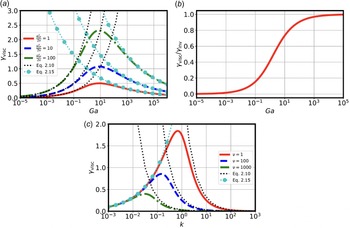


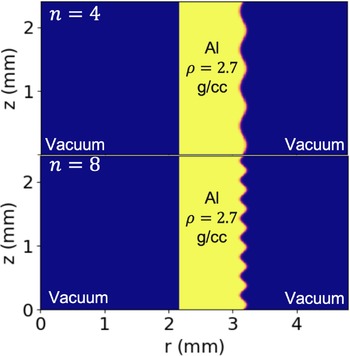


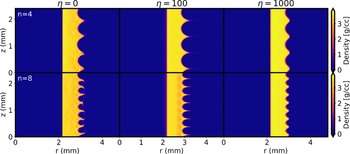


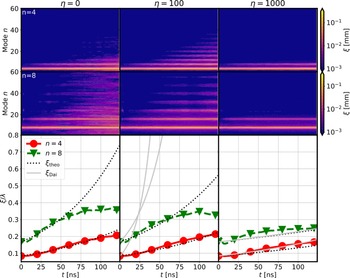


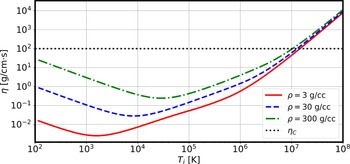


 Open access

