


Introduction
The bushmeat trade has attracted considerable scientific interest in the forest vegetation zone of Central and West Africa (e.g. Ajayi, Reference Ajayi1978; Fa et al., Reference Fa, Peres and Meeuwig2002a,Reference Fa, Peres and Meeuwigb, Reference Fa, Seymour, Dupain, Amin, Albrechtsen and Macdonald2006; Dupain et al., Reference Dupain, Nackoney, Vargas, Johnson, Farfán, Bofaso and Fa2012; Akani et al., Reference Akani, Amadi, Eniang, Luiselli and Petrozzi2015a,Reference Akani, Petrozzi, Ebere, Dendi, Phil-Eze, Nioki and Luisellib; Kiffner et al., Reference Kiffner, Peters, Stroming and Kioko2015; Petrozzi et al., Reference Petrozzi, Amori, Franco, Gaubert, Pacini and Eniang2016; Luiselli et al., Reference Luiselli, Petrozzi, Akani, Di Vittorio, Amadi and Ebere2017). However, it has not been studied previously in the Sahel region of West Africa, where drier climatic conditions and distinct social characteristics of human communities may have resulted in different patterns of trade, and effects on the local fauna. It has been speculated that the bushmeat trade in the Sahel may not be as widespread as in the predominantly Christian regions of forested West Africa, as most of the local people are Muslim (Luiselli et al., Reference Luiselli, Petrozzi, Akani, Di Vittorio, Amadi and Ebere2017).
To explore the patterns of bushmeat trade in the Sahel we used a multidisciplinary approach, focusing on Burkina Faso. We conducted interview surveys to understand people's perceptions of bushmeat in relation to three independent factors: their place of residence (urban vs rural), sex and age. We focused on interviews (using the same protocol as Luiselli et al., Reference Luiselli, Petrozzi, Akani, Di Vittorio, Amadi and Ebere2017) instead of market surveys (e.g. Fa et al., Reference Fa, Seymour, Dupain, Amin, Albrechtsen and Macdonald2006) because of the absence of open sites where bushmeat is traded, and because direct statistical analysis of carcasses in markets would not be useful for determining subtle social factors linked to the trade (Luiselli et al., Reference Luiselli, Petrozzi, Akani, Di Vittorio, Amadi and Ebere2017). In addition, we analysed the long-term (1985–2010) population dynamics of two ungulate species (the oribi Ourebia ourebi and the common duiker Sylvicapra grimmia) that are among the main targets of the bushmeat trade in Burkina Faso (authors, pers. obs.). We investigated the population dynamics of these species in Nazinga Game Ranch, a protected area that experienced no interannual variations in habitat quality during the time-span of the study but where poaching activities are known to occur and are likely to be a threat to the local wildlife. We predicted that if poaching (and hence the bushmeat trade) were threatening the local wildlife, the population sizes of the two main target species of the trade would be affected even in a protected area where habitat conditions are suitable and stable.
Our objectives were to (1) describe people's perceptions of bushmeat in relation to their location, sex and age, (2) explore the commodity chain of bushmeat in the Sahel, (3) evaluate whether the wild populations of two target species of the trade are stable, increasing or decreasing under poaching pressure in a protected area with no changes in habitat quality, and (4) consider the implications of any observed patterns for conservation.
Study areas
The study was conducted in Burkina Faso, West Africa, which is mostly arid, with extended Sudanian and Sahel savannahs. We conducted the interview surveys in Ouagadougou (in the neighbourhoods Ouaga 2000, Marché de Songamdé, Kilwin, Koumdanyoré and Karpalà) and in a number of small, rural villages (Bieha, Boura, Pama, Sanga, Zabré, Gamboussougou, Tindougou, Tibadi, Nadiagou and Kompienbiga; Fig. 1). The villages have populations of 500–5,500 people, except Pama, which has c. 40,000. Ouagadougou is a cosmopolitan town, with a population of c. 2.5 million people and a mixture of ethnic groups, with the majority of people being Mossi. Most of the villages are inhabited by people of the Gourmatche ethnic group.
Locations of the rural and urban areas in Burkina Faso where interviews were conducted to investigate patterns and perceptions of bushmeat hunting.
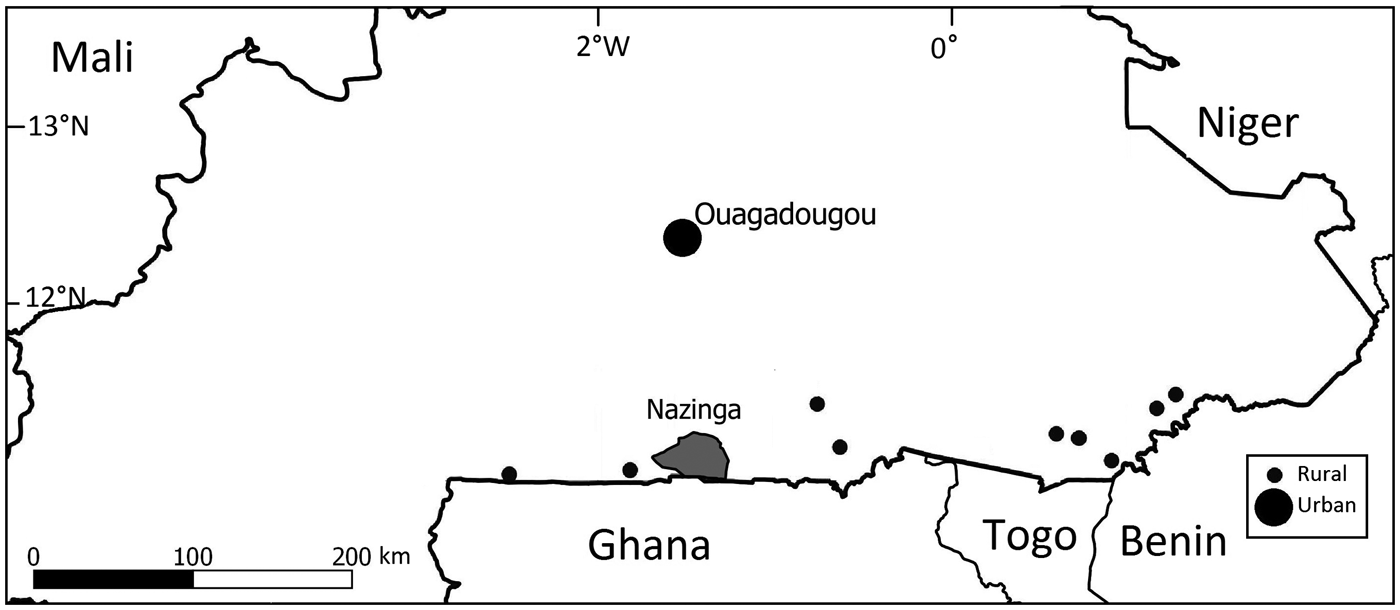
We studied antelopes in the 940 km2 Nazinga Game Ranch, in the south of the country, 165 km from Ouagadougou, where illegal hunting is known to occur (Marchal et al., Reference Marchal, Lejeune, Bouché, Ouédraogo, Sawadogo and Yaméogo2012). This is an area of the Gourounsi ethnic group, with migrants mostly from the Mossi ethnic group. The vegetation is tall-grass tree-shrub savannah. The main plant species are Vitellaria paradoxa, Terminalia spp., Combretum spp., Acacia spp. and Detarium microcarpum, and the main grasses are Andropogon ascinoides and Schizachyrium sanguineum (Croes, Reference Croes1988).
Methods
Interview surveys
Information on the bushmeat market chain in Burkina Faso was obtained, primarily by EMH, through field experience, hundreds of non-structured interviews with local people, and news from field staff during 1998–2016. Most of this information was obtained informally and in a non-standardized way, and thus cannot be processed statistically.
During May–October 2016, structured interviews were conducted with 507 randomly encountered people in urban and rural areas. The interviewees were encountered in places where social life typically occurs (e.g. in marketplaces, on the road, and in canteens, restaurants, hair salons and food shops). We stopped the first person encountered after a given timespan (in minutes) generated by a random number generator (Math Goodies, 2015), within lower and upper limits that were newly inserted after the completion of each interview. All interviews were conducted by local scientists, who disclosed to the interviewees that they were carrying out a scientific research project. Sex and age category (≤ 25 years, 26–50 years, ≥ 51 years) were recorded. Interviewees’ names and level of education were not recorded, to protect their privacy (St John et al., Reference St John, Edwards-Jones, Gibbons and Jones2010; Nuno et al., Reference Nuno, Bunnefeld, Naiman and Milner-Gulland2013; Luiselli et al., Reference Luiselli, Petrozzi, Akani, Di Vittorio, Amadi and Ebere2017). To avoid the risk of non-independence of the data, we never interviewed two members of the same family or the same household.
Interviewees were asked the following questions: (1) Do you like eating bushmeat? (2) If yes, how often do you eat it? They were offered a choice of responses to question (2): frequently (at least once per week), rarely (c. once per month or less), or never. Those who indicated that they ate bushmeat were asked whether they would select the type of animal to eat or whether they would buy and consume whatever kind of bushmeat was available.
Population dynamics of antelopes
At Nazinga Game Ranch data were collected along 30 equally spaced north–south transects of 1.4 km length, arranged systematically across the entire area of the ranch, using the linear transect unlimited bandwidth method (Burnham et al., Reference Burnham, Anderson and Laake1980; Buckland et al., Reference Buckland, Anderson, Burnham and Laake1993, Reference Buckland, Anderson, Burnham, Laake, Borchers and Thomas2001). Overall, c. 600 km of transects were surveyed. The survey data were collected during field projects focusing on elephants Loxodonta africana, conducted during 1985–2010 under the supervision of EMH and WG (Hema et al., Reference Hema, Barnes and Guenda2010a,Reference Hema, Barnes and Guendab,Reference Hema, Ouattara and Karamac).
Data were collected over 7 days in each of the study years, with debriefing and sharing sessions in the afternoon. The transects were surveyed by 12 teams, each consisting of a scientist (team leader) and two observers (a local resident from a neighbouring village and a field guide). The teams walked independently along straight lines. They were equipped with global positioning systems, compasses, rangefinders, maps, and sheets on which to record notes on the species, the number of individuals observed, the radial distance and the viewing angle, sex, age, type of activity, and any illegal activity by people. They began walking early in the morning, as soon as there was sufficient daylight to distinguish objects accurately.
Statistical analyses
Generalized linear modelling was used to model the interview results and quantify the relationships between bushmeat consumption and site (rural vs urban), sex and age category (Hosmer & Lemeshow, Reference Hosmer and Lemeshow2000). Consumption of bushmeat was the dependent variable (consumption data were converted into a binary variable: 1 = eat (often or rarely) and 0 = never eat bushmeat), and the identity link function and a normal distribution of error were used (McCullagh & Nelder, Reference McCullagh and Nelder1989). Three age categories were used for all analyses: < 25 years, 26–50, and ⩾51 years. In the generalized linear models a stepwise forward regression procedure was used to test the statistical significance of each variable in turn, and variables that did not correlate significantly to the dependent variable were excluded (Wald test, P > 0.05).
A χ 2 test was used to compare groups of interviewees who ate bushmeat frequently, rarely, and never, and to identify differences in terms of the type of bushmeat consumed. All analyses were conducted in PASW 11.0 (SPSS Inc., Hong Kong), with α = 5%.
Data on ungulate densities along line transects were analysed using Distance v. 6.2 (Burnham et al., Reference Burnham, Anderson and Laake1980), with the half-normal key as model, k(y) = Exp(-y**2/(2*A(1)**2)). Long-term trends in the estimated population densities of the two ungulate species were analysed by calculating the Pearson correlation coefficient for estimated density (the dependent variable) against year (the independent variable), and the statistical difference between species in terms of long-term population trends was tested by a heterogeneity of slopes test (analysis of covariance).
Results
Interview surveys
Table 1 presents a synopsis of the interview data. In the urban areas there were statistical differences between groups, with significantly more people (independently of their sex or age) eating bushmeat rarely rather than frequently (χ 2 = 17.36, df = 4, P < 0.005), and significantly more people (again independently of their sex or age) eating bushmeat, at least occasionally, than never eating bushmeat (χ 2 = 30, df = 5, P < 0.0001). In the rural areas the patterns were relatively similar, with significantly more people eating vs not eating bushmeat (χ 2 = 83.65, df = 5, P < 0.0001). However, in contrast with the urban area, there were non-significant differences between frequencies of people eating bushmeat frequently vs rarely (χ 2 = 9.78, df = 5, P = 0.06).
Synopsis of the data on bushmeat consumption collected during interviews of 507 people in urban and rural areas of Burkina Faso.

The forward stepwise model highlighted significant differences between rural and urban areas in terms of respondents claiming that they had never eaten bushmeat (Wald statistic = 0.384, P < 0.01), with an increased probability of finding people who had never eaten bushmeat in the urban areas. This model explained 99.97% of the total deviance, and therefore provided good fit to the data. Overall, the main difference between urban and rural areas was that most urban people ate bushmeat only rarely whereas most rural people ate bushmeat frequently (χ 2 test: df = 1, P < 0.01).
Most of the bushmeat-eating interviewees reported they would eat antelopes (rural areas: 92%, n = 176; urban areas: 95.8%, n = 165), but also birds (Guinea fowl Numida meleagris; 40.3 and 55.2%), hares Lepus sp. (82.4 and 84.2%), crocodiles Crocodylus suchus (46 and 61.8%), grasscutters Thryonomys swinderianus (90.3 and 97.6%), monkeys (e.g. Papio anubis and Chlorocebus tantalus; 64.2 and 49.1%) and fruit bats (79 and 69.7%), with no statistical differences in people's preferences between rural and urban areas (χ 2 = 7.31, df = 6, P = 0.293). However, some families in rural communities do not eat certain animals (e.g. crocodiles, pythons Python sebae and other snakes), as to do so is considered taboo in animistic cults.
Population dynamics of antelopes
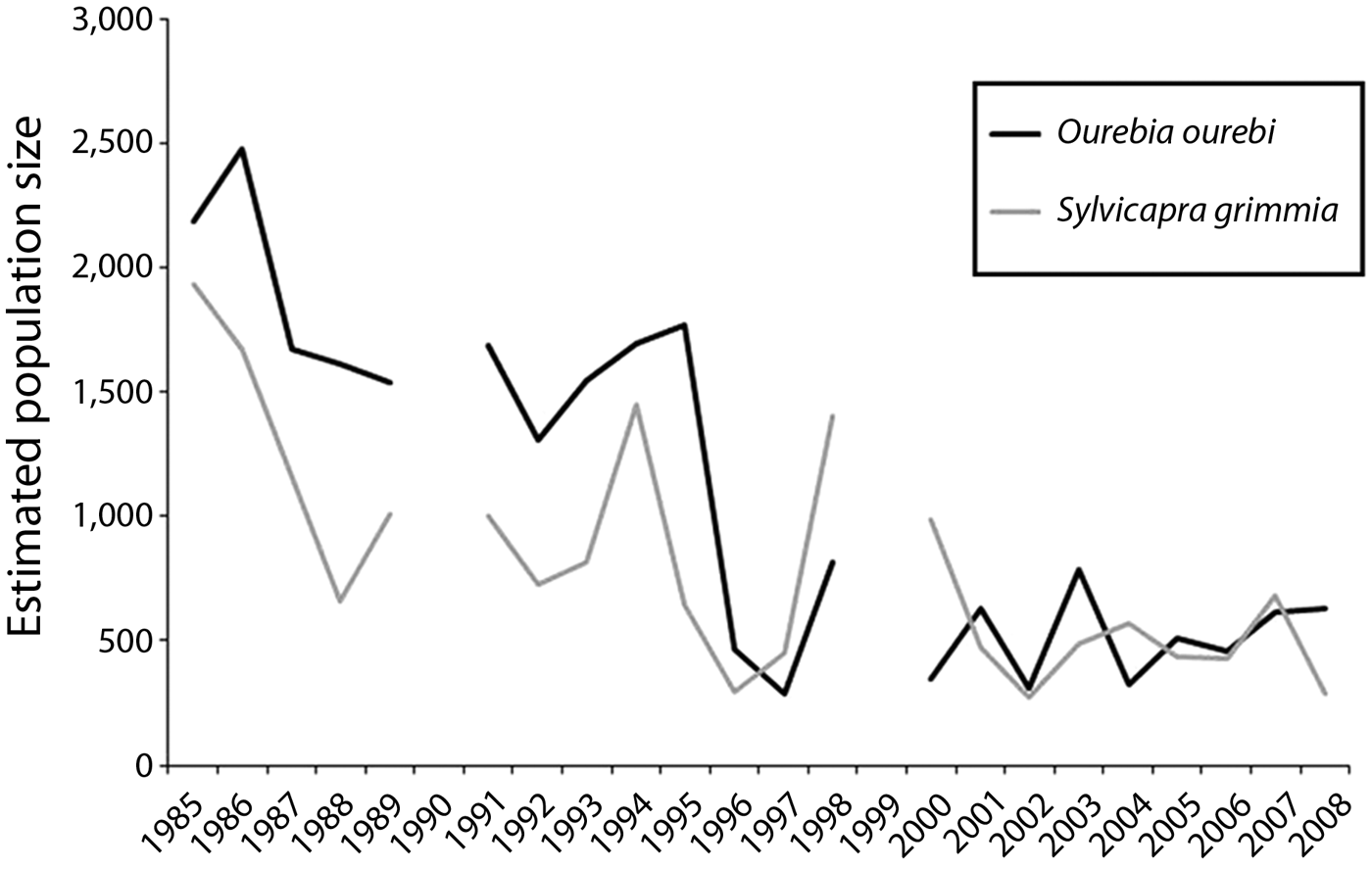
Both O. ourebi and S. grimmia showed a decreasing trend of abundance over time (Fig. 2). The largest estimated population size for O. ourebi was 2,474, in 1986, and the smallest was 289, in 1997. For S. grimmia the largest estimated population size was 1,934, in 1985, and the smallest was 275, in 2002. The decreasing trend was statistically significant for both O. ourebi (Pearson's r = −0.854, n = 24, P < 0.0001) and S. grimmia (Pearson's r = −0.497, n = 24, P < 0.0001), and an analysis of covariance revealed that the decline was significantly higher in O. ourebi (heterogeneity of slopes test: F = 6.2. df = 1,45, P = 0.029). The (log) yearly population size of O. ourebi was significantly positively correlated with the (log) yearly population size of S. grimmia (Pearson's r = 0.736, n = 24, P < 0.0005), indicating a clear effect of year on the population sizes of the two antelope species.
Distance-based population size estimates for the oribi Ourebia ourebi and the common duiker Sylvicapra grimmia from direct counts along line transects in Nazinga Game Ranch during 1985–2010. Gaps indicate years when field surveys were suspended.
Discussion
Compared to other countries, mostly in the forest zone of West and Central Africa (e.g. Ivory Coast, Ghana, Nigeria, Cameroon, Equatorial Guinea, Congo; Fa et al., Reference Fa, Peres and Meeuwig2002a,Reference Fa, Yuste, Burn and Broadb, Reference Fa, Seymour, Dupain, Amin, Albrechtsen and Macdonald2006), it is more difficult to analyse the bushmeat trade in the Sahelian countries of West Africa because there are no open bushmeat markets, and because of social complications (e.g. religion). To our knowledge, no study had been published on the bushmeat trade in Sahelian West Africa (but see Lindsey et al., Reference Lindsey, Balme, Becker, Begg, Bento and Bocchino2012).
In Burkina Faso bushmeat is widely consumed, despite the apparent absence of bushmeat markets. The hunting season is officially restricted to December–May throughout the country, and bushmeat markets are prohibited by legislation, although the sale of bushmeat is authorized in certain locations (e.g. during the official hunting season bushmeat is sold at some wildlife department offices). Some restaurants are also authorized to sell bushmeat.
Bushmeat is available illegally all year round but the trade is secretive and impossible to quantify through standard market monitoring protocols, as has been done in Nigeria (e.g. Fa et al., Reference Fa, Seymour, Dupain, Amin, Albrechtsen and Macdonald2006; Akani et al., Reference Akani, Amadi, Eniang, Luiselli and Petrozzi2015a,Reference Akani, Petrozzi, Ebere, Dendi, Phil-Eze, Nioki and Luisellib), Cameroon (e.g. Njiforti, Reference Njiforti1996; Fa et al., Reference Fa, Seymour, Dupain, Amin, Albrechtsen and Macdonald2006) and Equatorial Guinea (e.g. Fa et al., Reference Fa, Yuste, Perez del Val and Castroviejo1995, Reference Fa, Yuste and Castelo2000). Sellers operate locally, and poachers sell their catches to sellers at the village level, or in Ouagadougou if they have specific agreements or orders from sellers there. In contrast to the forest-zone countries of West and Central Africa, there are no hub markets that receive bushmeat from neighbouring regions (e.g. Cowlishaw et al., Reference Cowlishaw, Mendelson and Rowcliffe2005; Akani et al., Reference Akani, Amadi, Eniang, Luiselli and Petrozzi2015a), nor are there stable village markets (Ajayi, Reference Ajayi1978; Caspary, Reference Caspary, Bakarr, Fonseca, Mittermeier, Rylands and Painemilla2001). The government-authorized trade involves only 212 carcasses annually: nine Syncerus caffer, 29 Hippotragus equinus, 29 Alcelaphus buselaphus, six Tragelaphus scriptus, 19 Kobus ellipsiprymnus, 18 Ourebia ourebi, 17 Sylvicapra grimmia, 51 Phacochoerus africanus and 34 Papio anubis. The trade chain is multi-staged: hunters provide their prey to a seller, who supplies local restaurants, and hunters usually hunt particular species on request, usually demanded by wealthy people, often residing in urban areas. Illegal bushmeat is transported from rural areas to Ouagadougou in secret, usually hidden in lorries carrying firewood and other goods.
Our interview surveys indicated that sex and age did not have any effect on the significance of the model. In practice, everybody may eat bushmeat, regardless of their economic status, because it is only moderately more expensive than poultry, beef or fish. Our model also indicated that fewer people eat bushmeat in Ouagadougou. However, this is probably because bushmeat is less available in urban areas, as most interviewees responded that they would like to eat bushmeat sometimes, if available. In contrast, young, middle-class, urban people in Nigeria have abandoned the consumption of bushmeat (Luiselli et al., Reference Luiselli, Petrozzi, Akani, Di Vittorio, Amadi and Ebere2017). Contrary to what occurs in Nigeria (Luiselli et al., Reference Luiselli, Petrozzi, Akani, Di Vittorio, Amadi and Ebere2017), hunters in Burkina Faso search actively for the largest animals, as the price is determined by the size of the animal (authors, pers. obs.). Assuming the price of bushmeat per kg is comparable across species, larger species are more valuable (Luiselli et al., Reference Luiselli, Petrozzi, Akani, Di Vittorio, Amadi and Ebere2017).
Similarly to what has been observed in Nigeria (Luiselli et al., Reference Luiselli, Petrozzi, Akani, Di Vittorio, Amadi and Ebere2017), in Burkina Faso people do not generally have a preference for a particular species (apart from the wealthiest communities in Ouagadougou) but simply want to eat bushmeat. Many Muslims have similar patterns of bushmeat consumption to Christians and animists, despite the consumption of wild suids being taboo in Islam. Animists have taboos regarding consumption of their holy animals (crocodiles, pythons, and sometimes other snakes).
In conservation terms, although the legal bushmeat trade is small and probably not having a significant impact on wildlife populations, the fact that the extent of the illegal market remains unknown is cause for concern. In this regard, the results of our field surveys (1985–2008) of ungulate population dynamics are of particular concern, as they indicate that populations of some species targeted for the bushmeat trade are declining in Nazinga Game Ranch. As there has been no apparent change in the quality and extent of habitat in the Ranch during this time-span (E.M. Hema et al., unpubl. data), the only other possible explanations for the observed declines of the two focal antelope species are hunting by humans or increased predation by natural predators. The latter is unlikely, as predators were encountered too infrequently during line transect surveys to be considered to be a main cause of antelope decline (Bouché et al., Reference Bouché, Lejeune, Bailly, Muyle, Zinque, Mercier and Cornélis2016), and most large carnivores have declined significantly in West and Central Africa (Brugière et al., Reference Brugière, Chardonnet and Scholte2015). Thus, although there is no confirmed evidence that the declines of O. ourebi and S. grimmia are attributable to overhunting, poaching is likely to have been the cause, as it is rampant around protected areas in Burkina Faso. Both O. ourebi and S. grimmia are highly valued in the bushmeat trade in the region, and they may have been targeted specifically by poachers. Overhunting to supply the bushmeat trade has been identified as a cause of the collapse of other antelope populations in forests (Albrechtsen et al., Reference Albrechtsen, Macdonald, Johnson, Castelo and Fa2007; Grande-Vega et al., Reference Grande-Vega, Farfan, Ondo and Fa2016) and savannahs (Fischer & Linsenmair, Reference Fischer and Linsenmair2001; Nasi et al., Reference Nasi, Brown, Wilkie, Bennett, Tutin, van Tol and Christophersen2008; Bouché et al., Reference Bouché, Nzapa Mbeti Mange, Tankalet, Zowoya, Lejeune and Vermeulen2012), and thus it seems that antelopes may be particularly prone to declines under heavy poaching, and may be the preferred type of bushmeat.
All poachers work in complicity with local communities, and therefore it is essential to educate these communities and to help them to benefit from the local wildlife, for instance through enhancement of ecotourism activities. We recommend that public awareness campaigns should be conducted in the media, because people in both urban and rural areas are not aware of the decline of antelopes as a result of overhunting (Fischer & Linsenmair, Reference Fischer and Linsenmair2001; Grande-Vega et al., Reference Grande-Vega, Farfan, Ondo and Fa2016). Appropriately conducted awareness campaigns regarding the ongoing poaching crisis have yielded positive results in other parts of Africa (e.g. Duffy, Reference Duffy1999; Lotter & Clark, Reference Lotter and Clark2014), and, although carried out for a different reason (i.e. as an anti-Ebola strategy), media campaigns have had considerable success in reducing bushmeat consumption in West Africa (Akani et al., Reference Akani, Dendi and Luiselli2015c).
Acknowledgements
We thank the Nazinga Game Ranch authorities for supporting the long-term field surveys for antelopes, the Communes de Ouagadougou and Pama for giving authorization to carry out the interview surveys, and two anonymous referees for helpful comments.
Author contributions
LL, EMH, DD and FP designed the study; WG supervised the local staff; VO, GP and DS carried out the field interviews; MDV and LL carried out the statistical analyses; and LL and EMH drafted the article, and all authors commented on and approved the final article.
Biographical sketches
Emmanuel Hema studies mammal demography and conservation of savannah habitats. Valy Ouattara is a social scientist with expertise in the socio-economy of the Burkinabe people. Gnoumou Parfait is a conservation biologist and works on terrestrial and freshwater environments of Burkina Faso. Massimiliano Di Vittorio is an ornithologist and conservation biologist who works on threatened species. Djidama Sirima is a field researcher with specialization in West African savannah habitats. Daniele Dendi is an ecological economist, with a particular focus on sustainable development in West Africa. Wendengoudi Guenda works on zoogeography, systematics and ecology. Fabio Petrozzi is a conservation biologist who conducts field studies in West African habitats. Luca Luiselli is a theoretical ecologist and conservation biologist with interests in various aspects of tropical forest and savannah conservation ecology.



