


Introduction
Mesophotic ecosystems occur at the lower light limits, and typically range between 30 and 150 m. At these depths, surface light irradiation is reduced to 1%, but this still allows for the development of some benthic primary producers (Cerrano et al., Reference Cerrano, Bastari, Calcinai, Di Camillo, Pica, Puce, Valisano and Torsani2019; Micaroni et al., Reference Micaroni, McAllen, Turner, Strano, Morrow, Picton, Harman and Bell2021). Benthic mesophotic habitats are thought to provide crucial refuge for fish and invertebrates, serve as carbon sinks and sources, and support extensive food webs (Soares et al., Reference Soares, Tavares and Carneiro2019 and references therein). Benthic mesophotic habitats could potentially serve as crucial links between deep and coastal water systems, or as important refuges for disturbed shallow communities to recover, either after anthropogenic or climatic events; however, these depths are poorly assessed worldwide (Cerrano et al., Reference Cerrano, Bastari, Calcinai, Di Camillo, Pica, Puce, Valisano and Torsani2019). The global biodiversity crisis necessitates the urgent investigations and protection of marine biodiversity hotspots, particularly in under-surveyed environments such as mesophotic benthic habitats.
The Canary Islands, located in the subtropical north-eastern Atlantic region (Macaronesia), host exceptionally high biodiversity, endemism, and conservation value. Marine flora alone comprises 758 species, according to the most recent archipelago species list (Gallardo et al., Reference Gallardo, Bárbara, Afonso-Carrillo, Bermejo, Altamirano, Gómez Garreta, Barceló Martí, Rull Lluch, Ballesteros and De la Rosa2016). From these species, 124 are green algae (Chlorophyta), mostly represented by the Class Ulvophyceae (122 species) and are distributed in five orders: Ulothricales (5 sp.), Ulvales (29 sp.), Chlodophorales (41 sp.), Dasicladales (7 sp.), and Bryopsidales (42 sp.) (Julio Afonso-Carrillo, Reference Afonso-Carrillo2014; Gallardo et al., Reference Gallardo, Bárbara, Afonso-Carrillo, Bermejo, Altamirano, Gómez Garreta, Barceló Martí, Rull Lluch, Ballesteros and De la Rosa2016). While most marine biodiversity surveys in the archipelago focus on the shallow photic zone, large mesophotic areas dominate the coastal margins of the Canary Islands. Although these deeper areas have received comparatively less attention, some efforts have been made to investigate mesophotic habitats, particularly black coral forests (order Antipatharia). These include the development of mapping methods (Czechowska et al., Reference Czechowska, Feldens, Tuya, de Esteban, Espino, Haroun, Schönke and Otero-Ferrer2020), and assessments of associated fish assemblages (Bosch et al., Reference Bosch, Espino, Tuya, Haroun, Bramanti and Otero-Ferrer2023; Navarro-Mayoral et al., Reference Navarro-Mayoral, Díaz-Vergara, Bosch, Tuya, Bramanti, Fernandez-Gonzalez, Terrana, Espino, Haroun and Otero-Ferrer2025). Earlier work by Bianchi and colleagues documented epibenthic communities down to 50 m off Lanzarote Island in 1991 using SCUBA diving (Bianchi et al., Reference Bianchi, Haroun, Morri and Wirtz2000). Because mesophotic zones lie beyond recreational diving depth limits, they are logistically challenging to access. As a result, studies remain scarce and targeted, and species distributions in these environments are likely still substantially underestimated.
Avrainvillea canariensis (Order Bryopsidales, Family Dichotomosiphonaceae) Gepp & Gepp (1911) is the only species of the genus Avrainvillea that occurs in the East Atlantic (Lagourgue et al., Reference Lagourgue, Rousseau, Zubia and Payri2023). Only a few species of green algae can thrive at the depths of upper mesophotic zone (>50 m) due to the attenuation of available light penetrating water column (Klugh and Martin, Reference Klugh and Martin1927). Globally, genus Avrainvillea can be observed from intertidal zones to the depths of up to 60 m, on sand plains, coral rubble, and in seagrass beds (Cabrera and Suárez, Reference Cabrera and Suárez2006; Lagourgue et al., Reference Lagourgue, Rousseau, Zubia and Payri2023; Guiry and Guiry, Reference Guiry and Guiry2025). The majority of 38 Avrainvillea species registered worldwide appears to be restricted to pantropical and subtropical climate, to a single ocean basin, which means the species have limited geographic ranges and do not spread across multiple oceans. This regional endemism and limited dispersal contrasts to other bryopsidalean families (e.g., Caulerpaceae and Codiaceae). Initially, A. canariensis was considered as a neo-endemic species restricted to the Canary Islands only (Cabrera and Suárez, Reference Cabrera and Suárez2006). However, in the last decade, there have been new records of the species in the Azores and Madeira archipelagos documenting a northward expansion of its distribution range (Ribeiro et al., Reference Ribeiro, Neto, Moreu, Haroun and Neves2019; Neto et al., Reference Neto, Cacabelos, Prestes, Díaz-Tapia and Moreu2022). Therefore, this siphonous green alga is now regarded as a species endemic to the whole Macaronesian ecoregion. In the Canary Islands, due to its endemism, particularly restricted distribution on sandy bottoms and its scarcity, A. canariensis has been included in the archipelago’s protected species catalogue (Law 4/2010, 4 June, BOC No. 112/2010, Annex III) under the category of ‘species of interest to the Canary Islands ecosystems’, aiming to conserve the species (Gobierno de Canarias, 2010). Although its official conservation status does not imply strict protection laws, the species must nevertheless be considered in environmental impact assessments.
Despite its conservation interest, the true distribution and ecological role of A. canariensis remain largely unknown. To date, in the Canary Archipelago, the algae was only observed as solitary individuals within the assemblages of other alga species (mostly Caulerpales) or Cymodocea nodosa seagrass beds. Its known distribution was limited to the islands of Tenerife (locations of records: San Andrés, Tabaiba, and Punta de Güímar) (J. Afonso-Carrillo et al., Reference Afonso-Carrillo, Gil-Rodríguez, Haroun Tabraue, Villena Balsa and Wildpret1984; Moreira-Reyes et al., Reference Moreira-Reyes, Monterroso, Aguirre, Cruz-Ryes, Gil-Rodríguez and Nunez2003) and Gran Canaria (locations of records: Arguinenín, Playa de Jinámar, Bahía de Gando, Playa del Inglés, Mogán, and Costa de Sardina del Norte) (Viera-Rodríguez et al., Reference Viera-Rodríguez, Soler-Onis and Haroun1995; Gonzalez et al., Reference Gonzalez, Monagas, Remirez, Luque, Hernandez and Llinas2015; Sosa Henríquez et al., Reference Sosa Henríquez, Luque Escalona, Otxoa and González Ramos2015).
The present study documents highly dense meadows formed exclusively by A. canariensis, revealing a mesophotic benthic habitat previously unknown in the archipelago. Furthermore, the study establishes a new southern limit to the species’ distribution range and provides the deepest record of A. canariensis within the Macaronesian ocean basin. These findings suggest that the species’ capacity to form structured habitats has been underestimated. The recent availability of modern technologies, such as Baited Remote Underwater Video Systems (BRUVS), now enables detailed investigations of poorly explored mesophotic habitats, which is essential for effective island management and conservation that rely on accurate mapping of the distribution of endemic species.
Material and methods
Discovery of new A. canariensis patches was made in October 2024, during the REMA-CAN project expedition, which assessed artisanal fishing grounds around the coast off El Hierro Island, using stereo BRUVS (SeaGIS Ltd). The use of BRUVS was essential as it allowed for the non-destructive surveying of the mesophotic zone, overcoming the depth limitations (below 20 m) typically associated with conventional SCUBA diving in the archipelago.
The sampling design for the deployment of BRUVS units consists of placing one unit every 200 m (n = 6) along the shoreline at each location. Sampling was performed at eight locations around the island at depths 40–60 m. Each BRUVS consisted of a stainless-steel frame, a horizontal bait arm (1–1.5 m) with a bait container, flotation devices, and two GoPro HERO10 Black Edition cameras (GoPro Inc.) in waterproof housings. The cameras were mounted in stereo configuration at a fixed angle of 7–8° and were previously calibrated to ensure accurate spatial measurements (Harvey et al., Reference Harvey, McLean, Goetze, Saunders, Langlois, Monk, Barrett, Wilson, Holmes, Ierodiaconou, Jordan, Meekan, Malcolm, Heupel, Harasti, Huveneers, Knott, Fairclough, Currey-Randall, Travers, Radford, Rees, Speed, Wakefield, Cappo and Newman2021). BRUVS were deployed from the boat and the cameras recorded continuously for ∼1 h per deployment. Each BRUVS deployment was considered one sampling unit.
Video recordings were uploaded into EventMeasure software (SeaGIS Ltd), which was used to extract morphometric data. Video footage was paused at four different positions of the BRUVS unit due to its displacement by currents and again during retrieval. Stereo measurements from still images were used to delineate a quadrant based on calibrated reference points in the stereo footage. Then, the area of each delineated quadrant was calculated, within which individual algae were counted. These measurements were then extrapolated to 100 m2 plots to allow comparisons with previous studies. In addition to estimating the population density of A. canariensis within the surveyed plots, EventMeasure software also allowed precise measurement of individual thallus length. For maximum measurement precision, only individuals closest to the camera rig (BRUVS unit) were measured. Spatial distribution of algal stands was qualitatively assessed by comparing six replicate deployments (six BRUVS units) within each site, with replicates positioned approximately 200 m apart.
Results and discussion
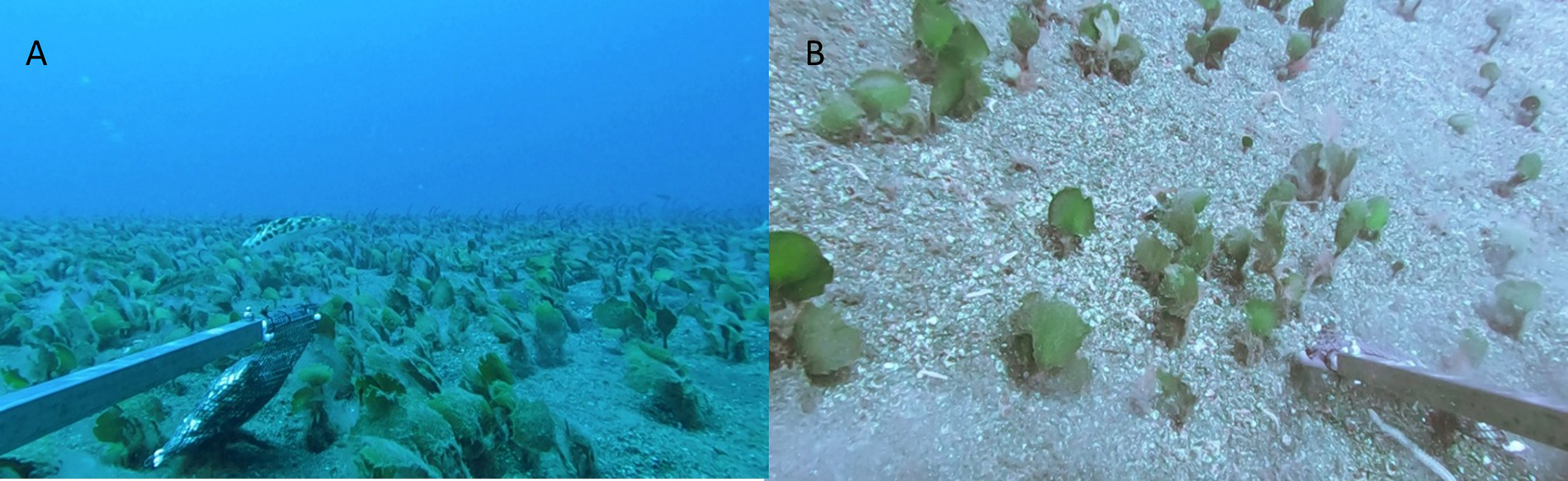
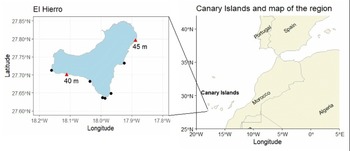
Two extensive and dense populations of the fan-shaped green macroalga A. canariensis (Chlorophyta) were observed for the first time off the coast of El Hierro island (Canary Islands), at two locations: Playa Los Moles, southwest of El Hierro (Lat 27.70186169, Lon – 18.12020897) and off Puerto de La Estaca, at the east of El Hierro (Lat 27.78551834, Lon – 17.89119361), at depths of 40 and 45 m, respectively (Fig. 1). The alga was identified from BRUVS video footage based on its characteristic fan-shaped blades, each supported by a single basal thallus embedded in gently sloping sandy substrate, and its deep green colouration (Fig. 2). Due to the depth and the nature of the sampling (remote video footage), it was not possible to collect specimens for closer examination. Nevertheless, the distinctive morphology of A. canariensis and its typical habitat allow reliable photo-identification. Moreover, only one species of the genus Avrainvillea has been reported in Canary Islands, making misidentification unlikely.
Location of the global position of the Canarian Archipelago and the island of El Hierro. Black dots represent sampling locations around the island, red triangles represent the two newly discovered populations of Avrainvillea canariensis and their depth ranges.

Image of dense (A) and sparse (B) mesophotic meadows of the macroalga Avrainvillea canariensis at two distinct sites, at 40 m and 45 m depth, respectively, off El Hierro, Canary Islands, Spain. Images were taken using two GoPro Black Eddition action cameras mounted on stereo BRUVs units (SeaGIS Ltd).
The height of the protruding part of A. canariensis thalli ranged from 8.6 to 12.4 cm (n = 7), resulting in an average of 10.5 ± 1.3 cm. These values matched those reported for individuals collected in Tenerife over four decades ago (Afonso-Carrillo et al., Reference Afonso-Carrillo, Gil-Rodríguez, Haroun Tabraue, Villena Balsa and Wildpret1984), but were ∼3–4 times greater than individuals recorded at two other locations outside the Canary Archipelago: Madeira (at ∼30 m depth (Ribeiro et al., Reference Ribeiro, Neto, Moreu, Haroun and Neves2019) and intertidal rockpools in Azores (Neto et al., Reference Neto, Cacabelos, Prestes, Díaz-Tapia and Moreu2022). At each location, the BRUVS unit that recorded A. canariensis was flanked by two adjacent units (replicates) ∼200 m away where the algae were absent, and no individuals were observed in the remaining five BRUVS replicates. Thus, based on the observations, we estimated that the maximum possible width at each algal patch was 400 m. However, the depth limits of these patches remain unknown, and should be investigated in the future expeditions.
The southwestern location (Playa de Los Moles) harboured a much denser algal meadow (Fig. 2a) than the eastern location (Puerto de La Estaca), where the population of A. canariensis was more scattered (Fig. 2b). The quality of the video recording was better at Playa de Los Moles and enabled us to obtain algal density that ranged from 12 individuals/m2 at the more scattered parts of the patch to a maximum of ∼100 individuals/m2 (n = 4). Towards the periphery of the algal bed, A. canariensis grows more sparsely, suggesting the algal meadow does not exhibit any clearly defined boundary or edge. These dense populations are significant because they are formed exclusively by A. canariensis, contrasting with historical records in Tenerife and Gran Canaria where the species was typically reported as solitary or found sparsely distributed in association with seagrass beds and other Caulerpales. Apart from the two populations observed in El Hierro, the only other location where A. canariensis forms dense meadows is Madeira Island, 400 km away from the Canaries. Although the algal patches in Madeira were relatively small (4–15 m2), they exhibited higher densities, from 640 to 1360 individuals/m2, which could be due to shallower depths, as the meadows were found at 30 m in Madeira versus 40 m in El Hierro (Ribeiro et al., Reference Ribeiro, Neto, Moreu, Haroun and Neves2019).
Using stereo video cameras, we were also able to record fish species actively utilizing A. canariensis meadows. Video footages captured a diverse assemblage of fish, including large numbers of Guinean pufferfish (Sphoeroides marmoratus), Mediterranean parrotfish (Sparisoma cretense), as well as emblematic species such as roughtail (Bathytoshia lata) and common stingrays (Dasyatis pastinaca), among others. The habitat also seemed to attract great predators, as we observed white trevally (Pseudocaranx dentex) passing by. Interestingly, at both locations, A. canariensis colonies appeared to either share or compete for habitat with the Brown garden eel (Heteroconger longissimus), which inhabits bare sandy areas between the algal stalks. The presence of diverse fauna, including conservation-priority species, such as rays, suggests that A. canariensis meadows may function as important mesophotic habitat, potentially providing shelter and feeding grounds. Further research is required to assess species interactions and to evaluate the broader ecological role of A. canariensis beds.
In Canary Archipelago, established populations of A. canariensis had not previously been officially described outside Tenerife or Gran Canaria. This discovery on El Hierro formally establishes the new southernmost limit of the species’ distribution range within the Macaronesian ecoregion, highlighting the island’s biogeographical importance. Nevertheless, a study by Moreira-Reyes et al. (Reference Moreira Reyes, Acuña and Gil Rodríguez2013), which characterized a seagrass meadow in La Caleta off El Hierro Island (∼150 m north of the eastern population described here), briefly listed A. canariensis among 15 algal species. These species were recorded within a single Cymodocea nodosa bed, surveyed at depths of 12–20 m. This record was not elaborated upon; the algae were neither mentioned further in the text nor any data on abundance or density were presented. Therefore, it remains unclear whether A. canariensis represented an established population at that time or merely just a few individuals sparsely scattered among seagrass shoots. To our knowledge, no other studies around El Hierro have reported the species in either English or Spanish. This study provides the first quantitative description of A. canariensis as forming permanent and extensive populations, including preliminary measurements of density, patch sizes, and associated species. Based on these observations, we reveal a previously unknown mesophotic soft-bottom habitat in the Canary Archipelago, representing a significant addition to the region’s marine biodiversity and ecosystem knowledge. Whether these habitats represent recent formations resulting from a southward population expansion or simply have been previously overlooked remains an open question.
The reproductive biology of A. canariensis remains largely unexplored. However, based on knowledge from other species within the genus Avrainvillea, these siphonous algae typically persist through clonal vegetative growth (van Tussenbroek Bi, Reference van Tussenbroek Bi2011; Thornton et al., Reference Thornton, Spalding, Stoeckel, Harris, Wade and Krueger-Hadfield2024). Presuming this is the case in A. canariensis, the approximate age of the two habitats could be estimated by combining several approaches, including measurements of organic matter accumulation in the sediment, colony size, and the growth rates at both the individual and patch (radial expansion) levels, as well as investigating relative roles of vegetative versus clonal reproduction (assessing genetic variability) (Thornton et al., Reference Thornton, Spalding, Stoeckel, Harris, Wade and Krueger-Hadfield2024). In addition, genome-level analysis could further reveal whether populations occurring across Canary Islands, Madeira, and Azores originate from a common source population. Addressing these questions in future studies will be essential for determining whether the species is currently expanding its range due to changing environmental conditions (e.g., climate change) or whether it has been present around El Hierro for decades but remained undetected due to the limited exploration of the mesophotic habitats.
This discovery was made possible by advances in technology that allow investigations in mesophotic zone. Depth has been a limiting factor due to recreational SCUBA diving limits that both citizen scientists and biologists must adhere to. Most surveys around El Hierro and Canary Archipelago did not reach depths below 20 m, suggesting that many species and populations may have been largely overlooked, including A. canariensis. Considering availability and accessibility of modern technology such as BRUVS, we recommend to urgently map the mesophotic zone off the archipelago to better determine this and other important species distributions. Timely updates to this scientific knowledge are critical to conserve endemic species and the unique biodiversity of the Macaronesian archipelagos.
Supplementary material
The supplementary material for this article can be found at https://doi.org/10.1017/S0025315426101295.
Acknowledgements
We are deeply indebted to fishing boat captain David Pavón, Representative and Spokesperson of the Regional Federation of Fishermen’s Guilds of the Canary Islands and Vice President of the Executive Committee of the Consultative Council for EU Outermost Regions on Fisheries and Aquaculture, for his invaluable local knowledge of marine biodiversity and his generous willingness to facilitate the REMA-CAN 2024 expedition in El Hierro and beyond.
Author contributions
S.L. undertook fieldwork and image analysis, drafted the manuscript, and reviewed the final version. C.H.P. undertook fieldwork, provided comments on the draft, and reviewed the final version. B.H. undertook the identification of the species, drafted the relevant sections, provided comments, and reviewed the final draft. J.C.H. coordinated the work, acquired funding for the research, provided comments for the manuscript, and reviewed the final version.
Funding
The expedition during which the visual data were collected was funded by the Government of the Canary Islands and the project Recursos Marinos de Canarias (REMA-CAN).
Competing interests
The authors declare that they have no known competing financial interests or personal relationships that could have appeared to influence the work reported in this paper.
Ethical standards
This study did not involve human participants or experimental manipulation of animals. All data were collected through non-invasive observational methods.
Data availability
The data supporting the findings of this study are available as Supplemental Material and from the corresponding author upon request.


 Open access

