


Introduction
Conventional and accessible marking systems for animals, such as dyeing bird feathers (Bendell & Fowle, Reference Bendell and Fowle1950; Paullin & Kridler, Reference Paullin and Kridler1988), painting mammal skin and fur (Pienaar, Reference Pienaar1970; Walker et al., Reference Walker, Trites, Haulena and Weary2012), ear notching ungulates (Blair, Reference Blair1941) or removing tissue, scale or scute pieces in amphibians and reptiles (Cagle, Reference Cagle1939; Turner, Reference Turner1960; Jennings et al., Reference Jennings, David and Portier1991; Ferner, Reference Ferner2007) have been widely used to identify individuals of many species over variable lengths of time. These notching or marking systems date back to the early 20th century when Cagle (Reference Cagle1939) described a simple scute-notching system for hard-shelled turtles whereby scutes were assigned a number and then notched with a file or scissors. Permanently identifying individuals in longitudinal studies in a way that does not disrupt their natural behaviours has proven to be instrumental for the study of growth and ageing, reproduction, survivorship and migration patterns (Cagle, Reference Cagle1939; Plummer & Ferner, Reference Plummer, Ferner, McDiarmid, Foster, Guyer, Gibbons and Chernoff2012). Although these systems have been adapted to a variety of species and projects (Ernst et al., Reference Ernst, Hershey and Barbour1974; Holland, Reference Holland1994; Bury et al., Reference Bury, Welsh, Germano and Ashton2012; Plummer & Ferner, Reference Plummer, Ferner, McDiarmid, Foster, Guyer, Gibbons and Chernoff2012; Nagle et al., Reference Nagle, Kinney, Gibbons and Congdon2017; Certified Pedigreed Swine, 2023), there is no such system for pangolins, and gaps remain in our knowledge of pangolin biology and ecology that a universal notching system would help alleviate (Willcox et al., Reference Willcox, Nash, Trageser, Kim, Hywood and Connelly2019; Heighton & Gaubert, Reference Heighton and Gaubert2021).
There are eight extant species of pangolin, four of which are native to Africa (Temminck's pangolin Smutsia temminckii, giant ground pangolin Smutsia gigantea, black-bellied pangolin Phataginus tetradactyla and white-bellied pangolin Phataginus tricuspis) and four are native to Asia (Chinese pangolin Manis pentadactyla, Indian pangolin Manis crassicaudata, Philippine pangolin Manis culionensis and Sunda pangolin Manis javanica; Challender et al., Reference Challender, Nash and Waterman2019; Gaubert et al., Reference Gaubert, Wible, Heighton, Gaudin, Challender, Nash and Waterman2020; IUCN, 2024). All eight species of pangolin have decreasing populations (IUCN, 2024) and are listed on Appendix I of CITES, the highest level of legal protection from the threats of international trade (Challender & O'Criodain, Reference Challender, O'Criodain, Challender, Nash and Waterman2020).
Pangolins, their name derived from the Malay peng-goling meaning ‘ones that roll up’ (Kingdon & Largen, Reference Kingdon and Largen1997), have distinct morphology and behaviour. They have been referred to as walking pinecones, scaly anteaters and even perambulating artichokes because of their long tongues, absence of teeth, unique armour formed by keratin scales and used for protection, and diet consisting mostly of ants and termites (Wang et al., Reference Wang, Yang, Sherman and Meyers2016). They live primarily in burrows, are known to dig, climb, walk and swim throughout their native habitats and, when threatened, curl into a defensive ball, allowing their scales to serve as their primary source of protection (Kingdon & Largen, Reference Kingdon and Largen1997; Vickaryous & Hall, Reference Vickaryous and Hall2006). Pangolins vary widely in size, with the smallest species, the white-bellied pangolin, weighing 1–3 kg and measuring 100 cm long (Jansen et al., Reference Jansen, Sodeinde, Pietersen, Alempijevic, Ingram, Challender, Nash and Waterman2020), and the largest species, the giant pangolin, weighing > 30 kg and measuring 140–180 cm (Hoffman et al., Reference Hoffman, Nixon, Alempijevic, Ayebare, Bruce, Davenport, Challender, Nash and Waterman2020).
Few pangolin populations have been quantitatively assessed. This limits our ability to understand the impacts of natural and anthropogenic pressures, particularly in areas where there is high exploitation and/or field personnel and equipment are limited, as is the case for most pangolin species in most range countries. Although the majority of pangolin trade involves scales, live animals are sometimes intercepted (Shepherd et al., Reference Shepherd, Connelly, Hywood and Cassey2017; Challender et al., Reference Zhang, Ades, Miller, Yang, Lai and Fischer2020; Bashyal et al., Reference Bashyal, Shrestha, Dhakal, Khanal and Shrestha2021) and need rehabilitation prior to release. Furthermore, although feasible (Gaubert et al., Reference Gaubert, Njiokou, Ngua, Afiademanyo, Dufour and Malekani2016; Zhang et al., Reference Zhang, Ades, Miller, Yang, Lai and Fischer2020; Ewart et al., Reference Ewart, Lightson, Sitam, Rovie-Ryan, Nguyen and Morgan2021; Tinsman et al., Reference Tinsman, Gruppi, Bossu, Prigge, Harrigan and Zaunbrecher2023), there is limited access to the genetic methods required to recover information about individuals (live, carcasses or scales) seized from the trade. Effective methods of monitoring and tracking pangolins are essential to understand the extent of population declines and potential recovery following intervention.
Efforts are currently underway to address these matters. One approach involves attaching battery-powered tracking devices such as VHF, satellite and GPS tags. Although all such devices have been utilized, VHF tags are most commonly used because of their relatively low cost, long battery life, light weight and capability to provide precise location data through triangulation (Willcox et al., Reference Willcox, Nash, Trageser, Kim, Hywood and Connelly2019; Morin et al., Reference Morin, Challender, Ichu, Ingram, Nash, Panaino, Challender, Nash and Waterman2020). However, signals from such devices can fluctuate in adverse weather conditions, and relocating individuals can be labour-intensive, often necessitating the use of ground vehicles, aircraft or drones to attain proximity to the signal or overcome geographical obstacles (Saunders et al., Reference Saunders, Nguyen, Cowen, Magrath, Marsh, Bell and Bobruk2022). Additionally, there is a risk that tagged individuals could stray beyond the study area or venture on to private property that practitioners do not have authorization to enter. Moreover, as many pangolin species inhabit underground burrows, signal ranges can be significantly restricted during daylight hours when tracking is safest for technicians (Pagès, Reference Pagès1975). Given these limitations, supplementing tracking devices with a sustainable low- or no-technology-based identification system would benefit long-term pangolin monitoring.
One non-invasive method of identifying and tracking live individuals, currently used for a range of animal species (e.g. ungulates: Blair, Reference Blair1941; amphibians and reptiles: Ferner, Reference Ferner2007; marine mammals: Walker et al., Reference Walker, Trites, Haulena and Weary2012) is notching or marking. This entails using a tool such as a drill, punch or file to remove a portion of tissue, scale or scute to permanently render the individual identifiable. Notching systems are valuable when used in tandem with advanced technologies, such as telemetry, as they persist after these technologies fail, are lost or damaged, run out of battery or reach their functional endpoint (Silvy et al., Reference Silvy, Lopez and Peterson2012; Ruden et al., Reference Ruden, Martin, Lacey, Wearn, Buckley and Ruhagazi2024).
At present, there is no universal scale-marking method available for pangolins (Willcox et al., Reference Willcox, Nash, Trageser, Kim, Hywood and Connelly2019; Morin et al., Reference Morin, Challender, Ichu, Ingram, Nash, Panaino, Challender, Nash and Waterman2020). Although pangolin scales vary in size across species, they all exhibit similar structural and mechanical properties (Wang et al., Reference Wang, Yang, Sherman and Meyers2016) allowing them to withstand the force and pressures of drilling. Some of the pangolin-tracking programmes we surveyed (see Methods, below) already use a method of scale notching for four species of pangolin: Sunda, black-bellied, white-bellied and Temminck's pangolins (Ruden et al., Reference Ruden, Martin, Lacey, Wearn, Buckley and Ruhagazi2024). However, each programme has created and manages its own notching system, potentially impeding data sharing. Here we overcome this problem by proposing a universal marking code.
We created the Pangolin Universal Notching System to address the lack of a uniform protocol and to streamline efforts already underway within the pangolin conservation community. This proposal combines elements of existing systems in a way that accommodates the unique morphology and behaviours of pangolins, and is designed to facilitate the identification of large numbers of individuals and integration via a central data repository. The system could be used by trained researchers, non-technical staff and law enforcement officials.
Methods
During January–September 2023, we conducted a literature review and survey of practitioners to assess tracking methods currently utilized across the pangolin research community (Ruden et al., Reference Ruden, Martin, Lacey, Wearn, Buckley and Ruhagazi2024). Despite no mention in the literature, eight of 15 respondents to our survey (53%) described marking or notching pangolin scales for identification using their own ad hoc secondary marking systems, with seven of those programmes acquiring pangolins from wildlife trafficking and trade. Four of these systems involve drilling a series of holes in the scales, and two other systems drill scales to attach numbered cattle ear tags. One system used a tattoo drill and another used paints (Table 1).
Ad hoc pangolin marking methods by species and origin (recovered from trade vs wild caught for research purposes). We identified eight pangolin conservation programmes using ad hoc marking as a supplementary tracking technique for four pangolin species. Several programmes are working across multiple species.

Further discussions with practitioners led us to create a pangolin-specific notching code that could be used for long-term marking of individuals and would complement other tracking techniques. During these discussions we considered factors such as interspecific variation in body size, interspecific and anatomical diversity in scale morphology, ecology, life histories and prior experience with altering scales. This allowed us to select the most suitable scales on which to place markings, to ensure that they are visible without disrupting normal pangolin behaviour. Because pangolins engage in burrowing, swimming, tree climbing, and hiding in dense brush areas, we selected an area along the back of the pangolin. This also proved to be an ideal location as juveniles attach themselves to the base of their mother’s tail, not obstructing the view of any markings. Following meetings with respondents we also consulted the creator of the North American code for hard-shelled turtles (Nagle et al., Reference Nagle, Kinney, Gibbons and Congdon2017) to discuss developing a similar code for pangolins and to gain additional insights regarding best practice.
Results
We created the Pangolin Universal Notching System by adapting and combining existing hard-shell turtle (Nagle et al., Reference Nagle, Kinney, Gibbons and Congdon2017) and ungulate (Blair, Reference Blair1941) marking methodologies. The system uses a numerical-based code to communicate individual identification and/or sex through a series of notches involving scales on or adjacent to the dorsal midline (Fig. 1a). We selected a numerical-based code to accommodate the growing catalogue of pangolin individuals and provide the ability to rapidly assess sex. We determined that drilling a centrally located area, proportional to scale size, would minimize the likelihood of scale breakage.
The Pangolin Universal Notching System applied to a Temminck's pangolin Smutsia temminckii. (a) Dorsal view, with the anterior (head) at the top of the image with the pangolin facing away from the observer. The first scale immediately left of the midline scale row at the pectoral girdle (shoulder) and the first scale immediately right of the midline scale row at the pectoral girdle are always 1 and 100, respectively. Marking the first midline row scale between the 1 and 100 scales indicates a male and marking the fifth midline row scale indicates a female. (b) Male individual number 7,238: the 7,000, 200, 20, 10, 7 and 1 scales and the first scale in the midline, indicating male, are marked.
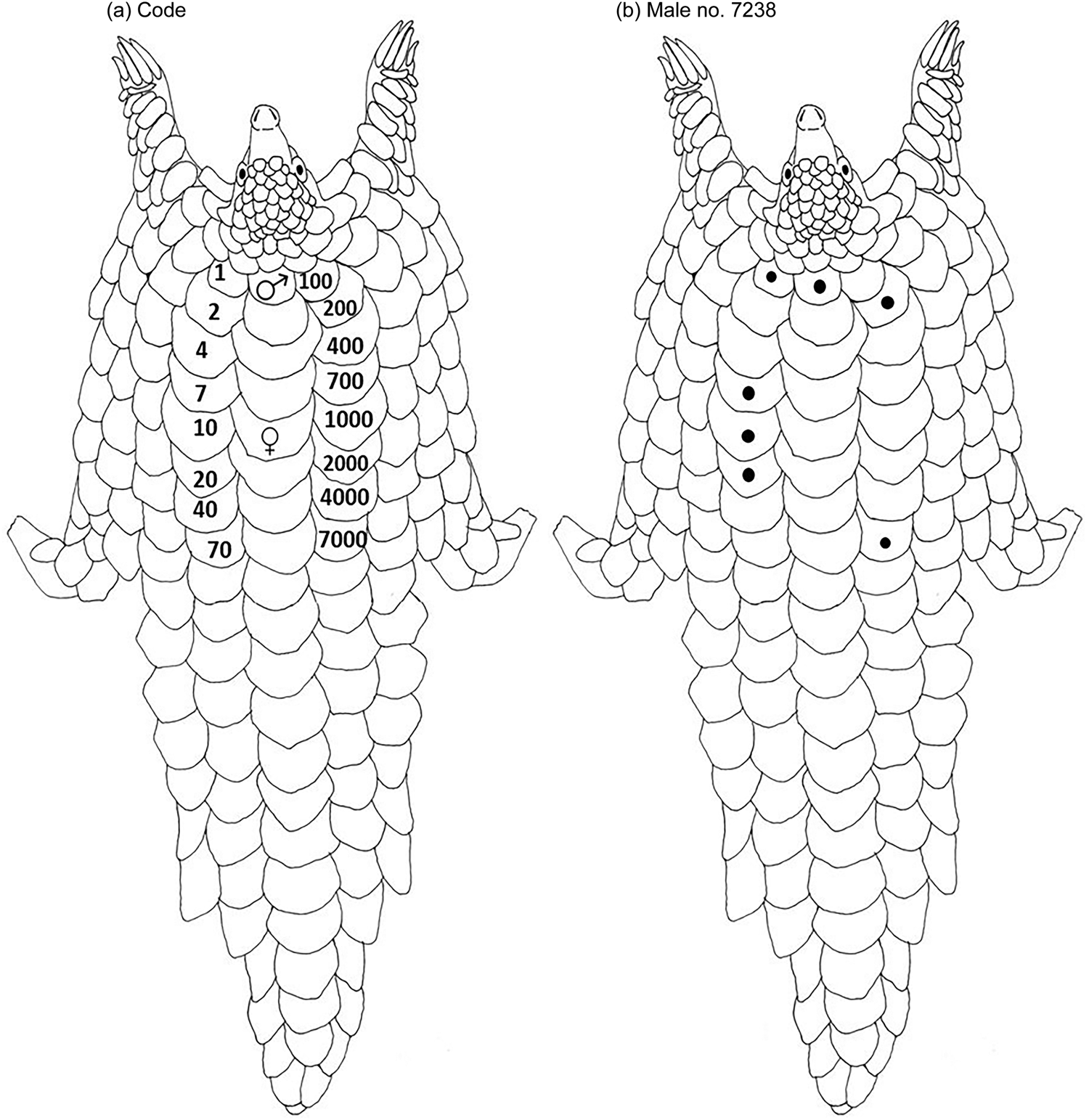
The codes are assigned and read whilst viewing the pangolin from its dorsal side, with the head facing away from and the tail towards the observer (Fig. 1a). The first scale immediately left of the midline scale row at the pectoral girdle (shoulder) and the first scale immediately right of the midline scale row at the pectoral girdle are always labelled 1 and 100, respectively. The pectoral girdles and the scapula (shoulder blade) can be palpated beneath the scales to identify the starting location. This location can also be identified by locating the change in scale morphology that delineates the smaller, thinner head and neck scales from the thicker, wider trunk scales (Challender et al., Reference Challender, Nash and Waterman2019). Once the starting point is identified, the first eight scales on each side of the midline row are numbered. Moving towards the tail from the starting location on the left side, scales are numbered 1, 2, 4, 7, 10, 20, 40 and 70. Moving towards the tail from the starting location on the right side scales are numbered 100, 200, 400, 700, 1,000, 2,000, 4,000 and 7,000. Scale numbers are marked cumulatively to attain the number required. The midline scale row is used to indicate the sex of the individual. For males, the first scale in the midline, between scales numbered 1 and 100, is marked. For females, the fifth scale, between scales numbered 10 and 1,000, is marked. For example, to assign a male pangolin the unique identification code 7,238, the 7,000, 200, 20, 10, 7 and 1 scales are marked, and the first scale along the midline to indicate a male (Fig. 1b). This system allows for a total of 15,554 uniquely marked individuals.
Once an individual pangolin code has been assigned, the relevant scales should be cleaned of debris and marked with a wax pencil or marker. A hard barrier should be gently placed between that scale and any underlying scales or soft tissue for protection. Using a standard drill and a bit no greater than one third of the total width of the narrowest part of the scale, one hole is drilled per scale. Marks should be placed centrally in the exposed portion of the scale and drilled straight through the scale, leaving a circular hole. We recommend covering the pangolin's eyes with a cloth or small towel to minimize stress. Should the pangolin curl into a defensive position, marking should be completed whilst curled rather than forcing the animal to straighten. This might also allow for greater separation of and access to targeted scales. If the scale intended for marking is obscured by the tail whilst in the defensive position, the tail should be gently moved out of the way, if possible, or marking should be finished at a later time.
Pangolin-tracking practitioners are already notching pangolins of all sizes and scale thicknesses, including the two smallest species. The Pangolin Universal Notching System is designed to ensure this notching is standardized and applied to the region of the body with the largest scales. We are therefore confident that the code can be used effectively for all species without extensive pre-testing.
Discussion
Establishing a universal scale-marking system for pangolins will be helpful to facilitate the consistent gathering and sharing of conservation data globally. As there are substantial knowledge gaps regarding pangolin populations, implementing a uniform scale-marking system will help leverage current and future efforts for optimized data integration. Overall, our proposed system seeks to establish a standardized, accessible and broadly applicable notching protocol that could be implemented globally with minimal resources and training, using techniques that are already familiar to the pangolin-tracking community.
Given that notching is already successfully used by practitioners on several pangolin species, including the smallest, the Pangolin Universal Notching System is adaptable to all eight pangolin species regardless of total scale number or scale morphology. The system is intended for use on individuals in good health and body condition that are not obviously pregnant, lactating or young enough to be nursing. This ensures that individuals are large enough for notching, scales are of adequate thickness and any stress would not lead to interference in the mother–pup relationship. The numerical coding system allows up to 15,554 individuals to be notched and for these data to be available for longitudinal studies, an important feature given the potentially high volume of pangolins that could be encountered in the long term through wildlife trade recovery, rehabilitation and in situ research.
Because of high scale count variability between pangolin species (Cota-Larson, Reference Cota-Larson2017; Ullmann et al., Reference Ullmann, Veríssimo and Challender2019), it is important to indicate a specific anatomical landmark for the starting point to ensure uniformity in notching execution. All species have at least eight scales in the first lateral row, and by using the first eight scales on each side, researchers can easily remember a simple rule that all numbers < 100 are on the left and all numbers > 100 are on the right. The area posterior to the pelvic girdle (hips) was avoided, to eliminate confusion with drill holes made during traditional transmitter placement (Pagès, Reference Pagès1975; Lim T-Lon, Reference Lim T-Lon2008; Carnivore and Pangolin Conservation Program, 2014; Pietersen et al., Reference Pietersen, McKechnie and Jansen2014; Schoppe, Reference Schoppe2015; Sun et al., Reference Sun, Pei and Lin2019).
In addition to being highly accessible to practitioners with limited resources or with training constraints, a significant advantage of the Pangolin Universal Notching System is the simplicity of the code, making it easy to adapt to individual programme needs and goals. Programmes could assign subsets of their codes to different geographical regions or specific projects, to provide additional detail about where the individual was originally encountered. Notch adornments could also be used to increase visibility to researchers in the field or in camera-trap images. These adornments could include beaded wires or reflective paints (similar to those used in iguanids; Rodda et al., Reference Rodda, Bock, Burghardt and Rand1988), cattle ear tags, coloured bird leg bands (Silvy et al., Reference Silvy, Lopez and Peterson2012) or any other materials that could be used as visual cues. It is important to note, however, that ear tags and bands used in other species have been associated with short-term rubbing and discomfort and are known to rip or fall out (Johnston & Edwards, Reference Johnston and Edwards1996; Griesser et al., Reference Griesser, Schneider, Collis, Overs, Guppy and Guppy2012). Although the impact of adorning a notched scale should be limited in pangolins because soft tissue is not involved, there could still be unanticipated negative effects. Therefore, given that pangolins are most often found in dense foliage and burrows, any adornment techniques should be evaluated by each programme to ensure animal safety is not compromised through increased predation, poaching or entanglement risks.
The Pangolin Universal Notching System is not intended to be a panacea that is appropriate for every circumstance, and there are limitations to its execution. Firstly, the animal must be sufficiently healthy to be handled for long enough to be marked, either in the wild or in a post-rehabilitation setting. Although the time needed to drill the holes is less than that needed to attach a telemetry tag or tracking device, animal health and potential stress still need to be taken into consideration. Secondly, if an animal were to lose or damage a marked scale over the course of its lifetime, only a partial code would be identified when recaptured. Therefore, unlike with the code used for hard-shelled turtles (Nagle et al., Reference Nagle, Kinney, Gibbons and Congdon2017) or with tattooing of certain mammals, notching in pangolins could be subject to some uncertainty because of scale wear. Thirdly, if an individual marked with a customized code is discovered by another programme or intercepted during trafficking, programme-specific adaptations of the code (such as using region- or project-specific codes) may not be immediately interpretable or obvious. However, in such circumstances, the pangolin could still be identified and traced if those who have recovered it are trained in interpreting the code. Fourthly, the Pangolin Universal Notching System is most effective when the pangolin is in hand whilst reading the code. Although the marked code could be read from a short distance or possibly from a camera-trap image, this notching system does not facilitate visibility across long distances. It could also be challenging to read if the pangolin is viewed unilaterally, if a pup is attached, or if mud or debris has filled the holes. Notwithstanding these limitations, the Pangolin Universal Notching System is a notable advancement for marking pangolins for conservation and research and has the potential to improve our understanding and protection of these threatened species. Its inherent simplicity and adaptability provide a non-intrusive method for the identification and tracking of pangolin individuals.
Code management and organization could be completed at the project, regional, national or international level. We recommend that pangolin practitioners work with the IUCN Species Survival Commission Pangolin Specialist Group to identify an organization or organizations to develop, house and manage a centralized database system to facilitate data-sharing for the proposed system. Given the distribution of pangolins across multiple countries, their status as the most trafficked mammal (Aisher, Reference Aisher2016) and the fact that a live trafficked animal could be intercepted and rehabilitated far from where it was originally marked (Wright & Jimerson, Reference Wright, Jimerson, Challender, Nash and Waterman2020), the ability to share data in this way will be instrumental for conservation. The centralized database could be modelled on existing species tag data-sharing systems such as the Sea Turtle Tag Inventory (ACCSTR, 2023) and the TagFinder programme (Seaturtle.org, 2023), the thoroughbred horse Interactive Registration Tattoo Lookup and Tattoo Research programmes (The Jockey Club, 2023), the Monarch Tagging programme (Monarch Watch, 2023) and the Bird Banding Laboratory (USGS, 2023).
The Pangolin Universal Notching System is a standardized, accessible and customizable system for marking pangolin species. It is neither resource nor training intensive, which will facilitate its accessibility and implementation globally. Implementation could aid in addressing knowledge gaps in pangolin ageing, reproduction, survivorship, migration and local trafficking patterns through longitudinal study data, especially when paired with other tracking methods and technologies.
Author contributions
Preliminary literature review: JMM, JYB, LML, RMR, DR, AW; survey design and completion: JMM, JYB, LML, RMR, DR, AW; code design: JMM, JYB, RMR; technical expertise: JMM, JYB, EC, LH, RMR; writing: JMM, JYB, LML, RMR; editing: all authors.
Acknowledgements
We thank the Tikki Hywood Foundation, The Rufford Foundation, White Oak Conservation, Laura Gruber and the Emerging Wildlife Conservation Leaders programme, National Geographic, Paul Thompson and Save Pangolins, Matthew Shirley and the IUCN Species Survival Commission Pangolin Specialist Group, Renee Bumpus, Colby Bishop, Sarah Crumb, Roy Nagle, Lauren McLane Gross, Kelly Ely Kolak and Annelise Mihopulos. This research project would not have been possible without their support, time and expertise. Funding for this work was provided by The Rufford Foundation.
Conflicts of interest
None.
Ethical standards
This research needed no special permissions and abided by the Oryx guidelines on ethical standards.
Data availability
Data that support this study are available from the corresponding author, JMM, upon reasonable request.


 Open access

