



Adiponectin and leptin are well-known protein hormones secreted by adipose tissue that regulate human body metabolism(Reference Zhao, Kusminski and Scherer1,Reference Askarpour, Alizadeh and Hadi2) . Previous studies have shown that adiponectin reduces insulin resistance, improves blood glucose control and regulates lipid profile(Reference Esmaili, Hemmati and Karamian3,Reference Khoramipour, Chamari and Hekmatikar4) . Adiponectin also possesses anti-inflammatory, antithrombotic, antioxidative stress, anti-atherogenic and antiatherosclerotic properties(Reference Nguyen5–Reference Clark, Ghaedi and Arab7). Research suggests that low levels of adiponectin (hypoadiponectinemia) may be associated with an increased risk of chronic diseases, including CVD, non-alcoholic fatty liver disease, hypertension, dyslipidaemia, diabetes, metabolic syndrome and obesity(Reference Zhao, Kusminski and Scherer1,Reference Khoramipour, Chamari and Hekmatikar4,Reference Adiyaman, Ozer and Saydam8,Reference Yosaee, Khodadost and Esteghamati9) . Leptin is an important hormone involved in weight regulation, energy homeostasis and fatty acid oxidation(Reference Senesi, Luzi and Terruzzi10). It regulates appetite by controlling satiety signals to the central nervous system(Reference Senesi, Luzi and Terruzzi10,Reference Obradovic, Sudar-Milovanovic and Soskic11) . In contrast to adiponectin, serum concentrations of leptin increase in obesity, diabetes and other cardiometabolic diseases(Reference Zhao, Kusminski and Scherer1,Reference Obradovic, Sudar-Milovanovic and Soskic11) .
Researchers have been examining how lifestyle changes, such as losing weight and increasing physical activity, can affect the levels of adiponectin and leptin in the body(Reference Golbidi and Laher12,Reference Karimian and Shekarchizadeh-Esfahani13) . They have also been studying how dietary changes can improve adipokine levels(Reference Senesi, Luzi and Terruzzi10,Reference Clemente-Suárez, Redondo-Flórez and Beltrán-Velasco14) . Functional foods have garnered significant interest in this area. Additionally, the use of medicinal herbs has become increasingly popular, with many people incorporating them into their treatment regimens(Reference Clark, Ghaedi and Arab7,Reference Jalili, Pezeshki and Askarpour15–Reference Hjazi19) .
Soya is a widely known legume in Asian countries for its beneficial effects on human health(Reference Qin, Wang and Luo20,Reference Li, Wu and Zhuang21) . This functional food is rich in soluble fibre, protein, minerals, vitamins, phytochemicals, antioxidants and unsaturated fatty acids. Prior evidence suggests that consuming soya can improve cardiovascular risk factors such as obesity, hypertension, inflammation, glycaemic control, blood lipid profile and endothelial function(Reference Karimian and Shekarchizadeh-Esfahani13,Reference Li, Wu and Zhuang21–Reference Eslami, Shidfar and Maleki26) . Several trials have reported the positive effects of soya and its isoflavones on levels of circulating adipokines(Reference Christie, Grant and Darnell27–Reference Rebholz, Reynolds and Wofford36). In addition, multiple meta-analyses of randomised controlled trials have been published, with contradictory results(Reference Karimian and Shekarchizadeh-Esfahani13,Reference Gholami, Baradaran and Hariri37–Reference Tutunchi, Koushki and Amiri-Dashatan41) . Several meta-analyses have confirmed that soya consumption does not have a significant effect on adiponectin and leptin levels(Reference Karimian and Shekarchizadeh-Esfahani13,Reference Gholami, Baradaran and Hariri37–Reference Moosavian, Rahimlou and Asbaghi40) . However, another review noted a significant effect of soya isoflavones supplementation in increasing plasma adiponectin levels specifically in postmenopausal women(Reference Tutunchi, Koushki and Amiri-Dashatan41). These conflicting results may be due to variations in the number of studies included in the analyses and the health status of the participants. As a result, a comprehensive analysis is necessary to draw better conclusions in this field. Therefore, the present umbrella meta-analysis aimed to examine the effects of soya consumption on serum adiponectin and leptin levels pooled from the selected meta-analyses.
Methods
According to the guiding principle of the Preferred Reporting Items for Systematic Reviews and Meta-analysis (PRISMA), this study was carried out and reported (online Supplementary Table 1)(Reference Page, McKenzie and Bossuyt42). The primary outcomes were adiponectin and leptin levels. There were no additional secondary outcomes. In addition, the study protocol was pre-registered with PROSPERO (registration number: CRD42024600208).
Literature search
Relevant studies were searched on international scientific databases including Cochrane Central, Web of Science, PubMed and Scopus until October 10, 2024. The search strategy was developed using medical subject headings (MeSH) terms and keywords: (soya OR tofu OR soyabeans OR soyamilk OR genistein OR daidzein OR isoflavone OR phytoestrogens) AND (adipokines OR adipocytokines OR adiponectin OR leptin) AND (systematic review OR meta-analysis). We also searched PROSPERO for related reviews. The search strategy used to retrieve relevant articles from all databases is provided in online Supplementary Table 2. A comprehensive search of relevant study references was also conducted to prevent research loss. Furthermore, the articles were restricted to those written in English. Unpublished data and grey literatures, including dissertations, congress abstracts and patents, were not included in the current meta-analysis.
Study selection
We used the PICO criteria as follows: Population/Patients (P: adults aged 18 and older), Intervention (I: treated with soya and its isoflavones), Comparison (C: control group), Outcome (O: adiponectin and leptin) and Study design (S: meta-analysis). The previous meta-analyses reviewed in this study looked into the effects of soya and its isoflavones on serum adiponectin and leptin levels by using their effect size (ES) values and their corresponding CI. We excluded the following types of studies: in vitro and in vivo studies; observational studies; quasi-experimental studies; randomised controlled trials and editorials. Two independent scholars reviewed the articles based on the eligibility criteria. First, they examined the titles and abstracts of the retrieved articles. After that, they evaluated the full text of all the relevant articles to determine if they met the criteria for inclusion in the meta-analyses. Any disagreements were resolved through discussion and agreement.
Data extraction
The included studies went through a standardised data extraction process using a preformatted spreadsheet by one of the authors. A second reviewer verified the extracted data to minimise reviewer errors and bias. The following information was extracted from the included articles: first author’s last name, year of publication, age, sex, sample size, dose and duration range of intervention and type of ES ((weighted mean difference and standardised mean difference), as well as CI for adiponectin and leptin.
Assessment of methodological quality and quality of evidence
Two investigators independently evaluated the methodological quality of the qualifying articles using the AMSTAR 2 tool, which is a critical appraisal tool for systematic reviews that include both randomised and nonrandomised studies(Reference Shea, Reeves and Wells43). Any disagreements between the investigators were resolved through discussion. The questionnaire consists of sixteen items and asks reviewers to select from options such as ‘Yes,’ ‘Partial Yes,’ ‘No’ or ‘No Meta-analysis.’ The AMSTAR 2 checklist categorises the methodological quality of the articles as ‘critically low quality,’ ‘low quality,’ ‘moderate quality’ or ‘high quality.’ The quality of evidence from each published meta-analysis was evaluated using the NutriGrade score(Reference Schwingshackl, Knüppel and Schwedhelm44). This score includes several components to assess the quality of evidence in published meta-analyses: (1) risk of bias, study quality or study limitations; (2) precision of the estimate; (3) heterogeneity; (4) directness; (5) publication bias; (6) funding bias; (7) ES and (8) dose–response association. The NutriGrade score ranges from 0 to 10.
Statistical analysis
The statistical analysis was conducted using the STATA program (version 16) by Stata Corp. The pooled ES was estimated using reported ES and CI. To compensate the potential heterogeneity among included studies, a random effect model was applied for the statistical analysis using the restricted maximum likelihood method. Heterogeneity between studies was evaluated using the I 2 statistic, with values of 25 %, 50 % and 75 % indicating low, moderate and high degrees of heterogeneity, respectively(Reference Higgins, Thompson and Deeks45). Subgroup analysis using predetermined variables, such as intervention duration, total sample size and mean age, helped identify potential sources of heterogeneity. Sensitivity analysis was also performed to assess the influence of removing each study on the overall results and ensure the robustness of the findings Publication bias was assessed using Begg’s rank correlation test. A P value < 0·05 was considered statistically significant.
Results
Search results
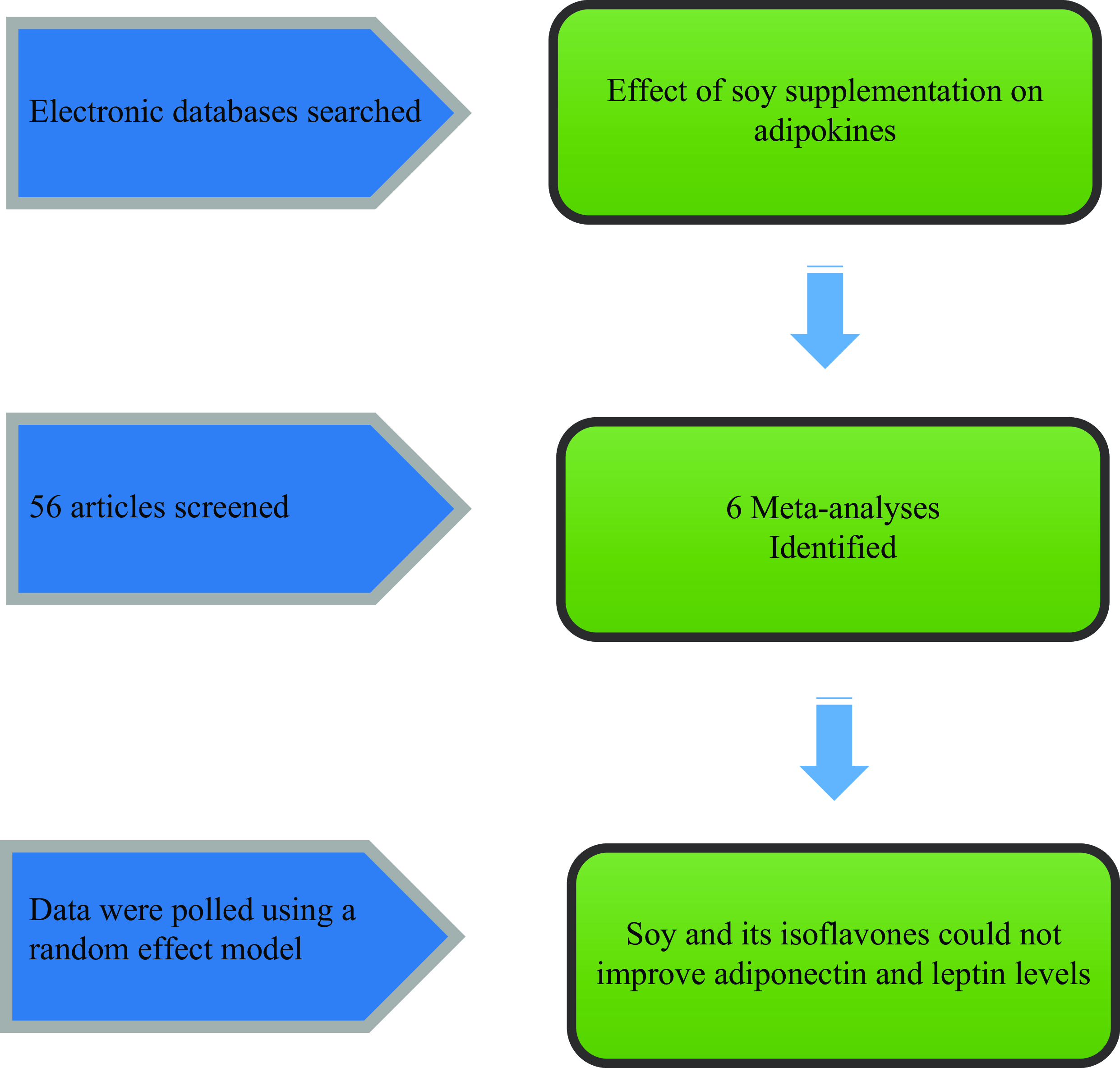
The literature search process began with fifty-six articles identified through an electronic database search, but forty-one of these were found to be duplications. After reviewing the titles and abstracts of the remaining fifteen articles, nine publications were excluded. Eventually, six meta-analyses(Reference Karimian and Shekarchizadeh-Esfahani13,Reference Gholami, Baradaran and Hariri37,Reference Mahmudiono, Khaydarov and Jasim39–Reference Tutunchi, Koushki and Amiri-Dashatan41,Reference Hariri, Amirkalali and Mollanoroozy46) were included in the umbrella meta-analysis. The study selection flow diagram is presented in Figure 1.
Literature search and review flow diagram for selection of umbrella review meta-analyses.

Characteristics of included studies
The present umbrella meta-analysis included a total of six publications with 4533 participants. These meta-analyses were published between 2021 and 2024 and were all conducted in Iran. The participants’ mean ages ranged from 50 to 56 years, and the interventions lasted from 9 to 34 weeks. All studies involved adults, and except for one study(Reference Tutunchi, Koushki and Amiri-Dashatan41), all included both sexes. The quality of the trials was assessed using the ‘Jadad score’ system and the Cochrane risk of bias tool. Overall, almost 70 % of the included meta-analyses contained high-quality randomised controlled trials. The characteristics of the included studies are presented in Table 1.
Characteristics of eligible primary studies on the effects of soya consumption on adiponectin and leptin levels in adults

Evaluation of methodological quality and quality of evidence
The details of methodological quality assessment using the AMSTAR2 checklist are outlined in Table 2. Among the six meta-analyses, three were of high quality(Reference Karimian and Shekarchizadeh-Esfahani13,Reference Gholami, Baradaran and Hariri37,Reference Hariri, Amirkalali and Mollanoroozy38) , two were of moderate quality(Reference Mahmudiono, Khaydarov and Jasim39,Reference Moosavian, Rahimlou and Asbaghi40) and one article was of low quality(Reference Tutunchi, Koushki and Amiri-Dashatan41). The quality of evidence assessment using the NutriGrade Scoring system is detailed in online Supplementary Table 3. Among the six meta-analyses, five(Reference Karimian and Shekarchizadeh-Esfahani13,Reference Gholami, Baradaran and Hariri37–Reference Moosavian, Rahimlou and Asbaghi40) were rated as moderate meta-evidence and one article(Reference Tutunchi, Koushki and Amiri-Dashatan41) was rated as high meta-evidence.
Results of assessing the methodological quality of meta-analysis

Q1- Did the research questions and inclusion criteria for the review include the components of PICO? Q2- Did the report of the review contain an explicit statement that the review methods were established prior to the conduct of the review, and did the report justify any significant deviations from the protocol? Q3- Did the review authors explain their selection of the study designs for inclusion in the review? Q4- Did the review authors use a comprehensive literature search strategy? Q5- Did the review authors perform study selection in duplicate? Q6- Did the review authors perform data extraction in duplicate? Q7- Did the review authors provide a list of excluded studies and justify the exclusions? Q8- Did the review authors describe the included studies in adequate detail? Q9- Did the review authors use a satisfactory technique for assessing the risk of bias (RoB) in individual studies that were included in the review? 10- Did the review authors report on the sources of funding for the studies included in the review? Q11- If meta-analysis was performed, did the review authors use appropriate methods for the statistical combination of results? Q12- If a meta-analysis was performed, did the review authors assess the potential impact of RoB in individual studies on the results of the meta-analysis or other evidence synthesis? Q13- Did the review authors account for RoB in individual studies when interpreting/ discussing the review results? Q14- Did the review authors provide a satisfactory explanation for and discussion of any heterogeneity observed in the review results? Q15- If they performed quantitative synthesis, did the review authors conduct an adequate investigation of publication bias (small-study bias) and discuss its likely impact on the review results? Q16- Did the review authors report any potential sources of conflict of interest, including any funding they received for conducting the review?
The impact of soya and its isoflavones on serum adiponectin levels
Five meta-analyses(Reference Karimian and Shekarchizadeh-Esfahani13,Reference Hariri, Amirkalali and Mollanoroozy38–Reference Tutunchi, Koushki and Amiri-Dashatan41) involving 4197 participants showed that soya consumption did not significantly increase adiponectin levels (ES = 0·10; 95 % CI: −0·22, 0·41; P = 0·55). There was moderate between-study heterogeneity (I 2 = 51·8 %; P = 0·08) (Figure 2), and subgroup analysis indicated that the duration of the intervention was a source of heterogeneity. However, the results remained non-significant in all subgroups (Figures 3, 4 and 5). Sensitivity analysis confirmed that the overall result was not reliant on a single study, and there was no publication bias based on Begg’s rank correlation test (P = 0·62).
Forest plot detailing mean difference and 95 % CI, the impacts of soya consumption on adiponectin levels.

Forest plot detailing mean difference and 95 % CI, the impacts of soya consumption on adiponectin levels, categorised by intervention duration.

Forest plot detailing mean difference and 95 % CI, the impacts of soya consumption on adiponectin levels, categorised by participants mean age.

Forest plot detailing mean difference and 95 % CI, the impacts of soya consumption on adiponectin levels, categorised by total sample size.

The impact of soya and its isoflavones on serum leptin levels
The effect of soya consumption on serum leptin levels was examined in two meta-analyses(Reference Gholami, Baradaran and Hariri37,Reference Moosavian, Rahimlou and Asbaghi40) involving 1160 participants. The findings of the present analysis could not show any beneficial effect of soya consumption on leptin levels (ES = −0·37; 95 % CI: −1·35, 0·61; P = 0·46). The amount of heterogeneity was moderate (I 2 = 71·2 %; P = 0·06) (Figure 6). We were unable to conduct a subgroup analysis because there were not enough studies available. The results of the sensitivity analysis indicated that the overall estimates were not impacted by the exclusion of any particular study. There was also no significant publication bias according to Begg’s rank correlation test.
Forest plot detailing mean difference and 95 % CI, the impacts of soya consumption on leptin levels.

Discussion
This umbrella meta-analysis is the most comprehensive quantitative review of meta-analyses that provides evidence on the effectiveness of soya consumption on adiponectin and leptin levels in people over 18 years old. The results showed that consuming soya and its isoflavones did not have a significant effect on plasma adiponectin and leptin levels. There was moderate between-study heterogeneity. Although the duration of the intervention contributed to this variation, the result remained non-significant in all subgroups. Hence, it is important to be careful when interpreting this result. Sensitivity analysis demonstrated that the overall estimates were not influenced by removing any study. No evidence of publication bias was also observed.
Similar to our findings, several reviews confirmed that soya consumption had no significant effect on adiponectin and leptin levels in adults(Reference Karimian and Shekarchizadeh-Esfahani13,Reference Gholami, Baradaran and Hariri37–Reference Moosavian, Rahimlou and Asbaghi40) . However, another review(Reference Tutunchi, Koushki and Amiri-Dashatan41) observed a significant effect of soya isoflavones supplementation on increasing plasma adiponectin levels in postmenopausal women. The conflicting results may be due to variations in sample size and individual characteristics among study participants. A study(Reference Tutunchi, Koushki and Amiri-Dashatan41) that demonstrated the beneficial impact of soya isoflavones on adiponectin levels was carried out on postmenopausal women. This group generally has lower adiponectin levels due to physiological and hormonal changes in their bodies, making them more responsive to methods aimed at increasing adiponectin(Reference Karimian and Shekarchizadeh-Esfahani13,Reference Tutunchi, Koushki and Amiri-Dashatan41,Reference Milewicz, Jędrzejuk and Dunajska47) . Also, in this meta-analysis(Reference Tutunchi, Koushki and Amiri-Dashatan41), most of the included trials had an intervention duration of more than 6 months. This shows that soya consumption over a longer period yields better results on circulating adipokine levels.
Although the results showed no effect of soya consumption on adiponectin and leptin indices, there are biochemical mechanisms in this regard. Inflammatory markers such as tumour necrosis factor-α and IL6 can cause a decrease in adiponectin levels due to insulin resistance(Reference Tutunchi, Koushki and Amiri-Dashatan41,Reference Arner48) . Research indicates that inflammatory conditions can inhibit the production of adiponectin from adipocytes(Reference Karimian and Shekarchizadeh-Esfahani13,Reference Arner48) . Recent studies suggest that soyabeans may help in improving inflammatory markers(Reference Rezazadegan, Mirjalili and Clark49,Reference Prokopidis, Mazidi and Sankaranarayanan50) , leading to higher levels of leptin and adiponectin in the body. Weight loss has been linked to increased adiponectin levels(Reference Salehi-Abargouei, Izadi and Azadbakht51,Reference Janiszewska, Ostrowska and Szostak-Węgierek52) . Therefore, considering the beneficial effects of soya consumption in improving anthropometric indices(Reference Mu, Kou and Wei53), probably soya can indirectly lead to an increase in the level of adiponectin. Additionally, soya and its related products contain phytoestrogens that can improve adipokine levels in the body through different mechanisms, including binding to and activating peroxisome proliferator-activated receptor gamma(Reference Jungbauer and Medjakovic54,Reference Abbasi, Karimi and Hossein Moridpour55) . It appears that adipose tissue is highly sensitive to oxidative stress, which can lead to a decrease in the gene expression of adiponectin in adipocytes when exposed to high levels of oxidative stress(Reference Khoramipour, Chamari and Hekmatikar4,Reference Karimian and Shekarchizadeh-Esfahani13,Reference Mahmudiono, Khaydarov and Jasim39) . Therefore, antioxidant factors, such as those found in soya(Reference Rizzo56), may help to increase the secretion of adiponectin from adipose tissue.
There were some limitations in the present umbrella meta-analysis. First, the repetition of some studies in different meta-analyses can affect the final result. Second, significant between-studies heterogeneity was observed. Third, the number of included meta-analyses is small, and as a result, the findings should be interpreted with caution. Fourth, we were unable to conduct a subgroup analysis for leptin because there were not enough studies available. Hence, we could not reach a conclusive finding regarding the effect of soya consumption on leptin levels in different subgroups. Fifth, all included studies were conducted in Iran, which may enhance the possibility of selection bias. Finally, we were unable to assess the effect of soya consumption on other adipokine markers since there were insufficient studies.
To gain a clearer understanding of the effects of soya consumption on serum adiponectin and leptin levels, future studies should be conducted on larger and more diverse populations across different countries. This will enhance the generalisability of the findings. Additionally, research should examine both short-term and long-term impacts, employing rigorous methodologies. It is crucial to control for confounding factors, such as overall diet and physical activity, to improve the validity of the results. Finally, using advanced statistical methods can lead to more precise data analysis and the development of scientifically sound dietary recommendations.
Conclusion
The present umbrella meta-analysis has confirmed that soya and its isoflavones do not have an impact on the circulating levels of adipokines in adults. Based on the NutriGrade score system, the assessment of the quality of evidence indicated that most studies were moderate in this regard. However, further investigations are needed with longer intervention duration, higher doses, and studies in different countries to validate these findings. Future studies should focus on exploring the effect of soya on various adipokines, and it is important to consider and adjust for the potential confounding effects of diet and physical activity.
Acknowledgements
None.
This research received no external funding.
K. P. and E. F. O. carried out the concept, design and drafting of this study. B. I. S., R. R. and N. E. searched databases and screened articles. R. R. and D. N. contributed to literature review, data collection, data interpretation and reviewing of manuscript for editorial and intellectual contents. P. K. and M. R. K. supervised the study and performed statistical analysis. All authors approved the final version of the manuscript.
The authors declare that they have no conflicts of interest.
No data were used to support this study.
Supplementary material
For supplementary material/s referred to in this article, please visit https://doi.org/10.1017/S0007114525000467



