


1 Introduction
The review article by Braginskii (published in Russian in 1963 and in English translation in 1965) on classical transport in weakly coupled, magnetised, multispecies plasmas has served as an invaluable reference for multiple generations of plasma physicists. For a two-component plasma with small electron-to-ion mass ratio, $\unicode[STIX]{x1D707}\doteq m_{e}/m_{i}\ll 1$
(
$\unicode[STIX]{x1D707}\doteq m_{e}/m_{i}\ll 1$
( $\doteq$
denotes a definition), Braginskii described a path to an approximate derivation of the so-called correction equations for the non-hydrodynamic parts of the distribution function, from which the classical transport coefficients are ultimately derived. The methodology, first published by Braginskii (Reference Braginskii1957),Footnote
1
can be traced back to the pioneering work of Chapman (Reference Chapman1916) and Enskog (Reference Enskog1917) on the kinetic theory of rarefied gases; for many details, see Chapman & Cowling (Reference Chapman and Cowling1952). The traditional Chapman–Enskog procedure is reviewed for the simple case of a one-component plasma (OCP) in appendix A.
$\doteq$
denotes a definition), Braginskii described a path to an approximate derivation of the so-called correction equations for the non-hydrodynamic parts of the distribution function, from which the classical transport coefficients are ultimately derived. The methodology, first published by Braginskii (Reference Braginskii1957),Footnote
1
can be traced back to the pioneering work of Chapman (Reference Chapman1916) and Enskog (Reference Enskog1917) on the kinetic theory of rarefied gases; for many details, see Chapman & Cowling (Reference Chapman and Cowling1952). The traditional Chapman–Enskog procedure is reviewed for the simple case of a one-component plasma (OCP) in appendix A.
Although the relevant mathematics was described clearly by Braginskii (Reference Braginskii1957), experience shows that many students do not take the time to work through those calculations and consequently do not always grasp the beautiful underlying structure of the transport problem. The techniques described in this article provide an alternative, heuristically appealing, and technically efficient approach that for neutral fluids is known to unify a number of threads of non-equilibrium statistical mechanics. That unification carries over to the more complicated plasma. Appreciation of the methods enables one to avoid reinventing the wheel and provides one with a concise yet workable formalism on which non-trivial generalizations can be built. An example of such a generalization is the calculation of second-order (Burnett) transport coefficients, addressed in Part 2 of this series of articles (Krommes Reference Krommes2018b ).
In the same year that the English translation of Braginskii’s review appeared, Mori (Reference Mori1965) published a seminal paper in which the transport problem was reformulated with the aid of projection-operator methods. The general approach had been anticipated by Zwanzig (Reference Zwanzig1961a ,Reference Zwanzig, Brittin, Downs and Downs b ), and the methodology is now known as the Mori–Zwanzig formalism. The purpose of the present article is to describe the application of the Mori–Zwanzig formalism to the problem of classical transport in weakly coupled, magnetised plasmas. This leads one to an alternative derivation of the Braginskii correction equations.
A great strength of Braginskii’s review article is its focus on the physical interpretation of the transport coefficients, knowledge of which is essential for researchers on magnetised plasmas. But although Braginskii’s interpretations of the mathematics are entirely correct, here too the present projection methods are helpful in providing additional intuition. They enable an extension of Braginskii’s equations for the macroscopic, mean hydrodynamic variables (density, flow, and temperature) to generalized Langevin equations that include fluctuating forces. Such equations have previously been derived from the Bogoliubov-Born-Green-Kirkwood-Yvon (BBGKY) hierarchy (Bixon & Zwanzig Reference Bixon and Zwanzig1969; Hinton Reference Hinton1970), but the projection-operator methods are arguably more transparent and efficient. Fluctuating forces appear implicitly in Braginskii’s heuristic explanations of the various transport processes, and their effects are contained in his systematic mathematics. However, explicit definition of those forces brings additional clarity to the transport calculations.
A projection operator $\text{P}$
is linear and idempotent (i.e.
$\text{P}$
is linear and idempotent (i.e. $\text{P}^{2}=\text{P}$
). It extends to linear algebra and functional analysis the notion of graphical projection onto an axis. An example of a projection operator is the ensemble averageFootnote
2
$\text{P}^{2}=\text{P}$
). It extends to linear algebra and functional analysis the notion of graphical projection onto an axis. An example of a projection operator is the ensemble averageFootnote
2 $\langle \ldots \rangle$
. Thus, all of statistical closure theory (Krommes Reference Krommes2002, Reference Krommes2015) can be said to involve projection operators. However, this is stretching the point. The specifically Mori–Zwanzig-style projection-operator techniques have a particular flavour and do not naturally generalize to all possible methods of statistical closure. They have been little used in plasma physics. Krommes (Reference Krommes1975) and Krommes & Oberman (Reference Krommes and Oberman1976) employed them to discuss the phenomenon of long-time tails in magnetised, thermal-equilibrium plasmas, earlier identified in the molecular-dynamics neutral-fluid computer experiments of Alder & Wainwright (Reference Alder and Wainwright1970).Footnote
3
They are mentioned briefly by Diamond, Itoh & Itoh (Reference Diamond, Itoh and Itoh2010, § 6.2). However, they have not been used systematically in the context of plasma transport theory. In particular, there is no published account of their application to the derivation of the Braginskii transport equations.Footnote
4
$\langle \ldots \rangle$
. Thus, all of statistical closure theory (Krommes Reference Krommes2002, Reference Krommes2015) can be said to involve projection operators. However, this is stretching the point. The specifically Mori–Zwanzig-style projection-operator techniques have a particular flavour and do not naturally generalize to all possible methods of statistical closure. They have been little used in plasma physics. Krommes (Reference Krommes1975) and Krommes & Oberman (Reference Krommes and Oberman1976) employed them to discuss the phenomenon of long-time tails in magnetised, thermal-equilibrium plasmas, earlier identified in the molecular-dynamics neutral-fluid computer experiments of Alder & Wainwright (Reference Alder and Wainwright1970).Footnote
3
They are mentioned briefly by Diamond, Itoh & Itoh (Reference Diamond, Itoh and Itoh2010, § 6.2). However, they have not been used systematically in the context of plasma transport theory. In particular, there is no published account of their application to the derivation of the Braginskii transport equations.Footnote
4
One possible reason that the Mori–Zwanzig formalism has not seen much use in plasma physics is that the most general non-equilibrium statistical–mechanical treatments of the transport problem produce formulas for the transport coefficients in terms of averages over the $N$
-particle equilibrium ensemble and dynamics evolved with a modified
$N$
-particle equilibrium ensemble and dynamics evolved with a modified $N$
-particle Liouville propagator, where
$N$
-particle Liouville propagator, where $N$
is the total number of particles in the system. Such formulas go back to Green (Reference Green1954) and Kubo (Reference Kubo1957). (Subtleties with the interpretation of the Green–Kubo formulas are discussed in § G.3.) While elegant, they are difficult to work out in the general case. However, in the special but very important regime of weak coupling, those formulas simplify dramatically. Moreover, with the further approximation of linear response an alternative approach becomes possible wherein a kinetic equation for the one-particle distribution function is first derived, then processed to produce formulas for the transport coefficients. It is that processing that is clarified by the projection-operator techniques described in the present paper. I shall show that a suitably modified Mori–Zwanzig formalism can be easily applied to the linearized plasma kinetic equation, leads efficiently to standard results, clarifies the structure of the hydrodynamic system and fosters heuristic understanding of the first-order transport processes.
$N$
is the total number of particles in the system. Such formulas go back to Green (Reference Green1954) and Kubo (Reference Kubo1957). (Subtleties with the interpretation of the Green–Kubo formulas are discussed in § G.3.) While elegant, they are difficult to work out in the general case. However, in the special but very important regime of weak coupling, those formulas simplify dramatically. Moreover, with the further approximation of linear response an alternative approach becomes possible wherein a kinetic equation for the one-particle distribution function is first derived, then processed to produce formulas for the transport coefficients. It is that processing that is clarified by the projection-operator techniques described in the present paper. I shall show that a suitably modified Mori–Zwanzig formalism can be easily applied to the linearized plasma kinetic equation, leads efficiently to standard results, clarifies the structure of the hydrodynamic system and fosters heuristic understanding of the first-order transport processes.
By $n$
th-order processes, I mean contributions to dissipative fluxes of
$n$
th-order processes, I mean contributions to dissipative fluxes of $n$
th order in the gradients. Thus, ‘first order’ is to be distinguished from ‘linear response’. The latter describes a formally infinitesimal perturbation of thermal equilibrium. In either linear response theory or a more general nonlinear theory, dissipative fluxes exist that are driven by arbitrary powers of the gradients. The proportionality factors are the ‘
$n$
th order in the gradients. Thus, ‘first order’ is to be distinguished from ‘linear response’. The latter describes a formally infinitesimal perturbation of thermal equilibrium. In either linear response theory or a more general nonlinear theory, dissipative fluxes exist that are driven by arbitrary powers of the gradients. The proportionality factors are the ‘ $n$
th-order transport coefficients’ (more precisely, the order-unity transport coefficients that enter in fluxes involving
$n$
th-order transport coefficients’ (more precisely, the order-unity transport coefficients that enter in fluxes involving $n$
th-order gradients). The first-order coefficients are called the Braginskii transport coefficients by plasma physicists; they are known in non-equilibrium statistical mechanics as the Navier–Stokes coefficients. For example, if small perturbations are denoted by
$n$
th-order gradients). The first-order coefficients are called the Braginskii transport coefficients by plasma physicists; they are known in non-equilibrium statistical mechanics as the Navier–Stokes coefficients. For example, if small perturbations are denoted by $\unicode[STIX]{x0394}$
, the first-order heat flux in an unmagnetised plasma has the form
$\unicode[STIX]{x0394}$
, the first-order heat flux in an unmagnetised plasma has the form $\unicode[STIX]{x0394}\boldsymbol{q}=-n\unicode[STIX]{x1D705}\unicode[STIX]{x1D735}\unicode[STIX]{x0394}T$
(
$\unicode[STIX]{x0394}\boldsymbol{q}=-n\unicode[STIX]{x1D705}\unicode[STIX]{x1D735}\unicode[STIX]{x0394}T$
( $n$
is the density and
$n$
is the density and $T$
is the temperature);
$T$
is the temperature); $\unicode[STIX]{x1D705}$
is the first-order thermal conductivity. This relation is both linear (
$\unicode[STIX]{x1D705}$
is the first-order thermal conductivity. This relation is both linear ( $\unicode[STIX]{x0394}\boldsymbol{q}\propto \unicode[STIX]{x0394}T$
) and first order (
$\unicode[STIX]{x0394}\boldsymbol{q}\propto \unicode[STIX]{x0394}T$
) and first order ( $\unicode[STIX]{x0394}\boldsymbol{q}\propto \unicode[STIX]{x1D735}$
). The second-order coefficients are called the Burnett transport coefficients. Some Burnett coefficients exist already in the linear approximation. For example, one contribution to the linear Burnett heat flux has the form
$\unicode[STIX]{x0394}\boldsymbol{q}\propto \unicode[STIX]{x1D735}$
). The second-order coefficients are called the Burnett transport coefficients. Some Burnett coefficients exist already in the linear approximation. For example, one contribution to the linear Burnett heat flux has the form $\unicode[STIX]{x0394}\boldsymbol{q}=n\unicode[STIX]{x1D705}^{\prime }\unicode[STIX]{x1D6FB}^{2}\unicode[STIX]{x0394}\boldsymbol{u}$
, where
$\unicode[STIX]{x0394}\boldsymbol{q}=n\unicode[STIX]{x1D705}^{\prime }\unicode[STIX]{x1D6FB}^{2}\unicode[STIX]{x0394}\boldsymbol{u}$
, where $\boldsymbol{u}$
is the fluid velocity. For nonlinear response, additional Burnett terms arise. For example, a contribution to the nonlinear Burnett heat flux has the form
$\boldsymbol{u}$
is the fluid velocity. For nonlinear response, additional Burnett terms arise. For example, a contribution to the nonlinear Burnett heat flux has the form $\unicode[STIX]{x0394}\boldsymbol{q}=n\unicode[STIX]{x1D705}^{\prime \prime }(\unicode[STIX]{x1D735}\,\boldsymbol{\cdot }\,\unicode[STIX]{x0394}\boldsymbol{u})\unicode[STIX]{x1D735}\unicode[STIX]{x0394}T$
.
$\unicode[STIX]{x0394}\boldsymbol{q}=n\unicode[STIX]{x1D705}^{\prime \prime }(\unicode[STIX]{x1D735}\,\boldsymbol{\cdot }\,\unicode[STIX]{x0394}\boldsymbol{u})\unicode[STIX]{x1D735}\unicode[STIX]{x0394}T$
.
This paper is Part 1 of a two-part series of articles whose goal is to show how to formulate classical, weakly coupled plasma transport theory by using projection-operator methods. Part 1 describes a self-contained rederivation of the Braginskii correction equations for the special case of linear perturbations of an absolute Maxwellian equilibrium. This is less than what Braginskii accomplished (his equations are nonlinear), but it serves to familiarize one with the basic methodology in the simplest possible context. (Following Braginskii, I restrict my attention to effects of first order in the gradients. Although the present methodology could also be used to study linear Burnett effects, I shall defer such calculation to the more general discussion given in Part 2, where nonlinear Burnett effects are also considered.) I shall also derive a set of generalized Langevin equations that extend Braginskii’s equations to include fluctuating forces. That is a core topic that provides important insight into the structure of the transport theory.
In Part 2, the problem is reformulated in order to embrace nonlinearity and arbitrarily strong coupling. The methodology used there is a generalization of the formulation of Brey, Zwanzig & Dorfman (Reference Brey, Zwanzig and Dorfman1981) to include a background magnetic field and multiple species. The nonlinear Braginskii equations are recovered with ease. The techniques also allow one to obtain the next-higher-order Burnett equations, including both of the linear and nonlinear effects as described above. Those were originally obtained for plasmas described by the Landau collision operator by Mikhaǐlovskiǐ (Reference Mikhaǐlovskiǐ1967), Mikhaǐlovskiǐ & Tsypin (Reference Mikhaǐlovskiǐ and Tsypin1971, Reference Mikhaǐlovskiǐ and Tsypin1984) and Catto & Simakov (Reference Catto and Simakov2004), none of whom remarked on connections to previous calculations of Burnett coefficients for neutral gases. In Part 2 it is shown that the Navier–Stokes and Burnett transport coefficients calculated by Catto and Simakov are special cases of the complete set of coefficients for which Brey et al. (Reference Brey, Zwanzig and Dorfman1981) gave general expressions in terms of integrals of two-time correlation functions.Footnote 5 Thus, the present series of articles serves to unify a variety of previous research threads.
I now return to an overview of the present Part 1. I illustrate the basic approach in § 2 by deriving linearized transport equations for the unmagnetised one-component plasma, restricting attention to dissipative fluxes that are of first order in the gradients. Then in § 3 I extend the calculations to embrace multispecies and magnetised plasmas, and I derive the linearized version of Braginskii’s correction equations.
The formalism employed in §§ 2 and 3 uses what is known as the Schrödinger representation, which means that one takes time-independent velocity moments of the time-dependent distribution function $f$
(which is taken to evolve according to the Landau kinetic equation). Alternatively, one can use the Heisenberg representation, in which equations are written for time-dependent, random hydrodynamic observables whose statistical behaviour evolves from statistics (velocity dependence) that reside in the distribution function at some initial time. The averaged equations are the same as before. However, the raw equations for the random variables can be cast into the form of generalized Langevin equations, which include fluctuating forces and imply a theory of hydrodynamic correlation functions. This is done in § 4. The body of the paper concludes with a brief discussion in § 5.
$f$
(which is taken to evolve according to the Landau kinetic equation). Alternatively, one can use the Heisenberg representation, in which equations are written for time-dependent, random hydrodynamic observables whose statistical behaviour evolves from statistics (velocity dependence) that reside in the distribution function at some initial time. The averaged equations are the same as before. However, the raw equations for the random variables can be cast into the form of generalized Langevin equations, which include fluctuating forces and imply a theory of hydrodynamic correlation functions. This is done in § 4. The body of the paper concludes with a brief discussion in § 5.
Several appendices are included. In appendix A I review the traditional Chapman–Enskog calculation for the one-component plasma, in appendix B I record various properties of the linearized Landau collision operator, in appendix C I describe a technically efficient covariant representation of the transport equations, in appendix D I provide an example of the evaluation of the general formulas by considering the electron heat flow in the limit of small collisionality, in appendix E I review Braginskii’s tensorial decomposition of the stress tensor, in appendix F I consider some important special cases of the linear eigenmodes of the Braginskii equations and in appendix G I focus on some important caveats regarding the use of projection operators. Key notation is summarized in appendix 2:I,Footnote 6 which merges the definitions from both Part 1 and Part 2.
This paper is intended to be useful to both graduate students just beginning their study of classical plasma transport as well as seasoned researchers interested in advanced techniques. Although it rederives some of Braginskii’s principal results and quotes others of them for completeness, it is neither a complete replacement for Braginskii’s article nor a comprehensive review of classical plasma transport theory. For initial study of classical transport, a reasonable plan of attack would be to begin by skimming the first half of Braginskii (Reference Braginskii and Leontovich1965) (through the end of §5, p. 262). Additional perspective should then be provided from the present paper by §§ 1–3 and 5 as well as appendices A, B, D, E and F, with § 4 and appendices C and G containing more advanced material. To fully appreciate the material in appendix G, the reader may find it useful to first study the concise modern introduction to non-equilibrium statistical mechanics given by Zwanzig (Reference Zwanzig2001), particularly chap. 8 on projection operators.
The material in Part 1 is intended to be introductory, and the restrictions to linear response and first-order transport coefficients are greatly simplifying. In fact, some deep conceptual issues lurk in what may appear at first glance to be straightforward analysis. If concerns arise, consult § 5 for brief discussion and see Part 2 for a more thorough treatment.
2 Linearized hydrodynamics for the one-component plasma
In a one-component, weakly coupledFootnote
7
plasma (for example, a discrete ion plasma with smooth electron neutralizing background) in which the collision frequency $\unicode[STIX]{x1D708}$
is ordered large, it is well known that Chapman–Enskog theory singles out the number density, momentum density, and kinetic-energy density (or temperature, or entropy density) as preferred hydrodynamic variables. That is, those quantities are conserved by the Landau collision operator. Mathematically, with
$\unicode[STIX]{x1D708}$
is ordered large, it is well known that Chapman–Enskog theory singles out the number density, momentum density, and kinetic-energy density (or temperature, or entropy density) as preferred hydrodynamic variables. That is, those quantities are conserved by the Landau collision operator. Mathematically, with $\overline{n}$
being the spatially uniform mean density, the velocity-dependent functions
$\overline{n}$
being the spatially uniform mean density, the velocity-dependent functions $\overline{n}$
,
$\overline{n}$
, $\overline{n}m\boldsymbol{v}$
, and
$\overline{n}m\boldsymbol{v}$
, and $(1/2)\overline{n}mv^{2}$
are the left null eigenfunctions of the collision operator (in terms of a natural scalar product to be defined shortly). No dissipative transport is associated with the null eigenfunctions. Rather, transport is carried by the non-hydrodynamic corrections to the local Maxwellian distribution function. The traditional Chapman–Enskog approach is reviewed in appendix A.
$(1/2)\overline{n}mv^{2}$
are the left null eigenfunctions of the collision operator (in terms of a natural scalar product to be defined shortly). No dissipative transport is associated with the null eigenfunctions. Rather, transport is carried by the non-hydrodynamic corrections to the local Maxwellian distribution function. The traditional Chapman–Enskog approach is reviewed in appendix A.
2.1 Basic idea of the hydrodynamic projection
These ideas can be codified by dividing a complete set of functions on the single-particle velocity space into two orthogonal subspaces: the hydrodynamic subspace ${\mathcal{H}}$
, spanned by the null eigenfunctions of the collision operator, and the non-hydrodynamic, orthogonal, or vertical subspace
${\mathcal{H}}$
, spanned by the null eigenfunctions of the collision operator, and the non-hydrodynamic, orthogonal, or vertical subspace $O$
.Footnote
8
$O$
.Footnote
8
The fluid evolution equations ‘live in the hydrodynamic subspace’. The non-hydrodynamic part of the distribution function determines the values of the transport coefficients. Transport coefficients enter the fluid equations because the dynamics of the hydrodynamic and non-hydrodynamic subspaces are coupled by the evolution equation for $f$
. That coupling is a special case of the statistical closure problem (Krommes Reference Krommes2015) for passive equations with random coefficients. (Such equations are said to possess a stochastic nonlinearity.) Here the random variable is velocity and the stochastic nonlinearity is the
$f$
. That coupling is a special case of the statistical closure problem (Krommes Reference Krommes2015) for passive equations with random coefficients. (Such equations are said to possess a stochastic nonlinearity.) Here the random variable is velocity and the stochastic nonlinearity is the $\boldsymbol{v}\boldsymbol{\cdot }\unicode[STIX]{x1D735}f$
term in the kinetic equation.
$\boldsymbol{v}\boldsymbol{\cdot }\unicode[STIX]{x1D735}f$
term in the kinetic equation.
The decomposition into hydrodynamic and non-hydrodynamic parts can be expressed by the introduction of appropriate projection operators. If $\text{P}$
projects into
$\text{P}$
projects into ${\mathcal{H}}$
and
${\mathcal{H}}$
and $\text{Q}\doteq 1-\text{P}$
(where
$\text{Q}\doteq 1-\text{P}$
(where $1$
is the identity operator) therefore projects into
$1$
is the identity operator) therefore projects into $O$
, and if the perturbed (denoted by
$O$
, and if the perturbed (denoted by $\unicode[STIX]{x0394}$
) distribution function is written as
$\unicode[STIX]{x0394}$
) distribution function is written as $\unicode[STIX]{x0394}f=\unicode[STIX]{x0394}f_{\text{h}}+\unicode[STIX]{x0394}f_{\bot }$
, then
$\unicode[STIX]{x0394}f=\unicode[STIX]{x0394}f_{\text{h}}+\unicode[STIX]{x0394}f_{\bot }$
, then $\unicode[STIX]{x0394}f_{\text{h}}=\text{P}\unicode[STIX]{x0394}f$
and
$\unicode[STIX]{x0394}f_{\text{h}}=\text{P}\unicode[STIX]{x0394}f$
and $\unicode[STIX]{x0394}f_{\bot }=\text{Q}\unicode[STIX]{x0394}f$
. The basic idea is illustrated in figure 1; the precise realization of
$\unicode[STIX]{x0394}f_{\bot }=\text{Q}\unicode[STIX]{x0394}f$
. The basic idea is illustrated in figure 1; the precise realization of $\text{P}$
is given in the next section.
$\text{P}$
is given in the next section.
Illustration of the $\text{P}$
and
$\text{P}$
and $\text{Q}$
projections. The kinetic-energy axis of the hydrodynamic subspace is omitted for clarity.
$\text{Q}$
projections. The kinetic-energy axis of the hydrodynamic subspace is omitted for clarity.

The formulation described in the present paper focuses on the decomposition of the one-particle distribution function $f_{s}(\boldsymbol{x},\boldsymbol{v},t)$
, which lives in the so-called
$f_{s}(\boldsymbol{x},\boldsymbol{v},t)$
, which lives in the so-called $\unicode[STIX]{x1D707}$
space (the six-dimensional (6-D) phase space for one generic particle of species
$\unicode[STIX]{x1D707}$
space (the six-dimensional (6-D) phase space for one generic particle of species $s$
). In contrast, the instantaneous state of the entire collection of
$s$
). In contrast, the instantaneous state of the entire collection of $N$
particles can be described by a single point in the so-called
$N$
particles can be described by a single point in the so-called $\unicode[STIX]{x1D6E4}$
space (of
$\unicode[STIX]{x1D6E4}$
space (of $6N$
dimensions). A well-known consequence of the reduction from
$6N$
dimensions). A well-known consequence of the reduction from $\unicode[STIX]{x1D6E4}$
space to
$\unicode[STIX]{x1D6E4}$
space to $\unicode[STIX]{x1D707}$
space is that the kinetic evolution equation for
$\unicode[STIX]{x1D707}$
space is that the kinetic evolution equation for $f$
is nonlinear (it involves the product
$f$
is nonlinear (it involves the product $\boldsymbol{E}[f]\,f$
, where the electric field
$\boldsymbol{E}[f]\,f$
, where the electric field $\boldsymbol{E}$
is a linear functional of
$\boldsymbol{E}$
is a linear functional of $f$
, as well as a nonlinear collision operator), which leads to various complications.
$f$
, as well as a nonlinear collision operator), which leads to various complications. $\unicode[STIX]{x1D6E4}$
-space dynamics, on the other hand, is formally linear, being described by the Liouville equation. That linearity combined with the linearity of projection operators was usefully exploited by Mori, who was able to write exact equations for two-time correlation functions with apparent ease; ultimately, the transport coefficients are expressed in terms of various integrals over those correlation functions. However, the simplicity is only formal. Mori’s projection operators involve the full
$\unicode[STIX]{x1D6E4}$
-space dynamics, on the other hand, is formally linear, being described by the Liouville equation. That linearity combined with the linearity of projection operators was usefully exploited by Mori, who was able to write exact equations for two-time correlation functions with apparent ease; ultimately, the transport coefficients are expressed in terms of various integrals over those correlation functions. However, the simplicity is only formal. Mori’s projection operators involve the full $N$
-particle dynamics, and his equations contain nonlinearities to all orders; in the general case, it is difficult to extract from them quantitative expressions for the transport coefficients. As I shall show in Part 2, the formulas simplify in the limit of weak coupling, which fortunately is appropriate for research on magnetic fusion and various other applications. However, that still leaves the dichotomy between the linearity of projection operators and the nonlinearity of
$N$
-particle dynamics, and his equations contain nonlinearities to all orders; in the general case, it is difficult to extract from them quantitative expressions for the transport coefficients. As I shall show in Part 2, the formulas simplify in the limit of weak coupling, which fortunately is appropriate for research on magnetic fusion and various other applications. However, that still leaves the dichotomy between the linearity of projection operators and the nonlinearity of $\unicode[STIX]{x1D707}$
-space dynamics to be dealt with. It might seem that a projection-operator formalism is restricted to the derivation of linearized transport equations. That is not correct, although the generalization is non-trivial. I shall address nonlinear transport in Part 2. In the present paper, I restrict my attention to linear response, where the basic features of the projection-operator methodology can be explained in the simplest possible context.
$\unicode[STIX]{x1D707}$
-space dynamics to be dealt with. It might seem that a projection-operator formalism is restricted to the derivation of linearized transport equations. That is not correct, although the generalization is non-trivial. I shall address nonlinear transport in Part 2. In the present paper, I restrict my attention to linear response, where the basic features of the projection-operator methodology can be explained in the simplest possible context.
2.2 Transport equations for the unmagnetised, one-component, weakly coupled plasma
In this section I shall introduce the formalism by using projection methods to derive the linearized fluid equations for the one-component plasma (OCP) in the limit of weak coupling and in the electrostatic approximation with background magnetic field $\boldsymbol{B}=\mathbf{0}$
, restricting my attention to fluxes that are of first order in the gradients. (An even simpler example, the Brownian test particle, is discussed in § G.4.) It is well known and easy to show that the fully nonlinear moment equations for the density
$\boldsymbol{B}=\mathbf{0}$
, restricting my attention to fluxes that are of first order in the gradients. (An even simpler example, the Brownian test particle, is discussed in § G.4.) It is well known and easy to show that the fully nonlinear moment equations for the density $n$
, flow velocity
$n$
, flow velocity $\boldsymbol{u}$
, and temperature
$\boldsymbol{u}$
, and temperature $T$
of the one-component, weakly coupled plasma are
$T$
of the one-component, weakly coupled plasma are
 $$\begin{eqnarray}\displaystyle & \displaystyle \unicode[STIX]{x2202}_{t}n(\boldsymbol{x},t)+\unicode[STIX]{x1D735}\,\boldsymbol{\cdot }\,(n\boldsymbol{u})=0, & \displaystyle\end{eqnarray}$$
 $$\begin{eqnarray}\displaystyle & \displaystyle nm\frac{\text{d}\boldsymbol{u}(\boldsymbol{x},t)}{\text{d}t}=nq\boldsymbol{E}-\unicode[STIX]{x1D735}p-\unicode[STIX]{x1D735}\,\boldsymbol{\cdot }\,\unicode[STIX]{x1D745}, & \displaystyle\end{eqnarray}$$
 $$\begin{eqnarray}\displaystyle & \displaystyle \frac{3}{2}n\frac{\text{d}T(\boldsymbol{x},t)}{\text{d}t}=-p\unicode[STIX]{x1D735}\,\boldsymbol{\cdot }\,\boldsymbol{u}-\unicode[STIX]{x1D735}\,\boldsymbol{\cdot }\,\boldsymbol{q}-(\unicode[STIX]{x1D735}\boldsymbol{u})\boldsymbol{ : }\unicode[STIX]{x1D745}. & \displaystyle\end{eqnarray}$$
 $$\begin{eqnarray}\displaystyle & \displaystyle n(\boldsymbol{x},t)\doteq \int \!\text{d}\boldsymbol{v}\,\overline{n}f(\boldsymbol{x},\boldsymbol{v},t), & \displaystyle\end{eqnarray}$$
 $$\begin{eqnarray}\displaystyle & \displaystyle n\boldsymbol{u}(\boldsymbol{x},t)\doteq \int \!\text{d}\boldsymbol{v}\,\overline{n}\boldsymbol{v}f(\boldsymbol{x},\boldsymbol{v},t), & \displaystyle\end{eqnarray}$$
 $$\begin{eqnarray}\displaystyle & \displaystyle \frac{3}{2}nT(\boldsymbol{x},t)\doteq \int \!\text{d}\boldsymbol{v}\,\frac{1}{2}\overline{n}m\,w^{2}f(\boldsymbol{x},\boldsymbol{v},t), & \displaystyle\end{eqnarray}$$ $\boldsymbol{w}\doteq \boldsymbol{v}-\boldsymbol{u}$
is the so-called peculiar velocity and
$\boldsymbol{w}\doteq \boldsymbol{v}-\boldsymbol{u}$
is the so-called peculiar velocity and $p\doteq nT$
is the pressure of an ideal gas. The total advective time derivative is
$p\doteq nT$
is the pressure of an ideal gas. The total advective time derivative is  $$\begin{eqnarray}\displaystyle & \displaystyle \frac{\text{d}}{\text{d}t}\doteq \frac{\unicode[STIX]{x2202}}{\unicode[STIX]{x2202}t}+\boldsymbol{u}\boldsymbol{\cdot }\unicode[STIX]{x1D735}, & \displaystyle\end{eqnarray}$$
and the stress tensor $\unicode[STIX]{x1D745}$
and the heat-flow vector
$\unicode[STIX]{x1D745}$
and the heat-flow vector $\boldsymbol{q}$
are defined by
$\boldsymbol{q}$
are defined by
 $$\begin{eqnarray}\displaystyle & \displaystyle \unicode[STIX]{x1D745}\doteq \int \!\text{d}\boldsymbol{v}\,(\overline{n}m\boldsymbol{w})\boldsymbol{w}f-p\unicode[STIX]{x1D644}, & \displaystyle\end{eqnarray}$$
 $$\begin{eqnarray}\displaystyle & \displaystyle \boldsymbol{q}\doteq \int \!\text{d}\boldsymbol{v}\,\left(\frac{1}{2}\overline{n}mw^{2}\right)\boldsymbol{w}f. & \displaystyle\end{eqnarray}$$
 $$\begin{eqnarray}\displaystyle & \displaystyle \unicode[STIX]{x1D745}\doteq -nm\unicode[STIX]{x1D707}\left((\unicode[STIX]{x1D735}\boldsymbol{u})+(\unicode[STIX]{x1D735}\boldsymbol{u})^{\text{T}}-{\textstyle \frac{2}{3}}(\unicode[STIX]{x1D735}\,\boldsymbol{\cdot }\,\boldsymbol{u})\unicode[STIX]{x1D644}\right), & \displaystyle\end{eqnarray}$$
where $\text{T}$
denotes transpose and
$\text{T}$
denotes transpose and $\unicode[STIX]{x1D707}$
is the kinematic viscosityFootnote
10
; and
$\unicode[STIX]{x1D707}$
is the kinematic viscosityFootnote
10
; and
 $$\begin{eqnarray}\displaystyle & \displaystyle \boldsymbol{q}\doteq -n\unicode[STIX]{x1D705}\unicode[STIX]{x1D735}T, & \displaystyle\end{eqnarray}$$
where $\unicode[STIX]{x1D705}$
is the first-order thermal conductivity. The linearizations of these equations around an absolute thermal equilibrium (which possesses no gradients or flows) of density
$\unicode[STIX]{x1D705}$
is the first-order thermal conductivity. The linearizations of these equations around an absolute thermal equilibrium (which possesses no gradients or flows) of density $n_{0}=\overline{n}$
and temperature
$n_{0}=\overline{n}$
and temperature $T_{0}$
are
$T_{0}$
are
 $$\begin{eqnarray}\displaystyle & \displaystyle \frac{\unicode[STIX]{x2202}}{\unicode[STIX]{x2202}t}\left(\frac{\unicode[STIX]{x0394}n}{n_{0}}\right)+\unicode[STIX]{x1D735}\,\boldsymbol{\cdot }\,\unicode[STIX]{x0394}\boldsymbol{u}=0, & \displaystyle\end{eqnarray}$$
 $$\begin{eqnarray}\displaystyle & \displaystyle n_{0}m\frac{\unicode[STIX]{x2202}\unicode[STIX]{x0394}\boldsymbol{u}}{\unicode[STIX]{x2202}t}=n_{0}q\unicode[STIX]{x0394}\boldsymbol{E}-\unicode[STIX]{x1D735}\unicode[STIX]{x0394}p-\unicode[STIX]{x1D735}\,\boldsymbol{\cdot }\,\unicode[STIX]{x0394}\unicode[STIX]{x1D745}, & \displaystyle\end{eqnarray}$$
 $$\begin{eqnarray}\displaystyle & \displaystyle \frac{3}{2}n_{0}\frac{\unicode[STIX]{x2202}\unicode[STIX]{x0394}T}{\unicode[STIX]{x2202}t}=-p_{0}\unicode[STIX]{x1D735}\,\boldsymbol{\cdot }\,\unicode[STIX]{x0394}\boldsymbol{u}-\unicode[STIX]{x1D735}\,\boldsymbol{\cdot }\,\unicode[STIX]{x0394}\boldsymbol{q}, & \displaystyle\end{eqnarray}$$ $\unicode[STIX]{x0394}p\doteq T_{0}\unicode[STIX]{x0394}n+n_{0}\unicode[STIX]{x0394}T$
and
$\unicode[STIX]{x0394}p\doteq T_{0}\unicode[STIX]{x0394}n+n_{0}\unicode[STIX]{x0394}T$
and  $$\begin{eqnarray}\displaystyle & \displaystyle \unicode[STIX]{x0394}\unicode[STIX]{x1D745}\doteq -n_{0}m\unicode[STIX]{x1D707}_{0}((\unicode[STIX]{x1D735}\unicode[STIX]{x0394}\boldsymbol{u})+(\unicode[STIX]{x1D735}\unicode[STIX]{x0394}\boldsymbol{u})^{\text{T}}-{\textstyle \frac{2}{3}}(\unicode[STIX]{x1D735}\,\boldsymbol{\cdot }\,\unicode[STIX]{x0394}\boldsymbol{u})\unicode[STIX]{x1D644}), & \displaystyle\end{eqnarray}$$
 $$\begin{eqnarray}\displaystyle & \displaystyle \unicode[STIX]{x0394}\boldsymbol{q}\doteq -n_{0}\unicode[STIX]{x1D705}_{0}\unicode[STIX]{x1D735}\unicode[STIX]{x0394}T. & \displaystyle\end{eqnarray}$$ $\unicode[STIX]{x1D707}_{0}$
and
$\unicode[STIX]{x1D707}_{0}$
and $\unicode[STIX]{x1D705}_{0}$
are available (appendix A). The immediate goal is to rederive these results from the projection-operator formalism.
$\unicode[STIX]{x1D705}_{0}$
are available (appendix A). The immediate goal is to rederive these results from the projection-operator formalism.The starting point is the nonlinear kinetic equation
 $$\begin{eqnarray}\displaystyle & \displaystyle \frac{\text{D}f}{\text{D}t}\doteq \frac{\unicode[STIX]{x2202}f}{\unicode[STIX]{x2202}t}+\boldsymbol{v}\boldsymbol{\cdot }\unicode[STIX]{x1D735}f+\boldsymbol{E}\boldsymbol{\cdot }\boldsymbol{\unicode[STIX]{x2202}}f=-\text{C}[f], & \displaystyle\end{eqnarray}$$
where $\boldsymbol{\unicode[STIX]{x2202}}\doteq (q/m)\unicode[STIX]{x2202}/\unicode[STIX]{x2202}\boldsymbol{v}$
and
$\boldsymbol{\unicode[STIX]{x2202}}\doteq (q/m)\unicode[STIX]{x2202}/\unicode[STIX]{x2202}\boldsymbol{v}$
and $\text{C}[f]$
is the collision operator,Footnote
11
written here as a (spatially local) nonlinear functional (denoted by the square brackets) of
$\text{C}[f]$
is the collision operator,Footnote
11
written here as a (spatially local) nonlinear functional (denoted by the square brackets) of $f$
. For present purposes, one may think of
$f$
. For present purposes, one may think of $C$
as the nonlinear Landau operator. However, although use of the Landau kinetic equation is commonplace, it requires a non-trivial justification. It appears to be adequate for the treatment of first-order and linear response in a weakly coupled plasma with a statistically homogeneous background; more generally, however, it is unclear that a spatially local collision operator even exists. Further explication of this point is relegated to Part 2, as it lies well outside of the scope of this introductory discussion.
$C$
as the nonlinear Landau operator. However, although use of the Landau kinetic equation is commonplace, it requires a non-trivial justification. It appears to be adequate for the treatment of first-order and linear response in a weakly coupled plasma with a statistically homogeneous background; more generally, however, it is unclear that a spatially local collision operator even exists. Further explication of this point is relegated to Part 2, as it lies well outside of the scope of this introductory discussion.
The electric field $\boldsymbol{E}=-\unicode[STIX]{x1D735}\unicode[STIX]{x1D719}$
(I consider only the electrostatic approximation) is obtained from Poisson’s equation
$\boldsymbol{E}=-\unicode[STIX]{x1D735}\unicode[STIX]{x1D719}$
(I consider only the electrostatic approximation) is obtained from Poisson’s equation
 $$\begin{eqnarray}\displaystyle & \displaystyle -\unicode[STIX]{x1D6FB}^{2}\unicode[STIX]{x1D719}(\boldsymbol{x},t)=4\unicode[STIX]{x03C0}\unicode[STIX]{x1D70C}=4\unicode[STIX]{x03C0}\mathop{\sum }_{\overline{s}}(\overline{n}q)_{\overline{s}}\int \!\text{d}\overline{\boldsymbol{v}}\,f_{\overline{s}}(\boldsymbol{x},\overline{\boldsymbol{v}},t). & \displaystyle\end{eqnarray}$$
For the OCP, one allows perturbations to only one species, so a species label is dropped in this section; the other species merely serve to provide an overall charge-neutral background. A stationary and stable solution of the kinetic-equation–Poisson system is the absolute Maxwellian,
 $$\begin{eqnarray}\displaystyle & \displaystyle f_{\text{M}}(\boldsymbol{v})\doteq (2\unicode[STIX]{x03C0}v_{\text{t}}^{2})^{-3/2}\text{e}^{-v^{2}/2v_{\text{t}}^{2}}, & \displaystyle\end{eqnarray}$$
whereFootnote
12 $v_{\text{t}}\doteq (T/m)^{1/2}$
. Infinitesimal perturbations to that equilibrium obey
$v_{\text{t}}\doteq (T/m)^{1/2}$
. Infinitesimal perturbations to that equilibrium obey
 $$\begin{eqnarray}\displaystyle \unicode[STIX]{x2202}_{t}\unicode[STIX]{x0394}f+\boldsymbol{v}\boldsymbol{\cdot }\unicode[STIX]{x1D735}\unicode[STIX]{x0394}f+\unicode[STIX]{x0394}\boldsymbol{E}\boldsymbol{\cdot }\boldsymbol{\unicode[STIX]{x2202}}f_{\text{M}}=-\widehat{\text{C}}\unicode[STIX]{x0394}f, & & \displaystyle\end{eqnarray}$$
where $\widehat{\text{C}}$
is the linearized Landau operator (discussed in appendix B). This is the basic dynamical equation used in this article. (I shall add a constant background magnetic field in § 3.) As a linear dynamical evolution equation, it is analogous to the Schrödinger equation of quantum mechanics. There are, of course, important differences: the Schrödinger equation is time reversible whereas the present equation is time irreversible due to the presence of
$\widehat{\text{C}}$
is the linearized Landau operator (discussed in appendix B). This is the basic dynamical equation used in this article. (I shall add a constant background magnetic field in § 3.) As a linear dynamical evolution equation, it is analogous to the Schrödinger equation of quantum mechanics. There are, of course, important differences: the Schrödinger equation is time reversible whereas the present equation is time irreversible due to the presence of $\widehat{\text{C}}$
, and the quantum-mechanical wave function is a probability amplitude (whose squared modulus is a probability) whereas
$\widehat{\text{C}}$
, and the quantum-mechanical wave function is a probability amplitude (whose squared modulus is a probability) whereas $f$
is directly an actual probability (density).
$f$
is directly an actual probability (density).
2.2.1 Definition of the projection operator
In this and the next several sections I shall use the Schrödinger representation, in which averages of time-independent functions of velocity are taken with the time evolved $f(t)$
, which plays the role of a time-dependent state vector. It is useful to treat those averages as projections, and it is convenient to realize those projections by using a time-independent scalar product. I shall use a Dirac bra–ket notation with a hidden weight function
$f(t)$
, which plays the role of a time-dependent state vector. It is useful to treat those averages as projections, and it is convenient to realize those projections by using a time-independent scalar product. I shall use a Dirac bra–ket notation with a hidden weight function $f_{\text{M}}$
. Thus, for any functions
$f_{\text{M}}$
. Thus, for any functions $A(\boldsymbol{v})$
and
$A(\boldsymbol{v})$
and $B(\boldsymbol{v})$
,
$B(\boldsymbol{v})$
,
 $$\begin{eqnarray}\displaystyle & \displaystyle \langle A|\doteq A(\boldsymbol{v}), & \displaystyle\end{eqnarray}$$
 $$\begin{eqnarray}\displaystyle & \displaystyle |A\rangle \doteq A(\boldsymbol{v})f_{\text{M}}(\boldsymbol{v}), & \displaystyle\end{eqnarray}$$
 $$\begin{eqnarray}\displaystyle & \displaystyle \langle A|\text{L}|B\rangle \doteq \int \!\text{d}\boldsymbol{v}\,\text{d}\overline{\boldsymbol{v}}\,A(\boldsymbol{v})L(\boldsymbol{v},\overline{\boldsymbol{v}})B(\overline{\boldsymbol{v}})f_{\text{M}}(\overline{\boldsymbol{v}}), & \displaystyle\end{eqnarray}$$ $L(\boldsymbol{v},\boldsymbol{v}^{\prime })$
. When multispecies plasmas are discussed later, the scalar product will be extended to include species summations. Note that no complex conjugate appears in this definition, unlike the analogous situation in quantum mechanics. This scalar product is ‘natural’ because (appendix B)
$L(\boldsymbol{v},\boldsymbol{v}^{\prime })$
. When multispecies plasmas are discussed later, the scalar product will be extended to include species summations. Note that no complex conjugate appears in this definition, unlike the analogous situation in quantum mechanics. This scalar product is ‘natural’ because (appendix B) $\overline{n}\widehat{\text{C}}$
is self-adjoint with respect to it:
$\overline{n}\widehat{\text{C}}$
is self-adjoint with respect to it:  $$\begin{eqnarray}\displaystyle & \displaystyle \langle A|\overline{n}\widehat{\text{C}}|B\rangle =\langle B|\overline{n}\widehat{\text{C}}|A\rangle . & \displaystyle\end{eqnarray}$$
A special case of (2.13c
) is obtained by specializing $\text{L}$
to the identity operator
$\text{L}$
to the identity operator $\text{I}\rightarrow \unicode[STIX]{x1D6FF}(\boldsymbol{v}-\overline{\boldsymbol{v}})$
:
$\text{I}\rightarrow \unicode[STIX]{x1D6FF}(\boldsymbol{v}-\overline{\boldsymbol{v}})$
:
 $$\begin{eqnarray}\displaystyle & \displaystyle \langle A|B\rangle =\int \!\text{d}\boldsymbol{v}\,A(\boldsymbol{v})B(\boldsymbol{v})f_{\text{M}}(\boldsymbol{v}), & \displaystyle\end{eqnarray}$$
just the equilibrium velocity average of the product $AB$
:
$AB$
: $\langle A|B\rangle =\langle AB\rangle _{\text{M}}$
. I shall often drop the
$\langle A|B\rangle =\langle AB\rangle _{\text{M}}$
. I shall often drop the $\text{M}$
subscript.
$\text{M}$
subscript.
Note that the scalar product used in this paper is defined on just the velocity space. That this is useful is a consequence of the assumptions that the collision operator is spatially local and that no potential-energy contributions are included in the definition of the hydrodynamic moments (see footnote 9 on page 9 and the discussion below). In Part 2, I shall remove those restrictions and employ a more general scalar product that generalizes the present one to also involve spatial integration.
Even for spatially local $\widehat{\text{C}}$
, other operators as well as the bras and kets will in general depend on space. The spatial dependence will often be removed by Fourier transformation, so constructions such as
$\widehat{\text{C}}$
, other operators as well as the bras and kets will in general depend on space. The spatial dependence will often be removed by Fourier transformation, so constructions such as $\langle A|B\rangle$
will be labelled by an (often implicit)
$\langle A|B\rangle$
will be labelled by an (often implicit) $\boldsymbol{x}$
or
$\boldsymbol{x}$
or $\boldsymbol{k}$
.Footnote
14
$\boldsymbol{k}$
.Footnote
14
If one writes $\unicode[STIX]{x0394}f\doteq \unicode[STIX]{x0394}\unicode[STIX]{x1D712}\,f_{\text{M}}$
for unknown (dimensionless)
$\unicode[STIX]{x0394}f\doteq \unicode[STIX]{x0394}\unicode[STIX]{x1D712}\,f_{\text{M}}$
for unknown (dimensionless) $\unicode[STIX]{x0394}\unicode[STIX]{x1D712}$
, (2.12) becomes
$\unicode[STIX]{x0394}\unicode[STIX]{x1D712}$
, (2.12) becomes
 $$\begin{eqnarray}\displaystyle & \displaystyle \unicode[STIX]{x2202}_{t}|\unicode[STIX]{x0394}\unicode[STIX]{x1D712}\rangle +\boldsymbol{v}\boldsymbol{\cdot }\unicode[STIX]{x1D735}|\unicode[STIX]{x0394}\unicode[STIX]{x1D712}\rangle +|\boldsymbol{\unicode[STIX]{x2202}}\ln f_{\text{M}}\rangle \boldsymbol{\cdot }\unicode[STIX]{x0394}\boldsymbol{E}=-\widehat{\text{C}}|\unicode[STIX]{x0394}\unicode[STIX]{x1D712}\rangle , & \displaystyle\end{eqnarray}$$
where $|\boldsymbol{\unicode[STIX]{x2202}}\ln f_{\text{M}}\rangle =-(q/T)|\boldsymbol{v}\rangle$
. In collisional transport theory, the conservation properties of the collision operator are crucial. For the Landau operator, those areFootnote
15
$|\boldsymbol{\unicode[STIX]{x2202}}\ln f_{\text{M}}\rangle =-(q/T)|\boldsymbol{v}\rangle$
. In collisional transport theory, the conservation properties of the collision operator are crucial. For the Landau operator, those areFootnote
15
 $$\begin{eqnarray}\displaystyle & \displaystyle \langle \overline{n}\breve{\boldsymbol{A}}|\widehat{\text{C}}=0, & \displaystyle\end{eqnarray}$$
where $\overline{n}$
is the spatially constant density of the equilibrium,
$\overline{n}$
is the spatially constant density of the equilibrium,
 $$\begin{eqnarray}\displaystyle & \displaystyle \breve{\boldsymbol{A}}\doteq (1\;\;\boldsymbol{P}^{\text{T}}\;\;K)^{\text{T}}, & \displaystyle\end{eqnarray}$$ $\boldsymbol{P}\doteq m\boldsymbol{v}$
,
$\boldsymbol{P}\doteq m\boldsymbol{v}$
, $K\doteq (1/2)mv^{2}$
, and the breve accent is used to distinguish non-orthogonal functions from more convenient orthogonal ones to be introduced shortly.Footnote
16
Thus,
$K\doteq (1/2)mv^{2}$
, and the breve accent is used to distinguish non-orthogonal functions from more convenient orthogonal ones to be introduced shortly.Footnote
16
Thus, $\langle \breve{\boldsymbol{A}}|$
are the five null left eigenfunctions of
$\langle \breve{\boldsymbol{A}}|$
are the five null left eigenfunctions of $\overline{n}\widehat{\text{C}}$
. (In fact, there is no need to distinguish left and right eigenfunctions because for the Landau operator
$\overline{n}\widehat{\text{C}}$
. (In fact, there is no need to distinguish left and right eigenfunctions because for the Landau operator $\overline{n}\widehat{\text{C}}$
is self-adjoint with respect to the chosen scalar product; see § B.1.) Those eigenfunctions span a preferred five-dimensional hydrodynamic subspace
$\overline{n}\widehat{\text{C}}$
is self-adjoint with respect to the chosen scalar product; see § B.1.) Those eigenfunctions span a preferred five-dimensional hydrodynamic subspace ${\mathcal{H}}$
(see figure 1).
${\mathcal{H}}$
(see figure 1).
Clearly the definition of ${\mathcal{H}}$
is tied to the form of the collision operator that is assumed. A consequence of assuming the Landau operator (appropriate for weak coupling) is that no potential-energy contributions appear in the eigenfunctions. Thus, the present
${\mathcal{H}}$
is tied to the form of the collision operator that is assumed. A consequence of assuming the Landau operator (appropriate for weak coupling) is that no potential-energy contributions appear in the eigenfunctions. Thus, the present ${\mathcal{H}}$
is not the true hydrodynamic subspace of the many-particle system. This approximation is relaxed in Part 2.
${\mathcal{H}}$
is not the true hydrodynamic subspace of the many-particle system. This approximation is relaxed in Part 2.
From the definitions of $n$
,
$n$
, $\boldsymbol{u}$
and
$\boldsymbol{u}$
and $T$
, it follows that
$T$
, it follows that
 $$\begin{eqnarray}\displaystyle & \displaystyle \langle 1|\,f/f_{\text{M}}\rangle =n/\overline{n}, & \displaystyle\end{eqnarray}$$
so
 $$\begin{eqnarray}\displaystyle & \displaystyle \langle 1|\unicode[STIX]{x0394}\unicode[STIX]{x1D712}\rangle =\unicode[STIX]{x0394}n/\overline{n}. & \displaystyle\end{eqnarray}$$
Similarly,
 $$\begin{eqnarray}\displaystyle & \displaystyle \langle \boldsymbol{v}|\unicode[STIX]{x0394}\unicode[STIX]{x1D712}\rangle =\unicode[STIX]{x0394}\boldsymbol{u} & \displaystyle\end{eqnarray}$$
(the absolute equilibrium has no flow). Finally,
 $$\begin{eqnarray}\displaystyle & \displaystyle \langle K|\unicode[STIX]{x0394}\unicode[STIX]{x1D712}\rangle =\frac{3}{2}\unicode[STIX]{x0394}T+\frac{3}{2}T\left(\frac{\unicode[STIX]{x0394}n}{\overline{n}}\right). & \displaystyle\end{eqnarray}$$
Thus, the perturbed (kinetic) temperature can be extracted by
 $$\begin{eqnarray}\displaystyle & \displaystyle {\textstyle \frac{3}{2}}\unicode[STIX]{x0394}T=\langle K^{\prime }|\unicode[STIX]{x0394}\unicode[STIX]{x1D712}\rangle , & \displaystyle\end{eqnarray}$$
where
 $$\begin{eqnarray}\displaystyle & \displaystyle K^{\prime }\doteq K-\langle K\rangle ={\textstyle \frac{1}{2}}mv^{2}-{\textstyle \frac{3}{2}}T. & \displaystyle\end{eqnarray}$$
This motivates the introduction of
 $$\begin{eqnarray}\displaystyle & \displaystyle \boldsymbol{A}\doteq (1\;\;{\boldsymbol{P}^{\prime }}^{\text{T}}\;\;K^{\prime })^{\text{T}}, & \displaystyle\end{eqnarray}$$
where $\boldsymbol{P}^{\prime }=\boldsymbol{P}-\langle \boldsymbol{P}\rangle =\boldsymbol{P}$
; with this definition, the components of
$\boldsymbol{P}^{\prime }=\boldsymbol{P}-\langle \boldsymbol{P}\rangle =\boldsymbol{P}$
; with this definition, the components of $\boldsymbol{A}$
are orthogonal. Then the deviations of the statistically averaged hydrodynamic variables from their equilibrium values are given by
$\boldsymbol{A}$
are orthogonal. Then the deviations of the statistically averaged hydrodynamic variables from their equilibrium values are given by
 $$\begin{eqnarray}\displaystyle & \displaystyle \unicode[STIX]{x0394}\boldsymbol{a}\doteq \langle \boldsymbol{A}|\unicode[STIX]{x0394}\unicode[STIX]{x1D712}\rangle =\left(\frac{\unicode[STIX]{x0394}n}{\overline{n}}\;\;\unicode[STIX]{x0394}\boldsymbol{p}^{\text{T}}\;\;\frac{3}{2}\unicode[STIX]{x0394}T\right)^{\text{T}}, & \displaystyle\end{eqnarray}$$
where $\unicode[STIX]{x0394}\boldsymbol{p}\doteq m\unicode[STIX]{x0394}\boldsymbol{u}$
.
$\unicode[STIX]{x0394}\boldsymbol{p}\doteq m\unicode[STIX]{x0394}\boldsymbol{u}$
.
These results lead one to define the hydrodynamic projection operator as
 $$\begin{eqnarray}\displaystyle & \displaystyle \text{P}\doteq |\boldsymbol{A}^{\text{T}}\rangle \boldsymbol{\cdot }\,\unicode[STIX]{x1D648}^{-1}\boldsymbol{\cdot }\langle \boldsymbol{A}|, & \displaystyle\end{eqnarray}$$
where the normalization matrixFootnote 17
 $$\begin{eqnarray}\displaystyle & \displaystyle \unicode[STIX]{x1D648}\doteq \langle \boldsymbol{A}\boldsymbol{A}^{\text{T}}\rangle =\left(\begin{array}{@{}ccc@{}}1 & \mathbf{0}^{\text{T}} & 0\\ \boldsymbol{ 0} & N_{\boldsymbol{p}}\unicode[STIX]{x1D644} & \mathbf{0}\\[3.0pt] 0 & \mathbf{0}^{\text{T}} & N_{T}\end{array}\right) & \displaystyle\end{eqnarray}$$
ensures that $\text{P}^{2}=\text{P}$
; one easily calculates that
$\text{P}^{2}=\text{P}$
; one easily calculates that
 $$\begin{eqnarray}\displaystyle & \displaystyle N_{\boldsymbol{p}}\doteq (mv_{\text{t}})^{2},\quad N_{T}\doteq {\textstyle \frac{3}{2}}T^{2}. & \displaystyle\end{eqnarray}$$
The projection of the state vector is thus
 $$\begin{eqnarray}\displaystyle & \displaystyle \text{P}|\unicode[STIX]{x0394}\unicode[STIX]{x1D712}\rangle =|\boldsymbol{A}^{\text{T}}\rangle \boldsymbol{\cdot }\unicode[STIX]{x1D648}^{-1}\boldsymbol{\cdot }\langle \boldsymbol{A}|\unicode[STIX]{x0394}\unicode[STIX]{x1D712}\rangle =|\boldsymbol{A}^{\text{T}}\rangle \boldsymbol{\cdot }\unicode[STIX]{x1D648}^{-1}\boldsymbol{\cdot }\unicode[STIX]{x0394}\boldsymbol{a}, & \displaystyle\end{eqnarray}$$
and the hydrodynamic variables can be extracted by taking the scalar product of $\boldsymbol{A}$
with that projection:
$\boldsymbol{A}$
with that projection:
 $$\begin{eqnarray}\displaystyle & \displaystyle \unicode[STIX]{x0394}\boldsymbol{a}(t)=\langle \boldsymbol{A}|\text{P}|\unicode[STIX]{x0394}\unicode[STIX]{x1D712}(t)\rangle . & \displaystyle\end{eqnarray}$$
The projection formalism can be couched in a manifestly covariant fashion that turns out to be very convenient. Namely, if the components of $\boldsymbol{A}$
are labelled as
$\boldsymbol{A}$
are labelled as $A^{\unicode[STIX]{x1D707}}$
, where
$A^{\unicode[STIX]{x1D707}}$
, where $\unicode[STIX]{x1D707}=1,\ldots ,5$
(or
$\unicode[STIX]{x1D707}=1,\ldots ,5$
(or $\unicode[STIX]{x1D707}\in \{n,\;\boldsymbol{p},\;T\}$
), and if
$\unicode[STIX]{x1D707}\in \{n,\;\boldsymbol{p},\;T\}$
), and if $(\unicode[STIX]{x1D648}^{-1})_{\unicode[STIX]{x1D707}\unicode[STIX]{x1D708}}$
is treated as a metric tensor
$(\unicode[STIX]{x1D648}^{-1})_{\unicode[STIX]{x1D707}\unicode[STIX]{x1D708}}$
is treated as a metric tensor $g_{\unicode[STIX]{x1D707}\unicode[STIX]{x1D708}}$
that lowers indices according to
$g_{\unicode[STIX]{x1D707}\unicode[STIX]{x1D708}}$
that lowers indices according to $A_{\unicode[STIX]{x1D707}}=g_{\unicode[STIX]{x1D707}\unicode[STIX]{x1D708}}A^{\unicode[STIX]{x1D708}}$
(where Einstein’s convention for summation over repeated indices is adopted), then
$A_{\unicode[STIX]{x1D707}}=g_{\unicode[STIX]{x1D707}\unicode[STIX]{x1D708}}A^{\unicode[STIX]{x1D708}}$
(where Einstein’s convention for summation over repeated indices is adopted), then $\text{P}$
can be written as
$\text{P}$
can be written as
 $$\begin{eqnarray}\displaystyle & \displaystyle \text{P}=|A_{\unicode[STIX]{x1D707}}\rangle \langle A^{\unicode[STIX]{x1D707}}|. & \displaystyle\end{eqnarray}$$
One has
 $$\begin{eqnarray}\displaystyle & \displaystyle \langle A^{\unicode[STIX]{x1D707}}|A_{\unicode[STIX]{x1D707}^{\prime }}\rangle =\unicode[STIX]{x1D6FF}_{\unicode[STIX]{x1D707}^{\prime }}^{\unicode[STIX]{x1D707}}, & \displaystyle\end{eqnarray}$$
the hydrodynamic projection of the state vector is
 $$\begin{eqnarray}\displaystyle & \displaystyle \text{P}|\unicode[STIX]{x0394}\unicode[STIX]{x1D712}(t)\rangle =|A_{\unicode[STIX]{x1D707}}\rangle \unicode[STIX]{x0394}a^{\unicode[STIX]{x1D707}}(t) & \displaystyle\end{eqnarray}$$
(cf. (2.30)), and the hydrodynamic variables themselves are
 $$\begin{eqnarray}\displaystyle & \displaystyle \unicode[STIX]{x0394}a^{\unicode[STIX]{x1D707}}(t)=\langle A^{\unicode[STIX]{x1D707}}|\unicode[STIX]{x0394}\unicode[STIX]{x1D712}(t)\rangle =\langle A^{\unicode[STIX]{x1D707}}|\text{P}|\unicode[STIX]{x0394}\unicode[STIX]{x1D712}(t)\rangle & \displaystyle\end{eqnarray}$$
(cf. (2.26) and (2.31)). This representation, which identifies the $\unicode[STIX]{x0394}a^{\unicode[STIX]{x1D707}}$
values as the contravariant components of a hydrodynamic vector, is further discussed in appendix C.
$\unicode[STIX]{x0394}a^{\unicode[STIX]{x1D707}}$
values as the contravariant components of a hydrodynamic vector, is further discussed in appendix C.
2.2.2 Projecting the kinetic equation; the statistical closure problem
Because $\text{P}$
is a time-independent linear operator, one can extract the linearized fluid moment equations by applying
$\text{P}$
is a time-independent linear operator, one can extract the linearized fluid moment equations by applying $\text{P}$
to (2.16), or equivalently by taking the time derivative of (2.31). Define
$\text{P}$
to (2.16), or equivalently by taking the time derivative of (2.31). Define
 $$\begin{eqnarray}\displaystyle & \displaystyle {\mathcal{L}}\doteq \text{L}+\text{L}_{\boldsymbol{E}}\quad \text{and}\quad \text{L}\doteq \text{L}_{\boldsymbol{v}}+\text{L}_{\text{C}}, & \displaystyle\end{eqnarray}$$
where
 $$\begin{eqnarray}\displaystyle & \displaystyle \text{i}\text{L}_{\boldsymbol{v}}\doteq \boldsymbol{v}\boldsymbol{\cdot }\unicode[STIX]{x1D735},\quad \text{i}\text{L}_{\text{C}}\doteq \widehat{\text{C}},\quad \text{i}\text{L}_{\boldsymbol{E}}\doteq -(q/T)|\boldsymbol{v}\rangle \boldsymbol{\cdot }\langle \pmb{\mathbb{E}}|, & \displaystyle\end{eqnarray}$$
and $\pmb{\mathbb{E}}$
is the linear operator that solves Poisson’s equation for
$\pmb{\mathbb{E}}$
is the linear operator that solves Poisson’s equation for $\unicode[STIX]{x0394}\boldsymbol{E}$
in terms of
$\unicode[STIX]{x0394}\boldsymbol{E}$
in terms of $\unicode[STIX]{x0394}\unicode[STIX]{x1D712}$
according to
$\unicode[STIX]{x0394}\unicode[STIX]{x1D712}$
according to $\unicode[STIX]{x0394}\boldsymbol{E}=\langle \pmb{\mathbb{E}}|\unicode[STIX]{x0394}\unicode[STIX]{x1D712}\rangle$
; in Fourier space, the kernel of
$\unicode[STIX]{x0394}\boldsymbol{E}=\langle \pmb{\mathbb{E}}|\unicode[STIX]{x0394}\unicode[STIX]{x1D712}\rangle$
; in Fourier space, the kernel of $\pmb{\mathbb{E}}$
is
$\pmb{\mathbb{E}}$
is
 $$\begin{eqnarray}\displaystyle & \displaystyle \pmb{\mathbb{E}}_{\boldsymbol{k}}(\boldsymbol{v},\boldsymbol{v}^{\prime })=\unicode[STIX]{x1D750}_{\boldsymbol{k}}\overline{n}q,\quad \unicode[STIX]{x1D750}_{\boldsymbol{k}}\doteq -4\unicode[STIX]{x03C0}\,\text{i}\boldsymbol{k}/k^{2} & \displaystyle\end{eqnarray}$$
( $\unicode[STIX]{x1D750}_{\boldsymbol{k}}$
is the Fourier transform of the electric field of a unit point charge). Then the hydrodynamic projection of the linearized kinetic equation is
$\unicode[STIX]{x1D750}_{\boldsymbol{k}}$
is the Fourier transform of the electric field of a unit point charge). Then the hydrodynamic projection of the linearized kinetic equation is
 $$\begin{eqnarray}\displaystyle & \displaystyle \unicode[STIX]{x2202}_{t}\text{P}|\unicode[STIX]{x0394}\unicode[STIX]{x1D712}\rangle +\text{P}\text{i}{\mathcal{L}}|\unicode[STIX]{x0394}\unicode[STIX]{x1D712}\rangle =0. & \displaystyle\end{eqnarray}$$
The ultimate goal is to obtain a closed system for $\text{P}|\unicode[STIX]{x0394}\unicode[STIX]{x1D712}\rangle$
; that is called ‘solving the closure problem’. That would be accomplished if one could move the
$\text{P}|\unicode[STIX]{x0394}\unicode[STIX]{x1D712}\rangle$
; that is called ‘solving the closure problem’. That would be accomplished if one could move the $\text{P}$
past the
$\text{P}$
past the ${\mathcal{L}}$
(i.e. if
${\mathcal{L}}$
(i.e. if $\text{P}$
and
$\text{P}$
and ${\mathcal{L}}$
commute –
${\mathcal{L}}$
commute – $[\text{P},\,{\mathcal{L}}]\doteq \text{P}{\mathcal{L}}-{\mathcal{L}}\text{P}=0$
). However, this is not entirely possible. From (2.37), one sees that the
$[\text{P},\,{\mathcal{L}}]\doteq \text{P}{\mathcal{L}}-{\mathcal{L}}\text{P}=0$
). However, this is not entirely possible. From (2.37), one sees that the $\unicode[STIX]{x0394}\boldsymbol{E}$
term is proportional to
$\unicode[STIX]{x0394}\boldsymbol{E}$
term is proportional to $|\boldsymbol{v}\rangle$
and thus, given the definition (2.27) of
$|\boldsymbol{v}\rangle$
and thus, given the definition (2.27) of $\text{P}$
, lies entirely in the hydrodynamic subspace [which is why
$\text{P}$
, lies entirely in the hydrodynamic subspace [which is why $\text{L}_{\boldsymbol{E}}$
was broken out separately in (2.36)]. A consequence is that
$\text{L}_{\boldsymbol{E}}$
was broken out separately in (2.36)]. A consequence is that $\text{P}$
and
$\text{P}$
and $\text{L}_{\boldsymbol{E}}$
commute, so there is no closure issue stemming from
$\text{L}_{\boldsymbol{E}}$
commute, so there is no closure issue stemming from $\text{L}_{\boldsymbol{E}}$
. However, the
$\text{L}_{\boldsymbol{E}}$
. However, the $\text{P}\text{i}\text{L}$
term is problematical because
$\text{P}\text{i}\text{L}$
term is problematical because $\text{P}$
and
$\text{P}$
and $\text{L}\doteq \text{L}_{\boldsymbol{v}}+\text{L}_{\text{C}}$
do not commute. Although for the OCP it is true that
$\text{L}\doteq \text{L}_{\boldsymbol{v}}+\text{L}_{\text{C}}$
do not commute. Although for the OCP it is true that $[\text{P},\,\widehat{\text{C}}]=0$
as a consequence of the conservation laws, that is not true in general,Footnote
18
and it is never the case that
$[\text{P},\,\widehat{\text{C}}]=0$
as a consequence of the conservation laws, that is not true in general,Footnote
18
and it is never the case that $[\text{P},\,\boldsymbol{v}]=0$
. In order to see this, note that while
$[\text{P},\,\boldsymbol{v}]=0$
. In order to see this, note that while $\text{P}\boldsymbol{v}\propto |\boldsymbol{A}\rangle$
lies in the hydrodynamic subspace by construction, one has
$\text{P}\boldsymbol{v}\propto |\boldsymbol{A}\rangle$
lies in the hydrodynamic subspace by construction, one has
 $$\begin{eqnarray}\displaystyle & \displaystyle \boldsymbol{v}\text{P}\propto |\boldsymbol{v}\boldsymbol{A}\rangle =\left(\begin{array}{@{}c@{}}|\boldsymbol{v}\rangle \\ |\boldsymbol{v}(m\boldsymbol{v})\rangle \\ |\boldsymbol{v}(\displaystyle \textstyle \frac{1}{2}mv^{2}-\textstyle \frac{3}{2}T)\rangle \end{array}\right). & \displaystyle\end{eqnarray}$$
While the density component of this vector lies in the hydrodynamic subspace, as do the diagonal elements of the momentum component [ $\boldsymbol{v}\boldsymbol{v}=(1/3)v^{2}\unicode[STIX]{x1D644}+(\boldsymbol{v}\boldsymbol{v}-(1/3)v^{2}\unicode[STIX]{x1D644})$
] and the
$\boldsymbol{v}\boldsymbol{v}=(1/3)v^{2}\unicode[STIX]{x1D644}+(\boldsymbol{v}\boldsymbol{v}-(1/3)v^{2}\unicode[STIX]{x1D644})$
] and the $(3/2)|\boldsymbol{v}\!\rangle T$
term, the off-diagonal terms and the kinetic-energy flux
$(3/2)|\boldsymbol{v}\!\rangle T$
term, the off-diagonal terms and the kinetic-energy flux $|(1/2)mv^{2}\boldsymbol{v}\!\rangle$
lie in the orthogonal subspace. This is the familiar problem of moment closure, formalized here in terms of projection operators. It is one instance of the famous statistical closure problem much discussed in analytical turbulence theory (Krommes Reference Krommes2002, Reference Krommes2015, and references therein), here involving averages over a random velocity variable.
$|(1/2)mv^{2}\boldsymbol{v}\!\rangle$
lie in the orthogonal subspace. This is the familiar problem of moment closure, formalized here in terms of projection operators. It is one instance of the famous statistical closure problem much discussed in analytical turbulence theory (Krommes Reference Krommes2002, Reference Krommes2015, and references therein), here involving averages over a random velocity variable.
To deal with this difficulty, I follow Mori and insert the identity $\text{P}+\text{Q}=1$
so that
$\text{P}+\text{Q}=1$
so that
 $$\begin{eqnarray}\displaystyle & \displaystyle \text{P}{\mathcal{L}}|\unicode[STIX]{x0394}\unicode[STIX]{x1D712}\rangle =\text{P}{\mathcal{L}}(\text{P}+\text{Q})|\unicode[STIX]{x0394}\unicode[STIX]{x1D712}\rangle =\text{P}{\mathcal{L}}\text{P}|\text{P}\unicode[STIX]{x0394}\unicode[STIX]{x1D712}\rangle +\text{P}{\mathcal{L}}\text{Q}|\text{Q}\unicode[STIX]{x0394}\unicode[STIX]{x1D712}\rangle . & \displaystyle\end{eqnarray}$$
(In writing the last form, I used $\text{P}^{2}=\text{P}$
and
$\text{P}^{2}=\text{P}$
and $\text{Q}^{2}=\text{Q}$
. I also slightly abused the notationFootnote
19
to write
$\text{Q}^{2}=\text{Q}$
. I also slightly abused the notationFootnote
19
to write $\text{P}|\unicode[STIX]{x0394}\unicode[STIX]{x1D712}\rangle \equiv |\text{P}\unicode[STIX]{x0394}\unicode[STIX]{x1D712}\rangle$
.) Let us define the frequency matrix
$\text{P}|\unicode[STIX]{x0394}\unicode[STIX]{x1D712}\rangle \equiv |\text{P}\unicode[STIX]{x0394}\unicode[STIX]{x1D712}\rangle$
.) Let us define the frequency matrix $\unicode[STIX]{x1D734}$
as
$\unicode[STIX]{x1D734}$
as
 $$\begin{eqnarray}\displaystyle & \displaystyle \unicode[STIX]{x1D734}\doteq \langle \boldsymbol{A}|{\mathcal{L}}|\boldsymbol{A}^{\text{T}}\rangle \boldsymbol{\cdot }\unicode[STIX]{x1D648}^{-1}; & \displaystyle\end{eqnarray}$$
this is a normalized version of the hydrodynamic matrix element of $\text{P}{\mathcal{L}}\text{P}$
. The nomenclature is consistent with the fact that under Fourier transformation
$\text{P}{\mathcal{L}}\text{P}$
. The nomenclature is consistent with the fact that under Fourier transformation $\boldsymbol{v}\boldsymbol{\cdot }\unicode[STIX]{x1D735}\rightarrow \text{i}\boldsymbol{k}\boldsymbol{\cdot }\boldsymbol{v}$
, which corresponds to the streaming frequency
$\boldsymbol{v}\boldsymbol{\cdot }\unicode[STIX]{x1D735}\rightarrow \text{i}\boldsymbol{k}\boldsymbol{\cdot }\boldsymbol{v}$
, which corresponds to the streaming frequency $\unicode[STIX]{x1D6FA}_{\boldsymbol{v}}\doteq \boldsymbol{k}\boldsymbol{\cdot }\boldsymbol{v}$
. In general, the ‘frequency’ is complex because
$\unicode[STIX]{x1D6FA}_{\boldsymbol{v}}\doteq \boldsymbol{k}\boldsymbol{\cdot }\boldsymbol{v}$
. In general, the ‘frequency’ is complex because ${\mathcal{L}}$
involves the dissipative term
${\mathcal{L}}$
involves the dissipative term $\text{L}_{\text{C}}\doteq -\text{i}\widehat{\text{C}}$
. However, for the OCP
$\text{L}_{\text{C}}\doteq -\text{i}\widehat{\text{C}}$
. However, for the OCP $\widehat{\text{C}}$
does not contribute to the frequency matrix since
$\widehat{\text{C}}$
does not contribute to the frequency matrix since $\text{P}\widehat{\text{C}}=0$
as a consequence of the conservation laws. In any event, if the
$\text{P}\widehat{\text{C}}=0$
as a consequence of the conservation laws. In any event, if the $\text{P}{\mathcal{L}}\text{Q}$
term in (2.41) were to vanish, then one would have a matrix equation for
$\text{P}{\mathcal{L}}\text{Q}$
term in (2.41) were to vanish, then one would have a matrix equation for $|\text{P}\unicode[STIX]{x0394}\unicode[STIX]{x1D712}\rangle$
(or for the
$|\text{P}\unicode[STIX]{x0394}\unicode[STIX]{x1D712}\rangle$
(or for the $\unicode[STIX]{x0394}\boldsymbol{a}$
values) and the closure problem would be solved. Unfortunately, this is not the case because, as shown above,
$\unicode[STIX]{x0394}\boldsymbol{a}$
values) and the closure problem would be solved. Unfortunately, this is not the case because, as shown above, $[\text{P},\,\boldsymbol{v}]\neq \mathbf{0}$
. (This is one way of stating that the kinetic equation is stochastically nonlinear in the velocity variable.) Thus, the dynamics in the hydrodynamic subspace,
$[\text{P},\,\boldsymbol{v}]\neq \mathbf{0}$
. (This is one way of stating that the kinetic equation is stochastically nonlinear in the velocity variable.) Thus, the dynamics in the hydrodynamic subspace,
 $$\begin{eqnarray}\displaystyle & \displaystyle \unicode[STIX]{x2202}_{t}|\text{P}\unicode[STIX]{x0394}\unicode[STIX]{x1D712}\rangle +|\boldsymbol{A}^{\text{T}}\rangle \boldsymbol{\cdot }\,\unicode[STIX]{x1D648}^{-1}\boldsymbol{\cdot }\text{i}\unicode[STIX]{x1D734}\boldsymbol{\cdot }\langle \boldsymbol{A}|\text{P}\unicode[STIX]{x0394}\unicode[STIX]{x1D712}\rangle +\text{P}\text{i}\text{L}\text{Q}|\text{Q}\unicode[STIX]{x0394}\unicode[STIX]{x1D712}\rangle =0 & \displaystyle\end{eqnarray}$$
or, upon applying $\langle \boldsymbol{A}|$
to (2.43),
$\langle \boldsymbol{A}|$
to (2.43),
 $$\begin{eqnarray}\displaystyle & \displaystyle \unicode[STIX]{x2202}_{t}\unicode[STIX]{x0394}\boldsymbol{a}+\text{i}\unicode[STIX]{x1D734}\boldsymbol{\cdot }\unicode[STIX]{x0394}\boldsymbol{a}+\langle \boldsymbol{A}|\text{i}\text{L}\text{Q}|\text{Q}\unicode[STIX]{x0394}\unicode[STIX]{x1D712}\rangle =0, & \displaystyle\end{eqnarray}$$
is coupled to that in the orthogonal subspace. Note that only $\text{L}$
(
$\text{L}$
( ${\mathcal{L}}$
sans
${\mathcal{L}}$
sans $\text{L}_{\boldsymbol{E}}$
) enters the last term of (2.44);
$\text{L}_{\boldsymbol{E}}$
) enters the last term of (2.44); $\text{Q}\text{L}_{\boldsymbol{E}}=\text{L}_{\boldsymbol{E}}\text{Q}=0$
since
$\text{Q}\text{L}_{\boldsymbol{E}}=\text{L}_{\boldsymbol{E}}\text{Q}=0$
since $\text{L}_{\boldsymbol{E}}~\propto |\boldsymbol{v}\rangle \langle 1|$
has components only in
$\text{L}_{\boldsymbol{E}}~\propto |\boldsymbol{v}\rangle \langle 1|$
has components only in ${\mathcal{H}}$
.
${\mathcal{H}}$
.
In order to obtain a closed system, it is necessary to eliminate $|\text{Q}\unicode[STIX]{x0394}\unicode[STIX]{x1D712}\rangle$
in favour of some function of
$|\text{Q}\unicode[STIX]{x0394}\unicode[STIX]{x1D712}\rangle$
in favour of some function of $\unicode[STIX]{x0394}\boldsymbol{a}$
. Upon applying
$\unicode[STIX]{x0394}\boldsymbol{a}$
. Upon applying $\text{Q}$
to (2.16), one obtains
$\text{Q}$
to (2.16), one obtains
 $$\begin{eqnarray}\displaystyle & \displaystyle \unicode[STIX]{x2202}_{t}|\text{Q}\unicode[STIX]{x0394}\unicode[STIX]{x1D712}\rangle +\,\text{Q}\text{i}\text{L}\text{Q}|\text{Q}\unicode[STIX]{x0394}\unicode[STIX]{x1D712}\rangle +\,\text{Q}\text{i}\text{L}\text{P}|\text{P}\unicode[STIX]{x0394}\unicode[STIX]{x1D712}\rangle =0. & \displaystyle\end{eqnarray}$$
Since $\text{Q}\text{i}\text{L}\text{Q}$
is a linear operator, equation (2.45) can be solved by means of a Green’s function:
$\text{Q}\text{i}\text{L}\text{Q}$
is a linear operator, equation (2.45) can be solved by means of a Green’s function:
 $$\begin{eqnarray}\displaystyle & \displaystyle |\text{Q}\unicode[STIX]{x0394}\unicode[STIX]{x1D712}\rangle (t)=\text{G}_{\text{Q}}(t;0)|\text{Q}\unicode[STIX]{x0394}\unicode[STIX]{x1D712}(0)\rangle -\int _{0}^{t}\!\text{d}\overline{t}\,\text{G}_{\text{Q}}(t;\overline{t})\text{Q}\text{i}\text{L}\text{P}|\text{P}\unicode[STIX]{x0394}\unicode[STIX]{x1D712}(\overline{t})\rangle , & \displaystyle\end{eqnarray}$$
where
 $$\begin{eqnarray}\displaystyle & \displaystyle \text{G}_{\text{Q}}(t;t^{\prime })\doteq H(t-t^{\prime })\exp [-\text{Q}\text{i}\text{L}\text{Q}(t-t^{\prime })] & \displaystyle\end{eqnarray}$$
(since $\text{Q}$
and
$\text{Q}$
and $\text{L}$
are time independent). Here
$\text{L}$
are time independent). Here $H(\unicode[STIX]{x1D70F})$
is the unit step function.Footnote
20
Only the time arguments are written explicitly in the previous two equations, although in reality the kernels of two-point operators such as
$H(\unicode[STIX]{x1D70F})$
is the unit step function.Footnote
20
Only the time arguments are written explicitly in the previous two equations, although in reality the kernels of two-point operators such as $\text{G}_{\text{Q}}$
also depend on two space and two velocity variables, so convolutions over those variables are implied. Because the background is spatially homogeneous and the equations are linear, one can Fourier transform in space. (This is not necessary, but it makes some of the notation less cumbersome.) It is conventional to ignore the initial condition
$\text{G}_{\text{Q}}$
also depend on two space and two velocity variables, so convolutions over those variables are implied. Because the background is spatially homogeneous and the equations are linear, one can Fourier transform in space. (This is not necessary, but it makes some of the notation less cumbersome.) It is conventional to ignore the initial condition $|\text{Q}\unicode[STIX]{x0394}\unicode[STIX]{x1D712}(0)\rangle$
. Physically, this means that the system is prepared to lie entirely in the hydrodynamic subspace. Then one obtains
$|\text{Q}\unicode[STIX]{x0394}\unicode[STIX]{x1D712}(0)\rangle$
. Physically, this means that the system is prepared to lie entirely in the hydrodynamic subspace. Then one obtains
 $$\begin{eqnarray}\displaystyle & \displaystyle \unicode[STIX]{x2202}_{t}\unicode[STIX]{x0394}\boldsymbol{a}_{\boldsymbol{k}}(t)+\text{i}\unicode[STIX]{x1D734}_{\boldsymbol{k}}\boldsymbol{\cdot }\unicode[STIX]{x0394}\boldsymbol{a}_{\boldsymbol{k}}(t)+\int _{0}^{t}\!\text{d}\overline{\unicode[STIX]{x1D70F}}\,\unicode[STIX]{x1D72E}_{\boldsymbol{k}}(\overline{\unicode[STIX]{x1D70F}})\boldsymbol{\cdot }\unicode[STIX]{x0394}\boldsymbol{a}_{\boldsymbol{k}}(t-\overline{\unicode[STIX]{x1D70F}})=0, & \displaystyle\end{eqnarray}$$
whereFootnote 21
 $$\begin{eqnarray}\displaystyle & \displaystyle \unicode[STIX]{x1D72E}_{\boldsymbol{k}}(\unicode[STIX]{x1D70F})\doteq \langle \boldsymbol{A}|\text{L}_{\boldsymbol{k}}\text{Q}\text{G}_{\text{Q},\boldsymbol{k}}(\unicode[STIX]{x1D70F})\text{Q}\text{L}_{\boldsymbol{k}}|\boldsymbol{A}^{\text{T}}\rangle \boldsymbol{\cdot }\unicode[STIX]{x1D648}^{-1}. & \displaystyle\end{eqnarray}$$
Although (2.48) is now closed in terms of $\unicode[STIX]{x0394}\boldsymbol{a}$
, that system does not yet have the form of conventional linearized fluid equations because it is non-local in time. To obtain the conventional form, one makes a Markovian approximation. In the time domain, that means that one assumes that
$\unicode[STIX]{x0394}\boldsymbol{a}$
, that system does not yet have the form of conventional linearized fluid equations because it is non-local in time. To obtain the conventional form, one makes a Markovian approximation. In the time domain, that means that one assumes that $\unicode[STIX]{x0394}\boldsymbol{a}_{\boldsymbol{k}}(t)$
varies much more slowly than the characteristic decay time of
$\unicode[STIX]{x0394}\boldsymbol{a}_{\boldsymbol{k}}(t)$
varies much more slowly than the characteristic decay time of $\unicode[STIX]{x1D72E}_{\boldsymbol{k}}(\unicode[STIX]{x1D70F})$
. Then (ignoring spatial or wavenumber dependence for the moment)
$\unicode[STIX]{x1D72E}_{\boldsymbol{k}}(\unicode[STIX]{x1D70F})$
. Then (ignoring spatial or wavenumber dependence for the moment)
 $$\begin{eqnarray}\displaystyle & \displaystyle \int _{0}^{t}\!\text{d}\overline{\unicode[STIX]{x1D70F}}\,\unicode[STIX]{x1D72E}(\overline{\unicode[STIX]{x1D70F}})\boldsymbol{\cdot }\unicode[STIX]{x0394}\boldsymbol{a}(t-\overline{\unicode[STIX]{x1D70F}})\approx \left(\int _{0}^{t}\!\text{d}\overline{\unicode[STIX]{x1D70F}}\,\unicode[STIX]{x1D72E}(\overline{\unicode[STIX]{x1D70F}})\right)\boldsymbol{\cdot }\unicode[STIX]{x0394}\boldsymbol{a}(t)\approx \left(\int _{0}^{\infty }\!\text{d}\overline{\unicode[STIX]{x1D70F}}\,\unicode[STIX]{x1D72E}(\overline{\unicode[STIX]{x1D70F}})\right)\boldsymbol{\cdot }\unicode[STIX]{x0394}\boldsymbol{a}(t).\quad & \displaystyle\end{eqnarray}$$
The temporal non-locality can also be represented in frequency space. The one-sided temporal Fourier transform of (2.48) (denoted by a hat) is
 $$\begin{eqnarray}\displaystyle & \displaystyle [-\text{i}\unicode[STIX]{x1D714}\unicode[STIX]{x1D644}+\text{i}\unicode[STIX]{x1D734}_{\boldsymbol{k}}+\widehat{\unicode[STIX]{x1D72E}}_{\boldsymbol{k}}(\unicode[STIX]{x1D714})]\boldsymbol{\cdot }\unicode[STIX]{x0394}\widehat{\boldsymbol{a}}_{\boldsymbol{k}}(\unicode[STIX]{x1D714})=\unicode[STIX]{x0394}\boldsymbol{a}_{\boldsymbol{k}}(0). & \displaystyle\end{eqnarray}$$
The temporal Markovian approximation in (2.50) becomes $\widehat{\unicode[STIX]{x1D72E}}(\unicode[STIX]{x1D714})\approx \widehat{\unicode[STIX]{x1D72E}}(0)$
.
$\widehat{\unicode[STIX]{x1D72E}}(\unicode[STIX]{x1D714})\approx \widehat{\unicode[STIX]{x1D72E}}(0)$
.
Because $\unicode[STIX]{x1D72E}_{\boldsymbol{k}}(\unicode[STIX]{x1D70F})$
depends on
$\unicode[STIX]{x1D72E}_{\boldsymbol{k}}(\unicode[STIX]{x1D70F})$
depends on $\boldsymbol{k}$
, the inverse spatial Fourier transform of (2.48) becomes a convolution in space and thus demonstrates several kinds of spatial non-locality – one from the
$\boldsymbol{k}$
, the inverse spatial Fourier transform of (2.48) becomes a convolution in space and thus demonstrates several kinds of spatial non-locality – one from the $\text{L}_{\boldsymbol{k}}$
operators, and one from
$\text{L}_{\boldsymbol{k}}$
operators, and one from $\text{G}_{\text{Q},\boldsymbol{k}}$
. The contribution from the
$\text{G}_{\text{Q},\boldsymbol{k}}$
. The contribution from the $\text{L}_{\boldsymbol{k}}$
operators is easy to understand. For the OCP, it is straightforward to see that only
$\text{L}_{\boldsymbol{k}}$
operators is easy to understand. For the OCP, it is straightforward to see that only $\text{L}_{\boldsymbol{v},\boldsymbol{k}}\doteq \boldsymbol{k}\boldsymbol{\cdot }\boldsymbol{v}$
contributes to (2.49) because the components of
$\text{L}_{\boldsymbol{v},\boldsymbol{k}}\doteq \boldsymbol{k}\boldsymbol{\cdot }\boldsymbol{v}$
contributes to (2.49) because the components of $\boldsymbol{A}$
are the null eigenvectors of
$\boldsymbol{A}$
are the null eigenvectors of $\widehat{\text{C}}$
. That means that
$\widehat{\text{C}}$
. That means that $\unicode[STIX]{x1D72E}_{\boldsymbol{k}}(\unicode[STIX]{x1D70F})\propto k^{2}$
. This is the Fourier representation of a diffusion process, corresponding to the spatial operator
$\unicode[STIX]{x1D72E}_{\boldsymbol{k}}(\unicode[STIX]{x1D70F})\propto k^{2}$
. This is the Fourier representation of a diffusion process, corresponding to the spatial operator $-\unicode[STIX]{x1D6FB}^{2}$
, and is the expected result for a conventional transport theory. (
$-\unicode[STIX]{x1D6FB}^{2}$
, and is the expected result for a conventional transport theory. ( $\unicode[STIX]{x1D6FB}^{2}$
is non-local because it couples neighbouring points in space.)
$\unicode[STIX]{x1D6FB}^{2}$
is non-local because it couples neighbouring points in space.)
Remaining to discuss is the $\boldsymbol{k}$
dependence of
$\boldsymbol{k}$
dependence of $\text{G}_{\text{Q},\boldsymbol{k}}$
. Completely analogous to the temporal Markovian approximation described above, conventional collisional transport theory will emerge if one can make the spatial Markovian approximation
$\text{G}_{\text{Q},\boldsymbol{k}}$
. Completely analogous to the temporal Markovian approximation described above, conventional collisional transport theory will emerge if one can make the spatial Markovian approximation $\text{G}_{\text{Q},\boldsymbol{k}}\approx \text{G}_{\text{Q},\mathbf{0}}$
.
$\text{G}_{\text{Q},\boldsymbol{k}}\approx \text{G}_{\text{Q},\mathbf{0}}$
.
To see whether these Markovian approximations are possible, let us look more closely at $\unicode[STIX]{x1D72E}_{\boldsymbol{k}}(\unicode[STIX]{x1D70F})$
. For scale lengths that are long compared to the mean free path, one can approximate
$\unicode[STIX]{x1D72E}_{\boldsymbol{k}}(\unicode[STIX]{x1D70F})$
. For scale lengths that are long compared to the mean free path, one can approximate $\exp [-\text{Q}(\boldsymbol{v}\boldsymbol{\cdot }\unicode[STIX]{x1D735}+\widehat{\text{C}})\text{Q}\unicode[STIX]{x1D70F}]\rightarrow \exp [-\text{Q}(\text{i}\boldsymbol{k}\boldsymbol{\cdot }\boldsymbol{v}+\widehat{\text{C}})\text{Q}\unicode[STIX]{x1D70F}]\approx \exp (-\text{Q}\widehat{\text{C}}\text{Q}\unicode[STIX]{x1D70F})$
. (This
$\exp [-\text{Q}(\boldsymbol{v}\boldsymbol{\cdot }\unicode[STIX]{x1D735}+\widehat{\text{C}})\text{Q}\unicode[STIX]{x1D70F}]\rightarrow \exp [-\text{Q}(\text{i}\boldsymbol{k}\boldsymbol{\cdot }\boldsymbol{v}+\widehat{\text{C}})\text{Q}\unicode[STIX]{x1D70F}]\approx \exp (-\text{Q}\widehat{\text{C}}\text{Q}\unicode[STIX]{x1D70F})$
. (This $k\rightarrow 0$
limit is the spatial Markovian approximation.) For the OCP, one has
$k\rightarrow 0$
limit is the spatial Markovian approximation.) For the OCP, one has $\text{P}\widehat{\text{C}}=\widehat{\text{C}}\text{P}=0$
, so
$\text{P}\widehat{\text{C}}=\widehat{\text{C}}\text{P}=0$
, so $\exp (-\text{Q}\widehat{\text{C}}\text{Q}\unicode[STIX]{x1D70F})\rightarrow \exp (-\widehat{\text{C}}\unicode[STIX]{x1D70F})$
. If this operator were to act on an element of
$\exp (-\text{Q}\widehat{\text{C}}\text{Q}\unicode[STIX]{x1D70F})\rightarrow \exp (-\widehat{\text{C}}\unicode[STIX]{x1D70F})$
. If this operator were to act on an element of ${\mathcal{H}}$
, which contains the null eigenfunctions of
${\mathcal{H}}$
, which contains the null eigenfunctions of $\widehat{\text{C}}$
, it would not decay and one would be in grave difficulty. However, in
$\widehat{\text{C}}$
, it would not decay and one would be in grave difficulty. However, in $\unicode[STIX]{x1D72E}_{\boldsymbol{k}}(\unicode[STIX]{x1D70F})$
this exponential is sandwiched between two
$\unicode[STIX]{x1D72E}_{\boldsymbol{k}}(\unicode[STIX]{x1D70F})$
this exponential is sandwiched between two $\text{Q}$
operators, giving the construction
$\text{Q}$
operators, giving the construction $\text{Q}\exp (-\widehat{\text{C}}\unicode[STIX]{x1D70F})\text{Q}$
. Those
$\text{Q}\exp (-\widehat{\text{C}}\unicode[STIX]{x1D70F})\text{Q}$
. Those $\text{Q}$
operators ‘protect’
$\text{Q}$
operators ‘protect’ $\widehat{\text{C}}$
from the null space. Thus, the null eigenvalues of
$\widehat{\text{C}}$
from the null space. Thus, the null eigenvalues of $\widehat{\text{C}}$
do not contribute and the effect of
$\widehat{\text{C}}$
do not contribute and the effect of $\widehat{\text{C}}$
is roughly to provide a damping
$\widehat{\text{C}}$
is roughly to provide a damping $\text{e}^{-\unicode[STIX]{x1D706}\unicode[STIX]{x1D70F}}$
, where
$\text{e}^{-\unicode[STIX]{x1D706}\unicode[STIX]{x1D70F}}$
, where $\unicode[STIX]{x1D706}$
is of the order of the collision frequency
$\unicode[STIX]{x1D706}$
is of the order of the collision frequency $\unicode[STIX]{x1D708}$
. (For discussion and examples of this assertion, which for the Landau operator is non-trivial, see § B.4.) Thus, since
$\unicode[STIX]{x1D708}$
. (For discussion and examples of this assertion, which for the Landau operator is non-trivial, see § B.4.) Thus, since $\unicode[STIX]{x1D72E}(\unicode[STIX]{x1D70F})$
has a finite decay time
$\unicode[STIX]{x1D72E}(\unicode[STIX]{x1D70F})$
has a finite decay time ${\sim}\unicode[STIX]{x1D708}^{-1}$
, the temporal Markovian approximation is justifiable and we have been led to a conventional set of time-local (Markovian) fluid equations:
${\sim}\unicode[STIX]{x1D708}^{-1}$
, the temporal Markovian approximation is justifiable and we have been led to a conventional set of time-local (Markovian) fluid equations:
 $$\begin{eqnarray}\displaystyle & \displaystyle \unicode[STIX]{x2202}_{t}\unicode[STIX]{x0394}\boldsymbol{a}_{\boldsymbol{k}}(t)+(\text{i}\unicode[STIX]{x1D734}_{\boldsymbol{k}}+\boldsymbol{\unicode[STIX]{x1D702}}_{\boldsymbol{k}})\boldsymbol{\cdot }\unicode[STIX]{x0394}\boldsymbol{a}_{\boldsymbol{k}}(t)=0, & \displaystyle\end{eqnarray}$$
where (for generality and later application to multispecies plasmas I reinstate the original construction $\exp (-\text{Q}\widehat{\text{C}}\text{Q}\unicode[STIX]{x1D70F})$
)
$\exp (-\text{Q}\widehat{\text{C}}\text{Q}\unicode[STIX]{x1D70F})$
)
 $$\begin{eqnarray}\displaystyle & \displaystyle \boldsymbol{\unicode[STIX]{x1D702}}_{\boldsymbol{k}}\doteq \int _{0}^{\infty }\!\text{d}\unicode[STIX]{x1D70F}\,\unicode[STIX]{x1D72E}_{\boldsymbol{k}}(\unicode[STIX]{x1D70F})\approx \langle \boldsymbol{A}|\text{L}_{\boldsymbol{k}}\text{Q}(\text{Q}\widehat{\text{C}}\text{Q})^{-1}\text{Q}\text{L}_{\boldsymbol{k}}|\boldsymbol{A}^{\text{T}}\rangle \boldsymbol{\cdot }\unicode[STIX]{x1D648}^{-1}, & \displaystyle\end{eqnarray}$$
or covariantly
 $$\begin{eqnarray}\displaystyle & \displaystyle \boldsymbol{\unicode[STIX]{x1D702}}_{\unicode[STIX]{x1D708},\boldsymbol{k}}^{\unicode[STIX]{x1D707}}=\langle A^{\unicode[STIX]{x1D707}}|\text{L}_{\boldsymbol{k}}\text{Q}(\text{Q}\widehat{\text{C}}\text{Q})^{-1}\text{Q}\text{L}_{\boldsymbol{k}}|A_{\unicode[STIX]{x1D708}}\rangle . & \displaystyle\end{eqnarray}$$
The result just obtained represents the lowest-order term in the Taylor expansion of $\unicode[STIX]{x0394}\boldsymbol{a}(\overline{\unicode[STIX]{x1D70F}})$
in (2.50). In principle, one could carry that expansion to higher order; at second order, one would ultimately obtain linear Burnett effects. However, I shall defer such a calculation to Part 2.
$\unicode[STIX]{x0394}\boldsymbol{a}(\overline{\unicode[STIX]{x1D70F}})$
in (2.50). In principle, one could carry that expansion to higher order; at second order, one would ultimately obtain linear Burnett effects. However, I shall defer such a calculation to Part 2.
To reemphasize and reiterate the role of the $\text{Q}$
operators, I return to the formal expression for
$\text{Q}$
operators, I return to the formal expression for $\boldsymbol{\unicode[STIX]{x1D702}}$
, which involves the inverse of the operator
$\boldsymbol{\unicode[STIX]{x1D702}}$
, which involves the inverse of the operator $\text{Q}\widehat{\text{C}}\text{Q}$
applied to a quantity in the orthogonal subspace
$\text{Q}\widehat{\text{C}}\text{Q}$
applied to a quantity in the orthogonal subspace $O$
. It is important to understand the sense in which this inverse exists. A quantity of the form
$O$
. It is important to understand the sense in which this inverse exists. A quantity of the form $|\unicode[STIX]{x1D713}\rangle \doteq (\text{Q}\widehat{\text{C}}\text{Q})^{-1}\text{Q}|\unicode[STIX]{x0394}\unicode[STIX]{x1D712}\rangle$
can be obtained as the solution to the equation
$|\unicode[STIX]{x1D713}\rangle \doteq (\text{Q}\widehat{\text{C}}\text{Q})^{-1}\text{Q}|\unicode[STIX]{x0394}\unicode[STIX]{x1D712}\rangle$
can be obtained as the solution to the equation $(\text{Q}\widehat{\text{C}}\text{Q})|\unicode[STIX]{x1D713}\rangle =\text{Q}|\unicode[STIX]{x0394}\unicode[STIX]{x1D712}\rangle$
. For this equation to have a solution, the source term on the right-hand side must be orthogonal to the left null eigenfunctions of the operator on the left. That is true; both sides are annihilated by
$(\text{Q}\widehat{\text{C}}\text{Q})|\unicode[STIX]{x1D713}\rangle =\text{Q}|\unicode[STIX]{x0394}\unicode[STIX]{x1D712}\rangle$
. For this equation to have a solution, the source term on the right-hand side must be orthogonal to the left null eigenfunctions of the operator on the left. That is true; both sides are annihilated by $\text{P}$
. Thus, by Fredholm’s alternative theorem, the equation has a solution, but it is not unique because an arbitrary superposition
$\text{P}$
. Thus, by Fredholm’s alternative theorem, the equation has a solution, but it is not unique because an arbitrary superposition $\sum _{i}\unicode[STIX]{x1D6FC}_{i}|i\rangle$
of the null eigenfunctions
$\sum _{i}\unicode[STIX]{x1D6FC}_{i}|i\rangle$
of the null eigenfunctions $|i\rangle$
can be added to
$|i\rangle$
can be added to $|\unicode[STIX]{x1D713}\rangle$
without changing the equation. However, according to (2.53) or (2.54), one requires
$|\unicode[STIX]{x1D713}\rangle$
without changing the equation. However, according to (2.53) or (2.54), one requires $\text{Q}|\unicode[STIX]{x1D713}\rangle$
, so the
$\text{Q}|\unicode[STIX]{x1D713}\rangle$
, so the $\unicode[STIX]{x1D6FC}_{i}$
terms do not contribute. Thus, those terms may be set to 0, leaving one with a unique solution.
$\unicode[STIX]{x1D6FC}_{i}$
terms do not contribute. Thus, those terms may be set to 0, leaving one with a unique solution.
To see that the formalism recovers the conventional linearized fluid equations for the OCP, one needs to work out the various matrix elements. For variety, I shall here use the spatial form of the operators, but the discussion could equally well be conducted in $\boldsymbol{k}$
space. Let us begin with the frequency matrix:
$\boldsymbol{k}$
space. Let us begin with the frequency matrix:
 $$\begin{eqnarray}\displaystyle & \displaystyle \text{i}\unicode[STIX]{x1D734}=\text{i}\unicode[STIX]{x1D734}_{\boldsymbol{v}}+\text{i}\unicode[STIX]{x1D734}_{\text{C}}+\text{i}\unicode[STIX]{x1D734}_{\boldsymbol{E}}, & \displaystyle\end{eqnarray}$$
where
 $$\begin{eqnarray}\displaystyle \displaystyle \text{i}\unicode[STIX]{x1D734}_{\boldsymbol{v}} & \doteq & \displaystyle \langle \boldsymbol{A}|\boldsymbol{v}\boldsymbol{\cdot }\unicode[STIX]{x1D735}|\boldsymbol{A}^{\text{T}}\rangle \boldsymbol{\cdot }\unicode[STIX]{x1D648}^{-1},\end{eqnarray}$$
 $$\begin{eqnarray}\displaystyle \displaystyle \text{i}\unicode[STIX]{x1D734}_{\text{C}} & \doteq & \displaystyle \langle \boldsymbol{A}|\widehat{\text{C}}|\boldsymbol{A}^{\text{T}}\rangle \boldsymbol{\cdot }\unicode[STIX]{x1D648}^{-1},\end{eqnarray}$$
 $$\begin{eqnarray}\displaystyle \displaystyle \text{i}\unicode[STIX]{x1D734}_{\boldsymbol{E}} & \doteq & \displaystyle \langle \boldsymbol{A}|\text{i}\text{L}_{\boldsymbol{E}}|\boldsymbol{A}^{\text{T}}\rangle \boldsymbol{\cdot }\unicode[STIX]{x1D648}^{-1}.\end{eqnarray}$$ $\unicode[STIX]{x1D648}^{-1}$
is to change contravariant indices to covariant ones. Thus, for example,
$\unicode[STIX]{x1D648}^{-1}$
is to change contravariant indices to covariant ones. Thus, for example,  $$\begin{eqnarray}\displaystyle & \displaystyle (\text{i}\unicode[STIX]{x1D734}_{\boldsymbol{v}})_{\unicode[STIX]{x1D708}}^{\unicode[STIX]{x1D707}}=\langle A^{\unicode[STIX]{x1D707}}|\boldsymbol{v}\boldsymbol{\cdot }\unicode[STIX]{x1D735}|A_{\unicode[STIX]{x1D708}}\rangle . & \displaystyle\end{eqnarray}$$
(Note that this mixed tensor has the dimensions of frequency.) For the OCP, $\unicode[STIX]{x1D734}_{\text{C}}$
vanishes because
$\unicode[STIX]{x1D734}_{\text{C}}$
vanishes because $\langle \boldsymbol{A}|$
is a left null eigenfunction of
$\langle \boldsymbol{A}|$
is a left null eigenfunction of $\widehat{\text{C}}$
. The
$\widehat{\text{C}}$
. The $\unicode[STIX]{x1D734}_{E}$
term is readily shown to give rise to the electric-force term in the momentum equation. Finally, with
$\unicode[STIX]{x1D734}_{E}$
term is readily shown to give rise to the electric-force term in the momentum equation. Finally, with $i$
,
$i$
, $j$
, and
$j$
, and $k$
denoting Cartesian components of the momentum vector, one finds
$k$
denoting Cartesian components of the momentum vector, one finds
 $$\begin{eqnarray}\displaystyle & \displaystyle \langle \boldsymbol{A}|v_{k}|\boldsymbol{A}^{\text{T}}\rangle =\left(\begin{array}{@{}ccc@{}}0 & T\unicode[STIX]{x1D6FF}_{jk} & 0\\ T\unicode[STIX]{x1D6FF}_{ik} & \unicode[STIX]{x1D7EC} & T^{2}\unicode[STIX]{x1D6FF}_{ik}\\ 0 & T^{2}\unicode[STIX]{x1D6FF}_{jk} & 0\end{array}\right). & \displaystyle\end{eqnarray}$$
Upon multiplying on the right by $\unicode[STIX]{x1D648}^{-1}$
, one finds
$\unicode[STIX]{x1D648}^{-1}$
, one finds
 $$\begin{eqnarray}\displaystyle & \displaystyle (\text{i}\unicode[STIX]{x1D734}_{\boldsymbol{v}})_{\unicode[STIX]{x1D708}}^{\unicode[STIX]{x1D707}}=\left(\begin{array}{@{}ccc@{}}0 & m^{-1}\unicode[STIX]{x1D735}_{j} & 0\\ T\unicode[STIX]{x1D735}_{i} & \unicode[STIX]{x1D7EC} & \frac{2}{3}\unicode[STIX]{x1D735}_{i}\\[4.0pt] 0 & Tm^{-1}\unicode[STIX]{x1D735}_{j} & 0\end{array}\right). & \displaystyle\end{eqnarray}$$
Note that the spatial Fourier transform of this matrix is proportional to $\boldsymbol{k}$
.
$\boldsymbol{k}$
.
To illustrate the content of $\unicode[STIX]{x1D734}$
, consider the density component of (2.52). It is easy to see that there is no
$\unicode[STIX]{x1D734}$
, consider the density component of (2.52). It is easy to see that there is no $\unicode[STIX]{x1D702}$
contribution because
$\unicode[STIX]{x1D702}$
contribution because $\langle 1|(\boldsymbol{v}\boldsymbol{\cdot }\unicode[STIX]{x1D735}+\widehat{\text{C}})\text{Q}=\unicode[STIX]{x1D735}\,\boldsymbol{\cdot }\,\langle \boldsymbol{v}|\,\text{Q}+\langle 1|\widehat{\text{C}}\text{Q}=0$
. The last equality follows since
$\langle 1|(\boldsymbol{v}\boldsymbol{\cdot }\unicode[STIX]{x1D735}+\widehat{\text{C}})\text{Q}=\unicode[STIX]{x1D735}\,\boldsymbol{\cdot }\,\langle \boldsymbol{v}|\,\text{Q}+\langle 1|\widehat{\text{C}}\text{Q}=0$
. The last equality follows since $|\boldsymbol{v}\!\rangle$
is in the hydrodynamic subspace, which is orthogonal to
$|\boldsymbol{v}\!\rangle$
is in the hydrodynamic subspace, which is orthogonal to $\text{Q}$
, and since
$\text{Q}$
, and since $\widehat{\text{C}}$
conserves number. But
$\widehat{\text{C}}$
conserves number. But $\unicode[STIX]{x1D6FA}_{\boldsymbol{p}}^{n}$
couples density to momentum, and one obtains
$\unicode[STIX]{x1D6FA}_{\boldsymbol{p}}^{n}$
couples density to momentum, and one obtains
 $$\begin{eqnarray}\displaystyle & \displaystyle \frac{\unicode[STIX]{x2202}}{\unicode[STIX]{x2202}t}\left(\frac{\unicode[STIX]{x0394}n}{\overline{n}}\right)+\unicode[STIX]{x1D735}\,\boldsymbol{\cdot }\,\unicode[STIX]{x0394}\boldsymbol{u}=0, & \displaystyle\end{eqnarray}$$
which reproduces the linearized continuity equation (2.7a ). As another illustration, consider the velocity component of (2.52). One readily finds that
 $$\begin{eqnarray}\displaystyle & \displaystyle \frac{\unicode[STIX]{x2202}\unicode[STIX]{x0394}\boldsymbol{p}}{\unicode[STIX]{x2202}t}=q\unicode[STIX]{x0394}\boldsymbol{E}-\overline{n}^{-1}\unicode[STIX]{x1D735}\unicode[STIX]{x0394}p+\cdots =0, & \displaystyle\end{eqnarray}$$
where $\unicode[STIX]{x0394}p=T\unicode[STIX]{x0394}n+\overline{n}\unicode[STIX]{x0394}T$
and the centred dots denote the contribution from
$\unicode[STIX]{x0394}p=T\unicode[STIX]{x0394}n+\overline{n}\unicode[STIX]{x0394}T$
and the centred dots denote the contribution from $\boldsymbol{\unicode[STIX]{x1D702}}$
, which will be discussed in the next paragraph. The explicitly written terms reproduce the correct non-dissipative (Euler) part of the linearized momentum equation (2.7b
). Similarly, the temperature projection leads to
$\boldsymbol{\unicode[STIX]{x1D702}}$
, which will be discussed in the next paragraph. The explicitly written terms reproduce the correct non-dissipative (Euler) part of the linearized momentum equation (2.7b
). Similarly, the temperature projection leads to
 $$\begin{eqnarray}\displaystyle & \displaystyle \frac{3}{2}\frac{\unicode[STIX]{x2202}\unicode[STIX]{x0394}T}{\unicode[STIX]{x2202}t}=-T\unicode[STIX]{x1D735}\,\boldsymbol{\cdot }\,\unicode[STIX]{x0394}\boldsymbol{u}+\cdots \,, & \displaystyle\end{eqnarray}$$
the explicitly written terms being the Euler part of the linearized temperature equation (2.7c ).
Now consider the dissipative contributions from $\boldsymbol{\unicode[STIX]{x1D702}}$
. I shall discuss the stress tensor in detail, leaving the heat-flow vector as an exercise for the reader. One has (now dropping the prime on
$\boldsymbol{\unicode[STIX]{x1D702}}$
. I shall discuss the stress tensor in detail, leaving the heat-flow vector as an exercise for the reader. One has (now dropping the prime on $\boldsymbol{v}^{\prime }$
since there is no flow in the equilibrium, and specifically considering the OCP)
$\boldsymbol{v}^{\prime }$
since there is no flow in the equilibrium, and specifically considering the OCP)
 $$\begin{eqnarray}\displaystyle & \displaystyle \unicode[STIX]{x1D702}_{\unicode[STIX]{x1D708}}^{\boldsymbol{p}}=-\langle m\boldsymbol{v}|\boldsymbol{v}\boldsymbol{\cdot }\unicode[STIX]{x1D735}\text{Q}\widehat{\text{C}}-1\text{Q}\boldsymbol{v}\boldsymbol{\cdot }\unicode[STIX]{x1D735}|A_{\unicode[STIX]{x1D708}}\rangle . & \displaystyle\end{eqnarray}$$
The density component $\unicode[STIX]{x1D702}_{n}^{\boldsymbol{p}}$
vanishes because
$\unicode[STIX]{x1D702}_{n}^{\boldsymbol{p}}$
vanishes because $A_{n}=1$
and
$A_{n}=1$
and $\text{Q}|\boldsymbol{v}\rangle =\mathbf{0}$
. The temperature contribution vanishes by a symmetry argument that uses the fact that
$\text{Q}|\boldsymbol{v}\rangle =\mathbf{0}$
. The temperature contribution vanishes by a symmetry argument that uses the fact that $\widehat{\text{C}}$
is rotationally invariant. For the self-coupling
$\widehat{\text{C}}$
is rotationally invariant. For the self-coupling $\unicode[STIX]{x1D702}_{\boldsymbol{p}}^{\boldsymbol{p}}$
, note that
$\unicode[STIX]{x1D702}_{\boldsymbol{p}}^{\boldsymbol{p}}$
, note that
 $$\begin{eqnarray}\displaystyle & \displaystyle \text{Q}\boldsymbol{v}\boldsymbol{\cdot }\unicode[STIX]{x1D735}|A_{\boldsymbol{p}}\rangle =(1-\text{P})\boldsymbol{v}\boldsymbol{\cdot }\unicode[STIX]{x1D735}|A_{\boldsymbol{p}}\rangle . & \displaystyle\end{eqnarray}$$
One has
 $$\begin{eqnarray}\displaystyle \displaystyle \text{P}\boldsymbol{v}\boldsymbol{\cdot }\unicode[STIX]{x1D735}|A_{\boldsymbol{p}}\rangle & = & \displaystyle |A_{\unicode[STIX]{x1D707}}\rangle \langle A^{\unicode[STIX]{x1D707}}|\boldsymbol{v}\boldsymbol{\cdot }\unicode[STIX]{x1D735}|A_{\boldsymbol{p}}\rangle\end{eqnarray}$$
 $$\begin{eqnarray}\displaystyle \displaystyle & = & \displaystyle |A_{n}\rangle (\text{i}\unicode[STIX]{x1D734}_{\boldsymbol{v}})_{\boldsymbol{p}}^{n}+|A_{T}\rangle (\text{i}\unicode[STIX]{x1D734}_{\boldsymbol{v}})_{\boldsymbol{p}}^{\text{T}}\end{eqnarray}$$
 $$\begin{eqnarray}\displaystyle & = & \displaystyle {\textstyle \frac{1}{3}}T^{-1}|v^{2}\rangle \unicode[STIX]{x1D735}.\end{eqnarray}$$
 $$\begin{eqnarray}\displaystyle \text{Q}\boldsymbol{v}\boldsymbol{\cdot }\unicode[STIX]{x1D735}|A_{\boldsymbol{p}}\rangle =T^{-1}\left|\boldsymbol{v}\,\boldsymbol{v}-{\textstyle \frac{1}{3}}v^{2}\unicode[STIX]{x1D644}\right\rangle \boldsymbol{\cdot }\unicode[STIX]{x1D735},\end{eqnarray}$$
and then
 $$\begin{eqnarray}\displaystyle & \displaystyle \unicode[STIX]{x1D702}_{\boldsymbol{p}}^{\boldsymbol{p}}\boldsymbol{\cdot }\unicode[STIX]{x0394}\boldsymbol{p}=\overline{n}^{-1}\unicode[STIX]{x1D735}\,\boldsymbol{\cdot }\,\unicode[STIX]{x0394}\unicode[STIX]{x1D745}, & \displaystyle\end{eqnarray}$$
where the linearized stress tensor is
 $$\begin{eqnarray}\displaystyle & \displaystyle \unicode[STIX]{x0394}\unicode[STIX]{x1D745}=-\overline{n}m\unicode[STIX]{x1D662}\boldsymbol{ : }\unicode[STIX]{x1D735}\unicode[STIX]{x0394}\boldsymbol{u} & \displaystyle\end{eqnarray}$$
and the fourth-rank tensor $\unicode[STIX]{x1D662}$
is
$\unicode[STIX]{x1D662}$
is
 $$\begin{eqnarray}\displaystyle & \displaystyle \unicode[STIX]{x1D662}\doteq v_{\text{t}}^{-2}\left\langle \boldsymbol{v}\,\boldsymbol{v}-{\textstyle \frac{1}{3}}v^{2}\unicode[STIX]{x1D644}\right|\widehat{\text{C}}^{-1}\left|\boldsymbol{v}\,\boldsymbol{v}-{\textstyle \frac{1}{3}}v^{2}\unicode[STIX]{x1D644}\right>. & \displaystyle\end{eqnarray}$$
This is the same result that follows from the traditional approach described in appendix A. There the matrix element is written in terms of $\boldsymbol{w}\doteq \boldsymbol{v}-\boldsymbol{u}$
, where
$\boldsymbol{w}\doteq \boldsymbol{v}-\boldsymbol{u}$
, where $\boldsymbol{u}$
is the lowest-order flow velocity. Here we are perturbing from an equilibrium with no flow, so
$\boldsymbol{u}$
is the lowest-order flow velocity. Here we are perturbing from an equilibrium with no flow, so $\boldsymbol{w}\rightarrow \boldsymbol{v}$
.
$\boldsymbol{w}\rightarrow \boldsymbol{v}$
.
The quantity $|m\boldsymbol{v}\boldsymbol{v}-(1/3)mv^{2}\unicode[STIX]{x1D644}\rangle$
(see (2.66)) is called the subtracted momentum flux; the subtraction arises from the
$|m\boldsymbol{v}\boldsymbol{v}-(1/3)mv^{2}\unicode[STIX]{x1D644}\rangle$
(see (2.66)) is called the subtracted momentum flux; the subtraction arises from the $\text{P}$
in
$\text{P}$
in $\text{Q}=1-\text{P}$
. All dissipative transport coefficients are defined in terms of subtracted fluxes; the physical reason is that the
$\text{Q}=1-\text{P}$
. All dissipative transport coefficients are defined in terms of subtracted fluxes; the physical reason is that the $\text{P}$
terms represent the fluxes that already exist in local thermal equilibrium, and those must be subtracted from the total flux in order to obtain the gradient-driven corrections that are responsible for the net transport (which determines the relaxation of a small perturbation to thermal equilibrium). In classical Chapman–Enskog theory (appendix A), subtracted fluxes arise when the first-order solvability conditions (Euler equations) are used to simplify the correction equations by eliminating time derivatives in favour of spatial gradients. The use of projection operators executes that task substantially more efficiently.
$\text{P}$
terms represent the fluxes that already exist in local thermal equilibrium, and those must be subtracted from the total flux in order to obtain the gradient-driven corrections that are responsible for the net transport (which determines the relaxation of a small perturbation to thermal equilibrium). In classical Chapman–Enskog theory (appendix A), subtracted fluxes arise when the first-order solvability conditions (Euler equations) are used to simplify the correction equations by eliminating time derivatives in favour of spatial gradients. The use of projection operators executes that task substantially more efficiently.
The reduction of $\unicode[STIX]{x1D662}$
to a form involving a single scalar viscosity coefficient
$\unicode[STIX]{x1D662}$
to a form involving a single scalar viscosity coefficient $\unicode[STIX]{x1D707}$
is given in appendix A. One thus recovers the proper expression (2.8a
) for the linearized stress tensor
$\unicode[STIX]{x1D707}$
is given in appendix A. One thus recovers the proper expression (2.8a
) for the linearized stress tensor $\unicode[STIX]{x0394}\unicode[STIX]{x1D745}$
of the unmagnetised OCP, where
$\unicode[STIX]{x0394}\unicode[STIX]{x1D745}$
of the unmagnetised OCP, where $\unicode[STIX]{x1D745}$
is defined by (2.5). Similar considerations lead to (2.8b
) for the linearized heat flow.
$\unicode[STIX]{x1D745}$
is defined by (2.5). Similar considerations lead to (2.8b
) for the linearized heat flow.
I remind the reader that the present calculation of the dissipative fluxes is correct only to first order in the gradients. Second-order fluxes are discussed in Part 2.
3 The Braginskii equations: Multispecies, magnetised, classical, collisional fluid equations
I now turn to the important problem of classical transport in multispecies, magnetised plasma (in the limit of weak coupling). This is somewhat more technically complicated than is the OCP because of interspecies collisional coupling and the loss of symmetry due to the magnetic field, but the basic idea of projection into hydrodynamic and orthogonal subspaces still applies. Again, in this Part 1 I consider only linear response and first-order dissipative effects. Nonlinear equations and Burnett corrections will be considered in Part 2.
3.1 Exact form of the moment equations, and summary of the results for a two-species plasma
Before I consider perturbations from thermal equilibrium, it is useful to have the exact form of the moment equations in mind. The starting point will be the Landau kinetic equation for the one-particle distribution, including the effect of an external magnetic field $\boldsymbol{B}$
(assumed here to be constant in space):
$\boldsymbol{B}$
(assumed here to be constant in space):
 $$\begin{eqnarray}\displaystyle & \displaystyle \unicode[STIX]{x2202}_{t}\,f_{s}+\boldsymbol{v}\boldsymbol{\cdot }\unicode[STIX]{x1D735}f_{s}+(\boldsymbol{E}+c^{-1}\boldsymbol{v}\times \boldsymbol{B})\boldsymbol{\cdot }\boldsymbol{\unicode[STIX]{x2202}}_{s}\,f=-\text{C}_{s}[f], & \displaystyle\end{eqnarray}$$
where as usual $\boldsymbol{E}_{\boldsymbol{k}}=\sum _{\overline{s}}(nq)_{\overline{s}}\int \!\text{d}\overline{\boldsymbol{v}}\,\unicode[STIX]{x1D750}_{\boldsymbol{k}}f_{\overline{s},\boldsymbol{k}}(\overline{\boldsymbol{v}})$
,
$\boldsymbol{E}_{\boldsymbol{k}}=\sum _{\overline{s}}(nq)_{\overline{s}}\int \!\text{d}\overline{\boldsymbol{v}}\,\unicode[STIX]{x1D750}_{\boldsymbol{k}}f_{\overline{s},\boldsymbol{k}}(\overline{\boldsymbol{v}})$
, $\boldsymbol{\unicode[STIX]{x2202}}_{s}\doteq (q/m)_{s}\unicode[STIX]{x2202}_{\boldsymbol{v}}$
, and
$\boldsymbol{\unicode[STIX]{x2202}}_{s}\doteq (q/m)_{s}\unicode[STIX]{x2202}_{\boldsymbol{v}}$
, and $\text{C}$
is the Landau collision operator defined in (B 1). That operator conserves number density (separately for each species), total (summed over species) momentum density and total kinetic-energy density:
$\text{C}$
is the Landau collision operator defined in (B 1). That operator conserves number density (separately for each species), total (summed over species) momentum density and total kinetic-energy density:
 $$\begin{eqnarray}\displaystyle & \displaystyle \mathop{\sum }_{\overline{s}}\overline{n}_{\overline{s}}\!\int \!\text{d}\overline{\boldsymbol{v}}\left(\begin{array}{@{}c@{}}\unicode[STIX]{x1D6FF}_{s\overline{s}}\\ m_{\overline{s}}\overline{\boldsymbol{v}}\\ \textstyle \frac{1}{2}m_{\overline{s}}\overline{v}^{2}\end{array}\right)\text{C}_{\overline{s}}[f]=0. & \displaystyle\end{eqnarray}$$
Upon taking the number-density, momentum-density and kinetic-energy-density moments of (3.1), one is led to
 $$\begin{eqnarray}\displaystyle & \displaystyle \unicode[STIX]{x2202}_{t}n_{s}+\unicode[STIX]{x1D735}\,\boldsymbol{\cdot }\,(n_{s}\boldsymbol{u}_{s})=0, & \displaystyle\end{eqnarray}$$
 $$\begin{eqnarray}\displaystyle & \displaystyle (nm)_{s}\frac{\text{d}_{s}\boldsymbol{u}_{s}}{\text{d}t}=(nq)_{s}(\boldsymbol{E}+c^{-1}\boldsymbol{u}_{s}\times \boldsymbol{B})-\unicode[STIX]{x1D735}p_{s}-\unicode[STIX]{x1D735}\,\boldsymbol{\cdot }\,\unicode[STIX]{x1D745}_{s}+\boldsymbol{R}_{s}, & \displaystyle\end{eqnarray}$$
 $$\begin{eqnarray}\displaystyle & \displaystyle \frac{3}{2}n_{s}\frac{\text{d}_{s}T_{s}}{\text{d}t}=-p_{s}\unicode[STIX]{x1D735}\,\boldsymbol{\cdot }\,\boldsymbol{u}_{s}-\unicode[STIX]{x1D735}\,\boldsymbol{\cdot }\,\boldsymbol{q}_{s}-\unicode[STIX]{x1D745}_{s}\boldsymbol{ : }\unicode[STIX]{x1D64E}_{s}+Q_{s}, & \displaystyle\end{eqnarray}$$
 $$\begin{eqnarray}\displaystyle & \displaystyle p\doteq nT, & \displaystyle\end{eqnarray}$$
 $$\begin{eqnarray}\displaystyle & \displaystyle \frac{\text{d}_{s}}{\text{d}t}\doteq \frac{\unicode[STIX]{x2202}}{\unicode[STIX]{x2202}t}+\boldsymbol{u}_{s}\boldsymbol{\cdot }\unicode[STIX]{x1D735}, & \displaystyle\end{eqnarray}$$
 $$\begin{eqnarray}\displaystyle & \displaystyle \unicode[STIX]{x1D64E}\doteq {\textstyle \frac{1}{2}}[\unicode[STIX]{x1D735}\boldsymbol{u}+(\unicode[STIX]{x1D735}\boldsymbol{u})^{\text{T}}], & \displaystyle\end{eqnarray}$$ $\unicode[STIX]{x1D745}$
, the interspecies momentum transfer
$\unicode[STIX]{x1D745}$
, the interspecies momentum transfer $\boldsymbol{R}$
, the heat-flow vector
$\boldsymbol{R}$
, the heat-flow vector $\boldsymbol{q}$
and the heat generation
$\boldsymbol{q}$
and the heat generation $Q$
are defined by
$Q$
are defined by  $$\begin{eqnarray}\displaystyle \displaystyle \unicode[STIX]{x1D745}_{s} & \doteq & \displaystyle \int \!\text{d}\boldsymbol{v}\,(\overline{n}m\boldsymbol{w})_{s}\boldsymbol{w}_{s}\,f_{s}-p_{s}\unicode[STIX]{x1D644},\end{eqnarray}$$
 $$\begin{eqnarray}\displaystyle \displaystyle \boldsymbol{R}_{s} & \doteq & \displaystyle -\int \!\text{d}\boldsymbol{v}\,(\overline{n}m\boldsymbol{w})_{s}\text{C}_{s}[f],\end{eqnarray}$$
 $$\begin{eqnarray}\displaystyle \displaystyle \boldsymbol{q}_{s} & \doteq & \displaystyle \int \!\text{d}\boldsymbol{v}\left(\frac{1}{2}\overline{n}mw^{2}\right)_{s}\boldsymbol{w}_{s}\,f_{s},\end{eqnarray}$$
 $$\begin{eqnarray}\displaystyle \displaystyle Q_{s} & \doteq & \displaystyle -\int \!\text{d}\boldsymbol{v}\left(\frac{1}{2}\overline{n}mw^{2}\right)_{s}\text{C}_{s}[f],\end{eqnarray}$$ $\boldsymbol{w}_{s}\doteq \boldsymbol{v}-\boldsymbol{u}_{s}$
. Braginskii uses the notation
$\boldsymbol{w}_{s}\doteq \boldsymbol{v}-\boldsymbol{u}_{s}$
. Braginskii uses the notation $\boldsymbol{R}\equiv \boldsymbol{R}_{e}$
. Conservation of total momentum ensures that
$\boldsymbol{R}\equiv \boldsymbol{R}_{e}$
. Conservation of total momentum ensures that $\sum _{i}\boldsymbol{R}_{i}=-\boldsymbol{R}$
. For a one-component plasma,
$\sum _{i}\boldsymbol{R}_{i}=-\boldsymbol{R}$
. For a one-component plasma, $\boldsymbol{R}$
vanishes because the collision operator conserves momentum for like-species collisions; similarly,
$\boldsymbol{R}$
vanishes because the collision operator conserves momentum for like-species collisions; similarly, $Q$
vanishes for the OCP by energy conservation. In the general case, application of the conservation laws leads to
$Q$
vanishes for the OCP by energy conservation. In the general case, application of the conservation laws leads to  $$\begin{eqnarray}\displaystyle & \displaystyle \mathop{\sum }_{i}Q_{i}=-Q_{e}-\mathop{\sum }_{i}\boldsymbol{R}_{i}\boldsymbol{\cdot }(\boldsymbol{u}_{e}-\boldsymbol{u}_{i}), & \displaystyle\end{eqnarray}$$
which reduces to
 $$\begin{eqnarray}\displaystyle & \displaystyle Q_{e}=-Q_{i}+\boldsymbol{R}\boldsymbol{\cdot }\boldsymbol{u} & \displaystyle\end{eqnarray}$$
( $\boldsymbol{u}\doteq \boldsymbol{u}_{e}-\boldsymbol{u}_{i}$
) for a single species of ions.
$\boldsymbol{u}\doteq \boldsymbol{u}_{e}-\boldsymbol{u}_{i}$
) for a single species of ions.
For a two-species, strongly magnetised electron–ion plasma (charges $q_{e}=-e$
and
$q_{e}=-e$
and $q_{i}=Ze$
) possessing overall charge neutrality and with mass ratio
$q_{i}=Ze$
) possessing overall charge neutrality and with mass ratio $\unicode[STIX]{x1D707}\ll 1$
and
$\unicode[STIX]{x1D707}\ll 1$
and $(\unicode[STIX]{x1D708}/|\unicode[STIX]{x1D714}_{\text{c}}|)_{s}\ll 1$
, Braginskii quotes the following results, which constitute an approximate hydrodynamic closure (the numerical coefficients are valid for
$(\unicode[STIX]{x1D708}/|\unicode[STIX]{x1D714}_{\text{c}}|)_{s}\ll 1$
, Braginskii quotes the following results, which constitute an approximate hydrodynamic closure (the numerical coefficients are valid for $Z=1$
). Further discussion of the limits of validity of this closure is given at the end of this section.
$Z=1$
). Further discussion of the limits of validity of this closure is given at the end of this section.
(i) The electron and ion collision times are
(3.8a,b ) $$\begin{eqnarray}\displaystyle & \displaystyle \unicode[STIX]{x1D70F}_{e}=\frac{3m_{e}^{1/2}T_{e}^{3/2}}{4\sqrt{2\unicode[STIX]{x03C0}}\ln \unicode[STIX]{x1D6EC}\,Z^{2}e^{4}n_{i}},\quad \unicode[STIX]{x1D70F}_{i}=\frac{3m_{i}^{1/2}T_{i}^{3/2}}{4\sqrt{2\unicode[STIX]{x03C0}}\ln \unicode[STIX]{x1D6EC}\,Z^{4}e^{4}n_{i}}. & \displaystyle\end{eqnarray}$$
(ii) The gyrofrequencies are
$\unicode[STIX]{x1D714}_{\text{c}s}\doteq (qB/mc)_{s}$
. (In my convention, unlike Braginskii’s,
$\unicode[STIX]{x1D714}_{\text{c}e}$
is negative.) The gyroradii are
$\unicode[STIX]{x1D70C}_{s}\doteq v_{\text{t}s}/|\unicode[STIX]{x1D714}_{\text{c}s}|$
, where
$v_{\text{t}s}\doteq (T/m)_{s}^{1/2}$
.(iii) The interspecies momentum transfer is denoted by
$\boldsymbol{R}_{e}\equiv \boldsymbol{R}$
and
$\boldsymbol{R}_{i}=-\boldsymbol{R}$
. It consists of two parts,
$\boldsymbol{R}=\boldsymbol{R}_{\boldsymbol{u}}+\boldsymbol{R}_{T}$
:(1) The friction force
$\boldsymbol{R}_{\boldsymbol{u}}$
is, with
$\boldsymbol{u}\doteq \boldsymbol{u}_{e}-\boldsymbol{u}_{i}$
, (3.9)where$$\begin{eqnarray}\displaystyle & \displaystyle \boldsymbol{R}_{\boldsymbol{u}}=-(mn)_{e}\unicode[STIX]{x1D70F}_{e}^{-1}(\unicode[STIX]{x1D6FC}\boldsymbol{u}_{\Vert }+\boldsymbol{u}_{\bot }), & \displaystyle\end{eqnarray}$$
$\unicode[STIX]{x1D6FC}\doteq 0.51$
.(2) The thermal force
$\boldsymbol{R}_{T}$
is (3.10)where$$\begin{eqnarray}\displaystyle & \displaystyle \boldsymbol{R}_{T}=-\unicode[STIX]{x1D6FD}n_{e}\unicode[STIX]{x1D735}_{\Vert }T_{e}+\frac{3}{2}\frac{n_{e}}{\unicode[STIX]{x1D714}_{\text{c}e}\unicode[STIX]{x1D70F}_{e}}\widehat{\boldsymbol{b}}\times \unicode[STIX]{x1D735}T_{e}, & \displaystyle\end{eqnarray}$$
$\unicode[STIX]{x1D6FD}\doteq 0.71$
.
(iv) The electron heat flux is
$\boldsymbol{q}_{e}=\boldsymbol{q}_{e,\boldsymbol{u}}+\boldsymbol{q}_{e,T}$
, where where(3.11a )$$\begin{eqnarray}\displaystyle & \displaystyle \boldsymbol{q}_{e,\boldsymbol{u}}=\unicode[STIX]{x1D6FD}(nT)_{e}\boldsymbol{u}_{\Vert }-\frac{3}{2}\frac{(nT)_{e}}{\unicode[STIX]{x1D714}_{\text{c}e}\unicode[STIX]{x1D70F}_{e}}\widehat{\boldsymbol{b}}\times \boldsymbol{u}, & \displaystyle\end{eqnarray}$$
(3.11b )$$\begin{eqnarray}\displaystyle & \displaystyle \boldsymbol{q}_{e,T}=-n_{e}\left(\unicode[STIX]{x1D705}_{\Vert e}\unicode[STIX]{x1D735}_{\!\Vert }T_{e}+\unicode[STIX]{x1D705}_{\bot e}\unicode[STIX]{x1D735}_{\!\bot }T_{e}+\frac{5}{2}\frac{v_{\text{t}e}^{2}}{\unicode[STIX]{x1D714}_{\text{c}e}}\widehat{\boldsymbol{b}}\times \unicode[STIX]{x1D735}T_{e}\right), & \displaystyle\end{eqnarray}$$
$\unicode[STIX]{x1D705}_{\Vert e}=3.16v_{\text{t}e}^{2}\unicode[STIX]{x1D70F}_{e}$
and
$\unicode[STIX]{x1D705}_{\bot e}=4.66\unicode[STIX]{x1D70C}_{e}^{2}/\unicode[STIX]{x1D70F}_{e}$
. (The coefficient
$4.66$
is derived in appendix D.)(v) The ion heat flux is
(3.12)where$$\begin{eqnarray}\displaystyle & \displaystyle \boldsymbol{q}_{i}=-n_{e}\left(\unicode[STIX]{x1D705}_{\Vert i}\unicode[STIX]{x1D735}_{\!\Vert }T_{e}+\unicode[STIX]{x1D705}_{\bot i}\unicode[STIX]{x1D735}_{\!\bot }T_{e}+\frac{5}{2}\frac{v_{\text{t}i}^{2}}{\unicode[STIX]{x1D714}_{\text{c}i}}\widehat{\boldsymbol{b}}\times \unicode[STIX]{x1D735}T_{e}\right), & \displaystyle\end{eqnarray}$$
$\unicode[STIX]{x1D705}_{\Vert i}=3.9v_{\text{t}i}^{2}\unicode[STIX]{x1D70F}_{i}$
and
$\unicode[STIX]{x1D705}_{\bot i}=2\unicode[STIX]{x1D70C}_{i}^{2}/\unicode[STIX]{x1D70F}_{i}$
.(vi) The ion heat generation is
(3.13)$$\begin{eqnarray}\displaystyle & \displaystyle Q_{i}=Q_{\unicode[STIX]{x0394}}\doteq 3\left(\frac{m_{e}}{m_{i}}\right)\unicode[STIX]{x1D70F}_{e}^{-1}n_{e}(T_{e}-T_{i}). & \displaystyle\end{eqnarray}$$
(vii) The electron heat generation is
(3.14)$$\begin{eqnarray}\displaystyle & \displaystyle Q_{e}=-\boldsymbol{R}\boldsymbol{\cdot }\boldsymbol{u}-Q_{\unicode[STIX]{x0394}}. & \displaystyle\end{eqnarray}$$
(viii) The stress tensor and viscosity coefficients are discussed in appendix E.





In addition to the basic mass-ratio and magnetic-field orderings, Braginskii’s equations have a restricted regime of validity. Even for linear response, they are correct only to first order in the gradients. Nonlinearly, as stressed by Mikhaǐlovskiǐ (Reference Mikhaǐlovskiǐ1967), Mikhaǐlovskiǐ & Tsypin (Reference Mikhaǐlovskiǐ and Tsypin1971, Reference Mikhaǐlovskiǐ and Tsypin1984) and Catto & Simakov (Reference Catto and Simakov2004), Braginskii’s results correspond to a high-flow regime in which the mean flow velocity $\boldsymbol{u}$
is of the order of the ion sound speed. When
$\boldsymbol{u}$
is of the order of the ion sound speed. When $\boldsymbol{u}$
is ordered smaller, additional terms must be retained. (These points are not made clear in Braginskii’s article; they are discussed in Part 2.)
$\boldsymbol{u}$
is ordered smaller, additional terms must be retained. (These points are not made clear in Braginskii’s article; they are discussed in Part 2.)
3.2 The hydrodynamic projection for multispecies and magnetised plasma
The present goal is to rederive the linearized version of Braginskii’s closure by using projection methods. However, before proceeding with a hydrodynamic projection, one must decide whether to derive one-fluid or $S$
-fluid equations, where
$S$
-fluid equations, where $S$
is the number of species. Because the null space of the collision operator is five-dimensional, it would be simplest to project into a five-dimensional, one-fluid hydrodynamic subspace. The resulting single-fluid equations would be identical in form to those derived earlier for the OCP except for the presence of the Lorentz force term. Unfortunately, such a one-fluid hydrodynamics disguises the important fact that when the mass ratio is small the physics of the electrons and the ions are quite different. Thus, following Braginskii, I shall derive a set of
$S$
is the number of species. Because the null space of the collision operator is five-dimensional, it would be simplest to project into a five-dimensional, one-fluid hydrodynamic subspace. The resulting single-fluid equations would be identical in form to those derived earlier for the OCP except for the presence of the Lorentz force term. Unfortunately, such a one-fluid hydrodynamics disguises the important fact that when the mass ratio is small the physics of the electrons and the ions are quite different. Thus, following Braginskii, I shall derive a set of $S$
-fluid equations. However, this leads to technical complications because one now has
$S$
-fluid equations. However, this leads to technical complications because one now has $5S$
equations although the null space remains merely five-dimensional. A consequence is that the interspecies collisional coupling described by
$5S$
equations although the null space remains merely five-dimensional. A consequence is that the interspecies collisional coupling described by $\boldsymbol{R}$
and
$\boldsymbol{R}$
and $Q$
results in some eigenvalues of the linearized problem being of the order of a collision frequency
$Q$
results in some eigenvalues of the linearized problem being of the order of a collision frequency $\unicode[STIX]{x1D708}$
(implying fast relaxation of some modes on the kinetic time scale) instead of being proportional to
$\unicode[STIX]{x1D708}$
(implying fast relaxation of some modes on the kinetic time scale) instead of being proportional to $k^{2}$
(implying slow relaxation constrained by conservation laws).
$k^{2}$
(implying slow relaxation constrained by conservation laws).
To begin defining the relevant projection operator, let me introduce the natural scalar product, which is the generalization of (2.13c ) to include a species summation:
 $$\begin{eqnarray}\displaystyle & \displaystyle \langle A|\text{L}|B\rangle \doteq \mathop{\sum }_{\overline{s}}\int \!\text{d}\overline{\boldsymbol{v}}\mathop{\sum }_{\overline{s}^{\prime }}\int \!\text{d}\overline{\boldsymbol{v}}^{\prime }\,A_{\overline{s}}(\overline{\boldsymbol{v}})L_{\overline{s}\overline{s}^{\prime }}(\overline{\boldsymbol{v}},\overline{\boldsymbol{v}}^{\prime })B_{\overline{s}}(\overline{\boldsymbol{v}})f_{\text{M},\overline{s}^{\prime }}(\overline{\boldsymbol{v}}^{\prime }). & \displaystyle\end{eqnarray}$$
This is natural for several reasons:
(i) The linearized collision operator (times
$\overline{n}$
) is self-adjoint with respect to it: (3.16)(see appendix B).$$\begin{eqnarray}\displaystyle & \displaystyle \langle \unicode[STIX]{x1D713}|\overline{n}\widehat{\text{C}}|\unicode[STIX]{x1D712}\rangle =\langle \unicode[STIX]{x1D712}|\overline{n}\widehat{\text{C}}|\unicode[STIX]{x1D713}\rangle & \displaystyle\end{eqnarray}$$
(ii) For
$\boldsymbol{A}$
defined as in (2.25), the conservation properties of
$\widehat{\text{C}}$
take the simple formFootnote
22
(3.17)$$\begin{eqnarray}\displaystyle & \displaystyle \langle \overline{n}\boldsymbol{A}|\,\widehat{\text{C}}=0. & \displaystyle\end{eqnarray}$$
(iii) The first-order electric field follows as
(3.18)where$$\begin{eqnarray}\displaystyle & \displaystyle \unicode[STIX]{x0394}\boldsymbol{E}_{\boldsymbol{k}}=\langle \pmb{\mathbb{E}}_{\boldsymbol{k}}|\unicode[STIX]{x1D712}_{\boldsymbol{k}}\rangle , & \displaystyle\end{eqnarray}$$
(3.19)(independent of$$\begin{eqnarray}\displaystyle & \displaystyle \pmb{\mathbb{E}}_{\boldsymbol{k},s\overline{s}}(\boldsymbol{v},\overline{\boldsymbol{v}})\doteq (\overline{n}q)_{\overline{s}}\unicode[STIX]{x1D750}_{\boldsymbol{k}} & \displaystyle\end{eqnarray}$$
$s$
,
$\boldsymbol{v}$
, and
$\overline{\boldsymbol{v}}$
).





Although projections are often discussed in terms of scalar products, and the scalar product (3.15) is natural from several points of view, its use in defining an $S$
-species projection operation is somewhat problematical because of the implied species summation. If one insists on defining bras and kets in terms of a scalar product, that summation must sometimes be inhibited in one way or another in order that one end up with a species-dependent result. A definition that generalizes naturally to the
$S$
-species projection operation is somewhat problematical because of the implied species summation. If one insists on defining bras and kets in terms of a scalar product, that summation must sometimes be inhibited in one way or another in order that one end up with a species-dependent result. A definition that generalizes naturally to the $\unicode[STIX]{x1D6E4}$
-space theory discussed in Part 2 is the following. Subsume the species index into a generalized field index:
$\unicode[STIX]{x1D6E4}$
-space theory discussed in Part 2 is the following. Subsume the species index into a generalized field index: $\boldsymbol{A}_{s}\equiv A_{s}^{\unicode[STIX]{x1D707}}\rightarrow A^{\unicode[STIX]{x1D707}}$
. (When a species index is written explicitly, then the superscript refers to just the usual field index.) Then define
$\boldsymbol{A}_{s}\equiv A_{s}^{\unicode[STIX]{x1D707}}\rightarrow A^{\unicode[STIX]{x1D707}}$
. (When a species index is written explicitly, then the superscript refers to just the usual field index.) Then define
 $$\begin{eqnarray}\displaystyle & \displaystyle \text{P}\doteq |A^{\unicode[STIX]{x1D707}}\rangle M_{\unicode[STIX]{x1D707}\unicode[STIX]{x1D707}^{\prime }}^{-1}\langle A^{\unicode[STIX]{x1D707}^{\prime }}|. & \displaystyle\end{eqnarray}$$
Also define
 $$\begin{eqnarray}\displaystyle & \displaystyle \unicode[STIX]{x0394}a^{\unicode[STIX]{x1D707}}=\langle A^{\unicode[STIX]{x1D707}}|\unicode[STIX]{x0394}\unicode[STIX]{x1D712}\rangle . & \displaystyle\end{eqnarray}$$
Here one is treating $\unicode[STIX]{x0394}\unicode[STIX]{x1D712}$
as the collection of all
$\unicode[STIX]{x0394}\unicode[STIX]{x1D712}$
as the collection of all $\unicode[STIX]{x0394}\unicode[STIX]{x1D712}_{s}$
values. Normally, the natural scalar product would require that the
$\unicode[STIX]{x0394}\unicode[STIX]{x1D712}_{s}$
values. Normally, the natural scalar product would require that the $s$
be changed to
$s$
be changed to $\overline{s}$
and a summation over
$\overline{s}$
and a summation over $\overline{s}$
be done. However,
$\overline{s}$
be done. However, $A^{\unicode[STIX]{x1D707}}$
depends on a specific species
$A^{\unicode[STIX]{x1D707}}$
depends on a specific species $s_{\unicode[STIX]{x1D707}}$
, not the entire collection
$s_{\unicode[STIX]{x1D707}}$
, not the entire collection $A_{s}^{\unicode[STIX]{x1D707}}$
for all
$A_{s}^{\unicode[STIX]{x1D707}}$
for all $s$
. A consistent interpretation is that the presence of a specific species index inhibits the species summation in the scalar product. Effectively,
$s$
. A consistent interpretation is that the presence of a specific species index inhibits the species summation in the scalar product. Effectively, $A_{s_{\unicode[STIX]{x1D707}}}^{\unicode[STIX]{x1D707}}$
behaves inside a scalar product as the
$A_{s_{\unicode[STIX]{x1D707}}}^{\unicode[STIX]{x1D707}}$
behaves inside a scalar product as the $s$
-dependent quantity
$s$
-dependent quantity $\unicode[STIX]{x1D6FF}_{s_{\unicode[STIX]{x1D707}}(s)}A_{(s)}^{\unicode[STIX]{x1D707}}$
, where parentheses inhibit the summation convention. Then
$\unicode[STIX]{x1D6FF}_{s_{\unicode[STIX]{x1D707}}(s)}A_{(s)}^{\unicode[STIX]{x1D707}}$
, where parentheses inhibit the summation convention. Then
 $$\begin{eqnarray}\displaystyle & \displaystyle \langle A^{\unicode[STIX]{x1D707}}|\unicode[STIX]{x0394}\unicode[STIX]{x1D712}\rangle =\mathop{\sum }_{\overline{s}}\int \!\text{d}\overline{\boldsymbol{v}}\,\unicode[STIX]{x1D6FF}_{s_{\unicode[STIX]{x1D707}}\overline{s}}A_{\overline{s}}^{\unicode[STIX]{x1D707}}(\overline{\boldsymbol{v}})\unicode[STIX]{x0394}\unicode[STIX]{x1D712}_{\overline{s}}(\overline{\boldsymbol{v}})=\int \!\text{d}\overline{\boldsymbol{v}}\,A_{s_{\unicode[STIX]{x1D707}}}^{\unicode[STIX]{x1D707}}(\overline{\boldsymbol{v}})\unicode[STIX]{x0394}\unicode[STIX]{x1D712}_{s_{\unicode[STIX]{x1D707}}}(\overline{\boldsymbol{v}})\doteq \unicode[STIX]{x0394}a^{\unicode[STIX]{x1D707}}. & \displaystyle\end{eqnarray}$$
To extract all hydrodynamic field components of specific species $s$
, I shall use the notation
$s$
, I shall use the notation
 $$\begin{eqnarray}\displaystyle & \displaystyle \boldsymbol{a}_{s}=\langle \boldsymbol{A}1_{s}|\unicode[STIX]{x0394}\unicode[STIX]{x1D712}\rangle , & \displaystyle\end{eqnarray}$$
where the $1_{s}$
inhibits the species summation in the scalar product.
$1_{s}$
inhibits the species summation in the scalar product.
Because $\boldsymbol{A}$
is defined in terms of purely kinetic quantities that do not couple species, in fact
$\boldsymbol{A}$
is defined in terms of purely kinetic quantities that do not couple species, in fact $M_{ss^{\prime }}^{\unicode[STIX]{x1D707}\unicode[STIX]{x1D707}^{\prime }}$
is diagonal in the species indices. It is also diagonal in the field indices because of the orthogonality built into the definition of
$M_{ss^{\prime }}^{\unicode[STIX]{x1D707}\unicode[STIX]{x1D707}^{\prime }}$
is diagonal in the species indices. It is also diagonal in the field indices because of the orthogonality built into the definition of $\boldsymbol{A}$
(see (2.28)). Thus,
$\boldsymbol{A}$
(see (2.28)). Thus, $M^{\unicode[STIX]{x1D707}\unicode[STIX]{x1D707}^{\prime }}=M^{(\unicode[STIX]{x1D707})}\unicode[STIX]{x1D6FF}_{(\unicode[STIX]{x1D707})\unicode[STIX]{x1D707}^{\prime }}$
(
$M^{\unicode[STIX]{x1D707}\unicode[STIX]{x1D707}^{\prime }}=M^{(\unicode[STIX]{x1D707})}\unicode[STIX]{x1D6FF}_{(\unicode[STIX]{x1D707})\unicode[STIX]{x1D707}^{\prime }}$
( $M^{\unicode[STIX]{x1D707}}\doteq M^{(\unicode[STIX]{x1D707})(\unicode[STIX]{x1D707})}$
) and
$M^{\unicode[STIX]{x1D707}}\doteq M^{(\unicode[STIX]{x1D707})(\unicode[STIX]{x1D707})}$
) and
 $$\begin{eqnarray}\displaystyle & \displaystyle \text{P}=\mathop{\sum }_{\unicode[STIX]{x1D707}}|A^{\unicode[STIX]{x1D707}}\rangle M_{\unicode[STIX]{x1D707}}^{-1}\langle A^{\unicode[STIX]{x1D707}}|. & \displaystyle\end{eqnarray}$$
In Part 2, potential-energy contributions will be added to $\boldsymbol{A}$
,
$\boldsymbol{A}$
, $\unicode[STIX]{x1D648}$
will no longer be diagonal, and (a space-dependent generalization of) (3.20) will be used.
$\unicode[STIX]{x1D648}$
will no longer be diagonal, and (a space-dependent generalization of) (3.20) will be used.
Define the magnetic-field operator by
 $$\begin{eqnarray}\displaystyle & \displaystyle \text{i}\widehat{\text{M}}\doteq c^{-1}\boldsymbol{v}\times \boldsymbol{B}\boldsymbol{\cdot }\boldsymbol{\unicode[STIX]{x2202}}=\unicode[STIX]{x1D714}_{\text{c}}\frac{\unicode[STIX]{x2202}}{\unicode[STIX]{x2202}\unicode[STIX]{x1D701}}, & \displaystyle\end{eqnarray}$$
where $\unicode[STIX]{x1D701}$
is the negativeFootnote
23
of the polar angle in velocity space. It is then a straightforward exercise to show that the kinetic equation linearized around an absolute Maxwellian can be written as
$\unicode[STIX]{x1D701}$
is the negativeFootnote
23
of the polar angle in velocity space. It is then a straightforward exercise to show that the kinetic equation linearized around an absolute Maxwellian can be written as
 $$\begin{eqnarray}\displaystyle & \displaystyle \unicode[STIX]{x2202}_{t}|\unicode[STIX]{x0394}\unicode[STIX]{x1D712}\rangle +\,\text{i}{\mathcal{L}}|\unicode[STIX]{x0394}\unicode[STIX]{x1D712}\rangle =0, & \displaystyle\end{eqnarray}$$
where
 $$\begin{eqnarray}\displaystyle & \displaystyle {\mathcal{L}}\doteq \text{L}+\text{L}_{\boldsymbol{E}}+\text{L}_{\text{M}},\quad \text{L}\doteq \text{L}_{\boldsymbol{v}}+\text{L}_{\text{C}}, & \displaystyle\end{eqnarray}$$
with $\text{L}_{\text{M}}\doteq \widehat{\text{M}}$
. The projections of the kinetic equation are formally the same as (2.43) and (2.45). Working out the components of the frequency matrix is straightforward. There are no surprises for
$\text{L}_{\text{M}}\doteq \widehat{\text{M}}$
. The projections of the kinetic equation are formally the same as (2.43) and (2.45). Working out the components of the frequency matrix is straightforward. There are no surprises for $\text{i}\unicode[STIX]{x1D734}_{\boldsymbol{v}}$
; it leads to the same (species-dependent) Euler contributions as for the OCP. It is easy to show that
$\text{i}\unicode[STIX]{x1D734}_{\boldsymbol{v}}$
; it leads to the same (species-dependent) Euler contributions as for the OCP. It is easy to show that $(\text{i}\unicode[STIX]{x1D734}_{\text{M}})_{\boldsymbol{p}}^{\boldsymbol{p}}$
gives rise to the usual Lorentz force, while all other magnetic contributions to the frequency matrix vanish.Footnote
24
It is shown in appendix B that
$(\text{i}\unicode[STIX]{x1D734}_{\text{M}})_{\boldsymbol{p}}^{\boldsymbol{p}}$
gives rise to the usual Lorentz force, while all other magnetic contributions to the frequency matrix vanish.Footnote
24
It is shown in appendix B that
 $$\begin{eqnarray}\displaystyle & \displaystyle \text{i}\unicode[STIX]{x1D734}_{\text{C}}\boldsymbol{\cdot }\unicode[STIX]{x0394}\boldsymbol{a}=m_{s}\mathop{\sum }_{s^{\prime }}\unicode[STIX]{x1D708}_{ss^{\prime }}(\unicode[STIX]{x0394}\boldsymbol{u}_{s}-\unicode[STIX]{x0394}\boldsymbol{u}_{s^{\prime }})+3\mathop{\sum }_{s^{\prime }}\left(\frac{m_{s}}{M_{ss^{\prime }}}\right)\unicode[STIX]{x1D708}_{ss^{\prime }}(\unicode[STIX]{x0394}T_{s}-\unicode[STIX]{x0394}T_{s^{\prime }}), & \displaystyle\end{eqnarray}$$
where $\unicode[STIX]{x1D708}_{ss^{\prime }}$
is a generalized interspecies collision frequency defined by (B 30) and
$\unicode[STIX]{x1D708}_{ss^{\prime }}$
is a generalized interspecies collision frequency defined by (B 30) and $M_{ss^{\prime }}\doteq m_{s}+m_{s^{\prime }}$
. At this point, we have obtained
$M_{ss^{\prime }}\doteq m_{s}+m_{s^{\prime }}$
. At this point, we have obtained
 $$\begin{eqnarray}\displaystyle & \displaystyle \frac{\unicode[STIX]{x2202}}{\unicode[STIX]{x2202}t}\left(\frac{\unicode[STIX]{x0394}n}{\overline{n}}\right)_{s}=-\unicode[STIX]{x1D735}\,\boldsymbol{\cdot }\,\unicode[STIX]{x0394}\boldsymbol{u}_{s}, & \displaystyle\end{eqnarray}$$
 $$\begin{eqnarray}\displaystyle \displaystyle (\overline{n}m)_{s}\frac{\unicode[STIX]{x2202}\unicode[STIX]{x0394}\boldsymbol{u}_{s}}{\unicode[STIX]{x2202}t} & = & \displaystyle (\overline{n}q)_{s}(\unicode[STIX]{x0394}\boldsymbol{E}+c^{-1}\unicode[STIX]{x0394}\boldsymbol{u}_{s}\times \boldsymbol{B})-\unicode[STIX]{x1D735}\unicode[STIX]{x0394}p_{s}-(\overline{n}m)_{s}\mathop{\sum }_{s^{\prime }}\unicode[STIX]{x1D708}_{ss^{\prime }}(\unicode[STIX]{x0394}\boldsymbol{u}_{s}-\unicode[STIX]{x0394}\boldsymbol{u}_{s^{\prime }})\nonumber\\ \displaystyle & & \displaystyle -\,\langle \overline{n}\boldsymbol{P}^{\prime }1_{s}|\text{P}\text{i}\text{L}\text{Q}|\text{Q}\unicode[STIX]{x0394}\unicode[STIX]{x1D712}\rangle ,\end{eqnarray}$$
 $$\begin{eqnarray}\displaystyle \displaystyle \frac{3}{2}\overline{n}_{s}\frac{\unicode[STIX]{x2202}\unicode[STIX]{x0394}T_{s}}{\unicode[STIX]{x2202}t} & = & \displaystyle -p_{s}\unicode[STIX]{x1D735}\,\boldsymbol{\cdot }\,\unicode[STIX]{x0394}\boldsymbol{u}_{s}-3\overline{n}_{s}\mathop{\sum }_{s^{\prime }}\left(\frac{m_{s}}{M_{ss^{\prime }}}\right)\unicode[STIX]{x1D708}_{ss^{\prime }}(\unicode[STIX]{x0394}T_{s}-\unicode[STIX]{x0394}T_{s^{\prime }})\nonumber\\ \displaystyle & & \displaystyle -\,\langle \overline{n}K^{\prime }1_{s}|\text{P}\text{i}\text{L}\text{Q}|\text{Q}\unicode[STIX]{x0394}\unicode[STIX]{x1D712}\rangle .\end{eqnarray}$$ $|\text{Q}\unicode[STIX]{x0394}\unicode[STIX]{x1D712}\rangle$
to be determined by closure. Note that only
$|\text{Q}\unicode[STIX]{x0394}\unicode[STIX]{x1D712}\rangle$
to be determined by closure. Note that only $\text{L}\doteq \text{L}_{\boldsymbol{v}}+\text{L}_{\text{C}}$
enters those parts; it is easy to show that the magnetic-field operator does not couple the subspaces, so
$\text{L}\doteq \text{L}_{\boldsymbol{v}}+\text{L}_{\text{C}}$
enters those parts; it is easy to show that the magnetic-field operator does not couple the subspaces, so $\text{P}\text{i}\widehat{\text{M}}\text{Q}=\text{Q}\text{i}\widehat{\text{M}}\text{P}=0$
, and a similar result holds for
$\text{P}\text{i}\widehat{\text{M}}\text{Q}=\text{Q}\text{i}\widehat{\text{M}}\text{P}=0$
, and a similar result holds for $\text{L}_{\boldsymbol{E}}$
. Also note that the frequency-matrix term involving
$\text{L}_{\boldsymbol{E}}$
. Also note that the frequency-matrix term involving $\unicode[STIX]{x0394}\boldsymbol{u}_{s}-\unicode[STIX]{x0394}\boldsymbol{u}_{s^{\prime }}$
in (3.29b
) is not, in general, the complete contribution to the interspecies momentum transfer. As is well known (Braginskii Reference Braginskii and Leontovich1965), the effective collision frequency for the parallel momentum transfer differs by a numerical factor from the
$\unicode[STIX]{x0394}\boldsymbol{u}_{s}-\unicode[STIX]{x0394}\boldsymbol{u}_{s^{\prime }}$
in (3.29b
) is not, in general, the complete contribution to the interspecies momentum transfer. As is well known (Braginskii Reference Braginskii and Leontovich1965), the effective collision frequency for the parallel momentum transfer differs by a numerical factor from the $\unicode[STIX]{x1D708}_{ss^{\prime }}$
defined by (B 30); for
$\unicode[STIX]{x1D708}_{ss^{\prime }}$
defined by (B 30); for $Z=1$
, that factor is
$Z=1$
, that factor is $\unicode[STIX]{x1D6FC}=0.51$
. The physics is that perturbations to an absolute Maxwellian background do not in general merely produce a shifted Maxwellian; the
$\unicode[STIX]{x1D6FC}=0.51$
. The physics is that perturbations to an absolute Maxwellian background do not in general merely produce a shifted Maxwellian; the $v^{-3}$
dependence of the electron–ion collision rate leads to a high-energy tail that enhances the parallel current for fixed electric field. This manifests as a reduction in the effective
$v^{-3}$
dependence of the electron–ion collision rate leads to a high-energy tail that enhances the parallel current for fixed electric field. This manifests as a reduction in the effective $\unicode[STIX]{x1D708}_{ss^{\prime },\Vert }$
. This effect is not seen in the frequency-matrix portion of the hydrodynamic projection, which only involves the perturbations of the quantities
$\unicode[STIX]{x1D708}_{ss^{\prime },\Vert }$
. This effect is not seen in the frequency-matrix portion of the hydrodynamic projection, which only involves the perturbations of the quantities $n$
,
$n$
, $\boldsymbol{u}$
and
$\boldsymbol{u}$
and $T$
that would appear in a local Maxwellian distribution. Thus, the physics of the high-energy tail must be contained in the last,
$T$
that would appear in a local Maxwellian distribution. Thus, the physics of the high-energy tail must be contained in the last, $|\text{Q}\unicode[STIX]{x0394}\unicode[STIX]{x1D712}\rangle$
term of (3.29b
), as I shall now demonstrate.
$|\text{Q}\unicode[STIX]{x0394}\unicode[STIX]{x1D712}\rangle$
term of (3.29b
), as I shall now demonstrate.3.3 Hydrodynamic closure
The straightforward generalization of (2.54) to the multispecies, magnetised case is
 $$\begin{eqnarray}\displaystyle & \displaystyle \boldsymbol{\unicode[STIX]{x1D702}}_{\unicode[STIX]{x1D708}}^{\unicode[STIX]{x1D707}}\doteq \int _{0}^{\infty }\!\text{d}\unicode[STIX]{x1D70F}\,\unicode[STIX]{x1D6F4}_{\unicode[STIX]{x1D708}}^{\unicode[STIX]{x1D707}}(\unicode[STIX]{x1D70F})\approx \langle A^{\unicode[STIX]{x1D707}}|\text{L}\text{Q}[\text{Q}(\text{i}\widehat{\text{M}}+\widehat{\text{C}})\text{Q}]^{-1}\text{Q}\text{L}|A_{\unicode[STIX]{x1D708}}\rangle , & \displaystyle\end{eqnarray}$$
the only difference being the addition of the magnetic-field operator to $\widehat{\text{C}}$
.Footnote
25
A different way of representing the content of (3.30) is to rewrite the solution for the orthogonal projection,
$\widehat{\text{C}}$
.Footnote
25
A different way of representing the content of (3.30) is to rewrite the solution for the orthogonal projection,
 $$\begin{eqnarray}\displaystyle & \displaystyle |\text{Q}\unicode[STIX]{x0394}\unicode[STIX]{x1D712}\rangle \approx -[\text{Q}(\text{i}\widehat{\text{M}}+\widehat{\text{C}})\text{Q}]^{-1}\text{Q}\text{i}\text{L}\text{P}|\text{P}\unicode[STIX]{x0394}\unicode[STIX]{x1D712}\rangle . & \displaystyle\end{eqnarray}$$
as the equation
 $$\begin{eqnarray}\displaystyle & \displaystyle (\text{i}\widehat{\text{M}}+\text{Q}\widehat{\text{C}})|\text{Q}\unicode[STIX]{x0394}\unicode[STIX]{x1D712}\rangle =-\text{Q}\text{i}\text{L}\text{P}|\text{P}\unicode[STIX]{x0394}\unicode[STIX]{x1D712}\rangle . & \displaystyle\end{eqnarray}$$
Here the result $\text{Q}\text{i}\widehat{\text{M}}\text{Q}=(1-\text{P})\text{i}\widehat{\text{M}}\text{Q}=\text{i}\widehat{\text{M}}\text{Q}$
was used. Unlike in the OCP, one cannot reduce
$\text{Q}\text{i}\widehat{\text{M}}\text{Q}=(1-\text{P})\text{i}\widehat{\text{M}}\text{Q}=\text{i}\widehat{\text{M}}\text{Q}$
was used. Unlike in the OCP, one cannot reduce $\text{Q}\widehat{\text{C}}\text{Q}\rightarrow \widehat{\text{C}}$
because the present hydrodynamic projection inhibits the species summation, so
$\text{Q}\widehat{\text{C}}\text{Q}\rightarrow \widehat{\text{C}}$
because the present hydrodynamic projection inhibits the species summation, so $\text{P}\widehat{\text{C}}\neq 0$
. Following Braginskii, I now restrict the calculation to a single species of ions. Then one finds
$\text{P}\widehat{\text{C}}\neq 0$
. Following Braginskii, I now restrict the calculation to a single species of ions. Then one finds
 $$\begin{eqnarray}\displaystyle \displaystyle \text{Q}\text{i}\text{L}\text{P}|\text{P}\unicode[STIX]{x0394}\unicode[STIX]{x1D712}\rangle & = & \displaystyle \frac{1}{2}\left|\frac{\boldsymbol{v}\,\boldsymbol{v}-(v^{2}/3)\unicode[STIX]{x1D644}}{v_{\text{t}}^{2}}\right\rangle \boldsymbol{ : }\unicode[STIX]{x1D652}[\unicode[STIX]{x0394}\boldsymbol{u}]+\left|\left(\frac{1}{2}\frac{v^{2}}{v_{\text{t}}^{2}}-\frac{5}{2}\right)\boldsymbol{v}\right\rangle \boldsymbol{\cdot }\unicode[STIX]{x1D735}\left(\frac{\unicode[STIX]{x0394}T}{T}\right)\nonumber\\ \displaystyle & & \displaystyle +\,\text{Q}\widehat{\text{C}}\text{P}|\text{P}\unicode[STIX]{x0394}\unicode[STIX]{x1D712}\rangle ,\end{eqnarray}$$
where the traceless tensor used by Braginskii is
 $$\begin{eqnarray}\displaystyle & \displaystyle \unicode[STIX]{x1D652}[\boldsymbol{u}]\doteq \unicode[STIX]{x1D735}\boldsymbol{u}+(\unicode[STIX]{x1D735}\boldsymbol{u})^{\text{T}}-{\textstyle \frac{2}{3}}(\unicode[STIX]{x1D735}\,\boldsymbol{\cdot }\,\boldsymbol{u})\unicode[STIX]{x1D644}. & \displaystyle\end{eqnarray}$$
To simplify the last term of (3.33), use $\text{Q}\widehat{\text{C}}\text{P}=\widehat{\text{C}}\text{P}-\text{P}\widehat{\text{C}}\text{P}$
, where the last term is evaluated in § B.2 and is given by (B 29). The quantity
$\text{Q}\widehat{\text{C}}\text{P}=\widehat{\text{C}}\text{P}-\text{P}\widehat{\text{C}}\text{P}$
, where the last term is evaluated in § B.2 and is given by (B 29). The quantity $\widehat{\text{C}}\text{P}|\unicode[STIX]{x0394}\unicode[STIX]{x1D712}\rangle$
is evaluated in § B.3 for small mass ratio. For the electrons, the
$\widehat{\text{C}}\text{P}|\unicode[STIX]{x0394}\unicode[STIX]{x1D712}\rangle$
is evaluated in § B.3 for small mass ratio. For the electrons, the $\unicode[STIX]{x0394}T$
part of
$\unicode[STIX]{x0394}T$
part of $\text{Q}\widehat{\text{C}}\text{P}|\unicode[STIX]{x0394}\unicode[STIX]{x1D712}\!\rangle$
vanishes to lowest order in the mass ratio; for the ions,
$\text{Q}\widehat{\text{C}}\text{P}|\unicode[STIX]{x0394}\unicode[STIX]{x1D712}\!\rangle$
vanishes to lowest order in the mass ratio; for the ions, $\text{Q}\widehat{\text{C}}\text{P}|\unicode[STIX]{x0394}\unicode[STIX]{x1D712}\!\rangle$
vanishes altogether to lowest order. Thus, with the results of appendix B, all pieces of (3.32) for
$\text{Q}\widehat{\text{C}}\text{P}|\unicode[STIX]{x0394}\unicode[STIX]{x1D712}\!\rangle$
vanishes altogether to lowest order. Thus, with the results of appendix B, all pieces of (3.32) for $\text{Q}|\unicode[STIX]{x0394}\unicode[STIX]{x1D712}\rangle$
are known. To rearrange that equation into Braginskii’s form, use
$\text{Q}|\unicode[STIX]{x0394}\unicode[STIX]{x1D712}\rangle$
are known. To rearrange that equation into Braginskii’s form, use $\text{Q}\widehat{\text{C}}=\widehat{\text{C}}-\text{P}\widehat{\text{C}}$
and place the
$\text{Q}\widehat{\text{C}}=\widehat{\text{C}}-\text{P}\widehat{\text{C}}$
and place the $\text{P}\widehat{\text{C}}$
terms on the right-hand side. For the electrons, one finds (cf. Braginskii’s equation (4.12))
$\text{P}\widehat{\text{C}}$
terms on the right-hand side. For the electrons, one finds (cf. Braginskii’s equation (4.12))
 $$\begin{eqnarray}\displaystyle \displaystyle -\!(\text{i}\widehat{\text{M}}+\widehat{\text{C}}_{e})|\text{Q}\unicode[STIX]{x0394}\unicode[STIX]{x1D712}\rangle & = & \displaystyle \frac{1}{2}\left|\frac{\boldsymbol{v}\,\boldsymbol{v}-(v^{2}/3)\unicode[STIX]{x1D644}}{v_{\text{t}e}^{2}}\right\rangle \boldsymbol{ : }\boldsymbol{W}[\unicode[STIX]{x0394}\boldsymbol{u}_{e}]+\left|\left(\frac{1}{2}\frac{v^{2}}{v_{\text{t}e}^{2}}-\frac{5}{2}\right)\boldsymbol{v}\right\rangle \boldsymbol{\cdot }\unicode[STIX]{x1D735}\left(\frac{\unicode[STIX]{x0394}T}{T}\right)_{e}\nonumber\\ \displaystyle & & \displaystyle +\frac{1}{v_{\text{t}e}^{2}\unicode[STIX]{x1D70F}_{e}}\left|\bigg[3\sqrt{\frac{\unicode[STIX]{x03C0}}{2}}\left(\frac{v_{\text{t}e}}{v}\right)^{3}-1\bigg]\boldsymbol{v}\right\rangle \boldsymbol{\cdot }\unicode[STIX]{x0394}\boldsymbol{u}-|\boldsymbol{v}\rangle \frac{1}{v_{\text{t}e}^{2}}\langle 1_{e}\boldsymbol{v}|\widehat{\text{C}}^{\text{Lor}}|\text{Q}\unicode[STIX]{x0394}\unicode[STIX]{x1D712}\rangle ,\nonumber\\ \displaystyle & & \displaystyle\end{eqnarray}$$
where the last term is the Lorentz approximation to $\text{P}\widehat{\text{C}}\text{Q}|\unicode[STIX]{x0394}\unicode[STIX]{x1D712}\rangle$
; only the momentum projection appears because the Lorentz collision operator conserves kinetic energy. The coefficient of that term is just the lowest-order approximation to the electron momentum transfer:
$\text{P}\widehat{\text{C}}\text{Q}|\unicode[STIX]{x0394}\unicode[STIX]{x1D712}\rangle$
; only the momentum projection appears because the Lorentz collision operator conserves kinetic energy. The coefficient of that term is just the lowest-order approximation to the electron momentum transfer:
 $$\begin{eqnarray}\displaystyle & \displaystyle -|\boldsymbol{v}\rangle \frac{1}{v_{\text{t}e}^{2}}\langle 1_{e}\boldsymbol{v}|\widehat{\text{C}}^{\text{Lor}}|\text{Q}\unicode[STIX]{x0394}\unicode[STIX]{x1D712}\rangle =\frac{1}{\overline{n}T}|\boldsymbol{v}\rangle \boldsymbol{\cdot }\unicode[STIX]{x0394}\boldsymbol{R}, & \displaystyle\end{eqnarray}$$
where (see (3.5b ))
 $$\begin{eqnarray}\displaystyle & \displaystyle \unicode[STIX]{x0394}\boldsymbol{R}\doteq -\langle (\overline{n}m)_{e}\boldsymbol{v}1_{e}|\widehat{\text{C}}^{\text{Lor}}|\text{Q}\unicode[STIX]{x0394}\unicode[STIX]{x1D712}\rangle . & \displaystyle\end{eqnarray}$$
For the ions, one finds that the $\text{Q}\widehat{\text{C}}\text{P}$
term in (3.33) is negligible for small mass ratio, so (cf. Braginskii’s equation (4.15))
$\text{Q}\widehat{\text{C}}\text{P}$
term in (3.33) is negligible for small mass ratio, so (cf. Braginskii’s equation (4.15))
 $$\begin{eqnarray}\displaystyle & \displaystyle -(\text{i}\widehat{\text{M}}+\widehat{\text{C}}_{ii})|\text{Q}\unicode[STIX]{x0394}\unicode[STIX]{x1D712}\!\rangle =\frac{1}{2}\left|\frac{\boldsymbol{v}\,\boldsymbol{v}-(v^{2}/3)\unicode[STIX]{x1D644}}{v_{\text{t}i}^{2}}\right\rangle \boldsymbol{ : }\boldsymbol{W}[\unicode[STIX]{x0394}\boldsymbol{u}_{i}]+\left|\left(\frac{1}{2}\frac{v^{2}}{v_{\text{t}i}^{2}}-\frac{5}{2}\right)\boldsymbol{v}\right\rangle \boldsymbol{\cdot }\unicode[STIX]{x1D735}\left(\frac{\unicode[STIX]{x0394}T}{T}\right)_{i}; & \displaystyle \nonumber\\ \displaystyle & & \displaystyle\end{eqnarray}$$
this is identical in form to the correction equation for the OCP (see (A 18b )).
Thus, the projection-operator methodology restricted to first-order processes has reproduced Braginskii’s correction equations – as, of course, it must since physics content is invariant to mathematical representation. Although we have not obtained any new results, it is hoped that the use of projection operators clarifies the underlying structure of the transport equations, the key import of the null eigenspace, and the distinction between a perturbed local Maxwellian distribution and the true perturbed distribution that includes a high-energy, non-Maxwellian tail driven by the various thermodynamic forces.
From this point forward, the route to the final values of the transport coefficients, namely the evaluation of the matrix elements (3.30), follows that of Braginskii and other authors. In general, numerical or approximate analytical work is required; there is no need to repeat such analysis here. But as an illustration of the content of the correction equations and with the goal of providing further insight into the various orthogonal projections, I show in appendix D how to work out the perpendicular electron heat flow $\boldsymbol{q}_{\bot ,e}$
in the limit of small
$\boldsymbol{q}_{\bot ,e}$
in the limit of small $\unicode[STIX]{x1D708}_{e}/|\unicode[STIX]{x1D714}_{\text{c}e}|$
.
$\unicode[STIX]{x1D708}_{e}/|\unicode[STIX]{x1D714}_{\text{c}e}|$
.
3.4 Onsager symmetries
Onsager’s symmetry theorem (Onsager Reference Onsager1931a
,Reference Onsager
b
; Casimir Reference Casimir1945; Krommes & Hu Reference Krommes and Hu1993) is one of the deepest results in classical statistical physics. It is a statement about the relaxation of an arbitrarily coupled $N$
-body system slightly perturbed from a Gibbsian thermal equilibrium. For the transport matrix
$N$
-body system slightly perturbed from a Gibbsian thermal equilibrium. For the transport matrix $\boldsymbol{\unicode[STIX]{x1D702}}$
, it reads in the present covariant notation
$\boldsymbol{\unicode[STIX]{x1D702}}$
, it reads in the present covariant notation
 $$\begin{eqnarray}\displaystyle & \displaystyle \widehat{\unicode[STIX]{x1D702}}^{\unicode[STIX]{x1D707}\unicode[STIX]{x1D708}}(\boldsymbol{B})=\widehat{\unicode[STIX]{x1D702}}^{\unicode[STIX]{x1D708}\unicode[STIX]{x1D707}}(-\boldsymbol{B}). & \displaystyle\end{eqnarray}$$
Here $\widehat{\boldsymbol{\unicode[STIX]{x1D702}}}\doteq \unicode[STIX]{x1D640}\boldsymbol{\cdot }\boldsymbol{\unicode[STIX]{x1D702}}$
, where
$\widehat{\boldsymbol{\unicode[STIX]{x1D702}}}\doteq \unicode[STIX]{x1D640}\boldsymbol{\cdot }\boldsymbol{\unicode[STIX]{x1D702}}$
, where $\unicode[STIX]{x1D640}$
is the parity matrix such that under a time-reversal transformation
$\unicode[STIX]{x1D640}$
is the parity matrix such that under a time-reversal transformation $\boldsymbol{A}\rightarrow \unicode[STIX]{x1D640}\boldsymbol{\cdot }\boldsymbol{A}$
. (In a diagonal representation,
$\boldsymbol{A}\rightarrow \unicode[STIX]{x1D640}\boldsymbol{\cdot }\boldsymbol{A}$
. (In a diagonal representation, $E_{(i)}^{(i)}=\pm 1$
depending on whether the
$E_{(i)}^{(i)}=\pm 1$
depending on whether the $i$
th variable is even or odd under time reversal. For my choice of
$i$
th variable is even or odd under time reversal. For my choice of $\boldsymbol{A}$
,
$\boldsymbol{A}$
, $\unicode[STIX]{x1D640}=\text{diag}[1,\,-1,1]$
for each species.) Fundamentally, this symmetry is a consequence of the time reversibility of the microscopic dynamics. It is critical to observe that the theorem applies to the fully contravariant (or fully covariant) transport tensor, not the mixed tensor
$\unicode[STIX]{x1D640}=\text{diag}[1,\,-1,1]$
for each species.) Fundamentally, this symmetry is a consequence of the time reversibility of the microscopic dynamics. It is critical to observe that the theorem applies to the fully contravariant (or fully covariant) transport tensor, not the mixed tensor $\boldsymbol{\unicode[STIX]{x1D702}}_{\unicode[STIX]{x1D708}}^{\unicode[STIX]{x1D707}}$
that appears naturally in the hydrodynamic equations. Failure to recognize this fact has led to confusion in the literature; a thorough discussion is given by Krommes & Hu (Reference Krommes and Hu1993, § III).
$\boldsymbol{\unicode[STIX]{x1D702}}_{\unicode[STIX]{x1D708}}^{\unicode[STIX]{x1D707}}$
that appears naturally in the hydrodynamic equations. Failure to recognize this fact has led to confusion in the literature; a thorough discussion is given by Krommes & Hu (Reference Krommes and Hu1993, § III).
As a consistency check, I shall sketch a proof that the present representation, involving weakly coupled dynamics represented by the Landau collision operator, possesses Onsager symmetry (as already discussed by Braginskii from a more traditional point of view). The fully contravariant version of (3.30) is
 $$\begin{eqnarray}\displaystyle & \displaystyle \unicode[STIX]{x1D702}^{\unicode[STIX]{x1D707}\unicode[STIX]{x1D708}}=\langle A^{\unicode[STIX]{x1D707}}|\text{L}\text{Q}[\text{Q}(\text{i}\widehat{\text{M}}+\widehat{\text{C}})\text{Q}]^{-1}\text{Q}\text{L}|A^{\unicode[STIX]{x1D708}}\rangle . & \displaystyle\end{eqnarray}$$
First suppose that instead of $A^{\unicode[STIX]{x1D707}}$
and
$A^{\unicode[STIX]{x1D707}}$
and $A^{\unicode[STIX]{x1D708}}$
one had generic functions
$A^{\unicode[STIX]{x1D708}}$
one had generic functions $\unicode[STIX]{x1D713}_{s}$
and
$\unicode[STIX]{x1D713}_{s}$
and $\unicode[STIX]{x1D712}_{s}$
, where as usual the
$\unicode[STIX]{x1D712}_{s}$
, where as usual the $s$
is to be summed over in the standard scalar product. (Such functions would arise in a one-fluid hydrodynamics.) Then one could proceed by rearranging the scalar product with the aid of adjoint operators as follows:
$s$
is to be summed over in the standard scalar product. (Such functions would arise in a one-fluid hydrodynamics.) Then one could proceed by rearranging the scalar product with the aid of adjoint operators as follows:
 $$\begin{eqnarray}\displaystyle & \displaystyle F[\unicode[STIX]{x1D713},\unicode[STIX]{x1D712};\boldsymbol{B}]\doteq \langle \unicode[STIX]{x1D713}|\text{L}\text{Q}[\text{Q}(\text{i}\widehat{\text{M}}+\widehat{\text{C}})\text{Q}]^{-1}\text{Q}\text{L}|\unicode[STIX]{x1D712}\rangle =\langle \unicode[STIX]{x1D712}|\text{L}^{\dagger }\text{Q}^{\dagger }{[\text{Q}(\text{i}\widehat{\text{M}}+\widehat{\text{C}})\text{Q}]^{\dagger }}^{-1}\text{Q}^{\dagger }\text{L}^{\dagger }|\unicode[STIX]{x1D713}\rangle . & \displaystyle \nonumber\\ \displaystyle & & \displaystyle\end{eqnarray}$$
With respect to the standard scalar product (which does not include complex conjugation), the operators $\text{Q}$
,
$\text{Q}$
, $\overline{n}\widehat{\text{C}}$
,
$\overline{n}\widehat{\text{C}}$
, $\text{L}_{\boldsymbol{v}}\doteq -\text{i}\boldsymbol{v}\boldsymbol{\cdot }\unicode[STIX]{x1D735}$
and
$\text{L}_{\boldsymbol{v}}\doteq -\text{i}\boldsymbol{v}\boldsymbol{\cdot }\unicode[STIX]{x1D735}$
and $\overline{n}\text{L}_{\text{C}}\doteq -\text{i}\overline{n}\widehat{\text{C}}$
are self-adjoint, whereas
$\overline{n}\text{L}_{\text{C}}\doteq -\text{i}\overline{n}\widehat{\text{C}}$
are self-adjoint, whereas $\widehat{\text{M}}$
is anti-self-adjoint.Footnote
26
Therefore,
$\widehat{\text{M}}$
is anti-self-adjoint.Footnote
26
Therefore,
 $$\begin{eqnarray}\displaystyle & \displaystyle F[\unicode[STIX]{x1D713},\unicode[STIX]{x1D712};\boldsymbol{B}]=\langle \unicode[STIX]{x1D712}|\text{L}\text{Q}[\text{Q}(-\text{i}\widehat{\text{M}}+\widehat{\text{C}})\text{Q}]^{-1}\text{Q}\text{L}|\unicode[STIX]{x1D713}\rangle =F[\unicode[STIX]{x1D712},\unicode[STIX]{x1D713};-\boldsymbol{B}]. & \displaystyle\end{eqnarray}$$
This is a restricted form of Onsager’s symmetry. However, notice that if $\unicode[STIX]{x1D713}$
and
$\unicode[STIX]{x1D713}$
and $\unicode[STIX]{x1D712}$
were the hydrodynamic vector
$\unicode[STIX]{x1D712}$
were the hydrodynamic vector $\boldsymbol{A}$
, then the properties
$\boldsymbol{A}$
, then the properties $\langle \overline{n}\boldsymbol{A}|\widehat{\text{C}}=\mathbf{0}$
(conservation) and
$\langle \overline{n}\boldsymbol{A}|\widehat{\text{C}}=\mathbf{0}$
(conservation) and $\widehat{\text{C}}|\boldsymbol{A}\rangle =\mathbf{0}$
(null eigenvectors) remove the
$\widehat{\text{C}}|\boldsymbol{A}\rangle =\mathbf{0}$
(null eigenvectors) remove the $\widehat{\text{C}}$
from
$\widehat{\text{C}}$
from $\text{L}$
and lead to the representation
$\text{L}$
and lead to the representation
 $$\begin{eqnarray}\displaystyle & \displaystyle F[\boldsymbol{A},\boldsymbol{A}^{\text{T}};\boldsymbol{B}]=\unicode[STIX]{x1D735}_{i}\langle \boldsymbol{A}|v_{i}\text{Q}[\text{Q}(\text{i}\widehat{\text{M}}+\widehat{\text{C}})\text{Q}]^{-1}\text{Q}v_{j}|\boldsymbol{A}^{\text{T}}\rangle \unicode[STIX]{x1D735}_{j}. & \displaystyle\end{eqnarray}$$
Given the way $\boldsymbol{A}$
was constructed (its components are orthogonal), symmetry in velocity space implies that there is no cross-coupling between elements with opposite parity. Thus, Onsager’s symmetry (3.39) applies for the unhatted form of the transport matrix in this case.
$\boldsymbol{A}$
was constructed (its components are orthogonal), symmetry in velocity space implies that there is no cross-coupling between elements with opposite parity. Thus, Onsager’s symmetry (3.39) applies for the unhatted form of the transport matrix in this case.
In the more interesting case in which one projects onto a particular species, the transport matrix is constructed from the specific $A^{\unicode[STIX]{x1D707}}$
and
$A^{\unicode[STIX]{x1D707}}$
and $A^{\unicode[STIX]{x1D708}}$
, whose species indices
$A^{\unicode[STIX]{x1D708}}$
, whose species indices $s_{\unicode[STIX]{x1D707}}$
and
$s_{\unicode[STIX]{x1D707}}$
and $s_{\unicode[STIX]{x1D708}}$
are not to be summed. Because the outer summations are inhibited, one cannot use the self-adjoint property of the
$s_{\unicode[STIX]{x1D708}}$
are not to be summed. Because the outer summations are inhibited, one cannot use the self-adjoint property of the $\widehat{\text{C}}$
that appears in the
$\widehat{\text{C}}$
that appears in the $\text{L}$
operators, nor can one remove
$\text{L}$
operators, nor can one remove $\widehat{\text{C}}$
from
$\widehat{\text{C}}$
from $\text{L}$
by means of the species-summed conservation property; this implies the existence of non-trivial cross-terms in the transport matrix. I shall illustrate for the important special case of two species. One has
$\text{L}$
by means of the species-summed conservation property; this implies the existence of non-trivial cross-terms in the transport matrix. I shall illustrate for the important special case of two species. One has
 $$\begin{eqnarray}\displaystyle \displaystyle \unicode[STIX]{x1D702}^{\boldsymbol{p}_{e}T_{e}} & = & \displaystyle -\langle \boldsymbol{P}_{e}^{\prime }|\widehat{\text{C}}_{ei}\text{Q}(\widehat{\text{D}}-1)_{ie}\text{Q}|K_{e}^{\prime }\boldsymbol{v}\rangle \boldsymbol{\cdot }\unicode[STIX]{x1D735},\end{eqnarray}$$
 $$\begin{eqnarray}\displaystyle \displaystyle \unicode[STIX]{x1D702}^{T_{e}\boldsymbol{p}_{e}} & = & \displaystyle -\unicode[STIX]{x1D735}\,\boldsymbol{\cdot }\,\langle K_{e}^{\prime }\boldsymbol{v}|\text{Q}(\widehat{\text{D}}-1)_{ei}\text{Q}\widehat{\text{C}}_{ie}|\boldsymbol{P}_{e}^{\prime }\rangle ,\end{eqnarray}$$ $\widehat{\text{D}}\doteq [\text{Q}(-\text{i}\widehat{\text{M}}+\widehat{\text{C}})\text{Q}]^{-1}$
. The inverse of the matrix
$\widehat{\text{D}}\doteq [\text{Q}(-\text{i}\widehat{\text{M}}+\widehat{\text{C}})\text{Q}]^{-1}$
. The inverse of the matrix  $$\begin{eqnarray}\displaystyle & \displaystyle \unicode[STIX]{x1D648}\doteq \left(\begin{array}{@{}cc@{}}\widehat{\text{A}} & \widehat{\text{B}}\\ \widehat{\text{C}} & \widehat{\text{D}}\end{array}\right), & \displaystyle\end{eqnarray}$$
where $\widehat{\text{A}}$
,
$\widehat{\text{A}}$
, $\widehat{\text{B}}$
,
$\widehat{\text{B}}$
, $\widehat{\text{C}}$
and
$\widehat{\text{C}}$
and $\widehat{\text{D}}$
are non-commuting operators, isFootnote
27
$\widehat{\text{D}}$
are non-commuting operators, isFootnote
27
 $$\begin{eqnarray}\displaystyle & \displaystyle \unicode[STIX]{x1D648}^{-1}=\left(\begin{array}{@{}cc@{}}(\widehat{\text{A}}-\widehat{\text{B}}\widehat{\text{D}}-1\widehat{\text{C}})^{-1} & -(\widehat{\text{D}}\widehat{\text{B}}-1\widehat{\text{A}}-\widehat{\text{C}})^{-1}\\ -(\widehat{\text{A}}\widehat{\text{C}}-1\widehat{\text{D}}-\widehat{\text{B}})^{-1} & (\widehat{\text{D}}-\widehat{\text{C}}\widehat{\text{A}}-1\widehat{\text{B}})^{-1}\end{array}\right). & \displaystyle\end{eqnarray}$$
Because of the complicated form of (3.46), it is not yet obvious that (3.44a ) and (3.44b ) are equal to within a sign. To demonstrate that, use the momentum conservation property
 $$\begin{eqnarray}\displaystyle & \displaystyle \langle \overline{n}_{e}\boldsymbol{P}_{e}^{\prime }|\widehat{\text{C}}_{ei}+\langle \overline{n}_{i}\boldsymbol{P}_{i}^{\prime }|\widehat{\text{C}}_{ie}=0 & \displaystyle\end{eqnarray}$$
and the result $\unicode[STIX]{x1D702}^{\text{T}_{e}\boldsymbol{P}_{e}}+\unicode[STIX]{x1D702}^{T_{e}\boldsymbol{P}_{i}}=0$
, which follows from
$\unicode[STIX]{x1D702}^{\text{T}_{e}\boldsymbol{P}_{e}}+\unicode[STIX]{x1D702}^{T_{e}\boldsymbol{P}_{i}}=0$
, which follows from $\widehat{\text{C}}|\boldsymbol{P}^{\prime }\rangle =0$
, to find
$\widehat{\text{C}}|\boldsymbol{P}^{\prime }\rangle =0$
, to find
 $$\begin{eqnarray}\displaystyle & \displaystyle \unicode[STIX]{x1D702}^{\boldsymbol{p}_{e}T_{e}}/T=\overline{n}_{e}^{-1}\langle \overline{n}_{i}\boldsymbol{P}_{i}^{\prime }|\widehat{\text{C}}_{ie}\text{Q}(\widehat{\text{D}}^{-1})_{ee}|\unicode[STIX]{x1D6FE}_{e}\boldsymbol{v}\rangle \boldsymbol{\cdot }\unicode[STIX]{x1D735}, & \displaystyle\end{eqnarray}$$
 $$\begin{eqnarray}\displaystyle & \displaystyle \unicode[STIX]{x1D702}^{T_{e}\boldsymbol{p}_{e}}/T=\unicode[STIX]{x1D735}\,\boldsymbol{\cdot }\,\langle \unicode[STIX]{x1D6FE}_{e}\boldsymbol{v}|(\widehat{\text{D}}^{-1})_{ee}\text{Q}\widehat{\text{C}}_{ei}|\boldsymbol{P}_{i}^{\prime }\rangle , & \displaystyle\end{eqnarray}$$ $\unicode[STIX]{x1D6FE}(\boldsymbol{v})\doteq (1/2)mv^{2}/T-5/2$
arises from the calculation of
$\unicode[STIX]{x1D6FE}(\boldsymbol{v})\doteq (1/2)mv^{2}/T-5/2$
arises from the calculation of $\text{Q}K^{\prime }\boldsymbol{v}$
. Since both expressions now involve the common matrix elementFootnote
28
$\text{Q}K^{\prime }\boldsymbol{v}$
. Since both expressions now involve the common matrix elementFootnote
28
 ,where $\widehat{\text{C}}^{\prime }\doteq \text{i}\widehat{\text{M}}+\widehat{\text{C}}$
(cf. (3.46)), they can be easily compared. Upon referring to the form (B 6) of the linearized Landau operator, one sees that an integration by parts of
$\widehat{\text{C}}^{\prime }\doteq \text{i}\widehat{\text{M}}+\widehat{\text{C}}$
(cf. (3.46)), they can be easily compared. Upon referring to the form (B 6) of the linearized Landau operator, one sees that an integration by parts of $\langle \overline{n}_{i}\boldsymbol{P}_{i}^{\prime }|\widehat{\text{C}}_{ie}$
in the expression (3.48a
) introduces a minus sign and that the (3.48a,b
) are otherwise equal with
$\langle \overline{n}_{i}\boldsymbol{P}_{i}^{\prime }|\widehat{\text{C}}_{ie}$
in the expression (3.48a
) introduces a minus sign and that the (3.48a,b
) are otherwise equal with $\boldsymbol{B}\rightarrow -\boldsymbol{B}$
. Thus, we have recovered (3.39). It is interesting to contemplate that the microscopic time reversibility used in Onsager’s original (and more general) derivation shows up in the above proof as the constraint of macroscopic momentum conservation.
$\boldsymbol{B}\rightarrow -\boldsymbol{B}$
. Thus, we have recovered (3.39). It is interesting to contemplate that the microscopic time reversibility used in Onsager’s original (and more general) derivation shows up in the above proof as the constraint of macroscopic momentum conservation. Braginskii remarked upon the Onsager symmetry between the electron temperature-gradient contribution to the friction force and the flow-driven contribution to the electron heat flux. (Those effects are absent for the ions to lowest order in the mass ratio.) He failed to mention that the stress tensor $\unicode[STIX]{x1D745}$
also affords an example of the symmetry. As discussed for the case of the OCP,
$\unicode[STIX]{x1D745}$
also affords an example of the symmetry. As discussed for the case of the OCP, $\unicode[STIX]{x1D745}$
can be written for infinitesimal perturbations as a fourth-order tensor
$\unicode[STIX]{x1D745}$
can be written for infinitesimal perturbations as a fourth-order tensor $\unicode[STIX]{x1D662}$
applied to
$\unicode[STIX]{x1D662}$
applied to $\unicode[STIX]{x1D735}\unicode[STIX]{x0394}\boldsymbol{u}$
. The ultimate effect in the momentum equation is
$\unicode[STIX]{x1D735}\unicode[STIX]{x0394}\boldsymbol{u}$
. The ultimate effect in the momentum equation is $-\unicode[STIX]{x1D735}\,\boldsymbol{\cdot }\,\unicode[STIX]{x1D745}=-\unicode[STIX]{x1D735}\,\boldsymbol{\cdot }\,\unicode[STIX]{x1D662}\boldsymbol{ : }(\unicode[STIX]{x1D735}\unicode[STIX]{x0394}\boldsymbol{u})$
, which in Fourier space can be written as
$-\unicode[STIX]{x1D735}\,\boldsymbol{\cdot }\,\unicode[STIX]{x1D745}=-\unicode[STIX]{x1D735}\,\boldsymbol{\cdot }\,\unicode[STIX]{x1D662}\boldsymbol{ : }(\unicode[STIX]{x1D735}\unicode[STIX]{x0394}\boldsymbol{u})$
, which in Fourier space can be written as $(\boldsymbol{k}\boldsymbol{\cdot }\unicode[STIX]{x1D662}\boldsymbol{\cdot }\boldsymbol{k})\boldsymbol{\cdot }\unicode[STIX]{x0394}\boldsymbol{u}\rightarrow \unicode[STIX]{x1D702}_{j}^{i}\unicode[STIX]{x0394}u^{j}=\unicode[STIX]{x1D702}^{ij}\unicode[STIX]{x0394}u_{j}$
; here the lowering of the index just involves an index-independent normalization factor. As discussed in appendix E,
$(\boldsymbol{k}\boldsymbol{\cdot }\unicode[STIX]{x1D662}\boldsymbol{\cdot }\boldsymbol{k})\boldsymbol{\cdot }\unicode[STIX]{x0394}\boldsymbol{u}\rightarrow \unicode[STIX]{x1D702}_{j}^{i}\unicode[STIX]{x0394}u^{j}=\unicode[STIX]{x1D702}^{ij}\unicode[STIX]{x0394}u_{j}$
; here the lowering of the index just involves an index-independent normalization factor. As discussed in appendix E, $\unicode[STIX]{x1D662}$
is constructed from symmetrized tensor products of the matrices
$\unicode[STIX]{x1D662}$
is constructed from symmetrized tensor products of the matrices $\unicode[STIX]{x1D63D}\doteq \widehat{\boldsymbol{b}}\,\widehat{\boldsymbol{b}}$
,
$\unicode[STIX]{x1D63D}\doteq \widehat{\boldsymbol{b}}\,\widehat{\boldsymbol{b}}$
, $\unicode[STIX]{x1D739}^{\bot }\doteq \unicode[STIX]{x1D644}-\widehat{\boldsymbol{b}}\,\widehat{\boldsymbol{b}}$
, and
$\unicode[STIX]{x1D739}^{\bot }\doteq \unicode[STIX]{x1D644}-\widehat{\boldsymbol{b}}\,\widehat{\boldsymbol{b}}$
, and $\unicode[STIX]{x1D737}\doteq \widehat{\boldsymbol{b}}\times$
. The contributions to
$\unicode[STIX]{x1D737}\doteq \widehat{\boldsymbol{b}}\times$
. The contributions to $\boldsymbol{\unicode[STIX]{x1D702}}$
that do not involve
$\boldsymbol{\unicode[STIX]{x1D702}}$
that do not involve $\unicode[STIX]{x1D737}$
are easily seen to be symmetric and invariant under a change of sign of
$\unicode[STIX]{x1D737}$
are easily seen to be symmetric and invariant under a change of sign of $\boldsymbol{B}$
. The remaining terms (i.e. the gyroviscous stresses), involve either
$\boldsymbol{B}$
. The remaining terms (i.e. the gyroviscous stresses), involve either $\{\unicode[STIX]{x1D739}^{\bot }\unicode[STIX]{x1D737}\}$
or
$\{\unicode[STIX]{x1D739}^{\bot }\unicode[STIX]{x1D737}\}$
or $\{\unicode[STIX]{x1D63D}\,\unicode[STIX]{x1D737}\}$
, where the symmetrization is denoted by the braces. Thus, the gyroviscous contributions to
$\{\unicode[STIX]{x1D63D}\,\unicode[STIX]{x1D737}\}$
, where the symmetrization is denoted by the braces. Thus, the gyroviscous contributions to $\boldsymbol{\unicode[STIX]{x1D702}}$
involve
$\boldsymbol{\unicode[STIX]{x1D702}}$
involve $\boldsymbol{k}\boldsymbol{\cdot }\{\unicode[STIX]{x1D739}^{\bot }\unicode[STIX]{x1D737}\}\boldsymbol{\cdot }\boldsymbol{k}$
or
$\boldsymbol{k}\boldsymbol{\cdot }\{\unicode[STIX]{x1D739}^{\bot }\unicode[STIX]{x1D737}\}\boldsymbol{\cdot }\boldsymbol{k}$
or $\boldsymbol{k}\boldsymbol{\cdot }\{\unicode[STIX]{x1D63D}\,\unicode[STIX]{x1D737}\}\boldsymbol{\cdot }\boldsymbol{k}$
. These tensors are antisymmetric because of the factor of
$\boldsymbol{k}\boldsymbol{\cdot }\{\unicode[STIX]{x1D63D}\,\unicode[STIX]{x1D737}\}\boldsymbol{\cdot }\boldsymbol{k}$
. These tensors are antisymmetric because of the factor of $\unicode[STIX]{x1D737}$
, but since the gyroviscous terms are proportional to one power of the signed gyrofrequency, symmetry is restored under the replacement
$\unicode[STIX]{x1D737}$
, but since the gyroviscous terms are proportional to one power of the signed gyrofrequency, symmetry is restored under the replacement $\boldsymbol{B}\rightarrow -\boldsymbol{B}$
. Therefore, all contributions to
$\boldsymbol{B}\rightarrow -\boldsymbol{B}$
. Therefore, all contributions to $\unicode[STIX]{x1D702}^{ij}$
obey the Onsager symmetry (3.39).
$\unicode[STIX]{x1D702}^{ij}$
obey the Onsager symmetry (3.39).
4 Generalized Langevin equation for the hydrodynamics of magnetised plasmas
The hydrodynamic equations developed in the previous sections describe the ensemble-averaged behaviour of the macroscopic observables. Underlying those equations is a system of generalized Langevin equations for fluctuating quantities whose means are the hydrodynamic variables. Langevin descriptions (Langevin Reference Langevin1908) are fundamental to the theory of both classical and turbulent transport, as they neatly capture and generalize the basic intuition associated with Brownian motion (Wang & Uhlenbeck Reference Wang and Uhlenbeck1945), namely, the competition between random excitation and coherent damping. In this section I shall develop a generalized Langevin equation for classical transport.Footnote 29 It will be seen that the transport coefficients are the time integrals of the two-time correlations of the fluctuating forces that appear on the right-hand side of the Langevin equation. Such a representation is fundamental and a core topic in transport theory.
In the previous sections I used the Schrödinger representation, in which the state vector $|\unicode[STIX]{x0394}\unicode[STIX]{x1D712}(t)\rangle$
changes with time while the hydrodynamic observables
$|\unicode[STIX]{x0394}\unicode[STIX]{x1D712}(t)\rangle$
changes with time while the hydrodynamic observables $\langle \boldsymbol{A}|$
are time independent. In this section I shall instead use the Heisenberg representation, in which averages are taken with the initial state
$\langle \boldsymbol{A}|$
are time independent. In this section I shall instead use the Heisenberg representation, in which averages are taken with the initial state $|\unicode[STIX]{x0394}\unicode[STIX]{x1D712}(0)\rangle$
while the observables become time dependent, to develop an evolution equation for the random hydrodynamic observables
$|\unicode[STIX]{x0394}\unicode[STIX]{x1D712}(0)\rangle$
while the observables become time dependent, to develop an evolution equation for the random hydrodynamic observables $\langle \boldsymbol{A}(t)|$
. The mean of that equation (its contraction with
$\langle \boldsymbol{A}(t)|$
. The mean of that equation (its contraction with $|\unicode[STIX]{x0394}\unicode[STIX]{x1D712}(0)\rangle$
) reduces to the usual fluid equations, but the random Langevin equation also contains fluctuating forces, analogous to the Langevin theory for classical Brownian motion.
$|\unicode[STIX]{x0394}\unicode[STIX]{x1D712}(0)\rangle$
) reduces to the usual fluid equations, but the random Langevin equation also contains fluctuating forces, analogous to the Langevin theory for classical Brownian motion.
4.1 Heisenberg versus Schrödinger representations
While the Heisenberg representation is familiar from quantum mechanics, there are some technical differences in the present application that need to be appreciated; therefore, I digress for a brief review. In quantum mechanics, the Schrödinger equation
 $$\begin{eqnarray}\displaystyle & \displaystyle \text{i}\hbar \,\unicode[STIX]{x2202}_{t}\unicode[STIX]{x1D713}=\text{H}\unicode[STIX]{x1D713} & \displaystyle\end{eqnarray}$$
can be written as
 $$\begin{eqnarray}\displaystyle & \displaystyle \unicode[STIX]{x2202}_{t}\unicode[STIX]{x1D713}=-\text{i}{\mathcal{L}}\unicode[STIX]{x1D713}, & \displaystyle\end{eqnarray}$$
where ${\mathcal{L}}\doteq \text{H}/\hbar$
. For time independent
${\mathcal{L}}\doteq \text{H}/\hbar$
. For time independent $\text{H}$
, the solution is given by
$\text{H}$
, the solution is given by
 $$\begin{eqnarray}\displaystyle & \displaystyle \unicode[STIX]{x1D713}(t)=\text{G}(t)\unicode[STIX]{x1D713}(0), & \displaystyle\end{eqnarray}$$
where $\text{G}(t)\doteq \text{e}^{-\text{i}{\mathcal{L}}t}$
. Because
$\text{G}(t)\doteq \text{e}^{-\text{i}{\mathcal{L}}t}$
. Because $\text{H}$
is self-adjoint with respect to the usual complex-valued scalar product,
$\text{H}$
is self-adjoint with respect to the usual complex-valued scalar product, $\text{G}$
is a unitary operator:
$\text{G}$
is a unitary operator: $\text{G}\text{G}^{\dagger }=1$
.
$\text{G}\text{G}^{\dagger }=1$
.
In statistical mechanics, the $N$
-particle PDF
$N$
-particle PDF $P_{N}(\unicode[STIX]{x1D6E4},t)$
, where
$P_{N}(\unicode[STIX]{x1D6E4},t)$
, where $\unicode[STIX]{x1D6E4}$
is the set of all phase-space coordinates, obeys the Liouville equation
$\unicode[STIX]{x1D6E4}$
is the set of all phase-space coordinates, obeys the Liouville equation
 $$\begin{eqnarray}\displaystyle & \displaystyle \unicode[STIX]{x2202}_{t}P_{N}(\unicode[STIX]{x1D6E4},t)=-\text{i}{\mathcal{L}}P_{N}, & \displaystyle\end{eqnarray}$$
where ${\mathcal{L}}$
is the Liouville operator. Thus, the state evolves as
${\mathcal{L}}$
is the Liouville operator. Thus, the state evolves as
 $$\begin{eqnarray}\displaystyle & \displaystyle P_{N}(\unicode[STIX]{x1D6E4},t)=\text{e}^{-\text{i}{\mathcal{L}}t}P_{N}(\unicode[STIX]{x1D6E4},0). & \displaystyle\end{eqnarray}$$
Since ${\mathcal{L}}$
is anti-self-adjoint with respect to a real-valued scalar product, time dependence can be transferred to observables (functions of
${\mathcal{L}}$
is anti-self-adjoint with respect to a real-valued scalar product, time dependence can be transferred to observables (functions of $\unicode[STIX]{x1D6E4}$
that are to be averaged) according to
$\unicode[STIX]{x1D6E4}$
that are to be averaged) according to
 $$\begin{eqnarray}\displaystyle \displaystyle \langle A(\unicode[STIX]{x1D6E4})\rangle & \doteq & \displaystyle \int \!\text{d}\unicode[STIX]{x1D6E4}\,A(\unicode[STIX]{x1D6E4})P_{N}(\unicode[STIX]{x1D6E4},t)\end{eqnarray}$$
 $$\begin{eqnarray}\displaystyle & = & \displaystyle \int \!\text{d}\unicode[STIX]{x1D6E4}\,A(\unicode[STIX]{x1D6E4})\text{e}^{-\text{i}{\mathcal{L}}t}P_{N}(\unicode[STIX]{x1D6E4},0)\end{eqnarray}$$
 $$\begin{eqnarray}\displaystyle & = & \displaystyle \int \!\text{d}\unicode[STIX]{x1D6E4}\,[\text{e}^{\text{i}{\mathcal{L}}t}A(\unicode[STIX]{x1D6E4})]P_{N}(\unicode[STIX]{x1D6E4},0)\end{eqnarray}$$
 $$\begin{eqnarray}\displaystyle & = & \displaystyle \langle A(t;\unicode[STIX]{x1D6E4})\rangle _{0},\end{eqnarray}$$ $A(t;\unicode[STIX]{x1D6E4})\doteq \text{e}^{\text{i}{\mathcal{L}}t}A(\unicode[STIX]{x1D6E4})$
and the average is now with respect to the initial PDF. Thus, if the states are evolved with
$A(t;\unicode[STIX]{x1D6E4})\doteq \text{e}^{\text{i}{\mathcal{L}}t}A(\unicode[STIX]{x1D6E4})$
and the average is now with respect to the initial PDF. Thus, if the states are evolved with $\text{G}(t)\doteq \text{e}^{-\text{i}{\mathcal{L}}t}$
, the trajectories evolve with
$\text{G}(t)\doteq \text{e}^{-\text{i}{\mathcal{L}}t}$
, the trajectories evolve with $\text{G}(-t)$
. This well-known result is a consequence of the fact that the microscopic dynamics is time reversible.
$\text{G}(-t)$
. This well-known result is a consequence of the fact that the microscopic dynamics is time reversible. In the present situation governed by the linearized Landau kinetic equation, the state $\unicode[STIX]{x0394}\unicode[STIX]{x1D712}(\boldsymbol{v},t)$
again evolves according to an equation of the form (4.2), where
$\unicode[STIX]{x0394}\unicode[STIX]{x1D712}(\boldsymbol{v},t)$
again evolves according to an equation of the form (4.2), where ${\mathcal{L}}\doteq \text{L}_{\boldsymbol{v}}+\text{L}_{\text{C}}+\text{L}_{\boldsymbol{E}}+\text{L}_{\text{M}}$
is given by (3.27). But
${\mathcal{L}}\doteq \text{L}_{\boldsymbol{v}}+\text{L}_{\text{C}}+\text{L}_{\boldsymbol{E}}+\text{L}_{\text{M}}$
is given by (3.27). But ${\mathcal{L}}$
has no definite symmetry. The operators
${\mathcal{L}}$
has no definite symmetry. The operators $\text{L}_{\boldsymbol{v}}\doteq \boldsymbol{k}\boldsymbol{\cdot }\boldsymbol{v}$
and
$\text{L}_{\boldsymbol{v}}\doteq \boldsymbol{k}\boldsymbol{\cdot }\boldsymbol{v}$
and $\text{L}_{\text{C}}\doteq -\text{i}\widehat{\text{C}}$
are self-adjoint with respect to the natural (real-valued) scalar product,
$\text{L}_{\text{C}}\doteq -\text{i}\widehat{\text{C}}$
are self-adjoint with respect to the natural (real-valued) scalar product, $\text{L}_{\text{M}}$
is readily shown to be anti-self-adjoint, and the electric-field operator
$\text{L}_{\text{M}}$
is readily shown to be anti-self-adjoint, and the electric-field operator $\text{L}_{\boldsymbol{E}}\propto |\boldsymbol{v}\rangle \!\langle \!1|$
has no symmetry. Thus, the best one can do is to transfer the time dependence from the state to the observables according to
$\text{L}_{\boldsymbol{E}}\propto |\boldsymbol{v}\rangle \!\langle \!1|$
has no symmetry. Thus, the best one can do is to transfer the time dependence from the state to the observables according to
 $$\begin{eqnarray}\displaystyle & \displaystyle \langle \boldsymbol{A}|\unicode[STIX]{x0394}\unicode[STIX]{x1D712}(t)\rangle =\langle \boldsymbol{A}(t)|\unicode[STIX]{x0394}\unicode[STIX]{x1D712}(0)\rangle , & \displaystyle\end{eqnarray}$$
where
 $$\begin{eqnarray}\displaystyle & \displaystyle \boldsymbol{A}(t)\doteq \text{G}^{\dagger }(t)\boldsymbol{A}(0), & \displaystyle\end{eqnarray}$$
with
 $$\begin{eqnarray}\displaystyle & \displaystyle \text{G}(t)\doteq \text{e}^{-\text{i}{\mathcal{L}}t},\quad \text{G}^{\dagger }(t)\doteq \text{e}^{-\text{i}{\mathcal{L}}^{\dagger }t}. & \displaystyle\end{eqnarray}$$
As a consistency check, note that the magnetic-field operator is a special case of the Liouville operator and possesses the same (anti)symmetry as is demonstrated by (4.6).
4.2 Derivation of the generalized Langevin equation
To derive the generalized Langevin equation, consider the time evolution of the hydrodynamic variables:
 $$\begin{eqnarray}\displaystyle & \displaystyle \unicode[STIX]{x2202}_{t}\langle \boldsymbol{A}(t)|=-\text{i}\langle {\mathcal{L}}^{\dagger }\boldsymbol{A}(t)|=-\text{i}\langle {\mathcal{L}}^{\dagger }\text{G}^{\dagger }\boldsymbol{A}(0)|=-\text{i}\langle \text{G}^{\dagger }{\mathcal{L}}^{\dagger }\boldsymbol{A}(0)|, & \displaystyle\end{eqnarray}$$
the last result following since ${\mathcal{L}}$
commutes with
${\mathcal{L}}$
commutes with $\text{G}$
(the latter being constructed from powers of
$\text{G}$
(the latter being constructed from powers of ${\mathcal{L}}$
). As in previous manipulations, this result will be manipulated by a judicious insertion of the identity
${\mathcal{L}}$
). As in previous manipulations, this result will be manipulated by a judicious insertion of the identity $\text{P}+\text{Q}=1$
. If that were done directly in the last form, virtually all of the symbols in the resulting expressions would be adorned with daggers. That could be avoided by working with the adjoint of (4.10). Alternatively, one can write formally
$\text{P}+\text{Q}=1$
. If that were done directly in the last form, virtually all of the symbols in the resulting expressions would be adorned with daggers. That could be avoided by working with the adjoint of (4.10). Alternatively, one can write formally
 $$\begin{eqnarray}\displaystyle & \displaystyle -\text{i}\langle \text{G}(t)^{\dagger }{\mathcal{L}}^{\dagger }\boldsymbol{A}(0)|=-\text{i}\langle \boldsymbol{A}(0)|{\mathcal{L}}\text{G}(t), & \displaystyle\end{eqnarray}$$
anticipating that this bra will ultimately be combined with the Heisenberg state $|\unicode[STIX]{x0394}\unicode[STIX]{x1D712}(0)\!\rangle$
. Proceeding similarly to the manipulations in the Schrödinger-picture projection, I rewrite this as
$|\unicode[STIX]{x0394}\unicode[STIX]{x1D712}(0)\!\rangle$
. Proceeding similarly to the manipulations in the Schrödinger-picture projection, I rewrite this as
 $$\begin{eqnarray}\displaystyle & \displaystyle -\text{i}\langle \boldsymbol{A}(0)|\,{\mathcal{L}}\text{G}=-\text{i}\langle \boldsymbol{A}(0)|\,{\mathcal{L}}(\text{P}+\text{Q})\text{G}. & \displaystyle\end{eqnarray}$$
The $\text{P}$
part of this becomes
$\text{P}$
part of this becomes
 $$\begin{eqnarray}\displaystyle & \displaystyle -\text{i}\langle \boldsymbol{A}(0)|{\mathcal{L}}|\boldsymbol{A}(0)\rangle \boldsymbol{\cdot }\unicode[STIX]{x1D648}^{-1}\boldsymbol{\cdot }\langle \boldsymbol{A}(0)|\text{G}=-\text{i}\unicode[STIX]{x1D734}\boldsymbol{\cdot }\langle \boldsymbol{A}(t)|. & \displaystyle\end{eqnarray}$$
For the $\text{Q}$
part, Mori, Zwanzig, and others have shown that it is useful to express the final
$\text{Q}$
part, Mori, Zwanzig, and others have shown that it is useful to express the final $\text{G}$
in (4.12) in terms of the modified propagator
$\text{G}$
in (4.12) in terms of the modified propagator $\text{G}_{\text{Q}}$
defined by (2.47). To do so, consider the Fourier transform of
$\text{G}_{\text{Q}}$
defined by (2.47). To do so, consider the Fourier transform of $\text{G}(\unicode[STIX]{x1D70F})$
,
$\text{G}(\unicode[STIX]{x1D70F})$
,
 $$\begin{eqnarray}\displaystyle & \displaystyle \widehat{G}(\unicode[STIX]{x1D714})=\int _{0}^{\infty }\!\text{d}\unicode[STIX]{x1D70F}\,\text{e}^{\text{i}\unicode[STIX]{x1D714}\unicode[STIX]{x1D70F}}\text{e}^{-\text{i}{\mathcal{L}}\unicode[STIX]{x1D70F}}=[-\text{i}(\unicode[STIX]{x1D714}-{\mathcal{L}}+\text{i}\unicode[STIX]{x1D716})]^{-1}, & \displaystyle\end{eqnarray}$$
and use the identity, valid for arbitrary non-commuting operators $\text{A}$
and
$\text{A}$
and $\text{B}$
(assuming that
$\text{B}$
(assuming that $\text{A}^{-1}$
is defined),
$\text{A}^{-1}$
is defined),
 $$\begin{eqnarray}\displaystyle & \displaystyle (\text{A}+\text{B})^{-1}=\text{A}^{-1}-\text{A}^{-1}\text{B}(\text{A}+\text{B})^{-1}, & \displaystyle\end{eqnarray}$$
with
 $$\begin{eqnarray}\displaystyle & \displaystyle \text{A}\doteq -\text{i}(\unicode[STIX]{x1D714}-\text{Q}{\mathcal{L}}\text{Q}+\text{i}\unicode[STIX]{x1D716}),\quad \text{B}\doteq \text{i}({\mathcal{L}}-\text{Q}{\mathcal{L}}\text{Q}). & \displaystyle\end{eqnarray}$$
Thus,Footnote 30
 $$\begin{eqnarray}\displaystyle & \displaystyle \widehat{G}(\unicode[STIX]{x1D714})=\widehat{G}_{\text{Q}}(\unicode[STIX]{x1D714})-\widehat{G}_{\text{Q}}(\unicode[STIX]{x1D714})[\text{i}({\mathcal{L}}-\text{Q}{\mathcal{L}}\text{Q})]\widehat{G}(\unicode[STIX]{x1D714}). & \displaystyle\end{eqnarray}$$
Now
 $$\begin{eqnarray}\displaystyle & \displaystyle {\mathcal{L}}-\text{Q}{\mathcal{L}}\text{Q}={\mathcal{L}}-[(1-\text{P}){\mathcal{L}}(1-\text{P})]=\text{P}{\mathcal{L}}+{\mathcal{L}}\text{P}-\text{P}{\mathcal{L}}\text{P}. & \displaystyle\end{eqnarray}$$
One requires $\text{Q}\text{G}$
for use in (4.12). Because
$\text{Q}\text{G}$
for use in (4.12). Because $\text{Q}\text{G}_{\text{Q}}=\text{G}_{\text{Q}}\text{Q}$
and
$\text{Q}\text{G}_{\text{Q}}=\text{G}_{\text{Q}}\text{Q}$
and $\text{Q}\text{P}=0$
, the first and last terms of (4.18) do not contribute to (4.17). Therefore, upon noting that
$\text{Q}\text{P}=0$
, the first and last terms of (4.18) do not contribute to (4.17). Therefore, upon noting that $\text{L}_{\boldsymbol{E}}$
and
$\text{L}_{\boldsymbol{E}}$
and $\text{L}_{\text{M}}$
do not contribute to
$\text{L}_{\text{M}}$
do not contribute to $\text{Q}{\mathcal{L}}$
, one finds
$\text{Q}{\mathcal{L}}$
, one finds
 $$\begin{eqnarray}\displaystyle & \displaystyle \text{Q}\text{G}=\text{Q}\text{G}_{\text{Q}}-\text{Q}\text{G}_{\text{Q}}\text{i}\text{L}\text{P}\text{G}. & \displaystyle\end{eqnarray}$$
Upon inserting the explicit form of $\text{P}$
into (4.19), one can rewrite the last term of (4.12) as
$\text{P}$
into (4.19), one can rewrite the last term of (4.12) as
 $$\begin{eqnarray}\displaystyle & \displaystyle -\text{i}\langle \boldsymbol{A}(0)|\text{L}\text{Q}\text{G}_{\text{Q}}(t)-\langle \boldsymbol{A}(0)|\text{L}\text{Q}\text{G}_{\text{Q}}(t)\text{L}|\boldsymbol{A}^{\text{T}}(0)\rangle \boldsymbol{\cdot }\unicode[STIX]{x1D648}^{-1}\boldsymbol{\ast }\langle \boldsymbol{A}(t)|, & \displaystyle\end{eqnarray}$$
where $\boldsymbol{\ast }$
denotes time convolution as well as dot product. The first term of (4.20) can be written as a random force
$\boldsymbol{\ast }$
denotes time convolution as well as dot product. The first term of (4.20) can be written as a random force $\langle \boldsymbol{f}(t)|$
, where
$\langle \boldsymbol{f}(t)|$
, where
 $$\begin{eqnarray}\displaystyle & \displaystyle |\,\boldsymbol{f}^{\text{T}}(t)\rangle \doteq -\text{i}\text{G}_{\text{Q}}^{\dagger }(t)\text{Q}{\mathcal{L}}^{\dagger }|\boldsymbol{A}^{\text{T}}(0)\rangle =\text{Q}\text{G}_{\text{Q}}^{\dagger }(t)|\dot{\boldsymbol{A}}^{\text{T}}(0)\rangle . & \displaystyle\end{eqnarray}$$
The last term of (4.20) can be written as
 $$\begin{eqnarray}\displaystyle & \displaystyle -\langle \boldsymbol{A}(0)|\text{L}\text{Q}\text{G}_{\text{Q}}(t)\text{L}|\boldsymbol{A}^{\text{T}}(0)\rangle \boldsymbol{\cdot }\unicode[STIX]{x1D648}^{-1}\boldsymbol{\ast }\langle \boldsymbol{A}(t)|=-\unicode[STIX]{x1D72E}\boldsymbol{\ast }\langle \boldsymbol{A}(t)|, & \displaystyle\end{eqnarray}$$
where, upon recalling (4.21),
 $$\begin{eqnarray}\displaystyle & \displaystyle \unicode[STIX]{x1D72E}(t)\doteq \langle \boldsymbol{f}(t)\boldsymbol{f}^{\text{T}}(0)\rangle \boldsymbol{\cdot }\unicode[STIX]{x1D648}^{-1}. & \displaystyle\end{eqnarray}$$
In summary, we have found the exact generalized Langevin equationFootnote 31
 $$\begin{eqnarray}\displaystyle & \displaystyle \unicode[STIX]{x2202}_{t}\langle \boldsymbol{A}(t)|+\text{i}\unicode[STIX]{x1D734}\boldsymbol{\cdot }\langle \boldsymbol{A}(t)|+\int _{0}^{t}\!\text{d}\overline{\unicode[STIX]{x1D70F}}\,\unicode[STIX]{x1D72E}(\overline{\unicode[STIX]{x1D70F}})\boldsymbol{\cdot }\langle \boldsymbol{A}(t-\overline{\unicode[STIX]{x1D70F}})|=\langle \boldsymbol{f}(t)|. & \displaystyle\end{eqnarray}$$
To demonstrate compatibility with the previous results, one may apply $|\unicode[STIX]{x0394}\unicode[STIX]{x1D712}(0)\!\rangle$
to (4.24), thus performing the statistical average. One needs
$|\unicode[STIX]{x0394}\unicode[STIX]{x1D712}(0)\!\rangle$
to (4.24), thus performing the statistical average. One needs
 $$\begin{eqnarray}\displaystyle & \displaystyle \langle \boldsymbol{f}(t)|\unicode[STIX]{x0394}\unicode[STIX]{x1D712}(0)\rangle =-\text{i}\langle \boldsymbol{A}(0)|\text{L}\text{G}_{\text{Q}}(t)\text{Q}|\unicode[STIX]{x0394}\unicode[STIX]{x1D712}(0)\rangle . & \displaystyle\end{eqnarray}$$
This generates the same contribution to the $\text{P}$
equation from the initial condition that one would have found by retaining the first term of (2.46). When the system is prepared in the hydrodynamic subspace, one has
$\text{P}$
equation from the initial condition that one would have found by retaining the first term of (2.46). When the system is prepared in the hydrodynamic subspace, one has $|\text{Q}\unicode[STIX]{x0394}\unicode[STIX]{x1D712}(0)\rangle =0$
and the contribution from the random force vanishes. The resulting equation,
$|\text{Q}\unicode[STIX]{x0394}\unicode[STIX]{x1D712}(0)\rangle =0$
and the contribution from the random force vanishes. The resulting equation,
 $$\begin{eqnarray}\displaystyle & \displaystyle (\unicode[STIX]{x2202}_{t}+\text{i}\unicode[STIX]{x1D734}+\unicode[STIX]{x1D72E}\boldsymbol{\ast })\langle \boldsymbol{A}(t)|\unicode[STIX]{x0394}\unicode[STIX]{x1D712}(0)\rangle =0, & \displaystyle\end{eqnarray}$$
is identical to that previously derived from the Schrödinger representation (see (2.48)).
4.3 Fluctuating hydrodynamics and transport coefficients
While (4.24) has the form of a generalized Langevin equation, it must not be assumed that it is always justifiable to treat $\langle \boldsymbol{f}(t)|$
as being white noise, as is often done in simple models (for example, see the discussion of the Brownian test particle in § G.3). The random noise involves the modified propagator
$\langle \boldsymbol{f}(t)|$
as being white noise, as is often done in simple models (for example, see the discussion of the Brownian test particle in § G.3). The random noise involves the modified propagator $\text{G}_{\text{Q}}$
, which encapsulates complicated details of the dynamics. Generalized Langevin equations can be derived for projections into essentially any subspace whatsoever, and the properties of
$\text{G}_{\text{Q}}$
, which encapsulates complicated details of the dynamics. Generalized Langevin equations can be derived for projections into essentially any subspace whatsoever, and the properties of $\langle \boldsymbol{f}|$
depend on the dimensionality of the subspace and the choice of variables
$\langle \boldsymbol{f}|$
depend on the dimensionality of the subspace and the choice of variables $\boldsymbol{A}$
that is made. (For some important caveats relating to the choice of projection operators, see appendix G.) The issue is particularly clear when one follows Mori (Reference Mori1965) and projects the Liouville equation. Then (4.24) merely describes an exact rearrangement of the
$\boldsymbol{A}$
that is made. (For some important caveats relating to the choice of projection operators, see appendix G.) The issue is particularly clear when one follows Mori (Reference Mori1965) and projects the Liouville equation. Then (4.24) merely describes an exact rearrangement of the $N$
-particle dynamics, with both (some) linear and nonlinear physics being buried in
$N$
-particle dynamics, with both (some) linear and nonlinear physics being buried in $\boldsymbol{f}$
. Note that the precise way in which physics content is apportioned between
$\boldsymbol{f}$
. Note that the precise way in which physics content is apportioned between $\unicode[STIX]{x1D734}$
,
$\unicode[STIX]{x1D734}$
, $\unicode[STIX]{x1D72E}$
and
$\unicode[STIX]{x1D72E}$
and $\boldsymbol{f}$
depends on the choice of the projection operator. In particular, for arbitrary
$\boldsymbol{f}$
depends on the choice of the projection operator. In particular, for arbitrary $\text{P}$
there is a part of
$\text{P}$
there is a part of $\boldsymbol{f}$
that lives partly in the hydrodynamic subspace and whose mean does not vanish. However, Zwanzig (Reference Zwanzig2001, p. 156) shows that provided that one chooses
$\boldsymbol{f}$
that lives partly in the hydrodynamic subspace and whose mean does not vanish. However, Zwanzig (Reference Zwanzig2001, p. 156) shows that provided that one chooses $\text{P}$
as I have done (using the standard scalar product), that mean vanishes to linear order. Furthermore, the specific choice of the hydrodynamic variables
$\text{P}$
as I have done (using the standard scalar product), that mean vanishes to linear order. Furthermore, the specific choice of the hydrodynamic variables $\boldsymbol{A}$
that I have used to build
$\boldsymbol{A}$
that I have used to build $\text{P}$
ensures that the long-wavelength limit of
$\text{P}$
ensures that the long-wavelength limit of $\unicode[STIX]{x1D72E}$
is well behaved for the evolution of the conserved quantities. Thus, the exact generalized Langevin equation (4.24) is useful for the treatment of linear perturbations from thermal equilibrium, to which this paper is restricted. (In Part 2, I show how to generalize the procedure to include nonlinear effects.)
$\unicode[STIX]{x1D72E}$
is well behaved for the evolution of the conserved quantities. Thus, the exact generalized Langevin equation (4.24) is useful for the treatment of linear perturbations from thermal equilibrium, to which this paper is restricted. (In Part 2, I show how to generalize the procedure to include nonlinear effects.)
Indeed, for the standard hydrodynamic projection, several classical results for neutral fluids, as well as their extensions to magnetised plasmas, readily follow from the previous results. The topic of hydrodynamic fluctuations and their relation to transport coefficients has a long history that I shall not attempt to fully review here. In brief: Landau & Lifshitz (Reference Landau and Lifshitz1957, Reference Landau and Lifshitz1987) argued that the transport coefficients of a classical fluid are intimately related to the two-time correlation functions of certain fluctuating forces; for example, the thermal conductivity is related to the autocorrelation of a random heat flow. Kadanoff & Martin (Reference Kadanoff and Martin1963) stressed the importance of the double (ordered) limit $\lim _{\unicode[STIX]{x1D714}\rightarrow 0}\lim _{k\rightarrow 0}$
in extracting transport coefficients from certain response formulas. (See the discussion of the plateau phenomenon in § G.3.) The Landau–Lifshitz formulas were derived more systematically from kinetic theory by Bixon & Zwanzig (Reference Bixon and Zwanzig1969), whose work was slightly generalized by Hinton (Reference Hinton1970). A review article that provides useful background is by Fox (Reference Fox1978).
$\lim _{\unicode[STIX]{x1D714}\rightarrow 0}\lim _{k\rightarrow 0}$
in extracting transport coefficients from certain response formulas. (See the discussion of the plateau phenomenon in § G.3.) The Landau–Lifshitz formulas were derived more systematically from kinetic theory by Bixon & Zwanzig (Reference Bixon and Zwanzig1969), whose work was slightly generalized by Hinton (Reference Hinton1970). A review article that provides useful background is by Fox (Reference Fox1978).
4.3.1 Transport coefficients as current–current correlations
To tie those discussions of hydrodynamic fluctuations to the present formalism, compare (2.49) with formula (4.21), which defines the fluctuating force. One readily sees that
 $$\begin{eqnarray}\displaystyle & \displaystyle \unicode[STIX]{x1D6F4}_{\unicode[STIX]{x1D708}}^{\unicode[STIX]{x1D707}}(\unicode[STIX]{x1D70F})=\langle \,f^{\unicode[STIX]{x1D707}}(\unicode[STIX]{x1D70F})f_{\unicode[STIX]{x1D708}}(0)\rangle . & \displaystyle\end{eqnarray}$$
To obtain the Markovian transport matrix $\boldsymbol{\unicode[STIX]{x1D702}}_{\unicode[STIX]{x1D708}}^{\unicode[STIX]{x1D707}}$
, (3.30), one takes
$\boldsymbol{\unicode[STIX]{x1D702}}_{\unicode[STIX]{x1D708}}^{\unicode[STIX]{x1D707}}$
, (3.30), one takes $k,\unicode[STIX]{x1D714}\rightarrow 0$
in
$k,\unicode[STIX]{x1D714}\rightarrow 0$
in $\text{G}_{\text{Q}}$
(the order of the limits is immaterial). To illustrate, first consider the unmagnetised OCP. Then only
$\text{G}_{\text{Q}}$
(the order of the limits is immaterial). To illustrate, first consider the unmagnetised OCP. Then only $\text{L}_{\boldsymbol{v}}$
contributes to formulas (3.30) and (4.21). With
$\text{L}_{\boldsymbol{v}}$
contributes to formulas (3.30) and (4.21). With $\unicode[STIX]{x1D735}\rightarrow \text{i}\boldsymbol{k}$
, one findsFootnote
32
$\unicode[STIX]{x1D735}\rightarrow \text{i}\boldsymbol{k}$
, one findsFootnote
32
 $$\begin{eqnarray}\displaystyle & \displaystyle \boldsymbol{\unicode[STIX]{x1D702}}_{\unicode[STIX]{x1D708}}^{\unicode[STIX]{x1D707}}\rightarrow \boldsymbol{k}\,\boldsymbol{k}\boldsymbol{ : }\langle A^{\unicode[STIX]{x1D707}}|\boldsymbol{v}\text{Q}\widehat{\text{C}}-1\text{Q}\boldsymbol{v}|A_{\unicode[STIX]{x1D708}}\rangle . & \displaystyle\end{eqnarray}$$
If one writes $f^{\unicode[STIX]{x1D707}}=\unicode[STIX]{x1D735}\,\boldsymbol{\cdot }\,\widehat{\boldsymbol{J}}^{\unicode[STIX]{x1D707}}$
for generalized (subtracted) currents
$f^{\unicode[STIX]{x1D707}}=\unicode[STIX]{x1D735}\,\boldsymbol{\cdot }\,\widehat{\boldsymbol{J}}^{\unicode[STIX]{x1D707}}$
for generalized (subtracted) currents $\widehat{\boldsymbol{J}}^{\unicode[STIX]{x1D707}}$
, then one has
$\widehat{\boldsymbol{J}}^{\unicode[STIX]{x1D707}}$
, then one has
 $$\begin{eqnarray}\displaystyle & \displaystyle \boldsymbol{\unicode[STIX]{x1D702}}_{\unicode[STIX]{x1D708}}^{\unicode[STIX]{x1D707}}=\boldsymbol{k}\,\boldsymbol{k}\boldsymbol{ : }\langle \widehat{\boldsymbol{J}}^{\unicode[STIX]{x1D707}}|\widehat{\text{C}}-1|\widehat{\boldsymbol{J}}_{\unicode[STIX]{x1D708}}\rangle . & \displaystyle\end{eqnarray}$$
By the symmetry of the unmagnetised system, the expectation must be proportional to the unit tensor,
 $$\begin{eqnarray}\displaystyle & \displaystyle \langle \widehat{\boldsymbol{J}}^{\unicode[STIX]{x1D707}}|\widehat{\text{C}}-1|\widehat{\boldsymbol{J}}_{\unicode[STIX]{x1D708}}\rangle =D_{\unicode[STIX]{x1D708}}^{\unicode[STIX]{x1D707}}\unicode[STIX]{x1D644}, & \displaystyle\end{eqnarray}$$
so one can obtain the generalized transport coefficients $D_{\unicode[STIX]{x1D708}}^{\unicode[STIX]{x1D707}}$
by
$D_{\unicode[STIX]{x1D708}}^{\unicode[STIX]{x1D707}}$
by
 $$\begin{eqnarray}\displaystyle & \displaystyle D_{\unicode[STIX]{x1D708}}^{\unicode[STIX]{x1D707}}=k^{-2}\boldsymbol{\unicode[STIX]{x1D702}}_{\unicode[STIX]{x1D708}}^{\unicode[STIX]{x1D707}}. & \displaystyle\end{eqnarray}$$
As an example, the thermal conductivity follows as
 $$\begin{eqnarray}\displaystyle & \displaystyle \unicode[STIX]{x1D705}=\langle \widehat{J}^{\text{T}}|\widehat{\text{C}}-1|\widehat{J}_{T}\rangle , & \displaystyle\end{eqnarray}$$
where
 $$\begin{eqnarray}\displaystyle & \displaystyle \widehat{J}^{\text{T}}\doteq \left(\frac{1}{2}\frac{v^{2}}{v_{\text{t}}^{2}}-\frac{5}{2}\right)v_{z}. & \displaystyle\end{eqnarray}$$
Note that $(5/2)nT$
is the ideal-gas value of the enthalpy. The role of the enthalpy subtraction and the thermodynamic interpretation of
$(5/2)nT$
is the ideal-gas value of the enthalpy. The role of the enthalpy subtraction and the thermodynamic interpretation of $\widehat{J}^{\text{T}}$
as a heat current is discussed by Kadanoff & Martin (Reference Kadanoff and Martin1963, p. 441).
$\widehat{J}^{\text{T}}$
as a heat current is discussed by Kadanoff & Martin (Reference Kadanoff and Martin1963, p. 441).
4.3.2 Fluctuating forces and collision-driven fluxes
In the multispecies case, $\widehat{\text{C}}$
also contributes to the
$\widehat{\text{C}}$
also contributes to the $\text{L}$
in
$\text{L}$
in $f^{\unicode[STIX]{x1D707}}$
. That gives rise to a fluctuating friction force
$f^{\unicode[STIX]{x1D707}}$
. That gives rise to a fluctuating friction force $\unicode[STIX]{x1D6FF}\boldsymbol{R}$
and a fluctuating thermal force
$\unicode[STIX]{x1D6FF}\boldsymbol{R}$
and a fluctuating thermal force $\unicode[STIX]{x1D6FF}\boldsymbol{q}$
. The autocorrelation of
$\unicode[STIX]{x1D6FF}\boldsymbol{q}$
. The autocorrelation of $\unicode[STIX]{x1D6FF}\boldsymbol{R}$
leads to the non-hydrodynamic part of the friction force. The cross-correlation of
$\unicode[STIX]{x1D6FF}\boldsymbol{R}$
leads to the non-hydrodynamic part of the friction force. The cross-correlation of $\unicode[STIX]{x1D6FF}\boldsymbol{R}$
and
$\unicode[STIX]{x1D6FF}\boldsymbol{R}$
and $\unicode[STIX]{x1D6FF}\boldsymbol{q}$
leads to the temperature-gradient-driven part of the momentum transfer and, by Onsager symmetry, to the flow-driven part of the heat flow.
$\unicode[STIX]{x1D6FF}\boldsymbol{q}$
leads to the temperature-gradient-driven part of the momentum transfer and, by Onsager symmetry, to the flow-driven part of the heat flow.
The existence of all of these effects was well known to Braginskii, who interpreted the systematic Chapman–Enskog mathematics with simple physical pictures. Those arguments are entirely correct, and I have nothing to add to the physics. However, since Braginskii does not explicitly mention fluctuating forces in the sense of the present formalism, it is useful to understand the connection between the various approaches. As an example, consider the temperature-gradient contribution to the electron momentum transfer. This arises from
 $$\begin{eqnarray}\displaystyle & \displaystyle \unicode[STIX]{x1D702}_{T}^{\boldsymbol{p}}=\int _{0}^{\infty }\!\text{d}\unicode[STIX]{x1D70F}\,\langle \,f^{\boldsymbol{p}}(\unicode[STIX]{x1D70F})f_{T}(0)\rangle =\int _{0}^{\infty }\!\text{d}\unicode[STIX]{x1D70F}\,\langle \,f^{\boldsymbol{p}}(0)|\text{G}_{\text{Q}}(\unicode[STIX]{x1D70F})|f_{T}(0)\rangle & \displaystyle\end{eqnarray}$$
when $f^{\boldsymbol{p}}$
is evaluated with
$f^{\boldsymbol{p}}$
is evaluated with $\text{L}_{\text{C}}$
and
$\text{L}_{\text{C}}$
and $f_{T}$
is evaluated with
$f_{T}$
is evaluated with $\text{L}_{\boldsymbol{v}}$
.
$\text{L}_{\boldsymbol{v}}$
.
The streaming contribution to the fluctuating heat flow is
 $$\begin{eqnarray}\displaystyle \displaystyle |\,f_{T}(0)\rangle & = & \displaystyle -\text{i}\text{Q}\text{L}_{\boldsymbol{v}}|A_{T}(0)\rangle\end{eqnarray}$$
 $$\begin{eqnarray}\displaystyle & = & \displaystyle -\text{Q}\boldsymbol{v}\boldsymbol{\cdot }\unicode[STIX]{x1D735}\left(\frac{3}{2}T\right)^{-1}\left|\frac{1}{2}\frac{v^{2}}{v_{\text{t}}^{2}}-\frac{3}{2}\right\rangle\end{eqnarray}$$
 $$\begin{eqnarray}\displaystyle & = & \displaystyle -\!\left(\frac{3}{2}T\right)^{-1}\left|\boldsymbol{v}\left(\frac{1}{2}\frac{v^{2}}{v_{\text{t}}^{2}}-\frac{5}{2}\right)\!\right\rangle \boldsymbol{\cdot }\unicode[STIX]{x1D735}.\end{eqnarray}$$
Next, one has
 $$\begin{eqnarray}\displaystyle & \displaystyle \int _{0}^{\infty }\!\text{d}\unicode[STIX]{x1D70F}\,\lim _{k\rightarrow 0}\text{G}_{\text{Q}}(\unicode[STIX]{x1D70F})|\,f_{T}(0)\rangle =[\text{Q}(\text{i}\widehat{\text{M}}+\widehat{\text{C}})\text{Q}]^{-1}|\,f_{T}(0)\rangle . & \displaystyle\end{eqnarray}$$
For the parallel physics, this states that the characteristic autocorrelation time of the fluctuations is the collision time, and it introduces the collisional mean free path $\unicode[STIX]{x1D706}_{\text{mfp}}$
as the characteristic characteristic length. In Braginskii’s discussion, the macroscopic temperature profile is expanded in the small ratio
$\unicode[STIX]{x1D706}_{\text{mfp}}$
as the characteristic characteristic length. In Braginskii’s discussion, the macroscopic temperature profile is expanded in the small ratio $\unicode[STIX]{x1D706}_{\text{mfp}}/L_{\Vert }$
,
$\unicode[STIX]{x1D706}_{\text{mfp}}/L_{\Vert }$
, $L_{\Vert }$
being a macroscopic parallel scale length. For perpendicular motions, the characteristic time scale is the gyroperiod, the characteristic extent of the interactions is the gyroradius
$L_{\Vert }$
being a macroscopic parallel scale length. For perpendicular motions, the characteristic time scale is the gyroperiod, the characteristic extent of the interactions is the gyroradius $\unicode[STIX]{x1D70C}\doteq v_{\text{t}}/|\unicode[STIX]{x1D714}_{\text{c}}|$
, and in the limit of
$\unicode[STIX]{x1D70C}\doteq v_{\text{t}}/|\unicode[STIX]{x1D714}_{\text{c}}|$
, and in the limit of $\unicode[STIX]{x1D708}/|\unicode[STIX]{x1D714}_{\text{c}}|\ll 1$
the net autocorrelation time is the gyroperiod reduced by the small ratioFootnote
33
$\unicode[STIX]{x1D708}/|\unicode[STIX]{x1D714}_{\text{c}}|\ll 1$
the net autocorrelation time is the gyroperiod reduced by the small ratioFootnote
33 $\unicode[STIX]{x1D708}/|\unicode[STIX]{x1D714}_{\text{c}}|$
, namely
$\unicode[STIX]{x1D708}/|\unicode[STIX]{x1D714}_{\text{c}}|$
, namely $\unicode[STIX]{x1D70F}_{\text{ac}}=(\unicode[STIX]{x1D708}/|\unicode[STIX]{x1D714}_{\text{c}}|)|\unicode[STIX]{x1D714}_{\text{c}}|^{-1}$
.
$\unicode[STIX]{x1D70F}_{\text{ac}}=(\unicode[STIX]{x1D708}/|\unicode[STIX]{x1D714}_{\text{c}}|)|\unicode[STIX]{x1D714}_{\text{c}}|^{-1}$
.
The microscopic velocity stream mentioned above suffers the fluctuating friction force
 $$\begin{eqnarray}\displaystyle & \displaystyle |\,f_{\boldsymbol{p}}(0)\rangle =-\text{Q}\widehat{\text{C}}|A_{\boldsymbol{p}}\rangle . & \displaystyle\end{eqnarray}$$
For the electrons, one has
 $$\begin{eqnarray}\displaystyle & \displaystyle \widehat{\text{C}}|A_{\boldsymbol{p}}\rangle =\widehat{\text{C}}_{ei}|T^{-1}\boldsymbol{v}\rangle . & \displaystyle\end{eqnarray}$$
The distinction here between the contravariant component $A^{\boldsymbol{p}}=m\boldsymbol{v}$
and covariant component
$A^{\boldsymbol{p}}=m\boldsymbol{v}$
and covariant component $A_{\boldsymbol{p}}=A^{\boldsymbol{p}}/N_{\boldsymbol{p}}=\boldsymbol{v}/T$
(see (2.28) and (2.29)) is important: the contravariant component contains a mass, whereas the covariant one does not. For the latter, this means that the conventional orderings in the mass ratio may be used, so
$A_{\boldsymbol{p}}=A^{\boldsymbol{p}}/N_{\boldsymbol{p}}=\boldsymbol{v}/T$
(see (2.28) and (2.29)) is important: the contravariant component contains a mass, whereas the covariant one does not. For the latter, this means that the conventional orderings in the mass ratio may be used, so $\widehat{\text{C}}_{ei}\approx \widehat{\text{C}}^{\text{Lor}}$
and
$\widehat{\text{C}}_{ei}\approx \widehat{\text{C}}^{\text{Lor}}$
and
 $$\begin{eqnarray}\displaystyle & \displaystyle \widehat{\text{C}}_{ei}|T^{-1}\boldsymbol{v}\rangle \approx 2T^{-1}\unicode[STIX]{x1D708}(v)|\boldsymbol{v}\rangle . & \displaystyle\end{eqnarray}$$
Sans the temperature factor, this can be interpreted as the velocity-dependent friction on a microscopic velocity stream, which is one of the principal ingredients in Braginskii’s heuristic pictures (cf. Braginskii’s discussion of his figure 1). Note that upon applying the $\text{Q}$
that is required in (4.37), one obtains a ket that is orthogonal to
$\text{Q}$
that is required in (4.37), one obtains a ket that is orthogonal to $\langle \boldsymbol{v}|$
:
$\langle \boldsymbol{v}|$
:
 $$\begin{eqnarray}\displaystyle & \displaystyle \frac{1}{v_{\text{t}e}^{2}\unicode[STIX]{x1D70F}_{e}}\left|\bigg[3\sqrt{\frac{\unicode[STIX]{x03C0}}{2}}\left(\frac{v_{\text{t}e}}{v}\right)^{3}-1\bigg]\boldsymbol{v}\right\rangle . & \displaystyle\end{eqnarray}$$
This is, in fact, exactly the ket that multiplies $m\unicode[STIX]{x0394}\boldsymbol{u}$
in the second line of (3.35); it describes the non-hydrodynamic part of the flow-driven tail on the perturbed distribution function.
$m\unicode[STIX]{x0394}\boldsymbol{u}$
in the second line of (3.35); it describes the non-hydrodynamic part of the flow-driven tail on the perturbed distribution function.
The net frictional effect on the microscopic heat flow is given by the cross-correlation between the fluctuating friction force (4.40) and the fluctuating heat flow (4.36). It is easy to see that that correlation gives rise to the same matrix element calculated by Braginskii for the off-diagonal contribution to the heat flow.
5 Discussion
The purpose of this paper has been to describe the application of projection-operator methods to classical plasma transport for the special case of linear response and the Braginskii (or Navier–Stokes) transport coefficients.
In general, there are two routes to the derivation of irreversible transport coefficients: (i) first derive an irreversible kinetic equation from the reversible Liouville equation, then project into the hydrodynamic subspace; (ii) project the Liouville equation, then perform a $\unicode[STIX]{x1D6E4}$
-space ensemble average in order to obtain the irreversible decay of correlation functions whose time integrals are the transport coefficients. In the present paper, route (i) was followed: projection was done on the (linearized) irreversible kinetic equation. (In Part 2, I shall instead follow route (ii).) It is useful to compare method (i) with the traditional Chapman–Enskog approach, which is reviewed in appendix A for the special case of the one-component plasma. Obviously, both that method and the projection-operator approach capture the same physics and make compatible predictions when their regimes of validity overlap. The traditional approach allows for a background zeroth-order flow, so it contains nonlinear advective derivatives. Those are absent in the linear-response formalism (developed via either projection operators or in any other way), where perturbations are made to an absolute Maxwellian distribution. However, both methods predict the same hydrodynamic fluxes to first order in the gradients.
$\unicode[STIX]{x1D6E4}$
-space ensemble average in order to obtain the irreversible decay of correlation functions whose time integrals are the transport coefficients. In the present paper, route (i) was followed: projection was done on the (linearized) irreversible kinetic equation. (In Part 2, I shall instead follow route (ii).) It is useful to compare method (i) with the traditional Chapman–Enskog approach, which is reviewed in appendix A for the special case of the one-component plasma. Obviously, both that method and the projection-operator approach capture the same physics and make compatible predictions when their regimes of validity overlap. The traditional approach allows for a background zeroth-order flow, so it contains nonlinear advective derivatives. Those are absent in the linear-response formalism (developed via either projection operators or in any other way), where perturbations are made to an absolute Maxwellian distribution. However, both methods predict the same hydrodynamic fluxes to first order in the gradients.
At the level of linear response, the principal difference in the formalisms is the way in which the solvability constraints are satisfied. In the projection-operator method, the frequency operator $\text{P}{\mathcal{L}}\text{P}$
leads to the Euler part of the hydrodynamic equations, and use of the orthogonal projector
$\text{P}{\mathcal{L}}\text{P}$
leads to the Euler part of the hydrodynamic equations, and use of the orthogonal projector $\text{Q}$
in the correction terms replaces the traditional Chapman–Enskog substitution of the partial time derivatives in the Euler equations by spatial gradients (see (A 18a
)). The projection-operator method provides an optimally concise representation of that algebra, which leads to the subtracted fluxes.
$\text{Q}$
in the correction terms replaces the traditional Chapman–Enskog substitution of the partial time derivatives in the Euler equations by spatial gradients (see (A 18a
)). The projection-operator method provides an optimally concise representation of that algebra, which leads to the subtracted fluxes.
It must be emphasized, however, that the methods are equivalent only when the proper hydrodynamic projector is used. For classical transport, the natural projection operator is clear; it is built from the null eigenvectors of the linearized collision operator. However, one can project into any subspace whatsoever. Since the physics is invariant to the mathematical representation, the same results must ensue in the long-wavelength, low-frequency limit regardless of the choice of $\text{P}$
. However, one must be extremely cautious because if the projection is chosen inaptly the Markovian approximation will not be satisfied. This issue is explored in §§G.1–G.3. However, a simple example given in § G.4 shows that provided that one projects at least into all of the null subspace of the collision operator, a higher-dimensional Markovian projection can also be used if one desires information additional to that contained in the natural transport equations.
$\text{P}$
. However, one must be extremely cautious because if the projection is chosen inaptly the Markovian approximation will not be satisfied. This issue is explored in §§G.1–G.3. However, a simple example given in § G.4 shows that provided that one projects at least into all of the null subspace of the collision operator, a higher-dimensional Markovian projection can also be used if one desires information additional to that contained in the natural transport equations.
For the purposes of introduction and simplicity, the calculations in this paper were restricted to linear perturbations and first-order dissipative processes, and they assumed the validity of the Landau collision operator. That is not always adequate; for example, it precludes consideration of convective amplification of locally unstable fluctuations (Kent & Taylor Reference Kent and Taylor1969), even when the system is globally stable. Non-local wave-induced transport (Rosenbluth & Liu Reference Rosenbluth and Liu1976) is also omitted from the present calculations. A few further words on those topics are given in Part 2.
Furthermore, the various approximations made in this paper may obscure some deep conceptual issues and certain general properties of hydrodynamic transport theory. For example, the transport matrix $\boldsymbol{\unicode[STIX]{x1D702}}$
was shown to be the infinite-time integral of the two-time correlation function of certain fluctuating forces – but as defined in this paper, those forces were not exact, being built from the Landau operator. In fact, a generalization of these techniques defines the true
$\boldsymbol{\unicode[STIX]{x1D702}}$
was shown to be the infinite-time integral of the two-time correlation function of certain fluctuating forces – but as defined in this paper, those forces were not exact, being built from the Landau operator. In fact, a generalization of these techniques defines the true $\boldsymbol{\unicode[STIX]{x1D702}}$
in terms of a certain exact two-time correlation function. This is done in Part 2, where it is also shown how to recover the present results in the limit of weak coupling.
$\boldsymbol{\unicode[STIX]{x1D702}}$
in terms of a certain exact two-time correlation function. This is done in Part 2, where it is also shown how to recover the present results in the limit of weak coupling.
A related point is the possible existence and construction of an exact hydrodynamic invariant manifold embedded in the kinetic many-body system, as discussed by Gorban & Karlin (Reference Gorban and Karlin2014). If that exists, it would be an attractor from which an appropriate projection leads to an certain set of exact hydrodynamic equations. For neutral fluids, this is apparently the case in the limit of vanishing Mach number and Knudsen numberFootnote 34 (Gorban & Karlin Reference Gorban and Karlin2014, and references therein), and this implies that the plasma equations that were developed in the present paper are likely to be good descriptions of physical reality. Calculation of Burnett effects (see Part 2) is the next step in the asymptotic construction of such a manifold. However, an invariant hydrodynamic manifold may not exist at all due to entanglement between the hydrodynamic and non-hydrodynamic modes. The pursuit of such issues goes well beyond the scope of this paper, but it is an interesting area for future research.
In conclusion, the projection-operator approach to the derivation of linearized fluid equations is intuitive and technically efficient. It embeds the classical plasma derivations of transport equations into more general and modern formulations of statistical dynamics. Although projection is a linear operation, the methodology is useful even for nonlinear response, as Brey et al. (Reference Brey, Zwanzig and Dorfman1981) have shown. That topic is addressed in Part 2, where it is shown how to obtain nonlinear fluid equations and the second-order (Burnett) corrections to the classical transport coefficients. It should also be clear that the formalism is not restricted to classical transport; one can contemplate applications to neoclassical theory and to gyrokinetics (Krommes Reference Krommes2012), for example. Projection-operator methods should be in the toolbox of every serious plasma theorist.
Acknowledgements
This paper is dedicated to Professor A. Kaufman, one of the pioneers of classical plasma transport theory, whose concise and beautiful technical approaches to the calculation of various linear and nonlinear plasma processes provided some of the inspirations for this work. I am grateful to G. Hammett for useful suggestions on the manuscript. This work was supported by the US Department of Energy Contract DE-AC02-09CH11466.
Appendix A. The traditional Chapman–Enskog calculation for the one-component plasma
It is instructive to compare the traditional Chapman–Enskog approach to hydrodynamic equations and transport coefficients with the projection-operator formalism described in the main text. In the present appendix, I present my own version of the traditional calculation for the simplest case of the unmagnetised one-component plasma (OCP). The procedure was described by Robinson & Bernstein (Reference Robinson and Bernstein1962). In essence, my discussion is little more than a transcription of their outline to the notation of the present paper, but I have also included some additional pedagogical content.
I assume that the plasma consists of discrete ions with a smooth neutralizing electron background. Then the relevant collision operator is the ion–ion Landau operator $\text{C}_{ii}$
; I shall subsequently drop the subscripts. That velocity-space operator conserves the densities of number, momentum and kinetic energy without the necessity for summation over species. The governing kinetic equation can be written as
$\text{C}_{ii}$
; I shall subsequently drop the subscripts. That velocity-space operator conserves the densities of number, momentum and kinetic energy without the necessity for summation over species. The governing kinetic equation can be written as
 $$\begin{eqnarray}\displaystyle \frac{\text{D}f}{\text{D}t}=-\text{C}[f], & & \displaystyle\end{eqnarray}$$
where $\text{D}/\text{D}t$
denotes the Vlasov operator defined in (2.9) and the brackets denote functional dependence.
$\text{D}/\text{D}t$
denotes the Vlasov operator defined in (2.9) and the brackets denote functional dependence.
I shall use the method of multiple time and space scales (Chow Reference Chow2007, and references therein) and consider time variations slow with respect to the collision time and spatial variations much longer than the collision mean free path $\unicode[STIX]{x1D706}_{\text{mfp}}$
, which is taken to be much smaller than the box size or characteristic gradient scale length
$\unicode[STIX]{x1D706}_{\text{mfp}}$
, which is taken to be much smaller than the box size or characteristic gradient scale length $L$
. I thus use an ordering parameter
$L$
. I thus use an ordering parameter $\unicode[STIX]{x1D716}\doteq \unicode[STIX]{x1D706}_{\text{mfp}}/L\ll 1$
(
$\unicode[STIX]{x1D716}\doteq \unicode[STIX]{x1D706}_{\text{mfp}}/L\ll 1$
( $\unicode[STIX]{x1D716}$
is called the Knudsen number Kn) and assume that
$\unicode[STIX]{x1D716}$
is called the Knudsen number Kn) and assume that
 $$\begin{eqnarray}\displaystyle \unicode[STIX]{x1D708}^{-1}\unicode[STIX]{x2202}_{t}=O(\unicode[STIX]{x1D716}),\quad \unicode[STIX]{x1D706}_{\text{mfp}}\unicode[STIX]{x1D735}=O(\unicode[STIX]{x1D716}). & & \displaystyle\end{eqnarray}$$
I also assume that the electric field is small enough that the entire left-hand side of (A 1) is small. The method then proceeds by asymptotically expanding (A 1) order by order in $\unicode[STIX]{x1D716}$
, using the multiple-scale definitions
$\unicode[STIX]{x1D716}$
, using the multiple-scale definitions $t_{n}\doteq \unicode[STIX]{x1D716}^{n}t$
and
$t_{n}\doteq \unicode[STIX]{x1D716}^{n}t$
and $\boldsymbol{x}_{n}\doteq \unicode[STIX]{x1D716}^{n}\boldsymbol{x}$
. Although in principle one could carry this process through all orders, I shall proceed only far enough to calculate dissipative transport to first order in the gradients (i.e. to obtain the Navier–Stokes transport coefficients). Then three physically distinct orders of expansion are relevant:
$\boldsymbol{x}_{n}\doteq \unicode[STIX]{x1D716}^{n}\boldsymbol{x}$
. Although in principle one could carry this process through all orders, I shall proceed only far enough to calculate dissipative transport to first order in the gradients (i.e. to obtain the Navier–Stokes transport coefficients). Then three physically distinct orders of expansion are relevant:
(i)
$O(\unicode[STIX]{x1D716}^{0})$
: kinetic scales – irreversible phenomena related to
$90^{\circ }$
collisions:
$\unicode[STIX]{x1D714}/\unicode[STIX]{x1D708}=O(1)$
,
$k\unicode[STIX]{x1D706}_{\text{mfp}}=O(1)$
. On the kinetic time scale, the distribution function relaxes to a local Maxwellian distribution. I shall assume that that process has gone to completion (i.e. that
$\unicode[STIX]{x2202}_{t_{0}}$
and
$\unicode[STIX]{x1D735}_{0}$
vanish or, equivalently, that (A 2) holds).(ii)
$O(\unicode[STIX]{x1D716}^{1})$
: transit scales – reversible phenomena related to particles free streaming across the distance
$L$
. The fundamental assumption is that
$L/\unicode[STIX]{x1D706}_{\text{mfp}}=\unicode[STIX]{x1D716}^{-1}\gg 1$
. The associated transit time scale is
$t_{\text{transit}}=L/v_{\text{t}}=(L/\unicode[STIX]{x1D706}_{\text{mfp}})(\unicode[STIX]{x1D706}_{\text{mfp}}/v_{\text{t}})=\unicode[STIX]{x1D716}^{-1}\unicode[STIX]{x1D708}^{-1}$
, one order longer than the kinetic time scale.Footnote
35
(iii)
$O(\unicode[STIX]{x1D716}^{2})$
: transport scales – irreversible phenomena related to classical diffusion and dissipation. If
$\unicode[STIX]{x1D707}$
is a spatial transport coefficient with the classical random-walk scaling
$\unicode[STIX]{x1D707}\sim \unicode[STIX]{x1D706}_{\text{mfp}}^{2}\unicode[STIX]{x1D708}$
, then the characteristic diffusion rate
$\unicode[STIX]{x1D707}\unicode[STIX]{x1D6FB}^{2}\sim \unicode[STIX]{x1D707}/L^{2}$
satisfies
$(\unicode[STIX]{x1D707}/L^{2})/\unicode[STIX]{x1D708}=(\unicode[STIX]{x1D706}_{\text{mfp}}/L)^{2}=\unicode[STIX]{x1D716}^{2}$
. It is not really necessary to introduce an
$x_{2}$
scale, but it is convenient to do so for purposes of symmetry in the asymptotic expansion.







In the multiple-scale formalism, it is assumed that time and space variations can be extended to independent variations on the multiple scales: $f(\boldsymbol{x},t)=f(\boldsymbol{x}_{0},\boldsymbol{x}_{1},\boldsymbol{x}_{2},\ldots ,$ $t_{0},t_{1},t_{2},\ldots )$
. Thus,
$t_{0},t_{1},t_{2},\ldots )$
. Thus,
 $$\begin{eqnarray}\displaystyle \frac{\unicode[STIX]{x2202}}{\unicode[STIX]{x2202}t}=\frac{\unicode[STIX]{x2202}}{\unicode[STIX]{x2202}t_{0}}+\unicode[STIX]{x1D716}\frac{\unicode[STIX]{x2202}}{\unicode[STIX]{x2202}t_{1}}+\unicode[STIX]{x1D716}^{2}\frac{\unicode[STIX]{x2202}}{\unicode[STIX]{x2202}t_{2}}+\cdots \,, & & \displaystyle\end{eqnarray}$$
and similarly for $\unicode[STIX]{x2202}/\unicode[STIX]{x2202}\boldsymbol{x}$
. The distribution function is also expanded according to
$\unicode[STIX]{x2202}/\unicode[STIX]{x2202}\boldsymbol{x}$
. The distribution function is also expanded according to $f=\sum _{n=0}^{\infty }f_{n}\unicode[STIX]{x1D716}^{n}$
. Because it is assumed that relaxation on the kinetic scale has already gone to completion, one drops
$f=\sum _{n=0}^{\infty }f_{n}\unicode[STIX]{x1D716}^{n}$
. Because it is assumed that relaxation on the kinetic scale has already gone to completion, one drops $\text{D}/\text{D}t_{0}$
. Then, through
$\text{D}/\text{D}t_{0}$
. Then, through $O(\unicode[STIX]{x1D716}^{2})$
, one obtains
$O(\unicode[STIX]{x1D716}^{2})$
, one obtains
 $$\begin{eqnarray}\displaystyle \displaystyle 0 & = & \displaystyle -\text{C}[\,f_{0}],\end{eqnarray}$$
 $$\begin{eqnarray}\displaystyle \displaystyle \frac{\text{D}f_{0}}{\text{D}t_{1}} & = & \displaystyle -\widehat{\text{C}}f_{1},\end{eqnarray}$$
 $$\begin{eqnarray}\displaystyle \displaystyle \frac{\text{D}f_{0}}{\text{D}t_{2}}+\frac{\text{D}f_{1}}{\text{D}t_{1}} & = & \displaystyle -(\widehat{\text{C}}f_{2}+\text{C}[\,f_{1},f_{1}]),\end{eqnarray}$$ $\widehat{\text{C}}$
is the linearized collision operator (see appendix B) and the notation
$\widehat{\text{C}}$
is the linearized collision operator (see appendix B) and the notation $\text{C}[f_{1},f_{1}]$
reflects the fact that the nonlinear Landau operator is actually a bilinear form.Footnote
36
$\text{C}[f_{1},f_{1}]$
reflects the fact that the nonlinear Landau operator is actually a bilinear form.Footnote
36
A.1 The kinetic time scale
The unique solution to (A 4a ) is the local Maxwellian distribution
 $$\begin{eqnarray}\displaystyle f_{0}(\boldsymbol{x},\boldsymbol{v},t)=f_{\text{lM}}(\boldsymbol{v}\mid \boldsymbol{x}_{1},t_{1},\boldsymbol{x}_{2},t_{2},\ldots ), & & \displaystyle\end{eqnarray}$$
where
 $$\begin{eqnarray}\displaystyle f_{\text{lM}}(\boldsymbol{v}\mid \boldsymbol{x},t)=\left(\frac{n^{\prime }(\boldsymbol{x},t)}{\overline{n}}\right)\left[[2\unicode[STIX]{x03C0}\,v_{\text{t}}^{\prime 2}(\boldsymbol{x},t)]^{-3/2}\exp \left(-\frac{[\boldsymbol{v}-\boldsymbol{u}^{\prime }(\boldsymbol{x},t)]^{2}}{2v_{\text{t}}^{\prime 2}(\boldsymbol{x},t)}\right)\right], & & \displaystyle\end{eqnarray}$$
with $v_{\text{t}}^{\prime 2}(\boldsymbol{x},t)\doteq T^{\prime }(\boldsymbol{x},t)/m$
. Here the primed parameters specify the portions of the density, flow velocity and temperature that are carried by the local Maxwellian. Below I shall argue that they can be identified with the same quantities that are carried by the full distribution
$v_{\text{t}}^{\prime 2}(\boldsymbol{x},t)\doteq T^{\prime }(\boldsymbol{x},t)/m$
. Here the primed parameters specify the portions of the density, flow velocity and temperature that are carried by the local Maxwellian. Below I shall argue that they can be identified with the same quantities that are carried by the full distribution $f$
, so I shall subsequently drop the primes. It is physically most instructive to isolate the density factor from the local Maxwellian. Thus, define
$f$
, so I shall subsequently drop the primes. It is physically most instructive to isolate the density factor from the local Maxwellian. Thus, define $F_{0}$
as the factor in large brackets in (A 6), so
$F_{0}$
as the factor in large brackets in (A 6), so
 $$\begin{eqnarray}\displaystyle f_{\text{lM}}(\boldsymbol{v}\mid \boldsymbol{x},t)=\left(\frac{n(\boldsymbol{x},t)}{\overline{n}}\right)F_{0}(\boldsymbol{v}\mid \boldsymbol{x},t). & & \displaystyle\end{eqnarray}$$
Note that for the local Maxwellian the viscous stress $\unicode[STIX]{x1D745}$
and the heat flow
$\unicode[STIX]{x1D745}$
and the heat flow $\boldsymbol{q}$
vanish.
$\boldsymbol{q}$
vanish.
A.2 The Transit time scale
The viscous stress and heat flow are determined by the first-order correction to the local Maxwellian. Upon writing
 $$\begin{eqnarray}\displaystyle f_{1}=\left(\frac{n}{\overline{n}}\right)\unicode[STIX]{x1D712}F_{0} & & \displaystyle\end{eqnarray}$$
and using $F_{0}$
as the weight function in the natural scalar product defined by (2.13c
), one can write the first-order correction equation (A 4b
) as
$F_{0}$
as the weight function in the natural scalar product defined by (2.13c
), one can write the first-order correction equation (A 4b
) as
 $$\begin{eqnarray}\displaystyle \left(\frac{n}{\overline{n}}\right)\widehat{\text{C}}|\unicode[STIX]{x1D712}\rangle =-\frac{\text{D}}{\text{D}t_{1}}\left(\frac{n}{\overline{n}}|1\rangle \right). & & \displaystyle\end{eqnarray}$$
If $\widehat{\text{C}}$
were positive–definite, a unique solution to this equation would be guaranteed. In fact, however,
$\widehat{\text{C}}$
were positive–definite, a unique solution to this equation would be guaranteed. In fact, however, $\widehat{\text{C}}$
is only positive–semidefinite since it has a five-dimensional null space associated with the conservation laws. Thus, either the solution does not exist or, if a certain solvability condition is satisfied, the solution exists but is not unique; this is the Fredholm alternative. Solvability is ensured by asserting that the right-hand side of (A 9) is orthogonal to the left null eigenvectors
$\widehat{\text{C}}$
is only positive–semidefinite since it has a five-dimensional null space associated with the conservation laws. Thus, either the solution does not exist or, if a certain solvability condition is satisfied, the solution exists but is not unique; this is the Fredholm alternative. Solvability is ensured by asserting that the right-hand side of (A 9) is orthogonal to the left null eigenvectors $\langle A^{\unicode[STIX]{x1D707}}|$
, where the
$\langle A^{\unicode[STIX]{x1D707}}|$
, where the $A^{\unicode[STIX]{x1D707}}$
are defined in (2.25). Because
$A^{\unicode[STIX]{x1D707}}$
are defined in (2.25). Because $F_{0}$
is a Gaussian function of
$F_{0}$
is a Gaussian function of $\boldsymbol{w}\doteq \boldsymbol{v}-\boldsymbol{u}$
, it is technically more convenient to use
$\boldsymbol{w}\doteq \boldsymbol{v}-\boldsymbol{u}$
, it is technically more convenient to use $\unicode[STIX]{x1D6FF}A^{\unicode[STIX]{x1D707}}$
instead of
$\unicode[STIX]{x1D6FF}A^{\unicode[STIX]{x1D707}}$
instead of $A^{\unicode[STIX]{x1D707}}$
, where
$A^{\unicode[STIX]{x1D707}}$
, where $\unicode[STIX]{x1D6FF}A^{\unicode[STIX]{x1D707}}(\boldsymbol{v})\doteq A^{\unicode[STIX]{x1D707}}(\boldsymbol{w})$
. Thus, the solvability constraints are
$\unicode[STIX]{x1D6FF}A^{\unicode[STIX]{x1D707}}(\boldsymbol{v})\doteq A^{\unicode[STIX]{x1D707}}(\boldsymbol{w})$
. Thus, the solvability constraints are
 $$\begin{eqnarray}\displaystyle n\langle \unicode[STIX]{x1D6FF}A^{\unicode[STIX]{x1D707}}|\widehat{\text{C}}|\unicode[STIX]{x1D712}\rangle =0=-\!\left\langle \unicode[STIX]{x1D6FF}A^{\unicode[STIX]{x1D707}}\left|\frac{\text{D}}{\text{D}t_{1}}\right|n\right\rangle , & & \displaystyle\end{eqnarray}$$
where the $\text{D}/\text{D}t_{1}$
acts on both the explicit
$\text{D}/\text{D}t_{1}$
acts on both the explicit $n$
as well as the space and velocity dependence of
$n$
as well as the space and velocity dependence of $F_{0}$
(which is hidden in the ket notation).
$F_{0}$
(which is hidden in the ket notation).
Those constraints determine the first-order evolution of the hydrodynamic variables ${a^{\prime }}^{\unicode[STIX]{x1D707}}$
. It is easy to see that the required averages are nothing but the hydrodynamic moments of the kinetic equation evaluated with first-order derivatives and with
${a^{\prime }}^{\unicode[STIX]{x1D707}}$
. It is easy to see that the required averages are nothing but the hydrodynamic moments of the kinetic equation evaluated with first-order derivatives and with $\unicode[STIX]{x1D745}$
and
$\unicode[STIX]{x1D745}$
and $\boldsymbol{q}$
set to
$\boldsymbol{q}$
set to $\mathbf{0}$
. These non-dissipative constraints are called the Euler equations. Thus, for example, the first of the five Euler equations is the continuity equation
$\mathbf{0}$
. These non-dissipative constraints are called the Euler equations. Thus, for example, the first of the five Euler equations is the continuity equation
 $$\begin{eqnarray}\displaystyle \frac{\unicode[STIX]{x2202}n}{\unicode[STIX]{x2202}t_{1}}+\unicode[STIX]{x1D735}_{1}\boldsymbol{\cdot }(n\boldsymbol{u})=0. & & \displaystyle\end{eqnarray}$$
When the first-order Euler equations are satisfied, a solution to (A 9) is guaranteed. That solution is not unique, however, because an arbitrary linear superposition of the null eigenvectors can be added. Thus,
 $$\begin{eqnarray}\displaystyle |\unicode[STIX]{x1D712}\rangle =\mathop{\sum }_{\unicode[STIX]{x1D707}=1}^{5}\unicode[STIX]{x1D6FC}^{\unicode[STIX]{x1D707}}|A_{\unicode[STIX]{x1D707}}\rangle +|\unicode[STIX]{x1D712}_{\bot }\rangle , & & \displaystyle\end{eqnarray}$$
where $\langle A^{\unicode[STIX]{x1D707}}|\unicode[STIX]{x1D712}_{\bot }\rangle =0$
. To the extent that the
$\langle A^{\unicode[STIX]{x1D707}}|\unicode[STIX]{x1D712}_{\bot }\rangle =0$
. To the extent that the $\unicode[STIX]{x1D6FC}$
coefficients are non-zero, they specify the amounts of the hydrodynamic variables carried by the first-order distribution. However, there are no further constraints on the
$\unicode[STIX]{x1D6FC}$
coefficients are non-zero, they specify the amounts of the hydrodynamic variables carried by the first-order distribution. However, there are no further constraints on the $\unicode[STIX]{x1D6FC}$
values at this order, nor will any emerge at higher order. Thus, one is free to choose the
$\unicode[STIX]{x1D6FC}$
values at this order, nor will any emerge at higher order. Thus, one is free to choose the $\unicode[STIX]{x1D6FC}^{\unicode[STIX]{x1D707}}$
to vanish, and this freedom will persist through all orders. This means that one can arrange things such that all of the hydrodynamic variables are carried by the local Maxwellian; in other words, one may set
$\unicode[STIX]{x1D6FC}^{\unicode[STIX]{x1D707}}$
to vanish, and this freedom will persist through all orders. This means that one can arrange things such that all of the hydrodynamic variables are carried by the local Maxwellian; in other words, one may set $n^{\prime }=n$
,
$n^{\prime }=n$
, $\boldsymbol{u}^{\prime }=\boldsymbol{u}$
, and
$\boldsymbol{u}^{\prime }=\boldsymbol{u}$
, and $T^{\prime }=T$
. While this choice is not necessary, it is by far the most convenient.
$T^{\prime }=T$
. While this choice is not necessary, it is by far the most convenient.
With the constraints satisfied, one must now solve (A 9). The right-hand side of that equation can be simplified by carrying out the required partial time, space and velocity derivatives, then using the first-order Euler equations to replace the terms in $\unicode[STIX]{x2202}/\unicode[STIX]{x2202}_{t_{1}}$
by terms in
$\unicode[STIX]{x2202}/\unicode[STIX]{x2202}_{t_{1}}$
by terms in $\unicode[STIX]{x1D735}_{1}$
. The algebra is straightforward. However, it is instructive to sketch it because there is an important lesson to be learned about the relation of this approach to the projection-operator method. Equation (A 9) can be written as
$\unicode[STIX]{x1D735}_{1}$
. The algebra is straightforward. However, it is instructive to sketch it because there is an important lesson to be learned about the relation of this approach to the projection-operator method. Equation (A 9) can be written as
 $$\begin{eqnarray}\displaystyle \widehat{\text{C}}|\unicode[STIX]{x1D712}\rangle =-\!\left|\frac{\text{D}\ln n}{\text{D}t_{1}}\right>-\left|\frac{\text{D}\ln F_{0}}{\text{D}t_{1}}\right>. & & \displaystyle\end{eqnarray}$$
One has
 $$\begin{eqnarray}\displaystyle \frac{\text{D}\ln n}{\text{D}t_{1}}=(\unicode[STIX]{x2202}_{t_{1}}+\boldsymbol{v}\boldsymbol{\cdot }\unicode[STIX]{x1D735}_{1})\ln n. & & \displaystyle\end{eqnarray}$$
Also, since
 $$\begin{eqnarray}\displaystyle \ln F_{0}=-\frac{w^{2}}{2v_{\text{t}}^{2}}-\frac{3}{2}\ln T+\text{const.}, & & \displaystyle\end{eqnarray}$$
one has (upon temporarily dropping the 1 subscripts)
 $$\begin{eqnarray}\displaystyle \frac{\unicode[STIX]{x2202}\ln F_{0}}{\unicode[STIX]{x2202}t}=\frac{1}{v_{\text{t}}^{2}}\boldsymbol{w}\boldsymbol{\cdot }\frac{\unicode[STIX]{x2202}\boldsymbol{u}}{\unicode[STIX]{x2202}t}+\left(\frac{1}{2}\frac{w^{2}}{v_{\text{t}}^{2}}-\frac{3}{2}\right)\frac{\unicode[STIX]{x2202}\ln T}{\unicode[STIX]{x2202}t} & & \displaystyle\end{eqnarray}$$
and similarly for $\boldsymbol{v}\boldsymbol{\cdot }\unicode[STIX]{x1D735}\ln F_{0}$
. Upon using the Euler equations to replace the partial time derivatives, one finds
$\boldsymbol{v}\boldsymbol{\cdot }\unicode[STIX]{x1D735}\ln F_{0}$
. Upon using the Euler equations to replace the partial time derivatives, one finds
 $$\begin{eqnarray}\displaystyle \unicode[STIX]{x2202}_{t}\ln n & = & \displaystyle -\unicode[STIX]{x1D735}\,\boldsymbol{\cdot }\,\boldsymbol{u}+\boldsymbol{w}\boldsymbol{\cdot }\unicode[STIX]{x1D735}\ln n,\end{eqnarray}$$
 $$\begin{eqnarray}\displaystyle \unicode[STIX]{x2202}_{t}\ln F_{0} & = & \displaystyle v_{t}^{-2}\boldsymbol{w}\boldsymbol{\cdot }[-\boldsymbol{u}\boldsymbol{\cdot }\unicode[STIX]{x1D735}\boldsymbol{u}+(q/m)\boldsymbol{E}-(nm)^{-1}(T\unicode[STIX]{x1D735}n+n\unicode[STIX]{x1D735}T)]\nonumber\\ \displaystyle & & \displaystyle +\,\left(\frac{1}{2}\frac{w^{2}}{v_{\text{t}}^{2}}-\frac{3}{2}\right)\frac{2}{3}(\boldsymbol{u}\boldsymbol{\cdot }\unicode[STIX]{x1D735}\ln T-\unicode[STIX]{x1D735}\,\boldsymbol{\cdot }\,\boldsymbol{u}).\end{eqnarray}$$
 $$\begin{eqnarray}\displaystyle \widehat{\text{C}}|\unicode[STIX]{x1D712}\rangle & = & \displaystyle -(\underbrace{-1}_{\unicode[STIX]{x2202}_{t}\ln n}+\underbrace{1}_{\unicode[STIX]{x2202}_{t}\ln T})\unicode[STIX]{x1D735}\,\boldsymbol{\cdot }\,\boldsymbol{u}|1\rangle -(\underbrace{1}_{\text{L}_{\boldsymbol{v}}\ln n}-\underbrace{1}_{\unicode[STIX]{x2202}_{t}\boldsymbol{u}})|\boldsymbol{w}\rangle \boldsymbol{\cdot }\unicode[STIX]{x1D735}\ln n\nonumber\\ \displaystyle & & \displaystyle -\,(\underbrace{-1}_{\text{L}_{\boldsymbol{E}}\ln F_{0}}+\underbrace{1}_{\unicode[STIX]{x2202}_{t}\boldsymbol{u}})\frac{q}{T}|\boldsymbol{w}\rangle \boldsymbol{\cdot }\,\boldsymbol{E}\nonumber\\ \displaystyle & & \displaystyle -\,\frac{1}{v_{\text{t}}^{2}}|\underbrace{\boldsymbol{w}\,\boldsymbol{w}}_{\text{L}_{\boldsymbol{v}}\boldsymbol{u}}-\underbrace{{\textstyle \frac{1}{3}}w^{2}\unicode[STIX]{x1D644}}_{\unicode[STIX]{x2202}_{t}\ln T}\rangle \boldsymbol{ : }\unicode[STIX]{x1D735}\boldsymbol{u}-\left|\vphantom{\frac{1}{2}}\right.\!\!\left.\bigg(\underbrace{\frac{1}{2}\frac{w^{2}}{v_{\text{t}}^{2}}-\frac{3}{2}}_{\text{L}_{\boldsymbol{v}}\ln F_{0}}-\underbrace{1}_{\unicode[STIX]{x2202}_{t}\boldsymbol{u}}\bigg)\boldsymbol{w}\right\rangle \boldsymbol{\cdot }\unicode[STIX]{x1D735}\ln T\end{eqnarray}$$
 $$\begin{eqnarray}\displaystyle & = & \displaystyle -\frac{1}{v_{\text{t}}^{2}}|\boldsymbol{w}\,\boldsymbol{w}-{\textstyle \frac{1}{3}}w^{2}\unicode[STIX]{x1D644}\!\rangle \boldsymbol{ : }\unicode[STIX]{x1D64E}_{1}-\frac{1}{T}\left|\left(\frac{1}{2}\frac{w^{2}}{v_{\text{t}}^{2}}-\frac{5}{2}\right)\boldsymbol{w}\right\rangle \boldsymbol{\cdot }\unicode[STIX]{x1D735}_{1}T,\end{eqnarray}$$ $\unicode[STIX]{x1D64E}$
is the rate-of-strain tensor,
$\unicode[STIX]{x1D64E}$
is the rate-of-strain tensor,  $$\begin{eqnarray}\displaystyle \unicode[STIX]{x1D64E}\doteq {\textstyle \frac{1}{2}}[(\unicode[STIX]{x1D735}\boldsymbol{u})+(\unicode[STIX]{x1D735}\boldsymbol{u})^{\text{T}}], & & \displaystyle\end{eqnarray}$$
and the underbraces indicate the origins of the various terms. Note that in each of the pairwise combinations in (A 18a
) the second term stems from a partial time derivative (i.e. from the enforcement of an Euler equation). This is the present algebra’s way of ensuring that the right-hand side of (A 9) is orthogonal to the null eigenspace. In the projection-operator method, the same result is obtained by working with the orthogonal projector $\text{Q}$
. In that approach, there is no explicit elimination of partial time derivatives; that is effectively done by the
$\text{Q}$
. In that approach, there is no explicit elimination of partial time derivatives; that is effectively done by the $\text{P}$
term in
$\text{P}$
term in $\text{Q}=1-\text{P}$
in the constructions
$\text{Q}=1-\text{P}$
in the constructions $\text{Q}\text{i}\text{L}\boldsymbol{A}$
. The physical reason for this subtraction is given in the paragraph following (2.69).
$\text{Q}\text{i}\text{L}\boldsymbol{A}$
. The physical reason for this subtraction is given in the paragraph following (2.69).
Because $\widehat{\text{C}}$
is linear and the right-hand side is linear in the gradients, the solution to (A 18b
) can be determined by linear superposition to be
$\widehat{\text{C}}$
is linear and the right-hand side is linear in the gradients, the solution to (A 18b
) can be determined by linear superposition to be $\unicode[STIX]{x1D712}=\unicode[STIX]{x1D712}_{\boldsymbol{u}}+\unicode[STIX]{x1D712}_{T}$
, where
$\unicode[STIX]{x1D712}=\unicode[STIX]{x1D712}_{\boldsymbol{u}}+\unicode[STIX]{x1D712}_{T}$
, where
 $$\begin{eqnarray}\displaystyle \unicode[STIX]{x1D712}_{\boldsymbol{u}}=\unicode[STIX]{x1D63C}(\boldsymbol{w})\boldsymbol{ : }\unicode[STIX]{x1D64E}_{1},\quad \unicode[STIX]{x1D712}_{T}=\boldsymbol{B}(\boldsymbol{w})\boldsymbol{\cdot }\unicode[STIX]{x1D735}_{1}T, & & \displaystyle\end{eqnarray}$$
where
 $$\begin{eqnarray}\displaystyle |\unicode[STIX]{x1D63C}\rangle =-\widehat{\text{C}}-1\frac{1}{v_{\text{t}}^{2}}\left|\hspace{1.0pt}\boldsymbol{w}\,\boldsymbol{w}-\frac{1}{3}w^{2}\unicode[STIX]{x1D644}\right\rangle ,\quad |\boldsymbol{B}\rangle =-\widehat{\text{C}}-1\frac{1}{T}\left|\left(\frac{1}{2}\frac{w^{2}}{v_{\text{t}}^{2}}-\frac{5}{2}\right)\boldsymbol{w}\right\rangle . & & \displaystyle\end{eqnarray}$$
To evaluate these expressions, numerical work or approximate analytical methods (such as variational techniques (Robinson & Bernstein Reference Robinson and Bernstein1962) or truncations of expansions in orthogonal polynomials (Braginskii Reference Braginskii and Leontovich1965)) are required.
A.3 The hydrodynamic regime
One can now proceed to $O(\unicode[STIX]{x1D716}^{2})$
, where the effects of dissipation become apparent. Upon rearranging (A 4c
), one must solve
$O(\unicode[STIX]{x1D716}^{2})$
, where the effects of dissipation become apparent. Upon rearranging (A 4c
), one must solve
 $$\begin{eqnarray}\displaystyle \left(\frac{n}{\overline{n}}\right)\widehat{\text{C}}|\unicode[STIX]{x1D712}_{2}\rangle =-|F_{0}^{-1}\text{C}[\,f_{1},f_{1}])\rangle -\frac{\text{D}}{\text{D}t_{2}}\left|\left(\frac{n}{\overline{n}}\right)1\right\rangle -\frac{\text{D}}{\text{D}t_{1}}\left|\left(\frac{n}{\overline{n}}\right)\unicode[STIX]{x1D712}_{1}\right\rangle . & & \displaystyle\end{eqnarray}$$
The solvability conditions are
 $$\begin{eqnarray}\displaystyle \langle \overline{n}\,\unicode[STIX]{x1D6FF}A^{\unicode[STIX]{x1D707}}|\widehat{\text{C}}|\unicode[STIX]{x1D712}_{2}\rangle =0 & = & \displaystyle -\!\left(\frac{\overline{n}}{n}\right)\bigg(\langle \overline{n}\,\unicode[STIX]{x1D6FF}A^{\unicode[STIX]{x1D707}}|F_{0}^{-1}\text{C}[\,f_{1},f_{1}]\rangle +\left\langle \unicode[STIX]{x1D6FF}A^{\unicode[STIX]{x1D707}}\left|\frac{\text{D}}{\text{D}t_{2}}\right|n\right\rangle \nonumber\\ \displaystyle & & \displaystyle +\,\left\langle \unicode[STIX]{x1D6FF}A^{\unicode[STIX]{x1D707}}\left|\frac{\text{D}}{\text{D}t_{1}}\right|n\unicode[STIX]{x1D712}_{1}\right\rangle \bigg).\end{eqnarray}$$
The first term on the right-hand side vanishes because of the conservation properties of $\text{C}$
.Footnote
37
The second term involves the same algebra that was done at first order and produces (sans a minus sign) the Euler moments in the
$\text{C}$
.Footnote
37
The second term involves the same algebra that was done at first order and produces (sans a minus sign) the Euler moments in the $\boldsymbol{x}_{2}$
and
$\boldsymbol{x}_{2}$
and $t_{2}$
variables. Finally, consider
$t_{2}$
variables. Finally, consider
 $$\begin{eqnarray}\displaystyle \left\langle \unicode[STIX]{x1D6FF}A^{\unicode[STIX]{x1D707}}\left|\frac{\text{D}}{\text{D}t_{1}}\right|n\unicode[STIX]{x1D712}_{1}\right\rangle & = & \displaystyle \langle \unicode[STIX]{x1D6FF}A^{\unicode[STIX]{x1D707}}|\unicode[STIX]{x2202}_{t_{1}}|n\unicode[STIX]{x1D712}_{1}\rangle +\langle \unicode[STIX]{x1D6FF}A^{\unicode[STIX]{x1D707}}|\boldsymbol{v}\boldsymbol{\cdot }\unicode[STIX]{x1D735}_{1}|n\unicode[STIX]{x1D712}_{1}\rangle \nonumber\\ \displaystyle & & \displaystyle +\,\langle \unicode[STIX]{x1D6FF}A^{\unicode[STIX]{x1D707}}|\boldsymbol{E}\boldsymbol{\cdot }\boldsymbol{\unicode[STIX]{x2202}}|n\unicode[STIX]{x1D712}_{1}\rangle .\end{eqnarray}$$
The first term on the right-hand side vanishes because $|\unicode[STIX]{x1D712}_{1}\rangle$
has been constructed to be orthogonal to the null eigenfunctions.Footnote
38
The last term also vanishes by orthogonality upon integration by parts. The middle term can be written as
$|\unicode[STIX]{x1D712}_{1}\rangle$
has been constructed to be orthogonal to the null eigenfunctions.Footnote
38
The last term also vanishes by orthogonality upon integration by parts. The middle term can be written as $\unicode[STIX]{x1D735}_{1}\boldsymbol{\cdot }\unicode[STIX]{x1D71E}_{1}^{\unicode[STIX]{x1D707}}$
, where
$\unicode[STIX]{x1D735}_{1}\boldsymbol{\cdot }\unicode[STIX]{x1D71E}_{1}^{\unicode[STIX]{x1D707}}$
, where
 $$\begin{eqnarray}\displaystyle \unicode[STIX]{x1D71E}_{1}^{\unicode[STIX]{x1D707}}\doteq n\langle \unicode[STIX]{x1D6FF}A^{\unicode[STIX]{x1D707}}\boldsymbol{v}|\unicode[STIX]{x1D712}_{1}\rangle =n\langle \unicode[STIX]{x1D6FF}A^{\unicode[STIX]{x1D707}}\boldsymbol{w}|\unicode[STIX]{x1D712}_{1}\rangle =(0\;\;\unicode[STIX]{x1D745}\;\;\boldsymbol{q})_{1}^{\text{T}}. & & \displaystyle\end{eqnarray}$$
Finally, add $\unicode[STIX]{x1D716}$
times the first-order solvability constraints (the first-order Euler equations) and
$\unicode[STIX]{x1D716}$
times the first-order solvability constraints (the first-order Euler equations) and $\unicode[STIX]{x1D716}^{2}$
times the second-order solvability constraints, and use
$\unicode[STIX]{x1D716}^{2}$
times the second-order solvability constraints, and use $\unicode[STIX]{x1D716}\,\unicode[STIX]{x2202}_{t_{1}}+\unicode[STIX]{x1D716}^{2}\unicode[STIX]{x2202}_{t_{2}}\approx \unicode[STIX]{x2202}_{t}$
(and similarly for
$\unicode[STIX]{x1D716}\,\unicode[STIX]{x2202}_{t_{1}}+\unicode[STIX]{x1D716}^{2}\unicode[STIX]{x2202}_{t_{2}}\approx \unicode[STIX]{x2202}_{t}$
(and similarly for $\unicode[STIX]{x2202}_{\boldsymbol{x}}$
). One thus reproduces the moment equations correct through second order and with explicit expressions for the fluxes:
$\unicode[STIX]{x2202}_{\boldsymbol{x}}$
). One thus reproduces the moment equations correct through second order and with explicit expressions for the fluxes:
 $$\begin{eqnarray}\displaystyle \unicode[STIX]{x1D745}=-nm\unicode[STIX]{x1D662}\boldsymbol{ : }\unicode[STIX]{x1D64E},\quad \boldsymbol{q}=-n\unicode[STIX]{x1D73F}\boldsymbol{\cdot }\unicode[STIX]{x1D735}T, & & \displaystyle\end{eqnarray}$$
where
 $$\begin{eqnarray}\displaystyle & \displaystyle \unicode[STIX]{x1D662}\doteq \frac{1}{v_{\text{t}}^{2}}\left\langle \boldsymbol{w}\,\boldsymbol{w}-\frac{1}{3}w^{2}\unicode[STIX]{x1D644}\right|\widehat{\text{C}}^{-1}\left|\boldsymbol{w}\,\boldsymbol{w}-\frac{1}{3}w^{2}\unicode[STIX]{x1D644}\right\rangle , & \displaystyle\end{eqnarray}$$
 $$\begin{eqnarray}\displaystyle & \displaystyle \unicode[STIX]{x1D73F}\doteq \left\langle \left(\frac{1}{2}\frac{w^{2}}{v_{\text{t}}^{2}}-\frac{5}{2}\right)\boldsymbol{w}\right|\widehat{\text{C}}^{-1}\left|\left(\frac{1}{2}\frac{w^{2}}{v_{\text{t}}^{2}}-\frac{5}{2}\right)\boldsymbol{w}\right\rangle . & \displaystyle\end{eqnarray}$$
These tensors can be simplified by using symmetry considerations. The tensor $\unicode[STIX]{x1D662}$
is symmetric and traceless in both the first and the last pair of its indices, and it depends on no preferred direction. The most general form of such a tensor is
$\unicode[STIX]{x1D662}$
is symmetric and traceless in both the first and the last pair of its indices, and it depends on no preferred direction. The most general form of such a tensor is
 $$\begin{eqnarray}\displaystyle m_{ijkl}=a\,\unicode[STIX]{x1D6FF}_{ij}\unicode[STIX]{x1D6FF}_{kl}+\unicode[STIX]{x1D707}(\unicode[STIX]{x1D6FF}_{il}\unicode[STIX]{x1D6FF}_{jk}+\unicode[STIX]{x1D6FF}_{ik}\unicode[STIX]{x1D6FF}_{jl}), & & \displaystyle\end{eqnarray}$$
where $a$
and
$a$
and $\unicode[STIX]{x1D707}$
are constants. Asserting the traceless condition leads to
$\unicode[STIX]{x1D707}$
are constants. Asserting the traceless condition leads to $a=-2\unicode[STIX]{x1D707}/3$
. An expression for the scalar
$a=-2\unicode[STIX]{x1D707}/3$
. An expression for the scalar $\unicode[STIX]{x1D707}$
(kinematic viscosity) follows, for example, from
$\unicode[STIX]{x1D707}$
(kinematic viscosity) follows, for example, from $m_{1221}$
:
$m_{1221}$
:
 $$\begin{eqnarray}\displaystyle \unicode[STIX]{x1D707}=v_{\text{t}}^{-2}\langle w_{x}w_{y}|\widehat{\text{C}}^{-1}|w_{x}w_{y}\rangle . & & \displaystyle\end{eqnarray}$$
Note that $\unicode[STIX]{x1D707}\sim v_{\text{t}}^{2}/\unicode[STIX]{x1D708}$
, which is the correct random-walk scaling for an unmagnetised transport coefficient. Contraction of
$\unicode[STIX]{x1D707}\sim v_{\text{t}}^{2}/\unicode[STIX]{x1D708}$
, which is the correct random-walk scaling for an unmagnetised transport coefficient. Contraction of $m_{ijkl}$
with
$m_{ijkl}$
with $\unicode[STIX]{x1D64E}$
leads to
$\unicode[STIX]{x1D64E}$
leads to
 $$\begin{eqnarray}\displaystyle \unicode[STIX]{x1D745}\doteq -nm\unicode[STIX]{x1D707}\unicode[STIX]{x1D652}, & & \displaystyle\end{eqnarray}$$
where
 $$\begin{eqnarray}\displaystyle \unicode[STIX]{x1D652}\doteq (\unicode[STIX]{x1D735}\boldsymbol{u})+(\unicode[STIX]{x1D735}\boldsymbol{u})^{\text{T}}-{\textstyle \frac{2}{3}}(\unicode[STIX]{x1D735}\,\boldsymbol{\cdot }\,\boldsymbol{u})\unicode[STIX]{x1D644}. & & \displaystyle\end{eqnarray}$$
Similar considerations lead to $\unicode[STIX]{x1D73F}=\unicode[STIX]{x1D705}\unicode[STIX]{x1D644}$
, where the thermal conductivity is
$\unicode[STIX]{x1D73F}=\unicode[STIX]{x1D705}\unicode[STIX]{x1D644}$
, where the thermal conductivity is
 $$\begin{eqnarray}\displaystyle \unicode[STIX]{x1D705}=\left\langle \!\!\left(\frac{1}{2}\frac{w^{2}}{v_{t}^{2}}-\frac{5}{2}\right)w_{z}\right|\widehat{\text{C}}^{-1}\left|\left(\frac{1}{2}\frac{w^{2}}{v_{t}^{2}}-\frac{5}{2}\right)w_{z}\right\rangle . & & \displaystyle\end{eqnarray}$$
This completes the review of the traditional Chapman–Enskog theory of the OCP, where dissipation is calculated just to first order in the gradients. In principle, one could proceed to higher order; at next order, the Burnett equations would emerge, but I shall not do so here. That calculation is treated in Part 2 using a generalization of the projection techniques described in the present paper.
The order-by-order Chapman–Enskog expansion constructs a one-particle distribution function that is slaved to the five hydrodynamic variables. Clearly, that cannot be the true distribution function of the kinetic system. Rather, the asymptotic procedure (attempts to) construct an invariant hydrodynamic manifold to which the system should quickly relax. For further discussion of this process, including the possibility that it may fail, please consult Gorban & Karlin (Reference Gorban and Karlin2014, and references therein).
Appendix B. The linearized Landau operator
The Landau collision operatorFootnote 39 is
 $$\begin{eqnarray}\displaystyle C_{s\overline{s}}^{\text{L}}[f]=-2\unicode[STIX]{x03C0}\,(\overline{n}m)_{s}^{-1}\bar{S}_{s\overline{s}}{\displaystyle \frac{\unicode[STIX]{x2202}}{\unicode[STIX]{x2202}\boldsymbol{v}}}\boldsymbol{\cdot }\int \!\text{d}\overline{\boldsymbol{v}}\,\unicode[STIX]{x1D650}(\boldsymbol{v}-\overline{\boldsymbol{v}})\boldsymbol{\cdot }\left({\displaystyle \frac{1}{m_{s}}}{\displaystyle \frac{\unicode[STIX]{x2202}}{\unicode[STIX]{x2202}\boldsymbol{v}}}-\frac{1}{m_{\overline{s}}}{\displaystyle \frac{\unicode[STIX]{x2202}}{\unicode[STIX]{x2202}\overline{\boldsymbol{v}}}}\right)\!f_{s}(\boldsymbol{v})f_{\overline{s}}(\overline{\boldsymbol{v}}), & & \displaystyle\end{eqnarray}$$
where
 $$\begin{eqnarray}\displaystyle \unicode[STIX]{x1D650}(\boldsymbol{v})\doteq v^{-1}(\unicode[STIX]{x1D644}-\widehat{\boldsymbol{v}}\,\widehat{\boldsymbol{v}}) & & \displaystyle\end{eqnarray}$$
and
 $$\begin{eqnarray}\displaystyle \overline{S}_{s\overline{s}}\doteq (\overline{n}q^{2})_{s}(\overline{n}q^{2})_{\overline{s}}\ln \unicode[STIX]{x1D6EC}_{s\overline{s}} & & \displaystyle\end{eqnarray}$$
(obviously symmetric in $s$
and
$s$
and $\overline{s}$
).Footnote
40
The proper definition of the Coulomb logarithm
$\overline{s}$
).Footnote
40
The proper definition of the Coulomb logarithm $\ln \unicode[STIX]{x1D6EC}$
is discussed by Krommes (Reference Krommes2018a
), who cites original references. Useful properties of
$\ln \unicode[STIX]{x1D6EC}$
is discussed by Krommes (Reference Krommes2018a
), who cites original references. Useful properties of $\unicode[STIX]{x1D650}$
, which is proportional to a projector into the direction perpendicular to its argument, are
$\unicode[STIX]{x1D650}$
, which is proportional to a projector into the direction perpendicular to its argument, are
 $$\begin{eqnarray}\displaystyle \unicode[STIX]{x1D650}(\boldsymbol{v})=\frac{\unicode[STIX]{x2202}^{2}v}{\unicode[STIX]{x2202}\boldsymbol{v}\,\unicode[STIX]{x2202}\boldsymbol{v}},\quad \frac{\unicode[STIX]{x2202}}{\unicode[STIX]{x2202}\boldsymbol{v}}\boldsymbol{\cdot }\unicode[STIX]{x1D650}=-\frac{2\boldsymbol{v}}{v^{3}}. & & \displaystyle\end{eqnarray}$$ $\text{C}^{\text{L}}$
is a bilinear operator on
$\text{C}^{\text{L}}$
is a bilinear operator on $f$
, so it can be written as
$f$
, so it can be written as $\text{C}[f,f]$
(I henceforth drop the L superscript for brevity). If one writes
$\text{C}[f,f]$
(I henceforth drop the L superscript for brevity). If one writes $f=(1+\unicode[STIX]{x0394}\unicode[STIX]{x1D712})f_{\text{M}}$
, then the operator linearized around a Maxwellian involves
$f=(1+\unicode[STIX]{x0394}\unicode[STIX]{x1D712})f_{\text{M}}$
, then the operator linearized around a Maxwellian involves
 $$\begin{eqnarray}\displaystyle & & \displaystyle \left(\frac{1}{m}\frac{\unicode[STIX]{x2202}}{\unicode[STIX]{x2202}\boldsymbol{v}}-\frac{1}{\overline{m}}\frac{\unicode[STIX]{x2202}}{\unicode[STIX]{x2202}\overline{\boldsymbol{v}}}\right)[(\unicode[STIX]{x0394}\unicode[STIX]{x1D712}+\unicode[STIX]{x0394}\overline{\unicode[STIX]{x1D712}})f_{\text{M}}\overline{f}_{\text{M}}]\nonumber\\ \displaystyle & & \displaystyle \qquad =\left(\frac{1}{m}\frac{\unicode[STIX]{x2202}\unicode[STIX]{x0394}\unicode[STIX]{x1D712}}{\unicode[STIX]{x2202}\boldsymbol{v}}-\frac{\boldsymbol{v}}{T}(\unicode[STIX]{x0394}\unicode[STIX]{x1D712}+\unicode[STIX]{x0394}\overline{\unicode[STIX]{x1D712}})\right)f_{\text{M}}\overline{f}_{\text{M}}-[(\boldsymbol{v},s)\Leftrightarrow (\overline{\boldsymbol{v}},\overline{s})].\end{eqnarray}$$
The antisymmetrization introduces the relative velocity $\boldsymbol{v}-\overline{\boldsymbol{v}}$
, which is annihilated by
$\boldsymbol{v}-\overline{\boldsymbol{v}}$
, which is annihilated by $\unicode[STIX]{x1D650}(\boldsymbol{v}-\overline{\boldsymbol{v}})$
. Thus, the linearized Landau operator is
$\unicode[STIX]{x1D650}(\boldsymbol{v}-\overline{\boldsymbol{v}})$
. Thus, the linearized Landau operator is
 $$\begin{eqnarray}\displaystyle \widehat{\text{C}}|\unicode[STIX]{x0394}\unicode[STIX]{x1D712}\rangle & = & \displaystyle -2\unicode[STIX]{x03C0}\,(\overline{n}m)_{s}^{-1}\frac{\unicode[STIX]{x2202}}{\unicode[STIX]{x2202}\boldsymbol{v}}\boldsymbol{\cdot }\mathop{\sum }_{\overline{s}}\overline{S}_{s\overline{s}}\int \!\text{d}\overline{\boldsymbol{v}}\,\unicode[STIX]{x1D650}(\boldsymbol{v}-\overline{\boldsymbol{v}})\nonumber\\ \displaystyle & & \displaystyle \boldsymbol{\cdot }\left(\left|\frac{1}{m_{s}}\frac{\unicode[STIX]{x2202}\unicode[STIX]{x0394}\unicode[STIX]{x1D712}_{s}}{\unicode[STIX]{x2202}\boldsymbol{v}}\right\rangle \overline{f}_{\text{M}}-[(\boldsymbol{v},s)\Leftrightarrow (\overline{\boldsymbol{v}},\overline{s})]\right).\end{eqnarray}$$
In practice, mass-ratio expansions of $\widehat{\text{C}}$
are often useful. For electron–ion collisions, the ion integration velocity
$\widehat{\text{C}}$
are often useful. For electron–ion collisions, the ion integration velocity $\overline{\boldsymbol{v}}$
is limited by the ion Maxwellian to be
$\overline{\boldsymbol{v}}$
is limited by the ion Maxwellian to be $O(v_{\text{t}i})$
; thus, for typical electron velocities
$O(v_{\text{t}i})$
; thus, for typical electron velocities $\boldsymbol{v}$
one has
$\boldsymbol{v}$
one has $\unicode[STIX]{x1D650}(\boldsymbol{v}-\overline{\boldsymbol{v}})\approx \unicode[STIX]{x1D650}(\boldsymbol{v})$
and
$\unicode[STIX]{x1D650}(\boldsymbol{v}-\overline{\boldsymbol{v}})\approx \unicode[STIX]{x1D650}(\boldsymbol{v})$
and
 $$\begin{eqnarray}\displaystyle \widehat{\text{C}}_{ei}|\unicode[STIX]{x0394}\unicode[STIX]{x1D712}\rangle \approx -2\unicode[STIX]{x03C0}\,(\overline{n}m)_{e}^{-1}\overline{S}_{ei}\frac{\unicode[STIX]{x2202}}{\unicode[STIX]{x2202}\boldsymbol{v}}\boldsymbol{\cdot }\unicode[STIX]{x1D650}(\boldsymbol{v}_{e})\boldsymbol{\cdot }\left(\frac{1}{m_{e}}\left|\frac{\unicode[STIX]{x2202}\unicode[STIX]{x0394}\unicode[STIX]{x1D712}_{e}}{\unicode[STIX]{x2202}\boldsymbol{v}_{e}}\right\rangle _{e}-|1\rangle _{e}\frac{1}{m_{i}}\left\langle 1\left|\frac{\unicode[STIX]{x2202}\unicode[STIX]{x0394}\unicode[STIX]{x1D712}_{i}}{\unicode[STIX]{x2202}\boldsymbol{v}_{i}}\right.\right\rangle _{i}\right). & & \displaystyle\end{eqnarray}$$
Terms of $O(m_{e}/m_{i})$
have been neglected in the electron term. The explicit
$O(m_{e}/m_{i})$
have been neglected in the electron term. The explicit $O(m_{i}^{-1})$
ion term is not necessarily negligible because one does not yet know the size of the
$O(m_{i}^{-1})$
ion term is not necessarily negligible because one does not yet know the size of the $\unicode[STIX]{x0394}\unicode[STIX]{x1D712}_{i}$
on which the operator will act. (Indeed, in some later projection operations one will need to insert
$\unicode[STIX]{x0394}\unicode[STIX]{x1D712}_{i}$
on which the operator will act. (Indeed, in some later projection operations one will need to insert $\unicode[STIX]{x0394}\unicode[STIX]{x1D712}$
values that are explicitly proportional to mass, so the mass dependence will cancel out in those cases.) When the ion term is in fact negligible, one obtains the Lorentz operator as usually defined:
$\unicode[STIX]{x0394}\unicode[STIX]{x1D712}$
values that are explicitly proportional to mass, so the mass dependence will cancel out in those cases.) When the ion term is in fact negligible, one obtains the Lorentz operator as usually defined:
 $$\begin{eqnarray}\displaystyle \widehat{\text{C}}_{ei}\approx \widehat{\text{C}}\text{Lor}\doteq \unicode[STIX]{x1D708}\left(\frac{v_{\text{t}e}^{3}}{v^{3}}\right)\boldsymbol{L}^{2}, & & \displaystyle\end{eqnarray}$$
where $\boldsymbol{L}^{2}$
is the square of the angular momentum operator.Footnote
41
The eigenfunctions of
$\boldsymbol{L}^{2}$
is the square of the angular momentum operator.Footnote
41
The eigenfunctions of $\boldsymbol{L}^{2}$
are the spherical harmonics:
$\boldsymbol{L}^{2}$
are the spherical harmonics:
 $$\begin{eqnarray}\displaystyle \boldsymbol{L}^{2}Y_{l}^{m}(\unicode[STIX]{x1D703},\unicode[STIX]{x1D719})=l(l+1)Y_{l}^{m}, & & \displaystyle\end{eqnarray}$$
with $Y_{l}^{m}(\unicode[STIX]{x1D703},\unicode[STIX]{x1D719})\doteq P_{l}^{m}(\cos \unicode[STIX]{x1D703})\text{e}^{\text{i}m\unicode[STIX]{x1D719}}$
,
$Y_{l}^{m}(\unicode[STIX]{x1D703},\unicode[STIX]{x1D719})\doteq P_{l}^{m}(\cos \unicode[STIX]{x1D703})\text{e}^{\text{i}m\unicode[STIX]{x1D719}}$
, $P_{l}^{m}(x)$
being the associated Legendre functions of the first kind. The collision frequency
$P_{l}^{m}(x)$
being the associated Legendre functions of the first kind. The collision frequency $\unicode[STIX]{x1D708}$
is related to Braginskii’s collision rate
$\unicode[STIX]{x1D708}$
is related to Braginskii’s collision rate $\unicode[STIX]{x1D70F}_{e}^{-1}$
, defined in (B 13) below, by
$\unicode[STIX]{x1D70F}_{e}^{-1}$
, defined in (B 13) below, by $\unicode[STIX]{x1D708}=(3\sqrt{2\unicode[STIX]{x03C0}}/4)\unicode[STIX]{x1D70F}_{e}^{-1}$
.
$\unicode[STIX]{x1D708}=(3\sqrt{2\unicode[STIX]{x03C0}}/4)\unicode[STIX]{x1D70F}_{e}^{-1}$
.
From the definition (3.5b
) and with the aid of integration by parts, (B 7) generates the electron momentum transfer $\boldsymbol{R}\approx \sum _{i}\boldsymbol{R}_{ei}$
, where
$\boldsymbol{R}\approx \sum _{i}\boldsymbol{R}_{ei}$
, where
 $$\begin{eqnarray}\displaystyle \boldsymbol{R}_{ei}\doteq -2\unicode[STIX]{x03C0}\,\overline{S}_{ei}\left(\left\langle \unicode[STIX]{x1D650}\boldsymbol{\cdot }\frac{1}{m_{e}}\left|\frac{\unicode[STIX]{x2202}\unicode[STIX]{x0394}\unicode[STIX]{x1D712}_{e}}{\unicode[STIX]{x2202}\boldsymbol{v}_{e}}\right\rangle _{\text{M}e}-\langle \unicode[STIX]{x1D650}\rangle _{\text{M}e}\boldsymbol{\cdot }\frac{1}{m_{i}}\right.\left\langle \frac{\unicode[STIX]{x2202}\unicode[STIX]{x0394}\unicode[STIX]{x1D712}_{i}}{\unicode[STIX]{x2202}\boldsymbol{v}_{i}}\right\rangle _{\text{M}i}\right). & & \displaystyle\end{eqnarray}$$
A standard reference calculation assumes (illegitimately) that the distribution function is a local (shifted) Maxwellian: $f_{\text{lM}}\doteq (n/\overline{n})(2\unicode[STIX]{x03C0}\,v_{\text{t}}^{2})^{-3/2}\exp [-|\boldsymbol{v}-\boldsymbol{u}|^{2}/2v_{\text{t}}^{2}]\approx f_{\text{M}}(1+\boldsymbol{v}\boldsymbol{\cdot }\boldsymbol{u}/v_{\text{t}}^{2})$
for
$f_{\text{lM}}\doteq (n/\overline{n})(2\unicode[STIX]{x03C0}\,v_{\text{t}}^{2})^{-3/2}\exp [-|\boldsymbol{v}-\boldsymbol{u}|^{2}/2v_{\text{t}}^{2}]\approx f_{\text{M}}(1+\boldsymbol{v}\boldsymbol{\cdot }\boldsymbol{u}/v_{\text{t}}^{2})$
for $|u|/v_{\text{t}}\ll 1$
. (This is incorrect because of the formation of high-energy tails on
$|u|/v_{\text{t}}\ll 1$
. (This is incorrect because of the formation of high-energy tails on $f$
, as discussed and calculated later.) If
$f$
, as discussed and calculated later.) If $\unicode[STIX]{x0394}\unicode[STIX]{x1D712}_{s}=\boldsymbol{v}\boldsymbol{\cdot }\boldsymbol{u}_{s}/v_{\text{t}s}^{2}$
is inserted into (B 10), the explicit mass dependence cancels (a possibility that was noted above) and one finds with the aid of
$\unicode[STIX]{x0394}\unicode[STIX]{x1D712}_{s}=\boldsymbol{v}\boldsymbol{\cdot }\boldsymbol{u}_{s}/v_{\text{t}s}^{2}$
is inserted into (B 10), the explicit mass dependence cancels (a possibility that was noted above) and one finds with the aid of
 $$\begin{eqnarray}\displaystyle \langle \unicode[STIX]{x1D650}\rangle _{\text{M}e}=\frac{8\unicode[STIX]{x03C0}}{3}(2\unicode[STIX]{x03C0})^{-3/2}v_{\text{t}e}^{-1}\unicode[STIX]{x1D644} & & \displaystyle\end{eqnarray}$$
that
 $$\begin{eqnarray}\displaystyle \boldsymbol{R}_{ei}\approx -(mn)_{e}\unicode[STIX]{x1D70F}_{ei}^{-1}(\boldsymbol{u}_{e}-\boldsymbol{u}_{i}), & & \displaystyle\end{eqnarray}$$
where
 $$\begin{eqnarray}\displaystyle \frac{1}{\unicode[STIX]{x1D70F}_{ei}}\doteq \frac{4}{3}\sqrt{2\unicode[STIX]{x03C0}}\,\frac{(q^{2})_{e}(nq^{2})_{i}\ln \unicode[STIX]{x1D6EC}_{ee}}{m_{e}Tv_{\text{t}e}} & & \displaystyle\end{eqnarray}$$
(cf. the definition (B 30) below of the generalized collision rate $\unicode[STIX]{x1D708}_{ss^{\prime }}$
, which holds for arbitrary mass ratio). For the case of a single species of ions, Braginskii writes
$\unicode[STIX]{x1D708}_{ss^{\prime }}$
, which holds for arbitrary mass ratio). For the case of a single species of ions, Braginskii writes $\unicode[STIX]{x1D70F}_{ei}\equiv \unicode[STIX]{x1D70F}_{e}$
.
$\unicode[STIX]{x1D70F}_{ei}\equiv \unicode[STIX]{x1D70F}_{e}$
.
For ion–electron collisions, one has
 $$\begin{eqnarray}\displaystyle \widehat{\text{C}}_{ie}|\unicode[STIX]{x0394}\unicode[STIX]{x1D712}\rangle & {\approx} & \displaystyle -2\unicode[STIX]{x03C0}\,(\overline{n}m)_{i}^{-1}\overline{S}_{ie}\frac{\unicode[STIX]{x2202}}{\unicode[STIX]{x2202}\boldsymbol{v}_{i}}\boldsymbol{\cdot }\int \!\text{d}\boldsymbol{v}_{e}\left(\unicode[STIX]{x1D650}(\boldsymbol{v}_{e})-\boldsymbol{v}_{i}\boldsymbol{\cdot }\frac{\unicode[STIX]{x2202}}{\unicode[STIX]{x2202}\boldsymbol{v}_{e}}\unicode[STIX]{x1D650}(\boldsymbol{v}_{e})\right)\nonumber\\ \displaystyle & & \displaystyle \boldsymbol{\cdot }\left(\frac{1}{m_{i}}\left|\frac{\unicode[STIX]{x2202}\unicode[STIX]{x0394}\unicode[STIX]{x1D712}_{i}}{\unicode[STIX]{x2202}\boldsymbol{v}_{i}}\right\rangle \overline{f}_{\text{M}}(\boldsymbol{v}_{e})-\frac{1}{m_{e}}\left|\frac{\unicode[STIX]{x2202}\unicode[STIX]{x0394}\unicode[STIX]{x1D712}_{e}}{\unicode[STIX]{x2202}\boldsymbol{v}_{e}}\right\rangle \overline{f}_{\text{M}}(\boldsymbol{v}_{i})\right)\end{eqnarray}$$
 $$\begin{eqnarray}\displaystyle & {\approx} & \displaystyle -2\unicode[STIX]{x03C0}\,(\overline{n}m)_{i}^{-1}\overline{S}_{ie}\frac{\unicode[STIX]{x2202}}{\unicode[STIX]{x2202}\boldsymbol{v}_{i}}\boldsymbol{\cdot }\bigg(\underbrace{\langle \unicode[STIX]{x1D650}\rangle _{\text{M}e}\boldsymbol{\cdot }\frac{1}{m_{i}}\left|\frac{\unicode[STIX]{x2202}\unicode[STIX]{x0394}\unicode[STIX]{x1D712}_{i}}{\unicode[STIX]{x2202}\boldsymbol{v}_{i}}\right\rangle }_{\text{(a)}}+\underbrace{|\boldsymbol{v}_{i}\rangle \boldsymbol{\cdot }\frac{1}{m_{e}}\left\langle \frac{\unicode[STIX]{x2202}\unicode[STIX]{x1D650}}{\unicode[STIX]{x2202}\boldsymbol{v}_{e}}\boldsymbol{\cdot }\left|\frac{\unicode[STIX]{x2202}\unicode[STIX]{x0394}\unicode[STIX]{x1D712}_{e}}{\unicode[STIX]{x2202}\boldsymbol{v}_{e}}\right.\right\rangle }_{\text{(b)}}\nonumber\\ \displaystyle & & \displaystyle -\,\underbrace{\frac{1}{m_{e}}\left\langle \unicode[STIX]{x1D650}\boldsymbol{\cdot }\left|\frac{\unicode[STIX]{x2202}\unicode[STIX]{x0394}\unicode[STIX]{x1D712}_{e}}{\unicode[STIX]{x2202}\boldsymbol{v}_{e}}\right.\right\rangle |1\rangle _{i}}_{\text{(c)}}\bigg).\end{eqnarray}$$
 $$\begin{eqnarray}\displaystyle \text{C}_{ie}[f]\approx -\frac{(mn)_{e}}{(mn)_{i}}\unicode[STIX]{x1D70F}_{e}^{-1}\frac{\unicode[STIX]{x2202}}{\unicode[STIX]{x2202}\boldsymbol{v}_{i}}\boldsymbol{\cdot }\left((\boldsymbol{v}_{i}-\boldsymbol{u}_{i})f_{i}+\frac{T_{e}}{m_{i}}\frac{\unicode[STIX]{x2202}f_{i}}{\unicode[STIX]{x2202}\boldsymbol{v}_{i}}\right)-\frac{1}{(mn)_{i}}\boldsymbol{R}\boldsymbol{\cdot }\frac{\unicode[STIX]{x2202}f_{i}}{\unicode[STIX]{x2202}\boldsymbol{v}_{i}}, & & \displaystyle\end{eqnarray}$$
where it was assumed that the electron distribution is a local Maxwellian.Footnote 42 The linearization of this operator around absolute Maxwellians with equal electron and ion temperatures is
 $$\begin{eqnarray}\displaystyle \unicode[STIX]{x0394}\text{C}_{ie}[f] & = & \displaystyle -\frac{(mn)_{e}}{(mn)_{i}}\unicode[STIX]{x1D70F}_{e}^{-1}\frac{\unicode[STIX]{x2202}}{\unicode[STIX]{x2202}\boldsymbol{v}_{i}}\boldsymbol{\cdot }\bigg[\underbrace{\boldsymbol{v}_{i}\unicode[STIX]{x0394}f_{i}}_{(\text{a}^{\prime })}+\underbrace{\frac{T}{m_{i}}\frac{\unicode[STIX]{x2202}\unicode[STIX]{x0394}f_{i}}{\unicode[STIX]{x2202}\boldsymbol{v}_{i}}}_{(\text{b}^{\prime })}-\underbrace{\unicode[STIX]{x0394}\boldsymbol{u}_{i}\,f_{i}}_{(\text{c}^{\prime })}-\underbrace{\boldsymbol{v}_{i}\left(\frac{\unicode[STIX]{x0394}T_{e}}{T}\right)f_{i}}_{(\text{d}^{\prime })}\bigg]\nonumber\\ \displaystyle & & \displaystyle -\,\underbrace{\frac{1}{(mn)_{i}}\frac{\unicode[STIX]{x2202}}{\unicode[STIX]{x2202}\boldsymbol{v}_{i}}\boldsymbol{\cdot }(\unicode[STIX]{x0394}\boldsymbol{R}\,f_{i})}_{(\text{e}^{\prime })}.\end{eqnarray}$$
For consistency, (B 14b
) should reduce to this when $\unicode[STIX]{x0394}\unicode[STIX]{x1D712}_{e}$
is taken to be the perturbation of a local Maxwellian. That this is so is demonstrated in footnote 43.Footnote
43
$\unicode[STIX]{x0394}\unicode[STIX]{x1D712}_{e}$
is taken to be the perturbation of a local Maxwellian. That this is so is demonstrated in footnote 43.Footnote
43
B.1 Properties of the linearized Landau operator
The linearized Landau operator inherits the conservation laws of the full operator:
 $$\begin{eqnarray}\displaystyle \langle \boldsymbol{A}|\overline{n}\widehat{\text{C}}=0, & & \displaystyle\end{eqnarray}$$
where the scalar product includes species summation (see (3.15)) and where
 $$\begin{eqnarray}\displaystyle \boldsymbol{A}\doteq (1\;\;{\boldsymbol{P}^{\prime }}^{\text{T}}\;\;K^{\prime })^{\text{T}}. & & \displaystyle\end{eqnarray}$$
This also follows directly from (B 6) upon integration by parts. This means that $\widehat{\text{C}}$
has a five-dimensional null space, with
$\widehat{\text{C}}$
has a five-dimensional null space, with $\langle \overline{n}\boldsymbol{A}|$
defining the left null eigenvectors.Footnote
44
For further discussion of the spectrum of
$\langle \overline{n}\boldsymbol{A}|$
defining the left null eigenvectors.Footnote
44
For further discussion of the spectrum of $\widehat{\text{C}}$
, see § B.4.
$\widehat{\text{C}}$
, see § B.4.
It can easily be shown from (B 6) that $\overline{n}\widehat{\text{C}}$
is self-adjoint:Footnote
45
$\overline{n}\widehat{\text{C}}$
is self-adjoint:Footnote
45
 $$\begin{eqnarray}\displaystyle \langle \unicode[STIX]{x1D713}|\overline{n}\,\widehat{\text{C}}|\unicode[STIX]{x1D712}\rangle =\langle \unicode[STIX]{x1D712}|\overline{n}\,\widehat{\text{C}}|\unicode[STIX]{x1D713}\rangle . & & \displaystyle\end{eqnarray}$$
Thus, upon taking the adjoint of (B 17), one finds that the right null eigenvectors are $|\boldsymbol{A}\rangle$
:
$|\boldsymbol{A}\rangle$
:
 $$\begin{eqnarray}\displaystyle \widehat{\text{C}}|\boldsymbol{A}\rangle =0. & & \displaystyle\end{eqnarray}$$
B.2 Calculation of
$\text{P}\widehat{\text{C}}\text{P}|\unicode[STIX]{x0394}\unicode[STIX]{x1D712}\rangle$

To calculate $\text{P}\widehat{\text{C}}\text{P}|\unicode[STIX]{x0394}\unicode[STIX]{x1D712}\rangle$
, the dissipative part of the frequency matrix (see (2.56b
)), one first evaluates
$\text{P}\widehat{\text{C}}\text{P}|\unicode[STIX]{x0394}\unicode[STIX]{x1D712}\rangle$
, the dissipative part of the frequency matrix (see (2.56b
)), one first evaluates $\widehat{\text{C}}\text{P}|\unicode[STIX]{x0394}\unicode[STIX]{x1D712}\rangle$
, then applies
$\widehat{\text{C}}\text{P}|\unicode[STIX]{x0394}\unicode[STIX]{x1D712}\rangle$
, then applies $\text{P}$
to that. Into the representation (B 6), one must replace
$\text{P}$
to that. Into the representation (B 6), one must replace $\unicode[STIX]{x0394}\unicode[STIX]{x1D712}$
by its projected value according to
$\unicode[STIX]{x0394}\unicode[STIX]{x1D712}$
by its projected value according to
 $$\begin{eqnarray}\displaystyle \unicode[STIX]{x0394}\unicode[STIX]{x1D712}_{s}\rightarrow 1\frac{\unicode[STIX]{x0394}n_{s}}{\overline{n}_{s}}+\boldsymbol{v}\boldsymbol{\cdot }\frac{1}{v_{\text{t}s}^{2}}\unicode[STIX]{x0394}\boldsymbol{u}_{s}+K_{s}^{\prime }\frac{1}{T^{2}}\unicode[STIX]{x0394}T_{s}, & & \displaystyle\end{eqnarray}$$
so
 $$\begin{eqnarray}\displaystyle \frac{1}{m_{s}}\frac{\unicode[STIX]{x2202}\unicode[STIX]{x0394}\unicode[STIX]{x1D712}_{s}}{\unicode[STIX]{x2202}\boldsymbol{v}}=\frac{1}{T}\unicode[STIX]{x0394}\boldsymbol{u}_{s}+\boldsymbol{v}\frac{1}{T^{2}}\unicode[STIX]{x0394}T_{s}. & & \displaystyle\end{eqnarray}$$
For like-species collisions, this vanishes under the antisymmetrization; this is a manifestation of the conservation laws and the self-adjointness of $\overline{n}\widehat{\text{C}}$
. All of the remaining integrals can be performed for arbitrary mass ratio in terms of the error function and its derivative, but I shall not do so here; simplifications for small mass ratio are given in the next section. However, the general result for
$\overline{n}\widehat{\text{C}}$
. All of the remaining integrals can be performed for arbitrary mass ratio in terms of the error function and its derivative, but I shall not do so here; simplifications for small mass ratio are given in the next section. However, the general result for $\text{P}\widehat{\text{C}}\text{P}|\unicode[STIX]{x0394}\unicode[STIX]{x1D712}\rangle$
is relatively simple. After integration by parts of
$\text{P}\widehat{\text{C}}\text{P}|\unicode[STIX]{x0394}\unicode[STIX]{x1D712}\rangle$
is relatively simple. After integration by parts of $\text{P}\widehat{\text{C}}=\text{P}\unicode[STIX]{x2202}_{\boldsymbol{v}}\boldsymbol{\cdot }\widehat{\boldsymbol{J}}$
, one must apply
$\text{P}\widehat{\text{C}}=\text{P}\unicode[STIX]{x2202}_{\boldsymbol{v}}\boldsymbol{\cdot }\widehat{\boldsymbol{J}}$
, one must apply $|\boldsymbol{v}\rangle mT^{-1}\langle \unicode[STIX]{x1D644}|+|K^{\prime }\rangle mN_{T}^{-1}\langle \boldsymbol{v}|$
to
$|\boldsymbol{v}\rangle mT^{-1}\langle \unicode[STIX]{x1D644}|+|K^{\prime }\rangle mN_{T}^{-1}\langle \boldsymbol{v}|$
to $\widehat{\boldsymbol{J}}\text{P}|\unicode[STIX]{x0394}\unicode[STIX]{x1D712}\rangle$
. It is clear from the formula (B 6) that one requires the integrals
$\widehat{\boldsymbol{J}}\text{P}|\unicode[STIX]{x0394}\unicode[STIX]{x1D712}\rangle$
. It is clear from the formula (B 6) that one requires the integrals
 $$\begin{eqnarray}\displaystyle \int \!\text{d}\boldsymbol{v}\,\text{d}\overline{\boldsymbol{v}}\,f_{\text{M}}(\boldsymbol{v})f_{\text{M}}(\overline{\boldsymbol{v}})\left(\begin{array}{@{}c@{}}\unicode[STIX]{x1D650}(\boldsymbol{v}-\overline{\boldsymbol{v}})\\ \boldsymbol{ v}\boldsymbol{\cdot }\unicode[STIX]{x1D650}(\boldsymbol{v}-\overline{\boldsymbol{v}})\\ \boldsymbol{v}\boldsymbol{\cdot }\unicode[STIX]{x1D650}(\boldsymbol{v}-\overline{\boldsymbol{v}})\boldsymbol{\cdot }\boldsymbol{v}\end{array}\right). & & \displaystyle\end{eqnarray}$$
These are best done by transforming to the relative and centre-of-mass coordinates
 $$\begin{eqnarray}\displaystyle \boldsymbol{w}\doteq \boldsymbol{v}-\overline{\boldsymbol{v}},\quad \boldsymbol{W}\doteq (m\boldsymbol{v}+\overline{m}\,\overline{\boldsymbol{v}})/M, & & \displaystyle\end{eqnarray}$$
where $M\doteq m_{s}+m_{\overline{s}}$
, so
$M\doteq m_{s}+m_{\overline{s}}$
, so
 $$\begin{eqnarray}\displaystyle \boldsymbol{v}=\boldsymbol{W}+\left(\frac{\overline{m}}{M}\right)\boldsymbol{w},\quad \overline{\boldsymbol{v}}=\boldsymbol{W}-\left(\frac{m}{M}\right)\boldsymbol{w}, & & \displaystyle\end{eqnarray}$$
and
 $$\begin{eqnarray}\displaystyle \int \!\text{d}\boldsymbol{v}\,\text{d}\overline{\boldsymbol{v}}\,f_{\text{M}}\,\overline{f}_{\text{M}}\ldots =\int \!\text{d}\boldsymbol{W}\,\text{d}\boldsymbol{w}\,\unicode[STIX]{x1D6F7}_{M}(\boldsymbol{W})\unicode[STIX]{x1D6F7}_{\unicode[STIX]{x1D707}}(\boldsymbol{w})\ldots , & & \displaystyle\end{eqnarray}$$
where $\unicode[STIX]{x1D6F7}_{\widehat{\unicode[STIX]{x1D707}}}$
is a Maxwellian with variance defined by
$\unicode[STIX]{x1D6F7}_{\widehat{\unicode[STIX]{x1D707}}}$
is a Maxwellian with variance defined by $\unicode[STIX]{x1D70E}^{2}=T/\widehat{\unicode[STIX]{x1D707}}$
for
$\unicode[STIX]{x1D70E}^{2}=T/\widehat{\unicode[STIX]{x1D707}}$
for $\widehat{\unicode[STIX]{x1D707}}=\unicode[STIX]{x1D707}$
or
$\widehat{\unicode[STIX]{x1D707}}=\unicode[STIX]{x1D707}$
or $M$
with
$M$
with $\unicode[STIX]{x1D707}$
being the reduced mass, defined by
$\unicode[STIX]{x1D707}$
being the reduced mass, defined by
 $$\begin{eqnarray}\displaystyle \unicode[STIX]{x1D707}_{s\overline{s}}^{-1}\doteq m_{s}^{-1}+m_{\overline{s}}^{-1}. & & \displaystyle\end{eqnarray}$$
It is then easy to show that
 $$\begin{eqnarray}\displaystyle \int \!\text{d}\boldsymbol{v}\,\text{d}\overline{\boldsymbol{v}}\,f_{\text{M}}(\boldsymbol{v})f_{\text{M}}(\overline{\boldsymbol{v}})\left(\begin{array}{@{}c@{}}\unicode[STIX]{x1D650}(\boldsymbol{v}-\overline{\boldsymbol{v}})\\ \boldsymbol{ v}\boldsymbol{\cdot }\unicode[STIX]{x1D650}(\boldsymbol{v}-\overline{\boldsymbol{v}})\\ \boldsymbol{v}\boldsymbol{\cdot }\unicode[STIX]{x1D650}(\boldsymbol{v}-\overline{\boldsymbol{v}})\boldsymbol{\cdot }\boldsymbol{v}\end{array}\right)=2\left(\frac{2}{\unicode[STIX]{x03C0}}\right)^{1/2}v_{\text{t}\unicode[STIX]{x1D707}}^{-1}\left(\begin{array}{@{}c@{}}(1/3)\unicode[STIX]{x1D644}\\ \mathbf{0}\\ v_{\text{t}M}^{2}\end{array}\right). & & \displaystyle\end{eqnarray}$$
The final result is
 $$\begin{eqnarray}\displaystyle \text{P}\widehat{\text{C}}\text{P}|\unicode[STIX]{x0394}\unicode[STIX]{x1D712}\rangle & = & \displaystyle |\boldsymbol{v}\rangle N_{\boldsymbol{v}}^{-1}\boldsymbol{\cdot }\mathop{\sum }_{s^{\prime }}\unicode[STIX]{x1D708}_{ss^{\prime }}(\unicode[STIX]{x0394}\boldsymbol{u}_{s^{\prime }}-\unicode[STIX]{x0394}\boldsymbol{u}_{s})\nonumber\\ \displaystyle & & \displaystyle +\,|K^{\prime }\rangle N_{T}^{-1}\bigg[3\mathop{\sum }_{s^{\prime }}\left(\frac{m_{s}}{M_{ss^{\prime }}}\right)\unicode[STIX]{x1D708}_{ss^{\prime }}(\unicode[STIX]{x0394}T_{s^{\prime }}-\unicode[STIX]{x0394}T_{s})\bigg],\end{eqnarray}$$
where the generalized collision rate is defined by
 $$\begin{eqnarray}\displaystyle \unicode[STIX]{x1D708}_{ss^{\prime }}\doteq \frac{4}{3}\sqrt{2\unicode[STIX]{x03C0}}\,\frac{q_{s}^{2}(nq^{2})_{s^{\prime }}}{m_{s}Tv_{\text{t}\unicode[STIX]{x1D707}}}\ln \unicode[STIX]{x1D6EC}_{ss^{\prime }}. & & \displaystyle\end{eqnarray}$$
B.3 Calculation of
$\widehat{\text{C}}\text{P}|\unicode[STIX]{x0394}\unicode[STIX]{x1D712}\rangle$

Ultimately, one requires $\text{Q}\widehat{\text{C}}\text{P}|\unicode[STIX]{x0394}\unicode[STIX]{x1D712}\rangle =(1-\text{P})\widehat{\text{C}}\text{P}|\unicode[STIX]{x0394}\unicode[STIX]{x1D712}\rangle$
, so one needs the action of
$\text{Q}\widehat{\text{C}}\text{P}|\unicode[STIX]{x0394}\unicode[STIX]{x1D712}\rangle =(1-\text{P})\widehat{\text{C}}\text{P}|\unicode[STIX]{x0394}\unicode[STIX]{x1D712}\rangle$
, so one needs the action of $\widehat{\text{C}}$
on the hydrodynamic subspace. Major simplifications ensue for small mass ratio, which was assumed by Braginskii. For electron–ion collisions, one has to lowest order
$\widehat{\text{C}}$
on the hydrodynamic subspace. Major simplifications ensue for small mass ratio, which was assumed by Braginskii. For electron–ion collisions, one has to lowest order $\unicode[STIX]{x1D650}(\boldsymbol{v}-\overline{\boldsymbol{v}})\approx \unicode[STIX]{x1D650}(\boldsymbol{v})$
, which projects into the direction perpendicular to
$\unicode[STIX]{x1D650}(\boldsymbol{v}-\overline{\boldsymbol{v}})\approx \unicode[STIX]{x1D650}(\boldsymbol{v})$
, which projects into the direction perpendicular to $\boldsymbol{v}$
. That removes the
$\boldsymbol{v}$
. That removes the $\unicode[STIX]{x0394}T_{e}$
term of
$\unicode[STIX]{x0394}T_{e}$
term of $\text{P}|\unicode[STIX]{x0394}\unicode[STIX]{x1D712}\rangle$
, and the integral over
$\text{P}|\unicode[STIX]{x0394}\unicode[STIX]{x1D712}\rangle$
, and the integral over $\overline{\boldsymbol{v}}$
removes the
$\overline{\boldsymbol{v}}$
removes the $\unicode[STIX]{x0394}T_{i}$
term, which is odd in
$\unicode[STIX]{x0394}T_{i}$
term, which is odd in $\overline{\boldsymbol{v}}$
. The second property of (B 4) can be used to simplify the divergence, and the result can be written in terms of the small-
$\overline{\boldsymbol{v}}$
. The second property of (B 4) can be used to simplify the divergence, and the result can be written in terms of the small- $m_{e}$
limit of the collision rate
$m_{e}$
limit of the collision rate $\unicode[STIX]{x1D708}_{ei}$
. Thus, for small mass ratio one finds
$\unicode[STIX]{x1D708}_{ei}$
. Thus, for small mass ratio one finds
 $$\begin{eqnarray}\displaystyle \widehat{\text{C}}_{ei}\text{P}|\unicode[STIX]{x0394}\unicode[STIX]{x1D712}\rangle \approx 3\sqrt{\frac{\unicode[STIX]{x03C0}}{2}}\frac{1}{v_{\text{t}e}^{2}\unicode[STIX]{x1D70F}_{ei}}\left|\left(\frac{v_{\text{t}e}}{v}\right)^{3}\boldsymbol{v}\right\rangle \boldsymbol{\cdot }\unicode[STIX]{x0394}\boldsymbol{u}, & & \displaystyle\end{eqnarray}$$
where $\unicode[STIX]{x0394}\boldsymbol{u}\doteq \unicode[STIX]{x0394}\boldsymbol{u}_{e}-\unicode[STIX]{x0394}\boldsymbol{u}_{i}$
, so the total flow-driven contribution to
$\unicode[STIX]{x0394}\boldsymbol{u}\doteq \unicode[STIX]{x0394}\boldsymbol{u}_{e}-\unicode[STIX]{x0394}\boldsymbol{u}_{i}$
, so the total flow-driven contribution to $\text{Q}\widehat{\text{C}}\text{P}|\unicode[STIX]{x0394}\unicode[STIX]{x1D712}\rangle$
is
$\text{Q}\widehat{\text{C}}\text{P}|\unicode[STIX]{x0394}\unicode[STIX]{x1D712}\rangle$
is
 $$\begin{eqnarray}\displaystyle \mathop{\sum }_{i}\frac{1}{v_{\text{t}e}^{2}\unicode[STIX]{x1D70F}_{ei}}\left|\left[3\sqrt{\frac{\unicode[STIX]{x03C0}}{2}}\left(\frac{v_{\text{t}e}}{v}\right)^{3}-1\right]\boldsymbol{v}\right\rangle \boldsymbol{\cdot }\unicode[STIX]{x0394}\boldsymbol{u}. & & \displaystyle\end{eqnarray}$$
We shall see in § 3.3 that this term behaves as a source that generates a contribution to $|\text{Q}\unicode[STIX]{x0394}\unicode[STIX]{x1D712}\rangle$
(see (3.35)). The physics of this result is that under perturbation the electron distribution is not merely a shifted Maxwellian; a high-energy non-Maxwellian tail develops because of the inverse velocity dependence of the electron–ion collision frequency. Thus, in the unmagnetised plasma the approximation (B 10) is not correct; the true shape of the perturbed distribution determines, for example, the values of
$|\text{Q}\unicode[STIX]{x0394}\unicode[STIX]{x1D712}\rangle$
(see (3.35)). The physics of this result is that under perturbation the electron distribution is not merely a shifted Maxwellian; a high-energy non-Maxwellian tail develops because of the inverse velocity dependence of the electron–ion collision frequency. Thus, in the unmagnetised plasma the approximation (B 10) is not correct; the true shape of the perturbed distribution determines, for example, the values of $\unicode[STIX]{x1D6FC}$
in (3.9) and
$\unicode[STIX]{x1D6FC}$
in (3.9) and $\unicode[STIX]{x1D6FD}$
in (3.10).
$\unicode[STIX]{x1D6FD}$
in (3.10).
For ion–electron collisions, on the other hand, it is a straightforward calculation using (B 14b
) to show that to lowest order in the mass ratio $\widehat{\text{C}}_{ie}|\unicode[STIX]{x0394}\unicode[STIX]{x1D712}\rangle$
lies entirely in the hydrodynamic subspace (i.e. that
$\widehat{\text{C}}_{ie}|\unicode[STIX]{x0394}\unicode[STIX]{x1D712}\rangle$
lies entirely in the hydrodynamic subspace (i.e. that $\text{Q}\widehat{\text{C}}\text{P}|\unicode[STIX]{x0394}\unicode[STIX]{x1D712}\rangle \approx 0$
).
$\text{Q}\widehat{\text{C}}\text{P}|\unicode[STIX]{x0394}\unicode[STIX]{x1D712}\rangle \approx 0$
).
B.4 The spectrum of the linearized Landau operator and its relation to the Markovian approximation
Lewis (Reference Lewis1967) has shown that $\widehat{\text{C}}_{e}$
has a continuous spectrum except for the five discrete null eigenvalues. While many calculations involving
$\widehat{\text{C}}_{e}$
has a continuous spectrum except for the five discrete null eigenvalues. While many calculations involving $\widehat{\text{C}}$
can be done without explicit reference to its spectrum, the spectral representation is the most direct way to argue for the validity of the Markovian approximation that is used in obtaining the standard form of the transport equations (for example, see (2.53)). What one needs to determine is whether a construction of the form
$\widehat{\text{C}}$
can be done without explicit reference to its spectrum, the spectral representation is the most direct way to argue for the validity of the Markovian approximation that is used in obtaining the standard form of the transport equations (for example, see (2.53)). What one needs to determine is whether a construction of the form
 $$\begin{eqnarray}\displaystyle |K(v,\unicode[STIX]{x1D70F})\rangle \doteq \text{e}^{-\text{Q}\widehat{\text{C}}\text{Q}\unicode[STIX]{x1D70F}}|\widehat{S}\rangle , & & \displaystyle\end{eqnarray}$$
where $\text{P}|\widehat{S}\rangle =0$
, decays on the collisional time scale. This is easy to argue in the affirmative when the spectrum of
$\text{P}|\widehat{S}\rangle =0$
, decays on the collisional time scale. This is easy to argue in the affirmative when the spectrum of $\widehat{\text{C}}$
is discrete; however, a continuous spectrum introduces some subtleties. Therefore, I shall provide some discussion.
$\widehat{\text{C}}$
is discrete; however, a continuous spectrum introduces some subtleties. Therefore, I shall provide some discussion.
Note that since $|\widehat{S}\rangle =\text{Q}|\widehat{S}\rangle$
by assumption, one has
$|\widehat{S}\rangle =\text{Q}|\widehat{S}\rangle$
by assumption, one has
 $$\begin{eqnarray}\displaystyle \text{e}^{-\text{Q}\widehat{\text{C}}\text{Q}\unicode[STIX]{x1D70F}}|\widehat{S}\rangle =\text{e}^{-\text{Q}\widehat{\text{C}}\unicode[STIX]{x1D70F}}|\widehat{S}\rangle . & & \displaystyle\end{eqnarray}$$
For simplicity, assume that $\text{P}\widehat{\text{C}}=0$
(e.g. the case of self-collisions). Then
$\text{P}\widehat{\text{C}}=0$
(e.g. the case of self-collisions). Then $\text{Q}\widehat{\text{C}}=(1-\text{P})\widehat{\text{C}}=\widehat{\text{C}}$
. The simplest relevant example is the 1-D Fokker–Planck operator for a test particle of mass
$\text{Q}\widehat{\text{C}}=(1-\text{P})\widehat{\text{C}}=\widehat{\text{C}}$
. The simplest relevant example is the 1-D Fokker–Planck operator for a test particle of mass $M$
in a bath of temperature
$M$
in a bath of temperature $T$
:
$T$
:
 $$\begin{eqnarray}\displaystyle \widehat{\text{C}}_{i}\,f\doteq -\frac{\unicode[STIX]{x2202}}{\unicode[STIX]{x2202}v}\left(\unicode[STIX]{x1D708}v+D_{v}\frac{\unicode[STIX]{x2202}}{\unicode[STIX]{x2202}v}\right)f, & & \displaystyle\end{eqnarray}$$
where the constant coefficients are related by the Einstein relation $D_{v}=(T/M)\unicode[STIX]{x1D708}$
. With velocities being normalized to
$D_{v}=(T/M)\unicode[STIX]{x1D708}$
. With velocities being normalized to $v_{T}\doteq (T/M)^{1/2}$
, (B 35) can be written as
$v_{T}\doteq (T/M)^{1/2}$
, (B 35) can be written as
 $$\begin{eqnarray}\displaystyle \widehat{\text{C}}_{i}|\unicode[STIX]{x0394}\unicode[STIX]{x1D712}\rangle =-\unicode[STIX]{x1D708}\frac{\unicode[STIX]{x2202}}{\unicode[STIX]{x2202}v}\left|\frac{\unicode[STIX]{x2202}\unicode[STIX]{x0394}\unicode[STIX]{x1D712}}{\unicode[STIX]{x2202}v}\right\rangle , & & \displaystyle\end{eqnarray}$$
where the implicit weight function is a Maxwellian with unit variance. From this representation, it can easily be seen that the operator is self-adjoint with respect to the standard scalar product. It is a 1-D model of the ion–electron collision operator $\widehat{\text{C}}_{ie}$
with
$\widehat{\text{C}}_{ie}$
with $M=m_{i}$
,
$M=m_{i}$
, $T=T_{e}$
, and
$T=T_{e}$
, and $\boldsymbol{u}_{e}=\mathbf{0}$
; it has a 1-D null eigenspace
$\boldsymbol{u}_{e}=\mathbf{0}$
; it has a 1-D null eigenspace $|1\!\rangle$
associated with density conservation. One can readily verify that the eigenfunctions are the (probabilistic) Hermite polynomials:Footnote
46
$|1\!\rangle$
associated with density conservation. One can readily verify that the eigenfunctions are the (probabilistic) Hermite polynomials:Footnote
46
 $$\begin{eqnarray}\displaystyle \widehat{\text{C}}_{i}|\text{He}_{n}(v)\rangle =n\unicode[STIX]{x1D708}|\text{He}_{n}(v)\rangle , & & \displaystyle\end{eqnarray}$$
where $n$
is a non-negative integer. Thus,
$n$
is a non-negative integer. Thus, $\widehat{\text{C}}_{i}$
has a discrete spectrum, a property shared with the linearized Boltzmann operator (which has a 5-D null space). To determine the behaviour of (B 33) for this example operator, insert the completeness relation (resolution of the identity)
$\widehat{\text{C}}_{i}$
has a discrete spectrum, a property shared with the linearized Boltzmann operator (which has a 5-D null space). To determine the behaviour of (B 33) for this example operator, insert the completeness relation (resolution of the identity)
 $$\begin{eqnarray}\displaystyle \unicode[STIX]{x1D6FF}(v-\overline{v})=\mathop{\sum }_{n=0}^{\infty }\text{He}_{n}(v)\frac{1}{n!}\text{He}_{n}(\overline{v})\left(\frac{\text{e}^{-v^{2}/4}}{(2\unicode[STIX]{x03C0})^{1/4}}\right)\left(\frac{\text{e}^{-\overline{v}^{2}/4}}{(2\unicode[STIX]{x03C0})^{1/4}}\right) & & \displaystyle\end{eqnarray}$$
into (B 33):
 $$\begin{eqnarray}\displaystyle |K(v,\unicode[STIX]{x1D70F})\rangle & = & \displaystyle \text{e}^{-\widehat{\text{C}}_{i}\unicode[STIX]{x1D70F}}\mathop{\sum }_{n=0}^{\infty }|\text{He}_{n}(v)\rangle \frac{1}{n!}\langle \text{He}_{n}\mid \widehat{S}\rangle\end{eqnarray}$$
 $$\begin{eqnarray}\displaystyle & = & \displaystyle \mathop{\sum }_{n=1}^{\infty }\text{e}^{-n\unicode[STIX]{x1D708}\unicode[STIX]{x1D70F}}\frac{1}{n!}\widehat{S}_{n}|\text{He}_{n}(v)\rangle .\end{eqnarray}$$ $n=0$
term is excluded because
$n=0$
term is excluded because $\text{He}_{0}(v)=1$
and I have assumed that
$\text{He}_{0}(v)=1$
and I have assumed that $\langle 1|\widehat{S}\rangle =0$
.) This clearly decays on the collisional time scale, so there is no difficulty with justifying the Markovian approximation.
$\langle 1|\widehat{S}\rangle =0$
.) This clearly decays on the collisional time scale, so there is no difficulty with justifying the Markovian approximation. Now consider $\widehat{\text{C}}=\widehat{\text{C}}_{ee}$
. Lewis (Reference Lewis1967) showed that the solution of
$\widehat{\text{C}}=\widehat{\text{C}}_{ee}$
. Lewis (Reference Lewis1967) showed that the solution of $\unicode[STIX]{x2202}_{t}|\,f\rangle =-\widehat{\text{C}}_{ee}|\,f\rangle$
has the continuous spectral representation (mostly using Lewis’s notation)
$\unicode[STIX]{x2202}_{t}|\,f\rangle =-\widehat{\text{C}}_{ee}|\,f\rangle$
has the continuous spectral representation (mostly using Lewis’s notation)
 $$\begin{eqnarray}\displaystyle |\,f\rangle (\boldsymbol{c},t)=\mathop{\sum }_{l,m}\int _{0}^{\infty }\!\text{d}\unicode[STIX]{x1D70C}(\unicode[STIX]{x1D706}_{l})\,\unicode[STIX]{x1D6F9}_{lm}(\boldsymbol{c},\unicode[STIX]{x1D706}_{l})\widetilde{F}_{lm}(\unicode[STIX]{x1D706}_{l})\text{e}^{-\unicode[STIX]{x1D706}_{l}\unicode[STIX]{x1D70F}}, & & \displaystyle\end{eqnarray}$$
where $\unicode[STIX]{x1D70F}$
is a dimensionless time (normalized to an electron–electron collision time),
$\unicode[STIX]{x1D70F}$
is a dimensionless time (normalized to an electron–electron collision time), $\unicode[STIX]{x1D70C}$
is the spectral measureFootnote
47
$\unicode[STIX]{x1D70C}$
is the spectral measureFootnote
47 $\text{d}\unicode[STIX]{x1D70C}(\unicode[STIX]{x1D706}_{l})\doteq a_{l}\unicode[STIX]{x1D706}_{l}^{-1/2}\text{d}\unicode[STIX]{x1D706}_{l}$
,
$\text{d}\unicode[STIX]{x1D70C}(\unicode[STIX]{x1D706}_{l})\doteq a_{l}\unicode[STIX]{x1D706}_{l}^{-1/2}\text{d}\unicode[STIX]{x1D706}_{l}$
,
 $$\begin{eqnarray}\displaystyle & \displaystyle \widetilde{F}_{lm}(\unicode[STIX]{x1D706}_{l})\doteq N_{l}^{-1}\int _{0}^{\infty }\!\text{d}\boldsymbol{c}\,\unicode[STIX]{x1D6F9}_{lm}^{\ast }(\boldsymbol{c},\unicode[STIX]{x1D706}_{l})f(\boldsymbol{c},0), & \displaystyle\end{eqnarray}$$
 $$\begin{eqnarray}\displaystyle & \displaystyle \unicode[STIX]{x1D6F9}_{lm}(\boldsymbol{c},\unicode[STIX]{x1D706}_{l})\doteq c^{-1}\text{e}^{-c^{2}/2}\unicode[STIX]{x1D713}_{l}(c,\unicode[STIX]{x1D706})Y_{l}^{m}(\unicode[STIX]{x1D703},\unicode[STIX]{x1D719}), & \displaystyle\end{eqnarray}$$ $c\doteq v/(\sqrt{2}v_{\text{t}})$
, the
$c\doteq v/(\sqrt{2}v_{\text{t}})$
, the $Y_{l}^{m}$
are the spherical harmonics normalized such that
$Y_{l}^{m}$
are the spherical harmonics normalized such that $\int \!\text{d}\unicode[STIX]{x1D6FA}\,Y_{l}^{m}(Y_{l^{\prime }}^{m^{\prime }})^{\ast }=N_{l}\unicode[STIX]{x1D6FF}_{ll^{\prime }}\unicode[STIX]{x1D6FF}_{mm^{\prime }}$
, and the
$\int \!\text{d}\unicode[STIX]{x1D6FA}\,Y_{l}^{m}(Y_{l^{\prime }}^{m^{\prime }})^{\ast }=N_{l}\unicode[STIX]{x1D6FF}_{ll^{\prime }}\unicode[STIX]{x1D6FF}_{mm^{\prime }}$
, and the $\unicode[STIX]{x1D713}_{l}(c,\unicode[STIX]{x1D706}_{l})$
are the eigenfunctions that solve a particular linear, integro-differential, self-adjoint equation (Lewis’s equation (20)) deduced from the collision operator linearized around a Maxwellian. Thus, functions
$\unicode[STIX]{x1D713}_{l}(c,\unicode[STIX]{x1D706}_{l})$
are the eigenfunctions that solve a particular linear, integro-differential, self-adjoint equation (Lewis’s equation (20)) deduced from the collision operator linearized around a Maxwellian. Thus, functions $u(c)$
that are square-integrable on
$u(c)$
that are square-integrable on $(0,\infty )$
have the spectral (generalized Fourier) representation
$(0,\infty )$
have the spectral (generalized Fourier) representation  $$\begin{eqnarray}\displaystyle u(c)=\int _{0}^{\infty }\!\text{d}\unicode[STIX]{x1D70C}(\unicode[STIX]{x1D706}_{l})\,\unicode[STIX]{x1D713}_{l}(c,\unicode[STIX]{x1D706}_{l})\widetilde{u}(\unicode[STIX]{x1D706}_{l}),\quad \widetilde{u}(\unicode[STIX]{x1D706}_{l})=\int _{0}^{\infty }\!\text{d}c\,\unicode[STIX]{x1D713}_{l}^{\ast }(c,\unicode[STIX]{x1D706}_{l})u(c). & & \displaystyle\end{eqnarray}$$
Given that the measure $\unicode[STIX]{x1D70C}(\unicode[STIX]{x1D706})$
is continuous at
$\unicode[STIX]{x1D70C}(\unicode[STIX]{x1D706})$
is continuous at $\unicode[STIX]{x1D706}=0$
, the point
$\unicode[STIX]{x1D706}=0$
, the point $\unicode[STIX]{x1D706}=0$
can be excluded from the integration in (B 40). Thus, as Lewis states, the spectral representation can be shown to be complete for all perturbations conserving the densities of number, momentum, and kinetic energy. Furthermore, since
$\unicode[STIX]{x1D706}=0$
can be excluded from the integration in (B 40). Thus, as Lewis states, the spectral representation can be shown to be complete for all perturbations conserving the densities of number, momentum, and kinetic energy. Furthermore, since $\unicode[STIX]{x1D706}=0$
is absent, one finds from (B 40) that perturbations decay on the collisional time scale;Footnote
48
thus, the Markovian approximation is justified (provided that the area under the curve is finite).
$\unicode[STIX]{x1D706}=0$
is absent, one finds from (B 40) that perturbations decay on the collisional time scale;Footnote
48
thus, the Markovian approximation is justified (provided that the area under the curve is finite).
Note that the collisional decay described by (B 40) need not be exponential (unlike the case of a discrete spectrum) because it involves a continuous superposition of exponentials. A 1-D example is obtained by considering the operator $\widehat{\text{C}}\rightarrow -\unicode[STIX]{x2202}_{v}^{2}$
, which is the velocity-space diffusion part of the operator (B 35) written in dimensionless variables with velocities normalized to
$\widehat{\text{C}}\rightarrow -\unicode[STIX]{x2202}_{v}^{2}$
, which is the velocity-space diffusion part of the operator (B 35) written in dimensionless variables with velocities normalized to $v_{T}$
and times normalized to
$v_{T}$
and times normalized to $\unicode[STIX]{x1D708}^{-1}$
. (Note that this operator is not self-adjoint with respect to the standard scalar product.) Unlike the operator (B 35), the diffusion operator has a continuous spectrum with plane-wave eigenfunctions
$\unicode[STIX]{x1D708}^{-1}$
. (Note that this operator is not self-adjoint with respect to the standard scalar product.) Unlike the operator (B 35), the diffusion operator has a continuous spectrum with plane-wave eigenfunctions $\exp (\text{i}\unicode[STIX]{x1D6EC}v)$
and eigenvaluesFootnote
49
$\exp (\text{i}\unicode[STIX]{x1D6EC}v)$
and eigenvaluesFootnote
49 $\unicode[STIX]{x1D706}=\unicode[STIX]{x1D6EC}^{2}$
,
$\unicode[STIX]{x1D706}=\unicode[STIX]{x1D6EC}^{2}$
, $\unicode[STIX]{x1D6EC}$
being the continuous Fourier variable conjugate to
$\unicode[STIX]{x1D6EC}$
being the continuous Fourier variable conjugate to $v$
. As an illustration, consider the specific initial condition
$v$
. As an illustration, consider the specific initial condition $f(v,0)=v[(2\unicode[STIX]{x03C0})^{-1/2}\text{e}^{-v^{2}/2}]$
. It is straightforward to solve the diffusion equation by Fourier transformation to find
$f(v,0)=v[(2\unicode[STIX]{x03C0})^{-1/2}\text{e}^{-v^{2}/2}]$
. It is straightforward to solve the diffusion equation by Fourier transformation to find
 $$\begin{eqnarray}\displaystyle f(v,\unicode[STIX]{x1D70F})=(1+2\unicode[STIX]{x1D70F})^{-3/2}v\frac{1}{\sqrt{2\unicode[STIX]{x03C0}}}\exp \left[-\frac{1}{2}\left(\frac{v^{2}}{1+2\unicode[STIX]{x1D70F}}\right)\right]. & & \displaystyle\end{eqnarray}$$
This function decays on the collisional time scale, although not exponentially, and $\int _{0}^{\infty }\!\text{d}\unicode[STIX]{x1D70F}\,f(v,\unicode[STIX]{x1D70F})$
is finite.Footnote
50
$\int _{0}^{\infty }\!\text{d}\unicode[STIX]{x1D70F}\,f(v,\unicode[STIX]{x1D70F})$
is finite.Footnote
50
Appendix C. Covariant representation of the hydrodynamic projection
Here I give justification and further discussion of the covariant representation of the hydrodynamic projection.
In the Dirac bra–ket notation, kets $|\!\cdot \!\rangle$
are conventionally interpreted as vectors, while bras
$|\!\cdot \!\rangle$
are conventionally interpreted as vectors, while bras $\langle \!\cdot |$
are interpreted as covectors.Footnote
51
In a finite-dimensional vector space spanned by the basis vectors
$\langle \!\cdot |$
are interpreted as covectors.Footnote
51
In a finite-dimensional vector space spanned by the basis vectors $\boldsymbol{e}_{i}$
, vectors
$\boldsymbol{e}_{i}$
, vectors $\boldsymbol{v}$
are represented as
$\boldsymbol{v}$
are represented as $\boldsymbol{v}=v^{i}\boldsymbol{e}_{i}$
, with the
$\boldsymbol{v}=v^{i}\boldsymbol{e}_{i}$
, with the $v^{i}$
being called the contravariant components. Similarly, covectors
$v^{i}$
being called the contravariant components. Similarly, covectors $\boldsymbol{w}$
are represented as
$\boldsymbol{w}$
are represented as $\boldsymbol{w}=w_{i}\boldsymbol{e}^{i}$
, where the
$\boldsymbol{w}=w_{i}\boldsymbol{e}^{i}$
, where the $\boldsymbol{e}^{i}$
are the dual basis vectors and the
$\boldsymbol{e}^{i}$
are the dual basis vectors and the $w_{i}$
are called the covariant components. In Dirac notation, one writes
$w_{i}$
are called the covariant components. In Dirac notation, one writes $|\boldsymbol{v}\rangle =v^{i}|\boldsymbol{e}_{i}\rangle \equiv v^{i}|i\rangle$
, the underlying basis vectors being understood in the last notation. Similarly,
$|\boldsymbol{v}\rangle =v^{i}|\boldsymbol{e}_{i}\rangle \equiv v^{i}|i\rangle$
, the underlying basis vectors being understood in the last notation. Similarly, $\langle \boldsymbol{w}|=w_{i}\langle \boldsymbol{e}^{i}|\equiv w_{i}\langle i|$
.
$\langle \boldsymbol{w}|=w_{i}\langle \boldsymbol{e}^{i}|\equiv w_{i}\langle i|$
.
It is useful to introduce an adjoint operation $\dagger$
that changes vectors into covectors (kets into bras) and vice versa:
$\dagger$
that changes vectors into covectors (kets into bras) and vice versa:

Because in the application to hydrodynamics the natural scalar product is real valued, no complex conjugate is taken in the execution of the adjoint operation.
The components $A^{\unicode[STIX]{x1D707}}$
of
$A^{\unicode[STIX]{x1D707}}$
of $\boldsymbol{A}$
(
$\boldsymbol{A}$
( $\unicode[STIX]{x1D707}=1,\ldots ,5$
) are, in fact, the first few multidimensional Hermite polynomials. Multiplied by
$\unicode[STIX]{x1D707}=1,\ldots ,5$
) are, in fact, the first few multidimensional Hermite polynomials. Multiplied by $f_{\text{M}}$
, the complete set of those polynomials spans the velocity space. Therefore,
$f_{\text{M}}$
, the complete set of those polynomials spans the velocity space. Therefore, $\langle A^{\unicode[STIX]{x1D707}}|$
plays the role of a dual basis vector
$\langle A^{\unicode[STIX]{x1D707}}|$
plays the role of a dual basis vector $\boldsymbol{e}^{\unicode[STIX]{x1D707}}$
, consistent with the interpretation of a bra as a covector.
$\boldsymbol{e}^{\unicode[STIX]{x1D707}}$
, consistent with the interpretation of a bra as a covector.
Define $M^{\unicode[STIX]{x1D707}\unicode[STIX]{x1D708}}=\langle A^{\unicode[STIX]{x1D707}}A^{\unicode[STIX]{x1D708}}\rangle$
. The inverse of this matrix is naturally written with lower indices:
$M^{\unicode[STIX]{x1D707}\unicode[STIX]{x1D708}}=\langle A^{\unicode[STIX]{x1D707}}A^{\unicode[STIX]{x1D708}}\rangle$
. The inverse of this matrix is naturally written with lower indices: $(\unicode[STIX]{x1D648}^{-1})_{\unicode[STIX]{x1D707}\unicode[STIX]{x1D708}}$
. Interpret this inverse as a metric tensor
$(\unicode[STIX]{x1D648}^{-1})_{\unicode[STIX]{x1D707}\unicode[STIX]{x1D708}}$
. Interpret this inverse as a metric tensor $g_{\unicode[STIX]{x1D707}\unicode[STIX]{x1D708}}$
and lower indices according to
$g_{\unicode[STIX]{x1D707}\unicode[STIX]{x1D708}}$
and lower indices according to $A_{\unicode[STIX]{x1D707}}=g_{\unicode[STIX]{x1D707}\unicode[STIX]{x1D708}}A^{\unicode[STIX]{x1D708}}$
. The ket
$A_{\unicode[STIX]{x1D707}}=g_{\unicode[STIX]{x1D707}\unicode[STIX]{x1D708}}A^{\unicode[STIX]{x1D708}}$
. The ket $|A_{\unicode[STIX]{x1D707}}\rangle$
is consistently interpreted as a basis vector
$|A_{\unicode[STIX]{x1D707}}\rangle$
is consistently interpreted as a basis vector $\boldsymbol{e}_{\unicode[STIX]{x1D707}}$
.
$\boldsymbol{e}_{\unicode[STIX]{x1D707}}$
.
Given this notation, one can define the (dimensionless and self-adjoint) hydrodynamic projector
 $$\begin{eqnarray}\displaystyle \text{P}=|A_{\unicode[STIX]{x1D707}}\rangle \langle A^{\unicode[STIX]{x1D707}}|\equiv |\unicode[STIX]{x1D707}\rangle \langle \unicode[STIX]{x1D707}|. & & \displaystyle\end{eqnarray}$$
The hydrodynamic projection of the state vector $|\unicode[STIX]{x0394}\unicode[STIX]{x1D712}\rangle$
is then
$|\unicode[STIX]{x0394}\unicode[STIX]{x1D712}\rangle$
is then
 $$\begin{eqnarray}\displaystyle \text{P}|\unicode[STIX]{x0394}\unicode[STIX]{x1D712}\rangle =|A_{\unicode[STIX]{x1D707}}\rangle \langle A^{\unicode[STIX]{x1D707}}|\unicode[STIX]{x0394}\unicode[STIX]{x1D712}\rangle =|A_{\unicode[STIX]{x1D707}}\rangle \unicode[STIX]{x0394}a^{\unicode[STIX]{x1D707}}, & & \displaystyle\end{eqnarray}$$
which defines the hydrodynamic variables $\unicode[STIX]{x0394}a^{\unicode[STIX]{x1D707}}$
as the contravariant components of a hydrodynamic vector.
$\unicode[STIX]{x0394}a^{\unicode[STIX]{x1D707}}$
as the contravariant components of a hydrodynamic vector.
The choice $g_{\unicode[STIX]{x1D707}\unicode[STIX]{x1D708}}=(\unicode[STIX]{x1D648}^{-1})_{\unicode[STIX]{x1D707}\unicode[STIX]{x1D708}}$
is a special case of the Weinhold metric (Weinhold Reference Weinhold1975, Reference Weinhold1976). The use of that metric in the context of a covariant representation of Onsager symmetries has been discussed by Krommes & Hu (Reference Krommes and Hu1993).
$g_{\unicode[STIX]{x1D707}\unicode[STIX]{x1D708}}=(\unicode[STIX]{x1D648}^{-1})_{\unicode[STIX]{x1D707}\unicode[STIX]{x1D708}}$
is a special case of the Weinhold metric (Weinhold Reference Weinhold1975, Reference Weinhold1976). The use of that metric in the context of a covariant representation of Onsager symmetries has been discussed by Krommes & Hu (Reference Krommes and Hu1993).
Appendix D. An example of the calculation of some transport coefficients: classical electron heat flow
Calculation of the classical electron heat flow in the limit of smallFootnote
52 $\unicode[STIX]{x1D716}\doteq \unicode[STIX]{x1D708}_{e}/|\unicode[STIX]{x1D714}_{\text{c}e}|$
provides a good example of the use of the various formulas and gives insights that are not available from purely numerical calculations. I repeat for convenience Braginskii’s result quoted in § 3.1:Footnote
53
$\unicode[STIX]{x1D716}\doteq \unicode[STIX]{x1D708}_{e}/|\unicode[STIX]{x1D714}_{\text{c}e}|$
provides a good example of the use of the various formulas and gives insights that are not available from purely numerical calculations. I repeat for convenience Braginskii’s result quoted in § 3.1:Footnote
53
 $$\begin{eqnarray}\displaystyle \boldsymbol{q}_{\bot ,e}\approx -4.66n_{e}\unicode[STIX]{x1D705}_{\bot ,e}\unicode[STIX]{x1D735}_{\!\bot }T_{e}+\frac{5}{2}n_{e}\left(\frac{cT_{e}}{eB}\right)\widehat{\boldsymbol{b}}\times \unicode[STIX]{x1D735}T_{e}-\frac{3}{2}\frac{(nT)_{e}}{\unicode[STIX]{x1D714}_{\text{c}e}\unicode[STIX]{x1D70F}_{e}}\widehat{\boldsymbol{b}}\times \unicode[STIX]{x1D735}\boldsymbol{u}, & & \displaystyle\end{eqnarray}$$
where $\unicode[STIX]{x1D705}_{\bot ,e}\doteq \unicode[STIX]{x1D70C}_{e}^{2}/\unicode[STIX]{x1D70F}_{e}$
has the usual random-walk scaling. (
$\unicode[STIX]{x1D705}_{\bot ,e}\doteq \unicode[STIX]{x1D70C}_{e}^{2}/\unicode[STIX]{x1D70F}_{e}$
has the usual random-walk scaling. ( $\unicode[STIX]{x1D70C}_{e}\doteq v_{\text{t}e}/|\unicode[STIX]{x1D714}_{\text{c}e}|$
is the electron gyroradius.) I shall show that all of the numerical coefficients in this expression can be calculated analytically by approximately solving (3.35) for small
$\unicode[STIX]{x1D70C}_{e}\doteq v_{\text{t}e}/|\unicode[STIX]{x1D714}_{\text{c}e}|$
is the electron gyroradius.) I shall show that all of the numerical coefficients in this expression can be calculated analytically by approximately solving (3.35) for small $\unicode[STIX]{x1D716}$
.
$\unicode[STIX]{x1D716}$
.
Linear superposition shows that the thermodynamic forces $\unicode[STIX]{x0394}\boldsymbol{W}\doteq \boldsymbol{W}[\unicode[STIX]{x0394}\boldsymbol{u}]$
,
$\unicode[STIX]{x0394}\boldsymbol{W}\doteq \boldsymbol{W}[\unicode[STIX]{x0394}\boldsymbol{u}]$
, $\unicode[STIX]{x1D735}\unicode[STIX]{x0394}T/T$
, and
$\unicode[STIX]{x1D735}\unicode[STIX]{x0394}T/T$
, and $\unicode[STIX]{x0394}\boldsymbol{u}$
drive independent contributions to
$\unicode[STIX]{x0394}\boldsymbol{u}$
drive independent contributions to $|\text{Q}\unicode[STIX]{x0394}\unicode[STIX]{x1D712}\!\rangle$
. The
$|\text{Q}\unicode[STIX]{x0394}\unicode[STIX]{x1D712}\!\rangle$
. The $\unicode[STIX]{x0394}\boldsymbol{R}$
term (the last term of (3.35); see (3.36)) also behaves as a thermodynamic force, but its magnitude is determined as part of the solution. For the calculation of
$\unicode[STIX]{x0394}\boldsymbol{R}$
term (the last term of (3.35); see (3.36)) also behaves as a thermodynamic force, but its magnitude is determined as part of the solution. For the calculation of $\boldsymbol{q}$
, defined by (3.5c
), vector symmetry precludes a contribution from
$\boldsymbol{q}$
, defined by (3.5c
), vector symmetry precludes a contribution from $\unicode[STIX]{x0394}\boldsymbol{W}$
. To calculate the
$\unicode[STIX]{x0394}\boldsymbol{W}$
. To calculate the $\unicode[STIX]{x1D735}_{\!\bot }\unicode[STIX]{x0394}T$
-driven heat flux, let
$\unicode[STIX]{x1D735}_{\!\bot }\unicode[STIX]{x0394}T$
-driven heat flux, let $|\unicode[STIX]{x1D713}\!\rangle$
be the part of
$|\unicode[STIX]{x1D713}\!\rangle$
be the part of $|\text{Q}\unicode[STIX]{x0394}\unicode[STIX]{x1D712}\!\rangle$
driven by
$|\text{Q}\unicode[STIX]{x0394}\unicode[STIX]{x1D712}\!\rangle$
driven by $\unicode[STIX]{x1D735}_{\!\bot }\unicode[STIX]{x0394}T/T$
. Define
$\unicode[STIX]{x1D735}_{\!\bot }\unicode[STIX]{x0394}T/T$
. Define $\widehat{\boldsymbol{t}}\doteq \unicode[STIX]{x1D735}\unicode[STIX]{x0394}T/T/(|\unicode[STIX]{x1D6FB}\unicode[STIX]{x0394}T|/T)$
(this unit vector in the direction of the gradient is conventionally taken to lie in the
$\widehat{\boldsymbol{t}}\doteq \unicode[STIX]{x1D735}\unicode[STIX]{x0394}T/T/(|\unicode[STIX]{x1D6FB}\unicode[STIX]{x0394}T|/T)$
(this unit vector in the direction of the gradient is conventionally taken to lie in the $-\widehat{\boldsymbol{x}}$
direction),
$-\widehat{\boldsymbol{x}}$
direction), $\overline{\unicode[STIX]{x1D713}}\doteq \unicode[STIX]{x1D713}/(|\unicode[STIX]{x1D6FB}\unicode[STIX]{x0394}T|/T)$
, and
$\overline{\unicode[STIX]{x1D713}}\doteq \unicode[STIX]{x1D713}/(|\unicode[STIX]{x1D6FB}\unicode[STIX]{x0394}T|/T)$
, and $\overline{\boldsymbol{R}}\doteq \boldsymbol{R}/(|\unicode[STIX]{x1D6FB}\unicode[STIX]{x0394}T|/T)$
. Thus, with velocities normalized to
$\overline{\boldsymbol{R}}\doteq \boldsymbol{R}/(|\unicode[STIX]{x1D6FB}\unicode[STIX]{x0394}T|/T)$
. Thus, with velocities normalized to $v_{\text{t}e}$
, one must solve
$v_{\text{t}e}$
, one must solve
 $$\begin{eqnarray}\displaystyle -\!(\text{i}\widehat{\text{M}}+\widehat{\text{C}})|\overline{\unicode[STIX]{x1D713}}\rangle =v_{\text{t}e}\left|\left(\frac{1}{2}v^{2}-\frac{5}{2}\right)\boldsymbol{v}_{\bot }\right\rangle \boldsymbol{\cdot }\widehat{\boldsymbol{t}}+\frac{1}{\overline{n}T}|\boldsymbol{v}_{\bot }\rangle \boldsymbol{\cdot }\unicode[STIX]{x0394}\overline{\boldsymbol{R}}. & & \displaystyle\end{eqnarray}$$
The most general solution is
 $$\begin{eqnarray}\displaystyle \overline{\unicode[STIX]{x1D713}}=a(v)\boldsymbol{v}_{\bot }\boldsymbol{\cdot }\widehat{\boldsymbol{t}}+b(v)\boldsymbol{v}_{\bot }\times \widehat{\boldsymbol{t}}\boldsymbol{\cdot }\widehat{\boldsymbol{b}}, & & \displaystyle\end{eqnarray}$$
where $a(v)$
and
$a(v)$
and $b(v)$
are unknown functions to be determined. Upon applying
$b(v)$
are unknown functions to be determined. Upon applying $\text{i}\widehat{\text{M}}\doteq \unicode[STIX]{x1D714}_{\text{c}e}\,\unicode[STIX]{x2202}/\unicode[STIX]{x2202}\unicode[STIX]{x1D701}$
to
$\text{i}\widehat{\text{M}}\doteq \unicode[STIX]{x1D714}_{\text{c}e}\,\unicode[STIX]{x2202}/\unicode[STIX]{x2202}\unicode[STIX]{x1D701}$
to $\boldsymbol{v}_{\bot }=v_{\bot }(\sin \unicode[STIX]{x1D701},-\text{cos}\,\unicode[STIX]{x1D701})^{\text{T}}$
, one finds
$\boldsymbol{v}_{\bot }=v_{\bot }(\sin \unicode[STIX]{x1D701},-\text{cos}\,\unicode[STIX]{x1D701})^{\text{T}}$
, one finds $\text{i}\widehat{\text{M}}\boldsymbol{v}_{\bot }=\unicode[STIX]{x1D714}_{\text{c}e}\boldsymbol{v}\times \widehat{\boldsymbol{b}}$
(
$\text{i}\widehat{\text{M}}\boldsymbol{v}_{\bot }=\unicode[STIX]{x1D714}_{\text{c}e}\boldsymbol{v}\times \widehat{\boldsymbol{b}}$
( $\widehat{\text{M}}$
rotates perpendicular velocity vectors by angle
$\widehat{\text{M}}$
rotates perpendicular velocity vectors by angle $\unicode[STIX]{x1D701}$
). Upon rearranging (D 2) in anticipation of iteration in small
$\unicode[STIX]{x1D701}$
). Upon rearranging (D 2) in anticipation of iteration in small $\unicode[STIX]{x1D716}$
, one finds
$\unicode[STIX]{x1D716}$
, one finds
 $$\begin{eqnarray}\displaystyle |a\boldsymbol{v}_{\bot }\rangle \times \,\widehat{\boldsymbol{t}}\boldsymbol{\cdot }\widehat{\boldsymbol{b}}+|b\boldsymbol{v}_{\bot }\rangle \boldsymbol{\cdot }\,\widehat{\boldsymbol{t}}=r_{e}\left|\left(\frac{1}{2}v^{2}-\frac{5}{2}\right)\boldsymbol{v}_{\bot }\right\rangle \boldsymbol{\cdot }\widehat{\boldsymbol{t}}+\underbrace{\frac{1}{\overline{n}\unicode[STIX]{x1D714}_{\text{c}e}T}|\boldsymbol{v}_{\bot }\rangle \boldsymbol{\cdot }\unicode[STIX]{x0394}\overline{\boldsymbol{R}}[\overline{\unicode[STIX]{x1D713}}]}_{O(\unicode[STIX]{x1D716})}+\underbrace{\frac{1}{\unicode[STIX]{x1D714}_{\text{c}e}}\widehat{\text{C}}|\overline{\unicode[STIX]{x1D713}}\rangle }_{O(\unicode[STIX]{x1D716})}, & & \displaystyle \nonumber\\ \displaystyle & & \displaystyle\end{eqnarray}$$
where $r_{e}\doteq v_{\text{t}e}/\unicode[STIX]{x1D714}_{\text{c}e}$
(a negative quantity). Expand
$r_{e}\doteq v_{\text{t}e}/\unicode[STIX]{x1D714}_{\text{c}e}$
(a negative quantity). Expand $a$
and
$a$
and $b$
in powers of
$b$
in powers of $\unicode[STIX]{x1D716}$
(e.g.
$\unicode[STIX]{x1D716}$
(e.g. $a=\sum _{n=0}^{\infty }a_{n}\unicode[STIX]{x1D716}^{n}$
). One readily deduces that
$a=\sum _{n=0}^{\infty }a_{n}\unicode[STIX]{x1D716}^{n}$
). One readily deduces that
 $$\begin{eqnarray}\displaystyle a_{0}=0,\quad b_{0}=\left(\frac{1}{2}v^{2}-\frac{5}{2}\right)r_{e}. & & \displaystyle\end{eqnarray}$$
At $O(\unicode[STIX]{x1D716})$
, one must satisfy
$O(\unicode[STIX]{x1D716})$
, one must satisfy
 $$\begin{eqnarray}\displaystyle |a_{1}\boldsymbol{v}_{\bot }\rangle \times \,\widehat{\boldsymbol{t}}\boldsymbol{\cdot }\widehat{\boldsymbol{b}}+|b_{1}\boldsymbol{v}_{\bot }\rangle \boldsymbol{\cdot }\,\widehat{\boldsymbol{t}}=\frac{1}{\overline{n}\unicode[STIX]{x1D714}_{\text{c}e}T}|\boldsymbol{v}_{\bot }\rangle \boldsymbol{\cdot }\,\unicode[STIX]{x0394}\overline{\boldsymbol{R}}[b_{0}\boldsymbol{v}_{\bot }\times \widehat{\boldsymbol{t}}\boldsymbol{\cdot }\,\widehat{\boldsymbol{b}}]+\frac{1}{\unicode[STIX]{x1D714}_{\text{c}e}}\widehat{\text{C}}|b_{0}\boldsymbol{v}_{\bot }\rangle \times \,\widehat{\boldsymbol{t}}\boldsymbol{\cdot }\widehat{\boldsymbol{b}}. & & \displaystyle\end{eqnarray}$$
From formula (3.37), one finds that the momentum transfer is given by $\unicode[STIX]{x0394}\overline{\boldsymbol{R}}=\unicode[STIX]{x1D64D}\times \widehat{\boldsymbol{t}}\boldsymbol{\cdot }\widehat{\boldsymbol{b}}$
, where
$\unicode[STIX]{x0394}\overline{\boldsymbol{R}}=\unicode[STIX]{x1D64D}\times \widehat{\boldsymbol{t}}\boldsymbol{\cdot }\widehat{\boldsymbol{b}}$
, where
 $$\begin{eqnarray}\displaystyle \unicode[STIX]{x1D64D}\doteq -(\overline{n}mv_{\text{t}})_{e}\langle \boldsymbol{v}_{\bot }|\widehat{\text{C}}\text{Lor}|b_{0}\boldsymbol{v}_{\bot }\rangle & & \displaystyle\end{eqnarray}$$
and $\widehat{\text{C}}^{\text{Lor}}\doteq \unicode[STIX]{x1D708}v^{-3}\boldsymbol{L}^{2}$
. This integral can be evaluated by representing the 3-D velocity in a spherical coordinate system
$\widehat{\text{C}}^{\text{Lor}}\doteq \unicode[STIX]{x1D708}v^{-3}\boldsymbol{L}^{2}$
. This integral can be evaluated by representing the 3-D velocity in a spherical coordinate system $(v,\unicode[STIX]{x1D703},\unicode[STIX]{x1D719})$
and recalling that the
$(v,\unicode[STIX]{x1D703},\unicode[STIX]{x1D719})$
and recalling that the $(l=1,\,m=1)$
spherical harmonic is proportional to
$(l=1,\,m=1)$
spherical harmonic is proportional to $\sin \unicode[STIX]{x1D703}\,\text{e}^{\text{i}\unicode[STIX]{x1D719}}$
; thus,
$\sin \unicode[STIX]{x1D703}\,\text{e}^{\text{i}\unicode[STIX]{x1D719}}$
; thus, $\boldsymbol{L}^{2}\boldsymbol{v}_{\bot }=l(l+1)\boldsymbol{v}_{\bot }=2\boldsymbol{v}_{\bot }$
. The resulting integral is proportional to
$\boldsymbol{L}^{2}\boldsymbol{v}_{\bot }=l(l+1)\boldsymbol{v}_{\bot }=2\boldsymbol{v}_{\bot }$
. The resulting integral is proportional to $\unicode[STIX]{x1D644}_{\bot }$
by isotropy. With the result that the 3-D Maxwellian average of
$\unicode[STIX]{x1D644}_{\bot }$
by isotropy. With the result that the 3-D Maxwellian average of $v^{n}$
isFootnote
54
$v^{n}$
isFootnote
54
 $$\begin{eqnarray}\displaystyle \langle v^{n}\rangle =\frac{4\unicode[STIX]{x03C0}}{(2\unicode[STIX]{x03C0})^{3/2}}2^{(n+1)/2}\unicode[STIX]{x1D6E4}\left(\frac{n+3}{2}\right), & & \displaystyle\end{eqnarray}$$
the matrix element can be calculated. The final result is
 $$\begin{eqnarray}\displaystyle \unicode[STIX]{x0394}\boldsymbol{R}=\frac{3}{2}\frac{\overline{n}_{e}}{\unicode[STIX]{x1D714}_{\text{c}e}\unicode[STIX]{x1D70F}_{e}}\widehat{\boldsymbol{b}}\times \unicode[STIX]{x1D735}\unicode[STIX]{x0394}T, & & \displaystyle\end{eqnarray}$$
which agrees with Braginskii’s result for the perpendicular thermal force (see (3.10)).
Due to the rotational symmetry of $\widehat{\text{C}}$
, the last term of (D 6) is proportional to
$\widehat{\text{C}}$
, the last term of (D 6) is proportional to $\boldsymbol{v}_{\bot }\times \widehat{\boldsymbol{t}}\boldsymbol{\cdot }\widehat{\boldsymbol{b}}$
. One therefore concludes that
$\boldsymbol{v}_{\bot }\times \widehat{\boldsymbol{t}}\boldsymbol{\cdot }\widehat{\boldsymbol{b}}$
. One therefore concludes that $b_{1}=0$
. Contributions to
$b_{1}=0$
. Contributions to $a_{1}$
arise from all of the
$a_{1}$
arise from all of the $\unicode[STIX]{x0394}\overline{\boldsymbol{R}}$
and the
$\unicode[STIX]{x0394}\overline{\boldsymbol{R}}$
and the $\widehat{\text{C}}=\widehat{\text{C}}_{ei}^{\text{Lor}}+\widehat{\text{C}}_{ee}$
terms. I shall omit the algebra relating to
$\widehat{\text{C}}=\widehat{\text{C}}_{ei}^{\text{Lor}}+\widehat{\text{C}}_{ee}$
terms. I shall omit the algebra relating to $\widehat{\text{C}}$
.
$\widehat{\text{C}}$
.
One can now undo the normalizations and proceed to calculate the heat flux
 $$\begin{eqnarray}\displaystyle \unicode[STIX]{x0394}\boldsymbol{q}=\langle \overline{n}K^{\prime }(v)\boldsymbol{v}|\unicode[STIX]{x1D713}\rangle & & \displaystyle\end{eqnarray}$$
( $K^{\prime }(v)$
is defined by (2.24)) from
$K^{\prime }(v)$
is defined by (2.24)) from
 $$\begin{eqnarray}\displaystyle \unicode[STIX]{x1D713}=-a\boldsymbol{v}\boldsymbol{\cdot }\unicode[STIX]{x1D735}\left(\frac{\unicode[STIX]{x0394}T}{T}\right)+b\boldsymbol{v}\boldsymbol{\cdot }\widehat{\boldsymbol{b}}\times \unicode[STIX]{x1D735}\left(\frac{\unicode[STIX]{x0394}T}{T}\right). & & \displaystyle\end{eqnarray}$$
The diamagnetic flux (in the direction orthogonal to the gradient) isFootnote 55
 $$\begin{eqnarray}\displaystyle \unicode[STIX]{x0394}\boldsymbol{q}_{\ast } & = & \displaystyle -(\overline{n}Tv_{\text{t}})_{e}\langle K^{\prime }(v)\boldsymbol{v}|b_{0}(v)\boldsymbol{v}\rangle \boldsymbol{\cdot }\widehat{\boldsymbol{b}}\times \unicode[STIX]{x1D735}\left(\frac{\unicode[STIX]{x0394}T}{T}\right)\end{eqnarray}$$
 $$\begin{eqnarray}\displaystyle & = & \displaystyle -\frac{5}{2}\overline{n}_{e}\left(\frac{v_{\text{t}e}^{2}}{\unicode[STIX]{x1D714}_{\text{c}e}}\right)\widehat{\boldsymbol{b}}\times \unicode[STIX]{x1D735}\unicode[STIX]{x0394}T=\frac{5}{2}\overline{n}_{e}\left(\frac{cT_{e}}{eB}\right)\widehat{\boldsymbol{b}}\times \unicode[STIX]{x1D735}\unicode[STIX]{x0394}T.\end{eqnarray}$$
 $$\begin{eqnarray}\displaystyle \unicode[STIX]{x0394}\boldsymbol{q}_{\bot }=-\overline{n}\unicode[STIX]{x1D705}_{e}\unicode[STIX]{x1D735}_{\!\bot }\unicode[STIX]{x0394}T, & & \displaystyle\end{eqnarray}$$
where $\unicode[STIX]{x1D705}_{e}=A\unicode[STIX]{x1D705}_{\bot ,e}$
with
$\unicode[STIX]{x1D705}_{e}=A\unicode[STIX]{x1D705}_{\bot ,e}$
with
 $$\begin{eqnarray}\displaystyle A\doteq \frac{1}{3}\left\langle \!\left(\frac{1}{2}v^{2}-\frac{3}{2}\right)v^{2}a_{1}(v)\right\rangle . & & \displaystyle\end{eqnarray}$$
Given the solution for $a_{1}(v)$
, it is straightforward to work out the required matrix elements and find that
$a_{1}(v)$
, it is straightforward to work out the required matrix elements and find that
 $$\begin{eqnarray}\displaystyle A=\underbrace{\frac{3}{2}}_{\unicode[STIX]{x0394}\boldsymbol{R}}+\underbrace{\frac{7}{4}}_{\widehat{\text{C}}_{ei}^{\text{Lor}}}+\underbrace{\sqrt{2}}_{\widehat{\text{C}}_{ee}}\approx 4.66, & & \displaystyle\end{eqnarray}$$
which reproduces the numerical coefficient in (D 1). A message from (D 15) is that all relevant thermodynamic forces, including self-collisions, contribute to the transport coefficient.
A similar calculation leads to the perpendicular heat flow driven by $\unicode[STIX]{x0394}\boldsymbol{u}$
. A difference is that there is no zeroth-order term; the
$\unicode[STIX]{x0394}\boldsymbol{u}$
. A difference is that there is no zeroth-order term; the $\unicode[STIX]{x0394}\boldsymbol{u}$
source term is already
$\unicode[STIX]{x0394}\boldsymbol{u}$
source term is already $O(\unicode[STIX]{x1D716})$
. This implies that contributions from the momentum transfer and the explicit collisional correction (the analogues of the last two terms in (D 4)) are
$O(\unicode[STIX]{x1D716})$
. This implies that contributions from the momentum transfer and the explicit collisional correction (the analogues of the last two terms in (D 4)) are $O(\unicode[STIX]{x1D716}^{2})$
and can be neglected. Thus, with
$O(\unicode[STIX]{x1D716}^{2})$
and can be neglected. Thus, with $\unicode[STIX]{x0394}\boldsymbol{u}=-|\unicode[STIX]{x0394}u|\widehat{\boldsymbol{x}}$
, one finds
$\unicode[STIX]{x0394}\boldsymbol{u}=-|\unicode[STIX]{x0394}u|\widehat{\boldsymbol{x}}$
, one finds
 $$\begin{eqnarray}\displaystyle b_{1}=-\frac{1}{v_{\text{t}e}^{2}\unicode[STIX]{x1D714}_{\text{c}e}\unicode[STIX]{x1D70F}_{e}}\left[3\sqrt{\frac{\unicode[STIX]{x03C0}}{2}}\left(\frac{v_{\text{t}e}}{v}\right)^{3}-1\right]. & & \displaystyle\end{eqnarray}$$
The matrix element with $K^{\prime }$
is readily calculated, and one recovers the last term of (D 1).
$K^{\prime }$
is readily calculated, and one recovers the last term of (D 1).
A consequence of the fact that the $\unicode[STIX]{x0394}\boldsymbol{u}_{\bot }$
-driven contributions to
$\unicode[STIX]{x0394}\boldsymbol{u}_{\bot }$
-driven contributions to $\text{Q}\unicode[STIX]{x1D74D}$
are
$\text{Q}\unicode[STIX]{x1D74D}$
are $O(\unicode[STIX]{x1D716})$
is that the perpendicular friction force is given dominantly by its value projected into the hydrodynamic subspace; see (3.29b
). That is, the numerical coefficient in
$O(\unicode[STIX]{x1D716})$
is that the perpendicular friction force is given dominantly by its value projected into the hydrodynamic subspace; see (3.29b
). That is, the numerical coefficient in $\boldsymbol{R}_{\bot }=-(\overline{n}m)_{e}\unicode[STIX]{x1D70F}_{e}^{-1}\unicode[STIX]{x0394}\boldsymbol{u}$
is 1. The physical explanation is that the rapid gyromotion rapidly restores the local Maxwellian in a time that is short compared to the time to form a high-energy tail.
$\boldsymbol{R}_{\bot }=-(\overline{n}m)_{e}\unicode[STIX]{x1D70F}_{e}^{-1}\unicode[STIX]{x0394}\boldsymbol{u}$
is 1. The physical explanation is that the rapid gyromotion rapidly restores the local Maxwellian in a time that is short compared to the time to form a high-energy tail.
Appendix E. Decomposition of the stress tensor
In the case of the one-component, weakly coupled plasma, the fourth-rank viscosity tensor $\unicode[STIX]{x1D662}$
was shown in appendix A to depend on a single scalar coefficient
$\unicode[STIX]{x1D662}$
was shown in appendix A to depend on a single scalar coefficient $\unicode[STIX]{x1D707}$
, the kinematic viscosity, as a consequence of symmetry; from (A 28), one has
$\unicode[STIX]{x1D707}$
, the kinematic viscosity, as a consequence of symmetry; from (A 28), one has
 $$\begin{eqnarray}\displaystyle m_{ijkl}=\unicode[STIX]{x1D707}\left(\unicode[STIX]{x1D6FF}_{il}\unicode[STIX]{x1D6FF}_{jk}+\unicode[STIX]{x1D6FF}_{ik}\unicode[STIX]{x1D6FF}_{jl}-{\textstyle \frac{2}{3}}\unicode[STIX]{x1D6FF}_{ij}\unicode[STIX]{x1D6FF}_{kl}\right). & & \displaystyle\end{eqnarray}$$
A background magnetic field $\boldsymbol{B}$
breaks the symmetry and the representation of
$\boldsymbol{B}$
breaks the symmetry and the representation of $\unicode[STIX]{x1D662}$
becomes more complicated. The most general form of
$\unicode[STIX]{x1D662}$
becomes more complicated. The most general form of $\unicode[STIX]{x1D662}$
that is compatible with rotational symmetry in the plane perpendicular to
$\unicode[STIX]{x1D662}$
that is compatible with rotational symmetry in the plane perpendicular to $\boldsymbol{B}$
can be argued to depend on the three tensors
$\boldsymbol{B}$
can be argued to depend on the three tensors
 $$\begin{eqnarray}\displaystyle \unicode[STIX]{x1D63D} & \doteq & \displaystyle \widehat{\boldsymbol{b}}\,\widehat{\boldsymbol{b}}=b_{i}b_{j}=\left(\begin{array}{@{}ccc@{}}0 & 0 & 0\\ 0 & 0 & 0\\ 0 & 0 & 1\end{array}\right),\end{eqnarray}$$
 $$\begin{eqnarray}\displaystyle \unicode[STIX]{x1D739}^{\bot } & \doteq & \displaystyle \unicode[STIX]{x1D644}-\unicode[STIX]{x1D63D}\equiv \unicode[STIX]{x1D6FF}_{ij}^{\bot }=\left(\begin{array}{@{}ccc@{}}1 & 0 & 0\\ 0 & 1 & 0\\ 0 & 0 & 0\end{array}\right),\end{eqnarray}$$
 $$\begin{eqnarray}\displaystyle \unicode[STIX]{x1D737} & \doteq & \displaystyle \widehat{\boldsymbol{b}}\times =-\unicode[STIX]{x1D716}_{ij3}=\left(\begin{array}{@{}ccc@{}}0 & -1 & 0\\ 1 & 0 & 0\\ 0 & 0 & 0\end{array}\right),\end{eqnarray}$$ $\boldsymbol{B}$
is locally in the
$\boldsymbol{B}$
is locally in the $z$
direction.
$z$
direction.The tensor $\unicode[STIX]{x1D662}$
is symmetric and traceless in both of its first and last pairs of indices. Introduce a symmetrizing operation
$\unicode[STIX]{x1D662}$
is symmetric and traceless in both of its first and last pairs of indices. Introduce a symmetrizing operation $\{\ldots \}$
that creates appropriately symmetric and traceless tensors out of its argument. Then the most general representation of
$\{\ldots \}$
that creates appropriately symmetric and traceless tensors out of its argument. Then the most general representation of $\unicode[STIX]{x1D662}$
is
$\unicode[STIX]{x1D662}$
is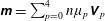 $\unicode[STIX]{x1D662}=\sum _{p=0}^{4}n\unicode[STIX]{x1D707}_{p}\unicode[STIX]{x1D651}_{p}$
, where, using Cartesian tensor notation and Braginskii’s conventions for coefficients and signs,
$\unicode[STIX]{x1D662}=\sum _{p=0}^{4}n\unicode[STIX]{x1D707}_{p}\unicode[STIX]{x1D651}_{p}$
, where, using Cartesian tensor notation and Braginskii’s conventions for coefficients and signs,
 $$\begin{eqnarray}\displaystyle \displaystyle \unicode[STIX]{x1D651}_{0} & \doteq & \displaystyle 3\{\unicode[STIX]{x1D63D}\,\unicode[STIX]{x1D63D}\}=3(B_{ij}-{\textstyle \frac{1}{3}}\unicode[STIX]{x1D6FF}_{ij})(B_{kj}-{\textstyle \frac{1}{3}}\unicode[STIX]{x1D6FF}_{kl}),\end{eqnarray}$$
 $$\begin{eqnarray}\displaystyle \displaystyle \unicode[STIX]{x1D651}_{1} & \doteq & \displaystyle \{\unicode[STIX]{x1D739}^{\bot }\,\unicode[STIX]{x1D739}^{\bot }\}=\unicode[STIX]{x1D6FF}_{ik}^{\bot }\unicode[STIX]{x1D6FF}_{jl}^{\bot }+\unicode[STIX]{x1D6FF}_{il}^{\bot }\unicode[STIX]{x1D6FF}_{jk}^{\bot }-\unicode[STIX]{x1D6FF}_{ij}^{\bot }\unicode[STIX]{x1D6FF}_{kl}^{\bot },\end{eqnarray}$$
 $$\begin{eqnarray}\displaystyle \displaystyle \unicode[STIX]{x1D651}_{2} & \doteq & \displaystyle \{\unicode[STIX]{x1D739}^{\bot }\,\unicode[STIX]{x1D63D}\}=\unicode[STIX]{x1D6FF}_{ik}^{\bot }B_{jl}+\unicode[STIX]{x1D6FF}_{il}^{\bot }B_{jk}+B_{ik}\unicode[STIX]{x1D6FF}_{jl}^{\bot }+B_{il}\unicode[STIX]{x1D6FF}_{jk}^{\bot },\end{eqnarray}$$
 $$\begin{eqnarray}\displaystyle \displaystyle \unicode[STIX]{x1D651}_{3} & \doteq & \displaystyle -{\textstyle \frac{1}{2}}\{\unicode[STIX]{x1D739}^{\bot }\,\unicode[STIX]{x1D737}\}=-{\textstyle \frac{1}{2}}(\unicode[STIX]{x1D6FF}_{ik}^{\bot }\unicode[STIX]{x1D6FD}_{jl}+\unicode[STIX]{x1D6FF}_{il}^{\bot }\unicode[STIX]{x1D6FD}_{jk}+\unicode[STIX]{x1D6FD}_{ik}\unicode[STIX]{x1D6FF}_{jl}^{\bot }+\unicode[STIX]{x1D6FD}_{il}\unicode[STIX]{x1D6FF}_{jk}^{\bot }),\end{eqnarray}$$
 $$\begin{eqnarray}\displaystyle \displaystyle \unicode[STIX]{x1D651}_{4} & \doteq & \displaystyle -\{\unicode[STIX]{x1D63D}\,\unicode[STIX]{x1D737}\}=-(B_{ik}\unicode[STIX]{x1D6FD}_{jl}+B_{il}\unicode[STIX]{x1D6FD}_{jk}+\unicode[STIX]{x1D6FD}_{ik}B_{jl}+\unicode[STIX]{x1D6FD}_{il}B_{jk}).\end{eqnarray}$$ $1/2$
are for later convenience. Note that the construction
$1/2$
are for later convenience. Note that the construction $\{\unicode[STIX]{x1D737}\,\unicode[STIX]{x1D737}\}$
is not independent because, for example,
$\{\unicode[STIX]{x1D737}\,\unicode[STIX]{x1D737}\}$
is not independent because, for example, $\unicode[STIX]{x1D6FD}_{ij}\unicode[STIX]{x1D6FD}_{kl}=\unicode[STIX]{x1D716}_{ij3}\unicode[STIX]{x1D716}_{kl3}=\unicode[STIX]{x1D6FF}_{ik}^{\bot }\unicode[STIX]{x1D6FF}_{jl}^{\bot }-\unicode[STIX]{x1D6FF}_{il}^{\bot }\unicode[STIX]{x1D6FF}_{jk}^{\bot }$
.
$\unicode[STIX]{x1D6FD}_{ij}\unicode[STIX]{x1D6FD}_{kl}=\unicode[STIX]{x1D716}_{ij3}\unicode[STIX]{x1D716}_{kl3}=\unicode[STIX]{x1D6FF}_{ik}^{\bot }\unicode[STIX]{x1D6FF}_{jl}^{\bot }-\unicode[STIX]{x1D6FF}_{il}^{\bot }\unicode[STIX]{x1D6FF}_{jk}^{\bot }$
. With these definitions, the $\unicode[STIX]{x1D651}$
matrices obey the following properties:
$\unicode[STIX]{x1D651}$
matrices obey the following properties: $\unicode[STIX]{x1D651}_{p}\boldsymbol{\cdot }\unicode[STIX]{x1D651}_{p^{\prime }}=0$
for
$\unicode[STIX]{x1D651}_{p}\boldsymbol{\cdot }\unicode[STIX]{x1D651}_{p^{\prime }}=0$
for $p\neq p^{\prime }$
,
$p\neq p^{\prime }$
,
 $$\begin{eqnarray}\displaystyle \unicode[STIX]{x1D651}_{0}\boldsymbol{ : }\unicode[STIX]{x1D651}_{0} & = & \displaystyle 2\unicode[STIX]{x1D651}_{0},\end{eqnarray}$$
 $$\begin{eqnarray}\displaystyle \unicode[STIX]{x1D651}_{1}\boldsymbol{ : }\unicode[STIX]{x1D651}_{1} & = & \displaystyle 2\unicode[STIX]{x1D651}_{1},\end{eqnarray}$$
 $$\begin{eqnarray}\displaystyle \unicode[STIX]{x1D651}_{2}\boldsymbol{ : }\unicode[STIX]{x1D651}_{2} & = & \displaystyle 2\unicode[STIX]{x1D651}_{2},\end{eqnarray}$$
 $$\begin{eqnarray}\displaystyle \unicode[STIX]{x1D651}_{3}\boldsymbol{ : }\unicode[STIX]{x1D651}_{3} & = & \displaystyle -2\unicode[STIX]{x1D651}_{1},\end{eqnarray}$$
 $$\begin{eqnarray}\displaystyle \unicode[STIX]{x1D651}_{4}\boldsymbol{ : }\unicode[STIX]{x1D651}_{4} & = & \displaystyle -2\unicode[STIX]{x1D651}_{2},\end{eqnarray}$$
 $$\begin{eqnarray}\displaystyle \unicode[STIX]{x1D651}_{0}+\unicode[STIX]{x1D651}_{1}+\unicode[STIX]{x1D651}_{2}=\{\unicode[STIX]{x1D644}\,\unicode[STIX]{x1D644}\}=\unicode[STIX]{x1D6FF}_{il}\unicode[STIX]{x1D6FF}_{jk}+\unicode[STIX]{x1D6FF}_{ik}\unicode[STIX]{x1D6FF}_{jl}-{\textstyle \frac{2}{3}}\unicode[STIX]{x1D6FF}_{ij}\unicode[STIX]{x1D6FF}_{kl}, & & \displaystyle\end{eqnarray}$$
which is the kinematic part of $\unicode[STIX]{x1D651}(\boldsymbol{B}=\mathbf{0})$
(see (E 1)).
$\unicode[STIX]{x1D651}(\boldsymbol{B}=\mathbf{0})$
(see (E 1)).
To calculate $\unicode[STIX]{x1D745}$
, one needs to know the action of
$\unicode[STIX]{x1D745}$
, one needs to know the action of $\unicode[STIX]{x1D651}_{i}$
on
$\unicode[STIX]{x1D651}_{i}$
on $\unicode[STIX]{x1D735}\boldsymbol{u}$
. Because the
$\unicode[STIX]{x1D735}\boldsymbol{u}$
. Because the $\unicode[STIX]{x1D651}$
matrices are symmetric in their last two indices, this is equivalent to calculating
$\unicode[STIX]{x1D651}$
matrices are symmetric in their last two indices, this is equivalent to calculating $\unicode[STIX]{x1D651}_{i}:\unicode[STIX]{x1D64E}$
, where
$\unicode[STIX]{x1D651}_{i}:\unicode[STIX]{x1D64E}$
, where $\unicode[STIX]{x1D64E}$
is defined by (3.4c
). Note that
$\unicode[STIX]{x1D64E}$
is defined by (3.4c
). Note that $\unicode[STIX]{x1D739}^{\bot }$
and
$\unicode[STIX]{x1D739}^{\bot }$
and $\unicode[STIX]{x1D63D}$
are symmetric, whereas
$\unicode[STIX]{x1D63D}$
are symmetric, whereas $\unicode[STIX]{x1D737}$
is antisymmetric. Then
$\unicode[STIX]{x1D737}$
is antisymmetric. Then
 $$\begin{eqnarray}\displaystyle \displaystyle \unicode[STIX]{x1D651}_{0}\boldsymbol{ : }\unicode[STIX]{x1D64E} & = & \displaystyle 3\left(\unicode[STIX]{x1D63D}-{\textstyle \frac{1}{3}}\unicode[STIX]{x1D644}\right)\left(\unicode[STIX]{x1D63D}-{\textstyle \frac{1}{3}}\unicode[STIX]{x1D644}\right)\boldsymbol{ : }\unicode[STIX]{x1D64E},\end{eqnarray}$$
 $$\begin{eqnarray}\displaystyle \displaystyle \unicode[STIX]{x1D651}_{1}\boldsymbol{ : }\unicode[STIX]{x1D64E} & = & \displaystyle 2\unicode[STIX]{x1D64E}_{\bot }-\unicode[STIX]{x1D739}^{\bot }\text{Tr}\unicode[STIX]{x1D64E}_{\bot },\end{eqnarray}$$
 $$\begin{eqnarray}\displaystyle \displaystyle \unicode[STIX]{x1D651}_{2}\boldsymbol{ : }\unicode[STIX]{x1D64E} & = & \displaystyle 2(\unicode[STIX]{x1D739}^{\bot }\boldsymbol{\cdot }\unicode[STIX]{x1D64E}\boldsymbol{\cdot }\unicode[STIX]{x1D63D}+\unicode[STIX]{x1D63D}\boldsymbol{\cdot }\unicode[STIX]{x1D64E}\boldsymbol{\cdot }\unicode[STIX]{x1D739}^{\bot }),\end{eqnarray}$$
 $$\begin{eqnarray}\displaystyle \displaystyle \unicode[STIX]{x1D651}_{3}\boldsymbol{ : }\unicode[STIX]{x1D64E} & = & \displaystyle \unicode[STIX]{x1D739}^{\bot }\boldsymbol{\cdot }\unicode[STIX]{x1D64E}\boldsymbol{\cdot }\unicode[STIX]{x1D737}-\unicode[STIX]{x1D737}\boldsymbol{\cdot }\unicode[STIX]{x1D64E}\boldsymbol{\cdot }\unicode[STIX]{x1D739}^{\bot },\end{eqnarray}$$
 $$\begin{eqnarray}\displaystyle \displaystyle \unicode[STIX]{x1D651}_{4}\boldsymbol{ : }\unicode[STIX]{x1D64E} & = & \displaystyle 2(\unicode[STIX]{x1D63D}\boldsymbol{\cdot }\unicode[STIX]{x1D64E}\boldsymbol{\cdot }\unicode[STIX]{x1D737}-\unicode[STIX]{x1D737}\boldsymbol{\cdot }\unicode[STIX]{x1D64E}\boldsymbol{\cdot }\unicode[STIX]{x1D63D}).\end{eqnarray}$$ $\unicode[STIX]{x1D64E}$
, he uses
$\unicode[STIX]{x1D64E}$
, he uses $\unicode[STIX]{x1D652}\doteq 2(\unicode[STIX]{x1D64E}-(1/3)\unicode[STIX]{x1D735}\,\boldsymbol{\cdot }\,\boldsymbol{u}\,\unicode[STIX]{x1D644})$
, so that
$\unicode[STIX]{x1D652}\doteq 2(\unicode[STIX]{x1D64E}-(1/3)\unicode[STIX]{x1D735}\,\boldsymbol{\cdot }\,\boldsymbol{u}\,\unicode[STIX]{x1D644})$
, so that $\unicode[STIX]{x1D64E}=(1/2)\unicode[STIX]{x1D652}+(1/3)\unicode[STIX]{x1D735}\,\boldsymbol{\cdot }\,\boldsymbol{u}\,\unicode[STIX]{x1D644}$
. The last term, proportional to the identity operator, does not contribute to
$\unicode[STIX]{x1D64E}=(1/2)\unicode[STIX]{x1D652}+(1/3)\unicode[STIX]{x1D735}\,\boldsymbol{\cdot }\,\boldsymbol{u}\,\unicode[STIX]{x1D644}$
. The last term, proportional to the identity operator, does not contribute to $\unicode[STIX]{x1D651}_{0}$
(because
$\unicode[STIX]{x1D651}_{0}$
(because $\unicode[STIX]{x1D64E}$
is dotted with a traceless quantity),
$\unicode[STIX]{x1D64E}$
is dotted with a traceless quantity), $\unicode[STIX]{x1D651}_{2}$
(because
$\unicode[STIX]{x1D651}_{2}$
(because $\unicode[STIX]{x1D739}^{\bot }$
and
$\unicode[STIX]{x1D739}^{\bot }$
and $\unicode[STIX]{x1D63D}$
are orthogonal), or
$\unicode[STIX]{x1D63D}$
are orthogonal), or $\unicode[STIX]{x1D651}_{3}$
and
$\unicode[STIX]{x1D651}_{3}$
and $\unicode[STIX]{x1D651}_{4}$
(because of cancellations due to the antisymmetry). It contributes to
$\unicode[STIX]{x1D651}_{4}$
(because of cancellations due to the antisymmetry). It contributes to $\unicode[STIX]{x1D651}_{1}$
a term
$\unicode[STIX]{x1D651}_{1}$
a term  $$\begin{eqnarray}\displaystyle \left({\textstyle \frac{2}{3}}\unicode[STIX]{x1D735}\,\boldsymbol{\cdot }\,\boldsymbol{u}-\unicode[STIX]{x1D735}_{\!\bot }\boldsymbol{\cdot }\boldsymbol{u}_{\bot }\right)\unicode[STIX]{x1D739}^{\bot }=\left(\unicode[STIX]{x1D735}_{\Vert }u_{\Vert }-{\textstyle \frac{1}{3}}\unicode[STIX]{x1D735}\,\boldsymbol{\cdot }\,\boldsymbol{u}\right)\unicode[STIX]{x1D739}^{\bot }={\textstyle \frac{1}{2}}W_{zz}\unicode[STIX]{x1D739}^{\bot }. & & \displaystyle\end{eqnarray}$$
Thus, one finds
 $$\begin{eqnarray}\displaystyle \unicode[STIX]{x1D651}_{0}:\unicode[STIX]{x1D64E} & = & \displaystyle {\textstyle \frac{3}{2}}\left(\unicode[STIX]{x1D63D}-{\textstyle \frac{1}{3}}\unicode[STIX]{x1D644}\right)\left(\unicode[STIX]{x1D63D}-{\textstyle \frac{1}{3}}\unicode[STIX]{x1D644}\right)\boldsymbol{ : }\unicode[STIX]{x1D652},\end{eqnarray}$$
 $$\begin{eqnarray}\displaystyle \displaystyle \unicode[STIX]{x1D651}_{1}\boldsymbol{ : }\unicode[STIX]{x1D64E} & = & \displaystyle \unicode[STIX]{x1D739}^{\bot }\boldsymbol{\cdot }\unicode[STIX]{x1D652}\boldsymbol{\cdot }\unicode[STIX]{x1D739}^{\bot }+{\textstyle \frac{1}{2}}(\widehat{\boldsymbol{b}}\boldsymbol{\cdot }\unicode[STIX]{x1D652}\boldsymbol{\cdot }\widehat{\boldsymbol{b}})\unicode[STIX]{x1D739}^{\bot },\end{eqnarray}$$
 $$\begin{eqnarray}\displaystyle \displaystyle \unicode[STIX]{x1D651}_{2}\boldsymbol{ : }\unicode[STIX]{x1D64E} & = & \displaystyle \unicode[STIX]{x1D739}^{\bot }\boldsymbol{\cdot }\unicode[STIX]{x1D652}\boldsymbol{\cdot }\unicode[STIX]{x1D63D}+\unicode[STIX]{x1D63D}\boldsymbol{\cdot }\unicode[STIX]{x1D652}\boldsymbol{\cdot }\unicode[STIX]{x1D739}^{\bot },\end{eqnarray}$$
 $$\begin{eqnarray}\displaystyle \displaystyle \unicode[STIX]{x1D651}_{3}\boldsymbol{ : }\unicode[STIX]{x1D64E} & = & \displaystyle {\textstyle \frac{1}{2}}(\unicode[STIX]{x1D739}^{\bot }\boldsymbol{\cdot }\unicode[STIX]{x1D652}\boldsymbol{\cdot }\unicode[STIX]{x1D737}-\unicode[STIX]{x1D737}\boldsymbol{\cdot }\unicode[STIX]{x1D652}\boldsymbol{\cdot }\unicode[STIX]{x1D739}^{\bot }),\end{eqnarray}$$
 $$\begin{eqnarray}\displaystyle \displaystyle \unicode[STIX]{x1D651}_{4}\boldsymbol{ : }\unicode[STIX]{x1D64E} & = & \displaystyle \unicode[STIX]{x1D63D}\boldsymbol{\cdot }\unicode[STIX]{x1D652}\boldsymbol{\cdot }\unicode[STIX]{x1D737}-\unicode[STIX]{x1D737}\boldsymbol{\cdot }\unicode[STIX]{x1D652}\boldsymbol{\cdot }\unicode[STIX]{x1D63D}.\end{eqnarray}$$ $\unicode[STIX]{x1D651}_{i}\boldsymbol{ : }\unicode[STIX]{x1D64E}$
is symmetric, consistent with the overall symmetry of
$\unicode[STIX]{x1D651}_{i}\boldsymbol{ : }\unicode[STIX]{x1D64E}$
is symmetric, consistent with the overall symmetry of $\unicode[STIX]{x1D745}$
.
$\unicode[STIX]{x1D745}$
.The magnetic-field scalings of the $\unicode[STIX]{x1D707}_{p}$
viscosities are
$\unicode[STIX]{x1D707}_{p}$
viscosities are
 $$\begin{eqnarray}\displaystyle \displaystyle \unicode[STIX]{x1D707}_{0} & {\sim} & \displaystyle B^{0}\quad (\text{parallel transport}),\end{eqnarray}$$
 $$\begin{eqnarray}\displaystyle \displaystyle \unicode[STIX]{x1D707}_{1},\,\unicode[STIX]{x1D707}_{2} & {\sim} & \displaystyle B^{-1}\quad (\text{non-dissipative gyroviscosities}),\end{eqnarray}$$
 $$\begin{eqnarray}\displaystyle \displaystyle \unicode[STIX]{x1D707}_{3},\,\unicode[STIX]{x1D707}_{4} & {\sim} & \displaystyle B^{-2}\quad \text{(cross-field transport)}.\end{eqnarray}$$ $\unicode[STIX]{x1D707}_{1}(\unicode[STIX]{x1D714}_{\text{c}})=\unicode[STIX]{x1D707}_{2}(2\unicode[STIX]{x1D714}_{\text{c}})$
and
$\unicode[STIX]{x1D707}_{1}(\unicode[STIX]{x1D714}_{\text{c}})=\unicode[STIX]{x1D707}_{2}(2\unicode[STIX]{x1D714}_{\text{c}})$
and $\unicode[STIX]{x1D707}_{3}(\unicode[STIX]{x1D714}_{\text{c}})=\unicode[STIX]{x1D707}_{4}(2\unicode[STIX]{x1D714}_{\text{c}})$
. This is a consequence of (i) the fact that the spherical harmonics are eigenfunctions of both
$\unicode[STIX]{x1D707}_{3}(\unicode[STIX]{x1D714}_{\text{c}})=\unicode[STIX]{x1D707}_{4}(2\unicode[STIX]{x1D714}_{\text{c}})$
. This is a consequence of (i) the fact that the spherical harmonics are eigenfunctions of both $\widehat{\text{C}}$
and
$\widehat{\text{C}}$
and $\text{i}\widehat{\text{M}}$
, and (ii) the aptly chosen tensorial decompositions of the
$\text{i}\widehat{\text{M}}$
, and (ii) the aptly chosen tensorial decompositions of the $\unicode[STIX]{x1D651}_{p}$
matrices.
$\unicode[STIX]{x1D651}_{p}$
matrices.The non-dissipative gyroviscosities $\unicode[STIX]{x1D707}_{1}$
and
$\unicode[STIX]{x1D707}_{1}$
and $\unicode[STIX]{x1D707}_{2}$
emerge in collisionless Vlasov or gyrokinetic theory as well. In the collisionless limit, a Chapman–Enskog-truncated fluid description is inappropriate and gyrokinetics (Krommes Reference Krommes2012, and references therein) provides a much superior approach. For further discussion, see Belova (Reference Belova2001).
$\unicode[STIX]{x1D707}_{2}$
emerge in collisionless Vlasov or gyrokinetic theory as well. In the collisionless limit, a Chapman–Enskog-truncated fluid description is inappropriate and gyrokinetics (Krommes Reference Krommes2012, and references therein) provides a much superior approach. For further discussion, see Belova (Reference Belova2001).
Appendix F. Linear eigenmodes of the Braginskii equations
After Fourier analysis in space, the linearized Braginskii equations can be written as
 $$\begin{eqnarray}\displaystyle \unicode[STIX]{x2202}_{t}\boldsymbol{a}_{\boldsymbol{k}}(t)=\unicode[STIX]{x1D646}_{\boldsymbol{k}}\boldsymbol{\cdot }\boldsymbol{a}_{\boldsymbol{k}}, & & \displaystyle\end{eqnarray}$$
where $\unicode[STIX]{x1D646}$
is a
$\unicode[STIX]{x1D646}$
is a $5S\times 5S$
square matrix. This leads to the
$5S\times 5S$
square matrix. This leads to the $5S$
-dimensional eigenvalue problem
$5S$
-dimensional eigenvalue problem
 $$\begin{eqnarray}\displaystyle \det (\unicode[STIX]{x1D646}-\unicode[STIX]{x1D706}\unicode[STIX]{x1D644})=0, & & \displaystyle\end{eqnarray}$$
where I have dropped the $\boldsymbol{k}$
labels for simplicity. In this appendix I discuss some aspects of the eigenmodes for first the unmagnetised one-component plasma (five eigenmodes; § F.1), then a two-species plasma (ten eigenmodes) in the two limits
$\boldsymbol{k}$
labels for simplicity. In this appendix I discuss some aspects of the eigenmodes for first the unmagnetised one-component plasma (five eigenmodes; § F.1), then a two-species plasma (ten eigenmodes) in the two limits $\boldsymbol{B}=\mathbf{0}$
(§ F.2) and
$\boldsymbol{B}=\mathbf{0}$
(§ F.2) and $\unicode[STIX]{x1D716}\doteq \unicode[STIX]{x1D708}/|\unicode[STIX]{x1D714}_{\text{c}}|\ll 1$
(§ F.3). (Only special cases are considered for the latter.) This knowledge is of intrinsic conceptual interest and is also useful for numerical work with the Braginskii equations. While one might be most interested in low-frequency phenomena, the Braginskii equations will not totally oblige; they contain high-frequency eigenvalues as well: Langmuir oscillations for
$\unicode[STIX]{x1D716}\doteq \unicode[STIX]{x1D708}/|\unicode[STIX]{x1D714}_{\text{c}}|\ll 1$
(§ F.3). (Only special cases are considered for the latter.) This knowledge is of intrinsic conceptual interest and is also useful for numerical work with the Braginskii equations. While one might be most interested in low-frequency phenomena, the Braginskii equations will not totally oblige; they contain high-frequency eigenvalues as well: Langmuir oscillations for $\boldsymbol{B}=\mathbf{0}$
; hybrid oscillations for
$\boldsymbol{B}=\mathbf{0}$
; hybrid oscillations for $\boldsymbol{B}\neq \mathbf{0}$
. Those may limit the time step unless special care is used in the formulation of the numerical algorithm.
$\boldsymbol{B}\neq \mathbf{0}$
. Those may limit the time step unless special care is used in the formulation of the numerical algorithm.
For simple cases, the eigenvalue calculations can be done by hand. However, for the most complicated situations the algebra becomes tedious. The determinant of a ten-dimensional matrix all of whose entries are unique contains $10!\approx 3.6\times 10^{6}$
terms, each of which may be a complicated product. The matrices for the linearized Braginskii equations are fortunately not full; nevertheless, the fully expanded determinant for the
$10!\approx 3.6\times 10^{6}$
terms, each of which may be a complicated product. The matrices for the linearized Braginskii equations are fortunately not full; nevertheless, the fully expanded determinant for the $\boldsymbol{B}\neq \mathbf{0}$
case contains more than 2500 terms. Those are of various orders in the small parameters
$\boldsymbol{B}\neq \mathbf{0}$
case contains more than 2500 terms. Those are of various orders in the small parameters $\unicode[STIX]{x1D707}$
,
$\unicode[STIX]{x1D707}$
, $\unicode[STIX]{x1D716}$
, and
$\unicode[STIX]{x1D716}$
, and $k^{2}$
, and one is interested only in the dominant balances. Since diverse orderings are possible, machine-aided manipulations are useful in sorting out the details.Footnote
56
$k^{2}$
, and one is interested only in the dominant balances. Since diverse orderings are possible, machine-aided manipulations are useful in sorting out the details.Footnote
56
F.1 Eigenmodes of the unmagnetised one-component plasma
The eigenmodes of the hydrodynamic equations of a neutral fluid are well known; however, they are non-trivially modified in the presence of the long-ranged Coulomb force. I shall illustrate that for the unmagnetised one-component plasma. These results are well known (Balescu Reference Balescu1975). However, lessons learned here generalize to the more complicated multispecies and magnetised problems, which I shall discuss in later sections.
The linearized continuity equation is
 $$\begin{eqnarray}\displaystyle \frac{\unicode[STIX]{x2202}}{\unicode[STIX]{x2202}t}\left(\frac{\unicode[STIX]{x0394}n}{n}\right)=-\text{i}\boldsymbol{k}\boldsymbol{\cdot }\unicode[STIX]{x0394}\boldsymbol{u}, & & \displaystyle\end{eqnarray}$$
the linearized momentum equation is
 $$\begin{eqnarray}\displaystyle \frac{\unicode[STIX]{x2202}\unicode[STIX]{x0394}\boldsymbol{u}}{\unicode[STIX]{x2202}t}=\frac{q}{m}\unicode[STIX]{x0394}\boldsymbol{E}-(nm)^{-1}\text{i}\boldsymbol{k}\unicode[STIX]{x0394}p-\unicode[STIX]{x1D707}k^{2}\unicode[STIX]{x0394}\boldsymbol{u}-\left(\frac{1}{3}\unicode[STIX]{x1D707}+\unicode[STIX]{x1D701}\right)\boldsymbol{k}\,\boldsymbol{k}\boldsymbol{\cdot }\unicode[STIX]{x0394}\boldsymbol{u} & & \displaystyle\end{eqnarray}$$
(here I allow for a bulk viscosity $\unicode[STIX]{x1D701}$
) with
$\unicode[STIX]{x1D701}$
) with $\unicode[STIX]{x0394}\boldsymbol{E}=-\text{i}\boldsymbol{k}\unicode[STIX]{x0394}\unicode[STIX]{x1D719}$
, and the linearized temperature equation is
$\unicode[STIX]{x0394}\boldsymbol{E}=-\text{i}\boldsymbol{k}\unicode[STIX]{x0394}\unicode[STIX]{x1D719}$
, and the linearized temperature equation is
 $$\begin{eqnarray}\displaystyle \frac{\unicode[STIX]{x2202}}{\unicode[STIX]{x2202}t}\left(\frac{\unicode[STIX]{x0394}T}{T}\right)=-\frac{2}{3}\text{i}\boldsymbol{k}\boldsymbol{\cdot }\unicode[STIX]{x0394}\boldsymbol{u}-\frac{2}{3}\unicode[STIX]{x1D705}k^{2}\left(\frac{\unicode[STIX]{x0394}T}{T}\right). & & \displaystyle\end{eqnarray}$$
Decompose $\unicode[STIX]{x0394}\boldsymbol{u}$
into longitudinal and transverse components (with respect to
$\unicode[STIX]{x0394}\boldsymbol{u}$
into longitudinal and transverse components (with respect to $\boldsymbol{k}$
):
$\boldsymbol{k}$
):
 $$\begin{eqnarray}\displaystyle \unicode[STIX]{x0394}\boldsymbol{u}=\unicode[STIX]{x0394}\boldsymbol{u}^{\text{long}}+\unicode[STIX]{x0394}\boldsymbol{u}^{\text{trans}}, & & \displaystyle\end{eqnarray}$$
where
 $$\begin{eqnarray}\displaystyle \unicode[STIX]{x0394}\boldsymbol{u}^{\text{long}}\doteq \widehat{\boldsymbol{k}}\,\widehat{\boldsymbol{k}}\boldsymbol{\cdot }\unicode[STIX]{x0394}\boldsymbol{u},\quad \unicode[STIX]{x0394}\boldsymbol{u}^{\text{trans}}\doteq (\unicode[STIX]{x1D644}-\widehat{\boldsymbol{k}}\,\widehat{\boldsymbol{k}})\boldsymbol{\cdot }\unicode[STIX]{x0394}\boldsymbol{u}=\widehat{\boldsymbol{k}}\times (\unicode[STIX]{x0394}\boldsymbol{u}\times \widehat{\boldsymbol{k}}). & & \displaystyle\end{eqnarray}$$
These components decouple according to
 $$\begin{eqnarray}\displaystyle \unicode[STIX]{x1D706}\unicode[STIX]{x0394}\boldsymbol{u}^{\text{trans}}=-\unicode[STIX]{x1D707}k^{2}\unicode[STIX]{x0394}\boldsymbol{u}^{\text{trans}}, & & \displaystyle\end{eqnarray}$$
which gives rise to two shear modes, each with $\unicode[STIX]{x1D706}=-\unicode[STIX]{x1D707}k^{2}$
, and
$\unicode[STIX]{x1D706}=-\unicode[STIX]{x1D707}k^{2}$
, and
 $$\begin{eqnarray}\displaystyle & \displaystyle \unicode[STIX]{x1D706}\left(\frac{\unicode[STIX]{x0394}n}{n}\right)=-\text{i}k\unicode[STIX]{x0394}u^{\text{long}}, & \displaystyle\end{eqnarray}$$
 $$\begin{eqnarray}\displaystyle & \displaystyle \unicode[STIX]{x1D706}\unicode[STIX]{x0394}u^{\text{long}}=-\text{i}\unicode[STIX]{x1D714}_{\text{p}}^{2}\frac{1}{k}\left(\frac{\unicode[STIX]{x0394}n}{n}\right)-\text{i}v_{\text{t}}^{2}k\left(\frac{\unicode[STIX]{x0394}n}{n}+\frac{\unicode[STIX]{x0394}T}{T}\right)-\left(\frac{4}{3}\unicode[STIX]{x1D707}+\unicode[STIX]{x1D701}\right)k^{2}\unicode[STIX]{x0394}u^{\text{long}}, & \displaystyle\end{eqnarray}$$
 $$\begin{eqnarray}\displaystyle & \displaystyle \unicode[STIX]{x1D706}\left(\frac{\unicode[STIX]{x0394}T}{T}\right)=-\frac{2}{3}\text{i}k\unicode[STIX]{x0394}u^{\text{long}}-\frac{2}{3}\unicode[STIX]{x1D705}k^{2}\left(\frac{\unicode[STIX]{x0394}T}{T}\right). & \displaystyle\end{eqnarray}$$ $\unicode[STIX]{x1D712}_{\unicode[STIX]{x1D707}}\doteq 4\unicode[STIX]{x1D707}/3+\unicode[STIX]{x1D701}$
and
$\unicode[STIX]{x1D712}_{\unicode[STIX]{x1D707}}\doteq 4\unicode[STIX]{x1D707}/3+\unicode[STIX]{x1D701}$
and $\unicode[STIX]{x1D712}_{\text{v}}\doteq \unicode[STIX]{x1D705}/c_{\text{v}}$
, where
$\unicode[STIX]{x1D712}_{\text{v}}\doteq \unicode[STIX]{x1D705}/c_{\text{v}}$
, where $c_{\text{v}}\doteq 3/2$
is the specific heat at constant volume for a three-dimensional ideal gas, (F 9a
)–(F 9c
) can be combined to obtain the longitudinal dispersion relation
$c_{\text{v}}\doteq 3/2$
is the specific heat at constant volume for a three-dimensional ideal gas, (F 9a
)–(F 9c
) can be combined to obtain the longitudinal dispersion relation  $$\begin{eqnarray}\displaystyle & \unicode[STIX]{x1D706}^{3}+k^{2}(\unicode[STIX]{x1D712}_{\unicode[STIX]{x1D707}}+\unicode[STIX]{x1D712}_{\text{v}})\unicode[STIX]{x1D706}^{2}+\left(\unicode[STIX]{x1D714}_{\text{p}}^{2}+{\textstyle \frac{5}{3}}k^{2}v_{\text{t}}^{2}+(k^{2}\unicode[STIX]{x1D712}_{\unicode[STIX]{x1D707}})(k^{2}\unicode[STIX]{x1D712}_{\text{v}})\right)\unicode[STIX]{x1D706}+(\unicode[STIX]{x1D714}_{\text{p}}^{2}+k^{2}v_{\text{t}}^{2})(k^{2}\unicode[STIX]{x1D712}_{\text{v}})=0.\quad & \displaystyle\end{eqnarray}$$
Although a cubic equation has an explicit analytical solution, its interpretation is opaque in general. Fortunately, of most interest is the hydrodynamic limit $k\unicode[STIX]{x1D706}_{\text{mfp}}\rightarrow 0$
. Upon noting that each of
$k\unicode[STIX]{x1D706}_{\text{mfp}}\rightarrow 0$
. Upon noting that each of $\unicode[STIX]{x1D707}$
and
$\unicode[STIX]{x1D707}$
and $\unicode[STIX]{x1D705}$
has the classical random-walk scaling
$\unicode[STIX]{x1D705}$
has the classical random-walk scaling $v_{\text{t}}^{2}/\unicode[STIX]{x1D708}$
, one can make (F 10) dimensionless by normalizing
$v_{\text{t}}^{2}/\unicode[STIX]{x1D708}$
, one can make (F 10) dimensionless by normalizing $\unicode[STIX]{x1D706}$
to
$\unicode[STIX]{x1D706}$
to $\unicode[STIX]{x1D708}$
, dividing by
$\unicode[STIX]{x1D708}$
, dividing by $\unicode[STIX]{x1D708}^{3}$
, and introducingFootnote
57
$\unicode[STIX]{x1D708}^{3}$
, and introducingFootnote
57 $\unicode[STIX]{x1D6FF}\doteq (kv_{\text{t}}/\unicode[STIX]{x1D708})^{2}=(k\unicode[STIX]{x1D706}_{\text{mfp}})^{2}$
. One may treat
$\unicode[STIX]{x1D6FF}\doteq (kv_{\text{t}}/\unicode[STIX]{x1D708})^{2}=(k\unicode[STIX]{x1D706}_{\text{mfp}})^{2}$
. One may treat $k^{2}$
as
$k^{2}$
as $O(\unicode[STIX]{x1D6FF})$
. For the roots of polynomials with small coefficients, an efficient and pictorial way of analysing the dominant balances is to use a Kruskal diagram (Kruskal Reference Kruskal1965) in which the terms in the polynomial populate a 2-D lattice whose abscissa measures the powers of
$O(\unicode[STIX]{x1D6FF})$
. For the roots of polynomials with small coefficients, an efficient and pictorial way of analysing the dominant balances is to use a Kruskal diagram (Kruskal Reference Kruskal1965) in which the terms in the polynomial populate a 2-D lattice whose abscissa measures the powers of $\unicode[STIX]{x1D706}$
and whose ordinate measures the powers of
$\unicode[STIX]{x1D706}$
and whose ordinate measures the powers of $\unicode[STIX]{x1D6FF}$
. Dominant balances are found by bringing up lines from below until they rest on populated points. The Kruskal diagram for (F 10) is shown in figure 2. The balance between the terms in
$\unicode[STIX]{x1D6FF}$
. Dominant balances are found by bringing up lines from below until they rest on populated points. The Kruskal diagram for (F 10) is shown in figure 2. The balance between the terms in $\unicode[STIX]{x1D706}^{1}$
and
$\unicode[STIX]{x1D706}^{1}$
and $\unicode[STIX]{x1D706}^{0}$
(I shall call that the 1–0 balance) signifies a thermal-diffusion mode with
$\unicode[STIX]{x1D706}^{0}$
(I shall call that the 1–0 balance) signifies a thermal-diffusion mode with
 $$\begin{eqnarray}\displaystyle \unicode[STIX]{x1D706}\approx -k^{2}\unicode[STIX]{x1D712}_{\text{v}}=-k^{2}\unicode[STIX]{x1D705}/c_{\text{v}}. & & \displaystyle\end{eqnarray}$$
The 3–1 balance leads to
 $$\begin{eqnarray}\displaystyle \unicode[STIX]{x1D706}^{2}=\unicode[STIX]{x1D714}_{\text{p}}^{2}+{\textstyle \frac{5}{3}}k^{2}v_{\text{t}}^{2}+O(\unicode[STIX]{x1D716}^{2}). & & \displaystyle\end{eqnarray}$$
Kruskal diagram for the longitudinal modes of an unmagnetised one-component plasma (see (F 10)), showing the balance between the terms in $\unicode[STIX]{x1D706}^{0}$
and
$\unicode[STIX]{x1D706}^{0}$
and $\unicode[STIX]{x1D706}^{1}$
(thermal-diffusion mode), and between
$\unicode[STIX]{x1D706}^{1}$
(thermal-diffusion mode), and between $\unicode[STIX]{x1D706}^{1}$
and
$\unicode[STIX]{x1D706}^{1}$
and $\unicode[STIX]{x1D706}^{3}$
(plasma oscillations).
$\unicode[STIX]{x1D706}^{3}$
(plasma oscillations).

These are obviously plasma oscillations with real mode frequency $\unicode[STIX]{x1D6FA}_{\boldsymbol{k}}\approx \pm \unicode[STIX]{x1D714}_{\text{p}}$
, but with a thermal correction that is incorrect in the weakly coupled limit; the proper coefficient (which follows from collisionless kinetic theory) is 3 rather than
$\unicode[STIX]{x1D6FA}_{\boldsymbol{k}}\approx \pm \unicode[STIX]{x1D714}_{\text{p}}$
, but with a thermal correction that is incorrect in the weakly coupled limit; the proper coefficient (which follows from collisionless kinetic theory) is 3 rather than $5/3$
. The error arises because in the limit of weak coupling these modes do not satisfy the Markovian requirement
$5/3$
. The error arises because in the limit of weak coupling these modes do not satisfy the Markovian requirement $|\unicode[STIX]{x1D6FA}_{\boldsymbol{k}}|\ll \unicode[STIX]{x1D708}$
, so one should not be taking the
$|\unicode[STIX]{x1D6FA}_{\boldsymbol{k}}|\ll \unicode[STIX]{x1D708}$
, so one should not be taking the $\unicode[STIX]{x1D714}=0$
limit of the projection formalism.Footnote
58
As is well known, the prediction (F 12) is easily rationalized on physical grounds:
$\unicode[STIX]{x1D714}=0$
limit of the projection formalism.Footnote
58
As is well known, the prediction (F 12) is easily rationalized on physical grounds: $5/3$
is the ratio of specific heats
$5/3$
is the ratio of specific heats $c_{\text{p}}/c_{\text{v}}=(d+2)/d$
of a
$c_{\text{p}}/c_{\text{v}}=(d+2)/d$
of a $d$
-dimensional ideal gas for
$d$
-dimensional ideal gas for $d=3$
whereas the correct coefficient of 3 corresponds to
$d=3$
whereas the correct coefficient of 3 corresponds to $d=1$
. The Braginskii equations incorrectly assume that strong collisions have isotropized the wave motion.Footnote
59
Furthermore, although the Braginskii equations predict (an incorrect formula for) dissipative collisional damping (not written in (F 12)), collisionless Landau damping is absent.Footnote
60
$d=1$
. The Braginskii equations incorrectly assume that strong collisions have isotropized the wave motion.Footnote
59
Furthermore, although the Braginskii equations predict (an incorrect formula for) dissipative collisional damping (not written in (F 12)), collisionless Landau damping is absent.Footnote
60
Kruskal diagram for the neutral gas, showing that the eigenmodes are a thermal-diffusion mode (1–0 balance) and two sound waves (3–1 balance).

Of course, the plasma oscillations are a consequence of the long-ranged nature of the Coulomb force. It is instructive to consider the limit of a neutral gas by letting $\unicode[STIX]{x1D714}_{\text{p}}^{2}\rightarrow 0$
. Then the dominant terms for
$\unicode[STIX]{x1D714}_{\text{p}}^{2}\rightarrow 0$
. Then the dominant terms for $\unicode[STIX]{x1D706}^{0}$
and
$\unicode[STIX]{x1D706}^{0}$
and $\unicode[STIX]{x1D706}^{1}$
move up to
$\unicode[STIX]{x1D706}^{1}$
move up to $\infty$
; the corresponding Kruskal diagram is shown in figure 3. The 1–0 balance now leads to
$\infty$
; the corresponding Kruskal diagram is shown in figure 3. The 1–0 balance now leads to
 $$\begin{eqnarray}\displaystyle \unicode[STIX]{x1D706}=-{\textstyle \frac{3}{5}}k^{2}\unicode[STIX]{x1D712}_{\text{v}}=-k^{2}\unicode[STIX]{x1D705}/c_{\text{p}}, & & \displaystyle\end{eqnarray}$$
where $c_{\text{p}}\doteq 5/2$
is the specific heat at constant pressure for a three-dimensional ideal gas. This is again a thermal-diffusion mode, but with a thermodynamics that differs from that of the OCP.Footnote
61
The 3–1 balance leads to two sound waves:
$c_{\text{p}}\doteq 5/2$
is the specific heat at constant pressure for a three-dimensional ideal gas. This is again a thermal-diffusion mode, but with a thermodynamics that differs from that of the OCP.Footnote
61
The 3–1 balance leads to two sound waves:
 $$\begin{eqnarray}\displaystyle \unicode[STIX]{x1D706}=\pm kc_{\text{s}}, & & \displaystyle\end{eqnarray}$$
where
 $$\begin{eqnarray}\displaystyle c_{\text{s}}^{2}\doteq {\textstyle \frac{5}{3}}v_{\text{t}}^{2} & & \displaystyle\end{eqnarray}$$
is the ideal-gas limit of the well-known result
 $$\begin{eqnarray}\displaystyle c_{\text{s}}^{2}=\left(\frac{c_{\text{p}}}{c_{\text{v}}}\right)\frac{1}{m}\left(\frac{\unicode[STIX]{x2202}p}{\unicode[STIX]{x2202}n}\right)_{T}=\frac{1}{m}\left(\frac{\unicode[STIX]{x2202}p}{\unicode[STIX]{x2202}n}\right)_{s}, & & \displaystyle\end{eqnarray}$$
where $s$
denotes entropy density. That long-range forces lead to profound modifications in linear-response theory is well known; good discussions are given by Martin (Reference Martin1967, Reference Martin, deWitt and Balian1968).
$s$
denotes entropy density. That long-range forces lead to profound modifications in linear-response theory is well known; good discussions are given by Martin (Reference Martin1967, Reference Martin, deWitt and Balian1968).
F.2 Eigenmodes of a two-species magnetised plasma for
$\boldsymbol{B}=\mathbf{0}$

Next I address the generalization of the previous results to a two-species, unmagnetised plasma. The linearized continuity equations are unchanged in form. To the linearized momentum equations must be added the perturbed momentum transfer:
 $$\begin{eqnarray}\displaystyle \unicode[STIX]{x0394}\boldsymbol{R}_{e}=-(nm)_{e}\unicode[STIX]{x1D70F}_{e}^{-1}\unicode[STIX]{x1D6FC}(\unicode[STIX]{x0394}\boldsymbol{u}_{e}-\unicode[STIX]{x0394}\boldsymbol{u}_{i})-\unicode[STIX]{x1D6FD}n_{e}\text{i}\boldsymbol{k}\unicode[STIX]{x0394}T_{e},\quad \unicode[STIX]{x0394}\boldsymbol{R}_{i}=-\unicode[STIX]{x0394}\boldsymbol{R}_{e}, & & \displaystyle\end{eqnarray}$$
where $\unicode[STIX]{x1D6FC}\doteq 0.51$
and
$\unicode[STIX]{x1D6FC}\doteq 0.51$
and $\unicode[STIX]{x1D6FD}\doteq 0.71$
. Also, to the linearized temperature equations must be added a temperature equilibration term
$\unicode[STIX]{x1D6FD}\doteq 0.71$
. Also, to the linearized temperature equations must be added a temperature equilibration term $\unicode[STIX]{x0394}Q$
:
$\unicode[STIX]{x0394}Q$
:
 $$\begin{eqnarray}\displaystyle \unicode[STIX]{x0394}Q_{e}=-3\left(\frac{m_{e}}{m_{i}}\right)\unicode[STIX]{x1D70F}_{e}^{-1}(\unicode[STIX]{x0394}T_{e}-\unicode[STIX]{x0394}T_{i}),\quad \unicode[STIX]{x0394}Q_{i}=-\unicode[STIX]{x0394}\text{Q}_{e}. & & \displaystyle\end{eqnarray}$$
Finally, the electron heat flow must be generalized to
 $$\begin{eqnarray}\displaystyle \unicode[STIX]{x0394}\boldsymbol{q}_{e}=-n_{e}\unicode[STIX]{x1D705}_{e}k^{2}\text{i}\boldsymbol{k}\unicode[STIX]{x0394}T_{e}+\unicode[STIX]{x1D6FD}(nT)_{e}(\unicode[STIX]{x0394}\boldsymbol{u}_{e}-\unicode[STIX]{x0394}\boldsymbol{u}_{i}). & & \displaystyle\end{eqnarray}$$
A decomposition into decoupled longitudinal and transverse components can be made as before. The transverse dispersion relation leads to two pairs of eigenvalues, where each pair obeys
 $$\begin{eqnarray}\displaystyle \unicode[STIX]{x1D706}^{2}+(\unicode[STIX]{x1D708}_{e}+\unicode[STIX]{x1D708}_{i}+\unicode[STIX]{x1D716}_{e}+\unicode[STIX]{x1D716}_{i})\unicode[STIX]{x1D706}+\unicode[STIX]{x1D716}_{i}\unicode[STIX]{x1D708}_{e}+\unicode[STIX]{x1D716}_{e}\unicode[STIX]{x1D708}_{i}+\unicode[STIX]{x1D716}_{e}\unicode[STIX]{x1D716}_{i}, & & \displaystyle\end{eqnarray}$$
where $\unicode[STIX]{x1D708}_{e}\doteq \unicode[STIX]{x1D6FC}\unicode[STIX]{x1D70F}_{e}^{-1}$
,
$\unicode[STIX]{x1D708}_{e}\doteq \unicode[STIX]{x1D6FC}\unicode[STIX]{x1D70F}_{e}^{-1}$
, $\unicode[STIX]{x1D708}_{i}\doteq (m_{e}/m_{i})\unicode[STIX]{x1D708}_{e}$
, and
$\unicode[STIX]{x1D708}_{i}\doteq (m_{e}/m_{i})\unicode[STIX]{x1D708}_{e}$
, and $\unicode[STIX]{x1D716}_{s}\doteq \unicode[STIX]{x1D707}_{s}k^{2}$
. The approximate solutions are a momentum-decay mode (2–1 balance),
$\unicode[STIX]{x1D716}_{s}\doteq \unicode[STIX]{x1D707}_{s}k^{2}$
. The approximate solutions are a momentum-decay mode (2–1 balance),
 $$\begin{eqnarray}\displaystyle \unicode[STIX]{x1D706}_{-}=-(\unicode[STIX]{x1D708}_{e}+\unicode[STIX]{x1D708}_{i})+O(\unicode[STIX]{x1D716}), & & \displaystyle\end{eqnarray}$$
and a momentum-diffusion mode (1–0 balance),
 $$\begin{eqnarray}\displaystyle \unicode[STIX]{x1D706}_{+}=-\left(\frac{\unicode[STIX]{x1D716}_{i}\unicode[STIX]{x1D708}_{e}+\unicode[STIX]{x1D716}_{e}\unicode[STIX]{x1D708}_{i}}{\unicode[STIX]{x1D708}_{e}+\unicode[STIX]{x1D708}_{i}}\right)+O(\unicode[STIX]{x1D716}^{2}). & & \displaystyle\end{eqnarray}$$
If one assumes $T_{e}=T_{i}=T$
and writes
$T_{e}=T_{i}=T$
and writes $\unicode[STIX]{x1D707}_{s}=C_{s}T/(m_{s}\unicode[STIX]{x1D708}_{s})$
, where
$\unicode[STIX]{x1D707}_{s}=C_{s}T/(m_{s}\unicode[STIX]{x1D708}_{s})$
, where $C_{s}$
is a constant, this eigenvalue reduces to
$C_{s}$
is a constant, this eigenvalue reduces to
 $$\begin{eqnarray}\displaystyle \unicode[STIX]{x1D706}_{+}=-T\left(\frac{C_{i}}{m_{e}}+\frac{C_{e}}{m_{i}}\right)\left(\frac{1}{\unicode[STIX]{x1D708}_{e}+\unicode[STIX]{x1D708}_{i}}\right)k^{2}, & & \displaystyle\end{eqnarray}$$
describing diffusion with a hybrid viscosity based on (essentially) the reduced mass and the total collision frequency.
Remaining are six longitudinal eigenmodes, for which I merely quote the lowest-order results:
(i) two plasma oscillations (6–4 balance):
$\unicode[STIX]{x1D706}=\pm \text{i}\unicode[STIX]{x1D714}_{\text{p}}$
, where
$\unicode[STIX]{x1D714}_{\text{p}}^{2}\doteq \sum _{s}\unicode[STIX]{x1D714}_{\text{p}s}^{2}$
and
$\unicode[STIX]{x1D714}_{\text{p}s}\doteq [4\unicode[STIX]{x03C0}(nq^{2}/m)_{s}]^{1/2}$
;(ii) two ion sound waves (4–2 balance):
$\unicode[STIX]{x1D706}=\pm \text{i}kc_{\text{s}}$
, where
$c_{\text{s}}\doteq (ZT_{e}/m_{i})^{1/2}$
;(iii) a temperature-equilibration mode (2–1 balance):
$\unicode[STIX]{x1D706}=-2\unicode[STIX]{x1D6FE}$
, where
$\unicode[STIX]{x1D6FE}\doteq 2\unicode[STIX]{x1D708}_{ie}$
;(iv) a thermal-diffusion mode (1–0 balance):
$\unicode[STIX]{x1D706}=-(1/2)(\unicode[STIX]{x1D6F4}_{Te}+\unicode[STIX]{x1D6F4}_{Ti})$
, where
$\unicode[STIX]{x1D6F4}_{Ts}\doteq 2k^{2}\unicode[STIX]{x1D705}_{s}/3=\unicode[STIX]{x1D705}_{s}/c_{\text{v}}$
.







F.3 Eigenmodes of a two-species magnetised plasma for
$\unicode[STIX]{x1D708}/|\unicode[STIX]{x1D714}_{\text{c}}|\ll 1$

Whereas for $\boldsymbol{B}=\mathbf{0}$
decomposition of
$\boldsymbol{B}=\mathbf{0}$
decomposition of $\boldsymbol{u}$
into longitudinal and transverse components is natural (
$\boldsymbol{u}$
into longitudinal and transverse components is natural ( $\boldsymbol{k}$
being the only vector in the problem other than
$\boldsymbol{k}$
being the only vector in the problem other than $\boldsymbol{u}$
), for
$\boldsymbol{u}$
), for $\boldsymbol{B}\neq \mathbf{0}$
a more useful and physically meaningful decomposition is into compressional and vortical components:
$\boldsymbol{B}\neq \mathbf{0}$
a more useful and physically meaningful decomposition is into compressional and vortical components:
 $$\begin{eqnarray}\displaystyle \unicode[STIX]{x1D6FA}_{\Vert }\doteq \text{i}k_{\Vert }u_{\Vert },\quad \unicode[STIX]{x1D6FA}_{\bot }\doteq \text{i}\boldsymbol{k}_{\bot }\boldsymbol{\cdot }\boldsymbol{u}_{\bot },\quad \unicode[STIX]{x1D6FA}_{\boldsymbol{\times }}\doteq \text{i}(\boldsymbol{k}_{\bot }\times \boldsymbol{u})\boldsymbol{\cdot }\widehat{\boldsymbol{b}}. & & \displaystyle\end{eqnarray}$$
Expressing the algebra in this way helps one to make contact with predictions of the gyrokinetic formalism, in which vorticity plays a prominent role. In gyrokinetics,Footnote
62
the perpendicular dielectric constant ${\mathcal{D}}_{\bot }\doteq \unicode[STIX]{x1D714}_{\text{p}i}^{2}/\unicode[STIX]{x1D714}_{\text{c}i}^{2}$
is assumed to be large.Footnote
63
To introduce
${\mathcal{D}}_{\bot }\doteq \unicode[STIX]{x1D714}_{\text{p}i}^{2}/\unicode[STIX]{x1D714}_{\text{c}i}^{2}$
is assumed to be large.Footnote
63
To introduce ${\mathcal{D}}_{\bot }$
naturally, it is convenient to normalize frequencies to
${\mathcal{D}}_{\bot }$
naturally, it is convenient to normalize frequencies to $\unicode[STIX]{x1D714}_{\text{c}i}$
and wavenumbers to
$\unicode[STIX]{x1D714}_{\text{c}i}$
and wavenumbers to $\unicode[STIX]{x1D70C}_{\text{s}}\doteq c_{\text{s}}/\unicode[STIX]{x1D714}_{\text{c}i}$
.
$\unicode[STIX]{x1D70C}_{\text{s}}\doteq c_{\text{s}}/\unicode[STIX]{x1D714}_{\text{c}i}$
.
I shall assume that $\unicode[STIX]{x1D716}\doteq \unicode[STIX]{x1D708}_{e}/|\unicode[STIX]{x1D714}_{\text{c}e}|$
is small. The normalized collision frequencies are then
$\unicode[STIX]{x1D716}\doteq \unicode[STIX]{x1D708}_{e}/|\unicode[STIX]{x1D714}_{\text{c}e}|$
is small. The normalized collision frequencies are then $\overline{\unicode[STIX]{x1D708}}_{e}\doteq \unicode[STIX]{x1D708}_{e}/\unicode[STIX]{x1D714}_{\text{c}i}=(|\unicode[STIX]{x1D714}_{\text{c}e}|/\unicode[STIX]{x1D714}_{\text{c}i})(\unicode[STIX]{x1D708}_{e}/|\unicode[STIX]{x1D714}_{\text{c}e}|)=\unicode[STIX]{x1D716}/\unicode[STIX]{x1D707}$
,
$\overline{\unicode[STIX]{x1D708}}_{e}\doteq \unicode[STIX]{x1D708}_{e}/\unicode[STIX]{x1D714}_{\text{c}i}=(|\unicode[STIX]{x1D714}_{\text{c}e}|/\unicode[STIX]{x1D714}_{\text{c}i})(\unicode[STIX]{x1D708}_{e}/|\unicode[STIX]{x1D714}_{\text{c}e}|)=\unicode[STIX]{x1D716}/\unicode[STIX]{x1D707}$
, $\overline{\unicode[STIX]{x1D708}}_{i}\doteq \unicode[STIX]{x1D708}_{i}/\unicode[STIX]{x1D714}_{\text{c}i}=\unicode[STIX]{x1D707}\,\overline{\unicode[STIX]{x1D708}}_{e}=\unicode[STIX]{x1D716}$
. For an optimal ordering, I shall take
$\overline{\unicode[STIX]{x1D708}}_{i}\doteq \unicode[STIX]{x1D708}_{i}/\unicode[STIX]{x1D714}_{\text{c}i}=\unicode[STIX]{x1D707}\,\overline{\unicode[STIX]{x1D708}}_{e}=\unicode[STIX]{x1D716}$
. For an optimal ordering, I shall take $\unicode[STIX]{x1D716}=\unicode[STIX]{x1D707}\,\overline{\unicode[STIX]{x1D716}}$
, where
$\unicode[STIX]{x1D716}=\unicode[STIX]{x1D707}\,\overline{\unicode[STIX]{x1D716}}$
, where $\overline{\unicode[STIX]{x1D716}}=O(1)$
with respect to
$\overline{\unicode[STIX]{x1D716}}=O(1)$
with respect to $\unicode[STIX]{x1D707}$
. This makes
$\unicode[STIX]{x1D707}$
. This makes $\overline{\unicode[STIX]{x1D708}}_{e}=O(1)$
in the mass-ratio ordering; later, one can do a subsidiary ordering with respect to
$\overline{\unicode[STIX]{x1D708}}_{e}=O(1)$
in the mass-ratio ordering; later, one can do a subsidiary ordering with respect to $\overline{\unicode[STIX]{x1D716}}$
.
$\overline{\unicode[STIX]{x1D716}}$
.
When considering various limiting cases in the small parameters $\unicode[STIX]{x1D707}$
,
$\unicode[STIX]{x1D707}$
, $\unicode[STIX]{x1D716}$
, and
$\unicode[STIX]{x1D716}$
, and $\unicode[STIX]{x1D6FF}\doteq \overline{k}^{2}\doteq k^{2}\unicode[STIX]{x1D70C}_{\text{s}}^{2}$
(where
$\unicode[STIX]{x1D6FF}\doteq \overline{k}^{2}\doteq k^{2}\unicode[STIX]{x1D70C}_{\text{s}}^{2}$
(where $k$
refers to either
$k$
refers to either $k_{\Vert }$
or
$k_{\Vert }$
or $k_{\bot }$
), it is important to keep in mind that the order of limits may matter. For example, any effect involving
$k_{\bot }$
), it is important to keep in mind that the order of limits may matter. For example, any effect involving $k^{2}$
is small relative to the interspecies collisional relaxation rates as
$k^{2}$
is small relative to the interspecies collisional relaxation rates as $k\rightarrow 0$
. However, to ensure proper cancellations relating to momentum conservation when evaluating
$k\rightarrow 0$
. However, to ensure proper cancellations relating to momentum conservation when evaluating $\det (\unicode[STIX]{x1D646})$
, one must first express all collision rates in terms of a common collision frequency. Since I am treating
$\det (\unicode[STIX]{x1D646})$
, one must first express all collision rates in terms of a common collision frequency. Since I am treating $\overline{\unicode[STIX]{x1D708}}_{e}$
as
$\overline{\unicode[STIX]{x1D708}}_{e}$
as $O(1)$
, it is appropriate to replace
$O(1)$
, it is appropriate to replace $\overline{\unicode[STIX]{x1D708}}_{i}\rightarrow \unicode[STIX]{x1D707}\,\overline{\unicode[STIX]{x1D708}}_{e}$
. Although the mass ratio
$\overline{\unicode[STIX]{x1D708}}_{i}\rightarrow \unicode[STIX]{x1D707}\,\overline{\unicode[STIX]{x1D708}}_{e}$
. Although the mass ratio $\unicode[STIX]{x1D707}$
is very small and the full determinant contains terms of various orders in
$\unicode[STIX]{x1D707}$
is very small and the full determinant contains terms of various orders in $\unicode[STIX]{x1D707}$
, most of which can be neglected, the ordered limit
$\unicode[STIX]{x1D707}$
, most of which can be neglected, the ordered limit $\lim _{\unicode[STIX]{x1D6FF}\rightarrow 0}\lim _{\unicode[STIX]{x1D707}\rightarrow 0}$
will produce unusual answers since it assumes that the
$\lim _{\unicode[STIX]{x1D6FF}\rightarrow 0}\lim _{\unicode[STIX]{x1D707}\rightarrow 0}$
will produce unusual answers since it assumes that the $k^{2}$
effects are large compared to the interspecies relaxation rates. The proper hydrodynamic limit is
$k^{2}$
effects are large compared to the interspecies relaxation rates. The proper hydrodynamic limit is $\lim _{\unicode[STIX]{x1D707}\rightarrow 0}\lim _{\unicode[STIX]{x1D6FF}\rightarrow 0}$
.
$\lim _{\unicode[STIX]{x1D707}\rightarrow 0}\lim _{\unicode[STIX]{x1D6FF}\rightarrow 0}$
.
Regarding the hydrodynamic limit, note that classical transport assumes the ordering $k^{2}\unicode[STIX]{x1D706}_{\text{mfp}}^{2}\sim (\unicode[STIX]{x1D706}_{\text{mfp}}/L)^{2}\ll 1$
, where
$k^{2}\unicode[STIX]{x1D706}_{\text{mfp}}^{2}\sim (\unicode[STIX]{x1D706}_{\text{mfp}}/L)^{2}\ll 1$
, where $\unicode[STIX]{x1D706}_{\text{mfp}}\doteq v_{\text{t}}/\unicode[STIX]{x1D708}$
and
$\unicode[STIX]{x1D706}_{\text{mfp}}\doteq v_{\text{t}}/\unicode[STIX]{x1D708}$
and $L$
is a characteristic gradient scale length. In the large-
$L$
is a characteristic gradient scale length. In the large- ${\mathcal{D}}_{\bot }$
limit, the natural dimensionless wavenumber that appears is
${\mathcal{D}}_{\bot }$
limit, the natural dimensionless wavenumber that appears is $k\unicode[STIX]{x1D70C}_{\text{s}}$
. Since
$k\unicode[STIX]{x1D70C}_{\text{s}}$
. Since $\unicode[STIX]{x1D706}_{\text{mfp}}\gg \unicode[STIX]{x1D70C}_{\text{s}}$
in a hot plasma and
$\unicode[STIX]{x1D706}_{\text{mfp}}\gg \unicode[STIX]{x1D70C}_{\text{s}}$
in a hot plasma and $k_{\bot }\unicode[STIX]{x1D706}_{\text{mfp}}=(\unicode[STIX]{x1D706}_{\text{mfp}}/\unicode[STIX]{x1D70C}_{\text{s}})(k_{\bot }\unicode[STIX]{x1D70C}_{\text{s}})\gg k_{\bot }\unicode[STIX]{x1D70C}_{\text{s}}$
, the requirement
$k_{\bot }\unicode[STIX]{x1D706}_{\text{mfp}}=(\unicode[STIX]{x1D706}_{\text{mfp}}/\unicode[STIX]{x1D70C}_{\text{s}})(k_{\bot }\unicode[STIX]{x1D70C}_{\text{s}})\gg k_{\bot }\unicode[STIX]{x1D70C}_{\text{s}}$
, the requirement $k_{\bot }\unicode[STIX]{x1D706}_{\text{mfp}}\ll 1$
does not inevitably require
$k_{\bot }\unicode[STIX]{x1D706}_{\text{mfp}}\ll 1$
does not inevitably require $k_{\bot }\unicode[STIX]{x1D70C}_{\text{s}}\ll 1$
. However, that limit is implied by the assumption that
$k_{\bot }\unicode[STIX]{x1D70C}_{\text{s}}\ll 1$
. However, that limit is implied by the assumption that $k_{\bot }L=O(1)$
provided that
$k_{\bot }L=O(1)$
provided that $\unicode[STIX]{x1D70C}_{\text{s}}/L\ll 1$
.
$\unicode[STIX]{x1D70C}_{\text{s}}/L\ll 1$
.
In general, I construct from the linearized Braginskii equations a $10\times 10$
matrix that acts on the column vector
$10\times 10$
matrix that acts on the column vector $(\!\unicode[STIX]{x0394}n_{e}/n_{e},\,\unicode[STIX]{x0394}n_{i}/n_{i},\,\unicode[STIX]{x1D6FA}_{\Vert e}/\unicode[STIX]{x1D714}_{\text{c}i},\,\unicode[STIX]{x1D6FA}_{\Vert i}/\unicode[STIX]{x1D714}_{\text{c}i},\,\unicode[STIX]{x1D6FA}_{\bot e}/\unicode[STIX]{x1D714}_{\text{c}i},\,\unicode[STIX]{x1D6FA}_{\bot i}/\unicode[STIX]{x1D714}_{\text{c}i}$
,
$(\!\unicode[STIX]{x0394}n_{e}/n_{e},\,\unicode[STIX]{x0394}n_{i}/n_{i},\,\unicode[STIX]{x1D6FA}_{\Vert e}/\unicode[STIX]{x1D714}_{\text{c}i},\,\unicode[STIX]{x1D6FA}_{\Vert i}/\unicode[STIX]{x1D714}_{\text{c}i},\,\unicode[STIX]{x1D6FA}_{\bot e}/\unicode[STIX]{x1D714}_{\text{c}i},\,\unicode[STIX]{x1D6FA}_{\bot i}/\unicode[STIX]{x1D714}_{\text{c}i}$
, $\unicode[STIX]{x1D6FA}_{\times e}/\unicode[STIX]{x1D714}_{\text{c}i},\,\unicode[STIX]{x1D6FA}_{\times i}/\unicode[STIX]{x1D714}_{\text{c}i},\,\unicode[STIX]{x0394}T_{e}/T_{e},\,\unicode[STIX]{x0394}T_{i}/T_{i} )^{\text{T}}$
. A complete description of the eigenvalues and eigenvectors of that matrix for all possible limits in the multidimensional space of small parameters is beyond the scope of this paper. Below I shall merely consider a few illustrative special cases.
$\unicode[STIX]{x1D6FA}_{\times e}/\unicode[STIX]{x1D714}_{\text{c}i},\,\unicode[STIX]{x1D6FA}_{\times i}/\unicode[STIX]{x1D714}_{\text{c}i},\,\unicode[STIX]{x0394}T_{e}/T_{e},\,\unicode[STIX]{x0394}T_{i}/T_{i} )^{\text{T}}$
. A complete description of the eigenvalues and eigenvectors of that matrix for all possible limits in the multidimensional space of small parameters is beyond the scope of this paper. Below I shall merely consider a few illustrative special cases.
F.3.1 Magnetized eigenvalues in the limit of zero dissipation
When all of the dissipation parameters as well as the gyroviscous stresses are set to zero (as discussed above, this is not the hydrodynamic limit because I hold $k_{\Vert }$
and
$k_{\Vert }$
and $k_{\bot }$
finite), and with
$k_{\bot }$
finite), and with $\overline{\unicode[STIX]{x1D706}}\doteq \unicode[STIX]{x1D706}/\unicode[STIX]{x1D714}_{\text{c}i}$
, one finds
$\overline{\unicode[STIX]{x1D706}}\doteq \unicode[STIX]{x1D706}/\unicode[STIX]{x1D714}_{\text{c}i}$
, one finds
 $$\begin{eqnarray}\displaystyle \unicode[STIX]{x1D646}=\left(\begin{array}{@{}cccccccccc@{}}-\overline{\unicode[STIX]{x1D706}} & 0 & -1 & 0 & -1 & 0 & 0 & 0 & 0 & 0\\ 0 & -\overline{\unicode[STIX]{x1D706}} & 0 & -1 & 0 & -1 & 0 & 0 & 0 & 0\\ \widehat{E}_{\Vert }+\overline{k}_{\Vert }^{2} & -\widehat{E}_{\Vert } & -\unicode[STIX]{x1D707}\overline{\unicode[STIX]{x1D706}} & 0 & 0 & 0 & 0 & 0 & \overline{k}_{\Vert }^{2} & 0\\ -\widehat{E}_{\Vert } & \widehat{E}_{\Vert }+\unicode[STIX]{x1D70F}\overline{k}_{\Vert }^{2} & 0 & -\overline{\unicode[STIX]{x1D706}} & 0 & 0 & 0 & 0 & 0 & \unicode[STIX]{x1D70F}\overline{k}_{\Vert }^{2}\\ \widehat{E}_{\bot }+\overline{k}_{\bot }^{2} & -\widehat{E}_{\bot } & 0 & 0 & -\unicode[STIX]{x1D707}\overline{\unicode[STIX]{x1D706}} & 0 & -1 & 0 & \overline{k}_{\bot }^{2} & 0\\ -\widehat{E}_{\bot } & \widehat{E}_{\bot }+\unicode[STIX]{x1D70F}\overline{k}_{\bot }^{2} & 0 & 0 & -0 & -\overline{\unicode[STIX]{x1D706}} & 0 & 1 & 0 & \unicode[STIX]{x1D70F}\overline{k}_{\bot }^{2}\\ 0 & 0 & 0 & 0 & 1 & 0 & -\unicode[STIX]{x1D707}\overline{\unicode[STIX]{x1D706}} & 0 & 0 & 0\\ 0 & 0 & 0 & 0 & 0 & -1 & 0 & -\overline{\unicode[STIX]{x1D706}} & 0 & 0\\ 0 & 0 & -2/3 & 0 & -2/3 & 0 & 0 & 0 & -\overline{\unicode[STIX]{x1D706}} & 0\\ 0 & 0 & 0 & -2/3 & 0 & -2/3 & 0 & 0 & 0 & -\overline{\unicode[STIX]{x1D706}}\end{array}\right)\!, & & \displaystyle \nonumber\\ \displaystyle & & \displaystyle\end{eqnarray}$$
where $\unicode[STIX]{x1D70F}\doteq T_{i}/T_{e}=1$
(the perturbations are around an absolute equilibrium with a common temperature),
$\unicode[STIX]{x1D70F}\doteq T_{i}/T_{e}=1$
(the perturbations are around an absolute equilibrium with a common temperature), $\widehat{E}_{\Vert }\doteq {\mathcal{D}}_{\bot }(k_{\Vert }^{2}/k^{2})$
, and
$\widehat{E}_{\Vert }\doteq {\mathcal{D}}_{\bot }(k_{\Vert }^{2}/k^{2})$
, and $\widehat{E}_{\bot }\doteq {\mathcal{D}}_{\bot }(k_{\bot }^{2}/k^{2})$
. For small
$\widehat{E}_{\bot }\doteq {\mathcal{D}}_{\bot }(k_{\bot }^{2}/k^{2})$
. For small $\unicode[STIX]{x1D707}$
, large
$\unicode[STIX]{x1D707}$
, large ${\mathcal{D}}_{\bot }$
, and small
${\mathcal{D}}_{\bot }$
, and small $k_{\bot }^{2}$
, the characteristic polynomial is dominantly
$k_{\bot }^{2}$
, the characteristic polynomial is dominantly
 $$\begin{eqnarray}\displaystyle (10/3)[{\mathcal{D}}_{\bot }(k_{\bot }^{2}/k^{2})]\overline{k}_{\Vert }^{2}\overline{\unicode[STIX]{x1D706}}^{2}+{\mathcal{D}}_{\bot }(k_{\Vert }^{2}/k^{2})\overline{\unicode[STIX]{x1D706}}^{4}+{\mathcal{D}}_{\bot }(k_{\Vert }^{2}/k^{2})\overline{\unicode[STIX]{x1D706}}^{6}+\unicode[STIX]{x1D707}\unicode[STIX]{x1D706}^{8}+\unicode[STIX]{x1D707}^{3}\overline{\unicode[STIX]{x1D706}}^{10}=0. & & \displaystyle\end{eqnarray}$$
Clearly, two eigenvalues vanish; those will be resolved when dissipation is included. For the remaining eigenvalues, first balance with respect to small $\unicode[STIX]{x1D707}$
. The 10–8 balance gives
$\unicode[STIX]{x1D707}$
. The 10–8 balance gives $\overline{\unicode[STIX]{x1D706}}^{2}=-\unicode[STIX]{x1D707}^{-2}$
, which when the normalizations are unwrapped gives
$\overline{\unicode[STIX]{x1D706}}^{2}=-\unicode[STIX]{x1D707}^{-2}$
, which when the normalizations are unwrapped gives $\unicode[STIX]{x1D714}^{2}=\unicode[STIX]{x1D714}_{\text{c}e}^{2}$
, the low-density limit of the upper hybrid wave. The 8–6 balance gives
$\unicode[STIX]{x1D714}^{2}=\unicode[STIX]{x1D714}_{\text{c}e}^{2}$
, the low-density limit of the upper hybrid wave. The 8–6 balance gives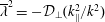 $\overline{\unicode[STIX]{x1D706}}^{2}=-{\mathcal{D}}_{\bot }(k_{\Vert }^{2}/k^{2})$
. These modes are the strongly magnetised limit of the plasma oscillations; in gyrokinetics, they are known as the
$\overline{\unicode[STIX]{x1D706}}^{2}=-{\mathcal{D}}_{\bot }(k_{\Vert }^{2}/k^{2})$
. These modes are the strongly magnetised limit of the plasma oscillations; in gyrokinetics, they are known as the $\unicode[STIX]{x1D714}_{\text{H}}$
modes. For the remaining balances, which involve
$\unicode[STIX]{x1D714}_{\text{H}}$
modes. For the remaining balances, which involve $\unicode[STIX]{x1D707}^{0}$
, use a subsidiary ordering with respect to small
$\unicode[STIX]{x1D707}^{0}$
, use a subsidiary ordering with respect to small $\overline{k}_{\Vert }$
. The 6–4 balance gives
$\overline{k}_{\Vert }$
. The 6–4 balance gives $\overline{\unicode[STIX]{x1D706}}^{2}=-1$
, the ion cyclotron wave. The 4–2 balance gives
$\overline{\unicode[STIX]{x1D706}}^{2}=-1$
, the ion cyclotron wave. The 4–2 balance gives $\overline{\unicode[STIX]{x1D706}}^{2}=-(10/3)\overline{k}_{\Vert }^{2}$
. These are the ion sound waves, but with a thermodynamic coefficient that differs from the value of 1 that follows from collisionless kinetic theory. The issue here is the same one that was raised in the discussion of the incorrect thermal correction to the unmagnetised plasma oscillations (F 12); the Braginskii equations are correct only for the collisional limit
$\overline{\unicode[STIX]{x1D706}}^{2}=-(10/3)\overline{k}_{\Vert }^{2}$
. These are the ion sound waves, but with a thermodynamic coefficient that differs from the value of 1 that follows from collisionless kinetic theory. The issue here is the same one that was raised in the discussion of the incorrect thermal correction to the unmagnetised plasma oscillations (F 12); the Braginskii equations are correct only for the collisional limit $\unicode[STIX]{x1D714}\ll \unicode[STIX]{x1D708}$
.
$\unicode[STIX]{x1D714}\ll \unicode[STIX]{x1D708}$
.
F.3.2 Magnetized eigenvalues for purely perpendicular propagation with no dissipation
For purely perpendicular propagation, the characteristic polynomial derived from (F 25) changes to ${\mathcal{D}}_{\bot }\unicode[STIX]{x1D707}\,\overline{\unicode[STIX]{x1D706}}^{6}+\unicode[STIX]{x1D707}\,\overline{\unicode[STIX]{x1D706}}^{8}+\unicode[STIX]{x1D707}^{3}\overline{\unicode[STIX]{x1D706}}^{10}=0$
. The sound waves have disappeared; four vanishing eigenvalues will be resolved by dissipation. Furthermore, the 8–6 balance is now changed to
${\mathcal{D}}_{\bot }\unicode[STIX]{x1D707}\,\overline{\unicode[STIX]{x1D706}}^{6}+\unicode[STIX]{x1D707}\,\overline{\unicode[STIX]{x1D706}}^{8}+\unicode[STIX]{x1D707}^{3}\overline{\unicode[STIX]{x1D706}}^{10}=0$
. The sound waves have disappeared; four vanishing eigenvalues will be resolved by dissipation. Furthermore, the 8–6 balance is now changed to $\overline{\unicode[STIX]{x1D706}}^{2}=-{\mathcal{D}}_{\bot }$
(the order of the limits
$\overline{\unicode[STIX]{x1D706}}^{2}=-{\mathcal{D}}_{\bot }$
(the order of the limits $\unicode[STIX]{x1D707}\rightarrow 0$
and
$\unicode[STIX]{x1D707}\rightarrow 0$
and $\overline{k}_{\Vert }\rightarrow 0$
matters), or in dimensional variables
$\overline{k}_{\Vert }\rightarrow 0$
matters), or in dimensional variables $\unicode[STIX]{x1D714}^{2}=\unicode[STIX]{x1D714}_{\text{p}i}^{2}$
; this is the low-density limit of the lower-hybrid waves.
$\unicode[STIX]{x1D714}^{2}=\unicode[STIX]{x1D714}_{\text{p}i}^{2}$
; this is the low-density limit of the lower-hybrid waves.
F.3.3 Magnetized eigenvalues for purely perpendicular propagation with dissipation
With all terms included, one finds $\unicode[STIX]{x1D646}=(\unicode[STIX]{x1D646}_{10\times 4}^{(1\ldots 4)},\,\unicode[STIX]{x1D646}_{10\times 2}^{(5,6)},\,\unicode[STIX]{x1D646}_{10\times 4}^{(7\ldots 10)})$
, where
$\unicode[STIX]{x1D646}=(\unicode[STIX]{x1D646}_{10\times 4}^{(1\ldots 4)},\,\unicode[STIX]{x1D646}_{10\times 2}^{(5,6)},\,\unicode[STIX]{x1D646}_{10\times 4}^{(7\ldots 10)})$
, where
 $$\begin{eqnarray}\displaystyle & & \displaystyle \hspace{-12.0pt}\unicode[STIX]{x1D646}^{(1\ldots 4)}\doteq \nonumber\\ \displaystyle & & \displaystyle \hspace{-12.0pt}\left[\begin{array}{@{}cccc@{}}-\overline{\unicode[STIX]{x1D706}} & 0 & -1 & 0\\ 0 & -\overline{\unicode[STIX]{x1D706}} & 0 & -1\\ \widehat{E}_{\Vert }+\overline{k}_{\Vert }^{2} & -\widehat{E}_{\Vert } & -\unicode[STIX]{x1D707}(\overline{\unicode[STIX]{x1D706}}+\unicode[STIX]{x1D6FC}\overline{\unicode[STIX]{x1D708}}_{e}+\textstyle \frac{4}{3}\overline{\unicode[STIX]{x1D6F4}}_{0\Vert e}^{u}+\overline{\unicode[STIX]{x1D6F4}}_{2\bot e}^{u}) & \unicode[STIX]{x1D707}\unicode[STIX]{x1D6FC}\overline{\unicode[STIX]{x1D708}}_{e}\\ -\widehat{E}_{\Vert } & \widehat{E}_{\Vert }+\unicode[STIX]{x1D70F}\overline{k}_{\Vert }^{2} & \unicode[STIX]{x1D6FC}\overline{\unicode[STIX]{x1D708}}_{i} & -(\overline{\unicode[STIX]{x1D706}}+\unicode[STIX]{x1D6FC}\overline{\unicode[STIX]{x1D708}}_{i}+\textstyle \frac{4}{3}\overline{\unicode[STIX]{x1D6F4}}_{0\Vert i}^{u}+\overline{\unicode[STIX]{x1D6F4}}_{2\bot i})\\ \widehat{E}_{\bot }+\overline{k}_{\bot }^{2} & -\widehat{E}_{\bot } & \unicode[STIX]{x1D707}(\textstyle \frac{2}{3}\overline{\unicode[STIX]{x1D6F4}}_{0\bot e}^{u}-\overline{\unicode[STIX]{x1D6F4}}_{2\bot e}^{u}) & 0\\ -\widehat{E}_{\bot } & \widehat{E}_{\bot }+\unicode[STIX]{x1D70F}\overline{k}_{\bot }^{2} & 0 & \textstyle \frac{2}{3}\overline{\unicode[STIX]{x1D6F4}}_{0\bot i}^{u}-\overline{\unicode[STIX]{x1D6F4}}_{2\bot i}^{u}\\ 0 & 0 & 0 & 0\\ 0 & 0 & 0 & 0\\ 0 & 0 & -\textstyle \frac{2}{3}(1+\unicode[STIX]{x1D6FD}) & \textstyle \frac{2}{3}\unicode[STIX]{x1D6FD}\\ 0 & 0 & 0 & -\textstyle \frac{2}{3}\end{array}\right],\nonumber\\ \displaystyle & & \displaystyle\end{eqnarray}$$
 $$\begin{eqnarray}\displaystyle & & \displaystyle \unicode[STIX]{x1D646}^{(5,6)}\doteq \nonumber\\ \displaystyle & & \displaystyle \left[\begin{array}{@{}cc@{}}-1 & 0\\ 0 & -1\\ \unicode[STIX]{x1D707}(\textstyle \frac{2}{3}\overline{\unicode[STIX]{x1D6F4}}_{0\Vert e}^{u}-\overline{\unicode[STIX]{x1D6F4}}_{2\Vert e}^{u}) & 0\\ 0 & \textstyle \frac{2}{3}\overline{\unicode[STIX]{x1D6F4}}_{0\Vert i}^{u}-\overline{\unicode[STIX]{x1D6F4}}_{2\Vert i}^{u}\\ -\unicode[STIX]{x1D707}(\overline{\unicode[STIX]{x1D706}}+\overline{\unicode[STIX]{x1D708}}_{e}+{\textstyle \frac{1}{3}}\overline{\unicode[STIX]{x1D6F4}}_{0\bot e}^{u}+\overline{\unicode[STIX]{x1D6F4}}_{1\bot e}^{u}+\overline{\unicode[STIX]{x1D6F4}}_{2\Vert e}^{u}) & \unicode[STIX]{x1D707}\overline{\unicode[STIX]{x1D708}}_{e}\\ \overline{\unicode[STIX]{x1D708}}_{i} & -(\overline{\unicode[STIX]{x1D706}}+\overline{\unicode[STIX]{x1D708}}_{i}+{\textstyle \frac{1}{3}}\overline{\unicode[STIX]{x1D6F4}}_{0\bot i}^{u}+\overline{\unicode[STIX]{x1D6F4}}_{1\bot i}^{u}+\overline{\unicode[STIX]{x1D6F4}}_{2\Vert i}^{u})\\ 1 & 0\\ 0 & -1\\ -\textstyle \frac{2}{3} & 0\\ 0 & -\textstyle \frac{2}{3}\end{array}\right],\nonumber\\ \displaystyle & & \displaystyle\end{eqnarray}$$
 $$\begin{eqnarray}\displaystyle & & \displaystyle \unicode[STIX]{x1D646}^{(7\ldots 10)}\doteq \left[\begin{array}{@{}cccc@{}}0 & 0 & 0 & 0\\ 0 & 0 & 0 & 0\\ 0 & 0 & (1+\unicode[STIX]{x1D6FD})\overline{k}_{\Vert }^{2} & 0\\ 0 & 0 & -\unicode[STIX]{x1D6FD}\overline{k}_{\Vert }^{2} & \unicode[STIX]{x1D70F}\overline{k}_{\Vert }^{2}\\ -1 & 0 & \overline{k}_{\bot }^{2} & 0\\ 0 & 1 & 0 & \unicode[STIX]{x1D70F}\overline{k}_{\bot }^{2}\\ -\unicode[STIX]{x1D707}(\unicode[STIX]{x1D706}+\overline{\unicode[STIX]{x1D708}}_{e}) & \unicode[STIX]{x1D707}\overline{\unicode[STIX]{x1D708}}_{e} & \textstyle \frac{3}{2}\overline{k}_{\bot }^{2}\unicode[STIX]{x1D707}\overline{\unicode[STIX]{x1D708}}_{e} & 0\\ \overline{\unicode[STIX]{x1D708}}_{i} & -(\unicode[STIX]{x1D706}+\overline{\unicode[STIX]{x1D708}}_{i}) & 0 & -\textstyle \frac{3}{2}\overline{k}_{\bot }^{2}\unicode[STIX]{x1D707}\overline{\unicode[STIX]{x1D708}}_{e}\\ \unicode[STIX]{x1D707}\overline{\unicode[STIX]{x1D708}}_{e} & -\unicode[STIX]{x1D707}\overline{\unicode[STIX]{x1D708}}_{e} & -(\overline{\unicode[STIX]{x1D706}}+\overline{\unicode[STIX]{x1D6FE}}+\overline{\unicode[STIX]{x1D6F4}}_{e}^{\text{T}}) & \overline{\unicode[STIX]{x1D6FE}}\\ 0 & 0 & \overline{\unicode[STIX]{x1D6FE}} & -(\overline{\unicode[STIX]{x1D706}}+\overline{\unicode[STIX]{x1D6FE}}+\overline{\unicode[STIX]{x1D6F4}}_{i}^{\text{T}})\end{array}\right].\end{eqnarray}$$
Here $\unicode[STIX]{x1D708}_{e}\equiv \unicode[STIX]{x1D708}_{ei}=\unicode[STIX]{x1D70F}_{e}^{-1}$
and
$\unicode[STIX]{x1D708}_{e}\equiv \unicode[STIX]{x1D708}_{ei}=\unicode[STIX]{x1D70F}_{e}^{-1}$
and $\unicode[STIX]{x1D708}_{i}\equiv \unicode[STIX]{x1D708}_{ie}=\unicode[STIX]{x1D707}\unicode[STIX]{x1D708}_{e}$
; overlines denote normalizations with respect to
$\unicode[STIX]{x1D708}_{i}\equiv \unicode[STIX]{x1D708}_{ie}=\unicode[STIX]{x1D707}\unicode[STIX]{x1D708}_{e}$
; overlines denote normalizations with respect to $\unicode[STIX]{x1D714}_{\text{c}i}$
;
$\unicode[STIX]{x1D714}_{\text{c}i}$
; $\overline{\unicode[STIX]{x1D6F4}}^{u}$
denotes quantities related to the stress tensor, with the numerical subscripts following Braginskii’s notation (appendix E) and
$\overline{\unicode[STIX]{x1D6F4}}^{u}$
denotes quantities related to the stress tensor, with the numerical subscripts following Braginskii’s notation (appendix E) and $\Vert$
or
$\Vert$
or $\bot$
denoting
$\bot$
denoting $k_{\Vert }^{2}$
or
$k_{\Vert }^{2}$
or $k_{\bot }^{2}$
, e.g.
$k_{\bot }^{2}$
, e.g. $\overline{\unicode[STIX]{x1D6F4}}_{2\bot e}^{u}\doteq k_{\bot }^{2}\unicode[STIX]{x1D707}_{2e}/\unicode[STIX]{x1D714}_{\text{c}i}$
(distinguish the mass ratio
$\overline{\unicode[STIX]{x1D6F4}}_{2\bot e}^{u}\doteq k_{\bot }^{2}\unicode[STIX]{x1D707}_{2e}/\unicode[STIX]{x1D714}_{\text{c}i}$
(distinguish the mass ratio $\unicode[STIX]{x1D707}$
, which is unsubscripted, from the classical viscosities
$\unicode[STIX]{x1D707}$
, which is unsubscripted, from the classical viscosities $\unicode[STIX]{x1D707}_{ps}$
, which are subscripted);
$\unicode[STIX]{x1D707}_{ps}$
, which are subscripted); $\overline{\unicode[STIX]{x1D6F4}}^{\text{T}}$
denotes the full thermal-diffusion coefficient (e.g.
$\overline{\unicode[STIX]{x1D6F4}}^{\text{T}}$
denotes the full thermal-diffusion coefficient (e.g. $\overline{\unicode[STIX]{x1D6F4}}_{e}^{\text{T}}\doteq (2/3)(k_{\Vert }^{2}\unicode[STIX]{x1D705}_{\Vert e}+k_{\bot }^{2}\unicode[STIX]{x1D705}_{\bot e})/\unicode[STIX]{x1D714}_{\text{c}i}$
); and
$\overline{\unicode[STIX]{x1D6F4}}_{e}^{\text{T}}\doteq (2/3)(k_{\Vert }^{2}\unicode[STIX]{x1D705}_{\Vert e}+k_{\bot }^{2}\unicode[STIX]{x1D705}_{\bot e})/\unicode[STIX]{x1D714}_{\text{c}i}$
); and $\overline{\unicode[STIX]{x1D6FE}}\doteq 2\overline{\unicode[STIX]{x1D708}}_{i}$
.
$\overline{\unicode[STIX]{x1D6FE}}\doteq 2\overline{\unicode[STIX]{x1D708}}_{i}$
.
The general dispersion relation for arbitrary $k_{\Vert }/k_{\bot }$
is complicated, even in the hydrodynamic limit, and will not be discussed here. The case of purely perpendicular propagation, however, is analytically tractable. With
$k_{\Vert }/k_{\bot }$
is complicated, even in the hydrodynamic limit, and will not be discussed here. The case of purely perpendicular propagation, however, is analytically tractable. With $k_{\Vert }=0$
, small
$k_{\Vert }=0$
, small $\unicode[STIX]{x1D707}$
, and large
$\unicode[STIX]{x1D707}$
, and large $D_{\bot }$
, one finds that the characteristic polynomial is dominantly
$D_{\bot }$
, one finds that the characteristic polynomial is dominantly
 $$\begin{eqnarray}\displaystyle & & \displaystyle 2\unicode[STIX]{x1D6FF}^{3}\unicode[STIX]{x1D6FC}{\mathcal{D}}_{\bot }\unicode[STIX]{x1D716}^{3}\overline{\unicode[STIX]{x1D6F4}}_{2\bot i}^{u}(\overline{\unicode[STIX]{x1D6F4}}_{e}^{\text{T}}+\overline{\unicode[STIX]{x1D6F4}}_{i}^{\text{T}})\overline{k}_{\bot }^{2}(1+\unicode[STIX]{x1D70F})\overline{\unicode[STIX]{x1D706}}+2\unicode[STIX]{x1D6FF}^{2}\unicode[STIX]{x1D6FC}{\mathcal{D}}_{\bot }\unicode[STIX]{x1D716}^{2}\overline{\unicode[STIX]{x1D6F4}}_{2\bot i}^{u}(\overline{\unicode[STIX]{x1D6F4}}_{e}^{\text{T}}+\overline{\unicode[STIX]{x1D6F4}}_{i}^{\text{T}})\overline{\unicode[STIX]{x1D706}}^{2}\nonumber\\ \displaystyle & & \displaystyle \quad +\,2\unicode[STIX]{x1D6FF}\unicode[STIX]{x1D6FC}{\mathcal{D}}_{\bot }\unicode[STIX]{x1D716}^{2}(2\overline{\unicode[STIX]{x1D6F4}}_{2\bot i}^{u}+\overline{\unicode[STIX]{x1D6F4}}_{e}^{\text{T}}+\overline{\unicode[STIX]{x1D6F4}}_{i}^{\text{T}})\overline{\unicode[STIX]{x1D706}}^{3}+4\unicode[STIX]{x1D6FC}{\mathcal{D}}_{\bot }\unicode[STIX]{x1D716}^{2}\overline{\unicode[STIX]{x1D706}}^{4}\nonumber\\ \displaystyle & & \displaystyle \quad +\,\unicode[STIX]{x1D6FC}{\mathcal{D}}_{\bot }\unicode[STIX]{x1D716}\overline{\unicode[STIX]{x1D706}}^{5}+{\mathcal{D}}_{\bot }\unicode[STIX]{x1D707}\overline{\unicode[STIX]{x1D706}}^{6}+\unicode[STIX]{x1D6FC}\unicode[STIX]{x1D716}\overline{\unicode[STIX]{x1D706}}^{7}+\unicode[STIX]{x1D707}\overline{\unicode[STIX]{x1D706}}^{8}+(2+\unicode[STIX]{x1D6FC})\unicode[STIX]{x1D707}^{2}\unicode[STIX]{x1D716}\overline{\unicode[STIX]{x1D706}}^{9}+\unicode[STIX]{x1D707}^{3}\overline{\unicode[STIX]{x1D706}}^{10},\end{eqnarray}$$
where I have inserted the hydrodynamic ordering parameter $\unicode[STIX]{x1D6FF}$
to explicitly remind one of the order of the transport termsFootnote
64
in
$\unicode[STIX]{x1D6FF}$
to explicitly remind one of the order of the transport termsFootnote
64
in $\overline{k}_{\bot }^{2}$
. One eigenvalue vanishes; that is resolved by viscous dissipation for small but non-zero
$\overline{k}_{\bot }^{2}$
. One eigenvalue vanishes; that is resolved by viscous dissipation for small but non-zero $k_{\Vert }$
.
$k_{\Vert }$
.
As stated above, the proper order of limits is $\lim _{\unicode[STIX]{x1D707}\rightarrow 0}\lim _{\unicode[STIX]{x1D6FF}\rightarrow 0}$
. With respect to
$\lim _{\unicode[STIX]{x1D707}\rightarrow 0}\lim _{\unicode[STIX]{x1D6FF}\rightarrow 0}$
. With respect to $\unicode[STIX]{x1D6FF}$
, the dominant balances are to set to zero either the first two lines of (F 27d
) (balances A) or the last term of the second line plus the last line (balances B). For the A balances, all of the terms fall on a line in a
$\unicode[STIX]{x1D6FF}$
, the dominant balances are to set to zero either the first two lines of (F 27d
) (balances A) or the last term of the second line plus the last line (balances B). For the A balances, all of the terms fall on a line in a $\unicode[STIX]{x1D6FF}$
-ordered Kruskal diagram, so there is no asymptotic simplification for small
$\unicode[STIX]{x1D6FF}$
-ordered Kruskal diagram, so there is no asymptotic simplification for small $\unicode[STIX]{x1D6FF}$
. After one factors out
$\unicode[STIX]{x1D6FF}$
. After one factors out $2\unicode[STIX]{x1D6FC}{\mathcal{D}}_{\bot }\unicode[STIX]{x1D716}^{2}$
and sets
$2\unicode[STIX]{x1D6FC}{\mathcal{D}}_{\bot }\unicode[STIX]{x1D716}^{2}$
and sets $\unicode[STIX]{x1D6FF}=1$
, the A balances become
$\unicode[STIX]{x1D6FF}=1$
, the A balances become
 $$\begin{eqnarray}\displaystyle \unicode[STIX]{x1D716}\overline{\unicode[STIX]{x1D6F4}}_{2\bot i}^{u}(\overline{\unicode[STIX]{x1D6F4}}_{e}^{\text{T}}+\overline{\unicode[STIX]{x1D6F4}}_{i}^{\text{T}})\overline{k}_{\bot }^{2}(1+\unicode[STIX]{x1D70F})\overline{\unicode[STIX]{x1D706}}+\overline{\unicode[STIX]{x1D6F4}}_{2\bot i}^{u}(\overline{\unicode[STIX]{x1D6F4}}_{e}^{\text{T}}+\overline{\unicode[STIX]{x1D6F4}}_{i}^{\text{T}})\overline{\unicode[STIX]{x1D706}}^{2}+(2\overline{\unicode[STIX]{x1D6F4}}_{2\bot i}^{u}+\overline{\unicode[STIX]{x1D6F4}}_{e}^{\text{T}}+\overline{\unicode[STIX]{x1D6F4}}_{i}^{\text{T}})\overline{\unicode[STIX]{x1D706}}^{3}+2\overline{\unicode[STIX]{x1D706}}^{4}=0. & & \displaystyle \nonumber\\ \displaystyle & & \displaystyle\end{eqnarray}$$
With respect to $\unicode[STIX]{x1D716}$
, the dominant balances are 2–1 and 4–3–2. The 2–1 balance is
$\unicode[STIX]{x1D716}$
, the dominant balances are 2–1 and 4–3–2. The 2–1 balance is
 $$\begin{eqnarray}\displaystyle \overline{\unicode[STIX]{x1D706}}=-(1+\unicode[STIX]{x1D70F})\overline{k}_{\bot }^{2}\unicode[STIX]{x1D716}\quad \text{or}~\unicode[STIX]{x1D706}=-(1+\unicode[STIX]{x1D70F})k_{\bot }^{2}D_{\bot }, & & \displaystyle\end{eqnarray}$$
where $D_{\bot }\doteq \unicode[STIX]{x1D70C}_{i}^{2}\unicode[STIX]{x1D708}_{i}=\unicode[STIX]{x1D70C}_{e}^{2}\unicode[STIX]{x1D708}_{e}$
; this is the ambipolar cross-field density-diffusion mode. The 4–3–2 balance factors into
$D_{\bot }\doteq \unicode[STIX]{x1D70C}_{i}^{2}\unicode[STIX]{x1D708}_{i}=\unicode[STIX]{x1D70C}_{e}^{2}\unicode[STIX]{x1D708}_{e}$
; this is the ambipolar cross-field density-diffusion mode. The 4–3–2 balance factors into
 $$\begin{eqnarray}\displaystyle (\overline{\unicode[STIX]{x1D706}}+\overline{\unicode[STIX]{x1D6F4}}_{2\bot i}^{u})[\overline{\unicode[STIX]{x1D706}}+\textstyle \frac{1}{2}(\overline{\unicode[STIX]{x1D6F4}}_{e}^{\text{T}}+\overline{\unicode[STIX]{x1D6F4}}_{i}^{\text{T}})]=0, & & \displaystyle\end{eqnarray}$$
yielding a momentum-diffusion mode and a thermal-diffusion mode.
The B balances do not involve $\unicode[STIX]{x1D6FF}$
, so one is free to consider balances with respect to
$\unicode[STIX]{x1D6FF}$
, so one is free to consider balances with respect to $\unicode[STIX]{x1D707}$
. Upon factoring out
$\unicode[STIX]{x1D707}$
. Upon factoring out $\overline{\unicode[STIX]{x1D706}}^{4}$
and replacing
$\overline{\unicode[STIX]{x1D706}}^{4}$
and replacing $\unicode[STIX]{x1D716}=\unicode[STIX]{x1D707}\overline{\unicode[STIX]{x1D716}}$
, one has
$\unicode[STIX]{x1D716}=\unicode[STIX]{x1D707}\overline{\unicode[STIX]{x1D716}}$
, one has
 $$\begin{eqnarray}\displaystyle 4\unicode[STIX]{x1D6FC}{\mathcal{D}}_{\bot }\unicode[STIX]{x1D707}^{2}\overline{\unicode[STIX]{x1D716}}^{2}+\unicode[STIX]{x1D6FC}{\mathcal{D}}_{\bot }\unicode[STIX]{x1D707}\overline{\unicode[STIX]{x1D716}}\overline{\unicode[STIX]{x1D706}}+{\mathcal{D}}_{\bot }\unicode[STIX]{x1D707}\overline{\unicode[STIX]{x1D706}}^{2}+\unicode[STIX]{x1D6FC}\unicode[STIX]{x1D707}\overline{\unicode[STIX]{x1D716}}\overline{\unicode[STIX]{x1D706}}^{3}+\unicode[STIX]{x1D707}\overline{\unicode[STIX]{x1D706}}^{4}+(2+\unicode[STIX]{x1D6FC})\unicode[STIX]{x1D707}^{3}\overline{\unicode[STIX]{x1D716}}\overline{\unicode[STIX]{x1D706}}^{5}+\unicode[STIX]{x1D707}^{3}\overline{\unicode[STIX]{x1D706}}^{6}=0,\quad & & \displaystyle\end{eqnarray}$$
which contains the balances 1–0, 4–3–2–1, and 6–4. The 1–0 balance yields
 $$\begin{eqnarray}\displaystyle \overline{\unicode[STIX]{x1D706}}=-4\unicode[STIX]{x1D707}\overline{\unicode[STIX]{x1D716}}=-4\unicode[STIX]{x1D716}\quad \text{or}~\unicode[STIX]{x1D706}=-4\unicode[STIX]{x1D708}_{i}; & & \displaystyle\end{eqnarray}$$
this is an interspecies heat-relaxation mode. The 4–3–2–1 balance can be further ordered with respect to large ${\mathcal{D}}_{\bot }$
, yielding (i) the 2–1 balance
${\mathcal{D}}_{\bot }$
, yielding (i) the 2–1 balance
 $$\begin{eqnarray}\displaystyle \overline{\unicode[STIX]{x1D706}}=-\unicode[STIX]{x1D6FC}\overline{\unicode[STIX]{x1D716}}\quad \text{or}~\unicode[STIX]{x1D706}=-\unicode[STIX]{x1D6FC}\unicode[STIX]{x1D708}_{e}, & & \displaystyle\end{eqnarray}$$
which is an interspecies momentum-relaxation mode; and (ii) the 4–2 balance
 $$\begin{eqnarray}\displaystyle \overline{\unicode[STIX]{x1D706}}^{2}=-{\mathcal{D}}_{\bot }\quad \text{or}~\unicode[STIX]{x1D706}^{2}=-\unicode[STIX]{x1D714}_{\text{p}i}^{2}, & & \displaystyle\end{eqnarray}$$
the lower-hybrid waves. Finally, the 6–4 balance yields
 $$\begin{eqnarray}\displaystyle \overline{\unicode[STIX]{x1D706}}^{2}=-\unicode[STIX]{x1D707}^{-2}\quad \text{or}~\unicode[STIX]{x1D706}^{2}=-\unicode[STIX]{x1D714}_{\text{c}e}^{2}, & & \displaystyle\end{eqnarray}$$
the upper-hybrid waves.
For the particular orderings I chose, the eigenmodes obtained for perpendicular propagation are physically reasonable; clearly, though, other orderings will lead to different results. In the general case, numerical work is essential. But the analytical exploration of the linearized Braginskii equations provides a good example of several important lessons from asymptotic analysis, namely that the order of limits can matter and that dominant balances in polynomial equations can be usefully analysed in terms of Kruskal diagrams.
Finally, I emphasize that not all of the Braginskii eigenmodes are hydrodynamic (i.e. some modes such as the Langmuir oscillations do not vanish with $k$
). In a projection-operator formalism, such non-hydrodynamic modes must be treated with care. See appendix G, especially § G.2, for more discussion.
$k$
). In a projection-operator formalism, such non-hydrodynamic modes must be treated with care. See appendix G, especially § G.2, for more discussion.
Appendix G. Projection operators: caveats and further examples
As shown in the main text, an appropriate choice of projection operator leads to a systematic derivation of multispecies transport theory, at least to first order in the gradients. (See Part 2 for a discussion of second-order effects.) However, although the projection method is quite powerful, it can be misused, as I shall show in §§ G.1–G.3 with several simple examples. Finally, in § G.4 I shall discuss the Brownian test particle in terms of two possible projections. In this case, there is no misuse of the formalism; both projections are viable. Understanding why that is so, in the face of the caveats discussed in the next three subsections, should lead one to a deeper appreciation for the overall content and consistency of the formalism.
G.1 Projection-operator methods and non-locality
In a 2-D vector space with basis vectors $\boldsymbol{e}_{x}\doteq (1,\;0)^{\text{T}}$
and
$\boldsymbol{e}_{x}\doteq (1,\;0)^{\text{T}}$
and $\boldsymbol{e}_{y}\doteq (0,\;1)^{\text{T}}$
, let
$\boldsymbol{e}_{y}\doteq (0,\;1)^{\text{T}}$
, let $\unicode[STIX]{x1D74D}\doteq (\unicode[STIX]{x1D713}_{x},\;\unicode[STIX]{x1D713}_{y})^{\text{T}}$
obey
$\unicode[STIX]{x1D74D}\doteq (\unicode[STIX]{x1D713}_{x},\;\unicode[STIX]{x1D713}_{y})^{\text{T}}$
obey
 $$\begin{eqnarray}\displaystyle \unicode[STIX]{x2202}_{t}\unicode[STIX]{x1D74D}+\text{i}\unicode[STIX]{x1D647}\boldsymbol{\cdot }\unicode[STIX]{x1D74D}=0, & & \displaystyle\end{eqnarray}$$
where
 $$\begin{eqnarray}\displaystyle \unicode[STIX]{x1D647}=\left(\begin{array}{@{}cc@{}}0 & \text{i}\\ -\text{i} & 0\end{array}\right). & & \displaystyle\end{eqnarray}$$
(Note that the eigenvalues of $\unicode[STIX]{x1D647}$
are
$\unicode[STIX]{x1D647}$
are $\pm 1$
, indicating oscillation.) The resulting dynamical system is
$\pm 1$
, indicating oscillation.) The resulting dynamical system is
 $$\begin{eqnarray}\displaystyle \dot{\unicode[STIX]{x1D713}}_{x}=\unicode[STIX]{x1D713}_{y},\quad \dot{\unicode[STIX]{x1D713}}_{y}=-\unicode[STIX]{x1D713}_{x}. & & \displaystyle\end{eqnarray}$$
These can be combined into the wave equation
 $$\begin{eqnarray}\displaystyle \ddot{\unicode[STIX]{x1D713}}_{x}+\unicode[STIX]{x1D713}_{x}=0, & & \displaystyle\end{eqnarray}$$
so the variables oscillate sinusoidally with unit frequency.
Let us try to recover (G 4) by projecting (G 1) into the $x$
direction. That can be accomplished by introducing the projection operator
$x$
direction. That can be accomplished by introducing the projection operator
 $$\begin{eqnarray}\displaystyle \unicode[STIX]{x1D64B}\doteq \boldsymbol{e}_{x}\otimes \boldsymbol{e}_{x}^{\text{T}}=\left(\begin{array}{@{}cc@{}}1 & 0\\ 0 & 0\end{array}\right). & & \displaystyle\end{eqnarray}$$
The standard equations apply:
 $$\begin{eqnarray}\displaystyle & \displaystyle \unicode[STIX]{x2202}_{t}\unicode[STIX]{x1D64B}\boldsymbol{\cdot }\unicode[STIX]{x1D74D}+(\unicode[STIX]{x1D64B}\boldsymbol{\cdot }\text{i}\unicode[STIX]{x1D647}\boldsymbol{\cdot }\unicode[STIX]{x1D64B})\unicode[STIX]{x1D64B}\boldsymbol{\cdot }\unicode[STIX]{x1D74D}=-(\unicode[STIX]{x1D64B}\boldsymbol{\cdot }\text{i}\unicode[STIX]{x1D647}\boldsymbol{\cdot }\unicode[STIX]{x1D64C})\boldsymbol{\cdot }\unicode[STIX]{x1D64C}\boldsymbol{\cdot }\unicode[STIX]{x1D74D}, & \displaystyle\end{eqnarray}$$
 $$\begin{eqnarray}\displaystyle & \displaystyle \unicode[STIX]{x2202}_{t}\unicode[STIX]{x1D64C}\boldsymbol{\cdot }\unicode[STIX]{x1D74D}+(\unicode[STIX]{x1D64C}\boldsymbol{\cdot }\text{i}\unicode[STIX]{x1D647}\boldsymbol{\cdot }\unicode[STIX]{x1D64C})\boldsymbol{\cdot }\unicode[STIX]{x1D64C}\boldsymbol{\cdot }\unicode[STIX]{x1D74D}=-(\unicode[STIX]{x1D64C}\boldsymbol{\cdot }\text{i}\unicode[STIX]{x1D647}\boldsymbol{\cdot }\unicode[STIX]{x1D64B})\boldsymbol{\cdot }\unicode[STIX]{x1D64B}\boldsymbol{\cdot }\unicode[STIX]{x1D74D}. & \displaystyle\end{eqnarray}$$ $\unicode[STIX]{x1D64B}\boldsymbol{\cdot }\unicode[STIX]{x1D647}\boldsymbol{\cdot }\unicode[STIX]{x1D64B}$
vanishes identically for the present problem, so in spite of its name it is unrelated to the natural oscillation. Furthermore, although the standard procedure is to eliminate
$\unicode[STIX]{x1D64B}\boldsymbol{\cdot }\unicode[STIX]{x1D647}\boldsymbol{\cdot }\unicode[STIX]{x1D64B}$
vanishes identically for the present problem, so in spite of its name it is unrelated to the natural oscillation. Furthermore, although the standard procedure is to eliminate $\unicode[STIX]{x1D64C}\boldsymbol{\cdot }\unicode[STIX]{x1D74D}$
by introducing Green’s function
$\unicode[STIX]{x1D64C}\boldsymbol{\cdot }\unicode[STIX]{x1D74D}$
by introducing Green’s function $\unicode[STIX]{x1D642}_{\unicode[STIX]{x1D64C}}(\unicode[STIX]{x1D70F})\doteq H(\unicode[STIX]{x1D70F})\exp (-\unicode[STIX]{x1D64C}\boldsymbol{\cdot }\text{i}\unicode[STIX]{x1D647}\boldsymbol{\cdot }\unicode[STIX]{x1D64C}\unicode[STIX]{x1D70F})$
, so
$\unicode[STIX]{x1D642}_{\unicode[STIX]{x1D64C}}(\unicode[STIX]{x1D70F})\doteq H(\unicode[STIX]{x1D70F})\exp (-\unicode[STIX]{x1D64C}\boldsymbol{\cdot }\text{i}\unicode[STIX]{x1D647}\boldsymbol{\cdot }\unicode[STIX]{x1D64C}\unicode[STIX]{x1D70F})$
, so  $$\begin{eqnarray}\displaystyle \unicode[STIX]{x1D64C}\boldsymbol{\cdot }\unicode[STIX]{x1D74D}(t)=-\int _{0}^{t}\!\text{d}\unicode[STIX]{x1D70F}\,\unicode[STIX]{x1D642}_{\unicode[STIX]{x1D64C}}(\unicode[STIX]{x1D70F})\boldsymbol{\cdot }\unicode[STIX]{x1D64C}\boldsymbol{\cdot }\text{i}\unicode[STIX]{x1D647}\boldsymbol{\cdot }\unicode[STIX]{x1D64B}\boldsymbol{\cdot }\unicode[STIX]{x1D74D}(t-\unicode[STIX]{x1D70F}), & & \displaystyle\end{eqnarray}$$
it is easy to show that in the present problem $\unicode[STIX]{x1D64C}\boldsymbol{\cdot }\unicode[STIX]{x1D647}\boldsymbol{\cdot }\unicode[STIX]{x1D64C}\equiv \unicode[STIX]{x1D7EC}$
. Thus,
$\unicode[STIX]{x1D64C}\boldsymbol{\cdot }\unicode[STIX]{x1D647}\boldsymbol{\cdot }\unicode[STIX]{x1D64C}\equiv \unicode[STIX]{x1D7EC}$
. Thus, $\unicode[STIX]{x1D642}_{\unicode[STIX]{x1D64C}}(\unicode[STIX]{x1D70F})$
does not decay in time, precluding the possibility of a Markovian description. Indeed, upon noting that
$\unicode[STIX]{x1D642}_{\unicode[STIX]{x1D64C}}(\unicode[STIX]{x1D70F})$
does not decay in time, precluding the possibility of a Markovian description. Indeed, upon noting that
 $$\begin{eqnarray}\displaystyle \unicode[STIX]{x1D64C}\boldsymbol{\cdot }\unicode[STIX]{x1D647}\boldsymbol{\cdot }\unicode[STIX]{x1D64B}=(\unicode[STIX]{x1D644}-\unicode[STIX]{x1D64B})\boldsymbol{\cdot }\unicode[STIX]{x1D647}\boldsymbol{\cdot }\unicode[STIX]{x1D64B}=\unicode[STIX]{x1D647}\boldsymbol{\cdot }\unicode[STIX]{x1D64B}=\left(\begin{array}{@{}cc@{}}0 & 0\\ -\text{i} & 0\end{array}\right), & & \displaystyle\end{eqnarray}$$
one finds that
 $$\begin{eqnarray}\displaystyle \unicode[STIX]{x1D64C}\boldsymbol{\cdot }\unicode[STIX]{x1D74D}(t)=-\int _{0}^{t}\!\text{d}\overline{t}\,\left(\begin{array}{@{}c@{}}0\\ \unicode[STIX]{x1D713}_{x}(\overline{t})\end{array}\right); & & \displaystyle\end{eqnarray}$$
then, with
 $$\begin{eqnarray}\displaystyle \unicode[STIX]{x1D64B}\boldsymbol{\cdot }\unicode[STIX]{x1D647}\boldsymbol{\cdot }\unicode[STIX]{x1D64C}=\unicode[STIX]{x1D64B}\boldsymbol{\cdot }\unicode[STIX]{x1D647}\boldsymbol{\cdot }(\unicode[STIX]{x1D644}-\unicode[STIX]{x1D64B})=\unicode[STIX]{x1D64B}\boldsymbol{\cdot }\unicode[STIX]{x1D647}=\left(\begin{array}{@{}cc@{}}0 & \text{i}\\ 0 & 0\end{array}\right), & & \displaystyle\end{eqnarray}$$
one finds that (G 6a ) becomes
 $$\begin{eqnarray}\displaystyle 0=\frac{\unicode[STIX]{x2202}}{\unicode[STIX]{x2202}t}\left(\begin{array}{@{}c@{}}\unicode[STIX]{x1D713}_{x}(t)\\ 0\end{array}\right)+\int _{0}^{t}\!\text{d}\overline{t}\,\left(\begin{array}{@{}c@{}}\unicode[STIX]{x1D713}_{x}(\overline{t})\\ 0\end{array}\right). & & \displaystyle\end{eqnarray}$$
The desired $x$
component can be extracted by dotting with
$x$
component can be extracted by dotting with $\boldsymbol{e}_{x}^{\text{T}}$
. Of course, the non-local integro-differential equation that results is equivalent to the second-order differential equation (G 4).
$\boldsymbol{e}_{x}^{\text{T}}$
. Of course, the non-local integro-differential equation that results is equivalent to the second-order differential equation (G 4).
This trivial example shows that it is not inevitable that a projected description must be time-local or Markovian. Note that the original vector system (G 1) of coupled ordinary differential equations (ODEs) is local in time; time-history integration is introduced as a consequence of the projection.Footnote
65
This is actually typical behaviour when the system supports linear waves. Very special conditions must hold in order that a projected system is Markovian. At least, what is required is that Green’s function $\text{G}_{\text{Q}}(\unicode[STIX]{x1D70F})$
(an operator) decays sufficiently rapidly in time when acting on the orthogonal subspace (as is required for (G 6b
)), a property that is related to the spectrum of
$\text{G}_{\text{Q}}(\unicode[STIX]{x1D70F})$
(an operator) decays sufficiently rapidly in time when acting on the orthogonal subspace (as is required for (G 6b
)), a property that is related to the spectrum of $\text{Q}\text{L}\text{Q}$
. Note that
$\text{Q}\text{L}\text{Q}$
. Note that $\text{Q}\text{L}\text{Q}$
will always possess a null space that is at least
$\text{Q}\text{L}\text{Q}$
will always possess a null space that is at least $p$
-dimensional, where
$p$
-dimensional, where $p$
is the dimension of the projected subspace, since
$p$
is the dimension of the projected subspace, since $(\text{Q}\text{L}\text{Q})\text{P}=0$
. But if it also possesses a zero or very small eigenvalue in the
$(\text{Q}\text{L}\text{Q})\text{P}=0$
. But if it also possesses a zero or very small eigenvalue in the $\text{Q}$
direction (as in the present example), some sort of non-locality must ensue. It is for this reason that for applications to fluid equations
$\text{Q}$
direction (as in the present example), some sort of non-locality must ensue. It is for this reason that for applications to fluid equations $\text{Q}$
is chosen to project into the directions orthogonal to the null space of the collision operator.Footnote
66
$\text{Q}$
is chosen to project into the directions orthogonal to the null space of the collision operator.Footnote
66
G.2 Projection operators and the dispersion relation of Langmuir oscillations
One of the wonderful yet dangerous features of the projection-operator formalism is that one can project onto virtually anything. For the case of collisional transport, the choice of projection operator is relatively obvious. In general, however, the formalism can be confusing because the zero-frequency limit is not allowed for high-frequency modes and because of the appearance of $\text{Q}$
in the relevant Green’s function.
$\text{Q}$
in the relevant Green’s function.
I remarked in § F.1 that the Braginskii equations predict an incorrect dispersion relation for the Langmuir oscillations $\unicode[STIX]{x1D714}=\unicode[STIX]{x1D6FA}_{\boldsymbol{k}}\approx \pm \unicode[STIX]{x1D714}_{\text{p}}$
as a consequence of a violation of the Markovian approximation by those high-frequency modes. Before the Markovian approximation is made, however, a projection-operator formalism must produce a formally correct result, no matter into what space the dynamics is projected. The proper dispersion relation, including both reactive and dissipative parts, must follow from a correct evaluation of the frequency-dependent
$\unicode[STIX]{x1D714}=\unicode[STIX]{x1D6FA}_{\boldsymbol{k}}\approx \pm \unicode[STIX]{x1D714}_{\text{p}}$
as a consequence of a violation of the Markovian approximation by those high-frequency modes. Before the Markovian approximation is made, however, a projection-operator formalism must produce a formally correct result, no matter into what space the dynamics is projected. The proper dispersion relation, including both reactive and dissipative parts, must follow from a correct evaluation of the frequency-dependent $\widehat{\unicode[STIX]{x1D72E}}(\unicode[STIX]{x1D714})$
. I shall demonstrate this by analysing the projection into the density subspace for the well-known model problem of linearized, collisionless Vlasov response. Note that for a high-frequency mode the null eigenspace of the collision operator is no longer relevant and cannot be used to motivate a useful projection operator. Projecting into the 1-D density subspace is the simplest operation that can be done, yet it demonstrates some non-trivial manipulations.
$\widehat{\unicode[STIX]{x1D72E}}(\unicode[STIX]{x1D714})$
. I shall demonstrate this by analysing the projection into the density subspace for the well-known model problem of linearized, collisionless Vlasov response. Note that for a high-frequency mode the null eigenspace of the collision operator is no longer relevant and cannot be used to motivate a useful projection operator. Projecting into the 1-D density subspace is the simplest operation that can be done, yet it demonstrates some non-trivial manipulations.
Thus, considerFootnote
67 $\text{P}=|1\!\rangle \langle \!1|$
and project the perturbed kinetic equation (2.12), assuming a collisionless electron plasma with neutralizing ion background. The frequency matrix involves the single matrix element
$\text{P}=|1\!\rangle \langle \!1|$
and project the perturbed kinetic equation (2.12), assuming a collisionless electron plasma with neutralizing ion background. The frequency matrix involves the single matrix element $\langle 1|\boldsymbol{v}|1\rangle =\mathbf{0}$
. The electric-field term vanishes under
$\langle 1|\boldsymbol{v}|1\rangle =\mathbf{0}$
. The electric-field term vanishes under $\text{P}$
because it is a perfect derivative in velocity space. Thus, the perturbed density evolves according to
$\text{P}$
because it is a perfect derivative in velocity space. Thus, the perturbed density evolves according to
 $$\begin{eqnarray}\displaystyle -\!\text{i}\unicode[STIX]{x1D714}\left(\frac{\unicode[STIX]{x0394}\widehat{n}(\boldsymbol{k},\unicode[STIX]{x1D714})}{n}\right)+\widehat{\unicode[STIX]{x1D6F4}}(\boldsymbol{k},\unicode[STIX]{x1D714})\left(1+\frac{1}{k^{2}\unicode[STIX]{x1D706}_{\text{D}e}^{2}}\right)\left(\frac{\unicode[STIX]{x0394}\widehat{n}(\boldsymbol{k},\unicode[STIX]{x1D714})}{n}\right)=\frac{\unicode[STIX]{x0394}n(0)}{n}, & & \displaystyle\end{eqnarray}$$
whereFootnote 68
 $$\begin{eqnarray}\displaystyle \widehat{\unicode[STIX]{x1D6F4}}(\boldsymbol{k},\unicode[STIX]{x1D714})\doteq \boldsymbol{k}\boldsymbol{\cdot }\langle \boldsymbol{v}\text{Q}|[-\text{i}(\unicode[STIX]{x1D714}\mathbf{1}-\text{Q}\boldsymbol{k}\boldsymbol{\cdot }\boldsymbol{v}\text{Q}+\text{i}\unicode[STIX]{x1D716}\mathbf{1})]^{-1}|\text{Q}\boldsymbol{v}\rangle \boldsymbol{\cdot }\boldsymbol{k}. & & \displaystyle\end{eqnarray}$$
The term in $(k\unicode[STIX]{x1D706}_{\text{D}e})^{-2}$
arises from the
$(k\unicode[STIX]{x1D706}_{\text{D}e})^{-2}$
arises from the $\text{Q}$
projection of the
$\text{Q}$
projection of the $\unicode[STIX]{x0394}\boldsymbol{E}$
term in (2.12) upon using Poisson’s equation to express
$\unicode[STIX]{x0394}\boldsymbol{E}$
term in (2.12) upon using Poisson’s equation to express $\unicode[STIX]{x0394}\boldsymbol{E}$
in terms of the electron charge density. In (G 13), the left-most and right-most
$\unicode[STIX]{x0394}\boldsymbol{E}$
in terms of the electron charge density. In (G 13), the left-most and right-most $\text{Q}$
operators may be omitted if desired because
$\text{Q}$
operators may be omitted if desired because $\text{Q}=\mathbf{1}-\text{P}$
,
$\text{Q}=\mathbf{1}-\text{P}$
, $\text{P}|\boldsymbol{v}\rangle =\mathbf{0}$
, and
$\text{P}|\boldsymbol{v}\rangle =\mathbf{0}$
, and $\langle \boldsymbol{v}|\text{P}=\mathbf{0}$
; for the same reason, it is sufficient to write
$\langle \boldsymbol{v}|\text{P}=\mathbf{0}$
; for the same reason, it is sufficient to write $\text{Q}\boldsymbol{k}\boldsymbol{\cdot }\boldsymbol{v}\text{Q}=\text{Q}\boldsymbol{k}\boldsymbol{\cdot }\boldsymbol{v}$
. The matrix element, a second-rank tensor, depends only on
$\text{Q}\boldsymbol{k}\boldsymbol{\cdot }\boldsymbol{v}\text{Q}=\text{Q}\boldsymbol{k}\boldsymbol{\cdot }\boldsymbol{v}$
. The matrix element, a second-rank tensor, depends only on $\boldsymbol{k}$
, so it must have the form
$\boldsymbol{k}$
, so it must have the form
 $$\begin{eqnarray}\displaystyle \langle \boldsymbol{v}|[-\text{i}(\unicode[STIX]{x1D714}\mathbf{1}-\text{Q}\boldsymbol{k}\boldsymbol{\cdot }\boldsymbol{v}\text{Q}+\text{i}\unicode[STIX]{x1D716}\mathbf{1})]^{-1}|\boldsymbol{v}\rangle =a(k)\widehat{\boldsymbol{k}}\widehat{\boldsymbol{k}}+b(k)(\unicode[STIX]{x1D644}-\widehat{\boldsymbol{k}}\widehat{\boldsymbol{k}}). & & \displaystyle\end{eqnarray}$$
Only the $\widehat{\boldsymbol{k}}\,\widehat{\boldsymbol{k}}$
term contributes to (G 13), so one must evaluate
$\widehat{\boldsymbol{k}}\,\widehat{\boldsymbol{k}}$
term contributes to (G 13), so one must evaluate
 $$\begin{eqnarray}\displaystyle \widehat{\unicode[STIX]{x1D6F4}}\doteq \langle \boldsymbol{k}\boldsymbol{\cdot }\boldsymbol{v}|[-\text{i}(\unicode[STIX]{x1D714}\mathbf{1}-\text{Q}\boldsymbol{k}\boldsymbol{\cdot }\boldsymbol{v}+\text{i}\unicode[STIX]{x1D716}\mathbf{1})^{-1}|\text{Q}\boldsymbol{k}\boldsymbol{\cdot }\boldsymbol{v}\rangle . & & \displaystyle\end{eqnarray}$$
Addition and subtraction of $\unicode[STIX]{x1D714}$
to the right-most ket leads to
$\unicode[STIX]{x1D714}$
to the right-most ket leads to
 $$\begin{eqnarray}\displaystyle \widehat{\unicode[STIX]{x1D6F4}}=-\text{i}\unicode[STIX]{x1D714}\langle \boldsymbol{k}\boldsymbol{\cdot }\boldsymbol{v}|(\unicode[STIX]{x1D714}\mathbf{1}-\text{Q}\boldsymbol{k}\boldsymbol{\cdot }\boldsymbol{v}+\text{i}\unicode[STIX]{x1D716}\mathbf{1})^{-1}\rangle . & & \displaystyle\end{eqnarray}$$
The term in angular brackets is similar, though not identical, to the integral that defines the electrostatic susceptibility:
 $$\begin{eqnarray}\displaystyle \unicode[STIX]{x1D712}(\boldsymbol{k},\unicode[STIX]{x1D714})\doteq -(k\unicode[STIX]{x1D706}_{\text{D}e})^{-2}J(\boldsymbol{k},\unicode[STIX]{x1D714}), & & \displaystyle\end{eqnarray}$$
where
 $$\begin{eqnarray}\displaystyle J(\boldsymbol{k},\unicode[STIX]{x1D714})\doteq \left\langle \frac{\boldsymbol{k}\boldsymbol{\cdot }\boldsymbol{v}}{\unicode[STIX]{x1D714}-\boldsymbol{k}\boldsymbol{\cdot }\boldsymbol{v}+\text{i}\unicode[STIX]{x1D716}}\right\rangle . & & \displaystyle\end{eqnarray}$$
To simplify (G 16), use $\text{Q}=\mathbf{1}-\text{P}$
and define the operators
$\text{Q}=\mathbf{1}-\text{P}$
and define the operators
 $$\begin{eqnarray}\displaystyle \text{A}\doteq (\unicode[STIX]{x1D714}-\boldsymbol{k}\boldsymbol{\cdot }\boldsymbol{v})\mathbf{1},\quad \text{B}\doteq \text{P}\boldsymbol{k}\boldsymbol{\cdot }\boldsymbol{v} & & \displaystyle\end{eqnarray}$$
so that
 $$\begin{eqnarray}\displaystyle J=\langle \text{BA}^{-1}\rangle . & & \displaystyle\end{eqnarray}$$
Then
 $$\begin{eqnarray}\displaystyle \widehat{\unicode[STIX]{x1D6F4}}/(-\text{i}\unicode[STIX]{x1D714})=\langle \text{B}(\text{A}+\text{B})^{-1}\rangle . & & \displaystyle\end{eqnarray}$$
With the aid of the operator identity (4.15), one finds $\widehat{\unicode[STIX]{x1D6F4}}=-\text{i}\unicode[STIX]{x1D714}I$
, where
$\widehat{\unicode[STIX]{x1D6F4}}=-\text{i}\unicode[STIX]{x1D714}I$
, where
 $$\begin{eqnarray}\displaystyle I\doteq \langle \text{B}(\text{A}+\text{B})^{-1}\rangle =\langle \text{B}\text{A}^{-1}\rangle -\langle \text{B}\text{A}^{-1}\text{B}(\text{A}+\text{B})^{-1}\rangle . & & \displaystyle\end{eqnarray}$$
Since $\text{B}=|1\rangle \langle \boldsymbol{k}\boldsymbol{\cdot }\boldsymbol{v}|$
, the last term factors:
$\text{B}=|1\rangle \langle \boldsymbol{k}\boldsymbol{\cdot }\boldsymbol{v}|$
, the last term factors:
 $$\begin{eqnarray}\displaystyle \langle \text{B}\text{A}^{-1}\text{B}(\text{A}+\text{B})^{-1}\rangle =\langle \text{B}\text{A}^{-1}\rangle \langle \text{B}(\text{A}+\text{B})^{-1}\rangle =JI. & & \displaystyle\end{eqnarray}$$
Thus, (G 22) becomes
 $$\begin{eqnarray}\displaystyle I=J-JI, & & \displaystyle\end{eqnarray}$$
the solution of which is
 $$\begin{eqnarray}\displaystyle I=J/(1+J). & & \displaystyle\end{eqnarray}$$
Upon defining the electrostatic dielectric function as
 $$\begin{eqnarray}\displaystyle {\mathcal{D}}(\boldsymbol{k},\unicode[STIX]{x1D714})\doteq 1+\unicode[STIX]{x1D712}(\boldsymbol{k},\unicode[STIX]{x1D714})=1-J(\boldsymbol{k},\unicode[STIX]{x1D714})/(k^{2}\unicode[STIX]{x1D706}_{\text{D}e}^{2}), & & \displaystyle\end{eqnarray}$$
one readily obtains the solution to (G 12) with the aid of (G 25):
 $$\begin{eqnarray}\displaystyle \frac{\unicode[STIX]{x0394}\widehat{n}(\boldsymbol{k},\unicode[STIX]{x1D714})}{n}=\left(\frac{1+J(\boldsymbol{k},\unicode[STIX]{x1D714})}{-\text{i}\unicode[STIX]{x1D714}{\mathcal{D}}(\boldsymbol{k},\unicode[STIX]{x1D714})}\right)\frac{\unicode[STIX]{x0394}n(0)}{n}. & & \displaystyle\end{eqnarray}$$
Since one has
 $$\begin{eqnarray}\displaystyle 1+J(\boldsymbol{k},\unicode[STIX]{x1D714})=1+\left\langle \frac{\boldsymbol{k}\boldsymbol{\cdot }\boldsymbol{v}}{\unicode[STIX]{x1D714}-\boldsymbol{k}\boldsymbol{\cdot }\boldsymbol{v}+\text{i}\unicode[STIX]{x1D716}}\right\rangle =\unicode[STIX]{x1D714}\left\langle \frac{1}{\unicode[STIX]{x1D714}-\boldsymbol{k}\boldsymbol{\cdot }\boldsymbol{v}+\text{i}\unicode[STIX]{x1D716}}\right\rangle , & & \displaystyle\end{eqnarray}$$
the final result is
 $$\begin{eqnarray}\displaystyle \frac{\unicode[STIX]{x0394}\widehat{n}(\boldsymbol{k},\unicode[STIX]{x1D714})}{n}=\frac{1}{{\mathcal{D}}(\boldsymbol{k},\unicode[STIX]{x1D714})}\left(\int \!\text{d}\boldsymbol{v}\,\frac{f_{\text{M}}(\boldsymbol{v})}{-\text{i}(\unicode[STIX]{x1D714}-\boldsymbol{k}\boldsymbol{\cdot }\boldsymbol{v}+\text{i}\unicode[STIX]{x1D716})}\right)\frac{\unicode[STIX]{x0394}\widehat{n}(\boldsymbol{k},t=0)}{n}. & & \displaystyle\end{eqnarray}$$
This is to be compared with the exact solution of the linearized Vlasov problem:
 $$\begin{eqnarray}\displaystyle \frac{\unicode[STIX]{x0394}\widehat{n}(\boldsymbol{k},\unicode[STIX]{x1D714})}{n}=\frac{1}{{\mathcal{D}}(\boldsymbol{k},\unicode[STIX]{x1D714})}\left(\frac{\overline{n}}{n}\right)\int \!\text{d}\boldsymbol{v}\,\frac{\unicode[STIX]{x0394}\widehat{f}(\boldsymbol{v},\boldsymbol{k},t=0)}{-\text{i}(\unicode[STIX]{x1D714}-\boldsymbol{k}\boldsymbol{\cdot }\boldsymbol{v}+\text{i}\unicode[STIX]{x1D716})}. & & \displaystyle\end{eqnarray}$$
As must be so, the results agree when the initial perturbation is chosen to have the form
 $$\begin{eqnarray}\displaystyle \unicode[STIX]{x0394}\widehat{f}(\boldsymbol{v},\boldsymbol{k},t=0)=\left(\frac{\unicode[STIX]{x0394}\widehat{n}(\boldsymbol{k},t=0)}{\overline{n}}\right)f_{\text{M}}(\boldsymbol{v}) & & \displaystyle\end{eqnarray}$$
(i.e. when only a density perturbation is imposed initially). The contribution from the vertical part of $\unicode[STIX]{x0394}f(0)$
is contained in the propagated initial-condition term that was ignored in the elimination of
$\unicode[STIX]{x0394}f(0)$
is contained in the propagated initial-condition term that was ignored in the elimination of $\text{Q}|\unicode[STIX]{x0394}\unicode[STIX]{x1D712}\rangle$
. That is, the system was prepared to lie in the density subspace.
$\text{Q}|\unicode[STIX]{x0394}\unicode[STIX]{x1D712}\rangle$
. That is, the system was prepared to lie in the density subspace.
Results such as (4.15) or (G 25) show that one must be very careful to not confuse unmodified propagators with ones modified with the orthogonal projector $\text{Q}$
. Although here I was working with the single-particle propagator, similar relations arise in many-body physics, where the
$\text{Q}$
. Although here I was working with the single-particle propagator, similar relations arise in many-body physics, where the $N$
-particle Liouville propagator arises; that was the original situation discussed by Mori (Reference Mori1965). Some further interpretations and generalizations of the formalism are discussed in appendices D and E of Krommes (Reference Krommes1975).
$N$
-particle Liouville propagator arises; that was the original situation discussed by Mori (Reference Mori1965). Some further interpretations and generalizations of the formalism are discussed in appendices D and E of Krommes (Reference Krommes1975).
G.3 The plateau phenomenon; unmodified vs modified propagators
According to Kubo (Reference Kubo1957), linear-response functions can be couched as two-time correlations of time-dependent currents for which the time dependence is induced by the Liouville propagator $\exp (-\text{i}{\mathcal{L}}t)$
. However, the transport coefficients discussed in the present article involve currents defined with the modified propagatorFootnote
69
$\exp (-\text{i}{\mathcal{L}}t)$
. However, the transport coefficients discussed in the present article involve currents defined with the modified propagatorFootnote
69 $\exp (-\text{i}\text{Q}{\mathcal{L}}\text{Q}t)$
. The subtle but crucial difference relates to the distinction between ‘internal’ and ‘external’ response functions and to a behaviour known as the plateau phenomenon (Berne Reference Berne, Eyring, Henderson and Jost1971; Mazenko Reference Mazenko1973, and references therein). Here I provide a brief introduction.
$\exp (-\text{i}\text{Q}{\mathcal{L}}\text{Q}t)$
. The subtle but crucial difference relates to the distinction between ‘internal’ and ‘external’ response functions and to a behaviour known as the plateau phenomenon (Berne Reference Berne, Eyring, Henderson and Jost1971; Mazenko Reference Mazenko1973, and references therein). Here I provide a brief introduction.
The simplest illustration involves the familiar stochastic Langevin equation for the random momentum $\widetilde{p}$
of an unmagnetised test particle of mass
$\widetilde{p}$
of an unmagnetised test particle of mass $M$
:
$M$
:
 $$\begin{eqnarray}\displaystyle \frac{\text{d}\widetilde{p}}{\text{d}t}+\unicode[STIX]{x1D708}\widetilde{p}=\widetilde{f}^{\text{ext}}(t), & & \displaystyle\end{eqnarray}$$
where $\widetilde{f}^{\text{ext}}$
is taken to be centred Gaussian white noise with covarianceFootnote
70
$\widetilde{f}^{\text{ext}}$
is taken to be centred Gaussian white noise with covarianceFootnote
70
 $$\begin{eqnarray}\displaystyle F^{\text{ext}}(t,t^{\prime })\doteq \langle \,\widetilde{f}^{\text{ext}}(t)\widetilde{f}^{\text{ext}}(t^{\prime })\rangle =2D_{p}\unicode[STIX]{x1D6FF}(t-t^{\prime }); & & \displaystyle\end{eqnarray}$$
the constant $D_{p}$
is the momentum-space diffusion coefficient (at short times,
$D_{p}$
is the momentum-space diffusion coefficient (at short times, $\unicode[STIX]{x1D708}t\ll 1$
, the mean-square momentum fluctuations obey
$\unicode[STIX]{x1D708}t\ll 1$
, the mean-square momentum fluctuations obey $\langle \unicode[STIX]{x1D6FF}p^{2}\rangle (t)=2D_{p}t$
). It is well known and can be easily proven from (G 32) that on the collisional time scale the fluctuation level saturates at the level
$\langle \unicode[STIX]{x1D6FF}p^{2}\rangle (t)=2D_{p}t$
). It is well known and can be easily proven from (G 32) that on the collisional time scale the fluctuation level saturates at the level $\langle \unicode[STIX]{x1D6FF}p^{2}\rangle =D_{p}/\unicode[STIX]{x1D708}$
. The steady-state balance between kinetic energy and the thermal energy of a bath at temperature
$\langle \unicode[STIX]{x1D6FF}p^{2}\rangle =D_{p}/\unicode[STIX]{x1D708}$
. The steady-state balance between kinetic energy and the thermal energy of a bath at temperature $T$
then leads to the Einstein relation
$T$
then leads to the Einstein relation $D_{p}/M\unicode[STIX]{x1D708}=T$
.
$D_{p}/M\unicode[STIX]{x1D708}=T$
.
The existence of that steady state leads to a peculiar but important property of the two-time correlation function $F(t,t^{\prime })$
of the total force
$F(t,t^{\prime })$
of the total force
 $$\begin{eqnarray}\displaystyle \widetilde{f}\doteq -\unicode[STIX]{x1D708}\widetilde{p}+\widetilde{f}^{\text{ext}}. & & \displaystyle\end{eqnarray}$$
From
 $$\begin{eqnarray}\displaystyle \langle \unicode[STIX]{x1D6FF}p^{2}\rangle (t)=\int _{0}^{t}\!\text{d}\overline{t}\int _{0}^{t}\!\text{d}\overline{t}^{\prime }\,F(\overline{t},\overline{t}^{\prime }), & & \displaystyle\end{eqnarray}$$
one can calculate a running ‘total diffusion coefficient’ according to
 $$\begin{eqnarray}\displaystyle D_{p}^{\text{tot}}(t)\doteq \frac{1}{2}\frac{\text{d}\langle \unicode[STIX]{x1D6FF}p^{2}\rangle }{\text{d}t}=\int _{0}^{t}\!\text{d}\overline{\unicode[STIX]{x1D70F}}\,F(\overline{\unicode[STIX]{x1D70F}}). & & \displaystyle\end{eqnarray}$$
The fact that $\text{d}\langle \unicode[STIX]{x1D6FF}p^{2}\rangle /\text{d}t\rightarrow 0$
as
$\text{d}\langle \unicode[STIX]{x1D6FF}p^{2}\rangle /\text{d}t\rightarrow 0$
as $t\rightarrow \infty$
implies that rigorously
$t\rightarrow \infty$
implies that rigorously
 $$\begin{eqnarray}\displaystyle \int _{0}^{\infty }\!\text{d}\overline{\unicode[STIX]{x1D70F}}\,F(\overline{\unicode[STIX]{x1D70F}})=0. & & \displaystyle\end{eqnarray}$$
Since it is easy to see that $F(\unicode[STIX]{x1D70F})\rightarrow F^{\text{ext}}(\unicode[STIX]{x1D70F})$
as
$F(\unicode[STIX]{x1D70F})\rightarrow F^{\text{ext}}(\unicode[STIX]{x1D70F})$
as $\unicode[STIX]{x1D70F}\rightarrow 0$
, (G 37) implies that
$\unicode[STIX]{x1D70F}\rightarrow 0$
, (G 37) implies that $F(\unicode[STIX]{x1D70F})$
possesses a long, negative tail whose integrated contribution exactly cancels the diffusive contribution embodied in
$F(\unicode[STIX]{x1D70F})$
possesses a long, negative tail whose integrated contribution exactly cancels the diffusive contribution embodied in $F^{\text{ext}}$
. This can be seen explicitly by direct calculation, which shows that
$F^{\text{ext}}$
. This can be seen explicitly by direct calculation, which shows that
 $$\begin{eqnarray}\displaystyle F(\unicode[STIX]{x1D70F})=2D_{p}\left(\unicode[STIX]{x1D6FF}(\unicode[STIX]{x1D70F})-{\textstyle \frac{1}{2}}\unicode[STIX]{x1D708}\text{e}^{-\unicode[STIX]{x1D708}\unicode[STIX]{x1D70F}}\right). & & \displaystyle\end{eqnarray}$$
This function and its time integral are illustrated in figure 4.
Solid curve: the function $F(\unicode[STIX]{x1D70F})$
(G 38) for
$F(\unicode[STIX]{x1D70F})$
(G 38) for $D_{p}=1$
; dotted curve:
$D_{p}=1$
; dotted curve: $4\times 10^{4}F(\unicode[STIX]{x1D70F})$
(amplified so as to make the shape of the negative tail visible); dashed curve: the running diffusion coefficient
$4\times 10^{4}F(\unicode[STIX]{x1D70F})$
(amplified so as to make the shape of the negative tail visible); dashed curve: the running diffusion coefficient $D_{p}^{\text{tot}}(\unicode[STIX]{x1D70F})$
, showing that a plateau forms after a few autocorrelation times and that the total area under
$D_{p}^{\text{tot}}(\unicode[STIX]{x1D70F})$
, showing that a plateau forms after a few autocorrelation times and that the total area under $F(\unicode[STIX]{x1D70F})$
goes to zero after a few collision times. The delta function in (G 38) has been opened up to be a Gaussian with standard deviation
$F(\unicode[STIX]{x1D70F})$
goes to zero after a few collision times. The delta function in (G 38) has been opened up to be a Gaussian with standard deviation $\unicode[STIX]{x1D70E}=(2/\unicode[STIX]{x03C0})^{1/2}/3$
, so that one unit in
$\unicode[STIX]{x1D70E}=(2/\unicode[STIX]{x03C0})^{1/2}/3$
, so that one unit in $\unicode[STIX]{x1D70F}$
corresponds to 3 microscopic correlation times
$\unicode[STIX]{x1D70F}$
corresponds to 3 microscopic correlation times $\unicode[STIX]{x1D70F}_{\text{ac}}$
. In these units,
$\unicode[STIX]{x1D70F}_{\text{ac}}$
. In these units, $\unicode[STIX]{x1D708}$
is chosen to be
$\unicode[STIX]{x1D708}$
is chosen to be $10^{-5}$
. The
$10^{-5}$
. The $\unicode[STIX]{x1D70F}$
axis is linear for
$\unicode[STIX]{x1D70F}$
axis is linear for $\unicode[STIX]{x1D70F}\leqslant 1$
and logarithmic for
$\unicode[STIX]{x1D70F}\leqslant 1$
and logarithmic for $\unicode[STIX]{x1D70F}>1$
.
$\unicode[STIX]{x1D70F}>1$
.

The integral (G 37) is the one-sided Fourier transform of $F(\unicode[STIX]{x1D70F})$
evaluated at
$F(\unicode[STIX]{x1D70F})$
evaluated at $\unicode[STIX]{x1D714}=0$
. The one-sided transform of (G 38) is
$\unicode[STIX]{x1D714}=0$
. The one-sided transform of (G 38) is
 $$\begin{eqnarray}\displaystyle \widehat{F}(\unicode[STIX]{x1D714})=D_{p}-D_{p}\frac{\unicode[STIX]{x1D708}}{-\text{i}(\unicode[STIX]{x1D714}+\text{i}\unicode[STIX]{x1D708})}, & & \displaystyle\end{eqnarray}$$
or, upon dividing by $MT$
and invoking the Einstein relation,
$MT$
and invoking the Einstein relation,
 $$\begin{eqnarray}\displaystyle \widehat{\unicode[STIX]{x1D6F7}}(\unicode[STIX]{x1D714})\doteq \widehat{F}(\unicode[STIX]{x1D714})/(MT)=\unicode[STIX]{x1D708}-\unicode[STIX]{x1D708}[-\text{i}(\unicode[STIX]{x1D714}+\text{i}\unicode[STIX]{x1D708})]^{-1}\unicode[STIX]{x1D708}, & & \displaystyle\end{eqnarray}$$
where the last term has been written in a way that will be easy to compare with the more general formula (G 55) derived later. Another interesting form is
 $$\begin{eqnarray}\displaystyle \widehat{\unicode[STIX]{x1D6F7}}^{-1}(\unicode[STIX]{x1D714})=\unicode[STIX]{x1D708}^{-1}+(-\text{i}\unicode[STIX]{x1D714})^{-1}. & & \displaystyle\end{eqnarray}$$
From either (G 40) or (G 41), one finds
 $$\begin{eqnarray}\displaystyle \widehat{\unicode[STIX]{x1D6F7}}(0)=0 & & \displaystyle\end{eqnarray}$$
as a signature of the long-time tail.
More generally, the constant $\unicode[STIX]{x1D708}$
could be replaced by a frequency-dependent relaxation rate
$\unicode[STIX]{x1D708}$
could be replaced by a frequency-dependent relaxation rate $\widehat{\unicode[STIX]{x1D708}}(\unicode[STIX]{x1D714})$
with
$\widehat{\unicode[STIX]{x1D708}}(\unicode[STIX]{x1D714})$
with $\widehat{\unicode[STIX]{x1D708}}(0)=\unicode[STIX]{x1D708}$
. Then the message is that whereas
$\widehat{\unicode[STIX]{x1D708}}(0)=\unicode[STIX]{x1D708}$
. Then the message is that whereas $\widehat{\unicode[STIX]{x1D708}}(\unicode[STIX]{x1D714})$
approaches a non-zero limit as
$\widehat{\unicode[STIX]{x1D708}}(\unicode[STIX]{x1D714})$
approaches a non-zero limit as $\unicode[STIX]{x1D714}\rightarrow 0$
,
$\unicode[STIX]{x1D714}\rightarrow 0$
, $\widehat{\unicode[STIX]{x1D6F7}}(\unicode[STIX]{x1D714})$
vanishes in that limit.
$\widehat{\unicode[STIX]{x1D6F7}}(\unicode[STIX]{x1D714})$
vanishes in that limit.
The physical difference between $\widehat{\unicode[STIX]{x1D708}}(\unicode[STIX]{x1D714})$
and
$\widehat{\unicode[STIX]{x1D708}}(\unicode[STIX]{x1D714})$
and $\widehat{\unicode[STIX]{x1D6F7}}(\unicode[STIX]{x1D714})$
is that
$\widehat{\unicode[STIX]{x1D6F7}}(\unicode[STIX]{x1D714})$
is that $\widehat{\unicode[STIX]{x1D708}}(\unicode[STIX]{x1D714})$
describes an internal polarization process whereas
$\widehat{\unicode[STIX]{x1D708}}(\unicode[STIX]{x1D714})$
describes an internal polarization process whereas $\widehat{\unicode[STIX]{x1D6F7}}(\unicode[STIX]{x1D714})$
describes the total response to an external perturbation. This distinction is crucial to maintain for all response processes; a lengthy pedagogical article that includes a discussion of conductivity is by Kubo (Reference Kubo, Kirczenow and Marro1974).
$\widehat{\unicode[STIX]{x1D6F7}}(\unicode[STIX]{x1D714})$
describes the total response to an external perturbation. This distinction is crucial to maintain for all response processes; a lengthy pedagogical article that includes a discussion of conductivity is by Kubo (Reference Kubo, Kirczenow and Marro1974).
The representations (G 40) or (G 41) might suggest that it is possible to extract the relaxation coefficient $\unicode[STIX]{x1D708}$
(or
$\unicode[STIX]{x1D708}$
(or $D_{p}$
, via the Einstein relation) from the high-frequency limit of
$D_{p}$
, via the Einstein relation) from the high-frequency limit of $\widehat{\unicode[STIX]{x1D6F7}}(\unicode[STIX]{x1D714})$
:
$\widehat{\unicode[STIX]{x1D6F7}}(\unicode[STIX]{x1D714})$
:
 $$\begin{eqnarray}\displaystyle \unicode[STIX]{x1D708}=\lim _{\unicode[STIX]{x1D714}\rightarrow \text{`}\infty \text{'}}\widehat{\unicode[STIX]{x1D6F7}}(\unicode[STIX]{x1D714}), & & \displaystyle\end{eqnarray}$$
where the inverted commas remind one that $\unicode[STIX]{x1D714}^{-1}>\unicode[STIX]{x1D70F}_{\text{ac}}$
, where
$\unicode[STIX]{x1D714}^{-1}>\unicode[STIX]{x1D70F}_{\text{ac}}$
, where $\unicode[STIX]{x1D70F}_{\text{ac}}$
is the microscopic autocorrelation time (the physical width of the delta function in (G 38)), since the Langevin model is not valid for
$\unicode[STIX]{x1D70F}_{\text{ac}}$
is the microscopic autocorrelation time (the physical width of the delta function in (G 38)), since the Langevin model is not valid for $\unicode[STIX]{x1D70F}<\unicode[STIX]{x1D70F}_{\text{ac}}$
. In the time domain, the statement is that
$\unicode[STIX]{x1D70F}<\unicode[STIX]{x1D70F}_{\text{ac}}$
. In the time domain, the statement is that $D_{p}^{\text{tot}}(t)\approx D_{p}$
for
$D_{p}^{\text{tot}}(t)\approx D_{p}$
for $\unicode[STIX]{x1D70F}_{\text{ac}}<t\ll \unicode[STIX]{x1D708}^{-1}$
. This is a consequence of the plateau behaviour in which
$\unicode[STIX]{x1D70F}_{\text{ac}}<t\ll \unicode[STIX]{x1D708}^{-1}$
. This is a consequence of the plateau behaviour in which $D_{p}^{\text{tot}}(t)$
quickly rises to an essentially constant value, then slowly falls off as the effects of the negative tail manifest. However, this works only for frequency-independent
$D_{p}^{\text{tot}}(t)$
quickly rises to an essentially constant value, then slowly falls off as the effects of the negative tail manifest. However, this works only for frequency-independent $\unicode[STIX]{x1D708}$
. More generally, it is better to find
$\unicode[STIX]{x1D708}$
. More generally, it is better to find $\unicode[STIX]{x1D708}=\lim _{\unicode[STIX]{x1D714}\rightarrow 0}\unicode[STIX]{x1D708}(\unicode[STIX]{x1D714})$
from the subtracted form
$\unicode[STIX]{x1D708}=\lim _{\unicode[STIX]{x1D714}\rightarrow 0}\unicode[STIX]{x1D708}(\unicode[STIX]{x1D714})$
from the subtracted form
 $$\begin{eqnarray}\displaystyle \unicode[STIX]{x1D708}^{-1}=\lim _{\unicode[STIX]{x1D714}\rightarrow 0}[\widehat{\unicode[STIX]{x1D6F7}}^{-1}(\unicode[STIX]{x1D714})-(-\text{i}\unicode[STIX]{x1D714})^{-1}]. & & \displaystyle\end{eqnarray}$$
A generalization of this result is useful for multispecies plasmas, which contain interspecies equilibration phenomena that occur on the collisional time scale.
Now consider the general projection-operator result for the frequency-dependent hydrodynamic transport matrix:Footnote 71
 $$\begin{eqnarray}\displaystyle \widehat{\unicode[STIX]{x1D72E}}(\unicode[STIX]{x1D714})\doteq \langle \boldsymbol{A}|{\mathcal{L}}\text{Q}\widehat{G}_{\text{Q}}(\unicode[STIX]{x1D714})\text{Q}{\mathcal{L}}|\boldsymbol{A}\rangle \boldsymbol{\cdot }\unicode[STIX]{x1D648}^{-1} & & \displaystyle\end{eqnarray}$$
and the corresponding function $\widehat{\unicode[STIX]{x1D6F7}}(\unicode[STIX]{x1D714})$
defined with
$\widehat{\unicode[STIX]{x1D6F7}}(\unicode[STIX]{x1D714})$
defined with $\text{G}(\unicode[STIX]{x1D714})$
instead of
$\text{G}(\unicode[STIX]{x1D714})$
instead of $\text{G}_{\text{Q}}(\unicode[STIX]{x1D714})$
. These matrices are related algebraically in a natural generalization of (G 40). To show this, note that
$\text{G}_{\text{Q}}(\unicode[STIX]{x1D714})$
. These matrices are related algebraically in a natural generalization of (G 40). To show this, note that
 $$\begin{eqnarray}\displaystyle \widehat{G}(\unicode[STIX]{x1D714})=[-\text{i}(\unicode[STIX]{x1D714}-{\mathcal{L}}+\text{i}\unicode[STIX]{x1D716})]^{-1}, & & \displaystyle\end{eqnarray}$$
write ${\mathcal{L}}=\text{P}{\mathcal{L}}+\text{Q}{\mathcal{L}}$
, and invoke the identity (4.15) with
${\mathcal{L}}=\text{P}{\mathcal{L}}+\text{Q}{\mathcal{L}}$
, and invoke the identity (4.15) with $\text{A}\doteq -\text{i}(\unicode[STIX]{x1D714}-\text{Q}{\mathcal{L}})$
and
$\text{A}\doteq -\text{i}(\unicode[STIX]{x1D714}-\text{Q}{\mathcal{L}})$
and $\text{B}\doteq \text{i}\text{P}{\mathcal{L}}$
to find
$\text{B}\doteq \text{i}\text{P}{\mathcal{L}}$
to find
 $$\begin{eqnarray}\displaystyle \widehat{\unicode[STIX]{x1D731}}=\widehat{\unicode[STIX]{x1D72E}}-\langle \boldsymbol{A}|{\mathcal{L}}\text{Q}\widehat{G}_{\text{Q}}\text{i}\text{P}{\mathcal{L}}\widehat{G}\text{Q}{\mathcal{L}}|\boldsymbol{A}\rangle \boldsymbol{\cdot }\unicode[STIX]{x1D648}^{-1}. & & \displaystyle\end{eqnarray}$$
The last term, sans minus sign, is explicitly
 $$\begin{eqnarray}\displaystyle \langle \boldsymbol{A}|{\mathcal{L}}\text{Q}\widehat{G}_{\text{Q}}\text{i}|\boldsymbol{A}^{\text{T}}\rangle \boldsymbol{\cdot }\unicode[STIX]{x1D648}^{-1}\boldsymbol{\cdot }\langle \boldsymbol{A}|{\mathcal{L}}\widehat{G}\text{Q}{\mathcal{L}}|\boldsymbol{A}^{\text{T}}\rangle \boldsymbol{\cdot }\unicode[STIX]{x1D648}^{-1}. & & \displaystyle\end{eqnarray}$$
In the first matrix element of (G 48), write
 $$\begin{eqnarray}\displaystyle [-\text{i}(\unicode[STIX]{x1D714}-\text{Q}{\mathcal{L}})]^{-1}=(-\text{i}\unicode[STIX]{x1D714})^{-1}\unicode[STIX]{x1D644}-(-\text{i}\unicode[STIX]{x1D714})^{-1}[-\text{i}(\unicode[STIX]{x1D714}-\text{Q}{\mathcal{L}})]^{-1}\text{i}\text{Q}{\mathcal{L}}. & & \displaystyle\end{eqnarray}$$
The first term does not contribute because $\text{Q}|\boldsymbol{A}\rangle =0$
; the second term reproduces
$\text{Q}|\boldsymbol{A}\rangle =0$
; the second term reproduces $\widehat{\unicode[STIX]{x1D72E}}$
. Thus,
$\widehat{\unicode[STIX]{x1D72E}}$
. Thus,
 $$\begin{eqnarray}\displaystyle \widehat{\unicode[STIX]{x1D731}}=\widehat{\unicode[STIX]{x1D72E}}-\widehat{\unicode[STIX]{x1D72E}}\boldsymbol{\cdot }\widehat{\unicode[STIX]{x1D63E}}, & & \displaystyle\end{eqnarray}$$
where
 $$\begin{eqnarray}\displaystyle \widehat{\unicode[STIX]{x1D63E}}\doteq (-\text{i}\unicode[STIX]{x1D714})^{-1}\langle \boldsymbol{A}|{\mathcal{L}}\widehat{G}\text{Q}{\mathcal{L}}|\boldsymbol{A}^{\text{T}}\rangle \boldsymbol{\cdot }\unicode[STIX]{x1D648}^{-1}. & & \displaystyle\end{eqnarray}$$
Insert the identity $\text{P}+\text{Q}=1$
after the first
$\text{P}+\text{Q}=1$
after the first ${\mathcal{L}}$
. The
${\mathcal{L}}$
. The $\text{P}$
term introduces the frequency matrix, and the
$\text{P}$
term introduces the frequency matrix, and the $\text{Q}$
term reproduces
$\text{Q}$
term reproduces $\widehat{\unicode[STIX]{x1D731}}$
:
$\widehat{\unicode[STIX]{x1D731}}$
:
 $$\begin{eqnarray}\displaystyle \widehat{\unicode[STIX]{x1D63E}}=(-\text{i}\unicode[STIX]{x1D714})^{-1}\unicode[STIX]{x1D734}\boldsymbol{\cdot }\langle \boldsymbol{A}|\widehat{G}\text{Q}{\mathcal{L}}|\boldsymbol{A}^{\text{T}}\rangle \boldsymbol{\cdot }\unicode[STIX]{x1D648}^{-1}+(-\text{i}\unicode[STIX]{x1D714})^{-1}\widehat{\unicode[STIX]{x1D731}}. & & \displaystyle\end{eqnarray}$$
Write
 $$\begin{eqnarray}\displaystyle \widehat{G}=(-\text{i}\unicode[STIX]{x1D714})^{-1}-(-\text{i}\unicode[STIX]{x1D714})^{-1}\widehat{G}\text{i}{\mathcal{L}}. & & \displaystyle\end{eqnarray}$$
Again the first term does not contribute; the second term reproduces $\widehat{\unicode[STIX]{x1D63E}}$
. Upon solving (G 52) for
$\widehat{\unicode[STIX]{x1D63E}}$
. Upon solving (G 52) for $\unicode[STIX]{x1D63E}$
, one finds
$\unicode[STIX]{x1D63E}$
, one finds
 $$\begin{eqnarray}\displaystyle \widehat{\unicode[STIX]{x1D63E}}=[-\text{i}(\unicode[STIX]{x1D714}\unicode[STIX]{x1D644}-\unicode[STIX]{x1D734})]^{-1}\boldsymbol{\cdot }\widehat{\unicode[STIX]{x1D731}}; & & \displaystyle\end{eqnarray}$$
then solving (G 47) for $\widehat{\unicode[STIX]{x1D731}}$
leads to
$\widehat{\unicode[STIX]{x1D731}}$
leads to
 $$\begin{eqnarray}\displaystyle \widehat{\unicode[STIX]{x1D731}}=\widehat{\unicode[STIX]{x1D72E}}-\widehat{\unicode[STIX]{x1D72E}}\boldsymbol{\cdot }[-\text{i}(\unicode[STIX]{x1D714}\unicode[STIX]{x1D644}-\unicode[STIX]{x1D734}+\text{i}\widehat{\unicode[STIX]{x1D72E}})]^{-1}\boldsymbol{\cdot }\widehat{\unicode[STIX]{x1D72E}}. & & \displaystyle\end{eqnarray}$$
This generalizes (G 40). If the matrices are invertible, (G 55) can be written as
 $$\begin{eqnarray}\displaystyle \widehat{\unicode[STIX]{x1D731}}^{-1}=\widehat{\unicode[STIX]{x1D72E}}^{-1}+[-\text{i}(\unicode[STIX]{x1D714}\unicode[STIX]{x1D644}-\unicode[STIX]{x1D734})]^{-1}, & & \displaystyle\end{eqnarray}$$
which generalizes (G 41).
An alternative way of writing (G 55) is
 $$\begin{eqnarray}\displaystyle \widehat{\unicode[STIX]{x1D731}}=\widehat{\unicode[STIX]{x1D72E}}\boldsymbol{\cdot }[-\text{i}(\unicode[STIX]{x1D714}\unicode[STIX]{x1D644}-\unicode[STIX]{x1D734}+\text{i}\widehat{\unicode[STIX]{x1D72E}})]^{-1}\boldsymbol{\cdot }[-\text{i}(\unicode[STIX]{x1D714}\unicode[STIX]{x1D644}-\unicode[STIX]{x1D734})]. & & \displaystyle\end{eqnarray}$$
Upon recalling that the determinant of a product is the product of the determinants, one finds
 $$\begin{eqnarray}\displaystyle \det (\widehat{\unicode[STIX]{x1D731}})=[\det (\widehat{\unicode[STIX]{x1D72E}})][\det (-\text{i}(\unicode[STIX]{x1D714}\unicode[STIX]{x1D644}-\unicode[STIX]{x1D734}+\text{i}\widehat{\unicode[STIX]{x1D72E}}))]^{-1}[\det (-\text{i}(\unicode[STIX]{x1D714}\unicode[STIX]{x1D644}-\unicode[STIX]{x1D734}))]. & & \displaystyle\end{eqnarray}$$
Thus, $\det (\widehat{\unicode[STIX]{x1D731}}(\unicode[STIX]{x1D714}_{i}))=0$
for any eigenvalue
$\det (\widehat{\unicode[STIX]{x1D731}}(\unicode[STIX]{x1D714}_{i}))=0$
for any eigenvalue $\unicode[STIX]{x1D714}_{i}$
of
$\unicode[STIX]{x1D714}_{i}$
of $\unicode[STIX]{x1D734}$
. This generalizes (G 42). (For the classical Langevin problem,
$\unicode[STIX]{x1D734}$
. This generalizes (G 42). (For the classical Langevin problem, $\unicode[STIX]{x1D6FA}$
vanishes,Footnote
72
so
$\unicode[STIX]{x1D6FA}$
vanishes,Footnote
72
so $\widehat{\unicode[STIX]{x1D731}}$
vanishes at
$\widehat{\unicode[STIX]{x1D731}}$
vanishes at $\unicode[STIX]{x1D714}=0$
.)
$\unicode[STIX]{x1D714}=0$
.)
Although the transport processes are naturally represented by the long-wavelength, low-frequency limit of $\widehat{\unicode[STIX]{x1D72E}}$
, it is also possible to extract them from
$\widehat{\unicode[STIX]{x1D72E}}$
, it is also possible to extract them from $\widehat{\unicode[STIX]{x1D731}}$
if one is careful. The Langevin example shows that
$\widehat{\unicode[STIX]{x1D731}}$
if one is careful. The Langevin example shows that $\widehat{\unicode[STIX]{x1D731}}(0)$
is unrelated to
$\widehat{\unicode[STIX]{x1D731}}(0)$
is unrelated to $\widehat{\unicode[STIX]{x1D72E}}(0)$
for the special case of vanishing frequency matrix, and the scalar version of (G 57) for non-zero
$\widehat{\unicode[STIX]{x1D72E}}(0)$
for the special case of vanishing frequency matrix, and the scalar version of (G 57) for non-zero $\unicode[STIX]{x1D6FA}$
shows that
$\unicode[STIX]{x1D6FA}$
shows that $\widehat{\unicode[STIX]{x1D731}}(0)$
has at best a peculiar relation to
$\widehat{\unicode[STIX]{x1D731}}(0)$
has at best a peculiar relation to $\widehat{\unicode[STIX]{x1D72E}}(0)$
. To understand how to proceed, first consider the classical neutral-fluid or OCP cases, for which
$\widehat{\unicode[STIX]{x1D72E}}(0)$
. To understand how to proceed, first consider the classical neutral-fluid or OCP cases, for which $\widehat{\unicode[STIX]{x1D72E}}(0)=k^{2}\unicode[STIX]{x1D63F}$
(where
$\widehat{\unicode[STIX]{x1D72E}}(0)=k^{2}\unicode[STIX]{x1D63F}$
(where $\unicode[STIX]{x1D63F}$
is the matrix of transport coefficients) and
$\unicode[STIX]{x1D63F}$
is the matrix of transport coefficients) and $\unicode[STIX]{x1D734}\propto k$
. It follows that
$\unicode[STIX]{x1D734}\propto k$
. It follows that
 $$\begin{eqnarray}\displaystyle \unicode[STIX]{x1D63F}=\lim _{k,\unicode[STIX]{x1D714}\rightarrow 0}k^{-2}\widehat{\unicode[STIX]{x1D72E}}_{k}(\unicode[STIX]{x1D714})=\lim _{\unicode[STIX]{x1D714}\rightarrow 0}\lim _{k\rightarrow 0}k^{-2}\widehat{\unicode[STIX]{x1D731}}_{k}(\unicode[STIX]{x1D714}). & & \displaystyle\end{eqnarray}$$
The order of limits is immaterial for $\widehat{\unicode[STIX]{x1D72E}}$
, but the
$\widehat{\unicode[STIX]{x1D72E}}$
, but the $k\rightarrow 0$
limit must be taken first for
$k\rightarrow 0$
limit must be taken first for $\widehat{\unicode[STIX]{x1D731}}$
. (In (G 57), the
$\widehat{\unicode[STIX]{x1D731}}$
. (In (G 57), the $k\rightarrow 0$
limit removes the
$k\rightarrow 0$
limit removes the $\unicode[STIX]{x1D734}$
and the second
$\unicode[STIX]{x1D734}$
and the second $\widehat{\unicode[STIX]{x1D72E}}$
. The terms involving
$\widehat{\unicode[STIX]{x1D72E}}$
. The terms involving $\unicode[STIX]{x1D714}$
then cancel, after which the
$\unicode[STIX]{x1D714}$
then cancel, after which the $\unicode[STIX]{x1D714}\rightarrow 0$
limit evaluates
$\unicode[STIX]{x1D714}\rightarrow 0$
limit evaluates $k^{-2}\widehat{\unicode[STIX]{x1D72E}}(\mathbf{0},\unicode[STIX]{x1D714})$
at
$k^{-2}\widehat{\unicode[STIX]{x1D72E}}(\mathbf{0},\unicode[STIX]{x1D714})$
at $\unicode[STIX]{x1D714}=0$
.) That the ordered limit must be taken for
$\unicode[STIX]{x1D714}=0$
.) That the ordered limit must be taken for $\widehat{\unicode[STIX]{x1D731}}$
agrees with the results of Kadanoff & Martin (Reference Kadanoff and Martin1963).
$\widehat{\unicode[STIX]{x1D731}}$
agrees with the results of Kadanoff & Martin (Reference Kadanoff and Martin1963).
This discussion clarifies an argument used by Brey et al. (Reference Brey, Zwanzig and Dorfman1981). They work in the space–time domain rather than with Fourier transforms. They derive an expression equivalent to (G 47), then assertFootnote
73
that the term $\langle \boldsymbol{A}|\text{L}\text{Q}\text{G}_{\text{Q}}\text{i}\text{P}$
is negligible through second order in the gradients because (when
$\langle \boldsymbol{A}|\text{L}\text{Q}\text{G}_{\text{Q}}\text{i}\text{P}$
is negligible through second order in the gradients because (when $\text{L}$
is proportional to a gradient) it involves
$\text{L}$
is proportional to a gradient) it involves $\text{G}_{\text{Q}}$
evaluated to zeroth order in the gradients (namely the identity operator) and
$\text{G}_{\text{Q}}$
evaluated to zeroth order in the gradients (namely the identity operator) and $\text{Q}\text{P}=0$
. Thus, they are first taking the limit of small gradients (i.e.
$\text{Q}\text{P}=0$
. Thus, they are first taking the limit of small gradients (i.e. $k\rightarrow 0$
). Then they assert that ‘the time integral can be extended to infinity’ (i.e. they take the
$k\rightarrow 0$
). Then they assert that ‘the time integral can be extended to infinity’ (i.e. they take the $\unicode[STIX]{x1D714}\rightarrow 0$
limit after passing to the limit of infinite system size).
$\unicode[STIX]{x1D714}\rightarrow 0$
limit after passing to the limit of infinite system size).
The arguments of Brey et al. fail in the multispecies case where $\text{L}$
contains the collision operator, first because
$\text{L}$
contains the collision operator, first because $\widehat{\text{C}}$
does not tend to zero with the gradients, second because
$\widehat{\text{C}}$
does not tend to zero with the gradients, second because $\text{Q}\widehat{\text{C}}\text{Q}\neq \widehat{\text{C}}$
. Thus, the unmagnetised Braginskii transport coefficients involve
$\text{Q}\widehat{\text{C}}\text{Q}\neq \widehat{\text{C}}$
. Thus, the unmagnetised Braginskii transport coefficients involve $(\text{Q}\widehat{\text{C}}\text{Q})^{-1}$
rather than
$(\text{Q}\widehat{\text{C}}\text{Q})^{-1}$
rather than  .
.
In the multispecies case, the frequency matrix contains terms that are of the order of the collision frequency and do not vanish with $k$
. That would not be a problem if
$k$
. That would not be a problem if $\widehat{\unicode[STIX]{x1D72E}}_{\boldsymbol{k}}$
would vanish with
$\widehat{\unicode[STIX]{x1D72E}}_{\boldsymbol{k}}$
would vanish with $k$
, in which case the ordered limit (G 59) would still work. However, we know from the discussion at the end of § 3.2 that the physics of the high-energy tail is contained in
$k$
, in which case the ordered limit (G 59) would still work. However, we know from the discussion at the end of § 3.2 that the physics of the high-energy tail is contained in $\widehat{\unicode[STIX]{x1D72E}}_{\boldsymbol{k}}$
, and the contribution of that tail to the effective collision frequency does not vanish with
$\widehat{\unicode[STIX]{x1D72E}}_{\boldsymbol{k}}$
, and the contribution of that tail to the effective collision frequency does not vanish with $k$
. Thus, one has a situation analogous to the Langevin model discussed at the beginning of the section. One could then resort to the generalization of (G 44), which from (G 56) is
$k$
. Thus, one has a situation analogous to the Langevin model discussed at the beginning of the section. One could then resort to the generalization of (G 44), which from (G 56) is
 $$\begin{eqnarray}\displaystyle \unicode[STIX]{x1D63F}^{-1}=\lim _{\unicode[STIX]{x1D714},k\rightarrow 0}k^{2}\{\widehat{\unicode[STIX]{x1D731}}^{-1}-[-\text{i}(\unicode[STIX]{x1D714}\unicode[STIX]{x1D644}-\unicode[STIX]{x1D734})]^{-1}\}, & & \displaystyle\end{eqnarray}$$
provided that the matrices are invertible.
G.4 Projection-operator analysis of the Brownian test particle
Analysis of the long-time statistical dynamics of the classical Brownian test particle by projection-operator techniques provides probably the simplest non-trivial example of the methodology and also provides further insights into the interactions between null spaces and multidimensional projections. To the stochastic momentum equation (G 32), adjoin
 $$\begin{eqnarray}\displaystyle \frac{\text{d}\widetilde{x}}{\text{d}t}=\widetilde{v}=\widetilde{p}/M. & & \displaystyle\end{eqnarray}$$
It is then well known that for times much longer than the collision time $\unicode[STIX]{x1D708}^{-1}$ $x$
-space diffusion ensues:
$x$
-space diffusion ensues:
 $$\begin{eqnarray}\displaystyle \langle \unicode[STIX]{x1D6FF}x^{2}\rangle \rightarrow 2Dt,\quad \text{where}~D=v_{T}^{2}/\unicode[STIX]{x1D708}. & & \displaystyle\end{eqnarray}$$
The exact solution of the (linear) Langevin system can also be obtained for all times from one of two equivalent methods: (i) Recognize that $\widetilde{x}$
and
$\widetilde{x}$
and $\widetilde{v}$
are jointly Gaussian because they solve linear ODEs driven by Gaussian noise, then calculate the conditional means and variances by directly solving the ODEs and appropriately averaging the solutions; (ii) solve the equivalent Fokker–Planck equation
$\widetilde{v}$
are jointly Gaussian because they solve linear ODEs driven by Gaussian noise, then calculate the conditional means and variances by directly solving the ODEs and appropriately averaging the solutions; (ii) solve the equivalent Fokker–Planck equation
 $$\begin{eqnarray}\displaystyle \frac{\unicode[STIX]{x2202}f(x,v,t)}{\unicode[STIX]{x2202}t}+v\frac{\unicode[STIX]{x2202}f}{\unicode[STIX]{x2202}x}=-\widehat{\text{C}}f, & & \displaystyle\end{eqnarray}$$
where $\widehat{\text{C}}$
is given by (B 35).Footnote
74
$\widehat{\text{C}}$
is given by (B 35).Footnote
74
G.4.1 Projection into the density subspace
First consider how the $x$
-space diffusion result (G 62) emerges from the natural hydrodynamic projection-operator formalism. It is not difficult to show that
$x$
-space diffusion result (G 62) emerges from the natural hydrodynamic projection-operator formalism. It is not difficult to show that $\widehat{\text{C}}$
possesses a single null eigenvalue, with eigenvector
$\widehat{\text{C}}$
possesses a single null eigenvalue, with eigenvector $|\text{He}_{0}\rangle =|1\rangle$
associated with probability (or density) conservation. This motivates the projection of (G 63) onto the 1-D density subspace, namely
$|\text{He}_{0}\rangle =|1\rangle$
associated with probability (or density) conservation. This motivates the projection of (G 63) onto the 1-D density subspace, namely $\text{P}=|1\rangle \!\langle 1|$
. The frequency ‘matrix’
$\text{P}=|1\rangle \!\langle 1|$
. The frequency ‘matrix’ $\unicode[STIX]{x1D6FA}=k\langle 1|v|1\rangle$
vanishes by symmetry (or equivalently by the orthogonality of
$\unicode[STIX]{x1D6FA}=k\langle 1|v|1\rangle$
vanishes by symmetry (or equivalently by the orthogonality of $\text{He}_{0}$
and
$\text{He}_{0}$
and $\text{He}_{1}$
). Because the eigenvalues of
$\text{He}_{1}$
). Because the eigenvalues of $\widehat{\text{C}}$
are the Hermite polynomials and the
$\widehat{\text{C}}$
are the Hermite polynomials and the $\text{Q}$
projection excludes the null space, the Markovian approximation is valid for time longer than
$\text{Q}$
projection excludes the null space, the Markovian approximation is valid for time longer than $\unicode[STIX]{x1D708}^{-1}$
, and one may use the specialization of the result (2.54) to a single density diffusion coefficient. One obtains
$\unicode[STIX]{x1D708}^{-1}$
, and one may use the specialization of the result (2.54) to a single density diffusion coefficient. One obtains
 $$\begin{eqnarray}\displaystyle \unicode[STIX]{x2202}_{t}n+k^{2}Dn=0, & & \displaystyle\end{eqnarray}$$
where
 $$\begin{eqnarray}\displaystyle D=\langle v\text{Q}|(\text{Q}\widehat{\text{C}}\text{Q})^{-1}|\text{Q}v\rangle =\langle v|\widehat{\text{C}}-1|v\rangle & & \displaystyle\end{eqnarray}$$
and I used the facts that $\text{P}\widehat{\text{C}}=\widehat{\text{C}}\text{P}=0$
and
$\text{P}\widehat{\text{C}}=\widehat{\text{C}}\text{P}=0$
and $\text{Q}|v\rangle =(1-\text{P})|v\rangle =|v\rangle$
.Footnote
75
The solution of the differential equation
$\text{Q}|v\rangle =(1-\text{P})|v\rangle =|v\rangle$
.Footnote
75
The solution of the differential equation
 $$\begin{eqnarray}\displaystyle \widehat{\text{C}}|\unicode[STIX]{x1D713}\rangle =|v\rangle & & \displaystyle\end{eqnarray}$$
is easy to obtain and is just $|\unicode[STIX]{x1D713}\rangle =|v\rangle /\unicode[STIX]{x1D708}$
; then
$|\unicode[STIX]{x1D713}\rangle =|v\rangle /\unicode[STIX]{x1D708}$
; then
 $$\begin{eqnarray}\displaystyle D=\langle v|v\rangle /\unicode[STIX]{x1D708}=v_{T}^{2}/\unicode[STIX]{x1D708}, & & \displaystyle\end{eqnarray}$$
in agreement with the known result (G 62).
G.4.2 Projection into a multidimensional subspace
Suppose that one does not recognize the one-dimensional nature of the null space. What would happen if one would use a higher-dimensional projection?Footnote
76
As an example, I shall consider a 2-D projection into the density and velocity subspaces. Namely, with velocities normalized to $v_{T}$
, project with
$v_{T}$
, project with $\text{P}=|1\rangle \!\langle 1|+|v\rangle \!\langle v|$
. The frequency matrix becomes
$\text{P}=|1\rangle \!\langle 1|+|v\rangle \!\langle v|$
. The frequency matrix becomes
 $$\begin{eqnarray}\displaystyle \unicode[STIX]{x1D734}=k\left(\begin{array}{@{}cc@{}}\langle 1|v|1\rangle & \langle 1|v|v\rangle \\ \langle v|v|1\rangle & \langle v|v|v\rangle \end{array}\right)=k\left(\begin{array}{@{}cc@{}}0 & 1\\ 1 & 0\end{array}\right). & & \displaystyle\end{eqnarray}$$
The Markovian approximation is even better justified (the $\text{Q}$
projection comprises Hermite polynomials of order 2 and above). The only surviving transport coefficient can easily be shown to be
$\text{Q}$
projection comprises Hermite polynomials of order 2 and above). The only surviving transport coefficient can easily be shown to be $\unicode[STIX]{x1D702}_{v}^{v}/k^{2}\equiv \unicode[STIX]{x1D707}$
; it is easy to calculate, but its value will not be needed to lowest order in the hydrodynamic limit. The projected system of equations takes the form
$\unicode[STIX]{x1D702}_{v}^{v}/k^{2}\equiv \unicode[STIX]{x1D707}$
; it is easy to calculate, but its value will not be needed to lowest order in the hydrodynamic limit. The projected system of equations takes the form
 $$\begin{eqnarray}\displaystyle & \displaystyle \unicode[STIX]{x2202}_{t}n+\text{i}ku=0, & \displaystyle\end{eqnarray}$$
 $$\begin{eqnarray}\displaystyle & \displaystyle \unicode[STIX]{x2202}_{t}u+\text{i}kn+k^{2}\unicode[STIX]{x1D707}u=-\unicode[STIX]{x1D708}u, & \displaystyle\end{eqnarray}$$
 $$\begin{eqnarray}\displaystyle \unicode[STIX]{x1D706}^{2}+(\unicode[STIX]{x1D708}+k^{2}\unicode[STIX]{x1D707})\unicode[STIX]{x1D706}+k^{2}=0. & & \displaystyle\end{eqnarray}$$
For $k^{2}\rightarrow 0$
, the 1–0 balance is, upon undoing the velocity normalization,
$k^{2}\rightarrow 0$
, the 1–0 balance is, upon undoing the velocity normalization, $\unicode[STIX]{x1D706}=-k^{2}D$
with
$\unicode[STIX]{x1D706}=-k^{2}D$
with $D$
as in (G 67); this is the density diffusion mode. The 2–1 balance is
$D$
as in (G 67); this is the density diffusion mode. The 2–1 balance is $\unicode[STIX]{x1D706}=-\unicode[STIX]{x1D708}$
, which describes momentum relaxation.
$\unicode[STIX]{x1D706}=-\unicode[STIX]{x1D708}$
, which describes momentum relaxation.
Thus, although in this example it is natural and optimally efficient to project into the 1-D density subspace, no harm is done by employing a higher-dimensional projectionFootnote
77
as long as part of it projects into the complete null space of the collision operator. If such a projection is treated in a mathematically consistent way, the long-time transport must still emerge, though it is likely to arise in ways that are mathematically different depending on the projection. For example, in the 1-D projection diffusion is represented by the dissipative $\unicode[STIX]{x1D702}$
coefficient, while in the density plus momentum projection the
$\unicode[STIX]{x1D702}$
coefficient, while in the density plus momentum projection the $\unicode[STIX]{x1D702}$
coefficient vanishes in the density equation and is subdominant in the momentum equation; density diffusion arises from the coupling between density and the momentum-dissipation effect represented by the explicit momentum projection of the collision operator, which does not conserve momentum.
$\unicode[STIX]{x1D702}$
coefficient vanishes in the density equation and is subdominant in the momentum equation; density diffusion arises from the coupling between density and the momentum-dissipation effect represented by the explicit momentum projection of the collision operator, which does not conserve momentum.
If one combines the insights of the present example with the caveats from the earlier examples in this appendix, which show that it is problematical to project into a subspace of dimension lower than that of the null space, one deduces that for a Markovian treatment of long-time transport based on a collisional kinetic equation, one must use a projection that at least spans all of the null space of the collision operator but may be of higher dimensionality if additional information is desired. This is a satisfying consistency. However, although the projection method is flexible and intuitive, a solid physical understanding of the effects to be described is essential to a successful exploitation of the techniques.







































