





Introduction
Knotroot foxtail is a warm season perennial grass weed that significantly reduces forage quality and yield in the southeastern United States (Israel et al. Reference Israel, Rhodes, Via and Miller2014). Among the various foxtail (Setaria) species, knotroot foxtail is also widely distributed across pastures, forage fields, roadsides, turfgrass, and rangelands throughout the Southeast (Dekker Reference Dekker2003). It reproduces by seed and knotty rhizomes formed within its root structure. The potential for regeneration from rhizomes makes knotroot foxtail more difficult to control than other annual foxtail species (McCullough Reference McCullough2016). Although young knotroot foxtail plants may provide acceptable forage value, forage quality declines as plants reach the reproductive stage. At seedhead formation, the species may also injure grazing livestock through oral irritation or ulceration, underscoring its negative effect on grazing systems (Israel et al. Reference Israel, Rhodes, Via and Miller2014; McCullough Reference McCullough2016).
To effectively manage this weed in pastures and hayfields, it is crucial to employ an integrated approach that combines preventive, cultural, mechanical, and chemical control practices. Among these, herbicides remain a common management strategy for controlling rhizomatous grass weeds, particularly when they grow among forage grass crops (Grichar and Foster Reference Grichar and Foster2019). However, managing knotroot foxtail in forage systems poses unique challenges due to the limited availability of herbicides that are both effective and safe for use on a wide range of desirable forage grass species (Israel et al. Reference Israel, Rhodes, Via and Miller2014). Although herbicides applied preemergence in spring under favorable environmental conditions can prevent knotroot foxtail seedlings from emerging from the soil seedbank, new shoots emerging from rhizomes of established plants often require application of a postemergence herbicide (Dyer et al. Reference Dyer, Henry, McCullough, Belcher and Basinger2024). The diversity of forage systems in the southeastern United States further complicates herbicide selection, because no single postemergence herbicide is universally effective and safe across all forage systems. Many available herbicides may cause crop injury, such as stunting or suppression of bermudagrass or tall fescue (Griffin and Gunsaulis Reference Griffin and Gunsaulis2019; James et al. Reference James, Tozer and Rahman2009).
Research by Russell et al. (Reference Russell, Byrd, Zaccaro-Gruener and Quick2022) identified the active ingredients in herbicides such as hexazinone and quinclorac as being promising treatments for controlling knotroot foxtail. Hexazinone is labeled for use on bahiagrass and bermudagrass, while quinclorac, a synthetic auxin herbicide, is labeled for postemergence control of tall fescue and bermudagrass forage. These two herbicides also have both foliar and soil activity; however, their performance is influenced by soil moisture and rain activation (McNeil et al. Reference McNeil, Stritzke and Basler1984; Shaner Reference Shaner2014; Williams et al. Reference Williams, Wehtje and Walker2004). Hexazinone is primarily absorbed through plant roots and requires sufficient moisture for movement into the soil; however, excessive rain may promote leaching below the root zone, reducing herbicide availability, whereas insufficient rain may limit its movement into the soil (Dias et al. Reference Dias, Mncube, Sellers, Ferrell, Enloe, Vendramini and Moriel2024; Felding Reference Felding1992). Similarly, quinclorac can also be absorbed through plant roots but it must be present at lethal concentrations within the root zone to be effective; therefore, its effectiveness may depend on rain for movement into the soil and subsequent root uptake (Williams et al. Reference Williams, Wehtje and Walker2004).
The fate and efficacy of herbicides depend not only on their chemical properties but also on how they interact with environmental variables such as rain amounts and time, soil moisture, and plant surfaces after application (Baker et al. Reference Baker, Hayes and Butler1992). Rain that falls shortly after a herbicide is applied, or rain that is delayed, can either enhance or reduce the herbicide’s effectiveness by influencing absorption, translocation, or soil persistence. Understanding how rain intervals affect herbicide performance is crucially important in deciding when a herbicide should be applied. Studies by Doran and Andersen (Reference Doran and Andersen1975) and Upchurch et al. (Reference Upchurch, Coble and Keaton1969) reported reduced effectiveness of postemergence herbicides when rain occurs too soon after application. Conversely, Miller and Norsworthy (Reference Miller and Norsworthy2018) found that adequate soil moisture can enhance herbicide absorption, particularly for systemic herbicides that require translocation within the plant. When it rains after a postemergence herbicide treatment affects the herbicide’s efficacy, and the required rain-free period (rainfastness) for optimal control varies significantly across plant species, herbicide formulations, and application rates (Bryson Reference Bryson1987; Weaver et al. Reference Weaver, Minarik and Boyd1946). Since hexazinone and quinclorac have both soil and foliar activity, it is important that the target species are actively growing and that precipitation occurs for soil incorporation. According to the herbicide label, hexazinone requires about 2.5 mm to 5 mm of rain after application for proper soil activation (Tide International 2019). For quinclorac, the label specifies that rain or irrigation is needed to move the herbicide into the soil, but it does not clearly state the amount required (BASF 2019). Although both herbicides work best under moist soil conditions, the literature remains unclear about the optimal timing of rain after application to achieve effective weed control, particularly in managing knotroot foxtail in grass forage systems. Understanding this timing is critically necessary to improving herbicide performance and for reducing the likelihood of herbicide loss from runoff, leaching, or degradation before effective weed uptake. Proper application strategies that consider rain timing are especially important for managing grass weeds in desirable forage species such as bermudagrass, bahiagrass, and tall fescue. Therefore, the objective of this study is to investigate the influence of rain timing on the efficacy of hexazinone and quinclorac control of knotroot foxtail.
Materials and Methods
Source of Plant Materials and Greenhouse Experiment Setup
Greenhouse experiments were conducted in 2023 and 2024 to evaluate knotroot foxtail response to herbicide application under varying times of simulated rain. Mature knotroot foxtail plants were collected from pastures and roadsides near Auburn, Alabama (32.549450°N, 85.563370°W; 32.445973°N, 85.900157°W), on August 18, 2023, and June 28, 2024. The plants were clipped to remove foliage, leaving 12.7 cm (5 inches) of stubble along with intact rhizome and root structures. Rhizomes were transplanted on the same day of collection to minimize desiccation. Prior to transplanting, rhizome sections were visually selected for uniformity, with an average fresh rhizome weight of approximately 6.75 g to reduce plant-to-plant variability. Each plant unit was then transplanted the same day into green (15.24 cm diam × 14.6 cm height) greenhouse pots filled with 1.8 L of sandy loam soil (75% sand, 10% silt, 15% clay). The plants were adequately irrigated and allowed to establish without fertilizer application. The greenhouse was maintained at day and night temperatures of 33 ±3 C and 25 ±3 C, respectively, with natural light supplemented by sodium-vapor lamps to provide a 14-h photoperiod. The average relative humidity was maintained at 40%.
Herbicide Treatments and Rates
After 27 d in pots, when the plants had attained an average height of 28.5 cm, they were separated into two groups, with 48 plants assigned to each herbicide treatment. The herbicides applied were quinclorac (0.4 kg ae ha−1) (Facet L; BASF, Research Triangle Park, NC), representing the maximum labeled rate for grass control, and hexazinone (0.8 kg ai ha−1) (Hexazinone 2SL; Tide International USA, Irvine, CA), applied within the labeled rate range. Herbicides were applied outside the greenhouse using a CO2-pressurized backpack sprayer calibrated to deliver 140.3 L ha−1 through a single TT11002-VP nozzle (TeeJet Technologies, Glendale Heights, IL. Following herbicide treatment, the plants were returned to the greenhouse.
Simulated Rain Treatments
The herbicide-treated plants were further subdivided into six groups based on rain timing. Each rain timing group contained 16 plants (eight treated with quinclorac and eight treated with hexazinone). A simulated rain of 6.3 mm (0.25 inches) was applied using overhead irrigation at six intervals: 0, 3, 6, 9, 12, and 15 d after herbicide treatment. For the 0-day after treatment (0 DAT) group, simulated rain was initiated approximately 6 h after herbicide application, consistent with the rainfast period indicated on the quinclorac herbicide label. The hexazinone label does not specify a rainfast period; therefore, the same 6-h interval was adopted to maintain consistency across treatments. To keep the plants alive before and after irrigation, individual pots were subirrigated at 5-d intervals to maintain soil moisture at field capacity (16% moisture content). Soil moisture in each pot was monitored using an ML3 ThetaProbe soil moisture sensor (Delta-T Devices Ltd, Cambridge, UK) following each irrigation event to verify that moisture levels remained near field capacity. Field capacity was determined based on potting soil texture using the manufacturer-provided ML3 ThetaProbe soil-specific calibration. In the 2023 pilot study, subirrigation was delivered using flat nursery trays (27.79 cm wide × 54.46 cm long × 6.20 cm deep) containing six greenhouse pots, and water levels were adjusted to bring soil to field capacity based on moisture sensor readings. However, minor bench unevenness occasionally resulted in variable water distribution among pots. In 2024, this procedure was refined by using individual plant saucers (26.9 cm top diam, 22.9 cm bottom diam, and 3.0 cm depth) beneath each pot to provide more uniform subirrigation. Additionally, in 2023, pots located near the evaporative cooling wall occasionally remained wetter than those farther away, a problem that was mitigated by regular pot rotation in the 2024 runs.
Experimental Design
The experiment was conducted in a split-plot design with four replicates and was repeated across 2 yr. Herbicide treatment (quinclorac and hexazinone) was the main plot, and rain treatment (0, 3, 6, 9, 12, and 15 d after herbicide treatment) was the subplot. The experiment was designed such that each herbicide treatment included six different rain timing groups. Within each rain timing group, there were four replicates, each consisting of two plants (pots), for a total of eight plants per group. This setup was identical across both herbicide treatments, leading to a total of 96 plants per experimental run. In 2023, a single-run pilot experimental study was conducted, whereas in 2024, two spatially separated but simultaneously established runs were conducted to increase the experimental unit sample size. To minimize environmental variation within the greenhouse, particularly to avoid the effects of proximity to the cooling panel, which kept the soil in nearby pots consistently moist compared with others, all pots were arranged in a completely randomized design and regularly rotated throughout the experiment.
Data Collection and Data Analysis
Knotroot foxtail control (as a percent) was visually estimated at 7, 14, and 51 d after each rain treatment (DAERT) based on herbicide injury symptoms, where 0% indicated no visible injury and 100% represented complete plant death. At 51 DAT in each experimental run, the foliage of the treated plants was cut, and the rhizomes were oven-dried at 60 C for 3 d. The dried rhizome weights were then used to calculate biomass reduction using Equation 1: ${\rm{Rhizome{\,\,}dry{\,\,}biomass{\,\,}reduction \ (\% )}} = \left[ {{{C - T} \over C}} \right] \times 100$
where C is the rhizome dry biomass from the nontreated control plants and T is the rhizome dry biomass of a treated plant. The 51-d evaluation interval was selected to determine the extent to which the herbicide treatments inhibited regrowth from rhizomes, as indicated by the emergence of new green leaves from previously injured plants, and to evaluate their potential for long-term control of knotroot foxtail.
A nontreated control was not included in the 2023 pilot study, which focused on refining experimental procedures. Therefore, data from 2023 were excluded from the main analysis and results. The complete treatment structure, including the control, was implemented in 2024. Observations from the 2023 study suggested greater knotroot foxtail control with hexazinone than quinclorac; however, those data were considered indicative only and were not included in the final analysis.
All statistical analyses were performed using the R Studio software (v.2023.3.0.386). Knotroot foxtail control and rhizome biomass were analyzed using a linear mixed-effects regression model with herbicide, rain timing, and their interaction treated as fixed effects, and experimental run and replication included as random effects, as given by the model that results from Equation 2: $\begin{align}{\rm{control}}_{{\rm{ijk}}} =\,&{\rm\beta _0} + {\rm\beta _1}\left( {{\rm{herbicide}}_{\rm{i}}} \right) + {\rm\beta_2}( {{\rm{raintiming}}_{\rm{j}}} ) \\&+ {\rm\beta _3}( {{\rm{herbicide}}_{\rm{i}} \times {\rm{raintiming}}_{\rm{j}}} ) + {{{\rm\mu _l}} + {\rm{\mu _{k(1)}}}} + {\rm{{\varepsilon _{ijkl}}}}\end{align}$
where β0 = overall intercept; β1, β2, β3 = fixed effects coefficients for herbicide, rainfall timing, and their interaction, respectively; µl = random effect of experimental run; µk(l) = random effect of replication nested within run; and ϵijkl = residual error.
Rain timing was treated as a continuous fixed effect, and herbicide as a categorical fixed effect. Data from the two 2024 experimental runs were pooled when treatment-by-run interactions were not significant (P > 0.05). Type II analysis of deviance was performed using Wald chi-square (χ2) tests via the Anova() function from the car package in R (Fox and Weisberg Reference Fox and Weisberg2019). When the interaction was not significant, main effects were interpreted independently. Treatment means were separated using the Tukey HSD test (α = 0.05) through pairwise comparisons with the emmeans package (Lenth Reference Lenth2022). Nontreated control plants were excluded from any analysis in which knotroot foxtail control was the response variable, due to the absence of visible injury. Assumptions of normality, independence, and homogeneity of variance were checked visually using residual plots. Where necessary, data were transformed to meet the assumptions of ANOVA. An arcsine-square root transformation was applied to visual estimates of knotroot foxtail control; however, back-transformed means are reported for ease of result interpretation.
The relationship between knotroot foxtail control and dry rhizome biomass was assessed using a Spearman rank correlation coefficient (ρ). A zero represents no correlation among variables (knotroot foxtail control and dry rhizome biomass), 1 represents a positive correlation, and −1 represents a negative correlation, using Equation 3: $\rho = 1 - {{6\Sigma \,d_i^2} \over {n({n^{2 - }}1)}}$
where d represents the differences between the ranks for each pair of observations and n is the number of paired values or observations (Spearman Reference Spearman1904).
Results and Discussion
Effect of Herbicide by Rain Timing on Knotroot Foxtail Control in 2024
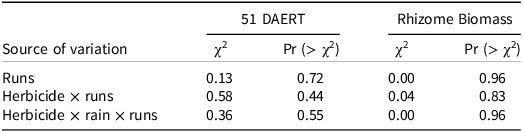
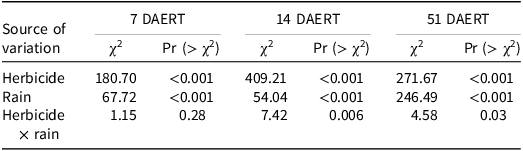
Treatment-by-run interactions were not detected for knotroot foxtail control at 51 DAERT (herbicide × run, P = 0.44; herbicide × rain × run, P = 0.55) or for rhizome dry biomass at 51 DAT (herbicide × run, P = 0.83; herbicide × rain × run, P = 0.96) (Table 1); therefore, data from both 2024 runs were pooled. Regression analysis of the pooled data set revealed significant herbicide × rain timing interactions at 14 DAERT (P = 0.006) and 51 DAERT (P = 0.03) (Table 2). Therefore, rain timing effects were reported separately for hexazinone and quinclorac at both 14 and 51 DAERT (Tables 3 and 4).
Type II Wald chi-square test for the effects of herbicide and simulated rain timing, with the two experimental runs in 2024 for knotroot foxtail control at 51 d after each rain treatment, and rhizome biomass. a,b

a Abbreviation: DAERT, days after each rain treatment.
b χ2 indicates the value of the type II Wald chi square; Pr (> χ2) indicates the P-value of the type II Wald chi square, for which α = 0.05.
Type II Wald chi-square test results from pooled data across two experimental runs in 2024, showing the effects of herbicide, simulated rain timing, and their interaction on knotroot foxtail control at 7, 14, and 51 d after rain treatment. a,b

a Abbreviation: DAERT, days after each rain treatment.
b χ2 indicates the value of the type II Wald chi square; Pr (> χ2) indicates the P-value of the type II Wald chi square, for which α = 0.05.
Knotroot foxtail control at14 d after each rain treatment as influenced by herbicide and simulated rain timing in 2024. a,b

a Abbreviation: D, days after herbicide application when simulated rain was applied.
b Means are estimated marginal means from the fitted linear mixed-effects model (standard error in parenthesis). Within each rainfall timing, means followed by the same letter are not different at α = 0.05. The means are based on data pooled across two experimental runs in 2024. Percentage values are based on visual control ratings.
Knotroot foxtail control at 51 d after each simulated rain treatment as influenced by herbicide and rain timing in 2024. a,b

a Abbreviation: D, days after herbicide application when simulated rain was applied.
b Means are estimated marginal means from the fitted linear mixed-effects model (standard error in parentheses). Within each rainfall timing, means followed by the same letter are not different at α = 0.05. The means are based on data pooled across two experimental runs in 2024. Percentage values are based on visual control ratings.
Knotroot foxtail control declined as irrigation was delayed following application of both herbicides. At 14 DAERT, an early simulated rain (0 to 3 d after herbicide application) resulted in greater control with hexazinone (84% to 83%) compared with rain that did not fall until 12 or 15 d after application (79% and 78%, respectively) (Table 3). Similarly, quinclorac provided 69% to 67% control when water was provided within 0 to 3 d after herbicide application, but knotroot foxtail control declined from 63% to 55% when simulated rain did not fall until 12 to 15 d after application (Table 3). At 51 DAERT, hexazinone provided near-complete knotroot foxtail control (>99%) when simulated rain fell on the day of herbicide application (0 d) and maintained 92% to 96% control when the rain was delayed until 3 to 6 d after herbicides were applied. Control fell from 85% to 81% when rain didn’t fall until 12 to 15 DAERT (Table 4). Similarly, the level of knotroot foxtail control provided by quinclorac gradually declined with increasing rain delays. When irrigation was applied on the same day as herbicide application, quinclorac provided 87% control of knotroot foxtail. However, as the simulated rain was delayed to 3, 6, and 9 DAT, knotroot foxtail control decreased to 82%, 77%, and 72%, respectively (Table 4). When rain was delayed until 12 and 15 d after quinclorac application, control declined further, to 67% and 62%, respectively (Table 4). This finding aligns with data reported by Dias et al. (Reference Dias, Mncube and Sellers2025), that 10.2 to 76.2 mm of rain within 7 d after hexazinone application (1.1 kg ai ha−1) was critical for effective control of smutgrass (Sporobolus indicus var. pyramidalis) in Florida pastures.
These results underscore the importance of timely rain, adequate soil moisture, and favorable growing conditions in herbicide performance, as they enhance activation and translocation to roots and rhizomes, leading to better weed control. Previous studies have reported reduced efficacy of some postemergence herbicides when rain fell shortly after application (Anderson and Arnold Reference Anderson and Arnold1985; Weaver et al. Reference Weaver, Minarik and Boyd1946), likely due to differences in herbicide rainfastness, formulation, mode of action, and exclusive foliar absorption (Souza et al. Reference Souza, Martins, Pereira and Bagatta2014). In contrast, hexazinone and quinclorac exhibit both foliar and soil activity. An early rain likely enhances movement into the soil, thereby improving root and rhizome uptake under moist conditions, which may explain the improved knotroot foxtail control observed in this study. Although Weaver et al. (Reference Weaver, Minarik and Boyd1946) demonstrated that an oil-based adjuvant can help systemic herbicides maintain their effectiveness and overcome variability in rain times, these are not often recommended for use with hexazinone because excessive injury to desirable forages is likely to occur.
Effect of Herbicide on Knotroot Foxtail Control in 2024
Herbicide treatment significantly affected knotroot foxtail control at 7, 14, and 51 DAERT in 2024 (P < 0.001; Table 5). Hexazinone consistently provided greater control of knotroot foxtail than quinclorac at all evaluation times. At 7 DAERT, hexazinone provided 68% control of knotroot foxtail, compared with 50% control with quinclorac. At 14 DAERT, hexazinone provided 81% control of knotroot foxtail, exceeding the 62% control observed with quinclorac. Similar results were observed at 51 DAERT, with hexazinone providing 90% control of knotroot foxtail, compared with 76% control with quinclorac (Table 5). Similar results were reported by Burns (Reference Burns2006), who observed that hexazinone applied at 1.3 kg ai ha−1 provided >80% knotroot foxtail control at 4 and 6 wk after application, compared to other postemergence herbicides.
Effect of herbicide treatment on visually estimated knotroot foxtail control at each evaluation date in 2024 greenhouse studies.a,b

a Abbreviation: DAERT, days after each rain treatment.
b Means followed by the same letter within a column are not significantly different based on the Tukey HSD test (α = 0.05). Percentage values are based on visual control ratings. Data were pooled from two experimental runs in 2024.
The lower efficacy of quinclorac compared with that of hexazinone may be attributed to differences in their mode of action, water solubility, and soil adsorption. Hexazinone exhibits high water solubility (approximately 30,000 mg L−1) and a low soil adsorption coefficient (Koc ranging from 10 to 54), which enables it to remain in the soil solution, where it is available for root uptake and capable of providing residual activity under adequate moisture conditions (Bouchard and Lavy Reference Bouchard and Lavy1985; NCBI 2025). In contrast, quinclorac has moderate water solubility (0.065 mg L−1 at pH 7, 20 C) and a higher Koc value (∼470), which may limit its mobility and reduce availability for plant uptake (El-Dars et al. Reference El-Dars, Mansour and Radwan2023; NCBI 2025).
Effect of Herbicide Treatment on Knotroot Foxtail Dry Rhizome Biomass
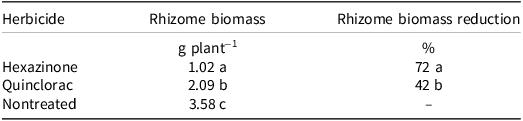
In 2024, no significant interaction between herbicide and simulated rain timing was detected on dry rhizome biomass at 51 DAERT (P = 0.92). However, herbicide treatment had a significant main effect on rhizome biomass (P < 0.001). Therefore, rhizome biomass responses are presented as pooled herbicide treatments from two experimental runs in 2024. Hexazinone consistently reduced rhizome biomass more effectively than quinclorac. Knotroot foxtail plants treated with hexazinone produced the lowest rhizome biomass (1.02 g plant−1), followed by quinclorac-treated plants (2.09 g plant−1), whereas nontreated plants produced the greatest biomass (3.58 g plant−1). Relative to the nontreated control, hexazinone and quinclorac reduced rhizome biomass by 72% and 42%, respectively (Table 6).
Knotroot foxtail rhizome biomass and rhizome biomass reduction in response to herbicide treatment at 51 d after each simulated rain treatment in 2024, pooled across two experimental runs. a

a Means followed by the same letter within a column are not different based on based on the Tukey HSD test (α = 0.05). Rhizome biomass reduction (%) was calculated relative to the nontreated control.
The enhanced performance of hexazinone may be associated with its high soil mobility, lower adsorption, and efficient root uptake, which together increase whole-plant exposure following activation. In contrast, quinclorac provided moderate control of rhizome biomass, likely due to its lower soil solubility and mobility relative to hexazinone, which may limit root uptake and activity in belowground tissues (Lamoureux and Rusness Reference Lamoureux and Rusness1995; Williams et al. Reference Williams, Wehtje and Walker2004). Rector et al. (Reference Rector, Pittman and Flessner2018) further suggested that established knotroot foxtail may escape quinclorac control because plants regenerate from rhizomes. Nonetheless, compared with nontreated plants, those treated with quinclorac exhibited substantially less rhizome biomass, indicating the herbicide’s potential as an alternative when hexazinone is unavailable or unsuitable for use in forage systems.
Correlation Between Knotroot Foxtail Control and Dry Rhizome Biomass
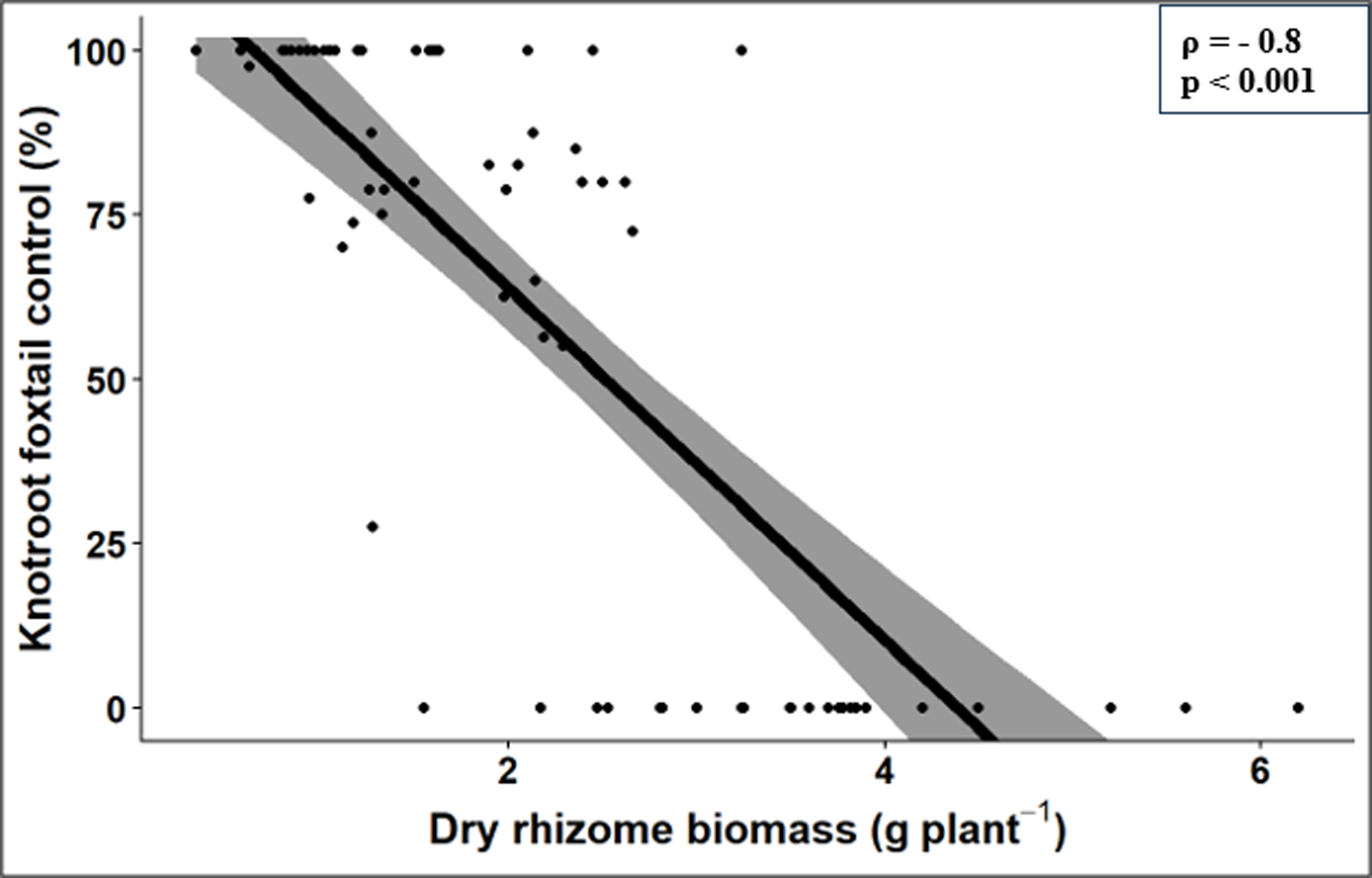
The Spearman rank–based correlation test revealed a significant negative correlation between knotroot foxtail control and dry rhizome biomass. At 51 DAERT in 2024, a strong negative correlation (ρ = −0.80, P < 0.001) was observed, indicating that higher levels of knotroot foxtail control were associated with reduced rhizome biomass (Figure 1). These findings suggest that effective herbicide applications can significantly reduce rhizome biomass, thereby limiting regrowth potential in perennial weeds like knotroot foxtail. The reduction observed among herbicide-treated plants highlights the potential of hexazinone and quinclorac to disrupt rhizome reserves that are critical for survival and future infestations. Movement of hexazinone and quinclorac to roots and rhizomes highlights their effectiveness in targeting the underground structures that are vital for perennial weed survival. This translocation is especially beneficial during late-season herbicide applications when carbohydrate flow is directed downward, thereby enhancing herbicide delivery to underground organs (Klingman and Ashton Reference Klingman and Ashton1975; Wilson et al. Reference Wilson, Martin and Kachman2006).
Correlation plot showing the relationship between knotroot foxtail control and dry rhizome biomass (g plant−1) 51 d after herbicide treatment in 2024. The Greek letter rho (ρ) indicates the Spearman rank correlation coefficient; P indicates the P-value at a 0.05 level of significance. The shaded region represents the 95% confidence interval of the correlation line. (Note: ρ ranges from –1 to 1, where ρ = −1 means a perfect negative correlation, 0 = no correlation, and 1 = perfect positive correlation between two variables). Data were pooled over two experimental runs in 2024.

Practical Implications
For effective control of knotroot foxtail in desirable forage systems, hexazinone applied at 0.8 kg ai ha−1 (3 pints per acre Tide Hexazinone) and quinclorac applied at 0.4 kg ae ha−1 (1 quart per acre Facet L) could provide considerable control of knotroot foxtail, especially when plants are young, preferably before rhizomes develop. Herbicide selection should be based on the primary desirable forage, because quinclorac is labeled for use on bermudagrass and tall fescue, whereas hexazinone is labeled for use on bahiagrass and bermudagrass. Integrating these herbicides with other sound cultural practices, such as proper fertilization and strategic grazing management, can enhance control of knotroot foxtail in pastures and hayfields and improve overall forage productivity.
Knowledge of forecasted rain is also important for herbicide application planning and timing, because an adequate amount of moisture, at least 6.3 mm (1/4 inch) of rain, is recommended for optimal control. This is because an early rain, within 0 to 6 d after application, can enhance weed control either through soil incorporation or by improving plant function and herbicide translocation.
Additionally, producers are encouraged to scout weed-infested fields to help identify specific foxtail species. This will encourage the proper choice of herbicide, because species misidentification can lead to failure of selected management programs. Knotroot foxtail is the only rhizomatous foxtail commonly found in the southeastern United States on roadsides, pastures, and hayfields. Given the limited herbicide options available for managing grass weeds within grass systems, future studies should explore additional herbicides with different modes of action to expand weed management strategies and enable effective herbicide rotation.
Funding
The Alabama Cattlemen’s Association, State Beef Checkoff program provided partial funding for this research.
Competing Interests
The authors declare they have no conflicts of interest.




 Open access

