


Introduction
Since the 1970s there has been growth in private landowner conservation schemes that aim to improve biodiversity and promote sustainable management on private land (Kleijn & Sutherland, Reference Kleijn and Sutherland2003; Thompson et al., Reference Thompson, Baruah and Carr2011; Wunder, Reference Wunder2013). The ecological impacts (Fitzsimons & Wescott, Reference Fitzsimons and Wescott2001; Kleijn & Sutherland, Reference Kleijn and Sutherland2003; Hardy et al., Reference Hardy, Fitzsimons, Bekessy and Gordn2016), economic efficiency (Dobbs & Pretty, Reference Dobbs and Pretty2008; Iftekhar et al., Reference Iftekhar, Tisdell and Gilfedder2014), community perceptions and motivations for participation (Moon & Cocklin, Reference Moon and Cocklin2011; Selinske et al., Reference Selinske, Coetzee, Purnell and Knight2015) have been addressed. However, questions remain about how and in what context financial incentives, which are provided within some of these programmes, enhance conservation outcomes (Borner et al., Reference Borner, Baylis, Corbera, Ezzine-de-Blas, Honey-Roses, Persson and Wunder2017).
The rationale for financial incentives is to increase motivation (Wilson & Hart, Reference Wilson and Hart2000; Blackmore & Doole, Reference Blackmore and Doole2013) and enhance participation rates among people who are not already autonomously motivated to engage in conservation (Sorice et al., Reference Sorice, Oh, Gartner, Snieckus, Johnson and Donlan2013; Shaw & Miller, Reference Shaw and Miller2016) or who cannot cover the direct or opportunity costs of conservation (Ernst & Wallace, Reference Ernst and Wallace2008). However, because participants often self-select into incentive programmes (Ferraro & Pattanayak, Reference Ferraro and Pattanayak2006), some participants who receive incentives may already engage in conservation management practices (Borner et al., Reference Borner, Baylis, Corbera, Ezzine-de-Blas, Honey-Roses, Persson and Wunder2017), reducing cost-effectiveness (Ferraro & Kiss, Reference Ferraro and Kiss2002; Borner et al., Reference Borner, Baylis, Corbera, Ezzine-de-Blas, Honey-Roses, Persson and Wunder2017).
Although randomized-control trials are the ideal method to assess the impacts of payments (Agrawal et al., Reference Agrawal, Ashwini and Gerber2015; Chervier et al., Reference Chervier, Velly and Ezzine-de-Blas2017), such experiments may not be ethically or logistically feasible (Butsic et al., Reference Butsic, Lewis, Radeloff, Baumann and Kuemmerle2017). One approach to understanding the effectiveness of incentives is to use a quasi-experimental approach (Ferraro & Pattanayak, Reference Ferraro and Pattanayak2006; Butsic et al., Reference Butsic, Lewis, Radeloff, Baumann and Kuemmerle2017) to examine the socio-psychological characteristics and management practices of people in incentive schemes and compare them to demographically similar conservationists who have not received financial support. Because values and motivations influence the tendency to undertake voluntary pro-environmental behaviours (de Groot & Steg, Reference de Groot and Steg2009; Agrawal et al., Reference Agrawal, Ashwini and Gerber2015; Cooke et al., Reference Cooke, Fielding and Winnifred2016), we hypothesized that, if incentives are effective in broadening the pool of participants, then people in paid programmes may have values and motivations that are less consistent with conservation than people enrolled in non-incentive programmes.
Much of the research on values, motivations and pro-environmental behaviours (Pelletier et al., Reference Pelletier, Tuson, Green-Demers, Noels and Beaton1998; Schultz & Zelezny, Reference Schultz and Zelezny1999; de Groot & Steg, Reference de Groot and Steg2010; Sheldon et al., Reference Sheldon, Nichols and Kasser2011; Evans et al., Reference Evans, Maio, Corner, Hodgetts, Ahmed and Hahn2013; Cooke et al., Reference Cooke, Fielding and Winnifred2016) draws on two major theories from cross-cultural and social psychology: the Theory of Basic Human Values (Schwartz, Reference Schwartz2007; Schwartz et al., Reference Schwartz, Vecchione, Fischer, Ramos, Cieciuch and Davidov2012, Reference Schwartz, Cieciuch, Vecchione, Torres, Dirilen-Gumus and Butenko2017) and Self-Determination Theory (Ryan & Deci, Reference Ryan and Deci2000, Reference Ryan and Deci2017). Questionnaires developed in these theoretical contexts have been empirically tested, validated, translated, and adapted to address applied problems in health, education, work environments and parenting (Williams et al., Reference Williams, Saizow, Ross and Deci1997; Deci et al., Reference Deci, Koestner and Ryan2001a, Reference Deci, Koestner and Ryanb; Kasser, Reference Kasser2002). More recently, they have been applied to conservation (Hicks et al., Reference Hicks, Cinner, Stoeckle and McClanahan2015; Cetas & Yasué, Reference Cetas and Yasué2016; Ramsdell et al., Reference Ramsdell, Sorice and Dwyer2016). Research using validated instruments is important because it can help generate data on the socio-psychological characteristics of conservationists that can be used in later analyses. At present, much of the research on values, motivations and pro-environmental behaviour using validated instruments has been conducted predominately with psychology undergraduate students (Pelletier et al., Reference Pelletier, Tuson, Green-Demers, Noels and Beaton1998; Schultz & Zelezny, Reference Schultz and Zelezny1999; de Groot & Steg, Reference de Groot and Steg2010; Sheldon et al., Reference Sheldon, Nichols and Kasser2011) rather than conservationists.
Values are trans-situational guiding principles that help people make behavioural decisions (Manfredo et al., Reference Manfredo, Bruskotter, Teel, Fulton, Schwartz and Arlinghaus2017). The Theory of Basic Human Values (Schwartz, Reference Schwartz2003; Schwartz et al., Reference Schwartz, Cieciuch, Vecchione, Torres, Dirilen-Gumus and Butenko2017) suggests that there are 10 human values that construct four higher-order values (self-enhancement, self-transcendence, openness to change, and conservation; Table 1) that exist in at least 67 countries and 21 languages. To avoid confusion, ‘conservation’ is referred to as ‘conservativism’ here. The four higher-order values are structured so that values more similar to each other are closer together on a circumplex. Self-enhancement and self-transcendance are on opposite sides of the circumplex, as are openness to change and conservativism (Schwartz, Reference Schwartz2003). People with more self-enhancement values may be less likely to engage in pro-environmental behaviour than people with more self-transcendence values (de Groot & Steg, Reference de Groot and Steg2010; Sheldon et al., Reference Sheldon, Nichols and Kasser2011; Corner et al., Reference Corner, Markowitz and Pidgeon2014).
Items used to measure values. The instructions indicated ‘Here we briefly describe some people. Please read each description and think about how much each person is or is not like you.’ People responded either 1, ‘Not like me at all’; 2, ‘Not like me’; 3, ‘A little like me’; 4, ‘Somewhat like me’; 5, ‘Like me’, or 6, ‘Very much like me’, to each of the items.

* Although we have placed these items into one of the four broader constructs, the multi-dimensional-scaling plots place them in between two broader constructs. These items were taken from Schwartz et al. (Reference Schwartz, Vecchione, Fischer, Ramos, Cieciuch and Davidov2012).
Self-Determination Theory differentiates between autonomous and controlled motivation (Ryan & Deci, Reference Ryan and Deci2002, Reference Ryan and Deci2017). Autonomous motivation includes intrinsic motivation (e.g. ‘I plant trees because it is enjoyable to plant trees’) as well as forms of extrinsic motivation that are consistent with personal beliefs and values (e.g. ‘I plant trees because I am an environmentalist’). Non-autonomous motivation consists of extrinsic forms of motivation that are not fully personally endorsed, such as guilt, shame, reward attainment or punishment avoidance (e.g. ‘I plant trees only so that I get paid’). Autonomous forms of motivation are correlated with creativity (Ryan & Deci, Reference Ryan and Deci2000), increased engagement (Taylor et al., Reference Taylor, Jungert, Mageau, Schattke, Dedic, Rosenfield and Koestner2014), persistence in carrying out a difficult task (Dweck, Reference Dweck2006), willingness to evince difficult pro-environmental behaviours (Cooke et al., Reference Cooke, Fielding and Winnifred2016), conservation programme satisfaction (Sorice et al., Reference Sorice, Oh, Gartner, Snieckus, Johnson and Donlan2013; Price & Leviston, Reference Price and Leviston2014; Ramsdell et al., Reference Ramsdell, Sorice and Dwyer2016) and better social and ecological outcomes for conservation projects (Cetas & Yasué, Reference Cetas and Yasué2016). Past research on the social contexts that can foster autonomous motivation (Black & Deci, Reference Black and Deci2000; Baard et al., Reference Baard, Deci and Ryan2004; DeCaro & Stokes, Reference DeCaro and Stokes2008) suggests that programmes help fulfil the basic psychological needs of autonomy, competence and relatedness (Chen et al., Reference Chen, Vansteenkiste, Beyers, Boone, Deci and Van der Kapp-Deeder2015) by providing meaningful choices, conveying trust in the participants, fostering relationships between participants and programme implementers, and providing meaningful feedback (Cetas & Yasué, Reference Cetas and Yasué2016; Ramsdell et al., Reference Ramsdell, Sorice and Dwyer2016).
Research on the effects of payments and other external rewards on autonomous motivation has demonstrated variable impacts. Incentives have been shown to both crowd-in (i.e. enhance) motivation by helping to foster relationships of trust and mutual respect (Sommerville et al., Reference Sommerville, Milner-Gulland, Rahajaharison and Jones2010; Borner et al., Reference Borner, Baylis, Corbera, Ezzine-de-Blas, Honey-Roses, Persson and Wunder2017) and enhance a participant's feelings of competence or self-efficacy to carry out personally meaningful tasks (D'Adda, Reference D'Adda2011; Rode et al., Reference Rode, Gomez-Baggethun and Krause2015). However, other studies have shown that external rewards can also crowd-out (i.e. thwart) autonomous motivation by thwarting feelings of autonomy (Deci et al., Reference Deci, Koestner and Ryan2001a; Frey & Jegen, Reference Frey and Jegen2002; Burton & Paragahawewa, Reference Burton and Paragahawewa2011), communicating a lack of trust between funders and participants (Gneezy & Rustichini, Reference Gneezy and Rustichini2000; Reeson & Tisdell, Reference Reeson and Tisdell2008) or shifting attitudes away from more enduring self-transcendence motivations to short-term individual profit motivations (Hecken & Bastiaensen, Reference Hecken and Bastiaensen2010; Fisher, Reference Fisher2012; Agrawal et al., Reference Agrawal, Ashwini and Gerber2015).
Few studies (Agrawal et al., Reference Agrawal, Ashwini and Gerber2015; Chervier et al., Reference Chervier, Velly and Ezzine-de-Blas2017) have compared values, motivations or behaviours between people in programmes with and without financial incentives, to examine the impacts of financial incentives on conservation, and, as far as we know, no studies have used the previously validated instruments from the Theory of Basic Universal Values and Self-Determination Theory to examine the effectiveness of incentives in private land conservation. Here we examine the effectiveness of financial incentives for private land conservation by addressing three questions. (1) Do financial incentives help to broaden the types of landowners willing to engage in private land conservation by engaging people who have lower self-transcendence values and autonomous motivation towards the environment? (2) Do people in incentivized programmes report more engagement in greater conservation management? (3) Do people in incentivized programmes report higher feelings of autonomy and competence?
Methods
Contexts of private land conservation programmes in Tasmania
With over 50% of land protected in conservation reserves, 843 conservation covenants, 1,541 registered participants of strictly educational conservation schemes, and the first ever Green Party politicians (in the world, in 1972), the people of the island State of Tasmania (Australia) are known for their environmentalism (Schultz & Cica, Reference Schultz and Cica2013). During 1995–2010 there were several private-land conservation programmes that provided incentives to persuade landowners to covenant land or undertake stewardship activities, concurrently with several non-incentive educational programmes (Prager & Vanclay, Reference Prager and Vanclay2010; Iftekhar et al., Reference Iftekhar, Tisdell and Gilfedder2014).
The majority of our survey and interview participants were engaged in one of three broad types of conservation programmes (Supplementary Material 1): (1) covenant programmes that provided either no incentives or substantial incentives (Iftekhar et al., Reference Iftekhar, Tisdell and Gilfedder2014), (2) stewardship programmes that provided small, targeted financial support for a particular management task (e.g. half the costs of planting trees), (3) educational programmes that provided only educational resources. We define non-incentive programmes as the two educational programmes and the non-incentive covenanting programme.
Data collection
Prior to conducting this research, MY met with conservation organizations, government agencies, farming organizations, agricultural consultants and University of Tasmania academics who work in private land conservation in Tasmania. We sought support from these organizations to help recruit participants through newsletters and Facebook groups, identify a range of types of landowners to participate in interviews, and enhance the clarity of surveys and interviews. During 15 January–1 June 2017 the survey (Supplementary Material 2) was promoted by these organizations.
Demographic and property characteristics
The first section of the survey requested information on the property (e.g. size, duration of ownership), demographics (e.g. age, gender, education) and participation in conservation programmes, to assess whether there were significant differences in these characteristics between participants of incentive or non-incentive programmes. Factors such as age, education, property size and gender may influence land management decisions and the willingness to engage in incentive programmes (Knowler & Bradshaw, Reference Knowler and Bradshaw2007; Lastro-Braxo et al., Reference Lastro-Braxo, Hubbarb, Garrod and Tolon-Becerra2015).
Programme experience
The second section (Supplementary Material 2) consisted of items to measure perceptions of autonomy-support, autonomy and competence when engaging in a programme. Participants indicated how autonomy-supportive they perceived the conservation programmes to be, on a 7-point Likert scale. These items were adapted from previously validated instruments that measured perceptions of autonomy-support from educators, supervisors and coaches. These items similarly had high reliabilities or internal consistencies (Cronbach's α = 0.91; Black & Deci, Reference Black and Deci2000; Pelletier et al., Reference Pelletier, Fortier, Vallerand and Briere2001; Baard et al., Reference Baard, Deci and Ryan2004). These measures examine the nature of the relationship between the programme participant and the programme administrator because in addition to the payments, programmes may also differ in terms of autonomy-supportive practices. The sections following the items for autonomy-supportive environments were items that assessed feelings of autonomy (Cronbach's α = 0.73) and competence (α = 0.68) when engaging in the programme activities. These two subscales were taken from the basic psychological needs at work questionnaires (Deci et al., Reference Deci, Ryan, Gagne, Leone, Usunov and Kornazheva2001b). The items measuring autonomy and competence were used to assess whether participants in incentive programmes had higher levels of autonomy and competence than non-participants. In addition to these items from previously validated instruments, based on feedback from landowners we added ‘I do not need the programme to achieve my conservation and stewardship goals’. These questions were used to assess whether participants in incentive programmes had higher levels of autonomy and competence than non-participants.
Portrait values questionnaire
This section included 21 gender-matched items that provided verbal portraits of values (e.g. ‘Being wealthy is important to her.’) to measure the broader value aspirations of participants (Table 1; Schwartz et al., Reference Schwartz, Vecchione, Fischer, Ramos, Cieciuch and Davidov2012). The reliability and validity of this instrument has been demonstrated elsewhere (Schwartz et al., Reference Schwartz, Vecchione, Fischer, Ramos, Cieciuch and Davidov2012, Reference Schwartz, Cieciuch, Vecchione, Torres, Dirilen-Gumus and Butenko2017; McQuilkin et al., Reference McQuilkin, Garoarsdottir, Thorsteinsson and Schwartz2016). Our preliminary analyses using correlation analyses and multi-dimensional scaling analyses (with Proxscal in SPSS v. 24, IBM Corp, Armonk, USA) with Euclidian distance measures, were consistent with theorized structures and demonstrated broader dimensions of self-transcendence and self-enhancement on one dimension and openness to change and conservativism on the other dimension (Supplementary Material 3).
Motivation towards the environment scale
These six items (Pelletier et al., Reference Pelletier, Tuson, Green-Demers, Noels and Beaton1998; Supplementary Material 2 & 4) measured autonomous or non-autonomous forms of motivation (Green-Demers et al., Reference Green-Demers, Pelletier and Sophie1997). The reliability and validity has been demonstrated elsewhere (Green-Demers et al., Reference Green-Demers, Pelletier and Sophie1997; Pelletier et al., Reference Pelletier, Tuson, Green-Demers, Noels and Beaton1998). For the sake of brevity we took one item per subscale.
Impacts on conservation action
We asked respondents about their conservation management activities in the previous 5 years. Based on preliminary conversations with researchers, conservation organizations and landowners, we included eight common conservation activities that were advocated by these conservation programmes (e.g. ‘Fenced off area to restore native or threatened species’, ‘Planted native species to restore habitat for native and threatened species’). In addition, we asked ‘To what extent do the programmes that you engage in influence how you manage your land?’ (5-point Likert scale) as well as ‘On average in the last year, how many hours a month did you spend doing activities consistent with the programme?’
Data analysis
We centred the scores for the portrait values questionnaire and the motivations for engagement in the programmes by subtracting the mean score of all items for each individual (Schwartz, Reference Schwartz2003). We calculated means for the items measuring autonomy-support and autonomy, self-enhancement, self-transcendance, conservativism, and openness to change, and calculated a measure of autonomous motivation and non-autonomous motivation following Green-Demers et al. (Reference Green-Demers, Pelletier and Sophie1997) and Cooke et al. (Reference Cooke, Fielding and Winnifred2016). In contrast to previous studies that subtracted the non-autonomous from the autonomous motivation to create a single index, we retained two variables for autonomous and controlled motivation because they were not correlated (R = 0.04). Autonomous and controlled motivations can occur simultaneously (Cameron et al., Reference Cameron, Banko and Pierce2001; Cerasoli et al., Reference Cerasoli, Nicklin and Ford2014). Because property size was positively skewed, we dichotomized the variable by splitting it at the median (7 ha). Given the small number of respondents with only a high-school degree or technical or trade school qualification, we pooled these responses and thus we had three groups based on education: secondary school, technical or trade school, graduate degree and postgraduate degree.
To determine whether there were differences in demographic characteristics, values or autonomous environmental motivation between people who participated in programmes with or without financial incentives, we used Kruskal–Wallis (continuous data) and χ2 tests (categorical data). To examine the simultaneous effects of multiple variables, we fitted a binary logistic model. The response variable was the dichotomous variable indicating whether a participant had participated in at least one incentivized programme. Using hierarchical regression we first tested a demographic and property model (together termed ‘demographic’) in which we included property size, age of landowner, gender, whether they were retired or not, educational attainment, property type (commercial, lifestyle and residential) and all two-way and three-way interaction terms (for continuous variables). In the next step we added all significant variables and interactions from the demographic/property model and the four higher order values and interaction terms. Similarly, we added autonomous motivation and controlled motivation from the motivation towards the environment scale to test whether autonomous motivation towards the environment predicted participation in an incentivized programme (de Groot & Steg, Reference de Groot and Steg2010). All interaction terms were examined visually by dichotomizing the variables at the median. Model saturation precluded more interaction terms. Likelihood ratio tests (α < 0.05) informed model optimization via backwards elimination (Crawley, Reference Crawley2007; Zuur et al., Reference Zuur, Ieno, Walker, Saveliev and Smith2009), and Spearman correlations were calculated and tests for multi-collinearity conducted.
Using the same modelling procedure, we used hierarchical linear regression to examine the factors that influenced the number of conservation actions. We used ANOVAs to compare the residual sum of squares between different models. In the final step, we assessed whether the number of conservation actions depended on participation in an incentivized programme.
Results
The survey respondents were 50 : 50 female : male, and mean age was 58 ± SE 0.8 years (range 30–85). The percentages of people with secondary school diplomas, technical degrees, graduate and postgraduate degrees were 10, 22, 29 and 39%, respectively. Within Tasmania only 10% of the adult population has an undergraduate degree and 2% a postgraduate degree (Australian Bureau of Statistics, 2016). Owners of larger and commercial properties were more likely to engage in programmes with financial incentives (Table 2). Commercial properties tended to be larger than non-commercial properties.
Comparison of demographic and property characteristics, programme experiences, values, motivations and behaviours between participants of incentive and non-incentive private land conservation programmes (values are % or mean ± SE; test statistic is Kruskal–Wallis for continuous data and χ2 for categorical data).

**P < 0.01.
Respondents indicated high levels of autonomy (mean 5.9 ± SE 0.07; 4 = ‘Neutral’, 5 = ‘Agree somewhat’ and 6 = ‘Mostly agree’) and competence (5.3 ± SE 0.07) when engaging in the programmes, as well as moderate levels of perceived autonomy-support (S2 4.7 ± SE 0.09). A large number of respondents (70%) were neutral or agreed somewhat that they did not need the programme to achieve conservation or stewardship goals. There were no significant differences between those in programmes with and without incentives in autonomy-support, autonomy, competence and need for the programme to achieve conservation or stewardship goals (Table 2).
All respondents indicated high self-transcendance (universalism and benevolence), high openness to change (self-direction, hedonism and stimulation), low self-enhancement (power and achievement) and low conservativism (tradition, conformity and security; Supplementary Material 3 & 4, Table 2). The top-ranked items from the portrait values questionnaire were universalism (care for nature), benevolence (care and loyalty for people close to you) and self-direction (freedom in thinking and action; Table 1). Preliminary investigation of a correlation matrix (Supplementary Material 3) also indicated relationships between values, motivations and behaviour that were consistent with past research and theoretical predictions of Self-Determination Theory (Ryan & Deci, Reference Ryan and Deci2017) and the Theory of Basic Values (Schwartz et al., Reference Schwartz, Vecchione, Fischer, Ramos, Cieciuch and Davidov2012; Baur et al., Reference Baur, Dobricki and Lips2016).
Participants were motivated to engage in these programmes because they felt that it was consistent with their personal values. Although intrinsic motivation is also a part of autonomous motivation, it appeared that the pleasure of engagement was only moderately important. Non-autonomous motivation tended to be least important (Supplementary Material 4). There was also no evidence that the perceived influence of programmes on land management, the number of conservation actions undertaken, or the hours of engagement in the programme were higher for respondents in incentive programmes (Table 2).
When we restricted the data to only the covenantors, there were still no indications of differences in values, motivations and behaviours amongst people who did or did not receive financial incentives. Further preliminary exploratory multivariate analysis (Supplementary Material 5) also suggested respondents could be divided into different types of landowners (in terms of values and motivations) but that respondents did not separate into groups based on whether they participated in a programme with or without incentives.
Owners of larger properties, men with graduate degrees and women with secondary or technical diplomas were more likely to be in incentive programmes (Table 3, Fig. 1). None of property type (commercial, residential or lifestyle), age or retirement status had significant effects. People with higher self-enhancement and lower self-transcendence motivations were more likely to engage in paid programmes. Adding autonomous motivation and non-autonomous motivation to the model resulted in a significant reduction in deviance compared to the demographic and values model. People with higher self-enhancement, lower self-transcendence and lower autonomous motivation were more likely to be part of paid programmes. For people on small properties, higher autonomous motivation increased their likelihood of participating in incentive programmes compared to owners of small properties with less autonomous motivation. On large properties, more autonomously motivated landowners were less likely to participate in incentive programmes (Table 3, Fig. 2).
The proportion (with binomial errors) of landowners who participated in a programme with financial incentives, by (a) education (secondary education includes landowners who also attended technical college programmes) and (b) property characteristics (median values were used to dichotomize property size). Numbers above bars indicate sample size.

The proportion (with binomial errors) of landowners who received financial incentives, by self-enhancement values and (a) self-transcendence values, (b) non-autonomous motivation, (c) autonomous motivation among people with lower self-transcendence values, and (d) autonomous motivation among people with higher self-transcendence values. Median values were used to dichotomize continuous variables. Numbers above bars indicate sample size.

Regression coefficients (± SE) for each of the independent variables in a hierarchical logistic regression predicting participation in programmes with financial incentives for 162 landowners. The three progressively complex models are listed from left to right and accounted for an increasing proportion of the variability, based on the Nagelkerke R 2 (Model 1 = 0.28, Model 2 = 0.33, Model 3 = 0.47). The reference category for gender is male (i.e. men are more likely to participate in incentivized programmes) and the reference category for education is people who do not have a graduate degree (i.e. people with graduate degrees are more likely to enrol in incentivized programmes than people without graduate degrees).
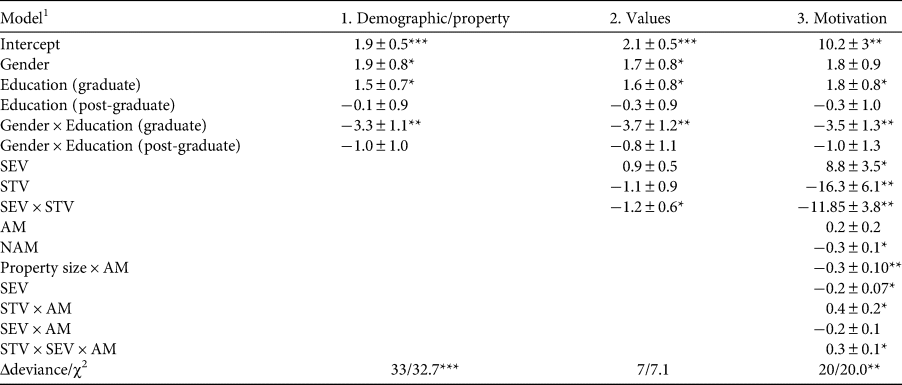
1SEV, self-enhancement values; STV, self-transcendence values; AM, autonomous motivations; NAM, non-autonomous motivations. SEV and STV were taken from the portrait values questionnaire and AM and NAM were based on the motivation towards the environment scale.
*P < 0.05, **P < 0.01, ***P < 0.001.
People with larger properties engaged in fewer conservation actions on their property (Table 4, Fig. 3). Furthermore, although participants in incentive programmes did not report more conservation actions, on larger properties higher autonomous motivation led to an increase in the number of conservation actions. On smaller properties, regardless of the level of autonomous motivation, landowners engaged in a larger number of conservation actions.
The number of conservation actions (with standard errors) implemented by landowners, by (a) their openness to change and self-transcendence, and by (b) autonomous motivation and (c) the presence or absence of incentive and property size. All significant interaction terms from the model are shown. Numbers above bars indicate sample size.

Regression coefficients (± SE) for hierarchical linear regressions predicting the number of conservation actions by 162 landowners. The four progressively complex models are listed from left to right and accounted for an increasing proportion of the variability (Model 1 = 0.07, Model 2 = 0.11, Model 3 = 0.17, Model 4 = 0.21).

1STV, self-transcendence values; AM, autonomous motivations.
*P < 0.05, **P < 0.01, ***P < 0.001.
Discussion
Incentives marginally added to the types of landowners engaging in conservation on private land but did not appear to lead to increased conservation action, or to changes in feelings of autonomy or competence with respect to conservation. In addition to enhancing participation of owners of larger properties, there were also some indications that people with lower self-transcendence values, higher self-enhancement values and lower autonomous motivation towards the environment were more likely to engage in incentive programmes. As property size did not influence values or motivations, incentives may have helped to encourage participation of owners of larger properties who may have higher costs in implementing conservation action.
The differences in values and autonomous motivation between participants of the two types of programmes were small. Participants had values and motivations that are consistent with other types of pro-environmental behaviour (Pelletier et al., Reference Pelletier, Tuson, Green-Demers, Noels and Beaton1998; Schultz & Zelezny, Reference Schultz and Zelezny1999; de Groot & Steg, Reference de Groot and Steg2010; Sheldon et al., Reference Sheldon, Nichols and Kasser2011). High self-transcendence values have been observed in other studies (Baur et al., Reference Baur, Dobricki and Lips2016; McQuilkin et al., Reference McQuilkin, Garoarsdottir, Thorsteinsson and Schwartz2016; Schwartz et al., Reference Schwartz, Cieciuch, Vecchione, Torres, Dirilen-Gumus and Butenko2017), especially in older (c.f. Robinson, Reference Robinson2013) and well-educated populations (Sheldon, Reference Sheldon2005).
Our results indicated that autonomous motivation was particularly important in promoting conservation action on large properties. In contrast, participation of owners of large properties in an incentive programme did not influence conservation action. These results are consistent with the generalization that autonomous motivation is associated with more challenging and enduring pro-environmental behaviours (de Groot & Steg, Reference de Groot and Steg2009; Burton & Paragahawewa, Reference Burton and Paragahawewa2011; Agrawal et al., Reference Agrawal, Ashwini and Gerber2015; Cooke et al., Reference Cooke, Fielding and Winnifred2016). The design of resilient conservation interventions that lead to action on the ground requires that programmes not only persuade otherwise uninvolved landowners to participate (DeCaro & Stokes, Reference DeCaro and Stokes2008; Burton & Paragahawewa, Reference Burton and Paragahawewa2011; Greiner & Gregg, Reference Greiner and Gregg2011), but also promote autonomous motivation (Greiner & Gregg, Reference Greiner and Gregg2011; Borner et al., Reference Borner, Baylis, Corbera, Ezzine-de-Blas, Honey-Roses, Persson and Wunder2017). Increased autonomous motivation may result from promoting moral reasons for programme participation; an emphasis on communal benefits (rather than private benefits); the fostering of social capital between programme participants, or between programme participants and programme officers through face-to-face engagement; and the creation of opportunities for greater self-determination and self-efficacy through the provision of comprehensive and meaningful information exchange and feedback between participants (Curtis & Lockwood, Reference Curtis and Lockwood2000; Reeve, Reference Reeve2006; Crompton & Kasser, Reference Crompton and Kasser2010; Bowles & Polania-Reyes, Reference Bowles and Polania-Reyes2012; Agrawal et al., Reference Agrawal, Ashwini and Gerber2015; Selinske et al., Reference Selinske, Coetzee, Purnell and Knight2015). Given that autonomous motivation had marginally positive effects on owners of small properties, unlike incentives, these types of approaches are likely to have positive impacts for owners of both small and large properties. Although we only had small sample sizes for owners of smaller properties who received incentives, our results indicate that incentives for this group may have led to a positive impact on conservation action.
Limitations
As with all surveys, except compulsory censuses, there may be participation bias, making relational analyses more valuable than normative statements. In comparison to previous surveys that had higher response rates (Morrison & Lockwood, Reference Morrison and Lockwood2014), the participants may have been that subsection of the population who are particularly autonomously motivated to engage in conservation (and even fill out a survey on conservation). Moreover, within Tasmania, as a result of the extensive history of environmentalism, it is likely that environmental values and a stewardship ethic are more socially accepted than elsewhere. Thus the results of this study cannot be extrapolated to other regions without investigation of prevailing values and motivations.
We focused on three potential benefits of incentives (enhanced pool of participants, increased conservation action, and enhanced feelings of competence and autonomy). However, there could be other important reasons for providing financial benefits. For example, payments may be a subsidy to retain or support family farms that support more conservation action, they may be an opportunity to begin building relationships between landowners for future conservation projects or they may simply help to shift landowners' perspectives about conservation or conservationists (Rode et al., Reference Rode, Gomez-Baggethun and Krause2015; Ramsdell et al., Reference Ramsdell, Sorice and Dwyer2016). These are all outcomes that were not measured in our study.
We have also assumed that any differences in values and motivations between those who participated in programmes with or without incentives reflect preferences for types of programmes. There could be other differences between programmes, such as experiences with individual stewardship officers, that could lead to different types of people participating (Moon & Cocklin, Reference Moon and Cocklin2011; Selinske et al., Reference Selinske, Coetzee, Purnell and Knight2015). Despite these differences, given the significant costs of incentive schemes in comparison to the overall budgets of private land conservation programmes, it is reasonable to expect differences in conservation actions and feelings of competence between programmes with and without incentives (Armsworth et al., Reference Armsworth, Acs, Dallimer, Gaston, Hanley and Wilson2012; Iftekhar et al., Reference Iftekhar, Tisdell and Gilfedder2014).
One important source of variation in our data that was not accounted for in our survey was the presence of threatened species or ecosystems on properties. For participation in several of the paid covenant and stewardship programmes, landowners needed to demonstrate the presence of threatened ecosystems or species. Thus, irrespective of the values and attitudes of the landowners, requirements of the funding agency may lead to differential levels of economic support for particular properties and therefore reduce the differences in property or landowner characteristics between incentive or non-incentive programmes.
The significance of several interaction terms and the large number of variables that appear to have significant (but small) effects, indicate that the impacts of financial incentives on conservation are highly context-dependent and influenced by a wider range of factors than we have been able to investigate in this quantitative analysis. To gain a finer-grained and more nuanced perspective on the psychological impacts of incentives and how payments, as well as other programme features such as extension officers and educational opportunities, can enhance or thwart autonomous motivation for the environment and conservation action, we suggest further studies using in-depth interviews.
Conclusion
Each year billions of dollars are spent on various forms of payments for ecosystem services (Armsworth et al., Reference Armsworth, Acs, Dallimer, Gaston, Hanley and Wilson2012). Effective use of conservation funds requires that financial incentives not only increase programme participation, but actually lead to changes on the ground (Kleijn & Sutherland, Reference Kleijn and Sutherland2003; Morris, Reference Morris2004). Although financial incentives may, in certain contexts, efficiently use conservation funds and enhance autonomous motivation (Ferraro & Kiss, Reference Ferraro and Kiss2002; Rode et al., Reference Rode, Gomez-Baggethun and Krause2015), the blanket-use of financial incentives for conservation needs to be approached cautiously, especially if participants may already be autonomously motivated to engage in conservation. Understanding longer-term impacts of these programmes requires socio-psychological investigation (DeCaro & Stokes, Reference DeCaro and Stokes2008) because it is human values and motivations that mediate the relationship between incentives and conservation outcomes.
Acknowledgements
We thank the numerous collaborators and colleagues who contributed to this work: Department of Primary Industries, Parks, Water and Environment (especially Iona Mitchell), Tasmania Land Conservancy, faculty and students at University of Tasmania (especially Michael Lockwood), Chloe Lucas, Greening Australia, Natural Resource Management, Landcare, Common-Cause Australia, researchers at the University of Queensland and RMIT University, anonymous reviewers, Conservation Landholders Tasmania, and all the landowners who participated in the programme.
Author contributions
Designing survey and research question, collecting data, analysis, writing: MY; support with data collection, feedback on initial concept and survey questions, writing: JBK.
Conflicts of interest
None.
Ethical standards
Human research ethics were approved by the University of Tasmania (H0016128).



