




Introduction
The archaeological site of Creney-le-Paradis is located south of Champagne, in the Senon region of France. This region, located at the junction of the important communication routes of the Yonne and Seine valleys and their tributaries, occupies an important geostrategic position in the context of (pre)historic exchanges between Atlantic and North Alpine complexes (Baray Reference Baray2018: 24). From the final Bronze Age (1400–800 BC) onwards, levels of social hierarchy can be distinguished within a substratum of dynamic local populations. Between the last quarter of the seventh century BC and the end of the fifth century BC (Hallstatt D/La Tène A), occupation of the Senese territory (present-day Yonne, Loiret, Essone, Seine-et-Marne and Aube departments) was particularly dense, with sociocultural facies stretching along both sides of the Vanne valley (Baray Reference Baray2018: 28). Situated beside this valley, Creney occupies a strategic position on both a European and a local scale. It is surrounded by elite sites—including Lavau (2.9km), Bouranton (4.5km), Estissac (26km) and Vix (67km) (Figure 1)—that bear witness to the intense economic and cultural activity of the region during the transition between the Early and Late Iron Ages (800–450 BC; 450–20 BC).
Distribution of elite burials from the sixth–fifth centuries BC in central-eastern France, and specifically in the Senon territory and the Vanne Valley (figure by authors).

The reuse of necropolises into the first century BC has had a detrimental effect on the preservation of the oldest burials, on which new burials were built. The collective burial mounds were also often levelled by ploughing in the intervening centuries, and finds are rare. Creney-le-Paradis has been interpreted as a possible chariot burial (Verger Reference Verger1995a) but no conclusive evidence for this interpretation has been found. During excavation, fragments of mineralised textiles were discovered. Weaving is one of the earliest craft technologies developed by humans (Grömer Reference Grömer2016), and textiles play an essential role in ancient and modern societies, with many functions that go far beyond clothing and domestic use, such as the transportation and storage of goods (Good Reference Good2001; Nosch & Gillis Reference Nosch and Gillis2007; Gleba & Mannering Reference Gleba and Mannering2012). Iconography and historical texts indicate that textiles were manipulated and staged in rituals deeply embedded in individual, social and religious practices (Gherchanoc & Huet Reference Gherchanoc and Huet2007; Brøns & Nosch Reference Brøns and Nosch2017). We present here the complete study of the Creney textiles, which has contributed to clarifying the social significance of the burial.
The Creney-le-Paradis site
The archaeological site at the ‘Le Paradis’ locality of Creney-près-Troyes (Aube, France) contains two large groups of archaeological structures: a necropolis used from the final Bronze Age to the beginning of the Late Iron Age (c. eighth to fifth centuries BC), and an indigenous farm linked to a Gallo-Roman occupation (52 BC–486 AD; Figure 2a). Excavation of the site was undertaken by Villard and colleagues in 1987–1988 (Villard Reference Villard1988). A tumulus and Y-shaped ditch form the monumental structure, with a diameter of 60m. The tumulus itself, which has been substantially damaged, has a very low relief—reaching a height of only 0.9m at its centre—and a diameter of 45m. The excavation revealed several concentrically superimposed construction phases (Figure 2c). The complex is organised around the construction of a first tumulus of 8m in diameter delimited by a ditch of 0.20 × 1.40m. No inhumations were found within this initial construction but cremated human bones were discovered in these levels. The second mound—12m in diameter and overlaying the first—was covered with ‘tiles’ of fine dark earth that alternate with a chalky sediment. This type of construction is very original and was identified here for the first time in the architecture of a tumulus (Villard Reference Villard1988). The tumulus was then covered in several stages with various earthy materials (chalky to carbonaceous). A layer of chalk pieces constitutes the last layer of the burial mound.
The site of Creney-le-Paradis (Aube, France): a) archaeological site (c. eighth–fifth centuries BC); b) burial, central pit (c. late sixth–fifth centuries BC); c) diagram of the mound and its concentrically superimposed construction phases; scale bar: 10m; d) vertical section of the mound (adapted from Villard Reference Villard1988) (figure by authors).

The tumulus (all construction phases) and its ditch comprised at least four burials. The central rectangular pit (3.0 × 2.1m), surrounded by a structure of vertically joined wooden planks, was dated to the late sixth to fifth centuries BC on the basis of stylistic features (shape and organisation of the burial structure) that show similarities with other structures in the region. The infilling material consisted of a compact dark brown to reddish clay (Figure 2b), mixed with loose dark brown fine earth (Villard Reference Villard1988). The burial had been looted, probably in the late nineteenth or early twentieth century. The discovery of a uniform button in the upper levels of the mound and the absence of any mention of this tumulus in the histography or of any archaeological finds at Creney suggest that the site was not professionally excavated until the 1980s. Rare small sherds of pottery were the only remains left by the looters, along with hundreds of fragments of bronze sheet metal, some of which were still attached to a more or less decomposed wooden support or some with remains of textile adhering to them. Scattered and fragmentary human bones suggest the presence of at least five other burials in the tumulus: three cremations and two inhumations.
The textiles at Creney-le-Paradis
A total of 99 fragments of bronze sheet (of just a few millimetres to centimetres in size) associated with the remains of mineralised textiles were identified in the material from the central pit. The present article constitutes the first description of these samples, under study by C. Moulherat at Musée du quai Branly–Jacques Chirac (MQB).
Methods
The technical analysis of both sides of all 99 fragments was carried out with a digital microscope (KH 8700, Hirox) at MQB. 20× and 40× magnifications were used (and occasionally 60×, 80×, 100×). Macrophotographs were taken on 28 samples using the camera at the Institut photonique d'analyse non-destructive européen des matériaux anciens (IPANEMA), Saint-Aubin, equipped with a macro lens (Nikon D300 with a 60mm AF-S Micro NIKKOR lens; focal length: 6.3mm). A white standard (Spectralon, Labsphere) was used to correct for chromatic aberration. This analysis was complemented by studying the fibres with the optical microscope at IPANEMA (Eclipse LV100, Nikon) coupled with a camera (Digital Sight DS-Fi1, Nikon) using three different magnifications (5×, 10×, 20×) on 41 samples. Scanning electron microscopy (SEM) was performed on the field emission gun scanning electron microscope at IPANEMA (FEG-SEM, Supra 55 VP, Zeiss). Variable pressure secondary emission (VPSE) images were collected on 13 samples (voltage: 15kV; 60–70Pa; working distance: 4.8–4.9mm). Synchrotron X-ray microtomography (μCT) was performed at the PSICHÉ (Pression Structure Imagerie par Contraste à Haute Énergie) beamline of the SOLEIL synchrotron facility, Saint-Aubin; 14 samples were studied in a configuration identical to that reported in Iacconi and colleagues (2023) (‘pink’ beam: 40–100keV; peak intensity at approximately 68keV: 2.7×10¹¹ ph/mm2/s; effective voxel size: 5.85μm3). Elemental characterisation using micro X-ray fluorescence was performed on five samples at the PUMA (Photons Utilisés pour les Matériaux Anciens) beamline of the SOLEIL synchrotron (μXRF; energy: 20keV; lateral resolution: 15μm).
Results
Identification of the metal substrate
The dimensions of the 99 metal fragments range in size from 6 × 3mm (smallest) to 44 × 18mm (largest); μXRF showed that the support was predominantly copper-based and contains arsenic, pointing to an arsenical bronze (see online supplementary material (OSM) section S1). The thickness of the metal substrate remains, to which the mineralised textiles adhere, was determined by μCT and ranges from 0.17–0.99mm. Digital microscopy revealed colours ranging from green to light and dark blue, indicating distinct copper corrosion products and highlighting several chemical pathways on a microscopic scale (Chen et al. Reference Chen, Jakes and Foreman1996; Gillard & Hardman Reference Gillard, Hardman and Orna1996; Reynaud et al. Reference Reynaud2020).
Identification of the nature of fibres
Several fibres retained their external morphological characteristics, with replacement of organic matter by copper corrosion products (positive mineralisation). SEM showed the presence of cuticle scales, the shape and disposition of which are diagnostic of animal hairs such as wool (Figure 3a & b). The width of the cuticle scales is 20±2μm. Imprints of cuticle scales of similar widths were observed in other samples (negative mineralisation; Figure 3c & d). Virtual cross-sectioning carried out by μCT highlighted the circular shape of the fibres (Iacconi et al. Reference Iacconi2023). These and additional observations by digital microscopy are consistent with the ubiquitous presence of wool (Moulherat Reference Moulherat2001; Rast-Eicher Reference Rast-Eicher2016).
SEM VPSE images of mineralised fibres from Creney-le-Paradis highlighting cuticle scales (a & b) and negatively mineralised imprints (c & d). All scale bars 10μm. All evidence points to wool (figure by authors).

Technical analysis using digital microscopy
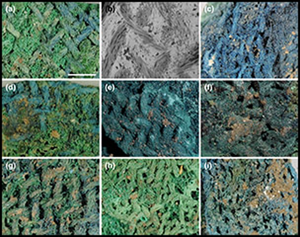
Three types of weave were identified by surface analysis: twill, tabby and tablet-weaving (see OSM Figure S16). Although a number of samples showed microstratigraphy with different textile layers, it was not possible to describe the technical parameters of these hidden layers.
Virtual technical analysis using synchrotron microtomography
μCT was used to perform a non-invasive technical analysis on highly mineralised and/or multi-layered samples (Iacconi et al. Reference Iacconi2023). A selection of 14 samples was made according to the presence of superimposed layers of textiles and different corrosion products (see typical results in OSM section S2).
We identified three types of weave throughout the corpus: twill (87% of the determined textiles), tablet-weaving (12%) and tabby (one occurrence). The state of conservation (i.e. mineralisation or abrasion) and/or limited access to synchrotron analytical time impeded determination in 51 per cent of the total 99 fragments (Table 1, Figure 4). We decided not to use yarn diameter as a discriminating factor for typology as it is significantly impacted by mineralisation. Some textile types (e.g. 1.1.3 and 1.1.4, see Table 1) could have the same facies (understood as the sum total of the characteristics that reflect the artefacts in their specific taphonomic conditions) if the samples were larger, but as their thread count differed, we decided to classify them separately. We therefore identified at least 16 textile items (not counting types 1.3 and 4). At least 20 samples showed microstratigraphy of several layers (maximum: 4), and 24 samples had textiles on both sides. The full results are available in OSM Table S2.
Typology of textiles identified in the 99 fragments from Creney-le-Paradis. Ox and Oy correspond to the yarn system of each weave, weft and warp if they could be determined. Textile types are numbered by weave type, type of yarn and thread count. Note that the total number of layers (NL 135) exceeds the number of fragments (99), as some fragments have more than one layer on their surface(s).

The different types of weave identified at Creney-le-Paradis: a–n) twill (types 1.1.1–1.3); o & p) tablet-woven (types 2.1–2.2); q) tabby (type 3); r) undetermined (type 4). Scale bar 1mm. Images b, m and o were generated from μCT virtual volumes to study otherwise inaccessible layers (figure by authors).

Discussion
Context of European burials and funerary practices in the Iron Age
Based on shape and thickness, the metal sheet finds are interpreted as the remains of at least one metal vessel that could originally have contained some of the burnt bones found at Creney. In the Gallic context, which generally favoured inhumation, the practice of depositing cremated remains in metal cinerary urns appears during Hallstatt D3 as a sign of distinction (Desplanques Reference Desplanques2022a). Corresponding finds are distributed between Burgundy, Jura and Baden-Württemberg (Desplanques Reference Desplanques2020). Creney fits perfectly into the group of urns dated between Hallstatt D2 and La Tène A and spread across Burgundy, Champagne, Orléans and Berry (Verger Reference Verger1995b: 342; Desplanques Reference Desplanques2022a). The deposition of cremation remains in a metal urn is one of several practices that replaced the Central-Hallstatt ritual of the four-wheeled chariot burial (Olivier & Reinhard Reference Olivier, Reinhard and Daubigney1993: 115–19; Milcent Reference Milcent2004: 279). At the same time, the construction of large mounds continued to be associated with burials that may be interpreted as high status or ‘privileged’ (Milcent Reference Milcent2004: 266–7). Comparisons of the different types of tombs show that there were probably several modes of presenting the deceased. In central-eastern Gaul, metal urns were deposited inside quadrangular enclosures or circular tumuli (Chaume et al. Reference Chaume, Reinhard and Wustrow2007: 361). At least two different levels of wealth have been identified for this practice in Gaul. The first corresponds with modest ensembles distinguished only by the use of a metal cinerary vessel (Milcent Reference Milcent2004: 279). The second encompasses tombs with metal urns that have more abundant furnishing and monumental funerary constructions with a ‘founding’ or ‘refounding’ purpose (e.g. Sainte-Geneviève-des-Bois, 525–400 BC; Courcelles-en-Montagne, 440–430 BC). These monuments received several later burials and were then surrounded by small cemeteries. In other cases (e.g. Mardié, 525–475 BC; Bouranton “Michaulot”, 500–450 BC; Gurgy, 500–475 BC), the metal urns were buried within existing complexes and their position in the funerary complex is variable. Similar contemporary practices may be observed in the Greek world, the Italian peninsula and Central and Northern Europe (Verger Reference Verger1995a & Reference Vergerb; Desplanques Reference Desplanques2022a). The use of this type of vessel is currently attested throughout the first millennium BC in Europe, from Scandinavia to Greece, and from the Atlantic coast to present-day Ukraine (Desplanques Reference Desplanques2020, Reference Desplanques2022a). Studies on a regional scale reveal phases of adaptation, continuity, disappearance and resurgence in this practice through time, yet wherever these metal urns appear in the archaeological record there is an association with the use of textiles (Gleba Reference Gleba, Harris and Douny2016; Gleba et al. Reference Gleba, Menale and Rescigno2017; Desplanques Reference Desplanques2022b). The symbolic importance of the choice of textiles selected for the grave is underlined by the Homeric sources (Iliad; Mazon Reference Mazon2017; Odyssey; Bérard Reference Bérard2012) and by Plutarch (Life of Demetrius; Pierron Reference Pierron1845). The original position of the urn burial at Creney in relation to the other finds in the tumulus cannot be confidently identified but it should be noted that the urn was discovered in the central pit (Villard Reference Villard1988).
Diversity of the Creney textiles
At least half of the 21 sites containing metal cinerary urns identified by Desplanques (Reference Desplanques2020) in central-eastern France yielded textile fragments (OSM Table S3). When the remains are sufficiently well preserved, they often show choices in the technical characteristics of the textiles and the arrangement of material within the grave made by individuals on a regional or local scale. Textiles were used to wrap the bone mass, the urn, the urn receptacle or specifically selected grave goods. Several different arrangements have been observed in the same burial: at Sainte-Geneviève-des-Bois, a woollen cloth covered the stamnoid situla (bucket-shaped vessel), which also contained the remains of another piece of cloth (Milcent & Moulherat Reference Milcent and Moulherat1999; Moulherat Reference Moulherat2001). Textiles may also have been deposited folded. The cist from Grave C at Estissac (late sixth–early fifth centuries BC) contained a large amount of textile in the form of successive layers of at least two distinct pieces (Deffressigne & Villes Reference Deffressigne, Villes, Piette and Rouquet1995). These various uses of the material can also be observed in different contexts. At Petershagen-Döhren (Germany, sixth–fifth centuries BC), two identical textiles were handled differently: one covered the urn and the other was placed inside it (Banck-Burgess Reference Banck-Burgess1999: 198). Similar arrangements have been found in more distant contexts, for example in Corfu (Greece, seventh century BC; Moulherat & Spantidaki Reference Moulherat, Spantidaki, Gleba and Mannering2012).
The study of the Creney textiles revealed at least 16 different items. Unfortunately, detail from the excavation was insufficient to propose any hypotheses concerning the function of the textiles in the burial and it was not possible to conduct tomographic analysis of all the fragments towards this end. Our results do, however, suggest that the textiles were used in several ways, as a quarter of the fragments had textiles on both sides of the metal substrate. They could thus have been used inside and outside the urn.
North of the Alps, the most common weave is 2/2 twill, which is composed mainly of woollen yarns, either with plied warp and single (s or z) weft, or composed of combinations of s- and z-twisted yarns (spin-pattern) (Banck-Burgess Reference Banck-Burgess1999; Moulherat Reference Moulherat2001; Gleba & Mannering Reference Gleba and Mannering2012). Some tabbies, mostly of wool, have also been recorded. The thread count averaged 10 yarns per centimetre (y/cm) in the Bronze Age and 30 to 40 y/cm in the Iron Age (Gleba Reference Gleba2008). Spin pattern was widely used in the Early Iron Age. It is based on the combination of differently spun yarns (s- and z-twist), which reflect light differently, creating a homogeneous pattern (tone-on-tone; Moulherat Reference Moulherat2001; Grömer Reference Grömer2016). The textiles found in these burials are mostly perceived to be of high quality due to the fineness of the weave and the treatment of the raw materials—only smooth yarns with parallel fibres can achieve the spin pattern (Grömer Reference Grömer2016).
The Creney textiles fit well within the corpus of woven material found north of the Alps, based on both the arrangement within burials and the technical characteristics of the textiles (Table 1). Textiles were used according to patterns and techniques shared on a European scale (Grömer Reference Grömer2016; Desplanques Reference Desplanques2020), while other elements of the furniture, notably the cinerary vases, were mostly imported from Central Europe, the Italian peninsula or the Greek world (Bouloumié Reference Bouloumié1977). The uniformity of weave types across Europe indicates the existence of common standards, which pre-date the appearance of metal urns. Elements such as fineness, density, provenance, sentimental and usage-related background of the textile may have been considered in the selection and the layout of the grave material. These materials may have been selected for the practical and functional character of the textile within the funerary practice and ritual, but it seems likely that the large number of textile items used may reflect a symbolic character.
Tablet-woven textiles
Tablet weaving creates very strong and narrow weaves, ideal for making selvedges (an edging that stops a piece of fabric from unravelling) or ribbons used as belts or braids for decoration or edging of clothing. In tablet weaving, the loom is replaced by a set of perforated tablets (Collingwood Reference Collingwood2015: 10). The warp yarns are passed through these holes and the tablets are arranged together into a rotating pack parallel to the warp. Tablets can be attached to vertical looms or used independently (Masurel Reference Masurel1983). Different patterns can be obtained by using different coloured warp yarns or different ways of turning the tablets. Although the weaving equipment is very simple, the production of these textiles requires special care of the raw materials and a lot of time spent on their manufacture. They are therefore indicators of a high level of technology, skill and craftsmanship. Among the Creney corpus, we identified seven fragments of tablet-woven textiles with very fine yarns and very high densities, all showing alternations in the direction of twist of their warp yarns.
Textile tools such as tablets, spools and spacers were widespread in Europe during the Bronze and Iron Ages (Knudsen & Grömer Reference Knudsen and Grömer2012: 260; Möller-Wiering Reference Möller-Wiering, Gleba and Mannering2012: 128; OSM Table S4). Some iconographic representations, such as those found on Hallstatt ceramics (Schappelwein Reference Schappelwein1999), Akrotiri frescoes (Xeste 3, Doumas Reference Doumas1999: 162), Greek vases (Spantidaki Reference Spantidaki2013) or Italian historiated situlae (Grömer Reference Grömer, Gleba and Mannering2012: 47), could represent tablet-woven borders of clothes. Thus, tablets could have been used very frequently for practical aspects such as reinforcing fabric borders, as sewn elements as at Hallstatt (Austria, eighth–fourth centuries BC; Grömer Reference Grömer2016: fig. 102), or as a warping technique at the loom as attested at Burton Fleming (England, La Tène; Crowfoot Reference Crowfoot and Stead1991: 124–5). The textiles to which archaeologists have access are often of remarkable quality and seem to have been a very visual medium for the expression of social status. Textile fragments preserved in the archaeological record are most often found in elite contexts; yet their preservation through contact with metal objects deposited in high-status graves may create a conservation bias for this fragile material. Such graves are also more easily identifiable. This is the case in the Chieftain's Grave of Hochdorf (Germany, 550–500 BC) where two sewn pieces of very fine cloth had been deposited in a cauldron, one of which had edges that were woven using 130 tablets (Banck-Burgess Reference Banck-Burgess1999: 142–9). In the Tomba del Trono at Verucchio (Italy, 700–650 BC), the tablet-woven borders (36 tablets) added to two of the mantles found in connection with the metal urn showed a pattern of triangles arranged in several rows and evidence of the use of red, yellow and blue dyes (Raeder Knudsen Reference Raeder Knudsen, Gleba and Mannering2012: 229, 246). This recurrent motif of rows of triangles in painting and sculpture, also present in Hochdorf, suggests an anthropometric and symbolic use referring to the status, social or religious function of the deceased. The three textile objects found in the tomb form a set of remarkable quality owing to the fine craftsmanship of the materials and the precision of the weaving.
In Western Europe, a metal urn from a tomb contemporary with Creney yielded fragments of tablet-woven textiles. Three bands of tablet fabric were identified at Altrier (Luxembourg, fifth century BC), two of which were sewn to another piece of textile (Rast-Eicher et al. Reference Rast-Eicher2022). All three showed traces of geometric decoration and dyes (kermes, pastel). One band was woven with four-hole tablets for the edges (ZZS or ZSZ) and with a two-hole tablet for the central part, for a minimum total of 74 tablets. Three-hole tablets were used for another strip. These technical characteristics are comparable to the tablet-woven textiles from Hochdorf, in particular the S-plied yarns in the warp, the tablet-woven bands in the two-hole tablet technique and the kermes dye. In addition, microscopic observation of the Altrier textiles shows that they are made from fine, carefully selected wool. The state of preservation of the tablet-woven textiles at Creney does not allow for the recognition of their original function and position. They could belong to a sewn or loom-woven border, or they could be the remains of a ribbon used to fix some of the organic elements to the metal object, as is the case in tumulus 4 in Matran (Switzerland, Hallstatt C). There, a 20mm-wide ribbon was arranged to surround a sword (Rast-Eicher Reference Rast-Eicher, Gleba and Mannering2012: 383). Similarly, the decorated tablet-woven band from Apremont (France, 600–500 BC), showing an alternation in the direction of the twist of the warp yarns, fixed the padding around the elements of one of the chariot wheels (Masurel Reference Masurel, Kaenel and Curdy1992: 66–7). In view of the quantity of Creney textiles in connection with the metal container, the possibility that ribbons could have been used to hold elements together is plausible.
Conclusions: revising the status of the burial?
During excavations at Creney-le-Paradis, Villard (Reference Villard1988) identified several elements indicative of the burial of an important individual: 1) the location of the burial within a large tumulus (diameter 45m); 2) the large size of the grave dug in the centre of the tumulus; 3) the existence of a funerary structure made of vertically joined wooden planks to protect the body of the deceased and his/her offerings. Our study of the textiles found at Creney, utilising novel imaging methods, reveals the presence of at least 16 textile items. A rich diversity of twills was identified, as well as seven fragments of tablet-woven textiles, adding substantially to the Iron Age record of this weaving technique. In addition to the elaborate nature of the funerary structure and the grave goods (urn) discovered at Creney, the wealth and number of textile items present in the burial contribute significantly to identifying the status of the burial, as reported by several authors (Grömer Reference Grömer, Schumann and Van Der Vaart-Verschoof2021: 231; Van der Vaart-Verschoof Reference Van Der Vaart-Verschoof2017: 24). All these elements enable us to suggest that the central tumulus at Creney-le-Paradis had elite status.
Three-dimensional imaging and documentation are rapidly evolving tools for the study of archaeological sites and material. Here we demonstrate a particularly powerful new approach to the 3D imaging of remains on the scale of just a few millimetres. More generally, our study reflects a particularly complex but very common case in archaeology, where much information has been lost over time, material evidence is extremely fragmentary and interpretation of the remains has been abandoned for some time. Yet, a patient, thorough and statistically extensive re-evaluation of tiny material finds is possible with new imaging approaches that can shed fresh light on these ‘cold cases’, helping to address difficult questions of practice, use or status.
When compared with the fabrics from other European Iron Age burials, notably those from Hochdorf, Apremont and Dürrnberg, the textiles from Creney lead us to re-evaluate our perception of burials. While the gestures made during a funeral, as well as the sounds, smells and emotions, remain inaccessible to modern observers, the fabrics preserved in burials bear witness to the very specific care and attention given to each deceased person. The universal presence of fabrics in burials studied indicates that this material played an essential role in the organisation of funerals. The diversity of arrangements for the inclusion of textiles, both on the scale of an individual burial and within the wider European tradition, suggests that the intentions and symbolism contained in each gesture varied. The criteria for choosing fabrics are likely economic and social in nature, but probably also touch on emotional issues. In this way, restoring this material to the importance it had for the organisers, actors and participants in funerals will enhance our perceptions of ancient funerary realities in terms of material considerations, community involvement and landscape.
Acknowledgements
The authors thank Serge Cohen (IPANEMA), Lauren Dalecky (PPSM), Angélique Deckers, Jean Doucet, Danilo Nunes (Novitom) and Laurent Tranchant (synchrotron SOLEIL) for their assistance and exchanges during sample preparation and data acquisition. We sincerely thank Anne Villard for answering our many questions. We thank Éleonore Kissel at Musée du quai Branly–Jacques Chirac for her support to the development of this project.
Funding statement
C. Iacconi was supported by the MUSETEX3D project (Paris Region PhD grant / Région Île-de-France). We acknowledge the provision of beamtime at the SOLEIL synchrotron facility under project no. 20200334.
Online supplementary material (OSM)
To view the supplementary material for this article, please visit https://doi.org/10.15184/aqy.2024.96 and select the supplementary materials tab.


 Open access

