





Input is critical for language acquisition (Bybee, Reference Bybee, Robinson and Ellis2008; Genesee & Nicoladis, Reference Genesee, Nicoladis, Hoff and Shatz2006; Lightfoot, Reference Lightfoot2020; Yang, Reference Yang2016). However, how input is processed by different types of speakers and how it influences subsequent linguistic production is not yet clear (Byalistok, Reference Byalistok1991; Clahsen & Felser, Reference Clahsen and Felser2006). A phenomenon that could shed some light on this issue, and which we investigate in this study, is structural priming, the tendency of speakers to produce a structure that was previously heard, read, or self-produced (Bock, Reference Bock1986).
Two types of models have been proposed to explain the nature of structural priming: the activation and the implicit learning models. The activation model (Pickering & Branigan, Reference Pickering and Branigan1998) claims that when speakers process a sentence, a lemma is activated and later reused in production. The activation of the syntactic structure is thus what drives priming. Evidence for this model comes from lexical repetition, which seems to increase the degree of priming in the short term (Branigan et al., Reference Branigan, Pickering and McLean2005).
By contrast, the implicit learning model (Chang et al., Reference Chang, Dell and Bock2006) proposes that exposure to a sentence makes speakers implicitly extract probabilistic information and create structural associations, which lead to the production of similar syntactic structures. Under this view, learning is seen as mere adaptation rather than acquisition of new knowledge: the fact that speakers adjust to a specific linguistic environment by producing (or not) certain structures is considered implicit learning (Frensch & Rünger, Reference Frensch and Rünger2003). Evidence supporting this model comes from priming research with amnesiac patients, from studies that do not involve any type of lexical repetition, and from the finding that priming is still effective after some time has elapsed between the prime and the target (Ferreira et al., Reference Ferreira, Bock, Wilson and Cohen2008). Likewise, the implicit learning model can also account for the inverse frequency effect (Jaeger & Snider, Reference Jaeger and Snider2013), by which speakers are more susceptible to priming the less frequent a structure is.
Widely investigated as well has been the role of memory in the structural priming process. It seems that immediate priming (short-term priming in the absence of intervening lags between the prime and the target) could be driven by explicit memory processes, whereas long-term priming could be driven by implicit memory processes (Bernolet et al., Reference Bernolet, Collina and Hartsuiker2016; Kutta et al., Reference Kutta, Kaschak, Porcellini and Jones2017). To account for lexical repetition, frequency, and memory, multifactorial models of priming have also been proposed (e.g., Reitter et al., Reference Reitter, Keller and Moore2011).
Structural priming has been mostly investigated in the monolingual production of different types of speakers, contexts, and modalities. More recently, there has been increasing attention on the possibilities of structural priming in second language acquisition and bilingualism (Jackson, Reference Jackson2018) as a way of examining how language is represented and used by non-monolingual speakers (Hartsuiker et al., Reference Hartsuiker, Pickering and Veltkamp2004; Hartsuiker & Bernolet, Reference Hartsuiker and Bernolet2017), and of assessing its pedagogical implications (Kim, Reference Kim and Markee2015). However, most L2 priming studies have focused on English as the target language and have tested a limited number of constructions (Kim & McDonough, Reference Kim and McDonough2016). We still lack understanding of how effective structural priming is in L2 speakers of other languages at different stages of development, and whether it leads to the same outcomes in heritage speakers, for whom their L2 is the dominant language.
If structural priming operates in L2 learners, it has the potential to become a valuable pedagogical tool to help these speakers advance in their acquisition and production of their L2. And if structural priming is also operative in the heritage speakers’ L1 (i.e., non-dominant language), it can be a means of activating and accessing specific L1 syntactic representations currently “blocked” due to less use of the heritage language (Putnam & Sánchez, Reference Putnam and Sánchez2013).
The present study contributes to increasing our understanding of structural priming in monolingual speakers, heritage speakers, and L2 speakers of Spanish in at least three ways. First, our study is the first one to investigate within-language structural priming in Spanish heritage speakers. As pointed out, examining how this population responds to structural priming could broaden our understanding of how these speakers process and represent their weaker language, which is a key question in heritage language research (Montrul, Reference Montrul2016). Another innovation of our study is its syntactic focus on Spanish clitic doubling constructions (Juan le da un libro a Maria “Juan gives Maria a book”) in cases in which the dative clitic is optional but much preferred in native varieties compared to the prepositional construction (Juan da un libro a Maria “Juan gives a book to Maria”), which L2 speakers tend to use (especially when their L1 has no clitics). Furthermore, this alternation was chosen because it resembles the English dative alternation, which has already been the subject of previous priming studies (Kantola & van Gompel, Reference Kantola and van Gompel2011; Loebell & Bock, Reference Loebell and Bock2003). Finally, most studies of structural priming have examined the immediate effects of priming. This study also examines the potential long-term effects of structural priming. Priming research has usually employed “long-term” to refer to effects that lasted for some minutes after the priming intervention. In our study, “long-term effects” refers to priming effects that last for a week, as this is more useful given our interest in the potential pedagogical implications of structural priming for the L2 and heritage language classroom.
DATIVE CONSTRUCTIONS IN SPANISH
Ditransitive sentences in Spanish are characterized by the presence of a dative clitic (le/les)Footnote 1 and a case marker (a), as in (1). The dative clitic agrees with the NP that works as the indirect object, and the case marker a licenses such NP. These ditransitive sentences with dative clitics are usually known as clitic doubling constructions.

The indirect object of such ditransitive sentences can have different thematic roles:Footnote 2 recipient, possessor (or source), beneficiary, and locative (Fernández-Alcalde, Reference Fernández-Alcalde2014). Ditransitive sentences with recipients express transfer or transmission, as in (1), where a book is given to my father by Juan. Sentences with possessors, as in (2), imply that the direct object (possessum) on which the action is performed belongs to or is an integral part of the direct object NP. In (2), the hair is an integral part of Julia (part of her body). Thus, Julia is the possessor of the hair. Sometimes, the possessum of these sentences is not part of the possessor’s constitution (i.e., it can be detached from the possessor), as when the direct object refers to clothes or accessories. In these cases, some propose the semantic role of source instead, whereas others prefer to use possessor and clarify that it has a metaphorical meaning (Uriagereka, Reference Uriagereka, Gerlach and Grijzenhout2000). In sentences with beneficiaries, as in (3), the indirect object benefits from the action: Soraya is the beneficiary of a sandwich. Lastly, sentences with locatives, as in (4), have an indirect object that expresses where the action was performed: the computer was the location where an antivirus was installed.



These four ditransitive constructions can also be expressed as prepositional constructions,Footnote 3 as shown in Table 1. In all cases, the alternation between the ditransitive construction and the prepositional construction involves no dative clitic and a different preposition (a, de, para, en). In the prepositional constructions, the indirect object is not an internal argument of the verb; rather, it is an external argument (a prepositional object) (Cuervo, Reference Cuervo2003; Fernández-Alcalde, Reference Fernández-Alcalde, Baauw, Drijkoningen, Meroni and Pinto2013; Gutiérrez-Ordóñez, Reference Gutiérrez-Ordóñez, Bosque and Demonte1999).
Alternation between ditransitive and prepositional constructions in Spanish

It is important to discuss the particular alternation of recipient constructions. Unlike the other three constructions, the recipient ditransitive construction and the recipient prepositional construction are very similar to one another because they both have the preposition a. In this particular alternation, there is only a change in the status of the clitic (i.e., it is either present or absent). This fact might lead to the wrong conclusion: that the only change in the alternation of recipient constructions is the optionality of the dative clitic. However, even though this similarity exists, the syntactic role of the preposition a is completely different in each construction: in the ditransitive construction, a is a dative case marker that licenses the indirect object (as in the other three constructions); in the prepositional construction, a is not a dative case marker but a preposition that happens to have the same morphological form as the case marker. Therefore, the structural equivalence between the two prepositions a is only illusory (Fernández-Alcalde, Reference Fernández-Alcalde2014). This apparent equivalence has received much attention in the syntax literature. For example, Demonte (Reference Demonte1995) claimed that the relationship between the two recipient constructions is such that one is derived from the other. Several syntactic explanations have been proposed for Spanish recipient constructions (Baker, Reference Baker1988; Cuervo, Reference Cuervo2003; Ormazábal & Romero, Reference Ormazábal, Romero, Duguine, Huidobro and Madariaga2010; Pylkkänen, Reference Pylkkänen2002; among others), the details of which are beyond the scope of this article. What is relevant for our purposes is the similarity between the ditransitive and the prepositional construction from a language acquisition perspective. Therefore, we will examine recipient constructions separately from non-recipient constructions (see also Irizarri, Reference Irizarri2014).
THE ACQUISITION OF DATIVE CONSTRUCTIONS IN SPANISH
Native speakers of Spanish produce and understand clitics at a very young age, although there is variation in the rate of dative clitics produced in different varieties of Spanish. Company (Reference Company and Company2006) analyzed data from the second half of the twentieth century and found that dative clitic doubling was less common in Peninsular Spanish, where speakers used clitic doubling 64% of the time, compared to speakers of Latin American varieties of Spanish, who use clitic doubling constructions much more frequently, with Mexico being the country where dative clitics were doubled the most, at a rate of 89%. Company’s study shows that, overall, native speakers tend to use ditransitive constructions with clitics as opposed to prepositional constructions.
By the age of 3, monolingual children already master the morphosyntactic properties of Spanish clitics (Eisenchlas, Reference Eisenchlas2003; López Ornat et al., Reference López Ornat, Fernández, Gallo and Mariscal1994). Furthermore, they hardly ever make any errors in this regard, as opposed to speakers of other languages, who sometimes have problems with establishing long distance dependencies like binding (Montrul, Reference Montrul2004a). Torrens and Wexler (Reference Torrens, Wexler, Powers and Hamman2000) analyzed longitudinal data from Maria, a child exposed to Peninsular Spanish, and found that she already used clitic doubling at age 1;10, and between the ages of 2;4 to 3;11 her production of clitic doubling constructions increased considerably. The child showed knowledge of obligatory and optional (i.e., alternation) contexts from the very beginning. The frequency of dative clitics in the input may explain their early acquisition.
Despite how easy it may be for native speakers of Spanish to acquire clitics and clitic doubling constructions, this is hardly the case of L2 learners of Spanish, especially when their L1 does not have clitics. Previous studies have examined how speakers of other languages (mainly English and French) produce and interpret Spanish clitics. Montrul (Reference Montrul, Klein and Martohardjono1999) conducted a study of dative clitics and clitic doubling with English-speaking and French-speaking L2 learners of Spanish, who completed a written grammaticality judgment task. Results showed that the French-speaking group, whose L1 has clitics but no clitic doubling, did not have problems with clitic doubling constructions in Spanish, while the English group, whose L1 lacks clitics, did. In another study, Perpiñán and Montrul (Reference Perpiñán, Montrul, Klee and Face2006) investigated whether English-speaking L2 learners of Spanish transferred the English double object construction into Spanish. Participants completed a sentence interpretation task in which a situation was provided (in English) and two possible answers were presented (in Spanish). The task tested different conditions, one of them being the clitic doubling construction, as in (5).



Results revealed that intermediate L2 learners of Spanish often chose the wrong option (5b), while the advanced L2 learners of Spanish were nativelike. Perpiñán and Montrul concluded that at the intermediate level, there is still transfer from English into Spanish with these constructions. Bruhn de Garavito (Reference Bruhn de Garavito, Slabakova, Montrul and Prévost2006) examined knowledge of Spanish clitics by Spanish monolinguals, Spanish-English bilinguals, and Spanish L2 speakers (L1 English) at the near-native level. Participants completed a task testing the interpretation of dative constructions with clitic doubling. Results showed that the L2 group had problems interpreting clitic doubling constructions when the indirect object was [-human], even though they had a near-native level of proficiency. No difference was observed between the bilingual and the monolingual groups. Cuervo (Reference Cuervo2007) tested semantic and syntactic knowledge of Spanish dative constructions by intermediate L2 learners of Spanish (L1 English). Like Bruhn de Garavito, Cuervo found that intermediate learners had mastery of morphosyntactic aspects but only accepted clitic doubling constructions as grammatical when the indirect object was animate. Overall, it seems that L2 learners of Spanish whose L1 does not have clitics go through different phases in their acquisition of clitic doubling. They seem to acquire the morphosyntax of the construction before its semantics (i.e., animacy).
Clitic doubling constructions have also been investigated in some heritage language situations. Silva-Corvalán (Reference Silva-Corvalán1994) examined oral production data of second-generation Spanish bilinguals in Los Angeles and found that heritage speakers had a tendency to produce dative structures without the clitic, especially in sentences with indirect objects that were possessors or locatives (they used prepositional constructions instead). Montrul (Reference Montrul2004b) conducted a study with monolingual and heritage speakers of Spanish who completed an oral narrative task and found no differences in their use of dative clitics. However, lower-proficiency heritage speakers produced fewer dative clitics in constructions containing a possessor. Montrul (Reference Montrul2010) compared L2 learners and heritage speakers on their knowledge of clitic doubling in an acceptability judgment task and found that heritage speakers had higher acceptance rates for dative clitic doubling than for dative structures with no clitic doubling. Also, the L2 learners only had problems accepting dative clitic doubling constructions with strong pronouns (i.e., obligatory contexts). More recently, Irizarri (Reference Irizarri2014) examined dative clitic doubling constructions by Spanish-Dutch heritage speakers and Spanish monolingual speakers in oral interviews using an elicited production task. Although no significant differences in the rate of dative clitics were found between the monolingual and the heritage speakers, all speakers produced fewer datives with non-recipient dative constructions, and this difference was particularly notable in the heritage speakers, who opted for alternatives that resembled the Dutch equivalent structure.
In general, studies with heritage speakers show that their rates of clitic production are similar to those of monolingual speakers. However, contact with Germanic languages has been shown to have an effect on the rate of clitics produced in nonrecipient constructions, as the studies by Silva-Corvalán (Reference Silva-Corvalán1994) and Irizarri (Reference Irizarri2014) found. Thus, it seems that, even though dative clitics are successfully acquired by the age of 3;0, the variable input heritage speakers receive compared to monolinguals in terms of quantity and quality makes these representations be weaker and more difficult to access for production (Putnam, Reference Putnam2019). This particular finding motivated the inclusion of heritage speakers in our study: we thus investigate whether structural priming is effective to promote higher production of dative clitics in heritage speakers and L2 learners in both recipient and non-recipient dative constructions.
STRUCTURAL PRIMING
Structural priming is the process whereby speakers produce a sentence (target) containing a structure that was previously encountered (prime). Research in this area started in the 1980s, with Bock’s seminal study (Bock, Reference Bock1986) claiming that priming was an automatic phenomenon that reflected the activation of syntactic rules and that did not depend on meaning nor communicative context. Subsequent studies examined the phenomenon in different languages (Hartsuiker & Kolk, Reference Hartsuiker and Kolk1998), with different syntactic constructions (Hartsuiker et al., Reference Hartsuiker, Kolk and Huiskamp1999), with different word orders, and different tests and modalities (Pickering & Branigan, Reference Pickering and Branigan1998; Potter & Lombardi, Reference Potter and Lombardi1998), and confirmed robust structural priming effects. Other studies looked at the duration of priming effects, with some of them reporting a significant effect after adding intervening sentences between the prime and the target (e.g., Bock & Griffin, Reference Bock and Griffin2000), which in turn supports an implicit learning account.
More recent studies have investigated the structural priming phenomenon in different populations, in an attempt to understand how different speakers represent and process language. Drawing from these studies, we know that structural priming occurs with young children (Huttenlocher et al., Reference Huttenlocher, Vasilyeva and Shimpi2004; Savage et al., Reference Savage, Lieven, Theakston and Tomasello2006), cross-linguistically (from one language to the other) in bilinguals (Loebell & Bock, Reference Loebell and Bock2003), and even in language-impaired individuals (Miller & Deevy, Reference Miller and Deevy2006).
In this study, we focus on two groups of bilinguals who have been understudied in the structural priming literature: L2 speakers at intermediate stages of development and heritage speakers. To date, most L2 priming studies have tested almost exclusively advanced speakers, and no study has tested heritage speakers so far. Thus, more research is needed in this regard to understand whether and how these two groups diverge from other speakers (Jackson, Reference Jackson2018).
L2 structural priming research has predominantly used cross-linguistic priming to examine whether syntactic representations are separate or shared in bilingual speakers. Findings seem to point in the latter direction, because activation of a structure in one language leads to activation (and thus priming) of an exact or similarFootnote 4 structure in the other language (Hartsuiker et al., Reference Hartsuiker, Pickering and Veltkamp2004; Kantola & van Gompel, Reference Kantola and van Gompel2011). Drawing from these results, Hartsuiker and Bernolet (Reference Hartsuiker and Bernolet2017) proposed the shared-syntax model, according to which representations of L2 structures that have an equivalent structure in the speakers’ L1 are fully shared when speakers are proficient in their L2. At intermediate stages of development, however, these connections are not strong yet and cross-linguistic activation yields weaker priming effects (Schoonbaert et al., Reference Schoonbaert, Hartsuiker and Pickering2007).
Although our study deals with bilingual speakers, it uses a within-language priming methodology instead. Within-language priming cannot tell us much about whether syntactic representations are shared, but it does help us compare how the representation and processing of a single language differs depending on the type of speaker (i.e., monolingual speakers, L2 speakers, and heritage speakers). Likewise, it can provide an insight into how factors that usually play a role in L1 structural priming (namely, lexical repetition, frequency, time, and semantics) operate in the two bilingual groups under study. Lastly, examining within-language priming effects can also help us draw pedagogical implications to foster the development of second and heritage language proficiency.
How L2 speakers differ from native speakers in terms of language processing is a foundational question in second language acquisition research (Clahsen & Felser, Reference Clahsen and Felser2006), and if structural priming is a kind of implicit learning, the question is to what extent this type of learning is operational in L2 speakers as well. It has been shown that for structural priming to be effective in these speakers, basic prior knowledge of the prime structure is required (McDonough & Trofimovich, Reference McDonough, Trofimovich, Cadierno and Eskildsen2015) because implicit learning does not necessarily imply that new knowledge has to be acquired. Instead, it consists of adaptation to a given input. For that adaptation to be successful, knowledge of the input structure seems to be necessary.
Regarding heritage speakers, their L2 seems to be their most dominant language, whereas their L1 usually shows both native and non-nativelike features (Montrul, Reference Montrul2016). Recently, Putnam and Sánchez (Reference Putnam and Sánchez2013) claimed that a low activation of L1 syntactic representations in these speakers might eventually lead to feature reassembly; meaning that their L2 (i.e., their dominant language) could block the activation of their L1 (i.e., their weaker or heritage language). By including these speakers in our study, we can examine whether structural priming enhances the production of syntactic representations that are weakly activated, thus developing their heritage language skills.
Concerning the factors that have been claimed to modulate structural priming effects, the boost experienced by lexical repetition has been documented in several different studies and seems to play a role in both monolingual and L2 speakers (Mahowald et al., Reference Mahowald, James, Futrell and Gibson2016). It seems that this lexical repetition effect is thus independent of the type of speaker. Our study seeks to whether this effect also holds true in a group of heritage speakers.
Proficiency level has also been proposed as a factor that modulates the priming effect. The developmental shared-syntax model (Hartsuiker & Bernolet, Reference Hartsuiker and Bernolet2017) predicts that abstract priming is only possible in high-proficient L2 speakers, as connections between lemmas are already strong. Low-proficiency L2 speakers, however, will be more primed in cases of lexical repetition or in related conditions. This is because their syntactic representations are still item-specific (i.e., non-abstract), so they might rely on explicit memory processes that would allow them to reuse the prime construction by only making minor “edits” to it.
As for frequency, Jaeger and Snider (Reference Jaeger and Snider2013) argued that priming effects are usually stronger the less frequent a structure is (inverse frequency effect). Although this claim was based on data from monolinguals, it has recently been investigated in L2 priming research. Jackson and Ruf (Reference Jackson and Ruf2017) tested a group of L2 German speakers and found that in a postpriming task, they were more primed with fronted temporal phrases than with fronted locative phrases because the first ones are more frequent in German. Similarly, Kaan and Chun (Reference Kaan and Chun2017) primed a group of L2 English speakers with the double object construction, as they had been shown to have a preference for the prepositional construction in a baseline task. Even though prepositional constructions were still preferred in the priming intervention, the number of double object constructions did increase. This suggests that L2 speakers are more primed with the construction that is most frequent in their L2. In other words, as opposed to monolinguals, L2 speakers would show a frequency effect (instead of an inverse frequency effect).
In terms of duration, few studies have examined the long-term effects of structural priming with promising results (e.g., Jiang & Huang, Reference Jiang and Huang2015; Shin & Christianson, Reference Shin and Christianson2012), which are crucial for assessing its potential learning and teaching implications. So, to understand the usefulness of structural priming as a pedagogical tool, more studies of different L2 structures and languages using long-term measures are critical (Jackson, Reference Jackson2018). Besides providing an insight into whether and how L2 speakers and heritage speakers may use structural priming as an implicit learning mechanism, finding that structural priming works with these two groups of speakers has important classroom applications because it could be used to promote the activation and use of certain syntactic structures in the L2 or heritage language (McDonough et al., Reference McDonough, Trofimovich and Neumann2015; McDonough & Chaikitmongkol, Reference McDonough and Chaikitmongkol2010).
The present study aims to contribute to this field of research by investigating structural priming with a set of structures that may be difficult for instructed learners to acquire and that have not been investigated so far. It also expands its inquiry to heritage speakers, who sometimes show some of the same problems with morphosyntactic aspects of Spanish as L2 learners (Montrul, Reference Montrul2008, Reference Montrul2016) but may use distinct language processing patterns. Because there are no previous priming studies of Spanish clitic constructions, our study also included a group of monolingual speakers.
RESEARCH QUESTIONS AND PREDICTIONS
Our study was guided by four main research questions:
-
1. Do Spanish monolingual speakers, L2 speakers, and heritage speakers use clitic doubling constructions in contexts where an alternation is possible?
We want to know whether the average rate of clitics produced by these three groups of speakers is consistent with what previous studies have found. We expect to find a continuum with monolingual speakers producing the highest number of clitics, followed by heritage speakers (who are usually more nativelike than L2 speakers) and by L2 speakers, respectively.
-
2. Does structural priming have an effect on these speakers’ production of clitic constructions? If so, is this effect significant in the long term?
We expect the three groups of speakers to be primed during the priming intervention. According to results of priming studies with other constructions, if L2 speakers produce fewer clitics in general, they are expected to be more sensitive, showing a higher rate of clitic production than monolingual speakers and heritage speakers after the intervention. Some studies have shown that structural priming effects persist several days after completing a priming task (Jiang & Huang, Reference Jiang and Huang2015; Shin & Christianson, Reference Shin and Christianson2012). Thus, it is possible that our participants also show this effect.
-
3. Does lexical repetition enhance priming?
Lexical repetition has been shown to enhance structural priming in the short-term regardless of the type of speaker (Mahowald et al., Reference Mahowald, James, Futrell and Gibson2016). Although previous studies have not tested heritage speakers, we also expect these speakers to show a lexical boost in the repeated condition. Likewise, we also predict a significant priming effect in the non-repeated condition, even for L2 speakers, because according to the developmental shared-syntax model (Hartsuiker & Bernolet, Reference Hartsuiker and Bernolet2017), the priming effect observed right after the prime might be driven by explicit memory processes. In other words, lexical repetition would enhance priming but would not be the only reason behind the effect.
-
4. Does the rate of clitic production vary in recipient and nonrecipient constructions?
Perhaps structural priming overrides the effects of construction, or it could be that the type of construction modulates the priming effect. We predict that Spanish monolingual speakers and Spanish heritage speakers will produce more clitics with nonrecipient constructions, as these are the less frequent ones (following Company, Reference Company and Company2006), so we should see an inverse priming effect (Jaeger & Snider, Reference Jaeger and Snider2013). L2 speakers, however, will produce more clitics with recipient constructions, as a result of the frequency effect.
PARTICIPANTS
Seventy-five participants were recruited for the study: 23 Spanish monolingual speakers,Footnote 5 28 Spanish L2 speakers, and 24 Spanish heritage speakers. The L2 learners and the heritage speakers were undergraduate students at an American university taking Spanish. They completed a written proficiency test, a linguistic background questionnaire, and a clitic task. The proficiency test consisted of a multiple-choice vocabulary section and a cloze passage (Montrul & Slabakova, Reference Montrul and Slabakova2003). The maximum possible score was 50 points. The L2 leaners obtained a mean score of 27.20 (SD: 5.90) (low intermediate) and the heritage speakers 37.90 (SD: 5.90) (high intermediate).
A 15-question background questionnaire (Gignoux, Reference Gignoux2009; Montrul, Reference Montrul2012; Torres, Reference Torres2012; available on the National Heritage Language Resource Center website) was used to determine group membership. Responses indicated that the group of Spanish heritage speakers was heterogeneous. Out of the 24 participants, 23 of them were second-generation immigrants and 1 of them was a third-generation immigrant. Twenty-one were of Mexican descent, and the other 3 from Guatemalan, Ecuadorian, and Spanish heritage. Five of them were raised in English-dominant environments (English was the main language spoken at home and the only language spoken at school), and the other 19 were raised in a bilingual environment (Spanish was spoken predominantly at home and to some extent at school).
The clitic task served as a screening measure to make sure participants had at least a basic knowledge of Spanish clitics. Participants were presented with six full sentences in Spanish on a computer screen with the direct and indirect objects underlined. They were asked to retype the sentence replacing the underlined objects by clitics. The maximum score possible was 6 points (1 point per sentence). The mean score was 4.70 (SD: 0.90) for L2 learners and 5.60 (SD: 0.60) for heritage speakers. Only 3 participants scored 3 points, which is chance (all of them were L2 speakers) and 10 participants scored 4 points (nine of them were L2 learners and one of them was a heritage speaker). The rest of participants scored either 5 or 6 points.
All the monolingual speakers were from Spain for a reason. According to Company (Reference Company and Company2006), the Peninsular variety of Spanish is the one that presents the lowest clitic rate (dative clitics are used around 60% of the time as opposed to Latin American varieties where, in some cases, clitics are used 89% of the time). A meta-analysis (Mahowald et al., Reference Mahowald, James, Futrell and Gibson2016) found that the average effect size of a priming intervention usually ranges from 13% to 27% for constructions that occur 50% of the time. Given those rates, it made sense to test natives from Spain because they still had a chance to increase their clitic production by that percentage.
METHODOLOGY AND PROCEDURE
Following Bock (Reference Bock1986), a picture description task was used to elicit clitics. Given the nature of the research questions, participants completed this task in four testing phases. The first phase was a baseline phase, in which participants were not primed. The goal of this first phase was to determine the base rate of clitic production for each group. The baseline phase took about 10 minutes to complete and it was presented on a computer screen. Participants saw pictures with a verb in the infinitive. They were asked to create a sentence using the verbs given to describe the pictures (i.e., elicited production). They were allowed to use whatever tense they wanted, and they could add as many details as they wished in their descriptions. Their spoken sentences were recorded for analysis. To disguise the actual goal of the experiment, participants were told they were taking part in a memory task. They were asked to focus on the pictures rather than on the verbs while completing the task. After a number of pictures, a question asking whether they had seen a given picture popped up. The question required clicking a “yes” or “no” answer and automatic feedback was provided on the screen.
After the baseline phase, participants proceeded to the treatment phase. In this second phase, they completed a similar task, although this time priming was administered. Like the baseline task, this one was also presented on a computer screen, but it took around 20 minutes to complete. In this phase, participants had a double task: they were presented with pictures accompanied by full sentences in Spanish that they had to read (primes) and they also had to produce their own descriptions in those cases in which only a verb was provided (targets). The goal was for them to produce the same structure in the targets as in the primes, without explicitly being told so. It is important to mention here that participants were told to read the prime sentences aloud because previous studies have shown that prime repetition enhances priming (Jackson & Ruf, Reference Jackson and Ruf2018; Kim & McDonough, Reference Kim and McDonough2016). Similar to the baseline phase, participants were also told this was a memory task, so distractor questions about pictures were also included. All spoken productions were audio-recorded.
The third phase consisted of an immediate posttest completed 5 minutes after the treatment to determine whether the effects of priming were still active. There was no distractor task between the treatment and the posttest; participants were simply given a short break. The structure of this phase followed the same format as the baseline phase. Finally, the fourth phase consisted of a delayed posttest with no priming conducted a week after the treatment phase. This last task was intended to measure long-term effects of priming. It followed the same structure as the baseline and the immediate posttest.
MATERIALS
The experiment was presented using the Paradigm software (Perception Research Systems, 2007). Although there were four phases in the study, three of them followed the same format. Thus, the baseline, immediate posttest and delayed posttest had the same number of items: seven picture-verb combinations to elicit recipient constructions (Figure 1), seven picture-verb combinations to elicit nonrecipient constructions (Figure 2), and seven picture-verb combinations to elicit transitive constructions (fillers). Pictures differed in animacy because some verbs did not allow constructions with animate indirect objects: 10 were animate and 4 were inanimate (all were counterbalanced by type of construction). In addition to these items, there were also four distractor questions for the covert memory task.
Recipient construction.
Note: Donar = Donate.

Non-recipient construction.
Note: Robar = Steal.
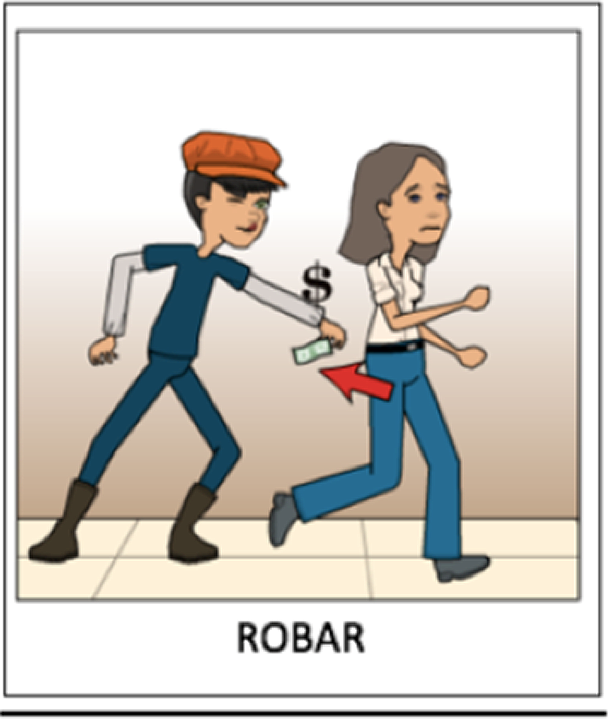
All items were presented in a pseudorandomized order, and two distractor questions never appeared one right after another. Materials for the baseline and delayed posttest were exactly the same (same verbs and same pictures), except for the distractor questions, which were different. In the immediate posttest, eight verbs were repeated from the baseline and the delayed posttest, whereas the other six were new (again, this was counterbalanced by type of construction).
Regarding the treatment phase, it consisted of 16 sets of items. Each set included four fillers, two primes, and one target. Items within a set always appeared in that fixed order, so participants were exposed to two primes before each target. Targets followed the same format as items from the other three phases (i.e., picture-verb combinations). However, fillers and primes consisted of pictures accompanied by full sentences (as opposed to simply verbs in the infinitive). All full sentences that acted as primes contained clitic doubling constructions (Table 2). There were five distractor questions.
Structure of sets in the treatment phase
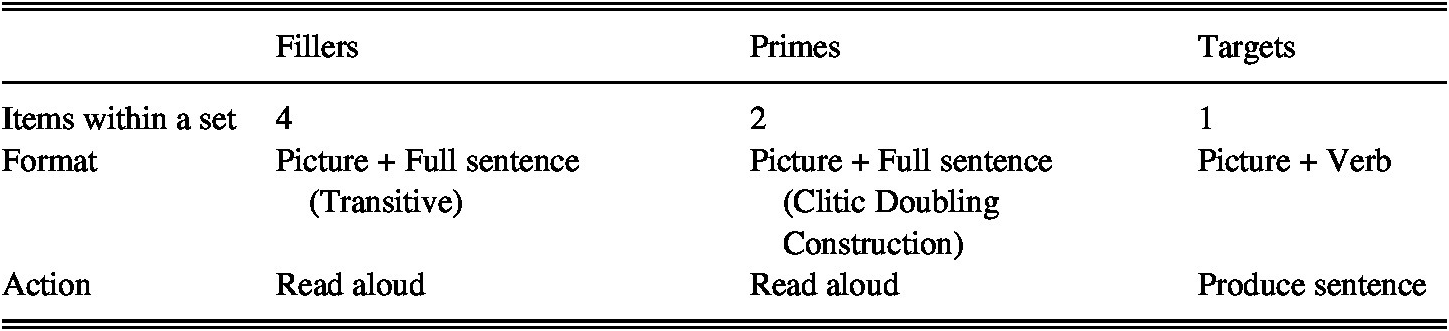
Primes and targets differed in terms of construction and lexical repetition following a 2 × 2 design (Table 3). Thus, out of the 16 sets, 8 elicited recipient constructions, whereas the other 8 elicited non-recipient constructions. Additionally, eight sets showed lexical repetition (i.e., same verb in the primes as in the target within a set) and eight did not. These conditions were counterbalanced.
Distribution of primes and targets in the treatment phase based on lexical repetition and type of construction
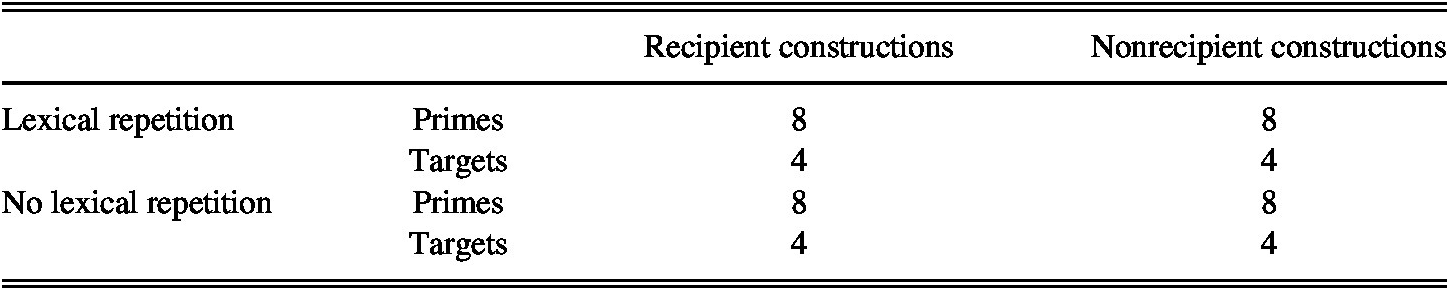
Similarly to what happened in the other phases, pictures differed in animacy: there were 6 inanimate targets and 10 animate targets (this was counterbalanced based on type of construction). Also, most verbs in the treatment were repeated from the other phases. Sets appeared in a pseudorandomized order and two distractor questions never appeared together.
DATA ANALYSIS AND RESULTS
All audio-recorded sentences were transcribed, except for the fillers. The transcriptions were verbatim, although unrelated errors of pronunciation, vocabulary and grammar were not considered. Each sentence was coded for presence or absence of the dative clitic, testing phase in which it was produced, type of construction, and repetition (this latter was only considered for sentences in the treatment phase). Table 4 presents the descriptive statistics of clitic usage by type of speaker and phase.
Means (M), standard deviations (SD), and percentages (%) of clitic usage by speaker and phase
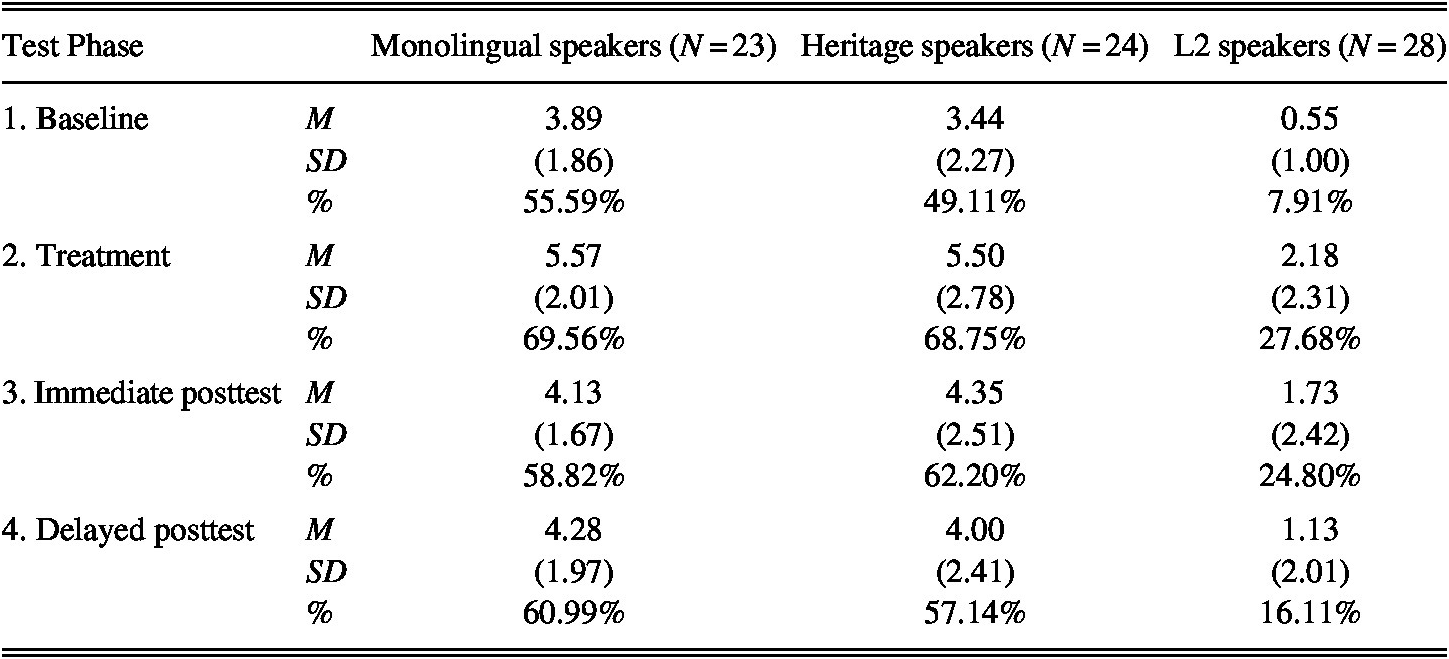
As Table 4 shows, rates of clitic production overall were similar for monolingual speakers and heritage speakers. The L2 learners, however, produced fewer clitics when compared to those two groups. This difference is particularly striking in the baseline phase, where the monolingual speakers produced 55.59% of clitics, the heritage speakers 49.11%, and the L2 learners 7.91% (only 13 L2 participants out of the 28 produced at least one clitic). All groups produced more clitic constructions in the treatment phase than in the baseline phase, suggesting that priming was effective. The increase from baseline to treatment was 13.97% for the monolingual speakers, 19.64% for the heritage speakers, and 19.77% for the L2 learners. In the two posttests, the rates of clitic production decreased in all groups: by 10.70% and then 8.57% in the monolingual speakers, by 6.55% and then 11.61% for the heritage speakers, and by 2.80% and then 11.69% for the L2 learners. However, dative clitic rates at the delayed posttest were still higher than in the baseline phase by 5.40% for the monolingual speakers, 8.03% for the heritage speakers, and 8.20% for the L2 learners.
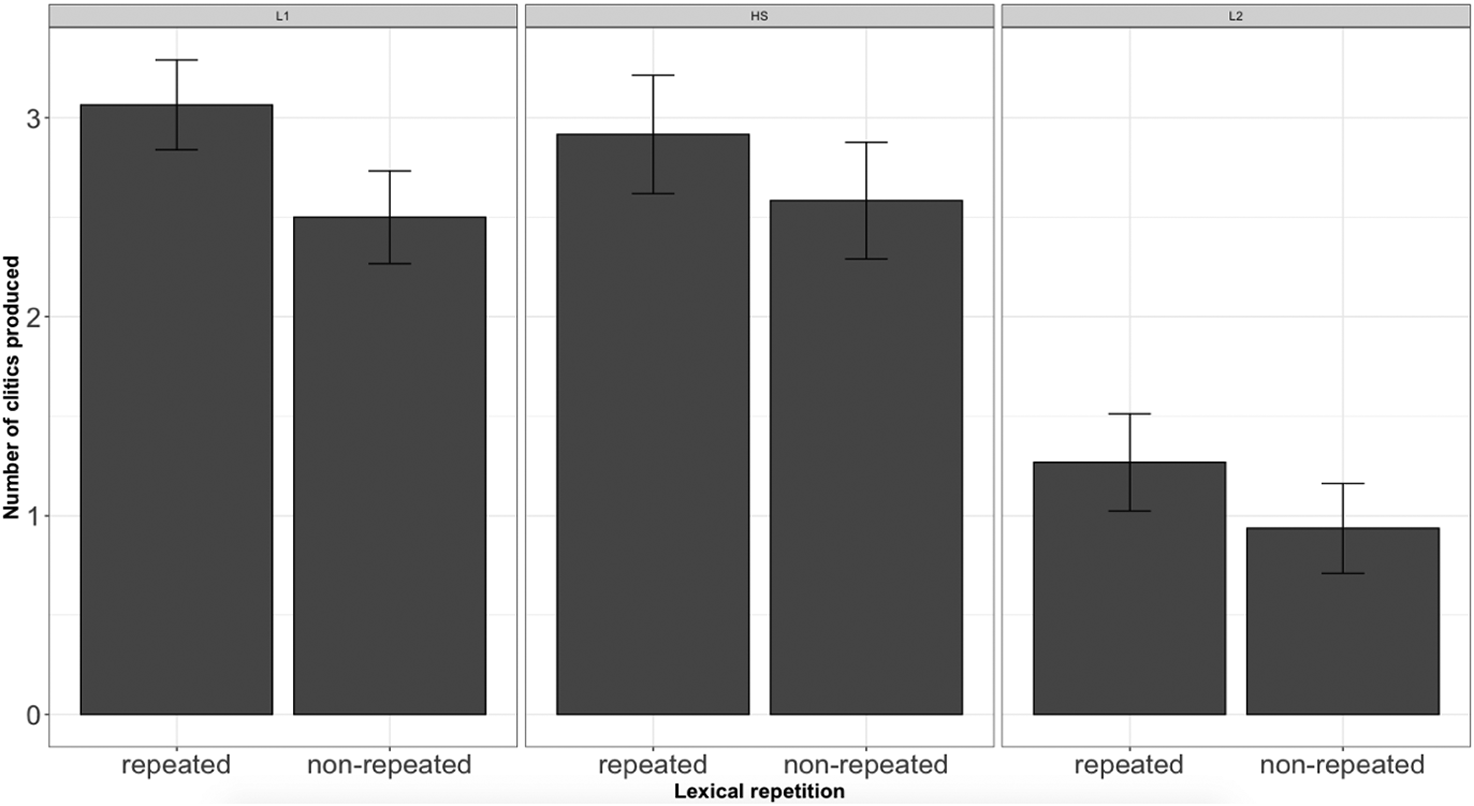
Turning now to whether priming is affected by lexical repetition, Figure 3 shows the rates of clitic production in the treatment phase after repeated and nonrepeated primes.
Means and standard errors of clitics produced by lexical repetition and group of speakers.
Note: L1 = Monolingual speakers, HS = Heritage speakers, L2 = L2 speakers.
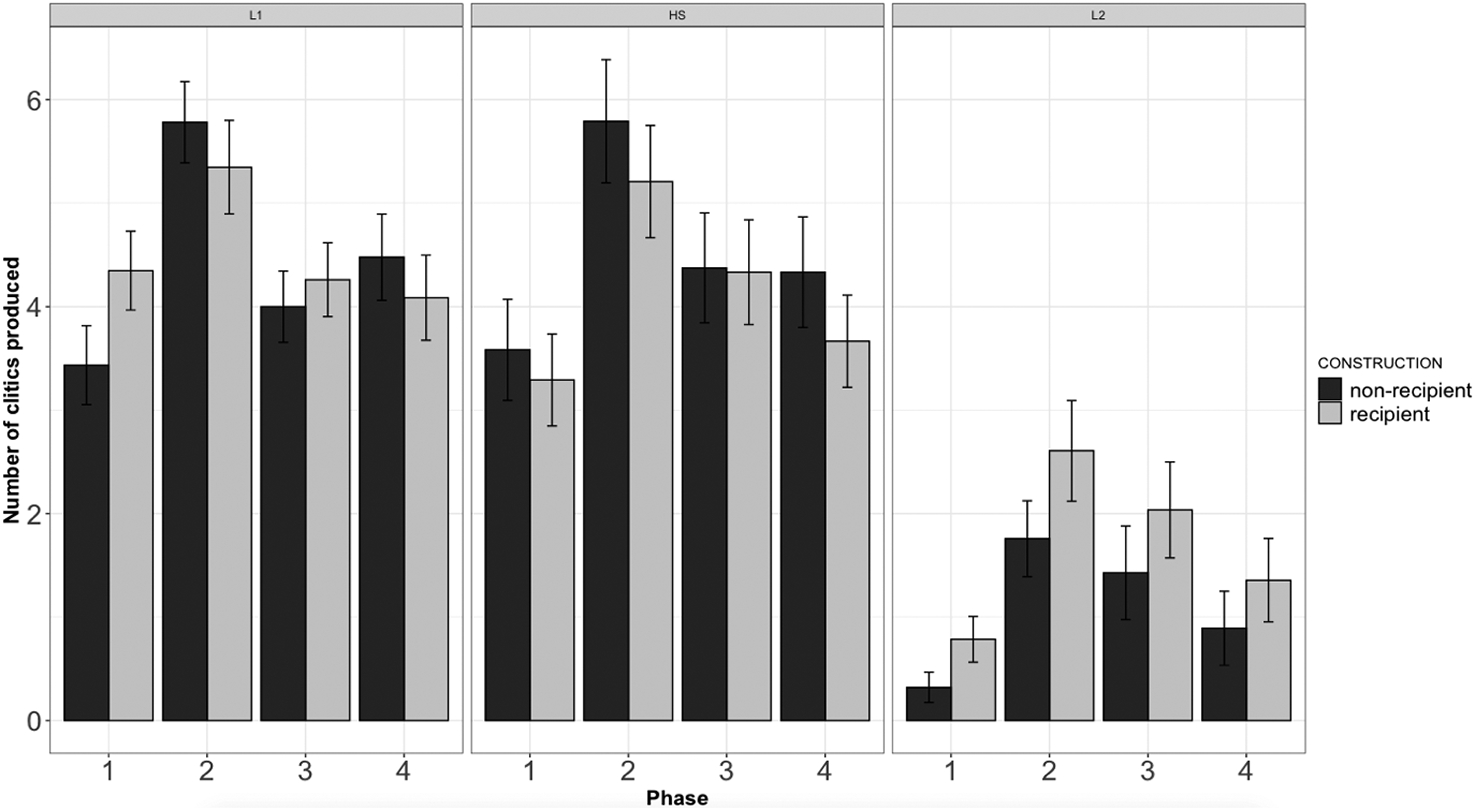
Lastly, we also plotted the results for construction (Figure 4) to examine how speakers behaved in this regard throughout the four phases.
Means and standard errors of clitics produced by phase, construction and group of speakers.
Note: L1 = Monolingual speakers, HS = Heritage speakers, L2 = L2 speakers, Phase 1 = Baseline, Phase 2 = Treatment, Phase 3 = Immediate posttest, Phase 4 = Delayed posttest.
Inferential analyses were conducted using mixed-effects binomial logistic regression models in R version 3.5.0 (R Core Team, 2018) and the lme4 package (Bates et al., Reference Bates, Mächler, Bolker and Walker2015). The presence or absence of the clitic was entered as the binomial dependent variable in all models. For every model, we started with the maximal random effects structure possible and then reduced the item random effect structure followed by the participant random effect structure until convergence (Jaeger, Reference Jaeger2008, Reference Jaeger2009).
In our first analysis, type of speaker, phase, and an interaction between type of speaker and phase were entered as fixed effects using dummy coding. The random effect structure included random intercepts for participant and item. Table 5 presents the results of this first model.
Results of the mixed-effects binomial logistic regression model for phase
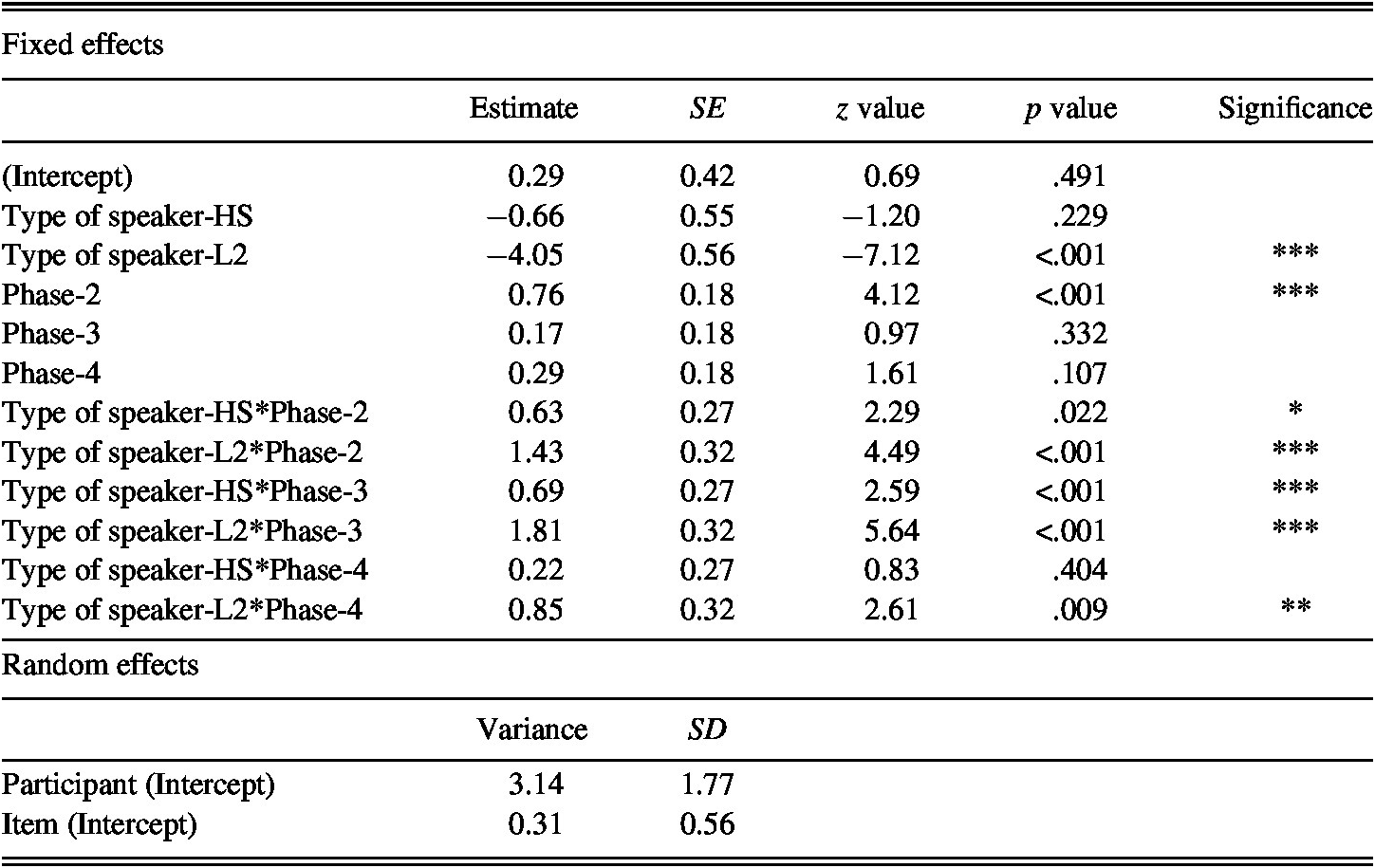
Note: HS = Heritage speakers, L2 = L2 speakers, Phase 2 = Treatment, Phase 3 = Immediate posttest, Phase 4 = Delayed posttest.
***p < .001; **p < .01; *p < .05.
Results from this model show that L2 learners produced significantly fewer clitic constructions than monolingual speakers. Also, no significant differences between the monolingual speakers and the heritage group were found. There was a significant group by phase interaction, meaning that each group responded differently to priming depending on the phase. To examine better how the groups responded to structural priming in each phase, estimated marginal means were calculated using the emmeans package (Lenth, Reference Lenth2020) (Table 6).
Estimated marginal means for phase
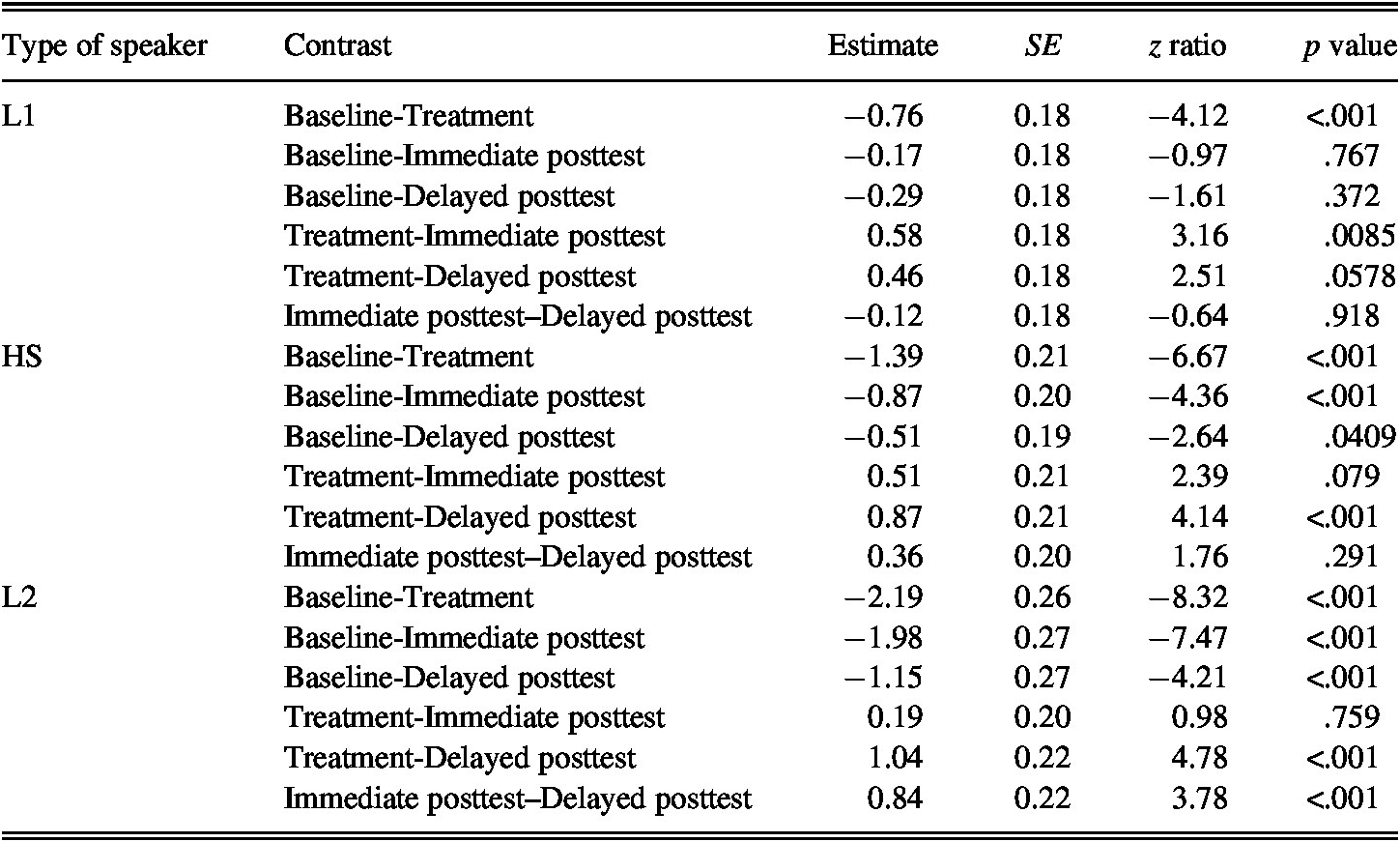
Note: L1 = Monolingual speakers, HS = Heritage speakers, L2 = L2 speakers.
Results show that many of the differences between phases were significant. More specifically, in the case of monolingual speakers, priming made them produce more clitics than in the baseline. However, this effect did not extend to the immediate posttest nor the delayed posttest. In the case of heritage speakers and L2 speakers, the priming intervention was successful at making them produce more clitics in each phase (compared to the baseline), including the delayed posttest. This means that the effects of structural priming were long-lasting for these two groups.
A second mixed-effects binomial logistic regression model (Table 7) was run with type of speaker, repetition, and an interaction between type of speaker and repetition as fixed effects using dummy coding. Intercepts for participant and item were entered as random effects. We found that lexical repetition of the prime did not enhance the priming effect significantly.
Results of the mixed-effects binomial logistic regression model for lexical repetition
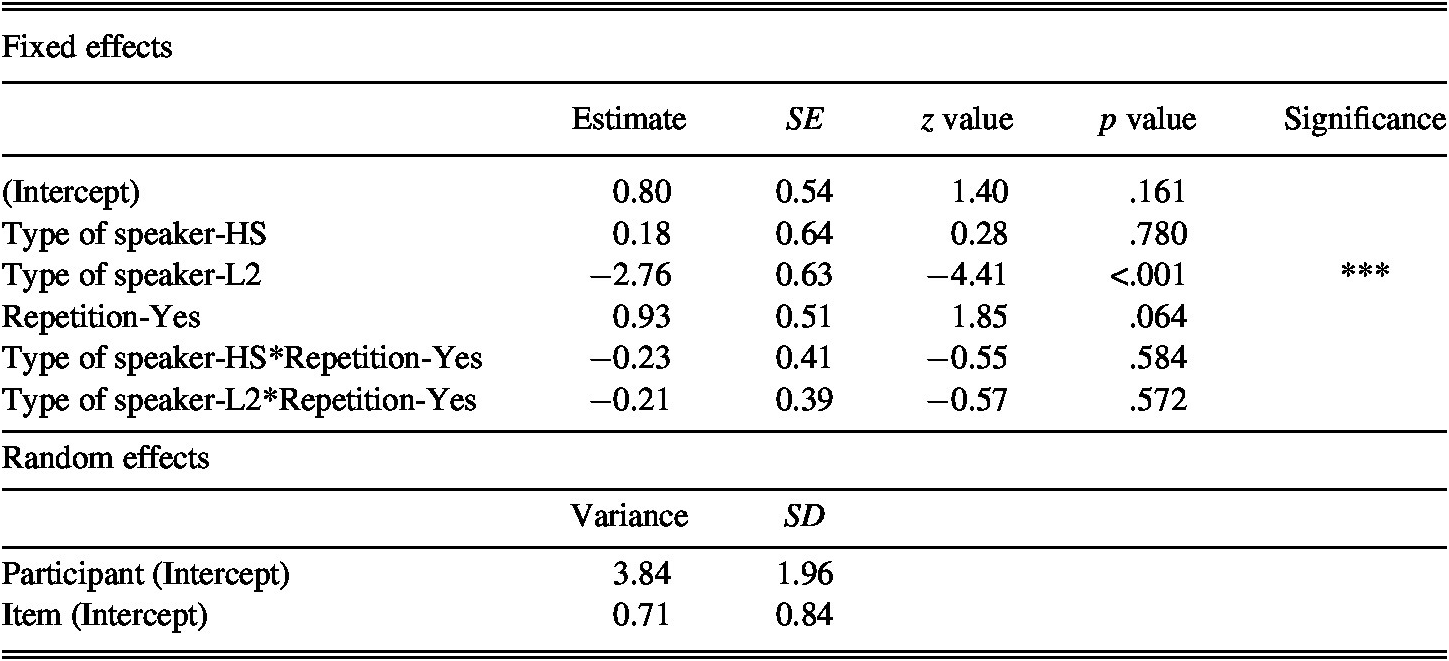
Note: HS = Heritage speakers, L2 = L2 speakers.
***p < .001.
A third model was run (Table 8) with type of speaker, construction, and an interaction between them as fixed effects using dummy coding. The model included intercepts for participant and item as random effects, as well as by-participant random slopes for construction. However, random slopes did not improve the overall model fit, so we removed them.
Results of the mixed-effects binomial logistic regression model for construction
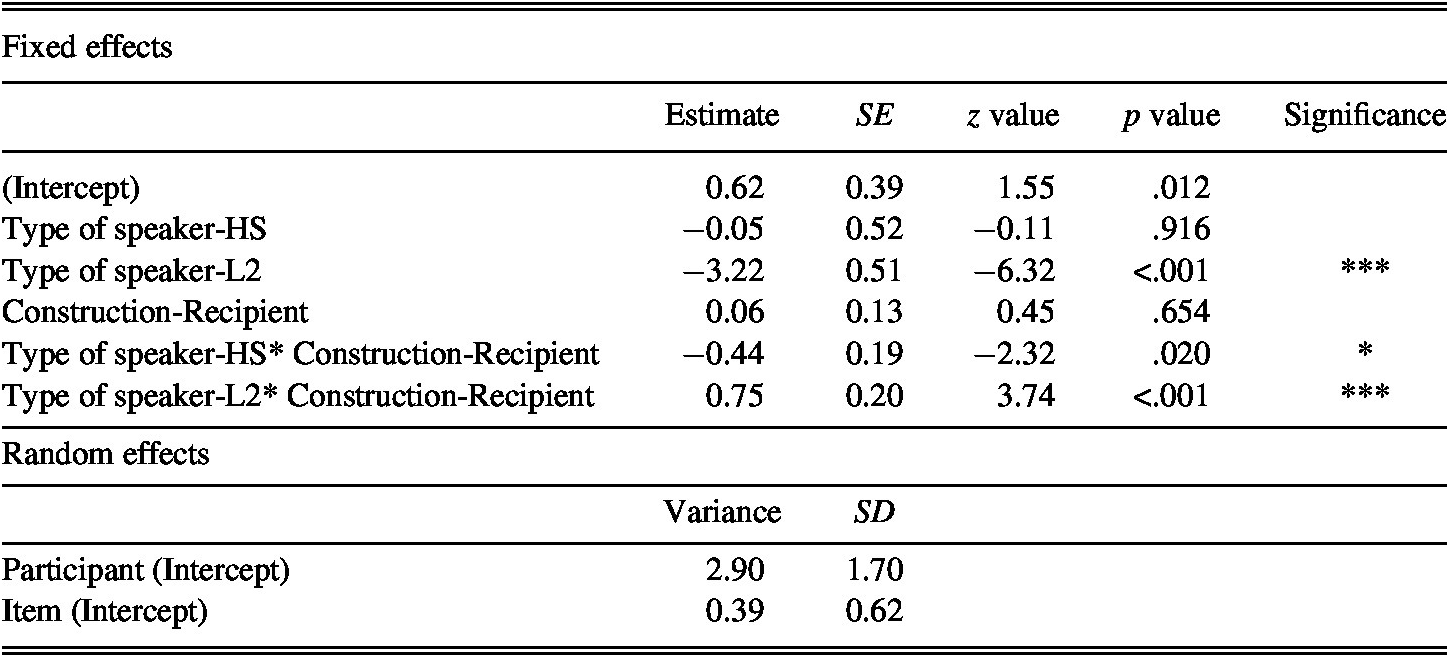
Note: HS = Heritage speakers, L2 = L2 speakers.
***p < .001; *p < .05.
The model shows that type of construction only had a significant effect when there was an interaction with type of speaker, so we explored this further by calculating estimated marginal means from the model (Table 9). The L2 group produced more clitics with recipient constructions, whereas the heritage group produced more clitics with non-recipient constructions.
Estimated marginal means for construction

Note: L1 = Monolingual speakers, HS = Heritage speakers, L2 = L2 speakers.
DISCUSSION
We examined knowledge of Spanish dative clitic constructions in monolingual speakers, L2 speakers, and heritage speakers and whether structural priming had an effect on these speakers’ production of such constructions, both immediately and in the long term (i.e., 1 week after the treatment). Results showed that, although priming was effective in all groups of speakers, its effects only extended to the posttests in the case of heritage speakers and L2 speakers, a finding that holds promise for potential pedagogical applications.
We believe that our results have implications for the priming literature. We found that construction frequency was a significant predictor in the case of L2 speakers and heritage speakers. The L2 group produced more target constructions with recipient structures, which was the most common of the two in Spanish (their L2). In other words, they showed a frequency effect as opposed to an inverse frequency effect (Jaeger & Snider, Reference Jaeger and Snider2013). This finding is in line with previous studies that have reported a greater priming effect with frequent constructions among non-proficient L2 speakers (Jackson & Ruf, Reference Jackson and Ruf2017; Kaan & Chun, Reference Kaan and Chun2017). In the case of heritage speakers, they did show an inverse frequency effect, as they were more primed with non-recipient constructions. In this sense, their response to priming was more nativelike than that of L2 speakers. The fact that there was not a significant effect of construction for monolingual speakers could be due to the fact that they already showed high production rates of the two constructions from the baseline.
Regarding the lexical boost, we did not find a significant effect, even though participants did produce numerically more target constructions when the verb was repeated. The lexical boost has been reported in numerous priming studies, testing either native speakers or L2 speakers (Mahowald et al., Reference Mahowald, James, Futrell and Gibson2016). Findings so far seem to suggest that it affects all speakers equally. Although our results agree with this idea, we did not find a significant effect. We hypothesized that the pictures we used might have played a role in this. Because our pictures differed in animacy, we conducted a mixed-effects binomial logistic regression model to explore whether there was an interaction between animacy and lexical repetition. Our dependent variable was the presence or absence of the clitic, and we included intercepts for participant and item. We found that there was indeed an interaction between those two variables (β = 1.16, z = 2.06, p = .04), with lexical repetition yielding a stronger priming effect when the picture was inanimate. The idea that priming can be constrained by animacy has already been observed in other studies (Buckle et al., Reference Buckle, Lieven and Theakston2017; Nitschke et al., Reference Nitschke, Serratrice and Kidd2014). Nevertheless, because animacy was not one of the main variables in our study and thus was not balanced, we believe that future studies should examine this further.
Regarding the relationship between priming and learning, the fact that priming was effective in the long term for both L2 speakers and heritage speakers suggests that the priming effect was lexically independent and not derived from explicit memory processes. In other words, our findings support an implicit learning account (Chang et al., Reference Chang, Dell and Bock2006), which is in line with other studies that found long-term priming effects (Kaschak et al., Reference Kaschak, Kutta and Coyle2014; Kim & McDonough, Reference Kim and McDonough2016; Shin & Christianson, Reference Shin and Christianson2012). The reason why monolingual speakers did not show this effect could be due to the fact that they already used this construction often (more than 50% of the time). Still, this hypothesis could be further investigated by testing Spanish monolingual speakers in the long term with a less frequently used construction.
The implicit learning effect observed, however, might have been driven by different mechanisms in the case of these L2 speakers and heritage speakers. In the L2 group, construction frequency analyses revealed that there was a stronger priming effect with frequent constructions. This implies that their learning process involved the activation of frequent L2 constructions which they barely used. In fact, many of the L2 participants produced 0% clitics in the baseline phase, despite being familiar with clitics, as per the clitic task. McDonough (Reference McDonough2006) found that participants who had produced the target structure in the baseline showed greater priming effects in the treatment than those who did not. We examined this possibility by splitting the L2 speakers into two smaller groups: those who had produced at least one clitic construction in the baseline (+Clitic) and those who did not (–Clitic). We compared the production of clitic constructions in the treatment phase in the two subgroups and found a significant difference between the +Clitic group (M = 3.69, SD = 1.94) and the –Clitic group (M = 2.15, SD = 2.07), t(24.56) = 2.32, p = .01435. This shows that it is not only knowledge of the construction that is required for priming to increase its level of activation, but also actual use of it.
The learning process observed in the case of heritage speakers follows the pattern reported in monolingual speakers: the inverse frequency effect (Jaeger & Snider, Reference Jaeger and Snider2013). In this regard, because heritage speakers did not produce as many clitics as monolingual speakers (a finding that is also consistent with the heritage language literature; Montrul, Reference Montrul2004b, Reference Montrul2010), priming could have facilitated access to and activation of L1 structures (Putnam & Sánchez, Reference Putnam and Sánchez2013). At the same time, this particular finding has implications for heritage language research, as most studies have tested knowledge of syntactic structures using non-interactive tasks, such as acceptability judgment tasks or elicited production in the absence of priming (Montrul, Reference Montrul2004a; Pires & Rothman, Reference Pires and Rothman2009). Those studies have found that heritage speakers usually diverge from monolingual speakers (Polinsky, Reference Polinsky2018). The fact that priming made heritage speakers produce a higher number of target constructions might mean that their grammars are simply more difficult to access for production, but that they are still nativelike, as reported in processing studies (Jegerski, Reference Jegerski2018).
It could be argued that participants might have come up with a “strategy” during the experiment. That is, participants might have been aware of the target construction at some point. Although we cannot answer this question, as we did not include a debriefing task, we believe that even if participants developed a strategy, they did so indirectly. That is, they were not explicitly provided with a pattern or rule to follow throughout the experiment. It was not the primary goal of this study to determine whether this apparent implicit learning might have been indeed an aware process, but we believe this is a fruitful area for further research, as priming studies do not usually include debriefing tasks to inform of the mechanisms that drive the learning process. Because we were mostly interested in the pedagogical implications of structural priming, our findings are still useful in that they show that language instructors could benefit from applying this methodology in their classes to promote the activation of particular syntactic structures, regardless of the nature of the learning processes involved. In this regard, some studies have shown that it is possible to prime L2 speakers throughout the course of several classes and in a naturalistic environment (McDonough & Chaikitmongkol, Reference McDonough and Chaikitmongkol2010; McDonough & Vleeschauwer, Reference McDonough and Vleeschauwer2012). Priming does not tell us anything, however, concerning the knowledge that speakers have about each particular construction. In other words, are speakers aware of the existence of this dative alternation or do they think the clitic is optional in some cases (this goes mostly for recipient constructions)? In this sense, another possible line of research would be to combine the priming intervention with a task that more directly taps into speakers’ syntactic knowledge.
One of the reviewers pointed out that for learning to be established, the target construction would have to be applied to novel instances. Our experiment followed the same methodology in each phase. Nevertheless, six verbs in the immediate posttest were completely new, so we explored this possibility by comparing clitic production with new (M = 3.25, SD = 1.92) and with repeated verbs (M = 3.36, SD = 2.46), but there were no significant differences, t(143.18) = −0.26, p = .798. That is, speakers produced as many clitic constructions with new verbs as with repeated verbs, suggesting that learning occurred.
We believe that the contributions discussed in this article are relevant for the field but should be taken with caution, as this is the first study testing heritage speakers using a priming methodology and one of the few to include a 1-week delayed posttest. It might be that the differences observed between heritage speakers and L2 speakers are not due to the way each type of speaker acquired the language, but rather to differences in their proficiency level. The heritage group had a high intermediate level of proficiency, whereas the L2 group had a low intermediate level and the fact that we could not match these two groups more tightly in proficiency is one limitation of the study. Future priming studies should test speakers of different proficiency levels as well as more heritage speakers so that we can identify general priming patterns. Likewise, it could also be objected that the heritage and monolingual groups cannot be compared for two reasons: on the one hand, because each group spoke a different variety of Spanish and, on the other hand, because the input that heritage speakers received might have been considerably different from the input monolinguals received. To address the first concern, we conducted a small follow-up study with 9 monolingual speakers of Mexican Spanish, who completed the baseline phase of the study. These speakers produced clitics 59.50% of the time. However, a t-test comparing Peninsular and Mexican monolingual speakers showed that this difference was not significant: t(15.21) = −0.42, p = .682. Regarding our second concern, this issue could lead to a comparison fallacy, as pointed out in the heritage language literature (Polinsky, Reference Polinsky2018). Thus, we acknowledge that this constitutes a caveat in our study.
CONCLUSION
Overall, our study showed that structural priming was effective in the three groups of speakers, although priming effects were only long-lasting in the case of heritage speakers and L2 speakers. Results also revealed that construction frequency worked differently in these two groups, a finding that we attribute to differences in the acquisition and activation of syntactic structures. Additionally, results suggest that priming may be a promising pedagogical tool to promote the activation and use of particular syntactic constructions, although the underlying mechanisms which drive this activation are still underspecified.


 Open access

