

Introduction
The relationship between the fertility crisis and our era’s marginalization of some groups of men is poorly understood. Over the past decades, researchers have documented how many men are falling behind in terms of education, professional performance, mental health, and other social and economic indicators, but mostly without investigating the psychological causes of the marginalization (e.g., Burger & Rocha, Reference Burger and Rocha2024; Cappelen et al., Reference Cappelen, Falch and Tungodden2025; Connell, Reference Connell2005; Kimmel, Reference Kimmel2013; Pasquini, Reference Pasquini2025). In Norway, one of the world’s most gender-progressive nations, politicians have tried to understand this concerning development through three government-appointed committees, but these failed to identify the underlying drivers or which policies could effectively counter the trend (St.meld. 8, 2008; NOU 3, 2019; NOU 8, 2024).
In the same period as men in many nations became more marginalized, fertility rates plummeted (Vollset et al., Reference Vollset, Goren, Yuan, Cao, Smith, Hsiao and Murray2020). The Nordic nations were anomalies, often attributed to their gender equality and generous family policies (Tsuya, Reference Tsuya2003), but they too are now headed toward demographic collapse (Campisi et al., Reference Campisi, Kulu, Mikolai, Klüsener and Myrskylä2022). In the 2010s, Norway’s rate fell from 2.0 to 1.5 and continued falling (Statistics Norway, 2025a). Nations like Norway and England—with a rate of 1.4—will see their cohort-size reduced by a third for each generation, barring effects of immigration (Figure 1).
Even moderate departures from replacement fertility produce large cumulative losses when compounded across generations. With a fertility rate of 1.6 (e.g., USA), about 44% of a cohort remain after three generations; with a rate of 0.6 (e.g., Shanghai), only 2.3% remain.

This reduction rate depends on whether the afflicted nations can prevent further decline, but many experts believe fertility rates could continue to drop (Bhattacharjee et al., Reference Bhattacharjee2024; Lesthaeghe, Reference Lesthaeghe2020; Lutz et al., Reference Lutz, Skirbekk and Testa2006; Skirbekk, Reference Skirbekk2022; Spears & Geruso, Reference Spears and Geruso2025). If these nations catch up with South Korea, which in 2012 had a rate similar to Norway’s current rate (OECD, 2024), they will have 99% fewer children in only four generations (Figure 1). However, how far these numbers will drop is uncertain; South Korea’s situation is unprecedented.
Demographic experts have primarily explained the fertility crisis in terms of economic costs, changing values, institutional arrangements affecting work–family balance, and shifts in gender roles (Balbo et al., Reference Balbo, Billari and Mills2013; Esping-Andersen & Billari, Reference Esping-Andersen and Billari2015; Goldscheider et al., Reference Goldscheider, Bernhardt and Lappegård2015; Lesthaeghe, Reference Lesthaeghe2010; Rindfuss et al., Reference Rindfuss, Choe and Brauner-Otto2016). They have been less focused on psychological causes and mating-market dynamics, and are yet to offer credible policy solutions. One conclusion has been that since we lack effective countermeasures, we should just adapt to the inevitable collapse (Aitken, Reference Aitken2024; Eberstadt, Reference Eberstadt2025; Miles, Reference Miles2023). Skirbekk (Reference Skirbekk2022) suggested we focus on personal fulfillment for the people who remain, while Bainbridge (Reference Bainbridge2009) proposed we get ready for a future as cyborgs. This scholarly bewilderment contributes to many nations mostly ignoring the existential threat, or misunderstanding the relevant contributors to low fertility (United Nations Population Fund, 2025).
Others have experimented with pronatalist policies, such as increasing financial transfers to families (e.g., Hungary, Poland, Russia, South Korea), or restricting women’s reproductive freedoms (e.g., Russia, Hungary), mostly without achieving significant results (Berde & Drabancz, Reference Berde and Drabancz2022; Cook et al., Reference Cook, Iarskaia-Smirnova and Kozlov2023; Gietel-Basten et al., Reference Gietel-Basten, Rotkirch and Sobotka2022). Norway appointed a Birth Rate Committee, but its suggestions and insights added little to the discussion around how to understand and solve the fertility crisis (Fødselstallsutvalget, 2025, 2026).
Among the factors that in the past century drove the decline from high to low fertility were reduced child mortality, urbanization, gender equality, and reliable contraceptives (Figure 2). Main contributors to the continuing decline to ultralow fertility are increasing singledom and delayed relationship formation (Lesthaeghe, Reference Lesthaeghe2020; Raymo et al., Reference Raymo, Park, Xie and Yeung2015; Thomson et al., Reference Thomson, Winkler-Dworak, Spielauer and Prskawetz2012). Fostik et al. (Reference Fostik, Fernández Soto, Ruiz-Vallejo and Ciganda2023, p. 1) found that “the time spent in a union during the reproductive lifespan is a key determinant of cumulated fertility.”
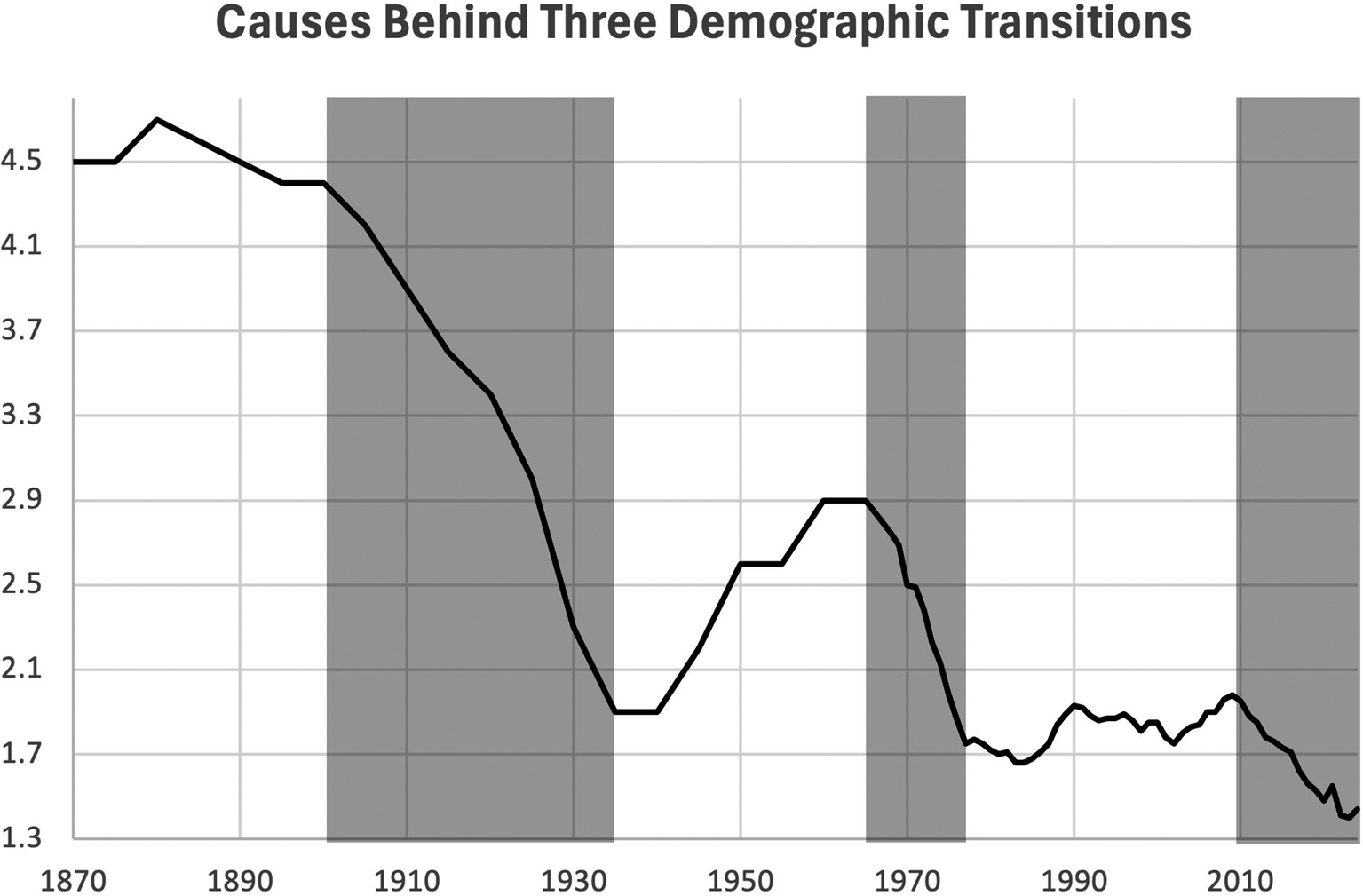
The Norwegian fertility rate reflects a pattern observed across a line of Western nations, with pronounced declines beginning around 1900, 1968, and 2010. Post-1968 gender equality initially drove fertility collapse, then female-friendly policies partially countered the effects of women’s emancipation, but only temporarily, as new pressures in the 2010s further complicated pair-bonding and reproduction.
Note: Data represent five-year intervals until 1965 and annual figures from 1968 on, derived from Statistics Norway (2012, 2025a).
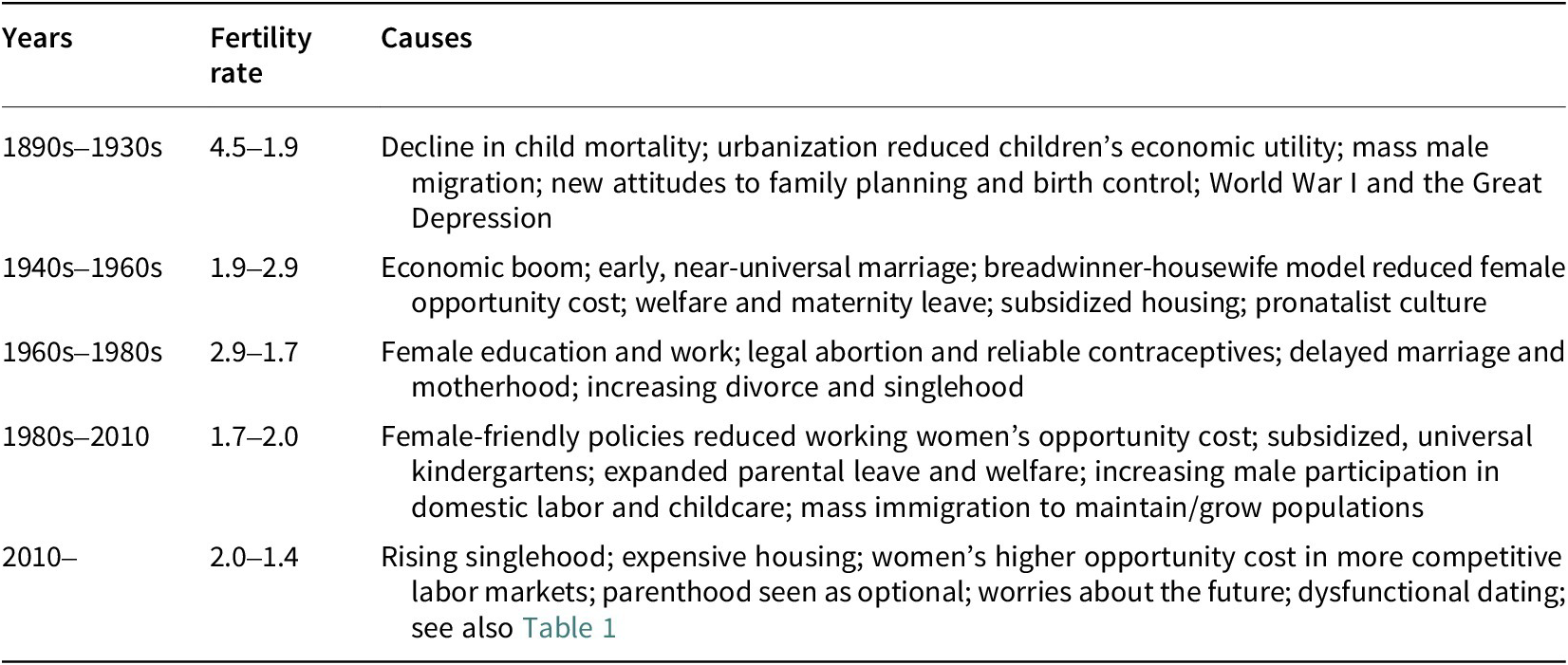
Sources: Bongaarts and Potter (Reference Bongaarts and Potter1983); Caldwell and Schindlmayr (Reference Caldwell and Schindlmayr2003); Rønsen (Reference Rønsen2004), Lesthaeghe (Reference Lesthaeghe2010), Galor (Reference Galor2012), Van Bavel and Reher (Reference Van Bavel and Reher2013), and Hellstrand et al. (Reference Hellstrand, Nisén, Miranda, Fallesen, Dommermuth and Myrskylä2021).
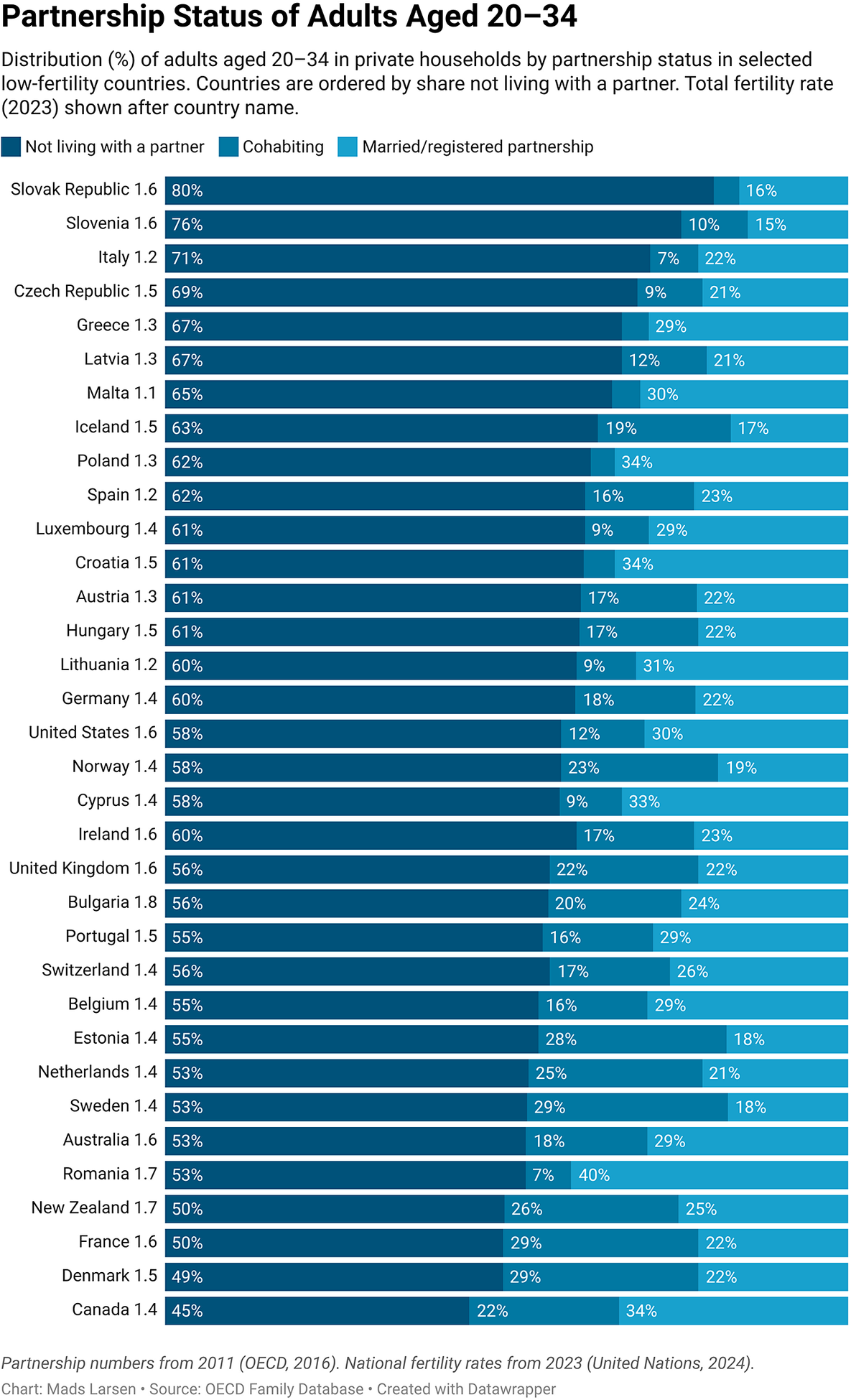
Not surprisingly, when fewer women and men pair-bond, there are fewer couples who reproduce. Among Norwegian women aged 20–34, the non-cohabitation rate doubled from 1977 to 2022—from 23% to 46% (Figure 3a). Similar increases are found across low-fertility nations (Fry & Parker, Reference Fry and Parker2021; Jones, Reference Jones, Poston, Lee and Kim2018; Reimondos et al., Reference Reimondos, Allen, Gray and Evans2025; Van den Berg & Verbakel, Reference Van den Berg and Verbakel2022). This trend seems not to have reached saturation; by one estimate, 45% of American women aged 25–44 will be single in 2030 (Morgan Stanley, Reference Morgan2019).
(a) Percentage of Norwegian women not living with a partner. (b) Increasing non-cohabitation among women aged 20–34 shows an observable association with Norway’s declining total fertility.
Notes: (a) Data represent 5-year age intervals (unweighted by cohort size), except in 1988, when values reflect ages 23, 28, 33, 38, and 43. Data from Statistics Norway (2022a) (b) Single-rate values shown as 3-year moving average, derived from Statistics Norway (2022a). Fertility data from Statistics Norway (2025a).
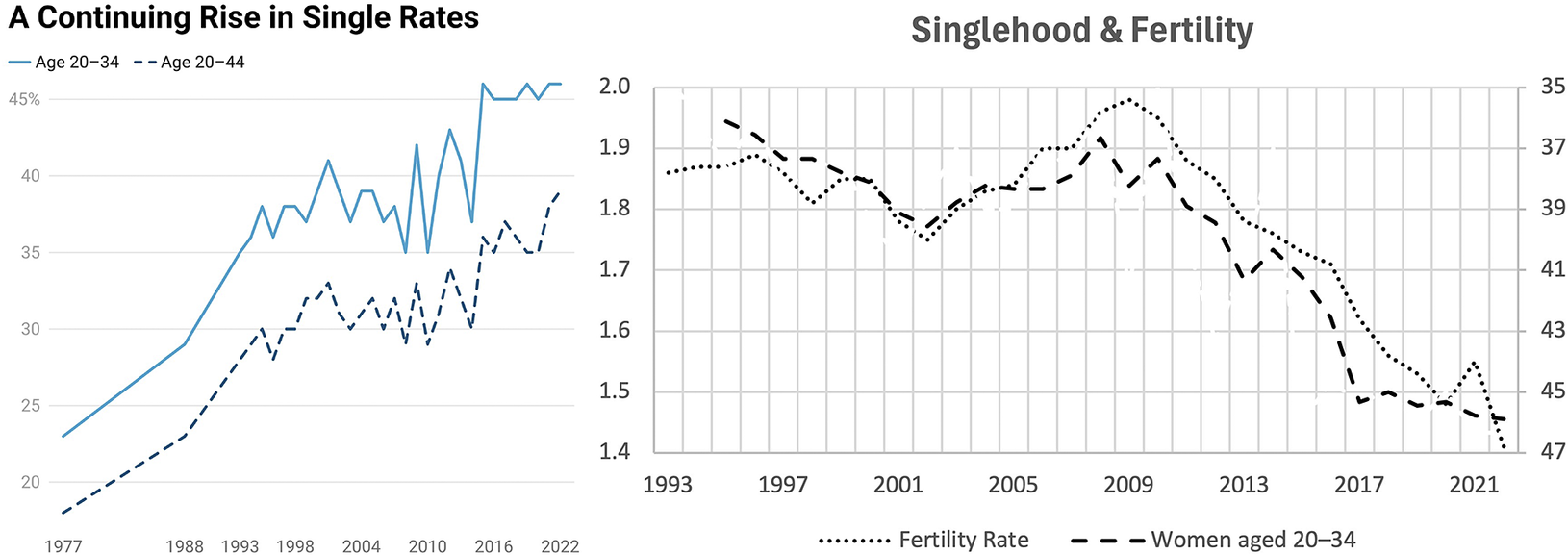
Supporting the link between this global “relationship recession” and declining fertility, Burn-Murdoch (Reference Burn-Murdoch2025) demonstrated how several nations show an observable association between reduced pair-bonding and declining fertility rates. In his analysis, periods in which countries experienced temporary increases in partnership formation tended to coincide with corresponding rises in fertility. Norwegian fertility and single rates show a similar co-movement over time (Figure 3b).
It varies, however, how much of a certain period’s decline in national fertility is explained by a reduction in pair-bonding; several counteracting or heterogeneous factors operate simultaneously (Figure 2). The most recent Nordic fertility drops were primarily caused by reduced fertility within relationships (Cantalini et al., Reference Cantalini, Ohlsson-Wijk and Andersson2024; Fødselstallsutvalget, 2026; Hellstrand et al., Reference Hellstrand, Nisén and Myrskylä2022), while Australian and East Asian fertility declines were predominantly caused by increasing single rates (Choi, Reference Choi2022; Reimondos et al., Reference Reimondos, Allen, Gray and Evans2025; Wang & Li, Reference Wang and Li2025). Despite notable contextual differences, higher singlehood is robustly associated with lower fertility (Fostik et al., Reference Fostik, Fernández Soto, Ruiz-Vallejo and Ciganda2023; Lesthaeghe, Reference Lesthaeghe2020; Raymo et al., Reference Raymo, Park, Xie and Yeung2015; Thomson et al., Reference Thomson, Winkler-Dworak, Spielauer and Prskawetz2012).
Antinatalist attitudes seem not to contribute significantly to low fertility. Only 3% of European women aged 18–40 consider zero children the ideal family size (Miettinen & Szalma, Reference Miettinen and Szalma2014). In Norway, women on average report a preference for 2.4 children but have only 1.4 (Cools & Strøm, Reference Cools and Strøm2020). Such fertility gaps between desired and actual offspring are common in low-fertility nations (Beaujouan & Berghammer, Reference Beaujouan and Berghammer2019; Friedrich & Bujard, Reference Friedrich and Bujard2025; Stone, Reference Stone2019). Americans consider the ideal family size to include 2.7 children, but their fertility rate is 1.6 (Gallup, 2025). Testa (Reference Testa2007) found that European women on average want 2.2 children—with “lack of the right partner” being their most frequently cited reason for not achieving intended fertility.
When women struggle to secure a long-term partner in their twenties, they have their reproductive window shortened and many end up childless (Saarela & Skirbekk, Reference Saarela and Skirbekk2020; Stone, Reference Stone2022). These dynamics suggest that trying to increase pair-bonding rates is the obvious way forward for nations hoping to avoid a demographic collapse. Unfortunately, experts are unsure also of the psychological causes behind reduced pair-bonding. Among their suggestions for what explains the decline in relationships are dating apps, political polarization, a preference for singlehood, individualism, materialism, attachment issues, social media use, economic inequality, and poor flirting skills (e.g., Apostolou, Reference Apostolou2021; Balki, Reference Balki2025; Kislev, Reference Kislev2019; Li et al., Reference Li, Lim, Tsai and J2015; Pepping et al., Reference Pepping, Girme, Cronin and MacDonald2024; Van den Berg & Verbakel, Reference Van den Berg and Verbakel2022; Yong et al., Reference Yong, Lim and Li2024).
Those elements could all play in, but we argue that our era’s dramatic reduction in pair-bonding has deeper roots. It is grounded in our history as a species, and thus, we take an evolutionary-psychological approach to the complex mating malaise that is afflicting a growing number of nations. Through investigating the 6-million-year history of hominin mating, we discuss the functions and sex differences of Homo sapiens’ short- and long-term sexual strategies (Buss & Schmitt, Reference Buss and Schmitt1993), which are the foundations of today’s maladaptive mating. We then use these insights into human mating psychology to analyze men’s and women’s behavior on dating apps and in other mating contexts.
Based on these investigations, we argue that the modern world’s uniquely resource-rich and gender-equal environments have triggered what we term a Mating Equilibrium Shift—possibly a main driver of today’s declining pair-bonding and fertility rates in many nations. Female freedoms and material prosperity seem to motivate women to place greater emphasis on short-term strategies (non-bonded mating), but in terms of reproduction, these strategies are rendered maladaptive by contraceptives. Low-fertility societies have thus entered what we call the Post-Pair-Bonding Fertility Trap, in which too few stable couples form early and durably enough to sustain replacement-level fertility. This trap is a consequence of the Female Choice Fertility Paradox: when women’s free mate choice is combined with economic independence and effective contraception, it systematically favors mating strategies that undermine pair-bonding and, in turn, realized fertility.
This is a new and unique situation. With the post-1960s mating regimes, Western societies became the first large human communities in which individual mate choice became the norm. After practicing near-universal arranged marriage probably for hundreds of thousands of years, Homo sapiens were finally free to choose their own partners, whether for committed relations or casual sex (Apostolou, Reference Apostolou2017; Chapais, Reference Chapais2008; Coontz, Reference Coontz2005; Henrich, Reference Henrich2020).
Not only do women now have free mate choice, but their professional empowerment has reduced men’s utility to them, meaning that women have less need for the material resources men bring to a relationship. Consequently, women exclude more men from their pool of potential partners (Buss, Reference Buss2016; Goldin & Katz, Reference Goldin and Katz2002; Grow & Van Bavel, Reference Grow and Van Bavel2015; Lichter et al., Reference Lichter, Price and Swigert2020; Nordin & Stanfors, Reference Nordin and Stanfors2024; Trimarchi, Reference Trimarchi2022). Empirical research supports that when women are less dependent on men for resources, they partner up to a lesser extent (Cancian & Meyer, Reference Cancian and Meyer2014; Cuesta & Reynolds, Reference Cuesta and Reynolds2021).
Female freedoms have brought tremendous benefits to societies and to both sexes in many respects, but experts have often been reluctant to emphasize their relationship to ultralow fertility. Some fear an anti-feminist backlash (Bajaj & Stade, Reference Bajaj and Stade2023; Bauer, Reference Bauer2023; Venis, Reference Venis2022), a concern that may have contributed to a more avoidant communication strategy among fertility researchers. Their unwillingness to properly sound the alarm and engage also the politically inconvenient drivers of the fertility crisis may be the more comfortable option, but it could undermine female freedoms in the long run.
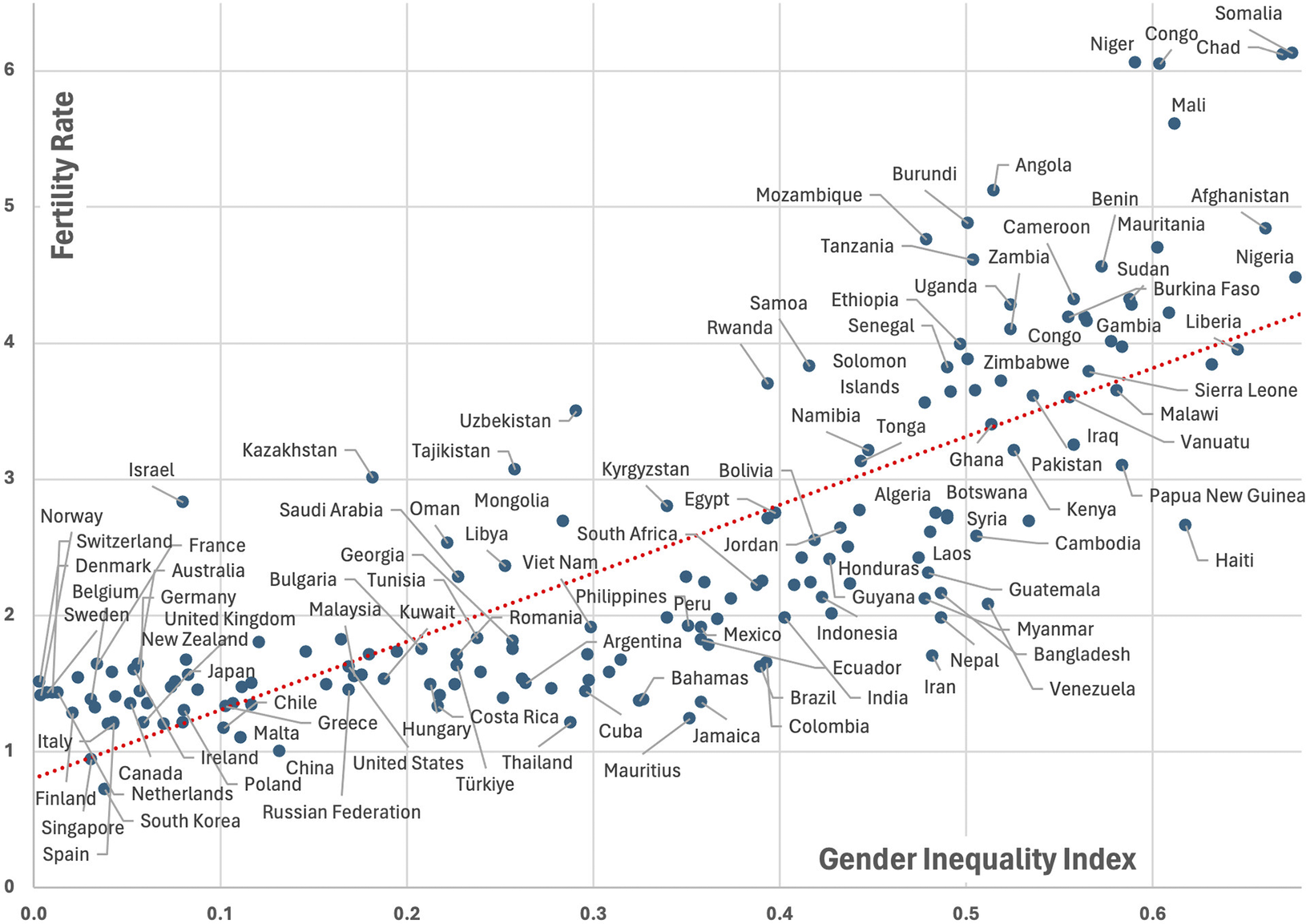
Using the Gender Inequality Index from the Human Development Report (UNDP, 2025) and national fertility rates from World Population Prospects (United Nations, 2024), we found a very strong correlation between gender equality and low fertility (r ≈ 0.81, N = 172). The more gender-equal a nation is, the lower its fertility rate tends to be (Figure 4), accelerating the pace of its demographic collapse (Figure 1). Such a high association needs to be considered in earnest, even if it is uncomfortable.
There is a strong association between the freedoms a nation grants its women and how high its fertility rate is. The Pearson correlation is r ≈ 0.81, while the rank order correlation is r ≈ 0.86, N = 172.
Note: Data from United Nations (2024) and UNDP (2025). Numbers from 2023.
Based on the analysis that follows, we posit that a further individualization of reproduction could be an effective means for solving the fertility crisis. If we are unlikely to sufficiently increase pair-bonding rates, policymakers should consider other means for helping women have the number of children that they themselves say they want. This would entail offering women the resources necessary for them to conclude that having children alone is a better alternative than remaining childless. Today, such large resource transfers are perhaps politically and fiscally unfeasible, but nations should consider limited reproductive policy experiments to find out what social and economic resources are required to motivate sufficient individualistic reproduction. In our post-automation future, perhaps as early as by 2040 (Kurzweil, Reference Kurzweil2024; Nayebi, Reference Nayebi2025; Rainie & Anderson, Reference Rainie and Anderson2024), insights from these pilot projects could inform national policies with the potential to substantially increase fertility.
Such financial transfers, however, would further reduce men’s utility to women, and thus the mate value of some groups of men, likely exacerbating male marginalization. Still, the existential stakes of the fertility crisis could justify such drastic measures. Moreover, artificial womb technology might be available as early as in the 2040s, which could result in greater reproductive equality between the sexes (Cavaliere, Reference Cavaliere2020; Gupta, Reference Gupta2025; Henriques, Reference Henriques2023; Martinez & Goodwin, Reference Martinez and Goodwin2024; Segers, Reference Segers2021). The following investigation leads us to conclude that the next step in human mating may entail a greater individualization of reproduction—and that gender-equal, low-fertility nations should prepare for this future as soon as possible.
Short- and long-term mating strategies
Buss and Schmitt’s (Reference Buss and Schmitt1993) sexual strategies theory is an evolutionary framework that explains human mating behavior. Because our male and female ancestors faced different reproductive challenges, men and women evolved distinct strategies for short- and long-term mating, that is, non-bonded and pair-bonded mating. To understand the sex differences that inform today’s low-fertility mating, we must examine how hominin reproduction evolved.
6 million years ago, our great ape ancestors probably lived in large multimale, multifemale groups who mated promiscuously (no pair-bonds, multiple sexual partners). In such mating regimes, females channel reproductive opportunities mostly to the highest-ranking males (Chapais, Reference Chapais2008), thereby spreading the genes that are most functional in their environment. Women’s short-term mate preferences therefore tend to be highly discriminatory. Compared to males, the energetic demands of pregnancy and postnatal childcare lead the obligate investment for females to be far greater, which positions them to need to select mates with the best genes. For males, their obligate investment is only to contribute sperm/genes. They increase their chance at achieving a large genetic legacy through copulating with many females, so male short-term mate preferences are far more inclusive (Trivers, Reference Trivers and Campbell1972).
Around 4 million years ago, early hominins show morphological evidence of reduced male–male aggression and the possible beginnings of pair-bonding, probably driven by increased offspring need and male provisioning (Lovejoy, Reference Lovejoy2009). In the human lineage, the intense, enduring emotional bond we recognize as romantic love likely emerged later, playing a critical role in the evolution of Homo sapiens (Fletcher et al., Reference Fletcher, Simpson, Campbell and Overall2015). These new emotions motivated males and females to cooperate through the pregnancy and their offspring’s most vulnerable phase. Women’s long-term mate preferences enabled them to be drawn also to men who were less genetically impressive, but who offered protection and energetic resources (e.g., high-calorie and nutrient rich food) in return for sexual access and exclusivity. This exclusivity is key, as women’s limited reproduction could then be monopolized. Previously marginalized males could thus outcompete dominant males who were only willing to copulate and not invest in offspring.
Because both women and men in a committed relationship tend to contribute significantly to reproduction, their long-term mate preferences are similarly inclusive—at least in environments where biparental care brings great benefit. When monogamy is the norm, the sexes practice assortative mating, meaning that individuals pair up with someone of similar long-term mate value. Such matching, of men and women with equivalent mate values, is the backbone of stable, long-term pair-bonds (Conroy-Beam et al., Reference Conroy-Beam, Buss, Pham and Shackelford2019a, Reference Conroy-Beam, Buss, Asao, Sorokowska and Sorokowski2019b).
Importantly, humans’ evolutionary history shows we have not exclusively adopted the practice of pair-bonding. Retaining our capacity for promiscuous mating as well as pair-bonding, both monogamy and polygamy (one individual with multiple partners), provided valuable flexibility as environments changed. For individuals, too, being able to utilize different sexual strategies enables useful adaptability. As we will elaborate on later, though, short-term strategies are not exclusively aimed at promiscuous mating, as short- and long-term strategies interact in complex ways to achieve conditionally adaptive reproductive outcomes (Buss, Reference Buss2000; Gangestad & Simpson, Reference Gangestad and Simpson2000). Both men and women pursue short- and long-term mating, but due to men’s lower obligate investment, strategies for short-term mating can yield greater reproductive benefits for men. Still, our male ancestors were mostly long-term investors who contributed far beyond the minimum, often investing socially in offspring past childhood (Hrdy, Reference Hrdy2009).
The norms that govern mate choice are downstream from each community’s need to direct its members’ mating behavior toward adaptive outcomes. We hypothesize that a key challenge for our linage has been to reconcile the difference between women’s short- and long-term mating strategies. If young women were free to have sex with the men to whom they felt most attracted—those who fulfilled both short- and long-term preferences—they would run a greater risk of abandonment by seductive men who were willing to copulate but not to pair-bond with them. Similarly, a community could impose severe sanctions to constrain the high-value men whose promiscuous inclinations could cause social conflict and mating disputes. It is common to emphasize that past mating regimes oppressed women, but in our evolutionary-historical past, neither sex had the privilege of free mate choice.
Although Homo sapiens has the capacity for a variety of mating arrangements, the near-universal norm has been forms of arranged marriage (Apostolou, Reference Apostolou2017). Parents and kin wielded influence over young people’s mate choice, but to various extents depending on the environment. Adolescents residing in foraging communities suffered less meddling, while the introduction of agriculture turned marriages more into commercial contracts between families (Goody, Reference Goody1976).
Female mate preferences were adaptive in the environments with arranged marriage in which they evolved, but they could be less so in today’s regimes of individual mate choice. Biegler and Kennair (Reference Biegler and Kennair2016) hypothesized that women retained a relatively stronger attraction to men with good genes to counter the influence of mothers and sisters who, when evaluating suitors, devalued good looks and other proxies of genetic value. Both the woman and her relatives prioritized direct benefits, such as the man’s resources, loyalty, and other characteristics that made him likely to be a good long-term partner and able to provide benefits also to in-laws. The largest difference between relatives and the woman was for indirect benefits, such as gene quality.
That is not surprising; genetic conflict theory establishes how a woman and her parents have different stakes in the genes of her children (Trivers, Reference Trivers1974). Grandparents only pass on around 25% of their genes, while mothers pass on approximately 50%. Thus, from an evolutionary perspective, the older generation is only half as incentivized to prioritize good genes (Kennair & Biegler, Reference Kennair, Biegler and Fisher2017).
Making matters worse, if a daughter conceived with an attractive man who abandoned her afterward, often it would be her parents who had to use their scarce resources to provide for her and her child (Hrdy, Reference Hrdy2009; Sear & Mace, Reference Sear and Mace2008; Thornhill & Gangestad, Reference Thornhill and Gangestad2008). This perennial conflict, amplified by parental influence over partner choice, could have shaped female mate preferences to overly emphasize good genes as compensation for their relatives’ underemphasis on indirect benefits (Biegler & Kennair, Reference Biegler and Kennair2016; Kennair & Biegler, Reference Kennair, Biegler and Fisher2017). Empirical research supports the universality of this parent–offspring conflict (e.g., Bovet et al., Reference Bovet, Raiber, Ren, Wang and Seabright2018; Buunk & Solano, Reference Buunk and Solano2010).
Three sexual revolutions that freed women
If the above hypothesis holds for female mating psychology—that it is optimized for mate selection in contexts of parental influence—then today’s unique mating regime may draw women’s preferences more strongly toward the most attractive men. That may weaken the broad and stable pair-bonding on which replacement-level fertility depends. The past millennium’s evolution of mating specifically in the West supports this position.
After the medieval Church dissolved Europe’s kinship societies, and strove hard to impose lifelong monogamy even on the most powerful men, Western psychology was put on a path of ever-greater individualism (Henrich, Reference Henrich2020). At the same time, reproductive practices became the responsibility of smaller care units (Figure 5). For our hunter–gatherer ancestors, taking care of children had been more of a communal responsibility (Hrdy, Reference Hrdy2009). Pair-bonds needed only last long enough for the weaned child to join a multi-age playgroup and get support from other members of the forager band. Their mating cycle was 3–4 years, after which time it was presumably adaptive to reproduce with a new mate to gain genetic diversity and expand social alliances (Fisher, Reference Fisher2016). The fact that the group was inclined to take greater responsibility for everyone’s children could be part of the explanation for why Homo sapiens’ strongest romantic emotions evolved only to last typically around 12–18 months, as found by Marazziti et al. (Reference Marazziti, Akiskal, Rossi and Cassano1999).
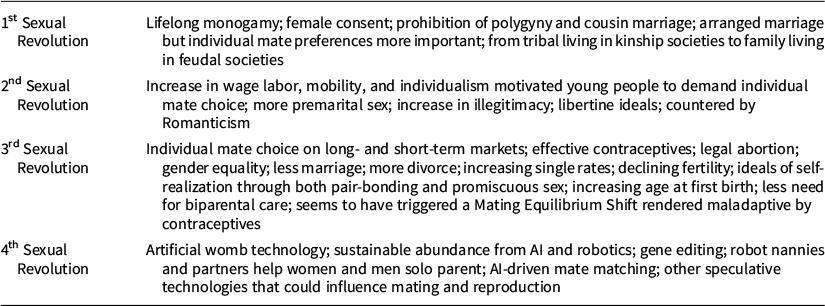
After the Church’s dissolution of Europe’s kinship societies, Western psychology and mating practices were put on a path toward greater individualization. Soon, we might be headed for a Fourth Sexual Revolution, as new technology could facilitate that more individuals care for children without having a partner—like early hominins did. Framework from Larsen (Reference Larsen2025c).

This equation changed after the agricultural revolution. Fields could not be split up and carried away after breakups, so an ideal emerged preferencing lifelong pair-bonds (Fortunato & Archetti, Reference Fortunato and Archetti2010). Children were still more of a communal responsibility for one’s tribe, often being raised by non-parents for long periods (Hrdy, Reference Hrdy2009).
The reproductive environment changed significantly around 1200, as a consequence of what we term the West’s First Sexual Revolution (Figure 5). After the Church dissolved Europe’s tribes and prohibited polygyny, people transitioned to living in families, often consisting of three generations. On these farms, children usually had more caretakers than what became typical after the Second Sexual Revolution around 1750, the West’s first attempt at implementing individual mate choice. An increasingly individualistic psychology, greater mobility, and wage labor motivated young people to begin choosing their own partners (Larsen, Reference Larsen2025c; Shorter, Reference Shorter1975). These new proletarians, as a result of urbanization and salary work, transitioned to living in two-generational nuclear families.
Moving away from arranged marriage imposed severe costs on some women. A strong increase in premarital sex resulted in more of them being left to care for offspring on their own. Illegitimacy doubled in England, while quadrupling in France and Germany. In Paris, the number of abandoned babies tripled. In Stockholm, half of childbirths were by unwed mothers (Borgström, Reference Borgström and Lauritzen1994; Coontz, Reference Coontz2005; Seccombe, Reference Seccombe1992). These pregnancies often resulted from higher-status men seducing lower-class women with promises of marriage, but leaving them when they became pregnant (Johansen, Reference Johansen, Ågren and Erickson2005). This pattern reflects both the inclusive nature of men’s short-term mate preferences, and women’s strong preference for the most attractive men (Bendixen et al., Reference Bendixen, Kennair, Biegler and Haselton2019), but the burden predominantly fell on the women who were left with a demanding child and poorer prospects for pair-bonding.
In the previous regimes of arranged marriage, parents had matched women and men of similar social mate value (Apostolou, Reference Apostolou2017; Coontz, Reference Coontz2005; Goody, Reference Goody1976). The emergence of individual choice empowered women to pursue the men who aroused the strongest attraction, as a consequence of the man’s traits and resources (Buss, Reference Buss2016). The resulting mating market evokes that of the early hominins’ promiscuous regime, in which females were drawn to the highest-ranking males (Chapais, Reference Chapais2008). This novel regime intensified intrasexual competition for the most sought-after men, thereby increasing women’s vulnerability to men with short-term intentions (Johansen, Reference Johansen, Ågren and Erickson2005), a problem for which human evolution appears to have left women relatively ill-prepared (Apostolou, Reference Apostolou2017; Biegler & Kennair, Reference Biegler and Kennair2016; Fisher & Cox, Reference Fisher and Cox2011; Kennair & Biegler, Reference Kennair, Biegler and Fisher2017).
New culture, most prominently exemplified by Romanticism, sought to reattach copulation to pair-bonding (Larsen, Reference Larsen2025a). After 1850, illegitimacy rates declined across the West (Shorter, Reference Shorter1975). The costs of individualized mate choice were simply too large in impoverished environments where women lacked gender equality and reliable contraceptives.
Eventually, this equation changed too—after the West’s Third Sexual Revolution around 1968. Post-World War II prosperity, female emancipation, and the contraceptive pill empowered women to choose their own short- and long-term partners with far less exposure to negative outcomes. They could pursue short-term mating with the most attractive men without unwillingly becoming a single parent, due to contraceptives and legal abortion. Women could also raise their requirements for long-term partners without being relegated to a life of impoverished singledom should they fail to secure a sufficiently desirable mate.
The emotional toll was still considerable; already in the early 1970s, some women advocated a counterrevolution, arguing that free mating markets predominantly benefitted men (Coontz, Reference Coontz2005). Many women experienced that getting attractive men to bed was easy, but having the same men commit to a relationship far harder (Larsen & Kennair, Reference Larsen and Kennair2025). A Swedish author bemoaned how men expected women to be as keen on promiscuous sex as men, which she thought was a poor fit for women’s psychology (Sundström, Reference Sundström1973).
In the 1950s, before the Third Sexual Revolution, marriage had been near-universal across the West. People married early, often reproduced quickly thereafter, and divorce was rare. From the 1970s on, Western people married later, divorce rates skyrocketed, pre-marriage sex became the norm, and the sex division of labor was greatly reduced (Coontz, Reference Coontz2005). Women were increasingly able to provide for themselves—and offspring—through better-paying, fulltime jobs (Goldin, Reference Goldin2006).
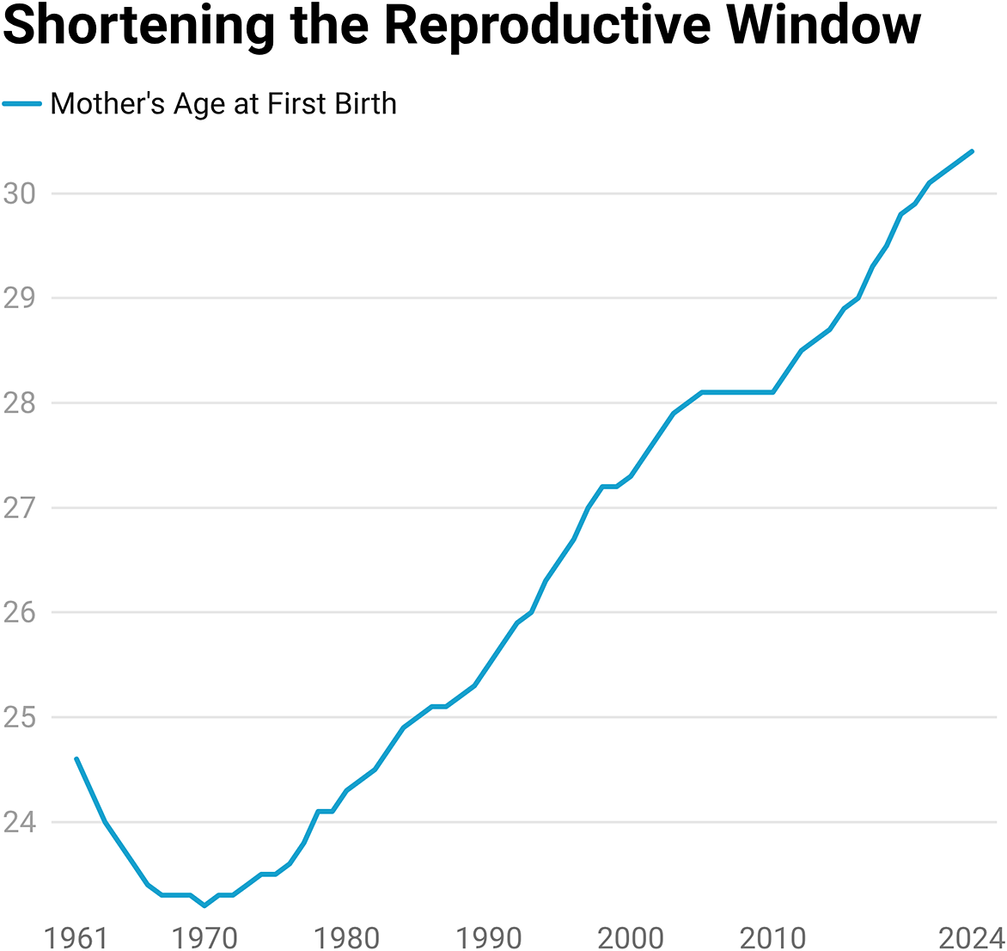
Simultaneously, pair-bonding rates began declining (Figure 3a), and mothers’ age at first birth increased (Figure 6). We see similar patterns in non-Western nations as they, too, moved toward regimes of individual choice (Jones, Reference Jones, Poston, Lee and Kim2018; Raymo et al., Reference Raymo, Park, Xie and Yeung2015). In terms of long-term fertility consequences, a key effect was that the modern world’s “free women” began excluding a larger proportion of the less-desirable men from their pool of potential partners (Buss, Reference Buss2016; Goldin & Katz, Reference Goldin and Katz2002; Grow & Van Bavel, Reference Grow and Van Bavel2015; Lichter et al., Reference Lichter, Price and Swigert2020; Nordin & Stanfors, Reference Nordin and Stanfors2024; Trimarchi, Reference Trimarchi2022). This change exemplifies how cultural changes stimulate the same evolved psychology and sex differences differently, which can lead to dramatically altered mating behavior and outcomes.
After the West’s Third Sexual Revolution, Norwegian women have become mothers at an increasingly high age, a pattern we see across nations with declining fertility. Note: Data from Statistics Norway (2025b).
Men’s reduced utility to women
While it might be uncomfortable, it is crucial to acknowledge that female emancipation required a return to the marginalization of the least sought-after men. Male marginalization, here, denotes the exclusion of men from pair-bonding and reproduction. Since the First Sexual Revolution around 1200 had imposed lifelong monogamy, Westerners had lived in societies with exceptionally strong pair-bonding egalitarianism (Henrich, Reference Henrich2020). A high proportion of men could secure a mate, which had not been common for our species. We have around twice as many female as male ancestors, as most men did not prevail in their intrasexual competition over women, and were thus deprived of becoming our ancestors (Kruger et al., Reference Kruger, Fisher and Wright2014; Wilder et al., Reference Wilder, Mobasher and Hammer2004).
Reverting to such stark mating inequality may feel inappropriate to contemporary sensibilities. However, in the pop-cultural discourse surrounding the mating crisis, some have expressed strong intuitions for why female emancipation has cost some men dearly. A widely circulated meme distilled this view memorably: “The real reason we have a male loneliness epidemic is because marriage was DEI for men” (Beguelin, Reference Beguelin2025).
In this framing, marriage between the First and Third Sexual Revolutions functioned as a kind of de facto affirmative action program for low-value men. After the Church’s insistence on monogamy, it was no longer a legally sanctioned option for women to share the highest-value men in polygynous relationships (Henrich, Reference Henrich2020). This radical intervention could be seen as “DEI for men,” or more precisely, for the low-value men who previously would have been outcompeted by men who could attract and afford multiple mates. But still, such lowest-value men contributed resources that could be invaluable for his wife and offspring—making it adaptive to marry them. In our ancestors’ environments, having a partner could be lifesaving for a woman and her offspring, if he provided even substandard levels of resources and some protection against predators, rival groups, and hostile males. Consequently, the romantic emotions women evolved for men needed only be strong enough to facilitate sufficient pair-bonding and reproduction in environments that were far poorer and more dangerous than our own.
How this aspect of male long-term utility has changed after the Third Sexual Revolution, we argue, explains much of why women to an increasing extent exclude the least sought-after men: they have no crucial resources to offer. In addition to women now being able to provide for themselves and have perfectly fine lives as romantically single, many nations support them with generous financial transfers. Regarding modern Scandinavia, Buss (Reference Buss2003, p. 68) concluded that “taxpayers effectively provide what husbands formerly provided, freeing women from their economic dependence on men.”
The above factors suppress pair-bonding. The assumption inherent in the concept of assortative mating is that women with a mate value in a certain percentile consider a suitable match a man in the same percentile (Conroy-Beam et al., Reference Conroy-Beam, Roney, Lukaszewski, Buss, Asao, Sorokowska, Sorokowski, Aavik, Akello, Alhabahba, Alm, Amjad, Anjum, Atama, Atamtürk Duyar, Ayebare, Batres, Bendixen, Bensafi and Zupančič2019c). If they do, a zipper can be used as a metaphor for how individuals with similar value pair-bond, providing communities with enough couples to reproduce their numbers. There is, however, little reason to assume that the median man and woman must have equal mate value—unless their mating regime makes monogamous marriage near-obligatory. With regard to pair-bonding, the relative value of the sexes is primarily informed by the importance of biparental care in a given environment (Penke et al., Reference Penke, Todd, Lenton, Fasolo, Geher and Miller2008), the sex ratio (Larsen, Reference Larsen and Shackelford2023), and prevailing mating norms (Larsen, Reference Larsen2025c).
If our hypothesis is correct in that our current environment motivates women to assign lower value to certain groups of men, we should see fewer assortative matches and declining pair-bonding rates. We would expect a marginalization of men with lower long-term mate value, and greater female intrasexual competition for the high-value men (Fisher & Cox, Reference Fisher and Cox2011; Fisher et al., Reference Fisher, Larsen and Kennairin press). A line of studies support the hypothesis that this change is occurring. For instance, Harper et al. (Reference Harper, Dittus, Leichliter and Aral2017) found that from 2002 to 2011–13, the top 5% of American men increased their number of sex partners by 32%, while a similar reduction in sex partners occurred across men in the lower percentiles. Norwegian men in the top 5% of estimated earnings capacity have over a 90% probability of being partnered by age 40, while men in the bottom 5% have under a 40% probability (Almås et al., Reference Almås, Kotsadam, Moen and Røed2023). Danish men experience similar marginalization, as 45% of low-skilled men live alone (Forum for Mænds Sundhed, 2017).
Dating apps exacerbate women’s discrimination of men
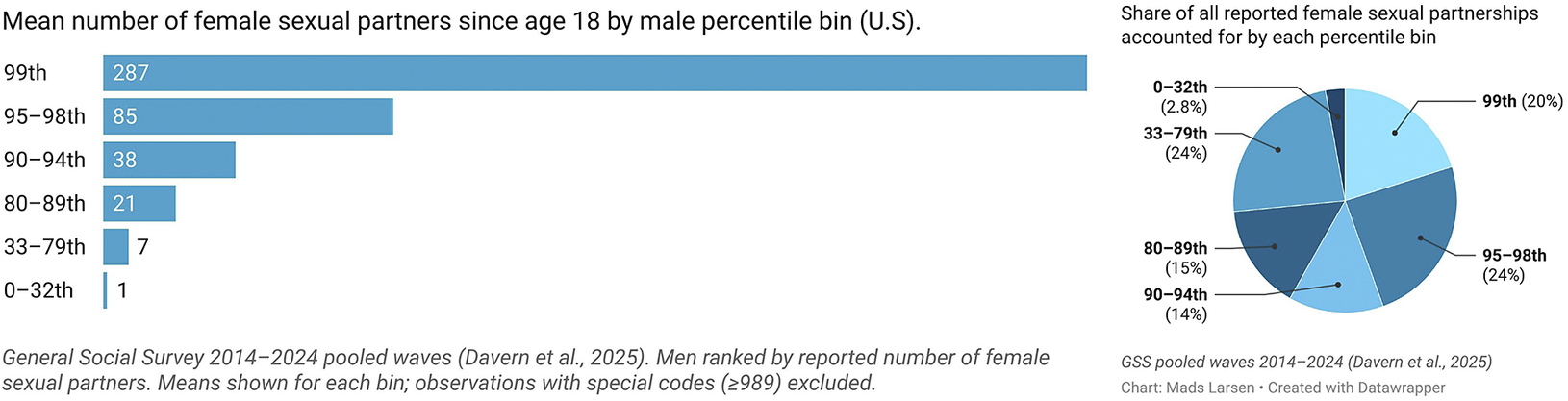
The fact that behavior on dating apps is so quantifiable perhaps contributes to why so many blame this new technology for parts of our mating dysfunction (e.g., Balki, Reference Balki2025; Bonilla-Zorita et al., Reference Bonilla-Zorita, Griffiths and Kuss2023; Sobieraj & Humphreys, Reference Sobieraj and Humphreys2021). Research reveals how strongly women discriminate between men in the distribution of mating outcomes (Figure 7), a stratification reflected also in dating app behavior (Ponseti, Reference Ponseti2022; Topinkova & Diviak, Reference Topinkova and Diviak2025). Yet we caution against viewing this new technology as the underlying cause of reduced pair-bonding, a process that started decades before Tinder was launched in 2012 (Figure 3a). Digital app use further complicates assortative mating, yet a return to our analogue past would probably not solve the fertility crisis. To support this argument, we must investigate how dating app dynamics mostly reflect, although also exacerbate, the deeper issue of many men’s reduced utility as long-term partners.
(a) Men’s reported lifetime sex partners. (b) Share of sexual partnerships.
While the pill empowered women to pursue the most attractive men with less risk of pregnancy, apps like Tinder give them easy, practically unlimited access to the most compelling men. Women have increasingly used this advantage to further restrict their dating pool. In 2014, female Tinder users were about three times as discriminatory as the male ones, while today they reject 10 times as many profiles (Bilton, Reference Bilton2014; Gerrard, Reference Gerrard2021). According to Gerrard (Reference Gerrard2021), the average woman first swipes away around 95% of men. In the chatting phase, 98% of the remainder is filtered out before the woman commits to a date (Grøntvedt et al., Reference Grøntvedt, Bendixen, Botnen and Kennair2020).
Such heavy filtration is facilitated by two distinct mating dynamics. First, women’s highly discriminatory short-term mate preferences draw them to a small proportion of men. Second, men’s far more inclusive short-term preferences motivate a much higher desire for partner variety than observed in most women. In Norway, men want 25 lifetime sex partners on average, while women prefer around 6 (Kennair et al., Reference Kennair, Schmitt, Fjeldavli and Harlem2009). Although numbers vary, this sex difference is a cross-cultural universal, one Kennair et al. (Reference Kennair, Grøntvedt, Kessler, Gangestad, Bendixen and Buss2023) found greater gender equality not to affect. Consequently, there is much greater demand for female sexuality than supply, giving women market power to select the men who best fulfill their mate preferences.
For the most sought-after men, Tinder and similar apps provide abundant access to new dates. Even on Hinge—whose slogan is “the dating app designed to be deleted,” that is, lead to relationships—the top 1% of men receive 16% of women’s likes, the top 15% receive 50%, while the bottom 50% are left with 4% of women’s likes (Edmunds, Reference Edmunds2017; Steinberg, Reference Steinberg2024). Other dating apps are similarly or more skewed. Studies suggest that the average man may have to work through over 5,000 profiles to secure a single date (Gerrard, Reference Gerrard2021; Grøntvedt et al., Reference Grøntvedt, Bendixen, Botnen and Kennair2020). Men with even lower mate value face even more punishing odds; some report having accumulated hundreds of thousands or even millions of rejections without finding a mate (Dregelid, Reference Dregelid2024; Weedston, Reference Weedston2025).
The fact that women channel so much of their mating effort to such a small number of men weakens the power advantage they have from being the sexually selective sex. Strong female intrasexual competition over the most sought-after men causes the dating process to unfold more according to male preferences (Goetz et al., Reference Goetz, Weisfeld, Zilioli, Welling and Shackelford2019b; Larsen, Reference Larsen and Shackelford2023)—which can motivate women to offer sex earlier than what they themselves would prefer (Buss, Reference Buss2017; Larsen & Kennair, Reference Larsen and Kennair2025). Frequently, women’s market power on dating apps does not translate into them fulfilling their desire for a long-term partner, but instead facilitates the most attractive men acquiring dozens or even hundreds of sex partners (Figure 7). For many women, the consequence of increasing female choosiness and competition is having to spend their most fertile years languishing in unfulfilling “situationships” that rarely transform into pair-bonds (Langlais et al., Reference Langlais, Guzman, Toohey, Podberesky and Lee2025; Stavang et al., Reference Stavang, Bendixen, Kleppestø and Kennair2026).
Considering how women deem there to be so few good-enough men when they use apps, it is not surprising that the resulting dating stratification can have adverse effects on pair-bonding rates. Such apps have displaced friends and family as our primary matchmakers (Bleize et al., Reference Bleize, van Stekelenburg and Tamboer2023; Castro & Barrada, Reference Castro and Barrada2020; Rosenfeld et al., Reference Rosenfeld, Thomas and Hausen2019)—generating many relationships—yet their channeling of women primarily to the most attractive men contributes to how many men become incels (involuntary celibate), while many women become insings (involuntary single), as they are unable to get the high-value men they date to commit (Larsen & Kennair, Reference Larsen and Kennair2025). A woman (34) referenced this challenge in the Norwegian mating debate: “Those I find interesting are not interested in anything serious or want ‘something simple’ that does not challenge them in any way” (Heia, Reference Heia2023).
One reason for this pattern may lie in the kind of information dating apps foreground. Women are more motivated to find love than casual sex when using dating apps (Sumter et al., Reference Sumter, Vandenbosch and Ligtenberg2017), yet many find it difficult to select the most appropriate candidates. Pictures on a small screen can tell you if someone looks hot enough to potentially turn you on if you meet, but it is harder to identify someone of matching long-term mate value with whom you could fall in love.
The consequence for our ability to achieve assortative mating seems considerable. When a dating site asked members to rate those of the opposite sex, the result attested to the difference between the sexes’ short-term preferences, but perhaps also to women developing increasingly discriminatory long-term mate preferences—a hypothesis we will return to. Men’s ratings spread across a bell curve, meaning that a few women were judged to be very attractive or un-attractive, while the majority were in the middle. By contrast, women concluded that over 80% of men had below-average attractiveness (Kincaid, Reference Kincaid2009). If the average woman considers only a fifth of men to be a good match in terms of attractivity, she will struggle to find someone who is both good enough and willing to commit. With online dating dominating as a mating arena, such numbers bode poorly for present and future pair-bonding, and in the extension of that, our ability to reproduce our populations.
Part of this problem may lie in the design of the technology itself. That it is so picture-based, in combination with the enormous demand women face on dating apps (Topinkova & Diviak, Reference Topinkova and Diviak2025), pushes women to be very focused on men’s physical attractiveness (Roshchupkina et al., Reference Roshchupkina, Kim and Lee2023). In our traditional offline environments, men place a higher premium on physical attractiveness than women (Zhang et al., Reference Zhang, Lee, DeBruine and Jones2019). But because apps are so visual and women need to filtrate online suitors based on something, women lean heavily into their short-term mate preferences, favoring good looks. Dating app users also tend to be more short-term oriented (Botnen et al., Reference Botnen, Bendixen, Grøntvedt and Kennair2018). These various factors, which work against assortative pairing, lead some experts to place parts of the blame for today’s dysfunctional mating on digital apps (Bonilla-Zorita et al., Reference Bonilla-Zorita, Griffiths and Kuss2021; Büyükeren et al., Reference Büyükeren, Makarin and Xiong2025; Castro & Barrada, Reference Castro and Barrada2020). Some believe that if only we could return to the analogue dating of the 2000s and earlier, perhaps people would have an easier time partnering up (e.g., Romare, Reference Romare2022).
Regardless of how unlikely it seems that young people would give up on dating apps, we believe such a development would have but a limited effect. Apps reflect and accentuate the modern world’s mating challenges, but the main underlying driver of increased singledom, we argue, is how some groups of men have lost so much utility to women that fewer fulfill women’s requirements for a long-term partner. Indeed, the Norwegian mating debate offers numerous examples of women who express that men are no longer good enough (e.g., Danielsen, Reference Danielsen2024; Tunstad, Reference Tunstad2024; Winge, Reference Winge2024). Ravatn (Reference Ravatn2024) wrote: “Now that women no longer need men, men must have something to offer, and women must be willing to put up with them.” Books like Why There are No Good Men Left: The Romantic Plight of the New Single Woman validate such female choosiness (Whitehead, Reference Whitehead2003).
Dating apps do facilitate women to direct much of their mating effort at the most sought-after men (Ponseti, Reference Ponseti2022)—with whom pair-bonding is an unlikely outcome—but the fact that dating apps play a part in how most men have little or no access to short-term mating is of limited relevance for their ability to attract a partner. Promiscuous mating has always been a lopsided affair for men; low-value men could never rely on promiscuity as their mating strategy (Buss, Reference Buss2016; Penke et al., Reference Penke, Todd, Lenton, Fasolo, Geher and Miller2008). If a lack of apps made women more willing to date men of similar mate value, the outcome could be more pair-bonding—or at least a slower decline—as more well-matched men and women would have a chance to meet and fall in love. But this alone could probably not solve the fertility crisis.
Our emotions do not work for us but for our genes
Another possibly relevant aspect is that—from the perspective of our genes—pair-bonding is not necessarily the best option for reproduction. A benefit of short-term mating is that most women can gain access to higher-quality genes than through pair-bonding with a man of matching mate value (Buss & Schmitt, Reference Buss and Schmitt1993; Gangestad & Simpson, Reference Gangestad and Simpson2000). Our long-term strategies evolved because more demanding offspring made biparental care increasingly beneficial (Hrdy, Reference Hrdy2009), but short-term mating remained an alternative conditional strategy. Even after our ancestors evolved the capacity for romantic love, if a woman experienced that no available partner offered sufficient benefit, her emotions could motivate her to opt for a higher-value man unwilling to bond. Their offspring’s mortality risk could increase some, but contributions from kin, especially maternal grandmothers (Hrdy, Reference Hrdy2009; Sear & Mace, Reference Sear and Mace2008), could help make single motherhood the better option—at least from the perspective of her genes.
Dawkins (Reference Dawkins2016, p. xxix) stated, a bit hyperbolically, that “we are survival machines—robot vehicles blindly programmed to preserve the selfish molecules known as genes.” In other words, our genes have programmed into us emotions that do not work for us but for the genes themselves. A woman with a mate value in the 60th percentile may desperately long for a partner, but if the biochemical algorithm that governs her mating strategies—in response to her materially abundant environment—will not release love-inducing hormones unless a potential partner scores above the 90th percentile, pair-bonding becomes less likely. Similarly, our female ancestors may not intentionally have wanted to become a single mother, yet still have been emotionally motivated to behave in a way that mixed their genes with those of a higher-value man. Depending on individual circumstance and the environment’s mating morality, such pregnancies could also result in a pair-bond, one the man otherwise might have declined.
Those examples illustrate how short- and long-term mating strategies should not be viewed as entirely separate pathways—facilitating either promiscuity or pair-bonding—but as interacting in complex ways to optimize reproductive outcomes (Buss, Reference Buss2000; Gangestad & Simpson, Reference Gangestad and Simpson2000). It can therefore be imprecise to interpret female dating-app behavior, for instance, as a conscious shift from long- to short-term mating. A more accurate framing could be that, as many men’s utility as long-term partners diminish, women increasingly shift from assortative to hypergamous mate choice, pursuing higher-percentile men rather than similar-percentile ones.
This perspective also clarifies contemporary women’s heightened emphasis on good-genes indicators (Buss et al., Reference Buss, Shackelford, Kirkpatrick and Larsen2001; Fisher et al., Reference Fisher, Garcia and Sokol Chang2013; Lee & McGuire, Reference Lee and McGuire2023; Moore et al., Reference Moore, Cassidy and Perrett2010)—why it does not mean a widespread preference for lifelong casual sex over family formation. Instead, as individual women have raised their minimum standards for long-term partners, the aggregated threshold for acceptable mate value now exceeds what men can collectively offer, creating a structural mismatch that leaves family formation increasingly unattainable. Women’s short-term shift is mostly not a promiscuous strategy; rather, it represents hypergamous filtering—an effort to secure a long-term partner who meets economically independent women’s increasingly stringent requirements for genetic and overall mate quality.
Similarly, in our pre-contraceptive-pill past, women’s sex with higher-value men was often best understood as a high-risk long-term strategy. If pregnancy led to pair-bonding, that was the optimal outcome. But even if the woman was left to care for the child with only kin support, that could still be conditionally adaptive. Such an offspring—especially in environments where women place high value on gene quality—could have greater reproductive success than an offspring with two parents but lower mate value (Jokela, Reference Jokela2009). The fact that a single mother might struggle more without the support of a partner would not be of primary importance to her genes (Dawkins, Reference Dawkins2016).
Of course, genes do not perform agentic calculations—we must not take Dawkins’s metaphor literally (Ball, Reference Ball2023)—yet the gene’s-eye view helps explain why our evolved mating emotions often fail to align with the outcomes we consciously desire. This tension is captured in folk wisdom as “you don’t get to choose who you fall in love with,” or, as Emily Dickinson (Reference Dickinson1862) put it, “The Heart wants what it wants.”
Whether women consciously desired it or not, short-term mating strategies gained greater influence after the Third Sexual Revolution created an environment in which women became far less dependent on male provisioning—thereby elevating their attraction to men’s genetic quality indicators over long-term resource potential (Buss et al., Reference Buss, Shackelford, Kirkpatrick and Larsen2001; Lee & McGuire, Reference Lee and McGuire2023; Moore et al., Reference Moore, Cassidy and Perrett2010). Men’s mate preferences shifted somewhat as well (Buss et al., Reference Buss, Shackelford, Kirkpatrick and Larsen2001), but there is scant evidence that male mating psychology underwent a comparably consequential transformation in response to these environmental changes. Their main challenge has always been to gain access to female sexuality, which continues to pose essentially the same formidable barrier for most men today as it did throughout hominin history. Women’s shift from long- to short-term tactics, noted Penke et al. (Reference Penke, Todd, Lenton, Fasolo, Geher and Miller2008), are much more dependent on ecological factors than what is the case for men, as only the highest-value men can expect to succeed with short-term strategies (Figure 7). The key environmental cues are those
that indicate the current relative importance of biparental care compared to good genes for reproductive success. How women use and process such environmental cues in order to reach adaptive mating tactic decisions is largely unknown and, as such, remains an interesting area for future research. (Penke et al., Reference Penke, Todd, Lenton, Fasolo, Geher and Miller2008, p. 63)
Thus, we hypothesize that our era’s increasing singledom primarily stems from women’s greater emphasis on short-term mate preferences due to novel environmental factors that disfavor biparental care for reproductive success. Having well-paying jobs, as well as generous welfare, puts females in a position evocative of what they had in our great ape ancestors’ promiscuous mating regimes: they can take care of children without the father’s help. Most women may not consciously want to solo parent, but it could still increase their fitness. This hypothesized Mating Equilibrium Shift—away from pair-bonding (Table 1)—could partly account for observed dating-app patterns, as it would motivate women to allocate more of their mating effort toward the most desirable men.
A line of modern pressures may influence women to emphasize short- rather than long-term mating strategies, which underpin our contemporary Mating Equilibrium Shift. Different environments facilitate distinct equilibria between short- and long-term mating, all of which could be adaptive, but reliable contraceptives seem to be the main mismatch that hinders today’s mating equilibrium from providing populations with sufficient reproduction.

Our genes, however, are unaware that we have invented reliable birth control. When women serially date and have sex with the highest-value men (Larsen & Kennair, Reference Larsen and Kennair2025), gene replication is rarely the outcome. With the invention of the pill, we may have checkmated our genes but potentially also our future survival. Alas, evolution seems to have programmed into us a more immediate and perhaps also stronger desire for sex than babies (Miller, Reference Miller1983; Rotkirch, Reference Rotkirch, Buchanan and Rotkirch2013), which was adaptive, but only until modern contraceptives empowered us to reap the rewards of love and copulation without having to incur the cost of pregnancy and childrearing.
If our hypothesis holds, dating apps should not be emphasized as a mismatch (Goetz et al., Reference Goetz, Pillsworth, Buss and Conroy-Beam2019a), the culprit that contributes to ultralow fertility. Throughout human history, the inclusive nature of men’s short-term mate preferences generally provided women access to uncommitted sex (Buss & Schmitt, Reference Buss and Schmitt1993), while women’s discriminatory short-term preferences favored the most attractive men (Scheib, Reference Scheib2001). Dating apps just amplify these ancient dynamics. Instead, the key mismatch is modern contraceptives.
Today, the emotions programmed into women respond to an exceptionally resource-rich environment that is uniquely empowering for women (Fisher et al., Reference Fisher, Garcia and Sokol Chang2013), so much so that solo parenting could be the preferred option for their genes. But in terms of reproduction, birth control renders short-term strategies ineffective, and most women lack the economic and social resources that would make them consciously choose to reproduce without a partner. Put differently, men as a group no longer provide enough value to free women for modern societies to sustain replacement-level fertility through pair-bonding alone.
These mating dynamics comprise what we term the Female Choice Fertility Paradox. When women are free to choose their own partners—while also having economic independence and effective contraceptives—their evolved mating psychology motivates strategies that undermine pair-bonding and thus sustainable fertility at the national level. Consequently, mostly all gender-equal nations have entered the Post-Pair-Bonding Fertility Trap, which impedes the formation of sufficient stable pair-bonds to ensure their populations’ future survival (Figure 8). Although these claims remain provisional and require further empirical testing, they suggest a coherent evolutionary way of understanding how contemporary mating-market conditions may matter for low fertility. This perspective complements more familiar demographic explanations by focusing on processes upstream of childbearing. Subsequent articles will elaborate the framework by isolating its component mechanisms, clarifying their interaction, formalizing their structure, and developing more precise predictions.
Gender-equal nations have experienced a dramatic reduction in stable pair-bonding, which suppresses fertility. In their most fertile years, an increasing number of women do not have a spouse or domestic partner.
Sufficient economic and social resources
Based on this investigation, we believe the most effective means for raising fertility rates could be to facilitate a further individualization of reproduction. This is not ideal, as most people still desire to partner up and tend to be happier in relationships (Argyle, Reference Argyle, Kahneman, Diener and Schwarz1999; Diener et al., Reference Diener, Gohm, Suh and Oishi2000; Grover & Helliwell, Reference Grover and Helliwell2019; Stern et al., Reference Stern, Krämer, Schumacher, MacDonald and Richter2024). After all, our psychologies are strongly shaped by millions of years of pair-bonding (Fisher, Reference Fisher2016). But we are in a situation where the ideal is not available; mating markets have become so frustrating for both sexes that many are giving up. Not only are 42% of Americans unpartnered (Pew Research Center, 2025), but 50% of single men and 65% of single women report that they are looking for neither short- nor long-term mating (Gelles-Watnick, Reference Gelles-Watnick2023).
Unless we are able to turn this trend drastically around, which we consider unlikely, the next step for human reproduction could be to facilitate more individuals having children without a partner. Offspring were historically a responsibility for the forager band, then the tribe, and then three- and two-generational families. A future with more single parents would fit this trend; it could be viewed as a return to our early hominin starting point, framing the past few million years as an era of pair-bonding—a temporary evolutionary compromise.
Of course, growing up with two parents comes with a line of benefits (Amato, Reference Amato2005). But if the Post-Pair-Bonding Fertility Trap makes communities steer toward self-eradication, compromises that forfeit some benefits but maintain societal survival should be considered. Certainly, we do not argue against pronatalist policies that target couples; quite the contrary—we think this strategy is also a good idea, although one that is unlikely to have a strong enough effect (Bergsvik et al., Reference Bergsvik, Fauske and Hart2021). We therefore see a need to rethink how post-pair-bonding societies support single parents. To incentivize more individualistic reproduction, people willing to have children alone could be offered additional social and economic resources. This is not a vision of women rejecting men, but of a society that ensures women who cannot obtain commitment from acceptable partners are not prevented from becoming mothers, so that survival-level fertility can be restored even if pair-bonding rates remain low. Conceivably, piloting such supports could refocus national attention on the fertility crisis, nurturing a wider pronatalist culture that—beyond enabling solo parenthood—might also raise fertility within relationships.
Today, even in a prosperous and feminist nation like Norway, such a program is probably unfeasible. Financial incentives to single parents are among the most generous in the world (Splash-DB, 2016), but few women deliberately pursue single parenthood (Farbu et al., Reference Farbu, Haugen, Meltzer and Brantsæter2014; Jacobsen et al., Reference Jacobsen, Vik and Dahl2020). For the government to step in with resources equivalent to what a partner would contribute could be too costly and reduce the national income. The fact that the Nordic nations are among the world’s richest is significantly due to high female labor force participation (Hall & Zoega, Reference Hall and Zoega2014). A central pillar of the Nordic Model is that all who can work should work, and that mothers should return to work within a year of giving birth. The mandate for the Norwegian Birth Rate Committee specified that no policy suggestions were allowed to challenge this “work principle” (Fødselstallsutvalget, 2025). If post-pair-bonding nations like Norway are to significantly raise their fertility rate, we believe politicians must be far bolder and more innovative, and consider preparing for the future by funding limited experiments to boost—and learn what is required to motivate—single parenthood.
We suggest that two main elements are key to making individualistic reproduction sufficiently appealing, one economic and the other social. Women must feel economically secure, regardless of whether they want to work fulltime, parttime, or not at all while raising their children. That is why we propose experiments should begin soon, to find out what level of economic resource transfers are required for enough women to choose to have children on their own.
The other element is the social environment. As we explored, while hominins evolved to sexually reproduce as couples, this pairing up does not extend to raising children in small, atomized units. Even when females mated promiscuously, not having the father around typically did not entail the mother being on her own. Kin and other alloparents often made crucial contributions to help feed and raise the child (Hrdy, Reference Hrdy2009; Sear & Mace, Reference Sear and Mace2008). In our modern world, such social networks have eroded. Women who move away from kin to seek education or work mostly lack the support that bands, tribes, farms, and villages provided in the past. We therefore propose that governments consider experiments with establishing apartment buildings or other living arrangements centered on the needs of solo parents and their children.
Offering 24/7 nearby childcare could be key to convince urbanite women to reproduce. Today, being a single mother could prohibit the lifestyle to which many have grown accustomed and have established to support themselves financially and socially. Knowing that their children can always be looked after by childcare workers, or stay with friends who live in the same building, would alleviate central burdens of single parenthood.
Initial steps in this direction have been seen with the rise of “intentional communities” or “cohousing” where neighborhoods are designed to promote both autonomous housing but also community living with shared resources, such as large kitchens and children’s playrooms (e.g., the Canadian https://cohousing.ca/). Having such a living environment, in which women could be guaranteed a home throughout their children’s youth, would likely facilitate stronger social bonds across families, as people would be incentivized to invest in the well-being of long-time neighbors (Sampson, Reference Sampson2012). Or, the experiments could uncover that entirely different social resources are necessary to create sufficiently appealing lives for single parents. We do not pretend to have all the answers, but encourage an engaged debate and creative experimentation to prepare for a further individualization of reproduction.
The attentive reader might object that such a development implies a socialization of reproduction, as the costs of offspring to a greater extent would be carried by society. That is correct; we propose an increasing socialization of the costs of reproduction but an individualization of the choice of having children.
We believe that for our modern, hyper-individualistic psychologies, such a change makes sense. Now that Homo sapien has become a postindustrial urbanite, the costs of having children are greatly individualized, while the economic gain is socialized; today’s children rarely help out on the family farm. Welfare states like Norway contribute generously, but parents still have large expenses. Children, however, benefit society, albeit once they have grown up. Parents invest heavily until the child is an educated adult ready to pay taxes for decades, but those funds do not befall parents; they go to state coffers to benefit all members of society. From this perspective, those who do not have children freeride on those who do, because everyone is supported by the younger generations when they retire (Longman, Reference Longman2004).
Male marginalization and demotivation
Even if a further individualization of reproduction makes sense, the downside for some groups of men could be considerable. After decades of men losing out financially relative to women (Renn, Reference Renn2022), additional female economic empowerment could lead to even greater male marginalization (Manning et al., Reference Manning, Trella, Lyons and Toit2010)—both in terms of sexual and romantic exclusion, as well as the negative psychological impact downstream from such exclusion.
The sexual economics framework of Baumeister and Vohs (Reference Baumeister and Vohs2004) emphasizes how men historically obtained sexual or romantic access through the provision of resources. If women gain further increases in economic independence, this reduces the relative importance of male-provided resources, so that men whose utility is tied to provisioning would be expected to experience an additional decline in mate value. More generous government support to women wanting to solo parent would thus further reduce some men’s utility to women, which could lead to even more men being excluded from intimacy, love, fatherhood, and family life—deprivations that likely cause male marginalization across many social and economic indicators.
This marginalization and its consequences for men’s well-being are predictable from an evolutionary perspective. The reason that males and females even exist is to facilitate sexual reproduction, which has a line of evolutionary benefits (Geary, Reference Geary2010). For most species, the male’s challenge is to gain sexual access to females, which causes intense intrasexual competition over mates (Kruger et al., Reference Kruger, Fisher and Wright2014; Trivers, Reference Trivers and Campbell1972). Not surprisingly, male psychology is strongly shaped by having to succeed in this reproductive contest—after all, the purpose of all life is to replicate DNA; it is why our organisms exist (Dawkins, Reference Dawkins2016; Wilson, Reference Wilson1975). When men experience failure at this most foundational task, their psychology should have a strong negative reaction, preferably to motivate more successful mating strategies.
However, if pair-bonding comes to be experienced as out of reach—regardless of effort—we should expect adverse consequences for men’s motivational systems (Adamczyk, Reference Adamczyk2017; Baumeister & Leary, Reference Baumeister and Leary1995; Deci & Ryan, Reference Deci and Ryan2000; Sparks et al., Reference Sparks, Zidenberg and Olver2024). This process could help explain why, as relationships have become less attainable (Figure 3a), some men withdraw further from social life, strive less for success, and experience worsening mental health (e.g., Burger & Rocha, Reference Burger and Rocha2024; Cappelen et al., Reference Cappelen, Falch and Tungodden2025; Connell, Reference Connell2005; Kimmel, Reference Kimmel2013; Pasquini, Reference Pasquini2025). Research suggests that men suffer more adverse effects than women from lacking a partner (Hoan & MacDonald, Reference Hoan and MacDonald2024; Tessler et al., Reference Tessler, Choi and Kao2024).
Living in an environment that has an abundance of single women, a mating morality that impels self-realization also through uncommitted sex (Shorter, Reference Shorter1975), and dating apps that muddle the line between short- and long-term mating seems increasingly challenging for excluded men. Research on incels shows that them having low mate value does not motivate a stronger long-term orientation—which would be the adaptive response—in fact, they desire more partner variety than other men (Costello et al., Reference Costello, Rolon, Thomas and Schmitt2022). Penke et al. (Reference Penke, Todd, Lenton, Fasolo, Geher and Miller2008) warned against the mental health consequences if more low-value men are motivated by today’s “hookup culture” to try to fulfill their innate desire for partner variety:
Since short-term mating tactics are proximately more rewarding and ultimately more adaptive for men than for women, and since, as a consequence, women become especially selective when choosing a short-term mate, only a small fraction of men with extraordinarily high mate value will be able to successfully pursue a short-term tactic … According to the motivational mechanism proposed by Allen and Badcock (Reference Allen and Badcock2003), [short-term strategies] should be avoided as a consequence of depressive affect … This interpretation is consistent with the literature on depression, which is often triggered by failure in courtship, relationships, or status-striving.
(Penke et al., Reference Penke, Todd, Lenton, Fasolo, Geher and Miller2008, p. 62)We therefore predict that many men could fare even poorer if women further emphasize short-term strategies, as a consequence of being in a stronger position to reproduce without needing a partner for economic and other support. Women may choose to become pregnant mostly with the most sought-after men, even if these are unwilling to pair bond. A more extreme view is that perhaps men should not have to pay child support, particularly if experiments show that women are mostly interested in having children with the most compelling men, and those men are not willing to participate if it entails an economic downside. These would be drastic measures, but we believe they could be justified by the existential stakes of solving the Female Choice Fertility Paradox.
To make such experiments more appealing to men, nations could present them as sex/gender neutral. Of course, biological males do not have a uterus, so they would be greatly disadvantaged. But theoretically, women could choose to have a child and let the father be the single parent.
Another alternative could be state-sponsored surrogacy for single men who want to become fathers. In feminist nations like Norway, however, surrogacy is typically not permitted because the practice is seen as exploiting women’s bodies (Stuvøy, Reference Stuvøy2018). Still, a compromise could perhaps be reached to portray experiments with state-sponsored reproduction as more gender neutral to win greater support from men. Given the increasingly dire situation for certain groups of men, communities should not underestimate the potential for resentment and misogyny arising from mating exclusion; a marginalized male underclass could become a destabilizing societal force (Costello & Buss, Reference Costello and Buss2023). This perspective is also worth bearing in mind as societies seek countermeasures to the fertility crisis. While we predict many people will find such discussions unsavory, they are needed if viable solutions are to be found.
In the longer run, artificial wombs could allow men greater reproductive equality. Experts predict that such technology might be available as early as in the 2040s (Cavaliere, Reference Cavaliere2020; Gupta, Reference Gupta2025; Henriques, Reference Henriques2023; Martinez & Goodwin, Reference Martinez and Goodwin2024; Segers, Reference Segers2021). This decade is the same one in which some experts estimate that AI and robotics can free humans from having to secure themselves materially through labor (Kurzweil, Reference Kurzweil2024; Nayebi, Reference Nayebi2025; Rainie & Anderson, Reference Rainie and Anderson2024). Billions of humanoid robots could be providing us with goods and services in the 2040s (Gavin, Reference Gavin2024; Neumann, Reference Neumann2025), bringing us toward a future of “sustainable abundance” (Diamandis & Kotler, Reference Diamandis and Kotler2023; Goldstein, Reference Goldstein2025).
Regardless of precisely when our post-automation future arrives, this is the world in which we likely can afford generous enough financial transfers to support individualistic reproduction for everyone who wants a baby. If artificial wombs arrive around the same time, men can have similar reproductive opportunities as women.
The future of free women
We are currently in a situation where gender challenges have been reversed in some regard. Based on our investigation of Western mating of the past millennium, we view feminism primarily as a means for achieving individual freedom, that is, individual mate choice made possible by women’s economic independence and reliable birth control. In many literary works from between the Second and Third Sexual Revolutions, both women and men expressed dissatisfaction with arranged marriage and gender inequality. Social vanguards envisioned a future in which both sexes were free to choose their own partners and move on when the relationship had played itself out (Larsen, Reference Larsen2021, Reference Larsen2024, Reference Larsen2025a, Reference Larsen2025b). But—for both sexes to be free—women would have to be able to provide for themselves and not suffer unwanted pregnancies. Women could therefore not achieve parity with men before new technologies made it possible (Goldin, Reference Goldin2006).
Men today are in a similar position. Free women exclude a growing proportion of men from pair-bonding, and they wield the reproductive power that the patriarchy had seized through arranged marriage and female subordination. To achieve parity, men must place their faith in tomorrow’s reproductive technologies, just like women had to for centuries. Perhaps this perspective can make experiments with individualistic reproduction more salient also for men. After all, the societies that steer toward demographic collapse belong to us all.
For modern women, the stakes are similarly large. Not only does the fertility crisis deprive many women of having the children they desire—instead relegating them to involuntary singlehood and childlessness—but from a feminist perspective, it is important to remember that the countries with low fertility are mostly those in which emancipated women are free to choose their own partners (Figure 4). As we explored, this unique level of mating agency underpins the Female Choice Fertility Paradox, which has captured gender-equal nations in the Post-Pair-Bonding Fertility Trap.
In contrast, the countries that still reproduce their populations are predominantly found across a fertility belt that extends through Africa, the Middle East, and further east (Figure 9), nations with quite different family practices and female freedoms than those familiar to us in the West (de Haas et al., Reference de Haas, Kabagenyi and Diennabila2025). If our communities fail to solve the fertility crisis and disappear, it seems unlikely that the fertility-belt nations will ever repeat our unique experiment with individual mate choice. In such a future, there may not be many free women, at least as we understand the concept in the West.
A decreasing number of nations are reproducing above the replacement rate of 2.1 (darkest color). There is a strong correlation between gender inequality and high fertility, indicating that continued ultralow fertility in gender-equal nations in the long term could threaten hard-won female freedoms.
Note: Data from United Nations (2024).
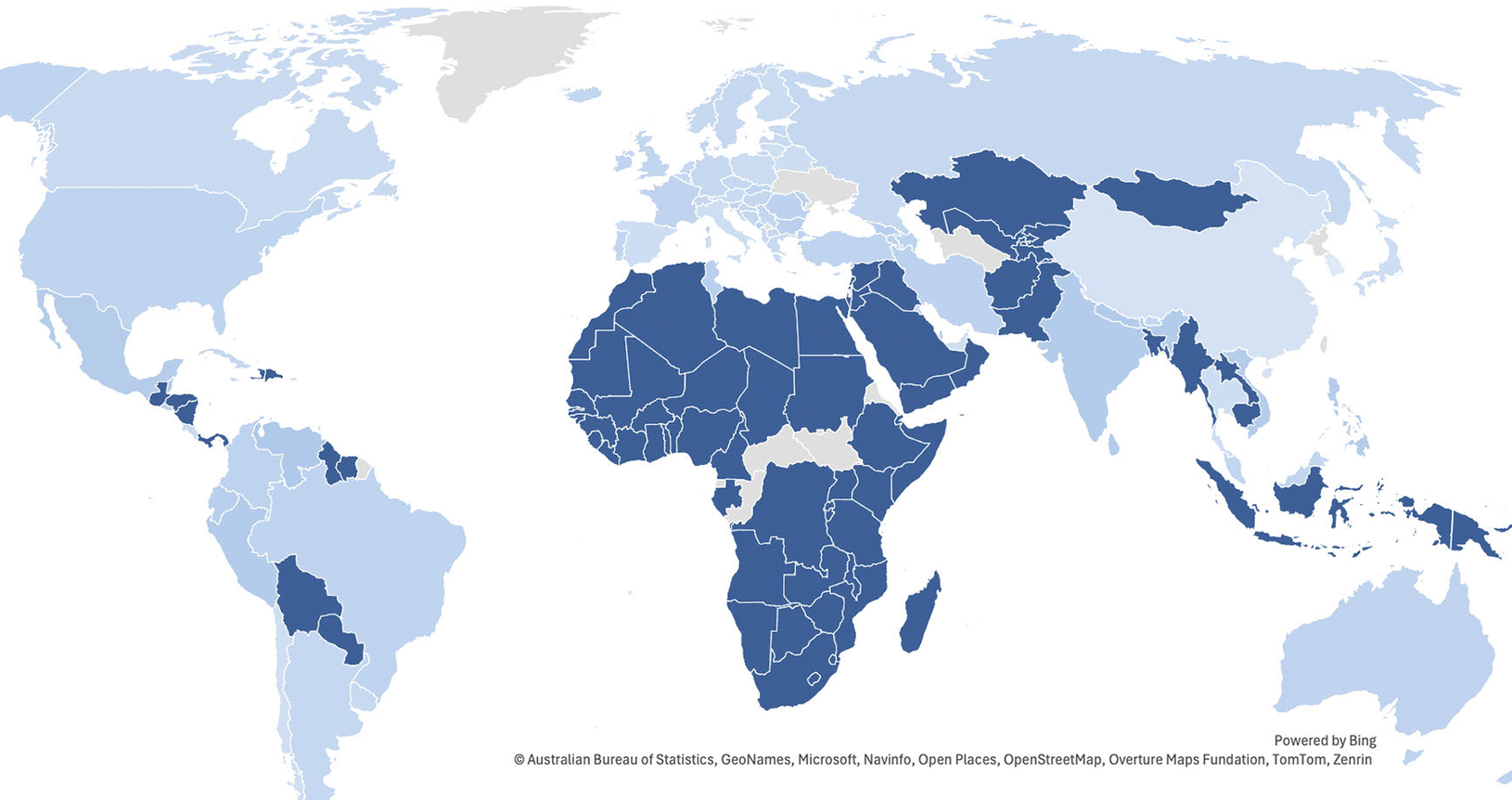
One way of looking at this challenge is that our nations have completed only the first part of modernity’s feminist project. Because no cultural change that sabotages reproduction can endure, the most crucial part remains: finding a way to combine having free women with sufficient reproduction. This is obligatory if we are to secure the future of our gender-equal communities. If we fail, feminism risks becoming one of humanity’s gravest mistakes: a noble project of emancipation that unwittingly dooms history’s most advanced civilization to demographic extinction. We therefore suggest that experiments which provide greater economic and social support for single parents, like those explored in this article, should be a high priority not only for societies facing low fertility, but also for feminists. However daunting and difficult this challenge may be to fully understand, it must be confronted if female emancipation is to remain a viable civilizational project.
Conclusion
Since the West’s Third Sexual Revolution around 1968, an increasing number of nations have seen fertility rates fall far below replacement levels. Demographers and other experts have struggled to untangle the complex, multifactorial causes behind ultralow fertility and have failed to identify effective solutions (Balbo et al., Reference Balbo, Billari and Mills2013; Esping-Andersen & Billari, Reference Esping-Andersen and Billari2015; Fødselstallsutvalget, 2026; Goldscheider et al., Reference Goldscheider, Bernhardt and Lappegård2015; Lesthaeghe, Reference Lesthaeghe2010; Rindfuss et al., Reference Rindfuss, Choe and Brauner-Otto2016). In this article, we have drawn on the evolutionary sciences to complement these more established explanations and to illuminate central psychological dimensions of the fertility crisis. Our examination of hominin mating history suggests why female emancipation has altered the conditions under which women’s mating psychology operates in ways that reduce pair-bonding, a key driver of continuing fertility decline in many nations.
Women’s mate preferences evolved in environments with arranged marriage, a context that may have made them more responsive to cues of genetic quality than is optimal for sustaining sufficient pair-bonding under today’s regimes of individual mate choice (Biegler & Kennair, Reference Biegler and Kennair2016; Kennair & Biegler, Reference Kennair, Biegler and Fisher2017). Economic empowerment intensifies this tendency by freeing women to concentrate their mating efforts on higher-value men, thereby narrowing the range of mutually acceptable matches and making it unlikely that pair-bonding rates will rise enough on their own to resolve the fertility crisis.
We believe this development is best understood as a Mating Equilibrium Shift. Pair-bonding was a highly beneficial strategy for millions of years (Figure 10), but the hominin linage’s reliance on biparental care could—if not be coming to an end—at least diminish in importance. Women’s mating psychology now responds to a uniquely resource-rich and female-empowering environment, one that again could make solo parenting preferable for their genes. Emancipation, individual mate choice, reliable contraceptives, and other factors make short-term strategies more salient (Table 1), but, alas, the same contraceptives render short-term mating largely ineffective in terms of reproduction. This is the Female Choice Fertility Paradox, which drives the Post-Pair-Bonding Fertility Trap (Figure 11).
Different environments facilitate distinct combinations of short- and long-term mating strategies. Global pattern from 6 million years ago until the Middle Ages, then Western. We predict an increase in women’s emphasis on short-term strategies in the decades ahead. This very approximate suggestion for a possible evolution of mating equilibria synthesizes the works of Ågren and Erickson (Reference Ågren and Erickson2005), Chapais (Reference Chapais2008, Reference Chapais, Shackelford and Salmon2011), Fisher (Reference Fisher2016), Henrich (Reference Henrich2020), Karmin et al. (Reference Karmin, Saag, Vicente, Wilson Sayres, Järve, Talas and Kivisild2015), Opie et al. (Reference Opie, Atkinson, Dunbar and Shultz2013), Seccombe (Reference Seccombe1992), and Zeng et al. (Reference Zeng, Aw and Feldman2018). Other sources propose different evolutions of equilibria.

Pathway to ultralow fertility.
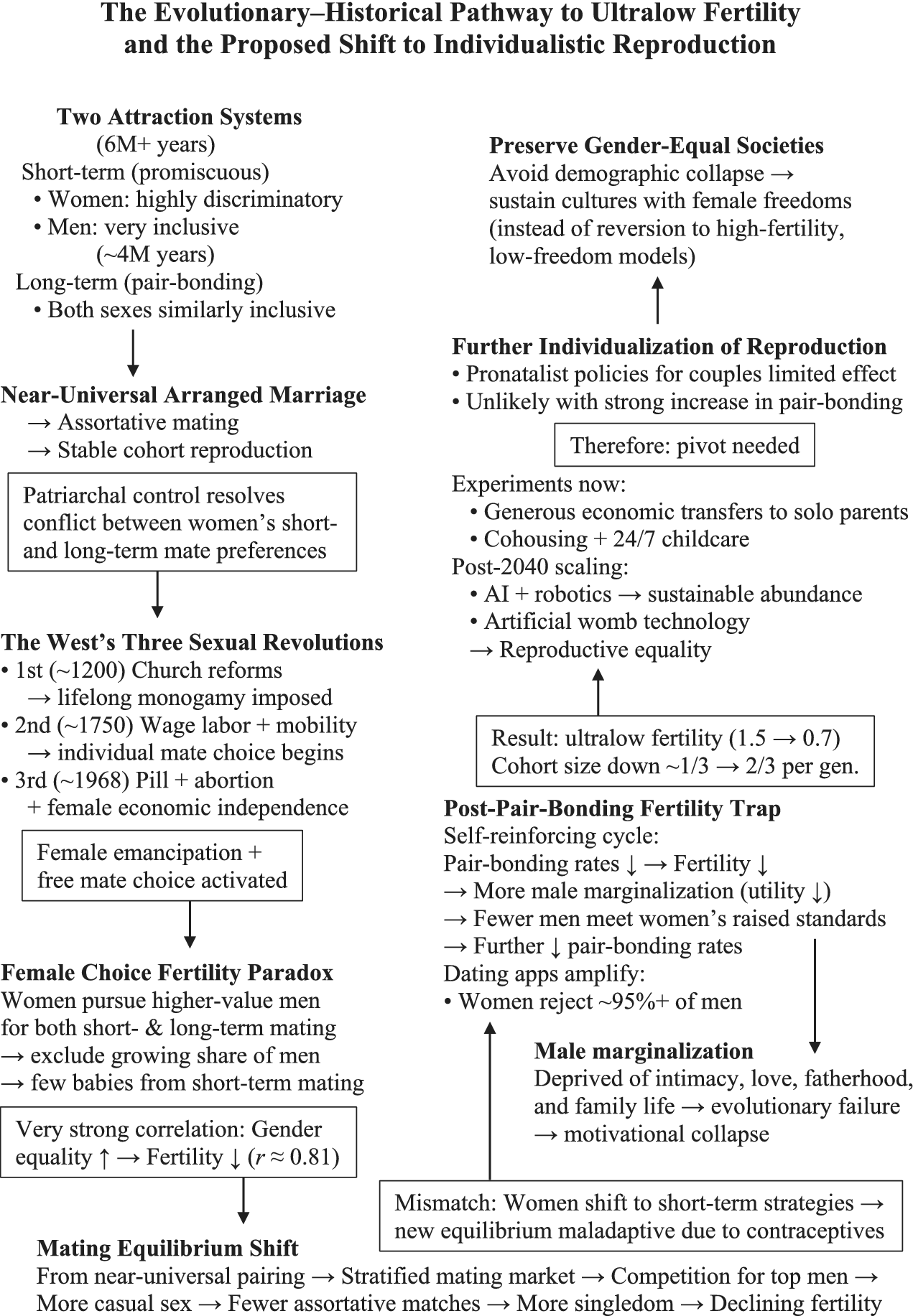
We therefore propose that a further individualization of reproduction could be the most effective means for aiding the survival of low-fertility nations, and in the extension of that, to preserve the cultures that grant women liberal freedoms. Nations should consider reproductive policy experiments to find out which economic and social resources are required for enough women to conclude that single parenthood is better than remaining childless. Insights from such pilot projects could inform universal implementation in our post-automation future. If artificial womb technology arrives around the same time, men would achieve greater reproductive equality, which could counter the male marginalization we have seen increase over the past decades. These would be drastic measures, but considering the existential stakes for nations and gender equality, they are worth considering in earnest.
Acknowledgments
In the preparation of this manuscript, the authors used various LLMs to assist with literature search, some formulations, and drafting Figures 2 and 11 and Table 1. The authors retain full responsibility for the integrity of the work.
Competing interest
We have no known conflict of interest to disclose.


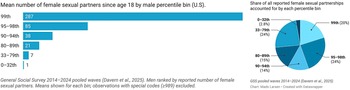
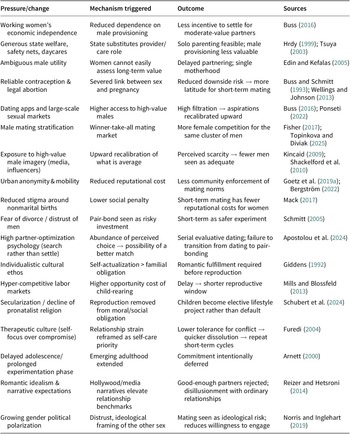
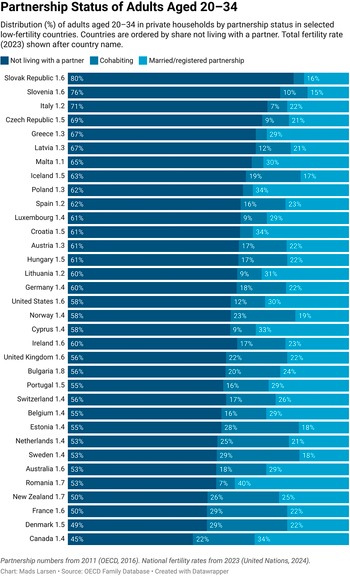
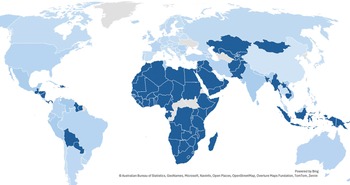


 Open access

