This paper contains supplementary material that can be found online at Http://journals.cambridge.org
Introduction
Plant species are being lost at an unprecedented rate because of human disturbance (Alcamo & Bennett, Reference Alcamo and Bennett2003). At a time of rapid global change the increasing loss of plant diversity requires urgent conservation and restoration efforts (IUCN, 1998). The introduction and reintroduction of species to the wild, especially of species that are rare and threatened, has become an important tool for biodiversity conservation (Akeroyd & Jackson, Reference Akeroyd and Jackson1995; Armstrong & Seddon, Reference Armstrong and Seddon2008). Reintroduction of plants is the controlled placement of plant material into a natural or managed ecological setting (Akeroyd & Jackson, Reference Akeroyd and Jackson1995). Related terms include introduction, restitution, translocation, reinforcement and restoration (Maunder, Reference Maunder1992; Akeroyd & Jackson, Reference Akeroyd and Jackson1995; SER, 2002; Bajomi et al., Reference Bajomi, Pullin, Stewart and Takács-Sánta2010). Translocation is a type of reintroduction in which material is transferred from one location to either existing or new locations within the species range (Akeroyd & Jackson, Reference Akeroyd and Jackson1995). Target 8 of the Global Strategy for Plant Conservation describes ex situ conservation and recovery plans for threatened species, with the goal of reintroducing c. 10% of such plant species to wild habitats (BGCI, 2003).
Successful plant reintroduction requires knowledge of the life history, demography, reproductive biology, horticulture, ecology and geography of the focal species (IUCN, 1998; Armstrong & Seddon, Reference Armstrong and Seddon2008; Bajomi et al., Reference Bajomi, Pullin, Stewart and Takács-Sánta2010). There have been a small number of successful reintroductions of shrubs and herbs and an even smaller number involving trees. The poor success rate of reintroductions has led to calls for greater monitoring and biological and ecological studies (Griffith et al., Reference Griffith, Scott, Carpenter and Reed1989; Armstrong & Seddon, Reference Armstrong and Seddon2008). Studies of plant reintroduction have typically focused on monitoring establishment rather than on explaining why establishment succeeds or fails (Armstrong & Seddon, Reference Armstrong and Seddon2008). Horticultural techniques have also been applied to reintroductions (Ren et al., Reference Ren, Ma, Zhang, Guo, Wang and Wang2010).
The study reported here concerns the herb Tigridiopalma magnifica, the only species in its genus (Family Melastomataceae; Zhang & Miao, Reference Zhang and Miao1984). The species was first discovered and named in 1979; it is endemic to southern China and has a very restricted distribution (Chen, Reference Chen1979). Because of human disturbance and habitat fragmentation the abundance of T. magnifica has decreased dramatically in the past 30 years. It is estimated that there are no more than 2,000 individuals in the wild, with a core distribution area of <1 km2 (Wang et al., Reference Wang, Ye and Ye2004). T. magnifica is categorized as Critically Endangered on the IUCN Red List of China (Xin, Reference Xin2005) but has not been assessed for the global IUCN Red List (although as the species is endemic its national and global status will be identical). This herb also has potential as an indoor ornamental plant because it is tolerant of shade and has attractive leaves and flowers. It flowers from August to December and sets fruit from March to May (Zeng, Reference Zeng2005). T. magnifica has a very specialized habitat, growing only on wet granitic rocks under the forest canopy. In addition, the species is difficult to propagate artificially (Wang et al., Reference Wang, Ye and Ye2004). Previous research on T. magnifica has examined its taxonomy and demography (Zhang & Miao, Reference Zhang and Miao1984), distribution (Wang et al., Reference Wang, Ye and Ye2004), life history and the obstacles to successful reproduction (Li, Reference Li2009), the feasibility of tissue culture (Zeng et al., Reference Zeng, Duan and Li2008) and its potential as an ornamental (Zeng, Reference Zeng2005).
Here we summarize the results of a 7-year reintroduction study of T. magnifica. We also describe its distribution, the structure of the plant communities in which it resides, and the major environmental variables that may affect attempts to reintroduce the species. We focus in particular on the following questions: (1) What characterizes the communities in which T. magnifica resides/ (2) What are the most appropriate habitats for future reintroductions/ (3) What can be done to increase the probability that reintroduced T. magnifica will survive/
Study area
The study was conducted at Xinyi, Yangchun, Gaozhou and Lianzhou cities in south-west Guangdong Province, southern China. The first three locations lie within the historical and current distribution of T. magnifica, where the climate is subtropical monsoon, altitudes are 60–1,000 m, mean annual temperature is 22.1°C and, mean annual total rainfall is 2,300 mm (c. 80% of which falls in April–October), the soil is lateritic and the vegetation is dominated by evergreen broad-leaved forests typical of the subtropics (Wang et al., Reference Wang, Ye and Ye2004). The climate of Lianzhou, which is outside the species' original range, is central subtropical monsoon, altitudes are 130–450 m, mean annual temperature is 19.5°C, mean annual rainfall 1,571 mm, the soil is lateritic and the vegetation is dominated by evergreen broad-leaved forests typical of the subtropics (Ren et al., Reference Ren, Ma, Zhang, Guo, Wang and Wang2010).
Methods
Examination of herbarium specimens and wild populations
We examined all T. magnifica specimens in the four major herbaria of the Chinese Academy of Sciences (Institute of Botany in Beijing, PE; Guangxi Institute of Botany, IBK; Kunming Institute of Botany, KUN; South China Botanical Garden, IBSC). The T. magnifica specimens in these herbaria were collected in 1931, 1935, 1951, 1956, 1957 and 2001. In addition we examined the Flora of China (Flora of China Editorial Committee, 1984) and Flora of Guangdong (Wu, Reference Wu2005). We interviewed elders in the villages within the range of T. magnifica to obtain information about the past distribution of T. magnifica and associated species, and during 2002–2009 we made several field trips to search for the species.
Vegetation survey
To examine the vegetation and environment of the natural habitat of T. magnifica we used the information from herbarium records and local floras to establish permanent plots, during 2002–2009, in 11 locations where we located wild T. magnifica (Fig. 1; see also Results). In each location we established a nested set of plots in an area of 800 m2: eight plots of 10×10 m within each of which we surveyed the tree layer; in four of these plots we established a subplot of 5×5 m, in each of which we surveyed the shrubs; and in three subplots we established a quadrat of 1×1 m within which we surveyed the herbaceous plants (there were 33 quadrats in all: three in each of the 11 locations). The location, elevation, and aspect of each quadrat were recorded with a global positioning system. In each plot, subplot and quadrat the name, height, diameter at breast height (DBH) and crown size of all plant species were recorded. In each site canopy closure was measured 15 times on two mornings by CID-110 canopy analysis. These vegetation surveys were conducted in April 2004 and March 2009 but as the two sets of data were similar we used only the data from March 2009.
The current distribution of Tigridiopalma magnifica and the locations of the vegetation and environment surveys, and of the augmentation, reintroduction and introduction: (a) China, showing the location of Guangdong province, (b) Guangdong Province, showing the location of Tianxin (13, the introduction site) and map (c), and (c) the current distribution (sites 1–11) and augmentation (3) and reintroduction (12) sites. The locations are (1) Dahe, (2) Hepin, (3) Dajiangkou, (4) Chaotang, (5) Muchong, (6) Bankeng, (7) Shachun, (8) Hekeng, (9) Kengchang, (10) Mugengtou, (11) Dongtang, (12) Ehuangzhang and (13) Tianxin.

Soil analysis
We collected soil samples in March 2009 from five random points in each of the 33 quadrats using a 5-cm diameter soil corer, to a depth of 5 cm (the soil layer on the rocks is thin). After mixing the soil samples from the five points in each quadrat we extracted a 0.5-kg subsample for analysis. The 33 subsamples were air-dried and sieved for determination of water content (g of water per 100 g of dry soil); pH (1:2.5 soil water extracts); N (decomposed with NaOH, absorbed with boracic acid, titrated with hydrochloric acid); P (extracted with HCl/NH4F, analysed with a spectrophotometer); K (extracted with CH3COONH4, analysed by atomic absorption spectrophotometry); Ca, Mg and Na content (extracted with H2SO4/HClO4, analysed by inductively coupled plasma mass spectrometry); and soil organic matter content (digested with H2SO4/K2Cr2O7, titrated with FeSO4; Standford & English, Reference Standford and English1949; Olsen et al., Reference Olsen, Cole, Watanabe and Dean1954; Institute of Soil Science & CAS, 1978; MEWAM, 1986).
Propagation of T. magnifica and preliminary experimentation
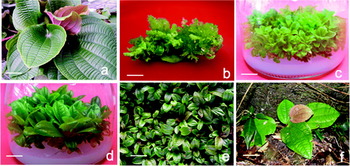
We established a system for in vitro propagation and plant regeneration (Plate 1) using biotechnology developed at the South China Botanical Garden. Plantlets were produced from leaf explants following procedures in Zeng et al. (Reference Zeng, Duan and Li2008). Before attempting to reintroduce T. magnifica we conducted a preliminary experiment to determine how to increase the survival of transplanted plantlets. We transplanted plantlets (kept in vitro for 10–12 months) into a planting bed (containing a sterilized mixture of sand, vermiculite, limestone and rice soil) in the greenhouse of the South China Botanical Garden. The plantlets were kept in the greenhouse planting bed for 8–10 months before they were transplanted to a location in the Garden. Survival of plantlets was highest if they were kept in vitro for 12 months and if they were kept in the greenhouse planting bed for a 9-month acclimation period before transplanting into the Garden. In addition we transplanted some plantlets under the forest canopy at five locations that were similar to the habitat of the original distribution of the species. However, the plantlets only survived at three of the locations (see below), and we used these as the reintroduction sites.
Tissue-culture propagation and reintroduction of Tigridiopalma magnifica: (a) specimen, (b) shoot induced from a leaf explant, (c) shoot proliferation, (d) roots induced, (e) plantlets for transplantation, and (f) reintroduced individuals. The bar in the left corner of each photograph is (a) 10 cm, (b) 0.5 cm, (c–d) 1 cm, and (e–f) 5.0 cm.

Reintroduction trial
Following the preliminary propagation experiment we planted T. magnifica in three locations: Dajiangkou Village (21°55′ N, 111°30′ E) in Yangchun City, Ehuangzhang Village (22°20′ N, 111°46′ E) in Yangchun City, and Tianxin Forestry Farm (25°6′ N, 112°21′ E) in Lianzhou City. The first location is an augmentation as individuals were planted within an extant population. The second location is a reintroduction as it is within the historical range of the species but had no extant population. The third location is an introduction as it is outside the species' known historical range. The structure of the plant community at the Tianxing Forestry Farm is similar to that at Ehuangzhang Village. The Dajiangkou Village location was also one of the 11 vegetation survey sites (see above); we also carried out the nested vegetation survey in Ehuangzhang Village and Tianxin Forestry Farm.
At each location we established three quadrats of 1×1 m for the reintroduction. The quadrats at Dajiangkou were c. 3 m from the wild population but without wild individuals of T. magnifica. The Ehuangzhang location is the herbarium garden of the Ehuangzhang Nature Reserve, c. 11.5 km from the original wild population. The Tianxin location is c. 400 km from Ehuangzhang. The habitat conditions at the three locations are similar (Table 1).
Characteristics (in some cases mean±SD) of the 11 sites in which Tigridiopalma magnifica was located (1–11) and the locations (*) where T. magnifica was augmented (i.e. within the species' original range; 3, Dajiangkou), reintroduced (12, Ehuangzhang) and introduced (13, Tianxin). There are 13 locations in total as Dajiangkou was both a confirmed location of the species and a survey site. For the location of each numbered site, see Fig. 1.

The plantlets were transplanted to the three locations on 16 April 2008 (the wet season). At the time of transplantation the area of each plantlet crown was c. 2.7 cm2. A survey of the wild T. magnifica population at Yangchun indicated that the typical density of these wild populations is c. 16 m−2 and we therefore used 15 m−2 as the planting density in the reintroduction. Plantlets were evenly spaced in each 1×1 m quadrat. Half the soil in each quadrat was the same soil used for acclimation in the greenhouse and half was untreated soil from the particular location. The plantlets were watered on each of the first 3 days after transplantation but not thereafter. The quadrats were not fenced, fertilized or mulched. We checked the survival and crown size of all transplants, and inferred causes of death (i.e. insect defoliation, fungal decay, nutrient deficiency, lack of water, strong radiation) on 16 April 2008, 21 March 2009, and 26 February 2011.
Data analysis
In the nested vegetation survey we recorded, in addition to T. magnifica, a total of 149 plant species belonging to 71 families (Appendix). We calculated the importance value of each plant species, which is based on the relative density, dominance and frequency of each species in the community, scaling from 0 to 300 (Krebs, Reference Krebs1985), and constructed a matrix that included the 45 most common plant species and T. magnifica. We also constructed a matrix of the 11 biotic and abiotic variables characterizing each of the 11 survey locations within the original range of the species. Detrended correspondence analysis (DCA), and canonical correspondence analysis (CCA) were used to quantify and describe the structure of the plant community, using PC-ORD4 (Hill & Gauch, Reference Hill and Gauch1980; ter Braak, Reference ter Braak1986; Økland, Reference Økland1990; Girard et al., Reference Girard, Lavoire and Theriault2002; Lachance & Lavoie, Reference Lachance and Lavoie2008). Major gradients in vegetation composition were identified using DCA. CCA was then used to examine the relationships between vegetation gradients and the abiotic variables (Leps & Smilauer, Reference Leps and Smilauer2003). A principal component analysis (PCA) of the environmental variables was calculated, using SPSS v. 11.0 (SPSS, Chicago, USA), to identify any potential clusters of locations. We calculated a one-way ANOVA, with SPSS, to compare the mean crown area and survivorship of the augmented, reintroduced and introduced individuals.
Results
We found records of T. magnifica in 12 locations but, during 2002–2009, we only located 11 of these. The location where T. magnifica appears to have become extinct is in Dianbai County (20°30′ N, 110°10′ E) in the south of Xinyi City and c. 120 km from Ehuangzhang Nature Reserve. Although there are records of several collections of T. magnifica from this location in 1956 we found neither herbarium specimens nor wild individuals. The 11 extant populations of T. magnifica are in Yangchun, Xinyi and Gaozhou cities (Fig. 1), distributed patchily along the Yunkai and Yunwu Mountains in south-west Guangdong at altitudes of 50–1,000 m.
T. magnifica is currently growing under the canopies of nine secondary natural forests and in two plantations (Cunninghamia lanceolata plantation in Magui and bamboo in Wangsha; Appendix). The population at Dongtang village is the largest and contains > 1,000 individuals. The other T. magnifica populations contain 98–212 individuals (Table I). In general the number of plant species within the original range of T. magnifica was higher than that in the location used for introduction of T. magnifica (i.e., at Tianxin Forestry Farm, Lianzhou City).
In the DCA ordination the relative positions of the 11 locations within the original range of T. magnifica and the reintroduction and introduction locations indicated the floristic similarity among locations. The first axis explained c. 13.8% of the total variation in floristic composition. There was no clear separation of locations except for the introduction location (Tianxin). All the wild T. magnifica were growing in soil on stone walls or rocks under the forest canopy. Canopy closure in these locations was > 70% and the distance of the populations to streams was 1–3 m. The soil nutrient contents are given in Table 1. In the PCA the first four principal components accounted for c. 89% of the total environmental variation and the first two components 69%. The first component mainly reflected soil nutrients and fertility and the second soil moisture.
In the CCA analysis (Fig. 2) the length of the lines representing the environmental factors represents the degree of correlation with vegetation composition, and the angle and direction of the line represents the relationship. The position of T. magnifica (S1 in Fig. 2) is closely related to canopy closure, soil water content and distance to streams.
Results of the canonical correspondence analysis of the vegetation and environmental variables at the 11 locations (Table 1) surveyed within the original range of T. magnifica (labelled S1). The species codes (S2–S46) are detailed in the Appendix.

Thirty-four months after transplantation the survival rate was 45, 33, and 33% at Dajiangkou, Ehuangzhang and Tianxin, respectively (Table 2). The crowns of transplanted plantlets were larger at Dajiangkou than at the other two locations. Although Ehuangzhang lies within the species' historical range and Tianxin does not, the survival rate and crown sizes were similar at these two locations. Although all the surviving individuals had produced seeds by 34 months, germination rate was lower at the reintroduction and introduction locations. Possible causes of transplant mortality were defoliation by the larvae of a noctuid moth, strong radiation, nutrient deficiency and lack of water.
Number of individuals and mean crown area of T. magnifica at planting on 16 April 2008, and after 11 months (on 21 March 2009) and 34 months (26 February 2011), with percentage survival at the three locations. Within a line values followed by different letters are significantly different at P < 0.05.

Discussion
We were able to verify the existence of only 11 populations of T. magnifica, within which individual plants have a patchy, scattered distribution. Ten of the populations were extremely small, with only 98–212 individuals. The population at Dongtang is substantially larger than at the other 10 locations. This location is in a reserve subject to little human disturbance, whereas the other populations are in secondary forests or plantations that often suffer clear cutting or other disturbances. T. magnifica propagates mostly by seeds, which are usually abundant; seed abortion rate is low and germination rate is high (Wang et al., Reference Wang, Ye and Ye2004). At the locations used for reintroduction and introduction, however, survival rate was low and thus constrains natural regeneration (Zeng et al., Reference Zeng, Duan and Li2008).
T. magnifica has large and membranous leaves and our results suggest that it grows only under the canopy of forests or plantations and near streams, and requires low temperatures, high humidity and low light. It has strong, fibrous roots and can grow in the thin soil on stone walls and rocks. A species will have difficulty dispersing into the surrounding habitat if it is not competitive in that habitat (Medail & Verlaque, Reference Medail and Verlaque1997) and it is possible that T. magnifica grows only on stone walls or rocks because it is not competitive elsewhere. It apparently has an efficient mechanism for nutrient cycling: it does not drop its leaves until they are completely withered and presumably most nutrients have been reabsorbed, and fallen leaves form a litter layer adjacent to the plant.
One of the criteria for the successful reintroduction of a species is that the introduced individuals complete their full life cycle and give rise to a self-sustaining, regenerating population. Most reintroduction studies involving woody species have only reported seedling survival because of long regeneration times (Allen, Reference Allen1988). Mehrhoff (Reference Mehrhoff and Falk1996) reintroduced 34 endemic plant species in Hawaii but 8 years later only three species were growing well. Although we monitored reintroduced plants for only 34 months and did not collect data on the next generation, survival rates of T. magnifica seedlings were high compared with survival rates in other reintroduction studies. However, although we successfully reintroduced greenhouse-grown seedlings the best method for the conservation of rare and threatened plants may be in situ preservation. Reintroduction can then be used as a complimentary method for conservation. The survival rate of seedlings of T. magnifica after 34 months at Tianxin, outside the species' historical range, was 33%, demonstrating that future human-assisted migration of this species, for example in the face of climate change, is possible.
In summary, successful reintroduction of T. magnifica requires a habitat with > 70% canopy cover, a thin layer of soil on rock, and a nearby stream that is sufficiently close to maintain high soil moisture and humidity. Because propagation of seedlings of T. magnifica is difficult we used a tissue culture technique to produce plantlets. We suggest integrating tissue culture (and perhaps other advanced propagation techniques) with ecological restoration techniques to increase the chances of successful reintroduction of T. magnifica and other threatened plant species. This example of the successful reintroduction of a rare, threatened herb has implications for human-assisted migration and colonization of rare plant species under future climate change scenarios.
Acknowledgements
This research was supported by the National Science Foundation of China (reference 31170493), Guangzhou Science and Technology Plan (reference 2010U1-E00601), and the Guangdong Sci-Tech Planning Project (reference 2010B060200039). We thank Yizhi Zhuang and Zhixin Tang for field monitoring, Huilan Zhang for soil analysis, HuaguYe for species identification, Jinping Zhang and Linjun Li for mapping and calculations, Bruce Jaffee for help with English and Jennifer Togerson for editing, and two anonymous reviewers for their valuable comments.
Appendix
The Appendix for this article is available online at Http://journals.cambridge.org/orx
Biographical sketches
This study is a collaboration between five research groups at two institutions and in a wide range of disciplines. Hai Ren is interested in vegetation restoration and reintroductions of rare and threatened plant species. Songjun Zeng is a biochemist currently involved in plant conservation. Longna Li is a technician working on in vitro propagation and plant regeneration. Qianmei Zhang is a data analyst with strong interests in long-term ecological studies. Long Yang specializes in vegetation restoration and horticulture. Jun Wang works on ecological restoration and is interested in seed bank and landscape design. Zhengfeng Wang focuses on plant conservation genetics. Qinfeng Guo's research interests include biological invasions, community ecology and biogeography.