







1 Introduction
The thermodynamic formalism for sequences of continuous functions generalizes that for continuous functions and it has been developed in connection to the study of dimension problems. In particular, Barreira and Mummert independently studied the sequences called almost additive sequences in [Reference Barreira1, Reference Mummert13], where the variational principle and definition of the Gibbs measure for continuous functions are generalized for such sequences. Let $(X, \sigma _X)$
be a subshift over finitely many symbols. In [Reference Barreira1, Reference Feng8, Reference Mummert13], it was shown that if the sequence
$(X, \sigma _X)$
be a subshift over finitely many symbols. In [Reference Barreira1, Reference Feng8, Reference Mummert13], it was shown that if the sequence ${\mathcal {F}}$
of continuous functions is almost additive on X with the weak specification property and has bounded variation, then it has a unique equilibrium state and this equilibrium state is a unique invariant Gibbs measure for
${\mathcal {F}}$
of continuous functions is almost additive on X with the weak specification property and has bounded variation, then it has a unique equilibrium state and this equilibrium state is a unique invariant Gibbs measure for ${\mathcal {F}}$
. Later, Feng and Huang [Reference Feng and Huang9] considered a more general class of sequences of continuous functions called asymptotically additive sequences and established the variational principle for such sequences.
${\mathcal {F}}$
. Later, Feng and Huang [Reference Feng and Huang9] considered a more general class of sequences of continuous functions called asymptotically additive sequences and established the variational principle for such sequences.
Recently, Cuneo [Reference Cuneo6] gave a result which relates the thermodynamic formalism for continuous functions and that for asymptotically additive sequences of continuous functions. He showed that if a sequence ${\mathcal {F}}=\{\log f_n\}_{n=1}^{\infty }$
on a subshift X is asymptotically additive, then there exists a function
${\mathcal {F}}=\{\log f_n\}_{n=1}^{\infty }$
on a subshift X is asymptotically additive, then there exists a function $\hat f\in C(X)$
such that
$\hat f\in C(X)$
such that
 $$ \begin{align} \lim_{n\rightarrow \infty} \frac{1}{n} \lVert \log f_{n}-S_n \hat f \rVert_{\infty}=0, \end{align} $$
where $(S_n \hat f)(x):=\sum _{i=0}^{n-1}\hat f(\sigma _X^{i}(x))$
and
$(S_n \hat f)(x):=\sum _{i=0}^{n-1}\hat f(\sigma _X^{i}(x))$
and $\| \cdot \|_{\infty }$
is the supremum norm. Such a function
$\| \cdot \|_{\infty }$
is the supremum norm. Such a function $\hat f$
is not unique. Equation (1.1) implies
$\hat f$
is not unique. Equation (1.1) implies
 $$ \begin{align} \lim_{n\to \infty} \frac{1}{n}\int \log f_n \,dm=\int \hat f\, dm \quad \text{ for every } m\in M(X, \sigma_X), \end{align} $$
where $M(X, \sigma _X)$
is the set of all
$M(X, \sigma _X)$
is the set of all $\sigma _X$
-invariant Borel probability measures on X. Therefore, the sequence
$\sigma _X$
-invariant Borel probability measures on X. Therefore, the sequence ${\mathcal {F}}$
and function
${\mathcal {F}}$
and function $\hat f$
satisfying (1.1) have the same equilibrium states and finding equilibrium states for asymptotically additive sequences is equivalent to finding equilibrium states for continuous functions. However, no explicit form for
$\hat f$
satisfying (1.1) have the same equilibrium states and finding equilibrium states for asymptotically additive sequences is equivalent to finding equilibrium states for continuous functions. However, no explicit form for $\hat f$
is known and many questions concerning its properties remain open. For example, it is not known under which conditions of
$\hat f$
is known and many questions concerning its properties remain open. For example, it is not known under which conditions of ${\mathcal {F}}$
we can find a function
${\mathcal {F}}$
we can find a function $\hat f$
which belongs to the Bowen class. It is easy to see that if the sequence
$\hat f$
which belongs to the Bowen class. It is easy to see that if the sequence ${\mathcal {F}}$
has a unique invariant Gibbs measure
${\mathcal {F}}$
has a unique invariant Gibbs measure $\mu $
on a subshift X with the weak specification property and
$\mu $
on a subshift X with the weak specification property and $\hat f$
satisfying (1.1) belongs to the Bowen class (equivalently,
$\hat f$
satisfying (1.1) belongs to the Bowen class (equivalently, $\mu $
is an invariant Gibbs measure for
$\mu $
is an invariant Gibbs measure for $\hat f$
satisfying (1.1)), then
$\hat f$
satisfying (1.1)), then ${\mathcal {F}}$
is almost additive with bounded variation on X. However, we do not know if the reverse implication holds. In other words, we do not know if
${\mathcal {F}}$
is almost additive with bounded variation on X. However, we do not know if the reverse implication holds. In other words, we do not know if $\mu $
being a unique invariant Gibbs measure for an almost additive sequence
$\mu $
being a unique invariant Gibbs measure for an almost additive sequence ${\mathcal {F}}$
with bounded variation implies that there exists a function
${\mathcal {F}}$
with bounded variation implies that there exists a function $\hat f$
in (1.1) for which
$\hat f$
in (1.1) for which $\mu $
is Gibbs. This question is addressed in [Reference Cuneo6]. Hence, in this paper, we study the following questions.
$\mu $
is Gibbs. This question is addressed in [Reference Cuneo6]. Hence, in this paper, we study the following questions.
[Q] What form does $\hat f$
take when
$\hat f$
take when ${\mathcal {F}}$
is (weakly) almost additive? What are the properties of
${\mathcal {F}}$
is (weakly) almost additive? What are the properties of $\hat f$
?
$\hat f$
?
For this purpose, we first investigate a natural form of a Borel measurable function $\hat f$
on X satisfying (1.1). We extend the notion of the (weak) Gibbs measure for a continuous function to a Borel measurable function (see §2). In Theorem 3.2, for an almost additive sequence
$\hat f$
on X satisfying (1.1). We extend the notion of the (weak) Gibbs measure for a continuous function to a Borel measurable function (see §2). In Theorem 3.2, for an almost additive sequence ${\mathcal {F}}$
on a subshift with the weak specification property, under certain conditions, we find a function
${\mathcal {F}}$
on a subshift with the weak specification property, under certain conditions, we find a function $\hat f$
satisfying (1.1) explicitly by using the sequence
$\hat f$
satisfying (1.1) explicitly by using the sequence ${\mathcal {F}}$
. If, in addition,
${\mathcal {F}}$
. If, in addition, ${\mathcal {F}}$
has bounded variation, then the unique equilibrium state for
${\mathcal {F}}$
has bounded variation, then the unique equilibrium state for ${\mathcal {F}}$
, which is the unique invariant Gibbs measure for
${\mathcal {F}}$
, which is the unique invariant Gibbs measure for ${\mathcal {F}}$
, is the unique invariant Gibbs measure for
${\mathcal {F}}$
, is the unique invariant Gibbs measure for $\hat f$
. We also consider the case in which
$\hat f$
. We also consider the case in which ${\mathcal {F}}$
is merely weakly almost additive. Such a sequence
${\mathcal {F}}$
is merely weakly almost additive. Such a sequence ${\mathcal {F}}$
is asymptotically additive. Defining
${\mathcal {F}}$
is asymptotically additive. Defining $\hat f$
satisfying (1.1) in the same manner, we show that if
$\hat f$
satisfying (1.1) in the same manner, we show that if ${\mathcal {F}}$
has an equilibrium state
${\mathcal {F}}$
has an equilibrium state $\mu $
which is Gibbs for
$\mu $
which is Gibbs for ${\mathcal {F}}$
(such a case does exist, see Remark 3.3), then it is an invariant weak Gibbs measure for
${\mathcal {F}}$
(such a case does exist, see Remark 3.3), then it is an invariant weak Gibbs measure for $\hat f$
. In Theorem 3.5, assuming that there is an invariant Gibbs measure for a weakly almost additive sequence
$\hat f$
. In Theorem 3.5, assuming that there is an invariant Gibbs measure for a weakly almost additive sequence ${\mathcal {F}}$
, we construct a function
${\mathcal {F}}$
, we construct a function $\hat f$
satisfying (1.1) by using the Gibbs measure and obtain similar results.
$\hat f$
satisfying (1.1) by using the Gibbs measure and obtain similar results.
In §4, by applying Theorem 3.2, we study the following questions related to [Q] concerning factors of Gibbs measures. Given a one-block factor map $\pi : X\to Y$
between subshifts and a Gibbs measure
$\pi : X\to Y$
between subshifts and a Gibbs measure $\mu \in M(X,\sigma _X)$
for
$\mu \in M(X,\sigma _X)$
for $f\in C(X)$
, we are interested in studying some properties of the push-forward measure
$f\in C(X)$
, we are interested in studying some properties of the push-forward measure $\pi \mu $
(which we call an image or a factor of
$\pi \mu $
(which we call an image or a factor of $\mu $
). These questions originate from statistical mechanics and many studies have been also conducted in the area of dynamical systems (see for example, [Reference Chazottes and Ugalde4, Reference Chazottes and Ugalde5, Reference Kempton11, Reference Piraino15–Reference Pollicott and Kempton17, Reference Verbitskiy19, Reference Yoo24]). In particular, Yoo [Reference Yoo24] showed that the fiber-wise sub-positive mixing property of factor maps (Definition 4.5) is a sufficient condition for a factor map to send all Markov measures on a topologically mixing shift of finite type to Gibbs measures and the result was extended by Piraino [Reference Piraino16] to the factors of Gibbs measures associated to continuous functions. However, the fiber-wise sub-positive mixing property is not a necessary condition (Proposition 4.7). Hence, we are interested in finding an equivalent condition for
$\mu $
). These questions originate from statistical mechanics and many studies have been also conducted in the area of dynamical systems (see for example, [Reference Chazottes and Ugalde4, Reference Chazottes and Ugalde5, Reference Kempton11, Reference Piraino15–Reference Pollicott and Kempton17, Reference Verbitskiy19, Reference Yoo24]). In particular, Yoo [Reference Yoo24] showed that the fiber-wise sub-positive mixing property of factor maps (Definition 4.5) is a sufficient condition for a factor map to send all Markov measures on a topologically mixing shift of finite type to Gibbs measures and the result was extended by Piraino [Reference Piraino16] to the factors of Gibbs measures associated to continuous functions. However, the fiber-wise sub-positive mixing property is not a necessary condition (Proposition 4.7). Hence, we are interested in finding an equivalent condition for $\pi \mu $
to be Gibbs for a continuous (or, more generally, Borel measurable) function. It is not known and we investigate it under a special setting. To this end, we study relative pressure functions by using the non-additive thermodynamic formalism.
$\pi \mu $
to be Gibbs for a continuous (or, more generally, Borel measurable) function. It is not known and we investigate it under a special setting. To this end, we study relative pressure functions by using the non-additive thermodynamic formalism.
Let $(X, \sigma _X), (Y, \sigma _Y)$
be subshifts and
$(X, \sigma _X), (Y, \sigma _Y)$
be subshifts and $\pi :X\rightarrow Y$
be a factor map. Let
$\pi :X\rightarrow Y$
be a factor map. Let $f\in C(X)$
,
$f\in C(X)$
, ${n\in {\mathbb {N}}}$
, and
${n\in {\mathbb {N}}}$
, and $\delta>0$
. For each
$\delta>0$
. For each $y\in Y$
, define
$y\in Y$
, define
 $$ \begin{align} P_n(\sigma_X, \pi, f, \delta)(y)&=\sup\bigg\{\!\sum_{x\in E}e^{(S_nf)(x)}\!:E \text{ is an } (n, \delta) \text{ separated subset of } \pi^{-1}(\{y\})\bigg\}, \nonumber\\ P(\sigma_X, \pi, f, \delta)(y)&= \limsup_{n\rightarrow \infty}\frac{1}{n}\log P_{n}(\sigma_X, \pi, f,\delta)(y),\\ P(\sigma_X, \pi, f)(y)&= \lim_{\delta\rightarrow 0}P(\sigma_X, \pi,f, \delta)(y). \nonumber \end{align} $$
The function $P(\sigma _X, \pi , f):Y\rightarrow {\mathbb {R}}$
, introduced by Ledrappier and Walters [Reference Ledrappier and Walters12], is the relative pressure function of
$P(\sigma _X, \pi , f):Y\rightarrow {\mathbb {R}}$
, introduced by Ledrappier and Walters [Reference Ledrappier and Walters12], is the relative pressure function of $f\in C(X)$
with respect to
$f\in C(X)$
with respect to $\pi $
. In general, it is merely Borel measurable. We have
$\pi $
. In general, it is merely Borel measurable. We have $P(\sigma _X, \pi , f) =\lim _{n\rightarrow \infty }(1/n)\log g_n$
almost everywhere with respect to every
$P(\sigma _X, \pi , f) =\lim _{n\rightarrow \infty }(1/n)\log g_n$
almost everywhere with respect to every $\mu \in M(Y, \sigma _Y)$
, where
$\mu \in M(Y, \sigma _Y)$
, where $g_n$
is defined in (4.1) in §4. The sequence
$g_n$
is defined in (4.1) in §4. The sequence ${{\mathcal {G}}=\{\log g_n\}_{n=1}^{\infty }}$
on Y is subadditive in general and is the sequence associated to the relative pressure function
${{\mathcal {G}}=\{\log g_n\}_{n=1}^{\infty }}$
on Y is subadditive in general and is the sequence associated to the relative pressure function $P(\sigma _X, \pi , f)$
.
$P(\sigma _X, \pi , f)$
.
Since the factor of the Gibbs measure for $f\in C(X)$
is a unique equilibrium state for the sequence
$f\in C(X)$
is a unique equilibrium state for the sequence ${\mathcal {G}}=\{\log g_n\}_{n=1}^{\infty }$
on Y associated to
${\mathcal {G}}=\{\log g_n\}_{n=1}^{\infty }$
on Y associated to $P(\sigma _X, \pi , f)$
and the factor is also a unique invariant Gibbs measure for
$P(\sigma _X, \pi , f)$
and the factor is also a unique invariant Gibbs measure for ${\mathcal {G}}$
(see for example, [Reference Feng8, Reference Yayama21, Reference Yayama22]), our approach is to find an explicit form of
${\mathcal {G}}$
(see for example, [Reference Feng8, Reference Yayama21, Reference Yayama22]), our approach is to find an explicit form of $\hat f$
satisfying (1.1) when
$\hat f$
satisfying (1.1) when ${\mathcal {F}}$
is replaced by
${\mathcal {F}}$
is replaced by ${\mathcal {G}}$
. In Theorem 4.8 and in the rest of the paper, we consider this factor under the following particular setting. A map
${\mathcal {G}}$
. In Theorem 4.8 and in the rest of the paper, we consider this factor under the following particular setting. A map ${\pi : X\to Y}$
is a one-block factor map between irreducible shifts of finite type where
${\pi : X\to Y}$
is a one-block factor map between irreducible shifts of finite type where $X\subseteq \{1,2,3\}^{{\mathbb {N}}}$
and
$X\subseteq \{1,2,3\}^{{\mathbb {N}}}$
and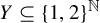 $Y\subseteq \{1,2\}^{{\mathbb {N}}}$
such that Y is the full shift or has the transition matrix
$Y\subseteq \{1,2\}^{{\mathbb {N}}}$
such that Y is the full shift or has the transition matrix $\big (\begin {smallmatrix} 0 & 1 \\ 1 & 1 \end {smallmatrix}\big )$
, satisfying
$\big (\begin {smallmatrix} 0 & 1 \\ 1 & 1 \end {smallmatrix}\big )$
, satisfying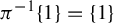 $\pi ^{-1}\{1\}=\{1\}$
, and f is a function of of two coordinates on X. The images of measures of maximal entropy under the factor maps of this type were originally studied in [Reference Shin18, Reference Yayama20]. Finding an explicit form of a function for which the factor of the Gibbs measure is (weak) Gibbs and studying the almost additivity of the sequence
$\pi ^{-1}\{1\}=\{1\}$
, and f is a function of of two coordinates on X. The images of measures of maximal entropy under the factor maps of this type were originally studied in [Reference Shin18, Reference Yayama20]. Finding an explicit form of a function for which the factor of the Gibbs measure is (weak) Gibbs and studying the almost additivity of the sequence ${\mathcal {G}}$
associated to
${\mathcal {G}}$
associated to $P(\sigma _X, \pi , f)$
, we investigate an equivalent condition for the factor of a Gibbs measure
$P(\sigma _X, \pi , f)$
, we investigate an equivalent condition for the factor of a Gibbs measure $\mu $
associated to f to be a Gibbs measure for a continuous (or, more generally, Borel measurable) function
$\mu $
associated to f to be a Gibbs measure for a continuous (or, more generally, Borel measurable) function $\hat {g}$
. (Theorem 4.8 and Corollary 4.10). Section 5 consists of the proof of Theorem 4.8. To find
$\hat {g}$
. (Theorem 4.8 and Corollary 4.10). Section 5 consists of the proof of Theorem 4.8. To find $\hat {g}$
, we apply some ideas from [Reference Chazottes and Ugalde4, Reference Yoo24] and connect
$\hat {g}$
, we apply some ideas from [Reference Chazottes and Ugalde4, Reference Yoo24] and connect ${\mathcal {G}}$
with the sum of all entries of products of certain matrices. In §6, we give two examples of factor maps from [Reference Shin18, Reference Yayama20] which illustrate Theorem 3.2 (Corollary 4.1) and Theorem 4.8. Finally, we are left with a question: can we generalize the results (Theorem 4.8) to the factors of Gibbs measures for continuous functions under a more general setting?
${\mathcal {G}}$
with the sum of all entries of products of certain matrices. In §6, we give two examples of factor maps from [Reference Shin18, Reference Yayama20] which illustrate Theorem 3.2 (Corollary 4.1) and Theorem 4.8. Finally, we are left with a question: can we generalize the results (Theorem 4.8) to the factors of Gibbs measures for continuous functions under a more general setting?
We remark that in [Reference Holanda and Santana10], given an almost additive ${\mathcal {F}}$
with bounded variation, some properties of a function
${\mathcal {F}}$
with bounded variation, some properties of a function $\hat f$
satisfying (1.1) were studied. An explicit form for
$\hat f$
satisfying (1.1) were studied. An explicit form for $\hat f$
was not studied.
$\hat f$
was not studied.
2 Background
2.1 Shift spaces
We give a brief summary of the basic definitions in symbolic dynamics. Here, $(X, \sigma _X)$
is a one-sided subshift over
$(X, \sigma _X)$
is a one-sided subshift over $\{1,\ldots , k\}$
if X is a closed shift-invariant subset of
$\{1,\ldots , k\}$
if X is a closed shift-invariant subset of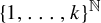 $\{1,\ldots , k\}^{{\mathbb {N}}}$
for some
$\{1,\ldots , k\}^{{\mathbb {N}}}$
for some $k\geq 1$
, that is,
$k\geq 1$
, that is, $\sigma _X(X)\subseteq X$
, where the shift
$\sigma _X(X)\subseteq X$
, where the shift $\sigma _X:X\rightarrow X$
is defined by
$\sigma _X:X\rightarrow X$
is defined by $(\sigma _X(x))_{i}=x_{i+1}$
for all
$(\sigma _X(x))_{i}=x_{i+1}$
for all $i\in {\mathbb {N}}$
,
$i\in {\mathbb {N}}$
, $x=(x_n)^{\infty }_{n=1} \in X.$
Define a metric d on X by
$x=(x_n)^{\infty }_{n=1} \in X.$
Define a metric d on X by $d(x,x')={1}/{2^{k}}$
if
$d(x,x')={1}/{2^{k}}$
if $x_i=x^{\prime }_i$
for all
$x_i=x^{\prime }_i$
for all $1\leq i\leq k$
and
$1\leq i\leq k$
and $x_{k+1}\neq {x'}_{k+1}$
,
$x_{k+1}\neq {x'}_{k+1}$
, $d(x,x')=1$
if
$d(x,x')=1$
if $x_1\neq x^{\prime }_1$
, and
$x_1\neq x^{\prime }_1$
, and $d(x,x')=0$
otherwise. Define a cylinder set
$d(x,x')=0$
otherwise. Define a cylinder set $[x_1 \cdots x_{n}]$
of length n in X by
$[x_1 \cdots x_{n}]$
of length n in X by $[x_1\cdots x_n]=\{(z_i)_{i=1}^{\infty } \in X: z_i=x_i \text { for all }1\leq i\leq n\}.$
For each
$[x_1\cdots x_n]=\{(z_i)_{i=1}^{\infty } \in X: z_i=x_i \text { for all }1\leq i\leq n\}.$
For each $n \in {\mathbb {N}},$
denote by
$n \in {\mathbb {N}},$
denote by $B_n(X)$
the set of all n-blocks that appear in points in X. Define
$B_n(X)$
the set of all n-blocks that appear in points in X. Define $B_{0}(X)=\{\epsilon \},$
where
$B_{0}(X)=\{\epsilon \},$
where $\epsilon $
is the empty word of length
$\epsilon $
is the empty word of length $0$
. The language of X is the set
$0$
. The language of X is the set $B(X)=\bigcup _{n=0}^{\infty }B_n(X)$
. A subshift
$B(X)=\bigcup _{n=0}^{\infty }B_n(X)$
. A subshift $(X,\sigma _X)$
is irreducible if for any allowable words
$(X,\sigma _X)$
is irreducible if for any allowable words $u, v\in B(X)$
, there exists
$u, v\in B(X)$
, there exists $w\in B(X)$
such that
$w\in B(X)$
such that $uwv \in B(X)$
, and has the weak specification property if there exists
$uwv \in B(X)$
, and has the weak specification property if there exists $p\in {\mathbb {N}}$
such that for any allowable words
$p\in {\mathbb {N}}$
such that for any allowable words $u, v \in B(X)$
, there exist
$u, v \in B(X)$
, there exist $0\leq k\leq p$
and
$0\leq k\leq p$
and $w\in B_{k}(X)$
such that
$w\in B_{k}(X)$
such that $uwv\in B(X)$
. A point
$uwv\in B(X)$
. A point $x\in X$
is a periodic point of
$x\in X$
is a periodic point of $\sigma _X$
if there exists
$\sigma _X$
if there exists $p\in {\mathbb {N}}$
such that
$p\in {\mathbb {N}}$
such that $\sigma _X^{p}(x)=x$
. Let
$\sigma _X^{p}(x)=x$
. Let $A=(a_{ij})$
be a
$A=(a_{ij})$
be a $k\times k$
matrix of zeros and ones. Define
$k\times k$
matrix of zeros and ones. Define $X_A$
by
$X_A$
by
 $$ \begin{align*}X_A= \{ (x_n)_{n =1}^{\infty} \in \{1,\ldots, k\}^{{\mathbb{N}}} : a_{x_{n}, x_{n+1}}=1 \text{ for every } n \in {\mathbb{N}} \}.\end{align*} $$
Then, $(X_A, \sigma _{X_{A}})$
is a one-sided shift of finite type and it is a subshift over
$(X_A, \sigma _{X_{A}})$
is a one-sided shift of finite type and it is a subshift over $\{1,\ldots , k\}$
. It is topologically mixing if there exists
$\{1,\ldots , k\}$
. It is topologically mixing if there exists $p\in {\mathbb {N}}$
such that
$p\in {\mathbb {N}}$
such that $A^p>0$
.
$A^p>0$
.
Let $(X, \sigma _X)$
be a subshift over a finite set
$(X, \sigma _X)$
be a subshift over a finite set $S_1$
and
$S_1$
and $(Y, \sigma _Y)$
be a subshift over a finite set
$(Y, \sigma _Y)$
be a subshift over a finite set $S_2$
. A map
$S_2$
. A map $\pi :X\rightarrow Y$
is a factor map if it is continuous, surjective, and satisfies
$\pi :X\rightarrow Y$
is a factor map if it is continuous, surjective, and satisfies ${\pi \circ \sigma _{X} = \sigma _Y\circ \pi }$
. A one-block code is a map
${\pi \circ \sigma _{X} = \sigma _Y\circ \pi }$
. A one-block code is a map $\pi : X\to Y$
for which there exists a function
$\pi : X\to Y$
for which there exists a function $\tilde \pi :S_1(X) \rightarrow S_2(Y)$
such that
$\tilde \pi :S_1(X) \rightarrow S_2(Y)$
such that $(\pi (x))_i = \tilde \pi (x_i)$
for all
$(\pi (x))_i = \tilde \pi (x_i)$
for all $i \in {\mathbb {N}}$
.
$i \in {\mathbb {N}}$
.
2.2 Sequences of continuous functions
Given a subshift $(X, \sigma _X)$
, for each
$(X, \sigma _X)$
, for each $n\in {\mathbb {N}}$
, let
$n\in {\mathbb {N}}$
, let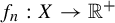 $f_n: X\rightarrow {\mathbb {R}}^{+}$
be a continuous function. Then,
$f_n: X\rightarrow {\mathbb {R}}^{+}$
be a continuous function. Then, ${\mathcal {F}}=\{\log f_n\}_{n=1}^{\infty }$
is a sequence of continuous functions on X. A sequence
${\mathcal {F}}=\{\log f_n\}_{n=1}^{\infty }$
is a sequence of continuous functions on X. A sequence ${\mathcal {F}}$
is almost additive on X if there exists a constant
${\mathcal {F}}$
is almost additive on X if there exists a constant $C> 0$
such that
$C> 0$
such that
 $$ \begin{align} f_{n+m}(x) \leq e^{C}f_n(x) f_{m}(\sigma^n_X x) \end{align} $$
and
 $$ \begin{align} f_{n+m}(x) \geq e^{-C}f_n(x) f_{m}(\sigma^n_X x) \end{align} $$
for every $x\in X$
,
$x\in X$
, $n,m\in {\mathbb {N}}$
. More generally, a sequence
$n,m\in {\mathbb {N}}$
. More generally, a sequence ${\mathcal {F}}$
is weakly almost additive if there exists a sequence of positive real numbers
${\mathcal {F}}$
is weakly almost additive if there exists a sequence of positive real numbers $\{C_n\}_{n=1}^{\infty }$
satisfying
$\{C_n\}_{n=1}^{\infty }$
satisfying $\lim _{n\to \infty }(1/n)C_n=0$
such that (2.1) and (2.2) hold if we replace C by
$\lim _{n\to \infty }(1/n)C_n=0$
such that (2.1) and (2.2) hold if we replace C by $C_n$
[Reference Cuneo, Jaksic, Pillet and Shirikyan7]. A sequence
$C_n$
[Reference Cuneo, Jaksic, Pillet and Shirikyan7]. A sequence $\mathcal {F}$
is subadditive if
$\mathcal {F}$
is subadditive if ${\mathcal {F}}$
satisfies (2.1) with
${\mathcal {F}}$
satisfies (2.1) with $C=0$
[Reference Cao, Feng and Huang3]. Asymptotically additive sequences were introduced in [Reference Feng and Huang9] and we use the following definition (see [Reference Cuneo6]). A sequence
$C=0$
[Reference Cao, Feng and Huang3]. Asymptotically additive sequences were introduced in [Reference Feng and Huang9] and we use the following definition (see [Reference Cuneo6]). A sequence ${\mathcal {F}}$
is asymptotically additive on X if there exists
${\mathcal {F}}$
is asymptotically additive on X if there exists $\hat f\in C(X)$
such that (1.1) holds. Weakly almost additive sequences are asymptotically additive [Reference Cuneo, Jaksic, Pillet and Shirikyan7, Lemma 6.2]. A sequence
$\hat f\in C(X)$
such that (1.1) holds. Weakly almost additive sequences are asymptotically additive [Reference Cuneo, Jaksic, Pillet and Shirikyan7, Lemma 6.2]. A sequence $\mathcal {F}= \{ \log f_n \}_{n=1}^{\infty }$
has bounded variation if there exists
$\mathcal {F}= \{ \log f_n \}_{n=1}^{\infty }$
has bounded variation if there exists $M \in {\mathbb {R}}^{+}$
such that
$M \in {\mathbb {R}}^{+}$
such that $\sup \{ M_n : n \in {\mathbb {N}}\} \leq M$
, where
$\sup \{ M_n : n \in {\mathbb {N}}\} \leq M$
, where ${M_n= \sup \{ {f_n(x)}/{f_n(y)} : x,y \in X, x_i=y_i}$
for
${M_n= \sup \{ {f_n(x)}/{f_n(y)} : x,y \in X, x_i=y_i}$
for $1 \leq i \leq n\}.$
Given a sequence of continuous functions
$1 \leq i \leq n\}.$
Given a sequence of continuous functions ${\mathcal {F}}=\{\log f_n\}_{n=1}^{\infty }$
on X, a measure
${\mathcal {F}}=\{\log f_n\}_{n=1}^{\infty }$
on X, a measure $\mu \in M(X, \sigma _X)$
is an equilibrium state for
$\mu \in M(X, \sigma _X)$
is an equilibrium state for ${\mathcal {F}}$
if
${\mathcal {F}}$
if
 $$ \begin{align} h_{\mu}(\sigma_X)+\lim_{n\rightarrow\infty}\frac{1}{n}\int\log f_n\,d\mu =\sup_{m\in M(X,\sigma_X)}\bigg\{h_{m}(\sigma_X)+\lim_{n\rightarrow\infty}\frac{1}{n}\int\log f_n\,dm\bigg\}. \end{align} $$
A measure $\mu \in M(X, \sigma _X)$
is a weak Gibbs measure for
$\mu \in M(X, \sigma _X)$
is a weak Gibbs measure for ${\mathcal {F}}$
if there exist
${\mathcal {F}}$
if there exist $P\in {\mathbb {R}}$
and
$P\in {\mathbb {R}}$
and $C_n>0$
satisfying
$C_n>0$
satisfying $\lim _{n\rightarrow \infty }(1/n)\log C_n=0$
such that
$\lim _{n\rightarrow \infty }(1/n)\log C_n=0$
such that
 $$ \begin{align} \frac{1}{C_n}\leq \frac{\mu[x_1\cdots x_n]}{e^{-nP}f_n(x)}\leq C_n \end{align} $$
for every $x\in X$
and
$x\in X$
and $n\in {\mathbb {N}}$
. If there exists
$n\in {\mathbb {N}}$
. If there exists $C>0$
such that
$C>0$
such that $C_n=C$
for all
$C_n=C$
for all $n\in {\mathbb {N}}$
, then
$n\in {\mathbb {N}}$
, then $\mu $
is a Gibbs measure for
$\mu $
is a Gibbs measure for ${\mathcal {F}}$
. If
${\mathcal {F}}$
. If ${\mathcal {F}}$
is almost additive with bounded variation on a subshift with the weak specification property, then
${\mathcal {F}}$
is almost additive with bounded variation on a subshift with the weak specification property, then ${\mathcal {F}}$
has a unique equilibrium state and it is the unique invariant Gibbs measure for
${\mathcal {F}}$
has a unique equilibrium state and it is the unique invariant Gibbs measure for ${\mathcal {F}}$
(see [Reference Barreira1, Reference Feng8, Reference Mummert13]). We note that if
${\mathcal {F}}$
(see [Reference Barreira1, Reference Feng8, Reference Mummert13]). We note that if $\mu $
is a weak Gibbs measure for an asymptotically additive sequence
$\mu $
is a weak Gibbs measure for an asymptotically additive sequence ${\mathcal {F}}$
, then the variational principle of topological pressure holds and P in (2.4) is given by the topological pressure of
${\mathcal {F}}$
, then the variational principle of topological pressure holds and P in (2.4) is given by the topological pressure of ${\mathcal {F}}$
(see for example [Reference Feng and Huang9]). Similarly, given a Borel measurable function g on X, a measure
${\mathcal {F}}$
(see for example [Reference Feng and Huang9]). Similarly, given a Borel measurable function g on X, a measure $\mu \in M(X, \sigma _X)$
is an equilibrium state for g if
$\mu \in M(X, \sigma _X)$
is an equilibrium state for g if ${h_{\mu }(X)+\int g\, d\mu = \sup _{m\in M(X,\sigma _X)}\{h_{m}(\sigma _X)+\int g\,dm\}.}$
A measure
${h_{\mu }(X)+\int g\, d\mu = \sup _{m\in M(X,\sigma _X)}\{h_{m}(\sigma _X)+\int g\,dm\}.}$
A measure $\mu \in M(X, \sigma _X)$
is a weak Gibbs measure for g if there exist
$\mu \in M(X, \sigma _X)$
is a weak Gibbs measure for g if there exist $P\in {\mathbb {R}}$
and
$P\in {\mathbb {R}}$
and $C_n>0$
such that (2.4) holds if we replace
$C_n>0$
such that (2.4) holds if we replace $f_n(x)$
by
$f_n(x)$
by $e^{(S_ng)(x)}$
and it is a Gibbs measure for g if
$e^{(S_ng)(x)}$
and it is a Gibbs measure for g if $C_n=C$
for all
$C_n=C$
for all $n\in {\mathbb {N}}$
for some
$n\in {\mathbb {N}}$
for some $C>0.$
3 Gibbs measures for weakly almost additive sequences
In this section, given an almost additive sequence ${\mathcal {F}}$
of continuous functions on a subshift with the weak specification property, we construct a Borel measurable function
${\mathcal {F}}$
of continuous functions on a subshift with the weak specification property, we construct a Borel measurable function $\hat f$
satisfying (1.1) under certain conditions and study the Gibbs property of the unique equilibrium state for
$\hat f$
satisfying (1.1) under certain conditions and study the Gibbs property of the unique equilibrium state for $\hat f$
when
$\hat f$
when ${\mathcal {F}}$
has bounded variation. We also consider the case when
${\mathcal {F}}$
has bounded variation. We also consider the case when ${\mathcal {F}}$
is weakly almost additive. We first start with a simple lemma.
${\mathcal {F}}$
is weakly almost additive. We first start with a simple lemma.
Lemma 3.1. Let $(X,\sigma _X)$
be a subshift with the weak specification property and
$(X,\sigma _X)$
be a subshift with the weak specification property and ${{\mathcal {F}}=\{\log f_n\}_{n=1}^{\infty }}$
be a sequence of continuous functions on X. Suppose that there exist a Borel measurable function f on X and a sequence of positive real numbers
${{\mathcal {F}}=\{\log f_n\}_{n=1}^{\infty }}$
be a sequence of continuous functions on X. Suppose that there exist a Borel measurable function f on X and a sequence of positive real numbers $\{A_k\}_{k=1}^{\infty }$
satisfying
$\{A_k\}_{k=1}^{\infty }$
satisfying $\lim _{k\to \infty }(1/k)\log A_k=0$
such that
$\lim _{k\to \infty }(1/k)\log A_k=0$
such that
 $$ \begin{align} \frac{1}{A_k}\leq \frac{f_k(x)}{e^{(S_kf)(x)}}\leq A_k \quad \text{ for every } x\in X, k\in {\mathbb{N}}. \end{align} $$
Then, the following hold.
-
(i) If $\mu $
is a Gibbs measure for
${\mathcal {F}}$
, then it is a weak Gibbs measure for f.
$\mu $
is a Gibbs measure for
${\mathcal {F}}$
, then it is a weak Gibbs measure for f. -
(ii) If there exists a constant
$A>0$
such that
$A_k=A$
for every
$k\in {\mathbb {N}}$
, then
$\mu $
is a Gibbs measure for
${\mathcal {F}}$
if and only if it is a Gibbs measure for f.


Proof. If $\mu $
is a Gibbs measure for
$\mu $
is a Gibbs measure for ${\mathcal {F}}$
, then there exist
${\mathcal {F}}$
, then there exist $P\in {\mathbb {R}}, C_0>0$
such that
$P\in {\mathbb {R}}, C_0>0$
such that
 $$ \begin{align*} \frac{1}{C_0}\leq \frac{\mu[x_1\cdots x_n]}{e^{-nP}f_n(x)}\leq C_0 \quad \text{ for every }x\in X, \,n\in {\mathbb{N}}. \end{align*} $$
Replacing $C_n$
and
$C_n$
and $f_n$
in (2.4) by
$f_n$
in (2.4) by $A_nC_0$
and
$A_nC_0$
and $e^{S_nf}$
, respectively,
$e^{S_nf}$
, respectively, $\mu $
is weak Gibbs for f. The second statement follows by similar arguments, replacing
$\mu $
is weak Gibbs for f. The second statement follows by similar arguments, replacing $A_k$
by A in (3.1).
$A_k$
by A in (3.1).
Setting (A). Let $(X,\sigma _X)$
be a subshift with the weak specification property and
$(X,\sigma _X)$
be a subshift with the weak specification property and ${{\mathcal {F}}=\{\log f_n\}_{n=1}^{\infty }}$
be a sequence of continuous functions on X. Define for
${{\mathcal {F}}=\{\log f_n\}_{n=1}^{\infty }}$
be a sequence of continuous functions on X. Define for $x \in X$
,
$x \in X$
,
 $$ \begin{align*} \underline{f}(x):=\liminf_{n\to \infty}\log \bigg(\frac{f_n(x)}{f_{n-1}(\sigma_X(x))}\bigg) \quad \text{ and }\quad \overline{f}(x):=\limsup_{n\to \infty}\log \bigg(\frac{f_n(x)}{f_{n-1}(\sigma_X(x))}\bigg). \end{align*} $$
Then, $\underline {f}$
and
$\underline {f}$
and $\overline {f}$
are Borel measurable functions on X. In the next theorem, we construct a Borel measurable function
$\overline {f}$
are Borel measurable functions on X. In the next theorem, we construct a Borel measurable function $\hat f$
satisfying (1.1) under certain conditions and study the properties of equilibrium states of
$\hat f$
satisfying (1.1) under certain conditions and study the properties of equilibrium states of $\hat f$
.
$\hat f$
.
Theorem 3.2. Under Setting (A), suppose that $\underline {f}(x)=\overline {f}(x)$
for every
$\underline {f}(x)=\overline {f}(x)$
for every $x\in X$
and define
$x\in X$
and define $\hat f(x):= \lim _{n\to \infty }\log (f_n(x)/f_{n-1}(\sigma _X(x)))$
. Then, the following hold.
$\hat f(x):= \lim _{n\to \infty }\log (f_n(x)/f_{n-1}(\sigma _X(x)))$
. Then, the following hold.
-
(i) If
${\mathcal {F}}$
is almost additive on X, then
$\hat {f}$
is a bounded Borel measurable function satisfying (1.1) and (1.2). If, in addition,
${\mathcal {F}}$
has bounded variation on X, then the unique equilibrium state for
${\mathcal {F}}$
which is also the unique invariant Gibbs measure for
${\mathcal {F}}$
is the unique equilibrium state for
$\hat f$
and it is the unique invariant Gibbs measure for
$\hat f$
. -
(ii) If
${\mathcal {F}}$
is merely weakly almost additive on X, then
$\hat f$
is a bounded Borel measurable function satisfying (1.1) and (1.2). If an equilibrium state for
${\mathcal {F}}$
is Gibbs for
${\mathcal {F}}$
, then it is an equilibrium state for
$\hat f$
and it is also an invariant weak Gibbs measure for
$\hat f$
.


Remark 3.3. A weakly almost additive sequence ${\mathcal {F}}$
on X has an equilibrium state. See Example 6.2 for the case when such an
${\mathcal {F}}$
on X has an equilibrium state. See Example 6.2 for the case when such an ${\mathcal {F}}$
has a unique equilibrium state with the Gibbs property.
${\mathcal {F}}$
has a unique equilibrium state with the Gibbs property.
We apply the following lemma to show Theorem 3.2.
Lemma 3.4. Under Setting (A), the following hold.
-
(i) If
${\mathcal {F}}$
satisfies (2.1), then
$\underline {f}$
is bounded from above and
$f_k(x)/e^{(S_k \underline {f})(x)}\geq e^{-C}$
for every
$x\in X$
and
$k\in {\mathbb {N}}$
. -
(ii) If
${\mathcal {F}}$
satisfies (2.2), then
$\overline {f}$
is bounded from below and
$f_k(x)/e^{(S_k\overline {f})(x)}\leq e^C$
for every
$ x\in X$
and
$k\in {\mathbb {N}}.$





Proof. We first we show statement (i). Since ${\mathcal {F}}$
satisfies (2.1),
${\mathcal {F}}$
satisfies (2.1), $\underline {f}$
is bounded from above by
$\underline {f}$
is bounded from above by $C+\max _{x\in X}\log f_1(x)$
. Fix
$C+\max _{x\in X}\log f_1(x)$
. Fix $k\in {\mathbb {N}}$
. Then,
$k\in {\mathbb {N}}$
. Then,
 $$ \begin{align*} \begin{split} (S_k\underline{f})(x)&=\liminf_{n\to \infty} \log \bigg(\frac{f_n(x)}{f_{n-1}(\sigma_X(x))} \bigg)+ \liminf_{n\to \infty} \log \bigg(\frac{f_{n-1}(\sigma_X(x))}{f_{n-2}(\sigma_X^2(x))}\bigg)\\ & \quad+\cdots +\liminf_{n\to \infty} \log \bigg(\frac{f_{n-k+1}(\sigma_X^{k-1} (x))}{f_{n-k}(\sigma_X^k(x))}\bigg)\\ & \leq \liminf_{n\to \infty} \log \bigg(\frac{f_n(x)f_{n-1}(\sigma_X(x))\cdots f_{n-k+1}(\sigma_X^{k-1}(x))}{ f_{n-1}(\sigma_X (x))f_{n-2}(\sigma_X^2 (x))\cdots f_{n-k}(\sigma_X^{k}(x))}\bigg)\\ & =\liminf_{n\to \infty} \log \bigg(\frac{f_n(x)}{f_{n-k}(\sigma_X^k (x))}\bigg)\leq \log (e^{C}f_k(x)), \end{split} \end{align*} $$
where the last inequality holds by (2.1). We next show statement (ii). Since ${\mathcal {F}}$
satisfies (2.2),
${\mathcal {F}}$
satisfies (2.2), $\overline {f}$
is bounded from below by
$\overline {f}$
is bounded from below by $-C+\min _{x\in X} \log f_1(x)$
. Fix
$-C+\min _{x\in X} \log f_1(x)$
. Fix $k\in {\mathbb {N}}$
. Then,
$k\in {\mathbb {N}}$
. Then,
 $$ \begin{align*} \begin{split} (S_k\overline{f})(x)&=\limsup_{n\to \infty} \log \bigg( \frac{f_n(x)}{f_{n-1}(\sigma_X(x))}\bigg) + \limsup_{n\to \infty}\log \bigg( \frac{f_{n-1}(\sigma_X (x))}{f_{n-2}(\sigma_X^2(x))}\bigg)\\ &\quad +\cdots +\limsup_{n\to \infty} \log \bigg(\frac{f_{n-k+1}(\sigma_X^{k-1}(x))}{f_{n-k}(\sigma_X^k(x))}\bigg)\\ & \geq \limsup_{n\to \infty} \log \bigg( \frac{f_n(x)f_{n-1}(\sigma_X (x))\cdots f_{n-k+1}(\sigma_X^{k-1}(x))}{ f_{n-1}(\sigma_X(x))f_{n-2}(\sigma_X^2 (x))\cdots f_{n-k}(\sigma_X^{k}(x))}\bigg)\\ & =\limsup_{n\to \infty} \log \bigg(\frac{f_n(x)}{f_{n-k}(\sigma_X^k (x))}\bigg)\geq \log (e^{-C}f_k(x)), \end{split} \end{align*} $$
where the last inequality holds by (2.2). This proves statement (ii).
Proof of Theorem 3.2
We first show statement (i). Lemma 3.4 implies that $\hat f$
is a measurable bounded function satisfying (1.1) and hence (1.2) holds. By (1.2), the unique equilibrium state
$\hat f$
is a measurable bounded function satisfying (1.1) and hence (1.2) holds. By (1.2), the unique equilibrium state $\mu $
for
$\mu $
for ${\mathcal {F}}$
which is also a unique invariant Gibbs measure for
${\mathcal {F}}$
which is also a unique invariant Gibbs measure for ${\mathcal {F}}$
is the unique equilibrium state for
${\mathcal {F}}$
is the unique equilibrium state for $\hat f$
. By Lemma 3.1(ii),
$\hat f$
. By Lemma 3.1(ii), $\mu $
is an invariant Gibbs measure for
$\mu $
is an invariant Gibbs measure for $\hat f$
. To show that it is a unique invariant Gibbs measure for
$\hat f$
. To show that it is a unique invariant Gibbs measure for $\hat f$
, suppose that there is another invariant Gibbs measure
$\hat f$
, suppose that there is another invariant Gibbs measure $\tilde \mu \neq \mu $
for
$\tilde \mu \neq \mu $
for $\hat f$
. Then, by Lemma 3.1(ii),
$\hat f$
. Then, by Lemma 3.1(ii), $\tilde \mu $
is also an invariant Gibbs measure for
$\tilde \mu $
is also an invariant Gibbs measure for ${\mathcal {F}}$
, which is a contradiction. Next we show statement (ii). Since
${\mathcal {F}}$
, which is a contradiction. Next we show statement (ii). Since ${\mathcal {F}}$
is weakly almost additive, we replace C of (2.1) and (2.2) by
${\mathcal {F}}$
is weakly almost additive, we replace C of (2.1) and (2.2) by $C_n>0$
such that
$C_n>0$
such that $\lim _{n\to \infty }(1/n)C_n=0$
. Then,
$\lim _{n\to \infty }(1/n)C_n=0$
. Then, $-C_1+\min _{x\in X}\log f_1(x)\leq \hat f(x)\leq C_1+\max _{x\in X}\log f_1(x)$
for all
$-C_1+\min _{x\in X}\log f_1(x)\leq \hat f(x)\leq C_1+\max _{x\in X}\log f_1(x)$
for all $x\in X$
. The inequalities in Lemma 3.4(i) and (ii) replacing C by
$x\in X$
. The inequalities in Lemma 3.4(i) and (ii) replacing C by $C_k$
hold. Hence, (1.1) and (1.2) hold. Since an equilibrium state for
$C_k$
hold. Hence, (1.1) and (1.2) hold. Since an equilibrium state for ${\mathcal {F}}$
is an equilibrium state for
${\mathcal {F}}$
is an equilibrium state for $\hat f$
, Lemma 3.1(i) implies the last statement.
$\hat f$
, Lemma 3.1(i) implies the last statement.
Next, assuming the existence of an invariant Gibbs measure for a sequence ${\mathcal {F}}$
, we construct a Borel measurable function
${\mathcal {F}}$
, we construct a Borel measurable function $\hat f$
satisfying (1.1).
$\hat f$
satisfying (1.1).
Setting (B). Let $(X,\sigma _X)$
be a subshift with the weak specification property and
$(X,\sigma _X)$
be a subshift with the weak specification property and ${{\mathcal {F}}=\{\log f_n\}_{n=1}^{\infty }}$
be a sequence of continuous functions on X. Suppose that there exists an invariant Gibbs measure
${{\mathcal {F}}=\{\log f_n\}_{n=1}^{\infty }}$
be a sequence of continuous functions on X. Suppose that there exists an invariant Gibbs measure $\nu $
for
$\nu $
for ${\mathcal {F}}$
, that is, there exist
${\mathcal {F}}$
, that is, there exist $P\in {\mathbb {R}}, C_0>0$
such that
$P\in {\mathbb {R}}, C_0>0$
such that
 $$ \begin{align} \frac{1}{C_0}\leq \frac{\nu[x_1\cdots x_n]}{e^{-nP}f_n(x)}\leq C_0 \quad \text{for every } x\in X, n\in {\mathbb{N}}. \end{align} $$
Note that (3.2) implies that ${\mathcal {F}}$
has bounded variation. Define for
${\mathcal {F}}$
has bounded variation. Define for $x\in X$
 $$ \begin{align*} \underline{r}(x):=\liminf_{n\to \infty}\log \bigg(\frac{\nu[x_1\cdots x_n]}{\nu[x_2\cdots x_n]}\bigg)+P \!\quad\text{and}\!\quad \overline{r}(x){\kern-1pt}:={\kern-1pt}\limsup_{n\to \infty}\log \bigg(\frac{\nu[x_1\cdots x_n]}{\nu[x_2\cdots x_n]}\bigg) {\kern-1pt}+{\kern-1pt}P.\end{align*} $$
Then, $\underline {r}$
and
$\underline {r}$
and $\overline {r}$
are Borel measurable functions on X.
$\overline {r}$
are Borel measurable functions on X.
Theorem 3.5. Under Setting (B), suppose that $\underline {r}(x)=\overline {r}(x)$
for every
$\underline {r}(x)=\overline {r}(x)$
for every $x\in X$
and define
$x\in X$
and define $r(x):=\lim _{n\to \infty }\log ({\nu [x_1\cdots x_n]}/{\nu [x_2\cdots x_n]})+P$
.
$r(x):=\lim _{n\to \infty }\log ({\nu [x_1\cdots x_n]}/{\nu [x_2\cdots x_n]})+P$
.
-
(i) If
${\mathcal {F}}$
is almost additive on X, then r is bounded and Borel measurable on X and (3.3)for every
$$ \begin{align} \lim_{n\to \infty}\frac{1}{n}\int\log f_n \,d\mu =\lim_{n\to \infty}\frac{1}{n}\int\log (\nu[x_1\cdots x_n]e^{np}) \,d\mu=\int r\, d\mu \end{align} $$
$\mu \in M(X,\sigma _X)$
. Then, the unique equilibrium state
$\nu $
for
${\mathcal {F}}$
is the unique equilibrium state for r which is also the unique invariant Gibbs measure for r.
-
(ii) If
${\mathcal {F}}$
is merely weakly additive, then r is bounded and Borel measurable, and (3.3) holds. The measure
$\nu $
is an equilibrium state for r which is an invariant weak Gibbs measure for r.


Proof. We first notice that the first equality of (3.3) follows from (3.2). Now we show statement (i). For $x\in X, n\in {\mathbb {N}}$
, define
$x\in X, n\in {\mathbb {N}}$
, define $r_n(x):=\nu [x_1\cdots x_n]e^{nP}$
. If
$r_n(x):=\nu [x_1\cdots x_n]e^{nP}$
. If ${\mathcal {F}}$
is almost additive satisfying (2.1) and (2.2), then using (3.2), a simple computation shows that
${\mathcal {F}}$
is almost additive satisfying (2.1) and (2.2), then using (3.2), a simple computation shows that
 $$ \begin{align*}(C^3_{0}e^C)^{-1}r_{n}(x)r_{m}(\sigma^nx)\leq r_{n+m}(x)\leq r_{n}(x)r_{m}(\sigma^nx)C^3_{0}e^C\end{align*} $$
for every $x\in X, n, m \in {\mathbb {N}}$
. Hence,
$x\in X, n, m \in {\mathbb {N}}$
. Hence, $\{\log r_n\}_{n=1}^{\infty }$
is almost additive and has bounded variation. Since
$\{\log r_n\}_{n=1}^{\infty }$
is almost additive and has bounded variation. Since $\underline {r}=\overline {r}$
, applying Theorem 3.2(i) to
$\underline {r}=\overline {r}$
, applying Theorem 3.2(i) to $\{\log r_n\}_{n=1}^{\infty }$
, we obtain the second equality of (3.3) and the first part of statement (i). Notice that
$\{\log r_n\}_{n=1}^{\infty }$
, we obtain the second equality of (3.3) and the first part of statement (i). Notice that $\nu $
is the unique equilibrium state for
$\nu $
is the unique equilibrium state for ${\mathcal {F}}$
and
${\mathcal {F}}$
and $\nu $
is Gibbs for
$\nu $
is Gibbs for $\{\log r_n\}_{n=1}^{\infty }$
because
$\{\log r_n\}_{n=1}^{\infty }$
because $\nu [x_1\cdots x_n]/(e^{-nP}r_n(x))=1$
. Hence, it is the unique equilibrium state for
$\nu [x_1\cdots x_n]/(e^{-nP}r_n(x))=1$
. Hence, it is the unique equilibrium state for $\{\log r_n\}_{n=1}^{\infty }$
. Applying Theorem 3.2(i), we obtain statement (i). We next show statement (ii) in the similar manner. If
$\{\log r_n\}_{n=1}^{\infty }$
. Applying Theorem 3.2(i), we obtain statement (i). We next show statement (ii) in the similar manner. If ${\mathcal {F}}$
is weakly almost additive, then (3.2) implies that there exists
${\mathcal {F}}$
is weakly almost additive, then (3.2) implies that there exists $C_n>0$
such that
$C_n>0$
such that $\lim _{n\to \infty }C_n/n=0$
satisfying
$\lim _{n\to \infty }C_n/n=0$
satisfying
 $$ \begin{align*}(C^3_{0}e^{C_n})^{-1}r_{n}(x)r_{m}(\sigma^nx)\leq r_{n+m}(x)\leq r_{n}(x)r_{m}(\sigma^nx)C^3_{0}e^{C_n}\end{align*} $$
for every $x\in X, n, m\in {\mathbb {N}}$
. Hence,
$x\in X, n, m\in {\mathbb {N}}$
. Hence, $\{\log r_n\}_{n=1}^{\infty }$
is weakly almost additive. Theorem 3.2(ii) implies the second equality of (3.3) and the first part of statement (ii). Since
$\{\log r_n\}_{n=1}^{\infty }$
is weakly almost additive. Theorem 3.2(ii) implies the second equality of (3.3) and the first part of statement (ii). Since $\nu $
satisfies the Gibbs property where P is given by the topological pressure of
$\nu $
satisfies the Gibbs property where P is given by the topological pressure of $\{\log r_n\}_{n=1}^{\infty }$
, it is an equilibrium state for
$\{\log r_n\}_{n=1}^{\infty }$
, it is an equilibrium state for $\{\log r_n\}_{n=1}^{\infty }$
and Theorem 3.2(ii) implies statement (ii).
$\{\log r_n\}_{n=1}^{\infty }$
and Theorem 3.2(ii) implies statement (ii).
4 Applications
4.1 Relative pressure functions and images of Gibbs measures for continuous functions
We apply Theorem 3.2 to the sequences ${\mathcal {G}}$
associated to relative pressure functions (see (1.3)). Corollaries 4.1 and 4.4 connect
${\mathcal {G}}$
associated to relative pressure functions (see (1.3)). Corollaries 4.1 and 4.4 connect ${\mathcal {G}}$
with images of Gibbs measures. For a survey of the study of images of Gibbs measures, see the paper by Boyle and Petersen [Reference Boyle and Petersen2]. Given a one-block factor map
${\mathcal {G}}$
with images of Gibbs measures. For a survey of the study of images of Gibbs measures, see the paper by Boyle and Petersen [Reference Boyle and Petersen2]. Given a one-block factor map $\pi : X\rightarrow Y$
between subshifts and an invariant measure
$\pi : X\rightarrow Y$
between subshifts and an invariant measure $\mu $
on X, define the image
$\mu $
on X, define the image $\pi \mu \in M(Y, \sigma _Y)$
by
$\pi \mu \in M(Y, \sigma _Y)$
by $\pi \mu (B)= \mu (\pi ^{-1}B)$
for a Borel set B of Y. Let
$\pi \mu (B)= \mu (\pi ^{-1}B)$
for a Borel set B of Y. Let $ f\in C(X)$
. For
$ f\in C(X)$
. For $y=(y_1, \ldots , y_n, \ldots )\in Y$
, define
$y=(y_1, \ldots , y_n, \ldots )\in Y$
, define $E_n(y)$
to be a set consisting of exactly one point from each cylinder
$E_n(y)$
to be a set consisting of exactly one point from each cylinder $[x_1\cdots x_n]$
in X such that
$[x_1\cdots x_n]$
in X such that $\pi (x_1\cdots x_n)=y_1\cdots y_n$
. For
$\pi (x_1\cdots x_n)=y_1\cdots y_n$
. For $n\in {\mathbb {N}}$
,
$n\in {\mathbb {N}}$
,
 $$ \begin{align} g_n(y):=\sup_{E_n(y)}\bigg\{\sum_{x\in E_n(y)}e^{(S_nf)(x)}\bigg\}. \end{align} $$
Then,
 $$ \begin{align*} P(\sigma_X, \pi, f)(y)=\limsup _{n\rightarrow\infty} \frac{1}{n} \log {g_n}(y), \quad \mu\text{-almost everywhere for any } \mu\in M(Y,\sigma_Y) \end{align*} $$
(see [Reference Feng8, Reference Petersen and Shin14]). It is clear that ${\mathcal {G}}=\{\log g_n\}_{n=1}^{\infty }$
has bounded variation.
${\mathcal {G}}=\{\log g_n\}_{n=1}^{\infty }$
has bounded variation.
Corollary 4.1. Let $\pi : X\to Y$
be a one-block factor map between subshifts, where X is a subshift with the weak specification property. Given
$\pi : X\to Y$
be a one-block factor map between subshifts, where X is a subshift with the weak specification property. Given $f\in C(X)$
, let
$f\in C(X)$
, let ${\mathcal {G}}=\{\log g_n\}_{n=1}^{\infty }$
be the sequence on Y associated to
${\mathcal {G}}=\{\log g_n\}_{n=1}^{\infty }$
be the sequence on Y associated to $P(\sigma _X, \pi , f)$
. For
$P(\sigma _X, \pi , f)$
. For $y\in Y$
, define a function
$y\in Y$
, define a function $g: Y\to {\mathbb {R}}$
by
$g: Y\to {\mathbb {R}}$
by
 $$ \begin{align} g(y)=\lim_{n\to \infty}\log \bigg(\frac{g_n(y)}{g_{n-1}(\sigma_Y y)}\bigg) \end{align} $$
if the limit exists at every point $y\in Y$
. When g is defined, the following hold.
$y\in Y$
. When g is defined, the following hold.
-
(i) If the sequence
${\mathcal {G}}$
is almost additive on Y, then g is bounded and Borel measurable on Y and (4.3)Then, the unique equilibrium state for
$$ \begin{align} \int P(\sigma_X, \pi, f)\,d\mu =\int g\,d\mu \quad \text{ for every } \mu\in M(Y, \sigma_Y). \end{align} $$
${\mathcal {G}}$
which is also the unique invariant Gibbs measure for
${\mathcal {G}}$
is the unique equilibrium state for g and it is the unique invariant Gibbs measure for g.
-
(ii) If
${\mathcal {G}}$
is merely weakly almost additive on Y, then g is bounded and Borel measurable on Y and (4.3) holds. If, in addition,
${\mathcal {G}}$
has an equilibrium state which is also an invariant Gibbs measure for
${\mathcal {G}}$
, then it is an equilibrium state for g which is also an invariant weak Gibbs measure for g.


Remark 4.2. The function g is similar to the function u defined in [Reference Kempton11, Reference Pollicott and Kempton17].
Proof. Set $f_n=g_n$
in Theorem 3.2.
$f_n=g_n$
in Theorem 3.2.
The next lemma connects relative pressure functions with images of Gibbs measures.
Lemma 4.3. (See [Reference Feng8, Reference Yayama22])
Let $\pi : X\to Y$
be a one-block factor map between subshifts, where X is a subshift with the weak specification property. If
$\pi : X\to Y$
be a one-block factor map between subshifts, where X is a subshift with the weak specification property. If $\mu $
is an invariant Gibbs measure for
$\mu $
is an invariant Gibbs measure for $f\in C(X)$
, then
$f\in C(X)$
, then $\pi \mu $
is the unique equilibrium state for the sequence
$\pi \mu $
is the unique equilibrium state for the sequence ${\mathcal {G}}$
on Y associated to
${\mathcal {G}}$
on Y associated to $P(\sigma _X, \pi , f)$
and it is the unique invariant Gibbs measure for
$P(\sigma _X, \pi , f)$
and it is the unique invariant Gibbs measure for ${\mathcal {G}}$
.
${\mathcal {G}}$
.
The next corollary is useful to study the images of Gibbs measures under factor maps and applied in §5.
Corollary 4.4. Under the assumption of Corollary 4.1, suppose $f\in C(X)$
has an invariant Gibbs measure
$f\in C(X)$
has an invariant Gibbs measure $\mu $
and g in Corollary 4.1 is defined. If
$\mu $
and g in Corollary 4.1 is defined. If ${\mathcal {G}}$
is almost additive (respectively weakly almost additive) on Y, then
${\mathcal {G}}$
is almost additive (respectively weakly almost additive) on Y, then $\pi \mu $
is the unique invariant Gibbs (respectively weak Gibbs) measure for g and it is the unique equilibrium state for g.
$\pi \mu $
is the unique invariant Gibbs (respectively weak Gibbs) measure for g and it is the unique equilibrium state for g.
4.2 The fiber-wise sub-positive mixing property of factor maps and almost additivity of subadditive sequences associated to relative pressure functions
The fiber-wise sub-positive mixing property of factor maps is a sufficient condition for a factor map to send all Markov measures to Gibbs measures [Reference Yoo24]. This property is assumed in various papers to study images of Gibbs measures (for the most general results, see [Reference Piraino16]).
In this section, noticing that the fiber-wise sub-positive mixing property is not a necessary condition for the image to be Gibbs (see Proposition 4.7), we characterize the Gibbs property of the images of Markov measures in terms of almost additivity of the sequences associated to relative pressure functions for a special type of factor maps (Theorem 4.8 and Corollary 4.10). Theorem 4.8 gives an answer to [Q] from §1 under a particular setting (Corollary 4.10).
Definition 4.5. [Reference Piraino16, Reference Yoo24]
Let $\pi : X \to Y$
be a one-block factor map between subshifts, where X is a shift of finite type. Then,
$\pi : X \to Y$
be a one-block factor map between subshifts, where X is a shift of finite type. Then, $\pi : X\to Y$
is fiber-wise sub-positive mixing if there exists
$\pi : X\to Y$
is fiber-wise sub-positive mixing if there exists $k\in {\mathbb {N}}$
such that for any
$k\in {\mathbb {N}}$
such that for any $w\in B_k(Y)$
,
$w\in B_k(Y)$
, $u_1\cdots u_k \in B_k(X), v_1\cdots v_k\in B_k(X)$
satisfying
$u_1\cdots u_k \in B_k(X), v_1\cdots v_k\in B_k(X)$
satisfying $\pi (u_1\cdots u_k)=\pi (v_1\cdots v_k)=w$
, there exists
$\pi (u_1\cdots u_k)=\pi (v_1\cdots v_k)=w$
, there exists $ a_1\cdots a_k\in B_k(X)$
with
$ a_1\cdots a_k\in B_k(X)$
with $a_1=u_1$
and
$a_1=u_1$
and $a_k=v_k$
such that
$a_k=v_k$
such that $\pi (a_1\cdots a_k)=w$
.
$\pi (a_1\cdots a_k)=w$
.
Theorem 4.6. [Reference Piraino16]
Let $\pi : X\to Y$
be a one-block factor map between subshifts, where X is a topologically mixing shift of finite type, satisfying the fiber-wise sub-positive mixing property. If
$\pi : X\to Y$
be a one-block factor map between subshifts, where X is a topologically mixing shift of finite type, satisfying the fiber-wise sub-positive mixing property. If $\mu $
is an invariant Gibbs measure for
$\mu $
is an invariant Gibbs measure for $f\in C(X)$
, then
$f\in C(X)$
, then $\pi \mu $
is an invariant Gibbs measure for
$\pi \mu $
is an invariant Gibbs measure for $\psi \in C(Y)$
, where
$\psi \in C(Y)$
, where $\psi $
is defined by
$\psi $
is defined by $\psi (y)=\lim _{n\to \infty }\log ({\pi \mu [y_1\cdots y_n]}/{\pi \mu [y_2\cdots y_n]})$
.
$\psi (y)=\lim _{n\to \infty }\log ({\pi \mu [y_1\cdots y_n]}/{\pi \mu [y_2\cdots y_n]})$
.
By Corollary 4.4, we can consider conditions of images of Gibbs measures to be Gibbs for continuous functions regardless of the fiber-wise sub-positive mixing property.
Proposition 4.7. Let $\pi : X\to Y$
be a one-block factor map, where X is a topologically mixing shift of finite type and Y is a subshift. Let
$\pi : X\to Y$
be a one-block factor map, where X is a topologically mixing shift of finite type and Y is a subshift. Let $\mu $
be the unique invariant Gibbs measure for
$\mu $
be the unique invariant Gibbs measure for $f\in C(X)$
and
$f\in C(X)$
and ${\mathcal {G}}$
be the subadditive sequence associated to the relative pressure function
${\mathcal {G}}$
be the subadditive sequence associated to the relative pressure function $P(\sigma _X, \pi , f)$
.
$P(\sigma _X, \pi , f)$
.
-
(i) If
$\pi $
is fiber-wise sub-positive mixing, then
${\mathcal {G}}$
is almost additive on Y. -
(ii) The almost additivity of
${\mathcal {G}}$
does not imply the fiber-wise sub-positive mixing property of a factor map. There exist a one-block factor map not fiber-wise sub-positive mixing and
$f\in C(X)$
such that the image
$\pi \mu $
is an invariant Gibbs measure for some
${g\in C(Y)}$
where
$ {\mathcal {G}}$
is almost additive on Y.


Proof. If $\pi $
is fiber-wise sub-positive mixing, by Theorem 4.6, there exists
$\pi $
is fiber-wise sub-positive mixing, by Theorem 4.6, there exists $g\in C(Y)$
for which
$g\in C(Y)$
for which $\pi \mu $
is Gibbs. It is easy to see that
$\pi \mu $
is Gibbs. It is easy to see that ${\mathcal {G}}$
is almost additive because
${\mathcal {G}}$
is almost additive because $\pi \mu $
is Gibbs for g and
$\pi \mu $
is Gibbs for g and ${\mathcal {G}}$
[Reference Yayama23, Corollary 6.11(iii)]. Example 6.1 in §6 proves statement (ii).
${\mathcal {G}}$
[Reference Yayama23, Corollary 6.11(iii)]. Example 6.1 in §6 proves statement (ii).
In the rest of the paper, we study equivalent conditions for factors of the Gibbs measures for continuous functions to be Gibbs, under the setting below.
Setting (C). Let $\pi : X\rightarrow Y$
be a one-block factor map such that
$\pi : X\rightarrow Y$
be a one-block factor map such that $\pi (1)=1, \pi (2)= \pi (3)=2$
, where
$\pi (1)=1, \pi (2)= \pi (3)=2$
, where $X\subseteq \{1,2,3\}^{{\mathbb {N}}}$
and
$X\subseteq \{1,2,3\}^{{\mathbb {N}}}$
and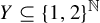 $Y\subseteq \{1,2\}^{{\mathbb {N}}}$
are irreducible shifts of finite type such that Y is the full shift or has the transition matrix
$Y\subseteq \{1,2\}^{{\mathbb {N}}}$
are irreducible shifts of finite type such that Y is the full shift or has the transition matrix $\big (\begin {smallmatrix} 0 & 1 \\ 1 & 1 \end {smallmatrix}\big )$
. Let f be a function of two coordinates on X and define
$\big (\begin {smallmatrix} 0 & 1 \\ 1 & 1 \end {smallmatrix}\big )$
. Let f be a function of two coordinates on X and define $f[ij]:=f(x)$
if
$f[ij]:=f(x)$
if $x\in [ij]$
.
$x\in [ij]$
.
Under Setting (C), let $A=(a_{ij})_{3\times 3}$
be the transition matrix of X and define the
$A=(a_{ij})_{3\times 3}$
be the transition matrix of X and define the $3\times 3$
non-negative matrix M with entries
$3\times 3$
non-negative matrix M with entries $M(i,j)$
given by
$M(i,j)$
given by $M(i,j) =e^{f[ij]}a_{ij}$
for
$M(i,j) =e^{f[ij]}a_{ij}$
for $i,j=1,2,3$
. Given each
$i,j=1,2,3$
. Given each $b_1b_2\in B_2(Y)$
, let
$b_1b_2\in B_2(Y)$
, let $M_{b_1b_2}$
be the
$M_{b_1b_2}$
be the $3 \times 3$
non-negative matrix with entries
$3 \times 3$
non-negative matrix with entries $M_{b_1b_2}(i,j)$
defined by
$M_{b_1b_2}(i,j)$
defined by
 $$ \begin{align} M_{b_1b_2}(i,j) = \begin{cases} e^{f[ij]} & \text{if } ij\in B_2(X) \text{ and } \pi(ij)=b_1b_2, \\ 0 & \text{otherwise.} \end{cases} \end{align} $$
Define the submatrix $M_{22}\vert _{\pi ^{-1}(22)}:=(M_{22}(i,j))_{i, j\in \{2,3\}}$
. Recall that
$M_{22}\vert _{\pi ^{-1}(22)}:=(M_{22}(i,j))_{i, j\in \{2,3\}}$
. Recall that ${\mathcal {G}}$
is the sequence associated to the relative pressure function
${\mathcal {G}}$
is the sequence associated to the relative pressure function $P(\sigma _X, \pi , f)$
.
$P(\sigma _X, \pi , f)$
.
Theorem 4.8. Under Setting (C), let $\mu $
be an invariant Gibbs measure for f. Then, the following hold.
$\mu $
be an invariant Gibbs measure for f. Then, the following hold.
-
(i) The sequence
${\mathcal {G}}$
is almost additive on Y if and only if there exists a Borel measurable function
$\hat g$
on Y for which
$\pi \mu $
is a unique invariant Gibbs measure. If
${\mathcal {G}}$
is merely weakly almost additive on Y, then there exists a Borel measurable function
$\hat g$
on Y for which
$\pi \mu $
is a unique invariant weak Gibbs measure. -
(ii) If
$M_{22}\vert _{\pi ^{-1}(22)}\neq \big (\begin {smallmatrix} 0 & a_1 \\ a_2 & 0 \end {smallmatrix}\big )$
,
$a_1, a_2> 0$
, then statement (i) holds for
$\hat g\in C(Y)$
. -
(iii) If
$M_{22}\vert _{\pi ^{-1}(22)}= \big (\begin {smallmatrix} 0 & a_1 \\ a_1 & 0 \end {smallmatrix}\big )$
,
$a_1>0$
, and M satisfies
$M(2,1)=M(3,1)$
or
${M(1,2)=M(1,3)}$
, then statement (i) holds for
$\hat g\in C(Y)$
.










Proof. See the proof in §5.
Remark 4.9. Theorem 4.8 is valid for any one-step Markov measure on X. Let ${A=(a_{ij})_{3\times 3}}$
be a transition matrix of an irreducible shift of finite type X. Let
${A=(a_{ij})_{3\times 3}}$
be a transition matrix of an irreducible shift of finite type X. Let $P=(P_{ij})$
be a stochastic matrix where
$P=(P_{ij})$
be a stochastic matrix where $P_{ij}>0$
exactly when
$P_{ij}>0$
exactly when $a_{ij}>0$
and let
$a_{ij}>0$
and let $p=(p_1, \ldots p_k)$
be the unique probability vector with
$p=(p_1, \ldots p_k)$
be the unique probability vector with $pP=p$
. A one-step Markov measure
$pP=p$
. A one-step Markov measure $\mu \in M(X,\sigma _X)$
is defined by
$\mu \in M(X,\sigma _X)$
is defined by $\mu [x_1\cdots x_k]=p_1P_{12} \cdots P_{k-1k}.$
Set
$\mu [x_1\cdots x_k]=p_1P_{12} \cdots P_{k-1k}.$
Set $f(x):=\log P_{i j}$
for
$f(x):=\log P_{i j}$
for $x\in [ij]$
. Then,
$x\in [ij]$
. Then, $\mu $
is an equilibrium state for f with the Gibbs property.
$\mu $
is an equilibrium state for f with the Gibbs property.
Corollary 4.10. Under Setting (C), let $\mu $
be the measure of maximal entropy for
$\mu $
be the measure of maximal entropy for $\sigma _X$
, that is,
$\sigma _X$
, that is, $h_{\mu }(\sigma _X)=\sup \{h_{\nu }(\sigma _X):\nu \in M(X,\sigma _X)\}$
. Let
$h_{\mu }(\sigma _X)=\sup \{h_{\nu }(\sigma _X):\nu \in M(X,\sigma _X)\}$
. Let $\Phi $
be the sequence associated to the relative pressure function
$\Phi $
be the sequence associated to the relative pressure function $P(\sigma _X, \pi , 0)$
. Then,
$P(\sigma _X, \pi , 0)$
. Then, $\Phi $
is almost additive on Y if and only if there exists a function
$\Phi $
is almost additive on Y if and only if there exists a function $\hat g \in C(Y)$
for which
$\hat g \in C(Y)$
for which $\pi \mu $
is a unique invariant Gibbs measure. If
$\pi \mu $
is a unique invariant Gibbs measure. If $\Phi $
is merely weakly almost additive on Y, then there exists
$\Phi $
is merely weakly almost additive on Y, then there exists $\hat g\in C(Y)$
for which
$\hat g\in C(Y)$
for which $\pi \mu $
is a unique invariant weak Gibbs measure.
$\pi \mu $
is a unique invariant weak Gibbs measure.
Proof. If $f=0$
, then we obtain
$f=0$
, then we obtain $M_{22}\vert _{\pi ^{-1}(22)}= \big (\begin {smallmatrix} 0 & 1 \\ 1 & 0 \end {smallmatrix}\big )$
in Theorem 4.8(iii). Now, we apply Lemma 5.6.
$M_{22}\vert _{\pi ^{-1}(22)}= \big (\begin {smallmatrix} 0 & 1 \\ 1 & 0 \end {smallmatrix}\big )$
in Theorem 4.8(iii). Now, we apply Lemma 5.6.
Corollary 4.11. Under Setting (C), the following hold.
-
(i) The sequence
${\mathcal {G}}$
is almost additive if and only if there exists a Borel measurable function
$\hat g$
on Y for which there exists a unique invariant Gibbs measure with the following property: (4.5)If
$$ \begin{align}\lim_{n\rightarrow \infty} \frac{1}{n} \lVert \log g_{n}-S_n \hat g \rVert_{\infty}=0. \end{align} $$
${\mathcal {G}}$
is merely weakly almost additive, then there exists a Borel measurable function
$\hat g$
satisfying (4.5) for which there is a unique invariant weak Gibbs measure.
-
(ii) Under the assumption of Theorem 4.8(ii) or (iii), statement (i) holds for
$\hat g\in C(Y)$
.


5 Proof of Theorem 4.8
This section is devoted to the proof of Theorem 4.8. Given a factor map $\pi : X \to Y$
between shifts of finite type, define for
$\pi : X \to Y$
between shifts of finite type, define for $n\in {\mathbb {N}}, y\in Y$
,
$n\in {\mathbb {N}}, y\in Y$
,
 $$ \begin{align} \begin{aligned} h_n(y):=&\sup_{E_n(y)}\bigg\{\!\sum_{x\in E_n(y)}e^{(S_{n-1}f)(x)}\bigg\},\\ \end{aligned} \end{align} $$
where $S_{0}f:=f$
and
$S_{0}f:=f$
and $E_n(y)$
is defined in (4.1). Let
$E_n(y)$
is defined in (4.1). Let ${\mathcal {H}}:=\{\log h_n\}_{n=1}^{\infty }$
on Y.
${\mathcal {H}}:=\{\log h_n\}_{n=1}^{\infty }$
on Y.
Proposition 5.1. Let $\pi : X \to Y$
be a factor map between shifts of finite type and
$\pi : X \to Y$
be a factor map between shifts of finite type and ${{\mathcal {G}}=\{\log g_n\}_{n=1}^{\infty }}$
be the sequence in (4.1). Then, the following hold.
${{\mathcal {G}}=\{\log g_n\}_{n=1}^{\infty }}$
be the sequence in (4.1). Then, the following hold.
-
(i) There exists a constant
$A>0$
such that for every
$n\in {\mathbb {N}}, y \in Y$
,
${1}/{A}\leq g_n(y)/h_n(y)\leq {A}.$
If
$f=0$
, then
$g_n(y)=h_n(y)$
for every
$n\in {\mathbb {N}}$
. -
(ii) We have
$P(\sigma _X, \pi , f)(y)= \limsup _{n\rightarrow \infty } (1/n) \log {g_n}(y) = \limsup _{n\rightarrow \infty } (1/n) \log {h_n}(y), \mu $
-almost everywhere for any
$\mu \in M(Y,\sigma _Y)$
. The sequence
${\mathcal {G}}$
is almost additive (respectively weakly almost additive) if and only if
${\mathcal {H}}$
is almost additive (respectively weakly almost additive). -
(iii) Define
$\hat {h}(y):=\lim _{n\to \infty }\log ( h_n(y)/h_{n-1}(\sigma _Y y))$
for each
$y\in Y$
if the limit exists. If
$\hat {h}$
is defined and
${\mathcal {H}}$
is weakly almost additive, there exists
$C_n>0$
,
$\lim _{n\to \infty }(1/n)C_n=0$
, such that for every
$n\in {\mathbb {N}}, y \in Y$
, (5.2)If
$$ \begin{align} {e^{-C_n}}\leq \frac{h_n(y)}{e^{(S_n\hat h)(y)}}\leq e^{C_n}. \end{align} $$
${\mathcal {H}}$
is almost additive, then there exists
$C>0$
such that
$C=C_n$
for every
$n\in {\mathbb {N}}$
.
-
(iv) Corollary 4.1(i), (ii), and Corollary 4.4 hold if we replace
${\mathcal {G}}$
and g by
${\mathcal {H}}$
and by
$\hat h$
, respectively.
















Proof. The results are easily obtained by the definitions of $g_n$
and
$g_n$
and $h_n$
.
$h_n$
.
From now on, assume that f is a function of two coordinates on X. Then,
 $$ \begin{align} h_n(y)=\sum_{x_1\cdots x_n\in B_n(X), \pi(x_1\cdots x_n)=y_1\cdots y_n}e^{f[x_1x_2]+f[x_2x_3]+\cdots +f[x_{n-1}x_n]} \end{align} $$
for each $n\geq 2, y\in Y$
, and
$n\geq 2, y\in Y$
, and $h_1=g_1$
. Define
$h_1=g_1$
. Define $h[b_1\cdots b_n]:=h_n(y)$
for
$h[b_1\cdots b_n]:=h_n(y)$
for $y\in [b_1\cdots b_n]$
,
$y\in [b_1\cdots b_n]$
, ${n\in {\mathbb {N}}}$
.
${n\in {\mathbb {N}}}$
.
Lemma 5.2. Let $X\subseteq \{1,\ldots , l\}^{{\mathbb {N}}}, l>2$
, and
$X\subseteq \{1,\ldots , l\}^{{\mathbb {N}}}, l>2$
, and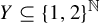 $Y\subseteq \{1,2\}^{{\mathbb {N}}}$
be irreducible subshifts. Let
$Y\subseteq \{1,2\}^{{\mathbb {N}}}$
be irreducible subshifts. Let $\pi : X\rightarrow Y$
be a one-block factor map such that
$\pi : X\rightarrow Y$
be a one-block factor map such that $\pi (1)=1, \pi (i)=2$
for
$\pi (1)=1, \pi (i)=2$
for $i=2,\ldots , l$
. Let f be a function on X of two coordinates. Suppose that
$i=2,\ldots , l$
. Let f be a function on X of two coordinates. Suppose that
 $$ \begin{align*} \lim_{n\to\infty} \frac{h[2^n]}{h[2^{n-1}]} \quad\text{and}\quad \lim_{n\to\infty} \frac{h[12^n]}{h[2^{n}]} \text{ exist.} \end{align*} $$
Then, $\hat {h}$
defined in Proposition 5.1(iii) is given by
$\hat {h}$
defined in Proposition 5.1(iii) is given by
 $$ \begin{align} \hat{h}(y)= \begin{cases} \log h[21] , & { y\in [21], }\\ \log \bigg(\dfrac{h[2^n1]}{h[2^{n-1}1]\vert} \bigg), & { y\in [2^n1], n\geq 2 },\\ \displaystyle\lim_{n\rightarrow\infty} \log \bigg(\dfrac{h[2^n]}{h[2^{n-1}]}\bigg), & { y=2^{\infty} },\\ {f[11]} , & { y\in [1^n2], n\geq 2, \text{ or } y=1^{\infty}},\\ \log \bigg(\dfrac{h[12^n1]}{h[2^{n}1]} \bigg), & { y\in [12^n1], n\geq 1 },\\ \displaystyle\lim_{n\rightarrow\infty} \log \bigg(\dfrac{h[12^n]}{h[2^{n}]} \bigg),& {y=12^{\infty} }. \end{cases} \end{align} $$
If $\hat {h}$
is continuous at
$\hat {h}$
is continuous at $2^{\infty }$
and
$2^{\infty }$
and $21^{\infty }$
, then
$21^{\infty }$
, then $\hat {h}$
is continuous on Y.
$\hat {h}$
is continuous on Y.
Proof. If $y\in [2^{k}1]$
for some
$y\in [2^{k}1]$
for some $k\geq 2$
, then for any
$k\geq 2$
, then for any $n\geq k+2$
, it is easy to see that
$n\geq k+2$
, it is easy to see that $h_{n}(y)=h_{k+1}(y)h_{n-k}(\sigma ^k_Y y)$
and
$h_{n}(y)=h_{k+1}(y)h_{n-k}(\sigma ^k_Y y)$
and $h_{n-1}(\sigma _Yy)=h_{k}(\sigma _Yy)h_{n-k}(\sigma ^k_Y y)$
. Hence,
$h_{n-1}(\sigma _Yy)=h_{k}(\sigma _Yy)h_{n-k}(\sigma ^k_Y y)$
. Hence, $h_{n}(y)/h_{n-1}(\sigma _Yy)= h[2^k1]/h[2^{k-1}1]$
. Other cases are obtained similarly.
$h_{n}(y)/h_{n-1}(\sigma _Yy)= h[2^k1]/h[2^{k-1}1]$
. Other cases are obtained similarly.
We apply some ideas found in [Reference Chazottes and Ugalde4, Reference Yoo24] to study the existence of the limits in (5.4) and continuity of $\hat {h}$
. Given
$\hat {h}$
. Given $y\in Y$
, we identify
$y\in Y$
, we identify $h_n(y)$
with the sum of entries of products of matrices described below. In the rest of the section, we assume setting (C). Recall the definitions of the matrix
$h_n(y)$
with the sum of entries of products of matrices described below. In the rest of the section, we assume setting (C). Recall the definitions of the matrix $M_{b_1b_2}$
with
$M_{b_1b_2}$
with $b_1b_2\in B_2(Y)$
. Clearly,
$b_1b_2\in B_2(Y)$
. Clearly,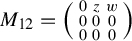 $M_{12} = \Big (\begin {smallmatrix} 0 & z&w \\ 0 & 0&0\\ 0 & 0&0 \end {smallmatrix}\Big )$
for some
$M_{12} = \Big (\begin {smallmatrix} 0 & z&w \\ 0 & 0&0\\ 0 & 0&0 \end {smallmatrix}\Big )$
for some $z,w\geq 0, (z, w)\neq (0,0)$
, and
$z,w\geq 0, (z, w)\neq (0,0)$
, and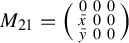 $M_{21} = \Big (\begin {smallmatrix} 0 & 0&0 \\ \bar {x} & 0&0\\ \bar {y} & 0&0 \end {smallmatrix}\Big )$
for some
$M_{21} = \Big (\begin {smallmatrix} 0 & 0&0 \\ \bar {x} & 0&0\\ \bar {y} & 0&0 \end {smallmatrix}\Big )$
for some $\bar {x},\bar {y} \geq 0, (\bar {x}, \bar {y})\neq (0,0)$
. For each
$\bar {x},\bar {y} \geq 0, (\bar {x}, \bar {y})\neq (0,0)$
. For each $b_1\cdots b_n\in B_n(Y)$
,
$b_1\cdots b_n\in B_n(Y)$
, $n\geq 2$
, define
$n\geq 2$
, define $M_{b_1\cdots b_n}:=M_{b_1b_2} M_{b_2b_3}\cdots M_{b_{n-1}b_n}$
. Then, for
$M_{b_1\cdots b_n}:=M_{b_1b_2} M_{b_2b_3}\cdots M_{b_{n-1}b_n}$
. Then, for ${y\in [b_1\cdots b_n]}$
,
${y\in [b_1\cdots b_n]}$
, $ h_n(y)=\text {sum of all entries of } M_{b_1\cdots b_n}.$
Since
$ h_n(y)=\text {sum of all entries of } M_{b_1\cdots b_n}.$
Since $M_{22}\vert _{\pi ^{-1}(22)}$
is a non-negative real
$M_{22}\vert _{\pi ^{-1}(22)}$
is a non-negative real $2 \times 2$
matrix, it has real eigenvalues and eigenvectors
$2 \times 2$
matrix, it has real eigenvalues and eigenvectors $\subset {\mathbb {R}}^2$
exist. Hence,
$\subset {\mathbb {R}}^2$
exist. Hence, $M_{22}\vert _{\pi ^{-1}(22)}$
is similar to a matrix of real Jordan form J and there exists a matrix
$M_{22}\vert _{\pi ^{-1}(22)}$
is similar to a matrix of real Jordan form J and there exists a matrix $P=\big (\begin {smallmatrix} a & b \\ c & d \end {smallmatrix}\big )$
,
$P=\big (\begin {smallmatrix} a & b \\ c & d \end {smallmatrix}\big )$
, $a, b, c, d\in {\mathbb {R}}$
,
$a, b, c, d\in {\mathbb {R}}$
, $ad-bc\neq 0$
such that
$ad-bc\neq 0$
such that $J=P^{-1}M_{22}\vert _{\pi ^{-1}(22)}P$
. If
$J=P^{-1}M_{22}\vert _{\pi ^{-1}(22)}P$
. If $M_{22}\vert _{\pi ^{-1}(22)}$
is similar to J, we write
$M_{22}\vert _{\pi ^{-1}(22)}$
is similar to J, we write $M_{22}\vert _{\pi ^{-1}(22)} \thicksim J$
. In the following lemmas, we continue to use the notation and assume that
$M_{22}\vert _{\pi ^{-1}(22)} \thicksim J$
. In the following lemmas, we continue to use the notation and assume that ${\mathcal {H}}$
is weakly almost additive.
${\mathcal {H}}$
is weakly almost additive.
Lemma 5.3.
-
(1) If
$M_{22}\vert _{\pi ^{-1}(22)} \thicksim \big (\begin {smallmatrix} \alpha & 1 \\ 0 & \alpha \end {smallmatrix}\big )$
,
$\alpha \in {\mathbb {R}}$
, then
$\alpha>0$
and
$\lim _{n\to \infty } \log (h[2^{n+1}]/h [2^n]) =\log \alpha $
. -
(2) If
$M_{22}\vert _{\pi ^{-1}(22)} \thicksim \big (\begin {smallmatrix} \alpha & 0 \\ 0 & \beta \end {smallmatrix}\big )$
, where
$\beta \neq -\alpha $
, then
$(\alpha , \beta )\neq (0,0)$
and the limit
$\lim _{n\to \infty } \log (h[2^{n+1}]/h[2^n])$
exists. -
(3) If
$M_{22}\vert _{\pi ^{-1}(22)} \nsim \big (\begin {smallmatrix} \alpha & 0 \\ 0 & -\alpha \end {smallmatrix}\big )$
,
$\alpha \neq 0$
, then
$\hat h$
is continuous at
$2^{\infty }\in Y$
.








Proof. We first show statement (1). Let $n\geq 4$
. Since
$n\geq 4$
. Since $(M_{22}\vert _{\pi ^{-1}(22)})^n=P\,\big (\!\begin {smallmatrix} \alpha ^n & n\alpha ^{n-1} \\ 0 & \alpha ^n \end {smallmatrix}\!\big )\, P^{-1}$
, for an invertible matrix P, a straight forward calculation shows that
$(M_{22}\vert _{\pi ^{-1}(22)})^n=P\,\big (\!\begin {smallmatrix} \alpha ^n & n\alpha ^{n-1} \\ 0 & \alpha ^n \end {smallmatrix}\!\big )\, P^{-1}$
, for an invertible matrix P, a straight forward calculation shows that
 $$ \begin{align} h[2^{n+2}]&=\text{sum of all entries of the matrix } M_{22}^{n+1}\nonumber\\ &=\frac{2(ad -bc)\alpha^{n+1}+(n+1)(a^2-c^2)\alpha^{n}}{ad-bc}>0. \end{align} $$
Then, $\alpha \neq 0$
and statement (1) holds. Next, we show statement (2). Since
$\alpha \neq 0$
and statement (1) holds. Next, we show statement (2). Since $(M_{22}\vert _{\pi ^{-1}(22)})^n=P\,\big (\!\begin {smallmatrix} \alpha ^n & 0 \\ 0 & \beta ^n \end {smallmatrix}\!\big )\,P^{-1},$
 $$ \begin{align} \begin{aligned} h[2^{n+2}]= \frac{(a+c)(d-b)\alpha^{n+1}+(a-c)(d+b)\beta^{n+1}}{ad-bc}>0. \end{aligned} \end{align} $$
Clearly, $(\alpha , \beta ){\kern-1pt}\neq{\kern-1pt} (0,0)$
. If
$(\alpha , \beta ){\kern-1pt}\neq{\kern-1pt} (0,0)$
. If $\alpha $
or
$\alpha $
or $\beta $
is zero, assume
$\beta $
is zero, assume $\beta {\kern-1pt}={\kern-1pt}0$
. Then,
$\beta {\kern-1pt}={\kern-1pt}0$
. Then, $\lim _{n\to \infty }h[2^{n+2}]/h[2^{n+1}]{\kern-1pt}=\alpha>0$
. If
$\lim _{n\to \infty }h[2^{n+2}]/h[2^{n+1}]{\kern-1pt}=\alpha>0$
. If $\alpha \neq 0$
and
$\alpha \neq 0$
and $\beta \neq 0$
, first suppose
$\beta \neq 0$
, first suppose $\vert \alpha \vert =\vert \beta \vert $
. Then,
$\vert \alpha \vert =\vert \beta \vert $
. Then, $\lim _{n\to \infty }h[2^{n+2}]/h[2^{n+1}]=\alpha =\beta>0.$
If
$\lim _{n\to \infty }h[2^{n+2}]/h[2^{n+1}]=\alpha =\beta>0.$
If $\vert \alpha \vert \neq \vert \beta \vert $
, assume that
$\vert \alpha \vert \neq \vert \beta \vert $
, assume that $\vert \alpha \vert>\vert \beta \vert $
. Then,
$\vert \alpha \vert>\vert \beta \vert $
. Then, $\alpha>0$
and, if
$\alpha>0$
and, if $(a+c)(d-b)\neq 0,$
we obtain
$(a+c)(d-b)\neq 0,$
we obtain $\lim _{n\to \infty }h[2^{n+2}]/h[2^{n+1}]{\kern-1pt} ={\kern-1pt}\alpha $
. If
$\lim _{n\to \infty }h[2^{n+2}]/h[2^{n+1}]{\kern-1pt} ={\kern-1pt}\alpha $
. If $(a+c)(d-b){\kern-1pt}={\kern-1pt} 0,$
then
$(a+c)(d-b){\kern-1pt}={\kern-1pt} 0,$
then ${(a{\kern-1pt}-{\kern-1pt}c)(d{\kern-1pt}+{\kern-1pt}b){\kern-1pt}\neq{\kern-1pt} 0}$
and
${(a{\kern-1pt}-{\kern-1pt}c)(d{\kern-1pt}+{\kern-1pt}b){\kern-1pt}\neq{\kern-1pt} 0}$
and $\lim _{n\to \infty }h[2^{n+2}]/h[2^{n+1}]=\beta>0$
. For statement (3), it is enough to show that
$\lim _{n\to \infty }h[2^{n+2}]/h[2^{n+1}]=\beta>0$
. For statement (3), it is enough to show that $\lim _{n\to \infty }{\kern-3.5pt} \log ({h[2^{n+2}]}/{h[2^{n+1}]}){\kern-1.5pt}={\kern-4pt} \lim _{n\to \infty }{\kern-3.5pt} \log ({h[2^{n+2}1]}/{h[2^{n+1}1]}). $
If
$\lim _{n\to \infty }{\kern-3.5pt} \log ({h[2^{n+2}]}/{h[2^{n+1}]}){\kern-1.5pt}={\kern-4pt} \lim _{n\to \infty }{\kern-3.5pt} \log ({h[2^{n+2}1]}/{h[2^{n+1}1]}). $
If ${M_{22}\vert _{\pi ^{-1}(22)} {\kern-2pt}\thicksim{\kern-2pt} \big (\!\begin {smallmatrix} \alpha & 1 \\ 0 & \alpha \end {smallmatrix}\!\big )}$
, then we obtain that
${M_{22}\vert _{\pi ^{-1}(22)} {\kern-2pt}\thicksim{\kern-2pt} \big (\!\begin {smallmatrix} \alpha & 1 \\ 0 & \alpha \end {smallmatrix}\!\big )}$
, then we obtain that
 $$ \begin{align} h[2^{n+2}1]&=\text{sum of all entries of the matrix } M_{22}^{n+1}M_{21}\nonumber\\ &=\frac{(ad-bc)(\bar{x}+\bar{y})\alpha^{n+1}+(n+1)(a+c)(-c\bar{x}+a\bar{y})\alpha^{n}}{ad-bc}. \end{align} $$
Then, $\lim _{n\to \infty }h[2^{n+2}1]/h[2^{n+1}1]=\alpha $
. If
$\lim _{n\to \infty }h[2^{n+2}1]/h[2^{n+1}1]=\alpha $
. If $ M_{22}\vert _{\pi ^{-1}(22)}\thicksim \big (\!\begin {smallmatrix} \alpha & 0 \\ 0 & \beta \end {smallmatrix}\!\big )$
, then
$ M_{22}\vert _{\pi ^{-1}(22)}\thicksim \big (\!\begin {smallmatrix} \alpha & 0 \\ 0 & \beta \end {smallmatrix}\!\big )$
, then
 $$ \begin{align} h[2^{n+2}1]=\frac{(d\bar{x}-b\bar{y})(a+c)\alpha^{n+1}+(a\bar{y}-c\bar{x})(b+d)\beta^{n+1}} {ad-bc}. \end{align} $$
If $\beta =0$
, then
$\beta =0$
, then $\alpha \neq 0$
and the continuity of
$\alpha \neq 0$
and the continuity of $\hat h$
at
$\hat h$
at $2^{\infty }$
follows combining the proof above. The same result holds for
$2^{\infty }$
follows combining the proof above. The same result holds for $\alpha =\beta \neq 0$
. If
$\alpha =\beta \neq 0$
. If $\vert \alpha \vert \neq \vert \beta \vert $
,
$\vert \alpha \vert \neq \vert \beta \vert $
, $\vert \alpha \vert> \vert \beta \vert $
, then we have the following:
$\vert \alpha \vert> \vert \beta \vert $
, then we have the following:
-
(i)
$(d\bar {x}-b\bar {y})(a+c)= 0.$
Then,
$(a\bar {y}-c\bar {x})(b+d)\neq 0$
and
$ \lim _{n\to \infty }h[2^{n+1}1]/ h[2^{n}1]=\beta .$
The weak almost additivity of
${\mathcal {H}}$
implies that
$(a+c)(d-b)=0$
. -
(ii)
$(d\bar {x}-b\bar {y})(a+c)\neq 0.$
Then,
$\lim _{n\to \infty }h[2^{n+1}1]/h[2^{n}1]=\alpha $
. The weak almost additivity of
${\mathcal {H}}$
implies that
$(a+c)(d-b)\neq 0$
.



Hence, the results follow by the proof above.
Lemma 5.4.
-
(1) If
$M_{22}\vert _{\pi ^{-1}(22)}\thicksim \big (\!\begin {smallmatrix} \alpha & 1 \\ 0 & \alpha \end {smallmatrix}\!\big )$
, then
$\lim _{n\to \infty } \log (h[12^{n+1}]/h[2^{n+1]})$
exists. -
(2) If
$M_{22}\vert _{\pi ^{-1}(22)} \thicksim \big (\!\begin {smallmatrix} \alpha & 0 \\ 0 & \beta \end {smallmatrix}\!\big )$
,
$\beta \neq -\alpha $
, then
$\lim _{n\to \infty } \log (h[12^{n+1}]/h[2^{n+1}])$
exists.





Proof. We show statement (1). Using the real Jordan form of $M_{22}\vert _{\pi ^{-1}(22)} $
,
$M_{22}\vert _{\pi ^{-1}(22)} $
,
 $$ \begin{align} h[12^{n+2}]&=\text{sum of all entries of the matrix } M_{12}M_{22}^{n+1}\nonumber\\ &=\frac{(ad-bc)(z+w)\alpha^{n+1}+(n+1)(az+cw)(a-c)\alpha^{n}}{ad-bc}. \end{align} $$
Case 1: $(az+cw)(a-c)\neq 0$
. The weak almost additivity of
$(az+cw)(a-c)\neq 0$
. The weak almost additivity of ${\mathcal {H}}$
and (5.5) imply
${\mathcal {H}}$
and (5.5) imply $a+c\neq 0$
. Hence,
$a+c\neq 0$
. Hence, $\lim _{n\to \infty }h[12^{n+2}]/h[2^{n+2}]=(az+cw)/(a+c).$
Case 2: $(az+cw)(a-c)= 0$
. The weak almost additivity of
$(az+cw)(a-c)= 0$
. The weak almost additivity of ${\mathcal {H}}$
and (5.5) imply that
${\mathcal {H}}$
and (5.5) imply that $a+c= 0$
. Then,
$a+c= 0$
. Then, $z+w\neq 0$
and
$z+w\neq 0$
and $\lim _{n\to \infty }h[12^{n+1}]/h[2^{n}]=(z+w)/2$
.
$\lim _{n\to \infty }h[12^{n+1}]/h[2^{n}]=(z+w)/2$
.
Next, we show statement (2). Since
 $$ \begin{align} \begin{aligned} h[12^{n+2}] =\frac{\alpha^{n+1}(d-b)(az+cw)+\beta^{n+1} (a-c)(bz+dw)}{ad-bc}. \end{aligned} \end{align} $$
Case 1: $\beta =0$
. Then,
$\beta =0$
. Then, $\lim _{n\to \infty }h[12^{n+1}]/h[2^{n}]=(az+cw)/(a+c)$
.
$\lim _{n\to \infty }h[12^{n+1}]/h[2^{n}]=(az+cw)/(a+c)$
.
Case 2: $\alpha \neq 0$
and
$\alpha \neq 0$
and $\beta \neq 0$
. We apply (5.6) and (5.10):
$\beta \neq 0$
. We apply (5.6) and (5.10):
-
(1)
$\alpha =\beta $
. We obtain
$\lim _{n\to \infty }h[12^{n+1}]/h[2^{n}]=(z+w)/2$
. -
(2)
$\vert \alpha \vert \neq \vert \beta \vert $
. Assume that
$ \vert \alpha \vert>\vert \beta \vert $
:-
(i)
$(d-b)(az+cw)\neq 0.$
The weak almost additivity of
$ {\mathcal {H}}$
implies that
$(d-b)(az+cw)\neq 0 \iff (a+c)(d-b)\neq 0.$
Hence,
$\lim _{n\to \infty }h[12^{n+1}]/ h[2^{n}]=(az+cw)/(a+c)$
. -
(ii)
$(d{\kern-1pt}-{\kern-1pt}b)(az{\kern-1pt}+{\kern-1pt}cw)=0.$
Then,
$(d{\kern-1pt}-{\kern-1pt}b)(az{\kern-1pt}+{\kern-1pt}cw)=0 {\kern-1pt}\iff{\kern-1pt} (a+c)(d-b)=0.$
Thus,
$\lim _{n\to \infty }h[12^{n+1}]/h[2^{n}]=(bz+dw)/(b+d).$
-





Lemma 5.5.
-
(1) If
$M_{22}\vert _{\pi ^{-1}(22)} \thicksim \big (\!\begin {smallmatrix} \alpha & 1 \\ 0 & \alpha \end {smallmatrix}\!\big )$
, then
$\alpha>0$
and the following hold.-
(a) If
$(wc+az)(-c\bar x+a\bar y)\neq 0$
, then
$\hat h$
is continuous at
$12^{\infty }\in Y$
. -
(b) If
$(wc+az)(-c\bar x+a\bar y)= 0$
, then
$\hat h$
is continuous at
$12^{\infty }\in Y$
if and only if
$(\bar {x}-\bar {y})(w-z)=0.$
-
-
(2) If
$M_{22}\vert _{\pi ^{-1}(22)} \thicksim \big (\!\begin {smallmatrix} \alpha & 0 \\ 0 & \beta \end {smallmatrix}\!\big )$
, then
$(\alpha , \beta )\neq (0,0)$
and the following hold.-
(a) If
$ \alpha \neq \beta $
, where
$\beta \neq -\alpha $
, then
$\hat h$
is continuous at
$12^{\infty }\in Y$
. -
(b) If
$ \alpha = \beta $
, then
$\hat h$
is continuous at
$12^{\infty }\in Y$
if and only if
$(\bar {x}-\bar {y})(w-z)=0$
.
-


Proof. We apply the proof of Lemma 5.4. We show that
 $$ \begin{align} \lim_{n\to \infty} \log \frac{h[12^{n+2}1]}{h[2^{n+2}1]}= \lim_{n\to \infty} \log \frac{h[12^{n+2}]}{h[2^{n+2}]}. \end{align} $$
 $$ \begin{align} h[12^{n+2}1]&=\text{sum of all entries of the matrix } M_{12}M_{22}^{n+1}M_{21}\nonumber\\ &=\frac{(ad-bc)(\bar x z+\bar y w) \alpha^{n+1}+(n+1)\alpha^{n}(wc+az)(-c\bar x+a \bar y)}{ad-bc}. \end{align} $$
If $(wc+az)(-c\bar x+a\bar y)\neq 0$
, then the weak almost additivity of
$(wc+az)(-c\bar x+a\bar y)\neq 0$
, then the weak almost additivity of ${\mathcal {H}}$
implies
${\mathcal {H}}$
implies $a+c\neq 0$
and
$a+c\neq 0$
and $ \lim _{n\to \infty }h[12^{n+2}1]/h[2^{n+2}1]=(wc+az)/(a+c).$
In (5.5), if
$ \lim _{n\to \infty }h[12^{n+2}1]/h[2^{n+2}1]=(wc+az)/(a+c).$
In (5.5), if $a-c=0$
, then
$a-c=0$
, then $\lim _{n\to \infty } h[12^{n+2}1]/h[2^{n+2}]=\infty $
. Hence,
$\lim _{n\to \infty } h[12^{n+2}1]/h[2^{n+2}]=\infty $
. Hence, $a-c\neq 0$
and the result follows by the proof of Lemma 5.4(1), Case 1. If
$a-c\neq 0$
and the result follows by the proof of Lemma 5.4(1), Case 1. If $(wc+az)(-c\bar x+a \bar y)= 0$
, then
$(wc+az)(-c\bar x+a \bar y)= 0$
, then $(ad-bc)(\bar x z+\bar y w)\neq 0$
. If
$(ad-bc)(\bar x z+\bar y w)\neq 0$
. If $wc+az=0$
, then we obtain
$wc+az=0$
, then we obtain ${\lim _{n\to \infty } h[12^{n+2}1]/h[2^{n+2}1]=(\bar x z+\bar y w)/(\bar x+\bar y)}$
. If
${\lim _{n\to \infty } h[12^{n+2}1]/h[2^{n+2}1]=(\bar x z+\bar y w)/(\bar x+\bar y)}$
. If $wc+az\neq 0$
and
$wc+az\neq 0$
and $-c\bar x+a \bar y= 0$
, then (5.9) implies that
$-c\bar x+a \bar y= 0$
, then (5.9) implies that $a-c=0$
. Then,
$a-c=0$
. Then, ${\lim _{n\to \infty }h[12^{n+2}1]/h[2^{n+2}1]=(\bar x z+\bar y w)/(\bar x+\bar y)}$
. The proof of Lemma 5.4(1), Case 2, yields the results. To show statement (2), observe that
${\lim _{n\to \infty }h[12^{n+2}1]/h[2^{n+2}1]=(\bar x z+\bar y w)/(\bar x+\bar y)}$
. The proof of Lemma 5.4(1), Case 2, yields the results. To show statement (2), observe that
 $$ \begin{align} \begin{aligned} h[12^{n+2}1] =\frac{(az+cw)(d\bar{x}-b\bar{y})\alpha^{n+1} +(a\bar{y}-c\bar{x})(bz+dw)\beta^{n+1}}{ad-bc}. \end{aligned} \end{align} $$
If $\beta =0$
, then
$\beta =0$
, then $\alpha \neq 0$
and, by (5.8),
$\alpha \neq 0$
and, by (5.8), $(a+c)(d\bar {x}-b\bar {y})\neq 0$
. Then,
$(a+c)(d\bar {x}-b\bar {y})\neq 0$
. Then, $\lim _{n\to \infty }h[12^{n+2}1]/ h[2^{n+2}1]=(az+cw)/(a+c)$
and (5.11) holds. Next, suppose that
$\lim _{n\to \infty }h[12^{n+2}1]/ h[2^{n+2}1]=(az+cw)/(a+c)$
and (5.11) holds. Next, suppose that $\alpha \neq 0$
and
$\alpha \neq 0$
and $\beta \neq 0$
. If
$\beta \neq 0$
. If $\alpha = \beta $
, a simple computation shows that
$\alpha = \beta $
, a simple computation shows that $\lim _{n\to \infty }h[12^{n+1}1]/h[2^{n+1}1]=(\bar {x}z+\bar {y}w)/ (\bar {x}+\bar {y})$
. Hence, h is continuous at
$\lim _{n\to \infty }h[12^{n+1}1]/h[2^{n+1}1]=(\bar {x}z+\bar {y}w)/ (\bar {x}+\bar {y})$
. Hence, h is continuous at $12^{\infty }$
if and only if
$12^{\infty }$
if and only if $(z+w)/2=(\bar {x}z+\bar {y}w)/(\bar {x}+\bar {y})$
, that is,
$(z+w)/2=(\bar {x}z+\bar {y}w)/(\bar {x}+\bar {y})$
, that is, $(\bar {x}-\bar {y})(w-z)=0$
. If
$(\bar {x}-\bar {y})(w-z)=0$
. If $\vert \alpha \vert \neq \vert \beta \vert $
, assume that
$\vert \alpha \vert \neq \vert \beta \vert $
, assume that $\vert \alpha \vert> \vert \beta \vert $
. Then,
$\vert \alpha \vert> \vert \beta \vert $
. Then,
 $$ \begin{align} \frac{h[12^{n+2}1]}{h[2^{n+2}1]}=\frac{(az+cw)(d\bar{x}-b\bar{y})\alpha^{n+1} +(a\bar{y}-c\bar{x})(bz+dw)\beta^{n+1}}{ (d\bar{x}-b\bar{y})(a+c)\alpha^{n+1}+(a\bar{y}-c\bar{x})(b+d)\beta^{n+1}}. \end{align} $$
If $(az+cw)(d\bar {x}-b\bar {y})=0$
, then by the weak almost additivity of
$(az+cw)(d\bar {x}-b\bar {y})=0$
, then by the weak almost additivity of ${\mathcal {H}}$
, we have
${\mathcal {H}}$
, we have $(d\bar {x}-b\bar {y})(a+c)=0$
and hence,
$(d\bar {x}-b\bar {y})(a+c)=0$
and hence, $h[12^{n+2}1]/h[2^{n+2}1]=(bz+dw)/(b+d)$
. The weak almost additivity of
$h[12^{n+2}1]/h[2^{n+2}1]=(bz+dw)/(b+d)$
. The weak almost additivity of ${\mathcal {H}}$
implies
${\mathcal {H}}$
implies $(a+c)(d-b)=0$
. By the proof of Lemma 5.4(2), the result follows. If
$(a+c)(d-b)=0$
. By the proof of Lemma 5.4(2), the result follows. If $(az+cw)(d\bar {x}-b\bar {y})\neq 0$
, then by the weak almost additivity of
$(az+cw)(d\bar {x}-b\bar {y})\neq 0$
, then by the weak almost additivity of ${\mathcal {H}}$
,
${\mathcal {H}}$
, $(d\bar {x}-b\bar {y})(a+c)\neq 0$
and hence,
$(d\bar {x}-b\bar {y})(a+c)\neq 0$
and hence, $\lim _{n\to \infty }h[12^{n+2}1]/h[2^{n+2}1]=(az+cw)/(a+c)$
. We have
$\lim _{n\to \infty }h[12^{n+2}1]/h[2^{n+2}1]=(az+cw)/(a+c)$
. We have $(a+c)(d-b)\neq 0$
by (5.6) and the weak almost additivity of
$(a+c)(d-b)\neq 0$
by (5.6) and the weak almost additivity of ${\mathcal {H}}$
. The proof of Lemma 5.4(2) implies the result.
${\mathcal {H}}$
. The proof of Lemma 5.4(2) implies the result.
Lemma 5.6. Suppose that $M_{22}\vert _{\pi ^{-1}(22)} \thicksim \big (\!\begin {smallmatrix} \alpha & 0 \\ 0 & -\alpha \end {smallmatrix}\!\big )$
. If
$M_{22}\vert _{\pi ^{-1}(22)} \thicksim \big (\!\begin {smallmatrix} \alpha & 0 \\ 0 & -\alpha \end {smallmatrix}\!\big )$
. If $M(2,3)=M(3,2)$
, then
$M(2,3)=M(3,2)$
, then $\hat h$
is continuous on Y except possibly at the point
$\hat h$
is continuous on Y except possibly at the point $12^{\infty }$
. If, in addition,
$12^{\infty }$
. If, in addition, $\bar x=\bar y$
or
$\bar x=\bar y$
or $z=w$
, then
$z=w$
, then $\hat h\in C(Y)$
. In particular, if
$\hat h\in C(Y)$
. In particular, if $f=0$
, then
$f=0$
, then $\hat h\in C(Y)$
.
$\hat h\in C(Y)$
.
Proof. Clearly, $\alpha \neq 0$
, and
$\alpha \neq 0$
, and $M_{22}\vert _{\pi ^{-1}(22)}$
has eigenvalues
$M_{22}\vert _{\pi ^{-1}(22)}$
has eigenvalues $\pm \alpha $
if and only if
$\pm \alpha $
if and only if $M_{22}\vert _{\pi ^{-1}(22)}=\ \big (\!\begin {smallmatrix} 0 & a_1 \\ a_2 & 0 \end {smallmatrix}\!\big ), a_1, a_2>0$
. For
$M_{22}\vert _{\pi ^{-1}(22)}=\ \big (\!\begin {smallmatrix} 0 & a_1 \\ a_2 & 0 \end {smallmatrix}\!\big ), a_1, a_2>0$
. For $k\in {\mathbb {N}}$
,
$k\in {\mathbb {N}}$
, $h[2^{2k+1}]=2{a_1}^k{a_2}^k$
and
$h[2^{2k+1}]=2{a_1}^k{a_2}^k$
and $h[2^{2k+2}]={a_1}^k{a_2}^k(a_1+a_2).$
Hence,
$h[2^{2k+2}]={a_1}^k{a_2}^k(a_1+a_2).$
Hence, $h[2^{2k+1}]/h[2^{2k}]=2a_1a_2/(a_1+a_2)$
and
$h[2^{2k+1}]/h[2^{2k}]=2a_1a_2/(a_1+a_2)$
and $h[2^{2k+2}]/h[2^{2k+1}]=(a_1+a_2)/2$
. Thus,
$h[2^{2k+2}]/h[2^{2k+1}]=(a_1+a_2)/2$
. Thus, $\hat h$
is defined at
$\hat h$
is defined at $2^{\infty }$
if and only if
$2^{\infty }$
if and only if $a_1=a_2$
. Observe that
$a_1=a_2$
. Observe that $\lim _{k\to \infty } h[2^{2k+1}1]/h[2^{2k}1]= a_1a_2(\bar x+\bar y)/(a_2 \bar x+ a_1 \bar y)$
and
$\lim _{k\to \infty } h[2^{2k+1}1]/h[2^{2k}1]= a_1a_2(\bar x+\bar y)/(a_2 \bar x+ a_1 \bar y)$
and $\lim _{k\to \infty } h[2^{2k+2}1]/h[2^{2k+1}1]=(a_2\bar x+a_1 \bar y)/(\bar x+\bar y)$
. Hence,
$\lim _{k\to \infty } h[2^{2k+2}1]/h[2^{2k+1}1]=(a_2\bar x+a_1 \bar y)/(\bar x+\bar y)$
. Hence, $a_1=a_2$
implies the continuity at
$a_1=a_2$
implies the continuity at $2^{\infty }$
. Since
$2^{\infty }$
. Since $\lim _{k\to \infty } h[12^{2k+1}]/h[2^{2k+1}]=(z+w)/2$
and
$\lim _{k\to \infty } h[12^{2k+1}]/h[2^{2k+1}]=(z+w)/2$
and $\lim _{k\to \infty } h[12^{2k+2}]/h[2^{2k+2}]=(za_1+wa_2)/(a_1+a_2)$
,
$\lim _{k\to \infty } h[12^{2k+2}]/h[2^{2k+2}]=(za_1+wa_2)/(a_1+a_2)$
, $\hat h$
is defined at
$\hat h$
is defined at $12^{\infty }$
if
$12^{\infty }$
if $a_1=a_2$
or
$a_1=a_2$
or $z=w$
. Since
$z=w$
. Since $\lim _{k\to \infty } h[12^{2k+1}1]/h[2^{2k+1}1]=(z\bar x+w\bar y)/(\bar x+\bar y)$
and
$\lim _{k\to \infty } h[12^{2k+1}1]/h[2^{2k+1}1]=(z\bar x+w\bar y)/(\bar x+\bar y)$
and $\lim _{k\to \infty } h[12^{2k}1]/ h[2^{2k}1]=(\bar yza_1+\bar x wa_2)/ (a_1 \bar y+a_2 \bar x)$
,
$\lim _{k\to \infty } h[12^{2k}1]/ h[2^{2k}1]=(\bar yza_1+\bar x wa_2)/ (a_1 \bar y+a_2 \bar x)$
, $\hat h$
is continuous at
$\hat h$
is continuous at $12^{\infty }$
if
$12^{\infty }$
if $a_2{\bar x}^2=a_1{\bar y}^2$
or
$a_2{\bar x}^2=a_1{\bar y}^2$
or $z=w$
. If
$z=w$
. If $f=0$
, then
$f=0$
, then $a_1=a_2=1$
. By Setting (C),
$a_1=a_2=1$
. By Setting (C), $\bar x=\bar y$
or
$\bar x=\bar y$
or $z=w$
holds.
$z=w$
holds.
Lemma 5.7. Suppose that $M_{22}\vert _{\pi ^{-1}(22)}$
satisfies one of the following conditions:
$M_{22}\vert _{\pi ^{-1}(22)}$
satisfies one of the following conditions:
-
(i)
$M_{22}\vert _{\pi ^{-1}(22)} \thicksim \big (\!\begin {smallmatrix} \alpha & 1 \\ 0 & \alpha \end {smallmatrix}\!\big )$
and
$(wc+az)(-c\bar x+a\bar y)= 0$
; -
(ii)
$M_{22}\vert _{\pi ^{-1}(22)} \thicksim \big (\!\begin {smallmatrix} \alpha & 0 \\ 0 & \alpha \end {smallmatrix}\!\big )$
; -
(iii)
$M_{22}\vert _{\pi ^{-1}(22)} \thicksim \big (\!\begin {smallmatrix} \alpha & 0 \\ 0 & -\alpha \end {smallmatrix}\!\big )$
.




If condition (i) or (ii) holds, define for $y\in Y$
,
$y\in Y$
,
 $$ \begin{align} \hat{h}_1(y)= \begin{cases} \log \bigg(\dfrac{\bar{x}z+\bar{y}w}{\bar{x}+\bar{y}}\bigg), & { y=12^{\infty}, }\\ \hat {h}(y) & \text{otherwise}. \end{cases} \end{align} $$
If condition (iii) holds, define for $y\in Y$
,
$y\in Y$
,
 $$ \begin{align} \hat{h}_2(y)= \begin{cases} \tfrac{1}{2}\log (a_1a_2), & { y=12^{\infty}, 2^{\infty}},\\ \hat {h}(y) & \text{otherwise}. \end{cases} \end{align} $$
Then, $\hat {h}_1\in C(Y)$
and
$\hat {h}_1\in C(Y)$
and $\hat {h}_2$
is Borel measurable on Y. If
$\hat {h}_2$
is Borel measurable on Y. If ${\mathcal {H}}$
is almost additive (respectively weakly almost additive), then the unique invariant Gibbs measure for
${\mathcal {H}}$
is almost additive (respectively weakly almost additive), then the unique invariant Gibbs measure for ${\mathcal {H}}$
is Gibbs (respectively weak Gibbs) for
${\mathcal {H}}$
is Gibbs (respectively weak Gibbs) for $\hat h_{i}$
,
$\hat h_{i}$
, $i=1,2$
.
$i=1,2$
.
Proof. If $M_{22}\vert _{\pi ^{-1}(22)}$
satisfies condition (i) or (ii), then
$M_{22}\vert _{\pi ^{-1}(22)}$
satisfies condition (i) or (ii), then $\hat h_1\in C(Y)$
by the proof of Lemma 5.5. Since
$\hat h_1\in C(Y)$
by the proof of Lemma 5.5. Since $\hat h (12^{\infty })=(z+w)/2$
, it is easy to see that
$\hat h (12^{\infty })=(z+w)/2$
, it is easy to see that $\sup _{n\in {\mathbb {N}}}\{{e^{(S_n{\hat h})(y)}}/{e^{(S_n {\hat h}_1)(y)}}: y\in Y\}<\infty $
. By Proposition 5.1(iii), we obtain the result. If
$\sup _{n\in {\mathbb {N}}}\{{e^{(S_n{\hat h})(y)}}/{e^{(S_n {\hat h}_1)(y)}}: y\in Y\}<\infty $
. By Proposition 5.1(iii), we obtain the result. If $M_{22}\vert _{\pi ^{-1}(22)}$
satisfies condition (iii), we show (5.2) replacing
$M_{22}\vert _{\pi ^{-1}(22)}$
satisfies condition (iii), we show (5.2) replacing $\hat h$
by
$\hat h$
by $\hat h_2$
for
$\hat h_2$
for $y \in P$
, where
$y \in P$
, where $P:=\{y\in Y: \text {there exists } p\in {\mathbb {N}} \cup \{0\} \text { such that } \sigma ^p_Yy=2^{\infty }\}$
. If
$P:=\{y\in Y: \text {there exists } p\in {\mathbb {N}} \cup \{0\} \text { such that } \sigma ^p_Yy=2^{\infty }\}$
. If $y=2^{\infty }$
, then for
$y=2^{\infty }$
, then for $k\in {\mathbb {N}}$
, we obtain
$k\in {\mathbb {N}}$
, we obtain $h_{2k}(y)/e^{(S_{2k}\hat {h}_2)(y)}=(a_1+a_2)/a_1a_2$
and
$h_{2k}(y)/e^{(S_{2k}\hat {h}_2)(y)}=(a_1+a_2)/a_1a_2$
and $h_{2k+1}(y)/e^{(S_{2k+1}\hat {h}_2)(y)}=2$
by the proof of Lemma 5.6. Noticing that (5.2) holds every
$h_{2k+1}(y)/e^{(S_{2k+1}\hat {h}_2)(y)}=2$
by the proof of Lemma 5.6. Noticing that (5.2) holds every $y \notin P$
and using the weak almost additivity of
$y \notin P$
and using the weak almost additivity of ${\mathcal {H}}$
, it is not difficult to see that
${\mathcal {H}}$
, it is not difficult to see that $\sup _{n\in {\mathbb {N}}}\{h_n(y)/{e^{(S_n {\hat h}_2)(y)}}: y\in P \}<\infty $
.
$\sup _{n\in {\mathbb {N}}}\{h_n(y)/{e^{(S_n {\hat h}_2)(y)}}: y\in P \}<\infty $
.
Proof of Theorem 4.8
If $\pi \mu $
is Gibbs for
$\pi \mu $
is Gibbs for $\hat g$
and
$\hat g$
and ${\mathcal {G}}$
, then clearly,
${\mathcal {G}}$
, then clearly, ${\mathcal {G}}$
is almost additive. Notice that
${\mathcal {G}}$
is almost additive. Notice that $M_{22}\vert _{\pi ^{-1}(22)}$
has eigenvalues
$M_{22}\vert _{\pi ^{-1}(22)}$
has eigenvalues $\pm \alpha $
,
$\pm \alpha $
, $\alpha \neq 0, $
if and only if
$\alpha \neq 0, $
if and only if $M_{22}\vert _{\pi ^{-1}(22)}=\, \big (\!\begin {smallmatrix} 0 & a_1 \\ a_2 & 0 \end {smallmatrix}\!\big ), a_1, a_2>0$
. If
$M_{22}\vert _{\pi ^{-1}(22)}=\, \big (\!\begin {smallmatrix} 0 & a_1 \\ a_2 & 0 \end {smallmatrix}\!\big ), a_1, a_2>0$
. If $M_{22}\vert _{\pi ^{-1}(22)} \neq \, \big (\!\begin {smallmatrix} 0 & a_1 \\ a_2 & 0 \end {smallmatrix}\!\big )$
,
$M_{22}\vert _{\pi ^{-1}(22)} \neq \, \big (\!\begin {smallmatrix} 0 & a_1 \\ a_2 & 0 \end {smallmatrix}\!\big )$
, $a_1, a_2>0$
, then by Lemmas 5.3 and 5.4, set
$a_1, a_2>0$
, then by Lemmas 5.3 and 5.4, set $\hat g=\hat h$
. Otherwise, set
$\hat g=\hat h$
. Otherwise, set $\hat g={\hat h}_2$
by Lemma 5.7. This proves statement (i). For statement (ii), if
$\hat g={\hat h}_2$
by Lemma 5.7. This proves statement (i). For statement (ii), if $M_{22}\vert _{\pi ^{-1}(22)}$
satisfies Lemma 5.7(i) or (ii), then set
$M_{22}\vert _{\pi ^{-1}(22)}$
satisfies Lemma 5.7(i) or (ii), then set $\hat g=\hat h_1$
. Otherwise, set
$\hat g=\hat h_1$
. Otherwise, set $\hat g= \hat {h}$
. Lemma 5.6 proves statement (iii).
$\hat g= \hat {h}$
. Lemma 5.6 proves statement (iii).
6 Examples
In this section, we give examples that illustrate Theorem 3.2 (Corollary 4.1) and Theorem 4.8. Example 6.1 proves Proposition 4.7(ii). In both examples, we consider a one-block factor map $\pi : X \subset \{1,2,3\}^{{\mathbb {N}}} \to Y \subset \{1,2\}^{{\mathbb {N}}}$
determined by
$\pi : X \subset \{1,2,3\}^{{\mathbb {N}}} \to Y \subset \{1,2\}^{{\mathbb {N}}}$
determined by $\pi (1)=1$
and
$\pi (1)=1$
and $\pi (2)=\pi (3)=2$
, and let
$\pi (2)=\pi (3)=2$
, and let $\mu $
be the Gibbs measure for
$\mu $
be the Gibbs measure for $f=0$
on X. See §5 for the notation
$f=0$
on X. See §5 for the notation ${\mathcal {H}}, h$
, and
${\mathcal {H}}, h$
, and $\hat h$
.
$\hat h$
.
Example 6.1. [Reference Shin18, Example 3.2]
Let $X\subset \{1,2,3\}^{{\mathbb {N}}}$
be the topologically mixing shift of finite type with the transition matrix A given by
$X\subset \{1,2,3\}^{{\mathbb {N}}}$
be the topologically mixing shift of finite type with the transition matrix A given by
 $$ \begin{align*} A= \begin{pmatrix} 0 & 1 & 1 \\ 1 & 1 & 0 \\ 1 & 0 & 1 \end{pmatrix}. \end{align*} $$
Then, Y is the topologically mixing shift of finite type with the transition matrix B,
 $$ \begin{align*} B=\begin{pmatrix} 0 & 1 \\ 1 & 1 \\ \end{pmatrix}. \end{align*} $$
Then, $\pi $
is not fiber-wise sub-positive mixing because
$\pi $
is not fiber-wise sub-positive mixing because $23\notin B_2(X)$
. We study the factor
$23\notin B_2(X)$
. We study the factor $\pi \mu $
using the sequence
$\pi \mu $
using the sequence ${\mathcal {G}}$
associated to
${\mathcal {G}}$
associated to $P(\sigma _X, \pi , 0)$
. Then,
$P(\sigma _X, \pi , 0)$
. Then, ${\mathcal {G}}$
=
${\mathcal {G}}$
= ${\mathcal {H}}$
. Since
${\mathcal {H}}$
. Since $h[12^n1]=h[2^n]=h[2^n1]=h[12^n]=2$
for each
$h[12^n1]=h[2^n]=h[2^n1]=h[12^n]=2$
for each $n\in {\mathbb {N}}, {\mathcal {H}}$
is almost additive. By Corollary 4.10, there exists a continuous function for which
$n\in {\mathbb {N}}, {\mathcal {H}}$
is almost additive. By Corollary 4.10, there exists a continuous function for which $\pi \mu $
is Gibbs for a continuous function and it is given by
$\pi \mu $
is Gibbs for a continuous function and it is given by $\hat h(=g$
in (4.2)).
$\hat h(=g$
in (4.2)).
Example 6.2. [Reference Yayama20, Example 5.1]
Let $X\subset \{1,2,3\}^{{\mathbb {N}}}$
be the topologically mixing shift of finite type with the transition matrix A given by
$X\subset \{1,2,3\}^{{\mathbb {N}}}$
be the topologically mixing shift of finite type with the transition matrix A given by
 $$ \begin{align*} A=\begin{pmatrix} 0 & 1 & 0 \\ 1 & 1 & 1 \\ 1 & 0 & 1 \end{pmatrix}. \end{align*} $$
Then, Y is the topologically mixing shift of finite type with the transition matrix B from Example 6.1. Then, $\pi $
is not fiber-wise sub-positive mixing. It is not difficult to show that
$\pi $
is not fiber-wise sub-positive mixing. It is not difficult to show that ${\mathcal {H}}$
is weakly almost additive by using that
${\mathcal {H}}$
is weakly almost additive by using that $h[2^n]=h[2^n1]=n+1$
and
$h[2^n]=h[2^n1]=n+1$
and $h[12^n]=h[12^n1]=n$
for
$h[12^n]=h[12^n1]=n$
for $n\geq 1$
. Hence, by Corollary 4.10,
$n\geq 1$
. Hence, by Corollary 4.10, $\pi \mu $
is a unique weak Gibbs for a continuous function and it is given by
$\pi \mu $
is a unique weak Gibbs for a continuous function and it is given by $\hat h(=g$
in (4.2)).
$\hat h(=g$
in (4.2)).
Acknowledgements
The author would like to thank Professor De-Jun Feng for useful discussion. The author also thanks the referees for the valuable comments which improved the paper.



