




Introduction
The United Nations’ Sustainable Development Goals (SDGs) have increased global commitment to sustainable agricultural development and food security(1,Reference Willis2) . The just-concluded 2021 United Nations Food Systems Summit (UNFSS) also recognised that progress towards the SDGs “relies on healthier, more sustainable and more equitable food systems”(Reference Nations3). In sub-Saharan Africa (SSA), where mixed crop–livestock farming is widely practiced(Reference Thornton and Herrero4), livestock keeping can increase resilience to malnutrition of smallholder farmers during drought(Reference Myeki and Bahta5,Reference Gwaka and Dubihlela6) . It also has the potential to alleviate food and nutrition insecurity, as livestock are not only a source of nutrient-dense foods, but also a wide range of saleable commodities and hence provide financial security and insurance for the rural poor(Reference Hetherington, Wiethoelter and Negin7,Reference Bird, Pradhan and Bhavani8) .
However, malnutrition continues to cause nearly half of annual global child deaths(Reference Burstein, Henry and Collison9,10) , with lasting effects on physical growth and cognitive development of millions of surviving children. According to the WHO, UNICEF and the World Bank, malnutrition is still the single most dangerous threat to global public health(Reference Mertens and Peñalvo11,12) . The COVID-19 pandemic has intensified hunger, with estimates ranging from 83 to 132 million more people suffering from chronic malnutrition(13).
Improving children’s nutrition requires effective and sustained multi-sectoral nutrition programming over the long term(12). As such, leveraging the potential of nutrition-specific (i.e. addressing immediate determinants of malnutrition) and nutrition-sensitive (i.e. addressing underlying determinants)interventions has become more important than ever, given a deteriorating global food and nutrition security situation and rapidly growing demand for animal-source foods (ASF)(Reference Bird, Pradhan and Bhavani8,Reference Ruel and Alderman14) . Likewise, targeted “nutrition-sensitive” agricultural interventions could play a critical role in addressing malnutrition(Reference Ruel and Alderman14,Reference Sibhatu and Qaim15) .
On the other hand, in many low-income countries, inadequate separation of animals and their waste (faeces) from domestic environments could lead to transmission of zoonotic pathogens and chronic illness through faecal contamination of hands, food, air, water sources and/or other transmission routes(Reference Zambrano, Levy and Menezes16,17) . While many studies of individual diseases have been carried out, there have been few previous efforts to synthesise these results or to consider these alongside nutritional benefits. Other reviews(Reference Bird, Pradhan and Bhavani8,Reference Lambrecht, Wilson and Jones18–Reference Chen, Mechlowitz and Li24) have examined specific aspects of this literature, although as part of a broader assessment of the impacts of agricultural programs on diets and nutrition or specific nutritional outcomes (e.g. anaemia)(Reference Bird, Pradhan and Bhavani8,Reference Lambrecht, Wilson and Jones18–Reference Pandey, Mahendra Dev and Jayachandran22) . The evidence from these reviews generally suggests a positive but inconclusive impact of agricultural practices (including livestock keeping) and other interventions on child nutritional status, but has rarely reported their impact on women’s nutrition. To draw conclusions about the associations between livestock keeping and maternal nutritional and morbidity (health) outcomes, the body of evidence is often insufficient. Additionally, there is limited rigorous evidence available to draw conclusions about nutritional outcomes in children, particularly the differential effects of various livestock species on nutrition and health of children.
The primary objective of this systematic review was to summarise the current state of knowledge on the effect of livestock keeping on nutritional and infection/morbidity outcomes of children and women of childbearing age to inform the future research agenda and nutrition-sensitive agriculture policies. We offer a balanced approach to consider both the beneficial and adverse outcomes of livestock keeping in relation to morbidity conditions and diseases transmitted from livestock (animals) to man; through this lens, we propose research priorities to better understand the effects of human exposure to livestock in low- and lower–middle-income countries (LMICs).
Methods
Protocol and registration
This review was prospectively registered on PROSPERO 2020 (CRD42020193622) and follows the Preferred Reporting Items for Systematic Reviews and Meta-Analyses (PRISMA) guidelines for reporting (see Additional files I and II in the Supplementary Material).
Information sources and searches
A comprehensive systematic review of primary (peer-reviewed) literature and an extensive review of the grey literature were conducted in accordance with PRISMA guidelines(Reference Tricco, Lillie and Zarin25). We conducted a search of the following electronic databases and “grey literature” sources to source articles produced after 1990 to the end of December 2020.
-
MEDLINE (accessed via Ovid)
-
CAB Abstracts (access via Ovid)
-
Global Health (access via Ovid)
-
Web of Science Core Collection (access via Web of Science)
-
Scopus (access via Elsevier)
-
Dissertations and Theses Global (access via ProQuest)
-
AGRIS (FAO-consolidated search)
-
Cochrane Collaboration
-
Commonwealth Scientific and Industrial Research Organization (CSIRO)
-
CGSpace
-
Global Index Medicus from WHO
-
SciELO
Details on the number of records identified and final records remaining after removing duplicates from each of these data bases is given in the Supplementary Material (Appendix I). Other databases included in the original plan could not be included due to issues with access to the database (Africa Theses and Dissertations, and African Journals Online); issues with exporting data (AgEcon and EMBRAPA); being deemed out of scope (Collaboration for Environmental Evidence; CEE), and other reasons (UNEP, WFP, WHO and World Bank).
Search strategy
The search of all published studies was performed in June 2020 and updated in December 2020. The keywords for investigation were identified using the contributing authors’ knowledge (see Supplementary Material, Appendix II). To identify any additional studies, the full reference lists of each study that met the inclusion criteria and systematic reviews previously published on the same subject were reviewed.
Eligibility criteria
Published studies fulfilling the following criteria were included:
-
(i) Types of participants: studies among children under 5 years and women of reproductive age (15–49 years) and from low- and lower–middle-income countries as classified by the World Bank(26);
-
(ii) Types of exposure: investigations of associations between livestock keeping (at least one animal kept at home or outdoors) and at least one of the specified nutrition and infection/morbidity outcome indicators;
-
(iii) Type of study: observational and experimental studies with primary empirical evidence.
Studies published in English and French and those produced from January 1991 to the end of July 2020 were included.
Exclusion criteria
Published studies meeting the following criteria were excluded: (i) Studies focusing on non-livestock-related effects on nutrition; (ii) opinion-based studies (commentaries and perspectives, among others); and (iii) articles in which the full-text was not available in English or French.
Selection and data collection process
Data were extracted using Covidence review software’s embedded systems, in line with Cochrane’s recommendations(Reference Higgins, Green and Shuster27). Two independent reviewers screened abstracts identified from searches, with a third author as tie breaker. Two independent reviewers also reviewed full-text versions of the articles included after abstract screening, and these were retained if they met inclusion criteria, with a third author as tie breaker. Using a set template, data were extracted by one author and checked by another. The data extracted comprised: study title; type of publication; name of author(s) and date of study; study country (settings); type of livestock farming (if named) with species, study methodology, type of comparison, duration of the study; study population; sample size; data type; location where the intervention was carried out; study outcomes (see Supplementary Material, Appendix III). Interventions with the same name and/or similar livestock species were grouped together. All data answering the study questions were successfully extracted from the source articles, and hence no contact with authors was required.
Quality of the evidence
Quality ratings were assigned by two independent reviewers for each publication using a quality assessment tool adapted from The Quality Assessment Tool for Observational Cohort and Cross-Sectional Studies published by the National Heart, Lung and Blood Institute (NHLBI). This adapted tool consists of 25 quality criteria/items (see Supplementary Material, Appendix IV), which differ slightly according to study design. Each of these criteria could be marked as Yes, Partly, No or Not Applicable. A mark of “Yes” (or convincing/adequate) was assigned a score of 2, “partly” a score of 1 and all other answers were given a score of zero. The maximum possible total score would be the twice the number of affirmative responses (for example, for cross-sectional studies there are 16 quality criteria giving a maximum score of 32). A study was considered as high quality if its score was ≥75% of the maximum score, medium if its score was ≥50% but <75% of the maximum score or low if <50% of the maximum score (see Supplementary Material, Appendix V). Any conflicts in assessment decisions were resolved either by discussion between the two researchers or by a third researcher.
Outcomes
The primary outcomes we considered were (1) nutrition-related health status (anthropometry and micronutrient status) of children and women among households practicing livestock keeping and (2) infectious diseases from reported symptoms or laboratory tests of children and women among households practicing livestock keeping. The outcomes of the review were grouped under the following headings:
-
Physical Growth (PG): physical growth of children under 5 years measured by height-for-age Z score (HAZ), weight-for-age Z score (WAZ) and weight-for-height Z score (WHZ), and their corresponding nutritional status indicators: stunting, wasting and underweight.
-
Micronutrient (MI): micronutrient status and anemia of children and women of reproductive age
-
Health Outcome (HO): infection and morbidity including serological tests of children and women
Database management and data synthesis
Covidence review software was used to manage all papers. It was used to screen abstracts and full-text articles, handle duplicate data, assess study quality and extract data related to specified study outcomes based on inclusion and exclusion criteria. A reviewer checked data extracted by another author. Data extraction included: (a) study identification details, (b) study design, (c) population characteristics, (d) outcome measurements, (e) information for assessment of the risk of bias.
We were interested in the relationships between livestock keeping and nutritional and morbidity outcomes in women and children. Nutritional outcomes were measured in different ways; we therefore anticipated a limited ability to run a meta-analysis for this review.
Results
The initial search of 12 databases identified 51,546 relevant references. After removal of duplicates (n = 17,144) and screening of titles and abstracts (n = 34,402 articles), 659 studies remained for full screening. This led to further exclusion of 481 of these references as irrelevant because they did not meet the pre-specified inclusion criteria. The main reasons for exclusion were lack of infection/morbidity or nutrition outcomes (n = 123), not from low- or lower–middle-income countries (n = 90), study does not include women of reproductive age and/or children under 5 years (n = 88), lack of comparison data (n = 56), lack of livestock keepers (n = 39), not primary empirical research (n = 28) and other reasons. We identified 176 eligible references for final review and synthesis. The process and results of selection are documented in the PRISMA flow diagram (Figure 1).
PRISMA flow diagram reporting the various references assessed for further evaluation and included in the review.

Characteristics of publications included are summarised in the Supplementary Material (Appendix III). Briefly, a large proportion (n = 156, 87.6%) of the papers were peer-reviewed research articles, followed by reports (n = 6, 3.4%), theses or dissertations (n = 4, 2.3%), conference papers (n = 4, 2.3%) and the rest (n = 8, 4.5%) were of miscellaneous types. About two-thirds of the studies were from sub-Saharan Africa (SSA), a quarter from Asia and the rest were from Latin America and North Africa (Table 1). The duration of observation ranged from 1 to 96 months (8 years).
References included for final review and synthesis by regions (continents) in LMIC

Overview of studies on the association between livestock keeping and nutritional status of children and women
From the total 176 references reviewed, close to half (n = 90, 51.1%) reported the association between children’s or women’s nutritional outcomes and livestock ownership. Specifically, nine out of ten (n = 81, 90%)(Reference Hetherington, Wiethoelter and Negin7,Reference Owor, Tumwine and Kikafunda28–Reference Rawlins, Pimkina and Barrett73) of the references reported on the association between keeping livestock (of any kind) and anthropometric measurements in children, while only 4 (4.4%)(Reference Bechir, Schelling and Kraemer74–Reference Dominguez-Salas, Alarcón and Häsler77) of the references reported on micronutrient (vitamin A, B, or iron deficiency or anaemia) status of children
On the other hand, only a tenth (n = 9, 10%)(Reference Bechir, Schelling and Kraemer74–Reference Okike, Jabbar and Abate82) of these references reported the association between livestock keeping and women’s nutritional status. In these studies, nutritional status of women was measured by body mass index (BMI) (n = 6)(Reference Dominguez-Salas, Alarcón and Häsler77,Reference Desalegn, Lambert and Riedel79–Reference Pradeilles, Allen and Gazdar83) , maternal body composition (n = 1)(Reference Nathan, Fratkin and Roth84) and/or mid-upper arm circumference (MUAC, n = 1)(Reference Kedir, Berhane and Worku78).
Overview of studies on the association of livestock keeping and nutritional and morbidity of women and children, by livestock species
The association of livestock keeping with health and nutritional outcomes of women and children in LMIC settings categorised by livestock species is presented in Table 2. Cattle were the most frequently reported livestock species, which were frequently associated with beneficial nutritional outcomes (n = 22/27) but also showed a negative association with health outcomes (n = 18/21). Similarly, studies conducted on sheep or goat keeping (n = 3/4) and mixed species (n = 14/21) predominantly reported a beneficial relationship with nutrition. In contrast, for pig production, while all (7/7) of the references reviewed reported negative associations with morbidity of women and children, none reported positive (beneficial) nutritional outcomes. Poultry keeping was also linked to both positive nutrition outcomes (n = 8/14) and negative health outcomes (n = 7/8).
Summary of evidence indicating beneficial ( ), neutral (
 ), adverse (
 ) or conflicting (
 ) associations between livestock keeping and health and nutritional status of women and children in LMIC categorised by livestock species.
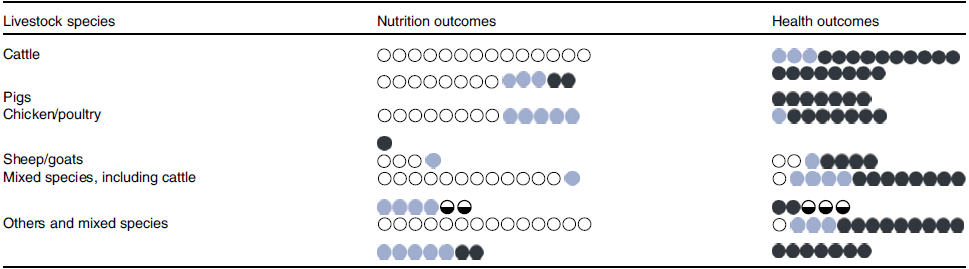
One dot representing one outcome; beneficial outcome indicates better nutritional status/improved health status (or reduced risk of malnutrition in the households owning livestock versus those that do not); adverse outcome indicates worse nutrition status/potential infection and morbidity impacts; neutral outcome indicates no association; and conflict outcome indicates the conflict results.
Studies on the association of livestock keeping and nutritional status of children and women
Table 3 presents the numbers of references in which livestock ownership was associated with nutritional status, classified as beneficial, adverse, neutral or conflicting findings. The conflicting findings indicate results within a reference, for example, either due to different results from different regions(Reference Hetherington, Wiethoelter and Negin7) or due to conflicting associations between ownership of different types of livestock on nutritional status(Reference Fadare, Mavrotas and Akerele63,Reference Gelli, Headey and Becquey64) (e.g. ownership of sheep, goats and pigs reduced the risk of stunting, while ownership of cattle increased risk). Given that a range of anthropometric indices could be used in a study, the total number of nutrition outcomes in Table 3 exceeds the total number of studies.
Summary of evidence indicating beneficial (), neutral (), adverse () or conflicting () associations between livestock ownership and nutritional outcomes among children <5 years and women of reproductive age.

One circle for one outcome; beneficial outcome indicates better nutritional status (or reduced risk of malnutrition in the households owning livestock versus those that do not); adverse outcome indicates worse nutrition status; neutral outcome indicates no association; and conflict outcome indicates the conflict results. Women’s nutritional outcomes: (1) Micronutrient deficiency (vitamin A, B and iron); (2) women’s body composition: 1 neutral; women’s BMI: 1 positive, 2 neutral; maternal malnutrition (using MUAC and BMI): 1; women’s body composition: percentage body fat; fat-free mass; maternal malnutrition indicators: wasting (MUAC <22 cm) and underweight (BMI <18.5 kg/m2)
According to the findings of the studies reviewed, a large proportion of the studies reporting on anthropometry showed that livestock keeping is significantly associated with improved HAZ (42.4%)(26–Reference Lindtjorn, Alemu and Bjorvatn55,Reference Headey, Nguyen and Kim67–Reference Sellen71) , WHZ (41.8%)(Reference Higgins, Green and Shuster27–Reference Fentaw, Bogale and Abebaw29,Reference Jones36) and WAZ (30.7%)(26–Reference Fentaw, Bogale and Abebaw29,Reference Fratkin, Roth and Nathan70,Reference Sellen71) in children. The remaining studies on these indices reported either a neutral(Reference Saaka62), conflicting/contradicting(Reference Hetherington, Wiethoelter and Negin7,Reference Fadare, Mavrotas and Akerele63,Reference Gelli, Headey and Becquey64) or an adverse(Reference Headey and Hirvonen40,Reference Gelli, Headey and Becquey64–Reference Temesgen and Haile68) outcome of livestock keeping (Table 3).
In the studies which assessed the association between livestock keeping and children’s micronutrient status, zinc deficiency (n = 1)(Reference Ouedraogo, Becquey and Hess85) and retinol status (n = 1)(Reference Pritwani and Mathur86), showed beneficial (protective) associations in alleviating the nutrient deficiencies. However, among the four(Reference Keverenge-Ettyang, van Marken Lichtenbelt and Esamai75–Reference Dominguez-Salas, Alarcón and Häsler77,Reference Nathan, Fratkin and Roth84) studies reporting on child anaemia (classified based on WHO’s guideline(87) as haemoglobin concentration of 100–109 g/L, 70–99 g/L and <70 g/L for mild, moderate and severe anaemia, respectively) one study showed an adverse(Reference Dominguez-Salas, Alarcón and Häsler77) association, while the remaining three reported beneficial (positive)(Reference Keverenge-Ettyang, van Marken Lichtenbelt and Esamai75,Reference Brown76,Reference Nathan, Fratkin and Roth84) associations between livestock keeping and anaemia status of children.
Regarding women’s nutritional status, the majority of studies reported either a beneficial(Reference Jin and Iannotti31,Reference Bechir, Schelling and Kraemer74–Reference Little, Humphries and Patel81) or neutral(Reference Pritwani and Mathur86,87) association between livestock keeping and nutritional status (e.g. reduced nutrient deficiencies, reduced malnutrition). One study, however, showed an adverse effect of livestock keeping on nutritional status of pregnant women(Reference Pradeilles, Allen and Gazdar83). The findings on the association between livestock keeping and anaemia varied, with four studies assessing anaemia in women reporting four different outcomes (Table 3).
Studies on the association between livestock keeping and infection and morbidity outcomes of children and women
There was consistent reporting of the association between livestock keeping and adverse infection and morbidity effects on human subjects across almost all studies reporting on these, mainly through transmission of microorganisms and diseases. For example, of the total (n = 81) references reporting on infection and morbidity outcomes, about four out of five (n = 66, 79.5%)(Reference Mahmud, Chappell and Hossain90–Reference Khalili, Hart and Mardani151) of the references indicated that livestock keeping is strongly associated with transmission of various microorganisms and diseases in man. On the other hand, some articles (n = 13, 16%)(Reference Kaur, Graham and Eisenberg47,Reference Nchito, Kelly and Sianongo152–Reference Meisner, Curtis and Graham164) indicated a lack of association (neutral), while a few (n = 4, 4.9%)(Reference Kledmanee, Liabsuetrakul and Sretrirutchai156,Reference Randremanana, Razafindratsimandresy and Andriatahina165–Reference Raghunathan, Whitney and Asamoa167) showed a protective effect (positive association) between livestock keeping and disease transmission.
Protozoa (n = 34, 40.9%) and bacteria (n = 25, 30.1%) were among the most commonly identified microorganisms transmitted from livestock to man, with adverse effects (Table 4). Among bacterial species, Brucellosis (n = 8)(Reference Mølbak, Aaby and Højlyng91,Reference Dumba, Kaddu and Mangen96) , Campylobacter (n = 7)(Reference Walingo88,Reference Mølbak, Aaby and Højlyng91,Reference Iqbal, Munir and Khan102,Reference Banu, Meyer and Ahmed109,Reference Asuming-Bediako, Parry-Hanson Kunadu and Abraham168) and Salmonella (n = 3)(Reference Mahmud, Chappell and Hossain90,Reference Conan, O’Reilly and Ogola118,Reference Harb, O’Dea and Hanan119) were also mentioned as having adverse effects on man from keeping livestock. Other bacterial species including Coxiella (Reference Obaidat, Malania and Imnadze141), Escherichia (Reference Conan, O’Reilly and Ogola118), Enterotoxigenic bacteroides fragilis (Reference Pathela, Hasan and Roy92), Mycobacterium tuberculosis (Reference Meisner, Curtis and Graham164), Mycobacterium ulceran (Reference Raghunathan, Whitney and Asamoa167) and Thermotolerant coliform (TTC)(Reference Budge, Hutchings and Parker123) were also identified (Table 4).
Summary of pathogenic characteristics of articles (n = 83) with potential infection and morbidity impacts to children and women from exposure to livestock – beneficial (), neutral (), adverse () or conflicting () effects of keeping livestock

Each dot represents two studies (references)
Several species of helminths and viruses were also identified to be among microorganisms associated with adverse outcomes of livestock keeping at the household level. Likewise, helminths such as Ascaris lumbricoids, Cysticercus, Fascioliasis, hookworm, Taenia and Chlamydia trachomatis were identified to be transmitted from livestock to man. On the other hand, viral species including hepatitis E virus, human influenza virus, rotavirus, rift valley fever, dengue fever, chikungunya and Crimean Congo haemorrhagic fever virus were also among viral species transmitted to man by keeping some form of livestock (Tables 4 and 6).
Protozoal species including Cryptosporidium (n = 9)(Reference Moucheraud, Chandyo and Henjum89,Reference Alyousefi, Mahdy and Mahmud97,Reference Ghoneim, Shalaby and Hassanain100,Reference Moore, Nget and Saroeun106) , Plasmodium (n = 8)(Reference Thiem, Schmidt and Suzuki101,Reference Ali, Akhter and Neubauer112,Reference Alemayehu, Ayele and Kloos126) , Toxoplasma (n = 6)(Reference Singh, Picado and Boelaert95,Reference Dumba, Kaddu and Mangen96,Reference El Deeb, Salah-Eldin and Khodeer98,Reference Lengerh, Moges and Unakal104,Reference Bastuji-Garin, Turki and Mokhtar113) and Giardia (n = 4) were frequently mentioned as being associated with adverse outcomes of livestock keeping. Other protozoa species including Entamoeba histolytica (Reference Alyousefi, Mahdy and Mahmud97), Trichomonas hominis (Reference Alyousefi, Mahdy and Mahmud97), Schistosoma mansoni (Reference Alyousefi, Mahdy and Mahmud97) and Hymenolepsis nana (Reference Alyousefi, Mahdy and Mahmud97) were also identified as being associated with adverse outcomes of livestock keeping at the household level.
In addition to the well-specified pathogens, several other non-pathogenic diseases (and/or diseases without identified pathogens) were also identified as being associated with adverse infection and morbidity outcomes of women and children in livestock-keeping households in LMICs. These included diseases such as diarrhoea, Tunisian pemphigus, atopy, mental health, acute gastrointestinal illness, anaemia, pneumonia, coughing and fever (Table 5).
Summary of other morbidity conditions with their potential adverse (), neutral (), and conflicting () infection and morbidity impacts from exposure to livestock

Overview of pathogens reported in reported publications/references.

Regarding the mode of transmission of pathogens and diseases from livestock to man, it varied between water, soil, food, mosquito, human hands, fomites, animal bites and air (respiratory route). Among references reporting on infection and morbidity of women and children, the most common modes of disease transmission from livestock to man were food (n = 45, 54.2%), water sources (n = 24, 28.9%) and flies (n = 12, 14.5%) (Table 7).
Summary of the mode of transmission of pathogens for references (n = 83) included in the review of potential infection and morbidity impacts from exposure to livestock

Pathways to association of livestock keeping on health and nutritional status of women and children in LMIC
To investigate potential pathways by which livestock ownership could affect nutrition and health of women and children, we used the 13 routes identified by Dominguez-Salas and colleagues(Reference Pfeifer, Domínguez-Salas and Baltenweck169). To cover health-related outcomes, we added two further routes: hygiene, covering access to clean water, personal hygiene practices (open defecation, hand washing) and consumption of raw or undercooked meat or milk. For each study included in this review, we collected information relating to the above routes. Of the papers which studied the influence of livestock ownership on nutrition outcomes, 57% also collected information on intake of ASFs, though this rarely included quantitative estimates of consumption and was sometimes at the level of the household rather than the individual woman or child. Information on hygiene was collected in 34% of these papers, and data on income from sales and women’s empowerment in 18% and 12% of papers, respectively.
The consumption of ASF by women, children or both was explicitly mentioned in just 42 of the 167 publications that were reviewed, and in 90 of the references that discussed nutritional outcomes and livestock ownership. Of the 42 studies, the majority (62%) of the references dealt with cattle ownership and ASF consumption; of these, more than two-thirds (67%) reported a positive or rise in ASF intake among children who owned them, followed by an increase (15%) in the consumption of ASF among women. The other livestock species that was commonly mentioned in reports of ASF intake by children or women was chicken. Similarly, just 25% of the publications we looked at stated that there had been no change in ASF for poultry owners; whereas 50% stated that there had been an increase in ASF for children and 16% for women. Even though they are small in number, the remaining references reporting on keeping of other animals including sheep, goats and pigs have likewise suggested a similar trend (Table 8).
Directionality of pathways between livestock ownership and consumption of ASF in LMIC, categorised by livestock species

1 Number (percent) of papers reporting on ASF consumption
2 any kind of livestock species.
In the papers, investigating the influence of livestock ownership on other health outcomes, the majority (63%) collected some information on hygiene and 19% collected information on disease in the livestock of the household (HH). Information on intake of ASFs was also collected in 9%, but other pathways were rarely studied in these papers. It was also notable that where any information on any of the variables had been collected, these were often used as covariates in cross-sectional analyses rather than in more complex models of pathways to effect, e.g. mediation analysis.
Additional impact pathways of livestock keeping on children’s nutritional status were through improving household food security status(Reference Shinsugi, Matsumura and Karama34,Reference Moucheraud, Chandyo and Henjum89) , household income(Reference Yigrem, Markemann and Abebe30) and gender equality or women’s control over resources(Reference Shapiro, Haider and Misgina50). Children from families that had co-owned or female-owned livestock(Reference Jin and Iannotti31,Reference Shapiro, Haider and Misgina50) were better nutritionally compared with those from male-dominated families.
Quality of references
Figure 2 illustrates the findings of the quality assessment of the included references. More than half of the included references were classified as high quality (56.8%), 36.4% of the studies were of moderate quality and small portions were low quality (6.8%). Case-control and experimental studies had higher quality scores compared with other observational studies (86.7% versus 54%).
Quality rating of references included by outcome measure.

Comparing the quality of references across infection/morbidity and nutrition outcomes, the quality of references (studies categorised as high quality) measuring infection/morbidity outcomes were slightly higher than those measuring nutrition outcomes (29.0% versus 26.7%). Papers measuring infection and morbidity outcomes had slightly more high-quality papers (29%) and slightly less moderate-quality papers (15.9%) than the corresponding values among papers measuring nutrition outcomes (26.7% high quality and 19.9% moderate quality). Among those references scored as being of low quality, references that measured infection and morbidity outcomes had a higher proportion of low-quality papers than references that measured nutrition outcomes (4.0% versus 2.8%). Three references measured both infection and morbidity and nutrition outcomes, of those two were of high quality and one of moderate quality (Figure 2).
Discussion
To generate evidence about the effect of livestock keeping on nutritional and infection/morbidity in children under 5 years and women of reproductive age in a LMIC setting, we synthesised the findings of peer-reviewed articles and other references from 12 databases. Data were extracted and stored in a database created specifically for this research and analysed using Covidence software. Analysis of evidence related to the association of livestock keeping with nutritional status of women and children indicated that livestock keeping is either significantly associated with a beneficial effect(s) or improved nutritional status of women and children. Nonetheless, the review also showed that livestock keeping is a double-edged sword(Reference Kaur, Graham and Eisenberg47), as it is a significant risk factor for disease and mortality in children, despite its dietary benefits.
Based on our analysis, a sizable proportion of the references showed that livestock keeping improved children’s HAZ(Reference Owor, Tumwine and Kikafunda28–Reference Passarelli, Ambikapathi and Gunaratna57,Reference Haider, Shapiro and Demissie61,Reference Ghosh, Aw-Hassan and Pellett69–Reference Rawlins, Pimkina and Barrett73) , WHZ(Reference Higgins, Green and Shuster27–Reference Fentaw, Bogale and Abebaw29,Reference Jones36,Reference Azzarri, Zezza and Haile37) and WAZ(26–Reference Fentaw, Bogale and Abebaw29,Reference Jones36,Reference Azzarri, Zezza and Haile37,Reference Hoorweg, Leegwater and Veerman39) scores, which are indicators of chronic and acute nutritional status in children. This is because livestock are sources of essential and nutrient-dense food items; ASF and sources of a wide range of saleable commodities as a source of financial security and insurance for the rural poor resulting in improved nutritional status among the most vulnerable populations(Reference Dror and Allen170–Reference Allen172).
References included in the present review also showed that livestock keeping (of some kind)(26,Reference Yigrem, Markemann and Abebe30,Reference Jin and Iannotti31,Reference Shinsugi, Matsumura and Karama34–Reference Jones36) or specific species (e.g. poultry(Reference Kavle, El-Zanaty and Landry35) and dairy(Reference Chilima and Matiya173)) are associated with better nutrition in children(26,Reference Shinsugi, Matsumura and Karama34–Reference Jones36) . For example, a dairy production nutrition intervention in a sugarcane growing area of western Kenya showed that children from households keeping dairy cattle and goats(Reference Sinharoy, Waid and Freeman44) had lower stunting prevalence through better food security and increased milk consumption(Reference Mbagaya53). Similarly, a chicken production intervention study from Ethiopia(Reference Passarelli, Ambikapathi and Gunaratna57) and one from Ghana(Reference Marquis, Colecraft and Kanlisi51) showed a positive association between poultry farming and child growth as well as dietary diversity.
Studies have also shown that families who own improved breeds or cross-bred cows were likely to have increased yield that led to higher consumption and lower malnutrition rates(Reference Kabunga, Ghosh and Webb43,Reference Haider, Shapiro and Demissie61) . Similarly, children from pastoralist families or barley–livestock families were uniformly heavier and taller than children of sedentary and nomadic farming families(Reference Fratkin, Roth and Nathan70,Reference Pedersen and Benjaminsen72,Reference Nathan, Fratkin and Roth84) . They were also better nourished compared with children from irrigation and olive/fruit tree farming families(Reference Ghosh, Aw-Hassan and Pellett69). In contrast, according to another study, children may face higher rates of malnutrition despite owning many livestock, particularly if hygiene issues are not well managed. A study from eastern Chad showed that households living in villages with larger concentrations of cattle and having more livestock sharing the same water source as for human consumption were significantly more likely to have a malnourished child(Reference Marshak, Young and Bontrager66). Children from livestock-keeping (pastoralist) families appear to be better off in terms of risk of chronic malnutrition (stunting) than children from peasant farmers or other agriculture-related livelihoods. A study(Reference Habaasa46) that compared the risk of stunting among children with mothers in pastoralists’ families vis-à-vis peasant farmers showed that the latter were more likely to be stunted than their counterparts(Reference Habaasa46).
The effect of season on the possible benefits of livestock keeping on nutritional outcome was also reported. A study from a drought prone area in Ethiopia showed that improvement in the state of nutrition of pastoral children followed soon after the main rains, but occurred later and after the main harvest among the children in agricultural households(Reference Lindtjorn, Alemu and Bjorvatn55).The association between livestock ownership and micronutrient status was explored only in a few studies(Reference Keverenge-Ettyang, van Marken Lichtenbelt and Esamai75–Reference Dominguez-Salas, Alarcón and Häsler77,Reference Nathan, Fratkin and Roth84–Reference Pritwani and Mathur86) (e.g. zinc(Reference Ouedraogo, Becquey and Hess85) and retinol(Reference Pritwani and Mathur86)). Almost all of these references showed positive associations or a beneficial role of livestock keeping on children’s micronutrient status. For example, the study from rural Burkina Faso(Reference Ouedraogo, Becquey and Hess85) on the prevalence of and risk factors for zinc deficiency among young children showed that the odds of zinc deficiency were significantly higher in households with no livestock ownership compared with the two highest quintiles of livestock ownership.
However, not all studies reported a positive or beneficial relationship between livestock ownership and nutritional outcomes. There were a number of studies that reported either neutral(Reference Saaka62) or conflicting/contradicting(Reference Hetherington, Wiethoelter and Negin7,Reference Fadare, Mavrotas and Akerele63,Reference Gelli, Headey and Becquey64) findings, or even inverse(Reference Headey and Hirvonen40,Reference Gelli, Headey and Becquey64–Reference Temesgen and Haile68) associations. A study on dairy cow ownership and child nutritional status in Kenya(Reference Nicholson, Mwangi, Staal and Thornton54) showed that dairy development efforts did not reduce child malnutrition, with limited evidence of positive nutritional effects of dairy cow ownership and child nutritional status for more intensive dairying. Another study also showed no indication of a reduced risk of stunting from village chicken keeping(Reference de Bruyn, Thomson and Darnton-Hill162). On the other hand, a study from Northern Tanzania on ethnicity and child health showed that Maasai who rely primarily on livestock herding showed signs of further disadvantage compared with Maasai relying primarily on agriculture(Reference Lawson, Mulder and Ghiselli65).
In another study, among the pastoralist families, the risk of adverse nutritional outcomes were shown to vary by the number of livestock units owned, the duration of exposure, ownership of improved breeds or cross-bred cows, and farmers’ livelihood systems. Generally, children from families with a larger number of livestock units(Reference Marshak, Young and Bontrager66) and those with longer exposure duration were shown to have a significantly lower risk of chronic malnutrition (stunting)(Reference Fentaw, Bogale and Abebaw29,Reference Hossain and Khan45,Reference Miller, Joshi and Lohani48,Reference Okike, Jabbar and Abate82) . However, rarely reported was the fact that the number of livestock did not guarantee the risk of under nutrition or household food supply. According to a study from Northern Tanzania, individuals in relatively wealthy households did not appear to benefit in terms of household food supply adequacy or average growth performance of young children(Reference Sellen71).
An observational study from rural Ethiopia(Reference Headey and Hirvonen40) showed that in households who had overly close exposure to poultry or the practice of corralling poultry in the household dwelling overnight, there was a negative association with children’s nutritional status(Reference Headey and Hirvonen40). A study on health risks of poultry rearing in developing countries, particularly for young children who have been observed to directly ingest poultry faeces(Reference Headey and Hirvonen52,Reference Gelli, Headey and Becquey64) , showed that livestock keeping (poultry) is inversely associated with child’s nutritional status, i.e. lower WHZ scores, and had a neutral effect on HAZ.
Livestock production had a mixed effect on women’s macronutrient and micronutrient status. As such, some of the studies reviewed showed that livestock ownership had either a beneficial(Reference Jin and Iannotti31,Reference Bechir, Schelling and Kraemer74–Reference Little, Humphries and Patel81) or neutral(Reference Pritwani and Mathur86,87) effect on women’s macro- and micronutrient (nutritional) status. For example, studies that investigated the association between livestock (poultry) farming and maternal body mass index (BMI) showed that not owning chickens was associated with maternal underweight(Reference Desalegn, Lambert and Riedel79), and inversely related to maternal BMI(Reference Kedir, Berhane and Worku78,Reference Little, Humphries and Patel81) . Conversely, livestock ownership was associated with increased iron stores during pregnancy(Reference Keverenge-Ettyang, van Marken Lichtenbelt and Esamai75) and protein intake of pregnant women(Reference Brown76). A couple of other studies that reported on the association between livestock keeping and micronutrient status of women showed that the odds of zinc deficiency were significantly higher in households with no livestock compared with the two highest quintiles of livestock ownership(Reference Ouedraogo, Becquey and Hess85). Livestock ownership was also seen to lower serum retinol (vitamin A) deficiency risk(Reference Bechir, Schelling and Kraemer74).
On the other hand, one study reported an adverse or negative association between livestock keeping and nutritional status of pregnant women(Reference Pradeilles, Allen and Gazdar83). Accordingly, during pregnancy, women who reported engaging in livestock and other labour-intensive agricultural work had lower maternal BMI. This was attributed to labour-intensive agricultural exercise in mid-to-late pregnancy, especially activities involving bending and lifting, leading to higher energy consumption(Reference Vemireddy and Pingali174) while also reducing placental function and blood flow, potentially affecting maternal weight and perinatal growth(Reference Wei and Gregory175).
Regarding the association between livestock production and infection and morbidity outcomes in women and children, from a total of 81 references that reported on the association between livestock production and infection and morbidity outcomes in women and children, about four out of five of them(Reference Mahmud, Chappell and Hossain90–Reference Khalili, Hart and Mardani151) indicated that livestock keeping is strongly associated with transmission of various microorganisms and diseases to man, particularly to the most vulnerable population groups, women and children. Some articles(Reference Kaur, Graham and Eisenberg47,Reference Nchito, Kelly and Sianongo152–Reference Meisner, Curtis and Graham164) also indicated a null (neutral) association, and others(Reference Kledmanee, Liabsuetrakul and Sretrirutchai156,Reference Randremanana, Razafindratsimandresy and Andriatahina165–Reference Raghunathan, Whitney and Asamoa167) a protective effect (positive association) between livestock keeping and disease transmission.
Considering the references that reported on a negative (adverse effects to man) association between livestock keeping and the transmission of microorganisms and diseases, it was shown that brucellosis is associated with individuals who keep animals at home(Reference Khan, Haleem and Shafiq161,Reference Ali, Nawaz and Akhtar176) , diarrhoeal disease (rotavirus infection) with possession of cattle(Reference Randremanana, Razafindratsimandresy and Andriatahina165), diarrhoea with livestock in children’s compounds(Reference Snell, Cummins and Martin148), Toxoplasma gondii immunoglobulin (Ig)M antibody with cats at home(Reference Hossein177) and cattle ownership with increased child mortality(Reference Vella59).
Conversely, some of the references reviewed also reported a null or lack of association between livestock keeping and the transmission of microorganisms and diseases to women and/or children. A study examining the direct and indirect effects of cow keeping at home, for example, discovered that exposure to cows is not associated with diarrhoea or impaired child growth (either via direct or indirect routes) by affecting growth or increasing the risk of diarrhoea – with no evidence that environmental exposure to cows contributes to growth deficiency in children(Reference Schmidt, Boisson and Routray160). Other studies also found no strong evidence about the presence of cowsheds and an increased number of synanthropic flies in households(Reference Schmidt, Boisson and Routray160), keeping animals and transmission of Cryptosporidiosis(Reference Kange’the, McDermott and Grace157), chicken keeping and risk of diarrhoea(Reference de Bruyn, Thomson and Darnton-Hill162), biogas production or exposure to livestock and manure and adverse human health(Reference Dang-Xuan, Macdonald and Schurer163), keeping livestock and risk of dengue virus infection(Reference Jakobsen, Nguyen-Tien and Pham-Thanh155), zoonotic cryptosporidiosis among cattle keepers(Reference Kange’the, McDermott and Grace157), exposure to goats and raw goat products and adverse pregnancy outcomes(Reference Kledmanee, Liabsuetrakul and Sretrirutchai156), livestock in homesteads and cryptosporidiosis(Reference Nyamwange, Mkoji and Mpoke159), cattle-associated risk factors and bovine TB, raw milk consumption and human TB skin test positivity(Reference Meisner, Curtis and Graham164), and several other conditions. One of the references reviewed indicated that in settings where bovine TB prevalence is low, cattle-associated zoonotic transmission may be rare, and may not be an important driver of human TB burden(Reference Meisner, Curtis and Graham164).
In a few cases, livestock keeping was also found to be a protective factor against exposure to certain diseases for humans in general, and women and/or children in particular. For example, a study on the effect of goat keeping inside or near the house showed a significant decline in r<the ate of Plasmodium falciparum infection (pfPR)(Reference Maziarz, Nabalende and Otim166). Another study also showed that wearing a shirt while farming and sharing indoor living space with livestock appears to be protective against Buruli ulcer disease (BUD)(Reference Raghunathan, Whitney and Asamoa167). Living indoors with chickens, in particular, was reported to be significantly protective against BUD, as it was reported more often by control subjects than by case patients.
The mode of transmission of pathogens and diseases from livestock to man varies between water, soil, food, mosquito, human hands, fomites, animal bites and air (respiratory route). However, the most common modes of disease transmission from livestock to humans, based on the references reviewed include food (54.2%), water sources (28.9%) and flies (14.5%).
Protozoa and bacteria were the commonest microorganisms transmitted from livestock to man, with several adverse effects. Among Protozoa species, Cryptosporidium (Reference Moucheraud, Chandyo and Henjum89,Reference Alyousefi, Mahdy and Mahmud97,Reference Ghoneim, Shalaby and Hassanain100) , Plasmodium (Reference Mosha, Lukole and Charlwood128, Reference Meisner, Curtis and Graham164), Toxoplasma (Reference Khalili, Hart and Mardani151,Reference Kledmanee, Liabsuetrakul and Sretrirutchai156) and Giardia were frequently associated with adverse outcomes of livestock keeping. Other protozoa species including Entamoeba histolytica (Reference Alyousefi, Mahdy and Mahmud97), Trichomonas hominis (Reference Alyousefi, Mahdy and Mahmud97), Schistosoma mansoni (Reference Alyousefi, Mahdy and Mahmud97) and Hymnolepsis nana (Reference Alyousefi, Mahdy and Mahmud97) were also identified as being associated with adverse outcomes of livestock keeping at the household level. Generally, we found several pathogens and diseases transmitted to man via livestock production. This could be related to the pathogenicity and virulence of the pathogens and the burden of diseases in the community(Reference Casadevall and Pirofski178). Other reasons could be the presence of suitable hosts and lack of preventive measures in resource-poor settings related to awareness and/or other poverty-related reasons.
While many of the studies in this review did not explicitly examine the pathways that influence livestock ownership on nutrition outcomes, some studies provided evidence on the different intermediary effects. In terms of direction, the pathways to positive impacts of livestock keeping on nutritional status of children and women were through both direct and indirect routes. Directly, it increases consumption of nutrient-dense ASF, while indirectly, it increases household income(Reference Yigrem, Markemann and Abebe30), household food security(Reference Shinsugi, Matsumura and Karama34,Reference Moucheraud, Chandyo and Henjum89) and gender equality(Reference Shapiro, Haider and Misgina50).
Among studies considering the direct benefits of livestock keeping, the multi-country studies from sub-Saharan African countries showed that households who own livestock were generally more likely to consume associated ASF(Reference Hetherington, Wiethoelter and Negin7,Reference Kaur, Graham and Eisenberg47) . The proportion of household members that consumed milk was higher in households that owned cows compared with those that did not(Reference Hossain and Khan45). Similarly, poultry meat consumption was generally higher in poultry-keeping households(Reference Hetherington, Wiethoelter and Negin7), unless in poor households(Reference Hoorweg, Leegwater and Veerman39).
The present review has some limitations that should be taken into consideration when interpreting the findings. One of the weaknesses is that we conducted an analysis on heterogeneous study designs, exposures and outcome variables, as well as study groups, that will potentially affect some of the conclusions, which might not strictly refer to the others and vice versa.
A second weakness of the study is that we synthesised evidence based on the direction of association or effect which is governed by the pre-defined scope and intention of the study. The observed adverse effects could also be wrongly perceived as common and inevitable conditions, which might not be always true provided appropriate hygiene, care and prevention interventions are put in place. The other possible limitation is that we only had a very small (2.8%) number of studies from Latin America and the Pacific, which may not be sufficient to adequately depict the situation in countries in this region. There may also be some vulnerable people in middle- and high-income countries that are not included in our analysis (e.g. indigenous communities in Latin America). Another limitation of the study could be that, as presented in Table 5, cattle were reported more frequently than any other livestock species in many of the references, potentially biasing the findings of our study.
Notwithstanding the above-mentioned limitations, our review has also several strengths that increase its usability and relevance to the field. To the best of the authors’ knowledge, no study has synthesised evidence on the effect of livestock ownership on the nutritional and infection status and morbidity of children and women, particularly searching literature from multiple datasets worldwide. We covered both livestock keeping and infectious disease outcomes, which is a substantial contribution to the field. In the present review, relatively, we conducted an unusually comprehensive and extensive search of peer-reviewed and grey literature from over 12 well-known scientific databases using an exhaustive list of search terms.
In addition to comprehensively examining the quality of each of the papers included in the review, we also screened a large number of records using a rigorous digital screening approach. The other strength of the study is the quality of references included in the final review. Using standard quality assessment methods, among the references included in the final synthesis, 56.8% and 36.4% of the studies had high and moderate quality assessment outcomes, respectively. In spite of similar scoring parameters, analytical (case-control and experimental – 15/176) studies scored relatively higher in quality scores compared with descriptive observational studies.
This review examined all kinds of infection and morbidity and nutritional outcomes among all studies retrieved that examined livestock keeping in LMIC settings. We believe the original number of records identified and final records (n = 176) synthesised in this review were sufficiently large to provide a thorough examination of the relationship between livestock keeping on nutritional and infection/morbidity of children and women in low- and middle-income countries.
Summary and conclusions
Overall, we found substantial evidence underscoring the beneficial effects of livestock keeping for the growth of young children, but also adverse effects for increased infection and morbidities in both women and children. The studies showed heterogeneous routes and extents of exposures and outcomes, which limited the inter-study comparisons. Overall, we conclude that together with the promotion of the production of livestock and consumption of ASF, attention should be given to the minimisation of diseases transmitted to humans through close contact or ownership of livestock at the household level in all LMIC settings. This could be achieved through practicing good food and personal hygiene, maintaining healthy animals, wearing protective clothing and undertaking all essential preventative treatments and vaccinations. Of course, interventions will need to be multifaceted, multidisciplinary and tailored to the specific context of each of these countries to ensure a sustained impact.
To shed more light on the relationship between livestock keeping and nutrition, infection and morbidity of women and children in LMICs, future research should focus on investigating the effects of livestock species and their age-specific effects on nutrition, infection and morbidity outcomes, particularly their effect on women of reproductive age. Future studies should also provide evidence on the effect of variations by livestock density and level (duration, magnitude and frequency) of exposure to a specific livestock species on nutrition and infection and morbidity outcomes. For example, the relationship between number (density) of cattle owned and child nutritional status is unclear. Veterinarians, nutritionists, public health practitioners and researchers in LMICs, who collect data related to livestock keeping and their effects on nutritional as well as infection/morbidity outcomes, could improve future research in this field by making datasets accessible to researchers through inter-institutional collaborations. To guide interventions, it would be useful to complement this paper with an analysis of the pathways linking livestock keeping with nutrition and infection/morbidity outcomes, differentiating between direct consumption of ASFs produced by the households, improved access to nutritious foods through increased income (ASFs and other foods) and other pathways (including women’s empowerment).
Supplementary material
For supplementary material accompanying this paper visit https://doi.org/10.1017/S0954422422000233
Data sharing
Data are available on request from the corresponding author.
Acknowledgments
This project received funding from the European Union’s Horizon 2020 research and innovation programme under the Marie Skłodowska-Curie grant agreement no. 801215 and the University of Edinburgh Data-Driven Innovation programme, part of the Edinburgh and Southeast Scotland City Region Deal award for Data Driven Innovation and by the International Livestock Research Institute. The work is also funded by donors and organisations that globally support ILRI through their contributions to the CGIAR system and in particular the Livestock CRP. For the purpose of open access, the author has applied a CC BY public copyright license to any Author Accepted Manuscript version arising from this submission.
Authors’ contributions
A.J.D., G.M., I.B. and T.A.Z. conceptualised and designed the study. T.A.Z. and G.N. conducted data analysis and interpretation, drafted, wrote and revised the manuscript, and contributed to the literature search. A.J.D., G.M. and I.B. supervised all the work and led the study design, data analysis and interpretation, and contributed to literature search, writing and revision of the manuscript. I.B. supported acquisition of the financial support for the project leading to this publication. F.B. conducted the literature search and contributed to data analysis, interpretation and revision of the manuscript. L.L.I. verified the data, contributed to the study design and critically revised the manuscript. All authors had full access to all the data in the study and had final responsibility for the decision to submit for publication.
Financial Support
This project received funding from the European Union’s Horizon 2020 Research and Innovation Programme under the Marie Skłodowska-Curie grant agreement no. 801215 and the University of Edinburgh Data-Driven Innovation programme, part of the Edinburgh and Southeast Scotland City Region Deal. The CGIAR system and in particular the Livestock CGIAR Research Program has also co-funded part of the fellowship of the lead author (T.A.Z.) and the study time for I.B. and A.D.
Conflict of Interest
None.
Declaration of interests
We declare no competing interests
Competing interests
All authors state that they have no competing interests to declare.
Patient consent for publication
Not required.


 Open access

