





Introduction
The Dutch naval logbooks kept in the Dutch National Archive (NA) in the Hague contain data that can help reconstruct the climate of the past in areas where Dutch naval ships were present. In 2018, we started examining these materials. This research has been inspired by similar historical climatology scholarship on ship logbooks in the UK and the US.Footnote 1 The works by Clive Wilkinson in the UK and one of our co-authors, Hisayuki Kubota, have been seminal here. The same is true of the Twentieth Century Reanalysis (20CR) project led by Gil Compo at the National Oceanic and Atmospheric Administration (NOAA) in the US.Footnote 2 Our research is also part of Atmospheric Circulation Reconstructions over the Earth (ACRE) initiative, which is sponsored by the World Meteorological Organization (WMO).Footnote 3
We have digitized the complete ship logs of six Dutch naval ships which sailed around Japan in the 1850s and 1860s.Footnote 4 In April 2025, all the data became accessible on the web page of the Japan-Asia Climate Data Program (JCDP, https://jcdp.jp/top-jp/) in Excel and Word files. In this article, we explain how the logbook archive was structured, and share how we studied this archive. Although our work is limited to the six Dutch naval ships that travelled around Japan, we hope our work will serve as a pilot project for further investigation aimed at digitizing the entire Dutch Navy logbook archive at a larger scale.
We also expect that our research will contribute to the reconstruction of climate of the past, European maritime history, and the role of the Dutch in the global history. This short article might also prove useful to scholars working on Dutch-Japanese relations and, more broadly, on Europe and Asian exchange history. This article ends with the wider implications of our research for maritime, colonial, and environmental historians.
First explorations in 2018
Our research project into Dutch ship logs began in 2018 when Togo Tsukahara started the investigations with the help of Gunther Können, formerly affiliated with the Royal Netherlands Meteorological Institute (Koninkelijk Nederlands Meteorologisch Instituut: KNMI). Their incipient targets were logbooks of Dutch merchant ships, such as the Drie Gezusters and the Cornelis Houtman which visited Dejima (now Nagasaki) in Japan in the Nineteenth Century. On board the Cornelis Houtman was Philipp Franz von Siebold (1796-1866), a German physician and collector who created important collections documenting Dutch-Japanese interactions in the nineteenth century.Footnote 5 In our research, we also drew on the work of Japanese historians like Itazawa, Katagiri, and Okamoto, who listed the names of Dutch ships which harboured in Nagasaki during the Edo period.Footnote 6
We were not the first to examine Dutch ship logs.Footnote 7 Categorization and extraction from logbooks was carried out in the Netherlands before World War II in a project called “Deck 193.” In the early 2000s, this project was used in the Climatological Database for the World’s Oceans (CLIWOC), funded by the European Union. This initiative collected meteorological data from Dutch and other European merchant ships on a largescale.Footnote 8 However, most of the data that has been used for CLIWOC does not come from the original handwritten ship logs, but from partial extracts of the original documents derived only from Deck 193 stored at the KNMI on punch cards. The original merchant ship logs were confiscated during the Nazi occupation and since then have not been traceable.Footnote 9 Therefore, CLIWOC data are problematic because they cannot be verified by consulting the relevant archives.Footnote 10
More targeted research into merchant ship logbooks
Due to the lack of meteorological archives at KNMI, Tsukahara and Können focused their research in 2018 on archives found elsewhere. These included the Special Collections of the Leiden University Library, the archives of the maritime museums in Amsterdam and Rotterdam, and documents at the NA in The Hague. We followed two strategies. First, by using local catalogues and inventories, we checked whether the institution had archives related to merchant ships. Second, we used the names of merchant ships as search terms in specific indices or parts of archives. In the case of the NA, we looked for well-known ship names in the indices of various colonial archives. In addition to the names of ships listed in the works of Japanese historians, we also used ship names that were frequently mentioned in Dutch-Japanese exchange history.
However, our work in the archives proved difficult, as our search for the logbook of the Cornelis Houtman shows. When we started our archival research, we had a good overview of the ship since its name appeared in several Dutch maritime databases, such as Piet’s Scheep Index (https://scheepsindex.nl/) and Van Sluijs’ list. We obtained in the Van Sluijs catalogue in the National Maritime Museum in Amsterdam the name of the shipowner (Gebr. Harts) and the name of the captain. However, even after intensive research, we were unable to locate the logbooks in museum archives.
Change of strategy
Since our search for merchant ship logbooks did not produce results, we changed our approach. Instead of merchant ships, we looked for naval ships. Then at the National Archive in The Hague, we found an Inventory of ship logs from the Ministry of the Navy (Inventaris van de Scheepsjournalen van het Ministerie van Marine, 1813-1995), Inventory number 2.12.03. This inventory was a promising avenue for further research. In 2001, KNMI had described this archive as “important resource”Footnote 11 for historical climate reconstruction. However, owing to the enormous size of the archive, the institute undertook no action to study or digitize it. It only concluded that more in-depth research would be necessary to understand the composition and value of this vast archive, which consists of roughly 5,350 ship logs produced during journeys of naval ships around the world between 1813 and 1995. The inventory of the archive is detailed, listing the name of individual ships and the years in which each log was produced.Footnote 12
Therefore, we started our search for ships that sailed to Japan. The logbooks of the Soembing, Gedeh, and Medusa were identified as good candidates for future research. These three ships sailed to Japan in the second half of the nineteenth century.
In the following section, we provide contextual information about these logbooks.
Soembing ship logs
The logbooks of the Soembing are stored under inventory numbers 4103, 4104, and 4105. The Soembing is a famous ship in the history of Dutch-Japanese relations. It sailed to Japan in August 1854 and was eventually gifted to the Japanese and became the first vessel of the Japanese navy. It was used as a training ship and had a formative impact on the country’s navy. Probably because of its diplomatic function, the Soembing’s logbooks are quite detailed; various contacts with Japanese officials are recorded in them. The first volume describes the journey from the Netherlands to the East Indies, while the second details the route and background information on the journey from the East Indies to Japan. From the logbooks we also learn that the Soembing sailed to Nagasaki together with the Gedeh, which took the Dutch crew back to Java. The ship logs of the Gedeh are also stored in the above-mentioned archive. and are discussed next.
Gedeh ship logs
The Gedeh was a large navy ship that was mostly stationed in the Dutch East Indies, usually sailing in coastal waters. According to its logbooks, it sailed around Batavia in 1853, reaching the Sea of Japan in July 1855. Later the ship proceeded to Nagasaki. Detailed meteorological records were kept during their voyages. While anchored, no meteorological records were recorded. However, in Nagasaki, we see daily non-meteorological notes recorded, even during anchorage, so we learn what happened at the harbour. The ship left Nagasaki in November and the meteorological record resumed at the start of this voyage.
Medusa ship logs
The Medusa was one of the longest-serving Dutch naval ships which also actively engaged in diplomatic function and several important sea battles. It sailed to Japan a few times. Each visit marked historical events in Dutch-Japanese history.
There are five logbooks from the Medusa, with the inventory numbers being 3018-3022.Footnote 13 3018, the first logbook, covers the 1850s the after the opening of the Japan and the formative years of the Japanese navy. The latter logs include records from the period of Shimonoseki War.
From 3018, we learn that the Medusa entered Nagasaki harbour on 8 July 1855. The documents also records visits to Nagasaki Bay (Baai van Nagasaki) in August and November 1856. According to the Medusa’s logbooks from 6 July to October 1856, the ship sailed from Batavia to Nagasaki via Hong Kong and Taiwan; then headed north along the Sea of Japan (Japansche Zee). While initially we did not understand whether the ship sailed along the Pacific side of Japan or Japan’s northern coast, the logbook’s data on the ships longitudinal and latitudinal position allowed us to determine the exact sailing route.
After Nagasaki, we can see the route it follows. It went further north, to the Pacific Ocean via Hakodate. From there, it went south to the Koshiki-jima Islands and back to Nagasaki. Eventually, the ship sailed back through the Sea of Japan to the Taiwan Strait and then to the China Sea. Once again it followed the route through the Sea of Japan, to the Taiwan Strait and into the China Sea. One of our authors, Kubota has mapped out the route in detail (see Figure 1).
Pictures of ship logs taken at the National Archive. On the right is a 30cm ruler for reference.

Inventory no. 3019 corresponds to a logbook from 1858-1861 and 3021 to 1862-1865, while inventory number 3020 covers 1862-1864. It overlaps with 3021 which covers the period 1862-1865. We have discovered the reason for this overlapping, namely that 3020 is a clean copy of 3021. This clean copy was intended to be submitted to the Ministry of Navy by the ship’s captain, Commander Francois (Frans) de Casembroot. He wanted to gain recognition for his war efforts. We will say more about the Shimonoseki war and de Cassembroot in the following section.
3022 is an ‘Engine Room Record’ (a logbook detailing the operation of steam engines and coal consumption) with information from Nagasaki, Edo, Shimonoseki, and other locations. The document shows that sailors in the Dutch navy were quite concerned about the condition of ship’s engine and the consumption of large amounts of coal. At the time, coal was expensive and difficult to secure while the ship was on duty.
The Shimonoseki War and Commander de Casembroot in the Four Nations Fleet
The Medusa participated in the Shimonoseki War (also known as the Bombardment of Shimonoseki or the Battle of Shimonoseki) together with three other Dutch ships. The Shimonoseki War consisted of a series of military engagements in 1863. At the core of the conflict was the question whether European ships were allowed to pass the Shimonoseki Strait, between the islands of Honshu and Kyushu. At the time, the Strait area was controlled by the feudal state of Choshu. The Choshu were known as political radicals disliking foreigners and any foreign exchange. They wanted to block the strait to prevent foreign ships from entering Japan’s Inland Sea. They allegedly managed to get an order from the imperial court to ‘expel the barbarians,’ on the basis of which they bombarded US, French, and Dutch ships in 1863. The Dutch ship they bombarded was the Medusa. As recorded in the ship log, one sailor was killed along with some damage.
In 1863, these hostilities created tensions between foreign powers and the Choshu. Eventually, the English, Americans, French, and Dutch opened diplomatic channels to negotiate with Tokugawa government to secure passage to the Japanese inland sea via Shimonoseki Strait with the aim of bypassing the Choshu. To enforce their claim, these four powers established the Four Nations Fleet. This joint fleet consisted of seventeen ships, nine from Britain, three from France, four from the Netherlands, and one from US. It succeeded in eventually achieving diplomatic agreement to conquer the Choshu. During a sea battle which lasted two days (5-6 September 1864), the fleet defeated the Choshu and forced them to open the strait.
Among the logbooks of the four Dutch ships which participated in the Four Nations Fleet, Medusa’s is curious. Its inventory number is 3020 and it is actually a clean copy of logbook no. 3021.Footnote 14 It was made by the commander of the Dutch fleet, Jonkheer (young lord) Francois (Frans) de Casembroot (1817-1895) who wrote a book about the abovementioned battle in which he described how bravely and effectively he fought. This was a way to proclaim his merit in a larger format. This clean copy was an instrument to show off his achievement to the senior bureaucrats in The Hague.
From our perspective, this clean copy was easy to read for us, and it allowed us to decipher the other Dutch handwritten documents. In this sense, this clean copy became an instrument to provide clues to read it and provide easier access to later historians.
Follow-up research in 2019
In 2019, Tsukahara and Ota continued to study the Dutch naval logs in the NA in The Hague. We carried out a feasibility study regarding the digitization of the logs. Each logbook consists of a large bound file (see Figure 2). In 2000, the KNMI reports that the archive had 7,315 inventory items, 5,350 of which were ship journals.Footnote 15 The archive was expanded in 2001. According to our count, the archive now contains 9185 volumes. According to the inventory, the archive now occupies 493 meters of shelf space at the NA.
The value of this archive for historical climate studies
These ship logs in question can be used as the historical resource for climate reconstruction, as they contain different types of meteorological and maritime information. In addition to data on the climate at sea, they contain descriptions of sailing routes, trade winds, and sailors’ conditions. They also include detailed evidence about changing wind directions, water salinity, and sea currents.
The analysis of the ship logs entails a collaboration between Dutch and Japanese historians; while historical meteorology and climatology scientists are also involved. Tsukahara and Ota are historians, and were the first to screen the archive. Alice de Jong, an archivist and former librarian at Leiden University, helped organize the Dutch team to aid us in deciphering the nineteenth-century Dutch handwriting. Together, we prioritized ship logs which fit our criteria for further digitization, and requested scans from the NA. With these scans, we produced a digital template to present the transcribed weather-related information in a structured way. After having examined a number of logbooks, we recognized some patterns in them. We decided to include the data part in an Excel file, while descriptive remarks in the right margin were transcribed in Word files. The Excel template is designed so that future researchers can extract weather-related data, as well as any other information needed for other specialties.
A standard page of the ship logs is shown in Figure 3. The example is taken from a clean version of the Medusa ship logs. This page consists of a printed format with a fixed set of columns; no horizontal lines were drawn in the form. Sailors on watch (“Wacht” in Dutch) could fill in the form as required. The columns were used to record temperature, wind direction, barometric pressure, etc, which could be filled in from left to right. In Figure 3 they are highlighted in red. The right-hand margin of the document contains a remarks column, marked in blue. In this part, various observations, statements, and official announcements could be recorded. The comments in the remark section vary, ranging from daily chores to information about diplomatic negotiations and miscellaneous issues, including food and a lot of alcoholic drinks for sailors, as well as the living conditions on board the ships. Often they mention punishments for sailors. These are certainly a rich resource for social history of sailing.
Standard Format of Naval Logbooks after 1854.

In addition to the standard page layout, there are some variations. One is shown in Figure 4.
Original Soembing logbook.

Usually the name of the ship and its approximate location are given at the top margin of the column (highlighted in yellow) The part marked in red pen indicates the exact location. The sailors in charge were mandated to record exact latitude and longitude usually once a day. Since the logbook does not have a separate column for the ship’s location, the sailors usually wrote it across columns. This location data is considered to be quite precise, as it was measured with astronomical instruments. Also, the descriptions of the locations are consistent. To highlight the value of such geographical information, we added a map created by Kubota using the position data extracted from a clean copy of the Medusa (Figure 5). This map covers the position of the Medusa from 1862 to 1864.
The route of the Medusa from 1862 to 1864, according to the relevant ship logs.

Digitization and preliminary results
To organize the different kinds of information in the digitized ship logs, we produced an Excel file format with 45 columns. The content of each of these columns is summarized in Table 1. As already mentioned, these Excel files can be found on the web site of JCDP.
List of data in the ship logs in Excel

The maritime terminology was specified by one of the authors, de Jong, who revisited the former research by Können into the history of Dutch navigation technology and weather management. She established a standard set of terms and abbreviations used in the Dutch navy ship logs. The summary of this terminology is accessible also on the JCDP web site.Footnote 16
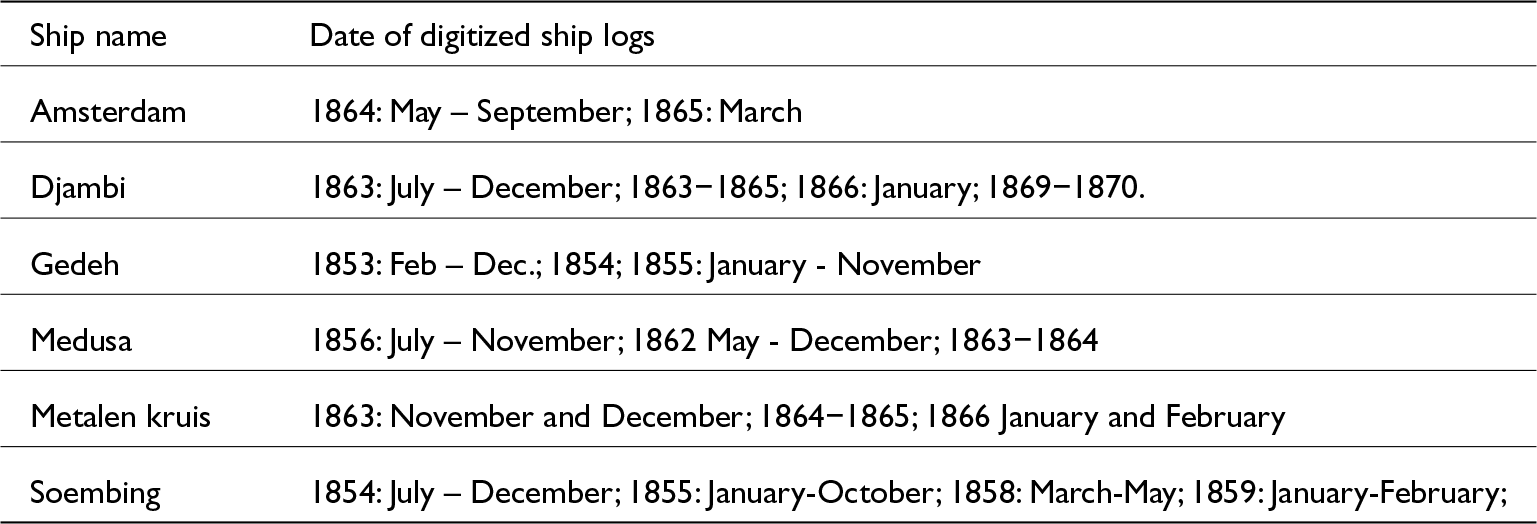
We digitized the ship logs for six ships (Table 2), covering slightly more than 100 months. We chose these ship logs based on the following two criteria:
(1) Geography. We focused on those ships with meteorological records from the seas around Japan. We adopted this area because our team includes specialists in the climatology and meteorology of monsoon Asia and typhoons in the vicinity of Japan.Footnote 17
Table 2.Digitized data: names of ships and durations

(2) Period. We focused on the 1850s and 1860s. After the Soembing was gifted to the Japanese, the Dutch navy was involved in the establishment of the Japanese Navy. Hence, Dutch-Japanese negotiations took place more often. We also believe that this period will attract more attention from historians and the public.
Preliminary conclusion and further research perspective
We have succeeded in digitizing part of the Dutch naval log books and have already produced several academic articles based on these documents. In relation to typhoons, we used the data in the Gedeh’s ship logs to reconstruct the historical typhoon called “Ansei no Ookaze” (Typhoon of the Ansei period) which occurred in 1854. The results of this research were published by Kubota and others in the e-journal GEO.Footnote 18 We are proud to note that this article has recently won a prize from the Japanese Society of Geography.Footnote 19 Our work is continuing, and we would like to mention some possible avenues of future research.
We digitized ship logs in the period just before the Aceh War, which followed the Shimonoseki War. Both military campaigns involved the Dutch navy in the Far East. From a painting in the Dutch Naval Museum in Den Helder, we know that ships such as the Jambi were mobilized for the Aceh War.Footnote 20 Further research into ship logs might allow us to have a more general idea about the relationship between Dutch military operations in the Far East and naval deployment in the East Indies.
Thanks to the analysis of the locations recorded in the ship logs, we learned that the Dutch navy sometimes took a different route, that allowed them to avoid an area off the China coast controlled by the British. The Dutch ships also took a route to Japan through the West Pacific, off the Philippines, where typhoons emerge. Therefore, meteorological observations and records from the area may lead us to new interpretation of past typhoons in the West Pacific.
Our work includes upcoming international collaborations. In 2022, Tsukahara, Ota, and Matsumoto visited the Koninkelijk Nederlands Akademie van Kunsten en Wetenschappen (KNAW) to discuss research collaboration. We invited Andreas Weber (University of Twente) to Tokyo Metropolitan University (March 2023) and Robert-Jan Wille (Utrecht University) to an international symposium at Nagasaki (October 2023), on which a booklet has been published in Japanese.Footnote 21 In 2023, Tsukahara and Ota presented a cooperation proposal to KNMI, to Maarten van Aalst, then newly appointed Director of the institute. In the summer of 2023, our team organized series of sessions at the International Conference on the History of Science in East Asia (16th ICHSEA) in Frankfurt, where Ville took part. After Frankfurt, our team travelled to the Netherlands, where we exchanged ideas with Martin Stendel of Danish Institute of Meteorology during a symposium at the Huygens Institute of KNMI in Amsterdam organized by A. Weber and Jelle van Lottum. (In relation to the Danish project, see Footnote 1). We also organized a workshop with historians and historians of science held in Leiden, with special assistance from Alicia Schrikker and Anita van Dissel from the history department of Leiden University.
We hope to strengthen our research collaborations with Dutch colleagues in the context of the recently launched digitization project Weer Leren van het Verleden (Learning weather again from the past). In the project, the Huygens Institute, KNMI, the NA, and the University of Twente have joined forces to initiate the digitization of the entire archive of Dutch Navy ship logs.Footnote 22 We are certain that, if funded, this project will positively impact a generation of maritime and colonial historians and historical climatologists in the Netherlands, Japan and elsewhere.
Our work is an attempt of combining the historical climatology with Dutch maritime history, as well as with global history. Although our digitization efforts are only at the initial stage, we believe they offer important clues for further data exploration and accumulation. In the age of global warming, our work can provide insights into the problems that humanity should tackle.
Acknowledgement
The authors wish to thank Andreas Weber and Robert-Jan Wille.
Funding information
Re-examination of climate and history around Japan during the 1860s based on Dutch ship logbook records, JSPS Grant-in-Aid for Scientific Research (A), 23H00030, PI: Jun Matsumoto
Recovery of tropical cyclone activity around Japan from the foreign ship logs during Edo era, JSPS: Grant-in-Aid for Challenging Research (Pioneering), 20K20328, 18H05307 (2018-2019), PI: Hisayuki Kubota
Climate change and social transformation in colonial Southeast Asia, JSPS: Grant-in-Aid for Scientific Research (B) 19H01322 PI: Atsushi Ota
ROIS-DS-JOINT (054PR2023), CODH, Joint Support-Center for Data Science Research, National Institute of Informatics. PI: 2022 Jun Matsumoto; 2023 Togo Tsukahara.


 Open access

