

Early historical documentation of Indigenous Ways-of-Life in North America, including human–plant relationships, were rooted in settler-colonial claims that Indigenous Peoples were not putting the land to “productive” use (Carter Reference Carter2019) nor cultivating plants in ways that were consistent with European conceptions of agriculture (Chilton Reference Chilton and Hart2008:57; Deur Reference Deur2002:141; Spalding Reference Spalding and Turner2020:377; Stein Reference Stein and Hart2008:65). Since then, much scholarly discourse has addressed ontological Eurocentricity regarding “agriculture” (see Denham et al. Reference Denham, Iriarte and Vrydaghs2007) and the problems of privileging Eurocentric perspectives of Indigenous pasts. In this article we contribute to this discourse by identifying and questioning the colonial components of archaeological practice that have been glossed over or ignored (see Nativ and Lucas Reference Nativ, Lucas, Nativ and Lucas2025). We focus our attention on Indigenous–plant relationships in the Canadian northern plains as a case study and resituate this corpus of archaeological knowledge as highly Eurocentric and rooted in settler-colonial logic. As two settler archaeologists, our goal from highlighting these issues is to push for alternative approaches to archaeological knowledge production.
There have been ample debate and various definitions of the term “agriculture” in the field of archaeology (e.g., Ford Reference Ford1985; Harris Reference Harris, Harris and Hillman1989, Reference Harris, Ellen and Fukui1996; Smith Reference Smith1998), ranging from relatively flexible definitions to more capitalist and Eurocentric orientations. We point to Vrydaghs and Denham’s (Reference Vrydaghs, Denham, Denham, Iriarte and Vrydaghs2007:8) definition as a more flexible approach: the authors outline common Eurasian components of agriculture that include but are not limited to (1) evidence of domestication through morphogenetic changes in plants or animals, (2) transformation of the environment from clearing forested areas for agriculture, and (3) “packages of associated cultural, political and social traits.” More capitalist orientations serve to commoditize land and labor to produce value through surplus production, with broader impacts that influence the social organization of agricultural communities (Piccoli et al. Reference Piccoli, Vittori and Uleri2023:2). There are numerous disagreements regarding applications and interpretations of the term “agriculture”; however, several scholars have advocated for studying agricultural practices on their “own terms” (Harris Reference Harris and Reed1977; Piperno and Pearsall Reference Piperno and Pearsall1998; Vrydaghs and Denham Reference Vrydaghs, Denham, Denham, Iriarte and Vrydaghs2007:1). We emphasize the need to apply this perspective to Indigenous agriculture in the Canadian northern plains.
Indigenous perspectives can be divergent from the Eurasian model and include different meanings of the term “agriculture.” For example, the president and CEO of the National Circle for Indigenous Agriculture and Food (NCIAF), Kallie Wood, has said, “Traditional harvesting, hunting, fishing, and trapping have provided food security and sovereignty to our communities since time immemorial. Anything Mother Earth provides to feed our people is agriculture” (Parent Reference Parent2024). This is in step with Armstrong and Anderson’s (Reference Armstrong, Anderson, Supernant, Baxter, Lyons and Atalay2020:41) perspective: “Indigenous peoples throughout the Americas developed institutions for managing and conserving animal and plant resources. These included, most obviously, agriculture and domestication, which, by definition, involve conserving and reproducing stock for future multiplication.” So, although there may be a myriad of definitions for agriculture, the traditional archaeological approach to this term has leaned toward Eurocentric interpretations until recently. In this article we use the term “Indigenous agriculture” to refer to broader and more flexible definitions, such as that of Armstrong and Anderson (Reference Armstrong, Anderson, Supernant, Baxter, Lyons and Atalay2020), which are representative of Indigenous plant management—that is, cultivating, propagating, and harvesting plant taxa for food and other cultural purposes—and of transformation of the environment such as managing wild plant communities, soil displacement and improvement, and prescribed burns. The term “horticulture” is only used when citing scholars who use this term.
Although it is not novel to claim that archaeology as a discipline is deeply rooted in Western ontologies, archaeological approaches to past Indigenous plant management strategies often gloss over discussions on Indigenous agriculture, especially in contexts that do not fit (even loosely) within Eurocentric conceptions of agriculture. For example, we can see this perspective in consideration of evidence for maize production in Middle northeastern plains village sites in North Dakota. Gregg et alia (Reference Gregg, Swenson, Picha, Kordecki, Haury and Quinn1987:448) hypothesized that a horticultural focus could not be determined unless horticultural products made up at least half of all food resources (Malainey Reference Malainey, Kooiman, O’Gorman and Painter2025:166–167). However, this claim, which relies on a definition of agriculture related to economic surplus production (i.e., a capitalist model), does not acknowledge the differential rates of preservation (and research focus) between zooarchaeological and paleoethnobotanical remains. Furthermore, the percentage of horticultural production relative to total food resources does not inherently qualify (or disqualify) the existence of crop production, and such cultural practices make significant contributions toward nutritional diversity. Schneider (Reference Schneider2002:36) makes a similar argument when discussing the necessary criteria for the Plains Village characterization: “What evidence is required to argue for the presence of horticulture? If it is direct evidence, such as charred maize kernels, cupules, or cobs in amounts sufficient to be considered ‘equal to hunting,’ then there are problems.” In these examples we find both theoretical (Eurocentrism) and methodological (preservation and sampling biases) challenges that have influenced archaeological interpretation.
In this article, we trace what we know about Indigenous human–plant relationships (including agriculture) within the Canadian northern plains before European colonization and critique how we know it. In the first section we highlight conventional (mis)conceptions of Indigenous human–plant relationships in the northern plains and colonial legacies within the field of archaeology. These include settler-colonial claims that were used to justify colonization of the northern plains, and we discuss how these claims have been upheld in modern scholarship. The next section summarizes archaeological evidence for Indigenous–plant relationships and Indigenous agriculture in the Canadian northern plains. It includes information on existing, undervalued, and overlooked lines of evidence (e.g., paleoethnobotanical data and agricultural tools). The third section problematizes standard archaeological practice in the study area and offers recommendations to reevaluate and expand archaeological knowledge. Overall, this article is one of many works that encourages researchers to challenge long-held assumptions and interpretive perspectives in the Great Plains, miskināhko-ministik (Nêhiyawêwin [Plains Cree language] for Turtle Island [Naytowhow Reference Naytowhow2023]), North America, the field of archaeology, and globally within lands affected by colonialism (e.g., Atalay Reference Atalay2012; Deur Reference Deur2002; Lightfoot et al. Reference Lightfoot, Cuthrell, Striplen and Hylkema2013; Steeves Reference Steeves2021).
For the purposes of this article, we use “Canadian northern plains” to refer broadly to the study area, which is situated within the lands covered by Numbered Treaties 1, 2, 4, 6, and 7, presently referred to as the Prairies within the Canadian provinces of Alberta, Manitoba, and Saskatchewan (Figure 1). Indigenous Peoples of these lands include (but are not limited to, considering ancestral groups) A’aninin (Gros Ventre), Nahkawininiwak (Saulteaux or Plains Ojibway), Nakota (Assiniboine), Niitsitapi (Blackfoot), Nêhiyawak (Plains Cree), Dakota and Lakota (Sioux), and Tsúut’ínà (Sarcee). In archaeological literature these lands have been referred to as the Canadian Prairie Ecozone (Nicholson et al. Reference Nicholson, Meyer, Oetelaar, Hamilton and Nicholson2011) and spans three of the six subareas of the Great Plains: Northwestern subarea, the Northern plains, and the Northeastern subarea (e.g., Adair Reference Adair and Minnis2003).
Distribution of selected northern plains archaeological sites related to Indigenous agriculture prior to colonization.

(Mis)conceptions of Indigenous Agriculture in the Northern Plains
Throughout the historical record, in archaeological scholarship, and underlying more generalized societal beliefs, there has been a widespread assumption that for the most part Indigenous Peoples in the northern plains did not practice agriculture prior to colonization (Carter Reference Carter2019; Malainey Reference Malainey, Kooiman, O’Gorman and Painter2025:155; Trabert and Hollenback Reference Trabert and Hollenback2021:104; Walde Reference Walde2006:297; Wedel Reference Wedel1961; Zarrillo and Kooyman Reference Zarrillo and Kooyman2006:478). This was largely directed to the practice of maize cultivation, and it should be emphasized that there is substantially less research focus on other Indigenous cultivars such as tobacco (Nicotiana sp.) and wild rice (Zizania palustris); this research issue is discussed in the next section. Although some scholars are willing to accept the precolonial occurrence of Indigenous horticulture—that is, small-scale technical cultivation—in the northeastern plains such as in Manitoba, these contexts have been characterized as outliers (e.g., fleeting, marginal, and unstable experiments or interludes; Buchner Reference Buchner1988:27; Trabert and Hollenback Reference Trabert and Hollenback2021:89; Walde Reference Walde2006). Similar claims have also been asserted and disputed elsewhere, such as the Eastern Woodlands in North America (see Mt. Pleasant Reference Mt. Pleasant2015:374). This section collates and critiques historical and archaeological (mis)conceptions about Indigenous agriculture in the northern plains to contextualize the foundations of archaeological knowledge in the region.
History
Historically, there are several important components of the (mis)characterizations of Indigenous agriculture before and during colonization. First is the historical predisposition of early historians (e.g., gender and racial biases). Those who were responsible for observing and reporting Indigenous Ways-of-Being at the time of contact were typically men working as missionaries, fur traders, and explorers who did not focus much of their attention on Indigenous Ways-of-Life, including Indigenous agriculture and broader Indigenous–plant relationships (Boyd et al. Reference Boyd, Surette and Nicholson2006; Carter Reference Carter2019:37; Clavelle Reference Clavelle1997:45; Hamilton and Nicholson Reference Hamilton and Nicholson2006:284; Stuart and Coward Reference Stuart and Coward2020:20). Gender biases meant that Indigenous cultivation practices were overlooked or missed entirely because in many communities including in the Great Plains (Griffitts Reference Griffitts2006:405; Wilson Reference Wilson1987), cultivation was connected to women’s roles (e.g., Masur Reference Masur2023:88; Turner et al. Reference Turner, Spalding, Deur and Turner2020:9). Historical accounts suggest a greater interest in the perceived practices of men, such as the bison hunt and other hunting and fishing practices (Turner et al. Reference Turner, Spalding, Deur and Turner2020:10), although certainly women also participated in such practices. It may also be the case that documenting practices that demonstrated the agency of women in Indigenous societies was pointedly omitted because this would have provided countervailing examples of ways of life outside a patriarchal nation-state framework (Stein Reference Stein and Hart2008:61).
Familiarity of environment may also have been a factor, with Europeans more acquainted with agriculture in (previously) wooded areas than within prairies that are more drought prone and require different approaches to cultivation in terms of scale, frequency, and location (e.g., along the rivers and floodplains). Documentation of Indigenous agriculture in the Eastern Woodlands described similarities to European farming; for example, the existence of gardens and cultivated fields (Mt. Pleasant and Burt Reference Mt. Pleasant and Burt2010:53–54). In early colonial accounts, Indigenous communities in the Eastern Woodlands such as Haudenosaunee practiced intensive agriculture, defined as agriculture with the intent to produce high yields, and had semipermanent/permanent village structures. In comparison, Indigenous communities in the Great Plains were characterized as nomadic/seminomadic: from a Eurocentric perspective this mobility inhibited the ability to practice agriculture, although some accounts did note that cultivation was often observed along rivers, such as the Red, Roseau, and White Mud Rivers (Moodie and Kaye Reference Moodie and Kaye1969:517–518).
Later historical documentation leaned into the narrative that Indigenous Peoples were unable to practice agriculture before colonization by pointing to the inability of early settlers to succeed in their farming efforts (Mt. Pleasant Reference Mt. Pleasant2015:382). This rhetoric can be seen globally where the failure of settlers to understand and cultivate the landscape was interpreted as impossible for anyone to do so (e.g., Australia; Pascoe Reference Pascoe2014). The challenging climate was also used to explain why settler agriculture failed; for example, in the case of the Selkirk settlement in Manitoba (Nicholson Reference Nicholson1990:34). However, several archaeological studies suggested that climate was not a significant factor restricting agricultural potential in the region (e.g., Nicholson Reference Nicholson1991; Schneider Reference Schneider2002).
In addition, racist evolutionary theories such as social Darwinism shaped colonial perspectives of Indigenous Peoples living in the northern plains. These theories included arguments that Indigenous Peoples were evolutionarily inferior (i.e., further behind) than Europeans. This belief was used to rationalize the Peasant Farm Policy (1889–1897) that set severe limits on Indigenous agricultural efforts, including prohibitions of using anything but hand tools, while settlers could use machinery. When this and other colonial policies, such as the 1857 Gradual Civilization Act, failed, colonial powers would point to their constructed false narratives of “cultural unsuitability” as reasons why Indigenous Peoples could not farm successfully (Carter Reference Carter2019:236).
Political motivation, then, was another significant component. The substantial efforts by the Canadian government to instruct Indigenous Peoples on the northern plains how to farm (although many promises related to farming through Numbered Treaties were not met) were beneficial to the government because teaching them to “become agriculturalists” like Europeans could limit the movement of Indigenous Peoples and their access to land (Carter Reference Carter2019:49). This orientation was predicated on the belief that Indigenous Peoples did not know anything about agricultural practices, despite archaeological evidence countering this perspective, such as the presence of scapula hoes and bell-shaped storage pits (discussed later) in the study area. Although prolific in the northern plains, this assimilationist strategy was not unique to this region and was also applied to lands within British Columbia (e.g., Adolph Reference Adolph and Turner2020:73).
Archaeology
Within archaeological discussions of Indigenous agriculture in the northern plains, Wedel (Reference Wedel1961) is a foundational work connected to the theory that Indigenous Peoples in these lands did not practice agriculture (Trabert and Hollenback Reference Trabert and Hollenback2021:110). At the time of writing, Wedel (Reference Wedel1961) pointed to a lack of direct or indirect evidence for corn growing in the Northeastern Periphery of the Great Plains. However, at that time paleoethnobotanical strategies were not commonplace within the field of archaeology, because flotation techniques had yet to be described by Struever (Reference Struever1968). Although Wedel (Reference Wedel1961:238) did not strongly dismiss the potential for such practices in the northeastern plains and cited several historical records of corn cultivation—for example, in the Qu’Appelle Lakes—he stated more forceful opinions about the lack of agriculture in the northwestern plains; for example, “The low rainfall and a short growing season make this a region in which an agricultural economy based on maize or other native American domesticates was not possible” (Wedel Reference Wedel1961:241). To support this conclusion, Wedel pointed to the scarcity of grinding tools and suggested that archaeological evidence in the northwestern plains was characterized by hunting subsistence strategies (Reference Wedel1961:261).
Perhaps the strongest rebuff of Wedel’s (Reference Wedel1961) claim is the work of Schneider (Reference Schneider2002), who suggested that five factors explain the lack of recognition and acceptance of prehistoric horticulture (in the northeastern plains): a biased view of the archaeological sites of this subarea, noting the lack of site fortifications, cache pits, and gardening tools; the belief that the climate could not support horticultural practices; the failure to apply robust archaeobotanical recovery techniques; an unfamiliarity with native horticulture early historic accounts; and the lack of native horticulture experiments to demonstrate its feasibility (Schneider Reference Schneider2002:33–34). Despite this detailed discussion, however, the belief that Indigenous agriculture on the northern plains was, for the most part, nonexistent or, at best, extremely sparse persists in the archaeological literature.
Archaeological characterizations of Indigenous human–plant relationships in the northern plains have historically used two lifeway models: nomadic hunter-gatherer (forager) or sedentary/semisedentary agricultural villager (farmer; Wood Reference Wood1998:1). This dichotomy is not unique to the northern plains: similar characterizations have been used to describe Indigenous human–plant relationships in the Eastern Woodlands (see discussions in Chilton Reference Chilton and Hart2008; Masur Reference Masur2023; Stein Reference Stein and Hart2008). Subsistence-based categorizations are commonplace in the archaeological and anthropological literature; however, Pluciennik (Reference Pluciennik2001:742) argues we should navigate pathways across these categories because they are rooted in seventeenth-century European morality and ideology in which “productiveness” and “improvement” were measures of moral worth. “Hunter-gatherer” societies were deemed as lacking productiveness because they were not “using” the land, and this perception contributed to the settler-colonial rationale to displace Indigenous communities.
Ultimately, the forager/farmer dichotomy oversimplifies complex nonlinear dynamics of human–environment relationships, and many archaeologists have begun to move away from this dualism (Deur Reference Deur2002:142; Lightfoot et al. Reference Lightfoot, Cuthrell, Striplen and Hylkema2013:288). There is ample archaeological and ethnographic evidence that these bounded categories misrepresent complex lifeways because there are many examples of hybrid subsistence strategies; for example, farmers do not fully cease relationships with wild plant communities just because they are involved in cultivation (e.g., Masur Reference Masur2023; Michlovic and Schneider Reference Michlovic and Schneider1993:133; Stein Reference Stein and Hart2008). Within North American archaeology, this is acknowledged in the Eastern Woodlands and broadly in the Great Plains (Griffitts Reference Griffitts2006:101; Michlovic and Schneider Reference Michlovic and Schneider1993:133); however, within the prairie lands of Alberta, Saskatchewan, and Manitoba, the forager/farmer dichotomy seems to persist in many cases, with greater focus on and acceptance of foraging practices and skepticism toward the existence of farming practices. Research conducted in Manitoba, using paleoethnobotanical approaches, has embraced a more complex interpretation of mixed foraging and farming subsistence practices (e.g., Hamilton and Nicholson Reference Hamilton and Nicholson2006; Hamilton et al. Reference Hamilton, Taylor-Hollings, Norris and Nicholson2011; Nicholson et al. Reference Nicholson, Hamilton, Running and Nicholson2006; Schneider Reference Schneider2002:46; Shay Reference Shay1986:1), yet this has not been observed in archaeological narratives from neighboring Saskatchewan and Alberta. We argue this approach should be more widely considered across the study region.
In sum, the Eurocentric framing of historical archaeological knowledge production in the Canadian northern plains and elsewhere benefited colonization efforts in Canada and continues to influence archaeological methods and interpretations. Archaeology in Canada has begun to move away from its colonial roots, yet aspects of colonial frameworks and rhetoric remain. Research institutions across the country maintain control over Indigenous belongings (i.e., artifacts) in both a physical and intellectual capacity, and archaeological pedagogy is largely structured by Western scholars (Beaudoin Reference Beaudoin2016:12; Ferris Reference Ferris2003; Pokotylo and Mason Reference Pokotylo, Mason and Smith2020; Supernant and Warrick Reference Supernant and Warrick2014:581). Knowledge is socially constructed (Trigger Reference Trigger1984), and in this section we have outlined how Western ontologies, Eurocentrism, and settler-colonial rhetoric have laid the foundation for the belief that Indigenous Peoples in the northern plains did not practice agriculture. To build on our critique, the following section collates multiple lines of archaeological evidence for Indigenous agriculture—management strategies to cultivate, harvest, and process plants—from published literature, graduate theses, and museum collections.
Archaeological Evidence for Indigenous Agriculture in the Northern Plains
Across the Great Plains, strong archaeological evidence for Indigenous agriculture is typically characterized as paleoethnobotanical remains (e.g., charred corn kernels), agricultural implements (e.g., scapula hoes), and storage pits (i.e., for crop surplus storage; Trabert and Hollenback Reference Trabert and Hollenback2021:89). These are often considered major components of the “Plains Village” cultural historical complex (Trabert and Hollenback Reference Trabert and Hollenback2021:91), with pottery traditions, formal domestic architecture, and village fortifications listed as additional components connected to the Middle Missouri tradition of the Plains Village pattern characterized by archaeologists in the northern plains (Trabert and Hollenback Reference Trabert and Hollenback2021:104). Here we present lines of evidence of Indigenous agriculture (i.e., plant management) from the Canadian northern plains, discuss methodological challenges, and critique archaeological interpretations. Based on the information from Table 1, we suggest that arguments centered on a lack of “substantial evidence” can be reevaluated when viewed outside rigid bounded typological categorizations—for example, the Plains Village Tradition, hunter-gatherer, horticulturalist, and so on—and critiqued in regard to Eurocentric definitions of agriculture.
Archaeological Evidence Related to Indigenous Agriculture in the Study Area.

Note. The table is organized alphabetically by province and then site name.
Paleoethnobotanical Residues
Although there are studies of human–plant relationships in the Great Plains broadly, within the lands of the northern plains that we now call Canada, research is more limited (Boyd et al. Reference Boyd, Surette and Nicholson2006:1; Coward Reference Coward2022:6; Schneider Reference Schneider2002; Stuart and Coward Reference Stuart and Coward2020; Zarrillo and Kooyman Reference Zarrillo and Kooyman2006). Much of the research on Indigenous foodways before colonization focuses on zooarchaeological remains and hunting strategies to procure bison and other large mammals as dietary staples (Zarrillo and Kooyman Reference Zarrillo and Kooyman2006:473). In many cases within the broader archaeological literature of the study area, plant remains are mentioned in passing, as speculation, or they are completely overlooked (Boyd et al. Reference Boyd, Varney, Surette and Surette2008:2555). This leaves a huge gap in our archaeological knowledge base of past human–plant relationships in the northern plains (Lints Reference Lints2012:47).
The published paleoethnobotanical literature has focused on tracing the northern presence of maize (Zea mays; Boyd et al. Reference Boyd, Surette and Nicholson2006, Reference Boyd, Varney, Surette and Surette2008; Boyd and Surette Reference Boyd and Surette2010), reconstructing paleoenvironments (Siegfried Reference Siegfried2002) and paleodiet (Zarrillo and Kooyman Reference Zarrillo and Kooyman2006), assessing broad plant use at archaeological sites (Stuart and Walker Reference Stuart and Walker2017), and analyzing medicinal plant use (Stuart and Coward Reference Stuart and Coward2020). Doctoral and master’s theses have also retrieved significant evidence of Indigenous human–plant relationships in the northern plains, with many discussing plant taxa recovered at archaeological sites through paleoethnobotanical sampling (e.g., Coward Reference Coward2022; Lints Reference Lints2012, Reference Lints2023; Siegfried Reference Siegfried2002; Webster Reference Webster1999). These theses cover a range of methods including flotation and microbotanical analyses (phytoliths, pollen, and starch grains).
Much of the research regarding Indigenous agriculture in North America and in the northern plains focuses on maize. Secure macrobotanical evidence for maize, such as corn kernels and cupules, has only been reported at the Lockport site in Manitoba (Hewitt et al. Reference Hewitt, Syms and Hoppa2008), making it the only site within the study region where scholars broadly agree maize cultivation was practiced and on a small scale. Other lines of evidence such as the presence of starch grains are typically emphasized as evidence of consumption but not necessarily local production (Boyd et al. Reference Boyd, Varney, Surette and Surette2008; Hamilton and Nicholson Reference Hamilton and Nicholson2006:274; Malainey Reference Malainey, Kooiman, O’Gorman and Painter2025:162, 177; Nicholson et al. Reference Nicholson, Hamilton, Running and Nicholson2006:348). For example, Boyd et alia (Reference Boyd, Varney, Surette and Surette2008:2550) connect their findings of maize starch to the retrieval contexts of lithic and ceramic belongings (i.e., artifacts) that were likely imported from Minnesota or the Dakotas; that is, they argue that the maize was also imported.
Although maize was indeed a central foodways component for Indigenous communities across North America, many other cultivars have been overlooked. Furthermore, discussions regarding Indigenous management of wild plant communities—berry patches, root beds, and nut-producing tree groves—have been sidelined. Indeed, several other cultivars present within the study area have received much less research focus than maize: beans (e.g., Phaseolus vulgaris), goosefoot (Chenopodium sp.), marsh elder (Iva annua), squash (Cucurbitaceae), sunflower (Helianthus annuus), and tobacco. In other regions such as the Eastern Woodlands, these taxa are considered part of agricultural crop traditions (Adair Reference Adair and Minnis2003:295; Trabert and Hollenback Reference Trabert and Hollenback2021:69), yet they are not typically discussed as evidence of agriculture in the northern plains—although only goosefoot and sunflower are native to the region. Beans such as Phaseolus vulgaris have been recovered in the study area through microbotanical residues (see Boyd et al. Reference Boyd, Varney, Surette and Surette2008; Lints Reference Lints2012), and squash seeds have been recovered from the Garratt site in Saskatchewan (Alan Korejbo, personal communication 2025). However, evidence for beans has been suggested as evidence of import (like the maize residues discussed earlier), and the squash seeds have not been conclusively determined as archaeological; that is, they are suspected to be modern because of the lack of research on these specific seeds. Goosefoot is often retrieved from sites in the study area, including as a cache deposit in Alberta (Ross site, DlPd-3). Wild rice has also received a surprising lack of attention, despite the historical and ongoing evidence of wild rice growth, collection, and use by Indigenous communities. However, archaeologically, wild rice is incredibly difficult to identify as pollen or starch grains, even in contexts where wild rice is presently growing.
Overall, there are few paleoethnobotanical studies in the northern plains compared to other regions. This research is largely conducted in universities as master’s and doctoral theses; across the study area, paleoethnobotanical research focused on Manitoba is contributing the most to our understanding of Indigenous agriculture in the northern plains (e.g., Boyd et al. Reference Boyd, Surette and Nicholson2006). From the existing evidence, it is clear that Indigenous–plant relationships were highly diverse, incorporating a wide variety of species including maize, beans, goosefoot, wild rice, prairie turnip (Psoralea esculenta), squash, saskatoon berry (Amelanchier alnifolia), chokecherry (Prunus virginiana), and a plethora of other species.
In the sites summarized in Table 1, maize was present in 31 of 43 sites (72%) that had some form of plant cultivation evidence (e.g., agricultural tools, other non-maize cultivated plant evidence, plant processing tools), whereas both wild and cultivated plant taxa were observed in 32% of sites in this study. Such evidence was typically represented through microbotanical residues and with some contexts of carbonized kernels and cupules. Other cultivars (e.g., beans and squash), tentative cultivars (e.g., goosefoot, knotweed [Polygonum erectum]), and probable carefully tended wild species (e.g., saskatoon berry, chokecherry, prairie turnip, and wild rice) have also been frequently identified through microbotanical residues in several studies.
Microbotanical studies offer exceptional opportunities to investigate maize consumption where macrobotanical remains have not been recovered, because microbotanical remains such as starch grains may be preserved when trapped as surface encrustations or within the pores of an artifact surface (Barton Reference Barton2007; Pearsall Reference Pearsall2015:356; Prado and Noble Reference Prado and Noble2024). In the northern plains, studies by Lints (Reference Lints2012), Prado (Reference Prado2024), and Zarrillo and Kooyman (Reference Zarrillo and Kooyman2006) have demonstrated the capabilities of starch and phytolith analyses to retrieve evidence for the culinary use of cultivars before colonization. Although these studies are unable to identify whether cultivars were produced locally or were traded, they demonstrate the uptake and use of cultivars by Indigenous communities in the Canadian northern plains.
Agricultural and Plant Processing Tools
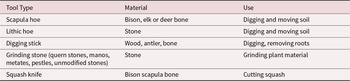
Although early historians noted a lack of plows used by Indigenous Peoples for cultivation, this does not mean that there was an absense of agricultural tools (Table 2). Scapula hoes and digging sticks were part of the agricultural tool kit for Indigenous Peoples of the northern plains before colonization. Such tools are mentioned in Wilson (Reference Wilson1987), perhaps the most thorough ethnographic account of Indigenous agriculture in the plains detailing the knowledge of Maxi’diwiac (Buffalo Bird Woman), a Hidatsa agriculturalist. Maxi’diwiac described how agricultural tools were made and used, among other agricultural techniques such as constructing storage pits (Wilson Reference Wilson1987).
Types of Indigenous Agricultural Tools in the Northern Plains.

Scapula hoes in the Great Plains are characterized as modified scapula bone usually from bison, elk, or deer. Modifications include perforations, score marks, and removal of border bone sections (e.g., anterior and posterior; Malainey Reference Malainey, Kooiman, O’Gorman and Painter2025:169). The edges of the hoe blade are typically striated, wavy, and polished, reflecting wear from handle attachment points and use along the working edge (Griffitts Reference Griffitts2006:278; Malainey Reference Malainey, Kooiman, O’Gorman and Painter2025:169). These tools have been identified across the study area (see Table 1; Figure 2); however, the most notable archaeological context is the Lockport site in Manitoba. Here approximately 19 examples have been recovered, including both complete (n = 10) and fragmented (n = 9) forms (Malainey Reference Malainey, Kooiman, O’Gorman and Painter2025:158). Because these Lockport scapula hoes were recovered alongside bell-shaped storage pits and charred maize, this site is considered one of the only sites in the northern plains for “concrete evidence of horticulture” (Malainey Reference Malainey, Kooiman, O’Gorman and Painter2025:156). Scapula hoes have also been recovered from the Olson site (DgMg-167) within the remains of a bone tool workshop context (Malainey Reference Malainey, Kooiman, O’Gorman and Painter2025:159), the Walter Felt site (Figure 2), and possibly the Garratt site in Saskatchewan (Alan Korejbo, personal communication 2025).
Examples of Indigenous digging tools recovered from the Walter Felt site (EcNm-8). (Color online)

The use of scapula hoes is rarely reflected in ethnohistoric literature. One mention from 1806 along the Missouri River remarked that hoes made of bone were as functional as “real hoes,” referring to iron hoes (Griffitts Reference Griffitts2006:273). Weight was a significant factor to consider when comparing scapula hoes and iron hoes. Although the heavier iron hoe was an advantage for digging deeply, it was heavier to lift and less easy to carry during travel than a scapula hoe (Griffitts Reference Griffitts2006:397). Scapula hoes could also be readily made across the plains because they did not require a blacksmith for production. Griffitts (Reference Griffitts2006:200) also argues that the scapula hoe was likely a moderately durable and repairable tool.
Although scapula hoes have received most of the research attention, lithic hoes and digging sticks (bone and antler) have also been observed in the study region but are rare or possibly underreported. Lithic hoes, however, require close investigation because there is potential for these artifacts to be used as adzes or other types of tools. Digging sticks have been characterized as primitive agricultural tools, situated on the opposite end of the agricultural development spectrum from the European plow (Mt. Pleasant Reference Mt. Pleasant2015:409). This tool has been used in many societies around the world and is typically connected to foraging for root crops (e.g., Deur Reference Deur2002:144; Nugent Reference Nugent2006). In the northern plains digging sticks have been recovered but are under-researched. Given the association of digging sticks with “foraging” practices we do not include them in Table 1. However, antler and bone digging sticks are documented in collections at the Manitoba Museum (David M. Finch and Cortney Pachet, personal communication 2025). One of their advantages is that digging sticks and scapula hoes minimally disturb the soil in comparison to European plows. This minimal disturbance has been observed to retain soil microbiota, organic matter, and nitrogen (Hart and Winchell-Sweeney Reference Hart and Winchell-Sweeney2023:499).
Although we have evidence for these tools, the historical record has often emphasized their “primitive” nature and limited functionality. Mt. Pleasant (Reference Mt. Pleasant2015), a soil scientist and agronomist, has challenged through modern experimentation the historical belief that the absence of plows was an impediment to Indigenous farming efforts. Mt. Pleasant found that hand tools reduced soil erosion, were less destructive of soil organic matter, and therefore enabled long-term sustainable crop yields (Mt. Pleasant Reference Mt. Pleasant2015:374). This finding is significant because archaeologists have claimed that Indigenous agricultural traditions, which lacked draft animals, plows, and animal manure fertilization, depleted soil nitrogen and required shifting agriculture, also referred to as swidden agriculture (Hart and Winchell-Sweeney Reference Hart and Winchell-Sweeney2023:497).
In comparison to agricultural implements, an under-researched category of evidence is plant processing tools, with two notable studies within the Canadian northern plains by Fedyniak and Giering (Reference Fedyniak and Giering2016) and Zarrillo and Kooyman (Reference Zarrillo and Kooyman2006). This research lacuna is attributed to the limited recovery of plant processing tools such as grinding stones, metates, and manos (Zarrillo and Kooyman Reference Zarrillo and Kooyman2006:474). Zarrillo and Kooyman (Reference Zarrillo and Kooyman2006) analyzed two unmodified lithic tools from a site within Calgary, Alberta (EgPn-612), for microbotanical remains; the results suggested these tools were used for processing both wild (e.g., chokecherry) and cultivated (e.g., maize) plants. Although plant processing stone tools are reportedly rare, these authors suggest this may reflect an oversight in archaeological practice by pointing to ethnographic and ethnohistoric literature that note the use of unmodified stones (Zarrillo and Kooyman Reference Zarrillo and Kooyman2006:475). Indeed, within the collection of the Manitoba Museum are a plethora of modified stone tools, including manos, metates, and pestles, from precolonial contexts in the study area (David M. Finch and Cortney Pachet, personal communication 2025).
Squash knives are plant processing tools described as thin-bladed rectangular tools constructed from bison scapulas (Griffitts Reference Griffitts2006:280). Within the ethnographic literature, Maxi’diwiac described how squash knives were used by Hidatsa women to cut round squash into rings so they could be strung on grass cordage and dried. Maxi’diwiac also recommended making a squash knife from a cow bison because the bone was thinner (Wilson Reference Wilson1987:70–74, 106). Such artifacts have been rarely identified, with two examples from Manitoba and Saskatchewan listed in Table 1. Suspected squash blades are often fragmentary, which makes identification and classification challenging for archaeologists.
Storage Pit and Cache Features
Storage pit features are interpreted in the Great Plains as evidence of surplus food production (Nicholson Reference Nicholson1990:53). There are extremely few finds of these features; however, it is difficult to know whether this is because they are truly absent, have been destroyed by historical development such as plowing, have been underreported, or are simply difficult to find (especially small caches). It may be the case that large surplus food production was not a significant objective of past Indigenous Peoples practicing agriculture in this study area; for example, food may have been prepared to be consumed during a single event with no surplus for storage. This was discussed by Carter (Reference Carter2019:215), who noted that surplus-oriented agriculture—for example, commercial agriculture—was the objective for settler farmers but not necessarily for Indigenous farmers during the earlier phases of colonization.
Here we identify scale as another component contributing to the perceived absence of Indigenous agriculture. The Eurocentric perspective views agriculture as necessarily a large-scale, surplus-creating production. Yet, within noncapitalist societies, surplus production is not necessarily the primary objective, and therefore agriculture practices may be pursued at smaller scales. Robin Wall Kimmerer (Reference Kimmerer2024:15), for example, discusses gift economies as alternative to market economies: “In a gift economy, wealth is understood as having enough to share, and the practice for dealing with abundance is to give it away. In fact, status is determined not by how much one accumulates, but by how much one gives away.” Kimmerer elaborates on this, noting, “The prosperity of the community grows from the flow of relationships, not the accumulation of goods” (Reference Kimmerer2024:16).
Subsistence farmers may not intend to cache a surplus, although this has been observed at the Lockport East site in Manitoba. That there are few storage pits in the northern plains may have been used as a line of evidence to fit the historical narrative, despite the likelihood that they might not be identifiable in the archaeological record because of historic and ongoing disturbances, such as plowing. However, it could be the case that foodways models in the Canadian northern plains, like gift economies, did not require storage pits.
Integrating Evidence
Table 1 collates several lines of evidence for precolonial Indigenous plant cultivation and processing from published literature, theses, reports, and museum information covering 43 archaeological sites (eight sites have captured multiple lines of evidence). A significant part of this evidence comes from paleoethnobotanical studies, which identified both cultivated and wild plant taxa in many cases. In total, cultivated plant evidence (inclusive of goosefoot and knotweed) was recovered from 31 sites, wild plant evidence from 15 sites, agricultural tools (e.g., scapula hoes) from 13 sites, grinding stones from seven sites, plant processing tools from four sites, and identified storage pit or cache features from two sites. Most of the cultivation evidence derives from innovative approaches using artifact residue analyses to recover microbotanical remains, suggesting that future studies will greatly develop archaeological knowledge of Indigenous–plant relationships and precolonial plant-based cuisine.
Discussion: Reconsidering Evidence and the Lack of Evidence
The collection of evidence presented here indeed includes many instances of identifiable cultivars, agricultural implements, ceramics, and some examples of storage. However, for scholars who require evidence of Indigenous agriculture to be on par with that seen in European contexts, we argue that the current methodologies are unlikely to recover sufficiently robust evidence. Historic and ongoing development has likely destroyed much of this evidence; for instance, through plowing (Nicholson Reference Nicholson1990:36). Furthermore, we suggest that requiring archaeological evidence of Indigenous agriculture to fit within a narrow Eurocentric orientation of agriculture has ultimately led to flawed archaeological science. The colonial bias discussed earlier has inhibited the archaeological theories, methods, and research focus required to more accurately trace the complexities of past Indigenous foodways.
Evidence of the cultivation component of Indigenous agriculture is present across the study area, albeit in varying degrees, likely because of differing research foci, archaeological methodologies, and highly variable human–plant relationships in the past. We argue that paleoethnobotanical remains, agricultural tools, and storage pit features identified in the study area are representative of diverse Indigenous plant management strategies that reflect cultivation, plant processing, storage, and environmental transformation. We echo Mt. Pleasant’s argument (Reference Mt. Pleasant2015:379) that a reliance on Western standards (and theory) is flawed and has distorted our analyses of Indigenous agriculture. Archaeological practice considers multiple lines of evidence to be a standard of research; however, investigations structured to retrieve multiple lines of evidence (e.g., paleoethnobotanical remains) in the northern plains are not typically pursued. It therefore seems unreasonable to expect the resulting evidence to be sufficiently robust. This orientation approaches a self-fulfilling prophecy where we cannot retrieve evidence of Indigenous agriculture if we are not using appropriate methods, in part because we believe doing so is unnecessary (i.e., because of the belief that Indigenous agriculture was not practiced in the region). Adair (Reference Adair and Minnis2003:319) emphasizes the importance of questioning the representativeness of the paleoethnobotanical assemblages recovered in archaeological research, including evidence we are missing because of our methods and tendency of “plant blindness” (Mooney Reference Mooney2025). Furthermore, this reliance on subsistence-based societal categorizations—for example, hunter-gatherer versus agriculturalist—traps our minds within an outdated worldview (circa European Enlightenment).
Recommendations for Expanding our Knowledge
There are several lines of knowledge that are missing from our standard approaches, as well as technologies that have been underutilized or yet to be pursued. In this section we reemphasize specific problems related to archaeological knowledge production of past Indigenous–plant relationships in the Canadian northern plains and provide recommendations for expanding archaeological approaches.
Problem 1: Lack of Engagement with Indigenous Knowledge and the Need to Dismantle Eurocentrism within Archaeological Interpretation
The most significant knowledge base that has been missing from our archaeological narratives is the perspective of northern plains First Nations and Métis Peoples. Given the overall orientation of this article, which critiques historical and archaeological narratives of Indigenous–plant relationships in the Canadian northern plains, it would be remiss of us not to acknowledge the importance of Oral Tradition and written Indigenous histories and the lack of engagement with Indigenous Knowledge Keepers and Elders. Archaeological engagement with Oral Histories is scarce in the study area, and there are few Indigenous-authored publications focused on human–plant relationships within the northern plains. Two notable examples—Plants Growing along the River (lii plante kaa shaakikihki oborr la rivyayr; Gabriel Dumont Institute 2019) and Medicines to Help Us (Belcourt Reference Belcourt2007)—are written from Métis perspectives. However, neither text has been meaningfully woven into archaeological knowledge production of Indigenous–plant relationships in the study area. Several ethnobotanical theses have engaged with First Nations communities near the study area, but most focused on more northern lands located in the parklands and boreal forest regions (e.g., Clavelle Reference Clavelle1997; Leighton Reference Leighton1982) rather than within the plains (e.g., Peacock Reference Peacock1992).
Indigenous interpretations of the archaeological record have been historically overlooked and undervalued (Atalay Reference Atalay2012:13; Constant-Inglis Reference Constant-Inglis2023:14; Supernant Reference Supernant2018), and the documented mischaracterizations of Indigenous Ways-of-Life have long been challenged by descendant Indigenous communities and Indigenous scholars (e.g., Echo-Hawk Reference Echo-Hawk2000; Harris Reference Harris, Smith and Wobst2005; Mt. Pleasant Reference Mt. Pleasant2015; Steeves Reference Steeves2021; Smith Reference Smith2021; Yellowhorn Reference Yellowhorn2002). Although efforts have been made in recent years, there remains a stark imbalance of Western and Indigenous perspectives within the field (Atalay Reference Atalay2012:16; Steeves Reference Steeves2021; Trabert and Hollenback Reference Trabert and Hollenback2021:24). Furthermore, there are increasing calls to acknowledge and return to Indigenous relationships with the land, such as using Traditional Ecological Knowledge that includes millennia of complex local-scale environmental conservation science and observations. There are broad similarities within Indigenous perspectives on human–plant relationships within North America, including an acknowledgment of plants as relatives and teachings that inform people how to have respectful and reciprocal relationships with plants and the land (e.g., Adolph Reference Adolph and Turner2020 [Xáxli’p]; Joseph Reference Joseph2023 [Sḵwx̱wú7mesh]; Nieves Zedeño et al. Reference Nieves Zedeño, Hollenback, Miller and Murray2010 [collaborative, Mandan, Hidatsa, Arikara, and Crow]; Geniusz Reference Geniusz2015 [Anishinaabe plant teachings]; Kimmerer Reference Kimmerer2013, Reference Kimmerer2024 [Potawatomi]). It is important to note that each Nation and community have a unique relationship with the land and, in turn, with plant communities. Ultimately, collaborative and Indigenous-led archaeological projects will surely restructure and grow archaeological methods to develop more nuanced understandings of human–plant relationships that exist outside Western/Eurocentric models.
Expanded paleoethnobotanical research projects in the northern plains and elsewhere can also retrieve knowledge that can be applied to real-life challenges in modern societies. At present, Indigenous communities globally are seeking to rejuvenate relationships that have been disrupted by colonialism (e.g., Dream of Wild Health [Minnesota], Kahnekanoron [Ohrón:wakon, Hamilton Ontario]; NiU NOW! [Hawai’i]; ‘Onipa’a Na Hui Kalo [Hawai’i]; Sovereign Seeds [North America]; Wild Plants Dinner [Palestine; Meneley Reference Meneley2021]). Such communities hold knowledge regarding the location of specific plant communities, how to care for them, how to collect seed and propagate these plants, and how to forage and use these resources sustainably (Armstrong and Anderson Reference Armstrong, Anderson, Supernant, Baxter, Lyons and Atalay2020:43; Armstrong et al. Reference Armstrong, Marion Dixon and Turner2018; Black Elk and Baker Reference Black Elk, Baker and Turner2020; Joseph Reference Joseph2023:14; Lepofsky and Armstrong Reference Lepofsky and Armstrong2018:58; Lightfoot et al. Reference Lightfoot, Cuthrell, Striplen and Hylkema2013). Archaeology often quantifies these relationships through economic modelling, cost-benefit analyses, labor affordances, and other Western “scientific” methods of interpreting Indigenous Ways-of-Being. Instead, Indigenous-led and collaborative archaeological projects can retrieve knowledge of ancestral food and plant management strategies to inform current and future food sovereignty, conservation, and land management approaches through culturally relevant and informed pathways.
Overall, research led by Indigenous archaeologists and pursued in collaboration with descendant communities will challenge long-held assumptions, methodologies, and protocols within the field of archaeology. Indigenous Archaeology is well positioned to confront problematic colonial narratives and create opportunities to interpret the archaeological record in different ways; therefore, such research is poised to significantly develop the field as a whole.
Problem 2: The Need for Expanded Archaeological Science Approaches in the Canadian Northern Plains
Paleoethnobotanical reporting is infrequent in the Canadian northern plains, with greater research focus directed toward lithics, ceramics, and zooarchaeological remains, which are generally more visible in the archaeological record due to preservation biases (Lints Reference Lints2012:73; Stuart and Coward Reference Stuart and Coward2020:20; Trabert and Hollenback Reference Trabert and Hollenback2021:42). This reflects a broader issue within archaeological practice: the focus of the discipline has historically been on material remains (i.e., artifacts) and more visible faunal remains, rather than all remnants of past human activities, including paleoethnobotanical remains (Lepofsky and Armstrong Reference Lepofsky and Armstrong2018:65; Lepofsky et al. Reference Lepofsky, Armstrong, Mathews, Greening and Turner2020:87; Morehart and Morell-Hart Reference Morehart and Morell-Hart2015:484; Stuart and Coward Reference Stuart and Coward2020:20). Within the broader context of Canadian archaeology, this orientation is representative of a significant lack of consistency in archaeological science methodologies, standards of practices, and levels of heritage protection nationwide because Canada does not have a federal heritage framework (Supernant Reference Supernant2018:147). Therefore, our second recommendation focuses on expanding archaeological science in the study area.
Across the study area, paleoethnobotanical methodologies, such as sampling and analyses, are not broadly required in research and CRM archaeological projects: required sampling (without standard methods or protocols) seems to be only present on a case-by-case basis. Stand-alone case studies seem to be pursued usually by archaeologists specializing in paleoethnobotany, of which there are few. Elsewhere in Canada—for example, in Ontario where Indigenous agriculture before colonization is well known—paleoethnobotanical assessment is required in specific contexts such as full site excavation (Ministry of Tourism and Culture 2011). Generally, paleoethnobotany in the Great Plains south of the Canada–USA border—the Central and Southern Plains—has provided most of our archaeological knowledge of past human–plant relationships in the northern plains. This is likely because of national and institutional differences between the two countries’ archaeological requirements (e.g., the US National Historic Preservation Act of 1966) versus less systematic provincial legislation in Canada (National Trust for Canada 2020) and research foci (e.g., comparatively less in the plains region in Canadian archaeology compared to in the Eastern Woodlands or on the West Coast). The current assemblage of paleoethnobotanical evidence for precolonial Indigenous–plant relationships provides a glimpse at how much data we are likely missing by not systematically pursuing paleoethnobotanical analysis in the northern plains because there are no systematic legal requirements or guidelines in Alberta, Manitoba, or Saskatchewan for such sampling in archaeological work (Province of Alberta 2022; Province of Manitoba 2022; Saskatchewan Tourism, Parks, Culture and Sport 2010). Therefore, relying on the evidence of absence (or trace evidence) is potentially perpetuating a false narrative.
A practical solution to the lack of federal heritage legislation and provincial requirements for paleoethnobotanical sampling is to conduct additional microbotanical studies on belongings (artifacts) that have already been excavated (e.g., legacy collections) and to reserve a selection of belongings that are ideal for microbotanical documentation when they are excavated (Figure 3). Such ideal belongings include those highlighted throughout this article, such as ceramics, suspected grinding stones, digging sticks, squash knives, and scapula hoes. Although ceramics with visible encrustations are ideal, microbotanical remains have also been successfully documented in cases where no encrustations were observed. This approach requires little technical skill, should not result in postexcavation damage to belongings, and is both time and cost effective. We emphasize that nondestructive microbotanical sampling on Indigenous belongings should be done with the consent of descendant communities and ideally as a collaborative effort with Indigenous scholars, Knowledge Keepers, and Elders.
Microbotanical sampling flow chart.

Given the expansive range of archaeological projects conducted within CRM projects, microbotanical analyses cannot reasonably be expected for every investigation. Unless such research is mandated by provincial or state regulations, conducting plant microfossil studies typically remains at the discretion of CRM organizations as part of their broader commitment to cultural stewardship. Importantly, the absence of immediate analysis does not preclude the possibility of future research. Despite the lack of legal requirements, we suggest that archaeologists can follow the steps illustrated in Figure 3 during heritage resource assessments. For example, materials such as stone and bone tools, pottery, fire-cracked rock, and hearth features should be routinely collected, and we recommend incorporating an additional sampling step when these materials are encountered.
Cultural belongings with a high potential to preserve food residues, such as pottery and food processing tools, should be collected and placed directly into sterile bags. Additionally, a small sediment sample (approximately 50 mg) from immediately beneath each artifact should be collected and stored separately. During laboratory processing, these belongings should not be washed initially; instead, adhering sediment can be removed using a dry brush or brushed off using a nitrile gloved fingertip (see “Dry Wash” in Prado and Noble Reference Prado and Noble2024:3–4). This recovered sediment provides an additional source of data to compare with food residues and can be curated for future analysis. Following this dry wash, belongings should be placed in a sterile plastic bag until further microbotanical sampling can be conducted. Modifying cleaning protocols in this way increases the likelihood of successful residue recovery, and separate storage helps maintain control over modern contamination. In addition to sampling belongings directly, we also recommend collecting a single control sediment column from both within and outside the archaeological site. This can be done either using a probe or excavation wall sampling (e.g., from a shovel test pit). These control samples enable comparison between archaeological residues and the surrounding environmental background, strengthening interpretations of residue antiquity.
Other innovative approaches using scientific techniques that are more established elsewhere can also increase archaeological knowledge in the Canadian northern plains through focused research projects. For example, one such approach is microwear analysis of bone and wood tools to understand their use and function. Further investigation of agricultural tools, including tentatively identified or ambiguous artifacts, could be pursued using microwear analyses that can identify subtractive (e.g., striation, polish) and additive wear (e.g., plant silica buildup) patterns. In more southern regions of the Great Plains, this method has been demonstrated by Griffitts (Reference Griffitts2006), who presented the merits and limits of various microwear approaches for studying bone tools. Several productive studies from outside the Great Plains have demonstrated how microwear analysis on stone and bone tools can be used to interpret tool manufacture, function, and association with plant processing (e.g., Anderson Reference Anderson1980; LeMoine Reference LeMoine1994; Meeks et al. Reference Meeks, Sieveking, Tite and Cook1982; Watson and Gleason Reference Watson and Gleason2016). In the Canadian northern plains, microwear analysis could be advantageous for assessing the function of scapula hoes and determining whether suspected scapula fragments were used as hoes. It could also focus on other tools such as lithic hoes, squash knives, and those used for plant processing (e.g., grinding stones). For example, Griffitts (Reference Griffitts2006:190) notes that maize cob shelling can be assessed using such approaches because tools used for this purpose show a continuous and bright polish, as well as widely spaced and shallow striations.
Multiproxy methods could also be explored in such contexts, such as starch and phytolith analysis of tools (see Lints Reference Lints2012). Bison and elk scapula hoes, as well as other agricultural implements, are likely to be the best-preserved lines of evidence and are more readily recognizable to archaeologists who may not have the expertise, budget, timeline, or desire to sample for paleoethnobotanical residues. Isotopic studies have also proven fruitful in other areas to trace the movement of paleoethnobotanical residues and artifacts (e.g., Boyd et al. Reference Boyd, Varney, Surette and Surette2008). Edwards et alia (Reference Edwards, Walde and Katzenberg2016) investigated maize production at the Cluny site through isotope analysis of dog and bison bones, although the isotopic signatures did not suggest a high C4 signature that would be used to broadly point to maize cultivation. However, a high C4 signature may not be present in a mixed economy where high yields and surplus production were not the objectives (i.e., consumption of maize was high and consistent over a lifetime). Further application of such trace element analyses may be able to retrieve clearer answers regarding the growing provenance of cultivated plants.
Conclusion
This article has aimed to disentangle colonial elements of standard archaeological practice. Although many archaeologists in Canada (and elsewhere) have begun to acknowledge this issue, mainstream archaeology tends to gloss over colonial foundations, rather than work to dismantle them. This has real-world impacts because this colonial worldview has been used to rationalize the displacement of Indigenous communities from their lands, waters, and other-than-human relatives. Archaeological and historical studies that characterized Indigenous Peoples as nonagricultural (i.e., foragers, hunter-gatherers) have hindered their claims to land (Mt. Pleasant Reference Mt. Pleasant2015:381) and contributed to skewed perceptions of Indigenous labor (Stein Reference Stein and Hart2008:66). In the northern plains this outcome is clearly outlined by Carter (Reference Carter2019:20):
That Indians did not farm was ample justification for others to lay claim to their land, but a further rationalization was that since Indians could be taught to farm, they would gain much more than they would lose. The reward was the prospect of an ennobling enterprise through which they could achieve status, stability, self-respect, and dignity. An added advantage was that the Indians would not be in need of their extensive hunting grounds, as they would have the means to feed themselves.
We see implications of this perspective throughout Canada’s history—for instance, in the Gradual Civilization Act (Canada 1857), the Indian Act (Canada 1985), and the White Paper (Canada 1969)—and in the twenty-first century through racist statements by settler politicians regarding Indigenous work ethic (e.g., Pierre Poilievre; CBC News 2008).
We focused on precolonial Indigenous–plant relationships in the Canadian northern plains to illuminate how Eurocentricity and colonial logic have guided prevailing interpretations and methodologies, thereby maintaining colonial power structures within the field. Continuing to uphold and privilege such practices keeps alternative perspectives and practices at bay, which prevents multivocal pasts from emerging, thus generally stagnating archaeological methodologies and interpretations. Ultimately, our article is one of many that critiques archaeology’s supporting role in colonialism, capitalism, and imperialism while mainlining itself as a “science” (Nativ and Lucas Reference Nativ, Lucas, Nativ and Lucas2025:4). A more accurate deep-time narrative, inclusive of Indigenous perspectives and expanded paleoethnobotanical approaches, would enhance societal knowledge of the complexities of Indigenous relationships with the environment before colonization and, more broadly, human–plant relationships that exist outside Eurocentric and linear (i.e., evolutionary) models. We agree with Vrydaghs and Denham’s assertion (Reference Vrydaghs, Denham, Denham, Iriarte and Vrydaghs2007:6) that “agriculture is a porous category” in which strategies of plant management (cultivated and wild) may be optional, seasonal, or fluctuating. We suggest that in the northern plains the approaches presented in this article will expand our knowledge and more accurately trace long-term plant management strategies, Traditional Ecological Knowledge, foodways, community social dynamics, and nuances of past Indigenous Peoples’ Ways-of-Life.
Acknowledgments
A sincere thank you to the many people who helped contribute to this research through in-person discussions and correspondence over email and Zoom: Honey Constant-Inglis, Karin Steuber, Tomasin Playford, David M. Finch, Cortney Pachet, Alan Korejbo, the Manitoba Museum, the Royal Saskatchewan Museum, Reid Graham, and Darryl Bereziuk. Special thanks to Shanti Morell-Hart, Glenn Stuart, Duygu Ertemin, Melissa Arcand, and David Natcher for their helpful comments on earlier drafts of this article. Merci to Élie Pinta for writing the second-language (French) abstract. We also express our thanks to the peer reviewers whose feedback helped us improve the clarity of this article.
Funding Statement
This research was supported by a Living Skies Postdoctoral Fellowship at the University of Saskatchewan in connection with the Bridge to Land Water Sky Living Lab funded by the Agriculture and Agri-Food Canada Agricultural Climate Solutions Living Lab program.
Data Availability Statement
No original data were used in this article
Competing Interests
The authors declare none.




 Open access

