

1. Introduction
1.1 Motivation
In their seminal paper, Donaldson and Thomas [Reference Donaldson and ThomasDT98] proposed a definition of gauge-theoretic invariants for a compact Calabi–Yau threefold $X$
. Writing
$X$
. Writing $\unicode {x03BD}_X$
for the volume form on
$\unicode {x03BD}_X$
for the volume form on $X$
, these invariants would count the critical points of a holomorphic Chern–Simons functional
$X$
, these invariants would count the critical points of a holomorphic Chern–Simons functional
 \begin{align*} \mathsf{CS} \colon \alpha \mapsto \int _X {\rm tr}(\tfrac 12 D \alpha \wedge \alpha + \tfrac 13 \alpha \wedge \alpha \wedge \alpha ) \wedge \unicode {x03BD}_X \end{align*}
on spaces of connections on vector bundles on $X$
, taken up to the action of a suitable gauge group. Defining such invariants directly in this infinite dimensional setup proved difficult, which led Thomas [Reference ThomasTho00] to pursue an algebraic setup involving moduli spaces of finite type. In the study of Donaldson–Thomas (DT) type invariants that followed [Reference Kontsevich and SoibelmanKS08, Reference Brav and DyckerhoffBD19, Reference Joyce and SongJS12], the moduli space of interest is the moduli stack of semistable sheaves
$X$
, taken up to the action of a suitable gauge group. Defining such invariants directly in this infinite dimensional setup proved difficult, which led Thomas [Reference ThomasTho00] to pursue an algebraic setup involving moduli spaces of finite type. In the study of Donaldson–Thomas (DT) type invariants that followed [Reference Kontsevich and SoibelmanKS08, Reference Brav and DyckerhoffBD19, Reference Joyce and SongJS12], the moduli space of interest is the moduli stack of semistable sheaves $\mathcal{M}_X$
, and the invariants are defined by expressing
$\mathcal{M}_X$
, and the invariants are defined by expressing $\mathcal{M}_X$
locally as a critical locus of a finite type potential [Reference JoyceJoy15].
$\mathcal{M}_X$
locally as a critical locus of a finite type potential [Reference JoyceJoy15].
The link between the gauge-theoretic and the algebraic setups was explored by Toda [Reference TodaTod18], who showed that the moduli space $\mathcal{M}_X$
is locally controlled by a gauge problem associated to a polystable sheaf
$\mathcal{M}_X$
is locally controlled by a gauge problem associated to a polystable sheaf $\mathcal{F} \in \mathsf{coh}\; X$
. Concretely, one takes a locally free resolution
$\mathcal{F} \in \mathsf{coh}\; X$
. Concretely, one takes a locally free resolution $\mathcal{E}^\bullet \to \mathcal{F}$
and considers the DG algebra
$\mathcal{E}^\bullet \to \mathcal{F}$
and considers the DG algebra
 \begin{align*} \mathfrak{g}_{\mathcal{E}} = \mathfrak{g}_{\mathcal{E}}^\bullet := \left (\Gamma (X, \mathscr{A}^{\;\,0,\bullet }(\mathcal{E} nd(\mathcal{E}))), D, \wedge \right ), \end{align*}
of Dolbeault forms, whose Maurer–Cartan locus represents the critical locus of the Chern–Simons functional. The gauge problem is made finite dimensional by transferring the DG algebra structure to a minimal model, given by an $A_\infty$
-structure on the Ext-algebra
$A_\infty$
-structure on the Ext-algebra
 \begin{align*} \mathcal{H}_{\mathcal{E}} = \left ({\rm Ext}^\bullet _X(\mathcal{F},\mathcal{F}), \unicode {x03BC} = (\unicode {x03BC}_n)_{n\in \mathbb{N}}\right ). \end{align*}
Toda [Reference TodaTod18] shows that the Maurer–Cartan locus of $\mathcal{H}_{\mathcal{E}}$
is an analytic space whose quotient by the gauge group presents an analytic neighbourhood of
$\mathcal{H}_{\mathcal{E}}$
is an analytic space whose quotient by the gauge group presents an analytic neighbourhood of $\mathcal{F}$
in
$\mathcal{F}$
in $\mathcal{M}_X$
. Under the assumption that
$\mathcal{M}_X$
. Under the assumption that $X$
is 3 Calabi–Yau, it is, moreover, a critical locus
$X$
is 3 Calabi–Yau, it is, moreover, a critical locus $\{{\rm d} \mathcal{W}_{\mathcal{F}} = 0\}$
of the associated analytic potential
$\{{\rm d} \mathcal{W}_{\mathcal{F}} = 0\}$
of the associated analytic potential
 \begin{align*} \mathcal{W}_{\mathcal{F}}(\alpha ) = \sum _n \tfrac 1{n+1}\unicode {x03C3}(\alpha )(\unicode {x03BC}_n(\alpha ,\ldots ,\alpha )), \end{align*}
where $\unicode {x03C3}\colon {\rm Ext}^\bullet (\mathcal{F},\mathcal{F}) \xrightarrow {\ \sim \ } {\rm Ext}^{\dim X-\bullet }(\mathcal{F},\mathcal{F})^\vee$
is the Serre duality pairing. The potential is the desired replacement for the Chern–Simons functional in this finite dimensional model, and is the correct function for defining refined versions of the DT invariants [Reference Kontsevich and SoibelmanKS08, Reference Morrison, Mozgovoy, Nagao and SzendrőiMMN+12, Reference TodaTod21].
$\unicode {x03C3}\colon {\rm Ext}^\bullet (\mathcal{F},\mathcal{F}) \xrightarrow {\ \sim \ } {\rm Ext}^{\dim X-\bullet }(\mathcal{F},\mathcal{F})^\vee$
is the Serre duality pairing. The potential is the desired replacement for the Chern–Simons functional in this finite dimensional model, and is the correct function for defining refined versions of the DT invariants [Reference Kontsevich and SoibelmanKS08, Reference Morrison, Mozgovoy, Nagao and SzendrőiMMN+12, Reference TodaTod21].
These results suggest that it should be possible to study the enumerative geometry of $X$
by directly manipulating the
$X$
by directly manipulating the $A_\infty$
-algebra
$A_\infty$
-algebra $\mathcal{H}_{\mathcal{E}}$
using algebraic methods. However, for this to work there are two additional structures which need to be considered:
$\mathcal{H}_{\mathcal{E}}$
using algebraic methods. However, for this to work there are two additional structures which need to be considered:
-
• an analytic structure on $\mathfrak{g}_{\mathcal{E}}$
and
$\mathcal{H}_{\mathcal{E}}$
, in the form of a norm
${\left \|\cdot \right \|}$
for which (as shown by Tu [Reference TuTu14]) the higher products satisfy a geometric series bound(1)
\begin{align} {\left \|\unicode {x03BC}_n\right \|} \lt C^n\quad \forall n\geqslant 1; \text { and} \end{align}
$\mathfrak{g}_{\mathcal{E}}$
and
$\mathcal{H}_{\mathcal{E}}$
, in the form of a norm
${\left \|\cdot \right \|}$
for which (as shown by Tu [Reference TuTu14]) the higher products satisfy a geometric series bound(1)
\begin{align} {\left \|\unicode {x03BC}_n\right \|} \lt C^n\quad \forall n\geqslant 1; \text { and} \end{align}
-
• a cyclic structure on
$\mathcal{H}_{\mathcal{E}}$
, in the form of the isomorphism
$\unicode {x03C3} \colon \mathcal{H}_{\mathcal{E}} \to \mathcal{H}_{\mathcal{E}}^*$
which (as shown by Polishchuk [Reference PolishchukPol01]) is compatible with the natural
$A_\infty$
-bimodule structures on
$\mathcal{H}_{\mathcal{E}}$
and
$\mathcal{H}_E^*$
.


Neither the cyclic nor the analytic structure is compatible with arbitrary $A_\infty$
-algebra morphisms. Instead, one should consider morphisms of cyclic
$A_\infty$
-algebra morphisms. Instead, one should consider morphisms of cyclic $A_\infty$
-algebras (defined in [Reference KajiuraKaj07, Reference Kontsevich and SoibelmanKS09]), and morphisms of analytic
$A_\infty$
-algebras (defined in [Reference KajiuraKaj07, Reference Kontsevich and SoibelmanKS09]), and morphisms of analytic $A_\infty$
-algebras (appearing implicitly in [Reference TuTu14, Reference TodaTod18]), respectively.
$A_\infty$
-algebras (appearing implicitly in [Reference TuTu14, Reference TodaTod18]), respectively.
The aim of this paper is to develop the theory of $A_\infty$
-algebras carrying both a cyclic and an analytic structure. The main goal is to find a general method for constructing analytic cyclic minimal models for a given analytic
$A_\infty$
-algebras carrying both a cyclic and an analytic structure. The main goal is to find a general method for constructing analytic cyclic minimal models for a given analytic $A_\infty$
-algebra, with the motivating example being the analytic DG algebra
$A_\infty$
-algebra, with the motivating example being the analytic DG algebra $\mathfrak{g}_{\mathcal{E}}$
and its analytic cyclic minimal model
$\mathfrak{g}_{\mathcal{E}}$
and its analytic cyclic minimal model $(\mathcal{H}_{\mathcal{E}},\unicode {x03C3})$
. To do this we study the behaviour of right Calabi–Yau structures on such analytic
$(\mathcal{H}_{\mathcal{E}},\unicode {x03C3})$
. To do this we study the behaviour of right Calabi–Yau structures on such analytic $A_\infty$
-algebras.
$A_\infty$
-algebras.
1.2 Main result
In what follows, $A$
denotes an
$A$
denotes an $A_\infty$
-algebra defined over a separable
$A_\infty$
-algebra defined over a separable $\mathbb{C}$
-algebra
$\mathbb{C}$
-algebra $\ell$
, which includes
$\ell$
, which includes $A_\infty$
-structures on vector spaces and quivers.
$A_\infty$
-structures on vector spaces and quivers.
Recall that a right $d$
-CY structure (often also called a proper or compact CY structure; see e.g. [Reference Kontsevich and SoibelmanKS09]) on
$d$
-CY structure (often also called a proper or compact CY structure; see e.g. [Reference Kontsevich and SoibelmanKS09]) on $A$
is a cocycle in the negative cyclic complex of
$A$
is a cocycle in the negative cyclic complex of $A$
satisfying a certain nondegeneracy condition [Reference Behrend, Bryan and SzendrőiBBS13]. In this paper, we take the Connes complex
$A$
satisfying a certain nondegeneracy condition [Reference Behrend, Bryan and SzendrőiBBS13]. In this paper, we take the Connes complex $\mathsf{C}_\lambda ^\bullet (A)$
as our model for negative cyclic cohomology
$\mathsf{C}_\lambda ^\bullet (A)$
as our model for negative cyclic cohomology ${\rm HC}_\lambda ^\bullet (A)$
, and a
${\rm HC}_\lambda ^\bullet (A)$
, and a $d$
-CY structure will be a cocycle in
$d$
-CY structure will be a cocycle in $\mathsf{C}_\lambda ^{-d}(A)$
. Given an analytic structure
$\mathsf{C}_\lambda ^{-d}(A)$
. Given an analytic structure ${{\left \|\cdot \right \|}} \colon A \to \mathbb{R}$
as above, we define the subcomplex
${{\left \|\cdot \right \|}} \colon A \to \mathbb{R}$
as above, we define the subcomplex
 \begin{align*} \mathsf{C}_\lambda ^{{\rm an},\bullet }(A) := \{\unicode {x03D5} \in \mathsf{C}_\lambda ^\bullet (A) \mid \unicode {x03D5}\; \textrm{satisfies a geometric series bound in}\; {{\left \|\cdot \right \|}} \}, \end{align*}
and we call a right CY structure analytic if it lies in $\mathsf{C}_\lambda ^{{\rm an},\bullet }(A)$
. We show that the subcomplex
$\mathsf{C}_\lambda ^{{\rm an},\bullet }(A)$
. We show that the subcomplex $\mathsf{C}_\lambda ^{{\rm an},\bullet }(A)$
admits pullbacks with respect to
$\mathsf{C}_\lambda ^{{\rm an},\bullet }(A)$
admits pullbacks with respect to $A_\infty$
-morphisms satisfying a bound analogous to (1), and that it is therefore a good cohomology theory on a category of analytic
$A_\infty$
-morphisms satisfying a bound analogous to (1), and that it is therefore a good cohomology theory on a category of analytic $A_\infty$
-algebras. Working inside this category, we find the following main theorem.
$A_\infty$
-algebras. Working inside this category, we find the following main theorem.
Theorem A (Theorem4.23). Let $A$
be an analytic
$A$
be an analytic $A_\infty$
-algebra admitting an analytic minimal model
$A_\infty$
-algebra admitting an analytic minimal model ${\rm H}(A)$
which is finite dimensional and unital. Then every analytic right
${\rm H}(A)$
which is finite dimensional and unital. Then every analytic right $d$
-CY structure
$d$
-CY structure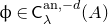 $\unicode {x03D5} \in \mathsf{C}_\lambda ^{{\rm an},-d}(A)$
defines a
$\unicode {x03D5} \in \mathsf{C}_\lambda ^{{\rm an},-d}(A)$
defines a $d$
-cyclic analytic minimal model
$d$
-cyclic analytic minimal model
 \begin{align*} ({\rm H}(A)^{\unicode {x03D5}},\unicode {x03C3}^{\unicode {x03D5}}) \end{align*}
which depends only on the class $[\unicode {x03D5}]_{{\rm an}} \in {\rm HC}_\lambda ^{{\rm an},-n}(A)$
up to an isomorphism of cyclic analytic
$[\unicode {x03D5}]_{{\rm an}} \in {\rm HC}_\lambda ^{{\rm an},-n}(A)$
up to an isomorphism of cyclic analytic $A_\infty$
-algebras. If
$A_\infty$
-algebras. If $B$
is a second such
$B$
is a second such $A_\infty$
-algebra, then every analytic quasi-isomorphism
$A_\infty$
-algebra, then every analytic quasi-isomorphism $f\colon B \to A$
induces a cyclic analytic
$f\colon B \to A$
induces a cyclic analytic $A_\infty$
-isomorphism
$A_\infty$
-isomorphism
 \begin{align*} ({\rm H}(B)^{f^*\unicode {x03D5}},\unicode {x03C3}^{f^*\unicode {x03D5}})\ \cong _{{\rm cyc},{\rm an}}\ ({\rm H}(A)^{\unicode {x03D5}},\unicode {x03C3}^{\unicode {x03D5}}). \end{align*}
The proof of our main theorem follows the work of Amorim and Tu [Reference Amorim and TuAT25], proving a type of ‘analytic Darboux theorem’ for the homotopy-invariant version of cyclic structures [Reference ChoCho08], which are related to the noncommutative symplectic structures of [Reference Kontsevich and SoibelmanKS09].
Cyclic $A_\infty$
-algebras are especially interesting in the 3-CY setting, because a cyclic
$A_\infty$
-algebras are especially interesting in the 3-CY setting, because a cyclic $A_\infty$
-structure is captured by a potential: given such a 3-cyclic
$A_\infty$
-structure is captured by a potential: given such a 3-cyclic $A_\infty$
-algebra
$A_\infty$
-algebra $(A,\unicode {x03C3})$
there is an associated noncommutative potential
$(A,\unicode {x03C3})$
there is an associated noncommutative potential $W \in \widehat {\mathsf{T}} V := \prod _{n\geqslant 0} V^{\otimes n}$
in the completed tensor algebra over
$W \in \widehat {\mathsf{T}} V := \prod _{n\geqslant 0} V^{\otimes n}$
in the completed tensor algebra over $V = (A^1)^\vee$
. If
$V = (A^1)^\vee$
. If $A$
is, moreover, equipped with an analytic structure, this potential lies in an analytic subring
$A$
is, moreover, equipped with an analytic structure, this potential lies in an analytic subring
 \begin{align*} \widetilde {\mathsf{T}} V := \left \{(v_n)_{n\in \mathbb{N}} \in \widehat {\mathsf{T}} V \quad \middle |\quad \exists C \;\textrm{such that}\; {\left \|v_n\right \|} \lt C^n \;\textrm{for all}\; n\gt 0\right \}, \end{align*}
and is therefore an analytic potential in the framework of Hua and Keller [Reference Hua and KellerHK19]. Analytic morphisms induce algebra morphisms between these analytic subrings, so in the 3-CY setting our theorem can be interpreted as follows.
Corollary B (Corollary4.24). In the situation of Theorem
A
suppose that $\unicode {x03D5}$
is a right 3-CY structure, and write
$\unicode {x03D5}$
is a right 3-CY structure, and write $V_A = {\rm H}^1(A)^\vee$
. Then there is a canonical analytic potential
$V_A = {\rm H}^1(A)^\vee$
. Then there is a canonical analytic potential
 \begin{align*} W^{\unicode {x03D5}} \in \widetilde {\mathsf{T}} V_A, \end{align*}
which is well defined up to an automorphism of $\widetilde {\mathsf{T}} V_A$
. Moreover, if
$\widetilde {\mathsf{T}} V_A$
. Moreover, if $f\colon B\to A$
is a quasi-isomorphism and
$f\colon B\to A$
is a quasi-isomorphism and $V_B = {\rm H}^1(B)^\vee$
then there is an induced isomorphism
$V_B = {\rm H}^1(B)^\vee$
then there is an induced isomorphism $g\colon \widetilde {\mathsf{T}} V_A \to \widetilde {\mathsf{T}} V_B$
such that
$g\colon \widetilde {\mathsf{T}} V_A \to \widetilde {\mathsf{T}} V_B$
such that
 \begin{align*} g(W^{\unicode {x03D5}}) = W^{f^*\unicode {x03D5}}. \end{align*}
The main theorem and its corollary provide a bridge between infinite dimensional settings, involving, for example, normed DG algebras, and finite dimensional settings, such as those considered in [Reference Hua and KellerHK19]. In particular, it applies to the gauge-theoretic setup mentioned above.
1.3 Analytic CY structures in complex geometry
We apply TheoremA to describe the cyclic analytic minimal models of Toda’s DGA $\mathfrak{g}_{\mathcal{E}}$
for a perfect complex
$\mathfrak{g}_{\mathcal{E}}$
for a perfect complex $\mathcal{E}$
of vector bundles on a smooth projective variety
$\mathcal{E}$
of vector bundles on a smooth projective variety $X$
of dimension
$X$
of dimension $d$
. If
$d$
. If $X$
is Calabi–Yau with holomorphic volume form
$X$
is Calabi–Yau with holomorphic volume form ${\unicode {x03BD}_X}\in {\rm H}^0(X,\Omega ^d_X)$
, then there is an induced right CY structure: the bounded linear functional
${\unicode {x03BD}_X}\in {\rm H}^0(X,\Omega ^d_X)$
, then there is an induced right CY structure: the bounded linear functional
 \begin{align} \mathfrak{g}_{\mathcal{E}} \to {\mathbb{C}},\quad \alpha \mapsto \int _X {\rm tr}(\alpha )\wedge {\unicode {x03BD}_X} \end{align}
defines a cocycle $\unicode {x03D5}^{\unicode {x03BD}_X} \in \mathsf{C}_\lambda ^{{\rm an},-d}(\mathfrak{g}_{\mathcal{E}})$
which is nondegenerate in the appropriate sense. The associated cyclic analytic minimal model
$\unicode {x03D5}^{\unicode {x03BD}_X} \in \mathsf{C}_\lambda ^{{\rm an},-d}(\mathfrak{g}_{\mathcal{E}})$
which is nondegenerate in the appropriate sense. The associated cyclic analytic minimal model $(\mathcal{H}_{\mathcal{E}}^{\unicode {x03BD}_X},\unicode {x03C3}^{\unicode {x03BD}_X})$
recovers that found in [Reference PolishchukPol01, Reference TuTu14, Reference TodaTod18].
$(\mathcal{H}_{\mathcal{E}}^{\unicode {x03BD}_X},\unicode {x03C3}^{\unicode {x03BD}_X})$
recovers that found in [Reference PolishchukPol01, Reference TuTu14, Reference TodaTod18].
There are, in general, many other choices of analytic right CY structures, each of which yields a cyclic analytic minimal model of $\mathfrak{g}_{\mathcal{E}}$
. We identify a family of such CY structures corresponding to holomorphic volume germs along the support
$\mathfrak{g}_{\mathcal{E}}$
. We identify a family of such CY structures corresponding to holomorphic volume germs along the support $Z = {\rm \mathsf{supp}}\; \mathcal{E}$
, by which we mean the equivalence class of a differential form
$Z = {\rm \mathsf{supp}}\; \mathcal{E}$
, by which we mean the equivalence class of a differential form
 \begin{align*} \unicode {x03BD} \in (\Omega _X^d)_Z := \operatorname {\underset {U\supset Z}{colim}} \Gamma (U,\Omega _X^d) \end{align*}
on analytic open neighbourhoods $U\supset Z$
, which is nonvanishing when
$U\supset Z$
, which is nonvanishing when $U$
is sufficiently small. Such a germ determines a bounded linear functional on the DG subalgebra
$U$
is sufficiently small. Such a germ determines a bounded linear functional on the DG subalgebra
 \begin{align*} \mathfrak{g}_{\mathcal{E}|_U,c} := \left \{ \unicode {x03BE} \in \mathfrak{g}_{\mathcal{E}} \mid {\rm \mathsf{supp}}\; \unicode {x03BE} \subset U \right \} \subset \mathfrak{g}_{\mathcal{E},c}, \end{align*}
of Dolbeault forms with compact support in any sufficiently small neighbourhood $U\supset Z$
. This functional induces an analytic right CY structure on
$U\supset Z$
. This functional induces an analytic right CY structure on $\mathfrak{g}_{\mathcal{E}|_U,c}$
, which we transfer to a right CY structure on
$\mathfrak{g}_{\mathcal{E}|_U,c}$
, which we transfer to a right CY structure on $\mathfrak{g}_{\mathcal{E}}$
using an explicit
$\mathfrak{g}_{\mathcal{E}}$
using an explicit $A_\infty$
-quasi-isomorphism. This leads to the following theorem.
$A_\infty$
-quasi-isomorphism. This leads to the following theorem.
Theorem C (Theorem5.10). Let $X$
be a smooth projective variety of dimension
$X$
be a smooth projective variety of dimension $d$
, and
$d$
, and $\mathcal{E} \in \mathsf{D}^{{\rm perf}}(X)$
a complex with support
$\mathcal{E} \in \mathsf{D}^{{\rm perf}}(X)$
a complex with support $Z\subset X$
. Then every volume germ
$Z\subset X$
. Then every volume germ $\unicode {x03BD} \in (\Omega ^d_X)_Z$
determines a class
$\unicode {x03BD} \in (\Omega ^d_X)_Z$
determines a class $[\unicode {x03D5}^{\unicode {x03BD}}]_{{\rm an}} \in {\rm HC}_\lambda ^{{\rm an},-d}(\mathfrak{g}_{\mathcal{E}})$
of an analytic right
$[\unicode {x03D5}^{\unicode {x03BD}}]_{{\rm an}} \in {\rm HC}_\lambda ^{{\rm an},-d}(\mathfrak{g}_{\mathcal{E}})$
of an analytic right $d$
-CY structure, and hence a
$d$
-CY structure, and hence a $d$
-cyclic analytic minimal model
$d$
-cyclic analytic minimal model
 \begin{align*} (\mathcal{H}_{\mathcal{E}}^{\unicode {x03BD}},\unicode {x03C3}^{\unicode {x03BD}}) = ({\rm Ext}_X^\bullet (\mathcal{E},\mathcal{E}),\unicode {x03BC}^\nu ,\unicode {x03C3}^\nu ) \end{align*}
which is uniquely defined up to an isomorphism of cyclic analytic $A_\infty$
-algebras. Moreover,
$A_\infty$
-algebras. Moreover, $\mathcal{H}_{\mathcal{E}}^{\unicode {x03BD}}$
is isomorphic to
$\mathcal{H}_{\mathcal{E}}^{\unicode {x03BD}}$
is isomorphic to $\mathcal{H}_{\mathcal{E}}$
as an ordinary (non-cyclic) analytical
$\mathcal{H}_{\mathcal{E}}$
as an ordinary (non-cyclic) analytical $A_\infty$
-algebra.
$A_\infty$
-algebra.
The above theorem applies to the setting of [Reference TodaTod18] when $\mathcal{E}$
is a resolution of a polystable sheaf
$\mathcal{E}$
is a resolution of a polystable sheaf $\mathcal{F} \in \mathsf{coh}\; X$
whose support does not meet the canonical divisor
$\mathcal{F} \in \mathsf{coh}\; X$
whose support does not meet the canonical divisor $K_X$
. Some examples considered in the enumerative geometry literature are point sheaves [Reference BehrendBeh09] and sheaves on contractible curves [Reference SzendrőiSze08, Reference KatzKat08]. If
$K_X$
. Some examples considered in the enumerative geometry literature are point sheaves [Reference BehrendBeh09] and sheaves on contractible curves [Reference SzendrőiSze08, Reference KatzKat08]. If $X$
is a threefold, then there is a noncommutative analytic potential
$X$
is a threefold, then there is a noncommutative analytic potential
 \begin{align*} W^{\unicode {x03BD}}_{\mathcal{E}} \in \widetilde {\mathsf{T}} {\rm Ext}^1(\mathcal{E},\mathcal{E})^\vee , \end{align*}
whose abelianisation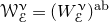 $\mathcal{W}^{\unicode {x03BD}}_{\mathcal{E}} = (W^{\unicode {x03BD}}_{\mathcal{E}})^{{\rm ab}}$
is an ordinary analytic function whose critical locus describes the moduli space of semistable sheaves around
$\mathcal{W}^{\unicode {x03BD}}_{\mathcal{E}} = (W^{\unicode {x03BD}}_{\mathcal{E}})^{{\rm ab}}$
is an ordinary analytic function whose critical locus describes the moduli space of semistable sheaves around $\mathcal{F}$
. Hence, the gauge-theoretic setup can be generalised from the projective CY-3 case in [Reference TodaTod18] to open analytic neighbourhoods of projective CY-3 folds equipped with a choice of volume form.
$\mathcal{F}$
. Hence, the gauge-theoretic setup can be generalised from the projective CY-3 case in [Reference TodaTod18] to open analytic neighbourhoods of projective CY-3 folds equipped with a choice of volume form.
In our setup, both the $A_\infty$
-algebra structure on the Ext-algebra of
$A_\infty$
-algebra structure on the Ext-algebra of $\mathcal{E}$
and the volume germ
$\mathcal{E}$
and the volume germ $\unicode {x03BD}$
are determined in terms of analytic-local geometry around the support of
$\unicode {x03BD}$
are determined in terms of analytic-local geometry around the support of $\mathcal{E}$
in
$\mathcal{E}$
in $X$
. One would therefore expect that the cyclic
$X$
. One would therefore expect that the cyclic $A_\infty$
-algebra
$A_\infty$
-algebra $(\mathcal{H}_{\mathcal{E}}^{\unicode {x03BD}},\unicode {x03C3}^{\unicode {x03BD}})$
is not sensitive to the global geometry of
$(\mathcal{H}_{\mathcal{E}}^{\unicode {x03BD}},\unicode {x03C3}^{\unicode {x03BD}})$
is not sensitive to the global geometry of $X$
. To show this we consider embeddings of such neighbourhoods into other projective varieties.
$X$
. To show this we consider embeddings of such neighbourhoods into other projective varieties.
Theorem D (Theorem5.13). Let $X,X'$
be smooth projective varieties of dimension
$X,X'$
be smooth projective varieties of dimension $d$
, and let
$d$
, and let $Y$
be an open submanifold of
$Y$
be an open submanifold of $X$
with an open embedding into
$X$
with an open embedding into $X'$
, as in the following diagram.
$X'$
, as in the following diagram.

Let $\mathcal{E}'$
be a perfect complex on
$\mathcal{E}'$
be a perfect complex on $X'$
with cohomological support
$X'$
with cohomological support $f(Z) \subset f(Y)$
for some compact
$f(Z) \subset f(Y)$
for some compact $Z\subset Y$
, and let
$Z\subset Y$
, and let $\unicode {x03BD} \in (\Omega ^d_{X'})_Z$
be a volume germ. Then for any
$\unicode {x03BD} \in (\Omega ^d_{X'})_Z$
be a volume germ. Then for any $\mathcal{E} \in \mathsf{D}^{{\rm perf}}(X)$
such that
$\mathcal{E} \in \mathsf{D}^{{\rm perf}}(X)$
such that $\mathcal{E}|_Y \simeq f^*\mathcal{E}'$
, there exists an analytic quasi-isomorphism
$\mathcal{E}|_Y \simeq f^*\mathcal{E}'$
, there exists an analytic quasi-isomorphism
 \begin{align*} \mathfrak{g}_{\mathcal{E}} \simeq _{{\rm an}} \mathfrak{g}_{\mathcal{E}'} \end{align*}
which identifies the classes $[\unicode {x03D5}^{\unicode {x03BD}}]$
and
$[\unicode {x03D5}^{\unicode {x03BD}}]$
and $[\unicode {x03D5}^{f^*\unicode {x03D5}}]$
via pullback. In particular, there is an analytic cyclic
$[\unicode {x03D5}^{f^*\unicode {x03D5}}]$
via pullback. In particular, there is an analytic cyclic $A_\infty$
-isomorphism between the
$A_\infty$
-isomorphism between the $d$
-cyclic analytic minimal models
$d$
-cyclic analytic minimal models
 \begin{align*} \big(\mathcal{H}_{\mathcal{E}}^{f^*\unicode {x03BD}},\unicode {x03C3}^{f^*\unicode {x03BD}}\big) \cong _{{\rm an},{\rm cyc}} (\mathcal{H}_{\mathcal{E}'}^{\unicode {x03BD}},\unicode {x03C3}^{\unicode {x03BD}}). \end{align*}
Corollary E (Corollary5.14). If $X,X'$
are threefolds, then the noncommutative potentials
$X,X'$
are threefolds, then the noncommutative potentials $W_{\mathcal{E}'}^{\unicode {x03BD}}$
and
$W_{\mathcal{E}'}^{\unicode {x03BD}}$
and $W_{\mathcal{E}}^{f^*\unicode {x03BD}}$
are related by an analytic change of variables
$W_{\mathcal{E}}^{f^*\unicode {x03BD}}$
are related by an analytic change of variables $\widetilde {\mathsf{T}}{\rm Ext}^1(\mathcal{E},\mathcal{E})^\vee \xrightarrow {\sim } \widetilde {\mathsf{T}}{\rm Ext}^1(\mathcal{E}',\mathcal{E}')$
.
$\widetilde {\mathsf{T}}{\rm Ext}^1(\mathcal{E},\mathcal{E})^\vee \xrightarrow {\sim } \widetilde {\mathsf{T}}{\rm Ext}^1(\mathcal{E}',\mathcal{E}')$
.
One implication of TheoremD is that there is a canonical cyclic $A_\infty$
-structure on the Ext-algebra of a compactly supported sheaf
$A_\infty$
-structure on the Ext-algebra of a compactly supported sheaf $\mathcal{F}$
on a quasi-projective Calabi–Yau threefold
$\mathcal{F}$
on a quasi-projective Calabi–Yau threefold $Y$
equipped with a fixed volume form. Indeed, applying TheoremC to a resolution of
$Y$
equipped with a fixed volume form. Indeed, applying TheoremC to a resolution of $\mathcal{F}$
on any compactification
$\mathcal{F}$
on any compactification $X = \overline Y$
, it follows from TheoremD that the cyclic
$X = \overline Y$
, it follows from TheoremD that the cyclic $A_\infty$
-algebra obtained does not depend on these choices.
$A_\infty$
-algebra obtained does not depend on these choices.
For the reader who is exclusively interesting in projective Calabi–Yau geometry, we stress that TheoremD also allows one to compare the cyclic analytic $A_\infty$
-structure (hence the enumerative geometry) of different projective CY varieties on a common analytic neighbourhood. As a motivating example, we compute the cyclic analytic
$A_\infty$
-structure (hence the enumerative geometry) of different projective CY varieties on a common analytic neighbourhood. As a motivating example, we compute the cyclic analytic $A_\infty$
-structure on the Ext-algebra of an arbitrary point sheaf.
$A_\infty$
-structure on the Ext-algebra of an arbitrary point sheaf.
Proposition F (Proposition5.18). Let $p\in X$
be a point on a smooth projective variety
$p\in X$
be a point on a smooth projective variety $X$
of dimension
$X$
of dimension $d$
, and
$d$
, and $\mathcal{F} \to \mathcal{O}_p$
a locally free resolution for the associated point sheaf. Then for every volume germ
$\mathcal{F} \to \mathcal{O}_p$
a locally free resolution for the associated point sheaf. Then for every volume germ $\unicode {x03BD} \in (\Omega ^d_Y)_p$
there is an isomorphism of cyclic analytic
$\unicode {x03BD} \in (\Omega ^d_Y)_p$
there is an isomorphism of cyclic analytic $A_\infty$
-algebras
$A_\infty$
-algebras
 \begin{align*} \mathcal{H}^{\unicode {x03BD}}_{\mathcal{F}} \cong _{{\rm an},{\rm cyc}} \left (\ \bigwedge ^\bullet T_{\kern -.5pt o\kern .5pt}{\mathbb{A}}^d,\ \unicode {x03C3}^\lambda \colon \xi \mapsto \lambda (\xi \wedge -)\ \right ), \end{align*}
where the right-hand side denotes the graded algebra of polyvectors at the origin $o\in {\mathbb{A}}^d$
with cyclic structure induced by some linear form
$o\in {\mathbb{A}}^d$
with cyclic structure induced by some linear form $\lambda \colon \bigwedge ^d T_{\kern -.5pt o\kern .5pt}{\mathbb{A}}^d \xrightarrow {\sim } {\mathbb{C}}$
.
$\lambda \colon \bigwedge ^d T_{\kern -.5pt o\kern .5pt}{\mathbb{A}}^d \xrightarrow {\sim } {\mathbb{C}}$
.
1.4 Structure of the paper
In § 2 we recall the definition of (analytic) $A_\infty$
-algebras, and prove some new results about inverses of analytic morphisms that are used in later sections.
$A_\infty$
-algebras, and prove some new results about inverses of analytic morphisms that are used in later sections.
In § 3 we define analytic $A_\infty$
-bimodules and analytic Hochschild cohomology, and we prove some new results about the invertibility of analytic
$A_\infty$
-bimodules and analytic Hochschild cohomology, and we prove some new results about the invertibility of analytic $A_\infty$
-bimodule maps.
$A_\infty$
-bimodule maps.
In § 4 we define analytic (homotopy) cyclic structures, used to prove TheoremA.
In § 5 we apply these results to the DG algebras of Dolbeault differential forms, which is used to prove TheoremsC and D, and PropositionF. This section is largely self-contained.
2. Analytic
$A_\infty$
-algebras

In this section we recall the definitions of $A_\infty$
-algebras and morphisms, and introduce the relevant category of analytic
$A_\infty$
-algebras and morphisms, and introduce the relevant category of analytic $A_\infty$
-algebras based on the convergence conditions of [Reference TuTu14, Reference TodaTod18]. The
$A_\infty$
-algebras based on the convergence conditions of [Reference TuTu14, Reference TodaTod18]. The $A_\infty$
-algebras we will use in § 5 have a natural structure of a quiver (possibly with multiplicity), since the
$A_\infty$
-algebras we will use in § 5 have a natural structure of a quiver (possibly with multiplicity), since the $A_\infty$
-algebras encode a certain noncommutative multi-pointed deformation theory. In order to preserve this structure in all our constructions, we work in a general setup of
$A_\infty$
-algebras encode a certain noncommutative multi-pointed deformation theory. In order to preserve this structure in all our constructions, we work in a general setup of $A_\infty$
-algebras over a separable algebra rather than over a field, following the example of [Reference Van den BerghVdB15].
$A_\infty$
-algebras over a separable algebra rather than over a field, following the example of [Reference Van den BerghVdB15].
In what follows let $\ell$
be a separable
$\ell$
be a separable $\mathbb{C}$
-algebra (i.e. a product of matrix algebras) and
$\mathbb{C}$
-algebra (i.e. a product of matrix algebras) and $\operatorname {\mathsf{grMod}} \ell ^e$
the graded
$\operatorname {\mathsf{grMod}} \ell ^e$
the graded $\mathbb{C}$
-linear category of graded bimodules
$\mathbb{C}$
-linear category of graded bimodules $V = V^\bullet$
which are nonzero in finitely many degrees. Given
$V = V^\bullet$
which are nonzero in finitely many degrees. Given $V,W\in \operatorname {\mathsf{grMod}} \ell ^e$
we denote the graded vector space of
$V,W\in \operatorname {\mathsf{grMod}} \ell ^e$
we denote the graded vector space of $\ell ^e$
-linear maps by
$\ell ^e$
-linear maps by
 \begin{align*} \hom _{{\ell ^e}}^\bullet (V,W) := \bigoplus _{n\in \mathbb{Z}} {{\rm Hom}}_{{\ell ^e}}(V^n,W^{n+\bullet }) \end{align*}
and write ${{\rm Hom}}_{\ell ^e}(V,W)$
for the subspace of graded morphisms. We write
${{\rm Hom}}_{\ell ^e}(V,W)$
for the subspace of graded morphisms. We write $|f|$
for the degree of a homogeneous element
$|f|$
for the degree of a homogeneous element $f\in \hom _{\ell ^e}^\bullet (V,W)$
. The category
$f\in \hom _{\ell ^e}^\bullet (V,W)$
. The category $\operatorname {\mathsf{grMod}} \ell ^e$
carries the usual graded tensor product
$\operatorname {\mathsf{grMod}} \ell ^e$
carries the usual graded tensor product $\otimes := \otimes _\ell$
and shift functor
$\otimes := \otimes _\ell$
and shift functor $[1]\colon \operatorname {\mathsf{grMod}} \ell ^e \to \operatorname {\mathsf{grMod}} \ell ^e$
. We write
$[1]\colon \operatorname {\mathsf{grMod}} \ell ^e \to \operatorname {\mathsf{grMod}} \ell ^e$
. We write $s\in \hom ^{-1}_{\ell ^e}(V,V[1])$
for the shift map, acting as the identity
$s\in \hom ^{-1}_{\ell ^e}(V,V[1])$
for the shift map, acting as the identity $V^i \to V^i = (V[1])^{i-1}$
on each graded component.
$V^i \to V^i = (V[1])^{i-1}$
on each graded component.
2.1
$A_\infty$
-algebras and morphisms
 $A_\infty$
-algebras are commonly defined as sequences of multilinear maps either of the form
$A_\infty$
-algebras are commonly defined as sequences of multilinear maps either of the form $V^{\otimes n} \to W$
with varying degrees or of the form
$V^{\otimes n} \to W$
with varying degrees or of the form $V[1]^{\otimes n} \to W[1]$
, with all maps being homogeneous. In this section we adopt the latter convention, adopting the notation
$V[1]^{\otimes n} \to W[1]$
, with all maps being homogeneous. In this section we adopt the latter convention, adopting the notation
 \begin{align*} \mathcal{M}^\bullet (V,W) := \prod _{n=0}^\infty \hom _{\ell ^e}^\bullet (V[1]^{\otimes n}, W[1]) \end{align*}
for the graded vector space of these sequences $f = (f_n)_{n\in \mathbb{N}}$
, and we write
$f = (f_n)_{n\in \mathbb{N}}$
, and we write $\overline {\mathcal{M}}(V,W) \subset \mathcal{M}(V,W)$
for the subspace of sequences with
$\overline {\mathcal{M}}(V,W) \subset \mathcal{M}(V,W)$
for the subspace of sequences with $f_0=0$
. There exist various compositions between sequences in
$f_0=0$
. There exist various compositions between sequences in $\mathcal{M}(V,W)$
, which are most cleanly described using the bar construction
$\mathcal{M}(V,W)$
, which are most cleanly described using the bar construction
 \begin{align*} \mathsf{B} V := \left (\bigoplus _{n\in \mathbb{N}} V[1]^{\otimes n}, \Delta \right ) \end{align*}
which is a cofree coaugmented conilpotent coalgebra over $\ell$
with the decomposition coproduct
$\ell$
with the decomposition coproduct $\Delta$
. The cofreeness implies that every sequence
$\Delta$
. The cofreeness implies that every sequence $f \in \mathcal{M}(V,V) \simeq \hom _{\ell ^e}(\mathsf{B} V,V[1])$
induces a unique coderivation
$f \in \mathcal{M}(V,V) \simeq \hom _{\ell ^e}(\mathsf{B} V,V[1])$
induces a unique coderivation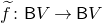 $\widetilde f \colon \mathsf{B} V \to \mathsf{B} V$
via the formula (see [Reference TradlerTra08, Lemma 2.3])
$\widetilde f \colon \mathsf{B} V \to \mathsf{B} V$
via the formula (see [Reference TradlerTra08, Lemma 2.3])
 \begin{align*} \widetilde f := \sum _{k\in \mathbb{N}} \sum _{i,j\geqslant 0} {\rm id}_{V[1]}^{\otimes i} \otimes f_k \otimes {\rm id}_{V[1]}^{\otimes j}, \end{align*}
and likewise every coderivation defines a sequence in $\mathcal{M}(V,V)$
by composing with the obvious projection
$\mathcal{M}(V,V)$
by composing with the obvious projection $\unicode {x03C0} \colon \mathsf{B} V \to V[1]$
. In terms of the bar construction,
$\unicode {x03C0} \colon \mathsf{B} V \to V[1]$
. In terms of the bar construction, $A_\infty$
-algebras are defined as follows.
$A_\infty$
-algebras are defined as follows.
Definition 2.1. An $A_\infty$
-algebra is a pair
$A_\infty$
-algebra is a pair $(A,\unicode {x03BC})$
of
$(A,\unicode {x03BC})$
of $A\in \operatorname {\mathsf{grMod}} \ell ^e$
and a map
$A\in \operatorname {\mathsf{grMod}} \ell ^e$
and a map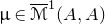 $\unicode {x03BC} \in \overline {\mathcal{M}}^1(A, A)$
satisfying the condition
$\unicode {x03BC} \in \overline {\mathcal{M}}^1(A, A)$
satisfying the condition ${\widetilde {\unicode {x03BC}}}^2=0$
, or equivalently
${\widetilde {\unicode {x03BC}}}^2=0$
, or equivalently $\unicode {x03BC} \circ \widetilde {\unicode {x03BC}} = 0$
.
$\unicode {x03BC} \circ \widetilde {\unicode {x03BC}} = 0$
.
The $A_\infty$
-condition implies that
$A_\infty$
-condition implies that $\unicode {x03BC}_1^2=0$
, so that
$\unicode {x03BC}_1^2=0$
, so that $\unicode {x03BC}_1$
makes
$\unicode {x03BC}_1$
makes $A[1]$
into a cochain complex. We say an
$A[1]$
into a cochain complex. We say an $A_\infty$
-algebra is compact if the cohomology with respect to
$A_\infty$
-algebra is compact if the cohomology with respect to $\unicode {x03BC}_1$
is finite dimensional over
$\unicode {x03BC}_1$
is finite dimensional over $\mathbb{C}$
.
$\mathbb{C}$
.
Example 2.2. If $(A,{\rm d}, \cdot )$
is a DG algebra, then the associated
$(A,{\rm d}, \cdot )$
is a DG algebra, then the associated $A_\infty$
-structure is given by the compositions
$A_\infty$
-structure is given by the compositions $\unicode {x03BC}_1 = -s\circ {\rm d} \circ s^{-1}$
and
$\unicode {x03BC}_1 = -s\circ {\rm d} \circ s^{-1}$
and $\unicode {x03BC}_2 = -s^{-1} \circ (-\cdot -) \circ (s^{-1}\otimes s^{-1})$
.
$\unicode {x03BC}_2 = -s^{-1} \circ (-\cdot -) \circ (s^{-1}\otimes s^{-1})$
.
Given $V,W\in \operatorname {\mathsf{grMod}} \ell ^e$
, every sequence
$V,W\in \operatorname {\mathsf{grMod}} \ell ^e$
, every sequence $f \in \mathcal{M}(V,W) \simeq \hom _{\ell ^e}(\mathsf{B} V,W[1])$
induces a cohomomorphism
$f \in \mathcal{M}(V,W) \simeq \hom _{\ell ^e}(\mathsf{B} V,W[1])$
induces a cohomomorphism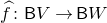 $\widehat f \colon \mathsf{B} V \to \mathsf{B} W$
between the associated coalgebras via the formula
$\widehat f \colon \mathsf{B} V \to \mathsf{B} W$
between the associated coalgebras via the formula
 \begin{align*} \widehat f := \sum _{k\in \mathbb{N}} \sum _{n_1,\ldots ,n_k\in \mathbb{N}} f_{n_1} \otimes \cdots \otimes f_{n_k}, \end{align*}
and every cohomomorphism between bar-coalgebras can be described in this way. These lifts are used to define (pre-)morphisms of $A_\infty$
-algebras.
$A_\infty$
-algebras.
Definition 2.3. A pre-morphism between $A_\infty$
-algebras
$A_\infty$
-algebras $A$
and
$A$
and $B$
is an element
$B$
is an element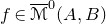 $f\in \overline {\mathcal{M}}^0(A,B)$
. A pre-morphism is a morphism if it satisfies
$f\in \overline {\mathcal{M}}^0(A,B)$
. A pre-morphism is a morphism if it satisfies $\widetilde {\unicode {x03BC}}_B \circ \widehat f = \widehat f \circ \widetilde {\unicode {x03BC}}_A$
, or equivalently
$\widetilde {\unicode {x03BC}}_B \circ \widehat f = \widehat f \circ \widetilde {\unicode {x03BC}}_A$
, or equivalently $\unicode {x03BC}_B \circ \widehat f=f\circ \widetilde {\unicode {x03BC}}_A$
.
$\unicode {x03BC}_B \circ \widehat f=f\circ \widetilde {\unicode {x03BC}}_A$
.
The morphism condition implies that $f_1\colon A[1] \to B[1]$
is a morphism of cochain complexes. A morphism
$f_1\colon A[1] \to B[1]$
is a morphism of cochain complexes. A morphism $f\in {{\rm Hom}}_{\mathsf{Alg}^\infty }(A,B)$
is called a quasi-isomorphism if
$f\in {{\rm Hom}}_{\mathsf{Alg}^\infty }(A,B)$
is called a quasi-isomorphism if $f_1$
is a quasi-isomorphism.
$f_1$
is a quasi-isomorphism.
By lifting pre-morphisms to cohomomorphisms, one obtains an associative composition between (pre-)morphisms which we will write as
 \begin{align*} \diamond \colon \mathcal{M}^0(B,C) \times \mathcal{M}^0(A,B) \to \mathcal{M}^0(A,C),\quad g \diamond f := g \circ \widehat f. \end{align*}
With this composition, $A_\infty$
-algebras form a category
$A_\infty$
-algebras form a category $\mathsf{Alg}^\infty$
with morphism spaces
$\mathsf{Alg}^\infty$
with morphism spaces ${{\rm Hom}}_{\mathsf{Alg}^\infty }(A,B)$
. We remark that the composition of two quasi-isomorphisms is again a quasi-isomorphism.
${{\rm Hom}}_{\mathsf{Alg}^\infty }(A,B)$
. We remark that the composition of two quasi-isomorphisms is again a quasi-isomorphism.
Definition 2.4. A unit for an $A_\infty$
-algebra
$A_\infty$
-algebra $A = (A,\unicode {x03BC})$
is an injective map
$A = (A,\unicode {x03BC})$
is an injective map $\unicode {x1D7D9} \colon \ell [1] \to A[1]$
such that
$\unicode {x1D7D9} \colon \ell [1] \to A[1]$
such that
 \begin{align*} \begin{aligned} \unicode {x03BC}_2(\unicode {x1D7D9}(l),a) = la,\quad \unicode {x03BC}_2(a,\unicode {x1D7D9}(l)) = (-1)^{|a|+1} al \quad &\textrm{for all}\; l\in \ell [1],\ a\in A[1]\\[5pt] \unicode {x03BC}_n(\ldots ,\unicode {x1D7D9}(l),\ldots ) = 0 \quad &\textrm{for all}\; n\neq 2, \end{aligned} \end{align*}
and a triple $(A,\unicode {x03BC},\unicode {x1D7D9})$
is called a unital
$(A,\unicode {x03BC},\unicode {x1D7D9})$
is called a unital $A_\infty$
-algebra.
$A_\infty$
-algebra.
If $A$
and
$A$
and $B$
are unital
$B$
are unital $A_\infty$
-algebras, with units
$A_\infty$
-algebras, with units $\unicode {x1D7D9}_A$
and
$\unicode {x1D7D9}_A$
and $\unicode {x1D7D9}_B$
, then one can consider the subset
$\unicode {x1D7D9}_B$
, then one can consider the subset ${{\rm Hom}}_{\mathsf{Alg}^\infty }^{{\rm un}}(A,B) \subset {{\rm Hom}}_{\mathsf{Alg}^\infty }(A,B)$
of morphisms
${{\rm Hom}}_{\mathsf{Alg}^\infty }^{{\rm un}}(A,B) \subset {{\rm Hom}}_{\mathsf{Alg}^\infty }(A,B)$
of morphisms $f$
satisfying
$f$
satisfying
 \begin{align*} \begin{aligned} f_1 \circ \unicode {x1D7D9}_A &= \unicode {x1D7D9}_B,\\[5pt] f_{i+j+1} \circ ({\rm id}^{\otimes i} \otimes \unicode {x1D7D9}_A \otimes {\rm id}^{\otimes j}) &= 0\quad \textrm{for all}\; i+j \gt 0, \end{aligned} \end{align*}
which are called unital $A_\infty$
-morphisms. The composition of two unital morphisms is again unital, so unital
$A_\infty$
-morphisms. The composition of two unital morphisms is again unital, so unital $A_\infty$
-algebras again form a category
$A_\infty$
-algebras again form a category $\mathsf{Alg}^{\infty ,{\rm un}}$
. Finally, we consider a weakening of the unital condition in cohomology.
$\mathsf{Alg}^{\infty ,{\rm un}}$
. Finally, we consider a weakening of the unital condition in cohomology.
Definition 2.5. A weak unit, or cohomological unit, is a map $\unicode {x1D7D9}\colon \ell [1] \to A[1]$
for which the image is
$\unicode {x1D7D9}\colon \ell [1] \to A[1]$
for which the image is $\unicode {x03BC}_1$
-closed and which satisfies the following relations in
$\unicode {x03BC}_1$
-closed and which satisfies the following relations in $\unicode {x03BC}_1$
-cohomology:
$\unicode {x03BC}_1$
-cohomology:
 \begin{align*} \unicode {x03BC}_2([\unicode {x1D7D9}(l)],[a]) = [la],\quad \unicode {x03BC}_2([a],[\unicode {x1D7D9}(l)]) = (-1)^{|a|+1}[al]. \end{align*}
One can likewise define a category of cohomologically unital $A_\infty$
-algebras, with morphisms consisting of
$A_\infty$
-algebras, with morphisms consisting of $A_\infty$
-morphisms
$A_\infty$
-morphisms $f$
for which
$f$
for which $[f_1(\unicode {x1D7D9}(l))] = [\unicode {x1D7D9}(l)]$
.
$[f_1(\unicode {x1D7D9}(l))] = [\unicode {x1D7D9}(l)]$
.
2.2 Homotopies $A_\infty$
-algebras are a model for homotopical algebra, and it is therefore natural to consider morphisms up to homotopy. There are various definitions, ranging from algebraic [Reference Lefèvre-HasegawaLH03, Reference KellerKel01] to more continuous variants [Reference Flajolet and SedgewickFS09], which lead to equivalent theories of homotopy. Below we use a variation of the piecewise-smooth model in [Reference Flajolet and SedgewickFS09, § 4.2.1].
$A_\infty$
-algebras are a model for homotopical algebra, and it is therefore natural to consider morphisms up to homotopy. There are various definitions, ranging from algebraic [Reference Lefèvre-HasegawaLH03, Reference KellerKel01] to more continuous variants [Reference Flajolet and SedgewickFS09], which lead to equivalent theories of homotopy. Below we use a variation of the piecewise-smooth model in [Reference Flajolet and SedgewickFS09, § 4.2.1].
Definition 2.6. Let $\mathsf{PC}^\infty ([0,1]) \subset L^\infty ([0,1])$
denote the ring of equivalence classes of bounded real functions on
$\mathsf{PC}^\infty ([0,1]) \subset L^\infty ([0,1])$
denote the ring of equivalence classes of bounded real functions on $f\colon [0,1] \to \mathbb{R}$
that are smooth outside of a discrete set, with two functions identified if they agree almost everywhere. We call elements of
$f\colon [0,1] \to \mathbb{R}$
that are smooth outside of a discrete set, with two functions identified if they agree almost everywhere. We call elements of $\mathsf{PC}^\infty ([0,1])$
piecewise-smooth functions.
$\mathsf{PC}^\infty ([0,1])$
piecewise-smooth functions.
Remark 2.7. Any $f \in \mathsf{PC}^\infty ([0,1])$
has well-defined one-sided limits at every
$f \in \mathsf{PC}^\infty ([0,1])$
has well-defined one-sided limits at every $t\in [0,1]$
. If the one-sided limits agree everywhere, then
$t\in [0,1]$
. If the one-sided limits agree everywhere, then $f$
is the class of the continuous function
$f$
is the class of the continuous function $\lim _{t'\to t} f(t')$
. This recovers the more restrictive definition of ‘piecewise-smooth function’ as a continuous function with smoothness imposed on a dense set, which may be common in other texts.
$\lim _{t'\to t} f(t')$
. This recovers the more restrictive definition of ‘piecewise-smooth function’ as a continuous function with smoothness imposed on a dense set, which may be common in other texts.
For each $f\in \mathsf{PC}^\infty ([0,1])$
, the derivative
$f\in \mathsf{PC}^\infty ([0,1])$
, the derivative ${\partial x}/{\partial t}$
is by definition well defined on the smooth locus, and therefore extends to a unique equivalence class in
${\partial x}/{\partial t}$
is by definition well defined on the smooth locus, and therefore extends to a unique equivalence class in $\mathsf{PC}^\infty ([0,1])$
if it is bounded. We can therefore consider the DG algebra of piecewise differential forms
$\mathsf{PC}^\infty ([0,1])$
if it is bounded. We can therefore consider the DG algebra of piecewise differential forms
 \begin{align*} \Omega ^\bullet _{[0,1]} := \{ x+y{\rm d} t \mid x,y \in \mathsf{PC}^\infty ([0,1]),\ x\textrm{continuous},\ \tfrac {\partial x}{\partial t}\; \textrm{bounded}\}, \end{align*}
with the usual wedge product and differential ${\rm d} \colon x+y {\rm d} t \mapsto {\partial x}/{\partial t} {\rm d} t$
. Then we consider, for any
${\rm d} \colon x+y {\rm d} t \mapsto {\partial x}/{\partial t} {\rm d} t$
. Then we consider, for any $A_\infty$
-algebra
$A_\infty$
-algebra $(A,\unicode {x03BC})$
, the tensor product
$(A,\unicode {x03BC})$
, the tensor product $A_\infty$
-algebra
$A_\infty$
-algebra
 \begin{align*} \big (\Omega ^\bullet _{[0,1]}\otimes A,\ \unicode {x03BC}^\otimes \big ). \end{align*}
where the $A_\infty$
-algebra structure is defined as in [Reference LodayLod11, Proposition 3.7] by
$A_\infty$
-algebra structure is defined as in [Reference LodayLod11, Proposition 3.7] by
 \begin{align} \unicode {x03BC}_1^\otimes &= {\rm d} \otimes {\rm id} + {\rm id} \otimes \unicode {x03BC}_1, \end{align}
 \begin{align} \unicode {x03BC}_k^\otimes &= (-\cdots -) \otimes \unicode {x03BC}_k, \end{align}
where $(-\cdots -)$
denotes the multiplication on
$(-\cdots -)$
denotes the multiplication on $k$
elements in
$k$
elements in $\Omega ^\bullet _{[0,1]}$
, and maps are applied along the isomorphism
$\Omega ^\bullet _{[0,1]}$
, and maps are applied along the isomorphism $(\Omega _{[0,1]}^\bullet \otimes A[1])^{\otimes k} \cong (\Omega _{[0,1]}^\bullet )^{\otimes k} \otimes A[1]^{\otimes k}$
observing the usual Koszul sign conventions. The tensor product fits into a diagram of three quasi-isomorphisms
$(\Omega _{[0,1]}^\bullet \otimes A[1])^{\otimes k} \cong (\Omega _{[0,1]}^\bullet )^{\otimes k} \otimes A[1]^{\otimes k}$
observing the usual Koszul sign conventions. The tensor product fits into a diagram of three quasi-isomorphisms
 \begin{align*} A \xrightarrow {\ a \mapsto 1\otimes a\ } \Omega ^\bullet _{[0,1]} \otimes A \xrightarrow {(\mathsf{ev}_0, \mathsf{ev}_1)} A \times A \end{align*}
where $\mathsf{ev}_t((x+y{\rm d} t)\otimes a) = \lim _{t'\to t} x(t') \cdot a$
. These maps make
$\mathsf{ev}_t((x+y{\rm d} t)\otimes a) = \lim _{t'\to t} x(t') \cdot a$
. These maps make $\Omega ^\bullet _{[0,1]} \otimes A$
into a path-space object as in [Reference Flajolet and SedgewickFS09, Definition 4.2.1], which leads to the following notion of a homotopy.
$\Omega ^\bullet _{[0,1]} \otimes A$
into a path-space object as in [Reference Flajolet and SedgewickFS09, Definition 4.2.1], which leads to the following notion of a homotopy.
Definition 2.8. A homotopy between two morphisms $f,g\in {{\rm Hom}}_{\mathsf{Alg}^\infty }(A,B)$
is an
$f,g\in {{\rm Hom}}_{\mathsf{Alg}^\infty }(A,B)$
is an $A_\infty$
-morphism
$A_\infty$
-morphism $H\in {{\rm Hom}}_{\mathsf{Alg}^\infty }(A,\Omega ^\bullet _{[0,1]}\otimes B)$
such that
$H\in {{\rm Hom}}_{\mathsf{Alg}^\infty }(A,\Omega ^\bullet _{[0,1]}\otimes B)$
such that $\mathsf{ev}_0\circ H=f$
and
$\mathsf{ev}_0\circ H=f$
and $\mathsf{ev}_1 \circ H=g$
.
$\mathsf{ev}_1 \circ H=g$
.
To make the condition more explicit we can write $H \in \overline {\mathcal{M}}^0(A,\Omega ^\bullet _{[0,1]}\otimes B)$
as
$H \in \overline {\mathcal{M}}^0(A,\Omega ^\bullet _{[0,1]}\otimes B)$
as $H = H_x + H_y {\rm d} t$
for some coefficient functions
$H = H_x + H_y {\rm d} t$
for some coefficient functions $t\mapsto H_x^t\in \overline {\mathcal{M}}^0(A,B)$
and
$t\mapsto H_x^t\in \overline {\mathcal{M}}^0(A,B)$
and $t\mapsto H_y^t \in \overline {\mathcal{M}}^{-1}(A,B)$
. Then, as observed in [[Reference Flajolet and SedgewickFS09, (4.2.41)], the map
$t\mapsto H_y^t \in \overline {\mathcal{M}}^{-1}(A,B)$
. Then, as observed in [[Reference Flajolet and SedgewickFS09, (4.2.41)], the map $H$
is a homotopy if and only if the following two conditions hold:
$H$
is a homotopy if and only if the following two conditions hold:
 \begin{align} H_x^t &\in {{\rm Hom}}_{\mathsf{Alg}^\infty }(A,B) & \textrm{for all}\; t\in [0,1], \textrm{and} \end{align}
 \begin{align} \frac {\partial }{\partial t} H_x^t &= \unicode {x03BC}_B \circ (\widehat H_x^t \otimes H_y^t \otimes \widehat H_x^t) + H_y^t \circ \widetilde {\unicode {x03BC}}_A & \textrm{for almost all}\; t\in [0,1]. \end{align}
It follows from a general argument [Reference Flajolet and SedgewickFS09, Proposition 4.2.37] that homotopy defines an equivalence relation between $A_\infty$
-morphisms, which is compatible with the composition. We give a direct proof below, which will also apply in the analytic setting.
$A_\infty$
-morphisms, which is compatible with the composition. We give a direct proof below, which will also apply in the analytic setting.
Lemma 2.9.
Homotopy defines an equivalence relation $\sim$
on
$\sim$
on ${{\rm Hom}}_{\mathsf{Alg}^\infty }(A,B)$
.
${{\rm Hom}}_{\mathsf{Alg}^\infty }(A,B)$
.
Proof.
It is clear that $f\sim f$
for any
$f\sim f$
for any $f\in {{\rm Hom}}_{\mathsf{Alg}^\infty }(A,B)$
via the constant homotopy
$f\in {{\rm Hom}}_{\mathsf{Alg}^\infty }(A,B)$
via the constant homotopy $H^t = f$
. Likewise, if
$H^t = f$
. Likewise, if $f\sim g$
via a homotopy
$f\sim g$
via a homotopy $H = H_x + H_y {\rm d} t$
then
$H = H_x + H_y {\rm d} t$
then $G^t = H^{1-t}_x - H_y^{1-t} {\rm d} t$
defines a homotopy
$G^t = H^{1-t}_x - H_y^{1-t} {\rm d} t$
defines a homotopy $g\sim f$
. Now if
$g\sim f$
. Now if $f\sim g$
and
$f\sim g$
and $g\sim h$
via homotopies
$g\sim h$
via homotopies $H = H_x + H_y{\rm d} t$
and
$H = H_x + H_y{\rm d} t$
and $G= G_x + G_y{\rm d} t$
, then we consider the pre-morphism
$G= G_x + G_y{\rm d} t$
, then we consider the pre-morphism $G*H \in \overline {\mathcal{M}}^0(A,\Omega ^\bullet _{[0,1]}\otimes B)$
with
$G*H \in \overline {\mathcal{M}}^0(A,\Omega ^\bullet _{[0,1]}\otimes B)$
with
 \begin{align*} (G*H)^t = \left\{\begin{array}{l@{\quad}l} H_x^{2t} + 2 H_y^{2t}{\rm d} t & t\leqslant 1/2\\[5pt] G_x^{2t-1} + 2 G_y^{2t-1} & t\gt 1/2. \end{array} \right.\end{align*}
We remark that this is well defined: the coefficient functions are piecewise-smooth, $(G*H)_x$
is continuous since
$(G*H)_x$
is continuous since $H_x^1 = g=G_x^0$
by assumption, and the derivative of
$H_x^1 = g=G_x^0$
by assumption, and the derivative of $(G*H)_x$
is bounded by the derivatives of
$(G*H)_x$
is bounded by the derivatives of $G_x$
and
$G_x$
and $H_x$
. By construction,
$H_x$
. By construction, $(G*H)_x^t \in {{\rm Hom}}_{\mathsf{Alg}^\infty }(A,B)$
for all
$(G*H)_x^t \in {{\rm Hom}}_{\mathsf{Alg}^\infty }(A,B)$
for all $t\in [0,1]$
, showing (5). The identity (6) holds for almost all
$t\in [0,1]$
, showing (5). The identity (6) holds for almost all $t \in [0,1/2)$
since
$t \in [0,1/2)$
since
 \begin{align*} \begin{aligned} \frac {\partial }{\partial t} (G*H)_x^t &= 2\cdot \left(\unicode {x03BC} \circ \left(\widehat H_x^{2t} \otimes H_y^{2t} \otimes \widehat H_x^{2t}\right) + H_y^{2t} \circ \widetilde {\unicode {x03BC}}\right) \\[5pt] &= \unicode {x03BC} \circ \left({\widehat {(G*H)}}_x^t \otimes (G*H)_y^t \otimes {\widehat {(G*H)}}_x^t\right) + (G*H)_y^t \circ \widetilde {\unicode {x03BC}}, \end{aligned} \end{align*}
and a similar computation shows that the identity holds for almost all $t\in (1/2,1]$
. Hence
$t\in (1/2,1]$
. Hence $G*H$
is a homotopy between
$G*H$
is a homotopy between $f = \mathsf{ev}_0 \circ (G*H)$
and
$f = \mathsf{ev}_0 \circ (G*H)$
and $h = \mathsf{ev}_1\circ (G*H)$
.
$h = \mathsf{ev}_1\circ (G*H)$
.
Lemma 2.10.
If $f\sim f'$
and
$f\sim f'$
and $g\sim g'$
then
$g\sim g'$
then $f\diamond g \sim f'\diamond g'$
.
$f\diamond g \sim f'\diamond g'$
.
Proof.
Let $H$
and
$H$
and $G$
be the homotopies for
$G$
be the homotopies for $f\sim f'$
and
$f\sim f'$
and $g\sim g'$
. Then
$g\sim g'$
. Then $H\diamond g$
is clearly a homotopy between
$H\diamond g$
is clearly a homotopy between $f\diamond g \sim f'\diamond g$
. Now
$f\diamond g \sim f'\diamond g$
. Now $f'$
lifts to an
$f'$
lifts to an $A_\infty$
-morphism
$A_\infty$
-morphism ${\rm id} \otimes f'$
between the path objects, providing a homotopy
${\rm id} \otimes f'$
between the path objects, providing a homotopy $({\rm id}\otimes f')\diamond G$
between
$({\rm id}\otimes f')\diamond G$
between $f'\diamond g$
and
$f'\diamond g$
and $f'\diamond g'$
.
$f'\diamond g'$
.
We say that two morphisms $f,g$
in
$f,g$
in $\mathsf{Alg}^\infty$
are homotopy inverse if
$\mathsf{Alg}^\infty$
are homotopy inverse if $f\diamond g$
and
$f\diamond g$
and $g\diamond f$
are homotopic to the identity. In this case
$g\diamond f$
are homotopic to the identity. In this case $f$
and
$f$
and $g$
are said to be homotopy equivalences and their source/target
$g$
are said to be homotopy equivalences and their source/target $A_\infty$
-algebras are homotopy equivalent.
$A_\infty$
-algebras are homotopy equivalent.
2.3 Minimal models
Recall that an $A_\infty$
-algebra
$A_\infty$
-algebra $(A,\unicode {x03BC})$
is called minimal if
$(A,\unicode {x03BC})$
is called minimal if $\unicode {x03BC}_1=0$
. It is often convenient to replace an
$\unicode {x03BC}_1=0$
. It is often convenient to replace an $A_\infty$
-algebra by a homotopy equivalent minimal one: a minimal model.
$A_\infty$
-algebra by a homotopy equivalent minimal one: a minimal model.
Definition 2.11. A minimal model for $A$
is a minimal
$A$
is a minimal ${\rm H}(A) \in {\mathsf{Alg}^\infty }$
with quasi-isomorphisms
${\rm H}(A) \in {\mathsf{Alg}^\infty }$
with quasi-isomorphisms $P = P_A \in {{\rm Hom}}_{\mathsf{Alg}^\infty }(A,{\rm H}(A))$
and
$P = P_A \in {{\rm Hom}}_{\mathsf{Alg}^\infty }(A,{\rm H}(A))$
and $I = I_A \in {{\rm Hom}}_{\mathsf{Alg}^\infty }({\rm H}(A),A)$
such that:
$I = I_A \in {{\rm Hom}}_{\mathsf{Alg}^\infty }({\rm H}(A),A)$
such that:
 \begin{align} P\diamond I = {\rm id}_{{\rm H}(A)}\quad \textrm{and}\quad I\diamond P \sim {\rm id}_A. \end{align}
It is well known that every $A_\infty$
-algebra admits a minimal model, which can be constructed explicitly using Kadeishvili’s homotopy transfer formula [Reference KadeishviliKad80] applied to the cohomology algebra of
$A_\infty$
-algebra admits a minimal model, which can be constructed explicitly using Kadeishvili’s homotopy transfer formula [Reference KadeishviliKad80] applied to the cohomology algebra of $A$
.
$A$
.
Given $A_\infty$
-algebras
$A_\infty$
-algebras $A,B\in {\mathsf{Alg}^\infty }$
with a fixed choice of minimal models
$A,B\in {\mathsf{Alg}^\infty }$
with a fixed choice of minimal models ${\rm H}(A)$
and
${\rm H}(A)$
and ${\rm H}(B)$
, we obtain for every morphism
${\rm H}(B)$
, we obtain for every morphism $f\in {{\rm Hom}}_{\mathsf{Alg}^\infty }(A,B)$
an induced map
$f\in {{\rm Hom}}_{\mathsf{Alg}^\infty }(A,B)$
an induced map
 \begin{align*} {\rm H}(f) := P_B \diamond f \diamond I_A \in {{\rm Hom}}_{\mathsf{Alg}^\infty }({\rm H}(A),{\rm H}(B)). \end{align*}
It is well known that if $f$
is a quasi-isomorphism, then
$f$
is a quasi-isomorphism, then ${\rm H}(f)$
is an isomorphism. The inverse at the level of minimal models can be constructed using a ‘tree formula’ that we recall below.
${\rm H}(f)$
is an isomorphism. The inverse at the level of minimal models can be constructed using a ‘tree formula’ that we recall below.
Definition 2.12. We use $\mathcal{O}(n)$
to denote the set of planar rooted trees on
$\mathcal{O}(n)$
to denote the set of planar rooted trees on $n$
leaves in which every internal node has valency
$n$
leaves in which every internal node has valency $\geqslant 3$
, and we use
$\geqslant 3$
, and we use $\mathcal{O}(n,d) \subset \mathcal{O}(n)$
to denote the subset of trees with
$\mathcal{O}(n,d) \subset \mathcal{O}(n)$
to denote the subset of trees with $d$
internal nodes.
$d$
internal nodes.
Note that there is a unique tree in $\mathcal{O}(1) = \mathcal{O}(1,0)$
and that for
$\mathcal{O}(1) = \mathcal{O}(1,0)$
and that for $n\gt 1$
each tree
$n\gt 1$
each tree $T\in \mathcal{O}(n)$
is uniquely determined by the ordered list of rooted subtrees
$T\in \mathcal{O}(n)$
is uniquely determined by the ordered list of rooted subtrees $T_1,\ldots ,T_k$
starting in the internal node of
$T_1,\ldots ,T_k$
starting in the internal node of $T$
connected to the root.
$T$
connected to the root.
For any pre-morphism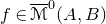 $f\in \overline {\mathcal{M}}^0(A,B)$
and map
$f\in \overline {\mathcal{M}}^0(A,B)$
and map $g_1 \colon B[1]\to A[1]$
we define a map for every
$g_1 \colon B[1]\to A[1]$
we define a map for every $T\in \mathcal{O}(n)$
as follows: for the unique tree
$T\in \mathcal{O}(n)$
as follows: for the unique tree $T\in \mathcal{O}(1)$
we set
$T\in \mathcal{O}(1)$
we set $g_T = g_1$
and for general
$g_T = g_1$
and for general $T\in \mathcal{O}(n)$
we set
$T\in \mathcal{O}(n)$
we set
 \begin{align*} g_T = -g_1 \circ f_k \circ (g_{T_1} \otimes \cdots \otimes g_{T_k}), \end{align*}
where $T_1,\ldots ,T_k$
are the subtrees starting in the internal node of
$T_1,\ldots ,T_k$
are the subtrees starting in the internal node of $T$
connected to the root. The following result is classical, and can be easily verified using the recursive formula.
$T$
connected to the root. The following result is classical, and can be easily verified using the recursive formula.
Proposition 2.13.
Let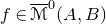 $f\in \overline {\mathcal{M}}^0(A,B)$
be a pre-morphism such that
$f\in \overline {\mathcal{M}}^0(A,B)$
be a pre-morphism such that $f_1\colon A[1]\to B[1]$
admits an inverse
$f_1\colon A[1]\to B[1]$
admits an inverse $g_1\colon B[1]\to A[1]$
. Then the pre-morphism
$g_1\colon B[1]\to A[1]$
. Then the pre-morphism $g\in \overline {\mathcal{M}}(B,A)$
defined by
$g\in \overline {\mathcal{M}}(B,A)$
defined by
 \begin{align*} g_n = \sum _{T\in \mathcal{O}(n)} g_T \end{align*}
is an inverse to $f$
. If
$f$
. If $f$
is, moreover, an
$f$
is, moreover, an $A_\infty$
-morphism, then
$A_\infty$
-morphism, then $g$
is again an
$g$
is again an $A_\infty$
-morphism.
$A_\infty$
-morphism.
Lemma 2.14. Every quasi-isomorphism induces an isomorphism between minimal models.
Proof.
Fix minimal models ${\rm H}(A)$
and
${\rm H}(A)$
and ${\rm H}(B)$
with maps
${\rm H}(B)$
with maps $I_A,I_B,P_A,P_B$
as in (7). Then given any quasi-isomorphism
$I_A,I_B,P_A,P_B$
as in (7). Then given any quasi-isomorphism $f\in {{\rm Hom}}_{\mathsf{Alg}^\infty }(A,B)$
, the induced map
$f\in {{\rm Hom}}_{\mathsf{Alg}^\infty }(A,B)$
, the induced map ${\rm H}(f) = P_B \diamond f \diamond I_A$
is again a quasi-isomorphism, because
${\rm H}(f) = P_B \diamond f \diamond I_A$
is again a quasi-isomorphism, because $P_B$
and
$P_B$
and $I_A$
are quasi-isomorphisms. But then
$I_A$
are quasi-isomorphisms. But then ${\rm H}(f)_1$
is an isomorphism by minimality, and the inverse
${\rm H}(f)_1$
is an isomorphism by minimality, and the inverse ${\rm H}(f)^{-1}$
exists by Proposition2.13.
${\rm H}(f)^{-1}$
exists by Proposition2.13.
Corollary 2.15.
Minimal models are unique up to $A_\infty$
-isomorphism.
$A_\infty$
-isomorphism.
Proof.
This follows directly from Lemma2.14 when taking ${\rm H}(A)$
and
${\rm H}(A)$
and ${\rm H}(B)$
to be two different minimal models of
${\rm H}(B)$
to be two different minimal models of $A=B$
with morphism
$A=B$
with morphism $f={\rm id}_A$
.
$f={\rm id}_A$
.
Given a quasi-isomorphism $f$
, the composition
$f$
, the composition $g = I_A \diamond {\rm H}(f)^{-1}\diamond P_B$
is a homotopy inverse to
$g = I_A \diamond {\rm H}(f)^{-1}\diamond P_B$
is a homotopy inverse to $f$
. To see this, note that there are identities
$f$
. To see this, note that there are identities
 \begin{align} g\diamond f=I_A \diamond {\rm H}(f)^{-1}\diamond P_B \diamond f \,\sim \, I_A \diamond {\rm H}(f)^{-1}\diamond \underbrace {P_B \diamond f \diamond I_A}_{{\rm H}(f)} \diamond P_A \,\sim \, I_A \diamond P_A \sim {\rm id}_A, \end{align}
 \begin{align} f\diamond g=f \diamond I_A \diamond {\rm H}(f)^{-1}\diamond P_B \,\sim \, I_B \diamond \underbrace {P_B \diamond f \diamond I_A}_{{\rm H}(f)} \diamond {\rm H}(f)^{-1} \diamond P_B \,\sim \, I_B \diamond P_B \sim {\rm id}_B, \end{align}
induced by the homotopies $I_A\circ P_A \sim {\rm id}_A$
and
$I_A\circ P_A \sim {\rm id}_A$
and $I_B\circ P_B \sim {\rm id}_B$
. Hence, every quasi-isomorphism is also a homotopy equivalence.
$I_B\circ P_B \sim {\rm id}_B$
. Hence, every quasi-isomorphism is also a homotopy equivalence.
2.4 Analytic algebras and morphisms
We now consider the category $\operatorname {\mathsf{grNMod}} {\ell ^e}$
of graded normed
$\operatorname {\mathsf{grNMod}} {\ell ^e}$
of graded normed $\ell ^e$
-bimodules, by which we mean pairs
$\ell ^e$
-bimodules, by which we mean pairs $(V,{{\left \|\cdot \right \|}}_V)$
of a bimodule
$(V,{{\left \|\cdot \right \|}}_V)$
of a bimodule $V\in \operatorname {\mathsf{grMod}} \ell ^e$
and a norm
$V\in \operatorname {\mathsf{grMod}} \ell ^e$
and a norm ${{\left \|\cdot \right \|}}_V \colon V\to \mathbb{R}$
on the underlying ungraded vector space such that for any
${{\left \|\cdot \right \|}}_V \colon V\to \mathbb{R}$
on the underlying ungraded vector space such that for any $l,r\in \ell$
the multiplication
$l,r\in \ell$
the multiplication $v \mapsto l v r$
is bounded in
$v \mapsto l v r$
is bounded in ${{\left \|\cdot \right \|}}_\ell$
. Between any
${{\left \|\cdot \right \|}}_\ell$
. Between any $V,W \in \operatorname {\mathsf{grNMod}} {\ell ^e}$
there is a graded normed vector space
$V,W \in \operatorname {\mathsf{grNMod}} {\ell ^e}$
there is a graded normed vector space
 \begin{align*} \hom _{\ell ^e}^{{\rm cont}}(V,W) := \{ f\in \hom _{\ell ^e}(V,W) \mid {\left \|f\right \|}_{{\rm op}} \lt \infty \} \end{align*}
of bounded morphisms with respect to the operator norm ${\left \|f\right \|}_{{\rm op}} := \sup _{\|v\|_V=1} \|f(v)\|_W$
. The shift naturally extends to a functor
${\left \|f\right \|}_{{\rm op}} := \sup _{\|v\|_V=1} \|f(v)\|_W$
. The shift naturally extends to a functor $[1]\colon \operatorname {\mathsf{grNMod}} {\ell ^e} \to \operatorname {\mathsf{grNMod}}{\ell ^e}$
, and for any pair
$[1]\colon \operatorname {\mathsf{grNMod}} {\ell ^e} \to \operatorname {\mathsf{grNMod}}{\ell ^e}$
, and for any pair $V,W\in \operatorname {\mathsf{grNMod}} {\ell ^e}$
the tensor product
$V,W\in \operatorname {\mathsf{grNMod}} {\ell ^e}$
the tensor product $V\otimes W$
is again normed via the projective tensor norm
$V\otimes W$
is again normed via the projective tensor norm
 \begin{align*} \|z\|_\pi := \inf \{\textstyle \sum _i \|v_i\|_V \|w_i\|_W \mid \textstyle z = \sum _i v \otimes _{\mathbb{C}} w \}, \end{align*}
where the infimum is over all presentations of an element $z\in V\otimes W$
as a sum of pure tensors in the tensor product
$z\in V\otimes W$
as a sum of pure tensors in the tensor product $V\otimes _{\mathbb{C}} W$
over
$V\otimes _{\mathbb{C}} W$
over $\mathbb{C}$
. If
$\mathbb{C}$
. If $f_i\colon V_i \to W_i$
are bounded bimodule morphisms between
$f_i\colon V_i \to W_i$
are bounded bimodule morphisms between $V_1,V_2,W_1,W_2 \in \operatorname {\mathsf{grNMod}}{\ell ^e}$
, the tensor product
$V_1,V_2,W_1,W_2 \in \operatorname {\mathsf{grNMod}}{\ell ^e}$
, the tensor product $f_1\otimes f_2$
has operator norm
$f_1\otimes f_2$
has operator norm
 \begin{align*} {\left \|f_1\otimes f_2\right \|}_{{\rm op}} = {\left \|f_1\right \|}_{{\rm op}} {\left \|f_2\right \|}_{{\rm op}} \lt \infty , \end{align*}
and is therefore a bounded bimodule map $V_1\otimes V_2 \to W_1\otimes W_2$
. Henceforth, we will drop the subscripts on the above norms to reduce clutter.
$V_1\otimes V_2 \to W_1\otimes W_2$
. Henceforth, we will drop the subscripts on the above norms to reduce clutter.
Now given a normed $\ell$
-bimodule
$\ell$
-bimodule $V\in \operatorname {\mathsf{grNMod}} {\ell ^e}$
and
$V\in \operatorname {\mathsf{grNMod}} {\ell ^e}$
and $r \in \mathbb{R}$
with
$r \in \mathbb{R}$
with $r \gt 0$
we consider the following normed version of the bar construction:
$r \gt 0$
we consider the following normed version of the bar construction:
 \begin{align*} \mathsf{B}(V,r) := (\mathsf{B} V, {{\left \|\cdot \right \|}}_r),\quad {\left \|\textstyle \sum v_n\right \|}_r := \sup _{n\in \mathbb{N}} {\left \|v_n\right \|}r^{-n}, \end{align*}
noting that the supremum in the definition of ${{\left \|\cdot \right \|}}_r$
is finite for any finite sum in
${{\left \|\cdot \right \|}}_r$
is finite for any finite sum in $\mathsf{B} V$
. Bounded maps out of these normed
$\mathsf{B} V$
. Bounded maps out of these normed $\ell$
-bimodules are characterised by the following lemma.
$\ell$
-bimodules are characterised by the following lemma.
Lemma 2.16.
Let $V,W\in \operatorname {\mathsf{grNMod}} {\ell ^e}$
and let
$V,W\in \operatorname {\mathsf{grNMod}} {\ell ^e}$
and let $f \in \mathcal{M}(V,W)$
. Then the following are equivalent:
$f \in \mathcal{M}(V,W)$
. Then the following are equivalent:
-
(i) there exists
$C\gt 0$
such that
${\left \|f_n\right \|} \lt C^n$
for all
$n\geqslant 1$
; and
-
(ii) there exists
$r\gt 0$
such that
$f\colon \mathsf{B}(V,r) \to W[1]$
is bounded.


If additionally $f_0=0$
then this is also equivalent to:
$f_0=0$
then this is also equivalent to:
-
(iii) for every
$r'\gt 0$
there exists an
$r\gt 0$
such that
$\widehat f \colon \mathsf{B}(V,r) \to \mathsf{B}(W,r')$
is bounded.


If additionally $V=W$
then this is also equivalent to:
$V=W$
then this is also equivalent to:
-
(iv) for every
$r'\gt 0$
there exists an
$r\gt 0$
such that
$\widetilde f \colon \mathsf{B}(V,r) \to \mathsf{B}(V,r')$
is bounded.


Proof.
(i) $\implies$
(ii). Without loss of generality we may assume that
$\implies$
(ii). Without loss of generality we may assume that $f_0=0$
. Let
$f_0=0$
. Let $C\gt 0$
be such that
$C\gt 0$
be such that ${\left \|f_n\right \|} \lt C^n$
for all
${\left \|f_n\right \|} \lt C^n$
for all $n\geqslant 1$
, and fix some
$n\geqslant 1$
, and fix some $r \lt C^{-1}$
. Then the map
$r \lt C^{-1}$
. Then the map $f \colon \mathsf{B}(V,r) \to W[1]$
satisfies, for every
$f \colon \mathsf{B}(V,r) \to W[1]$
satisfies, for every $v = \sum _{n\geqslant 1} v_n \in \mathsf{B}(V,r)$
,
$v = \sum _{n\geqslant 1} v_n \in \mathsf{B}(V,r)$
,
 \begin{align*} {\left \|f(v)\right \|} \leqslant \sum _{n\geqslant 1} {\left \|f_n(v_n)\right \|} \lt \sum _{n\geqslant 1} C^n {\left \|v_n\right \|} \leqslant \sum _{n\in \mathbb{N}} (Cr)^n {\left \|v\right \|}_r = \frac {{\left \|v\right \|}_r}{1-Cr}, \end{align*}
where the final equality for the geometric series holds because $Cr \lt 1$
. It follows that
$Cr \lt 1$
. It follows that $f$
has operator norm bounded by
$f$
has operator norm bounded by $(1-Cr)^{-1} \lt \infty$
.
$(1-Cr)^{-1} \lt \infty$
.
(ii) $\implies$
(i). If
$\implies$
(i). If $f \colon \mathsf{B}(V,r) \to W[1]$
is bounded in the operator norm by some constant
$f \colon \mathsf{B}(V,r) \to W[1]$
is bounded in the operator norm by some constant $K\gt 1$
, then for each
$K\gt 1$
, then for each $n\geqslant 1$
and
$n\geqslant 1$
and $v_n \in V[1]^{\otimes n}$
the map
$v_n \in V[1]^{\otimes n}$
the map $f_n$
satisfies
$f_n$
satisfies
 \begin{align*} {\left \|f_n(v_n)\right \|} = {\left \|f(v_n)\right \|} \leqslant K {\left \|v_n\right \|} r^{-n} \leqslant (K/r)^n {\left \|v_n\right \|}. \end{align*}
Hence, picking any $C\gt K/r$
it follows that
$C\gt K/r$
it follows that ${\left \|f_n\right \|} \lt C^n$
for all
${\left \|f_n\right \|} \lt C^n$
for all $n\geqslant 1$
.
$n\geqslant 1$
.
(i) $\implies$
(iii). Let
$\implies$
(iii). Let $C\gt 0$
be such that
$C\gt 0$
be such that ${\left \|f_n\right \|} \lt C^n$
for all
${\left \|f_n\right \|} \lt C^n$
for all $n\geqslant 1$
, fix
$n\geqslant 1$
, fix $r'\gt 0$
and let
$r'\gt 0$
and let $K = \min \{r',1\}$
. Then assuming
$K = \min \{r',1\}$
. Then assuming $f_0=0$
and expanding the formula for
$f_0=0$
and expanding the formula for $\widehat f$
, we find that, for every
$\widehat f$
, we find that, for every $v = \sum _{n\in \mathbb{N}} v_n \in \mathsf{B} V$
,
$v = \sum _{n\in \mathbb{N}} v_n \in \mathsf{B} V$
,
 \begin{align*} \begin{aligned} {\left \|\widehat f(v)\right \|}_{r'} &\leqslant \sum _{n\geqslant 1} \sum _{n_1+\cdots +n_k = n} {\left \|f_{n_1}\otimes \cdots \otimes f_{n_k}(v_n)\right \|} (r')^{-k} \\[5pt] &\leqslant \sum _{n\in \mathbb{N}} \sum _{n_1+\cdots +n_k = n} C^n K^{-k} {\left \|v_n\right \|} \\[5pt] &\leqslant \sum _{n\in \mathbb{N}} ({\#}\textrm{ partitions of n})\cdot \left (\frac CK\right )^n {\left \|v_n\right \|}. \end{aligned} \end{align*}
The number of partitions of $n$
is bounded by the number of ordered partitions (also known as compositions), of which there are
$n$
is bounded by the number of ordered partitions (also known as compositions), of which there are $2^{n-1}$
, and it is therefore, in particular, bounded by
$2^{n-1}$
, and it is therefore, in particular, bounded by $2^n$
. Picking
$2^n$
. Picking $r\lt {K}/{2C}$
, the geometric series with terms
$r\lt {K}/{2C}$
, the geometric series with terms $({2rC}/{K})^n$
again converges, which shows that
$({2rC}/{K})^n$
again converges, which shows that
 \begin{align*} {\left \|\widehat f(v)\right \|}_{r'} \leqslant \sum _{n\in \mathbb{N}} \left (\frac {2rC}{K}\right )^n {\left \|v\right \|}_r = \frac {K}{K-2rC} {\left \|v\right \|}_r. \end{align*}
As $r$
can be chosen independently of
$r$
can be chosen independently of $v$
, it follows that
$v$
, it follows that $\widehat f \colon \mathsf{B}(V,r) \to \mathsf{B}(V,r')$
is bounded.
$\widehat f \colon \mathsf{B}(V,r) \to \mathsf{B}(V,r')$
is bounded.
(i) $\implies$
(iv). Let
$\implies$
(iv). Let $C\gt 1$
be such that
$C\gt 1$
be such that ${\left \|f_n\right \|}\lt C^n$
for all
${\left \|f_n\right \|}\lt C^n$
for all $n\in \mathbb{N}$
, fix
$n\in \mathbb{N}$
, fix $r'\gt 0$
and let
$r'\gt 0$
and let $K=\min \{r',1\}$
. Then assuming
$K=\min \{r',1\}$
. Then assuming $f_0=0$
and expanding the formula for
$f_0=0$
and expanding the formula for $\widetilde f$
yields, for every
$\widetilde f$
yields, for every $v=\sum _{n\in \mathbb{N}} v_n \in \mathsf{B} V$
,
$v=\sum _{n\in \mathbb{N}} v_n \in \mathsf{B} V$
,
 \begin{align*} \begin{aligned} {\left \|\widetilde f(v)\right \|}_{r'} &\leqslant \sum _{n\in \mathbb{N}} \sum _{i+k+j=n} {\left \|({\rm id}^{\otimes i} \otimes f_k \otimes {\rm id}^{\otimes j})(v_n)\right \|} (r')^{-(i+j+1)} \\[5pt] &\leqslant \sum _{n\in \mathbb{N}} \sum _{i+k+j=n} C^k K^{-(i+j+1)}{\left \|v_n\right \|} \\[5pt] &\leqslant \sum _{n\in \mathbb{N}} n^3 \left (\frac CK\right )^n{\left \|v_n\right \|}. \end{aligned} \end{align*}
Picking $q\gt 0$
such that
$q\gt 0$
such that $n^3 \lt q^n$
for all
$n^3 \lt q^n$
for all $n$
and an
$n$
and an $r\lt {K}/{qC}$
, it again follows that
$r\lt {K}/{qC}$
, it again follows that
 \begin{align*} {\left \|\widetilde f(v)\right \|}_{r'} \leqslant \sum _{n\in \mathbb{N}} \left (\frac {rqC}{K}\right )^n {\left \|v\right \|}_r = \frac {K}{K - rqC}{\left \|v\right \|}_r, \end{align*}
and hence $\widetilde f$
is bounded when considered as a linear map
$\widetilde f$
is bounded when considered as a linear map $\mathsf{B}(V,r) \to \mathsf{B}(V,r')$
.
$\mathsf{B}(V,r) \to \mathsf{B}(V,r')$
.
(iii), (iv) $\implies$
(ii). For any
$\implies$
(ii). For any $r'$
, the projection
$r'$
, the projection $\unicode {x03C0}\colon \mathsf{B}(V,r') \to V[1]$
is obviously bounded, so if a map
$\unicode {x03C0}\colon \mathsf{B}(V,r') \to V[1]$
is obviously bounded, so if a map $\widehat f$
or
$\widehat f$
or $\widetilde f$
is bounded it follows that
$\widetilde f$
is bounded it follows that $f = \unicode {x03C0} \circ \widehat f = \unicode {x03C0} \circ \widetilde f$
is again bounded.
$f = \unicode {x03C0} \circ \widehat f = \unicode {x03C0} \circ \widetilde f$
is again bounded.
We define the space of analytic sequences of multilinear maps between $V$
and
$V$
and $W$
as
$W$
as
 \begin{align*} {\mathcal{A}}(V,W) = \bigcup _{r\gt 0} \hom _{\ell ^e}^{{\rm cont}}(\mathsf{B}(V,r), W[1]) \subset \mathcal{M}(V,W), \end{align*}
and note that its elements are sequences $f = (f_n)_{n\in \mathbb{N}}$
satisfying one of the equivalent conditions in the above lemma. As before, we write
$f = (f_n)_{n\in \mathbb{N}}$
satisfying one of the equivalent conditions in the above lemma. As before, we write $\overline {\mathcal{A}}(V,W) \subset {\mathcal{A}}(V,W)$
for the sequences with
$\overline {\mathcal{A}}(V,W) \subset {\mathcal{A}}(V,W)$
for the sequences with $f_0=0$
.
$f_0=0$
.
Definition 2.17.
An analytic $A_\infty$
-algebra is a pair
$A_\infty$
-algebra is a pair $(A,\unicode {x03BC})$
of
$(A,\unicode {x03BC})$
of $A\in \operatorname {\mathsf{grNMod}}{\ell ^e}$
and
$A\in \operatorname {\mathsf{grNMod}}{\ell ^e}$
and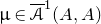 $\unicode {x03BC}\in \overline {\mathcal{A}}^1(A,A)$
which satisfies
$\unicode {x03BC}\in \overline {\mathcal{A}}^1(A,A)$
which satisfies ${\widetilde {\unicode {x03BC}}}^2=0$
.
${\widetilde {\unicode {x03BC}}}^2=0$
.
Example 2.18. Let $(A,{\rm d})$
be a DG algebra, and suppose
$(A,{\rm d})$
be a DG algebra, and suppose ${{\left \|\cdot \right \|}}\colon A \to \mathbb{R}$
is any norm on the underlying vector space. Then the differential and multiplication define an analytic
${{\left \|\cdot \right \|}}\colon A \to \mathbb{R}$
is any norm on the underlying vector space. Then the differential and multiplication define an analytic $A_\infty$
-algebra structure if and only if both are bounded. In particular, this includes the case of Banach DG algebras.
$A_\infty$
-algebra structure if and only if both are bounded. In particular, this includes the case of Banach DG algebras.
Example 2.19. Let $(A,\unicode {x03BC})$
be a finite dimensional
$(A,\unicode {x03BC})$
be a finite dimensional $A_\infty$
-algebra such that
$A_\infty$
-algebra such that $\unicode {x03BC}_n=0$
for
$\unicode {x03BC}_n=0$
for $n\gg 0$
. Then
$n\gg 0$
. Then $(A,\unicode {x03BC})$
is analytic for any choice of norm on
$(A,\unicode {x03BC})$
is analytic for any choice of norm on $A$
.
$A$
.
Remark 2.20. It follows from Lemma 2.16 that the definition given above is equivalent to the $A_\infty$
-algebras satisfying the convergence condition used in [Reference TuTu14, Reference TodaTod18].
$A_\infty$
-algebras satisfying the convergence condition used in [Reference TuTu14, Reference TodaTod18].
Given two analytic $A_\infty$
-algebras
$A_\infty$
-algebras $A$
and
$A$
and $B$
, we say that a pre-morphism
$B$
, we say that a pre-morphism $f$
is analytic if it lies in the subspace
$f$
is analytic if it lies in the subspace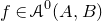 $f\in {\mathcal{A}}^0(A,B)$
. Lemma2.16 implies that the composition of analytic pre-morphisms is well defined.
$f\in {\mathcal{A}}^0(A,B)$
. Lemma2.16 implies that the composition of analytic pre-morphisms is well defined.
Lemma 2.21.
For any three analytic $A_\infty$
-algebras
$A_\infty$
-algebras $A,B,C$
, the composition restricts to a map
$A,B,C$
, the composition restricts to a map
 \begin{align*} \diamond \colon {\mathcal{A}}^0(B,C) \times {\mathcal{A}}^0(A,B) \to {\mathcal{A}}^0(A,C). \end{align*}
Proof.
Given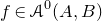 $f\in {\mathcal{A}}^0(A,B)$
and
$f\in {\mathcal{A}}^0(A,B)$
and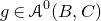 $g\in {\mathcal{A}}^0(B,C)$
, it follows from Lemma2.16 that there exist
$g\in {\mathcal{A}}^0(B,C)$
, it follows from Lemma2.16 that there exist $r_1,r_2\gt 0$
such that the maps
$r_1,r_2\gt 0$
such that the maps
 \begin{align*} g \colon \mathsf{B}(B,r_1) \to C[1],\quad \widehat f \colon \mathsf{B}(A,r_2) \to \mathsf{B}(B,r_1) \end{align*}
are bounded. Then the composition $g \diamond f=g \circ \widehat f$
is also bounded.
$g \diamond f=g \circ \widehat f$
is also bounded.
We conclude that analytic $A_\infty$
-algebras again form a category
$A_\infty$
-algebras again form a category $\mathsf{Alg}^{\infty ,{\rm an}}$
, with morphism spaces
$\mathsf{Alg}^{\infty ,{\rm an}}$
, with morphism spaces
 \begin{align*} {{\rm Hom}}_{\mathsf{Alg}^\infty }^{{\rm an}}(A,B) := \overline {\mathcal{A}}(A,B) \cap {{\rm Hom}}_{\mathsf{Alg}^\infty }(A,B), \end{align*}
with an obvious forgetful functor ${\mathsf{Alg}^{\infty ,{\rm an}}} \to {\mathsf{Alg}^\infty }$
.
${\mathsf{Alg}^{\infty ,{\rm an}}} \to {\mathsf{Alg}^\infty }$
.
2.5 Analytic homotopies
To generalise the definition of homotopies to analytic $A_\infty$
-algebras we introduce a norm on the path object. The algebra
$A_\infty$
-algebras we introduce a norm on the path object. The algebra $\mathsf{PC}^\infty ([0,1])$
is bounded for the essential supremum norm
$\mathsf{PC}^\infty ([0,1])$
is bounded for the essential supremum norm ${{\left \|\cdot \right \|}}_{\infty }$
on
${{\left \|\cdot \right \|}}_{\infty }$
on $L^\infty ([0,1])$
, and likewise
$L^\infty ([0,1])$
, and likewise $\Omega ^\bullet _{[0,1]}$
is bounded in the norm
$\Omega ^\bullet _{[0,1]}$
is bounded in the norm
 \begin{align*} {\left \|x+y{\rm d} t\right \|} = {\left \|x\right \|}_\infty + {\left \|\tfrac {\partial x}{\partial t}\right \|}_\infty + {\left \|y\right \|}_\infty . \end{align*}
For $A\in {\mathsf{Alg}^{\infty , {\rm an}}}$
there is an induced tensor norm on
$A\in {\mathsf{Alg}^{\infty , {\rm an}}}$
there is an induced tensor norm on $\Omega ^\bullet _{[0,1]}\otimes A$
and one checks easily that this is an analytic
$\Omega ^\bullet _{[0,1]}\otimes A$
and one checks easily that this is an analytic $A_\infty$
-algebra, using (3) and (4). The following is then a natural generalisation of homotopy between analytic
$A_\infty$
-algebra, using (3) and (4). The following is then a natural generalisation of homotopy between analytic $A_\infty$
-morphisms.
$A_\infty$
-morphisms.
Definition 2.22. For $A,B\in {\mathsf{Alg}^{\infty ,{\rm an}}}$
, a homotopy
$A,B\in {\mathsf{Alg}^{\infty ,{\rm an}}}$
, a homotopy $H\in {{\rm Hom}}_{\mathsf{Alg}^\infty }(A,\Omega ^\bullet _{[0,1]}\otimes B)$
is analytic if it lies in the subspace
$H\in {{\rm Hom}}_{\mathsf{Alg}^\infty }(A,\Omega ^\bullet _{[0,1]}\otimes B)$
is analytic if it lies in the subspace ${{\rm Hom}}_{\mathsf{Alg}^\infty }^{{\rm an}}(A,\Omega ^\bullet _{[0,1]}\otimes B)$
.
${{\rm Hom}}_{\mathsf{Alg}^\infty }^{{\rm an}}(A,\Omega ^\bullet _{[0,1]}\otimes B)$
.
We will use an explicit sufficient condition for a homotopy to be analytic in terms of the coefficient functions. Suppose $H = H_x + H_y {\rm d} t$
, then for all
$H = H_x + H_y {\rm d} t$
, then for all $k\geqslant 1$
we have a bound
$k\geqslant 1$
we have a bound
 \begin{align*} {\left \|H_k\right \|} \leqslant {\left \|H_{x,k}\right \|}_\infty + {\left \|\tfrac {\partial }{\partial t} H_{x,k}\right \|}_\infty + {\left \|H_{y,k}\right \|}_\infty , \end{align*}
where ${{\left \|\cdot \right \|}}_\infty$
denotes the essential supremum of the operator norms over the interval, and bounds
${{\left \|\cdot \right \|}}_\infty$
denotes the essential supremum of the operator norms over the interval, and bounds
 \begin{align*} {\left \|H_{x,k}\right \|}_\infty \leqslant {\left \|H_k\right \|},\quad {\left \|\tfrac {\partial }{\partial t}H_{x,k}\right \|}_\infty \leqslant {\left \|H_k\right \|},\quad {\left \|H_{y,k}\right \|}_\infty \leqslant {\left \|H_k\right \|}. \end{align*}
Hence $H$
is analytic if and only if there is a
$H$
is analytic if and only if there is a $C\gt 0$
such that for each
$C\gt 0$
such that for each $k\geqslant 1$
the functions
$k\geqslant 1$
the functions $H_{x,k}$
,
$H_{x,k}$
, $\tfrac {\partial }{\partial t} H_{x,k}$
, and
$\tfrac {\partial }{\partial t} H_{x,k}$
, and $H_{y,k}$
are bounded almost everywhere by
$H_{y,k}$
are bounded almost everywhere by $C^k$
. We use this to prove the following.
$C^k$
. We use this to prove the following.
Lemma 2.23.
Analytic homotopy defines an equivalence relation $\sim _{{\rm an}}$
on
$\sim _{{\rm an}}$
on ${{\rm Hom}}_{\mathsf{Alg}^\infty }^{{\rm an}}(A,B)$
.
${{\rm Hom}}_{\mathsf{Alg}^\infty }^{{\rm an}}(A,B)$
.
Proof.
Given $f\in {{\rm Hom}}_{\mathsf{Alg}^\infty }^{{\rm an}}(A,B)$
, the constant homotopy
$f\in {{\rm Hom}}_{\mathsf{Alg}^\infty }^{{\rm an}}(A,B)$
, the constant homotopy $H=1\otimes f$
has norms
$H=1\otimes f$
has norms ${\left \|(1\otimes f)_k\right \|} = {\left \|f_k\right \|}$
and is therefore analytic. Hence
${\left \|(1\otimes f)_k\right \|} = {\left \|f_k\right \|}$
and is therefore analytic. Hence $f\sim _{{\rm an}} f$
always holds. Likewise, if
$f\sim _{{\rm an}} f$
always holds. Likewise, if $f\sim _{{\rm an}} g$
with analytic homotopy
$f\sim _{{\rm an}} g$
with analytic homotopy $H = H_x + H_y {\rm d} t$
, then the coefficient functions of the homotopy
$H = H_x + H_y {\rm d} t$
, then the coefficient functions of the homotopy $G^t = H_x^{1-t} - H_y^{1-t} {\rm d} t$
have norms
$G^t = H_x^{1-t} - H_y^{1-t} {\rm d} t$
have norms
 \begin{align*} {\left \|G_{x,k}\right \|}_\infty = {\left \|H_{x,k}\right \|}_\infty ,\quad {\left \|\tfrac {\partial }{\partial t} G_{x,k}\right \|}_\infty = {\left \|\tfrac {\partial }{\partial t} H_{x,k}\right \|}_\infty ,\quad {\left \|G_{y,k}\right \|}_\infty = {\left \|H_{y,k}\right \|}_\infty . \end{align*}
Hence $G$
is again analytic and provides an analytic homotopy
$G$
is again analytic and provides an analytic homotopy $g\sim _{{\rm an}} f$
. Finally, suppose
$g\sim _{{\rm an}} f$
. Finally, suppose $f\sim _{{\rm an}} g$
and
$f\sim _{{\rm an}} g$
and $g\sim _{{\rm an}} h$
via analytic homotopies
$g\sim _{{\rm an}} h$
via analytic homotopies $H$
and
$H$
and $G$
, then we have
$G$
, then we have
 \begin{align*} \begin{gathered} {\left \|(G*H)_{x,k}\right \|}_\infty = \max \{{\left \|H_{x,k}\right \|}_\infty ,{\left \|G_{x,k}\right \|}_\infty \},\quad {\left \|(G*H)_{x,k}\right \|}_\infty=2 \max \{{\left \|\tfrac {\partial }{\partial t}H_{x,k}\right \|}_\infty ,{\left \|\tfrac {\partial }{\partial t}G_{x,k}\right \|}_\infty \},\\[5pt] {\left \|(G*H)_{x,k}\right \|}_\infty=2 \max \{{\left \|H_{y,k}\right \|}_\infty ,{\left \|G_{y,k}\right \|}_\infty \}.\quad \end{gathered} \end{align*}
Since the coefficient functions of $H$
and
$H$
and $G$
are essentially bounded by
$G$
are essentially bounded by $C^k$
for some
$C^k$
for some $C\gt 0$
, the coefficient functions of
$C\gt 0$
, the coefficient functions of $G*H$
are essentially bounded by
$G*H$
are essentially bounded by $(2C)^k$
. Hence,
$(2C)^k$
. Hence, $G*H$
is an analytic homotopy
$G*H$
is an analytic homotopy $f\sim _{{\rm an}} h$
.
$f\sim _{{\rm an}} h$
.
The relation $\sim _{{\rm an}}$
is again compatible with
$\sim _{{\rm an}}$
is again compatible with $\diamond$
, because the compositions used in Lemma2.10 are analytic. Hence we obtain an equivalence relation on morphisms in
$\diamond$
, because the compositions used in Lemma2.10 are analytic. Hence we obtain an equivalence relation on morphisms in $\mathsf{Alg}^{\infty ,{\rm an}}$
which is compatible with composition. In particular, we can speak of analytic homotopy inverse maps and analytic homotopy equivalences as before.
$\mathsf{Alg}^{\infty ,{\rm an}}$
which is compatible with composition. In particular, we can speak of analytic homotopy inverse maps and analytic homotopy equivalences as before.
2.6 Analytic minimal models
We define an analogue of a minimal model in the analytic setting by requiring all the structures involved to be analytic.
Definition 2.24. An analytic minimal model for $A\in {\mathsf{Alg}^{\infty ,{\rm an}}}$
is a minimal
$A\in {\mathsf{Alg}^{\infty ,{\rm an}}}$
is a minimal ${\rm H}(A) \in {\mathsf{Alg}^{\infty ,{\rm an}}}$
with quasi-isomorphisms
${\rm H}(A) \in {\mathsf{Alg}^{\infty ,{\rm an}}}$
with quasi-isomorphisms $P \in {{\rm Hom}}_{\mathsf{Alg}^\infty }^{{\rm an}}(A,{\rm H}(A))$
and
$P \in {{\rm Hom}}_{\mathsf{Alg}^\infty }^{{\rm an}}(A,{\rm H}(A))$
and $I \in {{\rm Hom}}_{\mathsf{Alg}^\infty }^{{\rm an}}({\rm H}(A),A)$
such that:
$I \in {{\rm Hom}}_{\mathsf{Alg}^\infty }^{{\rm an}}({\rm H}(A),A)$
such that:
 \begin{align} P\diamond I = {\rm id}_{{\rm H}(A)}\quad \textrm{and}\quad I\diamond P \sim _{{\rm an}} {\rm id}_A. \end{align}
In contrast to the non-analytic case, not every analytic $A_\infty$
-algebra has an analytic minimal model. Indeed, it is in general not even possible to find chain maps
$A_\infty$
-algebra has an analytic minimal model. Indeed, it is in general not even possible to find chain maps $I_1$
and
$I_1$
and $P_1$
providing a bounded splitting of its cohomology. Nonetheless, the construction in [Reference TuTu14] shows that the homotopy transfer formula can be used to construct analytic minimal models in geometric settings, which we will see in § 5.
$P_1$
providing a bounded splitting of its cohomology. Nonetheless, the construction in [Reference TuTu14] shows that the homotopy transfer formula can be used to construct analytic minimal models in geometric settings, which we will see in § 5.
We conclude by generalising some results about (homotopy) inverses from § 2.3.
Lemma 2.25.
Let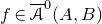 $f \in \overline {\mathcal{A}}^0(A,B)$
be an analytic pre-morphism such that
$f \in \overline {\mathcal{A}}^0(A,B)$
be an analytic pre-morphism such that $f_1\colon A[1]\to B[1]$
admits a bounded inverse
$f_1\colon A[1]\to B[1]$
admits a bounded inverse $g_1$
. Then the inverse
$g_1$
. Then the inverse $g$
of Proposition
2.13
is again analytic.
$g$
of Proposition
2.13
is again analytic.
Proof.
By assumption there exists a common constant $C\gt 1$
such that
$C\gt 1$
such that ${\left \|g_1\right \|} \lt C$
and
${\left \|g_1\right \|} \lt C$
and ${\left \|f_n\right \|} \lt C^n$
for all
${\left \|f_n\right \|} \lt C^n$
for all $n\geqslant 1$
. We now claim that for any tree
$n\geqslant 1$
. We now claim that for any tree $T \in \mathcal{O}(n,d)$
the norm of
$T \in \mathcal{O}(n,d)$
the norm of $g_T$
is bounded by
$g_T$
is bounded by ${\left \|g_T\right \|} \lt C^{2n+2d-1}$
. This follows by induction: for the base case
${\left \|g_T\right \|} \lt C^{2n+2d-1}$
. This follows by induction: for the base case $T\in \mathcal{O}(1) = \mathcal{O}(1,0)$
, we have
$T\in \mathcal{O}(1) = \mathcal{O}(1,0)$
, we have
 \begin{align*} {\left \|g_T\right \|} = {\left \|g_1\right \|} \lt C=C^{2+0-1}, \end{align*}
while for $n\gt 1$
any tree
$n\gt 1$
any tree $T\in \mathcal{O}(n)$
determined by subtrees
$T\in \mathcal{O}(n)$
determined by subtrees $T_i \in \mathcal{O}(n_i,d_i)$
such that
$T_i \in \mathcal{O}(n_i,d_i)$
such that $\sum n_i = n$
and
$\sum n_i = n$
and $\sum d_i = d-1$
, we have
$\sum d_i = d-1$
, we have
 \begin{align*} {\left \|g_T\right \|} \leqslant {\left \|g_1\right \|}{\left \|f_k\right \|}{\left \|g_{T_1}\otimes \cdots \otimes g_{T_k}\right \|} \lt C \cdot C^k \cdot C^{2\sum n_i+2\sum d_i - k} = C^{2n+2d -1}, \end{align*}
assuming the claim holds for all $n_i\lt n$
and
$n_i\lt n$
and $d_i \lt d$
; this shows the identity for each
$d_i \lt d$
; this shows the identity for each $T$
. To derive the analytic bound we note that any
$T$
. To derive the analytic bound we note that any $T\in \mathcal{O}(n)$
has valency
$T\in \mathcal{O}(n)$
has valency $\geqslant 3$
at internal nodes, and therefore has at most
$\geqslant 3$
at internal nodes, and therefore has at most $n-1$
internal nodes. Hence,
$n-1$
internal nodes. Hence, $\mathcal{O}(n)$
consists of the subsets
$\mathcal{O}(n)$
consists of the subsets $\mathcal{O}(n,d)$
with
$\mathcal{O}(n,d)$
with $d=1,\ldots , n-1$
internal nodes. Any
$d=1,\ldots , n-1$
internal nodes. Any $T\in \mathcal{O}(n,d)$
has
$T\in \mathcal{O}(n,d)$
has $n+d$
total vertices, and is therefore bounded by the Catalan number
$n+d$
total vertices, and is therefore bounded by the Catalan number $\mathcal{C}_{n+d-1} = {1}/{n+d}\binom {2n+2d}{n+d}$
, which counts the number of all planar rooted trees with
$\mathcal{C}_{n+d-1} = {1}/{n+d}\binom {2n+2d}{n+d}$
, which counts the number of all planar rooted trees with $n+d$
vertices (see e.g. [Reference FukayaFuk09, § I.3.21]). The cardinality of
$n+d$
vertices (see e.g. [Reference FukayaFuk09, § I.3.21]). The cardinality of $\mathcal{O}(n)$
is therefore bounded by
$\mathcal{O}(n)$
is therefore bounded by
 \begin{align*} |\mathcal{O}(n)| \leqslant \sum _{d=1}^{n-1} \mathcal{C}_{n+d-1} \leqslant (n-1) \mathcal{C}_{2n-2} = \tfrac {n-1}{2n-1}\binom {4n-4}{2n-2} \leqslant \sum _{j=0}^{4n-4} \binom {4n-4}{j} = 2^{4n-4} \leqslant 16^n. \end{align*}
We therefore find the following bound on the norm of $g_n$
:
$g_n$
:
 \begin{align*} {\left \|g_n\right \|} \leqslant \sum _{d=0}^{n-1} \sum _{T\in \mathcal{O}(n,d)} \|g_T\| \lt \sum _{d=0}^{n-1} \sum _{T\in \mathcal{O}(n,d)} C^{2n+2d-1} \leqslant |\mathcal{O}(n)| \cdot C^{4n} \lt (16C^4)^n. \end{align*}
Because the constant $16C^4$
is independent of
$16C^4$
is independent of $n$
, it follows that
$n$
, it follows that $g$
is analytic.
$g$
is analytic.
Note that if the $A_\infty$
-algebras
$A_\infty$
-algebras $A$
and
$A$
and $B$
are finite dimensional, then the continuity of
$B$
are finite dimensional, then the continuity of $g_1$
is automatic. The above now implies that the morphism between minimal models induced by an analytic quasi-isomorphism is invertible in the analytic category.
$g_1$
is automatic. The above now implies that the morphism between minimal models induced by an analytic quasi-isomorphism is invertible in the analytic category.
Lemma 2.26.
Suppose $A,B\in {\mathsf{Alg}^{\infty ,{\rm an}}}$
are compact and admit analytic minimal models. Then every analytic quasi-isomorphism induces an analytic isomorphism between the minimal models.
$A,B\in {\mathsf{Alg}^{\infty ,{\rm an}}}$
are compact and admit analytic minimal models. Then every analytic quasi-isomorphism induces an analytic isomorphism between the minimal models.
Proof.
By assumption there are minimal models ${\rm H}(A)$
,
${\rm H}(A)$
, ${\rm H}(B)$
such that the maps
${\rm H}(B)$
such that the maps $I_A,I_B,P_A,P_B$
are analytic, and hence the morphism
$I_A,I_B,P_A,P_B$
are analytic, and hence the morphism ${\rm H}(f) := P_B \diamond f \diamond I_A$
is again analytic. By assumption
${\rm H}(f) := P_B \diamond f \diamond I_A$
is again analytic. By assumption ${\rm H}(A)$
and
${\rm H}(A)$
and ${\rm H}(B)$
are finite dimensional, so the inverse of
${\rm H}(B)$
are finite dimensional, so the inverse of ${\rm H}(f)_1$
is bounded and therefore the inverse
${\rm H}(f)_1$
is bounded and therefore the inverse ${\rm H}(f)^{-1}$
is analytic by Lemma2.25.
${\rm H}(f)^{-1}$
is analytic by Lemma2.25.
Corollary 2.27.
Analytic minimal models of compact analytic $A_\infty$
-algebras are unique up to analytic isomorphism.
$A_\infty$
-algebras are unique up to analytic isomorphism.
If $f$
is an analytic quasi-isomorphism between compact analytic
$f$
is an analytic quasi-isomorphism between compact analytic $A_\infty$
-algebras admitting minimal models, then
$A_\infty$
-algebras admitting minimal models, then $g = I_A \diamond {\rm H}(f)^{-1} \diamond P_B$
is an analytic homotopy inverse, since the homotopies (8) and (9) are again analytic. Hence for such analytic
$g = I_A \diamond {\rm H}(f)^{-1} \diamond P_B$
is an analytic homotopy inverse, since the homotopies (8) and (9) are again analytic. Hence for such analytic $A_\infty$
-algebras, analytic quasi-isomorphisms and analytic homotopy equivalences are the same.
$A_\infty$
-algebras, analytic quasi-isomorphisms and analytic homotopy equivalences are the same.
Finally, we show that the existence of minimal models only depends on the analytic homotopy equivalence class of an $A_\infty$
-algebra.
$A_\infty$
-algebra.
Lemma 2.28.
Suppose $A,B\in {\mathsf{Alg}^{\infty ,{\rm an}}}$
are analytic
$A,B\in {\mathsf{Alg}^{\infty ,{\rm an}}}$
are analytic $A_\infty$
-algebras which are analytically homotopy equivalent. Then
$A_\infty$
-algebras which are analytically homotopy equivalent. Then $A$
admits an analytic minimal model if and only if
$A$
admits an analytic minimal model if and only if $B$
does.
$B$
does.
Proof.
By assumption there are maps $f \in {{\rm Hom}}_{\mathsf{Alg}^\infty }^{{\rm an}}(A,B)$
and
$f \in {{\rm Hom}}_{\mathsf{Alg}^\infty }^{{\rm an}}(A,B)$
and $g\in {{\rm Hom}}_{\mathsf{Alg}^\infty }^{{\rm an}}(B,A)$
which are homotopy inverse. Then the composition
$g\in {{\rm Hom}}_{\mathsf{Alg}^\infty }^{{\rm an}}(B,A)$
which are homotopy inverse. Then the composition $g\diamond f \in {{\rm Hom}}_{{\mathsf{Alg}^\infty }}^{{\rm an}}(A,A)$
is a homotopy equivalence, and hence a quasi-isomorphism. If
$g\diamond f \in {{\rm Hom}}_{{\mathsf{Alg}^\infty }}^{{\rm an}}(A,A)$
is a homotopy equivalence, and hence a quasi-isomorphism. If $A$
admits a minimal model, it follows from Lemma2.26 that
$A$
admits a minimal model, it follows from Lemma2.26 that $g\diamond f$
admits an analytic homotopy inverse
$g\diamond f$
admits an analytic homotopy inverse $T = I_A \diamond {\rm H}(g\diamond f)^{-1} \diamond P_A$
. We see that
$T = I_A \diamond {\rm H}(g\diamond f)^{-1} \diamond P_A$
. We see that
 \begin{align*} (P_A\diamond T\diamond g) \diamond (f\diamond I_A) = P_A \diamond I_A \diamond {\rm H}(g\diamond f)^{-1} \diamond {\rm H}(g\diamond f) = {\rm id}_{{\rm H}(A)}, \end{align*}
so that $P_A\diamond T\diamond g$
is left-inverse to
$P_A\diamond T\diamond g$
is left-inverse to $f\diamond I_A$
. To show it is homotopy right-inverse, first note that
$f\diamond I_A$
. To show it is homotopy right-inverse, first note that $g\diamond f \sim _{{\rm an}} {\rm id}_A$
implies that
$g\diamond f \sim _{{\rm an}} {\rm id}_A$
implies that $T$
is homotopic to the identity via
$T$
is homotopic to the identity via
 \begin{align*} T=I_A \diamond {\rm H}(g\diamond f)^{-1} \diamond P_A \sim _{{\rm an}} I_A \diamond {\rm H}(g\diamond f)^{-1} \diamond P_A \diamond g\diamond f \diamond I_A \diamond P_A \sim _{{\rm an}} = I_A \diamond P_A \sim _{{\rm an}} {\rm id}_A. \end{align*}
Since $f\diamond g\sim _{{\rm an}} {\rm id}_B$
also holds, the claim then follows from the chain of homotopies
$f\diamond g\sim _{{\rm an}} {\rm id}_B$
also holds, the claim then follows from the chain of homotopies
 \begin{align*} (f\diamond I_A) \diamond (P_A\diamond T\diamond g) \sim _{{\rm an}} f \diamond T \diamond g \sim _{{\rm an}} f\diamond g \sim _{{\rm an}} {\rm id}_B. \end{align*}
Hence the maps $I_B = f\diamond I_A$
and
$I_B = f\diamond I_A$
and $P_B = P_A\diamond T\diamond g$
make
$P_B = P_A\diamond T\diamond g$
make ${\rm H}(A)$
into a minimal model for
${\rm H}(A)$
into a minimal model for $B$
.
$B$
.
3. Analytic
$A_\infty$
-bimodules

In this section we define $A_\infty$
-bimodules and morphisms over an analytic
$A_\infty$
-bimodules and morphisms over an analytic $A_\infty$
-algebra by imposing an analogous condition on sequences of multilinear maps. We start by recalling the definition of such bimodules using a bar construction, for which we again follow Tradler [Reference TradlerTra08].
$A_\infty$
-algebra by imposing an analogous condition on sequences of multilinear maps. We start by recalling the definition of such bimodules using a bar construction, for which we again follow Tradler [Reference TradlerTra08].
3.1
$A_\infty$
-bimodules

Given an $A_\infty$
-algebra
$A_\infty$
-algebra $A \in {\mathsf{Alg}^\infty }$
,
$A \in {\mathsf{Alg}^\infty }$
, $A$
-bimodules and the morphisms between them can be defined via double sequences of morphisms in the graded vector space
$A$
-bimodules and the morphisms between them can be defined via double sequences of morphisms in the graded vector space
 \begin{align*} \mathcal{M}_A(M,N) := \prod _{i,j=0}^\infty \hom _{\ell ^e}(A[1]^{\otimes i} \otimes M[1] \otimes A[1]^{\otimes j}. N[1]). \end{align*}
We will use the notation $\unicode {x03C1} = (\unicode {x03C1}_{i,j})_{i,j\in \mathbb{N}}$
for homogeneous elements of
$\unicode {x03C1} = (\unicode {x03C1}_{i,j})_{i,j\in \mathbb{N}}$
for homogeneous elements of $\mathcal{M}_A(M,N)$
, and when applying such a map to elements we will underline the element in
$\mathcal{M}_A(M,N)$
, and when applying such a map to elements we will underline the element in $M[1]$
for clarity. As before, this space of sequences can be identified with the morphisms out of a bar construction
$M[1]$
for clarity. As before, this space of sequences can be identified with the morphisms out of a bar construction
 \begin{align*} \mathsf{B}_A M := \mathsf{B} A \otimes M[1] \otimes \mathsf{B} A = \bigoplus _{i,j=0}^\infty A[1]^{\otimes i} \otimes M[1]\otimes A[1]^{\otimes j}, \end{align*}
which is naturally a cofree cobimodule over the coalgebra $\mathsf{B} A$
. In [Reference TradlerTra08, Lemmas 3.3, 4.2] it is shown that one can lift any map
$\mathsf{B} A$
. In [Reference TradlerTra08, Lemmas 3.3, 4.2] it is shown that one can lift any map $\unicode {x03C1} \in \mathcal{M}_A(M,N)$
to a cohomomorphism
$\unicode {x03C1} \in \mathcal{M}_A(M,N)$
to a cohomomorphism $\widehat {\unicode {x03C1}}\colon \mathsf{B}_AM \to \mathsf{B}_AN$
, and to a coderivation
$\widehat {\unicode {x03C1}}\colon \mathsf{B}_AM \to \mathsf{B}_AN$
, and to a coderivation $\widetilde {\unicode {x03C1}} \colon \mathsf{B}_AM \to \mathsf{B}_A M$
if
$\widetilde {\unicode {x03C1}} \colon \mathsf{B}_AM \to \mathsf{B}_A M$
if $M=N$
. These maps are explicitly given by the following formulas:
$M=N$
. These maps are explicitly given by the following formulas:
 \begin{align*} \begin{aligned} \widehat {\unicode {x03C1}} &:= \sum _{i,j\geqslant 0} {\rm id}^{\otimes i} \otimes \underline {\unicode {x03C1}} \otimes {\rm id}^{\otimes j} \\[5pt] \widetilde {\unicode {x03C1}} &:= \sum _{i,j} {\rm id}^{\otimes i} \otimes \underline {\unicode {x03C1}} \otimes {\rm id}^{\otimes j} + \sum _{i,j,k\geqslant 0} {\rm id}^{\otimes i} \otimes \unicode {x03BC}_A \otimes {\rm id}^{\otimes k} \otimes \underline {{\rm id}}_{M[1]} \otimes {\rm id}^{\otimes j} \\[5pt] &\quad + \sum _{i,j,k\geqslant 0}{\rm id}^{\otimes i} \otimes \underline {{\rm id}}_{M[1]} \otimes {\rm id}^{\otimes k} \otimes \unicode {x03BC}_A \otimes {\rm id}^{\otimes j}, \end{aligned} \end{align*}
where the part of the maps landing in $M[1]$
is again underlined. These lifts are used to define
$M[1]$
is again underlined. These lifts are used to define $A_\infty$
-bimodule structures and their morphisms, as follows.
$A_\infty$
-bimodule structures and their morphisms, as follows.
Definition 3.1. An $A_\infty$
-bimodule over an
$A_\infty$
-bimodule over an $A_\infty$
-algebra
$A_\infty$
-algebra $A$
is pair
$A$
is pair $(M,\unicode {x03BD})$
of a bimodule
$(M,\unicode {x03BD})$
of a bimodule $M \in \operatorname {\mathsf{grMod}} \ell ^e$
and a map
$M \in \operatorname {\mathsf{grMod}} \ell ^e$
and a map $\unicode {x03BD} \in \mathcal{M}_A^0(M, M)$
satisfying
$\unicode {x03BD} \in \mathcal{M}_A^0(M, M)$
satisfying $\widetilde {\unicode {x03BD}}^2=0$
, or equivalently
$\widetilde {\unicode {x03BD}}^2=0$
, or equivalently $\unicode {x03BD} \circ \widetilde {\unicode {x03BD}} = 0$
.
$\unicode {x03BD} \circ \widetilde {\unicode {x03BD}} = 0$
.
The main examples of bimodules which we will consider are the following; proofs that these are bimodules can be found in [Reference TradlerTra08, Lemma 5.1].
Example 3.2. The diagonal bimodule $A_\Delta = (A,\unicode {x03BD}_\Delta )$
is defined by the map
$A_\Delta = (A,\unicode {x03BD}_\Delta )$
is defined by the map
 \begin{align*} \unicode {x03BD}_{\Delta ,i,j}(a,\underline b,c) = \unicode {x03BC}_{i+j+1}(a,b,c). \end{align*}
Example 3.3. The dual bimodule $A^\vee = ({{\rm Hom}}_{\mathbb{C}}(A,{\mathbb{C}}), \unicode {x03BD}_\Delta ^\vee )$
is defined by the sequence of maps
$A^\vee = ({{\rm Hom}}_{\mathbb{C}}(A,{\mathbb{C}}), \unicode {x03BD}_\Delta ^\vee )$
is defined by the sequence of maps
 \begin{align*} \unicode {x03BD}_{\Delta ,i,j}^\vee (a, \underline b,c)(d) = (-1)^K b(\mu _{i+j+1}(c,d,a)), \end{align*}
where $K= |a|(|b| + |c| + |d|) + |b|$
is a Koszul sign.
$K= |a|(|b| + |c| + |d|) + |b|$
is a Koszul sign.
Bimodules over an $A_\infty$
-algebra
$A_\infty$
-algebra $A$
form a DG category with the following morphism complexes.
$A$
form a DG category with the following morphism complexes.
Definition 3.4. A pre-morphism between $A_\infty$
-bimodules
$A_\infty$
-bimodules $(M,\unicode {x03BD}_M)$
and
$(M,\unicode {x03BD}_M)$
and $(N,\unicode {x03BD}_N)$
is a cochain in
$(N,\unicode {x03BD}_N)$
is a cochain in
 \begin{align*} \hom _{A-A}^\bullet (M,N) := \left (\mathcal{M}_A^\bullet (M, N),\delta \right ),\quad \unicode {x03B4}(\unicode {x03C1}) = \unicode {x03BD}_N \circ \widehat {\unicode {x03C1}} - (-1)^{|\unicode {x03C1}|} \unicode {x03C1} \circ \widetilde {\unicode {x03BD}}_M. \end{align*}
The degree $0$
cocycles form the subspace of morphisms
$0$
cocycles form the subspace of morphisms ${{\rm Hom}}_{A-A}(M,N) \subset \hom _{A-A}^0(M,N)$
.
${{\rm Hom}}_{A-A}(M,N) \subset \hom _{A-A}^0(M,N)$
.
Given $\unicode {x03C1} \in \hom _{A-A}(M,N)$
and
$\unicode {x03C1} \in \hom _{A-A}(M,N)$
and $\unicode {x03C4} \in \hom _{A-A}(L,M)$
the composition is defined as
$\unicode {x03C4} \in \hom _{A-A}(L,M)$
the composition is defined as $\unicode {x03C1} \diamond \unicode {x03C4} = \unicode {x03C1} \circ \widehat {\unicode {x03C4}}$
. This composition then yields a well-defined DG category
$\unicode {x03C1} \diamond \unicode {x03C4} = \unicode {x03C1} \circ \widehat {\unicode {x03C4}}$
. This composition then yields a well-defined DG category $\operatorname {\mathsf{Mod}}^\infty _{A-A}$
of
$\operatorname {\mathsf{Mod}}^\infty _{A-A}$
of $A_\infty$
-bimodules.
$A_\infty$
-bimodules.
Given a morphism $f \in {{\rm Hom}}_{{\mathsf{Alg}^\infty }}(A,B)$
of
$f \in {{\rm Hom}}_{{\mathsf{Alg}^\infty }}(A,B)$
of $A_\infty$
-algebras
$A_\infty$
-algebras $A,B\in {\mathsf{Alg}^\infty }$
, there is a DG functor
$A,B\in {\mathsf{Alg}^\infty }$
, there is a DG functor
 \begin{align*} f^\sharp \colon \operatorname {\mathsf{Mod}}^\infty _{B-B}\to \operatorname {\mathsf{Mod}}^\infty _{A-A}, \end{align*}
mapping a $B$
-bimodule
$B$
-bimodule $(M,\unicode {x03BD})$
to
$(M,\unicode {x03BD})$
to $(M,f^\sharp \unicode {x03BD}) = (M,\unicode {x03BD} \circ (\widehat f \otimes \underline {{\rm id}}_{M[1]} \otimes \widehat f))$
and mapping a
$(M,f^\sharp \unicode {x03BD}) = (M,\unicode {x03BD} \circ (\widehat f \otimes \underline {{\rm id}}_{M[1]} \otimes \widehat f))$
and mapping a $B$
-bimodule pre-morphism
$B$
-bimodule pre-morphism $\unicode {x03C1}$
to the map
$\unicode {x03C1}$
to the map $f^\sharp \unicode {x03C1}$
defined by the composition
$f^\sharp \unicode {x03C1}$
defined by the composition
 \begin{align*} \mathsf{B}_A M = \mathsf{B} A \otimes M[1] \otimes \mathsf{B} A \xrightarrow {\widehat f \otimes \underline {{\rm id}}_{M[1]} \otimes \widehat f} \mathsf{B} B \otimes M[1] \otimes \mathsf{B} B \xrightarrow {\unicode {x03C1}} N[1]. \end{align*}
For a proof that this defines a DG functor $f^\sharp$
and that this is functorial in
$f^\sharp$
and that this is functorial in $f$
, see [Reference GanatraGan12, § 2.8].
$f$
, see [Reference GanatraGan12, § 2.8].
For any $f \in {{\rm Hom}}_{{\mathsf{Alg}^\infty }}(A,B)$
, there are
$f \in {{\rm Hom}}_{{\mathsf{Alg}^\infty }}(A,B)$
, there are $A_\infty$
-bimodule morphisms
$A_\infty$
-bimodule morphisms $f_\Delta \in {{\rm Hom}}_{A-A}(A_\Delta ,f^\sharp B_\Delta )$
and
$f_\Delta \in {{\rm Hom}}_{A-A}(A_\Delta ,f^\sharp B_\Delta )$
and $f_\Delta ^\vee \in {{\rm Hom}}_{A-A}(f^\sharp B_\Delta ^\vee , A_\Delta ^\vee )$
defined in components by
$f_\Delta ^\vee \in {{\rm Hom}}_{A-A}(f^\sharp B_\Delta ^\vee , A_\Delta ^\vee )$
defined in components by
 \begin{align*} \begin{aligned} (f_\Delta )_{i,j}(a,b,c) &= f_{i+1+j}(a,b,c),\\[5pt] (f_\Delta ^\vee )_{i,j}(a,\underline {b},c)(d) &= (-1)^K b (f_{i+1+j} (c, d, a)), \end{aligned} \end{align*}
where $a \in A^{\otimes i}$
,
$a \in A^{\otimes i}$
, $c\in A^{\otimes j}$
, and
$c\in A^{\otimes j}$
, and $K = |a|(|b|+|c|+|d|)$
is a Koszul sign. Given any pre-morphism
$K = |a|(|b|+|c|+|d|)$
is a Koszul sign. Given any pre-morphism $\unicode {x03C1} \in \hom _{B-B}(B_\Delta ,B_\Delta ^\vee )$
there is a pre-morphism
$\unicode {x03C1} \in \hom _{B-B}(B_\Delta ,B_\Delta ^\vee )$
there is a pre-morphism $f^*\unicode {x03C1} \in \hom _{A-A}(A_\Delta ,A_\Delta ^\vee )$
given by
$f^*\unicode {x03C1} \in \hom _{A-A}(A_\Delta ,A_\Delta ^\vee )$
given by
 \begin{align*} f^*\unicode {x03C1} \colon \mathsf{B}_A A_\Delta \xrightarrow {\widehat f_\Delta } \mathsf{B}_A f^\sharp B_\Delta \xrightarrow {\widehat {f^\sharp \unicode {x03C1}}} \mathsf{B}_A f^\sharp B_{\Delta }^\vee \xrightarrow {{\widehat f}^\vee _\Delta } A_\Delta ^\vee . \end{align*}
This defines a chain map $f^*\colon \hom _{B-B}(B_\Delta ,B_\Delta ^\vee ) \to \hom _{A-A}(A_\Delta ,A_\Delta ^\vee )$
for each
$f^*\colon \hom _{B-B}(B_\Delta ,B_\Delta ^\vee ) \to \hom _{A-A}(A_\Delta ,A_\Delta ^\vee )$
for each $f$
, since
$f$
, since $f^\sharp$
is a DG functor and
$f^\sharp$
is a DG functor and $f_\Delta$
and
$f_\Delta$
and $f_\Delta ^\vee$
commute with the differential. One can check that this is also functorial.
$f_\Delta ^\vee$
commute with the differential. One can check that this is also functorial.
3.2 Hochschild cohomology
Given an $A_\infty$
-algebra
$A_\infty$
-algebra $A$
, one can define the Hochschild cohomology with values in any
$A$
, one can define the Hochschild cohomology with values in any $A_\infty$
-bimodule
$A_\infty$
-bimodule $M$
. The Hochschild complex can again be modelled using the bar construction: following Tradler [Reference TradlerTra08, Lemma 2.3], each
$M$
. The Hochschild complex can again be modelled using the bar construction: following Tradler [Reference TradlerTra08, Lemma 2.3], each $\unicode {x03BE} \in \mathcal{M}(A,M)$
defines a map
$\unicode {x03BE} \in \mathcal{M}(A,M)$
defines a map
 \begin{align*} \overline {\unicode {x03BE}} := \sum _{i,j,n\geqslant 0} {\rm id}^{\otimes i}_{A[1]} \otimes \underline {\xi _n} \otimes {\rm id}^{\otimes j}_{A[1]}, \end{align*}
which is a coderivation $\overline {\unicode {x03BE}}\colon \mathsf{B} A \to \mathsf{B}_AM$
with values in the comodule
$\overline {\unicode {x03BE}}\colon \mathsf{B} A \to \mathsf{B}_AM$
with values in the comodule $\mathsf{B}_AM$
. As before, the underlining signifies the component mapping to the factor
$\mathsf{B}_AM$
. As before, the underlining signifies the component mapping to the factor $M$
. Using this lift, the Hochschild cochain complex can be defined as follows.
$M$
. Using this lift, the Hochschild cochain complex can be defined as follows.
Definition 3.5. Let $(A,\unicode {x03BC})$
be an
$(A,\unicode {x03BC})$
be an $A_\infty$
-algebra and
$A_\infty$
-algebra and $(M,\unicode {x03BD})$
an
$(M,\unicode {x03BD})$
an $A$
-bimodule. Then the
$A$
-bimodule. Then the $M$
-valued Hochschild cochain complex is the complex
$M$
-valued Hochschild cochain complex is the complex $\mathsf{C}^\bullet (A,M) := \left (\mathcal{M}(A,M)[-1],\ {\bf b}\right )$
with differential
$\mathsf{C}^\bullet (A,M) := \left (\mathcal{M}(A,M)[-1],\ {\bf b}\right )$
with differential
 \begin{align*} {\bf b}(\xi ) := \unicode {x03BD} \circ \overline {\xi } - (-1)^{|\xi |} \xi \circ \widetilde {\unicode {x03BC}}. \end{align*}
The cohomology of the complex is denoted ${{\rm HH}}^\bullet (A,M)$
, and, if
${{\rm HH}}^\bullet (A,M)$
, and, if $M = A_\Delta$
, the complex and its cohomology are denoted as
$M = A_\Delta$
, the complex and its cohomology are denoted as $\mathsf{C}^\bullet (A) := \mathsf{C}^\bullet (A,A_\Delta )$
and
$\mathsf{C}^\bullet (A) := \mathsf{C}^\bullet (A,A_\Delta )$
and ${{\rm HH}}^\bullet (A) := {{\rm HH}}^\bullet (A,A_\Delta )$
, respectively.
${{\rm HH}}^\bullet (A) := {{\rm HH}}^\bullet (A,A_\Delta )$
, respectively.
The Hochschild complex is functorial in each factor: any morphisms $f\in {{\rm Hom}}_{{\mathsf{Alg}^\infty }}(A,B)$
or
$f\in {{\rm Hom}}_{{\mathsf{Alg}^\infty }}(A,B)$
or $\unicode {x03C1}\in {{\rm Hom}}_{A-A}(M,N)$
induce respective chain maps
$\unicode {x03C1}\in {{\rm Hom}}_{A-A}(M,N)$
induce respective chain maps
 \begin{align*} \begin{aligned} \mathsf{C}^\bullet (B,M) &\to \mathsf{C}^\bullet (A,f^\sharp M)\quad &\unicode {x03BE} \mapsto \unicode {x03BE} \circ \widehat f,\\[5pt] \mathsf{C}^\bullet (A,M) &\to \mathsf{C}^\bullet (A,N)\quad &\unicode {x03BE} \mapsto \unicode {x03C1} \circ \overline {\unicode {x03BE}}. \end{aligned} \end{align*}
In particular, for $M= A_\Delta ^\vee$
and
$M= A_\Delta ^\vee$
and $\unicode {x03C1} = f_\Delta ^\vee$
the combination of these constructions yields a chain map
$\unicode {x03C1} = f_\Delta ^\vee$
the combination of these constructions yields a chain map $f^* \colon \mathsf{C}^\bullet (B,B_\Delta ^\vee ) \to \mathsf{C}^\bullet (A,A_\Delta ^\vee )$
, sending
$f^* \colon \mathsf{C}^\bullet (B,B_\Delta ^\vee ) \to \mathsf{C}^\bullet (A,A_\Delta ^\vee )$
, sending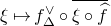 $\xi \mapsto f_\Delta ^\vee \circ \overline {\xi \circ \widehat f}$
. Explicitly, this map is given by
$\xi \mapsto f_\Delta ^\vee \circ \overline {\xi \circ \widehat f}$
. Explicitly, this map is given by
 \begin{align*} f^*\xi (a_1,\ldots ,a_n)(a_0) = \sum _{\substack {i,j\geqslant 0\\[5pt] i+j \leqslant n}} (-1)^{K_i} \xi (\widehat f(a_{i+1},\ldots ,a_{n-j}))(f(a_{n-j+1},\ldots ,a_n,a_0,a_1,\ldots ,a_i)), \end{align*}
where $K_i = (|a_1|+\cdots +|a_i|)(|a_{i+1}|+\cdots +|a_n| + |a_0|)$
is the Koszul sign obtained from permuting the
$K_i = (|a_1|+\cdots +|a_i|)(|a_{i+1}|+\cdots +|a_n| + |a_0|)$
is the Koszul sign obtained from permuting the $a_i$
. This map is natural with respect to
$a_i$
. This map is natural with respect to $f$
and induces a map
$f$
and induces a map $[f^*] \colon {{\rm HH}}^\bullet (B,B_\Delta ^\vee ) \to {{\rm HH}}^\bullet (A,A_\Delta ^\vee )$
, making the Hochschild cohomology with values in the dual bimodule functorial.
$[f^*] \colon {{\rm HH}}^\bullet (B,B_\Delta ^\vee ) \to {{\rm HH}}^\bullet (A,A_\Delta ^\vee )$
, making the Hochschild cohomology with values in the dual bimodule functorial.
A variation of Hochschild cohomology is negative cyclic cohomology, which can be realised using Connes’ complex. An element $\unicode {x03BE} = (\xi _n)_{n\in \mathbb{N}} \in \mathsf{C}^\bullet (A,A^\vee _\Delta )$
is called cyclic if for each
$\unicode {x03BE} = (\xi _n)_{n\in \mathbb{N}} \in \mathsf{C}^\bullet (A,A^\vee _\Delta )$
is called cyclic if for each $n\geqslant 1$
and all
$n\geqslant 1$
and all $a_0,\ldots ,a_n \in A[1]$
the following relation holds:
$a_0,\ldots ,a_n \in A[1]$
the following relation holds:
 \begin{align*} \xi _n(a_1,\ldots ,a_n)(a_0) = (-1)^{|a_0|(|a_1|+\cdots +|a_n|)} \xi _n(a_0,\ldots ,a_{n-1})(a_n) \end{align*}
One checks that the Hochschild differential preserves cyclic cochains, yielding a subcomplex
 \begin{align*} \mathsf{C}^\bullet _\lambda (A) := \left (\left \{\unicode {x03BE} \in \mathsf{C}^\bullet (A,A^\vee _\Delta ) \mid \unicode {x03BE}\; \textrm{is cyclic}\right \}, {\bf b} \right ), \end{align*}
which is called Connes’ complex. The cohomology of this complex is denoted ${\rm HC}_\lambda ^\bullet (A)$
. We remark that the pullback along any morphism
${\rm HC}_\lambda ^\bullet (A)$
. We remark that the pullback along any morphism $f\in {{\rm Hom}}_{{\mathsf{Alg}^\infty }}(A,B)$
preserves cyclic cocycles, and therefore restricts to a map
$f\in {{\rm Hom}}_{{\mathsf{Alg}^\infty }}(A,B)$
preserves cyclic cocycles, and therefore restricts to a map $f^*\colon \mathsf{C}^\bullet _\lambda (B) \to \mathsf{C}^\bullet _\lambda (A)$
and an induced map
$f^*\colon \mathsf{C}^\bullet _\lambda (B) \to \mathsf{C}^\bullet _\lambda (A)$
and an induced map $[f^*] \colon {\rm HC}_\lambda ^\bullet (B) \to {\rm HC}_\lambda ^\bullet (A)$
.
$[f^*] \colon {\rm HC}_\lambda ^\bullet (B) \to {\rm HC}_\lambda ^\bullet (A)$
.
It is well known that Hochschild cohomology and negative cyclic cohomology are invariant under homotopy equivalences. Below we include a proof using the definition of homotopy in § 2.2, which will also apply in the analytic setting.
Proposition 3.6.
Let $f,g\in {{\rm Hom}}_{\mathsf{Alg}^\infty }(A,B)$
with
$f,g\in {{\rm Hom}}_{\mathsf{Alg}^\infty }(A,B)$
with $f\sim g$
. Then
$f\sim g$
. Then $f$
and
$f$
and $g$
induce the same morphisms
$g$
induce the same morphisms
 \begin{align*} [f^*] = [g^*] \colon {{\rm HH}}^\bullet (B,B_\Delta ^\vee ) \to {{\rm HH}}^\bullet (A,A_\Delta ^\vee ),\quad [f^*] = [g^*] \colon {\rm HC}^\bullet _\lambda (B) \to {\rm HC}^\bullet _\lambda (A). \end{align*}
Proof.
If $f\sim g$
then
$f\sim g$
then $f = \mathsf{ev}_0 \circ H$
and
$f = \mathsf{ev}_0 \circ H$
and $g=\mathsf{ev}_1 \circ H$
for some homotopy
$g=\mathsf{ev}_1 \circ H$
for some homotopy $H\in {{\rm Hom}}_{\mathsf{Alg}^\infty }(A,\Omega ^\bullet _{[0,1]}\otimes B)$
, and the induced maps are therefore given by
$H\in {{\rm Hom}}_{\mathsf{Alg}^\infty }(A,\Omega ^\bullet _{[0,1]}\otimes B)$
, and the induced maps are therefore given by
 \begin{align*} [f^*] = [H^*][\mathsf{ev}_0^*],\quad [g^*] = [H^*][\mathsf{ev}_1^*]. \end{align*}
Therefore, it is sufficient to prove that the maps $\mathsf{ev}_0,\mathsf{ev}_1 \in {{\rm Hom}}_{\mathsf{Alg}^\infty }(\Omega ^\bullet _{[0,1]} \otimes B, B)$
induce the same map
$\mathsf{ev}_0,\mathsf{ev}_1 \in {{\rm Hom}}_{\mathsf{Alg}^\infty }(\Omega ^\bullet _{[0,1]} \otimes B, B)$
induce the same map $[\mathsf{ev}_0^*] = [\mathsf{ev}_1^*]$
on Hochschild/negative cyclic cohomology, which we do below.
$[\mathsf{ev}_0^*] = [\mathsf{ev}_1^*]$
on Hochschild/negative cyclic cohomology, which we do below.
Let $\unicode {x03BE} \in Z^k\mathsf{C}(B,B^\vee _\Delta )$
be any fixed cocycle. Then the pullback along
$\unicode {x03BE} \in Z^k\mathsf{C}(B,B^\vee _\Delta )$
be any fixed cocycle. Then the pullback along $\mathsf{ev}_t$
for any
$\mathsf{ev}_t$
for any $t\in [0,1]$
is given by a cocycle
$t\in [0,1]$
is given by a cocycle $\mathsf{ev}_t^*\unicode {x03BE} \in Z^k\mathsf{C}(\Omega ^\bullet _{[0,1]} \otimes B,(\Omega ^\bullet _{[0,1]} \otimes B)^\vee _\Delta )$
, given on pure tensors of the form
$\mathsf{ev}_t^*\unicode {x03BE} \in Z^k\mathsf{C}(\Omega ^\bullet _{[0,1]} \otimes B,(\Omega ^\bullet _{[0,1]} \otimes B)^\vee _\Delta )$
, given on pure tensors of the form $\omega _i = (x_i+y_i{\rm d} t) \otimes b_i$
by
$\omega _i = (x_i+y_i{\rm d} t) \otimes b_i$
by
 \begin{align*} (\mathsf{ev}_t^*\unicode {x03BE})_n (\omega _1,\ldots ,\omega _n)(\omega _{n+1}) = x_1(t)\cdots x_{n+1}(t) \cdot \xi _n(b_1,\ldots ,b_n)(b_{n+1}). \end{align*}
We claim that the difference $\mathsf{ev}_1^*\unicode {x03BE} - \mathsf{ev}_0^*\unicode {x03BE}$
is the
$\mathsf{ev}_1^*\unicode {x03BE} - \mathsf{ev}_0^*\unicode {x03BE}$
is the ${\bf b}$
-image
${\bf b}$
-image $\unicode {x03B6}\in \mathsf{C}^{k-1}(\Omega ^\bullet _{[0,1]} \otimes B, (\Omega ^\bullet _{[0,1]} \otimes B)^\vee _\Delta )$
defined on pure tensors
$\unicode {x03B6}\in \mathsf{C}^{k-1}(\Omega ^\bullet _{[0,1]} \otimes B, (\Omega ^\bullet _{[0,1]} \otimes B)^\vee _\Delta )$
defined on pure tensors $\omega _i = (x_i+y_i{\rm d} t) \otimes b_i$
as
$\omega _i = (x_i+y_i{\rm d} t) \otimes b_i$
as
 \begin{equation} \begin{aligned} \zeta _n(\omega _1,\ldots ,\omega _n)(\omega _{n+1}) &= \sum _{j=1}^n(-1)^{|\unicode {x03BE}|+|b_1|+\cdots +|b_{j-1}|} \int _0^1 x_1\cdots y_j \cdots x_{n+1} {\rm d} t \cdot \xi _n(b_1,\ldots ,b_n)(b_{n+1})\\[5pt] &\quad + (-1)^{|\unicode {x03BE}|+1+|b_1|+\cdots +|b_n|} \int _0^1 x_1\cdots x_n y_{n+1} {\rm d} t \cdot \xi _n(b_1,\ldots ,b_n)(b_{n+1}). \end{aligned} \end{equation}
For brevity we decompose the $A_\infty$
-structure defined in (3) and (4) as
$A_\infty$
-structure defined in (3) and (4) as $\unicode {x03BC}^\otimes = {\rm d} + \unicode {x03BC}$
, using the abbreviation
$\unicode {x03BC}^\otimes = {\rm d} + \unicode {x03BC}$
, using the abbreviation ${\rm d} = {\rm d} \otimes {\rm id}$
and
${\rm d} = {\rm d} \otimes {\rm id}$
and $\unicode {x03BC} = \sum _{k\geqslant 1} (-\cdots -) \otimes \unicode {x03BC}_k$
. Then we have the following:
$\unicode {x03BC} = \sum _{k\geqslant 1} (-\cdots -) \otimes \unicode {x03BC}_k$
. Then we have the following:
 \begin{align} {\bf b}(\unicode {x03B6}) &= {\rm d}_\Delta ^\vee \circ \unicode {x03B6} - (-1)^{|\unicode {x03B6}|} \cdot \unicode {x03B6} \circ \widetilde {{\rm d}} \end{align}
 \begin{align} &\quad +\unicode {x03BC}^\vee _\Delta \circ \overline {\unicode {x03B6}} -(-1)^{|\unicode {x03B6}|} \unicode {x03B6} \circ \widetilde {\unicode {x03BC}_k}. \end{align}
By inspection, the value of (12) on variables $\omega _i = (x_i+y_i{\rm d} t) \otimes b_i$
is
$\omega _i = (x_i+y_i{\rm d} t) \otimes b_i$
is
 \begin{align*} \begin{aligned} &({\rm d}^\vee \circ \unicode {x03B6} - (-1)^{|\unicode {x03B6}|} \cdot \unicode {x03B6} \circ \widetilde {{\rm d}})(\omega _1,\ldots ,\omega _n)(\omega _{n+1})\\[5pt] &\quad = (-1)^{|\unicode {x03B6}|+|b_1|+\cdots + |b_n|} \unicode {x03B6}(x_1\otimes b_1,\ldots ,x_n\otimes b_n)({\rm d} x_{n+1}\otimes b_{n+1}) \\[5pt] &\quad \quad - \sum _{j=1}^n (-1)^{|\unicode {x03B6}|+|b_1|+\cdots +|b_{j-1}|} \cdot \unicode {x03B6}_n(x_1\otimes b_1,\ldots , {\rm d} x_j\otimes b_j , \ldots , x_n\otimes b_n)(x_{n+1}\otimes b_{n+1}) \\[5pt] &\quad = \sum _{j=1}^{n+1} \int _0^1 \left (x_0\cdots \tfrac {\partial x_j}{\partial t} \cdots x_n\right ) {\rm d} t \cdot \unicode {x03BE}_n(b_1,\ldots ,b_n)(b_{n+1}) \\[5pt] &\quad = (x_0(1)\cdots \cdots x_n(1) - x_0(0)\cdots \cdots x_n(0))\cdot \unicode {x03BE}_n(b_1,\ldots ,b_n)(b_0) \\[5pt] &\quad = (\mathsf{ev}_1^*\unicode {x03BE})_n (\omega _1,\ldots ,\omega _n)(\omega _0) - (\mathsf{ev}_0^*\unicode {x03BE})_n (\omega _1,\ldots ,\omega _n)(\omega _0). \end{aligned} \end{align*}
Conversely, the motivated reader may check that the value of (13) on pure tensors $\omega _i$
is equal to
$\omega _i$
is equal to
 \begin{align*} \begin{aligned} &(\unicode {x03BC}_\Delta ^\vee \circ \overline {\unicode {x03B6}} - (-1)^{|\unicode {x03B6}|} \unicode {x03B6} \circ \widetilde {\unicode {x03BC}})(\omega _1,\ldots ,\omega _n)(\omega _{n+1}) \\[5pt] &=\quad \sum _{j=1}^{n} (-1)^{|\unicode {x03BE}|+|b_1|+\cdots +|b_{j-1}|} \cdot \int _0^1 x_1\cdots y_j \cdots x_n {\rm d} t \cdot {\bf b}(\unicode {x03BE})(b_1,\ldots ,b_n)(b_{n+1}), \end{aligned} \end{align*}
which always vanishes because $\unicode {x03BE}$
is assumed to be a cocycle. We conclude that
$\unicode {x03BE}$
is assumed to be a cocycle. We conclude that
 \begin{align*} [\mathsf{ev}_1^*\unicode {x03BE}] = [\mathsf{ev}_0^*\unicode {x03BE} + {\rm d} \unicode {x03B6}] = [\mathsf{ev}_0^*\unicode {x03BE}]. \end{align*}
To see that the same is true for the cyclic classes, it suffices to show that $\unicode {x03B6}$
is cyclic whenever
$\unicode {x03B6}$
is cyclic whenever $\unicode {x03BE}$
is cyclic. If
$\unicode {x03BE}$
is cyclic. If $\unicode {x03BE}$
is cyclic, then given homogeneous pure tensors
$\unicode {x03BE}$
is cyclic, then given homogeneous pure tensors $\omega _i$
with
$\omega _i$
with $\omega _j = y_j {\rm d} t \otimes b_j$
for some fixed
$\omega _j = y_j {\rm d} t \otimes b_j$
for some fixed $j\leqslant n$
and
$j\leqslant n$
and $\omega _i = x_i \otimes b_i$
for all
$\omega _i = x_i \otimes b_i$
for all $i\neq j$
, we have
$i\neq j$
, we have
 \begin{align*} \begin{aligned} &\zeta _n(\omega _{n+1},\omega _1,\ldots ,\omega _{n-1})(\omega _n) \\[5pt] &\quad = (-1)^{|\unicode {x03BE}|+|b_{n+1}| + |b_1|+\cdots +|b_{j-1}|} \int _0^1 x_1\cdots y_j \cdots x_{n+1} {\rm d} t \cdot \xi _n(b_{n+1},b_1,\ldots ,b_{n-1})(b_n) \\[5pt] &\quad = (-1)^{|b_{n+1}| + |b_1|+\cdots +|b_{j-1}| + |b_{n+1}|(|b_1|+\cdots +|b_n|)} \int _0^1 x_1\cdots y_j \cdots x_{n+1} {\rm d} t \cdot \xi _n(b_1,\ldots ,b_n)(b_{n+1}) \\[5pt] &\quad = (-1)^{|b_{n+1}|(|b_1|+\cdots +(|b_j|+1)+\cdots +|b_n|)}\unicode {x03B6}(\omega _1,\ldots ,\omega _n)(\omega _{n+1}) \\[5pt] &\quad = (-1)^{|\omega _{n+1}|(|\omega _1|+\cdots +|\omega _n|)}\unicode {x03B6}(\omega _1,\ldots ,\omega _n)(\omega _{n+1}). \end{aligned} \end{align*}
A similar computation shows that the cyclic identity holds when $\omega _{n+1} = y_{n+1}{\rm d} t \otimes b_{n+1}$
. This shows that
$\omega _{n+1} = y_{n+1}{\rm d} t \otimes b_{n+1}$
. This shows that $\mathsf{ev}_0$
and
$\mathsf{ev}_0$
and $\mathsf{ev}_1$
induce the same classes on Hochschild and negative cyclic cohomology, as claimed.
$\mathsf{ev}_1$
induce the same classes on Hochschild and negative cyclic cohomology, as claimed.
Corollary 3.7.
For an $A_\infty$
-algebra
$A_\infty$
-algebra $A$
with minimal model
$A$
with minimal model ${\rm H}(A)$
there are isomorphisms
${\rm H}(A)$
there are isomorphisms
 \begin{align*} {{\rm HH}}(A,A^\vee _\Delta ) \cong {{\rm HH}}({\rm H}(A),{\rm H}(A)^\vee _\Delta ),\quad {\rm HC}_\lambda (A,A^\vee _\Delta ) \cong {\rm HC}_\lambda ({\rm H}(A),{\rm H}(A)^\vee _\Delta ). \end{align*}
Proof.
The maps induced by the morphisms $I$
and
$I$
and $P$
satisfy
$P$
satisfy $I^*P^* = (P\diamond I)^* = {\rm id}$
, and the existence of a homotopy
$I^*P^* = (P\diamond I)^* = {\rm id}$
, and the existence of a homotopy $I\diamond P \sim {\rm id}_A$
implies that
$I\diamond P \sim {\rm id}_A$
implies that $[P^*][I^*] = [(I\diamond P)^*] = [({\rm id}_A)^*] = {\rm id}$
.
$[P^*][I^*] = [(I\diamond P)^*] = [({\rm id}_A)^*] = {\rm id}$
.
3.3 Analytic
$A_\infty$
-bimodules

Given $A\in {\mathsf{Alg}^{\infty ,{\rm an}}}$
and
$A\in {\mathsf{Alg}^{\infty ,{\rm an}}}$
and $M\in \operatorname {\mathsf{grNMod}}{\ell ^e}$
we consider a family of norms as in § 2.4: for each
$M\in \operatorname {\mathsf{grNMod}}{\ell ^e}$
we consider a family of norms as in § 2.4: for each $r\gt 0$
we define
$r\gt 0$
we define
 \begin{align*} \mathsf{B}_A(M,r) := (\mathsf{B}_A M, {{\left \|\cdot \right \|}}_r),\quad {\left \|m\right \|}_r = \sup _{i,j} {\left \|m_{i,j}\right \|}r^{-i-j-1}, \end{align*}
where $m = \sum _{i,j} m_{i,j} \in \mathsf{B}_AM$
is a decomposition into elements
$m = \sum _{i,j} m_{i,j} \in \mathsf{B}_AM$
is a decomposition into elements $m_{i,j} \in A[1]^{\otimes i} \otimes M[1] \otimes A[1]^{\otimes j}$
. Boundedness of linear maps out of these normed bar constructions can again be characterised in various ways, analogously to Lemma2.16.
$m_{i,j} \in A[1]^{\otimes i} \otimes M[1] \otimes A[1]^{\otimes j}$
. Boundedness of linear maps out of these normed bar constructions can again be characterised in various ways, analogously to Lemma2.16.
Lemma 3.8.
For $\unicode {x03C1}\in \mathcal{M}_A(M,N)$
the following are equivalent:
$\unicode {x03C1}\in \mathcal{M}_A(M,N)$
the following are equivalent:
-
(i) there exists
$C\gt 0$
such that
${\left \|\unicode {x03C1}_{i,j}\right \|} \leqslant C^{i+j+1}$
for all
$i,j\in \mathbb{N}$
, -
(ii) there exists
$r\gt 0$
such that
$\unicode {x03C1}\colon \mathsf{B}_A(M,r) \to N[1]$
is bounded, and
-
(iii) for every
$r'\gt 0$
there exists
$r\gt 0$
such that
$\widehat {\unicode {x03C1}} \colon \mathsf{B}_A(M,r) \to \mathsf{B}_A(N,r')$
is bounded.








If, moreover, $M=N$
, then this is also equivalent to:
$M=N$
, then this is also equivalent to:
-
(iv) for every
$r'\gt 0$
there exists
$r\gt 0$
such that
$\widetilde {\unicode {x03C1}} \colon \mathsf{B}_A(M,r) \to \mathsf{B}_A(M,r')$
is bounded.



Proof.
(i) $\implies$
(ii). Suppose there exists
$\implies$
(ii). Suppose there exists $C\gt 0$
such that
$C\gt 0$
such that ${\left \|\unicode {x03C1}_{i,j}\right \|} \leqslant C^{i+j+1}$
for all
${\left \|\unicode {x03C1}_{i,j}\right \|} \leqslant C^{i+j+1}$
for all $i,j\in \mathbb{N}$
, and fix
$i,j\in \mathbb{N}$
, and fix $0\lt r\lt C^{-1}$
. Then an element
$0\lt r\lt C^{-1}$
. Then an element $m = \sum _{i,j} m_{i,j} \in \mathsf{B}_A(M,r)$
of norm
$m = \sum _{i,j} m_{i,j} \in \mathsf{B}_A(M,r)$
of norm ${\left \|m\right \|}_r=1$
satisfies
${\left \|m\right \|}_r=1$
satisfies ${\left \|m_{i,j}\right \|} \leqslant r^{i+j+1}$
for all
${\left \|m_{i,j}\right \|} \leqslant r^{i+j+1}$
for all $i,j\in \mathbb{N}$
and therefore
$i,j\in \mathbb{N}$
and therefore
 \begin{align*} {\left \|\unicode {x03C1}(m)\right \|} \leqslant \sum _{n\in \mathbb{N}} \sum _{i+j=n} {\left \|\unicode {x03C1}_{i,j}(m_{i,j})\right \|} \leqslant \sum _{n\in \mathbb{N}} \sum _{i+j=n} C^{i+j+1} r^{i+j+1} = \sum _{n\in \mathbb{N}} n (Cr)^{n+1}. \end{align*}
Because the power series $\sum _n n z^{n+1}$
has radius of convergence
$\sum _n n z^{n+1}$
has radius of convergence $1$
, it converges at
$1$
, it converges at $z = Cr \lt 1$
. In particular, the norm
$z = Cr \lt 1$
. In particular, the norm $\unicode {x03C1}$
is bounded.
$\unicode {x03C1}$
is bounded.
(ii) $\implies$
(i). Let
$\implies$
(i). Let $K\gt 1$
be a constant bounding the norm of
$K\gt 1$
be a constant bounding the norm of $\unicode {x03C1}\colon \mathsf{B}_A(M,r) \to N[1]$
and pick
$\unicode {x03C1}\colon \mathsf{B}_A(M,r) \to N[1]$
and pick $C \geqslant {K}/{r}$
. Then for all
$C \geqslant {K}/{r}$
. Then for all $i,j\in \mathbb{N}$
and
$i,j\in \mathbb{N}$
and $m_{i,j}\in A[1]^{\otimes i} \otimes M[1] \otimes A[1]^{\otimes j}$
of norm
$m_{i,j}\in A[1]^{\otimes i} \otimes M[1] \otimes A[1]^{\otimes j}$
of norm ${\left \|m_{i,j}\right \|} = 1$
, the map
${\left \|m_{i,j}\right \|} = 1$
, the map $\unicode {x03C1}_{i,j}$
satisfies
$\unicode {x03C1}_{i,j}$
satisfies
 \begin{align*} {\left \|\unicode {x03C1}_{i,j}(m_{i,j})\right \|} = {\left \|\unicode {x03C1}(m_{i,j})\right \|} \leqslant K {\left \|m_{i,j}\right \|} r^{-i-j-1} \leqslant \left (\frac {K}{r}\right )^{i+j+1} \leqslant C^{i+j+1}, \end{align*}
which shows that, in particular, ${\left \|\unicode {x03C1}_{i,j}\right \|} \leqslant C^{i+j+1}$
.
${\left \|\unicode {x03C1}_{i,j}\right \|} \leqslant C^{i+j+1}$
.
(i) $\implies$
(iii). Suppose there exists
$\implies$
(iii). Suppose there exists $C\gt 1$
such that
$C\gt 1$
such that ${\left \|\unicode {x03C1}_{i,j}\right \|} \leqslant C^{i+j+1}$
for all
${\left \|\unicode {x03C1}_{i,j}\right \|} \leqslant C^{i+j+1}$
for all $i,j\in \mathbb{N}$
, and fix
$i,j\in \mathbb{N}$
, and fix $r'\gt 0$
. Then we choose a constant
$r'\gt 0$
. Then we choose a constant $q\gt 0$
such that
$q\gt 0$
such that $ij \lt q^{i+j+1}$
for all
$ij \lt q^{i+j+1}$
for all $i,j\in \mathbb{N}$
, a constant
$i,j\in \mathbb{N}$
, a constant $K=\min \{r',1\}$
, and a radius
$K=\min \{r',1\}$
, and a radius $r\lt {K}/{qC}$
. Then for any element
$r\lt {K}/{qC}$
. Then for any element $m = \sum m_{i,j} \in \mathsf{B}_A M$
of norm
$m = \sum m_{i,j} \in \mathsf{B}_A M$
of norm ${\left \|m\right \|}_r=1$
one has
${\left \|m\right \|}_r=1$
one has ${\left \|m_{i,j}\right \|} \leqslant r^{i+j+1}$
and hence
${\left \|m_{i,j}\right \|} \leqslant r^{i+j+1}$
and hence
 \begin{align*} \begin{aligned} {\left \|\widehat {\unicode {x03C1}}(m)\right \|}_{r'} &\leqslant \sum _{i,j\geqslant 0} \sum _{\substack {0\leqslant i\leqslant n\\[5pt] 0\leqslant j\leqslant m}} {\left \|({\rm id}^{\otimes i} \otimes \unicode {x03C1}_{n-i,m-j} \otimes {\rm id}^{\otimes j})(m_{i,j})\right \|} (r')^{-i-j-1} \\[5pt] &\leqslant \sum _{i,j\geqslant 0} \sum _{\substack {0\leqslant i\leqslant n\\[5pt] 0\leqslant j\leqslant m}} C^{i+j-i-j+1} K^{-i-j-1} r^{i+j+1} \\[5pt] &\leqslant \sum _{i,j\geqslant 0} nm \left (\frac {rC}{K}\right )^{i+j+1} \\[5pt] &\leqslant \sum _{N\geqslant 1} (N-1) \left (\frac {rq C}{K}\right )^N .\end{aligned} \end{align*}
Then the norm is bounded by the value of the power series $\sum _N (N-1) z^N$
at
$\sum _N (N-1) z^N$
at $z={rqC}/{K} \lt 1$
.
$z={rqC}/{K} \lt 1$
.
(i) $\implies$
(iv). This follows in an analogous way to the previous implication. We leave the details up to the reader.
$\implies$
(iv). This follows in an analogous way to the previous implication. We leave the details up to the reader.
(iii), (iv) $\implies$
(ii). The projection
$\implies$
(ii). The projection $\unicode {x03C0} \colon \mathsf{B}_A(N,r') \to N[1]$
is clearly bounded for any
$\unicode {x03C0} \colon \mathsf{B}_A(N,r') \to N[1]$
is clearly bounded for any $r'\gt 0$
, so the boundedness of
$r'\gt 0$
, so the boundedness of $\widehat {\unicode {x03C1}}\colon \mathsf{B}_A(M,r) \to \mathsf{B}_A(N,r')$
implies that
$\widehat {\unicode {x03C1}}\colon \mathsf{B}_A(M,r) \to \mathsf{B}_A(N,r')$
implies that $\unicode {x03C1} = \unicode {x03C0}\circ \widehat {\unicode {x03C1}}$
is bounded. Likewise,
$\unicode {x03C1} = \unicode {x03C0}\circ \widehat {\unicode {x03C1}}$
is bounded. Likewise, $\unicode {x03C1} = \unicode {x03C0} \circ \widetilde {\unicode {x03C1}}$
is bounded when
$\unicode {x03C1} = \unicode {x03C0} \circ \widetilde {\unicode {x03C1}}$
is bounded when $\widetilde {\unicode {x03C1}}\colon \mathsf{B}_A(M,r) \to \mathsf{B}_A(M,r')$
is bounded.
$\widetilde {\unicode {x03C1}}\colon \mathsf{B}_A(M,r) \to \mathsf{B}_A(M,r')$
is bounded.
Hence, as in the algebra case we find that the union over the spaces $\hom _{\ell ^e}^{{\rm cont}}(\mathsf{B}_A(M,r),N[1])$
is given by a graded vector space of double sequences
$\hom _{\ell ^e}^{{\rm cont}}(\mathsf{B}_A(M,r),N[1])$
is given by a graded vector space of double sequences
 \begin{align*} {\mathcal{A}}_A(V,W) := \left \{\; f \in \mathcal{M}_A(V,W) \;\middle |\; \exists C\gt 0 \;\textrm{such that}\; \|f_{i,j}\| \leqslant C^{i+j+1}\;\textrm{for all}\; i,j\in \mathbb{N} \;\right \}, \end{align*}
whose elements we again call analytic. In particular, we obtain a definition of analytic $A_\infty$
-bimodules over an analytic
$A_\infty$
-bimodules over an analytic $A_\infty$
-algebra.
$A_\infty$
-algebra.
Definition 3.9. Let $(A,\unicode {x03BC})$
be an analytic
$(A,\unicode {x03BC})$
be an analytic $A_\infty$
-algebra. Then an analytic
$A_\infty$
-algebra. Then an analytic $A$
-bimodule is a pair
$A$
-bimodule is a pair $(M,\unicode {x03BD})$
of
$(M,\unicode {x03BD})$
of $M\in \operatorname {\mathsf{grNMod}}({\ell ^e})$
and
$M\in \operatorname {\mathsf{grNMod}}({\ell ^e})$
and $\unicode {x03BD} \in {\mathcal{A}}_A^1(M,M)$
satisfying
$\unicode {x03BD} \in {\mathcal{A}}_A^1(M,M)$
satisfying $\widetilde {\unicode {x03BD}}^2=0$
.
$\widetilde {\unicode {x03BD}}^2=0$
.
Example 3.10. The diagonal bimodule $A_\Delta$
is analytic for any analytic
$A_\Delta$
is analytic for any analytic $A_\infty$
-algebra when endowed with the induced norm, as
$A_\infty$
-algebra when endowed with the induced norm, as ${\left \|\unicode {x03BD}_{\Delta ,i,j}\right \|} = {\left \|\unicode {x03BC}_{i+j+1}\right \|}$
satisfies the appropriate bound.
${\left \|\unicode {x03BD}_{\Delta ,i,j}\right \|} = {\left \|\unicode {x03BC}_{i+j+1}\right \|}$
satisfies the appropriate bound.
Example 3.11. The dual bimodule $A^\vee$
is not analytic in general, as the dual space is not endowed with a natural norm. However, one can consider the continuous dual bimodule
$A^\vee$
is not analytic in general, as the dual space is not endowed with a natural norm. However, one can consider the continuous dual bimodule
 \begin{align*} A_\Delta ' := \left (\hom ^{{\rm cont}}_{\mathbb{C}}(A,{\mathbb{C}}), \unicode {x03BD}'_\Delta \right ), \end{align*}
where the components of $\unicode {x03BD}'_\Delta$
are defined by the same formula as the components of
$\unicode {x03BD}'_\Delta$
are defined by the same formula as the components of $\unicode {x03BD}_\Delta ^\vee$
. It is again straightforward to check that
$\unicode {x03BD}_\Delta ^\vee$
. It is again straightforward to check that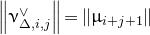 ${\left \|\unicode {x03BD}^\vee _{\Delta ,i,j}\right \|} = {\left \|\unicode {x03BC}_{i+j+1}\right \|}$
is bounded by a geometric series. If
${\left \|\unicode {x03BD}^\vee _{\Delta ,i,j}\right \|} = {\left \|\unicode {x03BC}_{i+j+1}\right \|}$
is bounded by a geometric series. If $A$
is finite dimensional, then
$A$
is finite dimensional, then $A'_\Delta$
is equal to
$A'_\Delta$
is equal to $A^\vee _\Delta$
in
$A^\vee _\Delta$
in $\mathsf{Mod}_{A-A}^\infty$
, but in general it is only a submodule.
$\mathsf{Mod}_{A-A}^\infty$
, but in general it is only a submodule.
As before, we call a (pre-)morphism $\unicode {x03C1} \in \hom _{A-A}^{\bullet }(M,N)$
between
$\unicode {x03C1} \in \hom _{A-A}^{\bullet }(M,N)$
between $A$
-bimodules
$A$
-bimodules $(M,\unicode {x03BD}_M)$
and
$(M,\unicode {x03BD}_M)$
and $(N,\unicode {x03BD}_N)$
analytic if it lies in the subspace
$(N,\unicode {x03BD}_N)$
analytic if it lies in the subspace ${\mathcal{A}}_A(M,N) \subset \mathcal{M}_A(M,N)$
. It follows from Lemma3.8 that
${\mathcal{A}}_A(M,N) \subset \mathcal{M}_A(M,N)$
. It follows from Lemma3.8 that
 \begin{align*} \unicode {x03B4} = \unicode {x03BD}_N \circ \widehat {(-)} - (-1)^{|\unicode {x03C1}|} (-)\circ \widetilde {\unicode {x03BD}}_M \end{align*}
is a bounded operator on this space, and hence gives rise to a complex of analytic pre-morphisms
 \begin{align*} \hom _{A-A}^{\bullet ,{\rm an}}(M,N) := \left ({\mathcal{A}}_A(M,N), \delta \right ), \end{align*}
which is a subcomplex of $\hom _{A-A}^\bullet (M,N)$
. As before, we denote the subspace of analytic morphisms by
$\hom _{A-A}^\bullet (M,N)$
. As before, we denote the subspace of analytic morphisms by ${{\rm Hom}}_{A-A}^{{\rm an}}(M,N) \subset {{\rm Hom}}_{A-A}(M,N)$
. It follows from Lemma3.8 that the composition of analytic bimodule pre-morphisms is again analytic, and therefore defines morphism complexes for a DG category
${{\rm Hom}}_{A-A}^{{\rm an}}(M,N) \subset {{\rm Hom}}_{A-A}(M,N)$
. It follows from Lemma3.8 that the composition of analytic bimodule pre-morphisms is again analytic, and therefore defines morphism complexes for a DG category $\operatorname {\mathsf{NMod}}^{\infty ,{\rm an}}_{A-A}$
of analytic bimodules over
$\operatorname {\mathsf{NMod}}^{\infty ,{\rm an}}_{A-A}$
of analytic bimodules over $A$
.
$A$
.
Given an analytic $A_\infty$
-morphism
$A_\infty$
-morphism $f$
one can again consider the functor
$f$
one can again consider the functor $f^*$
, and the pullback map
$f^*$
, and the pullback map $f^\sharp$
on the Hom-spaces between the diagonal bimodule and its continuous dual.
$f^\sharp$
on the Hom-spaces between the diagonal bimodule and its continuous dual.
Lemma 3.12.
Let $f\in {{\rm Hom}}^{{\rm an}}_{{\mathsf{Alg}^\infty }}(A,B)$
be an analytic morphism. Then there is a well-defined functor
$f\in {{\rm Hom}}^{{\rm an}}_{{\mathsf{Alg}^\infty }}(A,B)$
be an analytic morphism. Then there is a well-defined functor
 \begin{align*} f^\sharp \colon \operatorname {\mathsf{NMod}}^{\infty ,{\rm an}}_{B-B} \to \operatorname {\mathsf{NMod}}^{\infty ,{\rm an}}_{A-A}, \end{align*}
which induces a pullback $f^*\colon \hom _{B-B}^{{\rm an}}(B_\Delta ,B_\Delta ') \to \hom _{A-A}^{{\rm an}}(A_\Delta ,A_\Delta ')$
.
$f^*\colon \hom _{B-B}^{{\rm an}}(B_\Delta ,B_\Delta ') \to \hom _{A-A}^{{\rm an}}(A_\Delta ,A_\Delta ')$
.
Proof.
Given $f \in {{\rm Hom}}^{{\rm an}}_{{\mathsf{Alg}^\infty }}(A,B)$
, for any
$f \in {{\rm Hom}}^{{\rm an}}_{{\mathsf{Alg}^\infty }}(A,B)$
, for any $N,M\in \operatorname {\mathsf{grNMod}} {\ell ^e}$
and
$N,M\in \operatorname {\mathsf{grNMod}} {\ell ^e}$
and $\unicode {x03C1}\in {\mathcal{A}}_B(M,N)$
there exists a common constant
$\unicode {x03C1}\in {\mathcal{A}}_B(M,N)$
there exists a common constant $C\gt 0$
such that
$C\gt 0$
such that ${\left \|f_n\right \|} \lt C^n$
for all
${\left \|f_n\right \|} \lt C^n$
for all $n\in \mathbb{N}$
and
$n\in \mathbb{N}$
and ${\left \|\unicode {x03C1}_{i,j}\right \|} \lt C^{i+j+1}$
for all
${\left \|\unicode {x03C1}_{i,j}\right \|} \lt C^{i+j+1}$
for all $i,j\in \mathbb{N}$
. Then the construction
$i,j\in \mathbb{N}$
. Then the construction $f^\sharp \unicode {x03C1}$
has components satisfying
$f^\sharp \unicode {x03C1}$
has components satisfying
 \begin{align*} \begin{aligned} {\left \|(f^\sharp \unicode {x03C1})_{i,j}\right \|} &\leqslant \sum _{\substack {i_1+\cdots +i_n = i\\[5pt] j_1+\cdots +j_n = j}} {\left \|\unicode {x03C1}_{n,m}\right \|} {\left \|f_{i_1}\right \|} \cdots {\left \|f_{i_n}\right \|} {\left \|f_{j_1}\right \|} \cdots {\left \|f_{j_m}\right \|} \\[5pt] &\lt \sum _{\substack {i_1+\cdots +i_n = i\\[5pt] j_1+\cdots +j_n = j}} C^{n+m+i+j+1} \\[5pt] &\leqslant ({\#} \textrm{ of partitions of $i$}) \cdot ({\#} \textrm{ of partitions of $j$})) \cdot C^{2(i+j)+1}. \end{aligned} \end{align*}
Picking some constant $q\gt 1$
such that
$q\gt 1$
such that $q^n$
bounds the number of partitions of
$q^n$
bounds the number of partitions of $n$
, it follows that
$n$
, it follows that ${\left \|(f^\sharp \unicode {x03C1})_{i,j}\right \|} \lt q^{i+j}C^{2(i+j)+1} \leqslant (qC^2)^{i+j+1}$
, which shows that
${\left \|(f^\sharp \unicode {x03C1})_{i,j}\right \|} \lt q^{i+j}C^{2(i+j)+1} \leqslant (qC^2)^{i+j+1}$
, which shows that $f^\sharp \unicode {x03C1} \in {\mathcal{A}}_A(M,N)$
. If follows that
$f^\sharp \unicode {x03C1} \in {\mathcal{A}}_A(M,N)$
. If follows that $f^\sharp$
maps every analytic bimodule structure
$f^\sharp$
maps every analytic bimodule structure $\unicode {x03BD}$
to an analytic bimodule structure
$\unicode {x03BD}$
to an analytic bimodule structure $f^\sharp \unicode {x03BD}$
, and an analytic (pre-)morphism
$f^\sharp \unicode {x03BD}$
, and an analytic (pre-)morphism $\unicode {x03C1} \in \hom ^{{\rm an}}_{A-A}(M,N)$
between analytic bimodules to an analytic bimodule map
$\unicode {x03C1} \in \hom ^{{\rm an}}_{A-A}(M,N)$
between analytic bimodules to an analytic bimodule map $f^\sharp \unicode {x03C1}$
. Hence
$f^\sharp \unicode {x03C1}$
. Hence $f^\sharp$
is a well-defined functor between categories of analytic bimodules.
$f^\sharp$
is a well-defined functor between categories of analytic bimodules.
It follows that $f^\sharp B_\Delta$
is an analytic bimodule, and it follows directly from the definition that the map
$f^\sharp B_\Delta$
is an analytic bimodule, and it follows directly from the definition that the map $f_\Delta \colon A \to f^\sharp B_\Delta$
is analytic. The bimodule
$f_\Delta \colon A \to f^\sharp B_\Delta$
is analytic. The bimodule $f^\sharp B_\Delta '$
is likewise analytic, and it follows easily that the formula for
$f^\sharp B_\Delta '$
is likewise analytic, and it follows easily that the formula for $f^\vee _\Delta$
defines an analytic map
$f^\vee _\Delta$
defines an analytic map $f_\Delta ' \colon f^\sharp B_\Delta ' \to A_\Delta '$
. Hence, if
$f_\Delta ' \colon f^\sharp B_\Delta ' \to A_\Delta '$
. Hence, if $\unicode {x03C1} \in \hom _{B-B}^{{\rm an}}(B_\Delta ,B_\Delta ')$
is an analytic bimodule map, the composition
$\unicode {x03C1} \in \hom _{B-B}^{{\rm an}}(B_\Delta ,B_\Delta ')$
is an analytic bimodule map, the composition $f^*\unicode {x03C1} = f_\Delta ' \diamond f^\sharp \unicode {x03C1} \diamond f_\Delta$
is again analytic.
$f^*\unicode {x03C1} = f_\Delta ' \diamond f^\sharp \unicode {x03C1} \diamond f_\Delta$
is again analytic.
3.4 Analytic Hochschild cohomology
Given an analytic $A_\infty$
-algebra
$A_\infty$
-algebra $(A,\unicode {x03BC})$
and an analytic
$(A,\unicode {x03BC})$
and an analytic $A$
-bimodule
$A$
-bimodule $(M,\unicode {x03BD}) \in \operatorname {\mathsf{NMod}}^{\infty ,{\rm an}}_{A-A}$
, we call a Hochschild cochain
$(M,\unicode {x03BD}) \in \operatorname {\mathsf{NMod}}^{\infty ,{\rm an}}_{A-A}$
, we call a Hochschild cochain $\unicode {x03BE} \in \mathsf{C}^\bullet (A,M) = (\mathcal{M}(A,M)[-1],{\bf b})$
analytic if it lies in the subspace
$\unicode {x03BE} \in \mathsf{C}^\bullet (A,M) = (\mathcal{M}(A,M)[-1],{\bf b})$
analytic if it lies in the subspace ${\mathcal{A}}(A,M)[-1] \subset \mathcal{M}(A,M)[-1]$
. This analytic condition can again be characterised in multiple ways.
${\mathcal{A}}(A,M)[-1] \subset \mathcal{M}(A,M)[-1]$
. This analytic condition can again be characterised in multiple ways.
Lemma 3.13.
Let $\unicode {x03BE} \in \mathsf{C}^\bullet (A,M)$
. Then the following are equivalent:
$\unicode {x03BE} \in \mathsf{C}^\bullet (A,M)$
. Then the following are equivalent:
-
(i)
$\unicode {x03BE}$
is analytic; and
-
(ii) for every
$r'\gt 0$
there exists
$r\gt 0$
such that
$\overline {\unicode {x03BE}}\colon \mathsf{B}(A,r) \to \mathsf{B}_A(M,r')$
is bounded.



Proof.
The implication (ii) $\implies$
(i) is obvious, and hence we only check the other implication. Given
$\implies$
(i) is obvious, and hence we only check the other implication. Given $\unicode {x03BE}\in \mathsf{C}^{\bullet ,{\rm an}}(A,M)$
, there exists
$\unicode {x03BE}\in \mathsf{C}^{\bullet ,{\rm an}}(A,M)$
, there exists $C\gt 1$
such that
$C\gt 1$
such that ${\left \|\xi _n\right \|} \lt C^n$
for all
${\left \|\xi _n\right \|} \lt C^n$
for all $n\geqslant 1$
. Fix
$n\geqslant 1$
. Fix $r'\gt 0$
, and let
$r'\gt 0$
, and let $r \lt \min \{r',1/C\}$
. Then for every element
$r \lt \min \{r',1/C\}$
. Then for every element $\sum _{n\in \mathbb{N}} a_n \in \mathsf{B}(A,r)$
of norm
$\sum _{n\in \mathbb{N}} a_n \in \mathsf{B}(A,r)$
of norm ${\left \|a\right \|}_r \leqslant 1$
 \begin{align*} \begin{aligned} {\left \|\overline {\unicode {x03BE}}(a)\right \|}_{r'} &\leqslant \sum _{i,j,k\geqslant 0} \sum _{k\geqslant 0} {\left \|({\rm id}^i\otimes \underline {\xi _k}\otimes {\rm id}^{\otimes j})(a_{i+k+j})\right \|} (r')^{-i-j-1} \\[5pt] &\leqslant \sum _{i,j\geqslant 0} {\left \|\unicode {x03BE}_0(1)\right \|} {\left \|a_{i+j}\right \|} (r')^{-i-j-1} + \sum _{i,j\geqslant 0}\sum _{k\geqslant 1} C^{i+k+j} {\left \|a_{i+k+j}\right \|} \cdot (r')^{-i-j-1} \\[5pt] &\leqslant {\left \|\unicode {x03BE}_0(1)\right \|}(r')^{-1} \sum _{n\geqslant 0} (n+1) (r/r')^n + (r')^{-1}\sum _{i,j\geqslant 0}\sum _{k\geqslant 1} (Cr)^{k} \cdot (r/r')^{i+j} \\[5pt] &\leqslant \frac {{\left \|\unicode {x03BE}_0(1)\right \|}}{r'(1-(r/r'))^2} + \frac {1}{r'(1-Cr)(1-(r/r'))^2} \lt \infty . \end{aligned} \end{align*}
It follows that the operator $\overline {\unicode {x03BE}}$
is bounded.
$\overline {\unicode {x03BE}}$
is bounded.
As a corollary, it follows that the differential maps an analytic cochain $\unicode {x03BE} \in \mathsf{C}^{\bullet ,{\rm an}}(A,M)$
to a cochain
$\unicode {x03BE} \in \mathsf{C}^{\bullet ,{\rm an}}(A,M)$
to a cochain
 \begin{align*} {\bf b}(\unicode {x03BE}) = \unicode {x03BD} \circ \overline {\unicode {x03BE}} - (-1)^{|\unicode {x03BE}|} \unicode {x03BE} \circ \widetilde {\unicode {x03BC}} \end{align*}
which is bounded as a map $\mathsf{B}(A,r) \to M$
for some
$\mathsf{B}(A,r) \to M$
for some $r$
, and hence analytic by Lemma2.16. It follows that the analytic cochains form a well-defined subcomplex, which we denote by
$r$
, and hence analytic by Lemma2.16. It follows that the analytic cochains form a well-defined subcomplex, which we denote by
 \begin{align*} \mathsf{C}^{\bullet ,{\rm an}}(A,M) := ({\mathcal{A}}(A,M)[-1],{\bf b}). \end{align*}
For $M=A_\Delta$
we again abbreviate
$M=A_\Delta$
we again abbreviate $\mathsf{C}^{\bullet ,{\rm an}}(A) := \mathsf{C}^{\bullet ,{\rm an}}(A,A_\Delta )$
. Similarly, we define the analytic version of Connes’ complex as the intersection
$\mathsf{C}^{\bullet ,{\rm an}}(A) := \mathsf{C}^{\bullet ,{\rm an}}(A,A_\Delta )$
. Similarly, we define the analytic version of Connes’ complex as the intersection
 \begin{align*} \mathsf{C}^{\bullet ,{\rm an}}_\lambda (A) := \mathsf{C}^\bullet _\lambda (A) \cap \mathsf{C}^{\bullet ,{\rm an}}(A,A_\Delta '), \end{align*}
which will play the role of the negative cyclic cohomology in the analytic setting.
The analytic Hochschild complex is again functorial in each argument with respect to analytic maps: given $f\in {{\rm Hom}}_{{\mathsf{Alg}^\infty }}^{{\rm an}}(A,B)$
it follows directly from Lemma2.16 that there is a well-defined map
$f\in {{\rm Hom}}_{{\mathsf{Alg}^\infty }}^{{\rm an}}(A,B)$
it follows directly from Lemma2.16 that there is a well-defined map
 \begin{align*} -\circ \widehat f \colon \mathsf{C}^{\bullet ,{\rm an}}(B,M) \to \mathsf{C}^{\bullet ,{\rm an}}(A,f^\sharp M), \end{align*}
and likewise for any $\unicode {x03C1}\in {{\rm Hom}}_{A-A}^{{\rm an}}(M,N)$
it follows from Lemma3.13 that
$\unicode {x03C1}\in {{\rm Hom}}_{A-A}^{{\rm an}}(M,N)$
it follows from Lemma3.13 that
 \begin{align*} \unicode {x03C1} \circ \overline {-} \colon \mathsf{C}^{\bullet ,{\rm an}}(A,M) \to \mathsf{C}^{\bullet ,{\rm an}}(A,N), \end{align*}
is well defined. In particular, composition with $\widehat f$
and
$\widehat f$
and $f'_\Delta$
induces maps
$f'_\Delta$
induces maps $f^*\colon \mathsf{C}^{\bullet ,{\rm an}}(B,B_\Delta ') \to \mathsf{C}^{\bullet ,{\rm an}}(A,A_\Delta ')$
and
$f^*\colon \mathsf{C}^{\bullet ,{\rm an}}(B,B_\Delta ') \to \mathsf{C}^{\bullet ,{\rm an}}(A,A_\Delta ')$
and $f^*\colon \mathsf{C}^{\bullet ,{\rm an}}_\lambda (B) \to \mathsf{C}^{\bullet ,{\rm an}}_\lambda (A)$
for any analytic
$f^*\colon \mathsf{C}^{\bullet ,{\rm an}}_\lambda (B) \to \mathsf{C}^{\bullet ,{\rm an}}_\lambda (A)$
for any analytic $A_\infty$
-morphism
$A_\infty$
-morphism $f\in {{\rm Hom}}_{{\mathsf{Alg}^\infty }}^{{\rm an}}(A,B)$
. As before, we have a compatibility with homotopies.
$f\in {{\rm Hom}}_{{\mathsf{Alg}^\infty }}^{{\rm an}}(A,B)$
. As before, we have a compatibility with homotopies.
Lemma 3.14.
Let $f,g\in {{\rm Hom}}_{\mathsf{Alg}^\infty }^{{\rm an}}(A,B)$
with
$f,g\in {{\rm Hom}}_{\mathsf{Alg}^\infty }^{{\rm an}}(A,B)$
with $f\sim _{{\rm an}} g$
, then
$f\sim _{{\rm an}} g$
, then $f$
and
$f$
and $g$
induce the same morphism on analytic Hochschild cohomology and analytic cyclic cohomology.
$g$
induce the same morphism on analytic Hochschild cohomology and analytic cyclic cohomology.
Proof.
If $f\sim _{{\rm an}} g$
then
$f\sim _{{\rm an}} g$
then $f = \mathsf{ev}_0 \circ H$
and
$f = \mathsf{ev}_0 \circ H$
and $g=\mathsf{ev}_1\circ H$
for an analytic map
$g=\mathsf{ev}_1\circ H$
for an analytic map $H\in {{\rm Hom}}_{\mathsf{Alg}^\infty }^{{\rm an}}(A,\Omega ^\bullet _{[0,1]}\otimes B)$
. Hence, as in Proposition3.6, it suffices to show that the analytic maps
$H\in {{\rm Hom}}_{\mathsf{Alg}^\infty }^{{\rm an}}(A,\Omega ^\bullet _{[0,1]}\otimes B)$
. Hence, as in Proposition3.6, it suffices to show that the analytic maps $\mathsf{ev}_0$
and
$\mathsf{ev}_0$
and $\mathsf{ev}_1$
induce the same map on the analytic versions of Hochschild/negative cyclic cohomology. For this, it suffices to show that if
$\mathsf{ev}_1$
induce the same map on the analytic versions of Hochschild/negative cyclic cohomology. For this, it suffices to show that if $\unicode {x03BE} \in Z^k\mathsf{C}^{\bullet ,{\rm an}}(B,B'_\Delta )$
is an analytic cocycle then the cochain (11) is analytic. However, this is straightforward: for any fixed
$\unicode {x03BE} \in Z^k\mathsf{C}^{\bullet ,{\rm an}}(B,B'_\Delta )$
is an analytic cocycle then the cochain (11) is analytic. However, this is straightforward: for any fixed $n$
and elements
$n$
and elements $\omega _i = \sum _{k_i} (x_i^{k_i} + y_i^{k_i}{\rm d} t) \otimes b^{k_i}_i$
, we have
$\omega _i = \sum _{k_i} (x_i^{k_i} + y_i^{k_i}{\rm d} t) \otimes b^{k_i}_i$
, we have
 \begin{align*} \begin{aligned} {\left \|\zeta _n(\omega _1,\ldots ,\omega _n)(\omega _{n+1})\right \|} &\leqslant \sum _{k_1,\ldots ,k_{n+1}}\sum _{j=1}^n \int _0^1 x_1^{k_1}\cdots y_j^{k_j}\cdots x_{n+1}^{k_{n+1}}{\rm d} t \cdot {\left \|\xi _n(b_1,\ldots ,b_n)(b_{n+1})\right \|} \\[5pt] &\leqslant {\left \|\xi _n\right \|} \cdot \sum _{k_1,\ldots ,k_{n+1}} \sum _{j=1}^n {\left \|x_1^{k_1}\right \|}_\infty \cdots {\left \|y_j^{k_j}\right \|}_\infty \cdots {\left \|x_{n+1}^{k_{n+1}}\right \|}_\infty \cdot {\left \|b_1\right \|}\cdots {\left \|b_{n+1}\right \|}. \\[5pt] &\leqslant {\left \|\xi _n\right \|} \cdot \sum _{k_1} {\left \|(x_1^{k_1} + y_1^{k_1}{\rm d} t) \otimes b^{k_1}_1\right \|} \cdots \sum _{k_{n+1}} {\left \|(x_{n+1}^{k_{n+1}} + y_{n+1}^{k_{n+1}}{\rm d} t) \otimes b^{k_{n+1}}_{n+1}\right \|}. \end{aligned} \end{align*}
Taking the infimum over all such decompositions of $\omega _i$
into pure tensors, we see that
$\omega _i$
into pure tensors, we see that ${\left \|\zeta _n\right \|} \leqslant {\left \|\xi _n\right \|}$
, and it follows that
${\left \|\zeta _n\right \|} \leqslant {\left \|\xi _n\right \|}$
, and it follows that $\unicode {x03B6}$
is again an analytic cochain. Hence
$\unicode {x03B6}$
is again an analytic cochain. Hence $[\mathsf{ev}_1^*\unicode {x03BE}] = [\mathsf{ev}_0^*\unicode {x03BE}]$
also holds in the analytic versions of the Hochschild and negative cyclic cohomology.
$[\mathsf{ev}_1^*\unicode {x03BE}] = [\mathsf{ev}_0^*\unicode {x03BE}]$
also holds in the analytic versions of the Hochschild and negative cyclic cohomology.
Corollary 3.15.
For every analytic $A_\infty$
-algebra
$A_\infty$
-algebra $A$
admitting an analytic minimal model
$A$
admitting an analytic minimal model ${\rm H}(A)$
there are isomorphisms
${\rm H}(A)$
there are isomorphisms ${{\rm HH}}^{{\rm an}}(A,A^\vee _\Delta ) \cong {{\rm HH}}^{{\rm an}}({\rm H}(A),{\rm H}(A)^\vee _\Delta )$
and
${{\rm HH}}^{{\rm an}}(A,A^\vee _\Delta ) \cong {{\rm HH}}^{{\rm an}}({\rm H}(A),{\rm H}(A)^\vee _\Delta )$
and ${\rm HC}^{{\rm an}}_\lambda (A) \cong {\rm HC}^{{\rm an}}_\lambda ({\rm H}(A))$
.
${\rm HC}^{{\rm an}}_\lambda (A) \cong {\rm HC}^{{\rm an}}_\lambda ({\rm H}(A))$
.
3.5 Analytic inverses for bimodule morphisms
In the remainder of this section we show the analogue of Lemma2.25 for bimodule morphisms: given $\unicode {x03C1} \in {{\rm Hom}}_{A-A}^{{\rm an}}(M,N)$
such that
$\unicode {x03C1} \in {{\rm Hom}}_{A-A}^{{\rm an}}(M,N)$
such that $\unicode {x03C1}_{0,0}$
is invertible in
$\unicode {x03C1}_{0,0}$
is invertible in $\operatorname {\mathsf{grNMod}} {\ell ^e}$
, we show that it admits an analytic inverse
$\operatorname {\mathsf{grNMod}} {\ell ^e}$
, we show that it admits an analytic inverse $\unicode {x03C4} \in {{\rm Hom}}_{A-A}^{{\rm an}}(N,M)$
. To check the growth condition on
$\unicode {x03C4} \in {{\rm Hom}}_{A-A}^{{\rm an}}(N,M)$
. To check the growth condition on $\unicode {x03C4}$
, we define it explicitly using a tree formula and a special kind of planar tree.
$\unicode {x03C4}$
, we define it explicitly using a tree formula and a special kind of planar tree.
Left: an example of a tree $T \in \mathsf{Catp}(3,4,2)$
with the root at the bottom. Right: the string diagram for the corresponding map
$T \in \mathsf{Catp}(3,4,2)$
with the root at the bottom. Right: the string diagram for the corresponding map $\unicode {x03C4}_T \colon A[1]^{\otimes 3} \otimes M[1] \otimes A[1]^{\otimes 4} \to N[1]$
.
$\unicode {x03C4}_T \colon A[1]^{\otimes 3} \otimes M[1] \otimes A[1]^{\otimes 4} \to N[1]$
.

Definition 3.16. A caterpillar is a rooted planar tree $T$
with one of the leaves marked, such that all internal nodes have valency
$T$
with one of the leaves marked, such that all internal nodes have valency $\geqslant 3$
and lie on a central path between the root and the marked leaf. The set of caterpillars for which
$\geqslant 3$
and lie on a central path between the root and the marked leaf. The set of caterpillars for which $n_1$
unmarked leaves lie to the left of this central path and
$n_1$
unmarked leaves lie to the left of this central path and $n_2$
unmarked leaves lie to the right of the central path is denoted
$n_2$
unmarked leaves lie to the right of the central path is denoted $\mathsf{Catp}(n_1,n_2)$
. The subset of caterpillars with
$\mathsf{Catp}(n_1,n_2)$
. The subset of caterpillars with $d$
internal nodes is denoted
$d$
internal nodes is denoted $\mathsf{Catp}(n_1,n_2,d)$
.
$\mathsf{Catp}(n_1,n_2,d)$
.
A typical example of a caterpillar tree is given in Figure 1. There is a unique tree $T\in \mathsf{Catp}(0,0)$
which has
$T\in \mathsf{Catp}(0,0)$
which has $d=0$
internal nodes. For
$d=0$
internal nodes. For $n\gt 1$
one has
$n\gt 1$
one has $d\gt 1$
and every tree
$d\gt 1$
and every tree $T\in \mathsf{Catp}(n_1,n_2,d)$
can be uniquely decomposed into an internal node and a subtree in two ways:
$T\in \mathsf{Catp}(n_1,n_2,d)$
can be uniquely decomposed into an internal node and a subtree in two ways:

so $T$
is uniquely determined by a pair of numbers
$T$
is uniquely determined by a pair of numbers $(l_1,l_2)$
and a tree
$(l_1,l_2)$
and a tree $T_r \in \mathsf{Catp}(n_1-l_1,n_2-l_2,d-1)$
, and also by a pair of numbers
$T_r \in \mathsf{Catp}(n_1-l_1,n_2-l_2,d-1)$
, and also by a pair of numbers $(r_1,r_2)$
and a tree
$(r_1,r_2)$
and a tree $T_l \in \mathsf{Catp}(n_1-r_1,n_2-r_2,d-1)$
. Hence we have bijections
$T_l \in \mathsf{Catp}(n_1-r_1,n_2-r_2,d-1)$
. Hence we have bijections
 \begin{align*} \begin{aligned} \mathsf{Catp}(n_1,n_2) &\cong \{(l_1,l_2,T_r) \mid l_1+l_2\gt 0,\ T_r \in \mathsf{Catp}(n_1-l_1,n_2-l_2)\} \\[5pt] &\cong \{(T_l,r_1,r_2) \mid r_1+r_2\gt 0,\ T_l \in \mathsf{Catp}(n_1-r_1,n_2-r_2)\}. \end{aligned} \end{align*}
Given $\unicode {x03C1}\in \hom _{A-A}(M,N)$
and
$\unicode {x03C1}\in \hom _{A-A}(M,N)$
and $\unicode {x03C4}_{0,0} \in \hom _{{\ell ^e}}^{{\rm cont}}(N,M)$
we then define, for every
$\unicode {x03C4}_{0,0} \in \hom _{{\ell ^e}}^{{\rm cont}}(N,M)$
we then define, for every $T\in \mathsf{Catp}(n_1,n_2)$
, a bimodule pre-morphism as follows. For
$T\in \mathsf{Catp}(n_1,n_2)$
, a bimodule pre-morphism as follows. For $n_1=n_2=0$
we set
$n_1=n_2=0$
we set $\unicode {x03C4}_T = \unicode {x03C4}_{0,0}$
, and otherwise we define
$\unicode {x03C4}_T = \unicode {x03C4}_{0,0}$
, and otherwise we define $\unicode {x03C4}_T$
via the following equivalent recursive formulas:
$\unicode {x03C4}_T$
via the following equivalent recursive formulas:
 \begin{equation} \begin{aligned} \unicode {x03C4}_T &= - \unicode {x03C4}_{0,0} \circ \unicode {x03C1}_{l_1,l_2} \circ ({\rm id}^{\otimes l_1} \otimes \underline {\unicode {x03C4}_{T_r}}\otimes {\rm id}^{\otimes l_2})\\[5pt] &= - \unicode {x03C4}_{T_l} \circ ({\rm id}^{\otimes (n_1-r_1)} \otimes \underline {(\unicode {x03C1}_{r_1,r_2}\circ \unicode {x03C4}_{0,0})} \otimes {\rm id}^{\otimes (n_2-r_2)}). \end{aligned} \end{equation}
See again Figure 1 for an example of the map $\unicode {x03C4}_T$
. If
$\unicode {x03C4}_T$
. If $\unicode {x03C4}_{0,0}$
is an inverse for
$\unicode {x03C4}_{0,0}$
is an inverse for $\unicode {x03C1}_{0,0}$
then the sum of these maps determines an inverse bimodule map.
$\unicode {x03C1}_{0,0}$
then the sum of these maps determines an inverse bimodule map.
Lemma 3.17.
Let $\unicode {x03C1} \in \hom _{A-A}(M,N)$
be a pre-morphism such that
$\unicode {x03C1} \in \hom _{A-A}(M,N)$
be a pre-morphism such that $\unicode {x03C1}_{0,0}$
admits a left-/right-inverse
$\unicode {x03C1}_{0,0}$
admits a left-/right-inverse $\unicode {x03C4}_{0,0}$
. Then
$\unicode {x03C4}_{0,0}$
. Then $\unicode {x03C1}$
admits a left-/right-inverse
$\unicode {x03C1}$
admits a left-/right-inverse $\unicode {x03C4} \in \hom _{A-A}(N,M)$
with components
$\unicode {x03C4} \in \hom _{A-A}(N,M)$
with components
 \begin{align*} \unicode {x03C4}_{i,j} = \sum _{T\in \mathsf{Catp}(i,j)} \unicode {x03C4}_T, \end{align*}
where the maps $\unicode {x03C4}_T$
are defined as above.
$\unicode {x03C4}_T$
are defined as above.
Proof.
Suppose $\unicode {x03C4}_{0,0}$
is a right-inverse for
$\unicode {x03C4}_{0,0}$
is a right-inverse for $\unicode {x03C1}_{0,0}$
, then we claim that
$\unicode {x03C1}_{0,0}$
, then we claim that $\unicode {x03C4}$
is a right-inverse for
$\unicode {x03C4}$
is a right-inverse for $\unicode {x03C1}$
. The base case
$\unicode {x03C1}$
. The base case $i=j=0$
is trivial as
$i=j=0$
is trivial as
 \begin{align*} (\unicode {x03C1}\diamond \unicode {x03C4})_{0,0} = \unicode {x03C1}_{0,0} \circ \sum _{T\in \mathsf{Catp}(0,0)} \unicode {x03C4}_T = \unicode {x03C1}_{0,0} \circ \unicode {x03C4}_{0,0} = {\rm id}_{M[1]}. \end{align*}
For $i+j\gt 0$
it follows from the recursive definition of the maps
$i+j\gt 0$
it follows from the recursive definition of the maps $\unicode {x03C4}_T$
that
$\unicode {x03C4}_T$
that
 \begin{align*} \begin{aligned} (\unicode {x03C1}\diamond \unicode {x03C4})_{i,j} &= \unicode {x03C1}_{0,0} \circ \unicode {x03C4}_{i,j} + \sum _{l_1+l_2\gt 0}\sum _{T_r\in \mathsf{Catp}(i-l_1,j-l_2)} \unicode {x03C1}_{l_1,l_2} \circ ({\rm id}^{\otimes l_1} \otimes \unicode {x03C1}_{T_r} \otimes {\rm id}^{\otimes l_2}) \\[5pt] &= \unicode {x03C1}_{0,0} \circ \unicode {x03C4}_{i,j} + \sum _{l_1+l_2\gt 0}\sum _{T_r\in \mathsf{Catp}(i-l_1,j-l_2)} \unicode {x03C1}_{0,0} \circ \unicode {x03C4}_{0,0} \circ \unicode {x03C1}_{l_1,l_2} \circ ({\rm id}^{\otimes l_1} \otimes \unicode {x03C1}_{T_r} \otimes {\rm id}^{\otimes l_2}) \\[5pt] &= \unicode {x03C1}_{0,0} \circ \unicode {x03C4}_{i,j} - \sum _{T \in \mathsf{Catp}(i,j)} \unicode {x03C1}_{0,0} \circ \unicode {x03C4}_{T} = 0, \end{aligned} \end{align*}
where the final line uses the bijection between trees in $\mathsf{Catp}(i,j)$
and triples
$\mathsf{Catp}(i,j)$
and triples $(l_1,l_2,T_r)$
discussed above. It follows that
$(l_1,l_2,T_r)$
discussed above. It follows that $\unicode {x03C1}\diamond \unicode {x03C4} = {\rm id}$
, so
$\unicode {x03C1}\diamond \unicode {x03C4} = {\rm id}$
, so $\unicode {x03C4}$
is a right-inverse. The case where
$\unicode {x03C4}$
is a right-inverse. The case where $\unicode {x03C4}_{0,0}$
is a left-inverse is similar, using the other decomposition into triples
$\unicode {x03C4}_{0,0}$
is a left-inverse is similar, using the other decomposition into triples $(T_l,r_1,r_2)$
. In particular,
$(T_l,r_1,r_2)$
. In particular, $\unicode {x03C4}$
is a two-sided inverse if
$\unicode {x03C4}$
is a two-sided inverse if $\unicode {x03C4}_{0,0}$
is.
$\unicode {x03C4}_{0,0}$
is.
We remark that if $\unicode {x03C1}$
is a morphism and
$\unicode {x03C1}$
is a morphism and $\unicode {x03C4}=\unicode {x03C1}^{-1}$
is a two-sided inverse, then the latter is again a morphism by the equality
$\unicode {x03C4}=\unicode {x03C1}^{-1}$
is a two-sided inverse, then the latter is again a morphism by the equality
 \begin{align*} 0 = \unicode {x03C4} \diamond \unicode {x03B4}({\rm id}) = \unicode {x03C4} \diamond \unicode {x03B4}(\unicode {x03C1})\diamond \unicode {x03C4} + \unicode {x03B4}(\unicode {x03C4}) = \unicode {x03B4}(\unicode {x03C4}). \end{align*}
We claim that the map $\unicode {x03C4}$
is, moreover, analytic when
$\unicode {x03C4}$
is, moreover, analytic when $\unicode {x03C1}$
is analytic.
$\unicode {x03C1}$
is analytic.
Proposition 3.18.
Let $\unicode {x03C1} \in \hom _{A-A}^{{\rm an}}(M,N)$
be an analytic pre-morphism, and suppose that
$\unicode {x03C1} \in \hom _{A-A}^{{\rm an}}(M,N)$
be an analytic pre-morphism, and suppose that $\unicode {x03C1}_{0,0}$
admits a continuous left-/right-inverse
$\unicode {x03C1}_{0,0}$
admits a continuous left-/right-inverse $\unicode {x03C4}_{0,0}$
. Then
$\unicode {x03C4}_{0,0}$
. Then $\unicode {x03C1}$
admits an analytic left-/right-inverse.
$\unicode {x03C1}$
admits an analytic left-/right-inverse.
Proof.
Because $\unicode {x03C1}$
is analytic and
$\unicode {x03C1}$
is analytic and $\unicode {x03C4}_{0,0}$
is continuous, there exists
$\unicode {x03C4}_{0,0}$
is continuous, there exists $C\gt 0$
such that
$C\gt 0$
such that ${\left \|\unicode {x03C4}_{0,0}\right \|} \lt C$
and
${\left \|\unicode {x03C4}_{0,0}\right \|} \lt C$
and ${\left \|\unicode {x03C1}_{i,j}\right \|} \lt C^{i+j+1}$
for all
${\left \|\unicode {x03C1}_{i,j}\right \|} \lt C^{i+j+1}$
for all $i,j\in \mathbb{N}$
. We claim that for
$i,j\in \mathbb{N}$
. We claim that for $T\in \mathsf{Catp}(n_1,n_2,d)$
the map
$T\in \mathsf{Catp}(n_1,n_2,d)$
the map $\unicode {x03C4}_T$
satisfies
$\unicode {x03C4}_T$
satisfies ${\left \|\unicode {x03C4}_T\right \|} \lt C^{n_1+n_2+2d+1}$
. For
${\left \|\unicode {x03C4}_T\right \|} \lt C^{n_1+n_2+2d+1}$
. For $n_1=n_2=0$
and
$n_1=n_2=0$
and $d=0$
one has
$d=0$
one has
 \begin{align*} {\left \|\unicode {x03C4}_T\right \|} = {\left \|\unicode {x03C4}_{0,0}\right \|} \lt C=C^{0+0+0+1}. \end{align*}
Now let $n_1,n_2$
and
$n_1,n_2$
and $d\gt 0$
be arbitrary, then assuming the bound holds for all
$d\gt 0$
be arbitrary, then assuming the bound holds for all $d' \lt d$
it follows by the recursive formula that there exists
$d' \lt d$
it follows by the recursive formula that there exists $(l_1,l_2)$
and a tree
$(l_1,l_2)$
and a tree $T_r\in \mathsf{Catp}(n_1-l_1,n_2-l_2,d-1)$
such that
$T_r\in \mathsf{Catp}(n_1-l_1,n_2-l_2,d-1)$
such that
 \begin{align*} {\left \|\unicode {x03C4}_T\right \|} = {\left \|\unicode {x03C4}_{0,0}\right \|} {\left \|\unicode {x03C1}_{l_1,l_2}\right \|} {\left \|\unicode {x03C4}_{T_r}\right \|} \lt C \cdot C^{l_1+l_2+1} \cdot C^{(n_1-l_1)+(n_1-l_2)+2(d-1)+1} = C^{n_1+n_2+2d+2}. \end{align*}
As the number of internal nodes satisfies $d\leqslant i+j$
, it follows that
$d\leqslant i+j$
, it follows that ${\left \|\unicode {x03C4}_T\right \|} \lt C^{3(i+j)+3}$
for
${\left \|\unicode {x03C4}_T\right \|} \lt C^{3(i+j)+3}$
for $i+j\gt 0$
. Hence, taking the sum over all trees in
$i+j\gt 0$
. Hence, taking the sum over all trees in $\mathsf{Catp}(i,j)$
one finds that
$\mathsf{Catp}(i,j)$
one finds that
 \begin{align*} {\left \|\unicode {x03C4}_{i,j}\right \|} \leqslant \sum _{T\in \mathsf{Catp}(i,j)} {\left \|\unicode {x03C4}_T\right \|} \lt \sum _{T\in \mathsf{Catp}(i,j)} C^{3(i+j)+3} = |\mathsf{Catp}(i,j)| (C^3)^{i+j+1}. \end{align*}
Each $T\in \mathsf{Catp}(i,j)$
corresponds to a unique planar tree with less than
$T\in \mathsf{Catp}(i,j)$
corresponds to a unique planar tree with less than $3(i+j)+3$
total nodes, so the cardinality of the set
$3(i+j)+3$
total nodes, so the cardinality of the set $\mathsf{Catp}(i,j)$
is clearly bounded by the Catalan number
$\mathsf{Catp}(i,j)$
is clearly bounded by the Catalan number $\mathcal{C}_{3(i+j)+3}$
. Taking again a constant
$\mathcal{C}_{3(i+j)+3}$
. Taking again a constant $q\gt 1$
such that
$q\gt 1$
such that $\mathcal{C}_n \lt q^n$
for
$\mathcal{C}_n \lt q^n$
for $n\gg 0$
, it follows that
$n\gg 0$
, it follows that ${\left \|\unicode {x03C4}_{i,j}\right \|} \lt (qC)^{i+j+1}$
for
${\left \|\unicode {x03C4}_{i,j}\right \|} \lt (qC)^{i+j+1}$
for $i+j\gg 0$
. Hence
$i+j\gg 0$
. Hence $\unicode {x03C4}$
is analytic.
$\unicode {x03C4}$
is analytic.
4. Cyclic structures and analytic Calabi–Yau structures
The notion of a cyclic structure on an $A_\infty$
-algebra was introduced in [Reference KajiuraKaj07, Reference Kontsevich and SoibelmanKS09]. A cyclic structure is defined as a non-degenerate skew-symmetric pairing
$A_\infty$
-algebra was introduced in [Reference KajiuraKaj07, Reference Kontsevich and SoibelmanKS09]. A cyclic structure is defined as a non-degenerate skew-symmetric pairing $\langle -,-\rangle \colon A[1] \otimes A[1] \to \ell [2-d]$
satisfying the condition
$\langle -,-\rangle \colon A[1] \otimes A[1] \to \ell [2-d]$
satisfying the condition
 \begin{align*} \langle \unicode {x03BC}_n(a_1,\ldots ,a_n),a_{n+1}\rangle = (-1)^K \langle \unicode {x03BC}_n(a_2,\ldots ,a_{n+1}),a_1\rangle , \quad \forall n\in \mathbb{N} \end{align*}
where $K = |a_1|(|a_2|+\ldots +|a_n|)$
is a Koszul sign. In particular, a cyclic
$K = |a_1|(|a_2|+\ldots +|a_n|)$
is a Koszul sign. In particular, a cyclic $A_\infty$
-algebra is always finite dimensional. In practice, it is easier to work with the following alternative characterisation of a cyclic structure as a bimodule map [Reference TradlerTra08, Reference ChoCho08].
$A_\infty$
-algebra is always finite dimensional. In practice, it is easier to work with the following alternative characterisation of a cyclic structure as a bimodule map [Reference TradlerTra08, Reference ChoCho08].
Definition 4.1. A $d$
-cyclic structure on
$d$
-cyclic structure on $A\in {\mathsf{Alg}^\infty }$
is a morphism
$A\in {\mathsf{Alg}^\infty }$
is a morphism $\unicode {x03C3} \in {{\rm Hom}}_{A-A}(A_\Delta ,A_\Delta ^\vee [-d])$
such that
$\unicode {x03C3} \in {{\rm Hom}}_{A-A}(A_\Delta ,A_\Delta ^\vee [-d])$
such that $\unicode {x03C3}_{0,0}\colon A_\Delta [1] \to A_\Delta [1-d]$
is a skew-symmetric isomorphism and
$\unicode {x03C3}_{0,0}\colon A_\Delta [1] \to A_\Delta [1-d]$
is a skew-symmetric isomorphism and $\unicode {x03C3}_{i,j} = 0$
for
$\unicode {x03C3}_{i,j} = 0$
for $i+j \gt 0$
.
$i+j \gt 0$
.
A pair $(A,\unicode {x03C3}_A)$
of an
$(A,\unicode {x03C3}_A)$
of an $A_\infty$
-algebra and a cyclic
$A_\infty$
-algebra and a cyclic $A_\infty$
-structure is called a cyclic
$A_\infty$
-structure is called a cyclic $A_\infty$
-algebra, and, given two such cyclic
$A_\infty$
-algebra, and, given two such cyclic $A_\infty$
-algebras
$A_\infty$
-algebras $(A,\unicode {x03C3}_A)$
and
$(A,\unicode {x03C3}_A)$
and $(B,\unicode {x03C3}_B)$
, a morphism
$(B,\unicode {x03C3}_B)$
, a morphism $f\in {{\rm Hom}}_{{\mathsf{Alg}^\infty }}(A,B)$
is said to be cyclic precisely if
$f\in {{\rm Hom}}_{{\mathsf{Alg}^\infty }}(A,B)$
is said to be cyclic precisely if $f^* \unicode {x03C3}_B = \unicode {x03C3}_A$
.
$f^* \unicode {x03C3}_B = \unicode {x03C3}_A$
.
A case of special interest is when $A$
is
$A$
is $d$
-cyclic for
$d$
-cyclic for $d=3$
, and
$d=3$
, and $A^0 \cong \ell$
. In this case, the structure of the cyclic
$A^0 \cong \ell$
. In this case, the structure of the cyclic $A_\infty$
-algebra
$A_\infty$
-algebra $(A,\unicode {x03C3}_A)$
can be recovered from a potential: setting
$(A,\unicode {x03C3}_A)$
can be recovered from a potential: setting $V_A = (A^1)^*$
, the cyclic structure defines an element
$V_A = (A^1)^*$
, the cyclic structure defines an element
 \begin{align*} W_A := \sum _{n\in \mathbb{N}} \tfrac 1{n+1}\unicode {x03C3}(\unicode {x03BC}_n(-,\ldots ,-))(-) \in \widehat {\mathsf{T}}_\ell V_A \end{align*}
in the completed tensor algebra $\widehat {\mathsf{T}}_\ell V_A := \prod _{n\geqslant 0} V_A^{\otimes n}$
on
$\widehat {\mathsf{T}}_\ell V_A := \prod _{n\geqslant 0} V_A^{\otimes n}$
on $V_A$
, which can be used to recover the
$V_A$
, which can be used to recover the $A_\infty$
-structure (see e.g. [Reference Van den BerghVdB15]). Likewise, given an
$A_\infty$
-structure (see e.g. [Reference Van den BerghVdB15]). Likewise, given an $\ell$
-bimodule
$\ell$
-bimodule $V$
and an element
$V$
and an element $W = \sum _n W_n \in \widehat {\mathsf{T}}_\ell V$
such that each
$W = \sum _n W_n \in \widehat {\mathsf{T}}_\ell V$
such that each $W_n$
is invariant under cyclic permutation, there is a well-defined cyclic
$W_n$
is invariant under cyclic permutation, there is a well-defined cyclic $A_\infty$
-algebra structure on
$A_\infty$
-algebra structure on
 \begin{align*} A_V = \ell \oplus V^*[-1] \oplus V[-2] \oplus \ell ^*[-3]. \end{align*}
Any morphism $f\in {{\rm Hom}}_{{\mathsf{Alg}^\infty }}(A,B)$
induces a graded algebra morphism
$f\in {{\rm Hom}}_{{\mathsf{Alg}^\infty }}(A,B)$
induces a graded algebra morphism $f^* \colon \widehat {\mathsf{T}}_\ell V_B \to \widehat {\mathsf{T}}_\ell V_A$
, and if such a morphism is cyclic then
$f^* \colon \widehat {\mathsf{T}}_\ell V_B \to \widehat {\mathsf{T}}_\ell V_A$
, and if such a morphism is cyclic then $f^*(W_B) = W_A$
by [Reference KajiuraKaj07, Proposition 4.16].
$f^*(W_B) = W_A$
by [Reference KajiuraKaj07, Proposition 4.16].
In this section we consider cyclic analytic $A_\infty$
-algebras, by which we mean pairs
$A_\infty$
-algebras, by which we mean pairs $(A,\unicode {x03C3}_A)$
with
$(A,\unicode {x03C3}_A)$
with $A\in {\mathsf{Alg}^{\infty ,{\rm an}}}$
and
$A\in {\mathsf{Alg}^{\infty ,{\rm an}}}$
and $\unicode {x03C3}_A$
a cyclic structure in the above sense. In the case of
$\unicode {x03C3}_A$
a cyclic structure in the above sense. In the case of $d=3$
the analytic requirement yields an analytic potential in the sense of [Reference Hua and KellerHK19].
$d=3$
the analytic requirement yields an analytic potential in the sense of [Reference Hua and KellerHK19].
Proposition 4.2.
Let $(A,\unicode {x03C3})$
be a 3-cyclic analytic
$(A,\unicode {x03C3})$
be a 3-cyclic analytic $A_\infty$
-algebra with
$A_\infty$
-algebra with $A^0 \cong \ell$
, and pick a basis
$A^0 \cong \ell$
, and pick a basis $v_1,\ldots v_m$
for
$v_1,\ldots v_m$
for $V_A$
. Then the potential
$V_A$
. Then the potential $W_A$
lies in the analytic subring
$W_A$
lies in the analytic subring
 \begin{align*} \widetilde {\mathsf{T}}_\ell V_A := \left \{\sum _{n=0}^\infty \sum _{i_1,\ldots ,i_n} c_{i_1,\ldots ,i_n} \cdot v_{i_1}\otimes \ldots \otimes v_{i_n} \in \widehat {\mathsf{T}}_\ell V_A \ \middle |\ \begin{gathered} \textit{there exists}\; C\gt 0\; \textit{such that} \\[5pt] |c_{i_1,\ldots ,i_n}| \lt C^n \;\textit{for all}\; i_1,\ldots ,i_n \end{gathered} \right \}. \end{align*}
Proof.
Let $a_1,\ldots ,a_m \in A^1$
be a dual basis to
$a_1,\ldots ,a_m \in A^1$
be a dual basis to $v_1,\ldots ,v_m \in V_A = (A^1)^*$
with
$v_1,\ldots ,v_m \in V_A = (A^1)^*$
with ${\left \|a_i\right \|} \leqslant 1$
. Then the coefficient
${\left \|a_i\right \|} \leqslant 1$
. Then the coefficient $c_{i_1,\ldots ,i_n}$
of
$c_{i_1,\ldots ,i_n}$
of $W_A$
in
$W_A$
in $\widehat {\mathsf{T}}_\ell V_A$
is given by
$\widehat {\mathsf{T}}_\ell V_A$
is given by $c_{i_1,\ldots ,i_n} =1/{n+1} \unicode {x03C3}(\unicode {x03BC}_{n-1}(a_{i_1},\ldots ,a_{i_{n-1}}))(a_{i_n})$
. Because
$c_{i_1,\ldots ,i_n} =1/{n+1} \unicode {x03C3}(\unicode {x03BC}_{n-1}(a_{i_1},\ldots ,a_{i_{n-1}}))(a_{i_n})$
. Because $\unicode {x03BC}$
is analytic by assumption, there exists
$\unicode {x03BC}$
is analytic by assumption, there exists $C_0 \gt 1$
such that
$C_0 \gt 1$
such that ${\left \|\unicode {x03C3}\right \|} \lt C_0$
and
${\left \|\unicode {x03C3}\right \|} \lt C_0$
and ${\left \|\unicode {x03BC}_n\right \|} \lt C_0^n$
for all
${\left \|\unicode {x03BC}_n\right \|} \lt C_0^n$
for all $n\geqslant 1$
. It follows that there is a bound for all
$n\geqslant 1$
. It follows that there is a bound for all $i_1,\ldots ,i_n$
:
$i_1,\ldots ,i_n$
:
 \begin{align*} |c_{i_1,\ldots ,i_n}| = \tfrac 1{n}|\unicode {x03C3}(\unicode {x03BC}_{n-1}(a_{i_1},\ldots ,a_{i_{n-1}}))(a_{i_n})| \leqslant \tfrac 1{n}{\left \|\unicode {x03C3}\right \|}{\left \|\unicode {x03BC}_{n-1}\right \|}{\left \|a_{i_1}\right \|}\cdots {\left \|a_{i_n}\right \|} \lt \tfrac 1n C_0^{n}. \end{align*}
Therefore if we set $C = C_0$
, the result follows.
$C = C_0$
, the result follows.
Remark 4.3. Hua and Keller [Reference Hua and KellerHK19] use the language of quivers to define their potential. Here the base is a product $\ell = \prod _{v\in Q_0} {\mathbb{C}} v$
over the nodes of a quiver
$\ell = \prod _{v\in Q_0} {\mathbb{C}} v$
over the nodes of a quiver $Q$
, and the
$Q$
, and the $\ell$
-bimodule
$\ell$
-bimodule $V$
should be seen as the span of the arrows in
$V$
should be seen as the span of the arrows in $Q$
. This identifies
$Q$
. This identifies $\widehat {\mathsf{T}}_\ell V$
with the completed path algebra
$\widehat {\mathsf{T}}_\ell V$
with the completed path algebra $\widehat {{\mathbb{C}} Q}$
, and identifies the subring
$\widehat {{\mathbb{C}} Q}$
, and identifies the subring $\widetilde {\mathsf{T}}_\ell V_A$
with the analytic path algebra
$\widetilde {\mathsf{T}}_\ell V_A$
with the analytic path algebra $\widetilde {{\mathbb{C}} Q} \subset \widehat {{\mathbb{C}} Q}$
in [Reference Hua and KellerHK19, § 3.3].
$\widetilde {{\mathbb{C}} Q} \subset \widehat {{\mathbb{C}} Q}$
in [Reference Hua and KellerHK19, § 3.3].
In the rest of this section we will show how to obtain a cyclic structure on analytic minimal models of analytic $A_\infty$
-algebras that satisfy a Calabi–Yau property. This requires us to consider a ‘homotopic’ generalisation of cyclic structures, called a strong homotopy inner product.
$A_\infty$
-algebras that satisfy a Calabi–Yau property. This requires us to consider a ‘homotopic’ generalisation of cyclic structures, called a strong homotopy inner product.
4.1 Strong homotopy inner products
If $\unicode {x03C3}$
is a cyclic structure on an
$\unicode {x03C3}$
is a cyclic structure on an $A_\infty$
-algebra
$A_\infty$
-algebra $B$
then the pullback
$B$
then the pullback $f^*\unicode {x03C3}$
along a quasi-morphism
$f^*\unicode {x03C3}$
along a quasi-morphism $f\in {{\rm Hom}}_{{\mathsf{Alg}^\infty }}(A,B)$
will, in general, not be a cyclic structure on
$f\in {{\rm Hom}}_{{\mathsf{Alg}^\infty }}(A,B)$
will, in general, not be a cyclic structure on $A$
because both the condition
$A$
because both the condition
 \begin{align*} (f^*\unicode {x03C3})_{i,j} = 0 \;\textrm{if}\; i+j\gt 0, \end{align*}
and the requirement that $(f^*\unicode {x03C3})_{0,0}$
is an isomorphism may be violated; one says that cyclic structures are strict. For this reason it is better to use a homotopy-invariant alternative which relaxes the cyclic conditions. One such alternative was define by Cho [Reference ChoCho08], and we recall it here following the setup of [Reference Amorim and TuAT25].
$(f^*\unicode {x03C3})_{0,0}$
is an isomorphism may be violated; one says that cyclic structures are strict. For this reason it is better to use a homotopy-invariant alternative which relaxes the cyclic conditions. One such alternative was define by Cho [Reference ChoCho08], and we recall it here following the setup of [Reference Amorim and TuAT25].
Definition 4.4. Given $A \in {\mathsf{Alg}^\infty }$
, a closed 2-form is an element of the subcomplex
$A \in {\mathsf{Alg}^\infty }$
, a closed 2-form is an element of the subcomplex $\Omega ^{2,{\rm cl}}(A)\subset \hom _{A-A}^\bullet (A_\Delta ,A_\Delta ^\vee )[-2]$
of shifts of bimodule morphisms
$\Omega ^{2,{\rm cl}}(A)\subset \hom _{A-A}^\bullet (A_\Delta ,A_\Delta ^\vee )[-2]$
of shifts of bimodule morphisms $\unicode {x03C1}$
satisfying:
$\unicode {x03C1}$
satisfying:
-
• skew-symmetry: for any
$i,j\in \mathbb{N}$
and
$a_0\otimes \cdots \otimes a_{i+j+1} \in (A[1])^{\otimes i+j+1}$
the relationholds, where
\begin{align*} \unicode {x03C1}(a_1\otimes \cdots \otimes \underline a_{i+1}\otimes \cdots \otimes a_n)(a_0) = (-1)^{K} \unicode {x03C1}(a_{i+2}\otimes \cdots \otimes \underline a_0\otimes \cdots \otimes a_i)(a_{i+1}) \end{align*}
$K$
is obtained from the Koszul sign rule after cyclic permutation; and
-
• closedness: for any
$a_0\otimes \cdots \otimes a_n \in (A[1])^{\otimes n}$
and indices
$1\leqslant i \lt j \lt k \leqslant n$
the relationholds, where
\begin{align*} \begin{aligned} (-1)^{K_i}\unicode {x03C1}(a_{j+1}\otimes \cdots \otimes \underline a_i\otimes \cdots \otimes a_{j-1})(a_j) &+ (-1)^{K_j}\unicode {x03C1}(a_{k+1}\otimes \cdots \otimes \underline a_j\otimes \cdots \otimes a_{k-1})(a_k) \\[5pt] &+ (-1)^{K_k}\unicode {x03C1}(a_{i+1}\otimes \cdots \otimes \underline a_k\otimes \cdots \otimes a_{i-1})(a_i)=0 \end{aligned} \end{align*}
$K_i,K_j,K_k$
are obtained from the Koszul sign rule after cyclic permutation.


Definition 4.5. A strong homotopy inner product (SHIP) of degree $2-d$
is a cocycle
$2-d$
is a cocycle $\unicode {x03C1}\in Z^{2-d}\Omega ^{2,{\rm cl}}(A)$
for which the map
$\unicode {x03C1}\in Z^{2-d}\Omega ^{2,{\rm cl}}(A)$
for which the map $\unicode {x03C1}_{0,0} \colon A_\Delta [1] \to A_\Delta ^\vee [1-d]$
is a quasi-isomorphism.
$\unicode {x03C1}_{0,0} \colon A_\Delta [1] \to A_\Delta ^\vee [1-d]$
is a quasi-isomorphism.
Any cyclic structure defines a SHIP, but the latter class is much better behaved under $A_\infty$
-morphisms: given
$A_\infty$
-morphisms: given $f\in {{\rm Hom}}_{{\mathsf{Alg}^\infty }}(A,B)$
the pullback
$f\in {{\rm Hom}}_{{\mathsf{Alg}^\infty }}(A,B)$
the pullback $f^*$
on bimodule morphisms restricts to a chain map
$f^*$
on bimodule morphisms restricts to a chain map
 \begin{align*} f^* \colon \Omega ^{2,{\rm cl}}(B) \to \Omega ^{2,{\rm cl}}(A), \end{align*}
which maps SHIPs to SHIPs when $f$
is a quasi-isomorphism. Following the philosophy of [Reference Kontsevich and SoibelmanKS09], a SHIP can be viewed as a type of noncommutative shifted-symplectic structure: one can view the Hochschild cohomologies
$f$
is a quasi-isomorphism. Following the philosophy of [Reference Kontsevich and SoibelmanKS09], a SHIP can be viewed as a type of noncommutative shifted-symplectic structure: one can view the Hochschild cohomologies $\mathsf{C}^\bullet (A)$
and
$\mathsf{C}^\bullet (A)$
and $\mathsf{C}^\bullet (A,A^\vee )$
as vector fields and differential 1-forms on a noncommutative space, and any cocycle
$\mathsf{C}^\bullet (A,A^\vee )$
as vector fields and differential 1-forms on a noncommutative space, and any cocycle $\unicode {x03C1} \in \Omega ^{2,{\rm cl}}(A)$
defines a contraction map
$\unicode {x03C1} \in \Omega ^{2,{\rm cl}}(A)$
defines a contraction map
 \begin{align*} \iota _-\unicode {x03C1}\colon \mathsf{C}^\bullet (A) = \mathsf{C}^\bullet (A,A) \to \mathsf{C}^\bullet (A,A_\Delta ^\vee ),\quad \unicode {x03B1} \mapsto \unicode {x03C1} \circ \overline {\unicode {x03B1}}, \end{align*}
which is a quasi-isomorphism if $\unicode {x03C1}$
is a SHIP. We now generalise the notion of strong homotopy inner products to analytic
$\unicode {x03C1}$
is a SHIP. We now generalise the notion of strong homotopy inner products to analytic $A_\infty$
-algebras, as follows.
$A_\infty$
-algebras, as follows.
For an analytic $A_\infty$
-algebra
$A_\infty$
-algebra $A\in {\mathsf{Alg}^{\infty ,{\rm an}}}$
, we define the complex of analytic closed 2-forms
$A\in {\mathsf{Alg}^{\infty ,{\rm an}}}$
, we define the complex of analytic closed 2-forms
 \begin{align*} \Omega ^{2,{\rm cl},{\rm an}}(A) := \Omega ^{2,{\rm cl}}(A) \cap {\mathcal{A}}(A_\Delta ,A_\Delta ')[-2], \end{align*}
where we view ${\mathcal{A}}(A_\Delta ,A_\Delta ')$
as a subspace of
${\mathcal{A}}(A_\Delta ,A_\Delta ')$
as a subspace of $\mathcal{M}(A_\Delta ,A_\Delta ^\vee )$
via the inclusion
$\mathcal{M}(A_\Delta ,A_\Delta ^\vee )$
via the inclusion $A_\Delta ' \hookrightarrow A_\Delta ^\vee$
. The assignment
$A_\Delta ' \hookrightarrow A_\Delta ^\vee$
. The assignment $A\mapsto \Omega ^{2,{\rm cl},{\rm an}}(A)$
is again functorial, as Lemma3.12 guarantees that there is a chain map
$A\mapsto \Omega ^{2,{\rm cl},{\rm an}}(A)$
is again functorial, as Lemma3.12 guarantees that there is a chain map
 \begin{align*} f^* \colon \Omega ^{2,{\rm cl},{\rm an}}(B) \to \Omega ^{2,{\rm cl},{\rm an}}(A) \end{align*}
for every analytic $A_\infty$
-morphism
$A_\infty$
-morphism $f\in {{\rm Hom}}_{{\mathsf{Alg}^\infty }}^{{\rm an}}(A,B)$
. We define the following analogue of a SHIP for an analytic
$f\in {{\rm Hom}}_{{\mathsf{Alg}^\infty }}^{{\rm an}}(A,B)$
. We define the following analogue of a SHIP for an analytic $A_\infty$
-algebra admitting an analytic minimal model.
$A_\infty$
-algebra admitting an analytic minimal model.
Definition 4.6. Let $A$
be an analytic
$A$
be an analytic $A_\infty$
-algebra
$A_\infty$
-algebra $A$
with minimal model
$A$
with minimal model ${\rm H}(A)$
. Then an analytic SHIP is a cocycle
${\rm H}(A)$
. Then an analytic SHIP is a cocycle $\unicode {x03C1}\in \Omega ^{2,{\rm cl},{\rm an}}(A)$
such that the map
$\unicode {x03C1}\in \Omega ^{2,{\rm cl},{\rm an}}(A)$
such that the map
 \begin{align*} {\rm H}(A)[1] \xrightarrow {\ I\ } A[1] \xrightarrow {\unicode {x03C1}_{0,0}} A^\vee [1] \xrightarrow {\ I^\vee \ } {\rm H}(A)^\vee [1] \end{align*}
admits a continuous inverse.
As before, an analytic SHIP can be thought of as a noncommutative shifted-symplectic structure with contraction map
 \begin{align*} \iota _-\unicode {x03C1} \colon \mathsf{C}^{{\rm an},\bullet }(A) \to \mathsf{C}^{{\rm an},\bullet }(A,A_\Delta '), \end{align*}
which is well defined by the discussion in § 3.4. If ${\rm H}(A)$
is a strong minimal model, one can again show that this map is a quasi-isomorphism. In what follows, we consider finite dimensional minimal
${\rm H}(A)$
is a strong minimal model, one can again show that this map is a quasi-isomorphism. In what follows, we consider finite dimensional minimal $A_\infty$
-algebras, for which it suffices that
$A_\infty$
-algebras, for which it suffices that $\unicode {x03C1}_{0,0}$
is invertible and the contraction map is an isomorphism.
$\unicode {x03C1}_{0,0}$
is invertible and the contraction map is an isomorphism.
Proposition 4.7.
Suppose $A$
is a finite dimensional minimal
$A$
is a finite dimensional minimal $A_\infty$
-algebra and
$A_\infty$
-algebra and $\unicode {x03C1}\in \Omega ^{2,{\rm cl},{\rm an}}(A)$
is a cocycle with
$\unicode {x03C1}\in \Omega ^{2,{\rm cl},{\rm an}}(A)$
is a cocycle with $\unicode {x03C1}_{0,0}$
invertible in
$\unicode {x03C1}_{0,0}$
invertible in $\operatorname {\mathsf{grMod}}{\ell ^e}$
. Then
$\operatorname {\mathsf{grMod}}{\ell ^e}$
. Then $\unicode {x03C1}$
is an analytic SHIP and
$\unicode {x03C1}$
is an analytic SHIP and $\iota _-\unicode {x03C1}$
is an isomorphism.
$\iota _-\unicode {x03C1}$
is an isomorphism.
Proof.
Continuity of $\unicode {x03C1}_{0,0}^{-1}$
is automatic if
$\unicode {x03C1}_{0,0}^{-1}$
is automatic if $A$
is finite dimensional, and hence
$A$
is finite dimensional, and hence $\unicode {x03C1}$
is an analytic SHIP. It then follows from Proposition3.18 that
$\unicode {x03C1}$
is an analytic SHIP. It then follows from Proposition3.18 that $\unicode {x03C1}$
admits an analytic inverse
$\unicode {x03C1}$
admits an analytic inverse $\unicode {x03C4} \in {{\rm Hom}}_{A-A}^{{\rm an}}(A'_\Delta ,A_\Delta )$
, and the induced map
$\unicode {x03C4} \in {{\rm Hom}}_{A-A}^{{\rm an}}(A'_\Delta ,A_\Delta )$
, and the induced map
 \begin{align*} \mathsf{C}^{{\rm an},\bullet }(A,A_\Delta ')\to \mathsf{C}^{{\rm an},\bullet }(A) \quad \unicode {x03BE} \mapsto \unicode {x03C4} \circ \overline {\unicode {x03BE}} \end{align*}
is then inverse to the contraction map by bi-functoriality of the Hochschild cochain complex.
4.2 An analytic Darboux lemma
Kontsevich and Soibelman [Reference Kontsevich and SoibelmanKS09] showed that, when interpreted in the language of noncommutative symplectic geometry, any SHIP can be put into a standard Darboux form. In the algebraic setup we use here, this means that any SHIP $\unicode {x03C1}\in \Omega ^{2,{\rm cl}}(A)$
on a minimal
$\unicode {x03C1}\in \Omega ^{2,{\rm cl}}(A)$
on a minimal $A_\infty$
-algebra
$A_\infty$
-algebra $A = (A^\bullet ,\unicode {x03BC})$
can be strictified to a genuine cyclic structure
$A = (A^\bullet ,\unicode {x03BC})$
can be strictified to a genuine cyclic structure
 \begin{align*} \unicode {x03C3} = f^*\unicode {x03C1} \in \Omega ^{2,{\rm cl}}(A^{{\rm pert}}) \end{align*}
where $A^{{\rm pert}} = (A^\bullet ,\unicode {x03BC}^{{\rm pert}})$
is a perturbation of the
$A^{{\rm pert}} = (A^\bullet ,\unicode {x03BC}^{{\rm pert}})$
is a perturbation of the $A_\infty$
-structure and
$A_\infty$
-structure and $f\in {{\rm Hom}}_{{\mathsf{Alg}^\infty }}(A^{{\rm pert}},A)$
is an
$f\in {{\rm Hom}}_{{\mathsf{Alg}^\infty }}(A^{{\rm pert}},A)$
is an $A_\infty$
-morphism with first order term
$A_\infty$
-morphism with first order term $f_1 = {\rm id}_A$
. A Darboux lemma of this form was first shown by Cho and Lee [Reference Cho and LeeCL11]. More recently, Amorim and Tu [Reference Amorim and TuAT25, Lemma 2.33] have shown that the morphism
$f_1 = {\rm id}_A$
. A Darboux lemma of this form was first shown by Cho and Lee [Reference Cho and LeeCL11]. More recently, Amorim and Tu [Reference Amorim and TuAT25, Lemma 2.33] have shown that the morphism $f$
can be obtained as
$f$
can be obtained as $f=f^1$
from a solution of a differential equation
$f=f^1$
from a solution of a differential equation
 \begin{equation} \left \{ \begin{aligned} \frac {{\rm d}}{{\rm d} t} f^t &= \unicode {x03B1}^t \diamond f^t\\[5pt] f^0 &= {\rm id}, \end{aligned} \right . \end{equation}
where $t\mapsto \unicode {x03B1}^t$
is a certain one-parameter family of Hochschild cocycles interpolating between
$t\mapsto \unicode {x03B1}^t$
is a certain one-parameter family of Hochschild cocycles interpolating between $\unicode {x03C1}$
and
$\unicode {x03C1}$
and $\unicode {x03C3}$
, chosen such that the solution satisfies
$\unicode {x03C3}$
, chosen such that the solution satisfies $f^1 = f$
. In what follows we give an analytic version of this result using an explicit tree expression for the solution.
$f^1 = f$
. In what follows we give an analytic version of this result using an explicit tree expression for the solution.
Fix a finite dimensional minimal $A \in {\mathsf{Alg}^{\infty ,{\rm an}}}$
and let
$A \in {\mathsf{Alg}^{\infty ,{\rm an}}}$
and let $\unicode {x03B1} \in \mathcal{M}(A,A\otimes \mathsf{PC}^\infty ([0,1]))[-1]$
be a continuous family of Hochschild cochains
$\unicode {x03B1} \in \mathcal{M}(A,A\otimes \mathsf{PC}^\infty ([0,1]))[-1]$
be a continuous family of Hochschild cochains $\unicode {x03B1}^t \in \mathsf{C}_\bullet (A)$
. Then we define, for every
$\unicode {x03B1}^t \in \mathsf{C}_\bullet (A)$
. Then we define, for every $T\in \mathcal{O}(n)$
, a continuous family
$T\in \mathcal{O}(n)$
, a continuous family
 \begin{align*} f_T\in \hom _{\ell ^e}^{{\rm cont}}(A[1]^{\otimes n}, A[1] \otimes \mathsf{PC}^\infty ([0,1])) \end{align*}
as follows. The unique tree $T\in \mathcal{O}(1)$
determines the constant map
$T\in \mathcal{O}(1)$
determines the constant map $f_T^t = {\rm id}_{A[1]}$
, and for
$f_T^t = {\rm id}_{A[1]}$
, and for $T\in \mathcal{O}(n)$
with
$T\in \mathcal{O}(n)$
with $n\gt 1$
the map
$n\gt 1$
the map $f_T$
is given by the recursive formula
$f_T$
is given by the recursive formula
 \begin{align*} f^t_T = \int _0^t \unicode {x03B1}^{\unicode {x03C4}}_k \circ (f_{T_1}^{\unicode {x03C4}} \otimes \cdots \otimes f_{T_k}^{\unicode {x03C4}}) {\rm d} \unicode {x03C4} \end{align*}
where $(T_1,\ldots ,T_k)$
are the subtrees emanating from the first internal node, as in Lemma2.25. The following lemma shows that this yields a solution for the differential equation of [Reference Amorim and TuAT25, Lemma 2.33].
$(T_1,\ldots ,T_k)$
are the subtrees emanating from the first internal node, as in Lemma2.25. The following lemma shows that this yields a solution for the differential equation of [Reference Amorim and TuAT25, Lemma 2.33].
Lemma 4.8.
Suppose $\unicode {x03B1}^t_0 = \unicode {x03B1}^t_1=0$
. Then the family
$\unicode {x03B1}^t_0 = \unicode {x03B1}^t_1=0$
. Then the family $f \in \overline {\mathcal{M}}(A,A\otimes \mathsf{PC}^\infty ([0,1]))$
defined by
$f \in \overline {\mathcal{M}}(A,A\otimes \mathsf{PC}^\infty ([0,1]))$
defined by
 \begin{align*} f_n = \sum _{T \in \mathcal{O}(n)} f_T, \end{align*}
is a solution to the differential equation (15).
Proof.
For $t=0$
we have
$t=0$
we have $f^0_T = {\rm id}_{A[1]}$
for the unique tree
$f^0_T = {\rm id}_{A[1]}$
for the unique tree $T\in \mathcal{O}(1)$
and
$T\in \mathcal{O}(1)$
and $f_T^0=0$
for
$f_T^0=0$
for $T\in \mathcal{O}(n)$
with
$T\in \mathcal{O}(n)$
with $n\gt 1$
, as the latter are given by an empty integral. Hence
$n\gt 1$
, as the latter are given by an empty integral. Hence $f$
satisfies the initial condition
$f$
satisfies the initial condition $f^0 = {\rm id}$
in (15) and it just remains to check that it satisfies the differential equation
$f^0 = {\rm id}$
in (15) and it just remains to check that it satisfies the differential equation
 \begin{align} \frac {{\rm d}}{{\rm d} t} f^t_n = (\unicode {x03B1}^t\diamond f^t)_n := \sum _{k=1}^n \sum _{n_1+\cdots +n_k = n} \unicode {x03B1}_k^t \circ (f_{n_1} \otimes \cdots \otimes f_{n_k}). \end{align}
Applying the recursive formula for $f_T$
it follows that
$f_T$
it follows that
 \begin{align*} \begin{aligned} \frac {{\rm d}}{{\rm d} t} f^t_n &= \sum _{T\in \mathcal{O}(n)} \frac {{\rm d}}{{\rm d} t} f_T^t \\[5pt] &= \sum _{k=2}^{n} \sum _{n_1+\cdots + n_k = n} \sum _{T_i\in \mathcal{O}(n_i)} \unicode {x03B1}_k^t \circ (f_{T_1}^t \otimes \cdots \otimes f_{T_k}^t) \\[5pt] &= \sum _{k=2}^n\sum _{n_1+\cdots + n_k = n} \unicode {x03B1}_k^t \circ \left (\left (\sum _{T_1\in \mathcal{O}(n_1)} f_{T_1}^t\right ) \otimes \cdots \otimes \left (\sum _{T_k\in \mathcal{O}(n_k)} f_{T_k}^t\right )\right ) \\[5pt] &= \sum _{k=2}^n\sum _{n_1+\cdots + n_k = n} \unicode {x03B1}_k^t \circ (f_{n_1} \otimes \cdots \otimes f_{n_k}), \end{aligned} \end{align*}
which is equal to (16) under the assumption $\unicode {x03B1}^t_1=0$
. Hence
$\unicode {x03B1}^t_1=0$
. Hence $f$
is a solution to (15) as claimed.
$f$
is a solution to (15) as claimed.
Let $\mathsf{PC}^\infty ([0,1])$
again be endowed with the essential supremum norm. Then a continuous pre-morphism
$\mathsf{PC}^\infty ([0,1])$
again be endowed with the essential supremum norm. Then a continuous pre-morphism $f\in \mathcal{M}(A,A\otimes \mathsf{PC}^\infty ([0,1])$
is analytic if and only if there exists
$f\in \mathcal{M}(A,A\otimes \mathsf{PC}^\infty ([0,1])$
is analytic if and only if there exists $C\gt 0$
such that, for all
$C\gt 0$
such that, for all $n\geqslant 1$
,
$n\geqslant 1$
,
 \begin{align*} {\left \|f_n\right \|}_\infty \lt C^n, \end{align*}
where ${{\left \|\cdot \right \|}}_\infty$
denotes the supremum of the operator norms
${{\left \|\cdot \right \|}}_\infty$
denotes the supremum of the operator norms $\left \|f_n^t\right \|$
for
$\left \|f_n^t\right \|$
for $t\in [0,1]$
. We can use this to prove the following.
$t\in [0,1]$
. We can use this to prove the following.
Lemma 4.9.
In the situation of Theorem
4.8
, suppose that $\unicode {x03B1}$
is analytic. Then
$\unicode {x03B1}$
is analytic. Then $f$
is also analytic.
$f$
is also analytic.
Proof.
Let $C\gt 0$
be such that
$C\gt 0$
be such that ${\left \|\unicode {x03B1}_n\right \|}_\infty \lt C^n$
for all
${\left \|\unicode {x03B1}_n\right \|}_\infty \lt C^n$
for all $n\in \mathbb{N}$
. We will show that
$n\in \mathbb{N}$
. We will show that ${\left \|f_T\right \|}_\infty \leqslant C^{n+d-1}$
holds for each
${\left \|f_T\right \|}_\infty \leqslant C^{n+d-1}$
holds for each $T \in \mathcal{O}(n,d)$
by induction over
$T \in \mathcal{O}(n,d)$
by induction over $n$
. For the unique tree
$n$
. For the unique tree $T \in \mathcal{O}(1) = \mathcal{O}(1,0)$
we have
$T \in \mathcal{O}(1) = \mathcal{O}(1,0)$
we have
 \begin{align*} {\left \|f_T\right \|}_\infty = \sup _{t\in [0,1]} {\left \|{\rm id}\right \|} = 1 = C^{1-0-1}, \end{align*}
which establishes the base case. For the induction step let $n\gt 1$
and assume the statement holds for all
$n\gt 1$
and assume the statement holds for all $T\in \mathcal{O}(m,d)$
with
$T\in \mathcal{O}(m,d)$
with $m\lt n$
. Then
$m\lt n$
. Then $T\in \mathcal{O}(n,d)$
is built out of
$T\in \mathcal{O}(n,d)$
is built out of $l\geqslant 2$
subtrees
$l\geqslant 2$
subtrees $T_1,\ldots ,T_l\subset T$
with
$T_1,\ldots ,T_l\subset T$
with $T_i \in \mathcal{O}(n_i,d_i)$
satisfying
$T_i \in \mathcal{O}(n_i,d_i)$
satisfying $n_i\neq 0$
,
$n_i\neq 0$
, $\sum n_i = n$
, and
$\sum n_i = n$
, and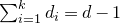 $\sum _{i=1}^k d_i = d-1$
. Then, because each
$\sum _{i=1}^k d_i = d-1$
. Then, because each $n_i$
is less than
$n_i$
is less than $n$
, it follows by the induction hypothesis that
$n$
, it follows by the induction hypothesis that
 \begin{align*} \begin{aligned} {\left \|f_T\right \|}_\infty &= \sup _{t\in [0,1]}{\left \|\int _0^t \unicode {x03B1}^{\unicode {x03C4}}_k \circ (f_{T_1}^{\unicode {x03C4}} \otimes \cdots \otimes f_{T_l}^{\unicode {x03C4}}) {\rm d} \unicode {x03C4}\right \|} \\[5pt] &\leqslant \sup _{\unicode {x03C4} \in [0,1]} {\left \|\unicode {x03B1}^{\unicode {x03C4}}_k\right \|} {\left \|f_{T_1}^{\unicode {x03C4}}\right \|} \cdots {\left \| f_{T_k}^{\unicode {x03C4}} \right \|} \\[5pt] &\leqslant {\left \|\unicode {x03B1}_k\right \|}_\infty {\left \|f_{T_1}\right \|}_\infty \cdots {\left \|f_{T_k}\right \|}_\infty \\[5pt] &\leqslant C^k\cdot C^{n_1+d_1-1} \cdots C^{n_k+d_k-1} = C^{n+d-1} \end{aligned} \end{align*}
which verifies the induction. Because the valency of every internal node of a tree in $\mathcal{O}(n)$
is at least
$\mathcal{O}(n)$
is at least $3$
, one easily verifies that the maximal number of internal nodes is
$3$
, one easily verifies that the maximal number of internal nodes is $d\leqslant n$
. Hence, the sum over all trees is bounded by
$d\leqslant n$
. Hence, the sum over all trees is bounded by
 \begin{align*} {\left \|f_n\right \|}_\infty \leqslant \sum _{T\in \mathcal{O}(n)} {\left \|f_T\right \|}_\infty \leqslant |\mathcal{O}(n)| \cdot C^{2n-1} \end{align*}
where $|\mathcal{O}(n)|$
denotes the cardinality of
$|\mathcal{O}(n)|$
denotes the cardinality of $\mathcal{O}(n)$
, which is bounded by the Catalan number
$\mathcal{O}(n)$
, which is bounded by the Catalan number $\mathcal{C}_{2n}$
. These Catalan numbers are bounded by
$\mathcal{C}_{2n}$
. These Catalan numbers are bounded by $q^n$
for some fixed
$q^n$
for some fixed $q\gt 0$
, so we obtain a bound
$q\gt 0$
, so we obtain a bound
 \begin{align*} {\left \|f_n\right \|}_\infty \lt \mathcal{C}_{2n}\cdot C^{2n} \lt q^nC^{2n} = (qC^2)^n, \end{align*}
which shows that $f$
is uniformly analytic.
$f$
is uniformly analytic.
Using the above and the results of the previous section, we arrive at an analytic generalisation of the Darboux lemma appearing in [Reference Kontsevich and SoibelmanKS08, Reference Cho and LeeCL11, Reference Amorim and TuAT25].
Lemma 4.10 (Analytic Darboux). Let $A \in {\mathsf{Alg}^{\infty ,{\rm an}}}$
be minimal and finite dimensional, and suppose that
$A \in {\mathsf{Alg}^{\infty ,{\rm an}}}$
be minimal and finite dimensional, and suppose that $\unicode {x03C1} \in \Omega ^{2,{\rm cl},{\rm an}}(A)$
is a SHIP of degree
$\unicode {x03C1} \in \Omega ^{2,{\rm cl},{\rm an}}(A)$
is a SHIP of degree $2-d$
. Then:
$2-d$
. Then:
-
(i) there exists an
$A_\infty$
-algebra
$A^{\unicode {x03C1}}$
and an analytic
$A_\infty$
-isomorphism
$f \in {{\rm Hom}}_{{\mathsf{Alg}^\infty }}^{{\rm an}}(A^{\unicode {x03C1}},A)$
such that
is a cyclic structure; and
\begin{align*} \unicode {x03C3}^{\unicode {x03C1}} := f^*\unicode {x03C1} \end{align*}
-
(ii) if
$\unicode {x03C4} \in \Omega ^{2,{\rm cl},{\rm an}}(A)$
is another SHIP such that the image
$\unicode {x03C4} - \unicode {x03C1}$
along the inclusion
$\Omega ^{2,{\rm cl},{\rm an}}(A) \to \Omega ^{2,{\rm cl}}(A)$
is exact, then there is a cyclic analytic
$A_\infty$
-isomorphism
\begin{align*} (A^{\unicode {x03C1}},\unicode {x03C3}^{\unicode {x03C1}}) \cong _{{\rm an},{\rm cyc}} (A^{\unicode {x03C4}},\unicode {x03C3}^{\unicode {x03C4}}). \end{align*}









Effectively, every class in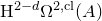 ${\rm H}^{2-d}\Omega ^{2,{\rm cl}}(A)$
admitting an analytic lift defines a cyclic analytic model.
${\rm H}^{2-d}\Omega ^{2,{\rm cl}}(A)$
admitting an analytic lift defines a cyclic analytic model.
Proof.
(i) Let $\unicode {x03C3} := \unicode {x03C1}_{0,0}$
and consider, for each
$\unicode {x03C3} := \unicode {x03C1}_{0,0}$
and consider, for each $t\in [0,1]$
, the analytic closed 2-form
$t\in [0,1]$
, the analytic closed 2-form
 \begin{align} \unicode {x03C1}^t := \unicode {x03C3} + t(\unicode {x03C1} - \unicode {x03C3}) \in \Omega ^{2,{\rm cl},{\rm an}}(A). \end{align}
Use Lemma4.17 to fix an analytic Hochschild cocycle $\unicode {x03BE} \in \mathsf{C}^{{\rm an},\bullet }(A,A_\Delta ')$
with image
$\unicode {x03BE} \in \mathsf{C}^{{\rm an},\bullet }(A,A_\Delta ')$
with image $S(\unicode {x03BE}) = \unicode {x03C1} - \unicode {x03C3}$
along the surjective map
$S(\unicode {x03BE}) = \unicode {x03C1} - \unicode {x03C3}$
along the surjective map $S\colon \mathsf{C}^{{\rm an},\bullet }(A,A_\Delta ') \to \Omega ^{2,{\rm cl},{\rm an}}(A)[1]$
. It follows from (20) that
$S\colon \mathsf{C}^{{\rm an},\bullet }(A,A_\Delta ') \to \Omega ^{2,{\rm cl},{\rm an}}(A)[1]$
. It follows from (20) that $\unicode {x03BE}_1$
is given on generators by
$\unicode {x03BE}_1$
is given on generators by
 \begin{align*} \unicode {x03BE}_1(x_1)(x_0) = \tfrac 12 (\unicode {x03C1} - \unicode {x03C3})(\underline x_0)(x_1)=0, \end{align*}
so $\unicode {x03BE}_1=0$
, and likewise
$\unicode {x03BE}_1=0$
, and likewise $\unicode {x03BE}_0=0$
. Because
$\unicode {x03BE}_0=0$
. Because $A$
is minimal the component
$A$
is minimal the component $\unicode {x03C1}^t_{0,0} = \unicode {x03C1}_{0,0}$
is invertible, and hence
$\unicode {x03C1}^t_{0,0} = \unicode {x03C1}_{0,0}$
is invertible, and hence $\unicode {x03C1}^t$
is an isomorphism by Proposition3.18. Hence, for every
$\unicode {x03C1}^t$
is an isomorphism by Proposition3.18. Hence, for every $t$
the Hochschild cocycle
$t$
the Hochschild cocycle $\unicode {x03B1}^t \in \mathsf{C}^{{\rm an},\bullet }(A)$
defined by the equation
$\unicode {x03B1}^t \in \mathsf{C}^{{\rm an},\bullet }(A)$
defined by the equation
 \begin{align*} \unicode {x03B1}^t := (\unicode {x03C1}^t)^{-1} \circ \overline {\unicode {x03BE}} \end{align*}
satisfies the equation $\iota _{\unicode {x03B1}^t}\unicode {x03C1}^t = \unicode {x03BE}$
. It is straightforward to verify that the sequence
$\iota _{\unicode {x03B1}^t}\unicode {x03C1}^t = \unicode {x03BE}$
. It is straightforward to verify that the sequence $\unicode {x03B1} = (\unicode {x03B1}_n)_{n\in \mathbb{N}}$
of functions
$\unicode {x03B1} = (\unicode {x03B1}_n)_{n\in \mathbb{N}}$
of functions $\unicode {x03B1}_n\colon t\mapsto \unicode {x03B1}^t_n$
is in
$\unicode {x03B1}_n\colon t\mapsto \unicode {x03B1}^t_n$
is in $\mathcal{M}_{[0,1]}(A,A)$
. Indeed, each component
$\mathcal{M}_{[0,1]}(A,A)$
. Indeed, each component $\unicode {x03C1}^t_n$
varies linearly in
$\unicode {x03C1}^t_n$
varies linearly in $t$
, and it is easy to verify from the recursive identity (17) that the function
$t$
, and it is easy to verify from the recursive identity (17) that the function $t\mapsto (\unicode {x03C1}^t)_n^{-1}$
is a polynomial of degree at most
$t\mapsto (\unicode {x03C1}^t)_n^{-1}$
is a polynomial of degree at most $n$
in
$n$
in $t$
. Hence,
$t$
. Hence, $\unicode {x03B1}$
is a well-defined family of Hochschild cocycles, which satisfies
$\unicode {x03B1}$
is a well-defined family of Hochschild cocycles, which satisfies
 \begin{align*} \unicode {x03B1}^t_1 = (\unicode {x03C1}^t)^{-1}_{0,0} \circ \unicode {x03BE}_1=0 \end{align*}
because $\unicode {x03BE}_1=0$
, and likewise
$\unicode {x03BE}_1=0$
, and likewise $\unicode {x03B1}^t_0 = ((\unicode {x03C1}^t)^{-1} \circ \overline {\unicode {x03BE}})_0=0$
by definition. To show that it is analytic we note that for each
$\unicode {x03B1}^t_0 = ((\unicode {x03C1}^t)^{-1} \circ \overline {\unicode {x03BE}})_0=0$
by definition. To show that it is analytic we note that for each $t\in [0,1]$
we have
$t\in [0,1]$
we have
 \begin{align*} {\left \|\unicode {x03C1}^t_{0,0}\right \|} = {\left \|\unicode {x03C1}_{0,0}\right \|},\quad {\left \|\unicode {x03C1}^t_{i,j}\right \|} = t{\left \|\unicode {x03C1}_{i,j}\right \|} \leqslant {\left \|\unicode {x03C1}_{i,j}\right \|} \quad (i+j \gt 0), \end{align*}
so that ${\left \|\unicode {x03C1}^t_n\right \|} \lt C_1^n$
for a uniform choice of constant
${\left \|\unicode {x03C1}^t_n\right \|} \lt C_1^n$
for a uniform choice of constant $C_1\gt 0$
independent of
$C_1\gt 0$
independent of $t$
. It then follows from the proof of Proposition3.18 that there is a uniform constant
$t$
. It then follows from the proof of Proposition3.18 that there is a uniform constant $C_2\gt 0$
such that
$C_2\gt 0$
such that ${\left \|(\unicode {x03C1}^t)^{-1}_n\right \|} \lt C_2^n$
for all
${\left \|(\unicode {x03C1}^t)^{-1}_n\right \|} \lt C_2^n$
for all $t$
, and because
$t$
, and because $\unicode {x03BE}$
is analytic there is some
$\unicode {x03BE}$
is analytic there is some $C_3\gt 0$
bounding the composition
$C_3\gt 0$
bounding the composition
 \begin{align*} {\left \|\unicode {x03B1}^t_n\right \|} = {\left \|((\unicode {x03C1}^t)^{-1} \circ \overline {\unicode {x03BE}})_n\right \|} \lt C_3^n, \end{align*}
for all $t$
. Therefore
$t$
. Therefore $\unicode {x03B1} = (\unicode {x03B1}_n)_{n\in \mathbb{N}}$
is uniformly analytic, and it follows from Lemmas4.8 and 4.9 that there exists a uniformly analytic family of pre-morphisms
$\unicode {x03B1} = (\unicode {x03B1}_n)_{n\in \mathbb{N}}$
is uniformly analytic, and it follows from Lemmas4.8 and 4.9 that there exists a uniformly analytic family of pre-morphisms $f = (f_n)_{n\in \mathbb{N}}$
satisfying the differential equation (15). It then follows from [Reference Amorim and TuAT25, Proposition 2.32] that for each
$f = (f_n)_{n\in \mathbb{N}}$
satisfying the differential equation (15). It then follows from [Reference Amorim and TuAT25, Proposition 2.32] that for each $t$
the pullback
$t$
the pullback $(f^t)^* \colon \Omega ^{2,{\rm cl},{\rm an}}(A) \to \Omega ^{2,{\rm cl},{\rm an}}(A)$
satisfies
$(f^t)^* \colon \Omega ^{2,{\rm cl},{\rm an}}(A) \to \Omega ^{2,{\rm cl},{\rm an}}(A)$
satisfies
 \begin{align*} (f^t)^*\unicode {x03C1}^t = \unicode {x03C3}, \end{align*}
so, in particular, $f^1$
pulls back
$f^1$
pulls back $\unicode {x03C1}^1 = \unicode {x03C1}$
to the constant 2-form
$\unicode {x03C1}^1 = \unicode {x03C1}$
to the constant 2-form $(f^1)^*\unicode {x03C1} = \unicode {x03C3}$
. Because
$(f^1)^*\unicode {x03C1} = \unicode {x03C3}$
. Because $f_1^1 = {\rm id}$
, the pre-morphism
$f_1^1 = {\rm id}$
, the pre-morphism $f^1_1$
admits an analytic inverse by Lemma2.25. Hence if we define
$f^1_1$
admits an analytic inverse by Lemma2.25. Hence if we define $A^{\unicode {x03C1}}$
as the
$A^{\unicode {x03C1}}$
as the $A_\infty$
-algebra with product defined by the analytic Hochschild cocycle
$A_\infty$
-algebra with product defined by the analytic Hochschild cocycle
 \begin{align*} \unicode {x03BC}^{\unicode {x03C1}} := (f^1)^{-1} \circ \overline {\unicode {x03BC}}_A \circ \widehat {f^1} \in \mathsf{C}^{{\rm an},\bullet }(A), \end{align*}
it follows, as in [Reference Amorim and TuAT25, Proposition 2.32], that $f^1\in {{\rm Hom}}_{{\mathsf{Alg}^\infty }}^{{\rm an}}(A^{\unicode {x03C1}},A)$
is an isomorphism and
$f^1\in {{\rm Hom}}_{{\mathsf{Alg}^\infty }}^{{\rm an}}(A^{\unicode {x03C1}},A)$
is an isomorphism and $\unicode {x03C3}^{\unicode {x03C1}} = \unicode {x03C3} = (f^1)^*\unicode {x03C1}$
is a cyclic structure as claimed.
$\unicode {x03C3}^{\unicode {x03C1}} = \unicode {x03C3} = (f^1)^*\unicode {x03C1}$
is a cyclic structure as claimed.
(ii) Now let $\unicode {x03C4}$
be another analytic SHIP defining a cyclic analytic
$\unicode {x03C4}$
be another analytic SHIP defining a cyclic analytic $A_\infty$
-algebra
$A_\infty$
-algebra $(A^{\unicode {x03C4}},\unicode {x03C3}^{\unicode {x03C4}})$
, and let
$(A^{\unicode {x03C4}},\unicode {x03C3}^{\unicode {x03C4}})$
, and let $g \in {{\rm Hom}}_{{\mathsf{Alg}^\infty }}^{{\rm an}}(A^{\unicode {x03C4}},A)$
denote the isomorphism for which
$g \in {{\rm Hom}}_{{\mathsf{Alg}^\infty }}^{{\rm an}}(A^{\unicode {x03C4}},A)$
denote the isomorphism for which $\unicode {x03C3}^{\unicode {x03C4}} = g^*\unicode {x03C4}$
is cyclic. Suppose that
$\unicode {x03C3}^{\unicode {x03C4}} = g^*\unicode {x03C4}$
is cyclic. Suppose that $\unicode {x03C4} - \unicode {x03C1}$
is exact in the complex
$\unicode {x03C4} - \unicode {x03C1}$
is exact in the complex $\Omega ^{2,{\rm cl}}(A)$
, then, as in [Reference Amorim and TuAT25, Lemma 2.33], we note that
$\Omega ^{2,{\rm cl}}(A)$
, then, as in [Reference Amorim and TuAT25, Lemma 2.33], we note that $\unicode {x03C4}_{0,0} = \unicode {x03C1}_{0,0}$
, so that for every
$\unicode {x03C4}_{0,0} = \unicode {x03C1}_{0,0}$
, so that for every $t\in [0,1]$
the analytic closed 2-form
$t\in [0,1]$
the analytic closed 2-form
 \begin{align*} \unicode {x03C1}^t := \unicode {x03C4} + t(\unicode {x03C1} - \unicode {x03C4}) \in \Omega ^{2,{\rm cl},{\rm an}}(A) \end{align*}
has $\unicode {x03C1}^t_{0,0} = \unicode {x03C4}_{0,0} = \unicode {x03C1}_{0,0}$
an isomorphism, and is therefore a SHIP. Fixing a cocycle
$\unicode {x03C1}^t_{0,0} = \unicode {x03C4}_{0,0} = \unicode {x03C1}_{0,0}$
an isomorphism, and is therefore a SHIP. Fixing a cocycle $\unicode {x03BE} \in \mathsf{C}^{{\rm an},\bullet }(A,A'_\Delta )$
such that
$\unicode {x03BE} \in \mathsf{C}^{{\rm an},\bullet }(A,A'_\Delta )$
such that $S(\unicode {x03BE}) = \unicode {x03C1} - \unicode {x03C4}$
as before, there again exists a family of Hochschild cocycles
$S(\unicode {x03BE}) = \unicode {x03C1} - \unicode {x03C4}$
as before, there again exists a family of Hochschild cocycles $\unicode {x03B1}$
which satisfy the equation
$\unicode {x03B1}$
which satisfy the equation $\iota _{\unicode {x03B1}^t}\unicode {x03C1}^t = \unicode {x03BE}$
for each
$\iota _{\unicode {x03B1}^t}\unicode {x03C1}^t = \unicode {x03BE}$
for each $t\in [0,1]$
. The norms of
$t\in [0,1]$
. The norms of $\unicode {x03C1}^t_n$
are bounded by
$\unicode {x03C1}^t_n$
are bounded by $\max \{{\left \|\unicode {x03C4}_n\right \|},{\left \|\unicode {x03C1}_n\right \|}\}$
for all
$\max \{{\left \|\unicode {x03C4}_n\right \|},{\left \|\unicode {x03C1}_n\right \|}\}$
for all $t$
, so it again follows that
$t$
, so it again follows that $\unicode {x03B1}$
is uniformly analytic. Hence there exists a family of pre-morphisms
$\unicode {x03B1}$
is uniformly analytic. Hence there exists a family of pre-morphisms $h$
with
$h$
with $h^0 = {\rm id}$
solving the differential equation
$h^0 = {\rm id}$
solving the differential equation
 \begin{align*} \frac {{\rm d}}{{\rm d} t} h^t = \unicode {x03B1}^t \diamond h^t. \end{align*}
Because $\unicode {x03C1} - \unicode {x03C4}$
is exact in
$\unicode {x03C1} - \unicode {x03C4}$
is exact in $\Omega ^{2,{\rm cl}}(A)$
it follows that
$\Omega ^{2,{\rm cl}}(A)$
it follows that $\unicode {x03BE}$
is exact in
$\unicode {x03BE}$
is exact in $\mathsf{C}^\bullet (A,A^\vee )$
. Therefore [Reference Amorim and TuAT25, Lemma 2.33] implies that the analytic pre-morphism
$\mathsf{C}^\bullet (A,A^\vee )$
. Therefore [Reference Amorim and TuAT25, Lemma 2.33] implies that the analytic pre-morphism $h^1$
is an
$h^1$
is an $A_\infty$
-morphism such that
$A_\infty$
-morphism such that $(h^1)^*\unicode {x03C4} = \unicode {x03C1}$
and hence lies in
$(h^1)^*\unicode {x03C4} = \unicode {x03C1}$
and hence lies in $h^1\in {{\rm Hom}}_{{\mathsf{Alg}^\infty }}^{{\rm an}}(A,A)$
. Now the composition
$h^1\in {{\rm Hom}}_{{\mathsf{Alg}^\infty }}^{{\rm an}}(A,A)$
. Now the composition $g^{-1} \circ h^1 \circ f^1 \in {{\rm Hom}}_{{\mathsf{Alg}^\infty }}^{{\rm an}}(A^{\unicode {x03C4}},A^{\unicode {x03C1}})$
is an analytic
$g^{-1} \circ h^1 \circ f^1 \in {{\rm Hom}}_{{\mathsf{Alg}^\infty }}^{{\rm an}}(A^{\unicode {x03C4}},A^{\unicode {x03C1}})$
is an analytic $A_\infty$
-isomorphism satisfying
$A_\infty$
-isomorphism satisfying
 \begin{align*} (g^{-1}\circ h^1 \circ f^1)^*\unicode {x03C3}^{\unicode {x03C4}} = (h^1 \circ f^1)^*\unicode {x03C4} = (f^1)^*\unicode {x03C1} = \unicode {x03C3}^{\unicode {x03C1}}. \end{align*}
4.3 Analytic Calabi–Yau structures and SHIPs
Cyclic structures express a type of Calabi–Yau symmetry, which can be formalised using the notion of a right Calabi–Yau structure in the terminology of [Reference Behrend, Bryan and SzendrőiBBS13]. For ordinary $A_\infty$
-algebras, these structures can be defined as follows.
$A_\infty$
-algebras, these structures can be defined as follows.
Definition 4.11. A right $d$
-Calabi–Yau structure on an
$d$
-Calabi–Yau structure on an $A_\infty$
-algebra
$A_\infty$
-algebra $A = (A,\unicode {x03BC}) \in {\mathsf{Alg}^\infty }$
is a cocycle
$A = (A,\unicode {x03BC}) \in {\mathsf{Alg}^\infty }$
is a cocycle $\unicode {x03D5} \in Z^{-d}\mathsf{C}_\lambda ^\bullet (A)$
for which the map
$\unicode {x03D5} \in Z^{-d}\mathsf{C}_\lambda ^\bullet (A)$
for which the map $A \to A^\vee [-d] \colon a \mapsto \unicode {x03D5}_0(\unicode {x03BC}_2(a,-))$
is a quasi-isomorphism.
$A \to A^\vee [-d] \colon a \mapsto \unicode {x03D5}_0(\unicode {x03BC}_2(a,-))$
is a quasi-isomorphism.
It was shown by Cho and Lee [Reference Cho and LeeCL11] (and in [Reference Kontsevich and SoibelmanKS08] in the symplectic language) that right CY structures and SHIPs on an $A_\infty$
-algebra
$A_\infty$
-algebra $A$
are equivalent notions. More precisely, the two structures are identified up to homotopy by a map
$A$
are equivalent notions. More precisely, the two structures are identified up to homotopy by a map $\Omega ^{2,{\rm cl}}(A)[1] \to \mathsf{C}_\lambda ^\bullet (A)$
. This map can be constructed in two steps.
$\Omega ^{2,{\rm cl}}(A)[1] \to \mathsf{C}_\lambda ^\bullet (A)$
. This map can be constructed in two steps.
Proposition 4.12 ([Reference Amorim and TuAT25, Lemma 2.14, Proposition 2.18]). The map $S\colon \mathsf{C}^\bullet (A,A_\Delta ^\vee ) \to \Omega ^{2,{\rm cl}}(A)[1]$
defined by
$S\colon \mathsf{C}^\bullet (A,A_\Delta ^\vee ) \to \Omega ^{2,{\rm cl}}(A)[1]$
defined by
 \begin{align*} (S\unicode {x03BE})({\bf x} \otimes \underline v \otimes \mathbf y)(w) = \xi ({\bf x} \otimes v \otimes {\bf y})(w) - \xi ({\bf y} \otimes w \otimes {\bf x})(v) \end{align*}
defines a chain map fitting into a short exact sequence of cochain complexes

where the first map is the inclusion of the cyclic cochains. Moreover, this short exact sequence is natural over $A\in {\mathsf{Alg}^\infty }$
along the induced pullbacks on Hochschild cochains and bimodule maps.
$A\in {\mathsf{Alg}^\infty }$
along the induced pullbacks on Hochschild cochains and bimodule maps.
The above shows that the map $S$
induces an isomorphism between
$S$
induces an isomorphism between $\Omega ^{2,{\rm cl}}(A)[1]$
and the quotient complex
$\Omega ^{2,{\rm cl}}(A)[1]$
and the quotient complex $\mathsf{C}^\bullet (A,A_\Delta ^\vee )/\mathsf{C}_\lambda ^\bullet (A)$
. As observed by Kontsevich and Soibelman, the latter complex can be related to the negative cyclic complex via the following short exact sequence.
$\mathsf{C}^\bullet (A,A_\Delta ^\vee )/\mathsf{C}_\lambda ^\bullet (A)$
. As observed by Kontsevich and Soibelman, the latter complex can be related to the negative cyclic complex via the following short exact sequence.
Proposition 4.13 ([Reference Amorim and TuAT25, Proposition 2.22]). There is a short exact sequence of chain complexes

where the maps are the compositions of the norm operator $(N\unicode {x03BE})_n = (1 + t + \cdots + t^{n})\unicode {x03BE}_n$
and the operator
$(N\unicode {x03BE})_n = (1 + t + \cdots + t^{n})\unicode {x03BE}_n$
and the operator ${\rm id} - t$
via the identification
${\rm id} - t$
via the identification
 \begin{align*} (\mathsf{B} A/\ell )^\vee \cong \prod _{n\geqslant 0} \hom _{\ell ^e}(A[1]^{\otimes n+1}, \ell )[1] \cong \prod _{n\geqslant 0} \hom _{\ell ^e}(A[1]^{\otimes n}, A^\vee ) \cong \mathcal{M}(A,A^\vee )[-1]. \end{align*}
The short exact sequence is, moreover, natural in $A\in {\mathsf{Alg}^\infty }$
via the induced maps.
$A\in {\mathsf{Alg}^\infty }$
via the induced maps.
It is well known that the normalised bar complex $\mathsf{B} A/\ell$
is acyclic if
$\mathsf{B} A/\ell$
is acyclic if $A$
is unital, and that the same is true of its dual. Choosing a contracting homotopy
$A$
is unital, and that the same is true of its dual. Choosing a contracting homotopy $s\colon (\mathsf{B} A/\ell )^\vee [1] \to (\mathsf{B} A/\ell )^\vee$
, one obtains a quasi-isomorphism
$s\colon (\mathsf{B} A/\ell )^\vee [1] \to (\mathsf{B} A/\ell )^\vee$
, one obtains a quasi-isomorphism
 \begin{align*} \Omega ^{2,{\rm cl}}(A)[2] \cong (\mathsf{C}^\bullet (A,A_\Delta ^\vee )/\mathsf{C}_\lambda ^\bullet (A))[1] \xrightarrow {N\circ s \circ ({\rm id} -t)} \mathsf{C}_\lambda ^\bullet (A), \end{align*}
after composing with the inverse of $S$
. One can show that this map identifies right CY structures with SHIPs, leading to the following statement for unital
$S$
. One can show that this map identifies right CY structures with SHIPs, leading to the following statement for unital $A_\infty$
-algebras.
$A_\infty$
-algebras.
Proposition 4.14 ([Reference Amorim and TuAT25, Corollary 2.24]). The map $\Omega ^{2,{\rm cl}}(A)[2] \xrightarrow {\sim } \mathsf{C}_\lambda ^\bullet (A)$
is a quasi-isomorphism, is natural with respect to
$\Omega ^{2,{\rm cl}}(A)[2] \xrightarrow {\sim } \mathsf{C}_\lambda ^\bullet (A)$
is a quasi-isomorphism, is natural with respect to $A_\infty$
-morphisms, and identifies right CY structures with SHIPs.
$A_\infty$
-morphisms, and identifies right CY structures with SHIPs.
We now want to show a version of the above for analytic $A_\infty$
-algebras, involving analytic SHIPs and analytic right Calabi–Yau structures, by which we mean the following.
$A_\infty$
-algebras, involving analytic SHIPs and analytic right Calabi–Yau structures, by which we mean the following.
Definition 4.15. Let $A\in {\mathsf{Alg}^{\infty ,{\rm an}}}$
. Then a right Calabi–Yau structure
$A\in {\mathsf{Alg}^{\infty ,{\rm an}}}$
. Then a right Calabi–Yau structure $\unicode {x03D5}$
is analytic if it lies in the subcomplex
$\unicode {x03D5}$
is analytic if it lies in the subcomplex $\mathsf{C}_\lambda ^{{\rm an},\bullet }(A) \subset \mathsf{C}_\lambda ^{\bullet }(A)$
.
$\mathsf{C}_\lambda ^{{\rm an},\bullet }(A) \subset \mathsf{C}_\lambda ^{\bullet }(A)$
.
Example 4.16. Let $(A,D,{{\left \|\cdot \right \|}})$
be a normed DG algebra and
$(A,D,{{\left \|\cdot \right \|}})$
be a normed DG algebra and $\unicode {x03BB} \colon A^n \to {\mathbb{C}}$
a
$\unicode {x03BB} \colon A^n \to {\mathbb{C}}$
a ${\left \|\cdot \right \|}$
-bounded linear functional such that
${\left \|\cdot \right \|}$
-bounded linear functional such that
 \begin{align*} \unicode {x03BB}(Da)=0,\quad \unicode {x03BB}(a_1\cdot a_2) = (-1)^{|a_1||a_2|}\unicode {x03BB}(a_2\cdot a_1). \end{align*}
Then the element $\unicode {x03D5} \in \mathsf{C}_\lambda ^{-n,{\rm an}}(A)$
defined by
$\unicode {x03D5} \in \mathsf{C}_\lambda ^{-n,{\rm an}}(A)$
defined by $\unicode {x03D5}_0 = \unicode {x03BB}$
and
$\unicode {x03D5}_0 = \unicode {x03BB}$
and $\unicode {x03D5}_n=0$
for
$\unicode {x03D5}_n=0$
for $n\gt 0$
is a cocycle, and it is a right
$n\gt 0$
is a cocycle, and it is a right $n$
-Calabi–Yau structure if the cohomology pairing
$n$
-Calabi–Yau structure if the cohomology pairing $([a_1],[a_2]) \mapsto \unicode {x03BB}([a_1\cdot a_2])$
is nondegenerate.
$([a_1],[a_2]) \mapsto \unicode {x03BB}([a_1\cdot a_2])$
is nondegenerate.
We will show that the map $\Omega ^{2,{\rm cl}}(A)[2] \to \mathsf{C}_\lambda ^\bullet (A)$
restricts to a map on analytic elements by showing that the short exact sequences (18) and (19) restrict to the relevant analytic subspaces. The analytic version of Proposition4.12 is as follows.
$\Omega ^{2,{\rm cl}}(A)[2] \to \mathsf{C}_\lambda ^\bullet (A)$
restricts to a map on analytic elements by showing that the short exact sequences (18) and (19) restrict to the relevant analytic subspaces. The analytic version of Proposition4.12 is as follows.
Lemma 4.17.
Let $A$
be an analytic
$A$
be an analytic $A_\infty$
-algebra. Then the map
$A_\infty$
-algebra. Then the map $S$
fits into a short exact sequence
$S$
fits into a short exact sequence

which is, moreover, natural with respect to analytic $A_\infty$
-morphisms
$A_\infty$
-morphisms $f\in {{\rm Hom}}_{{\mathsf{Alg}^\infty }}^{{\rm an}}(A,B)$
.
$f\in {{\rm Hom}}_{{\mathsf{Alg}^\infty }}^{{\rm an}}(A,B)$
.
Proof.
By construction, $\mathsf{C}^{{\rm an},\bullet }_\lambda (A) = \mathsf{C}^{\bullet }_\lambda (A) \cap \mathsf{C}^{{\rm an},\bullet }(A,A_\Delta ')$
is a subcomplex of
$\mathsf{C}^{{\rm an},\bullet }_\lambda (A) = \mathsf{C}^{\bullet }_\lambda (A) \cap \mathsf{C}^{{\rm an},\bullet }(A,A_\Delta ')$
is a subcomplex of $\mathsf{C}^{{\rm an},\bullet }(A,A_\Delta ')$
, and this subcomplex is the kernel of the restriction of
$\mathsf{C}^{{\rm an},\bullet }(A,A_\Delta ')$
, and this subcomplex is the kernel of the restriction of $S$
to
$S$
to $\mathsf{C}^{{\rm an},\bullet }(A,A_\Delta ')$
by Proposition4.12. Hence it suffices to show that
$\mathsf{C}^{{\rm an},\bullet }(A,A_\Delta ')$
by Proposition4.12. Hence it suffices to show that $S$
restricts to a surjective map
$S$
restricts to a surjective map $S\colon \mathsf{C}^{{\rm an},\bullet }(A,A'_\Delta ) \to \Omega ^{2,{\rm cl},{\rm an}}(A)[1]$
.
$S\colon \mathsf{C}^{{\rm an},\bullet }(A,A'_\Delta ) \to \Omega ^{2,{\rm cl},{\rm an}}(A)[1]$
.
Suppose $\unicode {x03D5} \in \mathsf{C}^{\bullet ,an}(A,A_\Delta ')$
, and pick
$\unicode {x03D5} \in \mathsf{C}^{\bullet ,an}(A,A_\Delta ')$
, and pick $C\gt 0$
such that
$C\gt 0$
such that ${\left \|\unicode {x03D5}_n\right \|} \lt C^n$
for all
${\left \|\unicode {x03D5}_n\right \|} \lt C^n$
for all $n\geqslant 1$
. Then for any element
$n\geqslant 1$
. Then for any element $a \in A[1]^{\otimes i}\otimes A[1] \otimes A[1]^{\otimes j}$
and any decomposition
$a \in A[1]^{\otimes i}\otimes A[1] \otimes A[1]^{\otimes j}$
and any decomposition $a=\sum _k {\bf x}_k \otimes \underline v_k \otimes {\bf y}_k$
 \begin{align*} \begin{aligned} {\left \|(S\unicode {x03D5})_{i,j}(a)\right \|} &\leqslant \sum _k \sup _{{\left \|w\right \|} = 1} {\left \|(S\unicode {x03D5})_{i,j}({\bf x}_k\otimes \underline v_k \otimes {\bf y}_k)(w)\right \|} \\[5pt] &\leqslant \sum _k \sup _{{\left \|w\right \|}=1} \left ({\left \|\unicode {x03D5}_{i+j+1}({\bf x}_k\otimes \underline v_k \otimes {\bf y}_k)(w)\right \|} + {\left \|\unicode {x03D5}_{i+j+1}({\bf y}_k\otimes \underline w \otimes {\bf x}_k)(v_k)\right \|}\right ) \\[5pt] &\leqslant 2{\left \|\unicode {x03D5}_{i+j+1}\right \|}\cdot \sum _k {\left \|{\bf x}_k\right \|} {\left \|v_k\right \|} {\left \|{\bf y}_k\right \|}. \end{aligned} \end{align*}
Taking the infimum over all decompositions of $a$
, it follows that
$a$
, it follows that ${\left \|(S\unicode {x03D5})_{i,j}(a)\right \|} \leqslant 2{\left \|\unicode {x03D5}_{i+j+1}\right \|} \cdot {\left \|a\right \|}$
, so that
${\left \|(S\unicode {x03D5})_{i,j}(a)\right \|} \leqslant 2{\left \|\unicode {x03D5}_{i+j+1}\right \|} \cdot {\left \|a\right \|}$
, so that ${\left \|(S\unicode {x03D5})_{i,j}\right \|} \leqslant 2{\left \|\unicode {x03D5}_{i+j+1}\right \|} \lt (2C)^{i+j+1}$
. It follows by Lemma3.8 that
${\left \|(S\unicode {x03D5})_{i,j}\right \|} \leqslant 2{\left \|\unicode {x03D5}_{i+j+1}\right \|} \lt (2C)^{i+j+1}$
. It follows by Lemma3.8 that $S\unicode {x03D5}$
is analytic.
$S\unicode {x03D5}$
is analytic.
To show the surjectivity of $S$
we use the mapFootnote
1
$S$
we use the mapFootnote
1 $h\colon \Omega ^{2,{\rm cl}}(A)[1] \to \mathsf{C}^\bullet (A,A^\vee )$
defined in [Reference Amorim and TuAT25, Equation 11], which is defined by the equations
$h\colon \Omega ^{2,{\rm cl}}(A)[1] \to \mathsf{C}^\bullet (A,A^\vee )$
defined in [Reference Amorim and TuAT25, Equation 11], which is defined by the equations
 \begin{align} (h\unicode {x03C1})(x_1\otimes \cdots \otimes x_n)(x_0) = \sum _{i=1}^n \frac {(-1)^\#}{n+1}\unicode {x03C1}(x_{i+1},\ldots ,x_n,\underline x_0,\ldots ,x_{i-1})(x_i), \end{align}
and which satisfies $S \circ h = {\rm id}$
. Now suppose
$S \circ h = {\rm id}$
. Now suppose $\unicode {x03C1}\in \Omega ^{2,{\rm cl},an}(A)$
is an analytic closed 2-form, and let
$\unicode {x03C1}\in \Omega ^{2,{\rm cl},an}(A)$
is an analytic closed 2-form, and let $C\gt 0$
be a constant such that
$C\gt 0$
be a constant such that ${\left \|\unicode {x03C1}_{i,j}\right \|} \lt C^{i+j+1}$
for all
${\left \|\unicode {x03C1}_{i,j}\right \|} \lt C^{i+j+1}$
for all $i,j\in \mathbb{N}$
. Then for any element
$i,j\in \mathbb{N}$
. Then for any element $a \in A[1]^{\otimes n}$
and decomposition
$a \in A[1]^{\otimes n}$
and decomposition $a = \sum _k a_{k,1}\otimes \cdots \otimes a_{k,n}$
there is an inequality
$a = \sum _k a_{k,1}\otimes \cdots \otimes a_{k,n}$
there is an inequality
 \begin{align*} \begin{aligned} {\left \|(h\unicode {x03C1})_n(a)\right \|} &\leqslant \sup _{{\left \|a_0\right \|}=1} \sum _k {\left \|(h\unicode {x03C1})_n(a_{k,1}\otimes \cdots \otimes a_{k,n})(a_0)\right \|} \\[5pt] &\leqslant \frac {1}{n+1} \cdot \sum _k\sum _{i=1}^n\sup _{{\left \|a_0\right \|}=1} {\left \|\unicode {x03C1}_{n-i,i-1}(a_{k,i+1},\ldots ,a_{k,n},\underline a_0,a_{k,1},\ldots ,a_{k,i-1})(a_{k,i})\right \|} \end{aligned} \end{align*}
 \begin{align*} \begin{aligned} &\leqslant \frac {1}{n+1} \cdot \sum _{i=1}^n{\left \|\unicode {x03C1}_{n-i,i-1}\right \|} \cdot \sum _k{\left \|a_{k,1}\right \|} \cdots {\left \|a_{k,n}\right \|} \\[5pt] &\lt C^n \cdot \sum _k{\left \|a_{k,1}\right \|} \cdots {\left \|a_{k,n}\right \|}. \end{aligned} \end{align*}
Taking the infimum over all decompositions of $a$
, it follows that
$a$
, it follows that ${\left \|(h\unicode {x03C1})_n(a)\right \|} \leqslant C^n{\left \|a\right \|}$
, which shows that
${\left \|(h\unicode {x03C1})_n(a)\right \|} \leqslant C^n{\left \|a\right \|}$
, which shows that $h\unicode {x03C1}$
is analytic. Hence
$h\unicode {x03C1}$
is analytic. Hence $h$
defines a map
$h$
defines a map $\Omega ^{2,{\rm cl},{\rm an}}(A)[1] \to \mathsf{C}^\bullet (A,A_\Delta ')$
which satisfies
$\Omega ^{2,{\rm cl},{\rm an}}(A)[1] \to \mathsf{C}^\bullet (A,A_\Delta ')$
which satisfies $S\circ h = {\rm id}$
, showing that
$S\circ h = {\rm id}$
, showing that $S$
is surjective.
$S$
is surjective.
Finally, if $f\in {{\rm Hom}}_{{\mathsf{Alg}^\infty }}^{{\rm an}}(A,B)$
is an analytic morphism, it follows from Lemma3.12 and the subsequent discussion that the pullback morphisms
$f\in {{\rm Hom}}_{{\mathsf{Alg}^\infty }}^{{\rm an}}(A,B)$
is an analytic morphism, it follows from Lemma3.12 and the subsequent discussion that the pullback morphisms $f^*$
preserve analytic elements, so naturality follows.
$f^*$
preserve analytic elements, so naturality follows.
Corollary 4.18.
The map $S$
induces an isomorphism
$S$
induces an isomorphism $\mathsf{C}^{{\rm an},\bullet }(A,A_\Delta ')/ \mathsf{C}^{{\rm an},\bullet }_\lambda (A) \xrightarrow {\sim } \Omega ^{2,{\rm cl},{\rm an}}(A)[1]$
.
$\mathsf{C}^{{\rm an},\bullet }(A,A_\Delta ')/ \mathsf{C}^{{\rm an},\bullet }_\lambda (A) \xrightarrow {\sim } \Omega ^{2,{\rm cl},{\rm an}}(A)[1]$
.
For the analytic analogue of Proposition4.13 we note that $(\mathsf{B} A/\ell )^\vee \cong \mathcal{M}(A,A^\vee )[-2]$
, and define
$(\mathsf{B} A/\ell )^\vee \cong \mathcal{M}(A,A^\vee )[-2]$
, and define
 \begin{align*} (\mathsf{B} A/\ell )^{\vee ,{\rm an}} := (\mathsf{B} A/\ell )^\vee \cap {\mathcal{A}}(A,A')[-2] \end{align*}
as the subspace obtained from ${\mathcal{A}}(A,A')[-2]$
via this identification. The following now holds.
${\mathcal{A}}(A,A')[-2]$
via this identification. The following now holds.
Lemma 4.19.
Let $A$
be an analytic
$A$
be an analytic $A_\infty$
-algebra. Then there is a short exact sequence
$A_\infty$
-algebra. Then there is a short exact sequence

which is natural with respect to analytic $A_\infty$
-morphisms.
$A_\infty$
-morphisms.
Proof.
The operator ${\rm id}-t$
restricts to
${\rm id}-t$
restricts to ${\mathcal{A}}(A,A')[-1] \subset \mathcal{M}(A,A^\vee )[-1]$
and clearly has the set of cyclic analytic elements as its kernel. Hence, it immediately follows that it defines an injective chain map
${\mathcal{A}}(A,A')[-1] \subset \mathcal{M}(A,A^\vee )[-1]$
and clearly has the set of cyclic analytic elements as its kernel. Hence, it immediately follows that it defines an injective chain map

To see that the norm operator likewise preserves ${\mathcal{A}}(A,A')$
, note that if
${\mathcal{A}}(A,A')$
, note that if $\unicode {x03D5}$
satisfies
$\unicode {x03D5}$
satisfies ${\left \|\unicode {x03D5}_n\right \|} \lt C^n$
then
${\left \|\unicode {x03D5}_n\right \|} \lt C^n$
then
 \begin{align*} {\left \|(N\unicode {x03D5})_n\right \|} \leqslant {\left \|\unicode {x03D5}_n\right \|} + \cdots + {\left \|(t^n\unicode {x03D5})_n\right \|} = (1+n) {\left \|\unicode {x03D5}_n\right \|} \lt (1+n) C^n \lt (3C)^n, \end{align*}
so that $N\unicode {x03D5}$
is again analytic. Therefore it follows that
$N\unicode {x03D5}$
is again analytic. Therefore it follows that $N$
defines a chain map
$N$
defines a chain map

It is, moreover, surjective, as every $\unicode {x03D5}\in \mathsf{C}_\lambda ^{{\rm an},\bullet }(A)$
is the image of
$\unicode {x03D5}\in \mathsf{C}_\lambda ^{{\rm an},\bullet }(A)$
is the image of $\sum _n 1/{n+1} \unicode {x03D5}_n \in {\mathcal{A}}(A,A')[-1]$
. To see that the sequence (21) is exact at the middle term, one can consider the inverse operator
$\sum _n 1/{n+1} \unicode {x03D5}_n \in {\mathcal{A}}(A,A')[-1]$
. To see that the sequence (21) is exact at the middle term, one can consider the inverse operator
 \begin{align*} f\colon \ker N \to \mathsf{C}^{{\rm an},\bullet }(A,A'_\Delta )/\mathsf{C}^{{\rm an},\bullet }_\lambda (A),\quad (f\unicode {x03BE})_n = \frac 1{n+1}(t+2 t^2+\cdots + n t^n)\unicode {x03BE}_n, \end{align*}
which maps an analytic element with ${\left \|\unicode {x03BE}_n\right \|} \lt C^n$
for
${\left \|\unicode {x03BE}_n\right \|} \lt C^n$
for $n\geqslant 1$
to an element
$n\geqslant 1$
to an element $f\unicode {x03BE}$
satisfying
$f\unicode {x03BE}$
satisfying ${\left \|(f\unicode {x03BE})_n\right \|} \leqslant {n^2}/{n+1} {\left \|\unicode {x03BE}_n\right \|} \lt (2C)^n$
, which is therefore again analytic. It follows that (21) is a short exact sequence as required. Naturality again follows from the naturality in (21).
${\left \|(f\unicode {x03BE})_n\right \|} \leqslant {n^2}/{n+1} {\left \|\unicode {x03BE}_n\right \|} \lt (2C)^n$
, which is therefore again analytic. It follows that (21) is a short exact sequence as required. Naturality again follows from the naturality in (21).
To construct the map $\Omega ^{2,{\rm cl},{\rm an}}(A)[2] \to \mathsf{C}_\lambda ^\bullet (A)$
, it now suffices to find a contracting homotopy for
$\Omega ^{2,{\rm cl},{\rm an}}(A)[2] \to \mathsf{C}_\lambda ^\bullet (A)$
, it now suffices to find a contracting homotopy for $(\mathsf{B} A/\ell )^\vee$
which restricts to a contracting homotopy for
$(\mathsf{B} A/\ell )^\vee$
which restricts to a contracting homotopy for $(\mathsf{B} A/\ell )^{\vee ,{\rm an}}$
. For this one can take, for example, the dual of the degeneracy map in [Reference LodayLod92, Proposition-definition 1.1.12], which is given by the formula
$(\mathsf{B} A/\ell )^{\vee ,{\rm an}}$
. For this one can take, for example, the dual of the degeneracy map in [Reference LodayLod92, Proposition-definition 1.1.12], which is given by the formula
 \begin{align*} s\colon (\mathsf{B} A/\ell )^\vee \to (\mathsf{B} A/\ell )^\vee [-1],\quad (sg)_n(a_1,\ldots ,a_n) = g_{n+1}(1,a_1,\ldots ,a_n), \end{align*}
where $1$
is any choice of unit in
$1$
is any choice of unit in $A$
. The following lemma shows that this restricts to analytic elements.
$A$
. The following lemma shows that this restricts to analytic elements.
Lemma 4.20.
Let $A$
be a unital analytic
$A$
be a unital analytic $A_\infty$
-algebra. Then the degeneracy map restricts to a contracting homotopy
$A_\infty$
-algebra. Then the degeneracy map restricts to a contracting homotopy $s\colon (\mathsf{B} A/\ell )^{\vee ,{\rm an}} \to (\mathsf{B} A/\ell )^{\vee ,{\rm an}}[-1]$
.
$s\colon (\mathsf{B} A/\ell )^{\vee ,{\rm an}} \to (\mathsf{B} A/\ell )^{\vee ,{\rm an}}[-1]$
.
Proof.
Let $f = (f_n)_{n\in \mathbb{N}} \in {\mathcal{A}}(A,A')$
be an analytic sequence, and pick
$f = (f_n)_{n\in \mathbb{N}} \in {\mathcal{A}}(A,A')$
be an analytic sequence, and pick $C\gt 0$
such that
$C\gt 0$
such that ${\left \|f_n\right \|} \lt C^n$
for all
${\left \|f_n\right \|} \lt C^n$
for all $n\geqslant 1$
. Then the corresponding element
$n\geqslant 1$
. Then the corresponding element $g\in (\mathsf{B} A/\ell )^\vee$
is the map defined by
$g\in (\mathsf{B} A/\ell )^\vee$
is the map defined by $g_n(a_1,\ldots ,a_n) = f_{n-1}(a_1,\ldots ,a_{n-1})(a_n)$
. Hence
$g_n(a_1,\ldots ,a_n) = f_{n-1}(a_1,\ldots ,a_{n-1})(a_n)$
. Hence
 \begin{align*} (sg)_n(a_1,\ldots ,a_n) = g_{n+1}(1,a_1,\ldots ,a_n) = f_n(1,a_1,\ldots ,a_{n-1})(a_n), \end{align*}
and the element $sf\in {\mathcal{A}}(A,A')$
corresponding to
$sf\in {\mathcal{A}}(A,A')$
corresponding to $sg$
is given by
$sg$
is given by $(sf)_n(a) = f_{n+1}(1\otimes a)$
. Clearly this now satisfies the bound
$(sf)_n(a) = f_{n+1}(1\otimes a)$
. Clearly this now satisfies the bound
 \begin{align*} {\left \|(sf)_n(a)\right \|} = {\left \|f_{n+1}(1\otimes a)\right \|} \leqslant {\left \|f_{n+1}\right \|}{\left \|1\right \|}{\left \|a\right \|} \lt C^{n+1} \cdot {\left \|a\right \|} \lt (C^2)^{n+1} \cdot {\left \|a\right \|}, \end{align*}
and hence $sf$
is analytic as claimed.
$sf$
is analytic as claimed.
Corollary 4.21.
For a unital analytic $A_\infty$
-algebra
$A_\infty$
-algebra $A$
there is a natural quasi-isomorphism
$A$
there is a natural quasi-isomorphism
 \begin{align*} \Omega ^{2,{\rm cl},{\rm an}}(A)[2] \cong (\mathsf{C}^{{\rm an},\bullet }(A,A_\Delta ')/\mathsf{C}_\lambda ^{{\rm an},\bullet }(A))[-1] \xrightarrow {N \circ s \circ ({\rm id} - t)} \mathsf{C}_\lambda ^{{\rm an},\bullet }(A), \end{align*}
which maps analytic SHIPs to analytic right CY structures.
Example 4.22. Let $(A,\unicode {x03BC})$
be the analytic
$(A,\unicode {x03BC})$
be the analytic $A_\infty$
-algebra obtained from a normed DG algebra with
$A_\infty$
-algebra obtained from a normed DG algebra with $\unicode {x03D5}$
an analytic right CY structure obtained from a bounded linear functional
$\unicode {x03D5}$
an analytic right CY structure obtained from a bounded linear functional $\unicode {x03BB} \colon A^n \to {\mathbb{C}}$
as in Example 4.16. Then
$\unicode {x03BB} \colon A^n \to {\mathbb{C}}$
as in Example 4.16. Then $\unicode {x03D5}$
is the image of the analytic SHIP
$\unicode {x03D5}$
is the image of the analytic SHIP $\unicode {x03C1} \in \Omega ^{2,{\rm cl},{\rm an}}(A)$
defined by
$\unicode {x03C1} \in \Omega ^{2,{\rm cl},{\rm an}}(A)$
defined by $\unicode {x03C1}_0(a)(b) = \unicode {x03BB}(\unicode {x03BC}_2(a,b))$
and
$\unicode {x03C1}_0(a)(b) = \unicode {x03BB}(\unicode {x03BC}_2(a,b))$
and $\unicode {x03C1}_n=0$
for
$\unicode {x03C1}_n=0$
for $n\gt 0$
: one has
$n\gt 0$
: one has $\unicode {x03C1} = S(\unicode {x03BE})$
for the analytic cocycle
$\unicode {x03C1} = S(\unicode {x03BE})$
for the analytic cocycle $\unicode {x03BE} \in \mathsf{C}^{{\rm an},\bullet }(A,A'_\Delta )$
with
$\unicode {x03BE} \in \mathsf{C}^{{\rm an},\bullet }(A,A'_\Delta )$
with $\unicode {x03BE}_1(a)(b) = 1/2 \unicode {x03BB}(a\cdot b)$
and
$\unicode {x03BE}_1(a)(b) = 1/2 \unicode {x03BB}(a\cdot b)$
and $\unicode {x03BE}_n=0$
otherwise, and this cocycle maps to the Connes cocycle
$\unicode {x03BE}_n=0$
otherwise, and this cocycle maps to the Connes cocycle $(N\circ s\circ ({\rm id} - t) \unicode {x03BE})$
with
$(N\circ s\circ ({\rm id} - t) \unicode {x03BE})$
with
 \begin{align*} (N\circ s\circ ({\rm id} - t) \unicode {x03BE})_0(a) = \unicode {x03BE}_1(1)(a) - (-1)^{|a|} \unicode {x03BE}_1(a)(1) = \tfrac 12 \unicode {x03BB}(\unicode {x03BC}_2(1,a) - (-1)^{|a|}\unicode {x03BC}_2(a,1)) = \unicode {x03BB}(a) \end{align*}
and vanishing higher terms. This example appears in the non-analytic case in [Reference Amorim and TuAT25, Example 2.25].
As a result of the corollary, we find that every analytic SHIP is determined, up to homotopy, by an analytic right Calabi–Yau structure. Using the corollary above, we can restate the analytic Darboux lemma in terms of Calabi–Yau structures, which yields our main theorem.
Theorem 4.23.
Suppose $A \in {\mathsf{Alg}^{\infty ,{\rm an}}}$
is compact and admits a unital analytic minimal model. Then:
$A \in {\mathsf{Alg}^{\infty ,{\rm an}}}$
is compact and admits a unital analytic minimal model. Then:
-
(i) every analytic right
$d$
-CY structure
$\unicode {x03D5}$
defines a cyclic analytic minimal model
$({\rm H}(A)^{\unicode {x03D5}},\unicode {x03C3}^{\unicode {x03D5}})$
; -
(ii) if
$\unicode {x03D5},\unicode {x03C8}$
are analytic right
$d$
-CY structures such that
$[\unicode {x03C8}] - [\unicode {x03D5}]$
maps to
$0$
in
${\rm HC}_\lambda ^{-d}(A)$
, then there is a cyclic analytic
$A_\infty$
-isomorphism
\begin{align*} ({\rm H}(A)^{\unicode {x03D5}},\unicode {x03C3}^{\unicode {x03D5}}) \cong _{{\rm an},{\rm cyc}} ({\rm H}(A)^{\unicode {x03C8}},\unicode {x03C3}^{\unicode {x03C8}}); \end{align*}
-
(iii) if
$B \in {\mathsf{Alg}^{\infty ,{\rm an}}}$
is also compact with a unital analytic minimal model, and
$g\colon B \to A$
is an analytic quasi-isomorphism, then there is an induced a cyclic analytic
$A_\infty$
-isomorphism
\begin{align*} ({\rm H}(B)^{g^*\unicode {x03D5}},\unicode {x03C3}^{g^*\unicode {x03D5}}) \cong _{{\rm an},{\rm cyc}} ({\rm H}(A)^{\unicode {x03D5}},\unicode {x03C3}^{\unicode {x03D5}}). \end{align*}


Hence, every nondegenerate class in ${\rm HC}_\lambda ^{{\rm an},-d}(A)$
defines a canonical cyclic analytic minimal model.
${\rm HC}_\lambda ^{{\rm an},-d}(A)$
defines a canonical cyclic analytic minimal model.
Proof.
(i) Let ${\rm H}(A)\in {\mathsf{Alg}^{\infty ,{\rm an}}}$
be a finite dimensional analytic minimal model of
${\rm H}(A)\in {\mathsf{Alg}^{\infty ,{\rm an}}}$
be a finite dimensional analytic minimal model of $A$
with analytic morphisms
$A$
with analytic morphisms $I$
and
$I$
and $P$
as in Definition2.24. Given an analytic right CY structure
$P$
as in Definition2.24. Given an analytic right CY structure $\unicode {x03D5}\in \mathsf{C}_\lambda ^{{\rm an},-d}(A)$
, the induced map
$\unicode {x03D5}\in \mathsf{C}_\lambda ^{{\rm an},-d}(A)$
, the induced map $A\to A^\vee [-d]$
induces an isomorphism
$A\to A^\vee [-d]$
induces an isomorphism ${\rm H}(A) \to {\rm H}(A)^\vee [-d]$
, which coincides with the morphism induced by
${\rm H}(A) \to {\rm H}(A)^\vee [-d]$
, which coincides with the morphism induced by $I^*\unicode {x03D5} \in \mathsf{C}_\lambda ^{{\rm an},\bullet }({\rm H}(A))$
. Hence,
$I^*\unicode {x03D5} \in \mathsf{C}_\lambda ^{{\rm an},\bullet }({\rm H}(A))$
. Hence, $I^*\unicode {x03D5}$
is an analytic right CY structure on
$I^*\unicode {x03D5}$
is an analytic right CY structure on ${\rm H}(A)$
.
${\rm H}(A)$
.
Because ${\rm H}(A)$
is unital, it follows by Corollary4.21 that there exists an analytic strong homotopy inner product
${\rm H}(A)$
is unital, it follows by Corollary4.21 that there exists an analytic strong homotopy inner product $\unicode {x03C1}^{\unicode {x03D5}} \in Z^{2-d}\Omega ^{2,{\rm cl},{\rm an}}(A)$
with image in
$\unicode {x03C1}^{\unicode {x03D5}} \in Z^{2-d}\Omega ^{2,{\rm cl},{\rm an}}(A)$
with image in $\mathsf{C}_\lambda ^{{\rm an},-d}(A)$
homotopic to
$\mathsf{C}_\lambda ^{{\rm an},-d}(A)$
homotopic to $I^*\unicode {x03D5}$
. Therefore Lemma4.10 determines a cyclic
$I^*\unicode {x03D5}$
. Therefore Lemma4.10 determines a cyclic $A_\infty$
-algebra
$A_\infty$
-algebra $({\rm H}(A)^{\unicode {x03D5}},\unicode {x03C3}^{\unicode {x03D5}}) = ({\rm H}(A)^{\unicode {x03C1}^{\unicode {x03D5}}},\unicode {x03C3}^{\unicode {x03C1}^{\unicode {x03D5}}})$
and an analytic
$({\rm H}(A)^{\unicode {x03D5}},\unicode {x03C3}^{\unicode {x03D5}}) = ({\rm H}(A)^{\unicode {x03C1}^{\unicode {x03D5}}},\unicode {x03C3}^{\unicode {x03C1}^{\unicode {x03D5}}})$
and an analytic $A_\infty$
-isomorphism
$A_\infty$
-isomorphism $f\in {{\rm Hom}}_{{\mathsf{Alg}^\infty }}^{{\rm an}}({\rm H}(A)^{\unicode {x03D5}},{\rm H}(A))$
such that
$f\in {{\rm Hom}}_{{\mathsf{Alg}^\infty }}^{{\rm an}}({\rm H}(A)^{\unicode {x03D5}},{\rm H}(A))$
such that $f^*\unicode {x03C1}^{\unicode {x03D5}} = \unicode {x03C3}^{\unicode {x03D5}}$
. Because
$f^*\unicode {x03C1}^{\unicode {x03D5}} = \unicode {x03C3}^{\unicode {x03D5}}$
. Because ${\rm H}(A)$
is finite dimensional, it follows by Lemma2.25 that the map
${\rm H}(A)$
is finite dimensional, it follows by Lemma2.25 that the map $f$
is invertible in
$f$
is invertible in $\mathsf{Alg}^{\infty ,{\rm an}}$
, and we obtain a diagram
$\mathsf{Alg}^{\infty ,{\rm an}}$
, and we obtain a diagram

which exhibits $({\rm H}(A)^{\unicode {x03D5}},\unicode {x03C3}^{\unicode {x03D5}})$
as a cyclic analytic minimal model of
$({\rm H}(A)^{\unicode {x03D5}},\unicode {x03C3}^{\unicode {x03D5}})$
as a cyclic analytic minimal model of $A$
.
$A$
.
(ii) Let $\unicode {x03C8}$
be a second right CY structure, and pick a lift
$\unicode {x03C8}$
be a second right CY structure, and pick a lift $\unicode {x03C1}^{\unicode {x03C8}} \in \Omega ^{2,{\rm cl},{\rm an}}({\rm H}(A))$
for
$\unicode {x03C1}^{\unicode {x03C8}} \in \Omega ^{2,{\rm cl},{\rm an}}({\rm H}(A))$
for $I^*\unicode {x03C8}$
, yielding a cyclic minimal model
$I^*\unicode {x03C8}$
, yielding a cyclic minimal model $({\rm H}(A)^{\unicode {x03C8}},\unicode {x03C3}^{\unicode {x03C8}})$
as above. Suppose
$({\rm H}(A)^{\unicode {x03C8}},\unicode {x03C3}^{\unicode {x03C8}})$
as above. Suppose $[\unicode {x03D5}] - [\unicode {x03C8}]$
maps to
$[\unicode {x03D5}] - [\unicode {x03C8}]$
maps to $0$
in
$0$
in ${\rm HC}_\lambda ^{-d}(A)$
. Then it follows by naturality that
${\rm HC}_\lambda ^{-d}(A)$
. Then it follows by naturality that $[I^*\unicode {x03D5}] - [I^*\unicode {x03C8}]$
maps to
$[I^*\unicode {x03D5}] - [I^*\unicode {x03C8}]$
maps to $0$
in
$0$
in ${\rm HC}_\lambda ^{-d}({\rm H}(A))$
. Considering the commutative diagram
${\rm HC}_\lambda ^{-d}({\rm H}(A))$
. Considering the commutative diagram

it is also clear that $[\unicode {x03C1}^{\unicode {x03D5}}] - [\unicode {x03C1}^{\unicode {x03C8}}]$
maps to
$[\unicode {x03C1}^{\unicode {x03D5}}] - [\unicode {x03C1}^{\unicode {x03C8}}]$
maps to $0$
in
$0$
in $\Omega ^{2,{\rm cl}}({\rm H}(A))$
. Hence it follows from Lemma4.10 that there is a cyclic analytic
$\Omega ^{2,{\rm cl}}({\rm H}(A))$
. Hence it follows from Lemma4.10 that there is a cyclic analytic $A_\infty$
-isomorphism
$A_\infty$
-isomorphism
 \begin{align*} ({\rm H}(A)^{\unicode {x03C8}},\unicode {x03C3}^{\unicode {x03C8}}) \cong _{{\rm an},{\rm cyc}} ({\rm H}(A)^{\unicode {x03D5}},\unicode {x03C3}^{\unicode {x03D5}}) \end{align*}
between the minimal models as claimed.
(iii) Let $B\in {\mathsf{Alg}^{\infty ,{\rm an}}}$
admit a finite dimensional analytic unital minimal model
$B\in {\mathsf{Alg}^{\infty ,{\rm an}}}$
admit a finite dimensional analytic unital minimal model ${\rm H}(B)$
and suppose
${\rm H}(B)$
and suppose $g\colon B \to A$
is an analytic quasi-isomorphism. Then
$g\colon B \to A$
is an analytic quasi-isomorphism. Then $g^*\unicode {x03D5} \in \mathsf{C}^{{\rm an},\bullet }_\lambda (B)$
is again right CY and induces a cyclic minimal model
$g^*\unicode {x03D5} \in \mathsf{C}^{{\rm an},\bullet }_\lambda (B)$
is again right CY and induces a cyclic minimal model ${\rm H}(B)^{g^*\unicode {x03D5}}$
. The map
${\rm H}(B)^{g^*\unicode {x03D5}}$
. The map $g$
induces an analytic
$g$
induces an analytic $A_\infty$
-isomorphism
$A_\infty$
-isomorphism ${\rm H}(g)$
fitting into the following commutative diagram.
${\rm H}(g)$
fitting into the following commutative diagram.

This implies that the equality $[I^*(g^*\unicode {x03D5})] = [{\rm H}(g)^*I^*\unicode {x03D5}]$
holds, and therefore
$[I^*(g^*\unicode {x03D5})] = [{\rm H}(g)^*I^*\unicode {x03D5}]$
holds, and therefore $[{\rm H}(g)^*\unicode {x03C1}^{\unicode {x03D5}}] = [\unicode {x03C1}^{g^*\unicode {x03D5}}]$
for the associated closed 2-forms. It therefore follows from Lemma4.10 that the cyclic minimal model
$[{\rm H}(g)^*\unicode {x03C1}^{\unicode {x03D5}}] = [\unicode {x03C1}^{g^*\unicode {x03D5}}]$
for the associated closed 2-forms. It therefore follows from Lemma4.10 that the cyclic minimal model $(H^{g^*\unicode {x03D5}},\unicode {x03C3}^{g^*\unicode {x03D5}})$
is cyclic-analytic
$(H^{g^*\unicode {x03D5}},\unicode {x03C3}^{g^*\unicode {x03D5}})$
is cyclic-analytic $A_\infty$
-isomorphic to the cyclic minimal model corresponding to
$A_\infty$
-isomorphic to the cyclic minimal model corresponding to ${\rm H}(g)^*\unicode {x03C1}^{\unicode {x03D5}}$
. The latter is given by
${\rm H}(g)^*\unicode {x03C1}^{\unicode {x03D5}}$
. The latter is given by $({\rm H}(A)^{\unicode {x03D5}},\unicode {x03C3}^{\unicode {x03D5}})$
, as the composition
$({\rm H}(A)^{\unicode {x03D5}},\unicode {x03C3}^{\unicode {x03D5}})$
, as the composition ${\rm H}(g)^{-1} \diamond f$
satisfies
${\rm H}(g)^{-1} \diamond f$
satisfies
 \begin{align*} ({\rm H}(g)^{-1}\diamond f)^*({\rm H}(g)^*\unicode {x03C1}^{\unicode {x03D5}}) = f^*\unicode {x03C1}^{\unicode {x03D5}} = \unicode {x03C3}^{\unicode {x03D5}}. \end{align*}
Corollary 4.24.
If $A\in {\mathsf{Alg}^{\infty ,{\rm an}}}$
is compact with a unital analytic minimal model
$A\in {\mathsf{Alg}^{\infty ,{\rm an}}}$
is compact with a unital analytic minimal model ${\rm H}^0(A) \cong \ell$
, then any analytic 3-CY structure
${\rm H}^0(A) \cong \ell$
, then any analytic 3-CY structure $\unicode {x03D5}$
determines an analytic potential
$\unicode {x03D5}$
determines an analytic potential
 \begin{align*} W_A^{\unicode {x03D5}} \in \widetilde {\mathsf{T}}_\ell V \end{align*}
in the analytic tensor algebra over $V = {\rm H}^1(A)^*$
which only depends on
$V = {\rm H}^1(A)^*$
which only depends on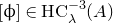 $[\unicode {x03D5}] \in {\rm HC}_\lambda ^{-3}(A)$
up to a change of coordinates
$[\unicode {x03D5}] \in {\rm HC}_\lambda ^{-3}(A)$
up to a change of coordinates $\widetilde {\mathsf{T}}_\ell V \to \widetilde {\mathsf{T}}_\ell V$
. Moreover, if
$\widetilde {\mathsf{T}}_\ell V \to \widetilde {\mathsf{T}}_\ell V$
. Moreover, if $g\colon B \to A$
is an analytic quasi-isomorphism for
$g\colon B \to A$
is an analytic quasi-isomorphism for $B$
, another such analytic
$B$
, another such analytic $A_\infty$
-algebra, then there is an isomorphism
$A_\infty$
-algebra, then there is an isomorphism $h\colon \widetilde {\mathsf{T}}_\ell W \to \widetilde {\mathsf{T}}_\ell V$
from the tensor algebra over
$h\colon \widetilde {\mathsf{T}}_\ell W \to \widetilde {\mathsf{T}}_\ell V$
from the tensor algebra over $W = {\rm H}^1(B)$
such that
$W = {\rm H}^1(B)$
such that
 \begin{align*} h^*(W_B^{g^*\unicode {x03D5}}) = W_A^{\unicode {x03D5}}. \end{align*}
Proof.
Letting $({\rm H}(A)^{\unicode {x03D5}},\unicode {x03C3}^{\unicode {x03D5}})$
be the cyclic minimal model from Theorem4.23(i) associated to a 3-CY structure
$({\rm H}(A)^{\unicode {x03D5}},\unicode {x03C3}^{\unicode {x03D5}})$
be the cyclic minimal model from Theorem4.23(i) associated to a 3-CY structure $\unicode {x03D5}$
, it follows from Proposition4.2 that there is an associated analytic potential
$\unicode {x03D5}$
, it follows from Proposition4.2 that there is an associated analytic potential $W_A^{\unicode {x03D5}} \in \widetilde {\mathsf{T}}_\ell V$
for
$W_A^{\unicode {x03D5}} \in \widetilde {\mathsf{T}}_\ell V$
for $V= (({\rm H}(A))^1)^* = {\rm H}^1(A)^*$
. If
$V= (({\rm H}(A))^1)^* = {\rm H}^1(A)^*$
. If $\unicode {x03C8}$
is another 3-CY structure with
$\unicode {x03C8}$
is another 3-CY structure with $[\unicode {x03C8}] = [\unicode {x03D5}]$
then it follows by Theorem4.23(ii) that there is an isomorphism
$[\unicode {x03C8}] = [\unicode {x03D5}]$
then it follows by Theorem4.23(ii) that there is an isomorphism $f\in {{\rm Hom}}_{{\mathsf{Alg}^\infty }}^{{\rm an}}({\rm H}(A)^{\unicode {x03D5}},{\rm H}(A)^{\unicode {x03C8}})$
which is cyclic. There is an induced algebra isomorphism
$f\in {{\rm Hom}}_{{\mathsf{Alg}^\infty }}^{{\rm an}}({\rm H}(A)^{\unicode {x03D5}},{\rm H}(A)^{\unicode {x03C8}})$
which is cyclic. There is an induced algebra isomorphism $f^*\colon \widehat {\mathsf{T}}_\ell V \to \widehat {\mathsf{T}}_\ell V$
, and it follows, using [Reference KajiuraKaj07, Proposition 4.16], that
$f^*\colon \widehat {\mathsf{T}}_\ell V \to \widehat {\mathsf{T}}_\ell V$
, and it follows, using [Reference KajiuraKaj07, Proposition 4.16], that
 \begin{align*} f^*(W_A^{\unicode {x03C8}}) = W_A^{\unicode {x03D5}}. \end{align*}
Hence it remains to verify that $f^*$
restricts to a map
$f^*$
restricts to a map $\widetilde {\mathsf{T}}_\ell V \to \widetilde {\mathsf{T}}_\ell V$
of analytic tensor algebras. As in [Reference Hua and KellerHK19, Lemma 3.12], it suffices to show that
$\widetilde {\mathsf{T}}_\ell V \to \widetilde {\mathsf{T}}_\ell V$
of analytic tensor algebras. As in [Reference Hua and KellerHK19, Lemma 3.12], it suffices to show that $f^*(v) \in \widetilde {\mathsf{T}}_\ell V$
for each
$f^*(v) \in \widetilde {\mathsf{T}}_\ell V$
for each $v \in V$
. Picking a basis
$v \in V$
. Picking a basis $v_1,\ldots ,v_m \in V$
and letting
$v_1,\ldots ,v_m \in V$
and letting $a_1,\ldots ,a_m \in {\rm H}^1(A)$
denote the dual basis, the element
$a_1,\ldots ,a_m \in {\rm H}^1(A)$
denote the dual basis, the element $f^*(v)$
can be written as the power series
$f^*(v)$
can be written as the power series
 \begin{align*} f^*(v) = \sum _{n\geqslant 0} \sum _{i_1,\ldots ,i_n} v(f_n(a_{i_1},\ldots ,a_{i_n})) \cdot v_{i_1}\otimes \cdots \otimes v_{i_n} \in \widehat {\mathsf{T}}_\ell V. \end{align*}
Because $f$
is analytic, it follows that there exists
$f$
is analytic, it follows that there exists $C_0 \gt 0$
such that
$C_0 \gt 0$
such that ${\left \|f_n\right \|} \lt C_0^n$
for all
${\left \|f_n\right \|} \lt C_0^n$
for all $n\in \mathbb{N}$
,
$n\in \mathbb{N}$
, ${\left \|v\right \|} \lt C_0$
, and
${\left \|v\right \|} \lt C_0$
, and ${\left \|a_i\right \|} \lt C_0$
for each
${\left \|a_i\right \|} \lt C_0$
for each $a_i$
. Then for each
$a_i$
. Then for each $i_1,\ldots ,i_n$
the coefficient satisfies
$i_1,\ldots ,i_n$
the coefficient satisfies
 \begin{align*} |v(f_n(a_{i_1},\ldots ,a_{i_n}))| \leqslant {\left \|v\right \|}{\left \|f_n\right \|}{\left \|a_{i_1}\right \|}\cdots {\left \|a_{i_n}\right \|} \lt C_0^{2n+1} \leqslant (C_0^3)^n, \end{align*}
which shows that $f^*(v) \in \widetilde {\mathsf{T}}_\ell V$
. It follows that
$f^*(v) \in \widetilde {\mathsf{T}}_\ell V$
. It follows that $W_A^{\unicode {x03D5}}$
and
$W_A^{\unicode {x03D5}}$
and $W_A^{\unicode {x03C8}}$
are related by an analytic change of coordinates. A similar argument now shows the second statement.
$W_A^{\unicode {x03C8}}$
are related by an analytic change of coordinates. A similar argument now shows the second statement.
5. Analytic Calabi–Yau structures in geometry
We will now apply our main theorem to a geometric setting: we will consider $A_\infty$
-algebras which govern the deformations of sheaves on a smooth projective variety. To set the notation, we will write
$A_\infty$
-algebras which govern the deformations of sheaves on a smooth projective variety. To set the notation, we will write $X$
for a smooth projective variety of dimension
$X$
for a smooth projective variety of dimension $n$
, which we interpret as an analytic space, and we will write
$n$
, which we interpret as an analytic space, and we will write $Y$
for an arbitrary complex manifold.
$Y$
for an arbitrary complex manifold.
The $A_\infty$
-algebras arising in this setting are obtained from normed DG algebras, and the corresponding
$A_\infty$
-algebras arising in this setting are obtained from normed DG algebras, and the corresponding $A_\infty$
-structures are therefore obtained as in Example2.2 using the canonical shift map
$A_\infty$
-structures are therefore obtained as in Example2.2 using the canonical shift map $s\colon A \to A[1]$
.
$s\colon A \to A[1]$
.
5.1 The Dolbeault construction
Recall that the sheaf of holomorphic functions $\mathcal{O}_Y$
on a complex manifold
$\mathcal{O}_Y$
on a complex manifold $Y$
admits a fine resolution via the Dolbeault complex
$Y$
admits a fine resolution via the Dolbeault complex
 \begin{align*} \mathscr{A\;\,}_Y^{0,0} \xrightarrow {\ \overline {\partial }\ } \mathscr{A\;\,}_Y^{0,1} \xrightarrow {\ \overline {\partial }\ } \ldots \xrightarrow {\ \overline {\partial }\ } \mathscr{A\;\,}_Y^{0,n} \longrightarrow 0, \end{align*}
where $\mathscr{A}^{\;\,p,q}_X$
is the sheaf of smooth
$\mathscr{A}^{\;\,p,q}_X$
is the sheaf of smooth $(p,q)$
-forms on
$(p,q)$
-forms on $Y$
. The sheaves
$Y$
. The sheaves $\mathscr{A}^{\;\,p,q}_X$
are acyclic, and hence can be used to compute the sheaf cohomology of
$\mathscr{A}^{\;\,p,q}_X$
are acyclic, and hence can be used to compute the sheaf cohomology of $\mathcal{O}_Y$
via
$\mathcal{O}_Y$
via ${\rm H}^i(U,\mathcal{O}_Y) \cong {\rm H}^i(\Gamma (U,\mathscr{A\;\,}_Y^{0,\bullet }),\overline {\partial })$
on any open
${\rm H}^i(U,\mathcal{O}_Y) \cong {\rm H}^i(\Gamma (U,\mathscr{A\;\,}_Y^{0,\bullet }),\overline {\partial })$
on any open $U\subset Y$
. More generally, one can take any bounded complex of locally free
$U\subset Y$
. More generally, one can take any bounded complex of locally free $\mathcal{O}_Y$
-modules
$\mathcal{O}_Y$
-modules $\mathcal{E} = (\mathcal{E}^\bullet ,\unicode {x03B4})$
on
$\mathcal{E} = (\mathcal{E}^\bullet ,\unicode {x03B4})$
on $Y$
(that is, a perfect complex), and obtain an acyclic resolution of
$Y$
(that is, a perfect complex), and obtain an acyclic resolution of $\mathcal{E}$
 \begin{align*} \mathscr{A\;\,}_Y^{0,\bullet }(\mathcal{E}) := \quad \ldots \xrightarrow {D} \bigoplus _{q\in \mathbb{Z}} \mathcal{E}^{-q} \otimes _Y \mathscr{A\;\,}_Y^{0,q} \xrightarrow {D} \bigoplus _{q\in \mathbb{Z}} \mathcal{E}^{1-q} \otimes _Y \mathscr{A\;\,}_Y^{0,q} \xrightarrow {D} \ldots , \end{align*}
where the differential is given by $D = \overline {\partial } + \unicode {x03B4}$
. This complex again computes the hypercohomology
$D = \overline {\partial } + \unicode {x03B4}$
. This complex again computes the hypercohomology ${\bf R}\Gamma ^i(U,\mathcal{E}) \cong {\rm H}^i\Gamma (U,\mathscr{A\;\,}_Y^{0,\bullet }(\mathcal{E}))$
on any open
${\bf R}\Gamma ^i(U,\mathcal{E}) \cong {\rm H}^i\Gamma (U,\mathscr{A\;\,}_Y^{0,\bullet }(\mathcal{E}))$
on any open $U\subset Y$
.
$U\subset Y$
.
The Dolbeault construction can be used to construct a DG enhancement of the derived category $\mathsf{D}^{{\rm perf}}(Y)$
: for any perfect complexes
$\mathsf{D}^{{\rm perf}}(Y)$
: for any perfect complexes $\mathcal{E},\mathcal{F}$
there is a natural isomorphism
$\mathcal{E},\mathcal{F}$
there is a natural isomorphism
 \begin{align*} {\rm H}^i\Gamma (Y,\mathscr{A\;\,}_Y^{0,\bullet }(\mathcal{H} om(\mathcal{E},\mathcal{F}))) \cong {\bf R}^i\Gamma (Y,\mathcal{H} om_Y(\mathcal{E},\mathcal{F})) \cong {{\rm Hom}}_{\mathsf{D}^{{\rm perf}}(Y)}(\mathcal{E},\mathcal{F}[i]), \end{align*}
so the complex of global sections for $\mathscr{A\;\,}_Y^{0,\bullet }(\mathcal{H} om(\mathcal{E},\mathcal{F}))$
is a morphism complex between
$\mathscr{A\;\,}_Y^{0,\bullet }(\mathcal{H} om(\mathcal{E},\mathcal{F}))$
is a morphism complex between $\mathcal{E}$
and
$\mathcal{E}$
and $\mathcal{F}$
. The natural composition on
$\mathcal{F}$
. The natural composition on $\mathsf{D}^{{\rm perf}}(Y)$
is given by a wedge product
$\mathsf{D}^{{\rm perf}}(Y)$
is given by a wedge product $\wedge$
, which can be defined in terms of local sections
$\wedge$
, which can be defined in terms of local sections $f \otimes \unicode {x03BE} \in (\mathcal{H} om^{i_1}(\mathcal{F},\mathcal{G}) \otimes \mathscr{A\;\,}_Y^{0,q})(U)$
and
$f \otimes \unicode {x03BE} \in (\mathcal{H} om^{i_1}(\mathcal{F},\mathcal{G}) \otimes \mathscr{A\;\,}_Y^{0,q})(U)$
and $g \otimes \unicode {x03B6} \in (\mathcal{H} om^{i_1}(\mathcal{E},\mathcal{F})\otimes \mathscr{A\;\,}_Y^{0,q_2})$
(U) as
$g \otimes \unicode {x03B6} \in (\mathcal{H} om^{i_1}(\mathcal{E},\mathcal{F})\otimes \mathscr{A\;\,}_Y^{0,q_2})$
(U) as
 \begin{align*} (f\otimes \unicode {x03BE}) \wedge (g\otimes \unicode {x03B6}) := (-1)^{i_2q_1}(f\circ g) \otimes (\unicode {x03BE} \wedge \unicode {x03B6}) \in (\mathcal{H} om^{i_1+i_2}(\mathcal{E},\mathcal{G}) \otimes \mathscr{A\;\,}_Y^{0,q_1+q_2})(U). \end{align*}
This product satisfies the Leibniz rule with respect to $D$
, and therefore defines a DG enhancement of
$D$
, and therefore defines a DG enhancement of $\mathsf{D}^{{\rm perf}}(Y)$
called the Dolbeault enhancement; see, for example, [Reference ToënToë11, § 2.3, Example 9].
$\mathsf{D}^{{\rm perf}}(Y)$
called the Dolbeault enhancement; see, for example, [Reference ToënToë11, § 2.3, Example 9].
To each perfect complex $\mathcal{E} \in \mathsf{D}^{{\rm perf}}(Y)$
there is associated an endomorphism DGA: the Dolbeault DG algebra
$\mathcal{E} \in \mathsf{D}^{{\rm perf}}(Y)$
there is associated an endomorphism DGA: the Dolbeault DG algebra
 \begin{align*} \mathfrak{g}_{\mathcal{E}} := \left (\Gamma (X,\mathscr{A\;\,}_Y^{0,q}(\mathcal{E} nd(\mathcal{E}))),D,\wedge \right ), \end{align*}
with cohomology ${\rm Ext}^\bullet (\mathcal{E},\mathcal{E})$
. If
${\rm Ext}^\bullet (\mathcal{E},\mathcal{E})$
. If $\mathcal{E}$
admits a direct sum decomposition
$\mathcal{E}$
admits a direct sum decomposition $\mathcal{E} = \mathcal{E}_1^{\oplus m_1} \oplus \ldots \oplus \mathcal{E}_k^{\oplus m_k}$
then the Dolbeault DG algebra is naturally defined over the base ring
$\mathcal{E} = \mathcal{E}_1^{\oplus m_1} \oplus \ldots \oplus \mathcal{E}_k^{\oplus m_k}$
then the Dolbeault DG algebra is naturally defined over the base ring
 \begin{align*} \ell = {\rm Mat}_{\mathbb{C}}(m_1) \times \cdots \times {\rm Mat}_{\mathbb{C}}(m_k) \subset \mathfrak{g}_{\mathcal{E}}^0. \end{align*}
In what follows we will always assume such a splitting is given, and work over the fixed base $\ell$
.
$\ell$
.
5.2 Analytic minimal models in the compact setting
Now let $X$
be (the analytic space associated to) a smooth projective variety and fix a hermitian metric
$X$
be (the analytic space associated to) a smooth projective variety and fix a hermitian metric $\langle -,-\rangle _X \colon \mathscr{A}^{\;\,0,q}_X \otimes \mathscr{A}^{\;\,0,q}_X \to \mathscr{A}^{\;\,0,0}$
. For a perfect complex
$\langle -,-\rangle _X \colon \mathscr{A}^{\;\,0,q}_X \otimes \mathscr{A}^{\;\,0,q}_X \to \mathscr{A}^{\;\,0,0}$
. For a perfect complex $\mathcal{E} = (\mathcal{E}^\bullet ,\unicode {x03B4})$
one can choose a compatible hermitian metric
$\mathcal{E} = (\mathcal{E}^\bullet ,\unicode {x03B4})$
one can choose a compatible hermitian metric
 \begin{align*} \langle -,-\rangle _{\mathcal{E}} \colon \mathscr{A}^{\;\,0,0}_X(\mathcal{E}^i) \otimes \mathscr{A}^{\;\,0,0}_X(\mathcal{E}^i) \to \mathscr{A}^{\;\,0,0}_X \end{align*}
for each locally free sheaf $\mathcal{E}^i$
; we will refer to
$\mathcal{E}^i$
; we will refer to $\mathcal{E}$
endowed with such a metric as a hermitian perfect complex. Recall (see e.g. [Reference Griffiths and HarrisGH78, Chapter 0, § 6]) that this data determines an
$\mathcal{E}$
endowed with such a metric as a hermitian perfect complex. Recall (see e.g. [Reference Griffiths and HarrisGH78, Chapter 0, § 6]) that this data determines an $L^2$
-norm
$L^2$
-norm ${{\left \|\cdot \right \|}}_{L^2} \colon \Gamma (X,\mathscr{A\;\,}_X^{0,\bullet }(\mathcal{E})) \to \mathbb{R}$
, which is defined on pure tensors
${{\left \|\cdot \right \|}}_{L^2} \colon \Gamma (X,\mathscr{A\;\,}_X^{0,\bullet }(\mathcal{E})) \to \mathbb{R}$
, which is defined on pure tensors $\unicode {x03BE} = f \otimes \omega$
with
$\unicode {x03BE} = f \otimes \omega$
with $f\in \Gamma (X,\mathscr{A}^{\;\,0,0}_X(\mathcal{E}^i))$
and
$f\in \Gamma (X,\mathscr{A}^{\;\,0,0}_X(\mathcal{E}^i))$
and $\omega \in \Gamma (X,\mathscr{A}^{\;\,0,q})$
by the formula
$\omega \in \Gamma (X,\mathscr{A}^{\;\,0,q})$
by the formula
 \begin{align*} {\left \|\unicode {x03BE}\right \|}_{L^2}^2 := \int _X \langle f,f\rangle _{\mathcal{E}} \cdot \langle \omega ,\omega \rangle _X \,{\rm d} vol_X, \end{align*}
where ${\rm d} vol_X \in \Gamma (X,\mathscr{A}^{\;\,0,n}_X(\Omega ^n_X))$
is the canonical real volume form on
${\rm d} vol_X \in \Gamma (X,\mathscr{A}^{\;\,0,n}_X(\Omega ^n_X))$
is the canonical real volume form on $X$
. The Sobolev
$X$
. The Sobolev $(l,2)$
-norm for
$(l,2)$
-norm for $l\in \mathbb{N}$
is defined in terms of the
$l\in \mathbb{N}$
is defined in terms of the $L^2$
-norm as
$L^2$
-norm as ${\left \|\unicode {x03BE}\right \|}_{l,2} := \sum _{k\leqslant l} {\left \|\nabla ^k\unicode {x03BE}\right \|}_{L^2}$
, where the operator
${\left \|\unicode {x03BE}\right \|}_{l,2} := \sum _{k\leqslant l} {\left \|\nabla ^k\unicode {x03BE}\right \|}_{L^2}$
, where the operator $\nabla$
acts on each locally free sheaf
$\nabla$
acts on each locally free sheaf $\mathcal{E}^i$
as the canonical metric connection.
$\mathcal{E}^i$
as the canonical metric connection.
Given hermitian perfect complexes $\mathcal{E}$
,
$\mathcal{E}$
, $\mathcal{F}$
, there is an induced hermitian metric on
$\mathcal{F}$
, there is an induced hermitian metric on $\mathcal{H} om(\mathcal{E},\mathcal{F})$
and hence also induced norms
$\mathcal{H} om(\mathcal{E},\mathcal{F})$
and hence also induced norms ${{\left \|\cdot \right \|}}_{L^2}$
and
${{\left \|\cdot \right \|}}_{L^2}$
and ${{\left \|\cdot \right \|}}_{l,2}$
on the global sections of its Dolbeault construction. As remarked by Fukaya [Reference Fukaya, Oh, Ohta and OnoFOO+09, § 8.2.5], the operators
${{\left \|\cdot \right \|}}_{l,2}$
on the global sections of its Dolbeault construction. As remarked by Fukaya [Reference Fukaya, Oh, Ohta and OnoFOO+09, § 8.2.5], the operators $D$
and
$D$
and $\wedge$
satisfy a bound
$\wedge$
satisfy a bound
 \begin{align*} {\left \|D\right \|}_{l,2} \lt C,\quad {\left \|\wedge \right \|}_{l,2} \lt C^2,\quad (C\gt 0) \end{align*}
if one chooses a sufficiently large $l \gt 2\dim _{\mathbb{C}} X$
. In particular, the Dolbeault DG algebra
$l \gt 2\dim _{\mathbb{C}} X$
. In particular, the Dolbeault DG algebra $\mathfrak{g}_{\mathcal{E}}$
of a hermitian perfect complex is naturally an analytic
$\mathfrak{g}_{\mathcal{E}}$
of a hermitian perfect complex is naturally an analytic $A_\infty$
-algebra. It was shown by Tu [Reference TuTu14] and Toda [Reference TodaTod18] that this admits a strong analytic minimal model.
$A_\infty$
-algebra. It was shown by Tu [Reference TuTu14] and Toda [Reference TodaTod18] that this admits a strong analytic minimal model.
Theorem 5.1 ([Reference TuTu14, Appendix A], [Reference TodaTod18, Lemma 4.1]). The DG algebra $\mathfrak{g}_{\mathcal{E}}$
admits a minimal model with diagram
$\mathfrak{g}_{\mathcal{E}}$
admits a minimal model with diagram

such that the $A_\infty$
-structure
$A_\infty$
-structure $\unicode {x03BC}$
on
$\unicode {x03BC}$
on $\mathcal{H}_{\mathcal{E}}$
and the maps
$\mathcal{H}_{\mathcal{E}}$
and the maps $I$
,
$I$
, $P$
, and
$P$
, and $Q$
satisfy the bounds
$Q$
satisfy the bounds
 \begin{align*} {\left \|\unicode {x03BC}_k\right \|}_{l,2} \lt C^k,\quad {\left \|I_k\right \|}_{l,2} \lt C^k,\quad {\left \|P_k\right \|}_{l,2} \lt C^k,\quad {\left \|Q_k\right \|}_{l,2} \lt C^k \end{align*}
for all $k\geqslant 1$
and a fixed constant
$k\geqslant 1$
and a fixed constant $C\gt 0$
independent of
$C\gt 0$
independent of $k$
.
$k$
.
At first order, the minimal model is given by Hodge theory: $\mathcal{H}_{\mathcal{E}}$
is the space of harmonic forms in
$\mathcal{H}_{\mathcal{E}}$
is the space of harmonic forms in $\mathfrak{g}_{\mathcal{E}}$
, with
$\mathfrak{g}_{\mathcal{E}}$
, with $I_1$
and
$I_1$
and $P_1$
being the inclusion and projection, and
$P_1$
being the inclusion and projection, and $Q_1$
is defined via the Green operator associated to
$Q_1$
is defined via the Green operator associated to $D$
. The higher compositions are all defined via the standard homotopy transfer formula [Reference KadeishviliKad80], which can be expressed via sums over trees [Reference MarklMar06].
$D$
. The higher compositions are all defined via the standard homotopy transfer formula [Reference KadeishviliKad80], which can be expressed via sums over trees [Reference MarklMar06].
If $X$
is a Calabi–Yau variety, then Polishchuk [Reference PolishchukPol01] showed that the Serre duality pairing pulls back to a cyclic structure on this analytic minimal model. Using the terminology employed in this paper, this can be phrased as follows.
$X$
is a Calabi–Yau variety, then Polishchuk [Reference PolishchukPol01] showed that the Serre duality pairing pulls back to a cyclic structure on this analytic minimal model. Using the terminology employed in this paper, this can be phrased as follows.
Theorem 5.2 ([Reference PolishchukPol01, Theorem 1.1]). Suppose $X$
is a projective Calabi–Yau variety with holomorphic volume form
$X$
is a projective Calabi–Yau variety with holomorphic volume form $\unicode {x03BD} \in {\rm H}^0(X,\Omega ^n_X)$
. Then the Serre pairing
$\unicode {x03BD} \in {\rm H}^0(X,\Omega ^n_X)$
. Then the Serre pairing
 \begin{align*} \unicode {x03C1}(-)(-) = \int _X \unicode {x03BD} \wedge {\rm tr}(- \wedge -) \end{align*}
pulls back to a cyclic structure $\unicode {x03C3} = I^*\unicode {x03C1}$
on
$\unicode {x03C3} = I^*\unicode {x03C1}$
on $\mathcal{H}_{\mathcal{E}}$
.
$\mathcal{H}_{\mathcal{E}}$
.
The Serre pairing used in this theorem can be viewed as an analytic strong homotopy inner product $\unicode {x03C1} \in \Omega ^{2,{\rm cl},{\rm an}}(\mathfrak{g}_{\mathcal{E}})$
, which corresponds to the right Calabi–Yau structure associated to the bounded linear functional
$\unicode {x03C1} \in \Omega ^{2,{\rm cl},{\rm an}}(\mathfrak{g}_{\mathcal{E}})$
, which corresponds to the right Calabi–Yau structure associated to the bounded linear functional
 \begin{align*} \unicode {x03C4}_{\unicode {x03BD}} = \int _X\unicode {x03BD}\wedge {\rm tr}(-) \in \mathfrak{g}_{\mathcal{E}}' \in {\bf C}^{-n}_\lambda (\mathfrak{g}_{\mathcal{E}}), \end{align*}
as in Example4.22. In view of the analytic Darboux theorem, one might suspect that there exist other cyclic analytic minimal models for other choices of analytic right Calabi–Yau structure.
In what follows we show how such CY structures can be obtained from a choice of holomorphic volume form on open subsets $U\subset X$
, using a compactly supported version of the Dolbeault construction.
$U\subset X$
, using a compactly supported version of the Dolbeault construction.
5.3 The compactly supported setting
Let $U\subset X$
be an open analytic subvariety of a smooth projective variety
$U\subset X$
be an open analytic subvariety of a smooth projective variety $X$
, viewed as an analytic manifold. Given a bounded complex of locally free
$X$
, viewed as an analytic manifold. Given a bounded complex of locally free $\mathcal{O}_U$
-modules
$\mathcal{O}_U$
-modules $\mathcal{F}$
we let
$\mathcal{F}$
we let
 \begin{align*} \mathfrak{g}_{\mathcal{F},c} := \left (\Gamma _c(U,\mathscr{A\;\,}_U^{0,\bullet }(\mathcal{E} nd(\mathcal{F}))),\ D,\ \wedge \right ) \end{align*}
denote the nonunital DG subalgebra of $\mathfrak{g}_{\mathcal{F}}$
of compactly supported sections. Henceforth, we will assume that the cohomology of
$\mathfrak{g}_{\mathcal{F}}$
of compactly supported sections. Henceforth, we will assume that the cohomology of $\mathcal{F}$
is supported on a compact subset
$\mathcal{F}$
is supported on a compact subset $Z\subset U$
, which implies that
$Z\subset U$
, which implies that
 \begin{align*} {\rm H}^\bullet \mathfrak{g}_{\mathcal{F},c} = {\bf R}^i\Gamma _c(U,\mathscr{A}^{\;\,0,\bullet }_U(\mathcal{E} nd(\mathcal{F}))) \cong {\bf R}^i\Gamma (U,\mathscr{A}^{\;\,0,\bullet }_U(\mathcal{E} nd(\mathcal{F}))) = {\rm H}^\bullet \mathfrak{g}_{\mathcal{F}}, \end{align*}
so that the inclusion $\mathfrak{g}_{\mathcal{F},c} \hookrightarrow \mathfrak{g}_{\mathcal{F}}$
is a quasi-isomorphism. We also fix a hermitian metric on
$\mathfrak{g}_{\mathcal{F},c} \hookrightarrow \mathfrak{g}_{\mathcal{F}}$
is a quasi-isomorphism. We also fix a hermitian metric on $\mathcal{F}$
, which induces a hermitian pairing
$\mathcal{F}$
, which induces a hermitian pairing
 \begin{align*} \langle -,-\rangle _{\mathcal{E} nd(\mathcal{F})} \colon \mathscr{A\;\,}_U^{0,0}(\mathcal{E} nd(\mathcal{F})) \otimes \mathscr{A\;\,}_U^{0,0}(\mathcal{E} nd(\mathcal{F})) \to \mathscr{A\;\,}_U^{0,0}. \end{align*}
The metric data again determines a well-defined $L^2$
-norm
$L^2$
-norm ${{\left \|\cdot \right \|}}_{L^2}\colon \mathfrak{g}_{\mathcal{F},c} \to \mathbb{R}$
which is defined on pure tensors
${{\left \|\cdot \right \|}}_{L^2}\colon \mathfrak{g}_{\mathcal{F},c} \to \mathbb{R}$
which is defined on pure tensors $\unicode {x03BE} = f \otimes \omega$
with
$\unicode {x03BE} = f \otimes \omega$
with $f\in \Gamma _c(U,\mathscr{A}^{\;\,0,0}(\mathcal{E} nd(\mathcal{F})))$
and
$f\in \Gamma _c(U,\mathscr{A}^{\;\,0,0}(\mathcal{E} nd(\mathcal{F})))$
and $\omega \in \Gamma _c(U,\mathscr{A}^{\;\,0,q})$
as
$\omega \in \Gamma _c(U,\mathscr{A}^{\;\,0,q})$
as
 \begin{align*} {\left \|\unicode {x03BE}\right \|}_{L^2} = \left (\int _X \langle f,f\rangle _{\mathcal{E} nd(\mathcal{F})} \cdot \langle \omega ,\omega \rangle _X {\rm d} vol_X \right )^{1/2}, \end{align*}
where we note that the compactly supported function $\langle f,f\rangle _{\mathcal{E} nd(\mathcal{F})}$
can be viewed as a function on
$\langle f,f\rangle _{\mathcal{E} nd(\mathcal{F})}$
can be viewed as a function on $X$
via extension by
$X$
via extension by $0$
, and similarly
$0$
, and similarly $\omega$
extends to a smooth
$\omega$
extends to a smooth $(0,q)$
-form on
$(0,q)$
-form on $X$
. The metric connection then also determines a Sobolev norm
$X$
. The metric connection then also determines a Sobolev norm ${{\left \|\cdot \right \|}}_{l,2} = \sum _{k\leqslant l} {\left \|\nabla ^k-\right \|}_{L^2}$
, as in the compact setting. A priori, the operators
${{\left \|\cdot \right \|}}_{l,2} = \sum _{k\leqslant l} {\left \|\nabla ^k-\right \|}_{L^2}$
, as in the compact setting. A priori, the operators $D$
and
$D$
and $\wedge$
are not guaranteed to be bounded, but the reader can check that such a bound exists if
$\wedge$
are not guaranteed to be bounded, but the reader can check that such a bound exists if $U$
is chosen to be a sufficiently small neighbourhood of the compact set
$U$
is chosen to be a sufficiently small neighbourhood of the compact set $Z$
.
$Z$
.
Now suppose that $U$
admits a nowhere-vanishing holomorphic volume form
$U$
admits a nowhere-vanishing holomorphic volume form $\unicode {x03BD} \in \Gamma (U,\Omega ^n_U)$
. Then, again writing
$\unicode {x03BD} \in \Gamma (U,\Omega ^n_U)$
. Then, again writing ${\rm tr}\colon \mathscr{A\;\,}_U^{0,n}(\mathcal{E} nd(\mathcal{E})) \to \mathscr{A\;\,}_U^{0,n}$
for the pointwise trace, we obtain a linear functional
${\rm tr}\colon \mathscr{A\;\,}_U^{0,n}(\mathcal{E} nd(\mathcal{E})) \to \mathscr{A\;\,}_U^{0,n}$
for the pointwise trace, we obtain a linear functional
 \begin{align*} \unicode {x03C4}_{\unicode {x03BD}} \colon \mathfrak{g}_{\mathcal{F},c}^n \to {\mathbb{C}},\quad \unicode {x03B6} \mapsto \int _U \unicode {x03BD} \wedge {\rm tr}(\unicode {x03B6}). \end{align*}
We will view $\unicode {x03C4}_{\unicode {x03BD}}$
as an element of
$\unicode {x03C4}_{\unicode {x03BD}}$
as an element of $\mathfrak{g}_{\mathcal{F},c}^\vee \subset \mathcal{M}(\mathfrak{g}_{\mathcal{F},c},\mathfrak{g}_{\mathcal{F},c}^\vee )[-1]$
in the obvious way, and we claim that this is a negative cyclic cocycle.
$\mathfrak{g}_{\mathcal{F},c}^\vee \subset \mathcal{M}(\mathfrak{g}_{\mathcal{F},c},\mathfrak{g}_{\mathcal{F},c}^\vee )[-1]$
in the obvious way, and we claim that this is a negative cyclic cocycle.
Lemma 5.3.
The map $\unicode {x03C4}_{\unicode {x03BD}}$
defines a right
$\unicode {x03C4}_{\unicode {x03BD}}$
defines a right $n$
-Calabi–Yau structure.
$n$
-Calabi–Yau structure.
Proof.
Unravelling the definition of the differential on ${\bf C}^\bullet (\mathfrak{g}_{\mathcal{F},c},\mathfrak{g}_{\mathcal{F},c}^\vee ) = (\mathcal{M}(\mathfrak{g}_{\mathcal{F},c},\mathfrak{g}_{\mathcal{F},c}^\vee )[-1],b)$
, we see that
${\bf C}^\bullet (\mathfrak{g}_{\mathcal{F},c},\mathfrak{g}_{\mathcal{F},c}^\vee ) = (\mathcal{M}(\mathfrak{g}_{\mathcal{F},c},\mathfrak{g}_{\mathcal{F},c}^\vee )[-1],b)$
, we see that $b(\unicode {x03C4}_{\unicode {x03BD}}) = 0$
if and only if the following two equations hold for all homogeneous
$b(\unicode {x03C4}_{\unicode {x03BD}}) = 0$
if and only if the following two equations hold for all homogeneous $\unicode {x03B6},\unicode {x03BE}\in \mathfrak{g}_{\mathcal{F},c}$
:
$\unicode {x03B6},\unicode {x03BE}\in \mathfrak{g}_{\mathcal{F},c}$
:
 \begin{align*} \begin{aligned} \unicode {x03C4}_{\unicode {x03BD}}(D \unicode {x03B6}) &= 0,\\[5pt] \unicode {x03C4}_{\unicode {x03BD}}(\unicode {x03B6}_1 \wedge \unicode {x03B6}_2) &= (-1)^{|\unicode {x03B6}_1||\unicode {x03B6}_2|} \unicode {x03C4}_v(\unicode {x03B6}_2\wedge \unicode {x03B6}_1). \end{aligned} \end{align*}
To show the first equation, we note that, for a local form $\unicode {x03B6} = f \otimes \omega$
with
$\unicode {x03B6} = f \otimes \omega$
with $f$
a local section of
$f$
a local section of $\mathcal{E} nd^i(\mathcal{F})$
and
$\mathcal{E} nd^i(\mathcal{F})$
and $\omega$
a local
$\omega$
a local $(0,n-i-1)$
-form, we have the local identity
$(0,n-i-1)$
-form, we have the local identity
 \begin{align*} {\rm tr}(D (f\otimes \omega )) = {\rm tr}(f)\overline {\partial }\omega + {\rm tr}([\unicode {x03B4},f])\omega = {\rm tr}(f)\overline {\partial }\omega = \overline {\partial }{\rm tr}(f\otimes \omega ). \end{align*}
Hence, the same identity also holds for a general compactly supported section $\unicode {x03B6}$
over
$\unicode {x03B6}$
over $U$
. Because
$U$
. Because $\unicode {x03BD}$
is holomorphic, it then follows by Stokes’ theorem for compactly supported forms that
$\unicode {x03BD}$
is holomorphic, it then follows by Stokes’ theorem for compactly supported forms that
 \begin{align*} \unicode {x03C4}_{\unicode {x03BD}}(D \unicode {x03B6}) = \int _U \overline {\partial }(\unicode {x03BD} \wedge {\rm tr}(\unicode {x03B6})) = \int _U (\partial + \overline {\partial })(\unicode {x03BD}\wedge {\rm tr}(\unicode {x03B6})) = 0, \end{align*}
where we note that $\partial (\unicode {x03BD}\wedge {\rm tr}(\unicode {x03B6})) = 0$
for degree reasons. For the second equation, we can likewise consider local forms
$\partial (\unicode {x03BD}\wedge {\rm tr}(\unicode {x03B6})) = 0$
for degree reasons. For the second equation, we can likewise consider local forms $\unicode {x03B6}_1 = f_1\otimes \omega _1$
and
$\unicode {x03B6}_1 = f_1\otimes \omega _1$
and $\unicode {x03B6}_2 = f_2\otimes \unicode {x03BE}_2$
with
$\unicode {x03B6}_2 = f_2\otimes \unicode {x03BE}_2$
with $f_k$
a local section of
$f_k$
a local section of $\mathcal{E} nd^{i_k}(\mathcal{F})$
and
$\mathcal{E} nd^{i_k}(\mathcal{F})$
and $\omega _k$
a local section of
$\omega _k$
a local section of $\mathscr{A\;\,}_U^{0,q_k}$
. There is an identity
$\mathscr{A\;\,}_U^{0,q_k}$
. There is an identity
 \begin{align*} \begin{aligned} {\rm tr}(\unicode {x03B6}_1\wedge \unicode {x03B6}_2) &= (-1)^{q_1 i_2} {\rm tr}(f_1\circ f_2) \cdot \omega _1 \wedge \omega _2 \\[5pt] &= (-1)^{q_1(q_2+i_2) + i_1i_2} {\rm tr}(f_2\circ f_1) \cdot \omega _2\wedge \omega _1 = (-1)^{|\unicode {x03B6}_1||\unicode {x03B6}_2|}{\rm tr}(\unicode {x03B6}_2\wedge \unicode {x03B6}_1). \end{aligned} \end{align*}
This identity then also holds for any compactly supported section on $U$
, so integrating against
$U$
, so integrating against $\unicode {x03BD}$
yields the section equality. It follows that
$\unicode {x03BD}$
yields the section equality. It follows that $\unicode {x03C4}_{\unicode {x03BD}}$
is a cocycle in
$\unicode {x03C4}_{\unicode {x03BD}}$
is a cocycle in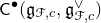 $\mathsf{C}^\bullet (\mathfrak{g}_{\mathcal{F},c},\mathfrak{g}_{\mathcal{F},c}^\vee )$
, and it is immediate that it lies in
$\mathsf{C}^\bullet (\mathfrak{g}_{\mathcal{F},c},\mathfrak{g}_{\mathcal{F},c}^\vee )$
, and it is immediate that it lies in $\mathsf{C}^\bullet _\lambda (\mathfrak{g}_{\mathcal{F},c})$
because the cyclic action is trivial on the summand
$\mathsf{C}^\bullet _\lambda (\mathfrak{g}_{\mathcal{F},c})$
because the cyclic action is trivial on the summand $\mathfrak{g}_{\mathcal{F},c}^\vee \subset \mathsf{C}^\bullet _\lambda (\mathfrak{g}_{\mathcal{F},c})$
.
$\mathfrak{g}_{\mathcal{F},c}^\vee \subset \mathsf{C}^\bullet _\lambda (\mathfrak{g}_{\mathcal{F},c})$
.
It remains to show that the map $\unicode {x03B6} \mapsto \unicode {x03C4}_{\unicode {x03BD}}(\unicode {x03B6} \wedge -)$
is a quasi-isomorphism, or equivalently that
$\unicode {x03B6} \mapsto \unicode {x03C4}_{\unicode {x03BD}}(\unicode {x03B6} \wedge -)$
is a quasi-isomorphism, or equivalently that
 \begin{align} (\unicode {x03B6},\unicode {x03BE}) \mapsto \unicode {x03C4}_{\unicode {x03BD}}(\unicode {x03B6}\wedge \unicode {x03BE}) = \int _U \unicode {x03BD} \wedge {\rm tr}(\unicode {x03B6} \wedge \unicode {x03BE}) \end{align}
induces a nondegenerate pairing on cohomology. For this, we note that a holomorphic volume form $\unicode {x03BD} \in \Gamma (U,\Omega ^n_U)$
represents an isomorphism
$\unicode {x03BD} \in \Gamma (U,\Omega ^n_U)$
represents an isomorphism $[\unicode {x03BD}] \in {{\rm Hom}}_{\mathsf{D}(U)}(\mathcal{O}_U,\Omega ^n_U)$
in the derived category. Therefore, the wedge product
$[\unicode {x03BD}] \in {{\rm Hom}}_{\mathsf{D}(U)}(\mathcal{O}_U,\Omega ^n_U)$
in the derived category. Therefore, the wedge product
 \begin{align} \unicode {x03BD}\wedge - \colon \Gamma _c(U,\mathscr{A\;\,}_U^{0,\bullet }(\mathcal{E} nd(\mathcal{F}))) \to \Gamma _c(U,\mathscr{A\;\,}_U^{0,\bullet }(\mathcal{E} nd(\mathcal{F}) \otimes \Omega _U^n)) \end{align}
induces the isomorphisms ${{\rm Hom}}_{\mathsf{D}(U)}(\mathcal{E},\mathcal{E}[i]) \to {{\rm Hom}}_{\mathsf{D}(U)}(\mathcal{E},\mathcal{E}\otimes \Omega ^n_U[i])$
in the derived category. By inspection, (22) is the composition of (23) with the Serre duality pairing
${{\rm Hom}}_{\mathsf{D}(U)}(\mathcal{E},\mathcal{E}[i]) \to {{\rm Hom}}_{\mathsf{D}(U)}(\mathcal{E},\mathcal{E}\otimes \Omega ^n_U[i])$
in the derived category. By inspection, (22) is the composition of (23) with the Serre duality pairing
 \begin{align*} \Gamma _c(U,\mathscr{A\;\,}_U^{0,n-i}(\mathcal{E} nd(\mathcal{E}))) \otimes \Gamma _c(U,\mathscr{A\;\,}_U^{0,i}(\mathcal{E} nd(\mathcal{E}) \otimes \Omega ^n_U)) \xrightarrow {\int _U{\rm tr}(-\wedge -)} {\mathbb{C}}, \end{align*}
which induces a nondegenerate pairing ${{\rm Hom}}_{\mathsf{D}(U)}(\mathcal{E},\mathcal{E}[n-i]) \otimes {{\rm Hom}}_{\mathsf{D}(U)}(\mathcal{E},\mathcal{E} \otimes \Omega ^n[i]) \to {\mathbb{C}}$
on cohomology. Therefore the pairing induced by (22) on cohomology is also nondegenerate, and it follows that
${{\rm Hom}}_{\mathsf{D}(U)}(\mathcal{E},\mathcal{E}[n-i]) \otimes {{\rm Hom}}_{\mathsf{D}(U)}(\mathcal{E},\mathcal{E} \otimes \Omega ^n[i]) \to {\mathbb{C}}$
on cohomology. Therefore the pairing induced by (22) on cohomology is also nondegenerate, and it follows that $\unicode {x03C4}_{\unicode {x03BD}}$
is a right Calabi–Yau structure.
$\unicode {x03C4}_{\unicode {x03BD}}$
is a right Calabi–Yau structure.
We now want to show that the right Calabi–Yau structure $\unicode {x03C4}_{\unicode {x03BD}}$
is analytic if
$\unicode {x03C4}_{\unicode {x03BD}}$
is analytic if $\mathfrak{g}_{\mathcal{F},c}$
is an analytic
$\mathfrak{g}_{\mathcal{F},c}$
is an analytic $A_\infty$
-algebra. For this, it suffices to show that
$A_\infty$
-algebra. For this, it suffices to show that $\unicode {x03C4}_{\unicode {x03BD}}$
is bounded with respect to the Sobolev norm.
$\unicode {x03C4}_{\unicode {x03BD}}$
is bounded with respect to the Sobolev norm.
Lemma 5.4.
If $\unicode {x03BD} \in \Gamma (U,\Omega ^n_U)$
is an
$\unicode {x03BD} \in \Gamma (U,\Omega ^n_U)$
is an $L^2$
-integrable holomorphic volume form, then
$L^2$
-integrable holomorphic volume form, then $\unicode {x03C4}_{\unicode {x03BD}}$
is bounded.
$\unicode {x03C4}_{\unicode {x03BD}}$
is bounded.
Proof.
For any $\unicode {x03B6} \in \Gamma _c(U,\mathscr{A}^{\;\,0,\bullet }(\mathcal{E} nd(\mathcal{F}))$
there is a Cauchy–Schwarz type inequality
$\unicode {x03B6} \in \Gamma _c(U,\mathscr{A}^{\;\,0,\bullet }(\mathcal{E} nd(\mathcal{F}))$
there is a Cauchy–Schwarz type inequality
 \begin{align*} |\tau _{\unicode {x03BD}}(\unicode {x03B6})| = \left |\int _U \unicode {x03BD} \wedge {\rm tr}(\unicode {x03B6})\right | \leqslant {\left \|\unicode {x03BD}\right \|}_{L^2} {\left \|{\rm tr}(\unicode {x03B6})\right \|}_{L^2}, \end{align*}
with respect to the $L^2$
-inner product on smooth forms determined by the hermitian metric. It is then easy to check that
$L^2$
-inner product on smooth forms determined by the hermitian metric. It is then easy to check that ${\left \|{\rm tr}(\unicode {x03B6})\right \|}_{L^2} \leqslant {\left \|\unicode {x03B6}\right \|}_{L^2}\leqslant {\left \|\unicode {x03B6}\right \|}_{l,2}$
, so that
${\left \|{\rm tr}(\unicode {x03B6})\right \|}_{L^2} \leqslant {\left \|\unicode {x03B6}\right \|}_{L^2}\leqslant {\left \|\unicode {x03B6}\right \|}_{l,2}$
, so that ${\left \|\unicode {x03C4}_{\unicode {x03BD}}\right \|}_{l,2}$
is bounded by
${\left \|\unicode {x03C4}_{\unicode {x03BD}}\right \|}_{l,2}$
is bounded by ${\left \|\unicode {x03BD}\right \|}_{L^2}$
.
${\left \|\unicode {x03BD}\right \|}_{L^2}$
.
We again remark that one can ensure that any holomorphic volume form $\unicode {x03BD}\in \Gamma (U,\Omega ^n_U)$
is bounded in the
$\unicode {x03BD}\in \Gamma (U,\Omega ^n_U)$
is bounded in the $L^2$
-norm by replacing
$L^2$
-norm by replacing $U$
with a sufficiently small neighbourhood of
$U$
with a sufficiently small neighbourhood of $Z$
. After making this slight modification, we find an analytic right Calabi–Yau structure corresponding to the volume form.
$Z$
. After making this slight modification, we find an analytic right Calabi–Yau structure corresponding to the volume form.
5.4 Comparing the compact and noncompact settings
Let $\mathcal{E}$
be a hermitian perfect complex on a projective variety
$\mathcal{E}$
be a hermitian perfect complex on a projective variety $X$
, with cohomology supported on a subset
$X$
, with cohomology supported on a subset $Z$
, and choose an open neighbourhood
$Z$
, and choose an open neighbourhood $U\supset Z$
with inclusion map
$U\supset Z$
with inclusion map $i\colon U \hookrightarrow X$
. Then the extension by zero yields an injective map
$i\colon U \hookrightarrow X$
. Then the extension by zero yields an injective map
 \begin{align*} i_!\colon \mathfrak{g}_{\mathcal{E}|_U,c} = \Gamma _c(U,\mathscr{A}^{\;\,0,\bullet }_U(\mathcal{E} nd(\mathcal{E}|_U))) \longrightarrow \Gamma (X,\mathscr{A}^{\;\,0,\bullet }_X(\mathcal{E} nd(\mathcal{E}))) = \mathfrak{g}_{\mathcal{E}}, \end{align*}
which exhibits $\mathfrak{g}_{\mathcal{E}|_U,c}$
as a DG ideal of
$\mathfrak{g}_{\mathcal{E}|_U,c}$
as a DG ideal of $\mathfrak{g}_{\mathcal{E}}$
. Equipping
$\mathfrak{g}_{\mathcal{E}}$
. Equipping $\mathcal{E}|_U$
with the induced metric, this is an isometry with respect to the Sobolev norm, making
$\mathcal{E}|_U$
with the induced metric, this is an isometry with respect to the Sobolev norm, making $\mathfrak{g}_{\mathcal{E}|_U,c}$
into an analytic
$\mathfrak{g}_{\mathcal{E}|_U,c}$
into an analytic $A_\infty$
-subalgebra of
$A_\infty$
-subalgebra of $\mathfrak{g}_{\mathcal{E}}$
. The assumption on the support, moreover, guarantees that
$\mathfrak{g}_{\mathcal{E}}$
. The assumption on the support, moreover, guarantees that $i_!$
is a quasi-isomorphism.
$i_!$
is a quasi-isomorphism.
In order to pull back the analytic right CY structures found above from $\mathfrak{g}_{\mathcal{E}|_U,c}$
to
$\mathfrak{g}_{\mathcal{E}|_U,c}$
to $\mathfrak{g}_{\mathcal{E}}$
we would like to construct a homotopy inverse for
$\mathfrak{g}_{\mathcal{E}}$
we would like to construct a homotopy inverse for $i_!$
using Lemma2.28. This requires us first to construct a quasi-isomorphism
$i_!$
using Lemma2.28. This requires us first to construct a quasi-isomorphism $\mathfrak{g}_{\mathcal{E}} \to \mathfrak{g}_{\mathcal{E}|_U,c}$
, for which we use a choice of weak unit.
$\mathfrak{g}_{\mathcal{E}} \to \mathfrak{g}_{\mathcal{E}|_U,c}$
, for which we use a choice of weak unit.
Lemma 5.5.
There exists a pair $(u,h) \in \mathfrak{g}_{\mathcal{E}|_U,c}^0 \times \mathfrak{g}_{\mathcal{E}}^{-1}$
such that
$(u,h) \in \mathfrak{g}_{\mathcal{E}|_U,c}^0 \times \mathfrak{g}_{\mathcal{E}}^{-1}$
such that $D u=0$
and
$D u=0$
and
 \begin{align*} D h=i_!u - {\rm id}_{\mathcal{E}} \in \mathfrak{g}_{\mathcal{E}}^0. \end{align*}
In particular, the map $\unicode {x1D7D9} \colon l \mapsto l\cdot u$
is a weak unit for the analytic
$\unicode {x1D7D9} \colon l \mapsto l\cdot u$
is a weak unit for the analytic $A_\infty$
-algebra
$A_\infty$
-algebra $\mathfrak{g}_{\mathcal{E}|_U,c}$
.
$\mathfrak{g}_{\mathcal{E}|_U,c}$
.
Proof.
Because $i_!\colon \mathfrak{g}_{\mathcal{E}|_U,c} \to \mathfrak{g}_{\mathcal{E}}$
is a quasi-isomorphism, it follows that there exists a cocycle
$i_!\colon \mathfrak{g}_{\mathcal{E}|_U,c} \to \mathfrak{g}_{\mathcal{E}}$
is a quasi-isomorphism, it follows that there exists a cocycle $u$
with
$u$
with $[i_!u] = [{\rm id}_{\mathcal{E}}]$
, and hence there exists a coboundary
$[i_!u] = [{\rm id}_{\mathcal{E}}]$
, and hence there exists a coboundary $D h=i_!u-{\rm id}_{\mathcal{E}}$
. If
$D h=i_!u-{\rm id}_{\mathcal{E}}$
. If $\unicode {x03BE} \in \mathfrak{g}_{\mathcal{E}|_U,c}$
is
$\unicode {x03BE} \in \mathfrak{g}_{\mathcal{E}|_U,c}$
is $D$
-closed then
$D$
-closed then
 \begin{align*} [i_!(u \wedge \unicode {x03BE})] = [{\rm id}_{\mathcal{E}} \wedge i_!\unicode {x03BE}] + [D h \wedge i_!\unicode {x03BE}] = [i_!\unicode {x03BE}] \in {\rm H}^\bullet \mathfrak{g}_{\mathcal{E}}. \end{align*}
It follows that $[u\wedge \unicode {x03BE}] = [\unicode {x03BE}]$
and likewise
$[u\wedge \unicode {x03BE}] = [\unicode {x03BE}]$
and likewise $[\unicode {x03BE} \wedge u] = [\unicode {x03BE}]$
hold in
$[\unicode {x03BE} \wedge u] = [\unicode {x03BE}]$
hold in ${\rm H}^\bullet \mathfrak{g}_{\mathcal{E}|_U,c}$
. The map
${\rm H}^\bullet \mathfrak{g}_{\mathcal{E}|_U,c}$
. The map $\unicode {x1D7D9} \colon \ell \to \mathfrak{g}_{\mathcal{E}|_U,c}$
then satisfies
$\unicode {x1D7D9} \colon \ell \to \mathfrak{g}_{\mathcal{E}|_U,c}$
then satisfies $[\unicode {x1D7D9}(l)\wedge \unicode {x03BE}] = [l\cdot u\wedge \unicode {x03BE}]= [l\cdot \unicode {x03BE}]$
and
$[\unicode {x1D7D9}(l)\wedge \unicode {x03BE}] = [l\cdot u\wedge \unicode {x03BE}]= [l\cdot \unicode {x03BE}]$
and $[\unicode {x03BE} \wedge \unicode {x1D7D9}(l)] = [\unicode {x03BE} \cdot l \wedge u] = [\unicode {x03BE}\cdot l]$
, making it a weak unit.
$[\unicode {x03BE} \wedge \unicode {x1D7D9}(l)] = [\unicode {x03BE} \cdot l \wedge u] = [\unicode {x03BE}\cdot l]$
, making it a weak unit.
For a unit/coboundary pair $(u,h)$
as above, the wedge product
$(u,h)$
as above, the wedge product $i_!u\wedge \unicode {x03BE}$
with any section
$i_!u\wedge \unicode {x03BE}$
with any section $\unicode {x03BE}\in \mathfrak{g}_{\mathcal{E}}$
has compact support contained in
$\unicode {x03BE}\in \mathfrak{g}_{\mathcal{E}}$
has compact support contained in $U$
. Hence, we obtain a restriction
$U$
. Hence, we obtain a restriction $i^*(i_!u \wedge -) \colon \mathfrak{g}_{\mathcal{E}} \to \mathfrak{g}_{\mathcal{E}|_U,c}$
which is a chain-level inverse to
$i^*(i_!u \wedge -) \colon \mathfrak{g}_{\mathcal{E}} \to \mathfrak{g}_{\mathcal{E}|_U,c}$
which is a chain-level inverse to $i_!$
. To extend it to an analytic
$i_!$
. To extend it to an analytic $A_\infty$
-morphism, we need the following lemma.
$A_\infty$
-morphism, we need the following lemma.
Lemma 5.6.
Let $h\in \mathfrak{g}_{\mathcal{E}}^{-1}$
and
$h\in \mathfrak{g}_{\mathcal{E}}^{-1}$
and $v = {\rm id}_{\mathcal{E}} + D h$
, then the maps
$v = {\rm id}_{\mathcal{E}} + D h$
, then the maps $K_n \colon \mathfrak{g}_{\mathcal{E}}[1]^{\otimes n} \to \mathfrak{g}_{\mathcal{E}}[1]$
given by
$K_n \colon \mathfrak{g}_{\mathcal{E}}[1]^{\otimes n} \to \mathfrak{g}_{\mathcal{E}}[1]$
given by
 \begin{align*} \begin{aligned} K_1(s\xi _1) &= s(v\wedge \xi _1) \\[5pt] K_n(s\xi _1,\ldots ,s\xi _n) &= s(v\wedge \xi _1\wedge h\wedge \cdots \wedge h\wedge \xi _n) \quad (n\gt 1) \end{aligned} \end{align*}
for $\xi _i \in \mathfrak{g}_{\mathcal{E}}$
, define an analytic
$\xi _i \in \mathfrak{g}_{\mathcal{E}}$
, define an analytic $A_\infty$
-morphism
$A_\infty$
-morphism $K \in {{\rm Hom}}_{{\mathsf{Alg}^\infty }}^{{\rm an}}(\mathfrak{g}_{\mathcal{E}},\mathfrak{g}_{\mathcal{E}})$
.
$K \in {{\rm Hom}}_{{\mathsf{Alg}^\infty }}^{{\rm an}}(\mathfrak{g}_{\mathcal{E}},\mathfrak{g}_{\mathcal{E}})$
.
Proof.
Since the $A_\infty$
-algebra structures on
$A_\infty$
-algebra structures on $\mathfrak{g}_{\mathcal{E}}$
and
$\mathfrak{g}_{\mathcal{E}}$
and $\mathfrak{g}_{\mathcal{E}|_U,c}$
come from DG algebra structures, the
$\mathfrak{g}_{\mathcal{E}|_U,c}$
come from DG algebra structures, the $A_\infty$
-morphism conditions can be written as
$A_\infty$
-morphism conditions can be written as
 \begin{equation} \begin{aligned} \mu _1 K_n + \sum _{i=1}^{n-1} \mu _2 (K_i \otimes K_{n-i}) &= \sum _{i=0}^{n-1} K_n ({\rm id}^{\otimes i} \otimes \mu _1 \otimes {\rm id}^{\otimes n-i-1}) \\[5pt] &\quad + \sum _{i=0}^{n-2} K_{n-1} ({\rm id}^{\otimes i} \otimes \mu _2 \otimes {\rm id}^{\otimes n-i-2}). \end{aligned} \end{equation}
Plugging in the definitions $\mu _1 = -s D s^{-1}$
and
$\mu _1 = -s D s^{-1}$
and $\mu _2 = -s(-\wedge -)(s^{-1})^{\otimes 2}$
, it follows from the graded Leibniz rule for
$\mu _2 = -s(-\wedge -)(s^{-1})^{\otimes 2}$
, it follows from the graded Leibniz rule for $D$
and
$D$
and $\wedge$
that
$\wedge$
that
 \begin{align*} \begin{aligned} \mu _1 K_n(s\xi _1,\ldots ,s\xi _n) &= -sD(v\wedge \unicode {x03BE}_1\wedge h \wedge \cdots \wedge \unicode {x03BE}_n) \\[5pt] &= \sum _{i=0}^{n-1} (-1)^{\epsilon _{i+1}} s(v \wedge \cdots \wedge h \wedge D \unicode {x03BE}_{i+1} \wedge h \wedge \cdots \wedge \unicode {x03BE}_n) \\[5pt] &\quad - \sum _{i=1}^{n-1} (-1)^{\epsilon _{i+1}} s(v \wedge \cdots \wedge h \wedge \unicode {x03BE}_i \wedge v \wedge \unicode {x03BE}_{i+1} \wedge h \wedge \cdots \wedge \unicode {x03BE}_n), \\[5pt] &\quad + \sum _{i=1}^{n-1} (-1)^{\epsilon _{i+1}} s(v \wedge \cdots \wedge h \wedge \unicode {x03BE}_i \wedge \unicode {x03BE}_{i+1} \wedge h \wedge \cdots \wedge \unicode {x03BE}_n), \end{aligned} \end{align*}
where we used the notation ${\epsilon _i} = |\xi _1|+\cdots +|\xi _i|+i$
for the sign. By inspection, each of the terms in these summations is given by one of the terms
${\epsilon _i} = |\xi _1|+\cdots +|\xi _i|+i$
for the sign. By inspection, each of the terms in these summations is given by one of the terms
 \begin{align*} \begin{aligned} \mu _2(K_i \otimes K_{n-i})(s\xi ) &= (-1)^{\epsilon _{i+1}} s(v\wedge \xi _1\wedge \cdots \wedge \xi _i \wedge v\wedge \xi _{i+1}\wedge \cdots \wedge h\wedge \xi _n)\\[5pt] K_n({\rm id}^{\otimes i}\otimes \mu _1 \otimes {\rm id}^{\otimes n-i-1})(s\xi ) &= (-1)^{{\epsilon _{i+1}}} s(v\wedge \xi _1 \wedge \ldots \wedge h\wedge D \xi _{i+1} \wedge h \wedge \cdots \wedge \xi _n)\\[5pt] K_{n-1}({\rm id}^{\otimes i-1}\otimes \mu _2\otimes {\rm id}^{\otimes n-i-1})(s\xi ) &= (-1)^{{\epsilon _{i+1}}} s(v\wedge \xi _1 \wedge \ldots \wedge h\wedge \xi _i \wedge \xi _{i+1} \wedge h \wedge \cdots \wedge \xi _n), \end{aligned} \end{align*}
where we use the abbreviation $s\xi = s\xi _1 \otimes \cdots \otimes s\xi _n$
. Comparing coefficients, it therefore follows that
$s\xi = s\xi _1 \otimes \cdots \otimes s\xi _n$
. Comparing coefficients, it therefore follows that $K$
defines an
$K$
defines an $A_\infty$
-morphism, and it remains to show it is analytic. For this, let
$A_\infty$
-morphism, and it remains to show it is analytic. For this, let $C\geqslant 1$
be any constant such that
$C\geqslant 1$
be any constant such that ${\left \|\wedge \right \|}_{l,2} \leqslant C$
,
${\left \|\wedge \right \|}_{l,2} \leqslant C$
, ${\left \|u\right \|}_{l,2} \lt C$
and
${\left \|u\right \|}_{l,2} \lt C$
and ${\left \|h\right \|}_{l,2} \lt C$
. Then for any sections
${\left \|h\right \|}_{l,2} \lt C$
. Then for any sections $\unicode {x03BE}_1,\ldots ,\unicode {x03BE}_n$
 \begin{align*} {\left \|K_n(s\unicode {x03BE}_1,\ldots ,s\unicode {x03BE}_n)\right \|}_{l,2} \leqslant C^{3n-1} \cdot {\left \|\unicode {x03BE}_1\right \|}_{l,2}\cdots {\left \|\unicode {x03BE}_n\right \|}_{l,2}, \end{align*}
which implies that ${\left \|K_n\right \|} \lt C^{3n-1} \lt (C^3)^n$
, which shows that
${\left \|K_n\right \|} \lt C^{3n-1} \lt (C^3)^n$
, which shows that $K$
is indeed analytic.
$K$
is indeed analytic.
Given a unit/coboundary pair $(u,h)$
as above,
$(u,h)$
as above, ${\rm id}_{\mathcal{E}}+D h=i_!u$
has support contained in the open
${\rm id}_{\mathcal{E}}+D h=i_!u$
has support contained in the open $U\subset X$
, so for any
$U\subset X$
, so for any $\xi _1,\ldots ,\xi _n \in \mathfrak{g}_{\mathcal{E}}$
there is a well-defined pullback
$\xi _1,\ldots ,\xi _n \in \mathfrak{g}_{\mathcal{E}}$
there is a well-defined pullback
 \begin{align*} K_{c,n}(s\xi _1,\ldots ,s\xi _n) = i^*(i_!u \wedge \xi _1 \wedge \cdots \wedge \xi _n) \in \mathfrak{g}_{\mathcal{E}|_U,c}. \end{align*}
We therefore obtain a well-defined $A_\infty$
-morphism
$A_\infty$
-morphism $K_c$
from
$K_c$
from $\mathfrak{g}_{\mathcal{E}}$
to
$\mathfrak{g}_{\mathcal{E}}$
to $\mathfrak{g}_{\mathcal{E}|_U,c}$
.
$\mathfrak{g}_{\mathcal{E}|_U,c}$
.
Lemma 5.7.
Let $(u,h)$
be a unit/coboundary pair as in Lemma
5.5
, and
$(u,h)$
be a unit/coboundary pair as in Lemma
5.5
, and $K$
the morphism associated to
$K$
the morphism associated to $h$
. Then
$h$
. Then $K_c$
is an analytic homotopy inverse to
$K_c$
is an analytic homotopy inverse to $i_!$
.
$i_!$
.
Proof.
We will construct an analytic homotopy $K^t + Q^t{\rm d} t \in {{\rm Hom}}^{{\rm an}}_{\mathsf{Alg}^\infty }(\mathfrak{g}_{\mathcal{E}},\Omega ^\bullet _{[0,1]} \otimes \mathfrak{g}_{\mathcal{E}})$
between
$K^t + Q^t{\rm d} t \in {{\rm Hom}}^{{\rm an}}_{\mathsf{Alg}^\infty }(\mathfrak{g}_{\mathcal{E}},\Omega ^\bullet _{[0,1]} \otimes \mathfrak{g}_{\mathcal{E}})$
between ${\rm id}_{\mathfrak{g}_{\mathcal{E}}}$
and
${\rm id}_{\mathfrak{g}_{\mathcal{E}}}$
and $K$
, where the coefficient functions are defined as follows:
$K$
, where the coefficient functions are defined as follows:
 \begin{align*} \begin{aligned} K^t_n(s\xi _1,\ldots ,s\xi _n) &= s({\rm id}_{\mathcal{E}} + t\cdot D h) \wedge \xi _1 \wedge (t\cdot h) \wedge \cdots \wedge (t\cdot h) \wedge \xi _n),\\[5pt] Q^t_n(s\xi _1,\ldots ,s\xi _n) &= s(h\wedge \xi _1 \wedge (t\cdot h) \wedge \cdots \wedge (t\cdot h) \wedge \xi _n). \end{aligned} \end{align*}
For each $t\in [0,1]$
the map
$t\in [0,1]$
the map $K^t$
is the
$K^t$
is the $A_\infty$
-morphism of Lemma5.6 corresponding to the element
$A_\infty$
-morphism of Lemma5.6 corresponding to the element $t\cdot h\in \mathfrak{g}_{\mathcal{E}}^{-1}$
, so it suffices to check the condition in (6). The two terms on the right-hand side of (6) are, respectively, given by the sum of the terms
$t\cdot h\in \mathfrak{g}_{\mathcal{E}}^{-1}$
, so it suffices to check the condition in (6). The two terms on the right-hand side of (6) are, respectively, given by the sum of the terms
 \begin{align*} \begin{aligned} \mu _1Q^t_n(s\xi _1,\ldots ,s\xi _n) &= \sum _{i=1}^n (-1)^{\epsilon _{i-1}} t^{n-1} \cdot s(h\wedge \xi _1 \wedge \cdots \wedge D h \wedge \xi _i \wedge \cdots \wedge h \wedge \xi _n) \\[5pt] &\quad -\sum _{i=1}^n (-1)^{\epsilon _{i-1}} t^{n-1} \cdot s(h\wedge \xi _1 \wedge \cdots \wedge h \wedge D \xi _i \wedge \cdots \wedge h \wedge \xi _n) \\[5pt] \mu _2(K^t_i \otimes Q^t_{n-i})(s\xi _1,\ldots ,s\xi _n) &= (n-1) t^{n-1} \cdot s(D h\wedge \xi _1 \wedge \cdots \wedge h \wedge \xi _n) \\[5pt] &\quad + (n-1) t^{n-2} \cdot s(\xi _1 \wedge h \wedge \cdots \wedge h \wedge \xi _n) \\[5pt] \mu _2(Q^t_i \otimes K^t_{n-i})(s\xi _1,\ldots ,s\xi _n) &= -(-1)^{\epsilon _{i+1} }t^{n-1} \cdot s(h\wedge \xi _1 \wedge \cdots \wedge D h \wedge \xi _{i+1} \wedge \cdots \wedge h \wedge \xi _n) \\[5pt] &\quad -(-1)^{\epsilon _{i+1}} t^{n-2}\cdot s(h\wedge \xi _1 \wedge \cdots \wedge h \wedge \xi _{i} \wedge \xi _{i+1} \wedge h \wedge \cdots \wedge h \wedge \xi _n) \end{aligned} \end{align*}
and the term
 \begin{align*} \begin{aligned} (Q^t_{n-1} \widetilde {\unicode {x03BC}})(s\xi _1,\ldots ,s\xi _n) &= \sum _{i=1}^n (-1)^{\epsilon _{i-1}}t^{n-1}\cdot s(h\wedge \xi _1 \wedge \cdots \wedge h \wedge D \xi _i \wedge \cdots \wedge h \wedge \xi _n)\\[5pt] &\quad + \sum _{i=1}^{n-1}(-1)^{\epsilon _{i+1}} t^{n-2} \cdot s(h\wedge \xi _1 \wedge \cdots \wedge h \wedge \xi _i \wedge \xi _{i+1} \wedge h \wedge \cdots \wedge h \wedge \xi _n). \end{aligned} \end{align*}
The sum of all these terms is equal to
 \begin{align*} nt^{n-1}\cdot s(D h \wedge \xi _1 \wedge h \wedge \ldots \wedge h \wedge \xi _n) + (n-1)t^{n-2} \cdot s(\xi _1 \wedge h \wedge \cdots \wedge h \wedge \xi _n ) = \frac {\partial }{\partial s} K^t_n(s\xi _1,\ldots ,s\xi _n), \end{align*}
which shows that $K^t+Q^t {\rm d} t$
defines a homotopy from
$K^t+Q^t {\rm d} t$
defines a homotopy from $K^0 = {\rm id}$
to
$K^0 = {\rm id}$
to $K^1 = K$
on
$K^1 = K$
on $\mathfrak{g}_{\mathcal{E}}$
. To see that this homotopy is analytic, we again take a constant
$\mathfrak{g}_{\mathcal{E}}$
. To see that this homotopy is analytic, we again take a constant $C\geqslant 1$
such that
$C\geqslant 1$
such that ${\left \|\wedge \right \|}_{l,2} \leqslant C$
,
${\left \|\wedge \right \|}_{l,2} \leqslant C$
, ${\left \|D \right \|}_{l,2}\lt C$
and
${\left \|D \right \|}_{l,2}\lt C$
and ${\left \|h\right \|}_{l,2} \lt C$
. Then the component functions in the homotopy are bounded by
${\left \|h\right \|}_{l,2} \lt C$
. Then the component functions in the homotopy are bounded by
 \begin{align*} \begin{aligned} {\left \|K_n^t\right \|}_\infty &\leqslant \int _0^1 t^{n-1} {\left \|\wedge \right \|}_{l,2}^{4n}\cdot {\left \|h\right \|}_{l,2}^{2n-2}\left (1+t {\left \|D \right \|}_{l,2}^2\cdot {\left \|h\right \|}_{l,2}^{2}\right ) {\rm d} t \lt 2 C^{6n+2} , \\[5pt] {\left \|\tfrac {\partial }{\partial t} K_n^t\right \|}_\infty & \leqslant \int _0^1 t^{n-2}{\left \|\wedge \right \|}_{l,2}^{4n} \cdot {\left \|h\right \|}_{l,2}^{2n-2}\left (n t {\left \|D \right \|}_{l,2}^2 \cdot {\left \|h\right \|}_{l,2}^{2} + (n-1)\right ) {\rm d} t \lt 2n C^{6n+2}, \\[5pt] {\left \|Q_n^t\right \|}_\infty &\leqslant \int _0^1 t^{n-1} {\left \|\wedge \right \|}_{l,2}^{4n} \cdot {\left \|h\right \|}_{l,2}^{2n}\,{\rm d} t \lt C^{6n}. \end{aligned} \end{align*}
Clearly, we then have a common bound (e.g. $C' = 2(C+1)^8$
suffices), and it follows that
$C' = 2(C+1)^8$
suffices), and it follows that $K^t + Q^t{\rm d} t$
is an analytic homotopy, which shows that
$K^t + Q^t{\rm d} t$
is an analytic homotopy, which shows that $i_! \diamond K_c = K \sim _{{\rm an}} {\rm id}_{\mathfrak{g}_{\mathcal{E}}}$
. The forms
$i_! \diamond K_c = K \sim _{{\rm an}} {\rm id}_{\mathfrak{g}_{\mathcal{E}}}$
. The forms $Q^t_n(s\xi _1,\ldots ,s\xi _n)$
and
$Q^t_n(s\xi _1,\ldots ,s\xi _n)$
and $K^t_n(s\xi _1,\ldots ,s\xi _n)$
have compact support on
$K^t_n(s\xi _1,\ldots ,s\xi _n)$
have compact support on $U$
whenever at least one of the
$U$
whenever at least one of the $\xi _i$
does. Writing
$\xi _i$
does. Writing $K_c^t$
and
$K_c^t$
and $Q_c^t$
to denote the composition with the restriction as before, we obtain an analytic homotopy
$Q_c^t$
to denote the composition with the restriction as before, we obtain an analytic homotopy
 \begin{align*} K_c^t \diamond i_! + Q_c^t \diamond i_! \in {{\rm Hom}}_{\mathsf{Alg}^\infty }(\mathfrak{g}_{\mathcal{E}|_U,c},\Omega ^\bullet _{[0,1]}\otimes \mathfrak{g}_{\mathcal{E}|_U,c}), \end{align*}
between ${\rm id}_{\mathfrak{g}_{\mathcal{E}|_U,c}}$
and
${\rm id}_{\mathfrak{g}_{\mathcal{E}|_U,c}}$
and $K_c \diamond i_!$
, which shows the result.
$K_c \diamond i_!$
, which shows the result.
We conclude that $\mathfrak{g}_{\mathcal{E}|_U,c}$
is analytically homotopy equivalent to
$\mathfrak{g}_{\mathcal{E}|_U,c}$
is analytically homotopy equivalent to $\mathfrak{g}_{\mathcal{E}}$
, and therefore also analytically homotopy equivalent to the minimal model
$\mathfrak{g}_{\mathcal{E}}$
, and therefore also analytically homotopy equivalent to the minimal model $\mathcal{H}_{\mathcal{E}}$
. Lemma2.28 then shows that there exists some automorphism
$\mathcal{H}_{\mathcal{E}}$
. Lemma2.28 then shows that there exists some automorphism $T\in {{\rm Hom}}_{\mathsf{Alg}^\infty }^{{\rm an}}(\mathfrak{g}_{\mathcal{E}},\mathfrak{g}_{\mathcal{E}})$
such that the compositions in the diagram
$T\in {{\rm Hom}}_{\mathsf{Alg}^\infty }^{{\rm an}}(\mathfrak{g}_{\mathcal{E}},\mathfrak{g}_{\mathcal{E}})$
such that the compositions in the diagram

make $\mathcal{H}_E$
into an analytic minimal model for
$\mathcal{H}_E$
into an analytic minimal model for $\mathfrak{g}_{\mathcal{E}|_U,c}$
. Hence,
$\mathfrak{g}_{\mathcal{E}|_U,c}$
. Hence, $\mathfrak{g}_{\mathcal{E}|_U,c}$
is again one of the well-behaved analytic
$\mathfrak{g}_{\mathcal{E}|_U,c}$
is again one of the well-behaved analytic $A_\infty$
-algebras, admitting a compact analytic minimal model.
$A_\infty$
-algebras, admitting a compact analytic minimal model.
Finally, we wish to compare the situation where $\mathcal{E}|_U$
is replaced by an arbitrary hermitian perfect complex on
$\mathcal{E}|_U$
is replaced by an arbitrary hermitian perfect complex on $U$
. It turns out that we can again compare the corresponding Dolbeault DG algebras via a quasi-isomorphism, as the following lemma shows.
$U$
. It turns out that we can again compare the corresponding Dolbeault DG algebras via a quasi-isomorphism, as the following lemma shows.
Lemma 5.8.
Suppose that $\mathcal{F}$
is a hermitian perfect complex, quasi-isomorphic to
$\mathcal{F}$
is a hermitian perfect complex, quasi-isomorphic to $\mathcal{E}|_U$
, such that
$\mathcal{E}|_U$
, such that $\mathfrak{g}_{\mathcal{F},c}$
is analytic with respect to the Sobolev norm. Then there exists a triple
$\mathfrak{g}_{\mathcal{F},c}$
is analytic with respect to the Sobolev norm. Then there exists a triple $(r,r^{-1},h_{rr^{-1}})$
with
$(r,r^{-1},h_{rr^{-1}})$
with
 \begin{align*} r \in \Gamma _c(U,\mathscr{A\;\,}_X^{0,\bullet }(\mathcal{H} om(\mathcal{F},\mathcal{E}|_U))),\quad r^{-1} \in \Gamma _c(U,\mathscr{A\;\,}_X^{0,\bullet }(\mathcal{H} om(\mathcal{E}|_U,\mathcal{F}))) \end{align*}
degree $0$
cocycles and
$0$
cocycles and $h_{rr^{-1}} \in \mathfrak{g}_{\mathcal{E}}^{-1}$
satisfying
$h_{rr^{-1}} \in \mathfrak{g}_{\mathcal{E}}^{-1}$
satisfying $D h_{rr^{-1}} = i_!(r\wedge r^{-1}) - {\rm id}_{\mathcal{E}}$
, such that the maps
$D h_{rr^{-1}} = i_!(r\wedge r^{-1}) - {\rm id}_{\mathcal{E}}$
, such that the maps
 \begin{align*} F_n(s\unicode {x03BE}_1,\ldots ,s\unicode {x03BE}_n) := s(r^{-1} \wedge \unicode {x03BE}_1 \wedge h_{rr^{-1}} \wedge \cdots \wedge h_{rr^{-1}} \wedge \unicode {x03BE}_n \wedge r) \end{align*}
determine an analytic $A_\infty$
-quasi-isomorphism
$A_\infty$
-quasi-isomorphism $F\in {{\rm Hom}}_{{\mathsf{Alg}^\infty }}(\mathfrak{g}_{\mathcal{E}|_U,c},\mathfrak{g}_{\mathcal{F},c})$
.
$F\in {{\rm Hom}}_{{\mathsf{Alg}^\infty }}(\mathfrak{g}_{\mathcal{E}|_U,c},\mathfrak{g}_{\mathcal{F},c})$
.
Proof.
Because the cohomologies of $\mathcal{F}$
and
$\mathcal{F}$
and $\mathcal{E}|_U$
are compactly supported on
$\mathcal{E}|_U$
are compactly supported on $U$
, the morphism spaces between
$U$
, the morphism spaces between $\mathcal{E}|_U$
and
$\mathcal{E}|_U$
and $\mathcal{F}$
in the derived category can be computed as
$\mathcal{F}$
in the derived category can be computed as
 \begin{align*} {{\rm Hom}}_{\mathsf{D}(U)}(\mathcal{E}|_U,\mathcal{F}) \cong {\bf R}^0\Gamma _c(U,\mathcal{H} om(\mathcal{E}|_U,\mathcal{F})) \cong {\rm H}^0(\Gamma _c(U,\mathscr{A\;\,}_U^{0,\bullet }(\mathcal{H} om(\mathcal{E}|_U,\mathcal{F}))),D), \end{align*}
and similarly ${{\rm Hom}}_{\mathsf{D}(U)}(\mathcal{F},\mathcal{E}|_U) \cong {\rm H}^0(\Gamma _c(U,\mathscr{A\;\,}_U^{0,\bullet }(\mathcal{H} om(\mathcal{E}|_U,\mathcal{F})),D)$
. Hence there exist degree
${{\rm Hom}}_{\mathsf{D}(U)}(\mathcal{F},\mathcal{E}|_U) \cong {\rm H}^0(\Gamma _c(U,\mathscr{A\;\,}_U^{0,\bullet }(\mathcal{H} om(\mathcal{E}|_U,\mathcal{F})),D)$
. Hence there exist degree $0$
cocycles
$0$
cocycles $r^{-1} \in \Gamma _c(U,\mathscr{A\;\,}_U^{0,\bullet }(\mathcal{H} om(\mathcal{E}|_U,\mathcal{F})))$
and
$r^{-1} \in \Gamma _c(U,\mathscr{A\;\,}_U^{0,\bullet }(\mathcal{H} om(\mathcal{E}|_U,\mathcal{F})))$
and $r \in \Gamma _c(U,\mathscr{A\;\,}_U^{0,\bullet }(\mathcal{H} om(\mathcal{E}|_U,\mathcal{F})))$
which induces the isomorphism between
$r \in \Gamma _c(U,\mathscr{A\;\,}_U^{0,\bullet }(\mathcal{H} om(\mathcal{E}|_U,\mathcal{F})))$
which induces the isomorphism between $\mathcal{F}$
and
$\mathcal{F}$
and $\mathcal{E}|_U$
in the derived category. Because the composition
$\mathcal{E}|_U$
in the derived category. Because the composition $r\wedge r^{-1}$
induces the identity on
$r\wedge r^{-1}$
induces the identity on $\mathcal{E}|_U$
in the derived category, there exists some
$\mathcal{E}|_U$
in the derived category, there exists some $h_{rr^{-1}}\in \mathfrak{g}_{\mathcal{E}}^{-1}$
such that
$h_{rr^{-1}}\in \mathfrak{g}_{\mathcal{E}}^{-1}$
such that
 \begin{align*} i_!(r\wedge r^{-1}) = {\rm id}_{\mathcal{E}} + D h_{rr^{-1}}. \end{align*}
Hence, $F$
is well defined and one can check easily that it is an
$F$
is well defined and one can check easily that it is an $A_\infty$
-morphism in an analogous fashion to the proof of Lemma5.6. To see that it is a quasi-isomorphism we note that
$A_\infty$
-morphism in an analogous fashion to the proof of Lemma5.6. To see that it is a quasi-isomorphism we note that $F_1(s\xi ) = s(r^{-1}\wedge \xi \wedge r)$
has a quasi-inverse
$F_1(s\xi ) = s(r^{-1}\wedge \xi \wedge r)$
has a quasi-inverse $F_1^{-1}(s\xi ) := s(r \wedge \xi \wedge r^{-1})$
. Indeed, we have
$F_1^{-1}(s\xi ) := s(r \wedge \xi \wedge r^{-1})$
. Indeed, we have
 \begin{align*} \begin{aligned}{} [i_!(F_1^{-1}(F_1(s\unicode {x03BE})))] &= [s(i_!(r\wedge r^{-1}) \wedge i_!\unicode {x03BE} \wedge i_!(r \wedge r^{-1}))] \\[5pt] &= [s(({\rm id}_{\mathcal{E}} + D h_{rr^{-1}}) \wedge i_!\unicode {x03BE} \wedge ({\rm id}_{\mathcal{E}}+D h_{rr^{-1}}))] \\[5pt] &= [si_!\unicode {x03BE}] \in {\rm H}^0\mathfrak{g}_{\mathcal{E}}, \end{aligned} \end{align*}
which implies that $F_1^{-1}\circ F_1$
induces the identity on
$F_1^{-1}\circ F_1$
induces the identity on ${\rm H}^\bullet \mathfrak{g}_{\mathcal{E}|_U,c}$
, since
${\rm H}^\bullet \mathfrak{g}_{\mathcal{E}|_U,c}$
, since $i_!\colon \mathfrak{g}_{\mathcal{E}|_U,c}\to \mathfrak{g}_{\mathcal{E}}$
is a quasi-isomorphism. To check that
$i_!\colon \mathfrak{g}_{\mathcal{E}|_U,c}\to \mathfrak{g}_{\mathcal{E}}$
is a quasi-isomorphism. To check that $F$
is analytic let
$F$
is analytic let $C\gt \max \{{\left \|r^{-1}\right \|}_{l,2},{\left \|r\right \|}_{l,2},{\left \|h\right \|}_{l,2},{\left \|\wedge \right \|}_{l,2}\}$
, so that
$C\gt \max \{{\left \|r^{-1}\right \|}_{l,2},{\left \|r\right \|}_{l,2},{\left \|h\right \|}_{l,2},{\left \|\wedge \right \|}_{l,2}\}$
, so that
 \begin{align*} {\left \|F\right \|}_{l,2} \leqslant {\left \|\wedge \right \|}_{l,2}^{2n}\cdot {\left \|r\right \|}_{l,2}\cdot {\left \|r^{-1}\right \|}_{l,2}\cdot {\left \|h_{rr^{-1}}\right \|}_{l,2}^{n-1} \leqslant C^{3n+1} \leqslant C^{4n}, \end{align*}
as in the proof of Lemma5.6. It follows that $F$
is analytic when
$F$
is analytic when $\mathfrak{g}_{\mathcal{F},c}$
is an analytic
$\mathfrak{g}_{\mathcal{F},c}$
is an analytic $A_\infty$
-algebra.
$A_\infty$
-algebra.
If $\mathcal{F}$
is an arbitrary perfect complex on
$\mathcal{F}$
is an arbitrary perfect complex on $U$
with compactly supported cohomology, then
$U$
with compactly supported cohomology, then $\mathcal{F}$
is quasi-isomorphic to
$\mathcal{F}$
is quasi-isomorphic to $i^*\mathcal{E} = \mathcal{E}|_U$
, where
$i^*\mathcal{E} = \mathcal{E}|_U$
, where $\mathcal{E} \to {\bf R} i_! \mathcal{F}$
is any resolution of the exceptional direct image. With the above lemma, we find maps on analytic negative cyclic cohomology
$\mathcal{E} \to {\bf R} i_! \mathcal{F}$
is any resolution of the exceptional direct image. With the above lemma, we find maps on analytic negative cyclic cohomology

along which right Calabi–Yau structures can be pulled back. With these comparison maps, we are now ready to prove the main theorems of the paper.
5.5 Cyclic minimal models from local volumes
We now combine all our results to obtain new cyclic minimal models associated to local holomorphic volume forms. It turns out that the cyclic minimal model one obtains does not depend on the neighbourhood chosen, so we can take an agnostic approach: given a closed subset $Z$
we consider the space of germs along
$Z$
we consider the space of germs along $Z$
$Z$
 \begin{align*} (\Omega ^n_X)_Z := \{ \unicode {x03BD} \in \Gamma (V,\Omega ^n_X) \mid V\supset Z \;\textrm{open in}\; X\}/\sim \end{align*}
where $\unicode {x03BD} \sim \unicode {x03BD}'$
for two sections
$\unicode {x03BD} \sim \unicode {x03BD}'$
for two sections $\unicode {x03BD} \in \Gamma (V,\Omega ^n_X)$
and
$\unicode {x03BD} \in \Gamma (V,\Omega ^n_X)$
and $\unicode {x03BD}' \in \Gamma (V',\Omega ^n_X)$
if there exists
$\unicode {x03BD}' \in \Gamma (V',\Omega ^n_X)$
if there exists $V'' \subset V\cap V'$
such that
$V'' \subset V\cap V'$
such that $Z \subset V''$
and
$Z \subset V''$
and $\unicode {x03BD}|_{V''} = \unicode {x03BD}'|_{V''}$
. We consider germs which locally act as a volume.
$\unicode {x03BD}|_{V''} = \unicode {x03BD}'|_{V''}$
. We consider germs which locally act as a volume.
Definition 5.9. An element $\unicode {x03BD} \in (\Omega ^n_X)_Z$
is a volume germ along
$\unicode {x03BD} \in (\Omega ^n_X)_Z$
is a volume germ along $Z$
if there is some open neighbourhood
$Z$
if there is some open neighbourhood $V\supset Z$
such that
$V\supset Z$
such that $\unicode {x03BD}|_V$
is nonzero at every point in
$\unicode {x03BD}|_V$
is nonzero at every point in $V$
.
$V$
.
The main result of this section is the following theorem.
Theorem 5.10.
Let $X$
be a smooth projective variety of dimension
$X$
be a smooth projective variety of dimension $n$
, and
$n$
, and $\mathcal{E}$
a perfect complex on
$\mathcal{E}$
a perfect complex on $X$
with cohomology supported on
$X$
with cohomology supported on $Z \subset X$
. Then any volume germ
$Z \subset X$
. Then any volume germ $\unicode {x03BD} \in (\Omega ^n_X)_Z$
determines a canonical class
$\unicode {x03BD} \in (\Omega ^n_X)_Z$
determines a canonical class $[\unicode {x03D5}^{\unicode {x03BD}}]_{{\rm an}} \in {\rm HC}_\lambda ^{\bullet ,{\rm an}}(\mathfrak{g}_{\mathcal{E}})$
of an analytic right Calabi–Yau structure, which determines a corresponding analytic cyclic minimal model of
$[\unicode {x03D5}^{\unicode {x03BD}}]_{{\rm an}} \in {\rm HC}_\lambda ^{\bullet ,{\rm an}}(\mathfrak{g}_{\mathcal{E}})$
of an analytic right Calabi–Yau structure, which determines a corresponding analytic cyclic minimal model of $\mathfrak{g}_{\mathcal{E}}$
 \begin{align*} (\mathcal{H}_{\mathcal{E}}^{\unicode {x03BD}},\unicode {x03C3}^{\unicode {x03BD}}) = ({\rm Ext}_X^\bullet (\mathcal{E},\mathcal{E}),\unicode {x03BC}^\nu ,\unicode {x03C3}^\nu ), \end{align*}
which is well defined up to cyclic analytic $A_\infty$
-isomorphism.
$A_\infty$
-isomorphism.
Proof.
We fix a hermitian structure on $X$
and
$X$
and $\mathcal{E}$
as before, so that
$\mathcal{E}$
as before, so that $\mathfrak{g}_{\mathcal{E}}$
is an analytic DG algebra which admits a strong analytic minimal model, by Theorem5.1, with underlying space
$\mathfrak{g}_{\mathcal{E}}$
is an analytic DG algebra which admits a strong analytic minimal model, by Theorem5.1, with underlying space
 \begin{align*} \mathcal{H}_{\mathcal{E}} \cong {\rm H}^\bullet \mathfrak{g}_{\mathcal{E}} \cong {\rm Ext}^\bullet _X(\mathcal{E},\mathcal{E}). \end{align*}
We claim that every volume germ $\unicode {x03BD}$
along
$\unicode {x03BD}$
along $Z$
has a representative which is
$Z$
has a representative which is $L^2$
-integrable. To construct this, pick any nonvanishing representative
$L^2$
-integrable. To construct this, pick any nonvanishing representative $\unicode {x03BD}^0 \in \Gamma (V,\Omega ^n_X)$
, and note that the pointwise squared-norm is a continuous function
$\unicode {x03BD}^0 \in \Gamma (V,\Omega ^n_X)$
, and note that the pointwise squared-norm is a continuous function $p \mapsto |\unicode {x03BD}^0(p)|_X^2$
on
$p \mapsto |\unicode {x03BD}^0(p)|_X^2$
on $V$
. Because
$V$
. Because $Z$
is compact, this function is bounded on
$Z$
is compact, this function is bounded on $Z$
, so picking any
$Z$
, so picking any $\epsilon \gt 0$
we obtain an open neighbourhood
$\epsilon \gt 0$
we obtain an open neighbourhood
 \begin{align*} U = \left \{p\in Y \ \middle |\ |\unicode {x03BD}_p^0|_X^2 \lt \epsilon + \max _{q\in Z} |\unicode {x03BD}_X^0(q)|^2\right \}, \end{align*}
on which $|\unicode {x03BD}_p^0|^2$
is bounded. Then
$|\unicode {x03BD}_p^0|^2$
is bounded. Then $\unicode {x03BD} = \unicode {x03BD}^0|_U$
is square-integrable, yielding the required representative.
$\unicode {x03BD} = \unicode {x03BD}^0|_U$
is square-integrable, yielding the required representative.
Fixing such a $\unicode {x03BD} \in \Gamma (U,\Omega ^n_X)$
, the trace
$\unicode {x03BD} \in \Gamma (U,\Omega ^n_X)$
, the trace $\unicode {x03C4}_{\unicode {x03BD}} \in \hom _{\ell ^e}^{{\rm cont}}(\ell ,\mathfrak{g}_{\mathcal{E}|_U,c}')$
from Lemma5.3 is an analytic right CY structure on
$\unicode {x03C4}_{\unicode {x03BD}} \in \hom _{\ell ^e}^{{\rm cont}}(\ell ,\mathfrak{g}_{\mathcal{E}|_U,c}')$
from Lemma5.3 is an analytic right CY structure on $\mathfrak{g}_{\mathcal{E}|_U,c}$
by Lemma5.4. Writing
$\mathfrak{g}_{\mathcal{E}|_U,c}$
by Lemma5.4. Writing $i\colon U\to X$
for the embedding of
$i\colon U\to X$
for the embedding of $U$
, it follows by Lemma5.5 that there is a unit/coboundary pair
$U$
, it follows by Lemma5.5 that there is a unit/coboundary pair $(u,h) \in \mathfrak{g}_{\mathcal{E}|_U,c}^0\times \mathfrak{g}_{\mathcal{E}}^{-1}$
, which induces an analytic homotopy equivalence
$(u,h) \in \mathfrak{g}_{\mathcal{E}|_U,c}^0\times \mathfrak{g}_{\mathcal{E}}^{-1}$
, which induces an analytic homotopy equivalence $K_c\in {{\rm Hom}}_{{\mathsf{Alg}^\infty }}^{{\rm an}}(\mathfrak{g}_{\mathcal{E}},\mathfrak{g}_{\mathcal{E}|_U,c})$
by Lemma5.6. We obtain the analytic right CY structure
$K_c\in {{\rm Hom}}_{{\mathsf{Alg}^\infty }}^{{\rm an}}(\mathfrak{g}_{\mathcal{E}},\mathfrak{g}_{\mathcal{E}|_U,c})$
by Lemma5.6. We obtain the analytic right CY structure
 \begin{align*} \unicode {x03D5}^{\unicode {x03BD}} := K_c^*\unicode {x03C4}_{\unicode {x03BD}} \in \mathsf{C}^{{\rm an},\bullet }(\mathfrak{g}_{\mathcal{E}}). \end{align*}
Because the minimal model $\mathcal{H}_{\mathcal{E}}$
is unital, it follows from Theorem4.23(i) that
$\mathcal{H}_{\mathcal{E}}$
is unital, it follows from Theorem4.23(i) that $\unicode {x03D5}^{\unicode {x03BD}}$
determines an analytic cyclic minimal model
$\unicode {x03D5}^{\unicode {x03BD}}$
determines an analytic cyclic minimal model
 \begin{align*} (\mathcal{H}_{\mathcal{E}}^{\unicode {x03BD}}\kern -.5pt, \unicode {x03C3}^{\unicode {x03BD}}) := (\mathcal{H}_{\mathcal{E}}^{\unicode {x03D5}^{\unicode {x03BD}}}\kern -5pt, \unicode {x03C3}^{\unicode {x03D5}^{\unicode {x03BD}}}), \end{align*}
so that $\unicode {x03D5}^{\unicode {x03BD}}$
pulls back to a class in
$\unicode {x03D5}^{\unicode {x03BD}}$
pulls back to a class in $\mathsf{C}_\lambda ^{\bullet ,{\rm an}}(\mathcal{H}_{\mathcal{E}}^{\unicode {x03BD}})$
which is homotopic to the image of
$\mathsf{C}_\lambda ^{\bullet ,{\rm an}}(\mathcal{H}_{\mathcal{E}}^{\unicode {x03BD}})$
which is homotopic to the image of $\unicode {x03C3}^{\unicode {x03BD}}$
along the map in Corollary4.21. It now remains to show that the right CY structure and the cyclic minimal model are independent of the choice of neighbourhood
$\unicode {x03C3}^{\unicode {x03BD}}$
along the map in Corollary4.21. It now remains to show that the right CY structure and the cyclic minimal model are independent of the choice of neighbourhood $U$
or the unit/coboundary pair
$U$
or the unit/coboundary pair $(u,h)$
.
$(u,h)$
.
Suppose $V\subset U$
is another open subset with inclusion
$V\subset U$
is another open subset with inclusion $j\colon V\hookrightarrow U$
, and let
$j\colon V\hookrightarrow U$
, and let $(u_V,h_V)$
be a choice of unit/coboundary pair such that
$(u_V,h_V)$
be a choice of unit/coboundary pair such that $(ij)_!u_V = {\rm id}_{\mathcal{E}} + D h_V$
, and let
$(ij)_!u_V = {\rm id}_{\mathcal{E}} + D h_V$
, and let $K_{c,V}\in {{\rm Hom}}_{{\mathsf{Alg}^\infty }}^{{\rm an}}(\mathfrak{g}_{\mathcal{E}},\mathfrak{g}_{\mathcal{E}|_V,c})$
be the induced analytic homotopy equivalence. Then
$K_{c,V}\in {{\rm Hom}}_{{\mathsf{Alg}^\infty }}^{{\rm an}}(\mathfrak{g}_{\mathcal{E}},\mathfrak{g}_{\mathcal{E}|_V,c})$
be the induced analytic homotopy equivalence. Then $\unicode {x03BD}|_V \sim \unicode {x03BD}$
is another representative of the germ and induces the analytic right CY structure
$\unicode {x03BD}|_V \sim \unicode {x03BD}$
is another representative of the germ and induces the analytic right CY structure $K_{c,V}^*\unicode {x03C4}_{\unicode {x03BD}|_V}$
as before. Since
$K_{c,V}^*\unicode {x03C4}_{\unicode {x03BD}|_V}$
as before. Since $j_!$
is a strict morphism from
$j_!$
is a strict morphism from $\mathfrak{g}_{\mathcal{E}|_V,c}$
to
$\mathfrak{g}_{\mathcal{E}|_V,c}$
to $\mathfrak{g}_{\mathcal{E}|_U,c}$
, it follows that
$\mathfrak{g}_{\mathcal{E}|_U,c}$
, it follows that
 \begin{align*} (j_!)^*\unicode {x03C4}_{\unicode {x03BD}}(\unicode {x03BE}) = \int _U \unicode {x03BD} \wedge {\rm tr}(j_!\unicode {x03BE}) = \int _V \unicode {x03BD}|_V \wedge {\rm tr}(\unicode {x03BE}) = \unicode {x03C4}_{\unicode {x03BD}|_V}(\unicode {x03BE}). \end{align*}
Now since $K_c\diamond i_! \sim _{{\rm an}} {\rm id}_{\mathfrak{g}_{\mathcal{E}|_U,c}}$
and
$K_c\diamond i_! \sim _{{\rm an}} {\rm id}_{\mathfrak{g}_{\mathcal{E}|_U,c}}$
and $i_!\diamond j_!\diamond K_{c,V} \sim _{{\rm an}} {\rm id}_{\mathfrak{g}_{\mathcal{E}}}$
, it follows by Lemma3.14 that
$i_!\diamond j_!\diamond K_{c,V} \sim _{{\rm an}} {\rm id}_{\mathfrak{g}_{\mathcal{E}}}$
, it follows by Lemma3.14 that
 \begin{align*} \begin {aligned} {} [K_{c,V}^*\unicode {x03C4}_{\unicode {x03BD}|_V}]_{{\rm an}} = [(j_!\diamond K_{c,V})^*\unicode {x03C4}_{\unicode {x03BD}}]_{{\rm an}} = [(K_c \diamond i_! \diamond j_!\diamond K_{c,V})^*\unicode {x03C4}_{\unicode {x03BD}}]_{{\rm an}} = [K_c^*\unicode {x03C4}_{\unicode {x03BD}}]_{{\rm an}} = [\unicode {x03D5}^{\unicode {x03BD}}]_{{\rm an}}. \end{aligned} \end{align*}
By Theorem4.23(ii) the cyclic minimal model induced by $K_{c,V}^*\unicode {x03C4}_{\unicode {x03BD}|_V}$
is then cyclic-analytic
$K_{c,V}^*\unicode {x03C4}_{\unicode {x03BD}|_V}$
is then cyclic-analytic $A_\infty$
-isomorphic to
$A_\infty$
-isomorphic to $\mathcal{H}^{\unicode {x03BD}}_{\mathcal{E}}$
.
$\mathcal{H}^{\unicode {x03BD}}_{\mathcal{E}}$
.
In the 3-Calabi–Yau case, a potential can be constructed using Corollary4.24.
Corollary 5.11.
Suppose $X$
is a threefold, then any volume germ
$X$
is a threefold, then any volume germ $\unicode {x03BD}$
induces an analytic potential
$\unicode {x03BD}$
induces an analytic potential
 \begin{align*} W^{\unicode {x03BD}} \in \widetilde {\mathsf{T}}_{\kern -1pt\ell } {\rm Ext}^1(\mathcal{E},\mathcal{E})^\vee , \end{align*}
which is well defined up to an analytic change of coordinates $\widetilde {\mathsf{T}}_{\kern -1pt\ell } {\rm Ext}^1(\mathcal{E},\mathcal{E})^\vee \xrightarrow {\sim } \widetilde {\mathsf{T}}_{\kern -1pt\ell } {\rm Ext}^1(\mathcal{E},\mathcal{E})^\vee$
.
$\widetilde {\mathsf{T}}_{\kern -1pt\ell } {\rm Ext}^1(\mathcal{E},\mathcal{E})^\vee \xrightarrow {\sim } \widetilde {\mathsf{T}}_{\kern -1pt\ell } {\rm Ext}^1(\mathcal{E},\mathcal{E})^\vee$
.
Remark 5.12. If $X$
is itself Calabi–Yau, then the global volume form
$X$
is itself Calabi–Yau, then the global volume form $\unicode {x03BD} \in \Gamma (X,\Omega ^n_X)$
is
$\unicode {x03BD} \in \Gamma (X,\Omega ^n_X)$
is $L^2$
-integrable and
$L^2$
-integrable and $(u,h) = ({\rm id}_{\mathcal{E}},0)$
is a valid unit/coboundary inducing the identity maps
$(u,h) = ({\rm id}_{\mathcal{E}},0)$
is a valid unit/coboundary inducing the identity maps $K_c = {\rm id}$
on
$K_c = {\rm id}$
on $\mathfrak{g}_{\mathcal{E},c} = \mathfrak{g}_{\mathcal{E}}$
. The trace
$\mathfrak{g}_{\mathcal{E},c} = \mathfrak{g}_{\mathcal{E}}$
. The trace $K_c^*\unicode {x03C4}_{\unicode {x03BD}} = \unicode {x03C4}_{\unicode {x03BD}}$
induces the Serre pairing, and
$K_c^*\unicode {x03C4}_{\unicode {x03BD}} = \unicode {x03C4}_{\unicode {x03BD}}$
induces the Serre pairing, and $(\mathcal{H}^{\unicode {x03BD}},\unicode {x03C3}^{\unicode {x03BD}})$
is simply the cyclic analytic minimal model of [Reference PolishchukPol01, Reference TuTu14, Reference TodaTod18], as given in Theorem 5.2.
$(\mathcal{H}^{\unicode {x03BD}},\unicode {x03C3}^{\unicode {x03BD}})$
is simply the cyclic analytic minimal model of [Reference PolishchukPol01, Reference TuTu14, Reference TodaTod18], as given in Theorem 5.2.
The cyclic minimal models obtained from the above theorem express the local geometry on an open subset, but they are always defined with respect to a global choice of projective variety. We claim, however, that the cyclic minimal model really only depends on the local geometry. To substantiate this claim, we will consider diagrams of the form

where $Y$
is an open analytic subvariety in a smooth projective variety
$Y$
is an open analytic subvariety in a smooth projective variety $X$
, and
$X$
, and $f$
is an open embedding into a second smooth projective variety
$f$
is an open embedding into a second smooth projective variety $X'$
. We claim that the cyclic minimal model for a perfect complex with support on
$X'$
. We claim that the cyclic minimal model for a perfect complex with support on $Y$
can be computed equivalently on
$Y$
can be computed equivalently on $X'$
or
$X'$
or $X$
.
$X$
.
Theorem 5.13.
In the situation of (26), let $\mathcal{E}' \in \mathsf{D}^{{\rm perf}}(X')$
have support
$\mathcal{E}' \in \mathsf{D}^{{\rm perf}}(X')$
have support $f(Z) \subset f(Y)$
for some compact
$f(Z) \subset f(Y)$
for some compact $Z\subset Y$
, let
$Z\subset Y$
, let $\unicode {x03BD} \in (\Omega ^n_{X'})_Z$
be a volume form germ, and let
$\unicode {x03BD} \in (\Omega ^n_{X'})_Z$
be a volume form germ, and let $\mathcal{E}\in \mathsf{D}^{{\rm perf}}(X)$
be such that
$\mathcal{E}\in \mathsf{D}^{{\rm perf}}(X)$
be such that $\mathcal{E}|_Y \simeq f^*\mathcal{E}'$
. Then there exists an analytic homotopy equivalence
$\mathcal{E}|_Y \simeq f^*\mathcal{E}'$
. Then there exists an analytic homotopy equivalence
 \begin{align*} \mathfrak{g}_{\mathcal{E}} \simeq _{{\rm an}} \mathfrak{g}_{\mathcal{E}'} \end{align*}
along which $\unicode {x03D5}^{\unicode {x03BD}}$
pulls back to a an analytic right CY structure analytically homotopic to
$\unicode {x03D5}^{\unicode {x03BD}}$
pulls back to a an analytic right CY structure analytically homotopic to $\unicode {x03D5}^{f^*\unicode {x03D5}}$
. In particular, there is an analytic cyclic
$\unicode {x03D5}^{f^*\unicode {x03D5}}$
. In particular, there is an analytic cyclic $A_\infty$
-isomorphism between the cyclic analytic minimal models:
$A_\infty$
-isomorphism between the cyclic analytic minimal models:
 \begin{align*} (\mathcal{H}_{\mathcal{E}}^{f^*\unicode {x03BD}},\unicode {x03C3}^{f^*\unicode {x03BD}}) \cong _{{\rm an},{\rm cyc}} (\mathcal{H}_{\mathcal{E}'}^{\unicode {x03BD}},\unicode {x03C3}^{\unicode {x03BD}}). \end{align*}
Proof.
Given a germ in $(\Omega ^n_{X'})_{f(Z)}$
, we can find a representative
$(\Omega ^n_{X'})_{f(Z)}$
, we can find a representative $\unicode {x03BD} \in \Gamma (f(U),\Omega ^n_{X'})$
defined on the image of some open neighbourhood
$\unicode {x03BD} \in \Gamma (f(U),\Omega ^n_{X'})$
defined on the image of some open neighbourhood $U\supset Z$
. As before, this neighbourhood can be chosen so that
$U\supset Z$
. As before, this neighbourhood can be chosen so that $\unicode {x03BD}$
and
$\unicode {x03BD}$
and $f^*\unicode {x03BD}$
are
$f^*\unicode {x03BD}$
are $L^2$
-integrable forms on
$L^2$
-integrable forms on $f(U)$
and
$f(U)$
and $U$
respectively, yielding
$U$
respectively, yielding $\unicode {x03C4}_{\unicode {x03BD}}\in \mathsf{C}_\lambda ^{\bullet ,{\rm an}}(\mathfrak{g}_{\mathcal{E}|_{f(U)},c})$
and
$\unicode {x03C4}_{\unicode {x03BD}}\in \mathsf{C}_\lambda ^{\bullet ,{\rm an}}(\mathfrak{g}_{\mathcal{E}|_{f(U)},c})$
and $\unicode {x03C4}_{f^*\unicode {x03BD}}\in \mathsf{C}_\lambda ^{\bullet ,{\rm an}}(\mathfrak{g}_{\mathcal{E}|_U,c})$
. Now for any choice of complexes
$\unicode {x03C4}_{f^*\unicode {x03BD}}\in \mathsf{C}_\lambda ^{\bullet ,{\rm an}}(\mathfrak{g}_{\mathcal{E}|_U,c})$
. Now for any choice of complexes $\mathcal{E}$
and
$\mathcal{E}$
and $\mathcal{E}'$
as above, we can consider the chain of quasi-isomorphisms
$\mathcal{E}'$
as above, we can consider the chain of quasi-isomorphisms

where $F\colon \mathfrak{g}_{\mathcal{E}|_U,c} \to \mathfrak{g}_{f^*\mathcal{E}'|_U,c}$
is the map in Lemma5.8 associated to a triple
$F\colon \mathfrak{g}_{\mathcal{E}|_U,c} \to \mathfrak{g}_{f^*\mathcal{E}'|_U,c}$
is the map in Lemma5.8 associated to a triple $(r,r^{-1},h_{rr^{-1}})$
of mutually inverse quasi-isomorphisms
$(r,r^{-1},h_{rr^{-1}})$
of mutually inverse quasi-isomorphisms $r^{-1}\colon \mathcal{E}|_U\to f^*\mathcal{E}'|_U$
and
$r^{-1}\colon \mathcal{E}|_U\to f^*\mathcal{E}'|_U$
and $r^{-1}\colon f^*\mathcal{E}'|_U\to \mathcal{E}|_U$
with coboundary
$r^{-1}\colon f^*\mathcal{E}'|_U\to \mathcal{E}|_U$
with coboundary $h_{rr^{-1}}$
for the composition
$h_{rr^{-1}}$
for the composition $r\wedge r^{-1}$
, and
$r\wedge r^{-1}$
, and $(f^*)^{-1}$
denotes the DG algebra morphism given by the inverse of the pullback map
$(f^*)^{-1}$
denotes the DG algebra morphism given by the inverse of the pullback map
 \begin{align*} f^*\colon \Gamma _c(f(U),\mathscr{A}^{\;\,0,\bullet }_X(\mathcal{E} nd(\mathcal{E}'))) \to \Gamma _c(U,\mathscr{A}^{\;\,0,\bullet }_Y(\mathcal{E} nd(f^*\mathcal{E}'))), \end{align*}
which is a DG algebra isomorphism because $f$
is a diffeomorphism onto its image. Choosing hermitian metrics on
$f$
is a diffeomorphism onto its image. Choosing hermitian metrics on $\mathcal{E}$
and
$\mathcal{E}$
and $\mathcal{E}'$
, there is an induced hermitian metric on
$\mathcal{E}'$
, there is an induced hermitian metric on $f^*\mathcal{E}'$
, and the maps
$f^*\mathcal{E}'$
, and the maps $K_c$
and
$K_c$
and $F$
are analytic. The strict map
$F$
are analytic. The strict map $f^*$
is again bounded, provided that
$f^*$
is again bounded, provided that $U$
is chosen sufficiently small, as the ratio between the metric on
$U$
is chosen sufficiently small, as the ratio between the metric on $U$
and the metric pulled back from
$U$
and the metric pulled back from $f(U)$
is again bounded on a neighbourhood of the compact subset
$f(U)$
is again bounded on a neighbourhood of the compact subset $Z$
.
$Z$
.
Now we observe that the functional $\unicode {x03C4}_{\unicode {x03BD}}$
pulls back along the quasi-isomorphism
$\unicode {x03C4}_{\unicode {x03BD}}$
pulls back along the quasi-isomorphism $(f^*)^{-1} \diamond F$
to an analytic negative cyclic cocycle of the form
$(f^*)^{-1} \diamond F$
to an analytic negative cyclic cocycle of the form
 \begin{align*} \begin{aligned} (((f^*)^{-1} \diamond F)^*\unicode {x03C4}_{\unicode {x03BD}})_n(s\unicode {x03BE}_1,\ldots ,s\unicode {x03BE}_n) &= \int _{f(U)} \unicode {x03BD} \wedge {\rm tr}((f^*)^{-1}(r^{-1} \wedge \unicode {x03BE}_1 \wedge h_{rr^{-1}} \wedge \cdots \wedge \unicode {x03BE}_n \wedge r)) \\[5pt] &= \int _{U} f^*\unicode {x03BD} \wedge {\rm tr}(r^{-1} \wedge \unicode {x03BE}_1 \wedge h_{rr^{-1}} \wedge \cdots \wedge \unicode {x03BE}_n \wedge r) \\[5pt] &= \int _{U} f^*\unicode {x03BD} \wedge {\rm tr}(r\wedge r^{-1} \wedge \unicode {x03BE}_1 \wedge h_{rr^{-1}} \wedge \cdots \wedge \unicode {x03BE}_n) \\[5pt] &= ((K_c\diamond i_!)^*\unicode {x03C4}_{f^*\unicode {x03BD}})_n(s\unicode {x03BE}_1,\ldots ,s\unicode {x03BE}_n), \end{aligned} \end{align*}
where $K_c$
is the map associated to the unit/coboundary pair
$K_c$
is the map associated to the unit/coboundary pair $(u,h) = (r\wedge r^{-1}, h_{rr^{-1}})$
constructed in Lemma5.6. Since
$(u,h) = (r\wedge r^{-1}, h_{rr^{-1}})$
constructed in Lemma5.6. Since $K_c\diamond i_!\sim _{{\rm an}} {\rm id}_{\mathfrak{g}_{\mathcal{E}|_U,c}}$
it follows that
$K_c\diamond i_!\sim _{{\rm an}} {\rm id}_{\mathfrak{g}_{\mathcal{E}|_U,c}}$
it follows that $((f^*)^{-1}\diamond F)^*\unicode {x03C4}_{\unicode {x03BD}} \sim _{{\rm an}} \unicode {x03C4}_{f^*\unicode {x03BD}}$
. Now let
$((f^*)^{-1}\diamond F)^*\unicode {x03C4}_{\unicode {x03BD}} \sim _{{\rm an}} \unicode {x03C4}_{f^*\unicode {x03BD}}$
. Now let $j\colon f(U) \hookrightarrow X'$
denote the inclusion of
$j\colon f(U) \hookrightarrow X'$
denote the inclusion of $f(U)$
, and let
$f(U)$
, and let $K_c'$
be the homotopy inverse of
$K_c'$
be the homotopy inverse of $j_!$
defining the analytic right CY structure
$j_!$
defining the analytic right CY structure $\unicode {x03D5}^{\unicode {x03BD}} = (K_c')^*\unicode {x03C4}_{\unicode {x03BD}}$
. Then
$\unicode {x03D5}^{\unicode {x03BD}} = (K_c')^*\unicode {x03C4}_{\unicode {x03BD}}$
. Then
 \begin{align*} j_! \diamond (f^*)^{-1} \diamond F \diamond K_c \in {{\rm Hom}}_{{\mathsf{Alg}^{\infty ,{\rm an}}}}^{{\rm an}}(\mathfrak{g}_{\mathcal{E}},\mathfrak{g}_{\mathcal{E}'}) \end{align*}
is an analytic quasi-isomorphism for which the pullback of the cocycle $\unicode {x03D5}^{\unicode {x03BD}}$
satisfies
$\unicode {x03D5}^{\unicode {x03BD}}$
satisfies
 \begin{align*} \begin{aligned} (j_! \diamond (f^*)^{-1} \diamond F \diamond K_c)^*\unicode {x03D5}^{\unicode {x03BD}} &= (K_c' \diamond j_! \diamond (f^*)^{-1} \diamond F \diamond K_c)^*\unicode {x03C4}_{\unicode {x03BD}} \\[5pt] &\sim _{{\rm an}} ((f^*)^{-1} \diamond F \diamond K_c)^*\unicode {x03C4}_{\unicode {x03BD}} \\[5pt] &= K_c^*((f^*)^{-1} \diamond F)^*\unicode {x03C4}_{\unicode {x03BD}} \\[5pt] &\sim _{{\rm an}} K_c^*\unicode {x03C4}_{f^*\unicode {x03BD}} = \unicode {x03D5}^{f^*\unicode {x03BD}}. \end{aligned} \end{align*}
It now follows by Theorem4.23(iii) that there is a cyclic analytic $A_\infty$
-isomorphism between the cyclic analytic minimal models, which finishes the proof.
$A_\infty$
-isomorphism between the cyclic analytic minimal models, which finishes the proof.
In the threefold case, the second part of Corollary4.24 now directly implies the following.
Corollary 5.14.
Suppose $X$
and
$X$
and $X'$
are threefolds with complexes
$X'$
are threefolds with complexes $\mathcal{E}$
and
$\mathcal{E}$
and $\mathcal{E}'$
as above. Then for any volume germ
$\mathcal{E}'$
as above. Then for any volume germ $\unicode {x03BD} \in (\Omega _{X'}^3)_Z$
there is an algebra isomorphism
$\unicode {x03BD} \in (\Omega _{X'}^3)_Z$
there is an algebra isomorphism
 \begin{align*} g\colon \widetilde {\mathsf{T}}_{\kern -1pt\ell } {\rm Ext}^1(\mathcal{E}',\mathcal{E}')^\vee \xrightarrow {\ \sim \ } \widetilde {\mathsf{T}}_{\kern -1pt\ell } {\rm Ext}^1(\mathcal{E},\mathcal{E})^\vee . \end{align*}
which relates the two potentials via $g(W^{\unicode {x03BD}}) = W^{f^*\unicode {x03BD}}$
.
$g(W^{\unicode {x03BD}}) = W^{f^*\unicode {x03BD}}$
.
5.6 The example of a point
We will give an explicit computation of the cyclic minimal model associated to the point sheaf of the origin in ${\mathbb{A}}^n$
, which is a quasi-projective Calabi–Yau with standard volume form
${\mathbb{A}}^n$
, which is a quasi-projective Calabi–Yau with standard volume form $\omega = {\rm d} z_1 \wedge \cdots \wedge {\rm d} z_n$
in standard coordinates.
$\omega = {\rm d} z_1 \wedge \cdots \wedge {\rm d} z_n$
in standard coordinates.
Let $\mathbb{P}^n \subset {\mathbb{A}}^n$
be the projective compactification with coordinates
$\mathbb{P}^n \subset {\mathbb{A}}^n$
be the projective compactification with coordinates $z_0,z_1,\ldots ,z_n$
, and write
$z_0,z_1,\ldots ,z_n$
, and write $o \in {\mathbb{A}}^n \subset \mathbb{P}^n$
for the origin. Writing
$o \in {\mathbb{A}}^n \subset \mathbb{P}^n$
for the origin. Writing $V = (T_o{\mathbb{A}}^n)^* \cong {\mathbb{C}}^n$
, the point sheaf
$V = (T_o{\mathbb{A}}^n)^* \cong {\mathbb{C}}^n$
, the point sheaf $\mathcal{O}_o$
is resolved by the Koszul complex
$\mathcal{O}_o$
is resolved by the Koszul complex
 \begin{align*} \mathcal{E} := \quad \wedge ^n (V \otimes _{\mathbb{C}} \mathcal{O}_{\mathbb{P}^n}(-1)) \xrightarrow {\ \unicode {x03B4}\ } \cdots \xrightarrow {\ \unicode {x03B4}\ } \wedge^2 (V \otimes _{\mathbb{C}} \mathcal{O}_{\mathbb{P}^n}(-1)) \xrightarrow {\ \unicode {x03B4}\ } V \otimes _{\mathbb{C}} \mathcal{O}_{\mathbb{P}^n}(-1) \xrightarrow {\ \unicode {x03B4}\ } \mathcal{O}_{\mathbb{P}^n}, \end{align*}
where the differential acts as $v \otimes f \mapsto \sum _{i=1}^n v(\partial _{z_i}) z_i \cdot f$
on
$v \otimes f \mapsto \sum _{i=1}^n v(\partial _{z_i}) z_i \cdot f$
on $\mathcal{E}^{-1} = V\otimes _{\mathbb{C}} \mathcal{O}_{\mathbb{P}^n}(-1)$
and acts on the other terms by extension over the wedge product. We endow
$\mathcal{E}^{-1} = V\otimes _{\mathbb{C}} \mathcal{O}_{\mathbb{P}^n}(-1)$
and acts on the other terms by extension over the wedge product. We endow $\mathcal{E}$
with a hermitian structure from the Fubini–Study metric on
$\mathcal{E}$
with a hermitian structure from the Fubini–Study metric on $\mathbb{P}^n$
, yielding a Dolbeault DG algebra
$\mathbb{P}^n$
, yielding a Dolbeault DG algebra $\mathfrak{g}_{\mathcal{E}}$
as a model for
$\mathfrak{g}_{\mathcal{E}}$
as a model for ${\rm Ext}^\bullet (\mathcal{O}_o,\mathcal{O}_o)$
. It is known (see e.g. [Reference Ricolfi and SavvasRS24, Lemma 3.6] for the threefold case) that the algebra of polyvectors
${\rm Ext}^\bullet (\mathcal{O}_o,\mathcal{O}_o)$
. It is known (see e.g. [Reference Ricolfi and SavvasRS24, Lemma 3.6] for the threefold case) that the algebra of polyvectors
 \begin{align*} \mathfrak{h} := \left (\bigoplus _{i=0}^n (T_o{\mathbb{A}}^n)^{\wedge i}, \wedge \right ) \end{align*}
at $o$
forms an
$o$
forms an $A_\infty$
-minimal model for
$A_\infty$
-minimal model for $\mathfrak{g}_{\mathcal{E}}$
. Here we include a proof for the analytic setting.
$\mathfrak{g}_{\mathcal{E}}$
. Here we include a proof for the analytic setting.
Lemma 5.15.
There is an analytic DG algebra quasi-isomorphism $I \colon \mathfrak{h} \xrightarrow {\sim } \mathfrak{g}_{\mathcal{E}}$
which makes
$I \colon \mathfrak{h} \xrightarrow {\sim } \mathfrak{g}_{\mathcal{E}}$
which makes $\mathfrak{h}$
into an analytic minimal model for
$\mathfrak{h}$
into an analytic minimal model for $\mathfrak{g}_{\mathcal{E}}$
.
$\mathfrak{g}_{\mathcal{E}}$
.
Proof.
It suffices to define $I(\xi )$
for
$I(\xi )$
for $\xi \in T_o{\mathbb{A}}^n$
and check that
$\xi \in T_o{\mathbb{A}}^n$
and check that $I(\xi )\wedge I(\xi ) = 0$
and
$I(\xi )\wedge I(\xi ) = 0$
and $D I(\xi ) = 0$
hold. For a vector
$D I(\xi ) = 0$
hold. For a vector $\xi \in T_o{\mathbb{A}}^n$
the element
$\xi \in T_o{\mathbb{A}}^n$
the element $I(\xi )$
is defined as the holomorphic endomorphism acting by
$I(\xi )$
is defined as the holomorphic endomorphism acting by $v\otimes f \mapsto v(\xi )\cdot f \in \mathcal{E}^0$
on
$v\otimes f \mapsto v(\xi )\cdot f \in \mathcal{E}^0$
on $\mathcal{E}^{-1}$
and extended to maps
$\mathcal{E}^{-1}$
and extended to maps $\mathcal{E}^{-k} \mapsto \mathcal{E}^{1-k}$
over the wedge product. A standard computation shows that
$\mathcal{E}^{-k} \mapsto \mathcal{E}^{1-k}$
over the wedge product. A standard computation shows that $I(\xi ) \wedge I(\xi ) = I(\xi ) \circ I(\xi )$
acts by
$I(\xi ) \wedge I(\xi ) = I(\xi ) \circ I(\xi )$
acts by
 \begin{align*} \begin{aligned} (I(\xi )\circ I(\xi ))(v_1 \otimes f_1 \wedge \cdots \wedge v_k \otimes f_k) &= \sum _{i=1}^n (-1)^i v_i(\xi )f_i \cdot I(\xi )(v_1\otimes f_1 \wedge \cdots \widehat {v_i\otimes f_i}\cdots \wedge v_k \otimes f_k)\\[5pt] &= \sum _{i\lt j} ((-1)^{i+j} v_i(\xi )v_j(\xi )f_if_j + (-1)^{i+j-1} v_i(\xi )v_j(\xi )f_if_j) \\[5pt] &\quad \quad \quad \cdot (v_1\otimes f_1 \wedge \cdots \cdots \widehat {v_i\otimes f_i} \cdots \widehat {v_j\otimes f_j}\cdots \wedge v_k \otimes f_k))\\[5pt] &=0, \end{aligned} \end{align*}
where the hats indicate omission. It follows that $I$
is an algebra morphism, and a similar argument shows that
$I$
is an algebra morphism, and a similar argument shows that $D(I(\xi )) = 0$
, making
$D(I(\xi )) = 0$
, making $I$
into an analytic DG algebra morphism. It is, moreover, a quasi-isomorphism because the dimension of
$I$
into an analytic DG algebra morphism. It is, moreover, a quasi-isomorphism because the dimension of $\mathfrak{h}$
is
$\mathfrak{h}$
is $\dim _{\mathbb{C}} {\rm Ext}^i(\mathcal{O}_o,\mathcal{O}_o) = \dim _{\mathbb{C}} (T_o{\mathbb{A}}^n)^{\wedge i}$
. By Corollary2.27 it follows that
$\dim _{\mathbb{C}} {\rm Ext}^i(\mathcal{O}_o,\mathcal{O}_o) = \dim _{\mathbb{C}} (T_o{\mathbb{A}}^n)^{\wedge i}$
. By Corollary2.27 it follows that $\mathfrak{h}$
is equivalent to the analytic minimal model
$\mathfrak{h}$
is equivalent to the analytic minimal model $\mathcal{H}_{\mathcal{E}}$
of
$\mathcal{H}_{\mathcal{E}}$
of $\mathfrak{g}_{\mathcal{E}}$
.
$\mathfrak{g}_{\mathcal{E}}$
.
It follows easily from [Reference Van den BerghVdB15, Lemma 11.2] that $\mathfrak{h}$
admits a cyclic structure: for every choice of trace
$\mathfrak{h}$
admits a cyclic structure: for every choice of trace $\unicode {x03BB}\colon \mathfrak{h}^n \to {\mathbb{C}}$
there is a cyclic structure of the form
$\unicode {x03BB}\colon \mathfrak{h}^n \to {\mathbb{C}}$
there is a cyclic structure of the form
 \begin{align*} \unicode {x03C3}(s\unicode {x03BE}_1)(s\unicode {x03BE}_2) := \unicode {x03BB}(\unicode {x03BE}_1\wedge \unicode {x03BE}_2). \end{align*}
Viewing $\unicode {x03BB}$
as a cocycle in
$\unicode {x03BB}$
as a cocycle in $\mathsf{C}_\lambda ^{\bullet ,{\rm an}}(\mathfrak{h})$
, one checks that it corresponds to
$\mathsf{C}_\lambda ^{\bullet ,{\rm an}}(\mathfrak{h})$
, one checks that it corresponds to $\unicode {x03C3}$
along the map in Corollary4.21. The following lemma relates
$\unicode {x03C3}$
along the map in Corollary4.21. The following lemma relates $\unicode {x03BB}$
to an analytic right CY structure on
$\unicode {x03BB}$
to an analytic right CY structure on $\mathfrak{g}_{\mathcal{E}|_U,c}$
induced by the volume
$\mathfrak{g}_{\mathcal{E}|_U,c}$
induced by the volume $\omega$
.
$\omega$
.
Lemma 5.16.
There exists an open $U\subset {\mathbb{A}}^n$
and unit/coboundary pair
$U\subset {\mathbb{A}}^n$
and unit/coboundary pair $(u,h)$
for
$(u,h)$
for $\mathfrak{g}_{\mathcal{E}|_U,c} \subset \mathfrak{g}_{\mathcal{E}}$
with associated quasi-isomorphism
$\mathfrak{g}_{\mathcal{E}|_U,c} \subset \mathfrak{g}_{\mathcal{E}}$
with associated quasi-isomorphism $K_c$
, such that
$K_c$
, such that $(K_c\diamond I)^*\unicode {x03C4}_{\omega |_U}$
is analytically homotopic to a trace
$(K_c\diamond I)^*\unicode {x03C4}_{\omega |_U}$
is analytically homotopic to a trace $\unicode {x03BB}$
.
$\unicode {x03BB}$
.
Proof.
Let $p\colon \mathbb{R} \to \mathbb{R}$
be the smooth function with compact support in
$p\colon \mathbb{R} \to \mathbb{R}$
be the smooth function with compact support in $[-1,1]$
defined by
$[-1,1]$
defined by
 \begin{align*} p(t) = \left\{\begin{array}{l@{\quad}l} e^{\frac {-t^2}{1-t^2}} & \textrm{if} t \in [-1,1],\\[5pt] 0 & {\rm otherwise}. \end{array}\right. \end{align*}
Then $q(t) = t^{-1}(p(t) - 1)$
is another smooth function
$q(t) = t^{-1}(p(t) - 1)$
is another smooth function $q\colon \mathbb{R}\to \mathbb{R}$
and we define, for each
$q\colon \mathbb{R}\to \mathbb{R}$
and we define, for each $i=1,\ldots ,n$
, the smooth sections
$i=1,\ldots ,n$
, the smooth sections $u_i \in \mathfrak{g}_{\mathcal{E}|_{{\mathbb{A}}^n}}^0$
and
$u_i \in \mathfrak{g}_{\mathcal{E}|_{{\mathbb{A}}^n}}^0$
and $h_i\in \mathfrak{g}_{\mathcal{E}|_{{\mathbb{A}}^n}}^{-1}$
by the formulas
$h_i\in \mathfrak{g}_{\mathcal{E}|_{{\mathbb{A}}^n}}^{-1}$
by the formulas
 \begin{align*} \begin{aligned} u_i(z) &= p(|z_i|^2) \cdot {\rm id}_{\mathcal{E}|_{{\mathbb{A}}^n}} - p'(|z_i|^2)(\partial _{z_i}^* \wedge -) \cdot {\rm d} \overline z_i,\\[5pt] h_i(z) &= q(|z_i|^2)\overline z_i (\partial _{z_i}^*\wedge -), \end{aligned} \end{align*}
where $\partial _{z_i}^* \in (T_o{\mathbb{A}}^n)^* = V$
is the dual of the standard basis vector
$\partial _{z_i}^* \in (T_o{\mathbb{A}}^n)^* = V$
is the dual of the standard basis vector $\partial _{z_i}$
. By inspection, we have
$\partial _{z_i}$
. By inspection, we have
 \begin{align*} \begin{aligned} D h_i(z) &= q(|z_i|^2)|z_i|^2 \cdot {\rm id}_{\mathcal{E}|_{{\mathbb{A}}^n}} + (q(|z_i|^2) + q'(|z_i|^2)|z_i|^2)(\partial ^*_{z_i}\wedge -) {\rm d} \overline z_i\\[5pt] &= (p(|z_i|^2) - 1) \cdot {\rm id}_{\mathcal{E}|_{{\mathbb{A}}^n}} - p'(|z_i|^2)(\partial ^*_{z_i}\wedge -) {\rm d} \overline z_i\\[5pt] &= u_i(z) - {\rm id}_{\mathcal{E}|_{{\mathbb{A}}^n}}. \end{aligned} \end{align*}
The element $u = u_1 \wedge \cdots \wedge u_n$
has the closed polydisc
$u = u_1 \wedge \cdots \wedge u_n$
has the closed polydisc $\{z \mid |z_i| \leqslant 1 \ \forall i\}$
as its support and can therefore be interpreted as an element of
$\{z \mid |z_i| \leqslant 1 \ \forall i\}$
as its support and can therefore be interpreted as an element of $\mathfrak{g}_{\mathcal{E}|_U,c}$
for a bounded open neighbourhood
$\mathfrak{g}_{\mathcal{E}|_U,c}$
for a bounded open neighbourhood $U$
of the said polydisc. Moreover, it satisfies
$U$
of the said polydisc. Moreover, it satisfies $u = {\rm id}_{\mathcal{E}|_{{\mathbb{A}}^n}} + D \widetilde h$
with respect to
$u = {\rm id}_{\mathcal{E}|_{{\mathbb{A}}^n}} + D \widetilde h$
with respect to
 \begin{align*} \widetilde h = \sum _{k=1}^n h_k + \sum _{i \lt j} h_i \wedge D h_j + \ldots + \sum _{j_1 \lt \cdots \lt j_{n-1}} h_{j_1} \wedge D h_{j_2} \wedge \cdots \wedge D h_{j_n} + h_1 \wedge D h_2 \wedge \cdots \wedge D h_n. \end{align*}
We want to extend $(u,\widetilde h)$
to a unit/coboundary pair on all of
$(u,\widetilde h)$
to a unit/coboundary pair on all of $\mathbb{P}^n$
, but note that
$\mathbb{P}^n$
, but note that $\widetilde h$
blows up at infinity. To remedy this, we can pick any smooth bump function
$\widetilde h$
blows up at infinity. To remedy this, we can pick any smooth bump function $\phi$
on
$\phi$
on ${\mathbb{A}}^n$
with
${\mathbb{A}}^n$
with $\phi |_U=1$
. Then
$\phi |_U=1$
. Then $\phi \cdot \widetilde h$
has compact support, and hence extends to a form
$\phi \cdot \widetilde h$
has compact support, and hence extends to a form $i_!(\phi \cdot \widetilde h)$
on
$i_!(\phi \cdot \widetilde h)$
on $\mathbb{P}^n$
which satisfies
$\mathbb{P}^n$
which satisfies
 \begin{align*} D(i_!(\phi \cdot \widetilde h)) = \phi (i_!u - {\rm id}_{\mathcal{E}}) + i_!\overline {\partial } \phi \cdot \widetilde h=i_!u - {\rm id}_{\mathcal{E}} + ((1-\phi ) {\rm id}_{\mathcal{E}} + i_!(\overline {\partial } \phi \cdot \widetilde h)). \end{align*}
Now the element $(1-\phi ) {\rm id}_{\mathcal{E}} + i_!(\overline {\partial } \phi \cdot \widetilde h) \in \mathfrak{g}_{\mathcal{E}}^0$
has support in
$(1-\phi ) {\rm id}_{\mathcal{E}} + i_!(\overline {\partial } \phi \cdot \widetilde h) \in \mathfrak{g}_{\mathcal{E}}^0$
has support in $\mathbb{P}^n \setminus U$
, and is therefore given by
$\mathbb{P}^n \setminus U$
, and is therefore given by $D\unicode {x03B2}$
for some
$D\unicode {x03B2}$
for some $\unicode {x03B2}\in \mathfrak{g}_{\mathcal{E}}^{-1}$
with compact support in
$\unicode {x03B2}\in \mathfrak{g}_{\mathcal{E}}^{-1}$
with compact support in $\mathbb{P}^n\setminus U$
. Taking
$\mathbb{P}^n\setminus U$
. Taking $h = i_!(\phi \cdot \widetilde h) - \unicode {x03B2}$
then yields the required extension, making
$h = i_!(\phi \cdot \widetilde h) - \unicode {x03B2}$
then yields the required extension, making $(u,h)$
into a unit/coboundary pair with
$(u,h)$
into a unit/coboundary pair with $h|_U = \widetilde h$
. Let
$h|_U = \widetilde h$
. Let $K_c \colon \mathfrak{g}_{\mathcal{E}} \to \mathfrak{g}_{\mathcal{E}|_U,c}$
be the morphism obtained from Lemma5.6, so that
$K_c \colon \mathfrak{g}_{\mathcal{E}} \to \mathfrak{g}_{\mathcal{E}|_U,c}$
be the morphism obtained from Lemma5.6, so that $I^*K_c^*\unicode {x03C4}_{\omega |_U}$
is an analytic negative cyclic cocycle for
$I^*K_c^*\unicode {x03C4}_{\omega |_U}$
is an analytic negative cyclic cocycle for $\mathfrak{h}$
. A computation in polar coordinates shows that the zeroth component maps the shift of
$\mathfrak{h}$
. A computation in polar coordinates shows that the zeroth component maps the shift of $\xi = \partial _{z_1} \wedge \cdots \wedge \partial _{z_n} \in \mathfrak{h}^n$
to
$\xi = \partial _{z_1} \wedge \cdots \wedge \partial _{z_n} \in \mathfrak{h}^n$
to
 \begin{align*} \begin{aligned} (I^*K_c^*\unicode {x03C4}_{\omega |_U})_0(s\xi ) &= \int _U p'(|z_1|^2)\cdots p'(|z_n|^2) \cdot {\rm d} z_1\cdots {\rm d} z_n {\rm d} \overline z_1\cdots {\rm d} \overline z_n. \\[5pt] &= (-1)^n \int _0^{2\pi }\int _0^1 p'(r_1^2) r_1 {\rm d} r_1{\rm d} \theta _1 \cdots \int _0^{2\pi }\int _0^1 p'(r_n)^2 r_n {\rm d} r_n{\rm d} \theta _n \\[5pt] &= (-1)^n (\pi p(1) - \pi \cdot p(0))^n = \pi ^n. \end{aligned} \end{align*}
A similar computation shows that the higher components of $I^*K_c^*\unicode {x03C4}_{\omega |_U}$
vanish, since
$I^*K_c^*\unicode {x03C4}_{\omega |_U}$
vanish, since
 \begin{align*} \begin{aligned} (I^*K_c^*\unicode {x03C4}_{\omega |_U})_k(s\xi _1,\ldots ,s\xi _k)(\xi _0) &= \int _{{\mathbb{A}}^n} {\rm d} z_1 \cdots {\rm d} z_n {\rm tr}(u \wedge I(\xi _0) \wedge h \wedge \cdots \wedge h \wedge I(\xi _k)) \\[5pt] &= \sum _{\substack {\alpha \in \mathbb{N}^n\\[5pt] |\alpha | = k}} \int _{{\mathbb{A}}^n} F_{\xi ,\alpha }(|z_1|^2,\ldots ,|z_n|^2) \overline z_1^{\alpha _1} \cdots \overline z_n^{\alpha _n} {\rm d} z_1 \cdots {\rm d} z_n {\rm d} \overline z_1 \cdots {\rm d} \overline z_n \\[5pt] &= \sum _{\substack {\alpha \in \mathbb{N}^n\\[5pt] |\alpha |=k}} (-1)^n\int _{[0,1]^n} F_{\xi ,\alpha }(r_1^2,\ldots ,r_n^2)r^{\alpha+1} {\rm d} r \cdot \prod _{j=1}^n \int _0^{2\pi } e^{-\alpha _j \theta _j \cdot i} {\rm d} \theta _j, \end{aligned} \end{align*}
for some smooth functions $F_{\xi ,\alpha }\colon \mathbb{R}^n \to \mathbb{R}$
supported on
$F_{\xi ,\alpha }\colon \mathbb{R}^n \to \mathbb{R}$
supported on $[-1,1]^n$
which depend on
$[-1,1]^n$
which depend on $\xi$
and a multi-index
$\xi$
and a multi-index $\alpha$
with
$\alpha$
with $|\alpha | = \alpha _1+ \ldots + \alpha _n = k$
. For
$|\alpha | = \alpha _1+ \ldots + \alpha _n = k$
. For $k\geqslant 1$
there is at least one
$k\geqslant 1$
there is at least one $\alpha _j \neq 0$
, contributing a factor
$\alpha _j \neq 0$
, contributing a factor $\int _0^{2\pi } e^{-\alpha _j \theta _j \cdot i} {\rm d}\theta _j=0$
which makes the term in the sum vanish. It follows that
$\int _0^{2\pi } e^{-\alpha _j \theta _j \cdot i} {\rm d}\theta _j=0$
which makes the term in the sum vanish. It follows that $(I^*K_c^*\unicode {x03C4}_{\omega |_U})_k=0$
for
$(I^*K_c^*\unicode {x03C4}_{\omega |_U})_k=0$
for $k\geqslant 1$
, and therefore
$k\geqslant 1$
, and therefore $\unicode {x03BB} = I^*K_c^*\unicode {x03C4}_{\omega |_U} = (I^*K_c^*\unicode {x03C4}_{\omega |_U})_0$
is a linear functional.
$\unicode {x03BB} = I^*K_c^*\unicode {x03C4}_{\omega |_U} = (I^*K_c^*\unicode {x03C4}_{\omega |_U})_0$
is a linear functional.
Corollary 5.17.
The pair $(\mathfrak{h},\unicode {x03C3})$
is equivalent to the cyclic analytic minimal model
$(\mathfrak{h},\unicode {x03C3})$
is equivalent to the cyclic analytic minimal model $(\mathcal{H}_{\mathcal{E}}^{\omega },\unicode {x03C3}^\omega )$
.
$(\mathcal{H}_{\mathcal{E}}^{\omega },\unicode {x03C3}^\omega )$
.
Proof.
Letting $U$
and
$U$
and $K_c$
be as in Lemma5.16 above, the map
$K_c$
be as in Lemma5.16 above, the map $K_c\diamond I$
makes
$K_c\diamond I$
makes $(\mathfrak{h},\unicode {x03C3})$
into the cyclic analytic minimal model of
$(\mathfrak{h},\unicode {x03C3})$
into the cyclic analytic minimal model of $\mathfrak{g}_{\mathcal{E}|_U,c}$
corresponding to the analytic right CY structure
$\mathfrak{g}_{\mathcal{E}|_U,c}$
corresponding to the analytic right CY structure $\unicode {x03C4}_{\omega |_U}$
as in Theorem4.23. It follows that
$\unicode {x03C4}_{\omega |_U}$
as in Theorem4.23. It follows that $K_c \in {{\rm Hom}}_{{\mathsf{Alg}^\infty }}^{{\rm an}}(\mathfrak{g}_{\mathcal{E}},\mathfrak{g}_{\mathcal{E}|_U,c})$
is a quasi-isomorphism such that
$K_c \in {{\rm Hom}}_{{\mathsf{Alg}^\infty }}^{{\rm an}}(\mathfrak{g}_{\mathcal{E}},\mathfrak{g}_{\mathcal{E}|_U,c})$
is a quasi-isomorphism such that
 \begin{align*} [K_c^*\unicode {x03C4}_{\omega |_U}]_{{\rm an}} = [\unicode {x03D5}^\omega ]_{{\rm an}} \in {\rm HC}_\lambda ^{{\rm an},\bullet }(\mathfrak{g}_{\mathcal{E}}), \end{align*}
is the canonical analytic right CY structure of Theorem5.10, but then it follows from Theorem4.23(iii) that there is a cyclic analytic $A_\infty$
-isomorphism
$A_\infty$
-isomorphism $(\mathfrak{h},\unicode {x03C3}) \cong _{{\rm cyc},{\rm an}} (\mathcal{H}_{\mathcal{E}}^\omega ,\unicode {x03C3}^\omega )$
.
$(\mathfrak{h},\unicode {x03C3}) \cong _{{\rm cyc},{\rm an}} (\mathcal{H}_{\mathcal{E}}^\omega ,\unicode {x03C3}^\omega )$
.
Because any point of a smooth variety has an analytic neighbourhood biholomorphic to an open analytic subset of ${\mathbb{A}}^n \subset \mathbb{P}^n$
, we now find a similar result for the cyclic analytic minimal models of arbitrary points.
${\mathbb{A}}^n \subset \mathbb{P}^n$
, we now find a similar result for the cyclic analytic minimal models of arbitrary points.
Proposition 5.18.
Let $p\in X'$
be a closed point in a smooth projective variety
$p\in X'$
be a closed point in a smooth projective variety $X'$
of dimension
$X'$
of dimension $n$
, and let
$n$
, and let $\mathcal{E}' \to \mathcal{O}_p$
be any resolution by a perfect complex. Then for every holomorphic volume germ
$\mathcal{E}' \to \mathcal{O}_p$
be any resolution by a perfect complex. Then for every holomorphic volume germ $\unicode {x03BD} \in (\Omega ^d_{X'})_Z$
the cyclic analytic minimal model is cyclic-analytic
$\unicode {x03BD} \in (\Omega ^d_{X'})_Z$
the cyclic analytic minimal model is cyclic-analytic $A_\infty$
-isomorphic to
$A_\infty$
-isomorphic to $(\mathfrak{h},\unicode {x03C3})$
.
$(\mathfrak{h},\unicode {x03C3})$
.
Proof.
Let $Y \subset {\mathbb{A}}^n \subset \mathbb{P}^n$
be a sufficiently small neighbourhood of
$Y \subset {\mathbb{A}}^n \subset \mathbb{P}^n$
be a sufficiently small neighbourhood of $o \in {\mathbb{A}}^n$
so that there is an open embedding
$o \in {\mathbb{A}}^n$
so that there is an open embedding $f\colon Y \to X'$
with
$f\colon Y \to X'$
with $f(o) = p$
. Then along this map
$f(o) = p$
. Then along this map $f^*\mathcal{O}_p \cong \mathcal{O}_o$
and the volume
$f^*\mathcal{O}_p \cong \mathcal{O}_o$
and the volume $\unicode {x03BD}$
pulls back to a form
$\unicode {x03BD}$
pulls back to a form
 \begin{align*} f^*\unicode {x03BD} = g(z_1,\ldots ,z_n) {\rm d} z_1 \wedge \cdots \wedge {\rm d} z_n, \end{align*}
for some nonvanishing holomorphic function $g$
on
$g$
on $Y$
. Let
$Y$
. Let $G(z_1,\ldots ,z_n)$
be a holomorphic function such that
$G(z_1,\ldots ,z_n)$
be a holomorphic function such that ${\partial G}/{\partial z_1} = g$
and
${\partial G}/{\partial z_1} = g$
and $G(0,\ldots ,0)=0$
. Then the map
$G(0,\ldots ,0)=0$
. Then the map $\varphi \colon Y \to {\mathbb{A}}^n$
given by
$\varphi \colon Y \to {\mathbb{A}}^n$
given by
 \begin{align*} \varphi (z_1,\ldots ,z_n) = (G(z_1,\ldots ,z_n),z_2,\ldots ,z_n) \end{align*}
has a Jacobian $J(\varphi ) = {\rm det} {\partial G_i}/{\partial z_j} = g$
which does not vanish on
$J(\varphi ) = {\rm det} {\partial G_i}/{\partial z_j} = g$
which does not vanish on $Y$
. Shrinking
$Y$
. Shrinking $Y$
if necessary, we obtain an open embedding
$Y$
if necessary, we obtain an open embedding $\varphi \colon Y \to {\mathbb{A}}^n$
such that
$\varphi \colon Y \to {\mathbb{A}}^n$
such that $\varphi ^*\mathcal{O}_o \cong \mathcal{O}_o$
and
$\varphi ^*\mathcal{O}_o \cong \mathcal{O}_o$
and
 \begin{align*} \varphi ^*\omega = {\rm d} G(z_1,\ldots ,z_n) \wedge \cdots \wedge {\rm d} z_n = g(z_1,\ldots ,z_n) {\rm d} z_1 \wedge \cdots \wedge {\rm d} z_n = f^*\unicode {x03BD}. \end{align*}
Applying Theorem5.13 twice then yields cyclic-analytic $A_\infty$
-isomorphisms
$A_\infty$
-isomorphisms
 \begin{align*} (\mathfrak{h},\unicode {x03C3}) = \mathcal{H}^\omega _{\mathcal{E}} \cong _{{\rm an},{\rm cyc}} \mathcal{H}^{f^*\unicode {x03BD}}_{\mathcal{E}} \cong _{{\rm an},{\rm cyc}} \mathcal{H}^{\unicode {x03BD}}_{\mathcal{E}'} \end{align*}
Acknowledgements
The author thanks Ben Davison and Louis Ioos for interesting discussions. The research for this paper was conducted while the author held a postdoctoral position under Sarah Scherotzke at the University of Luxembourg, whom he thanks for their support. He also thanks an anonymous referee for suggesting important improvements.
Conflicts of Interest
Ben Davison was my former PhD supervisor, and is also on the editorial board for the journal Moduli. The other authors have no conflicts of interest.
Journal Information
Moduli is published as a joint venture of the Foundation Compositio Mathematica and the London Mathematical Society. As not-for-profit organisations, the Foundation and Society reinvest $100\%$
of any surplus generated from their publications back into mathematics through their charitable activities.
$100\%$
of any surplus generated from their publications back into mathematics through their charitable activities.


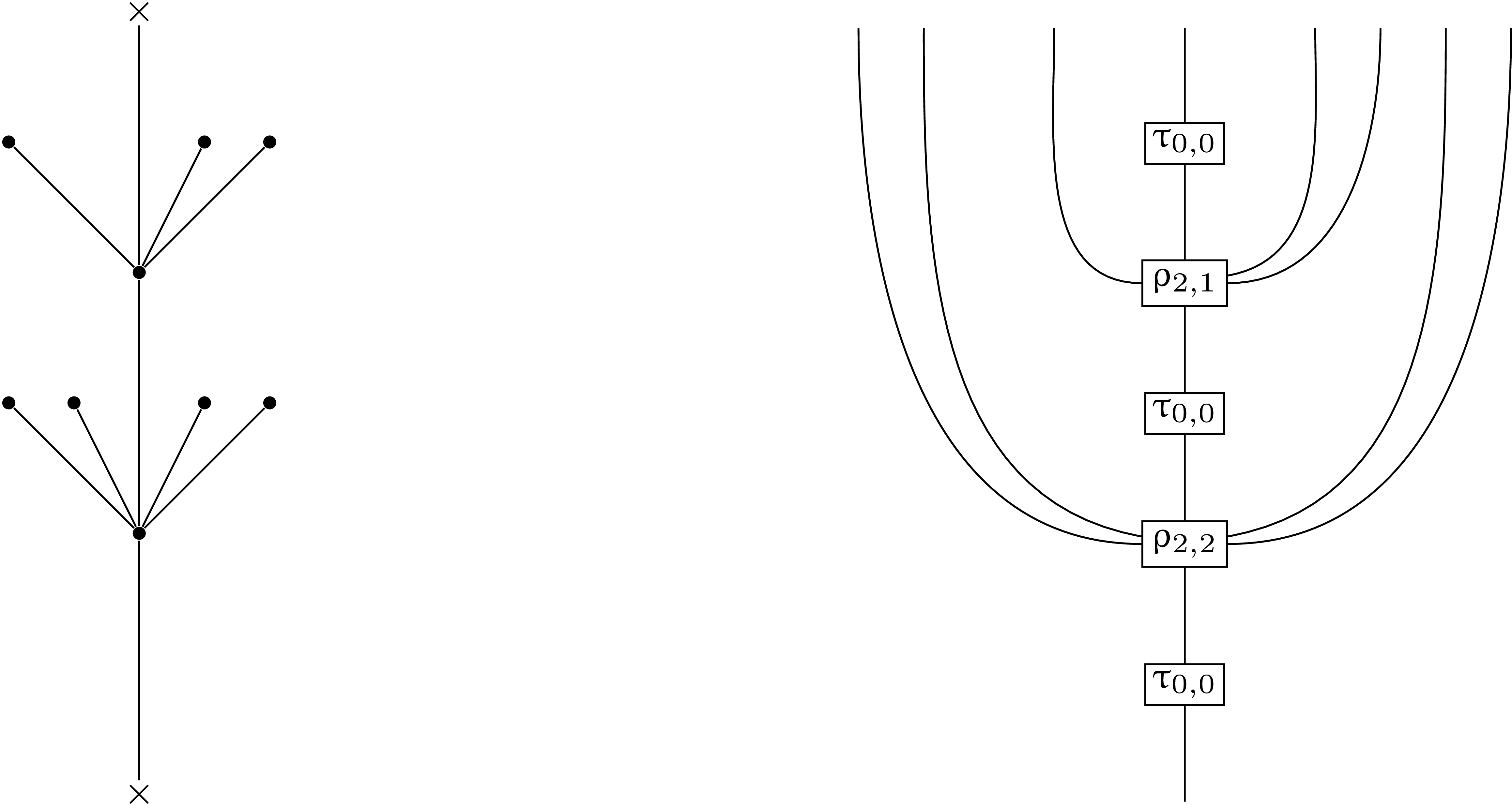


 Open access

