





Introduction
Criminality causes substantial costs to the society, victims, families, and the perpetrator (McCollister et al., Reference McCollister, French and Fang2010). Previous research has largely focused on increasing our knowledge about causes of crime. However, a less explored topic concerns why individuals who may be at risk of committing crime refrain from doing so. Parents who commit crimes are more likely to have children who also commit crimes (Frisell et al., Reference Frisell, Lichtenstein and Långström2011). A meta-analysis of the intergenerational transmission of criminality consisting of 23 samples showed that children of parents with a criminal history had an increased risk of engaging in crime themselves, with a pooled odds ratio of 2.4 (Besemer et al., Reference Besemer, Farrington, Bijleveld and Kaufman2017). The intergenerational transmission of crime is likely due to both genetic influences (Miller & Barnes, Reference Miller and Barnes2013) and environmental influences (Besemer et al., Reference Besemer, Farrington, Bijleveld and Kaufman2017; Kendler et al., Reference Kendler, Ohlsson, Morris, Sundquist and Sundquist2015). This means that the risk to engage in criminal activity is passed down from parent to child via the genetic makeup and via the shared environment (Frisell et al., Reference Frisell, Lichtenstein and Långström2011; Långström et al., Reference Långström, Babchishin, Fazel, Lichtenstein and Frisell2015).
Despite extensive research on intergenerational transmission of crime, factors that prevent children of parents with a criminal history from engaging in crime are less understood. While there is no commonly agreed upon definition of protective factors, one approach is the “risk-based protective factor” which states that a protective factor is “a variable that predicts a low probability of offending among a group at risk” (Farrington et al., Reference Farrington, Ttofi and Piquero2016, p. 64). Within this perspective, some studies have explored biological and psychological protective factors, indicating that higher resting heart rate (RHR), a measure of autonomic arousal (Palma & Benarroch, Reference Palma and Benarroch2014), may act as a protective factor against the intergenerational transmission of crime (Raine et al., Reference Raine, Choy, Achenbach and Liu2023). While a lower RHR has been shown to predict an increased risk of crime in numerous studies, especially for violent crime (see for example Latvala et al., Reference Latvala, Kuja-Halkola, Almqvist, Larsson and Lichtenstein2015, de Looff et al., Reference de Looff, Cornet, de Kogel, Fernández-Castilla, Embregts, Didden and Nijman2022), higher RHR might suggest greater autonomic responsiveness and emotional regulation, which can be protective against criminal conduct (Raine et al., Reference Raine, Choy, Achenbach and Liu2023). Thus, RHR can serve as a physiological marker of emotional reactivity, which may influence decision-making processes, making it a candidate for a protective factor against crime.
While not studied in the context of protective factors, systolic blood pressure ([SBP]; another indicator of autonomic arousal; Palma & Benarroch, Reference Palma and Benarroch2014) show associations with both violent and non-violent crime that align directionally with RHR (Latvala et al., Reference Latvala, Kuja-Halkola, Almqvist, Larsson and Lichtenstein2015). It has also been shown that similar to RHR, SBP is associated with an increased risk of injuries resulting from assaults and accidents (Latvala et al., Reference Latvala, Kuja-Halkola, Almqvist, Larsson and Lichtenstein2015). Findings of this kind are in line with an interpretation of SBP as reflecting similar underlying mechanisms as RHR, such as low fear responsiveness which is consistent with fearlessness theory. According to this theory, individuals with lower physiological arousal may experience less fear in threatening situations, which could reduce the natural inhibition against engaging in criminal conduct (Raine, Reference Raine2002). Thus, if high RHR is a protective factor against the intergenerational transmission of crime, high SBP could be as well. From this perspective, higher SBP like higher RHR, might indicate greater physiological arousal and sensitivity to threat, which could function as a protective factor by reinforcing internal constraints against offending.
Low cognitive ability (CA) is a well-established risk factor for criminal behavior and has been consistently associated with higher rates of offending (Basto-Pereira & Farrington, Reference Basto-Pereira and Farrington2022). Notably, this relationship persists even after adjusting for shared familial influences (i.e., genetic and environmental factors shared between siblings), supporting a possible causal link (Frisell et al., Reference Frisell, Pawitan, Långström and Krueger2012). Some studies further suggest that higher CA may act as a protective factor against crime, particularly among individuals exposed to elevated risk (Ttofi et al., Reference Ttofi, Farrington, Piquero, Lösel, DeLisi and Murray2016). However, findings in this area are mixed, with some research indicating more complex or inconsistent associations (Portnoy et al., Reference Portnoy, Chen and Raine2013). In addition, individual-level personality traits such as agreeableness, conscientiousness (Gubbels et al., Reference Gubbels, Assink and van der Put2024), and low neuroticism (Farrington et al., Reference Farrington, Ttofi and Piquero2016) have also been linked to lower risk of criminal behavior. These findings highlight the relevance of psychological traits as potential protective factors, possibly within high-risk populations.
Research examining biological and psychological protective factors against parent to child transmission of criminality exist, but important methodological limitations need to be addressed. Previous studies often relied on small sample sizes, self-reported data, and more importantly – lacked the ability to test for causal relations between protective factors and the intergenerational transmission of crime. Consequently, it remains unclear how strong causal inferences can be made based on earlier studies. While earlier findings suggest that certain protective factors are associated with a reduced risk of intergenerational transmission of crime, it is crucial to elucidate the underlying mechanisms of these associations. These associations might result from etiological factors shared between the protective factor and the intergenerational transmission of crime, such as genetic or shared environmental factors. Another alternative is that they could reflect causal mechanisms whereby the protective factor decreases the risk of intergenerational transmission of crime independently of shared genetic and environmental influences. Utilizing a genetically sensitive design, such as a sibling design, can help evaluate these different hypotheses and advance our understanding of protective factors.
By using data from nationwide population-based registers, we aimed to extend the knowledge about biological and psychological protective factors available in the Swedish conscription register. We explored the associations between RHR, SBP, CA, and psychological functioning (PF) with criminal convictions among a group of conscripted men with a convicted parent. In addition, we tested the associations while taking unmeasured familial factors into account by conducting stratified analyses within siblings.
Materials and methods
Data sources
Via the unique personal identity numbers assigned to all individuals who are born in or who immigrate to Sweden, we linked several Swedish population-based registers to obtain data. The linkage of registers was approved by the Regional Ethical Review Board (2023-05532-02). We used the Total Population Register (TPR) for data on date of birth, sex, death, and migration (Ludvigsson et al., Reference Ludvigsson, Almqvist, Edstedt Bonamy, Ljung, Michaëlsson, Neovius, Stephansson and Weimin2016); the Swedish Military Conscription Register for data from a conscription assessment mandatory for all men in Sweden up until the year of 2010 (Mårdberg & Carlstedt, Reference Mårdberg and Carlstedt1998); the National Crime Register for data on all convictions from Swedish district courts, including all individuals who at or after their 15th birthday (minimum age for criminal responsibility in Sweden) had a registered criminal conviction; the Multi-Generation Register to connect individuals to their full siblings; and the Census Records for data on childhood socioeconomic status (SES).
Study population
We identified a total of 1,940,625 men born in Sweden between 1958 and 1992. We excluded those who could not be linked to both their biological parents (n = 34,514), those who did not have a biological mother or father with at least one criminal conviction (n = 1,158,609), those who had not been conscripted (n = 189,391), and only kept the first conscription date among those who had conscripted more than once (i.e., excluding n = 13,983 duplicates). We also excluded individuals who had immigrated at any point in time (n = 33,415). After 2010, conscription was no longer mandatory in Sweden (see Ludvigsson et al., Reference Ludvigsson, Berglind, Sundquist, Sundström, Tynelius and Neovius2022 for further information), and individuals conscripted after this point in time were excluded (n = 6,057). We further excluded individuals who had an emigration status before their 15th birthday (n = 80).
Lastly, we excluded men who had missing data on all protective factors (i.e., RHR, SBP, CA, and PF; n = 23,449), and one individual with error in data. The final sample consisted of 495,109 men.
Protective factors
We used the definition of a “risk-based protective factor” in line with Farrington et al. (Reference Farrington, Ttofi and Piquero2016). This definition states that a protective factor is “a variable that predicts a low probability of offending among a group at risk” (Farrington et al., Reference Farrington, Ttofi and Piquero2016, p. 64).
Resting heart rate and systolic blood pressure
RHR and SBP were measured as part of the conscription assessment. Measurements were obtained by using an arm-cuff monitor while conscripts were laying down in the supine position after having rested for 5 – 10 minutes (Ludvigsson et al., Reference Ludvigsson, Berglind, Sundquist, Sundström, Tynelius and Neovius2022). A valid value for RHR (i.e., 35 to 145 beats per minute [bpm]; Latvala et al., Reference Latvala, Kuja-Halkola, Almqvist, Larsson and Lichtenstein2015) was available for 242,049 individuals in the cohort (49%). Reasons for missing RHR data have been reported elsewhere (Latvala et al., Reference Latvala, Kuja-Halkola, Almqvist, Larsson and Lichtenstein2015; Sundström et al., Reference Sundström, Neovius, Tynelius and Rasmussen2011). A valid value for SBP (i.e., 80 to 160 millimeter of mercury [mmHg]; Latvala et al., Reference Latvala, Kuja-Halkola, Almqvist, Larsson and Lichtenstein2015) was available for 410,659 individuals in the cohort (83%). RHR and SBP were divided into quintiles to allow for potential non-linear relationships (Latvala et al., Reference Latvala, Kuja-Halkola, Almqvist, Larsson and Lichtenstein2015). In the present sample, RHR and SBP were weakly positively correlated r(241183) = 0.24, 95% CI = 0.24, 0.25, p < .001.
Cognitive ability
CA was measured with the Swedish Enlistment Battery (SEB), included in the Swedish Military Conscript Register (Mårdberg & Carlstedt, Reference Carlstedt1998). The SEB started in 1944 (Ludvigsson et al., Reference Ludvigsson, Berglind, Sundquist, Sundström, Tynelius and Neovius2022) and the batteries have been influenced by the concept of a general CA (i.e., the “g factor”; Spearman, Reference Spearman1904). A detailed description is provided elsewhere (Carlstedt, Reference Carlstedt2000; Ludvigsson et al., Reference Ludvigsson, Berglind, Sundquist, Sundström, Tynelius and Neovius2022). The scales have been standardized using the 9-point stanine scale with a mean (M) of 5 and a standard deviation (SD) of 2 (Black et al., Reference Black, Devereux and Salvanes2009) to maintain the same distribution over time. For the CA test, stanine 5 represents an IQ level of 100 (Ludvigsson et al., Reference Ludvigsson, Berglind, Sundquist, Sundström, Tynelius and Neovius2022) where a higher score indicated a higher CA. As a reference, the conscription IQ test is similar but not equal to Wechsler Adult Intelligence Scale (Ludvigsson et al., Reference Ludvigsson, Berglind, Sundquist, Sundström, Tynelius and Neovius2022; Wechsler, Reference Wechsler1981). A valid value for CA was available for 487,376 individuals in the cohort (98%). CA was divided into five categories approximating quintiles: (1 – 3), (4), (5), (6), and (7 – 9; Black et al., Reference Black, Devereux and Salvanes2009).
Psychological functioning
All conscripts underwent psychological testing consisting of a questionnaire and a semi-structured interview assessed by a licensed psychologist specialized in the Swedish Military organization (Ludvigsson et al., Reference Ludvigsson, Berglind, Sundquist, Sundström, Tynelius and Neovius2022). The psychologists conducting the assessments received standardized, nationally coordinated training, ensuring consistency in evaluation procedures (Kendler et al., Reference Kendler, Lönn, Lichtenstein, Sundquist and Sundquist2016). The main purpose of the psychological testing was to classify conscripts to a suitable position within the military service by assessing whether conscripts met the psychological requirements to perform in the armed forces and ultimately at war (Carlstedt, Reference Carlstedt1998; Lindqvist & Vestman, Reference Lindqvist and Vestman2011). The psychological test yielded four different sub scores that combined into one score on the 9-point stanine scale. A higher score indicated a better PF, that is for performance in the military service, characterized by stress resilience, emotional stability, a focus on group cohesion, persistence and independence (Carlstedt, Reference Carlstedt1998; Lindqvist & Vestman, Reference Lindqvist and Vestman2011; Ludvigsson et al., Reference Ludvigsson, Berglind, Sundquist, Sundström, Tynelius and Neovius2022). Earlier work has suggested, although not tested, that a higher score of PF reflect higher agreeableness, higher conscientiousness, and lower neuroticism from the “big five” model of personality (John, Reference John and Pervin1990; Kendler et al., Reference Kendler, Lönn, Lichtenstein, Sundquist and Sundquist2016; Sorjonen et al., Reference Sorjonen, Hemmingsson, Lundin, Falkstedt and Melin2012). The Swedish Armed Forces have also conducted internal validation studies demonstrating the predictive validity of the scale. For example, it has been shown to reliably predict military performance across a range of roles, including enlisted personnel and officers in the Air Force, under both combat and support conditions (Carlstedt, Reference Carlstedt1998). In the present sample, CA and PF were modestly positively correlated ρ = 0.39, p < .001.
A valid value for PF was available for 441,847 individuals in the cohort (89%). PF was divided into five categories approximating quintiles: (1 – 3), (4), (5), (6), (7 – 9; Black et al., Reference Black, Devereux and Salvanes2009).
Outcome measures
Criminal convictions
A registered criminal conviction served as the outcome variable in the present study. We constructed three separate outcome variables: any, violent, and non-violent conviction. Following previous work, we defined a violent criminal conviction as a having been convicted of homicide, manslaughter, assault, kidnapping, illegal confinement, unlawful coercion, gross violation of a person’s or a woman’s integrity, unlawful threats, intimidation, robbery, arson, and threats and violence against an officer (Frisell et al., Reference Frisell, Lichtenstein and Långström2011). We defined a non-violent criminal conviction as having been convicted of any other crime than a violent crime (Kuja-Halkola et al., Reference Kuja-Halkola, Pawitan, D’Onofrio, Långström and Lichtenstein2012).
Covariates
For analyses with RHR and SBP, we included height and weight, divided into quintiles, because of their potential association with RHR, SBP and criminal convictions (Beckley et al., Reference Beckley, Kuja-Halkola, Lundholm, Långström and Frisell2014). We also included a measure of cardiorespiratory fitness, divided into quintiles as this is a well-known correlate of RHR and SBP (Cornelissen & Smart, Reference Cornelissen and Smart2013; Jensen et al., Reference Jensen, Suadicani, Hein and Gyntelberg2013) and potentially criminal convictions (Latvala et al., Reference Latvala, Kuja-Halkola, Almqvist, Larsson and Lichtenstein2015). Cardiorespiratory exercise was assessed during conscription where conscripts used an ergometer bicycle (results were recorded in Watts; Ludvigsson et al., Reference Ludvigsson, Berglind, Sundquist, Sundström, Tynelius and Neovius2022). We adjusted for childhood SESFootnote 1 , coded from the National Census records as low, medium, or high which was based on the occupation for the head of each participant’s household (Latvala et al., Reference Latvala, Kuja-Halkola, Almqvist, Larsson and Lichtenstein2015). Lastly, we included birth year as a covariate, categorized into approximately equal categories (1958 – 1969, 1970 – 1979, 1980 – 1992), to adjust for any potential cohort effects. For analyses with CA and PF, we included only childhood SES1 and birth year as covariates.
Statistical analyses
All data management and analyses were carried out using SAS software (version p.4; SAS Institute) and R (version 4.05; R Development Core Team, 2023). Firstly, we used the Kaplan-Meier method to estimate the cumulative incidence of being convicted of any, violent, and non-violent crimes among individuals with different values of the protective factors under study, while accounting for censoring (i.e., individuals contributing with unequal lengths of time. We estimated the cumulative incidence of experiencing the outcome before age 30 (i.e., after 15 years of follow-up).
Secondly, we used Cox Proportional Hazards regression models to estimate hazard ratios (HRs) and 95% confidence intervals (CIs) of the associations between the protective factors and the outcomes (i.e., any, violent and non-violent convictions) with age as the underlying timescale. Participants were followed from their 15th birthday (minimum age of criminal responsibility in Sweden) and were followed until they were convicted of a crime, emigrated, died, or the end of the study period (December 31st, 2021), whichever occurred first. We constructed two different models for each exposure variable with each outcome. The first model included only birth year as a covariate. To the second model we added childhood SES, and height, weight, and cardiorespiratory exercise where appropriate. In these two models, we used robust standard errors to account for familial clustering.
Thirdly, families where parent(s) have a criminal conviction are likely to have a large variation which may account for the observed associations among offspring. One way to provide a more rigorous test of the associations between the putative protective factors and criminal convictions is to hold the unobserved parental factors constant by comparing siblings from the same families. Thus, we used stratified Cox proportional hazard models conditioning on full sibling clusters to estimate associations between protective factors and criminality among offspring while adjusting for unmeasured familial factors. If a similar association is present both in the individual-level analyses and in the within-sibling pair analyses, the association is not due to factors that the siblings share. If an association observed in the individual-level analyses is attenuated in the within-sibling pair analyses, the association is assumed to be due to shared familial factors. The sibling analyses included only birth year as a covariate.
Sensitivity analyses
To explore whether our estimates were affected by the timing of obtaining the measures of protective factors in relation to the first conviction, we restricted our sample to only include offspring who had their first conviction after their conscription (n = 390,841). To explore whether our estimates were affected by the timing of the parental conviction, we restricted our sample to include only those who had a parent who had their last conviction before the offspring conscripted (n = 247,096). We further restricted our sample to include only offspring with a father who had a criminal conviction (n = 363,544) and thus removing offspring with a convicted mother. We also stratified our cohort to include only individuals with a parent who had a violent criminal conviction (n = 72,687), or a non-violent criminal conviction with no violent convictions (n = 440,595) to investigate whether parental type of crime had an impact on the results. Lastly, we repeated all analyses in the total sample, excluding individuals with a convicted parent (i.e., a lower-risk group; n = 847,677) to assess the generalizability of the observed associations.
Results
Descriptive statistics
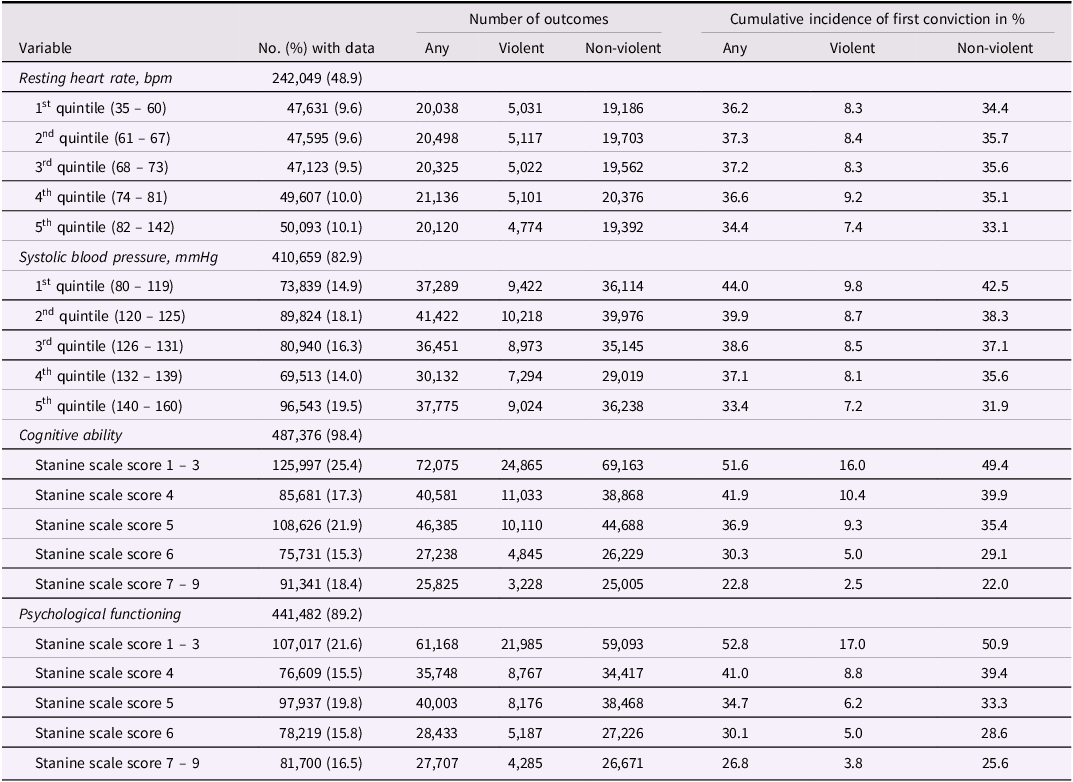
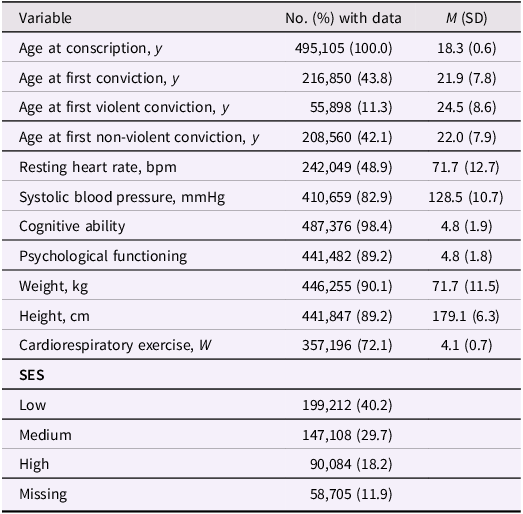
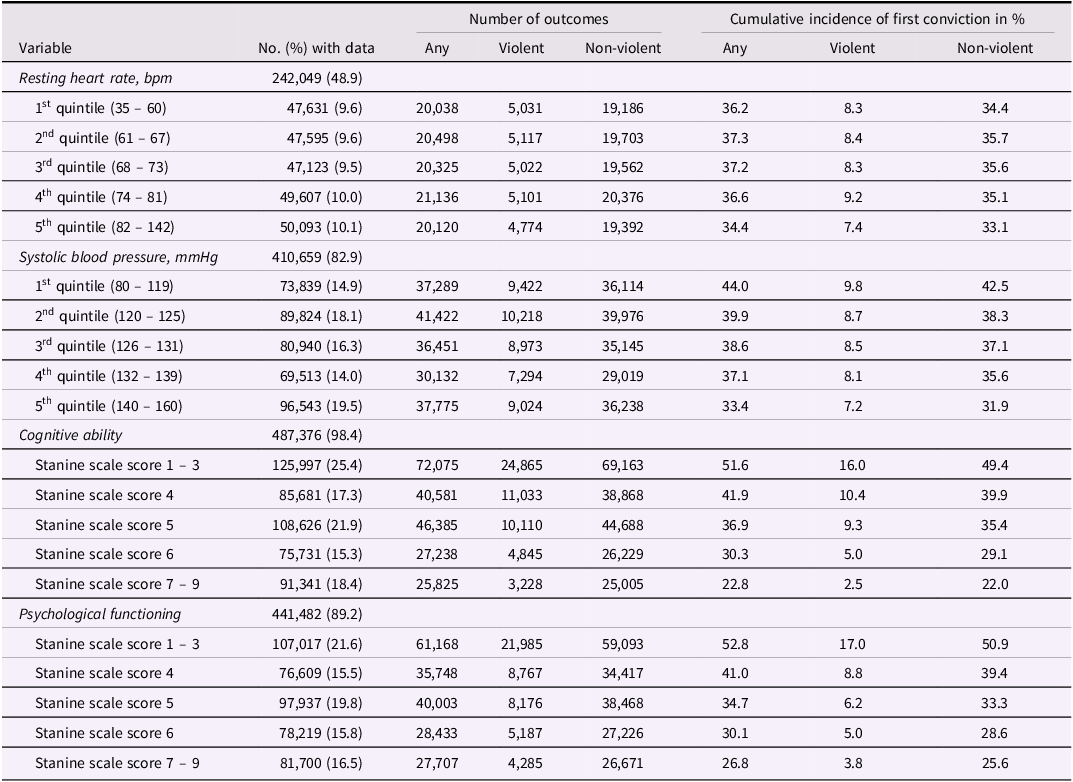
Descriptive statistics for the full cohort can be found in Table 1. Table 2 displays cumulative incidences (i.e., estimated probability) of any, violent, and non-violent convictions by levels of protective factors during follow-up. Models adjusted for birth year only can be found in Supporting Information (Table S1). Cumulative incidence plots for all protective factors are shown in the S1-S4 Figs.
Descriptive statistics for the sample of men with a convicted parent*

*N = 491,658.
Cumulative incidence rates by age 30 of any, violent, and non-violent convictions among men with a convicted parent*
*N = 495,109.
Protective factors for intergenerational transmission of crime
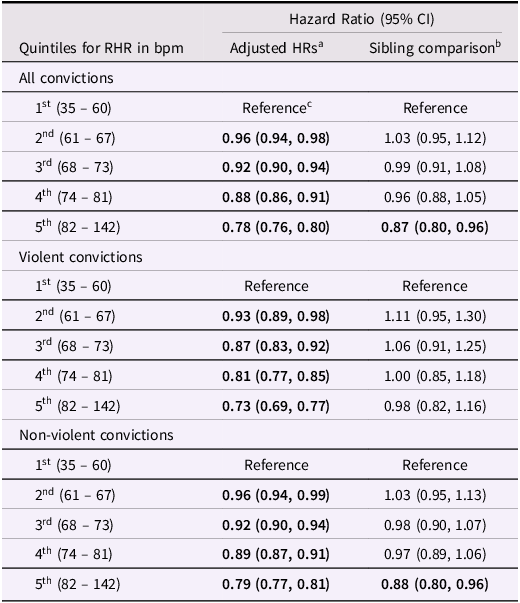
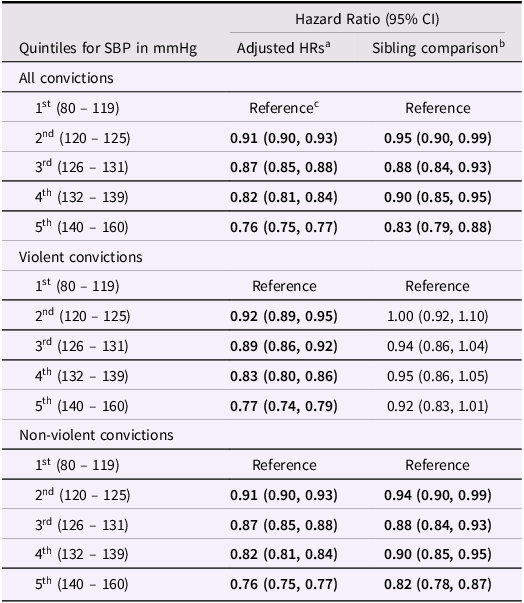
Results from Cox models for RHR and SBP for any, violent, and non-violent crimes are shown in Table 3 and 4. In adjusted models (i.e., adjusted for birth year, height, weight, cardiorespiratory exercise, and childhood SES), men with the highest RHR had a reduced risk for being convicted of any, violent, and non-violent crimes as compared to those with the lowest RHR, with HRs ranging from 0.73 (95% CI = 0.69, 0.77) to 0.79 (95% CI = 0.77, 0.81). Similarly, men with the highest SBP had a reduced risk for being convicted of any, violent, and non-violent crimes with HRs ranging from 0.76 (95% CI = 0.75, 0.77) to 0.77 (95% CI = 0.74, 0.79). When adjusting for familial factors, estimates for RHR and SBP remained largely unchanged, however for RHR, the CIs widened and in most cases overlapped 1.
Adjusted cox proportional hazard regression models for resting heart rate with criminal convictions among men with a convicted parent

Abbreviations: bpm = (beats per minute); HR = (hazard ratio); CI = (confidence interval).
Results in bold have CI that exclude 1.
a Adjusted for birth year, height, weight, cardiorespiratory exercise, and childhood socioeconomic status.
b Adjusted for birth year and full siblings.
c Category of comparison.
Adjusted cox proportional hazard regression models for systolic blood pressure with criminal convictions among men with a convicted parent

Abbreviations: mmHg = (millimeter of mercury); HR = (hazard ratio), CI (confidence interval).
Results in bold have CI that exclude 1.
a Adjusted for birth year, height, weight, cardiorespiratory exercise, and childhood socioeconomic status.
b Adjusted for birth year and full siblings.
c Category of comparison.
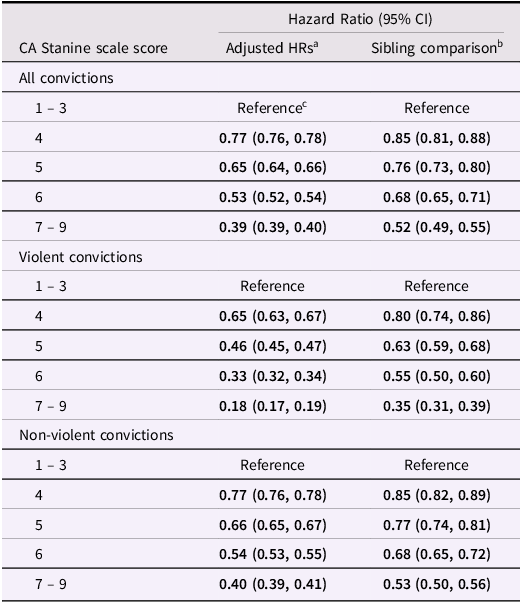
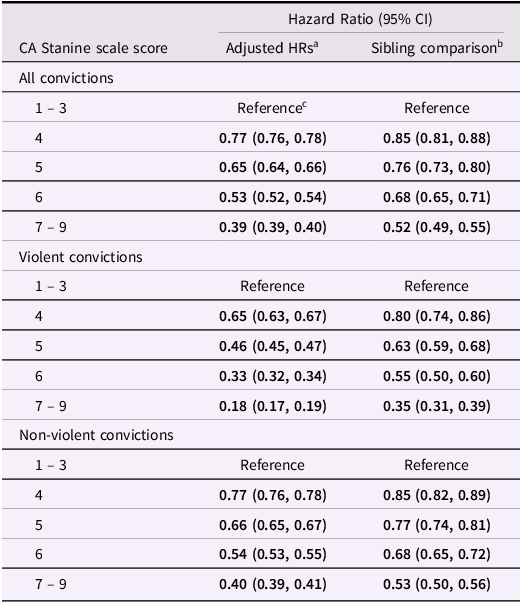
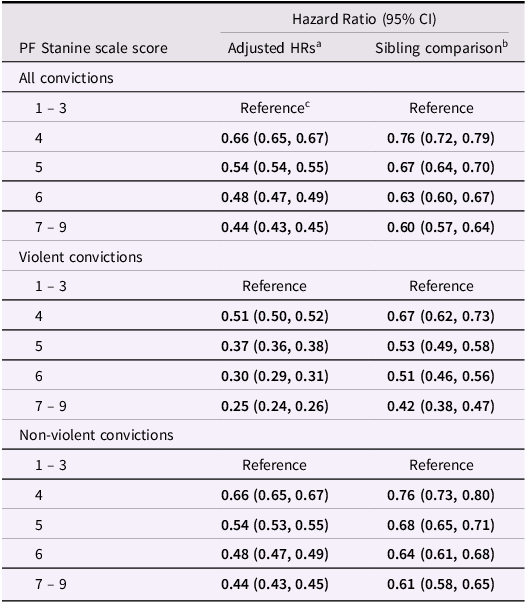
Results from Cox models for CA and PF for any, violent, and non-violent convictions are shown in Table 5 and 6. In adjusted models (i.e., adjusted for birth year and childhood SES), men with the highest CA had a reduced risk for being convicted of any, violent, and non-violent crimes as compared to those with the lowest CA, with HRs ranging from 0.18 (95% CI = 0.17, 0.19) to 0.40 (95% CI = 0.39, 0.41). Similarly, men with the highest PF had a reduced risk for being convicted of any, violent, and non-violent crimes, with HRs ranging from 0.25 (95% CI = 0.24, 0.26) to 0.44 (95% CI = 0.43, 0.45). The estimates were slightly attenuated when adjusted for unmeasured familial factors but remained significant for both CA and PF.
Adjusted cox proportional hazard regression models for cognitive ability with criminal convictions among men with a convicted parent
Abbreviations: HR = (hazard ratio); CI = (confidence interval).
Results in bold have CI that exclude 1.
a Adjusted for birth year and childhood socioeconomic status.
b Adjusted for birth year and full siblings.
c Category of comparison.
Adjusted cox proportional hazard regression models for psychological functioning with criminal convictions among men with a convicted parent

Abbreviations: HR = (hazard ratio); CI = (confidence interval).
Results in bold have CI that exclude 1.
a Adjusted for birth year and childhood socioeconomic status.
b Adjusted for birth year and full siblings.
c Category of comparison.
Sensitivity analyses
Estimates for RHR, SBP, CA, and PF were largely unaffected by restrictions to the dataset, although the CIs were wider in the restricted samples for RHR and SBP but generally not for CA and PF: offspring who had their first conviction after conscription (Tables S2 – S5), offspring who had a parent who had their last conviction before the offsprings conscription (Tables S6 – S9), offspring with a father who had a criminal conviction (Tables S10 – S13), and offspring with a parent convicted of violent (Tables S14 – S17) and non-violent crimes (Tables S18 – S21) only. Results from sensitivity analyses suggest that the findings from the main analyses are robust.
Findings from the lower-risk sample suggest that the observed associations in the main analyses are not specific to individuals with familial criminal history, but instead reflect a broader pattern present in the general population. This enhances the external validity of our results and indicates that these factors operate independently of parental criminality (see Tables S22 – S25).
Discussion
The present study sheds light on biological and psychological protective factors against criminality among at-risk men. Higher levels of RHR, SBP, CA, and PF were linked to reduced risk of criminality after adjusting for covariates. Even after accounting for familial factors shared by siblings, men in the highest RHR quintile had a reduced risk of any and non-violent crime. Similarly, men with higher SBP had a reduced risk of any and non-violent crime. The strong associations of CA and PF with all types of crime remained significant, though somewhat attenuated, after considering familial factors. These findings suggest that associations between RHR and criminality among men with a convicted parent were largely explained by familial factors. Similarly, associations between SBP and violent crime, but not non-violent crime, were explained by familial factors. A part of the associations between CA and PF with criminality were also explained by familial factors but most of the associations remained, which is compatible with a causal interpretation.
After adjusting for unmeasured familial factors, male offspring with a convicted parent had a reduced risk of being convicted themselves if they were on the higher end of the scale of RHR (i.e., ≥ 82 bpm). Despite the highest quintile of RHR being predictive of a reduced risk of intergenerational transmission of crime even after adjusting for familial confounds, the pattern in the present study along with results from previous studies suggests that RHR is not a causal factor in relation to crime (Karwatowska et al., Reference Karwatowska, Frach, Schoeler, Tielbeek, Murray, de Geus, Viding and Pingault2023; Kendler et al., Reference Kendler, Lönn, Sundquist and Sundquist2021). Others have suggested that sensation-seeking is a potential mediator between RHR and crime because individuals with lower RHR have a lower level of autonomic arousal which can increase the risk of committing crime (Karwatowska et al., Reference Karwatowska, Frach, Schoeler, Tielbeek, Murray, de Geus, Viding and Pingault2023; Oskarsson et al., Reference Oskarsson, Raine and Baker2024). Previous studies show evidence of a genetic covariation between RHR and crime, where individuals with a genetic predisposition for lower RHR also have a genetic predisposition for crime (Kendler et al., Reference Kendler, Lönn, Sundquist and Sundquist2021). Thus, while RHR may serve as a risk indicator for identifying at-risk individuals, it does not appear to be a direct causal factor in the intergenerational transmission of crime.
Despite both RHR and SBP being proxies for autonomic arousal, their associations with crime differ within the present study. For SBP, associations with any and non-violent crime remained significant after adjusting for familial factors while associations with violent crime did not. While high SBP may encourage risk-averse behavior that deter non-violent crime, it may not have the same protective effect against the impulsive and aggressive nature of violent crime. While a low autonomic arousal is theorized to reflect a lack of anticipatory fear which may increase the risk of crime because it interferes with avoidance learning (Raine, Reference Raine2002), a high autonomic arousal in this setting may instead reflect fearfulness and a heightened emotional processing capacity (Brennan et al., Reference Brennan, Raine, Schulsinger, Kirkegaard-Sorensen, Knop, Hutchings, Rosenberg and Mednick1997). This in turn may decrease the risk of crime as it inhibits antisocial acts because of the potential consequences such acts may bring (Raine et al., Reference Raine, Choy, Achenbach and Liu2023). This reasoning is further in line with studies demonstrating that the social cognition of the perceived risk of being caught is bipolar and thus can increase or decrease the risk of crime (Loeber et al., Reference Loeber, Farrington, Stouthamer-Loeber and Raskin-White2008). Future studies should continue to explore the role of SBP in the intergenerational transmission of crime as our study is the first to suggest a decreased risk for any and non-violent crime among individuals with high SBP.
Studies have consistently demonstrated an increased risk of crime among individuals with lower CA (e.g., Frisell et al., Reference Frisell, Pawitan, Långström and Krueger2012; Schwartz et al., Reference Schwartz, Savolainen, Aaltonen, Merikukka, Paananen and Gissler2015) as well as a decreased risk of crime among individuals with a higher CA (e.g., Farrington et al., Reference Farrington, Ttofi and Piquero2016). In the present study, after adjusting for unmeasured familial factors, male offspring with a convicted parent and higher levels of CA (i.e., > 3 on the stanine scale) still had a reduced risk of being convicted themselves as compared to their brother(s) with lower CA. These results are in line with results from other areas of research where individuals with different types of disadvantages are protected from a diversity of adverse outcomes by a higher level of intelligence, because they are good learners and problem solvers (Masten et al., Reference Masten, Best and Garmezy1990) which is a central part of the definition of CA (Neisser et al., Reference Neisser, Boodoo, Bouchard, Boykin, Brody, Ceci, Halpern, Loehlin, Perloff, Sternberg and Urbina1996).
Similarly, studies have consistently shown that neuroticism (high), agreeableness (low), and conscientiousness (low) from the “Big Five” model of personality (John, Reference John and Pervin1990) relate to an increased risk of crime which has been demonstrated in a meta-analytic review (Jones et al., Reference Jones, Miller and Lynam2011). Our findings after adjusting for unmeasured familial factors show that male offspring with a convicted parent and higher levels of PF (i.e., > 3 on the stanine scale) still had a reduced risk of being convicted themselves as compared with their brother(s) with lower levels of PF. High levels on this measure have been suggested to reflect low levels of neuroticism, higher levels of agreeableness and higher levels of conscientiousness from the “Big Five” model of personality (John, Reference John and Pervin1990; Kendler et al., Reference Kendler, Lönn, Lichtenstein, Sundquist and Sundquist2016; Sorjonen et al., Reference Sorjonen, Hemmingsson, Lundin, Falkstedt and Melin2012). Our findings from a sibling comparison design corroborate results from previous studies with weaker designs suggesting that these personality traits are associated with a reduced risk of intergenerational transmission of crime (Farrington et al., Reference Farrington, Ttofi and Piquero2016; Gubbels et al., Reference Gubbels, Assink and van der Put2024).
Results from the present study are in line with the compensatory model (Garmezy et al., Reference Garmezy, Masten and Tellegen1984), which suggests that protective factors may buffer against risk factors (Brennan et al., Reference Brennan, Raine, Schulsinger, Kirkegaard-Sorensen, Knop, Hutchings, Rosenberg and Mednick1997), such as having a parent with a criminal conviction (van de Weijer et al., Reference van de Weijer, de Jong, Bijleveld, Blokland and Raine2017). We know from numerous studies that parental criminality is one of the most important risk factors for engaging in crime (Besemer et al., Reference Besemer, Farrington, Bijleveld and Kaufman2017), thus the intergenerational transmission of crime is crucial to interrupt. While a high RHR does not seem to be causally associated with a decreased risk of intergenerational transmission of crime and SBP results should be further explored before drawing any conclusions, our results show that high levels of CA and PF are associated with a reduced risk of crime among men with a convicted parent, independently of covariates and familial factors shared between siblings. Interestingly though, associations remained consistent also in a low-risk group (i.e., males without a convicted parent), suggesting that RHR, SBP, cognitive ability, and PF reflect generalizable protective factors for crime across different populations. In other words, our findings do not suggest that these biological and psychological factors would be protective merely, or specifically, in the context of elevated risk.
While it remains unclear to what extent CA is malleable (Moreau, Reference Moreau2022) and personality traits have been suggested to be fairly stable across the lifespan (Bleidorn et al., Reference Bleidorn, Schwaba, Zheng, Hopwood, Sosa, Roberts and Briley2022), the protective factors examined in this study could nonetheless be valuable for promoting resilience among individuals exposed to risk. Even when familial risk is present, implying that genetic and/or shared environmental factors contribute to the criminal behavior, individual-level factors play a key role in shaping outcomes. Not all individuals with a family history of criminality go on to offend, and individual characteristics such as higher CA, better PF, and higher physiological arousal may help explain this variation and may buffer against the intergenerational transmission of crime by supporting more adaptive responses to risk.
From a resilience perspective, identifying and strengthening these protective factors could enhance individuals’ capacity to cope with adversity and avoid negative outcomes. While some traits may be relatively stable, others may be modifiable through intervention. By fostering protective traits, interventions could potentially reduce the likelihood of offending despite underlying familial risk. Integrating these insights into risk assessments and prevention strategies may therefore contribute to more effective, resilience-oriented approaches to breaking the cycle of intergenerational transmission of crime.
Methodological strengths and limitations
While the utilization of population-based register data provides several methodological strengths such as longitudinal data across several decades, large sample sizes, and complete study populations which minimize selection bias, our findings should be considered in the light of some limitations. RHR and SBP were measured using an arm-cuff monitor which may be less sensitive than collecting data in a psychophysiological lab. However, this procedure is standard in a clinical context (Sundström et al., Reference Sundström, Neovius, Tynelius and Rasmussen2011). Also of note, only 49% of the sample had valid RHR data, something that has been discussed elsewhere (Latvala et al., Reference Latvala, Kuja-Halkola, Almqvist, Larsson and Lichtenstein2015; Sundström et al., Reference Sundström, Neovius, Tynelius and Rasmussen2011). Our study findings further apply to men only, and it remains to be investigated whether results apply also to women. The outcome(s) in the present study were based on official records of criminal convictions and does therefore not reflect all crimes convicted by these men in Sweden. They may also not be generalizable to other countries given potential differences in criminal justice systems. It is also important to recognize that only discordant siblings contribute to the estimates in the within-sibling pair analyses. Given the relatively small number of individuals with RHR data, the unstable estimates and wide CIs from the within-sibling pair analyses may reflect low statistical power. The attenuation of estimates from the models adjusted for covariates and the models adjusted for unmeasured familial factors may also further reflect measurement error (see Frisell et al., Reference Frisell, Pawitan, Långström and Krueger2012; Frisell et al., Reference Frisell, Pawitan, Långström and Lichtenstein2012). Future research should further explore how protective factors are best defined, particularly when working with continuous variables that may also function as risk factors depending on context.
Conclusion
If RHR, SBP, CA and PF influence the risk of criminality among offspring to convicted parents, they provide an interesting opportunity for interventions in the context of strengthening such factors to reduce the risk of intergenerational transmission of crime. However, we are unable to make any conclusions regarding potentially causal associations, although the present study findings suggest that the most part of the studied associations between CA and PF are not due to confounding factors shared among siblings. Results for SBP warrants further investigation, although they suggest that fearfulness and a heightened emotional processing reduce the risk of crime among offspring to convicted parents. Future research should aim to delve deeper into the questions about causality.
Supplementary material
The supplementary material for this article can be found at https://doi.org/10.1017/S0954579425100515.
Data availability statement
Data cannot be shared publicly because of the Swedish Secrecy Act. Data from the registers used for this study were made available by ethical approval. Researchers may apply for access through the Swedish Research Ethics Boards (www.etikprovningsmyndigheten.se) and from the primary data owners Statistics Sweden (www.scb.se) and the National Board of Health and Welfare (www.socialstyrelsen.se), in accordance with Swedish law.
Acknowledgments
The authors have no acknowledgments to report.
Funding statement
S.O was supported by the Swedish Research Council (grant number 2024-01324). A.L was supported by the Research Council of Finland (grant number 339646).
Competing interests
H.L reports receiving grants from Shire Pharmaceuticals; personal fees from and serving as a speaker for Medice, Shire/Takeda Pharmaceuticals and Evolan Pharma AB; and sponsorship for a conference on attention-deficit/hyperactivity disorder from Shire/Takeda Pharmaceuticals and Evolan Pharma AB, all outside the submitted work. Henrik Larsson is editor-in-chief of JCPP Advances. All other authors report no financial relationships with commercial interests.


 Open access

