





1. Introduction
In this article, we are concerned with the curvature properties of the higher direct images $R^if_*(\Omega ^{n-i}_{X/B}(\log )\otimes L)$
and in particular of
$R^if_*(\Omega ^{n-i}_{X/B}(\log )\otimes L)$
and in particular of $f_*(\omega _{X/B}\otimes L),$
where
$f_*(\omega _{X/B}\otimes L),$
where $f\colon X\to B$
is a semistable fibration of smooth complex projective varieties of relative dimension n, L is a Hermitian line bundle on
$f\colon X\to B$
is a semistable fibration of smooth complex projective varieties of relative dimension n, L is a Hermitian line bundle on $X,$
and
$X,$
and $\Omega ^{\bullet }_{X/B}(\log )$
are the bundles of holomorphic relative logarithmic forms (see Section 2 for details).
$\Omega ^{\bullet }_{X/B}(\log )$
are the bundles of holomorphic relative logarithmic forms (see Section 2 for details).
If $f\colon X\to B$
is smooth, it is classically known that
$f\colon X\to B$
is smooth, it is classically known that $f_*\omega _{X/B}$
is Griffiths semi-positive (see [Reference Griffiths13], [Reference Griffiths and Tu15]). Expanding on this, if f is not necessarily smooth but B is a curve, a result by Fujita shows that
$f_*\omega _{X/B}$
is Griffiths semi-positive (see [Reference Griffiths13], [Reference Griffiths and Tu15]). Expanding on this, if f is not necessarily smooth but B is a curve, a result by Fujita shows that $f_*\omega _{X/B}$
has a holomorphic decomposition
$f_*\omega _{X/B}$
has a holomorphic decomposition $f_*\omega _{X/B}=\mathcal {U}\oplus \mathcal {A,}$
where
$f_*\omega _{X/B}=\mathcal {U}\oplus \mathcal {A,}$
where $\mathcal {A}$
is an ample vector bundle and
$\mathcal {A}$
is an ample vector bundle and $\mathcal {U}$
is a unitary flat vector bundle (see [Reference Catanese and Dettweiler4], [Reference Catanese and Dettweiler5], [Reference Fujita8], [Reference Fujita9]). This result has been generalized in many directions (see, e.g., [Reference Catanese and Kawamata6] for the case
$\mathcal {U}$
is a unitary flat vector bundle (see [Reference Catanese and Dettweiler4], [Reference Catanese and Dettweiler5], [Reference Fujita8], [Reference Fujita9]). This result has been generalized in many directions (see, e.g., [Reference Catanese and Kawamata6] for the case $\dim B>1$
, and [Reference Iwai18], [Reference Lombardi and Schnell23] for the direct image of the relative pluricanonical bundles
$\dim B>1$
, and [Reference Iwai18], [Reference Lombardi and Schnell23] for the direct image of the relative pluricanonical bundles $f_*(\omega _{X/B}^{\otimes m})$
).
$f_*(\omega _{X/B}^{\otimes m})$
).
Berndtsson, in the seminal work [Reference Berndtsson1], shows that $f_*(\omega _{X/B}\otimes L)$
is semi-positive in the sense of Nakano if L is semi-positive and this provides an evidence for the Griffiths conjecture [Reference Griffiths12]. Later in [Reference Berndtsson2], it is shown that it is possible to relate the curvature of
$f_*(\omega _{X/B}\otimes L)$
is semi-positive in the sense of Nakano if L is semi-positive and this provides an evidence for the Griffiths conjecture [Reference Griffiths12]. Later in [Reference Berndtsson2], it is shown that it is possible to relate the curvature of $f_*(\omega _{X/B}\otimes L)$
to the Kodaira–Spencer class. In particular, if
$f_*(\omega _{X/B}\otimes L)$
to the Kodaira–Spencer class. In particular, if $L=\mathcal {O}_X$
, these results highlight a close relation between curvature formulas and the classical infinitesimal Torelli problem.
$L=\mathcal {O}_X$
, these results highlight a close relation between curvature formulas and the classical infinitesimal Torelli problem.
One key property of this kind of metric result is that they can be meaningfully extended to the whole base B using the notion of singular Hermitian metric, see [Reference Păun26], [Reference Raufi30] and the references therein for all definitions.
For convenience, we state our results in the case $\dim B=1$
, nevertheless, most of this work can be generalized to the case
$\dim B=1$
, nevertheless, most of this work can be generalized to the case $\dim B>1$
.
$\dim B>1$
.
Using a curvature formula from [Reference Berndtsson2], we give conditions for the isotriviality of $f\colon X\to B$
over a Zariski open subset of B.
$f\colon X\to B$
over a Zariski open subset of B.
Theorem 1.1. Let $f\colon X\to B$
be a family of canonically polarized manifolds. Assume that there exists a surjective morphism
$f\colon X\to B$
be a family of canonically polarized manifolds. Assume that there exists a surjective morphism $\rho \colon V\times B\to X$
, where V is a projective variety, such that
$\rho \colon V\times B\to X$
, where V is a projective variety, such that $p:=f\circ \rho $
is the projection on B. Then, X is Zariski locally trivial.
$p:=f\circ \rho $
is the projection on B. Then, X is Zariski locally trivial.
See Theorem 3.12. This result must be seen in the light of the “constancy” results that are at the heart of the recent solution, in some cases, of the Bombieri–Lang conjecture: we think that Theorem 1.1 gives an interesting link between metric estimates and the techniques used in the proof of [Reference Xie and Yuan42, §2.3 and Theorem 2.6].
On the opposite side, we give a new method to study strong non-isotriviality based on metric evaluations on the conjugate of the Kodaira–Spencer class. It arises from the study of the curvature of certain torsion-free subsheaves of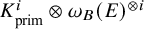 $K^i_{\text {prim}}\otimes \omega _B(E)^{\otimes i}$
, where
$K^i_{\text {prim}}\otimes \omega _B(E)^{\otimes i}$
, where $K^i_{\text {prim}}$
is the sheaf of primitive classes in the kernel of
$K^i_{\text {prim}}$
is the sheaf of primitive classes in the kernel of $R^if_*\Omega ^{n-i}_{X/B}(\log )\to \omega _B(E)\otimes R^{i+1}f_*\Omega ^{n-i-1}_{X/B}(\log )$
and E is the divisor on B of the f-singular values.
$R^if_*\Omega ^{n-i}_{X/B}(\log )\to \omega _B(E)\otimes R^{i+1}f_*\Omega ^{n-i-1}_{X/B}(\log )$
and E is the divisor on B of the f-singular values.
Following [Reference Kovács22], we give the following definition.
Definition 1.2. A semistable fibration $f\colon X\to B$
is said to be strongly non-isotrivial if the morphism
$f\colon X\to B$
is said to be strongly non-isotrivial if the morphism
 $$ \begin{align*}\rho_f\colon T_B(-E)^{\otimes n}\to R^nf_*\wedge^n T_{X/B}(-\log ) \end{align*} $$
given by the iteration of the Kodaira–Spencer map is not trivial.
Actually, we study the behavior of the morphisms
 $$ \begin{align*}\varphi_i\colon f_*\omega_{X/B}\otimes T_B(-E)^{\otimes i}\to R^if_*\Omega^{n-i}_{X/B}(\log)\quad i=1,\dots,n\end{align*} $$
induced by iteration of the contraction with the Kodaira–Spencer class. In particular, if $\varphi _n$
is not zero, then f is strongly non-isotrivial.
$\varphi _n$
is not zero, then f is strongly non-isotrivial.
We denote by $k_t$
the representative of the Kodaira–Spencer class
$k_t$
the representative of the Kodaira–Spencer class $\xi _t\in H^1(X_t, T_{X_t})$
coming from the so-called horizontal lift of the local vector field
$\xi _t\in H^1(X_t, T_{X_t})$
coming from the so-called horizontal lift of the local vector field $\frac {\partial }{\partial t}$
on B (see [Reference Berndtsson, Păun and Wang3], [Reference Schumacher37], [Reference Siu38] and Section 2 for details). We denote a local section of
$\frac {\partial }{\partial t}$
on B (see [Reference Berndtsson, Păun and Wang3], [Reference Schumacher37], [Reference Siu38] and Section 2 for details). We denote a local section of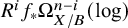 $R^if_*\Omega ^{n-i}_{X/B}(\log )$
by
$R^if_*\Omega ^{n-i}_{X/B}(\log )$
by $[u]$
; it can be seen as a function that maps a general point
$[u]$
; it can be seen as a function that maps a general point $t\in B$
to a cohomology class
$t\in B$
to a cohomology class $[u_t]$
of
$[u_t]$
of $(n-i,i)$
-forms on the corresponding fiber
$(n-i,i)$
-forms on the corresponding fiber $X_t$
. We denote by
$X_t$
. We denote by $u_{t,h}\in [u_t]$
the harmonic representative of
$u_{t,h}\in [u_t]$
the harmonic representative of $[u_t]$
and by
$[u_t]$
and by $c(\psi )$
the curvature of a smooth metric on
$c(\psi )$
the curvature of a smooth metric on $\omega _B(E)$
of local weight
$\omega _B(E)$
of local weight $\psi $
. We prove the following theorem.
$\psi $
. We prove the following theorem.
Theorem 1.3. If for every section $[u]$
of
$[u]$
of $\varphi ^i(\mathcal {A}\otimes T_B(-E)^{\otimes i})\cap K^i_{\text {prim}}$
,
$\varphi ^i(\mathcal {A}\otimes T_B(-E)^{\otimes i})\cap K^i_{\text {prim}}$
, $i=1,\dots ,n-1$
, the following inequality holds over
$i=1,\dots ,n-1$
, the following inequality holds over $B\setminus E$
:
$B\setminus E$
:
 $$ \begin{align*}\lVert(\bar{k}_t\cup u_t)_h\lVert^2\geq ic(\psi)\lVert [u_t]\lVert^2\end{align*} $$
then either $f_*\omega _{X/B}$
is unitary flat or
$f_*\omega _{X/B}$
is unitary flat or $f\colon X\to B$
is strongly non-isotrivial.
$f\colon X\to B$
is strongly non-isotrivial.
See Theorem 3.4. Theorem 1.3 must be put in correspondence to the semi-negativity results given in [Reference Berndtsson, Păun and Wang3], [Reference Zuo44].
Thanks to this new metric point of view, we obtain a somewhat surprising result on surfaces S of general type with positive index $\tau :=\frac {1}{3}(c_1^2(S)-2c_2(S))$
, where
$\tau :=\frac {1}{3}(c_1^2(S)-2c_2(S))$
, where $c_i(S)$
,
$c_i(S)$
, $i=1,2$
, are the Chern classes of S. Algebraic surfaces with
$i=1,2$
, are the Chern classes of S. Algebraic surfaces with $\tau>0$
, even in the non-simply connected case, have been studied; we can quote here [Reference Inoue17] for some examples and [Reference Lu and Yau24] for interesting geometric properties.
$\tau>0$
, even in the non-simply connected case, have been studied; we can quote here [Reference Inoue17] for some examples and [Reference Lu and Yau24] for interesting geometric properties.
Theorem 1.4. Let $f\colon X\to B$
be a semistable fibration and denote by r the rank of
$f\colon X\to B$
be a semistable fibration and denote by r the rank of $K^0_{\text {prim}}$
. Assume that the general fiber
$K^0_{\text {prim}}$
. Assume that the general fiber $X_t$
is a surface satisfying
$X_t$
is a surface satisfying $K^2_{X_t}> 8\chi (\mathcal {O}_{X_t})+2r+1$
, then f is strongly non-isotrivial.
$K^2_{X_t}> 8\chi (\mathcal {O}_{X_t})+2r+1$
, then f is strongly non-isotrivial.
See Theorem 3.10. We thank the referee for pointing out that, in particular, these families are rigid by [Reference Kovács22], [Reference Viehweg and Zuo41]. This theorem confirms that conditions for strong non-isotriviality are actually related to upper bounds on the dimension of the vector subspace of liftable top forms (see Remark 3.11).
Finally, motivated by the above-mentioned relation between curvature formulas and Torelli problem, we study how to relate the complex analytic approach stemming from [Reference Berndtsson1], [Reference Berndtsson2] to the theory of Massey products in the algebraic geometry context (cf. [Reference Rizzi and Zucconi35]).
Massey products have been introduced in [Reference Collino and Pirola7], [Reference Pirola and Zucconi29] and have been useful for solutions of Torelli-type problems (see [Reference Rizzi and Zucconi32]–[Reference Rizzi and Zucconi34]). More importantly, they have been used in [Reference Collino and Pirola7], [Reference Rizzi and Zucconi35] to study the unitary flat summand $\mathcal {U}$
of
$\mathcal {U}$
of $f_*\omega _{X/B}$
following an approach somewhat parallel to the metric one used by Berndtsson (see also [Reference Berndtsson, Păun and Wang3]). The theory of Massey products can also be generalized in the case
$f_*\omega _{X/B}$
following an approach somewhat parallel to the metric one used by Berndtsson (see also [Reference Berndtsson, Păun and Wang3]). The theory of Massey products can also be generalized in the case $\dim B>1$
(see, e.g., [Reference Rizzi31]).
$\dim B>1$
(see, e.g., [Reference Rizzi31]).
Our result concerns a metric interpretation of the liftability of relative volume forms. To the best of our knowledge, this is the first method proposed for studying the liftability of a Massey product that belongs to the ample part $\mathcal {A}$
of the Fujita decomposition.
$\mathcal {A}$
of the Fujita decomposition.
More precisely, let $\mathcal {W}\subset f_*\omega _{X/B}$
be the standard subbundle generated via the Massey product technique, see Definition 4.1, and take on
$\mathcal {W}\subset f_*\omega _{X/B}$
be the standard subbundle generated via the Massey product technique, see Definition 4.1, and take on $\mathcal {Q}:= f_*\omega _{X/B}/\mathcal {W}$
the quotient metric of the Hermitian metric defined in [Reference Griffiths and Tu15]. In Proposition 4.5, we give a formula computing the Chern curvature
$\mathcal {Q}:= f_*\omega _{X/B}/\mathcal {W}$
the quotient metric of the Hermitian metric defined in [Reference Griffiths and Tu15]. In Proposition 4.5, we give a formula computing the Chern curvature $\Theta _{\mathcal {Q}}$
on the class
$\Theta _{\mathcal {Q}}$
on the class $[\alpha ]$
, where
$[\alpha ]$
, where $\alpha $
is a Massey product in
$\alpha $
is a Massey product in $f_*\omega _{X/B}$
. From this explicit formula, it becomes easy to show that the cup product of the Kodaira–Spencer class and a Massey product
$f_*\omega _{X/B}$
. From this explicit formula, it becomes easy to show that the cup product of the Kodaira–Spencer class and a Massey product $\alpha $
in the ample part of the Fujita decomposition vanishes if and only if the curvature of
$\alpha $
in the ample part of the Fujita decomposition vanishes if and only if the curvature of $\mathcal {Q}$
degenerates along
$\mathcal {Q}$
degenerates along $[\alpha ]$
.
$[\alpha ]$
.
Theorem 1.5. Let $\alpha $
be a Massey product in
$\alpha $
be a Massey product in $\mathcal {A}$
. It is infinitesimally liftable if and only if
$\mathcal {A}$
. It is infinitesimally liftable if and only if $\langle \Theta _{\mathcal {Q}} [\alpha ],[\alpha ]\rangle _{\mathcal {Q}}=0$
.
$\langle \Theta _{\mathcal {Q}} [\alpha ],[\alpha ]\rangle _{\mathcal {Q}}=0$
.
2. Setting
Let X be a smooth complex projective $n+1$
-dimensional variety and B a smooth complex projective curve. In this article, we consider semistable fibrations
$n+1$
-dimensional variety and B a smooth complex projective curve. In this article, we consider semistable fibrations $f\colon X\to B$
, that is, f is a proper surjective morphism with connected fibers
$f\colon X\to B$
, that is, f is a proper surjective morphism with connected fibers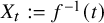 $X_t:=f^{-1}(t)$
,
$X_t:=f^{-1}(t)$
, $t\in B$
, and such that the singular fibers are reduced and normal crossing. We remark that, thanks to the semistable reduction theorem, see, for example, [Reference Kempf, Knudsen, Mumford and Saint-Donat19], we can always reduce to this case up to a sequence of blow-ups of X and cyclic Galois coverings of B.
$t\in B$
, and such that the singular fibers are reduced and normal crossing. We remark that, thanks to the semistable reduction theorem, see, for example, [Reference Kempf, Knudsen, Mumford and Saint-Donat19], we can always reduce to this case up to a sequence of blow-ups of X and cyclic Galois coverings of B.
We denote by $E\subset B$
the divisor of singular values of f and by S the (support of the) inverse image
$E\subset B$
the divisor of singular values of f and by S the (support of the) inverse image $f^{-1}(E)$
.
$f^{-1}(E)$
.
In this section, we give a characterization of some of the key concepts of [Reference Rizzi31], [Reference Rizzi and Zucconi35], [Reference Rizzi and Zucconi36] by means of their metric properties.
2.1. Preliminary definitions
We begin by recalling the short exact sequence
 $$ \begin{align} 0\to f^*\omega_B\to \Omega^1_X\to \Omega^1_{X/B}\to 0, \end{align} $$
which defines the sheaf of holomorphic relative differentials $\Omega ^1_{X/B}$
. This sheaf, in general, is not locally free, and for this reason, it is often convenient to consider the logarithmic version of (1):
$\Omega ^1_{X/B}$
. This sheaf, in general, is not locally free, and for this reason, it is often convenient to consider the logarithmic version of (1):
 $$ \begin{align} 0\to f^*\omega_B(E)\to \Omega^1_X(\log S)\to \Omega^1_{X/B}(\log)\to 0. \end{align} $$
We briefly recall that if S is locally given by $z_1z_2\ldots z_k=0$
in appropriate local coordinates, the sheaf
$z_1z_2\ldots z_k=0$
in appropriate local coordinates, the sheaf $\Omega ^1_X(\log S)$
of logarithmic differentials is the locally free
$\Omega ^1_X(\log S)$
of logarithmic differentials is the locally free $\mathcal {O}_X$
-module generated by
$\mathcal {O}_X$
-module generated by $dz_1/z_1,\ldots ,dz_k/z_k,dz_{k+1},\ldots ,dz_{n+1}$
.
$dz_1/z_1,\ldots ,dz_k/z_k,dz_{k+1},\ldots ,dz_{n+1}$
.
In the case of a semistable fibration, (2) is an exact sequence of vector bundles and its p-wedge product, for $p=1,\dots , n$
, is
$p=1,\dots , n$
, is
 $$ \begin{align} 0\to f^*\omega_B(E)\otimes \Omega^{p-1}_{X/B}(\log)\to \Omega^p_X(\log S)\to \Omega^p_{X/B}(\log)\to 0 \end{align} $$
and the determinant sheaf of $\Omega ^1_{X/B}(\log )$
is
$\Omega ^1_{X/B}(\log )$
is
 $$ \begin{align*}\det(\Omega^1_{X/B}(\log))=\det(\Omega^1_X(\log S))\otimes f^*\omega_B(E)^\vee=\omega_X(S)\otimes f^*\omega_B(E)^\vee=\omega_X\otimes f^*\omega_B^\vee=:\omega_{X/B} \end{align*} $$
the relative dualizing sheaf of $f\colon X\to B$
.
$f\colon X\to B$
.
The pushforward via f of Sequence (3) is a long exact sequence of locally free sheaves on B (see [Reference Steenbrink39, Theorem 2.11] cf. [Reference Kollár21, Lemma 2.11]), and we give the following definition.
Definition 2.1. We call $K^i$
the kernel of the connecting morphism
$K^i$
the kernel of the connecting morphism
 $$ \begin{align*}R^if_*\Omega^{n-i}_{X/B}(\log)\to \omega_B(E)\otimes R^{i+1}f_*\Omega^{n-i-1}_{X/B}(\log).\end{align*} $$
Remark 2.2. At general point $t\in B$
, the fiber of
$t\in B$
, the fiber of $K^i$
is the kernel of the homomorphism
$K^i$
is the kernel of the homomorphism
 $$ \begin{align*}H^i(X_t, \Omega^{n-i}_{X_t})\to T_{B,t}^\vee\otimes H^{i+1}(X_t, \Omega^{n-i-1}_{X_t}) \end{align*} $$
given by the cup product with the Kodaira–Spencer class $\xi _t\in H^1(X_t, T_{X_t})$
.
$\xi _t\in H^1(X_t, T_{X_t})$
.
Following [Reference Rizzi and Zucconi35], we also associate to $f\colon X\to B$
a local system of vector spaces on B, that is, a sheaf on B which is locally isomorphic to a constant sheaf. Denote by
$f\colon X\to B$
a local system of vector spaces on B, that is, a sheaf on B which is locally isomorphic to a constant sheaf. Denote by $\Omega ^1_{X,d}$
the sheaf of de Rham closed holomorphic
$\Omega ^1_{X,d}$
the sheaf of de Rham closed holomorphic $1$
-forms on X, hence
$1$
-forms on X, hence $\Omega ^1_{X,d}\subset \Omega ^1_{X}(\log S)$
and we consider the composition
$\Omega ^1_{X,d}\subset \Omega ^1_{X}(\log S)$
and we consider the composition
 $$ \begin{align*}f_*\Omega^1_{X,d}\hookrightarrow f_*\Omega^1_{X}(\log S)\to f_*\Omega^1_{X/B}(\log). \end{align*} $$
The image sheaf of $f_*\Omega _{X,d}^{1}\to f_*\Omega ^1_{X/B}(\log )$
is a local systems (see [Reference Rizzi and Zucconi35, Lemma 2.6]).
$f_*\Omega _{X,d}^{1}\to f_*\Omega ^1_{X/B}(\log )$
is a local systems (see [Reference Rizzi and Zucconi35, Lemma 2.6]).
Definition 2.3. We call $\mathbb {D}^1$
the local system obtained as image of the morphism
$\mathbb {D}^1$
the local system obtained as image of the morphism $f_*\Omega _{X,d}^{1}\to f_*\Omega ^1_{X/B}(\log )$
.
$f_*\Omega _{X,d}^{1}\to f_*\Omega ^1_{X/B}(\log )$
.
Equivalently, $\mathbb {D}^1$
fits into the following short exact sequence:
$\mathbb {D}^1$
fits into the following short exact sequence:
 $$ \begin{align} 0\to \omega_B\to f_*\Omega^1_{X,d}\to\mathbb{D}^1\to 0. \end{align} $$
Similarly, we denote by $\mathbb {D}^{n}$
the local system contained in
$\mathbb {D}^{n}$
the local system contained in $f_*\Omega ^{n}_{X/B}(\log )=f_*\omega _{X/B}$
and defined by the de Rham closed n-forms. As shown in [Reference Rizzi and Zucconi35, Theorem 3.7],
$f_*\Omega ^{n}_{X/B}(\log )=f_*\omega _{X/B}$
and defined by the de Rham closed n-forms. As shown in [Reference Rizzi and Zucconi35, Theorem 3.7], $\mathbb {D}^{n}$
is actually the local system of the so-called second Fujita decomposition of
$\mathbb {D}^{n}$
is actually the local system of the so-called second Fujita decomposition of $f_*\omega _{X/B}$
. In fact, as recalled in the Introduction, there is a decomposition
$f_*\omega _{X/B}$
. In fact, as recalled in the Introduction, there is a decomposition
 $$ \begin{align} f_*\omega_{X/B}=\mathcal{U}\oplus\mathcal{A,} \end{align} $$
where $\mathcal {A}$
is an ample vector bundle (or
$\mathcal {A}$
is an ample vector bundle (or $\mathcal {A}=0$
) and
$\mathcal {A}=0$
) and $\mathcal {U}$
is a unitary flat vector bundle;
$\mathcal {U}$
is a unitary flat vector bundle; $\mathbb {D}^{n}$
is such that
$\mathbb {D}^{n}$
is such that $\mathcal {U}=\mathbb {D}^{n}\otimes _{\mathbb {C}} \mathcal {O}_B$
.
$\mathcal {U}=\mathbb {D}^{n}\otimes _{\mathbb {C}} \mathcal {O}_B$
.
Finally, we point out that we have the inclusions $\mathbb {D}^n\subset \mathcal {U}\subseteq K^0\subseteq f_*\omega _{X/B}$
. The difference between the rank of
$\mathbb {D}^n\subset \mathcal {U}\subseteq K^0\subseteq f_*\omega _{X/B}$
. The difference between the rank of $\mathcal {U}$
and the rank of
$\mathcal {U}$
and the rank of $K^0$
is of interest (see, e.g., [Reference González-Alonso and Torelli11]).
$K^0$
is of interest (see, e.g., [Reference González-Alonso and Torelli11]).
2.2. Hermitian metrics on direct images
Consider the open subset $B\setminus E$
corresponding to the smooth fibers. The vector bundle
$B\setminus E$
corresponding to the smooth fibers. The vector bundle $f_*\omega _{X/B}$
and, more in general, the bundles of primitive cohomology classes
$f_*\omega _{X/B}$
and, more in general, the bundles of primitive cohomology classes $\mathcal {P}^{n-i,i}\subset R^if_*\Omega ^{n-i}_{X/B}(\log )$
are endowed with a natural smooth Hermitian metric coming from the Hodge metric on the fibers (cf. [Reference Griffiths13], [Reference Griffiths and Tu15]). Actually, one can also consider the twisted cases
$\mathcal {P}^{n-i,i}\subset R^if_*\Omega ^{n-i}_{X/B}(\log )$
are endowed with a natural smooth Hermitian metric coming from the Hodge metric on the fibers (cf. [Reference Griffiths13], [Reference Griffiths and Tu15]). Actually, one can also consider the twisted cases $f_*(\omega _{X/B}\otimes L)$
and
$f_*(\omega _{X/B}\otimes L)$
and $R^if_*(\Omega ^{n-i}_{X/B}(\log )\otimes L),$
where L is a Hermitian line bundle on X whose curvature satisfies suitable properties. See [Reference Berndtsson1], [Reference Berndtsson2] for the case where L is semi-positive and [Reference Berndtsson, Păun and Wang3] for the case where L is semi-negative.
$R^if_*(\Omega ^{n-i}_{X/B}(\log )\otimes L),$
where L is a Hermitian line bundle on X whose curvature satisfies suitable properties. See [Reference Berndtsson1], [Reference Berndtsson2] for the case where L is semi-positive and [Reference Berndtsson, Păun and Wang3] for the case where L is semi-negative.
From now on, we fix a Kähler form $\Omega $
on X. We denote by
$\Omega $
on X. We denote by $\omega _t$
the restriction of
$\omega _t$
the restriction of $\Omega $
to
$\Omega $
to $X_t$
.
$X_t$
.
Following [Reference Berndtsson1], [Reference Berndtsson2], we first briefly recall the definition of the metric on $f_*\omega _{X/B}$
and some of its key properties. Consider u a local section of
$f_*\omega _{X/B}$
and some of its key properties. Consider u a local section of $f_*\omega _{X/B}$
over a disk
$f_*\omega _{X/B}$
over a disk $\Delta \subset B\setminus E$
. It can be seen as a function that maps a general point
$\Delta \subset B\setminus E$
. It can be seen as a function that maps a general point $t\in \Delta $
to a global holomorphic
$t\in \Delta $
to a global holomorphic $(n,0)$
-form
$(n,0)$
-form $u_t$
on the corresponding fiber
$u_t$
on the corresponding fiber $X_t$
. The Hermitian norm is then defined as
$X_t$
. The Hermitian norm is then defined as
 $$ \begin{align} \lVert u_t\lVert^2_t=c_n\int_{X_t} u_t\wedge\bar{u}_t, \end{align} $$
where $c_n=i^{{n}^2}$
is a unimodular constant.
$c_n=i^{{n}^2}$
is a unimodular constant.
Key computations on this metric strongly rely on the notion of a good representative of a section. A representative of u, denoted by $\mathbf {u}$
, is a smooth
$\mathbf {u}$
, is a smooth $(n,0)$
-form on
$(n,0)$
-form on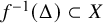 $f^{-1}(\Delta )\subset X$
which restricts to
$f^{-1}(\Delta )\subset X$
which restricts to $u_t$
on the fibers.
$u_t$
on the fibers.
The key point is that we have an explicit expression for the Chern connection $D = D'+ D"$
and curvature
$D = D'+ D"$
and curvature $\Theta $
in terms of the representative
$\Theta $
in terms of the representative $\mathbf {u}$
. Indeed, we can write
$\mathbf {u}$
. Indeed, we can write
 $$ \begin{align*}\partial\mathbf{u}=\mu\wedge dt, \end{align*} $$
and, since $\bar {\partial }\mathbf {u}$
is trivial along the fibers, we can write
$\bar {\partial }\mathbf {u}$
is trivial along the fibers, we can write
 $$ \begin{align*}\bar{\partial}\mathbf{u}=\nu\wedge d\bar{t}+\eta\wedge dt, \end{align*} $$
where $\nu $
and
$\nu $
and $\mu $
are relative forms of bidegree
$\mu $
are relative forms of bidegree $(n,0)$
and
$(n,0)$
and $\eta $
is of bidegree
$\eta $
is of bidegree $(n-1,1)$
. We have that
$(n-1,1)$
. We have that
 $$ \begin{align} (D"u)_t=\nu_t d\bar{t} \end{align} $$
and
 $$ \begin{align} (D'u)_t=P(\mu_t)dt, \end{align} $$
where P is the orthogonal projection of $(n, 0)$
-forms on the space of holomorphic
$(n, 0)$
-forms on the space of holomorphic $(n, 0)$
-forms. The
$(n, 0)$
-forms. The $(n-1,1)$
-form
$(n-1,1)$
-form $\eta _t$
has a neat interpretation in terms of the cup product with the Kodaira–Spencer class
$\eta _t$
has a neat interpretation in terms of the cup product with the Kodaira–Spencer class $\xi _t$
: it is a representative of the cohomology class of the cup product
$\xi _t$
: it is a representative of the cohomology class of the cup product $\xi _t\cup u_t\in H^{n-1,1}(X_t)$
. See [Reference Berndtsson1] for all the details on these formulas.
$\xi _t\cup u_t\in H^{n-1,1}(X_t)$
. See [Reference Berndtsson1] for all the details on these formulas.
Of course, the choice of the representative $\mathbf {u}$
is not unique; two such choices differ by a term of the form
$\mathbf {u}$
is not unique; two such choices differ by a term of the form $v\wedge dt$
, but everything mentioned so far is independent from this choice.
$v\wedge dt$
, but everything mentioned so far is independent from this choice.
Nevertheless, if u is a holomorphic section of $f_*\omega _{X/B}$
and t is a point in
$f_*\omega _{X/B}$
and t is a point in $\Delta $
, by [Reference Berndtsson1], [Reference Berndtsson2], there is a preferred choice of
$\Delta $
, by [Reference Berndtsson1], [Reference Berndtsson2], there is a preferred choice of $\mathbf {u}$
such that
$\mathbf {u}$
such that $\mu _t$
is holomorphic (i.e.,
$\mu _t$
is holomorphic (i.e., $P(\mu _t)=\mu _t$
) and
$P(\mu _t)=\mu _t$
) and $\eta _t$
is primitive. The key advantage of this choice is that we get
$\eta _t$
is primitive. The key advantage of this choice is that we get $(D'u)_t=\mu _t dt$
and
$(D'u)_t=\mu _t dt$
and $-c_n\int _{X_t}\eta _t\wedge \bar {\eta }_t=\lVert \eta _t\lVert ^2$
. This choice of representative allows to compute the Chern curvature formula for the Hermitian metric as follows:
$-c_n\int _{X_t}\eta _t\wedge \bar {\eta }_t=\lVert \eta _t\lVert ^2$
. This choice of representative allows to compute the Chern curvature formula for the Hermitian metric as follows:
 $$ \begin{align} \langle\Theta u_t,u_t \rangle_t=\lVert\eta_t\lVert^2. \end{align} $$
See [Reference Griffiths and Tu15] for the original proof. Berndtsson in [Reference Berndtsson2, §3] proves that $\eta _t$
is the unique harmonic representative of the cohomology class
$\eta _t$
is the unique harmonic representative of the cohomology class $\xi _t\cup u_t\in H^{n-1,1}(X_t)$
, hence we can also write this formula as
$\xi _t\cup u_t\in H^{n-1,1}(X_t)$
, hence we can also write this formula as
 $$ \begin{align} \langle\Theta u_t,u_t \rangle_t=\lVert\xi_t\cup u_t\lVert^2. \end{align} $$
In the case of $\mathcal {P}^{n-i,i}$
, the situation is similar, but we have to be a little more careful since a section
$\mathcal {P}^{n-i,i}$
, the situation is similar, but we have to be a little more careful since a section $[u]$
is a function that maps t to a primitive cohomology class of
$[u]$
is a function that maps t to a primitive cohomology class of $(n-i,i)$
-forms on the corresponding fiber
$(n-i,i)$
-forms on the corresponding fiber $X_t$
. For this part, we follow [Reference Berndtsson, Păun and Wang3].
$X_t$
. For this part, we follow [Reference Berndtsson, Păun and Wang3].
We denote by $u_{t,h}$
the harmonic representative of this class. By a fundamental result of Kodaira–Spencer, the variation of
$u_{t,h}$
the harmonic representative of this class. By a fundamental result of Kodaira–Spencer, the variation of $u_{t,h}$
with respect to t is smooth. The norm is
$u_{t,h}$
with respect to t is smooth. The norm is
 $$ \begin{align} \lVert[u_t]\lVert^2_t=(-1)^ic_n\int_{X_t} u_{t,h}\wedge \bar{u}_{t,h}. \end{align} $$
As in the $(n,0)$
case, we consider a representative
$(n,0)$
case, we consider a representative $\mathbf {u}$
of
$\mathbf {u}$
of $[u]$
, that is, a smooth
$[u]$
, that is, a smooth $(n-i,i)$
-form on
$(n-i,i)$
-form on $f^{-1}(\Delta )$
which is
$f^{-1}(\Delta )$
which is $\bar {\partial }$
-closed on the fibers of f and whose restriction to each
$\bar {\partial }$
-closed on the fibers of f and whose restriction to each $X_t$
belongs to the cohomology class
$X_t$
belongs to the cohomology class $[u_t]$
. In this case, the preferred choice of such a representative is given by the so-called vertical representative.
$[u_t]$
. In this case, the preferred choice of such a representative is given by the so-called vertical representative.
Definition 2.4. We say that a smooth vector field V on X is horizontal if $df(V)$
is a non-zero
$df(V)$
is a non-zero $(1,0)$
vector field and
$(1,0)$
vector field and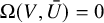 $\Omega (V,\bar {U})=0$
for every other vector field U with
$\Omega (V,\bar {U})=0$
for every other vector field U with $df(U)=0$
. We say that a form
$df(U)=0$
. We say that a form $\mathbf {u}$
is vertical if the contraction
$\mathbf {u}$
is vertical if the contraction $V|\mathbf {u}$
is equal to 0 for any horizontal vector field V.
$V|\mathbf {u}$
is equal to 0 for any horizontal vector field V.
The vertical representative is unique, see [Reference Berndtsson, Păun and Wang3, Proposition 5.1]; we consider $\mathbf {u}$
the vertical representative of
$\mathbf {u}$
the vertical representative of $[u]$
. Similarly as before, we write
$[u]$
. Similarly as before, we write
 $$ \begin{align*}\bar{\partial}\mathbf{u}=\nu\wedge d\bar{t}+\eta\wedge dt \end{align*} $$
and
 $$ \begin{align*}\partial\mathbf{u}=\zeta \wedge d\bar{t}+\mu\wedge dt. \end{align*} $$
Then, $\nu $
and
$\nu $
and $\mu $
are relative forms of bidegree
$\mu $
are relative forms of bidegree $(n-i,i)$
,
$(n-i,i)$
, $\eta $
is of bidegree
$\eta $
is of bidegree $(n-i-1,i+1),$
and
$(n-i-1,i+1),$
and $\zeta $
is of bidegree
$\zeta $
is of bidegree $(n-i+1,i-1)$
; they are primitive on the fibers (see [Reference Berndtsson, Păun and Wang3, §7]). As before, we can explicitly compute the Chern connection as
$(n-i+1,i-1)$
; they are primitive on the fibers (see [Reference Berndtsson, Păun and Wang3, §7]). As before, we can explicitly compute the Chern connection as
 $$ \begin{align} (D"[u])_t=[\nu_t] d\bar{t} \end{align} $$
and
 $$ \begin{align} (D'[u])_t=[\mu_t] dt. \end{align} $$
As a representative of the Kodaira–Spencer class $\xi _t$
, we choose the (0,1)-form with coefficients in the tangent space
$\xi _t$
, we choose the (0,1)-form with coefficients in the tangent space $T_X$
given by
$T_X$
given by $\bar {\partial }V$
, where V is the horizontal lift of the
$\bar {\partial }V$
, where V is the horizontal lift of the $(1,0)$
vector
$(1,0)$
vector $\partial /\partial t$
on
$\partial /\partial t$
on $\Delta $
. That is, on
$\Delta $
. That is, on $X_t$
, we denote
$X_t$
, we denote $k_t:=\bar {\partial }V_{|X_t}$
and
$k_t:=\bar {\partial }V_{|X_t}$
and $\xi _t=[k_t]\in H^1(X_t,T_{X_t})$
. It turns out that with this choice
$\xi _t=[k_t]\in H^1(X_t,T_{X_t})$
. It turns out that with this choice
 $$ \begin{align} \eta_t=k_t\cup u_t \end{align} $$
and
 $$ \begin{align} \zeta_t=\bar{k}_t\cup u_t \end{align} $$
if $u_t$
is harmonic.
$u_t$
is harmonic.
Remark 2.5. In terms of cohomology classes, this means that
 $$ \begin{align*}[\eta_t]=\xi_t\cup [u_t] \end{align*} $$
and
 $$ \begin{align*}[\zeta_t]=\overline{(\xi_t\cup\overline{[u_t]})} \end{align*} $$
since the contraction with $\bar {k}_t$
corresponds to the composition
$\bar {k}_t$
corresponds to the composition
 $$ \begin{align*}H^{p,q}\cong H^{q,p}\xrightarrow{\xi_t\cup\ } H^{q-1,p+1}\cong H^{p+1,q-1}, \end{align*} $$
where the isomorphisms are given by complex conjugation.
The curvature formula generalizing (9) is
 $$ \begin{align} \langle\Theta [u_t],[u_t] \rangle_t=\lVert\eta_{t,h}\lVert^2-\lVert\zeta_{t,h}\lVert^2, \end{align} $$
where by $\eta _{t,h}$
and
$\eta _{t,h}$
and $\zeta _{t,h}$
, we mean the harmonic part of
$\zeta _{t,h}$
, we mean the harmonic part of $\eta _t$
and
$\eta _t$
and $\zeta _t$
, respectively (see [Reference Berndtsson, Păun and Wang3]).
$\zeta _t$
, respectively (see [Reference Berndtsson, Păun and Wang3]).
One of the immediate consequences of the curvature formulas (9) and (16) is that the bundles $K^i_{\text {prim}}:=K^i\cap \mathcal {P}^{n-i,i}$
are semi-negatively curved since by definition they are the primitive part of the kernel of the cup product with the Kodaira–Spencer class. For example, if u is a section of
$K^i_{\text {prim}}:=K^i\cap \mathcal {P}^{n-i,i}$
are semi-negatively curved since by definition they are the primitive part of the kernel of the cup product with the Kodaira–Spencer class. For example, if u is a section of $K^0_{\text {prim}}=K^0$
, then by (9), we have that
$K^0_{\text {prim}}=K^0$
, then by (9), we have that $\langle \Theta u_t,u_t \rangle _t=0$
and for
$\langle \Theta u_t,u_t \rangle _t=0$
and for $[u],$
a section of
$[u],$
a section of $K^i_{\text {prim}}$
,
$K^i_{\text {prim}}$
, $i\geq 1$
, by (16), we have that
$i\geq 1$
, by (16), we have that $\langle \Theta [u_t],[u_t] \rangle _t=-\lVert \zeta _{t,h}\lVert ^2\leq 0$
. In both cases, since curvature decreases in subbundles, we have that
$\langle \Theta [u_t],[u_t] \rangle _t=-\lVert \zeta _{t,h}\lVert ^2\leq 0$
. In both cases, since curvature decreases in subbundles, we have that $K^i_{\text {prim}}$
is semi-negatively curved on
$K^i_{\text {prim}}$
is semi-negatively curved on $B\setminus E$
for
$B\setminus E$
for $i\geq 0$
.
$i\geq 0$
.
Actually, there is an extension across the singularities. Indeed, $\mathcal {P}^{n-i,i}$
and
$\mathcal {P}^{n-i,i}$
and $K^i_{\text {prim}}$
are firstly defined on
$K^i_{\text {prim}}$
are firstly defined on $B\setminus E$
, but since they are subsheaves of
$B\setminus E$
, but since they are subsheaves of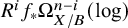 $R^if_*\Omega ^{n-i}_{X/B}(\log )$
, which is defined over the whole base B, they have a natural extension across E. Furthermore, by [Reference Berndtsson, Păun and Wang3, §9], the chosen smooth Hermitian metric on
$R^if_*\Omega ^{n-i}_{X/B}(\log )$
, which is defined over the whole base B, they have a natural extension across E. Furthermore, by [Reference Berndtsson, Păun and Wang3, §9], the chosen smooth Hermitian metric on $B\setminus E$
extends to a singular Hermitian metric. This singular metric is semi-negatively curved on
$B\setminus E$
extends to a singular Hermitian metric. This singular metric is semi-negatively curved on $K^i_{\text {prim}}$
in the sense of singular metrics.
$K^i_{\text {prim}}$
in the sense of singular metrics.
2.3. Metric interpretation
The Chern connection D on the vector bundle $f_*\omega _{X/B}$
is compatible with the Gauss–Manin connection. This is shown, for example, in [Reference Berndtsson2, §2.3]. Here, we rephrase it using the objects introduced in the beginning of this section. Using the same notation as above, we denote by
$f_*\omega _{X/B}$
is compatible with the Gauss–Manin connection. This is shown, for example, in [Reference Berndtsson2, §2.3]. Here, we rephrase it using the objects introduced in the beginning of this section. Using the same notation as above, we denote by $\Theta $
the Chern curvature of
$\Theta $
the Chern curvature of $f_*\omega _{X/B}$
.
$f_*\omega _{X/B}$
.
Proposition 2.6. Consider the vector bundle $f_*\omega _{X/B}$
with the Hermitian structure described above. The subsheaves
$f_*\omega _{X/B}$
with the Hermitian structure described above. The subsheaves $\mathbb {D}^n\subset \mathcal {U}\subseteq K^0$
of
$\mathbb {D}^n\subset \mathcal {U}\subseteq K^0$
of $f_*\omega _{X/B}$
are characterized as follows:
$f_*\omega _{X/B}$
are characterized as follows:
-
(i) $\mathbb {D}^n$
is the kernel of the Chern connection
$D.$
$\mathbb {D}^n$
is the kernel of the Chern connection
$D.$
-
(ii)
$\mathcal {U}$
is the largest flat subbundle of
$f_*\omega _{X/B}$
. -
(iii)
$K^0$
is the kernel of the curvature
$\Theta $
.


In particular, $K^0$
is a (holomorphic) direct summand of
$K^0$
is a (holomorphic) direct summand of $f_*\omega _{X/B}$
if and only if
$f_*\omega _{X/B}$
if and only if $K^0=\mathcal {U}$
.
$K^0=\mathcal {U}$
.
Proof.
(i) First note that $\mathbb {D}^n=\mathrm {Im}\, (f_*\Omega ^n_{X,d}\to f_*\omega _{X/B})$
. In particular, if u is a local section of
$\mathbb {D}^n=\mathrm {Im}\, (f_*\Omega ^n_{X,d}\to f_*\omega _{X/B})$
. In particular, if u is a local section of $\mathbb {D}^n$
, it follows that, at least locally on the base B, we can choose the representative
$\mathbb {D}^n$
, it follows that, at least locally on the base B, we can choose the representative $\mathbf {u}$
to be a holomorphic de Rham closed n-form. Hence,
$\mathbf {u}$
to be a holomorphic de Rham closed n-form. Hence, $\partial \mathbf {u}=\bar {\partial }\mathbf {u}=0$
and we get that
$\partial \mathbf {u}=\bar {\partial }\mathbf {u}=0$
and we get that $\mathbb {D}^n$
is contained in the kernel of the connection D by (7) and (8). Vice versa, if u is a holomorphic section in the kernel of D, by (9), we have that
$\mathbb {D}^n$
is contained in the kernel of the connection D by (7) and (8). Vice versa, if u is a holomorphic section in the kernel of D, by (9), we have that $\eta _t=0$
for all t, so that
$\eta _t=0$
for all t, so that $\xi _t\cup u_t=0$
. This means that u is in
$\xi _t\cup u_t=0$
. This means that u is in $K^0$
by Remark 2.2, hence, since
$K^0$
by Remark 2.2, hence, since $K^0$
can also be seen as the image of
$K^0$
can also be seen as the image of $f_*\Omega ^{n}_{X}\to f_* \omega _{X/B}$
, we can choose
$f_*\Omega ^{n}_{X}\to f_* \omega _{X/B}$
, we can choose $\mathbf {u}$
to be a section of
$\mathbf {u}$
to be a section of $f_*\Omega ^n_{X}$
, so that
$f_*\Omega ^n_{X}$
, so that $\bar {\partial }\mathbf {u}=0$
. Finally, since
$\bar {\partial }\mathbf {u}=0$
. Finally, since $D'u=0,$
we also have that
$D'u=0,$
we also have that $\mu =0$
, that is,
$\mu =0$
, that is, $\partial \mathbf {u}=0$
. So we conclude that
$\partial \mathbf {u}=0$
. So we conclude that $\mathbf {u}$
is de Rham closed and u is a local section of
$\mathbf {u}$
is de Rham closed and u is a local section of $\mathbb {D}^n$
.
$\mathbb {D}^n$
.
(ii) By point (i), this follows easily since $\mathcal {U}=\mathbb {D}^n\otimes \mathcal {O}_B$
. Indeed, note that
$\mathcal {U}=\mathbb {D}^n\otimes \mathcal {O}_B$
. Indeed, note that $\mathcal {U}$
is contained both in the kernel of the curvature
$\mathcal {U}$
is contained both in the kernel of the curvature $\Theta $
and in the kernel of the second fundamental form of
$\Theta $
and in the kernel of the second fundamental form of $\mathcal {U}$
in
$\mathcal {U}$
in $f_*\omega _{X/B}$
.
$f_*\omega _{X/B}$
.
(iii) If u is a holomorphic section of $K^0$
, locally on B, the representative
$K^0$
, locally on B, the representative $\mathbf {u}$
can be chosen as a holomorphic form, as in point (i). So
$\mathbf {u}$
can be chosen as a holomorphic form, as in point (i). So $\bar {\partial }\mathbf {u}=0$
and
$\bar {\partial }\mathbf {u}=0$
and $\partial \mathbf {u}=\mu \wedge dt$
, where
$\partial \mathbf {u}=\mu \wedge dt$
, where $\mu $
is a holomorphic section of
$\mu $
is a holomorphic section of $f_* \omega _{X/B}$
. Hence,
$f_* \omega _{X/B}$
. Hence, $\Theta u=D"D'u=0$
. Vice versa, if u is a holomorphic section of
$\Theta u=D"D'u=0$
. Vice versa, if u is a holomorphic section of $f_*\omega _{X/B}$
with
$f_*\omega _{X/B}$
with $\Theta u=0$
, by (10),
$\Theta u=0$
, by (10), $u_t$
is in the kernel of the cup product with
$u_t$
is in the kernel of the cup product with $\xi _t$
for all t, hence u is a section of
$\xi _t$
for all t, hence u is a section of $K^0$
, by Remark 2.2.
$K^0$
, by Remark 2.2.
Remark 2.7. We have already seen that $K^0$
is semi-negatively curved with the metric induced from
$K^0$
is semi-negatively curved with the metric induced from $f_*\omega _{X/B}$
. It seems actually interesting to understand when
$f_*\omega _{X/B}$
. It seems actually interesting to understand when $K^0$
is maximal inside
$K^0$
is maximal inside $f_*\omega _{X/B}$
with this property. For example, in Section 3, we study the kernels of the iterated cup product with the Kodaira–Spencer class.
$f_*\omega _{X/B}$
with this property. For example, in Section 3, we study the kernels of the iterated cup product with the Kodaira–Spencer class.
3. Isotriviality and strong non-isotriviality
In this section, we use the metrics introduced in Section 2 to study possible conditions for the triviality or, on the opposite side, strong non-isotriviality of the fibration $f\colon X\to B$
.
$f\colon X\to B$
.
3.1. Strongly non-isotrivial fibrations
We give the following definition.
Definition 3.1. We denote by $\phi _i\colon f_*\omega _{X/B}\to \omega _B(E)^{\otimes i}\otimes R^if_*\Omega ^{n-i}_{X/B}(\log )$
the composition of the connecting morphisms obtained from the direct images of (3):
$\phi _i\colon f_*\omega _{X/B}\to \omega _B(E)^{\otimes i}\otimes R^if_*\Omega ^{n-i}_{X/B}(\log )$
the composition of the connecting morphisms obtained from the direct images of (3):
 $$ \begin{align*} \phi_i\colon f_*\omega_{X/B}\to \omega_B(E)\otimes R^1f_*\Omega^{n-1}_{X/B}(\log)\to \dots\to \omega_B(E)^{\otimes i}\otimes R^if_*\Omega^{n-i}_{X/B}(\log). \end{align*} $$
Similarly, we denote by $\varphi _i\colon f_*\omega _{X/B}\otimes T_B(-E)^{\otimes i}\to R^if_*\Omega ^{n-i}_{X/B}(\log )$
the morphism obtained from
$\varphi _i\colon f_*\omega _{X/B}\otimes T_B(-E)^{\otimes i}\to R^if_*\Omega ^{n-i}_{X/B}(\log )$
the morphism obtained from $\phi _i$
by tensoring with
$\phi _i$
by tensoring with $T_B(-E)^{\otimes i}$
.
$T_B(-E)^{\otimes i}$
.
In the literature, they are referred to as the Griffiths–Yukawa coupling or as iterated Higgs maps.
These morphisms are given on smooth fibers by iterated cup product with the Kodaira–Spencer class. From the Introduction, we recall that if $\phi _n$
is not zero (equivalently,
$\phi _n$
is not zero (equivalently, $\varphi _n$
is not zero), then f is strongly non-isotrivial. By the Fujita decomposition (5),
$\varphi _n$
is not zero), then f is strongly non-isotrivial. By the Fujita decomposition (5), $ f_*\omega _{X/B}=\mathcal {U}\oplus \mathcal {A}$
and, since
$ f_*\omega _{X/B}=\mathcal {U}\oplus \mathcal {A}$
and, since $\mathcal {U}$
is contained in
$\mathcal {U}$
is contained in $K^0=\ker \phi _1$
, we look at the image of
$K^0=\ker \phi _1$
, we look at the image of $\mathcal {A}$
.
$\mathcal {A}$
.
In particular, note that if $\mathcal {A}$
is not contained in
$\mathcal {A}$
is not contained in $K^0$
(i.e.,
$K^0$
(i.e., $\mathcal {A}\neq 0$
), and also
$\mathcal {A}\neq 0$
), and also $\phi _i(\mathcal {A})$
is not contained in
$\phi _i(\mathcal {A})$
is not contained in $K^i\otimes \omega _B(E)^{\otimes i}$
, for
$K^i\otimes \omega _B(E)^{\otimes i}$
, for $i=1,\dots , n-1$
, then the image
$i=1,\dots , n-1$
, then the image $\phi _n(\mathcal {A})$
is not zero and f is strongly non-isotrivial. Actually, in our setting, we are dealing with primitive forms. In fact, the holomorphic
$\phi _n(\mathcal {A})$
is not zero and f is strongly non-isotrivial. Actually, in our setting, we are dealing with primitive forms. In fact, the holomorphic $(n,0)$
-forms on the fibers are primitive and hence the images
$(n,0)$
-forms on the fibers are primitive and hence the images $\phi _i(\mathcal {A})$
are bundles of primitive classes, since the cup product of a primitive form with the Kodaira–Spencer class is again primitive.
$\phi _i(\mathcal {A})$
are bundles of primitive classes, since the cup product of a primitive form with the Kodaira–Spencer class is again primitive.
3.1.1. Curvature conditions for strong non-isotriviality
A possible condition that ensures that $\phi _i(\mathcal {A})$
is not contained in
$\phi _i(\mathcal {A})$
is not contained in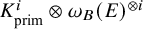 $K^i_{\text {prim}}\otimes \omega _B(E)^{\otimes i}$
,
$K^i_{\text {prim}}\otimes \omega _B(E)^{\otimes i}$
, $i=1,\dots , n-1$
, since
$i=1,\dots , n-1$
, since $\mathcal {A}$
is ample, is that
$\mathcal {A}$
is ample, is that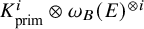 $K^i_{\text {prim}}\otimes \omega _B(E)^{\otimes i}$
induces a metric with semi-negative curvature on
$K^i_{\text {prim}}\otimes \omega _B(E)^{\otimes i}$
induces a metric with semi-negative curvature on $\phi _i(\mathcal {A})\cap (K^i_{\text {prim}}\otimes \omega _B(E)^{\otimes i})$
.
$\phi _i(\mathcal {A})\cap (K^i_{\text {prim}}\otimes \omega _B(E)^{\otimes i})$
.
We have seen in Section 2 how to define a smooth metric on $\mathcal {P}^{n-i,i}|_{B\setminus E}$
. Given a metric on
$\mathcal {P}^{n-i,i}|_{B\setminus E}$
. Given a metric on $\omega _{B}(E)$
of local weight
$\omega _{B}(E)$
of local weight $\psi $
and curvature denoted by
$\psi $
and curvature denoted by $c(\psi )$
, we consider the tensor metric on the bundle
$c(\psi )$
, we consider the tensor metric on the bundle $\mathcal {P}^{n-i,i}\otimes \omega _{B}(E)^{\otimes i}|_{B\setminus E}$
. The following result gives a curvature formula for this metric. We write an element of
$\mathcal {P}^{n-i,i}\otimes \omega _{B}(E)^{\otimes i}|_{B\setminus E}$
. The following result gives a curvature formula for this metric. We write an element of $\mathcal {P}^{n-i,i}\otimes \omega _{B}(E)^{\otimes i}$
at the point t as
$\mathcal {P}^{n-i,i}\otimes \omega _{B}(E)^{\otimes i}$
at the point t as $[u_t]\otimes l_t$
, where
$[u_t]\otimes l_t$
, where $l_t$
is of norm 1 and
$l_t$
is of norm 1 and $u_t$
is harmonic on
$u_t$
is harmonic on $X_t$
.
$X_t$
.
Proposition 3.2. The curvature $\Theta _i$
of
$\Theta _i$
of $\mathcal {P}^{n-i,i}\otimes \omega _{B}(E)^{\otimes i}|_{B\setminus E}$
satisfies
$\mathcal {P}^{n-i,i}\otimes \omega _{B}(E)^{\otimes i}|_{B\setminus E}$
satisfies
 $$ \begin{align} \langle\Theta_i ([u_t]\otimes l_t),[u_t]\otimes l_t\rangle=\lVert\eta_{t,h}\lVert^2-\lVert\zeta_{t,h}\lVert^2+ic(\psi)\lVert [u_t]\lVert^2, \end{align} $$
where $\eta _{t,h}$
and
$\eta _{t,h}$
and $\zeta _{t,h}$
are defined as in (16).
$\zeta _{t,h}$
are defined as in (16).
Proof. This is the formula for the curvature of a tensor product. Call for simplicity $F=\mathcal {P}^{n-i,i}$
and
$F=\mathcal {P}^{n-i,i}$
and $L= \omega _{B}(E)^{\otimes i}$
. Then,
$L= \omega _{B}(E)^{\otimes i}$
. Then, $\Theta _{F\otimes L}=\Theta _F\otimes I_L+I_F\otimes \Theta _L$
and
$\Theta _{F\otimes L}=\Theta _F\otimes I_L+I_F\otimes \Theta _L$
and
 $$ \begin{align*}\langle\Theta_{F\otimes L} [u_t]\otimes l_t,[u_t]\otimes l_t\rangle=\langle\Theta_F [u_t],[u_t]\rangle\lVert l_t\lVert^2+\langle\Theta_L l_t,l_t\rangle\lVert [u_t]\lVert^2 \end{align*} $$
and we are done using that $\lVert l_t\lVert =1$
and Equation (16).
$\lVert l_t\lVert =1$
and Equation (16).
We prove the following proposition.
Proposition 3.3. Assume that there exists a smooth metric on $\omega _B(E)$
of local weight
$\omega _B(E)$
of local weight $\psi $
such that on
$\psi $
such that on $B\setminus E,$
we have
$B\setminus E,$
we have $\lVert (\bar {k}_t\cup u_t)_h\lVert ^2\geq ic(\psi )\lVert [u_t]\lVert ^2$
for every section
$\lVert (\bar {k}_t\cup u_t)_h\lVert ^2\geq ic(\psi )\lVert [u_t]\lVert ^2$
for every section $[u]$
of
$[u]$
of $\varphi ^i(\mathcal {A}\otimes T_B(-E)^{\otimes i})\cap K^i_{\text {prim}}$
. Then,
$\varphi ^i(\mathcal {A}\otimes T_B(-E)^{\otimes i})\cap K^i_{\text {prim}}$
. Then, $\phi _i(\mathcal {A})\cap (K^i_{\text {prim}}\otimes \omega _B(E)^{\otimes i})$
admits a semi-negative singular Hermitian metric.
$\phi _i(\mathcal {A})\cap (K^i_{\text {prim}}\otimes \omega _B(E)^{\otimes i})$
admits a semi-negative singular Hermitian metric.
Proof. As recalled in Section 2, by [Reference Berndtsson, Păun and Wang3], $K^i_{\text {prim}}$
has a semi-negatively curved singular Hermitian metric. We consider on
$K^i_{\text {prim}}$
has a semi-negatively curved singular Hermitian metric. We consider on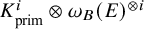 $K^{i}_{\text {prim}}\otimes \omega _B(E)^{\otimes i}$
the singular metric given by the tensor product and on
$K^{i}_{\text {prim}}\otimes \omega _B(E)^{\otimes i}$
the singular metric given by the tensor product and on $\phi _i(\mathcal {A})\cap (K^i_{\text {prim}}\otimes \omega _B(E)^{\otimes i})$
its restriction.
$\phi _i(\mathcal {A})\cap (K^i_{\text {prim}}\otimes \omega _B(E)^{\otimes i})$
its restriction.
On $B\setminus E$
, these metrics are smooth and coincide with the restriction of the metric on
$B\setminus E$
, these metrics are smooth and coincide with the restriction of the metric on $\mathcal {P}^{n-i,i}\otimes \omega _{B}(E)^{\otimes i}|_{B\setminus E}$
discussed above.
$\mathcal {P}^{n-i,i}\otimes \omega _{B}(E)^{\otimes i}|_{B\setminus E}$
discussed above.
For the sections of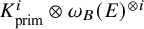 $K^{i}_{\text {prim}}\otimes \omega _B(E)^{\otimes i}$
, we have by (15) and (17),
$K^{i}_{\text {prim}}\otimes \omega _B(E)^{\otimes i}$
, we have by (15) and (17),
 $$ \begin{align} \langle\Theta_i ([u_t]\otimes l_t),[u_t]\otimes l_t\rangle=-\lVert\zeta_{t,h}\lVert^2+ic(\psi)\lVert [u_t]\lVert^2=-\lVert(\bar{k}_t\cup u_t)_h\lVert^2+ic(\psi)\lVert [u_t]\lVert^2. \end{align} $$
By our hypothesis, the metric on $\phi _i(\mathcal {A})\cap (K^i_{\text {prim}}\otimes \omega _B(E)^{\otimes i})$
is then semi-negatively curved on
$\phi _i(\mathcal {A})\cap (K^i_{\text {prim}}\otimes \omega _B(E)^{\otimes i})$
is then semi-negatively curved on $B\setminus E$
, since curvature decreases in subbundles.
$B\setminus E$
, since curvature decreases in subbundles.
By the results in [Reference Berndtsson, Păun and Wang3], it is not difficult to see that it is semi-negative everywhere in the sense of singular metrics.
So, under the hypotheses of Proposition 3.3, the image $\phi _i(\mathcal {A})$
is not contained in
$\phi _i(\mathcal {A})$
is not contained in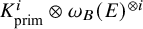 $K^i_{\text {prim}}\otimes \omega _B(E)^{\otimes i}$
,
$K^i_{\text {prim}}\otimes \omega _B(E)^{\otimes i}$
, $i=1,\dots , n-1$
, since
$i=1,\dots , n-1$
, since $\mathcal {A}$
is ample. Hence, we conclude the following theorem.
$\mathcal {A}$
is ample. Hence, we conclude the following theorem.
Theorem 3.4. Let $f\colon X\to B$
be a semistable fibration and assume that there exists a smooth metric on
$f\colon X\to B$
be a semistable fibration and assume that there exists a smooth metric on $\omega _B(E)$
of local weight
$\omega _B(E)$
of local weight $\psi $
such that on
$\psi $
such that on $B\setminus E,$
we have
$B\setminus E,$
we have $\lVert (\bar {k}_t\cup u_t)_h\lVert ^2\geq ic(\psi )\lVert [u_t]\lVert ^2$
for every section
$\lVert (\bar {k}_t\cup u_t)_h\lVert ^2\geq ic(\psi )\lVert [u_t]\lVert ^2$
for every section $[u]$
of
$[u]$
of $\varphi ^i(\mathcal {A}\otimes T_B(-E)^{\otimes i})\cap K^i_{\text {prim}}$
,
$\varphi ^i(\mathcal {A}\otimes T_B(-E)^{\otimes i})\cap K^i_{\text {prim}}$
, $i=1,\dots ,n-1$
. Then, either
$i=1,\dots ,n-1$
. Then, either $f_*\omega _{X/B}$
is unitary flat or the fibration is strongly non-isotrivial.
$f_*\omega _{X/B}$
is unitary flat or the fibration is strongly non-isotrivial.
Note that a parallel approach is given by the study of the semi-positivity of $\mathcal {A}\otimes T_B(-E)^{\otimes i}$
for
$\mathcal {A}\otimes T_B(-E)^{\otimes i}$
for $i=1,\dots ,n-1$
. Similarly as before, this condition shows that
$i=1,\dots ,n-1$
. Similarly as before, this condition shows that $\varphi _i (\mathcal {A}\otimes T_B(-E)^{\otimes i})$
is not contained in
$\varphi _i (\mathcal {A}\otimes T_B(-E)^{\otimes i})$
is not contained in $K^i_{\text {prim}}$
for
$K^i_{\text {prim}}$
for $i=1,\dots ,n-1$
and hence
$i=1,\dots ,n-1$
and hence $\varphi _n$
is not zero and f is strongly non-isotrivial (or
$\varphi _n$
is not zero and f is strongly non-isotrivial (or $\mathcal {A}$
is zero). We skip the computations since they are similar to the previous ones. We note that we only need the semi-positivity of
$\mathcal {A}$
is zero). We skip the computations since they are similar to the previous ones. We note that we only need the semi-positivity of $\mathcal {A}\otimes T_B(-E)^{\otimes n-1}$
since it implies the semi-positivity of
$\mathcal {A}\otimes T_B(-E)^{\otimes n-1}$
since it implies the semi-positivity of $\mathcal {A}\otimes T_B(-E)^{\otimes i}$
,
$\mathcal {A}\otimes T_B(-E)^{\otimes i}$
, $i=1,\dots ,n-2$
. This semi-positivity is given on
$i=1,\dots ,n-2$
. This semi-positivity is given on $B\setminus E$
by the inequality
$B\setminus E$
by the inequality $\lVert ({k}_t\cup u_t)_h\lVert ^2\geq (n-1)c(\psi )\lVert u_t\lVert ^2$
.
$\lVert ({k}_t\cup u_t)_h\lVert ^2\geq (n-1)c(\psi )\lVert u_t\lVert ^2$
.
Theorem 3.5. Let $f\colon X\to B$
be a semistable fibration on a smooth projective curve B and assume that there exists a smooth metric on
$f\colon X\to B$
be a semistable fibration on a smooth projective curve B and assume that there exists a smooth metric on $\omega _B(E)$
of local weight
$\omega _B(E)$
of local weight $\psi $
such that on
$\psi $
such that on $B\setminus E,$
we have
$B\setminus E,$
we have $\lVert ({k}_t\cup u_t)_h\lVert ^2\geq (n-1)c(\psi )\lVert u_t\lVert ^2$
for all u in
$\lVert ({k}_t\cup u_t)_h\lVert ^2\geq (n-1)c(\psi )\lVert u_t\lVert ^2$
for all u in $\mathcal {A}$
. Then, either
$\mathcal {A}$
. Then, either $f_*\omega _{X/B}$
is unitary flat or the fibration is strongly non-isotrivial.
$f_*\omega _{X/B}$
is unitary flat or the fibration is strongly non-isotrivial.
Remark 3.6. In principle, there is no correlation between the inequalities of Theorems 3.4 and 3.5, except when $n=2$
. In fact, in this case, note that the condition
$n=2$
. In fact, in this case, note that the condition $\lVert ({k}_t\cup u_t)_h\lVert ^2\geq c(\psi )\lVert u_t\lVert ^2$
of Theorem 3.5 together with the inequality
$\lVert ({k}_t\cup u_t)_h\lVert ^2\geq c(\psi )\lVert u_t\lVert ^2$
of Theorem 3.5 together with the inequality $\lVert (\bar {k}_t\cup ({k}_t\cup u_t)_h)_h\lVert ^2\leq \lVert ({k}_t\cup u_t)_h\lVert \lVert u_t\lVert $
coming from Cauchy formula together with the fact that
$\lVert (\bar {k}_t\cup ({k}_t\cup u_t)_h)_h\lVert ^2\leq \lVert ({k}_t\cup u_t)_h\lVert \lVert u_t\lVert $
coming from Cauchy formula together with the fact that $k_t$
and
$k_t$
and $\bar {k_t}$
are adjoint (see Proposition 3.7 below), give the condition
$\bar {k_t}$
are adjoint (see Proposition 3.7 below), give the condition $\lVert (\bar {k}_t\cup ({k}_t\cup u_t)_h)_h\lVert ^2\geq c(\psi )\lVert ({k}_t\cup u_t)_h\lVert ^2$
. This is the condition required in Theorem 3.4 since
$\lVert (\bar {k}_t\cup ({k}_t\cup u_t)_h)_h\lVert ^2\geq c(\psi )\lVert ({k}_t\cup u_t)_h\lVert ^2$
. This is the condition required in Theorem 3.4 since ${k}_t\cup u_t$
gives, while
${k}_t\cup u_t$
gives, while $u_t$
varies in
$u_t$
varies in $\mathcal {A}$
, all the elements in
$\mathcal {A}$
, all the elements in $\varphi ^i(\mathcal {A}\otimes T_B(-E)^{\otimes i})\cap K^i_{\text {prim}}$
.
$\varphi ^i(\mathcal {A}\otimes T_B(-E)^{\otimes i})\cap K^i_{\text {prim}}$
.
As a final note, everything in this section can actually be generalized for fibrations over a higher-dimensional base. In fact, even when B is not a curve, by [Reference Catanese and Kawamata6], the direct image $f_*\omega _{X/B}$
has a decomposition
$f_*\omega _{X/B}$
has a decomposition $f_*\omega _{X/B}=\mathcal {U}\oplus \hat {\mathcal {A,}}$
where
$f_*\omega _{X/B}=\mathcal {U}\oplus \hat {\mathcal {A,}}$
where $\mathcal {U}$
is unitary flat and
$\mathcal {U}$
is unitary flat and $\hat {\mathcal {A}}$
is generically ample, that is,
$\hat {\mathcal {A}}$
is generically ample, that is, $\hat {\mathcal {A}}$
restricts to an ample vector bundle on the general complete intersection smooth curve in B. Hence, it is possible to consider the generalization of the morphism
$\hat {\mathcal {A}}$
restricts to an ample vector bundle on the general complete intersection smooth curve in B. Hence, it is possible to consider the generalization of the morphism $\phi _i$
and
$\phi _i$
and $\varphi _i$
as
$\varphi _i$
as $\phi _i\colon f_*\omega _{X/B}\to \text {Sym}^i\Omega ^1_B(\log E)\otimes R^if_*\Omega ^{n-i}_{X/B}(\log )$
and
$\phi _i\colon f_*\omega _{X/B}\to \text {Sym}^i\Omega ^1_B(\log E)\otimes R^if_*\Omega ^{n-i}_{X/B}(\log )$
and $\varphi _i\colon f_*\omega _{X/B}\otimes \text {Sym}^iT_B(-\log E)\to R^if_*\Omega ^{n-i}_{X/B}(\log )$
and argue similarly to obtain similar conditions involving the curvature of the symmetric bundles.
$\varphi _i\colon f_*\omega _{X/B}\otimes \text {Sym}^iT_B(-\log E)\to R^if_*\Omega ^{n-i}_{X/B}(\log )$
and argue similarly to obtain similar conditions involving the curvature of the symmetric bundles.
3.1.2. A case on surfaces
Now, consider again the composition $\phi _n$
 $$ \begin{align*} \phi_n\colon f_*\omega_{X/B}\to \omega_B(E)\otimes R^1f_*\Omega^{n-1}_{X/B}(\log)\to\dots\to \omega_B(E)^{\otimes n}\otimes R^nf_*\mathcal{O}_{X} \end{align*} $$
and restrict it to the general smooth fiber $X_t$
as
$X_t$
as
 $$ \begin{align} \phi_{n,t}\colon H^{n,0}(X_t)\to T_{B,t}^\vee\otimes H^{n-1,1}(X_t)\to\dots\to (T_{B,t}^\vee)^{\otimes n}\otimes H^{0,n}(X_t). \end{align} $$
Since $\dim B=1$
, choosing a local coordinate around t, we identify
$\dim B=1$
, choosing a local coordinate around t, we identify $T_{B,t}^\vee \cong \mathbb {C}$
and, with a little abuse of notation, we denote by
$T_{B,t}^\vee \cong \mathbb {C}$
and, with a little abuse of notation, we denote by $\xi _t\cup $
every map
$\xi _t\cup $
every map
 $$ \begin{align*}\xi_t\cup \colon H^{p,q}(X_t)\to H^{p-1,q+1}(X_t) \end{align*} $$
since they are all defined by the cup product with the Kodaira–Spencer class $\xi _t$
.
$\xi _t$
.
Proposition 3.7. Let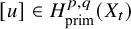 $[u]\in H^{p,q}_{\text {prim}}(X_t)$
and
$[u]\in H^{p,q}_{\text {prim}}(X_t)$
and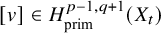 $[v]\in H^{p-1,q+1}_{\text {prim}}(X_t)$
,
$[v]\in H^{p-1,q+1}_{\text {prim}}(X_t)$
, $p+q=n$
. Then,
$p+q=n$
. Then,
 $$ \begin{align*}\langle\xi_t\cup [u],[v]\rangle=\langle [u],\overline{\xi_t\cup \overline{[v]}}\rangle. \end{align*} $$
Proof. We choose harmonic representatives $u_h$
and
$u_h$
and $v_h$
of the classes
$v_h$
of the classes $[u]$
and
$[u]$
and $[v]$
, respectively. Also, we represent the class
$[v]$
, respectively. Also, we represent the class $\xi _t$
by its representative
$\xi _t$
by its representative $k_t$
as above.
$k_t$
as above.
We have
 $$ \begin{align*}\langle\xi_t\cup [u],[v]\rangle &=(-1)^{q+1}c_n\int_{X_t}(\xi_t\cup [u])_h\wedge\bar{v}_h \\ &=(-1)^{q+1}c_n\int_{X_t}(k_t\cup u_h)_h\wedge\bar{v}_h=(-1)^{q+1}c_n\int_{X_t}( k_t\cup u_h)\wedge\bar{v}_h \end{align*} $$
and
 $$ \begin{align*}\langle [u],\overline{\xi_t\cup \overline{[v]}}\rangle &=(-1)^{q}c_n\int_{X_t} u_h\wedge( {\xi_t\cup \overline{[v]}})_h\\ &=(-1)^{q}c_n\int_{X_t} u_h\wedge({k_t\cup \bar{v}_h})_h=(-1)^{q}c_n\int_{X_t} u_h\wedge({k_t\cup \bar{v}_h}). \end{align*} $$
It is now easy to see, for example, writing locally $u_h,v_h$
, and
$u_h,v_h$
, and $k_t$
, that
$k_t$
, that $(-1)^{q+1}c_n\int _{X_t}( k_t\cup u_h)\wedge \bar {v}_h=(-1)^{q}c_n\int _{X_t} u_h\wedge ({k_t\cup \bar {v}_h})$
. This can, for example, be verified on decomposable forms, since everything is linear.
$(-1)^{q+1}c_n\int _{X_t}( k_t\cup u_h)\wedge \bar {v}_h=(-1)^{q}c_n\int _{X_t} u_h\wedge ({k_t\cup \bar {v}_h})$
. This can, for example, be verified on decomposable forms, since everything is linear.
Remark 3.8. From this formula, we easily get the condition $K^q_{\text {prim},t}\subset \overline {\xi _t(H^{q+1,p-1}_{\text {prim}}(X_t))}^\perp $
.
$K^q_{\text {prim},t}\subset \overline {\xi _t(H^{q+1,p-1}_{\text {prim}}(X_t))}^\perp $
.
Denote by $\xi ^q_t$
the composition of the cup product with
$\xi ^q_t$
the composition of the cup product with $\xi _t$
taken q times,
$\xi _t$
taken q times,
 $$ \begin{align*}\xi_t^q\colon H^{n,0}(X_t)\to H^{n-q,q}(X_t). \end{align*} $$
Hence, we have the following condition for strong non-isotriviality.
Proposition 3.9. If $\xi _t^{n-1}(H^{n,0}(X_t))\cap \overline {\xi _t(H^{n,0}(X_t))}\neq \{0\}$
, then the fibration is strongly non-isotrivial.
$\xi _t^{n-1}(H^{n,0}(X_t))\cap \overline {\xi _t(H^{n,0}(X_t))}\neq \{0\}$
, then the fibration is strongly non-isotrivial.
Proof. This comes from the fact that all the elements of $K^{n-1}_{\text {prim},t}$
are contained in
$K^{n-1}_{\text {prim},t}$
are contained in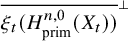 $\overline {\xi _t(H^{n,0}_{\text {prim}}(X_t))}^\perp $
by the previous remark. Hence,
$\overline {\xi _t(H^{n,0}_{\text {prim}}(X_t))}^\perp $
by the previous remark. Hence, $\phi _{n,t}=\xi ^n_t\neq 0$
.
$\phi _{n,t}=\xi ^n_t\neq 0$
.
In the case of $n=2$
, this condition suggests an interesting numerical bound concerning families of surfaces with positive index.
$n=2$
, this condition suggests an interesting numerical bound concerning families of surfaces with positive index.
Theorem 3.10. Let $f\colon X\to B$
be a semistable fibration and denote by r the rank of
$f\colon X\to B$
be a semistable fibration and denote by r the rank of $K^0$
. Assume that the general fiber
$K^0$
. Assume that the general fiber $X_t$
is a surface satisfying
$X_t$
is a surface satisfying $K^2_{X_t}> 8\chi (\mathcal {O}_{X_t})+2r+1$
, then f is strongly non-isotrivial.
$K^2_{X_t}> 8\chi (\mathcal {O}_{X_t})+2r+1$
, then f is strongly non-isotrivial.
Proof. By Proposition 3.9, it is enough to show that the intersection $\xi _t(H^{2,0}(X_t))\cap \overline {\xi _t(H^{2,0}(X_t))}$
is nontrivial in
$\xi _t(H^{2,0}(X_t))\cap \overline {\xi _t(H^{2,0}(X_t))}$
is nontrivial in $H^{1,1}_{\text {prim}}(X_t)$
. This is true if
$H^{1,1}_{\text {prim}}(X_t)$
. This is true if $\dim \xi _t(H^{2,0}(X_t))>h^{1,1}_{\text {prim}}/2$
, that is,
$\dim \xi _t(H^{2,0}(X_t))>h^{1,1}_{\text {prim}}/2$
, that is,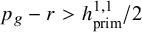 $p_g-r>h^{1,1}_{\text {prim}}/2$
. Now since
$p_g-r>h^{1,1}_{\text {prim}}/2$
. Now since $c_2=2-4q+2p_g+h^{1,1}$
and
$c_2=2-4q+2p_g+h^{1,1}$
and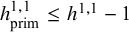 $h^{1,1}_{\text {prim}}\leq h^{1,1}-1$
, by Noether’s formula
$h^{1,1}_{\text {prim}}\leq h^{1,1}-1$
, by Noether’s formula $12\chi (\mathcal {O}_{X_t})=K_{X_t}^2+c_2$
, the above condition is implied by
$12\chi (\mathcal {O}_{X_t})=K_{X_t}^2+c_2$
, the above condition is implied by
 $$ \begin{align*}2p_g-2r>-2p_g+4q-2+12\chi(\mathcal{O}_{X_t})-K_{X_t}^2-1, \end{align*} $$
which we can write as
 $$ \begin{align*}K^2_{X_t}> 8\chi(\mathcal{O}_{X_t})+2r+1. \end{align*} $$
Remark 3.11. Note that since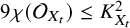 $9\chi (\mathcal {O}_{X_t})\leq K^2_{X_t}$
by the Miyaoka–Yau inequality [Reference Miyaoka25], [Reference Yau43], our assumption can hold only if
$9\chi (\mathcal {O}_{X_t})\leq K^2_{X_t}$
by the Miyaoka–Yau inequality [Reference Miyaoka25], [Reference Yau43], our assumption can hold only if $r\leq \frac {p_g-q}{2}$
.
$r\leq \frac {p_g-q}{2}$
.
3.2. Conditions for triviality of a fibration
In this section, we look at the opposite problem and give conditions for the triviality of $f\colon X\to B$
over a Zariski open subset of B. So far, we have considered the direct image of the relative dualizing sheaf
$f\colon X\to B$
over a Zariski open subset of B. So far, we have considered the direct image of the relative dualizing sheaf $f_*\omega _{X/B}$
, here, we will work on the direct image of the relative pluricanonical bundles
$f_*\omega _{X/B}$
, here, we will work on the direct image of the relative pluricanonical bundles $f_*(\omega _{X/B}^{\otimes m})$
. Hence, we briefly recall how to construct a Hermitian metric on the vector bundle associated with
$f_*(\omega _{X/B}^{\otimes m})$
. Hence, we briefly recall how to construct a Hermitian metric on the vector bundle associated with $f_*(\omega _{X/B}\otimes L)$
, where L is a line bundle on X endowed with a singular metric assumed to be smooth when restricted to the general fiber. We denote by
$f_*(\omega _{X/B}\otimes L)$
, where L is a line bundle on X endowed with a singular metric assumed to be smooth when restricted to the general fiber. We denote by $\psi $
the local weight of this metric and assume that L is semi-positively curved.
$\psi $
the local weight of this metric and assume that L is semi-positively curved.
Without covering all the details, we just highlight the differences with the untwisted case of Section 2. In particular, on an appropriate open subset of B, the metric in (6) is replaced by
 $$ \begin{align} \lVert u_t\lVert^2_t=\int_{X_t} c_n u_t\wedge\bar{u}_te^{-\psi} \end{align} $$
and the curvature in (9) is replaced by
 $$ \begin{align} \langle\Theta u_t,u_t \rangle_t=f_*(c_ni\partial\bar{\partial}\psi\wedge\mathbf{u}\wedge\bar{\mathbf{u}}e^{-\psi})/dV_t+\lVert\eta_t\lVert^2, \end{align} $$
where $dV_t=idt\wedge d\bar {t}$
.
$dV_t=idt\wedge d\bar {t}$
.
For our purposes, we take $L=\omega _{X/B}^{\otimes {m-1}}$
and we prove the following theorem which complements the constancy result proved in [Reference Xie and Yuan42].
$L=\omega _{X/B}^{\otimes {m-1}}$
and we prove the following theorem which complements the constancy result proved in [Reference Xie and Yuan42].
Theorem 3.12. Let $f\colon X\to B$
be a family of canonically polarized manifolds. Assume that there exists a surjective morphism
$f\colon X\to B$
be a family of canonically polarized manifolds. Assume that there exists a surjective morphism $\rho \colon V\times B\to X$
, where V is a projective variety, such that
$\rho \colon V\times B\to X$
, where V is a projective variety, such that $p:=f\circ \rho $
is the projection on B. Then, X is Zariski locally trivial.
$p:=f\circ \rho $
is the projection on B. Then, X is Zariski locally trivial.
Proof. By [Reference Iwai18], [Reference Lombardi and Schnell23], the direct image $f_*(\omega _{X/B}^{\otimes m})$
has a so-called Catanese–Fujita–Kawamata decomposition
$f_*(\omega _{X/B}^{\otimes m})$
has a so-called Catanese–Fujita–Kawamata decomposition
 $$ \begin{align*}f_*(\omega_{X/B}^{\otimes m})=\mathcal{U}\oplus \mathcal{A}, \end{align*} $$
where $\mathcal {U}$
is unitary flat and
$\mathcal {U}$
is unitary flat and $\mathcal {A}$
is ample (or zero). On the other hand, we also get an injective morphism
$\mathcal {A}$
is ample (or zero). On the other hand, we also get an injective morphism $f_*(\omega _{X/B}^{\otimes m})\hookrightarrow p_*((\Omega ^n_{V\times B/B})^{\otimes m})=H^0(V, (\Omega ^n_V)^{\otimes m})\otimes \mathcal {O}_B$
. From this, it is not difficult to see that
$f_*(\omega _{X/B}^{\otimes m})\hookrightarrow p_*((\Omega ^n_{V\times B/B})^{\otimes m})=H^0(V, (\Omega ^n_V)^{\otimes m})\otimes \mathcal {O}_B$
. From this, it is not difficult to see that $\mathcal {A}=0$
and
$\mathcal {A}=0$
and $\mathcal {U}=\mathcal {O}_B^l$
is trivial.
$\mathcal {U}=\mathcal {O}_B^l$
is trivial.
Now, we write $f_*(\omega _{X/B}^{\otimes m})=f_*(\omega _{X/B}\otimes \omega _{X/B}^{\otimes m-1})$
and take
$f_*(\omega _{X/B}^{\otimes m})=f_*(\omega _{X/B}\otimes \omega _{X/B}^{\otimes m-1})$
and take $L=\omega _{X/B}^{\otimes m-1}$
. L admits a singular metric which is smooth and with strictly positive curvature when restricted to the smooth fibers (cf. [Reference Schumacher37]). By [Reference Păun and Takayama27, Theorem 3.3.5], the vector bundle
$L=\omega _{X/B}^{\otimes m-1}$
. L admits a singular metric which is smooth and with strictly positive curvature when restricted to the smooth fibers (cf. [Reference Schumacher37]). By [Reference Păun and Takayama27, Theorem 3.3.5], the vector bundle $f_*(\omega _{X/B}^{\otimes m})$
admits a singular Hermitian metric with semi-positive curvature. But by the fact that
$f_*(\omega _{X/B}^{\otimes m})$
admits a singular Hermitian metric with semi-positive curvature. But by the fact that $f_*(\omega _{X/B}^{\otimes m})$
is trivial, the curvature of this metric cannot be strictly positive definite; actually, it is zero, see, for example, [Reference Hacon, Popa and Schnell16, Lemma 13.2]. On the open subset where f is smooth, this metric coincides with the one recalled above in (20) and by the explicit curvature formula given in [Reference Berndtsson2, Theorem 1.2] and following remarks, the Kodaira–Spencer class vanishes at every point of this open subset.
$f_*(\omega _{X/B}^{\otimes m})$
is trivial, the curvature of this metric cannot be strictly positive definite; actually, it is zero, see, for example, [Reference Hacon, Popa and Schnell16, Lemma 13.2]. On the open subset where f is smooth, this metric coincides with the one recalled above in (20) and by the explicit curvature formula given in [Reference Berndtsson2, Theorem 1.2] and following remarks, the Kodaira–Spencer class vanishes at every point of this open subset.
Moreover, by the argument in [Reference Berndtsson2, §4.1, p. 1216], the Kodaira–Spencer class $\xi _t$
is represented by the form
$\xi _t$
is represented by the form $\bar {\partial }{V_\psi }_{|X_t}$
, where
$\bar {\partial }{V_\psi }_{|X_t}$
, where $V_\psi $
is a (in principle only smooth) vector field which turns out to be holomorphic since the curvature of
$V_\psi $
is a (in principle only smooth) vector field which turns out to be holomorphic since the curvature of $f_*(\omega _{X/B}^{\otimes m})$
is not strictly positive. The fibration f is then analytically locally trivial.
$f_*(\omega _{X/B}^{\otimes m})$
is not strictly positive. The fibration f is then analytically locally trivial.
To show that f is trivial over a Zariski open subset U of B, we can proceed then as in [Reference Xie and Yuan42, p. 22].
Remark 3.13. Theorem 3.12 relies on the existence of an ample part in $f_*(\omega _{X/B}^{\otimes m})$
. For the study of this ample part using algebraic techniques, see [Reference Viehweg40].
$f_*(\omega _{X/B}^{\otimes m})$
. For the study of this ample part using algebraic techniques, see [Reference Viehweg40].
4. Massey product and curvature formula
Using curvature formulas, we can give conditions on the liftability of Massey products. First, we briefly recall this notion, which is one of the main constructions of [Reference Pirola and Torelli28], [Reference Rizzi and Zucconi35]. If a Massey product $\alpha _t$
is Massey trivial, see Definition 4.4 below, then its cup product with the Kodaira–Spencer class
$\alpha _t$
is Massey trivial, see Definition 4.4 below, then its cup product with the Kodaira–Spencer class $\xi _t$
is zero, that is,
$\xi _t$
is zero, that is, $\alpha _t$
is liftable. The consequences of this are well studied in relation to Torelli-type problems. On the other hand, the case where
$\alpha _t$
is liftable. The consequences of this are well studied in relation to Torelli-type problems. On the other hand, the case where $\alpha _t$
is not Massey trivial, but still liftable, is not well understood, especially when the Massey product is a section of the ample part
$\alpha _t$
is not Massey trivial, but still liftable, is not well understood, especially when the Massey product is a section of the ample part $\mathcal {A}$
of the Fujita decomposition (5). Hence, below we give a metric interpretation of this condition. To our best knowledge, it is the first time that such an interpretation is studied.
$\mathcal {A}$
of the Fujita decomposition (5). Hence, below we give a metric interpretation of this condition. To our best knowledge, it is the first time that such an interpretation is studied.
From the direct image of Sequence (1), we get a short exact sequence on B defining the vector bundle $K_\partial $
:
$K_\partial $
:
 $$ \begin{align} 0\to \omega_B\to f_*\Omega^1_X\to K_\partial\to 0. \end{align} $$
Intuitively, we can think of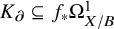 $K_\partial \subseteq f_*\Omega ^1_{X/B}$
as the sheaf of holomorphic one forms on the fibers of f which are liftable to a tubular neighborhood in X of such fibers. For a more in depth study of
$K_\partial \subseteq f_*\Omega ^1_{X/B}$
as the sheaf of holomorphic one forms on the fibers of f which are liftable to a tubular neighborhood in X of such fibers. For a more in depth study of $K_\partial $
, see [Reference González-Alonso, Stoppino and Torelli10], [Reference González-Alonso and Torelli11], [Reference Pirola and Torelli28] for the case
$K_\partial $
, see [Reference González-Alonso, Stoppino and Torelli10], [Reference González-Alonso and Torelli11], [Reference Pirola and Torelli28] for the case $n=2$
and [Reference Rizzi and Zucconi35] for the general case.
$n=2$
and [Reference Rizzi and Zucconi35] for the general case.
Note that if in Sequence (22) we consider, instead of $f_*\Omega ^1_X$
, the sheaf
$f_*\Omega ^1_X$
, the sheaf $f_*\Omega ^1_{X,d}$
, we obtain the exact sequence (4) and recover the local system
$f_*\Omega ^1_{X,d}$
, we obtain the exact sequence (4) and recover the local system $\mathbb {D}^1$
as introduced in Section 2.
$\mathbb {D}^1$
as introduced in Section 2.
By [Reference Pirola and Torelli28, Lemma 3.5] or [Reference Rizzi and Zucconi35, Lemma 2.2], Sequence (22) splits, and from now on, we choose and fix one such splitting. Now, consider $n+1$
linearly independent sections
$n+1$
linearly independent sections $\eta _1,\ldots ,\eta _{n+1}\in \Gamma (\Delta ,K_{\partial })$
on an open subset
$\eta _1,\ldots ,\eta _{n+1}\in \Gamma (\Delta ,K_{\partial })$
on an open subset $\Delta \subset B$
of coordinate t and denote by
$\Delta \subset B$
of coordinate t and denote by $s_1,\dots ,s_{n+1}\in \Gamma (\Delta ,f_*\Omega ^1_{X})$
the liftings of
$s_1,\dots ,s_{n+1}\in \Gamma (\Delta ,f_*\Omega ^1_{X})$
the liftings of $\eta _1,\dots ,\eta _{n+1}$
according to the chosen splitting of Sequence (22).
$\eta _1,\dots ,\eta _{n+1}$
according to the chosen splitting of Sequence (22).
Definition 4.1. We call $\alpha _i\in \Gamma (\Delta , f_*\omega _{X/B})$
,
$\alpha _i\in \Gamma (\Delta , f_*\omega _{X/B})$
, $i=1,\ldots ,{n+1}$
, the relative forms defined by
$i=1,\ldots ,{n+1}$
, the relative forms defined by $\eta _1\wedge \dots \wedge \hat {\eta _i}\wedge \dots \wedge \eta _{n+1}$
and
$\eta _1\wedge \dots \wedge \hat {\eta _i}\wedge \dots \wedge \eta _{n+1}$
and $\mathcal {W}$
the (local)
$\mathcal {W}$
the (local) $\mathcal {O}_B$
-submodule of
$\mathcal {O}_B$
-submodule of $f_*\omega _{X/B}$
generated by the
$f_*\omega _{X/B}$
generated by the $\alpha _i$
.
$\alpha _i$
.
Note that by $\hat {\eta _i}$
, we mean that
$\hat {\eta _i}$
, we mean that $\eta _i$
is excluded from the wedge product.
$\eta _i$
is excluded from the wedge product.
Definition 4.2. The Massey product of $\eta _1,\ldots ,\eta _{n+1}$
is the section
$\eta _1,\ldots ,\eta _{n+1}$
is the section $\alpha \in \Gamma (\Delta , f_*\omega _{X/B})$
defined by
$\alpha \in \Gamma (\Delta , f_*\omega _{X/B})$
defined by $s_1\wedge \cdots \wedge s_{n+1}=\alpha \wedge dt$
. We say that the sections
$s_1\wedge \cdots \wedge s_{n+1}=\alpha \wedge dt$
. We say that the sections $\eta _1,\ldots ,\eta _{n+1}$
are Massey trivial if
$\eta _1,\ldots ,\eta _{n+1}$
are Massey trivial if $\alpha $
is a section of the submodule
$\alpha $
is a section of the submodule $\mathcal {W}$
.
$\mathcal {W}$
.
Remark 4.3. The crucial result is that if $\eta _1,\ldots ,\eta _{n+1}$
are Massey trivial, we can find liftings
$\eta _1,\ldots ,\eta _{n+1}$
are Massey trivial, we can find liftings $\tilde {s}_i$
such that
$\tilde {s}_i$
such that
 $$ \begin{align} \tilde{s}_1\wedge\dots\wedge\tilde{s}_{n+1}=0; \end{align} $$
in particular, we can take $\alpha $
to be zero. See, for example, [Reference Rizzi and Zucconi35, Proposition 4.10].
$\alpha $
to be zero. See, for example, [Reference Rizzi and Zucconi35, Proposition 4.10].
Since $\mathbb {D}^1$
is a subsheaf of
$\mathbb {D}^1$
is a subsheaf of $K_{\partial }$
, it makes sense to construct Massey products starting from sections of
$K_{\partial }$
, it makes sense to construct Massey products starting from sections of $\mathbb {D}^1$
, that is,
$\mathbb {D}^1$
, that is, $\eta _i\in \Gamma (\Delta ,\mathbb {D}^1)$
. One of the key points in [Reference Pirola and Torelli28], [Reference Rizzi and Zucconi35] is exactly to consider this setting.
$\eta _i\in \Gamma (\Delta ,\mathbb {D}^1)$
. One of the key points in [Reference Pirola and Torelli28], [Reference Rizzi and Zucconi35] is exactly to consider this setting.
The construction of Massey products can also be done pointwise, that is, for a fixed regular value $t\in B$
. This is the original approach of [Reference Collino and Pirola7], [Reference Pirola and Zucconi29], [Reference Rizzi and Zucconi34]. In this case, one considers
$t\in B$
. This is the original approach of [Reference Collino and Pirola7], [Reference Pirola and Zucconi29], [Reference Rizzi and Zucconi34]. In this case, one considers $\eta _{1,t},\ldots ,\eta _{n+1,t}\in K_{\partial ,t}\leq H^0(X_t,\Omega ^1_{X_t})$
the restriction of the
$\eta _{1,t},\ldots ,\eta _{n+1,t}\in K_{\partial ,t}\leq H^0(X_t,\Omega ^1_{X_t})$
the restriction of the $\eta _i$
to the fiber
$\eta _i$
to the fiber $X_t$
. Similarly,
$X_t$
. Similarly, $\mathcal {W}_t=\langle \alpha _{1,t},\dots ,\alpha _{n+1,t}\rangle \leq H^0(X_t,\omega _{X_t})$
and
$\mathcal {W}_t=\langle \alpha _{1,t},\dots ,\alpha _{n+1,t}\rangle \leq H^0(X_t,\omega _{X_t})$
and $\alpha _t\in H^0(X_t,\omega _{X_t})$
are restriction on
$\alpha _t\in H^0(X_t,\omega _{X_t})$
are restriction on $X_t$
of
$X_t$
of $\mathcal {W}$
and of
$\mathcal {W}$
and of $\alpha $
, respectively. We have a pointwise version of Definition 4.2
$\alpha $
, respectively. We have a pointwise version of Definition 4.2
Definition 4.4. We say that $\eta _{1,t},\ldots ,\eta _{n+1,t}$
are Massey trivial (at t) if
$\eta _{1,t},\ldots ,\eta _{n+1,t}$
are Massey trivial (at t) if $\alpha _t\in \mathcal {W}_t$
.
$\alpha _t\in \mathcal {W}_t$
.
4.1. A curvature formula on Massey products
In this section, we consider a disk $\Delta \subset B\setminus E$
. Using the same notation as above, take sections
$\Delta \subset B\setminus E$
. Using the same notation as above, take sections $\eta _1,\dots ,\eta _{n+1}\in \Gamma (\Delta ,K_{\partial })$
and
$\eta _1,\dots ,\eta _{n+1}\in \Gamma (\Delta ,K_{\partial })$
and $\alpha $
their Massey product. The notion of Massey triviality, see Definition 4.2, means that
$\alpha $
their Massey product. The notion of Massey triviality, see Definition 4.2, means that $\alpha $
is a section of the
$\alpha $
is a section of the $\mathcal {O}_B$
-submodule
$\mathcal {O}_B$
-submodule $\mathcal {W}=\langle \alpha _{1},\dots ,\alpha _{n+1}\rangle \subseteq {f_*\omega _{X/B}}_{|\Delta }$
, hence it is natural to study the quotient
$\mathcal {W}=\langle \alpha _{1},\dots ,\alpha _{n+1}\rangle \subseteq {f_*\omega _{X/B}}_{|\Delta }$
, hence it is natural to study the quotient $\mathcal {Q}:={f_*\omega _{X/B}}_{|\Delta }/\mathcal {W}$
. Indeed, the class
$\mathcal {Q}:={f_*\omega _{X/B}}_{|\Delta }/\mathcal {W}$
. Indeed, the class $[\alpha ]$
does not depend on the choice of liftings
$[\alpha ]$
does not depend on the choice of liftings $s_i$
of
$s_i$
of $\eta _i$
, while the section
$\eta _i$
, while the section $\alpha $
does. Following this idea, we assume that
$\alpha $
does. Following this idea, we assume that $\mathcal {W}$
is a non-trivial subbundle of
$\mathcal {W}$
is a non-trivial subbundle of ${f_*\omega _{X/B}}_{|\Delta }$
and we compute the curvature of
${f_*\omega _{X/B}}_{|\Delta }$
and we compute the curvature of $\mathcal {Q}$
on the section
$\mathcal {Q}$
on the section $[\alpha ]$
and relate it to the cup product with the Kodaira–Spencer class and the pointwise liftability of
$[\alpha ]$
and relate it to the cup product with the Kodaira–Spencer class and the pointwise liftability of $\alpha $
. The result is a version of Formula (10), the difference is that working on the quotient
$\alpha $
. The result is a version of Formula (10), the difference is that working on the quotient $\mathcal {Q}$
makes the key role of the local system
$\mathcal {Q}$
makes the key role of the local system $\mathbb {D}^1$
more clear.
$\mathbb {D}^1$
more clear.
In this section, let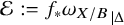 $\mathcal {E}:={f_*\omega _{X/B}}_{|\Delta }$
and, to avoid confusion, here we denote by
$\mathcal {E}:={f_*\omega _{X/B}}_{|\Delta }$
and, to avoid confusion, here we denote by $\langle ,\rangle _{\mathcal {E}}$
its metric introduced in Section 2 and by
$\langle ,\rangle _{\mathcal {E}}$
its metric introduced in Section 2 and by $\langle ,\rangle _{\mathcal {Q}}$
the quotient metric on
$\langle ,\rangle _{\mathcal {Q}}$
the quotient metric on $\mathcal {Q}$
.
$\mathcal {Q}$
.
By the above discussion, the case to be studied is when $\alpha _t$
is not contained in the vector space
$\alpha _t$
is not contained in the vector space $\mathcal {W}_t=\langle \alpha _{1,t},\dots ,\alpha _{n+1,t}\rangle $
. Without loss of generality, we assume that, by a standard orthogonalization process,
$\mathcal {W}_t=\langle \alpha _{1,t},\dots ,\alpha _{n+1,t}\rangle $
. Without loss of generality, we assume that, by a standard orthogonalization process, $\alpha _{1,t},\dots ,\alpha _{m,t},\alpha _t$
,
$\alpha _{1,t},\dots ,\alpha _{m,t},\alpha _t$
, $m\leq n+1$
, are a unitary basis of
$m\leq n+1$
, are a unitary basis of $\langle \mathcal {W}_t,\alpha _t\rangle $
(note that
$\langle \mathcal {W}_t,\alpha _t\rangle $
(note that $\alpha _{1,t},\dots ,\alpha _{n+1,t}$
are not necessarily linearly independent). We can extend to a
$\alpha _{1,t},\dots ,\alpha _{n+1,t}$
are not necessarily linearly independent). We can extend to a $\mathcal {C}^\infty $
unitary frame of
$\mathcal {C}^\infty $
unitary frame of $\mathcal {E}$
, denoted by
$\mathcal {E}$
, denoted by $\alpha ^{\prime }1,\dots ,\alpha ^{\prime }{m},\alpha ',\tau _1,\dots ,\tau _k$
, such that
$\alpha ^{\prime }1,\dots ,\alpha ^{\prime }{m},\alpha ',\tau _1,\dots ,\tau _k$
, such that $\alpha ^{\prime }1,\dots ,\alpha ^{\prime }{m}$
is a smooth frame for
$\alpha ^{\prime }1,\dots ,\alpha ^{\prime }{m}$
is a smooth frame for $\mathcal {W}$
,
$\mathcal {W}$
, $\alpha ',\tau _1,\dots ,\tau _k$
is a smooth frame for
$\alpha ',\tau _1,\dots ,\tau _k$
is a smooth frame for $\mathcal {W}^\perp \cong \mathcal {Q}$
, and
$\mathcal {W}^\perp \cong \mathcal {Q}$
, and $\alpha ^{\prime }1,\dots ,\alpha ^{\prime }{m},\alpha '$
restrict to
$\alpha ^{\prime }1,\dots ,\alpha ^{\prime }{m},\alpha '$
restrict to $\alpha _{1,t},\dots ,\alpha _{m,t},\alpha _t$
on
$\alpha _{1,t},\dots ,\alpha _{m,t},\alpha _t$
on $X_t$
.
$X_t$
.
We compute $\langle \Theta _{\mathcal {Q}} [\alpha _t],[\alpha _t]\rangle _{\mathcal {Q}}$
by means of the second fundamental form
$\langle \Theta _{\mathcal {Q}} [\alpha _t],[\alpha _t]\rangle _{\mathcal {Q}}$
by means of the second fundamental form $\mathfrak {S}$
of
$\mathfrak {S}$
of $\mathcal {Q}$
in
$\mathcal {Q}$
in $\mathcal {E}$
. Following the notation of [Reference Griffiths and Harris14], the second fundamental form
$\mathcal {E}$
. Following the notation of [Reference Griffiths and Harris14], the second fundamental form $\mathfrak {S}\colon \mathcal {A}^0(\mathcal {Q})\to \mathcal {A}^1(\mathcal {W})$
is defined as the composition of the connection D on
$\mathfrak {S}\colon \mathcal {A}^0(\mathcal {Q})\to \mathcal {A}^1(\mathcal {W})$
is defined as the composition of the connection D on $\mathcal {E}$
restricted to
$\mathcal {E}$
restricted to $\mathcal {Q}\cong \mathcal {W}^\perp $
 $$ \begin{align*}D_{|\mathcal{Q}}\colon \mathcal{A}^0(\mathcal{Q})\to \mathcal{A}^1(\mathcal{E}) \end{align*} $$
and the projection to $\mathcal {W}$
 $$ \begin{align*}\mathcal{A}^1(\mathcal{E}) \to \mathcal{A}^1(\mathcal{W}). \end{align*} $$
We have
 $$ \begin{align*}\langle\Theta_{\mathcal{Q}} [\alpha_t],[\alpha_t]\rangle_{\mathcal{Q}}=\langle\Theta_{\mathcal{E}} \alpha_t,\alpha_t\rangle_{\mathcal{E}}-\langle \mathfrak{S} \alpha_t,\mathfrak{S}\alpha_t\rangle_{\mathcal{E}}. \end{align*} $$
The first of these summands is given by (10), that is,
 $$ \begin{align*}\langle\Theta_{\mathcal{E}} \alpha_t,\alpha_t\rangle_{\mathcal{E}}=\lVert\xi_t\cup {\alpha}_t\lVert^2 \end{align*} $$
hence we are left with the second summand.
In our chosen unitary frame, we write $\mathfrak {S}\alpha _t=\lambda _1\alpha _{1,t}+\dots +\lambda _{m}\alpha _{m,t}$
, for certain
$\mathfrak {S}\alpha _t=\lambda _1\alpha _{1,t}+\dots +\lambda _{m}\alpha _{m,t}$
, for certain $(0,1)$
-forms
$(0,1)$
-forms $\lambda _i$
, [Reference Kobayashi20, Proposition 1.6.6]. Explicitly, since
$\lambda _i$
, [Reference Kobayashi20, Proposition 1.6.6]. Explicitly, since $\mathcal {W}$
is a holomorphic subbundle of
$\mathcal {W}$
is a holomorphic subbundle of $\mathcal {E}$
,
$\mathcal {E}$
,
 $$ \begin{align*}\lambda_i=\langle(D\alpha')_t,\alpha_{i,t}\rangle_{\mathcal{E}}=-\langle\alpha_t,(D\alpha^{\prime}{i})_t\rangle_{\mathcal{E}}=-\left(\int_{X_b}c_n\alpha_t\wedge \overline{P(\mu^{\prime}i)}\right)d\bar t, \end{align*} $$
where we use the same notation as Section 2, Equation (8).
Proposition 4.5. The following formula computes the curvature of $\mathcal {Q}$
on the class
$\mathcal {Q}$
on the class $[\alpha _t]$
:
$[\alpha _t]$
:
 $$ \begin{align} \langle\Theta_{\mathcal{Q}} [\alpha_t],[\alpha_t]\rangle_{\mathcal{Q}}=\lVert\xi_t\cup {\alpha}_t\lVert^2+\sum_i\Big|\int_{X_b}c_n\alpha_t\wedge \overline{P(\mu^{\prime}i)}\Big|^2. \end{align} $$
As pointed out above, the case where the sections $\eta _{i}$
are in the local system
$\eta _{i}$
are in the local system $\mathbb {D}^1$
is of particular interest. The following corollary indeed specifies what happens in this case.
$\mathbb {D}^1$
is of particular interest. The following corollary indeed specifies what happens in this case.
Corollary 4.6. Let $\eta _{i}\in \Gamma (\Delta ,\mathbb {D}^1)$
, then, for every
$\eta _{i}\in \Gamma (\Delta ,\mathbb {D}^1)$
, then, for every $t\in \Delta $
,
$t\in \Delta $
, $\alpha _t$
is liftable iff
$\alpha _t$
is liftable iff $\langle \Theta _{\mathcal {Q}} [\alpha _t],[\alpha _t]\rangle _{\mathcal {Q}}=0$
.
$\langle \Theta _{\mathcal {Q}} [\alpha _t],[\alpha _t]\rangle _{\mathcal {Q}}=0$
.
Proof. Note that if the $\eta _{i}$
are in the local system
$\eta _{i}$
are in the local system $\mathbb {D}^1$
, then the
$\mathbb {D}^1$
, then the $\alpha _{i}$
are in
$\alpha _{i}$
are in $\mathbb {D}^n$
, hence we can assume that the
$\mathbb {D}^n$
, hence we can assume that the $\alpha _i'$
are holomorphic and by Proposition 2.6, the summation in the formula of Proposition 4.5 is zero.
$\alpha _i'$
are holomorphic and by Proposition 2.6, the summation in the formula of Proposition 4.5 is zero.
Remark 4.7. In particular, $\alpha $
is a section of
$\alpha $
is a section of $K^0$
if and only if
$K^0$
if and only if $\langle \Theta _{\mathcal {Q}} [\alpha _t],[\alpha _t]\rangle _{\mathcal {Q}}=0$
for every
$\langle \Theta _{\mathcal {Q}} [\alpha _t],[\alpha _t]\rangle _{\mathcal {Q}}=0$
for every $t\in \Delta $
. Of course by Formula (10),
$t\in \Delta $
. Of course by Formula (10), $\alpha $
is a section of
$\alpha $
is a section of $K^0$
if and only if
$K^0$
if and only if $\langle \Theta _{\mathcal {E}} \alpha _t,\alpha _t\rangle _{\mathcal {E}}=0$
for every
$\langle \Theta _{\mathcal {E}} \alpha _t,\alpha _t\rangle _{\mathcal {E}}=0$
for every $t\in \Delta $
. The condition on the curvature of
$t\in \Delta $
. The condition on the curvature of $\mathcal {Q}$
is, in general, stronger in the sense that it points to directions where the curvature of the quotient bundle is degenerate.
$\mathcal {Q}$
is, in general, stronger in the sense that it points to directions where the curvature of the quotient bundle is degenerate.
Another interesting point not fully analyzed in the literature is when the Massey product is a section of $\mathcal {A}$
, the ample part of the Fujita decomposition. In this case, we can relax the assumption on the
$\mathcal {A}$
, the ample part of the Fujita decomposition. In this case, we can relax the assumption on the $\eta _{i}$
and obtain the same conclusion.
$\eta _{i}$
and obtain the same conclusion.
Corollary 4.8. Assume that $\eta _{i}\in \Gamma (\Delta ,\mathbb {D}^1\otimes \mathcal {O}_B)$
and that their Massey product
$\eta _{i}\in \Gamma (\Delta ,\mathbb {D}^1\otimes \mathcal {O}_B)$
and that their Massey product $\alpha $
is a holomorphic section of
$\alpha $
is a holomorphic section of $\mathcal {A}$
, then
$\mathcal {A}$
, then $\alpha _t$
is liftable iff
$\alpha _t$
is liftable iff $\langle \Theta _{\mathcal {Q}} [\alpha _t],[\alpha _t]\rangle _{\mathcal {Q}}=0$
.
$\langle \Theta _{\mathcal {Q}} [\alpha _t],[\alpha _t]\rangle _{\mathcal {Q}}=0$
.
Proof. In this case, the $\alpha _{i}$
are in
$\alpha _{i}$
are in $\mathbb {D}^n\otimes \mathcal {O}_B=\mathcal {U,}$
the unitary flat part of the Fujita decomposition. Since the decomposition
$\mathbb {D}^n\otimes \mathcal {O}_B=\mathcal {U,}$
the unitary flat part of the Fujita decomposition. Since the decomposition $f_*\omega _{X/B}=\mathcal {U}\oplus \mathcal {A}$
is orthogonal, we get that
$f_*\omega _{X/B}=\mathcal {U}\oplus \mathcal {A}$
is orthogonal, we get that $D\alpha ^{\prime }i$
is not necessarily zero, but is orthogonal to
$D\alpha ^{\prime }i$
is not necessarily zero, but is orthogonal to $\alpha $
. Hence, once again the summation in the formula of Proposition 4.5 is zero.
$\alpha $
. Hence, once again the summation in the formula of Proposition 4.5 is zero.
The above corollaries give a metric interpretation of the liftability of Massey products. Based on our experience concerning the case of trivial Massey products, we expect these results to be useful in the future.
Funding statement
The first author has been supported by the Institute for Basic Science (IBS-R003-D1) and by European Union funds, NextGenerationEU. The second author has been supported by the grant DIMA Geometry PRIDZUCC, by PRIN 2017 Prot. 2017JTLHJR “Geometric, algebraic and analytic methods in arithmetics” and by the project DM737 RIC COLLAB ZUCCONI “Birational geometry, Fano manifolds and torus actions” CUP G25F21003390007, European Union funds, NextGenerationEU.
The authors are members of INdAM-GNSAGA.

 Open access

