


Introduction
Though revolutions were once considered a dying breed, the last three decades have revealed that, if anything, this mode of regime change is on the rise (Beissinger Reference Beissinger2022; Chenoweth et al. Reference Chenoweth, Dahlum, Kang, Marks, Shay and Wig2019). Considerable research examines the conditions under which such revolutions break out and why they succeed in toppling strongmen and autocrats. But there has been far less investment in understanding whether or how fledgling revolutionary regimes consolidate their gains. In this paper I turn attention to these postrevolutionary periods and consider one of the most common threats that new revolutionary governments face: counterrevolution. What type of revolutions are most likely to be overthrown by counterrevolutions? The study focuses specifically on “restorative counterrevolutions” or counterrevolutions that seek to restore a version of the regime that was just toppled by revolution. It represents one of the first attempts to conceptualize, theorize, and empirically examine this important phenomenon.
I argue that revolutions in which challengers adopt violent modes of resistance produce regimes that are less likely to be overthrown by counterrevolutions. Conversely, nonviolent revolutions are more vulnerable to being reversed. The paper then unpacks the mechanisms behind these relationships, arguing that revolutionary violence lowers the likelihood of counterrevolution because it bolsters the coercive might of the new government, which drastically lowers the chance that a counterrevolution can succeed. But there is no meaningful relationship between violence and the likelihood that a counterrevolution will emerge in the first place, suggesting that counterrevolution is neither the product of the old regime’s desperations and fears, nor its access to guns and resources. Instead, counterrevolution appears to be mainly the product of opportunities presented to old regime actors as new revolutionary governments attempt to consolidate their rule.
I support these arguments with an original global dataset of counterrevolutions from 1900 to 2015—the first to document this phenomenon empirically in a cross-national framework. These data reveal that there have been 98 counterrevolutionary challenges across 123 cases of revolution and that 22 of these counterrevolutions were successful in toppling the new revolutionary regime. In the vast majority of these 22 cases, the ill-fated revolutionary government was installed through largely nonviolent resistance. Statistical analyses then reveal a markedly lower probability of counterrevolution following revolutions involving violence—as measured by large numbers of deaths, whether the revolution involved a civil war, and whether the new regime had its own army or guerrilla force. I then show that these three variables have no significant relationship with the emergence of a counterrevolutionary challenge but instead that they lower the likelihood of counterrevolutionary success—from about 50% following a nonviolent revolution to 10% following a very violent one. A further analysis using Boolean set theory reveals that nonviolence is a near-necessary condition for a counterrevolution to succeed.
In the final empirical section, I further elucidate the mechanisms behind these relationships with a paired comparison of two revolutions that occurred in close temporal proximity within the same country: Cuba’s revolutions of 1933 and 1959. The Cuban revolution of 1933 was a nonviolent uprising, which brought to power a fractious government that was toppled in a counterrevolutionary coup after 100 days. In contrast, the revolution of 1959 involved an armed insurgency by a small but cohesive Rebel Army, which then provided the organizational foundation for the new revolutionary regime. This loyal coercive force allowed the new government to handily put down at least three counterrevolutionary challenges, one of which, the 1961 Bay of Pigs invasion, was backed by the United States. The paired comparison highlights the importance for revolutionaries of having their own coercive tools when they first come to power.
The study is important, first, because it generates data and insights about a highly understudied phenomenon. Though we have myriad books and articles on the dynamics of revolution, we have very little research interrogating counterrevolution. It is also important because it contributes to active debates about the role of violence and nonviolence in processes of regime change. There is now a fairly well-established finding that nonviolent resistance “works”—in that it is a more effective strategy for ousting incumbents than violent insurgency or rebellion (e.g., Celestino and Gleditsch Reference Celestino and Gleditsch2013; Chenoweth and Stephan Reference Chenoweth and Stephan2012; Nepstad Reference Nepstad2011; Schock Reference Schock2005; Teorell Reference Teorell2010). But this study raises important questions about the tenacity of the regimes produced through nonviolent revolutions. In other words, in line with a somewhat older tradition of social science research (e.g., Huntington Reference Huntington1968; Skocpol Reference Skocpol1979), there may be something of a “no pain, no gain” logic to revolutions, whereby violent struggles are more difficult to win but lead to more lasting political change. In the conclusion, I reflect further on the normative implications of these findings and discuss several potential avenues for future research.
Counterrevolution
Counterrevolutions represent one of the greatest threats to new revolutionary regimes and are among the most obvious ways by which revolutionary transformations can be reversed or undermined. Yet despite their importance, there is limited research dedicated to explaining counterrevolution, as a number of recent works have pointed out (Mayer Reference Mayer2000; Slater and Smith Reference Slater and Smith2016; Weyland Reference Weyland2016). The scholarship on revolution does touch on the topic of counterrevolution, especially works that consider postrevolutionary trajectories or aftermaths. For example, some scholars note the ubiquity of counterrevolutionary threats following successful revolution (Gurr Reference Gurr1988; Levitsky and Way Reference Levitsky and Way2013; Mayer Reference Mayer2000; Skocpol Reference Skocpol1979).Footnote 1 Goldstone (Reference Goldstone2014) argues that when revolutionary regimes survive fierce counterrevolutions they may become more ruthless and authoritarian. And Lawson (Reference Lawson2019) notes that counterrevolutionary challenges can breed protracted and destabilizing civil conflicts. But because they are concerned with theorizing revolution, these works focus mainly on how counterrevolutions shape postrevolutionary regime development. They therefore do not explicitly theorize or analyze counterrevolution as an outcome on its own terms, including the factors that make it more likely to emerge and succeed.
In part because there has been so little direct research on the phenomenon, there is little consensus on how best to conceptualize and operationalize counterrevolution. Indeed, though most scholars agree that counterrevolution involves opposition or resistance to revolutionary change, there are a variety of forms that such opposition can take. For example, Brinton (Reference Brinton1938) equated counterrevolution with “Thermidor,” or a period in which moderate revolutionaries take over and reimpose many of the rules, norms, and practices of the old regime. In his study of the Vendée counterrevolution in France, Tilly (Reference Tilly1964) defined counterrevolution as bottom-up resistance to the imposition of revolutionary rule. Others have conceptualized counterrevolution as a relatively unified, right-wing project directed at thwarting revolutionary movements worldwide (Halliday Reference Halliday1999; Mayer Reference Mayer1971).
Another prominent understanding of counterrevolution is an effort to defeat revolutionary movements before they come to power (Allinson Reference Allinson2019; Bisley Reference Bisley2004; Jones Reference Jones2013). For example, Slater and Smith define counterrevolution as “collective and reactive efforts to defend the status quo and its varied range of dominant elites against a credible threat to overturn them from below” (Slater and Smith Reference Slater and Smith2016, 1475), and argue that these counterrevolutions generate cohesion and strength among ruling coalitions. In another prominent recent study using this definition, Weyland (Reference Weyland2016) analyzes the diffusion of counterrevolutionary practices in Europe that led to the crushing of revolution during and after 1848.
In this paper, I choose to analyze a different manifestation of counterrevolution, which I call “restorative counterrevolution” because it seeks to restore the former regime to power following a successful revolution.Footnote 2 A restorative counterrevolution is an irregular effort in the aftermath of a successful revolution to restore a version of the prerevolutionary political regime. Throughout the paper when I use the term “counterrevolution,” this is the version to which I refer (unless otherwise noted). I adopt this conceptualization, which is somewhat narrower than those used in previous studies, primarily in an effort to generate and test a more parsimonious and tractable theory. For example, a theory that makes sense of efforts to defeat a revolution before it comes to power would likely emphasize mechanisms like violent repression, concessions, or cooptation, which would mostly be ill-suited to explaining the conditions under which fallen incumbents restore themselves in office. In other words, by focusing only on restorative counterrevolutions I allow for the development of a more focused and coherent argument, while also recognizing that this leaves other manifestations of counterrevolution for future scholars to explore.
The definition of counterrevolution above immediately begs clarification of a second concept: successful revolution. Here, I mean that a regime has been overthrown through the mass mobilization of large numbers of everyday citizens. This understanding of revolution follows a long line of scholarship that has characterized “political revolution” as an exercise in popular regime change (Beissinger Reference Beissinger2022; Goldstone Reference Goldstone2001; Goodwin Reference Goodwin2001; Karl Reference Karl1990; Lawson Reference Lawson2019; Tilly Reference Tilly1978), distinguishing it from the far rarer phenomenon of “social revolution,” which strives for profound transformation in state institutions and societal relations (Huntington Reference Huntington1968; Skocpol Reference Skocpol1988). Moreover, as will become important for the arguments and analyses that follow, this more capacious understanding of revolution leaves open the question of revolutionary tactics; its only criteria are that the campaign be directed at regime change and that a sufficient number of everyday citizens be involved. These citizens can be organized in a nonviolent revolutionary movement staging protests and demonstrations, or they can be recruited into a revolutionary militia devoted to fighting the incumbent through guerrilla insurgency (Beissinger Reference Beissinger2022; Chenoweth and Stephan Reference Chenoweth and Stephan2012; Goldstone Reference Goldstone2001; Reference Goldstone2014). Indeed, in some cases these forms of resistance hybridize, with some revolutionaries opting for armed resistance while others remain committed to nonviolence. In other cases, a campaign that begins with nonviolent resistance may devolve into violent armed combat. The definition of revolution adopted here therefore follows existing works in treating revolutionary tactics, including the use of armed versus unarmed resistance, as a characteristic that varies—not as constitutive of the phenomenon itself.
A number of other terms in my definition are worth highlighting, particularly as they inform the coding of data and the empirical analyses that follow. First, a counterrevolution is defined as an effort rather than an outcome. Like revolutions, coups, rebellions, and other forms of regime change, counterrevolutionary efforts may either succeed or fail. This means that explanations of counterrevolution should be broken into two parts: first we must explain why counterrevolutions emerge and then why they succeed. Second, I note that a counterrevolution must take place through irregular action, like a coup, invasion, rebellion, or uprising. It therefore excludes efforts by former incumbents to capture power through the institutional channels established by the new regime, as, for example, when authoritarian successor parties return through elections in new democracies (Grzymala-Busse Reference Grzymala-Busse2002; Loxton and Mainwaring Reference Loxton and Mainwaring2018). Third, the goal of the effort must be restoration of a version of the prerevolutionary regime. In other words, it is insufficient to simply reimpose authoritarianism. Instead, a counterrevolution is an effort to resurrect a version of the governing rules that characterized the former regime and to restore members of that ruling elite to power.
Finally, it is important to distinguish my definition of counterrevolution from a related concept in an adjacent literature: democratic breakdown. The overthrow of a nascent democracy by antidemocratic forces has obvious affinities with my understanding of counterrevolution. Indeed, though not all democratic transitions are effected through revolution and not all breakdowns involve the return of the former regime, it is no doubt true that some of these breakdowns would qualify as counterrevolutions. When a democratic breakdown meets my criteria for counterrevolution—that is, it follows a political revolution, involves irregular action, and seeks to restore a version of the former regime—it is included in my dataset and analyses.
Yet despite some degree of conceptual overlap, there are good reasons to treat these phenomena as distinct for the purposes of developing theory. The most obvious of these reasons is that, as I explain in the next section, postrevolutionary transitions tend to be marked by a fairly well-defined distribution of power and interests between the old and new regimes, which directly shape counterrevolutionary processes. In contrast, democratization research tends to lump together transitions effected through revolutionary mobilization and those involving elite pacts. Moreover, the dynamics of these latter transition are somewhat distinct, in part because democratizers generally have far less initial leverage over former incumbents than they do following revolutions (Haggard and Kaufman Reference Haggard and Kaufman2016; Kadivar Reference Kadivar2018; Karl Reference Karl1990). As a result, the tactics that have been found to be important for avoiding democratic breakdown, like rapid demobilization, moderation in policies, and conciliation and compromise toward former officials, are likely to be ineffective in thwarting counterrevolutions (Diamond Reference Diamond2008; Higley and Burton Reference Higley and Burton1989; Huntington Reference Huntington1984; O’Donnell and Schmitter Reference O’Donnell and Schmitter1986). In fact, as I discuss in the Conclusion, this paper’s findings suggest that democratic revolutionaries’ best hopes for guarding against counterrevolution may be to remain as mobilized as possible so that they retain their ability to confront counterrevolutionary challenges with a return to mass protest. To summarize, although the scholarship on democratic breakdown may inform our understanding of counterrevolution, its arguments cannot alone explain this outcome.
Revolutionary Violence
Having now defined and conceptualized counterrevolution, we can begin developing some theoretical intuitions about when we might expect it to occur. As noted above, because counterrevolution is conceptualized as an effort that can either succeed or fail, we must consider counterrevolutionary outcomes in two parts: (1) when are counterrevolutions most likely to emerge and (2) when are they most likely to succeed?
One place to begin our theorizing is with the distribution of interests and coercive capacities between revolutionaries and old regime forces in the postrevolutionary critical juncture. On the one hand, we might expect patterns in counterrevolution to be shaped by the interests of the old regime. Of course, in all successful revolutions incumbents are forced from power against their will, and they are, as a result, likely to maintain a strong desire to return to office.Footnote 3 But the extent of this desire may vary considerably across revolutions, depending on the nature of the new regime. Revolutionary governments that undertake purges, pursue punitive justice, or threaten old regime interests through radical policies are likely to generate particularly acute desperation among these former elites, making it more likely that they will launch a risky gambit to grab back power.
In addition to interests, we might expect coercive capacities—of both the old regime and the new one—to pattern counterrevolutionary outcomes. Revolutions, by definition, entail that challengers have managed to overpower the old regime through some combination of armed insurgency and mass mobilization. But, like old regime interests, this revolutionary power advantage varies considerably in nature and extent across different revolutions. In some cases, the old regime is left with its coercive apparatus mostly or entirely intact, with revolutionaries only able to exert influence through their potential to return to revolutionary mass mobilization (e.g., the Egyptian and Tunisian revolutions of 2011). In other cases, revolutionaries may have an army of their own, and they can use this coercive apparatus to defend their revolutionary gains (e.g., the Chinese and Vietnamese revolutions). The relative coercive resources available to revolutionaries and former incumbents in the postrevolutionary critical juncture should shape the likelihood of both counterrevolutionary emergence and success. When old regime forces maintain some or all of their coercive might, they will be better equipped for a counterrevolutionary campaign. And when revolutionaries themselves have their own army or militia to draw on, they will be better positioned to defeat these counterrevolutionary challenges.
What are the primary determinants of these relative interests and coercive capacities in the postrevolutionary period? Here I argue that the nature of the revolutionary process—and, specifically, whether challengers embrace strategies of violent or nonviolent resistance—should determine the extent of old regime desperation and the distribution of coercive capacities after the revolution ends. In developing this argument, I draw on two scholarships. The first is the literature on nonviolent resistance, which has argued that nonviolence is a more effective strategy for toppling dictators than violent insurgency (Chenoweth and Lawrence Reference Chenoweth and Lawrence2010; Chenoweth and Stephan Reference Chenoweth and Stephan2012; Nepstad Reference Nepstad2011; Schock Reference Schock2005). The second is an older literature on social revolution, which traces the origins of political order and durable state institutions to violent conflict (Huntington Reference Huntington1968; Skocpol Reference Skocpol1979; Tilly Reference Tilly1993). Though these two literatures are often contrasted, interestingly they together point to a fairly consistent set of expectations regarding counterrevolutionary emergence and success.
On the one hand, we might expect counterrevolutions to be more likely following violent revolutions, because they induce heightened levels of desperation in former incumbents. Violent revolutions produce regimes that are far better able to purge and punish their enemies. For example, Mulholland (Reference Mulholland2017) argues that, throughout European history, revolutions achieved through military occupation were better able to subordinate resistant state bureaucracies. Old regime elites living under the rule of such regimes are therefore especially likely to fear for their lives, safety, and interests, and these fears can be a powerful spur to action. Slater and Smith (Reference Slater and Smith2016) find, for example, that the fears provoked by violent social revolutions that fail can bind the surviving ruling coalitions together for years or even decades afterwards. A similar mechanism of fear and desperation may make old regime elites living under violent revolutionary rule especially likely to attempt counterrevolutions.
However, if we think about how violence affects the coercive resources available to old regime elites, we reach a somewhat different set of conclusions. Nonviolent campaigns succeed by eliciting defections from the incumbent’s supporters, including, most crucially, members of the military (Chenoweth and Stephan Reference Chenoweth and Stephan2012; Goodwin Reference Goodwin2001; Schock Reference Schock2005; Tilly Reference Tilly1978). In contrast, violent campaigns achieve victory only when they are able to defeat an incumbent’s armies through guerrilla war or urban insurgency (Lachapelle et al. Reference Lachapelle, Levitsky, Way and Casey2020; Levitsky and Way Reference Levitsky and Way2013). The latter is a more difficult path to victory than the former—which is one reason that Chenoweth and Stephan (Reference Chenoweth and Stephan2012) argue nonviolent campaigns succeed more often than violent ones. But the flip side of this easy success is that nonviolent revolutions barely touch the old regime’s coercive apparatus. If these old regime agents later sour on the new government, they therefore have considerable means at their disposal with which to launch a counterrevolution.
Violence and nonviolence also crucially shape the capacities and strength of the new revolutionary government, including its ability to defeat counterrevolutionary challenges. As scholars of social revolution have long argued, the loyal military organizations built during violent revolutionary struggles become a crucial tool by which new regimes subsequently consolidated their rule (Huntington Reference Huntington1968; Skocpol Reference Skocpol1979; Tilly Reference Tilly1993). Waging violent revolution for any sustained period requires the development of at least some degree of armed organization, and these organizational resources can subsequently be channeled into the construction of a permanent revolutionary military. As Ted Gurr put it, “the revolutionary fighters and zealots become the cadre of new or transformed agencies of state security” (Reference Gurr1988, 53). New regimes rely on these loyal cadres in their initial years to put down bottom-up threats, which, according to Levitsky and Way (Reference Levitsky and Way2013), is one important reason that revolutionary regimes tend to be so strong and durable (also, Lachapelle et al. Reference Lachapelle, Levitsky, Way and Casey2020). Similarly, Meng and Paine (Reference Meng and Paine2022) argue that the process of waging violent rebellion generates loyalty and experience between rebel leaders and their military officers, which, after coming to power, helps these leaders solve the “guardianship dilemma”—that is, granting officers the power and authority to put down bottom-up threats (like counterrevolutions) without risking an internal coup.
In contrast, nonviolent revolutionary regimes may be more susceptible to counterrevolutionary threats. In fact, the same mechanisms that grant an advantage to nonviolent revolutions in toppling dictators may later generate opportunities for those same dictators to return. A crucial feature of nonviolent revolutions is the breadth and diversity of their revolutionary coalitions (Beissinger Reference Beissinger2022; Dix Reference Dix1984). Nonviolent campaigns are better able to attract large numbers of participants, and the more everyday citizens that pour out into the streets the more likely elites are to defect from the incumbent regime (Chenoweth and Stephan Reference Chenoweth and Stephan2012). But although broad coalitions are helpful in forcing dictators from power, they represent a liability when it comes to governing. As Rule and Tilly put it in their study of the 1830 revolution in France, “the initial seizure of control [by revolutionaries] requires a larger coalition than does the maintenance of control” (Reference Rule and Tilly1972, 56). Because of their broad coalitions, scholars like Goldstone (Reference Goldstone2014) and Nepstad (Reference Nepstad2011) have found that nonviolent revolutionary regimes are often weak and unstable, with a tendency to backslide from democracy back into authoritarianism. Beissinger (Reference Beissinger2022) similarly finds that the rapidly convened and coalitional nature of urban civic revolutions (which also tend to be nonviolent) make them less durable and less transformative than violent social revolutions. These revolutions lack the institutional and coercive resources to manage the squabbling and infighting that define postrevolutionary transitions (Beck Reference Beck2015; Foran and Goodwin Reference Foran and Goodwin1993; Goldstone Reference Goldstone2014). And because their campaigns were waged through nonviolent struggle, they lack their own loyal coercive force to help them put down threats, forcing them to rely instead on the military organization of the regime they just felled. For all these reasons, we might expect nonviolent revolutionary regimes to present potential counterrevolutionaries with far more opportunities to return to power.
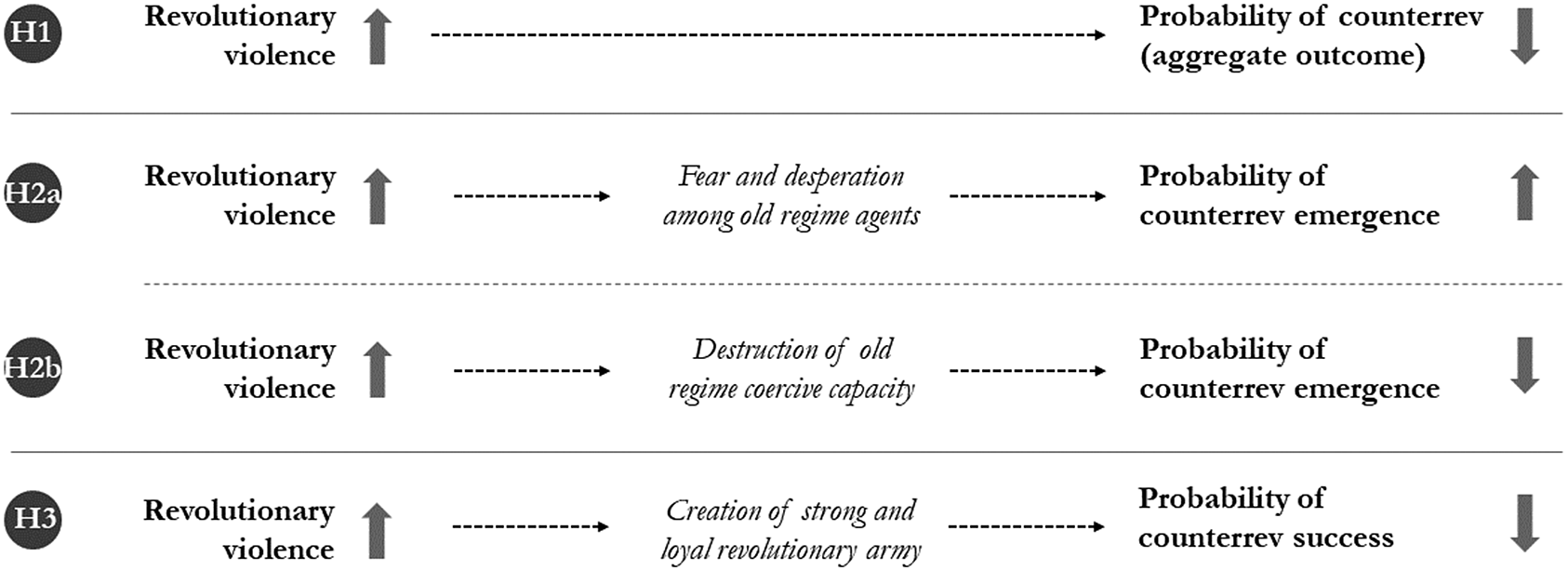
This theoretical discussion points to a clear set of hypotheses about the relationship between revolutionary violence and counterrevolution. On the question of counterrevolutionary emergence we have two competing hypotheses. On the one hand, violent revolutions might induce more fear and desperation in the remnants of the old regime, pushing them to attempt a counterrevolution. On the other hand, violent revolutions destroy the coercive capacities of these former incumbents, making it harder for them to get a counterrevolution off the ground. On the question of counterrevolutionary success we have a more consistent prediction. Violent revolutions generate coercive resources that the new regime can then use to consolidate its rule and put down counterrevolutionary threats. In contrast, nonviolent revolutions produce fractious regimes based on broad coalitions that lack the coercive tools to defeat bottom-up challenges.
These hypotheses are summarized in Figure 1. We have two competing and opposite predictions regarding violence and counterrevolutionary challenges (H2a and H2b). Then we have a single and more consistent prediction that violence lowers the likelihood of counterrevolutionary success (H3). How these causal dynamics combine to shape counterrevolutionary outcomes in aggregate—that is, whether a revolution is reversed by counterrevolution or not—are somewhat hard to predict. However, given that there is a causal logic connecting violence both to lower rates of counterrevolutionary emergence and to lower rates of success, we might expect that, on net, the more violence deployed during a revolution the less likely that revolution is to be subsequently overturned (H1).
Diagram of Hypotheses and Mechanisms
Finally, it is important to note that revolutionary violence is unlikely to be the only variable that patterns counterrevolutionary emergence and success. For example, previous work on counterrevolution has emphasized the importance of international sponsorship (Allinson Reference Allinson2019; Bisley Reference Bisley2004; Halliday Reference Halliday1999; Jones Reference Jones2013; Walt Reference Walt1992). Domestic counterrevolutions are often funded and armed by sympathetic foreign powers, and foreign sponsorship can also be decisive in propping up new revolutionary regimes. Another potentially important variable is the existence of a strong revolutionary party, as a number of studies have argued that strong parties are associated with regime strength and durability (Anria and Cyr Reference Anria and Cyr2016; Huntington Reference Huntington1968; Levitsky and Way Reference Levitsky and Way2012; Slater and Smith Reference Slater and Smith2016). In the models and case studies below, I do control for and consider these alternative explanations. However, I leave fuller exploration of these potentially important causal pathways for future research.
Data on Counterrevolution
Because no one has ever collected data on counterrevolutions, we do not have even basic statistics about how often they occur. Therefore, I constructed an original dataset of all counterrevolutionary challenges globally from 1900 to 2015. To assemble these data, I began with a dataset built by Beissinger (Reference Beissinger2022) of successful political revolutions in the twentieth and twenty-first centuries (n = 123). In line with the discussion above, Beissinger adopts an understanding of political revolution as regime change involving the mass mobilization of everyday citizens (both armed and unarmed), and his dataset includes every campaign that meets these criteria. It therefore provided me with the full universe of cases in which counterrevolution was conceptually possible. Using a number of secondary sources (enumerated in Appendix A1), I conducted research on each of these cases to identify discrete instances of counterrevolution.
I was guided in my research by the three inclusion criteria in the definition above. First, the definition specifies that the mode of action must be irregular, so I looked for challenges to the revolutionary regime that occurred outside of institutional channels, including rebellions, mass protests, foreign invasions, and coups. The second criterion specifies that the goals of the challenge must be restoration of some version of the old regime. In evaluating whether an effort met this standard I looked at whether individuals who held official positions in the former regime led or joined the challenge, inferring from their participation that the goal of the effort included old regime restoration in some form. In other words, I did not include efforts that were simply led by those who supported the old regime (e.g., members of the former incumbent’s ethnic group or classes that benefited under the former regime). Finally, for the timing criterion—that a counterrevolution must occur in the aftermath of revolution, before the new regime has become institutionalized—I used a cutoff point of 10 years. In choosing a temporal cutoff as my method of operationalization, I followed the guidelines of Gasiorowski and Power (Reference Gasiorowski and Power1998), who operationalize democratic consolidation by identifying the temporal moment when democratic breakdown becomes far less likely. Similarly, I used the survival curve of revolutionary regimes in Beissinger’s (Reference Beissinger2022) dataset to identify an inflection point at years 7 to 10 when the probability of revolutionary regime collapse declines significantly. In identifying counterrevolutionary challenges I therefore focused on the decade following the end of the revolution (unless the revolutionary regime ended during this period, in which case the moment of termination marked the end point for my analysis).Footnote 4
Through this research, I identified 98 discrete counterrevolutionary challenges, which occurred across 65 cases of revolution (as some revolutions experienced multiple counterrevolutions). Of these counterrevolutions, 22 ended in success and 76 ended in failure. In other words, of the 123 revolutions that have occurred since 1900, 53% of them witnessed at least one counterrevolutionary challenge and 18% of them were actually overthrown by counterrevolutions. I use these data to construct the dependent variables in the statistical and set-theoretic analyses that follow. But before turning to these analyses let us briefly consider the list of revolutions that were actually overturned. In Figure 2, I enumerate these revolutions, along with the name of the counterrevolution that overturned it, the location, the end year of the revolution and the start year of the counterrevolution, and the number of people that were killed during the revolution (as a proxy for violence). These data on deaths were taken from Beissinger’s dataset.
Successful Counterrevolutions since 1900
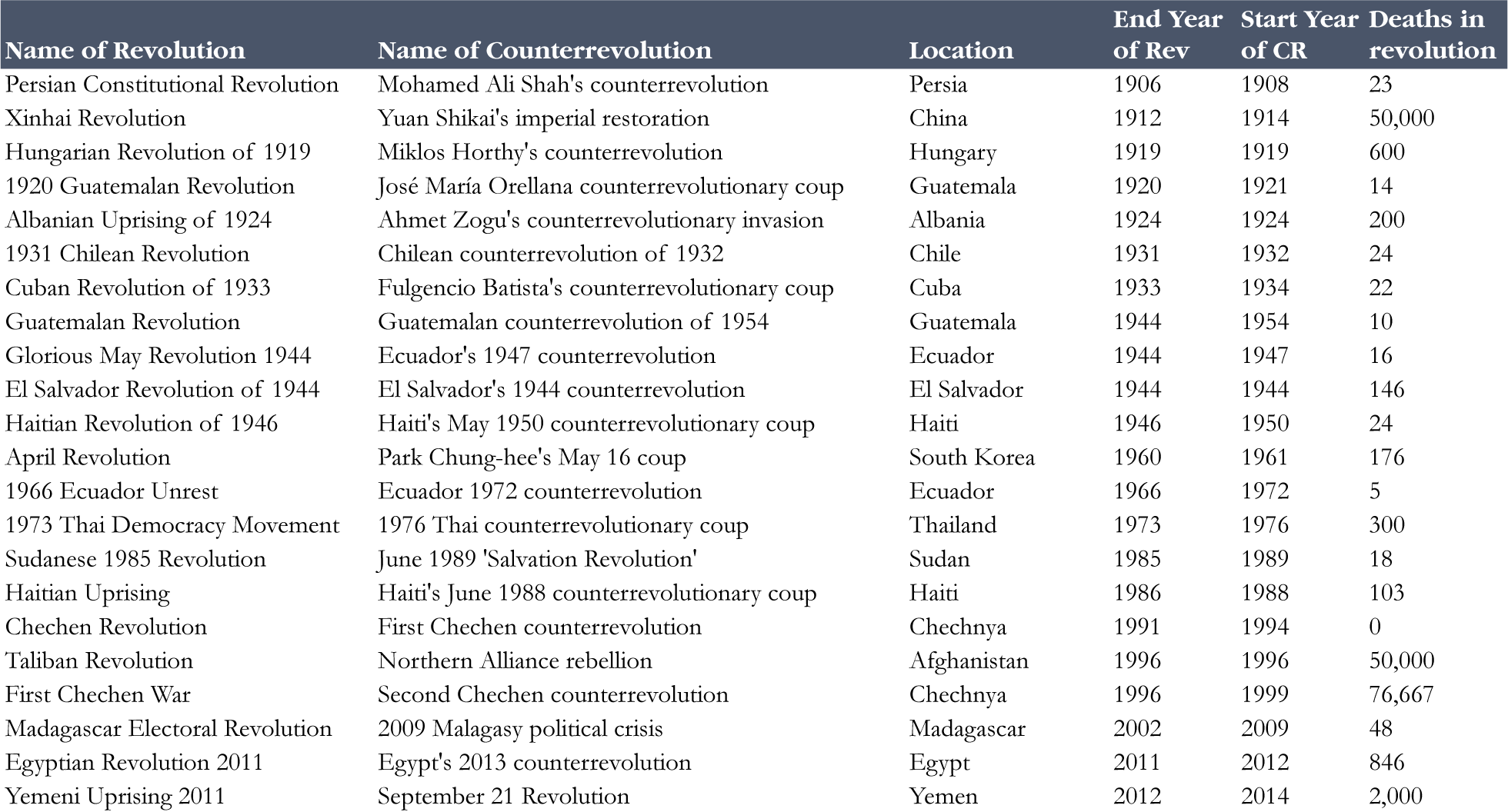
In this table we see some compelling initial evidence that nonviolent revolutions are more likely to succumb to counterrevolutions. Many of the revolutions on the list involved very few deaths. They mostly occurred through unarmed mass mobilization and brought to power governments comprising diverse coalitions that lacked coercive organizations of their own. Counterrevolution then unfolded in a fairly similar way across cases: old regime generals soured on the revolutionary project and took advantage of opportunities created by coalition infighting to stage counterrevolutionary coups. This was the pattern in the handful of early twentieth-century Latin American revolutions on the list. It was also the pattern for the democratic revolutions during the Cold War—in South Korea, Thailand, Sudan, Ecuador, and Haiti. And most recently this pattern has played out following Egypt’s 2011 revolution, when divisions between Islamists and secularists in the revolutionary coalition paved the way for a return of military rule.
Furthermore, we see that the list contains none of the famous twentieth-century revolutions that appear in much of the literature—for example, the violent social revolutions in Russia, China, Vietnam, Cambodia, Algeria, Angola, Cuba, or Nicaragua. We do see a small number of other violent revolutions on the list—the Chechen civil war following Russia’s first counterrevolutionary invasion, the Taliban Revolution, and the Xinhai Revolution in China. But these cases may be the exceptions that prove the rule, as two of them were only overturned because powerful foreign actors decided to intervene militarily (i.e., Russia’s second invasion of Chechnya and the US invasion of Afghanistan). Of course, we can only infer so much from looking at the characteristics of “positive” cases. Therefore, in the next section I use statistical analyses to model the emergence and success of counterrevolution across the full universe of modern revolutions.
Statistical Analyses
Dependent and Independent Variables
The statistical analyses are conducted on a cross-sectional dataset of the 123 successful revolutions that have occurred since 1900.Footnote 5 The dependent variable is a binary measure indicating whether or not that revolution’s regime was overthrown by a counterrevolution (i.e., the aggregate counterrevolution outcome). Then, in order to further explicate the mechanisms connecting revolutionary violence and counterrevolution (i.e., H2 and H3), in subsequent analyses I disaggregate this dependent variable into two parts—a binary measure indicating whether a counterrevolution emerged and a binary measure indicating whether a counterrevolution was successful—and model them in two stages.Footnote 6
To measure revolutionary violence I need variables that capture the extent to which opposition challengers deployed violence during the revolutionary campaign. First, I use the same deaths variable represented in Figure 2: a count of the number of people killed during the revolution (logged). Next, I use a binary variable indicating whether the revolution involved a civil war (sourced from Beissinger’s dataset). Beissinger defines a revolutionary civil war as a revolution involving at least two months of armed combat between an opposition and an incumbent regime (Beissinger Reference Beissinger2022). And, finally, I use a binary measure indicating whether the new revolutionary government had some type of military organization (e.g., a revolutionary army, a rebel militia or guerrilla force, or a paramilitary group). I coded this variable myself while building the counterrevolutions dataset.
These three measures each capture different aspects of revolutionary violence, giving me stronger measurement validity for this variable. Deaths is a rather direct measure of the degree or extent of violence during the revolution. Furthermore, because violence and nonviolence are not binary characteristics, it is helpful to have at least one continuous measure. However, this variable does not distinguish between deaths inflicted by the incumbent and deaths inflicted by revolutionaries, meaning that it does not directly capture the violent actions of revolutionaries themselves. The “civil war” variable is helpful in this respect because it more directly measures the tactical choices of opposition challengers—that is, whether the opposition decides to take up arms and wage sustained combat against the incumbent. And the “revolutionary militia” variable is oriented less toward the nature of the revolutionary process and more toward its institutional outcomes—that is, whether the new revolutionary regime emerges with its own military apparatus.Footnote 7
This latter variable is also the most direct measure of the mechanism at the center of H3, which posited that revolutionary violence reduces the likelihood of counterrevolution because it produces regimes with a loyal armed organization. However, we would also expect the first two variables to capture this mechanism, to a certain degree. A civil war requires challengers to have constructed at least rudimentary levels of military organization, sufficient to sustain armed combat for a minimum of two months (the criteria Beissinger uses in his operationalization). And though autocrats do sometimes inflict large numbers of deaths through one-sided repression, all of the revolutions with truly staggering death numbers (i.e., in the tens or hundreds of thousands) involved reciprocal violence between an organized armed challenger and a state military.
Method
Because my outcome variables are binary, I use logistic regressions to model the occurrence of counterrevolution across the 123 revolutions in the cross-sectional dataset.Footnote 8 Although many studies of regime change use panel datasets of country-years, this setup is not appropriate for an analysis of counterrevolution because, by definition, a counterrevolution cannot occur unless a successful revolution has just transpired. In other words, country-years where no revolution has occurred are not “at risk” of counterrevolution.
There are some analytical challenges with modeling counterrevolution in this way. First, because revolutions are rare events, there are a relatively small number of observations. In datasets with smaller samples, logistic regressions can yield coefficient estimates that are biased away from zero (Rainey and McCaskey Reference Rainey and McCaskey2021). Therefore, I use Firth’s (Reference Firth1993) penalized maximum likelihood estimation strategy, which is often used to adjust for rare events bias but can also reduce the bias from small sample sizes. The second analytical challenge is that some countries experience multiple revolutions. There are 81 countries in the dataset, 31 of which witnessed more than one revolution since 1900. This nested data structure means that we cannot assume independence across all observations; two or more revolutions in the same country are likely to be related in important but unknown ways. To account for this nesting I enter robust standard errors clustered by country.
Evaluating hypotheses 2 and 3 requires that we split the counterrevolution dependent variable into its two parts: counterrevolutionary emergence and counterrevolutionary success. To do this I conduct two sequential logistic regressions, which model these linked outcomes in two stages. First, I model the emergence of counterrevolution across the full sample of 123 revolutions. Then I model counterrevolutionary success on a subsample of only those revolutions that experienced a counterrevolutionary challenge (n = 65).
I also introduce a number of controls, which I lay out and justify more fully in Appendix A3. However, in brief, these controls are included to mitigate two potential threats to inference. The first is that certain characteristics of countries or regimes might make them both prone to higher levels of revolutionary violence and more likely to witness counterrevolutions. Therefore, I control for the following country-level socioeconomic and demographic characteristics: GDP per capita (logged), population (logged), urbanization, ethnic fractionalization, and mountainous terrain (logged). I also control for world-historical time with the end year of the revolution. And I control for features of the former regime that could affect both the extent of revolutionary violence and the likelihood of counterrevolution: the duration the former incumbent was in power and whether the old regime was headed by the military.Footnote 9
Second, I include controls intended to capture a number of alternative explanations for counterrevolution, including those mentioned at the end of the theory section. These controls are especially important because the variables highlighted in these explanations are also often associated with revolutionary violence. For this reason, any results from my measures of revolutionary violence might actually be reflecting the effect of these other aspects of the revolutionary process. I control for international sponsorship using a binary variable, sourced from Casey (Reference Casey2020), denoting whether the new revolutionary regime was sponsored by a major foreign power. I control for a strong party with a binary variable capturing whether the revolution was led by a vanguard political party (sourced from Beissinger’s dataset). And I control for leftist ideology with a binary variable, also from Beissinger, denoting whether the revolution made leftist political demands. Descriptive statistics for all variables can be found in Appendix A2.
Results
Results for the main analysis are depicted in Table 1, which includes three models, one corresponding to each measure of revolutionary violence: the number of deaths in the revolution (logged), the “civil war” binary variable, and the “revolutionary militia” binary variable. The results show that, regardless of how violence is operationalized, it is robustly and negatively associated with counterrevolution. In other words, in line with Hypothesis 1, revolutions in which the opposition resorted to violence are significantly less likely to be overturned by counterrevolutions. There are also some noteworthy results from certain control variables. For example, foreign sponsorship appears to complement revolutionary violence as a major deterrent of counterrevolution. There is also a negative relationship between the end year of the revolution and counterrevolution, indicating a secular decline in rates of counterrevolution over the last twelve decades.
Revolutionary Violence and Counterrevolution (Penalized Logistic Regression)
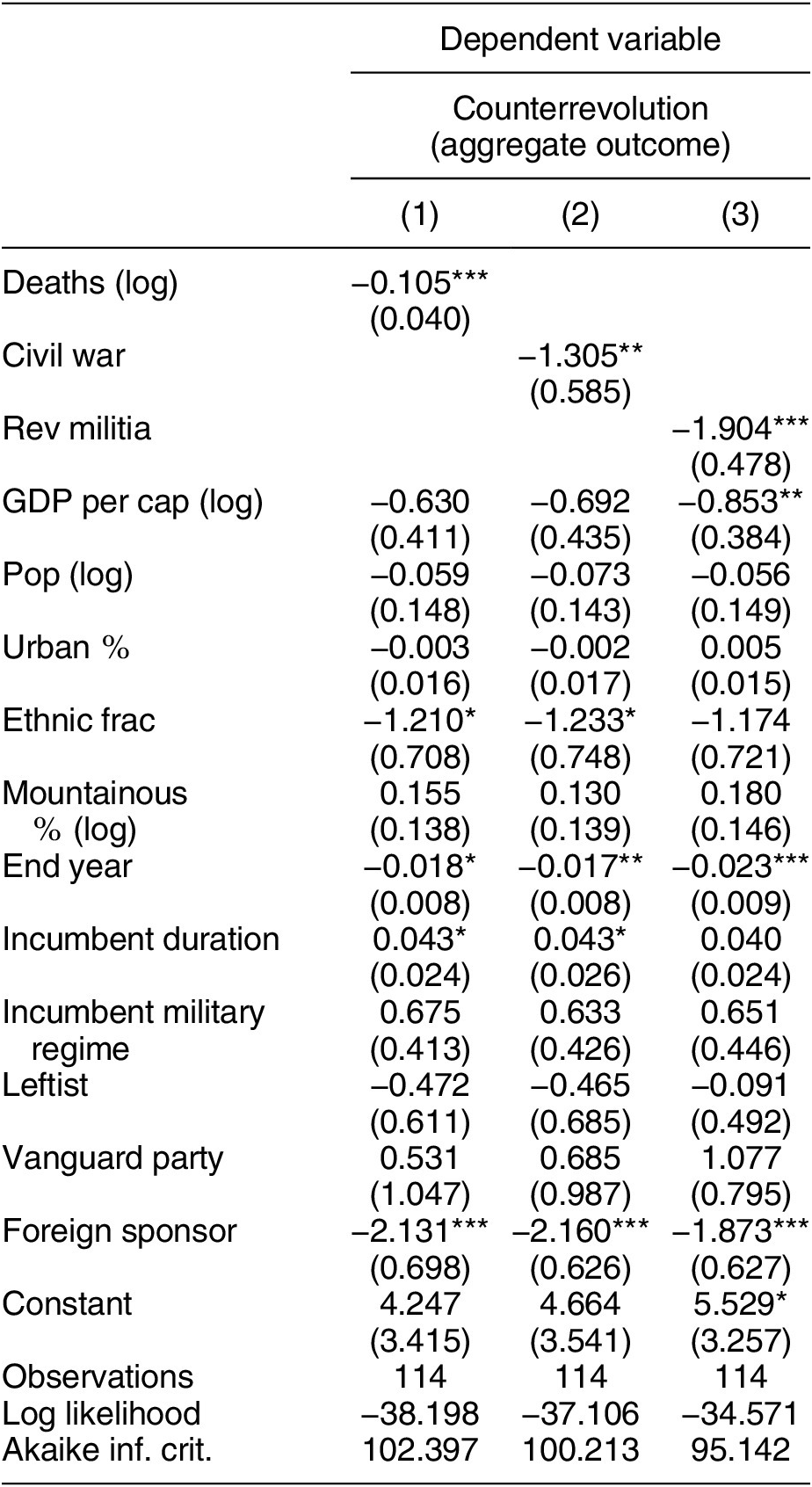
Note: *p < 0.10, **p < 0.05, ***p < 0.01.
Table 2 lays out models that split the dependent variable into two parts—counterrevolutionary emergence and counterrevolutionary success—which helps us to understand why revolutionary violence is negatively associated with counterrevolution (i.e., H2 and H3). The first three models analyze whether a counterrevolution emerges, and the second three models analyze whether a counterrevolution succeeds, conditional on one having emerged. Again, we see consistent results regardless of how we operationalize violence. Revolutionary violence has no significant relationship with the emergence of counterrevolution. These results provide little support for either H2a or H2b (though the fact that the coefficients are negative, even if not statistically significant at normal levels, provides slightly more support for H2b). Instead, we see that the negative relationship between revolutionary violence and counterrevolution is due primarily to a superior ability to weather counterrevolutionary challenges when they emerge (H3).
Revolutionary Violence and Counterrevolutionary Emergence/Success (Penalized Logistic Regression)
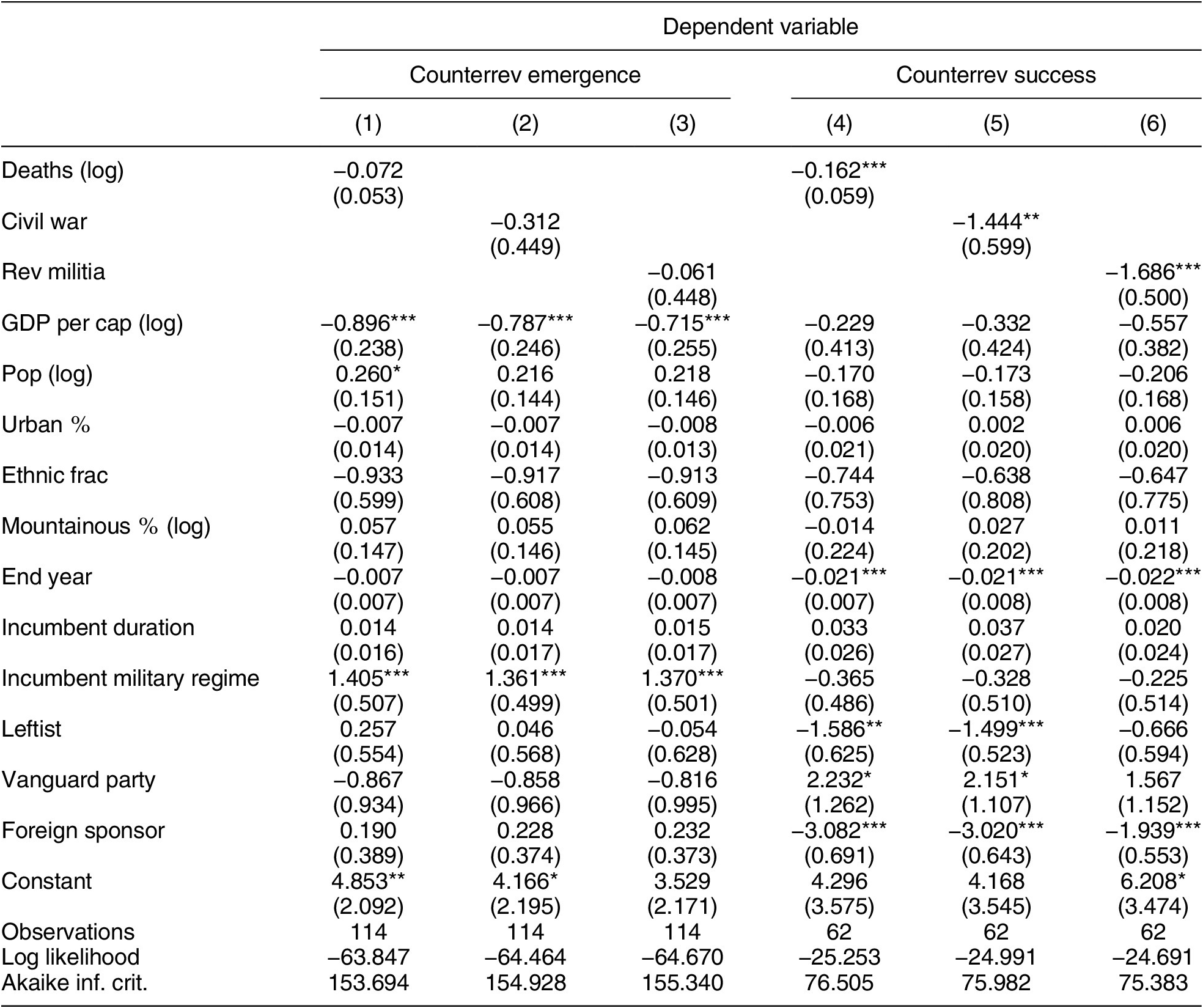
Note:*p < 0.10, **p < 0.05, ***p < 0.01.
Contingency Table of Revolutionary Violence and Counterrevolution
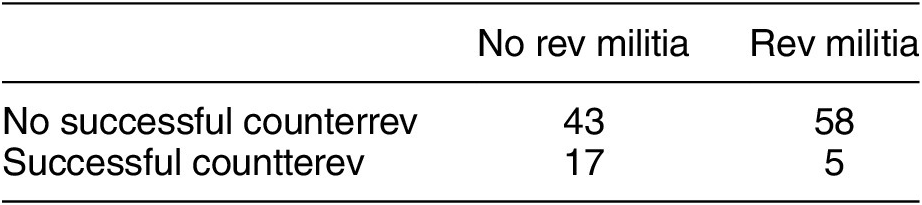
Note: Consistency: 0.92; Coverage: 0.57.
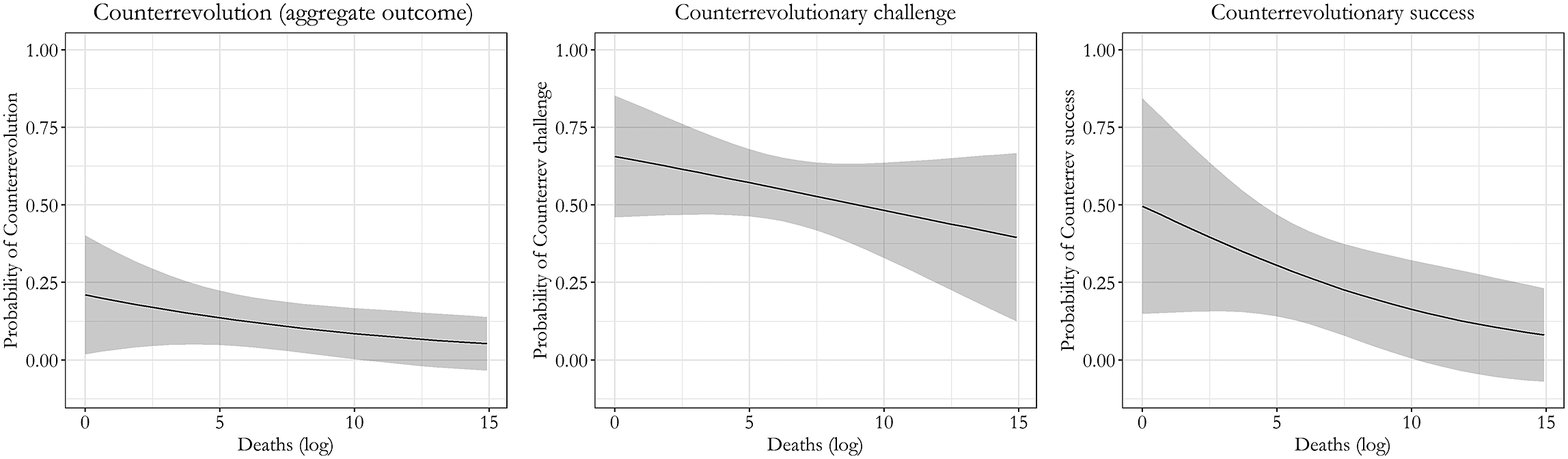
Figure 3 plots the marginal effect of deaths on each of the three outcomes. We see that the probability of a counterrevolution following revolutions involving very few deaths is about 20%, whereas in revolutions where hundreds of thousands of people die the probability of counterrevolution falls to 8% or lower. Furthermore, when we look at the two disaggregated outcomes, we see clearly that though the relationship with counterrevolutionary challenges is negative there is a much stronger relationship with counterrevolutionary success. The probability of a counterrevolution succeeding is about 10% following very violent revolutions, whereas it approaches 50% following nonviolent revolutions.
Marginal Effect of Deaths on Likelihood of Counterrevolution
We see similar patterns in Figure 4, which plots the marginal effects of the two binary variables. The probability of a counterrevolution is 16% lower following revolutions that devolve into civil wars. But a civil war only slightly lowers the probability of a counterrevolution emerging (6% lower), whereas it lowers the probability of counterrevolutionary success by 23%. We see an even stronger relationship with the measure capturing whether the new regime has its own military organization. Counterrevolutions are 22% less likely under these regimes and, again, the relationship stems primarily from the way in which these armies lower the likelihood of counterrevolutionary success (26% lower) rather than emergence (1% lower).
Marginal Effect of a Revolutionary Militia and Civil War on Likelihood of Counterrevolution

Overall, these findings support the idea that revolutions in which challengers take up arms and deploy violence yield regimes that are less likely to be overturned by counterrevolutions. Moreover, the analyses shed light on the mechanism through which these outcomes are related. Violent revolutions tend to survive because they yield regimes with the tools to put down counterrevolutionary challenges when they emerge. However, violence does not seem to affect the likelihood of counterrevolution emerging in the first place—either because of the desperation it instills in potential counterrevolutionaries or because of the damage it inflicts on their coercive might. Without further analysis it is difficult to know what is behind this null result. One possibility is that violence simply does not have much bearing on counterrevolutionaries’ decision to launch a challenge or not. Another, and perhaps more likely, possibility is that the causal processes captured by H2a and H2b are both at work—and thus cancel each other out. In other words, violent revolutions might leave old regime forces with few coercive resources but more incentive to launch a challenge. Conversely, nonviolent revolutions leave more of the old regime intact but give their agents less reason to attempt a risky counterrevolutionary gambit. With these two dynamics pulling in opposite directions, we might see little relationship in statistical analyses between revolutionary violence and the emergence of counterrevolution.
Although these statistical findings are striking in their strength and consistency, there are obvious limitations to the inferences we can draw from observational analyses of a relatively small cross-sectional dataset. The two biggest issues are the deeply endogenous nature of the causal process we are trying to understand and the small number of observations. On endogeneity, the main issue is that the factors that push a revolutionary movement down a violent versus nonviolent path may also shape the likelihood of counterrevolution. Although I have tried to identify and control for some of the most obvious variables that could be related to both outcomes, there may be other confounding variables that I could not account for. One point that should give readers some reassurance: many of the variables that would seem to affect both revolutionary violence and counterrevolution are most likely to affect counterrevolutionary emergence because they shape the capacities of old regime elites (e.g., mountainous terrain) or their interests in returning to power (e.g., former regime type). The fact that I find a strong relationship between violence and counterrevolutionary success, but not emergence, should give readers some confidence that an unobserved confounder is not biasing the findings.
As for issues of sample size, beyond the concern that estimates may be biased upward (and thus the need to use a penalized logistic regression), there are two additional concerns: one is that the models are overfitted (given the ratio of predictors to observations), and the second is that results may be driven by certain especially high-leverage observations. Therefore, in Appendix A5 I show that results are robust to different combinations of controls and to the removal of the highest-leverage observations. However, a more fundamental critique might be that such a small dataset requires an entirely different analytical setup—that is, a set-theoretic approach that examines whether violence/nonviolence are necessary or sufficient conditions for counterrevolution. In the next section, I show that the findings above are robust to this alternative approach.
Set-Theoretic Analysis
An alternative to statistical modeling for datasets with relatively small sample sizes is the use of Boolean set theory. The logic of this approach is different from that of statistical analysis. Whereas, statistical modeling is directed at identifying probabilistic relationships, Boolean approaches are directed at finding necessary or sufficient relationships between conditions (Goertz and Mahoney Reference Goertz and Mahoney2012; Ragin Reference Ragin1987).
Here I show partial results from a set-theoretic evaluation of my hypotheses about revolutionary violence and counterrevolution. Though more complex Boolean analyses involve examining multiple causal pathways with different combinations of conditions, I am concerned with a single independent variable—revolutionary violence—and so conduct only a simple analysis of how this condition is related to counterrevolution. The clearest way to show set-theoretic relationships between two variables is with 2 × 2 contingency tables that represent distributions in cases according to a causal condition (for our purposes, revolutionary violence) and an outcome condition (counterrevolution). In Table 3 I show the relationship between one of my violence measures (the revolutionary militia variable) and the aggregate counterrevolution outcome. The rest of the tables, using the other violence measures and the disaggregated counterrevolution outcomes, can be found in Appendix A6. For each table, I also calculate the consistency and coverage scores, which are useful for specifying necessity and sufficiency.
The table and resulting consistency and coverage scores tell a clear story, which is in line with the statistical analyses above. There are only five counterrevolutions that topple revolutionary regimes with their own coercive organizations and 17 that topple those lacking a revolutionary army. The consistency score of 0.92 further suggests that nonviolence is a virtually necessary condition for a successful counterrevolution and that revolutionary violence is a nearly sufficient condition for no counterrevolution. Moreover, when we produce the same tables using the disaggregated counterrevolution outcomes (which appear in Appendix A6), we find that there is no relationship of necessity or sufficiency between revolutionary violence and counterrevolutionary emergence (consistent with the null results in the statistical analyses) but a strong relationship with success. Overall, then, the findings from both statistical and set-theoretic analyses point in the same direction: when revolutionaries come to power through violent resistance it is virtually impossible for the old regime to return through counterrevolution.
Revolution in Cuba: 1933 versus 1959
In this final empirical section, I use qualitative evidence from two carefully paired cases to trace the mechanisms behind the relationships identified above, which can be a good way to establish causality in observational studies (Goertz Reference Goertz2017; Seawright Reference Seawright2016). Specifically, I compare Cuba’s 1933 revolution, a nonviolent revolution that was toppled by a counterrevolution, and its 1959 revolution, a violent revolution that successfully survived multiple counterrevolutionary threats. These cases offer a fairly unique opportunity for a “most-similar-systems” paired comparison. Normally with this design one would compare two similar countries with different trajectories or outcomes (Lijphart Reference Lijphart1975). But these comparisons still have to contend with the fact that even very similar countries usually have a host of differences in their cultures, demographics, political economies, etc. With these two revolutions I am able to compare two episodes from within the very same country that occurred within relatively close temporal proximity, therefore mitigating some (but not all) of the “degrees of freedom” problem that can be an issue with the comparative method. In other words, I am able to focus on differences between the revolutions themselves, bracketing other background or underlying variables like culture or economy. Nevertheless, as with all paired comparisons, the power of the inferences and the strength of the analysis comes from the combination of comparing like cases and tracing causal processes within these cases (Falleti and Mahoney Reference Falleti and Mahoney2015; Slater and Ziblatt Reference Slater and Ziblatt2013), with the latter helping to adjudicate between rival explanations that cannot be eliminated through the structure of the comparison.
The Cuban Uprising of 1933
By far the lesser-known of Cuba’s two twentieth-century revolutions, the uprising of 1933 toppled the dictatorship of President Gerardo Machado and ushered in a left-leaning government that was overthrown in a counterrevolutionary coup after only one hundred days in office (earning it the name “El Gobierno de los Cien Días”).Footnote 10 Though Machado had been genuinely elected in 1924, his decision to remain in power for a second term through a fake election in 1928 triggered broad-based opposition. The coalition that ultimately ousted him in 1933 was accordingly quite diverse, comprising student movements, labor groups, opposition political parties, and underground secret societies (del Aguila and Mora Reference del Aguila, Mora, Wiarda and Kline2014, 341). Though in the two years prior to the uprising several of these groups had attempted to undermine the regime with sporadic acts of violence, like terrorism and assassinations (Aguilar Reference Aguilar1972, 124–7), the uprising itself was almost entirely nonviolent. The campaign was set off on July 25, 1933, by a bus drivers’ strike, which escalated into a general strike and prompted opposition groups to organize demonstrations. When Machado’s police opened fire and killed 20 of these demonstrators, the strikes and protests escalated further. At their peak, the demonstrations in Havana garnered more than ten thousand participants (Whitney Reference Whitney2017, 100). The uprising also triggered a revolt of junior officers within the military, led by the charismatic sergeant Fulgencio Batista. These officers expressed support for the opposition while also pressing an agenda of military reform that included pushing out corrupt senior officers close to Machado. Eventually, the US ambassador also urged Machado to resign, and he fled Cuba on August 12, 1933.
Almost as soon as Machado departed, the revolutionary coalition fractured. Moderates wanted the new president to be former ambassador Carlos Manuel de Céspedes, who was also the preferred candidate of the United States. But a leftist faction of students, organized in the University Students Directorate, balked at Céspedes and formed an alliance with the junior officers, who had rapidly taken over control of the military. Together, they forced the appointment of a more radical revolutionary government, headed by the university professor Ramón Grau. This government secured support, on the left, from students, laborers, and Communists and, on the right, from Batista and the military. But it was immediately opposed by those moderate revolutionary groups that had supported the stillborn Céspedes government; they even launched a rebellion in November 1933 trying to bring it down (Aguilar Reference Aguilar1972, 193–7; Whitney Reference Whitney2017, 108). The government itself was also plagued by factionalism, with Grau caught in between the increasingly radical students, led by the 27-year-old Antonio Guiteras and the more conservative military officers.
The revolutionary government was, in this sense, based on the type of uneasy alliance between civilians and officers that is common following nonviolent revolutions. As with many of these revolutions, the 1933 uprising achieved its success when a faction within the military turned on the incumbent and sided with the revolution. The military apparatus, which had been greatly expanded by Machado, was therefore left almost entirely intact (Pérez Reference Pérez1974; Whitney Reference Whitney2017). The biggest change was the elevation of a new crop of formerly junior officers and the emergence of Batista as the army chief. But Batista did not restructure the army; instead, he simply appointed loyalists to critical positions and weakened or retired officers who had been close to Machado. According to the Havana Post, after the revolution the military under Batista stood as the “only organized force on the island” (Whitney Reference Whitney2017, 106). With Batista’s control over Machado’s military firmly secured, the students and Grau, who had no armed organization of their own, had little leverage to push for reforms. Moreover, at several points they were forced to call on the army to put down various challenges to their rule (like the November rebellion). Both sides recognized this power imbalance. Batista began contemplating a coup almost as soon as the government was formed and was kept in check only by the fact that the students were initially popular and still retained their ability to mobilize large numbers in strikes and protests. For his part, Guiteras saw Batista as a clear counterrevolutionary threat, and in November he “began to forge an armed instrument which could counterbalance or paralyze Batista’s” (Aguilar Reference Aguilar1972, 216).
But Guiteras’ efforts were far too little, too late. By January, the revolutionary government had grown deeply unpopular, in part because its fractiousness had rendered it unable to deal with a host of governance challenges. Many groups that had supported the government at first, including students, laborers, and the Communist Party, were now mobilizing against it. Batista, for his part, had been quietly cultivating the support of the moderate members of the original revolutionary coalition, as well as the United States. On January 14, he called on Grau to resign. Grau left the country, but Guiteras tried to fight back, rallying some elements of the navy that were loyal to him and attempting to launch a general strike (Aguilar Reference Aguilar1972, 227). But the efforts came to nothing, and Batista quickly installed a puppet president from the moderate opposition and consolidated his rule.
The Cuban Revolution of 1959
Twenty-two years later, Fulgencio Batista would find himself facing a revolutionary movement that looked very different from the one he had ousted in 1934. Cuba’s revolution of 1959, which toppled Batista following a two-year armed insurgency, is far better known than the earlier 1933 uprising.Footnote 11 Indeed, the story of a band of motley guerrillas sneaking ashore from the small vessel, the Granma, and hiding out in the mountains as they built up their rebel army has reached the status of political legend, both in Cuba and beyond.
The story is a classic David and Goliath tale, with the Cuban rebels vastly outnumbered by a military apparatus numbering 30,000. The campaign initially began as a coalition of opposition groups, committed to a variety of modes of resistance, both violent and nonviolent. However, the advocates of violent resistance eventually won out, as the moderate opposition tried and failed to negotiate with Batista (Sweig Reference Sweig2009, 6–7). This violent resistance took two forms: an underground urban insurgency and the rural rebellion headed by Fidel Castro. It was only in April 1958, when the urban insurgency was crushed, that Castro ultimately consolidated his hold on the opposition movement, with his Rebel Army as the main remaining fighting force (Sweig Reference Sweig2009, 148–53). Though it comprised less than 1,000 fighters, these rebel forces were able to secure a number of critical victories in the second half of 1958, in large part because Batista’s army, though large, had grown hopelessly corrupt and unprofessional, with mass desertions during the campaign. In contrast, when Batista finally fled in early 1959, Castro was able to march on Havana at the head of a Rebel Army whose members, though still relatively few in number (several thousand at most), had been hardened by months of rural insurgency and were exceedingly loyal to him.
The revolutionary government initially included a variety of groups that had opposed Batista, including liberals and social democrats. But over the course of 1959, Castro narrowed this ruling coalition to his core supporters. Fully three-quarters of cabinet members were replaced during that first year, and control became centralized in Castro’s 26th of July Movement and the newly formed Revolutionary Armed Forces. Indeed, in many ways Castro set about rebuilding the Cuban state with this Revolutionary Army at its core; he dismantled and integrated rival revolutionary militias and appointed former guerrillas to head many state institutions (Eckstein Reference Eckstein2004, 28; Pérez-Stable Reference Pérez-Stable1999, 78). These transformations institutionalized a system in which the military would furnish most of the country’s state officials; indeed, even years after the revolution most top government leaders were Castro’s comrades from the earliest days of the rebellion (Dominguez Reference Dominguez2009, 341–78). Castro also vastly expanded the size of the new armed forces through recruitment and increased military spending. Whereas before the revolution the Cuban army had numbered approximately 30,000, with military spending of 2.3% of GDP, by the early 1960s the Revolutionary Army had peaked at 300,000 and military spending had reached 7.6% of GDP (Dominguez Reference Dominguez2009, 346–8).
At the same time that Castro was vastly expanding his new regime’s military apparatus, he was systematically dismantling whatever was left of Batista’s army. The revolution had already seriously depleted the army, with many rank-and-file soldiers having laid down their arms and large amounts of equipment having been confiscated by the Rebel Army. Castro then took apart whatever elements remained, including by jailing senior officers and trying them in revolutionary courts. Despite these systematic purges, some members of Batista’s army and police forces did manage to flee abroad, or they escaped Havana and went into hiding in the country’s interior, where they began organizing a variety of counterrevolutionary plots.
The best-known counterrevolutionary campaign following the 1959 revolution is the US-backed Bay of Pigs Invasion in April 1961. However, Castro’s regime also faced at least two smaller counterrevolutions. On August 14, 1959, the Cuban government announced it had arrested a plane load of counterrevolutionaries, who had been armed and organized by the Dominican Republic. There was also a domestic counterrevolutionary insurgency centered in the Escambray Mountains in central Cuba, which drew from former members of Batista’s security forces, local bandits, and peasants opposed to the regime’s rural reforms (Brown Reference Brown2017). In all of these instances, the counterrevolutionaries proved no match for Castro’s burgeoning revolutionary army. Even with their American training and equipment, the invasion force of 1,400 Cuban exiles that landed at the Bay of Pigs was totally overwhelmed by the new regime’s air force, tanks, and hundreds-thousand-strong militias (Welch Reference Welch2017, 64–78). The whole affair was over in less than 72 hours. Likewise, although the counterrevolutionaries in the Escambray mountains engaged in low-scale acts of banditry, sabotage, and harassment for several years, by the mid-1960s their rebellion had been stamped out.
Discussion and Alternative Explanations
These brief case studies of two revolutions within the same country have elucidated some of the mechanisms by which violent revolution produces regimes that are more resistant to counterrevolutionary threats. Specifically, they have pointed to the importance of coercive capacities in defeating counterrevolutionary challenges. In 1933 we saw that the revolution’s predominantly nonviolent modes of resistance effectively drew in a wide array of participants. But this diverse coalition struggled to govern and, without a coercive apparatus of its own, its members had no way to fend off the old regime’s military once their popularity waned. These dynamics contrast markedly with those following the 1959 revolution. By the end of that revolution, the broad coalition that had initially opposed Batista had been consolidated under the leadership of Castro and his hardened Rebel Army. Once coming to power, Castro constructed his regime around this military organization and used it to effectively fend off multiple counterrevolutionary challenges.
The cases also help us to make sense of why we saw no strong relationship in the statistical analyses between violence and counterrevolution emergence. Both of these Cuban revolutions experienced counterrevolutionary attempts—but for somewhat different reasons. In 1933, counterrevolution was made far easier by the fact that Batista led a military that had escaped the revolution largely unscathed. In contrast, following the 1959 revolution the old regime’s army was destroyed, but that did not stop multiple counterrevolutions from emerging, as desperation and fear prompted various old regime remnants to try fruitlessly to return to office.
Finally, it is worth briefly reflecting on some alternative explanations. Of course, as with any complex political outcome, multiple causal factors likely contributed. As noted earlier in the paper, I certainly do not claim that violence is the only variable that shapes counterrevolutionary outcomes—in general or in these cases. Nevertheless, we can rule out several alternative explanations in these cases. One possibility is that learnings from the first revolutionary experience may have helped revolutionaries the second time around to weather the storms of counterrevolution. But, if anything, we would likely expect learning to affect the outcomes in the opposite direction. Indeed, the main repeat player in these two cases was Batista; neither Castro nor any other core leaders in the 26th of July Movement were involved in the 1933 revolution. Having already led one successful counterrevolution, we would expect political learning to have helped Batista in organizing a second one, but in fact we see the opposite.
At several points in this paper, I have noted that international support is an often-cited alternative explanation for counterrevolution. To some extent, these cases provide support for this thesis: the US did provide tacit support for Batista’s coup in 1934, and at least two of the counterrevolutions following the 1959 revolution would likely never have occurred had it not been for foreign backing. But international support is less helpful in explaining why the Castro regime was able to defeat counterrevolution after 1959. Here, the timing of the causal process observations do not line up; the Castro regime did form a strong alliance with the Soviet Union, but this alliance mostly took shape after and in response to the failed Bay of Pigs invasion in 1961 (Pérez-Stable Reference Pérez-Stable1999, 79–80). Similarly, the construction of a strong governing party—another potential alternative explanation—mostly occurred after the failed counterrevolutions. Moreover, this party was built on and closely linked to the preexisting military organization (Dominguez Reference Dominguez2009, 364–72; Eckstein Reference Eckstein2004, 19–21). Ultimately, then, the military strength built up through the violent revolutionary process of 1956–1958 is the best explanation for the failed counterrevolutions after 1959 versus the successful one after 1933.
Conclusion
This study has shown that, though nonviolence may be superior to violence when it comes to bringing down incumbents, it may be less effective in guaranteeing that autocratic figures never return. Through statistical analyses and using three different operationalizations of violence, we found a strong and robust negative relationship between revolutionary violence and counterrevolution. These statistical models also revealed that violence diminishes the probability of counterrevolution primarily because it gives revolutionary governments the coercive tools to defeat bottom-up threats. These logics have been further supported by set-theoretic analyses, which revealed that nonviolence is a virtually necessary condition for counterrevolutionary success. And through comparison of two back-to-back revolutions in Cuba, we learned about the mechanisms behind these relationships: that when revolutionaries come to power through a nonviolent uprising they are left almost entirely exposed to the whims of the old regime’s military, whereas when they have waged violent rebellion they can construct their new regime around a loyal and organizationally robust military apparatus.
The study points to a number of promising avenues for future research. As noted above, the scholarship on counterrevolution is small (though growing), and I hope that this paper will spark further interest in studying counterrevolutionary politics—both restorative counterrevolutions, which have been the focus of this paper, and other manifestations of counterrevolution.
In terms of specific questions that future research will have to answer, we were only able to speculate about the reasons behind the weak relationship connecting revolutionary violence to counterrevolutionary emergence: that the effects of heightened desperation may be offset by those of diminished coercive capacities. These dynamics require further examination. A second question that remains unanswered is why, despite being more susceptible to counterrevolution, many nonviolent revolutions still manage to survive. Though it is true that most of the cases of counterrevolution in Figure 2 are nonviolent revolutions, there are more than twice as many comparable revolutions that were not rolled back. Though some of these nascent regimes faltered in other ways—for example, backsliding into some form of autocracy—others did go on to consolidate democratic rule. What are the strategies by which these weak revolutionary governments managed to withstand counterrevolutionary threats and establish durable democracy? Current literature on democratic transitions argues that new leaders can avoid autocratic reversions by placating former dictators and demobilizing quickly. But if this paper’s findings are true, and counterrevolution is more the product of opportunity than threat, then this advice may be ill-suited to democratic revolutionaries. Instead, the best hopes of survival for these governments may be to preserve their leverage over the old regime at all costs by maintaining their ability to return to mass mobilization when threats to their rule emerge.
Finally, this paper raises a pressing set of normative questions about the strategies that are most effective for opposing autocratic rule. On the one hand, as existing literature argues, nonviolent revolutions tend to be more successful at ousting autocrats and they are also more likely to install liberal, democratic regimes. But ultimately these gains may not be particularly meaningful if the same autocratic forces are quickly able to return to power. In contrast, when violent revolutions succeed they generally send these autocrats packing for good. This creates the potential for more lasting and transformational political change, though it often also results in the reimposition of dictatorship under new, revolutionary garb.
SUPPLEMENTARY MATERIALS
To view supplementary material for this article, please visit http://doi.org/10.1017/S0003055422001174.
DATA AVAILABILITY STATEMENT
Research documentation and data that support the findings of this study are openly available at the American Political Science Review Dataverse: https://doi.org/10.7910/DVN/TA1T4V.
ACKNOWLEDGMENTS
For helpful feedback on earlier versions of this manuscript I thank: Mark Beissinger, Jason Brownlee, Erica Chenoweth, Adria Lawrence, Elizabeth Nugent, Megan Stewart, Cary Aileen García Yero, and members of the Harvard Weatherhead Center’s Political Violence Workshop and the Harvard Weatherhead Scholars Program Seminar Series.
FUNDING STATEMENT
This research was supported by a Political Science Doctoral Dissertation Research Improvement Grant from the National Science Foundation [AWD1005800] and the Social Science Research Council’s International Dissertation Research Fellowship, with funds provided by the Andrew W. Mellon Foundation.
CONFLICT OF INTEREST
The author declares no ethical issues or conflicts of interest in this research.
ETHICAL STANDARDS
The author affirms this research did not involve human subjects.


 Open access


Comments
No Comments have been published for this article.