




On 7 December 1944, exactly three years after the bombing of Pearl Harbor, representatives from fifty-two countries signed the Chicago Convention on International Civil Aviation. The supranational agreement, with its pledge to ‘create and preserve friendship and understanding among the nations and peoples of the world’, underpinned what would become the post-Second World War tourism industry and built the global airport network that exists today.Footnote 1 Yet the signing of the document also intersected with a critical historical juncture. By the end of 1944, it was clear that the United States and its allies would be victorious and that they would determine the post-war order, as confirmed by the Yalta and Potsdam conferences of 1945. Moreover, global safety and security – that is, avoiding a Third World War at all costs – would hinge upon supranational cooperation through initiatives such as the Chicago Convention, the United Nations and NATO.
Turkey was undeniably in a precarious position when it signed the Chicago Convention. While it had managed to escape the physical destruction of the Second World War, remaining neutral until February 1945, when it joined the Allies in anticipation of their victory, Turkey had suffered economically and was in dire need of the trade and tourism that the agreement would bring.Footnote 2 Furthermore, as the USSR gradually transitioned from friend to foe between 1945 and 1947, Turkey was increasingly coming under geopolitical threat. Spanning Europe and Asia and sharing a border with the Soviet Union (through Georgia and Armenia) and other communist bloc satellite countries (Bulgaria and arguably Romania across the Black Sea), it was geographically adjacent to the Iron Curtain, but politically aligned with the West. Consequently, it could also benefit from the mutual security that accompanied the Chicago Convention. However, when Turkey signed the agreement, it lacked civilian airports and the finances, expertise and logistics to build them. Thus it could not realistically participate in a programme designed to promote civil aviation without outside assistance.Footnote 3
The United States immediately recognized this impasse and in April 1946 sent advisers from the Civil Aeronautics Administration (CAA) to assess the situation in Turkey. American involvement increased dramatically in March 1947, when President Harry Truman voiced his concerns over the encroaching sovietization of Eastern Europe and the perilous positions of Greece and Turkey. Fearing the spread of communism through the ‘domino theory’, or ‘the idea that if one nation fell to communism and aligned itself with the Soviet Union, then all nations surrounding it would, like dominos, follow’, he proposed its containment via $400 million ($5.5 billion in 2024 terms) in funding for the two countries.Footnote 4 Between 1948 and 1953, the United States augmented this support through the Marshall Plan, distributing $13 billion ($170 billion in 2024 terms) to sixteen European countries to rebuild their economies and infrastructures based on the American capitalist model. Such aid guaranteed US firms new trading partners, markets and business opportunities and strengthened political ties between the United States and Europe. Moreover, it facilitated US soft- and hard-power involvement in the region by opening channels for organizations such as NATO and the UN, and Americanization through engineering and technology transfer.Footnote 5
With the economic and political support of the United States, Turkey was now in a position to construct international civilian airports, and in July 1947 signed contracts with the Westinghouse Electric International Company and the J.G. White Engineering Corporation for the construction of Istanbul's Yeşilköy Airport (renamed Atatürk Airport in 1985). As this article will argue, the building of Yeşilköy (1949–53), through a partnership with two American engineering firms, is essentially an early Cold War narrative of transnational exchange involving the multidirectional flow of technical knowledge, expertise and resources between the United States and Turkey; the circulation of geopolitically significant (and frequently competing) military, civilian and government actors; and the local and global implications of these transmissions. Yet the Yeşilköy construction narrative also illustrates how post-war technology transfer was a highly political process of constant adaptation, modification and negotiation. Fraught with unforeseen friction and thorny challenges, Yeşilköy exemplifies the complicated American Cold War strategy of creating and maintaining alliances through engineering knowledge, personnel and practices, often with unintended consequences.
Thus, as a case study, Yeşilköy opens a new window into the cautious science diplomacy that occurred along the Iron Curtain, thereby complementing and expanding the work of scholars such as John Krige and Sönke Kunkel, among others, while filling a notable historiographic gap with respect to aviation in early Cold War Turkey.Footnote 6 In recent years, historians have become far more critical of ‘highly optimistic’ characterizations of science diplomacy. Sönke Kunkel has called for an examination of the ‘motives, contexts, and experiences which shaped the ideas and practices of science diplomacy over the course of the twentieth century’, specifically during the Cold War, when countries like the United States deployed ‘science diplomacy not only as a crucial asset to rebalance diplomatic relationships but also as a way to extend specific norms, ideas, interests, and technologies’ into the industrialized and industrializing worlds.Footnote 7 As John Krige has illustrated, the United States deployed this strategy in Europe, especially along the vulnerable edges of the Iron Curtain (e.g. Turkey), using its scientific and technological prowess to integrate the continent into its sphere of influence and shape and control its development in opposition to sovietization.Footnote 8
This article will also build upon the research of Aashique Ahmed Iqbal, whose recent examination of aviation diplomacy in India has revealed the possibilities, and limitations, of science diplomacy in industrializing countries and in non-Western contexts.Footnote 9 According to Iqbal, aviation technology played a significant role in implementing science diplomacy during the first half of the twentieth century.Footnote 10 This was certainly the case with Turkey, which saw the acquisition of such Western technologies as a pathway towards social and economic development and its own geopolitical and international influence. Thus, in the aftermath of the Second World War, Turkey welcomed foreign investment and collaboration, particularly from and with the United States, a very willing partner that could ensure the mutual benefit of both nations through investment in large infrastructure projects. However, as Krige and Burçak Keskin-Kozat have also articulated, this flow or circulation of technical information was not always smooth.Footnote 11 Occasionally, there were resistance, challenges and even competition from both Turkish and American actors regarding technology transfer and the movement of knowledge, expertise and experts across borders during the Cold War.
Constructing Yeşilköy
Turkey attended the International Civil Aviation Conference in Chicago with a nine-person delegation: Şükrü Koçak, president of the Turkish Aeronautical League (who chaired the group); Orhan H. Erol, from the Turkish embassy in Washington, DC; Ferruh Şahinbaş, director of the Turkish State Airlines; Hikmet Belbez, a law professor from Ankara University; and five technical advisers.Footnote 12 When they signed the Chicago Convention at the end of the conference, Turkey pledged to abide by ninety-six articles that would govern global civil aviation, which gained official status thirty days after twenty-six nations had ratified it and deposited their documents with the US State Department.Footnote 13 On 5 June 1945, Turkey became the second country to ratify the Convention. On 12 June 1945, the Turkish Grand National Assembly (TGNA) voted the convention into law (No. 4749), and the State Department confirmed the deposit of their ratification documents on 20 December 1945.Footnote 14
At the time of the Conference, Turkey had international aerodromes in Istanbul (Yeşilköy), Ankara and Adana. However, with the war came rapid advances in aviation, including the development of different types of wide-body jet and heavy cargo planes that required larger airports, longer and more durable runways and new navigation and communication equipment. By the end of 1945, Turkey's aerodromes were unsalvageable and unusable for international civil aviation. Renovating them would not be cost-effective; building new airports, from the ground up, would.Footnote 15 Consequently, on 8 February 1946, the TGNA passed Law No. 4860, granting the Ministry of Communications the authority to enter into contracts of up to 15 million Turkish liras (TL) to construct airports over a five-year period. When global inflation and the devaluation of the TL rendered this amount insufficient, on 12 June 1947, Law No. 5076 raised it to 43 million TL.Footnote 16
During the interwar years, the United States added science diplomacy, or what Nina Fedoroff has defined as ‘the use of scientific collaborations among nations to address common problems and to build constructive international partnerships’, to its foreign-policy toolbox as a way for policymakers to approach issues of hemispheric concern.Footnote 17 In the post-war era, science diplomacy became a means of mediating global conflict and consolidating power as a bulwark against the dual threats of communism and fascism.Footnote 18 After all, it professed liberal democratic values such as openness, cooperation and humanitarian progress for the greater good, which, as Waqar Zaidi, Adom Getachew and others have argued, complemented the internationalism and emphasis on supranational organizations that emerged during this period.Footnote 19 Consequently, the ideals of the international scientific community also enabled the United States to project geopolitical power globally, particularly during the Cold War. This manifested in various forms: the exchange of scientists, engineers and their knowledge; international meetings and conferences for socialization and technical dialogue; and multilateral, transnational projects involving military, civilian and corporate concerns, most of which – like Yeşilköy – involved the transfer of American goods, services and technology.
Correspondence between Westinghouse and the Turkish government regarding airport construction began shortly after the Chicago delegation returned to Turkey, with the US State Department serving as an intermediary. As expressed in a letter dated 27 July 1945, from C.B. Myhre of Westinghouse to W. Stokeley Morgan, chief of the Aviation Division at the Department of State, in a period of six months, Westinghouse had already prepared detailed proposals for Yeşilköy, ‘consisting of two (2) books involving parts I, II and III’.Footnote 20 The State Department conveyed the reports to the Turkish authorities, followed by a suggestion from the US Foreign Office: the dispatch ‘of two American experts to study Turkish airports and recommend any work which may be necessary to meet the needs of American civil airplanes which are to operate on them’.Footnote 21
Over the ensuing years, US concerns regarding airports in Turkey would increasingly focus on mutual defence against the USSR, especially through NATO-related military projects. However, before the Cold War became a global matter, the United States ostensibly engaged in such projects to spread post-war ‘goodwill’. Yet sharing American ‘know-how’ (i.e. technology transfer through science diplomacy) was also an important means of establishing political and cultural alliances, and would become a critical component of US anti-sovietization strategy in the region.Footnote 22 In the Yeşilköy case, designing and constructing a state-of-the-art airport that would ensure the safety of American carriers, such as Pan Am, using Turkish facilities as part of the expanding International Civil Aviation Organization (ICAO) network, was the initial goal of the transnational collaboration. Nevertheless, it soon burgeoned into a project with far larger, and more complicated, geopolitical, diplomatic and military objectives.
Numerous State Department documents from the era articulated these goals, including an office memorandum dated 8 March 1946, from John L. Depenbrock to Francis J. Colligan, an expert in cultural exchange and public diplomacy and one of the chief forces behind the Fulbright-Hays and Smith-Mundt Acts. In it, Depenbrock supports the deployment of two technical experts from the CAA, civil engineer Isaac L. Ledbetter and air carrier inspector Hiram Broiles, to Turkey to advise the government on airport development. Specifically, Depenbrock frames the initiative as ‘bringing countries closer together and facilitating the exchange of persons and [aviation] materials as one of the greatest cultural media [the world] has yet seen’. Depenbrock also argues that ‘as a country at the crossroads of east and west’, Turkey ‘is anxious to modernize its airfields and facilitate in every way possible air communication with the west. However, with all [its] enthusiasm and interest, Turkey as yet has little scientific knowhow’. He adds that ‘as far as the techniques and skills of civil aviation are concerned, the United States is in a unique position to assist Turkey in this particular project and thereby establish an important bond between the two countries, which itself will strengthen other bonds’.Footnote 23 Turkish authorities accepted this offer and on 1 April 1946, Ledbetter and Broiles arrived in Ankara as part of the United States Airport and Airways Mission.
After touring other airport sites, the Turkish–American delegation of experts arrived in Istanbul on 20 April 1946. The group consisted of Ledbetter, Broiles and representatives from Devlet Hava Yolları, or the Turkish State Airlines (director Ferruh Şahinbaş; mechanical, electrical, radio, civil and airport engineers; and a draftsman); Westinghouse (D.C. Lynch, C.A. Muessel, E.R. Kelsey and F.V. Long from the Special Projects Department); J.G. White (R.W. Gausmann and W.S. Gray); Bourne Associates (E.H. Smith, who specialized in range stations and radio navigation); and the United Industries Corporation (engineer Muzzafer Harunoğlu and secretary Selma Tali).Footnote 24 At Yeşilköy, the inspection team discovered that the existing runway was made of ‘a lean mix concrete’ containing ‘only three 50 [kilo]gram bags of cement per cubic meter of mix’. As a result, it did not have the ‘flexural strength to sustain heavy loads or the density to resist freezing and thawing. Disintegration was very noticeable’, and ‘the depth of the concrete was generally 12 to 13 centimeters placed on a 5-centimeter subbase of sand’. Moreover, ‘Joints in the pavement were either without sealing compound or were poorly sealed and subgrade failure [would] be expected under heavier loads’, such as wide-body jet and cargo planes, ‘and in seasons of rain or thaw’. They also noted that ‘the open-top, coarse graded stone French-type drain … had become inoperative due to silting up … providing practically no drainage, the stone of the drain … was scattered over the runway, creating a hazard to high-speed aircraft’. Furthermore, the runway grade followed the ground profile, with little or no excavation, posing other dangers in terms of the smooth departure and landing of aircraft.Footnote 25
Another expert with the delegation was Lieutenant Commander (LCDR) Wilbur S. Gray from the US Navy Civil Engineering Corps (USNCEC). Gray reiterated these discoveries in his account of the inspection tour. As he narrated for the USNCEC bulletin, ‘In 1946 I was with a party of 9 [Americans] in Turkey, at the request of the Minister of Communications, to make recommendations for airport locations, to prepare contracts for equipment, and to design and supervise construction.’ He observed,
For the most part, existing Turkish airports … [had] improperly oriented runways, little or no drainage, and [were] of poor construction. They were built regardless of cost during the war to provide fighter strips quickly. No attention was paid to glide angles, pavement design or drainage, nor [was] there any evidence that contractors were required to abide by specifications for paving mixes.Footnote 26
Clearly, Yeşilköy had to be completely replanned, redesigned and rebuilt, and a Turkish–American civilian and military partnership would be the only feasible way to ensure that the airport met international standards. The CAA suggested starting with a new air traffic control tower, a passenger terminal with up-to-date facilities, and the relocation and building of a new runway, with heavy grading and 70,000-kilogram design loading.Footnote 27 Moreover, in order to ensure ‘that the very latest standards and methods of design and construction may be employed in the construction of the runways and landing strips’, they recommended ‘that all plans and specifications be transmitted to the US Civil Aeronautics Administration, A.S. Koch, Assistant Administrator for Field Operations, Washington, DC, for review’.Footnote 28 They also required the following items to permit the proper review of the Yeşilköy project: a detailed topographic map of the property, including all existing structures, ditches and trees; a plan of the proposed runway and taxiway locations, with all possible obstructions; detailed plans for all pavement cross-sections and grades, as well as all drainage design details; the tabulated testing results for the onsite soil, coarse and fine aggregates and subbase materials, taken in accordance with CAA specifications (that is, mechanical analysis, liquid limits, plastic limits, plastic indexes and the volume changes at the field moisture equivalent); and monthly meteorological station records for rainfall, snowfall, temperatures, wind direction and velocity for the past five years. Finally, they ‘recommended that all standard CAA specifications for materials and construction be made a part of the design and construction requirements’, and enumerated the manuals that would help with this process: the CAA Design Manual for Airport Pavements, the US ‘ANC standards’ for night lighting equipment, and the CAA Airport Design booklet for runway layouts, taxiways, support buildings and aprons (aircraft parking areas).Footnote 29 Ledbetter and Broiles also noted that some of these publications had already been delivered to Ferruh Şahinbaş and Lieutenant General Seki Doğan, chief of the Turkish Air Force Command, and that the rest would be sent upon their return to the United States.
On 14 July 1947, two of the American firms that participated in the 1946 inspection, Westinghouse and J.G. White, signed contracts with the Turkish government for the construction of the new Yeşilköy airport (Westinghouse specialized in electronics, navigation and radio communication, and lighting; J.G. White in airport and runway design and construction management). However, one of the first problems they encountered was the provision of equipment. Between August 1947 and August 1948, there was intense correspondence between the State Department and the US embassy in Ankara, both of which served as conduits for the Turkish and American military and civilian interests involved in the project. While on 27 December 1947 the embassy expressed the urgency of the acquisition of Caterpillar diesel tractors, bulldozer blades and cable, two weeks later, on 14 January 1948, they added other items to the list, such as more tractors, bulldozers and spare parts. By August 1948, J.G. White's list would be five pages long, and would include just about everything needed to construct a runway, from scrapers, graders, rollers and dump trucks, to gravel washers, screeners, crushers, pumps, conveyors, concrete paving mixers, spreaders, finishers and much more. In the telegrams, the embassy stressed that delays with the equipment would postpone runway construction.Footnote 30 Within a few months, J.G. White could no longer proceed with groundwork without the equipment, which was being stalled due to disagreements in price, payment procedure and source (manufacturers or US Army stock).Footnote 31
On the other hand, some of the navigation aids and radio communication equipment, purchased directly from Westinghouse as Ledbetter and Broiles's report suggested, had already arrived in Turkey, and Westinghouse had subcontracted the Intercontinent Engineering Corporation to install it.Footnote 32 Nevertheless, civil air attaché Ralph B. Curren raised concerns about the operation and maintenance of the navigation and radio equipment. The CAA (Ledbetter and Broiles), the US embassy in Ankara, J.G. White and Westinghouse had repeatedly articulated the importance of sending a Turkish team of experts to the United States to be trained in this area. Yet the Turkish civil aviation authorities had shown little interest, acting, in Curren's opinion, like ‘other countries in the Mediterranean area, too over confident and optimistic as to their ability to operate communications [equipment] … of a type they have never seen before and cannot operate and maintain without adequate trained personnel’.Footnote 33 These issues coincided with the arrival of the United States Air Force Group (USAFG) in Turkey as part of the Truman Doctrine and what would become the Marshall Plan. Thus, unsurprisingly, from this point onwards the US military would take a more decisive role in coordinating the construction of Yeşilköy, integrating themselves into J.G. White's and Westinghouse's work as part of its larger geopolitical goals in the region. In fact, as Craig Livingston contends, J.G. White was so desperate for assistance that it even
agreed to allow Turkish students from Cumaovasi (Izmir) to understudy the planning and execution of an airfield construction project in return for an equipment loan from the USAFG. Work proceeded quickly after these arrangements were made … Interim repairs and equipment installation at selected airfields provided experience to Turkish work crews and allowed airfields to operate until the USAFG planners could organize a more substantial effort.Footnote 34
Eventually, the State Department made the unorthodox decision to assist the Turkish government (specifically the Turkish State Airlines) with its acquisition of the equipment, mainly because expediting the construction of Yeşilköy complemented its military and civilian goals. In September 1948, the State Department was able to secure a payment plan, delivery process and date (March 1949) for the equipment through the US Army and the US Public Roads Administration. However, the construction start date had already been delayed by approximately one year, and would be postponed another six months by the time the equipment arrived. This would, at best, defer the completion of the runway, taxiways and aprons until autumn 1950. In order not to waste any more time, J.G. White changed its schedule, moving up the construction of the passenger terminal, administration building, maintenance and storage hangars and other structures whose equipment and component parts had already been largely received, while waiting for the runway equipment (Figure 1).Footnote 35
Construction of the main terminal at Yeşilköy Airport, c.1950. Gökhan Sarıgöl, A Centenary Journey, Istanbul: TAV Press, 2019, p. 105 (used with permission).

Meanwhile, LCDR Gray from the USNCEC had returned to Turkey in August 1947 to, as he recounts,
take over as Assistant General Manager and Chief Engineer for this project. For the survey and design, we employed 3 field engineers and 1 office engineer. The balance of the survey parties were Turkish. Our 3 chiefs of party were US educated and had worked in this country before returning to Turkey.
Yet, according to Gray, Yeşilköy's construction challenges were not limited to equipment. ‘The field has the shape of an inverted saucer, with a short flat section falling away on all sides’, Gray noted. He added,
The chief design problems at this site were to locate runways for minimum grading while still covering wind directions, and to obtain a satisfactory site for the middle marker of the ILS [instrument landing system]. A location was found for the instrument runway that gave the minimum grading, but would not provide the required distance for the middle marker without placing it on piling in the Sea of Marmara. To move the runway longitudinally away from the sea would be an expensive proposition as the terrain dropped off sharply, so a solution was finally obtained by rotating the runway 4° and compromising on the distance to the middle marker … LCDR R.R. Stowell and LT Nelson Booth (both CEC, USNR) were with me on this project and remained in Turkey for the construction.Footnote 36
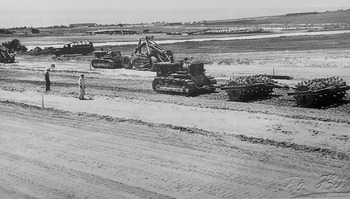
Upon the request of the Turkish government, a three-person CAA delegation spent 21 June to 1 August 1949 reassessing civil aviation in the country, documenting the progress that had been made and preparing a ‘Tentative report on survey of civil aviation in Turkey’. The committee consisted of Hiram Broiles, Francis J. Rhody and Cecil S. Fuller (Broiles was also a member of the original delegation that had visited Turkey in April 1946). They found that very little construction had been performed up to that point due to delays in obtaining equipment, as well as legal and financial problems acquiring the required land. ‘On the small amount of construction work that has been performed’, the report praised J.G. White, stating it ‘has provided very good engineering supervision under its contract with the Turkish government’.Footnote 37 The committee recommended revising Yeşilköy's plans according to the latest ICAO standards, which had changed since the airport was initially designed. For example, they suggested that the length of the new north-east–south-west instrument runway should be 2,300 metres, instead of 2,150 metres, with the additional 150 metres added on the south-west end to correct for density altitude. They also advised the addition of a ‘stub taxiway connecting the center of the runway with the administration building’ to facilitate operations and reduce unnecessary taxiing. Moreover, Broiles, Rhody and Fuller expressed that the runway and taxiway grading plans should be redesigned to optimize cost and time and suggested that the telephone lines along the railway near the south-west approach be relocated or placed underground. Furthermore, they endorsed the change to high-intensity lights for the instrument runway, the installation of approach lights on the south-west end of the runway, and the use of flush-type lights with blue filters for the new stub taxiway.Footnote 38 In terms of building materials, the report noted that ‘crushed gravel and beach sand will be used as concrete aggregates. The use of beach sand is undesirable but sand is not available from other sources … it may be necessary to blend other material with the beach sand to obtain the proper gradation’ (Figure 2).Footnote 39
Soil compaction of the reinforced concrete runway at Yeşilköy Airport, c.1950. Sarıgöl, op. cit., p. 104 (used with permission).

The report also commented on the lack of proper training and general unpreparedness of the local crews. While most of the navigation and radio equipment was shipped to Turkey in 1947 and 1948, ‘some of it sustained considerable damage in inadequate storage during the several months which elapsed before Turkish Customs could be persuaded to release it. Further damage was also reportedly done by inept and careless handling, both before and after it was released’.Footnote 40 In response, the delegation recommended installing the equipment as soon as possible (no later than January 1950), without waiting for the completion of the runway. Moreover, the administration building and maintenance and storage hangars were also at risk. Designed by the Luria Engineering Corporation of New York, a Westinghouse subcontractor, the structures were ‘permanent steel-frame structures, low in cost due to standardization, but modifiable according to specifications’.Footnote 41 In this case, the terminal building was a ‘90 × 358 ft [27.4 × 109.1 m] three-story structure surmounted by a two-story tower’, with a ‘total floor area of 74,000 sq ft [6,875 m2], of which 22,000 sq ft [2,044 m2]’ was occupied by offices. The maintenance and storage hangars, designed to accommodate ‘the largest transport planes now in use, including DC-6s, Constellations and Stratocruisers’, were 240 feet (73.2 m) long, with a gabled roof, and built entirely out of steel. They included ‘clear openings 160 ft [48.8 m] wide by 30 ft [9.1 m] high at both ends of the hangar, each with eight doors that roll sidewise’ to house the airplanes as well as the
maintenance and repairs shops, office, and heating and power installations. The main structural elements [were] 13 three-hinged arches tied under the floor. Roofing and door covering consist[ed] of insulated corrugated steel, and the walls [were] of masonry. All structural connections [were] bolted. The hangar [was] designed for a roof load of 30 psf [1.44 kN/m2] and a wind load of 20 psf [0.96 kN/m2].Footnote 42
However, as Broiles, Rhody and Fuller explained, while ‘the steel has been fabricated and is now stored in Istanbul … some of the steel was bent during unloading from the ships.’Footnote 43
Critics and competitors
On 23 September 1949, the State Department filed an alarming memorandum of conversation with respect to Yeşilköy's construction. Through his attorney, Charles F. O'Neall of the Roberts & McInnis Law Offices in Washington, DC, William F. Luce (misspelt as Loose in the memo), an airport designer with the Intercontinent Engineering Corporation (a Westinghouse subcontractor), made a number of serious accusations. Specifically, that Westinghouse's navigation and radio equipment had yet to be installed (it was originally scheduled for spring 1948) and was being held in warehouses in Istanbul, exposed to the elements, thereby compromising its functionality and safety (this supplemented the findings of the Broiles, Rhody and Fuller delegation). O'Neall also
called to the attention of the State Department representatives the allegedly very unsatisfactory situation in the construction of the Istanbul airport, now being handled by J.G. White, American consulting engineering firm. With the help of numerous maps and blueprints, he explained some of the alleged most flagrant and elementary mistakes in designing and constructing the airport.Footnote 44
In Luce's opinion, these errors would increase the cost of the airport three- or fourfold and delay its completion by four to six years. Luce was in Turkey at the time of the conversation, representing Intercontinent and Johnson, Drake, and Piper General Contractors, and trying to acquire a new agreement with the Turkish government upon the expiration of J.G. White's contract on 11 January 1950. Thus, at this point, it was unclear whether Luce was genuinely a concerned whistle-blower, or a J.G. White competitor who stood to gain financially by bringing these issues to light. However, what was clear was ‘the importance of having the airport competently and quickly completed, as evidenced by the interest which Military Intelligence expressed to ECA’, or the Economic Cooperation Administration, the Marshall Plan agency that was already asserting influence in Turkey through the USAFG.Footnote 45 Clearly, fast-tracking Yeşilköy's completion would complement both Turkish and American civilian and military plans for the airport.
On 14 October 1949, the Turkish Ministry of Public Works, which had taken over airport construction from the Turkish State Airlines and the Ministry of Communications in May 1949, responded by sending a letter to J.G. White outlining Luce's allegations.Footnote 46 On 18 October, Bruce Buchanan, J.G. White's general manager in Turkey, submitted a reply, and Luce countered with a rebuttal the following day, further complicating the controversy. As part of J.G. White's 18 October defence, Buchanan submitted alternative Plans A and B to the Ministry of Public Works’ Bureau of Airports. Plan A was ‘a revision of White's design profile for the instrument runway and relocation of the secondary runways’, while Plan B was ‘a redesign of the general layout for Yesilkoy’.Footnote 47 Buchanan also addressed Luce's criticisms, many of which were already known to J.G. White, since they reiterated the findings of the Broiles, Rhody and Fuller ‘Tentative report on survey of civil aviation in Turkey’ from August 1949. For example, Luce stated that the airport layout was over-engineered, did not fit the local topography, and required a large amount of unnecessary earthwork. Moreover, it did not meet ICAO standards due to slope and drainage issues and problems with the runway length and thickness (all found in the Broiles, Rhody and Fuller report). Luce also mentioned the delays acquiring the land needed to proceed with construction and the spacing of the passenger terminal, hangars and aprons – again, concerns exposed by the August 1949 report.Footnote 48
In his five-page rebuttal to Buchanan, Luce accused J.G. White of using ‘incorrect and misleading statements, and the overemphasis of vague or irrelevant factors’, and ‘deliberately trying to cover up the essential facts’. He also claimed that they had wasted a ‘huge amount of money’ on grading and questioned how their design would ensure safety during departures and landings.Footnote 49 Moreover, he expressed concern over the new location of the radio range facility, since it bore little resemblance to the original location presented to Intercontinent in 1947. However, as Luce's concluding remarks convey, his motivation for his intense scrutiny of J.G. White was not so noble. ‘I can assure you that our interest in this matter is based on our firm conviction that we can give you a better job in much less time and for much less money’, he articulated to the Ministry of Public Works, concluding that ‘we feel that it is our duty, both to your country and to ours, to bring these things to your attention’.Footnote 50 Despite investing considerable time, effort and expense, Luce only partially achieved his goal. Ultimately, the Ministry of Public Works decided not to renew J.G. White's contract in January 1950, citing as reasons Luce's criticisms, the construction delays (which were generally not J.G. White's fault), the disappointing renewal proposal and the cost.Footnote 51 Yet the ministry also did not award Yeşilköy's engineering and construction to Luce and the corporate interests he represented. Instead, the ministry decided to undertake the completion of the project itself, using local firms and American technical assistance, when necessary. It chose to hire five engineers formerly with J.G. White, and four experts from Westinghouse, on individual contracts, as consultants.Footnote 52 Thus began a new phase in Yeşilköy's construction.
A ground-breaking ceremony, completion and a grand opening
In June 1950, a ground-breaking ceremony was held for Yeşilköy's new passenger terminal with the participation of governor/mayor of Istanbul Fahrettin Kerim Gökay, the manager of Istanbul's Bureau of Public Works, officials from the Ministry of Public Works, the American consul, the American air attaché, Lt Nelson Booth of the USNCEC, and representatives of foreign airlines and aircraft companies. Stone-crushing, soil removal and levelling machines from the United States were proudly on display and were used for the ground-breaking operations (and later the construction work) at the airport. The ceremony began with the ritual sacrifice of an animal, followed by the governor/mayor throwing the first shovel of dirt and a short press conference. As Gökay articulated, ‘Our country takes great pleasure in … knowledge, international prosperity and progress, and adopts international cooperation as its motto’. These opening remarks – a nod to the foreign dignitaries in attendance – were followed by more specific details:
The pavement of the runway where concrete will be poured will be 2,300 metres long, its width will be 60 metres and the thickness of the runway will be 40 centimetres. All care and effort has been and is being made to ensure that the construction of facilities such as hangars and radio equipment buildings will be carried out in parallel with the construction of the runway.Footnote 53
He also informed the crowd that the construction contract for the terminal had been awarded to Haymil İnşaat Ltd, supervised by Süreyya Serez, the chief construction engineer from the Ministry of Public Works, and that it would be built using state-of-the-art equipment and Turkish labour, with an estimated completion date of September 1952.Footnote 54 Moreover, he added that the terminal building, originally designed through a collaboration between Luria and Westinghouse, would be identical to that found at (Ronald Reagan) Washington National Airport.Footnote 55
By the end of 1950, the soil-levelling work was 90 percent completed, as was the concrete work for the 1,550-metre blind flight track. The assembly of the maintenance and storage hangars and the steel skeleton of the passenger terminal had also been completed. On 3 July 1951, the Ministry of Public Works awarded the crushed stonework to contractor Süleyman Karacehennemoğlu and his partner Reşat Azbay. Stones were sourced from the Cebeci quarries near Yeşilköy and the crushing operations were carried out at the airport.Footnote 56 Upon the completion of Yeşilköy's new instrument runway in June 1951, the US embassy in Ankara released a report on the progress of the airport construction. Authored by Turkish project manager Adil Belgin, it focused on the layout and specifications of the new runway (length, width, depth and weight capacity), discussing its materials and design in great detail, emphasizing the Turkish resourcefulness involved in the project, and the seriousness with which the Ministry of Public Works was taking the building process. As the report noted,
In the paving itself there are steel expansion joints every 18 meters separated by celotex sheets [for thermal insulation] saturated with bitumen. Every 6 meters there are dummy [construction] joints to prevent cracks due to [the settling of] concrete at other places … Concrete [was] mixed in a mixer with a capacity of 1 m3 per minute … [and was] cured for seven days from the time it is poured. Aggregate [was] furnished by a contractor and [was brought] from Çekmece, seven kilometers from the airport. The aggregate [was] taken away from the lake and sea-shore at Çekmece, washed and screened, and forwarded to the construction by trucks … Water [was] provided from an artesian well and pumped to two elevated water tanks.Footnote 57
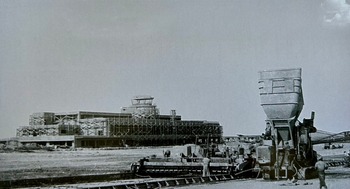
The report also expressed that the onsite soil laboratory had been converted to a materials-testing laboratory that ensured that all the construction materials being used met the required specifications. By June 1951, the principal work of the lab was performing soil compaction tests on the subgrade and subbase (to prepare a uniform base for the concrete pavement), measuring the strength of the concrete runways and taxiways, and preventing future soil settling. The lab also took frequent samples from the concrete as it was being poured, moulding it into cubes and beams to test its compressive and flexural strengths and assess its quality (Figures 3, 4).Footnote 58
The construction of the reinforced concrete runway at Yeşilköy Airport, with its transverse and longitudinal steel supports, general view, c.1950. Sarıgöl, op. cit., p. 103 (used with permission).

In situ concrete pouring for the reinforced concrete runway at Yeşilköy Airport, c.1950. Background: construction of the main terminal. Sarıgöl, op. cit., p. 105; Zeynep Gülten, Havacılık Tarihinde Yeşilköy, Ankara: Hava Basımevi ve Neşriyat Müdürlüğü Press, 2010, p. 87 (used with permission).

Around the same time, Ismail Ismen and Vedat Urul, junior members of the American Society of Civil Engineers (ASCE), published a technical article on the airport in the ASCE's Civil Engineering magazine. Ismen was a research and design engineer and Urul was a soil engineer, both at the Turkish Ministry of Public Works’ Bureau of Airports. Thus, to a certain extent, the article ‘Turkey expands her air transport facilities’ was also an informative promotional piece. In it, Ismen and Urul stressed that Yeşilköy was on the forefront of modern airport construction as an ICAO B1 long-range-type facility. Moreover, they repeatedly conveyed that ‘the design factors are based on the latest CAA specifications’ and provided a detailed explanation of the soil and grading situation – two areas that had caused conflict and challenges in the past. ‘Soil conditions at Yeşilköy are quite variable’, they clarified, adding,
The 3 ft [0.9 m] thick topsoil consists generally of a class E-8 soil (CAA designation). The subsoil varies but generally consists of class E-6 and E-7 soils. E-6 soil is to be used as the subgrade material under the paved areas and is to be mixed in with [30%] sand for the subbase material. The southwest end of the runways is underlain by clay, which will require some undercutting. The clay taken out will be used on the shoulders in very thin layers thoroughly mixed with some E-6 soil. The pavement design provides for a base thickness of about 10 in [25.4 cm] and a concrete runway pavement thickness of 12 in [30.5 cm]. The concrete surfacing of the taxiways, thickened runways sections and aprons will be 16 in [40.6 cm] thick, over the same base. Concrete rather than bituminous pavements were chosen, mainly because jet planes are expected to use the airport.Footnote 59
Before Yeşilköy's grand opening, the US Mutual Security Agency's Civil Aviation group conducted its own inspection of the facilities, paying close attention to the airport's telecommunications and air navigation capabilities, given the irregularities that had occurred during the procurement and installation of the equipment.Footnote 60 Their October 1952 report found that, in general, the Turkish nationals the ministry employed to complete Westinghouse's and Intercontinent's original work in this area were quite adept at handling the tasks at hand. In fact, they found relatively few outstanding issues, estimating a February 1953 completion date for the remaining items and reinforcing the Turkish competence stressed by Gökay, Belgin, Ismen and Urul.Footnote 61
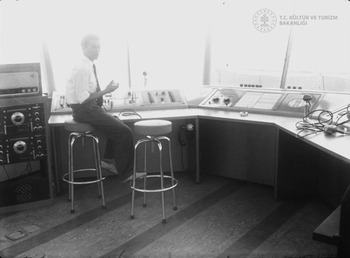
Construction was finally completed on 23 May 1953, when the airport was transferred to the Turkish Ministry of Transportation for testing and trial runs.Footnote 62 Thus, after numerous delays and challenges, Yeşilköy International Airport opened on 1 August 1953. Decorated with the national flags of the airlines that served the airport, the passenger terminal was the centrepiece of the opening ceremony.Footnote 63 Much like the ground-breaking ceremony in June 1950, it was attended by dignitaries such as Minister of Public Works Kemal Zeytinoğlu, Minister of Transportation Yümnü Üresin, Istanbul governor/mayor Gökay, representatives of civil aviation companies, and members of the national and international press. The official ceremony began at 11:00 a.m. local time, when a marching band played the Turkish national anthem, followed by a speech by Zeytinoğlu. In it, he underscored how the new airport met strict international standards, praising its 1,200,000-square-feet (111,484 m2) of concrete runway, taxiway and aprons, which could accommodate the departure or landing of even the heaviest and largest civilian or military aeroplanes every minute and a half. Moreover, according to the minister, the new three-storey, steel-constructed, 10,000-square-metre terminal could process four hundred domestic, two hundred transit and eighty international passengers per hour. He also discussed the 12,000-square-metre airplane hangar and Yeşilköy's Westinghouse electronic infrastructure – specifically, sixteen kilometres of overhead electrical line, 122 kilometres of underground cables, a backup power station with 225 kilowatts of power, a two-hundred-line telephone exchange and twelve radio transmitter and receiver posts. Furthermore, the airport was equipped with blind flight equipment, advanced ground control approach devices to ensure flight safety especially during night flights, a US military-grade SCS 51 instrument landing system (ILS) to prevent accidents during blind flights, and a very-high-frequency (VHF) omni-directional radio range (VOR) system to assist planes in keeping on course, regardless of wind velocity, thereby preventing airborne collisions (Figures 5, 6).Footnote 64
The interior of the air traffic control tower at Yeşilköy Airport, grand opening ceremony, 1953. The Ministry of Culture and Tourism of the Republic of Türkiye (used with permission).

A close-up view of the Westinghouse equipment in the air traffic control tower at Yeşilköy Airport, 1953. The Ministry of Culture and Tourism of the Republic of Türkiye (used with permission).

Conclusion
Although Yeşilköy Airport was originally designed in the late 1940s to accommodate propeller planes, by the time it was completed in the early 1950s it was equipped with the latest military-grade aviation technology and able to handle large volumes of jet and cargo planes. Not only was it one of the most modern airports in the world, but it was also Cold War-ready – an important accomplishment given Turkey's accession to NATO in 1952 as a result of its participation in the Korean War, and its increasing significance on the front line between the communist East and the democratic West. The minister of transportation, Yümnü Üresin, alluded to this reality when, during his speech at Yeşilköy's opening ceremony, he stressed that the airport is located in the Black Sea strait, one of the most strategic points in the world, between the Black Sea and the Mediterranean. Moreover, he added that because of this, airports and airlines would play a larger civilian and military role in the region in the years to come.Footnote 65
By 1953, Yeşilköy had become so geopolitically important that its opening also received special treatment from the New York Times. As it reported,
[in] light of Turkey's strategic position as anchor of the North Atlantic Treaty Organization's southeastern flank, the military importance of the new airport is not being overlooked. The new Istanbul terminal is now using an instrument landing system (ILS) … and also employs the standard United States four-course radio range and compass location to facilitate the operations of fourteen scheduled international carriers that call here.Footnote 66
The article also noted, ‘There are only twenty such [VOR] systems in Europe and 200 in the United States. As soon as antenna masts and coils and crystals arrive from the United States, [Yeşilköy] will be linked with Athens, Frankfurt and London by international radio-teletype circuit’, underscoring its tactical significance in such a charged region.
Clearly, the construction of Yeşilköy Airport was an example of the US early Cold War foreign-policy belief that American science, technology and engineering could serve as a bulwark against sovietization in and around Turkey. As this case study demonstrates, containing communism and promoting Americanization through large-scale infrastructure projects was almost always a convoluted, adaptive process that required accommodating rapidly changing transnational social, economic and political contexts. Moreover, it did not always produce optimal results – contract renewals could be refused; American engineers, managers and construction workers could be replaced by local firms; and design plans could be negotiated and modified along the way – illustrating the fact that Americanization and aviation diplomacy had limits, and could never be universally applied, particularly in rapidly industrializing countries like Turkey. As the Yeşilköy construction narrative exemplifies, unpredictable infrastructure and personnel deficiencies were just as inevitable as political, diplomatic and technical disagreements, unforeseen critics and competitors, and legal and financial variables. The involvement of numerous Turkish and American civilian, government and military actors, each with their own set of aims and goals, further complicated matters.
Nevertheless, the science diplomacy and technological transfer involved in Yeşilköy and later projects reinforced Turkish–American relations during this period and helped build a strategic partnership that would define the Cold War. Over the course of the 1950s, Turkish and American engineers and other technical experts would cooperate on a wide range of modernization projects, from construction to agriculture, manufacturing and defence.Footnote 67 Yeşilköy is thus one example of the impact that civilian, government and military interests – including American engineering firms such as Westinghouse and J.G. White – had in Turkey in the 1950s and beyond. While such undertakings were undeniably geopolitical in nature, they also benefited all sides involved. Always imperfect, with many different moving parts and partners, and frequently running out of time or money, these projects, for better or worse, opened up the world, especially areas like Turkey under immediate Soviet threat, to US-led soft- and hard-power development through technology transfer and science diplomacy.




 Open access

