


Introduction
Wildlife is in crisis globally, mainly as a result of the increasing human population and consequent consumption (Baillie et al., Reference Baillie, Griffiths, Turvey, Loh and Collen2010). Carnivores are particularly affected because of their spatial and dietary requirements, leading to low density and high conflict with human interests (Ripple et al., Reference Ripple, Estes, Beschta, Wilmers, Ritchie and Hebblewhite2014). Carnivores appear to be recovering in developed countries (Chapron et al., Reference Chapron, Kaczensky, Linnell, von Arx, Huber and Andrén2014) but in Africa carnivore populations are largely declining (Woodroffe & Sillero-Zubiri, Reference Woodroffe and Sillero-Zubiri2012; Bauer et al., Reference Bauer, Chapron, Nowell, Henschel, Funston and Hunter2015). Where carnivores and people coexist, competition for resources is likely to lead to attacks by carnivores on people or livestock, which often motivates retaliatory or indiscriminate killing (Hazzah et al., Reference Hazzah, Dolrenry, Naughton-Treves, Edwards, Mwebi, Kearney and Frank2014). Whether that motivation leads to action depends on various factors, tolerance being an important one. Tolerance has been defined by some as an attitude (Manfredo & Dayer, Reference Manfredo and Dayer2004; Treves, Reference Treves2012) but many scholars define it as a behaviour (Bruskotter & Fulton, Reference Bruskotter and Fulton2012, Bruskotter et al., Reference Bruskotter, Singh, Fulton and Slagle2015). We adopt the definition of tolerance as behaviour because tolerating carnivore attacks is a behavioural result of an individual's attitude, given that the individual has the opportunity to act in a certain way (Manfredo et al., Reference Manfredo, Teel and Bright2003; Ajzen & Fishbein, Reference Ajzen, Fishbein, Albarracín, Johnson and Zanna2005).
Literature on this topic often uses the term human–wildlife conflict, even though this term can be misleading; the conflicts are often between people with different views on the impacts of wildlife (Redpath et al., Reference Redpath, Bhatia and Young2015; Fisher, Reference Fisher2016). Conflicts are the result of complex social and ecological interactions that vary in space and over time (Treves et al., Reference Treves, Wallace, Naughton-Treves and Morales2006; Ale et al., Reference Ale, Yonzon and Thapa2007; Dickman et al., Reference Dickman, Macdonald and Macdonald2011; Schuette et al., Reference Schuette, Creel and Christianson2013). The outcome of conflict is determined by perceptions, norms, attitudes and intentions (Marchini & Macdonald, Reference Marchini and Macdonald2012) but most literature focuses on costs and benefits for local people (Dickman et al., Reference Dickman, Macdonald and Macdonald2011).
Literature from southern Africa generally suggests that depredation and retaliation are directly related, by inferring that people kill carnivores to maximize livestock-related profits (Marker et al., Reference Marker, Mills and Macdonald2003; Hemson et al., Reference Hemson, Maclennan, Mills, Johnson and Macdonald2009). In South Africa there is low tolerance for depredation, and reserves with lions are fenced (Packer et al., Reference Packer, Loveridge, Canney, Caro, Garnett and Pfeifer2013). Retaliatory killing is explained by rational choice theorists on the basis that humans are self-centred beings focused on maximizing their immediate outcomes (Ostrom, Reference Ostrom1998). Literature from East Africa partially follows this paradigm, but other work describes how people and wildlife are integrated in landscapes, and determinants of coexistence are not only economic but also cultural (Romañach et al., Reference Romañach, Lindsey and Woodroffe2007; Hazzah et al., Reference Hazzah, Mulder and Frank2009, Reference Hazzah, Dolrenry, Naughton-Treves, Edwards, Mwebi, Kearney and Frank2014; Goldman et al., Reference Goldman, Roque De Pinho and Perry2010a; Blackburn et al., Reference Blackburn, Hopcraft, Ogutu, Matthiopoulos and Frank2016). As a result, retaliatory killing occurs only if depredation exceeds tolerance, whereby tolerance is culturally determined and may vary in space and over time. In this context, carnivore conservation hinges on mitigation to reduce losses or compensation to buy tolerance for losses, or both (Ogada et al., Reference Ogada, Woodroffe, Oguge and Frank2003; Kissui, Reference Kissui2008; Dickman et al., Reference Dickman, Macdonald and Macdonald2011; Lichtenfeld et al., Reference Lichtenfeld, Trout and Kisimir2015; Bauer et al., Reference Bauer, Müller, Van Der Goes and Sillero-Zubiri2017).
In West, Central and the Horn of Africa the significance of livestock goes beyond its economic productivity and contributes to livelihoods in the broadest sense within their cultural community (Moritz, Reference Moritz2013). Sogbohossou et al. (Reference Sogbohossou, de Iongh, Sinsin, de Snoo and Funston2011) and Tumenta et al. (Reference Tumenta, de Iongh, Funston and Udo de Haes2013) give examples of the economic approach to conflict management in Benin and Cameroon, respectively. However, Bauer et al. (Reference Bauer, de Iongh and Sogbohossou2010) noted that the most common mitigation measure practised throughout West and Central Africa is the use of magic, a combination of traditional cultural and religious practices (e.g. incantations by a professional marabout, the use of amulets or the practice of voodoo). In Ethiopia research has shown that spotted hyaenas Crocuta crocuta depend on church forests for daytime cover and adapt their diet during Christian fasting periods, adding a religious dimension to the economic and cultural aspects of coexistence (Yirga et al., Reference Yirga, De Iongh, Leirs, Gebrihiwot, Deckers and Bauer2012). Yirga et al. (Reference Yirga, Ersino, De Iongh, Leirs, Gebrehiwot, Deckers and Bauer2013, Reference Yirga, Imam, De Iongh, Leirs, Kiros and Yohannes2014) also reported high tolerance and close coexistence, and Baynes-Rock (Reference Baynes-Rock2015) described how spotted hyaenas in the eastern Ethiopian town of Harar have become part of the community. However, little is known about lions in Ethiopia (Gebresenbet et al., Reference Gebresenbet, Bauer, Hunter and Gebretensae2009).
We investigated conflict with large carnivores, especially lions and leopards, in the moist montane forest ecosystem of Kafa Biosphere Reserve (hereafter the Reserve), in the south-west of Ethiopia. The habitat occupied by lions within the Reserve is unusual; anecdotal information suggests that they were extirpated from the savannahs at lower altitudes, and the montane coffee and bamboo forests at c. 3,000 m in the margins of their former distribution have now become their core refugium (NABU, 2016). Considerable local and international interest in the conservation of this biosphere has led to the creation of a fund that aims to promote coexistence and address depredation.
We studied conflicts with lions and leopards in two districts, using both quantitative (household survey) and qualitative approaches (focus group discussion; Krueger & Casey, Reference Krueger and Casey2000; Williams, Reference Williams2003; Krosnick & Presser, Reference Krosnick, Presser, Marsden and Wright2010). Incorporating the focus group discussions helped to include the voices of various social groups (mainly adult females and college students), which otherwise might not have been captured. A case study of a particular depredation incident added further insight into local coping mechanisms that would not have been uncovered through quantitative research. Our objective was to assess the economic impact of predation on livestock and to understand local perceptions and attitudes to large carnivores. We analysed the results in the context of local cultural and religious practice and used qualitative information to explain why depredation does not lead to retaliatory killings, and to explore elements of culture and religion that influence the complex relationship between predation on livestock, attitudes and behaviour.
Study area
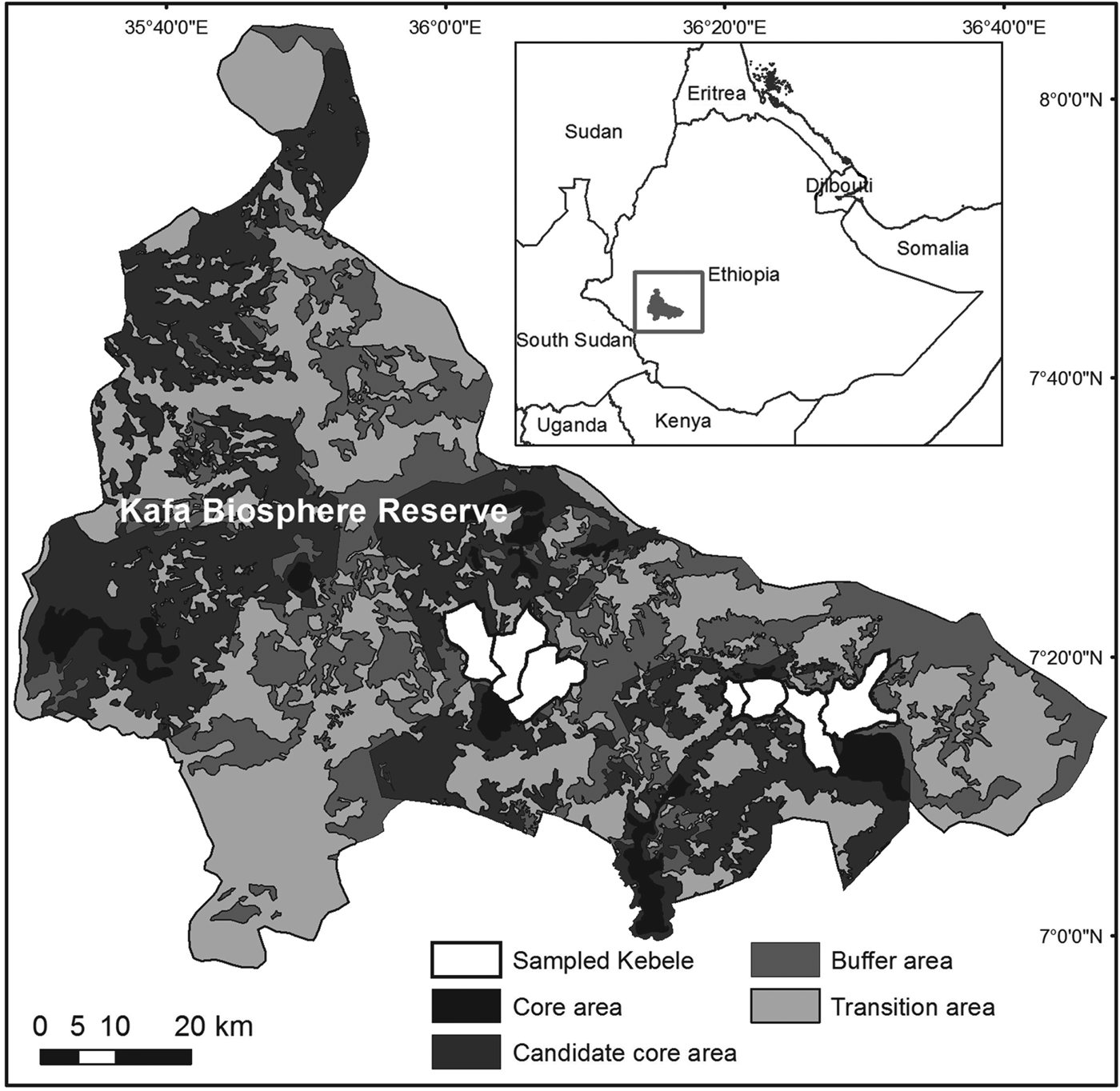
The Reserve was established in 2010, covering 7,500 km2, of which 47% is forest (Dresen, Reference Dresen2011), at an altitude of 400–3,100 m (Pratihast et al., Reference Pratihast, DeVries, Avitabile, de Bruin, Kooistra, Tekle and Herold2014). It harbours moist montane forest habitats, with trees of wild coffee Coffea arabica that are naturally part of the ecosystem, and wetland and aquatic habitats. The abundance of coffee trees makes the area economically important both locally and nationally. The area is recognized by UNESCO as a Biosphere Reserve and is protected under regional by-laws, but it is not gazetted as a protected area at federal level. Although it hosts c. 21% of the country's rich mammalian diversity and is an important conservation area, it is threatened by habitat destruction (Berhan, Reference Berhan2008; IBC, 2009). The forest cover is high but the density of prey is low. Wildlife includes large carnivores, including leopards and lions, but it is unclear if they are resident throughout the year, or how far eastwards they range. The size of the forest has declined as a result of human encroachment (Berhan, Reference Berhan2008). Lions are now observed regularly in only two of the seven districts in the Reserve (Gimbo and Adiyo), and these were selected as the study area (Fig. 1). Adiyo is a highland district, whereas Gimbo has highland and lowland; the mean altitude is 1,747 m but lions are primarily found at c. 2,700 m.
Locations of subdistricts in Kafa Biosphere Reserve, south-west Ethiopia, in which household surveys and focus group discussions were conducted.
Methods
Ethical clearance was obtained from the Human Subjects Research Institutional Review Board of Oklahoma State University. Local research permits were acquired from the Kafa Zone Regional Administration office and the district and subdistrict level administration offices. The Zone and the two districts provided formal letters of introduction. All participants were given a printed descriptive summary of the research (if participants were illiterate the document was read to them). Prior informed consent was obtained orally from all participants. Data were collected during February–April 2014 using household surveys with semi-structured questionnaires (quantitative) and focus group discussions (qualitative). The quantitative survey data provided an estimate of the economic impacts of depredation, and the qualitative data from the focus group discussions helped in understanding local attitudes towards lions and leopards. In general, data collection focused on attitudes of local people towards lions and leopards, tolerance of livestock losses, retaliatory actions, conflict mitigation techniques, changes in conflict intensity, and the cultural connotation of livestock depredation. Attitude was defined as how a person evaluates a certain object or entity, and behaviour as the action performed by the person on that entity (Ajzen & Fishbein, Reference Ajzen and Fishbein1977).
The household survey was conducted in seven subdistricts (or kebeles; the lowest administrative level in Ethiopia), where 30 household heads were selected randomly from the list of households provided by each subdistrict administration office. When a household head was not present the household head of the right-side neighbour was surveyed instead. We conducted 210 questionnaires in total, each lasting c. 1 hour. The questionnaire was in two parts. The first comprised 36 open and closed questions, and the second comprised 36 statements, which were scored on a Likert scale (Albaum, Reference Albaum1997) from 1 (strongly agree) to 5 (strongly disagree). The survey assessed five issues: demographics, general knowledge about lions and leopards, conflicts, attitudes, and behaviours. Questions that assessed demographics were used to group respondents based on their social and economic status. Information collected included gender, educational level, occupation and number of livestock owned. The second set of questions assessed the general knowledge of respondents about the carnivores, including their population status in the Reserve, their diet, frequency of sightings, legal protection and hunting in the Reserve. The third set of questions gathered information on human–carnivore conflicts, and included questions about attacks on people and livestock, grazing distance, presumed reason for depredation, and retaliatory killings. Questions to assess attitude asked how the respondents felt about the carnivores, how they felt if they had encountered a lion or a leopard, whether they wanted the carnivores to be extirpated from their communities, how they felt about compensation payments, whether they thought they had a moral obligation to conserve lions and leopards for future generations, and how they perceived cultural practice in the Kafa context to conserve lions and leopards. The fifth set of questions assessed the behaviour of respondents, focusing on their behavioural intentions in the event of livestock depredation, their likely behavioural intentions in the event of future attacks, depredation preventive techniques, and whether respondents respected regulations for conserving carnivores. Before preparing the final version of the questionnaire we conducted test interviews in Bonga, the Zone capital, which is adjacent to the study area, to ensure that all questions were clear.
We calculated the frequencies of response to the 10 statements about attitude scored on the Likert scale. A correlation test showed a high correlation between scores for similar questions for lions and leopards, and therefore we separated the questions pertaining to lions and leopards. We conducted a reliability analysis in SPSS v. 20.0 (IBM, Armonk, USA) to test the measure of internal consistency, based on Cronbach's α. We also calculated the mean of the responses and presented them as a composite attitude scale, assigning the following values to responses: 5, strongly agree; 4, agree; 3, neutral; 2, disagree; 1, strongly disagree. We multiplied the number of respondents for each response with its assigned value, summed these values, and divided the sum by the total number of respondents (210). Before calculating the weighted mean and running the reliability analysis we reversed the scores of two questions (7 and 8; Table 2) to make them comparable to the other questions.
Three focus group discussions were conducted, with elderly leaders, adult females and college students. There were 10 participants in each group, and the discussions took place during a traditional coffee ceremony, a social setting preferred by the participants. The elderly and female focus groups were selected based on guidance from zonal and subdistrict administration offices, the Reserve's local project coordinator, and Reserve rangers who were trained as interviewers and used as translators. The college students were selected based on communication with the Bonga College of Teacher Education, the only such college in Kafa Zone. Each focus group discussion lasted c. 2 hours. All three discussions focused on the following themes: comparison of past and current human–carnivore conflicts, experiences of livestock loss and culturally acceptable retaliatory actions, conflict prevention techniques, support from the local administration to reduce conflicts, and the distribution of carnivores.
At the outset we asked 30 randomly selected people how they would define rich, moderately well off, and poor households; they agreed that the criteria were ownership of livestock, land and houses. Respondents then indicated thresholds for all three criteria to define categories of wealth, which were subsequently used in the analysis. Numbers of the various types of livestock were converted to Tropical Livestock Units (Njuki et al., Reference Njuki, Poole, Johnson, Baltenweck, Pali, Lokman and Mburu2011). Livestock prices for years prior to 2014 were calculated using mean prices from various markets in Kafa Zone in 2014. We used the consumer price index (Index Mundi, 2014) and the rate of inflation (Trading Economics, 2014) for a specific year to adjust for inflation by taking the ratio of that year's index and the index for 2014. This ratio matches the ratio of livestock prices for the same years, and thus livestock prices for past years could be computed (Appelbaum, Reference Appelbaum2004).
The quantitative data analysis mainly involved descriptive analysis. We used Spearman's rank correlation to investigate if there was an association between loss of livestock to carnivore attacks and how respondents said they would react to future attacks (a behavioural intention we henceforth refer to as presumed action). We ranked the responses from low (1) to high (3 for leopards, 4 for lions) based on the severity of the respondents’ presumed action: 1, doing nothing because it is a course of nature; 2, conducting a traditional begging ritual so lions would stop their attacks on livestock; 3, reporting to local officials; and 4, retaliating by killing the carnivores. The analysis for leopards included only 1, 3 and 4. We also used Spearman's rank correlation to investigate the association between livestock loss and respondents’ attitudes towards having a carnivore-free place to live. We asked if respondents would want lions and leopards to be extirpated from their environment, and ranked responses from strong disagreement (5) to strong agreement (1). Livestock losses as a result of attacks by leopards and lions were 0–3.23 and 0–20.05 Tropical Livestock Units per household, respectively.
To analyse the qualitative data from the focus group discussions we used discourse analysis, which is the process of understanding issues by identifying similarities and differences (Jørgensen & Phillips, Reference Jørgensen and Phillips2002; Doody et al., Reference Doody, Slevin and Taggart2013). We used participants’ language (how they described and framed issues, together with their body language) regarding their knowledge about, attitude and behaviour towards lions and leopards to identify patterns and commonalities within and among the three groups.
Results
We surveyed 210 households, 13 headed by women and 197 headed by men; 67% of respondents were > 35 years old. People who had > 13 cattle, ≥ 4 ha of land and ≥ 3 houses were considered to be rich in the local context. Those who had 8–12 cattle, 2–3.75 ha of land and two houses were of moderate wealth, and those with less were considered to be poor. The mean number of livestock per household was 9 ± SD 14.9. Grazing always occurred during the day and in the presence of a herder, and distance from home was generally low (< 1 km for c. 93% of respondents).
Knowledge about lions and leopards
Although uncommon now, lions used to be present in the highlands and lowlands of the Reserve. However, respondents stressed that lions have become progressively restricted to the higher altitudes. Focus group members from the highlands claimed that lions were unable to withstand the cold weather and the ants that are common in the forest. Leopards, on the other hand, have been known to exist at all elevations in the Reserve. All focus groups reached consensus that the community did not know where the lions were resident, when they came, which route they used, and other related information. The elderly and student focus groups claimed that the number of attacks escalated at the end of the dry season and the beginning of the rainy season.
Overview of attacks and economic losses
Circa 42% (n = 89) of the respondents knew of lion attacks on people during their lifetime. We recorded a total of 17 attacks on people, four of which were fatal (all before 2006); 12 occurred during 2009–2013. Only 1.4% (n = 3) of respondents claimed to know of leopard attacks on people, two of which happened in 1996 and one in 2000. More losses were reported for lions than leopards (Fig. 2). Rich households lost more than moderate and poor ones to both lion (48.3, 29.7 and 22.0%, respectively) and leopard (40.59, 34.7 and 24.5%, respectively) attacks. Livestock depredation claims during 2009–2013 accounted for 80% (n = 350) of reported attacks by lions and 62% (n = 62) of reported attacks by leopards (Table 1), on 73 and 20 households, respectively. Of these households, 14 incurred losses to both carnivores. Lions caused 85% of the total livestock depredation during 2009–2013. In 2012 and 2013, 38 households claimed loss of livestock worth USD 11,259, with the damage caused by lions amounting to USD 10,841 (96%). Households that suffered livestock loss in 2012 and 2013 had mean losses of USD 287 and 310, respectively, per year. If livestock losses are considered in terms of a direct reduction in household income, these households lost c. 70 and 66% of the mean Ethiopian gross domestic product per capita (which was USD 410 and 470 in 2012 and 2013, respectively; World Bank, 2013).
Recorded Tropical Livestock Units lost as a result of attacks by lions Panthera leo and leopards Panthera pardus in Kafa Biosphere Reserve (Fig. 1).
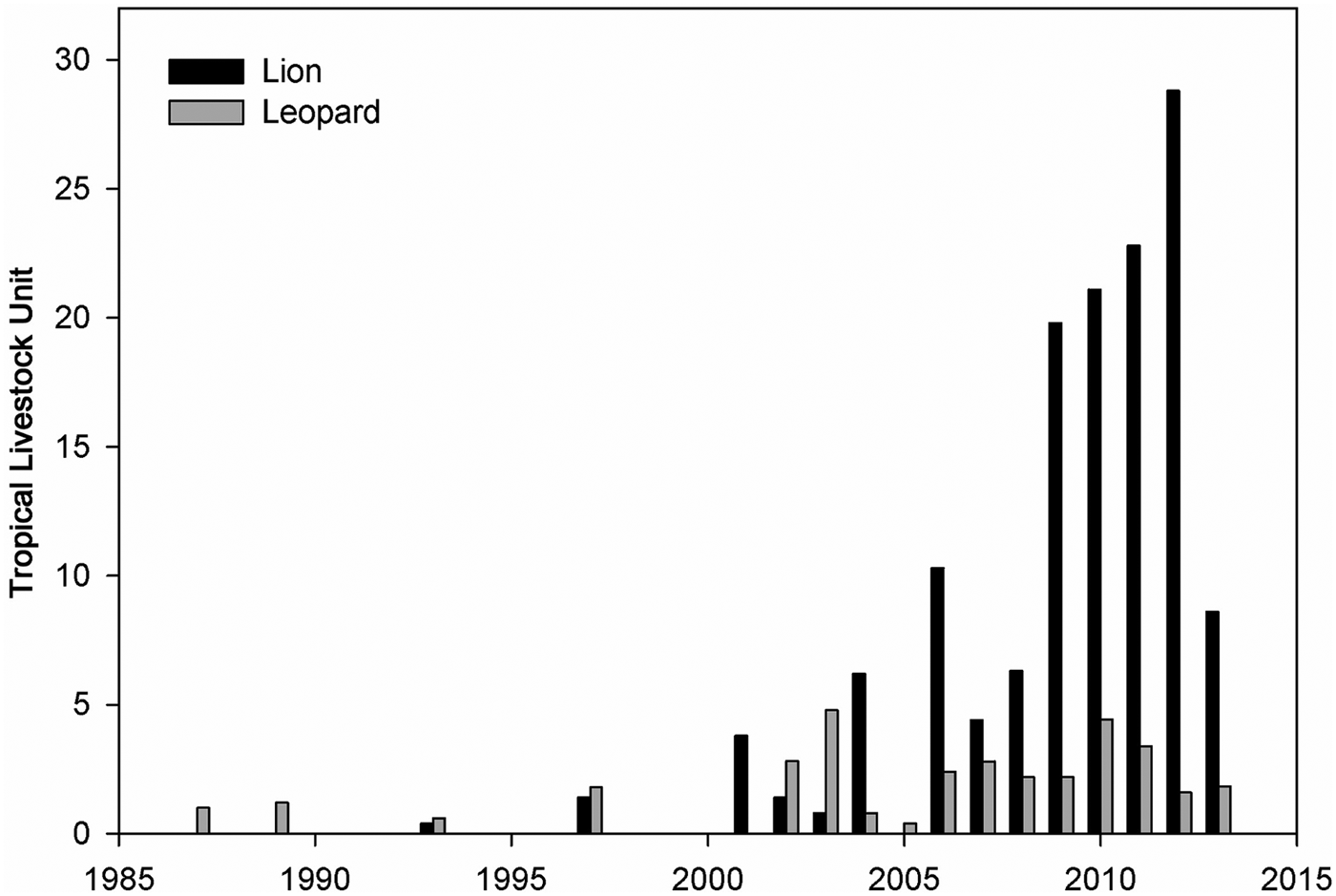
No. of livestock lost to lions Panthera leo and leopards Panthera pardus during 2009–2013 by 210 households in the Kafa Highlands, Ethiopia (Fig. 1).

Attacks by lions in the Reserve were not restricted to grazing fields. There were reported cases of lions entering peoples’ houses at night and attacking them. More than half of the survey respondents, and all focus groups, mentioned an incident that occurred in Adiyo in 2010: a lioness entered a house during the night, ate two goats and attacked the owner, who was sleeping in her bed. The woman survived after medical treatment, with scars on her face and scalp. Two-thirds (63%) of the lion attacks reportedly occurred during 18.00–06.00, and approximately half (55%) of the leopard attacks occurred during 12.00–18.00. Half of the household survey respondents thought that the main reason for these attacks was the lack of wild prey as a result of destruction of the forest. However, 26% thought that attacks happened because lions are violent in nature and habitual raiders.
During focus group discussions, the consensus was that the community tried to share the burden of losing livestock; typically, neighbours contributed money to buy a calf to help victims cope with the loss. In line with this, 76% of respondents who incurred losses informed only their neighbours, with only 26.9% reporting losses to the local administration.
Attitudes towards lions and leopards
Respondents had broadly similar, positive attitudes towards both carnivores (Table 2). Of the 10 statements about attitude, the one that was scored highest was that conserving lions/leopards is a positive cultural practice in Kafa (with a mean weighted score of 4.33 for lions and 4.32 for leopards). Cronbach's α. was 0.64 for lions and 0.63 for leopards, which suggests that 64 and 63% of the variance is reliable for the attitude data collected for lions and leopards, respectively.
Percentage of responses to 10 statements relating to attitude towards carnivores, scored on a Likert scale, and mean responses as a composite attitude scale.

A majority of respondents and the student focus group, and all participants of the female and elderly focus groups, did not refer to lions as Dahero (lion); they used the name Donno, which is a respectful way of addressing elderly and other socially respected people. When they hear others referring to lions simply as lions, they cover their ears as a way of saying ‘I cannot hear this’. This deep-rooted respect and honour for lions is maintained even at the time of attacks. During the focus group discussions with the elderly, one of the participants explained:
We do not think lions take our livestock to hurt us. As a result, we do not refer to it as an attack or killing but taking what they needed.
Leopards are not afforded the same honour and respect, although they do not face retaliatory or preventive killings. Most (91.4%) respondents claimed that fear of legal action is an additional reason for the absence of lion and leopard killings in the Reserve (86% were aware that killing lions is prohibited by law in Ethiopia).
All focus groups explained that losing livestock to lions is considered to be a sign of good luck, and of upcoming wealth, throughout the Reserve. Three of the participants in the female discussion group and four in the elderly group explained that the number of their livestock had increased significantly after losing some to lions. One of the women explained:
Before 7 years, two of our cattle were taken in one night. In the morning, my husband and I were very happy to see lion footprints because we believed our livestock were going to be fertile and we were going to be wealthy. And indeed we have been blessed since.
In the Kafa culture lions are considered to be kinder than leopards. One participant in the elderly focus group expressed:
If we encounter a lion while on the road, all we have to do is cut some leaves and put them on our head and beg the lion and bow down. It is guaranteed that it will walk away. Male lions even convince or drag lionesses with them, who otherwise might block the path and lay around for a long time. But a leopard never shows such mercy; it always attacks if confrontation happens accidentally.
The focus groups also revealed that community elders hold a ritual ceremony when lion attacks become frequent, in which they beat drums and pray that the lions will leave them and their livestock alone. Participants in the elderly focus group explained that a few years ago there had been an incident in which a lion became a problem, taking livestock every night but not eating them, just killing them and walking away. They claim that a local spiritual leader prayed and the lion died. An informant told us confidentially that people killed the lion but maintained the narrative, which illustrates the respect for the lion and the spiritual leader but also the resentment that led to retaliatory killing. The lion carcass was given a ceremonial burial; it was covered in hand-made traditional cloth before being buried in a meadow that remains fenced to this date.
Our findings indicate that although most of our respondents are afraid to go to the field or into the forest where lions and leopards are believed to live, they also like seeing these carnivores in the wild and do not want them to disappear from the Reserve (Table 2).
Behaviours and actions
There are few retaliatory killings of lions and leopards in the Reserve. Only 2.9% (n = 6) and 1.9% (n = 4) of respondents had witnessed killings of lions and leopards, respectively. Three lion killings and one leopard killing occurred during 2009–2013. Of the 93 households that suffered livestock losses during this time, only 2.1% (n = 2) responded that they wanted to kill the carnivores in retaliation (and may do so if it happens in the future). However, the majority (71%; n = 66) did not want to retaliate and replied that they would not retaliate in the future.
Correlation of economic losses with attitude and behaviour
Spearman's correlation showed a significant association between livestock loss and presumed reaction to leopard attacks (ρ s = 0.181, P < 0.01), but that association was not significant for lion attacks (ρ s = –0.132, P = 0.056). Spearman's correlation between wanting to see carnivores extirpated in their community and livestock loss showed a non-significant association for both leopards (ρ s = 0.015, P = 0.83) and lions (ρ s = –0.108, P = 0.118).
Compensation vs prevention
A minority of livestock owners who experienced carnivore attacks (17%, n = 60, for lions and 24%, n = 15, for leopards) said they would like to be compensated. The rest of the victims believed depredation was a course of nature and no one was responsible for compensating their loss. All respondents and focus groups highlighted the importance of preventive techniques. The two most preferred remedies (79% of respondents) were (1) introducing better protection schemes for livestock and (2) fencing the Reserve to keep the carnivores away from people. Better protection techniques include keeping cattle in houses or in fenced fields at night and not grazing livestock in forests. The majority of respondents and all focus groups suggested that the carnivores’ habitat, particularly that of lions, should be fenced, at least during the rainy season. The focus groups explained that fire and watch dogs were commonly used for night guarding but their efficiency as a preventive technique had diminished, as the carnivores, particularly lions, attacked livestock even in the presence of fire and dogs. The elderly and student focus groups reported five incidents in which dogs were killed by lions during attacks.
Discussion
Depredation had an economic impact on the households studied, but in general the damage was not high compared to other landscapes with lions (Gifford-Gonzalez, Reference Gifford-Gonzalez2000; Frank et al., Reference Frank, Woodroffe, Ogada, Woodroffe, Thirgood and Rabinowitz2005). The tolerance expressed by the participants is striking; tolerance for carnivore attacks varies across Africa but is relatively common in India (Karanth et al., Reference Karanth, Naughton-Treves, DeFries and Gopalaswamy2013; Meena et al., Reference Meena, Macdonald and Montgomery2014). Effective conservation of carnivores is difficult where tolerance is low (Sillero-Zubiri & Laurenson, Reference Sillero-Zubiri, Laurenson, Gittleman, Funk, Macdonald and Wayne2001; Bruskotter & Wilson, Reference Bruskotter and Wilson2014); in the Reserve the habitat and prey availability are suboptimal (deforestation, low prey density; Berhan, Reference Berhan2008) and it is probably because of the prevailing culture of tolerance that lions and leopards have survived.
By combining the overview provided by quantitative data with insights and details provided by qualitative data we were able to make a more complete analysis. We found that rational choice theory poorly explains human–lion interaction; social, political and cultural factors are at least as important as economic rationale (Inskip & Zimmermann, Reference Inskip and Zimmermann2009; Bruskotter & Shelby, Reference Bruskotter and Shelby2010).
Traditionally in Kafa if individuals lose livestock to lions they are happy because they believe it to be a sign that their livestock number is to increase. People's response to conflict with carnivores is culturally contextualized and complex; rational choice theory would predict retaliation but culture can be a stronger incentive and encourage the conservation of carnivores (Karanth & Chellam, Reference Karanth and Chellam2009; Kopnina, Reference Kopnina2015; Thomas et al., Reference Thomas, Bruyere, Sundaresan, Bouzo, Welden and Trimarco2015). Increasing levels of depredation and external influences may erode tolerance and lead to different narratives (Ikanda & Packer, Reference Ikanda and Packer2008; Maclennan et al., Reference Maclennan, Groom, Macdonald and Frank2009) but thus far people in Kafa have proved to be tolerant, with few retaliatory killings. Attitude, whether positive or negative, to carnivores will influence behaviour towards them (Thorn et al., Reference Thorn, Green, Marnewick and Scott2015).
Human–carnivore conflicts are increasing in many areas (Treves & Karanth, Reference Treves and Karanth2003). Attacks on people have been reported in Ethiopia (Gebresenbet et al., Reference Gebresenbet, Bauer, Hunter and Gebretensae2009) but are not a major problem in the Reserve at present. The suspected increase in human–lion interactions in the wet season could be a result of seasonal variation in prey availability (Patterson et al., Reference Patterson, Kasiki, Selempo and Kays2004; Woodroffe & Frank, Reference Woodroffe and Frank2005). Although our reliability analysis suggests a less than ideal (70%) variance reliability, the qualitative responses and the frequency of responses suggest there is a positive attitude in Kafa towards lions and leopards. The highest mean ratings (Table 2) for the statement that conserving lions and leopards is a positive cultural practice in Kafa (with a mean weighted score of 4.33 for lions, and 4.32 for leopards) also support this claim. Additionally, there was a non-significant correlation between livestock loss and wanting to see carnivores extirpated in the community for both lions and leopards, supporting the claim that there is a positive attitude towards both carnivores.
Lions are more problematic than leopards in the Reserve, yet there is more tolerance towards lions than leopards. The correlation between livestock loss and respondents’ presumed actions following lion attacks was not significant, supporting the claim that there is a culture of tolerance towards lions. However, attitudes to leopards were less positive, and the significant correlation between livestock loss and respondents’ presumed actions following leopard attacks reveals that as households lose more livestock to leopards their behavioural intention to retaliate becomes stronger. The Reserve appears to be exceptional in this regard, as leopards generally coexist more easily with people; with their diet adaptability and secretive behaviour, leopards can often persist close to people without significantly affecting them (Hayward et al., Reference Hayward, Henschel, O'Brien, Hofmeyr, Balme and Kerley2006; Odden et al., Reference Odden, Athreya, Rattan and Linnell2014; Athreya et al., Reference Athreya, Odden, Linnell, Krishnaswamy and Karanth2016).
Wildlife and people coexist across Ethiopia, where the biosphere reserve model fits the de facto management of protected areas that are almost all open access systems (Gebresenbet et al., Reference Gebresenbet, Daniel, Bauer, Haile, Navjot and Raven2013). In the context of widespread extreme poverty, depredation must therefore be addressed. Our results show that policy will be more effective and efficient if it looks beyond economic impacts and considers the depth and complexity of communities’ relationships with large carnivores. Integrated damage mitigation (Bauer et al., Reference Bauer, de Iongh and Sogbohossou2010) may be more appropriate than segregation (e.g. fences; Packer et al., Reference Packer, Loveridge, Canney, Caro, Garnett and Pfeifer2013) or compensation (Naughton-Treves et al., Reference Naughton-Treves, Grossberg and Treves2003; Dickman et al., Reference Dickman, Macdonald and Macdonald2011; Bauer et al., Reference Bauer, Müller, Van Der Goes and Sillero-Zubiri2017). There are plans for a pilot consolation scheme in the Reserve (Schütze, Reference Schütze2014); it will not compensate directly for losses but will provide a more general subsidy for coexistence. This fits with global trends in conservation that focus on ecosystem services, monetary values and trade-offs (Goldman et al., Reference Goldman, Daily, Kareiva, Leader-Williams, Adams and Smith2010b; Anyango-Van Zwieten et al., Reference Anyango-Van Zwieten, Van der Duim and Visseren-Hamakers2015). This may improve attitudes and lead to better conservation outcomes; however, other factors are equally important (Heberlein, Reference Heberlein2012). For example, fear, personal and social motivations and internal and external barriers to retaliatory killing (e.g. lack of skills and force of law, respectively) have been found to influence jaguar killing (Marchini & Macdonald, Reference Marchini and Macdonald2012). We add that communal coping mechanisms, beliefs in long-term positive wealth impacts and a culture of tolerance are important. The relative importance of these factors varies in space and time, adding to the complexity of conservation.
Acknowledgements
Fieldwork was supported financially by the German Nature and Biodiversity Conservation Union (NABU) and by the Wildlife Conservation Research Unit at the University of Oxford, UK. We thank all NABU staff based in Bonga, Kafa, for greatly assisting the research, Mesfin Tekle and Tilahun Teshome for sharing their ideas during the planning and implementation stages of the data collection, Kafa Biosphere Reserve rangers Siraj Hussien and Mamo Gebremedhin for assistance in collecting data and in translation whenever the Kafa language was used, Mulubrhan Hagos for facilitating communications with students from the Bonga College of Teacher Education, and all participants of the survey and focus group discussions for taking the time to answer our questions.
Author contributions
FG processed ethical clearance, co-prepared survey questions, trained translators, collected data and wrote the article. BB co-prepared survey questions and collected data. GY arranged research permits and edited the article. CSZ verified analyses and edited the article. HB assisted in project design and data collection, and wrote the article.
Biographical sketches
Fikirte Gebresenbet works on large carnivore and herptile conservation in Ethiopia. Brhane Baraki works on human–carnivore conflict in Kafa. Gidey Yirga has done extensive research on the ecology of the spotted hyaena in Northern Ethiopia. Claudio Sillero-Zubiri is interested in carnivores and human–wildlife conflict and is the Chair of the IUCN SSC Canid Specialist Group. Hans Bauer is based in Ethiopia and works on lion conservation in West, Central and the Horn of Africa.



