





I
Investors regard liquidity – i.e. the possibility to buy or sell large quantities quickly and with only a limited impact on market prices – as a desirable characteristic of financial markets. Liquid markets with high participation and large trading volumes facilitate asset pricing by increasing the efficiency of the price discovery process. Intense trading also favors the incorporation into stock prices of firm-specific information produced by investors, press analysts and firms themselves (Roll Reference ROLL1984; French and Roll Reference FRENCH and ROLL1986; Durnev et al. Reference DURNEV, MORCK, YEUNG and ZAROWIN2003; Jin and Myers Reference JIN and MYERS2006; Chen et al. Reference CHEN, GOLDSTEIN and JIANG2007; Fernandes and Ferreira Reference FERNANDES and FERREIRA2008). Moreover, stock market liquidity has positive effects on the real economy by enhancing firm performance, investment, productivity and growth (Pagano Reference PAGANO1989, Reference PAGANO1993; Levine and Zervos Reference LEVINE and ZERVOS1996; Levine Reference LEVINE, Paganetto and Phelps2003; Fang et al. Reference FANG, NOE and TICE2009). This risk-reducing characteristic of liquidity explains why investors demand a premium to hold illiquid stocks (Pastor and Stambaugh Reference PASTOR and STAMBAUGH2003; Acharya and Pedersen Reference ACHARYA and PEDERSEN2005; Amihud et al. Reference AMIHUD, MENDELSON and PEDERSEN2005).
Recent global events, such as the financial crisis of 2007–8 and public health incidents (SARS in 2002–4 and Covid-19 in 2020–1), stimulated new research on the consequences of uncertainty shocks for stock market liquidity. Results suggest that typically trading activity falls and bid-ask spreads widen in periods of heightened uncertainty, such as economic recessions, stock market downturns and financial crises. Crises also expose investors to both market risk and liquidity risk and may trigger a reallocation of portfolios towards more liquid assets (Brunnermeier and Pedersen Reference BRUNNERMEIER and PEDERSEN2009; Rösch and Kaserer Reference RÖSCH and KASERER2013; Dash et al. Reference DASH, MAITRA, DEBATA and MAHAKUD2021). Uncertainty shocks caused by the outbreak of pandemics are found to have similar effects (McTier et al. Reference McTIER, TSE and WALD2013; Chebbi et al. Reference CHEBBI, AMMER and HAMEED2021; Gofran et al. Reference GOFRAN, GREGORIOU and HAAR2022; Tiwari et al. Reference TIWARI, ABAKAH, KARIKARI and GIL-ALANA2022; Apergis et al. Reference APERGIS, LAU and XU2023). Less studied is the impact of uncertainty caused by political factors. There exists a large literature on the relationship between political risk and stock market performance, especially in emerging markets (Erb et al. Reference ERB, HARVEY and VISKANTA1996; Bilson et al. Reference BILSON, BRAILSFORD and HOOPER2002; Lesmond Reference LESMOND2005; Bialkowski et al. Reference BIALKOWSKI, GOTTSCHALK and WISNIEWSKI2008; Lehkonen and Heimonen Reference LEHKONEN and HEIMONEN2015). Other recent contributions explore the impact of economic policy uncertainty (Brogaard and Detzel Reference BROGAARD and DETZEL2015; Bali et al. Reference BALI, BROWN and TANG2017; Luo and Zhang Reference LUO and ZHANG2020), electoral uncertainty (Bialkowski et al. Reference BIALKOWSKI, GOTTSCHALK and WISNIEWSKI2008), political instability (Boutchkova et al. Reference BOUTCHKOVA, DOSHI, DURNEV and MOLCHANOV2012) and partisan conflict (Azzimonti Reference AZZIMONTI2018, Reference AZZIMONTI2021) on stock returns. However, the consequences of political uncertainty on stock market liquidity remain largely unexplored.
Financial theory offers no clear-cut prediction. On one hand, uncertainty produces an environment of ambiguity that increases asymmetries between informed and uninformed investors and enhance adverse selection risk (Pastor and Veronesi Reference PASTOR and VERONESI2012, Reference RÖSCH and KASERER2013; Nagar et al. Reference NAGAR, SCHOENFELD and WELLMAN2019). It also might reduce the quantity and quality of information disclosed by firms, as well as increase ambiguity about the quality of information included in stock prices, thus shaking investors’ confidence in their prior beliefs about stock fundamentals. While investors can better assess firms’ exposure to political risk and its effect on future returns in a stable political environment, they become ‘unsure about the correct probability laws’ governing future mean returns and their distribution (Anderson et al. Reference ANDERSON, GHYSELS and JUERGENS2009, p. 234) when information about the predictable range of possible political outcomes and their impact is inadequate – for instance, because the evolution of the political environment is highly volatile and unpredictable. In this situation of ambiguity (Brenner and Izhakian Reference BRENNER and IZHAKIAN2018), ambiguity-averse investors might feel discouraged to trade individual stocks or even decide not to trade at all, thus reducing market liquidity (Chordia et al. Reference CHORDIA, ROLL and SUBRAHMANYAM2000; Jin and Myers Reference JIN and MYERS2006; Karolyi et al. Reference KAROLY, LEE and VAN DIJK2012). While the findings of empirical studies generally support this story (Fulgence et al. Reference FULGENCE, KWABI, BOATENG, HU and PAUDYAL2023; Kwabi et al. Reference KWABI, ADEGBITE, EZEANI, WONU and MUMBI2024; Dang et al. Reference DANG, LUONG, NGUYEN and NGUYEN2024), ambiguity aversion is not the only possible explanation. Since the decision to trade is endogenous to market conditions, low market participation may also reflect a rational response by investors if political uncertainty increases information asymmetries or induces sellers and buyers to expect high transaction costs or prices not aligned with their beliefs (Case et al. Reference CASE, POELMANS and VERDICKT2025). Thus, there exist multiple possible mechanisms connecting uncertainty and market participation. On the other hand, however, political uncertainty might increase disagreement among investors about the fundamental value of stocks, and stimulate the search and production of information. This could lead in turn to more intense trading and higher liquidity (Ozsoylev and Werner Reference OZSOYLEV and WERNER2011; Pasquariello and Zafeiridou Reference PASQUARIELLO and ZAFEIRIDOU2014; Chen et al. Reference CHEN, CHEN, WANG and ZHENG2018).
We contribute to this debate by studying the impact of political uncertainty on stock markets in the historical context of Spain between World War I and the mid 1930s. This period saw a transformative breakthrough of mass democracy also in other European countries (Ziblatt Reference ZIBLATT2017, p. 8) and the rise of new political forces that ‘embraced the primacy of politics and touted their desire to use political power to reshape society and the economy’ (Berman Reference BERMAN2006, pp. 16-17). Our empirical analysis focuses on market liquidity; to our knowledge, we are the first to address this issue in a historical setting. Contemporary financial chronicles of the 1930s observed with surprise that in periods of heightened socio-political turmoil, investors were reluctant to trade and orders could not be executed for the lack of counterparties. Why was the stock market so oddly calm? And was this investor behavior typical of previous periods of political unrest or specific to the circumstances of the 1930s?Footnote 1
To explore this issue, we assembled a unique and entirely original dataset of daily closing prices and trading volumes of liquid common stocks in the Madrid Stock Exchange (MSE) between 1914 and 1936 and constructed different measures of liquidity, such as trading frequency, turnover and the price impact of trading. We also used ABC, the main conservative newspaper of the time and a fundamental source of information for investors, to construct a monthly measure of the arrival of news about mass mobilization, politically motivated violence and other political processes that could be perceived as threats to the existing political and socio-economic order. In addition, we control for other political processes, such as electoral campaigns, cabinet crises and the risk of a breakdown of Spain as a unitary state (a threat stemming from Catalan regional nationalism), which could affect investors’ short-term risk aversion and trading patterns. By doing so, the impact of our index of political uncertainty on liquidity can be more clearly associated with fundamental uncertainty about the future socio-political regime, which implied the repricing of political risk.Footnote 2
Our main finding is that high levels of political uncertainty had a strong negative effect on market liquidity during and after the transition to a democratic regime (the so-called Second Republic) in the 1930s, but not in the socio-political mobilizations that characterized the late period of the monarchic regime between World War I (during which Spain remained neutral) and the early 1920s. This negative impact persisted in a time-horizon of 6-to-12 months and was economically significant, as peaks in political uncertainty led to a 20 percent fall in turnover and up to a 10 percent increase in price impact. These results are confirmed when we control for other sources of domestic and international political uncertainty, as well as for uncertainty related to economic factors in a period dominated by exchange rate stress and the global spread of the Great Depression. Our conclusion is that the response of investors to rising social pressure for democratization was different in the 1930s, as the regime change made the redistributive consequences of the political process more unpredictable and political polarization blurred the lines between redistribution and revolution risk.
The article contributes to different strands of literature. Our research project was inspired by seminal studies on the relationship between potential threats to the capitalist regime and the high volatility of interwar financial markets in the US and Europe (Schwert Reference SCHWERT1989; Bittlingmayer Reference BITTLINGMAYER1998; Voth Reference VOTH2002). Our findings mainly speak to the historical literature on the economic and financial consequences of political and policy uncertainty (Mathy and Ziebarth Reference MATHY and ZIEBARTH2017; Opitz Reference OPITZ2018; Cortés and Weidenmier Reference CORTES and WEIDENMIER2019; Leitão et al. Reference LEITÃO, MARQUES PEREIRA, PEREIRA DOS SANTOS and TAVARES2019; Lennard Reference LENNARD2020; Mathy Reference MATHY2016, Reference MATHY2020; Verdickt Reference VERDICKT2020). We also contribute to recent studies on the attitude of wealthy investors towards the democratization of political institutions in the nineteenth and twentieth centuries (Turner and Zhang Reference TURNER and ZHAN2012; Dasgupta and Ziblatt Reference DASGUPTA and ZIBLATT2015; Lehmann-Hasemeyer et al. Reference LEHMANN-HASEMEYER, HAUBER and OPITZ2014; Tuncer and Weller Reference TUNCER and WELLER2022; Miller Reference MILLERforthcoming). Finally, our article also connects to recent research on illiquidity as a structural feature of historical financial markets (Rousseau Reference ROUSSEAU2009; Moore Reference MOORE2010; Campbell et al. Reference CAMPBELL, TURNER and YE2018; Fleming et al. Reference FLEMING, LIU, MERRETT and VILLE2024; Case et al. Reference CASE, POELMANS and VERDICKT2025) and the role of liquidity shocks in stock market crashes (Cadorel Reference CADOREL2024).
The remainder of the article is structured as follows. Section II provides a historical background for the process of democratization in interwar Spain. Section III presents the political uncertainty index. Section IV describes stock market data and liquidity measures. Section V presents the benchmark results of the regression analysis. Section VI tests the sensitivity of results to other sources of political and economic uncertainty. Section VII measures the impact of regulations on trading. Section VIII provides qualitative evidence from contemporary financial chronicles in support of the results. Section IX concludes.
II
The concept of democratization usually refers to political reforms related to the extension of suffrage, the parliamentarization of governments and the institutionalization of civil liberties (Dasgupta and Ziblatt Reference DASGUPTA and ZIBLATT2015). On this basis, early twentieth-century Spain was a de jure democracy with institutional distortions that seriously constrained de facto the exercise of democratic prerogatives. Universal male suffrage had been granted in 1891 not under a violent threat brought home by the disenfranchised (Acemoglu and Robinson Reference ACEMOGLU and ROBINSON2005) but as a consequence of competition among incumbent political oligarchies (Lizzeri and Persico Reference LIZZERI and PERSICO2004). Far from steering the political process away from special-interest politics, however, this peaceful democratization preserved a political system largely based on corruption and patronage (Ziblatt Reference ZIBLATT2017). Orchestrated alternation of conservative and liberal executives (turno), direct control of the government over the list of local candidates (encasillado), strong control of the rural vote by local wealthy ‘notables’, and electoral districts designed to dilute the impact of the relatively independent urban vote, were the political mechanisms that contributed to minimize the electoral influence of new parties, such as republicans and socialists, which represented a growing share of urban middle and working classes, as well as rural workers.
The crisis of this system became evident during World War I, which benefited the exports of neutral Spain but caused inflationary spikes and a first massive cycle of social unrest and political mobilization in which the demand for radical political reform became inseparable from a demand for socio-economic reforms. In line with an international trend after World War I, organized labor became the driving force of democratization. This novelty shifted the focus of democratization towards workers’ bargaining power, the reduction of inequalities and extensive redistributive reforms, which significantly increased the perceived cost of political change for wealthy elites (Miller Reference MILLERforthcoming). In 1917 the mobilization in favor of a political revolution promoted by the Democratic Assembly Movement (a broad coalition of republicans, socialists and Catalan nationalists) led to massive participation in a general revolutionary strike in Catalonia called by trade unions, which was violently repressed by the army. The explosion of trade union membership in 1918 led in 1919 to a new wave of mobilization, focused on social reforms and the institutionalization of labor relations, and culminated in a general strike in Barcelona. Again, the government’s response was militarized repression, followed by waves of terrorist violence, the disarticulation of trade unions and the suppression of the debate on political autonomy of the Basque Country and Catalonia (Radcliff Reference RADCLIFF2017). The authoritarian solution to the crisis of the Restoration monarchy, with the suppression of the parliamentary regime and the appointment of a Military Directory in September 1923, temporarily divorced democratization from social reforms, as the autocratic regime sought to integrate the working classes into a corporatist state through an informal collaboration with the Socialist Party and trade unions. The failure of this project of authoritarian mass integration and the collapse of the dictatorship in January 1930 prepared the ground for a new cycle of mass mobilization in support of democratization and extensive redistributive reforms.
The establishment of a new parliamentarian democracy in April 1931 was a major political surprise. The regime change occurred 14 months after the fall of the military dictatorship and just four months after a revolutionary attempt of republicans and socialists, easily crushed by the army (December 1930), had brought its leaders into jail or exile. The Republic was peacefully proclaimed one day after the unanticipated success of republican parties in municipal elections that had been called as a plebiscite in search of a new legitimization of the monarchy. The unexpected decisions by King Alphonse XIII to leave the country and by the army not to intervene in defense of the monarchy precipitated a bloodless handover of power. The change led to the disbandment of dynastic forces and a dramatic overhaul of the structure of political competition. Party fragmentation led to high political instability, with three general elections, weak coalitions and 20 executives in five years. The political debate became soon polarized between an extensive program of socio-economic reforms in land and labor markets pursued by a coalition of left republicans and socialists (in power between April 1931 and September 1933 and again after February 1936) (Carmona et al. Reference CARMONA, ROSÉS and SIMPSON2019; Basco et al. Reference BASCO, DOMÈNECH and MARAVALL2023; Domènech et al. Reference DOMÈNECH, LAHDELMA and MARTINELLI2024) and the counter-reforms promoted by a coalition of conservative republicans and a Catholic right (ruling the country between November 1933 and January 1936) (Gonzalez-Calleja et al. Reference GONZÁLEZ CALLEJA, COBO ROMERO, MARTÍNEZ RUS and SÁNCHEZ PÉREZ2015; Radcliff Reference RADCLIFF2017). The legitimacy of the new regime was also undermined by the weak commitment of extreme forces on the left (communists and anarchists) and the right (traditional monarchists and fascists) to liberal democracy, and by unsettled relationships between civil and military authorities. The clash of extreme movements produced a climate of political violence that made it more difficult for wealthy elites to distinguish between redistribution risk and revolution risk (Miller Reference MILLERforthcoming). Finally, the struggle for autonomy of Catalan parties translated into an open threat of secession and cast doubts on the survival of Spain as a unitary state. At the same time, a state of permanent economic crisis reinforced the mobilization of the working class. Massive waves of collective actions, occasional insurrectional attempts and frequent outbursts of politically or religiously motivated violence elicited the state’s violent reaction, raising fears of a possible radical change in the political and socio-economic regime (Linz Reference LINZ, Linz and Stepan1978, pp. 187–94). Thus, ambiguity about the scale and scope of socio-political reforms and blurred lines between redistribution and revolution risk led to major shifts in fundamental political uncertainty.
III
Theory suggests that periods of intense mass mobilization for political and social reforms might lead uncertainty/ambiguity-averse investors to reduce or temporarily suspend trading activity, causing liquidity shocks. To test this hypothesis formally, we constructed an index of political uncertainty based on press news, in line with recent historical studies (Brune et al. Reference BRUNE, HENS, RIEGER and WANG2015; Mathy and Ziebarth Reference MATHY and ZIEBARTH2017; Lennard Reference LENNARD2020; Verdickt Reference VERDICKT2020). We extended back to 1914 the existing index used by Battilossi et al. (Reference BATTILOSSI, HOUPT and VERDICKT2022) and Battilossi and Houpt (Reference BATTILOSSI and HOUPT2025) for the period 1930–6. Our source is ABC, the most important conservative newspaper of the period published in Madrid. ABC reported daily stock market data, published professional stock exchange chronicles and represented a fundamental source of information for investors.
The index is based on count data of keywords that were systematically associated with ‘bad’ political news. For that purpose, we identified words and word combinations systematically used to inform about events that could be perceived as potential challenges to the political and socio-economic status quo. Our dictionary includes strike (huelga) and general strike (huelga general), disorder (desorden), expropriation (expropiación), revolution (revolución), violence (violencia), combined with politics/political (política) and Spain (España). For each word (or word combination), we computed monthly counts of pagesFootnote 3 and standardized their time series using recursive mean and standard deviation.Footnote 4 Finally, we created an aggregate index by extracting their first principal component. Its cumulative proportion is 0.47 and all individual series contribute to it with positive loadings. For use in robustness checks, we also computed an alternative index that normalizes page counts by the average number of pages published by the newspaper, which increased gradually over time.Footnote 5 Time variations in the arrival of ‘bad’ news identify periods during which investors perceived a heightened level of political uncertainty. This approach is well established in an extensive literature (Alesina and Perotti Reference ALESINA and PEROTTI1996; Voth Reference VOTH2002; Funke et al. Reference FUNKE, SCHULARICK and TREBESCH2016; Cortés and Weidenmier Reference CORTES and WEIDENMIER2019).Footnote 6 While ABC’s news was not necessarily unbiased (given its strong pro-monarchy and conservative orientation), Garcia-Uribe et al. (Reference GARCÍA-URIBE, MUELLER and SANZ2024) find that indices of socio-economic conflict based on news from ABC and La Vanguardia (a moderately pro-Republic newspaper published in Barcelona) are virtually identical and explain most of the economic policy uncertainty of the period. Therefore, we can reasonably exclude that our findings are contaminated by the ideological bias of our source.
The index is quite persistent, with an AR(1) coefficient of 0.48 over the entire sample. This suggests the existence of political uncertainty ‘cycles’ driven by the ebb and flow of socio-political mobilization. Structural break tests identify univocally the presence of break dates in the mean of the index in January 1921 (sign –) and October 1930 (sign +).Footnote 7 The two dates are historically meaningful. The first one corresponds to the end of the first cycle of mass mobilization and political violence that shook the country in the aftermath of World War I. The second one coincides with the political reorganization of republican forces and the mass mobilization that led to the failed revolutionary attempt of December 1930. The manifesto of this new political platform connected intimately the demand for political and socio-economic reforms and set the stage for the agenda of the republican front after the regime change of April 1931. It also coincides with the start of a long period of economic crisis and stagnation due to domestic and international factors (i.e. the propagation of the Great Depression: Albers Reference ALBERS2018), which certainly contributed to depress average market liquidity. Hence, we adjust the index to avoid our results being affected by these structural shifts. Unit root tests confirm the stationarity of the index.Footnote 8
Our political uncertainty index (both unadjusted and adjusted), expressed in standard deviations, is shown in Figure 1. Peaks of the index were often clustered and coincided with important socio-political processes, such as electoral campaigns (grey-shadowed periods) and waves of collective action and political mobilization in 1917, 1919, 1930–4 and 1936. The index also captures adequately periods of demobilization after their successful repression, such as in the early 1920s and 1935, as well as the suppression of socio-political mobilization during the years of the dictatorship of General Primo de Rivera (1923–30).
Political uncertainty

IV
The Madrid Stock Exchange (MSE) was organized along the lines of the French Bourse. Licensed stockbrokers were granted a trading monopoly, received orders from investors and had to find a matching counterparty for the transaction. Therefore, no bid and ask quotes were recorded, only transaction prices and the nominal amount of securities traded (Houpt and Rojo Cagigal Reference HOUPT, CAGICAL and C2010). This microstructure remained stable during the interwar period, which rules out the possibility that liquidity was affected by changes in market architecture or trading system.
Our sample spans the period from 2 January 1914 to 17 July 1936, for a total of 6,146 trading days.Footnote 9 The last observation coincides with the military coup of disloyal army generals against the republican government, which marked the outbreak of the Civil War and led to the closure of Spanish stock exchanges until the end of the conflict. We hand-collected closing spot prices and trade volumes of all listed common stocks from the daily bulletins of the MSE. The availability of trade volume data is a unique characteristic of our sources, as Spanish regulations obliged the governing body of official stock exchanges to publish the nominal value of transactions (both spot and forward) negotiated at the end of each session. We also collected detailed information about each firm in our panel from the MSE yearbooks, including the number of common stocks issued, their nominal value, paid-up capital and date of listing.
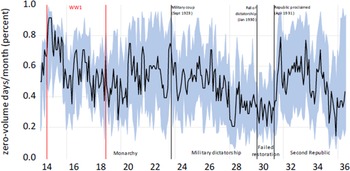
As in other historical cases, sparse trading was a structural characteristic of the Madrid market (Moore Reference MOORE2010; Case et al. Reference CASE, POELMANS and VERDICKT2025). For the construction of our portfolio, we calculated for each stock/month the share of zero-volume days and excluded equities with a monthly average above 90 percent. The final dataset includes up to 28 Spanish firms, which jointly represent 60 percent of the total capitalization of the equity market in the MSE.Footnote 10 Figure 2 shows monthly fluctuations of the median value of zero-volume days/month in the cross-section of included firms and the corresponding 25 and 75 percent quantiles of its cross-sectional distribution. The figure neatly identifies the impact of major political events on trading frequency, such as the outbreak of World War I in July 1914, the military coup of September 1923 and the proclamation of the Republic in April 1931.
Incidence of zero-volume days

Using daily data on prices and trade volumes, we constructed for each stock i and month m different low-frequency indicators of liquidity that, in the absence of transaction data, have been found to be good proxies of trading costs for market participants (Goyenko et al. Reference GOYENKO, HOLDEN and TRZCINKA2009). Our first group of liquidity variables captures investors’ trading activity. A standard metric is Turnover – i.e. the sum of stocks of firm i traded in each month m divided by the total number of stocks i admitted to trade in the Stock Exchange at the beginning of the same month:
 \begin{equation}Turnove{r_{im}} = \mathop \sum \nolimits_{d = 1}^{{D_{im}}} \frac{{n.{\text{ }}of{\text{ }}stocks{\text{ }}trade{d_{id}}}}{{n.{\text{ }}of{\text{ }}stocks{\text{ }}admitte{d_{im}}}}\end{equation}
 where  ${D_{im}}$ is the number of non-zero volume days for stock i in month m. A complementary measure, based on trading frequency and originally proposed by Lesmond et al. (Reference LESMOND, OGDEN and TRZCINKA1999), is Zero, the proportion of zero-volume days over the total number of trading days in each month ( ${T_m}$):
 \begin{equation}Zero_{im}^{vol} = \frac{{n.{\text{ }}of{\text{ }}days{\text{ }}with{\text{ }}zero{\text{ }}volum{e_{im}}}}{{{T_m}}}\end{equation}
The occurrence of many zero-volume days reflects the inhibiting impact of low liquidity (e.g. large trading costs) on informed investors’ decision to trade (Goyenko et al. Reference GOYENKO, HOLDEN and TRZCINKA2009, p. 159). We interpret Zero as a broad indicator of the extensive margin of liquidity related to participation decisions, and Turnover as a measure of the intensive margin of liquidity related to the intensity of trade, although the two measures are strongly correlated.
Our second group of variables is based on the price impact of trade, originally proposed by Amihud (Reference AMIHUD2002) and Amihud et al. (Reference AMIHUD, MENDELSON and LAUTERBACH1997) and widely used in the empirical finance literature. The first measure is the monthly average of the daily ratio of absolute price return ( $\left| {{R_{id}}} \right|$) to trading volume, expressed in domestic currency (Spanish pesetas), $VO{L_{id}} = ({P_{id}} \cdot {S_{id}}$), where ${P_{id}}$ is the daily closing price of stock i, and ${S_{id}}$ is the number of stocks i traded on day d. For its calculation, we trim the top and bottom 0.1 percent of the cross-sectional distribution of returns, which is a standard screening procedure. Taking logs of the ratio further ensure that the possible impact of outlier observations is minimized:
 \begin{equation}Amihud_{im}^{vol} = log\left( {1 + \frac{1}{{{D_{im}}}}\sum \nolimits_{d = 1}^{{D_{im}}}\frac{{\left| {_{{R_{id}}}} \right|}}{{VO{L_{id}}}}} \right)\end{equation}
 where ( ${D_{im}}$) is the number of non-zero volume days in each month. This measure is undefined for zero-volume days and equals zero in zero-return days. The ratio means to capture the response of stock prices to order flow, which is assumed to be inversely related to trading costs. Hence,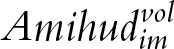 $Amihud_{im}^{vol}$ must be interpreted as an indicator of illiquidity.
For robustness, we use two additional metrics: the monthly average of the daily ratio of absolute price return to turnover (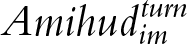 $Amihud_{im}^{turn}$) (Florackis et al. Reference FLORACKIS, KONTONIKAS and KOSTAKIS2014) and the monthly average of the daily ratio of nominal trading volume (in domestic currency) to absolute return (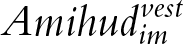 $Amihud_{im}^{vest}$) (Amihud et al. Reference AMIHUD, MENDELSON and LAUTERBACH1997):
 \begin{equation}Amihud_{im}^{turn} = log\left( {1 + \frac{1}{{{D_{im}}}}\mathop \sum \nolimits_{d = 1}^{{D_{im}}} \frac{{\left| {_{{R_{id}}}} \right|}}{{Turnove{r_{id}}}}} \right)\end{equation}
 \begin{equation}Amihud_{im}^{vest} = log\left( {1 + \frac{1}{{{D_{im}}}}\mathop \sum \nolimits_{d = 1}^{{D_{im}}} \frac{{ {VO{L_{id}}} }}{{\left| {{R_{id}}} \right|}}} \right)\end{equation}
 By substituting the turnover ratio for monetary volume, 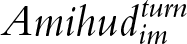 $Amihud_{im}^{turn}$ addresses a possible bias caused by differences in firm size and variations in price inflation over our sample, thus enhancing the comparability of our measure across firms and over time. In turn, $Amihud_{im}^{vest}{\text{ }}$– which is essentially a reciprocal of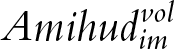 $Amihud_{im}^{vol}$ and should be interpreted as a measure of liquidity – is undefined for zero-return days; hence this measure limits the risk of underestimating illiquidity for stocks/months with a high incidence of zero returns. Table 1 presents descriptive statistics of the five liquidity/illiquidity variables.
Liquidity measures: descriptive statistics

This table shows descriptive statistics of the five liquidity measures. Statistics of Amivest, Amivol and Amiturn include only stock/month observations with an incidence of zero-volume days below 80 percent.
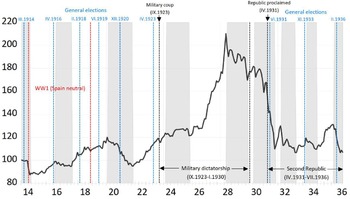
Figure 3 presents a weighted price index of the equity market portfolio.Footnote 11 We identify cycles of market expansion (bull markets) and contraction (bear markets) by applying to the nominal stock price series the Bry-Boschan algorithm adapted to asset prices by Pagan and Sossounov (Reference PAGAN and SOSSOUNOV2003).Footnote 12
Stock market cycles, 1914–36

A moderate bull market characterized the last part of World War I, which benefited the exports of neutral Spain (1917–19), and was followed by a long price reversal during the international recession of 1920–1. Stock prices recovered in 1922–3 but did not react strongly to the military coup of September 1923, which signaled the final crisis of the monarchic political system (six general elections and 21 cabinets in 10 years). In turn prices soared sharply in 1926–8, coinciding with the corporatist consolidation of the regime and a developmental economic policy based on protectionism, the regulation of competition, generous subsidies to incumbent firms and rising public spending. After the peak of May 1928, prices remained on a downward trend during the last years of the dictatorship (1928–9) and in the political transition of 1930–1, which coincided with structural budget deficits, persistent pressure on the exchange rate and finally the propagation of the Great Depression. The surprise of the Republic, followed by a ‘twin’ (banking and currency) crisis in the spring–summer of 1931, caused a long market crash that reached a trough in October of the same year.Footnote 13 Prices recorded mild fluctuations in the economic stagnation of 1932–4, surged in the short-lived economic recovery of 1935 and crashed again after the victory of the Popular Front in the elections of February 1936 – another political surprise not anticipated by the market (Battilossi et al. Reference BATTILOSSI, HOUPT and VERDICKT2022).
Figure 4 shows the monthly time series of market-wide measures of liquidity, weighted by market capitalization. We also aggregate the trade-based and the price impact (Amihud) measures by extracting their respective principal component. For the former, the loadings of Turnover and Zero are -0.70 and 0.70, and the cumulative proportion of the first PC is 0.62: for the latter, the loadings of Amivest, Amiturn and Amivol are -0.47, 0.60 and 0.65, respectively, and the cumulative proportion is 0.73. Therefore, both aggregate measures must be interpreted as indices of illiquidity.
Aggregate illiquidity and market cycles

Their co-movement confirms their ability to capture adequately variations in liquidity as a state variable of the equity market. We can observe high levels of illiquidity in the early phase of World War I, throughout the 1920s and during the Second Republic until 1934, with frequent peaks during and after the long market crash of 1931. On the contrary, market liquidity was relatively higher from 1917 to 1921 and again from 1928 to 1930, coinciding with the peak of the market boom of the late 1920s and its slow reversal until the initial phase of the Great Depression. Overall, there seems to be no uniform pattern in the variation of liquidity across market cycles.
V
To assess the contemporaneous impact of political uncertainty on stocks’ liquidity, we regress alternative liquidity measures (LIQ) on the monthly index of political uncertainty (POL) in the cross section of firms (i). We capture the differential impact of political uncertainty under different political regimes by interacting POL with dummies for the dictatorship (September 1923 – January 1930) and the period from the fall of the dictatorship to the outbreak of the Civil War (February 1930 – July 1936), leaving the years of the monarchic regime (January 1914 – August 1923) as a benchmark.Footnote 14 We estimate the following multivariate regression:
 \begin{align} {LI{Q_{im}} = \alpha \, } & { + \left[ {\beta _{i,m}^{POL}PO{L_m} + {\text{ }}\beta _{i,m}^{POL*DIC}\left( {PO{L_m}*{\text{ }}RE{G^{DIC}}} \right)} \right.} \nonumber \\
{} & {\left. { + {\text{ }}\beta _{i,m}^{POL*REP}\left( {PO{L_m}*{\text{ }}RE{G^{REP}}} \right)} \right] + \beta _i^X{X_{im}} + {\text{ }}\beta _i^M{M_m} + \beta _i^F{F_i} + {\text{ }}{\varepsilon _{im}}} \nonumber \\
\end{align}
\begin{align} {LI{Q_{im}} = \alpha \, } & { + \left[ {\beta _{i,m}^{POL}PO{L_m} + {\text{ }}\beta _{i,m}^{POL*DIC}\left( {PO{L_m}*{\text{ }}RE{G^{DIC}}} \right)} \right.} \nonumber \\
{} & {\left. { + {\text{ }}\beta _{i,m}^{POL*REP}\left( {PO{L_m}*{\text{ }}RE{G^{REP}}} \right)} \right] + \beta _i^X{X_{im}} + {\text{ }}\beta _i^M{M_m} + \beta _i^F{F_i} + {\text{ }}{\varepsilon _{im}}} \nonumber \\
\end{align} where the parameters of interest are  $\left( {\beta _{i,m}^{POL}} \right)$,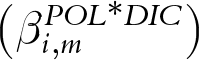 $\left( {\beta _{i,m}^{POL*DIC}} \right)$ and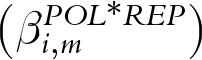 $\left( {\beta _{i,m}^{POL*REP}} \right)$, which measure the contemporaneous impact of a one-unit increase in political uncertainty on the liquidity/illiquidity of stock i in month m across political regimes. In line with the empirical finance literature (Chordia et al. Reference CHORDIA, ROLL and SUBRAHMANYAM2000, Reference CHORDIA, ROLL and SUBRAHMANYAM2001; Dunham and Garcia Reference DUNHAM and GARCIA2020; Chebbi et al. Reference CHEBBI, AMMER and HAMEED2021), we add several controls. X is a vector of firm-specific time-varying characteristics widely used as determinants of liquidity. They include sensitivity to market risk (beta); the log of age, price and market capitalization (both in real terms); the absolute value of the mean daily return (a proxy for information asymmetries), momentum (the cumulative return in the last six months, excluding the current month) and volatility (the realized variance of daily returns within each month). M are month dummies that control for seasonality in liquidity.Footnote 15 F are firm fixed effects to control for time-invariant unobservable characteristics that may affect firms’ liquidity, such as information disclosure, quality of governance and asset tangibility. In our baseline regressions we use an OLS panel estimator with robust standard errors clustered at firm level. Since both Turnover and Zero are ratios, we use their logit transformation (log $\frac{x}{{\left( {1 - x} \right)}}$) as dependent variable. Panel unit root tests unanimously reject the existence of a common or individual unit root process in all liquidity/illiquidity variables.Footnote 16 A limitation of all Amihud variables is that their quality declines when stocks record a high number of zero-volume days, which reduces the number of daily observations available for their calculation. To take this problem into account, we use only stock/month observations with at least 20 percent of non-zero-volume days.Footnote 17 For further robustness, we also report the results obtained using stock/month observations with at least 50 percent of non-zero-volume days. Table 2 summarizes the results.Footnote 18
Political uncertainty and liquidity, 1914–36

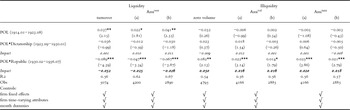
This table shows the results of a linear regression of liquidity/illiquidity measures on the political uncertainty index (adjusted for structural breaks in January 1921 and October 1930) across political regimes. The reported coefficients measure the effect on liquidity/illiquidity of a one-unit increase in the POL variable. Impact is the difference between the coefficient for the period 1914–23 and those obtained for the periods 1923–30 and 1930–6, respectively. For all Amihud measures, we report results obtained using only stock/month observations with at least 20 and 50 percent of non-zero-volume days in columns (a) and (b), respectively. Controls include: firm fixed effects; month dummies for liquidity seasonality; and time-varying firm-specific attributes (market beta, age, real price, real market capitalization, absolute mean return, momentum and volatility). T-stats (in parentheses) are based on robust standard errors clustered at firm level. *, ** and *** denote statistical significance at the 10, 5 and 1% level, respectively.
We find some evidence of the possible existence of opposed effects across political regimes. The sign of the estimated coefficients for the period 1914–23 suggests that ‘bad’ political news tended to increase (decrease) liquidity (illiquidity), although only the turnover and Amivest measures are statistically significant at customary levels. The results of this period should be interpreted with caution, however, due to the significantly smaller number of liquid stocks in the market portfolio and, more importantly, the overlapping of mass mobilization with domestic macroeconomic shocks (high inflation) and powerful international factors (World War I and its aftermath).Footnote 19 The sign of coefficients is generally reversed in the period 1923–30, but coefficients are never statistically significant. This is hardly surprising given the repression of political parties and social movements imposed by the dictatorship, which is reflected in the lack of variance in the political uncertainty index.
On the contrary, in the transition years 1930–1 and during the Second Republic a one-unit increase in political uncertainty reduced average turnover by 5.2 percent, increased the average incidence of zero-volume days by 4.9 percent, and increased the average price impact of trading between 1.6 and 2.6 percent. As a consequence, peaks of political uncertainty (≥ 4.0 s.d.) coincided with large liquidity shocks in the cross-section of equities, i.e. a fall in turnover and trading frequency of around 20 percent and an increase in price impact between 6 and 10 percent with respect to the ‘normal’ levels of each stock. Overall the data support the notion that the regime change of the 1930s represented a clear discontinuity in investors’ perception of the political uncertainty generated by the demand for democratization.Footnote 20 The results hold if we limit the empirical analysis for the Republican period to the ‘calm’ years 1932–5. This demonstrates that the effect of uncertainty on liquidity is not driven by the market crashes that followed the political surprises of April 1931 (regime change) and February 1936 (electoral victory of the Popular Front).Footnote 21
We confirm the robustness of our findings with a number of additional checks.Footnote 22 Since the liquidity metrics 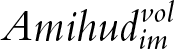 $Amihud_{im}^{vol}$ and $Amihud_{im}^{vest}$ are largely driven by variations in the trading volume component (Lou and Shou Reference LOU and SHOU2014), the results for those measures could be affected by time-varying inflation. Therefore, we replace nominal with deflated trading volumes. The results do not change. Second, we test whether investors reacted to the intensity of political uncertainty or to unexpected shocks to uncertainty. For that purpose, we regress the index on its lags to obtain orthogonal innovations in political uncertainty, then use both the predictable component and innovations as independent variables. The results show that liquidity was mainly affected by predictable uncertainty rather than by uncertainty surprises. This finding is consistent with the notion that what mattered most for investors was the level of uncertainty reached during waves of mass mobilization. We also use in-sample predictive regressions to assess the persistence of the impact of political uncertainty on liquidity for time-horizons up to 12 months. The results strongly support persistence after the transition to the democratic regime. Finally, we explored the possible heterogeneity of the impact of political uncertainty on liquidity in the cross-section of firms. We focus on political connections to new and traditional parties as well as other firms’ characteristics such as the intensity of foreign participation (Battilossi and Houpt Reference BATTILOSSI and HOUPT2025). The results suggest that the liquidity effect of uncertainty was quite homogeneous across firms with and without political and international links, as well as across firms connected to different political forces.
VI
In this section we test the validity of the previous findings against possible confounding factors. They include other domestic sources of political uncertainty and economic/economic policy uncertainty, as well as international political risk.
Other domestic sources of political uncertainty
The emergence of center–periphery cleavages was a fundamental aspect of the rise of mass politics in Spain since the early twentieth century (Vall-Prat Reference VALL-PRAT2023). In both the Basque Country and Catalonia – the two most important industrial clusters of the country – the demand for democratization was inextricably connected with a rising demand for autonomy, which raised fierce hostility among conservative and nationalist elites. The first mass mobilization in favor of a statute of ‘integral autonomy’ under the leadership of conservative Catalan nationalists in 1918–19 led to an upsurge of politically motivated violence and failed to win the support of a majority in the Spanish parliament. In the early 1920s Spanish executives intensified their policy of centralization, which culminated in the final suppression of Catalan political institutions by the dictatorship of general Primo de Rivera. In the 1930s, however, the participation of left-wing Catalan nationalists in the republican revolutionary front, their electoral success in the municipal elections of April 1931 and their open plans for an independent Catalan republic brought home a more extreme and credible threat to the survival of Spain as a unitary state (Radcliff Reference RADCLIFF2017).
In order to capture this dimension of political uncertainty and its possible impact on stock market liquidity, we constructed a monthly index based on news from the newspaper ABC, using the keywords Catalan problem (problema catalán), Catalan question (cuestión catalana) and Catalan statute (Estatuto Catalán). The index captures neatly the escalation of political controversies generated by the statute of autonomy for Catalonia in 1918–19 (eventually rejected by the national parliament) and again in 1931–2 (approved by the Constitutional Assembly), as well as the unilateral proclamation of an independent Republic in April 1931 and again in October 1934, in the wake of a revolutionary general strike in Catalonia and Asturias.Footnote 23 By interacting the index with the Republican regime dummy, we are able to take into account the qualitative changes in Catalan politics after 1930 (the hegemony of left-wing nationalists and their alliance with republicans and socialists) compared to the early period of Catalan mobilization.
An additional source of domestic political uncertainty was extreme government instability, which characterized both the last years of the monarchic regime (before the military coup of 1923) and the years of the Second Republic. Between January 1914 and September 1923 there were 15 cabinet crises and six general elections. The record between January 1930 and July 1936 was 23 cabinets, two municipal elections, one constituent election and two snap general elections. These different sources of political risk could affect investors’ risk aversion and market participation in the short run, but – unlike a credible threat to the existing socio-economic regime – should not imply a fundamental re-pricing of political risk. To control for their possible impact on stock market liquidity, we include dummies for pre-election, election and post-election months, as well as for months that preceded or coincided with cabinet crises. Since both the nature of electoral competition and the characteristics of the party system were deeply transformed after the transition to democracy, we use separate dummies for elections and cabinet crises before 1923 and after 1930.
Table 3 shows the results. We report coefficients only for the pre-1923 and post-1930 periods, since there were neither free elections nor cabinet crises during the Dictatorship. The inclusion of additional political factors weakens the evidence in support of a differentiated impact of political uncertainty on liquidity across regimes. Before 1923 its effect on all liquidity measures is now statistically insignificant, whereas it is fully confirmed after the transition to a democratic regime, although the magnitude of its economic impact is slightly smaller compared to the benchmark results of Table 2. Interestingly, uncertainty about Catalan politics tended to increase stock market liquidity before 1923, but had a strong and negative impact on all liquidity measures after 1930. In the period of the Republic, the economic effect of political uncertainty and Catalan separatism is of comparable magnitude: for instance, a one-standard deviation increase in the two indices reduced turnover by -5.4 and -3.8 percent, respectively. We also find that liquidity tended to fall during months that preceded cabinet crises in the period of the Republic. The results confirm that several dimensions of domestic political uncertainty had a prominent influence on Spanish investors’ behavior after the regime change. Controlling for them allows us better to disentangle their short-term effects on risk aversion and market participation from the impact of fundamental ambiguity about the future configuration of socio-economic relationships.
Other domestic political factors

This table shows the results of a linear regression of liquidity/illiquidity measures on the political uncertainty index (adjusted for structural breaks in January 1921 and October 1930) and additional political factors (elections, cabinet crises and news about Catalan separatism) across political regimes. The reported coefficients measure the effect on liquidity/illiquidity of a one-unit increase in political uncertainty and Catalan separatism variable, and the switch from 0 to 1 for electoral and crisis dummies. Impact is the difference between the coefficients for the period 1914–23 and those obtained for 1930–6, respectively. Controls include month dummies for liquidity seasonality, firm fixed effects and time-varying firm-specific attributes (market beta, age, real price, real market capitalization, absolute mean return, momentum and volatility). T-stats (in parentheses) are based on robust standard errors clustered at firm level. *, ** and *** denote statistical significance at the 10, 5 and 1% level, respectively.
Economic and economic policy uncertainty
In the interwar period the monetary regime and the exchange rate were the main sources of economic policy uncertainty. After the inflationary peaks of the late 1910s, the exchange rate of the Spanish peseta appreciated almost uninterruptedly until the second half of the 1920s, prompting a long and inconclusive policy debate on Spain’s adherence to a restored gold exchange standard. Since 1927, however, domestic and international concerns about fiscal profligacy fed into a reversal of capital flows and a continuous depreciation of the peseta since 1928. The years until the 1931 crisis were dominated by a persistent and harsh conflict between executives (the military junta until January 1930, interim civil-military governments thereinafter) and the privately owned central bank (Bank of Spain) over the use of gold reserves and international loans for the stabilization of the exchange rate since 1928 (Betrán et al. Reference BETRÁN, MARTÍN-ACEÑA and PONS2012; Martín-Aceña et al. Reference MARTÍN-ACEÑA, PONS and BETRÁN2014; Martínez Ruiz and Nogués-Marco Reference MARTÍNEZ RUIZ and NOGUÉS-MARCO2014; Jorge-Sotelo Reference JORGE-SOTELO2020). After the proclamation of the Republic, there was constant uncertainty about governments’ ability to achieve the fiscal consolidation required by the stabilization of the peseta, eventually achieved at the end of 1933 with the introduction of tight capital controls under a formal peg to the French franc. At the same time, governments, private banks and the Bank of Spain engaged in a prolonged dispute on the relaxation of monetary policy to revive a depressed economy (Martín-Aceña Reference MARTÍN-ACEÑA1984, pp. 261–71). Disruption of international trade added to the uncertainty and had significant political consequences (Betrán and Huberman Reference BETRÁN and HUBERMAN2022, Reference BETRÁN and HUBERMAN2024).
To control for the possible impact of macroeconomic and economic policy uncertainty, we adopt the same procedure used for political uncertainty. Using ABC as our source, we constructed an index of news related to key macroeconomic issues, such as the exchange rate, fiscal and monetary policy, based on the following keywords: Bank of Spain (Banco de España), discount rate (tipo de descuento), exchange rate (cambio, tipo de cambio), peseta depreciation (depreciación de la Peseta), gold standard (Patrón Oro) and government budget (presupuesto del Estado).Footnote 24 As in the case of political uncertainty, we test its stationarity, identify the existence of one structural break in the intercept in November 1928, and adjust the index accordingly.Footnote 25 Alternatively, we include the Economic Policy Uncertainty (EPU) index constructed by Garcia Uribe et al. (Reference GARCÍA-URIBE, MUELLER and SANZ2024) and based on the same newspaper, ABC.Footnote 26
As shown in Table 4, the coefficients of the political uncertainty index remain virtually identical. Interestingly, trade frequency, turnover and two of the price impact measures suggest that macroeconomic news from ABC, and especially the EPU index, had a positive and significant impact on liquidity in the period 1914–23 and switched to a negative and significant impact during the Dictatorship and the republican regime. This might be related to changes in policy-making institutions and objectives (for instance, the transition of the Bank of Spain to a more explicit role as a central bank and the centrality of exchange rate stabilization) – an important issue that we leave for future research. Interestingly, the magnitude of the effect of political uncertainty and economic policy uncertainty was very similar after 1930, suggesting that both contributed critically to the decline in liquidity in the years of the Second Republic.
Economic policy uncertainty

This table shows the results of a linear regression of liquidity/illiquidity measures on the political uncertainty index (adjusted for structural breaks in January 1921 and October 1930) and measures of economic policy uncertainty across political regimes. Controls include month dummies for liquidity seasonality, firm fixed effects and time-varying firm-specific attributes (market beta, age, real price, real market capitalization, absolute mean return, momentum and volatility). T-stats (in parentheses) are based on robust standard errors clustered at firm level. *, ** and *** denote statistical significance at the 10, 5 and 1% level, respectively.
International disaster risk
Our last set of controls deals with international political uncertainty. In line with recent research on the impact of disaster risk on financial markets (Berkman et al. Reference BERKMAN, JACOBSEN and LEE2011, Reference BERKMAN, JACOBSEN and LEE2017), we use the ICB (International Crises Behavior) dataset to construct monthly indicators based on the number of international political crises, both at a global level and in Europe, for the period 1918–36.Footnote 27 Crises are defined as episodes in which involved actors perceived a threat to basic values and a heightened probability of involvement in a military conflict. Our benchmark measure is the number of ongoing crises, both at global level and in Europe, during each month in our period. We also construct weighted measures that reflect the characteristics of each crisis such as the gravity of value threat, the centrality and intensity of violence, and the degree of involvement of Great Powers.Footnote 28
Table 5 reports the results using the number of crises weighted by the intensity of violence.Footnote 29 We find a strong effect of disaster risk on the liquidity of the Spanish stock market in all periods, but with different sign. While international instability tended to increase liquidity in the pre-1923 period, it had the opposite effect in the 1920s–30s. More importantly, the economic magnitude of the effect of international risk was much larger after 1930. Nevertheless, the statistical and economic significance of the negative impact of domestic political uncertainty is confirmed and is also slightly higher than in the benchmark results (Table 2). On the contrary, there is no evidence of a liquidity-enhancing effect of domestic political uncertainty before 1923.
Disaster risk, 1918–36

This table shows the results of a linear regression of liquidity/illiquidity measures on the political uncertainty index (adjusted for structural breaks in January 1921 and October 1930) and the log of a measure of international disaster risk (the number of ongoing crises in each month, weighted by the intensity of violence deployed in the crises). Controls include month dummies for liquidity seasonality, firm fixed effects and time–varying firm–specific attributes (market beta, age, real price, real market capitalization, absolute mean return, momentum and volatility). T–stats (in parentheses) are based on robust standard errors clustered at firm level. *, ** and *** denote statistical significance at the 10, 5 and 1% level, respectively.
VII
During and after the market slump of the spring of 1931, the MSE authorities, in agreement with the Republican government, intervened frequently on bond and equity trading to stabilize prices in periods of acute market stress. Those market interventions resemble recent experiences in emerging and developing economies, in which large and sudden stock market downturns were followed by direct government interventions to limit investors’ ability to operate. Trading suspension or regulation are usually motivated by goals such as enhancing price stability, limiting speculation and restoring investor confidence. At the same time, interventions may disrupt basic market functions, such as price discovery and risk transfer, magnify information inefficiencies and increase volatility, which can further deteriorate investors’ confidence (Su et al. Reference SU, YIP and WONG2002; Khan and Batteau Reference KHAN and BATTEAU2011). The first-order impact of government interventions on measures of stock liquidity depends on the instruments used – for instance, the suspension of trading directly affects turnover and trading frequency. Once interventions are lifted, the impact on liquidity depends on whether investors interpret the removal of controls as ‘good’ or ‘bad’ news. Hence, one may wonder to what extent the observed negative impact of political uncertainty on liquidity in the period of the Republic was actually driven by official regulations.
The most common instrument of intervention in the Madrid Stock Exchange was the establishment of temporary price caps (topes) on firms especially affected by selling. Less frequently, public access to the trading pit of specific stocks or categories of stocks was temporarily suspended, and trading was limited to transactions among brokers. Restrictions were also imposed on short selling and forward transactions. Contemporary financial magazines justified interventions with the need to ‘prevent financial panics or overly abrupt changes’ in market prices.Footnote 30 The back-stop mechanism on prices partially insured investors against downside risk by limiting ‘bad’ volatility in the short run. It also protected the balance sheets of banks with large holdings of corporate stocks and bonds in their portfolio, and enhanced the access of banks and firms to the Bank of Spain’s liquidity through collateralized loans against the pledge of corporate securities (Jorge Sotelo Reference JORGE-SOTELO2020). However, interventions were often criticized by organized groups of investors for limiting their scope for profits.Footnote 31 For this reason, price floors were short-lived and frequently adjusted. Overall, market interventions failed to prevent a long-term decline of stocks especially exposed to political risk (Battilossi and Houpt Reference BATTILOSSI and HOUPT2025).
To assess the impact of market interventions on liquidity, we read carefully all stock exchange chronicles published daily by ABC between 1930 and 1936 and identified the periods of trade restrictions and the stocks affected. For each stock/month affected by interventions, we create a dummy for price caps (tope) and another one for withdrawal from public outcry (corro) to control for their average effect on liquidity. We also test the impact of the introduction and lifting of restrictions in the following month. If trade regulations were the main driver of liquidity shocks, the coefficient on the political uncertainty index should be statistically and economically less significant once we control for interventions. The results in Table 6 confirm that regulations, especially price caps, had a significant and negative impact on the liquidity of intervened stocks, depressing turnover and increasing the price impact of trade. In the same vein, stocks withdrawn from public outcry had a much higher incidence of zero-volume days and their price reacted more strongly to trade (though only in the case of the Amivest measure). Interestingly, the establishment of price cap (with the dummy switching from 0 to 1) had a positive impact on the liquidity of the affected stock in the following month, whereas in the month after price caps were lifted (hence the dummy switched from 1 to 0), we observe a negative impact on stocks’ liquidity (i.e. lower turnover and higher price impact) – assuming the impact is symmetric. This suggests that investors possibly interpreted the suspension of interventions as a ‘bad’ signal for the affected stocks. However, the coefficients for the political uncertainty index are not affected in their statistical and economic significance, with the exception of the Zero measure, in which case the coefficient becomes statistically insignificant at standard levels. Overall, the results suggest that the impact of political uncertainty on liquidity was not mainly driven by market interventions, which nonetheless contributed significantly to it.
Market interventions, 1930–6

This table shows the results of a linear regression of liquidity/illiquidity measures on the political uncertainty index and dummies for the enforcement of restrictions on stock trade for the period January 1930 – July 1936. Controls include month dummies for liquidity seasonality, firm fixed effects and time-varying firm-specific attributes (market beta, age, real price, real market capitalization, absolute mean return, momentum and volatility). T-stats (in parentheses) are based on robust standard errors clustered at firm level. *, ** and *** denote statistical significance at the 10, 5 and 1% level, respectively.
VIII
The financial chronicles published by the newspaper ABC were written by highly reputed professionals, who also edited the yearbooks of the Madrid Stock Exchange and a specialized investor magazine (La Semana Financiera). Their commentaries provide in real time telling insights of investors’ reaction to the arrival of economic and political news. During the years of the Second Republic the ABC chronicles clearly identified socio-political factors as a fundamental and often preponderant determinant of investors’ behavior (Battilossi et al. Reference BATTILOSSI, HOUPT and VERDICKT2022). They rationalized investors’ overconcern with political news as being due to the unprecedented level of conflict caused by political and socio-economic reforms that characterized the republican regime. As they wrote during the electoral campaign of the fall of 1933, ‘this attitude is not surprising, because our generation never experienced such an intense political and social struggle’ (29 October 1933).
A recurrent theme in the chronicles was the impact of politics on investor participation, the level of trading and the availability of counterparties. For instance, one month after the regime change and in response to proposed regulation of labor conflicts, ABC wrote ‘now [investors] are influenced by everything related to the action of the government … the sentiment of stockholders is depressed [and] money withdrew from the floor, where counterparties are lacking’ (10 May 1931). At the end of the electoral campaign for the Constituent Assembly, the newspaper described the stock exchange as ‘depressed … an inert body, which operates with extraordinary slowness and indolence’ while ‘selling orders accumulate for the lack of counterparties’ (21 June 1931). Similarly, as mass mobilization and revolutionary threats intensified after the victory of right-wing parties in the general elections of November 1933, ABC saw ‘business, paralyzed … arbitrage, dead’ (17 June 1934) and ‘the market, discouraged; the speculative trading pits, silent’ (29 July 1934).
The impact of increasing political polarization on trading activity was clearly described. ‘Experienced investors’, ABC wrote ‘know that [revolutionary] threats … are unrealistic boasts … flamethrowers … but they have an effect because other people, neither obtuse nor blind, before confusion and electoral noise prefer to leave their business inactive’ (5 November 1933). According to ABC observers, this explained why, for instance, at the peak of the revolutionary campaign of 1934, while ‘violent acts and revolutionary preparations occur[red] in quick succession’, the Stock Exchange ‘stood in front of them in lethargy’ (16 September 1934). Similarly, after the surprise victory of the Popular Front in the general elections of February 1936, chronicles emphasized the ‘stillness’ of the market, with ‘reluctant operations’ and ‘lack of trading’ (23 March 1936). Few weeks later, after the assassination of José Calvo Sotelo, leader of a right-wing party and a former Minister of Finance during the military dictatorship, ABC noticed the absence of trade in spite of abundant liquidity from the recent payment of coupons on government debt and dividends. ‘The general tendency for large and small savers is abstention’, they concluded (19 July 1936). Those commentaries reflect a clear perception of investor behavior in response to the arrival of ‘bad’ political news, and support the results of our empirical analysis.
IX
Financial theories based on ambiguity-averse investors and endogenous market participation contend that high levels of political uncertainty should have a negative impact on stock market liquidity. Our study of interwar Spain provides historical evidence that validates this hypothesis. The arrival of ‘bad’ political news related to mass mobilization in support of democratization and redistributive reforms depressed investor participation, reduced trade volumes and increased the price impact of trading. The materialization of this effect, however, was conditional upon a radical change in the political regime – the advent of the Republic in April 1931 – that removed institutional distortions that had prevented the democratic integration of the working masses and their political representatives into the Spanish state. The new regime set in motion an open-ended process of democratization whose final outcome, in terms of the future configuration of political and socio-economic relations, was extremely hard to predict. The radical ambiguity of this political process, which unfolded in a volatile and increasingly polarized environment (both domestic and international), explains investors’ response. While other sources of political, economic and international uncertainty, as well as market interventions by stock exchange authorities, also had an impact on liquidity, the economic significance of the liquidity effect of political uncertainty was high and persistent. This also suggests that the impact of political uncertainty on investors’ trading decisions was likely to be driven more by fundamental concerns about the future socio-political regime, which implied a fundamental repricing of political risk, rather than by short-term shifts in risk aversion. Contemporary stock market observers were aware of this effect and captured investor behavior in their real-time financial chronicles.
Overall, the evidence from interwar Spain strongly aligns with the notion that in the ‘First Wave of Democratization’ after World War I, wealthy autocratic elites perceived political change as a costly process that increased redistribution risk and threatened their future consumption (Miller Reference MILLERforthcoming). The tragic epilogue of the Spanish experiment also illustrates the fragility of democratic transitions in a highly polarized environment prone to the use of political violence by multiple political and institutional actors. The large support (both ideological and material) provided by wealthy elites to the military coup of July 1936 suggests that a high level of uncertainty about the scale and scope of future redistribution and the blurred lines between redistribution and revolution risk may have encouraged them to take the risk of a violent autocratic reversal.
Supplementary material
The supplementary material for this article can be found at https://doi.org/10.1017/S0968565025100115





 Open access

