





Introduction
The World population is anticipated to reach 9.8 billion by 2050, putting tremendous strain on agricultural lands that are already suffering from the consequences of climate change (Lal, Reference Lal2020; Barrett, Reference Barrett2021). In order to address the impacts of climate change, it will be necessary to effectively manage several resources, including water, soil, and biodiversity (Chávez-Dulanto et al., Reference Chávez-Dulanto, Thiry, Glorio-Paulet, Vögler and Carvalho2021). Agriculture, according to Mazhar et al. (Reference Mazhar, Ghafoor, Xuehao and Wei2021) can play a critical role in the fight against climate change by reducing its contribution to greenhouse gas emissions. Climate change can be mitigated in a variety of ways, including the use of sustainable farming methods such as agroecological practices.
Agroecological practices rely on the integration of science, and traditional and local knowledge to boost adaptive capacities and empower producers and communities (Palomo-Campesino, González, and García-Llorente, Reference Palomo-Campesino, González and García-Llorente2018; Verharen et al., Reference Verharen, Bugarin, Tharakan, Wensing, Gutema, Fortunak and Middendorf2021). The purpose of agroecology is to change the way we think about agriculture and food by addressing the fundamental causes of the industry's difficulties (Nyantakyi-Frimpong et al., Reference Nyantakyi-Frimpong, Kangmennaang, Bezner Kerr, Luginaah, Dakishoni, Lupafya, Shumba and Katundu2017). Agroecology is the integration of several sectors into one's efforts to improve the sustainability of the food system (Anderson et al., Reference Anderson, Bruil, Chappell, Kiss and Pimbert2019; Aare et al., Reference Aare, Egmose, Lund and Hauggaard-Nielsen2021). It values all types of knowledge and stresses the involvement of all stakeholders (Gliessman, Reference Gliessman2018). Furthermore, agroecology strives to counter the current industrial food systems' economic and political power structures with alternative social structures and policy action to ensure that food systems are sustainable (Anderson and Rivera-Ferre, Reference Anderson and Rivera-Ferre2021).
According to Rosati, Borek, and Canali (Reference Rosati, Borek and Canali2021), despite the numerous benefits of conventional agriculture, it is not sustainable for the world to handle the myriad environmental and societal concerns. Agroecological farms are designed to recycle resources and minimize energy and resource loss. They also encourage positive species interactions while reducing the usage of fossil fuels and hazardous chemicals (Cappelli et al., Reference Cappelli, Domeignoz-Horta, Loaiza and Laine2022). Farms can reduce waste and boost energy efficiency by replacing chemical inputs with environmentally friendly procedures and materials (Gliessman, Friedmann, and Howard, Reference Gliessman, Friedmann and Howard2019). This is part of a comprehensive strategy to create long-term sustainable agroecosystems and provide just livelihoods. Agroecology refers to individuals' sovereignty over their food; it highlights the necessity of sustainable practices and procedures (Laforge et al., Reference Laforge, Dale, Levkoe and Ahmed2021). It also gives them the ability to design their farming systems.
The integration of organic matter into the soil is an agroecological approach. It can be done in a variety of methods, including intercropping, planting diverse types of plants, and incorporating livestock. According to Ameur, Amichi, and Leauthaud (Reference Ameur, Amichi and Leauthaud2020), among the most popular agroecological techniques are afforestation, cover-cropping, mulching, and no/minimum tillage (although there are many agroecological practices in the study area, the focus group discussions we conducted during the data collection revealed that afforestation, mulching, composting and minimum tillage/no tillage are the major practices.). These approaches have the potential to improve soil fertility and increase agricultural productivity. According to Malamba (Reference Malamba2021), mulching has the greatest potential to successfully lower soil temperature, maintain soil moisture, and enhance crop yield, which is critical in a semi-arid country like Botswana where dry spells and droughts occur frequently. Across the country, there are already evidence of land degradation and decrease of land productivity (Akinyemi, Reference Akinyemi2021). As a result, when agroecological practices such as afforestation, cover cropping, minimum tillage, and mulching are implemented, they can help to avert further environmental losses.
One of the most sustainable practices for improving soil organic carbon and reducing the risk of soil erosion and water run-off in semi-arid regions is the use of cover crops (Silva and Moore, Reference Silva and Moore2017). Cover crops can help improve soil structure and fertility, reduce the risk of soil erosion, and enhance the microbial diversity and organic matter content in the soil. According to Romero, Navarro, and Ordaz (Reference Romero, Navarro and Ordaz2022), cover crops can help farms store more water due to their reduced evaporation, runoff and soil erosion. The use of minimum tillage can help improve soil carbon storage, reduce greenhouse gas emissions, and enhance soil organic matter. Compared to conventional tillage, minimum tillage is less intensive and can help improve soil organic matter (Prasad et al., Reference Prasad, Rao, Srinivas, Jyothi, Venkateswarlu, Ramachandrappa, Dhanapal, Ravichandra and Mishra2016). According to a study by Feng et al. (Reference Feng, Adeli, Read, McCarty and Jenkins2019), minimum tillage can help improve soil water-holding capacity and increase aggregate stability.
The afforestation system involves intentionally integrating trees with crops in and around the farm. The benefits of afforestation are numerous, such as improving soil health, reducing greenhouse gas emissions, and conserving biodiversity. According to Kulik et al. (Reference Kulik, Barabanov, Manaenkov and Kulik2017), afforestation can help improve the conditions of the landscape, develop sustainable water resources, and reclaim lands that have been abandoned and heavily disturbed. Mulching is an agroecological technique that encourages sustainable management of the soil. Romero, Navarro, and Ordaz (Reference Romero, Navarro and Ordaz2022) observed that mulching can help improve the organic matter content of soil by adding nutrients and other organic materials to it. It can also help prevent run-off and minimize the effects of heavy rainfall on the soil's water retention capacity. Mulching can also increase the soil's water availability by up to 5% in the upper part of the soil profile (Li et al., Reference Li, Schneider, Morreale, Xie, Li and Li2018).
Agriculture plays an important role in the economy of Botswana and has the potential for growth and the creation of employment opportunities (Lekobane and Seleka, Reference Lekobane and Seleka2017). Crop production has historically been the most vulnerable component of the agricultural industry due to its dependency on rainfall (Hadebe, Modi, and Mabhaudhi, Reference Hadebe, Modi and Mabhaudhi2017). The horticulture sub-sector is a vital area within the crop sector, and it is considered vulnerable to climate change (Williams et al., Reference Williams, Crespo, Abu and Simpson2018). In developing nations like Botswana, growing vegetables is a way to combat unemployment and poverty (Schreinemachers, Simmons, and Wopereis, Reference Schreinemachers, Simmons and Wopereis2018). The majority of local farmers who grow vegetables do so for their use as well as for retail sales in local markets, neighborhoods, and on street corners in and around urban areas (Siegner, Sowerwine, and Acey, Reference Siegner, Sowerwine and Acey2018). In areas like Botswana where climate change is causing increased water constraints, it is now more crucial than ever to think about how to approach vegetable cultivation as a sustainable livelihood strategy (Makondo and Thomas, Reference Makondo and Thomas2018).
Governments and funders in Sub-Saharan Africa, particularly Botswana, are actively promoting agroecological systems as a technique to sustainably enhance smallholder agriculture and improve rural livelihoods. Agroecological approaches have been shown to have advantages, but due to low uptake and adoption by farmers, their full potential impact has not been realized (Thierfelder et al., Reference Thierfelder, Chivenge, Mupangwa, Rosenstock, Lamanna and Eyre2017; D'Annolfo et al., Reference D'Annolfo, Gemmill-Herren, Amudavi, Shiraku, Piva and Garibaldi2021). Many empirical studies (e.g., Ward et al., Reference Ward, Bell, Droppelmann and Benton2018; Kansanga et al., Reference Kansanga, Bezner Kerr, Lupafya, Dakishoni and Luginaah2021) that relate to farmers' adoption of farming practices or technologies frequently make use of the assumption that these practices are used independently and therefore analyze their adoption decisions as a single practice with little regard to the use of other farming practices. However, in practice, farmers do adopt many farm management practices including agroecology as complementary or substitutes. Moreover, despite the growing promotion of sustainable farming practices like the agroecological system, studies on their wider effects on farm performance are still lacking, particularly in the vegetable industry in Botswana. The primary objective of the study is twofold. First, the study used a multivariate probit model (MVP) to examine the complementarity or substitutability of the four agroecological practices, as well as their determining factors. Second, the instrumental variable treatment regression (ivtreatreg), specifically direct-2sls was used to quantitatively estimate the impact of adopting at least one agroecological practice on farm performance (proxy as yield and net farm revenue). The use of the direct-2sls model estimated through the ivtreatreg estimator account for both observed and hidden bias that might emanate from differences in the socioeconomic characteristics of the farmers.
Methodology
Description of the study area, sampling and data collection techniques
This study relied on a cross-sectional data set collected from vegetable producers in Botswana. The survey employed a proportionate stratified random sampling technique to select the districts. A complete list of the total number of vegetable farmers in Botswana and the districts they are found in was obtained from the Ministry of Agricultural Development and Food Security. Districts with the most vegetable farmers were identified and four of them were selected, namely; Southeast, Central, Kweneng and Kgatleng. Proportionate sampling was also employed to select localities in the districts and farming households in the localities. Thus, three, seven, nine and ten local communities were selected from the Southeast, Kweneng, Kgatleng and central districts, respectively. A total of 8–15 individual farming households were selected from each local community. In all, 45 farmers were interviewed from the three local communities in the Southeast, while 57 farmers were interviewed across the seven local communities in the Kweneng districts. For the Kgatleng district, a total of 67 farmers were interviewed across the nine local communities. Finally, in the Central district (the largest among the four), 138 farmers were interviewed across 10 communities. In total 308 respondents were used in this study. A structured questionnaire was used; designed based on the review of related literature and specified objectives of the study. Questionnaires were administered with the assistance of the extension officers and research assistants.
Empirical model specification
The study employed two econometric techniques, namely, the MVP and direct-2sls in the framework of the ivtreatreg. The MVP was used to examine the interdependence of the selected components of agroecological practices and the determinants of each of the four components. The direct-2sls was employed to primarily estimate the quantitative effects of the agroecological farming practices on farm performance (measured as yield and net farm revenue).
Multivariate probit model (MVP)
One of the objectives of this study is to analyze the factors that influence the adoption of various agroecological practices among farming households in the study area. According to Issahaku and Abdulai (Reference Issahaku and Abdulai2020), farmers are more likely to adopt a combination of practices to achieve various goals, such as improving net revenue. We use the assumption that the decision to adopt these practices is multivariate (Oyetunde-Usman, Olagunju, and Ogunpaimo, Reference Oyetunde-Usman, Olagunju and Ogunpaimo2021). Multivariate analysis is a process that involves the simultaneous analysis of two or more variables at the same time (Nalley et al., Reference Nalley, Adamowski, Biswas, Gharabaghi and Hu2019). Estimating each practice using a univariate model such as a probit/logit is not necessary since we are focusing on the assumption of multiple simultaneous and interdependent selections (Anik, Ranjan, and Ranganathan, Reference Anik, Ranjan and Ranganathan2018; Ogundeji, Danso-Abbeam, and Jooste, Reference Ogundeji, Danso-Abbeam and Jooste2022). Not considering this interdependency may lead to experiencing biased and inefficient coefficient estimates. This study adopts the MVP to model the influence of various explanatory variables on the dependent variables, and agroecological practices and allows the unobserved characteristics of the variables to be freely correlated (Ogundeji, Danso-Abbeam, and Jooste, Reference Ogundeji, Danso-Abbeam and Jooste2022). The general equation can be expressed as:

where T jk is the dependent variable representing the adoption of k th agroecological practice by the j th household, x is the set of independent variables hypothesized to affect the decision of adopting various agroecological practices by the farming households, δ is the estimated parameter and $\varepsilon _{jk}$ is the error term. In the MVP structure, each observed dependent variable is assigned a value of 1 if a farming household uses an agroecological practice and 0 otherwise. Thus, the latent variable can be specified as:

where $T_{jk}^\ast$ is the latent variable of the k th practice and j th household, given that it is a continuous dependent variable influenced by a set of observed characteristics. The letters C, T, A, and M denote the various agroecological practices: cover crops, minimum tillage, afforestation, and mulching, respectively. The relationship between the observed dependent and its latent variable can be expressed as:
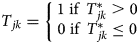
According to Ogundeji, Danso-Abbeam, and Jooste (Reference Ogundeji, Danso-Abbeam and Jooste2022), in an MVP system, where there is a possibility of adopting multiple agroecological practices simultaneously, the error term is based on a multivariate normal distribution (MVN) given a conditional mean of zero and variance normalized to unity where (μC, μT, μA, μM) ≈ ~MVN(0, π) and the symmetric covariance matrix π is given by:

The covariance matrix is composed of the unobserved correlations between different agroecological practices. It provides estimates of the underlying model's regression coefficients and correlation matrix. The MVP model provides a correlation coefficient that can be used to analyze the various latent equations and error terms that affect the choice of practices in agro-ecological settings. It also states that the rho (ρ) gives more information than merely indicating a relationship. A positive correlation means that two agroecological practices are complementary, while a negative one suggests that they can be substituted for each other. This is because a negative correlation means that two practices can be used to replace each other in a situation.
Instrumental variable treatment regression model (ivtreatreg)
In this section, unlike section 2.2.1 where each of the agroecological practices was considered as a binary variable, we treated the adoption of any of the agroecological practices (or use of at least one agroecological practice) as one variable and considered it as a binary treatment. Thus, if a farming household adopts at least one of the agroecological practices, it is assigned the value one, otherwise zero. In this case, the treatment effect of adopting agroecological practices on outcome variables (Y i), showing improvement in their farm performance can be specified in Equation (5) as:

where Y 1i is the value of the outcome variable (farm yield and net farm revenue) for the ith adopters of agroecological practices and Y 0i is the value of the outcome variable for ith non-adopters of agroecological practices. Nevertheless, the values $Y_{1i}\;{\rm and\ }Y_{0i}$ cannot be observed at the same time for the same farming households. Thus, estimating the treatment effect is practically not possible. According to Copas et al. (Reference Copas, Burkill, Conrad, Couper and Erens2020), another major concern when evaluating an impact of a treatment on an outcome is the possible existence of self-selection bias. There is a possibility of self-selection bias such as access to information, thereby making adoption decisions endogenous. Therefore, the study relied on the instrumental variable econometric technique in the treatment effect framework to estimate the average treatment effect (ATE) (Rosenbaum and Rubin, Reference Rosenbaum and Rubin1983). The ‘ivtreatreg’, specifically the direct-2sls was used to estimate the ATE in this study.
As the name suggests, the direct-2sls relies on the estimation of two ordinary least square (OLS) regressions. The first step can be specified as:

where A i denote adoption of agroecological practices, x i is a vector of explanatory variables, m denotes the outcome variable used for the estimation of impact and $\varepsilon _i$ is an error term. The second stage involves using the estimated fitted value $( \hat{A}_i)$
 from Equation (6) in the outcome variable model to obtain ATE. The second stage can be specified as:

One unique feature of the ‘ivtreatreg’ is that it permits the heterogeneous treatment effects to be estimated using the idiosyncratic variables. Considering that farmers are encouraged to use sustainable farming practices like agroecological systems to improve productivity and farm income, adoption decisions might have a heterogeneous influence on the binary treatment. For example, the quantitative impact may vary with farm size; hence, the ivtreatreg also estimate ATE(x), where ATE is estimated through idiosyncratic effects by incorporating additional explanatory variables $( x_{im}-\bar{x}\hat{A}_{im}) \partial _m \times \hat{A}_i$ in Equation (3). The ATE(x) provides information about the difference in the change in farm performance between adopters and non-adopters of agroecological practices across the entire population. The ivtreatreg also estimates the average treatment effect on the treated (ATET(x)) and the average treatment effect on the untreated (ATENT(x)). The ATET(x) defines the average difference in the farm performance between adopters in their adoption state and the same adopters in their non-adoption state. Then ATENT(x), on other hand, refers to the average difference in the farm performance of non-adopters in their current state and if they had adopted.
The direct-2sls under the ‘ivtreatreg’ framework require that instrumental variables are used to identify the binary treatment equation. An instrument is typically built from the design of a program and other exogenous factors that are unrelated to its desired outcome. The selection of the appropriate instruments is also important to ensure that they are not directly related to the outcome variable. However, they should be able to correlate with the endogenous treatment variable. The instrumental variables used in this study to identify the treatment variable (adoption of agroecological variable) are farmers' participation in basic financial management training and membership in farmer association. The falsification tests indicate that the two instrumental variables had a joint significant influence (χ2 = 10.38; P = 0.006) on the treatment variable. However, these instruments had no joint significant influence on net farm revenue (χ2 = 2.02; P = 0.135) and farm yield (χ2 = 2.13; P = 121).
Variable definition and measurement
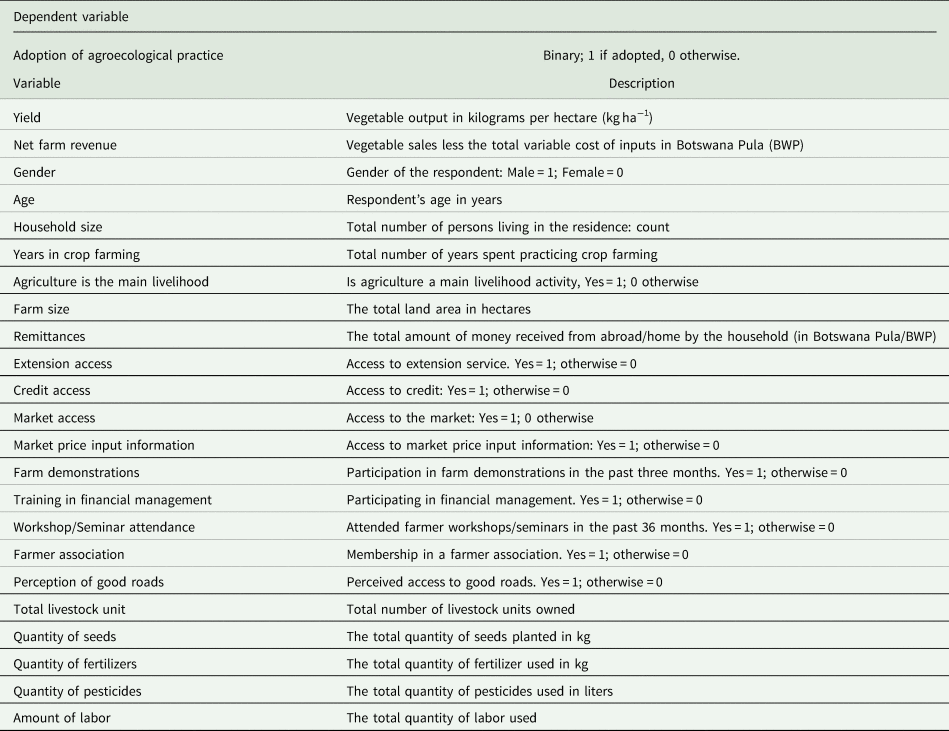
This section defines and measures outcome variables (farm performance), treatment variables (agroecological practices), and independent variables (containing socioeconomic and demographic aspects of the target population, as well as institutional elements) which are all presented in Table 1.
Definition of variables and measurements used in the study
Results and discussions
Adoption of agroecological practices
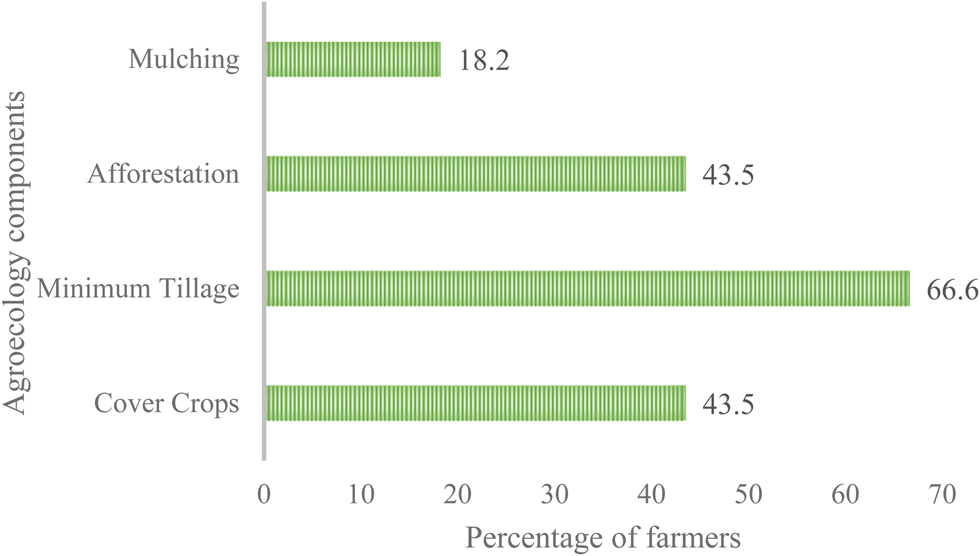
This section identifies the various practices that are commonly used by farmers in the study area, which include the use of cover crops, minimum tillage, afforestation, and mulching. Figure 1 depicts the distribution of agroecological practices among farming households in the study area. Figure 1 revealed that out of a total of 308 farmers, only 43.5% of the farmers use cover crops, while 66.5% of them use minimum tillage. Moreover, about 43.5% of farmers make use of afforestation while only 18.1% of them use mulching. Some farmers even utilize more than one practice in their farming operations.
Distribution of agroecological practices use by vegetable farmers Botswana.
Descriptive statistics of vegetable farmers in the study area
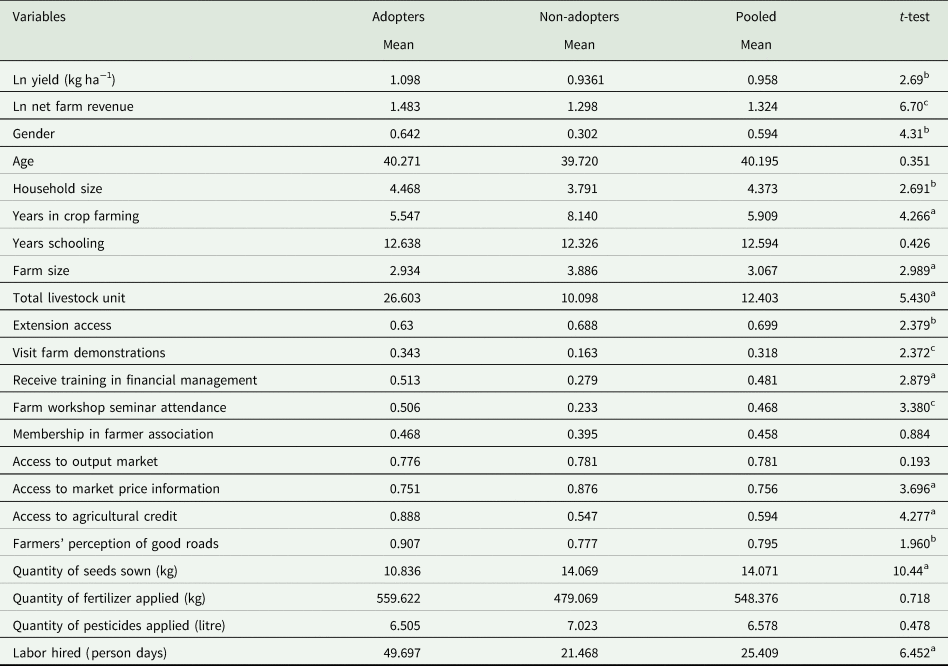
Table 2 shows the descriptive statistics of the outcome variables (net farm revenue and farm yield), as well as the various characteristics of the farm, institutional, and sociodemographic characteristics of the vegetable farmers. The results in Table 2 indicate that non-adopters had significantly lower net farm revenue and farm yield than adopters of agroecological practices. Data collected shows that most adopters (64%) were male. This finding is consistent with literature that indicates men are more likely than women to use sustainable agricultural discipline like agroecology (Gebru et al., Reference Gebru, Wang, Kim and Lee2019; Lovell, Shennan, and Thuy, Reference Lovell, Shennan and Thuy2021). The average age of the farmers was 40 years, while there are four persons per household Table 2.
Descriptive statistics of vegetable farmers
a, b, and c denote significant levels at 1, 5, and 10%, respectively.
The descriptive results further show that vegetable farmers in the study area had an average of six years in vegetable farming and 13 years in formal education. The average farm size is approximately 3.1 ha and there is a significant difference between non-adopters (3.89 ha) and adopters (2.93 ha) of agroecological practices. Moreover, about 70, 32, 48, 46, and 46% had contacts with extension agents, visited demonstration plots, received training in basic financial management, and had attended farm workshops or seminars, and belong to farmer associations, respectively. In addition, about 80% of the farmers perceived that the road network to their farms is in good condition. For the conventional inputs, there is a significant difference in the number of seeds sown and labor hired by the adopters and non-adopters. However, no significant difference exists between adopters and non-adopters regarding the use of fertilizer and pesticides.
Pair-wise correlation matrix of agro-ecological practices
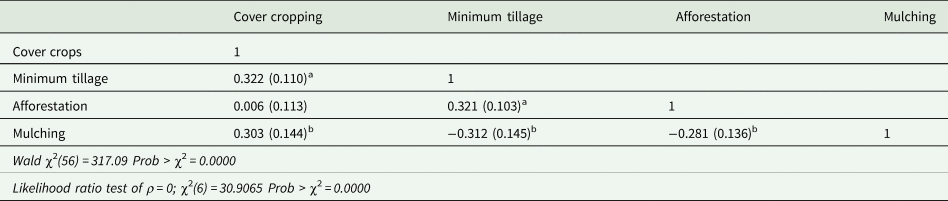
Table 3 reports the correlation matrix of the agroecological practices adopted by smallholder vegetable farmers. The model fit was statistically significant at 1% as indicated by the Wald χ2 value [Wald χ2 (56): 317.09, P = 0.0000]. This demonstrates the interconnectedness of the various agroecological practices. Thus, the MVP has strong explanatory power for this study. The results from the pairwise correlation matrix further indicate a statistically significant relationship among the various agroecological practices. In a pairwise correlation matrix, a positive significant coefficient indicates a complementarity between the variables in question, while a negative coefficient is an indication that the two variables are substitutes.
Pairwise correlation of agroecological practices
a, b, and c denote significant levels at 1, 5, and 10%, respectively.
In both cases, the choice of one agroecological practice is conditioned on the other practice. The results in Table 3 showed that some agroecological practices are complementary, whereas some are substitutes. For example, afforestation is positively related to cover cropping, indicating a simultaneous use of afforestation and cover cropping. Cover crops can be used to manage vegetation and provide farmers with additional income, by helping to reduce the cost of establishing trees within the farm (Hovis et al., Reference Hovis, Hollinger, Cubbage, Shear, Doll, Kurki-Fox, Line, Fox, Baldwin, Klondike, Lovejoy, Evans, West and Potter2021). A study by Edwards et al. (Reference Edwards, Cerullo, Chomba, Worthington, Balmford, Chazdon and Harrison2021) further explains that afforestation can be more profitable and affordable if it involves the planting of companion cover crop species that provide various ecological and economic benefits. Therefore, this could explain the complementary adoption of afforestation with cover crops by farmers. Minimum tillage is positively related to cover crops; therefore, these two practices are complementary. According to Schmidt, Hallmann, and Finckh (Reference Schmidt, Hallmann and Finckh2020), an organic minimum tillage system can help improve the fertility of the soil, if it incorporates the use of intensive cover cropping. A combination of regular cover cropping and a minimum tillage system can also help minimize the negative effects of minimum tillage. Therefore, these two practices would be used together to enhance their effectiveness. Minimum tillage and afforestation can also be considered complementary to each other since they are positively related. This shows that farmers would use these practices to complement their benefits and also believe that they would be more cost-effective. Mulching is also positively related to cover crops, indicating the complementary use of the two practices. Farmers' use the two practices to enhance their benefits and these practices are believed to be less knowledge-intensive compared to other practices.
However, mulching is negatively related to afforestation and this would indicate that farmers would substitute mulching with afforestation. The presence of mulch can help keep undesirable vegetation away from the soil and it often takes less time to mulch compared to afforestation (Coello et al., Reference Coello, Piqué, Rovira, Fuentes and Ameztegui2018; Fernández-Guisuraga et al., Reference Fernández-Guisuraga, Calvo, Huerta and Marcos2022). Therefore, farmers would substitute mulching as a less time consuming alternative to afforestation, depending on the amount of labor available. Similarly, since mulching is negatively related to minimum tillage this would mean that mulching would be substituted for minimum tillage. This can be explained by farmers' limited knowledge of how to incorporate agroecological practices in their farming operations. Many studies (Lei et al., Reference Lei, Wang, Li, Wang, Yang, Zheng and Tang2021; Musurmanov, Reference Musurmanov2021; Nyamwange, Njeru, and Mucheru-Muna, Reference Nyamwange, Njeru and Mucheru-Muna2021) have shown that minimum tillage and mulching would achieve better effectiveness when they complement each other.
Factors influencing the adoption of agro-ecological practices in Botswana
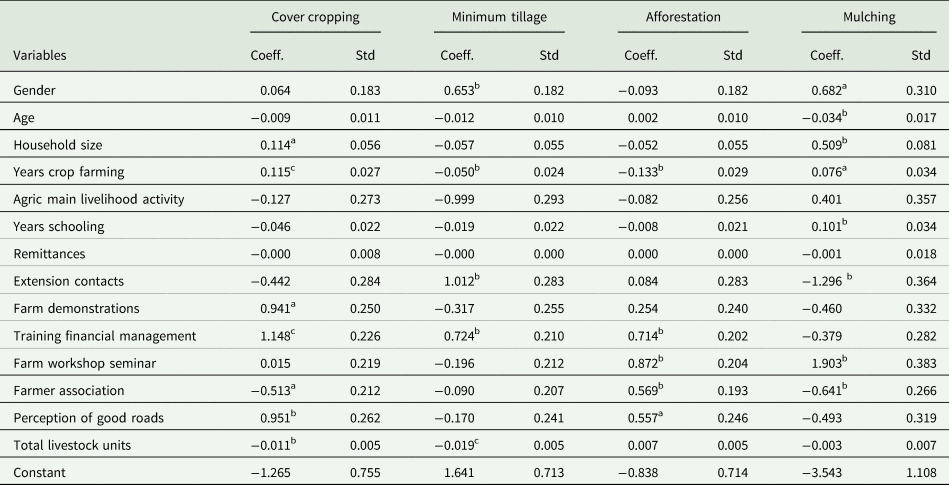
The coefficient estimates from the MVP results are presented in Table 4. The gender of the household is positively and significantly influencing the farmers' adoption of minimum tillage and mulching. This suggests that men are more likely to adopt the use of these practices in their farming operations as compared to women. Tsige, Synnevåg, and Aune (Reference Tsige, Synnevåg and Aune2020) observed that various gendered constraints affect women smallholders' uptake of these practices compared to men. Age on the other hand indicated a negative and significant influence on the adoption of mulching. It can be postulated that younger farmers may be more likely to make use of practices like mulching. This is not surprising as the older farmers might have long-standing experience in crop production and may be more familiar with using their conventional practices as such reluctant to adopt more advanced practices. Moriaque et al. (Reference Moriaque, Félix, Pascal, Anastase, Socrate and Sidoine2019) observed also that age plays a significant part in determining the adoption of water erosion control practices.
Factors influencing adoption of agroecological practices
a, b, and c denote significant levels at 1, 5, and 10%, respectively.
Moreover, Wekesah, Mutua, and Izugbara (Reference Wekesah, Mutua and Izugbara2019) stated that in Zimbabwe and Zambia, male-headed households were more likely to adopt conservation practices such as minimum tillage. This is because they have better access to resources and are more likely to use them for farming (Marenya et al., Reference Marenya, Kassie, Jaleta, Rahut and Erenstein2017). Results from Table 4 also indicated that household size has a positive and significant influence on the adoption of cover cropping and mulching. Thus, the greater the size of the household the greater chance of mulching being used by the household. This is consistent with recent studies (Amare and Simane, Reference Amare and Simane2017; Danso-Abbeam et al., Reference Danso-Abbeam, Bosiako, Ehiakpor and Mabe2017; Wossen et al., Reference Wossen, Abdoulaye, Alene, Haile, Feleke, Olanrewaju and Manyong2017) that identified larger family sizes to positively influence farmers' adoption of sustainable agricultural practices like soil and water conservation practices and improved maize varieties. This implies that having a larger family size gives the household access to labor that can be used to implement such sustainable practices.
As summarized in Table 4, years in crop farming have a positive and significant influence on the adoption of cover crops and mulching by smallholder vegetable farmers. This suggests that the greater experience a farmer has in crop farming, the more likely that farmer is to practice sustainable farming operations like agroecological practices. A study by Paustian and Theuvsen (Reference Paustian and Theuvsen2017) confirms that having around 16–20 years in crop farming has a positive influence on the adoption of precision farming techniques. However, years in crop farming showed a negative effect on the adoption of afforestation and minimum tillage. This suggests that farmers with less experience in crop farming are the ones more likely to make use of afforestation and minimum tillage. This pattern could be explained by farmers becoming less likely to adopt sustainable farming practices as they gain more experience. Farmers with more experience may be less willing to try new things and more reluctant to experiment new practices, especially if they have previously had success with their traditional methods. Moreover, it is conceivable that farmers with a high level of experience in their farming could be more inclined to avoid risk. This inclination can be explained by the large stakes they have in their investments and general well-being. It is possible for people to perceive the application of new techniques as risky, especially if they are unaware of the possible consequences.
Results further identify that years of schooling have a positive and significant effect on the adoption of mulching. The greater the number of years of schooling a farmer has had the better their knowledge of advanced and knowledge-intensive agroecological practices such as mulching. Contact with extension officers increases the likelihood of adopting minimum tillage. The observation is consistent with a study by Olorunfemi, Olorunfemi, and Oladele (Reference Olorunfemi, Olorunfemi and Oladele2020) who established that extension officers were pivotal in the diffusion of practices like minimum tillage amongst farmers. However, extension contacts were identified to be significant but have a negative influence on the adoption of mulching. This suggests that the lesser the contact with extension officers, the higher the chances of a farmer making more independent choices in their farming operations such as adopting mulching without contacting extension officers.
As indicated in Table 4, farm demonstrations have a positive and significant influence on the adoption of cover crops. This infers that more opportunities that are given to farmers to learn practically and first-hand would enhance the adoption of those practices. Training in financial management was also estimated to influence the adoption of three practices, excluding mulching. It has a positive and significant influence on the adoption of cover crops, minimum tillage and afforestation. The results imply that farmers who possess training in financial management have a greater likelihood to employ these three practices on their vegetable farms. These results confirm the a priori expectation that receiving training in financial management helps enhance good sustainable business practices and development, thus enabling farmers to decide to invest in agroecological practices (Hama Said and Hassan, Reference Hama Said and Hassan2017). Farm workshop or seminar attendance is also established to have a positive and significant effect on the adoption of afforestation and mulching. It can be interpreted that attendance at farmer workshops or seminars enhances the adoption of agroecological practices by smallholder vegetable farmers. Many empirical studies (Coulibaly, Motelica-Heino, and Hien, Reference Coulibaly, Motelica-Heino and Hien2019; Yang et al., Reference Yang, Qi, Lu, Tantiwat, Guo and Arif2023) had confirmed that training that can be gained by farmers was positively linked to the adoption of agroecological practices.
The results further indicated that farmer associations have a significant and negative influence on the adoption of cover cropping and mulching but a positive and significant influence on afforestation. Thus, being a member of a farmer association would greatly enhance the adoption of afforestation. A study by Kangmennaang et al. (Reference Kangmennaang, Kerr, Lupafya, Dakishoni, Katundu and Luginaah2017) established that to achieve a more participatory approach to the uptake of agroecological practices, there must be an emphasis on farmer-to-farmer knowledge sharing, community involvement and social equity to enhance farmer learning and realize its' benefits. However, farmers that have no link with a farmer group/ association have a greater likelihood of adopting the use of agroecological practices like mulching and cover crops. This goes against studies by Anang, Bäckman, and Sipiläinen (Reference Anang, Bäckman and Sipiläinen2020), Moore et al. (Reference Moore, Swisher, Koenig, Monval, Tarter, Milord and Delva2021) and Wossen et al. (Reference Wossen, Abdoulaye, Alene, Haile, Feleke, Olanrewaju and Manyong2017) which identified that being part of a farmer organization and having contact with other farmers increases the likelihood of technology adoption. Farmer organizations are typically made up of people from various backgrounds, preferences, and with different farming methodologies. The presence of varied viewpoints might lead to divergent opinions about the efficacy and benefits of some farming practices, making it difficult to reach a unified agreement on its implementation. Furthermore, farmer associations may not consistently place a high premium on the dissemination of information about modern agricultural techniques such as mulching. Adoption may be hampered by a lack of awareness or information among their constituents.
Table 4 further recognizes that the perception of good roads also had a positive and significant influence on the adoption of cover crops and afforestation. Good road infrastructure enables convenient transportation of agricultural inputs and enhances the efficiency of marketing activities related to farm products. Farmers are more inclined to adopt agricultural practices such as cover cropping and afforestation when they perceive the availability of resources and convenient access to markets facilitated by well-maintained road infrastructure. Total livestock unit was identified to have a negative and significant influence on the adoption of two practices: cover crops and minimum tillage. Thus, farmers with small quantities of livestock have a higher probability of making use of agroecological practices like cover crops and minimum tillage in their farming operations. A study by Abeje et al. (Reference Abeje, Tsunekawa, Adgo and Haregeweyn2019) confirms that livestock ownership plays a part in influencing the livelihood decisions of farmers. This can imply that farmers who have greater quantities of livestock are reluctant to invest in other activities but would seek to specialize in rearing livestock. This is especially true for a country like Botswana, which is heavily reliant on livestock production compared to other sub-sectors.
Determinants of farm performance
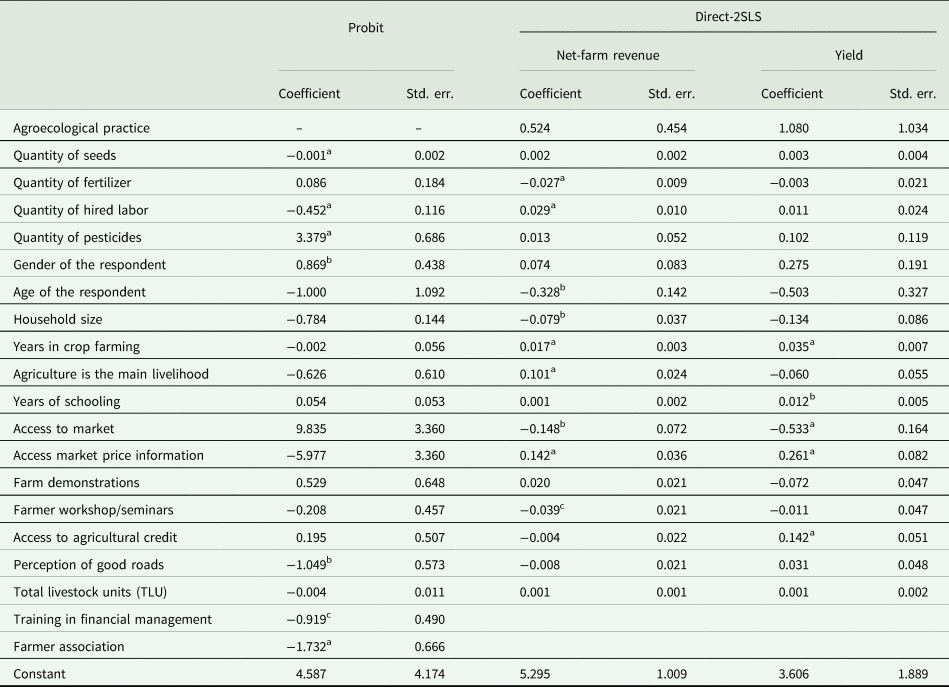
Table 5 displays the results of the probit model that identifies factors influencing the adoption of at least one of the agroecological practices under consideration, as well as the determinants of farm performance estimated via the direct-2sls model under the framework of ‘ivtreatreg’. It is worth noting that since factors explaining the variation in the adoption of agroecological practices have been estimated via MVP and discussed in sections 3.2 and 3.3, the probit model will not be discussed in detail here. Hence, the discussion under this section is based on the determinants of net farm revenue and yield in columns four to seven in Table 5. In column two of Table 5, the factors identified to influence the adoption of at least one agroecological practice include the quantity of seeds used, amount of hired labor, the quantity of pesticides used, gender of the respondent and perception of the state of the farm road. Others are the two instruments used to identify the probit model: received training in basic financial management and membership of a farmer association.
Factors influencing vegetable farm performance in Botswana
a, b, and c denote significant levels at 1, 5, and 10%, respectively.
The results indicate that the quantity of organic fertilizer applied and labor hired are the key inputs that significantly affect the net farm revenue. However, while fertilizer decreases net farm revenue, labor increases net farm revenue. The negative effect of fertilizer application suggests that the greater the amounts of fertilizer that is used can eventually reduce the net farm revenue of the enterprise. This is consistent with a study by van Wesenbeeck et al. (Reference van Wesenbeeck, Keyzer, van Veen and Qiu2021) who identified that overly dependence on chemical fertilizers can eventually reduce the incomes of farmers but if farmers move away from this heavy reliance on chemical fertilizers, they can reap greater benefits. Greater availability of workforce can have a significant influence on adopting more labor-intensive practices, which will in turn have a positive and significant influence on net farm income. Age and household size are found to have a significant, although negative effect on net farm income. This result disagrees with a study Sani and Kemaw (Reference Sani and Kemaw2019), which showed that factors like age and household size have a positive effect on food security and productivity of the farming household. Years spent engaging in crop farming and agriculture as the primary source of livelihood also showed a positive and significant effect on net farm income. The likelihood that a farmer will generate more net farm income is significantly increased if agriculture is their primary line of work. The net farm revenue was found to be positively and significantly influenced by access to market price information.
So, it follows that the more price knowledge a farmer has, the more equipped they would be to make production choices that would enable them to increase net farm revenue. According to Civera et al. (Reference Civera, De Colle and Casalegno2019), having information about market prices enables farmers to become more empowered, which may improve their ability to earn a sustainable income. The net farm revenue was also found to be significant but negatively influenced by participation in workshops and seminars. Contrary to earlier studies (Issahaku and Abdulai, Reference Issahaku and Abdulai2020; Liang et al., Reference Liang, Guan, Clarke, Liu, Wang and Yao2021), this finding downplays the significance of training for smallholder farmers as a crucial element that influences farm productivity and production choices. This could be a result of the workshops or seminars that the farmers attended possibly focusing more on how to use farm management practices than how farmers should effectively deploy their resources to maximize profit. When it comes to farm yield, it has been found that the factors such as years of crop farming experience, years of education, market access, market pricing information access, and agricultural financing access all significantly affect the yield of smallholder vegetable farmers. This supports the conclusions of recent studies (Agbodji, Reference Agbodji2021; Issahaku and Abdulai Reference Issahaku and Abdulai2020; Makate et al., Reference Makate, Makate, Mango and Siziba2019) showing these factors have a positive and significant effect on farm productivity. The yield is shown to be significantly yet negatively influenced by the variable access to the market. This suggests that farmers who have low yields often have a tough time accessing the right markets for their produce as such limiting their income greatly. Which is consistent with studies (Hlatshwayo et al., Reference Hlatshwayo, Ojo, Modi, Mabhaudhi, Slotow and Ngidi2022; Magesa et al., Reference Magesa, Michael and Ko2020) that believe that for smallholder farmers, having the access to the right markets for their produce greatly affects their farm performance.
Impact of agroecological practices adoption on farm performance
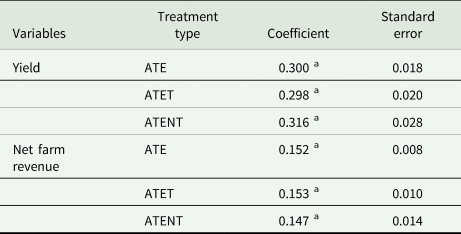
The post-estimation of the direct-2sls allows the estimation of ATE, ATET, and ATENT. Table 6 presents the results of the quantitative impacts of agroecological practices on farm performance estimated via direct-2sls.
Average treatment effects (direct-2SLS)
a denote significance level at 1%.
The findings from the direct-2sls analysis reveal that the adoption of agroecological practices is associated with a significant 30% rise in crop yield and a 15.2% increase in net farm revenue. Therefore, on average, the adoption of agroecological practices results in a 30% increase in yield and a 15.2% increase in net farm revenue, in comparison to those who have not adopted such practices. For the ATET results, farmers who adopted at least one of the agroecological practices had their farm yield and net farm revenue increased by 29.8 and 15.3%, respectively, more than what they would have had if they did not adopt. Thus, if they had not adopted the agroecological practices they would be worse off by 29.8 and 15.3% in yield and net farm revenue, respectively. Regarding the non-adopters of agroecological practices (ATENT), their yield and net farm revenue would have increased by 31.6 and 14.7%, respectively if they had adopted at least one of them. Thus, the use of agroecological practices had a substantial impact on farm yields and revenue of adopters, and non-adopters would have been better off if they had adopted. The findings support the idea that adopting eco-friendly practices like agroecology can result in higher land productivity and profitability. This is consistent with the literature that shows that these practices can improve both productivity and profitability (D'Annolfo et al., Reference D'Annolfo, Gemmill-Herren, Graeub and Garibaldi2017). The findings are also consistent with other pieces of literature (Brzozowski and Mazourek, Reference Brzozowski and Mazourek2018; Wei Reference Wei2020) that opined that agroecological innovation can have a significant contribution to sustainably boosting the yield of crops.
Conclusions and recommendations
The study estimated the impact of agroecological practices adoption on farm performance across four districts of Botswana using farm-level data collected from 308 vegetable farming households. This objective was achieved through the use of two econometric techniques: MVP and direct-2sls model. From the key findings, the study concluded that vegetable farmers in the study area use cover cropping with minimum tillage, cover crops with mulching, as well as minimum tillage with afforestation as complementary agroecological practices. However, afforestation with mulching, and minimum tillage with mulching were used as substitutes. Moreover, different socioeconomic, institutional, and farm-specific factors influence farmers' decisions to adopt these agroecological practices such as years in crop farming, training in financial management, farmer association, gender, age, extension contact etc. The adoption of agroecological practices had a substantial and positive impact on farm yield and net farm revenue of farmers who adopted at least one of the practices, and those who did not adopt any of the practices would have benefitted significantly if they had done so. Non adopters would have benefited by 31.6 and 14.7% with regard to yield and net farm revenue respectively, had they adopted agroecological practices.
This study has resulted in some noteworthy insights that can be used as a basis for policy recommendations. Firstly, it is imperative for both the government and the private sector to improve the dissemination of information regarding farm management approaches, such as agroecological practices, in order to strengthen farmers' understanding and encourage their adoption. Specifically, agroecological practices could be integrated as part of an extension training module to boost farmers' interest in its use. Furthermore, government should encourage the formation of farmer groups especially among the youth to enhance knowledge sharing and transfer, promote social cohesion, and consequently boost the use of agroecological practices, which will, in turn greatly benefit farmers. Finally, up scaling agroecological practices requires an appropriate enabling environment including policy and technical frameworks to support smallholder farmers to overcome barriers (e.g., improved access to agricultural credit and insurance against various hazards) to the implementation of agroecological practices. That is Government and private sector can jointly avail the necessary resources to help farmers in the uptake of sustainable agricultural practices for better food production in the country.
Further research
There are various practices that farmers use that can be regarded as agroecological, however only four were explicitly analyzed in this study. Therefore, further research may look into examining other practices and their economic impacts. While this study relied on cross sectional data, future researches can use other types of data such as panel data.
Competing interests
None.


 Open access

