




Introduction
When the British withdrew from India in 1947, the subcontinent was divided into two independent nation-states—India and Pakistan—conceived along majority lines. Following partition and the ensuing sectarian violence, there was a mass exodus: around 15 million people fled to the ‘right’ nation, and between one to three million people died.Footnote 1 The partition of India entailed splitting the province of Bengal. The eastern part of Bengal became East Pakistan, established as a Muslim-majority state, while the western part of Bengal was absorbed into India. There was sectarian violence between Hindus and Muslims in the border provinces of Punjab, in the northwest part of India, and Bengal. As a result of this violence and faced with the prospect of further escalation, Bengali Hindus living in Noakhali, East Bengal, departed for Calcutta because they feared the massive violence in Punjab would also occur in Bengal.Footnote 2 However, their connection to their ancestral homes was not untethered, even though the border crisis between Delhi and Karachi exacerbated problems in East Pakistan. On 14 July 1948, the Government of India unilaterally introduced the permit system, which required anyone who entered the country across its western frontier to obtain a permit. In retaliation, the West Pakistan government instituted its own permit system on 15 October 1948 and wanted to extend this to East Bengal. The East Bengal government objected out of concern for the thousands of Bengalis who consistently crossed over to West Bengal for business purposes.Footnote 3 Most importantly, Bengali Hindus who crossed the border during riots and partition were still travelling back and forth, and hoped to return to their abandoned properties. I argue that their hopes of returning home died when the East Bengal State Acquisitions and Tenancy Act of 1950 was enacted. For Bengali Hindus, the Act, which permitted the acquisition of their landed properties in 1956 by the East Pakistan government, marked the real moment of partition.
Following the Noakhali riots of 1946, which arguably expedited the partition of Bengal, some Bengali Hindus exchanged or sold properties when they decided to leave their homes in East Bengal. A portion of them left their homes on the understanding that they would return. Often, Bengali Hindus left someone, such as a Muslim, widow, relative, or trustworthy person, to watch over their properties until they could come back.Footnote 4 Some had to depart without appointing anyone to look after their holdings. Thousands of petitions were forwarded from the chief secretary of the Government of West Bengal, India, to his counterpart in East Bengal regarding alleged forcible occupation of Hindus’ houses and properties. The petitions ranged from the payment of arrears to government requisition of the houses, cutcherry, and so on.Footnote 5 The newly formed countries circulated letters to each other to enquire into the cases. Although it is true that Bengali Hindus from Calcutta sought help from the Indian state to ensure that their properties were safe and secured, there were other cases of mutually arranged property exchanges between Hindus and their Muslim neighbours. Government records tell a story which portrays an antagonistic relationship between Hindus and their Muslim counterparts. That portrayal, however, is not representative of the common Hindu-Muslim relationship of the era; records of direct correspondence between Hindus and Muslims provide a much more nuanced perspective—though there was occasional antagonism, most relationships were respectful and affectionate.
The Bengali Hindu landowners who departed for Calcutta initially entertained the hope that they would be able to return and reclaim their lands and homes after the partition of India in 1947. However, when they heard news of the recurring violence in the years that followed, Bengali Hindus realized that they would have to wait to return to their ancestral villages. This resulted in them being unwillingly separated from their familial inheritance, and losing their property rights forever from the mid-1950s onwards. This article documents the initial hope of the displaced landowners and the gradual abandonment of their hopes of returning. Specifically, this article examines 26 letters, dated from 1948 to 1956, between Jogendra and Oli Mian. Jogendra’s story is revealed in a long conversation through letters exchanged over the years following partition. The early letters contain the hope and explicit plans that Jogendra had of returning home and reclaiming his properties. However, the later letters depict him selling parts of his properties to Muslim villagers including Oli Mian, Gani Mian, and Kajal Khan. The rest of his properties were eventually requisitioned by the government in the mid-1950s through the East Bengal State Acquisitions and Tenancy Act. This case study indicates why so many Bengali Hindus—including those among the first 14,000 who crossed the border immediately after the Noakhali riots and partition—had lost their hopes of returning home by the mid-1950s. This correspondence between a Hindu and his Muslim neighbour provides a microscopic view of the dwindling hopes of returning post-partition. It is representative of the longing and accompanying struggle of Bengali Hindus, who migrated to West Bengal and waited for their chance to return to East Bengal, and shows that there was more to Hindu-Muslim relationships than violent antagonism.
While historians have a grasp of the communal violence of the era, I posit that they lack a thorough understanding of individual experiences, particularly regarding the relations between Hindus and Muslims before and after partition. Historians of partition have largely neglected to examine the personal struggles of individuals who were affected by partition. Thus, it is difficult to get an idea from partition literature of how the Bengali Hindus’ inability to return to their homes in East Bengal became a fait accompli in the middle of the 1950s. With partition, new national identities were constructed in both India and Pakistan based on religious affiliation, and yet Hindus and Muslims sustained agrarian relations from both sides of the new border that sliced through Bengal.
Historian Gyanendra Pandey writes about Muslims’ loyalty to India after partition. He contends that a ‘the test of loyalty’ was required from Indian Muslims, who were not considered as natural citizens of the state as per the construction of Indian nationalism in the post-partition era.Footnote 6 Dipesh Chakrabarty writes about Bengali Hindus’ remembrance, nostalgia, and sentiment that revolved around native villages, pictured as both sacred and beautiful in Chere Asha Gram (The Abandoned Village) published in 1970.Footnote 7 Vazira Zamindar argues that the post-partition Muslim and Hindu displacement from Delhi and Karachi was a result of state policies that produced more refugees and fractured communities.Footnote 8 Ilyas Chattha argues that the property settlements benefitted Muslim factory owners in Gujranwala in Punjab, who regarded themselves as labourers-turned-proprietors because displaced Hindus favoured leaving their businesses to Muslim employees and friends.Footnote 9 Partha Chatterjee notes that despite the fact that some people see the history of India as being defined by the Hindu religion, there were, in fact, many others who viewed Indian history as a story of fraternal association between Hindus and Muslims.Footnote 10 Tapan Raychaudhuri recounts his childhood in his autobiography when hundreds of Muslims would come to enjoy puja from far distant villages in Barisal before partition.Footnote 11 Sumit Sarkar states that, ‘sometimes zamindars offered their respects to the dargas, tomb of Muslim saints and pirs’.Footnote 12 Uditi Sen examines how Hindu bhadralok (gentlefolk) dealt with their struggles in the squatter colony of Bijoygarh and took advantage of government ‘schemes offering training, employment and loans to refugees’.Footnote 13 However, none of these studies pays any attention to the Bengali Hindu refugees in West Bengal who wished to return to their homes in East Bengal. More needs to be understood about Bengali Hindus’ desire to, and expectations of, return to their homeland in East Bengal. My sources confirm and expand upon this idea.
The letters, which I discovered, add another piece to the puzzle by offering an account of friendly, neighbourly, and sometimes tense relationships between Hindus and Muslims. This account is important because it questions the grand narrative of the political parties which argues that India was a country of two forever feuding factions. This following section provides an overview of the conditions in Lamchar, a village in the Noakhali district, and then the district as a whole.
Lamchar and Noakhali
Lamchar was one of the few Union Parishads in Noakhali where Hindus were in the majority.Footnote 14 It had a total population of 931: 286 Hindu males, 325 Hindu females, 165 Muslim males, and 155 Muslim females.Footnote 15Among the various bari—a community where approximately five to seven families live in close proximity—Lamchar Chowdhury Bari was unique because its inhabitants were upper-caste Hindus who were the Talukdars and moneylenders.Footnote 16 They arranged the Durga puja, the commemoration of the annual victory and unfathomable power of the goddess Durga over the demon. The puja is symbolic of the aristocracy, requiring a month-long preparation and ending in a week-long celebration.
Bengali Muslims came in large numbers to participate in the festival and often helped to prepare it. Mokhles Khan, a Muslim headmaster of Lamchar primary school, shared in an interview, ‘We joined Durga puja. Jogendra doctor (Doctor Babu) was a generous person and loved my father so much. We were so poor, my father used to work in their houses, and they looked after us. This house was also given by Doctor Babu based on Dakhila (rent-receipt).’Footnote 17 This exemplifies a friendly Hindu-Muslim relationship, especially between upper-caste Hindus and lower-class Muslims. However, Hindu-Muslim coexistence was not uneventful. In fact, it was quite complex, with interactions ranging from helpful to exploitative. Oral histories and private correspondence provide surprising insights into these complicated relationships before and after partition.
Upper-caste Hindus, Talukdars, oppressed Muslim peasants; we used to work as their subjects. We can’t go to the bazaar with shoes on. They [Hindus] often humiliated us … But not all of them were bad. During Hindu festivals, Muslims were able to go and collect food for the families for a couple of days. Hindus also established community health centres, post offices, and lots of modern facilities that Muslims could enjoy. We often joined in the theater that started in the Hindu landowners’ yard. These plays lasted through the night until early morning.Footnote 18
This account was shared by a Bengali Muslim named Suroz Mian, now 102 years of age. From the interview, it was clear that not all Hindus exploited Muslims. Lamchar had friendly relationships, and yet tensions often emerged in the Hindu-Muslim community for economic reasons.
It is important to see the district of Noakhali from the perspective of the population and the economy. Muslims were ‘98% … tenants and debtors’, while all the moneylenders and Talukdars came from the Hindu community.Footnote 19 Among the Hindus, ‘about 10% were from landlord and money lender classes, while the vast majority were indebted agriculturists’ like the bulk of the Muslims.Footnote 20 Statistically speaking, the total population of Noakhali, the southeastern district of Bangladesh, was 1.7 million in 1940. According to J. E. Webster, a British civil servant who compiled statistical data in 1911, ‘the district takes its name from that of the river, the Origin of Noakhali Khal (or new channel) on which the headquarters is stationed’.Footnote 21 Table 1 provides information about Noakhali district.
Information about Noakhali district.

Agrarian relationships between Hindus and Muslims persisted beyond partition; they engaged in economic transactions that included financial support and property settlements, and sustained communication over farming and land use. Political changes did not necessarily or immediately destroy personal relationships, but this has found no expression due to the overriding narrative in partition literature that has overwhelmingly concentrated on politics and violence, and the high politics of partition. More importantly, Bengali Muslims’ voices have not been heard; as a result, they are seen as acting antagonistically towards Bengali Hindus. Nationally important political events were recorded and preserved by powerful individuals and institutions, but rural communal records and individual experiences have been more difficult to recover.
Many Hindus either sold or lost their ancestral property in East Bengal and, as a result, were forced into a lower standard of living and suffered prolonged hardship as a displaced people in West Bengal.Footnote 23 In some cases, these families returned later to reclaim their occupied property. In other instances, in their rush to leave, Bengali Hindus left the land to their neighbours. Some Hindu and Muslim families exchanged their properties in their respective countries of migration.Footnote 24 This type of property exchange was prevalent in the urban areas surrounding Dacca and Chittagong and in specific regions along the border where Muslims migrated to East Bengal and Hindus relocated to the West Bengal.Footnote 25 Bengali Hindus in Noakhali could not exchange property due to its rural location and the unanticipated riots in the area, which forced their urgent, unplanned migration. Frequently, Hindu landowners in Noakhali made a hurried decision to sell a tiny portion of property and appointed their Muslim and Hindu neighbours to take care of the rest until they returned.
The first Hindus who fled were landowners, businessmen, and traders, who were at the top of the economic hierarchy and had regular communication with Calcutta before partition (see Table 2). Chatterji remarks that, ‘wealthy Hindus with property in West Bengal were best placed to make the move since they had homes to go to in the west: most substantial landlords in East Bengal owned considerable “town houses” in Calcutta’.Footnote 26 Many of them had a safe space in which to seek refuge. Statistical data produced by the Indian and Pakistani governments attempted to ascertain the cost of partition. Often, the facts and figures they published were not reliable because they were produced to blame the other side. According to anthropologist Nilanjana Chatterjee, the ‘unending trail’ of migration began with the Noakhali-Tippera riots in 1946, which saw 14,000 Hindu people displaced.Footnote 27 However, the Government of India produced data that set the figure at 19,000 Hindu people being displaced. Conversely, the East Pakistan government undercut the Indian government’s claim with their own figure of 15,000, and they further stated that 3,750 minority community members had since returned to Noakhali.Footnote 28 The scale of the migration and the competing documentation makes it difficult to uncover the fate of the abandoned properties. Therefore, the scope of the economic displacement among Noakhali’s upper-caste Hindus is difficult to estimate. This situation was further complicated by the fact that people travelled back and forth between their abandoned properties in Noakhali and their new shelter in Calcutta.
Reasons why refugees fled from East Bengal, 1946–1970. (Figures in lakhs: 100,000s.)
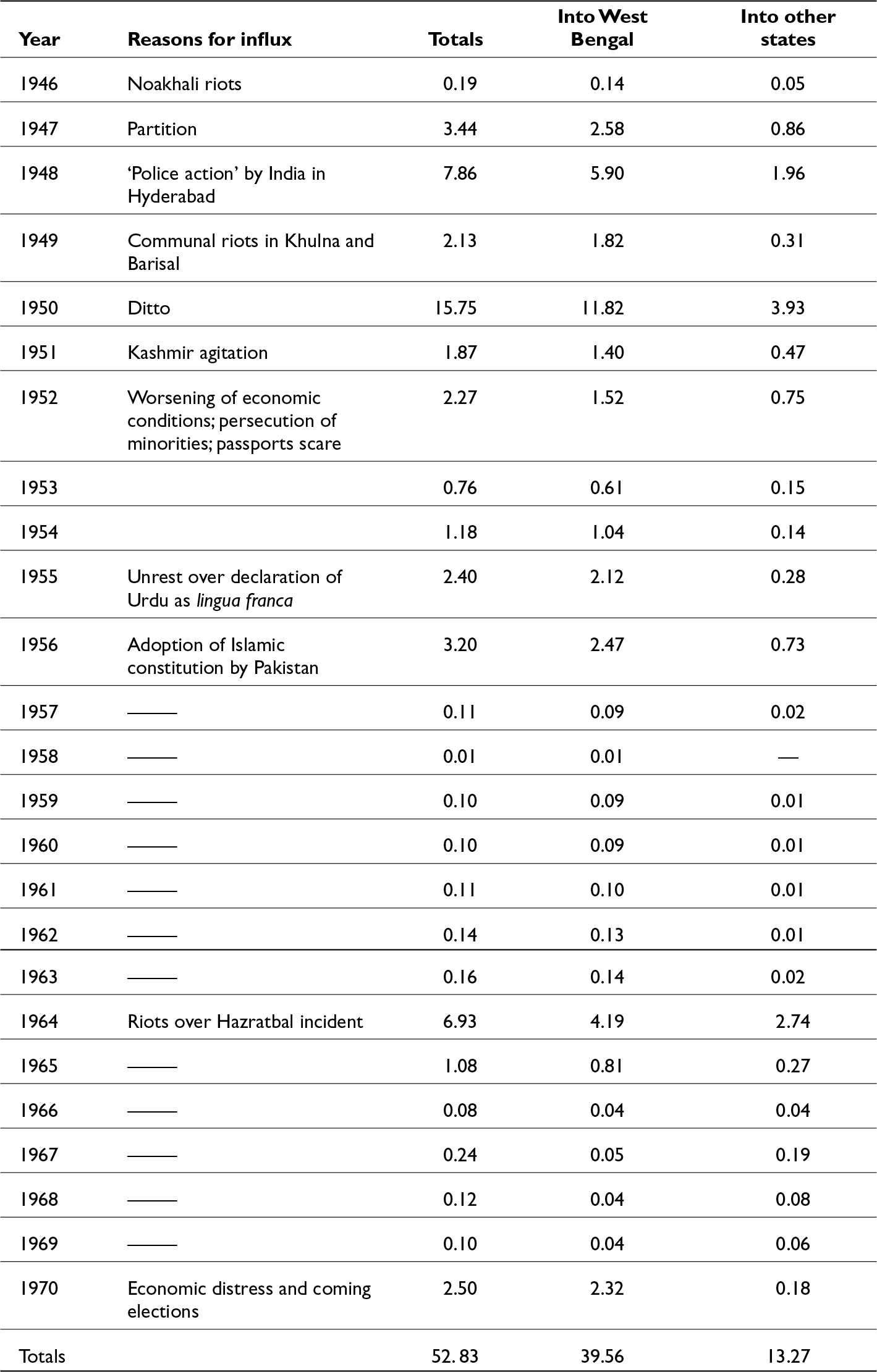
Source: P. N. Luthra, Rehabilitations (New Delhi: Publications Division, 1972), pp. 18–19.Footnote 29
There is some research on the economic displacement surrounding partition. For example, Ilyas Chattha focuses on the Muslim refugees who moved to West Pakistan. In Gujranwala, Punjab, many Muslims had good relationships with Hindu businessmen they worked for, and took over the businesses when the Hindus fled in the huge tidal waves that drove Hindu minorities from West Punjab once and for all.Footnote 30 However, the East Bengali Hindu migration was a lengthier process that corresponded to patterns of disturbance within their places of origin. My research suggests that Hindus consciously maintained relationships with their agriculturalist Muslim caretakers and did not completely desert their properties. Between 1946 and 1956, Bengali Hindus sold a small portion of their properties to Muslim neighbours and others gave away some belongings to Muslims. However, the displaced Hindus were hoping to one day return to their ancestral villages. To sell even a small part of their lands was a difficult process because giving the power of attorney required to act in their stead necessitated an exchange of letters between Calcutta and Noakhali. In addition, each new government law introduced novel and specific problems into the Hindu and Muslim agricultural and properties relationship.
Government acts and passports
The East Pakistan government enacted several policies that had negative effects on the Hindu minority of the fledgling state. Following their departure from East Bengal, Bengali Hindus remained hopeful for their return, believing that their stay in Calcutta would be temporary until communal troubles at home blew over. However, the situation deteriorated after the government passed the East Bengal (Emergency) Requisition of Property Act in 1948, which alienated the Hindu minority from their lands.Footnote 31 After partition, as Pakistan created its own government, laws were enacted to meet the urgent needs of the new government offices. Whenever any properties were requisitioned or acquired under this Act, an agreement between the district magistrate and the property owner called for the government to recompense the property owner.
The law enabled the government to requisition and convert Hindus’ houses into secretary offices within the metropolises. The government also requisitioned property in order to bring offices into a relatively centralized urban position rather than their previously scattered locations in the different outlying districts.Footnote 32 After partition, no governmental offices existed in East Bengal. Even Dacca, the most developed location and capital of East Bengal, lacked governmental accommodation. To run the nascent country, the government had to acquire, if necessary, both movable and immovable properties. The draft of this Act used the phrase ‘public purpose’ to requisition properties. Government officials abused this vague phrase to acquire minority properties under the guise that it served a public purpose. Most of the houses in the vicinity of the districts were owned by Hindus and it was these houses that fell prey to the requisition process. Furthermore, in many cases, after partition many Hindus found they had few prospects in East Bengal and allowed their houses and businesses to be requisitioned to receive compensation. They chose to relocate to Calcutta and yet filed complaints through West Bengal to the East Bengal government that their houses were unfairly acquired.Footnote 33 However, Jogendra’s properties were not occupied due to their rural location. Importantly, his Muslim neighbours consciously prevented the land from being acquired.
Furthermore, the legislature took subsequent action concerning the administration of properties by enacting the East Bengal Evacuees (Administration of Immovable Property) Act of 1951. This asserted that any person, including a legal heir, who fled after partition ‘would be considered an evacuee’ and their properties would be turned over to the Evacuee Property Management Committee for leasing and letting. Any persons wanting to return within six months were required to complete a declaration form.Footnote 34 This law entrusted the government to preserve and protect the immovable properties of the Hindu evacuees. However, in practice the law allowed the government to act in an arbitrary and inconsistent manner. If anyone failed to declare their intent to return within that timeframe, their holdings would be forfeited to the government. This legislation ensured that the Evacuee Committee could repossess and distribute any land that belonged to evacuees without prior consent if they did not return in time. East Bengal maintained separate records of the properties that were considered desirable for requisition, which made it easier for the District Minorities boards, which were controlled by the Evacuee Committee, to have joint control of the properties the government wanted. It is not clear whether the boards waited before selling the land or if there was any way for a landowner to reacquire their property. Meanwhile, a problem ensued between Delhi and Karachi concerning the refusal of Muslim refugees’ rehabilitation, which resulted in a permit system. The idea was adopted to maintain internal security by refusing entry permits to those whom they considered to be a potential threat to communal harmony. This measure implemented the first set of restrictions on the border which, Zamindar notes, was for many an action that instituted the ‘real’ partition on the western border.Footnote 35
Although West Pakistan pushed to adopt their permit system on the East Bengal border, it was opposed by the East Bengal side in 1948 due to Hindu and Muslim communities regularly crossing from both sides of Bengal to make a living. East Bengal had an open border to facilitate the free passage of Hindus and Muslims; however, in 1952 passports became a requirement for border-crossings between India and Pakistan.Footnote 36 Before passport culture began to control the border, the Nehru-Liaqat Pact, agreed on 8 April 1950, encouraged minorities to return and promised freedom of movement across the Bengal border. Moreover, East Bengal took steps to derequisition the houses of the Hindu minority, allowing property to be reclaimed, and so border crossings had to be fluid. In the case of confusion regarding property ownership, the benefit of the doubt was extended to the claimants.Footnote 37 Passport requirements did not stem the flow even after 1952 because Bengal’s porous border is crisscrossed by many rivers and the natural geography allowed passage without official interaction, which made the border difficult to seal. Khwaja Nazimuddin, Pakistan’s prime minister, spoke with Hindu leaders in 1952 explaining that passport legislation ‘would not discriminate against them’.Footnote 38 This article maintains therefore that partition became a reality for Bengali Hindus in 1956 when the East Bengal State Acquisitions and Tenancy Act was implemented, and that the requirement of a permit or passport made virtually no difference for crossing the border between West and East Bengal.
Thus, the final blow for landowners, who were predominantly Hindus, was the East Bengal government’s determination to abolish the zamindari system. The land reformation system was drafted in the interest of the state. The East Bengal State Acquisitions and Tenancy Act of 1950 was passed after a long debate and controversy between Hindu and Muslim parliament members. The government was determined to acquire all rent-receiving interests from the hands of landowners, but they agreed to compensate landowners for their property. The bill was first drafted in 1948 and presented in parliament for debate. This led to a scathing exchange between Hindus and Muslims. Hindus argued that the bill should not be passed in its present form as it would create anomalies. These arguments, over the clauses about compensation and retaining land that would impact on Hindus economically, prolonged the process of enacting the law. The Hindus’ main concern was that the bill should not allow a vindictive spirit, and government should not entertain it. During this debate, Hindus asserted that passing the bill in its present form would place zamindars in the streets. However, Muslim members protested that a lot of zamindars had gone to India but still exercised their zamindari power from across the border. Facing a strong protest from the Hindu landlords, the East Bengal Legislative Assembly finally passed the Act on 18 May 1951.Footnote 39 The cultivators were granted permanent and transferable tenancy rights and paid rent directly to the government. The zamindars and other subleases were abolished.
The Muslim League government in East Pakistan was in its moribund stage in 1954, and this prolonged the enactment of the law. Additionally, its implementation was further delayed due to fact that some of the Muslim members of parliament were also zamindars and protested against the law alongside the Hindus. In 1956, 83 zamindars, led by Jibendra Kishore, challenged the Act in the Supreme Court for being discriminatory against Hindus by emboldening the government to acquire land. The last hope of the zamindars lay in the hands of the Supreme Court. However, the East Pakistan government won the case against the zamindars in 1956, and the Supreme Court permitted the government to enact the law after five years of litigation. Except for wakfs and wakfs al-al-aulad (an endowment in Islamic law, often a piece of land or building that is used for religious purposes), the East Bengal State Acquisitions and Tenancy Act of 1950 empowered the government to acquire land from landowners. The following section will illustrate how at this point the hopes of the landowners who had been waiting for the right time to return died a natural death.
Jogendra’s letters to Oli Mian: A microhistory view
When Bengali Hindus left their homes behind, uncertain of whether they would be able to return, they had to correspond with their neighbours they had entrusted with their properties. Twenty-six letters exchanged between Jogendra, a Bengali Hindu displaced from Noakhali, and his former neighbour, Oli Mian, a Muslim caretaker, demonstrate both an emotional and pragmatic correspondence. In his letters, Jogendra communicated to his former neighbour that his life had been disrupted by the communal violence he had suffered, which led to fear and uncertainty. The letters reveal both his economic and psychological losses; they demonstrate Jogendra’s dependence on his lands’ income, on the one hand, and, on the other, how he longed for his home, where he had left behind a part of himself and where things were familiar. His letters show that he wanted to return and claim his properties in Noakhali, but an opportune time never presented itself. I was only able to obtain access to the letters Jogendra wrote to Oli Mian, and so my argument relies on an analysis of just half of their conversation. However, the tone of Jogendra’s letters speaks volumes about the complex relationship between Hindus and Muslims during the period.
Like many relationships, the agricultural interdependency between Hindus and Muslims helped to shape their friendships. Even after the communal violence of 1946, fraternal relationships persisted between Hindus and Muslims in Noakhali. Jogendra held many properties, including fishing ponds, large gardens, a house, and paddy fields (some of which were entrusted to Oli). The letters, which have been folded within legal records, concern those properties that were held under Oli’s jurisdiction. Oli’s grandson, Shamsul Alam, in consultation with his mother, Shamsun Nahar, agreed to share these letters. However, his mother was initially hesitant due to their sensitive content, stating, ‘No, no, we don’t have letters or anything.’ Oli’s family members preserved the letters along with the land records. They bundled the documents in polythene bags and kept them safe in a metal trunk in case they encountered contention over the property. This suggests that the letters carry as much importance to the family as their land documents, because they prove their connection with Jogendra more than any oral claim. Anthropologist Naveeda Khan captured how Chauras (people who live on the sandbars or chars within the Jamuna River) cared for their land records in Bangladesh. She wrote that the records ‘were kept as safe as possible, wrapped in plastic bags, sometimes even laminated, and put in metal trunks with large locks to protect them from water, mice, and insects more than from other humans’.Footnote 40
We had common acquaintances and close family friends, and eventually Shamsun Nahar agreed to share the letters with me. All the letters are handwritten and complete. They are not in pristine condition—some of them are torn and discoloured from age—but they are all legible when patched together. I was told not to share the letters with anybody else in the village, and I kept that promise. I was only given permission to scan them and use them for research.
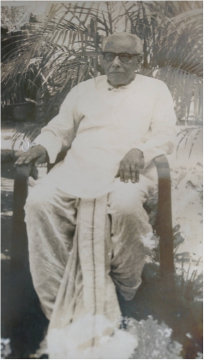
I collected Jogendra’s picture from her grandaughter, Ms Snigdha, who resides in Netaji Nagar, Kolkata, India (see Figure 1). I translated Jogendra’s letters from Bengali to English in such a way as to capture their emotional content while staying true to their original meaning. Each has a salutation of ‘Sri Oli Mian’ or ‘Kalyaniyesu’, and Jogendra signed the letters with ‘Your uncle Jogendra Roy Chowdhury’. The first few letters were from Shyambazar, and the later letters were from Netaji Nagar, Calcutta. Almost all the letters were two-to-three pages long. Eight letters have been selected for this article and four of those are from 1955. Jogendra wrote more letters in 1955 than in any other year because this was the toughest time for him. He desperately wrote letters in an attempt to complete the land registration to transfer ownership before the government requisitioned his properties in 1956. These letters from 1955 expose Jogendra as vulnerable and running against time. Thus, the selected eight letters encompass the subjects of money, community, his desire to return, land registration, and the irony of fate. With partition, Jogendra and Oli became very dependent on each other. The letters show that Jogendra had relied on Oli to cultivate his land just as much before partition as after his departure. Oli did not have land and continued as a sharecropper for Jogendra. That agricultural relationship between Jogendra and Oli did not disappear with the blow of partition.
Jogendra Roy Chowdhury. Source: Collected on 29 March 2021 from his family at Netaji Nagar, Kolkata, India.
Jogendra’s overriding concern with money
The first letter shows the ups and downs of their relationship, along with how the two neighbours missed each other when they were apart. It narrates Jogendra’s attempts to get his money back from Oli, to whom he had made a loan prior to his departure for Calcutta. Jogendra related the financial struggle he faced in Calcutta, which he said was only made worse by the delayed payments. This letter is a prime example of how vulnerable a landowner was at the time of partition, as his land and money fell into the hands of a neighbour. The loss of his property was hard for Jogendra, who had devoted his life to its maintenance and care. The loss was not just a monetary hardship, but an emotional one as well.
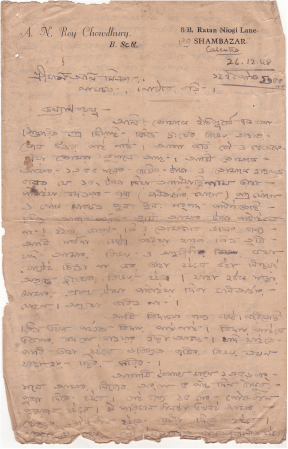
In addition to facing financial problems, the eastern Bengali refugees were called Bangals (referring to their identity as refugees from East Bengal) by people in West Bengal and were mocked for their accents and regionalism.Footnote 41 In India, no policies were initially drafted to address the refugees’ economic struggles, and they lacked proper citizenship status. Though Jogendra was not a refugee, he was a displaced Bengali Hindu and was identified as Bangal as well. His letters do not describe what it was like in Calcutta, but some anxiety and suffering emerge. He did not have a place to call home in Calcutta and at first lived in a rented place in Shyambazar and later in Netaji Nagar. The letters demonstrate Jogendra’s strong attachment to and anxiety about the home he had left behind, especially since he was unable to physically oversee his belongings. A letter written on 26 December 1948 reads (see Figure 2):
Oli, lately, I have written to you in great detail, and I was really disappointed that I did not receive an answer from you. Hopefully, you and your family are well. I gave you a loan of 25 taka [the official currency of Bangladesh which will be written as tk throughout the article] along with some other money that I received from my land in 1355 [Bengali calendar year, corresponding to 1948].Footnote 42 I have constantly written letters and insisted through personal acquaintances that you send me the money. But still, I have not received a response from you. Can you tell me what the problem is? I have, over the years, tried to ensure that you and your family have a good life, and if you do not consider my situation and problems, that would be extremely disappointing.Footnote 43
Letter written on 26 December 1948. Source: Collected from Shamsul Alam’s family archives on 24 July 2019, Ramganj, Lakshmipur, Bangladesh.
Jogendra was persistent and demanded his money in multiple letters to Oli. The language that Jogendra used in the letters was reminiscent of bargaining with Oli, as is typical for monetary dealings between a Hindu landowner and a Muslim debtor. He wrote in the same letter, ‘However, send me the money as soon as possible without any further delay. If I get the time off, I will come to the village. And once I come to village, I will discuss the land properties in detail and get everything settled.’Footnote 44 It is safe to say that Jogendra was angry with Oli when he took time to respond. But the letter additionally revealed that geographical divisions failed to separate them. Jogendra did not forget that Oli was a good neighbour and a trusted person whose life he wanted to improve.Footnote 45 Simultaneously, the excerpts above illustrate how the relationship between the Hindu landowner and his Muslim sharecropper, which had always been intertwined with land settlements, continued from either side of the newly created border as Oli continued to act as caretaker for Jogendra’s property. The trust between the two men contradicts the common historical conception of animosity between Hindus and Muslims.
In the same letter, Jogendra shared that he intended to return to Noakhali and sort out the land issue. He was desperate to return to his properties because the people who cultivated his lands, some of whom had once been his good friends, did not share the revenue with him. He was physically separated from his land, but he was keenly aware of its worth. His fixation on cultivating his land and reaping the rewards of the harvests became a site of his desire to return to Noakhali and made him very anxious about the (im)possibility of that return.
Despite his trust in Oli, Jogendra, at times, articulated a specific vision of how the finances should be managed within the complicated money-transfer system in post-partition Bengal. In another passage from 7 September 1951, Jogendra writes:
Oli, as I informed you before, I have received the 50 tk that you sent to me. Both Sri Gani and Kajal Khan are fine [two of his Muslim neighbours from Noakhali who had stayed in Calcutta for their jobs after partition]. They have available cash on hand to give me. If you gave money to Burjuk Ali in his house in Noakhali, and if Ali acknowledged it and wrote to Sri Gani and Kajal Khan in Calcutta, then they would be able to hand over the money to me. Now decide what you are going to do. One thing you were not clear about was the price of the land. For this reason, I wrote to you to come to Calcutta.Footnote 46
To make ends meet after his relocation, Jogendra took out a loan from his Muslim neighbours in Calcutta. He hoped that he could pay them back with the payments from Oli, who would sell his land in Noakhali. He asked Oli to find out potential buyers and the current market price of the land. He also decided to sell a portion of marshy land to a Muslim neighbour named Maharam Ali. As Jogendra was overextended by his loans, he requested that Oli pay the money to Burjuk Ali (another Muslim neighbour), who would expedite the payment to Jogendra’s Muslim neighbours in Calcutta. Jogendra acknowledged that he received 50tk from Oli. However, Oli informed Jogendra that sending money was risky, as was carrying it to Calcutta, due to police searches. However, to solve this problem, Jogendra directed Oli to give a money order to his brother-in-law, Sri Hemendra Kumar Das, a doctor who still lived in Jessore, a district of southwestern Bengal.
Jogendra also gathered information about the value of his land from other Muslim villagers. He persisted in asking what sort of crops Oli was cultivating and what cattle he owned. After partition, relations continued in the same way as they had before— Jogendra as the landowner and Oli as his tenant. Though separated geographically, the cultural interdependence remained after partition and is exemplified by Jogendra’s correspondence with Muslims still in Noakhali. Jogendra wanted to ensure he received the maximum price for the land: ‘You wrote to Ali and Gani about our discussion regarding the land. I was informed that the price would be anywhere from 1500tk to 2000tk, or to 2500tk. Therefore, I assumed that you would sell my land for at least 2000tk.’Footnote 47 Though he was far away, Jogendra was very involved with the sale of his land and was meticulous in ensuring he received a fair price.
Moreover, it seemed that he had an eye on the ground about his property’s value and that he intended to hold Oli accountable for payment from the sale of his extra land, which would help sustain him in Calcutta. By conveying that information via letter, Oli realized that Jogendra was not uninformed. Since Jogendra had large tracts of property scattered across multiple areas, he needed to communicate with Oli quite often to make sure every piece of land was managed properly. In a letter dated 7 September 1951, he asked:
What happened to the money that I was owed for this year? You promised that you would pay me the full amount in Bhadro masa [Bengali month of Bhadro which marks the beginning of Autumn]. What happened to that? Moharram Ali wanted to sell his land near his house. You can pay me by selling the land. Discuss what needs to be done with Burjuk Ali and the others. If you and your brother wanted to buy my land, I would be happy. I pray for you and your family to live happily. I have asked him to drop my letter for you. You will know more details if you discuss with him. Tell Kajal Khan what you decide so he can deliver the message to me.Footnote 48
This portion of the letter reflected their intimate and friendly social relationship. Jogendra’s discussions with Oli appear as if he were in Noakhali and having a face-to-face conversation with Oli. He expressed affection towards Oli and his family members and how he preferred to sell his land to Oli because of their close friendship: ‘If you and your brother wanted to buy my land, I would be happy.’ There are preferences for buying and selling land: even though selling means completely disowning the land, there is a visceral satisfaction if it is sold to someone you have a friendly relationship with. While Jogendra trusted him, Oli sometimes kept him in the dark or miscommunicated about land affairs. In a letter to Oli on 1 May 1950, Jogendra wrote: ‘You are cultivating two pieces of my land. What did you cultivate this year? Jute? There is an agreement between Pakistan and Hindustan so hopefully, there will be a better price in the next year. I depend fully on you. Now do what you think is right.’Footnote 49 Here Jogendra sounded anxious and impatient because he was not informed what crops were being cultivated. However, his trust in Oli is shown in the closing sentence of the letter: ‘do what you think is right’. This expression of trust was also a way to ensure that Oli had control over the lands with Jogendra’s permission and that he felt responsible for the proper cultivation of the land.
In his letters to other villagers in Noakhali at the same time, Jogendra took an interest in what was happening in the village and actively participated in decision-making from Calcutta, particularly in selling the land of his neighbour Dhirendra. Jogendra wrote, ‘We do not know yet whether Dhirendra will sell his house or not. If he wants to sell the house, he must inform everyone. He cannot whimsically do whatever he wants.’Footnote 50 Although he was not physically in Noakhali, Jogendra continued to exercise his authority by insisting on keeping an eye on others. The fact that he had so many relationships with the villagers in Noakhali, and that he continued to participate in village life from Calcutta, strengthened his belief that he would return to his home. He wrote several times that he would like to return home to settle his land and visit his neighbours; however, because of political turmoil, that never happened. Since Jogendra was forced to conduct all his land dealings from afar, he became even more involved with his Muslim neighbours. Jogendra sought Oli’s advice about every aspect of land management. Although Oli communicated infrequently, he helped Jogendra sell his land and strengthened his trust by taking care of the property. Jogendra wrote on 1 May 1950:
Oli, I have not received any letter from you for a long time. Hopefully, you are well with your wife and children. A few days back, I sent a letter regarding the details of the land, but there has been no response from you. I told this to Gani. Anyway, I hope to receive your letter—containing news of your health—in the next post.Footnote 51
The above letter demonstrates that Jogendra continued to have a relationship of accountability with Oli and other Muslims in his village in Noakhali despite his absence from home and his inability to return there. For example, in his letter to Oli above, he mentioned twice that he had not received an expected response and implied that Oli should write immediately by stating ‘I hope to receive your letter […] in the next post.’Footnote 52 Additionally, he let Oli know that he had reported his negligence to Gani. That sort of statement was to inform Oli know that he would be held accountable to others and not just Jogendra, and that he was being watched by other members of the community. However, Jogendra also repeatedly expressed his good wishes for Oli and his family—even amid his apparent distress. Of course, careful use of language may be seen as a rhetorical move to encourage Oli to respond out of love and act out of a sense of personal duty. However, it could also be seen as a genuine statement of concern for his caretaker, showing that Jogendra felt emotionally attached to the community he had left behind and not just financially attached to his property.
In his letters, Jogendra was insistent, he pushed Oli and, at times, seemed to overreach. He was anxious about his land and the overextended cultural conflict unfolding around him. Besides Jogendra, Oli also received complaints from Gani, his Muslim neighbour who lived in Calcutta for work. Oli’s grandson confirmed that his grandfather did not know how to write. This may explain Oli’s slow responses to Jogendra. Oli would have had to enlist the assistance of a third person who was literate and could write a letter on his behalf.
The period resulting from partition was a turbulent time in East Bengal. In those chaotic circumstances, everyone tried to take advantage of the situation, regardless of whether they were Hindu or Muslim. In one of the letters, Jogendra states that a neighbour, not mentioned by name, borrowed or bought some possessions from a Hindu named Harkanta Roy.Footnote 53 Perhaps Harkanta was preparing to leave Noakhali and had sold his land for a cheap price, or perhaps he had allowed this neighbour to stay on his property as a guest. But the letter indicates that Harkanta’s possessions were not returned. That betrayal created chaos within the community. Harkanta wrote a letter to Jogendra explaining that items to the value of 20–25tk were taken. But in a later letter, Harkanta changed the amount from 20–25tk to 70–75tk.Footnote 54 It is apparent from Jogendra’s letters that he often mediated property issues between Hindus and Muslims. In another letter, Jogendra assured Oli that he, Jogendra, did not owe any money to Harkanta; Harkanta may have demanded some money from Oli because Jogendra had borrowed from him.Footnote 55 Jogendra also stated that Shamod Ali, a Muslim, had not sent some of his possessions to Chandpur, which Jogendra believed was an infringement of his trust. It is clear from the letters that both Hindus and Muslims tried to capitalize on the chaotic situation regarding abandoned properties and absent landlords in the wake of the violence to benefit themselves.
Continued interest in the community
Since Jogendra was unsure of the profits Oli made from the cultivation of his land, he unfailingly questioned Oli’s use of the income but did not make any moves to change their friendly relationship. Almost every letter from Jogendra started with a discussion about his properties and land and ended with an expression of love and respect, and enquiries into the welfare of his neighbours and what they had been doing. Thus, even though Jogendra was frequently frustrated with Oli, overall, he chose to remain close to him.
Although Jogendra had left the community, he was still entangled with revenue-related issues. Besides meeting in Calcutta, Jogendra’s Muslim acquaintances maintained a regular correspondence with him, which included detailed discussions about the land settlement. The Muslims who worked in Calcutta after partition also acted as go-betweens—carrying Jogendra’s letters to Oli, circulating his messages, and passing on spoken words from the community when they travelled back and forth.Footnote 56 Jogendra decided on a property settlement and extracted agricultural profits from Noakhali through correspondence with Muslim neighbours in Calcutta. To show his remaining ties to the area, he often mentioned Gani and Kajal visiting him and conversing about community issues. Supporting this claim, in an interview with Kajal’s wife, Rabeya Akter, she shared that her husband had had to hide in Jogendra’s house when he was attacked in Calcutta. Not only did Jogendra collect information but he also helped Muslim neighbours by providing shelter.
The deepening relationship between Jogendra, Oli, and the Hindu festival is noticeable. A letter written on 26 December 1948 shows that Jogendra still cared for his community because he reminded Oli that, ‘in the upcoming month, I must arrange my part of Thakur Puja for five days on Bengali year 1356 (1949). For this we need 25 kilograms of rice. You must keep the same amount of rice from where we reaped from my land. You have not told me how much you received from the land till now.’Footnote 57 Thakur Puja is a Hindu religious festival that aims to bring blessings from a Hindu god or lord (Bhagwan) through specific offerings to uplift villagers’ well-being for the coming year.Footnote 58 Even though he could have participated in religious ceremonies in Calcutta where he lived, Jogendra placed importance on this particular festival in Noakhali, and he asked his Muslim neighbours to ensure his donation was made. This request had a bigger implication than just religion: it indicated the strong bond Jogendra felt with his home in Noakhali.Footnote 59 Despite his absence, Jogendra contributed 25 kilograms of rice to his Noakhali community to ensure they could enjoy the Hindu celebration.Footnote 60 In so doing, he was both trying to do something beneficial for his neighbours as well as to ensure that Hindu practices persisted within the community. It was a ritual that had been performed for generations and he did not want to see it end. He felt that the puja would ensure the blessings of god and would touch everyone, regardless of their religious affiliation, which was why he wrote, ‘Have all my blessing. I pray to God that He will make you safe.’Footnote 61 This suggests that he believed in one god for both Hindus and Muslims. Further, his wish for Thakur Puja to be performed with his contribution spoke of his love for his neighbours.
In the same letter, Jogendra asked about the welfare of several Muslim neighbours, seven of whom he enquired of by name: ‘How is Ahmed and Shahbaz Ali? Is Samad Ali ok? Are Bande and Burjuk well? How is Rakhi and Mandira?’Footnote 62 Rakhi and Mandira were the two female members from Oli’s household. He was confirming that they were also fine. I argue that if Jogendra bore ill will towards the Muslims in his village because of past experiences of communal violence, he would not have taken the time to enquire about their well-being. Furthermore, his expression of care for so many neighbours showed that Jogendra was deeply absorbed in his community. In a letter written on 1 May 1950, Jogendra confided in Oli about his own family: ‘Kanu is infected with chickenpox. So far, the rest of the family members are good. But there is no space in our house. We are enduring pain and problems.’Footnote 63 Perhaps, Jogendra shared this information with Oli to make an emotional appeal to him to consider Jogendra’s critical situation and do what he could to alleviate the sufferings Jogendra’s family were facing.
Many Muslim neighbours from Noakhali who lived in Calcutta after partition helped Jogendra concerning the land settlement issues. Jogendra often communicated with them. Those villagers often visited him, which meant that he was able to collect information through multiple means about Oli and his properties. In a letter written on 3 October 1952, Jogendra wrote about a neighbour named Gani:
Oli, I have sent you a letter folded within Gani’s envelope, and hopefully you have received it. I accepted the 50tk you sent me through Gani. I did not understand what year and what land-related transaction the money stemmed from. According to my estimation, you must pay me two years’ arrears. What about the other money that you were supposed to pay me? In addition, I have not forgotten you and your mother. Gani also visited me in weal and woe. I am in much trouble which has prevented me from going back to desh [native land].Footnote 64
Scribbled at the very bottom of the same letter, Jogendra wrote that he was deeply concerned about other members of the former community: ‘How is Samad Ali? How is Shahara Ali and the others? Is Ahmad Ali alive?’Footnote 65 Here Jogendra may have used rhetorical strategies of showing concern for his former community members to ensure that they continued to send him the monthly income from the cultivation of his agricultural lands. But these lines also show deep bonds and may be indicative of genuine concern for his former friends and how he longed for his homeland.
Longing to return
In a letter dated 1 May 1950, Jogendra began to explicitly describe his feelings of hopelessness, and shared his emotional pain with Oli:
All this time I have wished to return to Noakhali, and I always think of you. But now I am in a situation where I cannot go anywhere. I have told you to come to Calcutta before the turmoil. I am suffering much sorrow.Footnote 66
In the letter, Jogendra conveyed his desire to return home and implied that even though he constantly put pressure on Oli, he was also aware that Oli did not have an easy life as a cultivator of his lands. Often, when people signify that they are thinking of others, it is because they themselves are in a terrible situation, and to feel better will choose to remember their friends who brought them happiness in the past. With, ‘I am suffering much sorrow’, Jogendra admitted that it was hard for him to live a life of such uncertainty. It was painful for him to not see his home and the people he had lived with. I speculate that there were three possibilities that stalled his return: first, as Jogendra’s home was not very far from the place where the riots first erupted in Noakhali, he might have been fearful that he would be targeted (his anxieties were especially fuelled by the news of communal troubles reported in the national newspaper); second, Jogendra had a single daughter whom he could not leave alone in Calcutta for a few days to visit Noakhali; third, the relationship between India and Pakistan was difficult and he was awaiting a better time to return. Throughout the letters, Jogendra projected his suffering from displacement onto Oli and emphasized his struggle to adapt to his new incomplete home in Calcutta.
The mental pain that he experienced could be associated with the loss of the space he once created. Jogendra often asked about the supportive community of people who lived in Noakhali, which showed that he thought of and cared for them. He wrote in the same letter, ‘Please write me in the next letter about you and desh.’Footnote 67 Jogendra’s use of the word desh here indicated he wanted information about the people of his community, not just his properties. If he wanted information just about the land, he would have used the word jami (land). Jogendra’s situation was indicative of lots of people’s experience at the time, which shows that it was not just about the country’s religious/political fights, but also about the pain of the people who lived through this time.
Oli was not the only person looking after Jogendra’s properties. For some of his properties, he had authorized a Hindu named Sri Josna Roy, a Hindu member of his bari, to look after his home and the trees around it. A letter dated 14 November 1955 was written not directly to Oli but rather to other Muslim community members named Khoaz Mian, Shona Mian, Lokman Mian, Burjuk Ali, and Bande Ali, who were respected people in the village. Jogendra complained that Josna had cut down his trees and bullied him for no reason.
However, Josna claimed that Jogendra owed him 300tk, and he cut down trees on Jogendra’s properties in an attempt to get his money back. In a later letter, Jogendra wrote to Oli that he did not owe even a three-half pice to Josna, let alone 300tk.Footnote 68 He now wanted to shift responsibility for the properties entirely onto Oli so that Josna would no longer be involved in his business. He sent a few registered letters to ensure that Oli from then on would take responsibility for his properties and would perform the religious rituals on his behalf.Footnote 69 He requested authoritative Muslim community members to keep an eye on Josna, who could cause unnecessary problems. In the same letter, he also shared that he would come back to his home when he felt the time was right. He wrote, ‘I did not give up the hope to return and am waiting for the proper time.’Footnote 70 This correspondence shows how he was determined to return to ensure that neither Josna nor any of the other villagers would exploit his property. He made it clear to both the Hindus and Muslims alike that they were not to take advantage of the fact that he was separated from his belongings.
Historians often assert that riots between Hindus and Muslims broke the trust between the two groups. But that was not the case in the relationship between Jogendra and his Muslim community. In fact, in 1955, eight years after they had started corresponding, Jogendra decided to entrust more of his properties to Oli, a Muslim, despite his religious beliefs and consistently late payments. Jogendra’s feud with Josna shows that there was no relationship of trust between the two Hindus, unlike with Oli. Jogendra believed that Oli would not destroy anything as Josna had. Even though partition put economic burdens on Oli, he managed Jogendra’s properties, sent money to Calcutta that was generated from the land, and ensured that no one cut down trees or stole anything from Jogendra’s lands. Jogendra never forgot to show his care in his letters to Oli, particularly when he penned the wish, ‘Have my blessings’.Footnote 71 Jogendra’s experience questions the very heart of the concept of partition, based on the imaginary religious division between Hindus and Muslims.
Although Jogendra was afraid and had every right to be angry, he never addressed Oli with aggression in his letters. The language he used to convince Oli was soft and humble. He referred to himself as an uncle and wished for Oli to have a successful life. He pressed upon Oli’s morality and ethics to make the right decision and pay back what he owed. Having no other option but to depend on Oli, Jogendra’s language reflected a position of powerlessness, of being entirely at the mercy of his former neighbours. In Calcutta, he struggled financially and was dependent on the income from his properties in Noakhali. The relationship between the two men occasionally appeared shaky and depended upon how often Jogendra had to negotiate with Oli and others for the income from his property. Still, Jogendra continued to express a belief that Oli would do the right thing. The correspondence between the two challenges the notion of political narratives that perpetuate the belief that Hindus and Muslims always fought each other and were never capable of caring for their neighbours. And yet, Hindus and Muslims were entangled in a situation of dependence as they needed to complete land registration and land sale transactions.
Land registration
Suroz shared in our interview that Jogendra did not complete the transfer of land registration to Oli, and that the government had eventually taken the land. In a letter, Jogendra discussed the land he wished to sell to Oli and even suggested that if Oli was not able to purchase it alone, then he could buy it collectively with Kajal and Gani, insisting that Oli had shed a lot of sweat for this land. Jogendra ultimately came to an agreement, selling the land to Oli and Maharam Ali. On 15 May 1955, he acknowledged that he received 300tk from the two buyers as partial payment for the land. He also enquired: ‘What happened to the rest of the money?’, and requested payment as early as possible. Jogendra wrote that his son, Amar Roy, would travel to Chandpur, a mere 40 miles from his house in Lamchar, to pick up his wife the following week. Jogendra would give Amar power of attorney through the District Collector Office in Noakhali which would cost at least 20–25tk, and that Oli would be responsible for paying this. Jogendra then made a list of expenses, including power of attorney, land registration, and the remaining money Oli was bound to pay for the land. He also warned Oli that he must complete the procedure in seven days. In addition, Jogendra also asked Oli to help Amar in every respect so he would not face any trouble. However, the land registration through Amar failed. In another letter dated 11 November 1955, Jogendra informed Oli and Maharam Ali, who owed 285tk and 60tk respectively, to manage and hand over the money to Amar’s father-in-law, who would then help them to register the land.
In 1955, a mere year before the government acquired the land, Jogendra sent an unusual number of letters, more than he had in the preceding years. Jogendra was aware that they had no time to waste since the procedure of government land acquirement was almost complete and any procrastination would destroy their effort to transfer the land ownership. However, Suroz explained that once again they had failed to register the land. Thus, Oli and Ali’s families lost the land to the government. Suroz blamed Jogendra, but the letters imply that the fault lay in his failure to obtain the entire amount from Oli and Ali, and the difficulty of putting the finishing touches to the complex process of registration through a third person in due time. Jogendra consistently pushed Oli to complete the procedure. However, it seems to have been impossible for Oli to obtain such a large amount of money within the short period of time. Oli was a farmer, and it was very difficult to deposit 300tk and later 285tk in the first half of the 1950s when the East Bengal economy was fragile. All the money Oli had given to Jogendra to buy the land was for a futile effort. Jogendra urged Oli to expedite the process because he had already realized it was going to be tough to finish within the short time remaining. The land remained unsold and, from interviews and the documentation, it is unclear if Jogendra returned the money to Oli or not. Jogendra blamed fate for not being able to execute his plan or his dream of returning home.
Irony of fate
A three-page letter written by Jogendra to Oli on 30 January 1956 indicates that by that stage, Jogendra had come to the conclusion that he would be unable to return home. It is difficult to pinpoint when he came to this decision, because he never stated it outright. There are some earlier clues that indicated Jogendra had lost interest in coming home and had been struggling with poor health, which he mentions in other letters written between 1951 and 1953. I conclude that his decision was most likely made in the middle of the 1950s. The letters that he wrote in the years of 1955 and 1956 are concerned not only with money, but also with land registration complications and expenditures. He decided to sell some of his important land but not the house. When Jogendra gave power of attorney to Amar under the new rules to sell his land, Jogendra was still in Calcutta,Footnote 72 and his letter at this time implied that he would not be interested in returning to his old house, which he had cherished from afar for almost a decade.
Three points from his letter dated 30 January 1956 reveal what was going on in his mind (see Figure 3). First, Jogendra began to use the address Netaji Nagar, Calcutta, instead of Shyambazar. When considering how calm his handwriting was compared to the older letters, which look like they were frantically written, it seems that he was more confident in his new living arrangements. Nevertheless, Jogendra did not stop thinking about his old home back in Noakhali. Even at this point, he did not indicate that he wanted to sell his house, although by that time he had sold other properties. Rather, he asked Oli to erect a fence around the house so that the furniture and other items inside would be protected from theft. Regarding the trees, he particularly mentioned that the ‘southern part of the western side of Bose’s land is mine. In that corner, the Tamarind tree, which is on both of our land, is theirs.’Footnote 73 It had been almost a decade since partition, and he was still acutely aware of which trees belonged to whom. That shows that he still had an extraordinary attachment to his home.
Letter written on 30 January 1956. Source: Collected from Shamsul Alam’s family archives on 24 July 2019, Ramganj, Lakshmipur, Bangladesh.
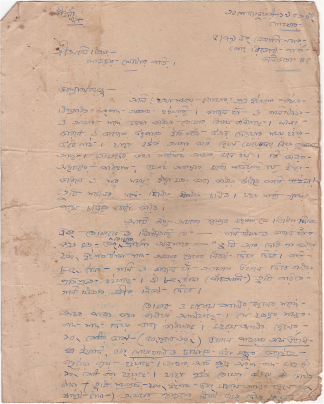
A second indication that he had decided not to return home was that in this letter he pushed Oli to register the land in Ramganj, Noakhali, in his name and lamented that it was already too late. Jogendra had never insisted on this before and was racing against time. He wrote, ‘If you procrastinate paying the registration fee, which you are supposed to do early, and if you take time to register or not registering it at all, I will not be responsible justifiably, religiously, and legally.’Footnote 74 This letter indicates that the responsibility to acquire the land resided with Oli who simply was not able to obtain the funds necessary to finish the sale. Along with his push for Oli to take over his property, Jogendra also provided him a detailed account of the rest of his properties. He also provided instructions on spiritual matters, for he notified Oli to consider contacting a Hindu man named Rajani Babu, rather than Josna Roy (who cut down his trees), regarding information about the religious festivals in the community. This comment appears to acknowledge Jogendra’s acceptance that the religious festivals would continue in the community whether he returned or not.
The third point, perhaps the most important one, is that he blamed his circumstances on the irony of fate and delivered his final message by stating:
What can I do? The irony of fate. I have fallen in a condition that even if I want to do something I can’t do it as I wished. You should all try to cooperate together. Try to do your best to follow the path of honesty.Footnote 75
It appears that he had lost hope of returning home, as India and Pakistan were at odds with one another at the time. He was almost completely exhausted by his own hopes, which had repeatedly been dashed. Every time he had tried to return to Noakhali in the past, something had prevented him from doing so. He was plunged into a ‘not-now’ moment. There were many troubles in his life. His family members, as he previously mentioned, were suffering from chickenpox, and he himself suffered consistently poor heath. By referring to his ‘odrister porihas (irony of fate)’ and his lack of agency, Jogendra demonstrated that he had lost all hopes of returning. In the last two sentences of this letter, it becomes clear that he was giving his final message to his neighbours and friends, which indicates that his hopes of ever returning to his homeland were extinguished by the middle of the 1950s.
What Jogendra’s letters say about partition
Jogendra’s letters to Oli provide a unique understanding of Hindu-Muslim relationships in the years following partition. They challenge the commonly held belief that the two religious groups were deeply divided since they depict a relationship between a Hindu landowner who depended upon his Muslim friends and tenants to assist him in managing his properties, as well as to help him maintain social and cultural bonds with the community he had left behind. The new political border had created an imagined binary of who was friend or foe, and who was to be kept in or out of the boundary. Political propaganda and rhetoric heavily suggested that without such a constructed political border, both groups’ access to freedom, self-determination, and properties was at risk. Colonial rule forced the Hindus and Muslims of India, particularly in Bengal, to subscribe to that fallacious narrative. Jogendra’s letters showed that a border would not, at least in the short term, rip apart the communal ties or force people to see each other as enemies. Years after partition, the people of the area were still emotionally tied to one another.
An interview with Mokhles Khan, who was a Muslim neighbour and brother of Kajal Khan with whom Jogendra had a good relationship, indicated that the community continued to hold great respect for Jogendra. Khan stated that he never saw Jogendra after partition, but he did see his son Amar Roy, who came in the late 1950s to see their old neighbourhood for the last time and sell the ghar (house). Khan also reflected on the changes in his community and mentioned the Hindu Puja ghar (the worship house), which reminded him of happier times when some other Hindu families still lived in the community. Khan was incredibly open regarding Jogendra and their relationship. He plainly acknowledged the influence that the Bengali Hindu had on his family. His voice became soft, and his eyes filled with tears. He shared, ‘There is one hospital named Annadacharan Memorial Hospital which was also established by a Bengali Hindu in Lamchar.’Footnote 76 The riots and partition fractured the community to the point of being irreparable, but they failed to have a severe impact on their collective sense of belonging.
The letters convey the feeling of helplessness Bengali Hindus experienced when they lost their economic hold and became displaced, but Bengali Muslims also suffered from the exodus of Hindus, as their village economies fell into chaos. They struggled to maintain huge properties for displaced Hindus who eagerly awaited the proper time to return. Khan recollected that, ‘They [the Hindus] did not initially sell all of their properties in the hope that they would return again when the situation would get better.’Footnote 77 However, as time dragged on, their exile persisted. Jogendra waited nearly a decade before slowly accepting that he could not return. His letters also delineated how much Hindus and Muslims were knitted into a shared history as Jogendra projected his sense of displacement onto Oli, suggesting that they shared an equal loss.
The final blow to any hope for the Bengali Hindus’ return came in 1956 when, after six years of litigation, the East Pakistani government won the lawsuit against 83 landowners and enacted the East Bengal State Acquisition and Tenancy Act in 1956, which marked the withdrawal of the permanent settlement.Footnote 78 The government seized their lands and finally put an end to their hopes of returning. Presumably, this is why Jogendra stopped writing.
Conclusion
The predicament of displaced Bengali Hindus from East Bengal has been written about widely; however, historians have overlooked the desire of relocated people from East Bengal to return home to their villages after partition. Bengali Hindus’ ‘home-coming’ remained uncertain because of their fear of recurring violence. The Bagerhat riots of 1950 worsened the communal fracture in East Bengal, and more of the minority Hindu population in East Bengal deserted their homes at that time.Footnote 79 False propaganda from the West Bengal press claimed that Hindus were being persecuted in East Bengal which accelerated their exodus.Footnote 80 Contrary to the claims made by publications in West Bengal in this period, Hamidul Huq Chowdhury, the Finance Minister of the East Pakistan government, gave a speech in parliament in which he urged Hindu landowners to refrain from hurriedly selling their lands and relocating to the other side of the border. To persuade the Bengali Hindus to return to their homes in East Bengal, he promised to ensure their security.Footnote 81 It was also declared in the parliament that many protections would be extended to landowners who had left in the recovery of their lands from trespassers. However, it is also true that the Hindu and Muslim parliamentarians in East Bengal blamed each other for the mass exodus and the recurrent riots that prevented Bengali Hindus from returning to their homes in East Bengal. Hindu politician Ganendra Chandra Bhattacharjee accused Muslim politicians of turning East Bengal into an Islamic state where minorities would not be safe, and Muslim politician, Mujibur Rahman, accused Hindus of being overly loyal to India.Footnote 82 The final blow came through the East Bengal State Acquisitions and Tenancy Act of 1950 which changed the entire environment for the returnees as the land was acquired by the East Pakistan government through the abolishment of zamindari. For the landowners who had left their properties behind in East Bengal, their hope of returning came to an end in the mid-1950s when the legislation was enacted, and the government acquired the land. Although the exodus of Bengali Hindus to West Bengal began in 1946, the East Bengal State Acquisitions and Tenancy Act of 1950 marked the final blow for Bengali Hindus.
This article provides new insight into the relationships between Hindus and Muslims in East Bengal, arguing that the relations between the two groups were more complex than simple enmity. The need remains for more research that considers how the displaced Bengali Hindus landowners longed for their old homes and communities, and the deep feelings of loss like that expressed by Jogendra in his letters to his caretaker and Muslim neighbour Oli. The popular narrative in partition literature is that Muslims occupied the land of Hindus. The example of the relationships Jogendra had with his Muslim neighbours should raise questions about such narratives.
There is a vast body of important research on the communal violence surrounding partition that led to the mass exodus of Hindus from East Bengal, establishing the narrative of the role of Muslim Bengali politicians in partition, and the violence of Bengali Muslims that forced Hindus to migrate. However, the existing literature focuses too narrowly on one narrative and the single lens of communal violence, erasing the complexity of this history. There is still much to be discovered concerning the quality and intensity of relationships between Hindus and Muslims during and after partition. This article suggests that the prevalent notion that religious differences in the area fuelled animosity between the two groups was not universal. In taking these into consideration, we can shed light on the complexity of people’s experiences alongside the current narrative. In doing so, we may even change the narrative about the eternal clash between Hindus and Muslims that perpetuates current religious violence all over South Asia. To attain peace in the region, it is important to liberate people on both sides of the border from narratives that reinforce Hindu-Muslim universal animosity.
Acknowledgements
I want to thank Mark Doyle for his invaluable feedback on the different versions of the draft as well as Martha Norkunas, Pankhuree Dube, Jonathan M. DiCicco, and Tariq Omar Ali. Special thanks to Dipesh Chakrabarty for his interest and suggestions on this article when it was developing, along with Nazmul S. Sultan, Tahmidal Zami, Mahmud Dipu, Gemini Wahhaj, Jacob Whitehead, Chris Parker, James Pegler, M. A. Sayeed, M. A. Kawser, S. M. Rezaul Karim, Md. Mizanur Rahman, Mohammad Azam, Priyam Pritim Paul, Azizul Rasel, and Salimullah Khan. I also wish to extend thanks to the two anonymous reviewers and the editors of Modern Asian Studies, particularly Sumit Guha, for his constructive comments and suggestions during the review process to shape the article into its current form. Finally, my gratitude to the family members of Shamshul Alam who kindly shared the letters utilized as evidence in this article.
Funding statement
Generous funding was extended to me for research travel and accommodation throughout my tenure as a PhD student from the Roscoe L. Strickland Jr. Endowment at Middle Tennessee State University.
Competing interests
The author declares none.


 Open access

