




Non-technical Summary
Ankylosaur isolated teeth have traditionally been identified to the family level (ankylosaurid or nodosaurid) using overall size and the presence or absence of features such as grooves on the tooth face (fluting). Recent hypotheses recognize four ankylosaur families (Panoplosauridae, Polacanthidae, Struthiosauridae, and Ankylosauridae). Understanding ankylosaur tooth variation could better help identify taxa where the family is unclear or allow isolated teeth to test paleoecological questions such as a potential extinction of mid-Cretaceous ankylosaurids from North America. We analyzed the shapes of a large sample of ankylosaur teeth using traditional and geometric morphometrics and investigated size and the presence of features such as a cingulum and fluting for differentiating ankylosaur teeth. Morphometric analyses show that “nodosaurids” had the greatest variation in tooth shape and size. Panoplosauridae and Struthiosauridae account for a large amount of “nodosaurid” variation, whereas basal ankylosaurs, Polacanthidae, and Ankylosauridae share a similar restricted morphospace. Teeth with a length or height over 10 mm are found only in panoplosaurids, struthiosaurids, and Peloroplites, but smaller sizes are found in all clades. Our analyses could accurately identify only between 50% and 75% of the teeth in our sample; they should be used in conjunction with size and traits when identifying isolated teeth. With these findings, caution should be used when attempting to use isolated ankylosaur teeth in broader paleoecological questions, and reclassification of museum collections should be undertaken.
Introduction
Toothed dinosaurs continuously grew and shed teeth throughout their lives (Carpenter and Breithaupt, Reference Carpenter and Breithaupt1986). Coupled with the durable nature of enamel and dentin compared with bones, this means that dinosaur teeth were far more likely to enter the fossil record than were other skeletal or soft tissue elements. As such, paleoecological and biogeographic signals may be present in the dental fossil record that are not present in the non-dental skeletal record. Teeth have been used in taxonomic studies for many dinosaur clades, primarily theropods (e.g., Smith et al., Reference Smith, Vann and Dodson2005; Hendrickx et al., Reference Hendrickx, Tschopp and Ezcurra2020), but ornithischian tooth variation has received comparatively less attention. Previous authors (Carpenter and Breithaupt, Reference Carpenter and Breithaupt1986; Coombs and Deméré, Reference Coombs and Deméré1996) have suggested that the teeth of different ankylosaur clades can be differentiated on the basis of tooth morphology, potentially increasing the amount of data available for understanding ankylosaur diversity and evolution through time. However, ankylosaur tooth identification through morphometrics has not been tested using modern approaches or with a large statistical sample.
Ankylosaurs were herbivorous ornithischian dinosaurs with large body sizes often exceeding 5 m in length, characterized by the extensive suite of osteoderms covering the body (Vickaryous et al., Reference Vickaryous, Maryañska, Weishampel, Weishampel, Dodson and Osmólska2004). Ankylosaurs tend to be rare components of dinosaur faunas (Horner et al., Reference Horner, Godwin and Myhrvold2011), and many genera are known from only a single specimen. Coombs (Reference Coombs1978) recognized two families, Nodosauridae and Ankylosauridae, on the basis of a suite of morphological differences in the skull, postcrania, and armor, and this classification has been largely upheld until recently. Ankylosaur teeth are considered “primitive” compared with other ornithischians as their structure does not change significantly from basal ornithischians and they lack the complex, modified dental batteries of hadrosaurs and ceratopsians (Coombs and Maryańska, Reference Coombs, Maryańska, Weishampel, Dodson and Osmólska1990). Nevertheless, differences between ankylosaurian teeth have been proposed for decades. Coombs (Reference Coombs1978) noted that ankylosaurids compared with nodosaurids have small crowns relative to the roots, have a swollen base but rarely a basal cingulum (nodosaurids possess a distinct basal cingulum), and have occasional complex fluting while nodosaurids have fluting running between denticle cusps. Coombs and Deméré (Reference Coombs and Deméré1996) noted that ankylosaurid teeth seem to be smaller and more numerous than nodosaurid teeth. The number of denticles has also been proposed to vary between species and within individuals (Coombs and Maryańska, Reference Coombs, Maryańska, Weishampel, Dodson and Osmólska1990). Isolated ankylosaur teeth are often field identified in museum collections as Nodosauridae or Ankylosauridae on the basis of characteristics such as their size and the presence or absence of a basal cingulum. These teeth are then used in studies documenting faunal occurrences (e.g., Brinkman, Reference Brinkman1990; Brinkman et al., Reference Brinkman, Russell, Eberth and Peng2004) and the Paleobiology Database. For example, commonly referenced handbooks (e.g., Johnson et al., Reference Johnson, Allen, Braunberger, Marsovsky and Quinsey2009) or summary literature (e.g., Carpenter, Reference Carpenter and Currie1997; Ryan and Evans, Reference Ryan, Evans, Currie and Koppelhus2005) note that ankylosaurid teeth are typically smaller than nodosaurid teeth. The taxonomic utility of these features has never been tested statistically, which has significant implications for studies using isolated teeth to answer questions about dinosaur paleoecology, paleobiogeography, and evolutionary trends.
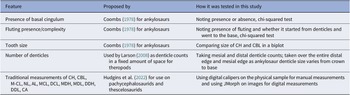
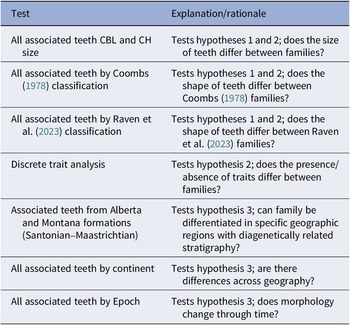
Within paleontology, many of the morphometric studies on teeth have focused on sharks (e.g., Belben et al., Reference Belben, Underwood, Johanson and Twitchett2017; Bazzi et al., Reference Bazzi, Kear, Blom, Ahlberg and Campione2018, Reference Bazzi, Campione, Ahlberg, Blom and Kear2021), mammals (e.g., Tarquini et al., Reference Tarquini, Chemisquy, Ladevèze and Prevosti2019; Wyatt et al., Reference Wyatt, Hopkins and Davis2021; Fischer et al., Reference Fischer, Bennion, Foffa, MacLaren, McCurry, Melstrom and Bardet2022), and theropod dinosaurs (e.g., Larson, Reference Larson2008; Larson and Currie, Reference Larson and Currie2013; Gerke and Wings, Reference Gerke and Wings2016; Averianov and Sues, Reference Averianov and Sues2019). These studies successfully reevaluated taxonomic relationships, differentiated between groups with similar-looking teeth, and studied diet and biodiversity. Existing morphometric methods can be applied to ankylosaur teeth and have the potential to differentiate teeth from the various ankylosaur subclades (Table 1). Several recent studies have attempted morphometrics on other ornithischian groups (Hudgins et al., Reference Hudgins, Currie and Sullivan2022; Dudgeon et al., Reference Dudgeon, Gallimore and Evans2024). In this study, we use modern morphometric approaches on a dataset of 325 in situ and associated tooth specimens to investigate whether ankylosaur teeth can be differentiated with morphometrics. These results are then used to: (1) identify the diversity of form within Ankylosauria, (2) uncover the spatial and temporal distributions of ankylosaur subclades and their relationship to one another, and (3) allow for a reevaluation of isolated teeth in research collections to build a broader reconstruction of ankylosaur environmental preferences (Table 2).
Summary of methods to test proposed diagnostic traits in ankylosaur teeth. AL, apical length; CA, crown angle; CBL, crown base length; CH, crown height; DCL, distal carina length; DDH, distal denticle height; DDL, distal denticle length; M-CL, mid-carina length; MCL, mesial carina length; MDH, mesial denticle height; MDL, mesial denticle length; NL, neck length

Tests and rationales

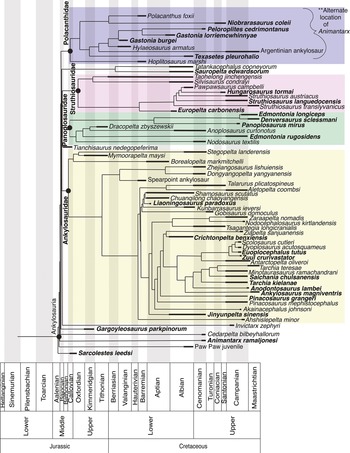
Two recent studies have suggested that ankylosaur phylogenetic relationships are more complex than the traditional nodosaurid–ankylosaurid dichotomy proposed by Coombs (Reference Coombs1978). Soto-Acuña et al. (Reference Soto-Acuña, Vargas, Kaluza, Leppe and Botelho2021) identified a potential third clade, Parankylosauria, outside of Ankylosauridae and Nodosauridae, which contains the highly divergent Stegouros (Fig. 1). Raven et al. (Reference Raven, Barrett, Joyce and Maidment2023) recovered a paraphyletic Nodosauridae whose members are spread across three families—Polacanthidae, Panoplosauridae, and Struthiosauridae—all supported by multiple cranial and postcranial synapomorphies (Fig. 2). Fonseca et al. (Reference Fonseca, Reid, Venner, Dunca, Garcia and Müller2024) also recovered Parankylosauria and a paraphyletic Nodosauridae in the recent systematic reassessment of Ornithischia. This study tests the feasibility of identifying ankylosaur teeth using the traditional ankylosaurid–nodosaurid classification (herein referred to as the Coombs, Reference Coombs1978 phylogeny for simplicity) and the new phylogenetic frameworks that split nodosaurids into multiple families (herein referred to as the Raven et al., Reference Raven, Barrett, Joyce and Maidment2023 phylogeny). Raven et al. (Reference Raven, Barrett, Joyce and Maidment2023) found two dental traits as unambiguous synapomorphies for Struthiosauridae: sub-triangular tooth crowns and striations on tooth crowns not extending down to the basal cingulum.
Relationships of Ankylosauria based on Coombs (Reference Coombs1978). Ankylosaurid interrelationships (yellow) from Arbour and Currie (Reference Arbour and Currie2016), nodosaurid interrelationships (blue) from Brown et al. (Reference Brown, Henderson, Vinther, Fletcher, Sistiaga, Herrera and Summons2017), and position of parankylosaurians (red) from Soto-Acuña et al. (Reference Soto-Acuña, Vargas, Kaluza, Leppe and Botelho2021). Species in bold were investigated in this study.

Phylogeny of Ankylosauria based on Raven et al. (Reference Raven, Barrett, Joyce and Maidment2023). Species in bold were investigated in this study.

Materials and methods
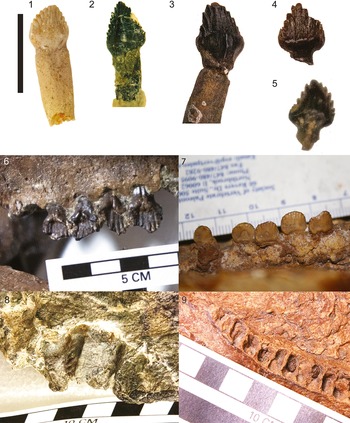
Ankylosaurs have proportionately small leaf-shaped teeth (Fig. 3) present in the maxilla and dentary, which do not interlock. Most derived taxa have edentulous premaxillae, but some early members retain premaxillary teeth that are also leaf-shaped. Premaxillary teeth are included in this study but are not the primary focus as so few species retained them. Ankylosaur teeth generally have denticles and sometimes have fluting. The leaf-shaped morphology present in ankylosaurs is also present in many non-ankylosaurian ornithischians and is thought to be the basal ornithischian tooth shape. Thescelosaurids, stegosaurs, and pachycephalosaurs all have a very similar tooth shape to ankylosaurs.
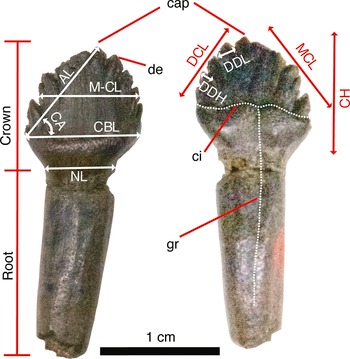
Key anatomical features and morphometric measurements for ankylosaur teeth, on specimen CMN 8531-7 (Edmontonia longiceps Sternberg, Reference Sternberg1928). AL = apical length; CA = crown angle; cap = crown apex; CBL = crown base length; CH = crown height; ci = cingulum; DCL = distal carina length; DDH = distal denticle height; DDL = distal denticle length; de = denticle; gr = groove; MCL = mesial carina length; M-CL = mid crown length; NL = neck length.

We use in situ and associated teeth to test differences in morphology between ankylosaurian families and between individual species. The primary hypotheses of this research are: (1) ankylosaur teeth can be differentiated from other leaf-shaped ornithischian teeth, and (2) the morphology of teeth from different ankylosaurian families (using either the Coombs, Reference Coombs1978 or Raven et al., Reference Raven, Barrett, Joyce and Maidment2023 taxonomy) differs on the basis of morphometric data.
We sampled teeth with known taxonomic identities based on their association with other skeletal material or their origin from a monotaxic bonebed (Figs. 1, 2, 4; Supplementals 1 and 2). These teeth were used to build the training and test datasets for morphometric analyses. Photos by V.M.A. taken before this study were also used, as well as images of teeth from literature for traditional and geometric morphometric analyses. We photographed each tooth in labial and lingual views, noting any important features and wear patterns. To reduce perspective and barrel lens distortion in images for digital measurements, we placed specimens in the center of the camera view and used a high optical zoom level. We also photographed teeth in situ in jaws; however, depending on the stage of eruption and mounting style of the skull, often only one view of an in situ tooth was possible. Occasionally, there were several teeth with the same specimen number; we assigned these teeth a hyphenated arbitrary number. There is a single Animantarx associated tooth useable for analyses, visible only in lingual view, and Raven et al. (Reference Raven, Barrett, Joyce and Maidment2023) provide two alternate classification schemes (here called Raven et al. (Reference Raven, Barrett, Joyce and Maidment2023) classification B) (Fig. 2), where Animantarx is classified as either a polacanthid or basal ankylosaur; both topologies are tested here.
Ankylosaur teeth associated with skulls. (1) Gastonia burgei (BYU 50866) in labial view. (2) Gargoyleosaurus parkpinorum Carpenter, Miles, and Cloward, Reference Carpenter, Miles and Cloward1998 (DMNH 27726-17) in labial view. (3) Ankylosaurus magniventris (CMNFV 8880) in lingual view (4) Euoplocephalus tutus Lambe, Reference Lambe1910 (CMNFV 8876-1) in lingual view. (5) Anodontosaurus lambei Sternberg, Reference Sternberg1929 (TMP 1996.075.0001-9) in lingual view. (6) Edmontonia rugosidens (TMP 1998.098.0001 in labial view. (7) Saichania chulsanenesis Maryańska, Reference Maryańska1977 (PIN 3142) in lingual view. (8) Peloroplites cedrimontanus Carpenter et al., Reference Carpenter, Bartlett, Bird and Barrick2008 (CEUM 34580) in lingual view. (9) Euoplocephalus tutus (TMP 2017.023.0017) in labial view. Scale bar = 1cm.

Discrete traits
We noted whether each specimen displays fluting and/or has a basal cingulum, as those have previously been suggested as traits that differentiate Ankylosauridae and Nodosauridae (Coombs, Reference Coombs1978). Chi-squared tests were completed using the presence/absence of these features, with Coombs (Reference Coombs1978) ankylosaur families and those proposed by Raven et al. (Reference Raven, Barrett, Joyce and Maidment2023), to test whether there was a statistically significant relationship.
Traditional morphometrics
Hudgins et al. (Reference Hudgins, Currie and Sullivan2022) completed traditional morphometrics on pachycephalosaur (dome-headed dinosaurs) and thescelosaurid (basal ornithischian dinosaurs) teeth, which have some features similar to the teeth of ankylosaurs and provide potential features that could be measured. Hudgins et al. (Reference Hudgins, Currie and Sullivan2022) measured crown height (CH), crown base length (CBL), mid-crown length (M-CL), neck length (NL), apical length (AL), mesial carina length (MCL), distal carina length (DCL), mesial denticle height (MDH), mesial denticle length (MDL), distal denticle height (DDH), distal denticle length (DDL), and crown angle (CA) (Fig. 3). We both considered the effects of size and analyzed values size-controlled by standardization and log transformation (Larson and Currie, Reference Larson and Currie2013; Marramà and Kriwet, Reference Marramà and Kriwet2017). Neither surface features (such as the basal cingulum) or curved surfaces can be included in an analysis using traditional morphometrics.
We measured associated and in situ teeth using digital callipers. Measurements taken include crown height (CH), crown base length (CBL), neck length (NL), apical length (AL), mesial crown length (MCL), and distal crown length (DCL). If the area to be measured was absent or too worn, we did not take a measurement. Beyond manual measurements, we also counted mesial and distal denticles on unworn teeth. Further, we noted whether the teeth have fluting, denticles, and a basal cingulum. As isolated teeth are often worn, noting the evidence of these features has potential to aid identification to family level.
We also took traditional morphometric measurements digitally using JMorph (Lelièvre and Grey, Reference Lelièvre and Grey2017), which was easier and more reliable for measuring in situ teeth in skulls. Further, the measurements of mesial and distal denticle heights and lengths are difficult to measure manually due to their small size, and these could only be measured digitally. Upon analyzing the values with size included, traditional measurements were standardized to allometric coefficients and log transformed to reduce the effect of size on the variables.
Geometric morphometrics
Two-dimensional landmark morphometrics involves selecting features that are homologous and are identifiable in all specimens, then comparing the locations of those landmarks; ankylosaur teeth lack sufficient landmarks to accurately capture their morphology, so landmark geometric morphometrics could not be used in this study. Instead, we used outline geometric morphometrics to create a digitized outline of the shape of the object, which plots the centroid of the object in relation to points along the curve of the outline. We created tooth outlines using JMorph (Lelièvre and Grey, Reference Lelièvre and Grey2017). Many morphometric techniques are unable to accurately capture the shape of curved edges; however, JMorph uses a Catmull Rom spline in outline morphometrics, which interprets curves between points and therefore works particularly well on shapes with curved edges (Lelièvre and Grey, Reference Lelièvre and Grey2017). Ankylosaur teeth have curved edges at the crown base and on the mesial and distal edges. To avoid error from starting point normalization, a normalized starting point was established where the base meets the root on the left side of the tooth, and all outlines were then developed clockwise. Each tooth image was arranged so that when the root is at the top of the image, the mesial edge is on the left side of the image. We then set points along the edge of the specimen, drawing an outline. JMorph exports each outline as an individual .txt file (Lelièvre and Grey, Reference Lelièvre and Grey2017). We wrote an R script (Supplementals 3, 4) to combine the files into one dataset for teeth in labial view (Supplemental 5) and one dataset for teeth in lingual view (Supplemental 6) in a format that works for the R package Momocs (Bonhomme et al., Reference Bonhomme, Picq, Gaucherel and Claude2014). We aligned all specimens in Momocs on the basis of the homologous outline start point where the mesial edge tooth base meets the root. We performed a quantitative analysis on the ideal number of harmonics to use for the elliptical Fourier transform using the function “calibrate_harmonicpower_efourier” (Bonhomme et al., Reference Bonhomme, Picq, Gaucherel and Claude2014), resulting in five harmonics for labial and lingual outlines. We converted the outline data to elliptical Fourier outline data by using “efourier(coo, nb.h)” (Bonhomme et al., Reference Bonhomme, Picq, Gaucherel and Claude2014).
Data analysis
We performed a principal components analysis (PCA) in PAST (Hammer et al., Reference Hammer, Harper and Ryan2001) and R (R Core Team, Reference Team2021) on all morphometric data. We used correlation (normalized variance–covariance) for the traditional morphometric PCAs because the crown angle is in a different unit of measurement. For the rest of the analyses, the PCAs used variance–covariance. For the geometric morphometric data, we converted the elliptical Fourier data to PCA data and plotted the PCA with the morphospace using the Momocs code “plot_PCA” (Bonhomme et al., Reference Bonhomme, Picq, Gaucherel and Claude2014). The PCAs show whether different measurements create unique or similar morphospaces between clades through the clustering or separation of data points. The PCAs for each method included only data from in situ or associated teeth to test whether the principal components (PCs) could cluster teeth according to the two taxonomic frameworks used here (Coombs, Reference Coombs1978 and Raven et al., Reference Raven, Barrett, Joyce and Maidment2023). The percentage variation of each PC and the loadings of each variable contributing to the PCs were noted, as well as the PC contributions to shape (Supplemental 7). For traditional morphometrics (both manually and digitally measured), we completed a sensitivity analysis to determine how many missing values per sample could be included in the PCA without skewing the distribution.
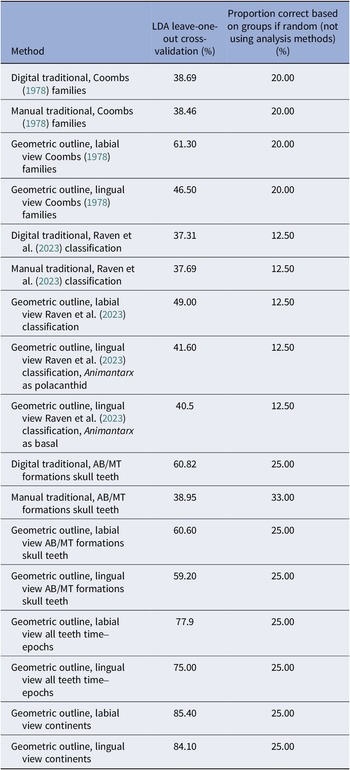
Beyond PCAs, datasets also underwent a linear discriminant analysis (LDA) to ensure that results were statistically significant. Leave-one-out cross-validation (jack-knifed) produces the most accurate overall classification percentage. We considered tests with a classification success rate of over 75% as viable tests for differentiating groups of ankylosaurs. This represents a reasonable midpoint between previously published thresholds (e.g., 50% in Davis and McHorse, Reference Davis and McHorse2013, 90% in Marramà and Kriwet, Reference Marramà and Kriwet2017) and allowed some overlap between clades but well exceeded randomly assigning a specimen to an arbitrary clade (10–33%, depending on the morphometric analysis; Table 3).
LDA classification success rates across analyses

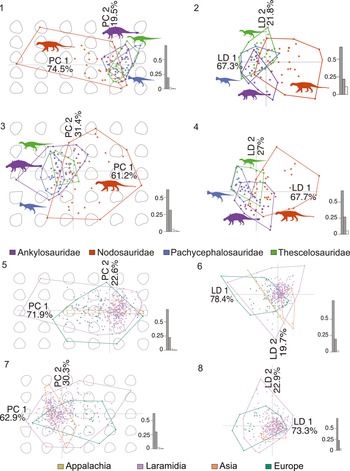
The dataset was also subdivided for further investigation to answer specific questions about ankylosaur biogeography and evolution. We analyzed the morphometrics of teeth associated with skulls from geological formations in Alberta and Montana (the Belly River Group and the Dinosaur Park, Scollard, Horseshoe Canyon, Oldman, Milk River, Foremost, Wapiti, St. Mary River, Lance, Hell Creek, and Judith River formations) as they represent a large number of samples in this dataset and have some of the better stratigraphic resolution. This allows us to test the efficacy of the methods between different, yet related, units in a case study of a larger geographic space.
Repositories and institutional abbreviations
AMNH—American Museum of Natural History, New York, New York, USA; AR—Fundación Conjunto Paleontológico de Teruel-Dinoópolis/Museo Aragonés de Paleontología, Teruel, Spain; BGS GSM—British Geological Survey, Keyworth, Nottingham, United Kingdom; BYU—Brigham Young University Museum of Paleontology, Provo, Utah, USA; CAMSM—Sedgwick Museum of Earth Sciences, University of Cambridge, Cambridge, United Kingdom; CEUM—Utah State University Eastern, Prehistoric Museum, Price, Utah, USA; CMN—Canadian Museum of Nature, Ottawa, Ontario, Canada; DLM—Drilandmuseum Gronau, Westfalen, Germany; DMNH—Denver Museum of Nature and Science, Denver, Colorado, USA; DPMWA—Dorthy Page Museum of Wasilla, Alaska, USA; FHSM VP—Fort Hays State University, Sternberg Museum of Natural History, Vertebrate paleontology collections, Hays, Kansas, USA; GPMM—Geomusuem of the Westfálische Wilhelms University, Münster, Westfalen, Germany; HMNH—Hayashibara Museum of Natural History, Okayama, Japan; INBR—Victor Valley Museum, Apple Valley, California, USA; IVPP—Institute of Vertebrate Paleontology and Paleoanthropology, Beijing, China; MTM—Magyar Természettudományi Múzeum, Budapest, Hungary; NHMUK—Natural History Museum, London, United Kingdom; PIN—Paleontological Institute, Russian Academy of Sciences, Moscow, Russia; PIUW—Paläontologisches Institut, Universitat Wien, Vienna, Austria; ROM—Royal Ontario Museum, Toronto, Ontario, Canada; SMA—Sauriermuseum Aathal, Switzerland; SDSNH—San Diego Natural History Museum, San Diego, California, USA; SMU—Southern Methodist University, Dallas, Texas, USA; TMP—Royal Tyrrell Museum of Paleontology, Drumheller, Alberta, Canada; UALVP—University of Alberta Vertebrate Paleontology, Edmonton, Alberta, Canada; UM2—Université des Sciences et Techniques du Languedoc, Montpellier, France; UMNH—Natural History Museum of Utah, Salt Lake City, Utah, USA; USNM—Museum of Natural History, Smithsonian Institution, Washington, DC, USA; XHPM—Xinghai Museum of Paleontology, Dalian, China; YPM—Yale Peabody Museum, New Haven, Connecticut, USA; ZMNH—Zhejiang Natural History Museum, Hangzhou, Zhejiang, China; ZPAL—Zaklad Paleobiologii (Institute of Paleobiology)–Polish Academy of Sciences, Warsaw, Poland.
Results
Tooth size
We compared the CBL with the CH of the teeth using a biplot before normalizing the values to understand how size differs between families (Fig. 5). Ankylosauridae, Thescelosauridae, Stegosauria, and Pachycephalosauria all occupy a similar morphospace. Nodosauridae, however, has a larger size distribution, plotting in the same morphospace as the other families but also reaching much larger sizes. When Nodosauridae is instead split into Panoplosauridae, Polacanthidae, Struthiosauridae, and basal Ankylosauria (after Raven et al., Reference Raven, Barrett, Joyce and Maidment2023), it becomes evident that most of the large variation in size is represented by Panoplosauridae and Struthiosauridae. With one exception, only Panoplosauridae and Struthiosauridae plot above 10 mm CBL and/or CH. Polacanthidae plots entirely in the cluster, except for one large notable outlier, Peloroplites, which is greater than 10 mm in CBL and CH. Several Sauropelta teeth also plot above 10 mm CH and CBL, with Sauropelta being an unranked non-ankylosaurid in the Raven et al. (Reference Raven, Barrett, Joyce and Maidment2023) classification. CH and CBL size support hypothesis 2, that teeth of different ankylosaur families can be differentiated. When a tooth is larger than 10 mm CH and/or CBL, it can be identified as either a nodosaurid (using Coombs taxonomy) or a panoplosaurid or struthiosaurid (using Raven et al. taxonomy). Teeth smaller than 10 mm CH and/or CBL could derive from any ankylosaur family irrespective of taxonomic framework or other ornithischian families with leaf-shaped teeth. Plotting residuals was uninformative and resulted in no additional differentiation of families (Supplemental 8).
Biplot of tooth size using the classification of Raven et al. (Reference Raven, Barrett, Joyce and Maidment2023). Dashed gray line at 10 mm crown base length (CBL) and crown height (CH) mark.

Basal cingulum and fluting
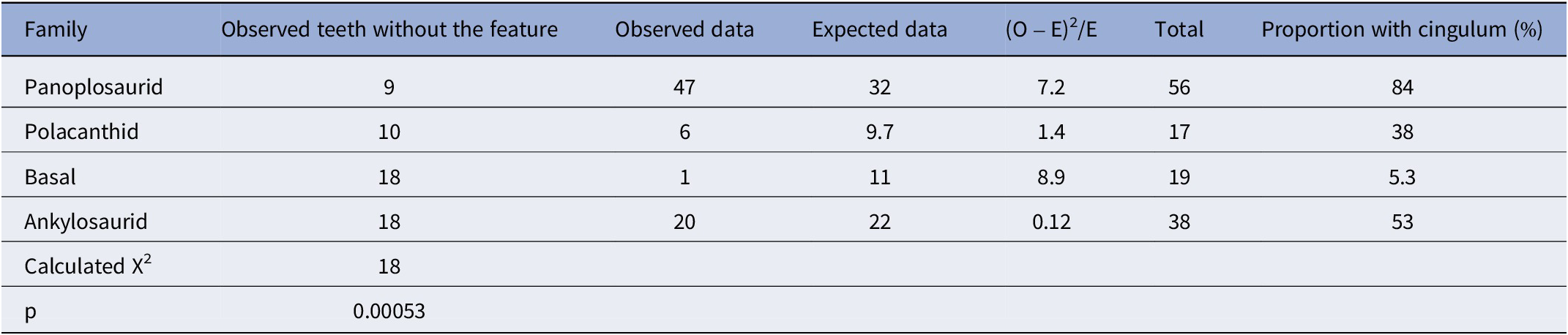
Chi-squared tests were used to determine whether there is an association between a basal cingulum and/or fluting and ankylosaurian families using the Coombs (Reference Coombs1978) and Raven et al. (Reference Raven, Barrett, Joyce and Maidment2023) taxonomies. The chi-squared tests include only specimens we observed firsthand, and so Struthiosauridae is not represented in this analysis.
Fluting is significantly associated with Coombs (Reference Coombs1978) families (p = 0.0096) (Table 4). Proportionally, 74% of ankylosaurid teeth have fluting compared with 39% of nodosaurid teeth. Ankylosaurid teeth are more likely to have fluting compared with nodosaurid teeth, but this feature cannot be used alone to determine family. A basal cingulum is also somewhat associated with family (p = 0.028) (Table 5); 51% of ankylosaurid teeth and 60% of nodosaurid teeth have a basal cingulum. Similar to fluting, the presence or absence of a basal cingulum should not be the sole trait used to assign an isolated tooth to a family but can be used in conjunction with other evidence to support an identification.
Chi-squared test for fluting using Coombs (Reference Coombs1978) families

Chi-squared test for basal cingulum using Coombs (Reference Coombs1978) families

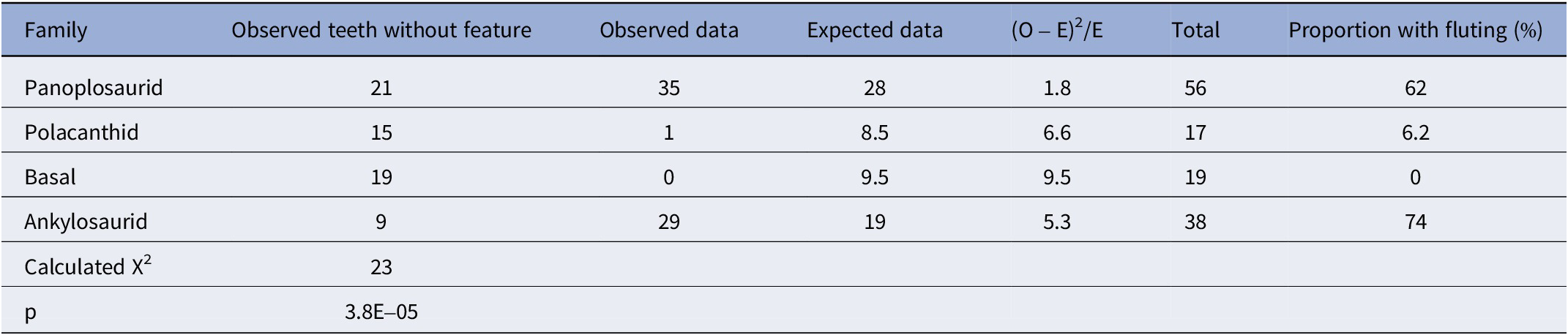
The chi-square tests using the Raven et al. (Reference Raven, Barrett, Joyce and Maidment2023) classification scheme provide additional clarity on these traits. Fluting is significantly associated with families (p = 3.8 × 10⁻⁵) (Table 6). If a tooth has fluting, it is most likely from a panoplosaurid or ankylosaurid. Similarly, a basal cingulum is significantly associated with families (p = 5.3 × 10⁻⁴) (Table 7). Panoplosauridae and Ankylosauridae have a significant number of teeth with fluting and with basal cingula, and basal Ankylosauria and Polacanthidae have a significant number of teeth without either fluting or a basal cingulum.
Chi-squared test for fluting using Raven et al. (Reference Raven, Barrett, Joyce and Maidment2023) classification

Chi-squared test for basal cingulum using Raven et al. (Reference Raven, Barrett, Joyce and Maidment2023) classification

Tooth morphometrics
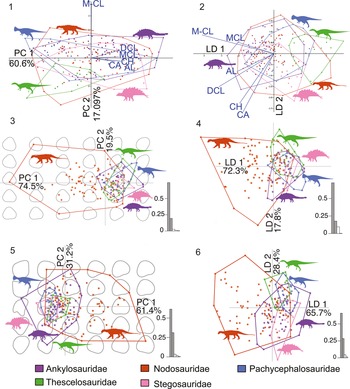
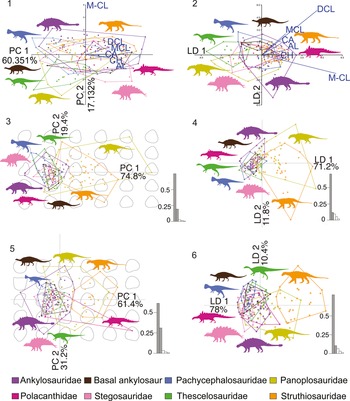
Plotting the PCAs of the elliptic Fourier tooth outlines generally produced different results from the traditional morphometric analyses, with higher classification accuracies. When the standardized and log-transformed manual and digital traditional values for teeth are plotted as a PCA, there is significant overlap between all families (Figs. 6.1, 7.1).
Comparison of ornithischian tooth morphology using the classification of Coombs (Reference Coombs1978). (1, 3, 5) Results of the principal component analyses: (1) digital traditional analysis; (3) outline geometric analysis labial view; (5) outline geometric analysis lingual view. (2, 4, 6) Results of the linear discriminant analysis: (2) digital traditional analysis; (4) outline geometric analysis labial view; (6) outline geometric analysis lingual view.

Comparison of ornithischian tooth morphology using the classification of Raven et al. (Reference Raven, Barrett, Joyce and Maidment2023). (1, 3, 5) Results from principal components analyses: (1) digital traditional analysis; (3) outline geometric analysis labial view; (5) outline geometric analysis lingual view. (2, 4, 6) Results of the linear discriminant analysis: (2) digital traditional analysis; (4) outline geometric analysis labial view; (6) outline geometric analysis lingual view.

Plotting a PCA of families in labial and lingual views with outline geometric morphometric methods shows large variation in Nodosauridae, and very little differentiation from the other families (Figs. 6.3, 6.5, 8.1, 8.3). There are more lingual outlines of teeth in skulls than labial, as newly erupting teeth expose only the lingual face. Using the Raven et al. (Reference Raven, Barrett, Joyce and Maidment2023) taxonomic framework, the majority of the variation shown by “nodosaurids” is represented by Panoplosauridae and Struthiosauridae, while Polacanthidae, basal Ankylosauria, Pachycephalosauridae, Thescelosauridae, and Stegosauridae are clustered together and with Ankylosauridae (Fig. 7.3, 7.5). The alternative position of Animantarx as a basal ankylosaur does not significantly impact the results of the PCA of outline geometric analyses (Supplemental 9).
Principal component analysis (PCA) and linear discriminant analysis (LDA) comparison of associated tooth morphology of specimens from the Campanian–Maastrichtian of Alberta and Montana, and continental-scale geographic locations. (1, 2) Analyses on teeth from Alberta and Montana, outline geometric analysis labial view: (1) PCA; (2) LDA. (3, 4) Outline geometric analysis lingual view: (3) PCA; (4) LDA. (5, 6) Continental scale geography analysis, outline geometric analysis labial view: (5) PCA; (6) LDA. (7, 8) Outline geometric analysis lingual view: (7) PCA; (8) LDA.

The highest LDA classification success rate for the Coombs (Reference Coombs1978) taxonomy is 61.3% for the labial view outline analysis (Fig. 6.4; Table 3). The LDAs of teeth with known identifications using the classification from Raven et al. (Reference Raven, Barrett, Joyce and Maidment2023) had classification success rates similar to those for the Coombs (Reference Coombs1978) taxonomy, still falling below our set value of 75% for viable identification (Fig. 7.4, 7.6). The highest LDA classification success rate from the digital traditional analysis was 49.00% (Table 3). Raven et al. (Reference Raven, Barrett, Joyce and Maidment2023) recovered Animantarx in two alternate positions, as a polacanthid and as a basal ankylosaur. When Animantarx is a polacanthid, the LDAs for outline lingual view had a classification success rate of 41.60% (Fig. 7.5; Table 3), and when Animantarx is a basal ankylosaur, the outline lingual LDA classification success rate was 40.5% (Supplemental 9; Table 3). Only the lingual view is given for Animantarx plots as the tooth is partially erupted, with only the lingual face visible. Both the Coombs (Reference Coombs1978) and Raven et al. (Reference Raven, Barrett, Joyce and Maidment2023) classifications are most useful when combined with data such as tooth size and the presence/absence of a basal cingulum or fluting.
Discussion
Identifying leaf-shaped ornithischian teeth
The results of this work demonstrate that leaf-shaped ornithischian teeth are very difficult to distinguish from one another, and using multiple lines of evidence is imperative for making taxonomic identifications. Furthermore, it may not be possible to confidently identify the family of many isolated leaf-shaped ornithischian teeth. For ankylosaurs, the previous identification methods proposed by Coombs (Reference Coombs1978) (i.e., the presence/absence of a basal cingulum, size, etc.) cannot be used in isolation for identifying family as they oversimplify the range of morphologies present in ankylosaurs. For example, the commonly cited observation that ankylosaurid teeth are smaller than nodosaurid teeth (e.g., Carpenter, Reference Carpenter and Currie1997; Ryan and Evans, Reference Ryan, Evans, Currie and Koppelhus2005; Johnson et al., Reference Johnson, Allen, Braunberger, Marsovsky and Quinsey2009) obscures the fact that nodosaurid teeth range in size from similar to ankylosaurid teeth to far larger. Taxonomic identifications of leaf-shaped ornithischian teeth are difficult to determine for both the traditional nodosaurid–ankylosaurid classification (Coombs, Reference Coombs1978) and the more recently identified ankylosaurid, panoplosaurid, polacanthid, and struthiosaurid system of Raven et al. (Reference Raven, Barrett, Joyce and Maidment2023).
Morphometric analyses are most effective for identifying whether teeth are panoplosaurid or struthiosaurid and are rarely able to identify isolated teeth as ankylosaurid with consistency across methods. This reflects the fact that ankylosaurid teeth occupy the same morphospace as panoplosaurid/struthiosaurid teeth, but panoplosaurid/struthiosaurid teeth occupy a larger area of morphospace that does not fully overlap with ankylosaurids. For example, any tooth with a CBL or CH greater than 10 mm is probably a nodosaurid/panoplosaurid or struthiosaurid, but smaller teeth could come from any ankylosaur family regardless of taxonomic framework.
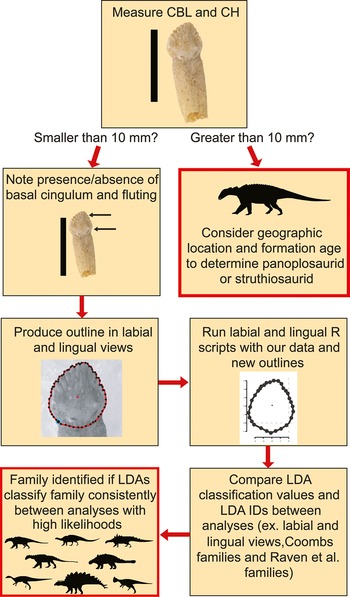
We recommend the following steps for identifying newly collected teeth, or for reassessing teeth already in collections (Fig. 9). Noting the size of the tooth is an easy method for quickly distinguishing panoplosaurid/struthiosaurid/nodosaurid teeth from all other leaf-shaped teeth, as any tooth greater than 10 mm CH and/or CBL can be identified as a nodosaurid or panoplosaurid/struthiosaurid ankylosaur. Noting the presence/absence of fluting and basal cingula can then provide insight as to whether the tooth may belong to Ankylosauridae/Panoplosauridae or Polacanthidae/basal Ankylosauria. Using the morphometric methods presented here, it is possible in some cases to identify panoplosaurid or struthiosaurid teeth. However, there is a large overlap in morphology not just between ankylosaurids and nodosaurids but also for thescelosaurs, pachycephalosaurs, and stegosaurs. Traditional and geometric morphometric methods may be employed once returning from the field to potentially resolve a more specific identification, and this is most effective when multiple morphometric analyses are analyzed in combination. Taxonomic identifications can be considered more confident when LDA identifications are consistent across multiple tests (i.e., traditional morphometric data, lingual outlines, and labial outlines) than when they differ between two or more tests.
Proposed workflow for the identification of family for isolated leaf-shaped ornithischian teeth.

In nearly every morphometric analysis, Nodosauridae shows a larger range of variation than the other groups of leaf-shaped ornithischian teeth. Several re-evaluations of ankylosaur phylogeny, most recently Raven et al. (Reference Raven, Barrett, Joyce and Maidment2023), have suggested that Nodosauridae should be split into multiple families. Our results show that there are significant morphological differences among taxa previously referred to Nodosauridae and provide additional support for the revised relationships proposed by Raven et al. (Reference Raven, Barrett, Joyce and Maidment2023). Raven et al. (Reference Raven, Barrett, Joyce and Maidment2023) identified two dental unambiguous synapomorphies of Struthiosauridae—a sub-triangular tooth crown shape and tooth striations not extending to the cingulum. According to the outline morphometric analyses, there is significant overlap in morphology between Panoplosauridae and Struthiosauridae, suggesting that sub-triangular tooth shape may not be an unambiguous synapomorphy for Struthiosauridae. We also noted that fluting (striations) does not always extend to the cingulum in other non-struthiosaurid ankylosaurs (e.g., BYU VP 50866, a polacanthid), suggesting that this is also not an unambiguous synapomorphy of Struthiosauridae.
Implications for ankylosaur paleoecology
Determining whether the teeth of ankylosaurids and non-ankylosaurids (nodosaurids using the Coombs, Reference Coombs1978 taxonomy; panoplosaurids, struthiosaurids, and polacanthids using the Raven et al., Reference Raven, Barrett, Joyce and Maidment2023 taxonomy) can be reliably distinguished from each other has significant implications for several lines of inquiry, including questions of ankylosaur taxonomy, stratigraphic distributions, and broader paleoecological studies. Many isolated ankylosaur teeth in museum collections are currently classified on the basis of features proposed by Coombs (Reference Coombs1978), potentially skewing interpretations of ankylosaur evolution and paleoecology if these teeth cannot be distinguished at the family level. This could also reduce the accuracy of tests if teeth are only classified as Ankylosauria when there may be real anatomical differences between ankylosaur clades.
Early Cretaceous North American ankylosaurids are currently represented only by Cedarpelta, which is sometimes recovered as a basal ankylosaurid (Carpenter, Reference Carpenter and Carpenter2001; Thompson et al., Reference Thompson, Parish, Maidment and Barrett2012; Arbour and Currie, Reference Arbour and Currie2016) and sometimes as a nodosaurid (Vickaryous et al., Reference Vickaryous, Maryañska, Weishampel, Weishampel, Dodson and Osmólska2004). Unambiguous ankylosaurid body fossils are absent from the fossil record of western North America between the Cenomanian and Campanian. All North American ankylosaurids except Aletopelta and Cedarpelta are deeply nested within a clade of Asian origin (Arbour and Currie, Reference Arbour and Currie2016). Arbour et al. (Reference Arbour, Zanno and Gates2016) suggested that Asian ankylosaurids migrated to North America in the later Cretaceous following a potential North American ankylosaurid extirpation after the Cenomanian, resulting in an “ankylosaurid gap” similar to that proposed for sauropods by Lucas et al. (Reference Lucas, Hunt, Farlow and Farlow1989). Arbour et al. (Reference Arbour, Zanno and Gates2016) used only skeletal fossils in their dataset because of concerns about the accuracy of assigning isolated teeth to either nodosaurid or ankylosaurid ankylosaurs. However, several papers (e.g., Russell, Reference Russell1935; Dorr, Reference Dorr1985; Lee, Reference Lee1997; Eaton et al., Reference Eaton, Cifelli, Hutchison, Kirkland and Parrish1999a, Reference Eaton, Diem, Archibald, Schierup and Munkb; Parrish, Reference Parrish and Gillette1999; Weishampel et al., Reference Weishampel, Meers, Akersten, McCrady, Akersten, McDonald, Meldrum and Thompson2002; Krumenacker, Reference Krumenacker2010; Loewen et al., Reference Loewen, Burns, Getty, Kirkland and Vickaryous2013) include isolated ankylosaur teeth from the early Late Cretaceous (Cenomanian to Santonian) of North America. Although our results show that ankylosaurid teeth cannot be differentiated from other ankylosaur clades, isolated teeth could be used to test this putative “ankylosaurid gap” if only nodosaurid/panoplosaurid teeth are present in samples from the gap and ankylosaurid teeth are consistently absent even in well-sampled datasets.
The variation in ankylosaur tooth morphology documented here may also have implications for interpreting ankylosaur diets. Panoplosaurids are more likely to have fluting and a basal cingulum, whereas polacanthids and basal ankylosaurs do not. The function of the basal cingulum and fluting in dinosaur teeth is poorly studied. However, in mammals, it is suggested that the cingulum protects the neck of the tooth while chewing soft foods, protects the gums (Lucas et al., Reference Lucas, Constantino, Wood and Lawn2008), or reduces strain on the base of the tooth from a soft food diet (Anderson et al., Reference Anderson, Gill and Rayfield2009). Fluting has been studied in spinosaurid and marine reptile teeth, where it is suggested that it aids in cutting flesh and reducing the number of teeth pulled out by struggling prey (Hendrickx et al., Reference Hendrickx, Mateus, da Lourinhã, Araújo, da Lourinhã and Choiniere2019). In addition, in predatory reptiles, it has been proposed that fluting may help remove food fragments from the tooth surface (Vaeth et al., Reference Vaeth, Rossman and Shoop1985; Taylor, Reference Taylor1992). While ankylosaurs were not carnivorous and they did not use the flutes for cutting flesh and reducing tooth removal from struggling prey, it is conceivable that they could have been used for a similar purpose due to the toughness of some plant material (Lucas, Reference Lucas2004; Mallon and Anderson, Reference Mallon and Anderson2014b). Testing the utility of the basal cingulum and fluting in ornithischian dinosaurs could thus provide more insight into potential dietary differences between families, given that there is a significant difference in the presence/absence of the traits between families.
Panoplosaurid/struthiosaurid teeth are not only absolutely larger than ankylosaurid, basal ankylosaur, and polacanthid teeth, but are also proportionally larger relative to skull size. For example, Ankylosaurus magniventris Brown, 1908 (CMNFV 8880) has a skull length from premaxilla to occipital condyle of 64.5 cm, a skull width at the quadratojugal horns of 74.5 cm (Carpenter, Reference Carpenter2004), and tooth CHs of ~5–7.5 mm, whereas Edmontonia rugosidens Gilmore, Reference Gilmore1930 (TMP 1998.098.0001) has a skull length of 47.7 cm, a skull width of 35.3 cm (Burns, Reference Burns2015, also listed as TMP 97.9.1), and tooth CHs from ~7 to 23 mm. Gastonia burgei Kirkland, Reference Kirkland1998 (Polacanthidae) has a skull length of 295 mm, a skull width of 283 mm (Kirkland, Reference Kirkland1998), and crown heights of ~4.5–6.5 mm. Gargoyleosaurus, representing basal Ankylosauria, has a skull length of 296 mm, a skull width of 235.5 mm (Kilbourne and Carpenter, Reference Kilbourne and Carpenter2005), and tooth CHs of ~3.5–8.5 mm. Europelta, representing struthiosaurids, has a skull length of 370.3 mm, a skull width of 299.1 mm (Kirkland et al., Reference Kirkland, Alcalá, Loewen, Espílez, Mampel and Wiersma2013), and tooth CHs of ~9.5–15 mm. In other words, crown height is up to 1.16% skull length in Ankylosaurus, 2.87% in Gargoyleosaurus, and 2.2% in Gastonia burgei, but 4.82% in Edmontonia and 4.05% in Europelta. The proportional sizes of polacanthids and basal ankylosaurs are similar to the proportional sizes of ankylosaurids. Ankylosaurids, basal ankylosaurs, and polacanthids have similar absolute tooth sizes, relative tooth sizes, and tooth morphology, indicating that their diets may have consisted of food with similar mechanical properties. By contrast, panoplosaurids and struthiosaurids have species with larger absolute and proportional tooth size and differing tooth morphology, indicating their food may have had different mechanical properties and suggesting potentially different dietary niches.
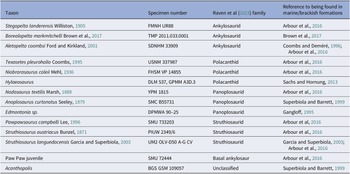
While panoplosaurid dinosaurs occupy the same formations as ankylosaurids in North America, they are also found in formations that ankylosaurids are not—primarily coastal and marine formations (Butler and Barrett, Reference Butler and Barrett2008; Arbour et al., Reference Arbour, Zanno and Gates2016). Previously, it has been hypothesized that “nodosaurids” may have a larger ecological niche than ankylosaurids, or preferentially chose to inhabit these environments (Butler and Barrett, Reference Butler and Barrett2008; Arbour et al., Reference Arbour, Zanno and Gates2016). Interestingly, when the nodosaurids found in marine/brackish deposits are classified using the Raven et al. (Reference Raven, Barrett, Joyce and Maidment2023) classification, there is no clear “nodosaurid” family found in these deposits at a higher rate (Table 8). Struthiosauridae, Panoplosauridae, and Polacanthidae are all represented in near equal numbers. Borealopelta, Aletopelta, and Stegopelta are found in marine formations and are classified as ankylosaurids by Raven et al. (Reference Raven, Barrett, Joyce and Maidment2023) but are likely panoplosaurid “nodosaurs.” Treating the teeth of these three taxa as isolated and seeing how they are classified could provide clarity to their taxonomic affinity, and their redesignation could result in one family having higher numbers of marine specimens. If specimens sourced from marine formations continue to be divided equally between Raven et al. (Reference Raven, Barrett, Joyce and Maidment2023) “nodosaurid” families, it suggests that the increased nodosaurid marine formation occurrences may be unrelated to “nodosaurids” having a different dietary niche, as polacanthids have the same tooth morphology as ankylosaurids.
Ankylosaur specimens found in marine formations classified using the Raven et al. (Reference Raven, Barrett, Joyce and Maidment2023) classification

The differing tooth morphology of panoplosaurid and struthiosaurid teeth suggests that they may occupy a different or larger dietary niche from the other ankylosaur families. Previous studies have suggested that nodosaurids would have eaten tougher plants than ankylosaurids (Mallon and Anderson, Reference Mallon and Anderson2013; Ballell et al., Reference Ballell, Mai and Benton2023) and would have been selective or intermediate feeders (Mallon and Anderson, Reference Mallon and Anderson2014a; Brown et al., Reference Brown, Greenwood, Kalyniuk, Braman, Henderson, Greenwood and Basinger2020; Ballell et al., Reference Ballell, Mai and Benton2023), with evidence of a predominantly fern diet (Brown et al., Reference Brown, Greenwood, Kalyniuk, Braman, Henderson, Greenwood and Basinger2020). With the possible exception of Borealopelta, all of these studies used panoplosaurid or struthiosaurid “nodosaurs,” supporting our findings of these groups having a potential different or wider dietary niche compared with ankylosaurids. Ösi et al. (Reference Ősi, Prondvai, Mallon and Bodor2017) found differences in wear patterns between “nodosaurids” (panoplosaurids and struthiosaurids in this case) and ankylosaurids, with the basal ankylosaur Gargoyleosaurus having unique wear patterns compared with the other nodosaurids studied. In addition, Ösi et al. (Reference Ősi, Prondvai, Mallon and Bodor2017) noted that Laramidian Late Cretaceous ankylosaurs have similar wear facets to panoplosaurids, but differing pits/scratches. Given the Raven et al. (Reference Raven, Barrett, Joyce and Maidment2023) classifications of the species used in Ösi et al. (Reference Ősi, Prondvai, Mallon and Bodor2017), this work also supports our findings that struthiosaurids and polacanthids likely had different or wider dietary niches compared with ankylosaurids. Further work should be done on the tooth wear patterns and jaw mechanics of polacanthids and basal ankylosaurs to compare with ankylosaurids, panoplosaurids, and struthiosaurids. The possibility of nodosaurids/panoplosaurids having a wider dietary niche than ankylosaurids could be a factor for why nodosaurids remain throughout the mid Cretaceous in North America (Laramidia) while ankylosaurids were potentially extirpated (Arbour et al., Reference Arbour, Zanno and Gates2016). If nodosaurids/panoplosaurids were able to eat different vegetation or a wider variety of vegetation compared with ankylosaurids, they may have been less susceptible to mid Cretaceous environmental changes such as the emergence of flowering plants (Wing and Boucher, Reference Wing and Boucher1998), changes to precipitation and humidity (Ufnar et al., Reference Ufnar, González, Ludvigson, Brenner and Witzke2004; Suarez et al., Reference Suarez, Gonzalez, Ludvigson, Cifelli and Tremain2012), climate change (Wang et al., Reference Wang, Scott, Wan, Graham, Huang, Wang, Wu, Dean and Zhang2013), and transgressions and regressions of sea levels (Haq, Reference Haq2014).
Conclusions
Variation in ankylosaur tooth morphology is more complex than previously appreciated, especially in light of new phylogenetic hypotheses of ankylosaur interrelationships. The morphometric approaches presented here can identify some isolated ankylosaur teeth as panoplosaurid or struthiosaurid, and occasionally as ankylosaurid, polacanthid, or other ornithischian families with leaf-shaped teeth. Key differences between the families include large size in polacanthids and struthiosaurids, an association with fluting and basal cingula in ankylosaurids and polacanthids, and larger variation in outline morphology of panoplosaurids and struthiosaurids. Differences in tooth morphology between ankylosaur families suggest that panoplosaurids and struthiosaurids may have occupied different or larger dietary niches than the other ankylosaur families, which may have allowed them to inhabit more environments and potentially supported their survival through the “ankylosaurid gap.”
Acknowledgments
We thank T. Cullen for his advice on the Momocs R package and B. Dyer for providing feedback on an early draft of this manuscript. We also thank all the collections managers and curators who allowed access to their collections, S. Ruffalo (CMN), K. Seymour (ROM), C. Levitt-Bussian (UMNH), R. Scheetz (BYU), K. Corneli (CEUM), K. MacKenzie (DMNH), B. Strilisky (TMP), and H. Gibbons (UALVP), S. Chapman (NHMUK), T. Tumanova (PIN), and M. Borsuk-Białynika (ZPAL).
Funding for this project was provided by a Dinosaur Research Institute Student Research Grant and a Canadian Museum of Nature Visiting Student Grant to E.G.C. V.M.A. is funded by a Natural Sciences and Engineering Research Council of Canada Discovery Grant (RGPIN-2020-04012) and Discovery Launch Supplement (DGECR-2020-00149).
Competing interests
The authors declare none.
Data availability statement
Data available from the Dryad Digital Repository: http://doi.org/10.5061/dryad.2547d7x3j.





 Open access

