




Introduction
The following pages navigate some of the issues surrounding musical instruments as tangible and intangible heritage. My starting point is the observation that discourse about music as intangible cultural heritage often overlooks the role of instruments in conserving a tradition and making live performance possible, while curating instruments as tangible heritage often neglects their use in music making. With this in mind, I explore two interrelated research questions. First, I ask whether instrument-crafting skills inherited from the past should be sustained or whether industrial or mechanized manufacturing processes should be encouraged. Second, I explore whether instruments inherited from the past should be displayed as objects, be restored to playing condition or be updated and developed for use today. To discuss these issues, I explore Britain’s piano heritage, traditional Korean instruments (kugakki) in the Republic of Korea/South Korea, and their equivalent “national” instruments (minjok akki) in the Democratic People’s Republic of Korea/North Korea.Footnote 1 The juxtaposition of such different instruments from opposite sides of the world allows me to look at both the country I call home (Britain) and the region where I have researched matters musical for 40 years – namely, the Korean peninsula.
The choice of the first recognizes the increasing proximity of musicology to ethnomusicology (or, inversely, of musicology to ethnomusicology)Footnote 2 and illustrates an issue critical to contemporary heritage discourse: should old instruments be preserved as museum objects or be maintained and restored to playing condition? In considering this question, I nod to organ craftsmanship in Germany, which, alongside organ music, was inscribed on the United Nations Educational, Scientific and Cultural Organization’s (UNESCO) Representative List of the Intangible Cultural Heritage of Humanity in 2017.Footnote 3 Shifting to the two Koreas for my second and third choices reveals my background in ethnomusicology, but it also demonstrates that the focus of ethnomusicological research overwhelmingly remains focused on our musical Others. Also, though, instruments in the two Koreas reveal different attitudes to conservation – the first, which is in the south, is closely allied to UNESCO’s heritage discourse, and the second, in the north, reflects an ideology that resists “resurrectionism” and “revivalism.”Footnote 4
Data for this article have been collected in South Korea since 1981, with almost annual visits to, and interviews with, instrument makers and musicians. I have conducted two research visits to North Korea in 1992 and 2000, when I worked with senior instrumentalists, collected instruments, and interviewed musicians and musicologists. The challenges of research in North Korea are such that I have also worked with archive and library materials on North Korea that are held in South Korea, China, North America, and Europe. I began to work with British keyboard makers in 2004, when I commissioned a new harpsichord from Michael Johnson, and with keyboard restorers in 2007, when I purchased the unrestored Ganer “square” piano discussed below from one restorer (Lucy Coad) and commissioned a second (Jean Maurer) to restore it. I have since participated in clavichord, harpsichord, and square piano groups and visited the major collections that I discuss in this article. My earlier work on music as intangible heritage includes work for UNESCO and research reported in, among other publications, my 2006 and 2012 books.Footnote 5
Setting the scene
There is often a personal reason for exploring a particular research topic. My interest started in my youth, when in the 1970s I joined the British Musicians’ Union as a percussionist. At that time, the union campaigned under the banner “Keep music live!” and operated a closed shop with broadcasters and theaters, where only union members could perform. The union’s campaign has been modified as the music industry changes, and, today, it strives to protect performance because this defines artistic practice.Footnote 6 This same discourse permeates discussions of music as intangible cultural heritage, with the result that attention tends to focus on the practical skills of performance, even though performing instrumentalists – including percussionists – are always concerned with obtaining good instruments. Hence, the craft skills involved in making instruments are vital.
Contrary to this idea, within tangible heritage discourse, curating instrument collections for display often downplays performance skills. Curating can be matched to archiving, and the same interests were evident in early efforts to conserve music as intangible heritage. Hence, the 1989 Recommendation on the Safeguarding of Traditional Culture and Folklore, adopted at the twenty-fifth session of the UNESCO General Conference, encouraged the development of inventories and institutions for folklore, the archiving of documentation, and the training of collectors, archivists, and documenters.Footnote 7 However, as the agenda evolved, efforts to sustain music shifted from archiving to identifying musicians and promoting their performance and transmission activities, thereby reinstating the “Keep music live!” mantra. Hence, in 1993, UNESCO announced a Living Human Treasures policyFootnote 8 and introduced guidelines in 1996 that were revised in 2002 – the Guidelines for the Establishment of Living Human Treasures Systems.Footnote 9 I worked on behalf of the Korean National Commission for UNESCO on the 2002 version of these guidelines. The shift should have allowed for craftsmen who made instruments to be recognized alongside musicians – surely, the future viability of much music performance rests on sustaining the skills for crafting and maintaining (including, in the case of old instruments, restoring) instruments.
Instruments, then, articulate the interface between objects as tangible heritage and music as intangible heritage. Notions of “tradition,” however, along with arguments about whether new creation should be allowed within genres considered “traditional,” are often framed around what is performed. Updating “tradition” will typically involve adaptations that purportedly serve contemporary tastes, with “airport art” targeting tourist consumption and with institutions, scholars, and journalists evaluating high-watermarked performances and appealing for preservation. There are parallels in instrument crafting, where considerations also include the impact of technology, shifting aesthetics of sound production, and whether factory production should be encouraged or resisted. Sustaining crafts, and the extent to which adaptations suited to new generations should be allowed, were discussed at a policy meeting sponsored by the (South) Korean National Commission for UNESCO in 1996 and continued in eight UNESCO workshops held between 1998 and 2002 in Korea, Italy, Japan, the Philippines, and the Czech Republic.Footnote 10 Also, France appointed “maîtres d’art” from 1994 onwards under the jurisdiction of a Crafts Council, while, in 1994, Poland initiated a program to protect “perishing professions,” and, in 1996, the Uzbek government set up a charitable organization, the Oltin meros (Golden Heritage) to support crafts. It is, then, reasonable to ask to what extent “traditional” music should use old instruments and/or whether it should be adapted for new instruments.
In Western art music, this question has been regularly voiced since pianos usurped the role of harpsichords and metal strings replaced gut strings on stringed instruments. In Britain, Roger Norrington’s progression through nineteenth-century symphonies to Tchaikovsky and Gustav Mahler with the gut-stringed instruments of the Orchestra of the Age of Enlightenment is well documented, while, in Austria, the Vienna Philharmonic was one of the last orchestras to move away from gut strings, long retaining a sound that has in recent times been recreated by the Wiener Akademie.Footnote 11 Again, inspired by commodified “world music,” some individuals champion using instruments developed for one musical tradition in the performance of other musics or fuse instruments from different traditions in new amalgams.Footnote 12 Finally, before proceeding, I note that some ethnomusicologists treat instruments implicated in their own backgrounds differently from the instruments of musical Others. Recognizing this observation led me in this article to include the British piano heritage alongside instruments from the two Koreas. To illustrate this point, consider the following Facebook exchange I had with two former ethnomusicology students in the autumn of 2018:
A: I’m thinking of buying a digital piano. Has anyone got any advice on what to look for, what to avoid, etc? I’m hoping for a weighted-key piano feel and full range.
Howard: I am a die-hard fan of real pianos. I know they require tuning and maintenance, and take more space, but …
B: Nothing can replace or be as inviting as a grand, but some of the digital pianos do a darned good job of mimicking them in feel and response. And at a fraction of the price.
Howard: Why do you need a grand? A good upright is still much better than a plugged-in keyboard. Why is that many ethnomusicologists don’t like finding a keyboard in, say, Javanese or Indian music? Or, why not have an electronic gamelan? Or, for that matter, electronic tabla or mbira? I am intrigued by how many ethnomusicologists look for “authentic” instruments in the music cultures they study, but don’t apply the same logic for the Western music traditions they grew up in.
A: For my Master’s dissertation, I wrote about a genre that combines keyboards with Javanese gamelan instruments. I’m not sure I would appreciate traditional classical gamelan pieces played on a keyboard, though.
Tangible and intangible instruments
Much instrument crafting remains an artisanal activity. Crafting often seems part of a pre-industrial leftover, with skills transmitted across generations, but although prestige is ascribed to historical crafting methods, technological advances are often utilized by instrument makers – for instance, to improve precision or for complex parts. There can also be discrimination against modern instruments – such as is the case with violins, but not with the Korean instruments discussed below. It is not uncommon to overlook technological advances in, say, the wind and brass instruments of Western orchestras, which change sonic dimensions of earlier Western art music, but, perhaps because of the legacy of folklore and much anthropology, ethnomusicologists tend to celebrate instrument crafting as part of the intangible heritage and resist change.
Put together, these observations lead to questions: do we really need to continue teaching and performing Javanese and Balinese gamelan – as ensembles requiring large, dedicated spaces and considerable maintenance – if digital versions exist; should we be concerned when Geoff Smith’s innovative “fluid piano” is used to play – as it was designed to – alternative modal systems such as South Asian raga or Middle Eastern maqam;Footnote 13 what about the synthesized Sibelius Sounds versions of the Japanese shakuhachi flute or the reproduction of raga and maqam in TouchKeys; and is it a matter of concern when Majorcan bagpipe (xeremies) makers use (as they do) synthetic materials rather than the goatskin of old for bags and if, in reviving their craft, they have learned skills from mainland Asturia and Galicia?Footnote 14 Questions of this sort recur across the world. Hans Christian Andersen’s tale about the Chinese emperor and the nightingale comes to mind: the emperor wanted to hear the nightingale’s beautiful song night and day, and so a mechanical automaton was devised that reproduced it. When the automaton broke down, the emperor fell critically ill, but by then all nightingales had disappeared because the automaton had rendered them redundant, and none could be found to sing to revive the emperor.
Instruments are core parts of material culture. They are often highly valued objects that travel from country to country. They are gifted and celebrated. As part of the tangible heritage, instruments in the archaeological record provide evidence for the history of musicking and also reveal information about technical knowledge among the people who made them.Footnote 15 Long ago, Edward Herron-Allen, writing about violins, demonstrated that instruments are entangled with localities and environments.Footnote 16 In nods to Bruno Latour,Footnote 17 instruments are key to the materiality of music, as part of a “sensescape” that links people to places, times, and technologies.Footnote 18 Instruments are prized in museum collections, although often only in obsolescence (much as Elodie Amandine Roy discusses in relation to recordings in archives).Footnote 19 But displays can abandon local entanglements, separating instruments as objects (as tangible heritage) from music (as intangible heritage). And instruments are today surrounded by controversy: they use precious resources, such as endangered Brazilian pernambuco wood for violin bows, protected ebony, rosewood, and other woods for guitars, near-threatened blackwood for bagpipes, and illegally harvested bubinga and rosewood for African drums. Ivory is commonly part of old instruments (particularly keyboard instruments) but, despite regulations under the Convention on International Trade in Endangered Species of Wild Fauna and Flora, can still be found on some newly made top-end instruments.Footnote 20
Some cultural heritage discourse wraps the interface between the tangible and intangible into a catch-all category – “infrastructure and regulations.” Between 2001 and 2005, UNESCO’s Masterpieces of the Oral and Intangible Heritage of Humanity included “action plans,” which, following the 2003 Convention for the Safeguarding of the Intangible Cultural Heritage (Intangible Heritage Convention), were carried over as “safeguarding measures” in the Representative List of the Intangible Cultural Heritage of Humanity.Footnote 21 The form for submitting to the Representative ListFootnote 22 requires information about an item’s transmission and re-creation, how it provides a sense of identity and continuity to a given community, and how its inscription on the list will help local, national, and international visibility and awareness. The use of control and validation mechanisms is common because heritage policies involve administrative and budgetary practices, procedures, and provisions for cultural action prescribed by a state or other institutions.Footnote 23 For crafts, including instruments, research and documentation has long aimed at reaching a consensus on quality that feeds into policies for collection and display and that may substantiate economic value, particularly in the case of violins. However, and ignoring for the moment how researchers are brought into the process, much of the literature on intangible heritage criticizes top-down mechanisms that provide control and aspects of valorization and instead champions bottom-up community efforts.
“Infrastructure and regulations” offers only a partial fit for how musical instruments function as both tangible and intangible heritage. Huib Schippers and Catherine Grant express the complexity involved in music sustainability in terms of an ecosystem divided into five domains, one of which is “infrastructure and regulations.” This domain has multiple elements.Footnote 24 Schippers and Grant slot instrument crafting into an “availability of instruments and other hardware” element within “infrastructure and regulations,” but because instruments are central to music making, a second of their domains – “media and music industry” – is also relevant (in respect to design evolutions). The complexity of instruments, however, means the reality is much more messy since they are implicated in many other elements across several of the five domains: “patronage and philanthropy” (consider the ownership of stratospherically expensive Stradivarius violins and how musicians are loaned precious instruments by collectors), “aesthetics and cosmology” (instrument design, features, and assigned meanings), “ethnicity and gender” (where some instruments are played by one gender only or by particular sub-groups with a given music culture), “approaches to authenticity” (consider bagpipes and the use of Galician gaita reeds by some Majorcan xeremies’ players), “pedagogy,” and “teachers.”
It is today routinely considered that to sustain cultural heritage requires promotion.Footnote 25 A notion of endangerment has become commonplace – there is, as Grant puts it, “an increasing sense of international urgency to better understand the wide-scale endangerment and loss of … music.”Footnote 26 Promoting music as heritage counterpoints the fractures caused by globalization, in which “localizing forces” seek to re-territorialize music, “weighing anchors” to conjoin “proximity and distance.”Footnote 27 This position, though, sits at some remove from earlier ethnomusicologists who have argued, following anthropology’s structural functionalism, that as societies change so must music.Footnote 28 In contrast, the contemporary Zeitgeist is that we should retain a past that is alive – as the South Asian theatre director and critic Rustom Bharucha notes, “instead of [just] venerating ‘the past’,” we need to “breathe a fresh spirit into it.”Footnote 29 Or, following from David Lowenthal in his musings on L. P. Hartley’s novel The Go-Between, our nostalgia should not be based merely on curated objects from a contested history framed for us by museums and archives.Footnote 30 In other words, heritage needs to be performed to remain meaningful, which renders the intangible heritage central to how people relate to the world that surrounds them: it brings the tangible to life.Footnote 31 Hence, tangible and intangible belong together, and, in music, it is instruments that assume the primary role in fusing the two because they are both tangible objects and part of the intangible heritage – as crafted objects, instruments are crucial to music performance.
Britain, pianos, and other keyboards
Intangible heritage discourse has in ethnomusicology tended to focus on musical Others more than, or at the expense of, musical familiars. This needs to be challenged; hence, I now turn to my own heritage – to Britain – where I was born and have spent most of my life. Britain is a UNESCO member state but not a signatory to the Intangible Heritage Convention; it participates in limited ways, in UNESCO projects such as World Heritage Sites, Memory of the World, Geoparks, Biospheres, and the Creative Cities Network.Footnote 32 Much as UNESCO maintains lists for threatened natural and manmade heritage, Britain has a separate Heritage Crafts Association, which issues a Red List of Endangered Crafts. The 2019 Red List cited cricket-ball making and gold beating as “extinct,” sieve making as having moved from “extinct” to “critically endangered” (after two people revived it in 2018), and three music instrument crafts as “critically endangered”: bell founding, flute making, and piano making. Of these three crafts, bell founding has remained essentially the same for 900 years, casting bells mouth down in a two-part mold in foundries. Bells are a quintessential part of the British idyll, punctuating daily life as they strike within church towers and town halls, and distinguished in Britain from most other countries by the change-ringing tradition kept alive by local and national guilds.Footnote 33 But 2017 saw the closure of the 450-year-old Whitechapel foundry (which cast both Westminster’s Big Ben and Philadelphia’s Liberty Bell). Only one foundry survives – Taylors – based in a building in Loughborough that is on the “at risk” register of a further organization, English Heritage.Footnote 34 The last few years have seen community campaigns that aim to safeguard the Loughborough foundry and to stop the Whitechapel site being turned into a hotel.Footnote 35
Pianos, rather like bells, are at the public level and are a familiar part of domestic British life. By the nineteenth century, they were a significant aspect of modernity, a symbol of respectability that marked “the sharpest of all lines of social division.”Footnote 36 London produced more pianos than any other place from the late eighteenth century to the beginning of the twentieth century. Initially, a concentration of makers set up in Golden Square, off Carnaby Street, many of whom contracted with craftsmen serving the furniture industry around Tottenham Court Road for supplies of specialized components. With the arrival of railways, to utilize these and the Regent’s Park branch of the Grand Union Canal for distribution, many makers moved to Camden Town where one pub, the Mother Redcap (now known as the World’s End), served as a labor exchange: tradesmen gathered each Monday to see what piecemeal jobs were available in the piano factories. Some factory buildings remain, such as those of Brinsmead (once the largest piano factory in the world; now an apartment complex) and the round premises of Collard and Collard (recently home to EasyJet).Footnote 37 The industry has gone, although Broadwood, the oldest maker in the world (with foundations stretching back to 1728 when the Swiss emigré Burkat Shudi, later father-in-law to John Broadwood, set up a workshop to make harpsichords), survives, primarily operating as a tuner and repairer.
Other crafts for instruments associated with Western art music are listed by the Heritage Crafts Council as “endangered”: crafting brass instruments,Footnote 38 free reed instruments, woodwinds, percussion instruments, and other keyboards. The cottage industry producing keyboards – primarily of types that predated the piano such as clavichords, harpsichords, and spinets – was a legacy of a late nineteenth-century revival associated with Arnold Dolmetsch and sustained by the mid-twentieth-century historical performance movement.Footnote 39 Although the cottage nature extends to, and is maintained by, associations of interested people, it is in severe decline, as was starkly illustrated in July 2019 when the British Clavichord Society dissolved itself after 40 years of existence.Footnote 40 Again, virtually all of Britain’s tertiary-level instrument-making courses have closed: many of today’s makers and restorers trained at the London College of Furniture, which is now part of London Metropolitan University, where only a short guitar-making course survives; Lincoln College offers the last remaining piano tuning and restoration course.Footnote 41
Although the instrument industry once had considerable national importance, Britain is today ambivalent about its loss. In respect to piano crafting, Alistair Laurence, whose family has connections to Broadwood stretching back more than 200 years, writes: “This indeed is a very dangerous situation – dangerous because we may reach a point where there is no one left to teach piano-making skills and to pass on critical knowledge to a new generation. … It is not unrealistic to suggest that, in the years ahead, we may have to commission technicians to fly in from Germany or Japan, just to keep our own pianos in reasonable order!”Footnote 42 Ambivalence is evident in British museums. There is no national collection of instruments. The Victoria and Albert Museum, which defines itself as the world’s leading museum of art and design and is the keeper of the national collection of performing arts,Footnote 43 closed its instrument gallery in 2010 – the gallery is now used for displays of fashion and the history of dress. A few of its instruments have since been displayed in the museum’s furniture, medieval, renaissance, and British galleries, and some are on loan to the Horniman Museum, but the gallery is “substantially closed.”Footnote 44 Most instruments are stored offsite, accessible only by appointment.Footnote 45 The Victoria and Albert Museum’s collection dates back to Carl Engel,Footnote 46 and some of its instruments were used by Alexander Ellis as source materials for his 1885 foundational text “On the Musical Scales of Various Nations,” a text that remains on many ethnomusicology course reading lists.Footnote 47
Some conservatoires, and Oxford and Edinburgh universities, house collections of keyboards, and the National Trust and English Heritage maintain collections spread between their properties. Two collections are housed in specific National Trust properties, both associated with individual collectors: the (Alec) Cobbe collection at Hatchlands in Surrey, and the (Major George Henry) Benton Fletcher collection at Fenton House in Hampstead.Footnote 48 Sadly, the two largest private collections in Britain, both formerly in Kent, have recently closed: Finchcocks was home to over 100 keyboard instruments – more than 40 in playing condition and used for regular public demonstrations – but it closed in 2015, and most of its instruments were auctioned in 2016;Footnote 49 the Colt Clavier collection in Bethersden, assembled using profits from wooden-framed buildings erected across Britain after the destruction of World War II, auctioned its instruments in 2018.Footnote 50
A large number of antique keyboard instruments, however, survive in Britain, testament to the long history of crafting. This ought to sustain a community of maintainers and restorers, but generating a living from restoration is increasingly hard, so only a handful remain active, supplemented by one maker of brass and copper strings and one supplier of leather and felt for hammers and dampers. Restoration allows instruments to be used rather than being displayed as objects in museums and to perform music written for them (rather than performing old music on a newer instrument with different tonal qualities and with different playing techniques). We may arguably “be overly concerned with having the ‘right’ instruments,” given that composer musicians in the pastFootnote 51 “did not necessarily play the same type of instrument all the time.”Footnote 52 This was true as pianos replaced other keyboards in the late eighteenth century, when many composer musicians travelled widely and, as a result, played on a number of different instruments, but composers of the time did often write for specific instruments. Hence, Katalin Komlós shows why the first four of J. C. Bach’s 1768 Opus 5 sonatas are among the earliest written for the piano (rather than the harpsichord).Footnote 53 David Rowland notes how piano pedaling evolved as instruments developed, and developments in piano actions, and extensions to keyboard ranges, allowed the evolution of compositional language, including that of composers such as Ludwig van Beethoven and Muzio Clementi (see Figure 1).Footnote 54
Keyboard restorer Jean Maurer, discussing with the author the restoration of the action of an eighteenth-century “square” piano (photo by Charlotte Howard; all rights reserved).

Playing antique instruments causes wear and, over time, damage. So should instruments be preserved and studied in their “original” state, should they be restored to playing condition using modern parts as required, or should “authentic” copies be made? I will avoid adding to the controversies surrounding these questions by simply introducing two pianos from my personal collection, neither of which would be likely considered important by museum curators. First, in a 2008 British Broadcasting Corporation television adaptation of Jane Austen’s Sense and Sensibility, Colonel Brandon (David Morrissey) hands Marianne Dashwood (Charity Wakefield) some sheet music. “You have an instrument?” “Yes, of sorts,” she replies.Footnote 55 The instrument of sorts is a “square” piano crafted by Christopher Ganer in Golden Square when Beethoven was a young teenager, in or around 1785, less than 20 years after the first known London-made square piano had been built (see Figure 2). However, the instrument heard in Sense and Sensibility, sadly, is a modern piano because when filming took place the Ganer had just been rescued from long service as a family’s sideboard. It had stood, unopened, as a piece of furniture for perhaps 200 years. The inside was thick with dust, and the leather hammers were caked in mold. Strings had broken, and the soundboard had split; it could no longer produce a note. However, this instrument has significance: it is an early example to have been built with two pedals, one providing a swell by lifting part of the casework in the manner of some harpsichord “Viennese swells.” Today, restored to playing condition, it sits in my music room alongside a cardboard box – not the cardboard box of forgotten treasures in The Go-Between that generated the well-known comment and title for Lowenthal’s books but, rather, a box with slivers of wood, hand-turned rusty screws, broken hammers, and even a Victorian-era penny red stamp, which were all found in the piano but unusable in restoration.
Christopher Ganer “square” piano, circa 1785, restored (photo by Keith Howard; all rights reserved).
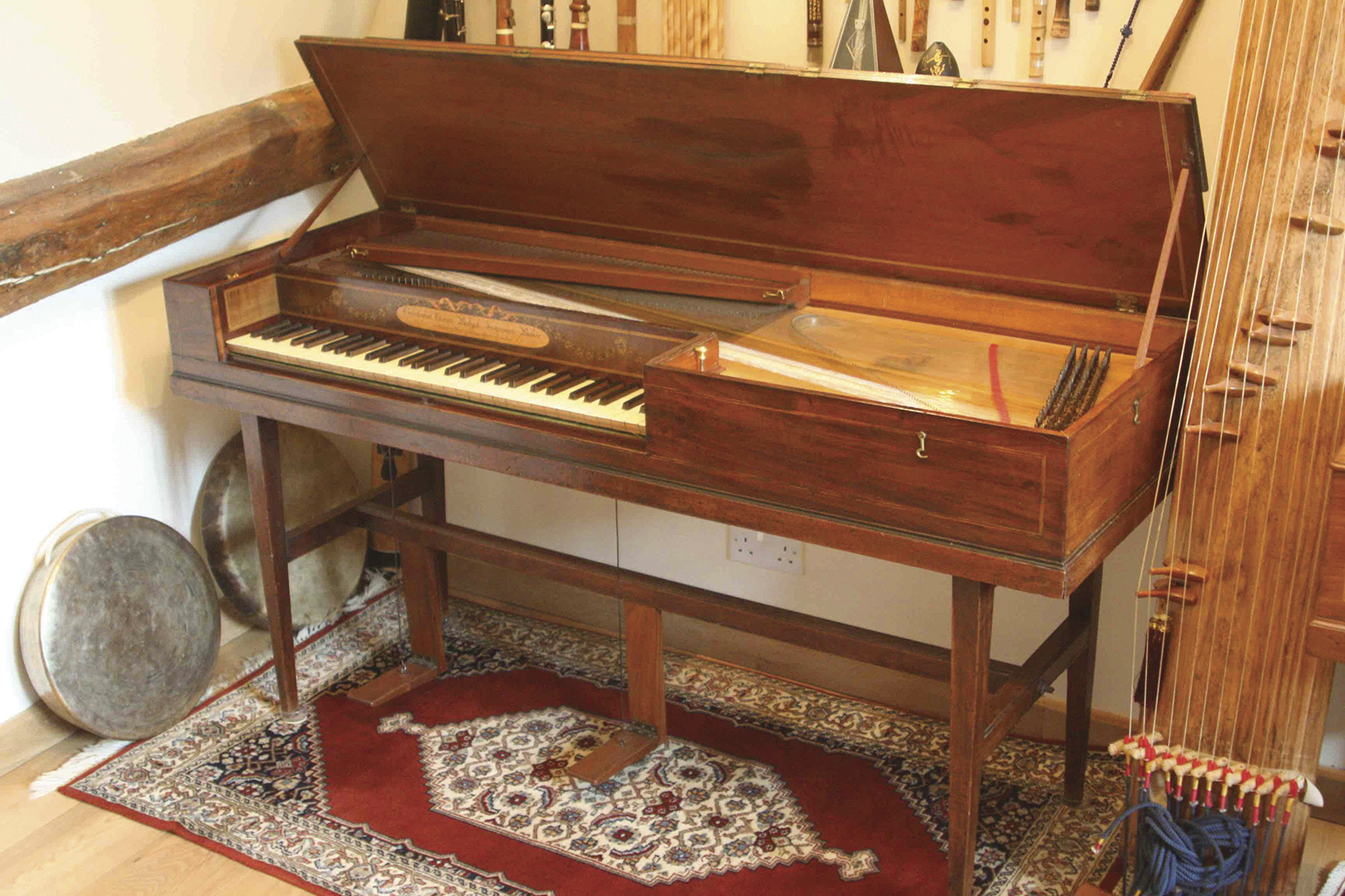
Second, when the composer Joseph Haydn (1732–1809) came to London for the second and final time in 1794, he was given a grand piano crafted in Golden Square by Matthew and William Stodart, on which, commentators believe, he wrote his final three piano sonatas. The instrument used the distinctive action designed in the late 1760s by Americus Backers.Footnote 56 Relatively few early grand pianos survive, not least because pressure placed on their wooden frames by strings held under tension led to “twists” that over time rendered many unplayable. But a 1796 Stodart grand sits in my music room, bought at auction in London, and which had previously belonged to the late actor Alec Clunes (Hastings in Laurence Olivier’s Richard III, with other film credits including One of Our Aircraft Is Missing). A minor twist had at some point resulted in its action being stripped out, leaving the beautiful veneered case. Two years later, a second Stodart grand from 1795 with a much-damaged case but long before converted into a harpsichord (that is, replacing three strings per note to one per note, thereby reducing pressures on the frame), appeared at auction. One piano was brought back to playing condition from the two, using the 1796 case, but also utilizing ivory key coverings from a third instrument of the same period – a Stodart “square” piano.
Restoring old instruments presents one approach to sustainability. A very different approach is to accommodate development and change, and advances in design have constantly refined the standard acoustic piano, from the revolution brought by iron frames in the nineteenth century to many more recent innovations. Reflecting the latter, Australia’s Stuart and Sons’ pianos are notable since they avoid the tenor “break” of Steinway pianos, extend the range, and use a redesigned agraff to couple the strings to the bridge and soundboard.Footnote 57 The fluid piano, designed by Geoff Smith, takes a different approach. In an interview in The Guardian newspaper, Smith stated that he intended it as “definitely an international instrument,” able to play Indian or Middle Eastern music; however, he lamented the resistance he had encountered from institutions, the piano community, and academics.Footnote 58 Smith’s fluid piano partly returns to late eighteenth-century construction (using, for example, bi-strung strings and small hammers).Footnote 59 Some continue to market his instrument as a success – hence, in a YouTube clip by a pianist of South Asian ethnicity, it is praised for its ability to play raga, unlike “when I hear Indian musicians introducing an electronic keyboard or a piano into their … compositions, since [that] just jars.”Footnote 60
Kugakki: (South) Korean traditional instruments
Korean traditional instruments, as they are crafted in South Korea today, illustrate one solution to how music can be sustained as cultural heritage. The South Korean intangible heritage system, from its early days, has conserved not just performance arts but also crafts, although, in contrast to the approach to pianos in Britain, the craft for instruments is the ability to make new instruments rather than restoring old instruments. National Intangible Cultural Property 42 (Kukka muhyŏng munhwajae 42) is stringed instrument crafting, specifically crafting the kayagŭm (12-stringed zither), kŏmun’go (six-stringed zither), and haegŭm (two-stringed fiddle). Drum making was formerly Property 63; brassware for gongs (and other goods) remains Property 77; and additional properties cover instrument decoration such as mother-of-pearl inlay (Property 10), string knotting (Property 22), and silver working (Property 35). Legislation for the system was promulgated in 1962, and the first intangible properties were appointed in 1964.Footnote 61 With legislation revisions in 2015, what had formerly been “important” (chungyo) became “national” (kukka), establishing a distinction between heritage appointed at the national level and at the provincial or city level; in addition to those appointed at the national level, a number of instrument makers have been appointed at the provincial and city level.
The system aims to enhance national identity through sustaining heritage. It began at a time of rapid change: the Korean peninsula was a Japanese colony from 1910 until 1945, was then divided into two territories by external forces in 1945, and was devastated by the Korean War (1950–53), after which rebuilding South Korea linked modernization to Westernization. The system was a top-down intervention by state bodies influenced by academics and journalists. In Reference Yonghae1963, the journalist Ye Yonghae assembled a book from articles on crafts and performance arts that he had written over the previous four years for a newspaper, the Han’guk ilbo (Korean Daily News), under the title In’gan munhwajae (Human Cultural Properties). He lamented how a surviving zither maker, Kang Sanggi, was wasting his precious skills since the only way he could earn a living was to build utilitarian furniture. Kang described himself as “a plain joiner rather than a master craftsman of classical musical instruments, because more often than not his unique skill [was] wasted on repairing furniture at his dingy workshop.”Footnote 62 Ye noted how instruments encapsulated ancient philosophy and stood witness to Korean history,Footnote 63 but, at all times, his reference point was the craftsman or artist.
Elsewhere, I have charted the considerable historical record for Korean zithers in detail:Footnote 64 excavated remains considered to be zither parts date to between the first century bce and the first century ce; a terracotta figurine (t’ou) carrying a zither has been dated to the reign of King Mich’u (ruled 261–284); a necked vase, the changgyŏngho, excavated in Kwangju in 1974 and most likely from the fourth century, depicts a woman playing a zither distinct from any Chinese or Japanese equivalent. A legend related in the twelfth-century Samguk sagi (History of Three Kingdoms), links the 12-stringed kayagŭm zither to the Kaya federation in the south-center of Korea and to the year 551 (or 552), when King Kashil heard a Chinese zheng zither and commented that since countries do not share languages they should not have the same music. The king, the legend has it, ordered U Rŭk, a musician from Sŏngyŏl prefecture, to create a Korean zither and compose music for it. Two well-preserved Korean zithers in the eighth-century Shōsōin repository in Nara, Japan, indicate a later link to the Japanese-equivalent zither, the koto.
Similarly, a legend about the six-stringed kŏmun’go zither, again in the Samguk sagi, tells how a Chinese seven-stringed qin was kept in Koguryŏ, a state in the Korean peninsula’s northwest. Nobody could play it, so the king offered an incentive that persuaded Prime Minister Wang Sanak to remodel it as the kŏmun’go. Wang wrote many pieces for the new instrument, and, as he played it, black cranes flew into the room and danced. Wang is thought to have served King Yangwŏn (ruled 545–559), and tomb paintings on former Koguryŏ territory dating from the fourth to seventh centuries show instruments that appear to relate to this zither; some show it played horizontally, as with zithers, and some more upright, as if a lute. Later associated with the literati, many surviving notation manuscripts dating from the sixteenth century onwards are written for the six-stringed zither.
Kang died shortly after Property 42 was appointed in 1971, leaving the maker Kim Kwangju to carry on the craft, and, after him, his apprentice Ko Hŭnggon (born 1951).Footnote 65 I first visited Ko in 1984, when he made zithers in one room of a small apartment, drying and weathering wood on the roof, using a kitchen gas burner to scorch soundboards and bring out the grain. Today, Ko not only has a studio and shop in Seoul but also a workshop in the countryside on the southern edge of Seoul. When I last visited in 2014, the workshop employed eight full-time craftsmen, sub-contracting instrument parts to others and producing more than 1,000 instruments a year, each of which sold for a considerable price. Such has been the reversal of decline since the 1960s that South Korea today supports many zither makers. Some have developed new versions of the two traditional 12-stringed kayagŭm (known in Korea as “court” chŏngak kayagŭm and “folk” sanjo kayagŭm) to accommodate contemporary musical creativity and practice. In 1986, the composer Yi Sŏngch’ŏn (1936–2003) commissioned a 21-stringed instrument from Ko, the extra strings expanding the range to four octaves and facilitating the simultaneous playing of melody and accompaniment; in 1987, the composer Pak Pŏmhun (born 1948) asked Ko to create a trio of zithers, adding a larger bass to a smaller and shorter soprano version; in 1988, the composer Pak Ilhun (born 1950) commissioned an 18-stringed instrument from another maker, combining the two traditional versions. This last instrument quickly became standard issue for Korea’s traditional music orchestras. Today, Ko also produces a 25-stringed version, using Western diatonic tuning rather than the traditional Korean pentatonic tuning. First developed by the maker Pak Sŏnggi in 1995, the 25-stringed version has become the instrument of choice for many composers and arrangers. Other innovations by makers include an eight-stringed small zither designed for school children that is little larger than a melodica and a 15-stringed version featuring an attached collapsible stand and a built-in electronic tuner. New South Korean versions of the zither maintain well worked-out aesthetics of timbre and ornamentation that are part of an inherited sound world. In essence, these promote nationalism, anchoring an identity of the traditional to a globalizing, contemporary world (see Figure 3).
Paulownia wood for kayagŭm zither soundboards, drying, behind Ko Hŭnggon’s workshop, 2014 (photo by Keith Howard; all rights reserved).

Traditional music as intangible heritage is sustained chiefly by the state-funded National Gugak Centre (Kungnip kugagwŏn). Centred in Seoul, this center today employs 550 musicians, dancers, researchers, and administrators and regards itself as the successor to royal court music offices stretching back 1,200 years. It is dedicated to the conservation and promotion of kugak (or gugak [Korean traditional music]) and, hence, has a division for instrument research that seeks to understand inherited construction techniques and performance practice. In 2009, the center revealed a restored version of an ancient set of tuned stone lithophones (known as the p’yŏn’gyŏng). The lithophones are used in the orchestras for two ancient, but extant, state rites: Chongmyo cheryeak and Munmyo cheryeak, which are conserved as National Intangible Cultural Properties 1 and 85, designated in 1964 and 1986 respectively. The rites are given at the Royal Ancestral Shrine (the Chongmyo), a World Heritage site entered in the UNESCO list in 1995 with two halls, the 19-shrine Chŏngjŏn and 16-shrine Yŏngnyŏngjŏn, which are listed in South Korea as Important Tangible Cultural Properties (Chungyo yuhyŏng munhwajae) 227 and 821 respectively, and the Confucian Shrine (the Taesŏngjŏn), Important Tangible Property 141. The Confucian rite dates to 1116, when the Korean court received instruments for it, including lithophone sets, from the Chinese Song emperor, Huizong.
The lithophones are calcite, and when the instruments received in 1116 needed replacing in the fifteenth century, new stone was quarried at Namyang in Korea to the size and thickness specifications of the inherited instruments (the specifications are recorded in a 1493 treatise, Akhak kwebŏm (Guide to the Study of Music)). The new instruments, however, produced different pitches and were discarded. The quarry was closed, and, from then onwards, Chinese lithophones were imported when needed, but, over time, China’s pitching changed. With Korea’s Confucianesque concern for retaining the past, the center attempted to craft local instruments in the 1980s using calcite quarried near Ch’ungju, but this had a different chemical composition to Chinese calcite. Namyang calcite was found to match the Chinese stone more closely, so, in 2009, the Namyang quarry was reopened. Prior to unveiling the new lithophone set, the Akhak kwebŏm treatise was re-examined: the hanging of the chimes was switched, long side to short side, and the pitching was adjusted to conform to the fifteenth-century specification. Restoring the set, though, had a knock-on effect since other instruments in the ritual orchestra had to be remade (or retuned) to match its pitches, and the new set of instruments was revealed in 2010 (see Figure 4).Footnote 66
The “new” stone lithophones (p’yŏn’gyŏng) at the National Gugak Centre, 2010 (photo by Keith Howard; all rights reserved).

Minjok akki: (North) Korean national instruments
South Korean traditional music memorializes a national past, even though what is sustained today is largely a twentieth-century construction.Footnote 67 In contrast, the dominant sound world of North Korea celebrates the proletariat and is therefore defined in North Korean literature as “national” (minjok),Footnote 68 with traditional instruments recast as national instruments (minjok akki), even though the influence of Chinese and Soviet artistic policies can be identified. As noted above, ideology resists “resurrectionism” and “revivalism” – hence, national instruments need to be contemporary more than traditional. Also, the notion of moving forward that is inherent in socialist ideology resists restoring old instruments and demands new production. Hence, in 1951 and during the Korean War, artisanal instrument crafting began to be replaced by a more industrial mode of production. The North Korean state set up the Flower Instrument Manufacturing Company (Hwasŏn akki chejakso), which by 1952 employed 50 people who, the literature claimed, made all instrument types. In October 1953, the company was renamed the Pyongyang Instrument Factory (P’yŏngyang akki kongjang) since it was situated in the capital city.
Shifting to a production line necessitated new ways of working and severed close associations between makers and performers. Alongside the factory, a National Instrument Construction Study Institute (Kungnip akki chejak yŏn’guso) with performers on its board is mentioned in texts from 1953 onwards, and this institute became part of the National Music Study Institute (Minjok ŭmak yŏn’guso) in April 1960. Two aspects of the state’s interventions are notable. First, instruments were standardized, and the factory crafted parts by machines operated by non-specialist workers. To take one example, the contemporary shawm (chang saenap), known in Korean tradition (and still in South Korea) as the t’aep’yŏngso, hojŏk, or nallari and familiar in China as the suona or further West as the zurna, today has a body length of 500 millimeters (almost twice the length of most old instruments in Korea), with a fixed distance from the center of the top hole to the base of the bell of 402 millimeters and from the bottom hole to the base of 52 millimeters. These are measurements for machine production since, outside North Korea, measurements for instruments routinely run from the top of the body to the holes because this prescribes the sounding length of the tube (from mouthpiece to hole). But, in North Korea, given that the manufactured length of the chang saenap body is always the same, lengths can be given the other way around (from the instrument base to holes). The measurements suggest precision, but a chang saenap that I ordered in Pyongyang in 2000 proved unplayable when it arrived. The senior musician I was learning from commented, simply, that factory workers are not musicians; he took the new instrument home, worked on it over a weekend, and returned it to me fixed and playable.Footnote 69
Second, instruments were to be reformed and developed – the North Korean term is kaeryang (“improved”),Footnote 70 which is taken from the Chinese gailiang – to make them suitable for a rapidly developing socialist state. A program to do this was announced at the Fourth Congress of the Korean Workers’ Party in September 1961. A year earlier, in October 1960, the Central Committee had taken aim at “flunkeyism” (sadae chuŭi), a term that means the negative imitation of the foreign. This gave impetus to retaining Korean traditional instruments but required them to be improved so they would exceed the capabilities of equivalent Western instruments.Footnote 71 The chang saenap was one of the first to be tackled: previously a raucous, screaming, outdoor instrument favored by rural percussion bands (nongak/p’ungmul) and for court processional music (ch’wit’a), it was redesigned to match the look and sound of the Western oboe, its sound softened and rounded by lengthening and narrowing the reed and reducing the conical bore of the tube. From a pentatonic instrument, it became chromatic and the range was extended through adding key work (which covered new, additional tuning holes). Although North Korea understates the influence of Western instruments, the “improved” instrument’s double reed resembles that of an oboe, while its key work arrangement is reminiscent of the single-reed clarinet and saxophone.
Experiments to develop the traditional 12-stringed kayagŭm zither included increasing the string number incrementally until a standardized 21-stringed instrument was settled on.Footnote 72 Many of the modifications parallel how the related Chinese zither (the zheng) had earlier been reformed: metal pegs replaced wooden pegs to allow tuning with a key, fastening cords were removed, and nylon strings replaced wound silk to reduce the likelihood of breaks (nylon, however, limited the pliability of strings and thereby restricted previously characteristic ornamentation). A box at the lower end enclosed pegs, replacing the historically significant and distinctive “ram’s horns” (fashioned from a separate piece of hardwood, with a shape that identifies the depictions on ancient pots and surviving old instruments as Korean rather than Chinese or Japanese zithers). The basic range of two-and-a-half octaves of old instruments was slightly extended – to one note short of three octaves – with strings tuned now to a diatonic scale rather than the pentatonic arrangement of old. The “improvements” contrast the approach of South Korean instrument makers when developing the instrument.
The “improved” haegŭm fiddle is particularly striking. Texts refer to the traditional instrument on the Korean peninsula from the thirteenth century onwards, although the retrospective Koryŏsa (History of Koryŏ [Dynasty] [published in 1452]) states that it was introduced from Song China in 1124. In North Korea, it underwent initial reform during the 1950s, shifting from a two-stringed spiked fiddle to a three-stringed fiddle with violin-style “f” holes to the soundboard. The inherited Korean fiddle of old lacked a fingerboard and generated a harsh, nasal sound primarily because of its two wound-silk strings, its paulownia soundboard as resonator, and its use of earth to line the inside of the sound box. During the Nationalist period in Shanghai, the equivalent Chinese fiddle, the erhu, had been “improved,” changing its soundboard and sound box construction and developing a set of instruments from the single type that could function as equivalent to Western orchestral strings. By the end of 1962 in Pyongyang, a short article in the journal Chosŏn ŭmak (Korean Music) reported a similar set of four haegŭm fiddles were to be created.Footnote 73 Several experiments followed, and, by 1970, a set of so haegŭm, chung haegŭm, tae haegŭm, and chŏ haegŭm was in use, the four equivalent to Western instruments (as seen in their open strings, notated as E′-A′-D-G (chŏ haegŭm; double bass), C-G-d-a′ (tae haegŭm; cello), c-g-d′-a′′ (chung haegŭm; viola), g-d′-a′′-e′′ (so haegŭm; violin). Made in a factory, the four haegŭm are constructed using precise and standardized measurements. This stands in contrast to the variations in size of surviving instruments from earlier times (and the instruments made by South Korean craftsmen today). In North Korea today, all so haegŭm – the smallest of the set of fiddles – measure 692 millimeters (± 5 millimeters) from the tip of the neck above the pegs to the base, and they have a sound box 167 millimeters tall by 172 millimeters wide and 159 millimeters deep (all ± 1 millimeter).
My North Korean interlocutors resisted any suggestion that their four fiddles imitate Western practice, despite the tuning observation made above, not least because Kim Il Sung (1912–94), the northern state’s first leader, demanded that Korean identity must be maintained:
You shouldn’t modify national instruments after the pattern of Western instruments. If you make national instruments similar to Western ones, they are national instruments only by name, not [in reality]. Our national instruments produce elegant sounds favourable to Koreans; however, if they produce the din of Western instruments, they lose national characteristics.Footnote 74
Hence, the senior musician Han Namyŏng, as he explained the development process to me in April 2000, commented:
We thought about how the reformed haegŭm could provide the string section of an orchestra, combining harmonic textures with counterpoint. We did not pay much attention to Western orchestral strings and their tunings at the time … although I admit that when we added the fourth string to the fiddles it could be interpreted as copying. What did we think about this problem? Well, it didn’t matter to us, since our aim was to follow our own national history while creating something modern. Sometimes, we might elect to make an instrument similar to something Western, and there is nothing to stop us doing so. No, because if our method of making an instrument creates something suitable for our people and our music, it is good. And, with the combination of instruments that we now have, we are no longer restricted in any way. So, where we used to listen to Western orchestral music, now our people can listen to an orchestra of our own instruments.
Space prevents delving into the many questions that this comment raises beyond noting that it inverts the Facebook exchange with which I began this article.Footnote 75 It is apparent, however, that North Korea’s national music has been established by fusing local and Western instruments and by replacing craftsmanship with industrial manufacturing.
Concluding remarks
This article has sought to introduce some of the knotty issues surrounding musical instruments as both tangible and intangible cultural heritage. In emphasizing their complex but critical role as heritage, I have recognized that instruments are tangible objects that, when collected and displayed, tell stories about the history of humanity. They are important parts of the archaeological record and, as material culture, offer evidence for the development of tools and materials and chart diplomatic, commercial, and cultural trade and exchange. Instruments, however, are also products of intangible crafting skills; made and restored, they form central components in enabling the intangible performance of music. Having identified instruments as bridges between the tangible and the intangible, the first point to make in concluding is that we risk losing sight of their importance if instruments are relegated to the amorphous category of “infrastructure and regulations” within heritage systems, when they are silenced in museum displays, or when they are rendered invisible in music recordings. And when the connection of an instrument as a physical, tangible object loses its intimate connection to musicking, it is the intangible – both the crafting skills of making the instrument and the performance skills of making music live – that suffers.
Second, albeit related to my first point, the mantra “Keep music live!” emanates from an awareness that music needs to be performed to be sustained. This awareness is shared with considerations of music as intangible cultural heritage. The awareness, therefore, involves both an inherited past – music and instruments that have been transmitted to us from earlier times – and a present in which music and instruments are part of contemporary creativity. The importance of sustaining the crafts involved in creating and maintaining (or, in respect to my first case study, restoring) instruments must therefore not be overlooked. If support for crafting and maintaining is not actively encouraged, then the efforts to support music performance and, thereby, to sustain much music as intangible heritage (that is, all but vocal music) will ultimately fail since, as instruments fall silent, performances of much music, whether old or new, will die.
Third, no single strategy for sustaining instrument production and maintenance fits all situations. To show this, I chose three contrasting case studies in this article, not to criticize any particular approach but, rather, to illustrate how markedly different strategies have been adopted and, further, to suggest how these strategies entwine not just with distinct repertoires and musical histories but also with political and social systems.
Fourth, in seeking to understand instruments as cultural heritage, I do call for action, although I do not suggest one single strategy. I do so because of the observations with which I opened my discussion: the role of instruments in conserving a tradition and making live performance possible is often overlooked, and ethnomusicologists have tended to focus attention on sustaining musical Others when we also need to consider instruments that have emerged in the course of the development of Western “art” music. In 1993, Philip Bohlman imagined “post-disciplinary musicologies” that would reconfigure the internal subdivisions of the field of musicology while “responding to the transformation of music in the public sphere.”Footnote 76 He was critical of musicology’s “remarkable capacity to imagine music into an object that [has] nothing to do with political and moral” causes.Footnote 77 To be fair, this is no longer – if, indeed, it ever was – the reality of musicology, and, today, many seek an “accommodation between established methodologies and new horizons,” matching the past to the present.Footnote 78
Still, one new horizon in the transformation of music in the public sphere is rooted in the past – namely, the discourse on music as intangible cultural heritage. This reflects the undeniable decline of many musical traditions in the contemporary world. If much ethnomusicology has turned to charting that decline, much the same decline affects Western “art” music: audiences, at least in Europe and North America, are ageing; the costs of staging performances as well as the investments required in training (including the costs involved in procuring high-end instruments, where instruments have become prized objects) are rising. For musicking, then, and expanding from Paul DiMaggio,Footnote 79 one might argue that neoliberalism is no friend since, with each passing year, it becomes ever more challenging for those who perform music to generate adequate income from their endeavors. Those who craft instruments face the same challenges as those who perform music. Hence, as musicologists and ethnomusicologists become increasingly interventionist and as they contribute to policies that aim to conserve and sustain music as intangible cultural heritage, they must support more than performance. As museums consider how to curate collections of musical instruments, they must be concerned with more than preservation and display. For all of us, fusing our intangible heritage with our tangible heritage demands efforts to sustain the skills of crafting and maintaining instruments.
Acknowledgements
Earlier versions of this article were given at the symposium “Modernization of Musical Traditions: Global Perspectives” at the Instituto de Etnomusicologia – Centro de Estudos em Música e Dança in Lisbon, Portugal, in March 2019, and at the “Sound Futures” working conference at the Smithsonian Institution in Washington in October 2019.


 Open access

