




1. Introduction
Despite their potential to enhance product development, the adoption and utilisation of design methods in industry remains limited due to three main factors (Tomiyama et al. Reference Tomiyama, Gu, Jin, Lutters, Kind and Kimura2009; Booker Reference Booker2012; Gericke et al. Reference Gericke, Eckert and Stacey2017). First, industry practitioners typically favour concrete, task-specific methodologies over more abstract design methods when solving immediate design problems (Tomiyama et al. Reference Tomiyama, Gu, Jin, Lutters, Kind and Kimura2009). Second, although design methods form a core component of engineering education – intended to develop design knowledge and innovative capabilities – organisational and behavioural factors within product development firms often hinder their practical implementation. Third, the research community’s emphasis on short-term “success stories” that frequently lack rigorous long-term follow-up and evaluation fails to provide objective indicators of method effectiveness (Tomiyama et al. Reference Tomiyama, Gu, Jin, Lutters, Kind and Kimura2009; Blessing & Seering Reference Blessing, Seering, Chakrabarti and Lindemann2016).
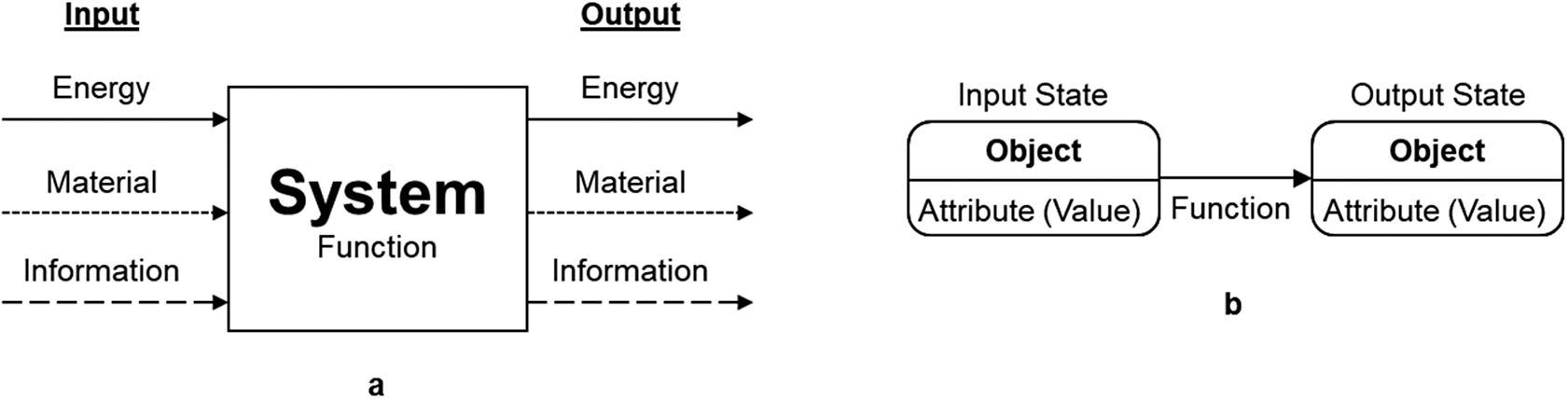
As product follows concept and concept follows function, functional models are of great importance to product design and development processes as they underpin the understanding and representation of product functionality throughout the development lifecycle (Pahl et al. Reference Pahl, Beitz, Feldhusen and Grote2007; Ullman Reference Ullman2010). Function modelling enables designers to capture and analyse system requirements through various representations, from simple black box models to complex hierarchical structures. A fundamental functional model of an engineered system can be depicted as a black box, consistent with Pahl et al. (Reference Pahl, Beitz, Feldhusen and Grote2007), as shown in Figure 1a; the function of the system is to convert (either transform or transfer) the inputs consisting of specifications/instantiations of operands of the type of material (M), energy (E) and information (I) into the desired outputs. Alternatively, the function of a generic system can be described as the transfer between the input state of objects to the output state, as illustrated in Figure 1b based on the System State Flow Diagram (SSFD) (Yildirim et al. Reference Yildirim, Campean and Williams2017). There are many other function models and representation schemes, see Erden et al. (Reference Erden, Komoto, Van Beek, D’Amelio, Echavarria and Tomiyama2008) for a comprehensive review. High-level functions can be decomposed into sub-functions, as function chains, which are connected to each other to realise the flows of material, energy and information. Interest for function models continues to grow, playing a crucial role in Model-Based Systems Engineering (MBSE) methodology (Micouin Reference Micouin2014; Tang et al. Reference Tang, Zhu, Faudou, Gauthier, Bonjour, Krob, Palladino and Stephan2019; Husung et al. Reference Husung, Weber, Mahboob, Krause and Heyden2022), and supporting verification and validation of autonomous systems (Koopman & Wagner Reference Koopman and Wagner2016; Rosenberger et al. Reference Rosenberger, Leitner, Watzenig and Ibanez-Guzman2020).
Basic function models: (a) black box and (b) state-based (SSFD).

Despite the firm theoretical basis, function modelling still faces significant implementation challenges in industry practice (Tomiyama et al. Reference Tomiyama, Gu, Jin, Lutters, Kind and Kimura2009; Eckert Reference Eckert2013), relating to complexity in methodology application, time-intensive implementation processes and limitations in usability across different domains. The challenge of evidencing business benefits from adopting a systematic approach to function modelling, as with other design methods developed through research, represents another significant barrier, as eloquently discussed by Stetter (Reference Stetter, Chakrabarti and Lindemann2016) and Gericke et al. (Reference Gericke, Eckert, Campean, Clarkson, Flening, Isaksson, Kipouros, Kokkolaras, Kohler, Panarotto and Wilmsen2020). Approaching this from the perspective of a long-term collaboration with an automotive OEM, Campean et al. (Reference Campean, Uddin, Bridges, Fannon and Yildirim2022) have introduced a framework for the evaluation of impact of a robust design methodology, considering three dimensions of impact: (i) business results, (ii) process improvement and (iii) teams capability improvement. The development of the framework was based on evidence from a large sample of technical reports written by practising engineers on the workplace application of the methodology following method transfer intervention (through training). This provided a powerful example of how the impact of design methodologies in general can be evaluated empirically in industry practice, for the benefit of both researchers and business.
The research work presented in this paper aims to develop an understanding of the factors influencing the implementation of function modelling methods in practice, focusing on (i) the technical challenges associated with the specific workplace problem, (ii) the broader workplace context of the application (competence area and product development phase) and (iii) the business-focused evaluation of the impact of the use of the method. The work herein uses the same empirical evidence of technical reports produced by practicing engineers as the one used by Campean et al. (Reference Campean, Uddin, Bridges, Fannon and Yildirim2022) but focuses on an in-depth examination of the way function modelling was employed within the workplace-based projects.
The contribution of this work is the introduction of a comprehensive reference framework for evaluating function modelling methods in industry, addressing the critical gap between theoretical design methodologies and their practical application. By synthesizing insights from a large dataset of technical reports generated in a collaborative automotive OEM setting, this research identifies specific technical problem characteristics and contextual factors that influence the adoption and effectiveness of function modelling approaches. Furthermore, the framework aids researchers in targeting relevant application areas while providing industry practitioners with a structured methodology to evaluate method applicability and impact, supporting the case for justifying the return on investment in the adoption of structured methodologies. The organization of the paper is as follows: Section 2 provides a summary of related literature; Section 3 introduces the research methodology; Section 4 details findings from the analysis of the technical reports, followed by a critical discussion leading to the proposed framework in Sections 5 and 6 summarizes the main conclusions from the study.
2. Review of related work
Function modelling is known to play a crucial role in determining product success factors in New Product Development (NPD) projects, particularly through enabling cross-functional collaboration and fostering innovativeness (Eisenbart & Kleinsmann Reference Eisenbart and Kleinsmann2017). Numerous scholars have reviewed function modelling from multiple perspectives to establish the theoretical basis. King & Sivaloganathan (Reference King and Sivaloganathan1998) categorized function analysis methods into five application areas (value analysis, failure analysis, concept analysis, artificial intelligence and function classification), while Erden et al. (Reference Erden, Komoto, Van Beek, D’Amelio, Echavarria and Tomiyama2008) evaluated function modelling approaches using 17 criteria across six categories including ontology and semantic definition. Subsequent reviews have expanded these perspectives. Srinivasan et al. (Reference Srinivasan, Chakrabarti and Lindemann2012) examined chronological development of function definitions through four views (Level of Abstraction, Requirement-Solution, System-Environment and Intended-Unintended). Eisenbart (Reference Eisenbart2014) provided a discipline-specific analysis across various engineering domains including mechanical, electrical, software, service development and systems engineering. Summers et al. (Reference Summers, Eckert and Goel2017) consolidated previous research in a comprehensive multidimensional benchmarking framework for functional models’ evaluation across four key dimensions: representation, modelling, cognitive dimension and reasoning characteristics, providing a nuanced understanding of functional models’ practical performance through both technical and human factors.
The empirical validation of function modelling approaches has also been pursued through various studies. This included empirical studies involving students; that is, Kurfman et al. (Reference Kurfman, Stone, Van Wie, Wood and Otto2000) evaluated their functional modelling methodology through experimental studies conducted across three universities, analysing student-generated functional models for three different products.
In contrast to studies involving students, several researchers investigated the broader implementation of function modelling in industry. Some studies focused on identifying case studies of application of a particular methodology (e.g. Grauberger et al. Reference Grauberger, Wessels, Gladysz, Bursac, Matthiesen and Albert Albers2020), while many others relied on surveys or interviews with practitioners. For example, the study of Eckert (Reference Eckert2013), involving a combination of interviews with engineers from industry and a controlled experiment with multiple engineers based on a particular function model, identified challenges faced by practicing engineers with handling abstract concepts while dealing with practical challenges. These findings were corroborated by Tomiyama et al. (Reference Tomiyama, van Beek, Cabrera, Komoto and D’Amelio2013), whose industrial observations revealed practitioners’ scepticism about the merits of creating and using functional models in product development activities. However, Eckert (Reference Eckert2013) noted that functions and functional models are routinely used in practice in conjunction with other methodologies (such as Failure Modes and Effects Analysis, FMEA or Quality Function deployment, QFD). Further research by Eisenbart et al. (Reference Eisenbart, Mandel, Gericke and Blessing2015) and Eisenbart & Kleinsmann (Reference Eisenbart and Kleinsmann2017) on functional modelling approaches in various companies revealed both benefits and limitations: while function modelling can effectively support collaborative work across disciplines and prove useful during specific stages like conceptual design, it faces challenges in widespread adoption due to perceived lack of benefits in product development activities and complexity in construction and comprehension.
These implementation challenges highlight a broader phenomenon in design methodology adoption. While the potential benefits of functional modelling should promote their adoption in the design process by product development teams (Graner Reference Graner, Chakrabarti and Lindemann2016), research has shown limited and low uptake of design methods in industry practice. As noted by Gericke et al. (Reference Gericke, Eckert, Campean, Clarkson, Flening, Isaksson, Kipouros, Kokkolaras, Kohler, Panarotto and Wilmsen2020), this paradox of low adoption despite clear potential benefits has prompted researchers to develop evaluation frameworks focused on identifying factors that facilitate successful transfer of methods and tools to industry settings. Several scholars presented generic frameworks. For example, Hiort et al. (Reference Hiort, Warell, Larsson, Motte and Jagtap2014) considered five key themes for the evaluation of a method: (i) the use of methods, (ii) qualities of methods, (iii) formalisation and prescription, (iv) the industrial context and (v) spread and active implementation of methods. Guertler (Reference Guertler2018) introduced four dimensions of requirements for methods/tools: (i) performance, (ii) presentation, (iii) process and (iv) data collection.
Taking the industry viewpoint, Stetter & Lindemann (Reference Stetter, Lindemann, Clarkson and Eckert2005) and Wallace (Reference Wallace and Birkhofer2011) have discussed that actual deployment of methods in industry takes time, reflecting the complexity of modern product development, and the real-world evaluation of the benefits from adopting the method is therefore significantly delayed. Stetter (Reference Stetter, Chakrabarti and Lindemann2016) further emphasised the difficulties of attribution of impact to a particular method, given that the ultimate outcome is the result of application of multiple interconnected methods and reflects the social and organisational approach to governance of methods and processes in product development.
A significant contribution comes from Campean et al. (Reference Campean, Uddin, Bridges, Fannon and Yildirim2022), who introduced an impact evaluation framework co-developed with industry stakeholders, within the context of a long-term industry-academia collaboration on development and teaching of robust design methodologies. The approach places emphasis on business and organizational perspectives with focus on identifying observable benefits to enable evaluation. The framework, shown in Table 1, identifies three main types of impact (business results, process improvement and teams capability improvement) and 14 distinct categories of observable impact.
Impact evaluation framework

Based on Campean et al. (Reference Campean, Uddin, Bridges, Fannon and Yildirim2022).
In summary, this review shows that a significant gap still exists between the academic research viewpoint on evaluating the usefulness of functional models, most comprehensively summarised by the framework of Summers et al. (Reference Summers, Eckert and Goel2017), and industry and practitioners’ viewpoints. This work therefore aims to address this gap with an in-depth study based on evidence from workplace project applications of functional modelling, across diverse engineering contexts, with the primary goal of developing a comprehensive framework for characterising and evaluating functional modelling capabilities for practical applications. This will contribute to design research methodology by enabling the linkage between theoretical functional modelling approaches and the industrial context and impact, establishing evidence-based evaluation criteria to guide both academic research and industrial adoption.
3. Research methodology
3.1. Research context
This research is set in the context of a long-term industry-academia collaboration on product development methodologies with a global automotive OEM, centred on methods to support quality and reliability of automotive systems and processes. In particular, it relates to a specific collaborative research project aimed at enhancing and adapting the systems engineering approach and methodological workflow currently adopted by the Company, and most importantly, integrating it with robustness and reliability methods (revolving around FMEA, P-Diagram and robust design verification methodologies) that had a well-established practice base within the Company. The project involved a deep engagement of the academic team with a cross-section of design experts from different competency areas and systems engineering methods experts, working through a large number of real-world use cases of current design problems. The outcome was a comprehensive methodology for “Engineering Systems Analysis with Failure Mode Avoidance” (Campean Reference Campean2017) that integrated systematic function failure and robustness methods within the requirements capture, functional and logical design methodology at each level of the system, with traceable linkages to the robust design verification plans for all new features and systems considered within the product development process.
The transfer of the developed methodology was facilitated by a structured programme of accredited learning, which was part of the Company’s broader “Technical Accreditations Scheme” (TAS) (Lopes Reference Lopes2012), delivered in conjunction with multiple universities. The programme involved a combination of training, delivered jointly by academics and industry experts, and post-training application to a workplace problem assigned to the engineers participating in the programme. During the workplace project, which typically took 4–6 months, support was provided jointly by the Company subject matter experts and methodology experts – both academic – and Company-based. The evaluation of individual learning was based on a technical report that documented the project implementation of the methodology, following a set template (adapted from the SAE technical papers template – commonly used by automotive industry experts for external reporting of technical work). In addition to covering the technical project-specific application and outcomes, the engineers were encouraged to reflect on their assessment of the effectiveness of the methodology, including how it could be applied in their areas to enhance existing processes and practices, within the workplace’s multidisciplinary team environment. The reports were evaluated upon submission by both Company technical experts and academics for the purpose of the individual accreditation of learning, with mini-conference events organised to share the good practice and lessons learnt across the organisation.
Collected over a period of three years, during which over 300 engineers participated in the programme, the technical reports submitted by practitioners on the application of the methodology to workplace-based problems provided a substantial body of evidence for evaluating the impact of collaborative research on robust design methodologies. As discussed by Campean et al. (Reference Campean, Uddin, Bridges, Fannon and Yildirim2022), such an evaluation is important for the Company to justify the value (as return-on-investment) of methodology-focused academic collaborations, as it is for the academic teams within the “research excellence framework” paradigm. The impact evaluation framework introduced, illustrated in Table 1, was synthesised based on the retrospective evaluation carried out jointly by industry and academic experts (different from the team who evaluated the reports in the first instance, to ensure consistency to the scope and purpose of the review) on a sample of 100 reports. As the programme was still ongoing at the time, objectivity of the study was ensured by selecting the reports based on the submission date, that is, the first 100 reports recorded were included in the study.
As part of the broader evaluation exercise, the academic team has focused on how the function modelling methods, in particular, the SSFD, which was the main (but not the only) method covered in the learning intervention, were used across the workplace projects. The focus on SSFD was driven by its integration with the function failure analysis methodology, underpinning the Company’s approach to design FMEA (coherent with the AIAG & VDA (2019) approach). A largely quantitative analysis reported in Yildirim et al. (Reference Yildirim, Campean and Uddin2022) also considered the workplace project context in which SSFD was applied, with reference to:
-
A. Usage across engineering competence areas – spanning Operations, Manufacturing, Engineering Laboratories, Electric Vehicles, Powertrain, Vehicle Engineering, Chassis Engineering and Body Engineering;
-
B. Usage across product development phases, as defined within the Company – Concept, Product Creation, System Integration, Plant Vehicle Team (PVT), Assembly and Service Operations;
-
C. The application purpose, reflecting the level of system analysis (system/subsystem/component/multiple levels) at which function modelling was used;
-
D. The integration of SSFD with other methods included within the broader robust design methodology employed by the Company.
The analysis of Yildirim et al. (Reference Yildirim, Campean and Uddin2022) provided a preliminary discussion of some common challenges for function modelling in workplace projects based on the comments raised by the engineers in the technical reports, rather than an in-depth analysis of the technical characteristics and context of the problem. For the present study, we undertook a further in-depth analysis of technical reports originating from workplace projects, with the aim of identifying and synthesizing technical problem characteristics as requirements for functional modelling methods from an industry practitioner viewpoint.
The scope of current study is set on the SSFD as function modelling method, which was reported in 72 of the 100 projects evaluated. However, the aim was to provide a synthesis of the technical problem characteristics extracted from the project evidence, as generic practical aspects relevant to the deployment of all function modelling methods. In turn, the derived structure of technical problem characteristics, considered in conjunction with the context of the engineering project application, will provide a reference framework to evaluate the capability of a function modelling method for different practical engineering problems.
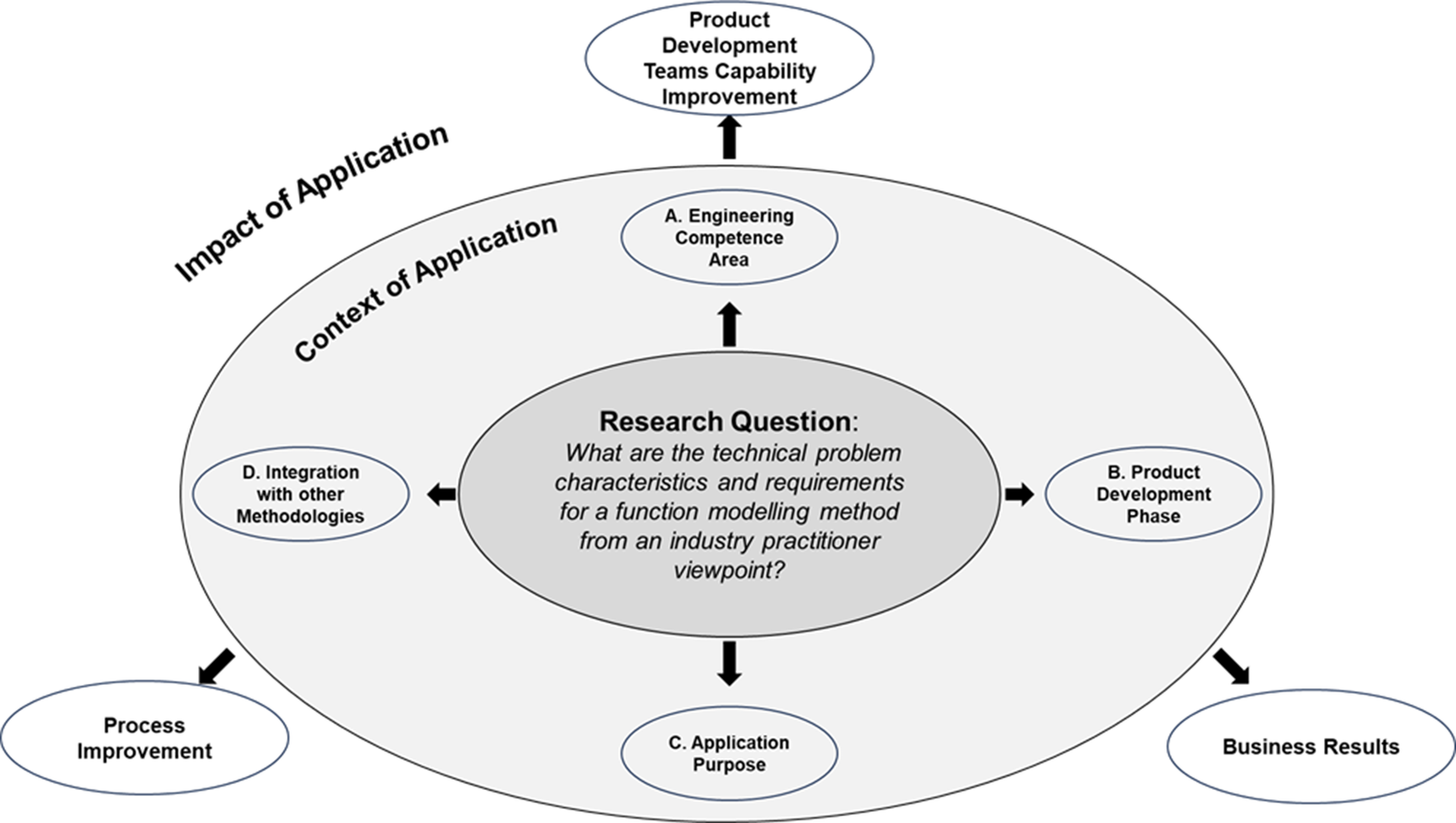
Further, we propose to integrate this reference framework with the dimensions of impact evaluation framework of Campean et al. (Reference Campean, Uddin, Bridges, Fannon and Yildirim2022), to provide a holistic framework for evaluating function modelling in industry, as illustrated in Figure 2. At its core, the diagram focuses on the central research question to investigate the project- and problem-specific technical characteristics and requirements for a function modelling method. This central inquiry is framed within the broader context of application, which relates to the project environment where the method was applied. The impact of application identifies the axes on which benefits from the deployment can be measured.
Research question for evaluating the proposed function modelling framework in industry.
3.2. Research design
Of the 72 reports that were found to use SSFD, a subset of 41 reports selected for the deep-dive analysis, based on their sufficiently detailed application of the SSFD methodology to enable evaluation of its contribution to project outcomes. This selection reflected the fact that not all projects applied function modelling to the same extent, given the heterogeneous nature of the problems across the Company’s diverse application domains.
The 41 reports selected were subjected to further in-depth evaluation to extract and synthesize the technical problem characteristics and their implications for function modelling requirements. This evaluation was conducted through a series of joint review sessions by a core team consisting of two academic researchers and one industry technical expert with oversight of robustness and systems engineering methods. Additional input and consultation with specific subject matter experts and technical managers was solicited on specific projects to validate textual information found in the reports alongside the internal assessment of benefits, scrutinizing for specific evidence of the function modelling method contribution to impact while accounting for both direct and indirect benefits. The evaluation was carried out in three sequential phases of analysis detailed below:
-
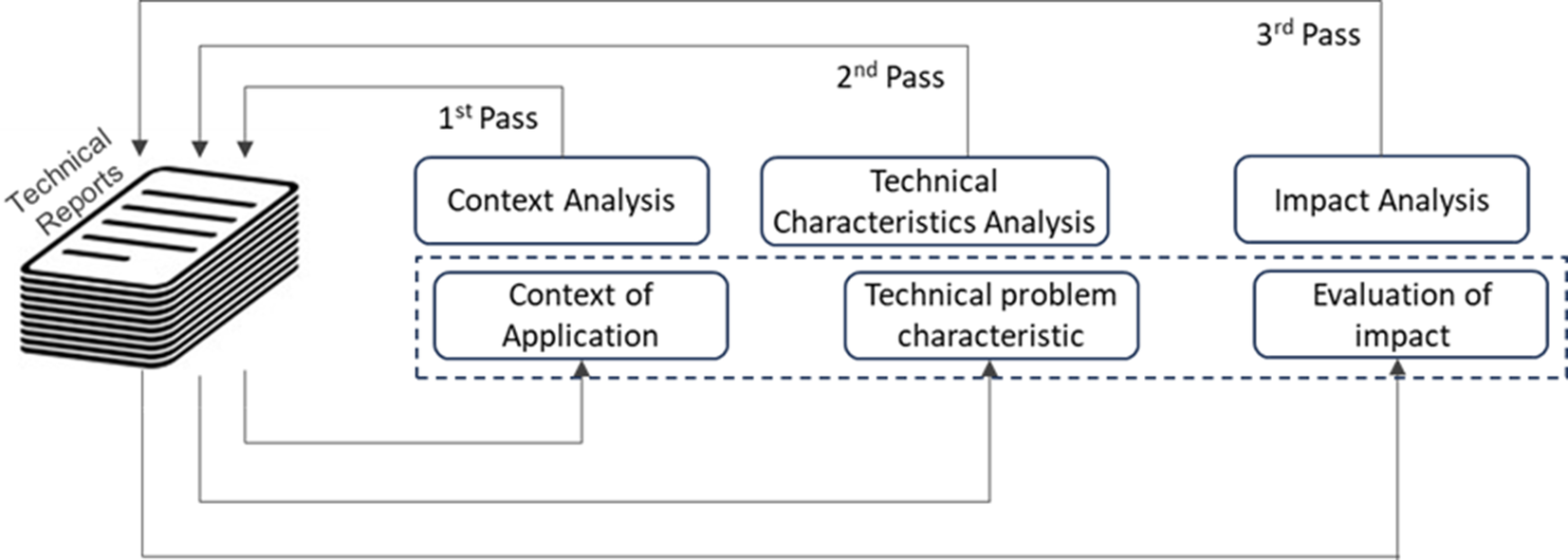
• Phase 1 – Project Context Analysis: This phase involved an initial content analysis review of each technical report, to evaluate the workplace project context for the application of function modelling, guided by the criteria shown in Figure 2, that is, engineering competence area, product development phase, application purpose and integration with other methodologies. This analysis, completed jointly by academic and industry reviewers, was documented in a tabular format to support subsequent analysis, to provide the foundational context for understanding how SSFD has been implemented across different projects.
-
• Phase 2 – Technical Characteristics Analysis: The second phase involved a detailed content analysis of the technical reports, examining how SSFD was implemented across different technical problems within the workplace projects. This aimed to identify and classify technical problem characteristics and the associated functional modelling requirements. This systematic review considered the capability and adaptability of SSFD across various engineering projects, based on the evidence included in the reports and the reflections of the engineers. The intention was to ensure a robust understanding and evaluation of the methodological challenges within the technical context of the problem. This approach facilitated a process of discussion and consensus-building between the industry and academic reviewers, to interpret the evidence within each report.
-
• Phase 3 – Impact Analysis: In the final phase, a further review of the projects was carried out to evaluate the impact to the OEM product development organisation using the impact framework in Table 1. Reflecting the fact that the SSFD function modelling was deployed as part of a larger methodology involving other methods and tools, the attribution of benefits to a specific method is very difficult, as discussed by Campean et al. (Reference Campean, Uddin, Bridges, Fannon and Yildirim2022) and previously by Stetter (Reference Stetter, Chakrabarti and Lindemann2016). Therefore, for this study we have considered the impact evaluation of the overall methodology (available from the previous study), while also scrutinising evidence for direct and indirect contribution of the SSFD to the identified impact for each technical report under consideration. The overall analysis quantified how often specific improvements were documented in the reports while exploring their qualitative nature. The evaluation process incorporated analysis of direct benefits in product development processes, assessment of indirect organizational impacts, systematic documentation of practical effects and evaluation of functional modelling value in specific organizational contexts.
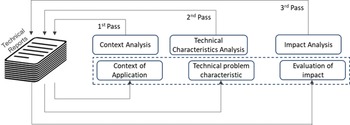
Figure 3 illustrates the research process, based on three successive passes through the deck of reports by the joint academic and industry team.
Three-phase methodological framework for the analysis of reports.
Following the implementation of the methodology, the results are presented in three corresponding sections: context analysis of SSFD applications (Section 4.1), technical problem characteristics analysis (Section 4.2) and impact analysis (Section 4.3).
4. Results
4.1. Context analysis for the application of function modelling
The context of the specific product development project task plays a significant part in the choice of the modelling methods. The review of the projects was initially guided by the criteria A–D discussed in Section 3.1 and illustrated in Figure 2. Table 2 summarises the analysis of the selected engineering projects, with further discussion provided in the subsequent subsections. The categories used for project classification (engineering system, component and process) emerged through inductive analysis of the project reports, where the research team iteratively grouped projects based on their function modelling scope and application domain. For the purpose of preserving confidentiality, project details were anonymised, with only a descriptive phrase indicating the scope within these derived categories.
Engineering context of application in workplace projects
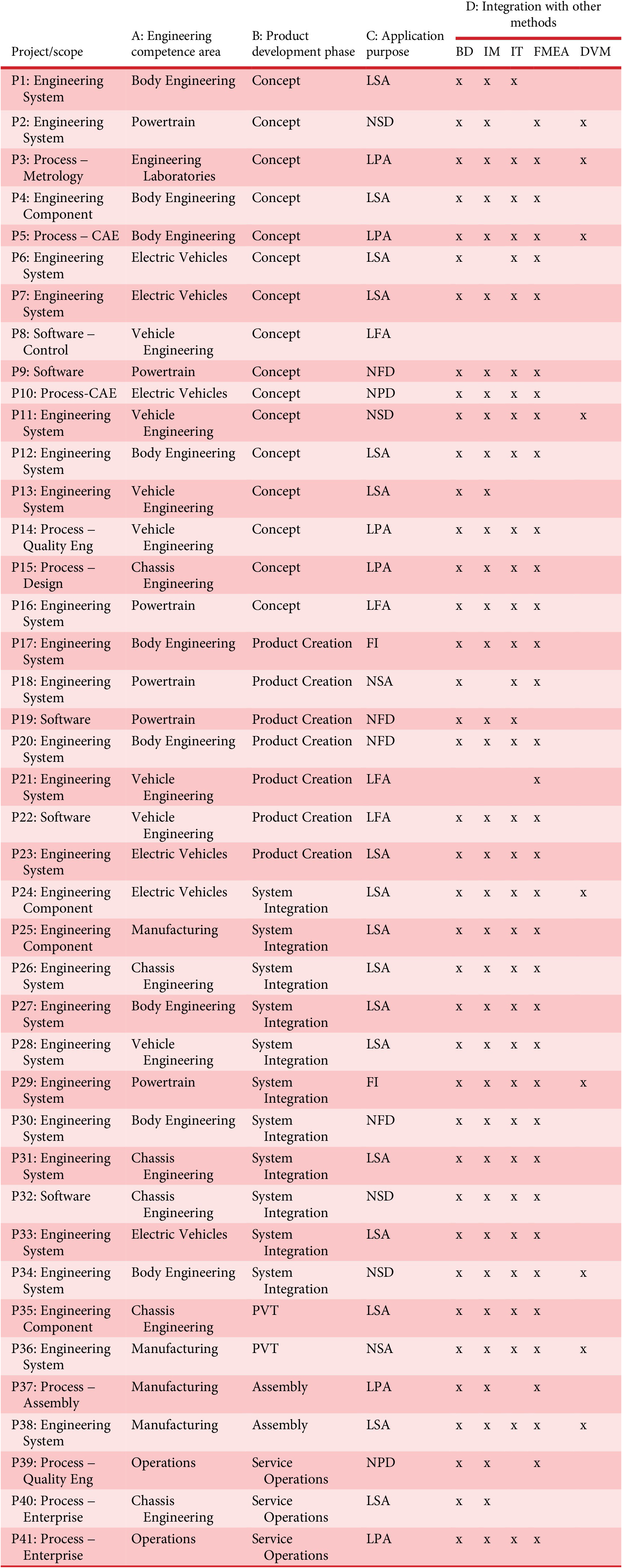
BD, Boundary Diagram; DVM, Design verification methods/matrix; FI, Feature Integration; FMEA, Failure Mode Effect Analysis; IM, Interface Matrix; IT, Interface Analysis Table; LFA, Legacy Feature Analysis; LPA, Legacy Process Analysis; LSA, Legacy System Analysis; NFD, New Feature Development; NPD, New Process Development; NSD, New System Development.
Upon the closer examination of the reports, reflecting upon the diversity in the purpose and scope of the project tasks, the research team decided to adopt a categorisation scheme that better reflects the typology of product development problems, replacing the previously used classification of projects based on the level of system analysis (system, subsystem and component). The reality of current automotive product development, in line with most other mature products and technologies, includes a variety of design tasks, commonly combining evolution or adaptation of legacy subsystems for new variants or applications, with innovation based on introduction of new technologies or new control features to deliver enhanced functionality. This was observed to have a more significant impact on the approach to function modelling, and more generally on the choice of methodological flow to address the workplace problem, compared to “the level of system analysis” considered in the previous work (Yildirim et al. Reference Yildirim, Campean and Uddin2022). Inspired by a project classification and evaluation scheme already in use within the Company, three types of applications were defined and used as reference for the analysis of the technical reports:
-
1) Legacy system/process/feature development analysis (LSA/LPA/LFA): “Legacy” as a generic term refers to a system-of-interest (SoI), feature or process that is carried over from a previous product. An engineering SoI can be of any type and can exist at any level of a vehicle decomposition structure. In traditional engineering practice, a legacy SoI is often designed, engineered and delivered via well-established physical modelling or CAE tools, but its functionality is not commonly documented via functional modelling method or tool in an explicit way by practitioners. The systems engineering methodology requires coherent and comprehensive documentation of system models to facilitate re-use and traceability across the product development lifecycle. Projects in this category tend to use reverse engineering principles and define the functions of the known system/process/feature based on a bottom-up approach.
Table 2 shows that the analysis of a “legacy” system, process or feature was by far the most common application (27 projects; nearly 66% of all projects; 2 out of 3 projects). For example, Project 6 used function modelling to underpin the development of a DFMEA for an electric drive unit, with subsequent analysis of functions failure and effects considering legislative requirements adherence across all markets. Project 22 applied function modelling to a software feature to identify risks to the function fulfilment, with subsequent robustness evaluation to identify countermeasures to address these problems.
Legacy process refers to a process where engineers use it with the underlying guidelines, standards, integrated methods and tools to engineer and document their systems. Legacy process can be a quality process with integrated methods (e.g. FMEA, boundary diagrams), or forward model architecture to compare different architectures and to make a decision to bring forward a chosen architecture based on trade-off criteria (e.g. cost, weight and manufacturing time). For example, Table 2 shows that Projects 14 and 15 focused on the analysis of feature kano model and forward model architecture processes, respectively, that in turn highlighted potential weaknesses and opportunities for improvements.
-
2) New System/Process/Feature Development (NSD/NPD/NFD): A “new” system, process or feature represents a development where the physical form is not yet established, and customer requirements must be translated into new functions. These functions may be allocated to new components or integrated with existing SoI. As shown in Table 2, nearly one out of three projects (12 projects; just over 29% of all projects) used function modelling for such new developments. Examples include Project 39’s new data management process, Project 11’s functional analysis of a new by-wire steering system and Project 20’s development of a new sun glare protection feature for drivers. As shown in Table 2, these new developments can occur across all product development and lifecycle phases.
-
3) Feature Integration (FI): Features or add-ons are described in Project 19 as “the traditional way for automotive manufacturers to allow the user to tailor the functions added to the vehicle to derive the distinct customer benefit.” FI category is about the integration of a feature whose functionality may be implemented by more than one legacy domain system or with the addition of new physical component/system. For example, the sensing functionality of the adaptive cruise control feature would be implemented by control systems within electrical domain, whereas control and actuation functionalities by brakes hardware and software. Project 29 utilized function modelling in the integration of a new software feature into a pre-existing platform. Only two practitioners (5% of all projects) reported the use of function modelling for fFI.
The projects listed in Table 2 have been arranged in the order of product development phases (from Concept to Service Operations, based on the internally defined taxonomy). As shown in Table 2, most projects were associated with Concept, Product Creation and System Integration (83% of all projects), most of which relate to physical engineering systems or components. Some projects related to development of software, or process design or improvement, for example, related to standardised methodologies for aspects of CAE modelling and correlation/validation. There are also notable project applications in PVT, Assembly and Service Operations concerned with both process improvement and engineering systems or components focus, supporting enhanced monitoring and action on post-design issues. In terms of distribution of projects across the engineering areas of competence (defined internally), Table 2 shows a good spread of applications across all engineering disciplinary competence areas, demonstrating a good penetration of the methodology.
Referring to SSFD in particular, within the context of the overall methodology, connections (as linkages and iterative information flows) were expected between function modelling and other methods and tools, in particular:
-
• the system boundary analysis (BD), which captures the system context and internal linkages between the structural elements;
-
• the interface analysis (interface matrix (IM) and interface analysis table (IT)), which captures exchanges between internal structural components and between the system and external elements, with functional requirements articulated to manage the interface exchanges (Uddin et al. Reference Uddin, Campean and Khan2016);
-
• the FMEA, which according to AIAG & VDA (2019) is driven by the function structure of the system, that is, function failure analysis;
-
• the design verification methods/matrix (DVM), which includes the mapping of verification tests against the functional requirements derived from the function modelling and includes the effect of noise factors identified from the interface analysis or other analysis (such as the robustness P-Diagram).
Table 2 includes the mapping of the SSFD usage in the reports in connection with the boundary diagram, interface matrix, IT, FMEA and DVM. This analysis shows that over 80% of practitioners (from the 41 reports) used SSFD to drive the application of other methods. An apparently smaller proportion of projects (22%) have taken the analysis into DVMs update; however, this mainly reflects the fact that the DVM was not included in the defined scope for many of the workplace projects. Nonetheless, Table 2 shows the significant integration of function analysis methodology with other methods on workplace projects.
4.2. Technical characteristics of the functional modelling method
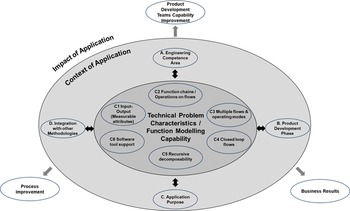
In the second phase, the research team has undertaken a detailed technical analysis seeking to identify function modelling challenges that are common across the project applications. Based on this review, a set of six characteristics has been defined for function modelling method that is required to tackle the technical challenges. These characteristics, denoted as C1–C6, can be further grouped into three classes as follows:
-
(i) elements required for the capture of functional chains in relation to input–output (C1) and basic operations on flows (C2);
-
(ii) the management of complex flows associated with real-world complex multidisciplinary systems, reflecting the heterogeneity of flows (C3) and closed-loop flows (C4); and
-
(iii) the capabilities to support implementation, associated with the practical aspects of the use of the methods within product development organisation; this includes support for the recursive application of the function modelling method across successive level of system decomposition (C5) and software tool support and integration (C6).
These characteristics will be discussed in detail in the following subsections, with reference to evidence from the engineering projects reviewed.
4.2.1. Input–output measurable attributes
The concept of material, energy and information/data are widely used to describe the flows through a system, commonly referenced to Pahl et al. (Reference Pahl, Beitz, Feldhusen and Grote2007). From the point of view of application in industry, there is a clear focus on the description of material, energy and information/data in terms of measurable attributes, which is crucial for the correct capture of requirements associated with each use case (Yildirim & Campean Reference Yildirim and Campean2020, Reference Yildirim and Campean2021), and to guide function failure analysis, FMEA and design verification (AIAG & VDA 2019; Campean & Henshall Reference Campean and Henshall2012). The SSFD supports this with a sharp focus on the identification of input(s) and output(s) of a function in terms of measurable attributes used to define the state of an object, as a basis for function definition/identification (Yildirim et al. Reference Yildirim, Campean and Williams2017). Intermediate state transitions and functions between the input and output states are identified with respect to the way of achievement of the state transition, which can be considered in the context of the physical phenomena that regulate the changes of the object attributes.
Numerous practitioners (n = 16) clearly pointed out the practical benefit of using upfront state-driven thinking based on measurable attributes in their projects. For example, in Project 25, the function modelling approach was used to resolve and identify problems in the alignment of two subsystems, that is, lighting and rear door subsystems. Function modelling served to the specification of profile tolerances of subsystems. Similar to Project 25, Project 27 focused on a geometric alignment problem where the function modelling was useful in the identification of leading contributors to the problem. Measurable states defined via the function modelling provided more insight into process performance and control in Project 26. Project 1 used function modelling as part of the analysis of a newly developed process for field data management process. In Project 39, process steps are documented in terms of measurable attributes which allowed the practitioner to embed related requirements into the process such as “project score” and “project state” as an attribute of “analysed projects list” and “project data,” respectively. Project 4 utilized state-driven thinking to detail the flow of energy, while Project 20 pointed out how thinking in terms of the flow of states, which are described in terms of measurable attributes, gave some insight into the achievement of a stakeholder goal (i.e. ease of use).
Some practitioners brought the role of these key elements to the attention in terms of the flow of information to other tools of the product design and development methodology introduced in the company (n = 14) and solution-neutral analysis of both new and current systems (n = 5). In terms of the flow of information, for example, Project 39, Project 14, Project 17 and Project 32, mentioned how states and functions facilitated the completion of FMEA. Project 21 pointed out how state-driven thinking was useful in the identification of some performance targets needed for FMEA as the function modelling promotes the description of the input/output of a function in terms of measurable attributes. Figure 4 shows the information flow to FMEA based on an excerpt from Project 39. The “wrong decision made” failure mode is associated with the “accepted/flagged” status of “project progress” and lists “wrong input data” as one potential cause of failure. The recommended actions refer to the “project score” attribute (i.e. criterion) of the “analysed projects list.”
Information flow to FMEA (based on Project 39).

Project 1 noted how identified states and functions are fed into IT, while Project 2 illustrated the flow of information from function modelling to IT and to the FMEA.
In the case of solution-neutral analysis of a system, Project 29, in the context of the generation of a new software, stated how state-driven thinking based on measurable attributes offered a flexibility for an alternative architecture by promoting solution-neutral representation of a system even if it is reverse engineered from existing architecture. Project 20 pointed out that “the inclusion of SI units added clarity over what was actually transferring in a solution agnostic method which enabled me to think more analytically without getting ‘bogged’ down in solutions.” These examples illustrate how the identification of measurable attributes, and where project context permits, the specification of detailed values, allow engineers to establish measurable frameworks early while enabling detailed specification as designs mature.
4.2.2. Function models as operations on flows (main flow, connecting flow and branching flow)
The creation of function structures by decomposing the overall function into sub-functions is a generic methodology followed by many function modelling approaches, for example, Pahl et al. (Reference Pahl, Beitz, Feldhusen and Grote2007) and IDEF0 (Buede Reference Buede2009). However, the decomposition of a functional structure at a given hierarchical level not only requires the identification of intermediate functions between the input(s) and the output(s) on the main flow of the system. The definition of connecting and branching flows to achieve the functions on the main flow is also necessary for coherency and mathematical correctness of the functional model. Therefore, an important characteristic of a function modelling methodology is its ability to support the identification of intermediate functions between the input(s) and the output(s) of the main, and connecting, branching flows to achieve the main function.
The functional models seen in some projects (e.g. Project 34) are in the form of linear diagrams which describe the purpose of the system in terms of a flow related to the intended effect of the system on the user or another system. These models focused on the representation of a main flow from the inputs to the outputs based on the decomposition of the defined main function without any connecting and branching flows to/from the main flow. However, this is rarely the case in the analysis of complex multidisciplinary systems.
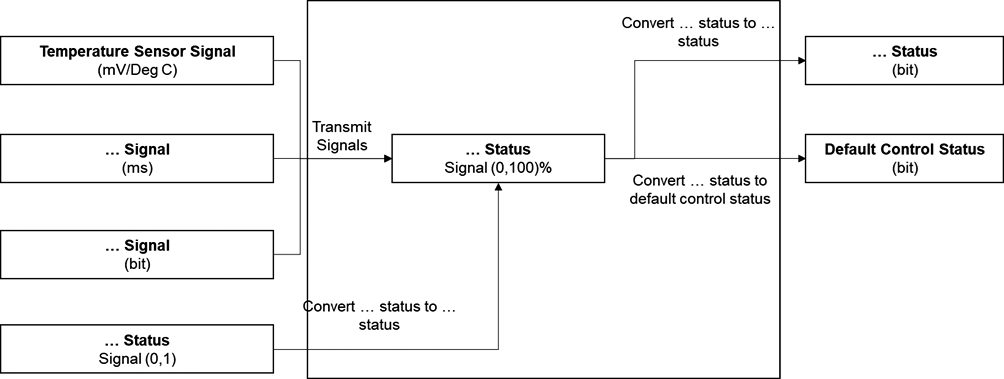
As shown in Figure 5, flows that connect to the main flow (where “Status” is shown in the middle) to define additional resource flows for relevant functions (connecting flow) and flows that branch out from the main flow (branching flow) must be defined as necessary, along with the relevant states and functions connecting into and branching off the main flow. This will ensure functional model of the system is “mathematically correct.” Functional models of various projects (such as Project 39) include these flows with associated states and functions; however, there is a need for the introduction of a methodological way of defining connecting and branching flows in a coherent way to ensure the mathematical correctness for the flow balances.
Functional model of a software feature (based on project 29; recreated with edits and omissions to preserve confidentiality).

4.2.3. Dealing with multiple flow types and operation modes
Real-world complex systems commonly involve multiple interconnected flows. For practical implementation, function modelling approaches must be able to manage multiple flows of the same or different types. This ability is essential for representing functional models related to different use cases of the same system in a coherent and mathematically correct way.
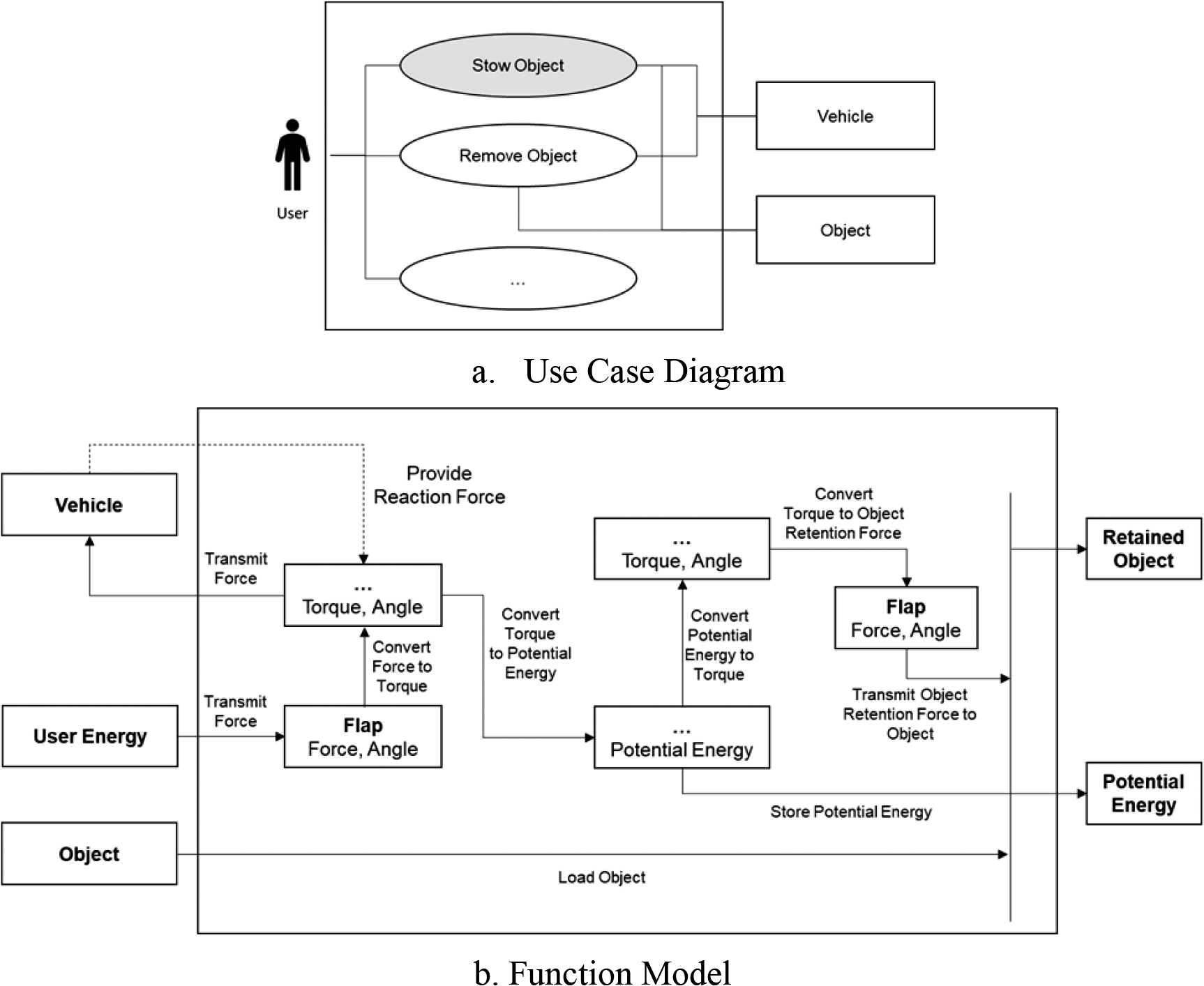
Complex multidisciplinary systems generally have multiple modes of operation; each corresponds to a use case of the system. Each operation mode of the system can be independently described by a functional chain, as shown by Project 12 with the analysis of an engineering system whose main functionality is to “Stow Object.” Figure 6a introduces an excerpt of use case diagram of the system, and Figure 6b shows functional model for “Stow Object” use case.
Analysis of an engineering system for the “Stow Object” use case (Project 12; recreated with some edits and omissions for the purpose of confidentiality).

Unlike Figure 6b, the development of a functional chain for an operation mode of most systems can be challenging if the chain requires the representation of multiple flows of the same and different types for different purposes (e.g. synchronising multiple flows) as noted by numerous practitioners (n = 19). This points out the need to manage this complexity.
All practitioner reports are based on functional models of relevant applications for a particular use case. Creating a global functional model that captures the complex functionality of a system requires aggregating functional chains from different operation modes. This involves two key challenges: first, representing multiple flows of the same and different types within each operation mode’s functional chains; and second, combining these chains into a unified model that captures the system’s overall logic. Therefore, identifying logical or parametric conditions of flows for relevant operation modes within a single model is essential. This challenge must be addressed to promote the practical use of particular function modelling methods – for example, capturing functional models of the “stow object” and “remove object” use cases of the engineering system in Figure 6a in a single diagram.
4.2.4. Modelling closed-loop systems
Many real-world systems have complex dynamics that require closed-loop control systems to deliver desired behaviours. Analysing systems with closed loops has become increasingly important with the development of autonomous systems, which require modelling various feedback control systems. Capturing functional models for systems involving closed loops is essential for robust integration of overall system design.
Practitioners pointed out that the use of the function modelling approach on the analysis and the representations of systems with closed loops (n = 9) was problematic. For example, Project 32 encountered difficulties in accurately representing the closed-loop relationship between a sensors’ feedback and the relevant control module’s adjustments during the development of the SSFD, where capturing the input/output relationships and defining the system’s states in a manner that aligned with the feedback loop proved challenging. Such difficulties resonate with the known limitations of traditional function modelling tools – which are typically designed for linear, sequential processes rather than systems with inherent feedback mechanisms. Other approaches like bond graphs (e.g. Gawthrop & Bevan Reference Gawthrop and Bevan2007) are often cited as more suitable for modelling closed-loop systems, as they are explicitly designed to capture the dynamics of the system. Within the scope of the 41 projects analysed, no participants attempted to formally modify the SSFD notation to incorporate such loops. Instead, practitioners typically worked around this limitation by modelling the primary linear flow of energy or material, often abstracting or omitting the control feedback from the functional model itself.
4.2.5. Recursive decomposability
Product development of complex systems requires systematic analysis at multiple levels of system decomposition. Since the analysis at different levels is conducted by various non-co-located teams – a common characteristic of distributed product development – using function modelling approaches across different levels of decomposition becomes challenging. This challenge also reflects the disciplinary biases of the teams involved. The challenge is not just to manage the traceability of the critical design characteristics across the product development but also to manage the impact on the overall effectiveness of the design and development process. Therefore, the ability of a function modelling approach to be applied recursively across teams, engineering disciplines and systems decomposition levels is an important attribute for practice.
Function modelling should be applicable at different levels of system decomposition, that is, from component to system. This is indicative of the integration of the methodology with the systems engineering approach. The scalability of the representation to span multiple levels of decomposition is important to enable teams to conduct progressive system analysis by managing representations at varying levels of functional granularity.
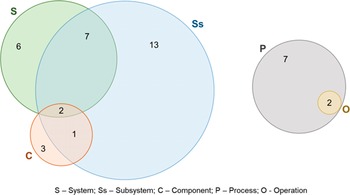
Figure 7 presents a Venn diagram analysis showing the system decomposition levels at which function analysis was applied across the reports. The analysis reveals two key patterns in how the practitioners have approached functional modelling scope:
-
• For the project application on engineering systems and components (32 reports, including software systems), 10 projects (that is, nearly 1 in 3) conducted function analysis at multiple decomposition levels simultaneously, with two projects examining functions at three different levels of system decomposition. This indicates that practitioners often find value in analysing functions across different levels of system granularity within the same project.
-
• Among the nine projects focused on process function analysis, two projects applied multi-level decomposition, specifically analysing both process-level and operations-level functions. Here, “process” refers to the highest-level view encompassing the complete manufacturing sequence, while “operations” represent the distinct activities or steps that constitute the overall process (Korsunovs et al. Reference Korsunovs, Doikin and Campean2022). This multi-level approach suggests that comprehensive process understanding requires analysis at both strategic (process) and tactical (operations) levels.
Levels of decomposition for analysis in projects.

This multi-level approach aligns with fundamental design methodology principles, where functions within the same model can appropriately exist at different levels of abstraction based on analysis requirements.
In terms of the decomposition of the system functional model across multiple levels of abstraction, some reports (n = 7) pointed out the need for nested decomposition of functions where functions are contained within other functions in a hierarchical structure. For example, Project 8 illustrates an approach to nested decomposition where the top-level use case contains multiple functional groups (such as displaying mode information), which further break down into specific individual functions. This nested approach allowed the practitioner to maintain traceability from high-level user needs down to detailed functional requirements while managing complexity through clear hierarchical organization. However, the practitioner noted challenges with decomposing interconnected mode display functions, which required simplification to align with the hierarchical structure. This situation reflects the practical reality that not all functions need to be decomposed to the same level within a model, consistent with the well-established design methodologies. These challenges resonate with the nested approach goal of maintaining traceability from high-level user needs to detail functional requirements. However, the difficulty in achieving effective decomposition in this case suggests that a lack of recursive decomposability can compromise the clarity and organisation needed for managing complexity.
4.2.6. Software tool support
The recursive and consistent application of function modelling frameworks is supported not only by a solid understanding of the method’s applicability across disciplines but also by the degree to which the method is embedded in (software) tools that promote and facilitate its practical use.
Practitioners mainly used PowerPoint and Microsoft Visio in the development of functional models. This led to the differences in terms of the illustration of the models, in particular, type of boxes and text. Functional models of some systems can be represented straightforwardly with these tools, but the analysis can be expected to grow substantially in application to large complex multidisciplinary systems and this can also affect the scalability of the approach. Therefore, to facilitate the engagement of practitioners with the function modelling approach and to standardize the representation of the models, the embodiment of a function modelling approach in a software tool is important. This need for robust software support is clearly articulated by some practitioners. For instance, Project 19 explicitly noted that “The SSFD diagram was shown to be a very powerful tool to decompose system function and steer analysis away from the solution space. It tends to bring out common functions that can be represented in software as reusable library functions.”
Based on the software-related challenges identified across multiple reports, software support could provide a basis for the automation of the function modelling approach and its integration with other methods through relevant MBSE packages as a potential solution pathway. This transition can shift the organization’s product design and development processes towards a newly introduced methodology for advanced systems, where requirements, risks and safety cases are captured using structured models (e.g. SysML for requirements) instead of traditional Office documents. Additionally, these models can be shared within the organization through a centralized database, allowing for streamlined product design and development activities, such as automated functional model analysis, as demonstrated by Song & Lind (Reference Song and Lind2020) in their work on automated generation of function models from piping and instrumentation diagrams.
4.3. Evaluation of benefits to the organisation
Content analysis was used to systematically code and categorize relevant evidence, allowing for the identification of direct and indirect contributions of function modelling. This approach enabled the team to assess both the frequency and qualitative aspects of these contributions, thereby clarifying the function modelling impact within the broader methodological context. For example, Project 11 documented specific quantitative outcomes underpinned by function modelling, including the identification of 48 failure modes for four system functions, 44 new requirements and design rules, 44 test cases for individual systems, and 33 requirements and test cases for the overall system.
The overall analysis of the impact evaluation is summarised in Figure 8. The analysis led to the identification of 95 examples of evidenced individual benefits from the 41 projects (that is, an average of 2.3 benefits per project), across the three classes (business results, process improvement and product development teams capability improvement) and 14 impact categories.
Quantitative analysis of benefits identified across three impact types and 14 categories of evidence.

Specific contributions of the function modelling approach were identified in relation to both direct and indirect benefits:
-
• Direct process benefits: The direct process benefits are evidenced through multiple projects’ outcomes. Project 23 demonstrated how function modelling “provides a structured and holistic approach for identifying different functions of a system,” while Project 37 showed enhanced process documentation through the creation of an “enhanced process flow document” based on process states/functions from function modelling. This systematic documentation extended to capturing part and process characteristics for each function, providing a comprehensive foundation for identifying variation sources, as demonstrated in Project 37.
-
• Integration with key tools: The integration with key tools, particularly FMEA, represents a significant area of impact. Project 37 illustrated how function modelling provided process characteristics that directly supported PFMEA development. This integration was further reinforced in Project 23, where the team successfully progressed “from function analysis to function failure” leading to the identification of 15 mechanisms of failure. The project also highlighted the enhancement of multidisciplinary collaboration in FMEA processes through the team-based approach to function analysis.
-
• Teamwork benefits: In terms of team working benefits, Project 15 provided evidence of how function modelling supports organizational effectiveness. Through functional decomposition, the approach enabled clear identification of value-added activities by “assessing what contributes to the management of people, product and process.” The project also demonstrated improved interface management, where function modelling supported the identification of opportunities to “remove interfaces and rationalize functions to optimize the group.”
The evidence from these projects demonstrates how function modelling serves both as an analytical tool and as an enabling methodology that enhances the effectiveness of other key tools in the product development process, particularly FMEA. This dual role is exemplified in Project 38’s quality improvement case, where function modelling contributed to process both understanding and subsequent PFMEA development. In turn, this supported the achievement of targeted quality improvements by facilitating the definition of critical process steps and enabling their thorough evaluation in the PFMEA analysis.
5. Discussion
The detailed analysis of the application of SSFD function modelling to a large set of workplace-based projects within an automotive OEM provided the research team with rich insight into the characteristics of real-world problems where function modelling is applied and evaluation of impact based on engineering practitioner reflection. This provided an opportunity to consolidate the findings into a generic framework that captures the industry practitioner viewpoint on the deployment of functional modelling methods, as well as reflecting on the effectiveness of SSFD.
5.1. Framework for the evaluation of function modelling in industry
In response to the research question articulated in Figure 2, through the in-depth analysis of technical reports discussed in Section 4.2, this research has identified six categories of technical problem characteristics, C1–C6, defining the inner core of the proposed framework for the evaluation of function modelling methods in industry, shown in Figure 9.
Framework for evaluation of function modelling methods in industry.

The importance of this framework is that it encapsulates two distinct perspectives for function modelling methods evaluation:
-
1) The application time perspective – reflecting the capability of a function modelling method to address the specific technical problem characteristics, as they arise within the context of application to a real-world project in industry.
-
2) The post-application perspective, which reflects upon the impact of application as benefits to the organisation.
The two viewpoints, and hence the framework, are pertinent to both researchers developing methods and tools for function modelling methods, and industry/Companies, who invest in method deployment and then evaluate the effectiveness of the methods.
Researchers are primarily interested in evaluating the capability of their preferred method and/or tool for application to real-world problems. A systematic consideration of the method and tool capability in relation to the ensemble of technical characteristics (C1–C6) as they arise in different contexts of applications (A–D) is necessary to establish the potential scope for application of a particular method.
From a Product Development Company perspective, the interest is to evaluate the capability of a method across the different contexts of applications (A–D) and by consideration of all relevant technical problem characteristics (C1–C6) before a method is chosen for adoption and implementation. This is important because adoption of a method typically requires very significant investment (typically multi-million £), to cover the cost of training and the time of engineers invested in learning the new methods.
Another use case observed by the authors during the initial collaborative research project was that system analysis methods in industry (including function modelling) tend to be bundled with much larger software solutions, such as a PLM environment. Mapping the use cases where additional methods are necessary to perform specialist tasks is essential for adoption (given that the “main” method does not meet the specific requirements) and rationalizing the selection of function modelling methods/tools to address many problems with the same method. This not only optimises the investment but also accelerates the learning and adoption through the establishment of either informal or formal communities of practice.
Considering impact is important not only in retrospect (as research impact for academics or return on investment for the company) but also during the method evaluation and selection phase. While direct business results can only be quantified post-factum, the potential for impact on process improvement or on product development team capability improvement can arguably be considered before the method is chosen (by the company) or while validated (by the researcher). For example, where function modelling is part of an analysis or modelling chain, a particular choice of function analysis method may facilitate the subsequent deployment of another method.
The framework thus bridges the gap between theoretical method capabilities and their real-world application, providing a structured and holistic evaluation approach that considers both technical excellence and organizational value creation.
5.2. Reflection on the evaluation of the SSFD based on workplace evidence
The in-depth review of the technical reports on workplace projects where SSFD has been applied has also provided a comprehensive opportunity to evaluate the SSFD as function modelling method, based on the proposed framework in Figure 9.
In relation to the context of project application, the analysis of the data in Table 1 showed a good penetration of SSFD across all areas of engineering competence, phases of product development, and application purpose. The wide range of project scopes, covering physical systems, features, software and processes, was to some extent unexpected, given that the problem-based context used for the training of the method was much more limited. In turn, this can be regarded as evidence for a good learning gradient for the SSFD.
While the analysis of the data in Table 1 shows that practitioners were more likely to use the SSFD in the analysis of a legacy system, process and feature during the concept phase of product development, this is a fair reflection of the distribution of design tasks within a mature product development organisation/OEM.
Reflection on the capability of SSFD as a function modelling method raised the following key points:
-
• The practitioners underlined the importance of upfront state-driven thinking based on measurable attributes in supporting systematic analysis of new and current systems that can facilitate consideration of alternative solutions, and the flow of information from the function modelling approach to other product design and development tools (such as FMEA).
-
• The practitioners underlined the importance of identifying all flows (in particular, branching flows) for the completeness of the model and its “mathematical correctness,” whereas they also emphasised the problem of developing functional model of a system with multiple operation modes in a single diagram by emphasizing the management of multiple flows of the same and different types based on logical or parametric conditions. This challenge of representing multiple operational modes is common across function modelling approaches including IDEF0 and SysML activity diagrams, suggesting a broader methodological gap that extends beyond SSFD-specific limitations.
-
• The usability of functional modelling approaches for analysing systems with closed loops has long been recognised as a challenge. The review of reports highlighted the crucial role of function modelling for the design and analysis of software and control systems, such as automotive electronic control units, emphasising the requirement for usability and applicability of functional modelling, including SSFD, in these systems.
-
• The analysis of the reports also showed the importance of the applicability and scalability of functional model across multiple levels of system decomposition, and the need for selective function decomposition in the analysis of a larger system, including systems with multiple functionalities, to enable a systematic capture of requirements. This approach aligns with established design methodology where functions naturally exist at different levels of abstraction within the same model, with decomposition applied as needed for system comprehension. The application of the SSFD on the reports shows its ability to support recursive application across different levels of system decomposition, while addressing the complexities of distributed product development is crucial for improving design effectiveness and team collaboration. While hierarchical decomposition is supported by various approaches including IDEF0, the nested systems approach discussed by Campean et al. (Reference Campean, Yildirim and Henshall2018) specifically aimed to address the challenge of maintaining consistency across decomposition levels, which could improve the effectiveness of SSFD relative to these alternatives.
-
• Engineers highlighted software-related challenges as a weakness of SSFD deployment at the time, specifically regarding practical applicability and modelling efforts. This challenge of software tool support is common across function modelling approaches, with SysML-based tools offering better integration capabilities but lacking the specific flow analysis features that practitioner valued in SSFD. However, the emergence of recent software tools (e.g. MATLAB System Composer) has the potential to address this gap by providing enhanced flow modelling capabilities within integrated development environments. Based on these identified challenges, the authors propose that the adaptation and integration of function modelling with other software packages, such as MBSE packages, is necessary to promote its take-up by improving its practical applicability and reducing modelling efforts. This was highlighted by the engineers as a weakness of SSFD deployment at the time and prompted subsequent development work (Yildirim et al. Reference Yildirim, Campean and Uddin2025) to facilitate an effective integration of SSFD with MBSE, with prescriptive guidance on function modelling based on flow heuristics.
-
• In terms of the evaluation of the benefits to the organisation, the analysis pointed out that integration with other methodologies is essential in revealing the impact of the SSFD. This integration requirement appears to be a strength of SSFD relative to more standalone approaches, as the flow-based nature facilitates connection with established tools like FMEA more naturally than purely structural or behavioural modelling approaches. In particular, the integration with the established product design and development methodologies augmented the impact of the methodology within the organization, as discussed by various practitioners and as shown in Figure 8. For example, the identification of failure modes through FMEA was directly linked to SSFD function modelling. The prominence of impact in the “Process Improvement” category shown in Figure 8 highlights a positive influence of SSFD function modelling on the broader product development methodologies and process.
5.3. Comparison with existing studies and frameworks
The evaluation framework presented by Summers et al. (Reference Summers, Eckert and Goel2017) compiles the most extensive theoretical foundation for benchmarking functional modelling approaches across representation, modelling, cognitive, and reasoning dimensions, which has provided a reference basis for many studies in the research community.
Our framework focuses on capturing the practitioner insight on practical implementation challenges, reflecting on the implementation context and expected outcomes from the application, as well as broader benefits to the product development organisation. In this respect, this represents a significant extension of the framework of Summers et al. (Reference Summers, Eckert and Goel2017), reflecting the industrial reality where the success of a functional modelling method depends not only on its inherent characteristics but also on how effectively it can be deployed within the range of organizational contexts and design problems, and demonstrable impact to business outcomes and the product development organisation.
One important observation is that the set of practical technical problem characteristics (C1–C6) was identified empirically from analysis of reports collected from one automotive OEM. As such, this cannot be considered exhaustive, and further empirical studies are needed to validate and possibly extend the set identified herein, ultimately matching the ensemble provided by Summers et al. (Reference Summers, Eckert and Goel2017). As a specific example, given the limited timescale for our study (reports were collected over 18 months) and the broad basis of deployment, we were not able to explore function modelling re-use patterns, which Summers et al. (Reference Summers, Eckert and Goel2017) discussed as an important characteristic for effective deployment.
From a methodological point of view, our study stands aside from other studies as those mentioned in Section 2, in that it was based on the retrospective analysis of technical reports, rather than observation or interviews with the practitioners. This provided clear benefits in terms of scale and objectivity of the assessment, as the evaluation was based on what was actually done on a workplace project, rather than subjective reflection on past applications.
Like Eckert (Reference Eckert2013), this study has confirmed that engineers in industry engage with function models within the context of other methods – such as FMEA and DVM, which are prescribed by the Company processes. However, as shown by this study, this also provides an effective pathway for evidencing the impact of function modelling methods, thus providing business arguments for investment in method adoption through training and facilitation.
Furthermore, our analysis provided both reinforcement and complementary insights to the existing literature. Specifically, we found strong corroboration for challenges related to methodology application complexity, as noted by Tomiyama et al. (Reference Tomiyama, Gu, Jin, Lutters, Kind and Kimura2009) and Eckert (Reference Eckert2013), particularly in managing multiple flows (C3) and modelling closed-loop systems (C4). Similarly, the time-intensive nature of implementation, also noted by Tomiyama et al. (Reference Tomiyama, Gu, Jin, Lutters, Kind and Kimura2009), was reflected in practitioners’ emphasis on the limitations of available software tools (C6).
However, the industrial evidence also revealed challenges that are less prominent in academic literature, for example, the critical importance of measurable attributes (C1) for requirements traceability and FMEA integration emerged as a key practitioner-driven requirement. Additionally, the need for recursive decomposability (C5) highlighted the realities of distributed, multidisciplinary product development teams – a context-specific challenge often extending beyond representational limitations discussed in academic studies.
The use of tools like MS Visio and PowerPoint, although primarily seen as illustrative, facilitated crucial team-based analysis integrated with formal engineering methodologies, such as FMEAs. This integration indicates that function models are not merely for presentation but serve as practical tools that contribute to engineering processes.
6. Conclusions
This study advances evidence-based research on function modelling in industry by adopting a methodology centred on analysing evidence from engineering project reports. The distinguishing feature of our evaluation approach lies in its practical orientation and the explicit consideration of contextual factors that influence the successful implementation of functional modelling methods in industry. This complements the theoretical rigor of existing frameworks while providing additional insights into the practical challenges and requirements for effective deployment of functional modelling methods in industrial settings.
Our findings provide valuable insights into the practical application and impact of function modelling methodologies in industrial settings, highlighting their applicability across diverse engineering projects, product development phases and different systems levels of analysis, and competence areas. The research shows that all of these factors have an impact on the effectiveness of the applicability of a function modelling method.
Industrial deployment of function modelling reveals that successful adoption depends critically on integration with established engineering methodologies, particularly FMEA, rather than standalone application. The study identifies six key technical characteristics (C1–C6) essential for industrial applicability, with state-driven thinking, measurable attributes and recursive decomposability emerging as fundamental requirements not adequately addressed in existing literature. Most significantly, systematic integration with other methodologies transforms function modelling from an additional burden into an enabler for demonstrable business impact. These findings suggest that future function modelling research should prioritise integrated deployment strategies and enhanced software toolchain support rather than focusing solely on method refinement in isolation.
Based on these insights, we have introduced a comprehensive framework for the applicability of a functional modelling method in industry practice. This framework synthesises three fundamental aspects:
-
1. The function modelling method capability in relation to the specific technical problem characteristics;
-
2. The context in which the method is employed in industry, in terms of engineering competences involved, product development phase, specific application purpose and integration with other methodologies;
-
3. The evidence basis for impact on the product development organization, in terms of business results, process improvement and teams capability improvement.
This framework contributes to closing the gap between academic research and industrial application. It provides guidance for researchers to carry out systematic analysis of the use, effectiveness and impact of function modelling methods in real-world applications, and for industry to evaluate the applicability of methods to real-world engineering projects, including pathways for evaluating impact to justify investment in method adoption.
Acknowledgements
The authors acknowledge the contribution of Jonathan Bridges and Steven Fannon with the evaluation of the technical reports.






 Open access

