

Hanns Eisler’s Kampfmusik is famous for its rhythmic energy. The term translates as ‘fight music’ or ‘music for the struggle’; Eisler began composing these mass songs, solo ballads, polyphonic choruses, and theatre and film music in the late 1920s ‘to agitate and to educate’ the working class and promote the German Communist Party. After the Nazis seized power in 1933, he continued to write Kampfmusik in exile for anti-fascist causes, but by the late 1930s, his production of it gradually petered out as he settled into long-term exile in the United States. In its time, Eisler’s Kampfmusik achieved widespread popularity and won the sometimes enthusiastic, sometimes grudging respect of the period’s leading music critics as a radically new approach to modern music that combined modernist techniques with mass appeal. Central to this appeal was the music’s contagious rhythmic drive, derived first and foremost from the steady, hammering block chords of the famous ‘Eisler Bass’, with its evenly accented triads on every beat of the bar.Footnote 1
Unsurprisingly, the rhythm of the Eisler Bass has been overwhelmingly associated with the steady beat of march music. Much of Eisler’s Kampfmusik references the march in its titles or performance indications. On a practical level, it could accompany marches, parades, picket lines, and other demonstrations, or it could reference such actions when performed in stationary settings like rallies, meetings, or concerts. In his writings from the time, Eisler even spares military music from his broader critique of bourgeois music, as it can be used to organize marching.Footnote 2 Eisler’s other writings from the period, however, demonstrate an ambition to fundamentally reconceptualize music’s function in society and reshape compositional techniques to fulfil this purpose. Rhythm had a key role to play.
In this article, I reconsider the steady beat of the Eisler Bass, re-reading Eisler’s writings alongside Weimar-era sources about rhythm, jazz, labour, and entrainment. A fact that is perhaps surprising to modern readers is that a well-articulated steady beat was considered a defining feature of jazz as dance music in post-World War I Germany, and while this beat was heard as ‘march-like’, it shared key distinguishing features with the Eisler Bass. I argue that in addition to its association with the march, the steady beat of Eisler’s Kampfmusik was derived from this Weimar understanding and practice of jazz via a process the composer called ‘refunctioning’ (Umfunktionieren).Footnote 3 In doing so, I reveal that Eisler’s efforts to realize his political ideals in music were more sophisticated than has previously been recognized, and I assert the relevance of his Kampfmusik to understanding musical modernism’s interwar engagement with technology and popular culture. For Eisler, the steady beat of jazz provided a key discursive link to machine rhythms, and specifically to the rhythms of factory labour. By refunctioning the steady beat of jazz as the sonic representation of factory machines, he was able to claim that his Kampfmusik emerged organically out of the rhythms of modern labour, just as earlier folk music was understood to have emerged out of the rhythms of pre-industrial work. His Kampfmusik could thus become a new kind of international folk music for the modern industrial world.
This line of reasoning was central to Eisler’s revolutionary goals; he believed that the bourgeois-capitalist social order relied on the division of life into separate domains of work and recreation, with music consigned to the latter. By composing music based — via the steady beat of jazz — on the rhythms of modern labour, Eisler sought to reforge the connection between work and music, undermine the current bourgeois social order, and lay the foundations for a future socialist society. More immediately, the steady beat also had an instinctive appeal that enabled it to coordinate activity, from marching and dancing to rationalized labour. Factory workers were accustomed to performing small, rationalized tasks whose contribution to the finished product was difficult to appreciate in isolation. By bringing the rhythm of the assembly line into his Kampfmusik, Eisler could help workers translate their embodied experience of factory work to revolutionary activity, in which individual revolutionaries also performed small and sometimes seemingly insignificant tasks according to a larger plan. As we will see, his writings and the discourse he draws upon anticipate conversations today about music and entrainment, embodiment, and mental and physical health, as well as music and rhythm as means of disciplining both the individual body and the body politic.
My argument also forces a reconsideration of the racial politics of Eisler’s — and, more broadly, German modernism’s — engagement with jazz. Previous scholarship on Eisler and jazz has focused on a handful of pieces in which he directly references it (in a style similar to Kurt Weill in Die Dreigroschenoper). These pieces draw on specific associations of jazz with the oppression of African Americans, and by focusing on them, scholars have presented Eisler’s politics as, for the time, racially progressive. My argument expands the influence of jazz to include the overwhelming majority of his Kampfmusik. This not only broadens the scope of its political meanings to include more stereotypically communist topics like organized labour, but it also troubles those previous interpretations. Eisler’s use of jazz relies on a thoroughly racialized discourse, but in the process of refunctioning the steady beat, he obscures the cultural labour of African Americans in the creation of jazz (or more accurately, the way German jazz theorists conceptualized African Americans’ role in the creation of jazz). Eisler’s Kampfmusik is thus implicated in a broader process of erasure that remains contested in contemporary debates over race in leftist politics about whether prioritizing class-based oppression ignores or can even perpetuate other vectors of oppression, like race, gender, sexuality, or ability.
I begin this article with a review of Eisler’s writings on the social function of music and the role he imagined for his Kampfmusik, which lays a foundation to re-examine his writings on jazz. I then turn to Weimar-era jazz discourse to interrogate what exactly Eisler would have meant by the rhythms of jazz, and I show that the steady beat of jazz as described in these writings corresponds to that of the Eisler Bass. With this connection established, I return to the function of Eisler’s Kampfmusik, first positioning the steady beat within early twentieth-century discourses of labour rationalization and then positioning that rationalization within communist tactics. Finally, I reflect on the broader implications of my analysis as regards the racial politics of Kampfmusik and German modernism’s interest in jazz.
The Social Function of Music
Eisler produced Kampfmusik in a variety of genres, including mass songs, ballads for solo performance, choral music, and music for theatre and film; he even understood his purely instrumental music from this time as Kampfmusik. Nevertheless, music with sung text occupied a central role. Beyond stand-alone songs, choruses, and so forth, Eisler’s music for theatre also emphasized songs and choruses, and he composed songs specifically for films. He also reused much of his film music in his instrumental music. Indeed, his instrumental music gained much of its Kampfmusik character from audiences recognizing melodies, remembering the songs’ texts, or recalling the music’s meaning in previous films or theatrical works.Footnote 4 In what follows, my focus will thus be on music with sung text, primarily mass songs, ballads, and songs written for theatre and film.
Eisler’s composition of Kampfmusik was just one part of a broader engagement with revolutionary proletarian music that began shortly after the Eleventh Party Congress of the German Communist Party in 1927 called for the creation of a new, specifically proletarian culture to replace existing folk and bourgeois forms.Footnote 5 Eisler threw himself into this work as a musician, an organizer, and a theoretician. During this period, before the predominance of socialist realism, there was much debate about exactly what this new revolutionary proletarian culture should consist of, and Eisler’s ideas aligned with and found support from a number of German artists and thinkers who published in party and party-adjacent periodicals like Musik und Gesellschaft and Kampfmusik. Footnote 6
Eisler developed his theory and practice of Kampfmusik in parallel during the late 1920s, and by the early 1930s, he was articulating a relatively sophisticated vision of how revolutionary proletarian music should work and sound. Using a Marxist conceptualization of history that was both teleological and dialectical, Eisler understood his Kampfmusik as intervening in musical culture of the day to facilitate the rise of the proletariat. Critical here are his ideas about music’s social function, the relationship between music and work, and the relationship between work and non-work in everyday life.
The first traces of Eisler’s Marxist reconceptualization of music date to 1928, in unpublished notes likely produced for a course and later a study group he led on the ‘historical-materialist analysis of music’ at the Berlin Marxist Workers’ School (Marxistische Arbeiterschule or MASCH).Footnote 7 Here, Eisler attempts to formulate fundamental theses for a dialectic materialist music history: his first thesis states that ‘music is the organization of notes’ and his second that ‘the organization of the notes reflects the social situation. A change in production methods, a change in the class structure, also affects a change in the methods of organizing the notes.’Footnote 8 The main task of the music theorist or historian is to study the ‘function of music’, which he defines in later writings as ‘the social purpose of music-making’.Footnote 9 Following from Eisler’s theses, musical style is dependent on the then-current social order. Musical materials, like Renaissance polyphony, sonata form, or late-Romantic orchestration, rose to prominence because they enabled music to best serve its function within the economic organization of society. When the social function of music changes, some of these materials are abandoned, while others are adapted to music’s new function.
In the Marxist dialectical view of history, each new social order begins with the revolutionary overthrow of the previous one, only for the new order to gradually become reactionary. Eisler argues that the same is true of music. The replacement of feudal music-making with bourgeois concert music, for example, ‘was, in the middle of the eighteenth century, a great step forward [… but] today this great step forward has transformed into a reactionary moment’.Footnote 10 As a social order and its music become reactionary, they also become unstable, contributing to their inevitable downfall. Expanding on the communist line that capitalism was entering its final phase, Eisler believed that ‘the development of music in the last fifteen years has definitively liquidated the previously stable concepts of bourgeois art’.Footnote 11 The stage was thus set for a new, revolutionary proletarian music to emerge, one that would contribute to the overthrow of the bourgeois-capitalist social order but also ‘already contain the seeds of the foundations of the methods of musical culture in socialism’.Footnote 12
Eisler rarely cites sources for his ideas, but in a 1931 draft, he references the work of German economist Karl Bücher on the origins and function of music in pre-industrial society going all the way back to the Palaeolithic.Footnote 13 Bücher was interested in the science of labour rationalization, especially as related to energy and fatigue.Footnote 14 In the nineteenth century, labour scientists came to understand human energy, both mental and physical, as a finite resource that once drained, needed to be recharged. As opposed to earlier characterizations of fatigue as laziness, lack of willpower, or just feeling tired, it was now understood to be a biological state of energy depletion. As such, it posed a grave threat to the productivity, wealth, and military power of the industrial state, which deployed the tools of science and medicine to counter it.
Fatigue was thought to be a modern condition, brought about by changes in work due to industrialization. In his 1896 book Arbeit und Rhythmus (Work and Rhythm), which appeared in a sixth, ‘improved and expanded’ edition in 1924, Bücher sought to better understand what made industrial labour so fatiguing by studying the development of labour from the Palaeolithic to the present day.Footnote 15 Building on evolutionary theories of culture prevalent at the time, he turned to non-European societies as representative of earlier stages of human civilization, using the cultures of the Amazon and sub-Saharan Africa as models of the earliest human civilizations and European folk culture as the model of the most advanced pre-industrial civilization. His primary methodology was to survey anthropological literature on work songs.Footnote 16 In the process, he developed an idiosyncratic theory that music, dance, and poetry all originated in the rhythms of work. At the time, the origin of music was a major preoccupation in the emerging field of musicology, and Bücher’s ideas found wide reception among musicians and musicologists.Footnote 17
Bücher identifies two major breaks in the development of human labour. The first occurred in the earliest human societies with a division into what he terms primitive and civilized peoples (Naturvölker and Kulturvölker). While Naturvölker only work to meet their immediate needs and cease working at or before the onset of fatigue, Kulturvölker work ‘consistently and methodically’ even after they began to experience fatigue. Bücher argues that a steady beat is essential to this ‘civilized’ form of labour, as its efficiency and entraining power minimizes energy expenditure, both delaying the onset of fatigue and facilitating continued work while fatigued. This beat is also, Bücher claimed, the origin of music. First, an individual began working at a steady rhythm, which gradually expanded into synchronized group work. Eventually, one worker was tasked with playing a simple percussion instrument to reinforce the beat, which then developed to include pitched percussion and later pitched instruments and singing. Poetry arose from the addition of words to the beats and melodies, and dance originated as the imitation of the rhythmic movements of work and was executed to the same rhythms and melodies.Footnote 18 Music and its steady beat thus facilitated workers moving seamlessly between work and non-work activities, like dancing and religious rituals. This model was central to Eisler’s understanding of music’s social function before capitalism and the bourgeoisie’s rise to power.
However, things became more complicated at Bücher’s second major break in the development of human labour: industrialization. For Bücher, the introduction of mechanically driven machinery fundamentally changed the rhythm of work. The pre-industrial steady beat emerged out of a human collective, and thus could speed up or slow down as individuals rush or drag, and an individual could stop or pause when their fatigue is too great. The mechanically regulated beat of modern factory labour, on the other hand, was inhumanly steady and unrelenting. Rather than naturally arising out of the rhythm of the workers’ movements, it was often set by the factory owners, and workers must keep up even as they became increasingly fatigued. Going back to his initial research question, Bücher argues that this change in the rhythm of labour not only made modern factory work fatiguing, but also fundamentally dehumanizing. As evidence, he claims that ‘the work song has almost completely disappeared’ from the modern factory, and ‘the arts hardly play a role in the life of the worker any more’.Footnote 19 Factory workers neither sing while they work, nor do they seamlessly transition from work into music and dance that imitates the motions of factory labour after their shifts: ‘Work […] is no longer music and poetry at the same time.’Footnote 20 Work and music had been relegated to separate domains.
This divide plays a key role in Eisler’s understanding of music’s function in capitalism. He argues that all music in capitalist society, whether Brahms or Schoenberg, The Merry Widow or jazz, serves the same social function: ‘the enjoyment of music’ (Musikgenuss).Footnote 21 He explains that as a means of enjoyment, ‘music is primarily used in bourgeois society as a restorative, for the reproduction of the ability to work’.Footnote 22 Here, he refers to the Marxist concept of the reproduction of labour power. Drawing on the discourses of labour and fatigue that would later inform Bücher, Marx argues that capitalism turns workers’ ability to work, their ‘labour power’, into a commodity that they sell to their employer. The reproduction of this power, however, is the responsibility of the worker, and thus contributes to the surplus value that the employer exploits.Footnote 23 In Eisler’s model of capitalism, workers, tired after a long day of work, listen to and make music for recreation so that they will be energized for work the next day.Footnote 24
Eisler, however, disagreed with Bücher on the fundamentally dehumanizing nature of factory work. As Anson Rabinbach explains, communists welcomed the rationalization of factory work as a means of increasing productivity; it was only the exploitation of rationalized labour they opposed.Footnote 25 Austrian Marxist Otto Bauer, for instance, published a defence of Taylorism, Rationalisierung und Fehlrationalisierung (Rationalization and Mis-rationalization), in 1931. Meanwhile, a Soviet version of Taylorism was developed in the early 1920s, and many Soviet artists sought to integrate its methods into their work.Footnote 26 Eisler was engaged in a similar process in how he understood the function of his Kampfmusik.
On the most practical level, Eisler defines his music’s function as ‘mobilization to the struggle [Kampf] and political education’.Footnote 27 How exactly it would do this was informed by his analysis of music history. In one of his most detailed discussions of the topic, Eisler argues:
If we — and by ‘we’ I mean the avant-garde of the proletariat, the revolutionary working class — really want to seize political power, then we must propagate an artistic practice that derives new methods from the daily struggle of the revolutionary working class, that does not just […] reflect the needs and worries of the working class, but rather that makes concrete the correct methods for seizing power to the broad masses of the hungry and suffering in Germany.Footnote 28
Here Eisler clarifies two key features of Kampfmusik: that it should arise out of the daily struggle of the proletariat and that it should concretely demonstrate how to carry out the revolution. His account of music history helps to explicate just how his Kampfmusik would achieve this and the central role of the steady beat of the Eisler Bass in doing so.
Eisler’s first claim — that Kampfmusik should arise out of the daily struggle of the proletariat — points back to his reading of Bücher and the relationship between music, work, and non-work. The strict separation of work and non-work into separate spheres of activity, with music confined to the latter, was central to the bourgeois social order and music’s role in upholding it. Kampfmusik needed to dissolve this distinction, and Bücher’s account of music in pre-industrial society provided a model for just such a system. This model, however, could not simply be copied, for while Eisler disagreed with Bücher’s conclusion that rationalized industrial labour was necessarily dehumanizing, he agreed with his argument that pre-industrial folk music was incompatible with the rhythms of the modern factory. In a 1938 lecture, for example, he paraphrases Bücher:
Factory workers cannot sing at work the same way and for the same reasons as the Volga boatmen sang. The tempo and rhythm of their work is dictated by their machines and not by the workers themselves. Spontaneous music culture dies under such conditions. Two generations after the Industrial Revolution the majority of the population was without any music culture at all.Footnote 29
For Bücher, the disappearance of folk music proved the inhumanity of industrial society. From Eisler’s historical materialist perspective, both this disappearance and industrialization were inevitable historical developments; what he lamented was not the loss of the old folk music but of the working class’s ‘spontaneous music culture’. This contributed to the working class’s oppression, as it compelled workers to adopt the bourgeois model that confined music to the domain of non-work.
In his Kampfmusik, Eisler sought to reforge the ‘spontaneous’ connection between music and labour and to bridge the domains of work and non-work. As he claims in a 1934 article: ‘The Kampflied is the true folk song of the proletariat.’Footnote 30 However, in order to reforge this connection, Eisler needed a way to conceptualize the rhythms of his Kampfmusik as arising out of the rhythms of rationalized factory labour. Traditional associations of a steady beat with pre-industrial musical genres like the march were insufficient to link his music to industrial work. Indeed, the march embodied the humane qualities of pre-industrial labour as described by Bücher: its steady beat emerged out of group movement and was maintained by one or more musicians tasked with playing a steady rhythm. But these musicians were only human — the beat of the march would inevitably vary based on their own imprecision and responses to the other marchers. Jazz, on the other hand, could provide a link to the inhuman precision of machine rhythms, and not just on a conceptual level. The Weimar understanding and practice of jazz also offered Eisler a whole set of rhythmic techniques that he adapted in his Kampfmusik.
Eisler and Jazz
Eisler mentions jazz infrequently in his writings from the Weimar period, and when he does, his comments are generally negative. This has led many observers to conclude that he was opposed to jazz on political and aesthetic grounds.Footnote 31 On closer examination, however, his opinions are more nuanced. He was certainly repulsed by jazz as commercial entertainment music and the role it played in bourgeois-capitalist society; nevertheless, he closely analysed it to better understand its effectiveness. As Eisler and Bertolt Brecht write in their ‘Comments on Die Massnahme’ to accompany their eponymous 1930 collaboration:
A rejection of jazz that does not stem from a rejection of its social function is a step backwards. Namely, one must be able to differentiate between jazz as a set of techniques and the repulsive commodity that the entertainment industry has made of it.Footnote 32
Eisler breaks jazz into its component parts — what he calls its materials — like melodic conventions, harmonic language, characteristic rhythms, and instrumentation. These materials can be isolated, reconfigured, and then put to use for politically acceptable purposes. Eisler calls this process refunctioning, which he defines in a 1934 essay: ‘We will apply our critical methods, separate craft from [ideological] content, purify craft from the influence of content, and then out of this new technique, we will bring something new into development by giving it other uses and content.’Footnote 33
In Eisler’s writings, refunctioning takes two forms. On the one hand, it can involve the transformation of large-scale elements of bourgeois music culture, like the programming of concerts, genres like the oratorio or symphony, or the role of music in theatre and film.Footnote 34 For example, Eisler advocates refunctioning conventional workers’ chorus concerts into political events. To do so, he suggests incorporating communal singing, removing religious oratorios from the repertoire (unless they are first historically contextualized for the audience), and adding non-musical components, like political speeches, skits, or newsreel projections.Footnote 35
When it comes to the refunctioning of jazz, previous scholarship on Eisler has taken a similarly large-scale perspective, focusing on examples where the composer used many elements of jazz all at once. In these works, Eisler clearly intends for the music to be heard as jazz or jazz-influenced in order to draw on listeners’ associations with it. For example, the ‘Lied der Baumwollpflücker’ (Song of the Cotton Pickers, text: Bruno Traven, 1929) and the ‘Ballade vom Nigger Jim’ (Ballade of Nigger Jim, text: David Weber, 1931) use jazz to symbolize the oppression of African Americans.Footnote 36 Such songs seek to teach working-class Germans to understand racist oppression as a symptom of capitalist class oppression and to feel solidarity with oppressed people around the world.Footnote 37
In other examples, jazz symbolizes more general exploitation under capitalism. When Eisler and Brecht describe the use of jazz in their collaboration Die Massnahme, they refer specifically to ‘the music of Part 5’, which is the ‘Lied des Händlers’ (Song of the Merchant, also known as the ‘Song der Ware’ (Commodity Song)). Musicologist Albrecht Dümling’s comments about this song are representative of the way Eisler’s refunctioning of jazz, both in this song and more generally, has been understood:
As a musical symbol for this mechanism of exploitation and oppression, Eisler selected jazz, or rather the dance music that fell under this rubric at the time. Like the other commodities described in the song, it is a product acquired by capitalists, a modern form of slave labour.Footnote 38
Indeed, many leftist and communist German musicians at the time used jazz in this way.Footnote 39
Eisler, however, does not actually describe this use of jazz in his songs as refunctioning, but as imitation. On the ‘Lied des Händlers’, he writes:
The music of Part 5 […] is an imitation of a music that reflects the fundamental attitude of the merchant: of jazz. The brutality, idiocy, self-assurance, and self-contempt of this type of person could be ‘represented’ in no other musical form.Footnote 40
Similarly, critics at the time also described Eisler’s recognizable use of jazz as imitation, satire, or parody. In a review of the premiere of Die Massnahme, for example, Hans Heinz Stuckenschmidt wrote of Part 5 and the ‘Lied des Händlers’:
Eisler knowingly copies the half-serious jazz style: the heavy chromaticism of the refrain and the sordid turns of the melody denote the sharp and intentional satire of the song. The principle of virtuosity (in the trombone part) also has a parodistic function here.Footnote 41
I argue that it is more useful to think of songs like the ‘Lied des Händlers’ and the ‘Lied der Baumwollpflücker’ as parodies than as refunctioning. For while jazz has been refunctioned to a certain extent (it now functions to agitate and educate, as opposed to providing pleasure), it does not fulfil all the requirements in Eisler’s definition: to separate craft from ideological content and to give craft new uses and new content. Eisler’s parodies of jazz necessarily preserve the music’s bourgeois associations; without them, the songs would not make sense. And because meaning in these parodies of jazz is dependent on knowledge of its bourgeois referent, they seem unlikely to contain within themselves any seeds of a future post-revolutionary socialist music.
If we take Eisler’s description of refunctioning seriously, we should instead look for how he broke jazz down into its constituent musical materials. He gave a particularly revealing insight into this process in a critique of other communist composers who sought to reproduce the mass accessibility of bourgeois popular music:
Bourgeois popular music [Schlager] has a thoroughly corrupt, inactive musical attitude and cannot in any way be taken up by us. Its logic, its melodic construction, and its harmony are completely unusable. It is, however, possible to refunction the rhythm of jazz and to make it taut and energetic.Footnote 42
The word Eisler uses for ‘bourgeois popular music’, Schlager, would have included jazz, jazz-influenced popular music, and popular music with no jazz influences. Eisler rejects any use — even refunctioning — of bourgeois popular music’s melody and harmony, and as the above quotation by Stuckenschmidt makes clear, these two elements were central to the imitation of jazz in songs like the ‘Lied des Händlers’. Instead, Eisler argues that rhythm is the only element of bourgeois popular music that can be refunctioned, and he specifies that this is not the rhythm of just any kind of Schlager but that of jazz.
Eisler’s terminology here is also revealing. Elsewhere he uses the German word umfunktionieren, which translates directly as ‘to refunction’, but here he writes ummontieren. This word builds on the root montieren, which translates as ‘to mount’ or ‘to assemble’; it was used to refer to the assembly process on a conveyer belt, as well as the process of creating a montage. Ummontieren, or to reassemble, thus carries strong associations with both factory labour and avant-garde artistic techniques. What exactly Eisler meant by the ‘rhythm of jazz’, however, remains unclear. Comparing Eisler’s compositions with contemporary discussions of jazz demonstrates that he was referring to the steady, driving beat of jazz as it was practised in Weimar Germany.
The Rhythm of Jazz
If asked to identify the ‘rhythm of jazz’, a modern listener would likely say syncopation, but this represents an understanding of jazz based on select American practices that were retroactively elevated in the construction of the jazz canon, or, as Scott DeVeaux has called it, ‘the jazz tradition’.Footnote 43 As J. Bradford Robinson and Frank Tirro have demonstrated, this tradition has also played an outsized role in the historiography of jazz in Germany.Footnote 44 While a growing body of recent scholarship has illuminated Germany’s idiosyncratic approach to early jazz, the importance of a steady beat remains largely unappreciated.Footnote 45 Re-examining this discourse reveals not only the centrality of the steady beat to early German jazz, but also the specific techniques and practices refunctioned by Eisler in his Kampfmusik.
Germany’s unique reception of jazz originated in World War I. Cut off first by the war and then by the economic and political turmoil that followed, Germans were dazzled by reports of jazz from abroad and sought to recreate it by grafting their knowledge of early American popular music (especially ragtime) and what they could glean from images and written descriptions onto German wartime popular music, like operetta, so-called ‘gypsy’ bands, and military marches. Marches especially came to be linked with early German ideas about jazz. During the war, it was popular to use marches to accompany ‘step’ dances, and Astrid Kusser writes that in this period, ‘Europeans often danced cakewalks to unsyncopated traditional marches’.Footnote 46 Afterwards, information about the movements of jazz dances like the Charleston or black bottom spread faster than the actual musical forms, and as these dances were in duple time, marches continued to be used in the immediate post-war period to accompany them. This combination of influences, especially that of ragtime and marches, shaped the early German understanding of jazz to emphasize the contrast of a steady bass with a syncopated melody, but with a particular emphasis on the bass. However, in its assimilation into German jazz, the steady beat was transformed, both in how it was played and in how it was understood.
Over the course of the 1920s, Germany was gradually reintegrated into the international circulation of popular music. While some idiosyncrasies of German jazz faded away, the steady beat endured, especially in social dancing, where it helped to keep the dancers in time. In 1929, for instance, a leading guide for jazz-band leaders warned that while the steady beat could be downplayed in symphonic concert jazz, ‘deviations from normal metrical schemes [… are] less advised in functional jazz out of consideration for the dancers’.Footnote 47 The steady beat served a similar function for the high-kicking troupes of dancing girls so famously analysed by Siegfried Kracauer. Jonathan Wipplinger notes that in another contemporary analysis of these troupes, sociologist Fritz Giese (to whom we will return below) had, in his descriptions of the music, to ‘gradually strip jazz’s rhythm of syncopation’ and emphasize instead the importance of the mechanically steady ‘beat’.Footnote 48 In such shows, the steady beat not only coordinated the dancers, but also reinforced the visual effect of their synchronization. Additionally, many American and Western European jazz and popular styles that arrived in Germany also featured a steady beat, like new ragtime, boogie-woogie, and stride piano. Based on their previous experience, Germans were predisposed to focus on this steady beat as further evidence of its centrality to jazz.
While the steady beat of German jazz had its origins in the march, it soon developed distinct accent patterns and methods of elaboration. Pedagogical manuals, written primarily for classically trained professional musicians who wanted to expand their repertoire, explain these characteristics in detail and offer valuable insight into how jazz was performed in everyday cafes, bars, and nightclubs. The leading author of such manuals was musicologist and critic Alfred Baresel; his first manual, Das Jazzbuch (The Jazz Book), was published in 1925 and went through seven editions before he released an expanded eighth edition in 1929, Das neue Jazzbuch (The New Jazz Book).Footnote 49 Baresel also published manuals for specific instruments, including percussion, banjo, and piano, and articles on jazz in newspapers, magazines, and academic journals. His books are notable for their descriptive, as opposed to prescriptive, approach; as he explains in an introduction, Das neue Jazzbuch ‘came to be in an unusual way: far removed from the American birthplace of its subject, it gathers its findings from observations of [jazz’s] European impact’.Footnote 50
From the first edition of Das Jazzbuch in 1925 to his final publication on jazz in the Weimar period, Jazz-Klavierschule (Jazz Piano Method) in 1932, Baresel consistently describes a steady beat as the defining feature of jazz, which he traces to the military march and German ‘step’ dances. Already in the first edition of Das Jazzbuch, he labels the foxtrot, one-step, and blues ‘march-like dances’ and ‘members of the march family’.Footnote 51 In the expanded discussions of Das neue Jazzbuch, he continues to connect duple-time jazz dances and military marches:
Drawing on the music of the person in step, march music, which has established a tempo division of parade march, swift march, [and] attack march, we can create three groups of the modern duple-metre dances: a slow, middle, and fast group.Footnote 52
This is especially telling as, for Baresel, jazz dances (foxtrot, one-step, blues) are not distinguished by characteristic rhythmic patterns or forms but by their tempo.Footnote 53
Nor was Baresel alone in linking jazz to the march. In his 1927 book Jazz: Eine musikalische Zeitfrage (Jazz: A Musical Question of our Times), Paul Bernhard also identifies the march and its ‘step’ dances as the source of jazz’s beat:
The old rhythms are dead. A single, simple, familiar rhythm that unites all people, primitive and highly civilized, lives: that of the swift march. […] The entire youth of Europe knows only one rhythm, the duple metre of the forward drive, the pounding, the ‘step’.Footnote 54
This connection became especially clear in retrospect. Michael Kater, for example, writes that ‘made-in-Germany jazz reminded Berlin’s Hans Blüthner [a leading figure in the jazz clubs of the time] of marches’.Footnote 55 This connection even endures in Adorno’s critique of jazz, written in exile in England in 1936:
If one wanted to describe the phenomenon of interference in jazz in terms of broad and solid concepts of style, one could claim it as the combination of salon music and march music. […] The effectiveness of the principle of march music in jazz is evident. The basic rhythm of the continuo and the bass drum is completely in sync with march rhythm, and since the introduction of six-eight time, jazz could be transformed effortlessly into a march.Footnote 56
Indeed, J. Bradford Robinson has argued that a number of Adorno’s idiosyncratic claims about jazz that leave modern readers puzzled can be explained by Weimar jazz practice.Footnote 57
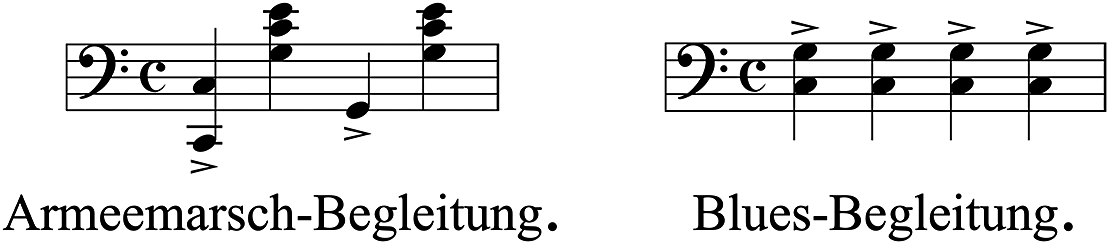
In response to such conflation, Baresel clarified a subtle but essential distinction: the march emphasized strong beats, creating an oom-pah effect, while jazz accented all four beats evenly, as seen in Example 1. The example is labelled ‘Blues accompaniment’ because it is notated in common time; recall that, for Baresel, the blues was not fundamentally different from other jazz dances, but was simply at a slower tempo.
Baresel, Das neue Jazzbuch, p. 21: March accompaniment and Blues accompaniment.
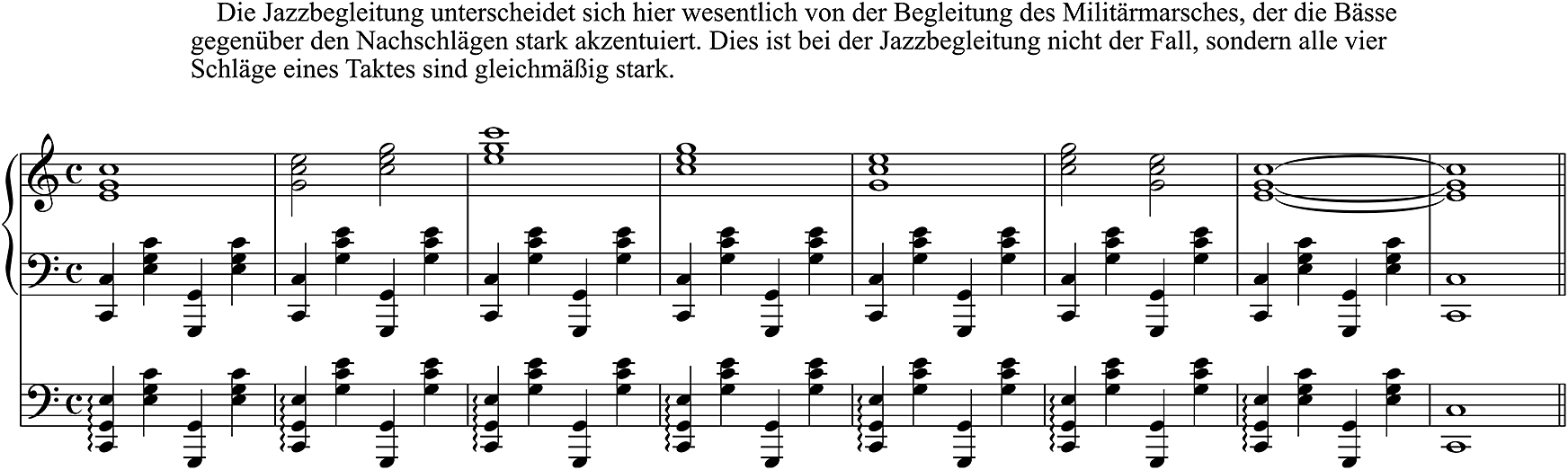
Baresel specified that the evenly accented steady beat was to be maintained even when there was an alternation of low and high chords that might imply an oom-pah effect. This is strikingly illustrated in Example 2, taken from the Jazz-Klavierschule. The caption accompanying the example translates as:
Jazz accompaniment differs here fundamentally from the accompaniment of a military march, which strongly accents the low notes as opposed to the weak beats. This is not the case in jazz accompaniment; rather, all four beats of the bar are equally strong.Footnote 58
Baresel and Gebhart, Die neue Klaviervirtuosität: Jazz-Klavierschule, p. 6.
The steady beat even took precedence in dance forms that Baresel did not describe as ‘march-like’. He claims that ‘jazz has even transformed the rhythmically uneven accompaniment of the tango into four even beats in modern dance usage’.Footnote 59
Thus, while the steady beat of jazz may have had its origins in the march, this beat was transformed as it was assimilated into Weimar dance practice. For inexpert listeners like Adorno or for listeners accustomed to the American and Western European ‘jazz tradition’, like Hans Blüthner and most readers today, the steady beat of German jazz was strongly reminiscent of march music, if not identical. For experts and practitioners of the time, however, the steady beats of jazz and the march were subtly but fundamentally different. Even as they acknowledged the historical origins of jazz’s beat in the march, they clearly articulated what made jazz unique.
‘Blues Accompaniment’ and the Eisler Bass
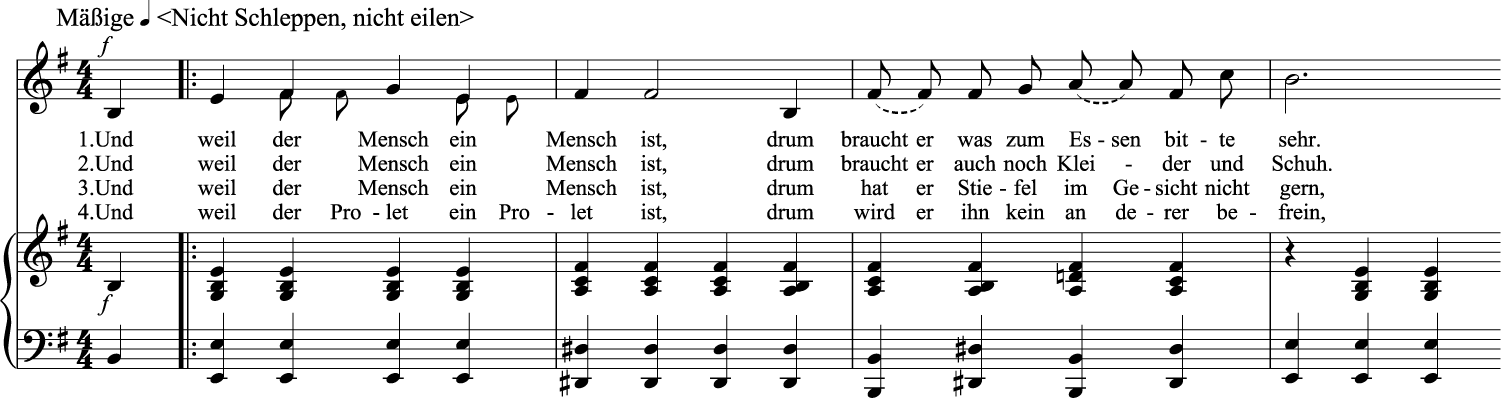
Eisler’s use of the ‘rhythm of jazz’ incorporated a range of practices related to the steady beat. On a fundamental level, Baresel’s ‘Blues accompaniment’ is strikingly similar to the Eisler Bass, as seen in Example 3, taken from Eisler’s ‘Einheitsfrontlied’ (Song of the United Front, text: Bertolt Brecht, 1935). A steady crotchet pattern evenly accents all four beats; this effect continues in the left hand for the duration of the song, and in the right hand for all but three bars.
Eisler, ‘Einheitsfrontlied’ (Song of the United Front, text: Bertolt Brecht, 1935), bars 1–4, © by Deutscher Verlag für Musik Leipzig.
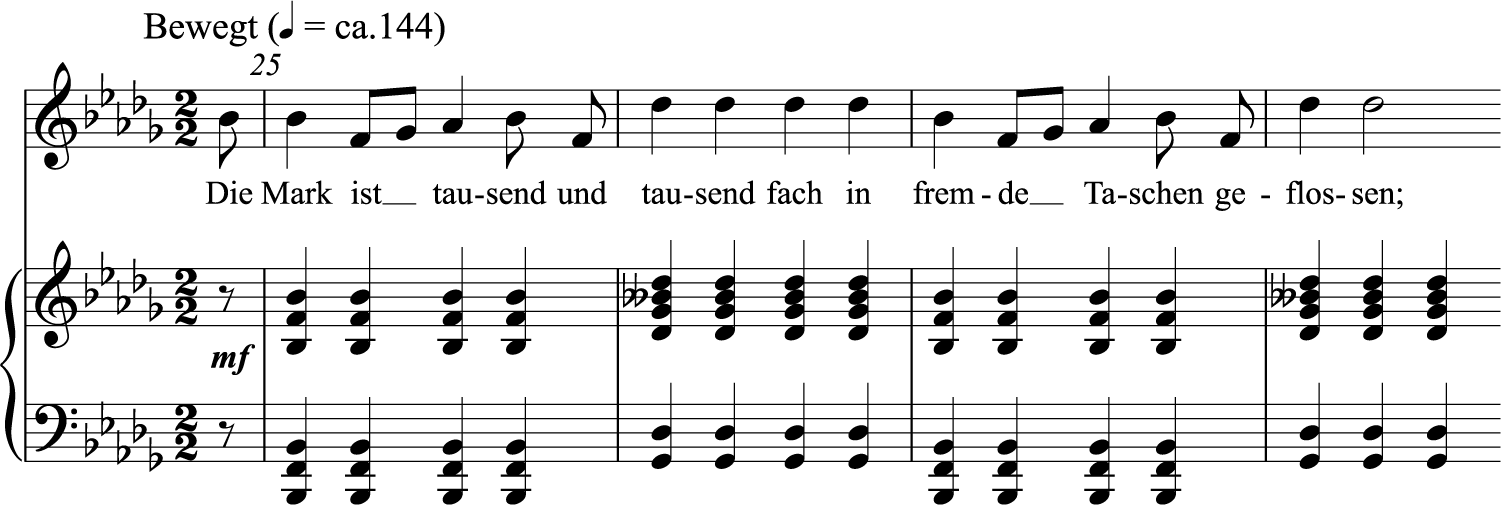
This model is typical of Eisler’s Kampfmusik. The extent to which it drives an individual composition depends on the genre. In mass songs, like the ‘Einheitsfrontlied’, the steady beat continues through the entire work. In ballads, which were composed for solo performance, the steady beat may or may not occur in the verses but almost always appears in the chorus.Footnote 60 Here, it reinforces a statement of the song’s message, and the audience might be invited to sing along. In the ‘Lied der Wohltätigkeit’ (Charity Song, text: Kurt Tucholsky, 1930), for example, the first portion of the chorus sums up the lesson of the ballad: charity is a cheap way for the ruling classes to give back only a small portion of what they extract by exploitation (Example 4). This is followed by a slower section that concludes this point and leads to a call to action: ‘Take what you get, but call out the bullshit. Think about your class, it will make you strong’.
Eisler, ‘Lied der Wohltätigkeit’ (Charity Song, text: Kurt Tucholsky, 1930), bars 25–28, © by Deutscher Verlag für Musik Leipzig.
The Eisler Bass rarely occurs in Eisler’s multi-part choral writing, but it does occur in much of his film and instrumental music from the period.Footnote 61 As stated above, in the case of instrumental music, he often self-borrows from texted songs, ballads, and film music, intending the audience to associate the instrumental music they hear with the remembered text and message of the song or film scene.
My claim that Eisler’s use of the steady beat in this manner is a refunctioning of jazz is supported by his use of a steady beat in his music that imitates it, such as the ‘Lied der Baumwollpflücker’ discussed above, as well as an early attempt to write an actual shimmy. This unpublished piece for solo piano, composed in 1926, is untitled but labelled ‘Shimmytempo’, and it contains a handwritten dedication to a certain ‘Frau Edith’ referring to it as a ‘shimmy’.Footnote 62 Substantial portions feature steady block chords in the left hand with an occasionally syncopated melody in the right. Clearly Eisler was familiar with the use of a steady beat in the German jazz music of his time.
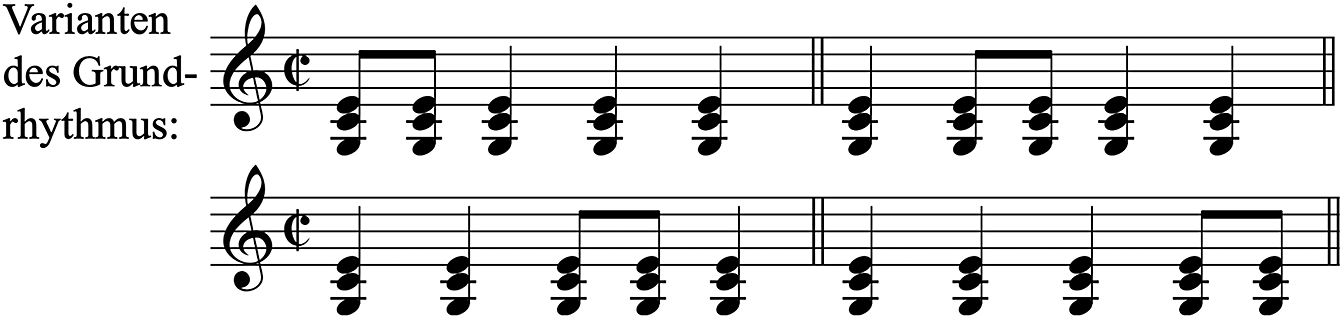
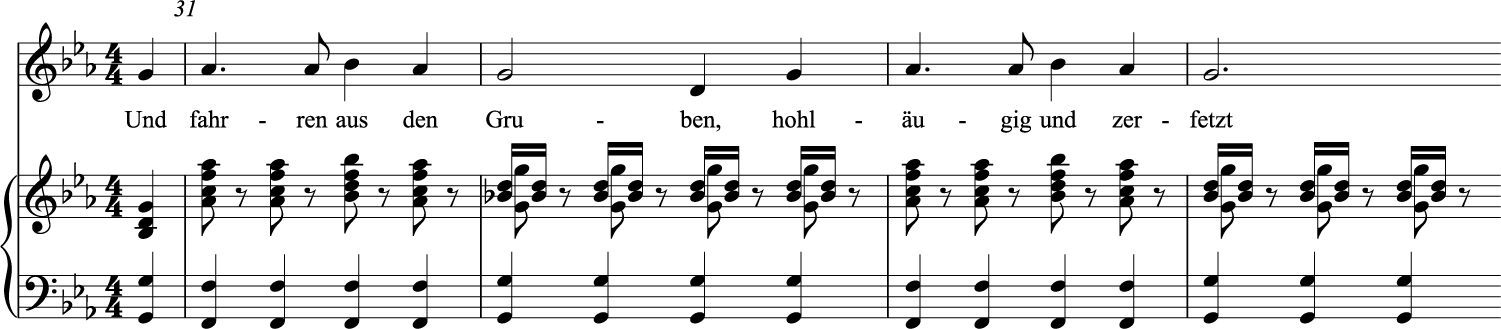
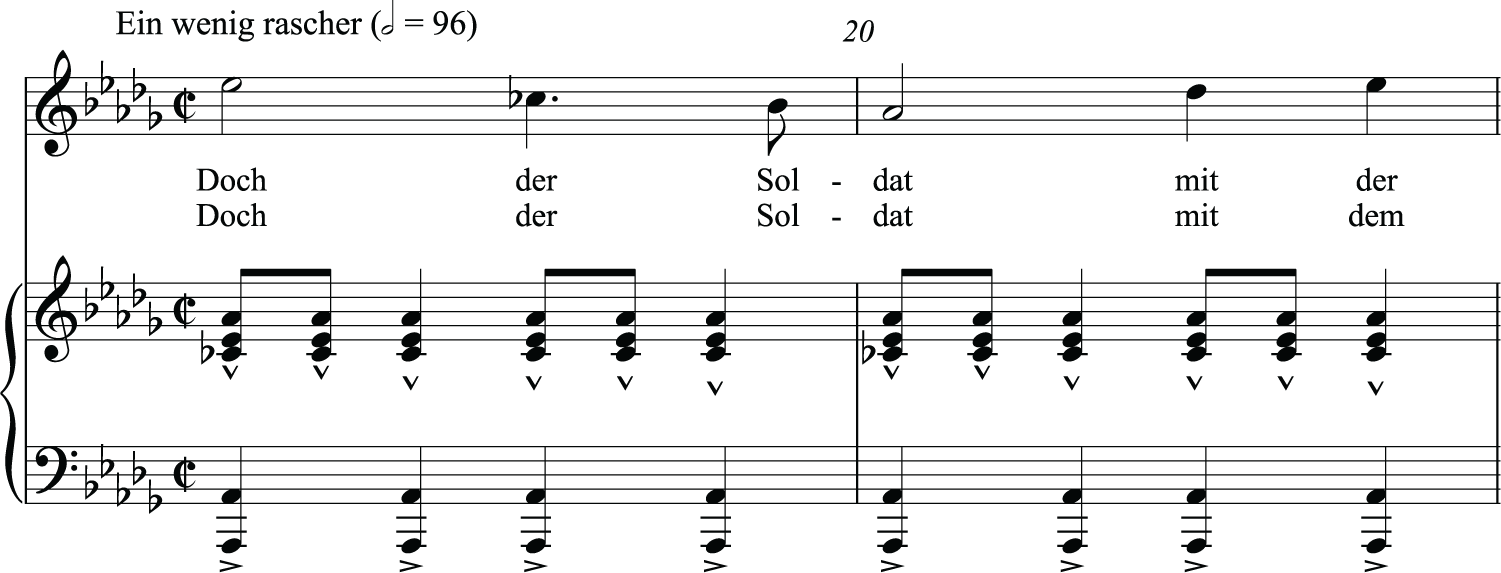
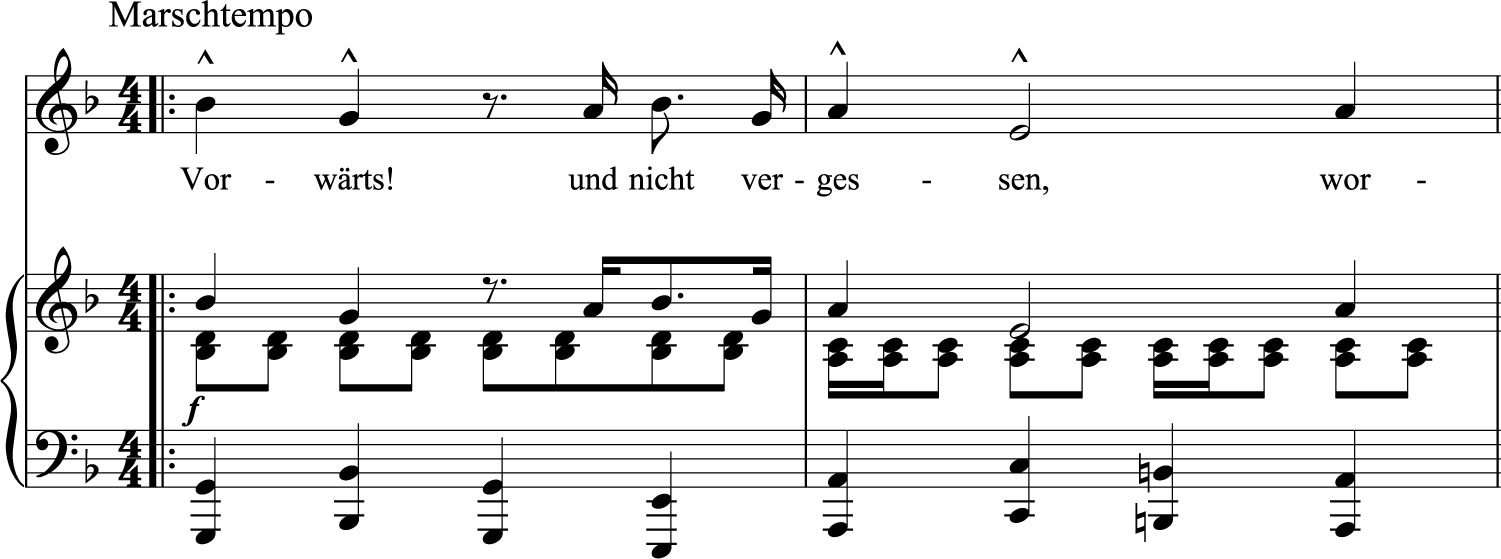
Eisler also varied the steady beat of the Eisler Bass with subdivisions in the middle voices, again following the practices of German jazz. According to Baresel, one could either subdivide every beat or any individual beat, as seen in Example 5, taken from Das neue Jazzbuch. The first variant in this example, which Baresel writes is also the most common, will be familiar to Eisler scholars: the first two beats of the bar are the rhythmic pattern Manfred Grabs has identified as the ‘Klassenkampf’ (class struggle) motif that recurs throughout Eisler’s Kampfmusik. Footnote 63 Grabs notes that the rhythm has affinities to jazz, and he and others drawing on his work have considered this as an isolated pattern that could reference jazz or popular music.Footnote 64 However, this pattern is just one of many Eisler refunctioned from jazz practice. Further, while Grabs argues that the rhythm loosens the ‘march’ rhythm of the Eisler Bass, Baresel writes that such patterns in jazz ‘liven up the accompaniment with a simultaneous strong emphasis on the metre’.Footnote 65 Examples 6–9 provide a selection of examples of the ways Eisler used and combined variations like those Baresel describes.Footnote 66
Baresel, Das neue Jazzbuch, p. 74: Variations of the basic rhythm.
Eisler, ‘Lied der Bergarbeiter’ (Song of the Miners, text: Anna Gmeyner, 1929), bars 31–34, © by Deutscher Verlag für Musik Leipzig.
Eisler, ‘Ballade vom Soldaten’ (Ballad of the Soldier, text: Bertolt Brecht, 1928), bars 19–20, © by Deutscher Verlag für Musik Leipzig.
Eisler, ‘Lied der Werktätigen’ (Song of the Workers, text: Stephan Hermlin, 1929), bars 17–18, © by Deutscher Verlag für Musik Leipzig.
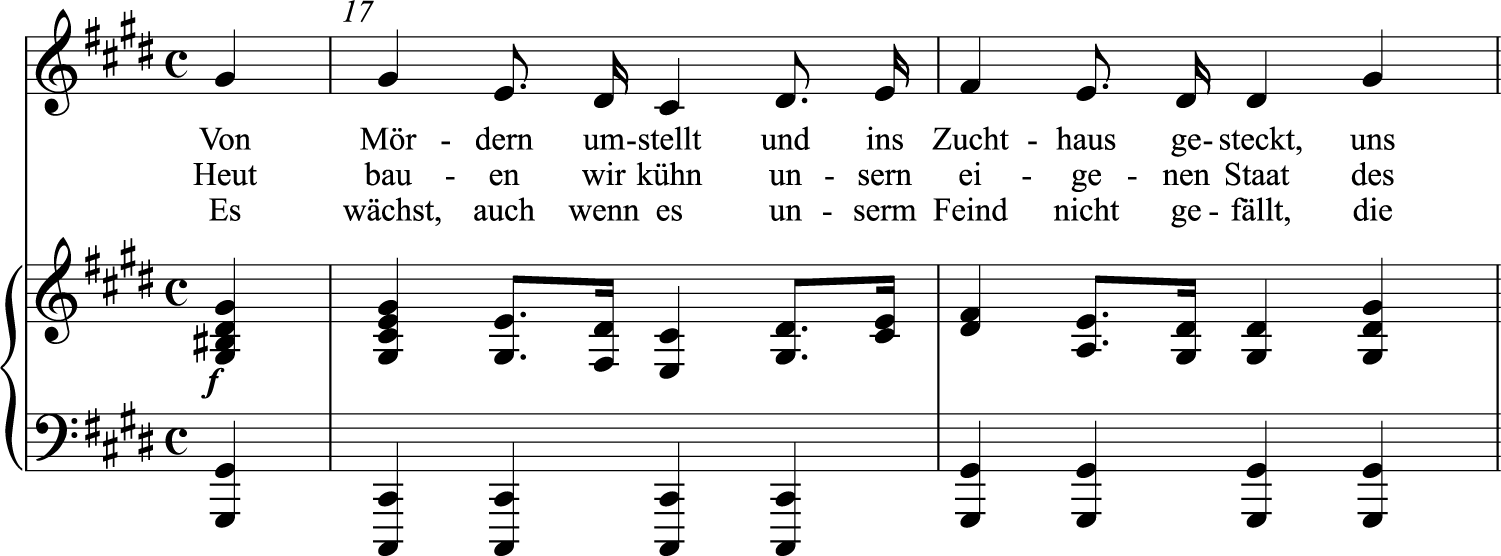
Eisler, ‘Solidaritätslied’ (Solidarity Song, text: Bertolt Brecht, 1931), bars 1–2, © by Deutscher Verlag für Musik Leipzig.
The similarities between jazz practice and Eisler’s Kampfmusik become even more apparent when one considers how the steady beat is orchestrated. As we have seen, in Eisler’s piano writing, the steady beat is placed in the left hand and either doubled or varied in the middle voices of the right. The melody appears in the vocal part, often doubled in the uppermost line of the right hand. This conforms to Baresel’s description:
In solo piano performance, the responsibilities of the accompaniment fall on the left hand. It holds fast to the steady, regular rhythm and plays ‘in straight time’. The right hand brings the artistic means of rhythm into play and plays ‘ragtime’ [i.e. syncopation].Footnote 67
The same is true of Eisler’s ensemble scoring. In German jazz bands, the piano was joined by what we today would call the rhythm section: bass/tuba, banjo/guitar, and percussion.Footnote 68 Mátyás Seiber, director of the first German jazz conservatory course at the Hoch Conservatory in Frankfurt, wrote in his 1929 Schule für Jazz-Schlagzeug (Manual for Jazz Percussion) that the first of the two main responsibilities of the jazz percussionist was ‘to give a rhythmic counterweight to the syncopations of the melody instruments (that is, to hold the fundamental rhythm steady during continual accompaniment)’.Footnote 69 Meanwhile, in his discussion of the other rhythm-section instruments, Baresel writes that the banjo ‘serves — similarly to the piano — the harmonic effect of the rhythm. It strikes chords in wide spacing on every beat according to the metre of the written bar.’Footnote 70
Eisler follows this practice. He almost always includes piano and banjo in his ensembles, and their parts follow Baresel’s guidelines. In an orchestration of the ‘Ballade von den Säckeschmeißern’ (Ballade of the Cargo Loaders, text: Julian Arendt, 1930) in the Eisler archive, for example, he places the steady beat in both verse and chorus in the piano and banjo.Footnote 71 An archival orchestration of the mass song ‘Der heimliche Aufmarsch’ (The Secret Deployment, text: Eric Weinert, 1938) also uses piano and banjo in this fashion.Footnote 72 In ensembles without piano or banjo, Eisler uses alternative instruments for the steady beat, as in an alternative orchestration of ‘Der heimliche Aufmarsch’ found in the archive which uses bassoon to provide middle-voice variation of the steady beat.Footnote 73
Jazz and Machines
In addition to its association with the march, jazz was famously also associated with machine culture in the 1920s. Beyond vague equations of jazz and machines as symbols of modernity, the similarity of the steady beat of jazz to that of a motor became a common trope. In Jazz: Eine musikalische Zeitfrage, Bernhard wrote: ‘In the ensemble, the left hand [on the piano] functions as a typical percussion instrument, as a kind of low drum. Typical for the instrumentation is the accompaniment, which stomps forward in an unshakeable, machine-piston rhythm.’Footnote 74 In his 1927 book on modern music, Die Entgötterung der Musik (literally ‘The De-sacralization of Music’, but published in English translation as ‘Music Come to Earth)’, critic Adolf Weissmann similarly claimed that ‘the piano has truly become a machine, in so far as it underscores the pounding beat of jazz in the bass. But jazz allows the right hand of the player enough room for wild figurations.’ These figurations, however, are ‘restrained by the unyielding rhythm in which the banjo and drums participate in a frantic, machine-like manner’.Footnote 75 Looking back on Weimar jazz from 1939, Ernst Krenek contrasted the seeming primacy of syncopation to the true importance of the mechanically steady beat:
At the outset, jazz used real syncopes. […] But the meter, generally a normal quadruple rhythm, was invariably carried through, mostly by the piano, the bass drum, or the banjo, no matter how far the other instruments might have gone astray in the syncopation. The dull, heavy, unobtrusive throbbing of this central mechanism vibrated with a soothing regularity throughout the piece like a ship’s engine, unaffected by raging gales above. […] The essential feature of jazz is the fictitious suspension of the simple metrical fundamental scheme. […] Under all circumstances […] the subterranean meter [is] imperturbably maintained.Footnote 76
Alongside the mechanical imagery, the emphasis in these quotations on the contrast of syncopation and the steady beat is common in Weimar-era descriptions of jazz. I will return to the effect of this contrast below.
The perceived similarities between jazz and machine rhythms drew the new music into broader debates, as we saw in Bücher’s work, over the potentially dehumanizing character of modern labour and modern life more generally. Indeed, all three authors mentioned above voiced such concerns. Bernhard bemoaned that in jazz, ‘the piano […] is simply reduced to a motor, to a piano-machine’.Footnote 77 The extreme steadiness of the beat was fundamentally inhuman: ‘Just like flipping an electrical switch the musical motor begins to sound, and it dies exactly in beat and rhythm when the switch is turned off, seemingly without a soul.’Footnote 78 Weissmann similarly lamented that ‘the piano, whose soul has been removed and which has been transformed into a percussion instrument, is evidence of de-sacralized music’.Footnote 79 In an essay from 1928, Krenek extended this comparison to the jazz industry and listener, describing the latter as a ‘mass-produced person […] who is created on the conveyor belt and wants to be served by products produced in the same way’.Footnote 80
Other writers reconfigured Bücher’s ideas to absolve the mechanically steady beat of its dehumanizing potential. To do so, they extrapolated from jazz’s African American origins. I highlight these potentially upsetting examples to clarify the association of jazz with machines, as well as to emphasize how thoroughly racialized and racist Weimar-era understandings of jazz and the steady beat were. In an extended essay on the history of jazz in Das neue Jazzbuch, Baresel locates the ‘beginnings of jazz’ in African music that was further developed by African Americans. Although he cites Bücher, Baresel diverges from the economist when he describes the steady beat of African drumming as identical to that of the modern machine. Instead, he integrates jazz and rationalized labour into a long lineage of healthy rhythms:
Let us now remember, that our heart ‘beats’ at regular intervals. The human expects this kind of regularity, an equally regular beat of the sounds of the outer world; he is even pleased when he finds it. Regularity makes work easier: this can be seen by the stonecutters, who let their hammers fall on the stone in alternating intervals of equal duration; an even pace, the fusion of all the marching legs in an audible ‘cadence’, whether induced or accompanied by music, brings the exhausted troops quickly forward; the drudgery of the machine hall becomes more bearable because of the regularity of the machines’ beats — monotony is better than chaos, than disorder. For rhythm eases labour, as it substantially reduces the expenditure of willpower it requires (Karl Bücher, ‘Arbeit und Rhythmus’). Thus we stand before the beating machine and observe a primal rhythm, a long abundance of regular sounds.Footnote 81
Baresel thus links the rhythm of this pre-industrial labour to the modern factory via the cultural work of African Americans. His debt to Bücher is evident not just in his citation, but also in his reference to ‘stonecutters’, an example taken directly from Bücher of labourers whose work generates an audible beat.
A more complicated example comes from Fritz Giese and his 1925 book Girlkultur (Girl Culture). Giese first made a name for himself studying the effects of rationalization and workplace injury (primarily electrical shocks) on telephone operators, who were overwhelmingly young unmarried women.Footnote 82 This led him to write Girlkultur, a sociological study of modern life that brought together discourses of labour rationalization and popular culture via the high-kicking chorus girl. Giese proposes several ways of conceptualizing rhythm, the most relevant being his distinction between ‘biological-natural’ and ‘technical-artificial’ rhythms. The former includes various rhythms of nature (seasons, heartbeats), as well as pre-industrial work rhythms, while the latter defines modern life and labour: ‘modern conveyor belt work […] the development of Taylorism and the related development of industry, traffic, […] business, [and] last of all the emergence of the modern metropolis’.Footnote 83
Giese uses the rhythms of music and dance to illustrate how western culture, which he racializes as white, has become disconnected from modern life: ‘The white person dances in a form that is absolutely inappropriate to the rhythm of the metropolis. The old waltzes, the Boston, or the one-step: they are simply no longer possible.’Footnote 84 The new rhythms of modernity are instead captured by ‘the jazz band and the dance forms connected to it’.Footnote 85 Giese contrasts his characterization of ‘white’ European culture with supposedly ‘primitive’ African culture. He assigns African Americans a mediating role between the two, which he claims enabled them to create jazz. Africans, he writes, ‘are much too close to the primal rhythms of nature’, while African Americans had spent several generations in the United States and forgotten ‘the primal forests of Africa’.Footnote 86 Nevertheless, their African origin gives them a special rhythmic intuition:
[The African American] was the first person who found this new rhythm of the metropolis — the technical, the business-like, and the traffic — absolutely intuitive. […] This grown-up child of nature responded in a way that was just as unmediatedly instinctive [motorisch] as rhythmic, and thus the general cultural good that emerges from America was born: jazz bands and Negro dances.Footnote 87
Returning to his distinction of biological-natural and technical-artificial rhythms, Giese summarizes: ‘The artificial rhythm of the metropolis, whose index was the shimmy and dances that reflected the times, was connected, over and through the nature of the Negro, to the […] natural, biological rhythm that the Negro possessed.’Footnote 88 The cultural work of African Americans thus bridged the primitive and modern rhythms of work, music, and everyday life.Footnote 89
To understand how Giese makes this connection, consider Krenek’s description of the title character of his 1927 opera Jonny spielt auf, an African American jazz musician: ‘Jonny […] is part of the technical-mechanical side of the world, he reacts just as easily, happily, exactly, and amorally as one of these well-constructed machines.’Footnote 90 By this, he means that Jonny does not have the rational or emotional capacities that give the opera’s European characters control over their own behaviour. Instead, Jonny responds to the world instinctively, following only the biological design of the human body, just as a machine responds according to its mechanical design. That Giese’s and Krenek’s goal was to critique European culture as decadent does not lessen the racism at play here.Footnote 91 Indeed, racist imagery of African American impulsiveness as a salve to European over-refinement was common in defences of jazz in the Weimar Republic.Footnote 92
Reflex Reactions
The term Giese uses to describe the instinctive reaction of African Americans to the rhythms of modern industry, motorisch, has obvious connections back to machine culture, but it also refers to an instinctive bodily response. In both German and English, the neurons involved in reflex reactions are called motor neurons. The idea of instinctive responses to rhythms again recalls Bücher, who argued that because regular repetition was the most efficient form of motion, evolution had hard-wired animal life to instinctively synchronize movement to a steady beat.Footnote 93 For him, this formed a biological basis to aesthetics; today it is studied as an effect of entrainment.Footnote 94 Such instinctive responses to rhythm were central to the discourse of both jazz and labour rationalization. In German jazz discourse, they became particularly tied up to ideas about not just the steady beat, but also syncopation. They thus form the next step in understanding Eisler’s refunctioning of the steady beat and also provide an opportunity to consider the role of syncopation and rhythmic disruptions in his Kampfmusik.
Weimar jazz discourse used instinctive, biological responses to the steady beat to explain the music’s popularity. Jazz apologists and opponents alike highlighted its infectious quality: you just couldn’t help but tap your foot. As an article in the radio journal Deutsche Welle humorously noted: ‘People who otherwise won’t budge are rooted out by jazz: [They say,] “Sure, we can do that. Just a few steps.” This comes from the music, something foolishly pleasing. One mocks, but one participates.’Footnote 95 Siegfried Kracauer described a similar experience while attending a jazz revue in Frankfurt in 1928: ‘It is a hard lot, only being able to look, for the music goes straight to your legs, which want to dance along at any price.’Footnote 96 Related to this are the many descriptions of jazz as ‘hypnotic music’, in which the regularity of the beat mesmerized dancers and compelled them to dance. As one observer noted, dancers ‘did not move themselves how they wished: they are set into motion by this music’.Footnote 97
Others were more ambivalent. While they celebrated jazz, they also expressed reservations about the hypnotic effect of the steady beat and its power to suppress individual subjectivity; above we saw Weissmann and Bernhard describing this as dehumanizing. A common solution to this conundrum was to valorize the rhythmic contrast provided by syncopation. Like the steady beat, syncopation was thought to trigger its own instinctive and bodily response. It had a natural disruptive quality, as illustrated in an account by the journalist Hans Siemsen:
[The dancers] march calmly and slowly according to the beat of the bass drum, but suddenly a shrill note on the flute drives into their bones, their knees knock together, and they proceed a few steps with completely contorted and shivering legs, until they once again find the calm beat of the bass drum.Footnote 98
But while the steady beat had an instinctive appeal on its own, Weimar jazz writers generally understood the effect of syncopation as arising from its contrast with a well-articulated steady beat. As Baresel writes:
The excitement of jazz music lies in the way that a rhythmic struggle between melody and accompaniment plays out before our eyes, or rather, our ears. The melody constantly rebels against the correct flow of the beat, and this only becomes noticeable and appealing because the accompaniment does not […] waver in this flow.Footnote 99
For many observers, it was thus the contrast of the steady beat and syncopation that redeemed jazz of potential negative dehumanizing associations. In an article titled ‘Sociology of Jazz’, Manfred Bukofzer explicitly read these issues through the lens of modern machine labour. Syncopation (which he terms polyrhythm) represents the triumph of individual subjectivity over the steady beat of the machine:
Today, people want to forget the everyday through the everyday; in art, they re-encounter the everyday. In music, they detect the rhythm of the machines that they must serve. Improvised polyrhythm, the strategic destruction of the motor principle, neutralizes the monotonous stomping with countermotion. It represents the triumph of the spirit over the machine to which the person is subjected.Footnote 100
Bukofzer’s analysis is especially notable because he participated in Eisler’s study group at the Berlin Marxist Workers’ School, and therefore we might expect Eisler to have a similar view.Footnote 101 Eisler’s treatment of syncopation in his Kampfmusik, however, suggests that while he shared Bukofzer’s evaluations of these rhythms’ effects and connotations, his end goal was rather different.
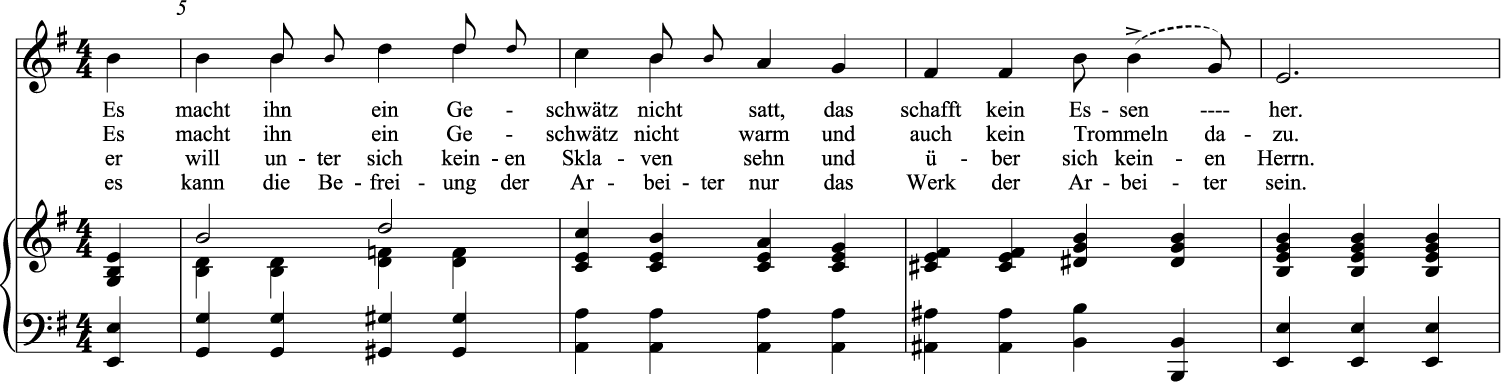
Previous scholarship on Eisler has emphasized that he wanted his listeners and musicians to critically engage with the words of his songs. His fleeting use of syncopation or similar metric disruptions have thus been understood as jarring moments of rhythmic dissonance that force an active, critical mode of listening, much like Brecht’s alienation effect.Footnote 102 While the context above supports this interpretation, we should be careful not to over-emphasize the disruptive effect. Outside of those ballads that parody jazz, syncopation or other metrical disruptions occur rarely in Eisler’s Kampfmusik. For example, there is only one occurrence of syncopation in the entire ‘Einheitsfrontlied’ (Example 10). Notably, Eisler’s practice is unlike that of other classically trained communist composers who also emphasized critical engagement with text and ideas. For example, Werner Fuhr writes that in Wladimir Vogel’s ‘Jungpionierenschritt’ (March of the Young Pioneers, text: Franz Bönsch, 1931), ‘the strong beats of the metre […] are not sounded in the sung melody or in the accompaniment, but rather are made unclear; the marchers must set their steps against the music’.Footnote 103 However, in Eisler’s fleeting moments of syncopation, he follows jazz practice. As shown in Example 10, syncopation occurs in the melody, creating a contrast with the steady beat in the middle and lower voices. Eisler clearly wanted to emphasize primarily the steady beat, with only rare disruptions.
Eisler, ‘Einheitsfrontlied’ (Song of the United Front, text: Bertolt Brecht, 1935), bars 5–8, © by Deutscher Verlag für Musik Leipzig. Note the syncopation in the melody, bar 7.
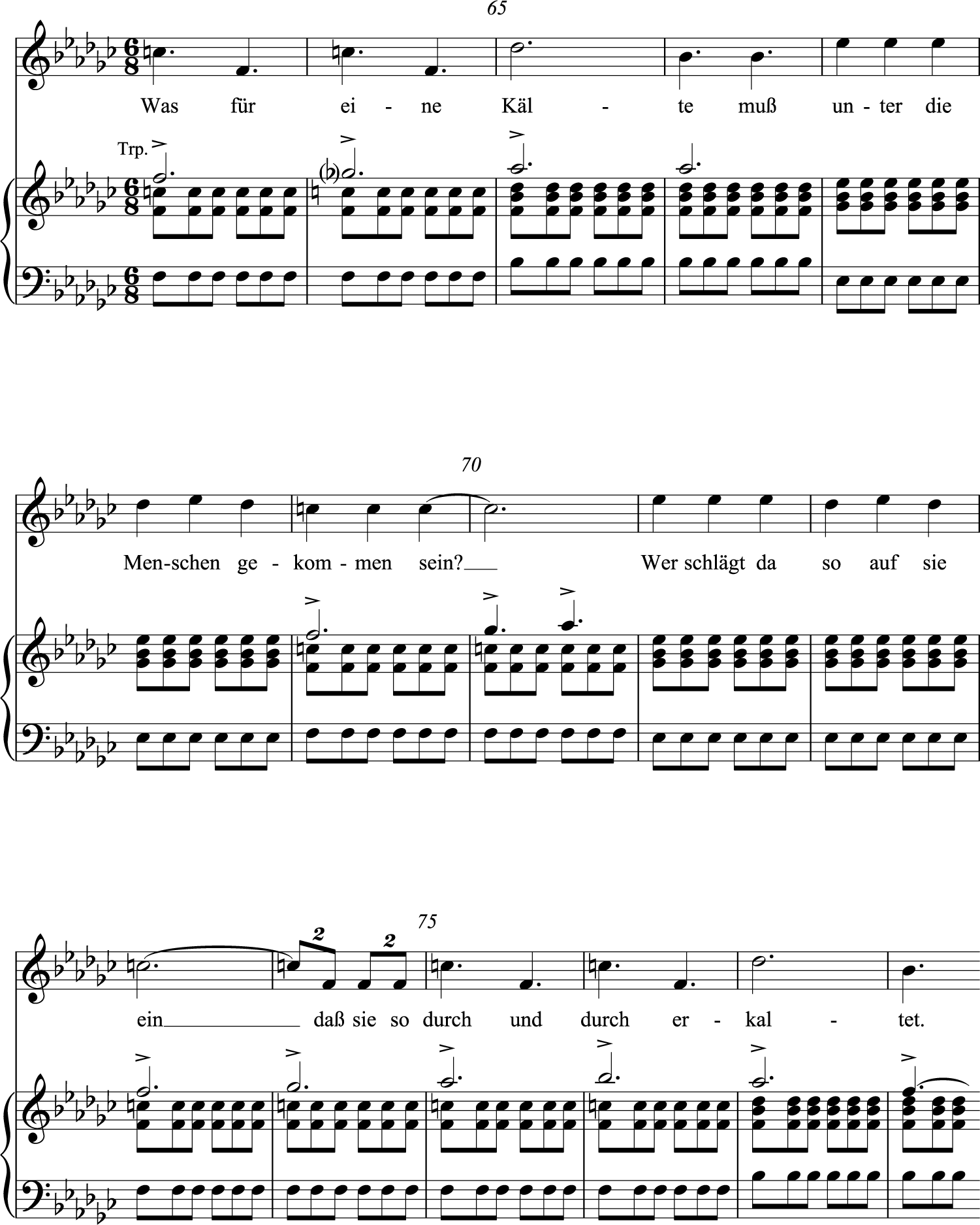
The same is true of metrical disruptions other than syncopation in Eisler’s Kampfmusik. Such disruption occurs somewhat more frequently, from shifts between duple and triple time to interpolations of bars of irregular metre.Footnote 104 Nevertheless, these shifts are accompanied by a steadily articulated sub-tactile beat. An extreme example is the ballad ‘O Fallada, da du hangest’ (O Fallada, Because You Stumbled, text: Bertolt Brecht, 1932). It is sung from the perspective of a horse who stumbles and falls on the streets of Berlin during the final months of World War I, when Germany faced severe food shortages. Residents of the nearby houses, who had previously doted on it, now rush out and flay the not-yet-dead horse for its meat. The steady beat comes at the end of the song as the horse reflects on the social conditions that led to this situation; as in the examples of ballads earlier, this is the lesson of the song that is meant to stick in the audience’s memory. Here the steady beat articulates regular quavers as the implied metre of the melody shifts from 6/8 (bars 63–66), to 3/4 (bars 67–73), 2/4 (bar 74), and back to 6/8 (bars 75–78) (Example 11).
Eisler, ‘O Fallada, da du da hangest’ (O Fallada, Because You Stumbled, text: Bertolt Brecht, 1932), bars 63–78, © by Deutscher Verlag für Musik Leipzig.
Eisler’s extensive use of the steady beat makes clear that he was drawn to its anti-subjective potential. Communist thought embraced ‘enlightened collectivism’ over ‘capitalist individualism’.Footnote 105 Individual subjectivity was understood to be a bourgeois invention, and the ‘machine man’ as an icon of the individual stripped of their subjectivity was a popular trope in communist and leftist culture.Footnote 106 While Eisler’s use of syncopation and metric disruption indicates that he wanted performers and listeners to think critically about the songs’ texts, this only went so far. Active engagement was meant to deepen one’s understanding and commitment, not open the possibility that communism was wrong.
Rationalizing the Revolution
As mentioned above, Eisler claimed that his Kampfmusik ‘derives new methods from the daily struggle of the revolutionary working class’ and ‘makes concrete the correct methods for seizing power’.Footnote 107 In doing so, it would also become ‘the true folk music of the proletariat’.Footnote 108 Just as folk music had emerged from the rhythms of pre-industrial labour and thus had been able to facilitate a seamless transition between work and non-work activities, the steady beat of jazz, understood to be a sonic equivalent to the steady beat of a motor, provided Eisler with a rhythm that enabled his Kampfmusik to be heard as emerging from the labour of modern factory workers. It could thus also facilitate their seamless movement between work and non-work. But rather than dance or religious ritual, as in Bücher’s account of pre-industrial society, Eisler’s workers engaged in a different kind of non-work activity.Footnote 109 Here, we turn our attention to how Eisler’s Kampfmusik ‘makes concrete the correct methods for seizing power’.
On a superficial level, refunctioning the steady beat of workers’ labour (their struggle) provided a beat for marching (a concrete activity that contributed to seizing power). On a more fundamental level, just as the steady beat of the machines was essential to the rationalization of factory labour, the steady beat of Kampfmusik made concrete the correct method for seizing power by rationalizing revolutionary activity. Communist workers were intended to behave in ways modelled on their behaviour in the factory — not their actual motions at the machines, but their performance of small, rationalized tasks. Just as specialist engineers worked out the most efficient means of manufacturing a product, so too did the party’s political specialists work out the (supposedly) most efficient means of achieving revolutionary social change. As on the conveyor belt, the specific tasks assigned to an individual revolutionary may have seemed insignificant, but they contributed to the creation of a larger product: the revolution.Footnote 110
Such rationalized revolutionary activity required the same psychological adjustments from workers that they were accustomed to in their rationalized factory work, most importantly the suppression of the individual ego. This was an explicit lesson of Eisler and Brecht’s stage work Die Massnahme. In this piece, a young activist ignores his instructions from the party and instead does what seems right from his perspective in the moment. His actions lead to violent suppression of the workers and endanger the entire party. In the end, he agrees that his comrades must kill him and destroy his body in order to protect their revolutionary work — the ultimate subordination of individuality to the collective.Footnote 111 In less explicit ways, this message of self-abnegation and submission to the strictures of rationalized revolutionary work permeates Eisler’s other Kampfmusik, from songs calling on workers to join specific revolutionary organizations to ballads instructing workers in the larger social forces that oppress the working class.
Additionally, Eisler’s ideas about Kampfmusik becoming ‘the true folk music of the proletariat’ point to his broader international ambitions and the meanings of jazz.Footnote 112 Just as the spread of modern factory labour liquidated local folk cultures, Eisler argued that jazz played a key role in capitalism’s gradual erasure of national cultures and the nation state as part of the dialectic of history.Footnote 113 He observed that:
Light bourgeois music has transformed its patriarchal entertainment character, which shows national characteristics, into an international, industrialized intoxicant. One hears the same jazz music in the bars of Berlin, Shanghai, or Chicago. […] At the same time, the death of folk music is completed: in the industrialized nations, there is no more folk music; the farmer in Germany, in Scotland, […] in North America, the Negro in South Carolina listens to the same international popular music on the radio.Footnote 114
In his dialectical analysis, industrialization and jazz cleared the way for a new international workers’ culture to take shape. This goal was stated explicitly in the ‘Solidaritätslied’ (Solidarity Song, text: Bertolt Brecht, 1930), the second verse of which opens with an address to people ‘black, white, brown, [and] yellow’.Footnote 115 Brecht reiterated this sentiment in a 1938 claim that Eisler’s mass songs had become the shared heritage of ‘millions of workers of white, black, and yellow races’.Footnote 116 These references to skin colour may be intended simply to capture the widespread international appeal of Eisler’s music, but they also emphasize cross-cultural acceptance of the music by these people. The use of skin colour as a convenient marker for cultural difference should remind us of the racialized discourse of jazz on which Eisler’s entire project rests, demanding a consideration of the racial politics of his Kampfmusik.
Based on the previous narrow view of Eisler’s refunctioning of jazz, Eisler scholarship has tended to praise the composer for his progressive racial politics.Footnote 117 As we saw above, ballads like the ‘Lied der Baumwollpflücker’ parody jazz to symbolize racial oppression, and others, like the ‘Lied des Händlers’, abstract the parody of jazz to symbolize capitalist oppression more generally. This abstraction is central to the message of these ballads: German workers learn that racial oppression is part of a broader system of capitalist oppression and that both the struggle for racial liberation abroad and the workers’ struggle in Germany are part of an international struggle for workers everywhere. This message exemplifies an affirmative answer to one of the great controversies about Marxism and race: whether or not racial oppression should be understood as a subcategory of class-based capitalist oppression (sometimes referred to as a ‘class-first’ approach).Footnote 118
Already at the time, communist anti-colonial activists mounted critiques of this class-first approach and advocated the importance of considering the specificity of race and other identities as a vector of oppression.Footnote 119 Contemporary historians have further critiqued the class-first approach for leading, in practice, to the erasure of difference within the party and the construction of an imagined working-class subject (or working-class masses) who was white, male, heterosexual, and able-bodied. Issues that directly affected those with this constellation of identities were considered universal concerns of the working class, while issues that did not were considered secondary to the broader class struggle.Footnote 120 To remain with the example of race, Robbie Aitken and others have explored how this impacted the Weimar Republic’s non-white population of mostly former colonial subjects: after World War I, their ambiguous legal status in Germany as well as general racial prejudice made it difficult for them to find work and housing or to access basic services.Footnote 121 Yet these concerns were not taken up by the German Communist Party, which tended to view workers from Germany’s former colonies not as members of the German working class but as representatives of colonized lands, to be trained and returned to organize communist anti-colonial activity. Some were also recruited as lecturers to educate the German working class about the anti-colonial struggle and international solidarity, but not about racial prejudice in Germany.Footnote 122
Eisler’s parodies of jazz in songs like the ‘Lied der Baumwollpflücker’ may seem to represent at least a partial counterexample to such claims of erasure. While they locate people of colour outside Germany’s borders (thus still erasing Black populations at home), they do evince a certain degree of active concern with racial oppression in the United States as a form of capitalist oppression. Eisler’s broader practice of refunctioning the steady beat, however, is deeply tied to larger patterns of erasure. Indeed, it is fundamentally based on a form of erasure: that of supposed ‘ideological content’. By stripping jazz down to a single feature, the steady beat, Eisler removed much of what made the steady beat identifiable as jazz, like its combination with syncopated melodies or jazzy harmonies. In its new context, one might still recognize it as jazz-derived if one focused on it in isolation. But heard in the full context of the Kampfmusik, this association would be buried in a list of other, more readily apparent references that focus attention on the concerns of the imagined white, male, working-class subject.
This can be seen in the reception of Eisler’s Kampfmusik, both in its time and since. I’ve highlighted a handful of examples where interwar critics linked the driving rhythms of the Kampfmusik to jazz, but these are relatively rare. They demonstrate that it certainly was possible for a listener of the time to recognize the influence of jazz in the Eisler Bass, but also how easy it was for listeners of the time to focus on other referents. Indeed, most criticism focuses on how the music relates to workers or workers’ issues, or to debates about communist aesthetics. Meanwhile, the narrow focus on Eisler’s songs that imitate jazz in the historiography of his Kampfmusik demonstrates how easily the jazz influence on the Eisler Bass could be lost.
Eisler’s participation in the erasure of race in German communist culture had real-world consequences. As scholars like Atina Grossmann have demonstrated, the German Communist Party’s erasure of gender difference and neglect of ‘women’s issues’ contributed to its perpetual difficulty recruiting women, and thus to its failure to realize its political ambitions.Footnote 123 Grossmann’s findings are generally applicable to the party’s similar challenges recruiting Germans of colour (as well as queer and disabled Germans).Footnote 124 While a thorough investigation of gender (or sexuality or ability) in Eisler’s Kampfmusik is beyond the scope of this article, we can see that as regards race, by so effectively promoting the ideals of the German Communist Party, Eisler also perpetuated its biases and likely contributed to its failure to achieve its political ambitions.
Conclusion
This article has argued that Eisler’s refunctioning of jazz in his Kampfmusik extended further than has previously been recognized. Beyond a small number of ballads that, in his own words, ‘imitate’ jazz, Eisler also refunctioned the characteristic rhythm of jazz as it was understood in Weimar Germany: a steady beat. This beat became a defining feature of his music, the so-called ‘Eisler Bass’, and was central to his music-political ambitions. On the one hand, the beat was understood to have an instinctive appeal that brought listeners into coordinated movement. Eisler’s working-class audiences were already conditioned to working to a mechanically steady beat in their factories; by refunctioning this rhythm into his Kampfmusik, the composer not only roused the workers to revolutionary activity, but coordinated them according to the rationalized revolutionary plans of the Communist Party. On the other hand, because this beat, and by extension Eisler’s Kampfmusik, emerged out of the rhythms of modern factory labour and participated in the transfer of actions from the factory into the wider world, it dissolved the bourgeois division of work and non-work, laying the foundation for the future socialist society. Jazz provided a crucial discursive link, enabling a mechanical beat to fulfil a function previously thought only capable of being filled by the ‘natural’ rhythms of pre-industrial labour.
Eisler’s nuanced engagement with jazz and machine aesthetics expands our understanding of the way modernist composers approached these influences in the interwar period. Especially in the early 1930s, as many composers began to move away from direct mimetic imitations of the sounds of jazz or of machines, Eisler’s treatment of the steady beat helps us to trace their enduring but less obvious influence in twentieth-century music. Hearing the Eisler Bass as the refunctioned rhythm of jazz and the factory also draws Eisler’s Kampfmusik into conversations beyond the history of musical modernism. His theories and the discourse on which he drew anticipate interest today in issues of embodiment, entrainment, and music’s ability to discipline the body and the body politic. Meanwhile, the racialized nature of this discourse and Eisler’s treatment of race provide historical examples for discussions of cultural appropriation, erasure, and the place of identity politics in political debates then and now.
For the modern listener, it likely remains difficult to hear a steady beat as ‘jazzy’, as this idiosyncrasy of German jazz reception has been largely forgotten. The connection was further obscured after World War II, when Eisler reorchestrated much of his Kampfmusik to reduce any potential similarities between it and the military marches so closely associated in the popular imagination with the Nazi regime.Footnote 125 That said, we should keep in mind that Eisler’s goal was not for his use of the steady beat to be immediately recognized as jazz; when he wanted to draw on specific cultural meanings associated with jazz, he wrote music that imitated it. Rather, the Eisler Bass sought to capture the instinctive appeal and entraining power of jazz. Rediscovering this legacy of German jazz and the steady beat opens up a much richer understanding of Eisler, his music, and his times. It allows us to hear, in the words of the communist newspaper Berlin am Morgen, that ‘Eisler knows how to make artistic use of the pounding rhythms with which jazz has convinced our spineless time that it has a beat’.Footnote 126


 Open access

