


The benefits of an adequate intake of fruit and vegetables have been observed in a wide range of epidemiological studies(Reference Ford and Mokdad1–Reference Key, Allen and Spencer5). It is well known that an adequate intake of fruit and vegetables not only promotes health but also plays an important role in the prevention of non-communicable diseases such as CVD, obesity and cancer, which are currently the focus of prevention for public health(4, 6, Reference Tomás-Barberán and Gil7).
Most European countries as well as international health agencies have developed recommendations for the desirable level of consumption of fruit and vegetables. The recommendations vary from 400 to 750 g/d(Reference Wolf, Yngve and Elmadfa8). The WHO recommends a population goal for fruit and vegetable consumption equal to or above 400 g/d. Such a recommendation is considered a population average and is important for the maintenance of health(6).
The Pro Children cross-sectional survey has shown that fruit and vegetable consumption among Portuguese mothers as well as their children was high in the European setting, but low compared with the recommendations of 400 g/d. The proportion of compliers to the WHO recommendations was only 44 and 21 % for mothers and children, respectively(Reference Wolf, Yngve and Elmadfa8, Reference Yngve, Wolf and Poortvliet9).
Determinants of fruit and vegetable intake among children, adolescents(Reference McClain, Chappuis and Nguyen-Rodriguez10–Reference Rasmussen, Krolner and Klepp12) and adults(Reference Shaikh, Yaroch and Nebeling13) have been identified by various researchers. From social–environmental determinants, parenting style has been taken into account as one of the determinants of fruit and vegetable intake among children and adolescents(Reference Kremers, Brug and de Vries14–Reference Young and Fors16). Parenting style is globally defined as the general emotional climate between parent and child interactions across a wide range of situations. Although it may be conceptualised differently, according to most usual theories, it is classified according to the amount and quality of two underlying dimensions of parental behaviour– strictness and involvement(Reference Maccoby, Martin, Mussen and Hetherington17). Strictness refers to the extent to which parents show control, maturity demands and supervision in their parenting; involvement refers to the extent to which parents show affective warmth, acceptance and supportiveness. Based on these two dimensions, a four-fold classification of parenting style has been described: (1) the authoritative style (high strictness/high involvement); (2) the authoritarian style (high strictness/low involvement); (3) the indulgent style (low strictness/high involvement); (4) the negligent style (low strictness/low involvement)(Reference Maccoby, Martin, Mussen and Hetherington17). Table 1 summarises these concepts. Within these general parenting styles, parents also display more specific parenting practices, which are typically context-specific behaviours. According to Darling et al. (Reference Darling and Steinberg18), the effectiveness of specific parenting practices is moderated by the general parenting style.
Characteristics of each parenting style*

* Adapted from Maccoby & Martin(Reference Maccoby, Martin, Mussen and Hetherington17).
Parenting style may influence children's food habits, namely fruit and vegetable intake, but to the best of our knowledge, its relationship with parent's own consumption has not been investigated yet. Therefore, we hypothesise that within the family, parenting style may also be associated with parent's food intake. The study of the association between the parenting styles and own fruit and vegetable consumption is relevant independently of the role of parenting styles as moderators of the relationships between children's and mother's intakes. Knowledge on this primary association may help to clarify different processes by which parental intake may influence children's fruit and vegetable intake, namely modelling or common availability and accessibility. In this context, the aim of the present study was to evaluate the association between parenting styles and own fruit and vegetable consumption among Portuguese mothers of 11–13-year-old children. Further studies will address how parenting styles are associated with children's fruit and vegetable intake.
Methods
Participants
The present study is part of the Pro Children cross European survey, in which Portugal is one of nine participating countries(Reference Klepp, Perez-Rodrigo and De Bourdeaudhuij19). The survey was designed to provide information on actual consumption levels of fruit and vegetables in European sixth-grade school children (11–13 years old) and their parents and to assess potential determinants of consumption patterns.
A random national sample of sixty schools was selected from a list provided by the Ministry of Education, which identified all public and private schools with sixth grade. All schools agreed to participate but only thirty-four schools returned the questionnaires. The children completed the questionnaire in the classroom with instructions and help from the teacher and took the questionnaire home to be completed by one of their parents or guardians.
From the total sample of 3044 school children, only 2375 questionnaires were filled in by one of their parents or guardians (participation rate 78 %). Of these, 1853 questionnaires were filled in by mothers or female guardians and 522 by fathers or male guardians. In the present study, data from mothers were included. Of the total sample of 1853 mothers, only 1601 were taken into account in the analysis due to incomplete answers about the FFQ or about the parenting styles. More detailed description of the Pro Children project, including sampling and data collection procedure, has been given elsewhere(Reference Wolf, Yngve and Elmadfa8, Reference Yngve, Wolf and Poortvliet9, Reference Klepp, Perez-Rodrigo and De Bourdeaudhuij19).
Measures
A self-administered questionnaire was developed to assess fruit and vegetable consumption and the parenting styles.
Fruit and vegetable consumption was assessed by a validated FFQ(Reference Kristjansdottir, Andersen and Haraldsdottir20). Mothers were asked how often they usually eat fresh fruit, salad, other raw vegetables and cooked vegetables (four separate questions). Fruit juice, potatoes as well as cooked fruit and vegetables included in composite dishes were not included. The response categories included eight possibilities ranging from ‘never’ to ‘more than twice a day’. The frequency of intake was converted into g/d (using mean portions defined previously), and total vegetable intake and combined fruit and vegetable intake were calculated.
Parenting style was assessed based on previous studies of Steinberg et al. (Reference Steinberg, Elmen and Mounts21), Lamborn et al. (Reference Lamborn, Mounts and Steinberg22) and Avenevoli et al. (Reference Avenevoli, Sessa, Steinberg and Hetherington23). Two dimensions, involvement and strictness, were measured by nine and seven items, respectively. Mothers were asked about different statements with five response possibilities ranging from ‘completely untrue’ to ‘completely true’. The mean score of all items for each dimension was used in the analyses (range 1–5). Internal consistency was satisfactory for both scales: α = 0·80 for involvement and α = 0·78 for strictness.
In order to define the four parenting styles, the scales were dichotomised by a median split. Mothers were subsequently categorised as authoritative (above median on both scales), authoritarian (above median for strictness and below median for involvement), indulgent (above median for involvement and below median for strictness) and neglectful (below median for both scales).
In the Pro Children project, only four countries measured parenting styles (Belgium, The Netherlands, Portugal and Spain)(Reference Klepp, Perez-Rodrigo and De Bourdeaudhuij19, Reference De Bourdeaudhuij, Te Velde and Maes24).
Statistical analyses
Descriptive statistical analyses consisted of the calculation of frequencies, means, standard deviations and medians. One-way ANOVA was used to compare mean ranking of fruit and vegetable intake among the four parenting styles. Pearson's correlation coefficient was used to measure the association between involvement and strictness and the consumption of fruit, vegetables and fruit and vegetables combined. In order to overcome the effect of the association between the two dimensions, partial correlations were also calculated, controlling the associations between consumption and each dimension for the other dimension. Statistical analysis was performed with SPSS version 14.0 (SPSS, Inc., Chicago, IL, USA) for Windows. A P value of < 0·05 was considered to be statistically significant.
Results
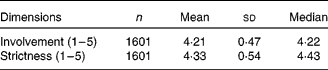
The study sample comprised 1601 Portuguese mothers of school children. Table 2 describes the sample's mean scores on the two dimensions, involvement and strictness, as well as the medians used to dichotomise them. A positive correlation was found between the two dimensions (r 0·652, P < 0·001).
(Mean values, standard deviations and medians)
The distribution of the sample among the four parenting styles is shown in Table 3. Most mothers were found to be either authoritative or neglectful in almost equal proportions (37·5 or 36·9 %, respectively), whereas the remaining 25 % were found to be authoritarian (13 %) or indulgent (12 %).
(Number of children and percentages, n 1601)

Table 4 shows the mean intake of fruit, vegetables and total fruit and vegetables for the whole sample and by parenting style. The highest mean intakes were observed for mothers classified as indulgent, whereas the lowest were observed for mothers classified as neglectful. Differences in intake by parenting styles were significant (P < 0·001) for fruit, vegetables and total fruit and vegetables.
(Mean values and standard deviations)
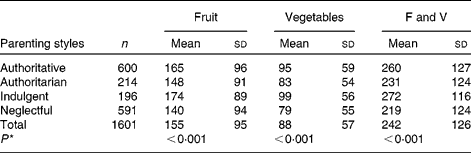
* One-way ANOVA.
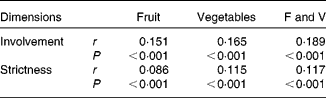
Both dimensions of the parenting style (strictness and involvement) showed a positive correlation with the intake of fruit, vegetables and fruit and vegetables combined, as can be observed in Table 5.
Association between the dimensions of parenting style and fruit, vegetable and total fruit and vegetable (F and V) intakes
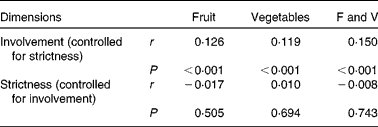
When partial correlations are calculated between each dimension (controlled for the other) and intakes of fruit, vegetables and total fruit and vegetables, only involvement shows a positive association (see Table 6).
Partial correlations between the dimensions of parenting style and fruit, vegetable and total fruit and vegetable (F and V) intakes
Discussion
In the scope of our research, we did not find any other study exploring the association between parenting style and parents' own intake of fruit and vegetables. However, we found some associated relevant studies, which are used to compare and discuss the present results. Significant differences were found in fruit, vegetable and total fruit and vegetable intakes among parenting styles. In general, an indulgent parenting style was associated with higher intake, and authoritative mothers also showed mean intakes above the global mean. Neglectful parenting style was associated with the lowest own fruit and vegetable mean intakes.
When studying the effects of parenting style on children's fruit and vegetable intake, a previous study (which included the children of mothers of the present study) has shown a similar trend: children of parents with neglectful parenting style reported eating less fruit and vegetables compared with children of parents with an authoritative or an indulgent style(Reference De Bourdeaudhuij, Te Velde and Maes24). This association has also been found in other studies carried out by several researchers(Reference Kremers, Brug and de Vries14–Reference Young and Fors16, Reference Pearson, Atkin and Biddle25). For instance, the findings from Kremers et al. (Reference Kremers, Brug and de Vries14) showed that adolescents who were raised in authoritative and indulgent homes consumed more fruit than those raised in authoritarian and neglectful homes. When Lytle et al. (Reference Lytle, Varnell and Murray15) explored the potential predictors of fruit and vegetable consumption in adolescents, they came to the following conclusion: the authoritative parenting style by a mother or female guardian predicted higher fruit and vegetable consumption by adolescents. The study of Pearson et al. (Reference Pearson, Atkin and Biddle25) has shown that significant effects for parenting style were observed for all dietary behaviours in adolescents. Adolescents who described their parents as authoritative ate more fruits/per day, fewer unhealthy snacks per day and took breakfast on more days per week than those who described their parents as neglectful.
Additional findings in the present study show that, from the dimensions, strictness and involvement, only involvement has a positive association with own consumption of fruit and vegetables among Portuguese mothers. Involvement, as has already been stated, is defined as the affective warmth between parent and child expressed by supportiveness and understanding. High involvement is common to the authoritative and indulgent parenting styles, in which we found the higher levels of fruit and vegetable consumption.
Once the parenting style shows a similar relationship with children's and parents' own intakes, it may support the hypothesis of modelling as a determinant/predictor of intakes of fruit and vegetables among children. This statement has been found in other studies as revealed by two recent reviews carried out by McClain et al. (Reference McClain, Chappuis and Nguyen-Rodriguez10) and Pearson et al. (Reference Pearson, Biddle and Gorely11) dealing with the determinants of fruit and vegetable consumption in children and adolescents.
In the Pro Children study, when De Bourdeaudhuij et al. (Reference De Bourdeaudhuij, te Velde and Brug26) explored the personal, social and environmental predictors of daily fruit and vegetable intake in children, parental modelling was also associated strongly and consistently with daily fruit intake across all nine European countries. However, for daily intake of vegetables, this trend was weaker but still consistent. Therefore, this finding should be considered in future interventions; moreover, it should encourage parents to be a positive role model in their children's eating habits.
The main limitation of the present study is that, as a cross-sectional study, it cannot express causality between parenting styles and intakes. However, because of the complex relationship among parenting styles, children's intake and parents' intake, it is of increasing relevance to explore their associations. One of the strengths of the present study is the large and representative sample; so in future, we intend to study the association among these three variables in the same sample (mother and respective child).
Conclusion
The present exploratory study shows that fruit and vegetable consumption of Portuguese mothers of 11–13-year-old school children seems to be related to their own parenting styles, especially with the dimension involvement, which has a positive association with intakes. It appears that parental involvement should be considered as a component of family-based nutrition interventions to promote fruit and vegetable consumption.
Furthermore, in order to develop effective interventions, it is necessary to fully understand the association among parenting styles and intakes of parents and their children. This influence may happen not only through parenting style but also indirectly through role modelling. Future research should address these associations.
Acknowledgements
The authors declare that they have no conflict of interests. The present study was carried out with financial support from the Commission of the European Communities, specific RTD programme ‘Quality of Life and Management of Living Resources’, QLKI-2001-005472 ‘Promoting and Sustaining Health Through Increased Vegetable and Fruit Consumption among European Schoolchildren’ (Pro Children). Special thanks to parents who took the time to participate in the study. Also we thank people who were involved in the data collection (e.g. children, headmasters, teachers and staff). B. F., K.-I. K. and M. D. V. A. were involved in the conception and design of the study. B. F. was responsible for the data collection, analysis, interpretation and drafting of the manuscript. R. P. supported and contributed to the statistical analysis and interpretation of the data. K.-I. K. and M. D. V. A. provided critical feedback on drafts. All authors agreed and approved the final version to be published.



