





1. Introduction
The idea behind the theory of linearly distributive categories (LDC) as introduced by Cockett and Seely (Reference Cockett and Seely1997) is that (the multiplicative fragment of) linear logic is best modeled by taking the two multiplicative connectives, $\otimes$
(tensor) and
$\otimes$
(tensor) and $\oplus$
(par), as primitive. One then obtains a category with two monoidal structures, related by linear distributions. A linear distribution is a natural transformation, not an isomorphism typically, of the following form or a symmetric equivalent:
$\oplus$
(par), as primitive. One then obtains a category with two monoidal structures, related by linear distributions. A linear distribution is a natural transformation, not an isomorphism typically, of the following form or a symmetric equivalent:
 \begin{equation*}A\otimes (B\oplus C)\rightarrow (A\otimes B)\oplus C\end{equation*}
This approach to the model theory of linear logic differs from the original approach, using the $*$
-autonomous categories of Barr (Reference Barr1979), which take tensor and negation as primitive and then define the par by de Morgan duality.
$*$
-autonomous categories of Barr (Reference Barr1979), which take tensor and negation as primitive and then define the par by de Morgan duality.
Just as monoidal categories can be viewed as one-object bicategories, one can ask for the bicategorical version of linearly distributive categories. These are the linear bicategories of Cockett et al. (Reference Cockett, Koslowski and Seely2000), which provide a natural semantics for non-commutative linear logic. The primary goal of this paper is to give new classes of linear bicategories arising from several different sources.
Before diving into the formal definitions, we describe the example that led to the more general discussion below. The structures we consider are two ordered semiring structures on the extended integers ${{\mathbb{Z}}_{\infty }}=\mathbb{Z}\cup \{+\infty ,-\infty \}$
, as examined by Golan (Reference Golan2003). (One could just as well consider the extended reals.) This set, in fact, has two semiring structures, and these are typically called the tropical and arctic semirings. They are of great use in the theory of synchronization as considered in Baccelli et al. (Reference Baccelli, Cohen, Olsder and Quadrat1992). See Droste and Kuich (Reference Droste, Kuich, Droste, Kuich and Vogler2009) and Droste et al. (Reference Droste, Kuich and Vogler2009) for how extensively these structures arise.
${{\mathbb{Z}}_{\infty }}=\mathbb{Z}\cup \{+\infty ,-\infty \}$
, as examined by Golan (Reference Golan2003). (One could just as well consider the extended reals.) This set, in fact, has two semiring structures, and these are typically called the tropical and arctic semirings. They are of great use in the theory of synchronization as considered in Baccelli et al. (Reference Baccelli, Cohen, Olsder and Quadrat1992). See Droste and Kuich (Reference Droste, Kuich, Droste, Kuich and Vogler2009) and Droste et al. (Reference Droste, Kuich and Vogler2009) for how extensively these structures arise.
In both, multiplication is given by the usual addition of integers. But we must be careful in defining $\infty +-\infty$
. In the first structure, we define
$\infty +-\infty$
. In the first structure, we define $-\infty +_1\infty =-\infty =\infty +_1-\infty$
. The addition to this structure is given by max. This gives
$-\infty +_1\infty =-\infty =\infty +_1-\infty$
. The addition to this structure is given by max. This gives ${\mathbb{Z}}_\infty$
the structure of an ordered semiring with
${\mathbb{Z}}_\infty$
the structure of an ordered semiring with ${\mathbb{Z}}_\infty$
equipped with its usual order.
${\mathbb{Z}}_\infty$
equipped with its usual order.
For the second structure, we again have that the multiplication is given by addition. But analogously, we now must have $-\infty +_2\infty =\infty =\infty +_2-\infty$
. The addition for this structure is given by min. This gives
$-\infty +_2\infty =\infty =\infty +_2-\infty$
. The addition for this structure is given by min. This gives ${\mathbb{Z}}_\infty$
the structure of an ordered semiring with
${\mathbb{Z}}_\infty$
the structure of an ordered semiring with ${\mathbb{Z}}_\infty$
equipped with the opposite of its usual order.
${\mathbb{Z}}_\infty$
equipped with the opposite of its usual order.
If $X$
and
$X$
and $Y$
are sets, we will define a
$Y$
are sets, we will define a ${\mathbb{Z}}_\infty$
-relation from
${\mathbb{Z}}_\infty$
-relation from $X$
to
$X$
to $Y$
to be a function
$Y$
to be a function $R\colon X\times Y\rightarrow {{\mathbb{Z}}_\infty }$
. As in the category of relations, we consider this as a morphism
$R\colon X\times Y\rightarrow {{\mathbb{Z}}_\infty }$
. As in the category of relations, we consider this as a morphism $R\colon X\nrightarrow Y$
. Then the two semiring constructions above allow us to define two distinct relational compositions.
$R\colon X\nrightarrow Y$
. Then the two semiring constructions above allow us to define two distinct relational compositions.
Explicitly, given $X\stackrel {A}{\nrightarrow }Y \stackrel {B}{\nrightarrow }Z$
, we define
$X\stackrel {A}{\nrightarrow }Y \stackrel {B}{\nrightarrow }Z$
, we define
 \begin{equation*}A\otimes B(x,z)=\bigvee _{y\in Y}(A(x,y)+_1B(y,z)) {\,\,\,\,\,\,\,\,\,\,\,\,\,\,\,\,\,\,\,\,}A\oplus B(x,z)=\bigwedge _{y\in Y}(A(x,y)+_2B(y,z))\end{equation*}
We are of course using the fact that both ${\mathbb{Z}}_\infty$
and
${\mathbb{Z}}_\infty$
and $\mathbb{Z}_\infty ^{op}$
are not just semirings with the above structures but are in fact quantales. We are thus following the program of monoidal topology as described in Hofmann et al. (Reference Hofmann, Seal and Tholen2014).
$\mathbb{Z}_\infty ^{op}$
are not just semirings with the above structures but are in fact quantales. We are thus following the program of monoidal topology as described in Hofmann et al. (Reference Hofmann, Seal and Tholen2014).
The current project began with the observation that the two compositions described above are related by a linear distribution and, in fact, determine a locally posetal linear bicategory. On the other hand, we have the observation that ${\mathbb{Z}}_\infty$
with the above operations is a Girard quantale, as investigated by Yetter (Reference Yetter1990) and Rosenthal (Reference Rosenthal1990), and the two structures are related by the Girard duality.
${\mathbb{Z}}_\infty$
with the above operations is a Girard quantale, as investigated by Yetter (Reference Yetter1990) and Rosenthal (Reference Rosenthal1990), and the two structures are related by the Girard duality.
We first introduce the quantale analog of linearly distributive categories and the quantaloidal analog of linear bicategories in Section 4, which we call LD-quantales and linear quantaloids, respectively. These definitions will underlie most of our main results. All Girard quantales are LD-quantales, and all Girard quantaloids are linear quantaloids.
Our first result in Section 5 is that the category $Q\text{-}{\sf Rel}$
is a Girard quantaloid, defined by Rosenthal (Reference Rosenthal1992), and therefore, a locally posetal linear bicategory if and only if
$Q\text{-}{\sf Rel}$
is a Girard quantaloid, defined by Rosenthal (Reference Rosenthal1992), and therefore, a locally posetal linear bicategory if and only if $Q$
is a Girard quantale. This extends naturally to the case where
$Q$
is a Girard quantale. This extends naturally to the case where $Q$
is an arbitrary LD-quantale. We then provide concrete examples of
$Q$
is an arbitrary LD-quantale. We then provide concrete examples of $Q\text{-}{\sf Rel}$
as a linear quantaloid.
$Q\text{-}{\sf Rel}$
as a linear quantaloid.
In Section 6, following the general theory of enriching in a bicategory and the work of Rosenthal (Reference Rosenthal1992), we introduce the quantaloid $\mbox{$\mathscr{Q}$-${\sf Mod}$}$
, whose 0-cells are
$\mbox{$\mathscr{Q}$-${\sf Mod}$}$
, whose 0-cells are $\mathscr{Q}$
-categories, 1-cells are
$\mathscr{Q}$
-categories, 1-cells are $\mathscr{Q}$
-modules, and 2-cells are pointwise inequalities, where
$\mathscr{Q}$
-modules, and 2-cells are pointwise inequalities, where $\mathscr{Q}$
is a Girard quantaloid.
$\mathscr{Q}$
is a Girard quantaloid. $\mbox{$\mathscr{Q}$-${\sf Mod}$}$
is then itself a Girard quantaloid. This leads to considering enrichment in a linear quantaloid
$\mbox{$\mathscr{Q}$-${\sf Mod}$}$
is then itself a Girard quantaloid. This leads to considering enrichment in a linear quantaloid $\mathscr{Q}$
and the introduction of the bicategory
$\mathscr{Q}$
and the introduction of the bicategory $\mbox{$\mathscr{Q}$-${\sf Mod}$}$
of linear
$\mbox{$\mathscr{Q}$-${\sf Mod}$}$
of linear $\mathscr{Q}$
-categories and linear
$\mathscr{Q}$
-categories and linear $\mathscr{Q}$
-modules. It is shown to be a linear quantaloid if and only if
$\mathscr{Q}$
-modules. It is shown to be a linear quantaloid if and only if $\mathscr{Q}$
is itself linear. This result proceeds by first proving the corresponding theorems for linear monads in
$\mathscr{Q}$
is itself linear. This result proceeds by first proving the corresponding theorems for linear monads in $\mathscr{Q}$
and matrices in
$\mathscr{Q}$
and matrices in $\mathscr{Q}$
. Given these new constructions, we provide more examples of locally posetal linear bicategories, using the linear quantaloids presented in the previous section.
$\mathscr{Q}$
. Given these new constructions, we provide more examples of locally posetal linear bicategories, using the linear quantaloids presented in the previous section.
We finally develop non-local poset examples as well. This is done in Section 7. We begin by considering $\mathcal{L}\mathrm{oc}$
, the bicategory whose objects are locales, 1-cells are bimodules, and two-cells are bimodule homomorphisms, which we use to illustrate a more general notion. This turns out to be what Cockett et al. (Reference Cockett, Koslowski and Seely2000) refer to as cyclic
$\mathcal{L}\mathrm{oc}$
, the bicategory whose objects are locales, 1-cells are bimodules, and two-cells are bimodule homomorphisms, which we use to illustrate a more general notion. This turns out to be what Cockett et al. (Reference Cockett, Koslowski and Seely2000) refer to as cyclic $*$
-autonomous bicategories, which are linear bicategories. We show that a number of classic examples of bicategories fit into this framework. In particular, the bicategories of quantales and of quantaloids (with their respective modules) are linear bicategories.
$*$
-autonomous bicategories, which are linear bicategories. We show that a number of classic examples of bicategories fit into this framework. In particular, the bicategories of quantales and of quantaloids (with their respective modules) are linear bicategories.
Remark 1.1. There are unfortunate notational conflicts between linear logic notation and the usual notation for ordered structures, as well as within the linear logic community. We now give our choice for notation for the remainder of the paper, chosen to be in line with the notation of Cockett and Seely (Reference Cockett and Seely1997) and Cockett et al. (Reference Cockett, Koslowski and Seely2000).
-
• For partially ordered sets, we will denote the top element by $\textbf {1}$
and the bottom element by
$\textbf {0}$
, if they exist.
$\textbf {1}$
and the bottom element by
$\textbf {0}$
, if they exist. -
• We will denote quantales by
$Q$
and quantaloids by
$\mathscr{Q}$
. -
• The composition of arrows will be written in diagrammatic order.
-
• In a monoidal category, we will use
$\otimes$
to denote the tensor product and
$\top$
to denote the unit, including in the case of quantales, as opposed to
$\&$
used by Mulvey (Reference Mulvey1986). Moreover, we will use
$\otimes$
to denote composition in a bicategory and
$\top _{X}$
or
$\top \!\!\!\top _X$
to denote the identity 1-cell on
$X$
, in particular in the case of quantaloids. -
• In a
$*$
-autonomous or linearly distributive category, there is a second monoidal structure, which we will denote by
$\oplus$
, rather than the
$\unicode{x214B}$
of Girard (Reference Girard1987). This includes in the case of Girard quantales and LD-quantales. The unit of this second monoidal product will be denoted by
$\perp$
. In the context of linear bicategories, including in Girard and linear quantaloids,
$\oplus$
will also denote the second composition and
$\bot _{X}$
or
$\bot \!\!\!\bot _{X}$
will be the identity 1-cell on
$X$
. Note that
$\bot$
,
$\bot _X$
, and
${\bot \!\!\!\bot }_X$
will also be used to denote cyclic dualizing elements and families in Girard quantales and quantaloids.


2. Preliminaries
2.1 Quantales and quantaloids
See Niefield and Rosenthal (Reference Niefield and Rosenthal1988) and Rosenthal (Reference Rosenthal1990, Reference Rosenthal1996) for a detailed discussion about quantales and quantaloids.
Definition 2.1.
-
• A
$\textrm {quantale}$
, introduced by Mulvey (Reference Mulvey1986), is a partially ordered set
$Q$
with all suprema and an associative multiplication
$\otimes \colon Q\times Q\rightarrow Q$
such that for all subsets
$P\subseteq Q$
and all elements
$a\in Q$
, we have
Note that
\begin{equation*}\big (\bigvee P\big )\otimes a=\bigvee _{p\in P}p\otimes a{\,\,\,\,\,\,\,\,\, and \,\,\,\,\,\,\,\,\,\,}a\otimes \big (\bigvee P\big )=\bigvee _{p\in P}a\otimes p\end{equation*}
$Q$
necessarily satisfies
$a\otimes {{\textbf {0}}={\textbf {0}}={\textbf {0}}}\otimes a$
.
-
• Since the operations
$(\!-\!)\otimes a$
and
$a\otimes (\!-\!)$
preserve all sups, they have right adjoints for all
$a\in Q$
, known as the left and right
$\textrm {residuations}$
. We denote them by
$(\!-\!)\circ \!\!-\!\!\!\!\!- a$
and
$a -\!\!\!\!\!-\!\!\circ (\!-\!)$
respectively and they are defined by:
\begin{equation*} c\,\circ \!\!-\!\!\!\!\!- a=\bigvee \{ b\in Q \,\vert \, b\otimes a\leq c\} \quad \quad \textrm {and}\quad \quad a -\!\!\!\!\!-\!\!\circ \,c=\bigvee \{ b\in Q \,\vert \, a\otimes b\leq c\} \end{equation*}
-
• An element
$\top \in Q$
is a
$\textrm {unit}$
if for all
$a\in Q, \top \otimes a = a\otimes \top$
, in which case
$Q$
is called
$\textrm {unital}$
.The following definitions and result are due to Yetter (Reference Yetter1990):
-
• An element
$\bot \in Q$
is a
$\mathrm{cyclic\, dualizing\, element}$
if for all
$a\in Q$
, we have
A
\begin{equation*}\bot \,\circ \!\!-\!\!\!\!\!- a=a -\!\!\!\!\!-\!\!\circ \,\bot \quad \quad \textrm {and}\quad \quad (a -\!\!\!\!\!-\!\!\circ \,\bot ) -\!\!\!\!\!-\!\!\circ \,\bot =a\end{equation*}
$\mathrm{Girard\, quantale}$
is a pair
$(Q, \bot )$
where
$Q$
is a quantale and
$\bot$
is a chosen cyclic dualizing element. We denote
$a -\!\!\!\!\!-\!\!\circ \,\bot$
as
$a^\perp$
.
-
• If
$Q$
is a Girard quantale, it has a second multiplication defined by the linear logic version of de Morgan duality:

















Lemma 2.2.
Let $(Q,\bot )$
be a Girard quantale; then it is unital with
$(Q,\bot )$
be a Girard quantale; then it is unital with $\top = \bot ^\perp$
and the operation
$\top = \bot ^\perp$
and the operation $(\!-\!)^\perp$
is a contravariant isomorphism.
$(\!-\!)^\perp$
is a contravariant isomorphism. $Q^{op}$
is thus a unital quantale with multiplication
$Q^{op}$
is thus a unital quantale with multiplication
 \begin{equation*}a\oplus b=(b^\perp \otimes a^\perp )^\perp \end{equation*}
and unit $\bot$
. Evidently, this operation satisfies:
$\bot$
. Evidently, this operation satisfies:
 \begin{equation*}\bigg(\bigwedge P\bigg)\oplus a=\bigwedge _{p\in P} p\oplus a {\,\,\,\,\,\,\,\,\, and \,\,\,\,\,\,\,\,\,\,}a\oplus \bigg(\bigwedge P\bigg)=\bigwedge _{p\in P} a\oplus p \end{equation*}
Example 2.3.
-
(1) Every locale (or frame)
$L$
, that is a complete lattice satisfying the infinite distributive law,
is a unital quantale with
\begin{equation*}a\wedge \bigg(\bigvee b_i\bigg) = \bigvee (a\wedge b_i)\ \forall a, b_i\in L \end{equation*}
$\otimes = \wedge$
and
$\top =1$
. As discussed by Niefield and Rosenthal (Reference Niefield and Rosenthal1988), a quantale is a locale if and only if it is commutative, right-sided, and idempotent. Following is a list of important locales we will consider in this paper:
-
-
(a) Truth value two-chain
$\Omega =\{{\textbf {0}}, {\textbf {1}}\}$
-
(b) Totally ordered 3-chain
$3=\{{\textbf {0}},1/2,{\textbf {1}}\}$
, with residuations given by
\begin{equation*} c\,\circ \!\!-\!\!\!\!\!- a= \begin{cases} {\textbf {1}}& {if}\, a\leq c \\ c &{if}\, a\gt c\end{cases} \end{equation*}
-
(c) Extended real half-line with opposite ordering
${\sf P_{max}} = ([0,\infty ]^{op}, \textrm {max}, 0)$
, with residuations defined by Lawvere (Reference Lawvere1973) to be
\begin{equation*}c\,\circ \!\!-\!\!\!\!\!- a = \begin{cases} c& {if}\, a \lt c \\ 0 &{if}\, a\geq c \end{cases} \end{equation*}
-
(d) Lattice of open sets
$\mathcal{O}(X)$
in a topological space
$X$
-
-
(2) The set of relations
$\textsf {Rel}(X)$
on a set
$X$
is a unital quantale with standard relational composition as its operation, that is given relations
$R, S\colon X\nrightarrow X$
,and with the diagonal relation
\begin{equation*}(x,x'')\in R\otimes S \quad \mbox{if and only if}\quad \exists x' {\,\,\,\,\,}(x,x')\in R\,\, \,\mbox{and}\, \,\,(x',x'')\in S \end{equation*}
$\Delta _X$
as its unit.
-
(3) The extended real half-line with opposite ordering can be equipped with other quantale structures besides
$\sf max$
. In particular, consider
${\sf P_{+}} = ([0,\infty ]^{op}, +, 0)$
, with its operation standard addition extended by
$a+\infty = \infty +a=\infty$
. It is often called Lawvere’s quantale of positive real numbers, as it was first introduced by Lawvere (Reference Lawvere1973). Residuation is given by “truncated subtraction”:
\begin{equation*} c\,\circ \!\!-\!\!\!\!\!- a = \begin{cases} c-a& {if}\, a\leq c \lt \infty \\ 0 &{if}\, a\geq c \\ \infty &{if}\, a\lt c=\infty \end{cases} \end{equation*}
-
(4) The unit interval with multiplication
$([0,1],\cdot ,1)$
is isomorphic to
${\sf P_{+}} = ([0,\infty ]^{op}, +, 0)$
under the map
$x\mapsto -{\sf ln}(x)$
, which is a unital homomorphism of quantales (function preserving arbitrary sups, quantale operation
$\otimes$
, and the unit
$\top$
), and its inverse
$y\mapsto {\sf exp}(-y)$
. Residuations are given “truncated division,” as defined by Hofmann and Reis (Reference Hofmann and Reis2013):
\begin{equation*} c\,\circ \!\!-\!\!\!\!\!- a = \begin{cases} c/a& {if}\, 0\neq a\gt c \\ 1 &{otherwise } \end{cases} \end{equation*}












Definition 2.4.
-
• A
$\mathrm{quantaloid}$
, introduced by Abramsky and Vickers (Reference Abramsky and Vickers1993), is a category
$\mathscr{Q}$
enriched over the category of complete lattices and sup-preserving maps. In other words, a quantaloid
$\mathscr{Q}$
is a locally small category such that
-
(1) each hom-set
$\mathscr{Q}(a,b)$
is a complete lattice, and
-
(2) composition of morphisms in
$\mathscr{Q}$
preserves sups in both variables.
-
-
• As in the case of quantales, for all arrows
$f\colon a\rightarrow b\in {\mathscr{Q}}$
, the functors
$(\!-\!)\otimes f\colon \mathscr{Q} (a',a)\rightarrow \mathscr{Q} (a',b)$
and
$f\otimes (\!-\!)\colon \mathscr{Q}(b,b')\rightarrow \mathscr{Q}(a,b')$
preserve all sups and thus have right adjoints, also known as left and right
$\mathrm{residuations}$
, denoted by
$(\!-\!)\circ \!\!-\!\!\!\!\!- f\colon \mathscr{Q}(a',b)\rightarrow \mathscr{Q}(a',a)$
and
$f -\!\!\!\!\!-\!\!\circ (\!-\!)\colon \mathscr{Q}(a,b')\rightarrow \mathscr{Q}(b,b')$
respectively. The following definitions and results are due to Rosenthal (Reference Rosenthal1992): -
• A family of 1-cells
${\mathcal{D}}=\{\bot _a\colon a\rightarrow a\mid a\in {\mathscr{Q}}\}$
is a
$\mathrm{cyclic\, family}$
if
$f -\!\!\!\!\!-\!\!\circ \,\bot _a= \bot _b\,\circ \!\!-\!\!\!\!\!- f$
, for all
$f\colon a\rightarrow b$
, and let
$f^\perp$
denote their common value. Then
$\mathcal{D}$
is called a
$\mathrm{cyclic\, dualizing\, family}$
if
$f^{\perp \perp }=f$
, for all
$f$
.A
$\mathrm{Girard\, quantaloid}$
is a quantaloid
$\mathscr{Q}$
together with a
$\mathrm{cyclic\, dualizing\, family}$
$\mathcal{D}$
. -
• Mirroring Lemma 2.2 , if
$\mathscr{Q}$
is Girard, it has a second composition
$\oplus$
given by the linear logic version of the Morgan duality, such that
$\mathscr{Q}^{co}$
is also a quantaloid (where
$-^{co}$
denotes the reversal of 2-cells).




















Remark 2.5.
Quickly, we introduce a bit of notation that will be used throughout this paper. Suppose $(\mathscr{V},\otimes ,\top )$
monoidal category, then let
$(\mathscr{V},\otimes ,\top )$
monoidal category, then let ${\mathscr{B}}(\mathscr{V})$
denote its suspension, namely the bicategory with one object
${\mathscr{B}}(\mathscr{V})$
denote its suspension, namely the bicategory with one object $\star$
whose 1-cells and 2-cells are the objects and morphisms of
$\star$
whose 1-cells and 2-cells are the objects and morphisms of $\mathscr{V}$
, respectively, with composition given by the tensor product
$\mathscr{V}$
, respectively, with composition given by the tensor product $\otimes$
and
$\otimes$
and $\rm \top _\star$
given by the unit
$\rm \top _\star$
given by the unit $\top$
of
$\top$
of $\mathscr{V}$
.
$\mathscr{V}$
.
The next preliminary subsections will outline constructions that give rise to various examples of quantaloids, but we outline here three key examples.
Example 2.6. (Rosenthal Reference Rosenthal1996)
-
(1)
$\mathscr{B}(Q)$
, the suspension of a unital quantale, is a quantaloid with one object. Note that a Girard quantaloid with one object is a Girard quantale.
-
(2)
$\sf Rel$
, the locally posetal bicategory of sets and relations, is a quantaloid with hom-sets ordered under inclusion and standard relational composition: if we have
$R\colon X\nrightarrow Y$
and
$S\colon Y\nrightarrow Z$
, then define
$R\otimes S\colon X\nrightarrow Z$
by
\begin{equation*}(x,z)\in R\otimes S \quad {if\, and\, only\, if}\quad \exists y {\,\,\,\,\,}(x,y)\in R\,\, \,{and}\, \,\,(y,z)\in S\end{equation*}
-
(3) Ord, the locally posetal bicategory of preordered sets and order ideals, is a quantaloid with standard relational composition: recall that a preordered set is a set
$X$
endowed with a reflexive and transitive relation
$\leq _X$
and order ideals are relations
$R\colon X\nrightarrow Y$
such that
\begin{equation*} x\leq _X x', \quad x'Ry\quad \implies \quad xRy \quad {and}\quad y\leq _Y y', \quad xRy\quad \implies \quad xRy'\end{equation*}


Definition 2.7.
(Rosenthal Reference Rosenthal1991, Def 2.2) If $\mathscr{Q}$
and
$\mathscr{Q}$
and $\mathscr{Q}'$
are quantaloids, then a
$\mathscr{Q}'$
are quantaloids, then a $\mathrm{quantaloid\, homomorphism}$
is a functor
$\mathrm{quantaloid\, homomorphism}$
is a functor $F\colon \mathscr{Q}\rightarrow \mathscr{Q}'$
such that on hom-sets it induces a suplattice morphism
$F\colon \mathscr{Q}\rightarrow \mathscr{Q}'$
such that on hom-sets it induces a suplattice morphism $\mathscr{Q}(a,b)\rightarrow \mathscr{Q}'(F(a),F(b))$
for all
$\mathscr{Q}(a,b)\rightarrow \mathscr{Q}'(F(a),F(b))$
for all $a,b\in \mathscr{Q}$
.
$a,b\in \mathscr{Q}$
.
2.1.1 The category
$Q\text{-}{\sf Rel}$

A relation $R:X\nrightarrow Y$
assigns a truth value to each pair in
$R:X\nrightarrow Y$
assigns a truth value to each pair in $X\times Y$
; as such, it can be understood as a function from
$X\times Y$
; as such, it can be understood as a function from $X\times Y$
to the two-chain quantale.
$X\times Y$
to the two-chain quantale. $\sf Rel$
can thus be generalized to arbitrary quantales by considering quantale-valued relations as follows, giving rise to a multitude of quantaloid examples.
$\sf Rel$
can thus be generalized to arbitrary quantales by considering quantale-valued relations as follows, giving rise to a multitude of quantaloid examples.
Definition 2.8.
If $Q$
is a unital quantale, we can form the category
$Q$
is a unital quantale, we can form the category $Q\text{-}{\sf Rel}$
whose objects are sets and arrows
$Q\text{-}{\sf Rel}$
whose objects are sets and arrows $R\colon X\nrightarrow Y$
are functions
$R\colon X\nrightarrow Y$
are functions $R\colon X\times Y\rightarrow Q$
, called
$R\colon X\times Y\rightarrow Q$
, called $Q$
-relations. Given
$Q$
-relations. Given $R\colon X\nrightarrow Y$
and
$R\colon X\nrightarrow Y$
and $S\colon Y\nrightarrow Z$
, the composition
$S\colon Y\nrightarrow Z$
, the composition $R\otimes S:X\nrightarrow Z$
is defined by
$R\otimes S:X\nrightarrow Z$
is defined by
 \begin{equation*} R\otimes S(x,z)=\bigvee _{y\in Y} R(x,y)\otimes S(y,z)\end{equation*}
Note that the use of $\otimes$
on the left refers to composition in
$\otimes$
on the left refers to composition in $Q\text{-}{\sf Rel}$
and on the right refers to multiplication in
$Q\text{-}{\sf Rel}$
and on the right refers to multiplication in $Q$
. Identities are given by
$Q$
. Identities are given by
 \begin{equation*}\top _X(x,x')={\begin{cases} \top & {if}\, x=x' \\ {\textbf {0}} &{if}\, x\neq x'\end{cases}}\end{equation*}
Lemma 2.9.
(Hofmann et al. Reference Hofmann, Seal and Tholen2014, Sections 3, 1.1) If $Q$
is a unital quantale, then
$Q$
is a unital quantale, then $Q\text{-}{\sf Rel}$
is a quantaloid under pointwise ordering, so in particular it is a locally posetal bicategory.
$Q\text{-}{\sf Rel}$
is a quantaloid under pointwise ordering, so in particular it is a locally posetal bicategory.
As $Q\text{-}{\sf Rel}$
is a quantaloid, given a Q-relation
$Q\text{-}{\sf Rel}$
is a quantaloid, given a Q-relation $R\colon X\nrightarrow Y$
, there exist residuation functors
$R\colon X\nrightarrow Y$
, there exist residuation functors $(\!-\!)$ $\circ \!\!-\!\!\!\!\!- R$
and
$\circ \!\!-\!\!\!\!\!- R$
and $R -\!\!\!\!\!-\!\!\circ (\!-\!)$
, defined for
$R -\!\!\!\!\!-\!\!\circ (\!-\!)$
, defined for $U\colon W\nrightarrow Y$
and
$U\colon W\nrightarrow Y$
and $T\colon X\nrightarrow Z$
by
$T\colon X\nrightarrow Z$
by
 \begin{align*} & U\,\circ \!\!-\!\!\!\!\!- R(w,z) = \bigwedge _{y\in Y} U(w,y)\,\circ \!\!-\!\!\!\!\!- R(x,y) & R -\!\!\!\!\!-\!\!\circ \, T(y,z) = \bigwedge _{x\in X} R(x,y) -\!\!\!\!\!-\!\!\circ \, T(x,z) \end{align*}
Example 2.10.
-
(1)
$\textsf {Rel}\cong \Omega$
-
Rel, the quantaloid of sets and relations.
-
(2)
$\sf P_{+}$
-
Rel, a quantaloid of sets and extended distance relations
$D\colon X\times Y\rightarrow [0,\infty ]$
, with composition
$\otimes$
defined, for
$D_1\colon X\times Y\rightarrow [0,\infty ]$
and
$D_2\colon Y\times Z\rightarrow [0,\infty ]$
, by
and identities
\begin{equation*} (D_1\otimes D_2)(x,z) = \bigwedge _{y\in Y} D_1 (x,y)+D_2(y,z) \end{equation*}
$\top _X$
defined by
\begin{equation*}\top _X(x,x')={\begin{cases} 0& {if}\, x=x' \\ \infty &{if}\, x\neq x'\end{cases}} \end{equation*}
Alternatively, one can consider
$[0,1]$
-
$\textsf {Rel}$
, isomorphic to
$\sf P_{+}$
-
Rel as the map
$[0,1]\cong {\sf P_{+}}$
extends to an isomorphism of quantaloids, with composition
$\otimes$
defined, for
$D_1\colon X\times Y\rightarrow [0,1]$
and
$D_2\colon Y\times Z\rightarrow [0,1]$
, by
and identities
\begin{equation*} (D_1\otimes D_2)(x,z) = \bigvee _{y\in Y} D_1 (x,y)\cdot D_2(y,z) \end{equation*}
$\top _X$
defined by
\begin{equation*}\top _X(x,x')={\begin{cases} 1& {if}\, x=x' \\ 0 &{if}\, x\neq x'\end{cases}}\end{equation*}
-
(3)
$\sf P_{max}$
-
Rel, another quantaloid of sets and extended distance relations
$D\colon X\times Y\rightarrow [0,\infty ]$
, but with a different composition
$\otimes$
defined for
$D_1\colon X\times Y\rightarrow [0,\infty ]$
and
$D_2\colon Y\times Z\rightarrow [0,\infty ]$
, by
The last two examples will connect to the notion of Lawvere metric spaces. This will be discussed further in Example 2.31 .
\begin{equation*} (D_1\otimes D_2)(x,z) = \bigwedge _{y\in Y} {\sf max}(D_1 (x,y),D_2(y,z)) \end{equation*}

















Note that there is a quantaloid embedding (quantaloid homomorphism, which is a monomorphism) from the suspension of the quantale $\mathcal{ B}(Q)$
into
$\mathcal{ B}(Q)$
into $Q\text{-}{\sf Rel}$
:
$Q\text{-}{\sf Rel}$
:
 \begin{equation*} \mathcal{ B}(Q)\hookrightarrow Q\text{-}{\sf Rel}: \quad \quad \star \mapsto 1=\{*\} \quad \quad a\mapsto R_a\colon 1\nrightarrow 1\quad \textrm { where}\quad R_a(*,*)=a \end{equation*}
2.2 Modules, matrices, and monads
We assume the reader is familiar with the theory of bicategories, introduced by Bénabou (Reference Bénabou1967). Appropriate references are Betti et al. (Reference Betti, Carboni, Street and Walters1983) and Leinster (Reference Leinster1998). In this section, we introduce three standard constructions in bicategory theory, but first, we must review the notion of a biclosed bicategory.
2.2.1 Biclosed bicategories
Recall the definitions of right extensions and right liftings in the sense of Street (Reference Street2014).
Definition 2.11.
Let $\mathscr{B}$
be a bicategory. A
$\mathscr{B}$
be a bicategory. A $\mathrm{right\, extension}$
of
$\mathrm{right\, extension}$
of $B\colon X\rightarrow Z$
along
$B\colon X\rightarrow Z$
along $A\colon X\rightarrow Y$
in
$A\colon X\rightarrow Y$
in $\mathscr{B}$
is a 1-cell, which we denote as
$\mathscr{B}$
is a 1-cell, which we denote as $A -\!\!\!\!\!-\!\!\circ \,B$
, also sometimes denoted by
$A -\!\!\!\!\!-\!\!\circ \,B$
, also sometimes denoted by $X\textrm {Mod}(A,B)$
, together with a 2-cell
$X\textrm {Mod}(A,B)$
, together with a 2-cell

inducing a bijection, called $\mathrm{currying}$
, between 2-cells
$\mathrm{currying}$
, between 2-cells $C\rightarrow A\, -\!\!\!\!\!-\!\!\circ B$
and
$C\rightarrow A\, -\!\!\!\!\!-\!\!\circ B$
and $A\otimes C \rightarrow B$
, for all
$A\otimes C \rightarrow B$
, for all $C\colon Y\rightarrow Z$
.
$C\colon Y\rightarrow Z$
.
A $\mathrm{right\, lifting}$
of
$\mathrm{right\, lifting}$
of $C\colon Z\rightarrow Y$
through
$C\colon Z\rightarrow Y$
through $A\colon X\rightarrow Y$
is a right extension in
$A\colon X\rightarrow Y$
is a right extension in $\mathcal{ B}^{op}$
, that is a 1-cell which we denote
$\mathcal{ B}^{op}$
, that is a 1-cell which we denote $C\,\circ \!\!-\!\!\!\!\!- A$
, also denoted by
$C\,\circ \!\!-\!\!\!\!\!- A$
, also denoted by $\textrm {Mod}Y(A,C)$
, together with a 2-cell
$\textrm {Mod}Y(A,C)$
, together with a 2-cell

inducing a bijection, also called $\mathrm{currying}$
, between 2-cells
$\mathrm{currying}$
, between 2-cells $B\rightarrow C\circ \!\!-\!\!\!\!\!- A$
and
$B\rightarrow C\circ \!\!-\!\!\!\!\!- A$
and $B\otimes A \rightarrow C$
, for all
$B\otimes A \rightarrow C$
, for all $B\colon Z\rightarrow X$
.
$B\colon Z\rightarrow X$
.
A bicategory $\mathscr{B}$
is called
$\mathscr{B}$
is called $\mathrm{biclosed}$
if it admits all right extensions and right liftings.
$\mathrm{biclosed}$
if it admits all right extensions and right liftings.
Remark 2.12.
We have chosen to use the more traditional notation and terminology from bicategory theory. Cockett et al. (Reference Cockett, Koslowski and Seely2000) chose their terminology to be in agreement with Lambek’s non-commutative linear logic rather than the theory of bicategories. We note that our notion of right extension is the same as their notion of $\mathrm{right\, hom}$
, and our notion of right lifting is their
$\mathrm{right\, hom}$
, and our notion of right lifting is their $\mathrm{left\, hom}$
.
$\mathrm{left\, hom}$
.
Example 2.13.
Suppose $(\mathscr{V},\otimes ,\top )$
is a symmetric monoidal closed category and consider its suspension
$(\mathscr{V},\otimes ,\top )$
is a symmetric monoidal closed category and consider its suspension ${\mathscr{B}}({\mathscr{V}})$
. Taking
${\mathscr{B}}({\mathscr{V}})$
. Taking $A { -\!\!\!\!\!-\!\!\circ }\,B = \textrm { Hom}(A,B)$
, often alternatively denoted by
$A { -\!\!\!\!\!-\!\!\circ }\,B = \textrm { Hom}(A,B)$
, often alternatively denoted by $[A,B]$
, and
$[A,B]$
, and $C \circ \!\!-\!\!\!\!\!- A = \textrm {Hom}(A,C)$
, we get:
$C \circ \!\!-\!\!\!\!\!- A = \textrm {Hom}(A,C)$
, we get: $\mathscr{B}(\mathscr{V})$
is a bicategory.
$\mathscr{B}(\mathscr{V})$
is a bicategory.
Proposition 2.14.
If $\mathscr{B}$
is a biclosed bicategory, then the induced 2-cells
$\mathscr{B}$
is a biclosed bicategory, then the induced 2-cells
 \begin{equation*}(A\otimes C) -\!\!\!\!\!-\!\!\circ \, B \rightarrow C -\!\!\!\!\!-\!\!\circ (A -\!\!\!\!\!-\!\!\circ \, B)\quad \quad {and}\quad \quad D\,\circ \!\!-\!\!\!\!\!-(A\otimes C)\rightarrow (D\,\circ \!\!-\!\!\!\!\!- C)\,\circ \!\!-\!\!\!\!\!- A\end{equation*}
are invertible and natural in $A\colon X\rightarrow Y$
,
$A\colon X\rightarrow Y$
, $B\colon X\rightarrow W$
,
$B\colon X\rightarrow W$
, $C\colon Y\rightarrow Z$
, and
$C\colon Y\rightarrow Z$
, and $D\colon W\rightarrow Z$
.
$D\colon W\rightarrow Z$
.
Proof. This follows from the universal properties of the extensions and liftings.
2.2.2
$\mathscr{B}$
-categories and modules

The theory of enriched categories generalizes categories by replacing hom-sets by hom-objects in some monoidal category $\mathscr{V}$
. Given that monoidal categories
$\mathscr{V}$
. Given that monoidal categories $\mathscr{V}$
are one-object bicategories, it was natural to consider enriching a category in a bicategory
$\mathscr{V}$
are one-object bicategories, it was natural to consider enriching a category in a bicategory $\mathscr{B}$
. Moreover,
$\mathscr{B}$
. Moreover, $\mathscr{V}$
-categories can be readily discussed in the language of bicategories, since they can be alternatively described as lax functors from sets viewed as indiscrete bicategories to the suspension
$\mathscr{V}$
-categories can be readily discussed in the language of bicategories, since they can be alternatively described as lax functors from sets viewed as indiscrete bicategories to the suspension $\mathscr{B}(\mathscr{V})$
.
$\mathscr{B}(\mathscr{V})$
.
As such, the theory of $\mathscr{B}$
-categories and
$\mathscr{B}$
-categories and $\mathscr{B}$
-modules was introduced, first for locally posetal bicategories by Walters (Reference Walters1981) and then for a larger class of bicategories by Street (Reference Street2005), generalizing
$\mathscr{B}$
-modules was introduced, first for locally posetal bicategories by Walters (Reference Walters1981) and then for a larger class of bicategories by Street (Reference Street2005), generalizing $\mathscr{V}$
-categories and their modules, the latter often known as
$\mathscr{V}$
-categories and their modules, the latter often known as $\mathscr{V}$
-profunctors or
$\mathscr{V}$
-profunctors or $\mathscr{V}$
-distributors.
$\mathscr{V}$
-distributors.
Definition 2.15.
Let $\mathscr{B}$
be a biclosed bicategory.
$\mathscr{B}$
be a biclosed bicategory.
-
• A
$\mathscr{B}$
-
$\mathrm{category}$
$M$
consists of the following data:
-
– for each 0-cell
$A\in \mathscr{B}$
, a set
$M_A$
“over
$A$
,”
-
– for each pair of elements
$x\in M_A, x'\in M_B$
over 0-cells
$A, B$
, respectively, a 1-cell
$M(x,x')\colon A\rightarrow B$
in
$\mathscr{B}$
, -
– for each triple of elements
$x\in M_A, x'\in M_B, x''\in M_C$
over 0-cells
$A, B, C$
, respectively, 2-cells
$\eta \colon 1_A\rightarrow M(x,x)$
and
$\mu \colon M(x,x')\otimes M(x',x'')\rightarrow M(x,x'')$
in
$\mathscr{B}$
satisfying the axioms of left and right identities and associativity. Alternatively, a
$\mathscr{B}$
-category is a lax functor from the union of sets
$M_A$
viewed as an indiscrete bicategory to
$\mathscr{B}$
. -
-
• A
$\mathscr{B}$
-
$\mathrm{module}$
$\Theta \colon M\nrightarrow N$
assigns:
-
– to each pair
$x\in M_A$
and
$y\in N_B$
over 0-cells
$A$
and
$B$
, a 1-cell
$\Theta (x,y)\colon A\rightarrow B$
in
$\mathscr{B}$
, -
– to each triple
$x, x'\in M_A$
and
$y\in N_B$
over 0-cells
$A$
and
$B$
, a left action 2-cell
$\rho \colon M(x,x')\otimes \Theta (x',y)\rightarrow \Theta (x,y)$
in
$\mathscr{B}$
, -
– to each triple
$x\in M_A$
and
$y, y'\in N_B$
over 0-cells
$A$
and
$B$
, a right action 2-cell
$\lambda \colon \Theta (x,y)\otimes N(y,y')\rightarrow \Theta (x,y')$
in
$\mathscr{B}$
,
satisfying five compatibility axioms.
-
-
• Given
$\mathscr{B}$
-modules
$\Theta , \Phi \colon M\nrightarrow N$
, a morphism of
$\mathscr{B}$
-modules
$\Theta \rightarrow \Phi$
is a family of 2-cells
$\alpha \colon \Theta (x,y)\rightarrow \Phi (x,y)$
in
$\mathscr{B}$
compatible with the left and right actions
$\lambda , \phi$
. -
• Given
$\mathscr{B}$
-modules
$\Theta \colon M\nrightarrow N$
and
$\Pi :N\nrightarrow P$
, the composite
$\Theta \otimes \Pi \colon M\nrightarrow N$
is defined, for
$x\in M_A$
and
$z\in P_C$
over
$A$
and
$C$
, by
$\Theta \otimes \Pi (x,z)$
as a colimit in
$\mathscr{B}(A, C)$
. -
• By restricting to certain bicategories
$\mathscr{B}$
, we can define the bicategory
$\mathscr{B}$
-
$\sf Mod$
of
$\mathscr{B}$
-categories and
$\mathscr{B}$
-modules. For more details, see Street (Reference Street2005).


























Suppose $(\mathscr{V},\otimes ,\top )$
is a complete and cocomplete symmetric monoidal closed category. Then, we can have
$(\mathscr{V},\otimes ,\top )$
is a complete and cocomplete symmetric monoidal closed category. Then, we can have $\mbox{$\mathscr{B}(\mathscr{V})$-$\textsf {Mod}\,\cong \,\mathscr{V}$}$
-
$\mbox{$\mathscr{B}(\mathscr{V})$-$\textsf {Mod}\,\cong \,\mathscr{V}$}$
- $\mathrm{Prof}$
, the bicategory of
$\mathrm{Prof}$
, the bicategory of $\mathscr{V}$
-categories,
$\mathscr{V}$
-categories, $\mathscr{V}$
-profunctors, otherwise known as
$\mathscr{V}$
-profunctors, otherwise known as $\mathscr{V}$
-distributors, and
$\mathscr{V}$
-distributors, and $\mathscr{V}$
-transformations.
$\mathscr{V}$
-transformations.
Note that composition $A\otimes _RB$
of
$A\otimes _RB$
of $\mathscr{V}$
-profunctors
$\mathscr{V}$
-profunctors $A\colon Q\nrightarrow R$
and
$A\colon Q\nrightarrow R$
and $B\colon R \nrightarrow S$
can be described by the coend
$B\colon R \nrightarrow S$
can be described by the coend
 \begin{equation*}(A\otimes _R B)(q,s)=\int ^r A(q,r)\otimes B(r,s)\end{equation*}
and $Q( -, -)\colon Q\nrightarrow Q$
is the identity 1-cell.
$Q( -, -)\colon Q\nrightarrow Q$
is the identity 1-cell.
2.2.3
$\mathscr{B}$
-matrices

The work of categories enriched in bicategories was further developed by Betti et al. (Reference Betti, Carboni, Street and Walters1983), which introduced the bicategory of $\mathscr{B}$
-matrices as a stepping stone to the study of
$\mathscr{B}$
-matrices as a stepping stone to the study of $\mathscr{B}$
-
$\mathscr{B}$
- ${\sf Mod}$
.
${\sf Mod}$
.
Definition 2.16.
Let $\mathscr{B}$
be a locally small-cocomplete bicategory with a small set of objects
$\mathscr{B}$
be a locally small-cocomplete bicategory with a small set of objects $\mathscr{B}_0$
.
$\mathscr{B}_0$
.
-
• Given a family
$X=(X_A)_{A\in \mathcal{ B}_0}$
of small sets indexed by
$\mathscr{B}_0$
, an element
$x\in X_A$
is said to be an
$\mathrm{element\, of}$
$X$
$\mathrm{over}$
$A$
. -
• Given a pair of families
$X=(X_A)_{A\in \mathscr{B}_0}$
and
$Y=(Y_A)_{A\in \mathscr{B}_0}$
, a
$\mathscr{B}$
-
$\mathrm{matrix}$
$S\colon X\nrightarrow Y$
assigns to each pair
$x,y$
of elements over
$A, B\in \mathscr{B}_0$
a 1-cell
$S(x,y)\colon A\rightarrow B$
in
$\mathscr{B}$
. Composition of
$\mathscr{B}$
-matrices
$\mathscr{B}$
-matrices
$S\colon X\nrightarrow Y$
and
$T\colon Y\nrightarrow Z$
is by matrix multiplication, that is
\begin{equation*} (S\otimes T)(x,z) = \coprod _{y\in Y} S(x,y)\otimes T(y,z) \end{equation*}
-
• A
$\mathrm{morphism\, of}$
$\mathscr{B}$
-
$\mathrm{matrices}$
$\alpha \colon S\rightarrow S'$
is a family of 2-cells
$\alpha _{x,y}\colon S(x,y)\rightarrow S'(x,y)$
in
$\mathscr{B}$
. -
• Define
${\sf Matr}\mathscr{B}$
to be the bicategory with families of small sets indexed by
$\mathscr{B}_0$
as 0-cells,
$\mathscr{B}$
-matrices as 1-cells, and
$\mathscr{B}$
-matrix morphisms as 2-cells.








Suppose $(\mathscr{V},\otimes ,\top )$
is a symmetric monoidal closed category with set-indexed products and coproducts. We can consider Matr
$(\mathscr{V},\otimes ,\top )$
is a symmetric monoidal closed category with set-indexed products and coproducts. We can consider Matr $\mbox{$\mathscr{B}(\mathscr{V})\,\cong \,\mathscr{V}$-$\textsf {Matr}$}$
the bicategory of sets,
$\mbox{$\mathscr{B}(\mathscr{V})\,\cong \,\mathscr{V}$-$\textsf {Matr}$}$
the bicategory of sets, $\mathscr{V}$
-matrices, and
$\mathscr{V}$
-matrices, and $\mathscr{V}$
-matrix morphisms.
$\mathscr{V}$
-matrix morphisms.
Recall from Carboni et al. (Reference Carboni, Kasangian and Walters1987) that a $\mathscr{V}$
-matrix
$\mathscr{V}$
-matrix $A\colon X\nrightarrow Y$
is a function
$A\colon X\nrightarrow Y$
is a function $A\colon X\times Y\rightarrow {\sf ob}\mathscr{V}$
. A morphism
$A\colon X\times Y\rightarrow {\sf ob}\mathscr{V}$
. A morphism $f\colon A\rightarrow B$
of
$f\colon A\rightarrow B$
of $\mathscr{V}$
-matrices
$\mathscr{V}$
-matrices $X\nrightarrow Y$
is a family
$X\nrightarrow Y$
is a family
 \begin{equation*}\{f (x,y) \colon A(x,y)\rightarrow B(x,y) \mid (x,y)\in X\times Y\}\end{equation*}
of morphisms of $\mathscr{V}$
. The composition of
$\mathscr{V}$
. The composition of $A\colon X\nrightarrow Y$
and
$A\colon X\nrightarrow Y$
and $B\colon Y\nrightarrow Z$
is given by matrix multiplication
$B\colon Y\nrightarrow Z$
is given by matrix multiplication
 \begin{equation*}(A\otimes B)(x,z)= \coprod _{y\in Y} A(x,y)\otimes B(y,z)\end{equation*}
and the identity $X\nrightarrow X$
is
$X\nrightarrow X$
is
 \begin{equation*}\top _X(x,x')= {\begin{cases} \top & x=x' \\ {\textbf {0}} & \text{otherwise}\\ \end{cases}} \end{equation*}
where $\top$
is the unit for
$\top$
is the unit for $\otimes$
and
$\otimes$
and $\textbf {0}$
is initial in
$\textbf {0}$
is initial in $\mathscr{V}$
.
$\mathscr{V}$
.
Given $\mathscr{V}$
-matrices
$\mathscr{V}$
-matrices $A\colon X\nrightarrow Y$
,
$A\colon X\nrightarrow Y$
, $B\colon X\nrightarrow Z$
, and
$B\colon X\nrightarrow Z$
, and $C\colon Z \nrightarrow Y$
, taking
$C\colon Z \nrightarrow Y$
, taking
 \begin{equation*} A{ -\!\!\!\!\!-\!\!\circ }\,B(y,z)= \prod _{x\in X} {\mathscr{V}}(A(x,y),B(x,z)) \qquad C\,\circ \!\!-\!\!\!\!\!- A(z,x)= \prod _{y\in Y} {\mathscr{V}}(A(x,y),C(z,y)) \end{equation*}
we get the well-known result within folklore, see Blute et al. (Reference Blute, Cockett, Seely and Trimble1996) and Lack (Reference Lack2010):
Lemma 2.17.
If $\mathscr{V}$
is a symmetric monoidal closed category with set-indexed products and coproducts, then
$\mathscr{V}$
is a symmetric monoidal closed category with set-indexed products and coproducts, then $\mathscr{V}$
-
Matr is a biclosed bicategory.
$\mathscr{V}$
-
Matr is a biclosed bicategory.
2.2.4 Monads in
$\mathscr{B}$
and modules

Carboni et al. (Reference Carboni, Kasangian and Walters1987) demonstrated that $\mbox{$\mathscr{B}$-${\sf Mod}$}$
can be broken into the constructions of
$\mbox{$\mathscr{B}$-${\sf Mod}$}$
can be broken into the constructions of ${\sf Matr}\mathscr{B}$
and of
${\sf Matr}\mathscr{B}$
and of ${\sf Mon}\mathscr{B}$
, the bicategory of monads and modules in
${\sf Mon}\mathscr{B}$
, the bicategory of monads and modules in $\mathscr{B}$
as defined below.
$\mathscr{B}$
as defined below.
Definition 2.18.
Let $\mathscr{B}$
be a bicategory with local coequalizers stable under composition.
$\mathscr{B}$
be a bicategory with local coequalizers stable under composition.
-
• A
$\mathrm{monad}$
in
$\mathscr{B}$
is a 1-cell
$Q\colon X\rightarrow X$
together with two 2-cells
$e\colon 1_X\rightarrow Q$
and
$m\colon Q\otimes Q \rightarrow Q$
satisfying the usual associativity and identity axioms. Note that a monad
$(X,Q)$
(denoted by just
$Q$
when
$X$
is understood) is a monoid in the monoidal category
$\mathcal{ B}(X,X)$
. -
• A
$(Q,R)$
-
$\mathrm{module}$
$A\colon (X,Q)\nrightarrow (Y,R)$
is a 1-cell
$A\colon X\rightarrow Y$
together with action 2-cells
$\lambda \colon Q\otimes A\rightarrow A$
and
$\rho \colon A\otimes R\rightarrow A$
satisfying (one-sided) associative and unit laws, and a diagram expressing the commutativity of the two actions.
-
• A
$(Q,R)$
-
$\mathrm{module\, morphism}$
is a 2-cell
$f\colon A\rightarrow B$
satisfying compatibility conditions with respect to the actions.
-
• Let
${\sf Mon}\mathscr{B}$
denote the bicategory of monads, modules, and module morphisms, with the composition
$A\otimes _R B$
of
$A\colon (X,Q) \nrightarrow (Y,R)$
and
$B\colon (Y,R)\nrightarrow (Z,S)$
given by the local coequalizer
in
\begin{equation*} A\otimes R \otimes B\mathop {\mathrel {\substack {\xrightarrow {\qquad } \\ \xrightarrow {\qquad }}}}\limits ^{\rho _A\otimes B}_{A\otimes \lambda _B} A \otimes B\to A\otimes _RB\end{equation*}
$\mathcal{ B}(X,Z)$
, and identity 1-cell
$\top \!\!\!\top _{(X,Q)}=Q\colon (X,Q)\nrightarrow (X,Q)$
.


















Note that identity 1-cell $\top _X\colon X\rightarrow X$
in
$\top _X\colon X\rightarrow X$
in $\mathscr{B}$
is a trivial monad, every 1-cell
$\mathscr{B}$
is a trivial monad, every 1-cell $A\colon X\rightarrow Y$
is an
$A\colon X\rightarrow Y$
is an $(\top _X,\top _Y)$
-module, and every 2-cell
$(\top _X,\top _Y)$
-module, and every 2-cell $f\colon A\rightarrow B$
is a
$f\colon A\rightarrow B$
is a $(\top _X,\top _Y)$
-module homomorphism. Moreover,
$(\top _X,\top _Y)$
-module homomorphism. Moreover, $X\mapsto \top _X$
defines a pseudo-functor, which is a left pseudo-adjoint to the forgetful (lax) functor
$X\mapsto \top _X$
defines a pseudo-functor, which is a left pseudo-adjoint to the forgetful (lax) functor ${\sf Mon}\mathscr{B}\rightarrow \mathscr{B}$
.
${\sf Mon}\mathscr{B}\rightarrow \mathscr{B}$
.
Suppose further that $\mathscr{B}$
is biclosed with local equalizers stable under composition. Given
$\mathscr{B}$
is biclosed with local equalizers stable under composition. Given $A\colon (X,Q)\nrightarrow (Y,R)$
,
$A\colon (X,Q)\nrightarrow (Y,R)$
, $B\colon (X,Q)\nrightarrow (Z,S)$
, and
$B\colon (X,Q)\nrightarrow (Z,S)$
, and $C\colon (Z,S) \nrightarrow (Y,R)$
, the right extension
$C\colon (Z,S) \nrightarrow (Y,R)$
, the right extension $A{-\!\!\!\!\!-\!\!\circ }_{Q}\, B$
in
$A{-\!\!\!\!\!-\!\!\circ }_{Q}\, B$
in ${\sf Mon}\mathscr{B}$
of
${\sf Mon}\mathscr{B}$
of $B$
along
$B$
along $A$
is obtained by taking the local equalizer.
$A$
is obtained by taking the local equalizer.
 \begin{equation*} A -\!\!\!\!\!-\!\!\circ _{Q}\, B\to A -\!\!\!\!\!-\!\!\circ \, B \mathop {\mathrel {\substack {\xrightarrow {\qquad } \\ \xrightarrow {\qquad }}}}^{\lambda ^*_A}_{\hat \lambda _B} (Q\otimes A) -\!\!\!\!\!-\!\!\circ \,B \end{equation*}
where $\lambda ^*_A = \lambda _A -\!\!\!\!\!-\!\!\circ \, B$
and
$\lambda ^*_A = \lambda _A -\!\!\!\!\!-\!\!\circ \, B$
and $\hat \lambda _B$
is the curry of
$\hat \lambda _B$
is the curry of
 \begin{equation*} (Q\otimes A)\otimes (A -\!\!\!\!\!-\!\!\circ \, B)\xrightarrow {\sim } Q\otimes (A\otimes (A -\!\!\!\!\!-\!\!\circ \, B)) \xrightarrow {Q\otimes \epsilon _{X,A}} Q\otimes B \xrightarrow {\lambda _B} B \end{equation*}
Similarly, the right lifting $C\,{\circ \!\!-\!\!\!\!\!-}_R A$
in
$C\,{\circ \!\!-\!\!\!\!\!-}_R A$
in ${\sf Mon}\mathscr{B}$
of
${\sf Mon}\mathscr{B}$
of $C$
through
$C$
through $A$
is
$A$
is
 \begin{equation*} C\,\circ \!\!-\!\!\!\!\!-_R A\to C\,\circ \!\!-\!\!\!\!\!- A \mathop {\mathrel {\substack {\xrightarrow {\qquad } \\ \xrightarrow {\qquad }}}}\limits ^{\rho ^*_A}_{\hat \rho _B} C\,\circ \!\!-\!\!\!\!\!- (A\otimes R) \end{equation*}
Note that given morphisms $A\colon X\rightarrow Y, B\colon X\rightarrow Z$
and
$A\colon X\rightarrow Y, B\colon X\rightarrow Z$
and $C\colon Z\rightarrow Y$
in
$C\colon Z\rightarrow Y$
in $\mathscr{B}$
, the 2-cells
$\mathscr{B}$
, the 2-cells
 \begin{equation*} A -\!\!\!\!\!-\!\!\circ _{\top _X}\, B\rightarrow A -\!\!\!\!\!-\!\!\circ \, B \text{ and } C\,\circ \!\!-\!\!\!\!\!-_{\top _Y} A\rightarrow C\,\circ \!\!-\!\!\!\!\!- A \end{equation*}
defining the extensions and liftings in ${\sf Mon}{\mathscr{B}}$
, are invertible, and without loss of generality, we can take them to be equalities.
${\sf Mon}{\mathscr{B}}$
, are invertible, and without loss of generality, we can take them to be equalities.
Moreover, given the above definitions, the following is a well-known result; see Betti et al. (Reference Betti, Carboni, Street and Walters1983) and Lack (Reference Lack2010):
Lemma 2.19.
If $\mathscr{B}$
is a biclosed bicategory with local equalizers and coequalizers stable under composition, then
$\mathscr{B}$
is a biclosed bicategory with local equalizers and coequalizers stable under composition, then ${\sf Mon}{\mathscr{B}}$
is a biclosed bicategory.
${\sf Mon}{\mathscr{B}}$
is a biclosed bicategory.
By examining the definitions of the three constructions, it is immediate that:
Proposition 2.20.
(Carboni et al. Reference Carboni, Kasangian and Walters1987) If $\mathscr{B}$
is a distributive bicategory (locally cocomplete bicategory with colimits preserved by composition on both sides),
$\mathscr{B}$
is a distributive bicategory (locally cocomplete bicategory with colimits preserved by composition on both sides), $\mbox{$\mathscr{B}$-${\sf Mod}$}$
is biequivalent to
$\mbox{$\mathscr{B}$-${\sf Mod}$}$
is biequivalent to $\textsf {Mon}{\sf Matr}\mathscr{B}$
.
$\textsf {Mon}{\sf Matr}\mathscr{B}$
.
Furthermore, the constructions are idempotent.
Proposition 2.21.
(Carboni et al. Reference Carboni, Kasangian and Walters1987) If $\mathscr{B}$
is a distributive bicategory, then (
$\mathscr{B}$
is a distributive bicategory, then ( $\mathscr{B}$
-
$\mathscr{B}$
- $\sf Mod$
)-Mod is biequivalent to
$\sf Mod$
)-Mod is biequivalent to $\mbox{$\mathscr{B}$-${\sf Mod}$}$
. If
$\mbox{$\mathscr{B}$-${\sf Mod}$}$
. If $\mathscr{B}$
is a bicategory with local coequalizers stable under, then
$\mathscr{B}$
is a bicategory with local coequalizers stable under, then $\textsf {Mon}$
(
$\textsf {Mon}$
( ${\sf Mon}\mathscr{B}$
) is biequivalent to
${\sf Mon}\mathscr{B}$
) is biequivalent to ${\sf Mon}\mathscr{B}$
. If is a bicategory with small local coproducts stable under composition, then
${\sf Mon}\mathscr{B}$
. If is a bicategory with small local coproducts stable under composition, then $\textsf {Matr}({\sf Matr}\mathscr{B})$
is biequivalent to
$\textsf {Matr}({\sf Matr}\mathscr{B})$
is biequivalent to ${\sf Matr}\mathscr{B}$
.
${\sf Matr}\mathscr{B}$
.
Thus, by Lemmas 2.17 and 2.19, and calculating the liftings and extensions by the ends
 \begin{equation*}(A -\!\!\!\!\!-\!\!\circ B)(r,s)=\int _q \textrm {Hom}(A(q,r),B(q,s)) \qquad (C \circ \!\!-\!\!\!\!\!-A)(s,q)=\int _q \textrm {Hom}(A(q,r),B(q,s)) \end{equation*}
for $\mathscr{V}$
-profunctors
$\mathscr{V}$
-profunctors $A\colon Q\nrightarrow R$
,
$A\colon Q\nrightarrow R$
, $B\colon Q\nrightarrow S$
, and
$B\colon Q\nrightarrow S$
, and $C\colon S\nrightarrow R$
, we get:
$C\colon S\nrightarrow R$
, we get:
Lemma 2.22.
Suppose $\mathscr{V}$
is a complete and cocomplete symmetric monoidal closed category, then
$\mathscr{V}$
is a complete and cocomplete symmetric monoidal closed category, then $\mathscr{V}$
-
$\mathscr{V}$
- $\mathrm{Prof}$
is a biclosed bicategory.
$\mathrm{Prof}$
is a biclosed bicategory.
2.2.5 Enrichment in a quantaloid
$\mathscr{Q}$

The previous bicategorical constructions can of course be considered in the special case of a quantaloid $\mathscr{Q}$
, as done by Rosenthal (Reference Rosenthal1992). We take the time to describe them in detail, as a main result of this paper is their generalization to the linear context.
$\mathscr{Q}$
, as done by Rosenthal (Reference Rosenthal1992). We take the time to describe them in detail, as a main result of this paper is their generalization to the linear context.
Definition 2.23.
Let $\mathscr{Q}$
be a quantaloid.
$\mathscr{Q}$
be a quantaloid.
-
• A
$\mathscr{Q}$
-
$\mathrm{category}$
is a pair
$M=(X,\rho )$
where:
-
–
$X$
is a set,
-
–
$\rho$
is a function
$\rho \colon X\rightarrow {\sf ob}\mathscr{Q}$
, and
-
– there is a function, called the
$\mathrm{enrichment}$
, assigning to each pair
$(x,x')\in X\times X$
a morphism
$M(x,x')\colon \rho (x)\rightarrow \rho (x')$
such that
$\forall x, x', x''\in X$
\begin{equation*} \top _{\rho (x)}\leq M(x,x) \qquad M(x,x')\otimes M(x',x'')\leq M(x,x'')\end{equation*}
Alternatively, a
$\mathscr{Q}$
-category is a lax functor from set
$X$
to
$\mathscr{Q}$
, when
$X$
is viewed as an indiscrete bicategory.
-
-
• Consider
$\mathscr{Q}$
-categories
$M=(X,\rho _M)$
and
$N=(Y,\rho _N)$
. A
$\mathscr{Q}$
-
$\mathrm{module}$
$\Theta \colon M\nrightarrow N$
consists of an assignment of a morphism
$\Theta (x,y)\colon \rho _M(x)\rightarrow \rho _N(y)$
to every pair
$(x,y)\in X\times Y$
such that
$\forall x, x'\in X, y, y'\in Y$
\begin{equation*} \Theta (x,y) \otimes N(y,y')\leq \Theta (x,y') \qquad M(x,x')\otimes \Theta (x',y) \leq \Theta (x,y) \end{equation*}
-
• Define the category
$\mathscr{Q}$
-
$\sf Mod$
whose objects are
$\mathscr{Q}$
-categories and arrows are
$\mathscr{Q}$
-modules. Given
$M\stackrel {\Theta }{\nrightarrow }N \stackrel {\Pi }{\nrightarrow }P$
, composition composition
$\Theta \otimes \Pi \colon M\nrightarrow P$
is defined by
Identity 1-cells
\begin{equation*} (\Theta \otimes \Pi )(x,z)=\bigvee _{y\in Y}\Theta (x,y)\otimes \Pi (y,z) \end{equation*}
${\top \!\!\!\top }_M\colon M\nrightarrow M$
are defined by
${\top \!\!\!\top }_M(x,x')=M(x,x')$
. Note that the use of
$\otimes$
on the left refers to composition in
$\mathscr{Q}$
-
$\sf Mod$
and on the right refers to composition in
$\mathscr{Q}$
.
















Remark 2.24.
We have chosen to denote the bicategory of $\mathscr{Q}$
-categories and
$\mathscr{Q}$
-categories and $\mathscr{Q}$
-modules as
$\mathscr{Q}$
-modules as $\mathscr{Q}$
-
$\mathscr{Q}$
- $\sf Mod$
in agreement with previously introduced notation, while it is called
$\sf Mod$
in agreement with previously introduced notation, while it is called ${\sf Bim}(\mathscr{Q})$
by Rosenthal (Reference Rosenthal1992).
${\sf Bim}(\mathscr{Q})$
by Rosenthal (Reference Rosenthal1992).
Definition 2.25.
Let $\mathscr{Q}$
be a quantaloid. Define the category
$\mathscr{Q}$
be a quantaloid. Define the category ${\sf Matr}\mathscr{Q}$
whose objects are small families of objects in
${\sf Matr}\mathscr{Q}$
whose objects are small families of objects in $\mathscr{Q}$
, that is pairs
$\mathscr{Q}$
, that is pairs $(X, \gamma )$
of a set
$(X, \gamma )$
of a set $X$
and a function
$X$
and a function $\gamma \colon X\rightarrow ob \mathscr{Q}$
and arrows are
$\gamma \colon X\rightarrow ob \mathscr{Q}$
and arrows are $\mathscr{Q}$
-matrices
$\mathscr{Q}$
-matrices $r\colon (X, \gamma )\nrightarrow (Y,\phi )$
, that is families of morphisms
$r\colon (X, \gamma )\nrightarrow (Y,\phi )$
, that is families of morphisms $(r_{x,y}\colon \gamma (x)\rightarrow \phi (y))_{(x,y)\in X\times Y}$
in
$(r_{x,y}\colon \gamma (x)\rightarrow \phi (y))_{(x,y)\in X\times Y}$
in $\mathscr{Q}$
. Given
$\mathscr{Q}$
. Given $\mathscr{Q}$
-matrices
$\mathscr{Q}$
-matrices $(X, \gamma )\stackrel {r}{\nrightarrow }(Y,\phi )\stackrel {s}{\nrightarrow }(Z,\chi )$
, composition
$(X, \gamma )\stackrel {r}{\nrightarrow }(Y,\phi )\stackrel {s}{\nrightarrow }(Z,\chi )$
, composition $r\otimes s\colon (X,\gamma )\nrightarrow (Z,\chi )$
is defined by
$r\otimes s\colon (X,\gamma )\nrightarrow (Z,\chi )$
is defined by
 \begin{equation*} (r\otimes s)_{x,z}=\bigvee _{y\in Y}r_{x,y}\otimes s_{y,z} \end{equation*}
Identity 1-cells $\top \!\!\!\top _{(X,\gamma )}\colon (X,\gamma )\nrightarrow (X, \gamma )$
are defined by
$\top \!\!\!\top _{(X,\gamma )}\colon (X,\gamma )\nrightarrow (X, \gamma )$
are defined by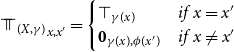 ${{\top \!\!\!\top }_{(X,\gamma )}}_{x,x'} = \begin{cases} \top _{\gamma (x)}& {if}\, x=x' \\ {\textbf {0}}_{\gamma (x),\phi (x')} &{if}\, x\neq x' \end{cases}$
.
${{\top \!\!\!\top }_{(X,\gamma )}}_{x,x'} = \begin{cases} \top _{\gamma (x)}& {if}\, x=x' \\ {\textbf {0}}_{\gamma (x),\phi (x')} &{if}\, x\neq x' \end{cases}$
.
Example 2.26.
-
(1) It is a standard result that
$\textsf {Matr}(\mathscr{B}(\Omega ))$
, the category of
$\mathscr{B}(\Omega )$
-matrices, is isomorphic to
$\textsf {Rel}$
. -
(2) Consider
$\textsf {Matr}(\mathscr{B}(Q))$
. The objects are pairs
$(X,\gamma )$
of a set
$X$
and a trivial function mapping the set to
$\star$
. The
$\mathscr{B}(Q)$
-matrices are families
$(r_{x,y}\colon \star \rightarrow \star )_{(x,y)\in X\times Y}$
, a collection of elements in
$Q$
, that is a function
$X\times Y\rightarrow Q$
, and the composition of
$\mathscr{B}(Q)$
-matrices is exactly the one of
$Q$
-relations. As such,
$\textsf {Matr}(\mathscr{B}(Q))\,\cong \,Q\text{-}{\sf Rel}$
, generalizing the first example.






Definition 2.27.
Let $\mathscr{Q}$
be a quantaloid.
$\mathscr{Q}$
be a quantaloid.
-
• A
$\mathrm{monad}$
$(a,m)$
in
$\mathscr{Q}$
is an object
$a$
equipped with a morphism
$m\colon a\rightarrow a$
such that
Alternatively, a monad in
\begin{equation*}\top _a\leq m \qquad m \otimes m \leq m\end{equation*}
$\mathscr{Q}$
is a lax functor from the terminal bicategory 1 to
$\mathscr{Q}$
.
-
• A
$(m,n)$
-
$\mathrm{module}$
$f\colon (a,m)\nrightarrow (b,n)$
is a morphism
$f\colon a\rightarrow b$
in such that
\begin{equation*} m\otimes f\leq f \qquad f\otimes n\leq f\end{equation*}
-
•
${\sf Mon}{\mathscr{Q}}$
is the category of monads and monad modules. in
$\mathscr{Q}$
. Composition is directly inherited from
$\mathscr{Q}$
and the identity 1-cell
${\top \!\!\!\top }_{(a,m)}\colon (a,m)\nrightarrow (a,m)$
is
$m:a\rightarrow a$
.







Example 2.28.
-
(1) It is immediate that monads in Rel are preordered sets and monad modules are order ideals; thus,
$\textsf {Mon}(\textsf {Rel})\,\cong \,\textsf {Ord}$
. -
(2) The above example can be generalized to
$Q$
-
$\sf Rel$
. Consider
$\textsf {Mon}({Q\text{-}{\sf Rel}})$
: monads in
$Q\text{-}{\sf Rel}$
are
$Q$
-categories
$(X,m)$
consisting of a set
$X$
equipped with a relation
$m\colon X\nrightarrow X$
which is
$Q$
-reflexive and
$Q$
-transitive, meaning
while monad modules are
\begin{equation*} \top \leq m(x,x) \quad \quad {and}\quad \quad m(x,x')\otimes m(x',x'') \leq m(x,x'') \quad \quad \forall x,x',x''\in X \end{equation*}
$Q$
-profunctors, relations
$S\colon (X,m)\nrightarrow (Y, n)$
such that
\begin{equation*} m(x,x')\otimes S(x',y) \leq S(x,y) \quad {and}\quad S(x,y')\otimes n(y',y) \leq S(x,y) \quad \forall x,x'\in X, y,y'\in Y \end{equation*}





These constructions are more than just categories:
Lemma 2.29.
(Rosenthal Reference Rosenthal1992) $\mathscr{Q}$
-
$\mathscr{Q}$
- $\sf Mod$
,
$\sf Mod$
, ${\sf Matr}{\mathscr{Q}}$
, and
${\sf Matr}{\mathscr{Q}}$
, and ${\sf Mon}\mathscr{Q}$
are quantaloids, so in particular, they are locally posetal bicategories.
${\sf Mon}\mathscr{Q}$
are quantaloids, so in particular, they are locally posetal bicategories.
As $\mathscr{Q}$
-
$\mathscr{Q}$
- $\sf Mod$
,
$\sf Mod$
, ${\sf Matr}\mathscr{Q}$
, and
${\sf Matr}\mathscr{Q}$
, and ${\sf Mon}\mathscr{Q}$
are quantaloids, there exist residuation functors. In the case of
${\sf Mon}\mathscr{Q}$
are quantaloids, there exist residuation functors. In the case of $\mathscr{Q}$
-
$\mathscr{Q}$
- $\sf Mod$
and
$\sf Mod$
and $\sf Mod$
and
$\sf Mod$
and ${\sf Matr}\mathscr{Q}$
, the formulas are similar to
${\sf Matr}\mathscr{Q}$
, the formulas are similar to $Q\text{-}{\sf Rel}$
, in other words, given by the infimum of the pointwise residuations, while
$Q\text{-}{\sf Rel}$
, in other words, given by the infimum of the pointwise residuations, while ${\sf Mon}\mathscr{Q}$
inherits residuations directly from
${\sf Mon}\mathscr{Q}$
inherits residuations directly from $\mathscr{Q}$
.
$\mathscr{Q}$
.
Propositions 2.20 and 2.21 apply to the case of quantaloids:
Proposition 2.30.
(Rosenthal Reference Rosenthal1992) $\mathscr{Q}$
-
$\mathscr{Q}$
- $\sf Mod$
is biequivalent to
$\sf Mod$
is biequivalent to ${\sf Mon}{{\sf Matr}{\mathscr{Q}}}$
, and the constructions are idempotent.
${\sf Mon}{{\sf Matr}{\mathscr{Q}}}$
, and the constructions are idempotent.
Thus, we see that $\textsf {Ord}\cong \mathscr{B}(\Omega )$
-
$\textsf {Ord}\cong \mathscr{B}(\Omega )$
- $\textsf {Mod}\cong \textsf {Rel}$
-Mod and
$\textsf {Mod}\cong \textsf {Rel}$
-Mod and $Q$
-
$Q$
- $\mbox{$\mathrm{Prof}\cong \mathscr{B}(Q)$-$\textsf {Mod}\cong (Q\text{-}{\sf Rel})$}$
-Mod.
$\mbox{$\mathrm{Prof}\cong \mathscr{B}(Q)$-$\textsf {Mod}\cong (Q\text{-}{\sf Rel})$}$
-Mod.
Example 2.31.
-
(1) Consider
$Q={\sf P_{+}}$
, then
$\sf P_{+}$
-
$\mathrm{Prof}$
is the quantaloid of Lawvere metric spaces and
$\sf P_{+}$
-bimodules, in the sense of Lawvere (Reference Lawvere1973). Objects are sets
$X$
equipped with extended distance functions
$m\colon X\times X\rightarrow [0,\infty ]$
which satisfy the axiom of point inequality and the triangle inequality:
\begin{equation*} m(x,x)\leq 0 \quad and \quad m(x,x'')\leq m(x,x')+m(x',x'')\quad \quad \forall x,x',x''\in X \end{equation*}
In other words, the objects are extended quasi-pseudo-metric spaces, or simply Lawvere metric spaces. The arrows
$(X,m)\nrightarrow (Y,n)$
are real-valued functions
$F\colon X\times Y\rightarrow [0,\infty ]$
satisfying
The standard category Met of Lawvere metric spaces and non-expansive maps is equivalent to the category of
\begin{equation*} F(x,y)\leq m(x,x')+F(x',y) \quad \textrm {and}\quad F(x,y)\leq F(x,y')+n(y',y) \quad \forall x,x'\in X, y,y'\in Y \end{equation*}
$\sf P_{+}$
-categories and
$\sf P_{+}$
-functors. Every
$\sf P_{+}$
-functor gives rise to a pair of adjoint
$\sf P_{+}$
-bimodules; therefore,
$\sf P_{+}$
-
$\mathrm{Prof}$
is a quantaloid of Lawvere metric spaces with a more general notion of morphisms.
Alternatively, take
$Q=[0,1]$
, then
$[0,1]$
-
${\mathrm{Prof}}\cong {\sf P_{+}}\text{-}{\mathrm{Prof}}$
. Objects are sets
$X$
equipped with a functions
$m\colon X\times X\rightarrow [0,1]$
satisfying
while arrows
\begin{equation*} 1\leq m(x,x) \quad {and}\quad m(x,x')\cdot m(x',x'')\leq m(x,x'') \quad \forall x,x',x''\in X \end{equation*}
$(X,m)\nrightarrow (Y,n)$
are functions
$F\colon X\times Y\rightarrow [0,1]$
satisfying
\begin{equation*} m(x,x')\cdot F(x',y)\leq F(x,y) \quad \textrm {and}\quad F(x,y')\cdot n(y',y)\leq f(x,y) \quad \forall x,x'\in X, y,y'\in Y \end{equation*}
-
(2) If instead, we consider
$Q={\sf P_{max}}$
, then
$\sf P_{max}$
-
$\mathrm{Prof}$
is the quantaloid of Lawvere ultrametric spaces and
$\sf P_{max}$
-bimodules. The metric spaces
$(X,m)$
satisfy the strengthened triangle inequality:
and the arrows
\begin{equation*}m(x,x'')\leq {\sf max}(m(x,x'), m(x',x''))\quad \quad \forall x,x',x''\in X \end{equation*}
$(X,m)\nrightarrow (Y,n)$
are real-valued functions
$F\colon X\times Y\rightarrow [0,\infty ]$
satisfying
\begin{equation*} F(x,y)\leq {\sf max}(m(x,x'), F(x',y)) \quad \textrm {and}\quad F(x,y)\leq {\sf max}(F(x,y'),n(y',y)) \quad \forall x,x'\in X, y,y'\in Y \end{equation*}
For more details, see Lawvere (Reference Lawvere1973).



















Note the following quantaloid embeddings of $\mathscr{Q}$
:
$\mathscr{Q}$
:
 \begin{align*} &{\mathscr{Q}}\hookrightarrow \mbox{$\mathscr{Q}$-${\sf Mod}$}: &&a\mapsto M_a = (1, \rho _a) \quad \textrm {where} \quad 1=\{*\},\quad \rho _a(*)=a\quad \textrm {and}\\ &&& M_a(*,*)=\top _a \\ &&&f\colon a \rightarrow b \mapsto \Theta _f\colon M_a\nrightarrow M_b\quad \textrm {where}\quad \Theta _f(*,*)=f \\\\ &\mathscr{Q}\hookrightarrow {\sf Matr}\mathscr{Q}: &&a\mapsto (1, \gamma _a) \quad \textrm {where}\quad 1=\{*\},\quad \gamma _a(*)=a \\ &&&f\colon a \rightarrow b \mapsto \Theta _f\colon M_a\nrightarrow M_b\quad \textrm {where}\quad \Theta _f(*,*)=f \\\\ &\mathscr{Q}\hookrightarrow {{\sf Mon}\mathscr{Q}}: &&a\mapsto (a,\top _a)\,\,\textrm {the trivial monad} \\ &&&f\colon a \rightarrow b \mapsto f\colon (a,\top _a)\nrightarrow (b,\top _b) \end{align*}
3. Linear Bicategories
We introduce the theory of linear bicategories as defined by Cockett et al. (Reference Cockett, Koslowski and Seely2000). The material in this subsection is entirely from that paper, unless otherwise specified.
Linear bicategories are an extension of the theory of linearly distributive categories, due to Cockett and Seely (Reference Cockett and Seely1997). Linearly distributive categories axiomatize the multiplicative fragment of linear logic in a way that is closer to the syntax. So the two binary connectives, $\otimes$
and
$\otimes$
and $\oplus$
, are taken as primitives, and negation can be added if one wishes.
$\oplus$
, are taken as primitives, and negation can be added if one wishes.
Linear logic and, in particular, its multiplicative fragment were first introduced by Girard (Reference Girard1987) as a commutative substructural logic. In terms of categorical semantics, this means the connectives $\otimes$
and
$\otimes$
and $\oplus$
are modeled by symmetric monoidal structures. As the theory of linear logic continued to be developed, non-commutative variants began being explored. Given that bicategorical composition is intrinsically non-commutative, bicategorical structures inherently provide categorical semantics for non-commutative logics. As such, linear bicategories were introduced to provide natural semantics for non-commutative multiplicative linear logic.
$\oplus$
are modeled by symmetric monoidal structures. As the theory of linear logic continued to be developed, non-commutative variants began being explored. Given that bicategorical composition is intrinsically non-commutative, bicategorical structures inherently provide categorical semantics for non-commutative logics. As such, linear bicategories were introduced to provide natural semantics for non-commutative multiplicative linear logic.
As usual with bicategories, one begins with a class of 0-cells, which we will denote ${\mathscr{B}}_0=\{X,Y,Z,\ldots \}$
. Then for every pair of 0-cells, one has a category
${\mathscr{B}}_0=\{X,Y,Z,\ldots \}$
. Then for every pair of 0-cells, one has a category $\mathscr{B}(X,Y)$
. The objects of
$\mathscr{B}(X,Y)$
. The objects of $\mathscr{B}(X,Y)$
are called 1-cells, and the arrows are called 2-cells. But now we have two composition functors:
$\mathscr{B}(X,Y)$
are called 1-cells, and the arrows are called 2-cells. But now we have two composition functors:
 \begin{equation*}\otimes ,\oplus \colon \mathscr{B}(X,Y)\times \mathscr{B}(Y,Z)\longrightarrow \mathscr{B}(X,Z)\end{equation*}
Each of these compositions gives a bicategory structure. Thus, for each composition, we have all of the morphisms and coherences that this entails. In particular, we must have identity 1-cells for each of the two compositions:
 \begin{equation*}\top _X\colon X\rightarrow X \quad {and}\quad \bot _X\colon X\rightarrow X\end{equation*}
These two bicategory structures are related by linear distributions as follows. Given 0-cells $X, Y, Z, W$
, we have two functors
$X, Y, Z, W$
, we have two functors
 \begin{equation*} -\otimes (-\oplus -), (-\otimes -)\oplus -\colon \mathscr{B}(X,Y)\times \mathscr{B}(Y,Z)\times \mathscr{B}(Z,W)\longrightarrow \mathscr{B}(X,W)\end{equation*}
and we require a natural transformation between them, which is not necessarily an isomorphism:
 \begin{equation*}\delta ^L:-\otimes (-\oplus -)\Longrightarrow (-\otimes -)\oplus -\end{equation*}
Symmetrically, we also need a natural transformation
 \begin{equation*}\delta ^R:(-\oplus -)\otimes -\longrightarrow -\oplus (-\otimes -).\end{equation*}
All of this structure must satisfy coherence requirements detailed in (Cockett et al. Reference Cockett, Koslowski and Seely2000, Def 2.1).
One of the main goals of this paper will be to provide new examples of linear bicategories, but we mention here the quintessential example Rel, as it will be the example on which ours are based.
Rel is a locally posetal bicategory with its first composition being the standard one. But we have a second composition: for $R\colon X\nrightarrow Y$
and
$R\colon X\nrightarrow Y$
and $S\colon Y\nrightarrow Z$
, define
$S\colon Y\nrightarrow Z$
, define $R\oplus S\colon X\nrightarrow Z$
by
$R\oplus S\colon X\nrightarrow Z$
by
 \begin{equation*}(x,z)\in R\oplus S \,\,\,\,\,\,\mbox{ if and only if}\,\,\,\, \forall y {\,\,\,\,\,\,}(x,y)\in R\,\, \,\mbox{ or}\, \,\,(y,z)\in S\end{equation*}
We quickly mention here that the appropriate notion of a functor between linear bicategories was developed, although it will only make a brief appearance in this article.
Definition 3.1.
(Cockett et al. Reference Cockett, Koslowski and Seely2000, Def 2.4) Let $\mathscr{B}$
and
$\mathscr{B}$
and $\mathscr{B}'$
be linear bicategories. A
$\mathscr{B}'$
be linear bicategories. A $\mathrm{linear\, functor}$ $F = (F_\otimes , F_\oplus )\colon \mathscr{B}\rightarrow \mathscr{B}'$
consists of:
$F = (F_\otimes , F_\oplus )\colon \mathscr{B}\rightarrow \mathscr{B}'$
consists of:
-
• a lax monoidal functor
$(F_\otimes , m_\top , m_\otimes )\colon (\mathscr{B},\otimes ,\top )\rightarrow (\mathscr{B}',\otimes ,\top )$
, equipped with
\begin{equation*} m_\top \colon \top \rightarrow F_\otimes (\top ) \qquad {m_\otimes }_{A, B}\colon F_\otimes (A)\otimes F_\otimes (B)\rightarrow F_\otimes (A\otimes B)\end{equation*}
-
• a colax monoidal functor
$(F_\oplus , n_\bot , n_\oplus )\colon (\mathscr{B},\oplus ,\bot )\rightarrow (\mathscr{B}',\oplus ,\bot )$
, equipped with
\begin{equation*} n_\bot \colon F_\oplus (\bot )\rightarrow \bot \qquad {n_\oplus }_{A,B}\colon F_\oplus (A\oplus B)\rightarrow F_\oplus (A)\oplus F_\oplus (B)\end{equation*}
-
• four natural transformations, known as
$\mathrm{linear\, strengths}$
,
\begin{align*} &{v_\otimes ^R}_{A,B} \colon F_\otimes (A\oplus B)\rightarrow F_\oplus (A)\oplus F_\otimes (B) &{v_\otimes ^L}_{A,B} \colon F_\otimes (A\oplus B)\rightarrow F_\otimes (A)\oplus F_\oplus (B)\\ &{v_\oplus ^R}_{A,B} \colon F_\otimes (A)\otimes F_\oplus (B)\rightarrow F_\oplus (A\otimes B) &{v_\oplus ^L}_{A,B} \colon F_\oplus (A)\otimes F_\otimes (B)\rightarrow F_\oplus (A\otimes B) \end{align*}






subject to various coherence conditions.
3.1
Cyclic
$*$
-autonomous bicategories

Prior to the introduction of linearly distributive categories, the categorical semantics for linear logic were investigated by Seely (Reference Seely1989), who demonstrated that $*$
-autonomous categories provided the appropriate model. The notion of a
$*$
-autonomous categories provided the appropriate model. The notion of a $*$
-autonomous category was originally introduced independently of linear logic by Barr (Reference Barr1979), who was trying to capture some of the dualities present in various categories of topological vector spaces. Barr’s definition of
$*$
-autonomous category was originally introduced independently of linear logic by Barr (Reference Barr1979), who was trying to capture some of the dualities present in various categories of topological vector spaces. Barr’s definition of $*$
-autonomous category was a symmetric monoidal closed category with a dualizing object.
$*$
-autonomous category was a symmetric monoidal closed category with a dualizing object.
As previously mentioned, non-commutative variants of linear logic began to be studied. Of note is cyclic linear logic, introduced by Yetter (Reference Yetter1990), which considers non-commutative connectives $\otimes$
and
$\otimes$
and $\oplus$
with one notion of linear negation. The quantale semantics of cyclic linear logic were shown to be given by Girard quantales. These were generalized to cyclic
$\oplus$
with one notion of linear negation. The quantale semantics of cyclic linear logic were shown to be given by Girard quantales. These were generalized to cyclic $*$
-autonomous categories by Rosenthal (Reference Rosenthal1994a): non-symmetric biclosed categories with a cyclic dualizing object. Given that bicategorical structures naturally provide semantics for non-commutative connectives, Koslowski (Reference Koslowski2001) introduced their bicategorical analog as follows.
$*$
-autonomous categories by Rosenthal (Reference Rosenthal1994a): non-symmetric biclosed categories with a cyclic dualizing object. Given that bicategorical structures naturally provide semantics for non-commutative connectives, Koslowski (Reference Koslowski2001) introduced their bicategorical analog as follows.
Definition 3.2.
(Koslowski Reference Koslowski2001, Def 1.03) A bicategory $\mathscr{B}$
is
$\mathscr{B}$
is $\mathrm{cyclic}$
*-
$\mathrm{cyclic}$
*- $\mathrm{autonomous}$
if
$\mathrm{autonomous}$
if
-
• for any pair of 0-cells
$X, Y$
, there is an adjoint equivalence
\begin{equation*} (\!-\!)^*_{X,Y}\dashv ((\!-\!)^*_{Y,X})^{op}\colon \mathscr{B}(X,Y)\simeq \mathscr{B}(Y,X)^{op}\end{equation*}
-
• for any 1-cell
$A:X\rightarrow Y$
, the 1-cell
$A^*$
is the right extension of
$\top _X^*$
along
$A$
, such that these extensions are natural in
$A$
.


As discussed in (Koslowski Reference Koslowski2001, Sec 1) and in (Cockett et al. Reference Cockett, Koslowski and Seely2000, Sec 3.4), we can equivalently define cyclic $*$
-autonomous bicategories by introducing the concept of dualizing 1-cells.
$*$
-autonomous bicategories by introducing the concept of dualizing 1-cells.
Definition 3.3.
Suppose $\mathcal{D}=\{\bot _X\colon X\rightarrow X \, \vert \, X \in {\mathscr{B}}\}$
is a family of 1-cells in a biclosed bicategory
$\mathcal{D}=\{\bot _X\colon X\rightarrow X \, \vert \, X \in {\mathscr{B}}\}$
is a family of 1-cells in a biclosed bicategory $\mathscr{B}$
. Given
$\mathscr{B}$
. Given $A\colon X\rightarrow Y$
, there are canonical 2-cells
$A\colon X\rightarrow Y$
, there are canonical 2-cells
 \begin{equation*}A\, \xrightarrow {\delta _{A,Y}} \, (\bot _Y {\circ \!\!-\!\!\!\!\!-} A){ -\!\!\!\!\!-\!\!\circ } \bot _Y \quad {and} \quad A \, \xrightarrow {\delta _{X,A}} \, \bot _X \circ \!\!-\!\!\!\!\!- (A -\!\!\!\!\!-\!\!\circ \bot _X) \end{equation*}
-
• A family
$\mathcal{ D}$
is called
$\mathrm{dualizing}$
if the 2-cells
$\delta _{X,A}$
and
$\delta _{A,Y}$
are invertible, for all
$A\colon X\rightarrow Y$
. -
• A dualizing family
$\mathcal{ D}$
is called
$\mathrm{cyclic}$
if there are invertible 2-cells
$\theta _A\colon \bot _Y {\circ \!\!-\!\!\!\!\!-} A \xrightarrow {\sim } A { -\!\!\!\!\!-\!\!\circ } \bot _X$
, natural in
$A\colon X\rightarrow Y$
, such that the following diagram commutes
In this case, we let
$A^\perp =A -\!\!\!\!\!-\!\!\circ \bot _X$
.






Proposition 3.4. $\mathscr{B}$
is a cyclic
$\mathscr{B}$
is a cyclic $*$
-autonomous bicategory if and only if it admits a cyclic dualizing family of 1-cells.
$*$
-autonomous bicategory if and only if it admits a cyclic dualizing family of 1-cells.
Example 3.5.
Suppose $\mathscr{V}$
is a cyclic
$\mathscr{V}$
is a cyclic $*$
-autonomous category with cyclic dualizing
$*$
-autonomous category with cyclic dualizing $\bot$
; one can show that
$\bot$
; one can show that ${\mathcal{D}}=\{ \perp \colon \star \longrightarrow \star \}$
is a cyclic dualizing family for its suspension
${\mathcal{D}}=\{ \perp \colon \star \longrightarrow \star \}$
is a cyclic dualizing family for its suspension $\mathscr{B}(V)$
. So
$\mathscr{B}(V)$
. So $\mathscr{B}(V)$
is a cyclic
$\mathscr{B}(V)$
is a cyclic $*$
-autonomous bicategory.
$*$
-autonomous bicategory.
In particular, consider $\mathscr{V}=\textrm {Sup}$
, the category of suplattices and suplattice homomorphisms (functions that preserve all joins). Sup is a
$\mathscr{V}=\textrm {Sup}$
, the category of suplattices and suplattice homomorphisms (functions that preserve all joins). Sup is a $*$
-autonomous category with cyclic dualizing object
$*$
-autonomous category with cyclic dualizing object $A\,{\circ \!\!-\!\!\!\!\!-}\Omega ^{op}\cong \Omega ^{op}{ -\!\!\!\!\!-\!\!\circ }\, A\cong A^\circ$
, where
$A\,{\circ \!\!-\!\!\!\!\!-}\Omega ^{op}\cong \Omega ^{op}{ -\!\!\!\!\!-\!\!\circ }\, A\cong A^\circ$
, where $A^\circ$
denotes the opposite poset of
$A^\circ$
denotes the opposite poset of $A$
, and
$A$
, and $A\cong (A^\circ )^\circ$
, for all
$A\cong (A^\circ )^\circ$
, for all $A$
. Therefore,
$A$
. Therefore, $\mathscr{B}(\textrm {Sup})$
is a cyclic
$\mathscr{B}(\textrm {Sup})$
is a cyclic $*$
-autonomous bicategory with cyclic dualizing family
$*$
-autonomous bicategory with cyclic dualizing family $\mathcal{D}=\{\Omega ^{op}\colon \star \rightarrow \star \}$
.
$\mathcal{D}=\{\Omega ^{op}\colon \star \rightarrow \star \}$
.
Recall that linearly distributive categories capture $*$
-autonomous categories by adding linear negation. Thus,
$*$
-autonomous categories by adding linear negation. Thus, $*$
-autonomous categories and, in particular, cyclic
$*$
-autonomous categories and, in particular, cyclic $*$
-autonomous categories are examples of the former. Therefore, it will come as no surprise that every cyclic
$*$
-autonomous categories are examples of the former. Therefore, it will come as no surprise that every cyclic $*$
-autonomous bicategory is a linear bicategory by the de Morgan equations. It is remarked in Cockett et al. (Reference Cockett, Koslowski and Seely2000) without a detailed proof, as it would largely follow the same computation described in (Cockett and Seely Reference Cockett and Seely1997, Sec 4), in the case of linearly distributive categories and
$*$
-autonomous bicategory is a linear bicategory by the de Morgan equations. It is remarked in Cockett et al. (Reference Cockett, Koslowski and Seely2000) without a detailed proof, as it would largely follow the same computation described in (Cockett and Seely Reference Cockett and Seely1997, Sec 4), in the case of linearly distributive categories and $*$
-autonomous categories. We describe below some of the key details.
$*$
-autonomous categories. We describe below some of the key details.
Lemma 3.6.
If $\mathscr{B}$
is a cyclic
$\mathscr{B}$
is a cyclic $*$
-autonomous bicategory, then there are invertible 2-cells
$*$
-autonomous bicategory, then there are invertible 2-cells
 \begin{equation*}A^\perp -\!\!\!\!\!-\!\!\circ \,B\xrightarrow {\sim } (B^\perp \otimes A^\perp )^\perp \quad {and}\quad B\,\circ \!\!-\!\!\!\!\!- C^\perp \xrightarrow {\sim } (C^\perp \otimes B^\perp )^\perp \end{equation*}
for all $A\colon X\rightarrow Y$
,
$A\colon X\rightarrow Y$
, $B\colon Y\rightarrow Z$
and
$B\colon Y\rightarrow Z$
and $C\colon Z\rightarrow W$
.
$C\colon Z\rightarrow W$
.
Proof.
Suppose $\mathcal{ D}=\{{\bot _X}\colon X\rightarrow X \}$
is a cyclic dualizing family for
$\mathcal{ D}=\{{\bot _X}\colon X\rightarrow X \}$
is a cyclic dualizing family for $\mathscr{B}$
. Then composition with
$\mathscr{B}$
. Then composition with $\delta _{B,Z}$
induces the transpose invertible 2-cell
$\delta _{B,Z}$
induces the transpose invertible 2-cell
 \begin{equation*} A^\perp -\!\!\!\!\!-\!\!\circ \,B \xrightarrow {\sim } A^\perp -\!\!\!\!\!-\!\!\circ \,((\bot _Z\,\circ \!\!-\!\!\!\!\!- B) -\!\!\!\!\!-\!\!\circ \,\bot _Z) \end{equation*}
Since $\bot _Z\,\circ \!\!-\!\!\!\!\!- B \cong B ^\perp$
and by Proposition 2.14, it follows that
$\bot _Z\,\circ \!\!-\!\!\!\!\!- B \cong B ^\perp$
and by Proposition 2.14, it follows that
 \begin{equation*}A^\perp -\!\!\!\!\!-\!\!\circ \,((\bot _Z\,\circ \!\!-\!\!\!\!\!- B) -\!\!\!\!\!-\!\!\circ \,\bot _Z)\xrightarrow {\sim } (B^\perp \otimes A^\perp ) -\!\!\!\!\!-\!\!\circ \,\bot _Z = (B^\perp \otimes A^\perp )^\perp \end{equation*}
and the desired 2-cell follows. Similarly for the second result.
Proposition 3.7.
(Cockett et al. Reference Cockett, Koslowski and Seely2000, Prop 3.13) Every cyclic $*$
-autonomous bicategory is a linear bicategory.
$*$
-autonomous bicategory is a linear bicategory.
Proof.
Suppose $\mathcal{D}=\{{\bot _X}\colon X\rightarrow X \}$
is a cyclic dualizing family for
$\mathcal{D}=\{{\bot _X}\colon X\rightarrow X \}$
is a cyclic dualizing family for $\mathscr{B}$
. Given
$\mathscr{B}$
. Given $A\colon X\rightarrow Y$
and
$A\colon X\rightarrow Y$
and $B\colon Y\rightarrow Z$
, define
$B\colon Y\rightarrow Z$
, define $A\oplus B= (B^\perp \otimes A^\perp )^\perp$
.
$A\oplus B= (B^\perp \otimes A^\perp )^\perp$
.
Then $\oplus$
is associative and has identity 1-cells
$\oplus$
is associative and has identity 1-cells $\bot _X = \top _X^\perp \colon X\rightarrow X$
:
$\bot _X = \top _X^\perp \colon X\rightarrow X$
:
 \begin{align*} A\oplus (B\oplus C) &= A\oplus (C^\perp \otimes B^\perp )^\perp \cong ((C^\perp \otimes B^\perp )\otimes A^\perp )^\perp \\ &\cong (C^\perp \otimes (B^\perp \otimes A^\perp ))^\perp \cong (C^\perp \otimes (A\oplus B)^\perp )^\perp \\ &= (A\oplus B)\oplus C \end{align*}
and $\top _X^\perp \oplus A \cong A\cong A\oplus \top _Y^\perp$
.
$\top _X^\perp \oplus A \cong A\cong A\oplus \top _Y^\perp$
.
To see that $\mathscr{B}$
is a linear bicategory, we will define the left linear distribution
$\mathscr{B}$
is a linear bicategory, we will define the left linear distribution
 \begin{equation*}A\otimes (B\oplus C)\rightarrow (A\otimes B)\oplus C\end{equation*}
Since $A\otimes (B\oplus C)\cong A\otimes (B^\perp -\!\!\!\!\!-\!\!\circ \,C)$
and
$A\otimes (B\oplus C)\cong A\otimes (B^\perp -\!\!\!\!\!-\!\!\circ \,C)$
and $(A\otimes B)\oplus C \cong (A\otimes B)^\perp { -\!\!\!\!\!-\!\!\circ }\,C\cong (B^\perp \,{\circ \!\!-\!\!\!\!\!-} A){ -\!\!\!\!\!-\!\!\circ }\,C$
, by Lemma 3.6; it suffices to define a 2-cell
$(A\otimes B)\oplus C \cong (A\otimes B)^\perp { -\!\!\!\!\!-\!\!\circ }\,C\cong (B^\perp \,{\circ \!\!-\!\!\!\!\!-} A){ -\!\!\!\!\!-\!\!\circ }\,C$
, by Lemma 3.6; it suffices to define a 2-cell
 \begin{equation*}A\otimes (B^\perp -\!\!\!\!\!-\!\!\circ \,C)\rightarrow (B^\perp \,\circ \!\!-\!\!\!\!\!- A) -\!\!\!\!\!-\!\!\circ \,C\end{equation*}
or equivalently, its transpose
 \begin{equation*} (B^\perp \,\circ \!\!-\!\!\!\!\!- A)\otimes (A\otimes (B^\perp -\!\!\!\!\!-\!\!\circ \, C))\rightarrow C\end{equation*}
For this, we can use the associator and the evaluation maps
 \begin{equation*}(B^\perp \,\circ \!\!-\!\!\!\!\!- A)\otimes (A\otimes (B^\perp -\!\!\!\!\!-\!\!\circ \,C))\rightarrow ((B^\perp \,\circ \!\!-\!\!\!\!\!- A)\otimes A)\otimes (B^\perp -\!\!\!\!\!-\!\!\circ \,C)\rightarrow B^\perp \otimes (B^\perp -\!\!\!\!\!-\!\!\circ \, C)\rightarrow C\end{equation*}
Similarly, we get a 2-cell $(A\oplus B)\otimes C\rightarrow A\oplus (B\otimes C)$
, as desired. It remains to show the coherence conditions, in particular, the ones involving the linear distributions.
$(A\oplus B)\otimes C\rightarrow A\oplus (B\otimes C)$
, as desired. It remains to show the coherence conditions, in particular, the ones involving the linear distributions.
The last section of this article will be a discussion of several examples of non-posetal cyclic $*$
-autonomous bicategories, including
$*$
-autonomous bicategories, including $\mathscr{Q}\mathrm{uant}$
and
$\mathscr{Q}\mathrm{uant}$
and $\mathscr{Q}\mathrm{tld}$
.
$\mathscr{Q}\mathrm{tld}$
.
Cyclic $*$
-autonomous bicategories are unique as linear bicategories in that every 1-cell
$*$
-autonomous bicategories are unique as linear bicategories in that every 1-cell $A\colon X\rightarrow Y$
has a canonical linear negation
$A\colon X\rightarrow Y$
has a canonical linear negation $A^\perp \colon Y\rightarrow X$
. This is encoded by the notion of cyclic linear adjoints, in the following sense:
$A^\perp \colon Y\rightarrow X$
. This is encoded by the notion of cyclic linear adjoints, in the following sense:
Definition 3.8.
(Cockett et al. Reference Cockett, Koslowski and Seely2000, Def 3.1) A $\mathrm{linear\, adjunction}$ $A-\!\!\!\parallel \,B\colon X\rightarrow Y$
consists of a pair of 1-cells
$A-\!\!\!\parallel \,B\colon X\rightarrow Y$
consists of a pair of 1-cells $A\colon X\rightarrow Y$
and
$A\colon X\rightarrow Y$
and $B\colon Y\rightarrow X$
, equipped with 2-cells
$B\colon Y\rightarrow X$
, equipped with 2-cells $\tau \colon \top _X\rightarrow A\oplus B$
, known as the unit, an
$\tau \colon \top _X\rightarrow A\oplus B$
, known as the unit, an $\gamma \colon B\otimes A\rightarrow \bot _Y$
, known as the conunit, satisfying the snake equations.
$\gamma \colon B\otimes A\rightarrow \bot _Y$
, known as the conunit, satisfying the snake equations.
Definition 3.9.
(Cockett et al. Reference Cockett, Koslowski and Seely2000, Def 4.1) A $\mathrm{cyclic\, linear\, adjunction}$
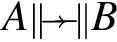 is a pair of linear adjoints $A-\!\!\!\parallel \,B$
and
$A-\!\!\!\parallel \,B$
and $B-\!\!\!\parallel \,A$
.
$B-\!\!\!\parallel \,A$
.
Proposition 3.10. (Cockett et al. Reference Cockett, Koslowski and Seely2000, Cor 3.4) Any two right (respectively left) linear adjoints to a 1-cell are isomorphic, in the sense that there is a unique 2-cell mediating the isomorphism.
Then,
Proposition 3.11.
(Cockett et al. Reference Cockett, Koslowski and Seely2000, Rem 4.10) Consider a cyclic $*$
-autonomous bicategory, then every 1-cell
$*$
-autonomous bicategory, then every 1-cell $A\colon X\rightarrow Y$
has a unique (up to isomorphism) cyclic linear adjoint given by
$A\colon X\rightarrow Y$
has a unique (up to isomorphism) cyclic linear adjoint given by $A^\perp \colon Y\rightarrow X$
.
$A^\perp \colon Y\rightarrow X$
.
4. LD-Quantales and Linear Quantaloids
It is immediate that Girard quantaloids are locally posetal cyclic $*$
-autonomous bicategories. Mirroring the alternative approach to categorical linear logic of linearly distributive categories and linear bicategories, we define what the analogous structure would be for quantaloids below.
$*$
-autonomous bicategories. Mirroring the alternative approach to categorical linear logic of linearly distributive categories and linear bicategories, we define what the analogous structure would be for quantaloids below.
Definition 4.1.
A $\mathrm{linear\, quantaloid}$
is a locally small category
$\mathrm{linear\, quantaloid}$
is a locally small category $\mathscr{Q}$
whose hom-sets are complete lattices with binary operations
$\mathscr{Q}$
whose hom-sets are complete lattices with binary operations $\otimes$
and
$\otimes$
and $\oplus$
and families of distinguished morphisms
$\oplus$
and families of distinguished morphisms $\{\top _a\,|\,a\in \textrm {ob}\mathscr{Q}\}$
and
$\{\top _a\,|\,a\in \textrm {ob}\mathscr{Q}\}$
and $\{\bot _a\,|\,a\in \textrm {ob}\mathscr{Q}\}$
such that
$\{\bot _a\,|\,a\in \textrm {ob}\mathscr{Q}\}$
such that
-
•
$(\mathscr{Q},\otimes ,\top _a)$
and
$(\mathscr{Q}^{co},\oplus ,\bot _a)$
are quantaloids,
-
• for all
$f\colon a\rightarrow b, g\colon b\rightarrow c, h\colon c\rightarrow d\in \mathscr{Q}$
,
\begin{equation*} f\otimes (g\oplus h)\leq (f\otimes g)\oplus h\quad { and}\quad (f\oplus g)\otimes h\leq f\oplus (g\otimes h)\end{equation*}




Every Girard quantaloid is a linear quantaloid, and we have the following obvious observation.
Lemma 4.2. A linear quantaloid is a linear bicategory.
Remark 4.3.
Given linear quantaloids $\mathscr{Q}$
and
$\mathscr{Q}$
and $\mathscr{Q}'$
, we say they are isomorphic if there exists an invertible functor
$\mathscr{Q}'$
, we say they are isomorphic if there exists an invertible functor $F\colon {\mathscr{Q}}\rightarrow {\mathscr{Q}}'$
such that
$F\colon {\mathscr{Q}}\rightarrow {\mathscr{Q}}'$
such that $F\colon ({\mathscr{Q}}, \otimes , \top _X)\rightarrow ({\mathscr{Q}}', \otimes , \top _X)$
and
$F\colon ({\mathscr{Q}}, \otimes , \top _X)\rightarrow ({\mathscr{Q}}', \otimes , \top _X)$
and $F\colon ({\mathscr{Q}}^{co}, \oplus , \bot _X)\rightarrow (\mathscr{Q}'^{co}, \oplus , \bot _X)$
are quantaloid homomorphisms. It is then immediate that
$F\colon ({\mathscr{Q}}^{co}, \oplus , \bot _X)\rightarrow (\mathscr{Q}'^{co}, \oplus , \bot _X)$
are quantaloid homomorphisms. It is then immediate that $F = (F,F)\colon (\mathscr{Q}, \otimes , \top _X, \oplus , \bot _X)\rightarrow ({\mathscr{Q}}', \otimes , \top _X, \oplus , \bot _X)$
is an invertible linear functor when equipped with identity linear strengths.
$F = (F,F)\colon (\mathscr{Q}, \otimes , \top _X, \oplus , \bot _X)\rightarrow ({\mathscr{Q}}', \otimes , \top _X, \oplus , \bot _X)$
is an invertible linear functor when equipped with identity linear strengths.
A main result of the present work will be new examples of linear bicategories, which are linear quantaloids. To construct these, we need the definition of the analogous linear structure for quantales. These are the LD-quantales as defined below.
Definition 4.4.
A LD- $\mathrm{quantale}$ $(Q, \otimes , \top , \oplus , \bot )$
is a complete lattice
$(Q, \otimes , \top , \oplus , \bot )$
is a complete lattice $Q$
with operations
$Q$
with operations $\otimes$
and
$\otimes$
and $\oplus$
and elements
$\oplus$
and elements $\top$
and
$\top$
and $\bot$
such that
$\bot$
such that
-
•
$(Q,\otimes , \top )$
and
$(Q^{op},\oplus ,\bot )$
are quantales, and
-
• for all
$a, b, c\in Q$
,
\begin{equation*} a\otimes (b\oplus c)\leq (a\otimes b)\oplus c\quad {and}\quad (a\oplus b)\otimes c\leq a\oplus (b\otimes c)\end{equation*}


Clearly, a Girard quantale is a LD-quantale.
The notion of a LD-quantale is not truly a new one. It has previously appeared in some form in the literature, following the introduction of linearly distributive categories. In particular, it has been considered within the field of algebraic logic when discussing ordered algebras, wherein linear distributivity was called hemi-distributivity by Dunn and Hardegree (Reference Dunn and Hardegree2001).
Indeed, within this context, a LD-quantale refers to a lattice-ordered bimonoid $\langle \mathbb{A}, \wedge , \vee ,\cdot ,$ $1, +, 0\rangle$
, where all joins and meets are admissible in the multiplicative pomonoid
$1, +, 0\rangle$
, where all joins and meets are admissible in the multiplicative pomonoid $\mathbb{A}_\cdot$
and in the additive pomonoid
$\mathbb{A}_\cdot$
and in the additive pomonoid $\mathbb{A}_+$
, respectively, as defined by Galatos and Přenosil (Reference Galatos and Přenosil2023).
$\mathbb{A}_+$
, respectively, as defined by Galatos and Přenosil (Reference Galatos and Přenosil2023).
Now, every locale is a quantale and Rosenthal (Reference Rosenthal1992) remarks that a locale is a Girard quantale if and only if it is a Boolean algebra with $\textbf {0}$
its dualizing element. We can extend this remark to LD-quantales, but first we must introduce a slightly less well-known type of lattice.
$\textbf {0}$
its dualizing element. We can extend this remark to LD-quantales, but first we must introduce a slightly less well-known type of lattice.
Definition 4.5. (Reyes and Zolfaghari Reference Reyes and Zolfaghari1996, Def 1.1)
-
• A
$\mathrm{Heyting}$
algebra is a bounded distributive lattice
$\mathcal{L}$
with an implication operator
$\rightarrow \,\colon {\mathcal{L}}\times {\mathcal{L}}\rightarrow {\mathcal{L}}$
with the following property:
$\forall a,b,c\in {\mathcal{L}}$
,
\begin{equation*} a\leq b\rightarrow c \iff a\wedge b\leq c\end{equation*}
-
• A
$\mathrm{co-Heyting}$
algebra is a bounded distributive lattice
$\mathcal{L}$
with a subtraction operator
$\backslash \,\colon {\mathcal{L}}\times {\mathcal{L}}\rightarrow {\mathcal{L}}$
with the following property:
$\forall a,b,c\in {\mathcal{L}}$
,
\begin{equation*} a\backslash b\leq c \iff a\leq b\vee c\end{equation*}
-
• A
$\mathrm{bi-Heyting}$
algebra is a bounded distributive lattice that is both a Heyting and a co-Heyting algebra.








Then:
Proposition 4.6.
A locale is a LD-quantale $(\mathcal{L}, \wedge , {\textbf {1}}, \vee , {\textbf {0}})$
if and only if it is a complete bi-Heyting algebra.
$(\mathcal{L}, \wedge , {\textbf {1}}, \vee , {\textbf {0}})$
if and only if it is a complete bi-Heyting algebra.
Proof. Note that a complete Heyting algebra is the same notion as a locale. Moreover, a locale is a LD-quantale if and only if the opposite infinitary law holds,
 \begin{equation*} \big(\bigwedge _{i\in I} a_i\big)\vee b = \bigwedge _{i\in I} (a_i\vee b)\end{equation*}
This is equivalent to requiring a right adjoint to $(\!-\!)\vee b\colon {\mathcal{L}}^{op}\rightarrow {\mathcal{L}}^{op}$
for all
$(\!-\!)\vee b\colon {\mathcal{L}}^{op}\rightarrow {\mathcal{L}}^{op}$
for all $b$
; in other words,
$b$
; in other words, $\mathcal{L}$
has a subtraction operation and is a co-Heyting algebra.
$\mathcal{L}$
has a subtraction operation and is a co-Heyting algebra.
Example 4.7.
-
(1)
$\textsf {Rel}(X)$
, the poset of relations on a set
$X$
, is a Girard quantale with cyclic dualizing element
$\Delta _X^c$
, by Proposition 1.2 in Rosenthal (Reference Rosenthal1992), and therefore is a LD-quantale.
-
(2) Consider the following locales, which are LD-quantales.
-
• Two-chain
$\Omega$
is a Girard quantale and therefore a LD-quantale.
-
• Three-chain
$3$
is the smallest locale, which is not Boolean as the law of excluded middle doesn’t hold:
As such, it is not a Girard quantale, but it is nonetheless a LD-quantale, as it is a bi-Heyting algebra.
\begin{equation*} 1/2 \vee (0\,\circ \!\!-\!\!\!\!\!- 1/2) = 1/2 \vee 0 = 1/2 \neq 1 \end{equation*}
-
•
$\sf P_{max}$
is a LD-quantale, as it is a bi-Heyting algebra, with
$\oplus = \textrm {min}$
and
$\bot = \infty$
, but it is not a Girard quantale, as
$\infty$
is not a dualizing element:
\begin{equation*} \textrm {if}\,\quad a\neq \infty , \quad a -\!\!\!\!\!-\!\!\circ \,\infty = \infty \implies (a -\!\!\!\!\!-\!\!\circ \,\infty ) -\!\!\!\!\!-\!\!\circ \,\infty = 0 \end{equation*}
-
• Reyes and Zolfaghari (Reference Reyes and Zolfaghari1996) demonstrate that given an oriented irreflexive multigraph, the lattice of its subgraphs is a bi-Heyting algebra and therefore a LD-quantale.
-
• Borceux et al. (Reference Borceux, Bourn and Johnstone2006) defined the notion of a bi-Heyting topos to be a topos such that the lattice of its subobjects is precisely a bi-Heyting algebra. An important example is the topos of presheafs
$[ {\mathcal{C}}^{op}, Set]$
for any small category
$\mathcal{C}$
. As such, its lattice of subobjects is a LD-quantale.
-
-
(3) Consider the unit interval with multiplication
$([0,1],\cdot , 1)$
. It becomes a LD-quantale
$([0,1],\cdot ,\oplus )$
when considering truncated addition
$a\oplus b ={\sf min}(a+b, 1)$
for its par structure with unit
$\bot = 0$
.
$([0,1]^{op}, \oplus , 0)$
is a quantale since
Linear distributivities hold as
\begin{equation*} \bigwedge _{\alpha } {\sf min}(a+b_\alpha , 1) = {\sf min}\big(a+\bigwedge _\alpha b_\alpha , 1\big) \end{equation*}
It is not however a Girard quantale as
\begin{equation*} a\cdot (b+c) = (a\cdot b) + (a\cdot c) \leq (a\cdot b)+c \quad \quad \forall a\in [0,1] \end{equation*}
$0$
is not a dualizing element:
\begin{equation*} \textrm {if}\,\quad a\neq 0, \quad a -\!\!\!\!\!-\!\!\circ \,0= 0 \implies (a -\!\!\!\!\!-\!\!\circ \,0) -\!\!\!\!\!-\!\!\circ \,0 = 1 \end{equation*}
Since
$([0,1],\cdot , 1)\,\cong \, {\sf P_{+}}$
, we can use the isomorphims to define a par structure on
$\sf P_{+}$
:
$a\oplus b = {\sf max}(-{\sf ln}({\sf exp}(-a)+{\sf exp}(-b)), 0)$
and
$\bot = \infty$
. Then,
${\sf P_{+}} = ([0,\infty ]^{op}, +, \oplus )$
is a LD-quantale isomorphic to
$([0,1],\cdot ,\oplus )$
.











Remark 4.8.
Given a locale $L$
, its booleanization
$L$
, its booleanization ${\sf Bool}(L)=\{a\in L\,|\, (a -\!\!\!\!\!-\!\!\circ \,{\textbf {0}}) -\!\!\!\!\!-\!\!\circ \,{\textbf {0}} = a\}$
is a complete Boolean algebra by Banaschewski and Pultr (Reference Banaschewski and Pultr1996). Therefore, viewing any complete bi-Heyting algebra as a LD-quantale, there is always a sub-locale
${\sf Bool}(L)=\{a\in L\,|\, (a -\!\!\!\!\!-\!\!\circ \,{\textbf {0}}) -\!\!\!\!\!-\!\!\circ \,{\textbf {0}} = a\}$
is a complete Boolean algebra by Banaschewski and Pultr (Reference Banaschewski and Pultr1996). Therefore, viewing any complete bi-Heyting algebra as a LD-quantale, there is always a sub-locale ${\sf Bool}(L)$
, which is a Girard quantale.
${\sf Bool}(L)$
, which is a Girard quantale.
The following is another example of a LD-quantale, which requires a little more discussion.
4.1 Shift monoids
Cockett and Seely (Reference Cockett and Seely1997) present shift monoids to provide examples of discrete linearly distributive categories with invertible linear distributions.
Definition 4.9.
-
• A
$\mathrm{shift\, monoid}$
consists of a 4-tuple
$\mathcal{M}=(M,+,\top ,a)$
where
$(M,+,\top )$
is a commutative monoid and
$a$
is an invertible element of
$M$
. -
• If
$\mathcal{M}$
is a shift monoid, define a second multiplication by
Then this is a second monoid structure on
\begin{equation*}x\cdot y=x+y-a\end{equation*}
$M$
with unit given by
$a$
.




It is trivial to see that $x\cdot (y+z)=(x\cdot y)+z$
, and so every shift monoid is a discrete linearly distributive category
$x\cdot (y+z)=(x\cdot y)+z$
, and so every shift monoid is a discrete linearly distributive category $(M,+,\cdot )$
. We modify the notion of shift monoid as follows in order to construct LD-quantales. Recall that a commutative monoid
$(M,+,\cdot )$
. We modify the notion of shift monoid as follows in order to construct LD-quantales. Recall that a commutative monoid $M$
is cancellative if for all
$M$
is cancellative if for all $a,b,c\in \ M$
, one has
$a,b,c\in \ M$
, one has
 \begin{equation*}a+b=a+c\Rightarrow b=c \end{equation*}
Proposition 4.10.
-
• Let
$(M,+,\top )$
be a cancellative commutative monoid. We view
$M$
as a discrete poset and then add top and bottom elements, which we denote as
1
and
0
. Denote this set as
$M^+$
. We then extend the addition on
$M$
:
\begin{equation*}{\textbf {1}}+b={\textbf {1}}\quad {if\, b\in M \, or\, b={\textbf {1}}} \,\,\,\,\,\,\,\,\,\,\,\, {\textbf {0}}+b={\textbf {0}}\quad {for\, all }\, b\in M^+\end{equation*}
Then
$(M^+,+,\top )$
is a commutative unital quantale.
-
• Let
$\mathcal{M} = (M,+,\top , a)$
be, furthermore, a cancellative commutative shift monoid, then extend the second operation in the dual way:
Then
\begin{equation*}{\textbf {0}}\cdot b={\textbf {0}}\quad {if \,b\in M \, or\, b={\textbf {0}}} \,\,\,\,\,\,\,\,\,\,\,\, {\textbf {1}}\cdot b={\textbf {1}}\quad {for\, all\, b\in M^+}\end{equation*}
$(M^+, +,\cdot )$
is a LD-quantale.





Remark 4.11.
The cancellative property is needed to ensure that $+$
preserves all suprema in
$+$
preserves all suprema in $M^+$
.
$M^+$
.
5.
$Q\text{-}{\sf Rel}$
as a Linear Bicategory

We now demonstrate that if $Q$
is a Girard quantale, or more generally a LD-quantale,
$Q$
is a Girard quantale, or more generally a LD-quantale, $Q\text{-}{\sf Rel}$
determines a linear quantaloid, providing new examples of linear bicategories.
$Q\text{-}{\sf Rel}$
determines a linear quantaloid, providing new examples of linear bicategories.
Proposition 5.1. $Q$
-
$Q$
- $\sf Rel$
is a Girard quantaloid with cyclic dualizing family
$\sf Rel$
is a Girard quantaloid with cyclic dualizing family $\mathcal{D}=\{\bot _X\colon X\nrightarrow X\}$
if and only if
$\mathcal{D}=\{\bot _X\colon X\nrightarrow X\}$
if and only if $Q$
is a Girard quantale with cyclic dualizing element
$Q$
is a Girard quantale with cyclic dualizing element $\bot$
, where
$\bot$
, where $\bot = \bot _1(*,*)$
,
$\bot = \bot _1(*,*)$
, $\bot _1\colon 1\nrightarrow 1$
being the constant map between singleton sets
$\bot _1\colon 1\nrightarrow 1$
being the constant map between singleton sets $1=\{*\}$
, and
$1=\{*\}$
, and
 \begin{equation} \bot _X(x,x')=\begin{cases}\bot & x=x' \\ {\textbf {1}} & x\ne x' \end{cases} \end{equation}
Proof.
Suppose $Q\text{-}{\sf Rel}$
is a Girard quantaloid. Given
$Q\text{-}{\sf Rel}$
is a Girard quantaloid. Given $a\in Q$
, let
$a\in Q$
, let $R_a\colon 1\nrightarrow 1$
denote the
$R_a\colon 1\nrightarrow 1$
denote the $a$
-valued constant relation. Since
$a$
-valued constant relation. Since $R_a -\!\!\!\!\!-\!\!\circ \bot _1=\bot _1 \circ \!\!-\!\!\!\!\!- R_a$
and
$R_a -\!\!\!\!\!-\!\!\circ \bot _1=\bot _1 \circ \!\!-\!\!\!\!\!- R_a$
and $R_a^{\perp \perp }=R_a$
, it follows that
$R_a^{\perp \perp }=R_a$
, it follows that $\bot =\bot _1(*,*)$
is a cyclic dualizing element for
$\bot =\bot _1(*,*)$
is a cyclic dualizing element for $Q$
, and so
$Q$
, and so $Q$
is a Girard quantale.
$Q$
is a Girard quantale.
Consider a set $X$
. Let
$X$
. Let $x'\in X$
and define
$x'\in X$
and define $Q$
-relation
$Q$
-relation $R\colon 1\nrightarrow X$
by
$R\colon 1\nrightarrow X$
by
 \begin{equation*}R(*,x)={\begin{cases} \top & x=x' \cr {\textbf {1}} & x\ne x'\end{cases}}\end{equation*}
Recall that, in $Q$
,
$Q$
, ${\textbf {1}} -\!\!\!\!\!-\!\!\circ \,a = {\textbf {1}} = a{\circ \!\!-\!\!\!\!\!-}\, {\textbf {1}}$
and
${\textbf {1}} -\!\!\!\!\!-\!\!\circ \,a = {\textbf {1}} = a{\circ \!\!-\!\!\!\!\!-}\, {\textbf {1}}$
and $\top { -\!\!\!\!\!-\!\!\circ }\, a = a = a{\circ \!\!-\!\!\!\!\!-}\, \top$
.
$\top { -\!\!\!\!\!-\!\!\circ }\, a = a = a{\circ \!\!-\!\!\!\!\!-}\, \top$
.
Now $(\bot _X \circ \!\!-\!\!\!\!\!- R)(x,*)=\displaystyle \bigwedge _{\bar x\in X} \bot _X(x,\bar x)\circ \!\!-\!\!\!\!\!- R(*,{\bar x})= \bot _X(x,x')$
and
$(\bot _X \circ \!\!-\!\!\!\!\!- R)(x,*)=\displaystyle \bigwedge _{\bar x\in X} \bot _X(x,\bar x)\circ \!\!-\!\!\!\!\!- R(*,{\bar x})= \bot _X(x,x')$
and
 \begin{equation*}(R { -\!\!\!\!\!-\!\!\circ } \bot _1)(x,*)=\bigwedge _{*\in 1} R(*,x){ -\!\!\!\!\!-\!\!\circ }\, \bot _1(*,*) = R(*,x) { -\!\!\!\!\!-\!\!\circ } \bot = {\begin{cases} \bot & x=x' \\ {\textbf {1}} & x\ne x'\end{cases}}\end{equation*}
As $\mathcal{D}$
is cyclic,
$\mathcal{D}$
is cyclic, $\bot _X{\circ \!\!-\!\!\!\!\!-} R = R { -\!\!\!\!\!-\!\!\circ } \bot _1$
and consequently, consequently, (1) holds.
$\bot _X{\circ \!\!-\!\!\!\!\!-} R = R { -\!\!\!\!\!-\!\!\circ } \bot _1$
and consequently, consequently, (1) holds.
Suppose $Q$
is a Girard quantale with cyclic dualizing element
$Q$
is a Girard quantale with cyclic dualizing element $\bot$
. Define a family of
$\bot$
. Define a family of $Q$
-relations
$Q$
-relations $\mathcal{D}$
by (1). Consider
$\mathcal{D}$
by (1). Consider $R\colon X\nrightarrow Y$
, then
$R\colon X\nrightarrow Y$
, then
 \begin{equation*}(R -\!\!\!\!\!-\!\!\circ \bot _X)(y,x) = \displaystyle \bigwedge _{\bar x} R(\bar x,y) -\!\!\!\!\!-\!\!\circ \bot _X(\bar x,x)=R(x,y) -\!\!\!\!\!-\!\!\circ \bot = R(x,y)^\perp \end{equation*}
 \begin{equation*}(\bot _Y \circ \!\!-\!\!\!\!\!- R)(y,x) = \displaystyle \bigwedge _{\bar y} \bot _Y(y,\bar y) \circ \!\!-\!\!\!\!- R(x,\bar y)= \bot {\circ \!\!-\!\!\!\!\!-} R(x,y) = R(x,y)^\perp \end{equation*}
and so $\mathcal{D}$
is a dualizing family for
$\mathcal{D}$
is a dualizing family for $Q\text{-}{\sf Rel}$
as
$Q\text{-}{\sf Rel}$
as $R -\!\!\!\!\!-\!\!\circ \bot _X = \bot _Y\circ \!\!-\!\!\!\!\!- R$
.
$R -\!\!\!\!\!-\!\!\circ \bot _X = \bot _Y\circ \!\!-\!\!\!\!\!- R$
. $\mathcal{D}$
being cyclic immediately, and as such,
$\mathcal{D}$
being cyclic immediately, and as such, $Q\text{-}{\sf Rel}$
is a Girard quantaloid.
$Q\text{-}{\sf Rel}$
is a Girard quantaloid.
Consequently, if $Q$
is a Girard quantale, there is a second categorical structure on
$Q$
is a Girard quantale, there is a second categorical structure on $Q\text{-}{\sf Rel}$
determining a linear bicategory. Indeed, its second composition is obtained as the de Morgan dual of its standard composition
$Q\text{-}{\sf Rel}$
determining a linear bicategory. Indeed, its second composition is obtained as the de Morgan dual of its standard composition
 \begin{equation*} R\oplus S(x,z) = \big(\bigvee _{y\in Y} S(y,z)^\perp \otimes R(x,y)^\perp \big)^\perp = \bigwedge _{y\in Y} (S(y,z)^\perp \otimes R(x,y)^\perp )^\perp = \bigwedge _{y\in Y}R(x,y)\oplus S(y,z)\end{equation*}
with identities $\bot _X$
.
$\bot _X$
.
This generalizes further. Suppose $(Q,\otimes ,\top )$
and
$(Q,\otimes ,\top )$
and $(Q^{op},\oplus ,\bot )$
are quantales. Two notions of composition
$(Q^{op},\oplus ,\bot )$
are quantales. Two notions of composition
 \begin{equation*}\otimes ,\oplus \colon \mathscr{B}(X,Y)\times \mathscr{B}(Y,Z)\longrightarrow \mathscr{B}(X,Z)\end{equation*}
are defined as follows: given $R\colon X\nrightarrow Y$
and
$R\colon X\nrightarrow Y$
and $S\colon Y\nrightarrow Z$
,
$S\colon Y\nrightarrow Z$
,
 \begin{equation*}R\otimes S(x,z)=\bigvee _{y\in Y}(R(x,y)\otimes S(y,z)) {\,\,\,\,\,\,\,\,\,\,\,\,\,\,\,\,\,\,\,\,}R\oplus S(x,z)=\bigwedge _{y\in Y}(R(x,y)\oplus S(y,z))\end{equation*}
The identity 1-cells are given by:
 \begin{equation*}\top _X(x,x')={\begin{cases}\top & \mbox{if}\, x=x' \\ {\textbf {0}} &\mbox{if}\, x\neq x' \end{cases}}{\,\,\,\,\,\,\,\,\,\,\,\,\,\,\,\,\,\,\,\,\,\,\,} \bot _X(x,x')={\begin{cases}\bot & \mbox{if}\, x=x' \\ {\textbf {1}} &\mbox{if}\, x\neq x' \end{cases}}\end{equation*}
and we get:
Theorem 5.2. $Q$
is a LD-quantale if and only if
$Q$
is a LD-quantale if and only if $Q\text{-}{\sf Rel}$
is a linear quantaloid.
$Q\text{-}{\sf Rel}$
is a linear quantaloid.
Proof.
By Lemma 2.9, $($
Q-Rel
$($
Q-Rel $, \otimes ,\top _X)$
and
$, \otimes ,\top _X)$
and $($
Q-Rel
$($
Q-Rel $^{co}, \oplus ,\bot _X)$
, which can be alternatively described as
$^{co}, \oplus ,\bot _X)$
, which can be alternatively described as $(Q^{op}$
-
$(Q^{op}$
- $\textsf {Rel}, \oplus , \bot _X)$
, are quantaloids as
$\textsf {Rel}, \oplus , \bot _X)$
, are quantaloids as $(Q,\otimes ,\top )$
and
$(Q,\otimes ,\top )$
and $(Q^{op},\oplus ,\bot )$
are quantales, inheriting their structure from
$(Q^{op},\oplus ,\bot )$
are quantales, inheriting their structure from $Q$
pointwise.
$Q$
pointwise.
Suppose $($
Q
$($
Q $,\otimes , \oplus )$
is a LD-quantale. Given
$,\otimes , \oplus )$
is a LD-quantale. Given
 \begin{equation*} W\stackrel {R}{\nrightarrow }X\stackrel {S}{\nrightarrow }Y\stackrel {T}{\nrightarrow }Z\end{equation*}
we have $R\otimes (S\oplus T) \le (R\otimes S)\oplus T$
if and only if, for all
$R\otimes (S\oplus T) \le (R\otimes S)\oplus T$
if and only if, for all $w,z$
,
$w,z$
,
 \begin{equation*} \bigvee _x [R(w,x)\otimes (S\oplus T)(x,z)] \le \bigwedge _y [(R\otimes S)(w,y)\oplus T(y,z)] \end{equation*}
if and only if $R(w,x)\otimes (S\oplus T)(x,z) \le (R\otimes S)(w,y)\oplus T(y,z)$
, for all
$R(w,x)\otimes (S\oplus T)(x,z) \le (R\otimes S)(w,y)\oplus T(y,z)$
, for all $w,x,y,z$
. But,
$w,x,y,z$
. But,
 \begin{eqnarray*} R(w,x)\otimes (S\oplus T)(x,z) & = &R(w,x)\otimes \bigwedge _ y [S(x,y) \oplus T(y,z)] \\ & \le & R(w,x)\otimes [S(x,y) \oplus T(y,z)] \\ & \le & [R(w,x)\otimes S(x,y)] \oplus T(y,z) \\ & \le &\bigvee _x[R(w,x)\otimes S(x,y)] \oplus T(y,z) \\ & \le &(R\otimes S)(w,y)\oplus T(y,z) \end{eqnarray*}
The other inequality follows similarly, and we conclude that $Q\text{-}{\sf Rel}$
is a linear quantaloid.
$Q\text{-}{\sf Rel}$
is a linear quantaloid.
Conversely, suppose $Q\text{-}{\sf Rel}$
is a linear quantaloid. Then
$Q\text{-}{\sf Rel}$
is a linear quantaloid. Then $a,b,c$
in
$a,b,c$
in $Q$
induces
$Q$
induces $1\stackrel {R_a}{\nrightarrow }1\stackrel {R_b}{\nrightarrow }1\stackrel {R_c}{\nrightarrow }1$
in
$1\stackrel {R_a}{\nrightarrow }1\stackrel {R_b}{\nrightarrow }1\stackrel {R_c}{\nrightarrow }1$
in $Q\text{-}{\sf Rel}$
, and
$Q\text{-}{\sf Rel}$
, and $R_a\otimes (R_b\oplus R_c) \le (R_a\otimes R_b)\oplus R_c$
implies
$R_a\otimes (R_b\oplus R_c) \le (R_a\otimes R_b)\oplus R_c$
implies $a\otimes (b\oplus c)\le (a\otimes b)\oplus c$
. Thus,
$a\otimes (b\oplus c)\le (a\otimes b)\oplus c$
. Thus, $Q$
is a LD-quantale.
$Q$
is a LD-quantale.
Example 5.3.
-
(1)
$\Omega\mbox{-}\textsf {Rel}\,\cong \,\textsf {Rel}$
is a Girard quantaloid, with its par composition given by de Morgan duality, the same as previously introduced in the preliminaries section.
-
(2)
$3$
-
Rel is a linear quantaloid, which is not a Girard quantaloid, as
$3$
is a complete bi-Heyting algebra, but not a Boolean algebra.
-
(3)
$\sf P_{max}$
-
Rel, the quantaloid of sets and “extended” distance relations, is a linear quantaloid, which is not Girard, with its par composition defined for
$D_1\colon X\nrightarrow Y$
and
$D_2\colon Y\nrightarrow X$
by
and par identities given by
\begin{equation*} (D_1 \oplus D_2)(x,z) = \bigvee _{y\in Y} {\sf min}(D_1(x,y), D_2(y,z)) \end{equation*}
\begin{equation*} \bot _X(x,x') = {\begin{cases}\infty & {if}\, x=x' \\ 0 &{if}\, x\neq x' \end{cases}}\end{equation*}
-
(4)
$[0,1]$
-
Rel is another linear quantaloid of sets and relations, which is not Girard, with its par composition defined, for
$D_1\colon X\nrightarrow Y$
and
$D_2\colon Y\nrightarrow X$
by
and par identities given by
\begin{equation*} (D_1 \oplus D_2)(x,z) = \bigwedge _{y\in Y} {\sf min}(D_1(x,y)+D_2(y,z), 1) \end{equation*}
Alternatively,
\begin{equation*} \bot _X(x,x') = {\begin{cases}0& {if}\, x=x' \\ 1 &{if}\, x\neq x' \end{cases}}\end{equation*}
$\sf P_{+}$
-
Rel with its par composition defined, for
$D_1\colon X\nrightarrow Y$
and
$D_2\colon Y\nrightarrow X$
by
and par identities given by
\begin{equation*} (D_1 \oplus D_2)(x,z) = \bigvee _{y\in Y}{\sf max}(-{\sf ln}({\sf exp}(-D_1(x,y))+{\sf exp}(-D_2(y,z))), 0) \end{equation*}
\begin{equation*} \bot _X(x,x') = {\begin{cases}\infty & \mbox{if}\, x=x' \\ 0 &\mbox{if}\, x\neq x' \end{cases}}\end{equation*}


6. Enriched in a Linear Quantaloid(2)
Rosenthal (Reference Rosenthal1992) demonstrated that the definition of a Girard quantaloid was closed under various constructions; in particular, if is a Girard quantaloid, then $\mathscr{Q}$
-
$\mathscr{Q}$
- $\sf Mod$
is as well. This can be easily extended into a necessary and sufficient condition.
$\sf Mod$
is as well. This can be easily extended into a necessary and sufficient condition.
Proposition 6.1. $\mathscr{Q}$
-
$\mathscr{Q}$
- $\sf Mod$
is a Girard quantaloid with a cyclic dualizing family
$\sf Mod$
is a Girard quantaloid with a cyclic dualizing family $\{{\bot \!\!\!\bot }_M\colon M\nrightarrow M\}$
if and only if
$\{{\bot \!\!\!\bot }_M\colon M\nrightarrow M\}$
if and only if $\mathscr{Q}$
is a Girard quantaloid with cyclic dualizing family
$\mathscr{Q}$
is a Girard quantaloid with cyclic dualizing family $\{\bot _a\colon a\rightarrow a\}$
, where
$\{\bot _a\colon a\rightarrow a\}$
, where $\bot _a={\bot \!\!\!\bot }_{M_a}(*, *)$
,
$\bot _a={\bot \!\!\!\bot }_{M_a}(*, *)$
, $M_a=(1,\rho _a)$
being the
$M_a=(1,\rho _a)$
being the $\mathscr{Q}$
-category defined by
$\mathscr{Q}$
-category defined by $\rho _a(*)=a$
and
$\rho _a(*)=a$
and $M_a(*,*)=\top _a$
, and
$M_a(*,*)=\top _a$
, and
 \begin{equation*}{\bot \!\!\!\bot }_M(x,x')=M(x',x) -\!\!\!\!\!-\!\!\circ \bot _{\rho (x')}\end{equation*}
Proof.
Suppose $\mathscr{Q}$
-
$\mathscr{Q}$
- $\sf Mod$
is a Girard quantaloid with cyclic dualizing family
$\sf Mod$
is a Girard quantaloid with cyclic dualizing family $\{{\bot \!\!\!\bot }_M\colon M\nrightarrow M\}$
. Given an object
$\{{\bot \!\!\!\bot }_M\colon M\nrightarrow M\}$
. Given an object $a$
in
$a$
in $\mathscr{Q}$
, define the
$\mathscr{Q}$
, define the $\mathscr{Q}$
-category
$\mathscr{Q}$
-category $M_a=(1,\rho _a)$
as indicated above and a family of morphisms
$M_a=(1,\rho _a)$
as indicated above and a family of morphisms ${\mathcal{D}}=\{\bot _a\colon a\rightarrow a\}$
in
${\mathcal{D}}=\{\bot _a\colon a\rightarrow a\}$
in $\mathscr{Q}$
by
$\mathscr{Q}$
by $\bot _a={\bot \!\!\!\bot }_{M_a}(*, *)$
.
$\bot _a={\bot \!\!\!\bot }_{M_a}(*, *)$
.
Given a morphism $f\colon a\rightarrow b$
in
$f\colon a\rightarrow b$
in $\mathscr{Q}$
, consider its image
$\mathscr{Q}$
, consider its image $\Theta _f\colon M_{a}\nrightarrow M_{b}$
under the embedding of
$\Theta _f\colon M_{a}\nrightarrow M_{b}$
under the embedding of $\mathscr{Q}$
into
$\mathscr{Q}$
into $\mathscr{Q}$
-
$\mathscr{Q}$
- $\sf Mod$
. Then,
$\sf Mod$
. Then,
 \begin{equation*} f -\!\!\!\!\!-\!\!\circ \bot _a = \Theta _f(*,*) -\!\!\!\!\!-\!\!\circ \, {\bot \!\!\!\bot }_{M_a}(*,*) = \bigwedge _{x\in \{*\}}\Theta _f(x,*){ -\!\!\!\!\!-\!\!\circ }\, {\bot \!\!\!\bot }_{M_a}(x,*) = (\Theta _f { -\!\!\!\!\!-\!\!\circ }\, {\bot \!\!\!\bot }_{M_a})(*, *) = \Theta _f^\perp (*,*) \end{equation*}
 \begin{equation*} \bot _b \circ \!\!-\!\!\!\!\!- f = {\bot \!\!\!\bot }_{M_b}(*,*) \,\circ \!\!-\!\!\!\!\!- \Theta _f (*,*) = \bigwedge _{x\in \{*\}}{\bot \!\!\!\bot }_{M_b}(*,x)\,\circ \!\!-\!\!\!\!\!- \Theta _f(*,x) = ({\bot \!\!\!\bot }_{M_b}\,\circ \!\!-\!\!\!\!\!- \Theta _f)(*, *) = \Theta _f^\perp (*,*) \end{equation*}
implying $\mathcal{D}$
is a cyclic family of morphisms in
$\mathcal{D}$
is a cyclic family of morphisms in $\mathscr{Q}$
and
$\mathscr{Q}$
and $\mathcal{D}$
being dualizing follows similarly.
$\mathcal{D}$
being dualizing follows similarly.
The sufficiency proof is shown in Theorem 3.1 in Rosenthal (Reference Rosenthal1992).
Notice that if $\mathscr{Q}$
is a Girard quantaloid, then for each
$\mathscr{Q}$
is a Girard quantaloid, then for each $\mathscr{Q}$
-category
$\mathscr{Q}$
-category $M=(X,\rho )$
and
$M=(X,\rho )$
and $(x,x')\in X$
, there is a morphism
$(x,x')\in X$
, there is a morphism $M(x',x)^\perp \colon \rho (x)\rightarrow \rho (x')$
satisfying
$M(x',x)^\perp \colon \rho (x)\rightarrow \rho (x')$
satisfying $\forall x, x', x''\in X$
 \begin{equation*} M(x,x)^\bot \leq \bot _{\rho (x)} \qquad M(x,x'')^\bot \leq M(x',x'')^\bot \oplus M(x,x')^\bot \end{equation*}
Therefore the map $M^\perp \colon (x,x')\mapsto M(x',x)^\perp$
, coupled with
$M^\perp \colon (x,x')\mapsto M(x',x)^\perp$
, coupled with $(X,\rho )$
is a
$(X,\rho )$
is a $\mathscr{Q}^{co}$
-category, where
$\mathscr{Q}^{co}$
-category, where $\mathscr{Q}^{co}$
is the quantaloid with the de Morgan dual composition
$\mathscr{Q}^{co}$
is the quantaloid with the de Morgan dual composition $\oplus$
and identities
$\oplus$
and identities $\bot _X$
.
$\bot _X$
. $M^\perp$
is moreover a
$M^\perp$
is moreover a $\mathscr{Q}$
-module
$\mathscr{Q}$
-module $M\nrightarrow M$
:
$M\nrightarrow M$
: $\forall x, x', x''\in X$
 \begin{equation*} M(x',x)^\bot \otimes M(x',x'')\leq M(x'',x)^\bot \qquad M(x,x')\otimes M(x'',x')^\bot \leq M(x'',x)^\bot \end{equation*}
While $M$
becomes a
$M$
becomes a $\mathscr{Q}^{co}$
-module
$\mathscr{Q}^{co}$
-module $M^\perp \nrightarrow M^\perp$
:
$M^\perp \nrightarrow M^\perp$
: $\forall x, x', x''\in X$
 \begin{equation*} M(x,x'')\leq M(x',x)^\bot \oplus M(x',x'') \qquad M(x,x'')\leq M(x,x')\oplus M(x'',x')^\bot \end{equation*}
All together, this entails that $(M, M^\bot )\colon X\rightarrow \mathscr{Q}$
is a linear functor when
$(M, M^\bot )\colon X\rightarrow \mathscr{Q}$
is a linear functor when $X$
is viewed as a degenerate indiscrete linear bicategory.
$X$
is viewed as a degenerate indiscrete linear bicategory.
Each $\mathscr{Q}$
-module
$\mathscr{Q}$
-module $\Theta \colon M\nrightarrow N$
interacts coherently with this structure, and it determines a
$\Theta \colon M\nrightarrow N$
interacts coherently with this structure, and it determines a $\mathscr{Q}^{co}$
-module
$\mathscr{Q}^{co}$
-module $M^\perp \nrightarrow N^\perp$
:
$M^\perp \nrightarrow N^\perp$
: $\forall x, x'\in X, y, y'\in Y$
 \begin{equation*}\Theta (x,y)\leq M(x',x)^\bot \oplus \Theta (x',y) \qquad \Theta (x,y)\leq \Theta (x,y')\oplus N(y,y')^\bot \end{equation*}
As with every Girard quantaloid, we can define a second composition on $\mathscr{Q}$
-
$\mathscr{Q}$
- $\sf Mod$
. Given
$\sf Mod$
. Given $M\stackrel {\Theta }{\nrightarrow }N \stackrel {\Pi }{\nrightarrow }P$
,
$M\stackrel {\Theta }{\nrightarrow }N \stackrel {\Pi }{\nrightarrow }P$
, $\Theta \otimes \Pi \colon M\nrightarrow P$
and
$\Theta \otimes \Pi \colon M\nrightarrow P$
and $\Theta \oplus \Pi \colon M\nrightarrow P$
are defined by
$\Theta \oplus \Pi \colon M\nrightarrow P$
are defined by
 \begin{equation*}(\Theta \otimes \Pi )(x,z)=\bigvee _{y\in Y}\Theta (x,y)\otimes \Pi (y,z)\quad \textrm {and}\quad (\Theta \oplus \Pi )(x,z)=\bigwedge _{y\in Y}\Theta (x,y)\oplus \Pi (y,z)\end{equation*}
The identities 1-cells for $\otimes$
and
$\otimes$
and $\oplus$
are given by
$\oplus$
are given by $\top \!\!\!\top _M$
and
$\top \!\!\!\top _M$
and ${\bot \!\!\!\bot }_M^\bot$
respectively, where
${\bot \!\!\!\bot }_M^\bot$
respectively, where
 \begin{equation*}\top \!\!\!\top _M(x,x')= M(x,x')\quad \textrm {and}\quad {\bot \!\!\!\bot }_M(x,x')=M(x',x)^\bot \end{equation*}
The above discussion motivates the following new definitions, which generalize $\mathscr{Q}$
-
$\mathscr{Q}$
- $\sf Mod$
to the case where
$\sf Mod$
to the case where $\mathscr{Q}$
is a linear quantaloid.
$\mathscr{Q}$
is a linear quantaloid.
Let $(\mathscr{Q}, \otimes , \top _a)$
and
$(\mathscr{Q}, \otimes , \top _a)$
and $(\mathscr{Q}^{co},\oplus ,\bot _a)$
be quantaloids.
$(\mathscr{Q}^{co},\oplus ,\bot _a)$
be quantaloids.
Definition 6.2.
A $\mathrm{linear} \, \mbox{$\mathscr{Q}$-$\mathrm{category}$}$
is a pair
$\mathrm{linear} \, \mbox{$\mathscr{Q}$-$\mathrm{category}$}$
is a pair $M = (X, \rho )$
where:
$M = (X, \rho )$
where:
-
• X is a set.
-
•
$\rho$
is a function
$X\rightarrow ob\mathscr{Q}$
, -
• there is a function, called the
$\otimes$
-
$\mathrm{enrichment}$
, assigning a morphism
$M_\otimes (x,x')\colon \rho (x)\rightarrow \rho (x')$
in
$\mathscr{Q}$
to each pair
$(x,x')\in X\times X$
such that
$\forall x, x', x''\in X$
\begin{equation*} \top _{\rho (x)}\leq M_\otimes (x,x) \qquad M_\otimes (x,x')\otimes M_\otimes (x',x'')\leq M_\otimes (x,x'')\end{equation*}
-
• there is a function, called the
$\oplus$
-
$\mathrm{enrichment}$
, assigning a morphism
$M_\oplus (x,x')\colon \rho (x) \rightarrow \rho (x')$
in
$\mathscr{Q}$
to each pair
$(x,x')\in X\times X$
such that
$\forall x, x', x''\in X$
satisfying the following inequalities
\begin{equation*} M_\oplus (x,x)\leq \bot _{\rho (x)} \qquad M_\oplus (x,x'')\leq M_\oplus (x,x')\oplus M_\oplus (x',x'') \end{equation*}
$\forall x, x', x''\in X$
,
\begin{equation*} M_\otimes (x,x'')\leq M_\oplus (x,x')\oplus M_\otimes (x',x'') \qquad M_\otimes (x,x'')\leq M_\otimes (x,x')\oplus M_\oplus (x',x'')\end{equation*}
\begin{equation*} M_\otimes (x,x')\otimes M_\oplus (x',x'')\leq M_\oplus (x,x'') \qquad M_\oplus (x,x')\otimes M_\otimes (x',x'')\leq M_\oplus (x,x'') \end{equation*}








More succinctly, if $\mathscr{Q}$
is a linear quantaloid, a linear
$\mathscr{Q}$
is a linear quantaloid, a linear $\mathscr{Q}$
-category is a linear functor from
$\mathscr{Q}$
-category is a linear functor from $X$
to
$X$
to $\mathscr{Q}$
, where
$\mathscr{Q}$
, where $X$
is viewed as a degenerate indiscrete linear bicategory.
$X$
is viewed as a degenerate indiscrete linear bicategory.
Note that given a linear $\mathscr{Q}$
-category
$\mathscr{Q}$
-category $M=(X,\rho )$
,
$M=(X,\rho )$
, $M_\otimes = (X,\rho )$
is a
$M_\otimes = (X,\rho )$
is a $\mathscr{Q}$
-category and
$\mathscr{Q}$
-category and $M_\oplus = (X,\rho )$
is a
$M_\oplus = (X,\rho )$
is a ${\mathscr{Q}}^{co}$
-category. Moreover, the
${\mathscr{Q}}^{co}$
-category. Moreover, the $\otimes$
-enrichment and
$\otimes$
-enrichment and $\oplus$
-enrichment together assign cyclic linear adjoints in
$\oplus$
-enrichment together assign cyclic linear adjoints in $\mathscr{Q}$
as follows.
$\mathscr{Q}$
as follows.
Proposition 6.3.
Given a linear quantaloid $\mathscr{Q}$
, consider a linear
$\mathscr{Q}$
, consider a linear $\mathscr{Q}$
-category
$\mathscr{Q}$
-category $M=(X,\rho )$
and a pair
$M=(X,\rho )$
and a pair $(x,x')\in X\times X$
. Then, the
$(x,x')\in X\times X$
. Then, the $\otimes$
-enrichment and
$\otimes$
-enrichment and $\oplus$
-enrichment provide a cyclic linear adjunction
$\oplus$
-enrichment provide a cyclic linear adjunction  .
.
Proof.
To show $M_\otimes (x,x')-\!\!\!\parallel M_\oplus (x',x)$
, we need only provide the unit and co-unit 2-cells, which are inequalities in this context.
$M_\otimes (x,x')-\!\!\!\parallel M_\oplus (x',x)$
, we need only provide the unit and co-unit 2-cells, which are inequalities in this context.
 \begin{equation*} \top _{\rho (x)}\leq M_\otimes (x,x) \leq M_\otimes (x,x')\oplus M_\oplus (x',x)\end{equation*}
 \begin{equation*} M_\oplus (x',x)\otimes M_\otimes (x,x')\leq M_\oplus (x',x') \leq \bot _{\rho (x')}\end{equation*}
Similarly, $M_\oplus (x',x)-\!\!\!\parallel M_\otimes (x,x')$
.
$M_\oplus (x',x)-\!\!\!\parallel M_\otimes (x,x')$
.
Definition 6.4.
Consider linear $\mathscr{Q}$
-categories
$\mathscr{Q}$
-categories $M=(X, \rho _M)$
and
$M=(X, \rho _M)$
and $N=(Y, \rho _N)$
. A
$N=(Y, \rho _N)$
. A $\mathrm{linear}$ $\mathscr{Q}$
-
$\mathscr{Q}$
- $\mathrm{module}$ $\mathscr{Q}$
-module
$\mathscr{Q}$
-module $\Theta \colon M\nrightarrow N$
consists of an assignment of a morphism
$\Theta \colon M\nrightarrow N$
consists of an assignment of a morphism $\Theta (x,y)\colon \rho _M(x)\rightarrow \rho _N(y)$
to every pair
$\Theta (x,y)\colon \rho _M(x)\rightarrow \rho _N(y)$
to every pair $(x,y)\in X\times Y$
such that
$(x,y)\in X\times Y$
such that $\forall x, x'\in X, y, y'\in Y,$
 \begin{equation*} \Theta (x,y) \otimes N_\otimes (y,y')\leq \Theta (x,y') \qquad M_\otimes (x,x')\otimes \Theta (x',y) \leq \Theta (x,y) \end{equation*}
 \begin{equation*} \Theta (x,y)\leq M_\oplus (x,x')\oplus \Theta (x',y) \qquad \Theta (x,y)\leq \Theta (x,y')\oplus N_\oplus (y',y)\end{equation*}
The above definition of a linear $\mathscr{Q}$
-module can be simplified, as the four inequalities are not independent: the top two imply the bottom two, and vice versa.
$\mathscr{Q}$
-module can be simplified, as the four inequalities are not independent: the top two imply the bottom two, and vice versa.
Proposition 6.5.
Consider linear $\mathscr{Q}$
-categories
$\mathscr{Q}$
-categories $M=(X, \rho _M)$
and
$M=(X, \rho _M)$
and $N=(Y, \rho _N)$
, then
$N=(Y, \rho _N)$
, then $\Theta \colon M\nrightarrow N$
is a
$\Theta \colon M\nrightarrow N$
is a $\mathrm{linear} \mbox{$\mathscr{Q}$-$\mathrm{module}$}$
if one of the following conditions holds:
$\mathrm{linear} \mbox{$\mathscr{Q}$-$\mathrm{module}$}$
if one of the following conditions holds:
-
(1)
$\Theta$
is a
$\mathscr{Q}$
-module
$M_\otimes \nrightarrow N_\otimes$
, and
-
(2)
$\Theta$
is a
$\mathscr{Q}^{co}$
-module
$M_\oplus \nrightarrow N_\oplus$
.


Proof.
Suppose $\Theta$
is a
$\Theta$
is a $\mathscr{Q}$
-module
$\mathscr{Q}$
-module $M_\otimes \nrightarrow N_\otimes$
; in other words,
$M_\otimes \nrightarrow N_\otimes$
; in other words, $\Theta (x,y) \otimes N_\otimes (y,y')\leq \Theta (x,y')$
and
$\Theta (x,y) \otimes N_\otimes (y,y')\leq \Theta (x,y')$
and $M_\otimes (x,x')\otimes \Theta (x',y) \leq \Theta (x,y)$
hold
$M_\otimes (x,x')\otimes \Theta (x',y) \leq \Theta (x,y)$
hold $\forall x, x'\in X, y, y'\in Y$
. Then,
$\forall x, x'\in X, y, y'\in Y$
. Then,
 \begin{align*} \Theta (x,y) &= \Theta (x,y)\otimes \top _{\rho _N(y)}\leq \Theta (x,y)\otimes N_\otimes (y,y) \leq \Theta (x,y)\otimes (N_\otimes (y,y')\oplus N_\oplus (y',y)) \\ &\leq (\Theta (x,y)\otimes N_\otimes (y,y'))\oplus N_\oplus (y',y) \leq \Theta (x,y')\oplus N_\oplus (y',y) \\ \end{align*}
 \begin{align*} \Theta (x,y)& = \top _{\rho _X(x)} \otimes \Theta (x,y) \leq M_\otimes (x,x)\otimes \Theta (x,y) \leq (M_\oplus (x,x')\oplus M_\otimes (x',x))\otimes \Theta (x,y) \\ &\leq M_\oplus (x,x')\oplus (M_\otimes (x',x)\otimes \Theta (x,y)) \leq M_\oplus (x,x')\oplus \Theta (x',y) \end{align*}
The other direction follows similarly.
Remark 6.6.
It was shown by Cockett, Koslowski, and Seely that representable poly-bicategories are linear bicategories, and poly-functors between them are linear functors. When viewing linear $\mathscr{Q}$
-categories as poly-functors between representable poly-bicategories, a linear
$\mathscr{Q}$
-categories as poly-functors between representable poly-bicategories, a linear $\mathscr{Q}$
-module is a
$\mathscr{Q}$
-module is a $\mathrm{poly-module}$
between the poly-functors, as defined in Def 4.1 Cockett et al. (Reference Cockett, Koslowski and Seely2003).
$\mathrm{poly-module}$
between the poly-functors, as defined in Def 4.1 Cockett et al. (Reference Cockett, Koslowski and Seely2003).
We can now define bicategory structures attached to the above data.
Definition 6.7.
Define $\mathscr{Q}$
-
$\mathscr{Q}$
- $\sf Mod$
to consist of the following data:
$\sf Mod$
to consist of the following data:
-
• 0-cells are linear
$\mathscr{Q}$
-categories
-
• given a pair of
$\mathscr{Q}$
-categories
$M$
and
$N$
, there is a category with 1-cells, the linear
$\mathscr{Q}$
-modules
$M\nrightarrow N$
, and 2-cells, the pointwise inequalities, that is
\begin{equation*}\Theta \leq \Pi \Leftrightarrow \,\forall (x,y)\in X\times Y, \quad \Theta (x,y)\leq \Pi (x,y)\end{equation*}
-
• given
$\mathscr{Q}$
-categories
$M$
,
$N$
, and
$P$
, there are two composition functors
$\otimes , \oplus$
defined for
$\Theta \colon M\nrightarrow N$
and
$\Pi \colon N\nrightarrow P$
by
\begin{equation*}(\Theta \otimes \Pi )(x,z)=\bigvee _{y\in Y}\Theta (x,y)\otimes \Pi (y,z)\quad {and}\quad (\Theta \oplus \Pi )(x,z)=\bigwedge _{y\in Y}\Theta (x,y)\oplus \Pi (y,z)\end{equation*}
-
• given every
$\mathscr{Q}$
-category
$M$
, there are identity 1-cells
$\top \!\!\!\top _M, {\bot \!\!\!\bot }_M\colon M\nrightarrow M$
defined by
\begin{equation*}\top \!\!\!\top _{M}(x,x')=M_\otimes (x,x')\quad {and}\quad {\bot \!\!\!\bot }_{M}(x,x')=M_\oplus (x,x')\end{equation*}




And we can show:
Theorem 6.8. $\mbox{$(\mathscr{Q}$-${\sf Mod}, \otimes , \oplus )$}$
is a linear quantaloid if and only if
$\mbox{$(\mathscr{Q}$-${\sf Mod}, \otimes , \oplus )$}$
is a linear quantaloid if and only if $({\mathscr{Q}},\otimes ,\oplus )$
is a linear quantaloid.
$({\mathscr{Q}},\otimes ,\oplus )$
is a linear quantaloid.
This will be an immediate consequence of similar results for linear $\mathscr{Q}$
-matrices and linear monads in
$\mathscr{Q}$
-matrices and linear monads in $\mathscr{Q}$
, so we will delay proving the above theorem.
$\mathscr{Q}$
, so we will delay proving the above theorem.
Another construction that was shown to be Girard by Rosenthal (Reference Rosenthal1992) is the quantaloid of $\mathscr{Q}$
-matrices:
$\mathscr{Q}$
-matrices:
Proposition 6.9.
Matr $\mathscr{Q}$
is a Girard quantaloid with cyclic dualizing family
$\mathscr{Q}$
is a Girard quantaloid with cyclic dualizing family $\{{\bot \!\!\!\bot }_{(X,\gamma )}:(X,\gamma )\nrightarrow (X,\gamma )\}$
if and only if
$\{{\bot \!\!\!\bot }_{(X,\gamma )}:(X,\gamma )\nrightarrow (X,\gamma )\}$
if and only if $\mathscr{Q}$
is a Girard quantaloid with cyclic dualizing family
$\mathscr{Q}$
is a Girard quantaloid with cyclic dualizing family $\{\bot _a\colon a\rightarrow a\}$
, where
$\{\bot _a\colon a\rightarrow a\}$
, where $\bot _a={{\bot \!\!\!\bot }_{(1,\gamma _a)}}_{*,*}$
,
$\bot _a={{\bot \!\!\!\bot }_{(1,\gamma _a)}}_{*,*}$
, $(1,\gamma _a)$
consisting of the singleton set
$(1,\gamma _a)$
consisting of the singleton set $1$
and the function
$1$
and the function $\gamma _a\colon *\mapsto a$
, and function
$\gamma _a\colon *\mapsto a$
, and function $\gamma _a\colon *\mapsto a$
, and
$\gamma _a\colon *\mapsto a$
, and
 \begin{equation*}{{\bot \!\!\!\bot }_{(X,\gamma )}}_{x,x'}=\begin{cases}\bot _{\gamma (x)} & x=x' \\ {\textbf {1}}_{\gamma (x),\gamma (x')} & x\ne x' \end{cases}\end{equation*}
Proof.
The forward direction follows similarly to the proof in the case of $\mathscr{Q}$
-
$\mathscr{Q}$
- $\sf Mod$
, while the backwards direction was proved in (Rosenthal Reference Rosenthal1992, Thm 3.2).
$\sf Mod$
, while the backwards direction was proved in (Rosenthal Reference Rosenthal1992, Thm 3.2).
If $(\mathscr{Q}, \otimes , \top _a)$
and
$(\mathscr{Q}, \otimes , \top _a)$
and $(\mathscr{Q}^{co},\oplus ,\bot _a)$
are quantaloids, then Matr
$(\mathscr{Q}^{co},\oplus ,\bot _a)$
are quantaloids, then Matr $\mathscr{Q}$
inherits a second bicategorical structure. The two notions of composition are defined as follows given:
$\mathscr{Q}$
inherits a second bicategorical structure. The two notions of composition are defined as follows given: $\mathscr{Q}$
-matrices
$\mathscr{Q}$
-matrices $(X, \gamma )\stackrel {r}{\nrightarrow }(Y,\phi )\stackrel {s}{\nrightarrow }(Z,\chi ); r\otimes s, r\otimes s, r\oplus s\colon (X,\gamma )\nrightarrow (Z,\chi )$
are defined by
$(X, \gamma )\stackrel {r}{\nrightarrow }(Y,\phi )\stackrel {s}{\nrightarrow }(Z,\chi ); r\otimes s, r\otimes s, r\oplus s\colon (X,\gamma )\nrightarrow (Z,\chi )$
are defined by
 \begin{equation*} (r\otimes s)_{x,z}=\bigvee _{y\in Y}r_{x,y}\otimes s_{y,z} \quad {and}\quad (r\oplus s)_{x,z}=\bigwedge _{y\in Y}r_{x,y}\oplus s_{y,z} \end{equation*}
Identity 1-cells ${\top \!\!\!\top }_{(X,\gamma )}, {\bot \!\!\!\bot }_{(X,\gamma )}\colon (X,\gamma )\nrightarrow (X,\gamma )$
are defined by
${\top \!\!\!\top }_{(X,\gamma )}, {\bot \!\!\!\bot }_{(X,\gamma )}\colon (X,\gamma )\nrightarrow (X,\gamma )$
are defined by
 \begin{equation*}{{\top \!\!\!\top }_{(X,\gamma )}}_{x,x'}=\begin{cases}\top _{\gamma (x)}& \mbox{if}\, x=x' \\ {\textbf {0}}_{\gamma (x),\phi (x')} &\mbox{if}\, x\neq x' \end{cases} \quad {and}\quad {{\bot \!\!\!\bot }_{(X,\gamma )}}_{x,x'}=\begin{cases} \bot _{\gamma (x)}& \mbox{if}\, x=x' \\ {\textbf {1}}_{\gamma (x),\phi (x')} &\mbox{if}\, x\neq x' \end{cases}\end{equation*}
Theorem 6.10.
Matr $\mathscr{Q}$
is a linear quantaloid if and only if
$\mathscr{Q}$
is a linear quantaloid if and only if $\mathscr{Q}$
is a linear quantaloid.
$\mathscr{Q}$
is a linear quantaloid.
Proof.
The proof is identical to that of Theorem 5.2, replacing objects in a quantale $Q$
by morphisms in
$Q$
by morphisms in $\mathscr{Q}$
.
$\mathscr{Q}$
.
Remark 6.11.
As in the case of ordinary quantales, it is immediate that for an LD-quantale $Q$
, the linear quantaloid
$Q$
, the linear quantaloid ${\sf Matr}\mathcal{ B}(Q)$
is isomorphic to
${\sf Matr}\mathcal{ B}(Q)$
is isomorphic to $Q\text{-}{\sf Rel}$
.
$Q\text{-}{\sf Rel}$
.
Finally, as one might expect, taking monads and modules in a Girard quantaloid remains Girard.
Proposition 6.12. ${\sf Mon}\mathscr{Q}$
is a Girard quantaloid with cyclic dualizing family
${\sf Mon}\mathscr{Q}$
is a Girard quantaloid with cyclic dualizing family $\{{\bot \!\!\!\bot }_{(a,m)}\colon (a,m)\nrightarrow (a,m)\}$
if and only if
$\{{\bot \!\!\!\bot }_{(a,m)}\colon (a,m)\nrightarrow (a,m)\}$
if and only if $\mathscr{Q}$
is a Girard quantaloid with cyclic dualizing family
$\mathscr{Q}$
is a Girard quantaloid with cyclic dualizing family $\{\bot _a\colon a\rightarrow a\}$
, where
$\{\bot _a\colon a\rightarrow a\}$
, where $\bot _a = \bot \!\!\!\bot _{(a,\top _a)}, (a,\top _a)$
being the trivial monad on
$\bot _a = \bot \!\!\!\bot _{(a,\top _a)}, (a,\top _a)$
being the trivial monad on $a$
, and
$a$
, and
 \begin{equation*}\bot \!\!\!\bot _{(a,m)} = m -\!\!\!\!\!-\!\!\circ \bot _a\end{equation*}
Proof.
The forward direction is immediate from the trivial monad embedding of $\mathscr{Q}$
into
$\mathscr{Q}$
into ${\sf Mon}\mathscr{Q}$
the backwards direction is proven by Theorem 3.3 in Rosenthal (Reference Rosenthal1992).
${\sf Mon}\mathscr{Q}$
the backwards direction is proven by Theorem 3.3 in Rosenthal (Reference Rosenthal1992).
As in the case of $\mathscr{Q}$
-
$\mathscr{Q}$
- $\sf Mod$
, this can be generalized to the linear setting.
$\sf Mod$
, this can be generalized to the linear setting.
Let $(\mathscr{Q}, \otimes , \top _a)$
and
$(\mathscr{Q}, \otimes , \top _a)$
and $(\mathscr{Q}^{co},\oplus ,\bot _a)$
be quantaloids.
$(\mathscr{Q}^{co},\oplus ,\bot _a)$
be quantaloids.
Definition 6.13.
(Cockett et al. Reference Cockett, Koslowski and Seely2000, Def 4.13) A $\mathrm{linear\, monad}$ $(a,m)=(a,m_\otimes ,m_\oplus )$
in
$(a,m)=(a,m_\otimes ,m_\oplus )$
in $\mathscr{Q}$
is a pair of compatible
$\mathscr{Q}$
is a pair of compatible $\otimes$
-monad
$\otimes$
-monad $(a, m_\otimes )$
and
$(a, m_\otimes )$
and $\oplus$
-comonad
$\oplus$
-comonad $(a, m_\oplus )$
, meaning it consists of
$(a, m_\oplus )$
, meaning it consists of
-
• an object
$a$
-
• a morphism
$m_\otimes :a\rightarrow a$
such that
\begin{equation*} \top _a\leq m_\otimes \quad {and}\quad m_\otimes \otimes m_\otimes \leq m_\otimes \end{equation*}
-
• a morphism
$m_\oplus :a\rightarrow a$
such that
satisfying the following inequalities:
\begin{equation*}m_\oplus \leq \bot _a \quad {and}\quad m_\oplus \leq m_\oplus \oplus m_\oplus \end{equation*}
\begin{equation*} m_\otimes \leq m_\oplus \oplus m_\otimes \qquad m_\otimes \leq m_\otimes \oplus m_\oplus \end{equation*}
\begin{equation*} m_\otimes \otimes m_\oplus \leq m_\oplus \qquad m_\oplus \otimes m_\otimes \leq m_\oplus \end{equation*}


Definition 6.14.
Let $(a,m)$
and
$(a,m)$
and $(b, n)$
be linear monads in
$(b, n)$
be linear monads in $\mathscr{Q}$
. A
$\mathscr{Q}$
. A $\mbox{$\mathrm{linear}\, (m,n)$-$\mathrm{module}$}$
(or monad module)
$\mbox{$\mathrm{linear}\, (m,n)$-$\mathrm{module}$}$
(or monad module) $f\colon (a,m)\nrightarrow (b,n)$
is a morphism
$f\colon (a,m)\nrightarrow (b,n)$
is a morphism $f\colon a\rightarrow b$
in
$f\colon a\rightarrow b$
in $\mathscr{Q}$
, which is
$\mathscr{Q}$
, which is $\otimes$
-monad module
$\otimes$
-monad module $f\colon (a,m_\otimes )\nrightarrow (b,n_\otimes )$
and a
$f\colon (a,m_\otimes )\nrightarrow (b,n_\otimes )$
and a $\oplus$
-comonad module
$\oplus$
-comonad module $f\colon (a,m_\oplus )\nrightarrow (b,n_\oplus )$
, that is satisfies the following inequalities:
$f\colon (a,m_\oplus )\nrightarrow (b,n_\oplus )$
, that is satisfies the following inequalities:
 \begin{equation*} f \otimes n_\otimes \leq f \qquad m_\otimes \otimes f\leq f \end{equation*}
 \begin{equation*}f \leq m_\oplus \oplus f \qquad f \leq f \oplus n_\oplus \end{equation*}
For the same reasons as in the case of linear $\mathscr{Q}$
-modules, the
$\mathscr{Q}$
-modules, the $\otimes$
and
$\otimes$
and $\oplus$
monad maps are cyclic linear adjoints, and the above definition can be simplified. A morphism
$\oplus$
monad maps are cyclic linear adjoints, and the above definition can be simplified. A morphism $f\colon a\rightarrow b$
in
$f\colon a\rightarrow b$
in $\mathscr{Q}$
is
$\mathscr{Q}$
is $\otimes$
-monad module
$\otimes$
-monad module $f\colon (a,m_\otimes )\nrightarrow (b,n_\otimes )$
if and only if it is a
$f\colon (a,m_\otimes )\nrightarrow (b,n_\otimes )$
if and only if it is a $\oplus$
-comonad module
$\oplus$
-comonad module $f\colon (a,m_\oplus )\nrightarrow (b,n_\oplus )$
.
$f\colon (a,m_\oplus )\nrightarrow (b,n_\oplus )$
.
Definition 6.15.
Define ${\sf Mon}\mathscr{Q}$
to consist of the following data:
${\sf Mon}\mathscr{Q}$
to consist of the following data:
-
• 0-cells are linear monads in
$\mathscr{Q}$
-
• given a pair of linear monads
$(a,m)$
and
$(b,n)$
, there is a category with 1-cells, the linear
$(m,n)$
-modules, and 2-cells are inherited from
$\mathscr{Q}$
-
• given linear monads
$(a,m)$
,
$(b,n)$
and
$(c,p)$
, there are two composition functors
$\otimes , \oplus$
, which are inherited from
$\mathscr{Q}$
-
• given every linear monad
$(a,m)$
, there are identity 1-cells
$\top \!\!\!\top _{(a,m)}, \bot \!\!\!\bot _{(a,m)}\colon (a,m)\nrightarrow (a,m)$
defined by
\begin{equation*}\top \!\!\!\top _{(a,m)}=m_\otimes \quad {and}\quad {\bot \!\!\!\bot }_{(a,m)}=m_\oplus \end{equation*}




Lemma 6.16.
If $\mathscr{Q}$
is a linear quantaloid, then
$\mathscr{Q}$
is a linear quantaloid, then $({\sf Mon}\mathscr{Q}, \otimes, \top \!\!\!\top _{(a,m)})\,\text{and}\,({{\sf Mon}\mathscr{Q}}^{co},\oplus ,{\bot \!\!\!\bot }_{(a,m)})$
are quantaloids.
$({\sf Mon}\mathscr{Q}, \otimes, \top \!\!\!\top _{(a,m)})\,\text{and}\,({{\sf Mon}\mathscr{Q}}^{co},\oplus ,{\bot \!\!\!\bot }_{(a,m)})$
are quantaloids.
Proof. $({{\sf Mon}{\mathscr{Q}}}, \otimes ,{\top \!\!\!\top }_{(a,m)})$
is a category with a well-defined composition
$({{\sf Mon}{\mathscr{Q}}}, \otimes ,{\top \!\!\!\top }_{(a,m)})$
is a category with a well-defined composition $\otimes$
: given linear monad modules
$\otimes$
: given linear monad modules $f\colon (a,m)\nrightarrow (b,n)$
and
$f\colon (a,m)\nrightarrow (b,n)$
and $g\colon (b,n)\nrightarrow (c,p)$
, it is immediate that
$g\colon (b,n)\nrightarrow (c,p)$
, it is immediate that $f\otimes g\colon a\rightarrow c$
is a
$f\otimes g\colon a\rightarrow c$
is a $\otimes$
-monad module since
$\otimes$
-monad module since $f, g$
are
$f, g$
are $\otimes$
-monad modules and, by linear distributivity,
$\otimes$
-monad modules and, by linear distributivity, $f\otimes g\colon a\rightarrow c$
is a
$f\otimes g\colon a\rightarrow c$
is a $\oplus$
-comonad module as follows:
$\oplus$
-comonad module as follows:
 \begin{equation*} f\otimes g\leq (m_\oplus \oplus f)\otimes g \leq m_\oplus \oplus (f\otimes g) \quad {and}\quad f\otimes g\leq f\otimes (g\oplus p_\oplus )\leq (f\otimes g)\oplus p_\oplus \end{equation*}
as $f, g$
are
$f, g$
are $\oplus$
-comonad modules. Identities
$\oplus$
-comonad modules. Identities $\top \!\!\!\top _{(a,m)}\colon (a,m)\nrightarrow (a,m)$
are also well-defined as
$\top \!\!\!\top _{(a,m)}\colon (a,m)\nrightarrow (a,m)$
are also well-defined as $m_\otimes$
is a linear monad module:
$m_\otimes$
is a linear monad module:
 \begin{equation*} m_\otimes \otimes m_\otimes \leq m_\otimes ,\quad m_\otimes \leq m_\oplus \oplus m_\otimes \quad {and} \quad m_\otimes \leq m_\otimes \oplus m_\oplus \end{equation*}
by the definition of linear $\mathscr{Q}$
-categories. Alternatively, we can simply note that
$\mathscr{Q}$
-categories. Alternatively, we can simply note that $f\otimes g$
and
$f\otimes g$
and $m_\otimes$
being
$m_\otimes$
being $\otimes$
-monad morphisms implies they are
$\otimes$
-monad morphisms implies they are $\oplus$
-comonad morphisms, being the remark made earlier. The quantaloid structure is directly inherited from
$\oplus$
-comonad morphisms, being the remark made earlier. The quantaloid structure is directly inherited from $(\mathscr{Q},\otimes ,\top )$
. Similarly,
$(\mathscr{Q},\otimes ,\top )$
. Similarly, $({\sf Mon\mathscr{Q}}^{co},\oplus ,{\bot \!\!\!\bot }_{(a,m)})$
is a quantaloid.
$({\sf Mon\mathscr{Q}}^{co},\oplus ,{\bot \!\!\!\bot }_{(a,m)})$
is a quantaloid.
Then we get this result:
Theorem 6.17. ${\sf Mon}\mathscr{Q}$
is a linear quantaloid if and only if
${\sf Mon}\mathscr{Q}$
is a linear quantaloid if and only if $\mathscr{Q}$
is a linear quantaloid.
$\mathscr{Q}$
is a linear quantaloid.
Proof.
Suppose $\mathscr{Q}$
is a linear quantaloid, then it is immediate that
$\mathscr{Q}$
is a linear quantaloid, then it is immediate that ${\sf Mon}{\mathscr{Q}}$
is a linear quantaloid as compositions
${\sf Mon}{\mathscr{Q}}$
is a linear quantaloid as compositions $\otimes$
and
$\otimes$
and $\oplus$
are inherited directly.
$\oplus$
are inherited directly.
Suppose ${\sf Mon}\mathscr{Q}$
is a linear quantaloid, consider the mapping of each object
${\sf Mon}\mathscr{Q}$
is a linear quantaloid, consider the mapping of each object $a\in\mathscr Q$
to the trivial linear monad
$a\in\mathscr Q$
to the trivial linear monad $(a,\top _a,\bot _a)$
and each morphism
$(a,\top _a,\bot _a)$
and each morphism $f\colon a\rightarrow b$
to itself viewed as the trivial linear monad module
$f\colon a\rightarrow b$
to itself viewed as the trivial linear monad module $f\colon (a,\top _a,\bot _a)\nrightarrow (b,\top _b,\bot _b)$
. Then,
$f\colon (a,\top _a,\bot _a)\nrightarrow (b,\top _b,\bot _b)$
. Then, $\forall f\colon a\rightarrow b, g\colon b\rightarrow c, h\colon c\rightarrow d$
, we know
$\forall f\colon a\rightarrow b, g\colon b\rightarrow c, h\colon c\rightarrow d$
, we know $f\otimes (g\oplus h)\leq (f\otimes g)\oplus h$
and
$f\otimes (g\oplus h)\leq (f\otimes g)\oplus h$
and $(f\oplus g)\otimes h\leq f\oplus (g\otimes h)$
, since the inequalities hold when they are viewed as 1-cells in
$(f\oplus g)\otimes h\leq f\oplus (g\otimes h)$
, since the inequalities hold when they are viewed as 1-cells in ${\sf Mon}{\mathscr{Q}}$
.
${\sf Mon}{\mathscr{Q}}$
.
We now return to the proof of Theorem 6.8:
Proof.
Suppose $\mathscr{Q}$
is a linear quantaloid, then
$\mathscr{Q}$
is a linear quantaloid, then ${\sf Matr}{\mathscr{Q}}$
is a linear quantaloid, and therefore, we can perform the linear monad construction and see that
${\sf Matr}{\mathscr{Q}}$
is a linear quantaloid, and therefore, we can perform the linear monad construction and see that ${\sf Mon}{\sf Matr}\mathscr{Q}$
is a linear quantaloid. By looking at the definitions, it is immediate that
${\sf Mon}{\sf Matr}\mathscr{Q}$
is a linear quantaloid. By looking at the definitions, it is immediate that $({\sf Mon}{\sf Matr}\mathscr{Q}, \otimes , \top \!\!\!\top _{(X,\gamma ), m})$
is biequivalent to
$({\sf Mon}{\sf Matr}\mathscr{Q}, \otimes , \top \!\!\!\top _{(X,\gamma ), m})$
is biequivalent to $(\mbox{$\mathscr{Q}$-${\sf Mod}$}, \otimes , {\bot \!\!\!\bot }_M)$
and
$(\mbox{$\mathscr{Q}$-${\sf Mod}$}, \otimes , {\bot \!\!\!\bot }_M)$
and $({\sf MonMatr}\mathscr{Q}^{co}, \oplus , {\bot \!\!\!\bot }_{(X,\gamma ), m)})$
is biequivalent to
$({\sf MonMatr}\mathscr{Q}^{co}, \oplus , {\bot \!\!\!\bot }_{(X,\gamma ), m)})$
is biequivalent to $({\mathscr{Q}\mbox{-}{\sf Mod}}^{co}, \oplus , {\bot \!\!\!\bot }_M)$
. Thus,
$({\mathscr{Q}\mbox{-}{\sf Mod}}^{co}, \oplus , {\bot \!\!\!\bot }_M)$
. Thus, $\mathscr{Q}$
-
$\mathscr{Q}$
- $\sf Mod$
and
$\sf Mod$
and $\mathscr{Q}\mbox{-}{\sf Mod}^{co}$
are quantaloids.
$\mathscr{Q}\mbox{-}{\sf Mod}^{co}$
are quantaloids.
Moreover, given linear $\mathscr{Q}$
-modules
$\mathscr{Q}$
-modules $\Theta \colon M\nrightarrow N$
,
$\Theta \colon M\nrightarrow N$
, $\Pi \colon N\nrightarrow P$
and
$\Pi \colon N\nrightarrow P$
and $\Sigma \colon P\nrightarrow R$
,
$\Sigma \colon P\nrightarrow R$
,
 \begin{equation*} \Theta \otimes (\Pi \oplus \Sigma )\leq (\Theta \otimes \Pi )\oplus \Sigma \quad \textrm {and}\quad (\Theta \oplus \Pi )\otimes \Sigma \leq \Theta \oplus (\Pi \otimes \Sigma )\end{equation*}
since the inequalities hold when they are viewed as linear $(M, N), (N,P)$
and
$(M, N), (N,P)$
and $(P,R)$
-monad modules in
$(P,R)$
-monad modules in ${\sf Mon}{\sf Matr}\mathscr{Q}$
.
${\sf Mon}{\sf Matr}\mathscr{Q}$
.
Suppose $\mathscr{Q}$
-
$\mathscr{Q}$
- $\sf Mod$
is a linear quantaloid, then consider the mapping of each object
$\sf Mod$
is a linear quantaloid, then consider the mapping of each object $a\in {\mathscr{Q}}$
to the trivial linear
$a\in {\mathscr{Q}}$
to the trivial linear $\mathscr{Q}$
-category
$\mathscr{Q}$
-category $M_a = (1,\rho _a)$
where
$M_a = (1,\rho _a)$
where $1=\{*\}$
is the singleton set,
$1=\{*\}$
is the singleton set, $\rho _a(*)=a$
, singleton set,
$\rho _a(*)=a$
, singleton set, $\rho _a(*)=a$
,
$\rho _a(*)=a$
, ${M_a}_\otimes = \top _a$
and
${M_a}_\otimes = \top _a$
and ${M_a}_\oplus = \bot _a$
, each morphism to
${M_a}_\oplus = \bot _a$
, each morphism to $f\colon a\rightarrow b$
to
$f\colon a\rightarrow b$
to $\mathscr{Q}$
-module
$\mathscr{Q}$
-module $\Theta _f\colon M_a\nrightarrow M_b$
, where
$\Theta _f\colon M_a\nrightarrow M_b$
, where $\Theta _f(*,*) = f$
. This mapping ensures the linear distributivities hold in
$\Theta _f(*,*) = f$
. This mapping ensures the linear distributivities hold in $\mathscr{Q}$
as they hold in
$\mathscr{Q}$
as they hold in $\mathscr{Q}$
-
$\mathscr{Q}$
- $\sf Mod$
.
$\sf Mod$
.
Remark 6.18.
As expected, the constructions are related: let $\mathscr{Q}$
be a linear quantaloid, then
$\mathscr{Q}$
be a linear quantaloid, then $\mathscr{Q}$
-
$\mathscr{Q}$
- ${\sf Mod}\cong {\sf Mon}{\sf Matr}\mathscr{Q}$
. Therefore, given any LD-quantale
${\sf Mod}\cong {\sf Mon}{\sf Matr}\mathscr{Q}$
. Therefore, given any LD-quantale $Q$
, we can then consider linear
$Q$
, we can then consider linear ${\sf Mon}({Q\text{-}{\sf Rel}})$
, which is isomorphic to
${\sf Mon}({Q\text{-}{\sf Rel}})$
, which is isomorphic to ${\sf Mon}{\sf Matr}{\mathscr{B}}(Q)$
and
${\sf Mon}{\sf Matr}{\mathscr{B}}(Q)$
and ${\mathscr{B}}(Q)$
-
${\mathscr{B}}(Q)$
- $\sf Mod$
.
$\sf Mod$
.
Example 6.19.
Let $\textsf {Rel}$
be the Girard quantaloid of sets and relations. The linear monads in
$\textsf {Rel}$
be the Girard quantaloid of sets and relations. The linear monads in $\textsf {Rel}$
are preordered sets
$\textsf {Rel}$
are preordered sets $(X,\leq )$
additionally endowed with the relation
$(X,\leq )$
additionally endowed with the relation $\leq ^\perp$
defined by
$\leq ^\perp$
defined by
 \begin{equation*} x\leq ^\perp y \iff y\nleq x\end{equation*}
The linear monad modules are order ideals $R\colon (X,\leq _X)\rightarrow (Y,\leq _Y)$
. In other words, the linear quantaloid of linear monads in Rel is isomorphic to the quantaloid of ordered sets and ideals
$R\colon (X,\leq _X)\rightarrow (Y,\leq _Y)$
. In other words, the linear quantaloid of linear monads in Rel is isomorphic to the quantaloid of ordered sets and ideals $\textsf {Mon}(\textsf {Rel})\cong \textsf {Ord}$
.
$\textsf {Mon}(\textsf {Rel})\cong \textsf {Ord}$
.
The above example follows from a more general result about Girard quantaloids (and even further cyclic $*$
-autonomous bicategories). Given a linear monad
$*$
-autonomous bicategories). Given a linear monad $(a,m_\otimes ,m_\oplus )$
in a quantaloid
$(a,m_\otimes ,m_\oplus )$
in a quantaloid $\mathscr{Q}$
, the monad maps
$\mathscr{Q}$
, the monad maps $m_\otimes \colon a\rightarrow a$
and
$m_\otimes \colon a\rightarrow a$
and $m_\oplus \colon a\rightarrow a$
are cyclic linear adjoints. Recall that these are unique (up to isomorphism, which is equality in the posetal context) and, as a cyclic
$m_\oplus \colon a\rightarrow a$
are cyclic linear adjoints. Recall that these are unique (up to isomorphism, which is equality in the posetal context) and, as a cyclic $*$
-autonomous bicategory, cyclic linear adjoints are canonically given by the
$*$
-autonomous bicategory, cyclic linear adjoints are canonically given by the $(\!-\!)^\perp$
. Thus,
$(\!-\!)^\perp$
. Thus, $m_\oplus = m_\otimes ^\perp$
. Furthermore, monad modules
$m_\oplus = m_\otimes ^\perp$
. Furthermore, monad modules $f\colon (a,m)\rightarrow (b,n)$
automatically become linear monad modules
$f\colon (a,m)\rightarrow (b,n)$
automatically become linear monad modules $f\colon (a,m,m^\perp )\rightarrow (b, n_, n^\perp )$
.
$f\colon (a,m,m^\perp )\rightarrow (b, n_, n^\perp )$
.
Therefore, the quantaloid of linear monads and linear monad modules of a Girard quantaloid is isomorphic to the standard quantaloid of monad and monad modules. In other words, considering Girard quantaloids does not give us any truly new quantaloids.
Example 6.20.
Let ${{\sf P_{max}}\mbox{-}\textsf {Rel}}$
be the linear quantaloid of sets and “extended” distance relations. Then consider Mon
${{\sf P_{max}}\mbox{-}\textsf {Rel}}$
be the linear quantaloid of sets and “extended” distance relations. Then consider Mon $({{\sf P_{max}}\mbox{-}\textsf {Rel}})$
, a linear quantaloid of sets
$({{\sf P_{max}}\mbox{-}\textsf {Rel}})$
, a linear quantaloid of sets $X$
endowed with a relation
$X$
endowed with a relation $m_\otimes \colon X\times X\times X\rightarrow [0,\infty ]$
satisfying
$m_\otimes \colon X\times X\times X\rightarrow [0,\infty ]$
satisfying
 \begin{equation*} m_\otimes (x,x)\leq 0 \quad {and}\quad m_\otimes (x,x'')\leq {\sf max}(m_\otimes (x,x'),m_\otimes (x',x'')) \end{equation*}
and relation $m_\oplus \colon X\times X\rightarrow [0,\infty ]$
satisfying
$m_\oplus \colon X\times X\rightarrow [0,\infty ]$
satisfying
 \begin{equation*} \infty \leq m_\oplus (x,x) \quad {and}\quad {\sf min}(m_\oplus (x,x'),m_\oplus (x',x''))\leq m_\oplus (x,x'') \end{equation*}
such that
 \begin{equation*} {\sf min}(m_\oplus (x,x'), m_\otimes (x',x'')) \leq m_\otimes (x,x''),\quad {\sf min}(m_\otimes (x,x'),m_\oplus (x',x''))\leq m_\otimes (x',x'') \end{equation*}
 \begin{equation*} m_\oplus (x,x'')\leq {\sf max}(m_\otimes (x,x'),m_\oplus (x',x'')) \quad {and}\quad m_\oplus (x,x'')\leq {\sf max}(m_\oplus (x,x'),m_\otimes (x',x'')) \end{equation*}
These are Lawvere ultrametric spaces $(X, m_\otimes )$
with an additional distance relation
$(X, m_\otimes )$
with an additional distance relation $m_\oplus$
, which interact coherently with
$m_\oplus$
, which interact coherently with $m_\otimes$
; in particular, they are cyclic linear adjoints. The arrows
$m_\otimes$
; in particular, they are cyclic linear adjoints. The arrows $(X,m)\nrightarrow (Y,n)$
are real-valued functions
$(X,m)\nrightarrow (Y,n)$
are real-valued functions $f\colon X\times Y\rightarrow [0,\infty ]$
such that
$f\colon X\times Y\rightarrow [0,\infty ]$
such that
 \begin{equation*} f(x,y')\leq {\sf max}(f(x,y), n_\otimes (y,y')) \quad {and} \quad f(x,y)\leq {\sf max}(m_\otimes (x,x'), f(x',y))\end{equation*}
 \begin{equation*} {\sf min}(f(x,y'), n_\oplus (y',y))\leq f(x,y) \quad {and}\quad {\sf min}(m_\otimes (x,x'), f(x',y))\leq f(x,y) \end{equation*}
Note that the top two inequalities imply the bottom two and vice versa. We can of course do the same construction with $\mathsf{P}_{+}$
-
Rel and
$\mathsf{P}_{+}$
-
Rel and $[0,1]$
-
Rel and get similar examples of “linearized” metric spaces.
$[0,1]$
-
Rel and get similar examples of “linearized” metric spaces.
7. Non-Locally Posetal Examples,
$\mathscr{L}\mathbf{oc}$
,
$\mathscr{Q}\mathbf{uant}$
, and
$\mathscr{Q}\mathbf{tld}$


In this section, we present examples of linear bicategories that are not locally posetal.
While the bicategory of locales being a linear bicategory will be a consequence of Theorem 7.8, we start with the case of locales, as it is the setting in which these greater results were first investigated.
Definition 7.1.
(Joyal and Tierney Reference Joyal and Tierney1984) Let $W, X$
and
$W, X$
and $Y$
be locales.
$Y$
be locales.
-
• An
$(X,Y)$
-
$\mathrm{module}$
$A\colon X\nrightarrow Y$
is a suplattice
$A$
which is a left
$X$
-module and a right
$Y$
-module satisfying
$x(ay)=(xa)y$
. -
• If
$B$
is a
$(W,Y)$
-module, then the suplattice of right
$Y$
-module homomorphisms, denoted by
$B\,\circ \!\!-\!\!\!\!\!- A$
, becomes a
$(W,X)$
-module via
$(wf)(a)=wf(a)$
and
$(fx)(a)=f(xa)$
. Dually, if
$C$
is a left
$(X,Z)$
-module,
$A -\!\!\!\!\!-\!\!\circ \,C$
is a
$(Y,Z)$
-module.
-
• A function
$f\colon A\rightarrow A'$
is a
$\mathrm{module\, homomorphism}$
if it is a left
$X$
-module and right
$Y$
-module homomorphism.
-
• Suppose
$A$
is an
$(X,Y)$
-module. Then the opposite lattice
$A^\circ$
becomes a
$(Y,X)$
-module as follows. Given
$x\in X$
, the function
$x\cdot - \colon A\rightarrow A$
is sup-preserving map and hence has a right adjoint
$- /x$
. Thus,
$A^\circ$
becomes a right
$X$
-module via
$(a,x)\mapsto a/x$
and a left
$Y$
-module via
$(y,a)\mapsto r\backslash a$
, where
$y\backslash -$
is right adjoint to
$-\cdot y$
, and
$(A^\circ )^\circ \cong A$
.








While not explicitly stated, Joyal and Tierney (Reference Joyal and Tierney1984) develop the required results to say that:
Theorem 7.2.
There is a bicategory whose objects are locales, 1-cells are modules, and 2-cells are module homomorphisms. Composition of $A\colon X\nrightarrow Y$
and
$A\colon X\nrightarrow Y$
and $B\colon Y\nrightarrow Z$
is given by
$B\colon Y\nrightarrow Z$
is given by
 \begin{equation*} A\otimes B=A\otimes _Y B\cong (B^\circ \circ \!\!-\!\!\!\!\!- A)^\circ \cong (B -\!\!\!\!\!-\!\!\circ \, A^\circ )^\circ \end{equation*}
with identity 1-cells $X\colon X\nrightarrow X$
. We denote this bicategory by
$X\colon X\nrightarrow X$
. We denote this bicategory by $\mathcal{L}\mathrm{oc}$
.
$\mathcal{L}\mathrm{oc}$
.
Now, we note that $\mathcal{L}\mathrm{oc}$
admits another composition of 1-cells
$\mathcal{L}\mathrm{oc}$
admits another composition of 1-cells
 \begin{equation*}A\oplus B=(B^\circ \otimes A^\circ )^\circ = (B^\circ \otimes _Y A^\circ )^\circ \cong A^\circ -\!\!\!\!\!-\!\!\circ \, B\end{equation*}
with identity 1-cells $X^\circ \colon X\nrightarrow X$
, since
$X^\circ \colon X\nrightarrow X$
, since $X^\circ \oplus A \cong A\cong A\oplus Y^\circ$
and is associative as follows
$X^\circ \oplus A \cong A\cong A\oplus Y^\circ$
and is associative as follows
 \begin{equation*}A\oplus (B\oplus C) = ((C^\circ \otimes B^\circ )\otimes A^\circ )^\circ \cong (C^\circ \otimes (B^\circ \otimes A^\circ ))^\circ = (A\oplus B)\oplus C \end{equation*}
To see that $\mathcal{L}\mathrm{oc}$
is a linear bicategory, we will define the linear distributivity
$\mathcal{L}\mathrm{oc}$
is a linear bicategory, we will define the linear distributivity
 \begin{equation*}A\otimes (B\oplus C)\rightarrow (A\otimes B)\oplus C\end{equation*}
Since $A\otimes (B\oplus C)\cong A\otimes _Y (B^\circ -\!\!\!\!\!-\!\!\circ \, C)$
and
$A\otimes (B\oplus C)\cong A\otimes _Y (B^\circ -\!\!\!\!\!-\!\!\circ \, C)$
and $(A\otimes B)\oplus C \cong (B^\circ {\circ \!\!-\!\!\!\!\!-} A){ -\!\!\!\!\!-\!\!\circ }\, C$
, it suffices to define a 2-cell
$(A\otimes B)\oplus C \cong (B^\circ {\circ \!\!-\!\!\!\!\!-} A){ -\!\!\!\!\!-\!\!\circ }\, C$
, it suffices to define a 2-cell $A\otimes _Y (B^\circ { -\!\!\!\!\!-\!\!\circ }\, C) \rightarrow (B^\circ {\circ \!\!-\!\!\!\!\!-} A){ -\!\!\!\!\!-\!\!\circ }\, C$
or equivalently,
$A\otimes _Y (B^\circ { -\!\!\!\!\!-\!\!\circ }\, C) \rightarrow (B^\circ {\circ \!\!-\!\!\!\!\!-} A){ -\!\!\!\!\!-\!\!\circ }\, C$
or equivalently,
 \begin{equation*} (B^\circ \circ \!\!-\!\!\!\!\!- A) \otimes _X (A \otimes _Y (B^\circ -\!\!\!\!\!-\!\!\circ \, C)) \rightarrow C \end{equation*}
For this, we can use the evaluation maps
 \begin{equation*}(B^\circ \circ \!\!-\!\!\!\!\!- A) \otimes _X (A \otimes _Y (B^\circ -\!\!\!\!\!-\!\!\circ \, C)) \cong ((B^\circ \circ \!\!-\!\!\!\!\!- A) \otimes _X A) \otimes _Y (B^\circ -\!\!\!\!\!-\!\!\circ \, C) \xrightarrow {\epsilon _{A,Y}} B^\circ \otimes _Y (B^\circ -\!\!\!\!\!-\!\!\circ \, C) \xrightarrow {\epsilon _{Z,B^\circ }} C\end{equation*}
Similarly, we get a 2-cell $(A\oplus B)\otimes C\rightarrow A\oplus (B\otimes C)$
, as desired.
$(A\oplus B)\otimes C\rightarrow A\oplus (B\otimes C)$
, as desired.
Theorem 7.3.
Under the above operations, $\mathcal{L}\mathrm{oc}$
is a linear bicategory.
$\mathcal{L}\mathrm{oc}$
is a linear bicategory.
7.1
$\mathscr{V}$
-
$\sf Mat$
,
${\sf Mon}\mathscr{B}$
, and
$\mathscr V\text{-}\sf Prof$


Recall $\mathscr{V}$
-
$\mathscr{V}$
- $\mathrm{Matr}$
, the bicategory of sets,
$\mathrm{Matr}$
, the bicategory of sets, $\mathscr{V}$
-matrices, and
$\mathscr{V}$
-matrices, and $\mathscr{V}$
-matrix, which is biclosed when
$\mathscr{V}$
-matrix, which is biclosed when $\mathscr{V}$
is a symmetric monoidal closed category with set-indexed products and coproduct by Lemma 2.17. If
$\mathscr{V}$
is a symmetric monoidal closed category with set-indexed products and coproduct by Lemma 2.17. If $\mathscr{V}$
is further
$\mathscr{V}$
is further $*$
-autonomous,
$*$
-autonomous, $\mathscr{V}$
-
$\mathscr{V}$
- $\mathrm{Matr}$
becomes a linear bicategory.
$\mathrm{Matr}$
becomes a linear bicategory.
Proposition 7.4.
Consider $\mathscr{V}$
-
$\mathscr{V}$
- $\mathrm{Matr}$
, where
$\mathrm{Matr}$
, where $\mathscr{V}$
is a
$\mathscr{V}$
is a $*$
-autonomous category with set-indexed products and coproducts. Given a set
$*$
-autonomous category with set-indexed products and coproducts. Given a set $X$
, define
$X$
, define ${\bot \!\!\!\bot }_X\colon X\nrightarrow X$
by
${\bot \!\!\!\bot }_X\colon X\nrightarrow X$
by
 \begin{equation*}{\bot \!\!\!\bot }_X(x,x')= \begin{cases} \bot & x=x' \\ {\textbf {1}} & {otherwise}\\ \end{cases}\end{equation*}
where $\bot$
is the dualizing object and
$\bot$
is the dualizing object and $\textbf {1}$
is the terminal object of
$\textbf {1}$
is the terminal object of $\mathscr{V}$
. For
$\mathscr{V}$
. For $\mathscr{V}$
-matrix
$\mathscr{V}$
-matrix $A\colon X\nrightarrow Y$
, defining
$A\colon X\nrightarrow Y$
, defining $A^\perp \colon Y\nrightarrow X$
by
$A^\perp \colon Y\nrightarrow X$
by $A^\perp (y,x)=A(x,y)^\perp = A(x,y){-\!\circ }\,\bot$
, one can show that
$A^\perp (y,x)=A(x,y)^\perp = A(x,y){-\!\circ }\,\bot$
, one can show that $(A{ -\!\circ }\,{\bot\!\!\!\bot }_Y) \cong A^\perp \cong ({\bot\!\!\!\bot }_X\,{\circ\!-} A)$
and
$(A{ -\!\circ }\,{\bot\!\!\!\bot }_Y) \cong A^\perp \cong ({\bot\!\!\!\bot }_X\,{\circ\!-} A)$
and $A\cong (A^\perp )^\perp$
, and so
$A\cong (A^\perp )^\perp$
, and so $\mathscr{V}$
-
$\mathscr{V}$
- $\mathrm{Matr}$
is a cyclic
$\mathrm{Matr}$
is a cyclic $*$
-autonomous bicategory with cyclic dualizing family
$*$
-autonomous bicategory with cyclic dualizing family $\mathcal{ D}=\{{\bot \!\!\!\bot }_X\colon X\nrightarrow X \}$
.
$\mathcal{ D}=\{{\bot \!\!\!\bot }_X\colon X\nrightarrow X \}$
.
Now consider ${\sf Mon}{\mathscr{B}}$
, the bicategory of monads in
${\sf Mon}{\mathscr{B}}$
, the bicategory of monads in $\mathscr{B}$
, modules, and module morphisms, which is biclosed if
$\mathscr{B}$
, modules, and module morphisms, which is biclosed if $\mathscr{B}$
is biclosed with local equalizers and coequalizers stable under composition by Lemma 2.19. Then
$\mathscr{B}$
is biclosed with local equalizers and coequalizers stable under composition by Lemma 2.19. Then ${\sf Mon}{\mathscr{B}}$
can be a linear bicategory:
${\sf Mon}{\mathscr{B}}$
can be a linear bicategory:
Proposition 7.5.
Suppose $\mathscr{B}$
is a cyclic
$\mathscr{B}$
is a cyclic $*$
-autonomous bicategory with local equalizers and coequalizers stable under composition, then
$*$
-autonomous bicategory with local equalizers and coequalizers stable under composition, then ${\sf Mon}\mathscr{B}$
is a cyclic
${\sf Mon}\mathscr{B}$
is a cyclic $*$
-autonomous bicategory.
$*$
-autonomous bicategory.
Proof.
Suppose ${\mathcal{D}}=\{{\bot _X}\colon X\rightarrow X \, \vert \, X \in {\mathscr{B}}\}$
is a cyclic dualizing family for
${\mathcal{D}}=\{{\bot _X}\colon X\rightarrow X \, \vert \, X \in {\mathscr{B}}\}$
is a cyclic dualizing family for $\mathscr{B}$
. Define the family of modules
$\mathscr{B}$
. Define the family of modules
 \begin{equation*} \mathcal{D}^\perp = \{ Q^\perp \colon (X,Q)\nrightarrow (X,Q)\,\vert \, (X,Q)\in {\sf Mon}\mathscr{B} \} \end{equation*}
This family is well-defined since the 1-cell $Q^\perp = Q -\!\!\!\!\!-\!\!\circ \,\bot _X\colon X\rightarrow X$
is a module
$Q^\perp = Q -\!\!\!\!\!-\!\!\circ \,\bot _X\colon X\rightarrow X$
is a module $(X,Q)\nrightarrow (X,Q)$
with action
$(X,Q)\nrightarrow (X,Q)$
with action $\lambda \colon Q\otimes Q^\perp \rightarrow Q^\perp$
given by currying
$\lambda \colon Q\otimes Q^\perp \rightarrow Q^\perp$
given by currying
 \begin{equation*} Q\otimes (Q\otimes Q^\perp )\xrightarrow {\sim } (Q\otimes Q)\otimes Q^\perp \xrightarrow {m\otimes Q^\perp } Q\otimes Q^\perp \xrightarrow {\epsilon _{X,Q}} \bot _X \end{equation*}
and action $\rho$
defined as
$\rho$
defined as $Q^\perp \otimes Q\xrightarrow {\sim } (\bot _X\,\circ \!\!-\!\!\!\!\!- Q)\otimes Q \xrightarrow {\rho '} \bot _X\,\circ \!\!-\!\!\!\!\!- Q \xrightarrow {\sim } Q^\perp$
, where
$Q^\perp \otimes Q\xrightarrow {\sim } (\bot _X\,\circ \!\!-\!\!\!\!\!- Q)\otimes Q \xrightarrow {\rho '} \bot _X\,\circ \!\!-\!\!\!\!\!- Q \xrightarrow {\sim } Q^\perp$
, where $\rho '$
is obtained by currying
$\rho '$
is obtained by currying
 \begin{equation*}((\bot _X\,{\circ \!\!-\!\!\!\!\!-} Q)\otimes Q)\otimes Q \xrightarrow {\sim } (\bot _X\,{\circ \!\!-\!\!\!\!\!-} Q)\otimes (Q\otimes Q) \xrightarrow {(\bot _X\,{\circ \!\!-\!\!\!\!\!-} Q) \otimes m} (\bot _X\,\circ \!\!-\!\!\!\!\!- Q)\otimes Q \xrightarrow {\epsilon _{Q,X}} \bot _X \end{equation*}
Given a monad module $A\colon (X,Q)\nrightarrow (Y,R)$
, applying Proposition 2.14, we see that
$A\colon (X,Q)\nrightarrow (Y,R)$
, applying Proposition 2.14, we see that
 \begin{equation*}A -\!\!\!\!\!-\!\!\circ _Q\, Q^\perp = A -\!\!\!\!\!-\!\!\circ _Q (Q -\!\!\!\!\!-\!\!\circ \bot _X) = A -\!\!\!\!\!-\!\!\circ _Q (Q -\!\!\!\!\!-\!\!\circ _{\top _X} \bot _X)\cong A -\!\!\!\!\!-\!\!\circ _{\top _X} \bot _X = A^\perp \end{equation*}
and
 \begin{equation*} R^\perp {\circ \!\!-\!\!\!\!\!-}_R A \cong (\bot _Y\,{\circ \!\!-\!\!\!\!\!-} R){\circ \!\!-\!\!\!\!\!-}_R A =(\bot _Y\,\circ \!\!-\!\!\!\!\!-_{\top _Y} R)\circ \!\!-\!\!\!\!\!-_R A\cong \bot _Y\,{\circ \!\!-\!\!\!\!\!-}_{\top _Y} A = \bot _Y\,\circ \!\!-\!\!\!\!\!- A \cong A^\perp \end{equation*}
Since all these 2-cells are natural in $A$
,
$A$
, ${\mathcal{D}}^\perp$
is a cyclic dualizing family for
${\mathcal{D}}^\perp$
is a cyclic dualizing family for ${\sf Mon}\mathscr{B}$
.
${\sf Mon}\mathscr{B}$
.
Finally, recalling that $\mathscr{V}\text{-}{\mathrm{Prof}}$
can be constructed as
$\mathscr{V}\text{-}{\mathrm{Prof}}$
can be constructed as $\sf Mon$
(
$\sf Mon$
( $\mathscr{V}$
-Matr) Proposition 2.20, and by the above two results:
$\mathscr{V}$
-Matr) Proposition 2.20, and by the above two results:
Proposition 7.6.
If $\mathscr{V}$
is a complete and cocomplete
$\mathscr{V}$
is a complete and cocomplete $*$
-autonomous category, then
$*$
-autonomous category, then $\mathscr{V}$
-
$\mathscr{V}$
- $\mathrm{Prof}$
is a cyclic
$\mathrm{Prof}$
is a cyclic $*$
-autonomous bicategory.
$*$
-autonomous bicategory.
7.2
Linear bicategories
$\mathscr{Q}\mathbf{uant}$
and
$\mathscr{Q}\mathbf{tld}$


Rosenthal (Reference Rosenthal1994b) observed that, for a fixed commutative unital quantale $Q$
, the category of left
$Q$
, the category of left $Q$
-modules and module homomorphisms is a
$Q$
-modules and module homomorphisms is a $*$
-autonomous category. Rosenthal (Reference Rosenthal1996) expanded this result and showed that, given a small quantaloid
$*$
-autonomous category. Rosenthal (Reference Rosenthal1996) expanded this result and showed that, given a small quantaloid $\mathscr{Q}$
, the category of
$\mathscr{Q}$
, the category of $(\mathscr{Q},\mathscr{Q})$
-modules is cyclic
$(\mathscr{Q},\mathscr{Q})$
-modules is cyclic $*$
-autonomous.
$*$
-autonomous.
Now that we have access to the notion of cyclic $*$
-autonomous bicategories and linear bicategories,
$*$
-autonomous bicategories and linear bicategories, $Q$
and
$Q$
and $\mathscr{Q}$
no longer need to be fixed, and we can consider the following examples.
$\mathscr{Q}$
no longer need to be fixed, and we can consider the following examples.
Definition 7.7.
-
• Given unital quantales
$Q$
and
$R$
, a
$(Q,R)$
-module
$Q\nrightarrow R$
is a suplattice
$A$
which is a left
$Q$
-module and a right
$R$
-module, that is there are suplattice homomorphisms
$\star \colon Q\times A\rightarrow A$
and
$\cdot \colon A\times R\rightarrow A$
such that
\begin{equation*} (q \otimes q')\star a = q\star (q'\star a), \quad a\cdot (r\otimes r') = (a\cdot r)\cdot r' \end{equation*}
\begin{equation*} \top \star a = a,\quad a\cdot \top = a \quad {and}\quad (q \star a)\cdot r = q\star (a\cdot r) \end{equation*}
-
• Given
$(Q,R)$
-modules
$A$
and
$B$
, a module homomorphism is a suplattice homomorphism
$f\colon A\rightarrow B$
such that
\begin{equation*}f(q\star a) = q\star f(a) \quad {and}\quad f(a\cdot r) = f(a)\cdot r \end{equation*}
-
• Let
$\mathscr{Q}\mathrm{uant}$
denote the bicategory of unital quantales, modules and module morphisms. Then,
$\mathscr{Q}\mathrm{uant}$
is
${\sf Mon}\mathcal{ B}(\textrm {Sup})$
, the bicategory of monoids, monoid modules and module morphisms in
$\textrm {Sup}$
.





If $\mathscr{V}$
is
$\mathscr{V}$
is $*$
-autonomous category with equalizers and coequalizers, its suspension
$*$
-autonomous category with equalizers and coequalizers, its suspension ${\mathscr{B}}(V)$
is a cyclic
${\mathscr{B}}(V)$
is a cyclic $*$
-autonomous bicategory with local equalizers and co-equalizers stable under composition. Then, by Proposition 7.5, the bicategory
$*$
-autonomous bicategory with local equalizers and co-equalizers stable under composition. Then, by Proposition 7.5, the bicategory ${\sf Mon}({\mathscr{B}}(V))$
is a cyclic
${\sf Mon}({\mathscr{B}}(V))$
is a cyclic $*$
-autonomous bicategory. Taking
$*$
-autonomous bicategory. Taking ${\mathscr{V}}=\textrm {Sup}$
, we get:
${\mathscr{V}}=\textrm {Sup}$
, we get:
Theorem 7.8.
The bicategory $\mathscr{Q}\mathrm{uant}$
is a cyclic
$\mathscr{Q}\mathrm{uant}$
is a cyclic $*$
-autonomous bicategory.
$*$
-autonomous bicategory.
Definition 7.9.
-
• Given small quantaloids
$\mathscr{Q}$
and
$\mathcal{ R}$
, a
$(\mathscr{Q},\mathcal{ R})$
-module
$A\colon \mathscr{Q}\nrightarrow \mathcal{ R}$
consists of, for each
$q, q'\in \textrm {ob}\mathscr{Q}, r, r'\in \textrm {ob}\mathcal{ R}$
:-
– a suplattice
$A(q,r)$
, -
– a left action suplattice homomorphism
$\star \colon \mathscr{Q}(q,q')\times A(q',r)\rightarrow A(q,r)$
such that given
$a\in A(q,r)$
\begin{equation*} \top _q \star a = a \quad \textrm {for}\quad q=q' \quad \quad (f\otimes g)\star a = f\star (g\star a) \quad \textrm { for}\quad f\colon q\rightarrow q', g\colon q'\rightarrow q'' \end{equation*}
-
– a right action suplattice homomorphism
$\cdot \colon A(q,r)\times \mathcal{ R}(r,r')\rightarrow A(q,r')$
such that given
$a\in A(q,r)$
\begin{equation*} a\cdot \top _r = a \quad \textrm {for}\quad r=r' \quad \quad a\cdot (h\otimes k) = (a\cdot h)\cdot k\quad \textrm {for}\quad h\colon r\rightarrow r', k\colon r'\rightarrow r'' \end{equation*}
satisfying
$\forall a\in A(q,r), f\colon q\rightarrow q' \in \mathscr{Q}, h\colon r\rightarrow r' \in \mathcal{ R}$
,
\begin{equation*} (f\star a)\cdot h = f\star (a\cdot h) \end{equation*}
-
-
• Given
$(\mathscr{Q},\mathcal{ R})$
-modules
$A$
and
$B$
, a module homomorphism
$f\colon A\rightarrow B$
is a family of suplattice homomorphisms
$f_{q,r}\colon A(q,r)\rightarrow B(q,r)$
satisfying, for
$f\colon q\rightarrow q' \in \mathscr{Q}, a'\in A(q',r), a\in A(q,r), h\colon r\rightarrow r' \in \mathcal{ R}$
,
\begin{equation*}f_{q,r}(f\star a') = q\star f_{q',r}(a') \quad {and}\quad f_{q,r'}(a\cdot h) = f_{q,r}(a)\cdot h \end{equation*}
-
• Let
$\mathscr{Q}\mathrm{tld}$
denote the bicategory of small quantaloids, modules, and module homomorphisms. Then,
$\mathscr{Q}\mathrm{tld}$
is
$\textrm { Sup}$
-
$\mathrm{Prof}$
, the bicategory of
$\textrm {Sup}$
-categories,
$\textrm {Sup}$
-profunctors, and
$\textrm {Sup}$
-transformations.














By Proposition 7.6 and taking $\mathscr{V}=\textrm {Sup}$
, we get:
$\mathscr{V}=\textrm {Sup}$
, we get:
Theorem 7.10.
The bicategory $\mathscr{Q}\mathrm{tld}$
is a cyclic
$\mathscr{Q}\mathrm{tld}$
is a cyclic $*$
-autonomous bicategory.
$*$
-autonomous bicategory.
Acknowledgments
The authors would like to thank an attentive anonymous referee for making many suggestions that improved the article, in particular bringing our attention to the notion of bimonoids in the algebraic logic literature and for calling attention to bi-Heyting algebras.


 Open access

