





Introduction
Nematodes of the genus Tanqua Blanchard, Reference Blanchard1904, infests the stomach and intestine of reptiles, particularly snakes inhabiting aquatic habitats (Baylis, Reference Baylis1916; Dewi et al., Reference Dewi, Jones and Hamidy2008; Agustin et al., Reference Agustin, Koesdarto, Lukiswanto, Suwanti, Arifin and Putranto2017). Species of the genus display a stout body, a cephalic bulb with a posteriorly encircled cuticular collar, a thick cuticle with transverse striations, 2 transversely striated pseudolabia projected anteriorly, interdigitating tooth-like lips, a long oesophagus that gradually increases in diameter posteriorly and is clearly separated from the intestine, and a tapering tail with ventral papillary pairs (Baylis, Reference Baylis1916; Baylis and Lane, Reference Baylis and Lane1920).
The type-species, Tanqua tiara (von Linstow, Reference von Linstow1879), initially described as a species of Ascaris, underwent reclassification, including genetic characterization conducted by Laetsch et al. (Reference Laetsch, Heitlinger, Taraschewski, Nadler and Blaxter2012) and the latest redescription was by Sou (Reference Sou2020), rendering it the most studied member of the genus (e.g. Gibbons and Keymer, Reference Gibbons and Keymer1991; Agustin et al., Reference Agustin, Koesdarto, Lukiswanto, Suwanti, Arifin and Putranto2017). Following T. tiara, Tanqua anomala (von Linstow, Reference von Linstow1904) and Tanqua diadema (von Linstow, Reference von Linstow1904) were examined and confirmed as valid species by Baylis (Reference Baylis1916) and Baylis and Lane (Reference Baylis and Lane1920). Tanqua ophidis Johnston & Mawson, Reference Johnston and Mawson1948, was described in both the common keelback snake, Tropidonophis mairii, and a file snake species, Acrochordus sp., in Australia (Johnston and Mawson, Reference Johnston and Mawson1948; Kagei and Shogaki, Reference Kagei and Shogaki1977). However, later research proposed that T. ophidis is synonymous with T. anomala (Dewi et al., Reference Dewi, Jones and Hamidy2008). Similarly, Tanqua sindensis Farooq et al., Reference Farooq, Khanum and Zuberi1979, was also considered synonymous with T. anomala, as reviewed by Bilqees (Reference Bilqees1980). In the mid-late 20th century, several additional species of Tanqua were described. These are Tanqua occlusa Schuurmans-Stekhoven, Reference Schuurmans-Stekhoven1943, described in the Smith's African water snake, Grayia smithii; Tanqua gigantica Kung, Reference Kung1948, described in the reticulated python, Malayopython reticulatus, and the king cobra, Ophiophagus hannah; Tanqua bainae Ghadirian, Reference Ghadirian1968, described in the Madagascar tree boa, Sanzinia madagascariensis; and Tanqua geoclemydis Wang et al. Reference Wang, Zhao, Wang and Zhang1979, described in the Chinese pond turtle, Mauremys reevesii. No further species have been discovered since.
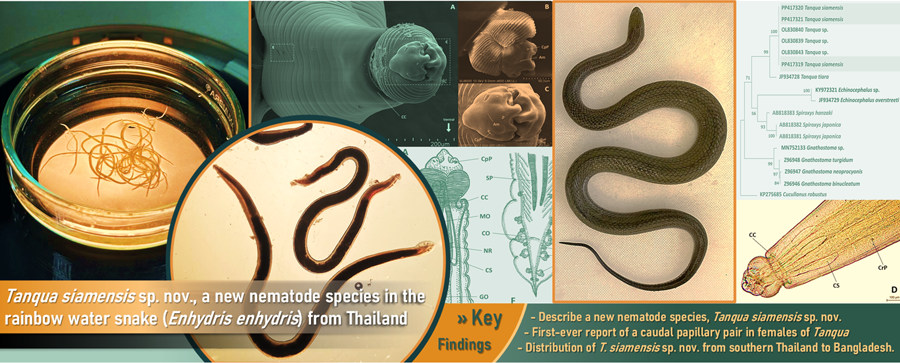
The rainbow water snake, Enhydris enhydris (Schneider, Reference Schneider1799), eats fish and occasionally preys on small amphibians and reptiles (Vattakaven et al., Reference Vattakaven, George, Balasubramanian, Réjou-Méchain, Muthusankar, Ramesh and Prabhakar2016). As predators, they can significantly impact parasite transmission by acting as reservoirs that facilitate the completion of a parasite's life cycle, especially when they consume infected hosts (Vattakaven et al., Reference Vattakaven, George, Balasubramanian, Réjou-Méchain, Muthusankar, Ramesh and Prabhakar2016; Lopez and Duffy, Reference Lopez and Duffy2021). Using both morphology and molecular methods, the nematodes infecting E. enhydris were identified. Genetic data revealed a match with Tanqua sp. (sensu Williams et al., Reference Williams, Hernandez-Jover, Hossen and Shamsi2022), a larval stage previously observed in the spotted snakehead fish, Channa punctata. Genetic markers employed for the molecular identification of Tanqua include the nuclear 18S and 28S ribosomal RNA (rRNA) genes. However, only 1 sequence has been associated with an identified species (T. tiara). Here, we describe a new nematode species, namely Tanqua siamensis sp. nov., supported by microscopic illustrations, morphological characteristics and genetic information.
Materials and methods
Host and parasite specimen preparation
Rainbow water snakes, E. enhydris, captured by local villagers and rescuers from Nakhon Si Thammarat Province and adjacent provinces in the southern part of Thailand, were delivered to the Snake Farm (SF), Queen Saovabha Memorial Institute (QSMI) in Bangkok, Thailand. Between 2020 and 2023, twelve specimens that perished during the quarantine stage were preserved at −20°C before undergoing dissection to explore helminths, adhering to reptile necropsy protocols (Terrell and Stacy, Reference Terrell and Stacy2007). Prior to dissection, the snakes underwent scrutiny based on Cox et al. (Reference Cox, Hoover, Chanhome and Thirakhupt2012) criteria. Various meristic and measurement variables, including weight, snout-vent length, tail length, scale numbers at different positions, gender and body pattern, were examined to confirm their species and gather host data.
After the dissection, organs, particularly the stomach, were isolated from each snake and placed in a petri dish filled with tap water. The organs were opened and carefully examined under stereomicroscopes (Olympus SZ30 and SZ51, Japan). Micro dissecting needles and precision probes were employed to extract all parasites, particularly Tanqua found in the stomach. These parasites were then transferred to a small petri dish filled with 0.85% normal saline and subsequently preserved in 70% ethanol in 1.5 mL sampling tubes. The number of parasites obtained per organ per snake was documented. Tubes containing parasites and the remaining parts of the snake specimens were stored in −20°C freezers at the Department of Helminthology, Faculty of Tropical Medicine, and the Department of Biology, Faculty of Science, Mahidol University, respectively.
Morphological study
For morphological studies, 32 male and 28 female complete helminth specimens were chosen from the preserved 70% ethanol stock for the creation of permanent slides. A subset of 6 specimens (3 males and females), in excellent body condition, were specifically selected as holotype, allotype and paratypes. Each specimen was stained in acetocarmine and dehydrated by sequential immersion in 70, 80, 90, 95% and concentrated ethanol for 45 min at each step. For neutralization and clearing, the specimens were then submerged in a 1:1 ethanol: xylene solution for 45 min, followed by a brief immersion in xylene. Subsequently, each specimen was placed in a few drops of mounting medium (Permount™) on a glass slide, covered with a coverslip, allowed to cool for a few minutes and incubated at 60°C for several days. The remaining specimens (n = 53) were mounted using lactophenol.
A comprehensive examination was conducted using an inverted microscope (Zeiss, Primovert, Germany) equipped with a Zeiss Axiocam and ZEN2 blue edition software. All measurements were recorded in millimetres (mm). Taxonomic keys for the identification of Tanqua species and the morphological features for species identification were derived from Baylis (Reference Baylis1916), Dewi et al. (Reference Dewi, Jones and Hamidy2008), Agustin et al. (Reference Agustin, Koesdarto, Lukiswanto, Suwanti, Arifin and Putranto2017) and Sou (Reference Sou2020). Illustrations were generated through drawings using a light microscope with a camera lucida (Leitz, Wetzlar, Germany).
For scanning electron microscope (SEM) analysis, 3 male and female specimens were selected from the preserved 70% ethanol stock. Initially, these specimens were immersed in a solution containing 2.5% glutaraldehyde in a 0.1 M sucrose phosphate buffer (SPB) for primary fixation. Subsequently, a secondary fixation step was performed using a 1% osmium tetroxide solution in the same 0.1 M SPB. Following this, the specimens were dehydrated with ethanol and dried using a critical point drying device (CPD300 auto, Leica, Wetzlar, Germany). A fine coating of gold was applied using a sputter coater (Q150R PLUS, Quorum, East Sussex, England). The specimen preparation was conducted at the Department of Tropical Pathology, Faculty of Tropical Medicine, Mahidol University. Finally, these prepared specimens were examined under the SEM (Hitachi, SU8010, Japan). The SEM analysis took place at the Faculty of Science (Phaya Thai), Mahidol University.
To examine morphological variation among all 60 helminth specimens (32 males and 28 females), 17 morphological characteristics shared by both genders were analysed. These were body length, maximum body width, cephalic bulb diameter, pseudolabial width, head length, distance from anterior to oesophagus end, maximum oesophagus width, muscular oesophagus length, muscular oesophagus width, glandular oesophagus length, glandular oesophagus width, distance from anterior to cervical sac, distance from anterior to nerve ring, distance from anterior to excretory pore, distance from anterior to cervical papillae, cuticle thickness and tail length (see Table 1). To assess the morphological variation of the specimens between hosts, gender morphologies were additionally employed. This included the number of caudal papillary pairs and spicule length for males (accounting for a total of 19 characters), and vulva to posterior end, egg width and egg length for females (accounting for a total of 20 characters) (Table 1). The multivariable data matrices were imported into principal component analysis (PCA) using PAST version 4.06b software (Hammer et al., Reference Hammer, Harper and Ryan2001). A correlation matrix model was employed to generate 2-dimensional scatter plots showing the percentage variances.
Information and measurement characters for T. tiara, T. anomala and T. siamensis sp. nov

Diagnostic characters for the new species are indicated in bold type. All measurements in millimetre (mm).
a From the level of anterior margin of cervical collar.
Molecular and phylogenetic study
For DNA extraction, 5 specimens were homogenized and processed using DNeasy Blood & Tissue Kit (Qiagen, Germany) following the manufacturer's instructions. The genomic DNA extracted was eluted with 30 μL of nuclease-free water and quantified using spectrophotometry.
The amplification targeted a partial sequence of a mitochondrial gene: cytochrome c oxidase subunit I (COI) and a nuclear gene: 18S ribosomal RNA (18S rRNA). These gene loci, known for molecular identification and revealing genetic diversity within nematode species, were selected based on previous studies (Tokiwa et al., Reference Tokiwa, Harunari, Tanikawa, Komatsu, Koizumi, Tung, Suzuki, Kadosaka, Takada, Kumagai and Akao2012; Eamsobhana et al., Reference Eamsobhana, Lim and Yong2015; Chan et al., Reference Chan, Chaisiri, Dusitsittipon, Jakkul, Charoennitiwat, Komalamisra and Thaenkham2020; Thaenkham et al., Reference Thaenkham, Chaisiri and Chan2022). The following primers were employed: JB3 5′-TTTTTTGGGC ATCCTGAGGTTTAT-3′ and JB4.5 5′-TAAAGAAAGAACATAATGAAAATG-3′ for COI, and 1096F 5′-GGTAATTCTGGAGCTAATAC-3′ and 1916R 5′-TTTACGGTCAGAACTAG GG-3′ for 18S rRNA. The resulting amplicon lengths for COI and 18S rRNA were 446 and 800 bp, respectively.
Polymerase chain reaction (PCR) reactions were conducted using a T100Tm thermocycler from Bio-Rad. The reaction mixture had a final volume of 30 μL, including 15 μL of 2X i-Taq master mix (Biotechnology, Gyeonggi, South Korea), 10 μm of each primer and 1 ng μL−1 of DNA. Thermocycling profiles varied for different gene targets, following established protocols (Holterman et al., Reference Holterman, van der Wurff, van den Elsen, van Megen, Bongers, Holovachov, Bakker and Helder2006; Charoennitiwat et al., Reference Charoennitiwat, Chaisiri, Ampawong, Laoungbua, Chanhome, Vasaruchapong, Tawan, Thaenkham and Ratnarathorn2023). PCR amplicons were visualized on a 1% agarose gel stained with SYBR Safe (Thermo Fisher Scientific, Waltham, USA). The PCR products from 3 specimens were sequenced using Barcode Taq sequencing (Celemics, Seoul, South Korea). Nucleotide sequences from this study were submitted to the NCBI database with the accession numbers PP444683–84 for COI and PP417319–21 for 18S rRNA.
The partial sequences of the 2 target genes were verified through manual inspection of electropherograms using BioEdit version 7.2.5, and the sequences were aligned using ClustalX 2.1. Phylogenetic analysis was performed using maximum likelihood (ML) in MEGA-X with the best-fit nucleotide substitution model and 1000 bootstrap replicates. The nucleotide substitution models used were Tamura-Nei (TN93) with a gamma distribution (+G) for COI and Kimura 2-parameter (K2) with a gamma distribution (+G) for 18S rRNA (Hall, Reference Hall1999; Thompson et al., Reference Thompson, Gibson and Higgins2002; Tamura et al., Reference Tamura, Stecher, Peterson, Filipski and Kumar2013).
Results
Taxonomy
Phylum: Nematoda Diesing, 1861
Class: Chromadorea Inglis, 1983
Order: Rhabditida Chitwood, 1933
Family: Gnathostomatidae Railliet, 1895
Genus: Tanqua Blanchard, Reference Blanchard1904
Species: Tanqua siamensis sp. nov. Charoennitiwat et al., Reference Charoennitiwat, Chaisiri, Kanjanapruthipong, Ampawong, Chanhome, Vasaruchapong, Thaenkham and Ratnarathorn2024 (Table 1, Figs 1–3)
Type-host: Enhydris enhydris (Schneider, Reference Schneider1799)
Tanqua siamensis sp. nov. of sample IDs: SN064TM01 (♂ paratype) and SN032TF02 (♀ allotype): (A) anterior end of male, lateral view; (B) posterior end of male, ventral view; (C) posterior end of female, lateral view; (D) a spicule of male; (F) eggs in uterus; and (E) reproductive structures of female, lateral view. AN, anus; CaP, caudal papillae; CC, cuticular collar; CO, cloaca; CpP, cephalic papillae; CrP, cervical papillae; CS, cervical sac; EP, excretory pore; GO, glandular oesophagus; IN, intestine; MO, muscular oesophagus; NR, nerve ring; SP, spicule; VU, vulva.

Scanning electron micrograph of Tanqua siamensis sp. nov.: (A) anterior region, anterior view; (B) cephalic bulb, lateral view; (C) pseudolabia, anterior view, extended from Fig. A; (D) excretory pore, extended from Fig. A; (E) cervical papilla, extended from Fig. A; (F) order sequence of cervical papilla and excretory pore, lateral view; (G) body wall with transverse striations, lateral view; (H) posterior end of male, ventral view; and (I) posterior end of female, ventral view. Am, amphid; AN, anus; CaP, caudal papillae; CC, cuticular collar; CpP, cephalic papillae; CrP, cervical papillae; EP, excretory pore; SP, spicule.

Permanent slides (acetocarmine dye, A and B) and semi-permanent slides (lactophenol, C and D) of Tanqua siamensis sp. nov.: (A) posterior region of female, lateral view; (B) posterior region of male, ventral view; (C) reproductive structures of female, ventral view; and (D) anterior region of male, dorsal view. 1‒8, pairs of caudal papillae; AN, anus; CaP, caudal papillae; CC, cuticular collar; CO, cloaca; CrP, cervical papillae; CS, cervical sac; UR, uteri; VA, vagina; VU, vulva.

Type-locality: Aquatic areas including lakes, ponds, swamps and paddy fields in Nakhon Si Thammarat (e.g. Pak Phraek, Thung Song district) and adjacent provinces in the southern part of Thailand (e.g. Songkhla lake). Specific coordinates of each host were not recorded.
Collection date: 10th November 2020 to 26th August 2023.
Site of infection: Stomach (the end of oesophagus and the beginning of small intestine in cases of high intensity)
Parasite intensity: 8–52 worms, mean approximately 23
ZooBank LSID: urn:lsid:zoobank.org:pub:AF6F528F-3F8A-4060-AF99-733915C59174
Etymology: The specific epithet ‘siamensis’ indicates that the nematode species is found in Thailand. We propose the colloquial English name for this nematode as the ‘stomach roundworm’ and the Thai name as ‘พยาธิกระเพาะงูสยาม’ (Phayat Krapho Ngu Siam).
General description
Body elongated with head and tail narrow. Cephalic bulb at anterior end regular, unarmed, with even transverse striations (approximately 23 rows of exposure from cuticular collar, Fig. 2B), and divided by longitudinal grooves into 2 submedian swellings positioned dorsally and ventrally (Figs 1A, 2A, B and 3D). Cuticular collar posterior to cephalic bulb (Figs 1A, 2A and 3D). Two thick pseudolabia project anteriorly, and medial surfaces deeply furrowed, slightly asymmetric (Figs 2A‒C). Intervening ridges appear as 5 blunt, tooth-like features, with lateral ridges smaller than medial ones (Fig. 2C). Projections on each pseudolabium interdigitate with one another (Figs 2A, C). Two sessile cephalic papillae present on external surface of each pseudolabium, featuring cordiform lateral prominences with minute amphid in between (Figs 1A and 2B, C). Oesophagus long, simple, gradually increases in diameter posteriorly (Figs 1A and 3D). Body wall smooth with fine transverse striations (Fig. 2D–G). Excretory pore on medial ventral side (Figs 1A and 2A, D, F), anterior to cervical papillae (Figs 1A and 2A, F). Cervical papillae digitiform on each lateral side (Figs 1A and 2A, F, D), spherical at base, taper abruptly (Fig. 2E). Four cervical sacs extend posteriorly from ballonets (Figs 1A and 3D).
Males (holotype, 2 paratypes and 29 voucher specimens): Body length 17–40.33 with maximum width 0.50–1.12. Cephalic bulb width 0.19–0.38; pseudolabial width 0.12–0.24. Oesophagus 1.52–4.71 long (7.7–20.3% of body length), with maximum width 0.29–0.54. Muscular oesophagus 0.22–0.49 long, with maximum width 0.08–0.30. Glandular oesophagus 1.28–4.17 long, with maximum width 0.35–0.66. Four cervical sacs 0.12–0.20 long, extend from anterior end, nerve ring 0.22–0.50 from anterior end, excretory pore, 0.35–0.66 from anterior end. Cervical papillae 0.39–0.74 from anterior end. Two equal and similar cuticular spicules 1.09–1.87 in length (4–8% of body length), curved ventrally, tubular, with pitted surface, without alae (Figs 1B, D and 2H). Tail tapering to point, 0.23–0.83 long, with well-developed caudal alae extending from anterior to cloaca to tip of tail (Figs 1B, 2H and 3B). Usually 8, sometimes 7, pairs of sessile caudal papillae present, situated ventrolaterally; 2/3 pairs preanal, 1 pair paranal and 4 pairs of diminishing size postanal (Figs 1B, 2H and 3B). First, fourth and sixth pairs from posterior end small, third and fifth pairs of caudal papillae from posterior end extend to alae (Figs 1B and 3B).
Gravid females (allotype, 2 paratypes and 25 voucher specimens): Body length 15.33–41.17, maximum width 0.56–1.56. Cephalic bulb width 0.22–0.44, pseudolabial width 0.10–0.30. Oesophagus 2.55–5.39 long (8.6–20.7% of body length), maximum width 0.21–0.67. Muscular oesophagus 0.23–0.69 long, with maximum width 0.09–0.34. Glandular oesophagus 2.21–4.61 long, with maximum width 0.21–0.67. Four cervical sacs 0.10–0.22 long, extend from anterior end. Nerve ring and excretory pore 0.21–0.55 and 0.34–0.73 from anterior end, respectively. Cervical papillae 0.40–0.81 long from anterior end. Vulva in posterior region of body, 6.68–16.56 from posterior end. Vulva present, 2 directly opposed uterine branches (didelphic) very long, two-fifths to half of body length (Figs 1E and 3C). Tail long and tapering, 0.59–1.37 in length (Figs 1C, 2I and 3A). A pair of caudal papillae located near tail end, with each positioned slightly laterally on both dorsal and ventral sides (Figs 1C, 2I and 3A). Eggs 0.04–0.06 × 0.05–0.08, oval, thin-shelled, ornamented with fine granulations (Fig 1F‒G).
Type materials
Holotype: Mature male deposited at the Mahidol University Museum of Natural History (Voucher no.: MUMNH-NEM0027; specimen code: SN071TM01) was collected by Vachirapong Charoennitiwat and his team, on 26th August 2023, in the stomach of a rainbow water snake, Endydris endydris (IDs: SN071 for this project; AAS077 [CO-Ee-046] for the Applied Animal Science laboratory's catalogue), at the Department of Helminthology, Faculty of Tropical Medicine, Mahidol University. Measurements of the holotype are available in Table S2. Eight pairs of sessile caudal papillae present; 3 pairs preanal, 1 pair paranal and 4 pairs of diminishing size postanal. First, fourth and sixth pairs from posterior end small, third and fifth pairs of caudal papillae from posterior end extend to alae. Other descriptive characters are consistent with the general description.
Allotype: Gravid female deposited at the Mahidol University Museum of Natural History (Voucher no.: MUMNH-NEM0028; specimen code: SN032TF02) was collected by Vachirapong Charoennitiwat and his team, on 21st June 2022, in the stomach of a rainbow water snake, E. endydris (IDs: SN032 for this project; AAS037 [CO-Ee-013] for the Applied Animal Science laboratory's catalogue), at the Department of Helminthology, Faculty of Tropical Medicine, Mahidol University. Measurements of the allotype are available in Table S2. Vulva didelphic (Fig. 1E), 1 pair of caudal papillae with each papilla situated on dorsal and ventral sides, laterally to midlines (Figs 1C, 2I and 3A). Eggs oval, thin-shelled, ornamented with fine granulations (Fig. 1F‒G). Other descriptive characters are consistent with the general description.
Paratypes (1–4) all from the stomach of E. endydris. Two males – Voucher no.: MUMNH-NEM0029 and MUMNH-NEM0030; specimen code: SN062TM01 and SN068TM01, respectively – were collected from snake IDs SN064 and SN068 (or AAS070 [CO-Ee-039] and AAS074 [CO-Ee-043]) on 26th August 2023. Two females – Voucher no.: MUMNH-NEM0031 and MUMNH-NEM0032; specimen code: SN032TF01 and SN032TF04, respectively – were collected from the same snake as the allotype. Morphological data for all paratypes are provided in Supplementary Table S2.
Diagnosis
Cephalic bulb consists of 2 smooth swellings, 1 dorsal and 1 ventral (Figs 1A, 2A and 3D). Distance from anterior end to cervical sac short (approximately 0.17 for both sexes). Distance from anterior end to excretory pore short (approximately 0.53 for both sexes). Excretory pore, positioned ventrally always anterior to cervical papillae (approximately 0.59 both sexes), which are positioned on lateral sides (Figs 1A and 2A, F). Males exhibit usually 8 or 7 pairs of caudal papillae, comprising 3 preanal, 1 paranal, and 3 or 4 postanal (Figs 1B, 2H and 3B). Females possess 1 caudal papillary pair located near tail end, with each positioned on dorsal and ventral sides, laterally to midlines (Figs 1C, 2I and 3A). Didelphic uterus very long, about 3 of 5 of the body lengths (Fig. 1E).
Comparison with other Tanqua species
The newly described species, T. siamensis sp. nov. has strongly distinctive characteristics (see Table S1). Notably, 1 pair of caudal papillae situated dorsally and ventrally close to the end of the female tail of T. siamensis sp. nov. is reported for the first time (Figs 1C, 2I and 3A), setting it apart from all other Tanqua species.
Tanqua tiara (von Linstow, Reference von Linstow1879) is characterized by 4 cephalic bulb swellings (Gibbons and Keymer, Reference Gibbons and Keymer1991; Sou, Reference Sou2020), despite multiple studies and revisions, resulting in variations in characteristic measurements and reports of diverse hosts among monitor lizard species (see Table S1), In contrast, T. siamensis sp. nov. has only 2 bulb swellings (Fig. 2A). Moreover, T. tiara was described with 4 branches of the uterus, whereas T. siamensis sp. nov. has only 2 branches.
Tanqua geoclemydis Wang et al., Reference Wang, Zhao, Wang and Zhang1979, stands out as the sole Tanqua species described from a turtle, the Chinese pond turtle, M. reevesii, in China. Relative to T. siamensis sp. nov., it has smaller dimensions, including body length (♂ 13.40 and ♀ 14.40–15.40 vs ♂ 17–40.33 and ♀ 15.33–41.17), oesophagus length (♂ 0.17 and ♀ 0.14–0.18 vs ♂ 0.30–0.54 and ♀ 0.21–0.67), the number of head-bulb swellings (4 vs 2), appearance of cervical sacs (asymmetrical vs symmetrical) and spicule length (0.56 vs 1.09–1.87).
Tanqua occlusa Schuurmans-Stekhoven, Reference Schuurmans-Stekhoven1943, from the oesophagus and stomach of Smith's African water snake, G. smithii, in Congo, Africa, was described with limited information. However, it evidently has 4 cephalic bulb swellings, akin to T. tiara. Males also exhibit 5 pairs of caudal papillae (compared with 7 or 8 pairs in T. siamensis sp. nov.), and females are large, ranging from 45 to 62 (compared to 15–41) (Schuurmans-Stekhoven, Reference Schuurmans-Stekhoven1943).
Tanqua gigantica Kung, Reference Kung1948, from the intestine of snakes in Southeast Asia, is a very large species with a total body length of 110–130 (vs 17–40 in T. siamensis sp. nov.) with a body width of 2.0–2.5 (vs 0.5–1.1) for males, while females are 120–160 (vs 15–41) long with a body width of 2.5–3.2 (vs 0.5–1.4) (Kung, Reference Kung1948). Tanqua gigantica is also distinguished by having only 6 caudal papillary pairs, a short tail (0.5% of the body length vs ♂ 1.2–3.2% and ♀ 2.5–6.0% in T. siamensis sp. nov.), and a short spicule length (1% of the body length vs 4–8% in T. siamensis sp. nov.).
Tanqua bainae Ghadirian, Reference Ghadirian1968, is another large species with a body length of 85–100 with a body width of 1.6 for males and 105–120 and a body width of 2 for females. These body size ranges show no overlap with T. siamensis sp. nov. Furthermore, the spicule length of T. bainae accounts for only about 1.5% of the total body length (vs 4–8% for T. siamensis sp.). Similarly, the uterus length of T. bainae has been described as about 2% of the body length (vs 40–50%). The site of infection (whole digestive tract vs stomach only) and locality (Madagascar vs Thailand) reported for this species also suggested that it is distinct from T. siamensis sp. nov.
A significant distinction between T. diadema von Linstow, Reference von Linstow1904 and T. siamensis sp. nov., lies, firstly, in the documented locality (Brazil vs Thailand) and, secondly, in the site of infection (intestines vs stomach). Importantly, T. diadema possesses a retractable cephalic bulb and pseudolabia within the cuticular collar, forming a prepuce-like sheath (Baylis and Lane, Reference Baylis and Lane1920), features not observed in T. siamensis sp. nov. (Figs 1A, 2A and 3D). Due to the retractile bulb of T. diadema, it has pseudolabia that, although smaller, are relatively about the size of the cephalic bulb (Baylis and Lane, Reference Baylis and Lane1920), while T. siamensis sp. nov. displays a cephalic bulb by considerably larger than the pseudolabia. Moreover, the excretory pore in T. diadema is situated behind the cervical papillae, which contrasts with the positioning in T. siamensis sp. nov., where it lies anterior to the cervical papillae. The uterus length is reportedly short in T. diadema, whereas this character is notably long in T. siamensis sp. nov (40–50% of the total body length).
Tanqua anomala (von Linstow, Reference von Linstow1904), reported in Indonesia and Australia, is another well-studied species that has undergone taxonomic revisions multiple times, resulting in varied morphological counts and measurements (see Table 1). It resembles T. siamensis sp. nov., in several characteristics but several differentiate these 2 species: (1) The distance from the anterior end to the excretory pore is 0.35–0.66 of the body length for males and 0.34–0.73 for females in T. siamensis sp. nov. (approximately 0.53 or 2.0% of the body length for both sexes). In contrast, in T. anomala it is more distant, 0.75–0.96 for males and 0.90–1.23 for females (approximately 0.85 and 1.09, or 2.3 and 2.9% of the body length for males and females, respectively, Baylis, Reference Baylis1916; Dewi et al., Reference Dewi, Jones and Hamidy2008). (2) The arrangement of the excretory pore and cervical papillae appears to differ between the 2 species, as the cervical papillae are anterior to the excretory pore in T. anomala (Dewi et al., Reference Dewi, Jones and Hamidy2008; Al-Moussawi, Reference Al-Moussawi2010), whereas in T. siamensis sp. nov. they are posterior to it (Figs 1A and 2A, 2F). (3) Tanqua anomala has been remarked as having a very short uterus, whereas T. siamensis sp. nov. has a long uterus. According to these characters, T. siamensis sp. nov. should be nominated as new species in the genus Tanqua.
Variation
After analysing the morphological measurements of all T. siamensis sp. nov. specimens, no marked morphological variation among individuals or genders were observed. The 2-dimensional plot of PC1 and PC2 axes showed no distinct separation and a significant overlap between males and females (Fig. S2). This lack of differentiation in PCA was supported by PC1 and PC2 accounting for 71.85% of the total variance together, with a substantial drop in eigenvalue between PC1 (60.07%) and PC2 (11.78%), and also between PC2 and PC3 (5.90%). Consequently, it can be inferred that sexual dimorphism of T. siamensis sp. nov. can only be determined based on discrete sex characteristics (such as the uterus and vulva in females, and caudal papillary pairs in males), rather than shared measurement characters between both sexes.
The intensity of T. siamensis sp. nov. infections ranged from 8 to 52 worms, with a mean of 23 (Table S2). Some morphological variation was observed among Tanqua specimens from individual snakes. The analysis among male specimens revealed 3 clusters which partially overlap (Fig. S2B). A similar result was observed for female worms (Fig. S2C), suggesting a minor host impact on the morphology of the worms.
Genetic characterization and phylogenetic position
Relative to other sequences available for comparison, both phylogenies suggest that T. siamensis sp. nov. is a distinct species within Gnathostomatidae. The COI analyses suggested that T. siamensis sp. nov. forms a distinct clade within Gnathostomatidae (Fig. 4A). Specifically, the nuclear 18S rRNA strongly indicated the differentiation of T. siamensis sp. nov. from T. tiara and other gnathostome sequences available in GenBank (Fig. 4B). The results illustrated that T. tiara is a sister clade to T. siamensis sp. nov., confirmed by a 99% Bayesian posterior probability. The genetic results also found that the sequence of T. siamensis sp. nov. from Thailand perfectly matches that of the larva of Tanqua sp. found in a snakehead fish from Bangladesh (Williams et al., Reference Williams, Hernandez-Jover, Hossen and Shamsi2022), suggesting that they represent the same species. The genetic variation between T. siamensis sp. nov. and other reported species ranged from 13 to 18% for the COI and 2 to 10% for the 18S rRNA gene. The closest genetic distances for 18S rRNA gene were observed between T. siamensis sp. nov. and T. tiara, with a 2% difference; for COI, a 13% difference was observed with Gnathostoma binucleatum.
Phylogenetic analysis of the available sequences of nematodes within the family Gnathostomatidae based on different genetic markers: (A) COI and (B) 18S rRNA. The analyses were conducted using MEGAX with the maximum likelihood method. Branch length scale bars indicate the number of substitutions per site. Coloured lines/fonts represent genetic data from various genera in Gnathostomatidae, sourced from GenBank, with the red line/font specifically highlighting the genus Tanqua. The blue box indicates the specimens of Tanqua siamensis sp. nov. utilized in the present study.

Natural history
Tanqua siamensis sp. nov., appears to be prevalent in the rainbow water snake, E. enhydris, as evidenced by its discovery in all 12 snake specimens examined. This species produces lesions in the stomach of its hosts. In instances of high-level infection, numerous small hardened spots [possibly indicative of caseous necrosis, as revealed by Gibbons and Keymer (Reference Gibbons and Keymer1991)] were common on the internal wall of the organ (Fig. S1), where the nematodes firmly affix themselves using the cephalic portion. The parasites densely populate the stomach, resulting in noticeable swelling.
Rainbow water snakes eat small fishes (Cox et al., Reference Cox, Hoover, Chanhome and Thirakhupt2012), which serve as intermediate hosts for T. siamensis sp. nov. Inspection of the snake gastrointestinal tract unveiled fish carcasses inside the oesophagus and stomach containing worms that had not yet attached to the stomach wall. The role of fish as an intermediate host for transmitting this nematode species is also supported by the phylogenetic results, showing that the genetic sequences of Tanqua sp. larvae found in a snakehead fish species, Channa sp. (sensu Williams et al., Reference Williams, Hernandez-Jover, Hossen and Shamsi2022), matched those of the Tanqua specimens in this study. This discovery extends the life cycle and the distribution of T. siamensis sp. nov. from South Thailand to Bangladesh, where its adults and larvae were reported, respectively.
Discussion
Despite the distinctiveness of many Tanqua species, several original species descriptions lack sufficient morphological details, particularly T. gigantica, T. bainae, T. geoclemydis, T. diadema and T. occlusal; each described from a small number of specimens. The first 3 species provided clear morphological measurements such as body length, body width and variables related to the lengths and ratios between reproductive organs and the total body length (Kung, Reference Kung1948; Ghadirian, Reference Ghadirian1968), serving to differentiate them from T. siamensis sp. nov. Conversely, T. diadema, and T. occlusal exhibit overlapping ranges of morphological measurements, resulting in difficulties in species differentiation. However, meristic counts and qualitative traits, such as the number of cephalic bulb swellings, the order of cervical papillae and excretory pore, and retractable head capability (Baylis and Lane, Reference Baylis and Lane1920; Schuurmans-Stekhoven, Reference Schuurmans-Stekhoven1943), distinguish these and the new species. In the case of T. tiara (Gibbons and Keymer, Reference Gibbons and Keymer1991; Agustin et al., Reference Agustin, Koesdarto, Lukiswanto, Suwanti, Arifin and Putranto2017; Sou, Reference Sou2020) and T. anomala (Baylis, Reference Baylis1916; Johnston and Mawson, Reference Johnston and Mawson1948; Kagei and Shogaki, Reference Kagei and Shogaki1977; Dewi et al., Reference Dewi, Jones and Hamidy2008), despite taxonomic revisions with varying numbers of specimens resulting in varied morphological characteristics and wide distribution for these 2 species, there are clear morphological differences that distinguish them from T. siamensis sp. nov.
Using the presence of 4 uterine branches as a diagnostic criterion for species identification, as invoked in some previous publications (e.g. Baylis, Reference Baylis1916; Baylis and Lane, Reference Baylis and Lane1920; Gibbons and Keymer, Reference Gibbons and Keymer1991), is problematic. Nematodes typically have either 1 or 2 genital tracts – monodelphic or didelphic (Li et al., Reference Li, Liang, Zhang and Mahamood2017). The observation of 4 tracts in T. tiara may be exceptional case, suggesting the need for a more in-depth study of extended anatomy. Alternatively, as uteri are typically folded, the character may have been misinterpreted.
The number of caudal papillary pairs in males is an important character for Tanqua species identification (e.g. Baylis and Lane, Reference Baylis and Lane1920; Dewi et al., Reference Dewi, Jones and Hamidy2008; Sou, Reference Sou2020). However, inconsistencies in reported numbers, particularly for T. tiara, pose challenges. Sou (Reference Sou2020) reported 5 pairs, whereas Baylis and Lane (Reference Baylis and Lane1920) and Gibbons and Keymer (Reference Gibbons and Keymer1991) indicated 8 pairs. Tanqua anomala also has conflicting reports, with Dewi et al. (Reference Dewi, Jones and Hamidy2008) documenting 8 pairs whereas Johnston and Mawson (Reference Johnston and Mawson1948) and Kagei and Shogaki (Reference Kagei and Shogaki1977) reported 5 pairs. The Tanqua specimens in this study add some complexity in that they vary in caudal papillae counts, ranging between 7 and (usually) 8 pairs. This variation suggests that caution is warranted when using this character as a diagnostic tool for species identification. Notably, this study is the first to report a caudal papillary pair near the end of the female tail of T. siamensis sp. nov. This character is unique to the new species.
The phylogenetic analysis, incorporating both nuclear and mitochondrial genes, indicates that T. siamensis sp. nov. is consistent with the genus Tanqua, and distinct from T. tiara. However, there is little genetic information for Tanqua species. Most studies were conducted molecular studies became common. Even well-known species, like T. anomala, lack sequences, despite efforts to obtain DNA from previous authors by the researchers in this study (e.g. Dewi et al., Reference Dewi, Jones and Hamidy2008; Al-Moussawi, Reference Al-Moussawi2010). Confirming whether T. siamensis sp. nov. is closer to T. anomala or T. diadema (the most closely resembling in morphology), requires further study involving specimens of these species from within their reported distribution.
The 18S rRNA gene analysis showed that T. siamensis sp. nov., is distributed from south Thailand to Bangladesh and that it is transmitted from fishes to snakes. Such a transmission aligns with observed hunting behaviour, which primarily targets fishes (Cox et al., Reference Cox, Hoover, Chanhome and Thirakhupt2012), as evidenced by the presence of fish carcasses containing unattached-to-organ Tanqua inside the upper digestive tract of the snakes. The reported host range of T. tiara, found in monitor lizard species, Varanus spp. (e.g. Baylis, Reference Baylis1916; Gibbons and Keymer, Reference Gibbons and Keymer1991; Agustin et al., Reference Agustin, Koesdarto, Lukiswanto, Suwanti, Arifin and Putranto2017; Sou, Reference Sou2020), and T. anomala, found in semiaquatic snake species (Baylis, Reference Baylis1916; Baylis and Lane, Reference Baylis and Lane1920; Johnston and Mawson, Reference Johnston and Mawson1948; Kagei and Shogaki, Reference Kagei and Shogaki1977; Dewi et al., Reference Dewi, Jones and Hamidy2008), including the rainbow water snake, E. endydris, from Indonesia (Kagei and Shogaki, Reference Kagei and Shogaki1977), suggests the possibility that each Tanqua species, including T. siamensis sp. nov., may infect multiple hosts.
A few reports have indicated the presence of T. tiara and T. anomala in snakes in Thailand. Chaiyabutr and Chanhome (Reference Chaiyabutr and Chanhome2002) documented T. tiara in the Laotian wolf snake, Lycodon laoensis. However, the details and specimen numbers for both hosts (n = 2) and Tanqua (n = 1) were insufficient for precise species characterization. A similar lack of information was observed in the discovery of T. anomala by Baylis and Lane (Reference Baylis and Lane1920) in the puff-faced water snake, Homalopsis buccata. These publications rely solely on basic parasite morphology for species identification. It is also plausible that both T. tiara and T. anomala exist in Thailand but are specifically hosted by other reptiles.
Sexual dimorphism in T. siamensis sp. nov. is challenging to discern solely through general morphological measurements. Host may impact worm morphology, as indicated by distinct clusters in PCA results. However, the low sample size per host suggests the need for more specimens to better understand host-related variation. Studies on nematode sexual dimorphism can be further implemented, such as host environmental influences (e.g. Anjam et al., Reference Anjam, Shah, Matera, Różańska, Sobczak, Siddique and Grundler2020), developmental molecular events (e.g. Emmons, Reference Emmons2014; Pollo et al., Reference Pollo, Leon-Coria, Liu, Cruces-Gonzalez, Finney and Wasmuth2023) and evolutionary perspectives (e.g. Morand and Hugot, Reference Morand and Hugot1998; Ancell and Pires-daSilva, Reference Ancell and Pires-daSilva2017). Similar observations have been reported in nematodes infecting snakes, such as Paracapillaria najae (Charoennitiwat et al., Reference Charoennitiwat, Chaisiri, Ampawong, Laoungbua, Chanhome, Vasaruchapong, Tawan, Thaenkham and Ratnarathorn2023) and Paracapillaria siamensis (Charoennitiwat et al., Reference Charoennitiwat, Chaisiri, Kanjanapruthipong, Ampawong, Chanhome, Vasaruchapong, Thaenkham and Ratnarathorn2024), although they are distinct taxa.
In conclusion, both morphological and genetic characterizations provide compelling evidence supporting the identification of a new species within the genus Tanqua. This discovery leads to the formal naming of the species as T. siamensis sp. nov. However, uncertainties in morphological observations from previous, often older studies raise questions about the reliability of using certain characters for Tanqua species identification. The limited popularity of this nematode genus within the scientific community has contributed to a delayed development in all aspects of basic information (e.g. molecular genetics), particularly when compared to medically relevant nematodes. Nonetheless, investigating T. siamensis sp. nov. in this study has not only expanded the taxonomy of its genus but also raised awareness of parasitic infections and lesions, especially for captive snakes.
Supplementary material
The supplementary material for this article can be found at https://doi.org/10.1017/S0031182024000908.
Data availability statement
The data that support the findings of this study are available from the first and corresponding authors upon reasonable request.
Acknowledgements
Sincerely thank Kartika Dewi from the Zoological Division, Research Centre for Biology, Indonesian Institute of Sciences for providing the genetic sequences of the T. tiara, and Hsuan-Wien Chen from the Department of Biological Resources, National Chiayi University, Taiwan for a copy of rare, original literature. Thank all supporting staffs from the Snake Farm, Queen Saovabha Memorial Institute, the Department of Helminthology, Faculty of Tropical Medicine, the Department of Tropical Pathology, Faculty of Tropical Medicine, and the Department of Biology, Faculty of Science, Mahidol University for facilitating working spaces and facilities.
Author contributions
V. C. conducted data investigation, performed formal data analyses, curated data and made contributions to methodology (all parts) and visualization. N. R. played a pivotal role in research conceptualization, methodology (helminth and host specimen preparation and SEM), formal data analyses, validation, visualization, funding and the writing and editing of the original draft. A. H. E. C. contributed to conceptualization, validation, made contributions to methodology (PCA and genetics) and edited the original draft. U. T. contributed validation, funding and provided recommendations. S. T. participated in methodology (PCA, morphological examination), data curation and visualization. K. C. contributed to visualization, validation and recommendations. T. K. and S. A. were involved in visualization and methodology. P. L. and T. T. contributed to specimen preparation, processing and resource management.
Financial support
This project is funded by the National Research Council of Thailand (NRCT) and Mahidol University (Contract ID: N42A660912).
Competing interests
None.
Ethical standards
All procedures performed by researchers, snake handlers and veterinarians in handling snakes were approved by the Safety Committee of Queen Saovabha Memorial Institute (Document No. SN001). The authors confirm that the field studies did not involve endangered or protected species. The study was also approved by the Ethics Committee of Queen Saovabha Memorial Institute (Approval Protocol Number: QSMI-ACUC-11-2021).


 Open access

