





Introduction
The Copepoda are a class of exceptionally diverse crustaceans, with nearly 3000 of the 13 000 estimated species being found in freshwater (Boxshall and Defaye, Reference Boxshall and Defaye2008). Around 330 species of freshwater copepods are parasitic, with fish being the most common host (Boxshall and Defaye, Reference Boxshall and Defaye2008). Salmincola is a genus of ectoparasitic copepods in the family Lernaeopodidae, which specializes on fishes in the family Salmonidae. Salmincola copepods begin life as free-swimming copepodid larvae and eventually attach themselves to the bodies of their host (Friend, Reference Friend1942; Kabata, Reference Kabata1969). Host attachment is achieved via a structure called the bulla, which is secreted from the maxillae (Figure 1). Attachment sites vary across species. The most common attachment sites are the gills and fins, with the operculum, mouth and skin also being common (Kabata, Reference Kabata1969). Salmincola copepods are found throughout the northern hemisphere (Kabata, Reference Kabata1969), but beyond basic life history and geographical details, little is known about their growth and development. Moreover, a paucity of genomic studies leaves many open questions about the evolutionary history and radiation of the genus. Salmincola was first described to include 13 species (Wilson, Reference Wilson1915). A major revision of the genus was done by Kabata (Reference Kabata1969), which increased the number of species to 15. At present, Salmincola has been found infecting a number of commercially and recreationally important species, including rainbow trout (Oncorhynchus mykiss), Brook trout (Salvelinus fontinalis) and Atlantic salmon (Salmo salar). For this reason, a large portion of the literature on this genus comes from fisheries management. Three new species have been described since 1970, all of which are found in Russia and Japan, where a large proportion of the evolutionary work on Salmincola has been done in recent decades. Additionally, only limited phylogenetic data, based on a handful of genes, exists for the genus (Hasegawa et al., Reference Hasegawa, Katahira and Koizumi2022b; Shedko et al., Reference Shedko, Shedko, Miroshnichenko and Nemkova2023). A search of publicly available nucleotide sequence databases uncovered a total of 246 gene sequences across Salmincola (see Supplementary Table S1 for a summary of databases searched and available sequences). Although this may at first appear to be a reasonably large dataset, it only covers 3 genes that are primarily reported in 6 species.
Adult female Salmincola edwardsii collected on brook trout near Richland Center, Wisconsin, USA. b, bulla; cs, cephalothorax; es, egg sac; mx2, second maxilla; t, trunk.

Despite a long history of study in fisheries, significant gaps remain in the understanding of the evolutionary history of Salmincola copepods and their relationship with salmonid hosts. This review seeks to describe the current state of knowledge regarding the genus, with particular emphasis on species diversity and host specificity.
Taxonomic review and natural history of the genus Salmincola
A literature search revealed 413 original records where authors provided genus and species for both host and parasite (see Supplementary Material 1 for a full list of references). Literature searches were conducted using Google Scholar. Search terms included ‘Salmincola’, ‘Salmincola copepod’ and ‘gill lice’. Further searches were done for each of the 23 described Salmincola species. In addition to English, searches for sources were conducted in Russian, Japanese, French, Ukrainian, Norwegian and Polish.
The complete list of records is summarized in Table 1, with records and references included in Supplementary Table S2. Reports from records before 1969 are revised to reflect current valid species names, based on Kabata (Reference Kabata1969). In total, of the 23 described Salmincola species, 13 were rarely reported in the literature, suggesting that additional work is needed to determine if these are valid identifiers or merit scrutiny. Rare records in this case are defined as species with fewer than 10 validated recordings in the literature, regardless of host species. Rare occurrences of a parasite species on a given host genus were documented as well. Fifteen cases were identified where fewer than 10% of total records for a parasite species are related to a second host genus (highlighted in Table 1). Finally, an examination of broad geographic ranges of particular parasite species with abundant records was conducted. Given that species within salmonid genera tend to be closely related (further explanation provided later), hosts are generally discussed at the genus level in order to refrain from identifying potentially spurious pairings at the host species level.
Host-parasite pairs found in the literature for Salmincola

Host species marked with an asterisk
(*) represent host-genera which account for less than 10% of records for a given parasite.
Natural history of Salmincola
Host diversity
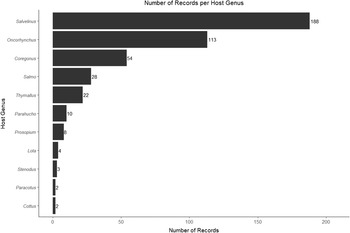
Salmincola are known from all 4 subfamilies of Salmonidae; however, their presence across different species is highly variable between genera. Just 5 host genera, Oncorhynchus, Salmo, Salvelinus, Coregonus and Thymallus, collectively account for over 92% of records (Figure 2). As for the remaining records, there are 12 and 8 instances of infection in the salmonid genera Prosopium and Parahucho, respectively. Four records were found of Salmincola lotae infecting the burbot, Lota lota. Finally, 4 records were uncovered of host-family spillover into the family Cottidae, the sculpins. Except for 1 record of S. edwardsii infecting Cottus cognatus, all records of Salmincola infecting cottids are the species S. cottidarum. Further research is necessary to determine whether these records represent rare spillover events of other, more common Salmincola species or lineages unique to these non-salmonid hosts.
Bar chart depicting the frequency of Salmincola hosts.

A central question for future research in Salmincola is the degree to which variation in host specificity correlates with morphological and genetic diversity in Salmincola. It is currently unclear, for instance, if Salmincola populations evolved alongside their host populations, how often parasite populations become extirpated, and how often new populations are established.
Species level definitions within Salmonidae are often debated, particularly in Salvelinus, Coregonus and Thymallus. A clear understanding of host species lineages will be key to understanding Salmincola diversity. Within Salvelinus, brook trout (S. fontinalis) is strongly supported and recognized as a valid species (Page and Burr, Reference Page and Burr2011). Dolly Varden trout (S. malma), Lake Trout (S. namaycush) and arctic charr (S. alpinus) are also well supported. Beyond those 4 lineages, most species of Salvelinus are extremely geographically constrained (Taylor, Reference Taylor2016; Osinov et al., Reference Osinov, Volkov and Mugue2021). Coregonus, the whitefishes, have a circumpolar distribution (Nelson et al., Reference Nelson, Grande and Wilson2016). In North America, the cisco (Coregonus artedi) and the bloater (Coregonus hoyi) are well supported (Page and Burr, Reference Page and Burr2011). In Eurasia, the European whitefish (Coregonus lavaretus) is widely distributed but with significant morphological variation that is often interpreted as species diversity (Østbye et al., Reference Østbye, Næsje, Bernatchez, Sandlund and Hindar2005; Bochkarev et al., Reference Bochkarev, Zuykova and Politov2017). In Thymallus, the number of extant, valid species ranges from just 2 (Gum et al., Reference Gum, Gross and Geist2009) to 4 (Nelson et al., Reference Nelson, Grande and Wilson2016) to 14 (Froese and Pauly, Reference Froese and Pauly2013). A consistent pattern across these 3 genera is a broad geographic distribution at the genus level with each region containing several well-supported species. Additionally, each genus contains a number of rarely reported species that are not nearly as strongly supported in the literature. In general, the species boundaries are less well documented in the remote regions of northeast Asia. While there may be an important relationship between host and parasite species diversity, further research will likely be hampered by disagreement over which evolutionary units, for both hosts and parasites, can be considered unique species. Importantly, jointly studying both hosts and parasites may help resolve some of these disputes. Testing for strong patterns of parasite specificity that support particular host species or clades could provide a novel approach to resolving several long-standing debates about Salmonid taxonomy.
Salmincola diversity
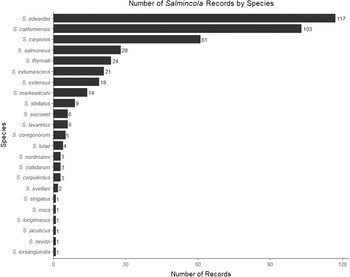
The literature review identified large discrepancies in the number of publications supporting different Salmincola species designations. Over half (50.4%) of Salmincola records pertain to just 2 species: Salmincola edwardsii and Salmincola californiensis. The next 7 most-commonly reported species account for just over 40% of total records (Figure 3). The remaining records consist of 14 species with fewer than 10 records each, including 6 species for which there is just 1 record. Among the species described in the following, there is a large variation in host range. Most species are found primarily in a single host genus, and many of the uncommon and rare parasites have only been observed on a small group of hosts. However, instances of parasites infecting atypical host genera are common. While it is possible that these atypical infections constitute host spillover events, many of them could result from uneven study effort across Salmincola species. The host range of parasites commonly increases as they become more well studied (Poulin and Mouillot, Reference Poulin and Mouillot2003). Alternatively, given the slight morphological differences between some species, unusual host records may reflect parasite misidentification. Additionally, these rare species, which have not been examined phylogenetically, should be considered prime targets for future phylogenetic research.
Bar chart showing frequency of records for 23 species of Salmincola.

The following sections provide a brief description of each major species in alphabetical order, followed by brief descriptions of the minor species organized by author. The summaries focus on recorded geographic distributions and host communities, and instances were identified where species are particularly relevant to diversification trends outlined earlier.
Salmincola californiensis
Salmincola californiensis is among the most common Salmincola species. S. californiensis records exist from the United States and Canada (Kabata, Reference Kabata1969), Russia (Kazachenko and Matrosova, Reference Kazachenko and Matrosova2020), and Japan (Nagasawa and Urawa, Reference Nagasawa and Urawa2002; Hasegawa et al., Reference Hasegawa, Uemura, Yamashita, Inoshita and Koizumi2025a, Reference Hasegawa, Sugimoto and Koizumib). In North America, the parasite is primarily found near the Pacific Coast, where Salmincola californiensis primarily infects salmonids of the genus Oncorhynchus (Kabata, Reference Kabata1969). However, there are some records of its presence in charr (genus Salvelinus) (Nagasawa et al., Reference Nagasawa, Urawa and Awakura1987; Reeves, Reference Reeves2015; Kazachenko and Matrosova, Reference Kazachenko and Matrosova2020). Morphologically, it is distinguished by the characteristic shortness of its trunk, which is ‘enough to make the species quite easy to recognize from its general appearance’ (Kabata, Reference Kabata1969). Over 93% of reports for this species are confined to a single host genus, Oncorhynchus, suggesting a large degree of specialization. Reports of S. californiensis from charr and whitefish (genus Prosopium) may represent spillover events, and further investigation is necessary to determine whether these reports may be capturing stable populations of S. californiensis outside of Oncorhynchus. However, it is possible that populations of S. californiensis infecting different hosts form distinct populations, or that parasites genetically cluster into discrete geographic units. Phylogeographic analyses offer the most straightforward method for understanding host and geographic patterns for Salmincola. For example, the phylogeography of another Oncorhynchus parasite, the flatworm Gyrodactylus, was recently documented using genetic data (Leis et al., Reference Leis, Chi and Lumme2021). That study not only uncovered distinct geographic units but also traced the evolutionary origin of the parasite as it jumped from the family Cyprinidae into salmonids and across salmonid subfamilies. Similar studies will be useful in determining the evolutionary history and geographic structure within Salmincola.
Salmincola carpionis
Salmincola carpionis has a circumpolar distribution, being found in Iceland, Greenland, North America, and Northeast Asia (Kabata, Reference Kabata1969). While morphologically similar to S. salmoneus, S. carpionis has a distinctly shaped cephalothorax along with a thin portion of the trunk where it connects to the cephalothorax (Kabata, Reference Kabata1969). It primarily infects Salvelinus, with some records in Oncorhynchus (Moles, Reference Moles1982; Nagasawa et al., Reference Nagasawa, Yamamoto, Sakurai and Kumagai1995). While carpionis is not as common as S. edwardsii or S. californiensis, it remains among the most commonly reported Salmincola species (Figure 2).
Salmincola coregonorum
Salmincola coregonorum is known primarily from records in the former USSR (Monod and Vladykov, Reference Monod and Vladykov1931; Kabata, Reference Kabata1969), with a single record from Canada (Chinniah and Threlfall, Reference Chinniah and Threlfall1978).
Morphologically, it is similar to S. thymalli, but has a distinct bulla morphology (Kabata, Reference Kabata1969). Every recorded specimen of S. coregonorum was found infecting members of the genus Coregonus (Table 1). Given the paucity of records for this species, future work should aim to confirm whether S. coregonorum constitutes a distinct species.
Salmincola corpulentus
Salmincola corpulentus is distributed in North America, from the Laurentian Great Lakes to the Great Slave Lake and Great Bear Lake in the north of Canada (Miller and Kennedy, Reference Miller and Kennedy1948; Kabata, Reference Kabata1969; Chinniah and Threlfall, Reference Chinniah and Threlfall1978). It is morphologically distinguished by the shape of the endopod of the second antenna (Kabata, Reference Kabata1988) along with the unique curvature of its egg sacs (Kabata, Reference Kabata1969; Bowen and Stedman, Reference Bowen II and Stedman1990). This species appears to infect bloaters (Coregonus hoyi) (Bowen and Stedman, Reference Bowen II and Stedman1990; Muzzall and Madejian, Reference Muzzall and Madenjian2013) and cisco (Coregonus artedi) (Hoff et al., Reference Hoff, Pronin and Baldanova1997). While this species is fairly commonly reported, future work should be done to compare it in more depth to other species found in the North American Great Lakes.
Salmincola cottidarum
Salmincola cottidarum is known only from sporadic records from Lake Baikal (Kabata, Reference Kabata1969; Kabata and Koryakov, Reference Kabata and Koryakov1974). Unique to the genus Salmincola, it infects sculpins of the genera Cottus and Paracottus, rather than salmonids. Kabata (Reference Kabata1969) described the species as being morphologically similar to S. edwardsii, though his description was based on just 3 individuals from a single locality. Given the uniqueness of this species’ host range, further investigation of sculpins as hosts of Salmincola is necessary.
Salmincola edwardsii
Salmincola edwardsii, one of the most well-sampled of any species in the genus, has a wide circumpolar distribution. Morphologically, S. edwardsii is most easily identified by the characteristics of the rami on the second antenna (Kabata, Reference Kabata1969). Infections have been recorded in North America (Mitro, Reference Mitro2016), Japan (Hasegawa et al., Reference Hasegawa, Ayer, Umatani, Miura, Ukumura, Katahira and Koizumi2022a), Norway (Refsnes, Reference Refsnes2014), and far eastern Russia (Shedko et al., Reference Shedko, Shedko, Miroshnichenko and Nemkova2023). S. edwardsii primarily infects members of the genus Salvelinus (Table 1). This includes the widely distributed arctic charr (S. alpinus), Dolly Varden trout (S. malma) and brook trout (S. fontinalis), as well as many records from potentially obscure members of Salvelinus (Table 1). It should be noted that there is no clear consensus on the number of species within Salvelinus, with reputable sources ranging from just 3 valid species with wide geographic ranges to dozens of species with highly constrained ranges (Froese and Pauly, Reference Froese and Pauly2013; Taylor, Reference Taylor2016; Osinov et al., Reference Osinov, Volkov and Mugue2021) (Table 1). Within Salvelinus, there is a strong divide between species with large ranges (such as Salvelinus fontinalis) and those with very limited distribution (such as Salvelinus neiva). Given its large range and diverse host range, there are ample opportunities for further research into the genetic and morphological diversity of this species. For instance, testing for phylogenetic associations, like those which have been created for gill parasites of cichlids (Seidlová et al., Reference Seidlová, Benovics and Šimková2022) and feather mites of warblers (Matthews et al., Reference Matthews, Klimov, Proctor, Dowling, Diener, Hager, Larkin, Raybuck, Fiss, McNeil and Boves2018), could be used to provide evidence for not only distinct lineages within S. edwardsii but also species-level classifications for Salvelinus.
Salmincola exsanguinata
A single record exists for Salmincola exsanguinata (Sandeman and Pippy, Reference Sandeman and Pippy1967). The species was described as infecting brook trout (Salvelinus fontinalis) on the Avalon Peninsula in Newfoundland and was differentiated based on morphology. Given the paucity of records surrounding this species, further investigation of the diversity of parasites infecting brook trout in Newfoundland is needed to determine if S. exsanguinata is a valid species.
Salmincola extensus
Salmincola extensus is distributed in the Great Lakes region of North America (Kabata, Reference Kabata1969; Leong and Holmes, Reference Leong and Holmes1981), and in Russia from the far east to as far west as the Ural Mountains (Kabata, Reference Kabata1969; Gavrilov et al., Reference Gavrilov, Bogdanov and Ieshko2013; Gavrilov and Gos’kova, Reference Gavrilov and Gos’kova2018). While not exceptionally common, S. extensus cannot be considered a rare species. Morphologically, this species has a much longer cephalothorax compared to other members of the genus (Kabata, Reference Kabata1969). Host records are primarily within the genus Coregonus, with single reports of a lake trout (Salvelinus namaycush) in Saskatchewan (Pietrock and Hursky, Reference Pietrock and Hursky2011), arctic charr in Alaska (Salvelinus alpinus) (West, Reference West1986), and a round whitefish in Russia (Prosopium cylindraceum) (Boutorina and Busarova, Reference Boutorina and Busarova2023).
Salmincola extumescens
Salmincola extumescens is found in both North America and northern Eurasia (Kabata, Reference Kabata1969). Morphologically, this species is distinguished by the shape of its second antenna (Kabata, Reference Kabata1969). Host records indicate that S. extumescens is nearly exclusive on Coregonus, with single records indicating a presence in Salmo salar and Salvelinus namaycush (Chinniah and Threlfall, Reference Chinniah and Threlfall1978). Given the small number of reports from non-Coregonus species, it is unclear whether or not this morphological distinction is large enough to support identification in these non-standard hosts. Additionally, while this species is not particularly rare, it is notable as one of a group of species that seems to specialize on coregonins, including S. extensus. Future work should focus on comparing these species with one another and other local Salmincola species to examine whether the infection of Coregonus species evolved independently.
Salmincola lotae
S. lotae exclusively infects burbot (Lota lota) (Table 1), but records for this species are sparse. While S. lotae was first identified in Russia and Finland, it now infects burbot in the Laurentian Great Lakes (Kabata, Reference Kabata1969). It is currently considered an invasive species in North America. However, the relative obscurity of this species means that its presence in the Great Lakes prior to its recent discovery in the 1930s cannot be ruled out.
Prior to any analysis on this species, its continued presence in burbot populations needs to be established. Phylogenetic clustering of North American S. lotae with other North American species rather than with European S. lotae would be a strong indicator of a spillover event rather than a recent invasion.
Salmincola salmoneus
S. salmoneus has the most western distribution of any Salmincola species in Eurasia, being found in the British Isles (Kabata, Reference Kabata1969). This species is the only 1 to exclusively infect Atlantic salmon (Salmo salar) and brown trout (Salmo trutta). In North America, S. salmoneus is known to infect Atlantic salmon along the northeastern coast (Friend, Reference Friend1942; Pippy, Reference Pippy1969; McGladdery and Johnston, Reference McGladdery and Johnston1988). S. salmoneus has been reported frequently and consistently infects members of the same genus.
Interestingly, there are no accounts of S. salmoneus infecting introduced brown trout in North America. Much of the historical movement of stocked fishes involves moving eggs rather than adult fish, providing an opportunity for introduced host populations to be free of parasites. However, brown trout co-occurs with Atlantic salmon in the eastern region of North America where S. salmoneus has been recorded (Page and Burr, Reference Page and Burr2011), providing an opportunity for cross-host infection. The reasons for this lack of cross-host infection are unclear and require further study. Information about invasion events and their timing may help distinguish recent range expansions of hosts and parasites.
Salmincola thymalli
Salmincola thymalli is distributed throughout the northern hemisphere (Kabata, Reference Kabata1969). This species has been reported relatively frequently throughout its range. This is the only Salmincola species that specializes on grayling, predominantly the genus Thymallus (Kabata, Reference Kabata1969). Thymallus is distributed widely throughout the Palearctic and Nearctic, with there likely being less stocking influence on host genetics compared to Oncorhynchus and Salvelinus (Weiss et al., Reference Weiss, Gonçalves, Secci-Petretto, Englmaier, Gomes-Dos-Santos, Denys, Persat, Antonov, Hahn, Taylor and Froufe2021). Given that host gene flow may have strong influences on parasite specialization, biogeographic variation of S. thymalli could provide an important contrast to other Salmincola species that infect hosts whose ranges have been dramatically affected by human movement and cultivation.
Other Salmincola species
Kabata (Reference Kabata1969) described Salmincola jacuticus as infecting Coregonus, but he also raised questions of whether it could be a synonym of S. extensus. Specifically, morphological variation between these species is primarily restricted to variation in size and proportion, rather than topology. While the number of mandibular teeth also, this trait can be variable within a single species. Given the lack of reports in the subsequent decades, it is likely that later records of S. jacuticus-like specimens were instead classified as S. extensus. Salmincola nordmanni (Kabata, Reference Kabata1969) is another species that, similar to S. jacuticus, is likely a synonym of S. extensus.
Another set of potentially rare species was identified by Burdukovskaya and Pronin (Reference Burdukovskaya and Pronin2010, Reference Burdukovskaya and Pronin2016). Salmincola lavaretus was described as infecting Coregonus spp. in and around lake Baikal (Burdukovskaya and Pronin, Reference Burdukovskaya and Pronin2010; Burdukovskaya and Pronin Reference Burdukovskaya and Pronin2016; Dugarov et al., Reference Dugarov, Baldanova, Sondueva, Burdukovskaya, Khamnueva, Tolochko, Batueva and Zhepkholova2022). It is currently only known from Russia. Salmincola longimanus was collected from Thymallus brevirostris in Lake Baikal, while S. svetlani was collected from 2 Thymallus species in the same lake (Burdukovskaya and Pronin, Reference Burdukovskaya and Pronin2010). Recent studies on the diversity of fish lineages in Lake Baikal (Sukhanova et al., Reference Sukhanova, Smirnov, Smirnova-Zalumi, Belomestnykh and Kirilchik2012; Bogdanov and Knizhin, Reference Bogdanov and Knizhin2022) make these species interesting candidates for additional study, given the large diversity of salmonids in the area and the ancient age of Lake Baikal.
Salmincola heintzi was initially described as infecting Salvelinus in Russia (Monod and Vladykov, Reference Monod and Vladykov1931). Kabata (Reference Kabata1969) later described it as similar to S. edwardsii. Given the lack of records for nearly a century, it may be a synonym of S. edwardsii.
Shedko (Reference Shedko2004) described Salmincola mica as a new species based on its unique morphology. This parasite infects the gills of the whitefish species Prosopium cylindraceum in the Anadyr River in the Chukchi Peninsula in eastern Russia and has not been reported since its initial description. Salmincola markewitschi was described from the Russian far east in 2002 (Shedko and Shedko, Reference Shedko and Shedko2002) and is nearly exclusively found on members of the genus Salvelinus; only 1 specimen has been collected from taimen (Parahucho perryi) (Kazachenko and Matrosova, Reference Kazachenko and Matrosova2020). This species has also been documented extensively in Japan (Nagasawa, Reference Nagasawa2021; Nagasawa and Urawa, Reference Nagasawa and Urawa2022; Hasegawa et al., Reference Hasegawa, Katahira and Koizumi2022b). Salmincola strigatus was re-described by Kabata in 1969 as based on Markewitsch’s 1936 description. This species is exclusively known from taimen and has been reported extensively in Japan and Russia in recent decades (see supplemental materials for a full list of reports). Salmincola strigatus was originally described by Markewitsch in 1936. In Kabata’s (Reference Kabata1969) revision of the genus, it was redescribed without further new specimens. The only subsequent report was in 2020, with S. strigatus infecting Coregonus sardinella in Russia (Nikulina and Polyaeva, Reference Nikulina and Polyaeva2020). As with other obscure members of Salmincola, the validity of S. strigatus is uncertain pending further study. Salmincola siscowet is distributed in North America and is only known to infect lake trout (Salvelinus namaycush) (Kabata, Reference Kabata1969). This species is morphologically similar to S. edwardsii.
Future directions
Little is known about the genetic and morphological diversity of Salmincola populations on a global scale. While a large number of morphological studies exist, none integrate data from across a large portion of the genus’ range. Only a few studies have examined Salmincola variation using few genetic loci (Hasegawa et al., Reference Hasegawa, Katahira and Koizumi2022b; Shedko et al., Reference Shedko, Shedko, Miroshnichenko and Nemkova2023); no studies have yet addressed genome-wide variation using next-generation sequencing (Supplemental Table S1). This lacuna is striking given the numerous areas where genetic analyses could clarify important evolutionary and ecological features of not only the parasites, but also their hosts. While ecological and species-specific features that could cloud taxonomic studies were previously identified, it is now highlighted why, where, and how further efforts would be most effective in contributing to the exploration of this fascinating group.
Validity of current species boundaries
To date, the vast majority of species identifications and definitions in Salmincola are morphology-based. Many records originate from broad parasite screenings or fisheries management agencies. The degree to which independent morphological examinations took place in these studies varies greatly. In many cases, it must be called into question whether or not researchers had adequate knowledge of Salmincola morphology to make accurate species identifications. It is worthwhile considering particular cases where these approaches are most problematic. The common diagnostic anatomical traits for Salmincola include the shape of the maxilliped palps, the number of spines on the exopod, the ratio of the cephalothorax length to the bulla diameter, and the number of outgrowths on the maxilliped palps (Kabata, Reference Kabata1969; Nagasawa and Urawa, Reference Nagasawa and Urawa2022). While all of these appear to be robust features, some authors have raised concerns about the validity of morphological definitions. Hasegawa et al. (Reference Hasegawa, Katahira and Koizumi2022b) found that S. carpionis and S. markewitschi were hard to identify morphologically due to high morphological variation in samples of S. markewitschi infecting whitespotted charr in Japan. All parasites in that study had the appropriate number of outgrowths on the maxilliped palps, consistent with the original description of S. markewitschi (Shedko and Shedko, Reference Shedko and Shedko2002). Conversely, some specimens had no spines on the distal end of the exopod of the antenna and a small bulla diameter, traits more in line with the original description of S. carpionis (Kabata, Reference Kabata1969). Additionally, Hasegawa et al. (Reference Hasegawa, Katahira and Koizumi2022b) also found that 28S rDNA and COI sequences indicated these copepods form a single population in Japan. In addition to morphology, the attachment site of the parasite, which varies across species, has been used as an important discriminating trait for Salmincola. Intriguingly, there is some indication that species with broader host ranges may support a more diverse set of attachment sites. For example, S. californiensis, with many known hosts, can attach to the gills, operculum, fins and bodies of its hosts (Kabata, Reference Kabata1969). By contrast, S. lotae, with a single known host, is exclusively known from infections of the mouth cavity (Bagge and Hakkari, Reference Bagge, Hakkari, Ilmavirta, Jones and Persson1982; Lasee et al., Reference Lasee, Sutherland and Moubry1988). However, given that there are hundreds of records for S. californiensis and just a handful for S. lotae, it may be possible that this pattern is an artefact of uneven study effort across Salmincola, similar to the influence of publication bias on host range (Poulin and Mouillot, Reference Poulin and Mouillot2003). These factors highlight the need for validating morphological identification with genetic data, especially when considering rare host-parasite species pairs.
In his foundational publication on Salmincola, Kabata (Reference Kabata1969) defined species based on just a few samples. These morphological definitions still form the basis of anatomical identification today. Given the results of Hasegawa et al. (Reference Hasegawa, Katahira and Koizumi2022b), it could be the case that some lineages house a large degree of morphological variation, leading to misclassified new species from morphologically extreme individuals. There are no multiple-gene phylogenies of Salmincola to date, increasing the chance that published phylogenies may present inaccurate hypotheses. Critically, the use of only a single locus or a small number of loci may provide less accurate inferences about phylogenetic history compared to larger datasets (Maddison, Reference Maddison and Wiens1997). Interestingly, even the most common species of Salmincola can be miscategorized by expert parasitologists. Kabata (Reference Kabata1969) includes at least 1 case wherein a record of S. edwardsii was reexamined by the author and included as S. californiensis. If even those researchers with a strong background in identifying Salmincola morphology are uncertain about certain identifications, then this strongly argues for the need to incorporate species definitions via genetics. One possibility is that current morphology-based species definitions are too broad and may not accurately capture Salmincola diversity. Some Salmincola may have been evolving for millennia alongside their hosts, leading to substantial genetic divergence between geographically separated populations (Shedko et al., Reference Shedko, Shedko, Miroshnichenko and Nemkova2023). However, many morphological traits may remain unchanged for long periods of time simply due to stabilizing selection. This cryptic speciation could also lead to morphological convergence, where a number of populations with nearly identical morphological characteristics do not descend from the same common ancestor.
The first genetic phylogeny of Salmincola was based on the COI gene and included 5 species (Shedko et al., Reference Shedko, Shedko, Miroshnichenko and Nemkova2023). The samples included in that study were primarily sourced from around far eastern Russia and Japan, with a few samples of S. edwardsii, S. siscowet and S. californiensis from North America. Interestingly, while the S. californiensis specimens grouped together by species, S. edwardsii from North America were more closely related to S. siscowet than they were to S. edwardsii from Asia. While this study anticipates the taxonomic improvements that could be made with genetic data, it also has important limitations. Most notably, population-level analyses based solely on mtDNA have serious limitations due to the lack of recombination in mitochondrial genomes (Rubinoff, Reference Rubinoff2006). Two methodological improvements would greatly aid future genetic work in this system; namely, greater number of loci and greater focus on particular species groups. In particular, a more in-depth study of Salmincola edwardsii and Salmincola californiensis from across continents is highly worth pursuing (Figure 4).
(A) Map of the northern hemisphere demonstrating localities of Salmincola populations representing species of particular interest to further study. Red circles: Salmincola edwardsii in Wisconsin and Japan. Blue triangles: Salmincola salmoneus in northeastern North America and northwestern Europe. Green squares: Salmincola californiensis along the western coast of North America and Japan. Gold stars: Salmincola extumescens in Newfoundland and around Lake Baikal. (B) Map of the Columbia River basin in western North America. Blue star: Willamette River, home to a diverse assemblage of Oncorhynchus populations known to be infected with S. Californiensis. Gold box: Birch Creek, home to a population of O. Mykiss which have only recently been reported to be infected with S. Californiensis. (B) Diagram depicting 3 possibilities for host specificity in Salmincola. Top: High host specificity, high parasite diversification. Middle: High parasite diversification, low specificity. Bottom: Low parasite diversification, low specificity (generalist).

Some questions, such as genetic variation across geography, can be easily answered with relatively few loci, such as what is offered by approaches such as restriction-associated DNA-sequencing (Andrews et al., Reference Andrews, Good, Miller, Luikart and Hohenlohe2016). Multiple bioinformatic methods are suitable for inferring the extent of homogenization in Salmincola. Landscape genomics has become increasingly useful in delimiting species boundaries across geography (Chambers et al., Reference Chambers, Lara-Tufiño, Campillo-García, Cisneros-Bernal, Dudek, León-Règagnon, Townsend, Flores-Villela and Hillis2025). Within Salmincola edwardsii, Cophylogenetic associations, like those which have been created for gill parasites of cichlids (Seidlová et al., Reference Seidlová, Benovics and Šimková2022) and feather mites of warblers (Matthews et al., Reference Matthews, Klimov, Proctor, Dowling, Diener, Hager, Larkin, Raybuck, Fiss, McNeil and Boves2018), could be used to provide evidence for not only distinct lineages within S. edwardsii but also species-level classifications for Salvelinus. Utilization of these methods would help us to understand whether or not Salmincola edwardsii is best divided into multiple species, or whether S. siscowet is not diverged enough to be considered its own species distinct from S. edwardsii.
Although genetic data offer many avenues for future research, there is additional benefit to be gained from pairing these with larger-scale morphological datasets. The morphological variability noted in Hasegawa et al. (Reference Hasegawa, Katahira and Koizumi2022b) suggests that there may be significant morphological variation within Salmincola. This suggests that there is a substantial opportunity for morphological analyses of large numbers of Salmincola individuals. By focusing on the species mentioned earlier, S. californiensis and S. edwardsii, it might be possible to quite quickly collect a very large number of individuals, as these are the 2 most commonly reported species of Salmincola (Table 1). From there, it would be possible to develop a set of standardized landmarks for morphometric analysis. These analyses could then be paired with the genetic data collected for these species. This would allow for tests of whether the genomic and morphological data agree. By incorporating morphometrics, morphological variation could be much more easily quantified in Salmincola. Future work could then incorporate less common species using the same morphometrics. This would allow for a more complete accounting of the morphospace occupied by the genus Salmincola and inform species boundaries.
Host specificity
There are substantial questions regarding the degree to which relationships between Salmincola copepods and their hosts are highly specialized (i.e. 1-to-1 species matching) or more general. To start, there is great variation across Salmincola species in the reported degree of host specialization. S. lotae and S. siscowet are each known to infect a single host, while S. edwardsii and S. californiensis parasitize many hosts. Some of this variation in host specificity may be determined by patterns of geographic isolation. Parasites with larger ranges tend to have more diverse host ranges (Krasnov et al., Reference Krasnov, Poulin, Shenbrot, Mouillot and Khokhlova2005). Salmincola species exhibit 3 distinct geographic distributions (Kabata, Reference Kabata1969). These include circumpolar, bicontinental and continental. There are indications that the pattern of more widely distributed species having a larger assemblage of hosts may hold true within Salmincola. For example, S. edwardsii, a species with a circumpolar distribution, is recorded in 25 host species (Table 1). Salmincola siscowet, however, is a continental species that is only known to infect 1 host, lake trout.
There are several plausible hypotheses concerning host specificity in Salmincola populations (Figure 4C). Given the wide scope of host range specificity in Salmincola (Table 1), no single hypothesis can account for every Salmincola species. Some species may exhibit complete specificity, in which each parasite species exhibits a strict association with a species or group of species, showing little or no evidence of host switching. Another hypothesis suggests partial specificity, whereby parasite populations may broadly track the evolutionary divergence of their hosts (cophylogenetic variation; see Paterson and Banks, Reference Paterson and Banks2001), yet retain the capacity to infect novel hosts, indicating incomplete host fidelity. Finally, there is generalism, where Salmincola species are capable of infecting a wide range of host species, including those they have not previously encountered. Genomic and morphometric studies will be able to determine which of these theoretical frameworks is most reflective of reality.
Salmincola californiensis is a promising candidate species for examining the validity of these frameworks, due to its high host diversity within the genus Oncorhynchus (Table 1). Even within the same river system, a single population of S. californiensis may infect multiple host species, as is the case in the Willamette River system in Oregon (Figure 4). These species include Oncorhynchus tshawytscha (Beeman et al., Reference Beeman, Hansen and Sprando2015; Monzyk et al., Reference Monzyk, Friesen and Romer2015; Herron-Seeley, Reference Herron-Seeley2016; Herron et al., Reference Herron, Kent and Schreck2018, Reference Herron, Ruse, Rockey, Sanders, Peterson, Schreck and Kent2024), Oncorhynchus clarki (Monzyk et al., Reference Monzyk, Friesen and Romer2015), Oncorhynchus nerka (Monzyk et al., Reference Monzyk, Friesen and Romer2015) and Oncorhynchus mykiss (Roon, Reference Roon2014; Monzyk et al., Reference Monzyk, Friesen and Romer2015). By studying these Salmincola populations, it may be possible to better understand host specificity within a single species of Salmincola. When considering all populations of S. californiensis, host specificity for that species within Oncorhynchus will be most similar to the ‘generalist’ hypothesis. However, localized host specificity may still occur within populations. A single parasite species may specialize on a local host or host, while the entire species may remain a generalist with a large host range (Poulin et al., Reference Poulin, Krasnov and Mouillot2011). Further effort should also be directed to understanding what signals are utilized by Salmincola parasites to detect suitable hosts. Finally, any hypotheses regarding differences in the degree of host specificity across Salmincola species and populations are likely to be influenced by the large disparity in historical study effort across Salmincola.
While most current research on Salmincola relies on naturally collected samples, more mechanistic questions could be advanced via laboratory studies. Previous work has examined infection rates of Salmincola californiensis on rainbow trout in the laboratory (Neal et al., Reference Neal, Kent, Sanders, Schreck and Peterson2021). This study demonstrated that infection rates are dependent on temperature and copepodid density in the laboratory. Other studies utilizing brook trout infected with S. edwardsii found that infection rates are also affected by host size and behaviour (Poulin et al., Reference Poulin, Rau and Curtis1991a, Reference Poulin, Curtis and Rau1991b). In contrast, field studies have indicated no relationship between temperature and Salmincola infection rates (Henriksen et al., Reference Henriksen, Frainer, Poulin, Knudsen and Amundsen2023). These experiments could be expanded to include additional Salmincola and salmonid species, including experimental infections of nonstandard species pairs. For example, attempting experimental infections of Oncorhynchus species with S. edwardsii and Salvelinus fontinalis with S. californiensis. These experiments could address whether infection is less likely in non-standard species pairs and whether infection rate is also influenced by temperature and copepodid density in novel contexts.
Range expansions
The close relationship between humans and salmonid fishes can act as both an impediment and an opportunity when considering genetic patterns within and across Salmincola species. For example, extensive stocking of rainbow trout (Oncorhynchus mykiss) has resulted in hybridization and the diminishing of unique genetic signals in many lineages of native trout (Consuegra et al., Reference Consuegra, Phillips, Gajardo and De Leaniz2011; Yau and Taylor, Reference Yau and Taylor2013). Although rainbow trout have become a classic example of a hybrid swarm, this pattern holds for a number of stocked salmonids, including Salmo salar (Salmincola salmoneus) and Salvelinus fontinalis (Salmincola edwardsii). It is an open question whether similar patterns of admixture occur within Salmincola populations living on these stocked hosts. Admixture is a major confounding issue for evolutionary biologists studying Salmincola as it obscures natural genomic signatures of gene flow. However, these host-parasite pairs offer powerful opportunities to observe repeated, natural experiments.
Several species, populations, and localities hold particular promise for understanding whether Salmincola are experiencing similar genetic homogenization as their hosts (Figure 4). For example, populations of Salmincola californiensis are frequently reported from new localities where they were previously not known to occur (Figure 4) (Suchomel and Billman, Reference Suchomel and Billman2021; Swain‐Menzel and Billman, Reference Swain‐Menzel and Billman2023). Salmincola californiensis has also been found infecting farmed rainbow trout far to the east of the host’s native range, including as far east as New Jersey and West Virginia (Hoffman, Reference Hoffman1984; Sutherland and Wittrock, Reference Sutherland and Wittrock1985). These populations are believed to be introduced via the movement of eggs and adult fish (Hoffman, Reference Hoffman1984). Future work should focus on documenting genetic and morphological variation within rainbow trout-infecting S. californiensis across the broad range of that host-parasite pair and comparing that variation to that seen across host species in an environment with an abundance of This will allow for a better understanding of what pattern of diversification (Figure 4) is most accurate for this species, and whether or not distinct, host-specific clades exist.
In addition to basic taxonomic and evolutionary questions, further study of Salmincola could help answer a number of applied fisheries management questions. For instance, infection levels may provide information about habitat quality and the general health of fish populations. To date, work on this question has been limited to brook trout and S. edwardsii. Habitat quality appears to influence the intensity of Salmincola infections in brook trout. Specifically, increases in temperature (Mitro et al., Reference Mitro, Lyons, Stewart, Cunningham and Griffin2019) may reduce host body condition and increase opportunities for Salmincola infection. Regions at the southern limits of salmonid ranges may see overall lower host body condition and higher infection rates (Nagasawa, Reference Nagasawa2020; Hasegawa and Koizumi, Reference Hasegawa and Koizumi2024). Poor host body condition, which may occur downstream of habitat conditions, also led to higher rates of infection by S. markewitschi in whitespotted char in Japan (Hasegawa and Koizumi, Reference Hasegawa and Koizumi2023). An outbreak of Salmincola edwardsii in Wisconsin in 2012 was likely caused by unseasonably warm water temperatures (Mitro, Reference Mitro2016). Infection by Salmincola is associated with increased mortality (Neal et al., Reference Neal, Kent, Sanders, Schreck and Peterson2021) and decreased recruitment (Mitro, Reference Mitro2016). Because of these serious impacts of outbreaks on fish stocks, future studies should work to develop an environmental framework for understanding when and where Salmincola infection will be most intense. An improved understanding of the environmental factors underlying Salmincola infection will help managers preserve salmonid stocks.
Conclusions
Despite over 100 years of study suggesting that Salmincola display great richness in species and host diversity, and that these parasites occupy a wide geographic range, much work remains to understand the diversity and evolution of this genus. Salmincola was first described in 1915, and the most recent major revision, from 1969, is now nearly 60 years out of date. Additionally, a number of rare species, such as S. mica and S. cottidarum, have been reported only sparsely in the literature and in many cases have not been reported in many years. Furthermore, the boundaries between a number of species, including S. siscowet and S. edwardsii, and S. carpionis and S. markewitschi, are now in question due to recent evidence (Hasegawa et al., Reference Hasegawa, Katahira and Koizumi2022b; Shedko et al., Reference Shedko, Shedko, Miroshnichenko and Nemkova2023). For these reasons, it is now time for a new taxonomic revision of the genus considering advances in genomics, newly described Salmincola species, and an improved understanding of the genus’ range given the large number of new publications in Salmincola in the intervening years. Studies should also prioritize the extent to which species found on multiple continents, such as S. californiensis and S. edwardsii, vary genetically and morphologically across these localities. For example, do these species display morphological or genetic geographic clines within continental sub-ranges? Finally, while almost all previous studies document wild infections, laboratory or highly controlled studies will almost certainly be necessary to understand the magnitude and mechanics of host specialization in apparent generalists such as S. californiensis.
There are significant opportunities within this system to further the understanding of host-parasite coevolution alongside improving the resources available to fisheries agencies to manage Salmincola infections. One question of considerable importance is why certain waterbodies have a substantial Salmincola presence while others do not, even with similar fish communities. Environmental conditions seem to play a role (Hasegawa and Koizumi Reference Hasegawa and Koizumi2024); however, there is a strong possibility that heritable specificity between hosts and parasites may also be important (Mitro, Reference Mitro2016; Mitro and Griffin, Reference Mitro and Griffin2018). Genetic data will be essential for answering these questions.
Supplementary material
The supplementary material for this article can be found at https://doi.org/10.1017/S0031182025100954.
Author contributions
JRA conceived of the review, conducted the literature review and drafted the manuscript. JNW provided comments and edited the drafted manuscript.
Financial support
This work was supported by lab startup funds from the University of Wisconsin-Madison to JNW.
Competing interests
The authors declare there are no conflicts of interest.
Ethical standards
Not applicable.




 Open access

