





Since the publication of Ramsey’s [Reference Putnam56] ‘Theories’, the Ramsification of scientific theories has become a major tool in theory reconstruction and interpretation. It has been applied to argue for the instrumental character of theories (which is one way of reading ‘Theories’, cf. [Reference Resnik58]), to determine the synthetic content of theories [Reference Carnap17] or the empirical claim made by theories [Reference Smith66], to explicate structural realism about science [Reference Woods82] and various kinds of functionalism, including functionalism about mental terms [Reference Lewis43] and about truth (see, e.g., [Reference Lewis45, Reference Wright85]).
In what follows, I will argue that the Ramsification of classical semantics can also help us overcome problems of semantic indeterminacy that result from the vagueness of natural language or from the theoreticity or open-endedness of mathematical and scientific language. Call the result of that Ramsification Ramsey semantics, which, I want to show, saves all of classical logic and almost all of classical semantics, while embracing semantic indeterminacy without going down the epistemicist or supervaluationist road. The upshot will be: if one wants to be prepared for semantic indeterminacy—unlike epistemicism—and one aims to stay closer to classical semantics than supervaluationism, one should Ramsify classical semantics.Footnote 1
0 Introduction
Before developing the theory in full detail, let me first present the idea in a nutshell by means of an example, which will also allow me to introduce the different parts of the paper.
Say, we are interested in stating the semantics of the language of the real number calculus. At some point we want to introduce the semantic interpretation of the function symbol ‘√’ for the (principal) square root of a real number, or, alternatively, the interpretation of the predicate ‘Sqrt’, where ‘Sqrt(y, x)’ is meant to express that y is the (principal) square root of x. Within the calculus of real numbers, mathematicians standardly define (principal) square roots only conditionally (see [Reference Sorensen68], Section 8.6 for a survey), that is, under the condition that x is a non-negative real:
For all x, y: if Real(x), Real(y), and x ≥ 0, then $\sqrt{x} = y\;\left(\mathrm{that}\kern0.17em \mathrm{is}, Sqrt\left(y,x\right)\right)\;\mathrm{if}\kern0.17em \mathrm{and}\kern0.17em \mathrm{only}\kern0.17em \mathrm{if}\;{y}^2 = x\;\mathrm{and}\;y\ge 0.$
Clearly, this leaves the square roots of negative reals undefined: nothing is said whatsoever about ‘ $\sqrt{x}$
’ or ‘Sqrt(y, x)’ in the case when ‘x’ denotes a negative real number. Accordingly, on the metalevel, ‘the’ intended interpretation of ‘√’ and ‘Sqrt’ should only be partially determined by what might be called the ‘metasemantic facts’ of mathematical concept formation. And although classical (meta-)semantics does not recognize the possibility of a partially determined intended interpretation (about which more in Section 1), mathematicians still manage to reason successfully about square roots in classical logic. How is that possible?
$\sqrt{x}$
’ or ‘Sqrt(y, x)’ in the case when ‘x’ denotes a negative real number. Accordingly, on the metalevel, ‘the’ intended interpretation of ‘√’ and ‘Sqrt’ should only be partially determined by what might be called the ‘metasemantic facts’ of mathematical concept formation. And although classical (meta-)semantics does not recognize the possibility of a partially determined intended interpretation (about which more in Section 1), mathematicians still manage to reason successfully about square roots in classical logic. How is that possible?
If one were to extend epistemicism about vague terms (see e.g., [Reference Sneed67, Reference Weatherson, Dietz and Moruzzi75, Reference Williamson77]) to the present case of semantic indeterminacy without vagueness, the answer would be: there might seem to be a factual gap left by the conditional definition of ‘√’ and ‘Sqrt’, but really the usage of these terms by mathematicians—and possibly some further facts—somehow conspire to determine a unique fully defined function on the reals. There is no guarantee anyone might know how that gap is filled in, but nevertheless classical semantics can be applied just as usual, and hence it is no wonder that mathematicians are able to reason classically about square roots.
But how plausible is that? As far as the predicate ‘Sqrt’ is concerned, one might try to adapt a suggestion by Williamson [Reference Williamson76] and argue that, since the conditional definition does not do enough to make Sqrt(y, x) true for any negative real x, ‘it thereby does enough to make it false’ ([Reference Williamson76], p. 213): if so, for every negative real x, there is a fact of the matter that is correctly described by ∀y(Real(y) →¬Sqrt(y, x)) and the semantic interpretation of ‘Sqrt’ is determined completely after all. But what would be the argument for this other than that it saves the classical presupposition of a unique fully determined intended interpretation? And wouldn’t the proposal suggest too much? For, by the same token, the same conditional definition ‘For all x, y: if Real(x), Real(y), and x ≥ 0, then…’ interpreted over the domain of complex numbers would not do enough to make Sqrt(y, x) true for any negative real-valued complex number x either, but thinking that thereby ∀y(Complex(y) →¬Sqrt(y, x)) would be determined true would run counter to the standard conservative extension of the conditional definition of square roots to the full definition of square roots on the complex numbers, according to which negative reals x do have (complex) square roots.
When I will summarize the tenets of classical semantics in Section 1, I will reconsider its central metasemantic presupposition of the existence of a unique factually determined intended interpretation in more detail, and I will present three examples to the effect that the presupposition is likely to be false: one is about semantic indeterminacy by vagueness in natural language, while the other two examples concern the semantic indeterminacy of mathematical and scientific languages without vagueness. Since it would be dangerous to base semantics on what is likely to be a false presupposition, we should find an alternative way of making semantic indeterminacy compatible with a semantics that saves classical logic and its applications—which is the goal of this paper.
As I will argue from Section 2, Ramsifying classical semantics with respect to its theoretical term ‘intended interpretation’ is going to deliver that combination. While it is less common for semanticists to reflect on the logical form in which their semantic theory is stated, Ramsifying a theory (in this case, classical semantics/metasemantics) by replacing some of its terms by variables (in this case, ‘intended interpretation’ by ‘F’), and closing the resulting formula existentially (in this case, by ‘there is an admissible interpretation F, such that…’) is a well-known procedure in the philosophy of science. The point of the paper is to put these insights from the philosophy of science to good semantic use. Sections 2 and 3 will show that the semantic consequences of the resulting Ramsey semantics resemble those of classical semantics. Sections 4, 5, and the Appendix will demonstrate how Ramsey semantics copes successfully with the semantic indeterminacy of vague terms, such as in the Sorites Paradox and in higher-order vagueness. Section 6 will demonstrate the same for cases of semantic indeterminacy that result from theory-ladenness and conceptual change in mathematics and science. The same section will also show that Ramsey semantics offers a new understanding of inter-theoretical interpretational continuity that is compatible with semantic indeterminacy. In particular, Ramsey semantics is compatible with conceptual extensions, such as extending the interpretation of ‘√’ and ‘Sqrt’ from the reals to the complex numbers.
But maybe it would not even be necessary to beat a new path towards an ‘almost classical’ semantics while allowing for semantic indeterminacy: for isn’t supervaluationism (see e.g., [Reference Fine25, Reference Kearns and Magidor35]) doing precisely that? In the square root example, supervaluationists might reconstruct the conditional definition of real-valued square roots model-theoretically with the help of a space Adm of semantically ‘admissible’ classical interpretations: all interpretations that satisfy the conditional definition from above. Admissible interpretations serve more commonly as ‘precisifications’ of imprecise vague terms, but they can be used to fill other kinds of metasemantic gaps, too, including those left by precise conditional definitions. On that basis, supervaluationists would proceed to re-define classical truth as super-truth: truth with respect to all interpretations in Adm. Consequently, they would count Sqrt(2, 4) as (super-)true, Sqrt(2, 9) as (super-)false, and (Sqrt(2, −4) ∨ ¬Sqrt(2, −4)) as (super-)true, even though Sqrt(2, −4) and ¬Sqrt(2, −4) would neither be (super-)true nor (super-)false and hence lack a truth value.
Ramsey semantics will start from the same class Adm of admissible interpretations as supervaluationism, but it will postulate the existence of an interpretation in Adm, such that truth and falsity for all sentences of the object language are determined from that very interpretation in the standard Tarskian manner. This metalinguistic existence postulate will turn out to be the Ramsey sentence for classical semantics, as will be explained in Section 2. Section 3 will prove the resulting Ramsey semantics to remain much closer to classical semantics than supervaluationism: in particular, in contrast with supervaluationist entailment, the rules and metarules of classical logic will be validated by Ramsey semantics in the same way as they are validated by classical semantics. And unlike super-truth, the concept of truth will remain classical by satisfying all T(ruth)-biconditionals, being compositional with respect to all classical logical operators, and avoiding truth value gaps. For instance, in the example above, Sqrt(2, 4) will be evaluated as true, Sqrt(2, 9) as false, (Sqrt(2, −4) ∨ ¬Sqrt(2, −4)) as true, Sqrt(2, −4) will be either true or false, and ¬Sqrt(2, −4) will be either true or false, too, even though neither Sqrt(2, −4) nor ¬Sqrt(2, −4) will be determined to be true by the metasemantic facts and thus will not be determinately true. In Ramsey semantics, truth may outrun the facts.
Where epistemicists have a classical concept of truth and maintain that the metasemantic facts fit that concept by determining a unique intended interpretation, and where supervaluationists accept that the metasemantic facts might not determine a unique intended interpretation and fit a non-classical concept of truth to these incomplete states of affairs, Ramsey semantics will occupy a position ‘in between’: the metasemantic facts might not determine a unique intended interpretation but the concept of truth will still remain classical. The details of the theory, including explanations of its terms (such as ‘metasemantic fact’), a formalization of its postulates with the help of metalinguistic Ramsey sentences and epsilon terms, and a discussion of its consequences and extensions (in the final Section 7) will be developed from Section 1.
Along the way, there will various pointers to overlaps with the existing literature, in particular to: Carnap [Reference Carnap14, Reference Carnap and Bar-Hillel15, Reference Carnap17] on the reconstruction of scientific theoretical terms by Ramsification and epsilon terms; McGee and McLaughlin [Reference McGee47] on semantic determination and the combination of supervaluationism for vague terms with a disquotationalist theory of truth; and Breckenridge and Magidor [Reference Breckenridge and Magidor6] on arbitrary reference and irreducible semantic facts. Although none of these references actually describe or advocate the metalinguistic Ramsification of classical semantics, they come close to it, and in many ways the present theory is going to continue threads of reasoning begun by them.
1 Classical semantics and the challenge from semantic indeterminacy
Let me start by summarizing classical semantics. By that I mean classical formal semantics in the Tarskian-Carnapian-Montagovian-… model-theoretic tradition that includes both classical semantics in the narrow sense of the term (the statement of the classical semantic rules) and classical metasemantics (the explanation in virtue of what these classical semantic rules hold). Not every semanticist will agree with every detail of my summary, but they should at least agree with something in that ballpark. For simplicity, I will concentrate on extensional semantics, though a similar story could be told for intensional semantics.Footnote 2 For linguists, intensional semantics is much more interesting than extensional semantics, as only intensional semantics allows for stating the truth conditions of sentences with intensional operators and for the formal reconstruction of the update of a conversational common ground by the intension of an asserted sentence. At the same time, extensional semantics still serves as the basis of intensional semantics and continues to attract attention for its own sake in philosophical semantics (as in discussions of truth), which is why restricting our attention to it will leave us with an interesting enough case to consider. I will have to postpone topics such as intensional indeterminacy, the assertion of intensionally indeterminate sentences, and the pragmatic aim of such assertions to follow-up work on intensional Ramsey semantics.
Classical extensional semantics builds upon the analysis and formalization of the syntax of some fragment of natural, mathematical or scientific language as given at some point in time; let the result of that formalization be L, which—as all other languages in this paper—is supposed to be an interpreted formal language. For illustration, let us take the syntax of L to be that of a standard first-order extensional language with identity, and let us assume that L is not itself concerned with semantic matters, so that the vocabulary of the object language L does not itself include semantic terms, such as ‘true’.
A (classical) interpretation F of L is a function that assigns references/extensions to the members of the descriptive vocabulary of L, based on a universe Uni(F) (which is a non-empty class); e.g., the extension F(P) of a unary predicate P is a subclass of Uni(F). A variable assignment s relative to F is a mapping that assigns values to the variables of L, where these values are taken from Uni(F). (I will ignore complex singular terms.) I am going to leave open here whether the metalinguistic variable ‘F’ is a first-order variable for set-theoretic functions with set-sized domains, or whether it is a first-order or second-order variable for functions in a more general sense, such that the domain of a function might have the cardinality of a proper class. The same holds for ‘Uni(F)’, which might denote a set or a proper class of individuals.Footnote 3
Subsequently, the truth conditions of formulas A in L are specified by (classical) semantic rules by which the (classical) truth or satisfaction of a formula A is defined relative to an interpretation F and a corresponding variable assignment s. In particular:
For all F, s:
 $$\begin{align} {\displaystyle \begin{array}{l}F,s\models P(a)\;\mathrm{iff}\;F(a)\in F(P);\\ {}F,s\models \neg A\;\mathrm{iff}\;F,s\nvDash A;\\ {}F,s\models C\vee D\;\mathrm{iff}\;F,s\models C\;\mathrm{or}\;F,s\models D;\\ {}F,s\models\ \exists xA\kern0.24em \mathrm{iff}\ \exists d\in Uni(F),\mathrm{such}\kern0.17em \mathrm{that}\;F,s\frac{d}{x}\models A.\end{array}} \end{align} $$
(Analogously for n-ary predicates with n > 1 and for the other classical logical connectives. $s\frac{d}{x}$
is like s but d is assigned to x; for sentences A, that is, for closed formulas, reference to s may be omitted. ‘iff’ is short for ‘if and only if’.)
$s\frac{d}{x}$
is like s but d is assigned to x; for sentences A, that is, for closed formulas, reference to s may be omitted. ‘iff’ is short for ‘if and only if’.)
The semantic rules are classical in virtue of their compositional format and the classical manner in which they treat the classical logical operators in the logical vocabulary of L. The logic of semantics itself, that is, of the semantic metatheory to which e.g., definition (1) belongs, is assumed to be classical, too, and a sufficiently strong deductive system of classical set/class theory or higher-order logic is presupposed as well.
The logical consequence relation of (classical) logic (as applied to L) results from quantifying universally over all interpretations of L and all corresponding variable assignments:
 $$ \begin{align} {A}_1,\dots, {A}_{\mathrm{n}}\models C\;\mathrm{iff}\;\forall F,s:\mathrm{if}\;F,s\models {A}_1,\dots, {A}_{\mathrm{n}},\mathrm{then}\;F,s\models C. \end{align} $$
Next, amongst all possible interpretations F of L, one presupposes there to be the intended or actual (classical) interpretation I that involves the intended or actual universe Uni(I) of objects and which assigns the intended or actual references/extensions to the members of the descriptive vocabulary of L. The actual truth values of formulas A in L are defined with the help of I and the semantic rules from before. In particular, one defines:Footnote 4
 $$ \begin{align} \mathrm{For}\;\mathrm{all}\;\mathrm{sentences}\;A\;\mathrm{in}\;L:A\;\mathrm{is}\kern0.17em \mathrm{true}\;\mathrm{iff}\;I\models A. \end{align} $$
Obviously, this does not mean that semanticists are interested in all aspects of truth—e.g., finding out which sentences of L are true normally involves empirical or mathematical investigation beyond semantics—but they are interested in defining or axiomatizing truth and in its semantic properties. It is for such purposes that I is important, at least so far as extensional semantics is concerned, since I does not just fix the intended references and extensions of terms but also the intended extensions of sentences, that is, their (actual) truth values.
I itself is supposed to be determined jointly by
-
(i) all linguistic facts concerning the competent usage of predicates and singular terms (individual constants, individual variables, function terms) in L and
-
(ii) all non-linguistic facts that are relevant as to whether the atomic formulas in L are satisfied.
The facts in (i) determine the truth conditions of atomic formulas and the universe of discourse over which the individual variables (attached to quantifiers) range. Or in other words: these facts determine the intensions of predicates and singular terms in L (including, possibly, rigid intensions). For instance, in the example of the principal-square-root predicate ‘Sqrt’ from the introduction, the linguistic fact in question would be that mathematicians understand ‘Sqrt’ to be partially defined on the set of real numbers by the conditional definition stated in Section 0.
The facts in (ii) determine whether the truth conditions determined by (i) are actually met over the universe that is determined by (i). These non-linguistic facts yield the ‘worldly’ contribution that, if taken together with intensions determined by the linguistic facts in (i), determines the extensions and references of predicates and singular terms in L at the ‘actual world’. In the square-root example, the relevant facts would be mathematical facts concerning which real numbers y are such that ${y}^2 = x$
and y ≥ 0 for a given non-negative real number x: e.g., one such fact would be described by ‘
${y}^2 = x$
and y ≥ 0 for a given non-negative real number x: e.g., one such fact would be described by ‘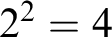 ${2}^2 = 4$
and 2 ≥ 0’. More generally, since the best present-day science and mathematics are our best present approximations of what the actual world is like, one may think of the facts in (ii) as obtaining states of affairs which, at least in principle, can be described by the best available language(s) of mathematics and science. For the same reason, it should be possible to describe the facts in (ii) in a manner that is precise enough according to the best present mathematical or scientific standards. This does not mean that (ii) would require an absolute notion of ‘precise fact’ (as [Reference McGee and McLaughlin48], p. 231 worry)—if anything, it would be the other way around: one might call the facts in (ii) ‘precise (enough at this point in time)’ in virtue of mathematicians and scientists describing them by the best linguistic means they have available (by their present standards).
${2}^2 = 4$
and 2 ≥ 0’. More generally, since the best present-day science and mathematics are our best present approximations of what the actual world is like, one may think of the facts in (ii) as obtaining states of affairs which, at least in principle, can be described by the best available language(s) of mathematics and science. For the same reason, it should be possible to describe the facts in (ii) in a manner that is precise enough according to the best present mathematical or scientific standards. This does not mean that (ii) would require an absolute notion of ‘precise fact’ (as [Reference McGee and McLaughlin48], p. 231 worry)—if anything, it would be the other way around: one might call the facts in (ii) ‘precise (enough at this point in time)’ in virtue of mathematicians and scientists describing them by the best linguistic means they have available (by their present standards).
The metasemantic determination of I by (i) and (ii) above is assumed to be governed by
-
(iii) all metasemantic laws taken together that concern the atomic formulas, and hence the predicates and singular terms, of L.Footnote 5
In the square-root example, the respective metasemantic law might be expressed by: For all objects d and d’, if mathematicians understand ‘Sqrt’ to be defined on the set of real numbers by the conditional definition ‘For all x, y: if Real(x), Real(y), and x ≥ 0, then: Sqrt(y, x) if and only if ${y}^2 = x$
and y ≥ 0’, and d’ (for ‘y’) and d (for ‘x’) are such that the condition and definiens of that conditional definition apply to them, then the pair <d’, d> is a member of the intended interpretation I(‘Sqrt’). E.g., for d = 4 and d’ = 2 it follows: since the first conjunct of the embedded antecedent describes a fact in (i) (the fact that mathematicians use the relevant conditional definition), and since the second conjunct of the embedded antecedent describes a fact in (ii) (in particular, the fact that
${y}^2 = x$
and y ≥ 0’, and d’ (for ‘y’) and d (for ‘x’) are such that the condition and definiens of that conditional definition apply to them, then the pair <d’, d> is a member of the intended interpretation I(‘Sqrt’). E.g., for d = 4 and d’ = 2 it follows: since the first conjunct of the embedded antecedent describes a fact in (i) (the fact that mathematicians use the relevant conditional definition), and since the second conjunct of the embedded antecedent describes a fact in (ii) (in particular, the fact that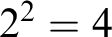 ${2}^2 = 4$
and 2 ≥ 0), the law implies that <2, 4> is a member of I(‘Sqrt’), which yields the expected constraint on the intended interpretation of ‘Sqrt’. (Another law would concern the exclusion of pairs of numbers from I(‘Sqrt’).)
${2}^2 = 4$
and 2 ≥ 0), the law implies that <2, 4> is a member of I(‘Sqrt’), which yields the expected constraint on the intended interpretation of ‘Sqrt’. (Another law would concern the exclusion of pairs of numbers from I(‘Sqrt’).)
Considering some more prominent examples, another metasemantic law in (iii) might be the following quasi-Kripkean one (cf. [Reference Kripke37]): for all proper names a in L, for all objects d, if present usage of a in L is suitably causally connected to an act of baptism in which d was named a, then d∈Uni(I) and I(a) = d. Consider any concrete instantiation of that universal claim: if the corresponding ‘if’-part describes one of the linguistic facts in (i), then the metasemantic law jointly with that fact determines the constraint on the intended interpretation I of L that is described by the ‘then’-part. Or yet another law in (iii) might be expressed in the following quasi-Putnamian way (cf. [Reference Psillos54]): for all kind terms K in L, for all objects d and d’, if K was collectively specified in L by pointing at d while being interested in the physical structure of d, and if d’ has the same physical structure as d, then: if d’∈Uni(I) then d’∈ I(K). Once again, consider any concrete instantiation of that universal statement: if the first conjunct of the corresponding ‘if’-part describes one of the linguistic facts in (i), whilst the second conjunct of the ‘if’-part describes one of the non-linguistic facts in (ii), then the metasemantic law and the two facts jointly determine the constraint on I that is described by the ‘then’-part.
In terms of an analogy, metasemantic determination in classical semantics is supposed to be much like a physical or economic quantity z being determined from other such quantities x and y in the sense that z is a function f of x and y: z is like the intended interpretation I, x and y are respectively like (i) and (ii) above, and the law z = f(x, y) corresponds to (iii). E.g., x being of some value, say, 3, and y being of some value, say, 1, jointly determine that z is of the value f(3, 1), which is analogous to (i)–(iii) determining I.
Let us call the facts in (i) and (ii) metasemantic facts (for L). They are metasemantic in the sense that the linguistic expressions in L have their intended references and extensions in virtue of them and the metasemantic laws in (iii). Sometimes I will also drop the qualification ‘metasemantic’ and just refer to facts.
Let us call the constraints that (i)–(iii) jointly impose on the interpretation of L the existing metasemantic constraints on the interpretation of L. One may think of these constraints as being summed up by a theory that states what I must be like in view of (i)–(iii). It may be possible to (at least approximately) express some of these constraints linguistically, as in the examples for (iii) above, and if one does so, one might use terms, such as ‘baptize’, ‘specify’, ‘interest’, ‘point to’, ‘describe’, ‘rule’, ‘practice’, ‘intention’, ‘intension’, ‘think’, ‘cause’, ‘historical’, ‘kind’, ‘same as’, ‘physical structure’, ‘natural’, ‘division of labor’, ‘expert’, ‘intuition’, ‘define’, ‘axiom system’, and more. (I am not saying all these terms are sufficiently clear or that each of them is required for that purpose, just that classical semantics is in principle compatible with all sorts of metasemantic constraints.) But there is no guarantee that every existing metasemantic constraint can be expressed easily in such terms or in others. Indeed, Williamson [Reference Williamson76] worries that ‘Meaning may supervene on use in an unsurveyably chaotic way’: while interpretation may be determined by the metasemantic facts, the ways in which this comes about—the metasemantic laws—might be extremely sensitive to how certain parameters are set (like parameters in a complex chaotic dynamic system of differential equations) and therefore also difficult to express in language. For that reason, it is more helpful to summarize the existing metasemantic constraints taken together as a theory in the sense of the non-statement view of scientific theories (see e.g., [Reference Suppes69]), that is, as a class of interpretations (models) of L: let us call that class ‘Adm’. (‘Adm’ is short for ‘admissible’, which I borrow from [Reference Fine25] and supervaluationist semantics, about which more from Section 2.) The existing metasemantic constraints on the interpretation of L show up in what Adm is like. Exploring these constraints and hence Adm goes beyond extensional semantics: the study of (i) belongs to pragmatics and intensional semantics, the study of (ii) is normally not the subject matter of linguistics at all (but, e.g., of mathematics or physics), and the study of (iii) lies at the interface of all the previous subjects. Following a reasonable divide-and-conquer strategy, classical semantics is therefore not itself concerned with formulating or testing metasemantic hypotheses on ‘Adm’ but merely presupposes that the metasemantic constraints (whatever they are like) yield a particularly strong and restrictive theory: the singleton set Adm = {I}, from which the intended interpretation I can be defined as its sole member. Nor is the claim that it is known exactly what I is like—one merely presupposes that there is a classical interpretation I, such that I conforms to the existing metasemantic constraints (I∈Adm), and where I is in fact determined uniquely by these constraints (Adm = {I}). Let us put these metasemantic presuppositions of classical semantics on record:
 $$\begin{align}\exists !F{\kern-2pt}\left(F\in Adm\right)\;\mathrm{and}\;I\in Adm\left(\mathrm{where}\ \text{`}Adm\text{'}\ \mathrm{is}\kern0.17em \mathrm{understood}\;\mathrm{as}\;\mathrm{explained}\kern0.17em \mathrm{before}\right).\end{align}$$
What classical extensional semanticists do is to formulate and test hypotheses about the (classical) semantic rules of L and about semantically salient aspects of the (classical) intended interpretation I of L, while presupposing (4) in the background. If all goes well, these hypotheses lead to empirically successful predictions and explanations of some linguistic phenomena concerning L. That is classical extensional semantics explained in a nutshell.Footnote 6
So far, so good. But there is a problem: while it is common to speak of the intended interpretation I (to which the term ‘I’ supposedly refers), and hence to presuppose that there is one and only one intended classical interpretation, we lack good reasons for believing that the existing metasemantic constraints on the interpretation of a language will always determine a unique such interpretation. That is: Adm might well happen not to be a singleton class. Let me illustrate this by means of three examples: one from natural language, another one from mathematical language, and a third one from scientific language.
Example 1: Vague terms may cause trouble: terms for which there seem to be ‘indeterminate’ or ‘imprecise’ borderline cases beyond the clear-cut positive and clear-cut negative ones. I will concentrate on what Alston [Reference Alston and Edwards2] calls degree vagueness, but the general conclusions should apply to all kinds of semantic vagueness.Footnote 7 Let B be a predicate of L that formalizes the English term ‘bald’, or rather, ‘is the number of hairs on the head of a bald person’, where I will presuppose that two people with the same number of hairs either both count as bald or both do not, and where I will ignore the distribution of hairs. (‘Bald(Peter)’ may then be understood as: there exists an x, such that number-of-hair-on-head-of(Peter) = x and B(x).)
Plausibly, the following claims express some existing metasemantic constraints on the intended interpretation of B, that is, the actual extension of B: any person with 0 hairs on their scalp belongs to the extension of B (0∈I(B)); any person with 100000 hairs does not (100000∉I(B)); if one person has more hair on their head than a second one, then, if the former belongs to the extension of B, the same holds for the latter (for all m, n, if m > n and m∈I(B) then n∈I(B))Footnote 8 ; Uni(I) includes the required natural numbers (e.g., 0∈Uni(I)); and so on.
But even if one combines all linguistic competent-use facts concerning L (e.g., pertaining to all rules for B-usage and all competent B-assertions ever made) with all relevant non-linguistic facts (e.g., concerning the number of hairs those people have had about whom competent B-assertions have or could have been made), and if one takes these facts together with all metasemantic laws for L, the following seems unlikely, at least at first glance: for each number n, either the existing metasemantic constraints determine that n∈I(B) (and hence, by (1), the truth of B(n)), or they determine that n∉I(B) (and hence, by (1) again, the truth of ¬B(n)). (I am using ‘n’ both as a metalinguistic and an object-linguistic symbol here.) For, at least prima facie, it is plausible that there are borderline cases n to which one may competently ascribe B, but to which one may also competently refrain from ascribing B and indeed ascribe ¬B. It does not just seem to be our knowledge of I that is incomplete or empirically underdetermined: rather, it seems that no competent speaker of L would be right in correcting or criticizing either of the two ascriptions even if they knew all metasemantic facts whatsoever. Thus, there should be at least two different classical interpretation functions F and F´ that conform to all existing metasemantic constraints, but which fill the gaps left by them differently: for some n, n∈F(B) whereas n∉F´(B). Consequently, the corresponding class Adm of admissible interpretation functions includes more than just one member, and hence there isn’t a uniquely factually determined intended interpretation I of L. Let us call this phenomenon the semantic indeterminacy of ‘the’ intended interpretation of L: vagueness seems to be ‘semantic indecision’ ([Reference Lewis44], p. 213; see [Reference Varzi74] for more on vagueness as indeterminacy.)
Of course, ‘unlikely’ is not ‘impossible’ and ‘plausible’ does not mean ‘guaranteed’: indeed, epistemicists about vagueness do believe the reference of ‘I’ to be determined uniquely by the metasemantic facts, and hence that vagueness does not entail semantic indeterminacy. And they might be right about this—who knows? But what if not? Epistemicists might also rightly complain that not enough has been said above about facts and metasemantic determination. For instance, they might ask: are the non-linguistic facts mentioned under (ii) above so that for each n, it is either a fact that B(n) or it is a fact that ¬B(n)? For if so, these ‘baldness facts’ would determine the interpretation of B uniquely after all. If not, which would seem more likely, as ‘baldness-facts’ would not be countenanced to be precise enough according to the best present mathematical or scientific standards (recall our description of (ii)): what exactly counts as a fact in (i) and (ii) above, and how do these facts constrain semantic interpretation by means of the laws in (iii)? Will the explication of ‘determination’ and ‘Adm’ possibly reveal some epistemic components in the special case of vague terms? (In contrast, the way in which the interpretation of the non-vague term ‘Sqrt’ was determined from the mathematicians’ usage of a conditional definition and from mathematical facts did not seem epistemic at all.)Footnote 9
These are reasonable questions, and more should be said indeed. But shouldn’t the previous considerations at least cast enough doubt on semantic determinacy that the burden of proof is switched to the classical semanticist? Wouldn’t we simply tempt the fate of semantics by building it on presupposition (4) for which it seems difficult to cite empirical evidence and which, at least prima facie, sounds doubtful with respect to the interpretation of vague terms?
Instead of continuing the philosophical debate on metasemantic determination, which is not itself the topic of this paper, I will rather add to the pressure on (4) by presenting further examples of semantic indeterminacy, though this time without vagueness. Accordingly, the focus of the paper is not vagueness per se but really the general phenomenon of semantic indeterminacy. And I will continue to understand ‘Adm’ in terms such as ‘determinately’ and ‘metasemantic facts’ rather than, say, ‘definitely’ and ‘knowledge’.
(The present example of the language L that includes vague terms, such as ‘B’ for ‘bald’, will remain the central example from Section 3 with the sole exception of Section 6. In what follows, any reference by means of ‘L’ is a reference to the language from Example 1.)
Example 2: Let L´ be a second-order formalization of the language of arithmetic (so here I am deviating from the previous assumption of a first-order language L ): let N, 0, s, +,⋅ be terms in L´ that formalize the corresponding arithmetical terms for ‘natural number’, ‘zero’, ‘successor’, ‘sum’, and ‘product’, as used by number theorists.
It is plausible that the following claim expresses an existing metasemantic constraint on ‘the’ intended interpretation I´ of L´: I´(N), I´(0), I´(s), I´(+), I´(⋅) jointly satisfy the second-order Dedekind-Peano axioms for arithmetic. (That is: I´(0)∈I´(N); for all d∈I´(N) it holds that I´(s)(d)∈I´(N); and the other axioms, including second-order induction.) As proven by Dedekind [Reference Dedekind21], the axiom system of second-order Dedekind-Peano arithmetic is categorical, that is, it pins down the structure of the natural number sequence uniquely. If structuralists about arithmetic are right (see [Reference Hamkins28] for a survey), there do not exist any other metasemantic constraints on the interpretation of arithmetical symbols than getting the structure of the natural number sequence right; hence, the second-order Dedekind-Peano axioms taken together might actually express all the metasemantic constraints on I´ there are. But, at the same time, these constraints do not pin down I´ uniquely: e.g., if I´(N) is identified with the set of finite von-Neumann-ordinals, there are suitable and easily definable choices for I´(0), I´(s), I´(+), I´(⋅), such that the axioms are satisfied; but the same is true also of the set of finite Zermelo-ordinals and the interpretations of the arithmetical symbols that are suitable to those ordinals (as famously highlighted by [Reference Benacerraf, Benacerraf and Putnam4]). The corresponding class Adm should therefore include at least two distinct classical interpretations F and F´—perhaps even all (infinitely many) interpretations isomorphic to the two previous ones—which is why there isn’t a uniquely factually determined interpretation of L´. The intended interpretation of the language of second-order arithmetic is semantically indeterminate, and since arithmetic terms do not have borderline cases, this is a case of semantic indeterminacy without vagueness.Footnote 10
On behalf of classical semantics, one might try to argue that set-theoretic structuralists about arithmetic are simply wrong—there do exist metasemantic constraints beyond those of second-order Dedekind-Peano arithmetic, and these do restrict the interpretation of arithmetical symbols, say, to the interpretation with the finite von-Neumann-ordinals. However, other than in the context of a textbook in foundational set theory in which natural numbers are indeed often defined as the finite von-Neumann-ordinals, number theorists may not feel bound by any specification of the intended interpretation of arithmetic over and above the Dedekind-Peano axioms. Once made aware of the existence of different set-theoretic interpretations of their axioms, some of them might simply not accept that one such interpretation is taken to be intended by fiat while all other interpretations are rejected as inadmissible; they might regard the assumption of a uniquely factually determined intended interpretation of the arithmetical symbols to be unfaithful to the mathematical content of arithmetic. Again, these number theorists might be wrong, but the mere existence of corresponding verdicts by number theorists and structuralist philosophers of number theory (Dedekind would count as a concrete instance on both sides) should suffice at least for a prima facie case against semantic determinacy. For the same reason, the burden of proof is again on the classical semanticists to justify their presupposition of a unique factually determined intended interpretation of arithmetical terms (even when doing so would lead them beyond semantics).
Example 3:
Let L´´ formalize the language of Newtonian mechanics—no matter whether first-order or second-order—and let m formalize the term ‘mass’ as used in Newtonian physics. (m is a function symbol, but let us put questions about syntax to one side now.) Field [Reference Field23] has argued, using the language of modern relativistic mechanics on the metalevel, that there are two interpretations of m, such that there is no fact of the matter which of them delivers ‘the’ actual or intended reference of m: according to the one, I´´
(m) coincides with relativistic mass (total energy/ ${\rm c}^2$
), while according to the other, I´´
(m) coincides with proper mass (non-kinetic energy/
${\rm c}^2$
), while according to the other, I´´
(m) coincides with proper mass (non-kinetic energy/ ${\rm c}^2$
), and relativistic mass and proper mass come apart in value and physical properties. Each of the two interpretations saves some of the central claims of the Newtonian theory from falsity (and many of Newton’s empirical predictions about slowly-enough-moving objects), neither of the two interpretations saves all central claims of Newton’s theory, and the theoretical roles played by relativistic mass and proper mass in modern relativity theory are equally salient and important. Since these properties seem to exhaust, in present terminology, the existing metasemantic constraints on the interpretation of m in Newtonian mechanics, Field’s diagnosis concerning ‘mass’ is: ‘the situation is not that we don’t know what Newton’s word denoted, but that Newton’s word was referentially indeterminate’ ([Reference Field23], p. 467, his emphasis).
${\rm c}^2$
), and relativistic mass and proper mass come apart in value and physical properties. Each of the two interpretations saves some of the central claims of the Newtonian theory from falsity (and many of Newton’s empirical predictions about slowly-enough-moving objects), neither of the two interpretations saves all central claims of Newton’s theory, and the theoretical roles played by relativistic mass and proper mass in modern relativity theory are equally salient and important. Since these properties seem to exhaust, in present terminology, the existing metasemantic constraints on the interpretation of m in Newtonian mechanics, Field’s diagnosis concerning ‘mass’ is: ‘the situation is not that we don’t know what Newton’s word denoted, but that Newton’s word was referentially indeterminate’ ([Reference Field23], p. 467, his emphasis).
What is going on here may be viewed as an application of the principle of charity: the Newtonian language is to be interpreted so that the truth of the sentences asserted by the Newtonian theory gets maximized; and as often the case when one maximizes a function, there might not be a unique maximum but two of them (such as for ‘mass’) or three…or even infinitely many. If so, the class Adm of admissible interpretation functions of L´´ includes more than one member, and hence there is no unique factually determined intended interpretation of L´´: ‘the’ intended interpretation of Newtonian mechanics is semantically indeterminate.Footnote 11
This argument for indeterminacy does not concern vagueness or structuralism but ‘incongruencies’ between, on the one hand, the language of Newtonian mechanics, and on the other hand, what we think the world is like as described by present-day relativistic mechanics. As Field argues against Kuhn [Reference Kripke38], these ‘incongruencies’ do not require incommensurability or complete referential discontinuity between the Newtonian language and the relativistic language but rather manifest themselves as semantic indeterminacies. (I will return to the discussion of referential change and continuity in science in Section 6.)
Once again, the classical semanticist might claim this analysis to be wrong: there are existing metasemantic constraints of which Field is unware, which determine the intended interpretation of m to coincide with, say, proper mass. If so, the defender of classical semantics should supply arguments and data in favour of this thesis (even when doing so would lead them beyond semantics): does proper mass possess some ‘objective naturalness’ that relativistic mass lacks, and if so in what sense? Is there something in the experimental practice of Newtonian physicists that rules out relativistic mass as an interpretation of ‘mass’? In view of Field’s arguments to the contrary, the presupposition that ‘mass’ in Newtonian physics has a unique factually determined intended interpretation would seem to rest on shaky grounds unless backed up by evidence. Presupposition (4) of classical (meta-)semantics is challenged by examples like these.
2 Ramsey semantics
In the last section I have described the gist of classical semantics. I ended up pointing out that classical semantics is risky business by building on a presupposition—the existence of a unique factually determined intended interpretation I—that might not be met: the metasemantic facts seem to leave ‘bald’, ‘natural number’, and ‘mass (in Newtonian mechanics)’ without uniquely determined intended interpretations, and each time for different reasons. The defender of classical semantics, it seems, will have to fend off each worry on separate grounds: no, vague terms are not semantically indeterminate, their vagueness can be explicated otherwise (e.g., counterfactually), and complete extensions are somehow determined by the facts even though we might not know how. No, structuralism about arithmetic is wrong, there is more to arithmetical terms than their structural content, whatever it is. No, ‘mass’ in Newtonian physics does have a uniquely determined reference, even when it is hard to say what it refers to.Footnote 12
Classical semanticists might reply that there might still be a global abductive argument for semantic determinacy: how else should one explain the success of classical semantics as applied to certain fragments of language (when successful there), if not by trusting its presupposition of a unique factually determined intended interpretation of that fragment? And even more so, when the alternatives of classical semantics seem to have their own problems!
In what follows, I want to demonstrate that this kind of inference to the best explanation does not go through either. For there exists a minor retreat from classical semantics that has similar theoretical virtues as classical semantics and which should therefore be similarly successful when and where classical semantics is successful: Ramsey semantics. At the same time, the new semantics will be less risky than classical semantics by not presupposing semantic determinacy. Ramsey semantics does not thereby claim semantic determinacy to be false, it only avoids presupposing it, and yet it keeps classical logic and truth on board. For these reasons, overall, Ramsey semantics should be preferable over classical semantics. What is more, by approximating classical semantics much more closely than supervaluationist semantics, Ramsey semantics should also win over supervaluationists who are attracted by classical semantics apart from not wanting to rule out semantic indeterminacy. While the present section will explain the new semantics, Section 3 will draw the comparison with supervaluationist semantics and classical semantics.
Returning to the semantics of our first-order language L (with ‘B’ for baldness) from Section 1, let us accept for now that ‘the’ intended interpretation of L is subject to metasemantic constraints without necessarily being pinned down by them uniquely: Adm may be a singleton class, as presupposed by classical semantics, but it may also include more than just one admissible classical interpretation mapping. Either way, by being members of Adm, all F in Adm have something in common; e.g., 0∈F(B); 100000∉F(B); for all m, n, if m > n and m∈F(B) then n∈F(B)); 0∈Uni(I); and so on. I will also assume, for simplicity, that all members F of Adm are based on one and the same universe U, which is a non-empty set (rather than a proper class): for all F∈Adm, Uni(F) = U.
In terms of the mathematical analogy from the last section: the quantity z (which was analogous to ‘I’) might be constrained by x and y, but not in the sense of being a function of them (z = f(x, y)) but by there being an equation that is to be satisfied jointly by z, x, y: say, $eq:{z}^2 = x+y$
. And that equation might offer more than one solution for ‘z’ when given concrete values for ‘x’ and ‘y’: e.g., x = 3 and y = 1 constrain the value of ‘z’ to the effect that either z = 2 or z = −2, without imposing further constraints that rule out either of the two solutions. The totality of all metasemantics laws that support the existing metasemantic constraints on the interpretation of L might be more like eq than like z = f(x, y), and the resulting class Adm of admissible interpretations of L might be more like {2, −2} than like {f(3, 1)}.
$eq:{z}^2 = x+y$
. And that equation might offer more than one solution for ‘z’ when given concrete values for ‘x’ and ‘y’: e.g., x = 3 and y = 1 constrain the value of ‘z’ to the effect that either z = 2 or z = −2, without imposing further constraints that rule out either of the two solutions. The totality of all metasemantics laws that support the existing metasemantic constraints on the interpretation of L might be more like eq than like z = f(x, y), and the resulting class Adm of admissible interpretations of L might be more like {2, −2} than like {f(3, 1)}.
Instead of presupposing that all the facts taken together determine metasemantically a unique intended classical interpretation I and hence what is true in virtue of I, a less risky way of proceeding in semantics should therefore be: to merely presuppose that there exists a classical interpretation F that conforms to all existing metasemantic constraints and from which truth is defined by means of the classical semantic rules. For that existence statement will be true both in case the intended interpretation of L is factually determined—when there is a uniquely determined F for which F∈Adm—and in the case of semantic indeterminacy—when there is more than one F, such that F∈Adm. (When there is no F at all such that F∈Adm, classical semantics suffers from an even deeper-going problem than indeterminacy, about which I will have nothing to say here. The obvious way out of that case would be to consider a larger class of ‘approximately admissible’ interpretations and work with that.)
But this means we enter well-trodden territory, since what is going on now may be viewed as an instance of Ramsification: first, one regards the terms ‘I’ (‘intended interpretation’) and ‘true’ from classical semantics as theoretical terms, the meanings of which are determined by ‘I∈Adm’ and the definition (3) of truth, that is, ‘for all sentences A in L: A is true iff I ⊨ A’. That is plausible because I was meant to be intended precisely in the sense of belonging to Adm, that is, of conforming to all existing metasemantic constraints, and at the same time delivering the domain, references, and extensions that feed into the definition of truth by means of the standard semantic rules (1). Secondly, one replaces ‘I’ and ‘true’ in the metalinguistic sentence
 $$\begin{align*}\text{`}I\in Adm\;\mathrm{and}\kern0.17em \mathrm{for}\;\mathrm{all}\;\mathrm{sentences}\;A{:}\ A\;\mathrm{is}\kern0.17em \mathrm{true}\;\mathrm{iff}\;I\models A\text{'}\end{align*}$$
by the function variable ‘F’ and the class variable ‘T’, respectively, which yields the open metalinguistic formula
 $$\begin{align*}\text{`}F\in Adm\;\mathrm{and}\kern0.17em \mathrm{for}\;\mathrm{all}\;\mathrm{sentences}\;A{:}\ A\in T\;\mathrm{iff}\;F\models A\text{'}.\end{align*}$$
Finally, one does not presuppose any longer
(4) and (3) $\exists !F{\kern-1pt}(F\in dm)$
and
$\exists !F{\kern-1pt}(F\in dm)$
and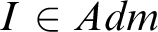 $I\in Adm$
, and for all sentences
$I\in Adm$
, and for all sentences $A{:}\ A\;\mathrm{is}\kern0.17em \mathrm{true}\;\mathrm{iff}\;I\models A$
(equivalently,
$A{:}\ A\;\mathrm{is}\kern0.17em \mathrm{true}\;\mathrm{iff}\;I\models A$
(equivalently, $\exists !F{\kern-1pt}(F\in Adm)$
and
$\exists !F{\kern-1pt}(F\in Adm)$
and $I=\iota F{\kern-1pt}(F\in Adm)$
Footnote
13
, and for all sentences
$I=\iota F{\kern-1pt}(F\in Adm)$
Footnote
13
, and for all sentences $A{:}\ A\;\mathrm{is}\kern0.17em \mathrm{true}\;\mathrm{iff}\;I\models A)$
.
$A{:}\ A\;\mathrm{is}\kern0.17em \mathrm{true}\;\mathrm{iff}\;I\models A)$
.
Instead, one merely claims the existence of an F and a T, such that F∈Adm and where F ‘defines’ T by means of satisfaction, that is:
 $$\begin{align}\exists F\exists T\left(F\in Adm\;\mathrm{and}\kern0.17em \mathrm{for}\;\mathrm{all}\;\mathrm{sentences}\;A{:}\ A\in T\;\mathrm{iff}\;F\models A\right).\end{align}$$
But (5) is nothing but the Ramsey sentence of ‘I∈Adm and for all A: A is true iff I ⊨ A’ with respect to the theoretical terms ‘I’ and ‘true’.Footnote 14
The classical presupposition ‘∃!F(F∈Adm)’ from (4) is dropped rather than Ramsified, because it is exactly what Ramsey semantics intends to avoid. The remaining parts of classical semantics, that is, the definition of ‘interpretation’, ‘variable assignment’, and (1) and (2) from Section 1, are explicit model-theoretic definitions that are presupposed by classical semantics and Ramsey semantics (and supervaluationist semantics) and do not need to be Ramsified. ‘Adm’ is regarded as an O(ld)-term in the terminology of Lewis [Reference Leitgeb42], which is left invariant by Ramsification: as explained in Section 1, the characterization of Adm does not belong to semantics proper, and the term ‘Adm’ (or something in the same ballpark it, such as ‘intended’ or ‘actual’) needs to be presupposed equally by classical (meta-)semantics, supervaluationist semantics, and Ramsey semantics. (As in [Reference Leitgeb42], the distinction between observational and non-observational terms known from more traditional applications of Ramsification does not play any role in Ramsey semantics.)
Since, for given F, ‘for all sentences A in L: A∈T iff F ⊨ A’ uniquely characterizes T so far as its sentence members in L are concerned (as can be shown set-theoretically or in higher-order logic), one may also formulate (5) alternatively as the combined existence/unique-existence claim
 $$\begin{align}\exists F\exists !T\left(F\in Adm\;\mathrm{and}\kern0.17em \mathrm{for}\;\mathrm{all}\;\mathrm{sentences}\;A{:}\ A\in T\;\mathrm{iff}\;F\models A\right).\end{align}$$
Either way, the idea is:
-
• classical semantics consists in the definition of ‘interpretation’, ‘variable assignment’, and (1)–(4) and
-
• while Ramsey semantics consists in the same definitions of ‘interpretation’ and ‘variable assignment’, (1), (2), and the Ramsey sentence (5)/(5′). (I am going to add yet another alternative formulation of Ramsey semantics below, which may be understood as a reformulation of the present one.)
As the term ‘Admissible’ had already suggested before, Ramsey semantics shares the assumption of a non-empty class Adm of admissible interpretations with supervaluationism (see [Reference Fine25, Reference Kearns and Magidor35, Reference McGee47]), such that neither of them presupposes that Adm is a singleton, and where ‘Adm’ is interpreted similarly in both semantics.
However, that is also where paths will diverge: in particular, Ramsey semantics does not introduce a supervaluationist notion of super-truth (cf. [Reference Suppes and Morgenbesser71]), that is,
 $$\begin{align*}\mathrm{for}\;\mathrm{all}\;\mathrm{sentences}\;A\;\mathrm{in}\;L:A\;\mathrm{is}\kern0.17em \mathrm{super}\hbox{-} \mathrm{true}\;\mathrm{iff}\;\mathrm{for}\;\mathrm{all}\;F\in Adm,F\models A,\end{align*}$$
to the effect that super-truth takes over some, if not all, conceptual roles that truth simpliciter plays in classical extensional semantics. (I am going to compare Ramsey semantics with supervaluationism in more detail in Section 3.)
Nor should the present theory be mistaken for so-called subvaluationism about vague terms (cf. [Reference Cobreros20, Reference Hilbert and Bernays32, Reference Hyde33]), which defines
 $$\begin{align*}\mathrm{for}\;\mathrm{all}\;\mathrm{sentences}\;A\;\mathrm{in}\;L:A\;\mathrm{is}\;\mathrm{sub}\hbox{-} \mathrm{true}\;\mathrm{iff}\ \exists F\in Adm,\mathrm{such}\kern0.17em \mathrm{that}:F\models A,\end{align*}$$
and which assigns sub-truth the roles that truth simpliciter plays in standard semantics.
Instead, Ramsey semantics maintains (reformulating (5′) just a bit)
 $$\begin{align*}\exists F\in Adm\,\exists !T,\mathrm{such}\kern0.17em \mathrm{that}\kern0.17em \mathrm{for}\;\mathrm{all}\;\mathrm{sentences}\;A\;\mathrm{in}\;L:A\in T\;\mathrm{iff}\;F\models A,\end{align*}$$
in which ‘F’ is bound existentially, but in which the existential quantifier expression ‘∃F∈Adm’ takes wide scope (instead of occurring on the right-hand side of the embedded equivalence), and in which T (truth relative to F) is determined uniquely from F by the semantic rules for classical satisfaction. The claim is: there exists a classical admissible interpretation in terms of which the truth values of all sentences of L are given in a classical manner. For instance, while there may be sentences A, such that neither A nor ¬A is super-true, and where both A and ¬A are sub-true, neither of this could possibly happen in Ramsey semantics, as there is no classical interpretation mapping F of which it would hold that F $\nvDash $
A and F
$\nvDash $
A and F $\nvDash $
¬A (and hence A∉T and¬A∉T), or of which it would hold that F ⊨ A and F ⊨ ¬A (and thus A∈T and ¬A∈T).
$\nvDash $
¬A (and hence A∉T and¬A∉T), or of which it would hold that F ⊨ A and F ⊨ ¬A (and thus A∈T and ¬A∈T).
Ramsey semantics should not be misunderstood either as requiring that the theoretical terms ‘I’ and ‘true’ would need to be eliminated—Ramsified away—when doing semantics: semantic statements including them merely need to be used and interpreted more cautiously than in classical semantics, so that they can always be understood as stand-ins for existential statements. There are two ways of achieving that.
One is to start from the existential statement (5) or (5′), to apply to it the elimination rule of natural deduction for existential quantifiers, thereby ‘picking’ one of the relevant Fs and calling ‘it’ ‘I’, calling the members of the set T that is given uniquely by I the ‘true sentences (of L)’, and introducing ‘I∈Adm and for all sentences A: A is true iff I ⊨ A’ as a temporary assumption. Of course, what is ‘picked’ by ‘I’ in this way is really left indeterminate—I could be any of the relevant Fs.
That being in place, the Ramsey semanticist is able to reformulate in their own terms every metalinguistic semantic statement
 $$\begin{align}S[I,\mathrm{true}]\end{align}$$
involving the terms ‘I’ or ‘true’ that the classical semanticist might want to put forward. This does not mean that each single statement (6) would require a new piecemeal application of Ramsification: instead, one application of Ramsification (the result of which is (5) or (5′)) may be used to reconstruct various possible metalinguistic instances of (6) simultaneously. Of course, at some point this application of the existential elimination rule will have to be terminated by discharging the assumption involving ‘I’ and ‘true’ from above and by deriving a statement that does not involve the ‘newly introduced’ terms anymore. For instance, in a case in which the classical semanticist would logically derive (6) from the classical thesis ‘I∈Adm and for all sentences A: A is true iff I ⊨ A’, the Ramsey semanticist would derive (6) in the same manner from the temporary assumption ‘I∈Adm and for all sentences A: A is true iff I ⊨ A’, hence derive the conjunction of (6) with that assumption, then derive from that conjunction that
 $$\begin{align}\exists F\in Adm\exists T,\mathrm{such}\kern0.17em \mathrm{that{\kern-2.5pt}:}\;\mathrm{for}\;\mathrm{all}\;\mathrm{sentences}\;A,A\in X\;\mathrm{iff}\;F\models A,\mathrm{and}\kern0.17em \mathrm{also}\;S\left[F,T\right]\end{align}$$
by existential introduction, and finally discharge the temporary assumption and thus derive (7) from the Ramsey sentence (5) or (5′) that is part of the theory of Ramsey semantics.Footnote 15
The downside of deriving semantic statements from the Ramsey sentence (5)/(5′) in this manner is that the terms ‘I’ and ‘true’ are only introduced temporarily in the context of an application of existential elimination in which the assumption ‘I∈Adm and for all sentences A: A is true iff I ⊨ A’ will need to be discharged eventually. Fortunately, there is also a second, more stable, way of presenting Ramsey semantics that allows the Ramsey semanticist to use the terms ‘I’ and ‘true’ continuously without having to make or discharge assumptions: one recycles Carnap’s [Reference Carnap14, Reference Carnap and Bar-Hillel15] treatment of theoretical terms as Hilbertian epsilon terms (see [Reference Sahlin59] for a recent survey, discussion, and application) and employs it in the present semantic context. The rest of this section will be devoted to this topic.
Epsilon terms ‘εF…’ are indefinite descriptions, which are much like definite descriptions ‘ιF…’ (‘the F, such that…’), except that the uniqueness presupposition of definite descriptions is dropped. Accordingly, one may read ‘εF…’ as ‘an F, such that…’: analogously to the application of existential elimination explained before, ‘εF C[F]’ is supposed to ‘pick’ one of the Fs that satisfy ‘C[F]’, such that what gets ‘picked’ by ‘εF C[F]’ is left indeterminate—once again, εF C[F] could be any of the relevant Fs. The Hilbert school (see [Reference Ackermann1, Reference Hilbert, Gabriel and McGuiness30]) introduced such epsilon terms as tools in metamathematics by which ‘ideal’ mathematical entities could be denoted and with the help of which proof-theoretic reductions were meant to be carried out.
In the present context, epsilon terms are made formally precise by adding, first, the primitive epsilon operator ‘ε’ to the logical vocabulary of the metalanguage of L. (For the logicality of the ε-operator, see [Reference Wilson81].) If ‘F’ is a metalinguistic variable, then the result of replacing ‘C[F]’ in ‘εF C[F]’ by a metalinguistic formula yields a metalinguistic term ‘εF…’ of the same type as ‘F’. (Abusing notation just a bit, I will denote the resulting term by ‘εF C[F]’ again.) E.g., just as ‘F’ can occur on any side of the metalinguistic equality symbol (as in ‘F = …’), the same holds for ‘εFC[F]’ (as in ‘εF(C[F]) = …’). If ‘F’ is the only free variable in (the metalinguistic formula replacing) ‘C[F]’, then the epsilon term ‘εF C[F]’ is a closed term, since the free variable ‘F’ of ‘C[F]’ is bound by ‘εF’ within ‘εF C[F]’ in the same way in which ‘∃F’ would bind the free variable ‘F’ of ‘C[F]’ within the closed formula (sentence) ‘∃FC[F]’.
Secondly, one extends the classical logic of the metalinguistic semantic theory by the axioms of the so-called (extensional) epsilon calculus, that is, all statements of the form
 $$\begin{align*}\exists FC[F]\leftrightarrow C[\varepsilon FC[F]]\end{align*}$$
 $$\begin{align*}\mathrm{Extensionality}:\forall F\left(C[F]\leftrightarrow {C}^{\prime}[F]\right)\to \varepsilon F C[F] = \varepsilon F{C}^{\prime}[F],\end{align*}$$
which, if added to classical first-order predicate logic or to the standard deductive (axiomatized) system of classical second-order predicate logic, is known to yield a conservative extension thereof (as follows from the Second Epsilon Theorem proven in [Reference Hilbert and Bernays31]). The left-to-right direction of the axiom scheme ‘∃FC[F]↔C[εFC[F]]’ states that, by the logic of ‘ε’, if some F is such that C, then εFC[F] (‘an F, such that C’) is such that C, too. The rationale for this is that the epsilon term ‘εFC[F]’ is understood to ‘pick’ one of the Fs that exists according to ‘∃FC[F]’. (If it is not the case that ∃FC[F], there are no constraints whatsoever on what member of the universe of discourse is ‘picked’ by ‘εFC[F]’.) Extensionality adds that what is ‘picked’ by εFC[F] only depends on the extension of ‘C[F]’, that is, on the class of all Fs for which C[F] is the case.
Carnap [Reference Carnap14, Reference Carnap and Bar-Hillel15] suggested to logically reconstruct theoretical scientific terms by defining them explicitly as epsilon terms, which he presented as a variation on Ramsification for theoretical terms. ([Reference Leitgeb42] suggested much the same, except that he defined theoretical terms as definite descriptions.) I will return to this in Section 6. In the present context, the idea is to apply Carnap’s procedure to the theoretical terms ‘I’ and ‘true’ of semantics. Instead of thinking of Ramsey semantics to be given by the definitions of ‘interpretation’ and ‘variable assignment’, (1), (2), and the Ramsey sentence (5)/(5′), one puts forward instead the ‘simplified’ Ramsey sentence
 $$\begin{align}\exists F{\kern-2pt}\left(F\in Adm\right),\end{align}$$
which follows logically from the Ramsey sentences (5)/(5′) from before. Afterwards, one defines ‘I’ explicitly with the help of the indefinite description
 $$\begin{align}I = \varepsilon F{\kern-1pt}(F\in Adm),\end{align}$$
and one concludes by defining ‘true’ explicitly based on the previously defined term ‘I’:
 $$\begin{align}\mathrm{for}\;\mathrm{all}\;\mathrm{sentences}\;A\;\mathrm{in}\;L:A\;\mathrm{is}\kern0.17em \mathrm{true}\;\mathrm{iff}\;I\models A\left(\mathrm{with}\text{`}I\text{'}\mathrm{being}\kern0.17em \mathrm{understood}\;\mathrm{as}\;\mathrm{in}\;(9)\right).\end{align}$$
The ‘simplified’ Ramsey sentence (8), the epsilon-term definition (9) of ‘I’, and the definition (10) of ‘true’ are stated as semantic eigenaxioms in this reformulation of Ramsey semantics. The previous definition of ‘interpretation’ as well as definitions (1) and (2) from Section 1 are presupposed, too. Overall, this yields:
-
• Ramsey semantics (in its ε-operator version) consists in the definitions of ‘interpretation’ and ‘variable assignment’, (1), (2), (8)–(10), and the logic of the ε-operator.
If formulated this way, Ramsey semantics can employ the same terms ‘I’ and ‘true’ as in classical semantics without making temporary assumptions. The resulting version of Ramsey semantics has the following consequences, which are also known from classical semantics: by combining (8) with the logical law
 $$\begin{align*}\exists F{\kern-1pt}(F\in Adm)\;\mathrm{iff}\;\varepsilon F{\kern-1pt}(F\in Adm)\in Adm,\end{align*}$$
which is an instance of the epsilon calculus axiom scheme from above, one can derive
 $$\begin{align}\varepsilon F{\kern-1pt}(F\in Adm)\in Adm.\end{align}$$
And that statement, by definition (9), can be reformulated as
 $$\begin{align}I\in Adm.\end{align}$$
Taking this together with definition (10) yields
 $$\begin{align}I\in Adm\;\mathrm{and}\kern0.17em \mathrm{for}\;\mathrm{all}\;\mathrm{sentences}\;A{:}\ A\;\mathrm{is}\kern0.17em \mathrm{true}\;\mathrm{iff}\;I\models A,\end{align}$$
which constitutes a part of the classical (3) and (4) from above, and which thus becomes derivable in Ramsey semantics based on (8)–(10). Indeed, (11) may be viewed as just an analytically equivalent variant of the simplified Ramsey sentence (8) on which its derivation relies (since (9) and (10) are just definitions). For the same reason, the Ramsey sentences (5) and (5′) can also be derived with the help of (8)–(10).
Equivalence (10) (the second conjunct of (11)), which coincides syntactically with the classical definition (3) of truth based on the term ‘I’ for ‘intended interpretation’, is now short for
 $$\begin{align}\mathrm{for}\;\mathrm{all}\;\mathrm{sentences}\;A{:}\ A\;\mathrm{is}\kern0.17em \mathrm{true}\;\mathrm{iff}\;\varepsilon F{\kern-1pt}(F\in Adm)\models A,\end{align}$$
in which ‘ε’ is tied logically to existential quantification by the logical axioms of the epsilon calculus. What (10′) makes transparent is that truth according to Ramsey semantics is just standard Tarskian truth relative to an admissible interpretation mapping that might not be determined uniquely by the existing metasemantic constraints on the interpretation of L, as Adm might include more than one member: all linguistic facts concerning competent usage of terms in L taken together with all non-linguistic facts concerning the satisfaction of atomic formulas in L might not, even with the help of all metasemantic laws, determine one and only one intended/admissible interpretation. I(=εF (F∈Adm)) may still be said to be unique in the sense that ∃!F(F = I), which is of course derivable in the classical logic of Ramsey semantics. If understood in that sense, it is even fine to speak of the intended interpretation I, so long as by that one does not mean the by the metasemantic facts uniquely determined interpretation: for I may not be the only member of Adm. As I have done before, I will sometimes use scare quotes for ‘the’ intended interpretation to signal this ambiguity.
By deriving I to be a member of Adm, Ramsey semantics still maintains that truth simpliciter is preserved by classical logic; that is: if ${A}_1,\dots, {A}_{\mathrm{n}}\models C$
holds in classical logic, then it follows that
${A}_1,\dots, {A}_{\mathrm{n}}\models C$
holds in classical logic, then it follows that
 $$\begin{align}\mathrm{if}\;{A}_1,\dots, {A}_{\mathrm{n}}\;\mathrm{are}\;\mathrm{true},\mathrm{then}\;C\;\mathrm{is}\kern0.17em \mathrm{true}.\end{align}$$
That is because: (12) may be unpacked, with (10), as
 $$\begin{align}\mathrm{if}\;I\models {A}_1,\dots, {A}_{\mathrm{n}},\mathrm{then}\;I\models C.\end{align}$$
And (12′) holds because it abbreviates, with (9),
 $$\begin{align}\mathrm{if}\;\varepsilon F{\kern-1pt}(F\in Adm)\models {A}_1,\dots, {A}_{\mathrm{n}},\mathrm{then}\kern0.24em \varepsilon F{\kern-1pt}(F\in Adm)\models C,\end{align}$$
which indeed follows logically from ${A}_1,\dots, {A}_{\mathrm{n}}\models C$
, definition (2), and εF(F ∈ Adm) being a member of Adm (recall (8′)) and therefore also being a classical interpretation function.
${A}_1,\dots, {A}_{\mathrm{n}}\models C$
, definition (2), and εF(F ∈ Adm) being a member of Adm (recall (8′)) and therefore also being a classical interpretation function.
More generally, the role of the Ramsey sentence (8) in the ε-operator formulation of Ramsey semantics is now to claim the existential presupposition of the indefinite description in definition (9) to be satisfied, since (8) claims Adm is to be non-empty, which implies (8′), that is, εF(F ∈ Adm) ∈ Adm.
The role of (9) and (10) is to make sure that any instance of (6) involving ‘I’ and/or ‘true’ can be understood as being short for
 $$\begin{align} S\left[\varepsilon F{\kern-1pt}(F\in Adm),\varepsilon F{\kern-1pt}(F\in Adm)\models \cdots \right],\end{align}$$
which from now I will take to be the official way of rendering statements S[I, true] from classical semantics in the terms of Ramsey semantics.
For instance, consider the metalinguistic sentence S[I, true] to be ‘B(n) is true’, where B(n) is a sentence in L from Example 1 of Section 1 (‘n is the number of hairs on the head of a bald person’): according to (10), B(n) is true iff I ⊨ B(n); by (9), I ⊨ B(n) iff εF(F∈Adm) ⊨ B(n); and (1) entails that εF(F ∈ Adm) ⊨ B(n) iff (εF(F ∈ Adm))(n) ∈ (εF(F ∈ Adm))(B), or more briefly, εF(F ∈ Adm)(n) ∈ εF(F ∈ Adm)(B). So we have that
 $$\begin{align*}\text{`}B(n)\;\mathrm{is}\kern0.17em \mathrm{true}\text{'}\,(S[I,\mathrm{true}])\end{align*}$$
may be understood to be short for
 $$\begin{align*}\varepsilon F{\kern-1pt}(F\in Adm)\models B(n)\;\left(S\left[\varepsilon F{\kern-1pt}(F\in Adm),\varepsilon F{\kern-1pt}(F\in Adm)\models \cdots \right]\right),\end{align*}$$
which in turn reduces to
 $$\begin{align*}\varepsilon F{\kern-1pt}(F\in Adm)(n)\in \varepsilon F{\kern-1pt}(F\in Adm)(B).\end{align*}$$
Analogously, using (1) again, ¬B(n) is true iff εF(F∈Adm)(n)∉εF(F∈Adm)(B); B(n) $\wedge$
¬B(n+1) is true iff εF(F∈Adm)(n)∈εF(F∈Adm)(B) and εF(F∈Adm)(n+1)∉εF(F∈Adm)(B), etc.
$\wedge$
¬B(n+1) is true iff εF(F∈Adm)(n)∈εF(F∈Adm)(B) and εF(F∈Adm)(n+1)∉εF(F∈Adm)(B), etc.
It is easy to see that such metalinguistic claims including ‘εF(F∈Adm)’ are sometimes logically entailed by sentences without epsilon terms, and sometimes they logically entail sentences without epsilon terms. For instance, if for all F∈Adm it holds that F(n)∈F(B), then this logically implies that εF(F∈Adm)(n)∈εF(F∈Adm)(B), that is, B(n) is true in Ramsey semantics. More generally, when an arbitrary sentence A is true at all F in Adm—when A is (super-)true in supervaluationism—it follows that A is true (simpliciter) in Ramsey semantics, and when A is false at all F in Adm, then A is also false (simpliciter) in Ramsey semantics. Furthermore, when e.g., B(n) is true in Ramsey semantics, this logically implies that there is an F∈Adm, such that F(n)∈F(B). In these ways and others, statements involving ‘I’ and ‘true’ as understood by Ramsey semantics can be predicted by, and can predict, statements without ‘I’ and ‘true’ (but perhaps including ‘Adm’). Indeed, with respect to sentences that do not involve the ‘theoretical’ terms ‘I’ and ‘true’, the Ramsey sentence (5) itself logically implies the same conclusions as the classical thesis ‘I∈Adm and for all sentences A: A is true iff I ⊨ A’ does (as follows from general considerations on Ramsification: see [Reference Carnap17]).
In all of that, usage of the epsilon operator ‘ε’ should not signal anything beyond the existential interpretation of ‘ε’ that is required by the logic of epsilon terms itself: in particular, usage of ‘εF(F∈Adm)’ is not meant to suggest the existence of metasemantic facts in virtue of which ‘εF(F∈Adm)’ would be able to ‘pick’ a factually uniquely determined member of Adm after all. Unless Adm is factually determined to be a singleton class, of course, in which case ‘εF(F∈Adm)’ must denote that member by the epsilon calculus; but if Adm is not a singleton class, there is simply no metasemantic fact of the matter what member of Adm is being ‘chosen’ by the epsilon term ‘εF(F∈Adm)’.Footnote 16
In the terminology of Breckenridge and Magidor [Reference Breckenridge and Magidor6], one might say that the reference of ‘εF(F∈Adm)’ is arbitrary, where ‘we do not know and cannot know’ ([Reference Breckenridge and Magidor6], p. 377) what a linguistic expression refers to when its reference has been fixed arbitrarily. But it is not merely that we do not know or could not know the particular interpretation function that is ‘picked’ by ‘εF(F∈Adm)’: there is simply no metasemantic fact to be known in that case—it is in that sense that ‘choice’ is indeterminate. Breckenridge and Magidor [Reference Breckenridge and Magidor6] would describe this as follows: if an expression with arbitrary reference refers to x, then this is not determined by any non-semantic facts but only by the semantic fact that the expression refers to x, where that semantic fact does not supervene on non-semantic use-facts (see [Reference Hyde and Colyvan34] for more on this). Whereas I would say: there is no metasemantic fact concerning which admissible interpretation ‘εF(F∈Adm)’ refers to, and there is no other kind of fact what ‘εF(F∈Adm)’ refers to either, not even a semantic one. The disadvantage of my way of expressing oneself will be that I will have to acknowledge the possibility of true sentences that are not determinately true and hence (by my understanding of ‘determinate’) not true in virtue of any facts. (See Section 4.) The disadvantage of their way of talking is that they have to acknowledge the possibility of semantic facts that do not obtain in virtue of any non-semantic facts. In the final Section 3 of Breckenridge and Magidor [Reference Breckenridge and Magidor6], they also add that there is a ‘determinate fact of the matter’ what a term with arbitrary reference refers to—which contradicts the way in which ‘determinate’ is used in the present paper in which it is reserved for a sentential operator or a semantic predicate that characterizes truth at all admissible interpretations (see Sections 3–5 and the Appendix). But these might be merely terminological differences.Footnote 17
What we do know according to Ramsey semantics is: if Adm is non-empty (which is claim (8) of Ramsey semantics), then εF(F∈Adm) is one of the members of Adm, by the logic of epsilon terms.Footnote 18 Whereas if Adm is empty after all, the epsilon calculus does not tell us anything about the reference of ‘εF(F∈Adm)’, except that, obviously, it could not be a member of the (then empty) class Adm. And that is all there is to be known about the reference of ‘εF(F∈Adm)’. For the same reason, if Adm is not a singleton, we will understand the language in which Ramsey semantics is formulated, that is, the metalanguage of L, as itself including semantically indeterminate linguistic expressions, such as ‘εF(F∈Adm)’. (The Appendix will explain how the indeterminacy of the metalinguistic term ‘εF(F∈Adm)’ could itself be expressed formally at the metametalevel.)
Hence, (8)–(10) taken together should only be read as requiring that
 $$\begin{align*}{\displaystyle \begin{array}{l}\exists F\in Adm,\mathrm{such}\kern0.17em \mathrm{that}\kern0.17em \mathrm{for}\;\mathrm{all}\;\mathrm{sentences}\;A,A\;\mathrm{is}\kern0.17em \mathrm{true}\;\mathrm{iff}\;F\models A,\\ {}\mathrm{and}\ \text{`}I\text{'}\ \mathrm{refers}\kern0.17em \mathrm{to}\; that\kern0.17em very\;F\mathrm{in}\;\mathrm{all}\;\mathrm{metalinguistic}\kern0.17em \mathrm{contexts{\kern-2.5pt}:}\\ {}\text{`}S[I,\mathrm{true}]\text{'}\ \mathrm{expresses}\kern0.17em \mathrm{that}\;S[F,\mathrm{true}],\\ {}\text{`}{S}^{\prime}[I,\mathrm{true}]\text{'}\ \mathrm{expresses}\kern0.17em \mathrm{that}\;{S}^{\prime}[F,\mathrm{true}],\\ {}\text{`}{S}^{{\prime\prime}}[I,\mathrm{true}]\text{'}\ \mathrm{expresses}\kern0.17em \mathrm{that}\;{S}^{{\prime\prime}}[F,\mathrm{true}],\dots, \end{array}}\end{align*}$$
in which
 $$\begin{align*}S[I,\mathrm{true}],{S}^{\prime}[I,\mathrm{true}],{S}^{{\prime\prime}}[I,\mathrm{true}],\dots\end{align*}$$
enumerate all metalinguistic statements whatsoever involving ‘I’ (and possibly also ‘true’). Carnap’s ε-method is simply a variant of Ramsification (about which [Reference Carnap14, Reference Carnap and Bar-Hillel15] is perfectly explicit) that allows the Ramsey semanticist to understand the theoretical term ‘I’ to be Ramsified uniformly in all metalinguistic contexts. And when it was said before that ‘εF(F∈Adm)’ ‘picks an interpretation’, this should only be understood as a more picturesque way of expressing the existential quantification from above.
With the help of the metalinguistic epsilon term for ‘I’, Ramsey semanticists may develop their semantics while using the term ‘I’ for ‘intended interpretation’ and the defined term ‘true’ just as much as their classical colleagues do. I will take that existential epsilon-term understanding of ‘I’ and ‘true’ for granted now when comparing the semantics in the next section with its immediate rivals: supervaluationist semantics and classical semantics.
3 Comparison with supervaluationist semantics and classical semantics
Ramsey semantics does not only maintain the key merits of supervaluationism—validating the laws of classical logic, allowing for semantic indeterminacy, and offering a conception of semantic indeterminacy as an incomplete constraint on classical interpretations—it also avoids those features of supervaluationism that should count as shortcomings at least for the classically minded. I will argue for this by considering first the concept of truth and secondly the concept of logical consequence.Footnote 19
First of all, there is just one concept of truth in Ramsey semantics and it is still classical, in the sense that: Ramsey semantics derives T(ruth)-biconditionals for all sentences of L; truth is compositional; and for every sentence, either it is true or its negation is true. None of this applies generally to (super-)truth in supervaluationist semantics. Of course, supervaluationists might add a disquotational truth predicate to their metalanguage by which they would be able to express a classical concept of truth over and above their non-classical concept of super-truth (see [Reference McGee47]). But then the single concept of truth from classical semantics would have to bifurcate into two concepts, and it would need to be determined for which purposes which of them is to be applied and how the two concepts relate to each other. (For instance, expanding supervaluationism and super-truth by a theory of disquotational-truth does not just by itself suffice for the derivation of ‘bridge laws’ such as ‘what is (super-)true is (disquotationally-)true’.)Footnote 20
Here is why truth is classical in Ramsey semantics. So far as atomic formulas in L are concerned, combining (10′) with (1) yields T-biconditionals for them; e.g.,
 $$\begin{align*}{\displaystyle \begin{array}{l}P(a)\;\mathrm{is}\kern0.17em \mathrm{true}\;\mathrm{iff}\;\varepsilon F{\kern-2pt}\left(F\in Adm\right)\models P(a)\\ {}\kern3em \mathrm{iff}\;\varepsilon F{\kern-2pt}\left(F\in Adm\right)(a)\in \varepsilon F{\kern-2pt}\left(F\in Adm\right)(P),\end{array}}\end{align*}$$
in which ‘(εF F∈Adm)(a)∈(εF F∈Adm)(P)’ may be regarded as the metalinguistic translation of the object-linguistic formula P(a).
If a and P are in fact semantically determinate, that is, when there are d and X, such that for all F∈Adm it holds that F(a) = d and F(P) = X, and (talking metametalinguistically now) when d is denoted by the semantically determinate metalinguistic term ‘a’ and X is the extension of the semantically determinate metalinguistic predicate ‘P’, the biconditional from above can be replaced salva veritate by
 $$\begin{align*}P(a)\;\mathrm{is}\kern0.17em \mathrm{true}\;\mathrm{iff}\;\mathrm{P}(\mathrm{a}),\end{align*}$$
which constitutes a more common form of a T-biconditional. (The same would also hold in supervaluationist semantics in that case.) But for atomic object-linguistic statements with semantically indeterminate terms, their metalinguistic translations in Ramsey semantics involve epsilon-terms that could not be replaced by semantically determinate terms that would determinately have the same interpretation as the epsilon terms: if P(a) is semantically indeterminate, and hence there are at least two members F in Adm, then ‘εF(F∈Adm)(a)∈εF(F∈Adm)(P)’ is indeterminate on the metalevel, too, since there are at least two values that ‘εF(F∈Adm)’ can take. Indeed, the metalinguistic epsilon terms make that potential indeterminacy of P and a explicit: Ramsey semantics is meant to clarify semantic indeterminacy and to reconcile it with classical logic and classical truth, not to eliminate it.
With respect to complex formulas in L, truth in Ramsey semantics is still compositional, by (1) and (10′) again: e.g.,
 $$\begin{align*}{\displaystyle \begin{array}{l}C\vee D\;\mathrm{is}\kern0.17em \mathrm{true}\;\mathrm{iff}\;\left(\mathrm{by}\;\left(1{0}^{\prime}\right)\right)\\ {}\varepsilon F{\kern-2pt}\left(F\in Adm\right)\models C\vee D\;\mathrm{iff}\;\left(\mathrm{by}\;(1)\right)\\ {}\varepsilon F{\kern-2pt}\left(F\in Adm\right)\models C\;\mathrm{or}\;\varepsilon F{\kern-2pt}\left(F\in Adm\right)\models D\;\mathrm{iff}\left(\mathrm{by}\;\left(1{0}^{\prime}\right)\right)\\ {}C\;\mathrm{is}\kern0.17em \mathrm{true}\kern0.17em \mathrm{or}D\;\mathrm{is}\kern0.17em \mathrm{true}.\end{array}}\end{align*}$$
Taking the two previous points together, it becomes clear that Ramsey semantics also proves T-biconditionals for all complex formulas in L, such as
 $$\begin{align*}&P(a)\vee \neg P(a)\;\mathrm{is}\kern0.17em \mathrm{true}\;\mathrm{iff}\\ &\kern1em \varepsilon F{\kern-1pt}(F\in Adm)\;(a)\in \varepsilon F{\kern-1pt}(F\in Adm)(P)\;\\ &\kern1em \mathrm{or}\;\varepsilon F{\kern-1pt}(F\in Adm)(a)\notin \varepsilon F{\kern-1pt}(F\in Adm)(P),\end{align*}$$
and
 $$\begin{align*}\exists xP(x)\;\mathrm{is}\kern0.17em \mathrm{true}\;\mathrm{iff}\ \exists d\in U,\mathrm{such}\kern0.17em \mathrm{that}\;d\in \varepsilon F{\kern-2pt}\left(F\in Adm\right)(P).\end{align*}$$
Why is that important? Tarski [Reference Tarski70] intended all T-biconditionals for the object language (L) to be derivable from his theory of truth(-in-L) (the so-called criterion of material adequacy) in order to make sure the theory got the extension of ‘true(-in-L)’ right. The same may be said in the present context, except that, as mentioned above, some of the T-sentences include epsilon terms that cannot be eliminated in favor of metalinguistic expressions with a unique factually determined intended interpretation. In partial compensation, Ramsey semantics may still derive semantic constraints on ‘the’ intended truth conditions of such sentences based on descriptions of the existing metasemantic constraints on the interpretation of L, so long as these descriptions are derivable metatheoretically as constraints on Adm.
For instance, assume that one can derive in one’s metatheory that for all F∈Adm: F(0) = 0; F(100000) = 100000; 0∈F(B); 100000∉F(B); for all m, n, if m > n and m∈F(B) then n∈F(B)); and 0, 100000 ∈Uni(I) = U. Then, from this, jointly with the T-biconditional
 $$\begin{align*}B(0)\;\mathrm{is}\kern0.17em \mathrm{true}\;\mathrm{iff}\;\varepsilon F{\kern-2pt}\left(F\in Adm\right)(0)\in \varepsilon F{\kern-2pt}\left(F\in Adm\right)(B)\end{align*}$$
and εF(F∈Adm)∈Adm ((8′), as derived before), Ramsey semantics proves that
 $$\begin{align*}B(0)\;\mathrm{is}\kern0.17em \mathrm{true};\end{align*}$$
analogously, it proves that ¬B(100000) is true, and also the semantic constraint:
 $$\begin{align*}\mathrm{for}\;\mathrm{all}\;x,y,\mathrm{if}\;x>y\;\mathrm{and}\;B(x)\;\mathrm{is}\kern0.17em \mathrm{true},\mathrm{then}\;B(y)\;\mathrm{is}\kern0.17em \mathrm{true}.\end{align*}$$
Of course, all these statements would be derivable in a supervaluationist metatheory, too, if based on the same statements concerning all F∈Adm.
However, Ramsey semantics proves additional semantic theorems for truth that supervaluationist semantics cannot derive for (super-)truth: e.g., in virtue of its compositional semantic rules, Ramsey semantics proves the semantic law
 $$\begin{align*}\mathrm{for}\;\mathrm{all}\;x,\mathrm{either}\;B(x)\;\mathrm{is}\kern0.17em \mathrm{true}\kern0.17em \mathrm{or}\,\neg B(x)\;\mathrm{is}\kern0.17em \mathrm{true}\ (\mathrm{but}\;\mathrm{not}\kern0.17em \mathrm{both}),\end{align*}$$
by which ‘B(x) is true’ is provably equivalent to ‘¬B(x) is not true’. Hence, one may replace the former by the latter in the previously derived constraint and prove that
 $$\begin{align*}\mathrm{for}\;\mathrm{all}\;x,y,\mathrm{if}\;x>y\;\mathrm{and}\; \neg B(x)\;\mathrm{is}\kern0.17em \mathrm{not}\kern0.17em \mathrm{true},\mathrm{then}\;B(y)\;\mathrm{is}\kern0.17em \mathrm{true}.\end{align*}$$
None of these additional theorems is derivable in a supervaluationist semantics in which ‘true’ expresses super-truth. For the same reason, no sentence A of L lacks a classical truth value in Ramsey semantics, since one can derive from (1) and (10′) the classical semantic law
 $$\begin{align*}\mathrm{for}\;\mathrm{all}\;\mathrm{sentences}\;A\;\mathrm{in}\;L{:}\,\mathrm{either}\;A\;\mathrm{is}\kern0.17em \mathrm{true}\kern0.17em \mathrm{or}\ \neg A\;\mathrm{is}\kern0.17em \mathrm{true},\end{align*}$$
which cannot be derived in supervaluationist semantics either, as supervaluationism countenances (super-)truth value gaps.
In a nutshell, truth in Ramsey semantics is classical, whilst (super)-truth in supervaluationist semantics is not: super-truth is not compositional (e.g., the super-truth of P(a) ∨¬P(a) does not entail that P(a) is super-true or that ¬P(a) is super-true), it does not support(super-)T-biconditionals for all sentences (in the sense that A may be true at some F in Adm without being super-true), and it may well leave a sentence A without (super-)truth/(super-)falsity values (when neither A nor ¬A is super-true).
Secondly, logical consequence is defined classically as truth preservation in Ramsey semantics and validates classical logic completely: not just the theorems and rules of classical logic (such as the Excluded Middle or Modus Ponens) but also its metarules (such as Conditional Proof, Reductio ad Absurdum, Proof by Cases, and metarules for sequents with multiple conclusions). In contrast, either supervaluationism does not define logical consequence as (super-)truth preservation, or if it does, logical consequence does not fully validate classical logic.
Here is why logical consequence and truth relate classically in Ramsey semantics: as explained in Section 2, logical consequence is still defined classically ((2)) as preservation of truth relative to all (classical) interpretations: ${A}_1,\dots, {A}_{\mathrm{n}}\models C\;\mathrm{iff}\;\forall F$
, s, if F,
${A}_1,\dots, {A}_{\mathrm{n}}\models C\;\mathrm{iff}\;\forall F$
, s, if F, $s\models {A}_1,\dots, {A}_{\mathrm{n}}$
, then F, s ⊨ C. What Ramsey semantics adds to this is to define I as εF(F∈Adm) (9), where Adm is a non-empty class of classical interpretations (8), from which it follows that I∈Adm (recall Section 2). Thus, I (that is, εF(F∈Adm)) is one of the interpretations F over which the universal quantifier in (2) ranges and by which both the formulas to the left and to the right of the logical consequence symbol ‘⊨’ are interpreted. Since truth is defined by ‘I ⊨…’ in Ramsey semantics (see (10)), it is itself an instance of ‘F ⊨…’ in (2), which is why truth and logical consequence ‘fit together’ in Ramsey semantics in precisely the same way in which they do in classical semantics. In contrast, super-truth does not ‘fit together’ with so-called local supervaluationist definitions of logical consequence that are not based on the preservation of supervaluationist (super-)truth but which are instead defined, for each admissible interpretation, to preserve truth-at-it: see e.g., Williamson [Reference Williamson76] for a criticism.Footnote
21
$s\models {A}_1,\dots, {A}_{\mathrm{n}}$
, then F, s ⊨ C. What Ramsey semantics adds to this is to define I as εF(F∈Adm) (9), where Adm is a non-empty class of classical interpretations (8), from which it follows that I∈Adm (recall Section 2). Thus, I (that is, εF(F∈Adm)) is one of the interpretations F over which the universal quantifier in (2) ranges and by which both the formulas to the left and to the right of the logical consequence symbol ‘⊨’ are interpreted. Since truth is defined by ‘I ⊨…’ in Ramsey semantics (see (10)), it is itself an instance of ‘F ⊨…’ in (2), which is why truth and logical consequence ‘fit together’ in Ramsey semantics in precisely the same way in which they do in classical semantics. In contrast, super-truth does not ‘fit together’ with so-called local supervaluationist definitions of logical consequence that are not based on the preservation of supervaluationist (super-)truth but which are instead defined, for each admissible interpretation, to preserve truth-at-it: see e.g., Williamson [Reference Williamson76] for a criticism.Footnote
21
What is more, the classical metarules also remain logically valid in Ramsey semantics if one expands the logical vocabulary of L by a new sentential operator Det (for ‘determinately’): in order to do so, change ‘F, s ⊨…’ everywhere into an ‘F, s, X ⊨…’ format (where ‘X’ denotes a non-empty class of interpretations) and augment the semantic rules by
 $$\begin{align*}F,s,X\models Det(A)\;\mathrm{iff}\;\forall {F}^{\prime}\in X:{F}^{\prime },s,X\models A.\end{align*}$$
(If A is a sentence, ‘s’ may be dropped again.) The original definition (10) of truth can be adapted to the presence of the new logical operator Det by means of: A is true iff I, Adm ⊨ A.
The operator Det is familiar from supervaluationist theories in which it expresses the metalinguistic concept of (super-)truth by object-linguistic means. But adding it to the object language is known to undermine the logical validity of some classical metarules if logical consequence is defined globally as preservation of super-truth: e.g., A ⊨ Det(A) holds in supervaluationist semantics with global logical consequence, while ⊨A→Det(A) fails, thus invalidating Conditional Proof (see [Reference Fine25], p. 290, [Reference Williamson76], pp. 151–3).
In contrast, Det(A)does not express in Ramsey semantics that A is true but rather that competent-usage facts and relevant non-linguistic facts, governed by metasemantic laws, determine A to be true: the truth of A is entailed by what the existing metasemantic constraints are like. Indeed, for all sentences A in L it holds: if Det(A) is true, then A is true,Footnote 22 but not necessarily the other way around. When n is a borderline case of the vague term B, and thus it is neither the case that for all F∈Adm n ∈ F(B) nor that for all F ∈ Adm n∉F(B), it follows that the conjunction ¬Det(B(n))&¬Det(¬B(n)) is true, while either B(n) is true or ¬B(n) is true according to Ramsey semantics. But what is most important for present logical purposes: the presence of Det in the object language does not affect the logical validity of any of the classical metarules. E.g., the metalinguistic proof of ‘if A ⊨ B, then ⊨A→B’ goes through in Ramsey semantics in precisely the same way in which it does in classical semantics, independently of whether the object language (and hence A or B) includes Det or not. Such are the logical advantages of Ramsey semantics over supervaluationist semantics. (But see [Reference Kearns and Magidor35, Reference Tarski72] for defenses of supervaluationism against these challenges, and see [Reference Cobreros19, Reference Tarski72] for further supervaluationist notions of consequence beyond the local and the global one.)
By preserving classical truth, classical logic, and their classical relationship, Ramsey semantics is much closer to classical semantics than supervaluationism, and perhaps as close as is possible without committing oneself to the unique satisfiability of ‘F∈Adm’. This should put Ramsey semantics ahead of supervaluationism in the eyes of anyone who is attracted by classical semantics, who wants to grant the possibility of semantic indeterminacy, and who therefore aims to approximate classical semantics while being prepared for semantic indeterminacy.
So far as the comparison with classical semantics itself is concerned, it is easy to see what is gained by switching from classical semantics to Ramsey semantics: the problematic metasemantic presupposition of semantic determinacy (∃!F(F∈Adm)) is avoided. It is much more difficult to see what is lost by moving to Ramsey semantics, since it preserves so many of the central theoretical features of classical semantics. Indeed, other than ‘∃!F(F∈Adm)’, the only apparent difference between the two semantics concerns the presentation and structure of their axioms and the appearance of epsilon terms in Ramsey semantics on the right-hand side of T-biconditionals for atomic formulas. Since, given the epsilon calculus, postulates (8)–(10) prove (11), that is, ‘I∈Adm and for all sentences A: A is true iff I ⊨ A’ (recall Section 2), every statement that a classical semanticist logically derives from that thesis must also be derivable in Ramsey semantics. (Though these consequences may not always have the same meaning, as ‘I’ is understood differently in Ramsey semantics than in classical semantics.). In other words: on purely deductive grounds, one is never going to notice the difference between classical semantics and Ramsey semantics so long as the classical semanticist does not explicitly invoke its only additional presupposition ‘∃!F(F∈Adm)’. It is precisely that assumption by which classical semantics exceeds Ramsey semantics in deductive strength: but semanticists do not normally exploit that assumption deductively in their semantic work but merely presuppose it, and Ramsey semantics happily abandons that presumption in order to accommodate semantic indeterminacy if and when necessary.
In the remaining sections, I will describe the ramifications that Ramsey semantics has for the Sorites, higher-order vagueness, and interpretational change and continuity. This, I hope, will add to the attractiveness of the semantics. Taking everything into account, Ramsey semantics should thus cross the finishing line as the top contender amongst theories that aim to meet the challenge from semantic indeterminacy on (quasi-)classical grounds.
4 The Sorites paradox
What does Ramsey semantics predict concerning the infamous Sorites paradox?
If formulated for the predicate B (for baldness) in L from Example 1, and with quantifiers ranging over the natural numbers, the paradoxical argument is:
 $$\begin{align}B(0)\end{align}$$
 $$\begin{align}\forall x(B(x)\to B(x+1))\end{align}$$
 $$\begin{align}\mathrm{Therefore},B(100000).\end{align}$$
Whilst (13) is obvious and (14) sounds plausible at least at first glance, (15) is absurd, and yet the argument is logically valid in classical logic—hence the paradox.
Indeed, in Ramsey semantics, (13) is true (I ⊨ B(0)) and (15) is false (I ⊨ ¬B(100000)): recall the description of the metasemantic constraints at the beginning of Section 2 which hold for all members F of Adm, and use I = εF(F∈Adm) (9) and εF(F∈Adm)∈Adm ((8′)). Since Ramsey semantics also preserves the classical logical validity of the argument (see Section 3), (14) must be the culprit: the Sorites is not sound since (14) is false, that is,
 $$\begin{align}\varepsilon F{\kern-1pt}(F\in Adm)\nvDash \forall x(B(x)\to B(x+ 1)),\end{align}$$
which, by (1), is equivalent to
 $$\begin{align}\varepsilon F{\kern-1pt}(F\in Adm)\models \neg \forall x(B(x)\to B(x+ 1)),\end{align}$$
or equivalently again:
 $$\begin{align}\varepsilon F{\kern-1pt}(F\in Adm)\models \exists x(B(x)\ \&\ \neg B(x+ 1)).\end{align}$$
That is like the supervaluationist diagnosis, except that supervaluationists regard the existential object-linguistic claim from (18) as (super-)true without necessarily regarding any of its instances as (super-)true, which conflicts with the pre-theoretically plausible principle that ‘a true existential generalization has a true instance’ ([Reference Williamson76], p. 154).
In contradistinction, there is a true instance of the true existential claim ∃x(B(x) &¬B(x+1)) according to Ramsey semantics, since definition (1) implies that (18) is equivalent to
 $$\begin{align}\exists n\in U,\mathrm{such}\kern0.17em \mathrm{that{\kern-2.5pt}:}\ \varepsilon F{\kern-2pt}\left(F\in Adm\right),s\frac{n}{x}\models B(x)\ \&\ \neg B\left(x+ 1\right)\end{align}$$
and also to
 $$\begin{align}\exists n\in U,\mathrm{such}\kern0.17em \mathrm{that{\kern-2.5pt}:}\ n\in \varepsilon F{\kern-2pt}\left(F\in Adm\right)(B)\;\mathrm{and}\;n+1\notin \varepsilon F{\kern-2pt}\left(F\in Adm\right)(B),\end{align}$$
both of which state the existence of a true instance of the true existential claim from (18).
On the negative side: doesn’t (20) say that there is a sharp cut-off point for B, which would seem counterintuitive again? This depends on what is meant by ‘sharp cut-off point’: Ramsey semantics is certainly not committed to the existence of a sharp factually determined cut-off point, for (20) does not mean that the existing metasemantic constraints on the interpretation of L would determine a particular instance of the existential claim in (18) to be true. That is, using the Det operator from Section 4: Ramsey semantics does not assume that there is an n∈U, such that εF(F∈Adm), $s\frac{n}{x}$
, Adm ⊨ Det(B(x) & ¬B(x+1)), as the boundary of B may be semantically indeterminate. Where supervaluationists interpret Det as expressing (super-)truth and hence regard metalinguistic statements about Det as statements about (super-)truth, Ramsey semanticists keep ‘determined to be true by the facts’ and ‘true’ separate: the former is about metasemantic determination, only the latter is about truth. While an existential statement is true just in case one of its instances is, the existing metasemantic constraints might determine Adm to be non-empty—here: determine the existence of various admissible cut-off points for B—without determining which admissible cut-off point is ‘the’ intended one. Or in more logical terms: ‘true’ commutes with the existential quantifier, whereas Det does not necessarily do so (as pointed out by [Reference McGee47], p. 212): if B is semantically indeterminate, Det(∃x(B(x) &¬B(x+1))) will be true in Ramsey semantics while ∃x(Det(B(x)&¬B(x+1)) will be false.
$s\frac{n}{x}$
, Adm ⊨ Det(B(x) & ¬B(x+1)), as the boundary of B may be semantically indeterminate. Where supervaluationists interpret Det as expressing (super-)truth and hence regard metalinguistic statements about Det as statements about (super-)truth, Ramsey semanticists keep ‘determined to be true by the facts’ and ‘true’ separate: the former is about metasemantic determination, only the latter is about truth. While an existential statement is true just in case one of its instances is, the existing metasemantic constraints might determine Adm to be non-empty—here: determine the existence of various admissible cut-off points for B—without determining which admissible cut-off point is ‘the’ intended one. Or in more logical terms: ‘true’ commutes with the existential quantifier, whereas Det does not necessarily do so (as pointed out by [Reference McGee47], p. 212): if B is semantically indeterminate, Det(∃x(B(x) &¬B(x+1))) will be true in Ramsey semantics while ∃x(Det(B(x)&¬B(x+1)) will be false.
But doesn’t (20) at least say that there must be a sharp cut-off point for B in the following weaker sense that does not involve the ‘Det’ operator: there is a natural number n, such that every number of hairs less than or equal to n counts as bald according to the intended interpretation of B, and every number of hairs greater than n counts as non-bald?
Now the answer is of course yes, since this is just a restatement of (20) (for I = εF (F∈Adm)), to which Ramsey semantics is committed. But one should add that Ramsey semantics uses ‘I’ (‘intended interpretation’) as a short-hand for ‘εF(F∈Adm)’, and statements involving ‘εF(F∈Adm)’ are themselves just stand-ins for existential claims. (Recall Section 2.) In particular, deriving a statement such as (20) should merely be regarded as a short-hand for deriving the existential claim
 $$\begin{align}&\exists F\in Adm,\mathrm{such}\kern0.17em \mathrm{that}\kern0.17em \mathrm{for}\;\mathrm{all}\;\mathrm{sentences}\;A,A\;\mathrm{is}\kern0.17em \mathrm{true}\;\mathrm{iff}\;F\models A,\nonumber\\ &\kern2em \mathrm{and}\;\exists n\in U,\mathrm{such}\kern0.17em \mathrm{that{\kern-2.5pt}:}\ n\in F(B)\;\mathrm{and}\;n+1\notin F(B),\end{align}$$
from (8)–(10), the epsilon calculus, and the fact that for all F∈Adm it holds that ∃n∈U, such that n∈F(B) and n+1∉F(B) (which follows from the assumptions on Adm that were described at the beginning of Section 2).
Jointly with the semantic determinacy of B, that is, if the existing metasemantic constraints were to determine the extension I(B) uniquely—if all members F of Adm were to assign the same extension to B—the plain existential statement (21) would indeed commit the Ramsey semanticist to the existence of a sharp cut-off point for B in every sense of the term: which is fine, since in that case ‘I(B)’ would refer to a uniquely factually determined set-theoretic extension with a precise cut-off. In that case, Ramsey semantics for B would simply collapse into epistemicism about B, assuming epistemicists would still be right that we would not know exactly what that extension I(B) of B would be like.
However, if the existing metasemantic constraints do not determine I(B) uniquely, and hence Adm includes more than one F, (21) is still claimed true by Ramsey semantics but is only committed to the existence of an admissible interpretation with a sharp cut-off point for B. And that reduces to a mere commitment to the existence of an admissible interpretation, as all interpretations in Adm assign—by their classical nature—a sharp cut-off point to B. In this way, Ramsey semantics takes the bite out of (21) and hence (20). Statement (20) is accepted by Ramsey semanticists but only expresses the Ramsification of what classical semanticists would mean by ‘the intended interpretation involves a sharp boundary for baldness’.
Perhaps the tolerance intuition (cf. [Reference Worrall, Zahar and Zahar83]) that lends support to the major premise (14) of the Sorites is itself but a reflection of there being no fact of the matter about which member of Adm is denoted by ‘εF(F∈Adm)’ in the case of semantic indeterminacy. For assume again the interpretation of B is semantically indeterminate, that is, there exist at least two members of Adm that assign different extensions to B: in that case, there must also be interpretation functions F and ${F}^{+}$
in Adm, such that
${F}^{+}$
in Adm, such that
 $$\begin{align*}\mathrm{for}\;\mathrm{all}\;n,\mathrm{if}\;n\in F(B)\;\mathrm{then}\;n+ 1\in {F}^{+}(B).\end{align*}$$
(This follows easily from semantic indeterminacy and from ‘for all m, n, if m > n and m∈F(B) then n∈F(B)’ expressing an existing metasemantic constraint on all F∈Adm.) Since both F and ${F}^{+}$
are members of Adm, each of them could serve as the referent of ‘εF(F∈Adm)’, that is: the existential statements for which statements of the form ‘S[εF(F∈Adm, true]’ serve as stand-ins quantify both over F and
${F}^{+}$
are members of Adm, each of them could serve as the referent of ‘εF(F∈Adm)’, that is: the existential statements for which statements of the form ‘S[εF(F∈Adm, true]’ serve as stand-ins quantify both over F and ${F}^{+}$
(and all other members of Adm). It is therefore not far off the truth to summarize the situation by (14), even though strictly speaking the B in the antecedent of the embedded conditional of (14) needs to be interpreted by a different member of Adm (say, F) than the B in the consequent (say,
${F}^{+}$
(and all other members of Adm). It is therefore not far off the truth to summarize the situation by (14), even though strictly speaking the B in the antecedent of the embedded conditional of (14) needs to be interpreted by a different member of Adm (say, F) than the B in the consequent (say, ${F}^{+}$
).
${F}^{+}$
).
One may summarize the different verdicts by classical semantics, supervaluationist semantics, and Ramsey semantics concerning the existence of borderline cases of the vague term B (‘bald’) as follows:
-
• Classical semantics takes the relevant borderline facts to be complete (‘∃xDet(B(x)&¬B(x+1))’ is true) and employs a classical concept of truth (‘∃x(B(x)&¬B(x+1)’ is true, hence ∃n, s.t. ‘B(x)&¬B(x+1))’ is true of n).
-
• Supervaluationist semantics takes the borderline facts to be incomplete (‘∃xDet(B(x)&¬B(x+1))’ is super-false) and invokes a non-classical concept of truth (‘∃x(B(x)&¬B(x+1)’ is super-true, but not ∃n, s.t. ‘B(x)&¬B(x+1))’ is super-true of n).
-
• Ramsey semantics takes the borderline facts to be incomplete (‘∃xDet(B(x)&¬B(x+1))’ is false) but uses a classical concept of truth (‘∃x(B(x)&¬B(x+1)’ is true, hence ∃n, s.t. ‘B(x)&¬B(x+1))’ is true of n).
The position taken by Ramsey semantics vis-à-vis the borderline cases of vague terms is therefore ‘half way in between’ classical semantics and supervaluationism: it agrees with supervaluationism that the existing metasemantic constraints are likely to leave vague terms with factual borderline gaps, while agreeing with classical semantics that the concept of truth is classical, such that, e.g., it obeys the standard compositional clauses. Classical semantics presupposes that there are no metasemantic gaps, supervaluationism acknowledges metasemantic gaps and translates them into semantic ones, while Ramsey semantics acknowledges metasemantic gaps but avoids translating them into semantic gaps.
The Ramsey semanticist would therefore summarize the situation concerning the vague term B as follows: there are sentences involving B, such as B(0), which the metasemantic facts determine to be true and which are thus true. There are sentences involving B, such as B(100000), which the metasemantic facts determine to be false and which are hence false. The Sorites argument is logically valid but not sound: its major premise is false. Since it is likely that the metasemantic facts do not determine the intended interpretation of B uniquely, it is likely that there is a sentence of the form B(n) for some number n in between 0 and 1000000, which is not determined to be true by the metasemantic facts but which is still true, while B(n + 1)is not determined to be false by the metasemantic facts but still false. Both n and n+1 would be available as admissible cut-off points for baldness (and maybe others) and there is no metasemantic fact of the matter which of them (if either of them) is ‘picked’ by the epsilon term ‘εF(F∈Adm)’ by which the intended interpretation I is defined in Ramsey semantics. That is also why the major premise of the Sorites sounded plausible initially.
These should be reasonable verdicts. Whether or not the existing metasemantic constraints determine ‘the’ intended interpretation of L uniquely, Ramsey semantics stays on the safe side and yet points to a way out of the Sorites that should be attractive to anyone who is inclined towards classical semantics at all.
5 Higher-order vagueness
If the first-order extensional object language L from Example 1 in Section 2 is indeed semantically indeterminate in virtue of terms such as B being vague: does that mean that there must also be higher-order vagueness?
I have already explained in Section 2 that if Adm is not a singleton set, ‘εF(F∈Adm)’ is meant to be semantically indeterminate, so that there is no fact of the matter which member of Adm is ‘picked’ by that epsilon term. Thus, in that case, there will certainly be semantically indeterminate linguistic expressions in the very metalanguage of L in which Ramsey semantics is developed. I will deal with the formalization of that kind of metalinguistic indeterminacy in the Appendix.
For now I only want to deal with the potential indeterminacy of the indeterminacy of the object language L with vague terms, which corresponds to what is more usually understood by higher-order vagueness. In other words: consider metalinguistic semantic predicates such as ‘is determinate(-in-L)’ and ‘is an (L-)borderline case of’, which express semantic properties/relations of sentences of the vague object language L, as in: ‘B(0) is determinate’, ‘¬B(100000) is determinate’, and ‘n is a borderline case of B’, that is, ‘B(n) is not determinate and ¬B(n) is not determinate’. Unlike the previous sections, let us make such claims precise by a metalinguistic determinacy predicate ‘Det’ of sentences instead of the previous sentential determinacy operator, in order not to leave the realm of standard first-order extensional languages. (Otherwise we would first have to extend Ramsey semantics for the strictly extensional language L from Section 2 to non-extensional sentential operators.) The question is thus: are semantic predicates such as ‘Det’ semantically indeterminate themselves? (See [Reference Wright, Dietz and Moruzzi84] for arguments to the contrary.) And if so, how would Ramsey semantics deal with that?
In the present context, in which such a metalinguistic ‘Det’ predicate for sentences in L will be defined metalinguistically in analogy with the determinacy operator from previous sections, that is, by
 $$\begin{align}\mathrm{for}\;\mathrm{all}\;\mathrm{sentences}\;A\;\mathrm{in}\;L{:}\ Det(A)\;\mathrm{iff}\;\mathrm{for}\;\mathrm{all}\;F\in Adm,F\models A,\end{align}$$
the only way for ‘Det’ to be vague would be for ‘Adm’ to be vague, too. And since ‘Adm’ was characterized as the class of classical interpretations F that conform to the existing metasemantic constraints on the interpretation of L, ‘Adm’ is vague only if the metalinguistic term ‘conforms to the existing metasemantic constraints on the interpretation of L’ is vague. So does that term have a factually uniquely determined intended interpretation? Footnote 23
If yes, ‘Adm’ would have a factually determined unique intended interpretation, and the same would hold for (8)–(10), and for ‘Det’ as defined in (22); hence, Ramsey semantics would steer clear of higher-order vagueness. None of this would affect any of the considerations from previous sections: for the semantic determinacy of the metalinguistic term ‘Adm’ would still allow for the interpretation of the object language L to be semantically indeterminate in the sense that Adm includes more than one interpretation mapping F. If so, the relevant metalinguistic epsilon term ‘εF(F∈Adm)’ of Ramsey semantics will still be semantically indeterminate in virtue of it being indeterminate which member of Adm gets ‘chosen’ by the term (which is to be distinguished from ‘Adm’ itself being indeterminate). In terms of our previous analogy: even when the equation ‘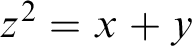 ${z}^2 = x+y$
’ has a uniquely determined reading over the real numbers, this still permits the existence of more than one real-valued solution for ‘z’ given x = 3 and y = 1.
${z}^2 = x+y$
’ has a uniquely determined reading over the real numbers, this still permits the existence of more than one real-valued solution for ‘z’ given x = 3 and y = 1.
But what if the answer to the question above is no? In that case, more than just one interpretation can be assigned to ‘conforms to the existing metasemantic constraints on the interpretation of L’ without invalidating any of the existing metametasemantic constraints on its interpretation. If so, ‘Adm’ is semantically indeterminate, the same is presumably true for (8)–(10), and Ramsey semantics will have to cope with higher-order vagueness. In our analogy again: ‘ ${z}^2 = x+y$
’ might tacitly include some additional parameters that need to be set appropriately before the equation can be applied, which is why ‘
${z}^2 = x+y$
’ might tacitly include some additional parameters that need to be set appropriately before the equation can be applied, which is why ‘ ${z}^2 = x+y$
’ actually represents a whole family of equations each of which comes with its own set of solutions.
${z}^2 = x+y$
’ actually represents a whole family of equations each of which comes with its own set of solutions.
So which answer is it? This depends on the metasemantic properties of the object language in question.
For instance, consider the purely mathematical language L´ from Example 2 in Section 1, even when strictly speaking the example did not concern vagueness: it is quite possible that the corresponding class Adm´ can be characterized completely in purely class-theoretic terms, e.g., as the class of all interpretations that satisfy the second-order Dedekind-Peano axioms, and that any potentially remaining indeterminacy concerning the class-theoretic membership predicate ‘∈’ can be safely ignored when dealing with the countably infinite matters of arithmetic (rather than, say, large-cardinal issues). If so, whether for systematic reasons or for ‘all practical purposes’, there should not be much room left for higher-order indeterminacy. In contrast, if Adm´ were e.g., characterized as the class of all those interpretations satisfying the second-order Dedekind-Peano axioms that are additionally easily definable set-theoretically, then ‘easily’ would be likely to be vague, and hence there should be higher-order vagueness. Ramsey semantics should be prepared for such possibilities, too.
More urgently, as far as the formalization of some fragment of natural language with vague terms is concerned, such as language L from Example 1, it is not even clear how one could tell which of the two answers from above applies, and there might be principal reasons for why we could not tell which of them applies. Therefore, once again, Ramsey semantics should at least be prepared for higher-order vagueness.
And it is not hard to see it is. For the Ramsification ‘scheme’ may simply be iterated at higher levels in the Tarskian hierarchy: a metametalinguistic epsilon term is used to express how ‘the’ intended interpretation of ‘Adm’ is picked from a class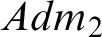 ${Adm}_2$
of interpretations of the metalanguage of L; a metametametalinguistic epsilon term is used to express how ‘the’ intended interpretation of ‘
${Adm}_2$
of interpretations of the metalanguage of L; a metametametalinguistic epsilon term is used to express how ‘the’ intended interpretation of ‘ ${Adm}_2$
’ is picked from a class
${Adm}_2$
’ is picked from a class ${Adm}_3$
of interpretations of the metametalanguage of L; and so forth. Or in other words: I is a member of Adm, which in turn is a member of
${Adm}_3$
of interpretations of the metametalanguage of L; and so forth. Or in other words: I is a member of Adm, which in turn is a member of ${Adm}_2$
, which in turn is a member of
${Adm}_2$
, which in turn is a member of ${Adm}_3$
, and so on. Picture such choices being carried out ‘simultaneously’ at all levels of the Tarskian hierarchy, such that at each level there might be metameta…-semantic facts constraining the ‘process’, and where the outcomes of that ‘process’ might not be determined uniquely at any level. As [Reference McGee47] (p. 230) point out, it is at least possible that ‘As we ascend the hierarchy of metalanguage, we find vagueness all the way up’—though in the present case, in which such a hierarchy is erected on top of a first-order language L with ordinary vague terms and a fixed first-order universe of discourse, one might also expect
${Adm}_3$
, and so on. Picture such choices being carried out ‘simultaneously’ at all levels of the Tarskian hierarchy, such that at each level there might be metameta…-semantic facts constraining the ‘process’, and where the outcomes of that ‘process’ might not be determined uniquely at any level. As [Reference McGee47] (p. 230) point out, it is at least possible that ‘As we ascend the hierarchy of metalanguage, we find vagueness all the way up’—though in the present case, in which such a hierarchy is erected on top of a first-order language L with ordinary vague terms and a fixed first-order universe of discourse, one might also expect ${Adm}_{\alpha}$
to become a singleton set from some ordinal level α and to remain so at all levels β > α. (But what that ‘stabilization ordinal’ α would be like might itself be indeterminate.)
${Adm}_{\alpha}$
to become a singleton set from some ordinal level α and to remain so at all levels β > α. (But what that ‘stabilization ordinal’ α would be like might itself be indeterminate.)
In any case, on each language level, a corresponding determinacy predicate may be introduced again in the expected manner; e.g., for all sentences A of the metalanguage of L:
 $$\begin{align*}{Det}_2(A)\kern0.24em \mathrm{iff}\;\mathrm{for}\;\mathrm{all}\;{F}_2\in {Adm}_2,{F}_2\models A.\end{align*}$$
Previously, ‘Det(A)’ expressed metalinguistically that the sentence A of L comes out true in whatever way a classical interpretation F satisfies all existing metasemantic constraints on the interpretation of L. Similarly, one may now employ ‘ ${Det}_2(\text{`} Det(A)\text{'})$
’ to express metametalinguistically that ‘Det(A)’ comes out true in whatever way a classical interpretation
${Det}_2(\text{`} Det(A)\text{'})$
’ to express metametalinguistically that ‘Det(A)’ comes out true in whatever way a classical interpretation ${F}_2$
satisfies all existing metametasemantic constraints on the interpretation of the metalanguage of L, including the metalinguistic term ‘Adm’. Combining determinacy predicates and truth predicates, one may express multiply iterated determinacy claims at one and the same language level and prove in Ramsey semantics how they interact. E.g., at the metametalevel level, one can prove that the determinacy of the determinacy of B(n) implies the determinacy of B(n), but one cannot in general prove the converse. (See the Appendix for the details.) Thus, the expected determinacy pattern emerges for B—the determinacy area for B is a superset of the determinacy–determinacy area for B, and each area exhibits indeterminate boundaries (Figure 1).
${F}_2$
satisfies all existing metametasemantic constraints on the interpretation of the metalanguage of L, including the metalinguistic term ‘Adm’. Combining determinacy predicates and truth predicates, one may express multiply iterated determinacy claims at one and the same language level and prove in Ramsey semantics how they interact. E.g., at the metametalevel level, one can prove that the determinacy of the determinacy of B(n) implies the determinacy of B(n), but one cannot in general prove the converse. (See the Appendix for the details.) Thus, the expected determinacy pattern emerges for B—the determinacy area for B is a superset of the determinacy–determinacy area for B, and each area exhibits indeterminate boundaries (Figure 1).
Determinacy pattern for B (baldness).

If, on each language level, the Ramsey semanticist can rely on sufficiently many metameta…-semantic findings concerning the respective extensions of ‘ ${Adm}_{\mathrm{i}}$
’—whether regarding these findings as likely or firmly accepting them as true or even adding them as axioms to the respective metameta…-theories—the resulting theoretical package should allow her to draw non-trivial conclusions on higher-order vagueness. If so, at each level, the Ramsification of classical semantics will be informative, and the Ramsification at the level will be consistent if classical semantics is; no ‘infinite regress’ in any bad sense of the term will emerge. No strong assumptions will be required other than postulating the existence of an admissible interpretation at each level of the Tarskian hierarchy. Nor will there be any novel phenomena over and above those covered by previous sections. Higher-order vagueness does not constitute a greater challenge to Ramsey semantics than first-order vagueness.Footnote
24
${Adm}_{\mathrm{i}}$
’—whether regarding these findings as likely or firmly accepting them as true or even adding them as axioms to the respective metameta…-theories—the resulting theoretical package should allow her to draw non-trivial conclusions on higher-order vagueness. If so, at each level, the Ramsification of classical semantics will be informative, and the Ramsification at the level will be consistent if classical semantics is; no ‘infinite regress’ in any bad sense of the term will emerge. No strong assumptions will be required other than postulating the existence of an admissible interpretation at each level of the Tarskian hierarchy. Nor will there be any novel phenomena over and above those covered by previous sections. Higher-order vagueness does not constitute a greater challenge to Ramsey semantics than first-order vagueness.Footnote
24
6 Interpretational change and continuity
Let me finally return to the mathematical and scientific Examples 2 and 3 from Section 1: by now, it should be clear what their Ramsey semantics will have to look like. This will prompt more general considerations on diachronic and synchronic referential/extensional continuity of terms from different languages and how this is compatible with Ramsey semantics.
Example 2 (reconsidered): Let L´ again be a second-order formalization of the language of arithmetic. Let us assume the class Adm´ of its admissible interpretations is identical to the class of all classical interpretations that satisfy the second-order Dedekind-Peano axioms (and which are thus pairwise isomorphic):
 $$\begin{align*}Ad{m}\acute{\mkern6mu} = \{F:F\models {\mathrm{PA}}_2\}.\end{align*}$$
What Ramsey semantics for L´ adds to this is: $\exists F\acute{\mkern6mu}(F\acute{\mkern6mu}\in Adm\acute{\mkern6mu})$
. (In fact, this would not have to be added, since it follows set-theoretically from the equality above.)
$\exists F\acute{\mkern6mu}(F\acute{\mkern6mu}\in Adm\acute{\mkern6mu})$
. (In fact, this would not have to be added, since it follows set-theoretically from the equality above.) $I\acute{\mkern6mu}{ = }_{\mathrm{df}}\varepsilon F\acute{\mkern6mu}(F\acute{\mkern6mu}\in Adm\acute{\mkern6mu}).$
For all sentences A in L´: A is true(-in-L´) iff I´⊨A.
The resulting semantics takes the structuralist conception of arithmetic seriously according to which only the structure of the interpretation of the arithmetical symbols is determined factually. And it combines this with a unique intended (though not factually uniquely determined) set Uni(I´) of natural numbers and with a classical concept of truth for the language of arithmetic that supports classical logic as used by number theorists. Acknowledging semantic indeterminacy in that way does not spell any trouble whatsoever for the Ramsey semantics of the language of second-order arithmetic.
On the contrary, the semantics has some noteworthy consequences: the epsilon calculus and the definitions of ‘I´’ and ‘true’ above just by themselves entail (recall Section 2) that
the second-order Dedekind-Peano axioms are true iff ∃F $\acute{\mkern6mu}$
(F
$\acute{\mkern6mu}$
(F $\acute{\mkern6mu}$
∈Adm
$\acute{\mkern6mu}$
∈Adm $\acute{\mkern6mu}$
),
$\acute{\mkern6mu}$
),
which, since Adm $\acute{\mkern6mu}$
is the class of all classical interpretations that satisfy the second-order Dedekind-Peano axioms, can be reformulated as:
$\acute{\mkern6mu}$
is the class of all classical interpretations that satisfy the second-order Dedekind-Peano axioms, can be reformulated as:
the second-order Dedekind-Peano axioms are true iff they are satisfiable.
In more traditional terminology: the structuralist Ramsey semantics for L´ yields that the truth of the second-order Dedekind-Peano axioms is tied analytically to their satisfiability—which resembles in some way (though only in some way) how Hilbert [Reference Hellman and Shapiro29] had famously characterized mathematical truth in his exchange with Frege.
Example 3 (reconsidered): Let L´´ formalize again the language of Newtonian mechanics. The class Adm´´ of admissible interpretation of L´´ is likely to include at least two members, where one member F of Adm´´ interprets ‘mass’ as relativistic mass, while another member F’ of Adm´´ interprets it as proper mass. Let us assume that these are the only members of Adm´´:
 $$\begin{align*}Adm\acute{\mkern6mu}\acute{\mkern6mu} = \{F,F'\}.\end{align*}$$
Ramsey semantics for L´´ postulates: $\exists F\acute{\mkern6mu}\acute{\mkern6mu}(F\acute{\mkern6mu}\acute{\mkern6mu}\in Adm\acute{\mkern6mu}\acute{\mkern6mu})$
. (Once again, this would not actually have to be stated, since it follows set-theoretically from the equality above.)
$\exists F\acute{\mkern6mu}\acute{\mkern6mu}(F\acute{\mkern6mu}\acute{\mkern6mu}\in Adm\acute{\mkern6mu}\acute{\mkern6mu})$
. (Once again, this would not actually have to be stated, since it follows set-theoretically from the equality above.) $I\acute{\mkern6mu}\acute{\mkern6mu}{ = }_{\mathrm{df}}\varepsilon F\acute{\mkern6mu}\acute{\mkern6mu}(F\acute{\mkern6mu}\acute{\mkern6mu}\in Adm\acute{\mkern6mu}\acute{\mkern6mu}).$
For all sentences A in L´´: A is true(-in-L´´) iff I´´⊨A.
In this way, Ramsey semantics applies the classical concept of truth to the language of Newtonian mechanics and interprets the logic of Newtonian arguments and proofs to be classical, while granting that, to the best of our present physical knowledge, it is not possible to ascribe the Newtonian term ‘mass’ a unique factually determined intended reference. In the terminology of Field [Reference Field23], Newtonian ‘mass’ only refers partially, which Field himself makes precise in a supervaluationist manner, while the Ramsey semantics from above does so by Ramsifying classical semantics.
For instance, Ramsey semantics for L´´ derives from the postulates above that $I\acute{\mkern6mu}\acute{\mkern6mu}(m) = F(m)\;\mathrm{or}\;I\acute{\mkern6mu}\acute{\mkern6mu}(m) = F'(m),$
without deriving either of the disjuncts (recall Section 2), which seems like the right prediction to make.
Example 3 concerned revolutionary language change in the following sense: one is giving a semantics for the language of a scientific theory that belongs to an earlier scientific paradigm (cf. [Reference Kripke38]), and one does so by using terms from the language of a scientific theory that belongs to a contemporary scientific paradigm. More generally, Ramsey semantics offers semanticists the resources to study interpretational change and diachronic continuity through all stages of scientific development, including normal ones in which the central theoretical terms remain to be used in similar ways. In either case, scientific realists would expect referential/extensional continuity between empirically successful successor theories, that is, the references/extensions of theoretical terms in successful theories should be preserved in the transition to their successful successor theories (see [Reference Putnam55]).
Carnap’s [Reference Carnap14, Reference Carnap and Bar-Hillel15] proposal to view theoretical terms as definable by epsilon terms (which he employed object-linguistically while Ramsey semantics uses them metalinguistically) was meant to support similar continuity considerations, but without the presupposition that a unique intended interpretation has been determined factually. Instead, he meant to capture the open-ended, increasing, and yet partial specification of theoretical terms in scientific progress (as [Reference Putnam56] had done before):
this definition [gives] just so much specification as we can give, and not more. We do not want to give more, because the meaning should be left unspecified in some respect, because otherwise the physicist could not—as he wants to—add tomorrow more and more postulates, and even more and more correspondence postulates, and thereby make the meaning of the same term more specific than [it is] today. So, it seems to me that the ε-operator is just exactly the tailor-made tool that we needed, in order to give an explicit definition, that, in spite of being explicit, does not determine the meaning completely, but just to that extent that it is needed. ([Reference Carnap14], pp. 171–172)
Of course, present-day scientific realists would not buy into Carnap’s overly descriptivist conception of scientific theoretical terms here. But so long as the linguistic metasemantic facts underlying the metasemantics of theoretical terms involve at least some theoretical component—as acknowledged, e.g., by combined causal-theoretical accounts of theoretical terms (see [Reference Pettigrew53], Chapter 12)—and hence some scientific theory is at least partially constitutive of these terms, it is plausible that the interpretation of such terms may remain partial in virtue of the theory being deductively incomplete or vague or both. What is more, the causal or ostensive components of the metasemantics of theoretical terms may themselves give rise to semantic indeterminacy: reference-fixing phrases such as ‘whatever causes phenomenon so-and-so shall be called…’ may be semantically indeterminate by leaving ‘causal distance’ and the relevant type of causality open; and an act of ostension may be directed simultaneously towards a plurality of objects, kinds, and physical structures, such that neither intentions nor interests may suffice to rule out all but one potential target. For the same reason, it should be possible to extend the metasemantic constraints on the interpretation of a theoretical term by extending or ‘precisifying’ the theory that partially characterizes it, or by diambiguating the term’s reference-fixing description, or by excluding relevant causal pathways as semantically unintended: in all of these cases, the class of admissible references/extensions of theoretical terms may be expected to change.
If so, Ramsey semantics (as, to some extent, supervaluationist semantics) may capture the respective semantic changes as follows: let ${L}_1$
be the language of a scientific theory at a time, let
${L}_1$
be the language of a scientific theory at a time, let ${L}_2$
be the language of its immediate successor theory, and let Terms be a set of theoretical terms that belong simultaneously to both languages. Let
${L}_2$
be the language of its immediate successor theory, and let Terms be a set of theoretical terms that belong simultaneously to both languages. Let ${Adm}_1$
be the class of all restrictions of
${Adm}_1$
be the class of all restrictions of ${L}_1$
-admissible interpretations to Terms (while leaving the domain of the interpretations the same), such that only the members of Terms are interpreted by the interpretation functions
${L}_1$
-admissible interpretations to Terms (while leaving the domain of the interpretations the same), such that only the members of Terms are interpreted by the interpretation functions ${F}_1$
in
${F}_1$
in ${Adm}_1$
; and let
${Adm}_1$
; and let ${Adm}_2$
be the corresponding class of all interpretation functions
${Adm}_2$
be the corresponding class of all interpretation functions ${F}_2$
that result from restricting
${F}_2$
that result from restricting ${L}_2$
-admissible interpretations to Terms.
${L}_2$
-admissible interpretations to Terms.
Then one can define:
The ${L}_2$
-interpretation of the members of Terms is a (proper) specification of their
${L}_2$
-interpretation of the members of Terms is a (proper) specification of their ${L}_1$
-interpretation just in case (
${L}_1$
-interpretation just in case ( ${Adm}_1\ne {Adm}_2$
and)
${Adm}_1\ne {Adm}_2$
and) ${Adm}_2\subseteq {Adm}_1$
, that is,
${Adm}_2\subseteq {Adm}_1$
, that is, ${Adm}_2$
is a (proper) subclass of
${Adm}_2$
is a (proper) subclass of ${Adm}_1$
.
${Adm}_1$
.
Specification is what Carnap described in the quote from before: the interpretation of the members of Term become more specific in the transition from ${L}_1$
to
${L}_1$
to ${L}_2$
. In the language of supervaluationism, one might also speak of increased ‘precisification’ or ‘sharpening’.
${L}_2$
. In the language of supervaluationism, one might also speak of increased ‘precisification’ or ‘sharpening’.
But specification is just one kind of interpretational change next to others:
The ${L}_2$
-interpretation of the members of Terms is a (proper) diversification of their
${L}_2$
-interpretation of the members of Terms is a (proper) diversification of their ${L}_1$
-interpretation just in case (
${L}_1$
-interpretation just in case ( ${Adm}_1\ne {Adm}_2$
and)
${Adm}_1\ne {Adm}_2$
and) ${Adm}_1\subseteq {Adm}_2$
, that is,
${Adm}_1\subseteq {Adm}_2$
, that is, ${Adm}_2$
is a (proper) superclass of
${Adm}_2$
is a (proper) superclass of ${Adm}_1$
.
${Adm}_1$
.
The ${L}_2$
-interpretation of the members of Terms is a (proper) compatible modification of their
${L}_2$
-interpretation of the members of Terms is a (proper) compatible modification of their ${L}_1$
-interpretation just in case (
${L}_1$
-interpretation just in case ( ${Adm}_1\ne {Adm}_2$
and)
${Adm}_1\ne {Adm}_2$
and) ${Adm}_1\cap {Adm}_2\ne \varnothing$
, that is,
${Adm}_1\cap {Adm}_2\ne \varnothing$
, that is, ${Adm}_1$
(differs from and) has non-empty overlap with
${Adm}_1$
(differs from and) has non-empty overlap with ${Adm}_2$
.
${Adm}_2$
.
The ${L}_2$
-interpretation of the members of Terms is a complete revision of their
${L}_2$
-interpretation of the members of Terms is a complete revision of their ${L}_1$
-interpretation just in case
${L}_1$
-interpretation just in case ${Adm}_1\cap {Adm}_2 = \varnothing$
, that is,
${Adm}_1\cap {Adm}_2 = \varnothing$
, that is, ${Adm}_1$
does not overlap with
${Adm}_1$
does not overlap with ${Adm}_2$
.Footnote
25
${Adm}_2$
.Footnote
25
Proper diversification is the ‘opposite’ of proper specification: it adds new ways of interpretation and thereby makes interpretation less specific.
(Proper) specification and (proper) diversification of interpretation are both special cases of (proper) compatible modification (assuming the relevant sets are non-empty), but compatible modification is broader: it also covers cases in which the previous metasemantic constraints on the interpretation of the members of Terms are compatible with newly introduced ones ( ${Adm}_1\cap {Adm}_2\ne \varnothing$
) while the interpretation of the terms does not become more or less specific.
${Adm}_1\cap {Adm}_2\ne \varnothing$
) while the interpretation of the terms does not become more or less specific.
Finally, in cases of complete revision, the new metasemantic constraints rule out the previous ones completely (that is, ${Adm}_1\cap {Adm}_2\ne \varnothing$
). In such cases, Ramsey semantics also rules out perfect referential/extensional continuity between
${Adm}_1\cap {Adm}_2\ne \varnothing$
). In such cases, Ramsey semantics also rules out perfect referential/extensional continuity between ${L}_1$
and
${L}_1$
and ${L}_2$
with respect to all theoretical terms in Terms: for the logical laws of the epsilon calculus imply in that case that
${L}_2$
with respect to all theoretical terms in Terms: for the logical laws of the epsilon calculus imply in that case that
 $$\begin{align*}\varepsilon {F}_1\left({F}_1\in {Adm}_1\right)\ne \varepsilon {F}_2\left({F}_2\in {Adm}_2\right),\end{align*}$$
that is, there must be some P in Terms, such that $\left(\varepsilon {F}_1\left({F}_1\in {Adm}_1\right)\right)(P)\ne \left(\varepsilon {F}_2\left({F}_2\in {Adm}_2\right)\right)(P)$
.
$\left(\varepsilon {F}_1\left({F}_1\in {Adm}_1\right)\right)(P)\ne \left(\varepsilon {F}_2\left({F}_2\in {Adm}_2\right)\right)(P)$
.
However, in the case of compatible modification ( ${Adm}_1\cap {Adm}_2\ne \varnothing$
), Ramsey semantics does allow one to regard all terms in Terms as preserving their references/extensions in the transition from
${Adm}_1\cap {Adm}_2\ne \varnothing$
), Ramsey semantics does allow one to regard all terms in Terms as preserving their references/extensions in the transition from ${L}_1$
to
${L}_1$
to ${L}_2$
: for it is easy to see that the postulates of Ramsey semantics may always be expanded consistently in that case by
${L}_2$
: for it is easy to see that the postulates of Ramsey semantics may always be expanded consistently in that case by
 $$\begin{align*}\varepsilon {F}_1\left({F}_1\in {Adm}_1\right) = \varepsilon {F}_2\left({F}_2\in {Adm}_2\right),\end{align*}$$
that is, by
 $$\begin{align*}{I}_1 = {I}_2.\end{align*}$$
In such case, let us call ‘ ${I}_1 = {I}_2$
’ the statement of perfect interpretational (referential/extensional) continuity (holding between
${I}_1 = {I}_2$
’ the statement of perfect interpretational (referential/extensional) continuity (holding between ${L}_1$
and
${L}_1$
and ${L}_2$
and with respect to Terms).
${L}_2$
and with respect to Terms).
Cases of compatible interpretational modification include the extreme case of improper specification/diversification in which ${Adm}_1$
is identical to
${Adm}_1$
is identical to ${Adm}_2$
and where they are singleton classes, that is,
${Adm}_2$
and where they are singleton classes, that is, ${Adm}_1 = \left\{{I}_1\right\} = \left\{{I}_2\right\} = {Adm}_2$
: in that extreme case, Ramsey semantics even entails perfect interpretational continuity, by the logic of epsilon terms. Scientific realists, who are normally wedded to classical semantics, either mean that extreme case when they are speaking of referential/extensional continuity between scientific successor languages, or they mean (more realistically) that
${Adm}_1 = \left\{{I}_1\right\} = \left\{{I}_2\right\} = {Adm}_2$
: in that extreme case, Ramsey semantics even entails perfect interpretational continuity, by the logic of epsilon terms. Scientific realists, who are normally wedded to classical semantics, either mean that extreme case when they are speaking of referential/extensional continuity between scientific successor languages, or they mean (more realistically) that ${Adm}_1$
and
${Adm}_1$
and ${Adm}_2$
are singletons while their members are merely similar or approximately identical:
${Adm}_2$
are singletons while their members are merely similar or approximately identical: ${Adm}_1 = \left\{{I}_1\right\}$
,
${Adm}_1 = \left\{{I}_1\right\}$
, ${Adm}_2 = \left\{{I}_2\right\}$
, and
${Adm}_2 = \left\{{I}_2\right\}$
, and ${I}_1\approx {I}_2$
. Call ‘
${I}_1\approx {I}_2$
. Call ‘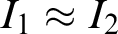 ${I}_1\approx {I}_2$
’ a statement of approximate interpretational (referential/extensional) continuity (again between
${I}_1\approx {I}_2$
’ a statement of approximate interpretational (referential/extensional) continuity (again between ${L}_1$
and
${L}_1$
and ${L}_2$
and with respect to Terms). Cases of approximate continuity that are not cases of perfect continuity would be cases of complete (but still approximate) revision.Footnote
26
${L}_2$
and with respect to Terms). Cases of approximate continuity that are not cases of perfect continuity would be cases of complete (but still approximate) revision.Footnote
26
But Ramsey semantics also permits perfect and approximate continuity in cases of compatible modification in which ${Adm}_1$
and
${Adm}_1$
and ${Adm}_2$
are not both singleton classes, that is, when the members of Terms are semantically indeterminate either qua
${Adm}_2$
are not both singleton classes, that is, when the members of Terms are semantically indeterminate either qua ${L}_1$
-terms or qua
${L}_1$
-terms or qua ${L}_2$
-terms or both. For instance, consider the case of specification again (
${L}_2$
-terms or both. For instance, consider the case of specification again ( ${Adm}_2\subseteq {Adm}_1$
), that is, when more metasemantic constraints on the interpretation of the members of Terms get introduced in the transition from
${Adm}_2\subseteq {Adm}_1$
), that is, when more metasemantic constraints on the interpretation of the members of Terms get introduced in the transition from ${L}_1$
to
${L}_1$
to ${L}_2$
: if so, the metasemantic facts determine that every admissible
${L}_2$
: if so, the metasemantic facts determine that every admissible ${L}_2$
-interpretation on Terms is also an
${L}_2$
-interpretation on Terms is also an ${L}_1$
-interpretation, and hence every
${L}_1$
-interpretation, and hence every ${L}_1$
-determinate statement A that is composed solely of members of Terms is also
${L}_1$
-determinate statement A that is composed solely of members of Terms is also ${L}_2$
-determinate. (That is: if
${L}_2$
-determinate. (That is: if ${Det}_{L1}(A)$
then
${Det}_{L1}(A)$
then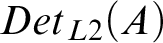 ${Det}_{L2}(A)$
.) But so long as
${Det}_{L2}(A)$
.) But so long as ${Adm}_2$
(and hence
${Adm}_2$
(and hence ${Adm}_1$
) is not a singleton class, there will not be any facts of the matter—no existing metasemantic constraints—that will require the interpretations of
${Adm}_1$
) is not a singleton class, there will not be any facts of the matter—no existing metasemantic constraints—that will require the interpretations of ${L}_1$
and
${L}_1$
and ${L}_2$
to perfectly or approximately coincide on Terms. That is, given such
${L}_2$
to perfectly or approximately coincide on Terms. That is, given such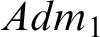 ${Adm}_1$
and
${Adm}_1$
and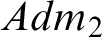 ${Adm}_2$
, Ramsey semantics will not by itself entail that
${Adm}_2$
, Ramsey semantics will not by itself entail that
 $$\begin{align*}{I}_1 = \varepsilon {F}_1\left({F}_1\in {Adm}_1\right) = {\!/\!}\approx \varepsilon {F}_2\left({F}_2\in {Adm}_2\right) = {I}_2.\end{align*}$$
However, one may still consistently extend Ramsey semantics for ${L}_1$
and
${L}_1$
and ${L}_2$
by the perfect/approximate continuity statement ‘
${L}_2$
by the perfect/approximate continuity statement ‘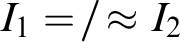 ${I}_1 = {\!/\!}\approx {I}_2$
’in that case: if one does so, this will not serve the purpose of describing existing metasemantics facts but rather correspond to a ‘free semantic posit’ by which one expresses one’s choice of talking on the metalevel as if the facts had determined the members of Terms to precisely or approximately preserve their references/extensions in the transition from
${I}_1 = {\!/\!}\approx {I}_2$
’in that case: if one does so, this will not serve the purpose of describing existing metasemantics facts but rather correspond to a ‘free semantic posit’ by which one expresses one’s choice of talking on the metalevel as if the facts had determined the members of Terms to precisely or approximately preserve their references/extensions in the transition from ${L}_1$
to
${L}_1$
to ${L}_2$
.Footnote
27
Semantically, any such interpretational continuity between theoretical terms from consecutive theories would still look like ordinary semantic realism. But not so metasemantically: since the continuity would not be grounded in facts, the continuity would remain merely verbal. (One might view ‘
${L}_2$
.Footnote
27
Semantically, any such interpretational continuity between theoretical terms from consecutive theories would still look like ordinary semantic realism. But not so metasemantically: since the continuity would not be grounded in facts, the continuity would remain merely verbal. (One might view ‘ $\varepsilon {F}_1\left({F}_1\in {Adm}_1\right) = {\!/\!}\approx \varepsilon {F}_2\left({F}_2\in {Adm}_2\right)$
’ as describing a ‘brute semantic fact’ in the sense of [Reference Breckenridge and Magidor6, Reference Hyde and Colyvan34], or as a true sentence that is not describing any fact at all.)
$\varepsilon {F}_1\left({F}_1\in {Adm}_1\right) = {\!/\!}\approx \varepsilon {F}_2\left({F}_2\in {Adm}_2\right)$
’ as describing a ‘brute semantic fact’ in the sense of [Reference Breckenridge and Magidor6, Reference Hyde and Colyvan34], or as a true sentence that is not describing any fact at all.)
I will have to postpone further investigation of that case to a different occasion, but if the semantic indeterminacy of scientific theoretical terms happens to be a common phenomenon at all—to which Ramsey semantics is not committed, but for which it is prepared—scientific realists should be regularly forced to seek refuge to such posited referential/extensional continuities between scientific terms from successor theories. (Alternatively, they might weaken the notion of referential/extensional continuity in the face of semantic indeterminacy, such that what is meant by it would merely be ${Adm}_2\subseteq {Adm}_1$
or even just
${Adm}_2\subseteq {Adm}_1$
or even just ${Adm}_1\cap {Adm}_2\ne \varnothing$
.)Footnote
28
${Adm}_1\cap {Adm}_2\ne \varnothing$
.)Footnote
28
Instead of continuing the study of diachronic interpretational continuity between theoretical terms in subsequent theories, let me turn now to an example of synchronic interpretational continuity between theoretical terms from theories held true at the same time.
Reconsider the second-order language L´ of arithmetic of Example 2 with its class Adm´ of admissible interpretations satisfying the second-order Dedekind-Peano axioms, and compare it to the second-order language L * of real analysis with its class Adm * of admissible interpretations that satisfy Dedekind’s second-order axioms of the real numbers. As in the case of number theory, the second-order theory of real numbers is categorical, that is, it pins down the structure of the real numbers uniquely. At the same time, infinitely many (pairwise isomorphic) set-theoretic systems instantiate that structure by satisfying the axioms: let us be set-theoretic structuralists again about the real numbers and assume that the class Adm * consists of all such systems. Ramsey semantics for L * will thus consist in:
 $$\begin{align*}{\displaystyle \begin{array}{l}{Adm}^{\ast} = \left\{F:F\models {RA}_2\right\}.\\ {}\exists {F}^{\ast}\left({F}^{\ast}\in {Adm}^{\ast}\right)\;\left(\mathrm{which}\kern0.17em \mathrm{follows}\;\mathrm{set}\hbox{-} \mathrm{the}\mathrm{oretically}\kern0.17em \mathrm{from}\kern0.17em \mathrm{the}\kern0.17em \mathrm{previous}\kern0.17em \mathrm{equation}\right).\\ {}{I}^{\ast }{ = }_{df}\varepsilon {F}^{\ast}\left({F}^{\ast}\in {Adm}^{\ast}\right).\\ {}\mathrm{For}\;\mathrm{all}\;\mathrm{sentences}\;A\kern0.24em \mathrm{in}\;{L}^{\ast}{:}\ A\kern0.24em \mathrm{is}\kern0.17em \mathrm{true}(\hbox{-} \mathrm{in}\hbox{-} {L}^{\ast})\;\mathrm{iff}\;{I}^{\ast } \vDash A.\end{array}}\end{align*}$$
The intended domain Uni(I *) of real numbers includes as a special subset the set {I *(0), I*(0+1), I *((0+1)+1),…} of real ‘natural’ numbers. However, combining Ramsey semantics for arithmetic with that of analysis still leaves open how these real-valued ‘natural’ numbers relate to the ‘actual’ natural numbers in Uni(I´).Footnote 29
Suppose that one intends to correct this by stipulatively identifying the former with the latter: then Ramsey semantics allows one to express this stipulation by adding
 $$\begin{align*}{I}^{\ast }(0) = I\acute{\mkern6mu}(0),{I}^{\ast}\left(0+1\right) = I\acute{\mkern6mu}\left(s(0)\right),{I}^{\ast}\left(\left(0+1\right)+1\right) = I\acute{\mkern6mu}\left(s\left(s(0)\right)\right),\dots\end{align*}$$
as semantic posits to one’s semantic metatheory, in which, e.g., ‘I *(0) = I´(0)’ is short for
 $$\begin{align*}\left(\varepsilon {F}^{\ast}\left({F}^{\ast}\in {Adm}^{\ast}\right)\right)(0) = \left(\varepsilon F\acute{\mkern6mu}\left(F\acute{\mkern6mu}\in Adm\acute{\mkern6mu}\right)\right)(0),\end{align*}$$
and the like. Once again, these are statements of perfect interpretational continuity (here between L * and L´), but this time concerning languages that are used at the same point in time. (Approximate continuity would not make much sense in a purely mathematical context.)
Just as in the diachronic case before, continuities established in that manner would not be due to metasemantic facts existing prior to identification but rather result from free semantic choices by which some factual gaps are ‘covered’ semantically. While there is no proper mathematical reason for identifying real-valued 0, 1, 2,… with natural 0, 1, 2,…, as the existence of an isomorphism between them suffices for all theoretical purposes, it may still be practically convenient for mathematicians to talk as if the mathematical facts had engendered the identification, and the continuity statement from above captures that semantically.
We find that Ramsey semantics allows for diachronic and synchronic interpretational continuity between languages even in cases of semantic indeterminacy for which there is no direct counterpart in classical semantics. According to classical semantics, every instance of interpretational continuity must already have existed ‘from the start’: a theoretical term in the ‘old’ theory must have happened to refer or apply to the same or similar phenomena as the same term does in the successor theory; the extension of ‘real natural number’ must have coincided with the extension of ‘(actual) natural number’; and so forth. While one may completely revise the classical interpretation of terms and sentences, and while two classical interpretations may be more similar to each other than to another one, there is no way of literally making a classical interpretation ‘more specific’, or of ‘identifying’ classical interpretations that had not been identical beforehand.Footnote 30 Ramsey semantics, in contrast, makes room for the existence of linguistic acts by which the (meta-)semantics of scientific and mathematical terms and sentences can be altered without affecting interpretational continuity; and in some cases, continuity may even be established by such acts in the first place.
For the same reason, it is generally difficult for classical semantics to make sense of the project of rational reconstruction [ Reference Carnap 10 ] as applied to language and semantics: the normative project of improving language and interpretation for some purposes by means of clarification, precisification, systematization, simplification, correction, and more.
For example: how should one understand the claim that number talk in mathematics can be rationally reconstructed in different ways for different purposes (as suggested by [Reference Carnap11, Reference Carnap13, Reference Carnap and Schilpp16])? Such as, including contemporary reconstructions: (set-)structuralistically, logicistically, formalistically, category-theoretically, homotopy-type-theoretically, and so on. In classical semantics, the whole project would seem rather pointless: e.g., the numeral ‘1’ that is used by number theorists either refers to a Hilbertian sequence of stroke symbols or it does not. If it does, there is no need for rationally reconstructing ‘1’-talk formalistically; if it does not, rationally reconstructing ‘1’-talk formalistically would be a mistake. Tertium non datur.
Ramsey semanticists, in contrast, could argue that ‘1’ might be semantically indeterminate and hence can be further specified in different ways: by excluding all interpretations except for those that are admissible on (set-)structuralist grounds, or except for those that satisfy all logicist desiderata, or except for those that are formalistically admissible; etc. Each such rational reconstruction may come with its own interpretational continuity statement and remains compatible with classical logic, truth, and mathematics, as can be shown in Ramsey semantics.
7 Conclusions and extensions
I have argued that Ramsey semantics combines the best of two worlds: Ramsifying classical semantics preserves the syntax, semantic rules, concept of truth, truth values, and logic of classical semantics; but it also avoids the classical presupposition of a unique factually determined intended interpretation. Instead, it follows supervaluationist semantics in merely presupposing a non-empty class of admissible interpretations. The resulting semantics circumvents the Sorites paradox, scales up to higher-order vagueness (if there is such), permits semantically indeterminate theoretical terms in mathematics and science, allows for such terms to retain their interpretation across theories, and makes sense of the rational reconstruction of language and interpretation. When there is no semantic indeterminacy, Ramsey semantics collapses into classical semantics; but when there is, it will be handled more classically by Ramsey semantics than by supervaluationist semantics.
Ramsey semantics can and should be developed into various directions. One was mentioned already at the beginning of Section 1: the Ramsification of classical intensional semantics and its application in pragmatics. For instance: classical semanticists postulate what is communicated by the assertion of B(n) to be ‘the’ intension of B(n), that is, ‘the’ class of possible worlds in which it is true. Accordingly, intensional Ramsey semantics will postulate the existence of an admissible intensional interpretation F, that is, an assignment of references and intensions to the descriptive terms of the object language that fits the metasemantic facts, such that F defines truth, and…, and asserting B(n) conveys the intension of B(n) as given by F. The aim of such an assertion will still be the truth of B(n), but truth will be understood as given existentially, as in Section 2. Metalinguistic intensional epsilon terms will be used to implement this idea formally, and what they ‘pick’ from the space Adm of admissible intensional interpretations will also depend on the context of assertion. The resulting Ramsey account of assertion and assertability may be expected to resemble that of supervaluationist semantics, but without changing truth into super-truth.
A different kind of extension concerns Ramsey semantics for a type-free truth predicate that avoids semantic paradoxes, such as the Liar paradox, while maintaining classical logic and truth. In that extended semantics, ‘true’ and ‘determinate’ would be type-free predicates of sentences, the extension of ‘true’ would be given by some admissible interpretation, while the extension of ‘determinate’ would coincide with the set of sentences satisfied in all admissible interpretations. And each admissible interpretation would itself interpret the same predicates ‘true’ and ‘determinate’ again (which is the type-free aspect). The relevant literature that comes closest to this are McGee [Reference Lynch46] and Cantini [Reference Cantini8], though neither of them treats type-free truth as given by Ramsification. Ramsey semantics might provide suitable variants of their theories with new philosophical support. At the same time, a type-free version of Ramsey semantics might improve the hierarchical account of higher-order vagueness in Section 5 and in the Appendix in much the same way in which Kripke’s [Reference Keefe36] type-free theory of truth improved Tarski’s classical typed theory. But all that is left for future work.
The new semantics may also have philosophical applications beyond the philosophy of language proper. Let me conclude this paper by mentioning one of them: partially reconciling (versions of) semantic anti-realism about mathematics with classical logic and truth.
Consider intuitionism about mathematics: clearly, Ramsey semantics will not be suitable to orthodox intuitionists who insist that ‘existence’ means constructibility, ‘truth’ means provability, and a disjunction is provable only if one of its disjuncts is. However, there might also be more liberal intuitionists who are driven by very different considerations: they might worry about the existence of mathematical statements A, such that the existing metasemantic constraints on the interpretation of A would neither be sufficient to determine A to be true nor sufficient to determine A to be false—no facts would fill the gap. If one assumes the facts in question to be matters of mental construction, as intuitionists normally do, the worry should be quite obvious. But even someone who merely thinks that mathematical facts supervene on mental, linguistic, physical,… facts, might well question whether these facts will be able to settle the status of, say, ‘x∈y’, for all sets x and y at arbitrary ordinal heights in the cumulative hierarchy of sets. And that worry also becomes relevant to complex mathematical statements, if one accepts that truth conditions are compositional. Indeed, if compositionality is implemented by the semantic rules of intuitionistic semantics, the truth of A∨¬A would be in doubt. The rationale for these semantic rules is to track determinacy by truth, much as supervaluationist semantics does, but compositionally, unlike supervaluationism: for these rules may be understood as compositionally employing (in present terminology) a determinacy predicate or operator in the clauses for atomic formulas, negation formulas, conditionals, and universal quantifications (as can be seen from Kripke semantics for intuitionistic logic or from Gödel’s translation of intuitionistic logic into the modal system S4Footnote 31 ).
It is to intuitionists of such more liberal stripe that Ramsey semantics may provide a profitable offer, since it accepts both the possibility of metasemantic gaps and the compositionality of truth, and yet delivers the logical truth of the excluded middle. The way it manages to do so is by excluding determinacy from the semantic rules for truth (see Section 2), and by postulating instead, at the outset, one non-constructive existence statement: a metalinguistic Ramsey sentence. If liberal intuitionists could make their peace with that Ramsey sentence by interpreting it as expressing some kind of ‘regulative ideal’ (cf. [Reference Schiemer and Gratzl60], p. 209) that is meant to systematize semantics in a practically beneficial manner, they might be able to embrace the logical truth of classical logic and the truth of classical mathematics without alarming factual commitments.Footnote 32
Appendix: Iterating Ramsey semantics throughout the Tarskian hierarchy
The metalinguistic Ramsey semantics of the first-order extensional object language L from Example 1 of Section 1 has been described in Section 2. I am now going to introduce Ramsey semantics for the metalanguage ${L}_2$
of L in which Ramsey semantics for L has been formulated. In an analogous manner, Ramsey semantics may be introduced at yet higher levels of the Tarskian hierarchy. The main technical challenge, on which I did not comment in Section 5, consists in the interpretation of the metalinguistic epsilon terms that figure prominently in
${L}_2$
of L in which Ramsey semantics for L has been formulated. In an analogous manner, Ramsey semantics may be introduced at yet higher levels of the Tarskian hierarchy. The main technical challenge, on which I did not comment in Section 5, consists in the interpretation of the metalinguistic epsilon terms that figure prominently in ${L}_2$
and in the formal interaction between determinacy and truth predicates.
${L}_2$
and in the formal interaction between determinacy and truth predicates.
For simplicity, let us assume that ${L}_2$
is a first-order extensional language again; e.g., the metalinguistic expression ‘F∈Adm’ in
${L}_2$
is a first-order extensional language again; e.g., the metalinguistic expression ‘F∈Adm’ in ${L}_2$
is really a first-order formula of the form ‘Adm(F)’ in which ‘F’ is a first-order variable and ‘Adm’ is a predicate. Classical interpretations
${L}_2$
is really a first-order formula of the form ‘Adm(F)’ in which ‘F’ is a first-order variable and ‘Adm’ is a predicate. Classical interpretations ${F}_2$
of
${F}_2$
of ${L}_2$
are defined as described in Section 1, except that now also the epsilon terms of
${L}_2$
are defined as described in Section 1, except that now also the epsilon terms of ${L}_2$
require interpretation: here one may simply follow the standard choice semantics of epsilon terms (see [Reference Kuhn39]) by defining each
${L}_2$
require interpretation: here one may simply follow the standard choice semantics of epsilon terms (see [Reference Kuhn39]) by defining each ${F}_2$
to come equipped with some choice function Ch(
${F}_2$
to come equipped with some choice function Ch( ${F}_2$
) by which epsilon terms in
${F}_2$
) by which epsilon terms in ${L}_2$
are interpreted. E.g., Ch(
${L}_2$
are interpreted. E.g., Ch( ${F}_2$
) applied to a non-empty subclass X of Dom(
${F}_2$
) applied to a non-empty subclass X of Dom( ${F}_2$
) yields some member of X, and
${F}_2$
) yields some member of X, and ${F}_2$
(‘εF(F∈Adm)’) is defined to be equal to Ch(
${F}_2$
(‘εF(F∈Adm)’) is defined to be equal to Ch( ${F}_2$
)(
${F}_2$
)( ${F}_2$
(‘Adm’)). Two interpretations
${F}_2$
(‘Adm’)). Two interpretations ${F}_2$
and
${F}_2$
and ${F_2}^{\prime }$
may well differ only in their respective choice functions. ‘⊨’ for satisfaction is defined as in (1) from Section 1 but now relative to interpretations
${F_2}^{\prime }$
may well differ only in their respective choice functions. ‘⊨’ for satisfaction is defined as in (1) from Section 1 but now relative to interpretations ${F}_2$
of
${F}_2$
of ${L}_2$
, and logical consequence is still defined by (2) from Section 1.
${L}_2$
, and logical consequence is still defined by (2) from Section 1.
Next, one assumes all existing metametasemantic constraints on the interpretation of ${L}_2$
to be summed up by a class
${L}_2$
to be summed up by a class ${Adm}_2$
of classical (
${Adm}_2$
of classical ( ${L}_2$
-)admissible interpretations
${L}_2$
-)admissible interpretations ${F}_2$
of
${F}_2$
of ${L}_2$
. The universe of each
${L}_2$
. The universe of each ${F}_2$
is going to be a set that includes all classical interpretations F of L for which Uni(F) = U (which was the intended set universe of L). For simplicity again, let us assume all interpretations in
${F}_2$
is going to be a set that includes all classical interpretations F of L for which Uni(F) = U (which was the intended set universe of L). For simplicity again, let us assume all interpretations in ${Adm}_2$
to have one and the same set-domain
${Adm}_2$
to have one and the same set-domain ${U}_2$
. Each (
${U}_2$
. Each ( ${L}_2$
-)admissible
${L}_2$
-)admissible ${F}_2$
assigns over
${F}_2$
assigns over ${U}_2$
, amongst others, an (
${U}_2$
, amongst others, an ( ${L}_2$
-)admissible interpretation to the metalinguistic expression ‘conforms to the existing metasemantic constraints on the interpretation of L’, hence also to ‘Adm’, and thereby, as in (22), to ‘Det’. Amongst the metametasemantic constraints on the interpretation of ‘Adm’, there will be conceptual constraints, such as: for each
${L}_2$
-)admissible interpretation to the metalinguistic expression ‘conforms to the existing metasemantic constraints on the interpretation of L’, hence also to ‘Adm’, and thereby, as in (22), to ‘Det’. Amongst the metametasemantic constraints on the interpretation of ‘Adm’, there will be conceptual constraints, such as: for each ${F}_2\in {Adm}_2$
,
${F}_2\in {Adm}_2$
,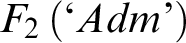 ${F}_2\left(\text{`} Adm\text{'}\right)$
is a subset of U
2 and indeed a non-empty set of classical interpretations F of L. And all
${F}_2\left(\text{`} Adm\text{'}\right)$
is a subset of U
2 and indeed a non-empty set of classical interpretations F of L. And all ${F}_2\in {Adm}_2$
interpret the metalinguistic terms ‘I’ and ‘true(-in-
${F}_2\in {Adm}_2$
interpret the metalinguistic terms ‘I’ and ‘true(-in- ${L}_1$
)’ so that the postulates of Ramsey semantics for L from Section 2 are made true: e.g.,
${L}_1$
)’ so that the postulates of Ramsey semantics for L from Section 2 are made true: e.g., ${F}_2\left(\text{`}I\text{'}\right) = {F}_2\left(\text{`}\varepsilon F{\kern-2pt}\left(F\in Adm\right)\text{'}\right)$
.
${F}_2\left(\text{`}I\text{'}\right) = {F}_2\left(\text{`}\varepsilon F{\kern-2pt}\left(F\in Adm\right)\text{'}\right)$
.
Once again, Ramsey semantics for the metalanguage ${L}_2$
of L commits itself to
${L}_2$
of L commits itself to ${Adm}_2$
being non-empty, ‘the’ intended interpretation
${Adm}_2$
being non-empty, ‘the’ intended interpretation ${I}_2$
of
${I}_2$
of ${L}_2$
being given by a metametalinguistic epsilon term, and truth for
${L}_2$
being given by a metametalinguistic epsilon term, and truth for ${L}_2$
being defined as classical satisfaction by
${L}_2$
being defined as classical satisfaction by ${I}_2$
; that is,
${I}_2$
; that is,
 $$\begin{align*}{\displaystyle \begin{array}{l}\exists {F}_2\left({F}_2\in {Adm}_2\right),\\ {}{I}_2{ = }_{df}\varepsilon {F}_2\left({F}_2\in {Adm}_2\right),\\ {}\mathrm{for}\;\mathrm{all}\;\mathrm{sentences}\;A\kern0.24em \mathrm{in}\;{L}_2{:}\ A\kern0.24em \mathrm{is}\kern0.17em \mathrm{true}(\hbox{-} \mathrm{in}\hbox{-} {L}_2)\;\mathrm{iff}\;{I}_2\models A.\end{array}}\end{align*}$$
The epsilon term ‘ $\varepsilon {F}_2\left({F}_2\in {Adm}_2\right)$
’ that defines ‘
$\varepsilon {F}_2\left({F}_2\in {Adm}_2\right)$
’ that defines ‘ ${I}_2$
’ thus ‘picks’ an interpretation in
${I}_2$
’ thus ‘picks’ an interpretation in ${Adm}_2$
. In that way, the same epsilon term also ‘picks’ the set
${Adm}_2$
. In that way, the same epsilon term also ‘picks’ the set ${I}_2$
(‘Adm’) of admissible interpretation of L that serves as ‘the’ intended interpretation of the term ‘Adm’ that was used in the metalanguage of L when Ramsey semantics was stated in previous sections (and from which I got ‘picked’ by a metalinguistic epsilon term). ‘The’ intended interpretation of the metalinguistic predicate ‘Det’ is thereby defined, too, and similarly for ‘I’ and ‘true(-in-
${I}_2$
(‘Adm’) of admissible interpretation of L that serves as ‘the’ intended interpretation of the term ‘Adm’ that was used in the metalanguage of L when Ramsey semantics was stated in previous sections (and from which I got ‘picked’ by a metalinguistic epsilon term). ‘The’ intended interpretation of the metalinguistic predicate ‘Det’ is thereby defined, too, and similarly for ‘I’ and ‘true(-in- ${L}_1$
)’.
${L}_1$
)’.
For instance, by the definition of ‘ ${I}_2$
’ and the previous assumptions, it holds that
${I}_2$
’ and the previous assumptions, it holds that
 $$\begin{align*}{I}_2(\text{`}I\text{'}) &= {I}_2(\text{`}\varepsilon F{\kern-1pt}(F\in Adm)\text{'}) = Ch({I}_2)({I}_2(\text{`}Adm\text{'})) \\ &= Ch(\varepsilon {F}_2({F}_2\in {Adm}_2))((\varepsilon {F}_2({F}_2\in {Adm}_2))(\text{`} Adm\text{'})),\end{align*}$$
where the second and third occurrence of ‘ε’ denotes the epsilon operator of the metalanguage ${L}_3$
of
${L}_3$
of ${L}_2$
, that is, the metametalanguage of L.
${L}_2$
, that is, the metametalanguage of L. ${L}_3$
is the language in which Ramsey semantics for
${L}_3$
is the language in which Ramsey semantics for ${L}_2$
is formulated; but I will put the details of its syntax to one side here.
${L}_2$
is formulated; but I will put the details of its syntax to one side here.
Last but not least, one may introduce a new metametalinguistic determinacy(-in- ${L}_2$
) predicate ‘
${L}_2$
) predicate ‘ ${Det}_2$
’ into
${Det}_2$
’ into ${L}_3$
, such that ‘
${L}_3$
, such that ‘ ${Det}_2$
’ applies to sentences of
${Det}_2$
’ applies to sentences of ${L}_2$
in the expected manner (see Section 5). Similarly, one may introduce a binary metametalinguistic determinacy(-in-
${L}_2$
in the expected manner (see Section 5). Similarly, one may introduce a binary metametalinguistic determinacy(-in- ${L}_2$
) predicate into
${L}_2$
) predicate into ${L}_3$
that applies to all open formulas A[x] of
${L}_3$
that applies to all open formulas A[x] of ${L}_2$
with precisely one free variable x, and to all objects d in
${L}_2$
with precisely one free variable x, and to all objects d in ${U}_2$
. I will use the predicate ‘
${U}_2$
. I will use the predicate ‘ ${Det}_2$
’ again for that purpose:
${Det}_2$
’ again for that purpose:
 $$\begin{align*}&\mathrm{for}\;\mathrm{all}\;A\left[x\right]\;\mathrm{in}\;{L}_2,\mathrm{for}\;\mathrm{all}\;d\in {U}_2: \\ &\qquad {Det}_2\left(A\left[x\right],d\right)\;\mathrm{iff}\;\mathrm{for}\;\mathrm{all}\;{F}_2\in {Adm}_2:{F}_2,s\frac{d}{x}\models A\left[x\right],\end{align*}$$
where s is an arbitrary variable assignment over ${U}_2$
. ‘
${U}_2$
. ‘ ${Det}_2\left(A\left[x\right],d\right)$
’ is read as: A[x] is determinate of d.
${Det}_2\left(A\left[x\right],d\right)$
’ is read as: A[x] is determinate of d.
For instance, one may now express the semantic indeterminacy of the metalinguistic term ‘εF(F∈Adm)’ in ${L}_2$
by means of
${L}_2$
by means of
 $$\begin{align*}\mathrm{it}\;\mathrm{is}\kern0.17em \mathrm{not}\kern0.17em \mathrm{the}\kern0.17em \mathrm{case}\kern0.17em \mathrm{that}\kern0.17em \mathrm{the}\mathrm{re}\kern0.17em \mathrm{is}\;\mathrm{a}\;d\in {U}_2,\mathrm{such}\kern0.17em \mathrm{that}\;{Det}_2\left(\text{`}\varepsilon F{\kern-2pt}\left(F\in Adm\right) = x\text{'},d\right).\end{align*}$$
And that indeterminacy of ‘εF(F∈Adm)’ can indeed be derived in the Ramsey semantics for ${L}_2$
whenever one can derive that
${L}_2$
whenever one can derive that ${Adm}_2$
includes at least two interpretations
${Adm}_2$
includes at least two interpretations ${F}_2$
and
${F}_2$
and ${F_2}^{\prime }$
of
${F_2}^{\prime }$
of ${L}_2$
that assign distinct interpretations to ‘εF(F∈Adm)’, that is, whenFootnote
33
${L}_2$
that assign distinct interpretations to ‘εF(F∈Adm)’, that is, whenFootnote
33
 $$\begin{align*}{F}_2(\text{`}\varepsilon F{\kern-1pt}(F\in Adm)\text{'}) & = Ch({F}_2)({F}_2(\text{`} Adm\text{'})){} \neq Ch({F}_2^{\prime})({F}_2^{\prime}(\text{`} Adm\text{'})) \\ & = {F}_2^{\prime}(\text{`}\varepsilon F{\kern-1pt}(F\in Adm)\text{'}).\end{align*}$$
As another example, consider the sentence B(0) of L: ‘Det(B(0))’ is a sentence of ${L}_2$
that is short for
${L}_2$
that is short for
 $$\begin{align*}\mathrm{for}\;\mathrm{all}\;F\in Adm,F\models B(0).\end{align*}$$
Similarly, $\text{`}{Det}_2(\text{`} Det(B(0))\text{'})\text{'}$
is a sentence of
$\text{`}{Det}_2(\text{`} Det(B(0))\text{'})\text{'}$
is a sentence of ${L}_3$
that is short for
${L}_3$
that is short for
 $$\begin{align*}\mathrm{for}\;\mathrm{all}\;{F}_2\in {Adm}_2,{F}_2\models Det(\text{`}B(0)\text{'}).\end{align*}$$
Taken together, and using the semantic rules by which ‘⊨’ is defined, $\text{`}{Det}_2(\text{`} Det(\text{`}B(0)\text{'})\text{'})\text{'}$
expresses: for each interpretation
$\text{`}{Det}_2(\text{`} Det(\text{`}B(0)\text{'})\text{'})\text{'}$
expresses: for each interpretation ${F}_2\in {Adm}_2$
, such that
${F}_2\in {Adm}_2$
, such that ${F}_2$
assigns an interpretation
${F}_2$
assigns an interpretation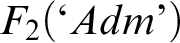 ${F}_2(\text{`} Adm\text{'})$
to ‘Adm’, and for each interpretation
${F}_2(\text{`} Adm\text{'})$
to ‘Adm’, and for each interpretation $F\in {F}_2(\text{`} Adm\text{'})$
, the sentence B(0) is true relative to F.
$F\in {F}_2(\text{`} Adm\text{'})$
, the sentence B(0) is true relative to F.
For instance, if for all ${F}_2\in {Adm}_2$
and all
${F}_2\in {Adm}_2$
and all $F\in {F}_2(\text{`} Adm\text{'})$
it holds that 0∈F(B), it is also going to be the case that
$F\in {F}_2(\text{`} Adm\text{'})$
it holds that 0∈F(B), it is also going to be the case that ${Det}_2(\text{`} Det(\text{`}B(0)\text{'})\text{'})$
, which in turn implies (by the definitions sketched before) that
${Det}_2(\text{`} Det(\text{`}B(0)\text{'})\text{'})$
, which in turn implies (by the definitions sketched before) that ${Det}_2(\text{`} True\hbox{-} in\hbox{-} L(\text{`}B(0)\text{'})\text{'})$
and True-in-
${Det}_2(\text{`} True\hbox{-} in\hbox{-} L(\text{`}B(0)\text{'})\text{'})$
and True-in- ${L}_2(\text{`} Det(\text{`}B(0)\text{'})\text{'})$
, and hence also that True-in-
${L}_2(\text{`} Det(\text{`}B(0)\text{'})\text{'})$
, and hence also that True-in- ${L}_2(\text{`} True\hbox{-} in\hbox{-} L(\text{`}B(0)\text{'})\text{'})$
. In plain words, and using operator-talk: having no hair at all on one’s head is not just a case of being bald (True-in-
${L}_2(\text{`} True\hbox{-} in\hbox{-} L(\text{`}B(0)\text{'})\text{'})$
. In plain words, and using operator-talk: having no hair at all on one’s head is not just a case of being bald (True-in- ${L}_2(\text{`} True\hbox{-} in\hbox{-} L(\text{`}B(0)\text{'})\text{'})$
) but also one of being determinately bald (
${L}_2(\text{`} True\hbox{-} in\hbox{-} L(\text{`}B(0)\text{'})\text{'})$
) but also one of being determinately bald ( ${Det}_2(\text{`} True\hbox{-} in\hbox{-} L(\text{`}B(0)\text{'})\text{'})$
and True-in-
${Det}_2(\text{`} True\hbox{-} in\hbox{-} L(\text{`}B(0)\text{'})\text{'})$
and True-in- ${L}_2(\text{`} Det(\text{`}B(0)\text{'})\text{'})$
) and of being determinately determinately bald (
${L}_2(\text{`} Det(\text{`}B(0)\text{'})\text{'})$
) and of being determinately determinately bald ( ${Det}_2(\text{`} Det(\text{`}B(0)\text{'})\text{'})$
).
${Det}_2(\text{`} Det(\text{`}B(0)\text{'})\text{'})$
).
More generally, from the axioms and assumptions above one can derive every instance of the four material conditional claims
 $$\begin{align*}{\displaystyle \begin{array}{ccc}& \to {Det}_2(\text{`} True\hbox{-} in\hbox{-} L(\text{`}A\text{'})\text{'})\to & \\ {}{Det}_2(\text{`} Det(\text{`}A\text{'})\text{'})& & True\hbox{-} in\hbox{-} {L}_2(\text{`} True\hbox{-} in\hbox{-} L(\text{`}A\text{'})\text{'})\\ {}& \to True\hbox{-} in\hbox{-} {L}_2(\text{`} Det(\text{`}A\text{'})\text{'})\to & \end{array}},\end{align*}$$
in which ‘A’ may be replaced by an arbitrary sentence of L. The converses of these claims are not necessarily derivable, nor is there any guarantee for all instances of ‘ ${Det}_2(\text{`} True\hbox{-} in\hbox{-} L(\text{`}A\text{'})\text{'})$
→True-in-
${Det}_2(\text{`} True\hbox{-} in\hbox{-} L(\text{`}A\text{'})\text{'})$
→True-in- ${L}_2(\text{`} Det(\text{`}A\text{'})\text{'})\text{'}$
or its converses to be derivable. (But if one assumes
${L}_2(\text{`} Det(\text{`}A\text{'})\text{'})\text{'}$
or its converses to be derivable. (But if one assumes $\text{`}{Det}_2(\text{`} Det(\text{`}A\text{'})\text{'})\text{'}$
, then both conditionals can be derived from that assumption.)
$\text{`}{Det}_2(\text{`} Det(\text{`}A\text{'})\text{'})\text{'}$
, then both conditionals can be derived from that assumption.)
By unpacking the two truth predicates and the determinacy predicate ‘Det’ in the four conditionals above, one may reformulate the conditionals as statements involving epsilon terms. In the case of semantic indeterminacy, these epsilon terms cannot be replaced salva veritate by terms with a unique factually determined intended interpretation. And the same holds for ‘ ${Det}_2$
’, if ‘conforms to the existing metametasemantic constraints on the interpretation of
${Det}_2$
’, if ‘conforms to the existing metametasemantic constraints on the interpretation of ${L}_2$
’ and hence ‘
${L}_2$
’ and hence ‘ ${Adm}_2$
’ turn out to be indeterminate, too (which may or may not be the case). In order to be prepared for that possibility, Ramsification may be repeated on the next level (on which
${Adm}_2$
’ turn out to be indeterminate, too (which may or may not be the case). In order to be prepared for that possibility, Ramsification may be repeated on the next level (on which ${L}_3$
would be interpreted), and so forth, throughout the Tarskian hierarchy—if necessary including levels of transfinite ordinals α. In short: classical semantics ought to be Ramsified at any ordinal level of metameta…metalanguage of L if one wants to stay on the safe side.Footnote
34
Figure 2 shows what the resulting structure of intended interpretations
${L}_3$
would be interpreted), and so forth, throughout the Tarskian hierarchy—if necessary including levels of transfinite ordinals α. In short: classical semantics ought to be Ramsified at any ordinal level of metameta…metalanguage of L if one wants to stay on the safe side.Footnote
34
Figure 2 shows what the resulting structure of intended interpretations $I,{I}_2,{I}_3,\dots$
(of, respectively,
$I,{I}_2,{I}_3,\dots$
(of, respectively, $L,{L}_2,{L}_3,\dots$
) and corresponding non-empty classes
$L,{L}_2,{L}_3,\dots$
) and corresponding non-empty classes $Adm,{Adm}_2,{Adm}_3,\dots$
looks like, where each intended interpretation
$Adm,{Adm}_2,{Adm}_3,\dots$
looks like, where each intended interpretation $I,{I}_2,{I}_3,\dots$
gets ‘picked’ by an epsilon term from its corresponding set
$I,{I}_2,{I}_3,\dots$
gets ‘picked’ by an epsilon term from its corresponding set $Adm,{Adm}_2,{Adm}_3,\dots$
of admissible interpretations (the ‘picking’ being visualized by arrows), and where in turn each such set of admissible interpretations coincides with
$Adm,{Adm}_2,{Adm}_3,\dots$
of admissible interpretations (the ‘picking’ being visualized by arrows), and where in turn each such set of admissible interpretations coincides with ${I}_2(\text{`}Adm\text{'}),{I}_3(\text{`}{Adm}_2\text{'}),{I}_4(\text{`}{Adm}_3\text{'}),\dots,$
respectively.
${I}_2(\text{`}Adm\text{'}),{I}_3(\text{`}{Adm}_2\text{'}),{I}_4(\text{`}{Adm}_3\text{'}),\dots,$
respectively.
On each level, hypotheses concerning the corresponding class of admissible interpretation may be added to the respective metameta…-theory. E.g., as far as the ‘B’ in the baldness case is concerned, the following kind of axiom would be plausible for each n ≥ 2 (where ${F}_1 = F$
):
${F}_1 = F$
):
 $$\begin{align*}\mathrm{for}\;\mathrm{all}\;{F}_{\mathrm{n}}\in {Adm}_{\mathrm{n}},\mathrm{for}\;\mathrm{all}\;{F}_{\mathrm{n}\hbox{-} 1}\in {F}_{\mathrm{n}}(\text{`}{Adm}_{\mathrm{n}\hbox{-} 1}\text{'}),\dots, \mathrm{for}\;\mathrm{all}\;F\in {F}_2(\text{`} Adm\text{'}):0\in F(B).\end{align*}$$
Ramsey semantics throughout the Tarskian hierarchy.

But generally one should not expect all plausible hypotheses concerning ( ${L}_{\mathrm{n}}$
-)admissible interpretations in
${L}_{\mathrm{n}}$
-)admissible interpretations in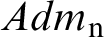 ${Adm}_{\mathrm{n}}$
to be added as axioms to one’s semantic metameta…-theory at level n+1: after all, assumptions concerning (
${Adm}_{\mathrm{n}}$
to be added as axioms to one’s semantic metameta…-theory at level n+1: after all, assumptions concerning ( ${L}_{\mathrm{n}}$
-)admissible interpretations do not belong to semantics proper (recall Section 1), and one might not be confident enough of them to ‘dignify’ them with the status of provability in one’s metameta…-theory.
${L}_{\mathrm{n}}$
-)admissible interpretations do not belong to semantics proper (recall Section 1), and one might not be confident enough of them to ‘dignify’ them with the status of provability in one’s metameta…-theory.
Acknowledgments
I am very grateful for comments on previous versions of this paper by members of the Diaphora Network, in particular Ali Abasnezhad, Manuel García-Carpintero, Peter Pagin, and Sven Rosenkranz, as well as by members of the DFG Formalization project and the MCMP, in particular Marianna Antonutti Marfori, Ivano Ciardelli, Pablo Cobreros, Martin Fischer, Norbert Gratzl, Gerhard Heinzmann, Bruno Jacinto, Gil Sagi, Georg Schiemer, and by the audience at talks that I have given on this topic at Wuhan, Prague, Wroclaw, Berlin, Munich, Saarbrücken, Barcelona, Salzburg, and Nancy. Work on this paper has received funding from the European Union's Horizon 2020 Research and Innovation programme under Grant Agreement no. 675415 and was funded by a project grant by the German Research Foundation: Gefördert durch die Deutsche Forschungsgemeinschaft (DFG) - Projektnummer 390218268.





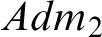


 Open access

